
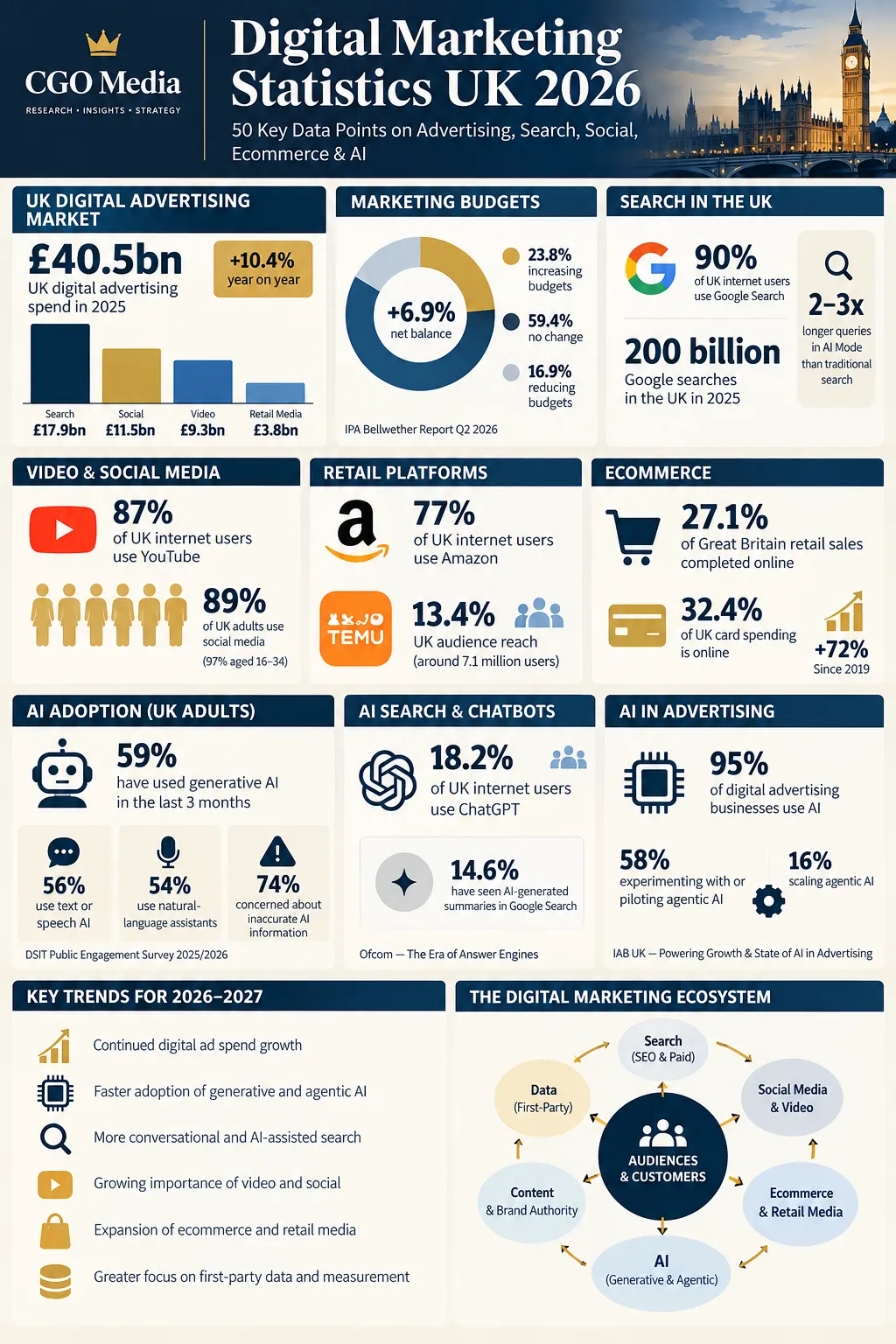
Digital marketing in the UK is entering another structural period of change.
Advertising investment continues to move towards digital channels, consumers spend several hours online every day, ecommerce remains embedded in retail behaviour, video and social media continue to attract advertising investment, and generative AI is beginning to change how people search for information, discover brands and evaluate products and services.
For businesses, the challenge is no longer simply deciding whether digital marketing matters.
The more important questions are where investment is moving, which channels are attracting consumer attention, how search and discovery are changing, and how organisations should allocate budgets across an increasingly fragmented digital ecosystem.
Central Research Finding
UK digital marketing investment continues to expand, but growth is becoming increasingly concentrated around measurable, data-rich and high-engagement environments including search, social video, retail media and AI-enabled advertising and discovery systems.
Executive Summary
The latest available evidence shows the scale of the UK digital marketing economy.
- UK digital advertising expenditure reached £40.5 billion in 2025.
- The market grew by 10% year on year.
- IAB UK forecasts digital advertising expenditure of approximately £44.7 billion in 2026.
- The same forecast places the market at approximately £49.1 billion by 2027.
- 57% of surveyed industry respondents expected digital advertising budgets to increase during 2026.
- Almost half — 48% — identified AI and automation as a defining force shaping the advertising sector over the coming decade.
- UK companies continued increasing marketing budgets in Q2 2026 despite weaker economic confidence.
The statistics suggest that digital marketing is not simply receiving more investment.
The composition of that investment is also changing.
↓
Increasing Digital Investment
↓
Data-Rich Advertising Channels
↓
AI & Automation
↓
Search & Recommendation-Led Discovery
↓
A More Integrated Digital Marketing Ecosystem
The 50 Statistics in This Report
| Statistics | Research Area | Primary Focus |
|---|---|---|
| 1–10 | UK Digital Marketing Market & Investment | Market size, growth, forecasts and marketing budgets |
| 11–20 | Search, SEO & Paid Search | Search investment, audience behaviour and discovery |
| 21–30 | Social Media, Video & Content | Social investment, video, creators and audience attention |
| 31–40 | Ecommerce, Retail Media & Consumer Behaviour | Online retail, commerce, retail media and digital purchasing |
| 41–50 | AI Search, Generative AI & Future Digital Marketing | AI adoption, AI search, automation and emerging discovery |
Research Scope
This report prioritises measurable UK evidence from organisations including IAB UK, the Institute of Practitioners in Advertising, Ofcom, the Office for National Statistics and other primary research providers.
Where international platform data is used later in the report, it is identified clearly and is not presented as UK population data.
Important methodology note: IAB UK introduced an updated Digital Adspend methodology with Oliver Wyman from H1 2025 and restated 2024 estimates for like-for-like comparison. IAB advises that figures produced under the new methodology should not be directly reconciled with older editions of the study.
Statistics 1–10 — UK Digital Marketing Market & Investment
The first ten statistics establish the scale and direction of the UK digital marketing economy.
They show a market continuing to expand despite economic uncertainty, with businesses maintaining marketing investment while advertisers increasingly focus on digital environments capable of combining audience reach, targeting, measurement and commercial outcomes.
1. UK digital advertising expenditure reached £40.5 billion in 2025
The UK digital advertising market reached £40.5 billion in 2025, according to IAB UK’s Digital Adspend study conducted with Oliver Wyman.
Crossing the £40 billion threshold illustrates the scale digital advertising has achieved within the UK economy.
Digital marketing is no longer a supplementary advertising category sitting alongside traditional media. It now represents a substantial commercial ecosystem encompassing search, social platforms, video, retail media, digital out-of-home, gaming and other online advertising environments.
Business implication: Digital channels now operate at a level of investment where individual businesses are competing within highly developed and increasingly sophisticated advertising markets.
Source: IAB UK / Oliver Wyman, Digital Adspend 2025, published March 2026.
2. The UK digital advertising market grew 10% in one year
UK digital advertising expenditure increased by 10% year on year in 2025.
This is significant because growth occurred despite a more challenging economic environment.
IAB UK noted that the digital advertising market expanded substantially faster than UK GDP during the same period.
The result suggests that advertisers continued prioritising digital channels even while wider economic growth remained comparatively subdued.
Investment implication: Digital advertising continued taking a larger role within business marketing activity rather than simply tracking wider economic growth.
Source: IAB UK / Oliver Wyman, Digital Adspend 2025.
3. Digital advertising growth substantially outpaced UK GDP growth
IAB UK compared digital advertising growth of 10% with UK GDP growth of 1.4% in 2025.
The two measures represent different economic concepts and should not be compared as though they are directly equivalent markets.
However, the gap helps illustrate the relative pace at which spending continues to move towards digital advertising.
Advertisers are following audiences into digital environments where activity can increasingly be targeted, measured and connected with commercial outcomes.
Strategic implication: Digital marketing investment is expanding considerably faster than the underlying economy, increasing competition for digital attention.
Source: IAB UK / Oliver Wyman, Digital Adspend 2025.
4. UK digital advertising expenditure is forecast to reach £44.7 billion in 2026
IAB UK forecasts that the UK digital advertising market will grow by 10.3% in 2026 to approximately £44.7 billion.
If realised, this would add more than £4 billion to annual digital advertising investment in a single year.
The forecast suggests that the structural movement towards digital advertising is expected to continue despite uncertainty across the wider economy.
Market implication: Businesses should expect competition for paid digital visibility to continue increasing rather than assuming advertising demand will remain static.
Source: IAB UK / Oliver Wyman, Digital Adspend 2025.
5. UK digital advertising expenditure is forecast to reach £49.1 billion by 2027
IAB UK’s current forecast places the UK digital advertising market at approximately £49.1 billion in 2027.
That would put annual expenditure close to the £50 billion threshold only two years after the market first passed £40 billion.
Forecasts can change with economic conditions and should not be treated as guaranteed outcomes.
Nevertheless, the direction of travel remains important for organisations planning medium-term marketing budgets.
Planning implication: Digital competition is likely to intensify as more advertiser expenditure moves into search, video, social, retail media and other online channels.
Source: IAB UK / Oliver Wyman, Digital Adspend 2025.
6. 57% of industry respondents expect digital advertising budgets to increase in 2026
57% of respondents to IAB UK’s industry sentiment research expected digital advertising budgets to increase during 2026.
This is a forward-looking sentiment measure rather than independently verified future expenditure.
It nevertheless supports the market forecast by showing that increased spending expectations are widespread among industry participants.
Video, retail media and digital out-of-home were among the areas expected to record particularly strong gains.
Budget implication: More than half of respondents expected digital budgets to rise, increasing pressure on businesses to allocate investment according to measurable commercial value rather than simply maintaining historical channel splits.
Source: IAB UK / Oliver Wyman, Digital Adspend industry sentiment survey, 2026.
7. 48% identify AI and automation as a defining force for digital advertising
48% of respondents to IAB UK’s industry research identified AI and automation as one of the forces expected to define the advertising sector over the next decade.
AI is already affecting media buying, campaign optimisation, creative production, targeting, measurement and audience discovery.
The significance of the finding is therefore not limited to generative content creation.
AI is increasingly becoming infrastructure within digital marketing systems themselves.
Technology implication: AI should increasingly be considered part of marketing operations, measurement and discovery rather than treated only as a separate experimental marketing channel.
Source: IAB UK / Oliver Wyman, Digital Adspend industry sentiment research, 2026.
8. UK digital advertising spend reached £21.8 billion in the second half of 2025
Digital advertising expenditure reached £21.8 billion during H2 2025, compared with £18.7 billion during H1.
The second half of the year therefore accounted for the larger share of total annual digital advertising expenditure.
Some seasonality is expected because the second half contains major retail and advertising periods including Black Friday, Christmas and other year-end commercial activity.
Planning implication: Annual averages can disguise substantial differences in advertising intensity across the year, making seasonal budget planning important for many sectors.
Source: IAB UK / Oliver Wyman, Digital Adspend 2025.
9. UK marketing budgets recorded a +6.9% net balance in Q2 2026
The IPA Bellwether Report recorded a net balance of +6.9% for UK marketing budgets in Q2 2026.
The Bellwether net balance measures the difference between the proportion of surveyed companies reporting increased marketing budgets and the proportion reporting cuts.
The +6.9% result followed +7.3% in Q1 and represented what the IPA described as the second-highest level of budget expansion in two years.
This occurred despite continuing economic and inflationary pressures.
Market implication: UK businesses collectively continued expanding marketing budgets through the first half of 2026 rather than responding to uncertainty with widespread reductions.
Source: IPA Bellwether Report, Q2 2026, researched by S&P Global.
10. 23.8% of UK companies increased marketing budgets in Q2 2026
23.8% of companies in the Q2 2026 IPA Bellwether survey reported increasing marketing expenditure.
By comparison, 16.9% reported budget reductions, while approximately 59.4% left budgets unchanged.
The data provides useful context around the +6.9% net balance.
The market is not experiencing universal expansion. Most companies maintained existing budgets, but businesses increasing investment outnumbered those making cuts.
Investment implication: Marketing investment remained resilient, but businesses were also selective — a pattern that increases the importance of demonstrating measurable performance and return on marketing expenditure.
Source: IPA Bellwether Report, Q2 2026.
What Statistics 1–10 Tell Us
The first ten statistics establish that UK digital marketing remains a large and expanding commercial market.
Three developments are particularly important.
First, digital advertising growth continues to outpace the wider UK economy.
Second, industry forecasts indicate that annual digital advertising expenditure could approach £50 billion by 2027.
Third, marketing budgets remained comparatively resilient during the first half of 2026 even as economic confidence weakened.
The market therefore appears to be moving through a period of selective expansion rather than indiscriminate spending growth.
Businesses increasingly need to demonstrate why investment belongs in a particular channel, campaign or platform.
The emerging investment model can be represented as:
↓
Growing Advertiser Investment
↓
More Competition for Attention
↓
Greater Measurement Pressure
↓
More Selective Budget Allocation
↓
Performance + Brand + Data + AI
The principal findings from Statistics 1–10 are:
- The UK digital advertising market has passed £40 billion annually.
- Digital advertising grew 10% during 2025.
- Growth substantially exceeded UK GDP growth during the same period.
- The market is forecast to reach approximately £44.7 billion in 2026.
- It is forecast to reach approximately £49.1 billion in 2027.
- A majority of surveyed industry respondents expect digital budgets to increase.
- AI and automation are increasingly viewed as structural forces within advertising.
- Advertising activity remained particularly strong during the second half of 2025.
- UK marketing budgets continued expanding during Q2 2026.
- Companies increasing marketing investment continued to outnumber those reducing it.
The next question is where this investment is going. Search remains the largest individual component of UK digital advertising expenditure, making search visibility, paid search and the changing relationship between SEO and AI-assisted discovery central to the next section.
Statistics 11–20 — Search, SEO & Paid Search
Search remains the largest individual category within UK digital advertising and one of the most widely used routes into online information, products and services.
At the same time, search itself is changing.
Traditional search-result pages increasingly coexist with AI Overviews, conversational AI Mode, AI chatbots and other answer-led discovery interfaces.
For marketers, this means search investment can no longer be viewed solely through the traditional separation of organic SEO and paid search.
Businesses increasingly need to consider how visibility is distributed across paid listings, conventional organic results, local results, AI-generated summaries and conversational search experiences.
Research note: There is no equivalent official national UK census measuring total business expenditure on SEO in the same way that IAB UK measures paid digital advertising. This report therefore does not invent a UK “SEO market size”. Instead, the SEO analysis is grounded in measurable search usage, advertising investment and changes to search-result interfaces.
11. UK search advertising expenditure reached £17.9 billion in 2025
Search advertising attracted £17.9 billion of UK digital advertising expenditure during 2025.
Search remained the largest individual category measured within IAB UK’s Digital Adspend study.
The figure demonstrates the commercial importance advertisers continue to place on reaching users at the point where they are actively expressing needs, comparing options or searching for products and services.
Marketing implication: Search remains one of the largest pools of measurable commercial intent in UK digital marketing.
Source: IAB UK / Oliver Wyman, Digital Adspend 2025.
12. Search accounts for 44% of all UK digital advertising expenditure
Search represented 44% of total UK digital advertising spend in 2025.
Almost £1 in every £2 spent on digital advertising therefore went into the search category as defined by IAB UK.
Search’s share remains substantial even as social media, video and retail media continue growing rapidly.
Budget implication: Search continues to occupy a central position within UK digital media planning despite increased competition from newer formats.
Source: IAB UK / Oliver Wyman, Digital Adspend 2025.
13. UK search advertising expenditure grew 6% year on year
Search advertising investment increased by 6% during 2025.
The category therefore continued to grow even though its expansion was slower than the 10% growth recorded across the overall digital advertising market.
That difference reflects the increasing contribution of faster-growing areas such as video, social and retail media.
Market implication: Paid search is still expanding, but businesses are operating within a broader digital ecosystem where other channels are capturing an increasing share of incremental investment.
Source: IAB UK / Oliver Wyman, Digital Adspend 2025.
14. UK search advertising attracted £8.3 billion in the first half of 2025 alone
Search advertising expenditure reached £8.3 billion in H1 2025.
At the halfway point of the year, search already accounted for 44% of the £18.7 billion UK digital advertising market recorded during the six-month period.
The full-year result subsequently reached £17.9 billion.
Commercial implication: Search attracts sustained advertiser investment throughout the year rather than relying on a small number of seasonal campaigns.
Source: IAB UK / Oliver Wyman, H1 2025 Digital Adspend.
15. Google Search reaches 82% of UK online adults
Ofcom reported that Google Search was used by 82% of UK online adults in May 2025.
Google Search therefore continues to reach approximately four in five UK online adults.
The figure helps explain why both organic and paid Google visibility remain commercially important despite the emergence of generative-AI alternatives.
SEO implication: Traditional search visibility still reaches an exceptionally broad UK audience and should not be abandoned simply because AI search is growing.
Source: Ofcom, Online Nation 2025, using Ipsos iris audience measurement.
16. Google processes approximately 3 billion UK searches per month
Ofcom describes Google as the UK’s most-used search service, with approximately 3 billion searches per month.
This illustrates the enormous continuing volume of conventional search activity taking place even as generative AI changes the format of some search experiences.
Three billion monthly searches represents repeated information-seeking behaviour rather than simply audience reach.
Search implication: The opportunity around organic and paid search remains substantial because traditional search volume continues at very large scale.
Source: Ofcom, Online Nation 2025.
17. 95% of UK internet users aged 8–14 use Google Search
Ofcom reported that 95% of UK internet users aged 8–14 use Google Search.
The figure demonstrates that search behaviour is deeply established even among younger internet users whose wider media habits are increasingly video-led and mobile-first.
This audience will also mature alongside AI-generated search interfaces, creating a generation accustomed to moving between conventional search, video discovery and AI-assisted answers.
Long-term implication: Search is unlikely to disappear as younger audiences mature, but the form of search they expect is likely to continue changing.
Source: Ofcom, Online Nation 2025.
18. Around 30% of searches now display AI Overviews
Ofcom reported that approximately 30% of searches now display an AI-generated overview.
This means AI-assisted search is no longer limited to users who actively open ChatGPT, Gemini or another dedicated generative-AI service.
Generated answers increasingly appear inside the conventional search environment itself.
For SEO, this changes the search-results landscape because an organic result may now coexist with an AI-generated response built from selected sources.
Visibility implication: Search strategy increasingly needs to consider both ranking visibility and whether information is eligible to contribute to answer-led search experiences.
Source: Ofcom, Online Nation 2025.
19. 53% of UK adults say they often see AI-generated search summaries
More than half of UK adults — 53% — say they often encounter AI-generated summaries when searching.
Ofcom notes that in many cases users are not deliberately seeking out these AI-generated experiences.
They encounter them because the search service integrates them into the normal results journey.
Marketing implication: AI search is becoming relevant to mainstream digital marketing even among audiences that do not consider themselves users of dedicated AI platforms.
Source: Ofcom, Online Nation 2025.
20. Early Google AI Mode users asked questions two to three times longer than traditional searches
When Google introduced AI Mode to the UK in July 2025, it reported that early AI Mode users were asking questions approximately two to three times longer than traditional search queries.
Longer queries allow users to communicate more complete requirements.
Instead of searching:
SEO company Manchester
a user can increasingly ask:
Which Manchester SEO agencies specialise in B2B companies, publish original AI-search research and have experience with enterprise technical SEO?
The second query contains several criteria against which potential providers can be evaluated.
SEO implication: Search optimisation increasingly needs to explain who an organisation serves, what it specialises in and what evidence supports its suitability — not merely repeat a short keyword phrase.
Source: Google UK, AI Mode Now Available on Google Search in the UK, July 2025.
What Statistics 11–20 Tell Us
The second group of statistics reveals a search market experiencing two developments simultaneously.
Traditional search remains commercially enormous.
UK advertisers spent £17.9 billion on search advertising in 2025, Google Search continues to reach four in five online adults, and approximately three billion UK Google searches take place each month.
At the same time, the interface through which those searches are answered is changing.
AI Overviews now appear across a meaningful proportion of searches, more than half of UK adults report encountering AI-generated summaries frequently, and AI Mode encourages longer and more complex questions.
The search ecosystem can therefore be represented as:
↓
Paid Search + Organic Results
+
AI-Generated Answers
+
Conversational Follow-Ups
↓
Integrated Search Discovery
The principal findings from Statistics 11–20 are:
- Search remains the largest UK digital advertising category.
- Search accounts for 44% of total digital ad expenditure.
- Paid search expenditure continues to grow.
- Google Search maintains extremely high UK audience reach.
- UK Google search volume remains enormous.
- Search is deeply established among younger internet users.
- AI-generated answers are becoming integrated into conventional search.
- AI search therefore reaches beyond dedicated chatbot users.
- Users are increasingly encountering generated summaries during ordinary searches.
- Conversational search enables substantially longer and more detailed expressions of intent.
The implication for UK marketers is not that SEO is being replaced by AI or that paid search is becoming irrelevant.
Instead, search marketing is widening.
Businesses increasingly need to combine paid search visibility, organic SEO, strong entity information and AI-search readiness rather than treating each as an isolated discipline.
Statistics 21–30 — Social Media, Video & Content Marketing
Social media and video are absorbing an increasing share of UK digital marketing investment.
This reflects a wider change in audience behaviour.
Consumers increasingly discover information, entertainment, products, brands and creators within feeds and video platforms rather than navigating directly to publisher or business websites.
For marketers, this makes content format increasingly important.
Static content still has a role, but advertising investment and audience attention are moving strongly towards video, creator-led formats and platform-native content.
Research context: Investment statistics in this section come primarily from IAB UK’s 2025 Digital Adspend study, while audience behaviour is drawn from Ofcom’s Online Nation 2025 and Adults’ Media Use and Attitudes 2026 research.
21. UK social media advertising expenditure reached £11.5 billion in 2025
UK advertisers spent £11.5 billion on social media advertising during 2025.
Social media has therefore developed into one of the largest categories within UK digital advertising.
The figure reflects the scale of platforms combining audience reach, creator content, video, commerce and algorithmic distribution within a single environment.
Marketing implication: Social media is no longer simply an engagement or community channel; it represents a major paid-media marketplace competing directly for substantial advertising budgets.
Source: IAB UK / Oliver Wyman, Digital Adspend 2025.
22. Social media accounts for 28% of UK digital advertising expenditure
Social media represented 28% of the UK’s £40.5 billion digital advertising market in 2025.
More than one quarter of UK digital advertising expenditure therefore flows through social platforms.
This places social media firmly alongside search as one of the major investment centres in digital marketing.
Budget implication: Social platforms now compete for a significant proportion of digital marketing budgets, making channel selection and platform-specific performance measurement increasingly important.
Source: IAB UK / Oliver Wyman, Digital Adspend 2025.
23. UK social media advertising spend increased 21% in one year
Social media advertising expenditure grew by 21% year on year during 2025.
This was more than twice the 10% growth recorded across the UK digital advertising market overall.
The difference demonstrates that social platforms continue capturing a disproportionately large share of incremental advertising investment.
Growth implication: Social advertising is expanding faster than the wider digital market, increasing competition for attention within platform feeds.
Source: IAB UK / Oliver Wyman, Digital Adspend 2025.
24. Video now represents 59% of all social media advertising investment
Video accounted for 59% of total social-platform advertising investment in 2025.
Video therefore receives the majority of advertising expenditure within social media environments.
This is important for content strategy because platform algorithms and audience behaviour increasingly favour visually rich, high-engagement formats.
The growth also reflects the influence of creators, short-form video and increasingly sophisticated video advertising products.
Content implication: Businesses treating social media primarily as a static-image or link-distribution channel risk misaligning their creative strategy with the direction of advertiser investment.
Source: IAB UK / Oliver Wyman, Digital Adspend 2025.
25. UK video advertising expenditure reached £9.3 billion in 2025
UK video advertising investment reached £9.3 billion during 2025.
IAB UK’s video category spans social platforms, broadcasters, streaming services and publishers.
The figure shows how video is becoming an increasingly important format across multiple digital channels rather than belonging to a single platform category.
Format implication: Video increasingly operates as a cross-channel marketing format spanning brand advertising, performance marketing, social media and streaming environments.
Source: IAB UK / Oliver Wyman, Digital Adspend 2025.
26. UK video advertising expenditure grew 20% year on year
Video advertising grew by 20% during 2025.
This made video one of the fastest-growing major formats in UK digital advertising.
The growth was twice the overall market rate of 10%.
Advertisers are therefore not simply shifting budgets online; they are disproportionately increasing expenditure on formats capable of combining sight, sound, motion and storytelling.
Creative implication: Video capability is becoming increasingly important within digital marketing teams because investment is growing considerably faster than the wider market.
Source: IAB UK / Oliver Wyman, Digital Adspend 2025.
27. Video now accounts for 23% of all UK digital advertising spend
Video represented 23% of total UK digital advertising expenditure in 2025.
Nearly one quarter of all digital advertising investment is therefore now associated with video formats.
IAB UK also reports that TV+ environments account for 34% of total video investment, illustrating the continued convergence between digital advertising, streaming and traditional television environments.
Media implication: The distinction between television advertising, online video and social video is becoming less useful as audiences and advertiser investment move across connected screens and platforms.
Source: IAB UK / Oliver Wyman, Digital Adspend 2025.
28. YouTube reaches 94% of UK online adults
Ofcom reported that YouTube reached 94% of UK online adults in May 2025.
This makes YouTube one of the highest-reaching online services in the UK.
Its role also extends beyond entertainment.
Users increasingly use video platforms for product research, tutorials, news, education, reviews and discovery.
Content implication: Video content can operate simultaneously as entertainment, search content, brand communication and product research.
Source: Ofcom, Online Nation 2025, using Ipsos iris audience measurement.
29. UK online adults spend an average of 51 minutes per day on YouTube
Average YouTube usage reached 51 minutes per day among UK online adults in May 2025, excluding viewing on television sets.
The figure increased from 47 minutes per day a year earlier.
Importantly, this measure excludes YouTube viewed on a television screen, meaning total cross-device exposure can be higher.
Ofcom’s separate Media Nations research also shows continued growth in YouTube viewing through household television sets.
Attention implication: YouTube commands substantial daily audience time, making it an important environment for both paid advertising and organic video content.
Source: Ofcom, Online Nation 2025, using Ipsos iris.
30. 89% of UK adult internet users use social media, rising to 97% among 16–34-year-olds
Ofcom’s 2026 research found that 89% of UK adult internet users use at least one social media platform, rising to 97% among users aged 16–34.
Social media therefore remains close to universal among younger adult internet users.
However, the nature of participation is changing.
Ofcom found that only 49% of adult social-media users were actively posting, sharing or commenting, down from 61% the previous year.
This suggests that social media consumption is becoming more passive even as platform reach remains extremely high.
Content implication: Businesses should distinguish between audience reach and active participation. Large audiences may increasingly consume content without publicly interacting with it.
Source: Ofcom, Adults’ Media Use and Attitudes 2026.
What Statistics 21–30 Tell Us
The third group of statistics shows a clear shift in both advertiser investment and audience attention.
Social media already represents more than one quarter of UK digital advertising expenditure, while video represents almost one quarter of the entire digital market.
Both categories are growing substantially faster than digital advertising overall.
Within social media itself, video now attracts the majority of advertising investment.
At the same time, YouTube reaches almost the entire UK online adult population and commands significant daily viewing time.
The result is a content environment increasingly shaped by feeds, creators, algorithms and video.
↓
Algorithmic Content Distribution
↓
More Video Consumption
↓
More Advertiser Investment
↓
Creator & Platform-Native Content
↓
Attention-Led Digital Marketing
The principal findings from Statistics 21–30 are:
- UK social-media advertising has passed £11 billion annually.
- Social media accounts for 28% of total digital advertising expenditure.
- Social advertising is growing more than twice as fast as the total digital market.
- Video now represents the majority of social-platform advertising investment.
- Total UK video advertising has reached £9.3 billion.
- Video advertising is growing at approximately twice the wider market rate.
- Video accounts for almost one quarter of UK digital advertising investment.
- YouTube reaches 94% of UK online adults.
- UK online adults spend close to an hour per day on YouTube before TV-set viewing is included.
- Social-media reach remains extremely high even as active posting and commenting decline.
For content marketing, the message is significant.
Producing useful written content remains valuable for search, authority and AI-source visibility, but distribution increasingly requires multiple formats.
One strong research asset can increasingly be repurposed into:
- Articles.
- Short-form video.
- Long-form video.
- Social posts.
- Infographics.
- Creator collaborations.
- Newsletters.
- AI-readable research assets.
The strongest content strategies are therefore increasingly multi-format rather than single-channel, combining searchable authority content with the visual and platform-native formats where audiences increasingly spend their attention.
Statistics 31–40 — Ecommerce, Retail Media & Consumer Behaviour
Ecommerce is no longer a separate digital channel sitting alongside physical retail.
For many consumers, online and offline shopping now form part of the same buying journey.
Retailers, marketplaces and commerce platforms increasingly combine product discovery, advertising, customer data, transactions and measurement within the same environment.
This helps explain the rapid growth of retail media: advertisers can reach consumers close to the point of purchase while using first-party retail data and closed-loop measurement to evaluate commercial outcomes.
Research context: The statistics below use three different measures: retail advertising expenditure, the proportion of Great Britain retail sales completed online, and online card-spending behaviour. These are related but not interchangeable. Card-not-present spending includes categories beyond retail and should not be treated as identical to ecommerce retail sales.
31. UK retail media advertising expenditure reached £3.8 billion in 2025
UK retail media advertising expenditure reached £3.8 billion during 2025.
Retail media allows advertisers to reach shoppers within retailer and marketplace environments using first-party audience and purchase data.
Its rapid expansion reflects the growing value advertisers place on environments where media exposure can be connected more directly with shopping behaviour and sales outcomes.
Marketing implication: Retailers are increasingly operating as media owners as well as commerce businesses.
Source: IAB UK / Oliver Wyman, Digital Adspend 2025.
32. UK retail media grew 18% year on year
Retail media advertising expenditure increased by 18% during 2025.
That growth substantially exceeded the 10% increase recorded across the UK digital advertising market overall.
Retail media’s expansion is therefore not simply the result of the broader digital market getting larger.
It is gaining share within that market.
Investment implication: Advertisers are allocating more budget towards commerce environments that combine audience data, product discovery and measurable purchase outcomes.
Source: IAB UK, Retail Media’s £3.8bn Moment, March 2026.
33. Online sales accounted for 27.5% of Great Britain retail sales in 2025
Internet sales represented 27.5% of total Great Britain retail sales in 2025.
This means more than one quarter of retail spending continued to take place online even after the exceptional ecommerce peaks associated with the pandemic period.
The 2025 share was also slightly above the 27.1% recorded in 2024.
Commerce implication: Online retail remains structurally embedded within consumer purchasing behaviour rather than reverting to pre-pandemic levels.
Source: Office for National Statistics, Retail Sales Index, internet sales as a proportion of total retail sales.
34. Online retail accounted for 28.0% of sales in Q2 2026
Internet sales represented 28.0% of total Great Britain retail sales during Q2 2026.
The comparable share in Q2 2025 was 26.3%.
That represents a year-on-year increase of 1.7 percentage points in the proportion of retail spending taking place online.
Current-market implication: Ecommerce’s share of retail spending remains elevated in 2026 and is not showing evidence of disappearing as physical retail normalises.
Source: Office for National Statistics, Retail Sales Index, September 2026 release.
35. 50.5% of UK consumer card spending was online in September 2025
Online card transactions accounted for 50.5% of total UK consumer card spending in September 2025.
ONS defines these transactions using card-not-present payment data supplied in aggregated form by Visa.
This measure is broader than retail ecommerce because online card spending can include services, travel and other categories as well as goods.
Nevertheless, it illustrates how normal remote and online transactions have become across UK consumer spending.
Consumer implication: Online payment behaviour now represents approximately half of measured consumer card expenditure in the cited month.
Source: Office for National Statistics, Consumer Card Spending, E-commerce and Digital Trade Insights in the UK: 2019 to 2025.
36. The online share of UK consumer card spending rose from 43.7% to 50.5% between 2019 and 2025
The online card-spending ratio increased from 43.7% in September 2019 to 50.5% in September 2025.
That is an increase of 6.8 percentage points over six years.
While pandemic restrictions accelerated online spending temporarily, the longer-term data still shows a materially higher online share than before 2020.
Behaviour implication: Consumer payment behaviour has undergone a lasting structural shift towards remote and digital transactions.
Source: Office for National Statistics / Visa Europe aggregated card-payment data.
37. Average online card spending per UK cardholder is 16.7% above the 2019 average
By September 2025, average online spend per UK cardholder was 16.7% higher than the 2019 monthly average.
Face-to-face card spending increased by 6.9% over the same comparison.
These figures are in current prices and are not adjusted for inflation, so they should not be interpreted entirely as real-volume growth.
However, the stronger increase in online expenditure provides further evidence of the shift towards digital purchasing behaviour.
Spending implication: Online transactions have increased faster than face-to-face card expenditure over the longer period measured.
Source: Office for National Statistics, February 2026.
38. 47.1% of domestic UK card spending was online in 2024
The proportion of domestic UK consumer card spending taking place online reached 47.1% in 2024.
That represented an increase of 6.4 percentage points compared with 2019.
The figure is useful because it separates domestic transactions from international card spending and shows that the rise in online behaviour is visible within UK merchant activity itself.
Domestic-commerce implication: Digital purchasing has become deeply embedded within everyday UK consumer transactions.
Source: Office for National Statistics / Visa Europe card-payment data.
39. Amazon reached 88% of UK online adults in May 2025
Amazon reached 43.2 million UK online adults in May 2025, equivalent to 88% of the online adult population.
Visitors spent an average of two hours and 15 minutes on Amazon during the month.
The figures demonstrate the scale achieved by large ecommerce marketplaces as both transaction platforms and product-discovery environments.
Discovery implication: Retailers increasingly compete not only for website traffic but also for visibility within major marketplaces where consumers begin and complete purchase journeys.
Source: Ofcom, Online Nation 2025, citing Ipsos iris.
40. Temu reached 28.4 million UK online adults after adding 8.3 million users in one year
Temu reached 28.4 million UK online adults in May 2025, equivalent to 58% reach.
Its measured audience increased by 8.3 million compared with May 2024.
That made Temu the third-largest retail service in Ofcom’s ranking, behind Amazon and eBay.
The scale and speed of growth illustrates how rapidly consumer retail behaviour can shift when new marketplaces combine aggressive acquisition, mobile-first merchandising, personalised recommendation systems and price-led propositions.
Competitive implication: Digital retail markets can change quickly, and established brands increasingly compete with platforms capable of acquiring tens of millions of users in relatively short periods.
Source: Ofcom, Online Nation 2025, citing Ipsos iris.
What Statistics 31–40 Tell Us
The fourth group of statistics shows that ecommerce is now embedded within UK consumer behaviour at several different levels.
More than one quarter of Great Britain retail spending takes place online, approximately half of measured consumer card expenditure was online in September 2025, and the largest retail platforms reach tens of millions of UK consumers.
At the same time, advertising is moving closer to the point of purchase.
Retail media is growing faster than the wider digital advertising market because it combines:
- First-party customer data.
- Product discovery.
- Advertising inventory.
- Transaction behaviour.
- Closed-loop measurement.
The digital commerce environment can therefore be represented as:
↓
Marketplace or Retail Platform
↓
Product Comparison
↓
Advertising & Recommendation
↓
Transaction
↓
Measurement & First-Party Data
The principal findings from Statistics 31–40 are:
- UK retail media has reached £3.8 billion annually.
- Retail media is growing faster than digital advertising overall.
- More than one quarter of Great Britain retail sales take place online.
- The online share remained elevated through Q2 2026.
- Online transactions represent around half of measured UK consumer card spending in the cited period.
- The online share of card expenditure is materially above its 2019 level.
- Online spending per cardholder has increased faster than face-to-face spending.
- Domestic digital transactions have also grown strongly.
- Amazon reaches nearly nine in ten UK online adults.
- Newer platforms such as Temu can acquire very large UK audiences quickly.
For marketers, ecommerce strategy therefore extends beyond maintaining an online store.
Businesses increasingly need to coordinate:
- Organic product discovery.
- Paid search.
- Retail media.
- Marketplace optimisation.
- Product feeds.
- Structured product data.
- Reviews and reputation.
- First-party customer data.
- Conversion optimisation.
The strongest digital commerce strategies increasingly connect discovery, advertising, product information, transaction data and customer intelligence rather than treating each as a separate marketing function.
Statistics 41–50 — AI Search, Generative AI & Future Digital Marketing
Artificial intelligence is moving from a specialist technology category into the infrastructure of mainstream digital marketing.
Consumers are using generative AI for information, advice and research, while advertisers and technology companies are integrating AI into campaign creation, optimisation, targeting, media planning and commerce.
For marketers, this creates two connected changes.
The first is a change in consumer discovery as people increasingly use AI assistants and answer-led interfaces to research information, brands, products and services.
The second is operational: AI is increasingly being built into the systems marketers use to plan, create, buy and optimise digital advertising.
Research context: The statistics below distinguish between UK consumer AI adoption, measured AI-chatbot audiences and AI adoption inside the digital advertising industry. These are different measures and should not be combined into a single estimate of “AI marketing usage”.
41. 59% of UK adults used generative AI within the previous three months
The UK Government’s 2025/2026 Public Engagement Survey found that 59% of adults had used some form of generative AI during the previous three months.
This is a significant threshold because generative AI usage is no longer confined to a small group of technology enthusiasts.
A majority of UK adults now report recent use of systems capable of generating text, images or other content.
Marketing implication: AI-assisted research, content creation and information discovery are becoming mainstream consumer behaviours.
Source: UK Department for Science, Innovation and Technology, Public Engagement Survey 2025/2026.
42. 56% of UK adults recently used AI capable of generating human-like text or speech
56% of UK adults reported using AI that creates human-like text or speech in response to prompts or queries during the previous three months.
This category includes tools such as ChatGPT, Copilot and Gemini.
These systems are particularly relevant to digital marketing because they can operate as content tools, research assistants and information-discovery interfaces.
Discovery implication: Natural-language AI systems have reached sufficient adoption to influence how large numbers of consumers research questions, compare options and access information.
Source: UK Department for Science, Innovation and Technology, Public Engagement Survey 2025/2026.
43. 54% of UK adults recently used AI-powered digital assistants that understand natural language
54% of UK adults reported using AI-powered digital assistants capable of understanding natural language during the previous three months.
This reflects the wider transition from command-based interfaces towards systems capable of interpreting conversational language.
Natural-language interaction reduces the need for users to learn specific search syntax or navigation pathways.
Marketing implication: Brands increasingly need digital information that can be understood when consumers describe needs conversationally rather than through short keyword searches.
Source: UK Department for Science, Innovation and Technology, Public Engagement Survey 2025/2026.
44. 54% of generative-AI users in the DSIT online sample had used it for work
Among generative-AI users who completed the online element of the UK Government survey, 54% reported using generative AI for work purposes.
A larger 83% had used generative AI in a personal setting.
The work figure demonstrates that AI adoption is not limited to consumer experimentation.
It is increasingly becoming part of everyday professional workflows.
Business implication: Organisations should expect generative AI to become embedded within marketing, research, communications and operational processes rather than remaining an isolated innovation project.
Source: UK Department for Science, Innovation and Technology, Public Engagement Survey 2025/2026.
45. 74% of UK adults are concerned that AI-generated information may be inaccurate
Nearly three quarters of UK adults — 74% — expressed concern that information generated by AI could be inaccurate.
This highlights a central tension in AI adoption.
Usage is growing quickly, but trust remains conditional.
Consumers may use AI for convenience while still wanting reliable sources, evidence and the ability to verify important claims.
Content implication: As AI-generated answers become more common, credible sourcing, expert authorship, original research and transparent evidence become more valuable rather than less.
Source: UK Department for Science, Innovation and Technology, Public Engagement Survey 2025/2026.
46. 15.8 million UK online adults visited a major AI chatbot in June 2025
Ipsos iris data cited by Ofcom found that 15.8 million UK online adults visited at least one major AI chatbot during June 2025.
That represented approximately 32% of the UK online adult population.
The measured services included ChatGPT, Copilot, Gemini, DeepSeek, Perplexity, Claude.ai and Grok.
Ofcom correctly cautions that visiting an AI chatbot does not prove that every visit was for search.
Audience implication: AI chatbot platforms have already developed substantial measurable UK audiences that marketers can no longer treat as marginal.
Source: Ofcom, The Era of Answer Engines, citing Ipsos iris.
47. ChatGPT reached 13 million UK online adults in June 2025
ChatGPT reached approximately 13.0 million UK online adults in June 2025, equivalent to 26% of the measured online adult population.
Its measured audience had increased from approximately 4.4 million in June 2024.
Ofcom therefore described ChatGPT as the highest-reaching standalone AI chatbot in its comparison.
Marketing implication: AI platforms are becoming meaningful consumer-discovery environments in their own right, particularly as they incorporate live web search and source citations.
Source: Ofcom / Ipsos iris, The Era of Answer Engines.
48. 95% of UK digital advertising businesses are already using AI
IAB UK reported in 2026 that 95% of digital advertising businesses were already using artificial intelligence.
The figure demonstrates how quickly AI has moved from experimentation into operational infrastructure within the advertising sector.
Applications increasingly include creative production, campaign optimisation, audience targeting, measurement and media operations.
Industry implication: AI adoption within digital advertising is already close to universal among the businesses measured by IAB UK.
Source: IAB UK, Powering Growth: The UK’s Hidden AI Engine, May 2026.
49. 58% of IAB UK members are experimenting with or piloting agentic AI
58% of surveyed IAB UK members said they were already experimenting with or piloting agentic AI within their organisations.
A further 16% reported that they were scaling agentic systems or operating what IAB described as “agent-first” workflows.
Agentic systems differ from simpler generative tools because they can increasingly perform sequences of tasks rather than responding only to an individual prompt.
Operational implication: AI is beginning to move from assisting marketers with individual activities towards orchestrating parts of planning, optimisation and campaign execution.
Source: IAB UK, State of AI in Advertising: Charting the Shift from Automation to Autonomy, June 2026.
50. AI-driven UK digital advertising spend is forecast to reach approximately £18 billion by 2030
IAB UK forecasts that approximately £18 billion of UK digital advertising expenditure could be AI-driven by 2030.
That would represent approximately 32% of total UK digital advertising expenditure under IAB UK’s forecast.
This is a forecast rather than observed spending and should therefore be interpreted as a possible future market trajectory rather than a guaranteed outcome.
Nevertheless, it shows the scale at which AI is expected to influence media planning, creative production, targeting, optimisation and commerce.
Future implication: AI is likely to become an increasingly important operating layer within digital advertising rather than remaining a standalone technology category.
Source: IAB UK, State of AI in Advertising, June 2026.
What Statistics 41–50 Tell Us
The final ten statistics show that AI is affecting both sides of digital marketing simultaneously.
On the consumer side, generative AI has reached mainstream UK adoption, AI chatbots have developed audiences measured in the millions, and natural-language assistants are becoming familiar ways to access information.
On the industry side, AI adoption within digital advertising is already widespread, while agentic systems are beginning to move marketing automation towards greater autonomy.
The transition can therefore be represented as:
↓
AI-Assisted Discovery
↓
Changing Search & Recommendation Behaviour
+
AI-Assisted Marketing Operations
↓
Agentic Planning & Optimisation
↓
AI-Native Digital Marketing
The principal findings from Statistics 41–50 are:
- A majority of UK adults now report recent generative-AI use.
- Natural-language generative systems have become mainstream.
- AI-powered digital assistants are used by more than half of UK adults.
- Generative AI is increasingly being used in professional settings.
- Trust and accuracy remain major concerns.
- AI chatbot platforms already reach tens of millions of UK users collectively.
- ChatGPT has developed a particularly large standalone UK audience.
- AI adoption within digital advertising businesses is already extremely high.
- Agentic AI is moving from experimentation towards real operational deployment.
- A substantial share of future UK digital advertising expenditure is forecast to become AI-driven.
For marketers, the key implication is that AI should not be treated as a single new channel alongside search, social or ecommerce.
It is increasingly affecting every one of those channels.
AI influences:
- How consumers discover information.
- How brands are recommended.
- How content is produced.
- How audiences are identified.
- How advertising is bought.
- How campaigns are optimised.
- How products are discovered.
- How marketing performance is measured.
The strongest digital marketing strategies for the next phase will therefore combine human expertise, reliable data, established search and media disciplines, strong brand authority and responsible use of AI rather than treating automation as a substitute for strategy.
CGO Media Analysis — What the 50 Digital Marketing Statistics Tell Us
Taken together, the 50 statistics show that UK digital marketing is not simply growing in size.
It is becoming more integrated, more data-driven and increasingly shaped by AI-assisted discovery, automated media systems and platforms that combine advertising, content, commerce and measurement within the same environment.
The strongest change is therefore structural rather than purely numerical.
UK digital marketing is moving from a collection of separate channels towards an interconnected discovery and performance ecosystem in which search, social media, video, ecommerce, retail media, first-party data and AI increasingly influence the same customer journey.
1. Digital Marketing Is Still Expanding Faster Than the Wider Economy
The first ten statistics establish the scale of the UK digital advertising market.
Annual expenditure has moved beyond £40 billion and is forecast to continue increasing through 2026 and 2027.
The important point is not simply that more money is being spent.
Digital advertising growth has continued despite a relatively weak wider economic environment, while UK companies have also maintained positive marketing-budget expansion.
CGO Media interpretation: Digital marketing is increasingly treated as core commercial infrastructure rather than discretionary activity that businesses automatically cut when economic confidence weakens.
2. Search Remains the Largest Individual Digital Advertising Category
Search continues to command the largest share of UK digital advertising expenditure.
This matters because search captures explicit demand.
Users are often expressing a need, comparing providers, researching products or seeking information when they enter a query.
That makes search commercially different from many interruption-based advertising formats.
CGO Media interpretation: Search remains one of the clearest digital signals of active demand, which helps explain why advertisers continue allocating such substantial budgets to it.
3. Search Is Expanding Beyond Traditional SEO and PPC
The evidence also shows why businesses should avoid treating search marketing as a simple two-channel choice between SEO and paid search.
Search results increasingly include:
- Paid listings.
- Traditional organic results.
- Local results.
- Shopping results.
- AI-generated summaries.
- Conversational AI Mode responses.
This creates a wider search ecosystem in which different forms of visibility can overlap within the same customer journey.
CGO Media interpretation: Search strategy increasingly needs to combine paid visibility, organic ranking, entity clarity, structured information and AI-search readiness.
4. Social Media Is Becoming an Increasingly Expensive Attention Market
Social advertising is growing faster than the wider digital advertising market.
This indicates both strong advertiser demand and intensifying competition for audience attention.
Large user bases do not automatically make social media inexpensive or efficient.
As more advertising expenditure moves into social feeds, creative quality, targeting, platform selection and conversion performance become increasingly important.
CGO Media interpretation: Social media’s growth increases opportunity, but it also raises the cost of mediocre creative and weak campaign differentiation.
5. Video Is Becoming a Default Digital Marketing Format
Video now represents a substantial share of both social-media advertising and total UK digital advertising expenditure.
This is consistent with audience behaviour across YouTube, social feeds, streaming services and connected television.
Video is therefore becoming less of a specialist content format and more of a standard digital marketing capability.
CGO Media interpretation: Businesses increasingly need the ability to communicate the same expertise and proposition across written, visual and video formats rather than relying on text alone.
6. Content Distribution Is Becoming More Important Than Publishing Alone
High-quality content remains important for search visibility, authority, education and AI-source selection.
However, the statistics show that audiences spend large amounts of time inside social and video platforms.
Publishing an article and waiting for audiences to find it is therefore increasingly insufficient.
Strong content assets can be distributed and repurposed across:
- Search.
- LinkedIn.
- YouTube.
- Short-form video.
- Email.
- Digital PR.
- Research repositories.
- AI-readable source environments.
CGO Media interpretation: Content marketing increasingly becomes a distribution system rather than simply a publishing calendar.
7. Ecommerce Marketing Is Becoming a Media Discipline
Retail media growth illustrates one of the most important changes in ecommerce marketing.
Large retailers and marketplaces are no longer simply destinations where transactions happen.
They are becoming advertising platforms that combine:
- Audience data.
- Product discovery.
- Advertising inventory.
- Purchase behaviour.
- Conversion measurement.
This creates strong incentives for advertisers because exposure can be linked more directly with transaction outcomes.
CGO Media interpretation: Ecommerce strategy increasingly includes media buying, feed optimisation, marketplace visibility and first-party data alongside traditional website optimisation.
8. Consumer Journeys Are Becoming Less Linear
The statistics across search, social media, video and ecommerce show that consumers increasingly move between several environments before acting.
A customer may:
- Discover a brand through video.
- Search for reviews.
- Visit the website.
- Return through paid search.
- Compare products on a marketplace.
- Ask an AI assistant for a recommendation.
- Complete the purchase later.
This complicates attribution because the final click may represent only the last stage in a much longer journey.
CGO Media interpretation: Marketing performance increasingly needs to be assessed across connected customer journeys rather than assigning all value to the final measurable interaction.
9. AI Is Changing Both Marketing Operations and Consumer Discovery
AI is unusual because it is affecting both sides of the marketing system at the same time.
Consumers use AI to research, compare and discover information.
Marketers use AI to:
- Create content.
- Analyse audiences.
- Optimise advertising.
- Generate creative variations.
- Automate workflows.
- Analyse performance.
This makes AI different from the introduction of a single new advertising platform.
It is becoming infrastructure within existing platforms and workflows.
CGO Media interpretation: Businesses should think about AI horizontally across their marketing ecosystem rather than creating an isolated “AI marketing” department disconnected from search, content, advertising and commerce.
10. Trust and Authority Become More Valuable as AI Usage Grows
AI adoption is growing quickly, but UK research simultaneously shows widespread concern about the accuracy of AI-generated information.
This creates an important opportunity for organisations capable of demonstrating credible expertise.
Useful trust signals can include:
- Original research.
- Named experts.
- Transparent methodology.
- Primary data.
- Third-party citations.
- Strong brand signals.
- Clear publication and update dates.
CGO Media interpretation: AI does not remove the need for authority. It increases the value of information that can be verified and trusted.
The CGO Media Digital Marketing Ecosystem Model
The 50 statistics suggest that digital marketing increasingly operates as a connected system:
↓
Search + Social + Video
↓
Content & Brand Authority
↓
Product or Service Discovery
↓
Paid Media + Organic Visibility + AI Recommendations
↓
Conversion & Commerce
↓
First-Party Data & Measurement
↓
AI-Assisted Optimisation
This model helps explain why channel-by-channel planning can become limiting.
A business may receive its first exposure through social media, build trust through research content, generate branded search demand, convert through paid search and later appear within an AI recommendation.
The channels remain measurable individually, but the customer does not necessarily experience them as separate systems.
The strategic shift is therefore from channel management towards integrated digital discovery, authority, conversion and measurement.
What UK Businesses Should Do in 2026
The 50 statistics in this report show a digital marketing environment that is becoming larger, more fragmented and more interconnected.
Search remains commercially dominant, social and video are expanding quickly, ecommerce and retail media are becoming more sophisticated, and AI is changing both consumer discovery and marketing operations.
For UK businesses, the strongest response is not to chase every new platform individually.
It is to build a connected marketing system capable of generating attention, demand, trust, conversion and measurable commercial outcomes across multiple channels.
The priority for 2026 should be integration: search, content, social, video, ecommerce, first-party data and AI should support one another rather than operate as disconnected marketing activities.
1. Protect Search Visibility While Adapting to AI Search
Search remains the largest individual digital advertising category in the UK and continues to reach most online adults.
Businesses should therefore avoid overreacting to AI-search growth by abandoning conventional SEO or paid search.
The stronger approach is to expand search strategy so it includes:
- Technical SEO.
- Organic search.
- Paid search.
- Local search.
- Structured data.
- AI Overview visibility.
- Conversational search readiness.
Recommended action: Keep traditional SEO and PPC strong while improving entity clarity, source authority and answer-ready content for AI-assisted search.
2. Allocate Budgets by Commercial Role, Not Historical Habit
Digital advertising investment continues to increase, but not every channel performs the same function.
Businesses should define whether a channel primarily supports:
- Demand capture.
- Demand generation.
- Brand awareness.
- Product discovery.
- Customer acquisition.
- Retention.
- Commerce.
Search may capture existing demand while video and social can create or reinforce it.
Retail media may influence shoppers closer to purchase, while research content can support authority and future discovery.
Recommended action: Assign every major marketing investment a defined role within the customer journey and measure it against that role.
3. Build Video Into the Core Content Strategy
Video is now one of the fastest-growing major areas of UK digital advertising and commands substantial audience attention.
Businesses should therefore consider whether important written assets can also be expressed through:
- Short-form video.
- Explainer videos.
- Interviews.
- Webinars.
- Product demonstrations.
- Research summaries.
This does not mean replacing written content.
Written content remains important for search, depth, authority and citation.
The opportunity is to extend one strong asset across multiple formats.
Recommended action: Design major campaigns and research assets from the beginning for both written and video distribution.
4. Treat Content Distribution as Part of Content Production
Publishing useful content is only the first step.
A strong asset should have a distribution plan covering the channels most relevant to the audience.
That may include:
- Organic search.
- LinkedIn.
- YouTube.
- Email.
- Digital PR.
- Industry publications.
- Research repositories.
- Paid amplification.
Recommended action: Define distribution before publication rather than relying on organic discovery alone.
5. Strengthen First-Party Data
The growth of retail media and increasingly automated advertising increases the strategic value of first-party customer data.
Useful first-party data can include:
- Customer records.
- Email subscribers.
- Purchase history.
- CRM data.
- Product preferences.
- Website behaviour.
- Lead-source information.
Businesses should collect and use this information responsibly and in accordance with applicable privacy requirements.
Recommended action: Reduce overdependence on rented platform audiences by developing stronger direct customer relationships and consented first-party data.
6. Improve Product and Commerce Data
For ecommerce businesses, marketing increasingly depends on accurate product information across websites, marketplaces, shopping feeds and AI-assisted discovery systems.
Priority data includes:
- Price.
- Availability.
- Product identifiers.
- Specifications.
- Images.
- Reviews.
- Delivery information.
- Product attributes.
Recommended action: Treat product feeds and structured product data as marketing infrastructure, not merely technical ecommerce administration.
7. Use AI to Improve Marketing Operations, Not Replace Strategy
AI adoption across the advertising industry is already extremely high.
Businesses can use AI to support:
- Research.
- Analysis.
- Creative variations.
- Workflow automation.
- Campaign optimisation.
- Reporting.
- Content ideation.
However, automation should not replace strategic judgement, subject-matter expertise or factual verification.
Recommended action: Use AI to accelerate high-quality marketing decisions rather than allowing automation to determine the strategy independently.
8. Invest in Brand and Evidence, Not Only Performance Media
Performance advertising can capture demand efficiently, but it does not automatically create authority or trust.
As AI-generated answers and recommendation systems expand, strong evidence can become increasingly valuable.
Businesses should build assets such as:
- Original research.
- Industry statistics.
- Case studies.
- Expert commentary.
- Press coverage.
- Independent citations.
Recommended action: Balance short-term acquisition investment with assets that strengthen long-term brand authority and discoverability.
9. Measure Customer Journeys Across Channels
A final conversion may be preceded by several marketing interactions.
Businesses should therefore combine channel-specific metrics with wider commercial measures such as:
- Customer acquisition cost.
- Revenue.
- Conversion rate.
- Qualified leads.
- Lifetime value.
- Branded search growth.
- Direct traffic.
- Assisted conversions.
Perfect attribution is rarely possible.
The objective should be to understand how channels contribute rather than pretend every conversion can be assigned with complete certainty.
Recommended action: Measure commercial performance at both channel and customer-journey level.
10. Build an Integrated Digital Marketing Measurement Framework
Businesses should avoid relying on one headline metric such as traffic, impressions or last-click conversions.
A stronger measurement framework combines:
- Visibility.
- Audience reach.
- Engagement.
- Lead generation.
- Conversion.
- Revenue.
- Customer value.
- Brand demand.
- AI and search visibility where measurable.
Recommended action: Build reporting around commercial outcomes and leading indicators rather than platform vanity metrics alone.
A Practical Digital Marketing Priority Model for 2026
↓
2. Strengthen Brand & Content Authority
↓
3. Expand Multi-Format Distribution
↓
4. Improve Commerce & First-Party Data
↓
5. Integrate AI Into Operations
↓
6. Connect Measurement Across Channels
↓
7. Optimise for Commercial Outcomes
The old marketing question was often:
“Which channel should receive the budget?”
The stronger question for 2026 is:
“How should our channels work together to create demand, build authority, capture intent and generate measurable commercial growth?”
That shift turns digital marketing from a collection of isolated campaigns into an integrated growth system.
Digital Marketing Trends UK 2026–2027
The evidence reviewed across the 50 statistics suggests that UK digital marketing will continue to expand, but the strongest changes are likely to come from how channels converge rather than from the emergence of one entirely new platform.
Search, social media, video, ecommerce, retail media, first-party data and AI are becoming increasingly connected.
The trends below are therefore presented as evidence-led directions rather than guaranteed predictions.
The defining trend for 2026–2027 is likely to be the continued movement from isolated channel management towards integrated, AI-assisted digital marketing systems built around audience attention, first-party data, measurable outcomes and connected customer journeys.
Trend 1 — UK Digital Advertising Spend Continues to Grow
The UK digital advertising market has already passed £40 billion annually and is forecast to continue growing through 2026 and 2027.
This does not mean every business will increase budgets at the same rate.
It does mean competition for digital attention is likely to remain intense.
2026–2027 direction: Digital marketing becomes increasingly competitive as more advertiser investment enters already mature channels.
Trend 2 — AI Becomes Embedded Across Advertising Operations
AI adoption within digital advertising is already widespread.
The next stage is likely to involve greater use of AI across:
- Media planning.
- Creative production.
- Campaign optimisation.
- Audience analysis.
- Reporting.
- Budget allocation.
The direction is towards AI as infrastructure rather than a separate experimental tool.
2026–2027 direction: AI increasingly becomes an operating layer within established marketing platforms and workflows.
Trend 3 — Search and AI Search Continue to Converge
Traditional search remains enormous, but AI-generated answers and conversational interfaces are becoming embedded inside the same search environment.
This creates a blended discovery model involving:
- Paid search.
- Organic results.
- AI Overviews.
- AI Mode.
- Local results.
- Shopping results.
2026–2027 direction: Search strategy increasingly becomes a visibility ecosystem rather than a simple split between SEO and PPC.
Trend 4 — Retail Media Becomes a Core Ecommerce Channel
Retail media is growing faster than the overall digital advertising market.
Its appeal lies in combining:
- First-party shopper data.
- Product discovery.
- Advertising inventory.
- Transaction data.
- Closed-loop measurement.
This makes retail platforms attractive environments for both performance and brand advertisers.
2026–2027 direction: Ecommerce marketing increasingly combines media buying, marketplace optimisation and first-party commerce data.
Trend 5 — Video Continues Taking a Larger Share of Digital Spend
Video already represents a substantial proportion of UK digital advertising expenditure and is growing faster than the wider market.
This supports continued investment across:
- Social video.
- YouTube.
- Connected TV.
- Streaming platforms.
- Creator-led video.
2026–2027 direction: Video increasingly becomes a default component of mainstream digital marketing rather than a specialist format.
Trend 6 — Content Becomes More Modular and Multi-Format
Businesses are increasingly expected to distribute the same core expertise across multiple formats and platforms.
A single research asset may be converted into:
- A long-form article.
- A video.
- An infographic.
- A webinar.
- A social post.
- A newsletter.
- A press release.
- An AI-readable source asset.
2026–2027 direction: Content strategy increasingly starts with a core evidence asset and expands into multiple distribution formats.
Trend 7 — First-Party Data Becomes More Strategically Valuable
As advertising platforms automate more targeting decisions and privacy constraints continue evolving, first-party customer data becomes increasingly important.
Businesses with strong CRM, email, customer and transaction data are better positioned to:
- Build direct relationships.
- Improve segmentation.
- Measure customer value.
- Support advertising optimisation.
- Reduce dependence on rented audiences.
2026–2027 direction: First-party data increasingly becomes a strategic business asset rather than merely a marketing database.
Trend 8 — Measurement Moves Beyond Last-Click Attribution
Customer journeys increasingly cross multiple channels before conversion.
This makes last-click attribution less capable of explaining the full value of marketing activity.
Businesses are likely to place more emphasis on:
- Incrementality.
- Customer acquisition cost.
- Lifetime value.
- Brand demand.
- Assisted conversions.
- Revenue contribution.
2026–2027 direction: Marketing measurement increasingly shifts towards commercial contribution rather than isolated platform metrics.
Trend 9 — Brand Authority Matters More in AI-Mediated Discovery
As AI systems become part of research and recommendation journeys, brand recognition, external authority and credible evidence may become increasingly important.
This increases the strategic value of:
- Original research.
- Independent media coverage.
- Expert authorship.
- Strong entity signals.
- Reliable third-party citations.
2026–2027 direction: Digital marketing increasingly rewards organisations capable of demonstrating verifiable authority rather than relying only on paid exposure.
Trend 10 — Channel Boundaries Continue to Weaken
The data across search, social, video, ecommerce and AI shows that these categories increasingly overlap.
A user can:
- Discover through social video.
- Search on Google.
- Read an AI-generated summary.
- Visit a retailer.
- Return through paid search.
- Complete the purchase through a marketplace.
The marketing system needs to reflect this reality.
2026–2027 direction: The strongest marketing strategies increasingly connect channels around the customer journey rather than managing each platform as an isolated silo.
The Direction of UK Digital Marketing
↓
Connected Customer Journeys
↓
First-Party Data
↓
AI-Assisted Optimisation
↓
Integrated Search, Social, Video & Commerce
↓
Commercial Measurement
↓
Integrated Digital Growth System
The marketing environment is therefore becoming simultaneously more automated and more demanding.
Automation can increase efficiency, but it also increases the importance of good data, strong creative, clear positioning and reliable measurement.
The organisations best positioned for 2026–2027 are likely to be those that use AI and automation to strengthen an already coherent marketing strategy rather than using technology to compensate for the absence of one.
Research Methodology & Limitations
This report was developed by the CGO Media Research Team to provide an evidence-led overview of digital marketing in the UK in 2026.
The research combines market expenditure data, audience measurement, government statistics, consumer behaviour research and documented platform data across five areas:
- UK digital marketing market size and investment.
- Search, SEO and paid search.
- Social media, video and content marketing.
- Ecommerce, retail media and consumer behaviour.
- AI search, generative AI and future digital marketing.
The purpose is not to create a single composite score for UK digital marketing.
Instead, the report brings together 50 separate measurable data points that collectively describe the size, direction and changing structure of the market.
The figures in this report measure different parts of the digital economy. Advertising expenditure, website reach, retail sales, AI usage and marketing-budget sentiment should not be combined or compared as though they represent the same underlying metric.
Primary Research Sources
CGO Media prioritised primary or near-primary sources wherever possible.
Principal research sources include:
- IAB UK.
- Oliver Wyman.
- Institute of Practitioners in Advertising.
- S&P Global.
- Ofcom.
- Office for National Statistics.
- UK Department for Science, Innovation and Technology.
- Ipsos iris.
- Google and other first-party platform documentation where platform behaviour is being described.
Secondary marketing articles and statistics aggregators were not treated as primary evidence where the original research source could be identified.
Source principle: Wherever possible, the statistic is attributed to the organisation that collected, measured or published the underlying data.
Digital Advertising Expenditure
The digital advertising figures in this report rely heavily on IAB UK’s Digital Adspend research.
IAB UK introduced an updated methodology with Oliver Wyman from H1 2025 and restated 2024 estimates to support like-for-like comparison.
This creates an important methodological limitation.
Figures produced under the current methodology should not automatically be reconciled with older editions of the Digital Adspend study as though the historical series were unchanged.
Interpretation rule: Year-on-year changes cited in this report use comparable figures supplied within the updated methodology rather than mixing old and new measurement systems.
Marketing Budget Sentiment
The IPA Bellwether Report measures whether surveyed companies increased, reduced or maintained their marketing budgets.
Its headline net balance is calculated as the proportion reporting increases minus the proportion reporting reductions.
A positive net balance therefore indicates that more companies increased budgets than reduced them.
It does not mean total UK marketing expenditure increased by the same percentage.
Measurement principle: The Bellwether net balance is a sentiment and budget-direction indicator, not a direct measure of aggregate marketing expenditure.
Search and SEO Measurement
There is no single official UK dataset equivalent to IAB Digital Adspend that measures total UK expenditure on SEO.
For this reason, CGO Media does not estimate a national SEO market size within this report.
Instead, SEO-related conclusions are supported through measurable indicators including:
- Search advertising expenditure.
- Search-engine reach.
- Search volume.
- AI-generated search-summary exposure.
- Documented changes to search interfaces.
Evidence principle: This report does not convert paid-search expenditure into an estimate of the size or value of the UK SEO industry.
Audience Reach and Usage Data
Several statistics use audience measurement from Ipsos iris as reported by Ofcom.
These measures estimate the number or proportion of UK online adults using particular websites, apps or online services during defined periods.
Audience reach should not be interpreted as active engagement with every feature offered by a platform.
For example, visiting an AI chatbot does not establish that every visit involved product research or search activity.
Interpretation rule: Audience reach measures exposure or usage of a service, not the exact purpose of every interaction.
Social Media Usage
Social media reach and active participation are treated separately.
A user can consume social media content without posting, commenting or sharing.
This distinction is particularly important given Ofcom’s evidence that social platform reach remains extremely high while active participation has declined.
The report therefore avoids using public posting behaviour as a proxy for overall platform consumption.
Ecommerce and Online Spending
Several separate datasets are used to describe digital commerce.
These include:
- The proportion of Great Britain retail sales completed online.
- Card-not-present consumer expenditure.
- Retail-platform audience reach.
- Retail media advertising expenditure.
These measures describe different aspects of ecommerce and should not be treated as equivalent.
In particular, card-not-present expenditure includes categories beyond retail goods and can include services and other remote transactions.
Commerce principle: The share of card expenditure taking place online should not be described as the proportion of all UK retail sales taking place online.
Great Britain and United Kingdom Measures
Some official retail statistics from the Office for National Statistics relate specifically to Great Britain rather than the full United Kingdom.
Where this applies, the report describes the measure as Great Britain data rather than automatically labelling it UK-wide.
This geographic distinction is retained throughout the report where material.
Generative AI Adoption
AI adoption is measured through several different methodologies.
The UK Government’s Public Engagement Survey provides self-reported population research, while Ipsos iris provides measured audience reach for AI websites and apps.
These measures answer different questions.
A survey can reveal whether respondents say they have used generative AI, while measured audience data can estimate visits to specific platforms.
Neither measure establishes that every AI interaction involved digital marketing, product research or search.
AI measurement principle: Generative-AI usage, AI-chatbot reach and AI-search usage are related but distinct behaviours.
Platform-Reported Data
Some search and AI statistics come directly from platform companies describing behaviour within their own products.
These figures can provide useful evidence about product usage, query behaviour and technological development.
However, they are first-party platform statistics rather than independent population research.
They should therefore be interpreted within the scope supplied by the platform.
Platform evidence principle: Behaviour observed within one platform should not automatically be generalised to the whole digital marketing market.
Forecasts
Several statistics in this report relate to future market forecasts rather than completed expenditure.
These include forecasts for:
- 2026 digital advertising expenditure.
- 2027 digital advertising expenditure.
- Future AI-driven advertising expenditure.
Forecasts depend on assumptions about economic conditions, advertiser behaviour, technological adoption and market growth.
They should therefore be treated as indicative scenarios rather than guaranteed outcomes.
Forecast principle: Future expenditure projections are identified explicitly and are not presented as observed historical data.
Inflation and Nominal Expenditure
Unless stated otherwise by the underlying source, monetary figures are presented in current prices.
An increase in nominal expenditure can therefore reflect a combination of:
- Higher advertising volume.
- Higher media prices.
- Inflation.
- Changes in market mix.
Revenue or expenditure growth should not automatically be interpreted as equivalent real-volume growth.
Correlation and Causation
The report identifies several developments occurring at the same time, including growth in digital advertising, AI adoption, video investment, retail media and ecommerce activity.
These simultaneous trends do not prove that one directly caused another.
Digital marketing performance is influenced by multiple factors including:
- Economic conditions.
- Consumer behaviour.
- Platform changes.
- Advertising prices.
- Technology adoption.
- Brand strength.
- Creative quality.
- Competition.
Interpretation principle: CGO Media distinguishes measurable association and market direction from unsupported claims of direct causation.
Research Limitations
The principal limitations of this report include:
- Not every data source uses the same measurement period.
- Some statistics relate to Great Britain rather than the entire UK.
- Some evidence is based on self-reported survey behaviour.
- Some audience evidence is based on measured website and app usage.
- Platform-reported statistics use proprietary methodologies.
- Digital advertising methodology can change between editions.
- SEO does not have a directly comparable official national expenditure dataset.
- Forecasts may change as economic conditions change.
- AI products and consumer behaviour are evolving rapidly.
- Digital customer journeys cannot always be attributed perfectly to individual channels.
These limitations do not make the data unusable.
They define how the evidence should be interpreted responsibly.
CGO Media Digital Marketing Research Standard
CGO Media applies six principles when compiling digital marketing statistics:
↓
Define the Metric
↓
Identify the Population & Geography
↓
Separate Historical Data from Forecasts
↓
Distinguish Evidence from CGO Media Analysis
↓
Avoid Unsupported Marketing Claims
A statistic is most useful when the reader understands exactly what was measured, when it was measured, which population it applies to and whether it represents observed data, survey sentiment or a forecast.
CGO Media therefore recommends that journalists, researchers and organisations quoting individual statistics consult the original source where practical and preserve the relevant date, population and methodological context.
Frequently Asked Questions — Digital Marketing Statistics UK 2026
The questions below address some of the most common issues surrounding UK digital advertising, SEO, paid search, social media, video, ecommerce, retail media, generative AI and digital marketing investment in 2026.
The central finding is that UK digital marketing is continuing to grow, but the market is becoming increasingly integrated across search, social, video, ecommerce, data and AI rather than developing as a collection of independent channels.
1. How large is the UK digital advertising market in 2026?
The latest completed annual figure is for 2025, when UK digital advertising expenditure reached £40.5 billion.
IAB UK forecasts approximately £44.7 billion of digital advertising expenditure during 2026.
The 2026 figure is therefore a forecast rather than completed annual expenditure.
Short answer: UK digital advertising reached £40.5bn in 2025 and is forecast at approximately £44.7bn in 2026.
2. Is digital marketing still growing in the UK?
Yes.
UK digital advertising expenditure increased by 10% during 2025, while IAB UK forecasts further growth during 2026 and 2027.
The IPA Bellwether Report also showed more UK companies increasing marketing budgets than reducing them during the first half of 2026.
Short answer: The latest expenditure and budget data both indicate continued expansion, although growth varies substantially by channel.
3. Which digital marketing channel receives the most UK advertising spend?
Search remains the largest individual category within UK digital advertising.
Search advertising attracted £17.9 billion in expenditure during 2025, representing 44% of total digital advertising spend.
Short answer: Search remains the largest UK digital advertising category, accounting for approximately 44% of expenditure in 2025.
4. How important is Google Search in the UK?
Google Search continues to reach the large majority of UK online adults.
Ofcom reported 82% reach among UK online adults and approximately three billion UK Google searches per month.
This remains commercially significant even as AI-generated answers become more common.
Short answer: Google Search still operates at very large UK scale and remains central to both organic and paid search marketing.
5. Is SEO becoming less important because of AI search?
The evidence does not support abandoning SEO.
Traditional search remains widely used, while AI-generated answers are increasingly being integrated into the same search ecosystem.
This changes the scope of SEO rather than removing its importance.
Businesses increasingly need to consider traditional rankings alongside entity clarity, structured information, authority and AI-search visibility.
Short answer: SEO is evolving into a wider search-visibility discipline rather than being replaced outright by AI.
6. How large is social media advertising in the UK?
UK social-media advertising expenditure reached £11.5 billion in 2025.
That represented approximately 28% of total digital advertising expenditure.
Social advertising also grew faster than the wider digital advertising market during the year.
Short answer: Social media is now one of the UK’s largest digital advertising categories, with more than £11bn of annual spend.
7. How important is video in digital marketing?
Video advertising expenditure reached £9.3 billion in the UK during 2025 and grew by 20% year on year.
Video also represented the majority of social-platform advertising investment.
Audience behaviour reinforces this trend, with YouTube reaching most UK online adults and commanding significant daily viewing time.
Short answer: Video has become a mainstream digital marketing format rather than a specialist channel.
8. Is written content still important?
Yes.
Written content remains important for search, research depth, authority, education, citations and AI-readable source material.
However, distribution increasingly benefits from multiple formats.
One strong article or research asset can also support video, social media, email, PR and visual content.
Short answer: Written content remains valuable, but the strongest strategies increasingly repurpose it across multiple formats and channels.
9. What percentage of retail sales take place online?
Internet sales represented 27.5% of total Great Britain retail sales in 2025.
The proportion stood at 28.0% during Q2 2026.
These ONS figures relate to Great Britain rather than the entire United Kingdom.
Short answer: More than one quarter of Great Britain retail sales now take place online.
10. What is retail media?
Retail media refers to advertising sold through retailers, marketplaces and commerce platforms using their customer, product and transaction environments.
It can include sponsored products, onsite advertising, offsite media and other retailer-owned advertising inventory.
UK retail media expenditure reached £3.8 billion in 2025.
Short answer: Retail media turns retailers and marketplaces into advertising platforms using commerce and first-party customer data.
11. Why is retail media growing so quickly?
Retail media combines several attractive features for advertisers:
- First-party customer data.
- Product-level targeting.
- High commercial intent.
- Transaction data.
- Closed-loop measurement.
This allows advertising exposure to be linked more directly with product discovery and sales outcomes.
Short answer: Retail media is attractive because it connects advertising, shopper data and purchase behaviour within the same ecosystem.
12. How widely used is generative AI in the UK?
The UK Government’s Public Engagement Survey found that 59% of adults had used some form of generative AI during the previous three months.
The exact figure depends on how generative AI is defined and measured, so different studies should not be treated as directly interchangeable.
Short answer: Recent UK Government research indicates that generative AI usage has reached mainstream levels.
13. How large is ChatGPT’s UK audience?
Ofcom, using Ipsos iris audience measurement, reported that ChatGPT reached approximately 13 million UK online adults in June 2025.
That represented approximately 26% of the measured online adult population.
The audience figure measures use of the service, not whether every visit involved search or commercial research.
Short answer: ChatGPT has already developed a UK audience measured in the tens of millions.
14. Are UK digital advertising businesses already using AI?
Yes.
IAB UK reported in 2026 that 95% of digital advertising businesses in its research were already using AI.
Usage extends beyond content generation into campaign optimisation, audience analysis, creative operations and other advertising workflows.
Short answer: AI adoption across the UK digital advertising industry is already extremely high.
15. Will AI replace digital marketers?
The available evidence shows strong adoption of AI and increasing automation, but it does not establish that human marketing strategy becomes unnecessary.
AI can improve speed, analysis and execution, while businesses still need:
- Commercial strategy.
- Brand positioning.
- Creative judgement.
- Subject expertise.
- Quality control.
- Measurement decisions.
Short answer: AI is more strongly evidenced as an increasingly powerful marketing tool and operating layer than as a substitute for the complete marketing function.
16. What should UK businesses prioritise in digital marketing in 2026?
There is no single channel mix suitable for every organisation.
However, the evidence supports several broad priorities:
- Protect search visibility.
- Build brand authority.
- Use multiple content formats.
- Improve first-party data.
- Strengthen product and commerce information.
- Integrate AI responsibly.
- Measure commercial outcomes.
Short answer: The strongest approach is an integrated strategy that connects search, content, media, commerce, data and AI around measurable business outcomes.
The Core Digital Marketing Question for 2026
The traditional planning question was often:
“Which marketing channel performs best?”
The stronger question is:
“How should search, content, social, video, commerce, data and AI work together to produce measurable growth?”
That shift reflects the increasingly connected nature of digital customer journeys and the growing difficulty of understanding performance through isolated platform metrics alone.
Conclusion — Digital Marketing Statistics UK 2026
The evidence across the 50 statistics shows a UK digital marketing market that is continuing to grow while becoming more complex, more integrated and increasingly influenced by artificial intelligence.
Search remains commercially dominant. Social media and video continue to attract rapid investment growth. Ecommerce and retail media are becoming more sophisticated, and AI is changing both how consumers discover information and how marketers operate.
The result is a marketing environment in which individual channels matter, but the connections between them matter increasingly as well.
The defining change in UK digital marketing in 2026 is not the disappearance of established channels. It is the increasing convergence of search, social media, video, ecommerce, first-party data and AI within the same customer journey.
Digital Marketing Remains a Growth Market
UK digital advertising expenditure has moved beyond £40 billion annually and is forecast to continue increasing.
This demonstrates that digital marketing remains central to how organisations compete for attention, demand and customers.
The market is not expanding evenly, however.
Video, social media and retail media are growing faster than the overall market, while search remains the largest individual category.
Search Remains Critical but Is Changing
Search continues to reach the majority of UK online adults and attracts the largest share of digital advertising investment.
At the same time, AI Overviews, conversational search and AI Mode are changing how information is surfaced and consumed.
This means SEO, paid search and AI-search readiness increasingly need to be considered together rather than as isolated activities.
Social and Video Continue to Capture Attention
Social advertising and video both grew materially faster than the total UK digital advertising market in 2025.
Audience behaviour supports that investment, with YouTube and major social platforms continuing to command large-scale reach and daily attention.
The implication is clear:
businesses increasingly need strong visual and video capabilities alongside written content.
Ecommerce and Media Are Converging
Retail media illustrates the increasingly blurred boundary between advertising and commerce.
Retailers and marketplaces are becoming media platforms that combine audience data, product discovery, advertising inventory and transaction measurement.
For ecommerce businesses, this increases the importance of product feeds, structured data, marketplace visibility and first-party customer intelligence.
AI Is Becoming Infrastructure
AI is increasingly embedded within both consumer behaviour and marketing operations.
Consumers are using generative AI for research, discovery and information access, while advertising businesses are using AI for optimisation, automation and creative operations.
This suggests that AI is becoming less of a standalone marketing category and more of a layer that influences existing channels.
Trust and Evidence Become More Important
High AI usage exists alongside substantial concern about the accuracy of AI-generated information.
That strengthens the value of:
- Original research.
- Expert authorship.
- Transparent methodology.
- Strong brand signals.
- Independent references.
- Accurate and current data.
As more information is summarised or mediated by AI systems, reliable underlying sources become increasingly valuable.
CGO Media conclusion: The strongest digital marketing strategies for 2026 are not built around one dominant channel. They combine search visibility, content authority, paid media, video, commerce data, first-party relationships and responsible AI adoption within one integrated system.
Final Research Findings
Across the 50 statistics reviewed in this report, ten findings stand out:
- UK digital advertising expenditure has passed £40 billion annually and continues to grow.
- Search remains the largest individual digital advertising category.
- Traditional search remains widely used even as AI-generated search expands.
- Social media continues to attract substantial and rapidly growing advertising investment.
- Video is becoming a default digital marketing format rather than a specialist one.
- Online retail remains structurally embedded in consumer behaviour.
- Retail media is increasingly connecting advertising directly with commerce and first-party data.
- Generative AI has reached mainstream consumer adoption in the UK.
- AI is already widely used within digital advertising operations.
- The most effective marketing strategies increasingly connect search, content, media, commerce, data and AI around measurable business outcomes.
+
Brand & Content Authority
+
Paid Media
+
Social & Video Distribution
+
Commerce & First-Party Data
+
AI-Assisted Optimisation
=
Integrated Digital Growth
For UK businesses, the practical message is not to chase every new platform or technology simply because it is growing.
The stronger objective is to understand how each channel contributes to attention, authority, demand, conversion and customer value.
The organisations best positioned for the next phase of digital marketing will be those that combine established marketing fundamentals with stronger data, better measurement, multi-format content and intelligent use of AI.
Research Usage, Citation & Press
CGO Media publishes research, statistics, frameworks and analysis to support businesses, journalists, researchers and organisations examining how digital marketing, search, ecommerce, advertising and AI are changing in the UK.
The statistics and analysis contained within this report may be referenced in editorial coverage, research papers, presentations, industry reports and commercial analysis, provided appropriate attribution and research context are retained.
Recommended Citation
CGO Media Research Team (2026). Digital Marketing Statistics UK 2026: 50 Data Points on Advertising, Search, Social, Ecommerce & AI. CGO Media.
Using Individual Statistics
Where an individual statistic originates from IAB UK, Ofcom, the Office for National Statistics, the IPA, DSIT, Ipsos iris, Google or another external organisation, CGO Media recommends citing the original research as the primary source wherever possible.
CGO Media may be cited for the synthesis, organisation, interpretation and UK-focused analysis surrounding that evidence.
Preferred citation approach: Attribute the underlying statistic to the organisation that produced the data and attribute the interpretation or wider analysis to CGO Media.
Using CGO Media Analysis
The analytical sections of this report — including the interpretation of the 50 statistics, practical recommendations for UK businesses, the Digital Marketing Ecosystem Model and the 2026–2027 trends analysis — represent CGO Media Research Team analysis.
Journalists, publishers, researchers and organisations may quote or summarise these findings with attribution to:
CGO Media Research Team
Digital Marketing Statistics UK 2026
cgomedia.com/digital-marketing-statistics-uk-2026/
Press & Media Enquiries
Journalists, editors, broadcasters, researchers and industry publications requiring additional commentary or clarification can use the dedicated CGO Media Press & Media area.
Relevant enquiry topics include:
- UK digital advertising growth.
- Search and SEO trends.
- Paid search and digital media.
- Social media advertising.
- Video marketing.
- Ecommerce and retail media.
- Generative AI adoption.
- AI search and conversational discovery.
- Marketing measurement.
- Digital marketing investment trends.
Press & Media Resources
Access CGO Media research, media information, press resources and current research programmes.
Research Methodology
CGO Media publishes a dedicated Research Methodology explaining how evidence is selected, evaluated and interpreted across the wider research programme.
The methodology covers:
- Primary and secondary evidence.
- Source selection.
- Geographic context.
- Platform-reported data.
- Forecasts.
- Research limitations.
- Responsible interpretation.
View the CGO Media Research Methodology
Research Updates
Digital marketing, AI, search and ecommerce are fast-moving research areas.
Advertising spend, platform usage, consumer behaviour and AI adoption can change substantially over relatively short periods.
CGO Media therefore reviews its statistics and research as new evidence becomes available.
Readers citing individual figures should preserve the original date, geography, population and methodological context of the source.
Research principle: Digital marketing statistics should be treated as dated research evidence rather than permanent figures that remain unchanged as markets and platforms evolve.
Editorial & Research Attribution
This report was prepared and reviewed by the CGO Media Research Team as part of CGO Media’s wider programme examining SEO, GEO, AI search, digital advertising, ecommerce, content authority, entity authority and changing consumer discovery behaviour.
The report combines external evidence with CGO Media analysis to examine how the UK digital marketing environment is changing across search, social media, video, retail, ecommerce and artificial intelligence.
Research, Press & Citation
↓
Clear Measurement
↓
Geographic Context
↓
Responsible Interpretation
↓
Journalist & Research Access
↓
Citable Digital Marketing Research
CGO Media’s objective is to make its digital marketing research useful not simply as online content, but as a transparent and referenceable evidence resource for businesses, journalists, researchers and marketing professionals.
Sources & References
The Digital Marketing Statistics UK 2026 report draws primarily on official UK statistics, independent audience measurement, established industry expenditure research and first-party platform data.
CGO Media prioritised original research wherever possible rather than relying on statistics reproduced across marketing websites without clear information about their original source, date, geography or methodology.
Source statistics remain attributable to their original publishers. CGO Media’s contribution is the selection, organisation, comparison and interpretation of this evidence within the wider context of UK digital marketing, search, social media, ecommerce and AI.
1. IAB UK / Oliver Wyman — Digital Adspend 2025
Publisher: IAB UK
Research partner: Oliver Wyman
Publication: Digital Adspend 2025
Published: 3 March 2026
Geography: United Kingdom
This is the principal expenditure source used throughout the report.
It provides evidence covering:
- Total UK digital advertising expenditure.
- Year-on-year market growth.
- Search advertising.
- Social media advertising.
- Video advertising.
- Retail media.
- 2026 and 2027 market forecasts.
- Industry sentiment around future digital advertising investment.
Used principally in: Statistics 1–8, 11–14, 21–27 and 31–32.
View IAB UK Digital Adspend 2025
2. Institute of Practitioners in Advertising — IPA Bellwether Report Q2 2026
Publisher: Institute of Practitioners in Advertising
Research: S&P Global
Publication: IPA Bellwether Report Q2 2026
Published: 16 July 2026
Geography: United Kingdom
The IPA Bellwether Report provides evidence about changes in marketing budgets among surveyed UK companies.
The Q2 2026 release found 23.8% of respondents increasing marketing expenditure, 16.9% reducing it and approximately 59.4% leaving budgets unchanged, producing a net balance of +6.9%.
Used principally in: Statistics 9–10 and analysis of UK marketing-budget resilience.
View IPA Bellwether Report Q2 2026
3. Ofcom — Online Nation 2025
Publisher: Ofcom
Publication: Online Nation 2025
Geography: United Kingdom
Research area: Online audiences, search, platforms, retail and digital behaviour
Online Nation provides evidence on the scale and use of major online services in the UK.
Data used in this report includes:
- Google Search reach.
- UK Google search activity.
- YouTube reach and usage.
- Retail-platform audiences.
- Amazon usage.
- Temu audience growth.
- AI-generated search-summary exposure.
Several audience measurements reported by Ofcom originate from Ipsos iris.
Used principally in: Statistics 15–19, 28–29 and 39–40.
4. Ofcom — Adults’ Media Use and Attitudes 2026
Publisher: Ofcom
Publication: Adults’ Media Use and Attitudes 2026
Published: 2 April 2026
Population: UK adults aged 16+
Research area: Media behaviour, social media and AI
Ofcom’s annual study provides evidence on UK adults’ use and understanding of online and media services.
The 2026 research found social-media use among 89% of adult internet users, rising to 97% among people aged 16–34.
The research also documents changing patterns of active and passive social-media participation.
Used principally in: Statistic 30 and supporting social-media analysis.
View Ofcom Adults’ Media Use and Attitudes
5. Office for National Statistics — Retail Sales Index
Publisher: Office for National Statistics
Dataset: Internet sales as a percentage of total retail sales
Geography: Great Britain
Research area: Ecommerce and retail sales
The ONS Retail Sales Index provides official data on the proportion of Great Britain retail sales completed online.
This source is deliberately described as Great Britain evidence rather than UK-wide data.
Used principally in: Statistics 33–34.
View ONS Internet Sales as a Percentage of Total Retail Sales
6. Office for National Statistics — Consumer Card Spending, E-commerce and Digital Trade Insights
Publisher: Office for National Statistics
Publication: Consumer Card Spending, E-commerce and Digital Trade Insights in the UK: 2019 to 2025
Published: 6 February 2026
Underlying data: Aggregated and anonymised Visa Europe card-payment data
The report examines how UK cardholders spend online and face to face.
The data supports analysis of:
- The proportion of card spending occurring online.
- Changes since 2019.
- Domestic versus international online spending.
- Average online spending per cardholder.
Used principally in: Statistics 35–38.
View ONS Consumer Card Spending Research
7. Department for Science, Innovation and Technology — Public Engagement Survey 2025/2026
Publisher: UK Department for Science, Innovation and Technology
Publication: DSIT Public Engagement Survey 2025/2026
Published: 16 July 2026
Population: UK adults
Research area: Artificial intelligence adoption and attitudes
This official UK Government research provides nationally focused evidence on public engagement with artificial intelligence.
Statistics used within this report include:
- Generative-AI adoption.
- Text and speech AI usage.
- Natural-language digital-assistant usage.
- Work-related generative-AI usage.
- Concerns about AI-generated information accuracy.
Used principally in: Statistics 41–45.
View DSIT Public Engagement Survey 2025/2026
8. Ofcom — The Era of Answer Engines
Publisher: Ofcom
Publication: The Era of Answer Engines: Generative AI’s Impact on Search Experiences and Online Safety
Published: November 2025
Research area: Generative-AI search, AI chatbots and AI-generated search experiences
The report examines how generative AI is changing the way users access information online.
It draws on UK research and Ipsos iris audience measurement covering major AI-chatbot services.
Used principally in: Statistics 46–47 and the analysis of AI-assisted discovery.
View Ofcom — The Era of Answer Engines
9. Ipsos iris — UK Online Audience Measurement
Research organisation: Ipsos
Dataset: Ipsos iris
Geography: United Kingdom
Ipsos iris audience measurement is cited by Ofcom throughout Online Nation and its generative-AI search research.
It provides measured audience estimates for websites and applications including:
- Google Search.
- YouTube.
- Amazon.
- Temu.
- ChatGPT.
- Other AI chatbot services.
CGO Media cites Ipsos iris through the corresponding Ofcom publications where those figures are reported.
Used principally in: Audience-reach statistics across search, video, ecommerce and AI.
10. IAB UK — Powering Growth: The UK’s Hidden AI Engine
Publisher: IAB UK
Publication: Powering Growth: The UK’s Hidden AI Engine
Published: 14 May 2026
Research area: AI adoption within digital advertising
The report examines how extensively artificial intelligence is already being used within the UK’s digital advertising industry.
IAB UK reports that 95% of businesses engaged in digital advertising are already using AI.
Used principally in: Statistic 48.
View Powering Growth: The UK’s Hidden AI Engine
11. IAB UK — State of AI in Advertising
Publisher: IAB UK
Publication: State of AI in Advertising: Charting the Shift from Automation to Autonomy
Published: June 2026
Research area: Generative AI, agentic AI and advertising automation
The study examines the transition from conventional automation towards increasingly autonomous AI systems within digital advertising.
Headline findings include:
- 58% of IAB UK members experimenting with or piloting agentic AI.
- 16% scaling agentic systems or operating agent-first workflows.
- Approximately £18 billion of UK digital advertising spend forecast to be AI-driven by 2030.
- AI-driven activity forecast to represent approximately 32% of UK digital ad spend by 2030.
Used principally in: Statistics 49–50 and the future digital-marketing analysis.
View State of AI in Advertising
12. Google UK — AI Mode in Search
Publisher: Google UK
Publication: AI Mode in Google Search — UK Launch
Published: July 2025
Research area: Conversational and AI-assisted search
Google’s UK AI Mode launch documentation is used to support discussion of longer natural-language search queries and the changing structure of search discovery.
Google reported that early AI Mode users were asking questions approximately two to three times longer than traditional search queries.
Used principally in: Statistic 20 and analysis of conversational search behaviour.
Source Hierarchy Used by CGO Media
CGO Media applied the following hierarchy when selecting evidence for this report:
↓
Independent Audience Measurement
↓
Established Industry Expenditure Research
↓
Original Research Organisations
↓
First-Party Platform Behavioural Data
↓
Supporting Industry Evidence
Secondary marketing statistics pages and unsourced round-ups were not treated as primary evidence where an original source could be identified.
Important Citation Note
Journalists and researchers citing a specific numerical statistic should, wherever practical, reference the original organisation that produced the data.
CGO Media should be cited where the material being referenced relates to:
- The organisation of the 50-statistic dataset.
- Comparison between evidence sources.
- CGO Media analysis.
- The Digital Marketing Ecosystem Model.
- Practical strategic recommendations.
- Digital marketing trends for 2026–2027.
This distinction preserves the integrity of the original evidence while allowing CGO Media’s synthesis and analysis to be referenced independently.
Research Review Date
Research reviewed: September 2026
Prepared by: CGO Media Research Team
Digital advertising, search, social media, ecommerce and artificial intelligence remain fast-moving research areas.
Individual figures should therefore be reviewed periodically as new official data and platform evidence become available.
Research Integrity
The purpose of this report is not to demonstrate that one digital marketing channel has become universally superior to every other channel.
The evidence instead points towards a more integrated market:
+
Social & Video
+
Content & Brand Authority
+
Ecommerce & Retail Media
+
First-Party Data
+
Artificial Intelligence
=
Integrated Digital Marketing
CGO Media will continue reviewing this evidence as the UK digital marketing environment develops.
