CGO Media Research
How Organisations Build Measurable Authority Across AI-Powered Search
AI Search Authority Research Observations UK 2026
Evidence-Led Research Observations
United Kingdom
50
2026
6 October 2026
AI Search Research Series
Executive Summary
AI-mediated search creates several forms of organisational visibility that cannot be measured adequately through conventional rankings alone. An organisation may be recognised as an entity, used as an information source, cited within an answer, compared with alternatives, recommended for a defined requirement or repeatedly surfaced across related research journeys.
These outcomes are observable. The proprietary mechanisms that cause individual AI platforms to retrieve, select, synthesise, cite, compare or recommend particular organisations are generally not fully disclosed.
CGO Media therefore treats AI Search Authority as a measurement concept built from observable search outcomes and verifiable supporting evidence rather than as a presumed hidden ranking, trust or confidence score.
This research presents fifty observations examining how organisations can measure recognition, knowledge evidence, source and citation presence, comparison and recommendation visibility, representation accuracy, competitive share and stability across AI-powered search environments.
What Is AI Search Authority?
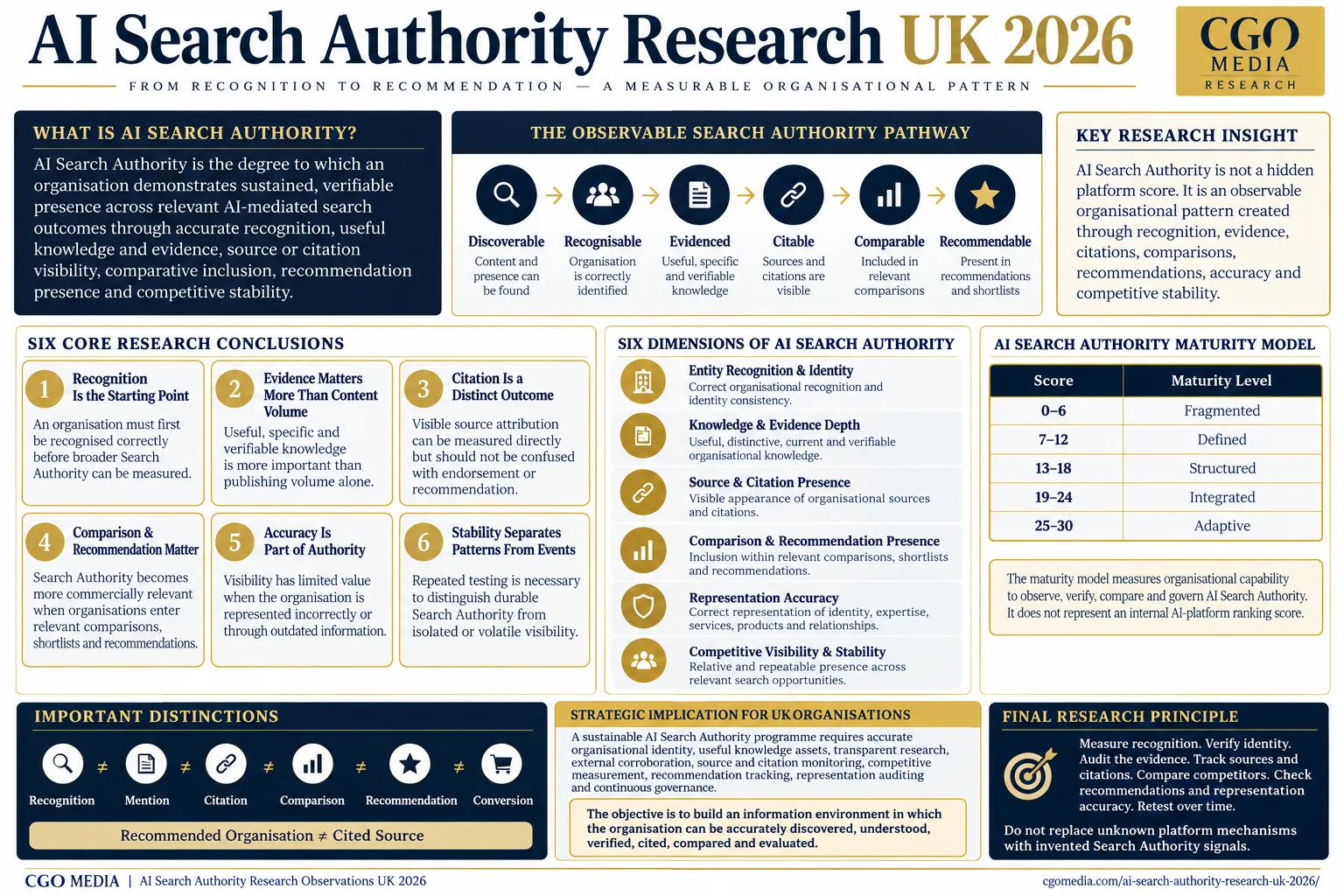
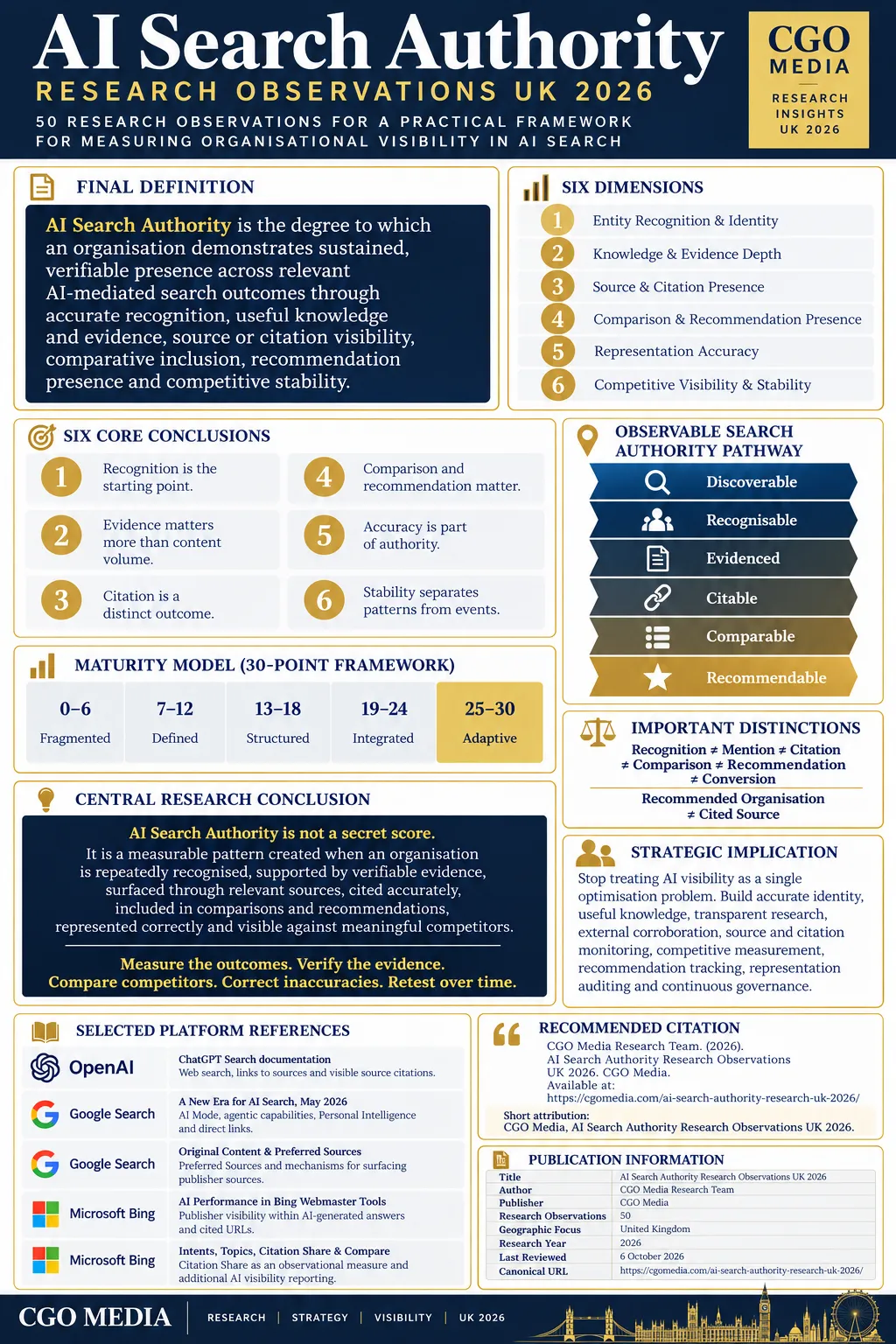
AI Search Authority is the degree to which an organisation demonstrates sustained, verifiable presence across relevant AI-mediated search outcomes through accurate recognition, useful knowledge and evidence, source or citation visibility, comparative inclusion, recommendation presence and competitive stability.
The definition is deliberately outcome-based. It does not assume that an AI platform calculates a universal organisational authority score or that every platform evaluates authority through the same internal signals.
AI Search Authority as an Umbrella Measurement
Within the CGO Media research architecture, AI Search Authority sits above several narrower forms of measurable AI search performance.
| Measurement Area | Primary Question |
|---|---|
| AI Search Authority | How strong, broad and stable is the organisation’s measurable presence across relevant AI search outcomes? |
| AI Brand Authority | Is the organisation recognised, accurately represented and supported by verifiable brand evidence? |
| AI Entity Authority | Is the organisation clearly identifiable as an entity with coherent attributes and relationships? |
| AI Citation Authority | Are the organisation’s webpages, research or knowledge assets visibly attributed as sources? |
| AI Recommendation Authority | Is the organisation, product or service surfaced as a suitable option for relevant requirements? |
| AI Search Visibility | How frequently and prominently does the organisation appear across the defined AI search measurement universe? |
These categories overlap operationally but should not be treated as synonyms. A brand can be visible without being cited, cited without being recommended, recognised without being accurately represented, or strongly evidenced without receiving competitive visibility.
What AI Search Authority Does Not Mean
- It does not mean an AI platform has assigned an organisation a universal authority score.
- It does not prove that an AI system internally “trusts” one organisation more than another.
- It does not reveal proprietary retrieval, ranking, source-selection or recommendation weights.
- It does not mean Digital PR, backlinks, schema, research or reviews are guaranteed authority factors.
- It does not mean every AI search platform evaluates organisations through the same architecture.
- It does not mean a citation automatically indicates recommendation or endorsement.
- It does not mean a recommendation automatically establishes broader search authority.
- It does not mean correlation between external evidence and AI visibility establishes causation.
Observable AI Search Authority Outcomes
Whether the organisation is correctly identified in relevant AI-generated answers.
Whether organisational information or knowledge assets appear among visible supporting sources.
Whether an organisational source receives visible attribution within or alongside the answer.
Whether the organisation is evaluated alongside relevant alternatives.
Whether the organisation is surfaced as potentially suitable for a defined requirement.
Whether the organisation, expertise, products, services and attributes are described correctly.
How often the organisation appears relative to relevant alternatives within the same opportunity set.
Whether these outcomes remain reasonably consistent across repeated measurements.
Important Measurement Distinctions
Ranking ≠ Recognition ≠ Citation ≠ Comparison ≠ Recommendation ≠ Referral Visit ≠ Conversion
These outcomes can occur within the same customer journey, but they measure different stages of search visibility and should not be collapsed into one undocumented concept of “AI trust.”
CGO Media Observable Search Authority Pathway
Discoverable → Recognisable → Evidenced → Citable → Comparable → Recommendable
This pathway is a CGO Media analytical model for structuring measurement. It does not claim that AI platforms process organisations through these stages internally, sequentially or universally.
Six Dimensions of AI Search Authority
| Dimension | Measurement Focus |
|---|---|
| 1. Entity Recognition & Identity | Whether the organisation is correctly recognised and its material identity attributes are represented consistently. |
| 2. Knowledge & Evidence Depth | The quality, specificity, breadth and verifiability of the information environment supporting the organisation’s expertise and claims. |
| 3. Source & Citation Presence | Whether organisational webpages, research, data or other knowledge assets appear as visible sources or citations. |
| 4. Comparison & Recommendation Presence | Whether the organisation enters relevant comparisons, shortlists and recommendations for defined information or commercial needs. |
| 5. Representation Accuracy | Whether generated answers describe the organisation, expertise, services, products and material attributes accurately. |
| 6. Competitive Visibility & Stability | How strongly and consistently the organisation appears relative to relevant competitors across repeated tests and platforms. |
Why AI Search Authority Matters
AI-mediated search can influence discovery before, during and after a conventional search-engine result is viewed. Users may encounter organisations directly within generated answers, supporting sources, comparative research or recommendations.
This makes AI Search Authority useful as a broader measurement layer for organisations trying to understand whether they are participating meaningfully in AI-assisted discovery rather than relying solely on rankings or traffic.
Whether the organisation enters relevant AI-generated research journeys.
Whether organisational knowledge becomes visible as supporting material.
Whether the organisation appears alongside relevant alternatives.
Whether the organisation becomes a candidate for defined user requirements.
Whether users encounter accurate information about the organisation.
Whether performance remains visible across platforms and repeated tests.
These outcomes may have commercial implications, but AI Search Authority by itself does not prove increased customer trust, conversion, revenue or lifetime value. Those outcomes require separate measurement.
Key Research Findings
- AI Search Authority cannot be reduced to one ranking or trust signal.
- Entity recognition is measurable without claiming access to hidden entity-confidence scores.
- Knowledge depth and evidence quality should be assessed independently from content volume.
- Source presence and citation presence are observable authority outcomes but do not prove endorsement.
- Comparison inclusion and recommendation presence should be measured separately from citations.
- Accurate representation is as important as frequency of appearance.
- Competitive share provides stronger context than raw appearance counts.
- Repeated testing is necessary to distinguish stable authority from isolated visibility.
- Platform differences should remain visible in reporting.
- AI Search Authority is best managed as a measurement and governance discipline rather than an assumed platform-internal score.
Research Objectives
- Define AI Search Authority through observable outcomes.
- Separate Search Authority from Brand, Entity, Citation, Recommendation and Visibility measurements.
- Develop a framework for evaluating organisational authority without inventing hidden platform signals.
- Assess the role of knowledge, evidence and source presence in AI-mediated discovery.
- Measure comparison and recommendation inclusion independently from citations.
- Evaluate representation accuracy across AI environments.
- Benchmark competitive visibility and stability through repeated testing.
- Develop an organisational maturity model for ongoing AI Search Authority governance.
Research Scope
Research Boundary
This research measures visible AI search outcomes and the evidence surrounding them.
It does not claim access to proprietary ranking systems, confidence scores, internal trust calculations, retrieval weights, recommendation weights or universal authority signals.
Where the causal mechanism behind an observed result is not publicly documented, CGO Media treats that mechanism as unknown rather than converting correlation into an invented ranking factor.
AI Search Authority Measurement Principle
Measure visible search outcomes first. Verify the supporting evidence second. Compare performance against relevant alternatives third. Do not replace unknown platform mechanisms with invented authority signals.
Minimum AI Search Authority Audit Record
- AI platform or interface;
- date of observation;
- exact prompt or query;
- prompt category and information need;
- whether the organisation appeared;
- whether it was identified accurately;
- whether organisational sources appeared;
- whether a visible citation was present;
- whether the organisation entered a comparison;
- whether it was recommended or shortlisted;
- competing organisations appearing in the same response;
- representation accuracy;
- source or evidence quality where verifiable;
- repeat-test result; and
- material platform or interface changes affecting interpretation.
Evidence & Interpretation Hierarchy
Documented Platform Capability → Observable Search Output → Verifiable Evidence → CGO Media Interpretation
Research Methodology
The broader principles governing evidence quality, observation, interpretation, transparency and limitations across CGO Media research are documented in the
CGO Media Research Methodology
.
Research Principle
Search Authority should be demonstrated through repeatable evidence of recognition, source visibility, citations, comparisons, recommendations, accurate representation and competitive stability—not assumed from undocumented platform signals.
Research Observations 1–10
Recognition, Identity, Knowledge Depth & Evidence Quality
The first ten observations establish the foundations of AI Search Authority: whether an organisation is recognised, represented as the correct entity and supported by a sufficiently clear and verifiable information environment.
Research Observation 1
Recognition Is the First Observable Search Authority Outcome
Before an organisation can be evaluated for citation, comparison or recommendation presence, researchers first need to establish whether the organisation is recognised at all for relevant topics, questions and use cases.
Research Observation 2
Recognition Does Not Establish Search Authority on Its Own
A single correct brand or organisation mention confirms visibility in one response, but it does not demonstrate sustained Search Authority. Broader measurement requires evidence of repeatability, relevance and additional authority outcomes.
Research Observation 3
Correct Entity Identification Is a Separate Requirement
An answer may mention an organisation name while confusing it with another company, location, person or product. Entity correctness should therefore be tested independently from simple appearance.
Research Observation 4
Identity Consistency Can Be Audited Without Knowing Hidden Entity Systems
Researchers can observe whether names, people, services, products, locations and organisational relationships are represented consistently without claiming access to proprietary entity-resolution or confidence systems.
Research Observation 5
Ambiguous Organisational Identity Creates Search Measurement Risk
Common names, inconsistent naming, multiple brands or outdated organisational relationships can make it harder to determine whether an AI-generated answer is referring to the intended entity.
Research Observation 6
Knowledge Depth Extends Beyond Commercial Content
Research papers, datasets, statistics, technical resources, frameworks, expert commentary and methodology pages can all contribute to the wider knowledge environment associated with an organisation.
Research Observation 7
Knowledge Volume and Knowledge Quality Are Different Measures
Publishing more pages does not necessarily create a stronger evidence environment. Search Authority analysis should evaluate whether information is useful, specific, current and verifiable rather than relying on content volume alone.
Research Observation 8
Original Research Creates Distinctive Evidence but Not Guaranteed Visibility
Original research can provide information that is unique to an organisation and therefore useful for search, citation and comparison analysis. Publication alone, however, does not guarantee retrieval, citation or recommendation.
Research Observation 9
Transparent Methodology Improves Evidence Auditability
Research and data assets are easier to evaluate when organisations explain their methodology, scope, sample, dates, assumptions and limitations. This improves verification without implying any direct ranking benefit.
Research Observation 10
Evidence Quality Should Be Assessed at the Claim Level
A source may be useful for one organisational claim and irrelevant for another. Evidence should therefore be matched to the exact statement, attribute or comparison being evaluated rather than treated as uniformly authoritative.
Recognition and Evidence Are Different Layers
Recognition → Correct Entity → Relevant Knowledge → Verifiable Evidence
An organisation may be recognised without having strong evidence assets, and it may possess strong evidence without being surfaced consistently. These conditions should remain analytically separate.
Search Authority Evidence Classes
| Evidence Class | Primary Role |
|---|---|
| Official Organisational Information | Defines current identity, services, products, people, locations and organisational facts. |
| Original Research & Data | Provides distinctive evidence, analysis and information associated with the organisation. |
| Technical & Specialist Knowledge | Provides depth on methods, products, services, systems or specialist expertise. |
| Independent External Evidence | Provides external corroboration, contradiction or contextual information. |
| Public & Institutional Records | Provides verifiable factual information where relevant to organisational identity or claims. |
What Observations 1–10 Tell Us
Recognised → Correctly Identified → Knowledgeable → Evidenced
Observations 1–10 show that AI Search Authority begins with recognition and correct identity, but authority cannot be inferred from recognition alone.
The stronger analytical foundation is a combination of correct entity representation, useful organisational knowledge and evidence that can be independently checked.
Research Principle
Recognition shows that an organisation is present. Evidence shows what can be verified. Neither should be converted into an undocumented assumption about internal platform trust.
Research Observations 11–20
Source Presence, Citation Visibility, Retrieval Evidence & Attribution Accuracy
The second group of observations examines whether organisational knowledge becomes visible within AI-generated answers as a source, citation or supporting evidence. These outcomes are measurable, but they should not be confused with proof of endorsement, recommendation or hidden platform trust.
Research Observation 11
Source Presence Is Distinct From Brand Presence
An organisation may be mentioned in an AI-generated answer while another publisher, directory, research source or platform provides the visible supporting evidence. Brand appearance and source appearance should therefore be recorded separately.
Research Observation 12
Visible Citation Provides Stronger Evidence Than Inferred Retrieval
When a platform visibly attributes a source, researchers can record that citation directly. Where a source is not shown, it is generally not defensible to claim that a particular webpage was retrieved or used internally.
Research Observation 13
One Citation Does Not Establish Search Authority
A single citation demonstrates one observable source-selection event. Stronger Search Authority requires broader evidence across relevant prompts, claims, platforms and measurement periods.
Research Observation 14
Citation Relevance Should Be Evaluated at the Claim Level
A source may be useful for one sentence or factual claim but not for another. Citation quality should therefore be assessed against the exact proposition it appears to support.
Research Observation 15
Citation Accuracy Is Separate From Citation Presence
A webpage can be cited while only partially supporting the statement made in the answer. Researchers should distinguish whether a source is present from whether the attribution is accurate.
Research Observation 16
First-Party Sources Can Be Appropriate Evidence
Official webpages can be appropriate sources for current organisational facts such as services, leadership, locations, policies or product specifications. First-party status alone does not make a source unsuitable.
Research Observation 17
Independent Sources Serve a Different Evidential Role
Independent publishers, institutions, reviews, public records and research can corroborate or challenge claims that would otherwise rely only on organisational self-description.
Research Observation 18
Persistent Research Identifiers Improve Traceability, Not Selection Guarantees
DOIs and other persistent identifiers can make research easier to distinguish, locate and reference over time. They improve traceability but should not be presented as guaranteed AI citation or retrieval signals.
Research Observation 19
Source Structure Can Improve Human and Machine Interpretability
Clear headings, explicit claims, tables, definitions, methodology, dates and source attribution make information easier to inspect and verify. This improves interpretability without proving that a platform gives such structure a universal ranking advantage.
Research Observation 20
Source and Citation Performance Should Be Measured Across a Controlled Query Set
Repeated source appearances across relevant prompt categories provide a stronger basis for analysis than isolated citations. The same controlled query set should be used where possible to support comparison over time.
Source Presence vs Citation Presence
| Measurement | What Can Be Observed |
|---|---|
| Brand Presence | The organisation is named or discussed in the answer. |
| Visible Source Presence | An organisational source appears within a visible source list or source interface. |
| Citation Presence | A source receives explicit visible attribution linked to the generated answer. |
| Citation Accuracy | The cited source materially supports the statement it appears to substantiate. |
| Inferred Retrieval | Generally not observable unless the platform explicitly exposes relevant retrieval information. |
Citation Quality Checks
Does the source actually support the claim?
Is the correct source being attributed?
Is the evidence sufficiently current for the claim?
Is the evidence precise enough to support the statement?
Can the origin of the information be identified?
Is independent corroboration relevant where the claim requires it?
Observable Source Pathway
Available Evidence → Visible Source → Relevant Attribution → Accurate Citation
This sequence is a measurement model, not a claim about hidden retrieval or source-selection architecture. The only stages that should be recorded as facts are those directly visible or otherwise documented by the platform.
What Observations 11–20 Tell Us
Observations 11–20 show that source visibility and citation visibility are important components of AI Search Authority, but they must be measured carefully.
A visible citation provides evidence of attribution. It does not reveal every internal retrieval step, prove endorsement or establish a universal authority score.
Research Principle
Record visible source evidence as evidence. Treat invisible retrieval mechanisms as unknown unless the platform documents them.
Research Observations 21–30
Comparison Presence, Recommendation Visibility, Competitive Share & Search Position
The third group of observations examines what happens when an organisation moves beyond basic recognition and source visibility into comparative and recommendation environments. These are important Search Authority outcomes, but they should remain distinct from citations and from conventional search ranking.
Research Observation 21
Comparison Presence Is a Distinct Search Authority Outcome
An organisation can be recognised and cited without being included in comparative answers. Comparison presence should therefore be measured independently from recognition and citation visibility.
Research Observation 22
Recommendation Presence Is Not the Same as Comparison Inclusion
A brand may appear within a comparison without being recommended as a suitable option. Recommendation presence should therefore remain a separate measurement state.
Research Observation 23
Recommendation Context Must Be Recorded
An organisation may be recommended for one use case, audience, budget or geography while being absent for another. Recommendation performance should therefore be interpreted against the exact prompt context.
Research Observation 24
AI Search Competitors May Differ From Organic Search Competitors
The organisations appearing in AI-generated comparisons and recommendations may differ materially from the domains that compete most visibly in conventional organic search results.
Research Observation 25
Competitive Share Provides More Context Than Raw Appearance Count
Knowing that an organisation appeared ten times is less useful without knowing how often competitors appeared across the same defined opportunity set.
Research Observation 26
Search Authority Should Be Segmented by Query Type
An organisation may perform strongly for research-led prompts but weakly for local discovery, product comparison, service selection or recommendation prompts. Aggregate reporting can conceal these differences.
Research Observation 27
Search Position Within an Answer Can Be Measured Without Claiming a Hidden Rank
Researchers can record whether an organisation appears first, centrally, within a shortlist or as a secondary alternative. This visible prominence should not be presented as proof of a universal internal ranking score.
Research Observation 28
Platform-Level Competitive Position Can Differ Materially
An organisation may appear frequently in comparisons on one AI platform and rarely on another. Competitive Search Authority should therefore preserve platform-level results.
Research Observation 29
Recommendation Visibility Should Be Tracked Over Time
Repeated testing can reveal whether recommendation presence is sustained, declining or highly volatile across equivalent prompts and measurement periods.
Research Observation 30
Search Authority Is Stronger When Multiple Observable Outcomes Converge
An organisation that is repeatedly recognised, cited, compared, accurately represented and recommended across relevant prompts demonstrates a broader pattern of Search Authority than one that appears through only one outcome type.
CGO Media Competitive Search Share
Competitive Search Share is used as a comparative analytical metric rather than as a platform-disclosed ranking measure.
Competitive Search Share = Organisation Appearances ÷ Relevant Search Authority Opportunities
The denominator must be defined explicitly—for example, all valid prompts in a category, all comparison opportunities or all recommendation opportunities—and retained consistently across measurement periods.
Comparison & Recommendation Measurement
| Metric | What It Measures |
|---|---|
| Recognition Presence | Whether the organisation appears at all. |
| Comparison Presence | Whether the organisation is evaluated alongside alternatives. |
| Shortlist Presence | Whether the organisation enters a restricted set of candidate options. |
| Recommendation Presence | Whether the organisation is explicitly presented as potentially suitable. |
| Prominence | How visibly the organisation is positioned in the generated response. |
| Competitive Share | Relative organisational visibility within the defined opportunity set. |
| Repeatability | Whether comparison or recommendation presence persists through repeated tests. |
Observable Search Position States
Recognised → Compared → Shortlisted → Recommended
This is a CGO Media measurement hierarchy, not a claimed internal decision sequence. AI systems may generate any of these visible outcomes without showing intermediate states.
Why Recommendation Presence Does Not Prove Authority
- A recommendation can be highly prompt-specific.
- The user requirement may materially change the candidate set.
- Different platforms may recommend different organisations.
- A recommendation does not reveal the internal weighting behind the choice.
- The organisation may be recommended inaccurately or for the wrong capability.
- One recommendation does not establish persistent Search Authority.
What Observations 21–30 Tell Us
Recognition → Comparison → Shortlisting → Recommendation → Competitive Trend
Observations 21–30 establish that AI Search Authority becomes more meaningful when organisations are evaluated relative to competitors and across higher-value search outcomes such as comparisons, shortlists and recommendations.
However, these outcomes remain query-dependent and platform-dependent. They should therefore be recorded as observable search events rather than treated as proof of a universal internal authority score.
Research Principle
Comparison and recommendation visibility strengthen the evidence for Search Authority when they are relevant, accurate, competitive and repeatable—not merely because they occur once.
Research Observations 31–40
Representation Accuracy, Freshness, Volatility, Platform Differences & Search Stability
The fourth group of observations examines the reliability of AI Search Authority over time. Strong authority cannot be inferred from visibility alone if the organisation is represented inaccurately, appears inconsistently or performs very differently across platforms.
Research Observation 31
Representation Accuracy Is a Core Search Authority Measure
An organisation may appear frequently in AI-generated answers while being described incorrectly. Search Authority should therefore measure both visibility and factual representation.
Research Observation 32
Search Authority Errors Should Be Classified by Type
Identity, service, product, location, people, relationship and capability errors represent different forms of misrepresentation and should be recorded separately.
Research Observation 33
Error Severity Should Be Measured Separately From Error Frequency
A minor wording difference should not be treated the same as an error that materially changes what the organisation does, where it operates or which products and services it provides.
Research Observation 34
Freshness Matters Most for Changeable Organisational Facts
Leadership, locations, product availability, services, partnerships, pricing and organisational structure can change. These attributes require more frequent verification than stable historical facts.
Research Observation 35
Outdated Evidence Can Sustain Incorrect Search Representation
Old webpages, directories, archived articles, obsolete profiles and legacy research can remain visible long after organisational facts have changed, creating an inconsistent evidence environment.
Research Observation 36
Repeated Testing Reveals Search Authority Stability
Running equivalent prompts at different times helps determine whether recognition, citation, comparison and recommendation outcomes persist or fluctuate materially.
Research Observation 37
Search Authority Volatility Is a Useful Diagnostic
Frequent changes in whether an organisation appears, which sources are cited, how it is described or whether it enters recommendations can indicate an unstable search position.
Research Observation 38
Platform Differences Should Be Preserved in Search Authority Reporting
The same organisation may be recognised, cited or recommended differently across AI platforms. Platform-level results should remain visible before any aggregate authority score is created.
Research Observation 39
Interface Changes Can Affect Observed Search Authority
Changes to source panels, citation placement, answer formatting, recommendation layouts or search interfaces can alter the appearance of visibility without necessarily indicating a change in the organisation’s underlying information environment.
Research Observation 40
Reliable Search Authority Requires Accuracy, Breadth & Stability Together
The strongest pattern of AI Search Authority occurs when an organisation is repeatedly recognised, represented accurately and visible across multiple relevant outcome types rather than through one isolated signal.
Search Authority Error Classification
| Error Type | Example |
|---|---|
| Identity Error | The answer confuses the organisation with another entity. |
| Source Error | The wrong source is associated with a claim or organisation. |
| Citation Error | A cited source does not materially support the attributed statement. |
| Service / Product Error | The organisation is associated with an incorrect or outdated offering. |
| Relationship Error | Ownership, partnership, affiliation or organisational relationships are represented incorrectly. |
| Recommendation Error | The organisation is recommended for a requirement it does not materially satisfy. |
Search Authority Stability Model
Accurate Recognition + Reliable Evidence + Repeatable Visibility + Competitive Presence = Stable Search Authority
What Organisations Should Track
Does the organisation continue to appear?
Do organisational sources continue to receive visible attribution?
Are organisational facts still correct?
Does recommendation presence persist?
Are relevant alternatives gaining or losing visibility?
How different are results across AI environments?
Which important facts are most likely to become outdated?
Has presentation changed enough to affect measurement?
Search Authority Volatility
Volatility can be measured by recording how often material search outcomes change across equivalent tests.
High volatility does not automatically mean weak authority. Some variation may result from normal generation differences, changing source availability, interface updates or personalised context. The important question is whether material outcomes remain sufficiently stable to form a defensible pattern.
What Observations 31–40 Tell Us
Accuracy → Freshness → Repeatability → Cross-Platform Comparison → Stability
Observations 31–40 establish that Search Authority should be evaluated as a repeated pattern rather than a snapshot.
An organisation that is highly visible but frequently misrepresented or highly volatile may require different intervention from an organisation with lower but accurate and stable presence.
Research Principle
Reliable AI Search Authority is not simply being visible. It is being visible accurately, across relevant outcomes, with enough repeatability to establish a meaningful pattern.
Research Observations 41–50
Measurement, Governance, Maturity & the AI Search Authority Framework
The final ten observations move from individual search outcomes toward organisational capability. They examine how AI Search Authority can be measured, governed and improved without presenting the framework as a hidden score used internally by AI platforms.
Research Observation 41
Search Authority Requires Multidimensional Measurement
No single outcome can adequately represent AI Search Authority. Recognition, evidence, citation presence, recommendation visibility, accuracy and competitive stability should be analysed together.
Research Observation 42
A Baseline Is Required Before Improvement Can Be Demonstrated
Organisations need a documented starting point covering recognition, source presence, citations, comparison inclusion, recommendation visibility, accuracy, competitors and platform-level performance.
Research Observation 43
Prompt Libraries Should Be Versioned
Trend analysis becomes unreliable when prompts change without documentation. Core query sets should remain sufficiently stable for comparison while additions and revisions are recorded.
Research Observation 44
Platform-Level Reporting Is More Defensible Than One Universal Score
Different AI environments can produce materially different recognition, source, citation and recommendation outcomes. Platform-specific results should therefore be retained before aggregation.
Research Observation 45
Search Authority Errors Should Enter Governance
Repeated identity errors, inaccurate citations, outdated information or inappropriate recommendations should be documented and assigned for review rather than treated as isolated anomalies.
Research Observation 46
Search Authority Requires Cross-Functional Ownership
AI Search Authority intersects with research, content, SEO, GEO, Digital PR, brand, communications, analytics and knowledge management. Mature programmes require clear ownership across these functions.
Research Observation 47
Search Authority Maturity Reflects Organisational Capability
An organisation can be described as more mature when it measures outcomes consistently, maintains evidence quality and governs errors effectively. This does not mean an AI platform has assigned it a higher internal authority score.
Research Observation 48
Material Change Should Trigger Reassessment
Rebrands, acquisitions, new products, geographic expansion, major research releases, leadership changes and material platform changes can justify a new Search Authority measurement cycle.
Research Observation 49
Composite Scores Should Not Create False Precision
A combined score can summarise organisational position, but it should not replace the six underlying dimensions. Two organisations can reach the same total with very different weaknesses and priorities.
Research Observation 50
AI Search Authority Is a Continuous Measurement Discipline
AI platforms, competitors, information sources and organisational facts change over time. Search Authority should therefore be measured and governed continuously rather than treated as a one-time optimisation exercise.
Six Dimensions of the CGO Media AI Search Authority Framework
| Dimension | Measurement Focus |
|---|---|
| 1. Entity Recognition & Identity | Whether the organisation is recognised correctly and its material identity is represented consistently. |
| 2. Knowledge & Evidence Depth | The quality, breadth and verifiability of the information environment supporting the organisation. |
| 3. Source & Citation Presence | Whether organisational knowledge assets appear as visible sources or citations. |
| 4. Comparison & Recommendation Presence | Whether the organisation enters relevant comparisons, shortlists and recommendations. |
| 5. Representation Accuracy | Whether the organisation, expertise, products and services are represented correctly. |
| 6. Competitive Visibility & Stability | How strongly and consistently the organisation appears relative to relevant alternatives. |
30-Point AI Search Authority Score
Each dimension is scored from 0 to 5 using retained evidence.
Absent
Very Weak
Developing
Established
Strong
Leading
6 Dimensions × Maximum 5 Points = 30 Points
AI Search Authority Maturity Levels
| Score | Maturity Level | Interpretation |
|---|---|---|
| 0–6 | Fragmented | Search outcomes are largely unmeasured, inconsistent or poorly understood. |
| 7–12 | Defined | Core authority outcomes and measurement practices are being defined. |
| 13–18 | Structured | Recognition, evidence, citation, comparison and representation are measured systematically. |
| 19–24 | Integrated | Search Authority measurement is integrated with research, content, SEO/GEO, Digital PR and analytics. |
| 25–30 | Adaptive | Authority is continuously measured, validated and governed as platforms and information environments change. |
Important limitation:
the 30-point AI Search Authority Framework is a CGO Media organisational diagnostic. It is not a ranking, trust, confidence or authority score used internally by an AI provider.
Continuous AI Search Authority Cycle
Measure → Verify → Compare → Diagnose → Improve Evidence → Retest → Govern
Recommended Executive Search Authority Scorecard
0–30 diagnostic total
Fragmented to Adaptive
Presence across relevant prompts
Visibility of organisational knowledge assets
Inclusion within relevant recommendations
Correctness of organisational information
Relative performance against relevant alternatives
Improving, stable or declining
What Observations 41–50 Tell Us
Measure → Diagnose → Strengthen → Retest → Compare → Govern
The final observations establish AI Search Authority as a multidimensional organisational capability rather than a single algorithmic signal.
The composite score can provide an executive summary, but the underlying dimensions and evidence remain more important for diagnosis and decision-making.
Research Principle
The total score summarises Search Authority. The six dimensions diagnose Search Authority. The retained evidence explains Search Authority.
CGO Media Analysis
What the 50 AI Search Authority Observations Tell Us
Taken together, the fifty observations point toward a more rigorous way of understanding organisational authority across AI-mediated search.
AI Search Authority should not be treated as a hidden trust score or a replacement for conventional SEO metrics. It is more defensibly measured through observable patterns of recognition, knowledge evidence, source and citation presence, comparative inclusion, recommendation visibility, representation accuracy and competitive stability.
1. AI Search Authority Is Broader Than Ranking
Conventional ranking measures where webpages appear within a search result. AI Search Authority examines whether the organisation itself is recognised, sourced, cited, compared, recommended and represented accurately across generated search experiences.
2. Recognition Is Necessary but Insufficient
An organisation appearing in an AI-generated answer proves only that it was surfaced in that response. Broader Search Authority requires a repeatable pattern across relevant information needs.
3. Correct Entity Identity Comes Before Authority Analysis
Search Authority becomes difficult to interpret if the wrong entity, location, person, product or organisational relationship is being represented. Identity accuracy must therefore be established first.
4. Knowledge Depth Is Different From Content Volume
A large website does not necessarily create a strong evidence environment. Search Authority is better supported by information that is specific, current, useful and verifiable.
5. Original Research Creates Distinctive Search Assets
Research papers, statistics, datasets and frameworks can create information that is uniquely associated with an organisation. This strengthens the evidence environment but does not guarantee retrieval, citation or recommendation.
6. Visible Source Evidence Is Stronger Than Assumed Retrieval
When a platform visibly attributes a source, the event can be documented. Where source use is not exposed, researchers should avoid claiming that a particular page was retrieved internally.
7. Citation Presence and Citation Accuracy Are Different Measures
A visible citation confirms attribution but does not automatically prove that the source fully supports the claim. Attribution accuracy should therefore be evaluated separately.
8. Comparison Inclusion Is a Higher-Value Search Outcome
When an organisation is compared with alternatives, it has entered a more decision-oriented stage of AI-assisted discovery. This should be measured independently from simple mentions.
9. Recommendation Presence Is Query-Dependent
An organisation may be a suitable recommendation for one audience, budget, geography or requirement and irrelevant for another. Recommendation visibility should therefore always retain prompt context.
10. Competitive Share Is More Useful Than Raw Appearance Volume
Counting organisational appearances provides little competitive context by itself. Search Authority becomes more meaningful when visibility is compared with the organisations surfaced for the same opportunity set.
11. AI Search Competitors May Differ From Traditional SEO Competitors
The organisations surfaced within AI comparisons and recommendations may not match the domains that dominate conventional organic rankings. AI competitor sets should therefore be measured directly.
12. Representation Accuracy Is Part of Authority
High visibility is not necessarily valuable if the organisation is described incorrectly. Accurate identity, capabilities, services and relationships should be treated as core Search Authority measures.
13. Stability Separates Patterns From Isolated Events
Repeated testing is required to determine whether recognition, citations, comparisons and recommendations represent persistent search outcomes or temporary variation.
14. Platform Differences Should Remain Visible
An organisation may demonstrate strong Search Authority on one platform and weak performance on another. A single blended score should not hide those differences.
15. Search Authority Is Ultimately a Governance Capability
Mature organisations need controlled query libraries, verified facts, research assets, competitor tracking, error monitoring, platform-level reporting and recurring reassessment.
The CGO Media AI Search Authority Model
Discoverable → Recognisable → Evidenced → Citable → Comparable → Recommendable
This pathway provides a practical structure for analysis. It should not be interpreted as a universal sequence used internally by AI platforms.
Six Dimensions of Measurable AI Search Authority
Is the organisation correctly recognised and identified?
Does the organisation have useful, specific and verifiable evidence?
Do organisational knowledge assets appear as visible sources?
Does the organisation enter relevant comparisons, shortlists and recommendations?
Is the organisation represented correctly?
How strongly and consistently does the organisation appear relative to alternatives?
Eight Questions Every AI Search Authority Audit Should Answer
Is the organisation surfaced for relevant queries?
Is the correct entity being represented?
What verifiable knowledge supports the organisation?
Do organisational sources receive visible attribution?
Does the organisation enter relevant comparisons?
Is the organisation presented as suitable for relevant needs?
Is the organisational representation materially correct?
Does the pattern persist across platforms and repeated tests?
CGO Media Research Position
Entity Recognition + Knowledge Evidence + Source & Citation Presence + Comparison & Recommendation Presence + Representation Accuracy + Competitive Stability = Measurable AI Search Authority
This formula is a CGO Media organisational model. It does not represent an internal AI platform ranking, authority, trust or confidence formula.
Search Authority vs Other AI Search Measurements
| Measurement | Primary Question |
|---|---|
| AI Search Authority | How broad, accurate and stable is the organisation’s presence across multiple AI search outcomes? |
| AI Brand Authority | Is the organisation recognised and accurately represented as a brand? |
| AI Citation Authority | Are organisational knowledge assets visibly attributed as sources? |
| AI Recommendation Authority | Is the organisation surfaced as a suitable option? |
| AI Search Visibility | How frequently and prominently does the organisation appear? |
Interpretation Hierarchy
Documented Platform Capability → Observable Search Outcome → Verifiable Evidence → CGO Media Interpretation
Central Analysis
AI Search Authority is not best understood as a secret metric that organisations accumulate.
It is better understood as a measurable pattern created when an organisation is repeatedly recognised, supported by useful evidence, surfaced as a source, included in relevant comparisons and recommendations, represented accurately and visible against meaningful competitors.
Measure the outcomes. Verify the evidence. Compare competitors. Retest over time. Keep unknown platform mechanisms unknown.
Practical Implementation
What UK Organisations Should Do to Improve AI Search Authority in 2026
Improving AI Search Authority does not mean attempting to manipulate an undocumented authority score. The more defensible approach is to improve the organisational information environment, strengthen verifiable evidence, measure observable AI search outcomes and correct weaknesses revealed through repeated testing.
The following implementation programme translates the fifty research observations into practical actions for organisations operating in the UK.
1. Define the Search Authority Measurement Universe
Begin by defining the topics, services, products, audiences, locations and information needs for which the organisation should reasonably expect to be recognised, cited, compared or recommended.
2. Build a Controlled Prompt Library
Create a repeatable set of prompts covering informational, research, comparison, recommendation, local, commercial and sector-specific search journeys.
Each prompt should be versioned so changes to wording do not become invisible changes to the measurement methodology.
3. Establish a Baseline Before Making Changes
Record current recognition, source presence, citations, comparisons, recommendations, representation accuracy, competitors and platform-level differences before attempting to improve performance.
4. Audit Organisational Identity
Verify the organisation’s name, ownership, people, locations, services, products, relationships and other important identity attributes across its own website and relevant external sources.
5. Resolve Conflicting First-Party Information
Conflicting descriptions across service pages, location pages, biographies, press pages and corporate information can create ambiguity. Core organisational facts should be consistent and current.
6. Strengthen Core Organisational Facts
Make important information explicit rather than forcing users or machines to infer it. Clearly state what the organisation does, where it operates, who it serves and how its principal products or services differ.
7. Develop Distinctive Knowledge Assets
Develop useful resources that add information beyond standard commercial pages, including original research, datasets, statistics, frameworks, technical guides, methodology and expert analysis.
8. Publish Transparent Research Methodology
Research assets should explain their scope, dates, methods, assumptions, sample limitations and interpretation boundaries wherever appropriate.
9. Improve Source Traceability
Use clear titles, publication dates, authorship, source references and persistent identifiers where appropriate so important knowledge assets can be distinguished and verified over time.
10. Audit Independent External Evidence
Review how the organisation is described by independent publishers, directories, institutions, public records, professional profiles, review environments and other relevant external sources.
The objective is not to manufacture repetition. It is to identify whether external evidence accurately corroborates important organisational claims.
11. Measure Visible Source Presence
Record whether organisational webpages, research or other assets appear within visible source interfaces. Do not label a source as retrieved where the platform does not expose that information.
12. Measure Citation Presence and Citation Accuracy Separately
Track both whether an organisational source receives attribution and whether the cited source materially supports the claim made in the generated answer.
13. Identify the Actual AI Competitor Set
Do not assume conventional SEO competitors are also the principal AI search competitors. Record the organisations that repeatedly appear within the same comparisons and recommendations.
14. Measure Competitive Search Share
Competitive Search Share = Organisation Appearances ÷ Relevant Search Authority Opportunities
Keep the denominator consistent across measurement periods and separate recognition, comparison and recommendation opportunity sets where necessary.
15. Measure Representation Accuracy
Review whether AI-generated answers describe the organisation accurately, including its identity, expertise, services, products, locations and organisational relationships.
16. Create a Search Authority Error Register
| Record | Purpose |
|---|---|
| Platform | Identifies where the error occurred. |
| Prompt | Preserves the context in which the error appeared. |
| Error Type | Classifies identity, source, citation, service, relationship or recommendation errors. |
| Severity | Separates minor wording differences from material misinformation. |
| Evidence Conflict | Records any first-party or external information that may contribute to ambiguity. |
| Status | Tracks investigation, correction and retesting. |
17. Keep Changeable Facts Current
Prioritise information with a high likelihood of becoming outdated, including leadership, locations, pricing, product availability, partnerships and service coverage.
18. Measure Search Authority Stability
Repeat equivalent tests to identify whether recognition, citations, comparisons and recommendations remain reasonably stable or show material volatility.
19. Keep Platform-Level Results Separate
Do not collapse all AI environments into one headline number before analysing platform differences. The same organisation can occupy very different search positions across platforms.
20. Establish Continuous Search Authority Governance
Assign responsibility for prompt libraries, measurement, factual accuracy, knowledge assets, external evidence, competitor tracking and remediation.
The CGO Media Implementation Model
Define → Baseline → Verify Identity → Strengthen Evidence → Measure Visibility → Compare → Correct → Retest → Govern
90-Day AI Search Authority Implementation Plan
Days 1–30 — Define & Baseline
- Define the Search Authority measurement universe.
- Create and version the controlled prompt library.
- Record baseline performance by platform.
- Identify AI search competitors.
- Audit organisational identity and first-party facts.
- Record existing source and citation visibility.
- Establish baseline representation accuracy.
- Create the Search Authority error register.
Days 31–60 — Strengthen the Evidence Environment
- Correct conflicting first-party information.
- Improve core organisational facts and service descriptions.
- Update outdated people, location and product information.
- Develop or improve research and knowledge assets.
- Publish clear research methodology where appropriate.
- Improve source traceability and attribution.
- Audit external organisational representation.
- Correct high-priority evidence conflicts where possible.
Days 61–90 — Retest, Compare & Govern
- Repeat the controlled prompt set.
- Compare results with the baseline.
- Measure recognition and Competitive Search Share.
- Reassess citation and source presence.
- Measure comparison and recommendation visibility.
- Recheck representation accuracy.
- Identify persistent errors and volatility.
- Score the six Search Authority dimensions.
- Assign ongoing governance responsibilities.
Cross-Functional Ownership
| Function | Primary Responsibility |
|---|---|
| Research | Methodology, datasets, studies and evidence integrity. |
| SEO / GEO | Prompt research, search measurement, technical discoverability and knowledge structure. |
| Content | Clear organisational information and useful knowledge assets. |
| Brand & Communications | Identity consistency and representation accuracy. |
| Digital PR | Legitimate distribution of research, expertise and organisational evidence to relevant external audiences. |
| Analytics / Leadership | Measurement priorities, governance, trend review and organisational decisions. |
What Organisations Should Not Do
- Do not assume more webpages automatically create more AI Search Authority.
- Do not publish unsupported statistics merely to generate citations.
- Do not describe backlinks, schema, Digital PR or reviews as guaranteed AI authority signals.
- Do not interpret one mention or citation as proof of authority.
- Do not treat a recommendation as evidence of universal platform preference.
- Do not hide major platform differences inside one composite score.
- Do not confuse visibility with factual accuracy.
- Do not infer retrieval mechanisms that are not exposed.
- Do not treat correlation as proof of causation.
- Do not optimise for a hypothetical hidden score instead of improving measurable organisational evidence.
Implementation Principle
Do not optimise for an invented authority score. Improve the evidence environment, measure the visible outcomes, correct inaccurate representation, compare against relevant competitors and retest the results.
CGO Media Measurement Framework
Full 30-Point AI Search Authority Measurement Framework
The CGO Media AI Search Authority Framework converts the six research dimensions into a structured 30-point organisational diagnostic.
Each dimension is scored from 0 to 5 using retained evidence from controlled prompts, visible AI search outputs, organisational information, external evidence and repeated measurement.
Important:
the framework measures organisational Search Authority maturity. It is not a disclosed ranking, trust, confidence or authority score used internally by any AI platform.
Scoring Scale
| Score | Level | General Interpretation |
|---|---|---|
| 0 | Absent | No meaningful evidence of the capability or measurable outcome. |
| 1 | Very Weak | Isolated evidence or highly inconsistent performance. |
| 2 | Developing | Some repeatable evidence exists, but material gaps remain. |
| 3 | Established | The capability is measurable and reasonably consistent. |
| 4 | Strong | Strong repeatable evidence exists across relevant prompts or platforms. |
| 5 | Leading | The capability is broad, accurate, competitive, stable and well governed. |
Dimension 1 — Entity Recognition & Identity
This dimension measures whether the organisation is correctly recognised and whether its important identity attributes are represented consistently.
| Score | Criteria |
|---|---|
| 0 | The organisation is generally absent or cannot be identified reliably. |
| 1 | Occasional recognition occurs, with frequent ambiguity or identity errors. |
| 2 | The organisation is recognised for some core prompts, but important identity gaps remain. |
| 3 | Recognition is established across core topics with generally accurate identity representation. |
| 4 | Recognition is strong across multiple relevant prompt categories with few material identity errors. |
| 5 | Recognition is broad, stable and highly accurate across relevant platforms, topics and organisational attributes. |
Dimension 2 — Knowledge & Evidence Depth
This dimension measures the quality, specificity, breadth and verifiability of the knowledge environment associated with the organisation.
| Score | Criteria |
|---|---|
| 0 | Little or no substantive information exists beyond basic commercial claims. |
| 1 | Limited knowledge assets exist, but evidence is thin, generic or difficult to verify. |
| 2 | Some useful evidence exists, but coverage, methodology or freshness is inconsistent. |
| 3 | A structured evidence environment supports core expertise and organisational claims. |
| 4 | Research, specialist resources and verifiable evidence provide strong depth across important topics. |
| 5 | The organisation maintains a distinctive, current and well-documented knowledge environment with strong traceability and methodology. |
Dimension 3 — Source & Citation Presence
This dimension measures whether organisational webpages, research, data or other knowledge assets appear visibly as supporting sources or citations.
| Score | Criteria |
|---|---|
| 0 | No visible organisational source or citation presence is recorded. |
| 1 | Isolated source or citation appearances occur without repeatability. |
| 2 | Source visibility exists across a limited set of relevant topics or platforms. |
| 3 | Organisational assets receive repeatable source or citation visibility across important prompt categories. |
| 4 | Citation presence is strong, relevant and generally accurate across multiple search environments. |
| 5 | The organisation demonstrates broad, accurate and stable source visibility across high-value relevant queries and platforms. |
Dimension 4 — Comparison & Recommendation Presence
This dimension measures whether the organisation enters relevant comparisons, shortlists and recommendation environments.
| Score | Criteria |
|---|---|
| 0 | The organisation is absent from relevant comparisons and recommendations. |
| 1 | Occasional comparison or recommendation presence occurs without consistency. |
| 2 | The organisation appears in some relevant comparisons or shortlists but is frequently absent. |
| 3 | Comparison and recommendation visibility is established across several important use cases. |
| 4 | The organisation is consistently included in relevant comparisons and frequently shortlisted or recommended. |
| 5 | The organisation demonstrates broad and stable competitive inclusion across highly relevant comparison and recommendation contexts. |
Dimension 5 — Representation Accuracy
This dimension measures whether AI-generated answers represent the organisation, expertise, products, services and relationships correctly.
| Score | Criteria |
|---|---|
| 0 | Representation is absent, materially incorrect or too unreliable to evaluate. |
| 1 | Frequent material inaccuracies affect identity, services, products or relationships. |
| 2 | Core facts are often correct, but important errors or outdated information remain. |
| 3 | Representation is generally accurate across core search contexts with manageable exceptions. |
| 4 | The organisation is represented accurately across most relevant prompts and platforms. |
| 5 | Representation is highly accurate, current, stable and actively governed across major search environments. |
Dimension 6 — Competitive Visibility & Stability
This dimension measures how strongly and consistently the organisation appears relative to relevant competitors across repeated tests and platforms.
| Score | Criteria |
|---|---|
| 0 | The organisation is largely absent from the defined competitive opportunity set. |
| 1 | Competitive presence is weak and highly volatile. |
| 2 | The organisation competes visibly in some areas but lacks consistency or share. |
| 3 | Competitive visibility is established across several relevant categories with moderate stability. |
| 4 | The organisation maintains strong competitive share and good stability across repeated tests. |
| 5 | Competitive Search Authority is broad, stable and consistently strong across major relevant search opportunities. |
30-Point Score Summary
| Dimension | Maximum |
|---|---|
| Entity Recognition & Identity | 5 |
| Knowledge & Evidence Depth | 5 |
| Source & Citation Presence | 5 |
| Comparison & Recommendation Presence | 5 |
| Representation Accuracy | 5 |
| Competitive Visibility & Stability | 5 |
| Maximum AI Search Authority Score | 30 |
Maturity Interpretation
| Score | Level | Interpretation |
|---|---|---|
| 0–6 | Fragmented | Authority outcomes are largely absent, inconsistent or unmanaged. |
| 7–12 | Defined | Core measurement areas are defined but capability remains limited. |
| 13–18 | Structured | Search Authority is measured systematically across several dimensions. |
| 19–24 | Integrated | Authority measurement and governance are integrated with wider search, research and communications activity. |
| 25–30 | Adaptive | Authority is broad, evidence-led, continuously measured and actively governed. |
Worked Example A — Strong Visibility, Weak Accuracy
| Dimension | Score |
|---|---|
| Entity Recognition & Identity | 4 |
| Knowledge & Evidence Depth | 3 |
| Source & Citation Presence | 4 |
| Comparison & Recommendation Presence | 4 |
| Representation Accuracy | 2 |
| Competitive Visibility & Stability | 4 |
| Total | 21 / 30 — Integrated |
This organisation has strong recognition, citations and competitive presence, but representation accuracy is materially weaker.
Do not prioritise additional visibility first. Investigate inaccurate or outdated organisational information and the evidence environment supporting those errors.
Worked Example B — Strong Evidence, Weak Competitive Visibility
| Dimension | Score |
|---|---|
| Entity Recognition & Identity | 3 |
| Knowledge & Evidence Depth | 5 |
| Source & Citation Presence | 4 |
| Comparison & Recommendation Presence | 2 |
| Representation Accuracy | 4 |
| Competitive Visibility & Stability | 2 |
| Total | 20 / 30 — Integrated |
This organisation possesses strong knowledge and evidence assets and is represented accurately, but it appears inconsistently in competitive comparisons and recommendations.
Investigate whether the organisation is absent from the relevant AI competitor set, whether its evidence aligns with the tested use cases and whether visibility differs materially by platform.
The Main Diagnostic Insight
Similar Total Score ≠ Same Search Authority Problem
A composite score should therefore be used as a summary, not as the diagnosis itself. The six-dimensional profile identifies where intervention is actually required.
Evidence-Backed Scoring Rules
- Every score should be supported by retained measurement evidence.
- Use the same or materially equivalent prompt set when comparing periods.
- Keep platform-level results visible.
- Record the measurement date and interface.
- Separate visible citation evidence from inferred retrieval.
- Record material representation errors.
- Compare performance with a defined competitive set.
- Do not raise a score purely because more content has been published.
- Do not lower or raise scores based on undocumented assumptions about platform algorithms.
- Re-score after material organisational, competitive or platform change.
What the Score Does Not Mean
- A score of 30 does not mean every AI platform will recommend the organisation.
- A higher score does not prove an AI system internally trusts the organisation more.
- The score does not represent a disclosed ranking factor.
- The framework cannot reveal proprietary retrieval or recommendation weights.
- A score improvement does not, by itself, prove causation from any specific SEO, GEO, PR or content activity.
- The framework is intended for organisational diagnosis, comparison and governance.
Continuous Measurement Cycle
Audit → Score → Diagnose → Correct → Strengthen Evidence → Retest → Re-Score → Govern
Framework Principle
The total score summarises AI Search Authority. The six dimensions diagnose AI Search Authority. The underlying evidence explains AI Search Authority.
Research Outlook
AI Search Authority Trends 2026–2027
The direction of AI search in 2026 suggests that organisational visibility will increasingly need to be measured across generated answers, citations, source interfaces, personalised search experiences, comparisons, recommendations and agentic actions rather than through conventional rankings alone.
The following trends combine documented platform developments with CGO Media interpretation. Documented capabilities and analytical implications should remain clearly separated: platform announcements establish what a product can do, while the implications for organisational Search Authority remain research interpretations.
Interpretation rule:
Documented Platform Capability → Observable Search Outcome → Verifiable Evidence → CGO Media Interpretation.
1. Search Authority Will Extend Beyond Traditional Rankings
AI-generated answers increasingly place organisations, sources and recommendations directly inside the search experience. Search Authority measurement will therefore need to include recognition, citations, comparisons and recommendations alongside conventional rankings.
2. Citation Visibility Will Become a Formal Search Performance Layer
AI search interfaces increasingly expose sources and citations directly. This creates a measurable search outcome that is separate from ranking position, brand mention and referral traffic.
3. Citation Share Will Become a More Useful Competitive Metric
Microsoft’s introduction of Citation Share in Bing Webmaster Tools provides an important example of AI visibility moving from raw citation counts toward comparative source visibility. The broader implication is that organisations will increasingly need to measure their share of relevant citation opportunities rather than counting citations in isolation.
4. Brand Visibility and Source Visibility Will Be Measured Separately
An organisation can be discussed without its own content being cited, while its research can be cited without the organisation being recommended commercially. These outcome types are likely to become increasingly distinct measurement layers.
5. Original and First-Hand Content Will Become More Strategically Important
Search platforms are placing greater product emphasis on original content, direct links and identifiable sources. For organisations, this increases the strategic value of publishing research, statistics, primary evidence and specialist information that adds something distinctive to the wider information environment.
6. User-Selected Sources Introduce a New Authority Layer
Preferred-source functionality demonstrates that search visibility can be influenced by explicit user preference as well as query relevance. This creates a new distinction between general search visibility and visibility among users who have deliberately prioritised particular publishers or sources.
7. Personalisation Will Make Universal Visibility Harder to Define
As search systems incorporate more user context, a single universal answer becomes a weaker assumption. Search Authority measurement will increasingly need to distinguish controlled benchmark testing from personalised real-world experiences.
8. Connected Apps Will Extend Search Into Workflows
AI search is moving beyond information retrieval toward interaction with connected services. This means organisational presence may increasingly matter not only when users research an option but also when they move directly from search into a task, transaction or workflow.
9. Agentic Search Will Extend Authority From Discovery Into Action
The expansion of agentic capabilities means search can increasingly assist with completing tasks rather than only presenting information. CGO Media expects this to create a new measurement boundary between being discovered, being selected and becoming actionable inside an AI-assisted journey.
10. Discovery Authority and Action Authority Will Need to Be Separated
An organisation may be highly visible during research but unavailable within the action layer that follows. Future measurement should distinguish informational visibility from whether users can progress toward booking, buying, contacting, configuring or completing another task.
11. Grounding and Source Traceability Will Become More Important
As platforms expose citations, source lists and grounding-related reporting, organisations will have more opportunities to analyse which knowledge assets are visibly supporting AI-generated answers. This strengthens the case for auditable, clearly attributable information.
12. Search Intent Will Become a More Important Reporting Unit
AI search reporting is beginning to organise visibility around intents, topics and grounding queries. Search Authority programmes should therefore move beyond simple keyword lists toward structured groups of user needs and decision contexts.
13. Prompt Categories Will Become Standard Measurement Infrastructure
Research, informational, comparison, recommendation, local and transactional prompts can produce very different organisational outcomes. Mature programmes will increasingly maintain controlled prompt libraries grouped by information need.
14. Platform Variance Will Become an Executive Search Metric
The same organisation can receive materially different recognition, citation and recommendation outcomes across search systems. Platform variance should therefore be reported rather than hidden inside one aggregate score.
15. Search Authority Stability Will Matter More Than Snapshot Visibility
As AI-generated outputs can vary between tests, organisations will need longitudinal measurement to determine whether a visible search position represents a persistent pattern or a temporary result.
16. Representation Accuracy Will Become a Search KPI
As users consume more information directly inside generated interfaces, accurate representation of an organisation becomes a measurable search performance issue rather than only a brand-management issue.
17. Research Assets Will Become Part of Search Infrastructure
Original studies, datasets, statistics, frameworks and technical resources can serve simultaneously as knowledge assets, publisher resources and potential source material. Their value should increasingly be assessed through both human use and observable AI search outcomes.
18. Recommendation Authority Will Become More Commercially Significant
As AI search increasingly supports comparison, shopping, local discovery and task completion, being included in a relevant recommendation set can become strategically distinct from merely being cited as an information source.
19. Search Authority Will Become Cross-Functional
SEO alone cannot govern entity facts, original research, external evidence, citation visibility, brand accuracy, Digital PR, recommendation performance and organisational knowledge. AI Search Authority programmes will increasingly require coordination across multiple functions.
20. By 2027, Search Authority Will Be Better Understood as an Organisational Capability
The organisations best positioned for AI-mediated discovery are likely to be those that systematically maintain accurate identity information, useful knowledge, verifiable evidence, competitive measurement and cross-platform governance rather than those attempting to optimise for a hypothetical universal AI authority score.
Documented Platform Direction in 2026
| Platform Development | Documented Direction | CGO Media Measurement Implication |
|---|---|---|
| ChatGPT Search | Current web search with visible citations and source review. | Citation presence and visible source selection can be measured independently from brand mentions. |
| Google AI Mode & AI Overviews | Generated search experiences increasingly include direct links, source discovery and original web content. | Search Authority should include source visibility as well as traditional organic visibility. |
| Google Preferred Sources | Users can explicitly prioritise preferred publishers or sources in parts of the search experience. | Publisher preference becomes an additional layer beyond general algorithmic visibility. |
| Google Personal Intelligence | Search experiences can incorporate additional user context when enabled. | Controlled benchmark testing and personalised real-world outcomes should be distinguished. |
| Google Connected Apps & Agentic Search | Search can increasingly connect information discovery with external services and task completion. | Authority measurement may need to distinguish discovery visibility from action eligibility. |
| Bing AI Performance | Publishers can inspect AI citation activity, referenced URLs and visibility trends. | AI citation measurement is becoming a platform-supported publisher metric. |
| Bing Citation Share, Intents & Topics | AI visibility can be analysed through citation share, query intent, subject areas and competitor comparison. | Competitive citation share and intent-level reporting are likely to become increasingly important Search Authority measures. |
CGO Media 2027 Search Authority Outlook
Discovery → Recognition → Evidence → Citation → Comparison → Recommendation → Action
This progression describes CGO Media’s expected expansion of the search measurement landscape. It does not represent a universal platform-internal decision sequence.
Priority AI Search Authority Measures for 2027
Presence across the defined query universe.
Visible attribution of organisational sources.
Relative share of relevant citation opportunities.
Presence in relevant competitive evaluations.
Inclusion within suitable recommendation sets.
Correctness of organisational information.
Visibility relative to meaningful AI competitors.
Consistency across repeated tests.
Difference between AI search environments.
Whether discovery can progress into an actionable user journey.
What These Trends Do Not Establish
- They do not establish a universal AI Search Authority ranking factor.
- They do not prove that one organisation is internally “trusted” more than another.
- They do not establish that original research guarantees citation visibility.
- They do not prove that Preferred Sources determine all AI source selection.
- They do not imply that personalisation works identically across platforms or users.
- They do not reveal proprietary retrieval or recommendation weights.
- They do not establish that citation automatically leads to recommendation or commercial action.
- They do not establish that platform developments will be implemented identically in every geography.
2026–2027 Research Principle
AI search is moving from links toward answers, sources, personalisation and actions. Search Authority measurement must evolve with those observable outcomes without converting product change into unsupported claims about hidden ranking mechanisms.
Research Methodology
Research Methodology & Limitations
This research uses an evidence-led observational methodology designed to measure visible AI search outcomes while avoiding unsupported claims about proprietary ranking, retrieval, source-selection, confidence or recommendation mechanisms.
The methodology focuses on what can be observed, recorded, verified and compared across defined prompts, platforms and time periods.
Research Purpose
The purpose of the study is to establish a practical framework for measuring AI Search Authority at organisational level.
The study does not attempt to reverse-engineer proprietary AI systems. Instead, it evaluates whether organisations demonstrate repeatable patterns of recognition, evidence, source visibility, citation, comparison, recommendation, accurate representation and competitive stability.
Core Research Questions
- Is the organisation recognised for relevant topics, services, products or use cases?
- Is the correct organisation or entity being represented?
- What verifiable knowledge and evidence support the organisation?
- Do organisational webpages, research or other assets appear as visible sources or citations?
- Does the organisation enter relevant comparisons and recommendations?
- Is the organisation represented accurately?
- How does performance compare with relevant AI search competitors?
- Are the observed outcomes sufficiently repeatable to demonstrate a stable pattern?
Evidence Classes
| Evidence Class | Role in the Research |
|---|---|
| Observable AI Search Output | Generated answers, mentions, citations, comparisons, recommendations and visible source interfaces. |
| First-Party Organisational Evidence | Official webpages, research, datasets, product information, people, locations, policies and organisational facts. |
| Independent External Evidence | Publishers, institutions, public records, directories, reviews and other independent sources used for corroboration or contradiction. |
| Documented Platform Information | Officially documented capabilities, interfaces and measurement features relevant to interpreting observable outcomes. |
| CGO Media Interpretation | Analytical conclusions derived from the relationship between observable outputs and verifiable evidence. |
Research Process
Define → Observe → Record → Verify → Compare → Interpret → Retest → Govern
Unit of Analysis
The primary unit of analysis is an individual AI-generated response produced for a defined prompt or query on a specified platform or interface at a particular point in time.
Each response is analysed for observable organisational presence, source or citation visibility, comparison or recommendation inclusion, factual representation and competitive context.
Prompt Methodology
Prompts are grouped according to meaningful information needs rather than treated as a single undifferentiated query set.
Core prompts should remain stable enough to support longitudinal comparison. Where wording, categories or measurement scope change, those changes should be documented.
Platform-Level Separation
Results are retained at platform or interface level before aggregation.
This avoids presenting materially different AI search environments as if they produce one universal organisational result.
Minimum Audit Record
- platform or interface;
- date of observation;
- exact prompt;
- prompt category;
- organisation present or absent;
- entity recognition accuracy;
- visible source presence;
- visible citation presence;
- comparison inclusion;
- shortlist inclusion;
- recommendation presence;
- competing organisations present;
- prominence where observable;
- representation accuracy;
- material errors;
- supporting evidence;
- repeat-test result; and
- material platform or interface changes.
Observable Search Outcome Classification
| Outcome | Operational Definition |
|---|---|
| Recognised | The organisation is correctly identified or described. |
| Mentioned | The organisation appears within the generated answer. |
| Cited | An organisational source receives visible attribution. |
| Compared | The organisation is evaluated alongside relevant alternatives. |
| Shortlisted | The organisation appears within a restricted candidate set. |
| Recommended | The organisation is explicitly presented as potentially suitable for the stated requirement. |
Representation Accuracy Method
Representation accuracy is assessed by comparing generated statements against current first-party information and, where appropriate, relevant independent evidence.
Errors are classified according to their type and materiality rather than being treated as one undifferentiated accuracy measure.
Competitive Measurement
Competitive Search Authority is evaluated by comparing organisational visibility against the entities surfaced within the same defined opportunity set.
Competitive Search Share = Organisation Appearances ÷ Relevant Search Authority Opportunities
The denominator should be explicitly defined and kept consistent where longitudinal comparisons are made.
30-Point Framework Method
The six Search Authority dimensions are scored from 0 to 5 using retained evidence.
| Dimension | Maximum Score |
|---|---|
| Entity Recognition & Identity | 5 |
| Knowledge & Evidence Depth | 5 |
| Source & Citation Presence | 5 |
| Comparison & Recommendation Presence | 5 |
| Representation Accuracy | 5 |
| Competitive Visibility & Stability | 5 |
Observable Evidence vs Interpretation
Documented Platform Capability → Observable Search Output → Verifiable Evidence → CGO Media Interpretation
CGO Media interpretation is clearly separated from documented platform capability. Observable outputs are not treated as proof of hidden internal mechanisms.
What This Research Does Not Claim
- It does not claim that AI platforms use a universal Search Authority score.
- It does not claim access to proprietary retrieval or ranking systems.
- It does not claim to measure internal AI confidence or trust.
- It does not claim that backlinks, Digital PR, schema, research, citations or reviews are universal AI ranking factors.
- It does not claim that all platforms use the same source-selection process.
- It does not claim that citation establishes endorsement.
- It does not claim that recommendation establishes universal platform preference.
- It does not claim that correlation establishes causation.
- It does not claim that a DOI establishes peer review, quality or authority.
- It does not claim that UK findings automatically generalise to every country or language market.
Research Limitations
1. Generated Output Variability
Equivalent prompts can produce different answers across runs. Repeated measurement reduces but does not eliminate this variability.
2. Platform Change
AI platforms, interfaces, models, source displays and search features can change during or after the measurement period.
3. Hidden Retrieval Mechanisms
Visible outputs do not reveal every internal retrieval, ranking, generation or source-selection step.
4. Personalisation
User history, location, account settings, connected services or other context can affect real-world results.
5. Prompt Sensitivity
Small changes in wording can alter the organisations, sources and recommendations surfaced.
6. Competitive Set Variability
The organisations appearing as competitors can change by prompt, platform, geography and measurement period.
7. Citation Visibility Is Not Complete Retrieval Evidence
Visible citations show attributed sources, but they do not necessarily expose every source used internally during answer generation.
8. External Evidence Quality Varies
Independent sources can themselves be outdated, inaccurate, duplicated or based on earlier organisational claims.
9. Composite Scoring Simplifies Complexity
The 30-point framework provides an organisational diagnostic but cannot represent every contextual difference within AI-mediated search.
10. Geographic Scope
The research is framed primarily around UK organisational discovery and should not automatically be generalised to other markets without separate testing.
Reproducibility & Auditability
AI search research cannot always reproduce identical generated wording. The methodological objective is therefore reproducibility of the measurement process rather than exact replication of every generated response.
A defensible audit should retain prompts, dates, platform information, response evidence, classifications, competitor observations and scoring rationale.
Geographic Scope
The research focuses on organisations operating within or targeting the United Kingdom. Findings should be tested separately where language, market structure, user behaviour, platform availability or source ecosystems differ materially.
CGO Media Research Methodology
The wider methodological principles governing evidence quality, research transparency and interpretation across CGO Media studies are documented in the
CGO Media Research Methodology
.
Methodological Principle
Measure what can be observed. Verify what can be checked. Compare what can be repeated. Clearly label what is interpretation.
Frequently Asked Questions
AI Search Authority Research UK 2026 — FAQ
The following questions clarify the meaning, measurement and limitations of AI Search Authority and explain how it differs from related concepts such as Brand Authority, Citation Authority, Recommendation Authority and AI Search Visibility.
1. What is AI Search Authority?
AI Search Authority is the degree to which an organisation demonstrates sustained, verifiable presence across relevant AI-mediated search outcomes through accurate recognition, useful knowledge and evidence, source or citation visibility, comparative inclusion, recommendation presence and competitive stability.
2. Is AI Search Authority an official metric used by AI platforms?
No. CGO Media uses AI Search Authority as an organisational measurement framework. It should not be presented as a disclosed ranking, trust, confidence or authority score used internally by an AI provider.
3. How is AI Search Authority different from traditional SEO authority?
Traditional SEO often focuses on webpage rankings, traffic, links and organic visibility. AI Search Authority measures a broader set of organisational outcomes including recognition, citations, comparisons, recommendations, representation accuracy and stability across AI search environments.
4. Is AI Search Authority the same as AI Search Visibility?
No. AI Search Visibility measures how frequently and prominently an organisation appears. AI Search Authority also considers evidence depth, citation presence, comparison and recommendation inclusion, accuracy and competitive stability.
5. How does AI Search Authority differ from AI Brand Authority?
AI Brand Authority focuses on whether an organisation is recognised, accurately represented and supported by verifiable brand evidence. AI Search Authority is broader and also includes source visibility, citations, comparisons, recommendations and competitive search stability.
6. How does AI Search Authority differ from AI Citation Authority?
AI Citation Authority focuses specifically on whether an organisation’s webpages, research, data or knowledge assets are visibly attributed as sources. Citation Authority is one component of the broader AI Search Authority model.
7. How does AI Search Authority differ from AI Recommendation Authority?
AI Recommendation Authority measures whether an organisation, brand, product or service is surfaced as a suitable option within relevant comparison and recommendation environments. Recommendation Authority forms one part of overall AI Search Authority.
8. What are the six AI Search Authority dimensions?
The six dimensions are Entity Recognition & Identity, Knowledge & Evidence Depth, Source & Citation Presence, Comparison & Recommendation Presence, Representation Accuracy, and Competitive Visibility & Stability.
9. What is the CGO Media Observable Search Authority Pathway?
The pathway is:
Discoverable → Recognisable → Evidenced → Citable → Comparable → Recommendable.
It is a CGO Media measurement model, not a claim about an internal sequence used by AI platforms.
10. Does being mentioned prove AI Search Authority?
No. A mention proves that an organisation appeared in a particular answer. Search Authority requires a broader and more repeatable pattern across relevant queries, outcome types and time periods.
11. Does being cited prove AI Search Authority?
No. A citation demonstrates one visible attribution event. Stronger Search Authority requires evidence across multiple dimensions including recognition, comparison, recommendation, accuracy and stability.
12. Does a citation mean an AI platform endorses the source?
No. Visible attribution demonstrates source use or reference within the answer interface. It should not automatically be interpreted as endorsement, recommendation or proof of internal trust.
13. Is a recommended organisation always a cited source?
No. A platform may recommend an organisation while citing third-party sources, and it may cite an organisation’s research without recommending that organisation as a commercial option.
14. Why is entity recognition important?
Search Authority is difficult to interpret if an AI-generated answer confuses the organisation with another entity or represents important identity attributes incorrectly.
15. Why does knowledge depth matter?
A richer information environment gives researchers more evidence to evaluate and can provide AI search systems with more useful organisational information. However, knowledge depth should not be presented as a guaranteed ranking factor.
16. Does publishing original research improve AI Search Authority?
Original research can create distinctive evidence and citable knowledge assets. Publication alone does not guarantee retrieval, citation, comparison or recommendation.
17. Do DOIs improve AI Search Authority?
A DOI can improve research traceability and persistent identification. It does not prove peer review, quality, authority or preferential AI source selection.
18. Does structured data create AI Search Authority?
Structured data can improve explicit machine-readable representation of certain information, but this research does not treat schema as a guaranteed AI authority or recommendation signal.
19. Do backlinks directly create AI Search Authority?
This research does not claim that backlinks directly create AI Search Authority. Links can matter within wider web discovery and authority environments, but their exact role within proprietary AI search systems should not be inferred without evidence.
20. Does Digital PR directly improve AI Search Authority?
Digital PR can increase legitimate external coverage and independent evidence. This research does not claim that Digital PR is a universal direct AI authority factor.
21. What is Competitive Search Share?
Competitive Search Share measures an organisation’s appearances relative to a clearly defined set of relevant Search Authority opportunities.
Competitive Search Share = Organisation Appearances ÷ Relevant Search Authority Opportunities
22. Why is Competitive Search Share useful?
Raw appearance counts lack context. Competitive Search Share shows how organisational visibility compares with the available opportunity set and with relevant alternatives.
23. Can AI search competitors differ from SEO competitors?
Yes. Organisations surfaced in AI-generated comparisons and recommendations may differ from the domains that compete most strongly in conventional search rankings.
24. What is representation accuracy?
Representation accuracy measures whether AI-generated answers correctly describe the organisation’s identity, capabilities, services, products, people, locations and relationships.
25. What is Search Authority volatility?
Search Authority volatility describes material variation in recognition, citations, comparisons, recommendations or representation across repeated equivalent tests.
26. Why should AI platforms be measured separately?
Different platforms can produce materially different sources, answers, competitors and recommendations. Combining them too early can conceal important differences in organisational performance.
27. How does the 30-point AI Search Authority score work?
Each of the six Search Authority dimensions is scored from 0 to 5 using retained evidence, producing a maximum organisational diagnostic score of 30.
28. What are the Search Authority maturity levels?
| Score | Maturity |
|---|---|
| 0–6 | Fragmented |
| 7–12 | Defined |
| 13–18 | Structured |
| 19–24 | Integrated |
| 25–30 | Adaptive |
29. Does a higher Search Authority score guarantee recommendations or commercial performance?
No. A higher score represents stronger measured organisational capability across the six dimensions. It does not guarantee recommendation, traffic, conversion, revenue or customer preference.
30. What is the main conclusion of the AI Search Authority research?
AI Search Authority is best understood as a measurable organisational pattern rather than an assumed hidden platform score. It is demonstrated through repeatable evidence of recognition, knowledge depth, source visibility, citations, comparisons, recommendations, accurate representation and competitive stability.
Recommended Citation
CGO Media Research Team. (2026). AI Search Authority Research Observations UK 2026. CGO Media.
Available at:
FAQ Research Principle
Recognition ≠ Citation ≠ Comparison ≠ Recommendation ≠ Conversion. Measure each outcome independently before interpreting broader AI Search Authority.
Final Research Conclusion
AI Search Authority Research UK 2026
AI-mediated search changes the way organisational visibility should be measured. Traditional rankings and traffic remain important, but they do not capture whether an organisation is recognised within an AI-generated answer, used as a visible source, cited, compared with alternatives, recommended for a defined requirement or represented accurately over time.
The central conclusion of this research is that AI Search Authority is best understood as an observable organisational pattern rather than an assumed hidden platform score.
Final Definition
AI Search Authority is the degree to which an organisation demonstrates sustained, verifiable presence across relevant AI-mediated search outcomes through accurate recognition, useful knowledge and evidence, source or citation visibility, comparative inclusion, recommendation presence and competitive stability.
Six Core Research Conclusions
An organisation must first be recognised correctly before broader Search Authority can be measured.
Useful, specific and verifiable knowledge provides a stronger research foundation than publishing volume alone.
Visible source attribution can be measured directly but should not be confused with endorsement or recommendation.
Search Authority becomes more commercially relevant when organisations enter relevant comparisons, shortlists and recommendations.
Visibility has limited value when the organisation is represented incorrectly or through outdated information.
Repeated testing is necessary to distinguish durable Search Authority from isolated or volatile visibility.
Six Dimensions of AI Search Authority
| Dimension | Primary Focus |
|---|---|
| Entity Recognition & Identity | Correct organisational recognition and identity consistency. |
| Knowledge & Evidence Depth | Useful, distinctive, current and verifiable organisational knowledge. |
| Source & Citation Presence | Visible appearance of organisational sources and citations. |
| Comparison & Recommendation Presence | Inclusion within relevant comparisons, shortlists and recommendations. |
| Representation Accuracy | Correct representation of identity, expertise, services, products and relationships. |
| Competitive Visibility & Stability | Relative and repeatable presence across relevant search opportunities. |
Observable Search Authority Pathway
Discoverable → Recognisable → Evidenced → Citable → Comparable → Recommendable
This pathway is a CGO Media analytical model for organising observable search outcomes. It is not presented as a universal internal sequence used by AI platforms.
Important Distinctions
Recognition ≠ Mention ≠ Citation ≠ Comparison ≠ Recommendation ≠ Conversion
Recommended Organisation ≠ Cited Source
AI Search Authority Maturity Model
| Score | Maturity Level |
|---|---|
| 0–6 | Fragmented |
| 7–12 | Defined |
| 13–18 | Structured |
| 19–24 | Integrated |
| 25–30 | Adaptive |
The maturity model measures organisational capability to observe, verify, compare and govern AI Search Authority. It does not represent an internal AI-platform ranking or authority score.
Strategic Implication for UK Organisations
The practical implication is that organisations should stop treating AI visibility as a single optimisation problem.
A sustainable AI Search Authority programme requires accurate organisational identity, useful knowledge assets, transparent research, external corroboration, source and citation monitoring, competitive measurement, recommendation tracking, representation auditing and continuous governance.
The objective is not to manufacture artificial signals. It is to build an information environment in which the organisation can be accurately discovered, understood, verified, cited, compared and evaluated.
Central Research Conclusion
AI Search Authority is not a secret score that organisations accumulate.
It is a measurable pattern created when an organisation is repeatedly recognised, supported by verifiable evidence, surfaced through relevant sources, cited accurately, included in comparisons and recommendations, represented correctly and visible against meaningful competitors.
Measure the outcomes. Verify the evidence. Compare competitors. Correct inaccuracies. Retest over time.
Recommended Citation
CGO Media Research Team. (2026). AI Search Authority Research Observations UK 2026. CGO Media.
Available at: https://cgomedia.com/ai-search-authority-research-uk-2026/
Short attribution:
CGO Media, AI Search Authority Research Observations UK 2026.
For Journalists, Researchers & Publishers
Journalists, researchers and publishers may reference the findings, framework and individual research observations with clear attribution to CGO Media Research Team.
For research enquiries, methodology questions, supporting material or media requests, visit the
CGO Media Press & Research page
.
Publication Information
| Title | AI Search Authority Research Observations UK 2026 |
| Author | CGO Media Research Team |
| Publisher | CGO Media |
| Research Type | Evidence-Led Research Observations |
| Research Observations | 50 |
| Geographic Focus | United Kingdom |
| Research Year | 2026 |
| Last Reviewed | 6 October 2026 |
| Canonical URL | https://cgomedia.com/ai-search-authority-research-uk-2026/ |
Research Status & Interpretation
This publication contains CGO Media research observations and analytical frameworks. It should not be interpreted as documentation of proprietary AI-platform ranking systems.
References to AI Search Authority, maturity levels, Competitive Search Share and the 30-point framework describe CGO Media analytical models.
Observable AI outputs do not disclose every internal retrieval, generation, ranking, source-selection or recommendation mechanism.
Selected Platform References
OpenAI — ChatGPT Search documentation
Documentation describing web search, links to sources and visible source citations within ChatGPT search experiences.
Google Search — A New Era for AI Search, May 2026
Google documentation covering AI Mode, agentic capabilities, Personal Intelligence and the continued expansion of AI-mediated search.
Google Search — Original Content & Preferred Sources, 2026
Google documentation covering Preferred Sources, original content and new mechanisms for surfacing publisher sources in AI search.
Microsoft Bing — AI Performance in Bing Webmaster Tools, 2026
Microsoft documentation describing publisher visibility within AI-generated answers, cited URLs and citation performance.
Microsoft Bing — Intents, Topics, Citation Share & Compare, June 2026
Microsoft documentation introducing Citation Share as an observational measure and additional AI visibility reporting by intent, topic and competitor comparison.
Ongoing Review
AI search platforms are developing rapidly. This research should therefore be treated as a maintained research publication rather than a permanent statement about how every AI search system operates.
CGO Media will continue reviewing changes to search interfaces, source visibility, citation reporting, personalisation, recommendations and agentic search as these developments become observable and documented.
Final Research Principle
Measure recognition. Verify identity. Audit the evidence. Track sources and citations. Compare competitors. Check recommendations and representation accuracy. Retest over time. Do not replace unknown platform mechanisms with invented Search Authority signals.