CGO Media Research Observations · United Kingdom UPDATED 5TH OCTOBER 2026
AI Entity Authority Research UK 2026
AI Entity Authority Research UK 2026 examines how organisations are represented, understood, differentiated and validated across search engines, AI assistants, generative search systems and the wider digital information ecosystem.
The research focuses on a fundamental change in digital discovery: organisations increasingly need to be understood not simply as collections of webpages, keywords and backlinks, but as identifiable entities connected to people, products, services, locations, topics, evidence and independent sources.
CGO Media uses the term Entity Authority as a research and measurement framework for evaluating the clarity, consistency, corroboration and authority of those organisational signals. It should not be interpreted as a disclosed Google ranking factor or as a named proprietary signal used by any individual AI platform.
Research Observations
United Kingdom
50 evidence-led findings
5 October 2026
Central Research Finding
AI visibility depends increasingly on whether an organisation can be identified, understood and independently corroborated as a credible entity.
Strong organisational visibility is therefore unlikely to depend on one isolated optimisation technique. It develops through the combined strength of identity signals, structured information, recognised people, topical relationships, authoritative content, independent references and consistent external evidence.
Executive Summary
Traditional search optimisation has historically concentrated heavily on webpages: whether individual URLs could be crawled, indexed, interpreted and ranked for relevant queries. Those foundations remain important, but modern discovery systems operate across a much broader information environment.
Search engines and AI systems must frequently determine who or what an organisation is, which topics it is associated with, who represents it, what products or services it provides, where it operates, how external sources describe it and whether different references across the web appear to describe the same underlying entity.
This creates an additional layer of optimisation beyond conventional page-level SEO.
An organisation may publish technically strong content while still presenting weak entity signals if its name, descriptions, people, services, locations, structured data and external references are inconsistent or difficult to reconcile. Conversely, an organisation that is clearly represented across its own website and independently corroborated by reliable external sources can provide search and retrieval systems with a more coherent evidence environment.
Google’s structured-data documentation provides a useful first-party example of this principle. Google states that adding Organization structured data can help it better understand administrative information about an organisation and distinguish one organisation from another in search results.
This does not mean that structured data alone creates authority. Nor does it demonstrate that “Entity Authority” is a formal Google ranking signal. Rather, it provides evidence that machine-readable identity, entity differentiation and organisational understanding form part of modern search infrastructure.
CGO Media’s research therefore treats Entity Authority as a broader organisational capability built from multiple connected evidence layers.
CGO Media Definition of Entity Authority
Entity Authority is the degree to which an organisation can be consistently identified, differentiated, associated with relevant topics and validated through connected first-party and independent evidence across search and AI information environments.
The model evaluates not only whether information about an organisation exists, but whether that information is sufficiently clear, consistent, structured, current and corroborated to support confident machine interpretation.
What Entity Authority Does — and Does Not — Mean
The term requires careful definition because discussion around AI search can easily turn conceptual frameworks into unsupported claims about proprietary ranking systems.
Entity Authority Is
A CGO Media framework for assessing organisational identity, semantic consistency, external corroboration, topical relationships, evidence strength and machine-readable clarity.
Entity Authority Is Not
A publicly confirmed Google ranking factor, a disclosed ChatGPT scoring system, a Gemini metric or a universal numerical signal shared by AI platforms.
Entity Recognition
Concerns whether a search or retrieval system can correctly determine which organisation, person, product or concept a reference represents.
Entity Authority
Extends beyond recognition by examining the strength, credibility, relationships and corroborating evidence associated with the recognised entity.
CGO Media Interpretation
The practical objective is not to attempt to “optimise for an entity score” that has never been disclosed. The objective is to make the organisation easier for search engines, retrieval systems and AI platforms to identify, understand, connect with relevant subject areas and verify against credible evidence.
Why Entity Authority Matters in AI Search
Generative and conversational systems regularly produce answers that reference organisations, products, experts, publications, research, services and locations. Before such information can be used effectively, systems must resolve ambiguity between potentially competing or similarly named entities and assemble evidence from multiple sources.
This makes organisational clarity increasingly important.
For example, an organisation may operate under several brand names, maintain inconsistent company descriptions, publish biographies that differ between platforms, use multiple address formats or have weak connections between its research, authors, company profiles and external references.
Each inconsistency can make entity resolution harder.
A stronger entity environment aims to establish clear relationships such as:
- Organisation → official website.
- Organisation → founders, executives and researchers.
- Organisation → products and services.
- Organisation → physical locations and operating markets.
- Organisation → research publications and datasets.
- Organisation → recognised subject areas.
- Organisation → independent media coverage.
- Organisation → professional and academic profiles.
- Organisation → trusted databases and directories.
- Organisation → citations and external references.
When these relationships are clear and consistently represented, machines have a richer information environment from which to identify and contextualise the organisation.
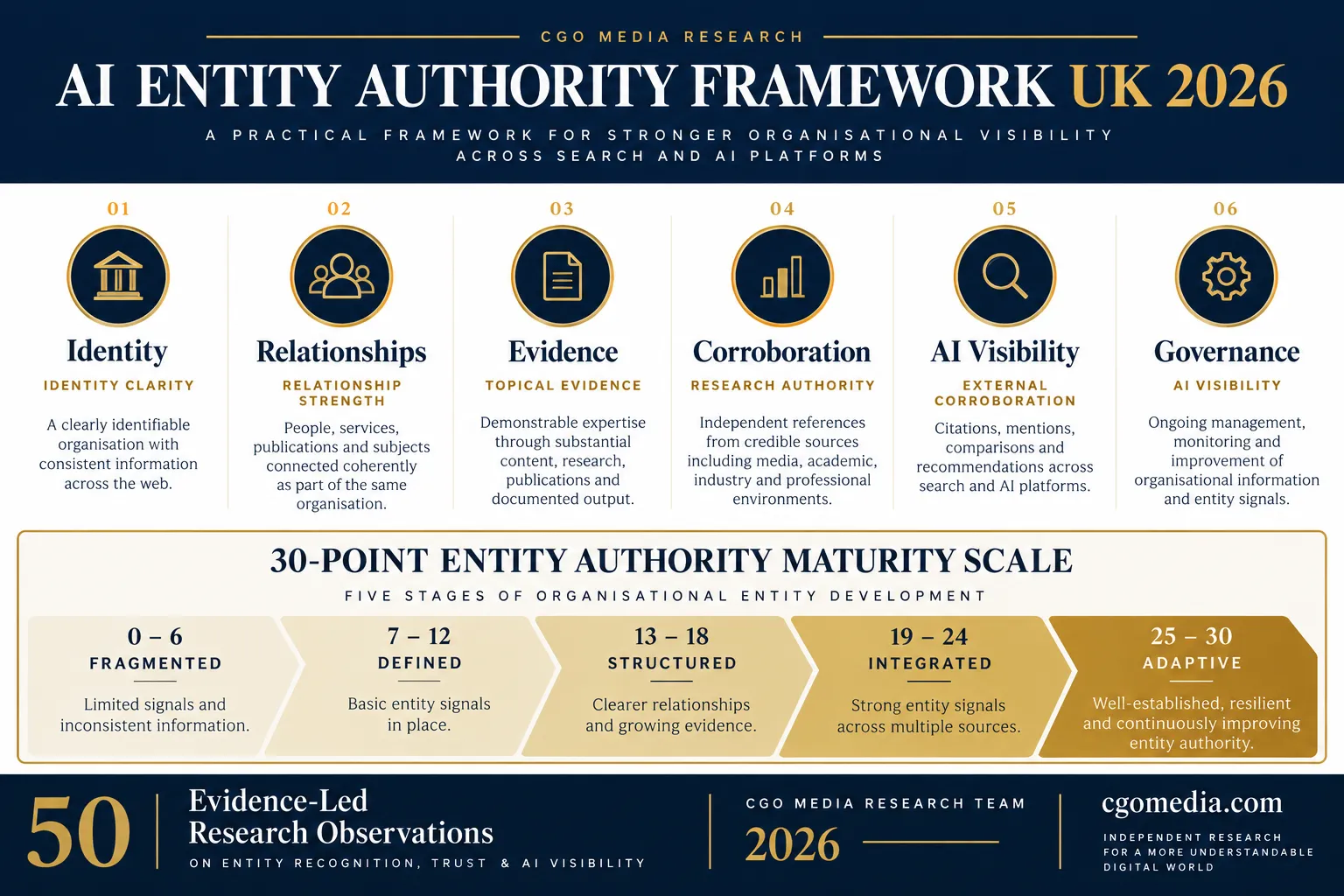
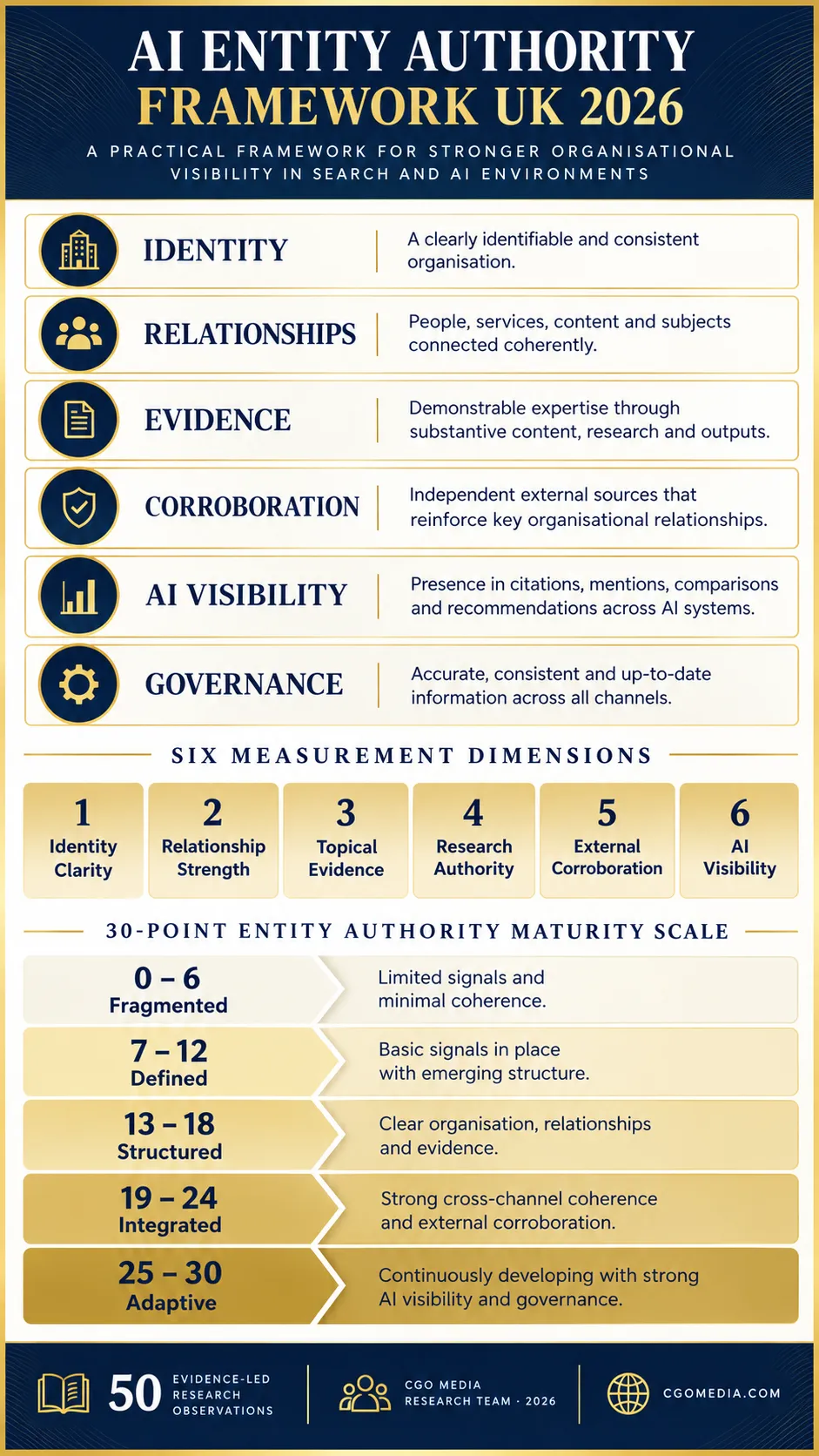
The Five Entity Authority Layers
For this research, CGO Media groups organisational Entity Authority into five connected layers.
| Entity Layer | What It Examines |
|---|---|
| 1. Identity | Organisation names, descriptions, legal identity, locations, contact information, branding and other signals that establish who the organisation is. |
| 2. Structure | Structured data, entity relationships, people, services, products, publications and machine-readable connections that clarify how the organisation is represented. |
| 3. Topical Association | The subjects, sectors, capabilities and areas of expertise repeatedly associated with the organisation across owned and independent sources. |
| 4. External Validation | Independent media, academic references, professional profiles, industry sources, citations, directories, repositories and other third-party corroborating evidence. |
| 5. Evidence Consistency | The degree to which those signals agree with one another and remain accurate, current and sufficiently consistent across the wider information ecosystem. |
What the 50 Research Observations Examine
The fifty observations in this study are organised around the recurring conditions that appear most relevant to building a clear and credible organisational entity across modern search environments.
Entity Identity & Disambiguation
How organisations establish stable identity signals and reduce ambiguity between similarly named people, companies, products and concepts.
Knowledge Relationships
How people, organisations, topics, services, publications and external sources create meaningful semantic relationships.
Independent Corroboration
How third-party sources contribute additional evidence that an organisation exists, operates in a particular field and possesses identifiable expertise.
People & Author Entities
How founders, researchers, executives and authors contribute to organisational understanding through identifiable professional and publishing relationships.
Research & Publication Evidence
How original research, datasets, frameworks, studies and repository records can strengthen the evidence environment surrounding an organisation.
Measurement & Governance
How organisations can audit, monitor and improve entity consistency as a continuing strategic capability rather than a one-off SEO task.
Research Scope
This publication does not attempt to reverse-engineer proprietary ranking algorithms or claim access to undisclosed AI platform signals.
Instead, the research combines documented search-engine guidance, structured-data standards, observable information-retrieval behaviour, recognised entity concepts and CGO Media’s own research interpretation to identify practical patterns that organisations can evaluate.
The research is particularly concerned with the difference between three related but separate outcomes:
- Recognition: can the system identify the organisation correctly?
- Understanding: can the system associate the organisation with the correct people, subjects, products, services and locations?
- Authority: is there sufficient consistent and independent evidence to support confidence in those associations?
Evidence Classification Used Throughout This Research
Each observation should be interpreted according to the evidence supporting it. The rebuild therefore distinguishes between:
- First-party platform documentation — statements directly documented by search engines or technology platforms.
- Structured-data and technical standards — documented conventions for describing entities and relationships.
- Independent research — studies, datasets and published analysis from external organisations.
- Observable search behaviour — repeatable characteristics that can be evaluated across search and generative systems.
- CGO Media research interpretation — conclusions or strategic models developed by CGO Media from the combined evidence.
Research Objectives
The AI Entity Authority Research UK 2026 programme has six primary objectives:
- Define Entity Authority in a way that can be measured without presenting it as a proprietary platform ranking factor.
- Identify the organisational signals that contribute to clearer entity recognition and differentiation.
- Examine the role of structured information and semantic relationships in organisational understanding.
- Assess how independent references can strengthen or contradict an organisation’s own entity signals.
- Develop a practical framework for auditing Entity Authority across search and AI environments.
- Establish a foundation for long-term measurement of organisational AI visibility, citation and recommendation readiness.
Research Standard
Throughout this publication, CGO Media distinguishes between documented platform behaviour, independently observed evidence and CGO Media’s own interpretation. Where a platform has not publicly confirmed a ranking signal, this research does not present one as established fact.
Primary First-Party Sources
Google Search Central — Organization Structured Data
Google states that organisation structured data can help it understand administrative details about an organisation and distinguish one organisation from another in search results.
Google Search Central: Organization Structured Data →
Google Search Central — ProfilePage Structured Data
Research Observations 1–10
Entity Identity, Recognition, Disambiguation & Structured Data
The first ten observations examine the foundation of Entity Authority: whether an organisation can be represented consistently enough for search engines and other machine-based systems to determine which organisation is being referenced and distinguish it from other entities.
These observations concentrate primarily on first-party identity signals and structured information. They should not be interpreted as evidence that adding schema markup, company identifiers or external profile links automatically improves rankings. Their significance lies in helping create a clearer and more internally consistent representation of the organisation.
Research Observation 1
A Stable Organisation Name Is the Foundation of Entity Identity
Evidence Type: Google First-Party Documentation
An organisation’s name is one of the most basic signals used to identify it. Google includes name among the recommended properties for Organization structured data and describes it as the name of the organisation.
Consistency becomes particularly important when the organisation is represented across its website, structured data, company profiles, research publications, directories, social platforms and external references.
Research Finding: An organisation should establish one clear primary name and use that identity consistently wherever practical.
CGO Media Interpretation: Entity development begins with identity stability. Frequent unexplained variations in the organisation’s primary name can create unnecessary ambiguity, particularly where similarly named organisations also exist.
Source:
Google Search Central — Organization Structured Data
Research Observation 2
Alternate Names Can Help Reconcile Legitimate Brand Variations
Evidence Type: Google First-Party Documentation
Organisations are not always referenced by one exact name. A company may have a legal name, trading name, abbreviated form or commonly used brand variation.
Google supports the alternateName property within organisational structured data. This provides a machine-readable method for expressing legitimate alternative names without treating them as separate organisations.
Research Finding: Legitimate naming variations should be explicitly reconciled rather than allowed to exist as unexplained inconsistencies.
CGO Media Interpretation: The objective is not to create numerous variations artificially. It is to help connect genuine names used for the same organisation so the underlying identity remains coherent.
Source:
Google Search Central — Organization Structured Data
Research Observation 3
The Official Website URL Functions as a Strong Identity Reference
Evidence Type: Google First-Party Documentation
The official organisational website provides a stable digital location around which other identity signals can be organised. Google supports the url property for organisations as part of its recommended structured-data vocabulary.
The relationship between an organisation and its canonical website becomes especially important when multiple domains, former domains, campaign sites, country sites or third-party profiles exist.
Research Finding: Organisations benefit from making the relationship between the brand and its primary canonical website explicit and consistent.
CGO Media Interpretation: The main website should act as the central first-party identity source from which people, research, services, locations and external profiles can be connected.
Source:
Google Search Central — Organization Structured Data
Research Observation 4
Formal Organisational Identifiers Can Strengthen Disambiguation
Evidence Type: Google First-Party Documentation
Names alone are not always sufficient to distinguish organisations. Google documents several organisational identifiers that can provide additional differentiation, including identifiers associated with legal entities, industry classifications and recognised registration systems.
Google specifically notes that properties such as iso6523Code and naics can be used behind the scenes to help distinguish one organisation from another.
Research Finding: Where appropriate and publicly relevant, recognised organisational identifiers can provide a more precise machine-readable identity than a company name alone.
CGO Media Interpretation: For organisations operating in regulated, financial, corporate or international environments, verified identifiers can become particularly useful evidence because they connect the digital entity to a formal real-world organisation.
Source:
Google Search Central — Organization Structured Data
Research Observation 5
Real-World Organisational Details Reinforce Digital Identity
Evidence Type: Google First-Party Documentation
Google recommends organisational properties that represent both digital and real-world presence, including addresses, telephone numbers, contact information and relevant registration details.
These properties help describe the organisation as an operating entity rather than only as a website.
Research Finding: Accurate real-world organisational information contributes to a more complete representation of the entity.
CGO Media Interpretation: Address, telephone and corporate information should agree wherever the same information is published. Entity clarity can be weakened when an organisation presents materially different identity information across its website and external profiles without explanation.
Source:
Google Search Central — Organization Structured Data
Research Observation 6
sameAs Can Connect an Entity to Authoritative External Identity References
Evidence Type: Schema.org Standard + Google Documentation
Schema.org defines sameAs as a URL to a reference page that unambiguously indicates the identity of the item being described.
Google also supports multiple sameAs URLs within Organization structured data and gives examples such as organisational profiles on external websites.
Research Finding: Correct use of sameAs can explicitly connect an organisation’s first-party representation with legitimate external profiles describing the same entity.
CGO Media Interpretation: sameAs should be used for genuine identity equivalence, not as a generic list of backlinks. High-quality organisational profiles, recognised repositories and established reference records are more appropriate than unrelated mentions.
Sources:
Schema.org — sameAs
Google Search Central — Organization Structured Data
Research Observation 7
Consistent Logos Support Brand Recognition but Should Not Be Confused With Authority
Evidence Type: Google First-Party Documentation
Google supports the logo property within organisational structured data and states that providing it can help Google understand which logo should represent an organisation in relevant search experiences.
A logo therefore contributes to representation and brand identification, but there is no basis for treating a logo itself as evidence of organisational authority.
Research Finding: Visual identity consistency is useful for entity representation, but visual branding and authority should be measured separately.
CGO Media Interpretation: Entity Authority requires evidence beyond recognition. A consistently presented logo may help systems and users identify an organisation, while authority must be developed through expertise, corroboration, publishing, relationships and independent evidence.
Source:
Google Search Central — Organization Structured Data
Research Observation 8
Organisation Markup Should Be Concentrated on the Page That Defines the Organisation
Evidence Type: Google First-Party Documentation
Google recommends placing organisation information on the homepage or on a single page that describes the organisation, such as an About page. It explicitly states that the organisation markup does not need to be repeated on every page.
Research Finding: Entity markup is strongest when it accurately describes the page and is located where the organisation itself is genuinely being defined.
CGO Media Interpretation: Repeating large organisation schema blocks indiscriminately across every URL does not create additional authority. A cleaner architecture establishes a central organisational entity and connects other pages to it appropriately.
Source:
Google Search Central — Organization Structured Data Guidelines
Research Observation 9
The Most Specific Valid Entity Type Should Be Used Where Appropriate
Evidence Type: Google First-Party Documentation
Google recommends using the most specific Schema.org subtype of Organization that accurately represents the organisation.
This reflects a wider principle of entity modelling: more precise classifications can communicate more information than unnecessarily broad labels, provided the classification is accurate.
Research Finding: Entity specificity can improve semantic clarity when the subtype genuinely describes the organisation.
CGO Media Interpretation: Organisations should avoid choosing schema types merely because they appear more commercially desirable. The objective is accurate classification, not markup inflation. Specificity is useful only when it reflects the actual entity.
Source:
Google Search Central — Organization Structured Data Guidelines
Research Observation 10
People and Organisations Can Be Modelled as Connected but Distinct Entities
Evidence Type: Google First-Party Documentation
Google’s ProfilePage documentation supports both Person and Organization as the primary entity represented by a profile page. Google also explains that structured-data features such as articles can reference authors and creators.
This provides a technical basis for representing organisations and the people associated with them as distinct entities with explicit relationships.
Research Finding: Founders, executives, authors and researchers should not be treated merely as text strings where a genuine identifiable person entity exists.
CGO Media Interpretation: An organisation’s authority architecture becomes richer when its recognised people are clearly connected to their biographies, expertise, publications, research and organisational roles. The person and the organisation remain separate entities, but the relationship between them becomes explicit.
What Observations 1–10 Tell Us
The first layer of Entity Authority is not authority at all. It is identity clarity.
Before an organisation can accumulate meaningful topical, research or external authority, search and retrieval systems need sufficient evidence to establish which entity is being referenced. The strongest foundations therefore combine:
- a stable primary organisational name;
- explicit legitimate alternative names;
- a clear canonical website;
- appropriate formal identifiers;
- consistent real-world organisational information;
- carefully selected external identity references;
- consistent brand representation;
- accurate structured data;
- specific entity classification where justified; and
- clear relationships between the organisation and its people.
These signals do not prove authority individually. Their value lies in creating a coherent identity layer upon which stronger evidence, topical relationships and independent validation can subsequently develop.
Evidence Note
Google states that adding Organization structured data can help it understand administrative details and disambiguate an organisation in Search. Google also advises organisations to add as many relevant properties as apply, rather than treating the markup as a fixed checklist.
Structured data should therefore be regarded as a method of communicating explicit information about an entity, not as a substitute for wider organisational credibility or as a guaranteed ranking mechanism.
Google Search Central — Organization Structured Data →
Research Observations 11–20
Knowledge Graphs, Entity Relationships & Topical Association
Entity identity becomes substantially more useful when it is connected to other identifiable entities, subjects and creative works. An organisation does not exist in isolation: it can be associated with founders, employees, researchers, publications, services, datasets, sectors, locations and external sources.
The following ten observations examine this relationship layer of Entity Authority. The emphasis is not on claiming that a specific relationship produces a ranking advantage. Instead, the research considers how organisations can represent their relationships more explicitly and create a more coherent information environment for search engines and AI systems.
Research Observation 11
Entity Relationships Are More Informative Than Isolated Entity References
Evidence Type: Structured Data Standards + CGO Media Research Interpretation
Structured data is designed not only to identify individual entities but also to describe how those entities relate to one another. A person can author an article, an organisation can publish research, a creative work can be about a subject, and a dataset can have an identifiable creator.
These relationships transform a collection of disconnected names into a more structured information model.
Research Finding: Entity understanding becomes richer when organisations make important relationships explicit rather than presenting people, publications and subjects as disconnected text references.
CGO Media Interpretation: Entity Authority should be treated as a network rather than a single organisational record. The strategic question is not simply “Is the organisation identifiable?” but also “Which identifiable people, subjects and evidence sources are clearly connected to it?”
Sources:
Schema.org structured vocabulary and Google Search Central structured-data documentation.
Research Observation 12
Being the Subject of Content Is Different From Merely Being Mentioned
Evidence Type: Schema.org Standard
Schema.org distinguishes between content that is principally about an entity and content that merely mentions it.
The about property describes the subject matter of a creative work, while mentions indicates that the work contains a reference to an entity or concept without necessarily being primarily about it.
Research Finding: A substantive relationship between an organisation and a subject is different from a passing reference to that organisation or subject.
CGO Media Interpretation: This distinction is important when evaluating topical authority. Hundreds of incidental keyword mentions should not be treated as equivalent to substantial research, analysis or specialist content whose primary subject matter is clearly connected to the organisation’s expertise.
Sources:
Schema.org — about
Schema.org — mentions
Research Observation 13
Topic Association Can Be Expressed Without Claiming Proven Expertise
Evidence Type: Schema.org Standard
Schema.org provides the knowsAbout property for a Person and, less commonly, an Organization. The property indicates a topic the entity knows about, while Schema.org explicitly cautions that it suggests possible expertise rather than proving it.
Research Finding: Machine-readable topical associations can help describe an organisation’s areas of knowledge, but the declaration itself does not constitute evidence of expertise.
CGO Media Interpretation: Organisations should not attempt to manufacture expertise simply by declaring topics in structured data. Stronger authority develops when claimed subject areas are supported by substantive content, identifiable authors, original research and independent corroboration.
Source:
Schema.org — knowsAbout
Research Observation 14
Author Relationships Strengthen the Connection Between People and Published Knowledge
Evidence Type: Google First-Party Documentation
Google’s Article structured-data documentation supports identifiable Person and Organization authors. Google recommends using the appropriate entity type and, where possible, providing an author URL or sameAs reference that helps identify the author.
This allows the creative work to be associated with a specific person or organisation rather than only displaying an unstructured byline.
Research Finding: Consistent authorship connects identifiable people or organisations with the body of content they create.
CGO Media Interpretation: For research-led organisations, author pages should not be decorative biography pages. They should function as entity hubs connecting the person to their expertise, research, articles, organisational role and relevant external profiles.
Source:
Google Search Central — Article Structured Data and Author Markup Best Practices
Research Observation 15
Author and Publisher Are Distinct Relationships
Evidence Type: Google First-Party Documentation
Google’s Article documentation distinguishes the author of content from the publisher. It specifically advises against placing the publisher’s name inside the author.name field and instead directs publishers to use the appropriate publisher property.
Research Finding: Separating authorship from publishing responsibility creates a more precise representation of who created a work and which organisation published it.
CGO Media Interpretation: This becomes particularly important for research organisations. An individual researcher can remain an identifiable author while the organisation is simultaneously established as the publisher. Conflating those roles removes useful relationship information.
Source:
Google Search Central — Article Structured Data
Research Observation 16
Research Datasets Can Create Explicit Relationships Between Organisations, Researchers and Evidence
Evidence Type: Google First-Party Documentation
Google’s Dataset structured-data documentation supports relationships including creator, publisher, citation, identifiers and funding information.
The creator can be represented as a person or organisation, allowing research outputs to be connected explicitly with the entities responsible for producing them.
Research Finding: Structured research assets can establish stronger relationships between an organisation and the evidence it produces than an unstructured webpage alone.
CGO Media Interpretation: Original datasets, research observations and formal publications can become important components of Entity Authority when authorship, organisational responsibility and publication identity are represented consistently.
Source:
Google Search Central — Dataset Structured Data
Research Observation 17
Persistent Research Identifiers Reduce Ambiguity Between Authors and Institutions
Evidence Type: Google First-Party Documentation
Google’s Dataset guidance explicitly recommends ORCID identifiers for uniquely identifying individual researchers and ROR identifiers for institutions and organisations where appropriate.
Persistent identifiers can be particularly useful where multiple researchers share the same name or where an institution may be referenced using different naming conventions.
Research Finding: Persistent identifiers can strengthen disambiguation within research and academic information environments.
CGO Media Interpretation: Organisations publishing original research should treat persistent researcher and institutional identities as part of their wider entity architecture. They help connect publications across websites, repositories and research environments without relying solely on name matching.
Source:
Google Search Central — Dataset Structured Data
Research Observation 18
Topical Authority Requires Evidence Beyond a Declared Topic
Evidence Type: Structured Data Standards + CGO Media Research Interpretation
An organisation can state that it operates within a particular field, and structured data can represent associations between an organisation and a topic. Neither action alone demonstrates sustained knowledge or authority.
A stronger topical relationship emerges when multiple forms of evidence converge around the same subject area.
Research Finding: Topic association is strongest when organisational claims are reinforced by substantive publications, identifiable authors, research, datasets, services and relevant external evidence.
CGO Media Interpretation: CGO Media distinguishes between declared relevance and demonstrated topical association. A company can declare expertise in AI search in one sentence; a sustained body of research, frameworks, datasets and specialist publications creates a much deeper evidence trail.
Evidence Basis:
Schema.org topic relationships; Google structured-data documentation; CGO Media research interpretation.
Research Observation 19
An Entity Can Be Connected to the Creative Works That Are About It
Evidence Type: Schema.org Standard
Schema.org’s subjectOf property describes a CreativeWork or Event about a particular entity and operates as the inverse relationship of about.
This illustrates an important entity principle: the information environment can be represented from both directions — content can be about an entity, and the entity can be the subject of relevant content.
Research Finding: Entity relationships can connect organisations not only to content they publish themselves but also to creative works in which they are genuinely the subject.
CGO Media Interpretation: Independent articles, research references, interviews, profiles and other substantive coverage can form part of an organisation’s wider evidence environment. The significance lies in the quality and relevance of the relationship, not simply the number of mentions accumulated.
Source:
Schema.org — subjectOf
Research Observation 20
Knowledge Architecture Becomes Stronger When Multiple Relationships Converge on the Same Entity
Evidence Type: CGO Media Research Synthesis
No single structured-data property, author profile, research paper or external reference creates a complete organisational knowledge architecture.
The stronger pattern occurs when multiple consistent relationships converge:
- the organisation publishes research;
- the research has identifiable authors;
- the authors have stable profiles;
- the organisation is the recognised publisher;
- the research concerns identifiable subjects;
- datasets are connected with their creators;
- external profiles identify the same people and organisation;
- independent sources discuss the organisation within the same subject areas; and
- those relationships remain consistent over time.
Research Finding: Entity Authority is better understood as the coherence of a connected evidence network than as the presence of one optimised data point.
CGO Media Interpretation: This is the foundation of the CGO Media Knowledge Architecture approach. Organisations should progressively connect identity, people, expertise, research, services, publications and independent evidence into one understandable entity ecosystem.
Evidence Basis:
Synthesis of Google structured-data guidance, Schema.org entity relationships and CGO Media research observations.
What Observations 11–20 Tell Us
The second layer of Entity Authority is relationship clarity.
An identifiable organisation becomes more understandable when its relationships with people, topics, research and external evidence can also be interpreted. The emerging pattern is therefore not simply:
Organisation → Topic
It is a deeper network:
Organisation → People → Expertise → Publications → Research → Topics → Independent Evidence.
The strongest entity architectures combine:
- clear relationships between people and organisations;
- accurate separation of authors and publishers;
- explicit subject relationships;
- identifiable research and datasets;
- persistent researcher and institutional identities;
- consistent topical associations;
- substantive rather than incidental mentions;
- first-party and independent creative works;
- connected internal knowledge architecture; and
- multiple evidence sources that reinforce the same underlying entity relationships.
These relationships do not constitute a disclosed Google or AI-platform authority score. Their value lies in making the organisation and its surrounding evidence environment progressively clearer, richer and easier to interpret.
CGO Media Entity Authority Principle
Recognition identifies the entity. Relationships explain the entity.
An organisation may be correctly recognised while remaining poorly understood. The purpose of the relationship layer is therefore to connect the organisation with the people, subjects, publications, research and independent evidence that explain what the organisation does and where its demonstrable knowledge sits.
Primary Evidence Sources for Observations 11–20
Google Search Central — ProfilePage Structured Data
Google Search Central — Article Structured Data and Author Markup Best Practices
Google Search Central — Dataset Structured Data
Schema.org — about
Schema.org — mentions
Schema.org — knowsAbout
Schema.org — subjectOf
Research Observations 21–30
Independent Corroboration, Citations, Brand Mentions & External Authority
The first twenty observations established two foundations of Entity Authority: an organisation must first be identifiable, and its relationships with people, topics, research and other entities must then be understandable.
The third layer concerns independent corroboration.
First-party information is essential because organisations need authoritative sources that explain who they are, what they do and what they know. However, organisations cannot establish broader external authority solely by repeating their own claims across their own websites.
Independent publications, citations, professional profiles, research repositories, media coverage, industry references and other third-party sources can provide additional evidence that an organisation, person, publication or area of expertise exists beyond its own controlled environment.
This section also distinguishes between citations and brand mentions. These are separate visibility outcomes and should therefore be measured separately.
Research Observation 21
First-Party Claims and Independent Corroboration Are Different Evidence Classes
Evidence Type: CGO Media Research Framework
An organisation’s own website is normally the most direct source for its identity, services, people, research and corporate information. However, information published by the organisation about itself remains first-party evidence.
External sources provide a different form of evidence because they originate outside the organisation’s directly controlled publishing environment.
Research Finding: A claim made by an organisation and independent corroboration of that claim should not be treated as equivalent evidence.
CGO Media Interpretation: Strong Entity Authority combines both. First-party sources define the entity; independent sources can help corroborate its existence, activities, expertise and relationships.
Evidence Basis:
CGO Media Entity Authority research framework and wider source-verification principles.
Research Observation 22
AI Citation and Brand Mention Are Distinct Visibility Outcomes
Evidence Type: Independent AI Visibility Research
A source can be cited within an AI-generated response without the organisation behind that source being explicitly named in the answer.
Conversely, an organisation may be named in an AI response without a direct citation to its website.
A 2026 Semrush study analysing domain appearances across major AI search environments reported that approximately 61.7% of citations in its dataset were “ghost citations”, where the source was cited but the associated brand was not named in the generated answer.
Research Finding: Citation visibility and brand visibility should be measured as separate outcomes.
CGO Media Interpretation: Organisations evaluating AI search performance should not assume that being cited automatically means the brand is being recognised by users. Citation tracking, mention tracking and recommendation tracking require separate measurement.
Source:
Semrush — 2026 Ghost Citations Study.
Research Observation 23
A Citation Can Create Source Visibility Without Creating Equivalent Brand Recognition
Evidence Type: Independent AI Visibility Research
The separation between citations and mentions changes how organisations should interpret AI visibility.
A research article, dataset or guide may be selected as a supporting source because it provides useful evidence, yet the generated answer may synthesise the information without explicitly naming the publisher in the response text.
Research Finding: Source selection does not necessarily translate into visible organisational attribution.
CGO Media Interpretation: Research-led organisations should value citations because they demonstrate source use, but they should not treat them as equivalent to branded visibility. A mature measurement framework should identify whether an organisation is cited, mentioned, compared or recommended.
Source:
Semrush — 2026 Ghost Citations Study.
Research Observation 24
Independent Sources Can Expand the Evidence Environment Around an Entity
Evidence Type: Entity Research Synthesis
An organisation’s own website can describe its services, research and expertise, but external sources can introduce additional references to the same underlying entity.
Relevant sources may include:
- news and trade publications;
- academic or research repositories;
- professional organisations;
- industry databases;
- conference and event websites;
- expert interviews;
- research citations;
- government or institutional sources;
- specialist directories; and
- independent comparative publications.
Research Finding: Relevant third-party references can broaden the number of independent environments in which an entity can be identified and contextualised.
CGO Media Interpretation: The objective is not to maximise the number of websites mentioning the organisation. It is to build a credible evidence footprint across sources that genuinely relate to the organisation’s identity, activities and specialist subjects.
Evidence Basis:
CGO Media research synthesis across entity representation, digital PR, research publishing and AI visibility.
Research Observation 25
External Authority Cannot Be Reduced to Raw Mention Volume
Evidence Type: Google Policy Documentation + CGO Media Research Interpretation
Not every external reference carries the same meaning. A relevant editorial reference from an established publication is fundamentally different from automated directory duplication, paid link schemes or content created primarily to manipulate search rankings.
Google’s spam policies prohibit link creation designed primarily to manipulate search rankings and also address third-party content placed on established websites primarily to exploit existing ranking signals.
Research Finding: External authority should be evaluated according to relevance, independence, context and credibility rather than raw link or mention counts.
CGO Media Interpretation: Entity Authority should not recreate historical link-building mistakes under a new label. Thousands of weak mentions do not automatically create stronger entity evidence than a smaller number of highly relevant independent references.
Sources:
Google Search Central — Spam Policies for Google Web Search.
Google Search Central — Site Reputation Abuse Policy.
Research Observation 26
Context Determines What an External Mention Actually Says About an Entity
Evidence Type: CGO Media Research Interpretation
An organisation can be mentioned for many unrelated reasons. A company name appearing in a generic business directory communicates something different from the same company being referenced within specialist analysis of the subject area in which it claims expertise.
The surrounding context determines which relationships the reference potentially reinforces.
Research Finding: External mentions are more informative when the surrounding content clearly connects the organisation to a relevant person, topic, service, research output or area of expertise.
CGO Media Interpretation: Entity analysis should ask not only “Where is the organisation mentioned?” but “What is the organisation being associated with when it is mentioned?”
Evidence Basis:
CGO Media entity relationship and external evidence methodology.
Research Observation 27
Research Repositories Can Provide Independent Publication Records
Evidence Type: Research Infrastructure Observation
Research repositories provide a separate environment in which publications, datasets, authors, dates, descriptions and persistent identifiers can be recorded.
Where the repository record accurately identifies the authors, organisation and publication, it can provide an external reference that is separate from the organisation’s own website.
Research Finding: Repository records can strengthen the discoverability and disambiguation of research outputs by providing independent publication metadata and persistent references.
CGO Media Interpretation: For organisations publishing original research, repositories should not be approached merely as backlink opportunities. Their more important value is as independent records connecting researchers, organisations, publications, dates, datasets and persistent identifiers.
Evidence Basis:
Research repository metadata practices and CGO Media research-publication methodology.
Research Observation 28
Independent Evidence Is Stronger When Multiple Sources Converge Without Being Artificially Identical
Evidence Type: CGO Media Research Synthesis
Independent sources should not be expected to reproduce an organisation’s exact marketing language. Genuine third-party descriptions may use different wording while still agreeing on the important underlying facts.
For example, multiple independent sources may consistently identify:
- the same organisation;
- the same founder or research team;
- the same primary sector;
- the same research publication;
- the same geographic operation;
- the same recognised expertise; or
- the same product or service category.
Research Finding: Evidence convergence does not require identical wording; it requires independent sources to remain substantially consistent about the underlying entity and its relationships.
CGO Media Interpretation: Natural corroboration is more credible than distributing identical promotional descriptions across hundreds of websites. Entity consistency concerns agreement about facts, not duplication of copy.
Evidence Basis:
CGO Media external corroboration methodology.
Research Observation 29
Links and Brand Mentions Should Be Analysed as Related but Separate Signals
Evidence Type: Google Documentation + Independent AI Visibility Research
A hyperlink creates an explicit navigational connection between one web resource and another. A brand mention can identify an organisation without providing a clickable link.
The two should therefore not be treated as interchangeable.
Google publicly documents links as part of how pages and resources are discovered and understood, while current AI visibility research demonstrates that brand mentions and source citations can appear independently of one another in generated responses.
Research Finding: External link analysis alone does not provide a complete picture of how an organisation is represented across modern search and AI environments.
CGO Media Interpretation: Entity Authority measurement should examine backlinks, citations, unlinked brand references, research references and AI mentions separately rather than collapsing them into one metric.
Evidence Basis:
Google Search documentation and independent 2026 AI citation/mention research.
Research Observation 30
External Authority Is Best Evaluated as a Distributed Evidence Network
Evidence Type: CGO Media Research Synthesis
No single publication, backlink, repository record, directory entry or AI citation provides a complete measure of organisational authority.
A stronger external evidence environment develops when multiple independent source types reinforce compatible aspects of the same entity.
This can include:
- media references confirming organisational activity;
- research repositories confirming publications;
- professional profiles confirming people and roles;
- trade publications connecting the organisation with relevant sectors;
- research citations connecting the organisation with original evidence;
- industry references confirming products or services;
- AI citations demonstrating source use;
- AI mentions demonstrating brand recognition; and
- independent recommendations demonstrating selection or preference.
Research Finding: External Entity Authority should be evaluated across multiple evidence environments rather than through one proxy metric.
CGO Media Interpretation: Backlinks remain useful, but they are only one component of a larger authority system. The emerging measurement challenge is to understand the entire external evidence network surrounding the entity.
Evidence Basis:
CGO Media Entity Authority and AI visibility research synthesis.
What Observations 21–30 Tell Us
The third layer of Entity Authority is independent corroboration.
Organisations need strong first-party sources, but a complete evidence architecture cannot be built entirely within properties the organisation controls.
The important progression is:
Organisation Claims → Independent Recognition → Contextual Corroboration → Citation → Mention → Comparison → Recommendation.
These outcomes are related, but they are not interchangeable.
A mature external authority strategy therefore evaluates:
- who references the organisation;
- why the organisation is referenced;
- which subjects are associated with it;
- whether the reference is genuinely independent;
- whether the source is credible and relevant;
- whether research outputs are independently recorded;
- whether the organisation is cited as a source;
- whether the brand is explicitly mentioned;
- whether it appears in comparison and recommendation environments; and
- whether multiple independent sources converge around the same underlying entity.
External authority is therefore not a volume contest. It is the development of a distributed and credible evidence environment around an identifiable organisation.
CGO Media Entity Authority Principle
First-party evidence defines the entity. Independent evidence corroborates the entity.
The strongest organisational knowledge architecture does not depend solely on what a company says about itself. It develops when relevant external environments independently recognise the organisation, its people, its research and its areas of expertise.
Key Evidence Sources for Observations 21–30
Google Search Central — Spam Policies for Google Web Search.
Google Search Central — Site Reputation Abuse Policy.
Semrush — 2026 Ghost Citations Study.
Semrush — 2026 AI visibility research examining citations and brand mentions across major AI search environments.
Important: CGO Media does not interpret an external mention, backlink, citation or repository record as a standalone AI ranking signal. These observations evaluate how external sources contribute to a broader evidence environment surrounding an organisation.
Research Observations 31–40
People Entities, Authors, Research, Digital PR & Organisational Evidence
Entity Authority is not created by the organisation alone. The people associated with an organisation — founders, executives, researchers, authors, specialists and contributors — can provide additional context that helps explain what the organisation does, which subjects it works in and where its expertise is demonstrated.
This becomes especially important for research-led organisations. Publications, datasets, frameworks, commentary and expert contributions can connect identifiable people with identifiable subjects and then connect those people back to the organisation.
The following observations examine how people entities, authorship, research publishing and digital PR contribute to a wider organisational evidence architecture.
Research Observation 31
Recognisable People Can Strengthen Organisational Understanding
Evidence Type: Structured Data Standards + CGO Media Research Interpretation
Organisations are often understood partly through the people associated with them. Founders, executives, researchers and subject specialists can each exist as identifiable entities with their own names, biographies, profiles and publication histories.
When those relationships are explicit, the organisation becomes connected to a network of people rather than existing only as a corporate name.
Research Finding: Clearly identifiable people can add contextual depth to the organisation by helping establish who is responsible for its expertise, research and public commentary.
CGO Media Interpretation: Organisations should identify key people consistently and connect them to genuine roles, areas of expertise and outputs rather than publishing thin biography pages with no supporting evidence.
Evidence Basis:
Google ProfilePage and Article structured-data guidance; Schema.org Person and Organization relationships.
Research Observation 32
Author Pages Should Function as Entity Hubs, Not Decorative Profiles
Evidence Type: Google Documentation + CGO Media Research Interpretation
An author page can provide more than a short biography. It can connect a person with their organisational role, publications, areas of expertise, external profiles, research outputs and other verifiable information.
Research Finding: A well-constructed author page can act as a central identity source for an identifiable contributor.
CGO Media Interpretation: Effective author architecture should connect the person to what they have actually produced. The stronger model is not simply Person → Biography, but Person → Role → Expertise → Publications → Research → External Profiles.
Evidence Basis:
Google Search Central — ProfilePage Structured Data and Article Author Guidance.
Research Observation 33
Authorship Becomes Stronger When It Is Consistent Across Multiple Publications
Evidence Type: CGO Media Research Interpretation
An author who appears once provides limited evidence of an ongoing relationship with a subject. A repeated publication history can create a much clearer connection between the person and the topics they consistently write or research about.
Research Finding: Sustained authorship can create a stronger evidence trail than isolated one-off publication.
CGO Media Interpretation: Topic association should emerge naturally from a person’s publication record. Repeated, substantive contributions across a defined subject area provide stronger evidence than simply listing a topic as an area of expertise.
Evidence Basis:
CGO Media author-entity and topical evidence methodology.
Research Observation 34
Original Research Can Create Stronger Evidence Than Repeated Commentary Alone
Evidence Type: Research Publishing Observation
Commentary can demonstrate that an organisation discusses a subject. Original research can go further by providing evidence that the organisation has collected, analysed, structured or interpreted new information.
Research may take the form of datasets, observations, surveys, statistical analysis, frameworks, comparative studies or long-form evidence reviews.
Research Finding: Original research can create a deeper evidential relationship between an organisation and a subject area than commentary alone.
CGO Media Interpretation: Research-led publishing becomes particularly valuable when the methodology, authorship, date, limitations and source material are transparent. Authority should come from the quality of the evidence, not merely from labelling content as “research”.
Evidence Basis:
Research publishing standards and CGO Media research methodology.
Research Observation 35
Research Methodology Is Part of the Evidence Architecture
Evidence Type: Research Methodology Principle
A research conclusion is easier to evaluate when readers can understand how the evidence was collected, analysed and interpreted.
Methodology therefore contributes to organisational credibility because it allows journalists, researchers and other readers to assess the basis of the claim.
Research Finding: Transparent methodology increases the interpretability of research evidence.
CGO Media Interpretation: Organisations publishing statistics, research observations or proprietary frameworks should clearly separate measured data, external evidence and internal interpretation. This reduces the risk of presenting opinion as established fact.
Evidence Basis:
CGO Media Research Methodology principles and standard research transparency practices.
Research Observation 36
Persistent Publication Records Extend Research Beyond the Corporate Website
Evidence Type: Research Infrastructure Observation
Research that exists only on a company website depends entirely on that domain for discovery and identification. Repository records, persistent identifiers and external research profiles can create additional records of the same publication.
Research Finding: Persistent records can extend the identity of a research output across multiple environments.
CGO Media Interpretation: Repository publishing should be used to create durable publication identity rather than merely to generate links. The most useful records connect publication title, authors, organisation, date, description and persistent identifier consistently.
Evidence Basis:
Research repository practices and CGO Media publication architecture.
Research Observation 37
Digital PR Can Strengthen Entity Evidence When the Organisation Is Relevant to the Story
Evidence Type: Digital PR Research Interpretation
Digital PR can create external references to organisations, researchers and original evidence. Its value is greatest when the organisation has a legitimate reason to appear in the editorial context.
Examples include original research findings, expert commentary, sector analysis, datasets, surveys and relevant specialist insight.
Research Finding: Editorial relevance is more important than simple mention acquisition.
CGO Media Interpretation: The strongest digital PR for Entity Authority creates meaningful relationships such as Organisation → Research → Journalist → Publication → Subject. A generic brand mention with no subject relevance creates a much weaker relationship.
Evidence Basis:
CGO Media Digital PR and external authority research.
Research Observation 38
Expert Commentary Can Connect a Person Entity With a Defined Subject
Evidence Type: Entity Relationship Observation
When a journalist, publication or specialist source quotes an identifiable person on a subject, that reference can create an external relationship between the person, the organisation and the topic.
The strength of that relationship depends on the relevance and credibility of the context.
Research Finding: Relevant external expert commentary can broaden the evidence connecting recognised individuals and organisations with specific subject areas.
CGO Media Interpretation: Expert commentary programmes should therefore prioritise genuine specialist subjects. Attempting to comment on every possible news story can dilute topical coherence rather than strengthen it.
Evidence Basis:
CGO Media digital PR and entity association methodology.
Research Observation 39
Organisational Expertise Is Stronger When People and Evidence Support the Same Subjects
Evidence Type: CGO Media Research Synthesis
An organisation’s topical position becomes more coherent when the same subject areas appear across multiple evidence types.
For example:
- the organisation publishes research on the subject;
- recognised authors write repeatedly about the subject;
- datasets or frameworks support the subject;
- external publications quote those people on the subject;
- repository records confirm relevant research outputs; and
- independent sources reference the organisation within the same subject area.
Research Finding: Topical authority becomes more credible when organisational, author, research and external evidence converge around the same subjects.
CGO Media Interpretation: This is stronger than relying on content volume alone. A large number of pages on unrelated topics may create less coherent subject association than a smaller, interconnected body of specialist evidence.
Evidence Basis:
CGO Media Entity Authority research synthesis.
Research Observation 40
People, Research and External Evidence Can Form an Organisational Authority Network
Evidence Type: CGO Media Research Synthesis
The strongest organisational evidence environments connect people, publications, research assets and external references rather than treating each as a separate marketing activity.
A connected model may include:
- an identifiable organisation;
- recognisable researchers or specialists;
- author profiles;
- original research;
- datasets and frameworks;
- repository records;
- persistent identifiers;
- journalist citations;
- expert commentary;
- independent media coverage; and
- external references to the same subject areas.
Research Finding: Organisational authority can be strengthened when multiple evidence types connect consistently around identifiable people, research and subjects.
CGO Media Interpretation: This network model helps explain why authority cannot be manufactured by one isolated optimisation tactic. The organisation, its people, its research and its external evidence should progressively reinforce one another.
Evidence Basis:
CGO Media Entity Authority, Content Authority, Digital PR and Knowledge Architecture research.
What Observations 31–40 Tell Us
The fourth layer of Entity Authority is human and research evidence.
An organisation becomes easier to understand when there are identifiable people behind its expertise and identifiable outputs behind its claims.
The progression is:
Organisation → People → Expertise → Publications → Research → Independent Recognition.
A strong evidence architecture therefore connects:
- recognisable founders, executives and researchers;
- consistent author identities;
- substantive publication histories;
- original research and datasets;
- transparent research methodology;
- persistent publication records;
- relevant digital PR;
- expert commentary;
- independent editorial references; and
- consistent topical relationships between people, organisation and evidence.
The important principle is that people should not be manufactured as artificial “expert entities”. Their authority should emerge from genuine roles, identifiable contributions, published work and independent corroboration.
CGO Media Entity Authority Principle
Organisations make claims. People create evidence. Research demonstrates capability. External sources provide corroboration.
Entity Authority becomes substantially stronger when these four layers reinforce one another around the same subjects.
Key Evidence Areas for Observations 31–40
Google Search Central — ProfilePage Structured Data.
Google Search Central — Article Structured Data and Author Markup.
Google Search Central — Dataset Structured Data.
Schema.org — Person, Organization, author, creator, publisher and subject relationships.
Research repositories and persistent identifier systems including ORCID and institutional research identifiers.
CGO Media — Research Methodology, Digital PR, Content Authority and Entity Authority research frameworks.
Evidence Note: The presence of an author page, repository profile, press quotation or research publication should not be interpreted as an automatic ranking advantage. Their value lies in contributing additional identifiable and corroborating evidence around people, organisations and subject expertise.
Research Observations 41–50
Measurement, Governance, Entity Maturity & AI Visibility
The final ten observations move from entity construction to entity management.
Identity, relationships, research and independent corroboration can all strengthen an organisation’s information environment, but these signals can deteriorate over time. People change roles, addresses change, research becomes outdated, profiles become inconsistent and external references may no longer reflect the organisation accurately.
Entity Authority should therefore be treated as an ongoing organisational capability rather than a one-time optimisation project.
Research Observation 41
Entity Authority Requires Continuous Measurement
Evidence Type: CGO Media Research Framework
An organisation’s entity environment changes continuously. New publications appear, employees join or leave, external profiles evolve, products change and independent references accumulate.
Research Finding: Entity Authority cannot be measured accurately through a one-off audit alone.
CGO Media Interpretation: Organisations should monitor identity, topical associations, research outputs, external mentions and AI visibility periodically so that deterioration or inconsistency can be identified early.
Evidence Basis:
CGO Media Entity Authority measurement framework.
Research Observation 42
Entity Consistency Should Be Audited Across Multiple Environments
Evidence Type: CGO Media Research Framework
Organisations rarely exist in only one digital environment. Their identity may appear across websites, social profiles, research repositories, business databases, directories, media articles and AI-generated responses.
Research Finding: Entity consistency should be evaluated across all important environments rather than only on the primary website.
CGO Media Interpretation: A strong first-party website cannot fully compensate for widespread external inconsistency. Audit processes should therefore compare names, descriptions, people, addresses, services and subject associations across multiple sources.
Evidence Basis:
CGO Media cross-platform entity auditing methodology.
Research Observation 43
Entity Conflicts Should Be Treated as Governance Issues
Evidence Type: CGO Media Research Interpretation
Conflicting information often emerges because different departments, websites, profiles and external sources are maintained independently.
Typical conflicts include:
- different company descriptions;
- outdated employee roles;
- incorrect addresses;
- inconsistent brand names;
- old service descriptions;
- duplicated organisation profiles; and
- different publication or author identities.
Research Finding: Entity inconsistency is frequently an organisational governance problem rather than simply an SEO problem.
CGO Media Interpretation: Responsibility for entity accuracy should be assigned internally so that corporate, editorial, research, PR and technical teams do not maintain contradictory representations of the same organisation.
Evidence Basis:
CGO Media entity governance methodology.
Research Observation 44
Entity Freshness Matters Where Organisational Facts Change
Evidence Type: Information Quality Principle
Entity information can become inaccurate even when it was originally correct. Leadership changes, locations close, services evolve and research programmes expand.
Research Finding: Entity accuracy depends partly on maintaining current information across first-party and external sources.
CGO Media Interpretation: Freshness should be prioritised for facts that materially affect organisational identity. Historical information can remain valuable, but current roles, locations, services and contact information should be clearly distinguishable from outdated records.
Evidence Basis:
CGO Media information-quality and entity-maintenance framework.
Research Observation 45
AI Visibility Should Be Measured Beyond Rankings
Evidence Type: AI Search Measurement Framework
Traditional search measurement has historically concentrated on rankings, impressions, clicks and conversions. AI-mediated discovery introduces additional visibility outcomes.
These include:
- being cited as a source;
- being mentioned by name;
- being included in comparisons;
- being shortlisted;
- being recommended; and
- being associated with a particular subject.
Research Finding: AI visibility requires a broader measurement framework than traditional keyword rankings alone.
CGO Media Interpretation: Organisations should track whether AI systems recognise, cite, mention, compare and recommend them across relevant commercial and informational query types.
Evidence Basis:
CGO Media AI Visibility and Entity Authority measurement framework.
Research Observation 46
Entity Authority Should Be Measured Through Multiple Dimensions
Evidence Type: CGO Media Research Model
A single score cannot explain every aspect of Entity Authority. An organisation may have strong identity clarity but weak external corroboration, or excellent research evidence but poor profile consistency.
Research Finding: Entity Authority is better measured as a multi-dimensional capability than as one isolated metric.
CGO Media Interpretation: A practical assessment should evaluate separate dimensions such as Identity Clarity, Relationship Strength, Topical Association, Research Evidence, External Corroboration and AI Visibility.
Evidence Basis:
CGO Media Entity Authority measurement model.
Research Observation 47
Entity Maturity Develops Through Progressive Organisational Capability
Evidence Type: CGO Media Maturity Model
Organisations differ substantially in how well their entity environment is managed. Some have fragmented identity data, while others operate structured research, author, schema, repository and external evidence programmes.
Research Finding: Entity Authority can be assessed as a maturity progression rather than a binary state.
CGO Media Interpretation: A practical maturity model can classify organisations across stages such as Fragmented, Defined, Structured, Integrated and Adaptive, reflecting progressively stronger identity, evidence and governance capability.
Evidence Basis:
CGO Media Entity Authority Maturity Model.
Research Observation 48
High Entity Authority Requires Organisational Coordination
Evidence Type: Governance Research Interpretation
Entity signals are usually produced by multiple teams. SEO manages technical representation, PR manages external coverage, research teams publish evidence, HR maintains people information and corporate teams manage official identity.
Research Finding: Mature Entity Authority depends on coordination between organisational functions.
CGO Media Interpretation: The strongest programmes align SEO, content, research, PR, corporate communications, data and leadership rather than allowing each function to publish independently without shared identity standards.
Evidence Basis:
CGO Media entity governance and organisational maturity framework.
Research Observation 49
Entity Authority Supports AI Readiness but Does Not Guarantee AI Recommendation
Evidence Type: CGO Media Research Synthesis
Clear identity, strong research, independent evidence and consistent relationships can improve the information environment surrounding an organisation. However, no public evidence supports the claim that these factors guarantee recommendation by any AI platform.
Research Finding: Entity Authority should be viewed as an enabling condition for AI visibility rather than a guaranteed recommendation mechanism.
CGO Media Interpretation: Organisations can improve how clearly they are represented and corroborated, but AI responses remain influenced by query context, source selection, platform architecture, freshness, relevance and other undisclosed factors.
Evidence Basis:
CGO Media AI Search Readiness and Entity Authority research synthesis.
Research Observation 50
Entity Authority Is Best Treated as a Long-Term Organisational Asset
Evidence Type: CGO Media Research Synthesis
The strongest conclusion from the fifty observations is that Entity Authority is not created through one schema deployment, one PR campaign, one research paper or one backlink programme.
It develops progressively through the interaction of:
- clear organisational identity;
- accurate structured information;
- recognisable people;
- consistent topical relationships;
- original research;
- persistent publication records;
- independent corroboration;
- external citations and mentions;
- AI visibility monitoring;
- continuous governance; and
- long-term evidence development.
Research Finding: Entity Authority is best understood as a cumulative organisational capability that strengthens as identity, relationships and evidence become more coherent over time.
CGO Media Interpretation: Organisations that treat entity development as infrastructure rather than a short-term campaign are better positioned to remain understandable across search engines, AI assistants and future discovery environments.
Evidence Basis:
Synthesis of all 50 CGO Media Entity Authority Research Observations.
What Observations 41–50 Tell Us
The fifth and final layer of Entity Authority is measurement and governance.
The full progression across the fifty observations is:
Identity → Relationships → External Corroboration → Human & Research Evidence → Measurement & Governance.
A mature organisation should be able to answer five questions:
- Identity: Can machines clearly determine who we are?
- Relationships: Can they understand the people, topics, services and publications connected to us?
- Evidence: Do independent sources corroborate those relationships?
- Authority: Is there meaningful evidence demonstrating why we should be associated with those subjects?
- Governance: Are we measuring and maintaining these signals consistently over time?
The objective is not to manufacture an artificial entity signal. It is to create a progressively clearer and more credible information environment around the organisation.
CGO Media Entity Authority Model
Entity Authority = Identity Clarity + Relationship Strength + Topical Evidence + Independent Corroboration + Research Evidence + Governance.
This formula is a CGO Media research framework. It is not presented as a disclosed ranking formula used by Google, ChatGPT, Gemini or any other search or AI platform.
CGO Media Entity Authority Maturity Levels
Level 1 — Fragmented: Identity and external information are inconsistent, disconnected or poorly maintained.
Level 2 — Defined: Core organisational identity, people and services are clearly documented but relationships remain limited.
Level 3 — Structured: Identity, schema, authors, research and external profiles are deliberately connected.
Level 4 — Integrated: Research, content, PR, people, repositories and external authority reinforce the same organisational and topical relationships.
Level 5 — Adaptive: Entity evidence is continuously monitored, measured and refined across search and AI environments.
Research Positioning Note
The CGO Media Entity Authority model is an independent research framework designed to help organisations assess how clearly and credibly they are represented across search and AI information environments.
It does not claim that Google, OpenAI, Anthropic, Microsoft, Perplexity or any other platform uses a metric called “Entity Authority”.
The framework combines documented structured-data practices, entity relationships, research publishing principles, external corroboration and observable AI visibility outcomes into one organisational measurement model.
CGO Media Research Analysis
What the 50 Entity Authority Observations Tell Us
The fifty observations point towards a clear conclusion: Entity Authority is not created by one signal, one platform or one optimisation technique.
It develops through the interaction of identity, relationships, research, external corroboration and organisational governance.
This matters because modern search and AI systems increasingly operate across information environments rather than isolated webpages. They may encounter an organisation through its website, an author profile, a research paper, an external article, a repository record, a business database, structured data or a third-party citation.
The organisation therefore needs to remain recognisable across those environments while presenting sufficiently consistent evidence for its people, expertise, publications and activities to be understood as connected.
The Central Finding
Entity Authority develops when multiple independent and first-party evidence sources converge around a clearly identifiable organisation.
The objective is not repetition for its own sake. It is coherence. An organisation becomes easier to interpret when its website, people, research, profiles, publications and external references broadly agree about who it is, what it does and where its expertise sits.
Entity Authority Is an Evidence System
The most important implication from this research is that Entity Authority should not be approached as a traditional SEO checklist.
Adding organisation schema, creating an author page, obtaining a press mention or uploading a research paper to a repository can each contribute useful information, but none of those actions alone creates a complete authority system.
The stronger model is cumulative:
Identity
Establish who the organisation is.
Relationships
Connect the organisation with its people, publications, services, locations and subjects.
Evidence
Demonstrate those relationships through research, content, datasets and identifiable outputs.
Corroboration
Develop relevant independent references that reinforce the same underlying entity.
Governance
Monitor and maintain the entire evidence environment over time.
The strength of the system therefore comes from the interaction between these layers rather than the isolated strength of any individual component.
Recognition Comes Before Authority
The first ten observations highlighted an important distinction: an organisation cannot develop meaningful Entity Authority if its basic identity is unclear.
Before authority can be evaluated, machines need to resolve more fundamental questions:
- What is the organisation called?
- Which website officially represents it?
- Are alternative names connected correctly?
- Which people are genuinely associated with it?
- Where does it operate?
- Which external profiles describe the same entity?
This means that organisations with fragmented identity data can face a foundational problem before content quality or external authority is even considered.
CGO Media Interpretation
Recognition is the prerequisite. Authority is the accumulation. An organisation must first become sufficiently identifiable before a wider evidence network can reinforce what that organisation represents.
Relationships Explain What the Entity Represents
Identity alone tells a system that an organisation exists. Relationships provide the additional context needed to understand what that organisation does.
This is why people, services, research, publications, locations and topics matter.
A research-led organisation can create a much richer entity architecture when:
- the organisation is clearly identified;
- researchers are identifiable people;
- those researchers have consistent profiles;
- their publications are connected to them;
- the organisation is established as the publisher;
- research outputs concern identifiable subjects;
- external sources reference those outputs; and
- those relationships remain consistent across multiple environments.
This creates a connected evidence structure rather than a set of unrelated webpages.
Topical Authority Requires More Than Content Volume
The research also suggests that Entity Authority should not be confused with publishing volume.
An organisation may produce hundreds of articles without developing a particularly clear relationship with any one subject area. Conversely, a smaller body of specialist research, supported by identifiable authors, datasets and independent references, can create a far more coherent topical footprint.
CGO Media therefore distinguishes between:
Declared Relevance
The organisation states that it works in a particular field.
Published Relevance
The organisation repeatedly produces substantive content on the field.
Demonstrated Relevance
Research, datasets, frameworks and identifiable people provide supporting evidence.
Corroborated Relevance
Independent sources also associate the organisation with that field.
The progression from declared relevance to corroborated relevance represents one of the clearest ways to think about Entity Authority development.
Independent Evidence Changes the Strength of the Relationship
An organisation can control what appears on its own website. It has far less control over how independent publications, repositories, professional profiles and third-party sources describe it.
This is precisely why external evidence matters.
Independent references can help demonstrate that the organisation is recognised outside its own controlled publishing environment.
The research does not suggest that every mention creates authority. Instead, external evidence becomes more meaningful when:
- the source is independent;
- the reference is editorially relevant;
- the surrounding subject matter is aligned;
- the organisation is identified correctly;
- the same people or research outputs are recognised;
- the reference is current enough to remain useful; and
- multiple independent sources converge around compatible facts.
People Are a Critical Part of Organisational Entity Architecture
The observations also show that organisational authority cannot always be separated from the people behind the organisation.
Founders, executives, authors and researchers can become important connectors between an organisation and its subject areas.
This is particularly significant for research-led and professional organisations where expertise is produced by identifiable individuals.
Person → Role → Expertise → Publication → Research → Organisation → External Recognition
The person should remain distinct from the organisation, but the relationship between the two should be clear and supported by genuine evidence.
Research Can Become a High-Value Entity Asset
Original research creates a particularly useful form of entity evidence because it connects an organisation to something it has actually produced.
A properly structured research publication can contain several important relationships at the same time:
- an identifiable title;
- an identifiable organisation;
- one or more identifiable authors;
- a publication date;
- a methodology;
- a defined subject area;
- supporting evidence;
- external references;
- a repository record; and
- a persistent identifier.
This makes research more than a content-marketing format. It can become part of the organisation’s long-term entity and evidence infrastructure.
AI Visibility Should Be Measured as a Funnel
The research also indicates that AI visibility should not be reduced to one binary outcome.
An organisation can appear at several different stages of AI-mediated discovery.
| AI Visibility Stage | What It Means |
|---|---|
| Recognition | The AI system appears able to identify the organisation correctly. |
| Association | The organisation is associated with a relevant subject, sector, service or area of expertise. |
| Citation | Content produced by the organisation is used or referenced as a source. |
| Mention | The organisation is explicitly named within the generated response. |
| Comparison | The organisation appears alongside alternative organisations, products or providers. |
| Shortlisting | The organisation is included among a smaller set of plausible choices. |
| Recommendation | The organisation is actively presented as a suitable choice within the context of the query. |
These outcomes should be measured separately because an organisation can perform strongly at one stage and weakly at another.
Citation Does Not Equal Recommendation
This distinction is particularly important.
An organisation may be heavily cited because its research is useful while rarely being recommended as a commercial provider. Another organisation may be frequently mentioned or recommended while rarely being cited as an information source.
These are fundamentally different forms of visibility.
CGO Media Measurement Principle
Citation measures source use. Mention measures brand visibility. Comparison measures consideration. Recommendation measures selection.
No single one of these outcomes should be used as a complete proxy for AI authority.
Entity Authority Is Not a Replacement for SEO
Entity Authority should not be interpreted as a replacement for technical SEO, content quality, backlinks, digital PR or traditional search optimisation.
Instead, it provides a framework for connecting many of those activities into a more coherent organisational structure.
Technical SEO remains necessary because information must be crawlable and accessible. Content remains necessary because organisations need substantive evidence. Links and PR remain relevant because external sources contribute independent references. Structured data remains useful because it can make important information explicit.
The difference is that these activities are no longer viewed entirely as separate disciplines.
Within an Entity Authority model, they become parts of one connected evidence environment.
Entity Authority Is Also an Organisational Governance Issue
The final observations show that entity consistency cannot be maintained by an SEO team alone.
Different parts of an organisation frequently control different evidence sources:
- marketing manages brand messaging;
- SEO manages structured data and search architecture;
- PR manages external media relationships;
- research teams produce publications and datasets;
- HR manages employee information;
- leadership manages corporate identity;
- legal and compliance teams manage formal company information; and
- technical teams manage websites and data systems.
If these functions operate without shared standards, entity conflicts are likely to emerge.
This means mature Entity Authority ultimately requires governance, ownership and periodic review.
The Entity Authority Development Model
The fifty observations can be reduced to six connected stages.
| Stage | Primary Objective | Core Question |
|---|---|---|
| 1. Identity | Establish a clear organisational entity. | Who are we? |
| 2. Relationships | Connect people, topics, services and publications. | What are we connected to? |
| 3. Evidence | Demonstrate expertise through substantive outputs. | What have we actually produced? |
| 4. Corroboration | Develop independent external confirmation. | Who else recognises these relationships? |
| 5. Visibility | Measure search and AI recognition, citation and recommendation. | Where are we being surfaced? |
| 6. Governance | Maintain accuracy and consistency over time. | How do we protect and strengthen the entity? |
The Overall Research Conclusion
The evidence reviewed across these fifty observations supports a broader way of thinking about organisational search visibility.
Organisations are increasingly represented through networks of information rather than isolated webpages.
Those networks contain names, people, topics, research, structured data, external references, citations, profiles and publications. When these elements remain disconnected or contradictory, the organisational entity becomes harder to interpret. When they reinforce one another, the organisation develops a clearer and more credible evidence environment.
Entity Authority therefore emerges from consistency, relationships, evidence and corroboration — not from a single proprietary signal.
CGO Media Research Position
CGO Media does not claim that search engines or AI platforms calculate a metric called “Entity Authority”.
Entity Authority is a CGO Media framework for evaluating whether the information surrounding an organisation is sufficiently clear, connected, evidenced and corroborated to support stronger machine understanding across modern search environments.
Practical Implementation
What UK Organisations Should Do in 2026
The fifty research observations suggest that Entity Authority should be developed as a structured organisational programme rather than a collection of disconnected SEO tasks.
For UK organisations, the practical objective is to improve how clearly the organisation, its people, its expertise and its evidence are represented across search and AI environments.
The following priorities provide a practical implementation sequence.
1. Establish a Single Canonical Organisational Identity
The first priority is to remove unnecessary ambiguity around the organisation itself.
Every organisation should be able to define clearly:
- its primary public-facing name;
- its legal or registered name where relevant;
- legitimate alternative or historic names;
- its primary website;
- its core geographic markets;
- its principal business activities;
- its important public contact information; and
- the external profiles that genuinely represent the same entity.
Priority Action
Create a central organisational identity record that acts as the internal source of truth for web, PR, research, legal, directory and profile information.
2. Audit Entity Consistency Across the Wider Web
The organisation’s own website is only one part of its information environment.
Important external sources may include:
- LinkedIn and professional profiles;
- Companies House and formal corporate records;
- research repositories;
- academic profiles;
- trade associations;
- industry directories;
- media profiles;
- review platforms;
- partner websites;
- conference websites; and
- historic company listings.
Audit Question: If a machine compared the ten most important sources describing the organisation, would they broadly agree on who the organisation is and what it does?
3. Create a Clear Organisation Entity Hub
The website should contain one authoritative page that clearly defines the organisation.
For many businesses this will be the homepage or About page. For larger organisations, it may be supported by additional corporate or research pages.
The hub should make the following information easy to identify:
- organisation name;
- description;
- history;
- locations;
- leadership;
- services or capabilities;
- research activity;
- sector expertise;
- contact details; and
- important external profiles.
4. Implement Accurate Organisation Structured Data
Structured data should be used to clarify information already visible and accurate on the website.
Depending on the organisation, relevant properties may include:
name;alternateName;url;logo;sameAs;address;telephone;contactPoint;- appropriate organisational identifiers; and
- the most specific valid organisation subtype.
Important
Structured data should describe the entity accurately. It should not be used to invent expertise, inflate authority or create relationships that do not exist in the visible organisation.
5. Build Proper Person Entities for Key People
Founders, executives, researchers, authors and recognised specialists should be represented consistently where they materially contribute to the organisation’s expertise.
A useful person profile can include:
- full name;
- current role;
- professional biography;
- areas of expertise;
- publications;
- research contributions;
- professional profiles;
- ORCID or similar persistent identifiers where appropriate; and
- clear connection to the organisation.
6. Connect Authors to What They Actually Produce
Author pages should connect identifiable people with identifiable output.
This may include:
- articles;
- research papers;
- datasets;
- frameworks;
- reports;
- industry commentary;
- conference contributions; and
- media appearances.
This creates a clearer evidence trail than publishing generic expertise claims with no supporting output.
7. Define the Subjects the Organisation Wants to Be Known For
Entity Authority becomes difficult to develop when an organisation attempts to associate itself with too many unrelated subjects.
Organisations should identify a manageable group of core subject areas and ask:
- Do we publish regularly on this subject?
- Do recognised people within the organisation work in this area?
- Do we have original evidence?
- Do external sources associate us with it?
- Are our products or services genuinely relevant to it?
Implementation Principle: Build depth around strategically important subjects before expanding into adjacent areas.
8. Develop Evidence, Not Just Content
Organisations should distinguish between content production and evidence production.
Evidence assets can include:
- original statistics;
- research studies;
- datasets;
- surveys;
- benchmark reports;
- proprietary frameworks;
- methodologies;
- case evidence;
- sector observations; and
- repeatable research series.
These assets can provide stronger support for expertise than large volumes of generic commentary.
9. Publish Transparent Research Methodology
Research becomes more credible when its methodology can be evaluated.
Organisations publishing research should explain:
- what was studied;
- the period covered;
- the sample or source base;
- how data was collected;
- how findings were analysed;
- limitations;
- what is measured evidence; and
- what is organisational interpretation.
10. Create Durable Research Records
Important research should not exist only as a transient webpage.
Where appropriate, organisations should consider:
- research repositories;
- DOIs;
- ORCID author links;
- institutional identifiers;
- downloadable PDFs;
- dataset records;
- consistent publication titles; and
- persistent publication metadata.
11. Use Digital PR to Build Relevant External Evidence
Digital PR should focus on creating genuine editorial relationships between the organisation, its people, its evidence and its specialist subjects.
Strong PR opportunities can include:
- original research findings;
- new datasets;
- sector trends;
- expert commentary;
- proprietary analysis;
- benchmark studies; and
- evidence-led predictions.
Better Digital PR Question
Do not ask only: “Can this earn a link?”
Also ask: “Does this reference help explain who we are, what we know and why an independent source associates us with this subject?”
12. Prioritise Relevant External Sources
External authority should be developed selectively.
High-value environments may include:
- sector publications;
- trade journals;
- national or regional media;
- academic and research platforms;
- professional organisations;
- government and institutional sources;
- industry databases;
- conference organisers; and
- credible comparison environments.
Relevance and context should take priority over raw volume.
13. Separate Citation, Mention and Recommendation Tracking
AI visibility should not be measured as one metric.
| Metric | Measurement Question |
|---|---|
| AI Recognition | Does the system identify the correct organisation? |
| Topic Association | Is the organisation associated with the intended subject? |
| AI Citation | Is organisational content used as a source? |
| Brand Mention | Is the organisation explicitly named? |
| Comparison Visibility | Does the organisation appear alongside competitors or alternatives? |
| Recommendation Visibility | Is the organisation actively recommended for suitable queries? |
14. Monitor Important AI Queries Repeatedly
AI results can vary by platform, query formulation and time.
Organisations should therefore create a defined query set covering:
- brand queries;
- category queries;
- expertise queries;
- comparison queries;
- recommendation queries;
- research queries;
- local or geographic queries where relevant; and
- commercial-intent questions.
15. Create an Entity Authority Scorecard
A practical entity programme requires measurable dimensions.
Identity Clarity
How consistently and accurately is the organisation identified?
Relationship Strength
How clearly are people, services, publications and subjects connected?
Topical Evidence
How much substantive evidence supports the organisation’s subject associations?
Research Authority
Does the organisation produce identifiable and durable original evidence?
External Corroboration
Do credible independent sources reinforce the same entity relationships?
AI Visibility
Is the organisation recognised, cited, mentioned, compared and recommended?
16. Assign Internal Ownership
Entity Authority should have a defined owner or coordinating function.
That does not mean one department controls every signal. It means somebody is responsible for maintaining consistency across teams.
- SEO;
- content;
- research;
- digital PR;
- corporate communications;
- HR;
- legal and compliance;
- leadership; and
- technical teams.
17. Create an Entity Change Process
Organisations should establish a process for updating entity information when important facts change.
- office relocation;
- leadership changes;
- rebranding;
- mergers or acquisitions;
- domain migrations;
- new research teams;
- major service changes;
- market expansion; and
- corporate restructuring.
18. Remove or Correct Conflicting Legacy Information
Entity development is not only about adding new information. Old information can continue to create ambiguity.
- former addresses;
- outdated staff profiles;
- old brand descriptions;
- duplicate profiles;
- historic domains;
- incorrect directory records;
- obsolete product information; and
- conflicting biographies.
19. Treat Entity Authority as a Long-Term Programme
Entity Authority will rarely change dramatically after one week of implementation.
Its development is cumulative.
Research must be published. People need publication histories. External references accumulate over time. Repositories build persistent records. AI systems need opportunities to encounter updated information.
Strategic Principle: Build Entity Authority as infrastructure, not as a short campaign.
20. Measure Improvement Against Baseline Conditions
Every implementation programme should begin with a baseline.
- identity consistency;
- structured-data coverage;
- number of identifiable authors;
- research publications;
- repository records;
- relevant external references;
- AI citations;
- AI mentions;
- comparison inclusion; and
- recommendation visibility.
2026 Entity Authority Priority Sequence
For organisations starting from a relatively immature position, CGO Media recommends the following order:
1. Fix Identity → 2. Connect People → 3. Structure Relationships → 4. Build Evidence → 5. Publish Research → 6. Develop External Corroboration → 7. Measure AI Visibility → 8. Establish Governance.
This sequence matters because later authority layers depend on the quality of the foundations beneath them.
CGO Media Implementation Principle
Do not attempt to optimise the organisation for AI systems before the organisation itself is clearly represented.
The highest-priority work is often not “AI optimisation” at all. It is improving identity, research, authorship, structured information and external corroboration so that search and AI systems have better evidence to work with.
CGO Media Measurement Framework
AI Entity Authority Measurement Framework
The research observations identify several dimensions that organisations can evaluate systematically rather than treating Entity Authority as an abstract concept.
CGO Media therefore proposes a 30-point Entity Authority diagnostic framework built around six connected dimensions.
Each dimension is scored from 0 to 5. The purpose is not to predict Google rankings or AI recommendations. It is to provide organisations with a repeatable method for identifying strengths, weaknesses and evidence gaps.
Important Measurement Note
The CGO Media Entity Authority Score is a diagnostic model. It is not a Google metric, an OpenAI score, a Gemini score or a disclosed measurement used by any search or AI platform.
The Six Entity Authority Dimensions
1. Identity Clarity
How clearly and consistently is the organisation represented across first-party and external environments?
2. Relationship Strength
How clearly are people, services, topics, locations, publications and other entities connected?
3. Topical Evidence
How much substantive evidence supports the subjects with which the organisation wants to be associated?
4. Research Authority
Does the organisation produce identifiable, attributable and durable original research or evidence?
5. External Corroboration
Do credible external sources independently reinforce the organisation’s identity, expertise and research relationships?
6. AI Visibility
Is the organisation recognised, cited, mentioned, compared or recommended across relevant AI search environments?
Dimension 1 — Identity Clarity
Identity Clarity evaluates whether the organisation can be identified consistently across important digital environments.
| Score | Identity Clarity Criteria |
|---|---|
| 0 | Major uncertainty about organisation name, website, ownership or identity. |
| 1 | Core identity exists but significant inconsistencies appear across external sources. |
| 2 | Primary identity is reasonably clear, with some unresolved names, profiles or historic information. |
| 3 | Consistent identity across the main website and most important external profiles. |
| 4 | Strong identity consistency, accurate structured data, clear external profiles and limited ambiguity. |
| 5 | Highly consistent and actively governed organisational identity across first-party, external and research environments. |
Dimension 2 — Relationship Strength
Relationship Strength evaluates how clearly the organisation is connected to its people, services, topics, publications, locations and other relevant entities.
| Score | Relationship Strength Criteria |
|---|---|
| 0 | Important relationships are absent, unclear or contradictory. |
| 1 | Some people and services are identified but relationships are largely unstructured. |
| 2 | Core people, services and subjects are connected but important gaps remain. |
| 3 | Clear relationships exist between organisation, people, publications and core topics. |
| 4 | Relationships are structured consistently across content, profiles and research assets. |
| 5 | A mature knowledge architecture connects people, expertise, research, publications, services and external evidence coherently. |
Dimension 3 — Topical Evidence
Topical Evidence measures whether the organisation’s claimed areas of expertise are supported by substantive and repeated evidence.
| Score | Topical Evidence Criteria |
|---|---|
| 0 | No clear specialist topics or supporting evidence. |
| 1 | Topics are claimed but supported mainly by marketing statements. |
| 2 | Some specialist content exists but evidence is inconsistent or shallow. |
| 3 | Strong specialist publishing supports several clearly defined subject areas. |
| 4 | Topics are reinforced through specialist authors, research, frameworks and relevant external references. |
| 5 | Multiple evidence types and independent sources consistently reinforce the organisation’s specialist subject relationships. |
Dimension 4 — Research Authority
Research Authority evaluates whether the organisation produces original, identifiable and durable evidence rather than relying entirely on commentary about third-party research.
| Score | Research Authority Criteria |
|---|---|
| 0 | No identifiable original research or evidence programme. |
| 1 | Occasional data or observations with limited methodology or attribution. |
| 2 | Some original studies or datasets, but publication architecture remains inconsistent. |
| 3 | Regular research with named authors, methodology and clearly defined publication records. |
| 4 | Research is supported by repositories, persistent identifiers, datasets and external references. |
| 5 | A mature research ecosystem connects identifiable researchers, publications, data, repositories, citations and external use. |
Dimension 5 — External Corroboration
External Corroboration evaluates whether relevant independent sources recognise the organisation, its people, its research and its subject relationships.
| Score | External Corroboration Criteria |
|---|---|
| 0 | Little or no credible independent evidence. |
| 1 | External references exist but are mainly generic directories or low-context mentions. |
| 2 | Some relevant editorial, trade or professional references are present. |
| 3 | Multiple credible external sources reinforce organisational or topical relationships. |
| 4 | Strong cross-source corroboration exists across media, research, professional and sector environments. |
| 5 | Independent evidence is broad, relevant, current and consistently aligned with the organisation’s core entity relationships. |
Dimension 6 — AI Visibility
AI Visibility evaluates how the organisation appears across relevant AI-mediated discovery environments.
| Score | AI Visibility Criteria |
|---|---|
| 0 | Organisation is rarely recognised correctly across strategic AI queries. |
| 1 | Limited recognition or occasional citations with low consistency. |
| 2 | Organisation appears for some relevant queries but coverage is fragmented. |
| 3 | Regular recognition, citation or mention across important query groups. |
| 4 | Strong visibility across recognition, citation, mention and comparison environments. |
| 5 | Consistent strategic visibility across multiple AI platforms and relevant stages from recognition through comparison and recommendation. |
The 30-Point Entity Authority Scorecard
| Dimension | Maximum Score |
|---|---|
| Identity Clarity | 5 |
| Relationship Strength | 5 |
| Topical Evidence | 5 |
| Research Authority | 5 |
| External Corroboration | 5 |
| AI Visibility | 5 |
| Total Entity Authority Score | 30 |
Entity Authority Maturity Bands
| Score | Maturity Level | Interpretation |
|---|---|---|
| 0–6 | Fragmented | Major identity, relationship or evidence gaps make the organisation difficult to interpret consistently. |
| 7–12 | Defined | Core identity is established but evidence and external relationships remain relatively weak. |
| 13–18 | Structured | Identity, people, topics and evidence are deliberately organised and increasingly connected. |
| 19–24 | Integrated | First-party identity, research, external corroboration and AI visibility are reinforcing one another. |
| 25–30 | Adaptive | Entity evidence is mature, actively governed, measured and continually refined across search and AI environments. |
Use the Scorecard for Gap Analysis
The total score is useful, but the individual dimension scores are more important for implementation.
Two organisations may both score 18 out of 30 while having very different weaknesses.
Example A
Strong identity and research, but very weak independent corroboration. Priority: external evidence and digital PR.
Example B
Strong brand recognition and press coverage, but weak author and research architecture. Priority: people entities and evidence publishing.
Example C
Strong traditional SEO but inconsistent organisational identity across external platforms. Priority: identity reconciliation and governance.
CGO Media Measurement Principle
The weakest dimension often provides a more useful implementation priority than the total score itself.
Recommended Review Cycles
| Area | Suggested Review Frequency |
|---|---|
| Core organisational identity | Quarterly and whenever material organisational changes occur |
| Structured data | Quarterly and after major website changes |
| People and author profiles | Quarterly |
| Research publication records | Monthly or as new research is published |
| External corroboration | Monthly |
| Strategic AI visibility queries | Monthly for defined query sets |
| Full Entity Authority scorecard | Quarterly |
| Maturity review | Every 6–12 months |
Add an Evidence-Confidence Rating
A score should not be treated as equally reliable in every situation. CGO Media therefore recommends assigning an evidence-confidence level alongside each dimension.
Low Confidence
Score is based on limited evidence, incomplete coverage or a small sample of AI queries.
Moderate Confidence
Several evidence sources support the score, but some important environments remain untested.
High Confidence
Score is supported by multiple current evidence sources, repeated testing and broad environment coverage.
How to Use the Framework
The Entity Authority Score should be used as a diagnostic system rather than a target to maximise artificially.
The recommended process is:
Baseline → Score Each Dimension → Identify the Weakest Capability → Prioritise Improvement → Re-measure → Compare Against Baseline.
The value of the framework lies in showing where organisational evidence is weak, not in claiming that a particular score guarantees rankings, citations or AI recommendations.
Diagnostic, Not Predictive
A score of 30 does not guarantee that an organisation will rank first in Google, receive citations from AI systems or be recommended by ChatGPT, Gemini, Claude, Perplexity or any other platform.
The framework measures the quality and maturity of the organisation’s evidence environment. It does not attempt to reverse-engineer undisclosed ranking or recommendation algorithms.
CGO Media Research Outlook
Entity Authority Trends 2026–2027
The evidence reviewed in this research suggests that organisational search visibility is moving beyond a page-only model.
Webpages remain essential, but organisations are increasingly represented through combinations of brand identity, people, structured data, research, external references, citations and AI-generated summaries.
The following trends outline how CGO Media expects Entity Authority to develop through the remainder of 2026 and into 2027.
Trend 1
Brand Search Results Are Becoming More AI-Mediated
Branded searches increasingly trigger AI-generated summaries and other machine-mediated search experiences rather than relying solely on traditional organic listings.
This increases the importance of maintaining accurate organisational information across multiple sources because AI-generated brand summaries may draw from a wider evidence environment than the official website alone.
Trend 2
Third-Party Sources Will Have Greater Influence Over Brand Representation
Organisations can control their own website, but they cannot completely control how external publications, repositories, databases and professional profiles describe them.
As AI systems synthesise information across multiple sources, third-party evidence will become increasingly important to how an organisation is represented.
Trend 3
Citation Visibility and Brand Visibility Will Be Managed Separately
The distinction between source citation and explicit brand mention is likely to become a standard part of AI visibility reporting.
Organisations will increasingly track whether their content is being used as a source, whether their brand is being named, and whether they are being compared or recommended.
Trend 4
Entity Disambiguation Will Become a Larger Technical Priority
Organisations with similar names, multiple brands, historic domains, several regional operations or inconsistent profiles create additional interpretation challenges.
Technical SEO programmes will increasingly need to consider entity identity and relationship clarity alongside crawling, indexing and page-level optimisation.
Trend 5
Structured Data Will Remain Important as Description, Not Magic
Structured data will remain useful because it gives organisations a machine-readable method for describing entities and relationships explicitly.
However, schema markup should increasingly be understood as a clarification mechanism rather than an authority shortcut. It describes evidence; it does not replace evidence.
Trend 6
People Entities Will Become More Important for Expertise-Led Organisations
Professional services firms, consultancies, research organisations, healthcare providers, legal firms and other expertise-led businesses depend heavily on identifiable people.
Clear relationships between experts, authors, research outputs and organisations are likely to become an increasingly important part of organisational evidence architecture.
Trend 7
Original Research Will Become a More Valuable Search Asset
As generic informational content becomes easier to generate, original evidence becomes more differentiated.
Research, datasets, observations, surveys and proprietary frameworks can create source material that journalists, researchers, search engines and AI systems may reference independently.
Trend 8
Research Assets Will Become More Structured and Persistent
Research publishing will increasingly extend beyond individual website pages.
DOIs, repositories, author identifiers, dataset records, downloadable papers and consistent metadata will become more important for organisations that want research to remain discoverable and attributable over time.
Trend 9
Search Optimisation Will Become More Organisation-Level
SEO has traditionally concentrated heavily on individual URLs and keyword groups.
Future optimisation programmes are likely to place greater emphasis on whether the organisation itself is understandable across multiple environments, not simply whether individual pages rank.
Trend 10
Content Volume Will Lose Ground to Evidence Density
Publishing large quantities of undifferentiated content does not necessarily strengthen organisational understanding.
A smaller number of pages containing original evidence, expert attribution, research, structured relationships and independent references may provide substantially stronger evidence than large volumes of generic material.
Trend 11
Digital PR and Entity Strategy Will Converge
Digital PR will increasingly be evaluated not only by links and reach but also by the relationships external coverage creates around the organisation.
Relevant media coverage can connect an organisation with its experts, research, products, services and subject areas across credible external environments.
Trend 12
AI Search Monitoring Will Become Standard Brand Measurement
Organisations will increasingly need to understand how they appear across ChatGPT, Gemini, Google AI experiences, Perplexity and other AI-mediated discovery systems.
Monitoring will likely move from occasional manual checks towards repeatable query sets covering recognition, citation, mention, comparison and recommendation.
Trend 13
Brand Accuracy Will Become a Search Risk-Management Issue
Incorrect organisational information can affect more than local listings or directory consistency.
As AI systems synthesise information, outdated descriptions, incorrect executives, old addresses and conflicting external records can influence how an organisation is represented to users.
Trend 14
Independent Corroboration Will Become Harder to Manufacture
Search and AI ecosystems are increasingly exposed to large quantities of low-quality, duplicated and artificially generated content.
This increases the relative value of genuine independent evidence such as editorial coverage, research citations, established professional profiles, recognised repositories and other externally controlled references.
Trend 15
Entity Governance Will Move Beyond the SEO Team
The information needed to maintain organisational clarity is distributed across leadership, HR, PR, research, legal, marketing, content and technical teams.
As entity representation becomes more important, ownership of organisational identity and evidence governance will increasingly become a cross-functional responsibility.
From Traditional Search Optimisation to Entity-Aware Visibility
| Traditional Primary Focus | Emerging Additional Focus |
|---|---|
| Individual webpages | Organisation-wide entity representation |
| Keywords | Topics, entities and relationships |
| Rankings | Recognition, citation, mention, comparison and recommendation |
| Backlinks | Distributed external evidence networks |
| Author bylines | Identifiable people entities with publication histories |
| Content production | Evidence production and research publishing |
| Schema implementation | Accurate machine-readable identity and relationship modelling |
| Link acquisition | Relevant independent corroboration |
| SEO reporting | Search + entity + AI visibility measurement |
| SEO team ownership | Cross-functional evidence and identity governance |
2027 Outlook: Four Forms of Organisational Visibility
By 2027, CGO Media expects organisations to increasingly measure search performance across four connected visibility layers.
Search Visibility
Whether webpages appear prominently across conventional and AI-enhanced search results.
Entity Visibility
Whether the organisation is correctly identified and associated with relevant people, services, sectors and subjects.
Evidence Visibility
Whether organisational research, statistics, publications and specialist evidence are being discovered and cited.
Recommendation Visibility
Whether the organisation enters comparison, shortlisting and recommendation environments for relevant queries.
Research Caution
These trends describe emerging patterns and strategic implications. They should not be interpreted as confirmation that search engines or AI platforms use a proprietary metric called Entity Authority.
Search and AI systems continue to evolve quickly, and organisations should distinguish between documented platform behaviour, independent research findings and forward-looking interpretation.
CGO Media 2027 Entity Authority Principle
The future of search visibility is unlikely to be page-only. It will increasingly be organisation, evidence and relationship aware.
Organisations that make themselves easy to identify, verify and understand across multiple independent environments are likely to be better prepared for this shift than organisations that continue to optimise webpages in isolation.
Trend Summary
The direction of travel across 2026–2027 can be summarised as:
Pages → Entities → Relationships → Evidence → Corroboration → AI Visibility → Recommendation Visibility
Traditional SEO remains part of this system, but organisational visibility increasingly depends on how well the wider evidence environment supports and explains the entity behind the website.
Research Transparency
Research Methodology & Limitations
The AI Entity Authority Research UK 2026 study was developed as a multi-source qualitative research programme examining how organisations can improve the clarity, consistency and credibility of their representation across search and AI information environments.
The research does not attempt to reverse-engineer proprietary ranking systems. Instead, it combines documented platform guidance, structured-data standards, independent research and observable search behaviour with CGO Media’s own analytical interpretation.
Methodology Principle
Documented platform behaviour, independent evidence and CGO Media interpretation are treated as separate evidence classes throughout the research.
Primary Research Inputs
First-Party Search Documentation
Official search-engine guidance relating to organisations, people, articles, datasets, structured data and spam policies.
Structured Data Standards
Schema.org entity types and properties used to describe identity, authorship, topics, relationships and external references.
Independent AI Search Research
Independent studies examining citation behaviour, brand mentions, AI Overviews and AI-mediated discovery.
Research Publishing Infrastructure
Repositories, persistent identifiers, researcher profiles and institutional identifiers used to establish durable publication records.
Observable Search Behaviour
Repeatable characteristics observed across traditional search and AI-mediated information environments.
CGO Media Research Interpretation
Analytical synthesis used to create the Entity Authority framework, scorecard and maturity model.
Evidence Classification
| Evidence Class | Meaning |
|---|---|
| First-Party Platform Documentation | Information published directly by search engines or technology platforms about supported behaviour or implementation. |
| Structured Data Standards | Formal entity and relationship vocabularies used to describe information in machine-readable form. |
| Independent Research | Published analysis from organisations outside CGO Media and outside the platform being studied. |
| Observable Behaviour | Repeatable characteristics visible in search and AI systems without claiming knowledge of undisclosed algorithms. |
| CGO Media Interpretation | Analytical conclusions developed by CGO Media from the combined evidence. |
| CGO Media Framework | Diagnostic models developed for practical measurement, such as the Entity Authority scorecard and maturity levels. |
Source Selection Principles
Sources were assessed according to several criteria:
- relevance to the specific research claim;
- authority of the publisher or documentation source;
- methodological transparency;
- recency where the subject is rapidly changing;
- clarity of the underlying data;
- whether the source supports the exact claim being made; and
- whether limitations can be identified and stated.
Observation Development Process
Each research observation was developed through the following process:
| Stage | Method |
|---|---|
| 1. Identify | Identify documented or observable behaviour relevant to organisational identity or authority. |
| 2. Narrow | Reduce the evidence to the narrowest defensible finding rather than making a broader unsupported claim. |
| 3. Separate | Separate documented evidence from CGO Media interpretation. |
| 4. Test Language | Avoid presenting correlation as causation or frameworks as proprietary platform factors. |
| 5. Classify | Assign an evidence type to the observation. |
| 6. Group | Place the observation within the relevant Entity Authority layer. |
| 7. Operationalise | Translate the finding into a practical measurement or implementation consideration. |
What This Research Does Not Assume
- That Google uses a ranking factor called Entity Authority.
- That ChatGPT, Gemini, Claude, Perplexity or another AI system uses a universal entity score.
- That adding structured data automatically improves rankings.
- That backlinks automatically create Entity Authority.
- That an unlinked mention automatically improves AI visibility.
- That repository publication guarantees citation.
- That author pages automatically create expertise.
- That one AI response represents stable platform behaviour.
- That correlation between a signal and visibility proves causation.
- That the CGO Media scorecard predicts platform rankings or recommendations.
Geographic Scope
The practical application of this research is focused on UK organisations.
However, many of the underlying standards and platform behaviours examined are international in scope. Google documentation, Schema.org standards, repository infrastructure and AI systems are not restricted to the UK market.
Where independent studies relate to another geography, the research uses them as supporting evidence for a defined behaviour rather than treating the result as proof that the same numerical outcome applies universally in the UK.
Temporal Scope
This publication reflects evidence reviewed during 2026.
AI search systems and search-engine features are changing rapidly. Platform interfaces, citation behaviour, AI Overviews and source-selection patterns may therefore change after publication.
Time-sensitive findings should always be interpreted according to the study date and dataset from which they were derived.
AI Visibility Testing Limitations
AI-generated outputs are not perfectly stable.
Results may vary according to:
- platform;
- query wording;
- location;
- account or personalisation state;
- model version;
- source freshness;
- retrieval behaviour;
- time of testing; and
- other undisclosed system factors.
Measurement Principle: AI visibility should therefore be evaluated across repeated query sets and multiple observations rather than inferred from one response.
Citation Research Limitations
Independent citation studies provide valuable evidence, but they remain dependent on their own samples, platforms, queries and study periods.
For example, a measured rate of brandless or “ghost” citations within one dataset should not be interpreted as the universal citation rate across every AI platform, geography or query type.
This research therefore uses third-party numerical findings only within the boundaries of the underlying study.
Structured Data Limitations
Structured data can make information explicit, but it does not prove that the information is authoritative or accurate.
Incorrect structured data can create additional inconsistency rather than solving it.
This research therefore treats structured data as an entity-description mechanism, not as a guaranteed authority or ranking mechanism.
External Evidence Limitations
External references also vary substantially in quality.
A mention may be:
- editorial;
- promotional;
- automatically generated;
- historical;
- irrelevant to the organisation’s expertise;
- factually inaccurate; or
- created primarily for search manipulation.
The presence of an external reference should therefore not be interpreted automatically as evidence of strong authority.
Scorecard Limitations
The 30-point Entity Authority scorecard is designed to support structured diagnosis.
It has several important limitations:
- scores require judgement;
- different evaluators may score the same organisation differently;
- the six dimensions are not proven to carry equal weight in external platforms;
- a high score does not guarantee search visibility;
- a low score does not prove poor rankings;
- AI platforms may value different evidence depending on query context; and
- the framework is diagnostic rather than predictive.
Correlation Is Not Causation
An organisation may have strong research, extensive press coverage and high AI visibility at the same time.
That does not automatically prove that any one of those factors directly caused the visibility outcome.
Where causal evidence is unavailable, this research describes relationships, associations and practical implications rather than presenting correlation as proven causation.
Reproducibility & Updating
CGO Media intends the research framework to remain reviewable and updateable.
Future revisions may reflect:
- changes to search-engine documentation;
- new structured-data standards;
- new independent AI search studies;
- changes in AI citation behaviour;
- new evidence on recommendation systems;
- updated repository practices; and
- additional CGO Media observational research.
Material updates should be reflected in the publication’s review date and, where relevant, repository record.
Methodology Summary
The AI Entity Authority Research UK 2026 study contains:
- 50 evidence-led research observations;
- 6 measurement dimensions;
- a maximum diagnostic score of 30 points; and
- 5 Entity Authority maturity levels.
The framework is designed to support organisational diagnosis, research and implementation. It is not presented as a disclosed platform ranking model.
Research Transparency
CGO Media welcomes corrections where source information has changed or where a research statement can be made more precise.
The objective of the methodology is not to present certainty where none exists, but to create a clearly sourced and reproducible framework for evaluating organisational entity visibility.
Frequently Asked Questions
AI Entity Authority Research UK 2026 — FAQ
The following questions address the most important practical and methodological issues arising from the research, including the distinction between entity recognition, organisational authority, structured data and AI visibility.
What is Entity Authority?
Entity Authority is CGO Media’s framework for evaluating how consistently an organisation can be identified, differentiated, associated with relevant subjects and supported by first-party and independent evidence across search and AI information environments.
Is Entity Authority a Google ranking factor?
No. CGO Media does not claim that Google uses a ranking factor called Entity Authority. The term is used in this research as an independent framework for evaluating organisational identity, relationships, evidence and external corroboration.
Why do entities matter in search and AI systems?
Search and AI systems often need to determine which organisation, person, product or concept a reference describes. Clear entity identity and relationships can make information easier to interpret, reconcile and connect across multiple sources.
How is Entity Authority different from traditional SEO authority?
Traditional SEO authority has often been discussed primarily in relation to pages, links and ranking strength.
Entity Authority takes a wider organisational view by examining identity, people, subjects, research, structured relationships, independent evidence and AI visibility alongside conventional SEO signals.
Does structured data create Entity Authority?
No. Structured data can help describe an organisation and its relationships in machine-readable form, but it does not create credibility or expertise by itself. It should represent evidence that already exists rather than substitute for that evidence.
Does Organization schema improve rankings?
Google documents Organization structured data as a way to help it understand administrative information about an organisation and distinguish one organisation from another. That documentation should not be interpreted as a guarantee of ranking improvement.
What is entity disambiguation?
Entity disambiguation is the process of distinguishing one entity from another when names or references could describe multiple organisations, people or concepts. Stable names, official URLs, identifiers and consistent external profiles can help reduce ambiguity.
What role does sameAs play?
The Schema.org sameAs property can connect an entity with another URL that unambiguously represents the same entity. It should be used for genuine identity references rather than as a generic list of links.
Do backlinks still matter for Entity Authority?
Backlinks remain an important part of the wider search environment, but Entity Authority should not be reduced to backlink volume. Links are one form of external evidence alongside citations, mentions, research references, professional profiles and independent editorial coverage.
Are unlinked brand mentions useful?
An unlinked mention can still provide information about an organisation and the context in which it is being discussed. However, its significance depends on the source, relevance, accuracy and surrounding subject matter. It should not automatically be treated as a ranking signal.
What is the difference between an AI citation and a brand mention?
An AI citation indicates that a source has been referenced or used to support an answer.
A brand mention means the organisation itself is explicitly named within the response. A source can be cited without the associated brand being mentioned.
Does being cited by an AI system mean a brand has strong Entity Authority?
Not necessarily. Citation shows that a source was useful within a particular response. Entity Authority considers a wider evidence environment including identity, people, research, topical relationships, external corroboration and repeated visibility over time.
What is recommendation visibility?
Recommendation visibility measures whether an organisation is actively presented as a suitable option in response to a relevant query. This is different from simply being cited as an information source or mentioned by name.
Why are people entities important?
People can connect an organisation with genuine expertise, research, authorship and professional activity. This is particularly important for organisations whose authority depends heavily on identifiable specialists, researchers, consultants or professionals.
Should every employee have an author or entity profile?
No. Profiles are most useful for people who genuinely contribute identifiable expertise, research, authorship, leadership or specialist activity. Creating thin profiles for every employee does not automatically strengthen organisational authority.
Can original research strengthen Entity Authority?
Yes, when the research is genuine, clearly attributed and methodologically transparent. Original research can connect an organisation with identifiable subjects, authors, data and external citations in a way that generic commentary often cannot.
Are research repositories useful for Entity Authority?
They can be useful because they provide independent publication records and persistent metadata connecting research with authors and organisations. Their main value is durable research identity, not simply backlink acquisition.
What is the CGO Media Entity Authority Score?
It is a 30-point diagnostic score across six dimensions: Identity Clarity, Relationship Strength, Topical Evidence, Research Authority, External Corroboration and AI Visibility.
Is the 30-point score used by Google or an AI platform?
No. It is an independent CGO Media diagnostic framework designed to help organisations identify gaps and measure progress. It is not endorsed or used by Google, OpenAI, Gemini, Claude, Perplexity or another platform.
What are the five Entity Authority maturity levels?
The five levels are Fragmented, Defined, Structured, Integrated and Adaptive. They describe progressively stronger organisational capability across identity, evidence, external corroboration, AI visibility and governance.
How long does Entity Authority take to build?
There is no fixed timeframe. Core identity issues can sometimes be corrected quickly, while research publishing, external corroboration, author development and AI visibility generally develop over a longer period. Entity Authority should be treated as organisational infrastructure rather than a short-term campaign.
How often should organisations audit Entity Authority?
CGO Media recommends a full scorecard review quarterly, with important organisational identity changes corrected as they occur. AI citation, mention and external corroboration monitoring may justify more frequent review for strategically important query sets.
Does high Entity Authority guarantee AI recommendations?
No. A strong evidence environment may improve organisational clarity and AI readiness, but recommendation depends on query context, relevance, source selection, platform architecture and other disclosed and undisclosed factors.
Can small businesses build Entity Authority?
Yes. Entity Authority does not require a large organisation. Small businesses can establish a clear identity, accurate profiles, recognised people, strong specialist content, relevant local or industry references and consistent evidence around a focused area of expertise.
Is Entity Authority only relevant to AI search?
No. Clear organisational identity, structured relationships, original evidence and credible external references are useful across traditional search, local search, research discovery, media relations and AI-mediated discovery.
What should an organisation fix first?
Start with identity clarity. Confirm the organisation’s primary name, canonical website, important profiles, contact information and key people before moving into research publishing, digital PR or AI visibility programmes.
What is the most important takeaway from the research?
Organisations should make themselves easier to identify, understand, verify and support with evidence. Entity Authority is not about manufacturing a hidden score; it is about building a coherent organisational evidence environment.
FAQ Summary
Entity Authority is not a disclosed ranking factor and should not be treated as one.
The practical objective is much simpler:
Make the organisation easier to identify, easier to understand, easier to verify and better supported by credible evidence.
That requires consistent identity, clear relationships, genuine expertise, durable research, independent corroboration and ongoing governance across both traditional and AI-mediated search environments.
Research Conclusion
Conclusion — Entity Authority as Organisational Evidence Infrastructure
The AI Entity Authority Research UK 2026 study points towards a significant shift in how organisations should think about search visibility.
Organisations are no longer encountered only through their individual webpages. They are increasingly represented through a much wider information ecosystem containing people, publications, structured data, research, media references, repositories, professional profiles, citations and AI-generated answers.
This means that organisational visibility increasingly depends on whether those different evidence sources reinforce a sufficiently clear and consistent underlying entity.
Across the fifty observations, six recurring requirements emerge:
- Clear identity — the organisation must be distinguishable from other entities.
- Understandable relationships — people, services, publications and subjects should be connected coherently.
- Supported expertise — topical claims should be backed by substantive evidence.
- Independent corroboration — credible external sources should reinforce important organisational relationships.
- Multi-outcome measurement — citation, mention, comparison and recommendation visibility should be evaluated separately.
- Continuous governance — organisational information should remain current, consistent and actively managed.
Central Research Conclusion
Entity Authority develops when a clearly identifiable organisation is supported by consistent relationships, demonstrable expertise, original evidence and credible independent corroboration. It is not one signal. It is the cumulative coherence of the evidence surrounding the organisation.
From Websites to Organisational Evidence Systems
| Traditional View | Entity Authority View |
|---|---|
| Website as primary digital asset | Website as the central first-party node within a larger evidence ecosystem |
| Pages optimised independently | Pages connected through organisational entities and relationships |
| Authors displayed as bylines | People represented as identifiable entities connected to expertise and output |
| Content proves relevance | Research, expertise, external evidence and publication history demonstrate relevance |
| Backlinks represent external authority | Links, mentions, citations, repositories and editorial references form a distributed evidence network |
| Rankings measure visibility | Rankings, recognition, citations, mentions, comparisons and recommendations measure visibility |
Entity Authority Does Not Replace Traditional SEO
Technical SEO, content quality, information architecture, backlinks, digital PR and user experience remain important.
Entity Authority adds another layer: ensuring that these activities contribute towards a coherent organisational identity and evidence system rather than operating as disconnected marketing disciplines.
A technically excellent website can still present weak entity signals if its people, research, external references and organisation information are inconsistent. Equally, strong entity evidence cannot compensate indefinitely for inaccessible pages, poor technical foundations or weak content.
The Entity Authority Development Cycle
Identify → Connect → Evidence → Corroborate → Measure → Govern → Improve
This cycle is continuous. Organisations change, information environments change and AI systems change. Entity Authority should therefore be treated as a maintained organisational asset rather than a completed optimisation task.
What Organisations Should Avoid
The increasing interest in entity optimisation also creates a risk of artificial signal creation.
- Do not manufacture fake experts or researcher profiles.
- Do not create thin author pages purely for schema.
- Do not add unsupported expertise claims to structured data.
- Do not use
sameAsas a generic backlink list. - Do not manufacture research without transparent methodology.
- Do not acquire low-quality mentions at scale and label them Entity Authority.
- Do not upload documents to repositories purely to obtain links.
- Do not present CGO Media frameworks as disclosed Google or AI platform factors.
- Do not treat one AI-generated response as proof of stable platform behaviour.
- Do not present correlation as causation without supporting evidence.
Final Research Position
Entity Authority is an independent CGO Media research framework.
It is not presented as a proprietary metric used by Google, OpenAI, Gemini, Claude, Perplexity or any other search or AI platform.
Its purpose is to provide organisations with a practical way to evaluate whether their identity, relationships, evidence and independent corroboration are sufficiently coherent to support stronger machine understanding across modern discovery environments.
Research Usage & Citation
How to Cite This Research
Researchers, journalists, academics and organisations may cite this research using the following attribution:
CGO Media Research Team (2026). AI Entity Authority Research UK 2026 — 50 Evidence-Led Observations on Entity Recognition, Trust & AI Visibility. CGO Media.
Digital Object Identifier & Archived Research Record
The archived research record is available through Zenodo. The DOI provides a persistent reference for researchers, journalists and publishers citing this publication.
Recommended Web Attribution
| Research Title | AI Entity Authority Research UK 2026 |
| Publisher | CGO Media |
| Authoring Body | CGO Media Research Team |
| Publication Year | 2026 |
| DOI | 10.5281/zenodo.22767382 |
| Canonical URL | https://cgomedia.com/ai-entity-authority-research-uk-2026/ |
Citing an Individual Research Observation
Where an individual observation is referenced, attribution should identify CGO Media and the observation number where practical.
Example: CGO Media, AI Entity Authority Research UK 2026, Research Observation 22.
Framework Attribution
The Entity Authority Framework, 30-Point Entity Authority Scorecard and Entity Authority Maturity Model are CGO Media research frameworks developed for diagnostic and organisational measurement purposes.
They should not be described as Google, OpenAI, Gemini, Claude, Perplexity or other platform scoring systems.
Reuse & Reproduction
Short extracts, research observations and individual findings may be referenced with clear attribution to CGO Media.
For substantial reproduction, commercial republication, dataset use or reproduction of CGO Media figures and infographics, please contact CGO Media through the Press & Media or Research Enquiries channels.
Press, Researchers & Publishers
Press & Media Enquiries
Journalists, editors, researchers and publishers may contact CGO Media regarding this research for:
- AI search and entity authority commentary;
- research methodology clarification;
- interpretation of individual observations;
- interviews with the CGO Media Research Team;
- sector-specific AI search analysis;
- permission to reproduce figures or infographics;
- research data and publication enquiries; and
- collaboration or citation enquiries.
Press & Media
Media enquiries, interviews, research commentary and asset requests.
Research Methodology
Further information on CGO Media’s research standards, evidence classification and methodology.
Research Transparency & Corrections
CGO Media welcomes corrections where source information has changed, a reference has been updated or a research statement can be made more precise.
Material revisions should be reflected in the research review date and, where appropriate, the associated repository record.
Research Sources
Sources & References
The research draws on first-party platform documentation, structured-data standards, independent AI search research, research infrastructure and CGO Media’s own analytical frameworks.
- Google Search Central — Organization Structured Data.
developers.google.com
- Google Search Central — ProfilePage Structured Data.
developers.google.com
- Google Search Central — Article Structured Data.
developers.google.com
- Google Search Central — Dataset Structured Data.
developers.google.com
- Google Search Central — Structured Data General Guidelines.
- Google Search Central — Spam Policies for Google Web Search.
developers.google.com
- Google Search Central — Site Reputation Abuse Guidance.
- Schema.org — Entity and Relationship Vocabulary. Includes Organization, Person,
sameAs,about,subjectOf,mentions,knowsAbout,author,creator,publisherand Dataset.
schema.org
- Semrush — The Ghost Citations Study, 2026. Independent research examining the relationship between AI citations and explicit brand mentions.
- Ahrefs — AI Overviews on Branded Searches, 2026. Study of branded-query AI Overview prevalence within its measured US desktop dataset.
- ORCID. Persistent researcher identification infrastructure.
orcid.org
- Research Organization Registry (ROR). Persistent institutional identifier infrastructure.
ror.org
- CGO Media Research Methodology.
CGO Media Research Methodology
- CGO Media Knowledge Architecture Research. Research and frameworks examining entities, relationships, evidence systems and organisational knowledge architecture.
- CGO Media AI Search Readiness & Citation Research. Supporting research examining AI search visibility, citation selection, authority signals and recommendation environments.
Source Interpretation Standard
The inclusion of a source does not imply that the source publisher endorses CGO Media’s Entity Authority Framework.
Platform documentation and third-party studies are used to support specific underlying observations. The Entity Authority framework, measurement scorecard and maturity model are CGO Media’s independent analytical interpretation of the combined evidence.
Final Research Statement
The objective of Entity Authority is not to manufacture machine signals.
It is to ensure that an organisation is represented with greater accuracy, identifiability, connectedness, attribution, evidence and independent corroboration across the information environments through which people and machines increasingly discover it.
Research Publication Information
CGO Media
CGO Media Research Team
Evidence-Led Research Observations
50
6
2026
5 October 2026
10.5281/zenodo.22767382
cgomedia.com