
RESEARCH-LED FRAMEWORKS FOR THE NEXT GENERATION OF SEARCH

CGO Media Framework Library

A complete collection of research frameworks for understanding digital authority, entity visibility, Al citation systems, generative search, technical SEO and organisational search maturity.

1. The CGO Media Knowledge Framework Architecture™

A connected system of research frameworks for the modern search environment.

Our frameworks are built on 25+ years of search experience and independent research. They examine how organisations can establish visibility, authority and trust across traditional search engines and Al-powered discovery platforms.
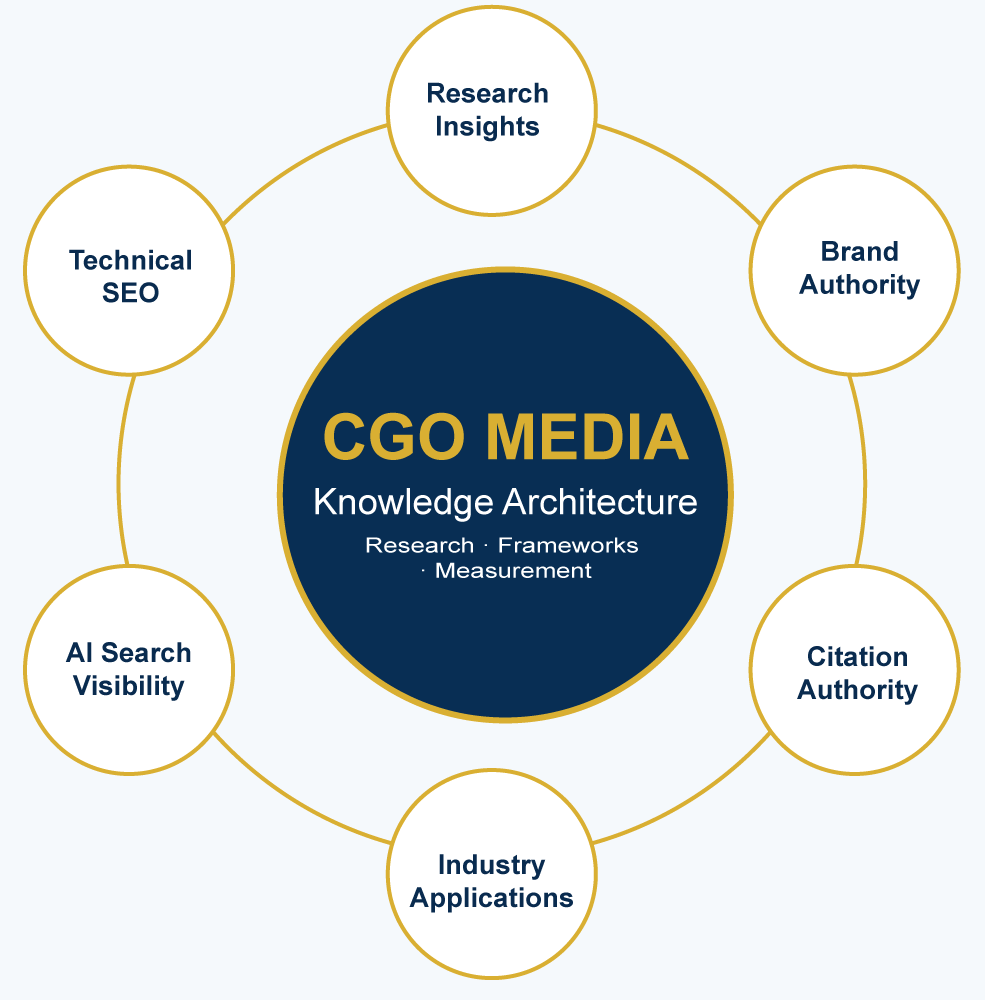
The CGO Media Knowledge Framework Architecture

2. The Ten Core Frameworks

The foundational frameworks that underpin modern search visibility and authority.

3. How the Frameworks Work Together

From research to measurable search authority.

Our frameworks form an integrated system that connects research, implementation and measurement across traditional and Al-powered search environments.
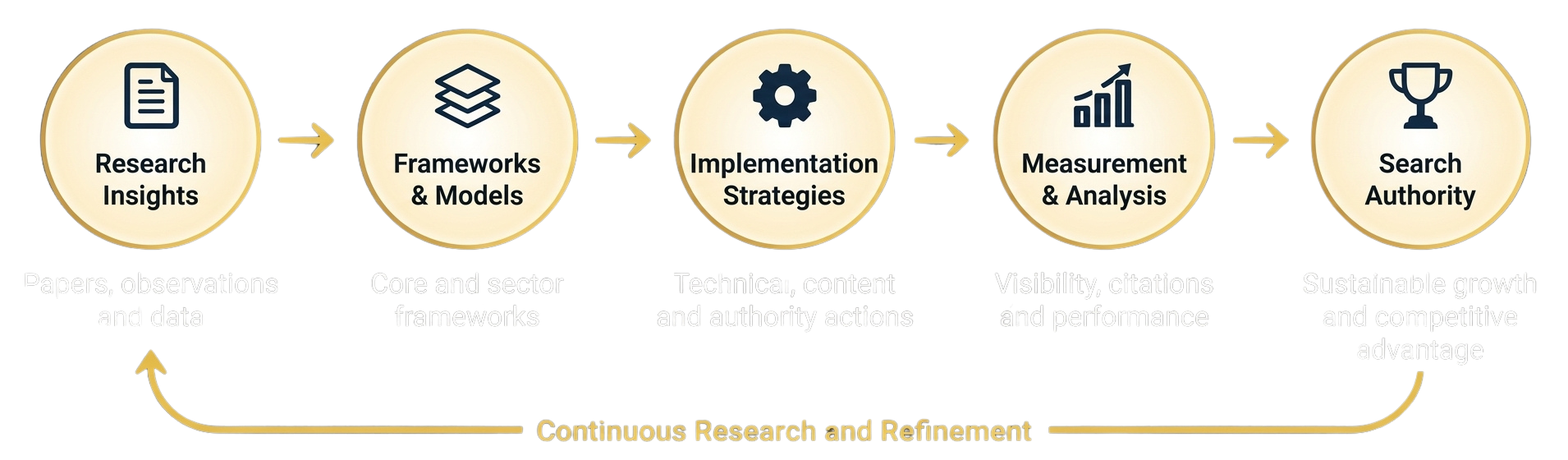
Frameworks Work Together

4. Sector Frameworks Library

Industry-specific framsurable for 12 key sectors.

06 Legal Icon

Legal →

12 SaaS Icon

SaaS →

5. Research Foundations

Evidence-led frameworks built on independent research.

6. Explore the Framework Library

Access the complete collection of frameworks and resources.

Research Papers

Research Papers

24 in-depth research papers

Research Observations

Research Observations

Focused analysis and sector insights

Statistics Library

Statistics Library

Quantitative research and UK data

Research Methodology icon in gold

Research Methodology

Understand how our research is conducted.

Statistics Library icon in gold

Statistics Library

Explore search, SEO and AI statistics and analysis.

Research Architecture in gold

Research Architecture

How everything
connects

Need Help Fmplementing Our Frameworks?

Our team of Al Search, GEO and SEO specialists can help you apply the CGO Media frameworks to your organisation, sector or website.

Frequently Asked Questions

The CGO Media Framework Library brings together structured research models for evaluating SEO, generative engine optimisation (GEO), AI Search visibility, technical accessibility, brand credibility and digital authority. Rather than presenting a single ranking formula, it connects complementary ways of assessing how organisations are discovered and represented. The wider evidence base is explained in the CGO Media Research Architecture.
The frameworks help organisations move from broad questions about search performance to defined assessments, priorities and measurable actions. They distinguish technical prerequisites from authority indicators, observed AI citations and business outcomes. Their purpose is to support disciplined decision-making, not to guarantee search rankings or recommendations. Explore the underlying work in the Research Library.
A traditional SEO checklist usually concentrates on individual website tasks, such as metadata, internal links, crawlability and performance. CGO Media’s frameworks also examine entity identity, external validation, content evidence, AI source selection, sector trust requirements and organisational readiness. They connect assessment with interpretation and measurement. The CGO Visibility Framework illustrates this wider approach.
The CGO Visibility Framework is an analytical model for considering visibility across conventional search and AI-assisted discovery. It encourages organisations to assess technical accessibility, relevance, authority and observable search exposure separately, rather than assuming that a high organic ranking guarantees AI citation. Read the CGO Visibility Framework explained for its components and interpretation.
The CGO Entity Authority Framework examines how an organisation, product, person or other entity is identified, described and connected to credible information across the web. Assessment can include naming consistency, structured information, contextual relationships and independent references. These factors can help evaluate the clarity of an entity’s digital representation, without implying guaranteed AI inclusion. See the CGO Entity Authority Framework.
The CGO Future Search Framework examines how search may evolve as conventional results, conversational interfaces, AI-generated answers and agent-assisted discovery increasingly interact. It is intended for scenario analysis and strategic preparation, not as a prediction that every platform will develop in the same way. Explore the CGO Future Search Framework.
The CGO Search Ecosystem Model considers search as a connected environment involving websites, search engines, AI interfaces, knowledge sources, brands and user decisions. It helps teams avoid assessing channels in isolation and encourages investigation of how information travels between discovery stages. Read the CGO Search Ecosystem Model.
The CGO AI Authority Model provides a way to examine organisational credibility and informational authority in AI-assisted search contexts. It considers how entity representation, supporting content, external references and evidence may interact, while recognising that the internal decision processes of proprietary AI systems are not fully visible. See the CGO AI Authority Model.
The CGO GEO Methodology Framework organises generative engine optimisation into research, assessment, implementation and measurement activities. It can guide investigation of content clarity, machine accessibility, entity information and observable AI responses without promising citation placement. Learn more from the CGO GEO Methodology Framework and GEO Services UK.
The CGO Technical SEO Audit Framework structures investigations into crawling, indexing, information architecture, structured data, performance and technical barriers to content discovery. Its findings can support a prioritised remediation plan and provide technical context for broader AI Search assessments. Explore the CGO Technical SEO Audit Framework and Technical SEO Audit service.
The frameworks draw on CGO Media’s research publications, documented observations, statistical investigations and technical analysis. The evidence behind a particular model should be evaluated according to its scope, methods and limitations; a proposed relationship is not the same as a confirmed causal mechanism. Readers can consult the Research Library, Research Observations Library and Research Methodology.
No. CGO Media’s frameworks are independently developed analytical models. They do not claim to disclose Google’s proprietary ranking systems, an AI provider’s internal source-selection formula or a guaranteed method for earning citations. They organise observable evidence and practical assessment questions while acknowledging uncertainty. The Research Methodology explains the distinction between evidence, observation, interpretation and hypothesis.
The CGO Brand Signal Framework organises questions about brand recognition, consistency, expertise, reputation and third-party validation. It can help identify gaps between how an organisation describes itself and how independent sources represent it. Brand signals should be assessed in context rather than treated as a disclosed AI ranking formula. Read the CGO Brand Signal Framework.
The CGO Content Authority Framework examines whether published information is accurate, useful, well-supported, clearly organised and appropriately connected to related subjects. It encourages attention to original evidence, expert review, topical coverage and maintainability rather than simply increasing word count. Organisations can use it to evaluate content weaknesses and editorial priorities. Explore the CGO Content Authority Framework.
The CGO AI Citation Framework investigates the conditions associated with sources being discovered, considered and explicitly referenced in AI-generated answers. It distinguishes source accessibility, relevance and credibility from the separate outcome of receiving a visible citation. Citation behaviour can vary between systems, prompts and retrieval contexts. Read the CGO AI Citation Framework and related citation selection research.
The CGO AI Search Readiness Framework provides a structured way to examine whether an organisation has the technical, informational and authority foundations needed to participate effectively in AI-assisted discovery. It can help prioritise accessibility, entity clarity, content evidence and measurement capabilities before broader implementation. Read the CGO AI Search Readiness Framework.
The frameworks are complementary rather than interchangeable. A technical assessment may identify crawlability barriers; an entity assessment may reveal inconsistent organisational information; a content assessment may expose weak evidence; and a citation assessment may document observable AI references. These findings can then inform a coordinated plan. The CGO Media Knowledge Architecture Map explains how the research components connect.
The CGO Ecommerce Visibility Framework examines product discoverability, merchant credibility, catalogue information, technical accessibility and AI-assisted shopping discovery. Retailers can use it to assess how clearly products and their supporting evidence are represented across search environments. The framework is a planning and assessment resource, not a guarantee of product recommendations. Read the CGO Ecommerce Visibility Framework.

The CGO Enterprise SEO System examines how large organisations coordinate technical SEO, content governance, entity information, measurement and cross-team delivery at scale. It helps identify operational dependencies that smaller, isolated optimisation projects may overlook. Explore the CGO Enterprise SEO System and Enterprise SEO UK.

Yes. CGO Media applies its wider research architecture to twelve sectors, including healthcare, financial services, legal, education, ecommerce, manufacturing, SaaS, technology and travel. Each sector has different requirements for trust, information quality, regulation and provider selection. Visit Sector Research to explore the sector collections and their six substantive research resources.
Provider selection involves more than appearing in a search result. Organisations may need to demonstrate suitability, expertise, service coverage, credibility and independently supported claims. Sector-specific provider selection models help teams examine how this information is presented and evaluated, while recognising that AI recommendations vary by context. The Travel Discovery & Provider Selection Model provides one industry example.
Measurement should begin with a documented baseline and clearly defined indicators. Depending on the assessment, these may include crawlability, indexing, content completeness, entity consistency, organic traffic, AI citations, brand mentions and conversions. AI answers can vary between prompts and systems, so repeated observations and stated limitations matter. The AI Search Measurement and Attribution research explores these challenges.
Yes. Journalists, analysts and researchers may reference publicly available framework publications with accurate attribution and in accordance with each publication’s applicable licence. Where a framework has a DOI, readers should cite the relevant publication record and version rather than assuming all related models share one identifier. Research findings should not be presented as independently peer-reviewed unless that status is documented. See the Press & Media page and Research Architecture.
Begin by defining the business’s search objectives, sector-specific requirements and existing evidence about technical health, content quality, brand representation and AI visibility. Select the frameworks most relevant to those needs, establish a baseline, prioritise identified gaps and reassess outcomes over time. Organisations wanting a structured starting point can read the CGO AI Search Readiness Framework or contact CGO Media to discuss their requirements.

Conclusion

The CGO Media Framework Library connects independent research with structured approaches to SEO, GEO, AI Search and digital authority. Its models help organisations investigate technical accessibility, entity recognition, content credibility and emerging discovery behaviour while recognising the limitations of available evidence. Together, the frameworks support clearer assessments, better-informed priorities and ongoing measurement across modern search environments.

Make Your Business or Organisation Visible Wherever Decisions Are Made

Strengthen your presence across AI Search, GEO and traditional search. Build the authority, trust and relevance signals that help search engines and AI platforms find, cite and recommend your organisation.

For Journalists & Researchers

Access original research, statistics, sector analysis and expert commentary on AI Search, GEO, SEO and the changing search landscape. Find evidence, figures and specialist insight designed to support journalists, researchers and publications.