CGO MEDIA • ECOMMERCE SEO UK

Ecommerce SEO UK

Increase product visibility, attract high-intent customers and grow online revenue.

Our Ecommerce SEO services help UK online retailers increase visibility in Google, AI Overviews, ChatGPT, Gemini and other generative search platforms. We combine technical SEO, product and category optimisation, structured data, content strategy and digital authority to drive more qualified traffic, higher conversions and sustainable revenue growth.
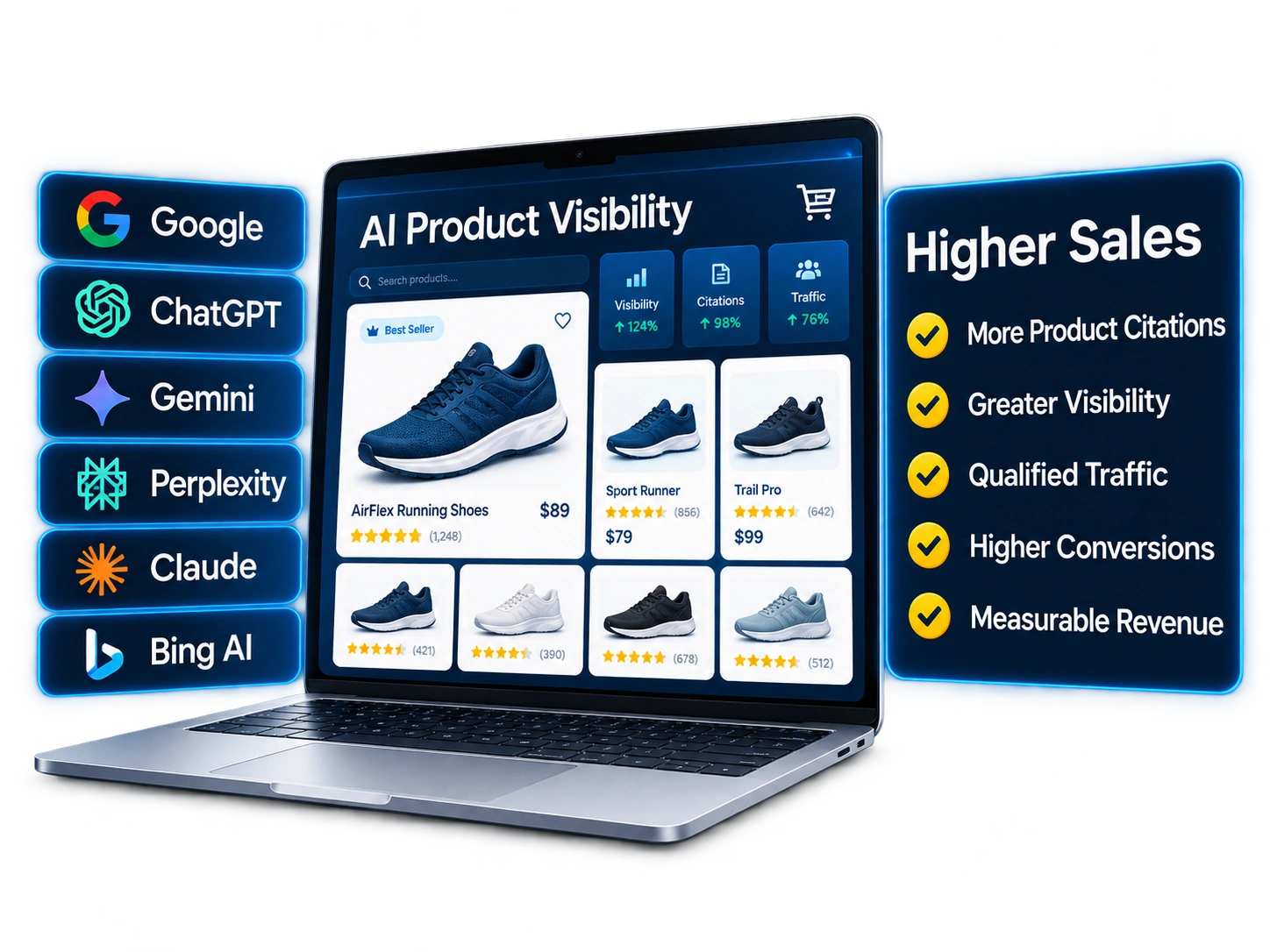
ai product visibility dashboard

CGO MEDIA • ECOMMERCE SEO UK

Ecommerce SEO UK

Increase product visibility, attract high-intent customers and grow online revenue.

Our Ecommerce SEO services help UK online retailers increase visibility in Google, AI Overviews, ChatGPT, Gemini and other generative search platforms. We combine technical SEO, product and category optimisation, structured data, content strategy and digital authority to drive more qualified traffic, higher conversions and sustainable revenue growth.

ai product visibility dashboard

Executive Summary

Our Ecommerce SEO services help UK online retailers improve visibility, traffic and revenue in a changing search landscape, where Al Overviews, ChatGPT, Gemini and other generative platforms are transforming how products are discovered and compared. We combine technical SEO, product and category optimisation, structured data, content strategy and digital authority to increase your visibility, attract high-intent customers and drive measurable commercial growth.

  • Increased visibility in Al and traditional search
  • Higher product citations and brand authority
  • More qualified traffic and higher conversions
  • Improved product and category rankings
  • Scalable strategies for multi-market ecommerce
  • Support for UK and international online retailers

Our Ecommerce SEO Services

A complete service designed to help your online store appear, compare and be recommended across traditional and generative search platforms.

Strategy &
Opportunity

Identify high-value product and market opportunities.

Technical SEO

Optimise architecture, structured data and machine readability.

Product & Category
Optimisation

Improve product pages, category structures and internal linking.

Digital Authority

Build brand authority and third-party validation.

AI Shopping & Recommendations

Optimise for AI shopping results, product citations and comparisons.

Measurement & Reporting

Track visibility, conversions, revenue and ROI.

Our Approach to Ecommerce SEO

A proven, research-led process to improve your product visibility, traffic and commercial performance.

01

Discover

Audit your current visibility, technical setup, product structure and opportunities.

02

Analyse

Identify prioritised product, category and technical requirements.

03

Implement

Develop and execute a tailored Ecommerce SEO strategy across all key areas.

04

Measure

Track progress with clear KPIs, reporting and ongoing optimisation.

Section 1 – The Ecommerce Search Environment

Explore how Al Overviews, ChatGPT, Gemini, Perplexity and Claude are changing the way customers discover, compare and buy products online.

  • The evolution of product search and Al-povered shopping
  • Differences between traditional and generative product discovery

  • Opportunities and challenges for UK ecommerce businesses

  • The role of Google Shopping, marketplaces and Al assistants

Learn more →

ecommerce product running shoes
  • AI Overviews
  • ChatGPT
  • Gemini
  • Perplexity
  • Claude

ecommerce product running shoesbest running shoes for UK
  • AI Overviews
  • ChatGPT
  • Gemini
  • Perplexity
  • Claude

Section 2 – Product & Category Architecture

Build a scalable product and category architecture that search engines and AI platforms can easily understand and recommend.

  • Product and category hierarchy and internal linking

  • URL structure and faceted navigation

  • Crawlability, indexation and duplicates

  • Site architecture for large product catalogues

Learn more →

Ecommerce Architecture Framework

Homepage

Categories

Subcategories

Products

Filters &
Facets

Section 3 – Product Data, Entities and Authority

Optimise your product data, structured data and entity signals to increase visibility
and trust across search and Al platforms.

  • Product schema and structured data
  • Entity optimisation and knowledge graph alignment
  • Product descriptions, reviews and user-generated content
  • Brand authority and topical relevance

Learn more →

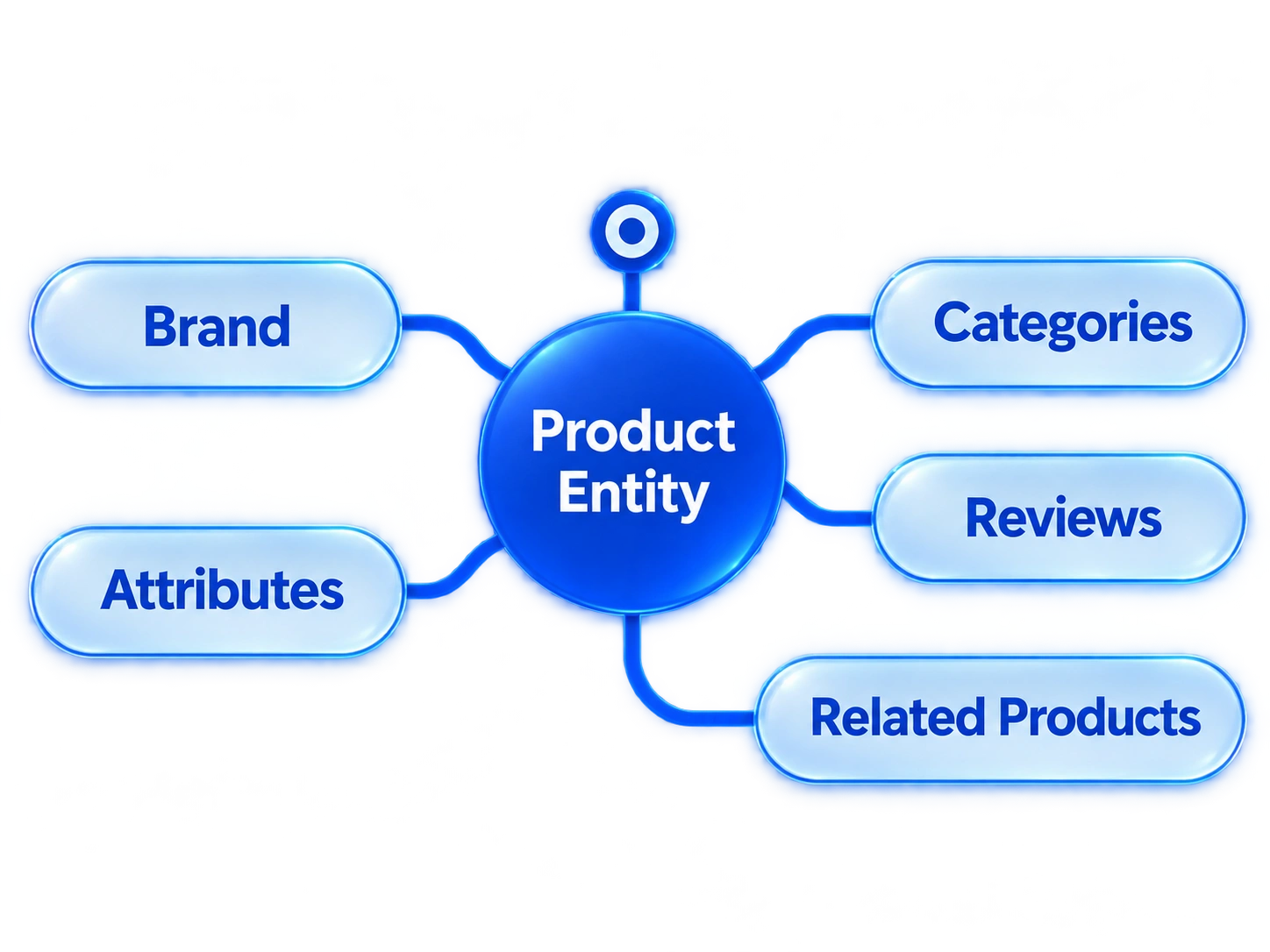
Product Entity Optimisation

glossy product entity mind map

Entity Signals

  • Structured data

  • Product attributes
  • Merchant information
  • Reviews and ratings
  • Authority links
  • Topical relevance

Section 4 – AI Shopping, Recommendations & Visibility

Optimise for AI shopping results, product comparisons and recommendation engines to increase visibility and conversions.

  • Optimisation for AI shopping and product recommendations
  • Product comparisons and buying intent signals
  • Content for featured products and AI citations
  • Visibility across Google Shopping, ChatGPT and other platforms

Learn more →

AI Shopping Optimisation

Product
Citations

Comparison
Inclusion

Buying
Guides

AI Shopping
Results

Higher
Conversions

Section 5 – Commercial Outcomes

Turn increased visibility into qualified traffic, higher conversions and revenue growth.

  • Product page traffic and conversion optimisation
  • Average order value and cross-selling opportunities
  • Revenue growth from organic and AI-driven traffic
  • Multi-channel attribution and ROI measurement

Learn more →

Commercial Impact

Traffic
Growth

More Conversions

Higher
Revenue

Increased
AOV

Long-Term
Growth

Section 6 – Measurement, Reporting and Implementation

Track performance, measure real impact and continuously improve your Ecommerce SEO strategy.
  • Visibility and product citation tracking
  • Traffic, conversions and revenue analysis
  • Technical, content and product optimisation
  • Reporting, iteration and long-term growth

Learn more →

Ecommerce SEO Measurement Framework

Baseline Audit

Track
Visibility

Measure
Conversions

Analyse
Revenue

Optimise
Continuously

Research & Evidence

Our Ecommerce SEO services are informed by original research, platform documentation and real-world client experience. Explore our latest research and insights.

ai search ecommerce seo books

What This Means for Your Organisation

Our Ecommerce SEO services help you increase visibility, attract high-intent customers, conversion and build a more sustainable and profitable online business.

Frequently Asked Questions

Ecommerce SEO improves how product, category and supporting pages appear in organic search. It combines technical accessibility, keyword and search-intent research, product information, internal linking and authority development. The objective is qualified shopping traffic and profitable sales, not rankings alone.

Costs depend on catalogue size, platform complexity, international coverage, competition and the amount of technical and content work required. A small Shopify store needs a different programme from a multi-market retailer with hundreds of thousands of URLs. CGO Media scopes the work after reviewing the store and its commercial objectives.

Technical fixes may improve crawling or indexing relatively quickly, but meaningful organic traffic and revenue growth often takes several months. Competitive categories and large migrations can take longer. A sensible plan sets near-term implementation milestones alongside longer-term visibility, conversion and revenue measures.

It can increase qualified visits to commercially relevant pages and improve product discovery. Revenue gains also depend on pricing, stock availability, delivery options, user experience and conversion rates. CGO Media assesses organic revenue, transactions and margins where data is available rather than treating traffic growth as the only success metric.

An audit typically reviews crawlability, indexation, category and product templates, duplicate URLs, faceted navigation, internal linking, structured data, Core Web Vitals, XML sitemaps and organic performance. Findings are prioritised by likely business impact, implementation effort and risk. See technical seo audit for the broader audit methodology.

Category pages should match how customers browse and search, with descriptive headings, helpful introductory content, logical product groupings, relevant filters and clear internal links. Avoid adding large blocks of generic text that hinder shopping. Monitor category-level impressions, organic visits and sales.

An effective product page has an accurate title, distinctive specifications, useful descriptions, clear pricing and availability, strong imagery, shipping and returns information and relevant reviews. Product structured data can help eligible search features when it matches visible content. Avoid copying manufacturer text unchanged across an entire catalogue.

Filters for colour, size, price and brand can generate large numbers of near-duplicate URLs. Decide which combinations deserve indexable landing pages based on demand, and control low-value combinations using appropriate linking, crawling and indexing strategies. Canonical tags alone are not a complete crawl-management solution.

Audit product variants, sorting parameters, pagination, syndicated descriptions and category overlaps. Use consistent canonical URLs where appropriate, unique value-adding content on priority pages and a clear internal-linking structure. Technical decisions must account for whether variants need their own search visibility.

Product structured data describes properties such as name, price, currency, availability and reviews when those details are present and eligible. Accurate markup may help search engines interpret product pages and qualify them for certain search presentations, but does not guarantee rich results. Validate markup and keep it synchronised with stock and price changes.

Before changing domains, platforms or URL structures, inventory existing URLs and organic performance, map redirects, preserve valuable content and test templates and structured data. At launch, monitor crawl errors, indexation, rankings and organic revenue. A migration plan should include rollback decisions and post-launch checks.

Authentic reviews can improve shopper confidence and provide useful product-specific information. Eligible review markup may support certain search features, but review volume alone does not guarantee rankings. Use compliant review collection practices and never manufacture ratings or misleading testimonials.

Yes. The ecommerce SEO service covers Shopify and WooCommerce alongside Magento, BigCommerce and enterprise platforms. Priorities vary by platform, but commonly include collection or category architecture, product templates, duplicate-content controls, structured data and site performance.

PPC buys placement and can deliver immediate visibility while budgets are active. Ecommerce SEO develops organic visibility through technical improvements, useful pages and authority, usually over a longer period. Many retailers benefit from both: paid campaigns test demand while SEO builds a more durable acquisition channel.

Start with attributable organic revenue and gross profit, then compare the incremental contribution against SEO costs. Track non-brand organic traffic, transactions, conversion rate, average order value and category-level performance. Attribution is imperfect across devices and channels, so interpret analytics alongside seasonality and paid-media changes.

Clear product information, accessible pages, consistent merchant data and credible third-party coverage can support discovery in AI-assisted shopping experiences. However, no agency can guarantee a product will be cited or recommended by ChatGPT, Google AI experiences or other systems. CGO Media integrates SEO with GEO services UK where appropriate.

CGO Media combines technical ecommerce SEO, commercial category strategy and AI-search research. Work is planned around a retailer’s platform, inventory and revenue goals, with an emphasis on prioritised implementation and measurable outcomes. Contact CGO Media to discuss an audit and tailored scope.

Slow pages can frustrate shoppers and contribute to abandoned visits, particularly on mobile. Optimise image delivery, JavaScript, caching, server response and layout stability. Core Web Vitals are useful diagnostics, but improvements should be assessed alongside conversion and revenue rather than treated as a ranking guarantee.

Links between category pages, subcategories, products, buying guides and related items help users navigate and search engines discover important URLs. Prioritise commercially valuable pages, avoid orphaned products and use descriptive link text. Navigation should remain intuitive rather than being built solely for crawlers.

Keep temporarily unavailable product pages live when they retain demand and may return, with accurate availability and relevant alternatives. For permanently discontinued items, choose between retaining a useful page, redirecting to a genuinely equivalent replacement or returning an appropriate removal status. Avoid redirecting every unavailable product to the homepage.

Yes. International programmes require market-specific keyword research, currency and delivery clarity, language localisation, appropriate URL architecture and carefully implemented hreflang where relevant. Regional product availability and legal requirements should also be reflected in page content.

Magento and BigCommerce stores benefit from strong category architecture, template optimisation, structured data and careful indexation controls. Magento often needs particular attention to complex URL and filter configurations; BigCommerce implementations vary by theme and integrations. The correct approach follows a platform-specific technical audit.

Yes, when the content genuinely helps customers choose products. Useful buying guides, comparisons and care instructions can address research-stage queries and link naturally to relevant categories and products. Focus on originality, accurate claims and maintaining the content as products change.

Reporting should connect technical work and search visibility to commercial outcomes. Useful measures include completed improvements, indexing health, non-brand organic demand, category and product performance, transactions, organic revenue and conversion rate. Agree reporting definitions and attribution limitations at the start of the engagement.

Conclusion

Ecommerce SEO is essential for online retailers that want to remain visible, trusted and competitive in a rapidly changing search landscape. Our experience and research-led approach help you increase product visibility, attract high-intent customers and achieve measurable revenue growth.

Ready to Grow Your Ecommerce Revenue?

Start a conversation with CGO Media. We’ll help you develop an Ecommerce SEO strategy
that increases product visibility, drives qualified traffic and grows your online revenue.