
Accessibility Statement
CGO Media is committed to making its website accessible, usable and understandable for the widest possible audience.
We want people to be able to access our services, research, frameworks, articles and other information regardless of ability, device, browser or the technology they use to browse the web.
This accessibility statement explains the standards we aim to follow, the measures we take to improve accessibility, areas that can sometimes create limitations and how visitors can report an accessibility problem to us.
This statement applies to the CGO Media website at cgomedia.com.
Last reviewed: 23 August 2026
Our Commitment to Accessibility
Accessibility is an important part of providing a useful and inclusive digital experience.
CGO Media aims to make its website usable by people with a wide range of access needs, including people who may experience visual, hearing, motor, speech, cognitive, neurological or learning-related barriers when using digital services.
Our objective is to reduce unnecessary barriers that could prevent visitors from:
- Reading and understanding website content.
- Navigating between pages.
- Accessing our research and information resources.
- Using forms and interactive elements.
- Following links and calls to action.
- Viewing the website on different devices and screen sizes.
- Using browser accessibility features and assistive technologies.
- Contacting CGO Media when assistance is required.
Accessibility principle: Digital information should be structured and presented so that people can perceive, navigate, understand and interact with it with as few unnecessary barriers as possible.
Accessibility Standards
CGO Media uses the Web Content Accessibility Guidelines 2.2, published by the World Wide Web Consortium, as the principal reference point for improving website accessibility.
Our accessibility target is WCAG 2.2 Level AA wherever reasonably achievable within the website, its content and the technologies under our control.
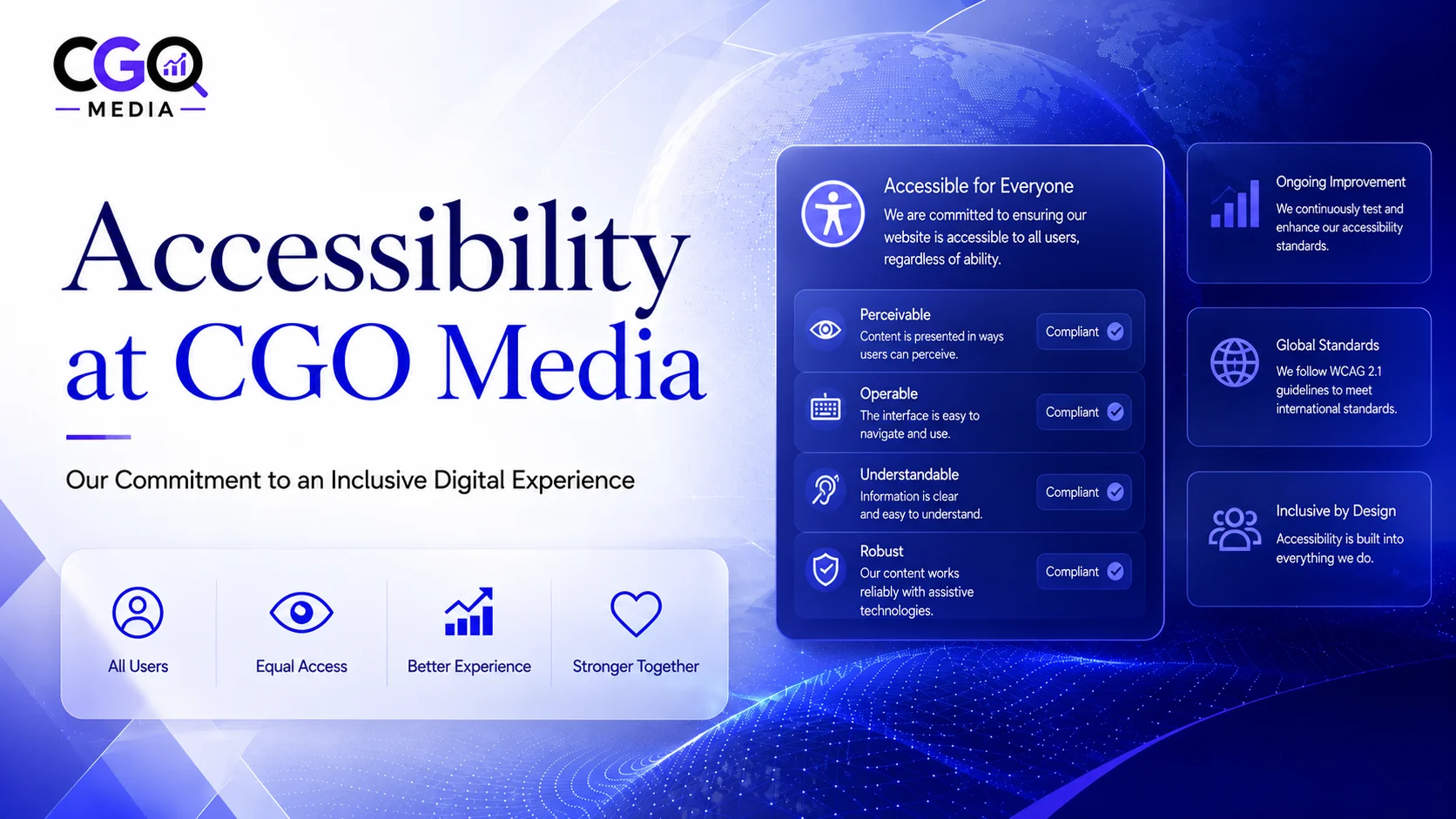
WCAG is organised around four broad accessibility principles. Digital content should be:
- Perceivable — information should be available in ways users can perceive.
- Operable — interfaces and navigation should be usable through appropriate input methods.
- Understandable — information and website operation should be reasonably clear and predictable.
- Robust — content should be structured so it can work across browsers, devices and assistive technologies.
Accessibility standards and technologies continue to evolve. We therefore treat accessibility as an ongoing improvement programme rather than a one-time website project.
How We Support Website Accessibility
Clear Structure
We use headings, paragraphs, lists and logical page structures to make information easier to navigate and understand.
Readable Content
We aim to use readable typography, clear layouts, appropriate spacing and sufficient visual contrast.
Responsive Design
Pages are designed to adapt across desktop computers, tablets, smartphones and different screen sizes.
Alternative Text
Meaningful images are intended to include alternative text where that information helps communicate their purpose or content.
Keyboard Access
We aim for important navigation, links, buttons and interactive functionality to remain usable without relying exclusively on a mouse.
Descriptive Links
Links and calls to action should provide sufficient context for users to understand their likely destination or purpose.
Accessible Forms
Forms are intended to provide understandable labels, instructions and validation information wherever practical.
Ongoing Review
Accessibility considerations are incorporated into continuing website maintenance, content development and technical improvement.
Navigation and Keyboard Accessibility
We aim to maintain a logical navigation structure so visitors can move between the main areas of the CGO Media website without unnecessary complexity.
Where possible, important website functions should be accessible using a keyboard as well as a mouse or touchscreen.
This includes:
- Main website navigation.
- Text links.
- Buttons and calls to action.
- Forms and input fields.
- Menus and other common interactive components.
We also aim to ensure that keyboard focus remains visible and that interactive elements can be identified when users navigate through a page.
Some third-party components or plugins may behave differently depending on the technology being used. These are discussed further below.
Text, Zoom and Readability
Visitors can normally increase or decrease the size of website content using the zoom controls provided by their browser or operating system.
Common browser shortcuts include:
- Windows: Ctrl and + to zoom in, Ctrl and – to zoom out.
- macOS: Command and + to zoom in, Command and – to zoom out.
- Browser menus can also be used to adjust page zoom.
Modern versions of browsers including Chrome, Edge, Firefox and Safari provide built-in zoom and accessibility controls.
We aim to design page layouts that continue to remain usable when text or page content is enlarged, although individual browser settings and third-party components can occasionally affect presentation.
Images, Infographics and Alternative Text
CGO Media publishes a substantial amount of visual material, including diagrams, research graphics, frameworks, charts and infographics.
Where an image communicates meaningful information, we aim to provide descriptive alternative text that identifies its subject or purpose.
Where a visual contains important research or explanatory information, we also aim to support it with surrounding HTML text, headings, captions or explanations so that the information is not available exclusively through an image.
Images used only for decoration may use empty alternative text where appropriate so that they do not create unnecessary interruptions for screen-reader users.
As our research and visual libraries continue to grow, older images may be progressively reviewed and improved as part of our ongoing accessibility work.
Forms and Contact Features
Forms are an important part of the CGO Media website because they allow visitors to request information, contact our team and enquire about services.
We aim for forms to include:
- Clear labels for important input fields.
- Logical field ordering.
- Understandable instructions.
- Clearly identifiable required fields.
- Useful error or validation messages where supported.
- Keyboard-accessible controls.
- Buttons with understandable text.
If a website form prevents you from contacting us because of an accessibility problem, please use our Contact CGO Media page or another available contact method and tell us what difficulty you experienced.
Links and Calls to Action
CGO Media contains a large number of internal and external links connecting services, research papers, frameworks, statistics, supporting resources and external references.
Where practical, link text is written so that its purpose can be understood from the surrounding context rather than relying entirely on generic wording.
External websites are outside CGO Media’s control and may operate according to different accessibility standards.
Video, Audio and Other Media
Where CGO Media publishes video, audio or other multimedia content, we aim to consider appropriate alternatives such as captions, transcripts or supporting written information when these are required to communicate the material effectively.
Embedded media supplied by external platforms may depend on the accessibility features provided by those services.
If you cannot access information contained within a media item, contact us and we will try to provide the relevant information in another suitable format where reasonably possible.
PDFs and Downloadable Documents
CGO Media may provide downloadable research papers, reports, documents or other resources in addition to HTML web pages.
Where practical, important information is also made available within the website itself rather than being available only through a downloadable document.
Older PDFs or externally generated documents may not provide the same level of accessibility as newer web content.
If you encounter a document that you cannot use, please contact us. Where reasonably possible, we will try to provide the information in an alternative format.
Browsers, Devices and Assistive Technologies
The CGO Media website is built using modern web technologies and responsive design techniques.
We aim for the website to work effectively with current versions of commonly used browsers and devices and to support the accessibility functionality built into modern browsers and operating systems.
Website experiences can vary depending on combinations of:
- Browser.
- Browser version.
- Operating system.
- Screen size.
- Device.
- Browser extensions.
- Assistive technology.
- User configuration.
Very old or unsupported browsers may not display all website functionality in the same way as current software.
Third-Party Content and Technology
Some CGO Media pages may use technology supplied by third parties.
This can include:
- Embedded videos.
- Maps.
- Analytics and consent-management tools.
- Website forms.
- Social-media content.
- External research resources.
- Scheduling or communication tools.
- WordPress plugins and website components.
We aim to choose suitable technologies and configure them responsibly, but we cannot always control the underlying markup, interface or accessibility behaviour of third-party services.
If third-party functionality creates an accessibility barrier, please tell us. We will investigate the issue and, where possible, provide another way to access the relevant information or service.
Known and Potential Accessibility Limitations
CGO Media is a continually developing website containing a growing collection of services, articles, research papers, frameworks, diagrams, infographics and other digital resources.
Because content and website functionality change over time, isolated accessibility issues may occasionally occur.
Areas that may require continuing review include:
- Older images and infographics created before current accessibility processes were adopted.
- Complex diagrams that contain substantial visual information.
- Older downloadable documents.
- Third-party plugins and embedded services.
- Automatically generated website components.
- Legacy content that may use older formatting or markup.
We do not intentionally exclude users from accessing this information. Where an issue is identified, we aim to assess the problem and make a reasonable improvement or provide an alternative means of access where practical.
Accessibility of CGO Media Research
CGO Media publishes independent research covering SEO, AI Search, Generative Engine Optimisation, digital authority, search behaviour, citations, entities and the future of online discovery.
Accessibility is particularly important for research resources because information should remain available to journalists, researchers, organisations, students, professionals and other readers using different technologies.
We therefore aim to publish important research information as structured HTML wherever practical, supported by clear:
- Headings and subheadings.
- Paragraphs and explanatory text.
- Lists.
- Tables where appropriate.
- Image alternative text.
- Figure captions.
- Research summaries.
- Source and methodology information.
This approach also helps ensure that important research findings are not dependent entirely on visual formats or downloadable files.
Accessibility in Website Design and Development
Accessibility should be considered throughout the lifecycle of a website rather than added only after content has been published.
CGO Media therefore aims to consider accessibility when making decisions about:
- Page architecture.
- Navigation.
- HTML structure.
- Typography.
- Colour contrast.
- Buttons and links.
- Forms.
- Images and media.
- Responsive layouts.
- Interactive functionality.
- New WordPress and Avada components.
When substantial website changes are introduced, accessibility considerations should form part of the review process alongside usability, technical performance, SEO, security and content quality.
Accessibility Monitoring and Ongoing Improvement
Accessibility is an ongoing process because websites, browsers, assistive technologies and recognised standards continue to change.
CGO Media aims to review accessibility as part of normal website maintenance and development.
Our continuing accessibility process can include:
- Reviewing new templates and page components.
- Improving semantic page structure.
- Checking image alternative text.
- Reviewing colour contrast and readability.
- Improving forms and calls to action.
- Reviewing keyboard navigation.
- Checking responsive behaviour.
- Reviewing older research graphics and documents.
- Responding to accessibility feedback from visitors.
- Monitoring changes to recognised accessibility guidance.
Review cycle: This statement should be reviewed at least annually and whenever material changes are made to the website, its technology or recognised accessibility guidance.
Last reviewed: 23 August 2026.
Reporting an Accessibility Problem
Feedback from users is one of the most useful ways of identifying accessibility barriers that may not be apparent during normal website development.
If you experience difficulty using any part of the CGO Media website, please tell us.
When reporting an accessibility problem, it is helpful if you can provide:
- The page or URL where the problem occurred.
- A short explanation of what you were trying to do.
- The accessibility problem you experienced.
- The browser or device you were using, if known.
- The assistive technology being used, if relevant.
- The format or alternative that would help you access the information.
We will use this information to investigate the issue and determine whether a reasonable improvement or alternative method of access can be provided.
Requesting Information in an Alternative Format
If information published on the CGO Media website is inaccessible to you, contact us and explain what information you need.
Where reasonably possible, we will try to provide the relevant information in another suitable format.
This may include providing information as:
- Plain text.
- HTML.
- A more accessible digital document.
- A written explanation of visual information.
- Another reasonable format appropriate to the request.
Contact CGO Media About Accessibility
If you experience an accessibility issue, cannot access information on this website or have a suggestion that could improve the experience for other visitors, please contact CGO Media.
Tell us which page or feature caused the problem and what would help you access the information.