
CGO MEDIA . ENTERPRISE SEO UK
Enterprise SEO UK
Drive visibility, authority and revenue at enterprise scale.
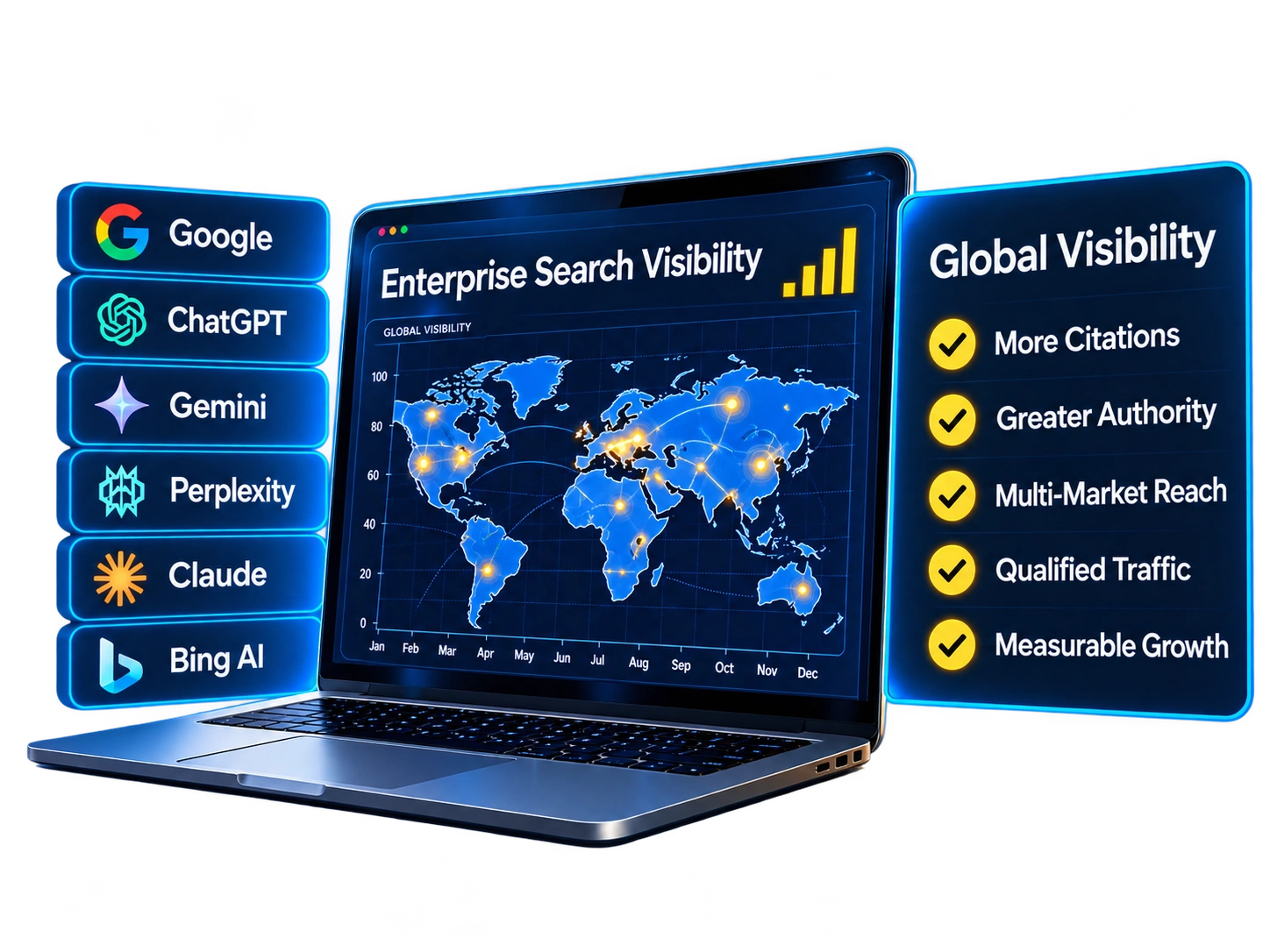
Our Enterprise SEO services help large organisations, multi-brand businesses and international companies improve visibility, authority and performance across Google, Al Overviews, ChatGPT, Gemini and other generative search platforms. We combine technical excellence,content strategy, entity optimisation and data-led measurement to
deliver scalable, long-term growth.
26+ Years Search Experience
Independent and trusted
AI Search & GEO Research
Original research and data
UK & International
Supporting businesses globally
Independent Research
No vendor bias
Executive Summary
Our Enterprise SEO services help large, complex organisations adapt to a changing search landscape, where AI Overviews, ChatGPT, Gemini and other generative platforms are reshaping how information is discovered. We combine technical SEO, content strategy, entity optimisation and digital authority to increase your visibility, trust and commercial outcomes across traditional and
AI-powered search environments.
- Increased visibility in Al and traditional search
- Higher citations and source authority
- More qualified traffic, leads and revenue
- Scalable SEO strategies for complex organisations
- Support for multi-brand and international businesses
Our Enterprise SEO Services
A complete service designed to help large organisations appear, compare and be recommended across traditional and generative search platforms.
Strategy &
Opportunity
Identify high-value growth opportunities across markets.
Technical SEO
at Scale
Optimise complex architectures and platforms.
Content & Entity Optimisation
Create and manage high-authority content across brands.
Digital Authority
Build brand authority and third-party validation.
International SEO
Multi-market strategies
and global expansion
support.
Measurement & Reporting
Track visibility, citations, traffic and revenue.
Our Approach to Enterprise SEO
A proven, research-led process to improve your visibility, authority and commercial outcomes at enterprise scale.
01
Discover
Audit your current visibility, technical setup, content and market opportunities.
02
Analyse
Identify prioritised opportunities across brands, markets and product lines.
03
Implement
Develop and execute a scalable SEO and GEO strategy across teams and markets.
04
Measure
Track progress with clear KPIs, reporting and ongoing optimisation.
Section 1 – The Enterprise Search Environment
Understand how Al Overviews, ChatGPT, Gemini and other generative platforms are changing search for large organisations, and what this means for enterprise SEO.
The evolution of enterprise search and Al-powered discovery
Key differences between traditional and generative search
- Challenges and opportunities for large organisations
Learn more →

- AI Overviews
ChatGPT
- Gemini
- Perplexity
Claude
Section 2 – Architecture, Governance and Technical SEO
Optimise complex, multi-domain and multi-brand architectures for maximum visibility and efficiency.
Enterprise website architecture and internal linking
- Crawlability, indexation and platform optimisations
Governance, workflows and scalability
Learn more ↓
Enterprise Technical SEO Framework
Crawlability
Architecture
Structured Data
Indexation
Governance
Scalability
Section 3 – Content, Entities and Authority
Build and manage high-quality content, entities and topical authority across multiple brands, markets and product lines.
Enterprise content strategy and topic clusters
Entity optimisation and knowledge graph alignment
- Brand authority and digital PR integration
Learn more →
Enterprise Content & Entity Framework
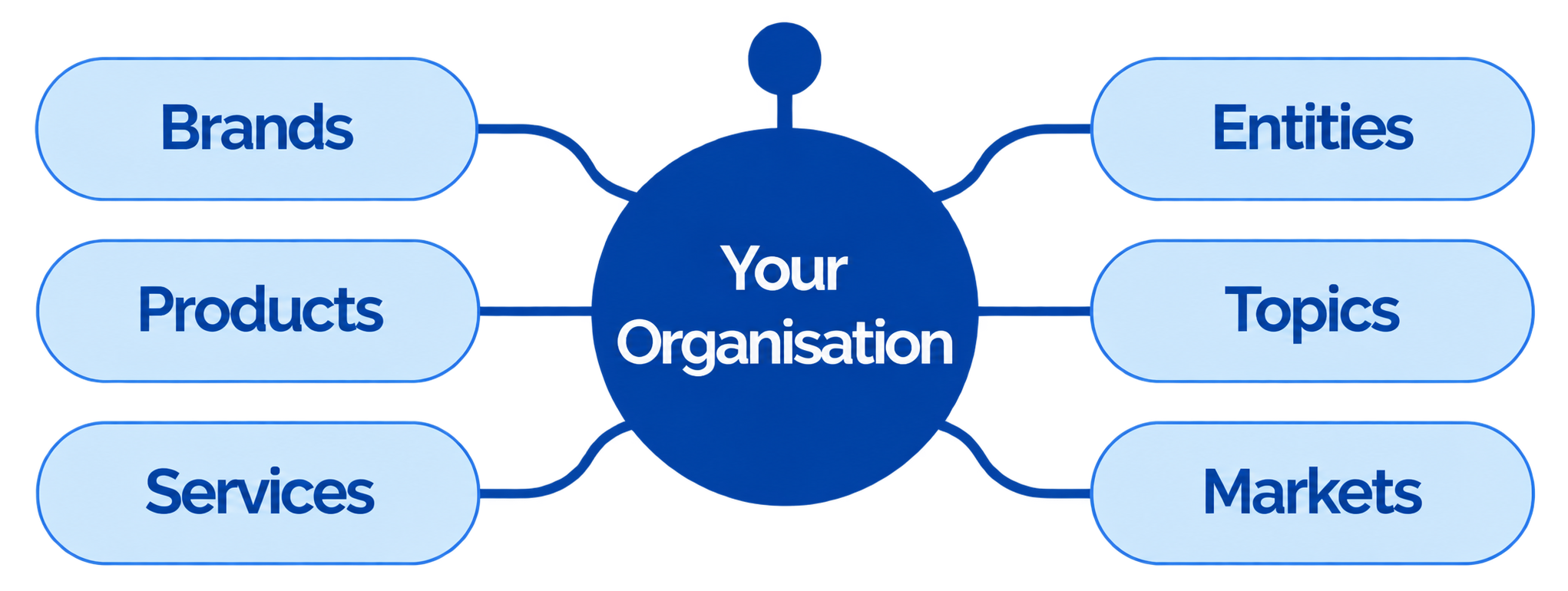
Entity Signals
Structured data
- Knowledge graph
- Consistent mentions
Authority links
- Topical relevance
Section 4 – International & Multi-Market SEO
Develop strategies for global visibility across multiple countries, languages and markets.
- International SEO strategy and implementation
- Hreflang, regional content and local relevance
- Multi-brand and multi-domain management
Learn more ↓
International SEO Key Elements
Markets
Hreflang
Localisation
Content Adaptation
Regional Authority
Section 5 – AI Visibility, Recommendation and Commercial Outcomes
Optimise for AI-powered recommendations and increase commercial visibility across generative platforms.
- AI citations and recommendation signals
- Comparison visibility and buying intent
- Lead generation and revenue growth
Learn more →
AI Recommendation Factors
Brand authority
- Product and service depth
- Third-party validation
- Pricing and compastions
- User reviews and sentiment
Commercial Outcomes
Traffic
Leads & enquiries
Sales & revenue
Section 6 – Measurement, Reporting and Implementation
Track performance, measure real impact and continuously improve your enterprise SEO strategy.
- Visibility and citation tracking
- Traffic, engagement and conversion analysis
- Reporting, iteration and long-term growth
Learn more →
Enterprise SEO Measurement Framework
Baseline
Audit
Track
Visibility
Measure
Engagement
Analyse
Revenue
Optimise
Continuously
Research & Evidence
Our Enterprise SEO services are informed by original research, platform documentation and real-world client experience. Explore our latest research and insights.
What This Means for Your Organisation
Our Enterprise SEO services help you increase visibility, attract higher-quality traffic, build authority across markets and drive measurable commercial growth.
Be found and recommended in Al search.
Support multiple brands and international markets.
Improve lead generation and revenue growth.
Turn visibility into long-term commercial success.
Frequently Asked Questions
Enterprise SEO services help large organisations improve organic search visibility across complex websites, multiple business units, brands and markets. They combine technical SEO, information architecture, content strategy, governance, authority development and performance measurement. Unlike a small-site campaign, enterprise SEO requires coordinated implementation across marketing, engineering, editorial and leadership teams. CGO Media also considers how these foundations support discoverability in AI-powered search environments.
Enterprise SEO applies familiar SEO principles at a significantly greater scale and organisational complexity. A large website may contain hundreds of thousands of URLs, multiple content management systems, international versions and competing internal priorities. The challenge is not only identifying improvements but also prioritising them, securing stakeholder approval, deploying changes safely and measuring impact across teams and markets.
Enterprise SEO pricing depends on website size, technical complexity, the number of markets and brands, competitive conditions, reporting requirements and the level of implementation support needed. A one-off enterprise audit differs substantially from a retained programme involving strategy, technical consulting, content governance and ongoing measurement. CGO Media scopes requirements before proposing a commercial arrangement; no universal fixed fee applies to every enterprise organisation.
Timelines vary with the site’s current condition, competition, implementation speed and the changes being made. Technical fixes can sometimes improve crawling or indexation relatively quickly, while competitive content and authority programmes often require several months or longer to demonstrate sustained commercial effects. A useful enterprise SEO plan separates immediate technical priorities from medium-term opportunities and long-term strategic investment, with clear baselines and reporting milestones.
An enterprise SEO agency audits search performance, identifies technical and content opportunities, builds a prioritised roadmap and works with internal teams to implement improvements. Typical responsibilities include site architecture, crawling and indexation, international SEO, content governance, digital authority, reporting and stakeholder coordination. CGO Media also assesses AI search visibility and how organisational information is represented across search and generative discovery systems.
Common challenges include duplicate or low-value URLs, inefficient crawling, inconsistent canonicalisation, faceted navigation, JavaScript rendering, weak internal linking and fragmented platform ownership. Large websites can also struggle with legacy redirects, inconsistent templates and slow release cycles. Prioritisation should reflect measurable search impact and the resources required to implement each fix.
Large-scale SEO relies on URL classification, representative sampling, log analysis where available, template-level improvements and automated quality checks. Teams should distinguish valuable pages from duplicates, expired inventory and URLs that should not be indexed. Rather than reviewing every page manually, enterprise programmes identify repeatable issues and correct them through scalable platform and governance changes.
Content governance defines who owns information, how it is approved, when it is reviewed and how outdated or overlapping pages are handled. For large organisations, these controls help maintain accuracy, consistency and clear topical coverage across teams and markets. Effective governance also reduces duplicated effort and supports reliable information for search engines, customers and AI-powered discovery systems.
Start by mapping search intent, page purpose and ownership across relevant URLs. Review whether competing pages genuinely serve different audiences or whether they overlap unnecessarily. Depending on the findings, solutions may include consolidation, clearer internal linking, revised content positioning, canonicalisation where appropriate and editorial rules for future publication. Not every instance of shared keywords represents a problem.
Internal links help users and crawlers navigate large websites, discover important pages and understand relationships between topics. At enterprise scale, navigation, breadcrumbs, category structures and contextual links must work consistently across templates. Link improvements should prioritise important pages and relevant pathways rather than indiscriminately adding links throughout the site.
Yes. Technical accessibility, useful content, clear entities and trustworthy supporting evidence can serve both conventional search and generative discovery objectives. GEO adds attention to how information may be retrieved, cited, summarised or used in recommendations. A combined programme should keep platform-specific measurement distinct, test assumptions and avoid claiming that conventional ranking improvements automatically produce AI citations.
An initial 90-day plan often begins with stakeholder discovery, analytics validation, technical and content assessment, competitive research and a baseline of existing performance. The next stage prioritises quick wins alongside structural work, assigns owners and establishes reporting. By the end of the period, the organisation should have an agreed roadmap, implementation process and measurable objectives. Actual delivery depends on access, resources and approval cycles.
Look for demonstrated experience with large or technically complex websites, a clear methodology, realistic commercial objectives and an ability to collaborate with engineering, content and leadership teams. Ask how the agency prioritises work, validates recommendations, measures business impact, handles migrations and reports limitations. Be cautious of guaranteed rankings, unsupported AI citation promises or proposals that focus only on keyword volume without implementation and governance.
Enterprise SEO can strengthen the technical accessibility, clarity, relevance and credibility of information that search and AI systems may encounter. Clear entity information, useful content, consistent brand references and strong site architecture can support broader discoverability. However, AI-generated answers and citations depend on platform-specific retrieval and generation processes, and no agency can guarantee placement in Google AI Overviews, ChatGPT or other AI responses.
Enterprise SEO ROI should be evaluated against agreed business outcomes rather than rankings alone. Useful measures include qualified organic enquiries, assisted conversions, revenue, pipeline contribution, non-brand visibility, technical health and cost efficiency. Attribution should account for longer buying journeys and interactions across channels. Where AI search is relevant, referral traffic and observed citations can be monitored separately, with limitations clearly explained.
Yes. Enterprise SEO planning can address multiple countries, languages, domains, subdomains and brands. Priorities commonly include hreflang implementation, localisation, canonicalisation, regional information architecture, governance and market-specific content. The correct structure depends on business objectives, technical constraints and how individual brands and markets operate; there is no single international setup suitable for every organisation.
An enterprise SEO audit typically reviews crawlability, indexation, technical architecture, internal linking, canonical signals, structured data, performance, international targeting, content quality and authority signals. It should also assess analytics reliability, operational bottlenecks and the feasibility of proposed changes. The most useful deliverable is a prioritised roadmap that explains business impact, implementation effort, dependencies and how results will be validated.
First establish which URLs should be discoverable and indexed, then investigate crawl behaviour using search engine tools, server logs where available and site audits. Common actions include improving internal links, controlling duplicate URL patterns, correcting canonical signals and reducing unnecessary crawl paths. Crawl budget becomes especially relevant for very large or frequently changing sites; smaller sites may have different priorities.
Yes. SEO should be involved before architecture, URL structures or content templates are finalised. Migration planning usually includes URL mapping, redirect rules, metadata preservation, staging checks, internal link updates and launch monitoring. Post-launch validation is essential because migrations can affect indexing, traffic and conversions even when the technical deployment appears successful.
Structured data provides machine-readable descriptions of eligible content and entities. On large websites, consistent schema implementation can improve data clarity and help search engines interpret supported page types. It should reflect visible page content, follow relevant guidelines and be validated at template level. Structured data does not guarantee enhanced search features or inclusion in AI-generated answers.
Successful enterprise SEO translates recommendations into actionable tickets with requirements, examples, acceptance criteria and expected outcomes. A shared prioritisation process helps engineering, product, content and marketing teams evaluate dependencies and release schedules. Regular validation and ownership tracking prevent high-impact recommendations from remaining indefinitely in audit documents.
An enterprise dashboard should reflect the organisation’s objectives and may include non-brand organic visibility, qualified traffic, conversions, revenue or pipeline, landing-page performance, indexation, technical issues and implementation progress. Segmenting by market, brand, device or page type often reveals trends hidden in sitewide totals. AI referral and citation observations can be added where measurable, but should not be presented as comprehensive visibility data.
For ecommerce enterprises, priorities often include category architecture, product availability, faceted navigation, duplicate product variants, structured data and performance. Search strategy should connect high-intent discovery to relevant product and category pages while accounting for inventory changes and merchandising needs. Product-led SaaS businesses may require different journeys, including documentation, solution pages and comparison content.
Entity optimisation helps make an organisation’s identity, services, products and relationships clear and consistent across its website and relevant external sources. Brand authority work may involve accurate corporate information, expert authorship, original research, reputable references and digital PR. These activities support credibility and discoverability, but should not be represented as a guaranteed way to influence any particular AI model.
Conclusion
Enterprise SEO is essential for large organisations that want to remain visible, trusted and competitive in a rapidly changing search landscape. Our experience, research and practical approach help you build long-term authority and achieve measurable results.
Ready to Improve Your Visibility at Enterprise Scale?
Start a conversation with CGO Media. We’ll help you develop an enterprise SEO strategy
that increases your visibility, citations and commercial opportunities in Al search.