
RESEARCH METHODOLOGY

CGO Media
Research Methodology

A transparent, evidence-based approach to independent research on Al search, GEO, SEO and digital visibility.

Our research is based on real-world observation, systematic analysis and multiple data sources to provide independent insights, practical frameworks and measurable conclusions.

OUR RESEARCH APPROACH

How Our Research Works

We combine real-world observation, quantitative and qualitative data, and independent analysis to understand how search and Al discovery systems operate, how users behave, and what drives visibility, authority and commercial outcomes.
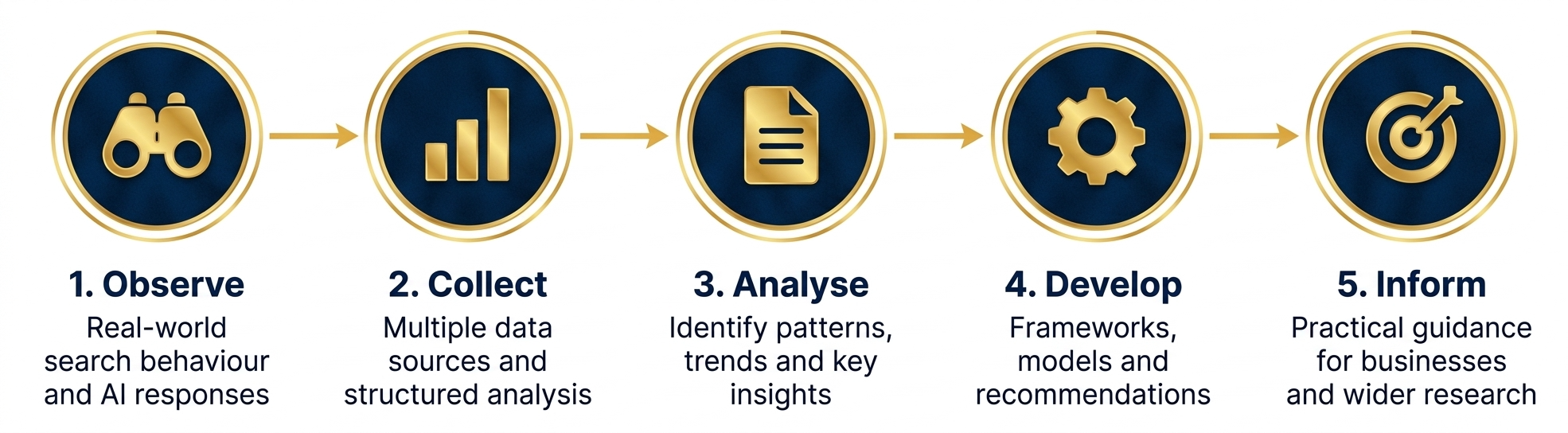
CGO Media Research Methodology: Five Stages from Observation to Practical Application

KEY ELEMENTS OF OUR METHODOLOGY

The Five Core Components

Our research methodology is built around five core components that ensure depth, rigour and practical relevance.


AI Search Analytics and Digital Performance Intelligence

1. Scope and Research Questions

We define clear research questions, scope and objectives for each study.

AI Research Data Storage and Digital Knowledge Infrastructure

2. Data and Evidence

We use multiple data sources, including search platforms, Al responses, industry data and real-world testing.

AI Search Performance Analytics and Connected Data Intelligence

3. Analysis Method

We apply systematic analysis to identify patterns, compare results and draw independent conclusions.

AI Search Authority Network and Connected Digital Intelligence

4. Frameworks and Models

We develop practical frameworks and analytical models based on our findings.

AI Research Documentation and Digital Knowledge Management Systems

5. Limitations and Transparency

We clearly state the limitations of our research and our approach to independence and objectivity.

4. RESEARCH PROCESS IN DETAIL

From Observation to Practical Guidance

Our research follows a structured process, from initial observation through to real-world recommendations.

AI Search Research Methodology: From Observation and Data Collection to Publication and Practical Impact

5. DATA SOURCES AND RESEARCH AREAS

Our Research Coverage

We draw on a wide range of data sources and research areas to provide a complete and independent view.

6. SUPPORTING RESOURCES

Explore Related Research

Our methodology underpins all of our research, statistics, observations and frameworks.

7. FURTHER RESEARCH & CONTACT

Use Our Research to Inform Your Strategy

Explore our full research programme or contact our team to discuss your organisation’s Al search and GEO requirements.

Frequently Asked Questions

CGO Media uses a structured, evidence-based methodology to investigate SEO, AI search, generative engine optimisation (GEO) and digital visibility. Research begins with a defined question and scope, draws on relevant platform observations and other evidence, applies systematic analysis, and records conclusions alongside limitations. The approach supports the studies published in our Research Library and the wider Research Architecture.
We examine how search and AI discovery systems present information, select sources, reference entities and respond to different queries. Depending on the study, this may involve structured prompt comparisons, search-result observations, citation analysis, technical reviews and sector-specific investigation. Findings are interpreted within the stated scope rather than presented as universal rules. See our Latest Research for recently published work.
The five components are scope and research questions; data and evidence; analysis method; frameworks and models; and limitations and transparency. Together they establish what is being studied, which evidence is relevant, how observations are interpreted, how findings are translated into useful models and what cannot be concluded. Our Framework Library illustrates how research can inform structured guidance.
Sources vary by study and may include Google and Bing search results, outputs from ChatGPT, Claude and Perplexity, technical website evidence, user-behaviour patterns, market reports, published research and direct observations. The choice of sources depends on the question under investigation, and sources should not be assumed to provide equivalent evidence. Quantitative publications can be explored in the Statistics Library.
CGO Media aims to distinguish observations, interpretations and practical recommendations, and to make material limitations visible. Research findings should not be treated as proof of causation simply because a pattern is repeated. Our governance resources, including Research Ethics and Integrity, explain the standards readers should expect; any commercial or methodological constraints relevant to an individual study should be disclosed there or in that publication.
Quantitative research examines measurable variables, counts or rates; qualitative research examines context, characteristics and patterns that may not be captured by a single metric. CGO Media may combine both approaches where appropriate, for example by counting observed citations and then examining why the cited sources differ. Related numerical work appears in the Statistics Library.
Search engines and AI assistants are complex systems whose internal decision processes are not fully public. Observational research helps document visible behaviour under specified conditions, compare outcomes and generate hypotheses for further testing. It cannot, on its own, establish every underlying mechanism. Browse examples in the Research Observations Library.
Comparisons should consider equivalent tasks, clear prompts, collection dates, output formats and platform-specific differences. Even closely matched queries may produce variable answers, so findings should describe the observed conditions rather than imply permanent platform behaviour. Our Latest Research highlights new studies as the ecosystem evolves.
Where relevant, the research programme examines how visibility, authority and discovery vary by sector. Differences in regulation, trust expectations, search intent and commercial journeys can affect interpretation. A finding from one industry should not automatically be transferred to another. Visit the Sector Research Library for sector-specific material.
Technical analysis may consider crawlability, indexability, rendering, structured data, internal linking, site performance and content accessibility. These factors can be evaluated alongside observed search and AI visibility, while avoiding unsupported claims that any single technical change directly causes a particular AI answer. For implementation context, see Technical SEO UK.
Publication on the CGO Media website or in a research repository does not, by itself, establish external peer review. Readers should look for an explicit statement about the review process for the particular work. Transparency about authorship, evidence, limitations and corrections remains important regardless of review status. Browse the Research Library for individual publications.

A research paper develops a question and analysis in depth; an observation records and interprets a defined pattern; a statistics publication presents quantitative evidence; and a framework organises findings into an assessment or action model. These outputs serve different purposes and should be read accordingly. The Research Architecture explains how the programme fits together.

Each investigation starts by identifying the phenomenon of interest, the questions being tested and the platforms, markets, periods or sectors to be examined. These boundaries determine which evidence is appropriate and where the conclusions apply. For example, a UK-focused study should not automatically be generalised to every country. Explore how this applies across industries in our Sector Research Library.
AI answer analysis can compare response content, cited sources, referenced brands or entities, and differences between queries or platforms. A citation is an observable inclusion, not by itself proof of endorsement, ranking causality or commercial value. We consider repeatability, context and alternative explanations when interpreting patterns. Related publications are available through the Research Observations Library.
Not necessarily. Representativeness depends on a study’s sampling design, sample size, collection period and target population. Exploratory or observational studies can identify meaningful patterns without supporting population-wide estimates. Readers should assess the methodology and limitations of each publication before generalising a percentage or result. The Statistics Library provides a starting point for quantitative research.
We distinguish observed evidence from inference, recognise that AI platforms and search results can change, and identify constraints such as incomplete access, sampling bias, geography and time. Where a study cannot establish causality or broader applicability, that should be clear to the reader. Our Research Disclaimer provides additional context for interpreting published material.
Yes. Research can help organisations identify questions to investigate, prioritise technical and content improvements, evaluate entity and citation visibility, and design their own measurement programmes. However, a published framework is not a guarantee of improved rankings or AI recommendations; implementation needs organisation-specific evidence and testing. The Framework Library provides related models and guidance.
If two factors occur together, we do not assume that one caused the other. Causal conclusions require an appropriate study design, control of plausible confounders and sufficiently robust evidence. Observational patterns are therefore described as associations or hypotheses unless stronger evidence is available. Our Research Methodology explains the broader analytical approach.
Review frequency depends on the publication and the rate at which its subject changes. AI interfaces, citation behaviour and search features may evolve quickly, so readers should check each publication’s date, version and any correction notes rather than assume every paper is continuously updated. New work is surfaced through Latest Research.
When a material error is identified, readers should be able to distinguish the corrected information from the original claim and understand whether the conclusion has changed. Corrections and updates are part of responsible publication governance. See CGO Media’s Corrections resource for the applicable process.
Frameworks organise findings into concepts, assessment dimensions or implementation steps that can be used consistently. They help translate research into practical decision support but should not be mistaken for independently validated universal laws. The Framework Library contains the programme’s published models.
Yes, subject to the relevant publication’s citation and licensing information. Citations should identify the specific work, its author or research team, publication date, title and persistent identifier where available. Quotations and numerical claims should preserve the original context and limitations. See Citation Guidance and Press & Media Resources.
Treat AI citations, mentions and recommendations as distinct observable outcomes. They may indicate visibility within a sampled set of responses, but they do not automatically establish trust, conversion impact or sustained performance. Organisations should evaluate patterns across relevant prompts and periods and combine them with their own analytics. Explore related studies in Research Observations.
Start with the Research Library for in-depth papers, Latest Research for recent publications, and the Research Architecture for the programme’s structure. Journalists can use Press & Media Resources; organisations with a specific enquiry can contact CGO Media.

Conclusion

CGO Media’s research methodology connects defined questions, transparent evidence and systematic analysis to practical understanding of SEO, AI search and GEO. Explore our research libraries, observations and frameworks to examine the findings, their limitations and their potential relevance to your organisation.

Make Your Business or Organisation Visible Wherever Decisions Are Made

Strengthen your presence across AI Search, GEO and traditional search. Build the authority, trust and relevance signals that help search engines and AI platforms find, cite and recommend your organisation.

For Journalists & Researchers

Access original research, statistics, sector analysis and expert commentary on AI Search, GEO, SEO and the changing search landscape. Find evidence, figures and specialist insight designed to support journalists, researchers and publications.