
The CGO Enterprise SEO System
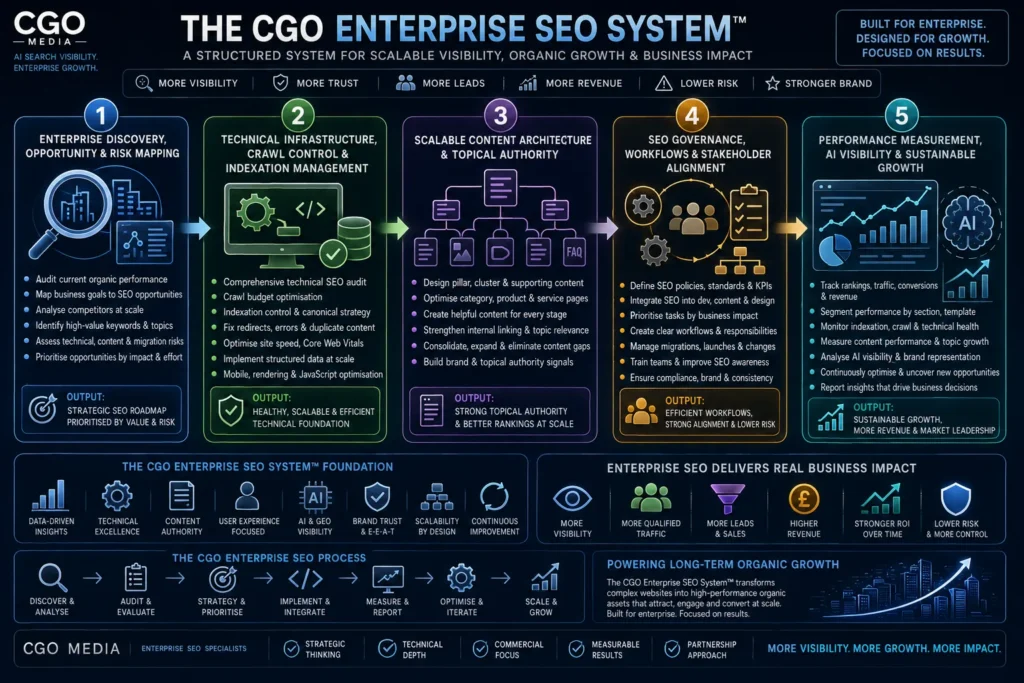
The CGO Enterprise SEO System shows how technical infrastructure, scalable content, governance, automation and authority building combine to improve enterprise search visibility.
Introduction to the CGO Enterprise SEO System
Enterprise SEO has evolved far beyond managing rankings across large websites. Modern enterprise organisations operate complex digital ecosystems comprising thousands or even millions of pages, multiple business units, international markets, diverse technology platforms and cross-functional teams. Success therefore depends upon scalable systems, governance and operational consistency rather than isolated SEO activities.
The emergence of AI-powered search has accelerated this evolution.
Large organisations must now optimise not only for traditional search engines but also for AI assistants, conversational search platforms and knowledge-driven recommendation systems. Enterprise SEO has therefore become an organisational capability that combines technical infrastructure, semantic architecture, content governance, Brand Authority, AI readiness and executive measurement into one integrated operating model.
The CGO Enterprise SEO System has been developed to provide organisations with a structured methodology for managing search visibility at enterprise scale while preparing for the future of AI-powered discovery.
Enterprise SEO System Definition
The CGO Enterprise SEO System is a comprehensive organisational framework that integrates technical SEO, content governance, entity management, AI Search readiness, operational governance, executive reporting and continuous optimisation to manage search visibility across large, complex digital ecosystems.
Why Enterprise SEO Has Changed
Traditional SEO campaigns often focused on improving individual pages or keyword groups.
Enterprise organisations face fundamentally different challenges that require coordinated systems rather than isolated optimisation projects.
Examples include:
- Large-scale website architectures.
- Thousands of product or service pages.
- Multiple business units.
- International and multilingual websites.
- Complex stakeholder environments.
- Frequent platform and content updates.
- Governance across multiple teams.
- AI-powered search optimisation.
Enterprise SEO therefore becomes an operational discipline that aligns people, processes, technology and governance across the entire organisation rather than functioning solely as a marketing activity.
Core Principle
Enterprise SEO succeeds when organisational systems, governance and technical infrastructure work together to deliver consistent visibility at scale.
Beyond Traditional Enterprise SEO
The CGO Enterprise SEO System expands conventional enterprise optimisation by integrating additional strategic capabilities required for modern AI-powered search.
These include:
- AI Search readiness.
- Entity Authority.
- Content Authority.
- Brand Signals.
- Technical governance.
- Knowledge architecture.
- Digital PR.
- Executive performance measurement.
Together these capabilities enable enterprise organisations to build resilient search ecosystems that remain competitive across both traditional search engines and emerging AI-powered discovery platforms.
Enterprise SEO is no longer simply about optimising large websites. It is about managing enterprise knowledge ecosystems that AI systems can understand, trust and recommend.
The Enterprise Search Ecosystem
The CGO Enterprise SEO System treats search visibility as an integrated organisational capability rather than a collection of disconnected SEO tasks.
| Enterprise Capability | Primary Purpose | Strategic Contribution |
|---|---|---|
| ⚙️ Technical Infrastructure | Support crawlability and scalability. | Improves discoverability. |
| 📝 Content Governance | Maintain quality and consistency. | Strengthens authority. |
| 🔗 Entity Management | Develop semantic understanding. | Supports AI interpretation. |
| 🏆 Brand Authority | Strengthen organisational trust. | Improves recommendations. |
| 🏢 Operational Governance | Coordinate enterprise-wide SEO. | Supports long-term performance. |
| 📊 Executive Measurement | Monitor strategic outcomes. | Supports continuous optimisation. |
Enterprise SEO as an Organisational System
The framework recognises that enterprise search performance depends upon collaboration between technology, marketing, product, content, communications and executive leadership.
Each department contributes signals that influence search visibility, semantic understanding and AI readiness.
The Enterprise SEO System therefore establishes governance structures that coordinate these functions through shared objectives, common standards and measurable performance indicators.
The strongest enterprise organisations treat SEO as an organisational operating system rather than an isolated marketing function.
The Objectives of the CGO Enterprise SEO System
The framework has been developed to help enterprise organisations build sustainable visibility across search engines and AI-powered discovery environments.
Its primary objectives include:
- Scale technical SEO efficiently.
- Strengthen enterprise governance.
- Improve AI Search readiness.
- Develop organisational authority.
- Expand semantic knowledge.
- Increase operational consistency.
- Support executive decision-making.
- Create sustainable long-term visibility.
Framework Vision
The purpose of the CGO Enterprise SEO System is to provide large organisations with a scalable operating model that strengthens technical excellence, organisational governance, AI readiness and long-term search visibility across an increasingly intelligent digital ecosystem.
Part 2 explores the strategic principles of Enterprise SEO, explains how the system integrates with the wider CGO framework ecosystem and introduces the long-term role of AI-powered enterprise search management.
The Strategic Principles of Enterprise SEO
The CGO Enterprise SEO System is founded upon a series of strategic principles that recognise search visibility as an organisational capability rather than an isolated marketing function. Enterprise organisations operate highly interconnected digital ecosystems where technology, content, governance, brand reputation and executive leadership collectively influence search performance.
These principles provide a structured operating model that enables organisations to scale SEO efficiently while preparing for the continued evolution of AI-powered search.
Strategic Principle
Enterprise SEO delivers sustainable competitive advantage when governance, technology, content and organisational knowledge operate as one integrated business system.
The Five Pillars of the Enterprise SEO System
The framework is organised around five strategic pillars that support long-term enterprise search performance.
| Framework Pillar | Primary Focus | Strategic Outcome |
|---|---|---|
| ⚙️ Technical Excellence | Develop scalable enterprise infrastructure. | Improves discoverability. |
| 🏢 Organisational Governance | Coordinate enterprise-wide SEO activities. | Creates operational consistency. |
| 🧠 Knowledge Authority | Develop trusted organisational expertise. | Strengthens AI understanding. |
| 🏆 Brand & Entity Authority | Build recognised organisational credibility. | Supports AI recommendations. |
| 📊 Executive Measurement | Monitor strategic enterprise performance. | Supports continuous improvement. |
Enterprise SEO becomes significantly more effective when technical optimisation, governance and organisational knowledge are managed together through one strategic operating model.
Integrating the Enterprise SEO System with the CGO Framework Ecosystem
The Enterprise SEO System forms part of the wider CGO strategic framework ecosystem.
Technical SEO Frameworks strengthen enterprise infrastructure, the Entity Authority Framework improves semantic understanding, the Content Authority Framework develops organisational expertise, the Brand Signal Framework enhances commercial trust and the AI Search Readiness Framework prepares enterprise websites for AI-powered discovery.
Together these frameworks provide enterprise organisations with a unified methodology for managing traditional search performance while strengthening visibility across emerging AI platforms.
Framework Integration Principle
Enterprise SEO delivers maximum value when every organisational framework contributes to one connected knowledge ecosystem that supports both search engines and AI systems.
The Enterprise Knowledge Ecosystem
Modern enterprise websites increasingly function as organisational knowledge platforms rather than collections of independent webpages.
Products, services, research, documentation, leadership, customer resources and technical information become interconnected knowledge assets that AI systems interpret collectively.
This shift means enterprise organisations must optimise the relationships between information as carefully as the information itself.
The future of Enterprise SEO lies in developing structured knowledge ecosystems that AI systems can interpret with confidence at organisational scale.
Preparing for the Remaining Framework
The remaining sections of the CGO Enterprise SEO System examine every major capability required to manage enterprise visibility, including scalable technical architecture, enterprise content governance, Entity Authority, AI Search readiness, executive governance, operational excellence, Digital PR, performance measurement and future AI strategy.
Each section combines strategic principles, governance models, implementation guidance and executive measurement frameworks that organisations can apply to strengthen long-term enterprise search performance.
Section 1 Executive Summary
The introduction establishes Enterprise SEO as an organisational operating system rather than a traditional marketing discipline. By integrating scalable technical infrastructure, governance, Content Authority, Entity Authority, Brand Signals, AI Search readiness and executive performance measurement, enterprise organisations build resilient digital ecosystems capable of supporting sustainable visibility across both traditional search engines and the next generation of AI-powered discovery platforms.
Scalable Technical SEO Infrastructure
Technical infrastructure forms the foundation of every successful Enterprise SEO programme. Large organisations manage complex digital ecosystems comprising multiple websites, business units, applications, content repositories and international platforms. Without scalable technical architecture, even the highest-quality content and strongest Brand Authority cannot achieve their full visibility potential.
The CGO Enterprise SEO System therefore positions technical infrastructure as a strategic organisational capability rather than a purely technical discipline.
As AI-powered search continues to evolve, enterprise infrastructure must support not only traditional crawling and indexing but also semantic understanding, structured knowledge, entity relationships and machine-readable information that enable AI systems to interpret enterprise content with greater confidence.
Scalable Technical Infrastructure Definition
Scalable Technical SEO Infrastructure is the enterprise-wide architecture, technology and optimisation framework that enables large organisations to manage search visibility efficiently across extensive digital ecosystems while supporting AI-powered discovery, semantic understanding and long-term operational resilience.
Why Scalability Matters
Enterprise organisations face technical challenges that differ significantly from those encountered by smaller businesses.
Large-scale websites often include:
- Hundreds of thousands or millions of URLs.
- Multiple country and language versions.
- Large product or service catalogues.
- Frequent platform updates.
- Complex CMS environments.
- Multiple development teams.
- Enterprise-level security requirements.
- Continuous content expansion.
These environments require technical systems capable of supporting growth without compromising search performance or AI readiness.
Scalability Principle
Enterprise SEO infrastructure should be designed to support future organisational growth rather than only current technical requirements.
The Core Components of Enterprise Technical Infrastructure
The framework identifies several technical disciplines that collectively support scalable search performance.
| Infrastructure Component | Primary Purpose | Strategic Contribution |
|---|---|---|
| 🏗️ Site Architecture | Organise enterprise content logically. | Improves discoverability. |
| 🔍 Crawl Management | Optimise search engine efficiency. | Supports indexation. |
| 🔗 Structured Data | Provide machine-readable enterprise knowledge. | Strengthens AI interpretation. |
| ⚡ Performance Optimisation | Improve speed and technical quality. | Enhances user experience. |
| 🧩 Internal Linking | Strengthen semantic relationships. | Supports contextual understanding. |
| 🛡️ Technical Governance | Maintain enterprise-wide standards. | Supports long-term consistency. |
Scalable infrastructure enables enterprise organisations to expand digital ecosystems while maintaining consistent technical quality and AI readiness.
Enterprise Information Architecture
Enterprise information architecture determines how effectively search engines and AI systems interpret organisational knowledge.
Rather than organising websites purely according to internal business structures, the framework recommends designing semantic architectures that reflect customer intent, organisational expertise and logical relationships between products, services, resources and supporting content.
Strong information architecture improves crawl efficiency while strengthening enterprise knowledge graphs.
Architecture Principle
Enterprise websites should be organised as structured knowledge ecosystems rather than disconnected collections of webpages.
Infrastructure for AI Search
AI-powered search requires technical infrastructure that extends beyond traditional optimisation.
Enterprise organisations should therefore ensure that structured data, semantic relationships, entity connections, metadata and content hierarchies consistently support machine interpretation alongside conventional search engine indexing.
This broader approach prepares enterprise websites for future AI-powered recommendation systems while strengthening present-day search performance.
| AI Infrastructure Capability | Purpose | Enterprise Benefit |
|---|---|---|
| 🧠 Entity Architecture | Connect organisational knowledge. | Improves AI understanding. |
| 🧩 Semantic Navigation | Strengthen contextual relationships. | Supports recommendation quality. |
| 📚 Structured Knowledge | Improve machine readability. | Expands discoverability. |
| ⚙️ Technical Consistency | Maintain reliable infrastructure. | Supports scalability. |
| 🔗 Knowledge Connectivity | Link related organisational resources. | Strengthens enterprise authority. |
Enterprise infrastructure increasingly serves both search engines and AI systems by enabling reliable interpretation of organisational knowledge at scale.
Technical Infrastructure as Strategic Advantage
Enterprise infrastructure should not be viewed solely as an operational requirement.
Well-designed technical architecture creates long-term competitive advantages by enabling faster innovation, stronger governance, improved AI readiness and more efficient enterprise-wide optimisation.
Organisations that invest in scalable infrastructure establish resilient digital ecosystems capable of adapting continuously as search technology evolves.
Framework Vision
The objective of Scalable Technical SEO Infrastructure is to provide enterprise organisations with resilient technical foundations that support search visibility, AI readiness and sustainable digital growth across increasingly complex organisational ecosystems.
Part 2 explores technical governance, enterprise infrastructure KPIs, maturity models, implementation methodology and the strategic role of scalable architecture within AI-powered Enterprise SEO.
Technical Governance for Enterprise SEO
Enterprise technical infrastructure requires structured governance to ensure that search performance remains consistent across large, continuously evolving digital ecosystems. As organisations expand through new products, acquisitions, international websites and technology platforms, governance provides the standards needed to maintain technical quality and operational consistency.
The framework recommends documented technical governance covering architecture, structured data, performance optimisation, crawl management, semantic consistency and AI readiness.
Technical Governance Principle
Enterprise technical infrastructure delivers long-term value when governance protects consistency, scalability and AI readiness across every digital property.
Enterprise Technical Governance Framework
| Governance Area | Primary Purpose | Strategic Benefit |
|---|---|---|
| 🏗️ Architecture Standards | Maintain consistent site structures. | Improves discoverability. |
| 🔍 Crawl Management | Optimise indexation across large websites. | Strengthens search efficiency. |
| 🔗 Structured Data Governance | Maintain machine-readable enterprise knowledge. | Supports AI interpretation. |
| 📊 Performance Monitoring | Track technical quality continuously. | Enhances user experience. |
| 🧠 Semantic Consistency | Protect relationships between enterprise entities. | Improves contextual understanding. |
| 🛡️ Technical Audit Programme | Review enterprise infrastructure regularly. | Supports continuous optimisation. |
Enterprise governance transforms technical infrastructure into a scalable strategic asset that supports long-term visibility and AI-powered discovery.
Enterprise Technical KPIs
Technical performance should be measured using enterprise indicators that evaluate infrastructure quality, scalability and operational resilience rather than isolated technical issues.
| KPI | Purpose | Strategic Value |
|---|---|---|
| 🔍 Enterprise Crawl Efficiency | Measure search engine access across digital properties. | Improves discoverability. |
| 📊 Index Quality Score | Evaluate the percentage of valuable pages successfully indexed. | Strengthens visibility. |
| 🔗 Structured Data Coverage | Assess implementation across enterprise websites. | Supports AI readiness. |
| ⚙️ Technical Health Index | Monitor infrastructure quality and reliability. | Protects performance. |
| 🧠 Semantic Connectivity Score | Measure relationships between enterprise knowledge assets. | Improves AI understanding. |
| ✅ Technical Compliance Rate | Assess adherence to governance standards. | Maintains consistency. |
Measurement Principle
Enterprise technical performance should be evaluated according to how effectively infrastructure supports discoverability, organisational knowledge and long-term AI readiness.
Technical Infrastructure Maturity Model
| Maturity Level | Characteristics | Strategic Outcome |
|---|---|---|
| 🌱 Level 1 – Basic Enterprise Infrastructure | Reactive technical optimisation with inconsistent governance. | Foundational technical capability. |
| 🧱 Level 2 – Structured Technical Platform | Documented standards, improved architecture and recurring technical reviews. | Growing operational consistency. |
| 🤖 Level 3 – AI-Ready Enterprise Infrastructure | Comprehensive semantic architecture, structured data and scalable governance. | Increasing AI recommendation readiness. |
| 🏆 Level 4 – Technical Enterprise Leader | Advanced automation, continuous monitoring and executive oversight. | High enterprise resilience. |
| 🌍 Level 5 – Global Technical Authority | Internationally recognised technical excellence supporting large-scale AI-powered discovery. | Sustainable Enterprise SEO leadership. |
Common Enterprise Technical Weaknesses
Many large organisations possess substantial digital assets but lack the governance necessary to manage them effectively.
Common weaknesses include:
- Inconsistent site architecture.
- Duplicate enterprise content.
- Weak structured data implementation.
- Poor crawl efficiency.
- Disconnected internal linking.
- Fragmented technical ownership.
- Limited semantic consistency.
- Reactive infrastructure management.
- Weak enterprise reporting.
- Limited AI readiness monitoring.
Addressing these weaknesses strengthens organisational scalability while improving enterprise visibility across both traditional search engines and AI-powered discovery platforms.
Scalable technical infrastructure becomes a lasting competitive advantage when governance enables enterprise growth without compromising search quality or AI understanding.
Technical Infrastructure Implementation Methodology
The framework recommends implementing enterprise technical infrastructure through a structured programme.
- Audit enterprise technical architecture.
- Standardise infrastructure across digital properties.
- Improve crawl efficiency and index quality.
- Strengthen structured data implementation.
- Develop semantic enterprise architecture.
- Monitor enterprise technical KPIs.
- Conduct recurring technical audits.
- Review AI readiness regularly.
- Maintain governance standards.
- Continuously optimise enterprise infrastructure for future AI-powered search.
Section 2 Executive Summary
Scalable Technical SEO Infrastructure provides the foundation for successful Enterprise SEO by combining robust architecture, technical governance, structured data, semantic connectivity and continuous performance monitoring. Through enterprise-wide standards, executive oversight and scalable optimisation, organisations create resilient digital ecosystems capable of supporting both traditional search engines and AI-powered discovery platforms. Sustainable Enterprise SEO depends upon technical infrastructure that grows alongside the organisation while maintaining consistency, quality and long-term search visibility.
Technical Governance for Enterprise SEO
Enterprise technical infrastructure requires structured governance to ensure that search performance remains consistent across large, continuously evolving digital ecosystems. As organisations expand through new products, acquisitions, international websites and technology platforms, governance provides the standards needed to maintain technical quality and operational consistency.
The framework recommends documented technical governance covering architecture, structured data, performance optimisation, crawl management, semantic consistency and AI readiness.
Technical Governance Principle
Enterprise technical infrastructure delivers long-term value when governance protects consistency, scalability and AI readiness across every digital property.
Enterprise Technical Governance Framework
| Governance Area | Primary Purpose | Strategic Benefit |
|---|---|---|
| 🏗️ Architecture Standards | Maintain consistent site structures. | Improves discoverability. |
| 🔍 Crawl Management | Optimise indexation across large websites. | Strengthens search efficiency. |
| 🔗 Structured Data Governance | Maintain machine-readable enterprise knowledge. | Supports AI interpretation. |
| 📊 Performance Monitoring | Track technical quality continuously. | Enhances user experience. |
| 🧠 Semantic Consistency | Protect relationships between enterprise entities. | Improves contextual understanding. |
| 🛡️ Technical Audit Programme | Review enterprise infrastructure regularly. | Supports continuous optimisation. |
Enterprise governance transforms technical infrastructure into a scalable strategic asset that supports long-term visibility and AI-powered discovery.
Enterprise Technical KPIs
Technical performance should be measured using enterprise indicators that evaluate infrastructure quality, scalability and operational resilience rather than isolated technical issues.
| KPI | Purpose | Strategic Value |
|---|---|---|
| 🔍 Enterprise Crawl Efficiency | Measure search engine access across digital properties. | Improves discoverability. |
| 📊 Index Quality Score | Evaluate the percentage of valuable pages successfully indexed. | Strengthens visibility. |
| 🔗 Structured Data Coverage | Assess implementation across enterprise websites. | Supports AI readiness. |
| ⚙️ Technical Health Index | Monitor infrastructure quality and reliability. | Protects performance. |
| 🧠 Semantic Connectivity Score | Measure relationships between enterprise knowledge assets. | Improves AI understanding. |
| ✅ Technical Compliance Rate | Assess adherence to governance standards. | Maintains consistency. |
Measurement Principle
Enterprise technical performance should be evaluated according to how effectively infrastructure supports discoverability, organisational knowledge and long-term AI readiness.
Technical Infrastructure Maturity Model
| Maturity Level | Characteristics | Strategic Outcome |
|---|---|---|
| 🌱 Level 1 – Basic Enterprise Infrastructure | Reactive technical optimisation with inconsistent governance. | Foundational technical capability. |
| 🧱 Level 2 – Structured Technical Platform | Documented standards, improved architecture and recurring technical reviews. | Growing operational consistency. |
| 🤖 Level 3 – AI-Ready Enterprise Infrastructure | Comprehensive semantic architecture, structured data and scalable governance. | Increasing AI recommendation readiness. |
| 🏆 Level 4 – Technical Enterprise Leader | Advanced automation, continuous monitoring and executive oversight. | High enterprise resilience. |
| 🌍 Level 5 – Global Technical Authority | Internationally recognised technical excellence supporting large-scale AI-powered discovery. | Sustainable Enterprise SEO leadership. |
Common Enterprise Technical Weaknesses
Many large organisations possess substantial digital assets but lack the governance necessary to manage them effectively.
Common weaknesses include:
- Inconsistent site architecture.
- Duplicate enterprise content.
- Weak structured data implementation.
- Poor crawl efficiency.
- Disconnected internal linking.
- Fragmented technical ownership.
- Limited semantic consistency.
- Reactive infrastructure management.
- Weak enterprise reporting.
- Limited AI readiness monitoring.
Addressing these weaknesses strengthens organisational scalability while improving enterprise visibility across both traditional search engines and AI-powered discovery platforms.
Scalable technical infrastructure becomes a lasting competitive advantage when governance enables enterprise growth without compromising search quality or AI understanding.
Technical Infrastructure Implementation Methodology
The framework recommends implementing enterprise technical infrastructure through a structured programme.
- Audit enterprise technical architecture.
- Standardise infrastructure across digital properties.
- Improve crawl efficiency and index quality.
- Strengthen structured data implementation.
- Develop semantic enterprise architecture.
- Monitor enterprise technical KPIs.
- Conduct recurring technical audits.
- Review AI readiness regularly.
- Maintain governance standards.
- Continuously optimise enterprise infrastructure for future AI-powered search.
Section 2 Executive Summary
Scalable Technical SEO Infrastructure provides the foundation for successful Enterprise SEO by combining robust architecture, technical governance, structured data, semantic connectivity and continuous performance monitoring. Through enterprise-wide standards, executive oversight and scalable optimisation, organisations create resilient digital ecosystems capable of supporting both traditional search engines and AI-powered discovery platforms. Sustainable Enterprise SEO depends upon technical infrastructure that grows alongside the organisation while maintaining consistency, quality and long-term search visibility.
Enterprise Content Governance and Knowledge Management
Content is one of the largest and most valuable assets within enterprise organisations. However, as websites expand across multiple departments, business units, countries and product portfolios, maintaining content quality, consistency and strategic alignment becomes increasingly challenging.
Without structured governance, enterprise content ecosystems often develop duplicated information, inconsistent messaging, fragmented ownership and declining quality. These issues reduce search visibility while making it more difficult for AI systems to interpret organisational knowledge accurately.
The CGO Enterprise SEO System therefore positions Enterprise Content Governance as a strategic organisational capability that strengthens search performance, AI understanding and long-term knowledge management.
Enterprise Content Governance Definition
Enterprise Content Governance is the structured management of organisational knowledge through documented standards, editorial processes, ownership, semantic consistency and continuous quality assurance that support scalable Enterprise SEO and AI-powered search.
Why Content Governance Matters
Enterprise organisations publish information across a wide variety of digital channels.
Typical enterprise content includes:
- Product and service pages.
- Knowledge centres.
- Support documentation.
- Research publications.
- Corporate communications.
- Regional content.
- Industry resources.
- Executive thought leadership.
Without governance, this information frequently becomes inconsistent, outdated or disconnected, reducing both customer value and AI interpretation.
Content Governance Principle
Enterprise knowledge delivers maximum value when every content asset contributes consistently to one coordinated organisational knowledge ecosystem.
The Core Components of Enterprise Content Governance
The framework identifies several governance disciplines that collectively strengthen enterprise knowledge.
| Governance Component | Primary Purpose | Strategic Contribution |
|---|---|---|
| 📝 Editorial Standards | Maintain consistent content quality. | Strengthens authority. |
| 👤 Content Ownership | Assign accountability. | Improves governance. |
| 🧠 Knowledge Architecture | Organise enterprise information. | Supports AI understanding. |
| 🔄 Content Lifecycle Management | Maintain relevance and accuracy. | Protects quality. |
| 🔗 Semantic Consistency | Standardise terminology and relationships. | Improves machine interpretation. |
| ✅ Quality Assurance | Review enterprise content continuously. | Supports long-term visibility. |
Enterprise content becomes significantly more valuable when governed as a strategic organisational knowledge asset rather than a collection of independent webpages.
Knowledge Management at Enterprise Scale
Enterprise SEO increasingly depends upon effective knowledge management.
Rather than creating isolated content assets, organisations should develop interconnected knowledge ecosystems where products, services, research, expertise, documentation and customer resources reinforce one another through semantic relationships.
This approach improves discoverability while strengthening AI-powered interpretation of organisational expertise.
Knowledge Management Principle
Enterprise knowledge should be organised to maximise both human understanding and machine interpretation across the entire organisation.
Content Governance and AI Search
AI-powered search increasingly relies on high-quality organisational knowledge rather than isolated webpages.
Enterprises that maintain consistent editorial standards, structured knowledge architecture and connected content ecosystems provide AI systems with stronger signals that support citations, recommendations and semantic understanding.
| Knowledge Capability | Purpose | Enterprise Benefit |
|---|---|---|
| 🧩 Content Clusters | Develop topical authority. | Strengthens expertise. |
| 🏛️ Knowledge Hubs | Centralise organisational information. | Improves discoverability. |
| 🔗 Semantic Relationships | Connect enterprise knowledge. | Supports AI understanding. |
| 📝 Editorial Consistency | Maintain quality across departments. | Builds trust. |
| 📚 Structured Documentation | Improve machine readability. | Supports AI interpretation. |
Enterprise content governance transforms information into structured organisational knowledge that AI systems can understand and trust at scale.
Content as a Strategic Enterprise Asset
Content should be managed with the same discipline applied to financial assets, technology infrastructure and intellectual property.
By establishing governance, ownership and continuous quality management, enterprise organisations create knowledge ecosystems that remain valuable as both search engines and AI technologies continue to evolve.
Framework Vision
The objective of Enterprise Content Governance is to develop scalable organisational knowledge that strengthens Enterprise SEO, AI readiness and long-term competitive advantage through consistent governance and continuous knowledge management.
Part 2 explores content governance KPIs, enterprise knowledge maturity models, implementation methodology, executive oversight and the long-term strategic value of organisational knowledge within Enterprise SEO.
Enterprise Content Governance and Knowledge Management
Content is one of the largest and most valuable assets within enterprise organisations. However, as websites expand across multiple departments, business units, countries and product portfolios, maintaining content quality, consistency and strategic alignment becomes increasingly challenging.
Without structured governance, enterprise content ecosystems often develop duplicated information, inconsistent messaging, fragmented ownership and declining quality. These issues reduce search visibility while making it more difficult for AI systems to interpret organisational knowledge accurately.
The CGO Enterprise SEO System therefore positions Enterprise Content Governance as a strategic organisational capability that strengthens search performance, AI understanding and long-term knowledge management.
Enterprise Content Governance Definition
Enterprise Content Governance is the structured management of organisational knowledge through documented standards, editorial processes, ownership, semantic consistency and continuous quality assurance that support scalable Enterprise SEO and AI-powered search.
Why Content Governance Matters
Enterprise organisations publish information across a wide variety of digital channels.
Typical enterprise content includes:
- Product and service pages.
- Knowledge centres.
- Support documentation.
- Research publications.
- Corporate communications.
- Regional content.
- Industry resources.
- Executive thought leadership.
Without governance, this information frequently becomes inconsistent, outdated or disconnected, reducing both customer value and AI interpretation.
Content Governance Principle
Enterprise knowledge delivers maximum value when every content asset contributes consistently to one coordinated organisational knowledge ecosystem.
The Core Components of Enterprise Content Governance
The framework identifies several governance disciplines that collectively strengthen enterprise knowledge.
| Governance Component | Primary Purpose | Strategic Contribution |
|---|---|---|
| 📝 Editorial Standards | Maintain consistent content quality. | Strengthens authority. |
| 👤 Content Ownership | Assign accountability. | Improves governance. |
| 🧠 Knowledge Architecture | Organise enterprise information. | Supports AI understanding. |
| 🔄 Content Lifecycle Management | Maintain relevance and accuracy. | Protects quality. |
| 🔗 Semantic Consistency | Standardise terminology and relationships. | Improves machine interpretation. |
| ✅ Quality Assurance | Review enterprise content continuously. | Supports long-term visibility. |
Enterprise content becomes significantly more valuable when governed as a strategic organisational knowledge asset rather than a collection of independent webpages.
Knowledge Management at Enterprise Scale
Enterprise SEO increasingly depends upon effective knowledge management.
Rather than creating isolated content assets, organisations should develop interconnected knowledge ecosystems where products, services, research, expertise, documentation and customer resources reinforce one another through semantic relationships.
This approach improves discoverability while strengthening AI-powered interpretation of organisational expertise.
Knowledge Management Principle
Enterprise knowledge should be organised to maximise both human understanding and machine interpretation across the entire organisation.
Content Governance and AI Search
AI-powered search increasingly relies on high-quality organisational knowledge rather than isolated webpages.
Enterprises that maintain consistent editorial standards, structured knowledge architecture and connected content ecosystems provide AI systems with stronger signals that support citations, recommendations and semantic understanding.
| Knowledge Capability | Purpose | Enterprise Benefit |
|---|---|---|
| 🧩 Content Clusters | Develop topical authority. | Strengthens expertise. |
| 🏛️ Knowledge Hubs | Centralise organisational information. | Improves discoverability. |
| 🔗 Semantic Relationships | Connect enterprise knowledge. | Supports AI understanding. |
| 📝 Editorial Consistency | Maintain quality across departments. | Builds trust. |
| 📚 Structured Documentation | Improve machine readability. | Supports AI interpretation. |
Enterprise content governance transforms information into structured organisational knowledge that AI systems can understand and trust at scale.
Content as a Strategic Enterprise Asset
Content should be managed with the same discipline applied to financial assets, technology infrastructure and intellectual property.
By establishing governance, ownership and continuous quality management, enterprise organisations create knowledge ecosystems that remain valuable as both search engines and AI technologies continue to evolve.
Framework Vision
The objective of Enterprise Content Governance is to develop scalable organisational knowledge that strengthens Enterprise SEO, AI readiness and long-term competitive advantage through consistent governance and continuous knowledge management.
Part 2 explores content governance KPIs, enterprise knowledge maturity models, implementation methodology, executive oversight and the long-term strategic value of organisational knowledge within Enterprise SEO.
Enterprise Content Governance Framework
Effective content governance requires structured policies that ensure organisational knowledge remains accurate, consistent and aligned with enterprise objectives. As organisations expand across multiple markets, departments and digital platforms, governance protects the integrity of enterprise knowledge while enabling efficient collaboration.
The framework recommends documented governance covering editorial standards, ownership, content lifecycle management, semantic consistency, quality assurance and continuous optimisation.
Content Governance Principle
Enterprise knowledge creates maximum strategic value when every content asset is governed through consistent standards, clearly defined ownership and continuous quality improvement.
Enterprise Content Governance Areas
| Governance Area | Primary Purpose | Strategic Benefit |
|---|---|---|
| 📝 Editorial Governance | Maintain enterprise-wide content standards. | Improves consistency. |
| 👤 Knowledge Ownership | Assign responsibility for organisational content. | Strengthens accountability. |
| 🔄 Content Lifecycle Management | Review and update knowledge regularly. | Maintains relevance. |
| 🧠 Semantic Governance | Protect terminology and entity relationships. | Supports AI understanding. |
| ✅ Quality Assurance | Monitor accuracy and completeness. | Builds trust. |
| 📊 Performance Monitoring | Evaluate enterprise knowledge continuously. | Supports optimisation. |
Enterprise Content Governance transforms organisational information into a trusted strategic knowledge asset that supports long-term search visibility and AI readiness.
Enterprise Content KPIs
Content governance should be evaluated using indicators that measure knowledge quality, organisational consistency and long-term authority rather than publishing activity alone.
| KPI | Purpose | Strategic Value |
|---|---|---|
| 🏆 Knowledge Quality Score | Measure the overall quality of enterprise content. | Strengthens authority. |
| 🔄 Content Freshness Index | Monitor review and update frequency. | Maintains relevance. |
| 🧠 Semantic Consistency Score | Assess alignment of terminology and entity relationships. | Supports AI interpretation. |
| 📚 Content Coverage Index | Evaluate completeness across strategic topics. | Improves topical authority. |
| 🤖 AI Citation Visibility | Monitor enterprise content referenced by AI systems. | Measures AI readiness. |
| ✅ Governance Compliance Rate | Track adherence to enterprise content standards. | Maintains consistency. |
Measurement Principle
Enterprise content performance should be measured according to how effectively organisational knowledge supports discoverability, authority, AI understanding and long-term business objectives.
Enterprise Knowledge Maturity Model
| Maturity Level | Characteristics | Strategic Outcome |
|---|---|---|
| 🌱 Level 1 – Unstructured Knowledge | Fragmented content with inconsistent ownership and quality. | Limited organisational visibility. |
| 🧱 Level 2 – Structured Content Governance | Documented editorial standards and recurring content reviews. | Improved consistency. |
| 🔗 Level 3 – Enterprise Knowledge System | Connected knowledge architecture supported by semantic governance. | Growing AI understanding. |
| 🏆 Level 4 – Organisational Knowledge Authority | Advanced governance, executive oversight and continuous optimisation. | High enterprise credibility. |
| 🌍 Level 5 – Global Enterprise Knowledge Leader | Internationally recognised knowledge ecosystem supported by innovation, governance and AI readiness. | Long-term Enterprise SEO leadership. |
Common Enterprise Content Weaknesses
Many enterprise organisations possess extensive content libraries but lack the governance required to maximise their strategic value.
Common weaknesses include:
- Duplicate content across departments.
- Inconsistent editorial standards.
- Unclear ownership.
- Outdated knowledge resources.
- Weak semantic relationships.
- Limited content lifecycle management.
- Poor knowledge architecture.
- Reactive governance.
- Weak executive reporting.
- Limited AI readiness measurement.
Addressing these weaknesses enables enterprise organisations to transform fragmented information into coordinated knowledge ecosystems that strengthen both search performance and AI-powered discovery.
Enterprise knowledge becomes a long-term competitive advantage when governance ensures accuracy, consistency and continuous development across the entire organisation.
Enterprise Content Governance Implementation Methodology
The framework recommends implementing enterprise content governance through a structured programme.
- Audit enterprise knowledge assets.
- Define governance standards and ownership.
- Develop structured knowledge architecture.
- Standardise editorial processes.
- Strengthen semantic consistency.
- Monitor enterprise content KPIs.
- Conduct recurring content reviews.
- Evaluate AI citation performance.
- Maintain governance standards.
- Continuously expand organisational knowledge quality.
Section 3 Executive Summary
Enterprise Content Governance enables organisations to manage knowledge as a strategic business asset that supports Enterprise SEO, AI Search readiness and long-term authority. Through structured editorial governance, semantic consistency, knowledge architecture, executive oversight and continuous performance measurement, enterprises build scalable knowledge ecosystems that strengthen discoverability, improve AI interpretation and create sustainable competitive advantage across increasingly intelligent search environments.
Enterprise Entity Architecture and Knowledge Graph Strategy
Modern Enterprise SEO increasingly depends upon how effectively search engines and AI systems understand an organisation’s entities and the relationships between them. Large enterprises manage extensive networks of products, services, brands, people, locations, technologies, publications and corporate information that together form a complex organisational knowledge ecosystem.
Traditional SEO focused primarily on webpages and keywords. Enterprise organisations must now optimise the underlying entities that define their business so AI-powered search platforms can interpret organisational knowledge with greater accuracy and confidence.
The CGO Enterprise SEO System therefore positions Entity Architecture and Knowledge Graph Strategy as central components of scalable Enterprise SEO and AI Search readiness.
Enterprise Entity Architecture Definition
Enterprise Entity Architecture is the structured organisation of business entities and their semantic relationships across an enterprise digital ecosystem, enabling search engines and AI systems to accurately understand organisational knowledge, expertise and commercial capabilities.
Why Entity Architecture Matters
Enterprise organisations contain significantly more entities than smaller businesses.
Examples include:
- Corporate brands.
- Products and services.
- Business divisions.
- Executives and subject-matter experts.
- Office locations.
- Research publications.
- Technology platforms.
- Strategic partnerships.
Without structured entity architecture, these assets often remain disconnected, reducing semantic understanding and limiting AI-powered discoverability.
Entity Principle
Enterprise organisations strengthen AI understanding by managing relationships between business entities rather than optimising individual webpages in isolation.
The Core Components of Enterprise Entity Architecture
The framework identifies several interconnected entity categories that collectively define organisational knowledge.
| Entity Category | Primary Purpose | Strategic Contribution |
|---|---|---|
| 🏢 Organisation Entities | Define corporate identity. | Strengthen trust. |
| 🛍️ Product & Service Entities | Represent commercial offerings. | Improve semantic understanding. |
| 👤 People Entities | Highlight organisational expertise. | Build authority. |
| 📍 Location Entities | Connect geographic operations. | Improve relevance. |
| 📚 Knowledge Entities | Organise research and publications. | Support AI citations. |
| 🔗 Relationship Architecture | Connect entities logically. | Strengthen contextual understanding. |
Enterprise Entity Architecture transforms organisational information into a structured knowledge ecosystem that AI systems can interpret at scale.
Knowledge Graph Strategy
Knowledge graphs provide the semantic structure that connects enterprise entities into one coherent organisational model.
Rather than viewing webpages independently, AI systems increasingly interpret how products relate to services, experts contribute to research, business units support customers and publications reinforce organisational authority.
Enterprise Knowledge Graph Strategy therefore focuses on strengthening these semantic relationships throughout the entire organisation.
Knowledge Graph Principle
Knowledge graphs create organisational context that enables AI systems to understand enterprise expertise beyond individual documents or webpages.
Entity Architecture and AI Search
AI-powered search increasingly depends upon connected enterprise knowledge.
Organisations that maintain structured entity relationships enable AI systems to identify expertise, understand commercial capabilities and generate more accurate citations and recommendations.
| Knowledge Graph Capability | Purpose | Enterprise Benefit |
|---|---|---|
| 🔗 Entity Relationships | Connect organisational knowledge. | Improves AI interpretation. |
| 🧠 Semantic Context | Strengthen understanding of business capabilities. | Supports recommendations. |
| 📚 Knowledge Connectivity | Link enterprise resources. | Expands discoverability. |
| ✅ Entity Consistency | Maintain standardised information. | Builds trust. |
| ⚙️ Machine Readability | Improve AI processing. | Supports future AI Search. |
Connected enterprise entities provide the semantic foundation required for AI-powered search, recommendations and organisational authority.
Entity Architecture as Enterprise Infrastructure
Entity Architecture should be viewed as long-term digital infrastructure rather than a one-time SEO implementation.
As enterprise organisations continue expanding products, services, research, locations and partnerships, structured entity management ensures organisational knowledge remains connected, scalable and understandable across increasingly intelligent search ecosystems.
Framework Vision
The objective of Enterprise Entity Architecture and Knowledge Graph Strategy is to create connected organisational knowledge that strengthens Enterprise SEO, AI understanding, semantic authority and sustainable long-term search visibility.
Part 2 explores enterprise entity governance, Knowledge Graph KPIs, maturity models, implementation methodology and the strategic role of semantic architecture within large-scale Enterprise SEO.
Enterprise Entity Governance
Enterprise Entity Architecture requires structured governance to ensure organisational knowledge remains accurate, connected and consistent across all digital properties. As enterprises expand through acquisitions, new business units, product launches and international growth, governance protects semantic integrity while supporting scalable AI understanding.
The framework recommends documented governance covering entity ownership, relationship management, structured data standards, knowledge graph development and continuous semantic optimisation.
Entity Governance Principle
Enterprise entities create maximum strategic value when they are managed as interconnected organisational assets rather than isolated pieces of information.
Enterprise Entity Governance Framework
| Governance Area | Primary Purpose | Strategic Benefit |
|---|---|---|
| 👤 Entity Ownership | Assign responsibility for organisational entities. | Strengthens accountability. |
| 🔗 Relationship Governance | Maintain logical connections between entities. | Improves AI understanding. |
| 🧠 Knowledge Graph Management | Develop enterprise semantic architecture. | Supports discoverability. |
| 📊 Structured Data Standards | Standardise machine-readable entity information. | Strengthens AI interpretation. |
| ✅ Semantic Quality Assurance | Validate entity consistency and completeness. | Maintains organisational trust. |
| 🚀 Continuous Entity Optimisation | Expand and refine enterprise knowledge. | Supports long-term visibility. |
Structured governance enables Enterprise Entity Architecture to evolve continuously while maintaining semantic consistency across complex organisational ecosystems.
Enterprise Entity KPIs
Entity performance should be measured using indicators that evaluate semantic quality, organisational connectivity and AI readiness.
| KPI | Purpose | Strategic Value |
|---|---|---|
| 🧠 Entity Recognition Score | Measure AI understanding of enterprise entities. | Evaluates semantic clarity. |
| 🕸️ Knowledge Graph Completeness | Assess the breadth and quality of entity relationships. | Strengthens organisational knowledge. |
| 🔗 Relationship Density | Monitor connectivity across enterprise entities. | Improves contextual understanding. |
| 📊 Structured Entity Coverage | Track implementation of machine-readable entity data. | Supports AI readiness. |
| 🤖 AI Citation Visibility | Measure AI references to enterprise knowledge. | Supports authority. |
| ✅ Semantic Integrity Score | Evaluate consistency across organisational entities. | Maintains long-term governance. |
Measurement Principle
Enterprise Entity Architecture should be evaluated according to how effectively organisational knowledge supports semantic understanding, AI interpretation and long-term authority.
Enterprise Entity Maturity Model
| Maturity Level | Characteristics | Strategic Outcome |
|---|---|---|
| 🌱 Level 1 – Basic Entity Presence | Limited structured entity information with inconsistent relationships. | Foundational semantic visibility. |
| 🧱 Level 2 – Structured Entity Management | Documented entity standards and improved semantic consistency. | Growing AI understanding. |
| 🔗 Level 3 – Enterprise Knowledge Graph | Connected organisational entities supported by governance and structured data. | Increasing recommendation potential. |
| 🏆 Level 4 – Semantic Enterprise Authority | Advanced knowledge graph management, automation and executive oversight. | High AI readiness. |
| 🌍 Level 5 – Global Knowledge Graph Leader | Internationally recognised enterprise knowledge ecosystem supported by continuous innovation and governance. | Long-term Enterprise SEO leadership. |
Common Enterprise Entity Weaknesses
Many enterprise organisations possess extensive organisational knowledge but fail to connect it through structured semantic relationships.
Common weaknesses include:
- Disconnected entity relationships.
- Incomplete structured data.
- Duplicate organisational entities.
- Weak knowledge graph development.
- Inconsistent terminology.
- Limited entity ownership.
- Poor semantic governance.
- Reactive entity management.
- Weak AI readiness measurement.
- Limited executive oversight.
Addressing these weaknesses strengthens enterprise semantic architecture while improving AI interpretation, recommendation potential and long-term organisational authority.
Enterprise Entity Architecture becomes a strategic competitive advantage when organisational knowledge is continuously expanded, connected and governed through a scalable semantic framework.
Enterprise Entity Implementation Methodology
The framework recommends implementing Enterprise Entity Architecture through a structured programme.
- Audit enterprise entities and relationships.
- Define entity governance standards.
- Develop an enterprise knowledge graph.
- Standardise structured entity data.
- Strengthen semantic relationships.
- Monitor enterprise entity KPIs.
- Conduct recurring semantic audits.
- Evaluate AI understanding regularly.
- Maintain governance standards.
- Continuously expand enterprise knowledge architecture.
Section 4 Executive Summary
Enterprise Entity Architecture and Knowledge Graph Strategy provide the semantic foundation required for scalable Enterprise SEO and AI-powered search. Through structured governance, connected organisational entities, knowledge graph development, semantic consistency, executive oversight and continuous performance measurement, enterprises strengthen AI understanding, improve recommendation potential and create resilient knowledge ecosystems that support sustainable long-term search visibility across increasingly intelligent digital environments.
AI Search Readiness and Generative Search Optimisation
Enterprise search is entering a new era in which artificial intelligence increasingly influences how information is discovered, interpreted and recommended. Traditional search engines remain essential, but AI-powered platforms such as conversational assistants and generative search experiences are reshaping the relationship between organisations and their audiences.
Enterprise organisations must therefore optimise not only for rankings and traffic but also for AI understanding, semantic interpretation and recommendation potential.
The CGO Enterprise SEO System positions AI Search Readiness as a strategic capability that prepares organisations for both current and future AI-powered discovery. Rather than responding reactively to emerging technologies, enterprises should develop scalable systems that enable AI platforms to understand organisational knowledge with clarity and confidence.
AI Search Readiness Definition
AI Search Readiness is the organisational capability to structure technical infrastructure, content, entities, knowledge and governance so that AI-powered search systems can accurately interpret, cite and recommend enterprise information across evolving digital discovery platforms.
Why AI Search Changes Enterprise SEO
Traditional search engines primarily ranked webpages according to relevance, authority and technical quality.
AI-powered search increasingly evaluates broader organisational signals, including:
- Entity relationships.
- Knowledge quality.
- Brand Authority.
- Structured data.
- Expertise and trust.
- Content completeness.
- Semantic consistency.
- Organisational credibility.
Enterprise SEO therefore evolves from webpage optimisation towards enterprise knowledge optimisation.
AI Search Principle
AI systems increasingly recommend organisations that demonstrate trusted, well-structured and semantically connected knowledge rather than simply well-optimised webpages.
The Components of AI Search Readiness
The framework identifies several strategic capabilities that collectively strengthen enterprise AI visibility.
| AI Readiness Component | Primary Purpose | Strategic Contribution |
|---|---|---|
| ⚙️ Technical Readiness | Support machine interpretation. | Improves discoverability. |
| 🧠 Entity Optimisation | Strengthen semantic understanding. | Supports AI recommendations. |
| 🔗 Knowledge Architecture | Connect enterprise expertise. | Builds contextual understanding. |
| 📚 Content Authority | Develop trusted information resources. | Improves citation potential. |
| 🏆 Brand Authority | Strengthen organisational trust. | Supports recommendation confidence. |
| 🛡️ Governance | Maintain AI readiness standards. | Supports long-term resilience. |
AI Search Readiness prepares enterprise organisations to become trusted knowledge providers within the next generation of AI-powered discovery.
Generative Search Optimisation
Generative Search Optimisation extends beyond conventional SEO by preparing enterprise knowledge for AI-generated responses, summaries and recommendations.
Rather than focusing solely on ranking webpages, enterprises should optimise complete knowledge ecosystems that enable AI systems to answer user questions accurately using trusted organisational information.
This requires stronger semantic architecture, structured data, entity relationships and authoritative content supported by consistent governance.
Generative Search Principle
Enterprise organisations should optimise for understanding and recommendation, not simply retrieval and ranking.
Preparing Enterprise Knowledge for AI
AI-powered search increasingly depends upon structured organisational knowledge that extends across multiple business functions.
| Knowledge Capability | Purpose | Enterprise Benefit |
|---|---|---|
| 🧠 Semantic Content | Improve contextual understanding. | Supports AI interpretation. |
| 🔗 Entity Relationships | Connect organisational expertise. | Strengthens recommendations. |
| 📊 Structured Data | Improve machine readability. | Supports AI processing. |
| 📚 Research & Publications | Develop authoritative knowledge. | Improves citation opportunities. |
| 🛡️ Knowledge Governance | Maintain information quality. | Strengthens organisational trust. |
Enterprise AI Search performance depends upon the quality, structure and credibility of organisational knowledge rather than individual webpages alone.
Preparing for the AI Search Economy
AI-powered discovery will continue evolving throughout the coming years.
Enterprise organisations that invest early in structured knowledge, semantic optimisation and AI readiness will build stronger foundations for future recommendation systems while maintaining excellent performance across traditional search environments.
Framework Vision
The objective of AI Search Readiness is to establish enterprise organisations as trusted knowledge authorities capable of supporting accurate AI interpretation, citations and recommendations across the evolving landscape of intelligent search.
Part 2 explores AI Search governance, enterprise AI KPIs, readiness maturity models, implementation methodology and the long-term strategic role of Generative Search Optimisation within Enterprise SEO.
AI Search Governance
AI Search Readiness requires structured governance to ensure that enterprise knowledge remains accurate, trustworthy and consistently optimised for both traditional search engines and AI-powered discovery platforms. As generative search technologies evolve, governance enables organisations to maintain semantic integrity while adapting efficiently to new methods of information retrieval and recommendation.
The framework recommends documented governance covering AI-ready content, entity management, structured data, knowledge quality, Brand Authority and continuous AI performance monitoring.
AI Governance Principle
Enterprise organisations achieve sustainable AI visibility when governance continuously protects the quality, consistency and credibility of organisational knowledge.
Enterprise AI Governance Framework
| Governance Area | Primary Purpose | Strategic Benefit |
|---|---|---|
| 🤖 AI Content Governance | Maintain AI-ready information quality. | Improves citations. |
| 🔗 Entity Governance | Protect semantic relationships. | Strengthens AI understanding. |
| 📊 Structured Data Governance | Maintain machine-readable knowledge. | Supports AI interpretation. |
| ✅ Knowledge Quality Assurance | Review enterprise expertise continuously. | Builds organisational trust. |
| 🏆 Brand Authority Monitoring | Strengthen external credibility. | Improves recommendation confidence. |
| 📈 AI Performance Reviews | Evaluate enterprise AI visibility. | Supports continuous optimisation. |
Effective AI governance enables enterprise organisations to adapt to evolving search technologies while maintaining consistent knowledge quality and organisational authority.
Enterprise AI Search KPIs
AI Search performance should be measured using indicators that evaluate organisational understanding, citation visibility and recommendation readiness rather than conventional ranking metrics alone.
| KPI | Purpose | Strategic Value |
|---|---|---|
| 🤖 AI Visibility Score | Measure enterprise presence across AI-powered search platforms. | Evaluates AI readiness. |
| 📚 AI Citation Frequency | Track references to enterprise knowledge. | Strengthens authority. |
| 🏆 Recommendation Visibility | Monitor enterprise appearances in AI-generated recommendations. | Supports commercial growth. |
| 🧠 Entity Recognition Score | Measure AI understanding of organisational entities. | Improves semantic clarity. |
| 📊 Knowledge Quality Index | Assess the completeness and reliability of enterprise information. | Builds trust. |
| 📈 AI Readiness Index | Evaluate overall organisational preparedness for AI-powered search. | Supports executive planning. |
Measurement Principle
Enterprise AI Search performance should be evaluated according to how effectively organisational knowledge supports AI interpretation, citation, recommendation and long-term digital authority.
AI Search Readiness Maturity Model
| Maturity Level | Characteristics | Strategic Outcome |
|---|---|---|
| 🌱 Level 1 – Traditional Search Focus | SEO strategy centred primarily on keyword rankings and webpages. | Foundational digital visibility. |
| 🧱 Level 2 – AI-Aware Organisation | Growing investment in structured data, entities and semantic optimisation. | Improved AI understanding. |
| 🤖 Level 3 – AI-Ready Enterprise | Integrated knowledge architecture, governance and AI-focused optimisation. | Increasing citation and recommendation potential. |
| 🏆 Level 4 – Enterprise AI Authority | Advanced governance, executive reporting and continuous AI optimisation. | High AI Search readiness. |
| 🌍 Level 5 – Global AI Search Leader | Internationally recognised organisational knowledge ecosystem supporting AI-powered search at enterprise scale. | Sustainable Enterprise SEO leadership. |
Common AI Search Weaknesses
Many enterprise organisations continue to optimise exclusively for traditional search engines while overlooking the broader requirements of AI-powered discovery.
Common weaknesses include:
- Weak semantic architecture.
- Limited entity optimisation.
- Incomplete structured data.
- Poor knowledge governance.
- Fragmented organisational expertise.
- Minimal AI performance monitoring.
- Weak Brand Authority.
- Reactive AI strategy.
- Limited executive oversight.
- No AI readiness measurement.
Addressing these weaknesses strengthens enterprise resilience while improving long-term visibility across both search engines and AI-powered recommendation systems.
Enterprise AI Search success depends upon continuously improving organisational knowledge rather than reacting to individual technology changes.
AI Search Implementation Methodology
The framework recommends implementing AI Search Readiness through a structured programme.
- Audit enterprise AI readiness.
- Develop AI governance standards.
- Strengthen entity architecture.
- Expand structured organisational knowledge.
- Improve semantic consistency.
- Monitor AI Search KPIs.
- Review AI citation performance regularly.
- Evaluate recommendation visibility.
- Maintain governance standards.
- Continuously optimise enterprise knowledge for AI-powered discovery.
Section 5 Executive Summary
AI Search Readiness and Generative Search Optimisation prepare enterprise organisations for the future of intelligent discovery by integrating structured knowledge, semantic architecture, entity optimisation, Brand Authority and executive governance into one scalable operating model. Through continuous performance measurement, AI governance and knowledge development, enterprises strengthen their ability to be understood, cited and recommended by AI-powered search systems while maintaining sustainable visibility across traditional search environments.
Enterprise Brand Authority and Digital PR
Brand Authority has become one of the defining characteristics of successful Enterprise SEO. While technical excellence ensures discoverability and content governance strengthens organisational knowledge, enterprise organisations increasingly differentiate themselves through recognised expertise, trusted reputation and independent validation across the wider digital ecosystem.
AI-powered search systems do not evaluate websites in isolation.
They increasingly interpret how organisations are recognised across industry publications, research, professional communities, media coverage and expert commentary. Enterprise Brand Authority therefore extends far beyond marketing and becomes an organisational asset that influences search visibility, AI recommendations and long-term commercial trust.
The CGO Enterprise SEO System positions Brand Authority and Digital PR as strategic capabilities that reinforce enterprise credibility while expanding semantic recognition across traditional search engines and emerging AI-powered discovery platforms.
Enterprise Brand Authority Definition
Enterprise Brand Authority is the measurable level of organisational credibility, recognition and trust established through consistent expertise, independent validation, Digital PR, research leadership and authoritative industry participation that strengthens Enterprise SEO and AI Search visibility.
Why Brand Authority Matters
Enterprise organisations compete within increasingly information-rich digital environments.
Customers, search engines and AI systems evaluate multiple external signals before determining whether an organisation represents a trustworthy source of information.
These signals include:
- Industry media coverage.
- Research publications.
- Expert commentary.
- Executive thought leadership.
- Professional partnerships.
- Independent citations.
- Conference participation.
- Industry recognition.
Together these activities strengthen organisational reputation while improving AI confidence in enterprise knowledge.
Brand Authority Principle
Enterprise organisations become more visible when external recognition consistently reinforces internal expertise.
The Core Components of Enterprise Brand Authority
The framework identifies several complementary activities that collectively strengthen organisational credibility.
| Authority Component | Primary Purpose | Strategic Contribution |
|---|---|---|
| 📰 Digital PR | Increase trusted media recognition. | Strengthens visibility. |
| 📚 Research Leadership | Create original industry knowledge. | Supports AI citations. |
| 🎤 Executive Thought Leadership | Demonstrate organisational expertise. | Builds authority. |
| 🤝 Industry Partnerships | Expand professional credibility. | Improves trust. |
| ✍️ Expert Publications | Develop recognised knowledge assets. | Strengthens semantic authority. |
| 🏆 External Recognition | Earn independent validation. | Supports AI recommendations. |
Enterprise Brand Authority grows through sustained external recognition that validates organisational expertise rather than promotional messaging alone.
Digital PR Beyond Backlinks
Traditional Digital PR often focused primarily on acquiring backlinks and media mentions.
The CGO Enterprise SEO System expands this perspective by treating Digital PR as a mechanism for strengthening organisational knowledge, semantic recognition and long-term authority.
Authoritative publications, executive interviews, original research and recognised industry contributions all help AI systems understand why an enterprise organisation deserves to be trusted and recommended.
Digital PR Principle
The greatest value of Digital PR lies in creating enduring organisational authority rather than generating temporary publicity.
Brand Authority Within AI Search
AI-powered search increasingly relies upon trusted organisational signals when selecting information for summaries, recommendations and citations.
Enterprises that consistently demonstrate expertise through independent sources provide AI systems with stronger evidence of credibility than organisations relying solely on self-published content.
| Authority Capability | Purpose | Enterprise Benefit |
|---|---|---|
| 📰 Media Recognition | Expand organisational visibility. | Builds trust. |
| 📚 Research Publications | Create authoritative knowledge. | Supports citations. |
| 🎤 Executive Expertise | Strengthen organisational leadership. | Improves credibility. |
| 🏆 Industry Validation | Earn external recognition. | Supports recommendations. |
| 🧠 Knowledge Leadership | Demonstrate sustained expertise. | Strengthens AI understanding. |
Enterprise Brand Authority enables AI systems to interpret organisational expertise with greater confidence, strengthening long-term recommendation potential.
Brand Authority as Strategic Infrastructure
Brand Authority should be developed continuously as part of enterprise strategy rather than through isolated public relations campaigns.
Organisations that consistently invest in research, expertise, external recognition and Digital PR establish resilient authority that supports Enterprise SEO regardless of future changes in search technology.
Framework Vision
The objective of Enterprise Brand Authority and Digital PR is to establish organisations as recognised industry leaders whose expertise, credibility and external recognition strengthen Enterprise SEO, AI Search visibility and long-term competitive advantage.
Part 2 explores Brand Authority governance, Digital PR KPIs, enterprise maturity models, implementation methodology and the strategic role of external recognition within AI-powered Enterprise SEO.
Brand Authority Governance
Enterprise Brand Authority requires structured governance to ensure that organisational reputation develops consistently across every market, business unit and communication channel. As enterprises expand internationally, governance protects messaging, reinforces expertise and ensures that Digital PR activities strengthen long-term organisational credibility rather than creating fragmented brand perceptions.
The framework recommends documented governance covering media strategy, executive communications, research publications, thought leadership, reputation management and continuous authority development.
Brand Governance Principle
Enterprise authority grows sustainably when every external communication reinforces organisational expertise, trust and long-term strategic positioning.
Enterprise Brand Governance Framework
| Governance Area | Primary Purpose | Strategic Benefit |
|---|---|---|
| 🏢 Brand Messaging | Maintain consistent enterprise positioning. | Strengthens recognition. |
| 📰 Digital PR Governance | Coordinate media engagement. | Builds authority. |
| 📚 Research Governance | Manage publication of original knowledge. | Supports AI citations. |
| 🎤 Executive Thought Leadership | Develop recognised organisational experts. | Improves credibility. |
| 🛡️ Reputation Monitoring | Track external recognition and sentiment. | Protects trust. |
| 🚀 Continuous Authority Development | Expand enterprise influence over time. | Supports sustainable growth. |
Enterprise Brand Authority becomes significantly more valuable when governance aligns every external activity with long-term organisational objectives.
Enterprise Brand Authority KPIs
Brand Authority should be measured using indicators that evaluate organisational credibility, industry influence and AI recognition rather than publicity volume alone.
| KPI | Purpose | Strategic Value |
|---|---|---|
| 🏆 Enterprise Brand Authority Score | Measure overall organisational credibility. | Supports executive reporting. |
| 📰 Authoritative Media Coverage | Track recognition by trusted publications. | Strengthens visibility. |
| 📚 Research Citation Frequency | Monitor references to enterprise research. | Supports AI authority. |
| 🎤 Executive Visibility Index | Measure thought leadership participation. | Builds organisational trust. |
| 🤖 AI Recommendation Visibility | Track enterprise recommendations across AI platforms. | Measures AI readiness. |
| 📈 Reputation Growth Index | Evaluate long-term expansion of enterprise influence. | Supports strategic planning. |
Measurement Principle
Enterprise Brand Authority should be evaluated according to how effectively external recognition strengthens organisational trust, AI understanding and long-term commercial influence.
Enterprise Brand Authority Maturity Model
| Maturity Level | Characteristics | Strategic Outcome |
|---|---|---|
| 🌱 Level 1 – Limited Brand Recognition | Reactive communications with minimal external authority. | Foundational market presence. |
| 🧱 Level 2 – Structured Brand Development | Consistent Digital PR activity and recognised brand messaging. | Growing organisational awareness. |
| 🏆 Level 3 – Trusted Enterprise Authority | Research-led communications, executive visibility and industry recognition. | Increasing AI recommendation potential. |
| 🌐 Level 4 – Industry Authority Leader | Advanced governance, international recognition and continuous reputation management. | High enterprise credibility. |
| 🌍 Level 5 – Global Brand Authority | Internationally recognised enterprise leadership supported by sustained research, media influence and executive governance. | Long-term Enterprise SEO leadership. |
Common Brand Authority Weaknesses
Many enterprise organisations possess significant expertise but fail to convert that knowledge into recognised external authority.
Common weaknesses include:
- Limited Digital PR activity.
- Weak executive thought leadership.
- Minimal original research.
- Inconsistent brand messaging.
- Limited media relationships.
- Poor reputation monitoring.
- Reactive communications.
- Weak governance.
- Limited AI visibility measurement.
- Underinvestment in long-term authority development.
Addressing these weaknesses enables enterprise organisations to strengthen external credibility while improving AI citation potential, recommendation visibility and long-term competitive positioning.
Enterprise Brand Authority becomes a sustainable competitive advantage when recognition is earned consistently through expertise, research and trusted industry leadership.
Enterprise Brand Authority Implementation Methodology
The framework recommends implementing Brand Authority through a structured programme.
- Audit existing enterprise reputation.
- Define long-term authority objectives.
- Develop a research-led Digital PR strategy.
- Strengthen executive thought leadership.
- Expand relationships with authoritative media.
- Monitor Brand Authority KPIs.
- Review AI citation and recommendation performance.
- Maintain governance standards.
- Continuously strengthen organisational expertise.
- Invest in long-term enterprise reputation.
Section 6 Executive Summary
Enterprise Brand Authority and Digital PR strengthen Enterprise SEO by expanding organisational credibility, external recognition and AI-powered recommendation potential. Through structured governance, research leadership, executive thought leadership, authoritative media engagement, continuous reputation management and strategic performance measurement, organisations develop sustainable authority that supports discoverability, semantic trust and long-term competitive advantage across both traditional search engines and AI-powered discovery platforms.
Enterprise SEO Operations, Automation and Workflow Management
Successful Enterprise SEO depends not only on strategy but also on operational excellence. Large organisations manage thousands of optimisation tasks across multiple departments, websites, content teams and technology platforms. Without structured operational systems, even well-designed SEO strategies become difficult to implement consistently at scale.
The CGO Enterprise SEO System therefore positions Enterprise SEO Operations as the capability that transforms strategy into repeatable execution through governance, automation, collaboration and continuous improvement.
As enterprise digital ecosystems continue expanding, automation becomes increasingly important. However, automation should support strategic decision-making rather than replace it. The objective is to reduce repetitive operational work while enabling specialist teams to focus on innovation, quality and long-term organisational growth.
Enterprise SEO Operations Definition
Enterprise SEO Operations is the structured management of people, processes, technology, automation and governance that enables enterprise organisations to execute SEO consistently, efficiently and at scale while supporting AI-powered search and continuous operational improvement.
Why Operational Excellence Matters
Enterprise SEO involves far more than page optimisation.
Typical operational activities include:
- Technical audits.
- Content production and review.
- Entity management.
- Structured data implementation.
- Platform releases.
- Performance monitoring.
- Cross-functional collaboration.
- Executive reporting.
Without structured workflows, these activities often become fragmented across departments, reducing operational efficiency and limiting long-term search performance.
Operations Principle
Enterprise SEO succeeds when scalable operational systems enable consistent execution across every department contributing to organisational visibility.
The Core Components of Enterprise SEO Operations
The framework identifies several operational capabilities that collectively support scalable Enterprise SEO.
| Operational Component | Primary Purpose | Strategic Contribution |
|---|---|---|
| ⚙️ Workflow Management | Coordinate enterprise SEO activities. | Improves operational efficiency. |
| 🤖 Automation | Reduce repetitive manual processes. | Supports scalability. |
| 🤝 Cross-Functional Collaboration | Align departments around shared objectives. | Strengthens governance. |
| ✅ Quality Assurance | Maintain consistent optimisation standards. | Protects search performance. |
| 📊 Performance Monitoring | Track operational effectiveness. | Supports continuous improvement. |
| 🎯 Executive Coordination | Connect SEO operations with business strategy. | Improves organisational alignment. |
Enterprise SEO Operations create repeatable systems that enable organisations to scale optimisation without sacrificing quality or governance.
The Strategic Role of Automation
Automation enables enterprise organisations to manage increasing operational complexity while maintaining consistency.
Appropriate automation can support:
- Technical monitoring.
- Content workflows.
- Schema validation.
- Performance reporting.
- Internal quality assurance.
- Routine auditing.
- Task management.
- Operational alerts.
Automation should always operate within documented governance frameworks that ensure enterprise standards remain under human oversight.
Automation Principle
The purpose of automation is to improve operational consistency while allowing enterprise specialists to focus on strategic decision-making.
Operational Collaboration Across the Enterprise
Enterprise SEO increasingly requires collaboration between technology, marketing, content, analytics, product management, communications and executive leadership.
Successful organisations establish clearly defined operational workflows that enable these teams to contribute efficiently towards shared visibility objectives.
| Operational Capability | Purpose | Enterprise Benefit |
|---|---|---|
| 🔄 Shared Workflows | Coordinate cross-functional delivery. | Improves efficiency. |
| 📋 Operational Standards | Maintain consistent execution. | Strengthens governance. |
| 🤖 Automated Monitoring | Identify issues rapidly. | Supports resilience. |
| 📊 Executive Dashboards | Provide strategic visibility. | Improves decision-making. |
| 🚀 Continuous Optimisation | Refine operational performance. | Supports long-term growth. |
Operational excellence enables Enterprise SEO strategies to be executed consistently across complex organisational environments.
Operations as Strategic Infrastructure
Enterprise SEO Operations should be viewed as long-term organisational infrastructure rather than project management.
Scalable workflows, governance and automation create operational resilience that allows organisations to respond efficiently to algorithm updates, AI developments, organisational growth and evolving customer expectations.
Framework Vision
The objective of Enterprise SEO Operations is to establish scalable operational systems that enable consistent optimisation, cross-functional collaboration and sustainable Enterprise SEO performance across increasingly complex digital ecosystems.
Part 2 explores operational governance, enterprise workflow KPIs, maturity models, implementation methodology and the future role of automation within Enterprise SEO.
Enterprise SEO Operations Governance
Enterprise SEO Operations require structured governance to ensure that optimisation activities remain consistent across multiple business units, digital platforms and operational teams. As organisations grow, governance provides the processes, responsibilities and standards needed to coordinate enterprise-wide SEO while maintaining quality and scalability.
The framework recommends documented governance covering workflow management, automation standards, quality assurance, cross-functional collaboration, performance reporting and continuous operational improvement.
Operations Governance Principle
Enterprise SEO achieves sustainable scalability when governance aligns people, processes and technology through consistent operational standards.
Enterprise SEO Operations Governance Framework
| Governance Area | Primary Purpose | Strategic Benefit |
|---|---|---|
| ⚙️ Workflow Governance | Standardise enterprise SEO processes. | Improves operational consistency. |
| 🤖 Automation Governance | Manage automated optimisation responsibly. | Supports scalability. |
| 🤝 Cross-Functional Coordination | Align departments around shared objectives. | Strengthens collaboration. |
| ✅ Quality Assurance | Maintain enterprise optimisation standards. | Protects search performance. |
| 📊 Operational Reporting | Provide executive visibility into SEO operations. | Supports strategic decisions. |
| 🚀 Continuous Improvement | Refine workflows and operational efficiency. | Builds long-term resilience. |
Operational governance transforms Enterprise SEO from a collection of individual activities into a coordinated business capability that scales efficiently.
Enterprise SEO Operations KPIs
Operational performance should be evaluated using indicators that measure efficiency, consistency and enterprise-wide execution rather than individual task completion.
| KPI | Purpose | Strategic Value |
|---|---|---|
| ⚙️ Operational Efficiency Score | Measure overall workflow performance. | Supports executive reporting. |
| ✅ Workflow Completion Rate | Monitor successful delivery of enterprise SEO initiatives. | Improves execution. |
| 🤖 Automation Coverage | Assess the proportion of repeatable tasks supported by automation. | Strengthens scalability. |
| 🤝 Cross-Functional Collaboration Index | Evaluate coordination between departments. | Builds organisational alignment. |
| 🛡️ Operational Compliance Rate | Track adherence to governance standards. | Maintains consistency. |
| 🚀 Continuous Improvement Index | Measure ongoing optimisation initiatives. | Supports long-term development. |
Measurement Principle
Enterprise SEO Operations should be measured according to how effectively governance enables consistent execution, scalable delivery and continuous organisational improvement.
Enterprise SEO Operations Maturity Model
| Maturity Level | Characteristics | Strategic Outcome |
|---|---|---|
| 🌱 Level 1 – Reactive SEO Operations | Fragmented workflows with limited governance. | Basic operational capability. |
| 🧱 Level 2 – Structured Workflow Management | Documented operational processes and recurring reviews. | Improved consistency. |
| 🔗 Level 3 – Integrated Enterprise Operations | Cross-functional collaboration supported by automation and governance. | Growing operational scalability. |
| 🏆 Level 4 – Enterprise Operational Excellence | Advanced workflow automation, executive reporting and continuous optimisation. | High organisational efficiency. |
| 🌍 Level 5 – Global Enterprise Operations Leader | Internationally recognised operational model supported by intelligent automation, innovation and executive governance. | Sustainable Enterprise SEO leadership. |
Common Enterprise Operations Weaknesses
Many enterprise organisations possess highly capable SEO teams but lack the operational systems needed to scale their expertise consistently across the business.
Common weaknesses include:
- Fragmented workflows.
- Limited automation.
- Weak governance documentation.
- Poor cross-functional communication.
- Inconsistent quality assurance.
- Reactive operational management.
- Limited executive reporting.
- Unclear ownership.
- Weak operational measurement.
- Limited continuous improvement.
Addressing these weaknesses enables enterprise organisations to execute SEO more efficiently while improving governance, operational resilience and long-term organisational performance.
Enterprise SEO Operations become a strategic competitive advantage when workflows, automation and governance enable consistent execution across the entire organisation.
Enterprise SEO Operations Implementation Methodology
The framework recommends implementing Enterprise SEO Operations through a structured programme.
- Audit current operational workflows.
- Define governance standards and ownership.
- Standardise enterprise SEO processes.
- Introduce workflow automation where appropriate.
- Strengthen cross-functional collaboration.
- Monitor operational KPIs.
- Conduct recurring operational reviews.
- Report performance to executive leadership.
- Maintain governance standards.
- Continuously optimise enterprise SEO operations.
Section 7 Executive Summary
Enterprise SEO Operations, Automation and Workflow Management provide the operational foundation required to execute Enterprise SEO consistently at scale. Through structured governance, workflow standardisation, intelligent automation, cross-functional collaboration, executive reporting and continuous performance improvement, organisations create resilient operational systems that strengthen search visibility, improve organisational efficiency and support long-term success across both traditional search engines and AI-powered discovery platforms.
Enterprise SEO Measurement, Reporting and Executive Intelligence
Enterprise SEO creates strategic value only when organisational performance can be measured accurately and translated into meaningful business intelligence. While operational teams require detailed technical metrics, executive leadership needs a broader understanding of how Enterprise SEO contributes to revenue growth, organisational authority, AI readiness and long-term competitive advantage.
The CGO Enterprise SEO System therefore positions measurement as an executive capability rather than a reporting exercise. Effective measurement connects technical optimisation, content performance, Brand Authority, entity development and AI visibility with strategic business objectives.
As AI-powered search continues to evolve, enterprise reporting must expand beyond traditional rankings and traffic to evaluate organisational knowledge, semantic authority and recommendation visibility across intelligent search ecosystems.
Enterprise SEO Measurement Definition
Enterprise SEO Measurement is the structured evaluation of technical performance, organisational knowledge, Brand Authority, AI Search readiness and commercial outcomes through executive reporting systems that support strategic decision-making and continuous organisational improvement.
Why Executive Measurement Matters
Enterprise organisations require reporting frameworks that communicate business impact rather than isolated SEO activities.
Traditional operational metrics remain valuable, but executive leadership increasingly requires visibility into wider organisational performance including:
- Enterprise search visibility.
- AI recommendation performance.
- Brand Authority growth.
- Entity recognition.
- Content Authority.
- Commercial contribution.
- Operational efficiency.
- Strategic competitiveness.
This broader perspective enables leadership teams to align Enterprise SEO investment with wider organisational objectives.
Measurement Principle
Enterprise SEO reporting should transform operational data into executive intelligence that supports long-term strategic decisions.
The Core Components of Enterprise SEO Measurement
The framework groups measurement into several complementary dimensions.
| Measurement Dimension | Primary Focus | Strategic Contribution |
|---|---|---|
| ⚙️ Technical Performance | Infrastructure quality and scalability. | Supports discoverability. |
| 🧠 Knowledge Performance | Content Authority and entity development. | Strengthens AI understanding. |
| 🏆 Brand Performance | Authority, reputation and recognition. | Improves recommendation potential. |
| ⚡ Operational Performance | Workflow efficiency and governance. | Supports organisational excellence. |
| 📈 Commercial Performance | Business growth and strategic outcomes. | Demonstrates enterprise value. |
Enterprise SEO measurement becomes most valuable when technical metrics, AI performance and business outcomes are evaluated together.
Executive Dashboards for Enterprise SEO
Executive dashboards should present concise strategic indicators that enable leadership teams to monitor Enterprise SEO without requiring detailed technical expertise.
The framework recommends dashboards that combine operational performance with long-term strategic indicators including AI Search readiness, Brand Authority, organisational knowledge growth and commercial visibility.
Executive Dashboard Principle
Enterprise SEO dashboards should communicate organisational progress rather than simply report marketing activity.
From SEO Reporting to Enterprise Intelligence
Modern Enterprise SEO contributes to multiple business functions including marketing, technology, product management, communications and digital transformation.
Measurement therefore becomes an enterprise intelligence capability that supports investment planning, operational governance and strategic decision-making.
| Intelligence Capability | Purpose | Enterprise Benefit |
|---|---|---|
| 📊 Executive Dashboards | Provide strategic visibility. | Supports leadership decisions. |
| 🤖 AI Performance Reporting | Monitor AI Search readiness. | Improves future competitiveness. |
| 🧠 Knowledge Analytics | Evaluate organisational expertise. | Strengthens authority. |
| ⚙️ Operational Reporting | Measure workflow effectiveness. | Improves governance. |
| 📈 Commercial Intelligence | Connect SEO with business outcomes. | Supports investment decisions. |
Enterprise SEO reporting should enable executive leadership to manage organisational visibility with the same discipline applied to financial and operational performance.
Measurement as Strategic Infrastructure
Measurement systems should evolve alongside the organisation.
As AI-powered discovery, semantic search and enterprise knowledge ecosystems become increasingly important, reporting frameworks must continue expanding to evaluate new dimensions of organisational visibility while maintaining consistency with long-term strategic objectives.
Framework Vision
The objective of Enterprise SEO Measurement is to provide executive leadership with reliable business intelligence that supports strategic governance, AI readiness and sustainable long-term search performance across complex enterprise environments.
Part 2 explores enterprise KPIs, executive governance, maturity models, implementation methodology and the future role of Enterprise SEO intelligence within AI-powered search.
Enterprise SEO Intelligence Governance
Enterprise SEO reporting requires structured governance to ensure that performance data remains accurate, consistent and aligned with organisational objectives. As enterprise reporting expands across multiple business units, international markets and AI-powered search platforms, governance provides the framework for delivering reliable executive intelligence.
The framework recommends documented governance covering KPI standardisation, dashboard management, reporting quality, AI performance measurement, executive reviews and continuous analytical improvement.
Reporting Governance Principle
Enterprise SEO intelligence creates maximum strategic value when reporting standards remain consistent across the entire organisation and support executive decision-making.
Enterprise SEO Reporting Governance Framework
| Governance Area | Primary Purpose | Strategic Benefit |
|---|---|---|
| 📊 KPI Governance | Standardise enterprise performance indicators. | Improves reporting consistency. |
| 📈 Dashboard Governance | Maintain executive reporting quality. | Supports strategic oversight. |
| ✅ Data Quality Assurance | Validate reporting accuracy. | Builds executive confidence. |
| 🤖 AI Performance Reporting | Measure AI Search visibility and recommendation performance. | Supports future readiness. |
| 🎯 Executive Review Process | Align reporting with business strategy. | Improves governance. |
| 🔄 Continuous Analytics Improvement | Refine reporting methodologies. | Strengthens organisational intelligence. |
Executive reporting becomes a strategic organisational asset when governance transforms operational metrics into reliable business intelligence.
Enterprise SEO Intelligence KPIs
Executive reporting should focus on indicators that measure organisational visibility, AI readiness and long-term commercial performance.
| KPI | Purpose | Strategic Value |
|---|---|---|
| 📊 Enterprise Visibility Score | Measure overall search performance. | Supports executive planning. |
| 🤖 AI Search Visibility | Track enterprise presence across AI-powered search platforms. | Measures future readiness. |
| 🏆 Brand Authority Index | Evaluate organisational credibility and recognition. | Strengthens competitive positioning. |
| 🧠 Knowledge Authority Score | Assess enterprise expertise and semantic strength. | Supports AI understanding. |
| ⚙️ Operational Performance Index | Monitor enterprise SEO workflow efficiency. | Improves governance. |
| 💼 Commercial Contribution Score | Measure Enterprise SEO’s impact on strategic business objectives. | Demonstrates organisational value. |
Measurement Principle
Enterprise SEO reporting should evaluate how effectively technical excellence, organisational knowledge and AI readiness contribute to long-term business performance.
Enterprise SEO Intelligence Maturity Model
| Maturity Level | Characteristics | Strategic Outcome |
|---|---|---|
| 🌱 Level 1 – Operational Reporting | Basic SEO metrics with limited executive visibility. | Foundational reporting capability. |
| 🧱 Level 2 – Structured Enterprise Reporting | Documented KPIs, dashboards and recurring performance reviews. | Improved organisational insight. |
| 🧠 Level 3 – Executive SEO Intelligence | Integrated reporting combining SEO, AI performance and business outcomes. | Growing strategic value. |
| 🏆 Level 4 – Enterprise Intelligence Leadership | Advanced analytics, predictive reporting and executive governance. | High decision-making capability. |
| 🌍 Level 5 – Global SEO Intelligence Leader | Internationally recognised enterprise intelligence platform supporting AI-powered strategic management. | Sustainable Enterprise SEO leadership. |
Common Enterprise Reporting Weaknesses
Many enterprise organisations collect extensive SEO data but struggle to convert it into actionable executive intelligence.
Common weaknesses include:
- Over-reliance on rankings.
- Disconnected reporting systems.
- Weak AI performance measurement.
- Limited executive dashboards.
- Inconsistent KPI definitions.
- Poor data governance.
- Reactive reporting.
- Weak commercial alignment.
- Limited predictive analysis.
- No long-term strategic benchmarking.
Addressing these weaknesses enables organisations to transform reporting into a strategic capability that supports enterprise governance, investment planning and sustainable competitive advantage.
Enterprise SEO intelligence delivers its greatest value when it enables leadership teams to anticipate opportunities rather than simply review historical performance.
Enterprise SEO Intelligence Implementation Methodology
The framework recommends implementing enterprise reporting through a structured programme.
- Define executive reporting objectives.
- Standardise enterprise SEO KPIs.
- Develop integrated executive dashboards.
- Measure AI Search visibility.
- Monitor organisational authority indicators.
- Conduct recurring executive performance reviews.
- Strengthen predictive reporting capabilities.
- Maintain reporting governance standards.
- Continuously refine enterprise analytics.
- Align reporting with long-term business strategy.
Section 8 Executive Summary
Enterprise SEO Measurement, Reporting and Executive Intelligence transform operational SEO data into strategic business intelligence. Through structured governance, executive dashboards, AI Search measurement, organisational authority metrics, predictive analytics and continuous reporting improvement, enterprises strengthen decision-making while aligning Enterprise SEO with wider commercial objectives. Sustainable Enterprise SEO depends upon executive intelligence that enables organisations to measure, govern and continuously improve visibility across both traditional search engines and AI-powered discovery platforms.
Enterprise SEO Governance, Risk Management and Compliance
Enterprise SEO extends beyond optimisation into organisational governance. Large organisations operate within complex regulatory, legal and operational environments where search visibility depends upon consistent processes, documented responsibilities and effective risk management. As websites grow across multiple regions, business units and technology platforms, governance becomes essential for maintaining quality, protecting reputation and supporting sustainable search performance.
The CGO Enterprise SEO System therefore positions governance as the strategic framework that coordinates technical infrastructure, content management, AI Search readiness, Brand Authority and operational execution through clearly defined organisational standards.
Strong governance also reduces organisational risk by ensuring that optimisation activities remain aligned with legal obligations, brand guidelines, information security requirements and executive business objectives.
Enterprise SEO Governance Definition
Enterprise SEO Governance is the structured management of policies, responsibilities, standards, risk controls and compliance processes that enable large organisations to maintain consistent search visibility, AI readiness and operational excellence across complex digital ecosystems.
Why Governance Matters
Enterprise SEO involves contributions from multiple departments including technology, marketing, legal, compliance, communications, analytics and executive leadership.
Without structured governance, organisations often experience:
- Inconsistent optimisation standards.
- Fragmented ownership.
- Regulatory risk.
- Brand inconsistency.
- Duplicate processes.
- Technical conflicts.
- Slow decision-making.
- Reduced operational efficiency.
Governance provides the coordination necessary to manage Enterprise SEO consistently while supporting innovation and organisational agility.
Governance Principle
Enterprise SEO delivers sustainable value when optimisation activities operate within structured governance that balances innovation, quality and organisational control.
The Core Components of Enterprise SEO Governance
The framework identifies several governance disciplines that collectively support long-term enterprise performance.
| Governance Component | Primary Purpose | Strategic Contribution |
|---|---|---|
| 📋 Policy Management | Define enterprise SEO standards. | Improves consistency. |
| 🛡️ Risk Management | Reduce operational and technical risk. | Protects organisational resilience. |
| ⚖️ Compliance Management | Support regulatory and corporate requirements. | Strengthens governance. |
| 👥 Role Definition | Clarify ownership and accountability. | Improves execution. |
| 🎯 Executive Oversight | Align SEO with business strategy. | Supports long-term planning. |
| 🔄 Continuous Governance Reviews | Maintain operational effectiveness. | Supports sustainable improvement. |
Enterprise SEO governance provides the organisational structure that enables consistent optimisation at scale while reducing operational risk.
Risk Management in Enterprise SEO
Enterprise search performance is influenced by technical changes, platform migrations, organisational restructuring, AI developments and regulatory requirements.
Risk management therefore becomes an essential governance capability that identifies potential threats before they affect visibility, reputation or commercial performance.
By integrating risk assessment into Enterprise SEO operations, organisations strengthen resilience while supporting continuous innovation.
Risk Management Principle
Enterprise organisations should anticipate search risks proactively rather than responding after performance has already been affected.
Governance for AI-Powered Search
AI Search introduces additional governance considerations relating to knowledge quality, semantic consistency, structured data and organisational credibility.
Enterprises that establish documented AI governance frameworks are better positioned to adapt as intelligent search technologies continue evolving.
| Governance Capability | Purpose | Enterprise Benefit |
|---|---|---|
| 📚 Knowledge Governance | Maintain trusted organisational information. | Supports AI understanding. |
| 🔗 Semantic Governance | Protect entity consistency. | Improves recommendations. |
| ⚖️ Compliance Oversight | Manage legal and regulatory requirements. | Reduces organisational risk. |
| 🎯 Executive Governance | Coordinate enterprise strategy. | Strengthens decision-making. |
| 🛡️ Continuous Risk Monitoring | Identify emerging challenges. | Improves resilience. |
Strong governance enables enterprise organisations to innovate confidently while maintaining operational control, regulatory compliance and AI readiness.
Governance as Strategic Infrastructure
Enterprise SEO governance should be viewed as permanent organisational infrastructure rather than administrative oversight.
By embedding governance into every aspect of Enterprise SEO, organisations create resilient operating models capable of supporting long-term digital growth regardless of technological or regulatory change.
Framework Vision
The objective of Enterprise SEO Governance, Risk Management and Compliance is to establish structured organisational systems that protect search performance, strengthen operational resilience and support sustainable visibility across traditional search engines and AI-powered discovery platforms.
Part 2 explores governance KPIs, enterprise maturity models, implementation methodology, executive accountability and the long-term role of governance within scalable Enterprise SEO.
Enterprise Governance Framework
Effective Enterprise SEO Governance requires clearly defined structures that coordinate policies, responsibilities, risk management and compliance across the organisation. As enterprise digital ecosystems become increasingly complex, governance ensures that every optimisation activity aligns with strategic business objectives while maintaining operational consistency and regulatory compliance.
The framework recommends documented governance supported by executive sponsorship, recurring governance reviews, enterprise-wide standards and continuous risk assessment.
Governance Framework Principle
Enterprise SEO governance creates sustainable competitive advantage by embedding consistency, accountability and strategic oversight into every stage of optimisation.
Enterprise Governance Areas
| Governance Area | Primary Purpose | Strategic Benefit |
|---|---|---|
| 📋 SEO Policy Management | Define enterprise-wide optimisation standards. | Improves consistency. |
| 🛡️ Risk Governance | Identify and mitigate operational risks. | Protects business continuity. |
| ⚖️ Compliance Governance | Ensure regulatory and corporate compliance. | Reduces organisational risk. |
| 🎯 Executive Oversight | Align Enterprise SEO with strategic objectives. | Supports long-term planning. |
| 📊 Performance Governance | Monitor governance effectiveness. | Strengthens accountability. |
| 🔄 Continuous Governance Improvement | Refine governance frameworks over time. | Supports organisational resilience. |
Structured governance enables Enterprise SEO to operate as a reliable business capability that supports innovation while protecting organisational performance.
Enterprise Governance KPIs
Governance performance should be measured using indicators that evaluate operational consistency, compliance and organisational resilience.
| KPI | Purpose | Strategic Value |
|---|---|---|
| 📋 Governance Compliance Rate | Measure adherence to enterprise SEO policies. | Supports operational consistency. |
| ⏱️ Risk Resolution Time | Monitor how quickly governance issues are addressed. | Improves resilience. |
| 📊 Policy Adoption Score | Assess implementation of governance standards. | Strengthens organisational alignment. |
| 🎯 Executive Governance Index | Evaluate leadership engagement in Enterprise SEO. | Supports strategic oversight. |
| 🛡️ Operational Risk Score | Measure exposure to technical and organisational risks. | Protects search performance. |
| 🔄 Governance Maturity Index | Track continuous improvement across governance processes. | Supports long-term capability development. |
Measurement Principle
Enterprise governance should be evaluated according to how effectively it protects organisational quality, reduces risk and supports sustainable Enterprise SEO performance.
Enterprise Governance Maturity Model
| Maturity Level | Characteristics | Strategic Outcome |
|---|---|---|
| 🌱 Level 1 – Reactive Governance | Limited documentation and inconsistent operational oversight. | Basic organisational control. |
| 🧱 Level 2 – Structured Governance | Documented policies, defined ownership and recurring governance reviews. | Improved operational consistency. |
| 🔗 Level 3 – Integrated Enterprise Governance | Risk management, compliance and SEO governance aligned across departments. | Growing organisational resilience. |
| 🏆 Level 4 – Strategic Governance Excellence | Executive oversight, predictive risk management and continuous governance optimisation. | High operational maturity. |
| 🌍 Level 5 – Global Governance Leader | Internationally recognised governance framework supporting AI-powered Enterprise SEO and organisational excellence. | Sustainable long-term leadership. |
Common Governance Weaknesses
Many enterprise organisations possess advanced SEO capabilities but lack the governance structures required to coordinate them effectively at scale.
Common weaknesses include:
- Unclear ownership of SEO responsibilities.
- Inconsistent governance policies.
- Reactive risk management.
- Weak executive engagement.
- Limited compliance monitoring.
- Fragmented decision-making.
- Poor governance documentation.
- Limited AI governance.
- Weak performance reporting.
- Insufficient continuous improvement.
Addressing these weaknesses strengthens operational resilience while enabling enterprise organisations to scale SEO confidently across increasingly complex digital environments.
Governance becomes a strategic competitive advantage when it enables innovation while maintaining consistency, accountability and organisational control.
Enterprise Governance Implementation Methodology
The framework recommends implementing Enterprise SEO Governance through a structured programme.
- Audit existing governance structures.
- Define enterprise SEO policies.
- Assign governance ownership.
- Develop risk management procedures.
- Strengthen compliance monitoring.
- Monitor governance KPIs.
- Conduct recurring executive governance reviews.
- Maintain governance documentation.
- Review AI Search governance.
- Continuously optimise governance maturity.
Section 9 Executive Summary
Enterprise SEO Governance, Risk Management and Compliance provide the organisational framework required to manage Enterprise SEO consistently across complex digital ecosystems. Through structured governance, executive oversight, policy management, compliance monitoring, risk assessment and continuous performance measurement, organisations strengthen operational resilience while supporting sustainable search visibility, AI readiness and long-term strategic growth.
Enterprise SEO Transformation and Change Management
Enterprise SEO initiatives rarely fail because of technical limitations. More commonly, they struggle due to organisational resistance, fragmented ownership, competing business priorities and ineffective change management. Large organisations often possess the technical resources and expertise required to succeed, but without structured transformation programmes, Enterprise SEO cannot be adopted consistently across the business.
The CGO Enterprise SEO System therefore positions organisational transformation as a strategic capability that enables Enterprise SEO to become embedded within corporate culture, operational processes and executive decision-making.
As AI-powered search accelerates the pace of digital change, enterprise organisations must develop the ability to adapt continuously rather than responding through isolated optimisation projects.
Enterprise SEO Transformation Definition
Enterprise SEO Transformation is the structured organisational process of embedding Enterprise SEO, AI Search readiness and knowledge-driven optimisation into business strategy, governance, culture, technology and operational workflows to achieve sustainable long-term digital performance.
Why Transformation Matters
Enterprise SEO affects multiple areas of an organisation, including technology, marketing, communications, product development, customer experience and executive leadership.
Successful transformation requires alignment across all these functions.
Without structured change management, organisations often encounter:
- Resistance to new processes.
- Competing departmental priorities.
- Limited executive sponsorship.
- Slow implementation.
- Fragmented ownership.
- Inconsistent adoption.
- Operational duplication.
- Reduced long-term impact.
Transformation programmes provide the structure needed to overcome these barriers while supporting enterprise-wide adoption.
Transformation Principle
Enterprise SEO delivers lasting business value when organisational change is managed with the same discipline as technical implementation.
The Core Components of Enterprise SEO Transformation
The framework identifies several strategic capabilities that collectively support successful organisational change.
| Transformation Component | Primary Purpose | Strategic Contribution |
|---|---|---|
| 🎯 Executive Sponsorship | Provide strategic leadership. | Strengthens organisational commitment. |
| 🔄 Change Management | Support adoption across departments. | Improves implementation. |
| 🧠 Capability Development | Strengthen enterprise skills. | Builds long-term resilience. |
| 🤝 Cross-Functional Alignment | Coordinate organisational priorities. | Improves collaboration. |
| 📢 Continuous Communication | Maintain stakeholder engagement. | Supports cultural change. |
| 📊 Performance Governance | Monitor transformation progress. | Supports continuous improvement. |
Enterprise SEO transformation succeeds when organisational culture evolves alongside technology, governance and operational capability.
Managing Continuous Change
AI-powered search is creating an environment of continuous digital evolution.
Rather than implementing Enterprise SEO as a one-time programme, organisations should develop operating models that encourage ongoing learning, experimentation and adaptation.
This approach enables enterprises to respond efficiently to technological developments while maintaining strategic consistency.
Continuous Change Principle
Enterprise organisations that embrace continuous adaptation become more resilient than those that rely on periodic transformation projects.
Transformation Within AI Search
Preparing for AI-powered search requires cultural as well as technical transformation.
Teams must increasingly focus on organisational knowledge, semantic architecture, customer value and trusted expertise rather than isolated optimisation tactics.
| Transformation Capability | Purpose | Enterprise Benefit |
|---|---|---|
| 🤖 AI Education | Develop organisational understanding. | Improves readiness. |
| 🧠 Knowledge Culture | Promote expertise and collaboration. | Strengthens authority. |
| 💡 Innovation Programmes | Support experimentation. | Encourages continuous improvement. |
| 🎯 Leadership Alignment | Connect transformation with business strategy. | Improves governance. |
| 🚀 Capability Building | Develop future enterprise skills. | Supports long-term competitiveness. |
Enterprise transformation prepares organisations not only for today’s search landscape but also for the future evolution of AI-powered discovery.
Transformation as Strategic Capability
Transformation should become an ongoing organisational capability rather than a temporary programme.
By embedding Enterprise SEO into culture, governance and continuous learning, organisations create resilient operating models capable of sustaining long-term digital growth regardless of technological change.
Framework Vision
The objective of Enterprise SEO Transformation and Change Management is to build adaptable organisations that continuously strengthen Enterprise SEO, AI readiness, governance and operational excellence through structured organisational change.
Part 2 explores transformation governance, organisational KPIs, maturity models, implementation methodology and executive leadership for sustainable Enterprise SEO transformation.
Enterprise Transformation Governance
Successful Enterprise SEO transformation requires structured governance that coordinates organisational change across leadership, technology, marketing, operations and supporting business functions. Governance ensures transformation programmes remain aligned with strategic objectives while providing the accountability required for long-term success.
The framework recommends documented governance supported by executive sponsorship, transformation roadmaps, stakeholder engagement, capability development and continuous organisational review.
Transformation Governance Principle
Enterprise transformation succeeds when governance enables organisational change to progress consistently across every department while maintaining strategic alignment and operational stability.
Enterprise Transformation Governance Framework
| Governance Area | Primary Purpose | Strategic Benefit |
|---|---|---|
| 🎯 Executive Sponsorship | Provide strategic direction and organisational commitment. | Accelerates enterprise adoption. |
| 🏢 Transformation Office | Coordinate implementation across business units. | Improves programme delivery. |
| 🤝 Stakeholder Engagement | Build cross-functional support. | Strengthens collaboration. |
| 🧠 Capability Development | Develop enterprise SEO and AI Search skills. | Builds organisational resilience. |
| 📊 Performance Governance | Monitor transformation progress. | Supports executive oversight. |
| 🔄 Continuous Improvement | Refine transformation strategy. | Supports long-term success. |
Transformation governance enables Enterprise SEO to evolve from a departmental initiative into an organisation-wide strategic capability.
Enterprise Transformation KPIs
Transformation programmes should be measured using indicators that evaluate organisational adoption, operational maturity and long-term business impact.
| KPI | Purpose | Strategic Value |
|---|---|---|
| 📈 Transformation Progress Score | Measure implementation against strategic objectives. | Supports executive reporting. |
| 🏢 Enterprise Adoption Rate | Monitor organisational uptake of new processes. | Measures change effectiveness. |
| 🧠 Capability Development Index | Evaluate growth in enterprise SEO and AI expertise. | Strengthens long-term resilience. |
| 🤝 Cross-Functional Engagement | Assess collaboration between departments. | Improves organisational alignment. |
| ⚙️ Operational Improvement Score | Track measurable efficiency gains. | Supports continuous optimisation. |
| 🚀 Transformation Maturity Index | Measure long-term organisational capability. | Supports strategic planning. |
Measurement Principle
Enterprise transformation should be evaluated according to how effectively organisational change improves strategic capability, operational performance and long-term AI readiness.
Enterprise Transformation Maturity Model
| Maturity Level | Characteristics | Strategic Outcome |
|---|---|---|
| 🌱 Level 1 – Initial Transformation | Isolated SEO initiatives with limited organisational alignment. | Foundational change capability. |
| 🧱 Level 2 – Structured Change Programme | Documented governance, stakeholder engagement and recurring reviews. | Improved implementation consistency. |
| 🔗 Level 3 – Integrated Enterprise Transformation | Enterprise-wide adoption supported by executive leadership, governance and capability development. | Growing organisational resilience. |
| 🏆 Level 4 – Strategic Transformation Leader | Continuous innovation, advanced governance and proactive organisational adaptation. | High operational maturity. |
| 🌍 Level 5 – Global Digital Transformation Leader | Internationally recognised organisation continuously evolving through AI readiness, innovation and enterprise governance. | Sustainable Enterprise SEO leadership. |
Common Transformation Weaknesses
Many Enterprise SEO programmes achieve strong technical results but fail to become embedded across the wider organisation.
Common weaknesses include:
- Limited executive sponsorship.
- Weak stakeholder engagement.
- Departmental silos.
- Inconsistent communication.
- Limited capability development.
- Reactive change management.
- Poor governance documentation.
- Weak performance measurement.
- Resistance to organisational change.
- Limited long-term planning.
Addressing these weaknesses enables enterprise organisations to embed Enterprise SEO into organisational culture while strengthening operational resilience and future AI readiness.
Enterprise transformation becomes a sustainable competitive advantage when continuous organisational learning, governance and innovation become part of everyday business operations.
Enterprise Transformation Implementation Methodology
The framework recommends implementing Enterprise SEO transformation through a structured programme.
- Assess organisational readiness.
- Define executive transformation objectives.
- Establish governance and sponsorship.
- Develop enterprise capability programmes.
- Align cross-functional stakeholders.
- Monitor transformation KPIs.
- Conduct recurring executive reviews.
- Strengthen organisational communication.
- Maintain governance standards.
- Continuously optimise enterprise transformation.
Section 10 Executive Summary
Enterprise SEO Transformation and Change Management enable organisations to embed Enterprise SEO into long-term business strategy through structured governance, executive sponsorship, stakeholder engagement, capability development and continuous organisational improvement. By treating transformation as an ongoing strategic capability rather than a one-time project, enterprises build resilient organisations that continuously strengthen search visibility, AI readiness and competitive advantage within an evolving digital landscape.
Future Enterprise SEO Strategy and AI-Powered Digital Leadership
Enterprise SEO is entering a period of continuous transformation driven by artificial intelligence, semantic search, conversational interfaces and increasingly sophisticated knowledge systems. While traditional search engines will remain important, enterprise organisations must prepare for a future in which AI assistants, intelligent recommendation engines and autonomous information retrieval systems become central to digital discovery.
The CGO Enterprise SEO System has therefore been designed not only to optimise enterprise websites for today’s search environment but also to establish long-term organisational capabilities that remain valuable as AI technologies continue evolving.
Rather than reacting to individual algorithm updates or new AI platforms, enterprises should focus on building resilient knowledge ecosystems, trusted authority and adaptable governance frameworks capable of supporting future innovation.
Future Enterprise SEO Definition
Future Enterprise SEO is the organisational capability to maintain discoverability, authority and competitive advantage across continuously evolving AI-powered search ecosystems through knowledge leadership, semantic excellence, governance and continuous innovation.
The Evolution of Enterprise Search
The future of enterprise search will increasingly focus on organisational knowledge rather than individual webpages.
Several developments are expected to shape Enterprise SEO over the coming decade.
| Emerging Development | Strategic Impact | Enterprise Opportunity |
|---|---|---|
| 🤖 Conversational AI Search | Natural language information discovery. | Greater recommendation visibility. |
| 🧠 Enterprise Knowledge Graphs | Improved semantic understanding. | Strengthened organisational authority. |
| 🔮 Predictive Search Experiences | Anticipation of user needs. | Enhanced customer engagement. |
| ⚙️ Autonomous AI Assistants | AI-supported decision-making. | Expanded digital influence. |
| 🛡️ Semantic Trust Systems | Greater emphasis on credibility. | Long-term competitive advantage. |
| 🔄 Continuous AI Learning | Ongoing evolution of recommendation systems. | Improved organisational resilience. |
The future leaders of Enterprise SEO will be organisations that continuously expand trusted knowledge rather than simply optimising webpages.
Preparing for Continuous AI Innovation
AI-powered search technologies will continue evolving beyond today’s capabilities.
Rather than attempting to predict every future development, enterprise organisations should focus on building enduring capabilities including:
- Knowledge leadership.
- Semantic architecture.
- Brand Authority.
- Technical excellence.
- Executive governance.
- Operational resilience.
- Continuous innovation.
- Organisational learning.
These capabilities remain valuable regardless of how individual AI platforms evolve.
Future Readiness Principle
Enterprise organisations achieve sustainable digital leadership by continuously strengthening knowledge, governance and adaptability rather than pursuing short-term optimisation.
The Enterprise Knowledge Organisation
Future enterprise organisations will increasingly operate as knowledge-driven businesses.
Products, services, research, expertise, customer resources and executive insight will become interconnected organisational knowledge assets that AI systems interpret collectively.
This evolution strengthens the importance of semantic architecture and organisational authority as long-term competitive advantages.
| Future Capability | Purpose | Enterprise Benefit |
|---|---|---|
| 🧠 Knowledge Leadership | Develop trusted expertise. | Strengthens authority. |
| 🤖 AI Readiness | Prepare for emerging search technologies. | Supports long-term visibility. |
| ⚙️ Innovation Governance | Coordinate organisational change. | Improves adaptability. |
| 🔗 Semantic Excellence | Strengthen knowledge architecture. | Improves AI understanding. |
| 🔄 Continuous Learning | Develop enterprise capability. | Supports future competitiveness. |
Enterprise organisations that continuously develop organisational knowledge will become the most trusted sources within AI-powered search ecosystems.
Building Long-Term Digital Leadership
Digital leadership extends beyond technology implementation.
It requires organisations to establish cultures that value innovation, expertise, governance and continuous improvement while maintaining customer trust and commercial relevance.
The CGO Enterprise SEO System provides a strategic operating model that supports this broader vision of enterprise digital leadership.
Framework Vision
The objective of Future Enterprise SEO Strategy is to help organisations become recognised knowledge leaders capable of maintaining visibility, authority and competitive advantage throughout the continued evolution of AI-powered search.
Part 2 explores future readiness governance, enterprise innovation KPIs, maturity models, implementation methodology and concludes the strategic vision for Enterprise SEO leadership in the AI era.
Future Readiness Governance
Long-term Enterprise SEO success depends upon governance that enables organisations to adapt continuously to technological innovation, AI-powered search and changing customer behaviour. Future readiness is not achieved through isolated innovation projects but through structured governance that embeds continuous improvement into enterprise strategy.
The framework recommends documented governance covering innovation management, AI strategy, organisational capability development, executive planning, knowledge expansion and continuous technology evaluation.
Future Readiness Principle
Enterprise organisations achieve sustainable digital leadership when governance continuously strengthens innovation, organisational knowledge and strategic adaptability.
Enterprise Future Readiness Framework
| Strategic Capability | Primary Purpose | Long-Term Benefit |
|---|---|---|
| ⚙️ Innovation Governance | Coordinate enterprise technology strategy. | Improves organisational adaptability. |
| 🤖 AI Strategy Management | Prepare for evolving AI-powered search. | Strengthens future readiness. |
| 🧠 Knowledge Development | Expand enterprise expertise continuously. | Builds long-term authority. |
| 🔬 Technology Evaluation | Assess emerging search technologies. | Supports informed investment. |
| 🎯 Executive Strategic Reviews | Align innovation with business objectives. | Improves long-term planning. |
| 🚀 Capability Development | Strengthen organisational skills and resilience. | Maintains competitive advantage. |
Future-ready enterprises invest continuously in knowledge, governance and innovation rather than reacting to individual technological developments.
Enterprise Future Readiness KPIs
Future readiness should be measured using indicators that evaluate innovation capability, AI preparedness and long-term organisational resilience.
| KPI | Purpose | Strategic Value |
|---|---|---|
| 🤖 AI Readiness Score | Measure preparedness for AI-powered search. | Supports executive planning. |
| 💡 Innovation Adoption Index | Track implementation of emerging technologies. | Measures organisational agility. |
| 🧠 Knowledge Growth Rate | Monitor expansion of enterprise expertise. | Strengthens authority. |
| 🔬 Technology Evaluation Frequency | Measure how regularly emerging platforms are reviewed. | Encourages continuous innovation. |
| 🌐 Future Visibility Index | Assess readiness for next-generation search ecosystems. | Supports strategic positioning. |
| 🛡️ Strategic Resilience Score | Evaluate long-term organisational adaptability. | Improves sustainability. |
Measurement Principle
Future readiness should be evaluated according to how effectively enterprise capabilities support continuous innovation, AI adaptation and long-term organisational competitiveness.
Enterprise Future Readiness Maturity Model
| Maturity Level | Characteristics | Strategic Outcome |
|---|---|---|
| 🌱 Level 1 – Reactive Organisation | Responds to technological change after competitors. | Limited future preparedness. |
| 🧱 Level 2 – Emerging Innovation Capability | Structured monitoring of AI and digital developments. | Improved organisational awareness. |
| 🚀 Level 3 – Future-Ready Enterprise | Integrated innovation governance, AI strategy and knowledge development. | Growing competitive resilience. |
| 🏆 Level 4 – Enterprise Innovation Leader | Continuous strategic adaptation supported by executive governance and advanced analytics. | High organisational agility. |
| 🌍 Level 5 – Global Digital Leadership | Internationally recognised enterprise continuously shaping AI-powered search through innovation, research and organisational excellence. | Sustainable Enterprise SEO leadership. |
Common Future Readiness Weaknesses
Many enterprise organisations focus heavily on short-term optimisation while underinvesting in the organisational capabilities required for long-term digital leadership.
Common weaknesses include:
- Reactive innovation.
- Limited AI strategy.
- Weak executive sponsorship.
- Insufficient knowledge development.
- Poor technology monitoring.
- Limited organisational learning.
- Fragmented innovation governance.
- Weak future performance measurement.
- Short-term strategic planning.
- Limited investment in organisational capability.
Addressing these weaknesses enables enterprise organisations to strengthen resilience while positioning themselves for continued leadership as AI-powered search ecosystems evolve.
Long-term Enterprise SEO leadership belongs to organisations that continuously strengthen organisational knowledge, innovation and strategic adaptability.
Enterprise Future Readiness Implementation Methodology
The framework recommends implementing future readiness through a structured programme.
- Assess organisational AI readiness.
- Develop an enterprise innovation strategy.
- Strengthen governance for continuous adaptation.
- Expand enterprise knowledge capabilities.
- Monitor future readiness KPIs.
- Evaluate emerging AI search technologies.
- Conduct recurring executive strategy reviews.
- Maintain innovation governance.
- Develop future enterprise capabilities.
- Continuously refine long-term digital strategy.
Section 11 Executive Summary
Future Enterprise SEO Strategy and AI-Powered Digital Leadership prepare organisations for the next generation of intelligent search through structured innovation governance, continuous knowledge development, AI readiness, executive leadership and long-term strategic planning. By embedding adaptability into organisational culture and governance, enterprises strengthen their ability to remain discoverable, trusted and competitive across rapidly evolving AI-powered search ecosystems while building sustainable digital leadership for the future.
Conclusion and Executive Recommendations
The role of Enterprise SEO has evolved from a specialised marketing discipline into a strategic organisational capability. Large organisations now compete not only for rankings within traditional search engines but also for recognition, authority and recommendation across AI-powered search ecosystems.
The CGO Enterprise SEO System demonstrates that sustainable visibility depends upon far more than technical optimisation. Long-term success is achieved when technical excellence, organisational knowledge, Entity Architecture, Brand Authority, governance, operational excellence and AI Search readiness function together as one integrated enterprise operating model.
Rather than treating Enterprise SEO as a collection of disconnected optimisation activities, the framework establishes a comprehensive methodology that aligns digital visibility with organisational strategy, executive leadership and continuous innovation.
Strategic Conclusion
Enterprise SEO becomes a sustainable competitive advantage when organisational knowledge, technical excellence, governance and AI readiness operate together as one continuously evolving enterprise capability.
The Enterprise SEO Operating Model
The CGO Enterprise SEO System integrates every major capability required for long-term enterprise visibility.
| Framework Component | Strategic Role | Enterprise Contribution |
|---|---|---|
| ⚙️ Technical Infrastructure | Support scalable discoverability. | Strengthens visibility. |
| 📚 Content Governance | Manage enterprise knowledge. | Builds authority. |
| 🔗 Entity Architecture | Develop semantic understanding. | Supports AI interpretation. |
| 🤖 AI Search Readiness | Prepare for intelligent discovery. | Improves recommendation potential. |
| 🏆 Brand Authority | Strengthen external credibility. | Builds organisational trust. |
| ⚙️ Operations & Governance | Coordinate enterprise execution. | Supports scalability. |
| 📊 Executive Intelligence | Guide strategic decision-making. | Improves long-term performance. |
| 🚀 Continuous Innovation | Maintain future competitiveness. | Strengthens resilience. |
The greatest Enterprise SEO advantage is created when every organisational capability contributes to one connected knowledge ecosystem that supports both search engines and AI systems.
Executive Recommendations
Enterprise leadership should prioritise the following strategic initiatives:
- Develop scalable AI-ready technical infrastructure.
- Strengthen Enterprise Content Governance.
- Expand Entity Architecture and Knowledge Graphs.
- Invest in Brand Authority through Digital PR and original research.
- Implement enterprise-wide AI Search Readiness.
- Standardise governance and operational workflows.
- Measure AI visibility alongside traditional SEO performance.
- Embed Enterprise SEO within executive strategy.
- Strengthen organisational capability through continuous learning.
- Invest in innovation as a permanent organisational capability.
Executive Vision
The future leaders of Enterprise SEO will be organisations that manage knowledge, governance, technology and innovation as interconnected strategic assets rather than independent digital marketing activities.
The Enterprise Organisation of the Future
Artificial intelligence will continue transforming how enterprise organisations are discovered, evaluated and recommended. Businesses that establish trusted knowledge ecosystems, structured governance, semantic architecture and continuous innovation capabilities will be best positioned to maintain long-term visibility regardless of how search technology evolves.
Enterprise SEO therefore becomes an organisational operating system that supports sustainable growth across marketing, technology, communications, customer experience and executive leadership.
Future Enterprise SEO success will belong to organisations that continuously develop trusted knowledge, organisational authority and AI readiness rather than pursuing isolated optimisation projects.
Framework Vision
The CGO Enterprise SEO System provides enterprise organisations with a scalable strategic operating model for managing technical excellence, organisational knowledge, AI Search readiness, governance and long-term digital leadership within increasingly intelligent search ecosystems.
Part 2 concludes the framework with the Enterprise SEO Maturity Model, executive implementation roadmap, final strategic recommendations and a comprehensive executive summary that integrates every principle presented throughout the framework.
Enterprise SEO Maturity Model
The CGO Enterprise SEO System concludes with a comprehensive maturity model that enables organisations to evaluate their long-term Enterprise SEO capability. Rather than measuring isolated optimisation activities, the model assesses how effectively technical infrastructure, organisational knowledge, AI readiness, governance, Brand Authority and executive leadership operate together as one integrated enterprise system.
| Maturity Level | Characteristics | Strategic Outcome |
|---|---|---|
| 🌱 Level 1 – Traditional Enterprise SEO | SEO operates primarily as a marketing function with limited governance and fragmented optimisation. | Foundational enterprise visibility. |
| 🧱 Level 2 – Structured Enterprise SEO | Documented governance, scalable technical infrastructure and recurring optimisation processes. | Improved organisational consistency. |
| 🤖 Level 3 – AI-Ready Enterprise | Integrated Entity Architecture, Content Governance, Brand Authority and AI Search Readiness. | Growing AI visibility and recommendation potential. |
| 🏆 Level 4 – Enterprise Digital Authority | Advanced governance, executive intelligence, automation, Digital PR and continuous optimisation. | High enterprise competitiveness. |
| 🌍 Level 5 – Global Enterprise Search Leader | Internationally recognised knowledge ecosystem supported by innovation, AI leadership, executive governance and continuous organisational development. | Sustainable long-term Enterprise SEO leadership. |
Enterprise SEO maturity reflects an organisation’s ability to integrate technology, knowledge, governance and AI readiness into a unified strategic operating model.
Executive Enterprise SEO Checklist
Executive leadership should review the following priorities regularly to ensure Enterprise SEO continues developing as a strategic organisational capability.
| Strategic Priority | Executive Objective | Business Impact |
|---|---|---|
| ⚙️ Strengthen Technical Infrastructure | Maintain scalable, AI-ready digital platforms. | Supports long-term discoverability. |
| 🧠 Develop Enterprise Knowledge | Expand authoritative organisational content and expertise. | Improves AI understanding. |
| 🔗 Strengthen Entity Architecture | Build connected organisational knowledge graphs. | Enhances semantic authority. |
| 🏆 Increase Brand Authority | Invest in Digital PR, executive thought leadership and original research. | Strengthens trust and recommendations. |
| 🤖 Measure AI Visibility | Monitor AI citations and recommendation performance. | Supports executive decision-making. |
| 🛡️ Maintain Governance | Protect operational quality and strategic alignment. | Improves organisational resilience. |
| 🚀 Invest in Innovation | Continuously strengthen AI readiness and enterprise capability. | Maintains long-term competitiveness. |
| 📊 Develop Executive Intelligence | Use Enterprise SEO reporting to guide strategic investment. | Supports sustainable growth. |
Final Strategic Recommendations
The CGO Enterprise SEO System recommends that enterprise organisations evolve beyond traditional optimisation and adopt Enterprise SEO as a core organisational capability that supports digital transformation and long-term competitive advantage.
Priority recommendations include:
- Build AI-ready technical infrastructure across all enterprise platforms.
- Manage organisational knowledge through structured governance.
- Develop comprehensive Entity Architecture and enterprise knowledge graphs.
- Invest continuously in Brand Authority and trusted industry recognition.
- Prepare enterprise content for AI-powered discovery and recommendations.
- Standardise Enterprise SEO governance across departments.
- Measure AI Search visibility alongside commercial performance.
- Embed Enterprise SEO within executive strategic planning.
- Strengthen organisational capability through continuous learning.
- Create a culture of innovation that supports long-term AI leadership.
Strategic Principle
The future of Enterprise SEO belongs to organisations that continuously strengthen knowledge, governance, AI readiness and organisational excellence as one integrated strategic capability.
The Future of Enterprise Digital Leadership
Artificial intelligence will continue reshaping enterprise search, customer engagement and digital decision-making. While technologies will evolve, the organisations that consistently invest in trusted knowledge, semantic architecture, governance, innovation and executive leadership will maintain lasting competitive advantages.
Enterprise SEO is therefore no longer simply about improving visibility within search engines. It has become a strategic operating system that enables organisations to build trusted digital ecosystems capable of supporting long-term growth across both traditional search environments and future AI-powered discovery platforms.
The strongest enterprise organisations will not compete solely on rankings. They will become globally recognised knowledge authorities that AI systems confidently understand, cite and recommend.
Final Conclusion
The CGO Enterprise SEO System provides a comprehensive strategic methodology for managing Enterprise SEO at organisational scale. By integrating scalable technical infrastructure, Enterprise Content Governance, Entity Architecture, AI Search Readiness, Brand Authority, Digital PR, operational excellence, executive intelligence, governance and continuous innovation, organisations create resilient digital ecosystems capable of adapting to future developments in search technology.
Ultimately, Enterprise SEO is not simply a marketing discipline. It is a business capability that enables organisations to organise knowledge, strengthen authority, improve AI understanding and create sustainable competitive advantage across the next generation of intelligent digital discovery.
Framework Executive Summary
The CGO Enterprise SEO System provides a comprehensive enterprise operating model for achieving sustainable search visibility across traditional search engines and AI-powered discovery platforms. By integrating technical excellence, Enterprise Content Governance, Entity Architecture, AI Search Readiness, Brand Authority, Digital PR, operational governance, executive intelligence, continuous innovation and strategic leadership, organisations build resilient knowledge ecosystems that strengthen discoverability, AI recommendation potential and long-term competitive advantage. As search continues evolving towards intelligent, knowledge-driven ecosystems, enterprises that invest consistently in governance, expertise and AI readiness will become the organisations most trusted, understood and recommended throughout the future of digital search.

About Roger Wilkinson
Roger Wilkinson is an independent researcher, SEO practitioner and founder of CGO Media with more than 25 years of experience in search, online visibility and business growth. Having worked in search since the late 1990s, he has witnessed the evolution of the industry from traditional keyword optimisation through to today’s AI-driven search landscape.
His current research focuses on how artificial intelligence is reshaping search engines, recommendation systems and digital authority. Through independent research papers and strategic frameworks, Roger examines the relationship between Technical SEO, Entity Authority, Brand Signals, AI Visibility, Citation Authority, Knowledge Graphs and Search Visibility to help organisations prepare for the future of search.
Roger is the creator of the CGO Framework Series, a collection of executive-level methodologies designed to help organisations measure, improve and govern their digital visibility in an increasingly AI-centric environment. These frameworks are intended to bridge the gap between traditional SEO, semantic search, generative AI and long-term organisational authority.
His research combines practical industry experience with strategic analysis, focusing on enterprise governance, executive reporting, AI readiness and sustainable digital growth. Rather than relying on short-term optimisation tactics, his work promotes structured, measurable frameworks that enable organisations to build trusted, resilient and future-ready digital ecosystems.
The research published through CGO Media is intended to contribute to industry discussion and encourage organisations to adopt more integrated approaches to Search Visibility, AI Visibility and Digital Authority. Each framework and research paper is developed as part of an ongoing programme of independent analysis and is periodically reviewed to reflect changes in search technology, artificial intelligence and user behaviour.
Roger continues to work with organisations seeking to strengthen their digital presence while researching the long-term impact of AI on search, marketing and organisational competitiveness.
Research Usage & Citation
CGO Media encourages researchers, journalists, organisations, educators and industry professionals to reference and build upon our research where it contributes to broader discussion and understanding of AI Search, SEO, Digital Authority and Search Visibility.
Reasonable quotations, summaries, charts and excerpts from our research papers and frameworks may be used in articles, reports, presentations, academic work and other publications, provided appropriate acknowledgement is given.
When referencing our work, we kindly request that you include one of the citations:
Cite This System / Embed Citation
Researchers, journalists, organisations and publishers may reference this system with attribution to CGO Media.
APA Citation:
CGO Media. (2026).
The CGO Enterprise SEO System.
CGO Enterprise SEO System
System:
CGO Enterprise SEO System
Developed and published by:
CGO Media
Digital Object Identifier: 10.5281/zenodo.22955396
This acknowledgement helps readers access the complete research, methodology and future updates while supporting our ongoing programme of independent research into AI Search and Digital Visibility.
For permissions relating to extensive reproduction, commercial licensing or republication of substantial portions of our research, please contact CGO Media directly.