
Travel Discovery and Provider Selection Model
Executive Summary
 The Travel Discovery & Provider Selection Model explains how travellers move from initial inspiration and destination exploration through provider discovery, trust validation, comparison, shortlisting and final booking.
The model reflects a fragmented travel environment in which travellers can move between:
Search engines – AI assistants – Maps – Online travel agencies – Review platforms – Destination websites – Travel publishers – Social media – Provider websites.
Provider selection should therefore not be understood as one search followed immediately by one booking.
It is a progressive decision process in which destinations, providers and booking options are repeatedly discovered, filtered, evaluated and validated.
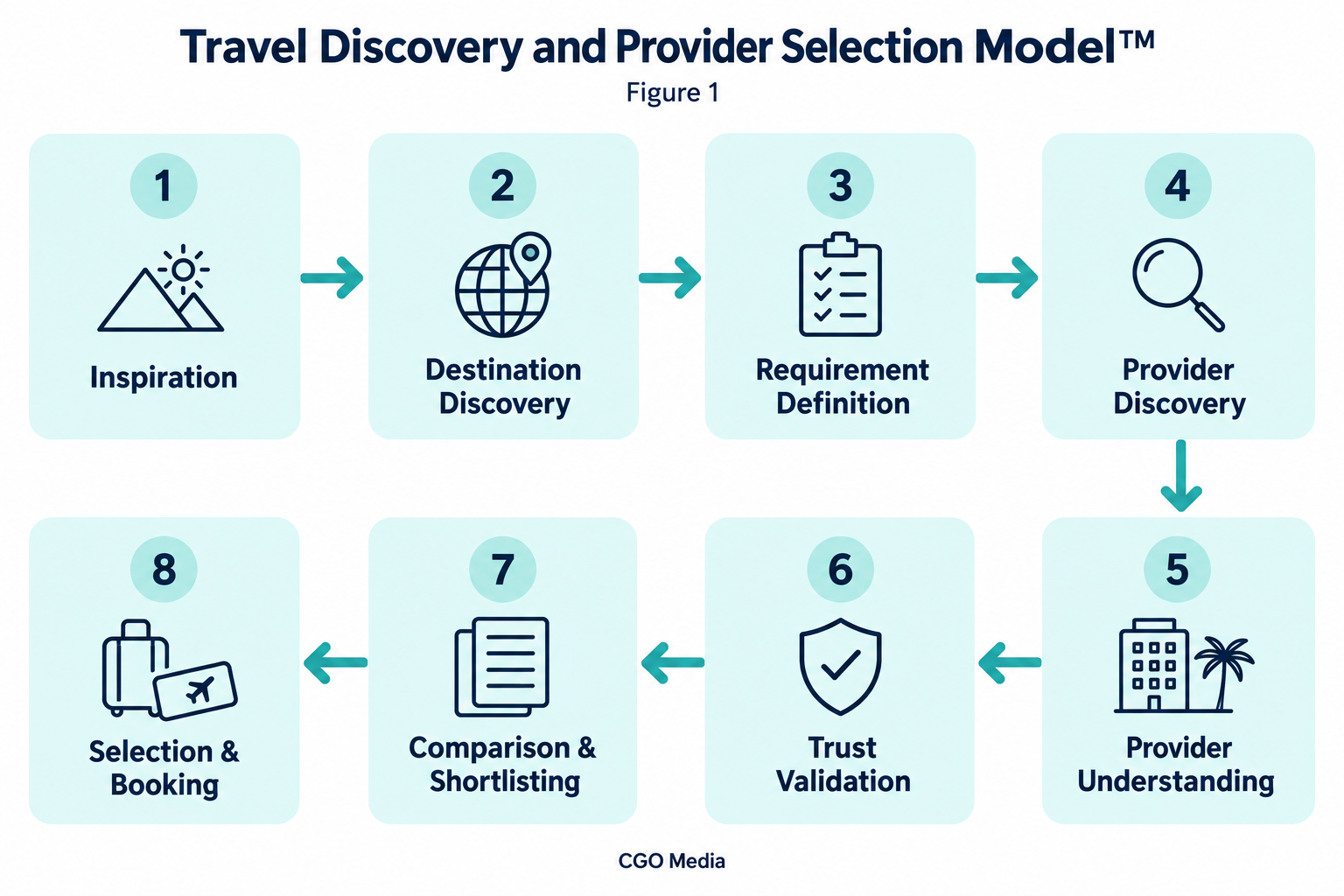
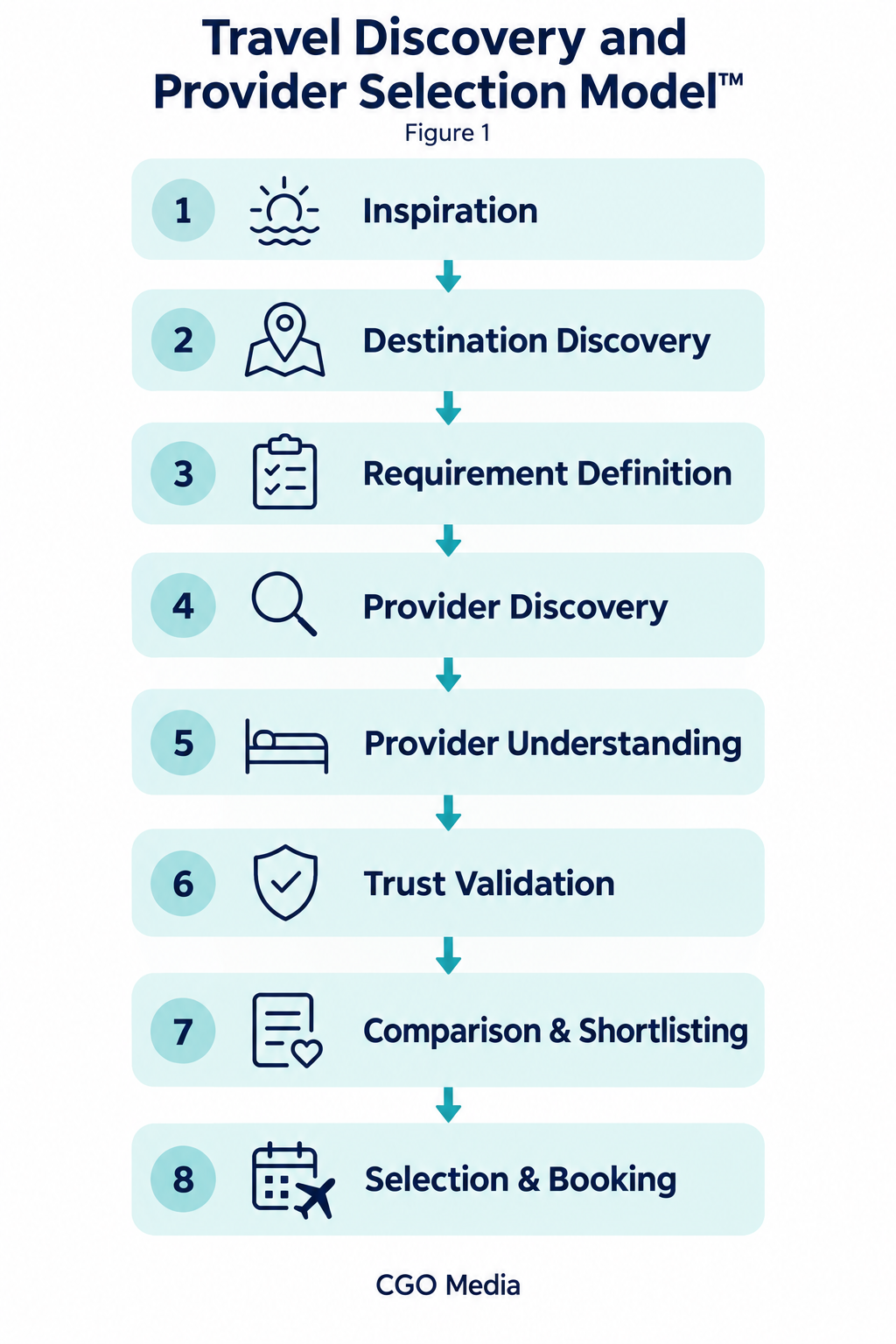
The complete journey is:
Inspiration → Destination Discovery → Requirement Definition → Provider Discovery → Provider Understanding → Trust Validation → Comparison & Shortlisting → Selection & Booking
The central strategic implication is that a travel provider must do more than become visible.
It must remain viable through several stages of selection.
A provider can be removed because it is:
- Not visible
- Outside the required destination
- Unavailable
- Outside budget
- Unsuitable for the traveller type
- Poorly explained
- Weakly trusted
- Inferior during comparison
- Difficult to book
This creates four fundamental questions:
- Can we be discovered?
- Can our suitability be understood?
- Can our claims be trusted?
- Can the traveller confidently select and book us?
1. Travel Decisions Begin Before Provider Search
Many travel journeys begin before the traveller knows which hotel, airline, tour operator, attraction or experience provider they want.
The earliest decision may simply be whether to travel at all.
A traveller may initially consider:
- Whether to take a trip
- When to travel
- How much to spend
- What type of trip to take
- Who will travel
This means provider-selection strategy must account for stages that occur before provider discovery.
2. Travel Intent Can Begin with an Experience
Some journeys begin with the experience the traveller wants rather than with a known destination.
Examples include:
- Beach holiday
- Golf break
- Wellness retreat
- Food trip
- Adventure holiday
- City break
- Cultural travel
The traveller may then ask where that experience is best delivered.
The journey becomes:
Experience → Destination → Provider
This gives experience-led content an important role in early travel discovery.
3. Other Journeys Begin with Place
A traveller may already know that they want to visit a particular country, region or city.
Place-led discovery can follow:
Country → Region → Destination → Neighbourhood → Provider
At each stage the traveller narrows the geographic field.
This gives destination architecture a direct role in provider discovery.
4. Inspiration Can Come from Many Environments
Travel inspiration can originate through:
- Search engines
- AI assistants
- Social media
- Travel journalism
- Events
- Friends and family
- Previous travel experience
Providers therefore compete for attention before the traveller begins a conventional commercial search.
5. AI Can Influence the Journey Earlier
AI assistants can participate before the traveller has chosen either a destination or a provider.
A traveller might ask:
Where should we go in southern Spain for a quiet family holiday near beaches and good restaurants?
The response can introduce:
- Destinations
- Neighbourhoods
- Provider categories
- Individual travel providers
This means recommendation visibility can begin much earlier than the traditional final-stage hotel search.
6. Stage One — Inspiration
The first stage is Inspiration.
The traveller is identifying possible:
- Trip types
- Destinations
- Experiences
- Seasons
At this stage, the provider may not yet be under direct evaluation.
Travel organisations can participate through useful destination, experience and planning information.
7. Inspiration Search Is Often Broad
Early-stage travel searches may include questions such as:
- Best places in Spain for a family holiday
- Best European destinations for golf
- Where to go for winter sun
- Best destinations for a wellness break
These are destination and experience questions rather than provider-selection queries.
Strong travel authority therefore begins before final commercial intent.
8. Stage Two — Destination Discovery
Once the traveller becomes interested in taking a trip, the next stage often involves deciding where to go.
Destination discovery can operate across:
- Countries
- Regions
- Cities
- Resort areas
- Neighbourhoods
The traveller is effectively reducing a very large geographic market into a manageable destination set.
9. Destination Selection Depends on Traveller Needs
Destination fit can depend on:
- Climate
- Budget
- Flight access
- Beaches
- Golf
- Food
- Nightlife
- Family suitability
- Culture
- Accessibility
No destination is universally best.
Suitability depends on the traveller’s specific requirements.
10. Destination Authority Can Influence Provider Discovery
Providers that are strongly connected with a destination can enter the traveller’s field of view while destination research is still taking place.
Travel organisations can strengthen these relationships through:
- Destination content
- Neighbourhood guides
- Local experience content
- Transport information
- Destination partnerships
This connects informational travel research with later provider discovery.
11. Stage Three — Travel Requirement Definition
Once a destination becomes more likely, the traveller begins defining the practical requirements that will determine provider eligibility.
Requirements can include:
- Budget
- Dates
- Party size
- Location
- Accommodation type
- Facilities
- Accessibility
- Transport
- Policies
This stage converts broad travel intent into a more specific provider-selection problem.
12. Hard and Soft Requirements Should Be Distinguished
Not all requirements have equal weight.
Hard Requirements
Hard requirements can eliminate a provider immediately.
Examples include:
- Maximum budget
- Required location
- Availability
- Accessibility
- Minimum room capacity
Soft Requirements
Soft requirements influence preference among providers that remain eligible.
Examples include:
- Style
- Atmosphere
- Views
- Brand preference
- Additional facilities
This distinction becomes increasingly important in AI-assisted provider filtering.
13. AI Can Combine Several Requirements at Once
Traditional search often required travellers to separate requirements across multiple queries.
AI-assisted search can combine them.
For example:
Find a family hotel near Málaga with parking, a pool, beach access and flexible cancellation for October.
This creates a multi-criteria provider-selection request before the traveller reaches an individual provider website.
Provider information therefore needs to be sufficiently explicit to support this filtering process.
14. Stage Four — Provider Discovery
Once destination and requirements become clearer, the traveller begins identifying potential providers.
Discovery can occur through:
- Organic search
- Maps
- AI recommendations
- Online travel agencies
- Destination websites
- Travel publications
- Social media
The result is not yet the final shortlist.
It is the initial set of providers that have successfully entered the traveller’s field of view.
15. Discovery Creates an Opportunity to Compete
Visibility is necessary, but it does not establish suitability.
A provider can be highly visible while failing immediately because it does not satisfy the traveller’s:
- Location
- Budget
- Availability
- Product
- Facility
- Accessibility
Discovery therefore opens the selection process rather than completing it.
16. Stage Five — Provider Understanding
After discovering a provider, the traveller needs to understand what it actually offers.
Important information can include:
- Identity
- Location
- Room or product types
- Facilities
- Accessibility
- Policies
- Transport
- Traveller suitability
Providers with incomplete or ambiguous information can lose consideration even when the underlying product is appropriate.
17. Understanding Depends on Explicit Evidence
Broad labels such as:
- Family-friendly
- Luxury
- Accessible
- Business-friendly
become more useful when supported by specific attributes.
For example:
Family Suitability → Room Configuration + Children’s Facilities + Dining + Pool + Location
The more specific the traveller requirement becomes, the more important attribute-level evidence becomes.
18. Stage Six — Trust Validation
Once the provider appears suitable, the traveller may seek evidence that the organisation and product can be trusted.
Validation can include:
- Reviews
- Maps
- Travel publications
- Tourism organisations
- OTA information
- Brand reputation
- Independent recognition
This is where first-party claims are tested against the wider evidence environment.
19. Trust Is a Distributed Evidence Problem
Trust does not exist only on the provider website.
A useful model is:
Provider Evidence + Traveller Evidence + Platform Evidence + Independent Validation
When these evidence layers broadly agree, selection confidence can increase.
When they conflict, decision friction can increase.
20. Stage Seven — Comparison & Shortlisting
Once several providers satisfy minimum requirements and basic trust checks, the decision becomes comparative.
The question changes from:
Can I consider this provider?
to:
Which of these providers represents the strongest overall fit?
Comparison can include:
- Price
- Location
- Product
- Facilities
- Reviews
- Policies
- Experience
The result is a smaller shortlist.
21. Comparison Is Weighted by Traveller Need
Different travellers assign different importance to the same attributes.
For example:
- Location may dominate a business trip.
- Room configuration may dominate a family holiday.
- Accessibility may dominate for an accessible traveller.
- Cancellation flexibility may dominate where plans are uncertain.
A useful conceptual relationship is:
Importance of Attribute × Strength of Provider Fit
This is not a fixed mathematical scoring formula.
It illustrates why the strongest provider can differ between travellers.
22. Stage Eight — Selection & Booking
The final provider decision still needs to become a successful booking or enquiry.
Selection can collapse because of:
- Unavailable inventory
- Unexpected charges
- Payment failure
- Booking friction
- Restrictive cancellation
- A stronger competing offer
This means provider selection and transaction completion should be treated as connected but distinct stages.
23. Provider Selection and Booking-Channel Selection Are Different
A traveller can decide which provider they want and still choose where to complete the transaction.
Possible booking channels can include:
- Direct provider website
- OTA
- Travel agent
- Tour operator
- Loyalty platform
- Telephone booking
This creates a second competitive layer.
The provider can win the selection decision while losing the booking channel decision.
24. Direct Booking Benefits Should Be Explicit
Where direct booking genuinely offers additional value, this should be clear.
Potential benefits can include:
- Flexible conditions
- Loyalty benefits
- Upgrades
- Direct support
- Exclusive inclusions
These claims should reflect actual booking conditions.
Unsupported direct-booking claims can weaken trust at the final stage.
25. Four Questions Run Through the Entire Journey
The eight-stage model can be reduced to four continuing strategic questions.
Can We Be Discovered?
The organisation must enter the relevant discovery environments.
Can Our Suitability Be Understood?
The traveller must be able to determine whether the provider meets their requirements.
Can Our Claims Be Trusted?
The provider’s own representation should be sufficiently supported by traveller, platform and independent evidence.
Can the Traveller Confidently Select and Book Us?
The provider must remain competitive through comparison and offer a credible transaction path.
26. Providers Can Fail at Any Stage
The provider-selection journey is cumulative.
A provider can fail because of:
- Invisibility
- Poor destination fit
- Hard eligibility failure
- Information gaps
- Weak trust
- Inferior comparative value
- Booking friction
This means ranking visibility alone has limited strategic meaning.
The stronger objective is sustained viability through the selection journey.
27. Search Plays Different Roles at Different Stages
Search visibility can support:
- Inspiration: introducing destinations and experiences
- Destination Discovery: establishing geographic relevance
- Provider Discovery: introducing organisations
- Provider Understanding: exposing product information
- Trust Validation: exposing reviews and independent evidence
- Comparison: supporting detailed evaluation
- Selection: enabling branded navigation before booking
SEO should therefore support the complete traveller journey rather than only final-stage commercial queries.
28. AI Can Operate Across the Entire Journey
AI assistants can support:
- Inspiration
- Destination explanation
- Provider discovery
- Requirement filtering
- Review synthesis
- Comparison
- Recommendation
AI therefore functions as a decision-support layer across multiple stages rather than as one isolated discovery channel.
This increases the importance of provider information that can support:
- Retrieval
- Interpretation
- Filtering
- Comparison
- Recommendation
29. The First Model Principle
Travel discovery is a journey rather than a single search, and providers should build visibility across multiple stages of traveller decision-making.
30. The Second Model Principle
Provider discovery creates an opportunity to compete, but relevance, eligibility, understanding and trust determine whether the organisation remains under consideration.
31. The Third Model Principle
AI-powered search increases the importance of explicit provider evidence because conversational systems can combine multiple traveller requirements before an individual provider website is visited.
32. The Fourth Model Principle
Travel provider selection should be measured as sustained progression through the journey rather than as isolated visibility at one search stage.
33. The Core Traveller Journey
The complete relationship can be expressed as:
Inspiration → Destination → Requirements → Provider → Understanding → Validation → Comparison → Selection
This simplified relationship sits within the more detailed eight-stage model:
Inspiration → Destination Discovery → Requirement Definition → Provider Discovery → Provider Understanding → Trust Validation → Comparison & Shortlisting → Selection & Booking
The strategic implication is that travel organisations should build:
- Discoverability
- Destination authority
- Provider clarity
- Trust evidence
- Comparison evidence
- Booking confidence
across the complete traveller decision journey rather than concentrating exclusively on final-stage booking queries.
34. Provider Selection Is a Progressive Filtering Process
Once the traveller enters provider discovery, the available market begins to narrow.
A major destination can contain hundreds or thousands of theoretically available providers, but travellers rarely evaluate the complete market.
Instead, providers are progressively removed according to practical, informational, trust and preference criteria.
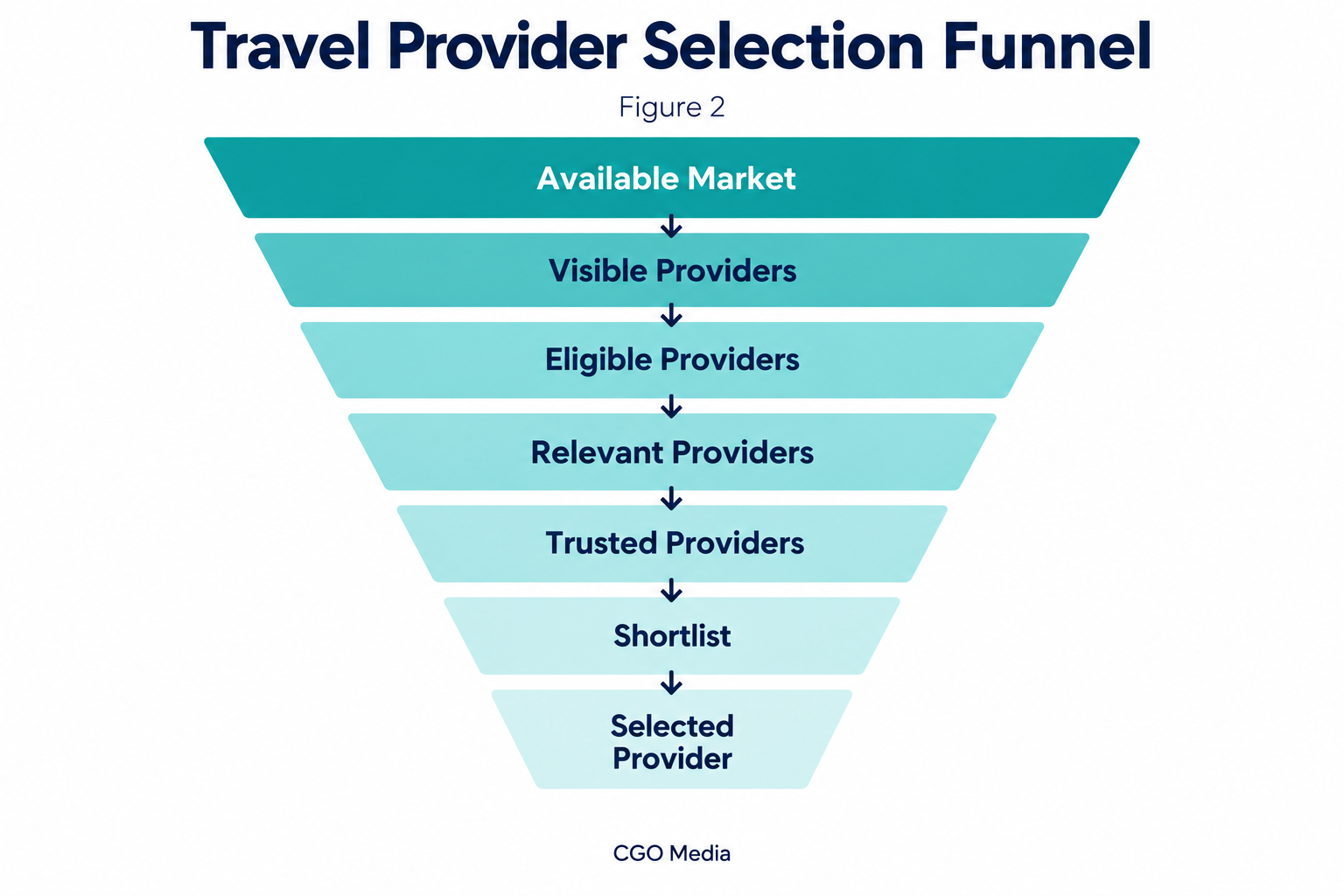
The selection process can be represented as:
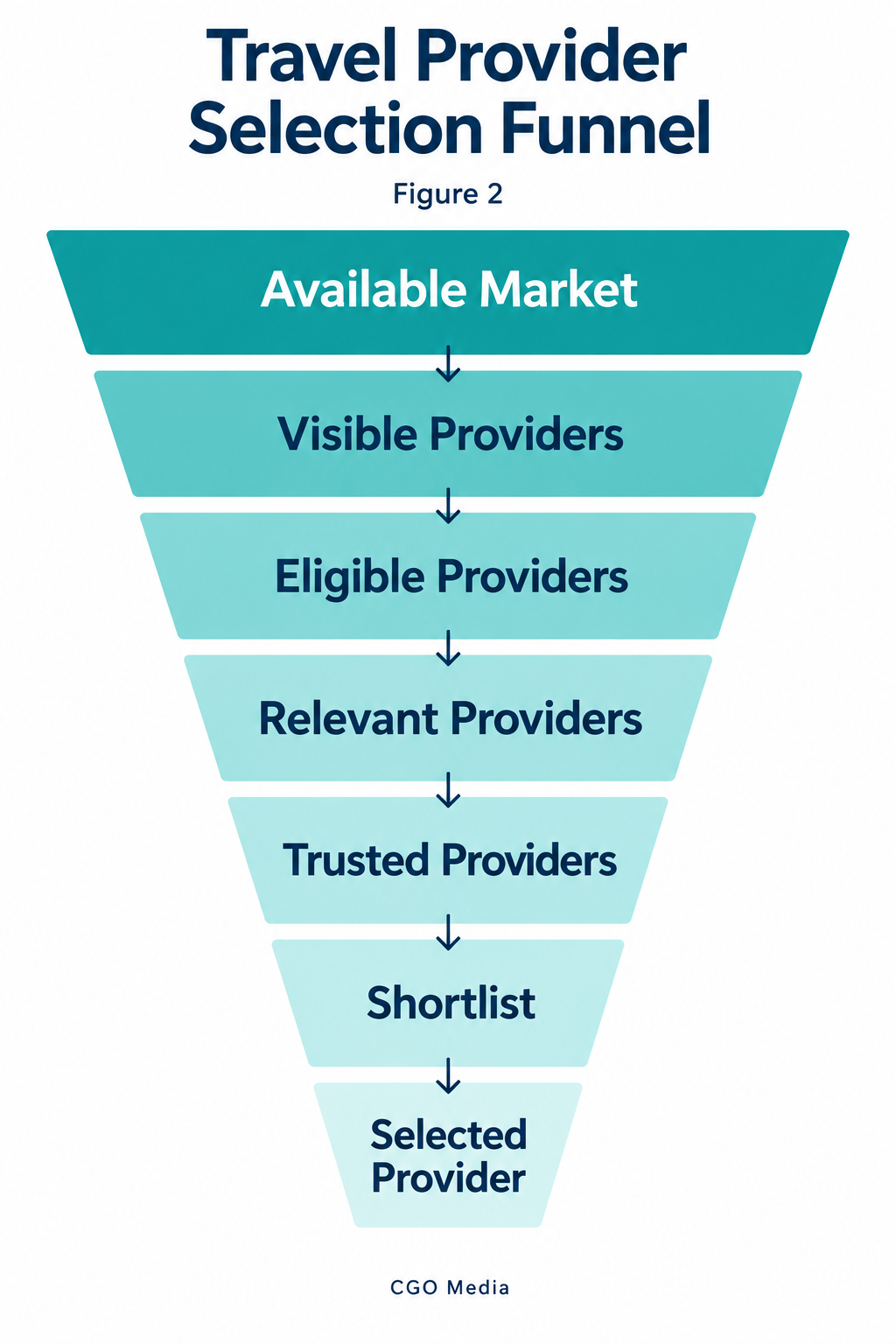
Available Market → Visible Providers → Eligible Providers → Relevant Providers → Trusted Providers → Shortlist → Selected Provider
Each transition represents a different competitive challenge.
35. The Available Market Is Much Larger Than the Considered Market
The Available Market includes every provider that could theoretically serve the destination or travel requirement.
This may include:
- Hotels
- Resorts
- Serviced apartments
- Villas
- Hostels
- Tour operators
- Attractions
- Experience providers
Most of these providers will never be considered by an individual traveller.
Selection therefore begins by reducing the market.
36. Visibility Is the First Filter
A provider must first enter the traveller’s discovery environment.
Visibility can occur through:
- Organic search
- Maps
- AI recommendations
- Online travel agencies
- Travel publications
- Tourism websites
- Social media
The first narrowing stage is:
Available Market → Visible Providers
Providers that are not visible cannot compete, regardless of their operational quality.
37. Visibility Alone Does Not Establish Relevance
A provider can appear prominently in search, maps or an OTA while still being unsuitable for the traveller’s actual trip.
Visibility creates an opportunity to compete.
It does not establish eligibility.
This distinction is fundamental because raw visibility can overstate commercial opportunity where the provider repeatedly appears for poorly matched travellers.
38. Geographic Fit Is an Early Filter
Location is often one of the first conditions applied after visibility.
Geographic fit can operate at several levels:
- Country
- Destination
- Neighbourhood
- Transport corridor
- Airport area
- Beach access
- Attraction proximity
A provider outside the traveller’s required location may be removed immediately.
39. Neighbourhood Fit Can Matter as Much as Destination Fit
Two properties within the same destination may provide very different travel experiences.
Neighbourhoods can differ according to:
- Atmosphere
- Noise
- Transport
- Walkability
- Price
- Attraction access
- Nightlife
Travel content should therefore help travellers understand sub-destination differences rather than treating a city or resort as one uniform market.
40. Proximity Should Be Practical Rather Than Promotional
A provider may be geographically close to an attraction while still being inconvenient to reach.
Practical location evidence can include:
- Walking time
- Driving time
- Public-transport time
- Transfer availability
- Terrain
Statements such as “close to the beach” or “near the centre” are more useful when the relationship can be understood in practical travel terms.
41. Availability Is a Hard Eligibility Filter
A provider can be ideal in principle while being irrelevant for the traveller’s dates.
Availability can remove a provider regardless of:
- Reputation
- Location
- Facilities
- Brand strength
This creates an important distinction between:
General Suitability and Current Eligibility.
42. Availability Can Be Product-Specific
A hotel may have inventory while lacking the particular product required by the traveller.
Examples include:
- Family room
- Accessible room
- Suite
- Connecting rooms
- Specific occupancy configuration
Provider-level availability therefore does not necessarily establish product-level eligibility.
43. Availability Is Time-Sensitive
Inventory can change during the traveller’s research process.
A provider that is eligible during early research may become unavailable before booking.
This means availability should normally be supported by transactional systems rather than treated as an evergreen content attribute.
44. Budget Is Another Hard Filter
Price determines whether the provider remains commercially viable for the traveller.
Even a highly relevant and trusted provider may be removed if the available rate exceeds the traveller’s budget.
Budget can operate at several levels:
- Total trip budget
- Nightly rate
- Room or unit price
- Package price
- Additional fees
Final affordability should be assessed using current pricing rather than broad brand positioning alone.
45. Price Positioning Still Helps Early Filtering
Although exact rates are dynamic, broad positioning can help travellers form an initial expectation.
Examples include:
- Budget
- Mid-market
- Premium
- Luxury
These labels should not be treated as substitutes for live pricing, but they can support early market filtering.
46. Property Type Can Determine Eligibility
A traveller may require a particular provider type.
Examples include:
- Hotel
- Resort
- Apartment
- Villa
- Hostel
- All-inclusive property
A strong provider in the wrong category may still be irrelevant to the trip.
47. Product Fit Narrows the Market Further
After basic eligibility, the traveller evaluates whether the provider offers the required product.
For accommodation, this can involve:
- Room type
- Occupancy
- Bed configuration
- Connecting rooms
- Kitchen facilities
- Outdoor space
- View
A provider can therefore remain geographically and commercially eligible while failing at product level.
48. Facilities Can Be Hard or Soft Filters
Facilities differ in importance according to the traveller.
For one traveller, a swimming pool may be optional.
For another, it may be a major reason for choosing the property.
Facilities can include:
- Pool
- Spa
- Gym
- Parking
- Restaurant
- Children’s facilities
- Meeting rooms
- Golf access
The provider should make important facility evidence explicit enough to support eligibility filtering.
49. Hidden Attributes Can Remove Suitable Providers
A provider may possess a required feature while failing to represent it clearly online.
Examples include:
- Parking exists but is difficult to find online.
- Accessible rooms exist but are poorly documented.
- Connecting rooms exist but are not explained.
- Airport transfers exist but are absent from main travel information.
This creates digital false exclusion: the product is suitable, but the evidence is insufficient for the traveller or system to establish that suitability.
50. Traveller Type Creates Additional Selection Filters
Different travellers require different combinations of attributes.
Relevant segments can include:
- Families
- Couples
- Business travellers
- Solo travellers
- Golf travellers
- Wellness travellers
- Accessible travellers
Provider suitability should therefore be evaluated relative to the traveller rather than treated as a universal property characteristic.
51. Family Selection Requires Specific Evidence
Family suitability can depend on:
- Room capacity
- Connecting rooms
- Children’s facilities
- Pool suitability
- Dining
- Location
- Transport
The label “family-friendly” alone may provide insufficient selection evidence.
52. Business Selection Uses Different Criteria
Business travellers may prioritise:
- Airport access
- Transport
- Workspace
- Connectivity
- Meeting facilities
- Efficient check-in
A provider can therefore be strong for leisure while comparatively weak for business travel, or vice versa.
53. Accessibility Can Be Non-Negotiable
Accessibility requirements can act as hard eligibility filters.
Relevant evidence may include:
- Step-free routes
- Accessible rooms
- Accessible bathrooms
- Lifts
- Parking
- Restaurant access
- Pool access
General accessibility claims should not substitute for specific evidence where the traveller’s ability to use the property depends on those details.
54. Transport Can Determine Provider Relevance
Transport requirements can remove otherwise strong providers from consideration.
Relevant factors include:
- Airport transfers
- Public transport
- Parking
- Taxi availability
- Walking access
- Car dependence
A property suitable for a traveller with a rental car may be less suitable for someone relying entirely on public transport.
55. Policies Can Affect Eligibility
Policies can become material provider-selection factors.
Examples include:
- Cancellation terms
- Pet policies
- Age restrictions
- Deposit requirements
- Check-in rules
- Minimum stay
Policy information should therefore be sufficiently clear to support comparison before the traveller reaches the final transaction stage.
56. Eligibility and Relevance Are Different
A provider can satisfy minimum eligibility requirements without being particularly well matched to the traveller.
This creates two stages:
Eligible Provider — can satisfy the minimum requirements.
Relevant Provider — appears meaningfully suited to the traveller’s wider preferences and purpose.
The funnel therefore progresses:
Visible Providers → Eligible Providers → Relevant Providers
57. Relevance Includes Experience Fit
Experience fit may include preferences involving:
- Quietness
- Nightlife
- Luxury
- Local character
- Family atmosphere
- Wellness
- Golf
- Romance
These characteristics often differentiate providers after basic eligibility has already been established.
58. Relevance Is Contextual
The same property can be:
- Highly relevant for one traveller
- Acceptable for another
- Unsuitable for a third
Provider relevance should therefore be understood as:
Provider Characteristics × Traveller Requirements
This is a conceptual relationship rather than a fixed scoring formula.
59. Trust Filters the Relevant Provider Set
Once providers satisfy practical and experiential requirements, trust becomes increasingly important.
The traveller may assess:
- Reviews
- Brand reputation
- Platform consistency
- Travel publications
- Destination recognition
- Information quality
Relevant providers with weak or contradictory trust evidence may be removed before shortlisting.
60. Trust Should Be Claim-Specific
A provider can have an excellent overall reputation while still possessing weak evidence around one specific traveller need.
For example:
- Strong general reviews but weak family evidence
- Strong luxury reputation but poor accessibility information
- Strong location ratings but recurring noise complaints
Trust should therefore be evaluated in relation to the claim or requirement being assessed.
61. The Funnel Produces Trusted Providers
Providers that survive practical filtering, relevance assessment and trust validation form the Trusted Provider Set.
These providers are plausible candidates for deeper comparison.
The funnel becomes:
Available Market → Visible Providers → Eligible Providers → Relevant Providers → Trusted Providers
62. Comparison Reduces Trusted Providers to a Shortlist
The traveller now compares providers that are all broadly viable.
Comparison can include:
- Price
- Location
- Room or product quality
- Facilities
- Policies
- Reviews
- Experience fit
The purpose is no longer to establish whether the provider is acceptable.
It is to determine which acceptable providers offer the strongest overall fit.
63. Comparison Readiness Requires Comparable Evidence
Providers should make strategically important attributes:
- Explicit
- Accurate
- Current
- Comparable
A provider may offer parking, flexible cancellation or accessible rooms while still performing poorly during comparison if those attributes are difficult to establish.
Comparison readiness is therefore an important component of AI search readiness.
64. The Highest-Rated Provider Does Not Necessarily Win
Overall rating is only one comparative factor.
A better-reviewed provider can still lose because of:
- Budget
- Location
- Accessibility
- Availability
- Traveller type
- Product mismatch
Provider selection should therefore not be reduced to reputation scores alone.
65. AI Can Perform Several Filters Upstream
AI-assisted travel discovery can combine multiple requirements before the traveller visits a provider website.
A request may simultaneously include:
- Destination
- Budget
- Traveller type
- Facilities
- Transport
- Experience preference
This can move filtering earlier in the journey.
Providers with incomplete or unclear attribute evidence may therefore fail before receiving a direct visit.
66. AI Can Create the Consideration Set Directly
A request such as:
Recommend five family-friendly hotels in central Rome with pools and flexible cancellation.
can generate a compact consideration set immediately.
This makes shortlist eligibility increasingly important.
The provider must have enough evidence to survive filtering before the traveller performs detailed manual research.
67. Qualified Inclusion Is the Better Objective
The strategic objective should not be universal provider inclusion.
It should be qualified inclusion.
Qualified inclusion means appearing where the provider genuinely matches the traveller’s needs.
This can contribute to:
- Better engagement
- Higher booking confidence
- Lower expectation mismatch
- Stronger traveller experience
68. Poorly Qualified Inclusion Can Be Harmful
Appearing for travellers who are a poor match can contribute to:
- Low engagement
- Abandonment
- Cancellation
- Expectation mismatch
- Negative reviews
Selection filters therefore protect both traveller and provider by directing attention toward appropriate matches.
69. Every Funnel Stage Creates a Different Optimisation Requirement
Available Market → Visible Providers
Requires discoverability.
Visible Providers → Eligible Providers
Requires accurate evidence around hard constraints.
Eligible Providers → Relevant Providers
Requires clear traveller and experience fit.
Relevant Providers → Trusted Providers
Requires credible supporting evidence.
Trusted Providers → Shortlist
Requires strong comparative value.
Shortlist → Selected Provider
Requires the strongest overall fit at that moment.
70. Funnel Loss Should Be Diagnosed
A provider missing from final selection should not automatically assume a visibility problem.
The failure may occur because of:
- Discovery weakness
- Geographic mismatch
- Availability
- Budget
- Product mismatch
- Missing evidence
- Trust weakness
- Poor comparative value
Understanding the stage of loss produces a more useful optimisation strategy.
71. Search Visibility Has Limited Meaning Without Funnel Survival
A provider can rank prominently and still be eliminated immediately after discovery.
This creates a stronger strategic objective:
Sustained Visibility Through Selection
The provider should remain viable through:
Discovery → Eligibility → Relevance → Trust → Comparison → Selection
72. The Fifth Model Principle
Travel provider selection operates through successive eligibility and preference filters that progressively reduce the available market into a viable shortlist.
73. The Sixth Model Principle
Hard constraints determine whether a provider can remain under consideration, while softer trust, experience and value signals determine relative preference among the providers that remain.
74. The Seventh Model Principle
AI-assisted travel search can move provider filtering upstream by combining multiple traveller requirements before a direct provider website visit occurs.
75. The Eighth Model Principle
The strategic objective should be qualified consideration-set inclusion rather than maximum visibility across traveller needs that the provider cannot genuinely satisfy.
76. The Travel Provider Selection Funnel
The complete filtering process can be summarised as:
Available Market → Visible Providers → Eligible Providers → Relevant Providers → Trusted Providers → Shortlist → Selected Provider
Available Market
Every provider that could theoretically serve the destination or travel category.
Visible Providers
Providers the traveller actually encounters through search, maps, AI systems, OTAs, media or other discovery environments.
Eligible Providers
Providers satisfying minimum practical requirements such as destination, dates, budget, capacity or accessibility.
Relevant Providers
Eligible providers whose characteristics align meaningfully with the traveller’s wider preferences and trip purpose.
Trusted Providers
Relevant providers supported by sufficiently credible and coherent evidence.
Shortlist
The reduced group remaining after comparison of the most important attributes.
Selected Provider
The provider representing the strongest current fit when the traveller is ready to make the final decision.
The strategic implication is that travel organisations should identify the practical, informational and trust filters governing progression through the funnel and strengthen the evidence required to survive each stage.
77. Trust Validation Begins After Basic Fit Is Established
Once a provider is visible, eligible and relevant, the traveller still needs to determine whether the provider can be trusted.
This creates the next major stage in the selection journey:
Relevant Provider → Trust Validation → Trusted Provider
Trust validation reduces uncertainty before the traveller commits time, money or personal information.
78. Trust Is a Distributed Evidence System
Travel trust is rarely created by one source.
A traveller may evaluate:
- Provider website
- Traveller reviews
- Maps
- Online travel agencies
- Destination organisations
- Travel media
The provider’s own claims therefore form only one part of the wider trust environment.
79. Provider Evidence Establishes the First Trust Layer
Provider-controlled information should explain:
- Who the provider is
- Where it operates
- What it offers
- What conditions apply
- How the traveller can contact or book
Clear, specific and current first-party information reduces unnecessary uncertainty.
80. Provider Claims Should Be Specific
Broad claims are difficult to validate.
For example:
Weak: “Perfect for families.”
Stronger: “Family rooms, children’s pool, family dining and connecting-room options are available.”
Specific claims create clearer evidence for both travellers and machine-assisted comparison.
81. Traveller Reviews Form a Second Trust Layer
Reviews provide experience evidence outside the provider’s direct control.
Useful themes can include:
- Service
- Cleanliness
- Location
- Noise
- Facilities
- Dining
- Value
- Traveller suitability
Recurring themes are generally more useful than isolated comments.
82. Review Relevance Matters
Not every review contributes equally to every traveller decision.
A family may care most about:
- Room configuration
- Children’s facilities
- Pool
- Dining
- Noise
A business traveller may care more about:
- Wi-Fi
- Workspace
- Breakfast timing
- Transport
- Check-in efficiency
Trust should therefore be interpreted in relation to the traveller’s actual need.
83. Review Recency Also Matters
Older reviews can remain useful for stable attributes, but recent reviews are often more informative for conditions that can change.
Examples include:
- Service quality
- Renovation status
- Current facilities
- Dining
- Noise
- Operational conditions
Current experience evidence is especially important where the property has changed materially.
84. Platform Evidence Forms a Third Trust Layer
Maps, OTAs and review platforms can reinforce or contradict first-party provider information.
Important areas include:
- Property identity
- Location
- Facilities
- Room information
- Accessibility
- Operating status
Material platform inconsistency can create uncertainty during validation.
85. Destination Validation Forms a Fourth Layer
Tourism organisations, destination authorities and relevant local sources can provide independent geographic and contextual validation.
This can be useful for establishing:
- Destination relationships
- Local relevance
- Attraction proximity
- Recognised experiences
- Destination credibility
Destination evidence can be particularly important where location and local context strongly influence provider suitability.
86. Travel Media Forms a Fifth Layer
Relevant travel publications and specialist media can provide additional independent evidence around:
- Quality
- Experience
- Destination relevance
- Specialist suitability
- Distinctiveness
The value of travel media depends on relevance, expertise and freshness rather than publication size alone.
87. Trust Increases When Evidence Converges
Selection confidence becomes stronger when several evidence layers broadly support the same conclusion.
For example:
- The provider documents family facilities.
- Major travel platforms show compatible information.
- Family travellers report positive experiences.
- Relevant travel media describes the property as suitable for families.
This creates evidence convergence.
A useful relationship is:
Provider Claims + Traveller Evidence + Platform Evidence + Independent Validation → Stronger Trust
88. Perfect Agreement Is Not Required
Travel experience contains legitimate subjectivity.
Different travellers may disagree about:
- Atmosphere
- Noise
- Value
- Service
- Location convenience
The goal is not universal agreement.
The goal is sufficient consistency around material facts and recurring experience patterns.
89. Evidence Conflict Reduces Selection Confidence
Trust weakens when important sources materially disagree.
Examples include:
- Official content lists a facility that recent reviews say is unavailable.
- Maps and the provider website show different locations.
- Platforms disagree about accessibility.
- The property markets itself as quiet while recent reviews repeatedly describe noise.
The greater the traveller impact of the conflict, the more important the issue becomes.
90. Trust Risk Should Be Weighted
A useful trust-risk relationship is:
Conflict Severity + Persistence + Traveller Impact + Decision Importance → Trust Risk
This prevents low-impact wording differences from receiving the same priority as material inaccuracies.
91. Financial Risk Increases Trust Requirements
The amount of evidence a traveller seeks often increases with perceived financial risk.
A low-cost activity may require relatively little validation.
An expensive resort stay, long-haul flight or multi-day tour may trigger deeper research.
Higher financial commitment can therefore increase the importance of:
- Reviews
- Policies
- Provider reputation
- Payment confidence
- Independent validation
92. Practical Risk Also Increases Validation
Travellers may seek more evidence where a wrong choice would create significant inconvenience.
Examples include:
- Remote destinations
- Airport-dependent travel
- Accessible travel requirements
- Family travel
- Tight schedules
The greater the practical consequence of failure, the more important trust validation can become.
93. Experiential Risk Matters Too
Travel purchases are partly experiential.
The traveller may not know the true quality of:
- Service
- Atmosphere
- Noise
- Food
- Room quality
- Experience delivery
until after arrival.
This uncertainty explains why reviews and independent evidence play such a significant role in travel selection.
94. Trust Is Claim-Specific
A provider can be strongly trusted overall while possessing weak evidence around one important requirement.
For example:
- Strong general reputation but unclear accessibility
- Strong luxury reputation but weak family evidence
- Strong service reviews but repeated location confusion
Trust should therefore be evaluated at the level of the claim or traveller requirement.
95. Trust Gaps Can Be Diagnosed
A practical diagnostic framework is:
Claim Gap + Evidence Gap + Consistency Gap + Experience Gap
Claim Gap
The provider does not explain an important attribute clearly.
Evidence Gap
The claim exists but has weak independent support.
Consistency Gap
Different environments present conflicting information.
Experience Gap
Traveller feedback contradicts the provider’s positioning.
96. Different Trust Gaps Require Different Solutions
Trust weaknesses should not all be treated as content problems.
Different causes require different responses.
97. Claim Gaps Require Better Information
Where important facts are missing or ambiguous, the response may involve clearer:
- Product detail
- Policies
- Location context
- Accessibility information
- Traveller suitability evidence
98. Evidence Gaps Require Stronger External Validation
Where first-party claims are clear but poorly reinforced, useful responses may include:
- Review development
- Digital PR
- Tourism relationships
- Specialist editorial coverage
- Relevant research
The objective is credible external corroboration rather than mention volume.
99. Consistency Gaps Require Data Governance
Where different platforms publish conflicting facts, organisations may need to reconcile:
- Website
- Maps
- OTAs
- Review platforms
- Other important listings
Critical travel information should have recognised sources of truth and ownership.
100. Experience Gaps Require Operational Improvement
Where real traveller experience consistently contradicts provider positioning, content changes alone are insufficient.
Examples include repeated problems involving:
- Service
- Cleanliness
- Noise
- Facilities
- Accessibility
The underlying operational problem should be addressed.
101. Trust Validation Is Cross-Functional
Travel trust can involve:
- SEO
- Operations
- Reputation
- PR
- Revenue
- Customer service
No single marketing team controls the complete evidence environment.
102. AI Can Compress Trust Validation
AI assistants can synthesise several evidence classes within one response.
A traveller might ask:
Which of these hotels has the strongest reviews for families and the most flexible cancellation?
The system may need to combine:
- Provider information
- Reviews
- Policies
- Destination context
- Platform evidence
This means validation can increasingly occur before the traveller visits the provider website.
103. Machine-Interpretable Trust Means Clear Evidence
Machine-interpretable trust does not mean manipulating AI systems.
It means maintaining public evidence that is:
- Clear
- Consistent
- Current
- Relevant
- Traceable
This makes provider claims easier to evaluate across both human and AI-assisted discovery.
104. Trust Evidence Should Be Current
Outdated validation can create a misleading picture.
Examples include:
- Old awards
- Historic media coverage
- Reviews predating renovation
- Former destination relationships
Current trust should therefore incorporate recent evidence where the underlying product can change materially.
105. Trust Evidence Should Be Relevant
Sources should support the claim under consideration.
A general lifestyle article may offer little evidence for accessibility.
A relevant specialist source may provide much stronger validation.
Context matters more than generic authority alone.
106. Trust Evidence Should Be Diverse
Selection confidence becomes more resilient when several relevant evidence types support the provider.
A balanced trust environment may combine:
- Provider evidence
- Traveller reviews
- Platform evidence
- Destination validation
- Travel media
Dependence on one source creates concentration risk.
107. Trust Evidence Should Be Traceable
Important claims should be supported by evidence that travellers and organisations can investigate.
This is particularly important for claims involving:
- Accessibility
- Facilities
- Location
- Policies
- Recognitions
108. Trust Must Remain Compatible with Operational Reality
Marketing cannot sustainably outrun product quality.
If the evidence environment repeatedly promises more than the provider delivers, traveller feedback will eventually challenge the positioning.
Long-term trust depends on alignment between:
Provider Promise → Product Reality → Traveller Experience
109. Trust Validation Should Inform Provider Improvement
Trust gaps can reveal where the organisation needs to strengthen:
- Content
- Operations
- Data
- Customer service
- External authority
Trust analysis therefore becomes a diagnostic tool rather than a reputation score alone.
110. Trust Reduces Decision Friction
A traveller who feels confident about:
- Provider identity
- Product suitability
- Reviews
- Policies
- Booking security
requires fewer additional checks before selection.
This does not guarantee booking, but it can reduce avoidable uncertainty.
111. Trust Can Influence Booking Channel
Provider selection and booking-channel selection are separate decisions.
A traveller may prefer:
- Direct booking
- OTA booking
- Travel-agent booking
depending on which channel appears safer, clearer or more flexible.
112. Direct Booking Requires Transaction Trust
Direct-booking confidence can depend on:
- Secure payment
- Transparent pricing
- Clear cancellation
- Contact information
- Booking confirmation
The provider can win the accommodation decision but still lose the transaction if the direct channel appears less trustworthy or convenient.
113. Provider Trust and Channel Trust Should Be Measured Separately
A traveller can trust the provider while preferring to book through a familiar platform.
Commercial measurement should therefore distinguish:
- Provider selection
- Booking-channel selection
Both affect revenue and direct-booking performance.
114. Trust Can Be Measured Quantitatively and Qualitatively
Useful indicators can include:
- Review trends
- Branded search
- Return visits
- Booking completion
- Cancellation behaviour
However, qualitative evidence such as recurring review themes and customer-service questions can explain why trust is strengthening or weakening.
115. The Ninth Model Principle
Travel provider trust is built through convergence between provider claims, traveller experience, platform information and independent external validation.
116. The Tenth Model Principle
The higher the perceived financial, practical or experiential risk of a trip, the more evidence travellers are likely to seek before final selection.
117. The Eleventh Model Principle
AI-assisted comparison can compress trust validation by synthesising reviews, destination context, policies and provider attributes before a direct provider visit occurs.
118. The Twelfth Model Principle
Trust problems should be diagnosed according to whether they originate in provider claims, external evidence, cross-platform inconsistency or the real traveller experience.
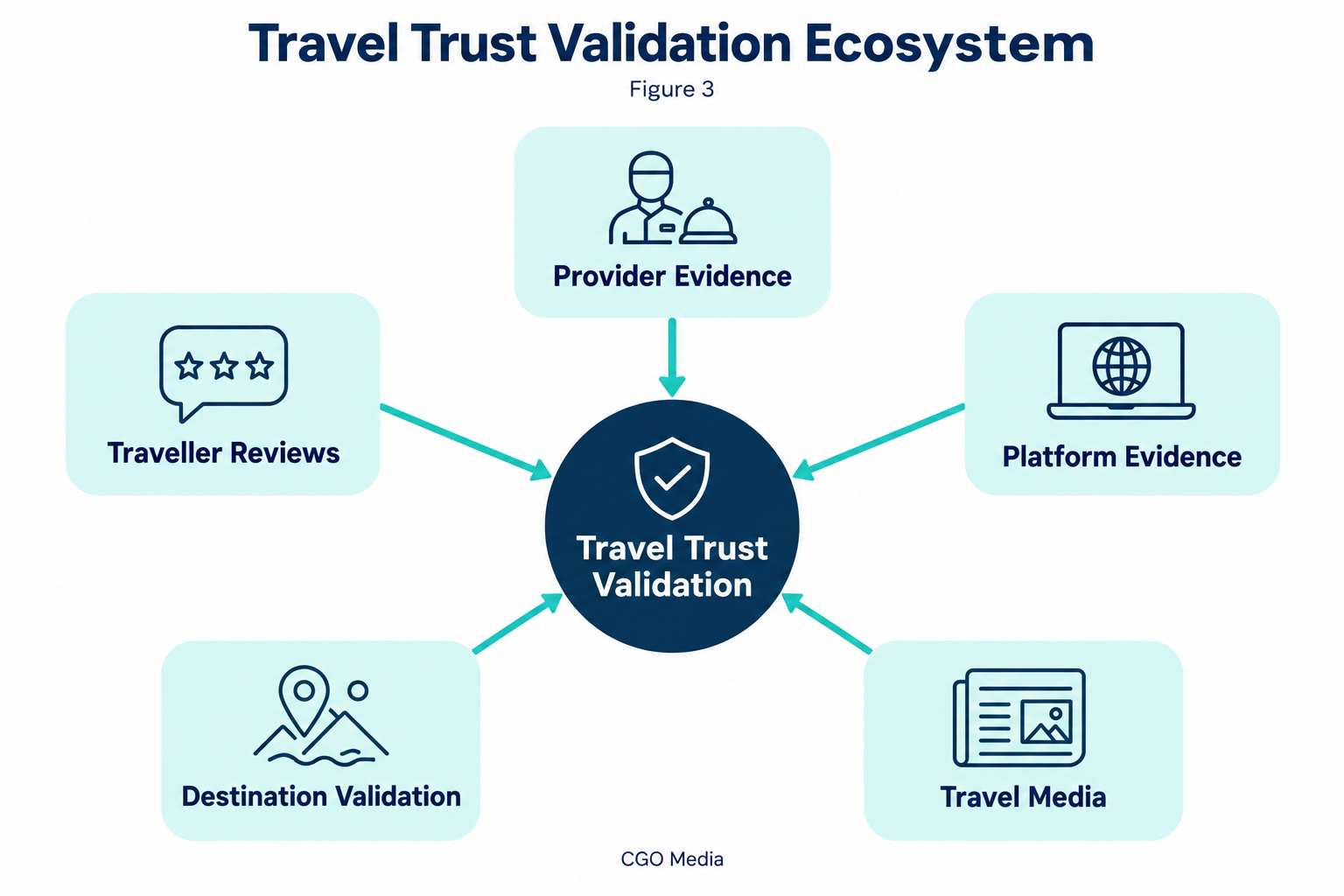
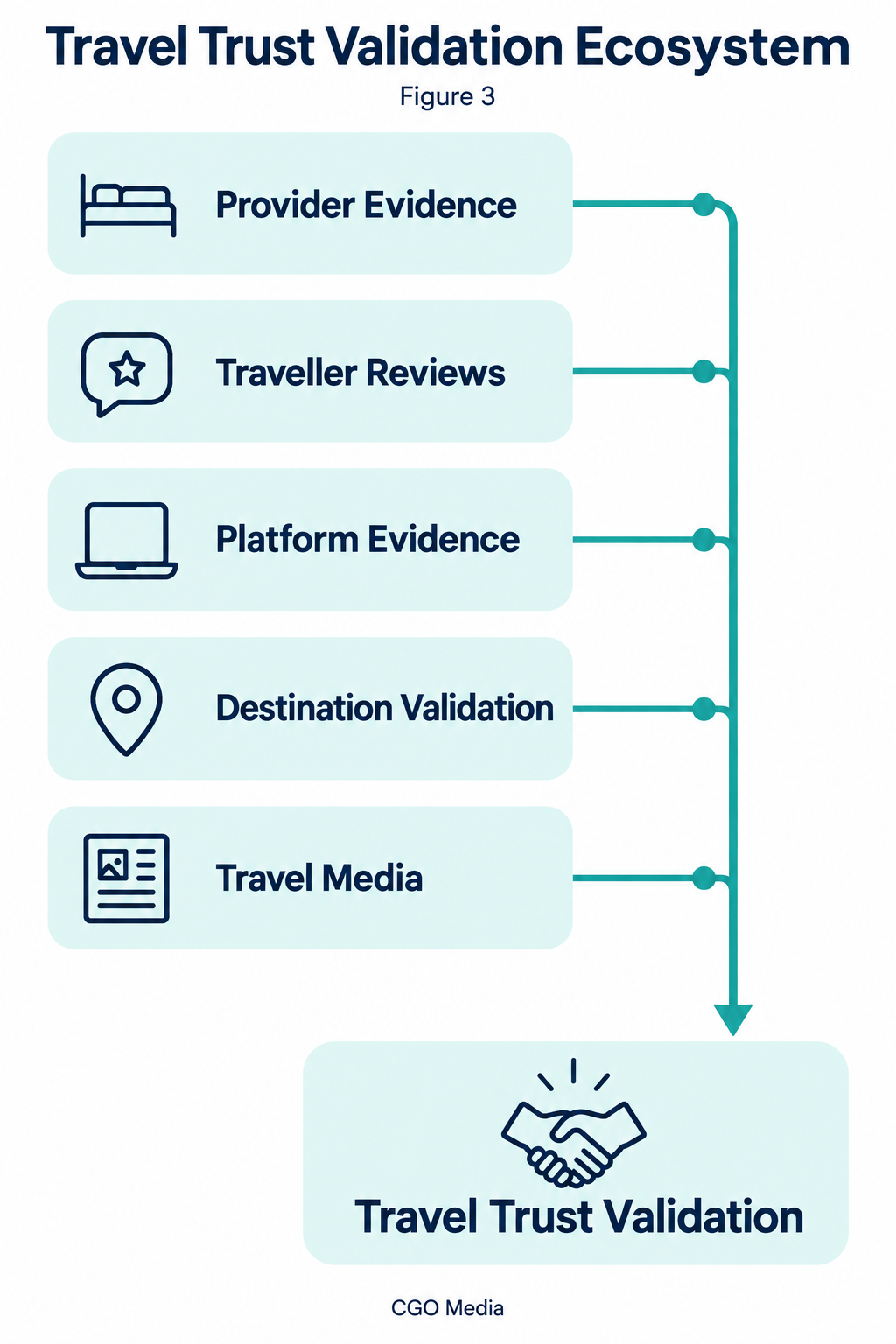
119. The Travel Trust Validation Ecosystem
The complete trust relationship can be summarised as:
Provider Evidence + Traveller Reviews + Platform Evidence + Destination Validation + Travel Media = Selection Confidence
Provider Evidence
Establishes what the provider claims about identity, product, facilities, policies and suitability.
Traveller Reviews
Provide independent experience evidence and reveal recurring strengths or weaknesses.
Platform Evidence
Reinforces or challenges critical provider facts across maps, OTAs and travel marketplaces.
Destination Validation
Provides geographic and contextual evidence from tourism organisations, local authorities and relevant destination sources.
Travel Media
Adds editorial and specialist validation around quality, relevance, distinctiveness or experience.
The strategic implication is that travel organisations should treat trust as a distributed evidence system and strengthen the specific sources that help travellers validate location, product quality, suitability, reputation and booking confidence before final selection.
120. Comparison Begins After Eligibility and Trust
Once several providers satisfy the traveller’s minimum requirements and possess sufficient trust evidence, the decision changes.
The traveller is no longer asking:
Can I consider this provider?
The question becomes:
Which of these providers represents the strongest overall fit?
Comparison is therefore a relative decision between viable alternatives.
121. Comparison Is Multi-Dimensional
Travellers can compare providers across dimensions including:
- Price
- Location
- Product
- Facilities
- Reviews
- Policies
- Experience
No single dimension necessarily determines the final decision.
The relative importance of each factor depends on the specific traveller and trip.
122. Comparison Criteria Carry Different Weight
A useful conceptual relationship is:
Importance of Attribute × Strength of Provider Fit
This is not intended as a literal scoring algorithm.
It illustrates why the same provider can perform differently across different traveller scenarios.
123. Location Can Dominate Some Comparisons
For a business traveller, proximity to a conference venue or transport hub may be more important than:
- Larger rooms
- Lower price
- Leisure facilities
A provider with a stronger practical location can therefore outperform a more luxurious alternative.
124. Product Configuration Can Dominate Family Travel
Family travellers may prioritise:
- Room capacity
- Connecting rooms
- Children’s facilities
- Dining
- Pool suitability
A highly rated hotel with unsuitable room configuration can lose to a less prominent provider whose product better fits the family.
125. Accessibility Can Override Other Advantages
Where accessibility is essential, failure to satisfy the requirement can remove the provider regardless of:
- Price
- Brand
- Review score
- Location
This demonstrates why comparison cannot be reduced to an overall provider rating.
126. Flexibility Can Become a Decisive Attribute
Cancellation and payment conditions can become especially important where travel plans are uncertain.
A traveller may accept a higher price in exchange for:
- Free cancellation
- Later payment
- Flexible changes
Comparison therefore involves risk as well as headline cost.
127. Headline Price Is an Incomplete Comparison
Price is highly visible, but the lowest headline rate does not always represent the lowest total cost.
A more useful comparison may include:
- Room rate
- Taxes
- Mandatory fees
- Parking
- Transfers
- Meals
This creates the concept of:
Headline Price → Total Trip Cost
128. Price Transparency Supports Better Selection
The earlier material costs become clear, the easier it becomes for travellers to compare providers fairly.
Unexpected charges late in the booking journey can weaken:
- Trust
- Conversion
- Booking confidence
Transparent pricing therefore supports both comparison and transaction quality.
129. Location Should Be Compared Through Convenience
Distance alone does not explain the complete value of a location.
Useful comparison factors can include:
- Walking time
- Public transport
- Taxi cost
- Airport access
- Noise
- Attraction access
- Neighbourhood character
A geographically closer provider can still be less convenient.
The stronger comparison concept is therefore:
Distance → Access → Convenience
130. Product Comparison Requires Attribute Detail
Travellers need to understand how the actual products differ.
For hotel rooms, comparison may include:
- Size
- Occupancy
- Bed configuration
- View
- Balcony
- Accessibility
Generic room descriptions make meaningful comparison more difficult.
131. Tour Comparison Uses Different Attributes
Tour and activity providers may be compared according to:
- Duration
- Group size
- Included activities
- Transport
- Meals
- Guide support
The comparison model should therefore adapt to the travel product being selected.
132. Airline Comparison Also Uses Product-Specific Attributes
Airline selection can involve:
- Departure time
- Arrival time
- Connections
- Baggage
- Fare flexibility
- Airport choice
Travel-provider selection is therefore category-specific even when the wider decision architecture remains similar.
133. Facilities Require Context
A facility can exist without being useful for the specific traveller.
The question should not only be:
Does the property have this facility?
It should also be:
Does this facility operate in a way that supports this trip?
134. Pool Comparison Requires More Than Presence
A pool can differ according to:
- Indoor or outdoor
- Opening season
- Children’s access
- Heated status
- Operating hours
The word “pool” alone may therefore be insufficient comparison evidence.
135. Parking Comparison Requires More Than Presence
Parking can differ according to:
- Availability
- Cost
- Reservation requirement
- Distance from the property
- Vehicle restrictions
A traveller arriving by car may treat these details as significant comparative factors.
136. Dining Comparison Requires More Than Presence
Restaurant evidence can include:
- Number of outlets
- Cuisine
- Opening times
- Dietary support
- Child suitability
Specificity strengthens both traveller understanding and machine-assisted comparison.
137. Reviews Become Comparative Evidence
At the shortlist stage, travellers may compare not only average scores but the reasons behind those scores.
Useful review dimensions include:
- Recent sentiment
- Cleanliness
- Noise
- Service
- Location
- Value
This turns review analysis from general reputation checking into attribute-level comparison.
138. Traveller-Segment Reviews Can Carry Greater Relevance
A family may place greater weight on reviews from other families.
A business traveller may seek comments around:
- Wi-Fi
- Breakfast timing
- Desk space
- Transport
- Noise
An accessible traveller may require specific evidence around exact accessibility needs.
Review relevance therefore matters alongside overall review volume.
139. Policies Become More Important Near Selection
Earlier in the journey, policies may receive limited attention.
As booking approaches, they can become decisive.
Relevant policies include:
- Cancellation
- Prepayment
- Check-in
- Children
- Pets
Clear policies reduce uncertainty at the point where the traveller is preparing to commit.
140. Policy Strength Can Affect Value
A slightly more expensive booking can represent greater value where it includes:
- Flexible cancellation
- Lower prepayment risk
- Better change conditions
Travel value should therefore not be assessed from price alone.
141. Distinctiveness Matters Once Functional Differences Narrow
When several providers satisfy the same practical requirements, differentiation becomes more influential.
Distinctiveness can explain why the traveller prefers one viable option over another.
142. Distinctiveness Can Be Physical
Physical differentiation can include:
- Architecture
- Beachfront position
- Historic setting
- Exceptional views
- Unique facilities
These characteristics should be described specifically rather than through generic superlatives.
143. Distinctiveness Can Be Service-Based
Service differentiation can include:
- Personalised service
- Specialist concierge
- Childcare
- Airport transfers
- Private experiences
These differences can become especially valuable where competing products otherwise appear similar.
144. Distinctiveness Can Be Experience-Based
Experience differentiation can include:
- Signature dining
- Wellness programmes
- Cultural access
- Adventure activities
- Local partnerships
Experience-led differentiation should remain relevant to the traveller segment being targeted.
145. Distinctiveness Can Be Reputation-Based
Independent recognition can help explain why one provider stands apart.
Useful evidence may include:
- Relevant awards
- Specialist travel coverage
- Destination recognition
- Strong recurring review themes
Recognition is most useful when it relates directly to the provider’s genuine strengths.
146. Relevant Differentiation Is Stronger Than Generic Differentiation
A unique feature has limited selection value if the traveller does not care about it.
The more useful question is:
What makes this provider meaningfully better for this particular traveller need?
This connects differentiation directly with selection relevance.
147. Differentiation Should Be Evidence-Based
Distinctive claims should be supported through:
- Product detail
- Traveller reviews
- Independent coverage
- Destination context
Unsupported uniqueness claims can create promotional noise rather than comparative advantage.
148. Comparison Is Both Rational and Emotional
Travel selection combines practical evaluation with anticipated experience.
Rational Comparison
Can include:
- Price
- Distance
- Facilities
- Policies
- Availability
Emotional Comparison
Can include:
- Atmosphere
- Excitement
- Luxury
- Romance
- Confidence
A complete provider-selection model should recognise both.
149. Visual Evidence Influences Emotional Comparison
Photography and video can influence perceptions of:
- Quality
- Atmosphere
- Space
- Experience
- Location
Visual evidence therefore forms part of the comparative decision environment.
150. Visual Evidence Should Remain Representative
Overly selective imagery can create an expectation gap between:
Digital Promise → Real Experience
Traveller-generated photography can also act as an independent check on provider imagery.
Representative visual evidence supports stronger long-term trust.
151. AI Can Compress Provider Comparison
Conversational systems can compare several shortlisted providers within one interaction.
A traveller might ask:
Compare these three hotels for a family travelling without a car who wants easy beach access and flexible cancellation.
This requires simultaneous evaluation across several provider attributes.
152. AI Comparison Requires Multi-Dimensional Evidence
The system may need evidence around:
- Family suitability
- Transport
- Beach access
- Cancellation
- Reviews
Evidence can come from:
- Provider websites
- Maps
- OTAs
- Review platforms
- External publications
This increases the importance of information that is explicit, current and comparable.
153. Hidden Attributes Create Comparison Disadvantages
A provider may offer a valuable feature while failing to expose it clearly.
Examples include:
- Flexible cancellation
- Parking
- Accessible rooms
- Family accommodation
- Airport transfers
Where evidence is difficult to retrieve or interpret, the provider can appear weaker than it really is.
154. Comparison Readiness Is a Form of AI Readiness
Important provider attributes should therefore be:
- Explicit
- Accurate
- Current
- Comparable
The ability to support automated comparison is increasingly part of modern provider-selection readiness.
155. Shortlisting Is the Output of Comparison
Comparison reduces the consideration set to a smaller number of serious options.
A shortlist can include different provider types, for example:
- International hotel brand
- Independent hotel
- Serviced apartment
- Resort
The shortlist represents the strongest available matches at that point in the decision journey.
156. Shortlists Are Dynamic
The shortlist can change as new information appears.
Changes can be triggered by:
- Price changes
- Availability changes
- New reviews
- Additional research
- AI recommendations
Provider selection therefore remains open until booking confidence becomes strong enough for the traveller to act.
157. Better Evidence Can Strengthen Shortlist Position
A provider can improve comparative clarity by explaining:
- Location
- Product differences
- Policies
- Direct-booking benefits
- Traveller suitability
Clear information reduces unnecessary uncertainty during comparison.
158. Better Trust Can Strengthen Shortlist Position
Useful trust evidence can include:
- Recent reviews
- Relevant independent coverage
- Destination validation
- Consistent platform information
Trust does not automatically make the provider the strongest option, but it can reduce uncertainty around selection.
159. Lower Friction Can Strengthen Shortlist Position
The provider should make it easy for the traveller to:
- Check availability
- Understand total price
- Compare products
- Review cancellation terms
- Book
Selection can be lost through friction even after the traveller has developed a preference.
160. Booking Confidence Is the Final Pre-Transaction Requirement
The traveller must eventually feel sufficiently confident to act.
Booking confidence can depend on:
- Price transparency
- Availability
- Payment security
- Cancellation clarity
- Product confidence
- Provider trust
The strongest comparative preference still has limited commercial value if the traveller does not feel comfortable completing the transaction.
161. Provider Selection and Booking-Channel Selection Are Separate Decisions
After choosing a provider, the traveller may still compare:
- Provider website
- OTA
- Travel agent
- Tour operator
The provider may therefore win the accommodation or service decision while losing the transaction channel.
162. Booking-Channel Comparison Has Its Own Criteria
Channel comparison can include:
- Price
- Cancellation
- Payment terms
- Loyalty benefits
- Perceived protection
This creates two linked decisions:
Provider Preference + Transaction Preference
163. Comparison Intelligence Should Feed Strategy
Organisations should understand which attributes repeatedly determine whether travellers choose or reject them.
Useful evidence can come from:
- Customer-service enquiries
- On-site search
- Reviews
- Booking behaviour
- Sales conversations
This can reveal which comparison factors deserve stronger representation.
164. Lost-Booking Analysis Can Reveal Selection Weakness
Where evidence is available, lost-booking research can classify losses by:
- Price
- Location
- Product
- Policy
- Trust
This is more useful than assuming every lost booking is caused by price.
165. Positioning Should Identify Best-Fit Demand
Providers should understand where they are:
- Strong
- Average
- Weak
- Distinctive
Attempting to appear equally suitable for every traveller can weaken differentiation.
Stronger positioning identifies where the provider has genuine comparative advantage.
166. Best-Fit Positioning Improves Recommendation Quality
A provider can be especially suitable for:
- Families
- Business travellers
- Couples
- Wellness travellers
- Luxury travellers
Clear suitability helps both travellers and AI systems understand when the provider belongs in the shortlist.
167. Poor-Fit Positioning Creates Commercial Waste
Broad visibility among unsuitable travellers can contribute to:
- Low conversion
- Abandonment
- Cancellation
- Negative reviews
The objective should therefore not be to win every provider comparison.
It should be to win the right comparisons.
168. The Right Comparisons Combine Four Forms of Fit
Strategically valuable comparison scenarios are those where the provider has genuine:
- Product fit
- Destination fit
- Traveller fit
- Trust evidence
These scenarios offer stronger commercial value than indiscriminate visibility.
169. Relevant Shortlist Inclusion Is a Better AI Objective
A useful AI selection metric is:
Relevant Shortlist Inclusion Rate
This asks:
Across strategically important traveller scenarios, how often does the provider appear among genuinely plausible options?
This is more useful than raw AI mention frequency.
170. Relevant Shortlist Inclusion Should Be Segmented
Analysis can be segmented by:
- Destination
- Traveller segment
- Experience
- Market
- Constraint
A provider can therefore identify exactly where shortlist visibility is strong or weak.
171. Recommendation Accuracy Should Be Measured Alongside Inclusion
An inaccurate recommendation should not be treated as a complete success.
Accuracy can include:
- Correct location
- Correct facilities
- Correct traveller fit
- Correct policies
- Correct product description
This protects the distinction between visibility and useful visibility.
172. Comparison Confidence Should Also Be Measured
The organisation should identify which important attributes remain:
- Missing
- Ambiguous
- Inconsistent
- Difficult to compare
A comparison-readiness audit can therefore ask:
- Are decision-critical attributes explicit?
- Are material costs clear?
- Are policies understandable?
- Are differentiators evidence-based?
- Are important claims independently supported?
173. The Integrated Provider Selection System
The complete comparison environment combines:
Eligibility + Provider Understanding + Trust + Comparative Value + Distinctiveness + Booking Confidence
Eligibility
Determines whether the provider can compete at all.
Provider Understanding
Determines whether the traveller can evaluate the provider accurately.
Trust
Determines whether the available evidence is sufficiently credible.
Comparative Value
Determines how the provider’s price, product and practical benefits compare with alternatives.
Distinctiveness
Determines whether relevant differences strengthen preference.
Booking Confidence
Determines whether the traveller feels sufficiently confident to complete the transaction.
174. Provider Selection Is a Chain of Confidence
Weakness at one stage can reduce the value created elsewhere.
Strong visibility with weak understanding creates evaluation friction.
Strong understanding with weak trust creates hesitation.
Strong trust with weak comparative value can still result in rejection.
Strong preference with weak booking confidence can still result in abandonment.
The traveller therefore needs sufficient confidence across:
Discovery → Understanding → Validation → Comparison → Booking
175. The Thirteenth Model Principle
Travel provider comparison is a multi-dimensional trade-off process in which price, location, product, trust, flexibility and experience carry different weights for different traveller needs.
176. The Fourteenth Model Principle
Providers become easier to compare when decision-critical attributes are explicit, current and supported by external evidence rather than hidden within generic marketing language.
177. The Fifteenth Model Principle
AI-assisted travel comparison increases the strategic importance of shortlist readiness because provider evaluation can occur before a traveller visits the organisation’s own website.
178. The Sixteenth Model Principle
The commercial objective should be to win relevant provider comparisons and appropriate booking-channel decisions rather than maximise visibility in scenarios where the provider is a poor fit.
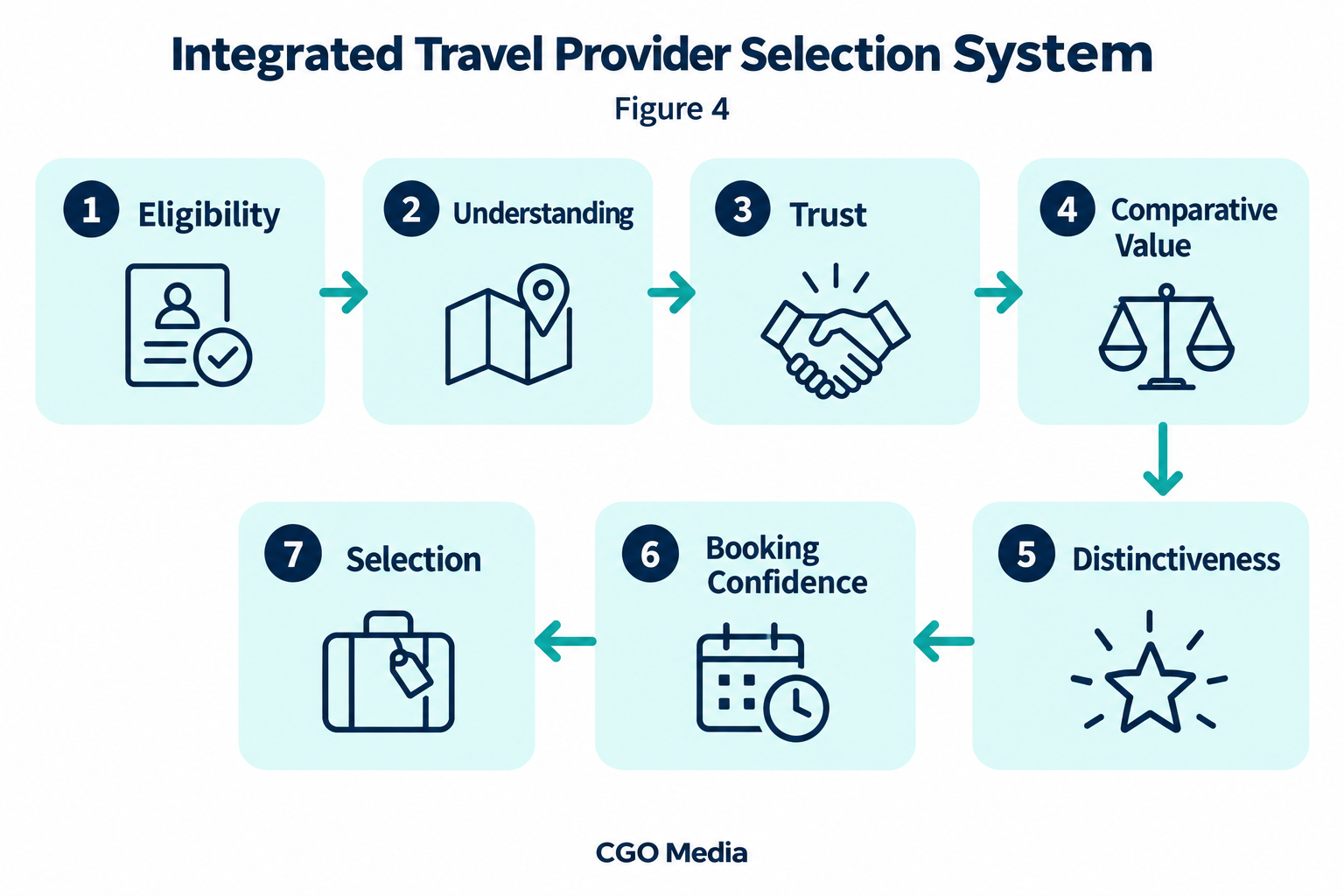
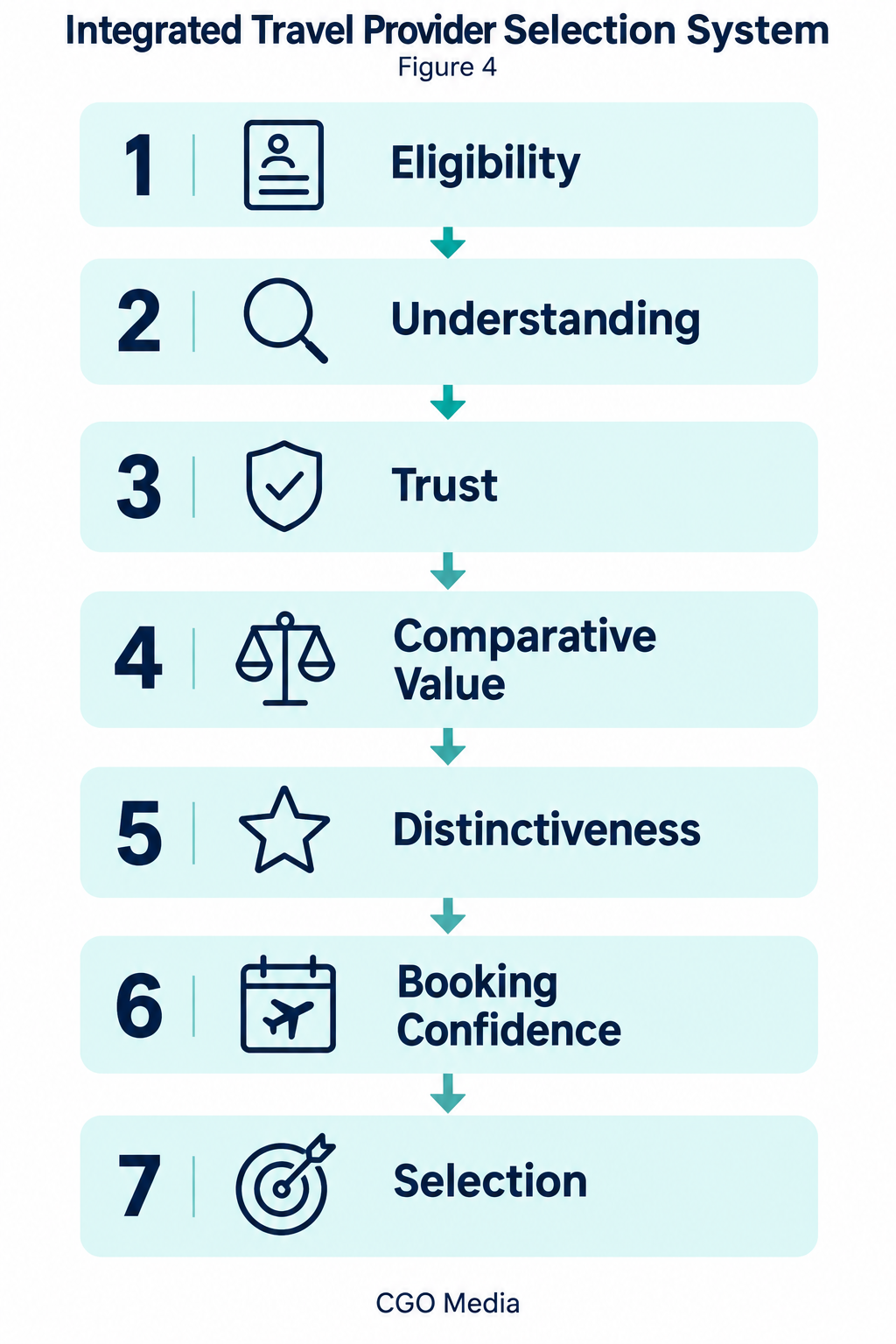
179. The Integrated Travel Provider Selection Model
The complete relationship can be summarised as:
Eligibility → Understanding → Trust → Comparative Value → Distinctiveness → Booking Confidence → Selection
Eligibility
The provider satisfies the traveller’s essential requirements.
Understanding
The traveller can clearly determine what the provider offers and whether it is suitable.
Trust
Provider claims are reinforced by credible traveller, platform and independent evidence.
Comparative Value
The traveller evaluates the relationship between price, product, convenience, flexibility and competing alternatives.
Distinctiveness
Relevant differences provide a reason to prefer the provider over otherwise similar options.
Booking Confidence
Pricing, policies, availability, payment and transaction evidence are sufficiently clear for the traveller to act.
Selection
The provider becomes the strongest current fit for the specific traveller journey.
The strategic implication is that travel organisations should make provider comparison easier by clarifying decision-critical attributes, reducing uncertainty, strengthening relevant differentiation and maintaining coherent trust and booking evidence across owned, platform and independent environments.
180. Provider Selection Should Be Measured Across the Full Decision Journey
A travel provider cannot understand selection performance accurately by measuring website traffic or completed bookings alone.
The traveller moves through several decision stages before a transaction occurs.
The measurement sequence should therefore follow:
Visibility → Consideration → Validation → Shortlist → Selection → Booking → Experience → Advocacy
Each stage answers a different question.
- Visibility: Did the provider enter the traveller’s field of view?
- Consideration: Did the provider remain a plausible option?
- Validation: Did available evidence support trust?
- Shortlist: Did the provider survive comparison?
- Selection: Did the traveller prefer the provider?
- Booking: Did preference convert into a transaction?
- Experience: Did delivery match expectations?
- Advocacy: Did the experience generate stronger future evidence?
181. Visibility Measurement
Visibility measurement asks:
Does the provider enter the traveller’s discovery environment?
Useful visibility measures can include:
- Organic search visibility
- Map visibility
- OTA visibility
- AI recommendation presence
- Travel-media visibility
Visibility is the entry condition for provider selection.
A provider that remains invisible cannot progress through the later stages, regardless of its underlying quality.
182. Brand and Non-Brand Discovery Should Be Separated
Branded visibility often reflects existing awareness.
Non-brand visibility reflects the ability to enter consideration before the traveller already knows the provider.
Examples include:
- Family hotels in Málaga
- Luxury resorts in Tenerife
- Business hotels near Heathrow
- Accessible hotels in Barcelona
Strong branded demand does not automatically indicate strong market discovery.
183. Consideration Measurement
Consideration asks:
Does the provider remain viable after initial discovery?
Useful behavioural indicators can include:
- Property-page visits
- Room or product-page views
- Return visits
- Availability checks
- Detailed information views
- AI shortlist inclusion
Consideration is strategically important because visibility without continued evaluation can exaggerate the provider’s true competitive position.
184. Relevant Shortlist Inclusion Is a Critical Metric
A provider can be visible without becoming a serious option.
A stronger measure is:
Relevant Shortlist Inclusion
This can be defined as:
Inclusion among plausible provider options for a strategically relevant traveller scenario.
This is particularly useful for AI-assisted travel discovery, where conversational systems can create shortlists before the traveller visits individual provider websites.
185. Shortlist Inclusion Is More Useful Than Raw Mention Volume
A provider repeatedly appearing in poorly matched scenarios may have high visibility but little commercial value.
Relevant shortlist inclusion should therefore focus on situations where the provider genuinely has:
- Destination fit
- Product fit
- Traveller fit
- Trust evidence
A useful internal metric is:
Relevant Shortlist Inclusion Rate = Relevant Shortlist Inclusions ÷ Relevant Shortlist Opportunities
This is an analytical measure for internal research and should not be interpreted as a metric used by external platforms.
186. Shortlist Measurement Should Be Segmented
Shortlist performance can be segmented by:
- Destination
- Traveller segment
- Budget range
- Experience
- Constraint
- Source market
Segmented analysis helps identify precisely where the provider is strong or weak.
187. Traveller-Segment Measurement
A property may perform strongly for:
- Couples
- Business travellers
while appearing less frequently for:
- Families
- Accessible travellers
- Golf travellers
An overall visibility measure would hide these differences.
Traveller-segment analysis therefore provides a more useful indication of recommendation fit.
188. Constraint-Level Measurement
Selection can also be analysed around specific requirements such as:
- Parking
- Accessibility
- Flexible cancellation
- Family rooms
- Airport access
- Beach access
This can reveal where an operational strength exists but is insufficiently represented digitally.
189. Trust Validation Measurement
Trust measurement asks:
Does the provider retain traveller confidence after independent checking?
Useful indicators can include:
- Review sentiment
- Review recency
- Review volume
- Platform consistency
- Travel-media coverage
- Destination validation
The objective is not simply to create a reputation score.
It is to understand whether important provider claims remain credible during independent validation.
190. Trust Should Be Measured by Claim Area
General reputation can conceal weaknesses around specific traveller requirements.
Trust can therefore be analysed separately for areas such as:
- Location
- Family suitability
- Accessibility
- Luxury positioning
- Service
- Value
A provider may possess strong overall reviews while remaining weakly validated around one important selection factor.
191. Comparison Competitiveness Should Be Measured
Once several trusted providers enter the shortlist, the traveller begins comparing them directly.
Comparison measurement can examine:
- Price clarity
- Product strength
- Location convenience
- Policy strength
- Facilities
- Distinctiveness
- Comparative value
The strategic question is:
Does the provider remain competitive when credible alternatives are placed beside it?
192. Comparison Readiness Can Be Audited
A comparison-readiness audit can ask:
- Are important attributes explicit?
- Are total costs sufficiently clear?
- Are policies understandable?
- Are differentiators evidence-based?
- Are important claims externally validated?
Where these answers are weak, the provider can appear less competitive than the real product deserves.
193. Selection Measurement
Selection measurement asks:
Did the traveller ultimately prefer this provider over the alternatives?
Useful indicators can include:
- Availability searches
- Booking starts
- Direct enquiries
- Saved properties
- Return branded visits
- Sales intelligence
Selection should be distinguished from transaction completion because the traveller can prefer a provider and still fail to complete the booking.
194. Provider Preference and Booking-Channel Preference Are Different
A traveller may decide which hotel or travel provider they want and then separately decide where to transact.
The booking channel may be:
- Direct website
- OTA
- Travel agent
- Tour operator
- Loyalty platform
This creates two distinct questions:
Did we win provider selection?
Did we win the transaction channel?
These should not be conflated when analysing direct-booking performance.
195. Booking Measurement
Booking measurement should follow the transaction pathway.
A typical sequence is:
Availability Search → Product Selection → Booking Start → Payment → Confirmation
Useful measures can include:
- Availability checks
- Booking starts
- Checkout progression
- Payment success
- Completed bookings
- Abandonment
This helps distinguish provider-selection weakness from booking-system weakness.
196. Booking Abandonment Should Be Diagnosed
A traveller who has already selected the provider may still abandon because of:
- Unexpected charges
- Payment friction
- Availability change
- Restrictive cancellation
- Booking-engine failure
- Product mismatch
Additional acquisition traffic will not necessarily solve these problems.
The actual transaction constraint should be identified.
197. Experience Quality Completes the Selection Model
Provider selection creates expectations that the operation must then fulfil.
Useful experience measures can include:
- Review sentiment
- Complaints
- Cancellations
- Repeat booking
- Recommendation intent
- Expectation accuracy
Selection quality cannot be evaluated completely without understanding what happens after booking.
198. Poor Selection Quality Creates Negative Downstream Evidence
A poor traveller-provider match can contribute to:
- Complaints
- Cancellation
- Negative reviews
- Low recommendation intent
This means acquisition quality influences future reputation.
199. Strong Selection Quality Creates Positive Downstream Evidence
A strong match can contribute to:
- Positive reviews
- Repeat bookings
- Word of mouth
- Stronger external trust
This creates the feedback loop:
Qualified Discovery → Appropriate Shortlist → Confident Selection → Positive Experience → Stronger Future Trust
200. Advocacy Extends the Journey Beyond the Stay
The final measurement stage is Advocacy.
Advocacy can include:
- Positive reviews
- Recommendations
- Repeat booking
- Referral
- User-generated content
Advocacy turns the completed travel experience into evidence that can influence future travellers.
The selection model is therefore circular rather than ending permanently at booking.
201. The Executive Provider-Selection Scorecard
A practical executive scorecard can consolidate the decision journey into six dimensions:
- Discovery Visibility
- Shortlist Inclusion
- Trust Strength
- Comparison Competitiveness
- Booking Conversion
- Experience Quality
The purpose is to provide management with a compact view of where provider selection is strengthening or weakening.
202. Scorecard Dimensions
Discovery Visibility
Can consider organic search, maps, OTA presence and AI discovery.
Shortlist Inclusion
Can consider relevant shortlist presence, traveller fit, destination fit and AI shortlist consistency.
Trust Strength
Can consider reviews, recency, platform consistency and independent validation.
Comparison Competitiveness
Can consider price clarity, product strength, policy strength, distinctiveness and comparative value.
Booking Conversion
Can consider availability search, booking starts, completion and payment success.
Experience Quality
Can consider review sentiment, complaints, repeat behaviour and expectation accuracy.
203. A Five-Level Performance Scale Can Be Used
| Level | Interpretation |
|---|---|
| 1 — Weak | Major selection barriers remain and performance is fragmented. |
| 2 — Developing | Core weaknesses are understood but remain only partly addressed. |
| 3 — Established | The provider performs consistently across several selection stages. |
| 4 — Strong | Discovery, trust, comparison and booking are well coordinated. |
| 5 — Resilient | The organisation monitors and improves selection quality continuously across traveller segments and markets. |
The scale is an internal management tool rather than an external rating of provider quality.
204. Critical Traveller-Risk Issues Should Sit Outside the Average Score
Serious selection problems should not disappear inside an overall maturity average.
Critical issues can include:
- Incorrect accessibility information
- Material location errors
- False availability
- Unexpected mandatory charges
- Serious booking-system failures
These issues should be escalated independently because their traveller impact can be disproportionate.
205. Measurement Should Be Longitudinal
A single observation rarely explains provider-selection performance.
Useful longitudinal analysis can compare:
- Month-on-month performance
- Seasonal performance
- Year-on-year performance
- Pre- and post-intervention performance
Travel markets are strongly influenced by seasonality, pricing, inventory, transport capacity, events and economic conditions.
Those contextual changes should be considered when interpreting trends.
206. Internal Baselines Are Often More Useful Than Generic Benchmarks
Provider-selection performance varies significantly by:
- Destination
- Property type
- Market
- Traveller segment
- Season
Organisations should therefore prioritise:
- Historical internal performance
- Comparable properties
- Comparable destinations
- Comparable traveller segments
over unsupported universal benchmarks.
207. Measurement Should Identify the Selection Constraint
The central management question is:
Where are we losing otherwise suitable travellers?
The answer should determine where investment is directed.
208. Different Constraints Require Different Interventions
If Discovery Is Weak
Prioritise relevant visibility.
If Eligibility Is Weak
Prioritise product fit, availability or positioning.
If Understanding Is Weak
Prioritise information clarity and product evidence.
If Trust Is Weak
Prioritise validation, reviews, evidence consistency and experience quality.
If Comparison Is Weak
Prioritise value, differentiation or policy strength.
If Booking Is Weak
Prioritise transaction reliability and friction reduction.
If Experience Is Weak
Prioritise operational improvement before increasing demand.
This is why more traffic is not always the correct response to weak commercial performance.
209. The Seventeenth Model Principle
Travel provider-selection performance should be measured across discovery, shortlist inclusion, trust, comparison, booking and experience rather than through traffic or conversion alone.
210. The Eighteenth Model Principle
Relevant shortlist inclusion is a stronger strategic metric than raw visibility because it reflects whether the provider remains viable for genuine traveller needs.
211. The Nineteenth Model Principle
Provider preference and booking-channel preference are separate decisions and should be analysed independently when evaluating direct-booking performance.
212. The Twentieth Model Principle
Qualified selection should be connected to post-booking experience because poor-fit demand can create negative reviews and weaken future trust even when initial conversion appears successful.
213. The Provider Selection Measurement Funnel
The complete measurement sequence can be summarised as:
Visibility → Consideration → Validation → Shortlist → Selection → Booking → Experience → Advocacy
Visibility
Measures whether the provider enters the traveller’s field of view.
Consideration
Measures whether the provider remains viable after initial discovery and eligibility filtering.
Validation
Measures whether provider claims survive independent checking and trust assessment.
Shortlist
Measures whether the provider survives direct comparison with plausible alternatives.
Selection
Measures whether the traveller develops a preference for the provider.
Booking
Measures whether provider preference progresses successfully through the transaction.
Experience
Measures whether the delivered product fulfils the expectations established during selection.
Advocacy
Measures whether the experience produces reviews, repeat demand, referrals or other evidence capable of influencing future travellers.
The strategic implication is that travel organisations should identify where suitable travellers leave the provider-selection journey and invest against the actual constraint rather than assuming that additional traffic, lower prices or broader advertising will solve every performance problem.
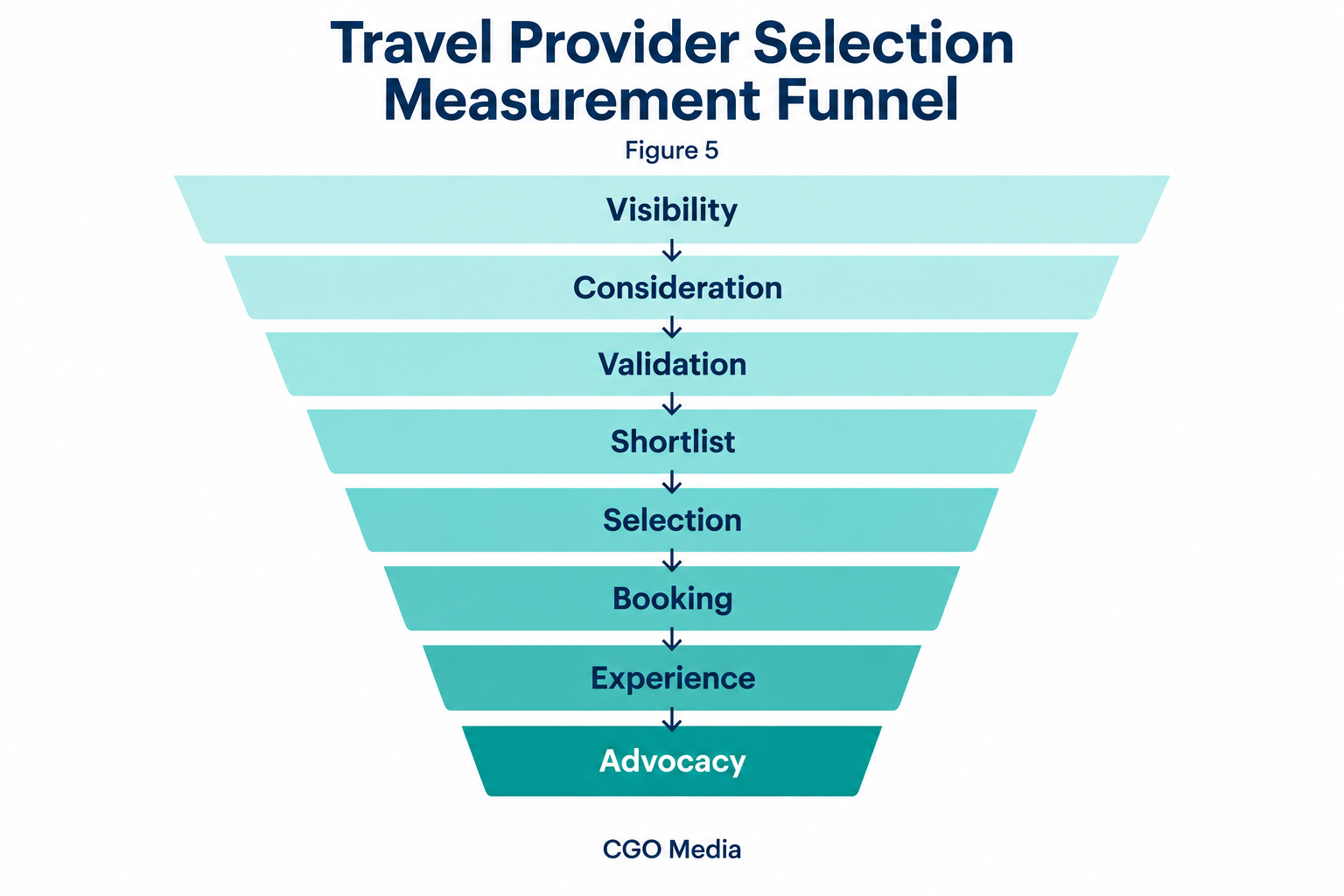
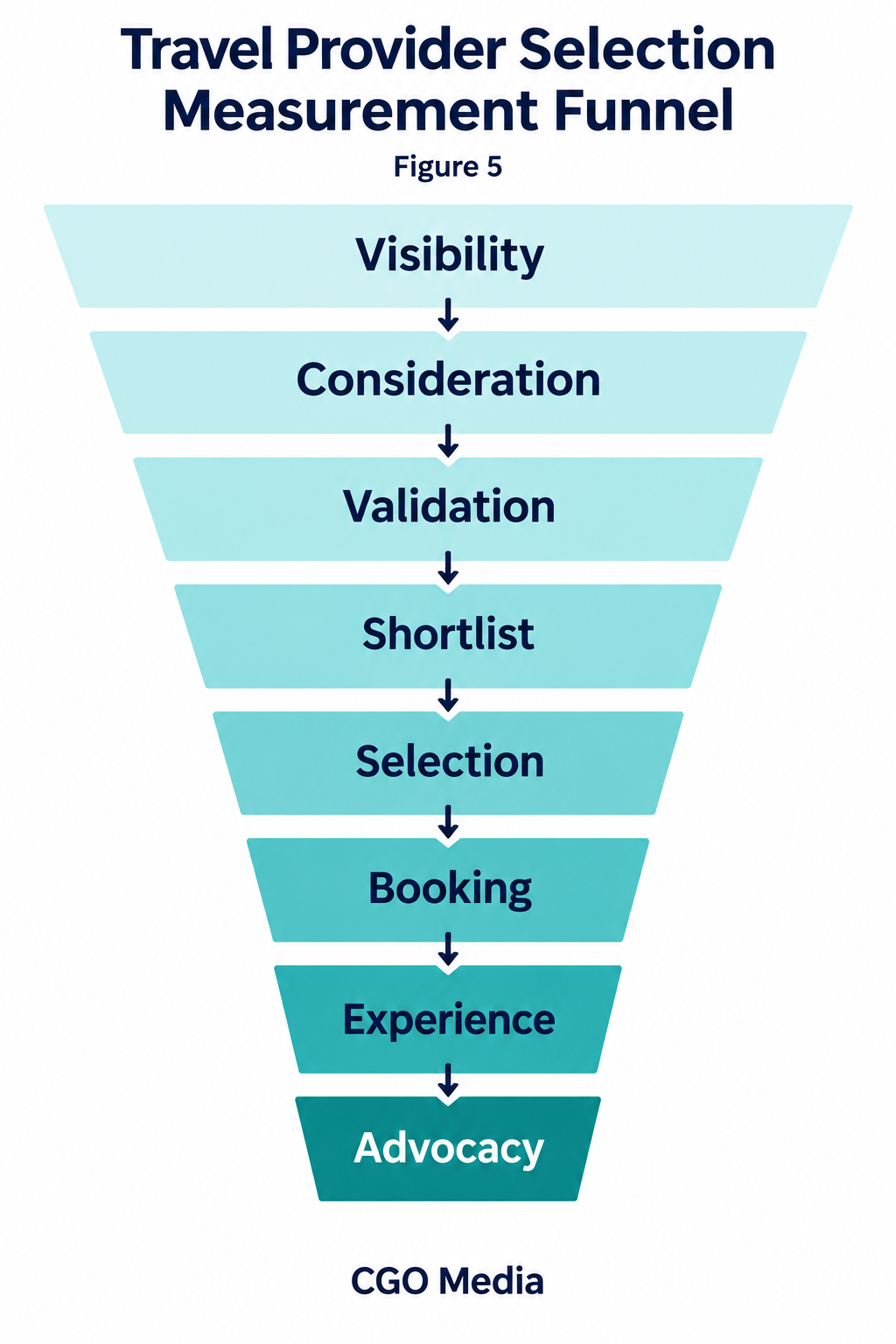
214. Provider Selection Performance Should Be Continuously Optimised
Travel markets are dynamic.
The factors influencing provider selection can change because of:
- Economic conditions
- Seasonality
- Transport changes
- Destination trends
- Traveller expectations
- Competitive activity
A provider that performs strongly today should therefore not assume that its selection position will remain unchanged.
Provider-selection strength requires continuous observation and improvement.
215. Traveller Priorities Can Change
Travellers can place different weight on selection criteria as market conditions change.
Examples include increased importance of:
- Price
- Cancellation flexibility
- Accessibility
- Transport convenience
- Digital service
- Transparency
Provider positioning should therefore remain responsive to real traveller behaviour rather than historical assumptions.
216. Provider Strengths Can Also Change
A property or travel organisation can become more competitive through:
- Renovation
- New facilities
- Service improvement
- Stronger reviews
- Improved booking conditions
- Better destination access
These improvements should be reflected in the digital evidence environment.
Operational improvement that remains poorly represented online may fail to influence provider selection.
217. Provider Weaknesses Can Emerge
Selection performance can also deteriorate because of:
- Declining service quality
- Outdated information
- Poor platform consistency
- Booking-system friction
- Negative review trends
- Weak competitive positioning
The objective of monitoring is to identify these changes before they materially weaken qualified demand.
218. The Continuous Provider-Selection Cycle
A practical improvement cycle can be represented as:
Observe → Diagnose → Prioritise → Improve → Validate → Measure → Learn → Repeat
This turns provider selection from a one-time marketing exercise into an ongoing management discipline.
219. Observe
The first stage is to identify material changes across the selection journey.
Observation should include:
- Discovery visibility
- Shortlist inclusion
- Trust
- Comparison outcomes
- Booking
- Experience
The purpose is not to collect every available metric.
It is to detect changes that may affect suitable travellers.
220. Diagnose the Underlying Cause
Performance changes should not be treated only as surface symptoms.
A fall in bookings, for example, does not automatically mean:
- SEO has weakened
- Prices are too high
- Demand has disappeared
The underlying cause should be identified before intervention.
221. Visibility Problems Can Have Several Causes
Weak discovery can arise from:
- Technical SEO problems
- Weak destination relevance
- Limited local visibility
- Weak platform presence
- Weak AI shortlist inclusion
Each cause requires a different response.
222. Trust Problems Can Have Several Causes
Weak trust can originate through:
- Negative review trends
- Platform conflicts
- Weak external validation
- Outdated information
- Operational quality problems
Publishing additional promotional content will not solve every trust problem.
223. Comparison Problems Can Have Several Causes
A provider can reach the shortlist but lose because of:
- Price
- Location
- Product fit
- Policy weakness
- Weak differentiation
Comparison losses should therefore be investigated at attribute level.
224. Booking Problems Can Have Several Causes
A traveller may prefer the provider and still fail to transact because of:
- Availability
- Checkout friction
- Payment failure
- Unexpected fees
- Cancellation concerns
This is why provider-selection performance and transaction performance should be measured separately.
225. Prioritisation Should Reflect Traveller and Commercial Impact
Not every weakness deserves the same response.
A useful prioritisation relationship is:
Traveller Impact + Commercial Importance + Persistence + Strategic Fit → Priority
This allows the organisation to focus resources on issues with the greatest practical effect.
226. High-Priority Selection Problems
High-priority issues can include:
- Major visibility loss
- Incorrect accessibility information
- Persistent severe review issues
- Booking-system failure
- Material pricing confusion
These problems can affect both traveller welfare and commercial outcomes.
227. Medium-Priority Selection Problems
Medium-priority issues can include:
- Weak comparison clarity
- Inconsistent product information
- Limited external evidence
- Traveller-segment gaps
These may not create immediate critical risk but can weaken shortlist performance over time.
228. Lower-Priority Problems
Lower-priority issues can include minor descriptive or presentation weaknesses with limited influence on traveller selection.
These should still be corrected where appropriate, but they should not displace more consequential work.
229. Improve the Source of the Weakness
The improvement stage should address the underlying constraint rather than the visible symptom.
Different selection problems require different interventions.
230. Visibility Improvements
Visibility interventions can include:
- Technical SEO
- Destination content
- Local search
- Platform visibility
- AI visibility analysis
The objective is to improve qualified discovery rather than simply increase exposure.
231. Understanding Improvements
Provider-understanding improvements can include:
- Better product descriptions
- Clearer facility information
- Stronger location context
- Better policy explanation
- More explicit traveller suitability
The goal is to reduce unnecessary uncertainty during evaluation.
232. Trust Improvements
Trust interventions can include:
- Review strategy
- Data reconciliation
- External authority development
- Operational improvement
Trust work should address the cause of weak confidence rather than focus only on reputation messaging.
233. Comparison Improvements
Comparison performance can be strengthened through:
- Clearer differentiation
- Better attribute comparison
- Improved value communication
- Clearer direct-booking benefits
The provider should make it easier for travellers to understand where it represents the strongest fit.
234. Booking Improvements
Booking improvements can include:
- Faster checkout
- Clearer fees
- Better payment reliability
- Simpler cancellation information
- Improved product availability clarity
Transaction improvement protects the confidence built during the earlier selection journey.
235. Validate Every Material Intervention
A change should not be considered successful simply because it has been implemented.
The organisation should confirm whether the intended improvement actually occurred.
The operating sequence should therefore be:
Implement → Validate → Measure
236. Validate Visibility Changes
Where visibility work has been completed, organisations can confirm whether:
- Important pages are indexed
- Local visibility changed
- Platform representation improved
- AI shortlist inclusion changed
Deployment alone does not establish success.
237. Validate Trust Changes
Trust interventions can be validated by examining whether:
- Data conflicts were resolved
- Review trends improved
- External evidence strengthened
- Traveller questions declined
238. Validate Booking Changes
Booking interventions can be assessed through:
- Completion rate
- Error frequency
- Abandonment
- Payment failure
The objective is to determine whether the transaction journey genuinely improved.
239. Measure Against a Baseline
Performance should be compared with the original state rather than evaluated impressionistically.
Baseline comparison helps answer:
- Did performance improve?
- Did the change persist?
- Did other stages deteriorate?
This reduces guesswork and makes provider-selection improvement more evidence-led.
240. Learn from Every Selection Cycle
Each cycle should improve understanding of why travellers choose or reject the provider.
Useful learning evidence can come from:
- Search behaviour
- Booking behaviour
- Reviews
- Customer-service enquiries
- Post-stay feedback
- AI observations
The objective is to convert behavioural evidence into better positioning, information and operations.
241. Lost Demand Should Be Studied
Organisations can often learn more from rejected or abandoned journeys than from successful bookings.
Lost-demand categories can include:
- Location loss
- Price loss
- Product loss
- Trust loss
- Policy loss
- Availability loss
Lower conversion should not automatically be attributed to price without supporting evidence.
242. Review Intelligence Should Feed the Learning Loop
Traveller reviews can explain:
- Why expectations were met
- Why expectations were missed
- Which attributes mattered most
- Which problems recur
Review intelligence therefore connects operational experience with future provider-selection strategy.
243. Customer-Service Intelligence Should Also Be Included
Recurring pre-booking questions can reveal:
- Information gaps
- Trust concerns
- Policy confusion
- Product uncertainty
These questions provide direct evidence about where provider understanding remains weak.
244. Booking-Engine Data Provides Selection Intelligence
Booking behaviour can reveal:
- Availability friction
- Product preference
- Price sensitivity
- Payment friction
This data should be interpreted alongside discovery and trust evidence rather than in isolation.
245. AI Monitoring Should Be Included
Generated travel comparisons can reveal how public provider evidence is being synthesised.
AI monitoring should focus on strategically relevant scenario families involving:
- Important destinations
- Priority traveller segments
- Key constraints
- High-value products
One output should not be treated as a stable pattern.
246. Relevant Shortlist Inclusion Should Be Tracked Over Time
Longitudinal monitoring can identify:
- Improving visibility
- Stable visibility
- Declining visibility
- Emerging opportunities
This is more informative than isolated snapshot testing.
247. Representation Accuracy Should Also Be Monitored
Provider inclusion can remain stable while the information surrounding that inclusion becomes inaccurate.
Important attributes to monitor include:
- Location
- Facilities
- Policies
- Traveller suitability
- Price positioning
Visibility and accuracy should therefore be treated as separate measurement dimensions.
248. Provider Selection Requires Cross-Functional Governance
Provider-selection insights can remain ineffective when they are trapped inside individual departments.
Selection performance can depend on:
- SEO
- Content
- Revenue
- Operations
- Customer service
- PR
- Data
Cross-functional governance connects these perspectives.
249. Ownership Should Be Assigned by Selection Dimension
Discovery Ownership
Can involve:
- SEO
- Local search
- Distribution
- Brand
Provider Understanding Ownership
Can involve:
- Content
- Product
- Operations
- Revenue
Trust Ownership
Can involve:
- Reputation
- PR
- Customer service
- Operations
Booking Ownership
Can involve:
- Ecommerce
- Revenue
- Technology
- Reservations
Experience Ownership
Can involve:
- Operations
- Guest experience
- Customer service
- Property management
250. Governance Should Define Escalation
Some provider-selection issues require urgent action.
Examples include:
- False availability
- Incorrect accessibility information
- Major location errors
- Payment failure
- Material pricing misinformation
These should have defined owners and escalation procedures.
251. Review Cadence Should Match Volatility
Different parts of the provider-selection system change at different speeds.
Frequent Review
Can focus on:
- Critical booking issues
- Major platform errors
- Severe AI misinformation
- Sudden review deterioration
Monthly Review
Can include:
- Shortlist inclusion
- Review themes
- Booking performance
- Platform consistency
Quarterly Review
Can include:
- Destination strength
- Traveller-segment performance
- Trust authority
- Comparison competitiveness
Annual Review
Can reassess:
- Best-fit traveller segments
- Destination strategy
- Product positioning
- Competitive differentiation
252. Positioning Should Evolve with Real Evidence
Provider positioning should change when the product, destination or market changes materially.
Examples include:
- Renovation
- New facilities
- New transport links
- Destination development
- Changing traveller expectations
Positioning should reflect what the provider can genuinely deliver now.
253. Best-Fit Travellers Should Guide Selection Strategy
Strong provider-selection strategy begins by identifying where the organisation has genuine comparative strength.
Best-fit analysis can include:
- Product fit
- Destination fit
- Traveller fit
- Trust strength
- Operational quality
The objective is not to appear suitable to every traveller.
It is to become especially credible for travellers whose requirements the provider can serve well.
254. Best-Fit Positioning Can Improve Qualified Visibility
Clear positioning can help the provider enter more appropriate:
- Search results
- Travel comparisons
- AI recommendation sets
- Traveller shortlists
This can improve the quality of demand even where total visibility does not increase dramatically.
255. Better Fit Can Improve Experience Quality
Better traveller-provider matching can reduce expectation mismatch.
That can contribute to:
- Stronger reviews
- Repeat bookings
- Recommendations
- Stronger external trust
This connects provider selection with long-term authority.
256. Poor Fit Creates the Opposite Cycle
Poor-fit visibility can create:
Broad Discovery → Weak Fit → Poor Selection → Expectation Mismatch → Negative Evidence → Weaker Future Trust
This is why maximum reach is not always the optimal travel-marketing objective.
257. The Long-Term Selection Authority Cycle
A stronger strategic cycle is:
Qualified Discovery → Relevant Shortlist → Confident Selection → Positive Experience → Stronger Trust → Future Qualified Discovery
The quality of today’s provider-selection outcomes can therefore influence tomorrow’s discoverability and reputation.
258. Strategic Recommendations
The model produces a practical set of recommendations for travel organisations.
Measure More Than Visibility
Track whether providers remain viable through consideration, validation, comparison and booking.
Measure Relevant Shortlist Inclusion
Prioritise realistic traveller scenarios over generic mention counts.
Diagnose Lost Consideration
Identify whether suitable travellers are being lost through visibility, information gaps, trust, comparative value or booking friction.
Connect Provider Selection with Experience
Do not treat completed booking as the end of the decision system.
Analyse Poor-Fit Demand
High traffic from unsuitable travellers can be strategically negative.
Use AI Monitoring as Selection Research
Observe how the provider is included, compared and described across relevant traveller scenarios.
Maintain Decision-Critical Data
Priority information should remain current, accurate, consistent and easy to understand.
Reduce Unnecessary Selection Friction
Every unresolved question can increase abandonment risk.
Strengthen Relevant Differentiation
Focus on attributes that matter to best-fit travellers.
Use Review Intelligence as Operational Evidence
Recurring traveller feedback should inform product, service and positioning improvement.
Distinguish Provider Demand from Channel Capture
A traveller can prefer the provider while booking through another channel.
Protect Booking Confidence
The final transaction should maintain the confidence created during discovery and comparison.
Govern Selection Cross-Functionally
Provider selection depends on more than marketing.
Use Best-Fit Positioning
Aim to be highly suitable for the right travellers rather than superficially relevant to every traveller.
Build Continuous Selection Intelligence
Combine search data, AI observations, booking data, reviews and customer-service evidence.
Reassess the Model as Conditions Change
Destination, provider and traveller dynamics should be reviewed continuously.
259. The Twenty-First Model Principle
Provider-selection performance should operate as a continuous learning system in which visibility, trust, comparison, booking and experience evidence are repeatedly observed and improved.
260. The Twenty-Second Model Principle
The quality of traveller-provider fit influences future authority because booking outcomes generate reviews, recommendations and other external evidence that affect later discovery.
261. The Twenty-Third Model Principle
Cross-functional governance is required because the major causes of provider-selection success and failure extend across marketing, technology, revenue, operations, reputation and customer experience.
262. The Twenty-Fourth Model Principle
The strongest long-term provider-selection strategy is not maximum exposure but repeated qualified inclusion among travellers whose needs the organisation can genuinely satisfy.
263. The Continuous Provider Selection Improvement Cycle
The operational cycle can be summarised as:
Observe → Diagnose → Prioritise → Improve → Validate → Measure → Learn → Repeat
Observe
Identify changes in discovery, shortlist inclusion, trust, comparison, booking and traveller experience.
Diagnose
Determine the underlying reason for the observed weakness or opportunity.
Prioritise
Focus first on issues with the greatest traveller, commercial and strategic impact.
Improve
Correct the relevant technical, informational, trust, commercial or operational constraint.
Validate
Confirm that the intervention was implemented correctly and changed the intended part of the selection environment.
Measure
Compare performance with an appropriate baseline.
Learn
Use search, booking, review, customer-service and AI evidence to improve understanding of provider selection.
Repeat
Re-enter the cycle as traveller behaviour, markets, destinations and provider conditions evolve.
264. The Long-Term Provider Selection Authority Cycle
The strategic cycle can be summarised as:
Qualified Discovery → Relevant Shortlist → Confident Selection → Positive Experience → Stronger Trust → Future Qualified Discovery
This creates a reinforcing relationship between current selection quality and future authority.
Providers that attract suitable travellers, deliver the expected experience and generate stronger external evidence can improve the conditions supporting future discovery.
265. The Strategic Implication
Travel organisations should treat provider selection as a continuously managed decision system.
Search, AI, booking, review and experience evidence should be considered together to improve how suitable travellers:
- Discover the provider
- Understand the provider
- Validate the provider
- Compare the provider
- Select the provider
- Experience the provider
The strategic objective is not simply to become visible.
It is to create repeated, qualified selection among travellers whose requirements the organisation can genuinely satisfy.
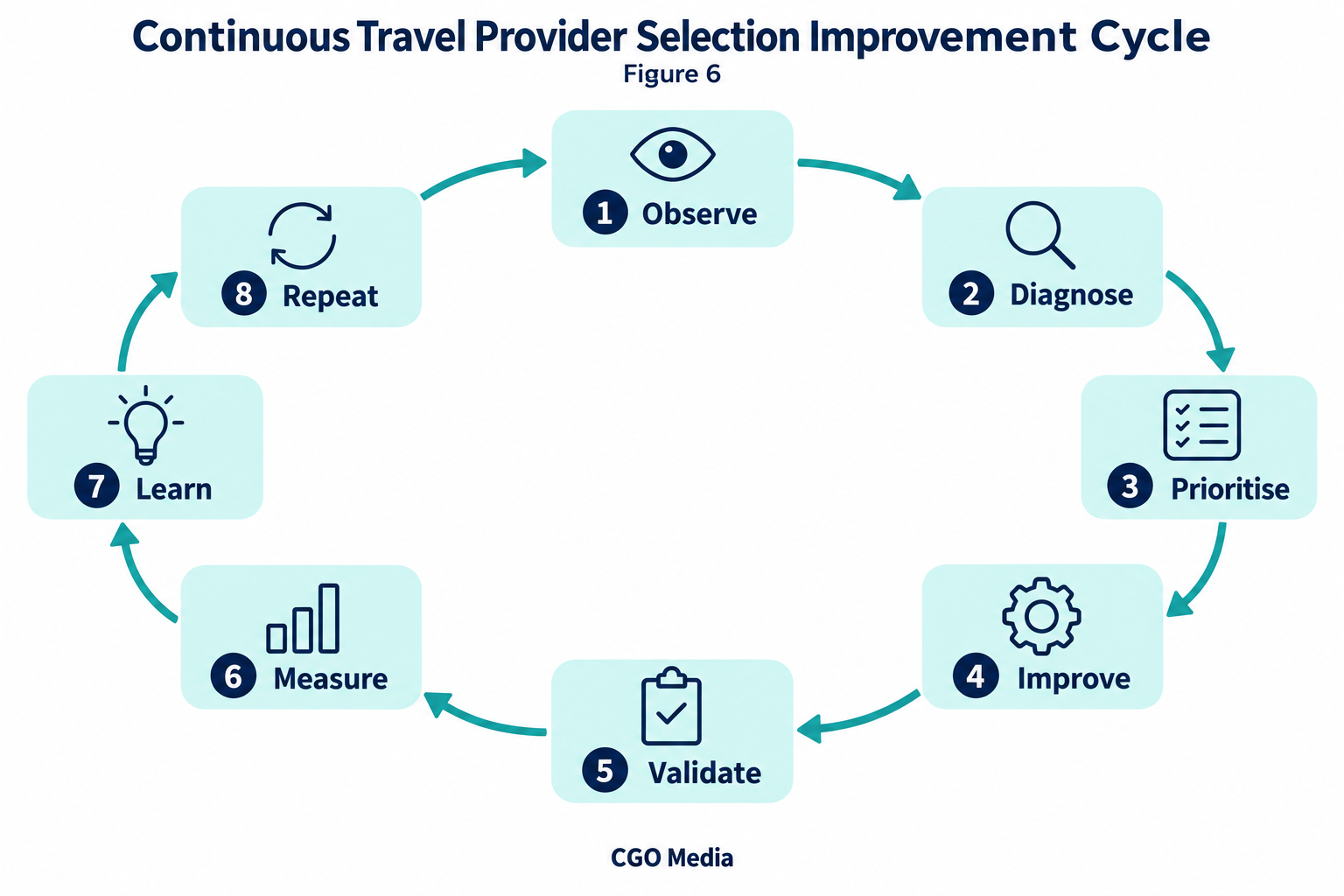
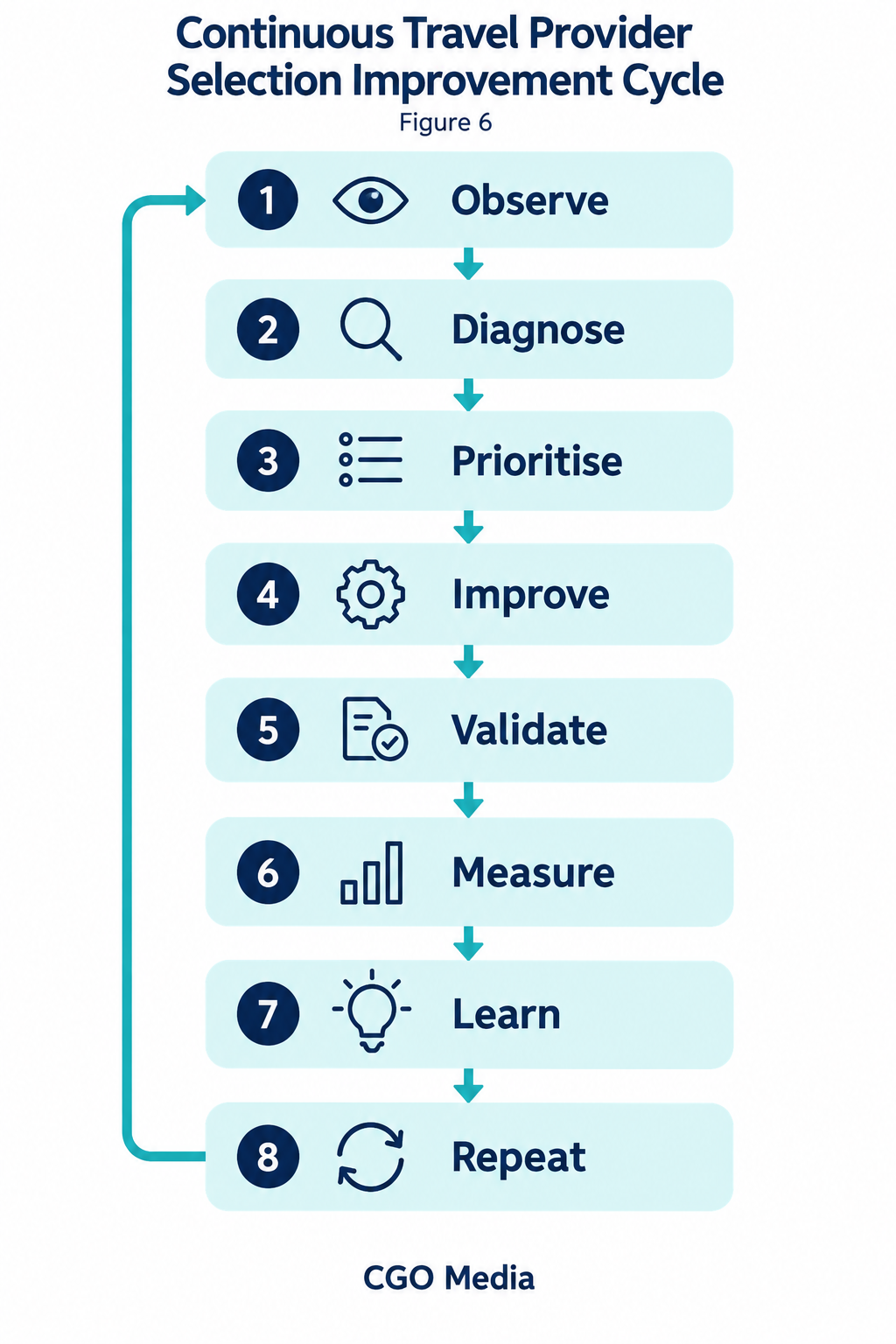
266. Methodology
The Travel Discovery and Provider Selection Model is a conceptual research framework developed by CGO Media to explain how travellers move from initial inspiration through destination discovery, provider evaluation, trust validation, comparison, selection and booking.
The framework examines provider selection as a multi-stage decision process operating across search engines, maps, online travel agencies, review platforms, destination resources, travel media, social environments, provider websites and increasingly AI-assisted discovery systems.
Central Research Question
The central research question is:
How do travellers progressively discover, filter, validate, compare and select travel providers in an environment increasingly shaped by search engines, maps, OTAs, review platforms and AI-assisted recommendation?
Research Scope
The framework is designed to support analysis across travel and hospitality organisations including:
- Hotels
- Resorts
- Airlines
- Tour operators
- Travel agencies
- Attractions
- Destination organisations
- Experience providers
- Travel platforms
Conceptual Research Approach
The framework combines established principles of search visibility, digital information architecture, credibility assessment, traveller decision-making and provider comparison with observation of increasingly fragmented and AI-assisted travel discovery journeys.
The models presented throughout this paper are analytical frameworks intended to organise those relationships.
They should not be interpreted as representations of proprietary algorithms used by search engines, online travel agencies, review platforms or AI systems.
Eight-Stage Traveller Journey
The core traveller journey is organised into eight stages:
- Inspiration
- Destination Discovery
- Travel Requirement Definition
- Provider Discovery
- Provider Understanding
- Trust Validation
- Comparison & Shortlisting
- Selection & Booking
The sequence provides a structured way to examine where providers enter, remain within or leave the traveller’s consideration process.
Inspiration Method
Early travel intent is considered across discovery sources including:
- Search
- AI systems
- Social media
- Travel journalism
- Events
- Personal recommendations
This recognises that provider competition can begin before the traveller searches for a specific travel business.
Destination Discovery Method
Destination discovery is modelled through progressive geographic and experiential narrowing:
Country → Region → Destination → Neighbourhood → Provider
This helps explain why destination authority can influence eventual provider visibility.
Requirement Definition Method
Traveller requirements are considered across factors including:
- Budget
- Dates
- Party size
- Location
- Facilities
- Accessibility
- Transport
- Policies
The method distinguishes between requirements that determine basic eligibility and softer preferences that influence comparative selection.
Provider Discovery Method
Provider discovery is assessed across environments including:
- Organic search
- Maps
- AI recommendations
- Online travel agencies
- Travel publications
- Tourism sources
- Social media
The aim is to understand whether the provider enters an appropriate consideration set rather than to measure one search channel in isolation.
Provider Understanding Method
Provider understanding examines whether travellers can determine:
- Identity
- Location
- Product
- Facilities
- Policies
- Traveller suitability
This separates simple provider visibility from the ability to evaluate what is actually being offered.
Trust Validation Method
Trust is considered through the convergence of:
Provider Evidence + Traveller Reviews + Platform Evidence + Destination Validation + Travel Media
The framework examines whether these evidence classes reinforce or contradict the claims that matter to provider selection.
Comparison Method
Provider comparison is examined through:
Eligibility + Understanding + Trust + Comparative Value + Distinctiveness + Booking Confidence
This reflects the fact that travellers often choose between several plausible providers rather than simply accepting the first eligible result.
Selection Funnel Method
The provider market is conceptualised as progressively narrowing through:
Available Market → Visible Providers → Eligible Providers → Relevant Providers → Trusted Providers → Shortlist → Selected Provider
Each transition represents a different potential point of provider loss.
Measurement Method
Provider-selection performance is considered through:
Visibility → Consideration → Validation → Shortlist → Selection → Booking → Experience → Advocacy
This extends measurement beyond traffic and conversion into the wider quality of traveller-provider matching.
Continuous Improvement Method
Long-term management is represented through:
Observe → Diagnose → Prioritise → Improve → Validate → Measure → Learn → Repeat
This treats provider-selection strength as a continuously managed capability rather than a static marketing outcome.
Qualified Selection Method
The framework distinguishes raw visibility from qualified selection by asking whether the provider is appearing for travellers whose needs genuinely match the destination, product and experience being offered.
The central objective is therefore not maximum provider visibility.
It is relevant inclusion within appropriate consideration and shortlist scenarios.
Selection-Quality Method
Successful provider selection is considered to involve:
- Relevant discovery
- Accurate understanding
- Appropriate trust
- Confident comparison
- Successful booking
- Positive experience
This connects digital discovery with the real-world outcome generated after the traveller has made the selection.
267. Limitations
The Travel Discovery and Provider Selection Model is a conceptual analytical framework and should not be interpreted as a description of a proprietary algorithm used by any search engine, online travel agency, review platform or AI system.
Traveller Journeys Are Not Uniform
Real travel journeys do not always follow the eight stages in a fixed sequence.
Travellers may:
- Skip stages
- Repeat stages
- Change destination
- Change provider type
- Change booking channel
The framework therefore provides an analytical structure rather than a claim that all travellers behave identically.
Traveller Priorities Differ
Provider-selection criteria vary according to:
- Trip purpose
- Budget
- Party composition
- Accessibility requirements
- Destination
- Personal preference
A provider that represents an excellent match for one traveller may be unsuitable for another.
Provider Categories Differ
Hotels, airlines, attractions, experience providers and tour operators should not be assumed to share identical evaluation or booking processes.
The framework should therefore be adapted to the characteristics of the travel category being analysed.
Recommendation Systems Differ
Different AI and search systems can use different:
- Models
- Retrieval systems
- Sources
- Ranking processes
- Interfaces
Observed behaviour in one environment should not automatically be generalised to another.
AI Outputs Are Variable
Generated recommendations may change according to:
- Prompt
- Date
- Model
- Market
- Language
- Available evidence
A single generated answer should therefore not be treated as proof of stable provider-selection visibility.
AI Recommendation Order Is Not a Stable Ranking
A provider appearing first in one generated answer should not automatically be considered stronger across other prompts, travellers, markets or time periods.
AI shortlist monitoring should focus on persistent patterns rather than isolated ordering.
Visible Citations Are Partial Evidence
Where AI systems display citations, those citations can support source analysis but should not be treated as a complete representation of every source or signal involved in answer generation.
Availability Is Dynamic
A provider can represent an excellent theoretical match while becoming irrelevant because the required product is unavailable for the traveller’s dates.
Evergreen provider information cannot independently establish live inventory.
Price Is Dynamic
Travel prices can vary according to:
- Date
- Demand
- Inventory
- Product type
- Booking conditions
Static price positioning should therefore not be interpreted as a guarantee of current transactional cost.
Destination Conditions Change
Provider suitability can change because of:
- Weather
- Transport
- Events
- Seasonality
- Local conditions
Destination and provider evidence should therefore be maintained according to the volatility of the information.
Reviews Are Incomplete Evidence
Traveller reviews provide useful experience evidence but should not be assumed to represent every stay or traveller equally.
Recurring themes and relevant traveller segments are generally more informative than individual comments.
Review Platforms Are Not Directly Comparable
Different platforms can have different:
- Audiences
- Scoring systems
- Moderation policies
- Review volumes
Headline review scores should therefore be interpreted within their platform context.
Attribution Is Incomplete
The final booking source may not reveal the environment that originally created:
- Awareness
- Trust
- Shortlist inclusion
- Provider preference
Travellers frequently interact with several discovery and validation environments before transacting.
AI Influence Can Occur Without Referral Data
A traveller may discover or compare a provider through an AI system before later booking through:
- Branded search
- Direct navigation
- An OTA
- A travel agent
Direct referral data may therefore understate AI-assisted influence.
Booking-Channel Preference Is Different from Provider Preference
A traveller can select the provider while choosing another platform to complete the transaction.
Direct-booking performance should therefore not be interpreted as a complete measure of provider-selection strength.
Correlation Does Not Establish Causation
Changes in search visibility, AI shortlist presence, bookings or review sentiment should not automatically be attributed to a single intervention without supporting evidence.
Visibility Does Not Guarantee Selection
A provider may be highly visible but fail because of:
- Poor traveller fit
- Weak trust
- High total cost
- Policy weakness
- Booking friction
Selection Does Not Guarantee Positive Experience
A completed transaction can still produce dissatisfaction where expectations and reality do not align.
Experience Can Alter Future Selection Performance
Reviews, recommendations, complaints and repeat demand generated after travel can influence later travellers.
Provider selection should therefore be understood as part of a circular evidence system rather than a process ending permanently at booking.
268. Conclusion
Travel provider selection is increasingly distributed across a complex digital ecosystem rather than occurring within one search engine, one provider website or one booking platform.
Travellers can begin with inspiration, narrow destinations, define practical requirements, discover providers, validate trust, compare alternatives and complete a booking across several different environments.
The complete journey can be summarised as:
Inspiration → Destination Discovery → Requirement Definition → Provider Discovery → Provider Understanding → Trust Validation → Comparison & Shortlisting → Selection & Booking
The strategic importance of this sequence is that a provider can be removed at every stage.
Providers Can Fail at Discovery
A suitable provider can fail simply because it never enters the traveller’s field of view.
This makes qualified search, map, platform and AI visibility fundamental.
Providers Can Fail at Eligibility
Visibility has little value when the provider does not satisfy essential requirements such as:
- Location
- Budget
- Availability
- Product
- Accessibility
Eligibility determines whether the provider remains within the decision process.
Providers Can Fail at Understanding
A suitable provider can still be removed when important information is unclear, incomplete or difficult to evaluate.
Attribute-level evidence therefore becomes central to provider-selection readiness.
Providers Can Fail at Trust Validation
First-party claims become more credible when they are supported by:
- Traveller reviews
- Platform information
- Destination sources
- Relevant travel media
Material conflicts between these sources can reduce confidence and reopen earlier stages of the traveller journey.
Providers Can Fail at Comparison
A provider may be visible, eligible and trusted while still losing to an alternative offering a stronger combination of:
- Fit
- Value
- Trust
- Distinctiveness
This is why provider-selection optimisation must extend beyond rankings and general reputation.
Providers Can Fail at Booking
Provider preference can still collapse because of:
- Availability changes
- Unexpected costs
- Transaction friction
- Payment failure
- Policy concerns
Booking quality is therefore a continuation of selection rather than an unrelated commercial process.
Providers Can Fail After Booking
A completed booking is not necessarily a successful selection outcome.
If the experience does not match the expectations established during discovery and comparison, the traveller may generate negative evidence that weakens future trust.
Selection Is a Chain of Confidence
Providers need to maintain sufficient confidence throughout:
Discovery → Understanding → Validation → Comparison → Booking → Experience
Weakness at any stage can reduce the value created earlier in the journey.
AI Changes Where Selection Can Occur
Conversational systems can increasingly combine:
- Destination context
- Traveller constraints
- Provider attributes
- Review evidence
- Comparative information
before the traveller visits an individual provider website.
This creates the possibility of pre-click provider selection.
Pre-Click Selection Increases the Importance of Explicit Evidence
Important provider attributes should therefore be:
- Clear
- Accurate
- Current
- Externally supported where appropriate
Information that is operationally true but difficult to identify digitally may fail to influence upstream filtering and shortlisting.
Relevant Shortlist Inclusion Becomes a Strategic Objective
Maximum visibility should not be confused with strong selection performance.
The stronger objective is:
Relevant visibility among travellers whose requirements the provider can genuinely satisfy.
Qualified selection can contribute to:
- Higher confidence
- Lower abandonment
- Lower expectation mismatch
- Stronger future reviews
Experience Completes the Provider-Selection System
The booking decision creates an expectation that the provider must fulfil.
Positive experience can generate:
- Positive reviews
- Recommendations
- Repeat demand
- Stronger external trust
Poor experience can produce the opposite effect.
The complete authority loop therefore becomes:
Qualified Discovery → Relevant Shortlist → Confident Selection → Positive Experience → Stronger External Trust → Future Qualified Discovery
Provider Selection Is Not Solely a Marketing Problem
Selection strength depends on the combined performance of:
- Marketing
- SEO
- Product
- Pricing
- Operations
- Reputation
- Technology
Cross-functional management is therefore essential.
The Final Model Position
The travel organisations most capable of building durable provider-selection strength will be those that become easy to discover, easy to understand, easy to validate, easy to compare and easy to book for the traveller segments they can genuinely serve well.
The central strategic objective is therefore not simply:
Be visible.
It is:
Be visible to the right traveller, remain credible through comparison, and deliver the experience that justified selection.
References
External Academic, Technical and Search Sources
- Google Search Central. SEO Starter Guide.
- Google Search Central. Understand How Structured Data Works.
- Google Search Central. Tell Google About Localised Versions of Your Page.
- Schema.org. Hotel.
- Schema.org. LodgingBusiness.
- Schema.org. TouristAttraction.
- Schema.org. Trip.
- W3C. Web Content Accessibility Guidelines (WCAG) 2.2.
- Hogan, A. et al. (2021). Knowledge Graphs. ACM Computing Surveys, 54(4).
- Metzger, M.J. (2007). Making Sense of Credibility on the Web: Models for Evaluating Online Information and Recommendations for Future Research. Journal of the American Society for Information Science and Technology, 58(13), 2078–2091.
- Ji, Z. et al. (2023). Survey of Hallucination in Natural Language Generation. ACM Computing Surveys, 55(12).
CGO Media Travel & Hospitality Research and Frameworks
- Wilkinson, R. (2026). Travel & Hospitality SEO for AI-Powered Search. CGO Media.
- Wilkinson, R. (2026). Travel & Hospitality AI Trust and Visibility Framework. CGO Media.
- Wilkinson, R. (2026). Travel Search Authority Maturity Model. CGO Media.
- Wilkinson, R. (2026). Travel & Hospitality SEO and AI Implementation Roadmap. CGO Media.
CGO Media Research Ecosystem
CGO Media Research Library | CGO Media Framework Library | CGO Media Research Architecture
About Roger Wilkinson
Roger Wilkinson is an independent researcher, SEO practitioner and founder of CGO Media with more than 25 years of experience in search, digital visibility and business growth.
His research focuses on how artificial intelligence is reshaping search engines, recommendation systems, entity representation, digital authority and organisational visibility.
Roger is the creator of the CGO Framework Series, a collection of research-led methodologies designed to help organisations measure, improve and govern Search Visibility, AI Visibility and Digital Authority.
His work examines the relationship between Technical SEO, Entity Authority, Content Authority, Citation Authority, Brand Signals, Knowledge Architecture and AI Search Readiness.
Related Travel & Hospitality Research
Travel & Hospitality SEO for AI-Powered Search | Travel & Hospitality AI Trust and Visibility Framework | Travel Search Authority Maturity Model | Travel & Hospitality SEO and AI Implementation Roadmap | Travel & Hospitality GEO: Generative Engine Optimisation
Research Usage & Citation
CGO Media encourages researchers, journalists, tourism organisations, hospitality groups, travel companies, destination organisations, travel technology providers and industry bodies to reference the Travel Discovery and Provider Selection Model where it contributes to analysis of travel discovery, provider comparison, AI recommendation, traveller trust and booking behaviour.
Reasonable quotations, summaries, figures and excerpts may be used in articles, reports, presentations, academic work and other publications provided appropriate acknowledgement is given to Roger Wilkinson and CGO Media.
Cite This Research / Embed Citation
The Travel Discovery and Provider Selection Model by Roger Wilkinson at CGO Media presents an eight-stage model explaining how travellers move from inspiration and destination discovery through provider evaluation, trust validation, comparison, shortlisting, selection and booking across search, travel platforms and AI-assisted discovery environments.
APA Citation
Wilkinson, R. (2026). Travel Discovery and Provider Selection Model. CGO Media. https://cgomedia.com/travel-discovery-provider-selection-model/
Author: Roger Wilkinson | Published by: CGO Media
For permissions relating to extensive reproduction, commercial licensing or republication of substantial portions of this framework, please contact CGO Media directly.