
Travel Search Authority Maturity Model
Executive Summary
 The Travel Search Authority Maturity Model is a strategic framework developed by CGO Media to assess how effectively hotels, resorts, travel companies, tourism organisations, hospitality groups and other travel providers build and manage authority across modern search and AI-assisted discovery environments.
The model is based on a simple principle: travel search authority is not created by SEO activity alone. It develops as technical accessibility, entity clarity, destination relevance, information quality, platform consistency, external validation, AI search visibility, measurement and governance become progressively more connected.
Travel organisations can therefore have substantial search activity without possessing a mature search authority system. A business may publish large volumes of content, maintain active local profiles, run Digital PR campaigns and rank for commercially important searches while still suffering from fragmented data, inconsistent property information, weak entity relationships, poor external validation or limited visibility within AI-generated recommendations.
The maturity model evaluates organisational capability rather than activity volume. It is designed to help organisations determine how consistently their search, content, entity, platform, reputation and AI visibility systems work together and how effectively those systems can be measured, governed and improved.
The model defines five progressive maturity levels:
- Level 1 — Functional: the organisation has the basic digital infrastructure required to participate in search.
- Level 2 — Optimised: search activity becomes deliberate, repeatable and performance-focused.
- Level 3 — Structured: optimisation develops into a more coherent architecture based on entities, destinations, topics, products and traveller needs.
- Level 4 — Integrated: search, content, reputation, platform, data and AI visibility capabilities begin operating as a coordinated authority system.
- Level 5 — Adaptive Authority: the organisation continuously measures, learns from and improves the wider digital evidence environment surrounding the brand, properties, destinations, products and experiences.
These levels should not be interpreted as simple rankings of organisational quality. A travel business may operate at different maturity levels across different capabilities. It may have highly developed technical SEO, for example, while remaining comparatively immature in entity governance or AI search monitoring.
The purpose of the model is therefore diagnostic. It is intended to identify capability gaps, dependencies and priorities so that organisations can determine what must improve before the wider search authority system can progress.
The Travel Search Authority Maturity Model forms part of the wider CGO Media Travel & Hospitality Search Research programme examining how travel providers are discovered, evaluated, trusted and potentially recommended across search engines, travel platforms and generative AI systems.
1. Why Travel Search Authority Requires a Maturity Model
Travel organisations operate within unusually complex digital discovery environments. A traveller researching accommodation, destinations, transport, tours or experiences may move between conventional search results, maps, online travel agencies, review platforms, tourism websites, social platforms, editorial sources and AI-assisted recommendation systems before making a decision.
The organisation therefore does not control every source of information through which it may be discovered or evaluated.
A hotel website may state one set of facilities while an OTA displays another. A local profile may contain outdated opening information. Reviews may highlight recurring strengths or weaknesses not reflected in official content. Editorial sources may describe the property in different terms. AI systems may then combine information from several of these environments when answering traveller questions.
This creates an authority problem that is broader than traditional website optimisation.
Search maturity must increasingly account for the organisation’s ability to maintain a coherent and credible digital representation across both owned and external environments.
Different Organisations Operate at Very Different Levels of Capability
At one end of the spectrum, a travel provider may maintain little more than a functioning website, a small number of property or service pages, several local listings and a presence on major booking platforms.
At the other end, an organisation may operate an integrated search authority programme involving technical SEO, structured destination architecture, entity governance, content systems, local search management, review intelligence, Digital PR, external citation development, AI visibility monitoring and cross-channel measurement.
Those organisations cannot usefully be evaluated by asking only whether they perform SEO.
The more useful question is:
How developed is the organisation’s ability to create, maintain, measure and expand search authority across the environments through which travellers discover and evaluate providers?
The Travel Search Authority Maturity Model provides a structure for answering that question.
Maturity Is Different from Activity
Search activity measures what an organisation is doing. Examples include keyword research, content production, technical auditing, local optimisation, link acquisition, Digital PR and reporting.
Maturity considers whether those activities form a repeatable and increasingly integrated capability.
An organisation can therefore undertake substantial SEO activity while remaining relatively immature. Hundreds of destination pages do not necessarily create strong destination authority. Large numbers of backlinks do not automatically create relevant external trust. Strong rankings do not guarantee accurate entity representation. Extensive reporting does not necessarily mean the organisation understands its visibility within AI-generated answers.
The distinction can be expressed as a progression:
Isolated Activity → Repeatable Process → Structured Capability → Integrated System → Adaptive Intelligence
Maturity Is Not Determined by Organisational Size
Large hotel groups and international travel organisations can possess significant resources while still operating fragmented digital systems.
Different properties may use different naming standards, technology platforms, content processes, local-search practices, data sources and booking environments. Responsibility may be distributed between marketing, ecommerce, revenue, operations, reputation, PR and regional teams.
Scale can therefore increase complexity rather than automatically producing maturity.
Conversely, a smaller independent hotel, specialist travel company or destination operator may achieve relatively advanced maturity through accurate information, clear entity relationships, strong destination relevance, consistent external platforms, high-quality reviews and disciplined monitoring.
Maturity should therefore be assessed primarily through capability, integration and governance rather than organisation size, marketing spend or website scale.
2. What Is Travel Search Authority?
Within this framework, travel search authority describes the strength and reliability of the digital evidence environment that enables a travel organisation to be discovered, understood, evaluated, trusted and potentially recommended across modern search systems.
Authority is multi-dimensional. It does not originate from a single signal, channel or platform.
Instead, it develops through the interaction of several forms of evidence.
Technical Accessibility
Search and AI systems require reliable access to important information. Websites must be crawlable, indexable, usable and sufficiently stable for important provider, destination, product and experience information to be discovered.
Technical accessibility therefore establishes the foundation upon which other forms of authority depend.
Entity Clarity
Digital systems must be able to understand who or what the provider represents.
This can include relationships between a parent organisation, individual hotels or properties, destinations, restaurants, facilities, tours, experiences, brands and other associated entities.
Clear entity relationships reduce ambiguity and improve the consistency with which information can be associated with the correct provider.
Destination and Experience Relevance
Travel discovery is highly contextual. Travellers rarely evaluate a provider in isolation from location, trip purpose or experience.
A property may therefore need to establish meaningful relationships with destinations, neighbourhoods, landmarks, airports, attractions, events, activities or traveller requirements.
This contextual layer helps search systems understand where the organisation fits within a real travel journey.
Information Quality
Travellers require specific evidence to make decisions.
This can include room configuration, facilities, accessibility, transport, location, check-in policies, cancellation terms, family suitability, parking, dining, seasonal availability and other practical information.
High-quality travel content is therefore not simply descriptive. It reduces uncertainty and makes the provider easier to evaluate and compare.
Platform Consistency
The organisation may be represented across maps, OTAs, booking platforms, review environments, directories, tourism websites and other external services.
Material inconsistencies between these environments can weaken traveller confidence and create uncertainty about which information is correct.
Mature authority therefore requires important provider information to be actively managed across the wider discovery ecosystem.
External Trust
The organisation’s own claims are only one part of the evidence available to travellers and search systems.
Reviews, editorial coverage, tourism organisations, relevant industry bodies, independent recommendations and credible citations can provide external confirmation of reputation, expertise, destination relevance or service quality.
Authority becomes stronger when first-party information is supported by credible third-party evidence.
AI Search Visibility
Generative AI introduces another discovery layer.
Travel providers can now be mentioned, compared, summarised or recommended within generated answers before the traveller visits an official website or conventional search result.
This means organisations increasingly need to understand whether AI systems recognise them, how they describe them, which competitors appear beside them and whether important information is represented accurately.
Measurement and Governance
The final dimension is organisational control.
Without defined ownership, measurement and review processes, search authority can deteriorate as properties change, facilities evolve, policies are updated, platforms modify information, reviews accumulate and traveller behaviour shifts.
Governance gives the authority system durability.
Together, these dimensions can be summarised as:
Technical Access → Entity Clarity → Destination Context → Information Quality → External Validation → AI Visibility → Measurement & Governance
No individual component is sufficient on its own. Strong technical SEO cannot fully compensate for poor information quality. Strong reviews cannot completely resolve confused entity representation. High organic rankings do not guarantee visibility within AI-assisted recommendations.
Travel search authority should therefore be understood as an interconnected system rather than a collection of independent marketing activities.
3. The Five Levels of Travel Search Authority Maturity
The Travel Search Authority Maturity Model defines five levels of organisational capability.
The levels describe a progression from basic digital participation toward an increasingly integrated and adaptive authority system:
Functional → Optimised → Structured → Integrated → Adaptive Authority
Progression does not necessarily occur evenly. Organisations may reach different levels across different capabilities, and temporary regression can occur when technology, ownership, platforms, properties or organisational structures change.
The value of the model lies in understanding the characteristics and constraints associated with each stage.
4. Level 1 — Functional
At the Functional level, the organisation has established the minimum digital infrastructure required to participate in search and online travel discovery.
The website exists, important commercial information is generally accessible and the organisation has some representation across the platforms travellers use.
However, activity is predominantly operational rather than strategic.
Typical Characteristics
- Basic website and commercial pages
- Limited technical optimisation
- Basic property, product or service information
- Local profiles and selected OTA listings
- Limited destination content
- Minimal structured data or entity governance
- Basic analytics and traffic reporting
- Little or no systematic AI search monitoring
Information may differ between the provider website, local profiles and booking platforms. Facilities, descriptions, addresses, photographs, policies or other important attributes may have been added at different times by different teams.
AI search visibility is normally unmanaged. The organisation may not know whether it appears for important recommendation queries, how its properties are described or whether generated information is accurate.
Primary Risk: Fragility
The principal weakness at Level 1 is dependence on isolated discovery channels.
A hotel may rely heavily on a major OTA. An attraction may depend on map visibility. A tour operator may rely predominantly on paid advertising. A resort may receive substantial branded demand while remaining weak for broader destination discovery.
This creates vulnerability because visibility can change quickly when an individual platform, ranking system, advertising environment or intermediary changes.
Strategic Priority
The objective at Level 1 is to establish reliable foundations.
Priority areas generally include technical accessibility, accurate provider identity, current product information, consistent local and OTA data, basic review monitoring and clear booking pathways.
The transition to Level 2 begins when the organisation moves beyond maintaining a digital presence and starts deliberately improving search performance.
5. Level 2 — Optimised
At the Optimised level, search becomes a deliberate and recurring activity.
The organisation begins identifying opportunities, correcting technical weaknesses and improving important pages according to search demand and traveller intent.
Typical Characteristics
- Regular technical SEO activity
- Keyword and search-intent research
- Improved website architecture
- Development of destination content
- More deliberate internal linking
- Local search optimisation
- Review-management processes
- Basic Digital PR or authority activity
- Routine organic-search reporting
Commercial pages become more detailed and deliberate. Hotel, room, resort, destination, tour and experience pages are increasingly aligned with identifiable traveller needs.
Search strategy may begin addressing questions such as family suitability, accessibility, proximity to attractions, airport access, parking, luxury positioning, business travel requirements or particular experience categories.
Primary Risk: Fragmentation
Despite stronger execution, Level 2 organisations often remain page-centric and channel-centric.
SEO may optimise destination pages while operations maintain different information on OTAs. PR may generate useful media coverage without connecting that coverage to priority destinations or entity themes. Review teams may identify recurring traveller concerns without feeding that evidence back into content or product strategy.
Individual activities improve, but the overall authority ecosystem remains fragmented.
Strategic Priority
The objective at Level 2 is to connect optimisation activity to a more structured information architecture.
The organisation begins moving beyond individual keywords and pages toward relationships such as:
Organisation → Destination → Provider → Product → Experience → Traveller Need
The transition to Level 3 is therefore primarily architectural.
6. Level 3 — Structured
At the Structured level, the organisation begins organising search strategy around entities, destinations, topics, products, experiences and information relationships rather than treating individual webpages as the primary unit of optimisation.
The digital environment starts representing the structure of the real-world organisation more accurately.
Typical Characteristics
- Defined destination and topic architectures
- Clearer relationships between brands, properties, products and experiences
- More systematic structured data
- Improved entity consistency
- Decision-useful content standards
- Platform reconciliation processes
- Structured review analysis
- More strategically relevant authority development
- Defined AI prompt monitoring
- Capability-level performance measurement
Content becomes less dependent on isolated keyword targets and more closely connected to traveller journeys.
A destination can connect to individual properties. Properties can connect to rooms, facilities and experiences. Experiences can connect to different traveller groups or requirements. Supporting information can explain transport, accessibility, seasonality, policies and other decision factors.
This structure improves both human navigation and machine interpretation.
Entity and Data Discipline Become More Important
At Level 3, the organisation begins identifying critical information that should remain consistent across digital environments.
This can include official names, addresses, geographic coordinates, property relationships, facilities, categories, policies, contact information and other high-value attributes.
The organisation may also begin defining which internal system or team acts as the recognised source of truth for particular information.
AI Visibility Becomes Structured
Rather than occasionally testing individual AI queries, the organisation begins maintaining repeatable prompt sets covering priority destinations, traveller segments, products, categories and competitive scenarios.
The objective is not simply to determine whether the organisation is mentioned. It is to understand how consistently it appears, how accurately it is represented and whether it is considered relevant to specific traveller requirements.
Primary Risk: Structural Silos
Level 3 organisations may have strong architectures and processes that still operate within separate teams.
SEO, PR, reputation management, ecommerce, operations, revenue management and AI visibility analysis may each possess useful information without sharing it effectively.
Strategic Priority
The objective at Level 3 is integration.
Structured capabilities must begin exchanging information so that external trust, traveller feedback, search demand, entity data, content performance and AI representation can reinforce one another.
7. Level 4 — Integrated
At the Integrated level, search authority becomes an organisational system rather than a collection of specialist activities.
Technical SEO, entity governance, destination strategy, content, local visibility, platform management, external authority and AI search monitoring become increasingly coordinated.
Typical Characteristics
- Defined ownership of critical digital information
- Shared entity and destination standards
- Content connected to operational data and traveller evidence
- Platform information reconciled against trusted internal sources
- Review intelligence feeding content and service decisions
- Digital PR aligned with strategic authority themes
- AI monitoring connected to search and content programmes
- Cross-functional measurement and governance
The organisation can now respond to weaknesses through more than one channel.
If AI systems repeatedly misunderstand an important facility, for example, the investigation may examine the official website, structured data, local profiles, OTA information and independent sources rather than treating the problem as an isolated AI issue.
If traveller reviews reveal recurring uncertainty about transport, accessibility or location, those findings can inform content development, property information, platform updates and customer communication.
External Authority Becomes Strategic
At this level, external coverage and citations are increasingly connected to the themes for which the organisation wants to develop authority.
Travel media activity, destination partnerships, research, expert commentary and relevant industry recognition can be used to reinforce priority destinations, traveller segments, experience categories or areas of organisational expertise.
The objective moves beyond acquiring mentions toward creating a more coherent external evidence environment.
Primary Risk: Complexity
Integration introduces a new challenge. The organisation may become dependent on complicated processes, dashboards, technology stacks and cross-functional workflows.
If ownership is unclear or governance becomes overly complex, improvements can slow.
Strategic Priority
The objective at Level 4 is to convert integration into intelligence.
The organisation needs to detect change earlier, identify emerging weaknesses, understand relationships between different authority signals and continuously adapt the system.
8. Level 5 — Adaptive Authority
Adaptive Authority represents the most developed stage within the model.
At this level, the organisation does not simply maintain a high standard of search optimisation. It continuously observes the wider evidence environment and adapts its authority system as destinations, traveller behaviour, technologies, platforms, competitors and AI discovery patterns change.
Typical Characteristics
- Continuous technical and information-quality monitoring
- Established entity and data governance
- Detection of material platform inconsistencies
- Traveller-intent and demand monitoring
- Systematic external authority analysis
- Structured AI recommendation monitoring
- Competitor and destination intelligence
- Cross-functional measurement
- Defined correction and escalation processes
- Continuous capability improvement
The distinguishing characteristic of Level 5 is not simply automation. It is the organisation’s ability to learn from multiple forms of evidence and use that intelligence to improve the authority system.
Search Authority Becomes an Intelligence Function
Search behaviour can reveal changing traveller demand.
Reviews can reveal recurring service expectations or operational weaknesses.
AI-generated answers can reveal gaps in entity understanding, external evidence or comparative positioning.
Platform changes can reveal inconsistencies before they materially affect travellers.
External citations can reveal changes in destination relevance or brand perception.
When these signals are connected, search authority becomes more than a visibility programme. It becomes a source of organisational intelligence.
Adaptive Authority Requires Governance
Continuous monitoring has limited value unless the organisation can act on what it discovers.
Mature governance therefore defines:
- Who owns critical information
- Which systems act as sources of truth
- Which changes require validation
- How significant errors are escalated
- How recurring weaknesses are prioritised
- How performance is reviewed
- How authority improvements are validated
The organisation moves from reacting to isolated search problems toward continuously improving the evidence system surrounding the brand.
Primary Risk: Complacency
No organisation reaches a permanent final state of search authority.
Search interfaces evolve. AI systems change. New platforms emerge. Traveller expectations shift. Competitors improve. Properties are renovated. Policies change. Destination demand moves. External sources are updated.
Adaptive Authority therefore describes an organisational capability rather than a completed destination.
Strategic Priority
The objective at Level 5 is continuous improvement and resilience.
The organisation should be able to identify material change, diagnose its potential impact, prioritise an appropriate response and validate whether the intervention has improved the wider authority system.
9. Interpreting the Five-Level Progression
The five maturity levels describe increasing organisational capability rather than a simple linear SEO score.
The progression can be summarised as:
Functional → Optimised → Structured → Integrated → Adaptive Authority
At the Functional level, the priority is establishing reliable digital foundations. At the Optimised level, those foundations are deliberately improved. At the Structured level, activity is organised around entities, destinations, products and traveller needs. At the Integrated level, separate authority capabilities begin operating together. At the Adaptive level, the organisation continuously measures and improves the wider system.
Three principles are important when applying the model.
Maturity Should Be Assessed by Capability
An organisation rarely operates at exactly the same maturity level across every area.
A travel group may possess advanced technical SEO while remaining comparatively weak in external citation authority. Another provider may have excellent reviews and destination recognition but weak entity governance or limited AI monitoring.
Capability-level assessment therefore provides more useful diagnostic information than assigning an organisation a single maturity label.
Foundational Weaknesses Can Constrain More Advanced Capabilities
Advanced AI monitoring provides limited strategic value if important property information remains inconsistent across core platforms. Similarly, sophisticated Digital PR cannot completely compensate for technical accessibility problems or unclear provider relationships.
Progression should therefore consider dependencies between capabilities rather than simply selecting whichever activity appears most advanced.
The Objective Is Coordinated Authority
The strongest maturity progression occurs when individual improvements begin reinforcing one another.
Technical accessibility makes information discoverable. Entity clarity identifies what that information describes. Destination context explains relevance. High-quality content supports evaluation. External evidence contributes independent validation. AI monitoring reveals how those signals are being interpreted. Measurement and governance allow the system to improve.
The strategic objective is therefore not maximum activity within every channel.
It is the development of a coherent, resilient and increasingly adaptive search authority system.


10. The Eight Travel Search Authority Capabilities
The five maturity levels describe how organisational capability develops. The next stage of the model identifies what must mature.
The Travel Search Authority Maturity Model assesses eight interconnected capability areas:
- Technical Search Foundations
- Entity & Data Authority
- Destination & Experience Authority
- Content & Information Quality
- Local & Platform Visibility
- External Trust & Citation Authority
- AI Search & Recommendation Visibility
- Measurement & Governance
These capabilities should not be treated as independent marketing channels. Together they determine whether a travel organisation can establish a reliable digital identity, demonstrate relevance to traveller needs, build independent trust and maintain visibility across conventional search, external platforms and emerging AI discovery systems.
The capabilities also create dependencies. Advanced content has reduced value if important pages are technically inaccessible. Strong reviews may not fully benefit a provider whose entity information is inconsistent. AI monitoring provides limited strategic value if the organisation has no process for correcting the underlying information environment.
For this reason, maturity should be assessed across the complete capability system rather than inferred from performance in one area.
11. Capability One — Technical Search Foundations
Technical Search Foundations measure whether search systems can reliably discover, crawl, render, interpret and index the organisation’s important digital information.
Technical maturity provides the infrastructure upon which every other capability depends.
Travel websites can be particularly complex because they may combine corporate websites, property pages, destination content, booking engines, availability systems, multilingual sections, JavaScript applications, third-party integrations and large image libraries.
A technical problem can therefore affect far more than conventional organic rankings. It can make important property, destination or product information difficult for search systems to retrieve and associate with the organisation.
Technical Capability at Lower Maturity
At Functional maturity, technical management is predominantly reactive. Problems may be addressed after traffic declines, pages disappear from search or users encounter errors.
Typical weaknesses can include:
- Indexation problems
- Broken internal links
- Redirect errors
- Duplicate or competing URLs
- Weak canonicalisation
- Poor mobile usability
- Slow or unstable templates
- Booking-engine integration problems
- Important information dependent on unreliable rendering
At Optimised maturity, audits become more regular and important templates are deliberately improved. Technical SEO begins operating as a repeatable process rather than emergency maintenance.
Technical Capability at Higher Maturity
At Structured maturity, technical standards become embedded within website architecture, templates and publishing processes.
Property, destination, experience and supporting-information pages follow clearer rules for indexing, canonicalisation, internal linking, structured data and information hierarchy.
At Integrated maturity, technical SEO becomes connected to development, content, ecommerce, analytics and booking systems. Proposed platform changes are evaluated partly according to their effect on search accessibility and information integrity.
At Adaptive Authority, important technical signals are monitored continuously or at sufficiently frequent intervals to identify material problems early.
The progression can be summarised as:
Reactive → Optimised → Standardised → Integrated → Continuously Monitored
Strategic Objective
The objective is not to achieve technical perfection. It is to create a sufficiently reliable infrastructure that important evidence remains discoverable as the organisation’s websites, booking technologies, content and product portfolio evolve.
12. Capability Two — Entity & Data Authority
Entity & Data Authority measures how clearly and consistently the organisation represents its brands, properties, locations, products, facilities and relationships across digital environments.
This capability is particularly important in travel because organisational structures can be complicated.
A hospitality group may operate several brands, hundreds of properties, restaurants, spas and experiences across multiple destinations. A tour operator may manage destinations, itineraries, departure dates and experience categories. Properties can be acquired, renamed, rebranded or transferred between management companies.
Without clear data and entity governance, different systems can represent the same provider differently.
Entity Capability at Lower Maturity
At Functional maturity, identity is largely derived from whatever information has accumulated across the website and external platforms.
Common problems include:
- Inconsistent property names
- Old brand references
- Conflicting addresses
- Duplicate property representations
- Incorrect geographic coordinates
- Unclear parent-brand relationships
- Outdated facilities
- Different contact information across platforms
At Optimised maturity, the organisation begins correcting obvious discrepancies and improving structured information on important pages and profiles.
Entity Capability at Higher Maturity
At Structured maturity, the organisation defines explicit relationships between major entities.
A hotel group might represent relationships such as:
Parent Organisation → Brand → Property → Destination → Accommodation → Facilities → Experiences
A tour operator might use:
Organisation → Destination → Tour → Itinerary → Experience → Departure → Booking
At Integrated maturity, important attributes are reconciled with recognised internal sources of truth. Responsibility for maintaining critical information becomes clearer across marketing, operations, ecommerce and property teams.
At Adaptive Authority, the organisation can identify material inconsistencies as they emerge and manage entity change systematically during events such as acquisitions, rebrands, renovations, openings or property disposals.
The progression can be summarised as:
Inconsistent → Corrected → Structured → Governed → Continuously Reconciled
Strategic Objective
The objective is to minimise ambiguity surrounding who the provider is, what it offers, where it operates and how its entities relate to one another.
Strong entity and data authority creates a clearer foundation for search, local visibility, external citation matching and AI interpretation.
13. Capability Three — Destination & Experience Authority
Destination & Experience Authority measures how effectively the organisation establishes meaningful relationships with the geographic, experiential and traveller-intent contexts in which its products are evaluated.
Travel discovery is inherently contextual.
A traveller may not begin with a provider name. Discovery can begin with a destination, neighbourhood, landmark, activity, event, trip purpose or requirement.
Examples include:
- Family hotels in a destination
- Resorts near a beach
- Hotels near a conference venue
- Golf accommodation
- Accessible travel options
- Wellness resorts
- Hotels near an airport
- Cultural experiences
- Luxury accommodation
- Adventure travel
The organisation therefore needs to establish not only what it is, but where and when it is relevant.
Destination Capability at Lower Maturity
At Functional maturity, destination information is limited or disconnected from commercial products.
The provider may have basic location text but little structured explanation of its relationship with nearby attractions, transport, neighbourhoods or experiences.
At Optimised maturity, destination pages and travel content become more deliberate. The organisation begins targeting recognised traveller demand and connecting commercial pages with relevant geographic information.
Destination Capability at Higher Maturity
At Structured maturity, destination information develops into an architecture rather than a collection of isolated articles.
A geographic structure might follow:
Country → Region → Destination → Neighbourhood → Provider → Experience
The structure can also connect the provider to traveller requirements such as family travel, luxury, business, golf, wellness, accessibility or cultural tourism.
At Integrated maturity, destination strategy is reinforced by local profiles, external citations, tourism relationships, content, reviews and PR activity.
At Adaptive Authority, destination and experience positioning evolves as traveller demand, transport infrastructure, attractions, seasonality and competitive conditions change.
The progression can be summarised as:
Location Mention → Destination Optimisation → Structured Context → Integrated Authority → Adaptive Destination Intelligence
Strategic Objective
The objective is to establish credible connections between the provider and the destinations, experiences and traveller needs for which it is genuinely relevant.
This is particularly important in recommendation environments where systems must determine which providers appropriately match a specific travel scenario.
14. Capability Four — Content & Information Quality
Content & Information Quality measures whether the organisation provides sufficient, accurate and useful information for travellers and digital systems to understand and evaluate its products.
Travel content performs several functions simultaneously.
It can support search discovery, explain products, reduce uncertainty, demonstrate destination relevance and provide evidence for comparison.
For this reason, content quality should not be judged primarily by word count or publishing volume.
Decision-Useful Travel Information
Depending on the provider, useful information may include:
- Accommodation types
- Facilities and amenities
- Accessibility
- Dining
- Parking
- Transport
- Check-in and check-out arrangements
- Family suitability
- Pet policies
- Cancellation terms
- Seasonal conditions
- Location and proximity
- Activities and experiences
- Booking conditions
The purpose is to answer the questions that materially influence evaluation.
Content Capability at Lower Maturity
At Functional maturity, content is often promotional and incomplete. Important information may be distributed between different pages or external booking environments.
At Optimised maturity, keyword and intent research begins shaping new and existing pages. Information becomes easier to find and better aligned with identifiable traveller needs.
Content Capability at Higher Maturity
At Structured maturity, content becomes organised around defined destinations, entities, products, experiences and traveller journeys.
Internal links increasingly reflect meaningful relationships rather than simply distributing ranking signals.
At Integrated maturity, content processes draw upon multiple evidence sources. Search behaviour, reviews, customer questions, operational information and platform data can all identify gaps requiring clarification.
At Adaptive Authority, the organisation continually evaluates whether important information remains accurate, useful and aligned with changing traveller behaviour.
The progression can be summarised as:
Promotional → Intent-Led → Structured → Governed → Adaptive
Strategic Objective
The objective is to create information that makes the organisation easier to discover, understand and evaluate.
Content authority becomes stronger when information is accurate, specific, structured and connected to real traveller decisions rather than produced simply to increase the number of indexed pages.
15. Capability Five — Local & Platform Visibility
Local & Platform Visibility measures how effectively the organisation is represented across the external environments travellers use to discover, validate and compare travel providers.
These environments can include:
- Maps
- Local business profiles
- Online travel agencies
- Review platforms
- Booking platforms
- Destination directories
- Tourism platforms
This capability is particularly important because travellers frequently encounter external representations of a provider before visiting the official website.
Platform Capability at Lower Maturity
At Functional maturity, external profiles may have developed over several years without clear ownership.
Common problems include outdated photographs, duplicate listings, incorrect categories, inconsistent addresses, old facility information and unmanaged reviews.
At Optimised maturity, important profiles are verified and corrected. Categories, addresses, opening information, photographs and property details receive more regular attention.
However, management may remain reactive: errors are corrected when discovered rather than through systematic monitoring.
Platform Capability at Higher Maturity
At Structured maturity, the organisation identifies the critical fields that should remain materially consistent across important external environments.
These can include:
- Official property name
- Address
- Coordinates
- Category
- Facilities
- Policies
- Contact information
Not every description must be identical. Different platforms serve different purposes. The objective is compatibility of important facts rather than exact duplication.
At Integrated maturity, ownership and escalation processes are defined. Important external information is reconciled against recognised internal sources.
At Adaptive Authority, the organisation monitors material external representations and can detect issues such as unexpected data changes, duplicate entities, review deterioration, category changes or location errors.
The progression can be summarised as:
Unmanaged → Optimised → Reconciled → Governed → Continuously Monitored
Strategic Objective
The objective is to create coherent representation across the platforms that influence traveller discovery and decision-making.
High-maturity platform management becomes increasingly preventative: significant inconsistencies are identified before they cause substantial confusion or loss of trust.
16. Capability Six — External Trust & Citation Authority
External Trust & Citation Authority measures the extent to which an organisation’s own claims are reinforced by credible independent evidence.
Travel trust is inherently distributed.
Travellers may consider official provider information alongside:
- Guest reviews
- Travel publications
- Tourism organisations
- Industry bodies
- Relevant awards
- Destination websites
- Independent recommendations
- Expert commentary
Independent evidence can strengthen confidence because it is not created solely by the organisation being evaluated.
External Authority at Lower Maturity
At Functional maturity, third-party authority is predominantly accidental. Media coverage may arise opportunistically, reviews may be monitored mainly through headline ratings and PR may operate independently from search strategy.
At Optimised maturity, the organisation becomes more deliberate about reputation management, review responses, media outreach, awards and destination relationships.
External activity increases, but it may still lack a coherent relationship with priority entities, destinations or traveller segments.
External Authority at Higher Maturity
At Structured maturity, the organisation begins identifying the types of external validation most relevant to its authority objectives.
A provider seeking stronger golf-travel authority, for example, may require a different evidence environment from one primarily targeting family, business, wellness or cultural travel.
At Integrated maturity, Digital PR, reviews, destination partnerships and relevant citations increasingly reinforce the same strategic themes represented across owned content.
Review analysis can also become an intelligence source. Recurring themes can inform content, positioning and operational priorities rather than being treated solely as reputation metrics.
At Adaptive Authority, the organisation monitors changes in its external evidence environment and identifies emerging strengths, weaknesses and gaps.
The progression can be summarised as:
Incidental → Managed → Strategic → Integrated → Continuously Evaluated
Strategic Objective
The objective is not to accumulate the largest possible number of mentions or links.
It is to develop credible, relevant and diverse independent evidence that reinforces the destinations, entities, products, experiences and areas of expertise for which the organisation seeks recognition.
17. Capability Seven — AI Search & Recommendation Visibility
AI Search & Recommendation Visibility measures how effectively the organisation understands and manages its representation within generative and AI-assisted discovery environments.
Travel is particularly suited to recommendation-oriented AI use because traveller questions are frequently contextual.
A user may ask for:
- A family hotel near a specific attraction
- A luxury resort with particular facilities
- A hotel suitable for a conference
- A quiet coastal property
- An accessible travel option
- A golf resort within a particular region
- An accommodation option meeting several simultaneous requirements
AI systems can synthesise information from multiple sources when responding to these questions. The organisation therefore needs to understand not only whether it appears, but why it appears, how it is described and whether the recommendation context is appropriate.
AI Capability at Lower Maturity
At Functional maturity, AI visibility is generally unmanaged. Employees may occasionally test branded questions, but there is no representative monitoring framework.
At Optimised maturity, the organisation begins checking strategically important prompts and recording obvious inaccuracies, omissions or competitor patterns.
However, testing may remain informal and inconsistent.
AI Capability at Higher Maturity
At Structured maturity, the organisation develops repeatable prompt sets covering areas such as:
- Priority destinations
- Provider categories
- Traveller segments
- Experience types
- Facilities
- Comparison scenarios
- Recommendation scenarios
The objective is to measure patterns rather than isolated outputs.
At Integrated maturity, AI findings begin informing content, entity governance, platform management, Digital PR and external authority development.
If an important provider is repeatedly omitted from a relevant recommendation scenario, the response is not simply to change website copy. The organisation investigates the wider evidence environment.
At Adaptive Authority, AI visibility is monitored longitudinally. Changes in recommendation presence, accuracy, competitor representation and source environments can be compared over time.
The progression can be summarised as:
Unobserved → Tested → Systematically Monitored → Integrated → Longitudinally Analysed
Strategic Objective
The objective should not be universal AI visibility.
A provider does not need to appear for every travel prompt. The more meaningful objective is appropriate recommendation visibility: appearing accurately and credibly where the provider genuinely matches the traveller’s need.
AI visibility should therefore be evaluated in relation to relevance, accuracy, context and commercial importance rather than raw mention volume alone.
18. Capability Eight — Measurement & Governance
Measurement & Governance determines whether the organisation can maintain, evaluate and improve its search authority system over time.
This capability converts individual optimisation activities into organisational capability.
Without measurement, the organisation cannot reliably determine what is improving or deteriorating. Without governance, identified problems may remain unresolved because ownership is unclear.
Measurement at Lower Maturity
At Functional maturity, reporting typically focuses on basic metrics such as traffic, rankings, bookings or visibility.
These metrics remain useful, but they provide an incomplete view of the wider authority system.
At Optimised maturity, reporting becomes more regular and may include technical performance, local visibility, content performance, reviews and conversion indicators.
Measurement at Higher Maturity
At Structured maturity, performance is increasingly evaluated by capability.
The organisation can begin monitoring areas such as:
- Technical integrity
- Entity consistency
- Destination visibility
- Information completeness
- Platform consistency
- Review and external authority trends
- AI recommendation visibility
- Commercial outcomes
At Integrated maturity, information from different functions is brought together to support diagnosis and prioritisation.
A decline in destination visibility, for example, can be evaluated alongside technical changes, content freshness, external citations, review trends, platform information and AI visibility rather than interpreted through rankings alone.
Governance also becomes explicit. The organisation defines:
- Who owns important information
- Who monitors each capability
- Which systems represent recognised sources of truth
- How material errors are escalated
- How changes are approved
- How often capability performance is reviewed
- How improvement is validated
At Adaptive Authority, measurement becomes part of a continuous learning system. The organisation can identify change, investigate causes, prioritise intervention and determine whether the intervention has produced a meaningful improvement.
The progression can be summarised as:
Basic Reporting → Performance Measurement → Capability Measurement → Integrated Governance → Adaptive Intelligence
Strategic Objective
The objective is to create an authority system that can be maintained despite organisational and technological change.
Measurement explains what is happening. Governance establishes responsibility for what happens next.
19. How the Eight Capabilities Work Together
The eight capabilities form a connected authority system.
They can be grouped into four broad layers.
Owned Authority
Owned authority includes:
- Technical Search Foundations
- Entity & Data Authority
- Destination & Experience Authority
- Content & Information Quality
These capabilities determine whether the organisation can reliably represent itself, its products and its relationship with relevant destinations and traveller needs.
Platform Authority
Local & Platform Visibility extends that representation into maps, OTAs, review environments, tourism platforms and other external discovery systems.
This layer helps determine whether important facts remain coherent when travellers move beyond the provider’s own website.
Independent Authority
External Trust & Citation Authority introduces evidence that the organisation does not directly control.
Reviews, relevant media, destination organisations and other credible sources can confirm, qualify or challenge the provider’s own claims.
AI Visibility and Governance
AI Search & Recommendation Visibility examines how the wider evidence environment may be interpreted within generative discovery.
Measurement & Governance then provides the organisational mechanism required to monitor and improve the complete system.
The relationship can therefore be represented as:
Owned Authority + Platform Authority + Independent Authority + AI Visibility + Governance
Capability Interdependence Creates a Maturity Ceiling
A travel organisation cannot sustainably operate at Adaptive Authority while several critical capabilities remain unmanaged.
Examples include:
- Strong content combined with poor entity data
- Strong reviews combined with weak technical accessibility
- Strong rankings combined with no meaningful AI visibility monitoring
- Strong AI recommendation presence combined with inaccurate platform information
- Strong external authority combined with weak governance
This means the strongest capability does not necessarily determine overall maturity.
In practice, one materially weak capability can restrict the value generated by several stronger ones.
The Eight Capability Progressions
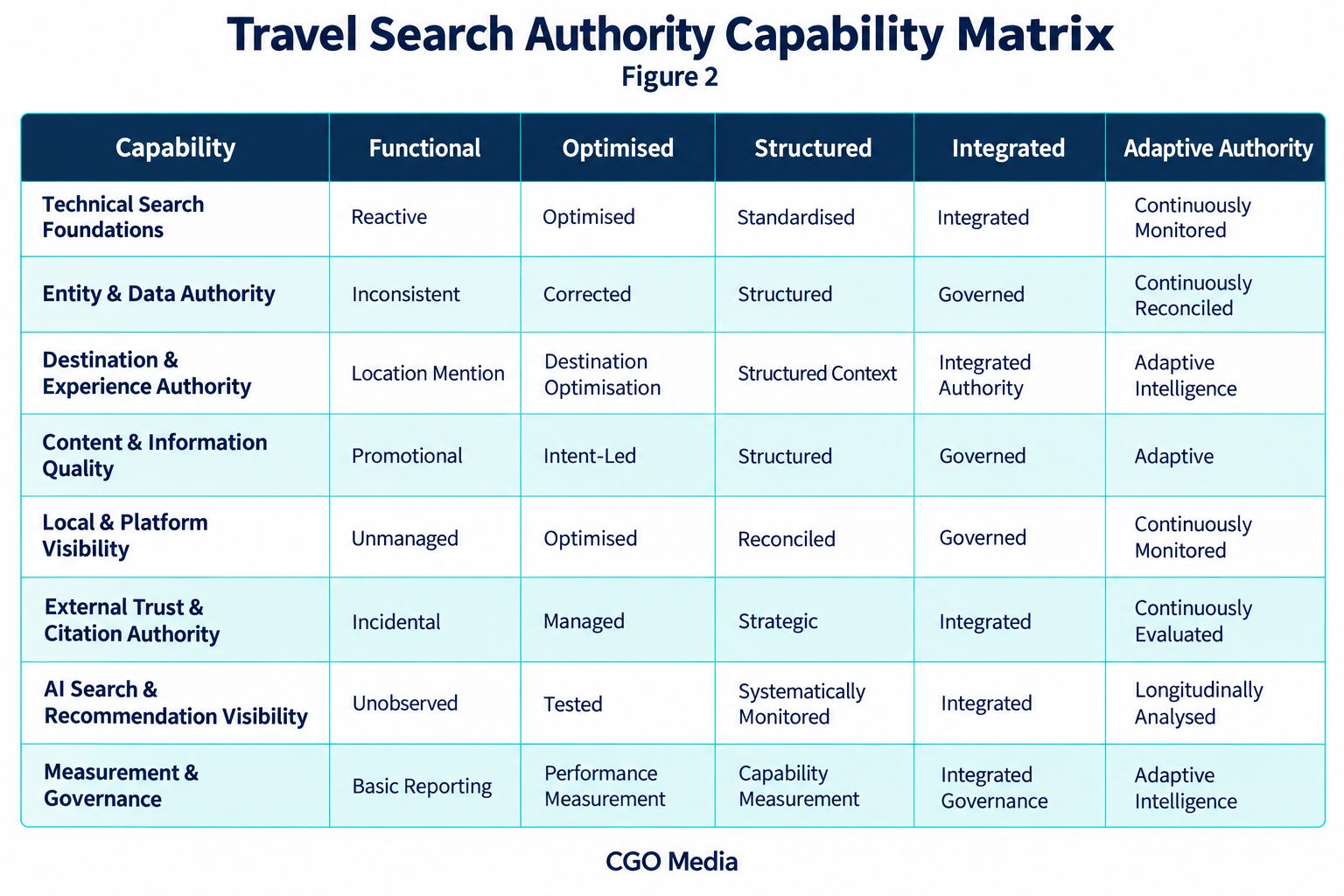
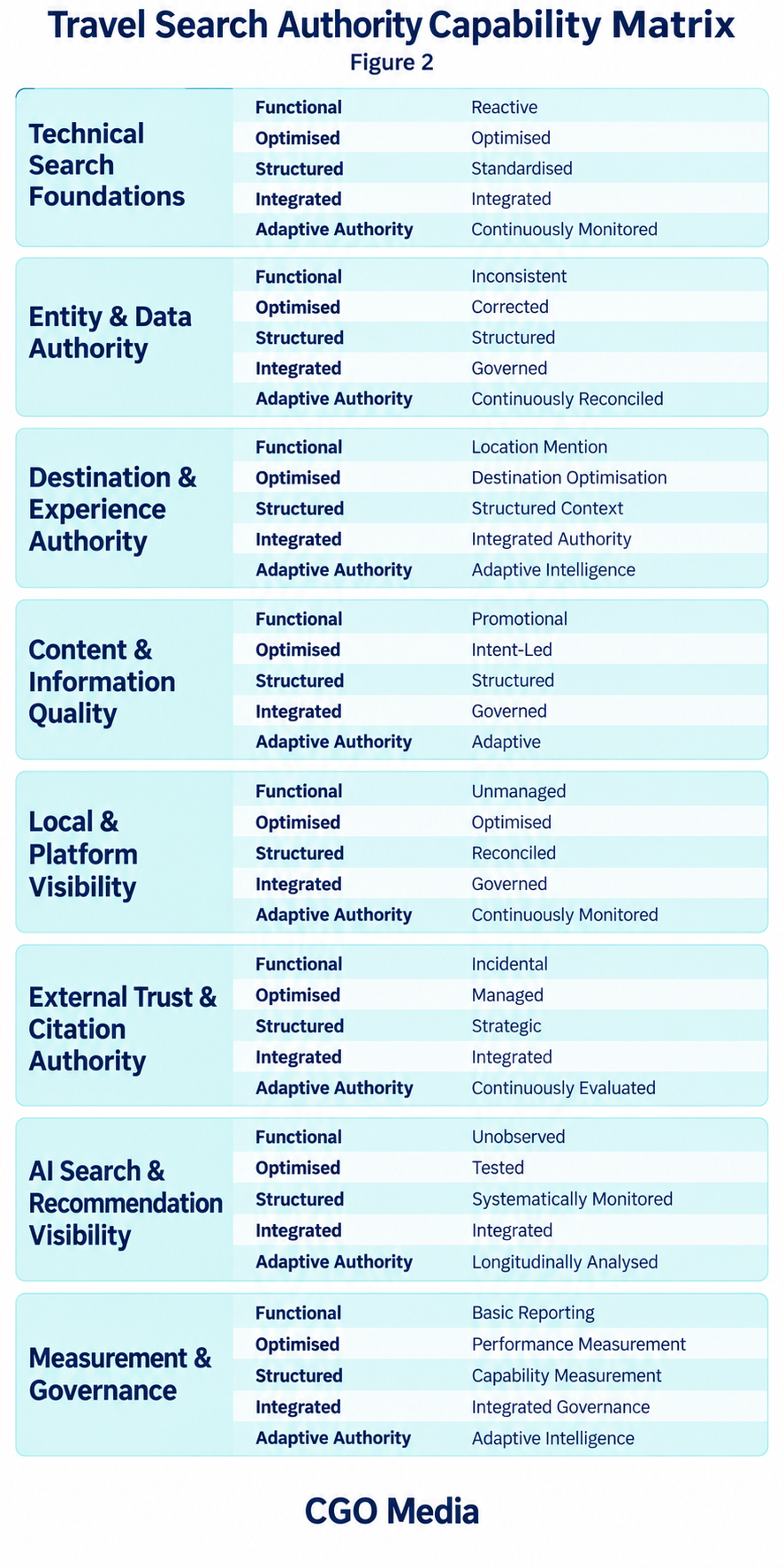
The maturity direction of each capability can be summarised as follows:
| Capability | Maturity Progression |
|---|---|
| Technical Search Foundations | Reactive → Optimised → Standardised → Integrated → Continuously Monitored |
| Entity & Data Authority | Inconsistent → Corrected → Structured → Governed → Continuously Reconciled |
| Destination & Experience Authority | Location Mention → Destination Optimisation → Structured Context → Integrated Authority → Adaptive Intelligence |
| Content & Information Quality | Promotional → Intent-Led → Structured → Governed → Adaptive |
| Local & Platform Visibility | Unmanaged → Optimised → Reconciled → Governed → Continuously Monitored |
| External Trust & Citation Authority | Incidental → Managed → Strategic → Integrated → Continuously Evaluated |
| AI Search & Recommendation Visibility | Unobserved → Tested → Systematically Monitored → Integrated → Longitudinally Analysed |
| Measurement & Governance | Basic Reporting → Performance Measurement → Capability Measurement → Integrated Governance → Adaptive Intelligence |
The Strategic Implication
Travel organisations should assess all eight capabilities independently before drawing conclusions about overall maturity.
The objective is not to maximise every activity simultaneously. It is to identify the capability gaps that most constrain the wider authority system and address them in an appropriate sequence.
This approach changes the maturity question from:
How advanced is our SEO?
to:
How effectively do our technical, entity, destination, content, platform, trust, AI and governance capabilities work together to create sustainable travel search authority?
20. Assessing Travel Search Authority Maturity
The capability matrix provides the foundation for assessing how mature a travel organisation is across the eight areas of the Travel Search Authority Maturity Model.
The purpose of assessment is not simply to assign a maturity level. It is to understand where capability is strong, where it is constrained and which weaknesses are preventing the wider authority system from progressing.
A useful assessment should therefore answer five questions:
- What is the organisation’s current capability?
- What level of capability is required?
- What gap exists between the two?
- What business or search impact does the gap create?
- Which gaps should be addressed first?
This produces a maturity profile rather than a single headline score.
That distinction is important because most travel organisations operate unevenly across the model.
A group may have advanced technical SEO but weak entity governance. Another organisation may possess strong destination authority and excellent reviews but limited AI monitoring. A hotel brand may have strong content operations but inconsistent property information across external platforms.
The maturity profile exposes those differences.
21. Capability-Level Assessment
Each of the eight capabilities should initially be assessed independently against the five maturity levels.
The assessor should consider observable evidence rather than relying solely on perceptions of organisational sophistication.
Evidence can include:
- Technical audit findings
- Website and template standards
- Structured data implementation
- Property and entity records
- Destination architecture
- Content standards
- Local and OTA consistency
- Review-management processes
- External citations and media coverage
- AI recommendation monitoring
- Reporting frameworks
- Governance documentation
The objective is to identify the maturity level that best reflects the organisation’s normal operating capability rather than isolated examples of good practice.
Avoid Assessing Maturity from Exceptional Cases
A single well-optimised hotel does not necessarily mean a hotel group has mature technical or content capability.
One successful Digital PR campaign does not establish Integrated external authority.
A small number of manually tested AI prompts does not represent Structured AI visibility monitoring.
Maturity should reflect repeatability, coverage and governance.
A capability is more mature when the organisation can reproduce it consistently across relevant properties, markets, destinations and teams.
22. Building the Maturity Profile
Once each capability has been assessed, the organisation can create a maturity profile showing relative strengths and weaknesses.
An illustrative profile might appear as follows:
| Capability | Current Maturity |
|---|---|
| Technical Search Foundations | Level 3 — Structured |
| Entity & Data Authority | Level 2 — Optimised |
| Destination & Experience Authority | Level 4 — Integrated |
| Content & Information Quality | Level 3 — Structured |
| Local & Platform Visibility | Level 2 — Optimised |
| External Trust & Citation Authority | Level 4 — Integrated |
| AI Search & Recommendation Visibility | Level 2 — Optimised |
| Measurement & Governance | Level 2 — Optimised |
The value of the profile lies in its unevenness.
An average score could suggest that the organisation operates around Level 3. That conclusion would hide several important weaknesses.
Entity governance, platform management, AI visibility and governance remain comparatively immature. Those gaps may reduce the value generated by stronger destination, content and external authority capabilities.
The maturity profile therefore provides more strategic information than a single aggregate number.
23. Current Capability vs Target Capability
Not every capability needs to reach the highest maturity level immediately.
The appropriate target depends on organisational complexity, commercial importance, market conditions and risk.
A multi-brand international hotel group may require significantly more advanced entity governance than a single independent property.
A destination organisation operating across hundreds of businesses may require more sophisticated destination architecture and external-data processes than a specialist tour operator.
The purpose of target capability is therefore to establish what level is appropriate for the organisation rather than automatically assuming Level 5 is required everywhere.
Target Capability Should Reflect Business Need
Target maturity can be influenced by factors including:
- Number of properties or travel products
- Number of destinations
- International market exposure
- Brand complexity
- Reliance on organic discovery
- Reliance on OTAs or intermediaries
- Importance of local search
- Competitive intensity
- AI recommendation exposure
- Operational risk
A capability gap exists when current maturity is materially below the level required to support business objectives.
The size of the gap matters, but it should not determine priority by itself.
24. Identifying Maturity Gaps
A maturity gap is the difference between current capability and required capability.
For example:
Current Capability: Level 2 — Optimised
Target Capability: Level 4 — Integrated
Gap: Two maturity levels
However, maturity gaps should be interpreted carefully.
A two-level technical gap affecting crawlability across an entire hotel portfolio may be more urgent than a two-level AI monitoring gap in a market where AI recommendation traffic remains relatively limited.
Similarly, a one-level entity-governance weakness could be strategically important if it creates widespread inconsistencies across hundreds of properties.
Gap size should therefore be combined with impact, risk and dependency.
25. Business Impact of Capability Gaps
Every material maturity gap should be connected to a potential business consequence.
This prevents the maturity model from becoming an abstract SEO exercise.
Possible impacts include:
- Reduced organic visibility
- Lower destination discoverability
- Incorrect property representation
- Dependence on paid acquisition
- Greater reliance on OTAs
- Weak direct-booking visibility
- Loss of traveller trust
- Inaccurate AI-generated information
- Reduced recommendation visibility
- Slower response to market change
- Operational inefficiency
The objective is not to attach financial values to every weakness. It is to make the relationship between authority capability and business performance explicit.
Direct and Indirect Impact
Some maturity gaps create direct effects.
A technical indexing problem may prevent important property pages from appearing in search. Incorrect local-profile information may cause immediate traveller confusion.
Other gaps create indirect effects.
Weak entity governance may gradually produce inconsistent representations across platforms. Limited external authority may reduce the evidence available to support recommendation systems. Weak measurement may delay the organisation’s ability to recognise deteriorating performance.
Both types of impact should be considered.
26. Risk Assessment
The diagnostic process should also consider the risk associated with leaving a capability gap unresolved.
Risk reflects the potential severity and likelihood of negative consequences.
Typical risk categories include:
- Visibility Risk: important pages, properties or products become less discoverable.
- Accuracy Risk: travellers or digital systems encounter incorrect information.
- Reputation Risk: inconsistent or poor-quality information reduces trust.
- Dependency Risk: the organisation becomes overly reliant on a platform, intermediary or channel.
- Competitive Risk: competitors develop stronger authority around important destinations or traveller needs.
- AI Representation Risk: generative systems misrepresent or omit the provider.
- Governance Risk: problems remain unresolved because ownership is unclear.
Risk does not need to be modelled with false precision.
A simple classification such as Low, Moderate, High or Critical is often sufficient to distinguish routine improvement opportunities from capability weaknesses requiring immediate attention.
27. Dependency Analysis
Some capabilities cannot progress efficiently until another capability reaches a sufficient level of maturity.
These relationships create dependencies.
For example:
- AI monitoring depends partly on reliable entity and content foundations.
- Destination authority depends on accessible and well-structured content.
- Platform governance depends on reliable internal property data.
- External authority development benefits from clear positioning and destination strategy.
- Integrated measurement depends on consistent underlying data.
This means the organisation should not always address the largest visible gap first.
It may need to strengthen a foundational capability before more advanced activity can deliver sustainable value.
Foundational Dependencies
Technical Search Foundations and Entity & Data Authority frequently act as foundational capabilities because they affect how information is discovered and interpreted.
Content & Information Quality and Destination & Experience Authority then build upon those foundations.
Local & Platform Visibility and External Trust extend authority beyond owned environments.
AI Search & Recommendation Visibility helps the organisation understand how the wider evidence system may be interpreted.
Measurement & Governance supports every stage.
This creates a broad dependency sequence:
Technical & Entity Foundations → Information & Destination Structure → Platform & External Authority → AI Visibility → Adaptive Governance
The sequence is not absolute, but it provides a useful guide when prioritising improvement.
28. Capability Bottlenecks
A capability bottleneck is a weakness that limits the value produced by stronger parts of the authority system.
This is one of the most important concepts within the maturity model.
An organisation may invest heavily in advanced activity while receiving limited returns because an earlier capability remains weak.
Example: Strong Content, Weak Technical Foundations
A travel organisation may publish excellent destination and property information but fail to achieve appropriate visibility because indexing, rendering or internal-linking problems prevent search systems from accessing it reliably.
Example: Strong SEO, Weak Entity Governance
A hotel group may rank well while maintaining inconsistent property names, locations and facilities across external platforms.
The resulting ambiguity can weaken local visibility, traveller confidence and machine interpretation.
Example: Strong PR, Weak Destination Architecture
A provider may receive substantial media coverage but fail to connect that authority clearly to the destinations, experiences or traveller needs it wants to own.
Example: Strong AI Monitoring, Weak Governance
An organisation may identify repeated inaccuracies within generative answers but lack a process for determining which team should correct the underlying information.
Monitoring then produces insight without improvement.
Bottleneck analysis helps prevent investment from being directed toward highly visible but strategically premature activities.
29. Prioritising Maturity Improvement
Once gaps, impacts, risks and dependencies have been identified, the organisation can establish improvement priorities.
A practical prioritisation model can consider six factors:
- Gap: how far current capability is from target capability.
- Commercial Impact: the potential effect on visibility, demand or revenue.
- Risk: the consequence of leaving the weakness unresolved.
- Dependency: whether other capabilities depend upon this improvement.
- Effort: the resources required to make meaningful progress.
- Time to Value: how quickly improvement is likely to produce useful results.
The strongest priorities are usually those where material business impact combines with high risk or strong dependency.
This helps distinguish strategically important work from activity that is merely easy to execute.
Priority Is Not the Same as Urgency
Some issues require immediate correction even if they are not part of the organisation’s long-term maturity programme.
Examples include:
- Large-scale indexation loss
- Incorrect property addresses
- Broken booking journeys
- Major platform duplication
- Materially inaccurate provider information
These are operational incidents and should be resolved accordingly.
Maturity priorities focus on the capability improvements required to prevent recurring weaknesses and strengthen long-term authority.
30. From Gap Analysis to an Improvement Roadmap
The maturity assessment becomes strategically useful when findings are converted into a practical improvement roadmap.
The roadmap should not attempt to move every capability to Level 5 simultaneously.
Instead, it should identify the next meaningful capability transition.
For example:
| Capability | Current | Target | Immediate Objective |
|---|---|---|---|
| Technical Search Foundations | Level 2 | Level 3 | Standardise technical requirements across critical templates. |
| Entity & Data Authority | Level 2 | Level 4 | Establish governed property records and ownership. |
| Destination & Experience Authority | Level 3 | Level 4 | Connect destination architecture with external authority. |
| AI Search Visibility | Level 1 | Level 3 | Create representative prompt monitoring. |
Each immediate objective can then be translated into defined workstreams, owners, measures and review periods.
The maturity model therefore becomes a planning instrument rather than simply an assessment framework.
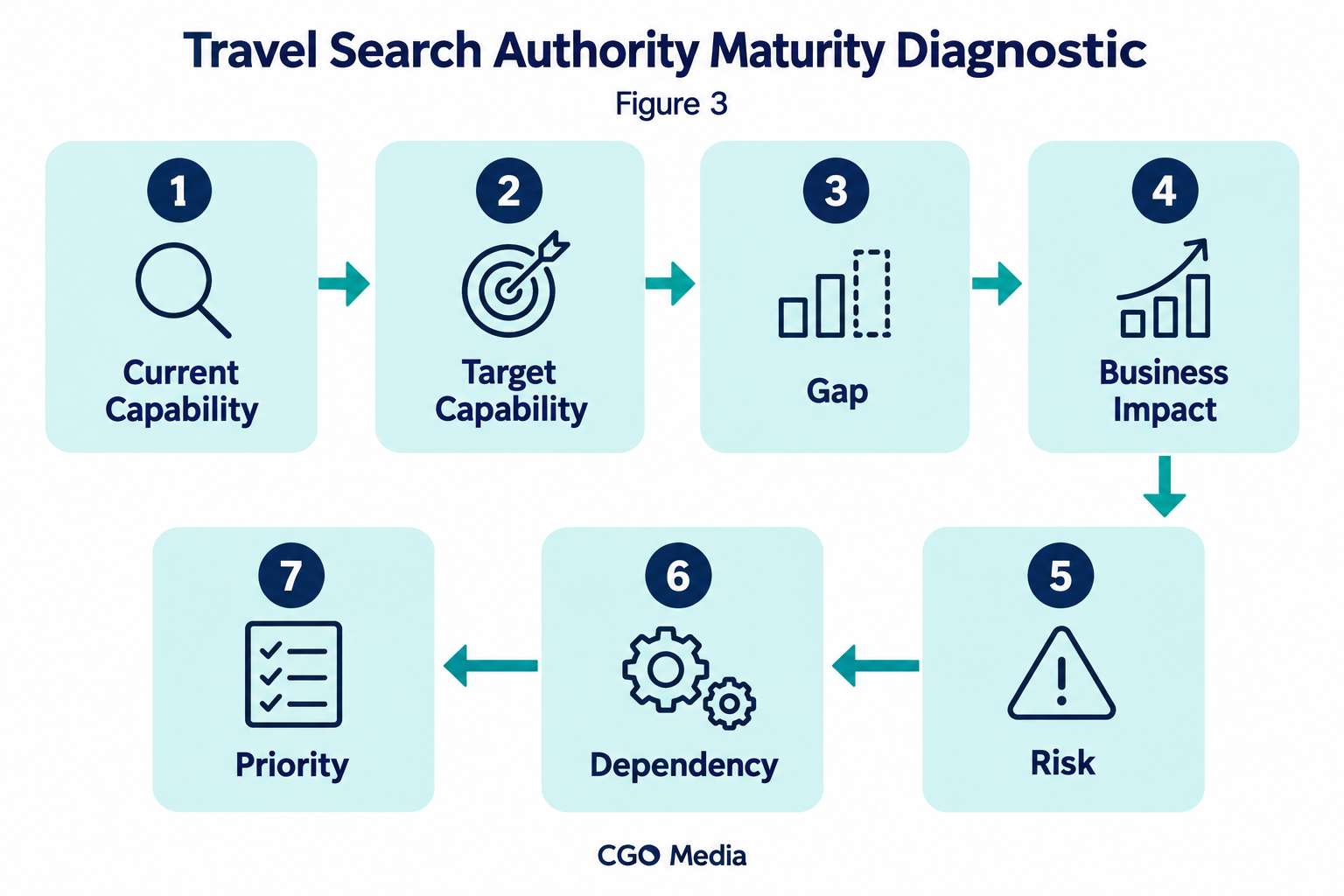
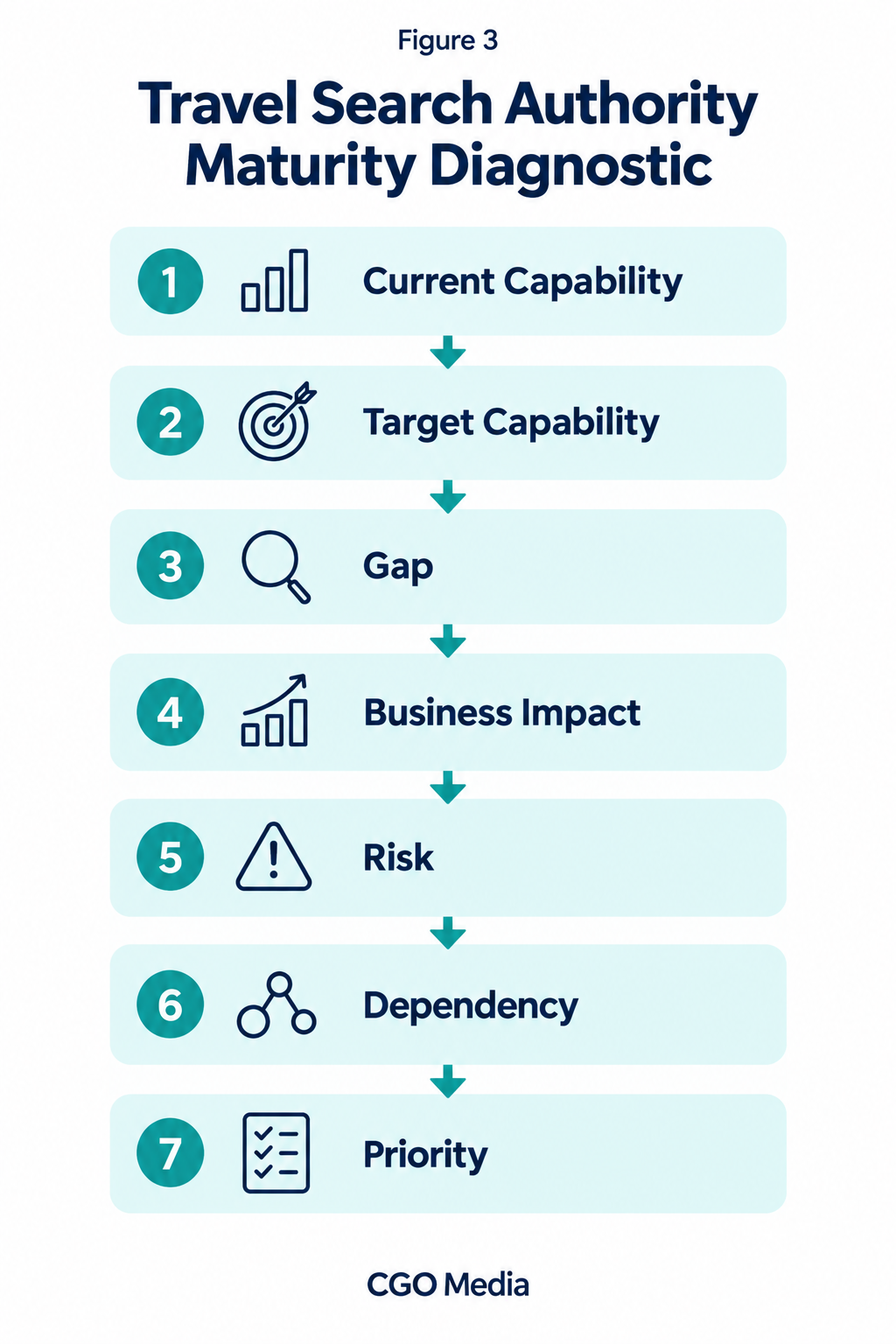
31. The Travel Search Authority Maturity Diagnostic
The Travel Search Authority Maturity Diagnostic brings the assessment process together into a single sequence.
For each capability, the organisation evaluates:
Current Capability → Target Capability → Gap → Business Impact → Risk → Dependency → Priority
Each stage answers a different strategic question.
Current Capability
What can the organisation reliably do today?
Target Capability
What level of capability is required to support current business objectives?
Gap
What needs to change between the current and target states?
Business Impact
What commercial, operational or discovery consequence does the gap create?
Risk
What could happen if the gap remains unresolved?
Dependency
Which other capabilities rely upon this area improving?
Priority
When should the organisation act relative to other maturity requirements?
This diagnostic prevents capability assessment from becoming an arbitrary scoring exercise.
Instead, maturity is connected directly to business need, organisational risk and strategic sequencing.
Diagnostic Output
The output should provide management with a clear view of:
- Current capability maturity
- Desired maturity
- Critical capability gaps
- Major dependencies
- Business and operational risks
- Improvement priorities
- Required ownership
The result is a practical roadmap showing where the authority system is constrained and what should be strengthened next.
32. Moving Between Maturity Levels
The Travel Search Authority Maturity Model is not only intended to describe organisational maturity. It is also designed to explain how capability develops.
Progression between maturity levels requires different types of organisational change.
The transition from Functional to Optimised is primarily about gaining control. The transition from Optimised to Structured requires architecture. Moving from Structured to Integrated requires coordination between capabilities. Progressing from Integrated to Adaptive Authority requires intelligence and continuous learning.
The four principal transition stages are therefore:
Control → Architecture → Integration → Intelligence
These transitions represent changes in operating capability rather than simply increases in SEO activity.
An organisation does not become more mature because it publishes more content, acquires more links or monitors more keywords. It becomes more mature when activities become repeatable, structured, connected and increasingly capable of learning from evidence.
33. Transition One — Functional to Optimised: Control
The first maturity transition is from Functional to Optimised.
The central objective is control.
At Functional maturity, many search-related activities exist because they are necessary to maintain a digital presence. Websites operate, properties are listed, reviews accumulate and booking channels function, but management is often reactive.
The organisation may not have clear standards for how technical issues are identified, how property information is maintained, how search opportunities are prioritised or how performance is reviewed.
The move toward Optimised maturity begins when these activities become deliberate.
What Control Means
Control does not mean centralising every activity within a single team.
It means establishing sufficient visibility and repeatability for the organisation to understand what exists, who is responsible and whether basic search requirements are being maintained.
Typical control measures include:
- Regular technical auditing
- Defined ownership of important website areas
- Verified property and local profiles
- Basic content standards
- Keyword and search-intent research
- Review-monitoring processes
- Routine reporting
- Clear escalation of critical errors
From Reaction to Routine
The defining change is that problems are no longer addressed only when they become visible.
Technical issues are reviewed regularly. Important listings are checked. Performance is measured. Content is developed against recognised search demand rather than published without a clear discovery purpose.
The organisation begins establishing recurring processes.
This transition can therefore be summarised as:
Reactive Management → Repeatable Optimisation
Primary Management Question
Do we have sufficient control over the basic systems and information that determine our search visibility?
Evidence That the Transition Is Working
The organisation should begin seeing:
- Fewer recurring technical failures
- More accurate provider information
- More consistent local and platform profiles
- Better understanding of organic-search demand
- More reliable performance reporting
- Clearer ownership of routine search activities
The organisation is ready for the next transition when optimisation activity becomes sufficiently stable that attention can move from individual tasks toward the structure connecting them.
34. Transition Two — Optimised to Structured: Architecture
The second transition is from Optimised to Structured.
The central objective is architecture.
At Optimised maturity, the organisation may perform many search activities well while still treating them as separate tasks.
Individual pages are optimised. Local profiles are improved. Destination articles are produced. Links are acquired. Reviews are monitored.
The problem is that those activities may not reflect a coherent information system.
The move to Structured maturity requires the organisation to organise information around meaningful relationships.
From Pages to Entities and Relationships
At this stage, the organisation starts asking broader questions:
- How do our brands relate to our properties?
- How do our properties relate to destinations?
- How do destinations relate to experiences?
- How do experiences relate to traveller needs?
- Which information should remain consistent across platforms?
- Which pages and entities should reinforce one another?
The website becomes an expression of a wider information architecture rather than a collection of separately optimised URLs.
Building Structured Destination Authority
Destination content becomes particularly important during this transition.
Rather than creating disconnected articles targeting individual keywords, the organisation builds relationships such as:
Region → Destination → Neighbourhood → Provider → Product → Experience
This creates clearer context for both travellers and machine systems.
Building Structured Entity Authority
The organisation also begins defining important entities and attributes more clearly.
Critical information may include:
- Official property names
- Parent-brand relationships
- Addresses
- Coordinates
- Categories
- Facilities
- Contact details
- Policies
- Destination relationships
These attributes are increasingly managed through defined standards rather than being left to individual teams or platforms.
Content Becomes Systematic
Content development begins following defined structures.
Property pages, destination pages, experience pages and supporting information are designed to answer different parts of the traveller journey.
Internal linking reflects those relationships.
Content is therefore created as part of an information system rather than simply to target additional keywords.
From Optimisation to Architecture
This transition can be summarised as:
Optimised Activity → Structured Authority Architecture
Primary Management Question
Are our search activities organised around a coherent representation of our organisation, destinations, products and traveller needs?
Evidence That the Transition Is Working
The organisation should begin seeing:
- Clearer destination hierarchies
- More consistent entity representation
- Reduced content duplication
- Better internal relationships between pages
- Improved data standards
- More consistent platform information
- More systematic AI query monitoring
Once the organisation has created these structures, the next challenge is connecting them across functions.
35. Transition Three — Structured to Integrated: Integration
The third transition is from Structured to Integrated.
The central objective is integration.
At Structured maturity, important capabilities may be individually well developed but still operate within separate organisational functions.
SEO may manage technical performance and content. PR may manage media relationships. Reputation teams may manage reviews. Ecommerce teams may control booking systems. Property teams may maintain operational information. Data teams may manage internal records.
The transition to Integrated maturity occurs when these capabilities begin sharing evidence, standards and objectives.
Integration Across Organisational Functions
Search authority can involve teams such as:
- SEO
- Content
- Digital PR
- Ecommerce
- Revenue management
- Property operations
- Brand
- Reputation management
- Data and analytics
- Technology
Integrated maturity does not require all of these functions to become one department.
It requires them to exchange information when their activities influence the same authority system.
Reviews Feeding Content
Guest reviews can reveal recurring uncertainty about issues such as transport, noise, accessibility, family suitability or location.
At lower maturity, review findings may remain within reputation management.
At Integrated maturity, these themes can inform content, FAQs, property descriptions and operational communications.
Search Demand Feeding Product Positioning
Search behaviour can reveal growing interest in particular traveller needs, experiences or destinations.
This intelligence can inform destination strategy, content priorities and commercial positioning.
PR Feeding Search Authority
Digital PR can be aligned with the destinations, entities and themes for which the organisation seeks recognition.
Coverage then reinforces strategic authority rather than existing as an independent media metric.
AI Findings Feeding the Wider Authority System
If generative systems repeatedly omit or misrepresent a provider, the organisation can investigate the wider evidence environment.
Potential causes may involve:
- Weak entity clarity
- Insufficient destination context
- Outdated platform information
- Limited independent validation
- Content gaps
The AI output becomes a diagnostic signal rather than an isolated problem.
From Structure to System
The transition can be summarised as:
Structured Capabilities → Integrated Authority System
Primary Management Question
Do our different search, content, platform, reputation, PR and data capabilities reinforce one another?
Evidence That the Transition Is Working
The organisation should begin seeing:
- Shared authority objectives
- Defined cross-functional ownership
- Review intelligence influencing content
- PR supporting strategic authority themes
- Platform issues routed to appropriate teams
- AI findings influencing wider optimisation
- Combined reporting across capabilities
Once the capabilities become integrated, the organisation can begin using them as an intelligence system.
36. Transition Four — Integrated to Adaptive Authority: Intelligence
The final transition is from Integrated to Adaptive Authority.
The central objective is intelligence.
At Integrated maturity, the organisation has connected its principal authority capabilities.
At Adaptive Authority, those connections are used to detect change, generate insight and continuously improve decision-making.
From Reporting to Intelligence
Traditional reporting describes what has already happened.
Intelligence attempts to explain why change is occurring and what the organisation should investigate next.
Examples can include:
- Identifying emerging destination demand
- Detecting declining review themes
- Recognising changes in AI recommendations
- Identifying competitor authority growth
- Detecting platform-data inconsistencies
- Recognising technical deterioration before major visibility loss
The organisation increasingly monitors patterns rather than isolated metrics.
Longitudinal AI Monitoring
AI search monitoring becomes particularly valuable when performed consistently over time.
A single prompt result provides limited evidence.
Repeated testing across defined query sets can reveal whether:
- Recommendation visibility is increasing or declining
- Competitors are appearing more frequently
- Provider descriptions remain accurate
- Destination associations are changing
- New recommendation categories are emerging
The emphasis moves from isolated output checking toward trend analysis.
Adaptive Destination Intelligence
Traveller behaviour changes continuously.
New attractions open. Transport routes change. Events create demand. Seasonal patterns shift. New traveller requirements emerge.
Adaptive organisations incorporate these signals into destination and content strategy rather than relying solely on historical keyword sets.
External Evidence Monitoring
Changes in reviews, media coverage, destination citations and other external sources can also provide early evidence of changing reputation or relevance.
The organisation can respond by strengthening information, correcting inaccuracies or developing authority where external evidence remains weak.
Continuous Improvement
Adaptive maturity depends on a recurring process:
Observe → Diagnose → Prioritise → Improve → Validate → Learn
The organisation does not assume that an improvement is successful simply because it has been implemented.
It measures the subsequent effect and uses that evidence to inform the next decision.
From System to Intelligence
This transition can be summarised as:
Integrated Authority System → Adaptive Search Intelligence
Primary Management Question
Can our authority system detect meaningful change and adapt before weaknesses become significant problems?
Evidence That the Transition Is Working
The organisation should increasingly demonstrate:
- Early detection of material change
- Longitudinal AI visibility monitoring
- Cross-channel trend analysis
- Faster diagnosis of authority weaknesses
- Evidence-led prioritisation
- Defined correction pathways
- Validation of completed improvements
37. The Four Transition Stages
The complete maturity journey can therefore be represented through four organisational transitions.
| Transition | Primary Objective | Organisational Change |
|---|---|---|
| Functional → Optimised | Control | Move from reactive activity to repeatable optimisation. |
| Optimised → Structured | Architecture | Organise activity around entities, destinations, information and traveller needs. |
| Structured → Integrated | Integration | Connect capabilities, teams, evidence and governance. |
| Integrated → Adaptive Authority | Intelligence | Continuously detect, diagnose, improve and learn from change. |
This distinction is useful because each transition requires different leadership priorities.
An organisation struggling with basic technical stability should not behave as though its primary challenge is advanced AI recommendation measurement.
Similarly, an organisation with mature technical and content capabilities should not remain focused exclusively on page-level optimisation if its major constraint is cross-functional integration.
Maturity progression therefore depends on addressing the organisational challenge appropriate to the current stage.
38. Capability Progression Is Not Always Linear
Although the maturity model is presented as a five-level progression, real organisations do not always move through it in a perfectly linear sequence.
Capability can accelerate, stall or regress.
Rapid Progression
An organisation may advance quickly when it introduces stronger governance, consolidates technology platforms or establishes clear data standards.
Stalled Progression
Progress can slow when responsibilities are unclear, teams remain siloed or underlying technology prevents consistent implementation.
Regression
Maturity can also decline.
Common causes include:
- Website migrations
- Technology-platform changes
- Property acquisitions
- Rebrands
- Organisational restructuring
- Changes in ownership
- Loss of key expertise
- Expansion into new markets
A group that previously maintained strong entity consistency may temporarily regress following a major acquisition.
A technically mature website can lose stability following migration.
Maturity should therefore be treated as a capability that must be maintained rather than a permanent status.
39. The Role of Leadership in Maturity Progression
As maturity increases, search authority becomes progressively less dependent on the SEO team alone.
Early-stage improvements can often be delivered within marketing or digital functions.
Higher maturity increasingly requires cooperation across technology, operations, data, ecommerce, reputation, PR and leadership.
This is because many advanced authority problems are organisational rather than purely technical.
An SEO specialist cannot independently establish company-wide property-data governance.
A content team cannot ensure OTA consistency without operational ownership.
A PR team cannot create integrated authority without alignment to wider destination and entity strategy.
Leadership therefore becomes increasingly important as organisations move toward Integrated and Adaptive Authority.
Leadership Responsibilities
Senior management should ensure that:
- Important authority capabilities have defined ownership
- Teams can access relevant information
- Critical data has recognised sources of truth
- Cross-functional issues can be escalated
- Measurement reflects strategic objectives
- Authority weaknesses are prioritised according to business impact
The maturity model can therefore support management conversations beyond the SEO function.
40. The Travel Search Authority Transition Model
The Travel Search Authority Transition Model summarises the organisational changes required to move through the five maturity levels.
The progression is:
Control → Architecture → Integration → Intelligence
Control
Establish repeatable management of basic technical, content, local, platform and measurement activity.
Architecture
Organise digital information around coherent relationships between organisations, brands, properties, destinations, products, experiences and traveller needs.
Integration
Connect technical, content, entity, platform, reputation, PR, AI and measurement capabilities so that evidence can flow between them.
Intelligence
Use integrated evidence to detect change, diagnose weaknesses, prioritise action, validate improvements and continuously adapt the authority system.
The transition model provides organisations with a simple way to identify the type of change required at each stage of maturity.
It also prevents organisations from attempting to solve advanced authority challenges without first establishing the foundations upon which those capabilities depend.
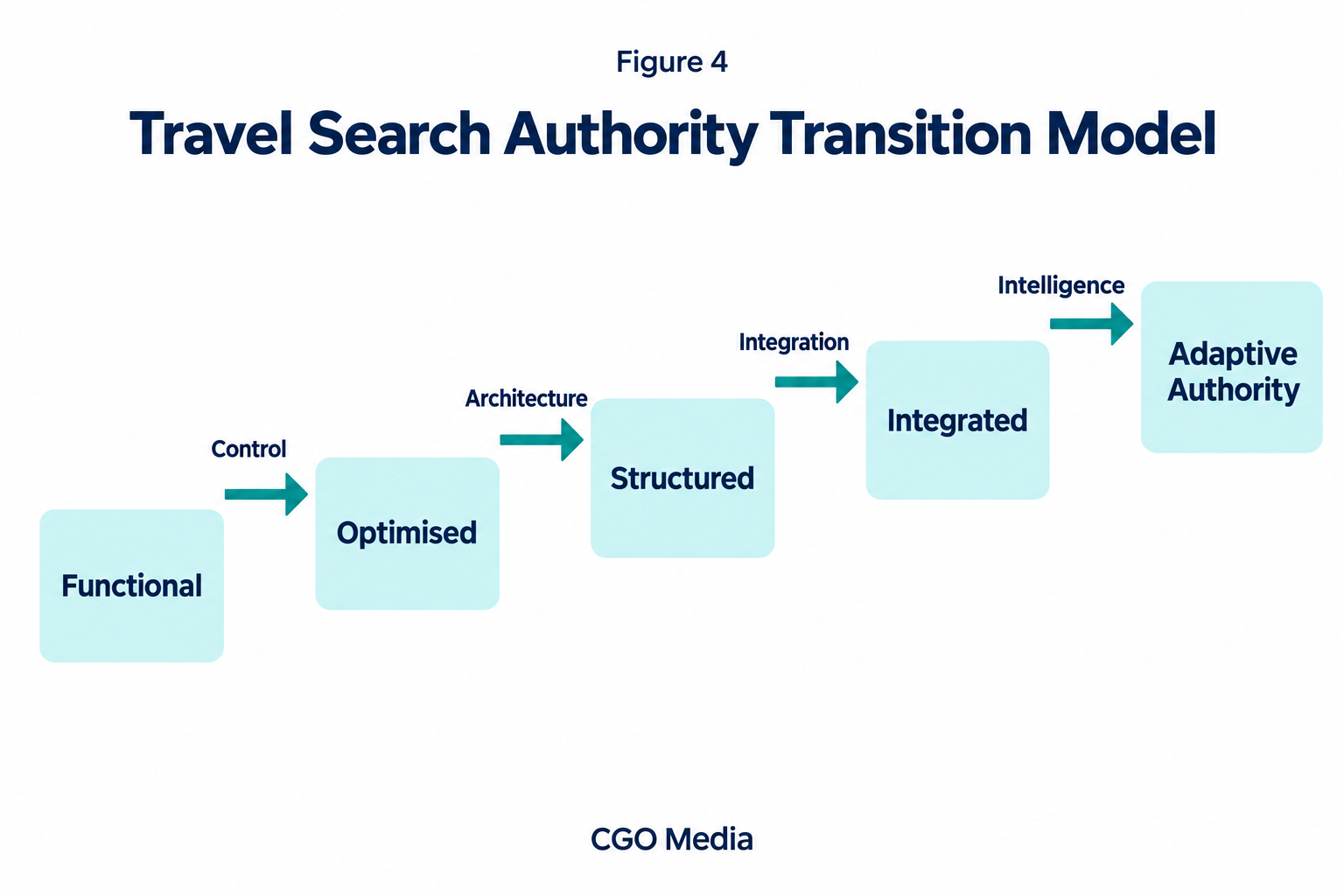
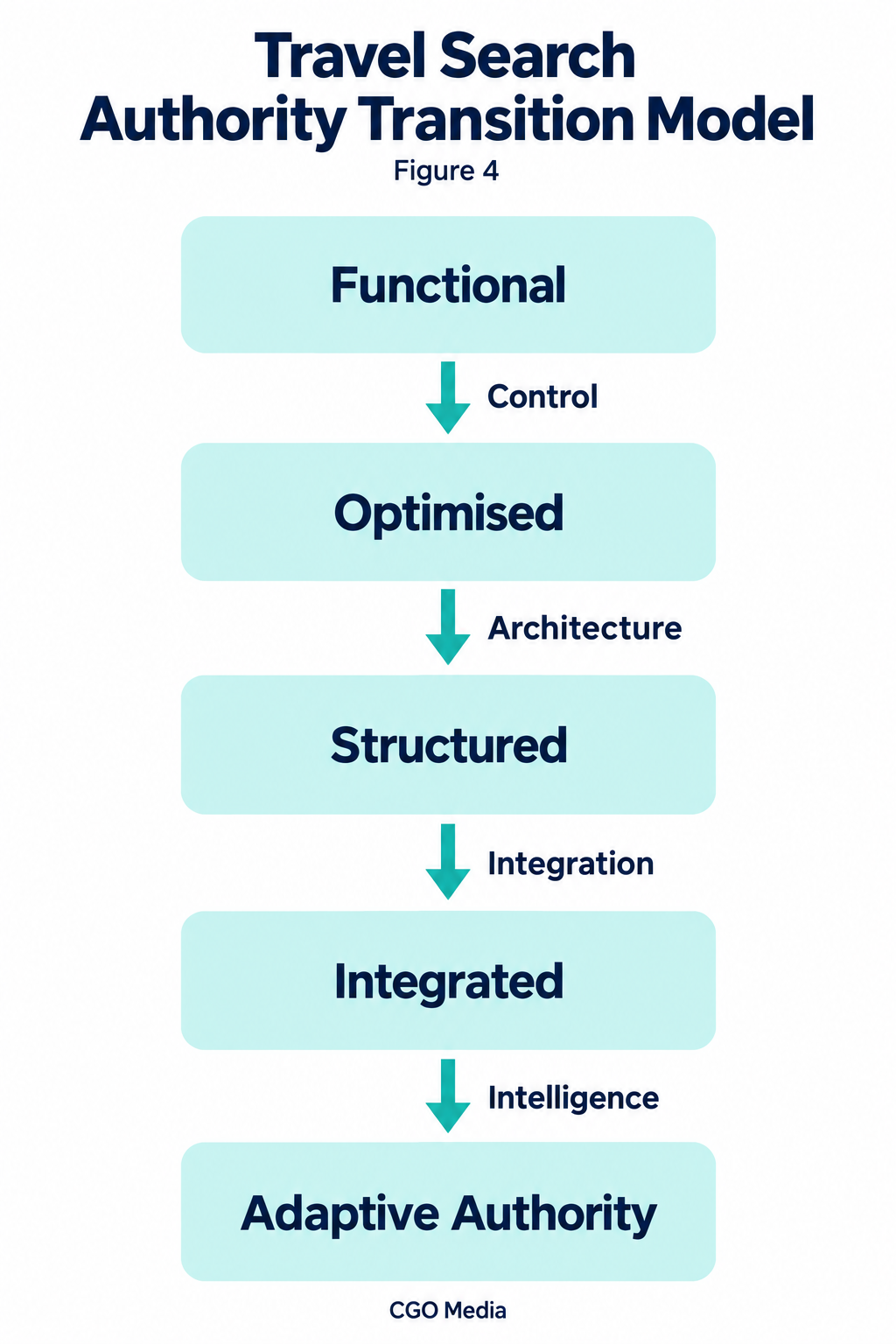
41. Connecting Maturity to Business Performance
The Travel Search Authority Maturity Model is intended to support business decision-making rather than operate as an isolated SEO framework.
Capability maturity should therefore be evaluated partly through its effect on commercial performance, operational resilience and organisational risk.
Higher maturity does not automatically guarantee higher revenue. Market conditions, brand strength, product quality, pricing, seasonality, distribution strategy and many other factors also influence travel performance.
However, stronger authority capability can improve the organisation’s ability to participate effectively across the environments where travellers discover, compare and evaluate providers.
This can support:
- Greater organic discoverability
- Stronger destination visibility
- More accurate provider representation
- Improved direct-discovery opportunities
- Reduced information friction
- Greater resilience to platform change
- Better understanding of AI recommendation exposure
- More effective prioritisation of search investment
The maturity model therefore focuses on the relationship between organisational capability and the outcomes that capability is intended to support.
42. Maturity Should Not Be Measured by Rankings Alone
Organic rankings remain useful, but they provide only a partial view of modern travel search authority.
A provider can rank strongly while suffering from inaccurate platform information, poor entity consistency or weak external validation.
Conversely, a travel organisation may have strong local, platform or AI recommendation visibility that is not fully reflected in conventional ranking reports.
Performance assessment should therefore consider several dimensions.
Discovery Performance
Discovery measures whether the organisation can be found across relevant travel-search environments.
Indicators can include:
- Organic visibility
- Destination search presence
- Non-branded discovery
- Local visibility
- Platform visibility
- AI recommendation presence
Representation Quality
Visibility is less valuable when the information displayed is inaccurate or incomplete.
Representation measures can therefore include:
- Property-information accuracy
- Entity consistency
- Facility accuracy
- Location accuracy
- Platform consistency
- AI description accuracy
Trust and Validation
Trust considers whether external evidence supports the provider’s own representation.
Relevant evidence may include:
- Review quality and recurring themes
- Relevant media citations
- Destination references
- Industry recognition
- Independent recommendations
- Authoritative third-party mentions
Commercial Performance
Where appropriate, authority measurement can be connected to commercial indicators such as:
- Organic bookings
- Direct revenue
- Qualified enquiries
- Conversion rates
- Destination-page contribution
- Cost of acquisition
- Channel dependency
No single metric provides a complete view. The objective is to combine enough evidence to determine whether capability maturity is producing strategically useful outcomes.
43. Commercial Impact by Capability
Different maturity capabilities influence business performance in different ways.
Understanding these relationships helps management determine why a capability deserves investment.
| Capability | Potential Commercial Contribution |
|---|---|
| Technical Search Foundations | Protects discoverability, supports efficient crawling and reduces visibility loss caused by technical failure. |
| Entity & Data Authority | Improves consistency and reduces ambiguity across search, maps, platforms and AI systems. |
| Destination & Experience Authority | Supports discovery for relevant destinations, experiences and traveller requirements. |
| Content & Information Quality | Improves understanding, evaluation and conversion by reducing information gaps. |
| Local & Platform Visibility | Supports visibility where travellers compare providers and make location-based decisions. |
| External Trust & Citation Authority | Strengthens independent validation, reputation and wider authority signals. |
| AI Search & Recommendation Visibility | Improves understanding of emerging recommendation exposure and representation. |
| Measurement & Governance | Improves decision-making, prioritisation, accountability and response speed. |
The table does not imply direct causation between a single capability and a specific commercial outcome.
In practice, performance normally results from interaction between several capabilities.
44. Performance Trend Matters More Than a Single Snapshot
Maturity assessment should not rely solely on a single point in time.
A capability may currently appear strong while underlying indicators are deteriorating.
For example:
- Organic visibility may remain high while technical errors are increasing.
- Review ratings may remain strong while negative themes are becoming more frequent.
- AI recommendation presence may remain stable while competitors are appearing more often.
- Platform accuracy may look acceptable overall while a growing number of properties contain inconsistencies.
Trend analysis helps distinguish stable capability from capability that requires intervention.
Useful Trend Classifications
For executive reporting, a simple trend classification can often be more useful than excessive numerical complexity.
A capability can be classified as:
- Improving
- Stable
- Deteriorating
- Insufficient Evidence
This enables management to identify where apparently mature capabilities may be weakening and where lower-maturity capabilities are progressing.
45. Commercial Impact Should Be Interpreted in Context
Search authority does not operate independently from broader travel economics.
Performance can be influenced by:
- Seasonality
- Room or product availability
- Pricing
- Destination demand
- Air connectivity
- Economic conditions
- Competitor activity
- Brand strength
- Distribution strategy
For this reason, maturity analysis should avoid attributing every commercial movement directly to SEO or search authority.
The more appropriate question is whether the authority system is contributing effectively to discoverability, accurate representation, traveller confidence and direct commercial opportunity.
Correlation Should Not Be Confused with Causation
An increase in organic bookings following content improvement does not necessarily mean the content alone caused the increase.
Likewise, a decline in search traffic does not automatically indicate declining authority if destination demand has fallen across the market.
Performance should therefore be interpreted against appropriate context, including market demand and operational conditions.
46. Measuring Commercial Dependency
One of the strategic benefits of maturity assessment is identifying excessive dependency on individual acquisition channels.
Travel providers may depend heavily on:
- Online travel agencies
- Paid search
- Meta-search platforms
- Brand search
- Social platforms
- Individual destination marketplaces
High dependency is not automatically problematic. Intermediaries can provide substantial value and distribution reach.
The strategic issue is whether the organisation understands the dependency and possesses sufficient alternative discovery capability.
Stronger search authority can contribute to a more diversified discovery environment by improving organic, local, destination, external and AI-assisted visibility.
The objective is resilience rather than elimination of intermediaries.
47. Risk as an Executive Performance Measure
Traditional reporting often focuses primarily on positive outcomes such as traffic growth, rankings or bookings.
Executive maturity reporting should also consider risk.
An organisation can be performing well today while carrying significant underlying vulnerabilities.
Examples of Authority Risk
- Large numbers of critical pages dependent on fragile technology
- Inconsistent property data across external platforms
- Unclear ownership of entity information
- Strong dependency on one acquisition channel
- Declining review sentiment
- Weak independent authority in important destinations
- Inaccurate representation within AI systems
- No defined response process when problems emerge
These risks may not immediately appear in revenue reports.
However, they can weaken the organisation’s ability to maintain authority during periods of change.
Risk should therefore sit alongside maturity and performance within executive reporting.
48. Recovery Capability
High-maturity organisations should be evaluated not only by their ability to prevent problems, but also by their ability to recover from them.
Travel organisations operate in environments where disruption is unavoidable.
Examples include:
- Website migrations
- Property rebrands
- Hotel openings and closures
- Acquisitions
- Major platform changes
- Incorrect external data
- Search algorithm changes
- AI representation changes
The relevant maturity question is therefore:
How quickly can the organisation detect, diagnose and correct a material authority problem?
Characteristics of Strong Recovery Capability
Higher recovery maturity usually includes:
- Reliable monitoring
- Clear ownership
- Access to trusted source data
- Defined escalation routes
- Cross-functional cooperation
- Post-resolution validation
Recovery capability is particularly important for large travel organisations where errors can affect many properties or markets simultaneously.
49. Executive Reporting Should Remain Simple
The underlying maturity model can contain substantial detail, but executive reporting should remain concise.
Senior management does not require every crawl issue, keyword movement or individual AI prompt result.
Executive reporting should answer a smaller number of strategic questions:
- How mature is the capability?
- Is performance improving or deteriorating?
- What commercial effect does the capability have?
- What significant risks exist?
- Can the organisation recover effectively if the capability fails?
This creates a management view that is sufficiently detailed for decision-making without reproducing operational dashboards.
50. Capability Maturity as an Executive Measure
The first component of the executive scorecard is Capability Maturity.
This indicates the current maturity level for each of the eight capability areas.
The purpose is to show whether the organisation has sufficient underlying capability to support its strategic objectives.
A capability may be classified as:
- Level 1 — Functional
- Level 2 — Optimised
- Level 3 — Structured
- Level 4 — Integrated
- Level 5 — Adaptive Authority
The score should always be supported by observable evidence rather than management perception alone.
51. Performance Trend as an Executive Measure
The second component is Performance Trend.
This indicates whether the capability is becoming stronger, remaining stable or deteriorating.
Possible classifications include:
- Improving
- Stable
- Deteriorating
- Insufficient Evidence
The trend provides an important counterbalance to maturity.
A Level 4 capability that is deteriorating may deserve more attention than a Level 2 capability that is steadily improving according to plan.
52. Commercial Impact as an Executive Measure
The third component is Commercial Impact.
This considers how materially the capability affects business objectives.
Impact may be assessed using classifications such as:
- Limited
- Moderate
- High
- Critical
The appropriate classification depends on organisational circumstances.
Technical search capability may be critical for a direct-booking-led hotel group but less commercially significant for a business where organic discovery plays a smaller role.
The purpose is to connect maturity improvement to actual organisational priorities.
53. Critical Risk as an Executive Measure
The fourth component is Critical Risk.
This highlights the most important vulnerability associated with each capability.
Examples include:
- Indexation instability
- Property-data inconsistency
- Destination authority weakness
- Content inaccuracy
- Platform duplication
- Declining external trust
- AI misrepresentation
- Unclear governance ownership
Executive reporting should focus on the most material risk rather than attempting to list every operational issue.
54. Recovery Capability as an Executive Measure
The fifth component is Recovery Capability.
This assesses whether the organisation can respond effectively when a significant authority problem occurs.
A simple assessment can consider whether recovery capability is:
- Weak
- Developing
- Established
- Advanced
This provides leadership with a view not only of current performance but also organisational resilience.
55. The Travel Search Authority Executive Scorecard
The Travel Search Authority Executive Scorecard brings the principal management measures together.
The five dimensions are:
Capability Maturity + Performance Trend + Commercial Impact + Critical Risk + Recovery Capability
These dimensions answer five different questions.
Capability Maturity
How developed is the underlying capability?
Performance Trend
Is the capability improving, stable or deteriorating?
Commercial Impact
How materially does this capability affect business performance?
Critical Risk
What is the most important vulnerability associated with the capability?
Recovery Capability
How effectively can the organisation respond if the capability fails or deteriorates?
Together, these measures allow senior management to distinguish between:
- Mature and stable capabilities
- Mature but deteriorating capabilities
- Immature but strategically low-risk capabilities
- Immature capabilities requiring urgent investment
- Capabilities where recovery resilience is insufficient
Illustrative Executive View
| Capability | Maturity | Trend | Commercial Impact | Critical Risk | Recovery |
|---|---|---|---|---|---|
| Technical Search Foundations | Level 4 | Stable | High | Platform dependency | Advanced |
| Entity & Data Authority | Level 2 | Improving | High | Property inconsistency | Developing |
| Destination & Experience Authority | Level 3 | Improving | High | Uneven destination coverage | Established |
| AI Search & Recommendation Visibility | Level 2 | Stable | Moderate | Limited monitoring | Developing |
The illustrative scorecard is not intended to prescribe fixed scoring rules.
Its purpose is to provide leadership with a compact view of organisational search authority and the areas requiring attention.
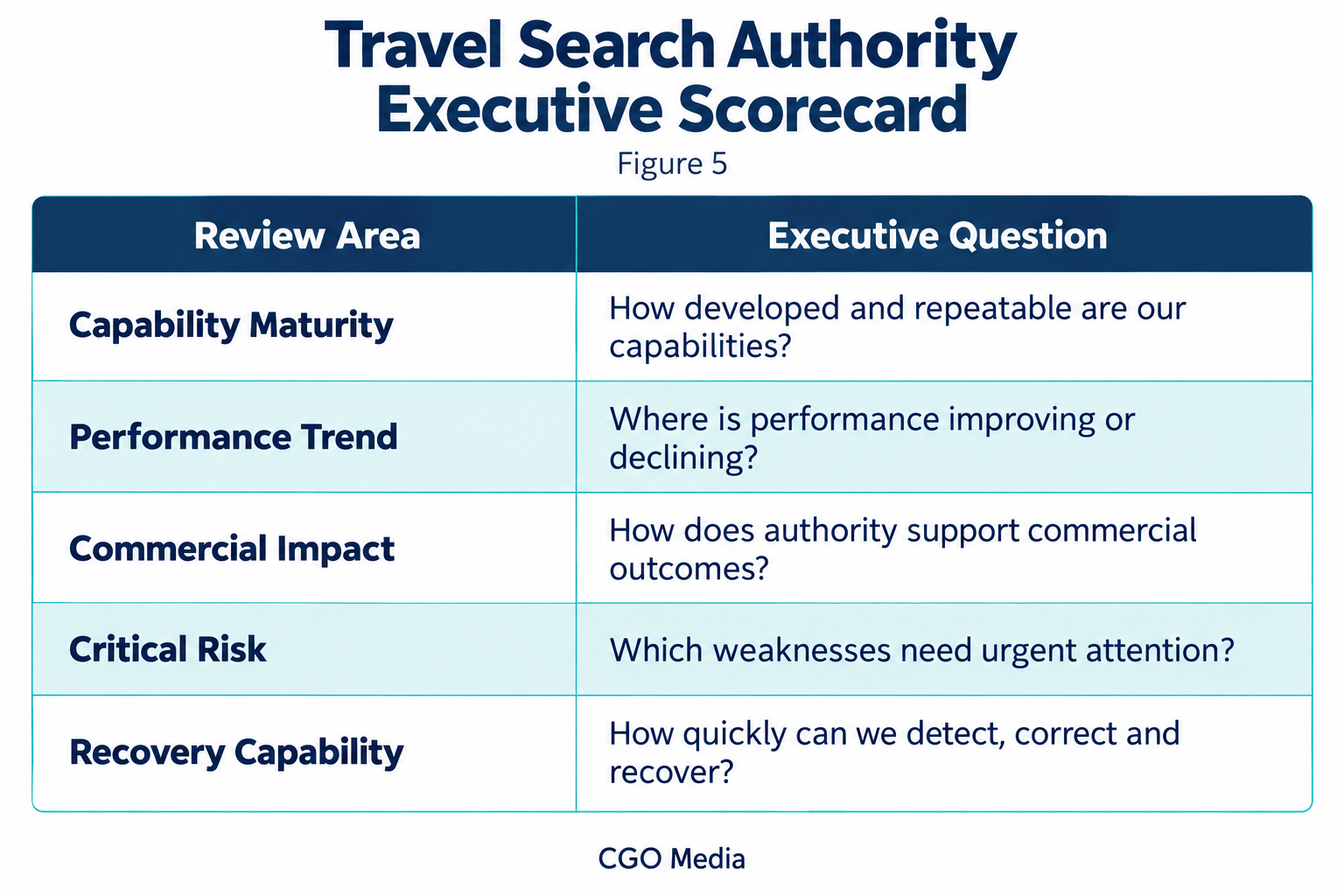
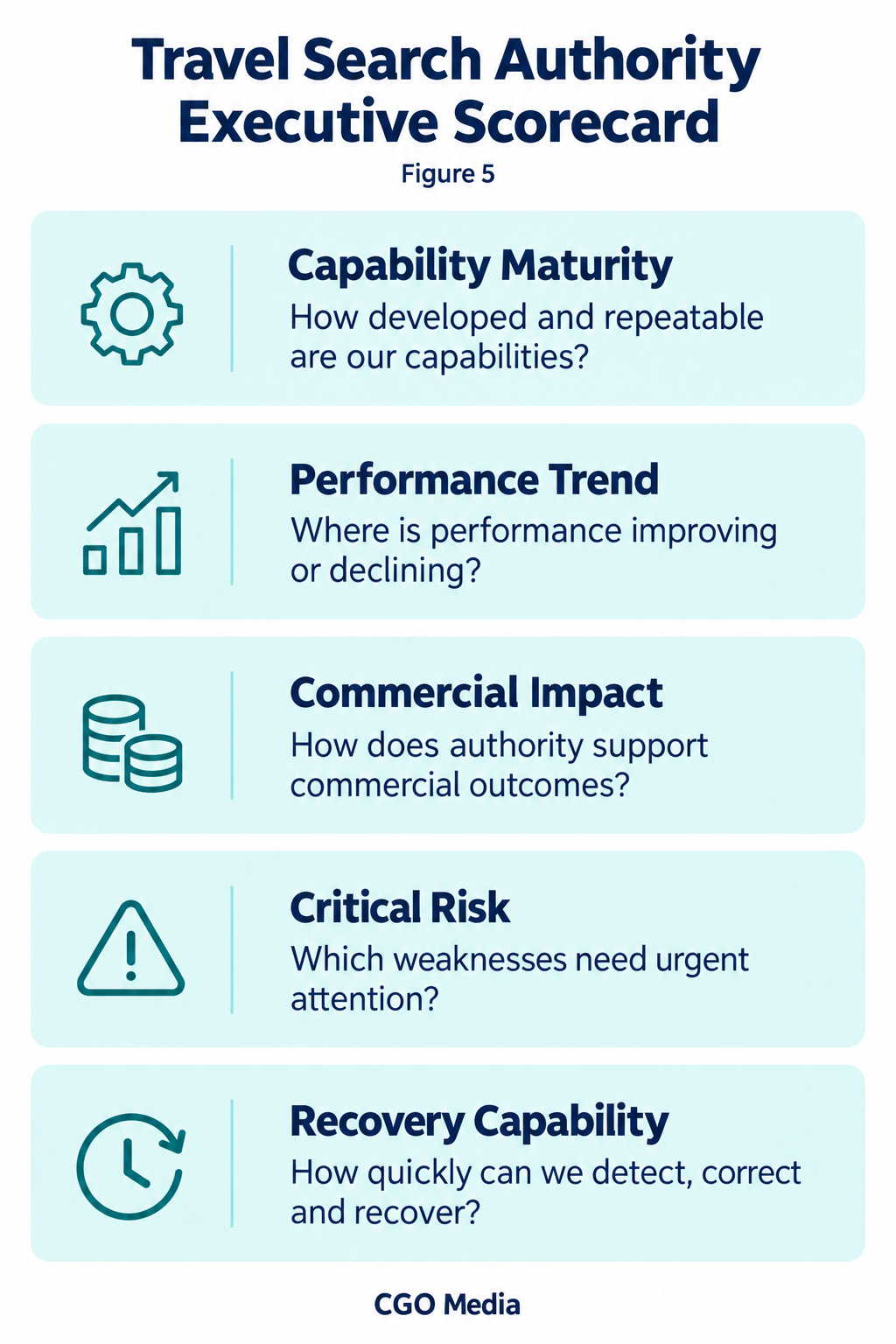
56. From Measurement to Continuous Improvement
The Travel Search Authority Executive Scorecard identifies where capability is strong, where performance is changing and where material risks exist.
The next requirement is action.
Maturity becomes valuable only when organisations use evidence to improve the underlying authority system.
This requires a repeatable cycle through which capabilities are assessed, weaknesses are diagnosed, priorities are established, improvements are implemented and results are validated.
Continuous improvement therefore represents the operational expression of Adaptive Authority.
The organisation moves from periodic optimisation toward an ongoing process of:
Assess → Diagnose → Prioritise → Improve → Integrate → Validate → Monitor → Adapt
This cycle is designed to prevent search authority from being treated as a series of disconnected projects.
57. Stage One — Assess
The continuous improvement cycle begins with assessment.
The organisation evaluates the current condition of its eight search authority capabilities and identifies material changes since the previous review.
Assessment can draw upon evidence from:
- Technical monitoring
- Entity and property data
- Destination visibility
- Content performance
- Local and platform consistency
- Review and reputation trends
- External authority signals
- AI search monitoring
- Commercial performance
The objective is not to recreate the entire maturity assessment during every review cycle.
Instead, the organisation should identify changes that may materially affect authority, risk or commercial performance.
Assessment Should Establish a Baseline
Without a baseline, the organisation cannot determine whether capability is improving or deteriorating.
Important baseline measures may therefore be maintained for each capability so that changes can be evaluated over time.
58. Stage Two — Diagnose
Once a material change or weakness has been identified, the organisation should diagnose the likely cause.
This stage is important because visible symptoms do not always reveal the underlying problem.
A decline in destination visibility, for example, could result from:
- Technical accessibility problems
- Changes in search demand
- Competitor improvement
- Outdated destination content
- Weak internal linking
- Loss of external authority
- Changes in platform representation
Similarly, declining AI recommendation visibility may be associated with weak entity clarity, insufficient external validation, changing competitor evidence or a shift in the recommendation environment.
The purpose of diagnosis is therefore to identify the capability or combination of capabilities most likely to explain the observed change.
59. Stage Three — Prioritise
Not every identified weakness requires immediate intervention.
The organisation should prioritise issues according to their significance.
Priority can reflect:
- Commercial impact
- Authority risk
- Scale of the problem
- Capability dependency
- Urgency
- Implementation effort
- Expected time to value
This prevents resources from being consumed by large numbers of low-impact issues while more important capability constraints remain unresolved.
Prioritisation Should Consider System Effects
A relatively small technical or data problem can deserve high priority when it affects many properties, destinations or downstream systems.
Conversely, a visible weakness may deserve lower priority when its commercial impact is limited and it does not constrain other capabilities.
The objective is therefore to prioritise according to system impact rather than visibility alone.
60. Stage Four — Improve
The improvement stage converts diagnosis into intervention.
Actions can range from individual corrections to wider capability programmes.
Examples include:
- Resolving technical indexation problems
- Correcting property information
- Improving structured data
- Rebuilding destination architecture
- Updating decision-useful content
- Reconciling local and OTA information
- Strengthening review-management processes
- Developing relevant external authority
- Expanding AI prompt monitoring
- Clarifying governance ownership
The appropriate intervention depends on the maturity gap identified during diagnosis.
Higher maturity improvement frequently requires process or governance change rather than a single optimisation task.
61. Stage Five — Integrate
Improvements should be integrated into the wider authority system wherever possible.
This prevents organisations from repeatedly solving the same problem in isolation.
If inaccurate facility information is discovered across several external platforms, for example, correcting individual listings may solve the immediate issue.
A more mature response also asks why the inconsistency occurred and whether the organisation needs stronger internal data standards, ownership or update processes.
Integration therefore converts individual fixes into stronger organisational capability.
Examples of Integration
- A technical fix becomes a development standard.
- A content improvement becomes a template requirement.
- A property-data correction becomes part of entity governance.
- A review insight becomes part of the content process.
- An AI visibility issue becomes part of routine monitoring.
- A PR success becomes part of strategic authority development.
This stage is essential because sustainable maturity depends on improving the system rather than repeatedly treating symptoms.
62. Stage Six — Validate
Completed work should not automatically be assumed to have succeeded.
Validation determines whether the intervention produced the intended result.
Depending on the capability, validation can include:
- Technical recrawling
- Indexation checks
- Entity-data verification
- Platform comparison
- Content-performance review
- Review-theme analysis
- External citation checks
- Repeated AI prompt testing
- Commercial-performance analysis
The validation period should reflect the type of intervention.
Some changes can be confirmed quickly. Others require sufficient time for search systems, external platforms or users to respond.
Validation Reduces False Progress
Without validation, organisations can create long lists of completed work without knowing whether authority has actually improved.
Maturity should therefore be measured by changed capability and outcomes rather than task completion alone.
63. Stage Seven — Monitor
After validation, important capabilities should continue to be monitored.
Travel authority is dynamic because the information environment continually changes.
Properties change facilities. Policies are updated. Reviews accumulate. Destinations evolve. Platforms modify data. Competitors publish new information. Search systems and AI interfaces change.
Monitoring helps the organisation identify when previously resolved issues reappear or when new weaknesses develop.
Monitoring Frequency Should Reflect Risk
Not every signal requires the same monitoring cadence.
Higher-risk or rapidly changing areas may require more frequent review, while stable capabilities can be assessed less often.
For example:
- Critical technical errors may require continuous or frequent monitoring.
- Property-data consistency may be reviewed through scheduled reconciliation.
- Review trends may be analysed monthly or quarterly depending on volume.
- AI visibility may be tested against structured prompt sets at defined intervals.
- Full maturity reassessment may occur periodically rather than continuously.
The objective is proportionate monitoring rather than maximum monitoring.
64. Stage Eight — Adapt
The final stage is adaptation.
The organisation uses evidence from previous stages to decide whether its standards, priorities, monitoring or strategic assumptions should change.
Adaptation can include:
- Changing destination priorities
- Updating content standards
- Modifying entity-governance processes
- Expanding monitoring coverage
- Adjusting AI prompt sets
- Changing external authority priorities
- Reallocating investment between capabilities
This is what distinguishes Adaptive Authority from conventional optimisation.
The organisation does not simply execute a fixed strategy more efficiently. It changes the strategy when the evidence environment changes.
65. Governance of the Continuous Improvement Cycle
Continuous improvement requires clear governance.
Without ownership, monitoring can identify problems that remain unresolved. Without standards, different teams can make conflicting changes. Without escalation, significant risks can persist because no function has authority to act.
Governance should therefore establish responsibility for each stage of the cycle.
Capability Ownership
Each major capability should have recognised ownership.
Ownership does not necessarily mean one individual performs every task. It means responsibility for maintaining the capability is explicit.
Information Ownership
Important facts should have recognised sources of truth.
For example, operational teams may own facility information while brand or ecommerce teams determine how that information is presented digitally.
The purpose is to prevent important facts from being independently recreated across multiple systems without validation.
Escalation
Significant problems need defined escalation routes.
A large-scale indexation failure, serious data inconsistency or widespread AI misrepresentation should not depend on informal communication between individual teams.
High-maturity organisations define when a problem becomes material and who is responsible for coordinating the response.
66. Search Authority Governance Cadence
The governance process can operate across several time horizons.
Operational Monitoring
Operational monitoring focuses on issues requiring relatively rapid intervention.
This may include technical failures, important profile errors, booking-path problems or major information inconsistencies.
Monthly or Periodic Performance Review
Regular performance reviews can examine:
- Visibility trends
- Destination performance
- Review themes
- Platform consistency
- AI visibility patterns
- Important authority developments
Quarterly Strategic Review
A broader review can assess whether capability maturity is progressing according to the roadmap and whether priorities need to change.
Periodic Full Maturity Assessment
The complete maturity model can be reassessed periodically or after major organisational change.
Events that may justify reassessment include:
- Acquisitions
- Rebrands
- Major website migrations
- Technology-platform changes
- Significant international expansion
- Major changes to distribution strategy
The purpose of governance cadence is to ensure that operational issues, performance trends and strategic capability are reviewed at appropriate intervals rather than being collapsed into one reporting process.
67. Resilience as a Characteristic of Mature Authority
A mature authority system should remain functional during periods of change.
Resilience describes the organisation’s ability to absorb disruption without losing control of its digital representation.
Travel organisations are particularly exposed to change because properties, products, destinations and operating conditions evolve continually.
Sources of Disruption
Potential disruptions include:
- Website migrations
- Hotel openings and closures
- Property renovations
- Brand changes
- Corporate acquisitions
- Technology replacements
- Platform-policy changes
- Search-system changes
- AI-interface changes
Lower-maturity organisations frequently respond after disruption has already created significant problems.
Higher-maturity organisations attempt to anticipate the authority implications of change.
68. Change Management and Search Authority
Major organisational changes should therefore include search authority considerations during planning rather than after implementation.
Website Migration
A migration should consider URL mapping, indexation, structured data, internal linking, content preservation, analytics and post-launch validation.
Property Acquisition
An acquisition may require reconciliation of names, addresses, profiles, websites, local entities, platform information and brand relationships.
Rebranding
A rebrand affects both owned and external representations.
The organisation may need to coordinate changes across the website, structured data, local profiles, OTAs, review platforms, media references and other external sources.
New Market Entry
International expansion can introduce new languages, destination relationships, search behaviour, platforms and regulatory requirements.
Search authority should therefore form part of wider change-management planning when the organisation’s digital representation is materially affected.
69. Recovery and Validation After Disruption
Resilience is demonstrated through recovery.
When disruption occurs, the organisation should be able to move through a clear sequence:
Detect → Diagnose → Contain → Correct → Validate → Monitor
The speed and effectiveness of this process provide useful evidence of maturity.
Recovery should also create learning.
If a problem exposed weaknesses in ownership, monitoring or standards, those weaknesses should be addressed so that similar disruption is less likely to create the same impact in future.
This turns recovery into capability improvement rather than simple restoration.
70. Continuous Improvement Should Remain Evidence-Led
Continuous optimisation can create unnecessary complexity when organisations attempt to improve everything at once.
The purpose of the maturity cycle is therefore not constant activity.
It is disciplined improvement based on evidence.
Changes should normally be associated with at least one of the following:
- A recognised maturity gap
- A measurable performance weakness
- A significant risk
- A changing traveller requirement
- A material platform or technology change
- An emerging strategic opportunity
This keeps the improvement programme connected to business and authority objectives.
71. Avoiding Maturity Theatre
Organisations should also avoid what can be described as maturity theatre: the appearance of sophistication without the underlying capability required to sustain it.
Examples can include:
- Large dashboards that do not influence decisions
- Extensive AI testing without a correction process
- Complex governance documents without clear ownership
- High volumes of content without information standards
- Advanced technology without reliable underlying data
Maturity should be demonstrated through repeatable capability and measurable improvement rather than the number of tools, reports or processes in use.
72. The Continuous Travel Search Authority Maturity Cycle
The Continuous Travel Search Authority Maturity Cycle brings the operating model together.
The eight stages are:
Assess → Diagnose → Prioritise → Improve → Integrate → Validate → Monitor → Adapt
Assess
Understand current capability, performance and material change.
Diagnose
Identify the likely cause of weaknesses, risks or emerging opportunities.
Prioritise
Determine which interventions matter most according to impact, risk and dependency.
Improve
Implement the required technical, data, content, platform, authority or governance changes.
Integrate
Embed successful improvements into wider systems, standards and processes.
Validate
Confirm whether the intervention produced the intended effect.
Monitor
Continue observing important signals for deterioration or new opportunity.
Adapt
Change priorities, standards or strategy when evidence indicates that the environment has shifted.
The cycle then begins again.
This continuous process is the defining operational characteristic of Adaptive Authority.
It enables search authority to evolve with traveller behaviour, destinations, platforms, competitors and AI discovery rather than becoming fixed around historical assumptions.
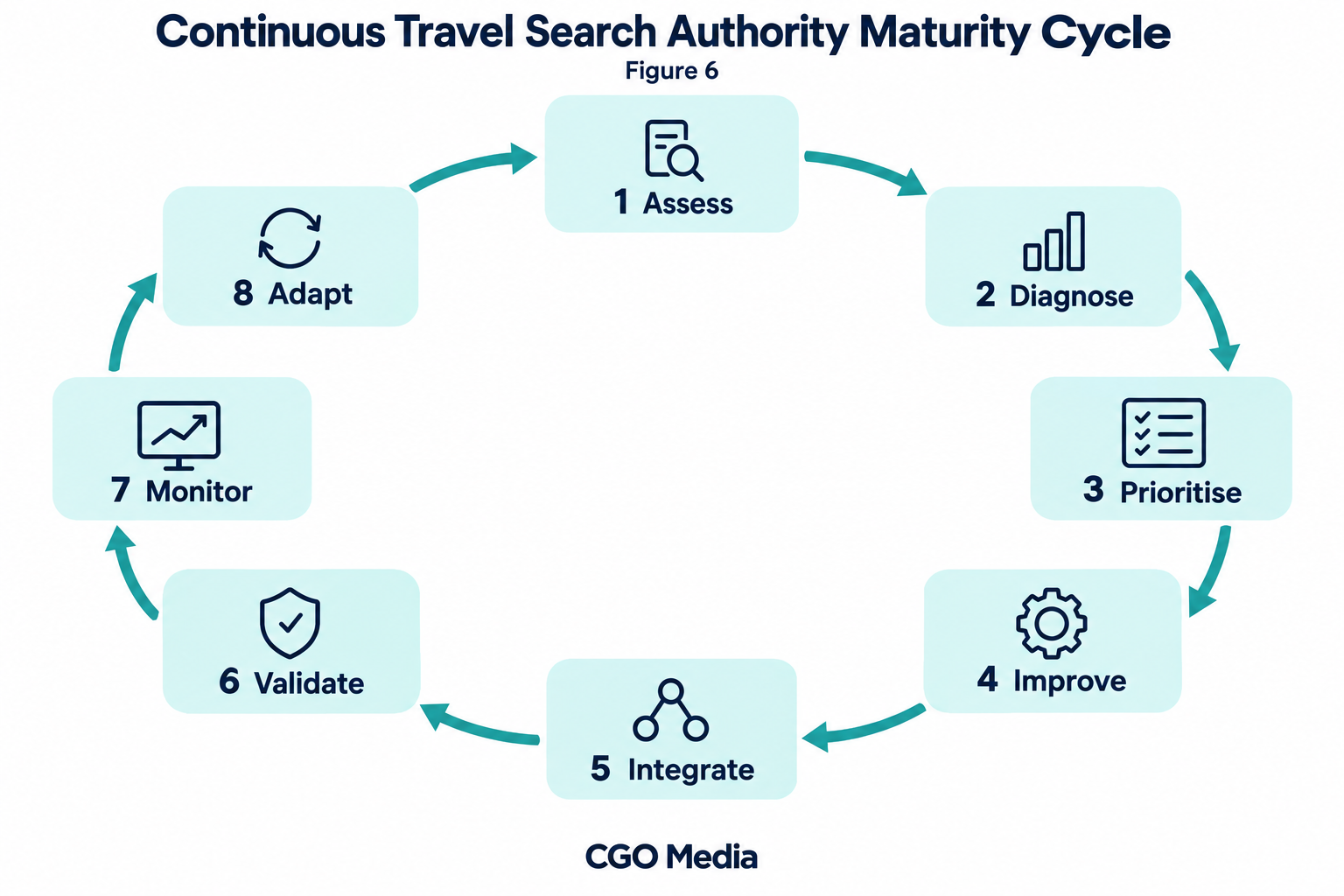
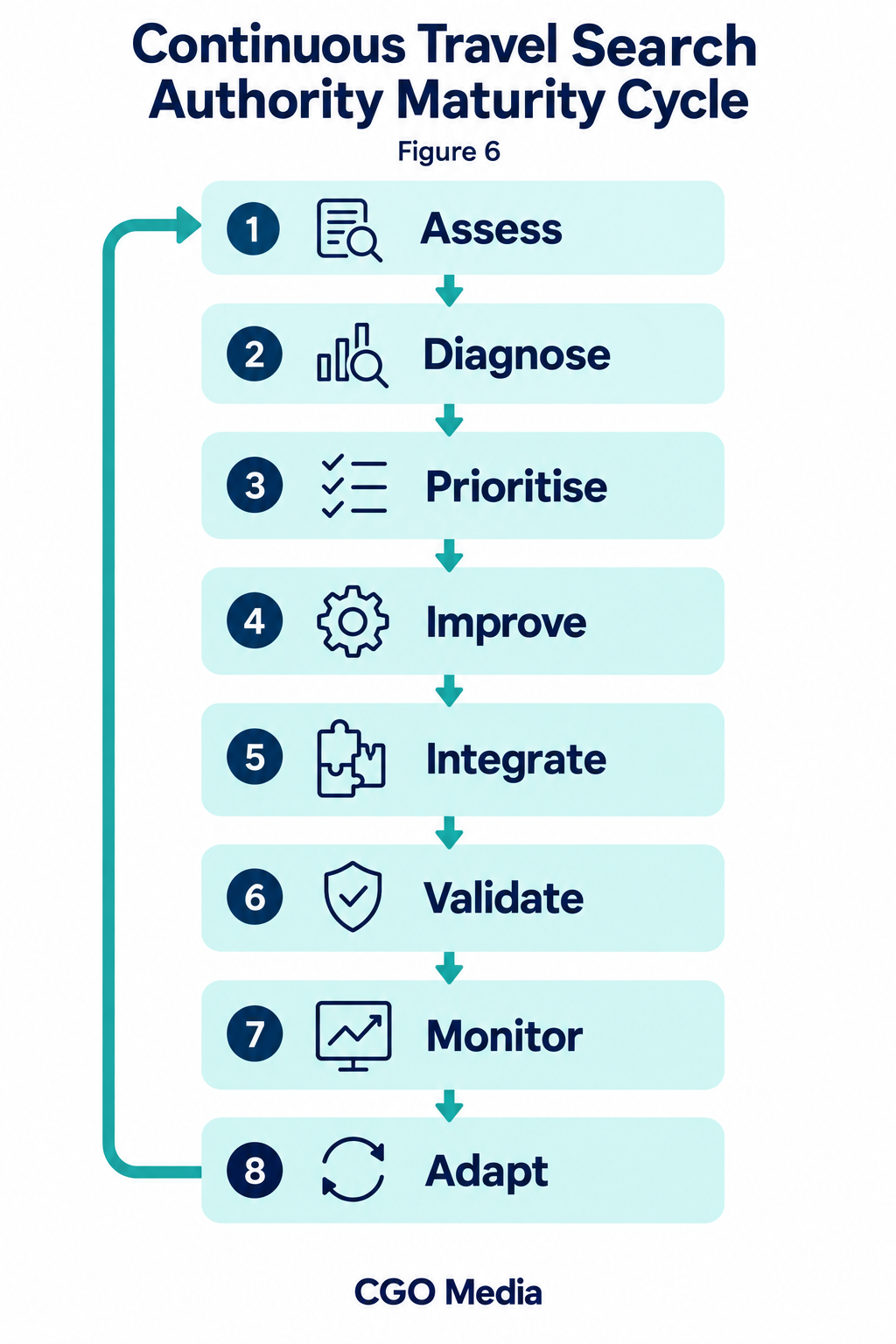
73. Applying the Model Across Travel & Hospitality Organisations
The Travel Search Authority Maturity Model is designed to be adaptable across different types of travel and hospitality organisations.
The same five maturity levels and eight capability areas can be applied to hotels, resorts, hotel groups, tour operators, travel agencies, airlines, attractions, destination organisations and travel technology providers, although the relative importance of individual capabilities will vary.
A single independent hotel may place greater emphasis on local visibility, reviews, property information and destination authority. A multinational hotel group may require significantly stronger entity governance, technical standards and cross-property data management. A tour operator may place greater emphasis on destinations, itineraries, experiences and seasonal search demand.
The model should therefore be used as a diagnostic framework rather than a fixed checklist.
Hotels and Resorts
Hotels and resorts can use the framework to assess whether property information, destination relevance, reviews, external platforms and direct-booking visibility operate as a coherent authority system.
Hotel Groups
Groups can use the model to evaluate consistency across brands, properties, markets and technology platforms while identifying where local execution differs from central standards.
Tour Operators and Travel Agencies
Tour operators can apply the framework to relationships between destinations, tours, itineraries, experiences, traveller requirements and booking products.
Destination Organisations
Destination marketing and tourism organisations can use the model to evaluate how effectively destinations, attractions, experiences and providers are represented and connected across digital discovery environments.
Travel Technology Providers
Technology organisations can use the framework to assess whether technical infrastructure, structured information, integrations and external discovery systems support accurate and scalable provider representation.
In every case, the objective is the same: identify the capabilities most important to sustainable search authority and determine where organisational development should be prioritised.
74. Methodology
The Travel Search Authority Maturity Model is a conceptual organisational framework developed by CGO Media to assess how advanced a travel or hospitality organisation has become in managing search visibility, digital authority and AI-assisted discovery.
The model is intended to move maturity assessment beyond individual rankings, traffic figures or campaign metrics.
Its central research question is:
How capable is an organisation of creating, governing, measuring and continuously improving travel search authority across traditional search, external platforms and AI-assisted discovery environments?
Model Structure
The framework combines two dimensions.
The first is the five-stage maturity progression:
Functional → Optimised → Structured → Integrated → Adaptive Authority
The second is the eight-capability assessment structure:
- Technical Search Foundations
- Entity & Data Authority
- Destination & Experience Authority
- Content & Information Quality
- Local & Platform Visibility
- External Trust & Citation Authority
- AI Search & Recommendation Visibility
- Measurement & Governance
Each capability is assessed independently before broader conclusions about organisational maturity are drawn.
Evidence Base
Assessment can draw upon multiple forms of evidence including technical audits, content inventories, entity and platform reviews, external citation analysis, review data, AI visibility testing, performance reporting and governance documentation.
Where evidence is incomplete, confidence in the resulting maturity assessment should be reduced accordingly.
Current and Target State
The methodology distinguishes between current maturity and target maturity.
A capability gap can be expressed conceptually as:
Target Capability − Current Capability = Maturity Gap
However, gap size alone does not determine priority. Business impact, risk, dependency, effort and evidence confidence should also be considered.
Transition Method
Progression through the model is represented through four principal organisational transitions:
Control → Architecture → Integration → Intelligence
These represent the movement from reactive management toward repeatable optimisation, structured information, integrated authority and continuous organisational learning.
Continuous Improvement Method
The operational improvement process is represented through:
Assess → Diagnose → Prioritise → Improve → Integrate → Validate → Monitor → Adapt
The model therefore combines maturity assessment with an operating process for continuous capability development.
75. Limitations
The Travel Search Authority Maturity Model is a strategic conceptual framework. It is not a proprietary scoring system used by Google, Bing, an AI provider, online travel agency, review platform or recommendation engine.
The maturity levels should therefore be interpreted as diagnostic categories rather than absolute measures of search performance.
Maturity Does Not Equal Commercial Performance
A Level 4 organisation should not automatically be assumed to outperform every Level 3 organisation commercially.
Revenue and demand are influenced by numerous factors outside search maturity, including pricing, product quality, destination demand, seasonality, transport capacity, brand strength and economic conditions.
Appropriate Maturity Depends on Context
The appropriate target level varies according to organisational scale, provider type, geography, commercial strategy and dependence on digital discovery.
Not every organisation requires Level 5 capability across all eight areas.
Maturity Is Not Necessarily Linear
An organisation may display characteristics from several maturity levels simultaneously.
Technical capability may be Integrated while AI monitoring remains Optimised. Destination authority may be highly developed while entity governance remains comparatively weak.
Large Organisations Can Contain Significant Internal Variation
Group-level assessment can conceal different maturity levels across properties, brands, countries and languages.
Where material variation exists, assessment should be undertaken at an appropriate organisational level.
Assessment Depends on Evidence Quality
Incomplete or unreliable evidence can reduce confidence in a maturity judgement.
Scores should therefore not imply greater precision than the available evidence supports.
AI Search Is Variable
Generative outputs can vary according to model, prompt, language, geography, timing and available evidence.
Recommendation order should not be treated as a stable conventional ranking, and isolated outputs should be interpreted cautiously.
Where systems expose citations or sources, visible references should also not automatically be assumed to represent every signal involved in generating an answer.
Correlation Does Not Establish Causation
Improved maturity and improved commercial results may occur together without proving that an individual search-authority intervention caused the commercial change.
Maturity Can Regress
Capability can weaken following organisational restructuring, staff changes, platform migrations, acquisitions, rebrands or technology changes.
Adaptive Authority should therefore not be treated as a permanent certification. It must be maintained through monitoring, governance and learning.
76. Conclusion
The Travel Search Authority Maturity Model provides a structured way to understand how travel organisations progress from basic digital participation toward increasingly integrated and adaptive authority management.
The maturity journey is:
Functional → Optimised → Structured → Integrated → Adaptive Authority
Functional organisations establish the foundations required to participate in digital discovery. Optimised organisations move toward deliberate and repeatable search management. Structured organisations develop clearer relationships between entities, destinations, products, experiences and information. Integrated organisations connect search, platforms, reputation, external authority, data and AI visibility. Adaptive organisations continuously observe, diagnose and respond to change.
The eight capabilities should not be treated as independent programmes.
Technical foundations create accessibility. Entity and data authority create identity. Destination and experience authority establish context. Content and information quality support understanding and evaluation. Local and platform visibility extend provider representation beyond owned environments. External authority provides independent validation. AI visibility reveals emerging recommendation behaviour. Measurement and governance make the complete system maintainable.
The most strategically important weakness may therefore not be the capability attracting the greatest management attention. A comparatively weak foundational capability can restrict the value generated by more advanced activity elsewhere.
This is why maturity assessment should focus on:
Current Capability → Target Capability → Gap → Business Impact → Risk → Dependency → Priority
The objective is not maximum activity.
It is coordinated authority.
Travel organisations that develop this capability are better positioned to maintain coherent visibility and trusted representation as travellers move between conventional search, maps, booking platforms, review environments, independent sources and AI-assisted discovery.
The long-term strategic requirement is therefore not simply to optimise for the search environment that exists today.
It is to build the technical, informational, organisational and analytical capability required to adapt to the search environment that emerges next.
References
External Academic, Technical and Search Sources
- Google Search Central. SEO Starter Guide.
- Google Search Central. Overview of Crawling and Indexing Topics.
- Google Search Central. Understand How Structured Data Works.
- Google Search Central. Tell Google About Localised Versions of Your Page.
- Schema.org. Hotel.
- Schema.org. LodgingBusiness.
- Schema.org. TouristAttraction.
- Schema.org. Trip.
- W3C. Web Content Accessibility Guidelines (WCAG) 2.2.
- Hogan, A. et al. (2021). Knowledge Graphs. ACM Computing Surveys, 54(4).
- Metzger, M.J. (2007). Making Sense of Credibility on the Web: Models for Evaluating Online Information and Recommendations for Future Research. Journal of the American Society for Information Science and Technology, 58(13), 2078–2091.
- Ji, Z. et al. (2023). Survey of Hallucination in Natural Language Generation. ACM Computing Surveys, 55(12).
CGO Media Travel & Hospitality Research and Frameworks
- Wilkinson, R. (2026). Travel & Hospitality SEO for AI-Powered Search. CGO Media.
- Wilkinson, R. (2026). Travel & Hospitality AI Trust and Visibility Framework. CGO Media.
- Wilkinson, R. (2026). Travel Discovery and Provider Selection Model. CGO Media.
- Wilkinson, R. (2026). Travel & Hospitality SEO and AI Implementation Roadmap. CGO Media.
CGO Media Research Ecosystem
CGO Media Research Library | CGO Media Framework Library | CGO Media Research Architecture
About Roger Wilkinson
Roger Wilkinson is an independent researcher, SEO practitioner and founder of CGO Media with more than 25 years of experience in search, digital visibility and business growth.
His research examines how artificial intelligence is changing search engines, recommendation systems, entity representation, digital authority and organisational visibility.
His work includes research into Technical SEO, Entity Authority, Content Authority, Citation Authority, Knowledge Architecture, AI Search Readiness and Generative Engine Optimisation.
Related Travel & Hospitality Research
Travel & Hospitality SEO for AI-Powered Search | Travel & Hospitality AI Trust and Visibility Framework | Travel Discovery and Provider Selection Model | Travel & Hospitality SEO and AI Implementation Roadmap | Travel & Hospitality GEO: Generative Engine Optimisation
Research Usage & Citation
CGO Media encourages travel organisations, hospitality groups, tourism bodies, researchers, journalists, consultants and technology providers to reference the Travel Search Authority Maturity Model where it contributes to analysis of search maturity, AI visibility, digital authority, destination discovery or organisational capability.
Reasonable quotations, summaries, figures and excerpts may be used in articles, reports, presentations and academic work provided appropriate acknowledgement is given to Roger Wilkinson and CGO Media.
Cite This Research
The Travel Search Authority Maturity Model by Roger Wilkinson at CGO Media presents a five-level maturity framework — Functional, Optimised, Structured, Integrated and Adaptive Authority — for assessing how travel organisations develop technical, entity, destination, trust, platform, AI visibility and governance capabilities.
APA Citation
Wilkinson, R. (2026). Travel Search Authority Maturity Model. CGO Media. https://cgomedia.com/travel-search-authority-maturity-model/
Author: Roger Wilkinson | Published by: CGO Media
For permissions relating to substantial reproduction, commercial licensing or republication of significant portions of this framework, please contact CGO Media directly.