
Travel & Hospitality SEO and AI Implementation Roadmap
Executive Summary
 The Travel & Hospitality SEO & AI Implementation Roadmap is a practical implementation framework developed by CGO Media to help hotels, resorts, hospitality groups, tourism organisations, travel companies, tour operators and experience providers translate search and AI visibility strategy into an ordered programme of action.
The roadmap is designed around a simple principle:
Travel organisations should stabilise the information and technical foundations of digital discovery before attempting to scale authority, AI visibility or recommendation performance.
Travel search authority is distributed across websites, maps, online travel agencies, review platforms, destination organisations, travel publishers, booking environments and increasingly AI-assisted discovery systems.
This means implementation cannot be reduced to a conventional sequence of keyword research, page creation and link acquisition.
The organisation must progressively build a connected authority system capable of supporting:
- Technical discoverability
- Accurate travel entities
- Destination understanding
- Product and experience evidence
- External validation
- AI-assisted discovery and recommendation
- Measurement, governance and continuous improvement
The roadmap therefore follows seven implementation stages:
Assess → Stabilise → Structure → Strengthen → Validate → Integrate → Evolve
Each stage creates foundations required by the next.
The objective is not simply to produce more travel content or gain more rankings.
It is to create a digital evidence environment in which the organisation can be discovered, understood, validated, compared and appropriately recommended across modern travel-discovery systems.
1. Why Travel SEO Requires an Implementation Roadmap
Travel and hospitality organisations frequently manage search visibility through disconnected activities.
Technical teams manage websites.
Marketing teams create campaigns.
Content teams publish destination information.
Property teams maintain operational information.
Revenue teams manage prices and availability.
Reputation teams monitor reviews.
PR teams develop external coverage.
Local teams manage maps and profiles.
AI visibility may then be added as another separate initiative.
This fragmentation creates predictable problems.
- Content is published before technical problems are resolved.
- Property information differs between websites and booking platforms.
- Destination pages are created without a clear entity architecture.
- Digital PR generates coverage unrelated to strategic travel positioning.
- Structured data describes information that is already inconsistent.
- AI monitoring begins before basic search and evidence weaknesses are corrected.
An implementation roadmap imposes order on these activities.
The central principle is:
Foundation before scale. Structure before promotion. Evidence before recommendation.
2. Travel Search Authority Is a System
Modern travel visibility depends on the interaction between multiple capabilities.
A useful implementation model is:
Technical SEO → Entity Architecture → Destination Authority → Product Evidence → External Validation → AI Visibility → Measurement & Governance
These capabilities should not be implemented as independent projects.
Technical SEO exposes information.
Entity architecture identifies what the information describes.
Destination authority provides geographic and experiential context.
Product evidence explains what the provider actually offers.
External validation strengthens trust.
AI visibility reflects how effectively this evidence can support discovery, comparison and recommendation.
Measurement and governance protect the entire system.
3. The Roadmap Should Follow Dependency Order
Implementation order matters.
Attempting to scale advanced activities before basic dependencies are reliable can waste resources.
For example:
- Publishing hundreds of destination pages provides limited value if major sections of the site cannot be crawled correctly.
- Adding structured data has limited value if underlying property information is inaccurate.
- Building Digital PR around family travel has limited strategic value if the property’s family facilities are poorly documented.
- Monitoring AI recommendations provides limited diagnostic value if the organisation does not know which public sources contain conflicting information.
The roadmap therefore moves progressively from diagnosis to stable infrastructure, structured information, stronger evidence, external validation, AI integration and ongoing optimisation.
4. The Seven-Stage Travel SEO & AI Implementation Roadmap
The roadmap contains seven connected stages.
Stage One — Assess
Establish the current position across technical SEO, entity clarity, destination authority, product information, platform consistency, external trust and AI visibility.
Stage Two — Stabilise
Correct technical, data and operational weaknesses capable of undermining every later stage.
Stage Three — Structure
Create a coherent architecture connecting brands, destinations, properties, products, experiences and traveller needs.
Stage Four — Strengthen
Develop deeper destination knowledge, product evidence, traveller information and content authority.
Stage Five — Validate
Strengthen independent authority through traveller evidence, tourism organisations, relevant publications, research and Digital PR.
Stage Six — Integrate
Connect search, entities, external evidence and AI monitoring into one discovery and recommendation system.
Stage Seven — Evolve
Measure performance, maintain information quality, correct emerging weaknesses and continuously improve the authority system.
The seven stages can be summarised as:
Assess → Stabilise → Structure → Strengthen → Validate → Integrate → Evolve
5. Stage One — Assess the Current Travel Authority System
Implementation should begin with assessment rather than immediate optimisation.
The organisation needs to establish what currently exists, what is reliable, what is missing and where the most important constraints occur.
A complete assessment should examine more than website rankings.
It should review the wider travel-discovery ecosystem.
Assessment Areas
- Technical search performance
- Property and organisational entities
- Destination architecture
- Product and experience information
- Local and map visibility
- OTA and platform consistency
- Traveller reviews
- External authority
- AI discovery and recommendation visibility
The purpose is to create a defensible baseline.
6. Assess Technical Search Foundations
The technical assessment should establish whether important travel information can be reliably crawled, rendered and indexed.
Priority areas include:
- Crawlability
- Indexation
- Canonicalisation
- Rendering
- Internal linking
- Site architecture
- Mobile usability
- Core performance
- International targeting where applicable
Technical problems should be evaluated according to business impact rather than simply counted.
A minor issue affecting an old article is less important than an indexation problem affecting every hotel or destination page.
Technical Priority
A useful prioritisation model is:
Impact × Scale × Strategic Importance
This keeps technical implementation focused on problems capable of materially limiting discovery.
7. Assess Property and Organisational Entities
Travel organisations should establish whether the principal entities within the business are represented clearly and consistently.
Depending on the organisation, this may include:
- Parent company
- Hotel brand
- Individual property
- Resort
- Restaurant
- Spa
- Golf facility
- Experience provider
- Tourism organisation
For each important entity, the assessment should determine whether key attributes are clear.
These can include:
- Official name
- Property type
- Brand relationship
- Address
- Coordinates
- Contact information
- Operating status
Entity ambiguity should be identified early because it can contaminate later content, platform and AI interpretation.
8. Assess Destination Architecture
Travel discovery is heavily influenced by geography.
The assessment should therefore examine whether the website and wider digital estate clearly represent relationships between providers and places.
A useful hierarchy is:
Country → Region → Destination → Neighbourhood → Property → Experience
Depending on the business, additional relationships may include:
- Airports
- Beaches
- Golf courses
- Conference venues
- Attractions
- Transport hubs
The assessment should identify:
- Missing destination coverage
- Duplicate destination pages
- Weak neighbourhood information
- Confusing geographic relationships
- Poor internal linking
- Destination pages with little traveller value
9. Assess Product and Experience Evidence
Travel providers should evaluate how well their digital information represents what they actually sell.
For accommodation providers this may include:
- Room types
- Occupancy
- Facilities
- Restaurants
- Pools
- Spas
- Parking
- Family facilities
- Accessibility
- Transport
The assessment should identify attributes that exist operationally but are poorly represented digitally.
This is important because missing evidence can create lost discovery opportunities even when the product itself is appropriate.
A useful diagnostic question is:
What important reason for selecting this provider exists in reality but is difficult to establish from its digital evidence?
10. Assess Platform and Local Consistency
The provider website is only one component of travel discovery.
Assessment should compare important facts across:
- Maps
- Local profiles
- Online travel agencies
- Review platforms
- Destination websites
- Booking marketplaces
High-priority inconsistencies can include:
- Different property names
- Incorrect addresses
- Incorrect coordinates
- Outdated facilities
- Conflicting accessibility information
- Wrong operating status
Platform inconsistency should be treated as a data-governance issue as well as a marketing issue.
11. Assess External Trust and Validation
Travel authority cannot be assessed entirely through first-party information.
The organisation should understand how independent sources represent important destinations, properties and experiences.
External evidence can include:
- Traveller reviews
- Tourism organisations
- Travel publications
- Relevant media
- Specialist travel sources
- Industry recognition
Assessment should examine not only the quantity of external coverage but its relevance to strategic positioning.
For example, a provider positioning itself around family travel should determine whether independent evidence actually reinforces that association.
12. Assess Review Evidence
Review assessment should go beyond average ratings.
Recurring themes can reveal whether digital positioning aligns with the actual traveller experience.
Useful themes include:
- Service
- Location
- Cleanliness
- Noise
- Facilities
- Dining
- Family suitability
- Business suitability
- Value
Review analysis can expose both strengths worth reinforcing and experience problems capable of undermining future authority.
13. Assess AI Search and Recommendation Visibility
AI visibility should be assessed as part of the baseline, but it should not dominate the initial audit.
Structured traveller scenarios can be used to examine:
- Provider recognition
- Destination recognition
- Description accuracy
- Comparison inclusion
- Recommendation inclusion
- Traveller fit
- Visible sources or citations where available
The purpose is not to count every mention.
The assessment should identify persistent patterns and material errors.
Priority AI Scenarios
Testing should begin with:
- Major destinations
- Strategic traveller segments
- High-value experiences
- Important properties
- Commercially meaningful trip scenarios
14. Build the Initial Authority Baseline
The assessment phase should conclude with a structured baseline.
A practical baseline can cover:
| Capability | Current State | Risk | Priority |
|---|---|---|---|
| Technical Search | Current capability | Low / Medium / High | Low / Medium / High / Critical |
| Entity Integrity | Current capability | Low / Medium / High | Low / Medium / High / Critical |
| Destination Authority | Current capability | Low / Medium / High | Low / Medium / High / Critical |
| Product Evidence | Current capability | Low / Medium / High | Low / Medium / High / Critical |
| External Trust | Current capability | Low / Medium / High | Low / Medium / High / Critical |
| AI Visibility | Current capability | Low / Medium / High | Low / Medium / High / Critical |
The baseline provides the reference point against which later implementation can be measured.
15. Identify Critical Dependencies
The audit should identify which weaknesses prevent progress elsewhere.
Examples include:
- Technical indexing failures blocking destination visibility
- Poor property data preventing reliable entity representation
- Weak destination architecture limiting provider context
- Missing product attributes limiting traveller matching
- Platform conflicts weakening trust
- Weak external evidence constraining recommendation confidence
A dependency-first roadmap prevents the organisation from investing heavily in activities that cannot yet produce their full value.
16. Stage Two — Stabilise Technical and Data Foundations
Once the current position is understood, the organisation should stabilise the infrastructure and information systems on which later authority development depends.
The Stabilise phase focuses on two foundations:
- Technical reliability
- Information reliability
The objective is not perfection.
It is to remove material weaknesses capable of undermining the later Structure, Strengthen and Validate stages.
17. Stabilise Crawlability and Indexation
Priority travel pages should be reliably accessible to search systems.
Typical priorities include:
- Hotel pages
- Destination pages
- Room and product pages
- Experience pages
- Important informational content
Technical implementation should resolve material problems involving:
- Robots directives
- Canonical errors
- Redirect chains
- Duplicate URL structures
- Rendering failures
- Broken internal links
- Orphan pages
Implementation should focus on commercially and strategically important page families first.
18. Stabilise Site Architecture
A clear site architecture supports both crawling and later entity development.
Important travel content should sit within understandable relationships rather than fragmented URL structures.
A basic architecture might connect:
Brand → Destination → Property → Accommodation → Experience
Internal linking should reinforce these relationships.
The architecture should help travellers as well as machines understand where information belongs.
19. Stabilise Core Property Data
Critical property facts should be reconciled before wider authority work begins.
Priority fields can include:
- Official property name
- Brand
- Property type
- Address
- Coordinates
- Contact details
- Operating status
- Core amenities
- Accessibility information
The organisation should identify a recognised source of truth for each critical data field.
This reduces the risk of several teams maintaining conflicting versions of the same information.
20. Stabilise Platform Information
Material inconsistencies across major travel platforms should be corrected where possible.
Priority should be given to errors capable of affecting traveller decisions.
These can include:
- Wrong location
- Incorrect operating status
- False facility information
- Incorrect accessibility information
- Wrong brand relationship
A practical correction sequence is:
Confirm Internal Truth → Correct Owned Information → Correct Priority Platforms → Verify Public Representation
21. Stabilise International Foundations Where Required
Travel businesses frequently operate across multiple countries and languages.
International implementation should therefore address material issues involving:
- Language architecture
- Country targeting
- Hreflang
- Canonicalisation
- Regional content
- Market-specific traveller information
International SEO should not be treated as simple translation.
Different markets can have different:
- Destination familiarity
- Booking behaviour
- Seasonality
- Transport patterns
- Traveller expectations
The technical and information architecture should allow meaningful localisation where required.
22. Define the Stabilisation Exit Criteria
The organisation does not need to eliminate every technical or information issue before moving forward.
However, major foundations should be reliable enough to support the next stages.
Typical exit criteria include:
- Priority pages are crawlable and indexable.
- Major duplication and canonical issues are controlled.
- Critical property information has recognised ownership.
- Material entity conflicts have been resolved.
- Priority platform errors have been corrected or entered into a managed remediation process.
- International foundations are stable where required.
At this point the organisation can move from stabilisation into architecture development.
23. Part One Implementation Outcome
The first two roadmap stages create a reliable implementation starting point.
Assess establishes the current authority position.
Stabilise removes the technical and information weaknesses most likely to undermine future work.
The resulting foundation can be represented as:
Baseline Assessment → Technical Reliability → Data Reliability → Stable Search Foundation
The next stage can then focus on creating a connected architecture around destinations, entities, properties, products and traveller needs.
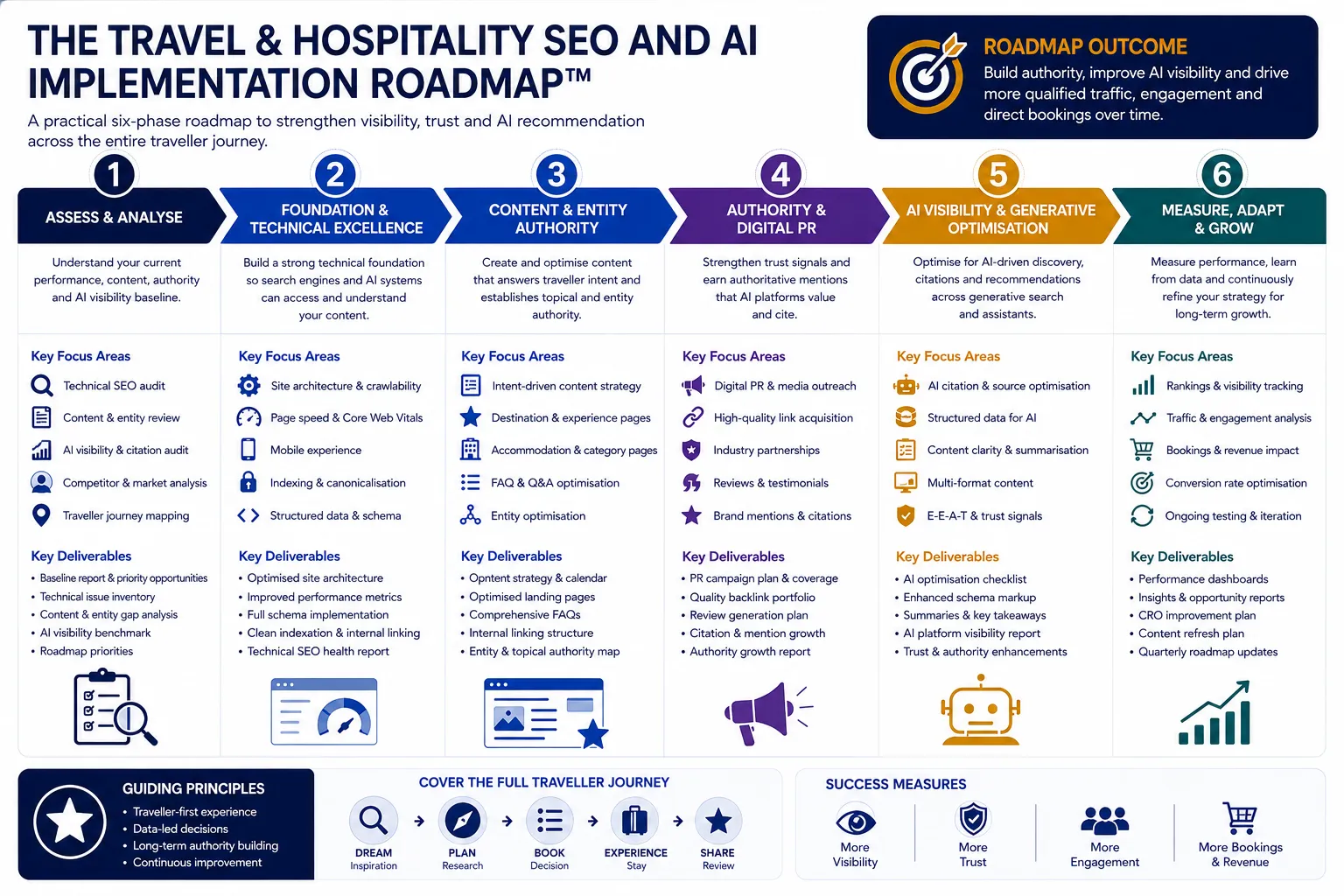
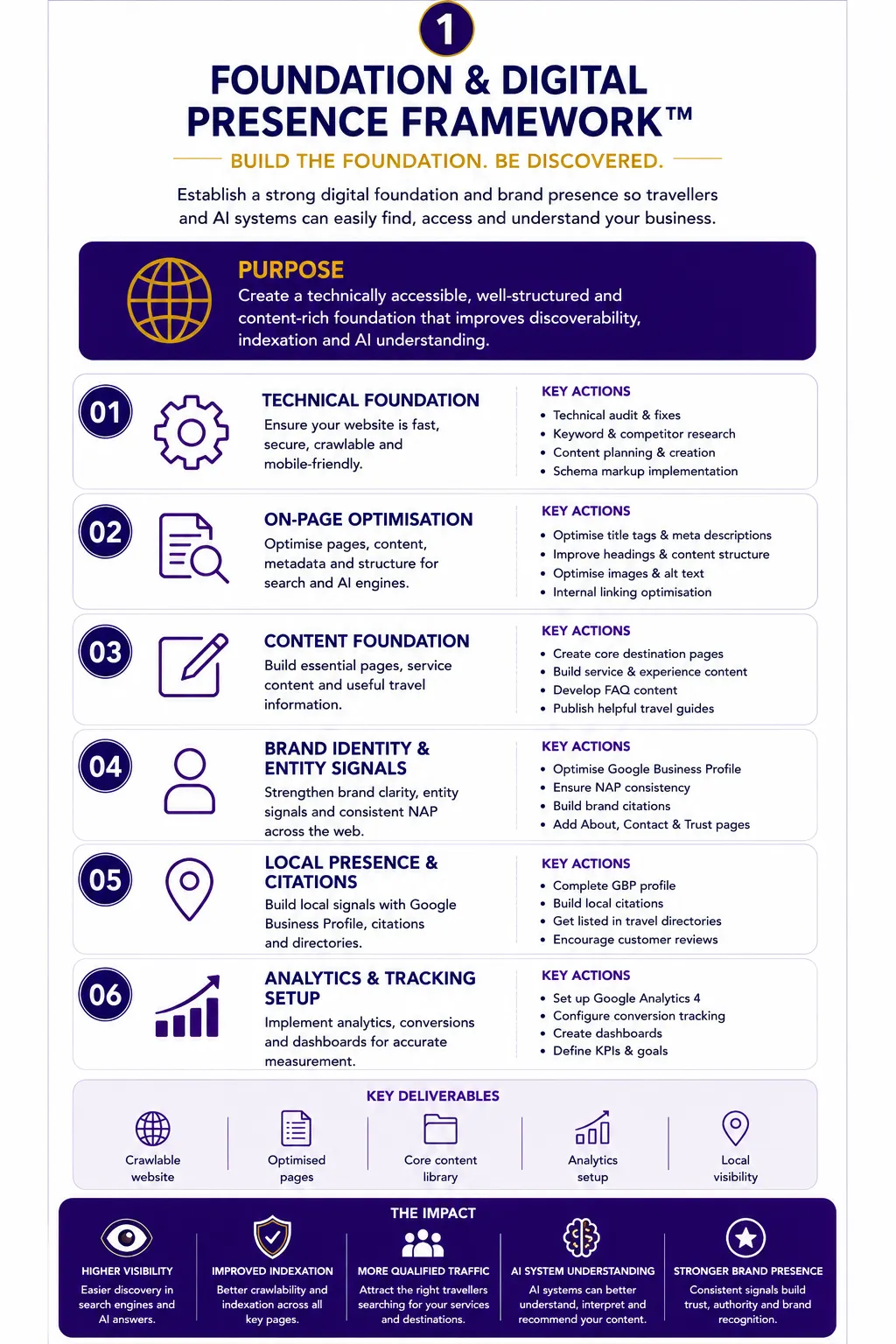
Figure 1 : Travel & Hospitality SEO and AI Implementation Roadmap — Assess → Stabilise → Structure → Strengthen → Validate → Integrate → Evolve.
24. Stage Three — Structure the Travel Knowledge Architecture
Once the technical and data foundations are sufficiently stable, implementation can move into the Structure phase.
The objective is to organise destinations, providers, products, experiences and traveller needs into a coherent digital architecture.
A useful relationship is:
Brand → Destination → Property → Product → Experience → Traveller Need
This architecture helps travellers, search engines and AI systems understand how information relates.
The purpose is not to create the largest possible number of pages.
It is to create a connected information system around the decisions travellers actually make.
25. Structure Begins with Clear Entities
The organisation should identify the principal entities that need to be represented consistently.
These may include:
- Parent organisation
- Brands
- Hotels
- Resorts
- Destinations
- Restaurants
- Spas
- Golf facilities
- Attractions
- Travel experiences
Each important entity should have a clear identity and relationship to the others.
For example:
Hospitality Group → Brand → Property → Destination
or:
Tourism Organisation → Destination → Attraction → Experience
Entity clarity reduces the risk that digital systems associate the wrong information with the wrong provider.
26. Build a Property Entity Register
Large hospitality organisations can benefit from a central property entity register.
The register can record:
- Official property name
- Brand
- Property type
- Address
- Coordinates
- Destination
- Neighbourhood
- Operating status
- Core amenities
- Primary website URL
This creates a reference point for SEO, content, platform management, structured data and AI monitoring.
It also makes entity discrepancies easier to diagnose.
27. Define Brand and Property Relationships
Hospitality groups frequently operate several brands, sub-brands and individual properties.
These relationships should be understandable both to travellers and digital systems.
Implementation should clarify:
- Which company owns or operates the property
- Which brand the property belongs to
- Whether the property has a distinct public identity
- Which destinations the property serves
Complex ownership structures should not be allowed to obscure the traveller-facing identity of the provider.
28. Structure Destination Entities
Travel architecture should represent locations as meaningful entities rather than merely keyword targets.
A useful geographic hierarchy may include:
Country → Region → City or Resort Area → Neighbourhood → Property
Additional geographic entities can include:
- Airports
- Beaches
- Transport hubs
- Golf courses
- Conference centres
- Major attractions
The structure should reflect real geography and real traveller behaviour.
29. Destination Architecture Should Support Decisions
Destination architecture should help travellers understand where to stay and why.
Useful relationships can answer questions such as:
- Which area is best for families?
- Which neighbourhood is closest to the historic centre?
- Which properties are convenient for the airport?
- Which hotels are close to golf courses?
- Which areas suit business travellers?
The objective is to connect geography with traveller intent.
A useful model is:
Destination → Location Context → Traveller Need → Relevant Provider
30. Avoid Keyword-Led Destination Fragmentation
Travel websites can easily accumulate large numbers of near-duplicate destination pages created around similar search terms.
This can produce:
- Content duplication
- Keyword cannibalisation
- Weak internal linking
- Confusing geographic relationships
- Poor maintenance
Pages should exist because they serve a distinct traveller need or represent a meaningful entity.
Small keyword variations alone are rarely sufficient justification for separate pages.
31. Give Each Destination Page a Clear Role
Different destination pages can serve different functions.
Country or Regional Pages
Can introduce broader geography, transport and destination clusters.
City or Resort Pages
Can support area selection, property discovery and traveller planning.
Neighbourhood Pages
Can explain character, access, attractions and traveller suitability.
Attraction Pages
Can provide practical context around access, travel time and nearby accommodation.
The page structure should reflect function rather than search-volume duplication.
32. Structure Property Pages Around Traveller Decisions
The property page should act as the central entity page for the hotel, resort or provider.
It should make important decision information easy to identify.
This can include:
- Property identity
- Location
- Accommodation
- Facilities
- Dining
- Accessibility
- Transport
- Traveller suitability
- Relevant experiences
- Booking pathway
The property page should connect naturally to deeper product and experience pages rather than attempting to contain every detail itself.
33. Structure Product Entities
Travel providers should identify the products that travellers actually evaluate.
For a hotel these may include:
- Rooms
- Suites
- Villas
- Meeting facilities
- Spa services
- Restaurants
- Golf packages
- Experiences
Important products should have sufficient information to support comparison and eligibility filtering.
The objective is not to create a page for every operational item.
Products deserve stronger digital representation where they materially influence discovery, selection or booking.
34. Room Architecture Should Reflect Real Inventory
Accommodation structures should make clear how room and unit types differ.
Useful attributes can include:
- Occupancy
- Bed configuration
- Room size where appropriate
- View
- Accessibility
- Facilities
- Connecting-room options
Vague room naming without sufficient supporting detail increases decision friction.
Where several room types are materially similar, the architecture should avoid unnecessary duplication.
35. Structure Experience Entities
Experiences can also function as meaningful travel entities.
Examples include:
- Golf
- Wellness
- Spa treatments
- Dining experiences
- Excursions
- Water sports
- Cultural experiences
- Family activities
The architecture should connect the experience to the relevant property and destination.
A useful relationship is:
Destination → Property → Experience → Traveller Segment
36. Structure Traveller-Segment Relationships
Traveller segments can help connect product evidence with real travel needs.
Relevant segments may include:
- Families
- Couples
- Business travellers
- Luxury travellers
- Golf travellers
- Wellness travellers
- Accessible travellers
However, traveller-segment architecture should only be created where the underlying provider genuinely supports that positioning.
A family-travel page without real family facilities creates weak and potentially misleading evidence.
37. Connect Entities Through Internal Linking
Internal linking should reinforce the knowledge architecture.
A useful pathway is:
Destination → Property → Product → Experience → Booking
Links should help travellers move naturally between related decisions.
Examples include:
- Destination pages linking to relevant properties
- Property pages linking to room types
- Property pages linking to experiences
- Experience pages linking back to relevant properties
The objective is both usability and semantic clarity.
38. Internal Linking Should Reflect Relevance
Internal links should not be inserted mechanically simply to increase link volume.
Links are most useful where they explain a meaningful relationship.
For example:
A Marbella destination page can link to properties genuinely located within or relevant to Marbella.
A golf page can link to hotels providing appropriate golf access or services.
A family-travel page can connect to properties with genuine family facilities.
This creates a more interpretable network of travel relationships.
39. Use Breadcrumbs to Reinforce Hierarchy
Breadcrumbs can help both travellers and search systems understand where a page sits within the information architecture.
A property hierarchy might appear as:
Home → Spain → Costa del Sol → Marbella → Property
A product hierarchy might appear as:
Property → Accommodation → Room Type
The hierarchy should remain understandable and should reflect genuine organisational or geographic relationships.
40. Structured Data Should Describe the Visible Architecture
Structured data can support explicit representation of entities and relationships where appropriate.
Relevant types can include:
- Organization
- Hotel
- LodgingBusiness
- TouristDestination
- TouristAttraction
- BreadcrumbList
Structured data should describe visible and accurate page content.
It should not be used to manufacture relationships that the underlying website does not clearly support.
41. Structured Data Is Not a Substitute for Architecture
Schema markup cannot repair an incoherent content structure.
If:
- Property names conflict
- Destination relationships are unclear
- Pages duplicate one another
- Product information is weak
then adding additional structured data does not resolve the underlying problem.
The correct sequence is:
Clear Information → Clear Architecture → Accurate Structured Representation
42. Define Stable and Dynamic Information
The Structure phase should distinguish information that changes slowly from information requiring operational freshness.
Relatively Stable Information
- Property identity
- Destination
- Room characteristics
- Permanent facilities
- Core experiences
Dynamic Information
- Rates
- Availability
- Promotions
- Seasonal packages
- Opening schedules
Dynamic information should normally depend on operational systems rather than being embedded as permanent statements within evergreen content.
43. Define Sources of Truth
Each important information category should have a recognised source of truth.
For example:
- Operations may own facilities and opening information.
- Revenue systems may own inventory and rates.
- Brand systems may own property naming.
- Location systems may own address and coordinates.
Digital teams should consume reliable information rather than independently invent or maintain critical travel facts.
44. Architecture Should Support Future Scale
The structure should remain manageable as the organisation adds:
- New properties
- New destinations
- New experiences
- New languages
- New traveller segments
This is particularly important for hospitality groups where inconsistent local implementation can quickly create fragmentation.
Templates, naming standards and entity registers can support controlled expansion.
45. International Architecture Requires Consistent Entities
International websites may present the same property across several languages or country markets.
The property entity itself should remain stable.
Core attributes such as:
- Name
- Location
- Property type
- Facilities
- Brand relationship
should remain compatible across markets.
Traveller-facing information can then be adapted according to local language and market needs.
46. Architecture Should Connect Search Intent with Entities
Traditional keyword research remains useful, but keywords should inform architecture rather than dictate it entirely.
Search demand can reveal:
- Destination questions
- Neighbourhood comparisons
- Traveller-segment needs
- Experience demand
- Provider-selection criteria
The organisation can then connect those needs to the entities capable of satisfying them.
A useful relationship is:
Traveller Intent → Information Need → Relevant Entity → Suitable Provider
47. Architecture Should Support AI Interpretation
Generative systems increasingly need to connect several pieces of travel information within one interaction.
For example:
Which family-friendly hotels in Marbella have pools and are close to the beach?
This involves several relationships:
Traveller Segment + Destination + Property + Facility + Location Relationship
A structured digital architecture makes these relationships easier to interpret than a collection of disconnected generic pages.
48. Architecture Should Support Eligibility Filtering
Traveller decisions frequently involve filtering providers according to non-negotiable requirements.
Eligibility criteria can include:
- Budget
- Location
- Occupancy
- Accessibility
- Facilities
- Transport
- Traveller type
Important provider attributes should therefore be easy to identify rather than hidden within broad marketing copy.
This strengthens both traveller usability and machine interpretation.
49. Validate the Architecture Before Scaling Content
The organisation should test whether the new architecture is understandable before investing heavily in content expansion.
Validation can ask:
- Can priority properties be reached easily?
- Are destination relationships clear?
- Are duplicate page roles reduced?
- Are important products represented?
- Can travellers move naturally between related pages?
- Are important entity relationships consistent?
Architecture problems are cheaper to correct before hundreds or thousands of pages inherit them.
50. Foundation Validation
At this stage, the organisation should validate the combined output of the Stabilise and Structure phases.
The foundation should now demonstrate:
- Technical reliability
- Accurate core data
- Clear provider entities
- Coherent destination relationships
- Understandable product architecture
- Reliable internal linking
This does not require complete optimisation.
It requires enough structural stability for later authority-building work to scale safely.
51. Foundation Governance
Clear ownership should support the architecture.
Typical responsibilities may include:
- SEO: crawlability, indexation and search diagnostics
- Technology: rendering, performance and integrations
- Revenue: rates, inventory and commercial feeds
- Operations: facilities, policies and service availability
- Content: destinations, properties and traveller information
- Distribution: OTAs, channels and third-party listings
Governance reduces the risk that structural improvements deteriorate as different teams update information independently.
52. Maintain a Foundation Register
A practical implementation register can record:
- Workstream
- Issue
- Owner
- Priority
- Dependency
- Implementation status
- Validation status
This creates visibility around dependencies and prevents later workstreams from scaling before important prerequisites are complete.
53. The Structure Phase Exit Criteria
The Structure phase can be considered sufficiently mature when:
- Priority entities are clearly defined.
- Property and brand relationships are understandable.
- Destination hierarchies reflect real geography.
- Property and product pages have distinct roles.
- Internal linking reinforces meaningful relationships.
- Structured data reflects visible information where appropriate.
- Sources of truth are defined for critical facts.
Perfection is unnecessary.
The objective is sufficient coherence to begin scaling decision-useful authority.
54. The Connected Travel Architecture
The resulting architecture can be represented as:
Destination ↔ Neighbourhood ↔ Property ↔ Product ↔ Experience ↔ Traveller Need
This connected structure allows:
- Technical accessibility to support entity discovery
- Entity clarity to support destination understanding
- Destination context to support product evaluation
- Product evidence to support traveller matching
- Traveller matching to support later comparison and recommendation
This is the structural bridge between basic SEO infrastructure and deeper travel authority.
55. The Travel SEO & AI Implementation Foundation Model
The complete implementation foundation can be summarised as:
Technical Reliability + Data Accuracy + Entity Clarity + Architecture Coherence = Implementation Readiness
Technical Reliability
Important pages and traveller journeys can be accessed, rendered, indexed and used reliably.
Data Accuracy
Critical provider, product and operational information reflects recognised internal sources of truth.
Entity Clarity
Brands, properties, destinations, products and experiences can be identified and connected correctly.
Architecture Coherence
Information is organised around meaningful destination, provider, product and traveller relationships.
Once these four foundations are sufficiently stable, the organisation can move from structural readiness into deeper authority development.
The implementation progression becomes:
Fragmented Systems → Stable Foundations → Structured Travel Knowledge → Scalable Authority


56. Stage Four — Strengthen Decision-Useful Travel Authority
Once technical reliability, data accuracy, entity clarity and architecture coherence are sufficiently established, implementation can move into the Strengthen phase.
The objective is not simply to increase content volume.
It is to build useful evidence around:
- Destination relevance
- Property suitability
- Product characteristics
- Traveller needs
- Practical trip decisions
Travel content should help the traveller understand whether a destination, property or experience genuinely fits their trip.
A useful principle is:
Information Volume ≠ Travel Authority
Authority increases when information becomes more useful, specific, supportable and connected to real travel decisions.
57. Destination Content Should Help Travellers Choose
Destination content should support decisions rather than simply describe places.
Useful destination information can explain:
- Which area to stay in
- Who different areas suit
- How transport works
- What attractions are nearby
- How seasonality affects the trip
- What practical trade-offs exist
A generic description of a destination may be accurate while contributing little to provider selection.
Decision-useful content connects destination knowledge directly with traveller needs.
58. Build Destination Authority Around Real Geographic Relationships
Destination authority should reflect actual geography.
Useful relationships can include:
Region → Destination → Neighbourhood → Attraction → Property
Where relevant, content can explain:
- Walking distances
- Transport connections
- Airport access
- Beach access
- Golf access
- Conference access
- Local character
This helps move destination content from promotional description toward practical travel intelligence.
59. Destination Content Should Connect to Commercial Intent
Destination research often occurs before property selection.
The content architecture should therefore create a natural progression:
Destination Research → Area Selection → Property Discovery → Product Evaluation → Booking
Relevant destination pages should connect travellers to properties and experiences that genuinely match the location being researched.
This creates a stronger relationship between informational search demand and commercial discovery.
60. Avoid Generic Destination Content at Scale
Publishing hundreds of thin destination pages can create the appearance of topical coverage without creating meaningful authority.
Weak pages often repeat:
- Generic history
- Widely known attractions
- Generic weather descriptions
- Promotional statements
Stronger destination assets should contain information capable of helping the traveller make a decision.
The test should be:
What does this page help the traveller decide that they could not easily determine from generic destination information?
61. Strengthen Property-Level Evidence
Property pages should clearly explain the characteristics that influence traveller suitability.
Important evidence can include:
- Exact location
- Accommodation types
- Facilities
- Dining
- Accessibility
- Transport
- Parking
- Family facilities
- Business facilities
- Relevant experiences
The objective is to make the property’s real strengths and limitations easier to evaluate.
62. Strengthen Product-Level Evidence
Travel decisions frequently depend on product details rather than the property brand alone.
For accommodation, useful product evidence can include:
- Room type
- Occupancy
- Bed configuration
- Accessibility
- Connecting-room availability
- View or location within the property
- Relevant facilities
For experiences, product evidence may include duration, location, eligibility, seasonality and practical requirements.
Product evidence should answer the questions that determine whether the traveller can actually use or enjoy the offer.
63. Strengthen Traveller-Segment Evidence
Traveller-segment content should be supported by actual provider characteristics.
For example:
Family Travel → Family Rooms + Children’s Facilities + Pool + Dining + Location
Business Travel → Transport + Meeting Facilities + Connectivity + Workspace
Golf Travel → Course Access + Transfers + Equipment or Package Information + Specialist Evidence
Wellness Travel → Spa Facilities + Treatments + Wellness Programmes + Relevant Reviews
The organisation should avoid creating traveller-segment pages where the product evidence does not justify the positioning.
64. Accessibility Content Requires Specific Evidence
Accessibility should not be reduced to a generic statement such as “accessible hotel”.
Useful information can include:
- Step-free routes
- Accessible room types
- Lift access
- Accessible bathrooms
- Parking
- Pool access
- Restaurant access
- Transport considerations
Where accessibility materially affects a traveller’s ability to use the property, information should be sufficiently specific to support informed verification.
65. Content Should Address Practical Travel Constraints
Travellers frequently make decisions around constraints rather than preferences.
Useful content should therefore address matters such as:
- Travel time
- Transfers
- Check-in arrangements
- Parking
- Room capacity
- Pet policies
- Seasonal closures
- Accessibility requirements
Removing uncertainty around practical constraints can be more valuable than adding additional promotional copy.
66. Content Should Distinguish Claims from Evidence
Travel marketing frequently uses broad descriptions such as:
- Luxury
- Family-friendly
- Romantic
- Exclusive
- Ideal location
These descriptions become more useful when supported by specific evidence.
A useful relationship is:
Positioning Claim → Product Evidence → Traveller Evidence → External Validation
The stronger the supporting evidence, the more defensible the positioning becomes.
67. Content Quality Should Be Evaluated Against Evidence
Every material travel claim should ideally be:
- Specific
- Current
- Supportable
- Useful
Content quality should therefore not be judged primarily by length.
A shorter page containing clear, specific and useful travel information can provide more decision value than a much longer page containing generic descriptions.
68. Separate Stable and Dynamic Information
Travel content should distinguish relatively stable information from rapidly changing commercial data.
Stable or Relatively Stable Information
- Destination guidance
- Property identity
- Room characteristics
- Permanent facilities
- Geographic relationships
Dynamic Information
- Availability
- Rates
- Promotions
- Seasonal packages
- Temporary opening conditions
Dynamic information should depend wherever possible on appropriate operational systems rather than being published as permanent evergreen statements.
69. Strengthen Internal Linking Around the Traveller Journey
Internal linking should connect related stages of the travel decision.
A useful pathway is:
Destination → Property → Product → Experience → Booking
Examples include:
- Destination pages linking to relevant properties
- Property pages linking to suitable room types
- Property pages linking to relevant experiences
- Experience pages linking to the appropriate provider
Links should support navigation and semantic clarity rather than being repeated mechanically for SEO purposes.
70. Visual Evidence Is Part of Travel Content Quality
Travel decisions are strongly visual.
Current visual evidence can help travellers understand:
- Rooms
- Facilities
- Views
- Destination context
- Experiences
Images should remain representative of the current product.
Outdated photography can create expectation gaps following renovation, room redesign, rebranding or facility changes.
Descriptive alt text, titles and captions can also support accessibility and context.
71. FAQ Intelligence Can Reveal Content Gaps
Repeated traveller questions often reveal information that is missing, unclear or difficult to locate.
Useful FAQ intelligence can come from:
- Reservations teams
- Customer service
- Website search
- Chat systems
- Reviews
- Sales enquiries
Recurring questions should be used to improve the main information architecture rather than simply being accumulated into very large FAQ pages.
72. Review Intelligence Should Inform Content
Traveller reviews provide evidence about how the real experience compares with digital expectations.
Recurring positive themes can identify strengths around:
- Service
- Location
- Facilities
- Dining
- Family suitability
Recurring negative themes can identify:
- Expectation gaps
- Missing information
- Product confusion
- Operational weaknesses
Some review problems require clearer communication.
Others require operational improvement.
The distinction is important.
73. Build Content Around Evidence Gaps
Content planning should increasingly be informed by evidence gaps rather than keyword volume alone.
An evidence gap exists where an important traveller question cannot be answered clearly from current digital information.
Examples include:
- Unclear airport-transfer information
- Weak accessibility detail
- Missing family-room information
- Insufficient neighbourhood context
- Unclear golf access
- Incomplete parking information
Closing these gaps improves usefulness while also strengthening machine-readable provider evidence.
74. Prioritise Content by Decision Impact
Not every content gap deserves equal investment.
A practical prioritisation model is:
Traveller Importance + Commercial Relevance + Evidence Gap + Search Opportunity
This gives priority to information that materially affects traveller selection while also supporting business objectives.
75. Validate the Strengthen Phase
Before scaling external authority work, the organisation should confirm that its own evidence environment now provides a strong representation of its real product.
Useful validation questions include:
- Are important destination relationships clear?
- Are property strengths supported by evidence?
- Are major traveller questions answered?
- Are key practical constraints clear?
- Does review feedback broadly align with positioning?
- Are internal links connecting relevant decisions?
The objective is to avoid building external authority around weak or ambiguous first-party evidence.
76. Stage Five — Validate Through External Authority
Once owned evidence is stronger, implementation can move more aggressively into the Validate phase.
External validation helps demonstrate that important provider or destination claims are supported outside the organisation’s own digital environment.
The objective is not maximum mention volume.
It is relevant corroboration.
77. External Validation Should Reinforce Real Strengths
External authority is strongest when it reflects characteristics that genuinely exist within the travel product.
Relevant sources can include:
- Travel media
- Tourism organisations
- Destination publishers
- Industry publications
- Specialist travel media
- Relevant awards
A family resort should seek evidence around family travel where appropriate.
A golf resort should build authority around genuine golf relevance.
A business hotel should reinforce location, transport and professional facilities.
78. Relevance Matters More Than Raw Authority
Not every external mention provides equal strategic value.
A specialist source with strong knowledge of the relevant destination or experience may provide more useful validation than a much larger publication with little contextual relevance.
A practical relationship is:
Source Credibility + Topical Relevance + Claim Alignment → Stronger External Validation
External authority development should therefore be claim-specific rather than purely volume-driven.
79. Digital PR Should Create Useful Evidence
Digital PR can support travel authority when campaigns produce genuinely useful information that other organisations have reason to reference.
Potential campaign assets include:
- Traveller surveys
- Destination studies
- Booking-behaviour analysis
- Seasonal travel data
- Hospitality trend analysis
- Expert commentary
The resulting value extends beyond a backlink.
Useful campaigns can create independent evidence associated with the organisation’s expertise, destination knowledge or traveller understanding.
80. Original Research Can Strengthen Authority
Original research can be particularly valuable where the organisation possesses access to unique or useful travel insight.
Research can examine:
- Traveller behaviour
- Destination demand
- Booking trends
- Seasonality
- Search behaviour
- Hospitality technology
Research should be methodologically transparent and genuinely useful.
The objective is to produce evidence worth citing rather than publishing data primarily for promotional purposes.
81. Destination Partnerships Can Reinforce Geographic Authority
Relevant relationships with tourism and destination organisations can strengthen the wider geographic evidence environment.
Partnerships may involve:
- Destination initiatives
- Local research
- Events
- Traveller resources
- Sustainability initiatives
- Specialist experiences
The strongest partnerships create genuine traveller or destination value rather than existing purely for link acquisition.
82. Awards Should Be Relevant and Verifiable
Relevant awards can contribute to external validation where:
- The awarding body is identifiable.
- The award is current or properly dated.
- The category is relevant.
- The claim can be independently verified.
Outdated, obscure or vaguely described awards should not form the primary foundation of trust.
83. Traveller Reviews Are a Major External Evidence Layer
Reviews provide independent experience evidence at scale.
Useful monitoring should examine:
- Volume
- Recency
- Recurring themes
- Traveller segments
- Experience consistency
The objective should not be simply to improve a headline rating.
Review evidence should help determine whether the provider’s intended positioning is being experienced in practice.
84. External Authority Should Be Diverse
Dependence on one platform or source category creates vulnerability.
A more resilient authority environment may include:
- Traveller evidence
- Tourism organisations
- Travel publishers
- Specialist media
- Relevant research
- Destination partnerships
Diversity should remain relevant rather than being pursued simply to increase the number of referring domains.
85. Map Owned, Platform and Independent Evidence
The Validate phase should examine all three major evidence layers:
Owned Evidence
Official provider information establishes core facts, products and positioning.
Platform Evidence
OTAs, maps and review systems distribute provider information and traveller experience.
Independent Evidence
Travel publishers, destination organisations, specialist sources and research provide external context and validation.
The strongest authority environments occur where these evidence layers materially converge.
86. Identify External Authority Gaps
An authority gap exists where important provider positioning is strongly stated internally but weakly supported externally.
Examples include:
- Family positioning with little family-travel evidence
- Golf positioning with minimal specialist validation
- Luxury positioning with weak independent recognition
- Destination expertise with little destination-level authority
These gaps can help determine where Digital PR, partnerships, research or reputation development should focus.
87. Avoid Manufactured Validation
External validation should not be approached as an exercise in creating the appearance of trust.
Weak approaches can include:
- Low-quality placements
- Irrelevant sponsorships
- Artificial review activity
- Unsupported awards
- Mass low-value link acquisition
These tactics may create superficial signals without improving the underlying evidence available to travellers.
88. Measure Whether External Authority Changes the Evidence Environment
Validation activity should be measured according to whether it creates useful authority.
Possible measures include:
- Relevant external references
- Destination citations
- Specialist coverage
- Traveller evidence
- Source recurrence in AI environments
The objective is to determine whether the organisation is becoming more independently understandable and credible within strategically important travel contexts.
89. The Authority-Building Sequence
The Strengthen and Validate stages operate together.
The sequence can be represented as:
Decision-Useful Content → Stronger Product Evidence → Traveller Evidence → Independent Validation → Broader Authority
This sequence is more defensible than attempting to build external authority before the provider has strong internal evidence supporting its claims.
90. The Travel Content & External Authority Development Model
The complete authority relationship can be summarised as:
Destination Relevance + Product Evidence + Traveller Evidence + Independent Validation = Stronger Travel Authority
Destination Relevance
Establish useful and accurate relationships between destinations, locations, traveller needs and providers.
Product Evidence
Provide specific information about accommodation, facilities, experiences, accessibility and practical suitability.
Traveller Evidence
Use reviews, questions and behavioural insight to understand whether the real experience supports intended positioning.
Independent Validation
Develop relevant external evidence through credible travel sources, destination organisations, research, partnerships and appropriate Digital PR.
The intended progression is:
Accurate Foundations → Decision-Useful Content → Validated Authority
Once these conditions are sufficiently developed, the roadmap can move into the Integrate phase, connecting search, platforms, operational information, booking intelligence, external trust and AI monitoring into one travel authority system.


91. Stage Six — Integrate the Travel Authority System
Once technical foundations, information quality and external validation are sufficiently developed, the roadmap moves into the Integrate phase.
The purpose of integration is to connect systems that are often managed separately.
Travel visibility commonly spans:
- Organic search
- Maps and local discovery
- Online travel agencies
- Review platforms
- Travel publishers
- Booking systems
- CRM and customer data
- AI-assisted discovery
When these systems operate independently, the organisation can create fragmented or contradictory evidence.
Integration creates a more coherent authority environment.
92. Fragmented Ownership Creates Fragmented Evidence
Different functions frequently own different parts of the travel-discovery system.
For example:
- SEO may manage organic search.
- Local teams may manage maps.
- Distribution may manage OTAs.
- Reputation teams may manage reviews.
- PR may manage external coverage.
- Revenue teams may manage booking systems.
- CRM teams may manage customer insight.
This functional separation is not inherently a problem.
The problem occurs when teams use different data, standards and priorities without sufficient coordination.
The result can be:
- Different property names
- Conflicting amenity information
- Outdated destination content
- Disconnected PR activity
- Weak traveller insight sharing
- Inconsistent AI representation
The Integrate phase reduces these disconnects.
93. Integration Does Not Mean Centralising Everything
A mature travel authority system does not require one team to control every channel.
Different functions can retain specialist ownership while sharing:
- Core data
- Entity standards
- Strategic priorities
- Measurement definitions
- Escalation processes
The objective is coordinated authority rather than organisational centralisation.
94. Integrate Search and Local Discovery
Organic search and local discovery should reinforce one another.
Relevant relationships include:
- Destination pages
- Property pages
- Map profiles
- Local listings
- Neighbourhood content
A property appearing strongly in organic search while maps contain inaccurate information creates unnecessary friction.
Search and local teams should therefore share critical location and entity information.
95. Integrate Website and OTA Information
The provider website, booking engine and major travel platforms should remain sufficiently aligned around critical facts.
Important areas include:
- Property identity
- Location
- Accommodation type
- Amenities
- Accessibility
- Policies
- Operating status
Descriptions do not need to be identical.
The underlying reality should remain compatible.
Integration therefore requires monitoring important platform differences and defining who is responsible for correction.
96. Integrate Reviews with Content Strategy
Traveller reviews provide direct evidence about the delivered experience.
Recurring themes can inform:
- Property descriptions
- Room information
- FAQs
- Policy pages
- Traveller-segment content
- Expectation setting
If travellers repeatedly misunderstand parking, transport, room layout or family facilities, the content team should know.
Similarly, repeated positive themes may reveal real strengths that deserve clearer representation.
97. Integrate Reviews with Operations
Not every negative review represents a communication problem.
Some reveal operational weaknesses.
Recurring complaints about:
- Cleanliness
- Service
- Noise
- Facilities
- Check-in
- Accessibility
should reach teams capable of addressing the underlying issue.
A strong authority system therefore connects reputation monitoring with operational improvement rather than treating reviews primarily as a marketing metric.
98. Integrate Digital PR with Entity Authority
External coverage should reinforce the correct entities and relationships.
Relevant PR should clearly identify:
- Organisation
- Brand
- Property
- Destination
- Experience
This improves the strategic value of external coverage.
Generic mentions that are disconnected from the provider’s core entity and destination relationships contribute less to the wider authority system.
99. Integrate PR with Strategic Authority Themes
PR activity should also connect to the authority themes identified during the Strengthen and Validate phases.
These might include:
- Family travel
- Luxury
- Golf
- Wellness
- Accessibility
- Destination expertise
This creates a stronger relationship between owned positioning and independent evidence.
The sequence becomes:
Product Reality → Owned Evidence → External Validation → Broader Authority
100. Integrate Destination Content with Commercial Pages
Destination research should lead naturally toward relevant providers and products.
A useful traveller journey is:
Destination Research → Area Selection → Property Evaluation → Product Evaluation → Booking
Destination content should therefore connect to:
- Relevant properties
- Relevant experiences
- Relevant room or package information
This avoids separating informational content from commercial discovery.
101. Integrate Search Strategy with Booking Intelligence
Search visibility should be interpreted alongside commercial evidence.
Booking data can help identify:
- High-value destinations
- Strong traveller segments
- Seasonal demand
- Booking lead times
- Weak conversion areas
- Important source markets
This can improve prioritisation.
For example, strong search demand with weak booking performance may indicate:
- Poor traveller fit
- Price mismatch
- Availability issues
- Weak product evidence
- Booking friction
Search strategy becomes more useful when interpreted within this wider commercial context.
102. Booking Intelligence Should Not Control Search Strategy Alone
Commercial data is important, but it should not become the only measure of authority.
Some visibility investments support:
- Future destination demand
- Brand discovery
- Traveller education
- Authority development
- New market entry
The organisation should therefore combine commercial evidence with search, trust and recommendation evidence rather than optimising exclusively around current bookings.
103. Integrate CRM and Traveller Insight
Customer data can improve understanding of actual traveller behaviour.
Relevant information can include:
- Origin market
- Trip purpose
- Traveller segment
- Length of stay
- Repeat behaviour
- Booking lead time
These insights can help determine whether search and content strategy reflects the travellers who actually use the product.
104. Integrate Traveller Questions with Search Research
Customer service, reservations and sales teams often receive questions that keyword tools do not capture clearly.
Recurring questions can reveal:
- Missing information
- Product confusion
- Traveller concerns
- Eligibility constraints
- Comparison criteria
These questions should feed into content planning and information architecture.
This connects observed traveller behaviour with search strategy.
105. Integrate Operational Truth with Public Content
Travel information can become inaccurate when operational changes do not propagate into digital environments.
Material changes can include:
- Facilities
- Policies
- Opening hours
- Restaurants
- Transport
- Accessibility
- Room configurations
The organisation should define processes for communicating these changes to digital teams.
A useful sequence is:
Operational Change → Internal Source of Truth → Website → Platforms → Verification
106. Integrate Search and Revenue Teams Around Seasonality
Travel demand is often highly seasonal.
Search teams and revenue teams should therefore share insight around:
- Peak periods
- Shoulder seasons
- Low-demand periods
- Market-specific demand
- Experience seasonality
This can help align destination content, campaign timing and commercial priorities without allowing short-term revenue priorities to overwhelm long-term authority development.
107. Integrate Local Intelligence
Local property and destination teams often possess information that central digital teams do not.
This can include:
- New attractions
- Transport changes
- Events
- Seasonal conditions
- Neighbourhood changes
- Local traveller questions
Processes should exist for transferring useful local knowledge into central search and content systems.
This is particularly important for large international hotel portfolios.
108. Integrate AI Monitoring with the Wider Authority System
AI monitoring should not operate as an isolated dashboard.
Observed AI outcomes can reveal weaknesses across several earlier roadmap stages.
For example:
- Wrong property details may reveal entity or platform inconsistency.
- Weak recommendation visibility may reveal insufficient product evidence.
- Incorrect destination association may reveal architecture problems.
- Outdated facilities may reveal evidence lag.
The value of AI monitoring is therefore diagnostic as well as descriptive.
109. Use AI Monitoring to Identify Representation Gaps
Structured scenario monitoring can evaluate whether the organisation is:
- Recognised
- Described accurately
- Compared appropriately
- Recommended appropriately
Where errors persist, teams should trace the problem back to the underlying evidence environment rather than attempting to alter individual generated answers directly.
110. AI Monitoring Should Connect to Source Analysis
Where platforms expose citations or identifiable sources, these can help explain how the provider is being represented.
Useful analysis can examine:
- Recurring sources
- Outdated sources
- Conflicting sources
- Competitor sources
- Missing first-party evidence
This can reveal whether the organisation needs stronger owned information, better platform consistency or stronger independent validation.
111. Integrate AI Monitoring with Recommendation Quality
AI visibility should be assessed according to recommendation quality rather than simple presence.
Useful classifications include:
- Relevant inclusion
- Relevant exclusion
- Irrelevant inclusion
- Appropriate exclusion
This prevents teams from rewarding visibility that attracts poorly matched travellers.
112. Integrate Experience Feedback with Future Discovery
The traveller experience influences future authority through reviews, recommendations and external commentary.
This creates a feedback loop:
Discovery → Booking → Experience → Review → Future Trust → Future Discovery
The delivered product therefore becomes part of future search and recommendation performance.
113. The Experience Must Support the Digital Promise
SEO and content can increase visibility, but they cannot permanently compensate for a poor traveller experience.
If digital positioning promises:
- Luxury
- Exceptional service
- Family suitability
- Accessibility
- Quiet accommodation
while reviews consistently report the opposite, the evidence environment becomes unstable.
Authority therefore depends partly on alignment between digital promise and operational delivery.
114. Integrate Experience Insight with Product Development
Recurring traveller feedback can also inform broader product decisions.
Repeated demand for:
- Family rooms
- Accessible facilities
- Airport transfers
- Workspace
- Wellness services
may reveal opportunities beyond content optimisation.
Search, review and booking data can therefore contribute to product strategy where interpreted carefully.
115. Integrated Measurement Should Follow the Traveller Journey
Measurement should connect the major stages of travel discovery and experience.
A useful sequence is:
Visibility → Engagement → Validation → Booking → Experience → Advocacy
Visibility
Measures whether the provider enters the traveller’s discovery environment.
Engagement
Measures whether the traveller investigates further.
Validation
Measures whether external evidence supports continued confidence.
Booking
Measures whether consideration converts into commercial action.
Experience
Measures whether delivery aligns with the digital promise.
Advocacy
Measures whether satisfied travellers create evidence that strengthens future authority.
116. Search Metrics Remain Important
Traditional SEO metrics should remain part of the integrated system.
These can include:
- Organic visibility
- Organic traffic
- Destination-page performance
- Property-page performance
- Local visibility
- Technical health
The Integrate phase expands measurement rather than replacing traditional search metrics.
117. Platform Metrics Add Distribution Context
Platform measurement can include:
- Profile accuracy
- OTA representation
- Review trends
- Map visibility
- Listing consistency
This helps identify whether the provider is represented consistently outside the owned website.
118. Trust Metrics Add Evidence Context
Trust measurement can examine:
- Review themes
- Review recency
- External citations
- Media coverage
- Destination relationships
- Relevant authority diversity
The objective is to determine whether external evidence supports important provider and destination claims.
119. Booking Intelligence Adds Commercial Context
Commercial analysis can include:
- Bookings
- Revenue
- Conversion
- Cancellation
- Length of stay
- Traveller segments
- Source markets
These metrics help determine whether discovery is translating into appropriate commercial demand.
Attribution should remain cautious because travellers often interact with multiple channels before booking.
120. AI Metrics Add Recommendation Context
AI monitoring can add measures such as:
- Presence
- Accuracy
- Comparison inclusion
- Recommendation inclusion
- Traveller fit
- Error persistence
These measures should be interpreted alongside traditional search and commercial data rather than treated as an isolated performance system.
121. Reporting Should Be Segmented
Integrated reporting becomes more useful when segmented by meaningful business dimensions.
These can include:
- Property
- Destination
- Market
- Language
- Traveller segment
- Experience category
This prevents portfolio-level averages from hiding local weaknesses.
122. International Reporting Requires Market Context
International travel performance can vary substantially across countries and languages.
A property may have:
- Strong visibility in one source market
- Weak awareness in another
- Different traveller associations by language
- Different recommendation patterns by market
Market-level reporting should therefore retain enough context to explain these differences.
123. Traveller-Segment Reporting Reveals Recommendation Fit
Different evidence may perform differently for:
- Families
- Couples
- Business travellers
- Luxury travellers
- Golf travellers
- Accessible travellers
Segment-level reporting can reveal whether intended positioning is actually being reflected across discovery, trust and booking environments.
124. Integration Requires Shared Standards
Teams should agree standards for critical elements such as:
- Property naming
- Destination naming
- Data ownership
- Review escalation
- AI error classification
- Reporting periods
Shared standards reduce ambiguity even where teams remain operationally separate.
125. Integration Requires Shared Objectives
Individual teams should understand how their work contributes to the wider authority system.
For example:
- SEO supports discoverability.
- Content supports understanding.
- PR supports external validation.
- Operations supports product truth.
- Revenue provides commercial intelligence.
- Reputation provides traveller evidence.
- AI monitoring identifies representation gaps.
Shared objectives help prevent each function from maximising its own metrics while weakening the wider traveller journey.
126. Integration Should Improve Decision Speed
A mature integrated system should make it easier to diagnose emerging problems.
If AI systems repeatedly misstate a facility, the organisation should be able to determine:
- What the correct operational information is
- What the website states
- What major platforms state
- Which external sources remain outdated
This reduces the time between detection and correction.
127. Integration Should Improve Change Propagation
Material property changes should move efficiently through the evidence system.
A useful workflow is:
Operational Change → Source of Truth → Owned Content → Platforms → External Verification → AI Monitoring
This is particularly important after:
- Renovation
- Rebranding
- Opening
- Closure
- Facility change
- Policy change
128. Integration Should Reduce Evidence Lag
Evidence lag occurs when the organisation has changed but public information has not.
This can create situations where:
- Old imagery remains visible.
- Removed facilities are still listed.
- Former property names continue to circulate.
- New accessibility improvements remain unknown.
Integrated processes reduce the duration and severity of these inconsistencies.
129. Integrated Authority Should Be Resilient
A system dependent on one search engine, OTA, review platform or AI environment carries concentration risk.
More resilient authority can combine:
- Owned search visibility
- Local discovery
- Platform presence
- Independent trust
- Direct booking relationships
- AI-assisted discovery
The objective is not to be equally strong everywhere.
It is to avoid unnecessary dependence on one discovery environment.
130. Phase Six Exit Criteria
The Integrate phase is sufficiently developed when previously separate systems begin to reinforce one another.
Useful exit criteria include:
- Search and local teams share critical entity information.
- Website and platform information are actively reconciled.
- Reviews feed content and operational improvement.
- PR supports defined authority themes.
- Booking intelligence informs prioritisation.
- Operational changes propagate into public information.
- AI monitoring feeds diagnostic action.
- Reporting connects discovery, trust, booking and experience.
The organisation does not need one centralised team.
It needs connected evidence, standards, measurement and accountability.
131. The Integration Principle
The central principle of Stage Six is:
Travel SEO and AI performance improves when search, content, reputation, operational data, booking systems and AI monitoring are integrated into one evidence and measurement framework rather than managed as unrelated channels.
This creates a continuous relationship between visibility, product truth, traveller behaviour and external validation.
132. The Integrated Travel Search & AI Authority System
The complete integration equation can be summarised as:
Search Visibility + Platform Consistency + External Trust + Booking Intelligence + AI Monitoring + Experience Feedback = Integrated Travel Authority
Search Visibility
Ensures relevant destinations, providers, products and experiences can enter traveller discovery.
Platform Consistency
Ensures critical provider facts remain sufficiently compatible across important third-party environments.
External Trust
Provides independent evidence supporting important destination, provider and experience claims.
Booking Intelligence
Connects discovery activity with real commercial and traveller behaviour.
AI Monitoring
Identifies whether provider information is being represented, compared and recommended appropriately within generative discovery.
Experience Feedback
Connects the delivered traveller experience back into reviews, content, operations and future authority.
The intended progression is:
Validated Authority → Integrated Discovery → Measurable Recommendation Readiness
Once these systems begin to reinforce one another, the roadmap can move into its final stage: Evolve, turning implementation from a project into a permanent measurement, governance and continuous-improvement system.
Figure 4 : Integrated Travel Search & AI Authority System — Search, Platforms, Trust, Booking Intelligence, AI Monitoring & Experience Feedback.
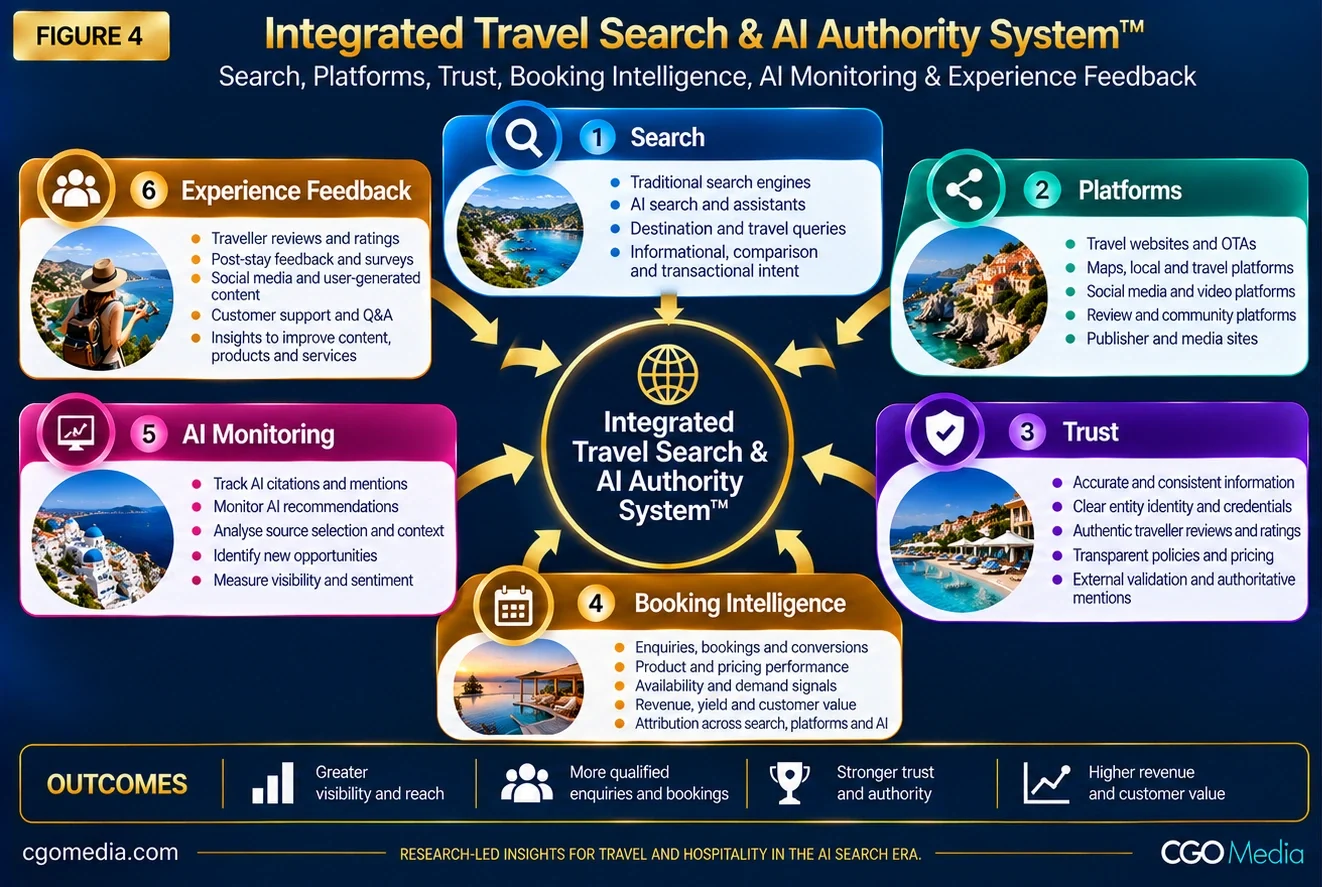

133. Stage Seven — Evolve the Travel Authority System
The final roadmap stage is Evolve.
By this point, the organisation should have progressed beyond isolated SEO activity toward a connected travel authority system combining technical search, entities, destination architecture, product evidence, external validation, booking intelligence and AI monitoring.
The objective now changes.
The priority is no longer simply to build new capability.
It is to maintain, measure and improve the authority system as:
- Traveller behaviour changes
- Destinations change
- Properties change
- Search systems change
- AI systems change
- Competitive evidence changes
The Evolve phase turns implementation from a project into an operating discipline.
134. Continuous Measurement Is Required
Travel authority should be measured across the complete discovery and experience system.
Relevant areas include:
- Technical reliability
- Entity and data integrity
- Destination authority
- Product and content evidence
- External trust
- AI recommendation readiness
- Commercial outcomes
- Traveller experience
The purpose is not to create the largest possible dashboard.
Measurement should help management identify where performance is improving, where risk is developing and where investment should be redirected.
135. Technical Health Should Remain Visible
Technical performance should continue to be monitored after the initial Stabilise phase.
Useful measures can include:
- Crawl reliability
- Indexation
- Rendering
- Performance
- Mobile usability
- Booking journey reliability
Technical regressions can weaken the value of every later authority investment.
For example, a destination section containing strong content and external authority can still lose visibility if important pages become difficult to crawl or index.
136. Entity and Data Integrity Should Be Monitored
Entity quality can deteriorate as organisations open properties, change brands, renovate facilities or update distribution systems.
Monitoring should therefore include:
- Property naming
- Brand relationships
- Location consistency
- Duplicate listings
- Facility accuracy
- Platform conflicts
- Sources of truth
The objective is to identify material inconsistencies before they spread widely across public evidence environments.
137. Destination and Content Authority Should Be Reviewed
Destination authority should evolve alongside traveller demand and business strategy.
Review can examine:
- Destination coverage
- Neighbourhood coverage
- Traveller relevance
- Internal linking
- Product detail
- Decision usefulness
- Evidence freshness
Content should not remain in place simply because it once performed well.
It should continue to provide useful and accurate support for current travel decisions.
138. External Trust Should Be Reviewed
External authority can strengthen or deteriorate over time.
Useful signals include:
- Review quality
- Review recency
- Recurring review themes
- Travel media references
- Destination citations
- Specialist coverage
- Authority diversity
A provider with historically strong authority may weaken if recent traveller evidence or external representation no longer supports its positioning.
139. AI Recommendation Readiness Should Be Monitored
AI monitoring should examine whether relevant destinations and providers continue to be represented accurately.
Useful measures can include:
- Presence in relevant scenarios
- Recommendation relevance
- Attribute accuracy
- Traveller fit
- Error severity
- Error persistence
The objective is to identify persistent changes rather than react to every individual generated answer.
140. Commercial and Experience Outcomes Should Be Included
Search and AI authority should ultimately be interpreted alongside commercial and experience evidence.
Useful measures can include:
- Booking performance
- Direct-booking contribution
- Conversion
- Cancellation
- Booking abandonment
- Review sentiment
- Repeat behaviour
- Experience quality
This helps prevent visibility from becoming disconnected from the quality of the traveller relationship it creates.
141. Early Signals Should Be Identified
Some authority problems become visible before commercial performance deteriorates significantly.
Review Trends
Recurring negative themes can indicate expectation or operational problems.
AI Errors
Persistent inaccuracies can expose data conflict, entity confusion, outdated information or external evidence weakness.
Search Decline
Falling non-branded visibility can indicate technical regression, weaker content, competitive change or authority loss.
These indicators can provide early warning before a wider problem develops.
142. Build a Shared Executive Scorecard
Leadership should be able to review roadmap progress through one compact framework.
A practical executive scorecard can include six dimensions:
- Technical Foundation
- Entity & Data Integrity
- Destination & Content Authority
- External Trust
- AI Recommendation Readiness
- Commercial & Experience Outcomes
Each dimension answers a different management question.
143. Technical Foundation
The Technical Foundation dimension should reflect whether priority discovery and booking systems remain reliable.
It can consider:
- Crawling
- Indexing
- Performance
- Mobile usability
- Booking reliability
A strong authority programme cannot remain resilient if foundational technology becomes unreliable.
144. Entity & Data Integrity
The Entity & Data Integrity dimension should assess whether:
- Property information is accurate.
- Brand relationships are clear.
- Important platform conflicts are controlled.
- Sources of truth are defined.
- Major changes propagate correctly.
This dimension measures the reliability of the information on which the wider authority system depends.
145. Destination & Content Authority
This dimension should examine whether the organisation has strong decision-useful evidence around:
- Destinations
- Neighbourhoods
- Properties
- Products
- Traveller segments
- Experiences
Useful questions include:
- Is the coverage strategically relevant?
- Does the content help travellers decide?
- Are important evidence gaps being closed?
- Does the architecture remain coherent?
146. External Trust
The External Trust dimension should reflect whether independent evidence supports important travel positioning.
Measures can consider:
- Review quality
- Review recency
- Media validation
- Tourism authority
- Specialist references
- External source diversity
The objective is relevant corroboration rather than raw mention volume.
147. AI Recommendation Readiness
This dimension should evaluate whether the organisation appears accurately and appropriately within important generative travel scenarios.
It can consider:
- Scenario presence
- Recommendation relevance
- Accuracy
- Traveller fit
- Error persistence
- Representation stability
The strongest performance is qualified recommendation rather than maximum inclusion.
148. Commercial & Experience Outcomes
The final scorecard dimension should connect authority with real traveller and business outcomes.
This can include:
- Qualified bookings
- Conversion
- Cancellation
- Direct contribution
- Review sentiment
- Repeat behaviour
- Experience quality
The objective is to ensure that stronger digital authority also produces better-matched traveller relationships.
149. Use a Five-Level Implementation Scale
A simple maturity scale can help management interpret each scorecard dimension.
| Level | Interpretation |
|---|---|
| 1 — Weak | Foundational problems remain significant and implementation is fragmented. |
| 2 — Developing | Priority weaknesses are being addressed, but systems remain incomplete. |
| 3 — Established | Core systems function and authority activity is becoming coordinated. |
| 4 — Strong | Search, trust and AI visibility operate through structured governance and measurement. |
| 5 — Resilient | The organisation can identify and respond effectively to change across search, AI, platforms, traveller behaviour and product information. |
The scale is an internal roadmap tool rather than an external industry rating.
150. Separate Current State from Target State
The scorecard should record both where the organisation is now and where it intends to move.
This prevents the roadmap from becoming a static maturity assessment.
For each dimension, management can record:
- Current level
- Target level
- Current trend
- Evidence confidence
- Priority
This allows progress to be managed as a transition rather than simply reported as a score.
151. Record Performance Trend
Current maturity should be interpreted alongside movement.
A practical trend classification is:
- Improving
- Stable
- At Risk
- Deteriorating
A strong current score with a deteriorating trend may require more attention than a lower score that is improving rapidly according to plan.
152. Record Evidence Confidence
Not every score should be presented with equal certainty.
Evidence confidence can be classified as:
- Low
- Medium
- High
Confidence should reflect the strength, scale and consistency of the evidence used to assess the dimension.
This reduces false precision in executive reporting.
153. Record Implementation Priority
Each scorecard dimension should also have a priority classification.
A simple model is:
- Critical
- High
- Medium
- Low
Priority should reflect business impact, traveller risk, dependency and strategic importance rather than maturity score alone.
154. Executive Roadmap Scorecard
| Dimension | Current | Target | Trend | Confidence | Priority |
|---|---|---|---|---|---|
| Technical Foundation | 1–5 | 1–5 | Improving / Stable / At Risk / Deteriorating | Low / Medium / High | Critical / High / Medium / Low |
| Entity & Data Integrity | 1–5 | 1–5 | Improving / Stable / At Risk / Deteriorating | Low / Medium / High | Critical / High / Medium / Low |
| Destination & Content Authority | 1–5 | 1–5 | Improving / Stable / At Risk / Deteriorating | Low / Medium / High | Critical / High / Medium / Low |
| External Trust | 1–5 | 1–5 | Improving / Stable / At Risk / Deteriorating | Low / Medium / High | Critical / High / Medium / Low |
| AI Recommendation Readiness | 1–5 | 1–5 | Improving / Stable / At Risk / Deteriorating | Low / Medium / High | Critical / High / Medium / Low |
| Commercial & Experience Outcomes | 1–5 | 1–5 | Improving / Stable / At Risk / Deteriorating | Low / Medium / High | Critical / High / Medium / Low |
The scorecard should remain compact enough for leadership use while allowing operational teams to maintain deeper supporting analysis underneath it.
155. Critical Risks Should Sit Outside the Average Score
A severe issue should not disappear inside an overall maturity average.
Critical implementation risks can include:
- Booking failure
- Incorrect property identity
- Material pricing misinformation
- Accessibility misinformation
- Persistent severe AI errors
These should be reported separately and escalated directly.
Each critical issue should have:
- An owner
- A deadline
- A validation requirement
- An escalation path
156. Governance Should Follow a Defined Cadence
Different parts of the authority system change at different speeds.
Governance should therefore use several review cycles rather than one universal frequency.
Operational Review
Can focus on:
- Critical technical problems
- Booking failures
- Major data conflicts
- Severe AI errors
Performance Review
Can focus on:
- Search trends
- Review themes
- Platform accuracy
- AI visibility
- Booking quality
Authority Review
Can examine:
- Destination authority
- Content gaps
- External validation
- Traveller-segment performance
Strategic Review
Can reassess roadmap maturity, governance, technology, market priorities and AI readiness.
157. Review Frequency Should Reflect Volatility
Information that changes quickly requires more frequent monitoring.
Higher-Volatility Areas
- Rates
- Availability
- Promotions
- AI outputs
Medium-Volatility Areas
- Policies
- Seasonal facilities
- Review sentiment
- Platform content
Lower-Volatility Areas
- Core entity identity
- Permanent property relationships
- Long-term destination architecture
Governance intensity should match the likelihood and consequence of change.
158. Define Ownership
Each roadmap dimension should have a responsible function.
Typical ownership may include:
- Technical: SEO, development and platform engineering
- Entity & Data: data, distribution, revenue and operations
- Destination & Content: SEO, content, brand and destination teams
- External Authority: PR, communications, partnerships and reputation
- AI Monitoring: SEO, data, research and digital strategy
- Commercial Outcomes: revenue, ecommerce, reservations and CRM
- Experience Outcomes: operations, guest experience and property management
The exact structure will vary by organisation.
The important requirement is that responsibility is explicit.
159. Define Decision Rights
Governance should also clarify who can make or approve important changes.
The organisation should know:
- Who can change critical property data
- Who approves major content changes
- Who manages platform corrections
- Who escalates material AI misinformation
- Who validates completed work
Decision rights reduce delay when important authority problems appear.
160. Validation Is Part of Implementation
A change should not be considered complete simply because it has been published or deployed.
Technical Changes
Confirm deployment, crawlability, indexation and user impact.
Data Changes
Confirm the source-of-truth update, platform propagation and public accuracy.
Content Changes
Confirm factual accuracy, internal links, usability and traveller usefulness.
External Authority Work
Confirm correct brand attribution, property identity, destination context and claims.
AI Corrections
Re-test the same or equivalent scenario families after underlying evidence changes.
Implementation therefore follows:
Baseline → Intervention → Validation → Observed Change
161. Benchmarking Should Remain Contextual
Universal travel benchmarks can be misleading.
Performance differs according to:
- Destination
- Property type
- Traveller segment
- Season
- Market
Useful comparison groups can include:
- Previous internal performance
- Comparable properties
- Comparable destinations
- Comparable markets
Internal baselines are often more defensible than unsupported universal thresholds.
162. Define Success Before Implementation
Each major workstream should define its intended outcome before work begins.
Technical Success
Can include stronger crawl reliability, cleaner indexation, faster performance and lower booking friction.
Entity Success
Can include fewer duplicates, greater platform consistency and clearer property relationships.
Content Success
Can include stronger destination coverage, better product clarity and greater traveller relevance.
External Authority Success
Can include stronger independent references, improved review evidence and greater authority diversity.
AI Visibility Success
Can include more relevant inclusion, fewer material errors and better traveller fit.
Commercial Success
Can include more qualified bookings, stronger direct contribution and lower unnecessary abandonment.
Experience Success
Can include stronger review sentiment, fewer complaints, greater repeat behaviour and better expectation alignment.
163. Qualified Growth Should Be the Objective
The roadmap should not optimise for visibility that attracts poorly matched travellers.
A more useful concept is:
Relevant Visibility + Accurate Evidence + Traveller Fit + Successful Experience → Qualified Growth
High traffic with poor fit can increase:
- Bounces
- Booking abandonment
- Cancellations
- Negative reviews
Similarly, high booking volume created through inaccurate expectations can damage future authority.
Search visibility, AI representation and marketing should align as closely as possible with the real travel product.
164. Experience Quality Feeds Future Authority
Travel authority is cyclical.
The relationship can be represented as:
Search & AI Discovery → Booking → Experience → Feedback → Authority Update → Future Discovery
When travellers receive the experience they expected, they are more likely to create positive future evidence.
When expectations are repeatedly mismatched, negative reviews and weaker trust can reduce future authority even if current search visibility remains strong.
165. Feedback Should Change Future Implementation
Recurring traveller and performance evidence should influence future work.
This can include changes to:
- Content
- Product positioning
- Operational priorities
- AI monitoring
- External communication
The roadmap should therefore learn from the complete traveller cycle rather than ending at discovery or booking.
166. Resilience Is the Long-Term Outcome
A mature travel authority system should be resilient.
Resilience has five core components:
- Monitoring — detects change.
- Ownership — ensures responsibility is clear.
- Diagnosis — identifies the underlying cause.
- Response — corrects the weakness.
- Learning — reduces recurrence.
A resilient organisation can detect and respond to authority deterioration before the weakness becomes systemic.
167. The Eighth Roadmap Principle
Travel SEO and AI implementation should evolve into a governed operating system in which visibility, trust, commercial performance and traveller experience are monitored together and continuously improved.
The roadmap therefore moves the organisation from implementation activity toward a permanent authority-management capability.
168. The Operating Equation
The complete operating relationship can be expressed as:
Measurement + Governance + Validation + Learning + Continuous Improvement = Search & AI Resilience
The intended progression is:
Integrated Authority → Governed Measurement → Continuous Improvement → Resilient Travel Visibility
169. The Travel SEO & AI Executive Implementation Scorecard
The Travel SEO & AI Executive Implementation Scorecard brings the roadmap into one management framework covering:
Foundations + Authority + Trust + AI Readiness + Commercial Outcomes
Foundations
Measure technical reliability, booking reliability, data quality and entity integrity.
Authority
Measure destination relevance, content quality, product evidence and architecture coherence.
Trust
Measure traveller evidence, platform consistency and independent validation.
AI Readiness
Measure accurate representation, relevant inclusion, traveller fit and error persistence.
Commercial Outcomes
Measure qualified booking performance, conversion, cancellation, experience quality and repeat behaviour.
The scorecard should not be treated as a universal industry ranking.
It is an internal implementation and governance tool designed to show where the organisation is strong, where risk remains and where the next stage of investment should be directed.


170. Convert the Roadmap into an Annual Operating Cycle
The seven implementation stages provide the strategic sequence, but organisations also need a practical way to manage execution over time.
A 12-month operating cycle can provide that discipline.
The annual model is:
Q1: Assess & Stabilise → Q2: Structure & Strengthen → Q3: Validate & Integrate → Q4: Measure, Evolve & Reprioritise
This should not be interpreted as a rigid calendar in which every organisation must complete one phase before the next quarter begins.
Large hospitality groups may have several properties operating at different stages simultaneously.
The purpose is to create a repeatable management rhythm that moves the organisation from diagnosis through implementation, validation and renewed prioritisation.
171. Quarter One — Assess & Stabilise
The first quarter should establish the baseline and reduce the most important foundational risks.
Priority work can include:
- Technical SEO audit
- Indexation review
- Booking-flow testing
- Property entity audit
- Platform consistency review
- Destination architecture review
- AI visibility baseline
The objective is to understand the current authority system before large-scale change begins.
172. Establish the Technical Baseline
Technical measurement should record the condition of the website and booking journey before major intervention.
Useful baseline areas include:
- Crawlability
- Indexation
- Rendering
- Performance
- Mobile usability
- Booking reliability
The organisation should identify which technical weaknesses materially restrict priority destination, property and product visibility.
173. Establish the Entity Baseline
The entity baseline should record whether the organisation’s critical travel entities are represented consistently.
Useful checks include:
- Property naming
- Duplicate listings
- Brand relationships
- Property type
- Location consistency
- Operating status
The baseline should also identify where ownership of important data is unclear.
174. Establish the Platform Baseline
The platform baseline should compare important travel information across:
- Maps
- Online travel agencies
- Review platforms
- Destination listings
- Relevant booking marketplaces
Material inconsistencies should be recorded and prioritised according to traveller and commercial impact.
175. Establish the AI Baseline
AI monitoring should begin with representative traveller scenarios.
The baseline can record:
- Prompt presence
- Provider recognition
- Recommendation relevance
- Attribute accuracy
- Traveller fit
- Persistent errors
The purpose is not to optimise immediately around individual outputs.
The baseline provides a reference point for later comparison.
176. Prioritise Foundation Risks
Quarter One should finish with a prioritised implementation register rather than a conventional audit containing hundreds of unranked observations.
A useful model is:
Business Impact + Traveller Risk + Scale + Dependency → Implementation Priority
Critical issues can include:
- Major indexation problems
- Booking failures
- Incorrect property identity
- Incorrect location data
- Material accessibility misinformation
- Large-scale platform inconsistency
177. Quarter One Outcome
By the end of Quarter One, the organisation should have:
- A documented authority baseline
- A prioritised risk register
- Defined owners
- Recognised sources of truth
- A first wave of foundational corrections
The intended movement is:
Uncertain Current State → Measured Baseline → Reduced Foundational Risk
178. Quarter Two — Structure & Strengthen
Quarter Two should use the more reliable foundation to improve the organisation’s travel knowledge and evidence architecture.
Priority work can include:
- Entity architecture
- Destination structure
- Property-page improvement
- Product evidence
- Internal linking
- Traveller-segment information
- Content-gap remediation
The objective is to make important travel entities, products and relationships easier to understand and evaluate.
179. Strengthen Entity Architecture
Quarter Two should establish clearer relationships between:
Brand → Destination → Property → Product → Experience → Traveller Need
This can include:
- Property entity registers
- Clear brand relationships
- Destination hierarchies
- Room and product structures
- Experience relationships
180. Strengthen Destination Authority
Priority destination content should move beyond generic travel description.
It should help travellers understand:
- Where to stay
- Neighbourhood differences
- Transport
- Attractions
- Seasonality
- Traveller suitability
The purpose is to connect destination knowledge with provider selection.
181. Strengthen Property and Product Evidence
Property pages should expose the information required to evaluate suitability.
This can include:
- Location
- Room types
- Facilities
- Dining
- Accessibility
- Parking
- Transport
- Relevant experiences
Attribute-level evidence should replace vague positioning wherever possible.
182. Strengthen Traveller-Segment Evidence
Where strategically important, the organisation should improve evidence around real traveller segments.
Examples include:
- Families
- Business travellers
- Golf travellers
- Luxury travellers
- Wellness travellers
- Accessible travellers
The evidence should arise from genuine product characteristics rather than content labels alone.
183. Quarter Two Outcome
By the end of Quarter Two, the organisation should have a clearer and more decision-useful digital representation of its destinations, properties and products.
The intended movement is:
Stable Foundations → Structured Travel Knowledge → Stronger Product Evidence
184. Quarter Three — Validate & Integrate
Quarter Three should extend stronger first-party evidence into the wider travel authority ecosystem.
Priority work can include:
- Review intelligence
- Digital PR
- Destination partnerships
- Travel media authority
- Original research
- OTA and platform integration
- Booking intelligence
- AI monitoring
The objective is to build relevant independent validation and connect previously separate authority systems.
185. Validate Strategic Positioning
External evidence should reinforce the provider’s genuine strengths.
For example:
Family Positioning → Product Evidence + Review Themes + Relevant External Coverage
Golf Positioning → Course Relationships + Product Evidence + Specialist Validation
Luxury Positioning → Product Quality + Service Evidence + Relevant Independent Recognition
The organisation should identify where important positioning is strong internally but weakly supported externally.
186. Integrate External Authority
Digital PR and research activity should support strategic entity, destination and experience themes.
Potential outputs include:
- Traveller studies
- Destination research
- Hospitality trend analysis
- Expert commentary
- Destination partnerships
The objective is not backlink volume.
It is to strengthen the independent evidence surrounding important travel claims.
187. Integrate Platform Evidence
The organisation should continue reconciling important facts across:
- Provider website
- Booking engine
- OTAs
- Maps
- Review platforms
This reduces conflict between owned and platform evidence.
188. Integrate Booking Intelligence
Commercial evidence should increasingly inform authority decisions.
Useful analysis can include:
- High-value destinations
- Traveller segments
- Booking lead times
- Conversion
- Cancellation
- Seasonality
This helps ensure that search and AI visibility remain connected to commercially meaningful travel demand.
189. Integrate AI Monitoring
AI monitoring should now become part of normal authority analysis.
Representative scenarios can be used to evaluate:
- Entity recognition
- Attribute accuracy
- Comparison inclusion
- Recommendation relevance
- Traveller fit
Observed weaknesses should be traced back to the underlying evidence system.
190. Quarter Three Outcome
By the end of Quarter Three, the organisation should be moving toward an integrated authority system in which owned information, platforms, independent evidence, booking intelligence and AI monitoring reinforce one another.
The intended progression is:
Strong Product Evidence → Independent Validation → Integrated Travel Authority
191. Quarter Four — Measure, Evolve & Reprioritise
Quarter Four should determine what changed during the year and what should happen next.
Priority work can include:
- Scorecard review
- Technical reassessment
- Entity reassessment
- Content performance review
- Trust review
- AI visibility review
- Commercial analysis
- Roadmap reprioritisation
192. Compare Against the Baseline
The organisation should compare current performance with the baseline established in Quarter One.
This can include:
- Technical reliability
- Entity consistency
- Destination authority
- Product evidence
- Independent trust
- AI recommendation readiness
- Commercial outcomes
This allows progress to be assessed using the organisation’s own starting position rather than unsupported universal benchmarks.
193. Measure What Improved
The annual review should identify which roadmap interventions produced observable improvement.
Examples can include:
- Better indexation
- Reduced platform conflict
- Stronger non-branded destination visibility
- Improved traveller information
- Stronger external evidence
- Fewer persistent AI inaccuracies
- Better booking quality
Successful interventions can then be standardised across other properties or destinations where appropriate.
194. Identify What Did Not Improve
Some interventions will produce limited or uncertain impact.
The organisation should determine whether the cause was:
- Incorrect diagnosis
- Incomplete implementation
- Insufficient time
- External market change
- Weak measurement
- An unresolved dependency
Unsuccessful work should produce learning rather than simply being repeated.
195. Reprioritise for the Next Cycle
The next annual cycle should not automatically repeat the same priorities.
Priorities should change according to:
- Remaining weaknesses
- New business objectives
- New destinations
- New properties
- Traveller behaviour
- Search-system change
- AI-system change
This keeps the roadmap adaptive.
196. The Annual Cycle Is Not Linear
Although the roadmap is presented sequentially, mature organisations will operate several activities in parallel.
For example:
- One property may require technical stabilisation.
- Another may require external authority development.
- A new destination may require architecture development.
- A mature property may primarily require monitoring and governance.
The roadmap should therefore function as a portfolio management system as well as a project sequence.
197. Large Portfolios Should Prioritise
Large hospitality groups should avoid attempting to implement every workstream across every property simultaneously.
Portfolio priority can reflect:
- Revenue importance
- Search opportunity
- Authority weakness
- Traveller risk
- Strategic growth
Priority properties can receive deeper intervention while standardised controls protect the broader portfolio.
198. New Properties Require an Accelerated Roadmap
New hotel or resort launches can use a compressed implementation sequence:
Entity Setup → Technical Foundation → Destination Integration → Product Evidence → Platform Distribution → External Validation → AI Monitoring
Establishing these elements before or around launch can reduce later correction work.
199. Rebrands Require Authority Migration
Property rebrands should be treated as authority migrations rather than simple naming changes.
Implementation can include:
- Website changes
- Redirects
- Structured information
- Maps
- OTAs
- Review profiles
- Media references
- AI monitoring
The objective is to move public understanding from the old identity toward the new one while minimising evidence fragmentation.
200. Continuous Improvement Requires Root-Cause Analysis
Repeated problems should be investigated at their source.
If AI systems repeatedly report the wrong facility, the organisation should inspect:
- Official provider content
- Structured information
- Maps
- OTAs
- Review platforms
- External articles
The objective is root-cause correction rather than tactical editing in response to one generated answer.
201. Validation Should Follow Every Major Intervention
A roadmap action should not be considered complete simply because the task itself has been completed.
The operating sequence should be:
Implement → Validate → Observe
Examples include:
- Technical fix → confirm crawl and index behaviour.
- Data correction → confirm platform propagation.
- Content improvement → confirm usefulness and search response.
- Authority campaign → confirm relevant external representation.
- AI correction work → re-test representative scenarios.
202. Learning Should Become Organisational Knowledge
Important findings should be preserved through:
- Property entity registers
- Issue logs
- Scenario libraries
- Source maps
- Implementation records
- Governance documentation
This prevents teams from repeatedly rediscovering the same authority problems.
203. The Continuous Improvement Principle
The roadmap should therefore operate as a recurring system rather than a project with a permanent end state.
The annual cycle provides execution discipline while the continuous-improvement cycle provides the long-term operating principle.
A useful strategic relationship is:
Assess → Improve → Validate → Measure → Learn → Reprioritise
Each cycle should leave the organisation with stronger:
- Technical reliability
- Entity clarity
- Travel evidence
- External authority
- AI recommendation readiness
- Organisational knowledge
204. Travel Authority Should Become an Organisational Capability
At higher maturity, Travel SEO and AI optimisation increasingly connects:
- SEO
- Content
- Data
- Revenue
- Operations
- Digital PR
- Reputation
- Customer experience
No single function controls the complete evidence environment.
The strongest programmes therefore combine specialist ownership with shared governance.
205. The Final Roadmap Principle
The strongest long-term travel visibility is created not by maximising isolated rankings or AI mentions, but by maintaining a coherent evidence system capable of helping the right traveller discover, understand, trust, select and successfully experience the right provider.
This transforms the implementation roadmap from a collection of SEO tasks into a permanent travel-authority management system.
206. The Continuous Travel SEO & AI Improvement Cycle
The complete operating cycle can be summarised as:
Assess → Improve → Validate → Measure → Learn → Reprioritise
Assess
Determine the current technical, entity, content, trust, AI and commercial position.
Improve
Address the highest-priority weaknesses and strengthen the underlying evidence system.
Validate
Confirm that changes were implemented correctly and propagated into relevant environments.
Measure
Compare performance with the previous baseline and determine whether meaningful change occurred.
Learn
Capture what succeeded, what failed and what the organisation should change in future.
Reprioritise
Update the roadmap according to remaining weaknesses, new opportunities and changes in travel discovery.
The cycle then repeats.
This creates the long-term relationship:
Implementation → Evidence Improvement → Better Measurement → Organisational Learning → Stronger Future Implementation


207. Methodology
The Travel & Hospitality SEO & AI Implementation Roadmap is a conceptual implementation framework developed by CGO Media to help travel and hospitality organisations translate search, digital authority and AI visibility strategy into an ordered programme of operational work.
The roadmap addresses a practical implementation problem:
In what order should a travel organisation strengthen its technical foundations, data quality, entity clarity, destination authority, content evidence, external validation, AI readiness and measurement systems so that each stage supports the next?
Research Scope
The roadmap can be adapted for organisations including:
- Hotels
- Resorts
- Accommodation groups
- Hospitality brands
- Airlines
- Tour operators
- Travel agencies
- Attractions
- Experience providers
- Destination organisations
- Travel technology businesses
Seven-Phase Implementation Method
The roadmap organises implementation into seven connected phases:
Assess → Stabilise → Structure → Strengthen → Validate → Integrate → Evolve
Assess
The Assess phase establishes the current position across:
- Technical SEO
- Search visibility
- Entity consistency
- Destination architecture
- Product information
- Platform accuracy
- Review evidence
- External authority
- AI representation
The purpose is to establish a baseline before large-scale implementation begins.
Stabilise
The Stabilise phase prioritises technical reliability and information accuracy.
Important areas can include:
- Crawlability
- Indexation
- Rendering
- Performance
- Booking reliability
- Property data
- Platform consistency
The objective is to prevent later authority investment from being undermined by unresolved foundations.
Structure
The Structure phase creates relationships between:
Brand → Destination → Property → Product → Experience → Traveller Need
The method considers entity definitions, geographic hierarchies, property architecture, internal linking, structured representation and recognised sources of truth.
Strengthen
The Strengthen phase develops decision-useful evidence around:
- Destinations
- Neighbourhoods
- Properties
- Accommodation
- Experiences
- Traveller segments
- Practical travel requirements
Content quality is assessed according to usefulness, specificity, accuracy and evidential value rather than word count alone.
Validate
The Validate phase examines whether important provider claims are supported beyond first-party content.
Validation can include:
- Traveller reviews
- Travel media
- Tourism organisations
- Destination partnerships
- Specialist publications
- Original research
- Relevant Digital PR
The focus is relevant independent authority rather than raw external mention volume.
Integrate
The Integrate phase connects systems that are frequently managed independently.
The integrated model is:
Search Visibility + Platform Consistency + External Trust + Booking Intelligence + AI Monitoring + Experience Feedback = Integrated Travel Authority
This phase evaluates whether data, search, reputation, commercial and AI systems can reinforce one another rather than creating disconnected evidence.
Evolve
The Evolve phase converts the roadmap into an ongoing management system.
It combines:
- Measurement
- Governance
- Validation
- Learning
- Reprioritisation
The long-term objective is resilience rather than completion of a fixed list of SEO tasks.
Dependency-Based Prioritisation
Implementation priority should account for whether one weakness prevents progress elsewhere.
A practical prioritisation relationship is:
Business Impact + Traveller Risk + Scale + Dependency → Implementation Priority
For example, a serious indexation issue affecting an entire property portfolio generally deserves attention before incremental content expansion.
Entity and Data Method
Entity analysis can examine:
- Property identity
- Brand relationships
- Property type
- Address
- Coordinates
- Destination relationships
- Operating status
- Facilities
Critical attributes should have recognised internal ownership and sources of truth.
Content and Destination Method
Destination and content assessment focuses on whether information supports real traveller decisions.
A useful journey is:
Destination Research → Area Selection → Provider Discovery → Product Evaluation → Booking
Content should help travellers move through this journey rather than existing primarily to target isolated keyword variations.
External Authority Method
External authority is evaluated according to:
Source Credibility + Topical Relevance + Claim Alignment
This distinguishes relevant independent validation from undifferentiated link or mention volume.
AI Monitoring Method
AI visibility can be monitored using representative traveller scenarios covering variables such as:
- Destination
- Traveller type
- Trip purpose
- Budget
- Accommodation type
- Required facilities
- Practical constraints
A useful AI observation model is:
Presence + Relevance + Accuracy + Trust Context + Traveller Fit
Repeated observations are more useful than individual outputs because generative responses can vary.
Experience Feedback Method
The framework treats traveller experience as part of future authority.
The feedback loop is:
Discovery → Booking → Experience → Review → Reputation → Future Discovery
This connects search and AI implementation with the product actually delivered to the traveller.
Annual Operating Method
The implementation programme can be organised around:
Q1: Assess & Stabilise → Q2: Structure & Strengthen → Q3: Validate & Integrate → Q4: Measure, Evolve & Reprioritise
The quarterly structure is a management framework rather than a rigid timetable.
Continuous Improvement Method
The final operating cycle is:
Assess → Improve → Validate → Measure → Learn → Reprioritise
The roadmap therefore treats implementation as a recurring organisational capability rather than a project with a permanent end state.
208. Limitations
The Travel & Hospitality SEO & AI Implementation Roadmap is a conceptual strategic implementation framework.
It is not a guarantee of rankings, AI recommendations, bookings, revenue growth, traveller satisfaction or commercial performance.
Implementation Requirements Differ
A single independent hotel and an international hospitality group will require very different levels of:
- Technology
- Data governance
- Content production
- Measurement
- Operational coordination
The roadmap should therefore be scaled according to organisational complexity.
Travel Provider Types Differ
Hotels, airlines, tour operators, attractions, destinations and travel technology businesses should not be assumed to require identical implementation programmes.
The seven phases provide an implementation logic rather than a universal operating specification.
Technical Architectures Differ
Travel organisations can use different:
- Content-management systems
- Booking engines
- Property-management systems
- Channel managers
- Analytics platforms
- Customer-data systems
Technical implementation should reflect the organisation’s actual technology environment.
Implementation Sequencing May Need Adjustment
The seven phases are directional rather than rigid.
Critical technical, legal, accessibility, operational or traveller-information issues may require immediate intervention regardless of the wider roadmap stage.
Large organisations may also run selected workstreams in parallel.
Search Visibility Is Dynamic
Organic rankings, local results and discovery interfaces change over time.
A successful implementation cannot guarantee stable positions indefinitely.
AI Systems Are Dynamic
AI models, retrieval systems, citations, interfaces and recommendation behaviour can change.
Observed results should therefore be interpreted within the platform and period in which they were recorded.
AI Systems Are Only Partially Observable
External organisations cannot directly inspect every internal signal used by search engines or AI systems.
The roadmap therefore evaluates observable evidence and outcomes rather than claiming access to proprietary recommendation formulas.
AI Outputs Can Vary
Generative responses can vary according to:
- Prompt wording
- Conversation context
- Platform
- Model
- Language
- Market
- Date
Individual outputs should not be treated as evidence of permanent visibility.
Third-Party Platform Data May Be Difficult to Control
Travel organisations can identify and attempt to correct platform inconsistencies without necessarily controlling when or whether every third-party system updates its information.
External Authority Is Not Fully Controllable
Media organisations, tourism bodies, reviewers and independent publishers retain control over their own editorial decisions.
External validation cannot therefore be guaranteed through implementation activity.
Reviews Are Subjective
Traveller reviews provide useful experience evidence but may contain subjective, unrepresentative or outdated opinions.
Recurring themes are generally more useful than isolated comments.
Pricing and Availability Are Dynamic
Rates and inventory can change rapidly.
Evergreen SEO content should not be assumed to provide current transactional truth unless connected to appropriate operational systems.
Accessibility Requires Specific Verification
Accessibility information can materially affect traveller eligibility.
Important accessibility requirements should be verified against sufficiently current and authoritative information.
Attribution Is Complex
Travellers can interact with:
- Search engines
- AI assistants
- Maps
- OTAs
- Review platforms
- Travel publishers
- Direct websites
before booking.
Commercial outcomes should therefore not automatically be attributed to one channel or intervention.
SEO Cannot Compensate Indefinitely for Product Weakness
Search visibility can increase discovery, but it cannot permanently compensate for a weak traveller experience.
Poor service, inaccurate expectations or unsuitable products can generate reviews and reputation evidence that weaken future authority.
Booking Performance Is Not Guaranteed
Booking decisions can depend on factors including:
- Price
- Availability
- Destination demand
- Competition
- Economic conditions
- Traveller preference
Improved SEO and AI readiness should therefore be viewed as part of a wider commercial and operational system.
209. Strategic Recommendations
Prioritise Foundations Before Scale
Correct material technical, data and entity weaknesses before attempting large-scale content or authority expansion.
Define Property and Destination Entities Clearly
Create recognised relationships between brands, destinations, properties, products, experiences and traveller requirements.
Use Recognised Sources of Truth
Critical property and operational information should have explicit ownership.
Build Decision-Useful Content
Prioritise information that helps travellers evaluate destinations, providers, products and practical constraints.
Connect Content to the Traveller Journey
Structure discovery around:
Destination → Provider → Product → Experience → Booking
Develop Evidence Before Promotion
Ensure that first-party product and traveller evidence supports the claims that external PR and authority development are intended to validate.
Build Relevant External Authority
Focus on sources capable of reinforcing genuine destination, product and traveller-segment authority.
Integrate Digital PR with Research
Original travel research can support stronger authority where methodology is transparent, useful and appropriately limited.
Diversify External Evidence
Avoid excessive dependence on one review platform, publisher, OTA or discovery environment.
Integrate Search with Booking and Experience Intelligence
Use commercial and traveller evidence to understand whether visibility is creating appropriate demand and realistic expectations.
Measure Qualified AI Visibility
Prioritise relevance, accuracy and traveller fit rather than raw AI mention counts.
Build Continuous Governance
Travel SEO and AI implementation should become a permanent organisational capability rather than an occasional marketing project.
210. Conclusion
Travel and hospitality SEO is becoming a broader organisational discipline because discovery increasingly occurs across search engines, maps, online travel agencies, review environments, travel publishers and AI-assisted recommendation systems.
The implementation challenge is therefore no longer limited to:
Which pages should we optimise?
A more complete question is:
How should we organise technical systems, provider data, destination knowledge, content evidence, external authority and AI monitoring so that the organisation becomes progressively easier to discover, understand, trust and appropriately recommend?
The roadmap answers this through seven phases:
Assess → Stabilise → Structure → Strengthen → Validate → Integrate → Evolve
The sequence begins with technical reliability and data accuracy because later content and authority work becomes less effective when foundational systems remain unstable.
It then establishes entity and destination architecture so that relationships between:
Brand → Destination → Property → Product → Experience → Traveller Need
become easier to understand.
The Strengthen phase develops the decision evidence required for provider evaluation.
The Validate phase adds independent authority around genuine destination, provider and experience strengths.
The Integrate phase connects:
Search Visibility + Platform Consistency + External Trust + Booking Intelligence + AI Monitoring + Experience Feedback
into a wider travel authority system.
The Evolve phase then turns that system into a permanent cycle of measurement, governance, validation, learning and reprioritisation.
The ultimate objective is not maximum search traffic or maximum AI mentions.
It is qualified visibility that helps the right traveller progress through:
Discovery → Understanding → Trust → Recommendation → Booking → Positive Experience
A successful implementation programme therefore connects digital representation with operational truth.
Search visibility, provider information, independent evidence, traveller experience and external reputation should reinforce one another over time.
This is what transforms Travel SEO from an isolated acquisition channel into a durable search and AI authority capability.
References
External Academic, Technical and Search Sources
- Google Search Central. SEO Starter Guide.
- Google Search Central. Crawling and Indexing Overview.
- Google Search Central. Understand How Structured Data Works.
- Google Search Central. Tell Google About Localised Versions of Your Page.
- Schema.org. Hotel.
- Schema.org. LodgingBusiness.
- Schema.org. TouristAttraction.
- Schema.org. Trip.
- W3C. Web Content Accessibility Guidelines (WCAG) 2.2.
- Hogan, A. et al. (2021). Knowledge Graphs. ACM Computing Surveys, 54(4).
- Metzger, M.J. (2007). Making Sense of Credibility on the Web: Models for Evaluating Online Information and Recommendations for Future Research. Journal of the American Society for Information Science and Technology, 58(13), 2078–2091.
- Ji, Z. et al. (2023). Survey of Hallucination in Natural Language Generation. ACM Computing Surveys, 55(12).
CGO Media Travel & Hospitality Research and Frameworks
- Wilkinson, R. (2026). Travel & Hospitality SEO for AI-Powered Search. CGO Media.
- Wilkinson, R. (2026). Travel & Hospitality AI Trust and Visibility Framework. CGO Media.
- Wilkinson, R. (2026). Travel Discovery and Provider Selection Model. CGO Media.
- Wilkinson, R. (2026). Travel Search Authority Maturity Model. CGO Media.
CGO Media Research Ecosystem
CGO Media Research Library | CGO Media Framework Library | CGO Media Research Architecture | CGO Media Research Observations Library | CGO Media Statistics Library
About Roger Wilkinson
Roger Wilkinson is an independent researcher, SEO practitioner and founder of CGO Media with more than 25 years of experience in search, digital visibility and business growth.
His research examines how artificial intelligence is reshaping search engines, recommendation systems, entity representation, digital authority, citation systems and organisational visibility.
Within travel and hospitality, this work focuses on destination discovery, provider selection, digital trust, entity authority, traveller evidence, AI recommendation readiness and implementation strategy.
Related Travel & Hospitality Research
Travel & Hospitality SEO for AI-Powered Search | Travel & Hospitality AI Trust & Visibility Framework | Travel Discovery & Provider Selection Model | Travel Search Authority Maturity Model | Travel & Hospitality GEO: Generative Engine Optimisation
Together, these assets form the Travel & Hospitality research family covering modern Travel SEO, trust, provider selection, maturity, Generative Engine Optimisation and practical implementation.
Research Usage & Citation
CGO Media encourages researchers, journalists, tourism organisations, travel companies, hospitality groups, destination organisations, technology providers and industry bodies to reference the Travel & Hospitality SEO & AI Implementation Roadmap where it contributes to analysis of travel search, AI discovery, destination visibility, digital authority, implementation planning or recommendation systems.
Reasonable quotations, summaries, figures and excerpts may be used in articles, reports, presentations, academic work and other publications provided appropriate acknowledgement is given to Roger Wilkinson and CGO Media.
Cite This Roadmap
The Travel & Hospitality SEO & AI Implementation Roadmap by Roger Wilkinson at CGO Media presents a seven-stage implementation model — Assess, Stabilise, Structure, Strengthen, Validate, Integrate and Evolve — for developing technical reliability, entity clarity, destination authority, product evidence, external validation and AI recommendation readiness across modern travel discovery environments.
APA Citation
Wilkinson, R. (2026). Travel & Hospitality SEO & AI Implementation Roadmap. CGO Media. https://cgomedia.com/travel-hospitality-seo-ai-implementation-roadmap/
Author: Roger Wilkinson | Published by: CGO Media
For permissions relating to substantial reproduction, commercial licensing or republication of significant portions of this roadmap, please contact CGO Media directly.