
Travel & Hospitality AI Trust and Visibility Framework
Executive Summary
 The Travel & Hospitality AI Trust & Visibility Framework is a research-led framework developed by CGO Media to explain how hotels, resorts, hospitality groups, travel companies, tourism organisations and experience providers can strengthen the evidence conditions that support visibility, trust and recommendation potential across traditional search engines and AI-assisted discovery systems.
Travel visibility increasingly depends on more than whether a provider can rank for a keyword.
Search engines, maps, online travel agencies, review platforms, travel publishers and generative AI systems can all influence how a destination or provider is discovered, understood, evaluated and recommended.
This creates a more complex trust environment.
A travel organisation may publish accurate information on its own website while external platforms contain different property details. Reviews may describe the experience differently from official marketing. Destination organisations may provide additional geographic context. Travel media may independently validate positioning. AI systems may then combine several of these evidence sources when answering traveller questions.
The framework therefore treats travel trust as a connected evidence system built across six dimensions:
- Entity Clarity
- Destination & Context Authority
- Experience & Product Evidence
- External Trust & Validation
- Information Quality & Transparency
- AI Search & Recommendation Readiness
These dimensions interact.
Entity clarity establishes who or what the provider is. Destination authority establishes where it is relevant. Experience evidence explains what the traveller can expect. External validation strengthens confidence. Information quality reduces uncertainty. AI readiness determines whether the combined evidence can support accurate discovery, comparison and recommendation.
The strategic objective is not maximum visibility.
It is qualified visibility supported by sufficient evidence to make the provider understandable, credible and appropriately recommendable within the traveller context.
1. Travel Trust Is a Distributed Digital System
Travel organisations do not control all of the information used to evaluate them.
A traveller researching a hotel may encounter:
- The official hotel website
- Search-engine results
- Maps and local profiles
- Online travel agencies
- Review platforms
- Destination websites
- Travel publications
- Social content
- AI-generated recommendations
Each environment can contribute part of the traveller’s understanding.
This means trust is distributed across owned, platform and independent evidence.
A useful relationship is:
Owned Information + Platform Representation + Independent Evidence → Digital Travel Trust
Where these environments broadly agree, confidence can increase.
Where they materially conflict, uncertainty increases.
2. Visibility Without Trust Has Limited Value
A travel provider can be highly visible while remaining difficult to evaluate.
For example, a hotel may appear prominently in search or AI-generated answers while key questions remain unclear:
- What type of property is it?
- Where exactly is it located?
- Which facilities are available?
- Which traveller segments does it suit?
- Are the descriptions current?
- Do independent sources support the positioning?
Visibility becomes more useful when these questions can be answered confidently.
The framework therefore separates simple exposure from trusted visibility.
A useful progression is:
Visibility → Understanding → Evidence → Trust → Recommendation Readiness
This does not imply that every visible provider must ultimately be recommended.
The purpose is to create sufficient evidence for appropriate evaluation.
3. Trust in Travel Is Contextual
Travel trust is not a single universal judgement.
A provider may be highly credible for one traveller scenario while being poorly suited to another.
A resort may have strong family evidence but limited relevance for business travel. A centrally located city hotel may be ideal for sightseeing but unsuitable for travellers seeking a quiet coastal break.
Trust therefore interacts with suitability.
A useful relationship is:
Provider Credibility + Traveller Relevance + Practical Suitability → Recommendation Confidence
Traveller Context Can Include
- Trip purpose
- Traveller type
- Budget
- Destination
- Location preference
- Transport requirements
- Facilities
- Accessibility
- Experience preference
The framework therefore focuses on trust that is both evidential and contextual.
4. Dimension One — Entity Clarity
Entity Clarity measures whether a travel provider can be identified and understood consistently across digital environments.
This is foundational because a system must first determine what an organisation, property or experience represents before it can evaluate trust or suitability.
Travel Entities Can Be Complex
A hospitality organisation may contain:
- Parent company
- Brands
- Hotels
- Resorts
- Restaurants
- Spas
- Golf facilities
- Experiences
A tourism organisation may represent destinations, attractions, events, transport and local providers.
Without clear relationships, digital systems may struggle to determine which information belongs to which entity.
Important Entity Attributes
These can include:
- Official name
- Brand relationship
- Property type
- Address
- Geographic coordinates
- Contact information
- Facilities
- Destination relationship
Entity Consistency Matters
Material information should remain sufficiently consistent across the official website, local profiles, booking platforms and other important environments.
This does not require every description to be identical.
It requires the underlying facts to remain compatible.
Entity clarity can therefore be summarised as:
Identity + Relationships + Consistent Attributes → Stronger Entity Understanding
5. Dimension Two — Destination & Context Authority
Destination & Context Authority measures whether the provider’s relationship with relevant locations, experiences and traveller needs is sufficiently clear and supported.
Travel discovery is highly geographic.
Hotels and experiences are normally evaluated in relation to:
- Countries
- Regions
- Cities
- Neighbourhoods
- Beaches
- Airports
- Attractions
- Conference venues
- Golf courses
- Transport connections
A property therefore requires more than an address.
It benefits from a clear explanation of how it relates to the traveller’s destination and trip.
Context Is More Than Geography
Context may also involve:
- Family travel
- Luxury travel
- Business travel
- Wellness
- Golf
- Nightlife
- Culture
- Accessible travel
The relevant relationship can be expressed as:
Provider → Destination → Experience → Traveller Need
Destination Authority Should Be Genuine
A provider should not attempt to associate itself broadly with every destination or experience.
Authority becomes more credible when geographic and experiential relationships are real, useful and supported by evidence.
6. Dimension Three — Experience & Product Evidence
Experience & Product Evidence concerns whether enough specific information exists to understand what the traveller is actually considering.
Travel products are experiential.
A hotel cannot be evaluated solely from its name or category. Travellers need evidence about the experience they are likely to receive.
Property Evidence Can Include
- Room types
- Facilities
- Dining
- Swimming pools
- Spa facilities
- Parking
- Family facilities
- Meeting space
- Accessibility
- Transport
Experience Evidence Should Be Specific
Broad claims such as “perfect for families” or “ideal for business travellers” are weaker than observable evidence.
For example:
Family Suitability → Family Rooms + Children’s Facilities + Pool + Destination Access + Review Evidence
Business Suitability → Location + Transport + Meeting Facilities + Connectivity + Workspace
Specific evidence makes provider positioning easier to understand and evaluate.
Evidence Should Reflect Current Reality
Facilities, services and experiences can change.
A property that has removed a restaurant, renovated its rooms or changed its operating model should update important digital representations accordingly.
Experience evidence is strongest when digital information reflects the real traveller experience.
7. Dimension Four — External Trust & Validation
External Trust & Validation measures whether credible sources outside the provider’s direct control reinforce important claims about the destination, property or experience.
First-party information is necessary, but it is not independent.
External evidence can provide additional confidence.
External Validation Can Include
- Traveller reviews
- Travel publications
- Tourism organisations
- Relevant industry bodies
- Destination organisations
- Independent recommendations
- Relevant awards
- Research citations
Reviews Provide Experience Evidence
Reviews can reveal recurring themes that are difficult to establish from provider claims alone.
Useful themes may include:
- Service
- Cleanliness
- Location
- Noise
- Facilities
- Value
- Traveller suitability
Review evidence is strongest when interpreted collectively rather than through isolated comments.
External Authority Should Be Relevant
The value of a third-party reference depends on context.
A specialist golf-travel publication may provide stronger validation for golf positioning than an unrelated high-authority publication.
The objective is therefore relevant external authority rather than raw mention volume.
8. Dimension Five — Information Quality & Transparency
Information Quality & Transparency measures whether the provider supplies sufficiently accurate, specific and understandable information for travellers and digital systems to evaluate it responsibly.
Travel decisions frequently involve substantial cost, time and planning.
Unclear information increases decision friction.
Decision-Useful Information Can Include
- Location
- Room configuration
- Facilities
- Policies
- Accessibility
- Transport
- Check-in and check-out
- Family arrangements
- Parking
- Dining
Transparency Reduces Ambiguity
Important limitations should also be clear.
A pool may be seasonal. An airport shuttle may require advance booking. Parking may have limited availability. An accessibility feature may apply only to certain room types.
Explicit limitations can strengthen trust because they reduce the risk of misleading expectations.
Freshness Is Part of Information Quality
Information should be updated according to how quickly it changes.
Pricing and availability require very high freshness. Property amenities require updates after material change. Destination geography changes much more slowly.
Information quality can therefore be summarised as:
Accuracy + Specificity + Transparency + Appropriate Freshness
9. Dimension Six — AI Search & Recommendation Readiness
AI Search & Recommendation Readiness measures whether the wider evidence environment provides enough clarity and confidence for a destination or provider to be understood, compared and potentially recommended within generative discovery systems.
This dimension depends heavily on the previous five.
AI readiness is weaker when:
- Entity information conflicts
- Destination relationships are unclear
- Experience evidence is vague
- Independent validation is weak
- Important information is outdated
It becomes stronger when evidence is coherent and traveller suitability is explicit.
Recommendation Readiness Is Different from AI Mention Visibility
A provider can be mentioned by an AI system without possessing strong recommendation readiness.
Recommendation requires a stronger combination of:
Entity Understanding + Destination Relevance + Experience Evidence + External Trust + Traveller Fit
AI Readiness Should Be Monitored
Travel organisations can use structured scenario libraries to evaluate:
- Whether the provider is recognised
- Whether descriptions are accurate
- Whether relevant experience attributes are understood
- Whether external sources appear
- Whether the provider enters relevant comparisons
- Whether recommendation inclusion is appropriate
The objective is not universal AI visibility.
It is accurate and relevant participation in appropriate discovery and recommendation scenarios.
10. The Six Dimensions Operate as One Trust System
The six dimensions should not be treated as independent optimisation channels.
They form an integrated authority system.
The progression can be represented as:
Entity Clarity → Destination & Context Authority → Experience & Product Evidence → External Trust & Validation → Information Quality & Transparency → AI Search & Recommendation Readiness
Entity Clarity Creates Understanding
The system must first identify the destination, provider, property and related entities correctly.
Destination Authority Creates Context
The provider must then be connected to the geographic and experiential situations where it is genuinely relevant.
Experience Evidence Creates Evaluability
Specific facilities, services and product information allow the provider to be assessed against traveller requirements.
External Validation Creates Independent Confidence
Reviews, media, tourism organisations and other credible sources can reinforce or qualify provider claims.
Information Quality Creates Reliability
Accurate, transparent and current information reduces uncertainty.
AI Readiness Creates Recommendation Potential
When the previous dimensions align, the provider becomes easier to understand, compare and appropriately recommend within AI-assisted discovery.
The strategic implication is straightforward:
Trust should be built as an interconnected evidence system rather than as a collection of isolated SEO, reputation or AI tactics.


11. From Trust Dimensions to Recommendation Potential
The six dimensions of the Travel & Hospitality AI Trust & Visibility Framework explain the components required to build a stronger evidence environment.
The next question is whether that evidence is sufficient to support visibility and recommendation potential.
Two broad conditions are particularly important:
- Digital Visibility — whether the destination, property or provider is sufficiently represented across the environments used during discovery.
- Independent Trust & Validation — whether credible evidence outside the provider’s direct control reinforces important claims.
These two dimensions create the Travel AI Recommendation Potential Matrix.
A provider can be highly visible but weakly validated. It can also possess strong external trust while remaining difficult to discover.
Neither condition alone provides the strongest foundation for AI-assisted recommendation.
The strongest position occurs when high digital visibility is supported by high independent trust and validation.
12. Digital Visibility
Digital Visibility describes the extent to which a travel provider can be discovered and understood across relevant search, platform and AI-assisted environments.
Visibility can exist across:
- Traditional organic search
- Local and map environments
- Online travel agencies
- Travel publishers
- Destination platforms
- Review platforms
- Generative AI systems
Visibility should not be reduced to website rankings alone.
A provider may have limited organic rankings but strong map, OTA or destination-platform visibility. Another may perform well in conventional search but rarely appear within generative recommendation scenarios.
Visibility Should Be Relevant
Broad exposure is less useful than visibility for relevant traveller needs.
A golf resort should ideally be discoverable for golf-travel scenarios. A family resort should appear where its facilities genuinely support family travel.
This creates a distinction between:
General Visibility — the provider appears broadly across travel discovery.
Qualified Visibility — the provider appears for traveller scenarios it genuinely fits.
Qualified visibility is the more useful objective.
13. Independent Trust & Validation
Independent Trust & Validation describes the degree to which important provider or destination claims are supported by credible sources outside the organisation’s direct control.
External validation can include:
- Traveller reviews
- Travel publishers
- Tourism organisations
- Relevant industry bodies
- Destination organisations
- Specialist travel sources
- Independent awards or recognition
- Research citations
The value of external evidence depends on its relevance.
A large volume of unrelated media mentions may provide less useful trust evidence than a smaller number of highly relevant references connected to the provider’s destination, experience or traveller segment.
Independent Validation Should Reinforce Specific Claims
For example:
- Family positioning can be reinforced by recurring family-review themes and relevant travel coverage.
- Golf positioning can be reinforced by specialist golf-travel sources and destination relationships.
- Business suitability can be reinforced by documented facilities, location evidence and business-travel references.
Independent trust is strongest when external evidence supports specific and observable provider characteristics.
14. Visibility and Trust Are Different Variables
Digital visibility and independent trust are related, but they should not be treated as the same thing.
A provider can achieve substantial visibility through:
- Strong organic rankings
- Large OTA presence
- Paid media
- Brand demand
- Local visibility
without possessing equally strong external validation.
Conversely, a property can have excellent reviews, specialist recognition and strong destination credibility while remaining difficult to discover across important search scenarios.
This distinction allows organisations to diagnose whether their primary weakness concerns discoverability or trust evidence.
15. Quadrant One — Low Visibility / Low Independent Trust
The first quadrant contains providers with relatively weak digital visibility and limited independent validation.
This is the lowest recommendation-potential position within the matrix.
Typical Characteristics
- Limited organic visibility
- Weak destination presence
- Incomplete local or platform profiles
- Few relevant reviews
- Limited independent travel coverage
- Weak entity consistency
- Little evidence of AI recommendation visibility
Primary Challenge
The organisation is difficult to discover and difficult to validate.
Improvement should normally begin with foundational work rather than advanced AI optimisation.
Priority Actions
Typical priorities can include:
- Correcting entity information
- Improving destination relevance
- Publishing useful provider information
- Strengthening local and platform presence
- Developing genuine review volume
- Establishing credible external references
The objective is to build sufficient visibility and trust evidence to enter more meaningful traveller consideration sets.
16. Quadrant Two — High Visibility / Low Independent Trust
The second quadrant contains providers that are easy to discover but comparatively weak in independent validation.
This can create substantial exposure without equivalent trust depth.
Typical Characteristics
- Strong organic rankings
- Good local visibility
- High OTA presence
- Strong branded demand
- Limited specialist media coverage
- Weak external validation around important positioning claims
- Reviews that do not fully support provider messaging
Primary Risk
The organisation can enter traveller consideration but may lack sufficient evidence to support stronger recommendation confidence.
This is particularly important for evaluative claims such as:
- Best for families
- Luxury positioning
- Outstanding service
- Strong value
- Specialist experience suitability
Priority Actions
The organisation should strengthen evidence outside its owned environment.
This can include:
- Improving review experience and monitoring
- Developing relevant Digital PR
- Building destination partnerships
- Publishing original research
- Securing specialist travel coverage
- Improving independent evidence around important traveller segments
The objective is not additional exposure alone.
It is to make existing visibility more credible.
17. Quadrant Three — Low Visibility / High Independent Trust
The third quadrant contains providers with strong external validation but comparatively limited digital discoverability.
This can occur where a property is highly regarded by travellers or specialists but lacks a sufficiently developed search and digital information architecture.
Typical Characteristics
- Strong reviews
- Positive independent coverage
- Relevant awards or recognition
- Strong destination reputation
- Limited non-branded search visibility
- Weak content architecture
- Limited AI visibility
- Incomplete structured entity information
Primary Challenge
The organisation possesses trust but does not expose that trust effectively across discovery environments.
Priority Actions
Typical priorities include:
- Improving technical accessibility
- Strengthening destination and experience architecture
- Improving entity clarity
- Connecting external authority to relevant first-party information
- Expanding qualified content coverage
- Monitoring relevant AI discovery scenarios
The objective is to make existing credibility easier to discover and interpret.
18. Quadrant Four — High Visibility / High Independent Trust
The fourth quadrant combines strong discoverability with strong external validation.
This creates the strongest foundation for qualified recommendation potential.
Typical Characteristics
- Strong organic and destination visibility
- Consistent property representation
- Clear experience positioning
- High-quality traveller reviews
- Relevant independent travel coverage
- Strong destination associations
- Established external authority
- Structured AI visibility monitoring
However, this position should not be treated as permanent.
Trust and visibility can deteriorate as properties change, reviews evolve, competitors improve or external information becomes outdated.
Strategic Priority
The organisation should focus increasingly on:
- Maintaining information accuracy
- Monitoring representation quality
- Protecting external authority
- Identifying emerging traveller requirements
- Monitoring AI comparison and recommendation patterns
The objective shifts from building basic authority toward maintaining and adapting a mature evidence environment.
19. High Visibility Does Not Guarantee Recommendation
Even providers operating in the high-visibility/high-trust quadrant should not be expected to appear in every recommendation scenario.
Recommendation still depends on traveller fit.
A highly visible luxury hotel may not be suitable for a budget traveller. A strong family resort may not fit a business trip. A highly trusted rural property may be inappropriate where city-centre access is essential.
The matrix therefore measures recommendation potential rather than universal recommendation eligibility.
A useful relationship is:
Visibility + Trust + Traveller Fit → Recommendation Potential
20. Low Visibility Does Not Mean Low Quality
The matrix should not be interpreted as a direct measure of hotel or travel-product quality.
A high-quality independent property may have low digital visibility because it has invested relatively little in search, content or platform management.
Similarly, a highly visible provider may not necessarily deliver a stronger traveller experience.
The framework assesses digital recommendation conditions, not absolute product quality.
21. External Trust Should Be Segmented
Independent trust is more useful when analysed by traveller segment and experience category.
A property may possess strong external validation for:
- Family travel
- Luxury
- Business travel
- Golf
- Wellness
- Food
while remaining less validated for other positioning claims.
This suggests a more useful trust question:
What is this provider independently trusted for?
rather than:
Is this provider generally trusted?
22. Visibility Should Also Be Segmented
Digital visibility can vary by:
- Destination
- Traveller segment
- Trip type
- Experience category
- Journey stage
A property may have strong branded visibility but weak non-branded destination discovery.
It may perform well for family-related search while remaining nearly invisible for golf or wellness scenarios despite offering relevant facilities.
Segmented visibility provides a more useful picture than a single sitewide measure.
23. Moving from Low Visibility to High Visibility
Where trust evidence already exists, improving visibility generally requires making that authority easier to discover and interpret.
Potential actions include:
- Improving technical search foundations
- Creating clearer destination architecture
- Improving property and experience pages
- Strengthening internal linking
- Improving structured data
- Improving local and platform consistency
- Monitoring generative discovery
The objective is not content volume.
It is stronger representation of relevant entities, destinations and traveller needs.
24. Moving from Low Trust to High Trust
Where visibility already exists but independent validation is weak, the organisation should strengthen the evidence supporting its positioning.
Possible actions include:
- Improving the underlying traveller experience
- Monitoring review themes
- Developing useful Digital PR
- Building relevant destination relationships
- Publishing original research
- Providing expert commentary
- Securing relevant specialist coverage
Trust should be earned through evidence rather than manufactured through unsupported claims.
25. Trust Gaps Can Reveal Positioning Problems
Where official positioning is not supported by independent evidence, the issue may not be purely a visibility problem.
For example, a hotel may describe itself as a family resort while traveller reviews rarely reference family facilities or experience.
Possible explanations include:
- The positioning is unclear
- The supporting facilities are insufficiently documented
- The traveller experience does not strongly support the claim
- External sources have not recognised the positioning
Trust analysis can therefore reveal strategic positioning issues as well as SEO opportunities.
26. Visibility Gaps Can Reveal Information Problems
Strong external trust combined with weak digital visibility may indicate that authority exists but has not been translated into a coherent discovery architecture.
Common causes can include:
- Weak technical accessibility
- Poor internal linking
- Thin destination context
- Unclear entity relationships
- Incomplete experience information
- Weak local optimisation
The appropriate response is usually to improve how existing authority is organised and exposed rather than to create more external validation unnecessarily.
27. Matrix Position Should Be Measured Over Time
Visibility and trust are dynamic.
A property can move between quadrants as:
- Search visibility changes
- Reviews improve or deteriorate
- New media coverage appears
- Properties are renovated
- Destinations change
- AI systems change
The matrix should therefore be used longitudinally rather than as a one-time classification.
28. Portfolio Analysis for Hotel Groups
Large hospitality organisations can use the matrix to compare properties across a portfolio.
For example:
- Some properties may have strong visibility and trust.
- Others may be well reviewed but poorly discoverable.
- Some may be highly visible but externally weak.
- New properties may be weak on both axes while authority develops.
This helps organisations avoid applying the same strategy to every property.
Different matrix positions require different interventions.
29. Destination-Level Matrix Analysis
The same matrix can also be used at destination level.
A destination may have strong recognition and independent travel coverage while possessing weak digital organisation.
Another may achieve significant digital visibility through tourism marketing but have limited independent authority.
Destination-level analysis can therefore help tourism organisations identify whether their primary challenge is visibility, validation or both.
30. The Travel AI Recommendation Potential Matrix
The Travel AI Recommendation Potential Matrix brings the two strategic dimensions together:
Digital Visibility × Independent Trust & Validation
The matrix produces four broad positions:
Low Visibility / Low Trust
Weak discovery and weak independent evidence. Priority should focus on foundational authority development.
High Visibility / Low Trust
Strong discovery but weaker independent validation. Priority should focus on strengthening external trust and evidence.
Low Visibility / High Trust
Strong independent credibility but weak discovery. Priority should focus on exposing and structuring existing authority.
High Visibility / High Trust
Strong discovery and strong external evidence. This provides the strongest foundation for appropriate comparison and recommendation.
The strategic objective is not simply to move every provider toward maximum visibility.
It is to build enough discoverability and independent trust for the provider to participate accurately and credibly in the traveller scenarios it genuinely serves.


31. The Travel Digital Evidence Ecosystem
The Travel AI Recommendation Potential Matrix establishes that strong recommendation potential depends on both visibility and independent trust.
The next question is where that trust evidence comes from.
Travel and hospitality organisations operate within a distributed digital evidence ecosystem containing three broad layers:
- Owned Evidence
- Platform Evidence
- Independent Evidence
These layers influence how travellers, search engines and AI systems understand a destination or provider.
A useful relationship is:
Owned Truth + Platform Consistency + Independent Validation = Stronger Travel Authority
The objective is not to make every source identical.
It is to create sufficient consistency, clarity and corroboration across the evidence environment that important facts can be understood with confidence.
32. Layer One — Owned Evidence
Owned Evidence consists of information directly controlled by the travel organisation.
This can include:
- Official website
- Hotel and resort pages
- Room and accommodation pages
- Destination content
- Experience pages
- Booking systems
- FAQs
- Policies
- Structured data
- Original research
Owned evidence is foundational because the provider is normally the primary authority for many facts about its own operation.
Owned Evidence Should Establish the Core Truth
Important first-party facts can include:
- Official property name
- Address
- Property type
- Brand relationship
- Facilities
- Room types
- Accessibility
- Dining
- Policies
- Operating status
If these facts are unclear within the organisation’s own environment, inconsistencies are more likely to spread into external platforms and generative systems.
33. Owned Evidence Should Be Specific
Broad promotional language provides relatively weak evidence.
Specific information is easier for travellers and digital systems to evaluate.
For example:
Weak: “Our resort is ideal for families.”
Stronger: “The resort offers family rooms, a children’s pool, supervised activities during selected periods and family dining options.”
The second version exposes the attributes supporting the positioning.
This creates a practical principle:
Specific Claim → Observable Evidence → Stronger Interpretability
34. Owned Evidence Requires Internal Sources of Truth
Large travel organisations often maintain the same information across several internal systems.
Property information may exist within:
- Property-management systems
- Content-management systems
- Booking engines
- CRM platforms
- Brand databases
- Local spreadsheets
- Third-party distribution tools
Where these systems disagree, public representation can become inconsistent.
Important attributes should therefore have recognised internal sources of truth.
A source of truth answers questions such as:
- Which system contains the official address?
- Who confirms current facilities?
- Who owns accessibility information?
- Which system contains the recognised property name?
- Who confirms operating status?
Evidence governance begins internally.
35. Layer Two — Platform Evidence
Platform Evidence consists of information distributed through third-party systems that play an operational role in travel discovery and booking.
These can include:
- Online travel agencies
- Maps
- Local business profiles
- Review platforms
- Booking marketplaces
- Destination directories
- Travel aggregators
These environments are particularly influential because travellers frequently encounter them before visiting the provider’s own website.
Platform Evidence Can Amplify Inconsistency
An incorrect address or amenity can spread through multiple external systems.
Once repeated, the incorrect information can appear more credible simply because several sources contain the same error.
Travel organisations should therefore treat major platforms as part of their evidence environment rather than as separate marketing channels.
36. Platform Consistency Does Not Require Exact Duplication
Different travel platforms have different audiences and data structures.
Descriptions do not need to be identical.
Material facts should, however, remain compatible.
High-value consistency areas include:
- Property identity
- Address
- Coordinates
- Property type
- Amenities
- Accessibility
- Contact details
- Operating status
The objective is factual alignment rather than identical copy.
37. Platform Evidence Also Contains Traveller Experience
Some platforms combine provider-supplied facts with traveller-generated evidence.
Reviews can provide information about the actual experience beyond official product descriptions.
Recurring review themes may include:
- Service
- Cleanliness
- Location
- Noise
- Facilities
- Food
- Value
- Family suitability
This makes platform environments both distribution systems and evidence systems.
The organisation should therefore monitor not only profile completeness but also the patterns emerging from traveller feedback.
38. Layer Three — Independent Evidence
Independent Evidence consists of external information created by organisations or individuals that are not directly responsible for selling the provider’s product.
This can include:
- Travel journalism
- Independent travel guides
- Tourism organisations
- Destination authorities
- Industry bodies
- Specialist publications
- Research organisations
- Relevant awards
Independent evidence can strengthen trust because it provides additional perspectives beyond the organisation’s own claims.
Independent Does Not Automatically Mean Authoritative
An external source should still be assessed according to:
- Relevance
- Expertise
- Evidence quality
- Freshness
- Destination knowledge
The value of independent validation depends on its quality and context.
39. Independent Authority Should Support Real Positioning
External evidence is strongest when it reinforces characteristics the provider genuinely possesses.
Examples can include:
Family Authority → Family Facilities + Traveller Reviews + Relevant Family Travel Coverage
Golf Authority → Course Relationships + Golf Services + Specialist Golf Travel Coverage
Luxury Authority → Product Quality + Service Evidence + Independent Luxury Travel Recognition
External authority should therefore emerge from real product and experience strengths rather than being treated as an independent publicity layer.
40. The Three Evidence Layers Should Reinforce One Another
The strongest travel evidence environments occur when owned, platform and independent sources broadly reinforce the same underlying reality.
For example, family suitability is more credible where:
- The official website documents family rooms and facilities.
- Booking platforms contain compatible facility information.
- Traveller reviews repeatedly mention positive family experiences.
- Relevant travel publishers describe the provider similarly.
This creates evidence convergence.
A useful relationship is:
Owned Evidence + Platform Evidence + Independent Evidence → Stronger Confidence
41. Evidence Convergence Reduces Uncertainty
Travel decisions frequently involve incomplete information.
Evidence convergence reduces uncertainty by showing that multiple relevant sources materially agree.
Convergence can strengthen confidence around:
- Property identity
- Location
- Facilities
- Traveller suitability
- Destination relevance
- Service positioning
Convergence does not require unanimous agreement.
Traveller experiences naturally vary.
The relevant question is whether the principal evidence layers create a coherent overall representation.
42. Evidence Conflict Creates Trust Friction
Where important sources disagree, travellers and digital systems face greater uncertainty.
Common conflicts include:
- Different addresses
- Different property names
- Conflicting amenity information
- Different accessibility descriptions
- Outdated policies
- Different operating status
Some differences are harmless.
Others can materially change the traveller’s decision.
Evidence governance should therefore prioritise conflicts according to their impact.
43. Evidence Conflict Should Be Risk-Weighted
A practical model is:
Conflict Severity + Traveller Impact + Persistence + Decision Importance → Evidence Risk
Higher-Risk Conflicts
Examples include:
- Incorrect accessibility information
- Wrong operating status
- False amenity information
- Incorrect property location
- Material policy discrepancies
Lower-Risk Differences
Minor wording differences or non-material descriptive variation may require little or no intervention.
The objective is proportionate governance rather than forced uniformity.
44. Freshness Is Part of Evidence Quality
Travel evidence does not remain correct indefinitely.
Property and destination conditions change.
The required freshness depends on the information type.
| Evidence Type | Typical Volatility |
|---|---|
| Price and availability | Very high |
| Opening hours and schedules | High |
| Facilities and policies | Moderate / event-driven |
| Property identity | Generally stable but critical when changed |
| Destination geography | Low |
The relevant question is not simply:
When was this page published?
but:
Is the information still true?
45. Evidence Lag Creates Recommendation Risk
When a property changes, different evidence layers may update at different speeds.
This creates evidence lag.
Examples include:
- A renovated property while external images remain old
- A closed restaurant still appearing on booking platforms
- A rebranded hotel continuing under its former name
- An accessibility improvement not yet reflected externally
- A removed facility continuing to appear in generated answers
Evidence lag can produce both false positive and false negative recommendation outcomes.
46. Major Property Changes Require Evidence Propagation
Material operational changes should trigger review across the wider evidence environment.
Examples include:
- Opening
- Closure
- Rebrand
- Renovation
- Ownership change
- New facilities
- Removed facilities
- Policy changes
The change should not be considered complete simply because an internal database has been updated.
The public evidence environment may require separate correction and verification.
47. The Change Propagation Workflow
A practical sequence is:
Update Source of Truth → Update Owned Surfaces → Update Platforms → Verify External Representation → Monitor AI Interpretation
Update Source of Truth
Confirm the correct internal information first.
Update Owned Surfaces
Ensure the website, booking systems and other controlled environments reflect the change.
Update Platforms
Correct material third-party listings and distribution systems where possible.
Verify External Representation
Check whether search, maps and relevant marketplace environments reflect the new state.
Monitor AI Interpretation
Observe whether generative systems continue to surface outdated information.
This sequence helps organisations distinguish internal correction from full public evidence correction.
48. Internal Truth, Public Truth and AI Representation Can Differ
Travel evidence governance should distinguish three states:
- Correct Internal Information
- Correct Public Information
- Correct AI Representation
These states may not change simultaneously.
A hotel may correct an internal record immediately while third-party profiles remain outdated for weeks or months.
AI-generated answers may continue reflecting older evidence even after major sources have been updated.
This means correction should be monitored as a propagation process rather than assumed to be instantaneous.
49. AI Monitoring Can Reveal Evidence Lag
Persistent outdated AI descriptions can be diagnostically useful.
They may indicate that:
- Old external sources remain visible
- Third-party platforms have not updated
- Legacy entity relationships remain unresolved
- New information has insufficient external support
The appropriate response is not necessarily to create more AI-targeted content.
The organisation should identify where outdated evidence remains within the wider ecosystem.
50. Travel Evidence Governance Should Be Ongoing
The evidence ecosystem cannot be maintained effectively through occasional SEO campaigns alone.
Travel organisations need processes that recognise when important facts change and determine where those changes should propagate.
Governance should establish:
- Who owns critical property data
- Which system is the source of truth
- Which platforms require updates
- Who verifies public representation
- Who monitors material AI inaccuracies
This becomes increasingly important as organisations grow across multiple properties, brands, destinations and languages.
51. The Evidence Ecosystem Supports Traveller Interpretation
Combined evidence helps travellers move through four broad evaluation stages:
Understand → Validate → Compare → Evaluate
Understand
The traveller establishes what the provider offers and where it is located.
Validate
The traveller looks beyond provider claims for external confirmation.
Compare
The provider is evaluated against alternatives.
Evaluate
The traveller determines whether the provider is sufficiently credible and suitable to remain under consideration.
AI systems can operate across similar evidence layers when constructing contextual descriptions, comparisons and recommendations.
52. Digital Evidence Forms an Authority Network
The evidence ecosystem is not simply a collection of websites.
It is an authority network connecting:
- Identity
- Destination
- Product
- Platform
- Traveller reputation
- Independent validation
Weakness in one part of the network can affect interpretation elsewhere.
For example, unclear property identity can reduce the value of external media coverage because systems may struggle to associate the coverage with the correct entity.
Strong authority therefore depends partly on the relationships between evidence layers.
53. Evidence Diversity Improves Resilience
Dependence on one source type creates vulnerability.
If virtually all provider authority comes from an OTA, changes to that platform can materially alter visibility.
If all positive evidence is first-party, independent trust remains comparatively weak.
A more resilient evidence environment can combine:
- Strong owned information
- Accurate platform representation
- Traveller evidence
- Relevant independent publishing
- Destination relationships
Diversity should remain relevant rather than being pursued for its own sake.
54. Evidence Should Be Strongest Around Strategic Positioning
Travel organisations do not need equal evidence depth for every possible traveller segment.
Evidence should be strongest around the destinations, experiences and traveller needs most important to the provider.
For example, a golf resort may prioritise:
- Golf-course relationships
- Golf facilities
- Transport
- Golf packages
- Specialist reviews
- Relevant golf-travel publications
A family resort would require a different evidence architecture.
This makes evidence development strategic rather than generic.
55. The Fifth Framework Principle
The fifth principle of the Travel & Hospitality AI Trust & Visibility Framework is:
Travel authority becomes more resilient when owned, platform-based and independent sources collectively reinforce a coherent and current representation of the provider.
This principle recognises that no travel organisation can control every external source.
The realistic objective is to create enough consistency, clarity and corroboration that important information can be interpreted with greater confidence.
56. The Travel Digital Evidence Ecosystem
The complete evidence model can be summarised as three interconnected layers:
Owned Evidence → Platform Evidence → Independent Evidence
Owned Evidence
Official provider information establishes identity, products, facilities, policies and controlled factual claims.
Platform Evidence
Booking, local, map and review environments distribute operational information and traveller experience at scale.
Independent Evidence
Travel publishers, tourism organisations, specialist sources and other independent entities provide external context and validation.
The layers reinforce one another when they broadly describe the same underlying reality.
The ecosystem equation is:
Owned Truth + Platform Consistency + Independent Validation = Stronger Travel Authority
The strategic objective is not complete control over external information.
It is a sufficiently coherent and current evidence environment that travellers, search systems and AI platforms can identify, understand, validate and evaluate the provider with greater confidence.


57. From Digital Evidence to Recommendation Readiness
The Travel Digital Evidence Ecosystem explains how owned, platform and independent evidence combine to shape trust.
The next question is whether that evidence is sufficiently clear, relevant and consistent to support AI-assisted recommendation.
Recommendation readiness is not the same as general visibility.
A provider can be widely visible while lacking enough evidence to establish whether it is suitable for a particular traveller.
A useful relationship is:
Traveller Need + Provider Evidence + Suitability Matching → Recommendation Readiness
The objective is not to make every hotel or travel provider appear in every recommendation.
It is to create enough reliable evidence for the provider to be considered where it genuinely fits the traveller scenario.
58. Traveller Need Comes First
Recommendation should begin with the traveller’s requirement rather than the provider’s marketing message.
Traveller need may include:
- Destination
- Trip purpose
- Budget
- Travel dates
- Traveller type
- Location preference
- Accommodation type
- Facilities
- Accessibility
- Transport requirements
- Experience preference
The same provider can therefore be strongly relevant in one scenario and weakly relevant in another.
Traveller Intent Is Multi-Dimensional
A useful structure is:
Purpose → Place → Constraints → Preferences → Product → Provider
Each layer narrows the set of suitable options.
59. Purpose Defines the Travel Scenario
Trip purpose influences which provider attributes matter most.
Common purposes include:
- Family holiday
- Business trip
- Romantic break
- Luxury holiday
- Golf trip
- Wellness break
- Adventure travel
- City break
A recommendation system should therefore avoid treating general popularity as sufficient evidence of suitability.
The provider needs to fit the actual purpose of the trip.
60. Constraints Narrow Recommendation Eligibility
Some traveller requirements are optional preferences. Others function as constraints.
Constraints can include:
- Budget ceiling
- Accessibility requirement
- Specific travel dates
- Required room configuration
- Parking
- Pet policy
- Airport access
- Conference proximity
A provider that fails a critical constraint should normally leave the recommendation set even if it performs strongly on other dimensions.
This can be expressed as:
Traveller Fit = Required Constraints + Relevant Preferences
61. Provider Evidence Must Support Suitability
Once the traveller requirement is understood, the next question is whether the provider has enough evidence to demonstrate suitability.
Provider evidence can include:
- Property identity
- Location
- Accommodation type
- Room configuration
- Facilities
- Transport
- Accessibility
- Policies
- Traveller reviews
- Independent travel coverage
The stronger the connection between the requirement and the evidence, the stronger the basis for recommendation.
62. Attribute-Level Evidence Is More Useful Than Broad Positioning
Broad descriptions such as “luxury”, “family-friendly” or “ideal for business travel” can help communicate positioning but provide limited evidence by themselves.
Attribute-level information is more useful.
For example:
Family Suitability → Family Rooms + Children’s Facilities + Pool + Dining + Review Themes
Business Suitability → Transport + Meeting Space + Connectivity + Workspace + Efficient Check-In
Wellness Suitability → Spa + Treatment Facilities + Wellness Programme + Relevant Reviews
Recommendation readiness therefore depends partly on making important attributes explicit.
63. Destination Fit and Provider Fit Should Be Separated
A suitable provider cannot compensate for an unsuitable destination.
The system may first need to determine whether the destination fits the traveller and then whether the provider fits within that destination.
The relationship is:
Traveller Need → Destination Fit → Provider Fit
Destination Fit
Can depend on:
- Climate
- Transport access
- Season
- Activities
- Budget
- Trip purpose
Provider Fit
Can then depend on:
- Location
- Accommodation type
- Facilities
- Price positioning
- Traveller suitability
- Operational practicality
64. Location Fit Can Determine Recommendation Quality
Providers within the same destination can offer very different practical experiences.
A hotel near the airport may suit a short business stay but be less attractive for travellers seeking a historic-centre experience.
A beach resort may be ideal for leisure travel while being inconvenient for a city conference.
Location fit can therefore include:
- Neighbourhood
- Distance
- Travel time
- Transport options
- Nearby attractions
- Trip-purpose relevance
Recommendation quality improves when location is interpreted in relation to the traveller’s actual objective.
65. Experience Fit Should Reflect Real Product Characteristics
Experience positioning should arise from the real travel product.
A provider may legitimately possess several experience associations.
For example, a resort might simultaneously support:
- Family travel
- Golf travel
- Wellness
- Beach holidays
Each association should be supported by specific evidence.
The objective is not to attach the largest possible number of travel labels to a property.
It is to establish the experience categories for which recommendation is genuinely defensible.
66. Independent Validation Strengthens Recommendation Readiness
Provider evidence becomes stronger when relevant external sources materially support it.
Independent validation may come from:
- Traveller reviews
- Travel media
- Tourism organisations
- Specialist publications
- Relevant awards
- Destination organisations
For evaluative claims, external evidence can be especially important.
A hotel describing itself as family-friendly is first-party positioning. Consistent family-focused reviews and independent family travel coverage create stronger validation.
67. Evidence Convergence Supports Recommendation Confidence
Recommendation confidence can increase when multiple relevant evidence layers agree.
For example, a family recommendation becomes more defensible where:
- The destination suits family travel.
- The property provides family accommodation.
- Family facilities are documented.
- Reviews repeatedly support family suitability.
- External travel sources describe the property consistently.
This relationship can be represented as:
Provider Evidence + Platform Evidence + Independent Validation + Traveller Fit → Stronger Recommendation Confidence
68. Conflicting Evidence Should Reduce Readiness
Recommendation readiness should weaken where important evidence conflicts.
Examples include:
- The hotel website lists a facility that booking platforms do not show.
- Recent reviews report that a facility is closed.
- External sources disagree about location.
- Accessibility information differs materially between platforms.
- Official positioning conflicts with persistent traveller feedback.
The appropriate response is not always to increase promotional content.
Organisations should investigate why the evidence disagrees and correct material inaccuracies where possible.
69. Recommendation Eligibility and Recommendation Confidence Are Different
A provider may satisfy the basic requirements for inclusion while still having weak supporting evidence.
This creates a distinction between:
Recommendation Eligibility — the provider appears to meet the traveller’s basic conditions.
Recommendation Confidence — sufficient evidence exists to support inclusion with greater certainty.
Eligibility may depend on:
- Destination
- Budget
- Property type
- Required amenities
Confidence may then depend on:
- Information accuracy
- Independent validation
- Evidence convergence
- Traveller reviews
- Operational freshness
70. False Positive Recommendation
A false positive occurs when a provider is recommended even though it does not appropriately fit the traveller scenario.
Possible causes can include:
- Outdated amenities
- Overly broad positioning
- Incorrect location information
- Weak traveller-segment clarity
- Ambiguous external descriptions
False positive recommendations can generate poor-fit enquiries and disappointing traveller experiences.
They should therefore be considered a trust problem rather than a visibility success.
71. False Negative Recommendation
A false negative occurs when a provider genuinely fits the scenario but is repeatedly absent from relevant recommendations.
Potential causes include:
- Weak digital visibility
- Missing attribute information
- Limited destination context
- Insufficient external validation
- Entity ambiguity
- Strong competing evidence
False negative analysis can identify genuine opportunities for improving recommendation readiness.
72. Appropriate Exclusion Is Not Failure
A provider should not appear where it does not fit the traveller’s needs.
Appropriate exclusion is therefore a positive quality outcome.
A useful recommendation-quality framework is:
| Outcome | Interpretation |
|---|---|
| Relevant Inclusion | Provider fits the scenario and is appropriately recommended. |
| False Negative | Provider fits but is consistently omitted. |
| False Positive | Provider is recommended despite poor fit. |
| Appropriate Exclusion | Provider does not fit and is correctly omitted. |
This provides a much stronger measure of recommendation quality than mention volume alone.
73. Recommendation Accuracy Should Be Prioritised Over Recommendation Frequency
High recommendation frequency can create the appearance of strong GEO performance.
However, frequent recommendation has limited value when:
- Descriptions are inaccurate
- Traveller fit is weak
- Facilities are misrepresented
- Practical constraints are ignored
A more useful relationship is:
Recommendation Value = Relevance × Accuracy × Suitability
This is a conceptual framework rather than a known external ranking formula.
74. Recommendation Errors Should Be Risk-Weighted
Not all recommendation errors have the same impact.
A useful risk model is:
Severity + Persistence + Traveller Impact + Decision Importance → Recommendation Risk
Higher-Risk Errors
These can include:
- Incorrect accessibility information
- Wrong property location
- Incorrect operating status
- Unavailable essential facilities
- Materially unsuitable recommendations
Lower-Risk Errors
Minor descriptive differences that do not materially change traveller understanding may require less urgent action.
75. Recommendation Readiness Requires Practical Fit
A property can appear highly suitable in abstract terms while being impractical for a specific trip.
Practical fit can include:
- Availability
- Dates
- Transport
- Check-in conditions
- Accessibility
- Room capacity
- Seasonal services
A useful principle is:
Attractive Option ≠ Practical Recommendation
Recommendation readiness should therefore account for whether the provider can actually satisfy the trip.
76. Availability Should Be Treated Carefully
Availability is highly dynamic.
A property may be generally suitable but unavailable for the traveller’s dates.
This creates two separate concepts:
General Recommendation Suitability — the provider would normally fit the traveller scenario.
Current Bookable Suitability — the provider is actually available for the specific trip.
Generative travel recommendations should be interpreted carefully where real-time availability is not known.
77. Pricing Also Requires Fresh Evidence
Price positioning can contribute to recommendation fit, but exact rates can change rapidly.
Pricing varies according to:
- Dates
- Demand
- Room type
- Occupancy
- Length of stay
- Packages
- Booking conditions
Labels such as “budget”, “mid-range” and “luxury” should therefore be interpreted as broad market positioning rather than guaranteed current prices.
78. Accessibility Requires High Evidence Confidence
Where accessibility determines whether a traveller can use the property, information should be specific and current.
Relevant evidence may include:
- Step-free access
- Accessible room types
- Lift access
- Accessible bathrooms
- Accessible parking
- Transport access
Broad statements such as “accessible hotel” may be insufficient for travellers with particular requirements.
Recommendation confidence should reduce where essential accessibility information is unclear or contradictory.
79. Traveller Review Themes Can Improve Suitability Matching
Aggregate review ratings provide useful reputation signals but can hide differences between traveller groups.
Theme analysis can reveal whether a property consistently performs well or poorly around:
- Families
- Business travellers
- Couples
- Location
- Noise
- Service
- Facilities
- Value
Review themes can therefore provide useful evidence for contextual suitability matching.
80. Traveller Segments Should Not Be Treated as Universal Categories
Even broad traveller segments contain variation.
One family may prioritise children’s facilities while another prioritises connecting rooms and transport.
One business traveller may need meeting facilities while another requires only rapid airport access.
Segment labels should therefore support rather than replace specific traveller constraints.
81. Recommendation Readiness Should Be Scenario-Based
Travel organisations can monitor recommendation readiness through structured scenario libraries.
Scenario variables can include:
- Destination
- Traveller segment
- Trip purpose
- Budget
- Accommodation type
- Location preference
- Required facilities
- Accessibility
The objective is to test realistic combinations rather than generic prompts such as “best hotel”.
82. Scenario Libraries Should Reflect Business Priority
Large hospitality organisations do not need to monitor every possible traveller scenario equally.
Priority should reflect:
- Commercially important destinations
- High-value properties
- Strategic traveller segments
- Key experience categories
- Areas of known representation risk
This makes recommendation monitoring manageable and strategically useful.
83. Recommendation Readiness Should Be Longitudinal
AI-generated outputs can vary between tests.
A single inclusion or exclusion should therefore not be treated as conclusive.
Longitudinal monitoring can reveal:
- Persistent relevant inclusion
- Persistent relevant exclusion
- Recurring factual errors
- Changing competitor sets
- Changing traveller associations
Patterns over time are more useful than individual outputs.
84. Competitor Presence Can Reveal Evidence Gaps
Where a relevant competitor repeatedly appears and the organisation does not, teams can compare the available evidence environments.
Useful questions include:
- Is the competitor’s destination relationship clearer?
- Are its facilities documented more explicitly?
- Does it possess stronger review evidence?
- Does it have stronger independent coverage?
- Is its traveller positioning clearer?
The objective is not to copy the competitor.
It is to identify whether legitimate evidence gaps exist.
85. Recommendation Readiness Can Be Improved Without Manipulating AI
The Travel & Hospitality AI Trust & Visibility Framework does not assume that organisations can directly control recommendation systems.
Instead, organisations can improve the quality of the underlying evidence available for evaluation.
This can include:
- Clarifying entity information
- Improving destination relationships
- Publishing attribute-level product evidence
- Correcting external platform information
- Strengthening independent trust
- Maintaining information freshness
These improvements benefit travellers and conventional search environments as well as AI systems.
86. The Travel AI Recommendation Readiness Model
The complete relationship can be summarised as:
Traveller Need → Provider Evidence → Suitability Matching → Recommendation Readiness
Traveller Need
Define what the traveller is trying to achieve, including destination, purpose, preferences and constraints.
Provider Evidence
Determine whether sufficient owned, platform and independent evidence exists to describe the provider accurately.
Suitability Matching
Assess whether location, accommodation type, facilities, experience, practical constraints and external evidence genuinely match the traveller’s need.
Recommendation Readiness
Recommendation readiness increases where evidence is clear, consistent, current and aligned with the specific travel scenario.
It decreases where identity is ambiguous, information conflicts, important attributes are missing or traveller fit is weak.
The strategic objective is therefore not universal recommendation presence.
It is accurate and qualified inclusion where provider evidence genuinely supports traveller suitability.


87. Measuring Travel Trust and AI Visibility
The Travel AI Recommendation Readiness Model establishes whether sufficient evidence exists to support appropriate traveller matching.
The next stage is measurement.
Travel and hospitality organisations need to determine not simply whether they are visible, but whether that visibility is accurate, trusted, relevant and sufficiently strong to support comparison and recommendation.
The measurement framework therefore combines several dimensions:
- Digital Visibility
- Independent Trust
- Entity & Experience Accuracy
- Recommendation Readiness
- Performance Trend
- Critical Risk
The objective is to move beyond raw mention counts toward a more useful view of qualified travel authority.
88. Visibility Should Be Measured in Context
Visibility should be evaluated according to the traveller scenarios in which the provider genuinely belongs.
Useful visibility environments can include:
- Organic search
- Maps and local results
- Online travel agencies
- Destination platforms
- Travel publishers
- Generative AI systems
A hotel that appears frequently for irrelevant scenarios should not be considered stronger than one that appears consistently for commercially important and highly relevant traveller needs.
A useful distinction is:
Raw Visibility — frequency of appearance.
Qualified Visibility — relevant appearance within appropriate traveller scenarios.
89. Measuring Digital Visibility
Digital visibility can be assessed across defined destination, traveller and trip categories.
Possible measures include:
- Organic visibility
- Destination visibility
- Local visibility
- Platform visibility
- AI mention visibility
- Comparison visibility
- Recommendation visibility
No single visibility measure provides a complete picture.
The strongest measurement programmes compare several environments so that dependence on one channel is visible.
90. Measuring Independent Trust
Independent trust should be evaluated separately from visibility.
Potential measures include:
- Review quality
- Review themes
- Relevant media coverage
- Destination citations
- Specialist travel references
- Independent awards
- Research citations
The purpose is not to maximise the total number of third-party mentions.
It is to determine whether independent evidence supports the provider’s most important positioning claims.
91. Trust Should Be Measured by Theme
Overall review ratings and general reputation can hide significant differences between traveller segments.
Trust can therefore be analysed by themes such as:
- Family travel
- Business travel
- Luxury
- Golf
- Wellness
- Location
- Service
- Accessibility
This allows organisations to distinguish between broad reputation and evidence supporting specific recommendation contexts.
92. Measuring Entity Accuracy
Visibility has limited value if the provider is represented incorrectly.
Entity accuracy should therefore examine whether important facts remain correct across observed search and AI environments.
Relevant attributes include:
- Official property name
- Brand relationship
- Property type
- Destination
- Address
- Location
- Operating status
A practical descriptive measure is:
Entity Accuracy Rate = Accurate Entity Observations ÷ Total Entity Observations
This should be used diagnostically rather than presented as a known external ranking factor.
93. Measuring Experience Accuracy
Travel organisations should also monitor whether important experience attributes are represented correctly.
These can include:
- Facilities
- Room configuration
- Family suitability
- Business suitability
- Accessibility
- Wellness or golf positioning
- Transport relationships
- Nearby experiences
A provider can be correctly identified while still being incorrectly described.
Entity accuracy and experience accuracy should therefore remain separate measures.
94. Accuracy Should Be Risk-Weighted
Not every inaccuracy has the same effect.
Minor descriptive differences may have little practical consequence.
Errors involving accessibility, operating status, location or essential facilities can materially affect the traveller’s decision.
A practical risk relationship is:
Severity + Persistence + Traveller Impact + Decision Importance → Accuracy Risk
Measurement systems should prioritise the highest-risk errors rather than treating every discrepancy equally.
95. Measuring Recommendation Readiness
Recommendation readiness considers whether the organisation has sufficient evidence to support appropriate inclusion in relevant traveller scenarios.
Useful measures can examine:
- Relevant inclusion
- Relevant exclusion
- False positive recommendation
- Appropriate exclusion
- Recommendation accuracy
- Recommendation persistence
This provides a stronger view than simple recommendation frequency.
96. Recommendation Accuracy
A useful internal measure is:
Recommendation Accuracy = Appropriate Recommendation Outcomes ÷ Total Recommendation Outcomes Observed
Appropriate outcomes can include both relevant inclusion and appropriate exclusion.
This recognises that a provider should not be rewarded for appearing where it does not fit.
97. Qualified Recommendation Share
Where organisations want to measure relevant inclusion specifically, they can use:
Qualified Recommendation Share = Relevant Recommendations ÷ Relevant Recommendation Opportunities
The measure should always be interpreted within a defined scenario library, platform, market and observation period.
It is an internal analytical metric rather than a known ranking formula used by external AI systems.
98. Measuring Comparison Visibility
Comparison visibility sits between general discovery and final recommendation.
A provider may be understood accurately but still fail to enter relevant comparison sets.
Useful questions include:
- Does the provider appear in relevant comparison scenarios?
- Which competitors appear?
- Which criteria appear to define the comparison?
- Is the provider characterised accurately?
- Does its comparative position change over time?
Comparison visibility can reveal where authority is strong enough for consideration but not yet sufficient for recommendation.
99. Measurement Should Be Segmented by Destination
Group-wide averages can conceal substantial variation.
A hospitality brand may have strong trust and visibility in one destination while remaining comparatively weak in another.
Destination-level measurement can identify:
- Where visibility is strongest
- Where external trust is weakest
- Where entity errors recur
- Where competitors dominate
- Where recommendation gaps persist
100. Measurement Should Be Segmented by Traveller Segment
Performance can also vary by traveller type.
A property may possess strong family authority but weak business visibility.
Another may be highly visible for luxury travel while lacking evidence for wellness or golf.
Traveller-segment measurement helps organisations determine whether digital positioning aligns with real product strengths.
101. Measurement Should Be Segmented by Journey Stage
Travel authority should also be evaluated across the traveller journey.
A useful progression is:
Inspiration → Destination Discovery → Provider Research → Comparison → Recommendation → Booking Research
A provider can perform strongly during research while remaining weak at the recommendation stage.
Journey-stage measurement exposes these differences.
102. Performance Should Be Measured Over Time
Travel AI outputs are variable.
A single observation should therefore not be treated as conclusive evidence of performance.
Longitudinal measurement can reveal:
- Persistent visibility patterns
- Changing trust signals
- Recurring accuracy problems
- Changing competitor presence
- Improving or declining recommendation readiness
The purpose is to identify structural movement rather than react to normal variation.
103. Performance Trend
A simple trend classification can help management interpret change.
Each major measure can be classified as:
- Improving
- Stable
- Deteriorating
- Insufficient Evidence
Trend can be more informative than the current absolute position.
A highly trusted property with declining review themes may require more attention than a lower-trust property that is improving according to plan.
104. Measurement Confidence Should Be Recorded
Not all observations are equally reliable.
Confidence can depend on:
- Number of scenarios tested
- Number of observation periods
- Number of platforms
- Evidence consistency
- Data quality
Where evidence is limited, conclusions should be presented cautiously.
This helps avoid false precision in AI visibility reporting.
105. Source Visibility Can Support Diagnosis
Where AI systems expose sources or citations, organisations can monitor which evidence repeatedly appears.
Useful source-level measures can include:
- Source recurrence
- Source diversity
- Source accuracy
- Source freshness
- Source relevance
Repeated source use can reveal which environments are shaping provider representation.
106. Citation Visibility Can Support Diagnosis
Citation analysis can examine:
- Which pages receive citations
- Which claims they support
- Which competing sources appear
- Whether citation patterns change over time
Citation frequency should not be interpreted as a universal authority score.
The more useful question is whether strategically important claims are supported by relevant and accurate evidence.
107. Review Intelligence Should Feed the Scorecard
Reviews are both trust evidence and operational intelligence.
Relevant measures can include:
- Overall trend
- Recurring positive themes
- Recurring negative themes
- Traveller-segment patterns
- Recent deterioration
Review measurement becomes particularly valuable when it identifies gaps between official positioning and actual traveller experience.
108. External Authority Should Be Measured by Relevance
External authority can be assessed through:
- Relevant media citations
- Destination references
- Specialist publication coverage
- Independent research citations
- Industry recognition
The objective is not maximum mention volume.
A small number of highly relevant references may provide stronger validation than large quantities of unrelated coverage.
109. Critical Risk Should Sit Beside Performance
A provider can currently perform well while carrying significant underlying risk.
Examples include:
- Weak property-data governance
- Increasing platform inconsistencies
- Declining review themes
- Heavy dependence on one discovery channel
- Persistent AI misrepresentation
- Weak external trust around key positioning
The scorecard should therefore identify the most material risk associated with each area.
110. Recovery Capability
Strong travel authority should also include the ability to recover when information becomes inaccurate or visibility deteriorates.
Recovery capability can depend on:
- Monitoring
- Clear ownership
- Reliable source data
- Platform access
- Escalation processes
- Re-testing
The relevant question is:
How quickly can the organisation detect, diagnose and correct a material travel-authority problem?
111. Executive Reporting Should Remain Compact
The underlying measurement programme can contain substantial detail.
Executive reporting should remain simpler.
Senior management typically needs to know:
- How visible are we?
- How trusted are we?
- Are we represented accurately?
- Are we recommendation-ready?
- Is performance improving or deteriorating?
- What major risk requires attention?
This provides enough information to support prioritisation without reproducing operational dashboards.
112. A Practical Executive Scorecard
A practical scorecard can combine the following dimensions:
| Dimension | Management Question |
|---|---|
| Digital Visibility | Are we discoverable for the traveller scenarios that matter? |
| Independent Trust | Do credible external sources support our important positioning? |
| Entity & Experience Accuracy | Are we represented correctly? |
| Recommendation Readiness | Do we have sufficient evidence for appropriate recommendation? |
| Performance Trend | Are these conditions improving or deteriorating? |
| Critical Risk | What vulnerability could most materially weaken authority? |
113. Avoid Composite Scores Without Explanation
Organisations may wish to create a single headline score for reporting convenience.
However, excessive aggregation can hide important weaknesses.
A provider with very high visibility and weak trust can produce the same average score as a provider with moderate visibility and moderate trust, despite the strategic implications being very different.
The scorecard should therefore preserve the underlying dimensions rather than relying entirely on one combined number.
114. Measurement Should Produce Action
The purpose of the scorecard is not merely to describe performance.
It should help management identify what requires intervention.
Examples include:
- Low visibility / high trust → strengthen discoverability.
- High visibility / low trust → strengthen independent validation.
- Low accuracy → correct entity or experience information.
- Weak recommendation readiness → strengthen traveller-fit evidence.
- Deteriorating trend → diagnose the source of decline.
- High critical risk → prioritise governance and recovery.
This keeps measurement connected to strategic action.
115. Measurement Should Feed Continuous Improvement
The scorecard should operate as an input to a wider improvement cycle.
The relationship is:
Measure → Diagnose → Prioritise → Improve → Validate → Monitor
Each review cycle should therefore ask not only what changed, but what the organisation should do next.
116. The Travel Trust, Visibility & AI Recommendation Measurement Scorecard
The Travel Trust, Visibility & AI Recommendation Measurement Scorecard brings the framework’s principal measurement dimensions together.
The scorecard should evaluate:
Digital Visibility + Independent Trust + Entity & Experience Accuracy + Recommendation Readiness + Performance Trend + Critical Risk
Digital Visibility
Measure whether the provider is discoverable across strategically important travel scenarios.
Independent Trust
Measure whether credible external evidence reinforces key destination, experience and provider claims.
Entity & Experience Accuracy
Determine whether the provider’s identity, location, facilities and traveller positioning are represented correctly.
Recommendation Readiness
Assess whether sufficient evidence exists to support appropriate traveller matching.
Performance Trend
Determine whether authority is improving, stable or deteriorating over time.
Critical Risk
Identify the weakness most likely to create significant visibility, trust or recommendation problems.
The purpose of the scorecard is not to create a universal rating system.
It provides a structured management view showing where travel authority is strong, where it is constrained and where intervention is most likely to create strategic value.


117. From Measurement to Continuous Improvement
The Travel Trust, Visibility & AI Recommendation Measurement Scorecard identifies where authority is strong, where performance is changing and where important risks exist.
The next requirement is improvement.
Travel authority cannot be maintained through periodic optimisation alone because destinations, properties, platforms, traveller expectations and AI discovery environments continually change.
The framework therefore uses a continuous operating cycle:
Observe → Diagnose → Prioritise → Strengthen → Validate → Learn → Adapt
This cycle converts trust and visibility measurement into an ongoing organisational capability.
118. Stage One — Observe
The improvement cycle begins with structured observation.
The organisation should monitor whether important signals within its travel authority ecosystem are changing.
Observation can include:
- Digital visibility
- Entity accuracy
- Experience accuracy
- Platform consistency
- Review themes
- External authority
- AI comparison visibility
- Recommendation visibility
The objective is not to monitor every possible signal continuously.
Observation should focus on the destinations, properties, traveller segments and business areas that matter most.
119. Observation Should Be Longitudinal
Travel and AI discovery environments contain normal variation.
A single unusual output should not automatically trigger major intervention.
Observed change can be classified broadly as:
Isolated → Occasional → Repeated → Persistent
Persistent patterns deserve greater attention because they are more likely to indicate structural weakness within the evidence environment.
Examples include:
- Recurring property inaccuracies
- Persistent relevant recommendation exclusion
- Repeated external-data conflicts
- Declining review themes
- Loss of destination visibility
- Repeated competitor dominance
120. Stage Two — Diagnose
Once a meaningful weakness has been observed, the organisation should determine why it exists.
The visible symptom may originate from a different part of the authority system.
For example, weak recommendation visibility may result from:
- Unclear entity identity
- Weak destination context
- Insufficient experience evidence
- Poor platform consistency
- Limited independent validation
- Outdated information
Diagnosis should therefore examine the complete evidence environment rather than assuming every AI visibility problem requires additional content.
121. Diagnose the Evidence Layer
A practical diagnostic approach is to identify which layer contains the principal weakness.
Entity Layer
Identity, property type, location or brand relationships are unclear.
Destination Layer
The provider’s geographic or experiential context is insufficiently established.
Product & Experience Layer
Facilities, services or traveller suitability are poorly documented.
Platform Layer
Important third-party information is inconsistent or outdated.
Independent Trust Layer
External validation is weak or does not support important positioning.
AI Interpretation Layer
Generative systems continue to describe or recommend the provider inaccurately despite improvements elsewhere.
The purpose is to identify the actual constraint before selecting an intervention.
122. Stage Three — Prioritise
Not every trust or visibility weakness requires immediate action.
Priority should reflect business and traveller impact.
A practical model is:
Severity + Persistence + Traveller Impact + Decision Importance → Priority
Severity
How materially wrong or weak is the representation?
Persistence
Does the issue recur?
Traveller Impact
Could it materially affect the traveller’s decision or experience?
Decision Importance
Does the issue involve a critical attribute such as location, accessibility, availability or operating status?
123. High-Priority Travel Authority Risks
Examples of higher-priority issues include:
- Incorrect property location
- Wrong operating status
- Incorrect accessibility information
- Unavailable facilities represented as available
- Material destination confusion
- Persistent recommendation mismatch
- Large-scale platform inconsistency
Minor wording differences generally deserve lower priority unless they create material misunderstanding.
124. Stage Four — Strengthen
The strengthening stage addresses the underlying authority weakness.
Potential interventions include:
- Correcting entity information
- Improving destination relationships
- Publishing clearer product evidence
- Updating platform data
- Improving structured information
- Strengthening independent validation
- Improving review intelligence
- Expanding AI monitoring
The objective should be to improve the underlying evidence environment rather than target one visible output.
125. Strengthen Entity Authority
Where identity is weak, organisations should improve the consistency of key attributes.
These can include:
- Official name
- Brand relationship
- Property type
- Address
- Coordinates
- Facilities
- Operating status
Entity improvements should be applied across important owned and external environments where possible.
126. Strengthen Destination Authority
Where geographic relevance is weak, organisations can improve how clearly the provider relates to:
- Destinations
- Neighbourhoods
- Attractions
- Transport
- Experiences
- Traveller segments
The objective is not to create excessive destination content.
It is to establish the contexts where the provider is genuinely relevant.
127. Strengthen Experience Evidence
Where suitability is unclear, organisations should strengthen attribute-level evidence.
For example:
Family Travel → Family Rooms + Children’s Facilities + Dining + Pool + Review Evidence
Business Travel → Location + Transport + Meeting Space + Connectivity + Workspace
Wellness Travel → Spa + Treatments + Wellness Facilities + Relevant Independent Evidence
Specific evidence creates stronger evaluability than broad promotional labels.
128. Strengthen Platform Consistency
Where platform information conflicts with owned information, the organisation should reconcile material facts.
Priority areas can include:
- Property identity
- Address
- Property type
- Facilities
- Accessibility
- Contact information
- Operating status
Exact wording does not need to match across platforms.
The underlying facts should remain compatible.
129. Strengthen Independent Trust
Where visibility is strong but external validation is weak, organisations can develop stronger independent evidence.
This may include:
- Relevant Digital PR
- Destination partnerships
- Specialist travel publishing
- Original research
- Expert commentary
- Industry recognition
Independent authority should support genuine provider strengths rather than attempt to manufacture artificial trust.
130. Stage Five — Validate
Completed activity should not automatically be assumed to have improved travel authority.
Validation determines whether the underlying problem has actually changed.
Validation can include:
- Checking owned information
- Checking external platforms
- Reviewing search representation
- Re-running AI scenarios
- Reviewing comparison visibility
- Reviewing recommendation outcomes
Task completion is not the same as authority improvement.
131. Re-Test the Original Problem
Where possible, organisations should re-test the same scenario that revealed the original weakness.
This can determine whether:
- The factual error disappeared
- Entity understanding improved
- External source patterns changed
- Comparison inclusion improved
- Recommendation quality changed
Because AI outputs vary, validation should normally rely on patterns rather than one improved response.
132. Stage Six — Learn
Every significant intervention should produce organisational learning.
If the same type of error repeatedly occurs, the organisation should strengthen the process causing it.
Learning can reveal:
- Weak data ownership
- Poor publishing standards
- Platform-management gaps
- Insufficient monitoring
- Weak destination architecture
- Incomplete experience evidence
The objective is to prevent repeated correction of the same underlying problem.
133. Organisational Memory Supports Resilience
Travel organisations can preserve learning through:
- Entity maps
- Property-data standards
- Scenario libraries
- Issue logs
- Source maps
- Experiment records
- Travel authority playbooks
This reduces dependence on individual staff knowledge and improves continuity during organisational change.
134. Stage Seven — Adapt
The final stage is adaptation.
Travel authority strategy should evolve when persistent evidence indicates that the environment has changed.
Adaptation can involve:
- Changing destination priorities
- Adding new traveller scenarios
- Updating platform-governance processes
- Changing monitoring frequency
- Strengthening new authority themes
- Updating experience positioning
- Expanding research
The objective is evidence-led adaptation rather than constant tactical reaction.
135. Governance Makes Continuous Improvement Possible
Continuous improvement depends on clear ownership.
Travel authority can involve:
- SEO
- Content
- Ecommerce
- Property operations
- Revenue management
- Reputation management
- Digital PR
- Data and technology
No single function necessarily controls every part of the evidence system.
Governance should therefore establish who owns important information, who monitors performance and who coordinates correction when significant problems appear.
136. Critical Information Requires Ownership
Important travel facts should have recognised owners.
These can include:
- Property name
- Address
- Coordinates
- Amenities
- Accessibility
- Opening status
- Policies
- Traveller-facing operational information
Ownership reduces the risk of several teams independently maintaining conflicting versions of the same fact.
137. Sources of Truth Should Be Defined
Each important attribute should ideally have a recognised source of truth.
For example:
- Operations may own current facility information.
- Property systems may own official location details.
- Revenue systems may own availability and price data.
- Brand teams may own approved naming conventions.
Digital channels should reference those recognised sources rather than recreate critical facts independently.
138. Escalation Should Reflect Materiality
Not every issue requires senior intervention.
Governance should define when a problem becomes material.
Examples can include:
- Large-scale property misrepresentation
- Incorrect accessibility information
- Major destination confusion
- Widespread platform-data failure
- Persistent high-risk AI recommendation errors
Defined escalation routes help organisations respond more quickly when traveller impact is significant.
139. Governance Cadence
Travel authority governance can operate at several levels.
Operational Monitoring
High-risk technical or information problems may require frequent observation.
Regular Performance Review
Visibility, reviews, platform consistency and AI recommendation patterns can be reviewed periodically.
Strategic Review
Broader reviews can assess whether authority priorities remain aligned with business strategy, destination development and traveller behaviour.
Major Change Review
Full reassessment may be appropriate following:
- Rebranding
- Acquisition
- Website migration
- Major renovation
- International expansion
- Technology change
140. Resilience Is Part of Travel Authority
A mature authority system should remain manageable during disruption.
Travel organisations continually experience change through:
- Hotel openings and closures
- Renovations
- Brand changes
- Management changes
- Technology migrations
- Platform updates
- Changing traveller demand
Resilience describes the organisation’s ability to maintain or restore accurate public representation during these events.
141. Recovery Capability
Where a material authority problem occurs, a practical recovery sequence is:
Detect → Verify → Diagnose → Correct → Validate → Monitor
Detect
Identify the potential issue.
Verify
Confirm whether the observed problem is real.
Diagnose
Identify the likely source of the weakness.
Correct
Update the relevant owned, platform or operational evidence.
Validate
Confirm whether the correction has propagated successfully.
Monitor
Continue observing the issue to ensure it does not recur.
142. Recovery Speed Can Be Measured
Organisations can evaluate resilience through measures such as:
- Time to detect
- Time to verify
- Time to correct
- Time to validate
These measures reveal whether the organisation can respond efficiently when important information becomes inaccurate.
143. Change Management Should Include Search Authority
Major organisational changes should consider the authority implications before implementation.
Property Rebrand
Requires coordinated changes across owned pages, local profiles, OTAs, structured data and external references.
Renovation
May require updates to facilities, imagery, room information and positioning.
Website Migration
Requires preservation of important entity, destination and content relationships.
Acquisition
May introduce conflicting property names, platforms, data structures and brand relationships.
Including authority within change management reduces evidence lag.
144. Evidence Lag Should Be Monitored
Internal information can change faster than external representations.
This produces evidence lag.
A useful sequence is:
Internal Truth → Owned Digital Truth → Platform Truth → External Evidence → AI Representation
These stages may update at different speeds.
Organisations should therefore monitor whether outdated information remains visible after material changes.
145. Adaptive Authority Should Remain Evidence-Led
Adaptive organisations do not react to every new AI feature or individual output.
They adjust strategy when persistent evidence indicates meaningful change.
This may include:
- Changing traveller demand
- New source patterns
- Persistent visibility shifts
- Changing recommendation behaviour
- New competitor authority
- Operational change
This creates adaptability without strategic instability.
146. Stable Principles Should Guide Adaptation
Platforms and models may change, but several principles remain comparatively stable:
- Clear identity
- Accurate information
- Relevant destination context
- Specific experience evidence
- Independent trust
- Traveller suitability
- Transparent limitations
These principles provide the long-term foundation of the framework.
147. Avoid Trust and Visibility Theatre
Organisations should avoid creating the appearance of sophistication without improving the underlying authority system.
Examples include:
- Large AI dashboards with no corrective process
- High volumes of content with weak factual governance
- Complex reporting without clear ownership
- Artificial authority-building with little traveller value
- Monitoring hundreds of prompts without strategic relevance
Maturity should be demonstrated through better evidence, stronger governance and improved recommendation quality rather than greater process complexity.
148. The Continuous Travel Trust, Visibility & AI Authority Improvement Cycle
The complete operating model can be summarised as:
Observe → Diagnose → Prioritise → Strengthen → Validate → Learn → Adapt
Observe
Monitor visibility, trust, accuracy and recommendation patterns.
Diagnose
Identify which evidence or governance layer is creating the weakness.
Prioritise
Rank issues according to severity, persistence, traveller impact and strategic importance.
Strengthen
Improve the relevant entity, destination, product, platform or independent evidence.
Validate
Determine whether the intervention produced the intended improvement.
Learn
Capture the cause and resolution so that the organisation becomes more resilient.
Adapt
Adjust standards, monitoring and strategic priorities as the travel-discovery environment changes.
The cycle then repeats.
This continuous process allows travel and hospitality organisations to maintain a more coherent, credible and adaptive authority system as traveller behaviour, destinations, platforms and AI-assisted discovery continue to evolve.
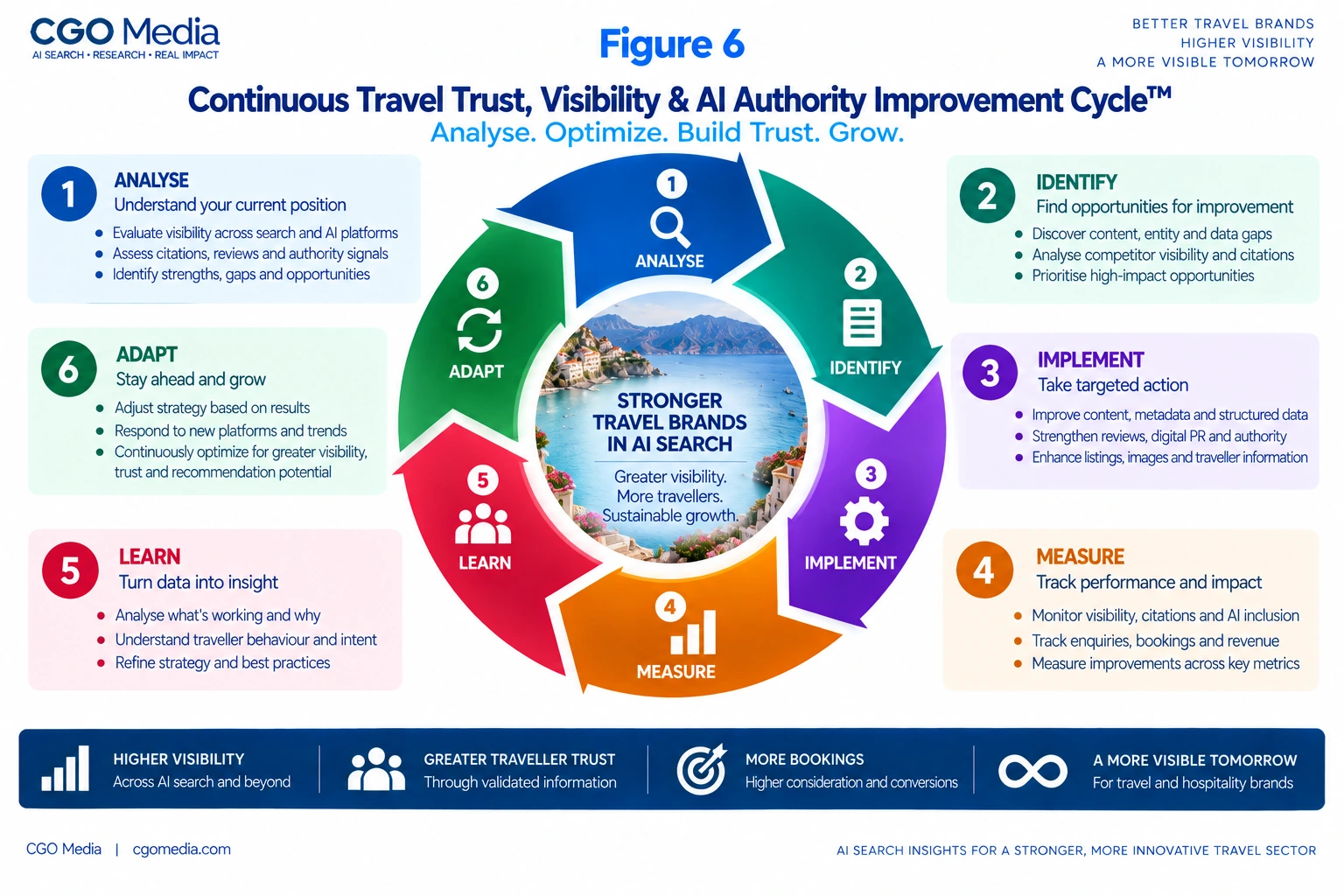
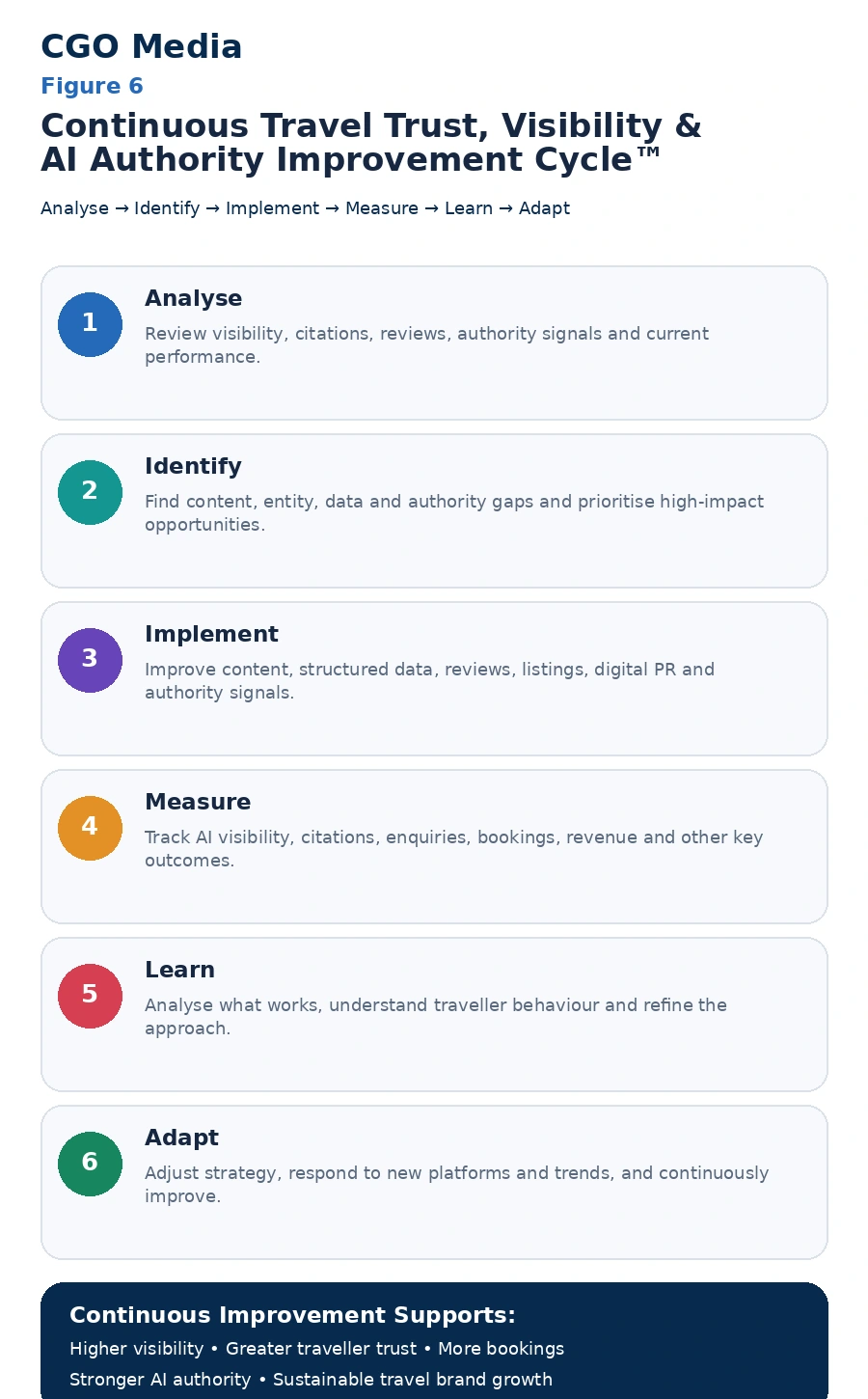
149. Methodology
The Travel & Hospitality AI Trust & Visibility Framework is a conceptual research framework developed by CGO Media to examine how travel and hospitality organisations build, communicate and maintain digital trust, search visibility and recommendation readiness across search engines, AI assistants, maps, travel marketplaces, online travel agencies, review platforms, destination organisations and provider-owned digital environments.
The framework is intended to provide a structured way to analyse the evidence surrounding a destination or travel provider rather than to reproduce the proprietary ranking, retrieval or recommendation systems used by individual search engines, travel platforms or AI providers.
Core Research Question
The central research question is:
What combination of entity clarity, destination relevance, product evidence, external validation, information quality and AI readiness allows a travel provider to become discoverable, understandable, trusted and appropriately recommendation-ready?
Research Scope
The framework can be applied across travel and hospitality organisations including:
- Hotels
- Resorts
- Accommodation providers
- Hospitality groups
- Tour operators
- Travel agencies
- Attractions and experience providers
- Destination organisations
- Travel technology businesses
Six-Dimension Method
The framework evaluates travel authority through six connected dimensions:
- Entity Clarity
- Destination & Context Authority
- Experience & Product Evidence
- External Trust & Validation
- Information Quality & Transparency
- AI Search & Recommendation Readiness
These dimensions are assessed together because weakness in one area can constrain the value created by stronger evidence elsewhere.
Entity-Clarity Method
Entity clarity is evaluated through the consistency and interpretability of information describing:
- Provider identity
- Property identity
- Brand relationships
- Property type
- Location
- Related entities
- Core operational attributes
The objective is to determine whether the provider can be identified consistently across important owned and external environments.
Destination-Authority Method
Destination and context authority are evaluated through relationships between the provider and:
- Destinations
- Neighbourhoods
- Transport
- Attractions
- Events
- Local experiences
- Traveller requirements
The framework evaluates whether these relationships provide genuine decision-useful context rather than generic geographic references.
Experience and Product-Evidence Method
Product and experience evidence is assessed using the specific attributes required to evaluate the travel product.
Depending on the provider, evidence may include:
- Rooms and accommodation types
- Facilities
- Dining
- Experiences
- Policies
- Accessibility
- Transport
- Operational information
Broad positioning statements are distinguished from observable attributes capable of supporting those statements.
External-Validation Method
Independent and semi-independent trust evidence can be examined across:
- Traveller reviews
- Travel publications
- Tourism organisations
- Destination websites
- Relevant media coverage
- Specialist sources
- Relevant awards and recognition
The framework places greater emphasis on contextual relevance than simple mention volume.
Information-Quality Method
Information quality is evaluated through:
Accuracy + Specificity + Transparency + Appropriate Freshness
Assessment considers whether information is sufficiently clear for travellers to understand both the provider’s strengths and any material limitations affecting their decision.
Three-Layer Evidence Method
The wider evidence ecosystem is divided into three layers:
Owned Evidence → Platform Evidence → Independent Evidence
Owned evidence establishes the organisation’s first-party representation. Platform evidence distributes property and traveller information through operational travel environments. Independent evidence provides external context and validation.
Analysis can assess the degree to which these layers converge around a coherent representation of the provider.
Evidence Consistency
Important factual differences can be evaluated according to:
Conflict Severity + Traveller Impact + Persistence + Decision Importance
The framework does not require identical wording across sources. It focuses on whether material facts remain compatible.
Travel AI Recommendation Potential
The Travel AI Recommendation Potential Matrix evaluates the interaction between:
Digital Visibility × Independent Trust & Validation
This produces four broad diagnostic states:
- Low Visibility / Low Trust
- High Visibility / Low Trust
- Low Visibility / High Trust
- High Visibility / High Trust
The matrix is diagnostic rather than evaluative of the underlying quality of the hotel or travel product.
Recommendation-Readiness Method
Recommendation readiness is evaluated through:
Traveller Need → Provider Evidence → Suitability Matching → Recommendation Readiness
The framework distinguishes between whether a provider can be discovered and whether sufficient evidence exists to justify its inclusion for a particular traveller scenario.
Recommendation Outcomes
Recommendation observations can be classified as:
- Relevant Inclusion — the provider fits and is included.
- False Negative — the provider fits but is repeatedly absent.
- False Positive — the provider is included despite weak fit.
- Appropriate Exclusion — the provider does not fit and is correctly omitted.
This distinction prevents recommendation frequency alone from being treated as the principal measure of success.
Scenario-Based AI Monitoring
AI search and recommendation visibility should be evaluated through defined traveller scenarios rather than generic branded prompts alone.
Scenario variables can include:
- Destination
- Traveller type
- Trip purpose
- Budget
- Accommodation requirement
- Location requirement
- Facilities
- Accessibility
Where longitudinal analysis is required, the platform, prompt, market, language and observation date should also be recorded.
Measurement Method
The measurement scorecard can evaluate:
- Digital Visibility
- Independent Trust
- Entity & Experience Accuracy
- Recommendation Readiness
- Performance Trend
- Critical Risk
Internal descriptive measures can also include:
Entity Accuracy Rate = Accurate Entity Observations ÷ Total Entity Observations
Qualified Recommendation Share = Relevant Recommendations ÷ Relevant Recommendation Opportunities
Recommendation Accuracy = Appropriate Recommendation Outcomes ÷ Total Recommendation Outcomes Observed
These formulas are analytical tools developed for framework application. They should not be interpreted as ranking or recommendation formulas used by external platforms.
Continuous Improvement Method
Long-term authority management follows the operating cycle:
Observe → Diagnose → Prioritise → Strengthen → Validate → Learn → Adapt
The framework therefore combines diagnosis, measurement and organisational improvement rather than treating AI visibility as an isolated reporting exercise.
150. Limitations
The Travel & Hospitality AI Trust & Visibility Framework is a conceptual strategic framework. It is not a hotel classification system, independent quality assessment, regulatory review, accessibility certification, pricing guarantee, booking guarantee or guarantee of search or AI visibility.
Travel Markets Differ
Traveller behaviour can vary substantially according to:
- Country
- Destination
- Season
- Traveller segment
- Trip purpose
- Language
Evidence derived from one market should not automatically be assumed to represent another.
Provider Types Differ
Hotels, resorts, airlines, attractions, tour operators and travel technology platforms operate with different products, data structures and traveller requirements.
The framework should therefore be adapted to the provider being assessed.
Property Types Differ
A city hotel, resort, hostel, villa, serviced apartment or boutique property should not be expected to demonstrate identical trust or recommendation characteristics.
Review Platforms Differ
Review scores, moderation practices, traveller populations and scoring systems vary between platforms.
Scores should not be treated as directly interchangeable without understanding the underlying context.
Reviews Are Subjective Evidence
Traveller reviews can be useful for identifying recurring themes, but individual reviews remain subjective and may not represent the overall traveller population.
Visibility Does Not Establish Quality
High digital visibility does not prove that a provider delivers a superior travel experience.
Similarly, low visibility does not indicate poor product quality.
The framework assesses digital evidence and recommendation conditions rather than absolute hospitality quality.
External Validation Does Not Guarantee Suitability
A highly reviewed or widely recognised provider may still be inappropriate for a particular traveller scenario.
Traveller fit remains contextual.
AI Systems Are Only Partially Observable
External researchers and travel organisations cannot observe every internal retrieval, ranking, source-selection or recommendation process used by generative systems.
Observed outputs therefore provide evidence about visible behaviour rather than complete access to underlying system mechanics.
AI Outputs Can Vary
Generated responses can vary according to:
- Platform
- Model
- Prompt
- Conversation context
- Language
- Market
- Date
A single output should therefore not be treated as evidence of a stable visibility pattern.
Generative Citations Have Limitations
Where an AI system displays citations, the visible citation should not automatically be assumed to explain every source or signal involved in constructing the answer.
Availability Is Dynamic
Travel inventory can change rapidly.
A provider that is normally suitable may be unavailable for the traveller’s required dates.
Evergreen web content cannot by itself establish current inventory.
Pricing Is Dynamic
Travel prices can vary according to:
- Date
- Demand
- Room type
- Occupancy
- Rate conditions
- Booking channel
Static pricing statements should therefore be treated cautiously.
Accessibility Requires Specific Verification
General statements about accessibility may not be sufficient for a traveller with specific requirements.
Travellers should verify critical accessibility needs directly with appropriate providers or authoritative current sources where necessary.
Independent Evidence Can Also Become Outdated
Travel publications, review platforms and external destination sources may continue displaying information after the underlying property has changed.
Independent evidence should therefore not automatically be assumed to be current.
Correlation Does Not Establish Causation
Changes in visibility, reviews, bookings or recommendation presence should not automatically be attributed to one intervention without sufficient supporting evidence.
Search Visibility Is Not Guaranteed
No framework can guarantee particular organic rankings, local positions or search-engine visibility.
AI Visibility Is Not Guaranteed
No framework can guarantee citation, recommendation or inclusion by a particular AI system.
Booking Outcomes Are Not Guaranteed
Traveller decisions can be influenced by many factors including:
- Price
- Availability
- Location
- Personal preference
- Timing
- Competing providers
Improved digital authority should therefore not be presented as a guaranteed commercial outcome.
151. Strategic Recommendations
The framework produces several practical recommendations for travel and hospitality organisations seeking to strengthen digital trust and AI recommendation readiness.
Establish Reliable Entity Foundations
Maintain clear provider, property, brand and destination identities across important owned and external environments.
Build Genuine Destination Context
Explain the provider’s relationships with neighbourhoods, transport, attractions, experiences and traveller requirements rather than relying on generic destination references.
Publish Specific Product Evidence
Make facilities, room configurations, policies, accessibility and traveller-relevant attributes explicit.
Separate Claims from Evidence
Broad positioning such as “family-friendly” or “luxury” should be supported by specific product characteristics and, where possible, relevant independent validation.
Maintain Platform Consistency
Monitor material information across maps, booking platforms, review environments and other important travel discovery systems.
Develop Relevant Independent Authority
Focus Digital PR, research, partnerships and specialist coverage on the destinations and experience categories for which the organisation has genuine relevance.
Use Reviews as Intelligence
Analyse recurring review themes rather than relying solely on headline ratings.
Separate Stable and Dynamic Information
Stable property identity and destination information can be governed differently from rapidly changing information such as availability, rates and opening conditions.
Monitor Recommendation Quality Rather Than Mention Volume
Distinguish relevant inclusion, false negatives, false positives and appropriate exclusions.
Prioritise High-Risk Errors
Give greatest attention to inaccuracies affecting location, operating status, accessibility, essential facilities and other factors capable of materially affecting the traveller.
Build Cross-Functional Governance
Search, content, operations, ecommerce, revenue, reputation, PR and technology functions should have clear ownership and escalation routes where their information affects travel authority.
Measure Longitudinally
Use repeated scenario-based monitoring to identify persistent trends rather than reacting to individual AI outputs.
Create Organisational Learning
Recurring authority problems should result in stronger standards, data ownership and monitoring so that the underlying weakness is less likely to reappear.
152. Conclusion
Travel and hospitality discovery is increasingly distributed across search engines, AI assistants, maps, online travel agencies, review platforms, tourism organisations, travel publishers and provider-owned digital environments.
This changes the strategic question from:
How do we rank this hotel, destination or travel product?
to:
Is there enough clear, accurate, current and independently reinforced evidence for the right traveller to discover, understand, trust and appropriately select this provider?
The Travel & Hospitality AI Trust & Visibility Framework identifies six interconnected authority dimensions:
Entity Clarity + Destination & Context Authority + Experience & Product Evidence + External Trust & Validation + Information Quality & Transparency + AI Search & Recommendation Readiness
These dimensions operate across three principal evidence layers:
Owned Evidence + Platform Evidence + Independent Evidence
The strongest authority environment emerges where those evidence layers converge around a coherent understanding of:
- Who the provider is
- Where it operates
- What it offers
- Which travellers it genuinely suits
- What practical limitations apply
- Why important claims can be trusted
AI-assisted discovery increases the importance of this coherence because destination research, provider discovery, comparison and recommendation can increasingly occur within the same interaction.
Recommendation readiness should therefore not be reduced to visibility alone.
A stronger relationship is:
Visibility + Trust + Relevance + Practical Eligibility + Data Freshness → Recommendation Readiness
The strategic objective is to create a travel evidence environment through which the provider can move successfully across:
Discovery → Understanding → Validation → Comparison → Recommendation → Selection
High visibility with weak trust creates vulnerability.
Strong trust with weak visibility creates unrealised discoverability.
High visibility combined with strong independent validation creates a stronger foundation for consideration, but traveller fit still determines whether recommendation is appropriate.
This is why the ultimate objective is not maximum AI exposure.
It is qualified authority: ensuring that the right provider can be discovered by the right traveller, understood accurately, supported by credible evidence and recommended only where the available information indicates genuine suitability.
Long-term resilience requires continuous management because properties, destinations, reviews, platforms, traveller behaviour and AI systems all change.
The final operating principle is therefore:
Observe → Diagnose → Prioritise → Strengthen → Validate → Learn → Adapt
Travel search authority is not a static marketing asset.
It is a continuously maintained relationship between digital representation, independent trust, operational reality and traveller experience.
References
External Academic, Technical and Industry Sources
- Google Search Central. SEO Starter Guide.
- Google Search Central. Understand How Structured Data Works.
- Schema.org. Hotel.
- Schema.org. LodgingBusiness.
- Schema.org. TouristAttraction.
- Schema.org. Trip.
- W3C. Web Content Accessibility Guidelines (WCAG) 2.2.
- Hogan, A. et al. (2021). Knowledge Graphs. ACM Computing Surveys, 54(4).
- Metzger, M.J. (2007). Making Sense of Credibility on the Web: Models for Evaluating Online Information and Recommendations for Future Research. Journal of the American Society for Information Science and Technology, 58(13), 2078–2091.
- Ji, Z. et al. (2023). Survey of Hallucination in Natural Language Generation. ACM Computing Surveys, 55(12).
CGO Media Travel & Hospitality Research and Frameworks
- Wilkinson, R. (2026). Travel & Hospitality SEO for AI-Powered Search. CGO Media.
- Wilkinson, R. (2026). Travel Discovery & Provider Selection Model. CGO Media.
- Wilkinson, R. (2026). Travel Search Authority Maturity Model. CGO Media.
- Wilkinson, R. (2026). Travel & Hospitality SEO & AI Implementation Roadmap. CGO Media.
CGO Media Research Ecosystem
CGO Media Research Library | CGO Media Framework Library | CGO Media Research Architecture | CGO Media Research Observations Library | CGO Media Statistics Library
About Roger Wilkinson
Roger Wilkinson is an independent researcher, SEO practitioner and founder of CGO Media with more than 25 years of experience in search, digital visibility and business growth.
His research examines how artificial intelligence is reshaping search engines, recommendation systems, entity representation, digital authority, citation systems and organisational visibility.
Within travel and hospitality, this work examines destination discovery, provider selection, digital trust, traveller evidence, AI recommendation readiness and the interaction between traditional search and generative discovery.
Related Travel & Hospitality Research
Travel & Hospitality SEO for AI-Powered Search | Travel Discovery & Provider Selection Model | Travel Search Authority Maturity Model | Travel & Hospitality SEO & AI Implementation Roadmap | Travel & Hospitality GEO: Generative Engine Optimisation | Travel & Hospitality GEO: Generative Engine Optimisation
Research Usage & Citation
CGO Media encourages travel organisations, hospitality groups, tourism bodies, researchers, journalists, consultants and technology providers to reference the Travel & Hospitality AI Trust & Visibility Framework where it contributes to analysis of travel search authority, digital trust, AI visibility, destination discovery or recommendation readiness.
Reasonable quotations, summaries, figures and excerpts may be used in articles, reports, presentations and academic work provided appropriate acknowledgement is given to Roger Wilkinson and CGO Media.
Cite This Research
The Travel & Hospitality AI Trust & Visibility Framework by Roger Wilkinson at CGO Media presents a six-dimension framework for understanding how entity clarity, destination authority, experience evidence, external validation, information quality and AI readiness combine to influence digital trust and recommendation potential across travel discovery environments.
APA Citation
Wilkinson, R. (2026). Travel & Hospitality AI Trust & Visibility Framework. CGO Media. https://cgomedia.com/travel-hospitality-ai-trust-visibility-framework/
Author: Roger Wilkinson | Published by: CGO Media
For permissions relating to substantial reproduction, commercial licensing or republication of significant portions of this framework, please contact CGO Media directly.