
CGO Media Research
How Organisations Become Recommended Across AI-Mediated Search & Discovery
AI Recommendation Authority Research UK 2026
Evidence-Led Research Observations
United Kingdom
50
22 July 2026
5 October 2026
10.5281/zenodo.22767920
Executive Summary
AI-mediated search is increasingly used not only to retrieve information but also to help users compare organisations, products and services, evaluate alternatives and identify options that appear suitable for a particular requirement.
This creates a new visibility problem for organisations.
A business may rank prominently in conventional search yet fail to appear when a user asks an AI system for recommended providers, suitable products, leading organisations, alternative suppliers or a shortlist of options.
Conversely, an organisation can sometimes appear within AI-generated recommendations even when the user’s journey does not involve a traditional search-engine results page.
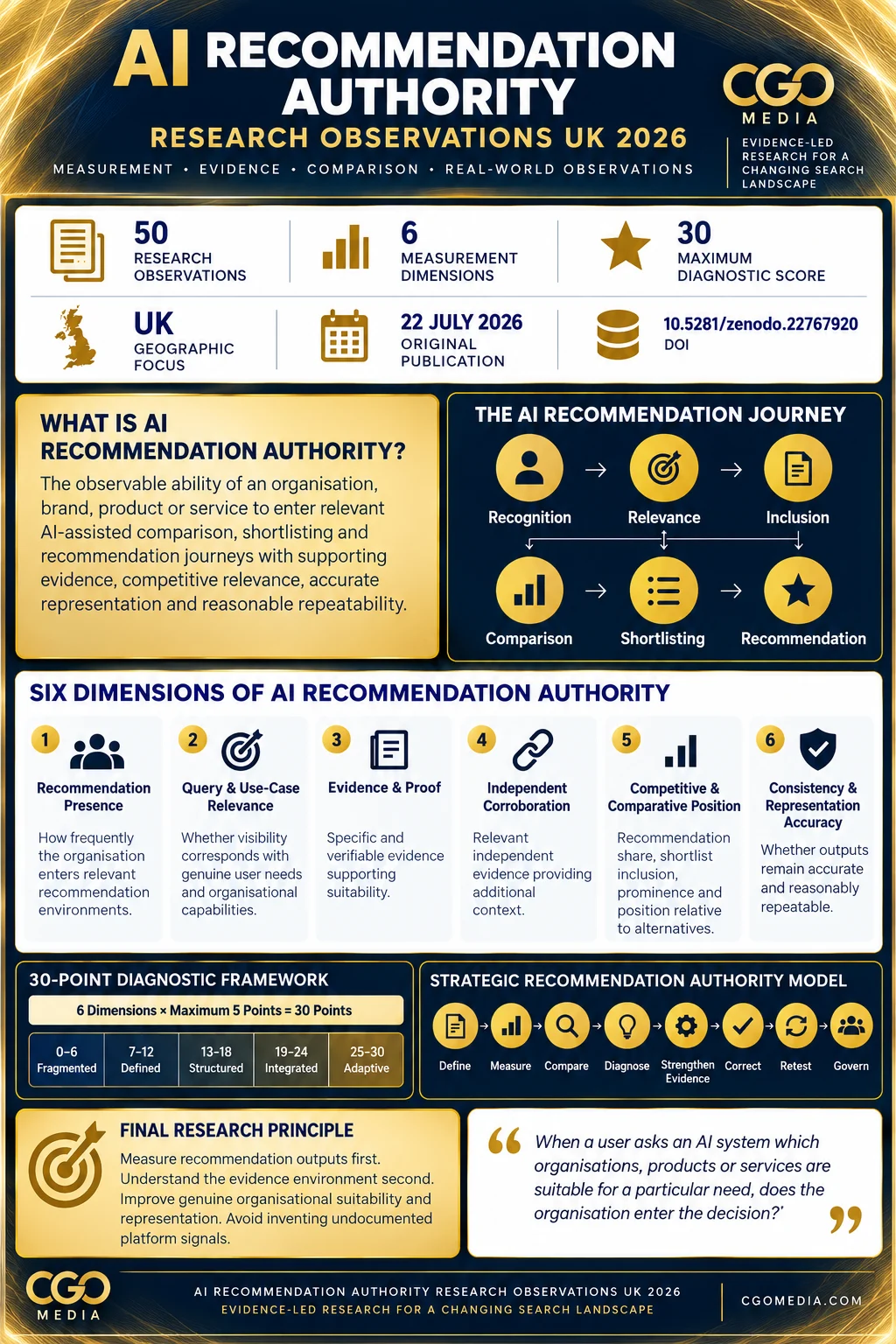
CGO Media uses the term AI Recommendation Authority to describe this emerging area of research.
CGO Media Definition
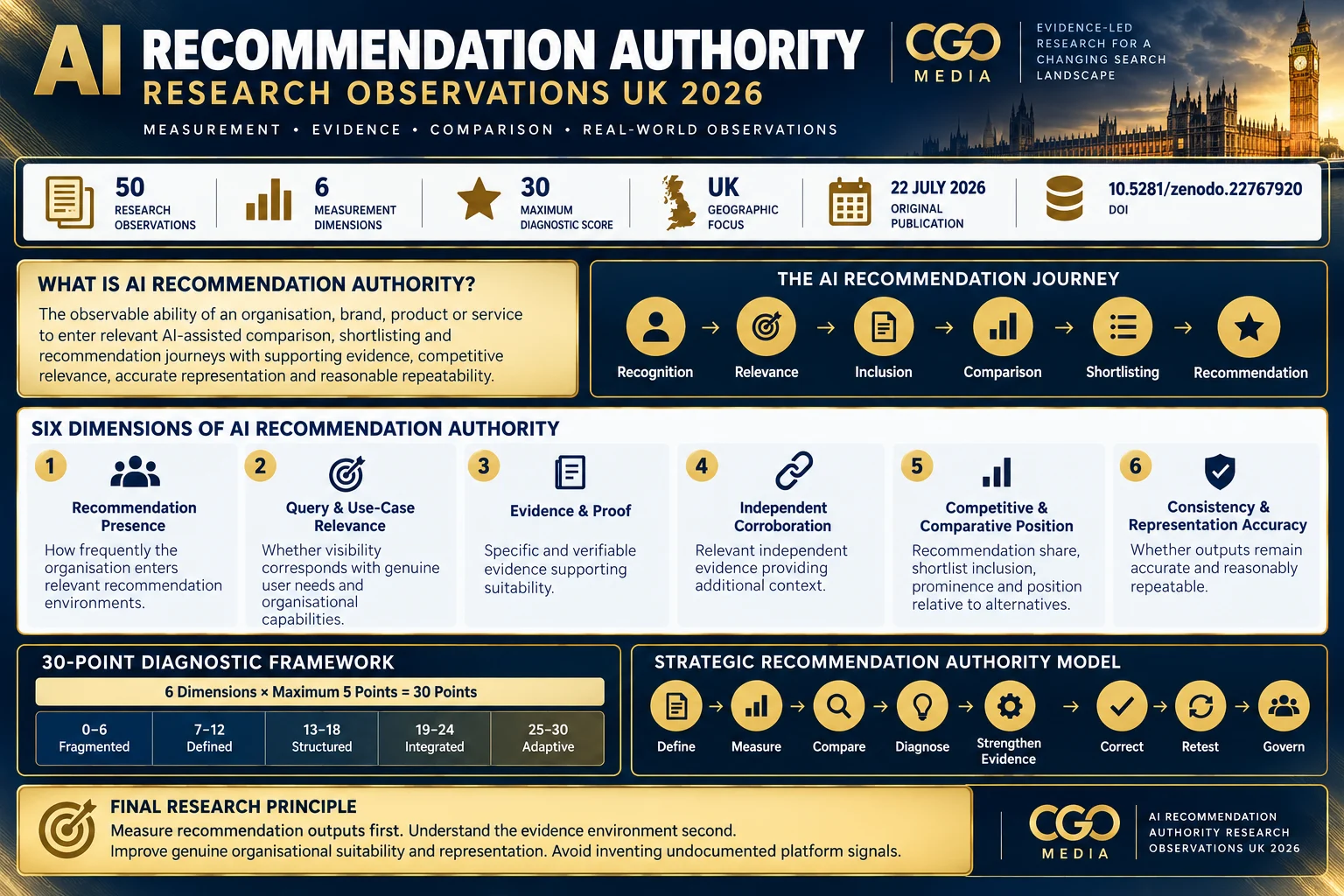
AI Recommendation Authority is the degree to which an organisation, brand, product or service is consistently surfaced as a suitable option within relevant AI-generated recommendation, comparison and shortlisting environments.
This definition deliberately focuses on observable outputs.
It does not assume that AI platforms use a universal internal “recommendation authority score”, a common set of trust signals or the same retrieval and ranking architecture.
What Counts as an AI Recommendation?
For this research, an AI recommendation occurs when an AI-mediated interface presents an organisation, brand, product or service as a potentially suitable option in response to a user need.
Recommendation environments may include:
- “best” or “recommended” organisation queries;
- provider or supplier shortlists;
- product discovery;
- product comparisons;
- service comparisons;
- alternative-provider questions;
- location-specific recommendations;
- budget or requirement-based suggestions;
- industry or specialist recommendations; and
- conversational buying or decision-support journeys.
Important Research Distinction
A recommendation should not automatically be treated as an endorsement by the AI platform.
AI-generated answers can be incomplete, contextual, personalised, time-sensitive or incorrect. Recommendation visibility therefore needs to be measured as an observable output rather than interpreted as a formal certification of quality.
Why Recommendation Visibility Matters
Traditional search visibility frequently measures whether a webpage appears for a query.
Recommendation visibility asks a different question:
When a user asks for organisations or products suitable for a particular need, does the brand enter the answer?
This makes recommendation research especially important in markets where users are comparing multiple alternatives rather than searching for one known company.
Observable Recommendation Pathway
AI recommendation performance can be analysed as a sequence of observable states.
Recognition → Relevance → Inclusion → Comparison → Shortlisting → Recommendation
This pathway is a CGO Media measurement model. It should not be interpreted as a disclosed internal processing sequence used by any specific AI platform.
Recommendation Visibility Is Not the Same as Citation Visibility
| AI Output | What It Shows |
|---|---|
| Recognition | The system can identify the organisation or product. |
| Citation | A source is referenced in support of an answer. |
| Mention | The brand appears within the answer. |
| Comparison | The organisation is evaluated alongside alternatives. |
| Recommendation | The organisation or product is presented as a potentially suitable option for the stated need. |
These outcomes can overlap, but they should not be treated as interchangeable.
What Public Platform Documentation Can Tell Us
Public platform documentation provides evidence that recommendation and comparison experiences are becoming an explicit part of AI-assisted discovery.
For example, OpenAI documents shopping experiences in which users can explore and compare products according to their needs, preferences, budget and conversational context. OpenAI also states that product selection can depend on relevance to the user’s intent and that merchant presentation can incorporate product and merchant information.
Google likewise documents product data systems in which structured product information, merchant feeds, pricing, availability, ratings and other product attributes can support richer product discovery experiences.
Research Boundary: These documented product-discovery mechanisms should not be generalised into a universal ranking formula for every brand, organisation, service provider or AI recommendation environment.
Six AI Recommendation Authority Dimensions
The rebuilt CGO Media framework evaluates recommendation performance across six dimensions that can be observed and audited without claiming access to proprietary AI scoring systems.
1. Recommendation Presence
How frequently the organisation appears within relevant recommendation and shortlist prompts.
2. Query & Use-Case Relevance
Whether the organisation appears for the problems, requirements, sectors and use cases it actually serves.
3. Evidence & Proof
The availability of verifiable information supporting capability, suitability, products, services or performance.
4. Independent Corroboration
The extent to which relevant external sources provide additional context, reviews, evidence or validation.
5. Competitive & Comparative Position
How the organisation is represented when AI systems compare it with plausible alternatives.
6. Consistency & Representation Accuracy
Whether recommendations describe the organisation accurately and remain reasonably consistent across repeated tests.
Central Research Finding
Recommendation visibility is strongest as a research concept when it is measured through repeatable outputs and connected with verifiable evidence, rather than explained through assumed hidden AI trust or authority scores.
Key Research Findings
- Recommendation visibility is distinct from conventional rankings.
- Recommendation, citation, mention and comparison are different observable outputs.
- Recommendation performance is query- and context-dependent.
- One prompt cannot establish recommendation authority.
- Repeatability across relevant prompt sets is more useful than isolated appearances.
- Evidence and factual clarity can be audited even when internal selection mechanisms are unknown.
- Independent sources can provide useful corroborating information but should not all be treated as equal.
- Recommendation accuracy should be measured alongside recommendation frequency.
- Competitor inclusion provides useful context for measuring recommendation share.
- No organisation can guarantee inclusion within AI-generated recommendations.
Research Objectives
- Define AI Recommendation Authority without presenting it as a hidden platform metric.
- Develop a repeatable method for measuring recommendation presence.
- Distinguish recommendations from citations, mentions and ordinary brand recognition.
- Assess how recommendation output changes across user needs and prompt contexts.
- Evaluate the evidence available to support organisational suitability claims.
- Measure competitive inclusion and recommendation share.
- Identify inaccurate, unstable or contradictory recommendation outputs.
- Develop an organisational framework for improving recommendation readiness and measurement.
Research Scope
The research considers recommendation behaviour across relevant AI-mediated discovery environments and examines:
Research Boundary
This paper does not assume that ChatGPT, Google AI Overviews, Gemini, Claude, Microsoft Copilot, Perplexity or other AI systems use the same recommendation architecture.
Where a platform does not publicly disclose how a recommendation was generated, the research does not assign undocumented internal signals, confidence values or causal ranking factors.
The analysis is therefore limited to public documentation, observable recommendation outputs, verifiable evidence and clearly labelled CGO Media interpretation.
Recommendation Measurement Principle
Prompt Set → Observe Outputs → Record Inclusion → Compare Alternatives → Check Evidence → Test Again
Recommendation Authority should therefore be evaluated through groups of relevant prompts over repeated measurement periods, not through a single favourable AI answer.
Minimum Recommendation Audit Record
- platform tested;
- date and time of test;
- exact prompt;
- user context or constraints where relevant;
- whether the organisation appeared;
- position or prominence within the answer;
- competitors or alternatives included;
- reasoning or attributes stated by the system;
- sources or citations displayed where available;
- factual accuracy;
- recommendation category;
- result on repeat testing.
CGO Media Recommendation Authority Principle
Measure recommendation outputs first. Investigate the supporting evidence second. Avoid inventing hidden platform signals.
The strategic objective is to understand whether an organisation enters relevant AI-assisted decision journeys, why it appears to be suitable based on observable evidence and where recommendation visibility remains weak, inaccurate or inconsistent.
Research Observations 1–10
Recommendation Presence, User Intent & Use-Case Relevance
The first ten observations examine whether an organisation appears at all when users ask AI systems for recommendations, shortlists, alternatives or suitable providers.
Recommendation Authority begins with presence, but presence alone is not enough. An organisation must also appear in the right contexts, for the right user needs and with a representation that matches what it genuinely provides.
Research Observation 1
Recommendation Presence Is the First Observable Requirement
Evidence Type: Recommendation Presence Observation
An organisation cannot participate in an AI-assisted decision journey if it is never surfaced within relevant recommendation or shortlist prompts.
Research Finding: Recommendation presence is the most basic observable condition for measuring AI Recommendation Authority.
CGO Media Interpretation: Start by measuring whether the organisation enters the answer before attempting to explain why.
Research Observation 2
One Favourable Prompt Does Not Establish Recommendation Authority
Evidence Type: Measurement Reliability Observation
An organisation may appear for one prompt and disappear for a similar prompt, another session or a different wording of the same need.
Research Finding: Isolated recommendation appearances are insufficient for reliable measurement.
CGO Media Interpretation: Recommendation Authority should be tested across prompt sets and repeated observations.
Research Observation 3
Recommendation Visibility Is Query-Dependent
Evidence Type: Query Context Observation
The same organisation can be visible for one recommendation need and absent for another because user intent, constraints and context differ.
Research Finding: Recommendation visibility cannot be treated as one universal brand-level state.
CGO Media Interpretation: Measurement should be organised around real use cases rather than one generic “best company” query.
Research Observation 4
User Constraints Change the Recommendation Set
Evidence Type: Intent Constraint Observation
Budget, location, sector, organisation size, product requirements, urgency and other constraints can materially alter which options are presented.
Research Finding: Recommendation relevance is conditional on the needs expressed in the prompt.
CGO Media Interpretation: Organisations should test recommendation visibility against commercially meaningful user constraints.
Research Observation 5
Use-Case Relevance Is More Valuable Than Broad Recommendation Presence
Evidence Type: Commercial Relevance Observation
Appearing in recommendation prompts unrelated to the organisation’s actual offer has limited strategic value.
Research Finding: Recommendation quality should account for relevance to genuine capabilities and target demand.
CGO Media Interpretation: Relevant recommendation presence matters more than raw recommendation volume.
Research Observation 6
Category Definition Influences Recommendation Eligibility
Evidence Type: Category Relevance Observation
If an organisation’s services, products or sector positioning are unclear, it may be harder to assess whether it belongs within a particular recommendation context.
Research Finding: Clear category and service definition supports more meaningful recommendation measurement.
CGO Media Interpretation: Recommendation readiness begins with explaining clearly what the organisation is suitable for.
Research Observation 7
Location Changes Recommendation Relevance
Evidence Type: Geographic Relevance Observation
An organisation may be suitable nationally, locally, internationally or only within a defined service area.
Research Finding: Geographic scope should be recorded separately from broad recommendation presence.
CGO Media Interpretation: Local and national recommendation prompt sets should not be merged into one undifferentiated score.
Research Observation 8
Recommendation Prompts Should Reflect Real Decision Journeys
Evidence Type: Research Design Observation
Synthetic prompts designed only to mention target keywords can produce misleading conclusions about recommendation performance.
Research Finding: Prompt design should reflect plausible user needs, comparisons and purchasing or selection criteria.
CGO Media Interpretation: Recommendation audits should model real journeys rather than manufacture favourable tests.
Research Observation 9
Recommendation Presence Should Be Measured Against Competitors
Evidence Type: Competitive Visibility Observation
Knowing that a brand appears is less informative without understanding which alternatives are repeatedly selected alongside or instead of it.
Research Finding: Competitor inclusion provides important context for evaluating recommendation share.
CGO Media Interpretation: AI Recommendation Authority should be measured comparatively, not in isolation.
Research Observation 10
Recommendation Presence Should Be Treated as a Distribution, Not a Binary Result
Evidence Type: Measurement Synthesis
A brand can be absent, occasionally included, frequently included or consistently prominent across a relevant prompt set.
Research Finding: Recommendation visibility is better measured through frequency and context than through a simple yes-or-no test.
CGO Media Interpretation: Recommendation Authority should be expressed as repeated observable performance across relevant prompt groups.
What Observations 1–10 Tell Us
The first layer of AI Recommendation Authority is relevant recommendation presence.
The important question is not simply whether an organisation can appear in an AI-generated answer. It is whether it appears repeatedly within recommendation contexts that reflect genuine user needs and commercial relevance.
User Need → Relevant Prompt → Recommendation Set → Brand Presence → Competitor Context
Presence is the starting point. Relevance and repeatability determine whether that presence is strategically meaningful.
CGO Media Recommendation Presence Principle
Recommendation Authority should be measured across realistic prompt sets that reflect actual user needs, constraints and decision journeys.
A single favourable answer is an observation, not evidence of sustained recommendation authority.
Recommendation Presence Audit
- Core recommendation categories
- Primary user needs
- Location-specific needs
- Sector-specific needs
- Budget and constraint-based prompts
- Provider shortlist prompts
- Alternative-provider prompts
- Product or service comparison prompts
- Competitors repeatedly included
- Recommendation frequency across repeated tests
Research Observations 11–20
Evidence, Proof, Independent Corroboration & Recommendation Suitability
The second group of observations examines the evidence surrounding an organisation when it appears within recommendation, comparison or shortlist environments.
Recommendation visibility becomes more meaningful when the organisation can be connected with accurate information explaining what it offers, who it serves, where it operates and what evidence supports its suitability.
Research Observation 11
Recommendation Suitability Requires Understandable Evidence
Evidence Type: Suitability Evidence Observation
An organisation is easier to evaluate when its services, products, capabilities, locations and intended customers are described clearly and consistently.
Research Finding: Clear capability evidence makes recommendation suitability easier to assess than broad promotional claims.
CGO Media Interpretation: Recommendation readiness should begin with clear evidence of what the organisation can actually deliver.
Research Observation 12
Specific Proof Is More Useful Than Generic Superiority Claims
Evidence Type: Proof Quality Observation
Statements such as “leading”, “best” or “trusted” provide limited evaluative value when they are not connected with verifiable supporting evidence.
Research Finding: Specific evidence such as product attributes, service scope, research, case material or independently verifiable facts is more useful for suitability assessment than unsupported superiority language.
CGO Media Interpretation: Replace vague claims with facts that can be inspected and compared.
Research Observation 13
First-Party Evidence Defines the Organisation’s Own Offer
Evidence Type: First-Party Evidence Observation
Official webpages remain important for defining services, products, locations, pricing where applicable, eligibility, capabilities and other current organisational facts.
Research Finding: First-party sources are especially important for current factual information about what the organisation says it provides.
CGO Media Interpretation: Recommendation readiness depends partly on making current commercial facts easy to find and interpret.
Research Observation 14
Independent Corroboration Is a Different Evidence Class
Evidence Type: Independent Evidence Observation
An organisation describing its own capabilities is different from relevant independent sources discussing, reviewing, referencing or evaluating those capabilities.
Research Finding: First-party definition and independent corroboration should be measured separately.
CGO Media Interpretation: Strong recommendation evidence combines accurate self-description with credible external context where available.
Research Observation 15
Not All External Sources Carry the Same Evidential Weight
Evidence Type: Source Quality Observation
A specialist publication, customer review, directory listing, research repository and automatically generated profile provide different forms of evidence.
Research Finding: External evidence should be evaluated by relevance, independence, specificity, freshness and credibility rather than simply counted.
CGO Media Interpretation: Recommendation evidence quality matters more than raw mention volume.
Research Observation 16
Reviews Can Provide Decision-Relevant Evidence When Interpreted Carefully
Evidence Type: Review Evidence Observation
Reviews can provide useful information about customer experience, product performance or service delivery, but review volume and sentiment require context.
Research Finding: Reviews can contribute useful suitability evidence, but they should not automatically be treated as a complete or unbiased representation of organisational quality.
CGO Media Interpretation: Review evidence is strongest when considered alongside other factual and independent evidence.
Research Observation 17
Research Can Strengthen Evidence Around Specialist Suitability
Evidence Type: Research Evidence Observation
Research, datasets and substantive publications can demonstrate sustained engagement with a subject area beyond commercial claims alone.
Research Finding: Research assets can contribute evidence of subject engagement where they are relevant, attributable and methodologically transparent.
CGO Media Interpretation: Organisations seeking specialist recommendation visibility should build genuine knowledge assets, not only promotional landing pages.
Research Observation 18
Evidence Should Match the Recommendation Context
Evidence Type: Contextual Evidence Observation
Evidence relevant to enterprise software selection may be different from evidence relevant to a local service recommendation, healthcare provider comparison or consumer product purchase.
Research Finding: Evidence quality depends partly on whether it addresses the actual decision criteria within the recommendation context.
CGO Media Interpretation: Recommendation evidence should be mapped to specific user needs rather than treated as one universal evidence pool.
Research Observation 19
Current Evidence Matters More When Suitability Depends on Changing Facts
Evidence Type: Freshness Observation
Prices, product availability, service areas, team composition, opening hours, certifications and commercial terms can change over time.
Research Finding: Outdated evidence can weaken the accuracy of suitability assessments even when the underlying brand remains relevant.
CGO Media Interpretation: Evidence freshness should be treated as part of recommendation governance.
Research Observation 20
Evidence Convergence Is More Informative Than Repetition
Evidence Type: CGO Media Research Synthesis
A recommendation case becomes easier to evaluate when first-party information, customer evidence, independent references and substantive knowledge assets converge on similar factual conclusions.
Research Finding: Multiple distinct evidence classes provide more informative context than repeating the same organisational claim across controlled properties.
CGO Media Interpretation: Recommendation suitability should be supported by evidence diversity rather than artificial repetition.
What Observations 11–20 Tell Us
The second layer of AI Recommendation Authority is evidence-backed suitability.
Recommendation visibility becomes more meaningful when the organisation can be connected with specific, current and contextually relevant evidence explaining why it may be suitable for a particular user need.
First-Party Facts → Proof → Independent Evidence → Contextual Relevance → Evidence Convergence
Evidence should explain suitability without being treated as proof of a hidden recommendation score.
CGO Media Recommendation Evidence Principle
Recommendation evidence should be specific, current, relevant to the user’s decision and distinguishable by source type.
First-party claims define the offer. Independent sources provide additional context. Neither should be misrepresented as a disclosed AI ranking signal.
Recommendation Evidence Audit
- Clear service or product definitions
- Relevant use-case evidence
- Current factual information
- Product or service attributes
- Research and substantive knowledge assets
- Case material where appropriate
- Customer reviews and experience evidence
- Independent media or industry references
- Evidence freshness
- Conflicting or unsupported claims
Research Observations 21–30
Comparative Position, Competitor Inclusion, Shortlisting & Recommendation Share
The third group of observations examines what happens once an organisation enters a recommendation environment alongside plausible alternatives.
At this stage, recommendation performance becomes comparative. It is not enough to know whether a brand appears; organisations also need to understand which competitors appear, how often they are included, what attributes are highlighted and whether the organisation progresses from general mention to shortlist or recommendation.
Research Observation 21
Recommendation Authority Is Inherently Comparative
Evidence Type: Comparative Recommendation Observation
Recommendation prompts frequently ask systems to select or compare multiple suitable options rather than evaluate one organisation in isolation.
Research Finding: Recommendation performance should be interpreted relative to the alternatives repeatedly surfaced for the same user need.
CGO Media Interpretation: Recommendation Authority is better understood as comparative visibility than as an isolated brand metric.
Research Observation 22
Competitor Inclusion Reveals the Practical Recommendation Set
Evidence Type: Competitor Set Observation
The competitors repeatedly surfaced alongside an organisation provide a practical view of the category in which the brand is being interpreted.
Research Finding: Repeated competitor inclusion helps identify the actual recommendation landscape associated with a prompt set.
CGO Media Interpretation: AI recommendation audits can expose competitors that conventional keyword-based competitor analysis may overlook.
Research Observation 23
Recommendation Share Is More Informative Than Raw Inclusion Count
Evidence Type: Recommendation Share Observation
A brand appearing ten times has a different meaning if competitors appear ten times each than if the closest competitor appears only twice.
Research Finding: Recommendation share provides comparative context for raw presence frequency.
CGO Media Interpretation: Organisations should track their share of relevant recommendation appearances within a defined competitor set.
Research Observation 24
Shortlisting Is a Stronger Observable State Than General Mention
Evidence Type: Shortlisting Observation
A brand may be mentioned within an answer without being presented as one of the options a user should actively consider.
Research Finding: Shortlisting represents a more decision-proximate form of visibility than incidental mention.
CGO Media Interpretation: Recommendation audits should distinguish between mention, shortlist inclusion and explicit recommendation.
Research Observation 25
Prominence Within a Recommendation Answer Can Be Measured Separately
Evidence Type: Recommendation Prominence Observation
Two brands can both appear in the same recommendation answer while receiving very different amounts of explanation, emphasis or decision-support context.
Research Finding: Inclusion and prominence are related but distinct recommendation metrics.
CGO Media Interpretation: Record how substantially the organisation is discussed, not only whether its name appears.
Research Observation 26
The Attributes Used in Comparison Matter
Evidence Type: Comparative Attribute Observation
Recommendation answers may compare organisations on price, specialism, geography, features, reviews, scale, suitability or other criteria.
Research Finding: The attributes associated with a brand reveal how it is being positioned within a recommendation context.
CGO Media Interpretation: Recommendation monitoring should capture the reasons stated for inclusion, not just the inclusion itself.
Research Observation 27
Comparative Accuracy Is as Important as Comparative Visibility
Evidence Type: Comparative Accuracy Observation
An organisation can appear prominently yet still be described inaccurately relative to competitors.
Research Finding: Recommendation performance should account for factual accuracy in the attributes used for comparison.
CGO Media Interpretation: A visible but inaccurate recommendation can create a misleading picture of authority.
Research Observation 28
Different Prompt Types Can Produce Different Competitor Sets
Evidence Type: Prompt Segmentation Observation
A “best provider” prompt, an “alternative to” prompt and a requirement-led shortlist prompt can surface different groups of organisations.
Research Finding: Competitor analysis should be segmented by recommendation intent rather than treated as one fixed list.
CGO Media Interpretation: Recommendation competitors are partly defined by the user’s decision context.
Research Observation 29
Recommendation Share Should Be Tracked Over Time
Evidence Type: Longitudinal Measurement Observation
A one-time comparison captures only one measurement period and may not reflect sustained performance.
Research Finding: Longitudinal tracking is required to determine whether recommendation share is strengthening, weakening or remaining stable.
CGO Media Interpretation: Recommendation Authority should be monitored as a trend rather than reported as a permanent status.
Research Observation 30
Recommendation Performance Should Be Measured Across the Decision Funnel
Evidence Type: CGO Media Research Synthesis
A brand may be recognised but not compared, compared but not shortlisted, or shortlisted without being presented as the most suitable option.
Research Finding: Recommendation performance contains multiple observable stages rather than one binary outcome.
CGO Media Interpretation: The strongest measurement model separates recognition, comparison, shortlisting and recommendation.
What Observations 21–30 Tell Us
The third layer of AI Recommendation Authority is comparative recommendation position.
Recommendation performance becomes strategically useful when organisations understand who they compete against, how frequently they appear, which attributes are used to compare them and how often they progress into shortlists and explicit recommendations.
Recognition → Comparison → Shortlist → Recommendation → Recommendation Share
Recommendation Authority is therefore best measured comparatively and longitudinally.
CGO Media Comparative Recommendation Principle
Recommendation Authority should be evaluated against the competitors, alternatives and attributes that repeatedly appear within the same decision context.
Inclusion alone does not reveal competitive strength; recommendation share, prominence, shortlist inclusion and representation accuracy provide the wider picture.
Comparative Recommendation Audit
- Competitors repeatedly included
- Recommendation share by prompt group
- Shortlist inclusion rate
- Explicit recommendation rate
- Prominence within answers
- Attributes used for comparison
- Positive and negative differentiators stated
- Comparative factual accuracy
- Changes in competitor sets by prompt type
- Recommendation share trend over time
Research Observations 31–40
Accuracy, Consistency, Volatility, Source Visibility & Recommendation Stability
The fourth group of observations examines how reliable recommendation visibility is once an organisation begins to appear within AI-generated comparisons and shortlists.
Recommendation Authority is weakened when the organisation is described inaccurately, appears inconsistently across repeated tests or is associated with outdated information. Stability and accuracy therefore need to be measured alongside presence and competitive position.
Research Observation 31
Recommendation Accuracy Should Be Measured Independently From Recommendation Presence
Evidence Type: Representation Accuracy Observation
An organisation can appear frequently in recommendation answers while being described incorrectly, incompletely or with outdated information.
Research Finding: High recommendation frequency does not automatically mean high-quality recommendation representation.
CGO Media Interpretation: Presence and accuracy should always be reported as separate measures.
Research Observation 32
Repeated Testing Reveals Recommendation Stability
Evidence Type: Stability Measurement Observation
Recommendation outputs can vary across repeated prompts, sessions, dates and platform contexts.
Research Finding: Stability can only be assessed through repeated observation rather than a single test.
CGO Media Interpretation: Stable recommendation visibility is more meaningful than occasional isolated appearances.
Research Observation 33
Recommendation Volatility Is Itself a Useful Metric
Evidence Type: Volatility Observation
A brand that moves frequently between strong recommendation presence and complete absence has a different visibility profile from one that appears consistently at a moderate level.
Research Finding: Volatility provides additional information beyond average recommendation frequency.
CGO Media Interpretation: Recommendation dashboards should show variability as well as mean performance.
Research Observation 34
Outdated Facts Can Distort Recommendation Suitability
Evidence Type: Freshness & Accuracy Observation
Old prices, former locations, discontinued products, obsolete service areas or outdated leadership information can alter how a recommendation is interpreted.
Research Finding: Information freshness contributes directly to recommendation accuracy even when recommendation inclusion remains unchanged.
CGO Media Interpretation: Organisations should treat outdated public information as a recommendation-governance issue.
Research Observation 35
Source Visibility Can Help Explain Recommendation Outputs
Evidence Type: Source Visibility Observation
Some AI interfaces display sources, references or links alongside recommendation answers, while others provide limited or no visible sourcing.
Research Finding: Where visible sources are available, they can provide useful evidence about which information environments are being surfaced in the answer.
CGO Media Interpretation: Source visibility should be recorded, but visible citations should not be assumed to reveal the complete internal selection process.
Research Observation 36
Visible Sources and Recommended Brands Are Not Always the Same Entities
Evidence Type: Source–Recommendation Separation Observation
An answer may cite one source while recommending a different organisation or product mentioned within that source or elsewhere in the information environment.
Research Finding: Citation visibility and recommendation visibility should not be treated as interchangeable measurements.
CGO Media Interpretation: Track both the source layer and the recommendation layer separately.
Research Observation 37
Cross-Platform Consistency Should Be Measured Without Assuming Shared Architecture
Evidence Type: Cross-Platform Observation
An organisation may appear strongly on one AI platform and weakly on another because platforms differ in available data, product design, retrieval behaviour and answer construction.
Research Finding: Cross-platform variation is an observable outcome but does not by itself reveal the internal reason for the difference.
CGO Media Interpretation: Platform-specific reporting is more defensible than combining all AI systems into one undifferentiated score.
Research Observation 38
Recommendation Errors Should Be Classified, Not Merely Counted
Evidence Type: Error Classification Observation
Recommendation inaccuracies can involve identity, geography, product availability, pricing, capability, affiliation, service scope or comparison criteria.
Research Finding: Error classification helps identify the type of information problem that requires investigation.
CGO Media Interpretation: Recommendation accuracy audits should record what is wrong, not just that something is wrong.
Research Observation 39
Recommendation Stability Should Be Interpreted Over Defined Measurement Windows
Evidence Type: Longitudinal Stability Observation
Short-term consistency does not necessarily imply long-term stability, particularly in rapidly changing product, local or commercial environments.
Research Finding: Stability should be defined relative to a stated time period and prompt set.
CGO Media Interpretation: Recommendation Authority should be tracked as a time series, not a permanent label.
Research Observation 40
Reliable Recommendation Measurement Requires Presence, Accuracy and Stability Together
Evidence Type: CGO Media Research Synthesis
No single recommendation metric captures the full quality of AI-mediated visibility.
Research Finding: A robust recommendation assessment combines how often the organisation appears, whether it is represented accurately and how stable that performance remains across repeated measurement.
CGO Media Interpretation: Strong Recommendation Authority is observable as relevant presence reinforced by accurate and reasonably repeatable representation.
What Observations 31–40 Tell Us
The fourth layer of AI Recommendation Authority is accurate and stable representation.
A brand that appears frequently but inaccurately has a different recommendation profile from one that appears consistently, correctly and within relevant decision contexts.
Presence → Accuracy → Repeatability → Stability → Reliable Recommendation Visibility
Source visibility can provide additional evidence, but it should not be treated as a complete explanation of undocumented platform behaviour.
CGO Media Recommendation Stability Principle
Recommendation Authority is stronger when relevant inclusion is accurate, repeatable and reasonably stable across defined prompt sets and measurement periods.
Volatility, factual errors and inconsistent platform representation should be treated as measurable weaknesses rather than ignored because the brand appeared at least once.
Recommendation Accuracy & Stability Audit
- Recommendation frequency
- Factual accuracy rate
- Common error types
- Outdated information detected
- Repeated-test consistency
- Recommendation volatility
- Visible sources or citations
- Difference between cited sources and recommended brands
- Cross-platform variation
- Stability trend over time
Research Observations 41–50
Measurement, Governance, Maturity & the CGO Media AI Recommendation Authority Framework
The final ten observations move from visibility analysis to organisational measurement and governance.
AI Recommendation Authority becomes more useful when organisations can define prompt sets, establish baselines, measure competitive performance, identify inaccurate outputs and track changes over time using transparent criteria.
Research Observation 41
Recommendation Authority Should Be Measured Across Multiple Dimensions
Evidence Type: Measurement Framework Observation
No single metric can adequately describe AI recommendation performance.
Research Finding: Recommendation presence, relevance, evidence, corroboration, comparative position and accuracy should be assessed independently before being combined.
CGO Media Interpretation: A composite score is useful only when its underlying dimensions remain visible.
Research Observation 42
A Baseline Is Required Before Improvement Can Be Demonstrated
Evidence Type: Baseline Measurement Observation
Without a documented baseline, later changes in recommendation visibility are difficult to interpret reliably.
Research Finding: Initial audits should record prompt sets, platforms, recommendation presence, competitors, evidence, accuracy and stability before intervention.
CGO Media Interpretation: Recommendation improvement should be measured against a known starting point.
Research Observation 43
Prompt Sets Should Be Governed and Versioned
Evidence Type: Prompt Governance Observation
If prompt wording changes continuously, longitudinal comparisons become less reliable.
Research Finding: Stable core prompt sets make trend analysis more reproducible while allowing additional experimental prompts to be tested separately.
CGO Media Interpretation: Prompt libraries should be treated as measurement assets and maintained under version control.
Research Observation 44
Platform-Level Reporting Is More Defensible Than One Universal AI Score
Evidence Type: Platform Measurement Observation
Different AI systems can produce different recommendation outputs for the same user need.
Research Finding: Platform-specific reporting preserves important variation that would otherwise be hidden by a blended score.
CGO Media Interpretation: Cross-platform summaries should sit above, not replace, individual platform measurements.
Research Observation 45
Recommendation Errors Should Enter the Governance Process
Evidence Type: Accuracy Governance Observation
Recurring inaccuracies may reveal outdated first-party information, conflicting external references or broader representation problems requiring investigation.
Research Finding: Error monitoring becomes more actionable when issues are categorised, assigned and reviewed rather than simply logged.
CGO Media Interpretation: Representation errors should become part of brand, search and information-governance workflows.
Research Observation 46
Recommendation Governance Requires Clear Organisational Ownership
Evidence Type: Organisational Governance Observation
Recommendation performance crosses SEO, GEO, content, research, Digital PR, product, brand and analytics functions.
Research Finding: Measurement can become fragmented when no team owns the overall recommendation audit, evidence register and correction process.
CGO Media Interpretation: Recommendation Authority should have a named organisational owner even when implementation is cross-functional.
Research Observation 47
Recommendation Maturity Reflects Measurement Capability, Not Hidden Platform Preference
Evidence Type: Maturity Model Observation
An organisation can mature from ad hoc testing towards structured, integrated and continuously governed recommendation measurement.
Research Finding: Higher maturity represents stronger organisational capability to measure and manage recommendation visibility.
CGO Media Interpretation: Maturity should not be presented as evidence that an AI platform assigns a higher hidden authority score.
Research Observation 48
Recommendation Authority Should Be Reassessed After Material Business Change
Evidence Type: Event-Driven Measurement Observation
Rebrands, acquisitions, new products, pricing changes, market expansion and service changes can materially alter recommendation suitability and comparative position.
Research Finding: Recommendation audits should be event-driven as well as periodic.
CGO Media Interpretation: Significant organisational change should trigger a new recommendation baseline.
Research Observation 49
Composite Recommendation Scores Should Not Create False Precision
Evidence Type: Scoring Limitation Observation
A 30-point framework can simplify reporting, but small score differences should not be interpreted as scientifically exact differences in how AI systems evaluate brands.
Research Finding: Composite scores are most useful when accompanied by dimension-level evidence and documented prompt methodology.
CGO Media Interpretation: Use scores to diagnose weakness and track change, not to imply access to proprietary AI ranking metrics.
Research Observation 50
AI Recommendation Authority Is a Continuous Measurement Discipline
Evidence Type: CGO Media Research Synthesis
Recommendation environments, competitors, products, evidence and user needs continue to change over time.
Research Finding: Recommendation Authority is best managed as an ongoing measurement and governance capability rather than a one-off optimisation exercise.
CGO Media Interpretation: The strategic objective is sustained, relevant and accurate recommendation visibility across the decision journeys that matter commercially.
CGO Media AI Recommendation Authority Framework
The fifty observations support a six-dimensional diagnostic framework for measuring AI Recommendation Authority.
1. Recommendation Presence
Frequency of inclusion across relevant recommendation, shortlist and comparison prompts.
2. Query & Use-Case Relevance
Whether the organisation appears for the genuine problems, requirements and user needs it serves.
3. Evidence & Proof
Availability of specific and verifiable evidence supporting capability and suitability.
4. Independent Corroboration
Relevant independent evidence, reviews, media, research references and third-party context.
5. Competitive & Comparative Position
Recommendation share, shortlist inclusion, prominence and comparison performance against alternatives.
6. Consistency & Representation Accuracy
Accuracy, repeatability, stability and absence of materially misleading recommendation outputs.
30-Point Diagnostic Model
Each dimension is scored from 0 to 5 using predefined and documented evidence.
Recommendation Presence + Use-Case Relevance + Evidence & Proof + Independent Corroboration + Competitive Position + Representation Accuracy
Maximum Score = 30
| Score | Diagnostic Meaning |
|---|---|
| 0 | Absent or materially unresolved |
| 1 | Very weak or inconsistent |
| 2 | Developing |
| 3 | Established |
| 4 | Strong and integrated |
| 5 | Leading and actively governed |
AI Recommendation Authority Maturity
0–6 Fragmented → 7–12 Defined → 13–18 Structured → 19–24 Integrated → 25–30 Adaptive
0–6 · Fragmented
Recommendation testing is ad hoc, presence is weak or uncertain and there is little systematic evidence or governance.
7–12 · Defined
Core prompt sets and recommendation categories are defined, but measurement and evidence coverage remain incomplete.
13–18 · Structured
Recommendation presence, competitors, evidence and accuracy are measured through repeatable processes.
19–24 · Integrated
Recommendation measurement is connected with content, research, Digital PR, competitive analysis and governance.
25–30 · Adaptive
Recommendation performance is continuously monitored, compared, corrected and reassessed as user needs and markets evolve.
What Observations 41–50 Tell Us
The final layer of AI Recommendation Authority is measurement and governance.
Recommendation visibility becomes an organisational capability when prompt sets, evidence, competitors, inaccuracies and changes over time can be measured systematically.
Measure → Compare → Diagnose → Improve → Retest → Govern
The framework is designed to support diagnosis and improvement, not to simulate a hidden AI recommendation score.
CGO Media AI Recommendation Authority Principle
Recommendation Authority should be measured through observable inclusion, relevance, evidence, comparative position, accuracy and stability.
The aim is not to reverse-engineer a hypothetical universal AI recommendation algorithm. The aim is to understand whether an organisation is entering relevant AI-assisted decision journeys and how consistently and accurately it is represented when it does.
CGO Media Analysis
What the 50 AI Recommendation Authority Research Observations Tell Us
The fifty observations point towards a clear conclusion: AI Recommendation Authority should be treated as a measurable visibility discipline rather than as an assumed hidden trust or ranking score.
The most defensible approach is to observe whether an organisation enters relevant AI-assisted decision journeys, how it is compared with alternatives, what evidence surrounds it and whether that representation remains accurate and reasonably stable over time.
Central Analysis
AI Recommendation Authority is strongest as a research concept when recommendation presence, user relevance, evidence, competitive position, representation accuracy and stability are measured together.
1. Recommendation Visibility Is Not the Same as Search Ranking
Traditional search measurement usually asks whether a webpage ranks for a query.
Recommendation measurement asks whether an organisation, brand, product or service appears as a suitable option within an AI-generated shortlist, comparison or recommendation.
CGO Media Position: Rankings and recommendations should be reported separately because they represent different observable outcomes.
2. Recommendation Presence Is Context-Dependent
An organisation may be recommended for one need and absent for another because recommendation prompts encode different constraints, user priorities, budgets, locations and decision criteria.
User Need → Constraints → Recommendation Context → Candidate Options → Shortlist
This means Recommendation Authority cannot be reduced to one universal brand-level visibility state.
3. One Prompt Is Not a Measurement System
A favourable answer can be useful as an observation but provides insufficient evidence of sustained recommendation visibility.
Meaningful measurement requires defined prompt groups, repeated observations and consistent recording of results.
Research Principle: A single recommendation is an event. Recommendation Authority is a pattern.
4. Relevance Matters More Than Raw Recommendation Volume
Recommendation visibility has limited strategic value if the organisation appears for needs that do not correspond to its actual offer.
The strongest recommendation visibility occurs when the brand appears within use cases, categories, locations and decision contexts that matter commercially.
5. Evidence Helps Explain Suitability
AI-generated recommendations can only be meaningfully audited when organisations can identify the information that supports their suitability.
Useful evidence may include:
- clear product or service descriptions;
- pricing or commercial conditions where relevant;
- location and service-area information;
- product attributes;
- research and specialist publications;
- case material;
- reviews;
- independent media or industry references; and
- other decision-relevant factual evidence.
6. Independent Corroboration Is Different From Self-Description
An organisation explaining its own capabilities provides one evidence class. Independent sources describing, reviewing or referencing those capabilities provide another.
First-Party Definition + Independent Context = Richer Recommendation Evidence
These evidence classes should reinforce one another without being treated as interchangeable.
7. Recommendation Authority Is Inherently Competitive
Recommendation environments frequently present multiple alternatives.
This means the organisation’s performance is best understood relative to the brands, products or providers repeatedly surfaced alongside it.
Key Measurement Shift: Move from “Did we appear?” to “How often did we appear relative to the alternatives?”
8. Recommendation Share Creates Better Competitive Context
Raw inclusion counts do not reveal whether an organisation dominates, matches or trails its practical competitor set.
Recommendation share provides a more useful comparative measure across a defined prompt universe.
9. Shortlisting Is More Decision-Proximate Than Mention
A brand can be recognised or mentioned without being presented as a realistic option for the user’s decision.
Recognition → Mention → Comparison → Shortlist → Recommendation
Separating these stages creates a clearer picture of where an organisation enters the AI-assisted decision funnel.
10. Accuracy Is as Important as Visibility
High recommendation frequency can be strategically harmful if the organisation is associated with incorrect pricing, locations, capabilities, affiliations or other material facts.
Recommendation monitoring should therefore ask not only whether the organisation appears but whether the representation is accurate enough to support the user’s decision.
11. Stability Matters Because Recommendation Outputs Can Vary
Recommendation answers may change across repeated tests, platforms, sessions and measurement periods.
This makes volatility an important part of recommendation reporting.
Presence
Does the organisation appear?
Accuracy
Is it represented correctly?
Repeatability
Does it reappear across tests?
Stability
Does performance persist over time?
12. Citation Visibility and Recommendation Visibility Must Remain Separate
The source cited in an AI-generated answer may not be the same organisation ultimately recommended.
A publisher may supply evidence about several brands, while the answer recommends one or more of those brands.
Measurement Principle: The source layer and the recommendation layer are connected but analytically distinct.
13. Cross-Platform Differences Are Expected
Different AI environments can return different recommendation sets for similar questions.
Organisations should measure this variation without assuming that all platforms rely on the same data, knowledge architecture or selection methodology.
14. Prompt Governance Is Essential for Longitudinal Measurement
A changing prompt universe makes trend analysis difficult.
Stable core prompt libraries create a better baseline while allowing experimental prompts to be maintained separately.
15. Recommendation Authority Requires Governance, Not Just Optimisation
Recommendation performance can be influenced by changes in products, services, pricing, evidence, locations, customer experience, competitors and external information.
The practical discipline therefore extends beyond SEO into research, content, product, Digital PR, analytics and organisational information governance.
Six Dimensions of AI Recommendation Authority
| Dimension | Core Question |
|---|---|
| Recommendation Presence | Does the organisation appear within relevant recommendation contexts? |
| Query & Use-Case Relevance | Does it appear for needs it genuinely serves? |
| Evidence & Proof | Is there specific evidence supporting suitability? |
| Independent Corroboration | Is relevant external evidence available? |
| Competitive & Comparative Position | How does the organisation perform against alternatives? |
| Consistency & Representation Accuracy | Is recommendation visibility accurate and reasonably stable? |
The Observable AI Recommendation Funnel
Recognition → Relevance → Inclusion → Comparison → Shortlisting → Recommendation
This is a CGO Media measurement framework rather than a claim about the internal processing sequence of any individual AI platform.
Recommendation Authority as an Organisational Capability
Define Prompt Universe → Measure → Compare → Diagnose → Strengthen Evidence → Correct Errors → Retest → Govern
Eight Questions Every Organisation Should Be Able to Answer
- Presence: Are we included in the recommendation prompts that matter?
- Relevance: Are we appearing for genuine customer needs?
- Evidence: What verifiable information supports our suitability?
- Corroboration: What relevant independent evidence exists?
- Competition: Which alternatives appear more often than we do?
- Position: Are we merely mentioned or actually shortlisted and recommended?
- Accuracy: Are our capabilities and attributes represented correctly?
- Stability: Does performance persist across repeated measurements?
CGO Media Research Position
AI Recommendation Authority should not be presented as a universal proprietary score used internally by AI platforms.
Its defensible role is to measure whether an organisation enters relevant AI-assisted recommendation environments, how it compares with alternatives, what evidence surrounds that representation and whether its visibility remains accurate and repeatable.
Presence + Relevance + Evidence + Corroboration + Competitive Position + Accuracy = Measurable Recommendation Authority
Practical Implementation
What UK Organisations Should Do in 2026
AI Recommendation Authority should be approached as a measurable organisational capability rather than as a one-off attempt to influence individual AI answers.
The practical objective is to understand where the organisation appears within relevant AI-assisted decision journeys, strengthen the evidence surrounding genuine suitability and improve the accuracy and consistency of that representation over time.
Implementation Principle
Measure real recommendation journeys first. Strengthen the evidence environment second. Retest and govern continuously.
1. Define the Recommendation Universe
Identify the recommendation contexts that matter commercially.
- best-provider queries;
- supplier shortlists;
- product discovery;
- service comparisons;
- alternative-provider prompts;
- location-based recommendations;
- sector-specific recommendations; and
- budget or requirement-led queries.
2. Build a Controlled Prompt Library
Create a stable group of prompts representing real user needs and decision journeys.
Keep the core prompt library consistent enough to support longitudinal measurement while maintaining a separate experimental group for new queries.
3. Segment Prompts by User Intent
Do not combine every recommendation query into one category.
Separate prompt groups by:
- commercial intent;
- location;
- sector;
- organisation size;
- budget;
- product type;
- service requirement; and
- comparison stage.
4. Establish a Baseline Before Making Changes
Record current recommendation performance before implementing major improvements.
This baseline should include:
- recommendation presence;
- competitors included;
- shortlist inclusion;
- recommendation share;
- representation accuracy;
- visible sources where available; and
- repeatability across tests.
5. Measure Platforms Separately
Track each AI environment independently before creating an executive summary across platforms.
Rule: Do not assume that one platform’s recommendation performance explains another platform’s behaviour.
6. Identify the Real Recommendation Competitor Set
Record which brands, products or providers appear repeatedly alongside or instead of the organisation.
This may reveal a different competitor universe from traditional organic-search competitors.
7. Measure Recommendation Share
Track the organisation’s recommendation appearances relative to the total observed recommendation opportunities within the defined prompt set.
Recommendation Share = Brand Recommendation Appearances ÷ Total Relevant Recommendation Opportunities
This is a CGO Media measurement construct rather than a disclosed platform metric.
8. Distinguish Mention, Comparison, Shortlisting and Recommendation
Do not treat every brand appearance as equivalent.
Recognition → Mention → Comparison → Shortlist → Recommendation
9. Audit the Reasons Given for Recommendation
Record the attributes used to explain why the organisation was included.
These may include:
- price;
- specialism;
- location;
- features;
- product availability;
- reviews;
- scale;
- sector expertise; and
- suitability for the stated use case.
10. Strengthen First-Party Suitability Evidence
Make it easy to understand what the organisation offers, where it operates, who it serves and what differentiates specific services or products.
11. Replace Generic Claims With Verifiable Proof
Reduce reliance on unsupported phrases such as “leading”, “best”, “trusted” or “award-winning” unless the underlying claim can be verified.
Use specific evidence instead.
12. Build Evidence Around Important Use Cases
Map each strategically important recommendation context to supporting evidence.
User Need → Relevant Capability → Supporting Evidence → Independent Context
13. Develop Substantive Research and Knowledge Assets
Where specialist authority matters, original research, datasets, frameworks, technical studies and other substantive knowledge assets can strengthen the evidence environment surrounding the organisation.
14. Strengthen Legitimate Independent Corroboration
Develop relevant third-party evidence through credible media, trade publications, professional sources, customer reviews, research repositories and industry environments.
Important: Independent corroboration is not the same as distributing the same self-authored claim across multiple owned or controlled sites.
15. Keep Commercial Information Current
Review information that can materially influence recommendation suitability.
- prices;
- availability;
- service areas;
- features;
- opening hours;
- commercial terms;
- products; and
- current organisational capabilities.
16. Monitor Recommendation Accuracy
Record material errors whenever the organisation appears.
Classify them by type:
- identity;
- location;
- pricing;
- service scope;
- product availability;
- capability;
- affiliation; and
- comparison attributes.
17. Investigate Repeated Representation Errors
Recurring inaccuracies should trigger an audit of the wider information environment.
Potential causes may include outdated first-party content, conflicting external sources or ambiguous organisational information.
18. Measure Stability and Volatility
Track whether recommendation presence remains stable across repeated measurements or fluctuates significantly.
Averages alone can conceal meaningful volatility.
19. Create a Recommendation Authority Governance Register
Maintain a structured record of the recommendation programme.
Which recommendation journey is being measured?
Where was the result observed?
What supports recommendation suitability?
Which alternatives are repeatedly surfaced?
Which representation errors require investigation?
Who is responsible for corrective action?
20. Treat Recommendation Authority as Continuous Measurement
Recommendation environments are dynamic.
Competitors, product data, independent evidence, user needs and platform behaviour can all change. Recommendation Authority should therefore be monitored continuously rather than treated as a completed optimisation task.
Recommended Implementation Sequence
Define → Baseline → Measure → Compare → Evidence → Correct → Retest → Govern
90-Day AI Recommendation Authority Plan
Days 1–30 — Define & Baseline
- Define priority recommendation journeys.
- Create the core prompt library.
- Segment prompts by intent and use case.
- Select AI environments for measurement.
- Run the baseline recommendation audit.
- Identify recurring competitors.
- Record representation inaccuracies.
- Score the six Recommendation Authority dimensions.
Days 31–60 — Strengthen Evidence & Representation
- Improve first-party product and service information.
- Strengthen use-case-specific evidence.
- Correct outdated commercial information.
- Develop substantive knowledge assets where relevant.
- Improve independent corroboration.
- Investigate repeated recommendation errors.
- Document comparison attributes and competitor strengths.
Days 61–90 — Retest, Compare & Govern
- Repeat the controlled prompt tests.
- Compare recommendation share against baseline.
- Measure shortlist and explicit recommendation changes.
- Review representation accuracy.
- Assess volatility and stability.
- Re-score the six framework dimensions.
- Create the ongoing governance register.
- Assign responsibility for continuing measurement.
Cross-Functional Ownership
AI Recommendation Authority should not be owned solely by SEO.
| Function | Recommendation Authority Responsibility |
|---|---|
| SEO / GEO | Prompt design, recommendation measurement, search visibility and information architecture. |
| Research | Evidence creation, data, methodologies, studies and specialist knowledge assets. |
| Content | Clear service, product, use-case and factual information. |
| Digital PR | Independent references, journalist engagement and external corroboration. |
| Product / Commercial | Current pricing, availability, features, eligibility and commercial facts. |
| Brand / Communications | Correct positioning, approved facts and representation accuracy. |
| Analytics / Leadership | Baseline governance, performance reporting, ownership and strategic prioritisation. |
What Organisations Should Not Do
- Do not use one favourable prompt as proof of recommendation authority.
- Do not engineer prompt wording purely to force a brand mention.
- Do not combine different AI platforms into one score without preserving platform-level results.
- Do not confuse citations with recommendations.
- Do not treat every brand mention as shortlist inclusion.
- Do not rely on unsupported “best” or “leading” claims.
- Do not count all external references as equally valuable.
- Do not ignore inaccurate recommendations simply because the brand is visible.
- Do not hide volatility behind an average score.
- Do not describe the CGO Media framework as an internal AI-platform score.
CGO Media Implementation Principle
Measure where the organisation enters the decision journey. Strengthen the evidence that supports genuine suitability. Correct inaccurate representation. Retest continuously.
The objective is sustained, relevant and accurate recommendation visibility — not the appearance of manipulating an undocumented AI recommendation algorithm.
Measurement Framework
Full AI Recommendation Authority Measurement Framework
The CGO Media AI Recommendation Authority Framework converts the research observations into a structured diagnostic model that organisations can use to evaluate recommendation visibility across AI-mediated search and discovery environments.
The framework contains six dimensions. Each dimension is scored from 0 to 5, producing a maximum diagnostic score of 30.
Presence + Relevance + Evidence + Corroboration + Competitive Position + Representation Accuracy
Maximum Diagnostic Score: 30
Scoring Scale
| Score | Level | General Meaning |
|---|---|---|
| 0 | Absent | Materially absent, unresolved or not measurable. |
| 1 | Very Weak | Some evidence exists, but performance is highly inconsistent or poorly governed. |
| 2 | Developing | Core elements exist but remain incomplete, uneven or unreliable. |
| 3 | Established | Consistent performance is visible across core priority areas. |
| 4 | Strong | Performance is strong, integrated and supported by repeatable measurement. |
| 5 | Leading | Performance is mature, broadly evidenced, actively monitored and governed. |
Dimension 1 — Recommendation Presence
Measures how frequently the organisation appears across the controlled recommendation, comparison and shortlist prompts that matter commercially.
- 0: Organisation is effectively absent from relevant recommendation prompts.
- 1: Occasional isolated appearances with little repeatability.
- 2: Appears within a limited number of relevant prompt groups but remains inconsistent.
- 3: Appears regularly across several priority recommendation journeys.
- 4: Strong inclusion across most priority prompt groups and repeated measurements.
- 5: Broad, sustained and repeatedly measurable recommendation presence across the defined priority universe.
inclusion frequency, shortlist rate, explicit recommendation rate, platform, date, prompt and repeated-test results.
Dimension 2 — Query & Use-Case Relevance
Measures whether recommendation visibility occurs for genuine customer needs, commercial use cases, sectors, locations and constraints that the organisation actually serves.
- 0: No meaningful visibility for relevant use cases.
- 1: Recommendations are sporadic or mainly irrelevant to the organisation’s real offer.
- 2: Some commercially relevant visibility exists, but important use cases remain absent.
- 3: Good visibility across the main customer needs and categories.
- 4: Strong visibility across most priority use cases, including important constraints and segments.
- 5: Broad and consistent recommendation visibility across the organisation’s strategically important decision journeys.
use-case coverage, geographic relevance, sector relevance, budget constraints, product or service requirements and customer segment alignment.
Dimension 3 — Evidence & Proof
Measures the quality and availability of verifiable information supporting why the organisation may be suitable for the recommendation context.
- 0: Little or no substantive evidence is available.
- 1: Evidence is mainly generic promotional language.
- 2: Some useful proof exists, but it is incomplete or poorly mapped to important use cases.
- 3: Clear evidence supports the main services, products or capabilities.
- 4: Strong, current and specific evidence supports most priority recommendation contexts.
- 5: Extensive, current and well-structured evidence supports the full priority recommendation universe.
product data, service details, pricing, research, case material, datasets, expertise evidence, customer outcomes and current commercial facts.
Dimension 4 — Independent Corroboration
Measures the availability and relevance of external evidence that provides independent context around the organisation, products or capabilities.
- 0: No meaningful independent evidence is identifiable.
- 1: Very limited external evidence or mostly low-value references.
- 2: Some relevant third-party corroboration exists but is inconsistent or narrow.
- 3: Multiple relevant independent sources provide useful context.
- 4: Strong corroboration exists across several credible evidence environments.
- 5: Broad, current and diverse independent corroboration consistently supports important organisational claims and use cases.
trade publications, media, independent reviews, professional sources, research repositories, industry references and relevant third-party datasets.
Dimension 5 — Competitive & Comparative Position
Measures how the organisation performs when compared with plausible alternatives inside AI-generated recommendation journeys.
- 0: Organisation is rarely or never included when competitors are recommended.
- 1: Competitors dominate almost all relevant recommendation sets.
- 2: Organisation is occasionally competitive but recommendation share remains weak.
- 3: Organisation appears regularly alongside major alternatives and gains meaningful shortlist inclusion.
- 4: Strong recommendation share and frequent shortlist or explicit recommendation inclusion.
- 5: Consistently strong comparative visibility across the priority prompt universe, while maintaining relevant and accurate representation.
recommendation share, shortlist rate, competitor frequency, prominence, differentiators and comparison attributes.
Dimension 6 — Consistency & Representation Accuracy
Measures whether recommendation outputs describe the organisation accurately and whether that representation remains reasonably repeatable over time.
- 0: Representation is materially inaccurate or too unstable to assess reliably.
- 1: Frequent errors, contradictions or major volatility are present.
- 2: Representation is partly accurate but recurring inconsistencies remain.
- 3: Generally accurate and reasonably repeatable representation across priority tests.
- 4: Strong accuracy with low material-error rates and good stability.
- 5: Highly accurate, consistently represented and actively monitored across platforms and measurement periods.
factual accuracy, error type, stale information, repeated-test consistency, platform variation and volatility.
AI Recommendation Authority Maturity Model
| Score | Maturity | Interpretation |
|---|---|---|
| 0–6 | Fragmented | Recommendation visibility is poorly understood, weakly measured or materially absent. |
| 7–12 | Defined | Core prompt sets and evidence requirements are defined but performance remains uneven. |
| 13–18 | Structured | Recommendation presence, evidence, competitors and accuracy are measured systematically. |
| 19–24 | Integrated | Recommendation measurement is integrated with research, content, Digital PR, product and analytics. |
| 25–30 | Adaptive | Recommendation performance is continuously measured, compared, corrected and governed. |
Important Scoring Limitation
These maturity levels describe organisational recommendation-measurement capability. They are not internal scores used by ChatGPT, Google, Gemini, Claude, Perplexity, Microsoft Copilot or any other AI platform.
Worked Diagnostic Example A
Consider a UK professional-services organisation that appears regularly in AI recommendations but has weak independent corroboration and inconsistent representation.
| Dimension | Score |
|---|---|
| Recommendation Presence | 4 |
| Query & Use-Case Relevance | 4 |
| Evidence & Proof | 3 |
| Independent Corroboration | 2 |
| Competitive & Comparative Position | 3 |
| Consistency & Representation Accuracy | 2 |
| Total | 18 / 30 |
Diagnosis: The organisation reaches the Structured maturity level, but the total score hides two important weaknesses: independent corroboration and representation accuracy.
Worked Diagnostic Example B
A second organisation can also score 18/30 while having a very different recommendation profile.
| Dimension | Score |
|---|---|
| Recommendation Presence | 2 |
| Query & Use-Case Relevance | 3 |
| Evidence & Proof | 4 |
| Independent Corroboration | 4 |
| Competitive & Comparative Position | 2 |
| Consistency & Representation Accuracy | 3 |
| Total | 18 / 30 |
Diagnosis: This organisation also reaches Structured maturity, but its weakness is not evidence. It has strong evidence and corroboration but limited recommendation presence and competitive inclusion.
Why Dimension-Level Reporting Matters
Two organisations can achieve the same total score while requiring completely different strategic interventions. The total score summarises performance; the individual dimensions diagnose the problem.
Evidence-Backed Scoring Rules
Every score should be supported by an auditable evidence record.
- Record the exact prompt tested.
- Record the AI platform and date.
- Record whether the organisation appeared.
- Record shortlist or recommendation status.
- Record competing organisations.
- Capture visible sources where available.
- Record supporting evidence.
- Classify factual inaccuracies.
- Repeat priority tests.
- Retain the evidence used to justify each 0–5 score.
What the Score Does Not Mean
- It does not represent a score assigned by an AI company.
- It does not reveal an internal recommendation algorithm.
- It does not guarantee recommendation inclusion.
- It does not prove that any individual evidence source caused a recommendation.
- It does not mean that a 24-point organisation is exactly twice as authoritative as a 12-point organisation.
- It does not replace platform-specific observation and analysis.
Recommendation Authority and AI Search Visibility
AI Recommendation Authority should be treated as one layer of a broader AI search visibility system.
Entity Recognition → Retrieval / Visibility → Citation → Comparison → Recommendation
An organisation may perform strongly at one stage and weakly at another. Recognition does not guarantee citation, and citation does not guarantee recommendation.
Continuous Measurement Cycle
Audit → Score → Diagnose → Prioritise → Improve → Validate → Re-Score → Govern
Executive Recommendation Authority Scorecard
Total diagnostic score out of 30.
Fragmented to Adaptive.
Primary diagnostic weakness.
Relative inclusion against alternatives.
Proportion of materially accurate recommendation outputs.
Improving, stable or declining over the defined measurement period.
CGO Media Measurement Principle
The total score summarises Recommendation Authority. The six dimensions diagnose Recommendation Authority. The underlying evidence explains Recommendation Authority.
The framework should therefore be used to support transparent measurement, prioritisation and governance rather than to imply access to proprietary AI recommendation systems.
Forward Research Outlook
AI Recommendation Authority Trends 2026–2027
AI-mediated discovery is moving beyond information retrieval towards comparison, shortlisting, product discovery, service evaluation and increasingly decision-oriented interactions.
For organisations, this means visibility can no longer be assessed only through rankings, traffic or citations. A growing part of the search journey involves whether an organisation enters a relevant consideration set and how it is represented when users ask AI systems to compare alternatives.
Research Outlook
The 2026–2027 shift is likely to move organisations from asking “Are we visible in AI?” towards asking “Are we considered, compared and recommended when users make decisions?”
1. Recommendation Visibility Becomes a Separate Search KPI
Organisations are likely to separate recommendation visibility from conventional rankings, citations and general AI mentions.
The relevant question becomes whether the organisation is being surfaced as a viable option within commercially important decision journeys.
2. Recommendation Share Becomes a Competitive Metric
Raw brand mentions provide limited competitive context.
Recommendation share is likely to become more useful because it measures how frequently an organisation appears relative to the alternatives surfaced for the same prompt universe.
3. Prompt Libraries Become Formal Measurement Assets
Organisations are likely to move away from occasional manual prompting towards governed prompt sets representing defined customer journeys.
Customer Need → Controlled Prompt Set → Recommendation Output → Measurement
4. User Constraints Become More Important to Recommendation Analysis
Recommendation systems increasingly operate within conversational contexts where users can specify budgets, preferences, locations, features and other requirements.
Recommendation research will therefore need to measure performance against realistic combinations of user constraints rather than broad category keywords alone.
5. Product and Service Comparison Moves Closer to the AI Interface
AI environments are increasingly able to help users explore alternatives, compare attributes and narrow choices without requiring every comparison step to begin on a conventional search-results page.
This makes comparative representation an increasingly important visibility layer.
6. Agentic Commerce Expands the Importance of Machine-Readable Commercial Information
As AI-assisted shopping progresses towards more transactional and agentic experiences, accurate product, pricing, availability and merchant information is likely to become increasingly important.
For ecommerce organisations, recommendation readiness and commercial-data readiness will become more closely connected.
7. Recommendation Optimisation Moves Beyond Ecommerce
Product recommendations are the clearest current use case, but the underlying decision pattern extends to professional services, software, travel, healthcare, education, financial services and other sectors.
The evidence required will differ significantly by sector.
8. Use-Case Authority Becomes More Important Than Generic Brand Authority
Being widely known does not necessarily mean being the most relevant option for a particular user requirement.
Recommendation analysis is likely to place greater emphasis on whether organisations can demonstrate suitability for specific customer problems and decision contexts.
9. Evidence Architecture Becomes Part of Recommendation Strategy
Organisations are likely to become more deliberate about connecting commercial claims with evidence that supports them.
Capability → Evidence → Corroboration → Comparison Readiness
10. Independent Evidence Becomes More Deliberately Managed
Digital PR, reviews, specialist publications, research repositories and other external environments are likely to become more closely connected with AI recommendation measurement.
The emphasis should remain on credible independent evidence rather than manufacturing repeated references across controlled properties.
11. Research Assets Become More Valuable in Specialist Recommendation Environments
For organisations competing on expertise rather than commodity attributes, original research and substantive knowledge assets can provide richer evidence of subject engagement.
This is particularly relevant where recommendation decisions involve expertise, trust, technical competence or specialist knowledge.
12. Recommendation Accuracy Becomes a Brand-Governance Metric
Organisations will increasingly need to measure whether AI-generated recommendations describe them correctly.
Incorrect location, pricing, features, service scope or organisational information can materially change a user’s decision.
13. Recommendation Error Registers Become More Common
Larger organisations are likely to formalise processes for identifying and categorising inaccurate AI representations.
- identity errors;
- location errors;
- product errors;
- pricing errors;
- capability errors;
- affiliation errors; and
- comparison errors.
14. Recommendation Volatility Becomes an Executive Reporting Metric
A recommendation score can conceal instability.
Organisations are likely to monitor both average performance and the degree to which recommendation results fluctuate between measurement periods.
15. Platform-Level Measurement Becomes Standard Practice
As AI search environments evolve differently, combining all recommendation outputs into one number risks concealing important variation.
Platform-level measurement is therefore likely to remain necessary even when organisations maintain an overall executive scorecard.
16. Citation Analysis and Recommendation Analysis Separate Further
Organisations will increasingly recognise that being cited as an information source is different from being recommended as the organisation, provider or product a user should consider.
Source Visibility ≠ Brand Mention ≠ Shortlisting ≠ Recommendation
17. AI Recommendation Measurement Becomes Cross-Functional
Recommendation Authority spans multiple organisational functions.
Visibility and measurement
Evidence creation
External corroboration
Commercial accuracy
Representation
Trend measurement
18. Recommendation Audits Become Recurring Rather Than One-Off
Changing competitors, products, information sources and platform behaviour make static audits increasingly inadequate.
Regular measurement and event-triggered reassessment are likely to become normal practice.
19. Recommendation Maturity Models Replace Simplistic Visibility Scores
Organisations will require more diagnostic models that explain why recommendation visibility is strong or weak.
Presence, evidence, corroboration, competitive position and accuracy provide a more useful management framework than one unexplained headline number.
20. Recommendation Readiness Becomes Part of Enterprise Search Infrastructure
By 2027, mature organisations are likely to treat AI recommendation monitoring as part of a wider search, brand, knowledge and commercial-data infrastructure.
The objective will not simply be to produce more content. It will be to maintain an information and evidence environment capable of supporting accurate discovery, comparison and decision-making.
The Emerging AI Recommendation Authority Stack
Entity Clarity → Use-Case Relevance → Evidence → Corroboration → Comparison → Recommendation → Measurement → Governance
The Measurement Shift
| Traditional Question | Emerging Recommendation Question |
|---|---|
| Do we rank? | Are we considered? |
| Do we receive traffic? | Do we enter the decision journey? |
| Are we mentioned? | Are we shortlisted? |
| Are we cited? | Are we recommended? |
| What keywords do competitors rank for? | Which competitors dominate the recommendation set? |
| How visible is our content? | How accurately is our organisation represented? |
Important Research Limitation
These trends describe observable market direction and CGO Media’s forward research interpretation.
They do not imply that all AI platforms use the same recommendation architecture, signals, retrieval systems, ranking mechanisms or internal scoring models.
CGO Media 2026–2027 Outlook
AI search is developing from an information-discovery environment into a more complex decision-support environment.
Visibility → Comparison → Shortlisting → Recommendation → Action
Organisations that can measure these stages separately will be better positioned to understand where they are visible, where they are excluded and which evidence or representation weaknesses require attention.
Research Methodology
Research Methodology & Limitations
This research examines AI Recommendation Authority as an observable search and decision-support phenomenon.
The methodology is designed to distinguish between what can be documented or directly observed and what remains unknown because AI platforms do not disclose their complete retrieval, ranking, recommendation or answer-generation systems.
Research Purpose
The purpose of the study is to develop a defensible framework for analysing whether organisations, brands, products and services are surfaced within relevant AI-generated recommendation, comparison and shortlisting environments.
The research does not attempt to reverse-engineer a universal recommendation algorithm.
Primary Research Questions
- Does the organisation appear in relevant AI-generated recommendation environments?
- For which user needs, sectors, locations and decision contexts does it appear?
- How often does it appear across repeated prompt tests?
- Which competitors or alternatives are surfaced alongside it?
- What evidence appears to support suitability within the recommendation context?
- How accurately is the organisation represented?
- How stable is recommendation visibility over time?
- How should recommendation performance be measured without overstating access to proprietary platform mechanisms?
Evidence Classes Used in the Research
Platform Documentation
Public documentation describing supported AI, search, shopping, product or recommendation-related functionality.
Observable Recommendation Output
Directly observable recommendation, comparison, shortlist, citation and brand-representation outputs.
First-Party Evidence
Information published by the organisation about its services, products, locations, capabilities and current commercial facts.
Independent Evidence
Relevant external sources such as publications, reviews, repositories, professional references and industry material.
CGO Media Analysis
Interpretation derived from comparing documented capability, observed outputs and available evidence.
CGO Media Framework
The six-dimensional Recommendation Authority diagnostic model developed from the research observations.
Research Process
Define → Observe → Record → Compare → Classify → Interpret → Validate → Govern
The process is deliberately designed to keep observable evidence separate from interpretation.
Prompt Design
Recommendation prompts should represent plausible user decision journeys rather than prompts engineered to produce a predetermined brand response.
Prompt groups may include:
- provider recommendation;
- product recommendation;
- service comparison;
- alternative-provider;
- best-for-use-case;
- location-specific;
- sector-specific;
- budget-constrained;
- feature-constrained; and
- shortlist-generation prompts.
Unit of Analysis
The primary unit of analysis is not an individual webpage or keyword.
It is the organisation’s performance within a defined recommendation environment consisting of:
Prompt Context + Recommendation Output + Competitor Set + Evidence + Accuracy + Repeatability
Minimum Audit Record
Each recommendation observation should record enough information to support later review and comparison.
- AI platform or interface;
- date of test;
- exact prompt;
- relevant user constraints;
- whether the organisation appeared;
- type of appearance;
- competitors included;
- prominence within the answer;
- attributes associated with the organisation;
- visible citations or sources where available;
- material factual errors;
- repeat-test result; and
- supporting evidence used for framework scoring.
Recommendation Output Classification
| Classification | Meaning |
|---|---|
| Recognition | The organisation is correctly identified. |
| Mention | The organisation appears in the response without clear decision-oriented positioning. |
| Comparison | The organisation is assessed alongside alternatives. |
| Shortlist | The organisation is presented as one of the options worth considering. |
| Recommendation | The organisation is explicitly presented as potentially suitable for the user’s stated need. |
Observable Evidence vs CGO Media Interpretation
Documented Capability → Observable Output → Supporting Evidence → CGO Media Interpretation
A recommendation output may demonstrate that an organisation appeared for a particular prompt. It does not, by itself, disclose why the underlying system selected that organisation.
What This Research Does Not Claim
- It does not claim that all AI platforms use the same recommendation architecture.
- It does not claim that AI systems calculate a universal “Recommendation Authority” score.
- It does not claim access to proprietary model weights, ranking factors or confidence values.
- It does not claim that any individual citation, review, backlink or schema property causes recommendation inclusion.
- It does not claim that recommendation presence proves platform endorsement.
- It does not claim that repeated recommendation automatically proves commercial quality.
- It does not claim that structured data creates recommendation authority by itself.
- It does not claim that recommendation performance is permanent or deterministic.
Research Limitations
1. Proprietary Recommendation Systems Are Not Fully Observable
AI platforms do not disclose every internal process involved in retrieval, generation, ranking, source selection or recommendation construction.
2. Platform Architectures Differ
Results from one AI environment should not automatically be generalised to another.
3. Recommendation Outputs Can Change
The same or similar prompts may produce different results across sessions, dates, users, model versions and platform updates.
4. Personalisation and Context May Affect Results
Conversation history, location, account state, user preferences and other contextual factors may alter outputs on some systems.
5. Visible Sources Do Not Reveal the Full Evidence Environment
A displayed citation or link can provide useful evidence but should not be assumed to reveal every source or internal process contributing to the answer.
6. Correlation Does Not Establish Recommendation Causation
The presence of strong reviews, research, structured data, media references or other evidence alongside recommendation visibility does not prove that any one factor caused the recommendation.
7. Recommendation Quality Is Contextual
The most suitable organisation depends on the user’s actual requirements. High general visibility should not be interpreted as universal suitability.
8. External Evidence Varies in Quality
Reviews, directories, publications, social sources, repositories and industry references differ substantially in independence, reliability and relevance.
9. Prompt Sampling Creates Measurement Boundaries
No practical audit can test every possible formulation of every possible user request.
Results therefore describe performance within the defined prompt universe rather than every conceivable AI recommendation interaction.
10. Human Judgement Remains Necessary
Determining relevance, material accuracy, evidence quality and recommendation suitability still requires structured human judgement.
Limitations of the 30-Point Framework
The six-dimensional framework is a CGO Media diagnostic model.
Its purpose is to help organisations structure evidence, identify weaknesses and track change.
A score of 24 should therefore not be interpreted as an AI system believing an organisation is exactly twice as authoritative as an organisation scoring 12. The scale describes organisational readiness and observed performance, not mathematical platform preference.
Reproducibility & Auditability
Recommendation research should be designed so that a later analyst can understand what was tested and how conclusions were reached.
CGO Media therefore recommends retaining:
- prompt versions;
- testing dates;
- platform names;
- raw recommendation observations;
- competitor sets;
- visible sources;
- accuracy assessments;
- framework scores;
- evidence supporting each score; and
- notes explaining methodological changes.
UK Research Scope
This paper is framed around UK organisations and UK recommendation environments.
Some principles may be transferable internationally, but local market structures, sources, regulation, language, platform behaviour and consumer expectations can change the recommendation environment.
CGO Media Interpretation Rule
Documented Capability → Observable Evidence → CGO Media Interpretation
Where a causal mechanism is not publicly documented, it should not be presented as fact.
CGO Media Research Methodology
For the broader research principles used across CGO Media studies, see the
CGO Media Research Methodology.
Methodological Principle
Measure what can be observed. Document what can be verified. Clearly label what is interpretation.
AI Recommendation Authority becomes more useful as a research discipline when uncertainty is acknowledged rather than replaced with unsupported explanations of proprietary systems.
Frequently Asked Questions
AI Recommendation Authority Research UK 2026 — FAQ
The following questions summarise the key concepts, measurement principles, limitations and practical implications of the CGO Media AI Recommendation Authority research.
1. What is AI Recommendation Authority?
AI Recommendation Authority is the CGO Media term for the degree to which an organisation, brand, product or service is consistently surfaced as a suitable option within relevant AI-generated recommendation, comparison and shortlisting environments.
2. Is AI Recommendation Authority an official metric used by AI platforms?
No. AI Recommendation Authority is a CGO Media research and diagnostic concept. It should not be interpreted as an internal score used by ChatGPT, Google, Gemini, Claude, Perplexity, Microsoft Copilot or another AI platform.
3. How is recommendation visibility different from traditional search ranking?
Traditional ranking measurement asks whether a webpage appears in search results. Recommendation visibility asks whether an organisation, product or service enters an AI-generated shortlist, comparison or recommendation in response to a user’s need.
4. Is a brand mention the same as a recommendation?
No. A brand can be mentioned without being presented as a suitable option. CGO Media separates recognition, mention, comparison, shortlisting and recommendation as different observable states.
5. Is an AI citation the same as an AI recommendation?
No. A cited source may provide information used in an answer without being the organisation ultimately recommended. Citation visibility and recommendation visibility should therefore be measured separately.
6. What counts as an AI recommendation?
For this research, an AI recommendation occurs when an organisation, product or service is presented as a potentially suitable option in response to a user’s stated need, comparison request or decision context.
7. Does appearing once prove Recommendation Authority?
No. A single favourable output is an observation. Recommendation Authority should be evaluated across defined prompt groups and repeated measurement periods.
8. Why are prompt sets important?
Controlled prompt sets create a consistent basis for measuring recommendation presence, use-case relevance, competitors, accuracy and changes over time.
9. Should prompt wording stay exactly the same?
Core prompts should remain sufficiently stable to support longitudinal comparison. Additional experimental prompts can be tested separately and versioned when the measurement model changes.
10. Why does user intent matter?
Recommendation relevance depends on the user’s actual need. Budget, location, features, sector, organisation size and other constraints can materially change the recommendation set.
11. What is recommendation share?
Recommendation share is a CGO Media measurement construct describing the organisation’s recommendation appearances relative to the relevant recommendation opportunities or competitor appearances within a defined prompt set.
12. Why should competitors be recorded?
Competitors provide the context required to understand whether an organisation’s recommendation presence is relatively strong, weak or improving.
13. Can AI recommendation competitors differ from SEO competitors?
Yes. The organisations repeatedly surfaced in AI recommendation environments may differ from those competing most visibly in conventional organic search.
14. What role does first-party evidence play?
First-party information helps define what an organisation currently offers, where it operates, who it serves and which product or service attributes are relevant to a decision.
15. What is independent corroboration?
Independent corroboration is relevant external evidence that provides additional context around organisational claims, capabilities, products or performance.
16. Are all third-party mentions equally valuable?
No. External sources vary in independence, relevance, specificity, freshness and credibility. They should be evaluated rather than simply counted.
17. Do reviews influence AI recommendations?
Reviews can provide useful decision-relevant evidence, but this research does not claim that review quantity or sentiment operates as a universal recommendation-ranking factor across AI systems.
18. Can original research help Recommendation Authority?
Original research can strengthen the evidence environment around specialist capability when it is relevant, attributable and methodologically transparent. It does not guarantee recommendation inclusion.
19. Does structured data create Recommendation Authority?
No. Structured data can help express factual information in a machine-readable form, but it should not be presented as creating recommendation authority or guaranteeing AI recommendation inclusion.
20. Why is recommendation accuracy important?
Recommendation visibility can be misleading or commercially harmful if an organisation is associated with incorrect prices, locations, products, capabilities or other material facts.
21. What is recommendation volatility?
Recommendation volatility describes the degree to which recommendation presence, prominence or comparison position changes across repeated tests or measurement periods.
22. Can recommendation performance differ by AI platform?
Yes. Different AI platforms can return different recommendation sets. Platform-level results should therefore be retained rather than automatically merged into one undifferentiated score.
23. What are the six CGO Media Recommendation Authority dimensions?
The six dimensions are:
- Recommendation Presence
- Query & Use-Case Relevance
- Evidence & Proof
- Independent Corroboration
- Competitive & Comparative Position
- Consistency & Representation Accuracy
24. How does the 30-point Recommendation Authority score work?
Each of the six dimensions is scored from 0 to 5 using documented evidence. The scores are then combined to produce a maximum diagnostic total of 30.
25. What are the Recommendation Authority maturity levels?
The framework uses five organisational maturity levels:
- 0–6: Fragmented
- 7–12: Defined
- 13–18: Structured
- 19–24: Integrated
- 25–30: Adaptive
26. Does a higher CGO Media score mean an AI platform prefers the organisation?
No. The score describes observed recommendation performance and organisational measurement maturity. It does not represent a proprietary platform preference score.
27. Why should the six dimensions be reported separately?
Two organisations can achieve the same total score while having completely different weaknesses. Dimension-level reporting reveals whether the real issue is visibility, evidence, competition, accuracy or another area.
28. How often should Recommendation Authority be audited?
Priority recommendation journeys should be monitored on a recurring basis, with additional reassessment after material organisational changes such as rebrands, acquisitions, market expansion, major product launches or pricing changes.
29. Can an organisation guarantee AI recommendations?
No. Organisations can improve the clarity, evidence, accuracy and measurability of their digital presence, but they cannot guarantee inclusion within proprietary AI-generated recommendations.
30. What is the main conclusion of the AI Recommendation Authority research?
The strongest approach is to measure whether an organisation appears within relevant AI-assisted decision journeys, whether its suitability is supported by verifiable evidence, how it compares with alternatives and whether its representation remains accurate and reasonably stable over time.
AI Recommendation Authority in One Sentence
AI Recommendation Authority measures how consistently, relevantly and accurately an organisation enters AI-assisted comparison, shortlisting and recommendation journeys, supported by observable evidence and competitive context.
Final Research Conclusion
Conclusion — AI Recommendation Authority in 2026
AI-mediated discovery is extending beyond the retrieval of webpages and information into comparison, shortlisting, product discovery, provider selection and recommendation.
For organisations, this creates a new measurement challenge.
Traditional SEO can measure rankings, impressions, clicks and organic traffic. AI citation research can measure whether sources receive visible attribution. Entity research can examine whether organisations are correctly recognised and understood.
Recommendation research asks a different question:
When a user asks an AI system which organisations, products or services are suitable for a particular need, does the organisation enter the decision?
The fifty research observations in this paper suggest that this question should be measured through observable outputs rather than explained through hypothetical proprietary recommendation scores.
Central Research Conclusion
AI Recommendation Authority is most defensible when defined as the observable ability of an organisation, brand, product or service to enter relevant AI-assisted comparison, shortlisting and recommendation journeys with supporting evidence, competitive relevance, accurate representation and reasonable repeatability.
What This Research Establishes
1. Presence Can Be Measured
Organisations can measure whether they appear across defined recommendation, shortlist and comparison prompt sets.
2. Relevance Must Be Preserved
Recommendation visibility is strategically valuable when it corresponds with genuine customer needs and organisational capabilities.
3. Evidence Explains Suitability
Specific and verifiable information provides a stronger basis for evaluating suitability than unsupported promotional claims.
4. Competition Provides Context
Recommendation performance becomes more informative when measured against the alternatives repeatedly surfaced for the same user needs.
5. Accuracy Is Part of Authority
Frequent recommendation has limited value when the organisation is represented inaccurately or with materially outdated information.
6. Governance Makes Measurement Sustainable
Prompt libraries, evidence, competitors, errors and performance trends require ongoing ownership and reassessment.
The AI Recommendation Journey
Recognition → Relevance → Inclusion → Comparison → Shortlisting → Recommendation
This sequence is a CGO Media measurement model. It describes observable stages of recommendation visibility and should not be interpreted as a disclosed internal processing sequence used by any AI platform.
Six Dimensions of AI Recommendation Authority
| Dimension | What It Measures |
|---|---|
| Recommendation Presence | How frequently the organisation enters relevant recommendation environments. |
| Query & Use-Case Relevance | Whether recommendation visibility corresponds with genuine user needs and organisational capabilities. |
| Evidence & Proof | The availability of specific and verifiable evidence supporting suitability. |
| Independent Corroboration | Relevant independent evidence providing additional context around organisational claims. |
| Competitive & Comparative Position | Recommendation share, shortlist inclusion, prominence and position relative to alternatives. |
| Consistency & Representation Accuracy | Whether recommendation outputs remain accurate and reasonably repeatable. |
30-Point Recommendation Authority Framework
6 Dimensions × Maximum 5 Points = 30 Points
0–6 Fragmented → 7–12 Defined → 13–18 Structured → 19–24 Integrated → 25–30 Adaptive
The score describes CGO Media’s diagnostic assessment of observable recommendation performance and organisational measurement capability. It is not an internal score assigned by an AI platform.
Strategic Recommendation Authority Model
Define → Measure → Compare → Diagnose → Strengthen Evidence → Correct → Retest → Govern
Final Research Principle
Measure recommendation outputs first. Understand the evidence environment second. Improve genuine organisational suitability and representation. Avoid inventing undocumented platform signals.
Research Usage & Citation
CGO Media encourages researchers, journalists, organisations, educators and industry professionals to reference this research where it contributes to discussion and analysis of AI Search, Generative Engine Optimisation, recommendation visibility and digital discovery.
Reasonable quotations, summaries, charts and excerpts may be used with appropriate attribution to CGO Media and a link to the canonical research page.
Recommended Citation
CGO Media Research Team (2026). AI Recommendation Authority Research Observations UK 2026. CGO Media. DOI: 10.5281/zenodo.22767920.
Digital Object Identifier
Web Attribution
Research Title: AI Recommendation Authority Research Observations UK 2026
Authoring Body: CGO Media Research Team
Publisher: CGO Media
Publication Year: 2026
Citing an Individual Research Observation
Example: CGO Media Research Team (2026), Research Observation 24, AI Recommendation Authority Research Observations UK 2026, CGO Media, DOI: 10.5281/zenodo.22767920.
Press, Media & Research Enquiries
Journalists, researchers and organisations requiring clarification, figures, commentary or additional information can use the
CGO Media Press & Media Resources
.
References & Supporting Resources
The research should be interpreted alongside current public platform documentation and the wider CGO Media research programme.
Platform & Technical References
OpenAI — Shopping with ChatGPT Search
Google Search Central — Merchant Listing Structured Data
Google Search Central — Product Structured Data
Google — Agentic Shopping & Universal Cart
CGO Media Research Resources
Publication Information
| Publisher | CGO Media |
| Authoring Body | CGO Media Research Team |
| Research Type | Evidence-Led Research Observations |
| Research Observations | 50 |
| Measurement Dimensions | 6 |
| Maximum Diagnostic Score | 30 |
| Geographic Focus | United Kingdom |
| Original Publication | 22 July 2026 |
| Last Reviewed | 5 October 2026 |
| DOI | 10.5281/zenodo.22767920 |
| Research Series | AI Search Research Series |
| Website | cgomedia.com |
Final Research Statement
AI Recommendation Authority should not be understood as the pursuit of a hidden algorithmic score.
It is the discipline of measuring whether an organisation enters the AI-assisted decisions that matter, understanding how it is represented relative to alternatives and strengthening the real evidence required to support accurate evaluation.
Measure → Evidence → Compare → Correct → Retest → Govern