CGO Media Research Observations · United Kingdom 2026
Measuring Organisational Visibility Across AI Search
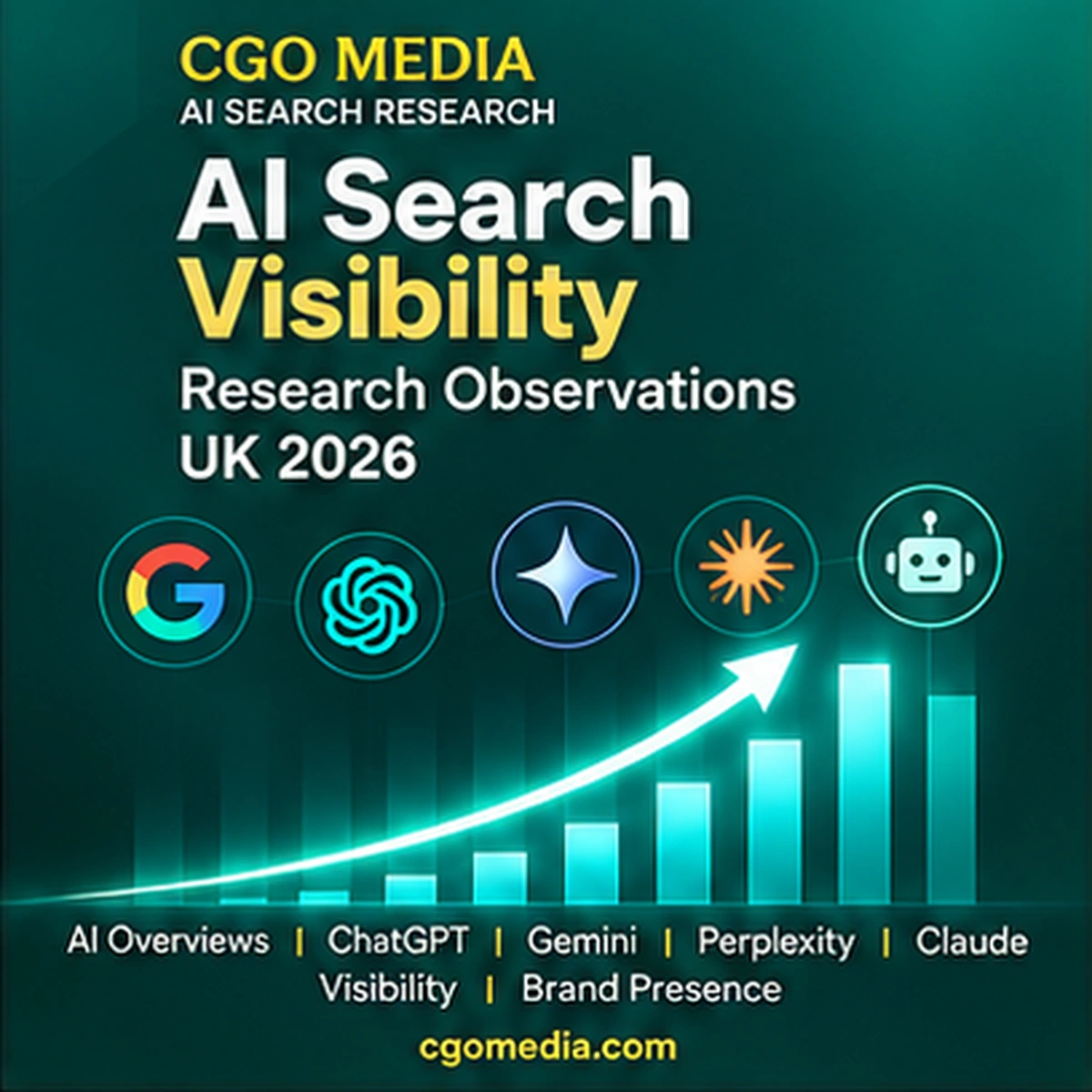
AI Search Visibility Research UK 2026 examines how organisations can measure whether they are being recognised, cited, mentioned, compared and recommended across AI-mediated search and answer environments.
Research Observations
United Kingdom
50 Evidence-Led Findings
5 October 2026
Executive Summary
Traditional search reporting was designed primarily around rankings, impressions, clicks, sessions and conversions.
Those metrics remain important, but they do not fully describe what happens when a user asks an AI system to explain a market, compare providers, identify specialists, recommend a company or summarise information without necessarily visiting a website.
In these environments, an organisation can achieve meaningful visibility even when no traditional organic click occurs. It may be cited as a source, named within an answer, included in a comparison or recommended as one of several possible choices.
This creates a measurement problem. Organisations need to understand not only whether their webpages rank, but also whether the organisation itself appears within AI-generated discovery and decision environments.
Central Research Finding
AI search visibility cannot be measured adequately through rankings and traffic alone. Organisations increasingly need outcome-specific measurement across recognition, citation, mention, comparison and recommendation.
What Is AI Search Visibility?
AI Search Visibility is the degree to which an organisation, brand, content source, product or service is surfaced within relevant AI-mediated search and answer environments through recognition, association, citation, mention, comparison or recommendation.
This definition deliberately focuses on observable outputs.
It does not assume that organisations can directly observe an AI model’s internal confidence, trust score, semantic score or recommendation algorithm.
Instead, organisations can measure what appears in generated outputs and track how those outcomes change across platforms, queries and time.
Six Observable AI Visibility Outcomes
01
Recognition
Can the system identify the organisation correctly?
02
Association
Is the organisation associated with relevant subjects, sectors, products, services or expertise?
03
Citation
Is content produced by the organisation referenced or used as a source?
04
Mention
Is the organisation explicitly named within the generated response?
05
Comparison
Does the organisation appear alongside alternatives, competitors or other relevant choices?
06
Recommendation
Is the organisation actively presented as a suitable option for the user’s query or decision context?
Not All AI Visibility Is the Same
One of the central problems with early AI visibility reporting is the tendency to combine fundamentally different outcomes into one metric.
| Visibility Type | What It Measures |
|---|---|
| Source Visibility | Whether the organisation’s content is cited or referenced. |
| Entity Visibility | Whether the organisation itself is recognised and named correctly. |
| Topical Visibility | Whether the organisation is associated with strategically relevant subjects. |
| Competitive Visibility | Whether the organisation appears when alternatives or providers are compared. |
| Recommendation Visibility | Whether the organisation is actively shortlisted or recommended. |
The CGO Media AI Search Visibility Score
This research develops the AI Search Visibility Score (ASVS) as a CGO Media diagnostic framework for combining several observable forms of AI visibility into one structured measurement programme.
The purpose of the score is not to claim access to proprietary AI ranking systems.
Its purpose is to help organisations measure their own visibility consistently, compare outcomes across query groups and platforms, identify weaknesses and track change over time.
Important Research Position
The AI Search Visibility Score is a CGO Media measurement framework. It is not a score disclosed or used by Google, OpenAI, Anthropic, Microsoft, Perplexity or any other AI platform.
Research Scope
The research considers organisational visibility across a wider AI search ecosystem rather than treating one platform as representative of the entire market.
Relevant environments can include:
- Google AI Overviews and AI-mediated Google Search experiences;
- ChatGPT;
- Google Gemini;
- Claude;
- Perplexity;
- Microsoft Copilot;
- enterprise AI assistants; and
- future generative search and answer platforms.
Because platforms use different systems, retrieval methods and presentation formats, visibility should be measured separately by environment before being combined into broader organisational reporting.
Research Objectives
- Define AI Search Visibility using observable outcomes rather than undisclosed platform signals.
- Identify practical metrics for citation, mention, comparison and recommendation visibility.
- Develop a repeatable framework for measuring organisational AI visibility.
- Separate source visibility from brand and recommendation visibility.
- Establish methods for multi-platform and competitive benchmarking.
- Define executive KPIs for AI-mediated discovery.
- Explain the limitations of AI visibility measurement.
- Provide UK organisations with a practical implementation and governance model for 2026.
Why This Matters for UK Organisations
AI-mediated discovery increasingly creates interactions in which users can learn about organisations, compare alternatives and receive recommendations without following the traditional sequence of search result → website visit → conversion.
That does not make rankings, traffic or conversions obsolete. It means those metrics need to be supplemented by measurements capable of showing what happens before or without the click.
For organisations investing in SEO, GEO, digital PR, research, content and entity development, AI Search Visibility provides a way to evaluate whether those investments are also improving representation within generative discovery environments.
Section 1 Research Position
The shift from traditional search to AI-mediated discovery does not remove the need for established SEO metrics.
It creates an additional measurement layer:
Rankings & Traffic → Recognition → Citation → Mention → Comparison → Recommendation
The purpose of AI Search Visibility measurement is to make these additional outcomes observable, comparable and useful for organisational decision-making.
Evidence & Interpretation Note
This research distinguishes between observable AI search outcomes and assumptions about proprietary model behaviour. Terms such as citation, mention, comparison and recommendation describe visible outputs. The CGO Media AI Search Visibility Score is an independent diagnostic framework built around those outputs.
No claim is made that AI platforms calculate or disclose a universal “AI Search Visibility Score”, “AI confidence score”, “semantic authority score” or comparable proprietary metric.
Research Observations 1–10
From Traditional Search Metrics to AI Visibility Measurement
The first ten observations examine the fundamental measurement shift created by AI-mediated search.
Traditional SEO metrics remain important, but AI answer environments introduce forms of visibility that can occur without a conventional ranking position, website impression or click.
This requires organisations to distinguish between page performance and organisational visibility within generated answers.
Research Observation 1
Traditional Rankings Do Not Capture the Full AI Search Journey
Evidence Type: Search Behaviour Observation
Traditional SEO reporting is heavily centred on where a webpage appears within a ranked search-results environment.
AI-generated answers can alter that journey by synthesising information before the user reaches a conventional results list or individual website.
Research Finding: Ranking position remains useful, but it does not measure whether an organisation is recognised, cited or recommended inside an AI-generated response.
CGO Media Interpretation: SEO dashboards should retain ranking metrics while adding a separate AI visibility layer rather than attempting to make rankings represent both environments.
Research Observation 2
AI Visibility Can Occur Without a Website Click
Evidence Type: User-Journey Observation
A user may encounter an organisation directly within a generated answer and learn its name, services, research findings or comparative position without visiting the organisation’s website.
Research Finding: Website traffic alone cannot represent every meaningful exposure occurring within AI-mediated discovery.
CGO Media Interpretation: Organisations need metrics capable of identifying visibility that occurs before, after or entirely without a website session.
Research Observation 3
Source Citation and Brand Visibility Are Different Outcomes
Evidence Type: AI Citation Observation
An AI system may use or cite a webpage as a source without prominently naming the organisation that published it.
Conversely, an organisation can be mentioned within a response without its own website being cited.
Research Finding: Citation visibility and explicit brand visibility should be tracked separately.
CGO Media Interpretation: A citation metric alone can overstate brand visibility if users are exposed to the source but not the organisation behind it.
Research Observation 4
Brand Mention Does Not Automatically Mean Recommendation
Evidence Type: AI Response Classification
An organisation can be named in an AI response for many reasons: as an example, source, market participant, historical reference, criticism, alternative or recommended provider.
Research Finding: Mention frequency does not by itself reveal the commercial or reputational meaning of the mention.
CGO Media Interpretation: Visibility reporting should classify mention context, especially whether the organisation is merely referenced, compared, shortlisted or actively recommended.
Research Observation 5
Comparison Visibility Represents a Distinct Stage of AI Discovery
Evidence Type: Decision-Journey Observation
Queries asking for the best providers, alternatives, leading companies or differences between products move beyond information retrieval into comparative decision-making.
Research Finding: Inclusion in a comparison environment is a stronger commercial visibility outcome than a general informational mention, but remains distinct from recommendation.
CGO Media Interpretation: Organisations should maintain a dedicated comparison-visibility metric for strategically important commercial query sets.
Research Observation 6
Recommendation Visibility Is a Higher-Intent Outcome
Evidence Type: Decision-Journey Observation
When an AI system explicitly presents an organisation as a suitable provider, product or option, the organisation has moved beyond general visibility into a recommendation context.
Research Finding: Recommendation should be treated as a separate high-intent visibility outcome rather than grouped with all mentions.
CGO Media Interpretation: Recommendation visibility is one of the most commercially significant AI search metrics, but it should never be treated as stable or guaranteed across platforms.
Research Observation 7
Recognition Should Be Measured Before Recommendation
Evidence Type: Entity Visibility Observation
Before an organisation can be assessed meaningfully for comparison or recommendation visibility, researchers need to establish whether AI systems identify the organisation correctly.
Research Finding: Recognition is a foundational measurement layer because inaccurate identity resolution can distort every later visibility metric.
CGO Media Interpretation: AI visibility audits should begin with branded and entity-resolution queries before moving into competitive recommendation testing.
Research Observation 8
Topical Association Should Be Measured Separately From Brand Recognition
Evidence Type: Entity Association Observation
An AI system may recognise an organisation correctly while failing to associate it with the subjects, services or expertise that matter commercially.
Research Finding: Brand recognition does not automatically imply relevant topical visibility.
CGO Media Interpretation: Organisations should test both “Who is this company?” and “Which organisations are associated with this subject?” rather than assuming one represents the other.
Research Observation 9
AI Visibility Should Be Measured by Query Class
Evidence Type: Measurement Methodology
A single visibility percentage can hide major differences between branded, informational, category, comparison and recommendation queries.
Research Finding: AI visibility becomes more useful when measured within clearly defined query classes.
CGO Media Interpretation: Executive reporting should show visibility by query intent rather than relying only on one blended headline score.
Research Observation 10
AI Search Visibility Is Best Treated as a Portfolio of Outcomes
Evidence Type: CGO Media Research Synthesis
No single metric adequately represents the full range of ways an organisation may appear across AI-mediated search.
A practical visibility framework therefore needs to consider multiple outcomes simultaneously.
Research Finding: AI Search Visibility is more accurately represented as a portfolio comprising recognition, association, citation, mention, comparison and recommendation outcomes.
CGO Media Interpretation: The strongest reporting systems preserve the individual metrics while also providing a structured summary for senior decision-makers.
What Observations 1–10 Tell Us
The first measurement layer is the transition from page performance to multi-outcome AI visibility.
The progression is:
Traditional Search Visibility → Entity Recognition → Topic Association → Citation → Mention → Comparison → Recommendation
Each stage answers a different business question and should therefore remain measurable independently.
CGO Media AI Visibility Measurement Principle
Rankings measure ranked search visibility. Citations measure source visibility. Mentions measure brand visibility. Comparisons measure consideration. Recommendations measure selection.
AI Search Visibility reporting becomes meaningful when these outcomes are separated before they are combined.
Recommended Measurement Categories
- Traditional Organic Search Visibility
- AI Entity Recognition
- Topical Association Visibility
- AI Citation Visibility
- Brand Mention Visibility
- Comparison Visibility
- Recommendation Visibility
Research Observations 11–20
Query Design, Platforms, Prompt Variation & Repeatable AI Visibility Testing
AI Search Visibility cannot be measured reliably from a handful of manually selected prompts.
Platforms differ, query wording changes outcomes, answer formats vary and generated responses can change over time. Measurement therefore requires a controlled testing structure that makes results comparable without pretending that AI outputs are perfectly deterministic.
Research Observation 11
Query Design Determines What AI Visibility Is Actually Being Measured
Evidence Type: Measurement Methodology
A branded query, an informational query and a provider-recommendation query measure different aspects of visibility.
Research Finding: AI visibility metrics become ambiguous when the query set does not distinguish between recognition, information retrieval, comparison and recommendation intent.
CGO Media Interpretation: Every visibility study should define its query taxonomy before testing begins.
Research Observation 12
Prompt Wording Can Change the Visibility Outcome
Evidence Type: AI Output Variability
Small changes in wording can alter whether a response cites sources, names organisations, returns a shortlist or provides a broader explanatory answer.
Research Finding: One prompt should not be assumed to represent an entire query category.
CGO Media Interpretation: Strategic query groups should contain multiple natural-language variants while preserving the same underlying intent.
Research Observation 13
One Platform Cannot Represent the Entire AI Search Market
Evidence Type: Multi-Platform Observation
Different AI platforms use different models, retrieval systems, interfaces, source-selection processes and answer formats.
Research Finding: Strong visibility on one platform does not establish equivalent visibility across all AI environments.
CGO Media Interpretation: Platform-level scores should be retained even when an organisation also reports a blended AI visibility score.
Research Observation 14
Visibility Testing Should Separate Branded and Non-Branded Queries
Evidence Type: Query Classification
Branded queries test whether a system recognises and represents an organisation correctly. Non-branded queries test whether that organisation surfaces when the user has not already named it.
Research Finding: Branded visibility and discovery visibility answer different business questions.
CGO Media Interpretation: A company that performs well only when its name is explicitly included has brand recognition but may still have weak category-level AI discovery.
Research Observation 15
Commercial Query Classes Need Separate Measurement
Evidence Type: Search Intent Analysis
Queries such as “best”, “top”, “recommended”, “alternatives to”, “which provider” and “compare” often represent more commercially significant stages of discovery than broad informational questions.
Research Finding: Blending informational and recommendation queries can hide performance in high-intent AI discovery environments.
CGO Media Interpretation: Commercial recommendation visibility should be reported separately to executives and revenue teams.
Research Observation 16
A Single Test Run Should Not Be Treated as Stable Visibility
Evidence Type: AI Output Variability
Generated outputs may change between sessions, model updates or testing periods even when the underlying question remains similar.
Research Finding: One observed answer provides evidence of one outcome, not proof of persistent visibility.
CGO Media Interpretation: Strategic queries should be re-tested on a defined schedule and trends evaluated across repeated observations.
Research Observation 17
Testing Frequency Should Match Business Importance
Evidence Type: Measurement Governance
Not every AI query requires the same monitoring frequency.
High-value recommendation queries may justify more frequent tracking than low-priority informational terms.
Research Finding: Monitoring resources are more useful when allocated according to strategic importance rather than evenly across every possible prompt.
CGO Media Interpretation: Query portfolios should contain priority tiers tied to commercial value, brand risk and strategic relevance.
Research Observation 18
Location Can Affect the Meaning of an AI Search Query
Evidence Type: Geographic Search Observation
For local and geographically dependent services, a query such as “best accountant” or “recommended hotel” is incomplete without understanding the location context.
Research Finding: Geographic AI visibility should be tested with explicit and relevant location context where location affects user intent.
CGO Media Interpretation: UK-wide, regional and local query sets should be kept separate when the organisation competes across multiple geographic markets.
Research Observation 19
Historical Results Are Necessary for Trend Analysis
Evidence Type: Longitudinal Measurement
A current AI visibility score provides a snapshot. It does not reveal whether visibility is improving, deteriorating or merely fluctuating within a normal range.
Research Finding: Longitudinal measurement is necessary to distinguish movement from isolated observations.
CGO Media Interpretation: AI visibility dashboards should preserve date-stamped historical results rather than replacing the previous measurement each time a query is tested.
Research Observation 20
Repeatable AI Visibility Measurement Requires a Fixed Testing Protocol
Evidence Type: CGO Media Research Methodology
Meaningful benchmarking becomes difficult if the query set, platforms, scoring rules and measurement intervals change continuously.
Research Finding: A consistent testing protocol improves the comparability of AI visibility observations across time.
CGO Media Interpretation: Organisations should document query definitions, platforms, dates, scoring logic, geographic assumptions and evidence-capture rules before benchmarking begins.
What Observations 11–20 Tell Us
The second layer of AI Search Visibility is measurement discipline.
A useful programme requires:
- defined query classes;
- natural prompt variants;
- separate branded and non-branded testing;
- multi-platform coverage;
- commercial-intent segmentation;
- repeated testing;
- geographic context where relevant;
- historical records; and
- a fixed testing protocol.
Without these controls, AI visibility reporting can easily become a collection of anecdotes rather than a measurement system.
CGO Media AI Visibility Testing Principle
A prompt is an observation. A query set is a measurement. Repeated query sets create a trend.
AI Search Visibility should therefore be evaluated through structured samples rather than screenshots of isolated answers.
Minimum Testing Protocol
For each monitored query, record:
- query text;
- query class;
- platform;
- date of observation;
- geographic context where relevant;
- whether the organisation was recognised;
- whether it was cited;
- whether it was explicitly mentioned;
- whether it appeared in a comparison;
- whether it was recommended; and
- the cited or referenced sources where visible.
Research Observations 21–30
Citations, Source Selection, Brand Mentions & Competitive Visibility
The third layer of AI Search Visibility concerns the relationship between sources, brands and competitive inclusion.
Being used as a source, being named within an answer and being selected as a recommended provider are different visibility outcomes. These distinctions become especially important when organisations attempt to measure the commercial value of AI-mediated discovery.
Research Observation 21
AI Citation Measures Source Use, Not Automatically Brand Preference
Evidence Type: Citation Visibility Observation
When an AI system cites or references a webpage, that indicates that the source has been used within the answer environment.
Research Finding: Citation confirms source visibility within a specific answer, but does not by itself establish that the associated organisation is preferred or recommended.
CGO Media Interpretation: Citation rates should be reported separately from brand recommendation metrics.
Research Observation 22
A Source Can Be Visible While the Brand Remains Invisible
Evidence Type: Citation & Brand Visibility Observation
AI systems can reference a webpage or domain while the organisation behind that content receives little or no explicit exposure in the generated wording.
Research Finding: Source visibility and brand visibility can diverge substantially.
CGO Media Interpretation: AI reporting should record both whether a source was cited and whether the organisation’s name was visible to the user.
Research Observation 23
Repeated Citation Can Indicate Source Utility Without Proving Preference
Evidence Type: Longitudinal Citation Observation
If the same organisation’s content appears repeatedly across relevant AI answers, this provides evidence that the source is repeatedly useful within those measured environments.
Research Finding: Repeated citation is stronger evidence of persistent source visibility than a one-off citation, but it should not be interpreted as proof of an undisclosed platform preference.
CGO Media Interpretation: Citation recurrence should be treated as an observable measurement trend rather than a claim about hidden model scoring.
Research Observation 24
Citation Context Matters as Much as Citation Presence
Evidence Type: Citation Context Analysis
A citation can support a definition, statistic, background fact, comparison point or recommendation-related claim.
Research Finding: Two citations to the same domain can carry very different strategic value depending on how the source is being used.
CGO Media Interpretation: Citation measurement should classify the purpose of the citation where practical, especially for research, category and commercial queries.
Research Observation 25
AI Source Selection Can Differ From Traditional Ranking Order
Evidence Type: Search & AI Comparison Observation
Sources surfaced within AI-generated answers do not necessarily mirror the exact order of conventional organic search results.
Research Finding: Traditional ranking position and AI citation visibility should be measured as related but separate outcomes.
CGO Media Interpretation: Organisations should not assume that improving a conventional ranking automatically produces equivalent movement in AI citation visibility.
Research Observation 26
Source Diversity Should Be Recorded Within AI Answers
Evidence Type: Source Environment Analysis
AI-generated answers may draw on publisher sites, company websites, research repositories, forums, media sources, government pages and other source types.
Research Finding: Understanding which source classes appear in relevant answers can reveal where an organisation’s evidence ecosystem is strong or weak.
CGO Media Interpretation: AI visibility analysis should record not only “who was cited” but also “what type of source was cited”.
Research Observation 27
Brand Mentions Need Sentiment and Context Classification
Evidence Type: Brand Visibility Analysis
An organisation can appear positively, neutrally or negatively within an AI response.
Research Finding: A raw mention count cannot distinguish favourable visibility from unfavourable or purely factual reference.
CGO Media Interpretation: Important brand mentions should be classified by context rather than added blindly into one visibility total.
Research Observation 28
Competitive Share of Voice Is More Useful Than Visibility in Isolation
Evidence Type: Competitive Measurement
An organisation may appear frequently in AI responses yet still be materially less visible than key competitors across the same query set.
Research Finding: Competitive benchmarking provides more strategic context than absolute mention or citation counts alone.
CGO Media Interpretation: AI Search Visibility reporting should include competitor share of citations, mentions, comparisons and recommendations within the same defined query portfolio.
Research Observation 29
Competitive Inclusion and Competitive Preference Are Different
Evidence Type: Competitive Decision Analysis
An organisation may be included in a list of alternatives without being placed first, described most favourably or selected as the final recommendation.
Research Finding: Inclusion indicates competitive visibility; recommendation indicates a stronger selection outcome.
CGO Media Interpretation: Competitive visibility dashboards should distinguish between appearing in the candidate set and being actively preferred within the response.
Research Observation 30
AI Competitive Visibility Should Be Treated as a Funnel
Evidence Type: CGO Media Research Synthesis
The progression from being known to being selected contains several observable stages.
Research Finding: Competitive AI visibility can be represented as a funnel moving from recognition through inclusion towards recommendation.
CGO Media Interpretation: Organisations should diagnose the point at which they drop out of the AI decision journey rather than focusing only on the final recommendation outcome.
AI Competitive Visibility Funnel
Recognition → Topical Association → Citation → Mention → Comparison → Shortlisting → Recommendation
What Observations 21–30 Tell Us
The third measurement layer is source and competitive visibility.
Organisations need to understand separately:
- whether their content is cited;
- whether the brand is explicitly visible;
- how citations are being used;
- which source types appear;
- how the organisation compares with competitors;
- whether it enters comparison sets; and
- whether it progresses from inclusion to recommendation.
The commercial significance of AI visibility increases as the organisation moves from being a source to being a considered and recommended choice.
CGO Media Source & Competitive Visibility Principle
Being used is not the same as being named. Being named is not the same as being compared. Being compared is not the same as being recommended.
AI visibility measurement should preserve those distinctions.
Recommended Metrics for This Layer
- Citation Rate
- Brand Mention Rate
- Citation-to-Mention Ratio
- Source-Type Distribution
- Competitive Share of Citation
- Competitive Share of Mention
- Comparison Inclusion Rate
- Shortlist Inclusion Rate
- Recommendation Rate
- Competitive Recommendation Share
Research Observations 31–40
Recommendation Visibility, Decision Context, Brand Representation & AI Search Risk
The fourth layer of AI Search Visibility concerns what happens when generated answers move beyond source use and into decision support.
At this stage, visibility becomes commercially more significant because the organisation may be compared, shortlisted or recommended. It also becomes more sensitive because inaccurate descriptions, outdated information or unfavourable framing can influence user perception before the user reaches the organisation’s website.
Research Observation 31
Recommendation Visibility Depends on Query Context
Evidence Type: Recommendation Context Observation
The same organisation may be recommended for one user need and omitted for another because recommendation depends on the exact problem, location, category, price point, feature set or decision criteria contained in the query.
Research Finding: Recommendation visibility should be interpreted within the specific query context rather than treated as a universal brand status.
CGO Media Interpretation: Organisations should build recommendation query sets around real buyer criteria rather than generic “best company” prompts alone.
Research Observation 32
Shortlisting Is a Distinct Commercial Visibility Outcome
Evidence Type: Decision-Journey Observation
A generated answer may present several organisations as plausible candidates without identifying a single winner.
Research Finding: Shortlist inclusion represents stronger commercial visibility than a generic mention but remains different from explicit recommendation.
CGO Media Interpretation: Shortlist visibility should be measured independently, especially for high-value B2B and professional-service categories.
Research Observation 33
Recommendation Frequency Should Not Be Confused With Recommendation Strength
Evidence Type: Recommendation Measurement
An organisation can be recommended frequently but only as one option among many, while another organisation may be recommended less often but with stronger or more specific language.
Research Finding: Recommendation frequency and recommendation prominence are different dimensions of visibility.
CGO Media Interpretation: High-value monitoring should record both whether the organisation was recommended and how prominently it appeared in the response.
Research Observation 34
The Reasons Given for Recommendation Are Measurable
Evidence Type: Recommendation Context Analysis
Generated responses often explain why an organisation is included, using attributes such as experience, pricing, location, specialisation, reputation, product capabilities or research expertise.
Research Finding: Recommendation rationale provides an observable window into how the organisation is being represented within the answer.
CGO Media Interpretation: Organisations should record recurring recommendation attributes and compare them with the positioning they actually want the market to understand.
Research Observation 35
AI Brand Representation Can Be Accurate, Incomplete or Incorrect
Evidence Type: Brand Representation Observation
An organisation may be correctly named while other details in the answer are outdated, incomplete or wrong.
Possible errors include:
- incorrect services;
- outdated leadership;
- wrong locations;
- old pricing information;
- incorrect market positioning; or
- confusion with a similarly named organisation.
Research Finding: Being visible is not sufficient if the underlying representation is materially inaccurate.
CGO Media Interpretation: AI visibility monitoring should include an accuracy score as well as presence metrics.
Research Observation 36
Incorrect AI Representation Creates a Brand Risk
Evidence Type: AI Search Risk Observation
Users may encounter generated descriptions before visiting official first-party sources.
Research Finding: Materially incorrect AI-generated information can become an early-stage brand and customer-journey risk even when conventional rankings remain strong.
CGO Media Interpretation: Brand-accuracy monitoring should become part of AI visibility governance, particularly for regulated, high-trust and reputation-sensitive sectors.
Research Observation 37
Negative Visibility Is Still Visibility, but It Should Not Be Scored Positively
Evidence Type: Sentiment & Visibility Measurement
Raw visibility counts can create misleading results if negative or cautionary mentions are treated as equivalent to favourable inclusion.
Research Finding: Visibility volume and visibility quality should be measured separately.
CGO Media Interpretation: Negative, neutral and positive brand representation should not contribute equally to a composite visibility score.
Research Observation 38
Outdated Information Can Distort Recommendation Visibility
Evidence Type: Information Freshness Observation
Recommendation systems and generated answers may encounter information from different publication dates and external sources.
Research Finding: An organisation can be correctly identified but evaluated using outdated information about its current offering or position.
CGO Media Interpretation: Freshness auditing should focus particularly on facts that could materially influence comparison or recommendation outcomes.
Research Observation 39
AI Search Visibility Should Include a Brand Accuracy Metric
Evidence Type: CGO Media Measurement Framework
A brand can have high mention visibility while being represented inaccurately.
Research Finding: Visibility measurement becomes more useful when presence and factual accuracy are evaluated together.
CGO Media Interpretation: Brand Accuracy should form a separate diagnostic dimension within mature AI Search Visibility programmes.
Research Observation 40
AI Search Visibility Is Also a Reputation and Governance Discipline
Evidence Type: CGO Media Research Synthesis
Once AI-generated answers influence how users understand and evaluate organisations, visibility monitoring extends beyond SEO performance alone.
Research Finding: AI Search Visibility sits at the intersection of search, brand, reputation, data accuracy and organisational governance.
CGO Media Interpretation: Mature monitoring programmes should involve SEO, communications, research, PR, brand and leadership rather than treating AI visibility as a narrow technical metric.
What Observations 31–40 Tell Us
The fourth measurement layer is decision visibility and representation quality.
Organisations should monitor:
- whether they enter shortlists;
- whether they are actively recommended;
- why they are recommended;
- how strongly they are positioned;
- whether descriptions are factually accurate;
- whether important information is outdated;
- whether visibility is positive, neutral or negative; and
- whether AI representation creates brand or reputational risk.
The closer AI visibility moves towards a decision outcome, the more important context and accuracy become.
CGO Media Recommendation Visibility Principle
Visibility measures whether the organisation appears. Representation measures how the organisation appears. Recommendation measures whether the organisation is presented as a suitable choice.
All three should be monitored separately.
Recommended Risk & Representation Metrics
- Shortlist Inclusion Rate
- Recommendation Rate
- Recommendation Prominence
- Recommendation Attribute Frequency
- Brand Accuracy Score
- Positive / Neutral / Negative Representation
- Outdated Information Incidence
- Material Error Incidence
- AI Brand Risk Alerts
Research Observations 41–50
Measurement Framework, Executive KPIs, Governance & AI Visibility Maturity
The final ten observations move from individual AI visibility outcomes to the organisational systems needed to measure them consistently.
The central question is no longer simply “Do we appear?” but “Can we measure where we appear, how we are represented, whether that visibility is improving and what the organisation should do next?”
Research Observation 41
AI Search Visibility Requires a Multi-Dimensional Measurement Framework
Evidence Type: CGO Media Measurement Framework
No single metric can represent recognition, citation, brand presence, competitive inclusion, recommendation and accuracy at the same time.
Research Finding: AI Search Visibility is more useful when measured across distinct dimensions rather than collapsed into one raw count.
CGO Media Interpretation: Organisations should preserve the underlying metrics even if they also publish a composite executive score.
Research Observation 42
Composite Scores Are Useful for Reporting but Dangerous Without the Underlying Data
Evidence Type: Measurement Governance
A single headline score can make executive reporting easier, but it can conceal the reason performance changed.
Research Finding: The same composite score can be produced by very different combinations of citation, mention, recommendation and accuracy performance.
CGO Media Interpretation: Composite AI visibility scores should function as summary indicators, not substitutes for diagnostic reporting.
Research Observation 43
Executive KPIs Should Focus on Business-Relevant AI Outcomes
Evidence Type: Executive Measurement Framework
Senior decision-makers do not need every prompt-level observation. They need a smaller set of metrics that explain whether organisational visibility is improving in strategically important areas.
Research Finding: Executive AI visibility reporting should prioritise recognition, competitive share, recommendation visibility, accuracy and trend direction.
CGO Media Interpretation: Prompt-level detail belongs in operational reporting; decision-oriented metrics belong in executive reporting.
Research Observation 44
Baseline Measurement Is Necessary Before Improvement Can Be Claimed
Evidence Type: Longitudinal Measurement
Without a starting measurement, later visibility changes cannot be evaluated consistently.
Research Finding: Improvement claims are stronger when measured against a predefined baseline using the same query portfolio and scoring rules.
CGO Media Interpretation: Every AI visibility programme should begin with a documented baseline before optimisation activity starts.
Research Observation 45
AI Visibility Improvement Should Be Measured Against Competitors as Well as Baseline
Evidence Type: Competitive Benchmarking
An organisation can improve its own visibility while competitors improve faster.
Research Finding: Internal improvement and competitive improvement are different measurements.
CGO Media Interpretation: Mature programmes should report both absolute visibility change and competitive share-of-voice change.
Research Observation 46
AI Search Visibility Requires Data Governance
Evidence Type: Measurement Governance
Visibility data becomes difficult to compare if teams change queries, platforms, categories or scoring rules without preserving version history.
Research Finding: Measurement consistency depends on governance of the testing methodology as well as collection of results.
CGO Media Interpretation: Query sets, score definitions, platform coverage and methodological changes should be version-controlled.
Research Observation 47
AI Visibility Maturity Develops Through Organisational Capability
Evidence Type: CGO Media Maturity Model
Some organisations perform occasional manual checks. Others maintain structured query portfolios, historical datasets, competitive benchmarks and defined governance processes.
Research Finding: AI Search Visibility can be assessed as a maturity capability rather than simply as a presence or absence metric.
CGO Media Interpretation: Organisations can progress from ad hoc monitoring to structured, integrated and adaptive visibility management.
Research Observation 48
Ownership Should Extend Beyond the SEO Team
Evidence Type: Organisational Governance
AI visibility intersects with search performance, public reputation, corporate information, research, digital PR and commercial positioning.
Research Finding: No single team controls every input that influences how an organisation is represented within AI search.
CGO Media Interpretation: Mature programmes require shared ownership across SEO, research, content, PR, brand, corporate communications and leadership.
Research Observation 49
AI Search Visibility Should Be Used for Diagnosis, Not False Precision
Evidence Type: Research Methodology
AI-generated results can vary, so a visibility score should not imply a level of precision that the underlying observations cannot support.
Research Finding: AI visibility scores are most useful for trend analysis, comparison and gap identification rather than as claims of exact platform performance.
CGO Media Interpretation: Reporting should show methodology, sample size and confidence rather than presenting a composite number without context.
Research Observation 50
AI Search Visibility Is Becoming a Long-Term Organisational Measurement Capability
Evidence Type: CGO Media Research Synthesis
The strongest conclusion from the fifty observations is that AI Search Visibility cannot be managed through occasional manual checking alone.
It requires repeatable query design, historical data, competitive benchmarking, source analysis, recommendation tracking, brand-accuracy monitoring and governance.
Research Finding: AI Search Visibility is best treated as an ongoing organisational measurement capability rather than a temporary reporting exercise.
CGO Media Interpretation: Organisations that establish the measurement infrastructure now will be better positioned to evaluate future AI discovery environments as platforms and user behaviour continue to change.
What Observations 41–50 Tell Us
The fifth and final layer is measurement maturity and governance.
A mature AI Search Visibility programme combines:
- multi-dimensional metrics;
- executive KPIs;
- documented baselines;
- competitive benchmarks;
- historical trend analysis;
- version-controlled methodologies;
- defined organisational ownership; and
- regular reassessment.
The objective is not to manufacture a perfect score. It is to create a reliable system for understanding whether organisational visibility is improving, weakening or changing across AI-mediated search.
CGO Media AI Search Visibility Model
The fifty observations can be summarised as five measurement layers:
1. Visibility Outcomes → 2. Measurement Discipline → 3. Source & Competitive Visibility → 4. Decision & Representation Quality → 5. Measurement Maturity & Governance
Each layer adds additional context to the question of whether an organisation is genuinely visible within AI-mediated discovery.
AI Search Visibility Measurement Maturity
Level 1 — Ad Hoc: Occasional manual prompt checking with little documentation.
Level 2 — Defined: A basic query set and platform list exist, but monitoring remains inconsistent.
Level 3 — Structured: Query classes, recurring testing, historical results and competitor tracking are established.
Level 4 — Integrated: AI visibility metrics are connected with SEO, PR, research, brand and executive reporting.
Level 5 — Adaptive: Monitoring is continuously refined as platforms, query behaviour and organisational priorities change.
CGO Media AI Search Visibility Principle
Do not measure AI visibility only to produce a score. Measure it to understand recognition, source use, brand representation, competitive position, recommendation visibility and change over time.
The score is the summary. The underlying evidence is the strategy.
CGO Media Research Analysis
What the 50 AI Search Visibility Observations Tell Us
The fifty observations point towards a fundamental change in search measurement.
Traditional SEO asks whether a page ranks, receives impressions, earns clicks and contributes to conversions. AI-mediated discovery adds another set of questions: whether the organisation is recognised, used as a source, mentioned by name, included in comparisons and recommended as a suitable choice.
These outcomes do not replace traditional search metrics. They create an additional visibility layer that organisations increasingly need to measure independently.
Central Research Finding
AI Search Visibility is best understood as a portfolio of observable outcomes rather than one universal ranking or authority score.
Visibility Now Exists at Several Different Stages
The observations show that an organisation can achieve visibility at several different stages of AI-mediated discovery.
Recognition → Association → Citation → Mention → Comparison → Shortlisting → Recommendation
Each stage represents a different relationship between the organisation and the generated answer.
An organisation may therefore perform strongly at one stage while remaining weak at another.
Recognition
Does the system correctly identify the organisation?
Association
Is the organisation connected with strategically relevant subjects or services?
Citation
Is organisational content being used as a source?
Mention
Is the brand explicitly named in the response?
Comparison
Does the organisation appear alongside competitors or alternatives?
Recommendation
Is the organisation actively presented as a suitable choice?
Source Visibility Is Not the Same as Brand Visibility
One of the strongest conclusions from the research is that citation and brand visibility must be measured separately.
A website can be cited without its organisation receiving meaningful brand exposure. Equally, an organisation can be mentioned without its own website being used as a source.
CGO Media Measurement Principle: Citation measures source use. Mention measures brand exposure. Comparison measures consideration. Recommendation measures selection.
Recommendation Visibility Is Not a Universal Brand Score
Recommendation outcomes are highly dependent on query context.
The same organisation may be suitable for one requirement but irrelevant for another because the user’s location, budget, sector, product requirements or decision criteria have changed.
This means organisations should avoid statements such as “we are the most recommended company by AI” unless the measurement clearly defines:
- which platforms were tested;
- which queries were included;
- which geography was measured;
- the testing period;
- how recommendation was classified; and
- which competitors were included.
The Query Portfolio Becomes the Measurement Foundation
AI Search Visibility cannot be measured meaningfully without a defined query portfolio.
CGO Media’s research suggests separating queries into distinct classes.
| Query Class | Primary Measurement Objective |
|---|---|
| Branded | Recognition and factual representation |
| Informational | Source and citation visibility |
| Category | Topical and market association |
| Comparison | Competitive inclusion and share of voice |
| Recommendation | Shortlisting and selection visibility |
| Local / Geographic | Visibility within defined geographic contexts |
A Prompt Is Not a Market Measurement
Individual screenshots can be useful illustrations, but they should not be confused with systematic measurement.
One answer represents one observation under one set of conditions.
A prompt is an observation. A query set is a measurement. Repeated query sets create a trend.
Multi-Platform Measurement Is Essential
The research also shows why one AI platform cannot stand in for the entire discovery environment.
Different platforms may:
- retrieve different sources;
- present citations differently;
- generate different comparison sets;
- apply different freshness mechanisms;
- use different model versions; and
- respond differently to equivalent natural-language prompts.
Platform-level data should therefore remain visible even where organisations also calculate a blended cross-platform score.
Competitive Visibility Changes the Meaning of Performance
Absolute visibility is useful, but it does not reveal whether competitors are gaining more rapidly.
For competitive markets, organisations need to compare:
- share of citations;
- share of mentions;
- comparison inclusion;
- shortlist inclusion;
- recommendation frequency; and
- recommendation prominence.
Key distinction: Improving from 10% to 20% visibility is positive in isolation. If the leading competitor moved from 25% to 60% during the same period, the competitive picture is different.
Representation Quality Matters as Much as Presence
The research also expands AI Search Visibility beyond simple presence.
An organisation can appear frequently while being represented incorrectly.
This creates a second measurement question:
Not only “Are we visible?” but “Are we being represented accurately?”
This makes Brand Accuracy an important diagnostic metric alongside citation and recommendation visibility.
AI Search Visibility Is Also a Brand-Risk Measurement
Generated answers may appear before users visit official corporate websites. This means inaccurate information can influence perception earlier in the discovery journey.
Important risks include:
- incorrect services;
- outdated products;
- wrong leadership information;
- obsolete pricing;
- incorrect locations;
- confusion between similarly named organisations; and
- negative or misleading comparisons.
This means mature AI monitoring should support brand, communications and reputation teams as well as SEO.
AI Search Visibility Should Be Measured Longitudinally
One measurement period provides a snapshot. Historical data creates strategic meaning.
A mature programme should therefore be capable of showing:
- current visibility;
- baseline visibility;
- change over time;
- competitive change;
- platform-level change;
- query-class change; and
- representation-quality change.
The Measurement Model Should Separate Diagnosis From Executive Reporting
Operational teams need detailed metrics. Senior leadership usually requires a smaller number of decision-oriented indicators.
| Operational Measurement | Executive Measurement |
|---|---|
| Prompt-level outputs | Overall trend direction |
| Citation source records | Citation visibility |
| Individual brand mentions | Brand visibility |
| Prompt comparison results | Competitive AI share of voice |
| Recommendation wording | Recommendation visibility |
| Individual factual errors | Brand Accuracy / AI risk |
The AI Search Visibility Development Model
The fifty observations can be reduced to six practical stages.
| Stage | Objective | Core Question |
|---|---|---|
| 1. Define | Define query classes and visibility outcomes. | What exactly are we measuring? |
| 2. Observe | Capture recognition, citation, mention and recommendation outcomes. | Where are we appearing? |
| 3. Compare | Benchmark against competitors and platforms. | How visible are we relative to others? |
| 4. Validate | Assess accuracy, context and representation quality. | Are we being represented correctly? |
| 5. Trend | Measure change against historical baselines. | Are we improving? |
| 6. Govern | Maintain methodology, ownership and review cycles. | Can we manage this consistently? |
Overall Research Conclusion
AI Search Visibility measurement should answer more than whether an organisation appears in an AI-generated answer.
It should establish:
- where the organisation appears;
- why it appears;
- which sources are being used;
- how the organisation compares with competitors;
- whether it reaches shortlist and recommendation stages;
- whether the representation is accurate; and
- whether visibility is improving over time.
AI Search Visibility therefore becomes a measurement system for organisational presence, source use, competitive consideration and recommendation across AI-mediated discovery.
CGO Media Research Position
CGO Media does not claim that AI platforms calculate a universal metric called AI Search Visibility.
The AI Search Visibility framework is an independent diagnostic model designed to convert observable outcomes into structured organisational measurement without claiming access to undisclosed ranking, retrieval or recommendation systems.
Practical Implementation
What UK Organisations Should Do in 2026
The research suggests that organisations should not treat AI Search Visibility as another isolated SEO metric.
The practical objective is to build a repeatable measurement system that shows where the organisation is recognised, cited, mentioned, compared and recommended — and whether those outcomes are improving across strategically important AI environments.
The following twenty priorities provide a practical implementation sequence for UK organisations during 2026.
Priority 01
Define What AI Search Visibility Means for the Organisation
Establish whether the programme is primarily intended to measure brand recognition, research citation, category visibility, competitive inclusion, recommendation visibility or a combination of these outcomes.
Priority 02
Build a Strategic Query Portfolio
Create a controlled query set covering branded, informational, category, comparison, recommendation and geographically relevant searches. Prioritise queries that reflect genuine customer, stakeholder or research behaviour.
Priority 03
Separate Branded and Non-Branded Visibility
Measure whether AI systems recognise the organisation when explicitly named and separately whether the organisation appears when users search for a category, problem, service or recommendation without using the brand name.
Priority 04
Test Across Multiple AI Environments
Avoid using one platform as a proxy for the entire AI search ecosystem. Track strategically relevant environments individually before combining results into wider reporting.
Priority 05
Record Recognition Before Measuring Recommendation
Verify whether the organisation is correctly identified, differentiated and described before interpreting more advanced comparison and recommendation outcomes.
Priority 06
Measure Citation and Brand Mention Separately
Record whether organisational content is cited and whether the organisation itself is explicitly named. Do not assume one automatically produces the other.
Priority 07
Track Competitive AI Share of Voice
Compare citation, mention, comparison, shortlist and recommendation visibility against a defined competitor set across the same query portfolio.
Priority 08
Create a Baseline Before Optimisation Begins
Establish a documented starting point using the same query classes, platforms and scoring rules that will be used for later measurement.
Priority 09
Preserve Historical AI Visibility Data
Do not overwrite previous results. Retain date-stamped records so visibility can be evaluated longitudinally across platforms, query classes and competitors.
Priority 10
Measure Brand Representation Accuracy
Monitor whether generated answers describe the organisation, its people, locations, products, services and market position accurately.
Priority 11
Identify Outdated or Conflicting Information
Audit material factual conflicts across the official website, profiles, repositories, directories, press coverage and other external sources that could affect AI representation.
Priority 12
Build Citation-Eligible Evidence Assets
Develop useful statistics, research, methodology pages, datasets, expert commentary and clearly structured factual resources that can support information-seeking queries.
Priority 13
Strengthen Independent Corroboration
Support important organisational claims with credible evidence beyond the corporate website, including relevant media coverage, repositories, professional profiles, reviews, datasets and sector sources.
Priority 14
Monitor Why the Organisation Is Recommended
Capture the attributes repeatedly associated with recommendations, such as expertise, location, evidence, reputation, pricing or product capability, and compare them with intended positioning.
Priority 15
Separate Operational and Executive Reporting
Operational teams should retain detailed prompt-level and source-level data. Leadership reporting should focus on trend, competitive share, recommendation visibility, accuracy and strategic risk.
Priority 16
Document the Measurement Methodology
Record query definitions, prompt variants, platform coverage, dates, geography, competitor sets, classification rules and any methodology changes.
Priority 17
Create an AI Visibility Review Cycle
Set a recurring review cadence based on business importance. High-value recommendation queries may require more frequent assessment than lower-priority informational queries.
Priority 18
Assign Cross-Functional Ownership
AI Search Visibility should involve SEO, content, research, digital PR, communications, brand and relevant commercial teams because no single function controls the full evidence environment.
Priority 19
Use AI Visibility Scores for Diagnosis, Not False Precision
Composite scores should help identify trends, gaps and priorities. They should not be presented as if they reveal a proprietary ranking, trust or recommendation score used internally by AI platforms.
Priority 20
Treat AI Search Visibility as a Long-Term Organisational Capability
Build the measurement, evidence and governance systems so they can adapt as AI platforms, interfaces, retrieval systems and user behaviour evolve.
Recommended Implementation Sequence
Define → Baseline → Measure → Compare → Validate → Improve → Re-Test → Govern
First 90 Days
Days 1–30
Define & Baseline
Create the query portfolio, identify competitors, select platforms, define outcome classifications and complete the first baseline measurement.
Days 31–60
Diagnose & Improve
Identify citation gaps, representation errors, weak comparison visibility, missing evidence and priority competitor advantages.
Days 61–90
Re-Test & Govern
Repeat the controlled measurement, compare movement against baseline and competitors, and establish the permanent review cycle.
AI Search Visibility Is a Cross-Functional Responsibility
| Function | Primary Responsibility |
|---|---|
| SEO / GEO | Query design, platform testing, visibility measurement and technical discoverability. |
| Research | Original evidence, datasets, methodology and citation-eligible assets. |
| Content | Clear explanations, topic coverage, product and service evidence. |
| Digital PR | Independent coverage, external corroboration and expert visibility. |
| Brand / Communications | Representation accuracy, message consistency and reputational monitoring. |
| Leadership | Strategic priorities, investment decisions, governance and executive KPIs. |
How Progress Should Be Judged
Success should not be reduced to the number of times an organisation appears in AI-generated answers.
A stronger assessment asks whether:
- recognition accuracy is improving;
- strategic topic association is becoming stronger;
- citation visibility is expanding;
- brand mention visibility is increasing;
- competitive share of voice is improving;
- shortlist inclusion is increasing;
- recommendation visibility is improving;
- factual errors are declining;
- important evidence gaps are closing; and
- measurement is becoming more repeatable and governed.
CGO Media Implementation Principle
Do not begin by trying to influence a score. Begin by establishing what AI systems currently recognise, cite, say, compare and recommend.
Then improve the underlying organisational evidence, measure the outcome again and compare the change.
That turns AI Search Visibility from an abstract concept into a repeatable management discipline.
CGO Media Measurement Framework
AI Search Visibility Measurement Framework
The CGO Media AI Search Visibility Measurement Framework provides organisations with a structured way to evaluate how consistently they appear across strategically relevant AI-mediated search and answer environments.
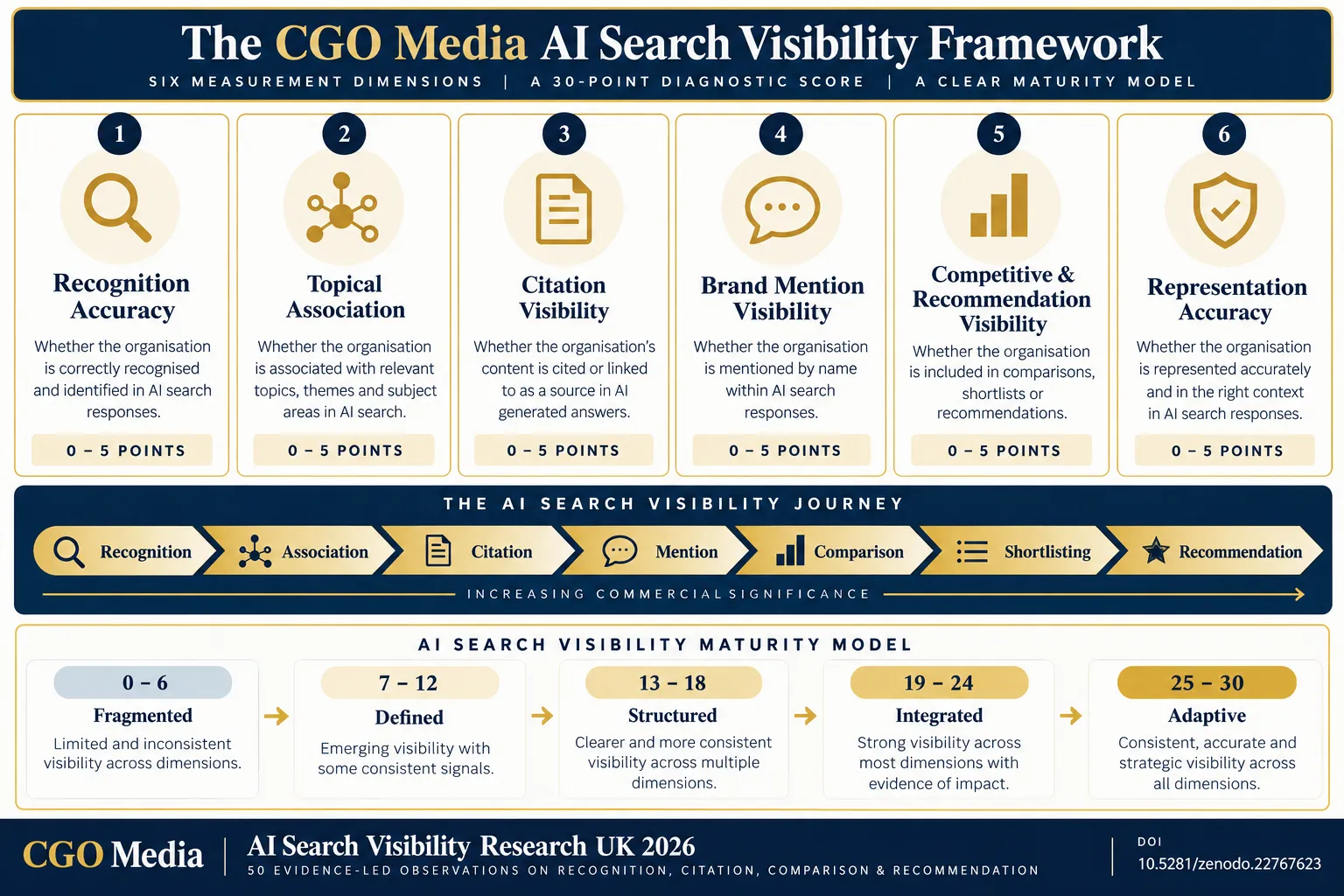
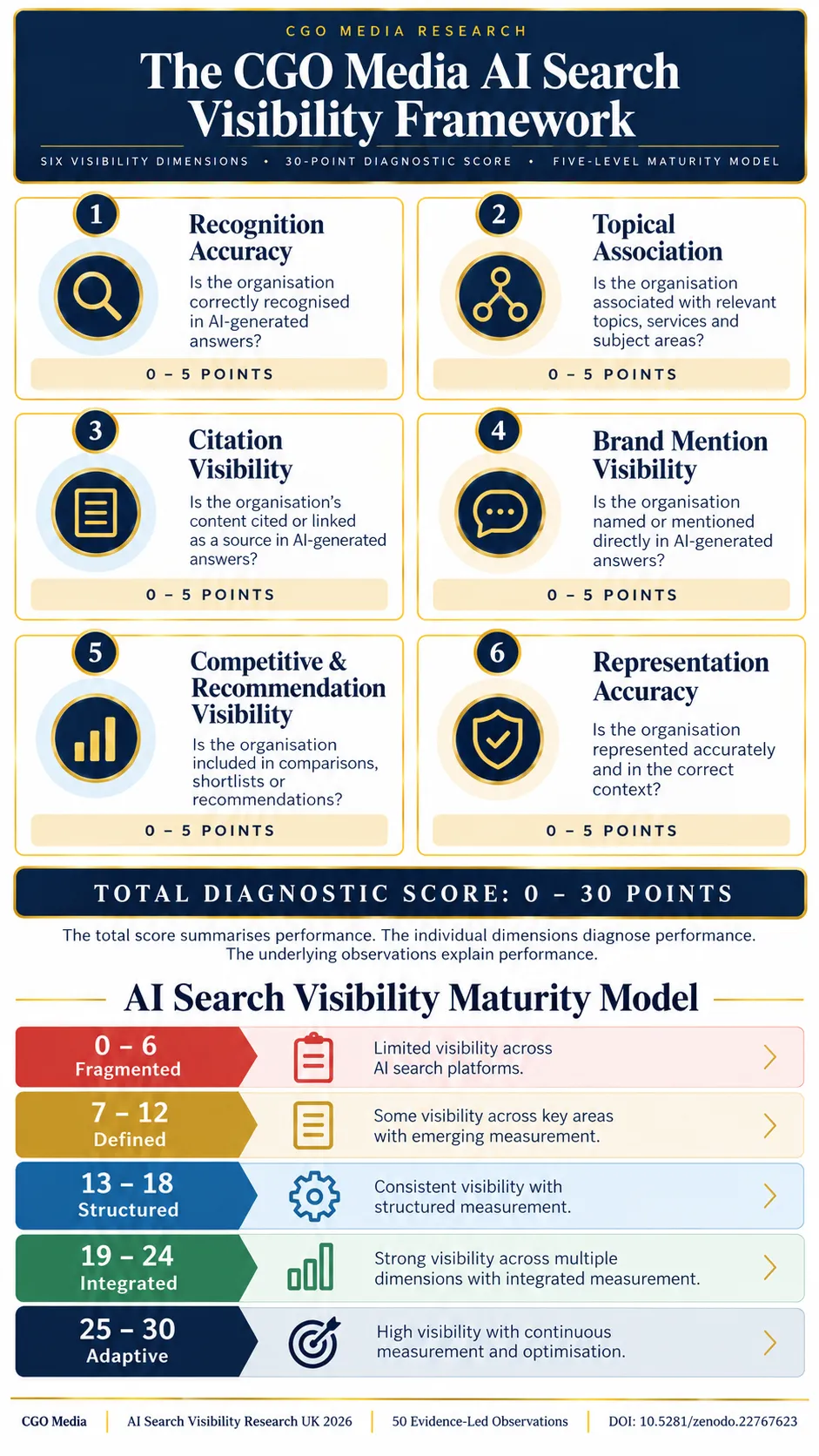
The framework evaluates six observable dimensions of AI visibility and converts them into a maximum diagnostic score of 30 points.
The score is designed for benchmarking, gap analysis and longitudinal measurement. It is not a ranking factor, platform score or internal metric disclosed by any AI provider.
Important Research Position
The AI Search Visibility Score is a CGO Media diagnostic framework. It does not claim to reproduce or reveal proprietary ranking, retrieval, confidence, authority or recommendation systems used by Google, OpenAI, Anthropic, Microsoft, Perplexity or other AI platforms.
Six AI Search Visibility Dimensions
DIMENSION 01
Recognition Accuracy
How consistently AI systems correctly identify and distinguish the organisation across relevant branded and entity-resolution queries.
DIMENSION 02
Topical Association
How consistently the organisation is associated with strategically relevant sectors, subjects, services, products or areas of expertise.
DIMENSION 03
Citation Visibility
How frequently the organisation’s website, research, data or other content is visibly cited or referenced across the monitored query portfolio.
DIMENSION 04
Brand Mention Visibility
How frequently the organisation itself is explicitly named within relevant AI-generated responses.
DIMENSION 05
Competitive & Recommendation Visibility
How consistently the organisation enters comparison sets, shortlists and recommendation responses relative to relevant competitors.
DIMENSION 06
Representation Accuracy
How accurately AI-generated responses describe the organisation, including important facts, positioning, services, locations, people and commercial attributes.
The 30-Point AI Search Visibility Score
Each dimension is assessed on a scale from 0 to 5.
AI Search Visibility Score
Recognition + Association + Citation + Mention + Competitive / Recommendation Visibility + Representation Accuracy
Maximum Score = 30 Points
How Each Dimension Is Scored
| Score | Assessment | Interpretation |
|---|---|---|
| 0 | Absent | No meaningful evidence within the monitored query set. |
| 1 | Very Weak | Isolated or inconsistent visibility with substantial gaps. |
| 2 | Developing | Some repeatable visibility, but performance remains limited or uneven. |
| 3 | Established | Consistent visibility across a meaningful portion of the monitored portfolio. |
| 4 | Strong | High and repeatable visibility across strategically important queries. |
| 5 | Leading | Consistently strong performance across the relevant measured environment and competitive set. |
Recommended Calculation Method
The score should be derived from a defined query portfolio rather than from subjective judgement alone.
For each dimension:
- Define the relevant query set.
- Test the same queries across the selected AI environments.
- Record the observable outcome for every query.
- Calculate the percentage of relevant observations meeting the required condition.
- Translate the resulting performance into the 0–5 diagnostic band.
- Retain the underlying percentage alongside the score.
Example
If an organisation is explicitly mentioned in 62 of 100 relevant monitored responses, the underlying Brand Mention Visibility rate is 62%.
That percentage can then be mapped into the organisation’s defined 0–5 score band. The original 62% should still be retained so the summary score never replaces the underlying evidence.
Do Not Compare Different Samples as If They Were Equivalent
A score calculated from 25 branded prompts on one platform is not directly equivalent to a score based on 500 category, comparison and recommendation queries across several platforms. Sample composition should always accompany the reported score.
AI Search Visibility Maturity Scale
| Score | Maturity Level | Typical Position |
|---|---|---|
| 0–6 | Fragmented | Visibility is weak, inconsistent or largely unmeasured. |
| 7–12 | Defined | Core visibility exists and initial measurement processes have been established. |
| 13–18 | Structured | Visibility is measurable across several important query groups with repeatable monitoring. |
| 19–24 | Integrated | Strong AI visibility is connected with competitive benchmarking, brand monitoring and wider search strategy. |
| 25–30 | Adaptive | Visibility is consistently strong, monitored longitudinally and actively governed as platforms and behaviour change. |
Maturity Progression
Fragmented → Defined → Structured → Integrated → Adaptive
The Total Score Is Only the Starting Point
Two organisations can achieve the same 18-point total while having very different visibility profiles.
| Dimension | Organisation A | Organisation B |
|---|---|---|
| Recognition Accuracy | 5 | 2 |
| Topical Association | 4 | 3 |
| Citation Visibility | 4 | 2 |
| Brand Mention Visibility | 3 | 4 |
| Competitive & Recommendation Visibility | 1 | 4 |
| Representation Accuracy | 1 | 3 |
| Total | 18 | 18 |
Organisation A has stronger source and recognition visibility but performs poorly when users reach commercial recommendation stages.
Organisation B has weaker source visibility but stronger comparison and recommendation performance.
This is why the individual dimensions are strategically more useful than the total score alone.
Retain Platform-Level Scores
An organisation may calculate a combined AI Search Visibility Score, but the underlying platform-level performance should remain visible.
Recommended structure:
Overall AI Search Visibility Score
↳ Google AI Search Visibility
↳ ChatGPT Visibility
↳ Gemini Visibility
↳ Claude Visibility
↳ Perplexity Visibility
↳ Other Strategically Relevant Environments
This prevents strong performance on one platform from masking weak visibility elsewhere.
Retain Query-Class Scores
The same principle applies to query intent.
Recognition & accuracy
Citation & source use
Topical association
Competitive consideration
Shortlisting & selection
Recommended Executive AI Visibility Scorecard
| KPI | Purpose |
|---|---|
| Overall AI Search Visibility Score | Headline diagnostic indicator across six dimensions. |
| Recognition Accuracy | Measures whether the organisation is correctly identified. |
| Citation Visibility | Measures organisational source use. |
| Competitive AI Share of Voice | Shows visibility relative to selected competitors. |
| Recommendation Visibility | Tracks shortlist and recommendation performance. |
| Representation Accuracy | Measures factual quality of AI-generated brand representation. |
| Trend | Shows whether visibility is improving, stable or declining. |
Continuous AI Visibility Measurement Cycle
Define → Measure → Compare → Diagnose → Improve → Re-Test → Govern
AI Search Visibility should therefore be treated as a continuous measurement process rather than a one-time audit.
CGO Media Measurement Principle
The total score summarises performance. The six dimensions diagnose performance. The underlying observations explain performance.
Organisations should therefore never publish or act on an AI Search Visibility Score without retaining the evidence underneath it.
Research Outlook
AI Search Visibility Trends 2026–2027
AI-mediated search is moving from a separate experimental layer towards a more integrated part of discovery, research, comparison and decision-making.
For organisations, the most important change is not simply that more answers are being generated by AI. It is that the journey between a user’s question and an eventual commercial, professional or informational decision is becoming more conversational, multi-stage and distributed across platforms.
CGO Media therefore expects AI Search Visibility measurement to develop rapidly during 2026–2027.
Trend 01
AI Search Becomes More Conversational
Search journeys increasingly continue through follow-up questions rather than ending after one query. This means visibility may develop across a sequence of interactions rather than within a single answer.
Trend 02
Single-Prompt Measurement Becomes Less Representative
As users refine questions conversationally, organisations will increasingly need to test prompt sequences, follow-up questions and decision journeys rather than treating one isolated prompt as the complete search experience.
Trend 03
Visibility Moves Further Into Comparison and Decision-Making
AI interfaces are increasingly capable of helping users compare products, services, providers and alternatives. This raises the strategic importance of comparison visibility, shortlist inclusion and recommendation measurement.
Trend 04
AI Search and Commerce Become More Closely Connected
Product discovery, comparison and purchasing journeys are increasingly capable of taking place within AI-assisted environments. Retailers and ecommerce organisations should therefore measure not only citation visibility but product inclusion, comparison and selection visibility.
Trend 05
Multimodal Discovery Expands the Visibility Surface
Users can increasingly search and investigate through combinations of text, images, files and other inputs. Organisational visibility measurement will therefore need to extend beyond traditional text-query monitoring where multimodal discovery is commercially relevant.
Trend 06
Source Visibility Remains Important
Even as interfaces become more generative, external sources remain important to many AI search experiences. This means research, statistics, primary evidence, authoritative explanations and useful first-party content remain strategically valuable.
Trend 07
Citation Visibility and Brand Visibility Become Separate KPIs
Organisations are likely to become more sophisticated in distinguishing whether their content is being used as a source from whether their brand itself is visible to the user.
Trend 08
Competitive AI Share of Voice Becomes More Important
As more organisations begin tracking AI visibility, absolute presence will become less informative on its own. Competitive share of citations, mentions, comparisons and recommendations will provide stronger strategic context.
Trend 09
Brand Accuracy Becomes a Formal AI Metric
Organisations will increasingly need to measure not merely whether they appear but whether AI-generated descriptions are factually accurate, current and aligned with the organisation’s real-world offering.
Trend 10
AI Visibility Monitoring Becomes a Reputation Function
Where generated answers describe organisations before users visit first-party sources, incorrect or unfavourable representation becomes relevant to communications, reputation and brand governance as well as SEO.
Trend 11
AI Search Reporting Becomes More Native to Search Platforms
Search platforms are beginning to provide website owners with more information and controls around AI-mediated search experiences. This should gradually improve the ability of organisations to combine platform-provided data with independent AI visibility monitoring.
Trend 12
Platform-Specific Measurement Becomes More Necessary
As AI products evolve independently, organisations should expect visibility patterns to diverge rather than converge completely. One combined score will therefore need to sit above separate platform-level measurements.
Trend 13
Query-Class Measurement Becomes Standard Practice
Branded, informational, category, comparison, recommendation and geographic query classes are likely to require separate reporting because each represents a different visibility and decision outcome.
Trend 14
Original Research Gains Strategic Importance
Organisations that produce useful original evidence can create assets capable of supporting both traditional search visibility and AI citation visibility. Research, datasets, statistics and methodology therefore become increasingly relevant to wider search strategy.
Trend 15
Digital PR and Independent Corroboration Become More Closely Connected to AI Visibility
Organisations are likely to pay greater attention to the wider evidence environment surrounding their brand, including independent publishers, sector sources, expert references, reviews and research repositories.
Trend 16
AI Visibility Moves From SEO Dashboard to Executive Dashboard
For organisations where AI-mediated discovery materially affects reputation or customer acquisition, selected AI visibility indicators are likely to move into broader management reporting.
Trend 17
Longitudinal Measurement Becomes More Valuable Than Screenshots
As AI outputs change over time, organisations will increasingly need historical datasets showing recurring performance rather than collections of isolated examples.
Trend 18
Automated Monitoring Expands but Human Interpretation Remains Necessary
More AI visibility data can be collected automatically, but classification of recommendation context, factual accuracy, commercial significance and reputational risk will still require clear methodology and human oversight.
Trend 19
AI Visibility and Entity Authority Become More Interdependent
Visibility measurement will increasingly need to be interpreted alongside organisational identity, topic relationships, research evidence and independent corroboration. Weak entity understanding can limit the usefulness of otherwise strong content visibility.
Trend 20
AI Search Visibility Becomes a Permanent Search Measurement Discipline
The strongest expected shift is organisational. AI visibility is likely to move from experimental testing towards a permanent measurement capability integrated with SEO, GEO, research, digital PR, brand and competitive intelligence.
The Emerging AI Search Measurement Stack
Traditional Search Performance
↓
AI Recognition & Topic Association
↓
Citation & Brand Mention Visibility
↓
Competitive Comparison Visibility
↓
Shortlisting & Recommendation Visibility
↓
Representation Accuracy & Brand Risk
↓
Longitudinal & Competitive Measurement
What Changes for Organisations
| Earlier Measurement | Emerging Measurement |
|---|---|
| Keyword ranking | Query-class AI visibility |
| Website impression | Entity and brand exposure |
| Organic click | Click and no-click visibility |
| Backlink profile | Distributed evidence and source visibility |
| Search competitor | AI comparison and recommendation competitor |
| SERP position | Recognition → citation → comparison → recommendation journey |
Measurement Capabilities Likely to Matter Most
Multi-Platform Monitoring
Maintaining comparable visibility data across several strategically important AI environments.
Query-Journey Tracking
Measuring visibility across initial questions, follow-ups, comparisons and recommendations.
Competitive Benchmarking
Understanding organisational visibility relative to direct and emerging AI competitors.
Citation Analysis
Tracking source visibility, citation context and recurring evidence use.
Brand Accuracy Monitoring
Identifying incorrect, outdated or misleading organisational representation.
Recommendation Measurement
Monitoring shortlist inclusion, recommendation frequency, prominence and competitive selection.
Important Limitation
These trends describe the direction of observable search and AI product development. They should not be interpreted as claims about undisclosed model weights, hidden ranking factors or proprietary recommendation scores.
Platforms will continue to change. The measurement framework should therefore be capable of adapting without depending on assumptions about internal systems that organisations cannot directly observe.
CGO Media 2026–2027 Outlook
AI Search Visibility is moving from experimental observation towards structured organisational measurement.
The organisations best positioned for this transition will be those able to connect:
Search Visibility + Entity Understanding + Evidence + Citation Visibility + Competitive Visibility + Recommendation Visibility + Governance
The objective is not to predict every change in AI search. It is to build a measurement system capable of adapting as those changes occur.
Research Methodology
Research Methodology & Limitations
AI Search Visibility Research UK 2026 is an evidence-led research study developed by the CGO Media Research Team to examine how organisations can measure visibility across AI-mediated search, answer, comparison and recommendation environments.
The study focuses on observable outputs rather than attempting to infer or reproduce undisclosed internal ranking, retrieval, confidence or recommendation systems used by AI platforms.
The research is structured around fifty research observations, six diagnostic measurement dimensions and a 30-point organisational AI Search Visibility framework.
Research Objective
The primary objective is to develop a practical and transparent method for evaluating how organisations appear across AI-mediated discovery environments.
The research addresses six core questions:
- Can the organisation be recognised correctly?
- Is it associated with strategically relevant subjects?
- Is its content used or cited as a source?
- Is the organisation explicitly mentioned?
- Does it appear in comparisons, shortlists or recommendations?
- Is the organisation represented accurately?
Evidence Model
The research separates evidence into several categories so that observed platform behaviour is not confused with interpretation.
Observable Output
Directly visible outcomes such as citations, brand mentions, comparisons, recommendation wording and factual representation.
Measurement Observation
Patterns identified through structured query testing, repeat observations and comparison across environments.
Platform Documentation
Public information issued by search engines, AI platforms and standards bodies about supported interfaces, source presentation or structured data.
External Research
Published studies and datasets used to provide broader context where they are relevant to AI search visibility.
CGO Media Interpretation
Analytical conclusions developed from the observed evidence and clearly presented as interpretation rather than platform disclosure.
Diagnostic Framework
CGO Media’s independent measurement model for converting observable outcomes into structured organisational reporting.
Research Process
Define → Observe → Classify → Compare → Validate → Interpret → Re-Test
The research process follows seven stages:
- Define: establish query classes, visibility outcomes and measurement rules.
- Observe: capture visible platform outputs across relevant search and AI environments.
- Classify: separate recognition, citation, mention, comparison, recommendation and representation outcomes.
- Compare: evaluate differences between platforms, query classes, competitors and testing periods.
- Validate: check whether the observed representation is factually accurate and materially relevant.
- Interpret: identify recurring patterns without claiming access to undisclosed platform systems.
- Re-Test: repeat strategically important measurements to assess consistency and change.
Query Classification
Queries should be grouped by intent before results are analysed.
| Query Class | Primary Research Purpose |
|---|---|
| Branded | Recognition, entity resolution and factual accuracy. |
| Informational | Citation, source use and topical evidence. |
| Category | Topical association and discovery visibility. |
| Comparison | Competitive inclusion and relative positioning. |
| Recommendation | Shortlisting, suitability and selection visibility. |
| Geographic | Local, regional and national visibility where location affects intent. |
Platform Scope
AI Search Visibility should be assessed across multiple environments where these are relevant to the organisation’s audience.
Potential environments include:
- Google AI-mediated search experiences;
- ChatGPT;
- Google Gemini;
- Claude;
- Perplexity;
- Microsoft Copilot;
- enterprise AI assistants; and
- other relevant generative search environments.
Results should be recorded separately by platform before any blended score is calculated.
Minimum Observation Record
To support repeatable analysis, each observation should record as much of the following information as practical:
- query text;
- query class;
- platform;
- date of observation;
- geographic context where relevant;
- organisation recognition status;
- topic association status;
- citation presence and source;
- brand mention presence;
- comparison inclusion;
- shortlist inclusion;
- recommendation status;
- recommendation wording or rationale;
- representation accuracy;
- competitors surfaced; and
- material anomalies or factual errors.
Repeatability & Longitudinal Testing
Generative outputs are not always deterministic. The same or similar prompt can produce different answers across sessions, dates, model versions and platforms.
For that reason, one output should be treated as an observation rather than proof of stable visibility.
A prompt is an observation. A query set is a measurement. Repeated query sets create a trend.
Strategically important query sets should therefore be repeated on a defined schedule using consistent methodology.
Use of the 30-Point Diagnostic Score
The CGO Media AI Search Visibility Score combines six dimensions:
- Recognition Accuracy
- Topical Association
- Citation Visibility
- Brand Mention Visibility
- Competitive & Recommendation Visibility
- Representation Accuracy
Each dimension is scored from 0 to 5, producing a maximum diagnostic score of 30.
The score is intended to summarise observable performance. It should always be interpreted alongside the underlying query sample, percentages, platform data and evidence.
Research Limitations
AI Search Visibility research is subject to several important limitations.
1. AI Outputs Can Vary
Generated responses can vary between sessions, users, model versions, locations and testing periods.
2. Platforms Change Frequently
Interfaces, retrieval systems, source presentation and product capabilities can change rapidly. Results should therefore be interpreted within the date of observation.
3. Internal Model Systems Are Not Observable
The research cannot directly observe proprietary model weights, internal confidence measures, retrieval scoring, ranking systems or recommendation algorithms unless a platform publicly discloses them.
4. Query Selection Affects Results
Different query portfolios can produce materially different visibility results. Sample composition must therefore accompany any reported score.
5. Platform Coverage Is Never Complete
No practical research programme can test every model, interface, account state, location, language and possible prompt variation.
6. Visibility Does Not Equal Commercial Impact
A citation, mention or recommendation does not automatically result in traffic, leads, revenue or customer acquisition.
7. Recommendation Does Not Imply Endorsement by the Platform
A generated recommendation should be treated as an observed response to a specific query, not evidence that the platform universally endorses the organisation.
Research Interpretation Rule
The study distinguishes carefully between:
What Can Be Observed → What Can Be Measured → What Can Reasonably Be Inferred
The research does not treat inference as platform disclosure.
Reproducibility
A third party attempting to reproduce an AI Search Visibility study should use:
- the same or substantially equivalent query set;
- the same query classifications;
- the same platforms;
- the same geographic assumptions;
- the same outcome definitions;
- the same scoring methodology; and
- a clearly stated testing period.
Exact responses may differ because generative systems can vary, but the methodology allows researchers to compare patterns using the same measurement structure.
Research Claims & Responsible Reporting
AI visibility research should avoid claims that exceed the evidence.
| Appropriate Claim | Claim to Avoid |
|---|---|
| “The organisation was cited in 43% of the monitored responses.” | “The AI platform gives the organisation a 43% authority score.” |
| “The organisation was recommended in 18 of 50 tested queries.” | “The platform officially recommends the organisation.” |
| “Visibility increased across the monitored query portfolio.” | “The organisation’s internal AI ranking increased.” |
CGO Media Research Methodology
Further information on CGO Media’s wider research approach, evidence classification, review processes and publishing standards is available in the
CGO Media Research Methodology.
CGO Media Methodology Principle
AI Search Visibility should be measured through transparent observations, defined samples and repeatable methods — not through assumptions about hidden platform systems.
The strength of the research lies in the evidence that can be observed, classified, compared and re-tested.
Frequently Asked Questions
AI Search Visibility Research UK 2026 — FAQ
The following questions summarise the main concepts, measurement principles and limitations developed throughout the research.
1. What is AI Search Visibility?
AI Search Visibility is the degree to which an organisation, brand, source, product or service appears within relevant AI-mediated discovery environments through recognition, topical association, citation, mention, comparison, shortlisting or recommendation.
2. Is AI Search Visibility the same as SEO visibility?
No. Traditional SEO visibility generally focuses on rankings, impressions, clicks and search-result exposure. AI Search Visibility additionally measures whether organisations and their evidence appear within generated answers, comparisons and recommendations.
3. Does AI Search Visibility replace traditional SEO measurement?
No. Rankings, organic traffic, conversions and revenue remain important. AI visibility adds another measurement layer for discovery that may happen before or without a conventional website click.
4. What does CGO Media measure within AI Search Visibility?
The framework measures six primary dimensions: Recognition Accuracy, Topical Association, Citation Visibility, Brand Mention Visibility, Competitive & Recommendation Visibility and Representation Accuracy.
5. What is the CGO Media AI Search Visibility Score?
It is a diagnostic framework that scores six AI visibility dimensions from 0 to 5, producing a maximum total of 30 points. It is intended for benchmarking, gap analysis and longitudinal measurement.
6. Is the AI Search Visibility Score used by Google or AI platforms?
No. It is an independent CGO Media research and measurement framework. It is not a disclosed ranking, authority, trust or recommendation score used by Google, OpenAI, Anthropic, Microsoft, Perplexity or other AI platforms.
7. What is AI citation visibility?
AI citation visibility measures whether an organisation’s website, research, statistics, datasets or other content is cited or referenced as a source within generated answers.
8. Is being cited the same as being mentioned?
No. A source can be cited without the organisation being prominently named, and a brand can be mentioned without its own content being cited. Citation and mention should therefore be measured separately.
9. What is brand mention visibility?
Brand mention visibility measures whether the organisation itself is explicitly named within relevant AI-generated responses.
10. What is recommendation visibility?
Recommendation visibility measures whether an organisation is actively presented as a suitable provider, product, service or option in response to a user decision or recommendation query.
11. Is a brand mention the same as a recommendation?
No. An organisation may be mentioned as an example, source, competitor or historical reference. Recommendation is a more specific outcome in which the organisation is presented as a potentially suitable choice.
12. What is comparison visibility?
Comparison visibility measures whether an organisation appears alongside competitors or alternatives when users ask AI systems to compare providers, products or services.
13. What is shortlist visibility?
Shortlist visibility occurs when an organisation is included among a limited set of plausible choices in an AI-generated response, even if it is not identified as the single preferred recommendation.
14. Why should branded and non-branded AI queries be measured separately?
Branded queries test whether AI systems recognise and describe an organisation correctly. Non-branded queries test whether the organisation can be discovered when the user has not already named it.
15. Why should AI visibility be measured by query type?
Branded, informational, category, comparison, recommendation and geographic queries represent different stages of discovery. Combining them into one undifferentiated percentage can hide strategically important differences.
16. Can one AI platform represent overall AI Search Visibility?
No. Different platforms can use different models, retrieval systems, source sets and answer formats. Organisations should retain platform-level measurement even where a wider blended score is used.
17. Which AI platforms should organisations monitor?
The answer depends on the organisation’s audience and market. Relevant environments may include Google AI search experiences, ChatGPT, Gemini, Claude, Perplexity, Microsoft Copilot and sector-specific or enterprise AI assistants.
18. How often should AI Search Visibility be measured?
Frequency should reflect strategic importance. High-value comparison and recommendation queries may justify more frequent testing, while lower-priority informational queries may be reviewed less often.
19. Can one AI response prove that a brand has strong visibility?
No. One answer is one observation. Stronger measurement requires defined query sets, repeated testing and historical comparison.
20. Why can AI Search Visibility change between tests?
Generated outputs can vary because of model changes, retrieval differences, prompt wording, platform updates, timing, geographic context and other factors. Visibility should therefore be interpreted as a pattern rather than a permanently fixed result.
21. What is Representation Accuracy?
Representation Accuracy measures whether AI-generated answers describe important organisational facts correctly, including services, products, people, locations, positioning and other decision-relevant information.
22. Why does inaccurate AI representation matter?
Users may encounter AI-generated information before visiting an organisation’s own website. Incorrect or outdated information can therefore affect brand perception, comparison and decision-making early in the customer journey.
23. Can AI Search Visibility be negative?
Yes. An organisation can be highly visible but represented negatively, inaccurately or in an unfavourable competitive context. Visibility volume and visibility quality should therefore be measured separately.
24. What is competitive AI share of voice?
Competitive AI share of voice compares an organisation’s citations, mentions, comparison inclusion or recommendations against defined competitors across the same monitored query set.
25. Does stronger AI Search Visibility guarantee more traffic or revenue?
No. Visibility is an upstream discovery measure. It can contribute to awareness, consideration and recommendation, but it does not automatically produce website visits, enquiries, sales or revenue.
26. How is AI Search Visibility related to Entity Authority?
Entity Authority concerns how clearly an organisation can be identified, connected with relevant subjects and corroborated through evidence. AI Search Visibility measures the observable outcome of whether and how the organisation then appears across AI-mediated discovery environments.
27. What is the main conclusion of AI Search Visibility Research UK 2026?
The central conclusion is that AI Search Visibility should be measured as a portfolio of observable outcomes across recognition, association, citation, mention, comparison, recommendation and representation quality rather than treated as one undisclosed platform score.
AI Search Visibility in One Sentence
AI Search Visibility measures whether an organisation is recognised, associated with relevant subjects, used as a source, mentioned, compared, shortlisted, recommended and represented accurately across AI-mediated discovery.
Final Research Conclusion
Conclusion
AI-mediated discovery is expanding the definition of search visibility.
Organisations still need to understand rankings, impressions, website traffic, conversions and revenue. However, these measurements no longer describe every stage through which users may discover, investigate, compare and evaluate organisations.
AI-generated answers introduce additional observable outcomes. An organisation may be recognised correctly, associated with a subject, cited as a source, mentioned by name, included in a comparison, shortlisted or recommended.
Each of these represents a different form of visibility and should be measured accordingly.
Central Conclusion
AI Search Visibility is best measured as a portfolio of observable outcomes across recognition, association, citation, mention, comparison, shortlisting, recommendation and representation accuracy — not as one assumed proprietary platform score.
What This Research Establishes
Across the fifty research observations, several consistent measurement principles emerge.
Rankings Are Not Enough
Traditional search metrics remain essential but do not capture every AI-mediated visibility outcome.
Citation Is Not Mention
Source visibility and explicit organisational visibility should be measured separately.
Mention Is Not Recommendation
Being named does not necessarily mean an organisation has been selected or endorsed as a suitable choice.
Context Matters
Visibility differs according to platform, query intent, geography, prompt wording and decision context.
Accuracy Matters
Organisations need to understand not only whether they appear but whether they are represented correctly.
Trends Matter
Repeated measurement creates stronger evidence than isolated screenshots or one-off prompt tests.
The AI Search Visibility Measurement Journey
Recognition → Association → Citation → Mention → Comparison → Shortlisting → Recommendation
The closer an organisation moves towards comparison and recommendation, the more commercially important the visibility outcome can become.
However, no stage should be interpreted without considering query intent, competitive context, factual accuracy and repeatability.
The CGO Media AI Search Visibility Framework
The research proposes six diagnostic measurement dimensions:
- Recognition Accuracy
- Topical Association
- Citation Visibility
- Brand Mention Visibility
- Competitive & Recommendation Visibility
- Representation Accuracy
Each dimension can be evaluated from 0 to 5, creating a maximum diagnostic score of 30.
Framework Principle: The total score summarises performance. The individual dimensions diagnose performance. The underlying observations explain performance.
AI Search Visibility Maturity
0–6 Fragmented → 7–12 Defined → 13–18 Structured → 19–24 Integrated → 25–30 Adaptive
The maturity model is intended to help organisations understand the development of their own measurement capability. It does not represent a score assigned by an AI platform.
Final CGO Media Research Principle
Do not measure AI visibility only to obtain a score.
Measure it to understand whether the organisation is being discovered, understood, used as evidence, considered alongside competitors and presented accurately when users make decisions.
The objective is not false precision. The objective is better organisational understanding of a changing search environment.
Research Usage & Citation
Journalists, researchers, academics, analysts and organisations may cite the findings and individual research observations from this study with clear attribution to CGO Media.
When referencing individual observations, please identify the relevant observation number wherever practical.
Recommended Citation
CGO Media Research Team (2026). AI Search Visibility Research UK 2026 — 50 Evidence-Led Observations on Recognition, Citation, Comparison & Recommendation. CGO Media. DOI: 10.5281/zenodo.22767623.
Recommended Web Attribution
Research Title: AI Search Visibility Research UK 2026
Authoring Body: CGO Media Research Team
Publisher: CGO Media
Publication Year: 2026
Citing an Individual Research Observation
Example: CGO Media, AI Search Visibility Research UK 2026, Research Observation 21.
Permanent Research Record
Press, Media & Research Enquiries
Journalists, publishers, researchers and analysts seeking clarification, commentary, supporting material or permission to reproduce substantial portions of this research can contact CGO Media through the Press & Media centre.
Sources & Reference Material
The research draws on observable AI search behaviour, public platform documentation, structured measurement and CGO Media’s wider AI Search research programme.
Google Search Central — AI Features and Your Website
Google Search Central — Optimising for Generative AI Features in Google Search
Google Search Central — Generative AI Performance Reporting
OpenAI — ChatGPT Search
CGO Media Research Methodology
CGO Media — AI Entity Authority Research UK 2026
CGO Media Research Library
CGO Media Research Observations
Evidence & Interpretation Note
References to external platform documentation describe publicly documented functionality and observable search behaviour.
The CGO Media AI Search Visibility Score, maturity model and measurement methodology are independent research frameworks. They should not be interpreted as disclosed scoring systems used internally by Google, OpenAI, Anthropic, Microsoft, Perplexity or other AI providers.
Publication Information
CGO Media
CGO Media Research Team
Evidence-Led Research Observations
50
6
30 Points
United Kingdom
2026
5 October 2026
10.5281/zenodo.22767623
cgomedia.com
AI Search Research