CGO Media Research
How Organisations Build Clear Entity Relationships, Structured Knowledge & Machine Understanding
Knowledge Graph Research Observations UK 2026
Evidence-Led Research Observations
United Kingdom
50
22 July 2026
5 October 2026
Executive Summary
Search and AI-mediated discovery increasingly depend on the ability to identify organisations, people, products, services, publications, locations and subjects as distinct entities and understand the relationships between them.
This creates a challenge that extends beyond traditional keyword optimisation.
An organisation may publish substantial amounts of content yet remain difficult to interpret if its identity is inconsistent, important relationships are unclear, structured information conflicts with visible content or external evidence does not align with first-party claims.
CGO Media uses the term Knowledge Graph Optimisation (KGO) for the structured process of improving how clearly an organisation’s important entities, attributes and relationships are represented across its own digital properties and relevant external evidence environments.
Knowledge Graph Definition
A knowledge graph is a structured representation of entities and the relationships between them. Instead of treating information only as isolated text or webpages, it can represent that an organisation has a particular name, operates from a location, employs or is associated with people, publishes research, provides services and relates to defined subjects.
CGO Media Definition
Knowledge Graph Optimisation (KGO) is the CGO Media term for the structured process of improving how clearly an organisation’s important entities, attributes and relationships are represented across its own digital properties and relevant external evidence environments.
Why Knowledge Graph Readiness Matters
Search engines and AI systems need to resolve identity and context before they can reliably interpret relationships between organisations, people, services, products, publications and subjects.
This does not mean every platform uses the same knowledge graph architecture or that structured data automatically creates authority.
The more defensible objective is to make organisational information clear, consistent, connected and verifiable across the environments in which it appears.
Structured Data Is a Representation Layer
Structured data can make existing facts and relationships more explicit in machine-readable form.
It should not be treated as evidence by itself.
Real Organisational Information → Clear Relationships → Structured Representation
Schema markup can clarify a well-defined entity. It cannot repair fundamentally inconsistent organisational information or manufacture expertise, authority or trust that is unsupported elsewhere.
First-Party Definition & Independent Evidence
| Evidence Class | Primary Function |
|---|---|
| First-Party Information | Defines the organisation’s identity, services, people, publications, locations and current facts. |
| Structured Data | Expresses relevant facts and relationships in machine-readable form. |
| Research & Publications | Create substantive knowledge assets connecting entities with defined subjects and evidence. |
| Independent Evidence | Provides external context and corroboration where relevant. |
Central Research Finding
Machine understanding becomes more reliable when organisational identity, relationships and evidence are expressed consistently across connected first-party information, structured data and credible independent sources.
Knowledge Graph Readiness Model
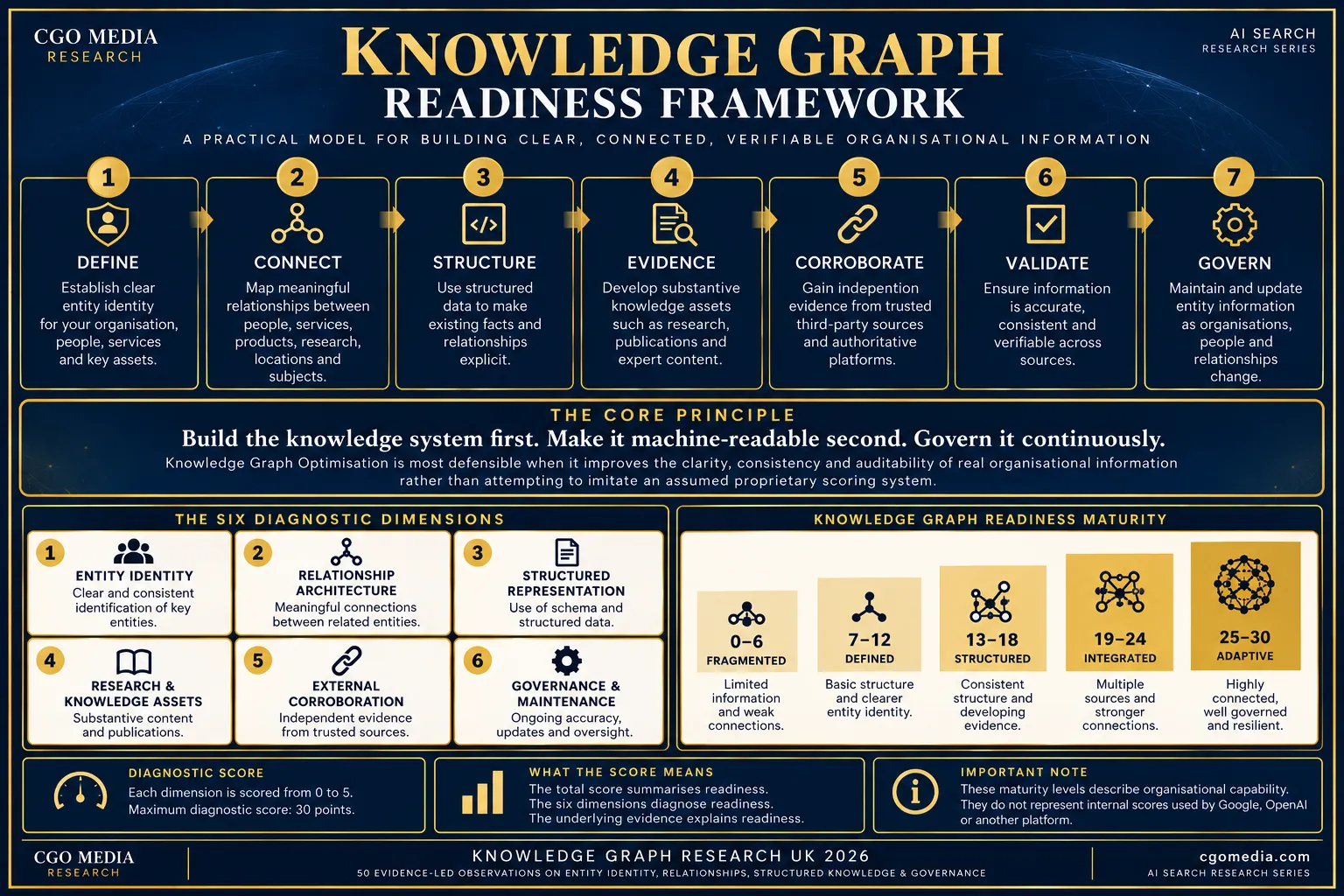
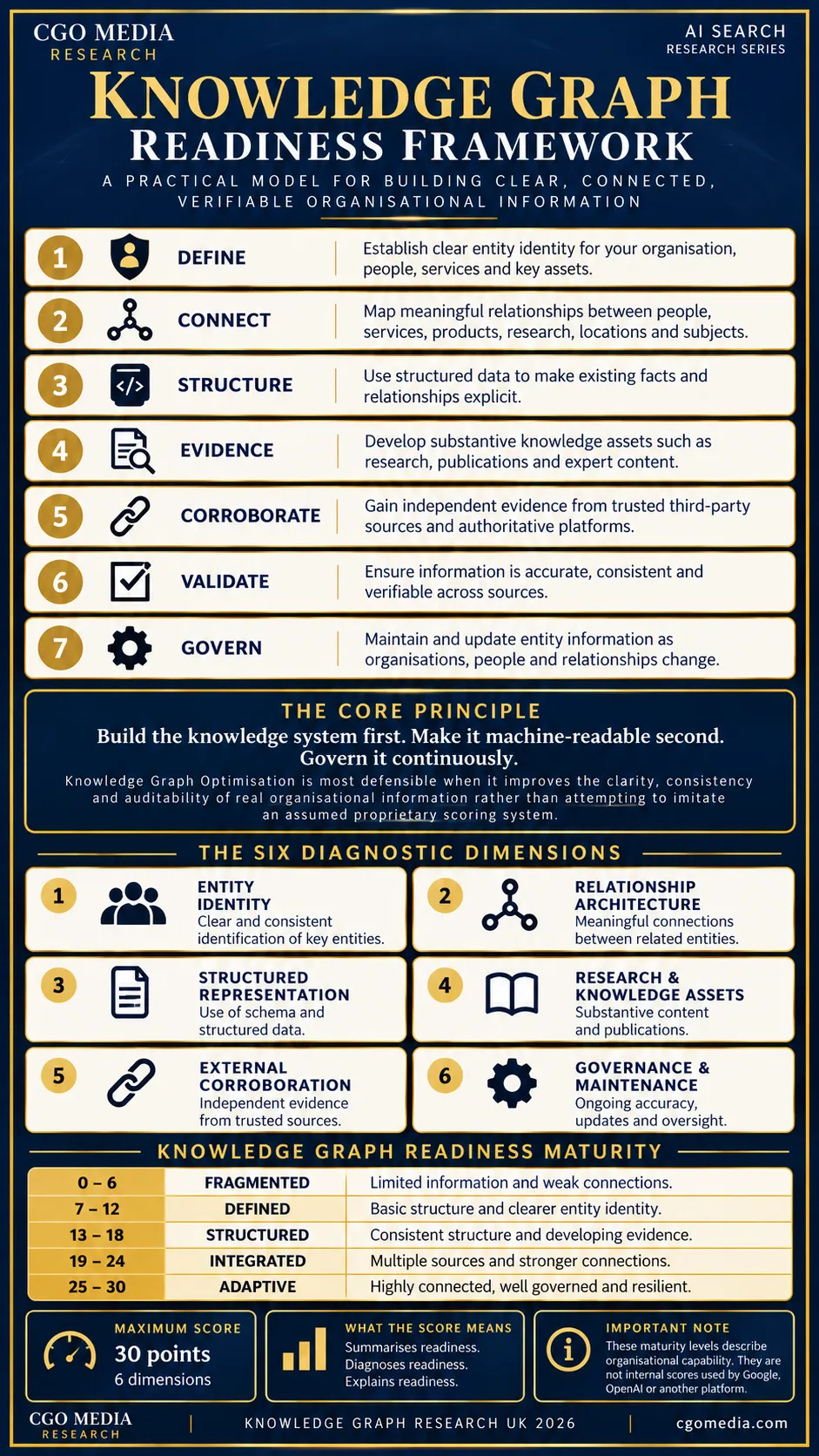
Identity → Relationships → Structured Representation → Knowledge Architecture → Corroboration → Governance
Organisational Relationship Architecture
Organisation → People → Services & Products → Topics → Publications & Research → Places → Independent Evidence
Research Objectives
- Define Knowledge Graph Optimisation without presenting it as a disclosed platform mechanism.
- Examine how organisations can improve entity identity and disambiguation.
- Assess how entity relationships contribute to organisational knowledge architecture.
- Clarify the appropriate role of structured data.
- Examine how research and publications create substantive knowledge assets.
- Distinguish first-party information from independent corroboration.
- Develop a practical framework for measuring Knowledge Graph Readiness.
- Establish governance principles for maintaining organisational knowledge over time.
Research Scope
Research Boundary
This research does not assume that Google, ChatGPT, Gemini, Claude, Microsoft Copilot, Perplexity or other systems use the same knowledge graph architecture.
It does not claim that structured data directly creates rankings, citations, recommendations, authority or proprietary AI confidence scores.
Where a platform does not publicly disclose an internal mechanism, the research separates documented capabilities, observable outputs and CGO Media interpretation.
CGO Media Knowledge Graph Principle
Build the knowledge system first. Make it machine-readable second. Govern it continuously.
Knowledge Graph Optimisation is most defensible when it improves the clarity, consistency, connectivity and auditability of real organisational information rather than attempting to imitate assumed proprietary scoring systems.
Research Observations 1–10
Entity Identity, Disambiguation & Structured Representation
The first ten observations examine the foundation of organisational knowledge representation: whether a system can identify the correct entity, distinguish it from similarly named entities and connect it with consistent factual information.
Before relationships, expertise or external authority can be interpreted meaningfully, the underlying organisation must be represented clearly enough for machines to reconcile it with confidence across multiple sources.
Research Observation 1
Stable Organisation Naming Is the Foundation of Entity Identity
Evidence Type: Entity Identity Observation
An organisation should use a stable primary name across its website and key external identity references wherever practical.
Research Finding: Frequent or unexplained naming variation can make entity reconciliation more difficult, particularly where several organisations share similar names.
CGO Media Interpretation: Establish one preferred organisational name and treat legitimate abbreviations or trading-name variants as secondary identity signals rather than competing primary identities.
Research Observation 2
Alternate Names Can Help Reconcile Legitimate Brand Variations
Evidence Type: Identity Disambiguation Observation
Organisations may legitimately use abbreviations, historical names, trading names or shortened brand forms.
Research Finding: Explicitly documenting legitimate alternate names can help distinguish intentional brand variation from inconsistent entity information.
CGO Media Interpretation: Alternate names should clarify one entity, not create several competing versions of the organisation.
Research Observation 3
The Official Website Acts as a Primary Organisational Identity Reference
Evidence Type: First-Party Entity Observation
An organisation’s official website is normally the strongest first-party environment for defining current organisational identity, services, people, locations and other factual information.
Research Finding: Weak or contradictory information on the official website can undermine clarity across the wider entity evidence environment.
CGO Media Interpretation: The website should function as the organisation’s clearest current reference point rather than forcing machines or users to reconcile conflicting first-party descriptions.
Research Observation 4
Formal Identifiers Can Reduce Ambiguity Between Similar Entities
Evidence Type: Entity Identifier Observation
Where appropriate, identifiers such as company-registration references, research identifiers or recognised institutional identifiers can help distinguish entities that share similar names.
Research Finding: Persistent or formal identifiers provide stronger disambiguation than descriptive text alone where authoritative identifiers exist.
CGO Media Interpretation: Organisations should use legitimate identifiers where they add meaningful clarity, rather than adding identifiers simply for volume.
Research Observation 5
Real-World Organisational Details Reinforce Digital Identity
Evidence Type: Organisational Identity Observation
Entity identity becomes clearer when digital information corresponds consistently with real-world organisational facts such as legal name, location, contact information and operating identity.
Research Finding: Consistency between online and real-world organisational details strengthens disambiguation and reduces conflicting identity signals.
CGO Media Interpretation: Entity optimisation should begin with factual consistency before advanced schema or relationship modelling.
Research Observation 6
sameAs Should Link to Genuine Identity References
Evidence Type: Structured Relationship Observation
The sameAs property is intended to identify another page that unambiguously refers to the same entity.
Research Finding: The value of sameAs depends on the quality and accuracy of the identity relationship, not on the number of URLs added.
CGO Media Interpretation: Use sameAs selectively for credible pages that clearly identify the same organisation or person.
Research Observation 7
Structured Data Should Describe the Page and Entity Truthfully
Evidence Type: Structured Data Governance
Structured data is most useful when it reflects information that is genuinely present, relevant and accurate.
Research Finding: Markup should clarify existing information rather than create claims that are unsupported by the visible page or wider evidence.
CGO Media Interpretation: Structured data is a representation layer, not a substitute for real organisational evidence.
Research Observation 8
Organisation Markup Should Be Concentrated Around the Entity-Defining Page
Evidence Type: Structured Representation Observation
The clearest organisation markup is normally associated with the page that best defines the organisation, commonly the homepage or another authoritative organisation page.
Research Finding: Repeating conflicting organisation entities across many pages can reduce clarity rather than improve it.
CGO Media Interpretation: Define the primary organisation entity consistently and let supporting pages connect back to it rather than reinventing the organisation on every page.
Research Observation 9
Use the Most Specific Valid Entity Type Where Appropriate
Evidence Type: Schema Classification Observation
Structured vocabularies often provide more specific entity types beneath broad categories such as Organisation or LocalBusiness.
Research Finding: More specific valid classification can provide additional semantic clarity where it accurately describes the entity.
CGO Media Interpretation: Specificity is useful only when factually correct; inappropriate specificity creates noise rather than stronger understanding.
Research Observation 10
Entity Identity Should Be Audited Before Relationship Complexity Is Added
Evidence Type: CGO Media Research Synthesis
Relationship modelling becomes less useful when the organisation itself is poorly defined or inconsistently represented.
Research Finding: Entity identity should be stabilised before organisations attempt to build increasingly complex knowledge relationships.
CGO Media Interpretation: Knowledge Graph Optimisation should begin with identity hygiene: names, URLs, identifiers, factual details and entity-defining pages.
What Observations 1–10 Tell Us
The first layer of Knowledge Graph Readiness is entity identity and disambiguation.
Before machines can interpret relationships around an organisation, they first need a coherent representation of which organisation is being described.
Stable Name → Official Website → Identifiers → Real-World Facts → Identity References → Structured Representation
The objective is consistency and clarity, not schema volume.
CGO Media Entity Identity Principle
Structured data can clarify an entity, but it cannot repair fundamentally inconsistent organisational information.
Identity consistency should therefore come before relationship expansion.
Entity Identity Audit Checklist
- Preferred organisation name
- Legitimate alternate names
- Canonical organisation URL
- Legal or formal identifiers where appropriate
- Current address and contact details
- Consistent logo and branding references
- Primary organisation entity page
- Relevant sameAs references
- Correct entity type
- Conflicting external identity information
Research Observations 11–20
Entity Relationships, People, Topics & Organisational Knowledge Architecture
Once organisational identity is clear, the next challenge is representing the relationships that explain what the organisation does, who is connected with it and which subjects, products, services and knowledge assets are genuinely relevant.
These relationships form the practical architecture around the entity. Their value depends on accuracy, relevance and corroboration rather than the sheer number of connections created.
Research Observation 11
Entity Relationships Provide Context That Isolated Entity References Cannot
Evidence Type: Relationship Modelling Observation
Knowing that an organisation exists provides only limited context. Greater understanding develops when the entity is connected to people, subjects, locations, products, services and publications.
Research Finding: Meaningful relationships can explain the role and context of an entity more effectively than isolated labels alone.
CGO Media Interpretation: Knowledge architecture should connect entities only where a genuine real-world relationship exists.
Research Observation 12
People and Organisations Should Be Modelled as Distinct but Connected Entities
Evidence Type: Person–Organisation Relationship
Founders, researchers, executives and authors may contribute substantially to organisational understanding, but they remain distinct entities from the organisation itself.
Research Finding: Clear person-to-organisation relationships help preserve identity while still expressing organisational affiliation and contribution.
CGO Media Interpretation: Avoid collapsing people and organisations into one entity merely because their reputations are closely connected.
Research Observation 13
Authorship Connects People With Published Knowledge
Evidence Type: Authorship Relationship
Author relationships create explicit connections between people and the articles, research papers, datasets or other works they produce.
Research Finding: Consistent authorship information helps connect person entities with a body of published work.
CGO Media Interpretation: Author pages should function as genuine knowledge hubs rather than decorative profile pages.
Research Observation 14
Author and Publisher Relationships Should Remain Distinct
Evidence Type: Publishing Relationship Observation
The person or organisation that creates a work may be different from the organisation that publishes it.
Research Finding: Separating authorship from publishing preserves clearer relationships between people, organisations and creative works.
CGO Media Interpretation: Accurate role modelling produces a stronger knowledge architecture than assigning every relationship to the organisation itself.
Research Observation 15
Topic Association Should Reflect Evidence, Not Marketing Ambition
Evidence Type: Topical Relationship Observation
Organisations can declare that they operate within particular subjects or sectors, but declarations alone do not establish demonstrated expertise.
Research Finding: Topic relationships become stronger when they are supported by relevant services, publications, research, authorship and independent references.
CGO Media Interpretation: `knowsAbout` and similar properties should describe genuine subject relationships, not serve as unsupported claims of authority.
Research Observation 16
about and subjectOf Express Different Relationship Directions
Evidence Type: Semantic Relationship Observation
A creative work can be about an organisation, while the organisation can be the subjectOf that creative work.
Research Finding: Directional relationships help clarify whether an entity creates content, is described by content or is merely mentioned within it.
CGO Media Interpretation: Relationship direction should reflect the real meaning of the connection rather than being chosen only because a property is available.
Research Observation 17
Services and Products Can Strengthen Organisational Context
Evidence Type: Commercial Entity Relationship
Services and products provide concrete evidence of what an organisation actually offers.
Research Finding: Clearly defined commercial entities can reinforce topic and category relationships when they are connected accurately with the parent organisation.
CGO Media Interpretation: Service and product architecture should make real commercial relationships explicit rather than relying only on broad marketing claims.
Research Observation 18
Location Relationships Help Define Where an Organisation Operates
Evidence Type: Geographic Entity Relationship
Head offices, branches, service areas and other real geographic relationships can help distinguish where an organisation exists and operates.
Research Finding: Geographic relationships are strongest when they reflect actual operational presence rather than artificially expanded location claims.
CGO Media Interpretation: Entity models should distinguish genuine offices, branches and service areas rather than treating every target market as a physical location.
Research Observation 19
Internal Linking Can Reinforce Organisational Knowledge Architecture
Evidence Type: Website Architecture Observation
Internal links help users and crawlers understand which pages relate to organisations, people, services, research, topics and other important entities.
Research Finding: Coherent internal architecture can reinforce meaningful entity relationships without requiring every relationship to be expressed through structured data.
CGO Media Interpretation: Knowledge Graph Optimisation is as much an information-architecture exercise as a schema exercise.
Research Observation 20
Knowledge Architecture Becomes Stronger When Multiple Relationships Converge on the Same Entity
Evidence Type: CGO Media Research Synthesis
A coherent entity model develops when the same organisation is connected consistently with its people, services, topics, publications, locations and external references.
Research Finding: Converging relationships provide a stronger knowledge structure than isolated pages or disconnected entity declarations.
CGO Media Interpretation: The aim is not maximum relationship density. It is coherent convergence around the same real-world entity.
What Observations 11–20 Tell Us
The second layer of Knowledge Graph Readiness is relationship architecture.
Organisational understanding becomes richer when meaningful relationships converge around the same entity.
Organisation → People → Services & Products → Topics → Publications → Locations → External Evidence
The quality of the relationships matters more than the quantity.
CGO Media Relationship Principle
A useful knowledge graph is not a collection of disconnected entity labels. It is a network of accurate relationships describing how real entities relate to one another.
Every relationship should therefore answer a genuine organisational question: who, what, where, about what, created by whom and supported by which evidence.
Relationship Architecture Audit
- Organisation ↔ People
- People ↔ Publications
- Organisation ↔ Services
- Organisation ↔ Products
- Organisation ↔ Topics
- Publications ↔ Topics
- Organisation ↔ Locations
- Organisation ↔ Research
- Organisation ↔ External References
- Internal pages ↔ Entity-defining pages
Research Observations 21–30
Research, Publications, Persistent Identifiers & External Corroboration
The third layer of Knowledge Graph Readiness concerns the evidence surrounding an organisation.
Research papers, datasets, publication records, persistent identifiers and independent references can help connect organisations and people with a body of work that exists beyond descriptive marketing claims.
Research Observation 21
Original Research Creates Substantive Organisational Evidence
Evidence Type: Research Authority Observation
Original research provides a tangible knowledge asset that can connect an organisation with defined subjects, methods, findings and authors.
Research Finding: Research creates stronger evidence of subject engagement than repeated promotional claims alone.
CGO Media Interpretation: Organisations seeking stronger knowledge architecture should invest in evidence-producing assets, not just descriptive content.
Research Observation 22
Publications Extend Organisational Knowledge Beyond the Corporate Website
Evidence Type: Publication Ecosystem Observation
Published research, articles and datasets can create multiple independent records connecting an organisation or its people with specific knowledge assets.
Research Finding: Publication records can expand the evidence network surrounding an entity beyond first-party webpages.
CGO Media Interpretation: Publishing should be treated as part of entity architecture, not only as a content-marketing activity.
Research Observation 23
Persistent Identifiers Reduce Ambiguity Between Authors, Institutions and Research Outputs
Evidence Type: Identifier Observation
Persistent identifiers such as DOIs, ORCID iDs and recognised organisation identifiers can help distinguish similarly named people, institutions and publications.
Research Finding: Persistent identifiers strengthen disambiguation by connecting entities to stable reference points.
CGO Media Interpretation: Use recognised identifiers where they genuinely clarify authorship, publication ownership or institutional identity.
Research Observation 24
Research Repositories Can Create Independent Publication Records
Evidence Type: Repository Observation
Repositories can provide publication pages, metadata, persistent identifiers and structured records that exist separately from an organisation’s own website.
Research Finding: Repository records can strengthen the discoverability and persistence of research outputs without converting those records automatically into proof of organisational authority.
CGO Media Interpretation: Repository publishing is most useful when metadata, authorship and organisational attribution remain accurate and consistent.
Research Observation 25
Datasets Can Create Explicit Connections Between Organisations, Researchers and Evidence
Evidence Type: Dataset Relationship Observation
Datasets can connect a research question, creators, publishers, methodology and resulting evidence in one identifiable knowledge asset.
Research Finding: Structured dataset records can strengthen relationships between entities and the evidence they produced.
CGO Media Interpretation: Data should be treated as a first-class knowledge asset where the organisation genuinely conducts evidence-based research.
Research Observation 26
Research Methodology Is Part of the Knowledge Architecture
Evidence Type: Research Governance Observation
A research finding becomes easier to evaluate when its methodology, scope, assumptions and limitations are documented clearly.
Research Finding: Methodology provides contextual relationships between a publication and the evidence underlying its claims.
CGO Media Interpretation: Research entities should connect not only to findings but also to the methodology that explains how those findings were produced.
Research Observation 27
First-Party Claims and Independent Corroboration Are Different Evidence Classes
Evidence Type: Evidence Classification
An organisation describing itself as a specialist is different from an independent source describing the organisation in that role.
Research Finding: First-party definition and independent corroboration should be preserved as distinct evidence classes.
CGO Media Interpretation: Strong knowledge architecture should not attempt to make self-description look like independent validation.
Research Observation 28
Independent Sources Can Expand the Evidence Environment Around an Entity
Evidence Type: External Corroboration Observation
Independent media, directories, professional bodies, repositories, reviews and other external sources can create additional references to the same organisation or person.
Research Finding: External references can broaden the network of evidence surrounding an entity when they are credible, relevant and genuinely independent.
CGO Media Interpretation: External evidence should be evaluated for relevance and quality, not simply counted.
Research Observation 29
External Corroboration Is Stronger When Multiple Independent Sources Converge
Evidence Type: Evidence Convergence Observation
A single external reference may be useful, but repeated independent evidence from different source environments can provide a broader corroboration pattern.
Research Finding: Independent convergence is more informative than artificial duplication of the same claim across many controlled properties.
CGO Media Interpretation: Evidence diversity matters because independent corroboration is different from repetition.
Research Observation 30
Research, Identifiers and External Evidence Can Form a Distributed Knowledge Network
Evidence Type: CGO Media Research Synthesis
When the same organisation, authors and publications are connected consistently across first-party pages, repositories, persistent identifiers and external sources, a broader knowledge network develops around the underlying entities.
Research Finding: Distributed evidence can strengthen entity clarity when the separate records converge accurately on the same real-world relationships.
CGO Media Interpretation: Knowledge architecture should extend beyond the website while preserving consistent identity and attribution.
What Observations 21–30 Tell Us
The third layer of Knowledge Graph Readiness is distributed evidence and corroboration.
Research, datasets, publication records, persistent identifiers and independent references create additional relationships around an organisation and its people.
Research → Publications → Identifiers → Repositories → Independent Sources → Evidence Convergence
The objective is not to manufacture external signals. It is to create durable, verifiable records of genuine organisational activity.
CGO Media Evidence Principle
First-party definition explains the organisation. Independent evidence helps corroborate it. Research creates substantive knowledge assets connecting the organisation with defined subjects.
These evidence classes should reinforce one another without being treated as interchangeable.
Knowledge Evidence Audit
- Original research assets
- Research methodology pages
- Datasets and supporting evidence
- Publication records
- DOIs and persistent publication identifiers
- Author identifiers such as ORCID where relevant
- Institutional identifiers where relevant
- Repository records
- Independent media and professional references
- Consistency of authorship and organisational attribution
Research Observations 31–40
Structured Data, Knowledge Architecture, Search Understanding & AI-Mediated Discovery
The fourth layer of Knowledge Graph Readiness examines how structured representation and information architecture can make organisational information easier to interpret across search and AI-mediated discovery environments.
The important distinction is that clearer representation can improve machine readability and disambiguation, but it should not be confused with guaranteed ranking, citation or recommendation outcomes.
Research Observation 31
Structured Data Can Make Organisational Relationships More Explicit
Evidence Type: Structured Representation Observation
Structured data can express relationships between organisations, people, publications, products, services and other entities in a machine-readable format.
Research Finding: Explicit machine-readable relationships can reduce ambiguity where the underlying information is already accurate and coherent.
CGO Media Interpretation: Structured data should clarify the organisation’s real knowledge architecture rather than attempt to manufacture one.
Research Observation 32
Schema Markup Does Not Create Expertise or Authority on Its Own
Evidence Type: Structured Data Limitation
Markup can describe what an organisation says about itself, but the markup itself does not prove the underlying claim.
Research Finding: Structured representation and substantive evidence are separate layers that should reinforce one another.
CGO Media Interpretation: Schema can make evidence easier to interpret, but it cannot substitute for evidence.
Research Observation 33
Information Architecture and Structured Data Should Describe the Same Reality
Evidence Type: Architecture Consistency Observation
A website may describe one organisational relationship in visible content while structured data describes another.
Research Finding: Consistency between visible content, internal linking and machine-readable markup reduces interpretive conflict.
CGO Media Interpretation: Knowledge architecture should be designed once and expressed consistently across both human-readable and machine-readable layers.
Research Observation 34
Entity-Defining Pages Should Be Easy to Identify Within the Site Architecture
Evidence Type: Website Knowledge Architecture
Important entities benefit from clear reference pages explaining who or what they are and how they relate to the organisation.
Research Finding: Clear entity pages make it easier to connect supporting content with a stable organisational reference point.
CGO Media Interpretation: Core entities should have identifiable homes within the architecture rather than being defined differently across many disconnected pages.
Research Observation 35
Internal Links Can Express Relationship Importance
Evidence Type: Internal Relationship Observation
Links between organisation pages, research, authors, sectors, services and supporting content create a navigable relationship structure.
Research Finding: Deliberate internal linking can reveal how knowledge assets and entities relate within the organisation’s own information environment.
CGO Media Interpretation: Internal links should reflect genuine relationships and hierarchy rather than exist only for keyword distribution.
Research Observation 36
Search Understanding Should Be Distinguished From Search Ranking
Evidence Type: Search Interpretation Observation
A search system may understand what an entity is without necessarily ranking the entity prominently for a particular query.
Research Finding: Entity understanding and ranking performance are related but distinct measurement concepts.
CGO Media Interpretation: Do not treat evidence of entity recognition as proof of ranking preference.
Research Observation 37
AI-Mediated Discovery Should Be Evaluated Through Observable Outputs
Evidence Type: AI Measurement Observation
Where AI systems do not expose their internal entity-resolution or retrieval processes, researchers should focus on outcomes that can actually be observed.
Research Finding: Recognition, factual representation, citation, mention and comparison can be observed more defensibly than hypothetical internal “knowledge graph scores”.
CGO Media Interpretation: Knowledge Graph research should remain grounded in visible evidence rather than inferred proprietary metrics.
Research Observation 38
Correct Entity Recognition Does Not Guarantee Citation or Recommendation
Evidence Type: AI Visibility Boundary
An AI system may identify an organisation accurately while still choosing different sources, competitors or recommendations for a given query.
Research Finding: Entity recognition, citation visibility and recommendation visibility should be measured as separate outcomes.
CGO Media Interpretation: Better entity clarity can support interpretation, but it should never be presented as a guaranteed path to AI recommendation.
Research Observation 39
Conflicting Entity Information Creates a Governance Problem
Evidence Type: Entity Governance Observation
Outdated addresses, old biographies, conflicting descriptions, obsolete services and inconsistent identifiers can remain distributed across the web long after first-party information changes.
Research Finding: Entity quality depends partly on ongoing maintenance, not only initial implementation.
CGO Media Interpretation: Knowledge Graph Optimisation should include conflict detection, correction and periodic revalidation.
Research Observation 40
Knowledge Graph Readiness Is a System, Not a Schema Plugin
Evidence Type: CGO Media Research Synthesis
Organisational knowledge representation depends on identity, architecture, content, relationships, structured data, external evidence and maintenance.
Research Finding: No single technical implementation can replace the wider information environment surrounding an organisation.
CGO Media Interpretation: Knowledge Graph Readiness should be managed as an organisational capability rather than a one-off technical deployment.
What Observations 31–40 Tell Us
The fourth layer of Knowledge Graph Readiness is machine-readable consistency and governed knowledge architecture.
Structured data can make relationships clearer, but the underlying information architecture and evidence remain essential.
Knowledge Architecture → Structured Representation → Search Understanding → Observable AI Recognition → Governance
Understanding, ranking, citation and recommendation are related but distinct outcomes.
CGO Media Structured Knowledge Principle
Structured data should make an existing knowledge system easier to interpret. It should not be treated as a substitute for identity clarity, evidence or organisational coherence.
The strongest implementation aligns visible content, internal architecture, structured relationships and external evidence around the same real-world entities.
Structured Knowledge Audit
- Entity-defining pages are identifiable
- Visible content and schema agree
- Person and organisation entities remain distinct
- Authorship and publisher relationships are accurate
- sameAs references are genuine
- Topic relationships are evidence-led
- Internal links reflect real relationships
- Outdated entity information is identified
- Search recognition is not confused with ranking
- AI recognition is measured separately from citation and recommendation
Research Observations 41–50
Measurement, Governance, Maturity & the CGO Media Knowledge Graph Readiness Framework
The final ten observations move from implementation to management. Knowledge Graph Readiness becomes more useful when organisations can measure entity clarity, identify gaps, monitor conflicts and govern important knowledge relationships over time.
The objective is not to create a hidden-platform score. It is to establish a transparent diagnostic system for evaluating the quality and consistency of an organisation’s own knowledge environment.
Research Observation 41
Knowledge Graph Readiness Should Be Measured Across Multiple Dimensions
Evidence Type: Measurement Framework Observation
No single indicator can adequately represent organisational knowledge quality.
Research Finding: Entity identity, relationships, structured representation, evidence, corroboration and governance should be assessed separately before being summarised.
CGO Media Interpretation: A total score is useful only when the underlying dimensions remain visible.
Research Observation 42
Entity Identity Should Be Scored Separately From Entity Authority
Evidence Type: Diagnostic Separation Observation
An organisation may be easy to identify but have weak independent evidence, while another may have strong external references but inconsistent first-party identity information.
Research Finding: Identity clarity and wider authority are different organisational capabilities and should not be collapsed into one concept.
CGO Media Interpretation: Knowledge Graph Readiness measures representation quality; Entity Authority measures the wider strength of the entity and its evidence environment.
Research Observation 43
A Diagnostic Score Should Be Based on Observable Organisational Conditions
Evidence Type: Framework Methodology
Scoring should reflect verifiable conditions such as naming consistency, structured relationships, publication records, external corroboration and governance processes.
Research Finding: Transparent criteria are more defensible than hypothetical estimates of proprietary platform confidence.
CGO Media Interpretation: The framework should measure what the organisation can inspect and improve directly.
Research Observation 44
Baseline Measurement Is Necessary Before Improvement Can Be Demonstrated
Evidence Type: Measurement Discipline
Without a documented baseline, later improvements can easily become subjective assessments.
Research Finding: Initial audits should record the current state of identity, relationships, evidence, schema, external references and conflicts before changes are implemented.
CGO Media Interpretation: Knowledge Graph optimisation should begin with diagnosis rather than implementation.
Research Observation 45
Knowledge Conflicts Should Be Recorded as Measurable Defects
Evidence Type: Governance Measurement
Conflicting names, addresses, biographies, organisational roles, service descriptions or outdated references create measurable knowledge defects.
Research Finding: Conflict incidence provides a practical governance metric for knowledge quality.
CGO Media Interpretation: Organisations should track not only positive implementation but also unresolved contradictions.
Research Observation 46
Knowledge Governance Requires Clear Ownership
Evidence Type: Organisational Governance
Entity information often crosses SEO, content, research, PR, legal, brand and operational teams.
Research Finding: Important entity changes can remain inconsistent when no team is responsible for maintaining the master organisational representation.
CGO Media Interpretation: Knowledge governance should assign responsibility for approving, updating and auditing key organisational facts.
Research Observation 47
Knowledge Graph Maturity Develops Through Organisational Capability
Evidence Type: Maturity Model Observation
Maturity develops as organisations move from fragmented entity information towards structured, integrated and governed knowledge systems.
Research Finding: Higher maturity reflects stronger organisational processes, not proof of preferential treatment by search or AI systems.
CGO Media Interpretation: Maturity should measure internal capability to maintain coherent knowledge over time.
Research Observation 48
Knowledge Graph Readiness Should Be Reassessed After Material Organisational Change
Evidence Type: Governance Cycle Observation
Rebrands, acquisitions, new offices, leadership changes, product changes and research expansion can alter important entity relationships.
Research Finding: Organisational change can rapidly make previously accurate knowledge representations incomplete or outdated.
CGO Media Interpretation: Entity audits should be event-driven as well as scheduled.
Research Observation 49
Composite Scores Are Useful for Diagnosis but Should Not Create False Precision
Evidence Type: Scoring Limitation
A 30-point framework can make complex information easier to communicate, but small score differences should not be interpreted as scientifically exact differences in search or AI treatment.
Research Finding: Composite scores are most useful when paired with dimension-level evidence and documented criteria.
CGO Media Interpretation: Use the score to find weaknesses and track progress, not to claim access to hidden platform metrics.
Research Observation 50
Knowledge Graph Readiness Is a Long-Term Organisational Capability
Evidence Type: CGO Media Research Synthesis
Entity information, research, people, services, external references and organisational structures continue to change over time.
Research Finding: Knowledge Graph Readiness is most effective when incorporated into ongoing content, research, technical and governance processes.
CGO Media Interpretation: The goal is to maintain a coherent organisational knowledge system that remains accurate as the organisation evolves.
CGO Media Knowledge Graph Readiness Framework
The fifty observations support a six-dimensional diagnostic framework for evaluating organisational Knowledge Graph Readiness.
1. Entity Identity
Naming, identifiers, factual consistency, canonical entity pages and disambiguation.
2. Relationship Architecture
Connections between organisations, people, products, services, topics, places and publications.
3. Structured Representation
Machine-readable entity information that accurately reflects visible organisational reality.
4. Research & Knowledge Assets
Research, datasets, publications, authorship and persistent knowledge assets.
5. External Corroboration
Independent references, repositories, professional sources and evidence convergence.
6. Governance & Maintenance
Ownership, conflict management, review cycles, documentation and ongoing maintenance.
30-Point Diagnostic Model
Each dimension is scored from 0 to 5 using predefined organisational criteria.
Entity Identity + Relationship Architecture + Structured Representation + Research & Knowledge Assets + External Corroboration + Governance & Maintenance = 30 Points
| Score | Diagnostic Meaning |
|---|---|
| 0 | Absent or materially unresolved |
| 1 | Very weak or inconsistent |
| 2 | Developing |
| 3 | Established |
| 4 | Strong and integrated |
| 5 | Leading and actively governed |
Knowledge Graph Readiness Maturity
0–6 Fragmented → 7–12 Defined → 13–18 Structured → 19–24 Integrated → 25–30 Adaptive
0–6 · Fragmented
Important entities are inconsistently defined, relationships are weak and governance is largely absent.
7–12 · Defined
Core identities and some relationships are documented, but implementation remains incomplete.
13–18 · Structured
The organisation has a coherent entity model, structured representation and growing evidence infrastructure.
19–24 · Integrated
Entity architecture, research, external evidence and governance operate as a connected organisational system.
25–30 · Adaptive
Knowledge representation is actively maintained, monitored and updated as the organisation changes.
What Observations 41–50 Tell Us
The final layer of Knowledge Graph Readiness is measurement and governance.
Knowledge architecture becomes an organisational capability when entities can be defined, measured, corrected and maintained consistently over time.
Audit → Score → Diagnose → Correct → Validate → Monitor → Govern
The purpose of the framework is diagnosis and improvement — not the creation of an assumed proprietary search or AI score.
CGO Media Analysis
What the 50 Knowledge Graph Research Observations Tell Us
The fifty observations point towards a broader conclusion: Knowledge Graph Optimisation should not be treated as a narrow schema implementation exercise.
It is better understood as the disciplined management of how an organisation, its people, its knowledge assets and its relationships are represented across first-party information, structured data and credible external evidence.
Central Analysis
Knowledge Graph Readiness develops when identity, relationships, structured representation, research evidence, external corroboration and governance converge around the same real-world entities.
1. Identity Comes Before Authority
An organisation cannot build a coherent knowledge environment if its core identity remains ambiguous.
Stable naming, canonical URLs, accurate organisational information and appropriate identifiers form the foundation upon which more complex relationships can be added.
CGO Media Position: Identity hygiene should be completed before organisations attempt to expand schema, topic relationships or external entity signals.
2. Relationships Create Context
Knowing that an organisation exists provides limited information. Understanding develops when that organisation is connected with people, services, products, topics, research, locations and external evidence.
Organisation → People → Services → Topics → Research → Locations → External Evidence
These relationships should describe reality rather than simply increase the number of connections associated with an entity.
3. Structured Data Is a Representation Layer
Structured data is valuable because it can express selected entities and relationships explicitly in machine-readable form.
Its role, however, is descriptive. It does not automatically create expertise, authority, trust or recommendation eligibility.
Key Principle: Schema should describe evidence and relationships that already exist. It should not be used to manufacture unsupported authority claims.
4. Knowledge Architecture Extends Beyond Schema
Organisational knowledge is also expressed through visible content, page architecture, internal links, author relationships, research libraries and topic structures.
A well-designed information architecture can make relationships understandable even before structured markup is considered.
Entity Pages
Define important organisations, people and other core entities.
Internal Links
Connect related entities, topics and knowledge assets.
Research Libraries
Create persistent relationships between organisations, people and subjects.
Structured Data
Makes selected relationships machine-readable.
5. Research Creates Evidence-Rich Entity Relationships
Research is especially valuable within knowledge architecture because it creates explicit relationships between organisations, people, subjects, methodologies, publications and evidence.
A substantial research programme can therefore expand the entity environment surrounding an organisation in ways that conventional marketing copy cannot.
Organisation → Researchers → Research → Data → Publications → Repositories → Citations
6. Persistent Identifiers Support Disambiguation
Persistent identifiers can reduce uncertainty where multiple people, organisations or publications share similar names.
DOIs, ORCID records and other recognised identifiers can provide stable connections between entities and their published work where appropriate.
Their role is identity resolution and persistence, not the automatic creation of authority.
7. Independent Corroboration Is Different From Repetition
Publishing the same self-authored claim across multiple controlled properties does not create the same evidential value as genuinely independent references.
Independent corroboration becomes more meaningful when different credible sources converge on the same factual identity, role, expertise or activity.
Research Distinction: Repetition increases frequency. Independent corroboration increases evidence diversity.
8. Knowledge Graph Readiness and AI Visibility Are Related but Different
Clear entity representation may make organisational information easier to interpret, but this should not be treated as proof that an AI platform will cite or recommend the organisation.
Knowledge Graph Readiness measures the quality of the entity information environment. AI Search Visibility measures observable outcomes such as recognition, citation, mention, comparison and recommendation.
| Knowledge Graph Readiness | AI Search Visibility |
|---|---|
| Is the entity clearly defined? | Is the entity recognised? |
| Are relationships explicit? | Is the organisation associated with the relevant topic? |
| Is research and evidence connected? | Is the organisation or its content cited? |
| Is external corroboration present? | Is the brand mentioned or compared? |
| Is the representation governed? | Is the brand represented accurately? |
9. Search Understanding, Ranking and Recommendation Should Not Be Collapsed Into One Concept
A search or AI system may correctly understand an entity without ranking it prominently, citing it as a source or recommending it to a user.
Entity Recognition ≠ Ranking ≠ Citation ≠ Comparison ≠ Recommendation
Separating these outcomes makes research and reporting more defensible.
10. Governance Determines Whether Knowledge Remains Reliable
Knowledge systems deteriorate when organisational information changes but the surrounding evidence environment does not.
Leadership changes, new services, office moves, acquisitions, rebrands and research expansion can all create conflicting entity information.
This makes ongoing governance as important as initial implementation.
Five Layers of Organisational Knowledge Development
Layer 1 — Identity
Who is the organisation, person, publication, product or service?
Layer 2 — Relationships
How do those entities relate to one another?
Layer 3 — Evidence
What research, publications, datasets and external references support those relationships?
Layer 4 — Representation
Are these entities and relationships expressed consistently across visible content and structured data?
Layer 5 — Governance
Can the organisation keep the knowledge environment accurate as facts change?
CGO Media Knowledge Graph Development Model
Define → Connect → Structure → Evidence → Corroborate → Validate → Govern
Six Questions Every Organisation Should Be Able to Answer
- Identity: Can important organisational entities be identified unambiguously?
- Relationships: Are people, services, research, topics and locations connected correctly?
- Representation: Do visible content and structured data describe the same relationships?
- Evidence: Is there substantive material supporting important organisational claims?
- Corroboration: Are important facts supported beyond first-party sources where appropriate?
- Governance: Who is responsible for keeping these relationships accurate?
CGO Media Research Position
Knowledge Graph Optimisation should not be presented as a method for directly controlling proprietary search-engine or AI knowledge systems.
Its defensible role is to improve the quality, consistency and auditability of the information environment surrounding important organisational entities.
Clear Identity + Meaningful Relationships + Structured Representation + Evidence + Corroboration + Governance = Stronger Knowledge Graph Readiness
Practical Implementation
What UK Organisations Should Do in 2026
Knowledge Graph Readiness should be implemented as a structured organisational programme rather than as a one-off schema project.
The practical objective is to make important entities easier to identify, relationships easier to interpret and supporting evidence easier to verify across the organisation’s own website and relevant external information environments.
Implementation Principle
Do not begin with schema. Begin by defining the organisation, its important entities, its real relationships and the evidence supporting them.
1. Define the Primary Organisation Entity
Document the organisation’s preferred name, legitimate alternate names, canonical website, legal identity where relevant, contact information, key locations and other core identifying information.
2. Establish a Canonical Entity Page
Ensure the organisation has one strong first-party page that clearly explains who it is, what it does, where it operates and how it should be identified.
3. Audit Organisational Naming Consistency
Review the website, social profiles, repositories, business listings, author profiles and major external references for inconsistent organisation names or outdated branding.
4. Identify the Organisation’s Core Entity Set
Create an inventory of the entities that materially define the organisation.
- Organisation
- Founders and leadership
- Researchers and authors
- Products
- Services
- Locations
- Research papers
- Datasets
- Frameworks
- Core subject areas
5. Map the Relationships Between Core Entities
Document how the core entities relate to one another before attempting technical implementation.
Organisation → People → Services → Topics → Research → Publications → External Evidence
6. Build Dedicated Pages for Important Entities
Important people, research programmes, services, frameworks and other significant entities should have stable pages where the relationship warrants it.
7. Strengthen Internal Knowledge Architecture
Use contextual internal links to connect related people, research, sectors, services, topics and supporting evidence.
Internal linking should reflect meaningful organisational relationships rather than being used only for keyword distribution.
8. Add Structured Data After the Entity Model Is Defined
Once the organisation’s identity and relationships are clear, use relevant structured data to describe those relationships in machine-readable form.
Rule: Structured data should represent existing organisational truth. It should not be used to create unsupported expertise, authority or affiliation claims.
9. Use sameAs Selectively
Connect the entity only with external pages that clearly and unambiguously identify the same organisation or person.
Quality and identity accuracy matter more than the number of links added.
10. Separate People From the Organisation
Founders, researchers, executives and authors should be represented as individual entities while their relationships with the organisation remain explicit.
11. Build Strong Author and Researcher Profiles
Author pages should connect people with biographies, areas of research, published work and legitimate external identity references where appropriate.
12. Develop Original Research and Knowledge Assets
Create substantive materials that demonstrate actual engagement with the subjects the organisation wants to be associated with.
- Research papers
- Statistics studies
- Datasets
- Research observations
- Methodologies
- Frameworks
- Sector research
13. Use Persistent Identifiers Where Appropriate
Connect research and researchers with recognised persistent identifiers where they genuinely improve disambiguation.
Examples may include DOIs for publications and ORCID records for researchers.
14. Publish Research Beyond the Corporate Website
Where appropriate, use credible repositories and publication environments to create additional persistent records for research assets.
Metadata, authorship and organisational attribution should remain consistent across those environments.
15. Strengthen Independent Corroboration
Develop legitimate external references through journalism, Digital PR, industry publications, professional organisations, research repositories and other relevant independent environments.
Important: Independent corroboration should not be confused with repeating the same self-authored statement across controlled properties.
16. Audit Conflicting Entity Information
Identify contradictions across websites, profiles, repositories and external references.
Common issues include:
- old organisation names;
- outdated office addresses;
- incorrect leadership information;
- obsolete service descriptions;
- inconsistent author biographies;
- incorrect affiliations; and
- duplicated or competing entity profiles.
17. Create a Knowledge Governance Register
Maintain a controlled record of important organisational entities and facts so that teams know which information is authoritative.
What is being governed?
What is the approved current information?
Where is the authoritative reference?
Who is responsible for maintaining it?
18. Establish a Review Cycle
Review important entity information periodically and after material organisational changes.
Event-triggered reviews should include rebrands, mergers, acquisitions, leadership changes, new offices, new services and major publication programmes.
19. Measure Knowledge Graph Readiness Before and After Changes
Use a documented baseline across the six framework dimensions before major improvements are implemented.
This creates a transparent way to assess progress without pretending to measure undisclosed platform scoring systems.
20. Treat Knowledge Graph Readiness as an Ongoing Organisational Capability
The strongest knowledge architecture is not static.
It evolves as the organisation publishes new research, hires new people, launches services, enters markets and accumulates new independent evidence.
Recommended Implementation Sequence
Define → Inventory → Map → Structure → Evidence → Corroborate → Validate → Govern
90-Day Knowledge Graph Implementation Plan
Days 1–30 — Define & Audit
- Define the primary organisation entity.
- Inventory people, products, services, locations and knowledge assets.
- Identify canonical entity pages.
- Audit names, URLs, identifiers and organisational facts.
- Review current structured data.
- Identify conflicting external information.
- Establish the Knowledge Graph Readiness baseline.
Days 31–60 — Connect & Strengthen
- Improve entity-defining pages.
- Strengthen internal relationship architecture.
- Correct structured data inconsistencies.
- Improve author and researcher profiles.
- Connect research with authors, topics and publishers.
- Add appropriate persistent identifiers.
- Correct major external identity conflicts where possible.
Days 61–90 — Corroborate & Govern
- Expand research and publication records.
- Strengthen legitimate independent corroboration.
- Create the knowledge governance register.
- Assign ownership for key entity information.
- Re-audit the six Knowledge Graph Readiness dimensions.
- Record remaining conflicts and gaps.
- Establish the ongoing review cycle.
Cross-Functional Ownership
Knowledge Graph Readiness should not sit entirely within SEO.
| Function | Knowledge Graph Responsibility |
|---|---|
| SEO / GEO | Entity audits, internal architecture, structured data and search visibility monitoring. |
| Research | Research assets, methodologies, datasets, publication metadata and identifiers. |
| Content | Entity-defining content, factual consistency and topic relationships. |
| Digital PR | Independent references, journalist relationships and external corroboration. |
| Brand / Communications | Approved naming, positioning, biographies and brand representation. |
| Leadership / Governance | Ownership, approval of canonical facts and organisational change control. |
What Organisations Should Not Do
- Do not add large amounts of schema before fixing factual inconsistency.
- Do not treat every external profile as a valid sameAs reference.
- Do not use topic markup to make unsupported expertise claims.
- Do not confuse repeated self-publication with independent corroboration.
- Do not merge people and organisations into one entity.
- Do not treat entity recognition as proof of ranking or recommendation.
- Do not create a composite score without preserving the underlying evidence.
- Do not assume the implementation is finished once the schema validates.
CGO Media Implementation Principle
Build the knowledge system first. Make it machine-readable second. Measure and govern it continuously.
The aim is not to force an organisation into an assumed proprietary knowledge graph. The aim is to create a clear, connected and verifiable information environment around the organisation’s real-world entities.
Measurement Framework
CGO Media Knowledge Graph Readiness Framework
The CGO Media Knowledge Graph Readiness Framework converts the research observations into a practical six-dimensional diagnostic model.
It is designed to help organisations assess whether their important entities, relationships, structured information and supporting evidence are sufficiently clear, consistent and governed.
Framework Position
The Knowledge Graph Readiness Score is a CGO Media diagnostic framework. It is not a score disclosed or used by Google, OpenAI, Anthropic, Microsoft, Perplexity or another search or AI platform.
Six Measurement Dimensions
1. Entity Identity
Measures how clearly and consistently the organisation and its core entities can be identified.
Assessment areas include:
- preferred organisation name;
- alternate names;
- canonical entity URL;
- accurate organisation details;
- persistent or formal identifiers where appropriate;
- consistent identity across major references; and
- clear separation from similarly named entities.
2. Relationship Architecture
Measures whether important organisational relationships are clearly represented.
Assessment areas include:
- organisation-to-person relationships;
- author-to-publication relationships;
- organisation-to-service relationships;
- organisation-to-product relationships;
- organisation-to-topic relationships;
- organisation-to-location relationships;
- research-to-topic relationships; and
- internal linking between entity-defining pages.
3. Structured Representation
Measures whether important entities and relationships are represented coherently in machine-readable form.
Assessment areas include:
- appropriate entity types;
- organisation markup;
- person and author markup;
- research and publication markup;
- sameAs accuracy;
- topic and subject relationships;
- consistency between visible content and structured data; and
- absence of unsupported structured claims.
4. Research & Knowledge Assets
Measures whether the organisation has substantive knowledge assets connected with relevant entities and subjects.
Assessment areas include:
- original research;
- datasets;
- research observations;
- frameworks;
- methodology documentation;
- researcher and author attribution;
- publication metadata; and
- persistent publication identifiers where appropriate.
5. External Corroboration
Measures the breadth and quality of credible external evidence connected with the organisation and its important entities.
Assessment areas include:
- independent media references;
- research repositories;
- professional or institutional references;
- recognised author profiles;
- industry references;
- external citation of research;
- evidence diversity; and
- consistency between external and first-party facts.
6. Governance & Maintenance
Measures whether the organisation can maintain accurate entity information over time.
Assessment areas include:
- defined entity ownership;
- canonical fact registers;
- review cycles;
- event-triggered updates;
- conflict identification;
- correction workflows;
- structured data review; and
- documented governance responsibilities.
0–5 Scoring Methodology
Each dimension is evaluated from 0 to 5 using documented evidence.
| Score | Assessment | Meaning |
|---|---|---|
| 0 | Absent | The capability is materially absent or unresolved. |
| 1 | Very Weak | Some evidence exists but major inconsistencies remain. |
| 2 | Developing | Core elements exist but implementation remains incomplete. |
| 3 | Established | The capability is implemented consistently across core areas. |
| 4 | Strong | The capability is integrated, supported by evidence and regularly reviewed. |
| 5 | Leading | The capability is mature, actively governed and continuously maintained. |
Calculating the 30-Point Score
Entity Identity + Relationship Architecture + Structured Representation + Research & Knowledge Assets + External Corroboration + Governance & Maintenance
Maximum Score = 30
Knowledge Graph Readiness Maturity Levels
| Total Score | Maturity Level | Interpretation |
|---|---|---|
| 0–6 | Fragmented | Entity information is inconsistent and poorly connected. |
| 7–12 | Defined | Core entities are recognised internally but implementation remains incomplete. |
| 13–18 | Structured | Identity, relationships and evidence are increasingly coherent. |
| 19–24 | Integrated | Knowledge representation, evidence and governance operate as a connected system. |
| 25–30 | Adaptive | The organisation actively maintains and evolves its knowledge environment. |
Why the Dimension Scores Matter More Than the Total
Two organisations can achieve the same total score while having very different weaknesses.
Organisation A — 18/30
- Entity Identity — 5
- Relationship Architecture — 4
- Structured Representation — 4
- Research & Knowledge Assets — 2
- External Corroboration — 1
- Governance & Maintenance — 2
Diagnosis: Strong technical and identity foundations, but weak external evidence and research depth.
Organisation B — 18/30
- Entity Identity — 2
- Relationship Architecture — 2
- Structured Representation — 1
- Research & Knowledge Assets — 5
- External Corroboration — 5
- Governance & Maintenance — 3
Diagnosis: Strong research and external evidence, but weak entity structure and machine-readable representation.
Interpretation: Both organisations score 18/30, but they require completely different improvement programmes. The total score summarises readiness; the six dimensions provide the diagnosis.
Every Score Should Be Evidence-Backed
A dimension score should not be assigned on instinct alone.
For each dimension, the audit should retain:
- the scoring criteria used;
- the evidence reviewed;
- the weaknesses identified;
- conflicting information;
- the assigned score;
- the reason for the score; and
- the recommended corrective action.
What the Score Does Not Mean
- It does not represent Google’s internal Knowledge Graph confidence.
- It does not measure a hidden AI authority score.
- It does not guarantee rankings.
- It does not guarantee AI citations.
- It does not guarantee recommendation visibility.
- It does not prove that one organisation is objectively more authoritative than another.
Measure Knowledge Graph Readiness Separately From AI Search Visibility
Knowledge Graph Readiness evaluates the quality of the organisation’s information environment.
AI Search Visibility evaluates whether that organisation subsequently appears within observable AI-mediated search outcomes.
| Readiness Measurement | Visibility Measurement |
|---|---|
| Entity Identity | Recognition Accuracy |
| Relationship Architecture | Topical Association |
| Research & Knowledge Assets | Citation Visibility |
| External Corroboration | Brand Mention / Comparison Visibility |
| Governance & Maintenance | Representation Accuracy |
Continuous Measurement Cycle
Audit → Score → Diagnose → Prioritise → Correct → Validate → Re-Score → Govern
Recommended Executive Scorecard
Score out of 30
Fragmented to Adaptive
Primary capability gap
Known unresolved contradictions
Key entities with supporting evidence
Improving, stable or declining
CGO Media Measurement Principle
The total score summarises readiness. The six dimensions diagnose readiness. The underlying evidence explains readiness.
The framework should be used to prioritise organisational improvements and measure change over time — not to imply access to proprietary search or AI scoring systems.
Research Outlook
Knowledge Graph Trends 2026–2027
Knowledge representation is becoming increasingly important as search experiences move beyond conventional ranked lists towards generated answers, multimodal discovery, comparison environments and conversational interfaces.
The following trends describe likely organisational implications based on observable search development, structured-data standards and the increasing importance of entity identity and connected evidence.
2026–2027 Outlook
The strategic direction is moving from isolated webpage optimisation towards clearer entity identity, connected knowledge, verifiable evidence and governed organisational information.
1. Entity Identity Becomes a More Formal SEO & GEO Requirement
Organisations are likely to place greater emphasis on defining who they are as entities rather than relying only on page-level keyword optimisation.
Stable naming, identifiers, canonical entity pages and clear organisational facts will increasingly become part of standard search architecture.
2. Entity Disambiguation Becomes More Important
As more organisations, people, products and publications compete for recognition, distinguishing one entity from another becomes increasingly important.
Identifiers, authoritative entity pages and consistent external references will become more valuable as disambiguation tools.
3. Organisational Knowledge Architecture Moves Beyond the SEO Team
Entity information intersects with brand, communications, research, legal, PR, product and leadership functions.
Knowledge Graph Readiness is therefore likely to become increasingly cross-functional rather than remaining solely a technical SEO responsibility.
4. Structured Data Remains Important but Becomes More Selective
The strategic emphasis is likely to shift from maximising schema volume towards using structured data where it clarifies genuinely important entities and relationships.
Expected Direction: Fewer unsupported relationships, stronger entity definition and closer alignment between visible content and machine-readable representation.
5. Entity Pages Become More Important Organisational Assets
Dedicated organisation, author, researcher, service and research pages are likely to play a greater role in defining important entities clearly.
These pages provide stable reference points around which supporting relationships can be organised.
6. Research and Publications Become More Important Knowledge Assets
Original research creates explicit relationships between organisations, authors, subjects, methods, data and findings.
Organisations with substantial research programmes are therefore likely to develop richer knowledge environments than organisations relying entirely on commercial landing pages.
7. Persistent Identifiers Gain Greater Strategic Value
DOIs, ORCID records and other recognised identifiers can reduce ambiguity across distributed research and publication environments.
Their importance is likely to increase as organisations publish across websites, repositories and external knowledge environments.
8. First-Party and External Evidence Become More Deliberately Connected
Organisations will increasingly need to understand where first-party claims are supported by independent evidence and where important organisational facts remain self-declared.
This is likely to increase the strategic overlap between Knowledge Graph Optimisation, Digital PR and research publishing.
9. Digital PR Becomes Part of the Entity Evidence System
Digital PR is likely to be evaluated increasingly not only through backlinks and referral traffic but also through the independent organisational evidence it creates.
Relevant media coverage can connect brands, people, expertise, products, research and events within external information environments.
10. Knowledge Graph and Entity Authority Measurement Become More Closely Connected
Knowledge Graph Readiness measures whether entities and relationships are represented clearly.
Entity Authority measures the wider evidence environment surrounding those entities.
The two disciplines are likely to become increasingly connected while remaining analytically distinct.
11. AI Search Visibility Adds an Observable Outcome Layer
Organisations will increasingly compare their internal Knowledge Graph Readiness with observable external outcomes across AI-mediated search.
Knowledge Graph Readiness → Entity Recognition → Citation → Mention → Comparison → Recommendation
The existence of this sequence should not be interpreted as guaranteed causation. It provides a practical measurement architecture.
12. Machine Understanding and Recommendation Measurement Separate Further
Organisations are likely to become more sophisticated in distinguishing whether they are correctly recognised from whether they are actually cited, compared or recommended.
Measurement Principle: Understanding is not ranking. Recognition is not citation. Citation is not recommendation.
13. Multimodal Entity Representation Expands
Entity representation increasingly extends beyond text into images, logos, products, video, places and other visual or multimodal assets.
Organisations are therefore likely to place greater emphasis on consistent identity across visual as well as textual environments.
14. Product and Service Entities Become More Explicit
As AI-mediated search becomes increasingly useful for comparison and commercial discovery, organisations will need clearer relationships between the parent organisation and its products or services.
Broad corporate descriptions are unlikely to be sufficient for every commercial discovery context.
15. Author and Researcher Entity Management Becomes More Important
Organisations publishing research will increasingly need consistent links between researchers, biographies, expertise areas, publications and external researcher profiles.
This moves authorship from a page-level content attribute towards a broader entity-management discipline.
16. Knowledge Conflict Monitoring Becomes a Formal Function
Organisations are likely to monitor conflicting external information more systematically.
Outdated addresses, old executives, obsolete services and inaccurate affiliations can become measurable knowledge-quality defects.
17. Knowledge Governance Registers Become More Common
Larger organisations may increasingly maintain central registers describing canonical names, identifiers, relationships, ownership and approved facts for strategically important entities.
This provides a shared reference point for websites, schema, PR, research and corporate communications.
18. Knowledge Graph Audits Become Recurring Rather Than One-Off
Entity environments change continuously as organisations hire people, launch products, move offices, publish research and attract new external references.
Periodic audits and event-triggered reviews are therefore likely to become standard practice.
19. Knowledge Graph Measurement Moves Towards Maturity Models
Rather than claiming exact platform scores, organisations are likely to adopt internal capability models measuring identity, relationships, evidence, representation and governance.
This provides a more defensible approach to measuring organisational improvement.
20. Knowledge Graph Readiness Becomes Part of Enterprise Search Infrastructure
By 2027, Knowledge Graph Readiness is likely to be viewed less as an isolated SEO tactic and more as part of the infrastructure connecting search, AI discovery, research, brand identity and organisational information governance.
Emerging Organisational Knowledge Stack
Entity Identity
↓
Relationship Architecture
↓
Structured Representation
↓
Research & Knowledge Assets
↓
External Corroboration
↓
Search & AI Visibility
↓
Governance & Measurement
From Page-Centred SEO to Entity-Centred Knowledge Architecture
| Earlier Focus | Emerging Focus |
|---|---|
| Keyword targeting | Entity identity and topical relationships |
| Individual webpages | Connected knowledge architecture |
| Schema implementation | Structured representation of real relationships |
| Backlink count | Independent evidence and corroboration |
| Author bio | Author entity and publication network |
| One-time technical audit | Continuous knowledge governance |
Capabilities Likely to Matter Most
Knowing which entities materially matter.
Documenting how those entities connect.
Creating substantive knowledge assets.
Using stable identifiers where appropriate.
Tracking external corroboration and conflicts.
Maintaining accuracy as the organisation changes.
Important Research Limitation
These trends describe the likely direction of organisational knowledge management and observable search behaviour.
They do not imply that all search engines or AI platforms use the same knowledge graph architecture, entity-resolution system, ranking process or recommendation model.
CGO Media 2026–2027 Outlook
The organisations best prepared for search and AI discovery are unlikely to be those with the greatest volume of schema or the largest number of disconnected pages.
They are more likely to be organisations whose identity, people, knowledge, products, research and external evidence form a coherent and maintainable information system.
Identity + Relationships + Evidence + Structured Representation + Corroboration + Governance = Knowledge Graph Readiness
Research Methodology
Research Methodology & Limitations
Knowledge Graph Research UK 2026 is an evidence-led research study developed by the CGO Media Research Team to examine how organisations can improve the clarity, consistency and governance of their entity information across search and AI-mediated discovery environments.
The study combines documented standards, observable search behaviour, public platform guidance, structured-data principles, research publishing practices and CGO Media analysis.
The purpose is not to claim access to proprietary knowledge graphs, model weights, ranking systems or recommendation algorithms. The research instead focuses on what organisations can observe, audit, document and improve directly.
Research Purpose
The study addresses five practical research questions:
- How can an organisation reduce ambiguity around important entities?
- How can meaningful relationships between organisations, people, topics, products and publications be represented clearly?
- What role can structured data play in making those relationships machine-readable?
- How can first-party information, research and independent evidence reinforce one another without being confused?
- How can organisations measure and govern Knowledge Graph Readiness over time?
Evidence Classification Used in This Research
| Evidence Class | How It Is Used |
|---|---|
| Platform Documentation | Public guidance from search engines, AI platforms and standards bodies describing supported functionality or structured representation. |
| Structured Data Standards | Properties, types and relationship definitions used to understand what machine-readable claims can legitimately express. |
| Observable Search Output | Visible search or AI-mediated outcomes such as entity recognition, factual representation, citations and mentions. |
| External Research | Relevant published research used to provide wider context where appropriate. |
| CGO Media Analysis | Interpretation developed from the evidence and clearly distinguished from platform disclosure. |
| CGO Media Framework | Independent diagnostic models created to structure organisational measurement and improvement. |
Research Process
Define → Observe → Classify → Compare → Interpret → Validate → Govern
- Define: establish the entity, relationship or evidence concept being assessed.
- Observe: examine visible information, documentation and relevant search outputs.
- Classify: separate identity, relationships, structured representation, research, corroboration and governance.
- Compare: identify consistency, conflict and evidence convergence across environments.
- Interpret: distinguish observable evidence from analytical inference.
- Validate: check whether conclusions remain supported by visible or documented evidence.
- Govern: translate findings into measurable organisational controls and review processes.
What This Research Does Not Claim
- It does not claim access to Google’s internal Knowledge Graph scoring or confidence systems.
- It does not assume all AI platforms use one shared knowledge graph architecture.
- It does not claim that schema markup creates authority by itself.
- It does not claim that stronger Knowledge Graph Readiness guarantees rankings.
- It does not claim that entity clarity guarantees AI citation or recommendation.
- It does not claim that every external reference is independent corroboration.
- It does not treat a CGO Media diagnostic score as a platform-generated metric.
Unit of Analysis
The primary unit of analysis is the organisational entity environment rather than an isolated webpage.
This includes:
- organisation identity;
- important people;
- services and products;
- locations;
- research and publications;
- structured data;
- internal linking;
- external identity references;
- persistent identifiers; and
- governance processes.
Minimum Audit Record
Where Knowledge Graph Readiness is assessed operationally, the audit should retain a record of the evidence behind each conclusion.
- entity being assessed;
- canonical name;
- canonical URL;
- relevant identifiers;
- key relationships;
- structured data present;
- supporting research or publications;
- external references;
- known contradictions;
- assigned dimension score;
- reason for the score; and
- recommended corrective action.
Research Limitations
1. Proprietary Systems Are Not Fully Observable
Search engines and AI platforms do not disclose every component of their entity resolution, retrieval, ranking or recommendation systems. Conclusions are therefore limited to documented functionality and observable outputs.
2. Knowledge Graph Architectures Differ
Different platforms may use different graph structures, databases, retrieval methods or entity systems. One framework should not be assumed to describe every platform internally.
3. Structured Data Support Changes Over Time
Supported structured-data features, recommended properties and platform interpretations can change. Implementations should therefore be reviewed against current documentation.
4. Entity Recognition Does Not Prove Ranking Preference
A system may identify an organisation correctly without ranking, citing or recommending it prominently.
5. External References Differ in Evidential Value
A repository record, independent media article, self-authored profile and directory listing should not automatically be treated as equivalent forms of corroboration.
6. Correlation Does Not Establish a Hidden Ranking Factor
If organisations with stronger entity evidence also perform well in search or AI environments, that correlation does not by itself prove the existence of a specific undisclosed ranking signal.
7. Knowledge Quality Can Change Quickly
Rebrands, mergers, new services, employee changes, office moves and publication activity can alter the entity environment materially.
8. Human Judgement Remains Necessary
Some relationship and evidence classifications require contextual judgement, particularly where affiliations, expertise, independence or identity equivalence are ambiguous.
Limitations of the 30-Point Readiness Framework
The 30-point Knowledge Graph Readiness score is intended for diagnosis, prioritisation and trend measurement.
It should not be interpreted as scientific ground truth or as a direct measurement of how any search engine or AI model internally evaluates an organisation.
Recommended Practice: Always retain the six dimension scores, the underlying evidence and the documented reasoning behind the total score.
Reproducibility & Auditability
A third party evaluating the same organisation should be able to understand why each score was assigned and which evidence supported the conclusion.
Exact judgements may differ in borderline cases, but the scoring framework becomes more reproducible when the following are documented:
- dimension criteria;
- evidence sources;
- date of review;
- identified conflicts;
- scoring rationale;
- assumptions; and
- limitations.
United Kingdom Research Scope
The paper is framed for UK organisations and the UK search market.
However, many of the underlying concepts — entity identity, structured relationships, research attribution, independent corroboration and governance — are not uniquely British and may be applicable in other markets.
Implementation should always account for local regulatory, organisational, search and publishing environments.
Research Interpretation Rule
The research distinguishes between:
Documented Capability → Observable Evidence → CGO Media Interpretation
CGO Media interpretation should not be presented as undisclosed platform documentation.
CGO Media Research Methodology
Further information on evidence classification, research review and publishing standards is available in the
CGO Media Research Methodology.
CGO Media Methodology Principle
Measure what can be observed, document what can be verified and clearly label what is interpretation.
Knowledge Graph research becomes more defensible when entity claims, relationships and scoring decisions remain transparent and auditable.
Frequently Asked Questions
Knowledge Graph Research UK 2026 — FAQ
The following questions summarise the main concepts, implementation principles and measurement framework developed throughout this research.
1. What is a knowledge graph?
A knowledge graph is a structured representation of entities and the relationships between them. It can connect organisations, people, products, services, places, publications and topics into a machine-readable information model.
2. What is Knowledge Graph Optimisation?
Knowledge Graph Optimisation is the CGO Media term for improving how clearly an organisation’s important entities, attributes and relationships are represented across its own digital properties and relevant external evidence environments.
3. Is Knowledge Graph Optimisation the same as schema markup?
No. Schema markup is one representation layer. Knowledge Graph Optimisation also includes entity identity, internal architecture, relationships, research, external corroboration and governance.
4. Can schema markup create authority by itself?
No. Structured data can describe an entity and make relationships more explicit, but it does not independently prove expertise, authority, trustworthiness or recommendation eligibility.
5. Why is entity identity important?
Before a system can understand relationships around an organisation, it needs to determine which real-world entity the information describes. Clear naming, URLs, identifiers and organisational facts reduce ambiguity.
6. What is entity disambiguation?
Entity disambiguation is the process of distinguishing one real-world entity from another, particularly where organisations or people share similar names or attributes.
7. What should an organisation’s primary entity page contain?
It should clearly describe the organisation’s preferred name, legitimate alternate names, purpose, services or products, locations, people, contact details and other important identifying information.
8. What is sameAs used for?
The sameAs property can reference another page that unambiguously identifies the same entity. It should be used selectively for genuine identity references rather than as a list of every page mentioning the organisation.
9. Does more sameAs markup make an entity stronger?
Not necessarily. Accuracy and relevance matter more than quantity. A small number of reliable identity references can be more useful than many weak or ambiguous links.
10. How should people and organisations be represented?
People and organisations should normally remain distinct entities, with explicit relationships showing roles, authorship, employment or organisational affiliation where appropriate.
11. Why are author and researcher pages important?
They can connect people with biographies, research interests, publications and legitimate external identities, creating clearer authorship and expertise relationships.
12. What role does original research play in knowledge architecture?
Original research creates substantive relationships between organisations, authors, subjects, methodologies, datasets and findings. It can therefore expand the evidence environment surrounding an entity.
13. Why are persistent identifiers useful?
Persistent identifiers can reduce ambiguity and create stable reference points for people, organisations and publications. Examples include DOIs for research outputs and ORCID iDs for researchers.
14. Do repository records automatically create authority?
No. Repository records can improve persistence, discoverability and attribution, but the existence of a repository record alone does not prove the authority or quality of the underlying research.
15. What is external corroboration?
External corroboration occurs when independent sources provide information that supports or confirms important facts, relationships or activities associated with an organisation.
16. Is repeating the same claim across multiple sites the same as independent corroboration?
No. Repeating a self-authored claim increases repetition but does not create the same evidence diversity as genuinely independent sources reaching similar conclusions.
17. How does Digital PR relate to Knowledge Graph Optimisation?
Digital PR can create independent references connecting organisations, people, research and expertise with relevant external sources. It therefore contributes to the wider evidence environment around an entity.
18. Does stronger Knowledge Graph Readiness guarantee higher Google rankings?
No. Entity understanding and ranking are different outcomes. Clearer entity representation may support machine understanding, but it does not guarantee ranking preference.
19. Does Knowledge Graph Readiness guarantee AI citations or recommendations?
No. Recognition, citation, comparison and recommendation should be measured separately. Knowledge Graph Readiness describes the quality of the entity information environment, not guaranteed AI outcomes.
20. How is Knowledge Graph Readiness different from AI Search Visibility?
Knowledge Graph Readiness evaluates whether identity, relationships, structured representation and evidence are coherent. AI Search Visibility measures observable outcomes such as recognition, citation, mention, comparison and recommendation.
21. How is Knowledge Graph Readiness different from Entity Authority?
Knowledge Graph Readiness focuses on how clearly entities and their relationships are represented. Entity Authority examines the wider strength of identity, topical evidence, research, corroboration and external authority surrounding the entity.
22. What is the CGO Media Knowledge Graph Readiness Score?
It is a six-dimensional diagnostic framework that scores Entity Identity, Relationship Architecture, Structured Representation, Research & Knowledge Assets, External Corroboration and Governance & Maintenance from 0 to 5, producing a maximum score of 30.
23. Is the 30-point score used by Google or AI platforms?
No. It is an independent CGO Media diagnostic framework used to organise audits and measure organisational improvement. It is not a disclosed internal platform metric.
24. What are the Knowledge Graph Readiness maturity levels?
The framework uses five maturity levels: Fragmented at 0–6 points, Defined at 7–12, Structured at 13–18, Integrated at 19–24 and Adaptive at 25–30.
25. Why should the six dimension scores be retained separately?
Two organisations can achieve the same total score for very different reasons. Dimension-level scoring reveals whether the weakness lies in identity, relationships, structured data, research, external evidence or governance.
26. How often should Knowledge Graph Readiness be audited?
Organisations should use a regular review cycle and also reassess after material changes such as rebrands, mergers, acquisitions, leadership changes, new offices, service launches or major research expansion.
27. Who should own Knowledge Graph governance?
Ownership should normally be cross-functional. SEO or GEO may lead implementation, while research, content, Digital PR, brand, communications and leadership maintain different parts of the organisational knowledge environment.
28. What is the biggest mistake organisations make with Knowledge Graph Optimisation?
A common mistake is beginning with large amounts of schema before resolving inconsistent names, weak entity pages, unclear relationships and unsupported organisational claims.
29. What should organisations do first?
Start with an entity inventory and identity audit: determine the important entities, define canonical facts, identify conflicting information and map the real relationships between them.
30. What is the main conclusion of Knowledge Graph Research UK 2026?
The central conclusion is that stronger Knowledge Graph Readiness develops when clear entity identity, meaningful relationships, structured representation, substantive knowledge assets, independent corroboration and ongoing governance converge around the same real-world entities.
Knowledge Graph Readiness in One Sentence
Knowledge Graph Readiness measures how clearly an organisation’s identity, relationships, structured information, research, external evidence and governance form one coherent and maintainable knowledge system.
Research Attribution
Cite This Research
Journalists, researchers, academics, organisations and industry publications may cite the findings from Knowledge Graph Research Observations UK 2026 with attribution to the CGO Media Research Team.
Where possible, citations should link to the canonical CGO Media research page or use the persistent Digital Object Identifier associated with the archived research record.
Recommended Citation
CGO Media Research Team (2026). Knowledge Graph Research Observations UK 2026. CGO Media. DOI: 10.5281/zenodo.22767761.
Persistent DOI Record
The DOI provides a persistent identifier for the archived research record and can be used for academic, professional and journalistic citation.
Canonical Research Page
The current online version of the research, including the complete observations, methodology, framework, figures and future revisions, is published at:
Short Attribution
For articles, reports and online commentary where a shorter attribution is more appropriate:
Source: CGO Media, Knowledge Graph Research Observations UK 2026.
Suggested Research Attribution
The following wording may be used when summarising the overall research:
“According to the Knowledge Graph Research Observations UK 2026 published by CGO Media, organisations can strengthen machine understanding by developing clearly defined entities, meaningful relationships, consistent structured information, substantive knowledge assets, independent corroboration and ongoing knowledge governance.”
Citing Individual Research Observations
Individual observations may also be referenced directly.
Example: CGO Media Research Team (2026), Research Observation 20, Knowledge Graph Research Observations UK 2026, CGO Media. DOI: 10.5281/zenodo.22767761.
Using Research Figures
Figures and infographics from this research may be referenced with clear attribution to CGO Media.
Suggested figure attribution:
Source: CGO Media Research Team, Knowledge Graph Research Observations UK 2026, DOI: 10.5281/zenodo.22767761.
Research Attribution Details
| Research | Knowledge Graph Research Observations UK 2026 |
| Author | CGO Media Research Team |
| Publisher | CGO Media |
| Year | 2026 |
| DOI | 10.5281/zenodo.22767761 |
| Canonical Website | cgomedia.com/knowledge-graph-research-uk-2026/ |
Press & Research Enquiries
For commentary, research clarification, figures or supporting material, visit the
CGO Media Press & Media Resources
.
Research Attribution Principle
The canonical CGO Media page provides the current online research resource, while the Zenodo DOI provides a persistent identifier for the archived research record.
CGO Media Research + Canonical Page + Persistent DOI = Clear & Stable Attribution