
CGO Media Research
How AI-Mediated Search Influences Conversion, Customer Intent & Commercial Action
AI Search Conversion Research Observations UK 2026
Evidence-Led Research Observations
United Kingdom
50
2026
6 October 2026
Executive Summary
AI-mediated search is changing the point at which users evaluate information, compare organisations and develop purchase intent.
A user may encounter an organisation inside an AI-generated answer, review a cited source, compare recommended providers, search for the brand later, return directly to the website and only then complete an enquiry, booking, purchase or other measurable action.
This makes conventional conversion reporting increasingly incomplete when it assumes that the final recorded session explains the entire customer journey.
The purpose of this research is therefore not to claim that AI search automatically improves conversion rates. It is to establish a structured method for examining where AI-mediated discovery may influence user behaviour, how different conversion events should be classified and what evidence is required before commercial conclusions are drawn.
Definition of AI Search Conversion
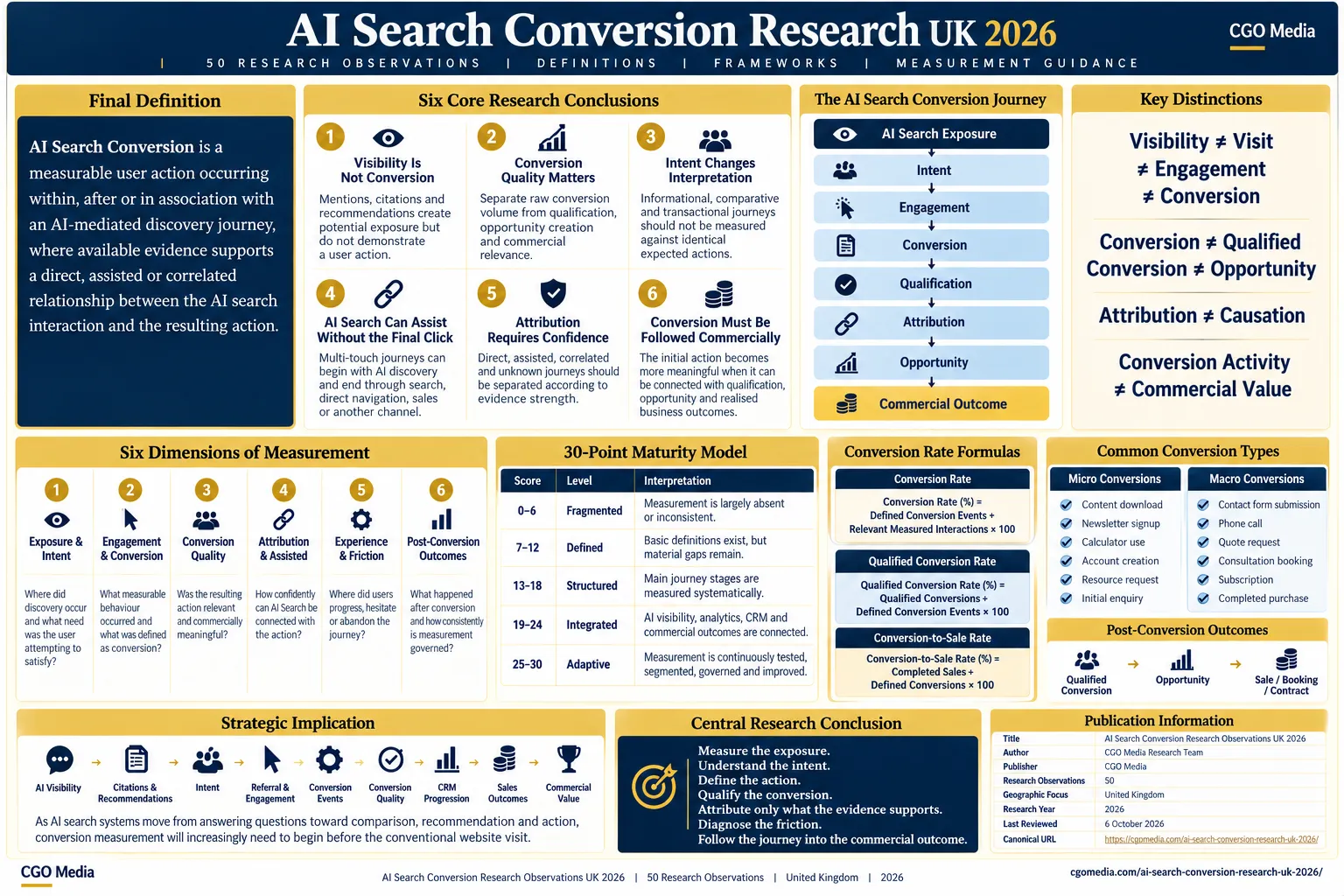
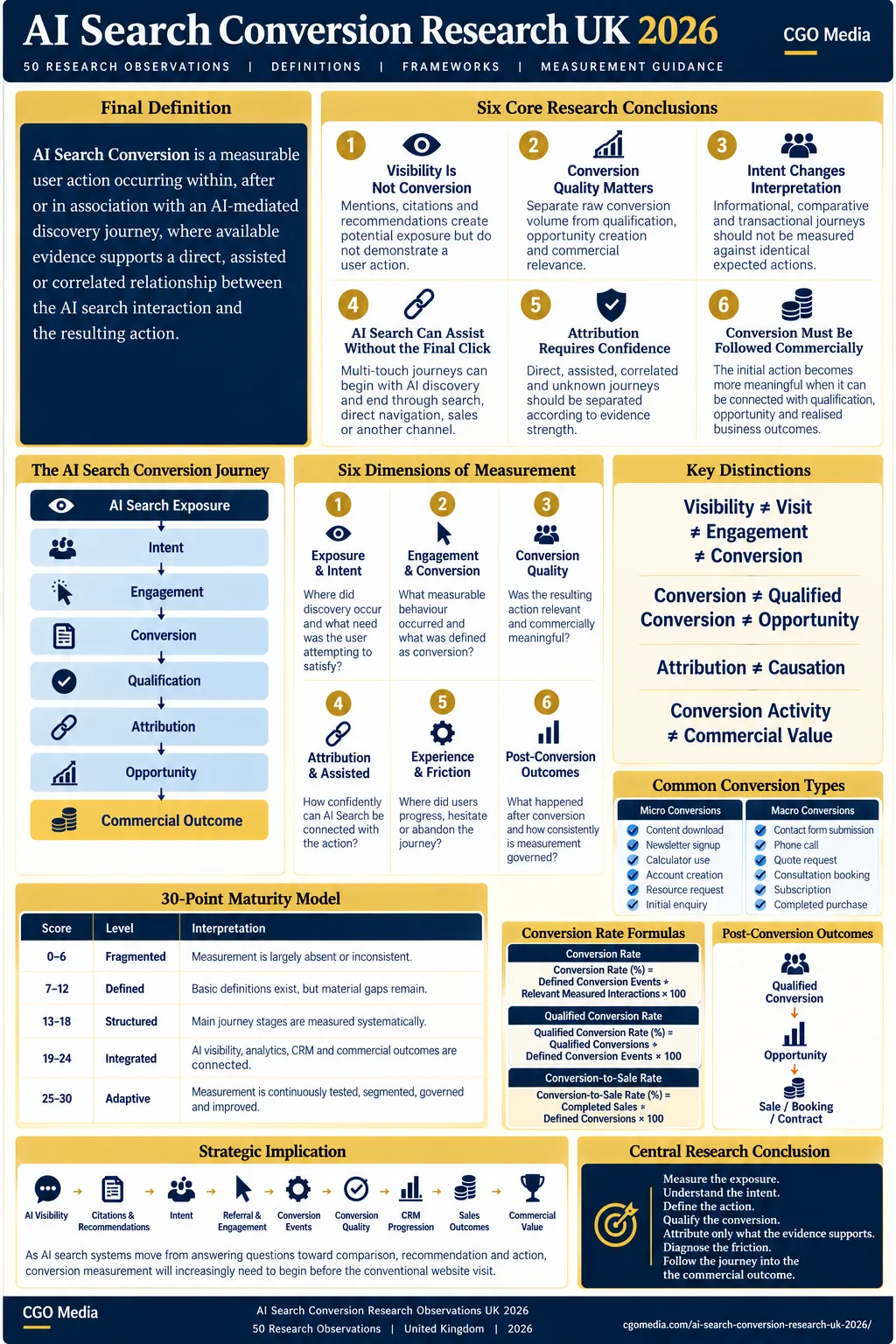
AI Search Conversion is a measurable user action occurring within, after or in association with an AI-mediated discovery journey, where available evidence supports a direct, assisted or correlated relationship between the AI search interaction and the resulting action.
The definition deliberately separates conversion from commercial value. A download, click, call or form submission can be a conversion event without necessarily becoming a qualified lead, sale or profitable customer.
Core Conversion Distinction
Visibility ≠ Visit ≠ Engagement ≠ Conversion ≠ Qualified Conversion ≠ Sale
Each stage represents a different level of user behaviour. Collapsing these stages into one conversion metric can overstate commercial performance and hide meaningful differences in intent and customer quality.
The AI Search Conversion Pathway
AI Search Exposure → Information Evaluation → Website / Brand Interaction → Conversion Event → Qualification → Commercial Outcome
This pathway is a CGO Media analytical model rather than a claim that all users follow a fixed linear sequence. Individual journeys may skip stages, repeat stages or convert without generating a conventional website visit.
Four Classes of Conversion Evidence
| Evidence Class | Definition |
|---|---|
| Direct Conversion | A sufficiently traceable AI-mediated interaction or referral is followed by a measurable conversion event. |
| Assisted Conversion | Evidence indicates AI search contributed to the journey, but additional channels materially participated before conversion. |
| Correlated Conversion | Conversion activity changed alongside AI search activity, but a reliable connection cannot be demonstrated. |
| Unknown Source | A conversion occurred, but available evidence does not support meaningful source attribution. |
Micro, Macro & Commercial Conversions
| Conversion Type | Examples | Interpretation |
|---|---|---|
| Micro Conversion | Download, newsletter signup, tool use, research access, content engagement. | Shows measurable progress but not necessarily commercial intent. |
| Macro Conversion | Enquiry, call, consultation request, demo request, booking or checkout. | Indicates stronger action but still requires qualification. |
| Qualified Conversion | Lead or action meeting defined customer, need, budget, fit or intent criteria. | Provides stronger evidence of commercial quality. |
| Commercial Outcome | Sale, contract, completed booking, paid subscription or realised revenue. | Represents realised business value rather than conversion activity alone. |
Six Dimensions of AI Search Conversion Measurement
1. AI Search Exposure
Was the organisation visible, cited, compared or recommended before the conversion journey?
2. Intent & Query Context
Was the interaction informational, comparative, commercial, transactional or navigational?
3. Referral & Engagement Quality
Did AI-assisted users meaningfully engage with the organisation after discovery?
4. Conversion Event Quality
Was the measured action meaningful, qualified and aligned with organisational objectives?
5. Attribution & Assistance
Can AI search be classified as a direct, assisted, correlated or unknown contributor?
6. Post-Conversion Quality
Did the conversion progress into a qualified opportunity, customer or realised commercial outcome?
Conversion Rate Formula
Conversion Rate (%) = Defined Conversion Events ÷ Relevant Measured Interactions × 100
The denominator must be defined carefully. Depending on the question being asked, it may refer to AI referral sessions, identifiable users, leads, opportunities or another consistent population.
A conversion rate is only meaningful when the numerator and denominator describe the same measurement population.
Conversion Quality Matters More Than Conversion Count Alone
100 downloads, 20 enquiries and 5 qualified opportunities represent very different forms of conversion evidence even though all may be recorded as “conversions” inside analytics systems.
Intent Classification
| Intent | Typical User Need | Likely Conversion Interpretation |
|---|---|---|
| Informational | Understand a subject or answer a question. | Micro conversions and research engagement may be more appropriate. |
| Comparative | Evaluate alternatives, providers, products or approaches. | Brand visits, comparison-page interaction and enquiries become more relevant. |
| Commercial Investigation | Assess suitability before taking action. | Calls, consultations, demos, quote requests and qualified enquiries become important. |
| Transactional | Complete a purchase, booking or subscription. | Completed commercial action provides the strongest conversion evidence. |
| Navigational / Brand | Locate a known organisation after prior discovery. | May represent assisted AI discovery where supporting evidence exists. |
Key Research Findings
Different organisations require different conversion hierarchies.
Assisted discovery should therefore be retained separately from direct attribution.
Qualification and post-conversion outcomes are required.
Informational and transactional journeys should not be assessed identically.
CRM, customer research and brand-search behaviour can add context.
Earlier AI-assisted interactions may not appear in the final conversion source.
Raw enquiry volume can overstate performance.
Opportunity creation, sales and retention determine whether the initial action had commercial value.
Increased AI visibility occurring alongside higher conversions does not prove one caused the other.
Conversion explains action; ROI evaluates the financial return associated with that action.
Research Scope
The research examines:
- AI search exposure;
- user intent;
- AI referral behaviour;
- brand-search follow-up;
- direct return visits;
- engagement quality;
- micro and macro conversions;
- qualified conversions;
- calls and enquiries;
- bookings and purchases;
- lead quality;
- opportunity creation;
- assisted conversions;
- multi-touch customer journeys;
- post-conversion quality;
- sales outcomes; and
- the relationship between conversion measurement and commercial ROI.
Minimum AI Search Conversion Record
Research Boundary
This research does not assume that AI-mediated search universally improves conversion rates.
It does not assume that AI-referred users are inherently more valuable than users from other channels.
It does not treat branded-search growth as proof of AI-assisted conversion.
It does not treat every recorded analytics event as a commercially meaningful conversion.
Where the evidence supports correlation rather than attribution, the research retains that distinction.
Relationship With AI Search ROI
AI Search Visibility → Conversion Evidence → Qualified Commercial Outcome → ROI
Conversion research examines whether AI-mediated discovery is associated with measurable user action. ROI research begins after those actions can be connected with defensible financial value and investment cost.
CGO Media Research Methodology
The wider principles governing evidence, interpretation and transparency across CGO Media research are documented in the
CGO Media Research Methodology
.
Research Principle
Do not measure AI search conversion as one number. Measure exposure, intent, engagement, conversion quality, attribution and post-conversion value separately before deciding whether the journey created meaningful commercial action.
Research Observations 1–10
AI Search Exposure, Intent, Referral Behaviour & Conversion Foundations
The first ten observations establish the measurement foundations required before AI-assisted conversion can be interpreted. They focus on exposure, intent, referral behaviour, event definition and the difference between observable interaction and genuine conversion.
Research Observation 1
AI Search Exposure Should Be Measured Before Conversion
Conversion analysis requires evidence that the organisation was visible, cited, compared, recommended or otherwise encountered during the AI-mediated search journey before downstream actions are attributed to that journey.
Research Observation 2
Visibility Alone Does Not Demonstrate Conversion
An organisation can appear prominently within an AI-generated answer without producing a measurable visit, enquiry, booking, purchase or other action. Visibility should therefore remain a separate metric.
Research Observation 3
Search Intent Changes the Meaning of Conversion
A download after an informational query, an enquiry after a comparison query and a completed purchase after a transactional query represent different behavioural outcomes and should not be interpreted identically.
Research Observation 4
AI Search Referral Traffic Represents Only One Observable Conversion Path
Some AI-assisted users can arrive through identifiable referral traffic, while others may later return through branded search, direct navigation or another channel. Referral sessions therefore provide useful but incomplete evidence.
Research Observation 5
A Website Visit Is Not Automatically a Conversion
A visit represents measurable engagement with the organisation but should not be classified as a conversion unless the organisation has explicitly defined the visit itself as the target action.
Research Observation 6
Conversion Events Should Be Defined Before Reporting Begins
Downloads, calls, forms, bookings, demos, registrations and purchases can all be conversion events, but their meaning should be documented before performance is compared across channels or time periods.
Research Observation 7
Micro Conversions Should Remain Separate From Macro Conversions
A newsletter signup or research download may indicate interest, but it should not carry the same interpretation as a consultation request, booking or completed sale.
Research Observation 8
Conversion Rates Require a Consistent Denominator
A conversion rate calculated from AI referral sessions cannot be compared directly with one calculated from all users, all leads or all exposed queries unless the denominator is standardised or the difference is disclosed.
Research Observation 9
Branded Search Can Indicate Assisted Discovery but Not Prove It
A user may encounter an organisation through AI search and later search for the brand directly, but branded-search growth can also be influenced by advertising, PR, offline exposure and existing brand demand.
Research Observation 10
Conversion Measurement Should Begin With Observable Behaviour
The strongest starting point is to record what can actually be observed: exposure, referral, engagement and defined conversion events. Commercial interpretation should follow only after those events are classified and qualified.
AI Search Conversion Evidence Ladder
AI Exposure → Referral / Brand Interaction → Engagement → Conversion → Qualification → Commercial Outcome
Conversion Intent Framework
| Intent | Typical Action | Conversion Interpretation |
|---|---|---|
| Informational | Read research, download resource, subscribe. | Usually micro-conversion or engagement evidence. |
| Comparative | Visit service pages, compare providers, review evidence. | Signals stronger evaluation intent. |
| Commercial Investigation | Request quote, call, demo or consultation. | Macro conversion requiring qualification. |
| Transactional | Book, purchase, subscribe or transact. | Strongest direct commercial conversion evidence. |
| Navigational / Brand | Search for organisation or return directly. | May support assisted-conversion analysis. |
Conversion Event Hierarchy
Meaningful interaction without a defined conversion event.
A low-commitment measurable action indicating progress.
A stronger action such as an enquiry, booking or purchase.
A conversion meeting defined commercial or customer-quality criteria.
A realised sale, booking, contract or paid customer event.
Conversion Rate Measurement
Conversion Rate (%) = Defined Conversion Events ÷ Relevant Measured Interactions × 100
For AI search reporting, the numerator and denominator should describe the same measurement population. For example, AI referral conversions divided by AI referral sessions can be meaningful; AI referral conversions divided by total website users answers a different question.
What Observations 1–10 Tell Us
Exposure → Intent → Interaction → Conversion Definition → Measurement
Observations 1–10 establish that AI search conversion cannot be understood from a single conversion-rate figure.
The organisation must first identify the search context, define the conversion event, choose an appropriate denominator and preserve the difference between exposure, engagement and actual action.
Research Principle
Do not begin with conversion rate. Begin by defining the behaviour, the intent, the exposure evidence and the population being measured.
Research Observations 11–20
Engagement Quality, Micro vs Macro Conversions, Lead Quality & Conversion Intent
The second group of observations examines the quality of user actions after AI-mediated discovery. The central issue is not simply whether a conversion happened, but whether the action represented meaningful progress toward a commercially relevant outcome.
Research Observation 11
Engagement Quality Matters More Than Session Volume Alone
AI-referred users can be commercially valuable even when referral volumes are modest. Meaningful engagement with relevant pages, tools, research or service information can provide stronger behavioural evidence than session volume alone.
Research Observation 12
Micro Conversions Are Useful Leading Indicators
Downloads, subscriptions, calculator use and research access can indicate progression within a customer journey, particularly for informational and research-led queries.
Research Observation 13
Micro Conversions Should Not Be Valued as Sales Without Evidence
A research download or newsletter signup can indicate interest, but it should not be assigned the same commercial meaning as a qualified enquiry, booking or completed purchase.
Research Observation 14
Macro Conversions Require Qualification
Calls, forms, demo requests and consultation enquiries signal stronger intent, but they can still include irrelevant, low-value or non-commercial contacts. Macro conversion count should therefore be followed by qualification analysis.
Research Observation 15
Qualified Conversion Rate Is More Informative Than Raw Conversion Rate
A channel that generates fewer total conversions but a higher proportion of commercially qualified outcomes may be more valuable than one producing a larger volume of low-quality actions.
Research Observation 16
Intent Should Be Compared With Conversion Type
An informational query producing a research download may represent a successful outcome, while the same action after a transactional query could indicate friction or incomplete progression.
Research Observation 17
High-Intent AI Journeys Should Be Analysed Separately
Comparative, recommendation and transactional queries sit closer to decision-making than broad informational queries. Their conversion patterns should therefore be analysed independently where sufficient data exists.
Research Observation 18
Post-Click Behaviour Can Reveal Intent Quality
Interactions such as service-page depth, pricing-page visits, comparison content, case-study review or return visits can provide useful context when assessing whether an AI-referred session carried meaningful commercial intent.
Research Observation 19
Return Behaviour Can Indicate a Longer Conversion Journey
Users who return later through direct or branded navigation may have begun their evaluation elsewhere. Return behaviour can support assisted-conversion analysis when combined with other evidence, but should not be treated as proof by itself.
Research Observation 20
Conversion Quality Should Be Evaluated Across the Full Funnel
A strong conversion programme connects engagement, micro conversion, macro conversion, qualification, opportunity creation and final commercial outcome rather than stopping at the first recorded analytics event.
The AI Search Conversion Quality Funnel
Engagement → Micro Conversion → Macro Conversion → Qualified Conversion → Opportunity → Commercial Outcome
Micro vs Macro Conversion Framework
| Measure | Typical Examples | Interpretation |
|---|---|---|
| Engagement | Relevant page depth, repeat interaction, service-page exploration. | Signals interest but not a formal conversion. |
| Micro Conversion | Download, subscription, calculator, saved item, account creation. | Shows progression but usually not realised commercial value. |
| Macro Conversion | Call, quote request, demo, consultation, booking, checkout. | Indicates stronger intent but may still require qualification. |
| Qualified Conversion | Lead or customer action meeting defined commercial criteria. | Stronger evidence of business relevance. |
| Commercial Outcome | Sale, paid booking, contract, subscription or realised revenue. | Represents realised commercial value. |
Qualified Conversion Rate
Qualified Conversion Rate (%) = Qualified Conversions ÷ Defined Conversion Events × 100
This measure helps distinguish channels or journeys producing genuine commercial relevance from those generating high conversion counts with weak quality.
Intent-to-Conversion Alignment
| Intent | Expected Progression | Potential Warning |
|---|---|---|
| Informational | Research engagement, subscription, deeper exploration. | Expecting immediate sale may understate the value of early-stage journeys. |
| Comparative | Provider evaluation, case studies, pricing, evidence review. | Weak progression may indicate insufficient trust or relevance. |
| Commercial Investigation | Quote, demo, consultation, call or enquiry. | High micro conversion but low enquiry rate may indicate friction. |
| Transactional | Purchase, booking, subscription or payment completion. | Drop-off after high-intent discovery may indicate conversion-path problems. |
Lead Quality Framework
Does the enquiry match the organisation’s offering?
Does the person or organisation fit the target profile?
Is there a genuine problem or requirement?
Is the user actively evaluating or ready to act?
Does the conversion have realistic economic value?
Is the requirement active within a relevant period?
Why Raw Conversion Rate Can Mislead
A source generating a 12% conversion rate composed mainly of low-value downloads may be commercially weaker than a source generating a 3% conversion rate dominated by qualified consultations or completed purchases.
Recommended Conversion Quality Measures
What Observations 11–20 Tell Us
Engagement → Conversion Type → Qualification → Opportunity → Commercial Quality
Observations 11–20 show why conversion quantity and conversion quality should be reported separately.
The value of AI-assisted discovery becomes more meaningful when organisations can identify what users did, why they were likely to act and whether the resulting action progressed into a commercially relevant outcome.
Research Principle
A conversion becomes more commercially meaningful as it progresses from simple interaction toward qualified intent, opportunity creation and realised business value.
Research Observations 21–30
Assisted Conversion, Multi-Touch Journeys, Branded Search, Direct Return & Attribution Confidence
The third group of observations examines conversion journeys in which AI search may contribute without appearing as the final measurable source. This is especially important where users discover a brand in an AI answer, continue their research elsewhere and convert later through another channel.
Research Observation 21
AI Search Can Assist Conversion Without Receiving the Final Click
A user can discover an organisation through AI search and later convert through organic search, direct navigation, email, a sales call or another route. Last-click reporting can therefore understate earlier AI-assisted discovery.
Research Observation 22
Assisted Conversion Should Remain Separate From Direct Conversion
Where AI search contributed to the journey but did not provide the final measurable interaction, the result should be reported as assisted rather than direct unless stronger evidence supports full attribution.
Research Observation 23
Multi-Touch Journeys Should Be Recorded Rather Than Collapsed
A sequence such as AI discovery, publisher research, branded search, direct return and sales contact contains more information than a single final-source label. Preserving the sequence helps improve interpretation.
Research Observation 24
Branded Search Can Support an Assisted-Conversion Hypothesis
A rise in branded search after increased AI visibility may support the possibility that users are discovering the organisation before searching for it directly, but branded demand can also arise from PR, advertising, offline exposure and existing awareness.
Research Observation 25
Direct Return Visits Can Indicate Continuing Evaluation
Users who return directly after earlier discovery may be continuing an evaluation journey. Direct traffic can therefore contain assisted behaviour, but it should not automatically be attributed to AI search.
Research Observation 26
Customer-Reported Discovery Can Reveal Hidden AI-Assisted Journeys
Structured customer-source questions can identify AI-assisted discovery that analytics misses, particularly where the final conversion happens after direct return or through an offline sales interaction.
Research Observation 27
Self-Reported Discovery Should Be Treated as Supporting Evidence
Customer recall can be incomplete, simplified or influenced by multiple prior touchpoints. Self-reported source data should therefore strengthen attribution analysis rather than replace behavioural and CRM evidence.
Research Observation 28
Attribution Confidence Should Accompany Conversion Claims
A direct AI referral followed by a tracked conversion provides stronger attribution evidence than a conversion inferred from timing or branded-search movement. Conversion reporting should communicate this difference.
Research Observation 29
First-Touch and Last-Touch Conversion Views Answer Different Questions
First-touch attribution can reveal discovery, while last-touch attribution identifies the final recorded interaction before conversion. Neither alone necessarily describes the full influence of AI search.
Research Observation 30
Conversion Attribution Should Reflect the Strength of the Evidence
Where direct evidence exists, direct attribution may be appropriate. Where the evidence shows participation but not sole contribution, assisted attribution is more defensible. Where only timing or correlation exists, the conclusion should remain limited.
Multi-Touch AI Conversion Journey
AI Discovery → Independent Research → Branded Search → Direct Return → Conversion
In this type of journey, AI search may be important to discovery even though analytics records another channel immediately before the final action.
AI Search Conversion Attribution Framework
| Classification | Evidence Position | Recommended Interpretation |
|---|---|---|
| Direct | Traceable AI referral or interaction connects with the conversion. | Directly attributed under the stated method. |
| Assisted | AI discovery is supported by evidence, but other touchpoints contributed materially. | AI-assisted conversion. |
| Correlated | Conversion changes coincide with AI visibility or activity without reliable linkage. | Correlation only; avoid attribution claims. |
| Unknown | Source evidence is insufficient. | Do not assign source credit. |
Attribution Confidence Levels
Direct referral, CRM or customer evidence materially links AI search to the conversion.
Multiple signals support assisted contribution, but other channels were involved.
The conclusion relies primarily on timing, correlation or incomplete self-reported evidence.
Evidence Triangulation
Conversion attribution becomes stronger when multiple independent evidence sources point toward the same journey.
First Touch vs Last Touch vs Assisted View
| View | Primary Question | Main Limitation |
|---|---|---|
| First Touch | Where did observable discovery begin? | Can over-credit initial discovery. |
| Last Touch | What was the final recorded source before conversion? | Can hide earlier AI-assisted discovery. |
| Assisted View | Which touchpoints contributed to the conversion journey? | Contribution can be difficult to quantify precisely. |
Recommended Customer-Source Question
How did you first hear about or discover us?
Where appropriate, response options can include Google Search, ChatGPT, Gemini, Microsoft Copilot, Perplexity, another AI assistant, recommendation/referral, media or publisher, social media, advertising, event, direct/known previously and other.
This information should be combined with analytics and CRM evidence rather than treated as a perfect source-of-truth record.
What Assisted Conversion Does Not Mean
- It does not mean AI search caused the conversion.
- It does not mean AI search deserves 100% of the credit.
- It does not mean branded search can automatically be reassigned to AI.
- It does not mean direct traffic is hidden AI traffic.
- It does not mean self-reported discovery overrides contrary behavioural evidence.
- It does not mean correlation is sufficient for attribution.
What Observations 21–30 Tell Us
Discovery → Multiple Touchpoints → Conversion → Attribution Classification → Confidence
Observations 21–30 show why AI-assisted conversion cannot be evaluated reliably through last-click analytics alone.
The strongest measurement approach retains the customer journey, distinguishes direct from assisted conversion and communicates how confidently AI search can be connected to the final action.
Research Principle
The final click identifies where the measurable journey ended. It does not necessarily identify where the customer’s decision process began.
Research Observations 31–40
Conversion Friction, Landing Experience, Trust, Evidence, Speed & Path-to-Action
The fourth group of observations examines what happens after AI-mediated discovery. Even where AI search creates relevant exposure or high-intent referral activity, conversion can still fail if the destination experience introduces friction, uncertainty, poor evidence or an unclear path to action.
Research Observation 31
AI Search Visibility Cannot Compensate for a Weak Conversion Experience
Strong visibility or recommendation presence may generate interest, but poor landing pages, unclear offers or weak calls to action can prevent that interest from progressing into measurable conversion.
Research Observation 32
Landing-Page Relevance Should Match the AI Search Context
A user arriving after a specific comparison, recommendation or research query should reach a destination that addresses the same need. Weak alignment between discovery context and landing experience can reduce progression.
Research Observation 33
Trust Evidence Becomes More Important Near Conversion
As users move from research toward action, they increasingly need evidence that reduces uncertainty. Relevant proof can include methodology, authorship, reviews, case studies, pricing clarity, credentials, policies, contact information and independent validation.
Research Observation 34
Evidence Quality Can Affect Conversion Confidence
Specific, verifiable and current evidence can reduce decision uncertainty more effectively than generic claims. Conversion analysis should therefore consider evidence quality rather than simply whether trust content exists.
Research Observation 35
Conversion Friction Should Be Measured, Not Assumed
Long forms, unclear next steps, unnecessary fields, weak mobile usability or confusing navigation may contribute to drop-off, but the effect should be evaluated through behavioural evidence rather than assumed from design preference alone.
Research Observation 36
Page Speed Can Affect the Conversion Path
Slow or unstable experiences can interrupt high-intent journeys before the user reaches a conversion event. Technical performance should therefore be treated as a possible conversion constraint where evidence supports it.
Research Observation 37
Mobile Conversion Should Be Evaluated Separately Where Behaviour Differs
Mobile users may encounter different interface constraints, form behaviour, navigation and task-completion friction. Device-level reporting can therefore reveal conversion problems hidden inside aggregate performance.
Research Observation 38
Call-to-Action Clarity Affects Measurable Progression
Users should understand the next available action and what will happen after taking it. Weak or ambiguous calls to action can make high-intent sessions appear less valuable than the underlying demand actually is.
Research Observation 39
Pricing and Commercial Clarity Can Influence Conversion Quality
Where pricing, eligibility, scope or commercial terms are important to the decision, unclear information can generate low-quality enquiries or prevent qualified users from progressing.
Research Observation 40
Conversion Measurement Should Diagnose the Path, Not Just the Endpoint
A weak conversion rate does not identify the cause of underperformance. Organisations should examine where users disengage between AI discovery, landing experience, trust evaluation, action and qualification.
AI Search Conversion Experience Model
Relevant Discovery → Relevant Landing Experience → Trust → Clear Action → Low Friction → Conversion
Conversion Friction Framework
The page does not clearly address the user’s original need.
Evidence, credibility or reassurance is insufficient for the decision.
The next step is unclear, difficult or unnecessarily complex.
Speed, layout, errors or device problems interrupt the journey.
Pricing, eligibility or terms are unclear or poorly aligned.
Forms, checkout or booking processes contain avoidable steps.
Landing Experience Alignment
| AI Search Context | Destination Need | Likely Conversion Goal |
|---|---|---|
| Informational Research | Clear evidence, methodology and further research. | Download, subscribe, continue research. |
| Provider Comparison | Differentiation, case studies, evidence, pricing context. | Consultation, demo, quote request. |
| Recommendation Query | Trust, relevance, proof and clear next action. | Enquiry, booking or purchase. |
| Transactional Query | Immediate action path, price, availability and reassurance. | Completed booking, checkout or subscription. |
Trust Evidence Near Conversion
Path-to-Action Measurement
Landing → Evidence Review → CTA Interaction → Form / Booking / Checkout → Completion
Tracking each stage can help identify whether the principal problem is lack of interest, lack of trust, poor call-to-action performance or friction inside the final process.
Recommended Friction Measures
| Measure | What It Can Reveal |
|---|---|
| Landing Exit Rate | Possible mismatch between discovery context and destination. |
| CTA Interaction Rate | Whether users are progressing toward a defined action. |
| Form Start Rate | Whether users show sufficient intent to begin conversion. |
| Form Completion Rate | Whether the conversion process itself creates friction. |
| Checkout / Booking Completion | Drop-off during high-intent transactional journeys. |
| Device-Level Conversion Rate | Whether mobile or desktop experience is creating materially different outcomes. |
Conversion Diagnosis Matrix
| Observed Pattern | Possible Interpretation |
|---|---|
| High AI Referral, Low Engagement | Potential context or landing-page mismatch. |
| High Engagement, Low CTA Use | Possible trust, offer or call-to-action weakness. |
| High CTA Use, Low Completion | Possible form, booking or checkout friction. |
| High Conversion, Low Qualification | Conversion definition or targeting may be too broad. |
| Strong Desktop, Weak Mobile | Possible device-specific friction or usability problem. |
What Observations 31–40 Tell Us
Discovery Quality → Landing Relevance → Trust → Low Friction → Action → Conversion
Observations 31–40 show that AI search conversion performance is partly determined by what happens after discovery.
An organisation can improve visibility without improving conversion if the destination experience does not preserve relevance, establish trust and make the next action clear and easy to complete.
Research Principle
AI search may create the opportunity to convert. The destination experience determines whether that opportunity can progress into action.
Research Observations 41–50
Post-Conversion Quality, Sales Outcomes, Revenue Linkage, Governance & Conversion Measurement Maturity
The final ten observations move beyond the conversion event itself. They examine whether AI-assisted conversions become qualified opportunities, customers and measurable commercial outcomes, and whether the organisation has the systems required to evaluate conversion consistently over time.
Research Observation 41
Conversion Measurement Should Continue After the Initial Action
A form submission, call or booking request is not necessarily the end of the conversion journey. Post-conversion qualification and commercial progression determine whether the action ultimately created business value.
Research Observation 42
Qualified Opportunity Rate Provides Stronger Commercial Context
The proportion of conversions that become genuine sales opportunities can reveal whether AI-assisted activity is producing commercially relevant demand rather than only top-of-funnel actions.
Research Observation 43
Conversion-to-Sale Rate Should Be Measured Separately
Two sources can produce similar conversion rates but materially different sales outcomes. Measuring conversion-to-sale progression helps distinguish activity volume from actual commercial effectiveness.
Research Observation 44
Revenue Linkage Should Follow Conversion Attribution, Not Replace It
Where a conversion becomes a sale, revenue can be linked to the journey under the stated attribution model. Revenue linkage should not be used to create stronger source attribution than the underlying conversion evidence supports.
Research Observation 45
Average Conversion Value Can Hide Important Differences
A single average value can conceal major variation between low-value and high-value conversions, customer segments, products or service lines. Segmented reporting is preferable where economics differ materially.
Research Observation 46
Time to Conversion Should Be Tracked
The time between AI-assisted discovery, initial conversion and final commercial outcome can vary substantially. Tracking this interval helps organisations choose more appropriate reporting windows.
Research Observation 47
Conversion Definitions Should Be Governed Across Teams
Marketing, analytics, sales and finance may use the word conversion differently. Shared definitions are necessary if AI search performance is to be compared consistently across the customer journey.
Research Observation 48
Conversion Measurement Maturity Is Different From High Conversion Performance
An organisation can have a mature measurement system and still discover weak conversion performance. Measurement maturity describes the quality of the measurement capability, not the attractiveness of the resulting performance.
Research Observation 49
Composite Conversion Scores Should Not Replace Underlying Measures
A maturity score can summarise organisational capability, but it should not replace conversion rate, qualification rate, opportunity rate, sales progression or commercial-outcome data.
Research Observation 50
AI Search Conversion Should Be Treated as a Continuous Measurement Discipline
Search interfaces, customer behaviour, attribution paths, landing experiences and commercial processes change. Conversion measurement should therefore be reviewed and refined continuously rather than treated as a one-time analytics exercise.
Post-Conversion Commercial Pathway
Conversion → Qualification → Opportunity → Sale → Revenue → Commercial Value
Recommended Post-Conversion Measures
Share of conversions meeting defined quality criteria.
Share of qualified conversions becoming commercial opportunities.
Share of initial conversions producing completed sales.
Average realised value generated by converted customers.
Time from observable discovery to the defined conversion action.
Time between conversion and realised commercial outcome.
Six Dimensions of the CGO Media AI Search Conversion Framework
| Dimension | Measurement Focus |
|---|---|
| 1. AI Search Exposure & Intent | Whether exposure, source context and user intent are measured consistently. |
| 2. Engagement & Conversion Definition | Whether meaningful engagement, micro conversions and macro conversions are clearly distinguished. |
| 3. Conversion Quality & Qualification | Whether conversion quality, relevance and commercial fit are measured. |
| 4. Attribution & Assisted Conversion | Whether direct, assisted, correlated and unknown journeys are distinguished with appropriate confidence. |
| 5. Conversion Experience & Friction | Whether landing relevance, trust, CTA performance and conversion friction are diagnosed. |
| 6. Post-Conversion Outcomes & Governance | Whether conversions are connected to opportunities, sales, revenue and cross-functional measurement governance. |
30-Point AI Search Conversion Measurement Maturity Score
Each dimension can be scored from 0 to 5 according to the maturity of the organisation’s conversion measurement capability.
Absent
Very Weak
Developing
Established
Strong
Leading
6 Dimensions × Maximum 5 Points = 30 Points
AI Search Conversion Measurement Maturity Levels
| Score | Maturity Level | Interpretation |
|---|---|---|
| 0–6 | Fragmented | Conversion events are poorly defined and AI-assisted journeys are largely unmeasured. |
| 7–12 | Defined | Basic conversion definitions exist but quality, attribution or commercial progression remains incomplete. |
| 13–18 | Structured | Conversion type, quality, attribution and funnel progression are measured systematically. |
| 19–24 | Integrated | Analytics, CRM and sales data are connected with strong conversion-quality and attribution reporting. |
| 25–30 | Adaptive | Conversion measurement is continuously diagnosed, segmented, tested and used in commercial decision-making. |
Important:
the 30-point framework measures the maturity of AI Search conversion measurement. It does not represent the organisation’s actual conversion rate and does not guarantee high commercial performance.
Recommended Executive Conversion Scorecard
Observable visibility supporting the measured journey.
Identifiable AI-assisted engagement.
High-intent conversion performance.
Commercial quality of measured actions.
Progression into active commercial opportunities.
Progression from conversion to realised customer.
Strength of evidence supporting AI involvement.
Time from discovery or referral to action.
Time from conversion to commercial outcome.
0–30 organisational capability score.
Cross-Functional Conversion Governance
| Function | Primary Responsibility |
|---|---|
| SEO / GEO | AI search exposure, query context and visibility evidence. |
| Analytics / CRO | Engagement, conversion events, funnel performance and friction analysis. |
| Sales | Lead qualification, opportunity status, conversion-to-sale and source evidence. |
| Customer / Ecommerce Operations | Booking, checkout, fulfilment and customer progression where relevant. |
| Finance | Revenue and commercial-value linkage after conversion. |
| Leadership | Definitions, governance standards and investment decisions. |
Continuous AI Search Conversion Measurement Cycle
Observe → Define → Measure → Qualify → Attribute → Diagnose → Improve → Re-Measure → Govern
What Observations 41–50 Tell Us
The final observations establish that conversion measurement should not stop when a user completes a form, call, booking request or checkout action.
The commercially useful question is what happened next: whether the conversion was qualified, whether it became an opportunity, whether it progressed into a sale and whether the organisation can explain the journey with sufficient attribution confidence.
This moves AI search conversion from a narrow analytics metric toward a cross-functional measurement discipline connecting search, user experience, analytics, sales and commercial outcomes.
Research Principle
A conversion is an observable action. Its commercial importance depends on what happens after that action and how reliably the journey can be measured.
CGO Media Analysis
What the 50 AI Search Conversion Observations Tell Us
The fifty observations collectively show that AI Search conversion cannot be understood through a single conversion-rate metric. Conversion quality depends on where the user entered the journey, what intent was present, how the organisation was encountered, whether the destination experience preserved relevance, what action occurred and whether that action progressed into a meaningful commercial outcome.
The strongest measurement systems therefore connect AI search exposure, user intent, engagement, conversion type, qualification, attribution, friction and post-conversion outcomes rather than treating all recorded actions as equivalent.
1. AI Search Visibility Is Only the Beginning
Visibility, citation and recommendation presence can create an opportunity for conversion, but they do not demonstrate that a user visited, engaged or acted.
Visibility → Interaction → Conversion → Qualification → Commercial Outcome
2. A Visit Is Not a Conversion
A website visit indicates observable engagement, but it should remain separate from a defined conversion event unless the visit itself is the target action.
3. Conversion Definitions Determine What the Data Means
Downloads, calls, enquiries, bookings, purchases and account registrations all represent different stages of customer behaviour. Without documented definitions, conversion reporting can mix actions with very different levels of intent and commercial value.
4. Search Intent Changes the Meaning of Success
An informational user may successfully convert by downloading a research asset, while a transactional user may be expected to complete a booking or purchase. Conversion performance should therefore be interpreted in relation to the original intent.
5. Micro Conversions Matter, but They Are Not Sales
Micro conversions can demonstrate progress, particularly during long consideration journeys. Their value lies in showing movement through the funnel, not in being treated as equivalent to realised commercial outcomes.
6. Macro Conversions Still Require Qualification
A form submission or phone call indicates stronger intent than a page view, but the action can still be irrelevant, low quality or commercially unsuitable. Qualification therefore remains essential.
7. Qualified Conversion Rate Can Be More Useful Than Raw Conversion Rate
A smaller number of high-quality conversions may be more valuable than a much larger volume of actions that fail to progress. Raw conversion rates should therefore be interpreted alongside qualification and sales progression.
8. AI-Assisted Journeys Are Frequently Multi-Touch
Users can discover an organisation through AI search, validate it through publishers or conventional search, return directly and then convert. The final recorded session may therefore reveal where the journey ended rather than where it began.
AI Discovery → Validation → Brand Search → Direct Return → Conversion
9. Last-Click Attribution Can Understate AI Discovery
Where AI search introduces the organisation but another channel records the final interaction, last-click models can hide the discovery role of AI-mediated search.
10. But Assisted Conversion Should Not Become Automatic Reattribution
The opposite error is to reassign branded search, direct traffic or later organic sessions to AI simply because AI visibility increased. Assisted attribution still requires evidence.
11. Branded Search Is Supporting Evidence, Not Proof
Growth in branded search can be consistent with earlier AI discovery, but it can also result from PR, advertising, offline awareness or existing demand. It should therefore be treated as one signal within a wider evidence set.
12. Direct Traffic Can Contain Hidden Prior Discovery
Users who return directly may have encountered the organisation previously through AI search or another source. Direct traffic therefore does not necessarily mean the customer journey began directly.
13. Customer-Reported Discovery Has an Important Supporting Role
Structured customer-source questions can uncover AI-assisted journeys missed by analytics, especially where the user later converts offline or through a different device or channel.
14. Attribution Confidence Should Be Reported Explicitly
A conversion backed by direct referral, CRM and customer evidence is materially different from one inferred from timing alone. Reporting should preserve that difference.
15. Conversion Friction Exists After Discovery
Strong AI visibility can generate interest while a poor destination experience prevents progression. Conversion performance therefore depends on more than discovery.
16. Relevance Must Continue From Search to Landing Experience
If the destination fails to answer the need implied by the AI search context, the user may disengage even when the original recommendation or citation was highly relevant.
17. Trust Becomes More Important as Intent Increases
Users approaching a high-commitment action need stronger reassurance than users consuming informational content. Evidence quality, reviews, methodology, credentials, commercial clarity and independent validation can therefore become increasingly important near conversion.
18. Conversion Problems Should Be Diagnosed by Stage
Low conversion performance may reflect weak relevance, insufficient trust, unclear calls to action, technical friction or problems inside the final form, booking or checkout process. One headline conversion rate cannot identify which stage failed.
19. The Conversion Event Is Not the End of Commercial Measurement
A conversion should be followed into qualification, opportunity creation and realised customer outcomes wherever the organisation wants to understand commercial quality.
20. AI Search Conversion Is Ultimately a Measurement System
The purpose of conversion analysis is not merely to produce a percentage. It is to identify where AI-assisted discovery creates meaningful progression, where the journey breaks down and which actions become genuine commercial outcomes.
The CGO Media AI Search Conversion Evidence Chain
AI Search Exposure → Intent → Engagement → Conversion → Qualification → Opportunity → Commercial Outcome
Five Levels of Conversion Evidence
| Evidence Level | What Can Be Said |
|---|---|
| 1. Exposure | The organisation was visible, cited, compared or recommended. |
| 2. Engagement | Observable user behaviour followed or was associated with the discovery journey. |
| 3. Conversion | A defined measurable action occurred. |
| 4. Qualified Conversion | The action meets defined relevance, fit or commercial-intent criteria. |
| 5. Commercial Outcome | The journey progressed into a realised sale, booking, contract or comparable outcome. |
The Six AI Search Conversion Dimensions
What discovery context existed before the action?
What behaviour occurred and what qualifies as conversion?
Was the action relevant and commercially meaningful?
How confidently can AI search be connected to the action?
Where did the journey progress or break down?
Did conversion progress into opportunity, sale and reliable reporting?
Eight Questions Every AI Search Conversion Audit Should Answer
- Where and how was the organisation exposed within AI-mediated search?
- What was the likely search intent?
- What measurable behaviour followed?
- What exactly counted as a conversion?
- Was the conversion commercially qualified?
- How confidently can AI search be connected to the conversion?
- Where did friction occur before or after the action?
- Did the conversion become an opportunity, customer or other commercial outcome?
What Should Not Be Collapsed Into One Conversion KPI
AI Visibility ≠ Website Visit ≠ Engagement ≠ Micro Conversion ≠ Macro Conversion ≠ Qualified Conversion ≠ Sale
Central CGO Media Analysis
The fifty observations point toward a broader conclusion: AI Search conversion is not simply a website analytics problem.
It is a customer-journey measurement problem involving search exposure, intent, user experience, attribution, lead quality, sales progression and commercial outcomes.
Organisations that measure only AI referral conversion risk missing assisted journeys. Organisations that count every analytics event as a conversion risk overstating performance. Organisations that stop measurement at form submission risk missing the difference between low-quality activity and genuine commercial value.
The more defensible approach is to preserve each stage of the journey and measure progression between those stages.
From Conversion Reporting to Conversion Intelligence
Count Actions → Understand Intent → Qualify Outcomes → Diagnose Friction → Attribute Carefully → Measure Commercial Progression
Central Research Conclusion
The strongest measure of AI Search conversion is not how many actions occurred. It is how reliably AI-assisted discovery can be connected to relevant, qualified actions that progress toward measurable commercial outcomes.
Practical Implementation
How UK Organisations Should Measure AI Search Conversion in 2026
A practical AI Search conversion programme should do more than count visits, forms or purchases. It should connect the original AI-mediated discovery context with user intent, engagement, conversion quality, attribution confidence and post-conversion outcomes.
The objective is to identify where AI-assisted users progress, where they encounter friction and which measured actions become commercially meaningful.
1. Define the Conversion Hierarchy
Before measuring AI search conversion, define which user actions belong to each stage of the funnel.
Engagement → Micro Conversion → Macro Conversion → Qualified Conversion → Commercial Outcome
2. Define What Counts as a Conversion
| Conversion Level | Example Actions |
|---|---|
| Engagement | Relevant page exploration, research consumption, repeat interaction. |
| Micro Conversion | Download, newsletter signup, calculator use, account creation. |
| Macro Conversion | Call, form enquiry, demo request, quote request, booking or checkout. |
| Qualified Conversion | Action meeting defined relevance, fit, intent or commercial criteria. |
| Commercial Outcome | Sale, paid booking, signed contract, subscription or realised customer event. |
3. Record AI Search Exposure Separately
Do not treat an AI citation, recommendation or source appearance as a conversion. Record search exposure independently so that later actions can be analysed against a known discovery layer.
4. Classify Search Intent
Conversion expectations should reflect the user’s likely intent. Informational and transactional interactions should not be evaluated against the same target behaviour.
Learning or research.
Evaluating alternatives.
Assessing provider suitability.
Ready to act or purchase.
Returning to a known brand.
5. Track Direct AI Referrals Where Available
Where identifiable referral data exists, separate AI-originated sessions so their engagement, conversion type, qualification and commercial progression can be evaluated independently.
6. Capture Assisted Discovery
Direct referral data will not capture every AI-assisted journey. Add structured source questions to forms, sales calls, bookings or onboarding where appropriate.
Suggested question:
“How did you first hear about or discover us?”
7. Connect Analytics With CRM Data
Website analytics can identify behaviour. CRM and sales systems are needed to determine whether the conversion became qualified, entered the pipeline or progressed into a customer.
AI Search → Analytics → Conversion → CRM → Qualification → Opportunity → Sale
8. Create a Qualification Standard
Define the criteria that distinguish a commercially meaningful action from a raw conversion.
Does the enquiry match the offering?
Is the customer appropriate for the organisation?
Is there a genuine requirement?
Is the user actively evaluating or ready to act?
Is there realistic customer value?
Is the requirement active within a relevant period?
9. Separate Direct, Assisted, Correlated & Unknown Conversions
| Classification | Use |
|---|---|
| Direct | Traceable evidence links AI discovery or referral to the conversion. |
| Assisted | Evidence indicates AI search contributed alongside other touchpoints. |
| Correlated | Conversion movement coincides with AI search activity but reliable linkage is absent. |
| Unknown | Available evidence cannot support source attribution. |
10. Assign Attribution Confidence
Direct referral, CRM or customer evidence materially supports the connection.
Multiple signals support assisted contribution but other touchpoints matter.
The conclusion relies mainly on timing, correlation or incomplete evidence.
11. Measure Conversion Quality Separately From Conversion Volume
Qualified Conversion Rate (%) = Qualified Conversions ÷ Defined Conversion Events × 100
12. Measure Progression Into Opportunity
For B2B, professional services and other longer-cycle journeys, opportunity creation provides an important bridge between website conversion and final revenue.
Opportunity Rate (%) = Qualified Opportunities ÷ Qualified Conversions × 100
13. Track Conversion-to-Sale Progression
Conversion-to-Sale Rate (%) = Completed Sales ÷ Defined Conversions × 100
14. Measure the Landing Experience
AI-assisted conversion analysis should include what happens after the user reaches the organisation’s own environment.
15. Diagnose Friction by Stage
Landing → Trust → CTA → Form / Booking / Checkout → Completion
16. Compare Conversion by Intent
Do not combine informational, comparison and transactional journeys into one performance measure where the expected actions are materially different.
17. Compare Conversion by Device
Device-level reporting can reveal mobile form, checkout, navigation or speed problems hidden inside aggregate results.
18. Track Time to Conversion
Record the time between initial observable AI-assisted discovery and the defined conversion event where the evidence allows it.
19. Track Time From Conversion to Commercial Outcome
This is particularly important where a conversion creates a lead rather than an immediate transaction.
20. Connect Conversion Reporting With ROI Reporting
Conversion research identifies measurable action and commercial progression. ROI analysis begins when those outcomes can be connected with financial value and the cost required to generate them.
CGO Media AI Search Conversion Implementation Model
Define → Observe → Classify Intent → Track → Convert → Qualify → Attribute → Diagnose → Improve → Measure Commercial Progression
90-Day AI Search Conversion Implementation Plan
Days 1–30 — Define & Instrument
- Define engagement, micro, macro and qualified conversions.
- Audit existing analytics conversion events.
- Define AI search exposure measures.
- Create intent categories.
- Separate identifiable AI referral traffic.
- Add customer-source questions where appropriate.
- Define direct, assisted, correlated and unknown attribution categories.
- Document the baseline conversion funnel.
Days 31–60 — Connect & Qualify
- Connect conversion records with CRM or sales data.
- Implement a defined lead-qualification standard.
- Track opportunity creation.
- Compare conversion quality by source and intent.
- Measure branded and direct-return journeys cautiously.
- Assign attribution-confidence levels.
- Audit landing-page alignment with AI search context.
- Identify material conversion friction.
Days 61–90 — Diagnose, Improve & Govern
- Calculate macro and qualified conversion rates.
- Measure opportunity and conversion-to-sale rates.
- Identify high-friction stages.
- Improve CTA, form, booking or checkout journeys where evidence supports action.
- Compare device-level performance.
- Measure time to conversion and time to sale.
- Build the executive AI Search conversion scorecard.
- Score measurement maturity across the six dimensions.
- Agree shared definitions across marketing, analytics, sales and finance.
Executive AI Search Conversion Reporting Model
| Reporting Layer | Recommended Measures |
|---|---|
| AI Search Exposure | Mentions, citations, recommendations and referral evidence. |
| Intent | Informational, comparative, commercial, transactional and navigational context. |
| Engagement | Meaningful page interaction, research consumption, CTA interaction and repeat behaviour. |
| Conversion | Micro conversion, macro conversion and conversion rate. |
| Quality | Qualified conversion rate and commercial relevance. |
| Attribution | Direct, assisted, correlated or unknown with confidence level. |
| Commercial Progression | Opportunity rate, conversion-to-sale rate and time to sale. |
Five Questions for Executive Reporting
What observable discovery or referral evidence exists?
What engagement and defined conversion events followed?
What proportion met commercial qualification criteria?
Was AI search direct, assisted, correlated or unknown?
Did conversions progress into opportunities and customers?
What UK Organisations Should Avoid
- Do not treat every AI-referred visit as a conversion.
- Do not combine micro and macro conversions into one undifferentiated KPI.
- Do not compare conversion rates built from different denominators without disclosure.
- Do not reassign all branded or direct conversion activity to AI search.
- Do not count every form submission as a qualified commercial lead.
- Do not stop measurement at the initial conversion event.
- Do not assume a low conversion rate automatically means poor AI search quality.
- Do not assume a high conversion rate automatically means strong commercial performance.
Implementation Outcome
The objective is not to create one universal AI Search conversion rate. It is to build a measurement system that shows where AI-assisted discovery creates meaningful action, how strong that action is, whether the attribution is defensible and whether the conversion progresses toward commercial value.
Implementation Principle
Define the action. Understand the intent. Qualify the conversion. Attribute it cautiously. Diagnose the friction. Follow it into the commercial outcome.
CGO Media Measurement Framework
Full 30-Point AI Search Conversion Measurement Framework
The CGO Media AI Search Conversion Measurement Framework evaluates how mature an organisation is at measuring conversion journeys influenced by AI-mediated search.
The framework assesses six connected dimensions. Each dimension is scored from 0 to 5, producing a maximum total score of 30.
6 Dimensions × Maximum 5 Points = 30-Point Conversion Measurement Maturity Score
General Scoring Scale
| Score | Level | General Interpretation |
|---|---|---|
| 0 | Absent | No meaningful measurement capability exists. |
| 1 | Very Weak | Some data exists, but definitions or processes are inconsistent. |
| 2 | Developing | Basic measurement exists but important gaps remain. |
| 3 | Established | Measurement is structured, documented and regularly used. |
| 4 | Strong | Multiple evidence sources are integrated and interpretation is reliable. |
| 5 | Leading | Measurement is comprehensive, governed, continuously tested and used for decision-making. |
Dimension 1 — AI Search Exposure & Intent
This dimension evaluates whether the organisation can identify where AI-mediated exposure occurs and whether the likely search intent is understood before conversion performance is interpreted.
| Score | Criteria |
|---|---|
| 0 | No AI search exposure or intent measurement exists. |
| 1 | Occasional AI mentions or referrals are noticed manually, but no repeatable process exists. |
| 2 | Basic AI referral tracking or periodic visibility checks exist, but intent is weakly classified. |
| 3 | AI exposure, citations, referrals and major intent categories are measured consistently. |
| 4 | Exposure is segmented by platform, query type and intent, with regular trend analysis. |
| 5 | AI exposure and intent are continuously monitored, segmented and linked into downstream conversion analysis. |
Dimension 2 — Engagement & Conversion Definition
This dimension assesses whether the organisation has clear definitions for engagement, micro conversion, macro conversion and related measurable actions.
| Score | Criteria |
|---|---|
| 0 | No agreed conversion definitions exist. |
| 1 | Basic events are tracked, but engagement and conversion are frequently mixed together. |
| 2 | Some micro and macro conversions are distinguished, but definitions are inconsistent across teams. |
| 3 | Engagement, micro conversion and macro conversion are documented and measured consistently. |
| 4 | Conversion definitions are segmented by intent, journey type or commercial objective. |
| 5 | Conversion definitions are governed, audited and continuously refined against changing user behaviour and business objectives. |
Dimension 3 — Conversion Quality & Qualification
This dimension measures whether the organisation can distinguish between raw conversion activity and actions that meet defined quality, relevance and commercial-fit criteria.
| Score | Criteria |
|---|---|
| 0 | All conversions are treated as equal and no quality measurement exists. |
| 1 | Sales or operational teams informally identify good and poor conversions. |
| 2 | Basic qualification criteria exist but are not applied consistently. |
| 3 | Qualified conversion rate is measured using documented criteria. |
| 4 | Qualification is connected to opportunity creation, customer fit and commercial value. |
| 5 | Quality models are continuously validated against sales outcomes, customer value and segment performance. |
Dimension 4 — Attribution & Assisted Conversion
This dimension evaluates whether direct, assisted, correlated and unknown journeys are distinguished, and whether attribution claims are matched to evidence strength.
| Score | Criteria |
|---|---|
| 0 | No meaningful source attribution exists. |
| 1 | Conversion reporting relies primarily on last-click analytics. |
| 2 | Direct AI referrals are identifiable, but assisted journeys remain weakly understood. |
| 3 | Direct, assisted, correlated and unknown journeys are reported separately. |
| 4 | Analytics, CRM, customer-reported source and journey evidence are triangulated with explicit confidence levels. |
| 5 | Attribution models are governed, tested and updated as customer journeys and AI platforms change. |
Dimension 5 — Conversion Experience & Friction
This dimension measures whether the organisation can diagnose where users progress or drop out after AI-assisted discovery.
| Score | Criteria |
|---|---|
| 0 | No meaningful conversion-path or friction measurement exists. |
| 1 | Problems are identified mainly through anecdotal feedback or broad conversion-rate changes. |
| 2 | Some CTA, form, booking or device-level behaviour is tracked. |
| 3 | Landing relevance, CTA progression and major friction points are measured systematically. |
| 4 | Friction analysis is segmented by intent, source, device and conversion type. |
| 5 | Conversion journeys are continuously tested, diagnosed and improved using behavioural and commercial evidence. |
Dimension 6 — Post-Conversion Outcomes & Governance
This dimension assesses whether conversion data is connected to qualification, opportunity creation, sales outcomes and cross-functional governance.
| Score | Criteria |
|---|---|
| 0 | Measurement stops at the initial conversion event. |
| 1 | Some sales outcomes are known but not connected systematically to conversion records. |
| 2 | Qualification or opportunity data exists, but integration and governance are incomplete. |
| 3 | Conversions are connected consistently to qualification, opportunities and sales outcomes. |
| 4 | Cross-functional reporting connects analytics, CRM, sales and commercial outcome data. |
| 5 | Definitions, evidence standards and commercial progression measures are governed and reviewed continuously across teams. |
Total AI Search Conversion Measurement Score
Exposure & Intent + Conversion Definition + Conversion Quality + Attribution + Friction + Post-Conversion Governance = Maximum 30 Points
Conversion Measurement Maturity Bands
| Total Score | Maturity Level | Interpretation |
|---|---|---|
| 0–6 | Fragmented | AI conversion measurement is largely absent or inconsistent. |
| 7–12 | Defined | Basic definitions exist, but attribution, quality or commercial progression remain incomplete. |
| 13–18 | Structured | Conversion measurement is systematic across the main journey stages. |
| 19–24 | Integrated | Exposure, attribution, CRM and sales outcomes are connected into a coherent measurement system. |
| 25–30 | Adaptive | Conversion measurement is governed, segmented, continuously tested and used in strategic decisions. |
Worked Example A — Strong Conversion Volume, Weak Attribution
| AI Search Exposure & Intent | 4 |
| Engagement & Conversion Definition | 4 |
| Conversion Quality & Qualification | 4 |
| Attribution & Assisted Conversion | 1 |
| Conversion Experience & Friction | 4 |
| Post-Conversion Outcomes & Governance | 3 |
| Total | 20 / 30 — Integrated |
The organisation has strong conversion measurement overall, but weak attribution means it should avoid strong claims about how much of the conversion performance was caused or assisted by AI search.
Worked Example B — Strong AI Visibility, Weak Conversion Measurement
| AI Search Exposure & Intent | 5 |
| Engagement & Conversion Definition | 1 |
| Conversion Quality & Qualification | 1 |
| Attribution & Assisted Conversion | 2 |
| Conversion Experience & Friction | 1 |
| Post-Conversion Outcomes & Governance | 1 |
| Total | 11 / 30 — Defined |
The organisation may have strong AI visibility but lacks the systems required to determine whether that visibility creates meaningful conversions.
Worked Example C — Mature Measurement, Modest Conversion Performance
| AI Search Exposure & Intent | 5 |
| Engagement & Conversion Definition | 5 |
| Conversion Quality & Qualification | 4 |
| Attribution & Assisted Conversion | 4 |
| Conversion Experience & Friction | 4 |
| Post-Conversion Outcomes & Governance | 5 |
| Total | 27 / 30 — Adaptive |
This organisation has a highly mature measurement system, even if the measured conversion performance itself is modest.
High Conversion Measurement Maturity ≠ High Conversion Performance
Evidence-Backed Scoring Rules
- Score existing capability, not planned capability.
- Use documented evidence wherever possible.
- Do not award points because a platform or tool has been purchased.
- Do not score AI visibility as conversion capability.
- Do not award high attribution scores where evidence is primarily correlational.
- Do not award high qualification scores where sales teams use inconsistent definitions.
- Do not award high friction scores where conversion journeys are not measured by stage.
- Do not award high governance scores if definitions differ materially between marketing, analytics and sales.
What the 30-Point Score Does Not Mean
- It is not a conversion rate.
- It is not a revenue score.
- It is not an ROI score.
- It is not a ranking score.
- It does not prove AI search caused conversions.
- It does not mean a 30-point organisation converts better than a 15-point organisation.
- It measures the maturity of the conversion measurement system.
Conversion Measurement Improvement Cycle
Audit → Score → Diagnose → Improve Measurement → Improve Journey → Re-Measure → Re-Score → Govern
Framework Principle
The total score summarises AI Search conversion measurement maturity. The six dimensions diagnose measurement capability. Actual conversion performance must still be evaluated through the underlying behavioural, qualification, attribution and commercial data.
Research Outlook
AI Search Conversion Trends 2026–2027
AI-mediated search is moving beyond answer generation toward comparison, recommendation, personalisation and task completion.
This changes the conversion question. Organisations increasingly need to understand not only whether AI search generated a website visit, but whether users compared the organisation, selected it, initiated an action or completed part of the commercial journey inside an AI-mediated environment.
The trends below distinguish between documented 2026 platform direction and CGO Media’s interpretation of likely measurement implications for 2027. Future-facing statements should not be read as guarantees about platform development or user behaviour.
Documented Platform Direction in 2026
| Platform Direction | Conversion Measurement Implication |
|---|---|
| ChatGPT Product Discovery & Comparison | Users can research, compare and narrow product choices within the conversational environment before visiting a merchant. |
| ChatGPT Checkout Capabilities | For eligible products and merchants, parts of the transaction can occur inside ChatGPT rather than after a conventional referral session. |
| Google Agentic Search | Search is increasingly capable of helping users complete tasks rather than only presenting information and links. |
| Google Agentic Commerce | Commerce journeys are moving toward AI-assisted product selection, cart management and transaction infrastructure. |
| Bing AI Performance Reporting | Publishers can increasingly observe AI citation presence, intent, topic and citation-share signals upstream of conversion. |
Trend 1 — Conversion Measurement Is Moving Beyond Referral Traffic
Traditional digital conversion reporting often begins when a user lands on a website. AI-mediated journeys can begin substantially earlier through answers, citations, recommendations or comparisons.
Referral traffic remains useful, but organisations increasingly need an upstream layer that records AI search exposure and downstream evidence separately.
Trend 2 — Recommendation Visibility Is Becoming a Conversion Indicator
Being cited as a source and being recommended as an organisation are different outcomes. Recommendation presence can sit closer to commercial decision-making because the system is moving from information retrieval toward provider, product or solution selection.
Mention → Citation → Comparison → Recommendation → Action
Trend 3 — Comparison Happens Earlier in the Journey
AI systems can compare products, providers and alternatives before users reach individual websites. This means part of the consideration phase can occur outside the organisation’s owned environment.
By the time a user visits directly, they may already have completed substantial research and arrived with stronger intent.
Trend 4 — AI Search Is Moving Closer to Action
Agentic search capabilities increase the possibility that users move from asking a question to taking an action within the same search environment.
The conventional sequence of search, click, website and conversion may therefore become less universal.
Trend 5 — Some Conversions May Occur Without a Conventional Website Session
Where AI systems facilitate checkout, booking, task completion or other actions, organisations may need to recognise conversions that do not follow a conventional website referral pathway.
AI Exposure → AI Evaluation → AI-Assisted Action → Commercial Outcome
Trend 6 — Website Traffic May Become a Smaller Share of the Observable Journey
If more discovery, comparison and action occurs before the user reaches the organisation’s website, sessions alone become a less complete measure of search influence.
This does not make website traffic unimportant. It means traffic should increasingly be interpreted within a broader conversion evidence system.
Trend 7 — Intent Data Is Becoming More Important
As platforms expose more information about the topics and intents associated with AI visibility, organisations can move beyond counting citations toward understanding the commercial context in which those citations appear.
Ten citations around broad informational queries and ten citations around high-intent provider comparisons represent very different conversion opportunities.
Trend 8 — Citation Share Can Become an Upstream Conversion Signal
Citation-share metrics can help organisations understand how consistently their sources are represented relative to other cited sources.
Citation Share is not itself conversion performance, but it can provide useful upstream context when combined with referral, intent and downstream commercial evidence.
Trend 9 — Conversion Reporting Will Need Platform-Level Segmentation
Different AI environments can produce different discovery, comparison and action patterns. Combining all AI-assisted activity into one channel can conceal meaningful differences.
Trend 10 — Product and Merchant Data Become Conversion Infrastructure
For ecommerce, the quality and availability of structured product, pricing, availability and merchant information increasingly affects whether AI systems can confidently compare or present products during high-intent journeys.
Conversion readiness therefore begins before checkout. It includes the data required for systems to understand the offer accurately.
Trend 11 — Conversion Optimisation Expands Beyond the Landing Page
Traditional CRO concentrates heavily on the owned website. AI-mediated conversion requires organisations to consider an earlier optimisation layer:
AI Representation → Selection → Referral / Action → Owned Experience → Conversion
Trend 12 — Brand Representation Quality Becomes Part of Conversion Readiness
If an AI system represents an organisation inaccurately, incompletely or without important differentiators, conversion can be weakened before the user reaches the organisation’s own content.
Representation accuracy should therefore be monitored alongside visibility.
Trend 13 — Recommendation Eligibility Becomes More Commercially Important
For high-intent queries, the key question may increasingly move from “Was the organisation cited?” to “Was the organisation considered and recommended?”
This creates a conversion layer between visibility and referral.
Trend 14 — Personalisation Makes Universal Conversion Rates Harder to Interpret
As search experiences become more contextual and personalised, different users may receive different recommendations or pathways even when their queries appear similar.
Organisations should therefore be cautious about treating one measured AI conversion rate as representative of every user or journey.
Trend 15 — First-Party Customer Evidence Becomes More Valuable
Where the upstream AI journey is not fully observable, CRM records, sales conversations and customer-reported discovery become increasingly important for reconstructing assisted conversion paths.
Trend 16 — Assisted Conversion Will Become a Larger Measurement Challenge
The more research and comparison that occurs inside AI environments, the greater the possibility that AI influences a decision without recording the final source.
This increases the importance of multi-touch analysis and attribution-confidence reporting.
Trend 17 — Conversion Events Will Need Broader Classification
The definition of conversion may increasingly include actions occurring across multiple environments rather than only on the organisation’s own site.
| Conversion Environment | Possible Action |
|---|---|
| AI Environment | Selection, comparison, checkout or other supported task. |
| Website | Form, call, purchase, booking, subscription or download. |
| Sales Environment | Consultation, qualification, proposal or contract progression. |
| Offline Environment | Phone, branch, appointment or physical transaction. |
Trend 18 — Leading and Lagging Conversion Indicators Should Be Separated
| Leading Indicators | Lagging Outcomes |
|---|---|
| AI visibility | Qualified conversion |
| Citation presence | Opportunity creation |
| Recommendation visibility | Sale / booking |
| Citation share | Commercial outcome |
| AI referral activity | Revenue-linked conversion |
Trend 19 — Conversion Measurement Will Become More Cross-Functional
AI-mediated conversion increasingly crosses SEO, GEO, analytics, ecommerce, CRO, CRM, sales and finance. No single dataset is likely to explain the entire journey.
AI Visibility Data + Analytics + CRM + Sales Evidence + Commercial Outcomes
Trend 20 — By 2027, Conversion Readiness Is Likely to Become a Broader Organisational Capability
CGO Media’s interpretation is that organisations will increasingly need to optimise not only pages for conversion, but the complete evidence environment required for AI-mediated discovery, comparison, selection and action.
Discoverable → Understandable → Comparable → Recommendable → Actionable → Convertible
Expected Measurement Progression Into 2027
Visibility → Citation → Comparison → Recommendation → Action → Conversion → Qualification → Commercial Outcome
Priority AI Search Conversion Measures for 2027
What These Trends Do Not Establish
- They do not establish that all search journeys will become agentic.
- They do not establish that websites will become commercially irrelevant.
- They do not establish that every AI citation will produce a conversion.
- They do not establish that AI-referred users convert better than users from other sources.
- They do not establish that recommendation visibility proves purchase influence.
- They do not establish that platform-level actions can always be attributed cleanly.
- They do not establish that 2027 platform development will follow one universal model.
Strategic Implication for UK Organisations
The principal conversion challenge is likely to move from measuring whether users clicked from an AI answer toward understanding how AI systems participated in discovery, comparison, selection and action.
This requires a broader measurement architecture that can connect AI visibility with user intent, direct referral, assisted discovery, conversion quality, customer-source evidence, CRM progression and final commercial outcomes.
2026–2027 Research Principle
AI search is moving from answering questions toward helping users compare, choose and act. Conversion measurement must therefore expand from website sessions and final clicks toward the complete AI-assisted decision journey.
Research Methodology
Research Methodology & Limitations
This section explains how CGO Media approaches AI Search conversion research, how conversion evidence is classified and the limitations that should be considered when interpreting AI-assisted customer journeys.
The methodology is designed to prevent a common analytical error: treating AI visibility, website interaction, conversion events and commercial outcomes as though they represent the same form of evidence.
Research Purpose
The purpose of the research is to develop a defensible framework for analysing how AI-mediated search may participate in conversion journeys involving UK organisations.
The research focuses on measurable progression between discovery, engagement, conversion, qualification and commercial outcome rather than assuming that exposure automatically produces action.
Core Research Questions
- How can AI-mediated search exposure be separated from actual conversion?
- How should direct and assisted AI Search conversions be classified?
- How does search intent affect the interpretation of conversion events?
- How should micro and macro conversions be distinguished?
- How can organisations measure conversion quality rather than conversion count alone?
- What evidence supports AI Search attribution?
- How should attribution confidence be communicated?
- How can conversion friction be diagnosed after AI-assisted discovery?
- How should post-conversion qualification and sales progression be measured?
- How can AI Search conversion reporting connect responsibly with commercial and ROI measurement?
Research Evidence Classes
| Evidence Class | Definition |
|---|---|
| AI Search Exposure Evidence | Observable mention, citation, comparison, recommendation or other AI-mediated search presence. |
| Behavioural Evidence | Referral sessions, brand searches, direct returns, page engagement, CTA interactions and related observable behaviour. |
| Conversion Evidence | A defined measurable action such as a form submission, call, booking, purchase, download or registration. |
| Qualification Evidence | Evidence that the conversion meets defined relevance, fit, need, intent or commercial criteria. |
| Commercial Outcome Evidence | Opportunity creation, sale, paid booking, contract, subscription or other realised commercial result. |
| Documented Platform Evidence | Information published by search and AI platforms describing features, reporting capabilities or documented system behaviour. |
| CGO Media Interpretation | Analytical conclusions or frameworks derived from the combined evidence and explicitly distinguished from direct platform claims. |
Research Process
Define → Observe → Track → Classify → Qualify → Attribute → Diagnose → Validate → Interpret → Govern
Unit of Analysis
The primary unit of analysis is a measurable conversion journey or defined conversion event associated with observable AI Search evidence.
Depending on the available data, the unit may include:
- an identifiable AI referral session;
- a measurable AI-assisted customer journey;
- a defined conversion event;
- a qualified lead or opportunity;
- a completed booking or sale;
- a customer-reported discovery source; or
- a platform-level visibility or recommendation observation linked to later behavioural evidence.
AI Search Exposure Measurement
Exposure should be recorded independently from conversion so that downstream behaviour is not assumed merely because a brand, source or product appeared in an AI-mediated response.
Intent Classification Method
Where intent can be inferred reasonably from the query or interaction context, it is classified into one of five broad groups:
| Intent Category | Primary Interpretation |
|---|---|
| Informational | The user is primarily seeking knowledge or explanation. |
| Comparative | The user is evaluating alternatives, products, services or providers. |
| Commercial Investigation | The user is assessing suitability before a likely commercial action. |
| Transactional | The user appears ready to purchase, book, subscribe or complete another action. |
| Navigational / Brand | The user is attempting to locate or return to a known organisation or brand. |
Intent classification is interpretative where the exact user motivation cannot be observed directly. It should therefore be used as analytical context rather than as proof of individual customer motivation.
Conversion Event Classification
Engagement → Micro Conversion → Macro Conversion → Qualified Conversion → Commercial Outcome
Conversion events are classified by their position in the customer journey rather than assumed to have equal commercial significance.
Conversion Attribution Classification
| Classification | Methodological Meaning |
|---|---|
| Directly Attributed | A sufficiently traceable AI-mediated interaction or referral is connected to the conversion event under the stated attribution method. |
| Assisted Contribution | Evidence indicates AI search participated in the journey, but other touchpoints also contributed materially. |
| Correlated Outcome | Conversion activity changed alongside AI search performance but reliable attribution cannot be established. |
| Unknown Source | Available evidence is insufficient to classify the role of AI search. |
Attribution Confidence Method
Direct referral, CRM, transaction, sales or customer evidence materially supports the AI Search connection.
Multiple evidence sources support an assisted relationship, but additional channels or uncertainty remain material.
The interpretation relies primarily on timing, correlation, weak source evidence or incomplete customer recall.
Conversion Rate Calculation
Conversion Rate (%) = Defined Conversion Events ÷ Relevant Measured Interactions × 100
The numerator and denominator must refer to the same measurement population. Changing the denominator changes the question being answered.
Qualified Conversion Rate
Qualified Conversion Rate (%) = Qualified Conversions ÷ Defined Conversion Events × 100
Post-Conversion Measurement
Where data is available, conversion events should be followed beyond the initial action into qualification, opportunity creation and commercial outcome.
Conversion → Qualified Conversion → Opportunity → Sale / Booking / Contract
Minimum Conversion Audit Record
A robust AI Search conversion record should capture as many of the following fields as the available data permits:
Evidence Hierarchy
AI Search Exposure → Behavioural Evidence → Conversion Evidence → Qualification Evidence → Commercial Outcome → Interpretation
What the Research Does Not Claim
- It does not claim that AI Search universally increases conversion rates.
- It does not claim that AI-referred users are inherently more valuable.
- It does not claim that visibility proves user action.
- It does not claim that citation proves conversion.
- It does not claim that recommendation presence proves purchase influence.
- It does not claim that branded-search growth proves AI-assisted discovery.
- It does not claim that direct traffic should automatically be reassigned to AI Search.
- It does not claim that customer self-reporting is perfectly accurate.
- It does not claim that conversion attribution proves causation.
- It does not claim that a mature measurement system guarantees strong conversion performance.
Research Limitations
1. AI Referral Data Can Be Incomplete
Not every AI-assisted journey generates a clearly identifiable referral. Users may search for the brand later, return directly or continue on another device or channel.
2. AI Search Journeys Can Be Multi-Touch
A conversion may involve AI search, traditional search, publishers, social media, advertising, direct traffic, sales interactions and offline activity.
3. Customer Recall Is Imperfect
Self-reported discovery can provide valuable evidence, but customers may simplify or misremember the sequence of touchpoints involved.
4. Search Intent Is Not Always Directly Observable
Intent classification can be inferred from queries and behaviour, but the precise motivation of an individual user cannot always be known.
5. Conversion Definitions Differ Between Organisations
A meaningful conversion for one organisation may be a weak engagement signal for another. Cross-company comparison therefore requires caution.
6. Attribution Does Not Establish Causation
Even where AI Search receives attribution credit, the evidence may demonstrate participation rather than prove that the conversion would not otherwise have occurred.
7. Branded Search Has Multiple Possible Causes
Brand-search growth can result from AI discovery, PR, advertising, existing awareness, offline exposure or other marketing activity.
8. Direct Traffic Is Ambiguous
Direct visits may represent returning users, bookmarks, untagged sources or earlier discovery through channels that are no longer observable.
9. Sales Processes Affect Post-Conversion Outcomes
A high-quality conversion can fail to become a sale because of response time, sales process, pricing, availability or other factors unrelated to the original AI-assisted discovery.
10. Website Experience Affects Measured Conversion
Landing relevance, mobile usability, technical performance, trust evidence and form friction can affect conversion independently of search quality.
11. Platform Interfaces and Reporting Change
AI search products, interfaces, referral behaviours and measurement capabilities continue to evolve. Findings should therefore be reviewed as platforms change.
12. Personalisation Can Change the Observed Journey
Different users may receive different AI responses, sources, recommendations or task pathways depending on context and platform behaviour.
13. Time Lag Can Obscure the Original Discovery Source
Long consideration or sales cycles make it more difficult to reconstruct the relationship between early AI-assisted discovery and later conversion.
14. Correlation Can Be Mistaken for Conversion Influence
AI visibility and conversion volume may rise at the same time because of broader brand or market activity. Temporal association alone is insufficient to establish an AI-assisted relationship.
15. Geographic Scope Limits Generalisation
The paper is framed around UK organisations and UK commercial conditions. Conversion behaviour, platform adoption and commercial norms may differ in other markets.
Reproducibility & Auditability
Where conversion claims are reported, organisations should retain enough documentation to allow the underlying logic to be reviewed.
- Define the conversion event.
- Define the measurement population.
- Record the attribution model.
- Record the evidence supporting AI involvement.
- Record the attribution-confidence level.
- Document the qualification criteria.
- Retain relevant CRM or commercial progression evidence.
- Record material assumptions and known limitations.
Geographic Scope
The primary geographic focus is the United Kingdom. The analytical framework may also be useful internationally, but findings should not be assumed to transfer unchanged across markets, sectors or commercial models.
Relationship With the Wider CGO Media Research Methodology
The broader standards governing research evidence, transparency, interpretation and limitations are documented in the
CGO Media Research Methodology
.
Methodological Principle
Observe the exposure. Define the action. Measure the behaviour. Qualify the conversion. Attribute only what the evidence supports. Follow the outcome. State what remains uncertain.
Frequently Asked Questions
30 Questions About AI Search Conversion in 2026
The following questions summarise the principal measurement, attribution and commercial issues examined within the CGO Media AI Search Conversion Research UK 2026.
1. What is AI Search conversion?
AI Search conversion is a measurable user action occurring within, after or in association with an AI-mediated discovery journey where available evidence supports a direct, assisted or correlated relationship between the AI interaction and the resulting action.
2. Is AI Search visibility the same as conversion?
No. Visibility shows that an organisation, source, product or service appeared in an AI-mediated search environment. Conversion requires a separate measurable action.
3. Is an AI citation a conversion?
No. Citation presence is an upstream visibility signal. A conversion occurs only when a defined measurable action takes place.
4. Is a website visit a conversion?
Usually not. A visit is behavioural evidence. It should only be treated as a conversion where the organisation has explicitly defined the visit itself as the intended action.
5. What is the basic conversion-rate formula?
Conversion Rate (%) = Defined Conversion Events ÷ Relevant Measured Interactions × 100
6. Why does the conversion-rate denominator matter?
Because AI referral sessions, total website sessions, leads and exposed queries describe different populations. A conversion rate is meaningful only when the numerator and denominator answer the same measurement question.
7. What is a micro conversion?
A micro conversion is a lower-commitment action showing progression in the journey, such as a research download, newsletter signup, calculator use or account creation.
8. What is a macro conversion?
A macro conversion is a stronger action such as an enquiry, call, quote request, consultation, booking, subscription or completed checkout.
9. Is a macro conversion automatically commercially valuable?
No. An enquiry or call can still be irrelevant, low quality or unsuitable. Macro conversions should be followed by qualification wherever commercial value matters.
10. What is a qualified conversion?
A qualified conversion is an action that meets defined criteria for relevance, customer fit, need, intent, timing or commercial potential.
11. Why is qualified conversion rate important?
It separates raw activity from commercially meaningful action. A lower-volume source can outperform a higher-volume source if a larger proportion of its conversions are qualified.
12. How is qualified conversion rate calculated?
Qualified Conversion Rate (%) = Qualified Conversions ÷ Defined Conversion Events × 100
13. Does search intent affect conversion measurement?
Yes. Informational, comparative, commercial, transactional and navigational journeys have different expected outcomes. Conversion performance should be interpreted within that context.
14. What is a direct AI Search conversion?
A direct conversion is one where sufficiently traceable AI referral or interaction evidence is connected with the defined conversion event under the stated attribution method.
15. What is an assisted AI Search conversion?
An assisted conversion occurs where evidence supports AI Search participation in the journey but additional touchpoints also materially contributed before the final action.
16. Does assisted conversion mean AI Search caused the result?
No. Assisted attribution indicates participation or supported influence under the measurement model. It does not prove that the conversion would not otherwise have occurred.
17. Can branded search reveal AI-assisted conversion?
It can provide supporting evidence, particularly where users discover a brand through AI and search for it later. It does not prove AI causation because brand demand can have many sources.
18. Can direct traffic contain AI-assisted users?
Yes. A user can discover an organisation elsewhere and return directly later. Direct traffic therefore identifies the recorded visit source, not necessarily the original discovery source.
19. Should customer surveys be used for AI Search attribution?
Yes, as supporting evidence. Customer-reported discovery can reveal hidden journeys, but recall is imperfect and should be combined with analytics, CRM and sales evidence where possible.
20. What is attribution confidence?
Attribution confidence communicates how strongly the available evidence supports the relationship between AI Search and the conversion. CGO Media uses High, Moderate and Low confidence classifications.
21. Why can last-click attribution be misleading?
Last-click reporting records the final measurable touchpoint before conversion. It can miss earlier AI discovery, research or comparison activity that contributed to the customer’s decision process.
22. Does a high AI referral conversion rate prove better traffic quality?
Not necessarily. The result should be examined alongside intent, sample size, conversion definition, qualification rate and post-conversion outcomes.
23. What conversion friction should organisations monitor?
Important areas include landing-page relevance, trust evidence, call-to-action clarity, form complexity, booking or checkout friction, technical performance, mobile usability and commercial clarity.
24. Why does post-conversion measurement matter?
Because the first action does not necessarily create commercial value. Qualification, opportunity creation and conversion-to-sale progression reveal what happened after the initial event.
25. What is the conversion-to-sale rate?
Conversion-to-Sale Rate (%) = Completed Sales ÷ Defined Conversions × 100
26. Can AI Search conversion happen without a conventional website visit?
Potentially, where an AI environment supports comparison, action, checkout or another task without requiring the user to complete the entire journey on the organisation’s website. These journeys should be measured separately where data is available.
27. What does the 30-point AI Search Conversion Framework measure?
It measures organisational maturity across six dimensions: AI Search Exposure & Intent; Engagement & Conversion Definition; Conversion Quality & Qualification; Attribution & Assisted Conversion; Conversion Experience & Friction; and Post-Conversion Outcomes & Governance.
28. Does a high 30-point score mean the organisation has a high conversion rate?
No. The score measures measurement maturity. An organisation can have excellent measurement systems and still identify weak conversion performance.
29. What are the five conversion measurement maturity levels?
| 0–6 | Fragmented |
| 7–12 | Defined |
| 13–18 | Structured |
| 19–24 | Integrated |
| 25–30 | Adaptive |
30. What is the main conclusion of the AI Search Conversion Research UK 2026?
AI Search conversion should not be reduced to one traffic source or one percentage. The strongest measurement approach connects AI Search exposure with intent, engagement, defined action, qualification, attribution confidence, friction and post-conversion commercial outcomes.
AI Search Conversion in One Measurement Chain
AI Exposure → Intent → Engagement → Conversion → Qualification → Attribution → Commercial Outcome
Recommended Citation
CGO Media Research Team. (2026). AI Search Conversion Research Observations UK 2026. CGO Media.
FAQ Research Principle
Visibility ≠ Visit ≠ Engagement ≠ Conversion ≠ Qualified Conversion ≠ Commercial Outcome.
Final Research Conclusion
AI Search Conversion Research UK 2026 — Final Conclusion
AI-mediated search is changing how organisations should think about conversion because discovery, comparison, evaluation and increasingly action can occur before a conventional website session is recorded.
The central finding from the 50 research observations is that AI Search conversion should not be reduced to referral traffic or a single conversion-rate percentage.
A defensible measurement system must preserve the distinctions between visibility, interaction, conversion, qualification, attribution and commercial outcome.
Final Definition
AI Search Conversion is a measurable user action occurring within, after or in association with an AI-mediated discovery journey, where available evidence supports a direct, assisted or correlated relationship between the AI search interaction and the resulting action.
The definition does not assume that every AI interaction produces a conversion, that every conversion has commercial value or that AI Search caused the resulting action.
Six Core Research Conclusions
1. Visibility Is Not Conversion
Mentions, citations and recommendations create potential exposure but do not demonstrate user action.
2. Conversion Quality Matters
Raw conversion volume should be separated from qualification, opportunity creation and commercial relevance.
3. Intent Changes Interpretation
Informational, comparative and transactional journeys should not be measured against identical expected actions.
4. AI Search Can Assist Without the Final Click
Multi-touch journeys can begin with AI discovery and end through search, direct navigation, sales or another channel.
5. Attribution Requires Confidence
Direct, assisted, correlated and unknown journeys should be separated according to evidence strength.
6. Conversion Must Be Followed Commercially
The initial action becomes more meaningful when it can be connected with qualification, opportunity and realised business outcomes.
The Final AI Search Conversion Evidence Chain
AI Search Exposure → Intent → Engagement → Conversion → Qualification → Attribution → Opportunity → Commercial Outcome
The Distinctions That Must Be Preserved
Visibility ≠ Visit ≠ Engagement ≠ Conversion
Conversion ≠ Qualified Conversion ≠ Opportunity
Attribution ≠ Causation
Conversion Activity ≠ Commercial Value
Six Dimensions of AI Search Conversion Measurement
| Dimension | Core Question |
|---|---|
| 1. AI Search Exposure & Intent | Where did discovery occur and what need was the user attempting to satisfy? |
| 2. Engagement & Conversion Definition | What measurable behaviour occurred and what was defined as conversion? |
| 3. Conversion Quality & Qualification | Was the resulting action relevant and commercially meaningful? |
| 4. Attribution & Assisted Conversion | How confidently can AI Search be connected with the action? |
| 5. Conversion Experience & Friction | Where did users progress, hesitate or abandon the journey? |
| 6. Post-Conversion Outcomes & Governance | What happened after conversion and how consistently is the measurement system governed? |
30-Point Conversion Measurement Maturity Model
| Score | Level | Interpretation |
|---|---|---|
| 0–6 | Fragmented | Conversion measurement is largely absent or inconsistent. |
| 7–12 | Defined | Basic definitions exist, but material measurement gaps remain. |
| 13–18 | Structured | Main journey stages are measured systematically. |
| 19–24 | Integrated | AI visibility, analytics, CRM and commercial outcomes are connected. |
| 25–30 | Adaptive | Measurement is continuously tested, segmented, governed and improved. |
High Conversion Measurement Maturity ≠ High Conversion Performance
The maturity framework measures the quality of an organisation’s measurement capability. It does not score the organisation’s actual conversion rate or commercial success.
Strategic Implication
As AI search systems move from answering questions toward comparison, recommendation and action, conversion measurement will increasingly need to begin before the conventional website visit.
This means organisations should develop a connected evidence architecture covering:
Central Research Conclusion
Measure the exposure. Understand the intent. Define the action. Qualify the conversion. Attribute only what the evidence supports. Diagnose the friction. Follow the journey into the commercial outcome.
Recommended Citation
CGO Media Research Team. (2026). AI Search Conversion Research Observations UK 2026. CGO Media.
For Journalists, Researchers & Publishers
Journalists, researchers, analysts and publishers may cite the findings, frameworks and observations contained within this research when attribution is provided to CGO Media Research Team and the canonical research page is referenced.
Where individual observations are cited, they should retain the distinction between measured evidence, analytical interpretation and forward-looking implications.
Publication Information
Research Status & Interpretation
This publication presents evidence-led research observations and a CGO Media analytical framework for understanding AI Search conversion.
It should not be interpreted as proof that AI-mediated search universally increases conversion performance or as evidence that any specific conversion was caused by AI Search unless the underlying attribution evidence supports that conclusion.
Forward-looking observations relating to 2027 describe expected measurement implications based on documented platform direction and CGO Media interpretation. They are not guarantees of future product development or customer behaviour.
Selected Platform References
OpenAI
Official documentation and product announcements relating to ChatGPT Search, source citations, product discovery, comparison and supported commerce experiences.
Official Search documentation and announcements relating to AI Mode, AI-powered search, agentic capabilities, commerce and task completion.
Microsoft Bing
Official Bing Webmaster documentation relating to AI Performance reporting, citation visibility, intents, topics and Citation Share.
Ongoing Review
AI Search conversion measurement remains a developing field. Search interfaces, platform reporting, recommendation systems, agentic actions and customer behaviour are likely to continue changing.
CGO Media intends this paper to function as a living research resource. Definitions, measurement guidance and platform observations should therefore be reviewed as stronger evidence or new reporting capabilities become available.
Final Research Principle
Do not count visibility as conversion. Do not count every conversion as qualified demand. Do not assign AI credit without evidence. Measure the full journey from discovery and intent through action, qualification and commercial outcome.