
CGO Media Research
Measuring the Commercial Return from AI-Mediated Search
AI Search ROI Research Observations UK 2026
Evidence-Led Research Observations
United Kingdom
50
2026
6 October 2026
Executive Summary
AI-mediated search creates new discovery journeys that may begin inside generated answers, citations, comparisons or recommendations before a user reaches an organisation’s website, speaks to sales or becomes identifiable within conventional analytics.
This creates a legitimate measurement challenge. Organisations need to understand whether investment in AI Search, Generative Engine Optimisation (GEO), SEO, research, content and related activities contributes to commercial performance, but not every visible AI interaction can be attributed directly to revenue.
CGO Media therefore separates directly attributable return, assisted commercial contribution, leading search indicators and strategic organisational assets. These categories may be related, but they should not be merged into one unsupported ROI figure.
The fifty research observations examine investment cost, AI search exposure, attribution evidence, traffic and lead quality, revenue and margin contribution, customer value, incrementality, payback, attribution confidence and executive reporting.
What Is AI Search ROI?
AI Search ROI is the financial return associated with measurable investment in AI-mediated search, calculated from attributable or evidence-supported commercial outcomes relative to the cost of generating those outcomes, while separately reporting assisted influence where direct causation cannot be established.
This definition deliberately separates financial return from visibility. Appearing in an AI answer, earning a citation or receiving a recommendation may be commercially relevant, but those outcomes are not themselves return on investment.
Core ROI Calculation
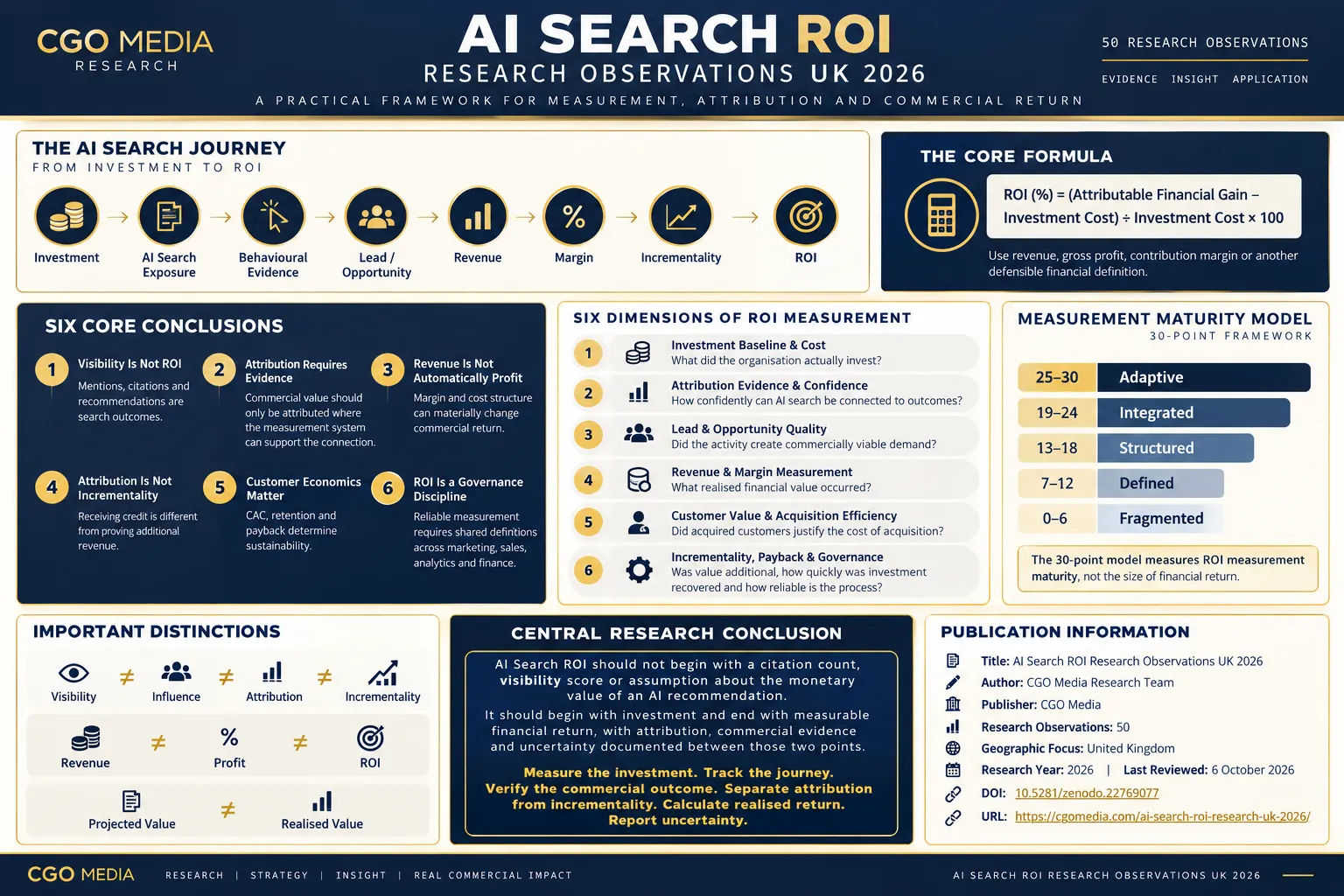
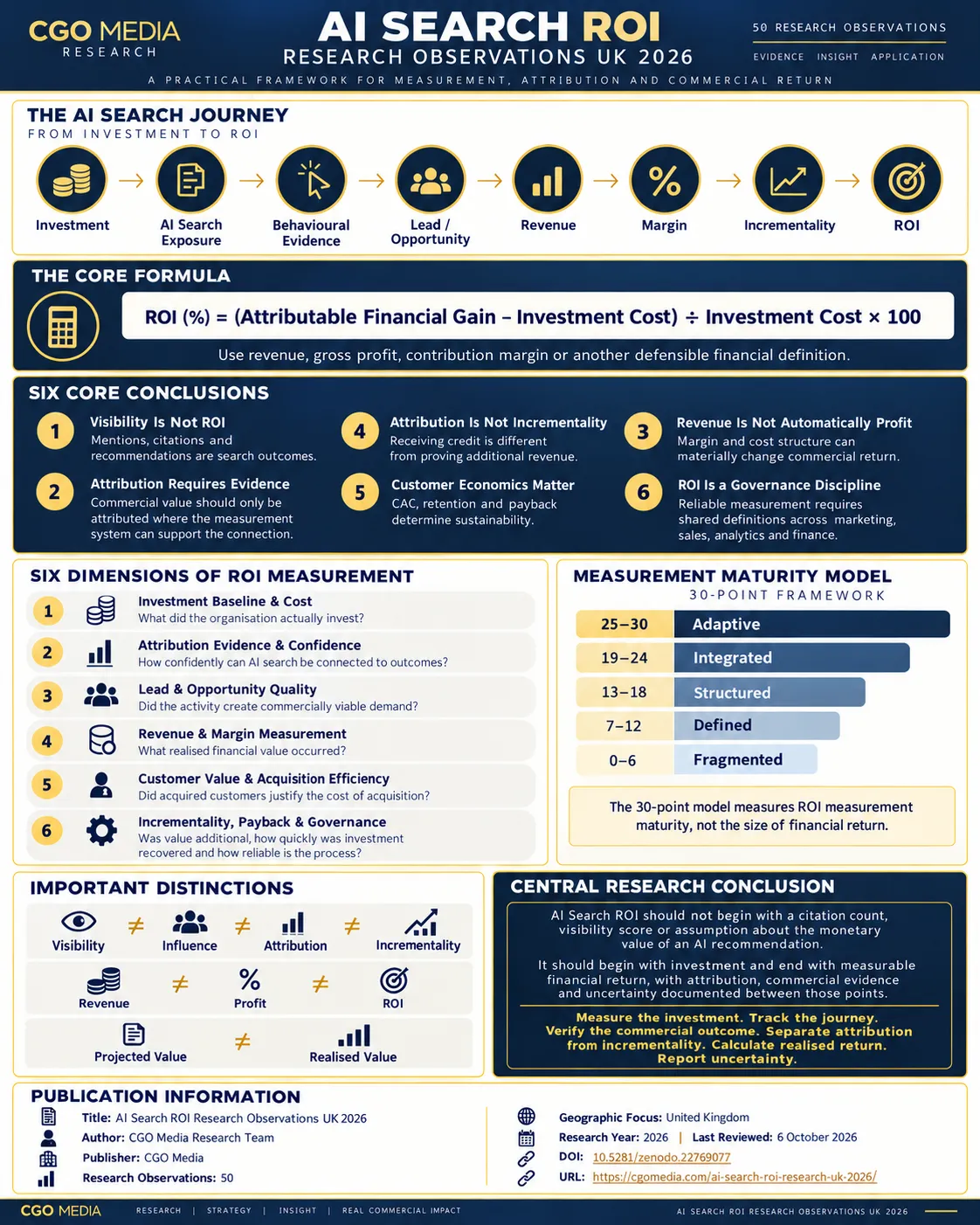
ROI (%) = (Attributable Financial Gain − Investment Cost) ÷ Investment Cost × 100
Where gross revenue materially overstates economic benefit, organisations should calculate return using contribution margin, gross profit or another clearly defined financial measure rather than revenue alone.
AI Search Influence Is Not Automatically ROI
Visibility ≠ Influence ≠ Attribution ≠ Incrementality ≠ Revenue ≠ Profit ≠ ROI
Each stage answers a different question. An organisation may observe growing AI visibility without proving commercial influence, identify assisted influence without proving incremental revenue, or attribute revenue without demonstrating positive ROI after costs are included.
Four Layers of AI Search Commercial Measurement
Recognition, citation presence, recommendation visibility, competitive share and related observable AI search outcomes.
Referral sessions, branded search, direct visits, engagement, enquiries and other observable behaviours that may follow AI-assisted discovery.
Qualified leads, opportunities, sales, bookings, revenue, margin, retention and customer value.
Commercial gain assessed against the investment required to generate and maintain the measured outcome.
Direct Attribution vs Assisted Contribution
| Measurement | Interpretation |
|---|---|
| Directly Attributable | A sufficiently traceable path connects an AI-mediated interaction or referral with a defined commercial outcome. |
| Assisted Contribution | Evidence indicates AI search participated in the customer journey, but the full outcome cannot reasonably be assigned to that interaction alone. |
| Correlated Outcome | Commercial performance changed alongside AI search performance, but causation has not been demonstrated. |
| Leading Indicator | An upstream signal such as recommendation visibility or citation presence that may justify further measurement but is not itself financial return. |
Observable AI Search Commercial Pathway
AI Search Exposure → Engagement Evidence → Lead / Opportunity → Revenue → Margin / Profit → ROI
This is a CGO Media measurement pathway, not a claim that every customer follows a linear journey. AI-assisted discovery can occur at multiple stages and can interact with organic search, direct traffic, paid media, social, email, offline sales and other channels.
Six Dimensions of AI Search ROI Measurement
| Dimension | Measurement Focus |
|---|---|
| 1. Investment Baseline & Cost | The internal and external cost of research, content, SEO/GEO, technical work, Digital PR, measurement, technology and ongoing management. |
| 2. AI Search Exposure & Attribution Evidence | Observable AI visibility and the strength of evidence connecting that exposure to subsequent organisational activity. |
| 3. Traffic, Engagement & Lead Quality | Referral behaviour, enquiry quality, qualification rates, opportunity creation and indicators of commercial intent. |
| 4. Revenue & Margin Contribution | Attributed or evidence-supported revenue, gross profit, contribution margin and other commercial value generated from measured outcomes. |
| 5. Customer Value & Acquisition Efficiency | Acquisition cost, revenue per lead, conversion efficiency, retention, repeat value and customer lifetime economics where available. |
| 6. Incrementality, Payback & Long-Term Return | Whether outcomes appear incremental to what would otherwise have occurred, how quickly investment is recovered and whether value persists over time. |
Attribution Confidence
AI Search ROI reporting should state how confidently a commercial outcome can be connected to AI-mediated discovery.
Directly traceable evidence connects AI search interaction with the commercial event.
Multiple signals support an assisted contribution, but other channels materially participated.
Timing or correlation suggests possible influence, but the connection cannot be demonstrated reliably.
What AI Search ROI Does Not Mean
- AI visibility is not automatically financial return.
- A citation is not automatically a conversion or revenue event.
- A recommendation does not prove incremental customer acquisition.
- Brand-search growth does not by itself prove AI search causation.
- Higher-quality leads should not be attributed to AI search without supporting evidence.
- Authority or trust should not be converted into monetary value without a defensible measurement method.
- Revenue is not the same as profit.
- Attributed revenue is not the same as incremental revenue.
- Correlation between AI visibility and commercial growth does not establish causation.
- Long-term value should not be described as “compounding ROI” unless financial returns are actually measured over time.
Key Research Findings
- AI Search ROI requires financial outcomes as well as search visibility measures.
- Direct return and assisted contribution should be reported separately.
- Investment cost must include the resources required to create, distribute, maintain and measure AI search activity.
- Lead quality can be commercially important even where referral traffic volumes are small.
- Revenue quality and margin can provide more useful financial context than traffic volume alone.
- Attribution confidence should accompany material ROI claims.
- Customer lifetime value can materially alter the economics of AI-assisted acquisition where it can be measured reliably.
- Incrementality is stronger evidence of commercial contribution than attribution alone.
- Long sales cycles require longer measurement windows than transactional ecommerce journeys.
- Executive ROI reporting should separate leading indicators from realised financial return.
Research Objectives
- Define AI Search ROI using measurable financial outcomes.
- Separate visibility, influence, attribution, incrementality and return.
- Identify practical evidence for AI-assisted commercial contribution.
- Examine the relationship between lead quality and financial return.
- Develop a structured method for calculating investment cost.
- Evaluate revenue, margin, acquisition efficiency and customer value.
- Develop an attribution-confidence model for executive reporting.
- Create an organisational framework for continuous AI Search ROI measurement.
Research Scope
Minimum AI Search ROI Measurement Record
- measurement period;
- defined AI search investment cost;
- platform or source of observable AI activity where known;
- search visibility or referral evidence;
- lead or opportunity identifier where available;
- attribution method;
- attribution confidence;
- commercial outcome;
- revenue attributed or assisted;
- gross profit or contribution margin where available;
- customer acquisition cost;
- customer lifetime value where relevant;
- time to conversion;
- payback period;
- known contribution from other channels; and
- assumptions and limitations.
Research Boundary
This research examines how organisations can measure commercial outcomes associated with AI-mediated search.
It does not assume that AI visibility, citations, authority, recommendation presence or Digital PR automatically generate revenue.
Where direct attribution or incrementality cannot be established, the research uses terms such as assisted contribution, commercial influence or correlation rather than presenting the outcome as proven ROI.
AI Search ROI Measurement Principle
Measure visibility as visibility. Measure influence as influence. Attribute revenue only where the evidence supports attribution. Claim incremental return only where the evidence supports incrementality. Calculate ROI only after costs and financial outcomes are defined.
Research Methodology
The broader principles governing evidence quality, observation, interpretation, transparency and limitations across CGO Media research are documented in the
CGO Media Research Methodology
.
Persistent Research Record
This research is associated with DOI
10.5281/zenodo.22769077
.
A DOI provides persistent identification and traceability. It does not by itself establish peer review, research quality or validity.
Research Principle
Commercial influence is not the same as financial return. AI Search ROI becomes defensible only when investment, attribution evidence, commercial outcomes and measurement limitations are made explicit.
Research Observations 1–10
Investment Cost, Attribution Foundations, Visibility vs Value & Commercial Measurement
The first ten observations establish the financial measurement foundations required before an organisation can make credible claims about AI Search ROI.
The central principle is that visibility, citations and recommendations may be valuable leading indicators, but ROI requires defined investment, measurable commercial outcomes and a defensible connection between the two.
Research Observation 1
AI Search ROI Cannot Be Calculated Without a Defined Investment Baseline
Organisations cannot calculate meaningful ROI if the cost of AI search activity is incomplete, inconsistent or excluded from reporting. Investment should include relevant internal and external costs rather than media spend or agency fees alone.
Research Observation 2
Internal Resource Cost Should Be Included
Research, subject-matter expertise, content production, technical implementation, analytics, management and governance consume organisational resources even where no external invoice exists. Excluding those costs can materially overstate return.
Research Observation 3
Ongoing Maintenance Cost Is Part of ROI
AI Search, GEO and research visibility require continued maintenance, measurement, updating and governance. One-time implementation cost alone may not reflect the real investment required to sustain performance.
Research Observation 4
AI Search Visibility Is a Leading Indicator, Not Financial Return
Recognition, citation presence, comparison inclusion and recommendation visibility can indicate growing participation in AI-mediated discovery, but none of these outcomes is itself revenue, profit or ROI.
Research Observation 5
Referral Traffic Provides Stronger Commercial Evidence Than Visibility Alone
Where an AI platform sends identifiable referral traffic to an organisation, the commercial journey becomes easier to analyse. Referral evidence can support attribution, but downstream lead and revenue outcomes still need to be measured separately.
Research Observation 6
Direct Visits and Branded Search May Indicate Assisted Influence
Users may discover an organisation through AI search and later return through direct navigation or branded search. These patterns can justify assisted-attribution analysis, but they should not automatically be assigned to AI search without supporting evidence.
Research Observation 7
Attribution Confidence Should Be Reported Alongside Revenue Claims
A commercial outcome supported by a directly traceable referral deserves a different level of confidence from an outcome inferred from timing, survey feedback or branded-search growth. Material revenue claims should therefore include an attribution-confidence level.
Research Observation 8
Attributed Revenue Is Not the Same as Incremental Revenue
Revenue may be attributed to an AI-assisted journey even if some or all of that sale would have occurred through another channel. Incrementality asks the harder question: what additional commercial value occurred because of the measured activity?
Research Observation 9
Revenue Alone Can Overstate Return
Where gross margins vary materially, using revenue as the numerator can make one channel or activity appear more profitable than it actually is. Contribution margin, gross profit or another defined profitability measure may provide a more defensible financial basis.
Research Observation 10
ROI Reporting Should Separate Realised Value From Expected Value
Pipeline value, forecast revenue and customer lifetime value can be useful management measures, but they should remain separate from realised revenue and realised profit. Combining expected and realised value can create an inflated ROI figure.
What Should Be Included in AI Search Investment Cost?
| Cost Category | Examples |
|---|---|
| Research | Studies, datasets, surveys, analysis, statistics and subject-matter input. |
| Content & Knowledge Assets | Research papers, guides, frameworks, landing pages, technical resources and updates. |
| SEO / GEO | Strategy, technical implementation, structured content, query research and measurement. |
| Digital PR & Distribution | Press outreach, research distribution, expert commentary and legitimate external promotion. |
| Technology | Analytics, CRM, AI visibility tools, reporting systems and supporting software. |
| Internal Labour | Management, research, content, development, analytics, sales and governance time. |
| Maintenance | Updating research, correcting information, refreshing content and ongoing monitoring. |
Commercial Evidence Ladder
Visibility → Referral / Behaviour → Lead → Opportunity → Sale → Margin → Incremental Return
The further the evidence progresses through the commercial journey, the stronger the basis for financial interpretation. Search visibility sits near the beginning of this chain, while incremental financial return sits at the end.
Attribution Evidence Hierarchy
| Evidence Type | Typical Interpretation |
|---|---|
| Direct Referral + Conversion Tracking | Higher-confidence direct attribution where tracking is reliable. |
| CRM / Sales-Source Evidence | Can support direct or assisted attribution depending on data quality. |
| Customer Self-Reported Discovery | Useful supporting evidence but subject to recall and classification limitations. |
| Branded Search / Direct-Traffic Movement | Potential assisted-influence signal, not standalone proof of causation. |
| AI Visibility Growth | Leading search indicator requiring downstream commercial evidence. |
| Timing Correlation Only | Low-confidence evidence that should not be converted directly into ROI. |
Financial Measures Should Remain Distinct
Revenue connected to the measured journey through the chosen attribution method.
Revenue where AI search appears to have contributed but was not the sole attributable source.
Revenue less direct cost of goods or service delivery, according to the organisation’s accounting definition.
Financial contribution remaining after defined variable costs.
Revenue estimated to have occurred because of the measured activity rather than merely being associated with it.
Defined financial gain net of investment, divided by the investment cost.
What Observations 1–10 Tell Us
Investment → Visibility Evidence → Attribution → Commercial Outcome → Financial Gain → ROI
Observations 1–10 establish that credible AI Search ROI begins with disciplined accounting and attribution rather than with search visibility.
The stronger the evidence connecting AI-assisted discovery to a realised commercial outcome, and the more completely investment costs are included, the more defensible the resulting ROI calculation becomes.
Research Principle
AI Search ROI starts with cost, not visibility. Financial return should only be claimed after the organisation can identify what it invested, what commercial value occurred and how confidently that value can be connected to the measured activity.
Research Observations 11–20
Traffic Quality, Lead Quality, Sales Efficiency & Revenue Contribution
The second group of observations moves from attribution foundations into commercial quality. AI Search ROI should not be judged by traffic volume alone; organisations need to understand whether AI-assisted discovery produces commercially useful visits, qualified enquiries, viable opportunities and financially meaningful outcomes.
Research Observation 11
Traffic Volume Is an Incomplete Measure of AI Search Value
A small number of commercially relevant visits can generate more value than a much larger volume of low-intent traffic. AI Search ROI should therefore analyse traffic quality as well as traffic quantity.
Research Observation 12
Engagement Should Be Interpreted in Context
Time on site, pages viewed and engagement events can help explain visitor behaviour, but these metrics should not be treated as financial value. Their usefulness depends on the organisation’s sales journey and conversion model.
Research Observation 13
Lead Quality Can Matter More Than Lead Volume
An organisation generating fewer but better-qualified enquiries may achieve stronger commercial return than one producing a larger number of weak leads. Lead quality should therefore be included in AI Search ROI analysis.
Research Observation 14
Lead Qualification Rates Provide Better Commercial Context
The proportion of enquiries that become sales-qualified or otherwise commercially viable can reveal whether AI-assisted discovery is reaching relevant audiences.
Research Observation 15
Opportunity Creation Is Stronger Evidence Than Enquiry Volume Alone
For organisations with longer sales cycles, movement from enquiry to qualified opportunity provides a stronger commercial signal than raw form fills or contact events.
Research Observation 16
Sales Conversion Rate Should Be Tracked Separately From Lead Generation
Lead generation and sales conversion measure different stages of commercial performance. AI-assisted discovery may improve one without improving the other, so both should remain visible in reporting.
Research Observation 17
Sales-Cycle Length Affects ROI Interpretation
A B2B organisation with a six-month sales cycle requires a different measurement window from an ecommerce transaction completed in minutes. ROI reporting should match the commercial reality of the organisation.
Research Observation 18
Revenue Per Lead Can Reveal Commercial Quality Differences
Where attribution evidence is sufficiently strong, comparing revenue per lead or revenue per qualified opportunity can help identify whether AI-assisted journeys generate different commercial economics from other acquisition sources.
Research Observation 19
Margin Contribution Can Be More Useful Than Revenue Contribution
Two channels can generate the same revenue while producing very different economic value because of product mix, fulfilment costs, discounts or service-delivery costs. Margin should therefore be considered where commercially material.
Research Observation 20
Commercial Value Should Be Measured Across the Full Funnel
AI Search ROI is easier to understand when organisations connect upstream visibility and engagement with downstream lead quality, opportunity creation, conversion, revenue and margin rather than evaluating each metric in isolation.
Commercial Funnel Measurement
AI Search Exposure → Visit / Engagement → Lead → Qualified Lead → Opportunity → Sale → Revenue → Margin
The commercial funnel is not necessarily linear, but recording each stage helps prevent upstream marketing indicators from being misreported as financial return.
Traffic Quality Measures
| Measure | Commercial Interpretation |
|---|---|
| Referral Sessions | Identifiable traffic arriving from AI platforms where referral information is available. |
| Engaged Sessions | May indicate relevant interaction but is not itself a financial outcome. |
| Conversion Events | Actions such as form fills, calls, bookings or account creation that may precede revenue. |
| Branded Search Follow-Up | Possible assisted-discovery evidence where additional supporting data exists. |
| Direct Return Visits | May reflect prior discovery but cannot automatically be attributed to AI search. |
Lead Quality Measurement
Percentage of leads meeting agreed commercial criteria.
Percentage of leads progressing into defined sales opportunities.
Percentage of qualified opportunities becoming customers.
Attributed revenue divided by the number of measured leads.
Defined profit or contribution generated per acquired customer.
Time between initial identifiable interaction and realised sale.
Lead Volume vs Lead Quality
| Scenario | Interpretation |
|---|---|
| High Volume / Low Qualification | Strong lead-generation volume but potentially weak commercial efficiency. |
| Low Volume / High Qualification | Lower acquisition volume but potentially stronger revenue and sales efficiency. |
| High Volume / High Qualification | Potentially strong commercial performance, subject to acquisition cost and margin. |
| Low Volume / Low Qualification | Weak commercial evidence requiring further investigation. |
Sales Efficiency Measures
| Measure | Why It Matters |
|---|---|
| Lead-to-Opportunity Rate | Shows whether leads become commercially actionable. |
| Opportunity-to-Sale Rate | Measures conversion from qualified sales pipeline to customer. |
| Average Deal Value | Helps quantify the commercial importance of acquired opportunities. |
| Time to Close | Determines the appropriate ROI measurement window. |
| Sales Cost per Opportunity | Adds commercial context beyond marketing acquisition cost alone. |
Revenue Contribution Should Be Classified
Commercial value tied to a traceable AI-assisted acquisition path.
Revenue where AI search appears to have participated but other channels materially contributed.
Potential future value from open opportunities; not yet realised revenue.
Revenue recognised from completed transactions according to the organisation’s accounting basis.
What Observations 11–20 Tell Us
Traffic → Lead Quality → Opportunity → Conversion → Revenue → Margin
Observations 11–20 show why traffic volume should not dominate AI Search ROI reporting. The stronger commercial analysis follows users through lead quality, opportunity creation, conversion and financial value.
For many organisations, especially those with high-value products or long sales cycles, the most commercially relevant question is not how much traffic AI search generated but whether the resulting customers justified the investment required to acquire them.
Research Principle
Do not confuse more traffic with more value. AI Search ROI improves only when measurable commercial outcomes justify the cost of creating them.
Research Observations 21–30
Customer Acquisition Cost, Lifetime Value, Retention, Payback & Incrementality
The third group of observations examines whether AI-assisted acquisition is economically efficient over time. Immediate revenue can provide only part of the picture; acquisition cost, retention, repeat purchasing, customer lifetime value and payback period can materially change the interpretation of ROI.
Research Observation 21
Customer Acquisition Cost Should Include the Full Cost of Acquisition
AI Search Customer Acquisition Cost should include the relevant investment required to generate qualified customers rather than only direct media, software or agency expenditure.
Research Observation 22
Cost Per Lead and Cost Per Customer Measure Different Economics
A low cost per lead can coexist with a high customer acquisition cost when lead quality or close rates are weak. Organisations should therefore avoid using inexpensive lead generation as a proxy for efficient acquisition.
Research Observation 23
Customer Lifetime Value Can Materially Change ROI Interpretation
An acquired customer may generate value beyond the initial transaction through renewal, repeat purchasing, expansion or long-term contracts. Where reliably measurable, lifetime value can provide a more complete view of acquisition economics.
Research Observation 24
Projected Lifetime Value Should Remain Separate From Realised Value
Forecast customer value is useful for planning, but it should not be reported as realised ROI. Actual retention and revenue should be measured over time before projected value is converted into realised financial return.
Research Observation 25
Retention Quality Can Affect the Economics of AI-Assisted Acquisition
If customers acquired through AI-assisted journeys retain for longer or purchase repeatedly, acquisition economics may improve. Such claims require cohort evidence rather than assumptions based on initial conversion quality.
Research Observation 26
Payback Period Provides a Different View From ROI Percentage
Two investments can generate similar eventual ROI but recover their cost at very different speeds. Payback period is therefore useful when cash flow, risk or budget availability matters.
Research Observation 27
Short Measurement Windows Can Understate Long-Term Return
Research assets, technical improvements and search visibility can continue generating commercial outcomes after the initial investment period. A measurement window that is too short can understate long-term return.
Research Observation 28
Long Measurement Windows Can Also Misattribute Value
The longer the attribution window, the more likely additional marketing, sales, brand and market factors contribute to the outcome. Longer windows should therefore be accompanied by stronger attribution controls and more cautious interpretation.
Research Observation 29
Incrementality Provides Stronger Evidence Than Attribution Alone
Attribution asks which activity receives credit for an outcome. Incrementality asks whether the outcome would have happened without that activity. Where feasible, incremental measurement provides a stronger basis for economic evaluation.
Research Observation 30
AI Search ROI Is Strongest When Acquisition Economics and Incrementality Converge
The strongest commercial case exists when AI-assisted acquisition can be connected to profitable customers, acceptable acquisition cost, reasonable payback and evidence that the resulting value was genuinely additional.
Customer Acquisition Cost
Customer Acquisition Cost = Defined Acquisition Investment ÷ Acquired Customers
The numerator should include the agreed share of research, content, technical, measurement, promotion, technology and internal resource costs associated with the acquisition programme.
Customer Lifetime Value
Customer Lifetime Value should use the organisation’s documented financial model and clearly distinguish projected value from realised value.
There is no single universal CLV formula suitable for every business model. Subscription, ecommerce, professional services and high-value B2B organisations may require materially different assumptions.
CAC to Lifetime Value Relationship
| Measure | Question Answered |
|---|---|
| Customer Acquisition Cost | How much did it cost to acquire a customer? |
| Initial Customer Value | What financial value did the first transaction generate? |
| Realised Lifetime Value | What value has the customer actually generated over time? |
| Projected Lifetime Value | What value is expected if stated assumptions hold? |
| Payback Period | How quickly is the acquisition investment recovered? |
Payback Period
Payback Period = Time Required for Cumulative Attributable Financial Gain to Recover the Defined Investment
Payback provides useful risk and cash-flow context that an ROI percentage alone may not reveal.
Attribution vs Incrementality
| Concept | Core Question |
|---|---|
| Attribution | Which activity or channel receives credit for the outcome? |
| Assisted Attribution | Which activities appear to have contributed to the outcome? |
| Incrementality | What additional outcome occurred because of the activity? |
| ROI | Did the resulting financial gain justify the defined investment? |
Practical Incrementality Methods
Perfect incrementality measurement is not always possible, but organisations can improve confidence using appropriate experimental or quasi-experimental methods where feasible.
Compare exposed and unexposed groups where a credible holdout can be constructed.
Compare materially similar markets with different levels of activity where appropriate.
Assess changes against historical patterns while accounting for seasonality and other material changes.
Compare customer or lead cohorts with different documented acquisition journeys.
Use comparable products, markets or audience segments where randomisation is not possible.
Use carefully designed surveys or sales feedback as supporting evidence, while recognising recall bias.
Long-Term Value Should Be Reported in Layers
Initial Revenue → Realised Repeat Value → Realised Lifetime Value → Forecast Future Value
Keeping these layers separate prevents expected future economics from being reported as if they have already occurred.
What Observations 21–30 Tell Us
Acquisition Cost → Customer Value → Retention → Payback → Incrementality → Long-Term ROI
Observations 21–30 show why the first transaction does not always provide a complete picture of AI Search ROI.
Acquisition cost, retention, realised customer value, payback period and incrementality determine whether apparent commercial performance becomes durable economic return.
Research Principle
Attribution tells you where to assign credit. Incrementality tells you what additional value occurred. ROI tells you whether that value justified the investment.
Research Observations 31–40
Attribution Confidence, Multi-Touch Journeys, Measurement Windows, Uncertainty & ROI Reliability
The fourth group of observations examines the reliability of AI Search ROI claims. Commercial journeys frequently involve multiple search, media, brand and sales interactions, so ROI reporting should communicate uncertainty rather than implying perfect attribution.
Research Observation 31
AI Search ROI Should Include an Attribution-Confidence Rating
Revenue connected through direct referral evidence, CRM data and customer-source information deserves a higher confidence rating than revenue inferred from timing or changes in branded search alone.
Research Observation 32
Multi-Touch Journeys Should Not Be Forced Into Single-Touch Attribution
A customer may encounter an organisation in an AI answer, later visit through organic search, read independent coverage and finally convert after direct contact. Assigning the full commercial outcome to one interaction can overstate that channel’s contribution.
Research Observation 33
First-Touch and Last-Touch Attribution Answer Different Questions
First-touch attribution identifies discovery. Last-touch attribution identifies the final recorded interaction before conversion. Neither necessarily captures the full contribution of AI search within the commercial journey.
Research Observation 34
Self-Reported Discovery Can Strengthen Attribution but Has Limitations
Asking customers how they found the organisation can reveal AI-assisted discovery that analytics misses, but recall bias, vague answers and multiple prior interactions mean self-reported attribution should be treated as supporting evidence rather than perfect proof.
Research Observation 35
Measurement Windows Should Match the Sales Cycle
Short-cycle ecommerce and long-cycle enterprise sales require different observation periods. A measurement window that ends before typical conversion can materially understate commercial return.
Research Observation 36
Long Attribution Windows Increase Uncertainty
As more time passes between AI-assisted discovery and conversion, additional factors may influence the outcome. Long attribution windows should therefore carry more cautious attribution language unless supporting evidence remains strong.
Research Observation 37
Seasonality Can Distort ROI Interpretation
Revenue changes during seasonal peaks or market events should not automatically be assigned to AI search activity. Period comparisons should account for known seasonal or cyclical factors where they are material.
Research Observation 38
Concurrent Marketing Activity Must Be Considered
Paid campaigns, PR activity, events, product launches, email, social media and offline sales activity can influence commercial performance during the same period. ROI analysis should record these material interventions.
Research Observation 39
ROI Precision Should Reflect Data Quality
A highly precise percentage can create false certainty when investment allocation, attribution or commercial value is estimated. Reporting should match the precision of the underlying evidence.
Research Observation 40
Reliable ROI Requires Transparent Assumptions
The strongest ROI reporting states which costs are included, how revenue is attributed, what measurement window is used, how lifetime value is calculated and which uncertainties remain unresolved.
Attribution Confidence Framework
| Confidence | Evidence Profile | Reporting Language |
|---|---|---|
| High | Direct referral, CRM or sales evidence materially connects the AI-assisted journey with the commercial outcome. | Directly attributed, subject to stated attribution method. |
| Moderate | Multiple supporting signals indicate AI search participated, but other touchpoints materially contributed. | Assisted contribution or evidence-supported influence. |
| Low | Timing, correlation or weak self-reporting suggests possible influence without a reliable attribution path. | Possible influence or correlation; avoid direct ROI attribution. |
Multi-Touch Commercial Journey
AI Discovery → Organic Search → Publisher Evidence → Direct Visit → Sales Contact → Conversion
In journeys such as this, AI search may have contributed to discovery without being the last measurable channel before conversion. Reporting should preserve that distinction rather than allocating the entire outcome arbitrarily.
Attribution Models Answer Different Questions
| Model | What It Emphasises | Limitation |
|---|---|---|
| First Touch | Initial recorded discovery. | Can over-credit discovery while ignoring later influences. |
| Last Touch | Final recorded interaction before conversion. | Can hide earlier AI-assisted discovery. |
| Multi-Touch | Multiple interactions within the journey. | Credit allocation can depend heavily on modelling assumptions. |
| Incrementality | Additional outcomes caused by the activity. | Often requires stronger experimental or quasi-experimental evidence. |
Measurement Window Framework
Transactional journeys where conversion can occur within minutes or days.
Journeys where evaluation and conversion commonly require several weeks.
Enterprise, complex B2B or high-value decisions requiring several months or longer.
Retention and repeat-value analysis extending beyond initial acquisition.
Sources of ROI Uncertainty
False Precision in ROI Reporting
An ROI figure such as 147.63% may imply a level of certainty that does not exist if the cost allocation, attribution model or lifetime value is estimated. Where uncertainty is material, reporting a rounded figure, range or confidence category can be more defensible.
Recommended ROI Reporting Language
| Evidence Position | Prefer | Avoid |
|---|---|---|
| Direct Evidence | “Directly attributed revenue under the stated attribution method.” | “AI search caused all of this revenue.” |
| Assisted Evidence | “AI search contributed to the measured customer journey.” | “AI search generated the sale.” |
| Correlation Only | “Commercial growth coincided with increased AI visibility.” | “Increased AI visibility generated the growth.” |
| Projected Value | “Forecast value based on stated assumptions.” | “Realised ROI.” |
What Observations 31–40 Tell Us
Evidence Quality → Attribution Confidence → Appropriate Window → Uncertainty Disclosure → Reliable ROI
Observations 31–40 show that ROI reliability depends not only on the final number but also on how clearly the organisation explains the journey, attribution method, measurement window and uncertainty surrounding the calculation.
A cautious ROI estimate backed by transparent evidence is more useful than an apparently precise figure built on weak attribution assumptions.
Research Principle
ROI confidence should never exceed the quality of the attribution evidence supporting it.
Research Observations 41–50
Executive Reporting, Governance, ROI Maturity & the AI Search ROI Framework
The final ten observations move from individual financial measures toward organisational capability. They examine how AI Search ROI should be reported to leadership, governed across teams and assessed through a structured maturity framework.
Research Observation 41
Executive Reporting Should Separate Leading Indicators From Financial Outcomes
AI visibility, citation growth and recommendation presence can be useful leading indicators, but they should not be placed in the same financial category as realised revenue, margin or ROI.
Research Observation 42
ROI Dashboards Should Show Attribution Confidence
Commercial outcomes should be accompanied by an indication of whether they are directly attributed, assisted, correlated or forecast. This helps decision-makers distinguish stronger evidence from weaker inference.
Research Observation 43
Cost Allocation Rules Should Be Consistent Over Time
ROI trend analysis becomes unreliable if the organisation changes which internal, agency, technology or research costs are included without documenting the change.
Research Observation 44
AI Search ROI Should Be Segmented Where Economics Differ Materially
Different products, sectors, locations, customer types or sales journeys can have materially different acquisition costs and margins. Aggregate ROI can conceal commercially important differences.
Research Observation 45
Material Attribution Assumptions Should Be Governed
Attribution windows, assisted-credit rules, lifetime-value assumptions and cost-allocation methods should be documented rather than changed informally to improve reported performance.
Research Observation 46
ROI Measurement Requires Cross-Functional Ownership
Marketing may observe visibility, sales may record lead origin, finance may define margin, and analytics may manage attribution. Reliable AI Search ROI therefore requires shared definitions and coordinated ownership.
Research Observation 47
AI Search ROI Maturity Reflects Measurement Capability, Not Marketing Performance Alone
An organisation can have strong financial results but weak measurement maturity if costs, attribution and incrementality remain poorly defined. Conversely, a mature measurement system can identify weak ROI clearly and support better decisions.
Research Observation 48
Material Business Change Should Trigger Reassessment
Changes to pricing, margin, product mix, geography, sales model, customer retention or AI search investment can materially alter ROI economics and should trigger a fresh measurement cycle.
Research Observation 49
Composite ROI Scores Should Not Replace Underlying Financial Evidence
A maturity score can summarise organisational measurement capability, but actual ROI still depends on the underlying cost, attribution, revenue, margin and incrementality evidence.
Research Observation 50
AI Search ROI Should Be Treated as a Continuous Financial Measurement Discipline
Costs, platforms, attribution paths, customer behaviour and commercial economics change over time. ROI should therefore be reviewed continuously rather than calculated once and treated as permanent.
Six Dimensions of the CGO Media AI Search ROI Framework
| Dimension | Measurement Focus |
|---|---|
| 1. Investment Baseline & Cost | Whether the organisation captures the full and relevant cost of AI search activity consistently. |
| 2. Attribution Evidence & Confidence | How strongly commercial outcomes can be connected to AI-assisted discovery. |
| 3. Lead & Opportunity Quality | Whether measured traffic and enquiries progress into commercially viable opportunities. |
| 4. Revenue & Margin Measurement | Whether realised commercial value is measured using appropriate financial definitions. |
| 5. Customer Value & Acquisition Efficiency | Whether CAC, retention, repeat value and lifetime economics are measured consistently. |
| 6. Incrementality, Payback & Governance | Whether additional value, recovery period, uncertainty and ongoing decision rules are assessed. |
30-Point AI Search ROI Measurement Maturity Score
Each dimension is scored from 0 to 5 based on measurement capability and retained evidence.
Absent
Very Weak
Developing
Established
Strong
Leading
6 Dimensions × Maximum 5 Points = 30 Points
AI Search ROI Maturity Levels
| Score | Maturity Level | Interpretation |
|---|---|---|
| 0–6 | Fragmented | Costs, attribution and commercial outcomes are poorly connected or not measured consistently. |
| 7–12 | Defined | Basic ROI definitions and commercial measures exist, but attribution remains limited. |
| 13–18 | Structured | Cost, attribution, leads, revenue and acquisition economics are measured systematically. |
| 19–24 | Integrated | Marketing, sales, analytics and finance data are connected with clear attribution-confidence reporting. |
| 25–30 | Adaptive | ROI is continuously measured, challenged, segmented and governed with incrementality and uncertainty considered where feasible. |
Important limitation:
the 30-point framework measures the maturity of AI Search ROI measurement and governance. It does not represent actual financial ROI and should never be used as a substitute for a financial return calculation.
Continuous AI Search ROI Cycle
Define Cost → Measure Exposure → Attribute → Validate Commercial Value → Test Incrementality → Calculate Return → Review → Govern
Recommended Executive AI Search ROI Scorecard
Defined AI search programme cost.
High, Moderate or Low.
Commercially valid enquiries.
Measured pipeline creation.
Realised revenue under the stated attribution model.
Defined financial contribution from measured customers.
Defined investment divided by acquired customers.
Time required to recover investment.
Return calculated from realised financial gain.
0–30 organisational capability score.
Cross-Functional ROI Governance
| Function | Primary ROI Responsibility |
|---|---|
| SEO / GEO | AI search exposure, visibility measurement and search-programme investment. |
| Content / Research | Knowledge-asset costs, research investment and content maintenance. |
| Analytics | Referral measurement, attribution logic and reporting integrity. |
| Sales | Lead source, qualification, opportunity creation, conversion and sales-cycle data. |
| Finance | Revenue, margin, cost allocation, realised value and financial definitions. |
| Leadership | Investment decisions, risk tolerance, measurement standards and governance. |
What Observations 41–50 Tell Us
Define → Measure → Attribute → Validate → Calculate → Challenge → Govern
The final observations establish AI Search ROI as an organisational measurement and governance discipline rather than a simple marketing dashboard calculation.
The most mature organisations connect marketing, sales, analytics and finance while keeping leading indicators, attributed outcomes, incrementality and realised financial return clearly separated.
Research Principle
A mature ROI programme does not try to make every AI search metric financial. It connects only the commercial outcomes that the evidence can reasonably support.
CGO Media Analysis
What the 50 AI Search ROI Observations Tell Us
The fifty observations collectively show that AI Search ROI cannot be reduced to visibility, traffic or even attributed revenue. A defensible commercial assessment requires organisations to connect investment, attribution evidence, lead quality, realised financial value, acquisition economics, incrementality and governance.
The strongest measurement systems are therefore not those producing the largest ROI percentage. They are those capable of explaining precisely what was invested, what happened commercially, how confidently the outcome can be connected to AI-assisted discovery and what uncertainty remains.
1. AI Search Visibility Is Not ROI
Recognition, citations, comparisons and recommendations can be strategically valuable, but they remain upstream search outcomes until commercial evidence connects them to leads, opportunities, customers or financial value.
Visibility ≠ Revenue ≠ Profit ≠ ROI
2. AI Search Influence and Financial Attribution Must Remain Separate
AI search can influence a customer journey without being directly measurable as the final acquisition source. Assisted influence is commercially relevant, but it should not be presented as direct financial attribution where the evidence does not support that conclusion.
3. Cost Definition Determines Whether ROI Is Meaningful
If research, internal labour, technical work, measurement, software, promotion or ongoing maintenance are excluded from the investment baseline, reported ROI can be materially overstated.
4. Commercial Quality Matters More Than Traffic Volume
AI search may produce relatively small referral volumes while still influencing valuable commercial journeys. Lead qualification, opportunity creation, close rate and margin can therefore provide more useful evidence than session volume alone.
5. Lead Quality Should Be Measured Before Revenue Is Interpreted
A rise in enquiries does not necessarily indicate stronger commercial performance. Organisations should determine whether leads are relevant, qualified and capable of progressing into viable sales opportunities.
6. Revenue and Profit Are Different Measures
Revenue can overstate economic return when product mix, fulfilment cost, discounts or service-delivery cost vary materially. Gross profit or contribution margin may provide a more meaningful financial basis for ROI analysis.
7. Attributed Revenue Is Not Incremental Revenue
Attribution allocates credit. Incrementality asks whether additional value actually occurred because of the measured activity. The distinction is central to credible AI Search ROI analysis.
Attribution = Who Receives Credit
Incrementality = What Additional Value Occurred
8. Customer Acquisition Cost Provides Essential Context
Strong revenue growth can still represent weak economics if acquisition costs rise faster than customer value. AI Search ROI should therefore include customer acquisition efficiency wherever reliable customer-level measurement is available.
9. Lifetime Value Can Change the Commercial Picture
Initial transaction value may understate the economics of customers who renew, repurchase or expand. However, projected lifetime value should remain clearly separated from value that has already been realised.
10. Payback Period Matters Alongside ROI Percentage
Two investments can produce similar eventual returns while requiring very different periods to recover their cost. Payback therefore provides additional insight into liquidity, risk and capital efficiency.
11. Long Sales Cycles Require Longer Measurement Windows
Enterprise, professional-services and complex B2B journeys may take months before financial outcomes become visible. Short reporting windows can make useful investment appear ineffective simply because the sales cycle has not matured.
12. Longer Attribution Windows Increase Uncertainty
Longer measurement periods can capture delayed outcomes, but they also allow more channels, commercial events and market factors to influence the result. The appropriate response is not to ignore long-term value but to report attribution confidence more carefully.
13. AI-Assisted Journeys Are Frequently Multi-Touch
A customer can encounter an organisation in an AI answer, later search the brand on Google, visit a publisher, return directly and convert through a salesperson. Single-touch models can therefore misrepresent the role of AI-assisted discovery.
AI Discovery → Search → Independent Evidence → Direct Visit → Sales → Conversion
14. Attribution Confidence Is as Important as the Attribution Model
A sophisticated attribution model built on weak data remains weak evidence. Executive reporting should therefore state whether an outcome is supported by high, moderate or low attribution confidence.
15. False Precision Weakens ROI Reporting
Where cost allocation, attribution or customer value contains material estimation, reporting ROI to multiple decimal places can imply certainty the data does not support. Ranges, rounded figures and confidence categories can sometimes communicate the evidence more accurately.
16. AI Search ROI Requires Marketing, Sales, Analytics and Finance
No single function owns all of the required information. Marketing can observe search performance, sales can validate lead quality, analytics can manage attribution and finance can define economic value. Reliable ROI depends on connecting those datasets and definitions.
17. ROI Measurement Maturity Is Not the Same as High ROI
A mature organisation may discover that a programme has weak financial return. That is not measurement failure; it is the value of measurement. The 30-point model assesses the capability to measure ROI, not whether the resulting ROI is positive.
18. Leading Indicators Still Matter
Recognition, citation visibility and recommendation presence should not be dismissed simply because they are not financial measures. They can provide early evidence that an organisation’s AI search position is changing before commercial outcomes mature.
19. But Leading Indicators Must Not Be Monetised Without Evidence
Assigning arbitrary monetary values to citations, mentions or recommendation appearances can create artificial ROI. Financial value should only be assigned where the organisation has a defensible method connecting the observable outcome to commercial economics.
20. AI Search ROI Is Ultimately a Decision Framework
The purpose of ROI analysis is not merely to produce a percentage. It is to help organisations decide whether to continue, reduce, redesign or increase investment based on the quality of the commercial evidence.
The CGO Media AI Search ROI Evidence Chain
Investment → AI Search Exposure → Behavioural Evidence → Lead / Opportunity → Revenue → Margin → Incrementality → ROI
The further the evidence moves from search exposure toward realised and incremental financial value, the stronger the basis for an ROI claim.
Five Levels of Commercial Evidence
| Evidence Level | What Can Be Said |
|---|---|
| 1. Search Exposure | The organisation appeared, was cited, compared or recommended. |
| 2. Behavioural Evidence | Observable user behaviour followed or was associated with the AI search interaction. |
| 3. Commercial Attribution | A lead, opportunity or sale can be connected to AI-assisted discovery under a defined attribution method. |
| 4. Financial Return | Defined financial gain can be compared with defined investment cost. |
| 5. Incremental Financial Return | Evidence supports the conclusion that additional financial value occurred because of the activity. |
The Six AI Search ROI Dimensions
Is the true investment known and consistently recorded?
How strongly can commercial outcomes be linked to AI-assisted discovery?
Do measured interactions create commercially viable opportunities?
Is realised value measured using appropriate financial definitions?
Do acquisition cost, retention and customer economics justify the investment?
Is additional value tested, recovered and governed over time?
Eight Questions Every AI Search ROI Audit Should Answer
- What is the full cost of the AI search programme?
- What observable AI search activity occurred?
- What evidence connects that activity to user or customer behaviour?
- Which leads, opportunities or customers can be attributed or assisted with reasonable confidence?
- What realised revenue or margin was generated?
- What did those customers cost to acquire?
- What evidence suggests the outcome was incremental?
- Does the resulting financial gain justify the investment?
AI Search ROI Interpretation Hierarchy
Observed Outcome → Attribution Evidence → Commercial Verification → Financial Calculation → Incrementality Assessment
What Should Not Be Collapsed Into One KPI
Search Visibility ≠ Referral Traffic ≠ Lead Generation ≠ Revenue Attribution ≠ Incremental Revenue ≠ Profit ≠ ROI
Central CGO Media Analysis
The evidence across these fifty observations points toward a broader conclusion: AI Search ROI is not primarily an AI measurement problem. It is an organisational measurement problem created by the interaction between emerging search journeys and existing marketing, analytics, sales and finance systems.
Organisations that measure only AI visibility risk overstating commercial success. Organisations that measure only last-click revenue risk understating AI-assisted discovery. The more defensible approach is to retain both layers while clearly distinguishing them.
The goal is therefore not to force every AI search interaction into an ROI calculation. It is to construct a measurement system capable of identifying where financial evidence is strong, where assisted influence is probable and where the organisation still does not know.
Central Research Conclusion
Measure the investment. Track the journey. Verify the commercial outcome. Separate attribution from incrementality. Calculate realised return. Report uncertainty. Do not turn visibility into revenue without evidence.
Practical Implementation
How UK Organisations Should Measure AI Search ROI in 2026
The practical challenge is not simply to collect more AI search metrics. It is to build a measurement system capable of connecting search activity with commercial outcomes at an appropriate level of confidence.
The following implementation model is designed for organisations that want to move from AI visibility reporting toward defensible commercial measurement without forcing every search interaction into an artificial ROI calculation.
1. Define the AI Search Investment Boundary
Start by defining exactly which activities and costs are included in the AI Search ROI calculation. The investment boundary should remain consistent enough to support trend analysis.
2. Establish a Financial Baseline
Before assessing the effect of AI search activity, establish the organisation’s existing commercial baseline. Without a baseline, later movement can be difficult to interpret.
| Baseline Measure | Purpose |
|---|---|
| Lead Volume | Establish normal enquiry levels before comparison. |
| Qualification Rate | Establish typical commercial lead quality. |
| Sales Conversion Rate | Understand normal conversion performance. |
| Average Customer Value | Provide a benchmark for acquired customer economics. |
| Contribution Margin | Measure value beyond gross revenue. |
| Customer Acquisition Cost | Provide an existing acquisition-efficiency benchmark. |
| Typical Sales Cycle | Determine the appropriate measurement window. |
3. Build an AI Search Measurement Layer
Track observable AI search outcomes separately from financial outcomes. This protects the organisation from treating visibility metrics as if they were revenue metrics.
Recognition → Citation → Comparison → Recommendation → Referral / Behaviour
4. Track Direct AI Referrals Where Available
Where referral information is available, record AI-originated sessions separately and connect them with conversion, CRM and revenue data where technically and legally appropriate.
Direct referral evidence generally provides a stronger attribution basis than inferred discovery, but downstream commercial performance still needs to be measured.
5. Add Customer-Reported Discovery
Website forms, sales calls and onboarding processes can include a structured “How did you hear about us?” field that allows respondents to identify ChatGPT, Gemini, Copilot, Perplexity or another AI search environment.
Self-reported discovery should be used as supporting evidence because customer recall is imperfect and journeys frequently include multiple touchpoints.
6. Connect Marketing Data With CRM Outcomes
The most valuable commercial analysis occurs after search and analytics data connect with sales outcomes.
Search Evidence → Analytics → Lead → CRM → Opportunity → Sale → Finance
7. Define a Lead-Quality Standard
Organisations should decide what constitutes a commercially qualified lead before comparing acquisition sources.
Is there a genuine requirement?
Does the customer fit the target segment?
Is there realistic commercial potential?
Is the requirement active within a relevant period?
8. Track Opportunity Creation
For long-cycle businesses, opportunity creation is often a more useful intermediate commercial measure than website conversion alone.
Track the proportion of AI-attributed or AI-assisted leads that progress into commercially valid opportunities and compare those rates with other acquisition routes.
9. Keep Direct, Assisted and Correlated Outcomes Separate
| Classification | Reporting Treatment |
|---|---|
| Direct | Revenue connected through a defined and traceable attribution path. |
| Assisted | AI search appears to have contributed alongside other material touchpoints. |
| Correlated | Commercial and AI search performance moved together without sufficient causal evidence. |
10. Use Margin Where Revenue Is Misleading
Where products or customers have materially different economic profiles, calculate return using gross profit, contribution margin or another documented profitability measure rather than relying exclusively on revenue.
11. Calculate Customer Acquisition Cost Consistently
CAC = Defined Acquisition Investment ÷ Acquired Customers
Do not compare AI Search CAC with another channel’s CAC if different cost categories are included in each calculation.
12. Separate Realised and Projected Customer Value
Report initial realised value, repeat realised value and projected lifetime value independently. This makes it possible to use lifetime economics for planning without converting forecasts into realised ROI prematurely.
13. Measure Payback Period
The time required to recover investment can materially influence whether an AI search programme is financially sustainable, even where long-term ROI appears positive.
14. Test Incrementality Where Feasible
Where data volume and business structure allow it, use holdouts, matched comparisons, cohort analysis, geographic comparisons or time-series methods to investigate whether measured commercial value was genuinely additional.
Where incrementality cannot be established, say so explicitly rather than treating attribution as proof of causation.
15. Match the Measurement Window to the Buying Journey
| Journey Type | Measurement Approach |
|---|---|
| Short Transactional | Measure conversion and revenue over a short purchase cycle. |
| Considered Purchase | Allow sufficient time for research, comparison and return visits. |
| Complex B2B | Track leads, opportunities and revenue across the full sales cycle. |
| Subscription / Retention | Extend measurement into realised retention and repeat value. |
16. Create an AI Search Attribution Register
Maintain a record of material AI-attributed and AI-assisted commercial outcomes so the organisation can audit how each conclusion was reached.
Recommended Fields: Date • Platform / Source • Discovery Evidence • Lead ID • Attribution Classification • Confidence • Opportunity Value • Realised Revenue • Margin • Other Touchpoints • Notes
17. Maintain an Assumptions Register
Material assumptions should be documented so that later results can be interpreted consistently.
18. Segment ROI Where Economics Differ
Avoid relying only on one organisation-wide ROI percentage where products, geographies, customer segments or sales models have materially different economics.
Segmented analysis can reveal profitable areas that are hidden inside a weak aggregate figure or weak areas hidden inside a strong overall result.
19. Report Uncertainty
Where attribution is incomplete, avoid presenting an artificially precise result. Use attribution-confidence categories, ranges or qualified language when those better reflect the underlying evidence.
20. Recalculate ROI Continuously
AI search platforms, customer behaviour, investment levels and commercial economics change. Recalculate ROI when material assumptions change and review performance on a regular reporting cycle.
CGO Media AI Search ROI Implementation Model
Define → Baseline → Track → Attribute → Qualify → Value → Test Incrementality → Calculate → Report → Govern
90-Day AI Search ROI Implementation Plan
Days 1–30 — Define & Baseline
- Define the AI search investment boundary.
- Record historical lead, sales and revenue baselines.
- Agree financial definitions with Finance.
- Map existing analytics and CRM data.
- Define direct, assisted and correlated attribution categories.
- Establish the typical sales cycle.
- Build the initial attribution and assumptions registers.
Days 31–60 — Connect Commercial Evidence
- Implement AI referral tracking where available.
- Add structured customer-source questions.
- Connect website enquiries with CRM records.
- Define lead and opportunity quality standards.
- Capture revenue and margin for closed customers.
- Calculate initial CAC and payback measures.
- Begin comparing AI-assisted cohorts with other acquisition sources.
Days 61–90 — Calculate, Challenge & Govern
- Calculate directly attributable financial return.
- Report assisted commercial contribution separately.
- Assign attribution-confidence levels.
- Test incrementality where practical.
- Review cost-allocation assumptions.
- Build the executive ROI scorecard.
- Score the organisation’s measurement maturity.
- Agree the next review cycle and governance owners.
Executive AI Search ROI Reporting Model
| Reporting Layer | Recommended Measures |
|---|---|
| AI Search Exposure | Recognition, source presence, citation, comparison and recommendation visibility. |
| Behaviour | Referral sessions, engagement, branded follow-up and identifiable conversion events. |
| Commercial Quality | Qualified leads, opportunities, close rate, average deal value and sales cycle. |
| Financial Outcomes | Attributed revenue, assisted revenue, realised margin and customer value. |
| Acquisition Economics | CAC, payback period, realised lifetime value and retention. |
| ROI | Realised financial return calculated against the defined investment. |
| Confidence & Governance | Attribution confidence, incrementality status, assumptions and measurement maturity. |
Executive Reporting Should Answer Five Questions
The full defined AI search programme cost.
Observable search, behavioural and commercial outcomes.
The attribution confidence and major uncertainties.
Realised revenue, margin, customer value and payback.
Increase, maintain, redesign or reduce investment based on the evidence.
Cross-Functional Ownership
| Team | Responsibility |
|---|---|
| SEO / GEO | Measure AI search exposure and search performance. |
| Content & Research | Track investment in knowledge assets and maintenance. |
| Analytics | Maintain referral, attribution and measurement integrity. |
| Sales | Validate lead source, quality, opportunity creation and conversion. |
| Finance | Define cost, revenue, margin and realised financial value. |
| Leadership | Use evidence to make investment and governance decisions. |
What UK Organisations Should Not Do
Do not assign arbitrary monetary values to AI mentions, citations or recommendations.
Do not treat branded search growth as proven AI-generated revenue.
Do not present pipeline value as realised return.
Do not report projected lifetime value as money already earned.
Do not compare CAC or ROI figures built from different cost definitions without disclosing the difference.
Do not claim incrementality where only attribution has been measured.
Do not hide uncertainty behind an artificially precise ROI percentage.
Implementation Outcome
The objective is not to force every AI search interaction into a revenue model. It is to build a measurement system that can distinguish search visibility from commercial influence, commercial influence from attribution, attribution from incrementality and realised financial return from forecast value.
Implementation Principle
Track what can be observed. Attribute what can be supported. Calculate what can be verified. Label uncertainty. Improve the measurement system before increasing the certainty of the claim.
CGO Media Measurement Framework
Full 30-Point AI Search ROI Measurement Framework
The CGO Media AI Search ROI Measurement Framework assesses how mature an organisation is at measuring the commercial return associated with AI-mediated search.
The framework does not score how profitable an organisation is. It scores the quality, completeness and governance of the measurement system used to calculate AI Search ROI.
Framework Structure
6 Dimensions × Maximum 5 Points = 30-Point Measurement Maturity Score
General Scoring Scale
| Score | Level | Interpretation |
|---|---|---|
| 0 | Absent | No meaningful measurement capability or retained evidence. |
| 1 | Very Weak | Informal or inconsistent measurement with major gaps. |
| 2 | Developing | Basic processes exist, but evidence is incomplete or inconsistently applied. |
| 3 | Established | Defined methods are used consistently across most relevant activity. |
| 4 | Strong | Integrated measurement with strong evidence quality and governance. |
| 5 | Leading | Advanced, audited and continuously improved measurement capability. |
Dimension 1 — Investment Baseline & Cost
This dimension evaluates whether the organisation knows what it actually invests in AI search and whether those costs are applied consistently.
| Score | Criteria |
|---|---|
| 0 | No defined AI search investment baseline exists. |
| 1 | Some external costs are known, but internal labour, research or maintenance are largely excluded. |
| 2 | Major cost categories are identified but allocation is incomplete or inconsistent. |
| 3 | Core programme costs are defined and tracked consistently. |
| 4 | Internal, external and maintenance costs are integrated into a documented financial baseline. |
| 5 | Cost allocation is comprehensive, governed, audited and segmented where economics differ materially. |
Dimension 2 — Attribution Evidence & Confidence
This dimension evaluates how reliably the organisation can connect AI-assisted discovery with later behavioural and commercial outcomes.
| Score | Criteria |
|---|---|
| 0 | No AI search attribution evidence is collected. |
| 1 | Attribution relies largely on anecdotal or timing-based assumptions. |
| 2 | Some referral, self-reported or CRM evidence exists but coverage is incomplete. |
| 3 | Direct, assisted and correlated outcomes are classified consistently with documented attribution rules. |
| 4 | Multiple evidence sources support attribution and outcomes are reported with confidence categories. |
| 5 | Attribution evidence is integrated across analytics, CRM, sales and customer research with regular validation and governance. |
Dimension 3 — Lead & Opportunity Quality
This dimension assesses whether the organisation can distinguish raw traffic and enquiries from commercially viable leads and opportunities.
| Score | Criteria |
|---|---|
| 0 | Only traffic or visibility is measured. |
| 1 | Enquiries are counted but commercial quality is not assessed consistently. |
| 2 | Some lead qualification data exists but is not consistently connected to AI-assisted journeys. |
| 3 | Lead qualification, opportunity creation and conversion are measured systematically. |
| 4 | AI-assisted cohorts can be compared against other acquisition sources for quality and sales efficiency. |
| 5 | Lead quality, opportunity quality, conversion, sales-cycle and commercial value are integrated into ongoing cohort analysis. |
Dimension 4 — Revenue & Margin Measurement
This dimension evaluates whether realised financial outcomes are measured accurately and whether revenue is distinguished from economic contribution.
| Score | Criteria |
|---|---|
| 0 | No financial outcomes are connected to AI search activity. |
| 1 | Revenue is occasionally estimated but without consistent attribution or financial definitions. |
| 2 | Attributed revenue is measured for some customers, but margin and realised value remain incomplete. |
| 3 | Realised revenue and relevant margin measures are consistently recorded. |
| 4 | Direct, assisted, realised and forecast values are clearly separated and financially governed. |
| 5 | Financial outcomes are integrated with profitability, segmentation and cohort reporting at decision-making level. |
Dimension 5 — Customer Value & Acquisition Efficiency
This dimension assesses whether the organisation understands the cost and longer-term value of customers associated with AI-assisted acquisition.
| Score | Criteria |
|---|---|
| 0 | CAC, retention and customer value are not measured. |
| 1 | Basic acquisition costs are estimated but not consistently tied to customers. |
| 2 | CAC is measured and some repeat-value or retention data exists. |
| 3 | CAC, retention and realised customer value are measured consistently. |
| 4 | Projected and realised lifetime value are separated and compared with acquisition cost. |
| 5 | Customer economics are segmented, cohort-based and incorporated into investment decisions. |
Dimension 6 — Incrementality, Payback & Governance
This dimension assesses whether the organisation can move beyond attribution toward additional value, recovery period and governance.
| Score | Criteria |
|---|---|
| 0 | No payback, incrementality or governance process exists. |
| 1 | ROI is discussed informally without documented incrementality or governance. |
| 2 | Payback or incremental contribution is considered occasionally but not systematically. |
| 3 | Payback, assumptions and measurement rules are documented and periodically reviewed. |
| 4 | Incrementality is tested where feasible and material assumptions are governed cross-functionally. |
| 5 | Incrementality, payback, uncertainty and investment decisions are integrated into continuous executive governance. |
30-Point Score Summary
| Dimension | Maximum |
|---|---|
| Investment Baseline & Cost | 5 |
| Attribution Evidence & Confidence | 5 |
| Lead & Opportunity Quality | 5 |
| Revenue & Margin Measurement | 5 |
| Customer Value & Acquisition Efficiency | 5 |
| Incrementality, Payback & Governance | 5 |
| Total | 30 |
AI Search ROI Measurement Maturity Bands
| Score | Maturity | Interpretation |
|---|---|---|
| 0–6 | Fragmented | ROI claims rely heavily on isolated metrics, incomplete costs or weak attribution. |
| 7–12 | Defined | Basic financial definitions and measurement processes exist but remain disconnected. |
| 13–18 | Structured | Costs, attribution, lead quality and financial outcomes are measured systematically. |
| 19–24 | Integrated | Marketing, sales, analytics and finance data are connected with strong governance. |
| 25–30 | Adaptive | ROI measurement is continuously challenged, segmented, tested and used in investment decisions. |
Worked Example A — Strong Revenue Tracking, Weak Incrementality
| Dimension | Score |
|---|---|
| Investment Baseline & Cost | 4 |
| Attribution Evidence & Confidence | 4 |
| Lead & Opportunity Quality | 4 |
| Revenue & Margin Measurement | 5 |
| Customer Value & Acquisition Efficiency | 4 |
| Incrementality, Payback & Governance | 2 |
| Total | 23 / 30 |
Maturity Level: Integrated
Diagnosis: The organisation measures costs, attribution, lead quality and realised revenue well, but it cannot yet demonstrate how much of that value was genuinely additional. The next priority should be incrementality testing and stronger governance rather than additional dashboard metrics.
Worked Example B — Strong Visibility, Weak Commercial Measurement
| Dimension | Score |
|---|---|
| Investment Baseline & Cost | 2 |
| Attribution Evidence & Confidence | 1 |
| Lead & Opportunity Quality | 2 |
| Revenue & Margin Measurement | 1 |
| Customer Value & Acquisition Efficiency | 1 |
| Incrementality, Payback & Governance | 1 |
| Total | 8 / 30 |
Maturity Level: Defined
Diagnosis: The organisation may have strong AI visibility, but it cannot yet make a defensible ROI claim. The priority is to connect analytics, CRM, lead qualification and finance data before attempting to monetise visibility.
Worked Example C — Good Measurement, Weak Economics
| Dimension | Score |
|---|---|
| Investment Baseline & Cost | 5 |
| Attribution Evidence & Confidence | 4 |
| Lead & Opportunity Quality | 4 |
| Revenue & Margin Measurement | 5 |
| Customer Value & Acquisition Efficiency | 4 |
| Incrementality, Payback & Governance | 4 |
| Total | 26 / 30 |
Maturity Level: Adaptive
Diagnosis: This organisation has mature measurement capability even if the actual financial ROI is negative. A high framework score therefore indicates strong measurement and governance, not strong economic performance.
Main Framework Insight
High Measurement Maturity ≠ High Financial ROI
The framework is designed to prevent organisations from confusing measurement capability with commercial performance. An organisation can score highly because it measures a weak investment accurately, while another can generate strong commercial results but still lack the evidence required to calculate defensible ROI.
Evidence-Backed Scoring Rules
- Score only what can be supported by retained evidence.
- Do not award points because a process is planned but not implemented.
- Use the lower score where evidence falls between two levels.
- Do not increase the measurement score because actual revenue is high.
- Do not reduce the measurement score merely because ROI is negative.
- Record the evidence supporting each dimension score.
- Re-score when material systems, assumptions or commercial conditions change.
- Keep scoring definitions consistent across reporting periods.
What the 30-Point Score Does Not Mean
- It is not a financial ROI percentage.
- It is not a revenue forecast.
- It is not an AI-platform score.
- It is not a measure of brand authority.
- It is not a measure of citation authority.
- It does not guarantee positive commercial performance.
- It does not establish causation where incrementality is unknown.
- It does not remove the need for underlying financial calculations.
Continuous Measurement Cycle
Audit → Score → Diagnose → Improve Measurement → Recalculate → Test → Re-Score → Govern
Framework Principle
The total score summarises AI Search ROI measurement maturity. The six dimensions diagnose measurement capability. The underlying financial evidence determines whether the investment actually generated a return.
AI Search ROI Trends
AI Search ROI Trends 2026–2027
AI search measurement is moving beyond simple referral traffic. Search platforms are exposing more source and citation information, conversational discovery is becoming more established, personalisation is increasing and agentic systems are beginning to move users from information discovery toward actions such as bookings, purchases and ongoing task completion.
For ROI measurement, this creates both an opportunity and a complication: organisations may gain more evidence about AI search exposure while simultaneously losing some of the linear website journeys on which traditional digital attribution has depended.
1. AI Search ROI Will Move Beyond Referral Traffic
Referral sessions will remain useful where they are available, but AI-mediated discovery can influence later branded searches, direct visits, sales enquiries, bookings or purchases without producing a clean first-party referral path.
The measurement implication is that referral traffic should remain one evidence class rather than the entire definition of AI search contribution.
2. First-Party AI Visibility Reporting Is Becoming More Important
Microsoft’s expansion of Bing Webmaster Tools into AI citation reporting demonstrates a broader movement toward first-party visibility data for AI-generated answers.
This does not solve financial attribution, but it creates a stronger observable starting point for connecting source visibility with downstream commercial evidence.
3. Citation Share Will Become a More Useful Upstream KPI
Raw citation counts provide limited competitive context. Measures such as Citation Share make it possible to evaluate relative presence within a defined citation environment.
Citation Share remains a visibility measure rather than a financial ROI measure, but it can become a more meaningful leading indicator for organisations tracking AI search investment.
4. Search Intent Will Become a Core ROI Reporting Dimension
AI search exposure is commercially different across informational, research, comparison, recommendation and transactional queries.
By 2027, stronger ROI programmes are likely to segment AI search performance by intent rather than treating every citation or appearance as equally valuable.
5. Recommendation Visibility Will Require Separate Commercial Measurement
A recommendation query sits closer to commercial decision-making than a general informational query, but recommendation visibility still does not prove a sale.
Organisations should therefore track recommendation presence separately and test whether recommended-brand exposure is associated with stronger enquiries, qualified opportunities or conversion.
6. AI Search Is Moving From Discovery Toward Action
Search systems are increasingly capable of helping users complete tasks rather than merely providing information. Agentic search can connect discovery with reservations, shopping, service selection and other actions.
This means future ROI measurement may need to distinguish Discovery Presence from Action Presence.
Discovery → Comparison → Recommendation → Action → Commercial Outcome
7. Website Visits May Represent a Smaller Share of the Measurable Journey
As AI interfaces answer more questions directly and support more actions inside the search experience, organisations should not assume that every commercially valuable interaction will generate a conventional website session.
This increases the importance of CRM, booking, transaction and customer-source data alongside web analytics.
8. First-Party Customer Data Will Become More Important
Where referral information is incomplete, organisations will increasingly depend on CRM records, customer-source questions, sales notes, booking data and transaction records to understand AI-assisted acquisition.
9. Personalisation Will Make Universal ROI Attribution Harder
AI search experiences are increasingly capable of incorporating user preferences, history and connected contextual information when the user enables those features.
The commercial result may therefore vary between users even when the broad information need appears similar, making one universal visibility or conversion rate less representative.
10. User-Selected Sources Introduce a New Measurement Layer
Source-preference features introduce an additional variable into AI search visibility: users may be able to influence which publishers or websites they want surfaced more prominently.
For ROI analysis, this reinforces the need to distinguish platform-wide discoverability from audience-specific source preference.
11. Source Visibility and Brand Visibility Will Be Reported Separately
An organisation can be mentioned without its own website being cited, and its research can be cited without the organisation being recommended commercially.
Separating brand presence from source presence will improve the interpretation of downstream ROI.
12. Multi-Touch Attribution Will Become More Important
AI-assisted discovery can sit at the beginning, middle or end of a buying journey. A user might discover a company through AI, verify it through conventional search and independent publishers, then convert through direct contact.
Last-touch attribution alone will increasingly struggle to describe these journeys.
13. Attribution Confidence Will Become an Executive Metric
As AI journeys become less linear, organisations should report how strongly a financial outcome can actually be connected to AI search rather than presenting every attributed outcome with equal certainty.
Directly Attributed → Assisted → Correlated → Unknown
14. Incrementality Will Matter More as AI Investment Increases
When AI Search and GEO budgets are small, organisations may initially focus on visibility and attribution. As investment grows, leadership will increasingly need to understand whether AI search created additional commercial value rather than simply receiving credit for demand that already existed.
15. AI Search ROI Will Be Measured by Customer Cohort
Comparing AI-assisted customers with other acquisition cohorts can reveal differences in qualification rate, deal size, close rate, retention, margin and realised customer value.
This is more useful than assuming all acquisition sources produce customers with identical economics.
16. Research Assets Will Be Evaluated as Long-Lived Commercial Infrastructure
Research papers, datasets, frameworks and specialist resources can remain discoverable and citable beyond the period in which they were created.
ROI analysis should therefore consider their continuing cost and realised commercial contribution over appropriate periods without assuming that continued visibility automatically creates financial return.
17. AI Search ROI Will Become More Cross-Functional
SEO or GEO teams cannot independently validate revenue, margin, customer value or incrementality. Measurement will increasingly require combined data from search, analytics, CRM, sales and finance systems.
18. Platform-Level Reporting Will Remain Necessary
Different AI platforms expose different source interfaces, referral behaviours, personalisation features and action capabilities.
Organisations should preserve platform-level data before creating an aggregated AI Search ROI view.
19. ROI Dashboards Will Separate Leading and Lagging Indicators
AI visibility, citation share and recommendation presence are leading indicators. Qualified opportunities, realised margin, customer value, payback and ROI are lagging commercial indicators.
Keeping these layers separate will reduce pressure to convert every search metric into a monetary value.
20. By 2027, AI Search ROI Is Likely to Become an Organisational Measurement Capability
The strongest organisations are likely to move away from asking only “How much traffic did AI send?” and toward a broader question:
What measurable commercial value is associated with AI-assisted discovery, how reliable is the evidence, and did that value justify the investment?
Documented Platform Direction in 2026
| Development | Measurement Implication |
|---|---|
| ChatGPT Search — Citations & Source Review | Visible sources provide an observable citation layer, but source visibility remains different from downstream commercial attribution. |
| Google AI Mode — Conversational Search | Longer conversational journeys can create more complex discovery paths than traditional one-query search sessions. |
| Google AI Search — Direct Links & Original Content | AI answers continue to expose web sources, creating measurable discovery and referral opportunities. |
| Google Preferred Sources | User-selected publisher preferences create another variable affecting which sources can receive visibility. |
| Google Personal Intelligence | Personal context can make identical broad information needs produce different user-level experiences. |
| Google Search Agents | Search can increasingly support ongoing monitoring and task completion, extending measurement beyond a single query session. |
| Google Agentic Commerce | Commercial discovery can progress toward shopping and checkout without following a conventional website-first journey. |
| Bing AI Performance | Publishers can observe citation counts, cited URLs and changes in AI source visibility over time. |
| Bing Intents, Topics, Citation Share & Compare | AI visibility can increasingly be analysed by intent, subject area, relative citation presence and change over time. |
Expected Measurement Progression for 2027
Visibility → Citation → Comparison → Recommendation → Action → Attribution → Commercial Value → Incrementality → ROI
This is a CGO Media expected measurement progression, not a claim that AI systems use this sequence internally or that every customer journey follows these stages.
Priority AI Search ROI Measures for 2027
Observable brand and source presence.
Relative citation presence within defined opportunities.
Inclusion within commercially relevant recommendation queries.
Inclusion within booking, purchase or task-completion pathways.
Identifiable traffic from AI search experiences.
Leads with evidence of AI-mediated discovery.
Strength of evidence connecting AI search with commercial outcomes.
Commercial quality of AI-assisted acquisition.
Investment required to acquire measured customers.
Realised economic value rather than revenue alone.
Time required to recover investment.
Additional value supported by stronger causal evidence where feasible.
What These Trends Do Not Establish
- More AI citations do not automatically mean more revenue.
- Higher Citation Share does not establish stronger financial ROI.
- Recommendation visibility does not prove customer acquisition.
- Agentic inclusion does not automatically mean an organisation receives the final transaction.
- Personalisation does not establish platform preference for a particular organisation.
- Source visibility does not reveal every internal retrieval or generation mechanism.
- Platform product changes do not prove that a particular SEO or GEO tactic caused commercial improvement.
- Observed commercial correlations do not establish incrementality.
- 2027 expectations are research forecasts rather than documented future platform guarantees.
Strategic Implication for UK Organisations
The direction of travel suggests that AI Search ROI will become less dependent on one analytics source and more dependent on integrated organisational evidence.
Search visibility data will need to connect with customer-source information, CRM records, transaction data, finance measures and incrementality analysis where organisations want to make increasingly confident commercial claims.
2026–2027 Research Principle
AI search is moving from answers toward sources, personalisation and actions. ROI measurement must move with it — from traffic attribution toward integrated commercial evidence — without converting every new AI interaction into an unsupported revenue claim.
Research Methodology
Research Methodology & Limitations
This research uses an evidence-led observational methodology designed to evaluate the commercial measurement of AI-mediated search without overstating attribution, causation or financial certainty.
The methodology separates observable search activity, behavioural evidence, commercial attribution, financial outcomes and incrementality so that each level can be evaluated independently.
Research Purpose
The purpose of the study is to develop a practical framework for measuring the commercial return associated with AI-mediated search while making the limits of attribution explicit.
The research does not assume that AI visibility creates revenue. It examines the evidence required to move from search exposure toward commercially defensible ROI claims.
Core Research Questions
- What investment should be included in an AI Search ROI calculation?
- What observable AI search outcomes can be measured?
- What evidence can connect AI-assisted discovery with later customer behaviour?
- How should direct, assisted and correlated outcomes be distinguished?
- How should lead and opportunity quality be incorporated into ROI analysis?
- When should revenue, margin or contribution profit be used?
- How should CAC, retention, lifetime value and payback be measured?
- What evidence is required to support incrementality?
- How should attribution uncertainty be communicated?
- How mature is the organisation’s overall AI Search ROI measurement capability?
Evidence Classes
| Evidence Class | Role in the Research |
|---|---|
| Observable AI Search Output | Mentions, citations, comparisons, recommendations, source presence and other visible search outcomes. |
| Behavioural Evidence | Referral sessions, branded follow-up, direct visits, enquiry behaviour and other observable user actions. |
| Commercial Evidence | Leads, opportunities, bookings, sales, contracts, revenue and customer outcomes. |
| Financial Evidence | Investment cost, margin, CAC, realised customer value, payback and ROI calculations. |
| Incrementality Evidence | Experimental or quasi-experimental evidence intended to estimate additional outcomes caused by the activity. |
| Documented Platform Information | Official platform documentation used to interpret observable AI search capabilities without assuming undocumented mechanisms. |
| CGO Media Interpretation | Analytical conclusions drawn from the relationship between measurable evidence classes. |
Research Process
Define → Observe → Track → Attribute → Verify → Calculate → Test → Interpret → Govern
Unit of Analysis
The primary commercial unit of analysis is a measurable customer or conversion journey associated with a defined AI search exposure or attribution signal during a specified measurement period.
Where customer-level linkage is unavailable, analysis can be conducted at cohort, campaign, platform, query-set, geographic or time-period level, provided the limitation is stated clearly.
AI Search Exposure Method
AI search exposure is recorded independently of commercial outcomes. Depending on platform capability and available data, this may include:
- organisation mentions;
- visible source presence;
- citations;
- comparison inclusion;
- recommendation presence;
- identifiable AI referral traffic;
- customer-reported AI discovery; and
- other observable platform-level search interactions.
Commercial Attribution Classification
| Classification | Operational Definition |
|---|---|
| Directly Attributed | A sufficiently traceable evidence path connects AI-assisted discovery with the commercial outcome under the stated attribution method. |
| Assisted | Evidence indicates AI search contributed to a multi-touch journey, but full credit cannot reasonably be assigned to that interaction. |
| Correlated | AI search and commercial performance moved together, but the relationship cannot be attributed reliably. |
| Unknown | Available evidence does not support a meaningful attribution conclusion. |
Attribution Confidence Method
Direct referral, CRM, sales or comparable evidence materially supports the attribution.
Multiple signals support assisted contribution, but other channels materially participated.
Attribution depends primarily on timing, correlation, weak self-reporting or incomplete evidence.
Financial Calculation Method
ROI (%) = (Attributable Financial Gain − Investment Cost) ÷ Investment Cost × 100
The financial-gain measure should be defined explicitly. Depending on the organisation’s economics, this may use revenue, gross profit, contribution margin or another documented financial measure.
Investment Cost Method
The investment baseline should include material costs associated with creating and maintaining the measured AI search programme.
Minimum ROI Audit Record
- measurement period;
- defined investment boundary;
- AI platform or source where known;
- observable AI search exposure;
- referral or behavioural evidence;
- customer or lead identifier where available;
- attribution classification;
- attribution confidence;
- qualified lead or opportunity status;
- realised commercial outcome;
- revenue value;
- margin or contribution value where relevant;
- customer acquisition cost;
- realised or projected customer value;
- payback period;
- other material channels involved;
- incrementality status;
- major assumptions; and
- known limitations.
Incrementality Method
Incrementality is treated as a stronger evidential standard than attribution. Where feasible, organisations can use experimental or quasi-experimental methods such as:
- holdout groups;
- matched cohorts;
- geographic comparisons;
- time-series analysis;
- comparable product or market groups; and
- other controlled approaches appropriate to the organisation’s data and scale.
Where incrementality cannot be established, the research does not treat attribution as equivalent to causation.
Measurement Maturity Method
The CGO Media 30-point framework scores six organisational measurement dimensions from 0 to 5:
- Investment Baseline & Cost
- Attribution Evidence & Confidence
- Lead & Opportunity Quality
- Revenue & Margin Measurement
- Customer Value & Acquisition Efficiency
- Incrementality, Payback & Governance
The score measures the maturity of the organisation’s ROI measurement capability. It is not itself a financial ROI score and should not be interpreted as one.
Evidence Hierarchy
Observable Search Evidence → Behavioural Evidence → Commercial Evidence → Financial Evidence → Incrementality Evidence → Interpretation
Moving from one evidence class to the next requires additional data. Search visibility should not be converted directly into financial return without the intervening evidence.
What This Research Does Not Claim
- It does not claim that AI visibility automatically generates revenue.
- It does not claim that citations or recommendations have a universal monetary value.
- It does not claim that referral traffic captures every AI-assisted customer journey.
- It does not claim that attribution establishes causation.
- It does not claim that attributed revenue is automatically incremental revenue.
- It does not claim that all organisations should use the same attribution model.
- It does not claim that all organisations should use revenue rather than profit or margin.
- It does not claim that projected customer lifetime value is realised ROI.
- It does not claim that the 30-point maturity framework measures actual financial performance.
- It does not claim that UK observations automatically generalise to every market.
Research Limitations
1. Incomplete AI Referral Data
Not every AI-assisted discovery journey produces identifiable referral information. Direct traffic, branded search and other return paths can obscure original discovery.
2. Multi-Touch Customer Journeys
Customers can interact with multiple search, media, sales and offline touchpoints before conversion, limiting the certainty of single-channel attribution.
3. Self-Reported Attribution
Customer-reported discovery can provide valuable evidence but may be affected by recall bias, simplified responses or incomplete knowledge of the journey.
4. Cost Allocation Uncertainty
Internal labour, shared technology and overlapping SEO, content or PR programmes can make exact AI search cost allocation difficult.
5. Customer Lifetime Value Assumptions
Projected lifetime value depends on assumptions about retention, repeat purchasing, margin and future customer behaviour that may not occur as forecast.
6. Incrementality Is Difficult to Establish
Controlled testing may be impractical for low-volume, high-value or complex B2B journeys. In such cases, attribution can be measured more readily than true incrementality.
7. Concurrent Marketing Activity
Paid advertising, SEO, Digital PR, email, events, social media and offline activity can influence outcomes during the same measurement period.
8. Sales-Team Effects
Changes in qualification, follow-up, pricing, sales capacity or conversion performance can alter commercial outcomes independently of AI search activity.
9. Platform & Interface Change
AI platforms, citation interfaces, search features, agents and referral behaviour can change over time, affecting measurement consistency.
10. Personalisation
Personalised AI search experiences can create different discovery outcomes for different users, reducing the value of one universal exposure measure.
11. Time-Lag Effects
Long buying cycles can delay financial outcomes well beyond the original AI search exposure, increasing attribution uncertainty.
12. Correlation and Causation
Commercial growth occurring alongside increased AI search visibility does not establish that AI search caused the growth.
13. Geographic Scope
The research is framed primarily around UK organisational measurement. Different markets can have different platforms, buying journeys, economics and reporting environments.
Reproducibility & Auditability
The methodology prioritises reproducibility of the measurement process rather than identical commercial outcomes across organisations.
A defensible audit should retain the financial definitions, cost assumptions, attribution rules, source evidence, commercial records, calculation method, confidence rating and known limitations used to produce the ROI conclusion.
Geographic Scope
This research focuses on organisations operating in or targeting the United Kingdom. The framework can be adapted internationally, but financial assumptions, platform availability, customer behaviour and regulatory requirements should be validated separately.
CGO Media Research Methodology
The wider methodological principles governing evidence, interpretation and transparency across CGO Media research are documented in the
CGO Media Research Methodology
.
Persistent Research Record
This publication is associated with DOI
10.5281/zenodo.22769077
.
The DOI provides persistent identification and traceability. It does not by itself establish peer review, validity or causal evidence.
Methodological Principle
Measure what was invested. Observe what happened. Attribute only what the evidence supports. Separate correlation from causation. Calculate financial return transparently. State what remains uncertain.
Frequently Asked Questions
AI Search ROI Research UK 2026 — FAQ
These questions clarify how CGO Media defines, measures and interprets AI Search ROI, including the difference between visibility, attribution, commercial contribution, incrementality and realised financial return.
1. What is AI Search ROI?
AI Search ROI is the financial return associated with measurable investment in AI-mediated search, calculated from attributable or evidence-supported commercial outcomes relative to the cost of generating those outcomes.
2. Is AI search visibility the same as ROI?
No. Visibility is an upstream search outcome. ROI requires a defined investment and measurable financial return.
3. Does being cited in an AI answer create ROI?
Not by itself. A citation can be a useful leading indicator, but financial return must be established through downstream commercial evidence.
4. Does an AI recommendation prove commercial value?
No. Recommendation presence can indicate commercially relevant visibility, but it does not prove that a customer was acquired or that incremental revenue occurred.
5. What is the basic AI Search ROI formula?
The basic formula is:
ROI (%) = (Attributable Financial Gain − Investment Cost) ÷ Investment Cost × 100.
The financial-gain measure should be defined explicitly.
6. Should AI Search ROI use revenue or profit?
That depends on the organisation’s economics. Revenue can be useful, but gross profit or contribution margin may provide a more accurate measure where costs vary materially.
7. What costs should be included in AI Search ROI?
Relevant costs may include research, content, SEO/GEO, technical implementation, Digital PR, software, analytics, internal labour, external support, maintenance and governance.
8. Why should internal labour be included?
Internal research, content, analytics, technical and management time consumes organisational resources. Excluding those resources can overstate financial return.
9. What is direct AI search attribution?
Direct attribution occurs where a sufficiently traceable evidence path connects AI-assisted discovery or referral with a defined commercial outcome under the chosen attribution method.
10. What is assisted AI search contribution?
Assisted contribution means AI search appears to have participated in the customer journey, but other material touchpoints also contributed to the final outcome.
11. Is attribution the same as causation?
No. Attribution assigns credit under a measurement model. Causation requires stronger evidence that the outcome occurred because of the activity.
12. What is incrementality?
Incrementality measures the additional outcome that occurred because of the activity compared with what would likely have happened without it.
13. Is attributed revenue the same as incremental revenue?
No. Revenue can receive attribution even where some or all of the purchase would have happened without the measured AI search activity.
14. How can organisations measure incrementality?
Depending on scale and data availability, methods can include holdout testing, matched cohorts, geographic comparisons, time-series analysis and other experimental or quasi-experimental designs.
15. What if incrementality cannot be measured?
Report attribution or assisted contribution at the appropriate confidence level and state that incremental impact remains unproven.
16. Why does lead quality matter?
Higher traffic or enquiry volume does not guarantee stronger economics. Qualified leads and commercially viable opportunities provide better evidence of potential financial value.
17. What AI-assisted lead measures should organisations track?
Useful measures can include qualification rate, opportunity rate, close rate, average deal value, sales-cycle length, revenue per lead and margin per customer.
18. What is AI Search Customer Acquisition Cost?
AI Search CAC is the defined acquisition investment divided by the number of acquired customers associated with the measured programme under the chosen attribution framework.
19. Why is customer lifetime value relevant?
Some customers generate meaningful value after the initial transaction through renewals, repeat purchasing or expansion. Lifetime value can therefore change acquisition economics materially.
20. Should projected lifetime value be counted as realised ROI?
No. Projected lifetime value should remain clearly separated from customer value that has already been realised.
21. What is payback period?
Payback period is the time required for cumulative attributable financial gain to recover the defined investment cost.
22. Why does sales-cycle length affect AI Search ROI measurement?
Long-cycle B2B or high-value purchases may take months to convert. A reporting window that is too short can miss commercial outcomes that have not yet matured.
23. Can a long attribution window also be misleading?
Yes. The longer the window, the more likely additional marketing, sales and market factors contributed to the outcome, increasing attribution uncertainty.
24. What is attribution confidence?
Attribution confidence describes the strength of the evidence connecting AI-assisted discovery with a commercial outcome. CGO Media uses High, Moderate and Low confidence categories.
25. Can customer surveys help identify AI-assisted discovery?
Yes. Structured “How did you hear about us?” questions can reveal journeys missed by referral analytics, although self-reported answers should be treated as supporting evidence because of recall limitations.
26. Can branded search growth be counted as AI Search ROI?
Not directly. Branded-search growth may support an assisted-discovery hypothesis, but it can also be influenced by advertising, PR, offline activity and broader brand demand.
27. What is the 30-point AI Search ROI framework?
It is a CGO Media organisational framework that scores six dimensions of AI Search ROI measurement capability from 0 to 5, producing a maximum score of 30.
28. Does a high 30-point score mean the organisation has high ROI?
No. The score measures measurement maturity, not financial performance. An organisation can measure a negative ROI accurately and still have a high maturity score.
29. What are the AI Search ROI maturity levels?
| Score | Maturity |
|---|---|
| 0–6 | Fragmented |
| 7–12 | Defined |
| 13–18 | Structured |
| 19–24 | Integrated |
| 25–30 | Adaptive |
30. What is the main conclusion of the AI Search ROI research?
AI Search ROI becomes defensible only when organisations separate search visibility from commercial influence, attribution from incrementality, projected value from realised value and revenue from the actual financial return generated after investment costs are included.
Recommended Citation
CGO Media Research Team. (2026). AI Search ROI Research Observations UK 2026. CGO Media.
DOI:
10.5281/zenodo.22769077
Available at:
FAQ Research Principle
Visibility ≠ Attribution ≠ Incrementality ≠ Revenue ≠ Profit ≠ ROI. Measure each stage separately before making a financial claim.
Final Research Conclusion
AI Search ROI Research UK 2026
AI-mediated search is creating commercial journeys that are increasingly difficult to evaluate through conventional last-click analytics alone. Users can discover organisations inside generated answers, encounter cited sources, compare alternatives, receive recommendations, return later through branded search or direct navigation and convert through channels that do not preserve the original discovery path.
The central conclusion of this research is that AI Search ROI should not be inferred from visibility. It should be built from a chain of measurable evidence connecting investment, exposure, commercial outcomes and financial return.
Final Definition
AI Search ROI is the financial return associated with measurable investment in AI-mediated search, calculated from attributable or evidence-supported commercial outcomes relative to the cost of generating those outcomes, while separately reporting assisted influence where direct causation cannot be established.
Six Core Research Conclusions
Mentions, citations, comparisons and recommendations are search outcomes rather than realised financial return.
Commercial value should only be attributed where the measurement system can support the connection.
Margin, cost structure and customer economics can materially change the interpretation of commercial return.
Receiving credit for revenue is different from demonstrating that the activity created additional revenue.
CAC, retention, realised customer value and payback determine whether acquisition is economically sustainable.
Reliable measurement requires shared definitions across marketing, sales, analytics and finance.
The AI Search ROI Evidence Chain
Investment → AI Search Exposure → Behavioural Evidence → Lead / Opportunity → Revenue → Margin → Incrementality → ROI
The further the evidence progresses from exposure toward verified financial value, the stronger the basis for an ROI conclusion.
Six Dimensions of AI Search ROI Measurement
| Dimension | Primary Measurement Question |
|---|---|
| Investment Baseline & Cost | What did the organisation actually invest? |
| Attribution Evidence & Confidence | How confidently can AI search be connected to commercial outcomes? |
| Lead & Opportunity Quality | Did the measured activity create commercially viable demand? |
| Revenue & Margin Measurement | What realised financial value occurred? |
| Customer Value & Acquisition Efficiency | Did acquired customers justify the cost of acquisition? |
| Incrementality, Payback & Governance | Was value additional, how quickly was investment recovered and how reliable is the process? |
Core Financial Formula
ROI (%) = (Attributable Financial Gain − Investment Cost) ÷ Investment Cost × 100
The organisation should state whether financial gain is measured using revenue, gross profit, contribution margin or another financial definition.
Important Distinctions
Visibility ≠ Influence ≠ Attribution ≠ Incrementality
Revenue ≠ Profit ≠ ROI
Projected Value ≠ Realised Value
AI Search ROI Measurement Maturity Model
| Score | Maturity Level |
|---|---|
| 0–6 | Fragmented |
| 7–12 | Defined |
| 13–18 | Structured |
| 19–24 | Integrated |
| 25–30 | Adaptive |
The 30-point model measures ROI measurement maturity, not the size of financial return. A high maturity score can coexist with negative ROI if the organisation measures the economics accurately.
Strategic Implication for UK Organisations
Organisations should avoid treating AI search as a standalone marketing channel with a simple traffic-to-revenue attribution model.
The more defensible approach connects search visibility, analytics, CRM, sales and finance while preserving the distinction between direct attribution, assisted contribution, correlation and incrementality.
The objective is not to force every AI interaction into a monetary figure. It is to identify where commercial evidence is strong enough to support financial interpretation and where uncertainty should remain visible.
Central Research Conclusion
AI Search ROI should not begin with a citation count, visibility score or assumption about the monetary value of an AI recommendation.
It should begin with investment and end with measurable financial return, with attribution, commercial evidence and uncertainty documented between those two points.
Measure the investment. Track the journey. Verify the commercial outcome. Separate attribution from incrementality. Calculate realised return. Report uncertainty.
Recommended Citation
CGO Media Research Team. (2026). AI Search ROI Research Observations UK 2026. CGO Media.
DOI:
10.5281/zenodo.22769077
Available at:
For Journalists, Researchers & Publishers
Journalists, researchers and publishers may reference the findings, framework and individual research observations with clear attribution to CGO Media Research Team.
When citing ROI findings, CGO Media recommends preserving the distinction between observed AI search activity, attributed commercial outcomes and proven incremental financial return.
For research enquiries, methodology questions or supporting material, visit the
CGO Media Press & Research page
.
Publication Information
| Title | AI Search ROI Research Observations UK 2026 |
| Author | CGO Media Research Team |
| Publisher | CGO Media |
| Research Type | Evidence-Led Research Observations |
| Research Observations | 50 |
| Geographic Focus | United Kingdom |
| Research Year | 2026 |
| Last Reviewed | 6 October 2026 |
| DOI | 10.5281/zenodo.22769077 |
| Canonical URL | https://cgomedia.com/ai-search-roi-research-uk-2026/ |
Research Status & Interpretation
This publication contains CGO Media research observations, analytical models and a measurement framework for evaluating AI Search ROI.
The 30-point maturity model measures organisational measurement capability. It is not a substitute for financial ROI calculation.
References to attribution, assisted influence and commercial contribution should not be interpreted as proof of causation where incrementality has not been established.
Platform citations, recommendations and visibility are treated as observable search outcomes rather than monetary assets unless a defensible financial connection can be demonstrated.
Selected Platform References
OpenAI — ChatGPT Search Documentation
Documentation covering web search, visible citations and source review within ChatGPT search experiences.
Google Search — AI Mode & AI Search Developments
Google documentation covering conversational AI search, links to web sources, personalised search and the expansion of agentic search capabilities.
Google Search — Preferred Sources & Original Content
Google documentation covering publisher source preferences and mechanisms for exposing original web content within AI-mediated search.
Microsoft Bing — AI Performance in Bing Webmaster Tools
Microsoft documentation describing visibility in AI-generated answers, cited URLs and AI citation reporting.
Microsoft Bing — Intents, Topics, Citation Share & Comparison
Microsoft documentation describing AI visibility reporting by intent, subject area, Citation Share and comparative performance.
Ongoing Review
AI search platforms, referral behaviour, agentic systems and measurement interfaces are evolving rapidly. The methods used to assess AI Search ROI should therefore be reviewed as new first-party reporting capabilities and commercial pathways emerge.
CGO Media will continue monitoring developments in citation reporting, AI referrals, source visibility, recommendations, agentic actions, customer attribution and incrementality as these become measurable.
Final Research Principle
Do not monetise visibility because it is measurable. Monetise only the commercial outcomes that can be supported by evidence, subtract the cost required to create them, separate attribution from incrementality and disclose what remains uncertain.