
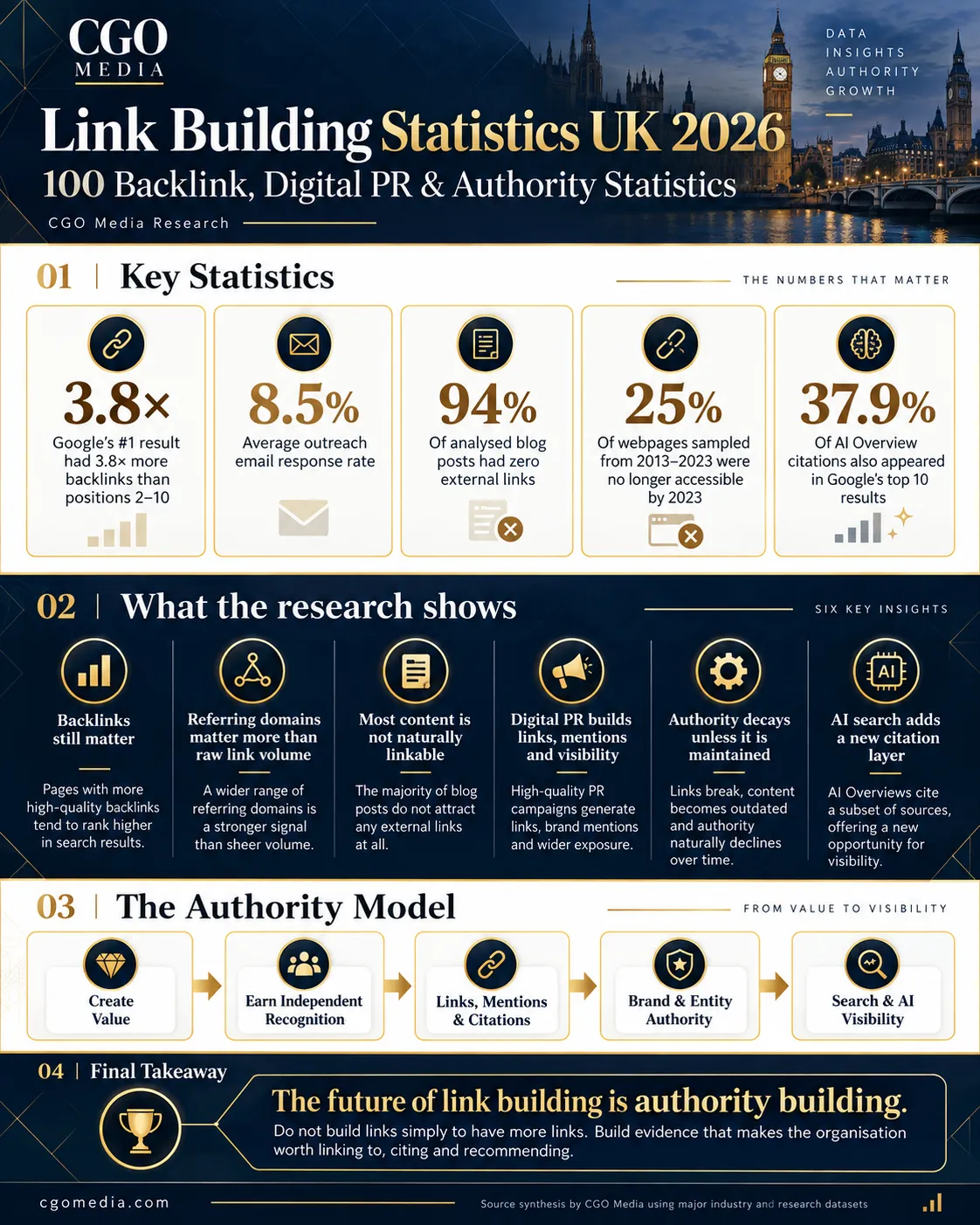
Link building has changed substantially from the period when backlink volume alone was treated as a primary measure of off-page SEO performance.
In 2026, organisations increasingly need to consider a much broader authority environment involving:
- referring domains;
- editorial backlinks;
- topical relevance;
- Digital PR;
- brand mentions;
- original research;
- journalist coverage;
- entity authority;
- source credibility;
- and AI citation visibility.
This research brings together 100 quantitative statistics examining how backlinks, Digital PR, authority signals and earned media continue to influence Search visibility while also becoming increasingly relevant to AI-powered discovery.
The objective is not to argue that links operate in isolation.
Instead, the research examines how links interact with:
- content quality;
- brand authority;
- technical SEO;
- entity understanding;
- Search rankings;
- website traffic;
- media visibility;
- and AI source selection.
Executive Summary
The evidence reviewed for this research points toward an important change in how link building should be understood.
The traditional model:
More Links → Higher Rankings
is increasingly inadequate.
The emerging model is closer to:
Relevant Content
↓
Editorial Discovery
↓
Brand Mention
↓
Backlink / Citation
↓
Authority Reinforcement
↓
Search & AI Visibility
The strongest links tend to emerge from content and organisations that provide something worth referencing.
That may include:
- original research;
- new statistics;
- expert commentary;
- unique datasets;
- industry analysis;
- tools and calculators;
- visual assets;
- or genuinely useful resources.
This increasingly connects traditional link building with Digital PR, research-led content and wider Brand Authority.
What the 100 Statistics Examine
The 100 statistics are organised into ten research areas.
| Section | Research Area | Primary Focus |
|---|---|---|
| 1 | Backlinks & Google Ranking Statistics | Referring domains, rankings, Search visibility and organic traffic. |
| 2 | Link Authority & Relevance Statistics | Authority, topical relevance, quality and link context. |
| 3 | Link Acquisition & Outreach Statistics | Outreach performance, response rates and acquisition efficiency. |
| 4 | Digital PR Statistics | Earned media, journalist outreach, campaigns and editorial coverage. |
| 5 | Content That Earns Links | Research, statistics, tools, reports, infographics and linkable assets. |
| 6 | Link Building Costs & Investment | Budgets, campaign investment, acquisition costs and resources. |
| 7 | Link Loss, Decay & Web Statistics | Broken links, disappearing pages, link attrition and content decay. |
| 8 | Brand Mentions, Entities & Authority | Brand signals, unlinked mentions, entity authority and trust. |
| 9 | AI Search, Citations & Source Authority | Source selection, citations, authority and generative Search visibility. |
| 10 | Link Building Performance & Future Trends | Measurement, commercial outcomes and the evolution of authority building. |
Why Link Building Still Matters in 2026
The role of link building is changing, but the underlying principle remains important.
A backlink represents a relationship between two information resources.
In many cases it can signal that another publisher considers a page sufficiently useful, relevant or authoritative to reference.
The value of that reference depends on far more than whether a link exists.
Important variables can include:
- the authority of the referring source;
- topical relevance;
- editorial context;
- placement;
- surrounding content;
- traffic and audience relevance;
- the credibility of the publisher;
- and whether the reference is genuinely earned.
This is why modern authority building increasingly overlaps with:
SEO + Digital PR + Research + Brand Authority + AI Visibility
From Backlink Acquisition to Authority Building
One of the strongest themes running through this research is the movement away from treating link building as an isolated acquisition activity.
The more durable model is based on creating assets, evidence and expertise that other organisations have a reason to reference.
That changes the question from:
“How do we get more backlinks?”
to:
“What can we publish, prove or contribute that authoritative sources will genuinely want to reference?”
That distinction becomes increasingly important as Search engines and AI systems attempt to evaluate organisations through a wider network of:
- sources;
- citations;
- mentions;
- entities;
- expertise;
- and corroborating evidence.
Central Research Question
The central question examined throughout this study is:
How Are Backlinks, Digital PR, Brand Mentions and Source Authority Combining to Influence Search and AI Visibility in 2026?
The following 100 statistics examine that question across traditional Search, earned media, Brand Authority and emerging AI discovery systems.
Statistics 1–10 — Backlinks & Google Ranking Statistics
Backlinks remain associated with Google Search performance in large-scale ranking studies, although the relationship is more nuanced than simply accumulating the largest possible number of links.
The evidence below examines backlink volume, referring-domain diversity, link growth and the relationship between external links and rankings.
Because large-scale UK-only backlink datasets are limited, this section uses international and US Search datasets. These statistics should therefore be interpreted as Search-industry benchmarks rather than direct measurements of UK websites.
1. Google’s #1 Result Has 3.8× More Backlinks Than Positions 2–10
3.8× more backlinks
Backlinko’s analysis of 11.8 million Google Search results found that the page ranking in position #1 had an average of 3.8 times more backlinks than pages ranking in positions #2–#10.
The study does not prove that additional backlinks caused the higher rankings, but it identifies a clear relationship between stronger backlink profiles and top-ranking pages.
Authority implication: Competing for highly contested Search terms often requires more than strong on-page content. The backlink profile of the pages already ranking should form part of competitive analysis.
Source:
Backlinko — Analysis of 11.8 Million Google Search Results
2. The #1 Google Result Had Around 3× More Referring Domains Than Positions 2–10
Approximately 3× more referring domains
The same 11.8-million-result Backlinko study found that the number of different domains linking to a page was associated with higher rankings.
The #1 Google result had approximately three times more referring domains than pages ranking in positions #2–#10.
This distinction matters because 100 backlinks from one website do not represent the same link diversity as 100 backlinks from 100 independent domains.
Authority implication: Referring-domain diversity is generally a more useful strategic measure than raw backlink totals alone.
Source:
Backlinko — Analysis of 11.8 Million Google Search Results
3. Referring-Domain Diversity Was the 12th Most Influential Factor in Semrush’s 2024 Ranking Study
12th most influential ranking factor
Semrush reports that the number of referring domains ranked as the 12th most influential factor in its 2024 ranking-factor research.
The finding again points toward the importance of earning links from multiple independent websites rather than concentrating link acquisition within a small number of domains.
Authority implication: A diversified backlink profile can provide a broader external evidence network around a website.
Source:
Semrush — Google Ranking Factors
4. Referring Domains Had a 0.255 Correlation With Google Rankings in a One-Million-Keyword Study
Spearman correlation: 0.255
Ahrefs analysed the top 20 results for the one million US keywords with the highest Search volume.
The number of referring domains produced a Spearman correlation of 0.255 with ranking position.
This was one of the strongest link-related correlations measured in the study.
The value is still considered a relatively weak statistical correlation, reinforcing that links are only one part of Google’s ranking systems.
Authority implication: Referring domains matter, but they should be analysed alongside content quality, Search intent, Brand Authority, technical performance and other signals.
Source:
Ahrefs — Google Says Links Matter Less: One Million SERPs Study
5. Total Backlinks Had a 0.248 Correlation With Google Rankings
Spearman correlation: 0.248
Within the same Ahrefs study, the total number of backlinks to a page had a correlation of 0.248 with ranking position.
That was slightly below the 0.255 correlation recorded for referring domains.
The difference supports the argument that link diversity can be more informative than raw link volume.
Authority implication: Reporting only the total number of backlinks can hide important differences in the structure and diversity of a site’s backlink profile.
Source:
Ahrefs — One Million SERPs Link Study
6. Followed Referring Domains Recorded a 0.250 Ranking Correlation
Spearman correlation: 0.250
Ahrefs found that followed referring domains had a ranking correlation of 0.250.
This was extremely close to the 0.255 recorded when all referring domains were measured.
The finding is useful because it demonstrates that backlink analysis should not automatically assume that every useful relationship can be reduced to a simplistic followed-versus-nofollow distinction.
Authority implication: Link evaluation should consider the wider authority and relevance of the referring source rather than relying solely on link attributes.
Source:
Ahrefs — One Million SERPs Link Study
7. Followed Backlinks Recorded a 0.242 Ranking Correlation
Spearman correlation: 0.242
The number of followed backlinks recorded a Spearman correlation of 0.242 with Google ranking position in Ahrefs’ million-keyword analysis.
For comparison:
- All referring domains: 0.255;
- Followed referring domains: 0.250;
- All backlinks: 0.248;
- Followed backlinks: 0.242.
The narrow differences illustrate why backlink metrics should not be interpreted independently or treated as deterministic ranking scores.
Authority implication: The evidence favours examining the complete backlink profile rather than reducing link quality to a single metric.
Source:
Ahrefs — One Million SERPs Link Study
8. External Backlinks Correlated More Than Twice as Strongly With Rankings as Internal Inlinks
0.248 vs 0.117
In Ahrefs’ study, external backlinks had a ranking correlation of 0.248, compared with 0.117 for internal inlinks.
On that specific dataset, the measured backlink correlation was therefore slightly more than twice as large as the internal-link correlation.
This does not mean internal links are unimportant. Internal linking performs different functions including discovery, hierarchy, context and internal authority distribution.
It does demonstrate that independent external references remain statistically associated with competitive Search performance.
Authority implication: Strong internal architecture cannot be assumed to substitute for genuine external authority signals.
Source:
Ahrefs — One Million SERPs Link Study
9. Most #1 Ranking Pages Acquire New Followed Referring Domains at 5%–14.5% Per Month
+5% to +14.5% per month
Ahrefs’ backlink-growth research found that most pages ranking in Google’s #1 position acquired followed backlinks from new referring domains at a rate of approximately 5% to 14.5% per month.
This has an important competitive implication.
A business attempting to close an existing backlink gap may be competing against a moving target because successful pages can continue attracting links while competitors are trying to catch them.
Authority implication: Sustainable link acquisition is not only about reaching today’s competitor benchmark. It also requires understanding competitor link velocity.
Source:
Ahrefs — Backlink Growth of Top-Ranking Pages
10. Only Around 1 in 6,671 Pages With No Referring Domains Received More Than 1,000 Monthly Google Visits
2,997 of approximately 20 million pages
Ahrefs’ 2023 study examined a database of approximately 14 billion pages.
Within its index were around 20 million pages with no referring domains.
Only 2,997 of those pages received more than 1,000 estimated monthly organic Search visits.
That equates to approximately:
1 in every 6,671 pages with no backlinks
Ahrefs also stresses that pages can rank without backlinks, particularly for low-competition topics. The finding should therefore not be interpreted as evidence that every page needs backlinks.
Authority implication: Backlinks become increasingly important when organisations compete for commercially valuable or highly contested Search topics.
Source:
Ahrefs — 14 Billion Page Search Traffic Study
What Statistics 1–10 Tell Us
The first ten statistics support several important conclusions.
First, backlinks remain associated with higher Search rankings, particularly for competitive queries.
Second, referring-domain diversity appears more informative than raw backlink quantity alone.
Third, external link metrics show stronger ranking correlations than internal-link counts within the Ahrefs dataset.
Fourth, successful pages do not necessarily maintain static backlink profiles. Many continue attracting new referring domains after reaching the top of the Search results.
The evidence therefore supports a shift from asking:
“How many backlinks do we have?”
toward:
“Which independent, relevant and authoritative sources are choosing to reference us — and how does that compare with the organisations already visible?”
That provides a more useful foundation for modern Link Building, Digital PR and Authority measurement.
Statistics 11–20 — Link Authority & Relevance Statistics
Not every backlink carries the same contextual or competitive significance.
Modern backlink analysis increasingly considers factors including:
- the strength of the linking page;
- the diversity of referring domains;
- the authority of the wider domain;
- anchor text;
- topical context;
- and whether the linking page itself receives Search visibility.
The statistics below demonstrate why backlink quality cannot be reduced to a simple link count.
As with the previous section, these are primarily international and US Search-industry datasets rather than UK population statistics.
11. Domain Rating Recorded a 0.131 Correlation With Google Rankings
Spearman correlation: 0.131
Ahrefs’ analysis of the top one million US keywords by Search volume found that its Domain Rating metric had a Spearman correlation of 0.131 with Google ranking position.
This was materially lower than the correlations recorded for page-level backlink and referring-domain metrics.
For comparison, the same study recorded:
- Referring domains: 0.255;
- Backlinks: 0.248;
- Domain Rating: 0.131.
Authority implication: The authority of the overall domain matters, but page-level external evidence may provide a more direct competitive signal for an individual ranking URL.
Source:
Ahrefs — One Million SERPs Link Study
12. Position #1 Pages Average More Than 200 Referring Domains
200+ referring domains on average
Semrush reports that pages ranking in Google’s #1 position have more than 200 referring domains on average.
By comparison, pages in approximately position #10 average fewer than 80 referring domains.
The difference does not establish causation, but it demonstrates how substantially backlink profiles can vary across positions within competitive Search results.
Authority implication: Link-gap analysis should focus on referring-domain breadth rather than merely comparing raw backlink totals.
Source:
Semrush — Referring Domains and SEO
13. 8 of Semrush’s Top 20 Ranking Correlation Factors Were Backlink-Related
8 of the top 20 factors
Semrush reports that eight of the 20 factors with the strongest correlations to ranking in its 2024 Ranking Factors research were related to backlinks.
That means backlink-related measurements accounted for 40% of the top 20 factors identified within that particular correlation study.
This should not be interpreted as meaning that links account for 40% of Google’s ranking algorithm.
The research measures correlations within the Semrush dataset rather than Google’s internal weighting systems.
Authority implication: External authority remains strongly represented among observable characteristics associated with high-ranking pages.
Source:
Semrush — Backlink Analysis and Ranking Factors
14. The Median Number of Backlinks for Top-Ranking Pages Was Only 13
Median: 13 backlinks
Although some high-ranking pages in Semrush’s ranking research had thousands of backlinks, the median number of backlinks among top-ranking pages was only 13.
This is an important counterweight to the assumption that strong Search performance always requires extremely large backlink volumes.
Backlink requirements vary substantially according to:
- query competitiveness;
- Search intent;
- existing Brand Authority;
- content quality;
- and the strength of competing pages.
Authority implication: Link building should be based on the competitive environment of the target topic rather than arbitrary backlink-volume targets.
Source:
Semrush — How to Find and Analyse Backlinks
15. Exact-Match Anchor Text Had Only a Weak Correlation With Rankings
Average correlation: 0.1436
Median correlation: 0.1869
Ahrefs studied the top 20 Search results across 19,840 keywords, covering 384,614 webpages, to examine anchor-text relationships.
The percentage of exact-match anchored links showed a Spearman correlation of:
- 0.1436 using the average;
- 0.1869 using the median.
Ahrefs characterised this as a relatively weak relationship.
Authority implication: Exact-match anchor text should not be treated as a shortcut to ranking performance. A natural backlink profile is more important than attempting to engineer rigid anchor-text percentages.
Source:
Ahrefs — Anchor Text Study
16. Phrase-Match Anchor Text Had an Even Weaker Ranking Correlation
Average: 0.1057
Median: 0.1393
Within the same Ahrefs study, phrase-match anchor text produced a Spearman correlation of 0.1057 using average values and 0.1393 using median values.
The measured relationship was weaker than for exact-match anchors.
Authority implication: Anchor wording may provide context, but the evidence does not support treating keyword-rich anchor ratios as a dominant ranking strategy.
Source:
Ahrefs — Anchor Text Study
17. Partial-Match Anchor Text Produced a 0.1076 Average Correlation
Average: 0.1076
Median: 0.1393
Partial-match anchors produced results almost identical to phrase-match anchors.
Ahrefs measured:
- average Spearman correlation: 0.1076;
- median correlation: 0.1393.
Again, this represents only a very weak association.
Authority implication: A backlink’s value cannot reasonably be assessed from anchor-text keyword matching alone.
Source:
Ahrefs — Anchor Text Study
18. Random Anchor Text Had Almost Zero Correlation With Rankings
Average: 0.0161
Median: 0.0130
Ahrefs also examined generic or random anchor text such as phrases comparable to “click here” or “this article”.
The correlations were effectively zero:
- average: 0.0161;
- median: 0.0130.
This reinforces the wider finding that anchor-text ratios alone explain very little about ranking position.
Authority implication: Link acquisition should prioritise legitimate editorial references and useful placement rather than attempting to control every anchor phrase.
Source:
Ahrefs — Anchor Text Study
19. Only 20 of 44,589 SERPs Had Traffic-Bearing Links for Every Top-Ranking Page
20 of 44,589 SERPs
Ahrefs examined 44,589 Search result pages to investigate whether backlinks from pages receiving organic Search traffic were particularly common among high-ranking results.
Only 20 SERPs had at least one traffic-bearing backlink pointing to every page in the top results.
That is approximately:
1 in every 2,229 SERPs
The result challenges simplistic assumptions that a backlink must come from a page receiving substantial organic traffic in order to have potential value.
Authority implication: Referring-page traffic can be a useful quality indicator, but it should not become an absolute requirement for evaluating every backlink.
Source:
Ahrefs — Links From Pages With Traffic Study
20. Around One-Fifth of SERPs Had No Top-Ranking Page With a Traffic-Bearing Backlink
Approximately 20% of SERPs
In the same Ahrefs research, approximately one-fifth of the studied SERPs had no top-ranking page with a backlink from a referring page receiving organic Search traffic.
In other words, pages were capable of reaching Google’s first page even when none of their backlinks originated from pages meeting Ahrefs’ traffic threshold.
This does not mean referring-page traffic is irrelevant.
It means that link quality is multidimensional.
Potential considerations include:
- page-level authority;
- referring-domain strength;
- editorial relevance;
- topical context;
- placement;
- audience;
- and the broader link graph.
Authority implication: Link quality should be evaluated using several signals rather than a single metric such as referring-page traffic.
Source:
Ahrefs — Links From Pages With Traffic Study
What Statistics 11–20 Tell Us
The evidence demonstrates why the idea of a universally “good backlink” is too simplistic.
Several conclusions stand out.
First, page-level backlink strength and referring-domain diversity appear more closely associated with ranking than domain authority alone.
Second, anchor-text optimisation shows only weak correlations with rankings.
This undermines strategies built around aggressively engineering exact-match anchor ratios.
Third, traffic to the referring page should not be used as an absolute quality test.
High-quality link evaluation therefore needs to consider a combination of:
Authority + Relevance + Editorial Context + Referring-Domain Diversity + Placement + Audience Value
The strategic objective should not be to manufacture a backlink profile that matches a theoretical formula.
It should be to create a pattern of credible external references that makes sense for the organisation, its expertise and the topics for which it wants to be recognised.
Statistics 21–30 — Link Acquisition & Outreach Statistics
Link acquisition frequently depends on outreach, but the available evidence demonstrates how difficult cold outreach can be at scale.
Success is influenced by:
- prospect relevance;
- personalisation;
- subject-line construction;
- the number of contacts approached;
- follow-up strategy;
- timing;
- and the strength of the underlying reason for someone to link.
Several statistics in this section come from Backlinko and Pitchbox’s large analysis of 12 million outreach emails. Although this is an older benchmark dataset, its scale makes it useful for understanding the mechanics of outreach. More recent BuzzStream research covering over 51 million emails is included to provide a contemporary comparison.
21. Only 8.5% of Outreach Emails Received a Response
8.5% response rate
Backlinko and Pitchbox analysed 12 million outreach emails and found that only 8.5% received a response.
That means approximately:
1 response for every 12 outreach emails
The study highlights one of the central difficulties of traditional link acquisition: most unsolicited outreach does not generate an observable reply.
Outreach implication: Link-building forecasts should begin with realistic response assumptions rather than expecting every relevant publisher to engage.
Source:
Backlinko / Pitchbox — 12 Million Outreach Email Study
22. 91.5% of Outreach Emails Received No Response
91.5% received no reply
The inverse of the 8.5% response rate is equally important.
Backlinko’s dataset found that 91.5% of outreach emails were ignored or otherwise received no response.
This demonstrates why increasing email volume alone can be an inefficient strategy.
If relevance and targeting remain poor, increasing the number of emails can simply increase the number of ignored messages.
Outreach implication: Prospect quality and pitch relevance should generally be improved before campaign volume is increased.
Source:
Backlinko / Pitchbox — 12 Million Outreach Email Study
23. Longer Outreach Subject Lines Produced 24.6% Higher Response Rates
+24.6% average response rate
Backlinko found that outreach emails with longer subject lines produced an average response rate 24.6% higher than emails with shorter subject lines.
A longer subject line may provide room to communicate additional context, relevance or specificity before the recipient opens the message.
The finding should not be interpreted as meaning that every subject line should simply be made longer.
Relevance and clarity remain more important than adding unnecessary words.
Outreach implication: Subject lines should communicate why the email matters to the recipient rather than relying only on short generic phrases.
Source:
Backlinko / Pitchbox — 12 Million Outreach Email Study
24. Personalised Subject Lines Increased Response Rates by 30.5%
+30.5%
Outreach emails with personalised subject lines received 30.5% higher response rates than emails without subject-line personalisation.
Personalisation can help indicate that the sender has identified the recipient intentionally rather than adding them to an indiscriminate bulk list.
However, meaningful personalisation requires more than automatically inserting a first name.
Useful personalisation can reference:
- a journalist’s recent coverage;
- a relevant article;
- a publication’s audience;
- a specific resource;
- or a genuine connection between the proposed asset and the recipient’s subject area.
Outreach implication: Relevance-based personalisation can materially improve the probability of engagement.
Source:
Backlinko / Pitchbox — 12 Million Outreach Email Study
25. Personalising the Email Body Increased Response Rates by 32.7%
+32.7%
Backlinko found that outreach emails with personalised body copy generated 32.7% higher response rates than emails without personalised message content.
The finding is particularly relevant to scaled link building.
Automated templates may improve efficiency, but excessive standardisation can remove the context that explains why the recipient was approached.
Outreach implication: Automation can support outreach operations, but the underlying message still needs to demonstrate specific relevance to the recipient.
Source:
Backlinko / Pitchbox — 12 Million Outreach Email Study
26. Multiple Outreach Attempts Generated Twice as Many Responses
2× more responses
The Backlinko/Pitchbox analysis found that contacting the same prospect multiple times generated approximately twice as many responses as sending only one outreach email.
Recipients may miss an initial email because of:
- inbox volume;
- timing;
- other priorities;
- holidays;
- or simply not seeing the message.
A relevant follow-up can therefore recover opportunities that would otherwise have been lost.
Outreach implication: A campaign should not automatically be judged as unsuccessful after the first email, although follow-ups should remain proportionate and relevant.
Source:
Backlinko / Pitchbox — 12 Million Outreach Email Study
27. Contacting Multiple People at the Same Organisation Increased Responses by 93%
+93% response rate
Sending outreach to more than one relevant contact at an organisation produced a response rate 93% higher than contacting only one person.
The effect was particularly relevant for larger organisations where responsibility for:
- content;
- editorial decisions;
- PR;
- partnerships;
- or website management
may be distributed across several people.
Backlinko also found diminishing returns after approximately five contacts.
Outreach implication: Identifying the correct person can be as important as identifying the correct website.
Source:
Backlinko / Pitchbox — 12 Million Outreach Email Study
28. Multiple Contacts Combined With Multiple Messages Increased Responses by 160%
+160%
When Backlinko compared a single email to one person with campaigns using multiple messages and multiple contacts, the latter generated a 160% higher response rate.
This was one of the strongest differences identified in the 12-million-email study.
It demonstrates how outreach performance can depend on the campaign process rather than merely the wording of one email.
Outreach implication: Structured outreach sequences can outperform one-off mass emailing when the contacts are genuinely relevant.
Source:
Backlinko / Pitchbox — 12 Million Outreach Email Study
29. A 2025 Study Found a 3.59% Reply Rate Across Link-Building Outreach
3.59% reply rate
BuzzStream analysed a dataset containing more than 51 million emails and reported an overall reply rate of 3.59% for link-building outreach.
That equates to approximately:
1 reply for every 28 link-building emails
The result is materially below the older 8.5% Backlinko/Pitchbox benchmark.
The studies use different datasets, populations and time periods, so the difference should not automatically be interpreted as proof that outreach effectiveness has declined by a specific amount.
It does demonstrate that response-rate assumptions can vary considerably according to campaign type and dataset.
Outreach implication: Organisations should establish their own baseline reply and placement rates rather than applying one industry benchmark universally.
Source:
BuzzStream — Analysis of More Than 51 Million Outreach Emails
30. 57% of Link-Building Replies Arrived Within Six Hours
57% within 6 hours
BuzzStream’s 2025 outreach analysis found that 57% of link-building replies arrived within six hours of the original email.
Almost 90% arrived within two days.
The average response time was 12.85 hours, with slower responses creating a longer tail.
This provides useful context for follow-up timing.
An immediate second email may be unnecessary when a significant proportion of interested recipients respond during the first day.
Outreach implication: Outreach teams should measure response timing as well as response rate and avoid judging campaign performance too quickly.
Source:
BuzzStream — How Long Does It Take to Get Email Outreach Replies?
What Statistics 21–30 Tell Us
The outreach data highlights why link acquisition should not be reduced to sending larger quantities of email.
Three findings are especially important.
First, response rates are generally low.
Both the historical 12-million-email benchmark and the newer 51-million-email BuzzStream analysis show that most outreach emails receive no reply.
Second, relevance and personalisation materially affect performance.
Personalised subject lines and personalised email copy both generated response-rate improvements of approximately 30% in the Backlinko/Pitchbox dataset.
Third, campaign structure matters.
Follow-ups, identifying the right contacts and using structured sequences can materially change the probability of receiving a response.
The practical model is therefore closer to:
Relevant Prospect
↓
Relevant Asset
↓
Personalised Pitch
↓
Correct Contact
↓
Measured Follow-Up
↓
Conversation
↓
Editorial Decision
↓
Potential Link
Most importantly, a reply is not the same as a backlink.
Outreach programmes should ultimately measure:
- positive replies;
- editorial placements;
- links earned;
- link quality;
- referring-domain quality;
- and downstream Search or commercial impact.
Response rate is an operational metric. The final objective is credible editorial authority.
Statistics 31–40 — Digital PR Statistics
Digital PR has become one of the principal ways organisations attempt to earn authoritative editorial coverage and backlinks.
Unlike traditional link acquisition, Digital PR normally begins with something intended to be genuinely newsworthy or useful to journalists, including:
- original data;
- research;
- expert commentary;
- newsjacking;
- creative campaigns;
- press releases;
- and proprietary insight.
The statistics below combine BuzzStream’s 2026 State of Digital PR research involving more than 150 Digital PR professionals with Muck Rack’s research involving more than 1,500 journalists.
Together, the datasets provide perspectives from both sides of the media relationship: the professionals seeking coverage and the journalists deciding what is worth covering.
31. 85.8% of Digital PR Professionals Say Backlink Building Is an Effective Outcome of Digital PR
85.8%
BuzzStream’s 2026 State of Digital PR research found that 85.8% of respondents identified building backlinks as an area where Digital PR is effective.
Backlinks remained the most frequently identified outcome in the study, ahead of other effects including Brand Awareness and organic Search performance.
This is important because Digital PR is increasingly discussed as a broader Brand Authority discipline, but earned links remain a major part of how practitioners evaluate its value.
Digital PR implication: Editorial link acquisition remains one of the clearest measurable connections between PR activity and Search Authority.
Source:
BuzzStream — State of Digital PR Report 2026
32. 68.2% Say Digital PR Is More Effective Than It Was 12 Months Earlier
68.2%
More than two-thirds of Digital PR professionals surveyed by BuzzStream said Digital PR had become more effective during the previous 12 months.
BuzzStream reported the figure at 68.2%.
This is a practitioner perception rather than an independently measured performance outcome, but it provides evidence of confidence within the Digital PR industry during 2026.
Digital PR implication: Digital PR practitioners increasingly see earned media as relevant to a wider visibility environment rather than solely conventional media exposure.
Source:
BuzzStream — State of Digital PR Report 2026
33. 85.2% Say Digital PR Produces Measurable Results Within Six Months
85.2% within six months
BuzzStream found that 85.2% of surveyed Digital PR professionals said measurable campaign results typically appear within six months.
This helps establish an important distinction between:
- the time required to secure the first piece of coverage;
- the time required to build a portfolio of coverage and links;
- and the longer period potentially required to observe Search or commercial impact.
Digital PR implication: Campaign evaluation should not be limited to whether a story receives coverage immediately after launch.
Source:
BuzzStream — State of Digital PR Report 2026
34. 51.4% Report That Measurable Digital PR Results Typically Take Three to Six Months
51.4%: three to six months
More specifically, 51.4% of respondents said it normally takes approximately three to six months for a Digital PR campaign to generate measurable results.
BuzzStream reported that this proportion was around five percentage points higher than in its previous study.
The finding supports a longer-term view of Digital PR rather than treating each campaign as an isolated short-term link acquisition exercise.
Digital PR implication: Sustainable authority programmes need sufficient time to accumulate coverage, links, mentions and associated visibility signals.
Source:
BuzzStream — State of Digital PR Report 2026
35. 81% of Digital PR Professionals Secure Their First Coverage Within One Week
81% within one week
Although overall campaign effects may take months to assess, initial editorial coverage can occur much faster.
BuzzStream found that 81% of Digital PR professionals reported securing first coverage within one week of pitching.
The most commonly reported individual timeframe was three to five days, selected by 29.9% of respondents.
Digital PR implication: Initial media pickup and longer-term campaign performance should be measured separately.
Source:
BuzzStream — State of Digital PR Report 2026
36. 85.1% Use Quality Links as a Digital PR Success Metric
85.1%
The most commonly reported Digital PR success metric in BuzzStream’s 2026 study was the number of quality links.
It was tracked by 85.1% of respondents.
Other commonly monitored measures included:
- total mentions: 72.3%;
- total links: 70.9%;
- organic traffic and rankings: 63.5%.
The distinction between total links and quality links is significant.
Digital PR implication: Digital PR teams increasingly recognise that the source and quality of editorial coverage matter more than accumulating the largest possible raw placement count.
Source:
BuzzStream — State of Digital PR Report 2026
37. 32.5% Say One Digital PR Professional Can Generate 31+ Links Per Month
32.5% report 31+ monthly links
BuzzStream found that 32.5% of respondents believed a single Digital PR team member could generate an average of 31 or more links per month.
That equates to roughly one link per day.
The study notes that the figure does not automatically distinguish every link according to:
- authority;
- relevance;
- syndication;
- follow attributes;
- or editorial value.
Digital PR implication: Link volume can vary considerably between campaigns and sectors, making quality and relevance necessary alongside output targets.
Source:
BuzzStream — State of Digital PR Report 2026
38. 84% of Journalists Say Stories Often Begin With PR Pitches
84%
Muck Rack’s 2025 State of Journalism research, based on responses from more than 1,500 journalists, found that 84% said stories often begin with pitches from PR professionals.
The finding demonstrates that journalist pitching remains capable of contributing directly to editorial discovery.
However, this does not mean journalists welcome indiscriminate outreach.
Digital PR implication: A strong, relevant pitch can provide journalists with a legitimate starting point for editorial coverage.
Source:
Muck Rack — State of Journalism 2025
39. 86% of Journalists Ignore Off-Topic PR Pitches
86% ignore off-topic pitches
Muck Rack found that 86% of journalists ignore pitches that are outside their area of coverage.
This is one of the clearest quantitative arguments against indiscriminate media-list building.
A campaign can have:
- strong data;
- a compelling headline;
- good creative assets;
- and an experienced PR team
and still underperform if the story is sent to journalists who do not cover the subject.
Digital PR implication: Journalist relevance is not a minor optimisation. It is a fundamental part of campaign distribution.
Source:
Muck Rack — State of Journalism 2025
40. 69% of Journalists Prefer PR Pitches Under 200 Words
69% prefer fewer than 200 words
Muck Rack’s journalism research found that 69% of journalists prefer pitches containing fewer than 200 words.
This matters because journalists operate in exceptionally crowded inbox environments.
Separate Muck Rack findings show that on a normal day:
- 55% of journalists receive more than five PR pitches;
- 17% receive between 11 and 20 pitches.
A pitch therefore needs to communicate the essential story quickly.
Digital PR implication: The strongest pitch is usually not the longest explanation of the campaign. It is the clearest explanation of why the story matters to that journalist and their audience.
Source:
Muck Rack — State of Journalism Pitching Preferences
What Statistics 31–40 Tell Us
Digital PR sits at the intersection of Search Authority and editorial relevance.
The practitioner evidence shows that backlinks remain one of the most important measurable outputs of Digital PR.
But the journalist evidence demonstrates why those links cannot simply be manufactured through volume.
Journalists receive large numbers of pitches and overwhelmingly ignore material that does not match their area of coverage.
The effective Digital PR process is therefore closer to:
Original Insight
↓
Newsworthy Story
↓
Relevant Journalist
↓
Concise Pitch
↓
Editorial Evaluation
↓
Media Coverage
↓
Brand Mention / Backlink
↓
Authority
The central lesson is that Digital PR links are earned as a consequence of editorial value.
That is fundamentally different from treating the backlink itself as the starting point.
Statistics 41–50 — Content That Earns Links: Research, Data, Statistics, Tools & Linkable Assets
The majority of published content earns very few external links.
This makes the type of content an organisation creates increasingly important.
Large-scale content studies consistently suggest that certain assets are more naturally referenceable than ordinary promotional or informational content.
These can include:
- original research;
- statistics;
- new datasets;
- industry reports;
- reference resources;
- infographics;
- tools;
- and authoritative answers to important questions.
Several of the largest quantitative studies in this area are older than the 2026 publication date of this research. They are included because they analyse exceptionally large content datasets and continue to provide useful benchmarks. Their dates should be considered when interpreting the findings.
41. 94% of 912 Million Blog Posts Had Zero External Links
94% received no external links
Backlinko and BuzzSumo analysed 912 million blog posts and found that 94% had received zero external links.
Only approximately 6% of the content in the dataset had earned at least one external backlink.
The scale of the study illustrates how unusual naturally linked content actually is.
Content implication: Simply publishing content does not make it linkable. A resource needs a reason for another publisher to cite or reference it.
Source:
Backlinko / BuzzSumo — Analysis of 912 Million Blog Posts
42. Only 2.2% of Content Earned Links From More Than One Website
2.2%
Within the same 912-million-post dataset, only 2.2% of content generated backlinks from more than one website.
This is a more demanding benchmark than simply earning one backlink.
It measures whether multiple independent publishers considered the resource worth referencing.
Content implication: Assets capable of earning links from multiple independent domains are relatively rare and potentially much more valuable for building referring-domain diversity.
Source:
Backlinko / BuzzSumo — Analysis of 912 Million Blog Posts
43. Content Over 3,000 Words Earned 77.2% More Referring-Domain Links Than Content Under 1,000 Words
+77.2% referring-domain links
Backlinko and BuzzSumo found that content exceeding 3,000 words received an average of 77.2% more links from referring domains than content containing fewer than 1,000 words.
The finding does not mean that adding unnecessary words causes backlinks.
Longer resources may have greater potential to provide:
- more evidence;
- more original analysis;
- greater topic coverage;
- more reference points;
- and more reasons for other publishers to cite them.
Content implication: Comprehensive resources can have greater link-earning potential when additional depth adds genuine informational value.
Source:
Backlinko / BuzzSumo — Analysis of 912 Million Blog Posts
44. “Why”, “What” and Infographic Content Earned 25.8% More Referring-Domain Links Than How-To Posts and Videos
+25.8%
The 912-million-post study found that “Why” posts, “What” posts and infographics received an average of 25.8% more referring-domain links than how-to articles and videos.
These formats often provide information that can be incorporated into another publisher’s work as:
- an explanation;
- a definition;
- a supporting reference;
- or a visual citation.
Content implication: Content designed to become a reference resource may have different characteristics from content designed primarily to generate immediate visits or social engagement.
Source:
Backlinko / BuzzSumo — Analysis of 912 Million Blog Posts
45. Social Shares and Backlinks Had a Correlation of Only 0.078
Pearson correlation: 0.078
Backlinko and BuzzSumo found almost no relationship between the number of social shares received by an article and the number of backlinks it earned.
The measured Pearson correlation coefficient was only 0.078.
This is important because highly shareable content is sometimes assumed to be highly linkable.
The evidence suggests that people may share and cite content for different reasons.
Content implication: Social engagement and link acquisition should be measured as different content outcomes rather than being treated as interchangeable indicators of success.
Source:
Backlinko / BuzzSumo — Analysis of 912 Million Blog Posts
46. 93% of B2B Content Received Zero External Links
93% of B2B content had no external links
Backlinko and BuzzSumo separately examined the B2B subset of their dataset.
They found that 93% of B2B content received no external backlinks.
This was close to the 94% recorded across the complete dataset.
The result is particularly relevant to professional-services, SaaS, technology, manufacturing and other B2B organisations publishing large volumes of informational content.
Content implication: Producing B2B articles at scale does not automatically create external authority. Content needs distinctive informational value if it is expected to earn citations.
Source:
Backlinko / BuzzSumo — B2B Content Analysis
47. Only 3% of B2B Content Earned Links From More Than One Website
3%
Within the B2B subset, only 3% of content received links from more than one website.
The result closely matched the 2.2% level recorded across the broader dataset.
This demonstrates how difficult it is for ordinary B2B content to earn repeated independent references.
Content implication: B2B organisations seeking authority should identify a smaller number of high-value reference assets rather than assuming every article needs to become a link magnet.
Source:
Backlinko / BuzzSumo — B2B Content Analysis
48. The Median Number of Backlinks Across 100 Million Articles Was Zero
Median backlinks: 0
BuzzSumo’s analysis of approximately 100 million articles published during 2017 found that the median number of backlinks received by an article was zero.
In other words, the typical article in that very large dataset did not receive a backlink.
The research identified stronger backlink performance among authoritative:
- research content;
- reference content;
- opinion content;
- and long-form resources.
Content implication: Link acquisition is an exceptional outcome rather than the default result of content publication.
Source:
BuzzSumo — Content Trends 2018, Analysis of 100 Million Articles
49. More Than 70% of the 100 Million Articles Were Never Linked to From Another Domain
More than 70% received no domain links
The same BuzzSumo analysis found that more than 70% of all content in the 100-million-article sample was never linked to from another domain.
BuzzSumo’s later, larger collaboration with Backlinko produced an even higher zero-link figure for blog content, demonstrating how results can vary according to:
- sample construction;
- content type;
- measurement period;
- and the underlying index.
Content implication: Zero-link percentages should not be treated as universal constants, but multiple large studies agree that most published content attracts little or no external linking activity.
Source:
BuzzSumo — Content Trends 2018
50. One Annual Research Report Earned 10× the Domain Links of Other Content With Similar Social Sharing
10× more domain links
BuzzSumo’s research into content that attracts both links and shares examined the annual industry research published by Social Media Examiner.
Its annual survey report received approximately ten times the number of domain links generated by other content on the site receiving comparable levels of social sharing.
BuzzSumo identified original research and valuable insights as one of the content categories repeatedly represented among highly referenceable material.
This is a case study from an individual publisher rather than a universal content benchmark, but it illustrates why proprietary data can become a persistent citation asset.
Content implication: An organisation that produces the underlying evidence becomes the primary source other writers can cite when discussing the finding.
Source:
BuzzSumo / Majestic — Research Into Content That Gets Links and Shares
What Statistics 41–50 Tell Us
The central finding is straightforward:
Most Content Is Published.
Very Little Content Is Referenced.
That distinction should influence how organisations approach link building.
If the objective is to earn editorial links, the content needs to give another publisher something worth citing.
The strongest candidates frequently include:
- original datasets;
- consumer surveys;
- industry statistics;
- benchmark studies;
- annual reports;
- new analysis;
- reference guides;
- interactive tools;
- calculators;
- and visual representations of useful evidence.
This creates a fundamentally different model from producing ordinary articles and subsequently trying to persuade websites to link to them.
The stronger model is:
Identify an Information Gap
↓
Generate New Evidence
↓
Publish the Primary Source
↓
Make the Evidence Easy to Understand
↓
Distribute It to Relevant Publishers
↓
Earn Mentions, Citations & Links
↓
Build Authority Over Time
This is one of the principal reasons research-led publishing and Digital PR increasingly overlap.
Original research can simultaneously function as:
- a Search asset;
- a journalist resource;
- a backlink asset;
- a source of statistics;
- a Brand Authority signal;
- and a potential source for AI-generated answers.
Statistics 51–60 — Link Building Costs & Investment Statistics
Modern link acquisition is not cost-free simply because the final backlink is editorially earned.
Investment can include:
- research;
- data collection;
- surveys;
- content production;
- creative assets;
- media databases;
- journalist outreach;
- PR expertise;
- analysis;
- and campaign management.
The statistics below primarily draw on two BuzzStream studies: its 2026 State of Digital PR survey of more than 150 professionals and a separate Digital PR pricing survey of approximately 70 agencies, freelancers and consultants.
The pricing survey is particularly relevant to this UK research because 54% of respondents were UK-based.
All monetary figures are reported in US dollars, matching the original research.
51. Around 60% of Digital PR Teams Report Monthly Budgets Below $10,000
Approximately 60% below $10,000 per month
BuzzStream’s 2026 State of Digital PR study found that approximately 60% of respondents operated with monthly Digital PR budgets below $10,000.
This demonstrates that Digital PR investment spans a wide range rather than being limited to large enterprise-level campaigns.
However, the research also shows increasing investment at the upper end of the market.
Investment implication: Digital PR should be budgeted as an ongoing authority-building activity rather than viewed only as the cost of individual links.
Source:
BuzzStream — State of Digital PR Report 2026
52. 25.7% of Digital PR Teams Report Monthly Budgets Below $5,000
25.7% below $5,000 per month
In 2026, 25.7% of surveyed Digital PR professionals reported monthly budgets below $5,000.
The comparable figure in the previous year’s BuzzStream research was 34.1%.
The share of respondents operating at the lowest budget level therefore decreased by 8.4 percentage points.
Investment implication: The distribution is moving away from the lowest budget tier, suggesting greater investment among at least part of the Digital PR market.
Source:
BuzzStream — State of Digital PR Report 2026
53. The Share of Teams Spending $20,000+ Per Month More Than Doubled to 8.8%
4% → 8.8%
BuzzStream found that the proportion of respondents reporting Digital PR budgets of $20,000 or more per month increased from 4% to 8.8%.
That represents more than a doubling of the share operating in the highest budget bracket measured in the report.
Higher campaign budgets can reflect investment in:
- larger proprietary datasets;
- consumer surveys;
- creative production;
- specialist PR staff;
- media monitoring;
- and sustained campaign activity.
Investment implication: At the upper end of the market, authority building is increasingly being funded as a substantial ongoing marketing function.
Source:
BuzzStream — State of Digital PR Report 2026
54. The Most Common Reported Cost per Link Range Is $300–$500
$300–$500 — reported by 19.6%
Among respondents able to report a cost per link, the most common range in BuzzStream’s 2026 survey was $300–$500.
This range was selected by 19.6% of respondents.
Cost per link remains widely used because it converts PR activity into an easily understood acquisition metric.
However, two backlinks costing the same amount can differ substantially in:
- publisher authority;
- editorial relevance;
- audience;
- brand exposure;
- traffic;
- and long-term value.
Investment implication: Cost per link can provide operational context, but it should not be used as a substitute for measuring link quality or business impact.
Source:
BuzzStream — State of Digital PR Report 2026
55. 10.2% Now Report a Cost per Link of $750 or More
10.2% report $750+ per link
BuzzStream found that 10.2% of respondents reported an average cost per link of at least $750 in 2026.
The equivalent figure in its previous research was only 3%.
The share of respondents operating in this higher cost bracket therefore increased by more than three times.
This should not be interpreted as meaning that every backlink has a market value of $750 or more.
Earned editorial links do not have a universal price.
Investment implication: Higher-quality campaigns can require significant research, production and specialist labour even when the resulting editorial link itself is not purchased.
Source:
BuzzStream — State of Digital PR Report 2026
56. 39.2% of Digital PR Professionals Do Not Know Their Cost per Link
39.2% do not know their CPL
Despite the continued use of cost per link as a reporting metric, 39.2% of respondents in BuzzStream’s 2026 State of Digital PR study said they did not know their average cost per link.
That was down from 51.4% in the previous year.
The figure illustrates the difficulty of reducing Digital PR to a single link-acquisition cost.
Campaigns may simultaneously generate:
- links;
- brand mentions;
- media coverage;
- referral traffic;
- Search visibility;
- and AI citations.
Investment implication: A complete measurement model needs to examine the wider return produced by earned media rather than calculating only link volume divided by campaign expenditure.
Source:
BuzzStream — State of Digital PR Report 2026
57. The Average Digital PR Contract in BuzzStream’s Pricing Study Was $5,458 Per Month
$5,458 average monthly contract
BuzzStream’s separate Digital PR pricing study surveyed approximately 70 agency leaders, freelancers and consultants.
The average monthly Digital PR contract across all respondents was approximately $5,458.
The dataset was particularly relevant to the UK market because 54% of survey participants were UK-based, compared with 23% from the United States.
Investment implication: Professional Digital PR commonly represents a recurring monthly investment rather than a low-cost transactional link acquisition service.
Source:
BuzzStream — Digital PR Cost Survey
58. The Average Reported Digital PR Cost per Link Was $597
$597 average cost per link
Across BuzzStream’s Digital PR pricing survey, the calculated average cost per link was $597.
Approximately one quarter of respondents reported a cost below $300, while other responses were distributed across substantially higher ranges.
The overall figure should be interpreted cautiously because campaign types varied considerably.
The research included activities ranging from:
- guest posting;
- journalist-request responses;
- reactive PR;
- proactive PR;
- and larger hero-content campaigns.
Investment implication: Comparing Digital PR providers purely on cost per link can be misleading unless the underlying service model and quality expectations are also comparable.
Source:
BuzzStream — Digital PR Cost Survey
59. UK Respondents Reported an Average Cost per Link of $818
UK average CPL: $818
When BuzzStream separated its Digital PR pricing survey geographically, UK respondents recorded an average cost per link of $818.
The comparable figures were:
- UK: $818;
- Other markets: $461;
- United States: $350.
The reported UK cost per link was therefore more than twice the US figure within this particular survey.
BuzzStream observed that UK respondents were more heavily represented in comparatively resource-intensive services such as hero content and reactive/proactive PR, while US respondents were more likely to report journalist-request and guest-posting services.
UK implication: Cost comparisons between markets need to account for differences in the type of Digital PR being delivered rather than assuming identical service models.
Source:
BuzzStream — UK vs US Digital PR Cost Analysis
60. Around 75% of Digital PR Contracts Run for More Than Six Months
Approximately 75% exceed six months
BuzzStream’s pricing research found that approximately three quarters of Digital PR contracts lasted longer than six months.
Only around one quarter fell into the three-month-or-shorter category.
The study also found substantial differences between agencies and freelancers:
- 53% of agency contracts were in the 6–11 month range;
- 35% of agency contracts lasted 12 months or longer;
- compared with 43% and 20% respectively among freelancers and consultants.
This supports the view that authority building is generally treated as a continuing programme rather than a short isolated intervention.
Investment implication: Organisations should evaluate Digital PR across a sufficiently long period to measure accumulated links, media coverage, authority and Search impact.
Source:
BuzzStream — Digital PR Cost Survey
What Statistics 51–60 Tell Us
The cost evidence demonstrates why modern link building should not be viewed as a simple exercise in purchasing or producing a fixed number of backlinks.
The financial investment behind credible authority building may fund:
Research + Data + Expertise + Creative Production + Journalist Outreach + Measurement
rather than the link itself.
Three conclusions stand out.
First, Digital PR is increasingly funded as an ongoing programme.
Approximately three quarters of contracts in BuzzStream’s pricing research extended beyond six months.
Second, costs vary substantially according to the type of campaign being delivered.
Research-led hero content, proactive PR and other resource-intensive campaigns cannot reasonably be compared with lower-cost transactional services on link price alone.
Third, cost per link is an incomplete performance measure.
The same campaign can generate:
- editorial links;
- unlinked Brand Mentions;
- media visibility;
- journalist relationships;
- organic Search improvements;
- referral traffic;
- and AI citation visibility.
The better investment question is therefore not:
“How cheaply can we acquire a backlink?”
It is:
“What Authority, Visibility and Commercial Value Did the Investment Create?”
That distinction becomes increasingly important as Digital PR contributes to both traditional Search and emerging AI discovery.
Statistics 61–70 — Link Loss, Content Decay & the Disappearing Web
Backlinks are not permanent assets.
Pages disappear, domains close, publishers update articles, URLs change and links are removed.
This process creates link rot and wider digital decay across the web.
The statistics below draw primarily on Pew Research Center’s large-scale analysis of almost one million historical webpages and Ahrefs’ study of links pointing to more than two million websites.
Together, they demonstrate why authority building requires not only earning new links but also monitoring and preserving existing ones.
61. 25% of Webpages From 2013–2023 Were No Longer Accessible by October 2023
25% of webpages disappeared
Pew Research Center analysed a random sample of just under one million webpages collected through Common Crawl between 2013 and 2023.
By October 2023, 25% of those webpages were no longer accessible.
The finding demonstrates that a substantial proportion of published web content disappears over time.
Authority implication: A backlink portfolio is not static. Links earned today may disappear as the pages and websites containing them change.
Source:
Pew Research Center — When Online Content Disappears
62. 38% of Webpages That Existed in 2013 Were Gone a Decade Later
38% inaccessible after approximately a decade
The effect becomes more pronounced as content ages.
Pew found that 38% of webpages captured in its 2013 sample were no longer accessible in 2023.
In other words, almost four in ten sampled pages disappeared within approximately a decade.
Authority implication: Long-term authority strategies need to account for the natural erosion of external references as older content disappears from the web.
Source:
Pew Research Center — When Online Content Disappears
63. Around 22% of Webpages From 2021 Were Already Inaccessible by 2023
22% inaccessible within roughly two years
Digital decay is not confined to very old parts of the web.
Pew found that approximately 22% of webpages captured in its 2021 sample were no longer accessible by 2023.
This means that around one in five sampled pages had disappeared within roughly two years.
Authority implication: Link loss can occur much faster than organisations may assume, making backlink monitoring relevant even for recently acquired links.
Source:
Pew Research Center — When Online Content Disappears
64. 16% of Historical Pages Became Inaccessible While Their Parent Domain Remained Active
16% individual-page disappearance
Of the webpages Pew examined from 2013–2023, 16% were individually inaccessible even though the root-level website remained functional.
This type of decay can occur when publishers:
- delete old articles;
- remove obsolete resources;
- change URL structures;
- consolidate content;
- or fail to implement redirects correctly.
Authority implication: A backlink can disappear even when the referring website itself remains healthy and active.
Source:
Pew Research Center — When Online Content Disappears
65. 9% of Historical Pages Were Inaccessible Because the Entire Root Domain No Longer Functioned
9% lost with the entire domain
A further 9% of webpages in Pew’s 2013–2023 sample were inaccessible because their entire root-level domain was no longer functioning.
This is an important distinction from an individual article simply being deleted.
When an entire domain disappears, every backlink from that website may effectively disappear with it.
Authority implication: A diversified backlink profile can reduce dependence on any single external website or publisher remaining permanently active.
Source:
Pew Research Center — When Online Content Disappears
66. 23% of News Webpages Contained at Least One Broken Link
23% of news pages
Pew sampled 500,000 pages from 2,063 news and information websites.
Across those pages, 23% contained at least one broken external link.
The research analysed more than 14 million external links from the sampled news pages.
Overall, approximately 5% of those external links pointed to pages that were no longer accessible.
Authority implication: Editorial coverage from news publishers can decay over time as the external resources journalists originally referenced disappear.
Source:
Pew Research Center — News Website Link Decay
67. 21% of Government Webpages Contained at Least One Broken Link
21% of government webpages
Pew also analysed approximately 500,000 government webpages.
It found that 21% contained at least one broken link.
Across the government websites studied, researchers identified approximately 42 million links.
Around 6% of sampled government links led to pages that were no longer accessible.
Authority implication: Link rot affects even highly established institutional websites. Publisher authority does not guarantee that every reference will remain available indefinitely.
Source:
Pew Research Center — Government Website Link Decay
68. At Least 66.5% of Links in an Ahrefs Nine-Year Study Had Rotted
66.5% link rot
Ahrefs examined links pointing to 2,062,173 websites using backlink data extending from January 2013.
It found that at least 66.5% of links identified during the study period had rotted.
Ahrefs defines link rot as links that no longer point to the original intended resource because pages have been:
- removed;
- redirected;
- changed;
- or become unavailable.
Authority implication: Link attrition is not an exceptional event. Over long periods it is a normal characteristic of the web.
Source:
Ahrefs — Link Rot Study
69. 74.5% of Links in the Ahrefs Study Were Classified as Lost for SEO Purposes
74.5% classified as lost
Ahrefs’ broader definition of links considered lost for SEO purposes produced an even higher figure.
A total of 74.5% of links in the study were classified as lost.
This includes the 66.5% identified as link rot along with additional technical conditions that prevented links from continuing to be counted normally within the Ahrefs index.
Authority implication: Historical backlink totals can substantially overstate the amount of external authority that remains active today.
Source:
Ahrefs — Link Rot Study
70. 47.7% of Lost Links Came From Dropped Pages and 34.2% From Links Being Removed
47.7% dropped pages | 34.2% removed links
Ahrefs identified two dominant causes behind lost links.
- 47.7% came from pages that had been dropped from the Ahrefs index;
- 34.2% occurred because the page still existed but the backlink itself had been removed.
Other causes included:
- 6.45% from crawl errors;
- 5.99% from redirected pages;
- 4.11% because the linking page was no longer found;
- 0.82% because the page was no longer canonical;
- 0.73% because the linking page had been marked noindex.
This matters because different forms of link loss require different responses.
A removed backlink may justify relationship-based outreach, while a backlink pointing to a deleted page on the organisation’s own site may be recoverable through an appropriate redirect.
Authority implication: Lost-link analysis should identify why the backlink disappeared before deciding whether reclamation is possible.
Source:
Ahrefs — Link Rot Study
What Statistics 61–70 Tell Us
The web is not a permanent archive.
Pages disappear.
Domains disappear.
Editorial content is rewritten.
Links are removed.
URLs change.
The consequence is continuous authority erosion.
A backlink programme therefore has two different responsibilities:
Earn New Authority
+
Preserve Existing Authority
This means backlink management should include:
- new referring-domain acquisition;
- lost-link monitoring;
- broken-backlink identification;
- redirect management;
- content migration checks;
- link reclamation;
- and preservation of high-value referenced resources.
There is also an important lesson for research-led link building.
If journalists, researchers and other publishers have linked to a statistics page, research report or data resource, unnecessarily deleting or changing that URL can destroy accumulated authority.
Where an important resource is updated, the stronger model is often:
Preserve the URL
↓
Update the Evidence
↓
Maintain Existing References
↓
Continue Earning New Citations
Authority is therefore not only something an organisation acquires.
Authority Is Also Something an Organisation Has to Maintain.
Statistics 71–80 — Brand Mentions, Entities & Authority Statistics
Authority is broader than backlinks alone.
Search engines, AI systems and consumers can encounter an organisation through a distributed network of external evidence including:
- reviews;
- business profiles;
- directories;
- media coverage;
- social platforms;
- industry websites;
- citations;
- and other third-party references.
These signals help establish whether information about an organisation is consistent, current and corroborated beyond its own website.
The statistics in this section primarily use BrightLocal’s 2026 Local Consumer Review Survey, conducted with a representative panel of 1,002 US adults. These are consumer-authority benchmarks rather than UK population estimates and should not be interpreted as direct Google ranking factors.
71. 97% of Consumers Read Online Reviews for Local Businesses
97% read business reviews
BrightLocal’s 2026 Local Consumer Review Survey found that 97% of respondents read online reviews when researching local businesses.
Reviews create a large body of third-party information about an organisation outside its own website.
They can contain references to:
- products;
- services;
- staff;
- locations;
- customer experiences;
- pricing;
- and operational characteristics.
Authority implication: External reputation has become part of the information environment through which consumers evaluate whether an organisation appears credible.
Source:
BrightLocal — Local Consumer Review Survey 2026
72. 41% of Consumers Always Read Reviews When Researching a Business
41% always read reviews
BrightLocal found that 41% of consumers always read reviews when browsing for businesses.
That was substantially higher than the 29% recorded in the previous year’s survey.
The finding illustrates how external validation can become a routine part of the decision journey rather than an occasional secondary check.
Authority implication: An organisation’s reputation increasingly exists across third-party platforms as well as on its own website.
Source:
BrightLocal — Local Consumer Review Survey 2026
73. Consumers Use an Average of Six Review Platforms When Choosing Businesses
Average: 6 platforms
BrightLocal reports that the average consumer uses six different review sites when researching businesses.
That means organisational reputation is increasingly distributed across multiple platforms rather than concentrated within one profile.
Potential sources can include:
- Google;
- Facebook;
- Trustpilot;
- Tripadvisor;
- Apple Maps;
- sector-specific directories;
- and other third-party platforms.
Entity implication: Consistent business information and reputation across independent sources becomes increasingly important when consumers move between multiple platforms.
Source:
BrightLocal — Local Consumer Review Survey 2026
74. AI Tools for Local Business Recommendations Increased From 6% to 45%
6% → 45%
BrightLocal found that reported use of ChatGPT and other generative AI tools for local business recommendations increased from 6% to 45%.
That made AI tools the third most-used source for local recommendations within the survey.
This development is especially significant for authority building because AI-generated recommendations may draw on information distributed across:
- business websites;
- reviews;
- directories;
- media coverage;
- third-party articles;
- and other online sources.
Entity implication: Consistent third-party information is becoming relevant not only to human research but also to AI-mediated business discovery.
Source:
BrightLocal — Local Consumer Review Survey 2026
75. 47% of Consumers Will Not Use a Business With Fewer Than 20 Reviews
47% require at least 20 reviews
BrightLocal found that 47% of consumers would not use a business with fewer than 20 reviews.
Only 9% said they were willing to use a business with five or fewer reviews.
The number of independent customer references therefore contributes to perceived credibility for many consumers.
This is conceptually similar to referring-domain diversity in link building: repeated independent validation is different from one isolated endorsement.
Authority implication: The breadth of third-party evidence can affect how credible an organisation appears, even where each individual mention is relatively small.
Source:
BrightLocal — Local Consumer Review Survey 2026
76. 74% of Consumers Prioritise Reviews From the Previous Three Months
74% seek recent evidence
BrightLocal found that 74% of consumers look for reviews written within the previous three months.
More specifically:
- 18% were influenced only by reviews written within the previous week;
- 32% looked for reviews written within the previous two weeks.
This demonstrates that reputation evidence can decay in perceived relevance even when the underlying review remains online.
Authority implication: Authority signals require freshness as well as historical accumulation. An organisation with strong but outdated external evidence may appear less current than one receiving consistent recent validation.
Source:
BrightLocal — Local Consumer Review Survey 2026
77. 31% of Consumers Will Only Use Businesses Rated 4.5 Stars or Higher
31% require 4.5+ stars
BrightLocal found that 31% of consumers will only use a business with a rating of 4.5 stars or higher.
That increased from 17% in the previous year’s study.
The research also found that 68% will only use businesses rated four stars or higher, up from 55%.
Authority implication: Third-party reputation signals can directly affect whether an organisation enters the consumer’s consideration set.
Source:
BrightLocal — Local Consumer Review Survey 2026
78. 56% Say Consistent Sentiment Across Multiple Reviews Is the Most Important Review Signal
56% value corroboration
When BrightLocal asked which review characteristics made consumers feel positively about using a business, the highest-ranked factor was whether a review was supported by other reviews expressing similar sentiment.
This factor was selected by 56% of respondents.
Other factors included:
- 46% — the review describes a positive experience;
- 44% — the review was posted within the last month;
- 42% — the review has a high star rating;
- 37% — the business owner responded.
Entity implication: Repeated, consistent evidence across independent sources can be more persuasive than one isolated positive reference.
Source:
BrightLocal — Local Consumer Review Survey 2026
79. Positive Reviews Increase Likelihood of Using a Business for 85% of Consumers
85% positive influence | 77% negative deterrence
BrightLocal found that 85% of consumers are more likely to use a business after reading positive reviews.
Conversely, 77% said negative reviews make them less likely to choose the organisation.
The effect demonstrates that third-party references can influence not only general reputation but actual inclusion or exclusion from consideration.
Authority implication: Brand Authority is shaped by what independent sources say about an organisation, not only by what the organisation says about itself.
Source:
BrightLocal — Local Consumer Review Survey 2026
80. 54% Visit the Business Website After Reading Positive Reviews
54% continue to the website
BrightLocal found that after reading positive reviews, 54% of consumers visit the business’s website.
The survey also found that 66% conduct additional research after reading positive reviews, while 34% are prepared to move directly toward a purchase or booking.
This demonstrates how off-site authority can influence subsequent owned-site discovery.
The journey can therefore look like:
Third-Party Evidence
↓
Trust
↓
Brand Research
↓
Website Visit
↓
Decision
Authority implication: External reputation should not be measured in isolation. It can contribute to downstream branded research, website visits and conversion behaviour.
Source:
BrightLocal — Local Consumer Review Survey 2026
What Statistics 71–80 Tell Us
The evidence demonstrates why modern authority should not be defined only by backlinks.
Consumers increasingly evaluate businesses using information distributed across multiple external platforms.
They look for:
- independent validation;
- consistent sentiment;
- recent evidence;
- sufficient volume;
- accurate business information;
- and corroboration across sources.
This creates a wider model of organisational authority:
Organisation
↓
Website & Structured Information
↓
Reviews & Listings
↓
Media & Industry References
↓
Brand Mentions & Citations
↓
Cross-Source Corroboration
↓
Entity Clarity & Authority
A backlink is one form of external validation.
A review is another.
A media mention is another.
A directory listing is another.
A citation in independent research is another.
None should automatically be treated as equivalent.
But collectively they create an external evidence network around the organisation.
Modern Authority Is Increasingly Built Through Independent Corroboration Across the Wider Web.
Statistics 81–90 — AI Search, Citations & Source Authority Statistics
The growth of AI Search introduces another form of external authority: source citation.
A backlink and an AI citation are not the same thing.
A backlink is a persistent hyperlink published on an external webpage.
An AI citation is a source selected dynamically by a generative system while constructing an answer.
However, both involve an external system deciding that a source is sufficiently relevant or useful to reference.
The emerging evidence shows that AI citation visibility overlaps with traditional Search Authority, but the relationship is far from one-to-one.
The statistics below primarily use large 2025–2026 Ahrefs and Semrush datasets. Most are based on US or international AI Search activity and should therefore be treated as AI Search benchmarks rather than UK population statistics.
81. Only 37.9% of AI Overview Citations Also Appeared Within Google’s First 10 Result Blocks
37.9% citation / top-10 overlap
Ahrefs analysed 863,000 keyword SERPs and approximately four million AI Overview URLs in its updated 2026 research.
Only 37.9% of URLs cited by AI Overviews also appeared within the first ten Google result blocks for the original query.
A further:
- 31.2% appeared between positions 11 and 100;
- 31.0% appeared beyond the top 100 result blocks.
This represents a substantial change from Ahrefs’ earlier 2025 study, when much greater citation overlap with direct Search results was observed.
AI authority implication: Ranking for the exact query remains relevant, but ranking alone does not determine which sources an AI Overview will select.
Source:
Ahrefs — 38% of AI Overview Citations Pull From the Top 10
82. 36.7% of AI Overview Citations Did Not Rank in Google’s Top 100 Organic Results
36.7% outside the organic top 100
When Ahrefs repeated its analysis using only conventional organic blue links and excluded other SERP features, it found that 36.7% of AI Overview-cited URLs did not rank within the first 100 organic results for the same query.
The remaining citations were distributed as follows:
- 37.1% ranked in the organic top 10;
- 26.2% ranked between positions 11 and 100;
- 36.7% ranked outside the top 100.
Google’s use of query expansion and related Search journeys can allow AI Overviews to identify sources beyond the direct SERP for the original query.
AI authority implication: Organisations competing for AI citation visibility may need authority across the wider topic rather than only one exact keyword.
Source:
Ahrefs — AI Overview Citation and Organic Ranking Study 2026
83. 18.2% of AI Overview Citations Outside Google’s Top 100 Came From YouTube
18.2% of non-ranking citations
Among AI Overview citations that did not rank within Google’s top 100 results for the same keyword, Ahrefs found that 18.2% were YouTube URLs.
YouTube URLs represented approximately 5.6% of all AI Overview citations in the complete dataset.
This demonstrates how AI systems can draw authority from content formats and sources that may not occupy a conventional blue-link position for the original query.
AI authority implication: Source Authority increasingly extends beyond conventional webpages into video, transcripts and other machine-readable media.
Source:
Ahrefs — AI Overview Citation Study 2026
84. YouTube’s AI Overview Citation Visibility Grew 34% in Six Months
+34% in six months
Ahrefs reported that YouTube had become the most-cited domain within AI Overviews in its Brand Radar dataset.
Its citation presence had grown by 34% during the previous six months.
Separate Ahrefs research involving 75,000 brands also found a strong relationship between YouTube mentions and AI Overview Brand Visibility.
This does not mean that publishing a YouTube video automatically creates AI visibility.
It demonstrates that authoritative source ecosystems increasingly extend beyond text-only content.
AI authority implication: Authority strategies may need to include multiple content formats capable of being discovered, interpreted and cited by generative systems.
Source:
Ahrefs — AI Overview Citation Study 2026
85. ChatGPT Ultimately Cited Only Around Half of the URLs Retrieved During Search
Approximately 50% selected for citation
Ahrefs analysed approximately 1.4 million ChatGPT prompts to investigate why some retrieved pages were ultimately cited while others were not.
The study found that ChatGPT retrieved approximately:
- 16.57 URLs per prompt that were subsequently cited;
- 16.58 URLs per prompt that were retrieved but not cited.
In practical terms, only around half of the candidate URLs ultimately received visible citation credit.
This introduces an important distinction:
Being Retrieved
≠
Being Selected as a Citation
AI authority implication: Machine discoverability is only the first stage. The source must still be selected from the wider candidate pool.
Source:
Ahrefs — Why ChatGPT Cites One Page Over Another
86. ChatGPT’s General Search Results Had an 88.46% Citation Rate in Ahrefs’ Retrieval Study
88.46% citation rate
Ahrefs identified several different retrieval channels inside the ChatGPT dataset.
URLs classified within the general search retrieval channel had a citation rate of 88.46%.
The comparable citation rates for specialist retrieval channels were substantially lower:
- News: 12.01%;
- Reddit: 1.93%;
- YouTube: 0.51%;
- Academia: 0.40%.
Ahrefs notes that Reddit and YouTube pages can also appear through the ordinary Search channel, so these specialist-category rates should not be interpreted as the overall citation rate for those domains.
AI authority implication: Conventional Search discoverability continues to play an important role inside at least some generative retrieval systems.
Source:
Ahrefs — ChatGPT Citation Selection Study 2026
87. 67.8% of ChatGPT’s Non-Cited Retrieval Pool Came From Reddit
67.8% of non-cited URLs
One of the more unusual findings in Ahrefs’ ChatGPT study was that 67.8% of all retrieved URLs that were not ultimately cited came from Reddit.
The dedicated Reddit retrieval channel contained more than 16 million data points, yet only 1.93% were directly cited through that particular channel.
This suggests that a source can potentially contribute to:
- context;
- consensus;
- idea formation;
- or retrieval
without necessarily receiving visible attribution in the final answer.
AI authority implication: Visible citations represent only one part of the information AI systems may use while constructing an answer.
Source:
Ahrefs — ChatGPT Citation Selection Study 2026
88. 61.7% of AI Source Appearances Were “Ghost Citations” With No Brand Mention
61.7% citation without brand mention
Semrush and Growth Memo analysed 3,981 domain appearances across 115 prompts, 14 countries and four AI Search systems.
They found that 61.7% of appearances were “ghost citations”.
The AI system used the domain as a source link but did not explicitly name the brand within the generated answer.
Across the full dataset:
- 61.7% were citation-only appearances;
- 13.2% were both cited and mentioned;
- 25.1% were mentioned without a citation.
Overall, 74.9% of appearances included a citation, while only 38.3% included a Brand Mention.
AI authority implication: Citation visibility and Brand Visibility need to be measured separately. A website can provide the evidence while the brand remains largely invisible to the user.
Source:
Semrush / Growth Memo — Ghost Citations Study 2026
89. 45.5% of AI Overview Citations Changed Between Consecutive Observations
45.5% citation change
Ahrefs tracked more than 43,000 keywords, each with at least 16 recorded AI Overviews, across approximately one month.
It found that only 54.5% of citation URLs overlapped on average between consecutive observations.
That means approximately 45.5% of cited sources changed.
Ahrefs estimated this as roughly one citation changing each time the same AI Overview query was observed again.
The generated content itself changed from one observation to the next approximately 70% of the time.
AI authority implication: AI citation visibility is considerably more volatile than a conventional static backlink and should be measured repeatedly over time.
Source:
Ahrefs — AI Overviews Change Every Two Days
90. AI Mode and AI Overviews Shared Only 13.7% of Their Citation URLs
13.7% citation overlap
Ahrefs compared Google AI Mode and AI Overviews using approximately 540,000 query pairs for citation analysis and 730,000 pairs for broader response analysis.
The same URLs appeared in both systems only 13.7% of the time.
For the top three citations, overlap increased only slightly to 16.3%.
This means approximately 87% of cited URLs differed between AI Mode and AI Overviews for the same queries.
Yet the systems reached strongly similar conclusions: average semantic similarity was approximately 86%, with 89.7% of response pairs scoring above 0.8 for semantic alignment.
In other words:
Similar Answer
≠
Same Sources
AI authority implication: Citation visibility should be monitored independently across AI platforms and interfaces. Authority in one generative environment does not guarantee selection in another.
Source:
Ahrefs — AI Mode vs AI Overviews Citation Study
What Statistics 81–90 Tell Us
AI Search is creating a new layer of authority measurement.
The evidence does not support the simplistic conclusion that traditional backlinks have been replaced by AI citations.
Instead, a more complex relationship is emerging.
Traditional Search visibility can contribute to AI discoverability.
But AI systems can also:
- expand the original query;
- retrieve sources beyond the direct SERP;
- use different retrieval channels;
- select only some retrieved sources;
- change citations between generations;
- and choose different sources across different AI interfaces.
The emerging authority environment can therefore be represented as:
Search Visibility
↓
Machine Discoverability
↓
Retrieval Eligibility
↓
Source Evaluation
↓
Citation Selection
↓
Brand Mention / Recommendation
↓
AI Visibility
This also explains why a backlink and an AI citation should not be measured as though they were identical.
A backlink can remain active for years.
An AI citation can disappear on the next generation of the same answer.
A backlink explicitly sends the user to another webpage.
An AI system may use a source without naming the organisation at all.
The stronger authority strategy is therefore not:
Backlinks or AI Citations
It is:
Search Authority + Editorial Authority + Brand Authority + Source Authority + AI Citation Visibility
The organisations most resilient to changes in discovery are likely to be those that build authority across the wider information ecosystem rather than optimising for one isolated channel.
Statistics 91–100 — Link Building Performance, Measurement & Future Authority Trends
The final ten statistics examine how the measurement of link building and Digital PR is expanding beyond conventional backlink counts.
Links remain important, but organisations are increasingly monitoring a wider authority environment involving:
- quality links;
- Brand Mentions;
- organic visibility;
- AI citations;
- AI Share of Voice;
- and wider brand presence across the web.
The evidence below primarily combines BuzzStream’s 2026 State of Digital PR research with Ahrefs’ analysis of 75,000 brands across AI Search environments.
Practitioner survey findings should be interpreted as reported industry behaviour, while the Ahrefs figures represent statistical correlations rather than evidence that any one factor directly causes AI visibility.
91. 66.2% of Digital PR Professionals Say AI Citations Are an Effective Outcome of Digital PR
66.2%
BuzzStream’s 2026 research found that 66.2% of Digital PR professionals identified getting mentioned in AI citations as an effective outcome of Digital PR.
Backlink building remained the most frequently selected outcome at 85.8%, but AI citation visibility appeared as a major new measurement category.
This demonstrates how the perceived role of Digital PR is widening from:
Media Coverage + Backlinks
toward:
Media Coverage + Backlinks + Brand Mentions + AI Citations
Future authority implication: Digital PR is increasingly being evaluated for its contribution to both Search Authority and generative Search visibility.
Source:
BuzzStream — State of Digital PR Report 2026
92. 55.4% Track AI Citation Mentions as a Digital PR Success Metric
55.4%
More than half of the Digital PR professionals surveyed by BuzzStream said they now monitor AI citation mentions as part of campaign measurement.
The figure reached 55.4% in 2026.
For comparison, traditional metrics remained widely used:
- quality links: 85.1%;
- total mentions: 72.3%;
- total links: 70.9%;
- organic traffic and rankings: 63.5%.
Measurement implication: AI citation tracking is moving from an experimental measurement area toward a mainstream Digital PR KPI.
Source:
BuzzStream — State of Digital PR Report 2026
93. 78.4% of Digital PR Professionals Track AI Visibility for Clients
78.4%
BuzzStream found that 78.4% of surveyed Digital PR professionals track AI visibility for their clients.
This is significantly broader than measuring direct AI citations alone.
AI visibility can include:
- Brand Mentions;
- citations;
- recommendations;
- Share of Voice;
- source appearances;
- and competitor visibility.
Measurement implication: Link-building and Digital PR reporting is beginning to incorporate visibility inside answer engines alongside traditional Search metrics.
Source:
BuzzStream — State of Digital PR Report 2026
94. Around 40% Say They Have a Repeatable Process for Earning AI Citations
Approximately 40%
BuzzStream reported that approximately four in ten Digital PR professionals said they had developed a repeatable way of helping brands earn citations from AI systems.
BuzzStream contrasted this with its separate Link Building Trends research, where only 11% of link builders reported having a repeatable AI-citation process.
The difference suggests that Digital PR teams may currently be adapting more quickly to citation-focused authority building than traditional link-building teams.
Future authority implication: AI citation acquisition is becoming a distinct operational discipline, although standardised methodologies are still developing.
Source:
BuzzStream — State of Digital PR Report 2026
95. 83.1% Say Digital PR Has Become More Important Because of AI
83.1%
BuzzStream found that 83.1% of Digital PR professionals believe Digital PR has become more important during the previous 12 months in relation to AI.
This is a practitioner perception rather than a measured causal effect.
However, it demonstrates how strongly the industry is connecting earned media with the emerging AI visibility environment.
The underlying logic is that Digital PR can create:
- editorial links;
- Brand Mentions;
- expert references;
- research citations;
- and third-party corroboration.
Future authority implication: Activities historically associated with off-page SEO are increasingly being evaluated for their potential influence on AI discovery as well.
Source:
BuzzStream — State of Digital PR Report 2026
96. 75% Have Been Asked to Use Digital PR to Improve AI Citation Visibility
75%
Three quarters of the Digital PR professionals surveyed by BuzzStream said they had been approached during the previous 12 months about using Digital PR to help brands appear in AI citations.
The statistic provides evidence of changing client demand.
Organisations are increasingly asking PR teams not only:
“Can this campaign earn coverage and backlinks?”
but also:
“Can this improve our visibility inside AI-generated answers?”
Future authority implication: AI visibility is becoming part of the commercial brief for Digital PR and off-page authority programmes.
Source:
BuzzStream — State of Digital PR Report 2026
97. Brand Web Mentions Had a 0.664 Correlation With AI Overview Brand Visibility
Spearman correlation: 0.664
Ahrefs analysed 75,000 brands to examine which measurable factors were most strongly associated with Brand Visibility in Google AI Overviews.
The strongest relationship identified was the number of branded web mentions.
These produced a Spearman correlation of 0.664 with AI Overview Brand Visibility.
Importantly, the metric included both linked and unlinked Brand Mentions.
This was substantially stronger than the relationship observed for conventional backlink counts.
Authority implication: The wider frequency with which credible web content discusses a brand may be increasingly relevant to understanding AI visibility.
Source:
Ahrefs — AI Overview Brand Visibility Factors: 75,000 Brands Studied
98. Branded Anchor Mentions Had a 0.527 Correlation With AI Overview Visibility
Spearman correlation: 0.527
Ahrefs found that branded anchors — hyperlinks where the visible anchor text contains the brand name — had a correlation of 0.527 with Brand Visibility in AI Overviews.
This was the second-strongest relationship identified in the study.
It sat below general Brand Mentions at 0.664 but above measures including:
- branded Search volume;
- Domain Rating;
- referring domains;
- and total backlinks.
Authority implication: Links can potentially provide both conventional link authority and explicit semantic information connecting a brand with the surrounding topic.
Source:
Ahrefs — AI Overview Brand Visibility Factors
99. Referring Domains Correlated More Strongly With AI Visibility Than Total Backlinks
Referring domains: 0.295 | Backlinks: 0.218
Within the same 75,000-brand study, Ahrefs recorded a correlation of:
- 0.295 for referring domains;
- 0.218 for total backlinks.
Domain Rating recorded a correlation of 0.326.
All three link-related relationships were substantially weaker than the 0.664 correlation for Brand Mentions.
The result does not mean backlinks are unimportant to AI visibility.
It suggests that link volume alone provides only a partial view of the broader external authority environment.
Future authority implication: Referring-domain diversity continues to be useful, but organisations increasingly need to measure how extensively they are discussed and referenced across the web as well.
Source:
Ahrefs — AI Overview Brand Visibility Factors
100. Brands With the Most Web Mentions Earned Up to 10× More AI Overview Mentions
Up to 10× greater AI Overview visibility
When Ahrefs grouped the 75,000 brands according to the number of web mentions they received, the brands in the highest-mention group generated up to ten times more Brand Mentions in AI Overviews than the next closest quartile.
The study also found that 26% of the analysed brands had zero Brand Mentions in AI Overviews.
Again, the study measures correlation rather than proving that creating additional web mentions will directly produce a proportional increase in AI visibility.
Nevertheless, it provides some of the strongest quantitative evidence currently available connecting broad third-party Brand Presence with generative Search visibility.
Future authority implication: The emerging authority objective is increasingly broader than acquiring hyperlinks. Organisations need to become recognised, discussed and corroborated within the wider information ecosystem.
Source:
Ahrefs — Analysis of AI Overview Brand Visibility Factors
What Statistics 91–100 Tell Us
The final ten statistics demonstrate how the concept of off-page authority is expanding.
The traditional model was largely:
Backlinks → Rankings
The emerging model is considerably broader:
Editorial Coverage
↓
Backlinks
↓
Brand Mentions
↓
Entity Associations
↓
Source Authority
↓
Search Visibility
↓
AI Citations & Recommendations
Backlinks remain part of this system.
But the Ahrefs evidence is especially important because Brand Mentions across the wider web showed a substantially stronger correlation with AI Overview Brand Visibility than raw backlink counts.
This does not justify abandoning link building.
It changes what successful link building should attempt to create.
A strong authority campaign can potentially generate:
- an editorial backlink;
- a Brand Mention;
- a topical association;
- a journalist reference;
- an entity relationship;
- a source citation;
- and future discoverability across Search and AI.
The strategic objective is therefore moving from:
Acquire the Link
toward:
Build Evidence That the Organisation Is Known, Referenced and Trusted Across the Web.
That is the broader definition of authority emerging from the 100 statistics in this research.
Central Finding From the 100 Statistics
Link Building Is Evolving Into Authority Building.
The evidence across the 100 statistics points toward a connected model:
Create Something Worth Referencing
↓
Earn Independent Coverage
↓
Generate Links, Mentions & Citations
↓
Strengthen Brand & Entity Authority
↓
Increase Search Discoverability
↓
Increase AI Source Eligibility
↓
Build Long-Term Visibility
The future of link building is therefore unlikely to be defined by who can accumulate the largest number of hyperlinks.
It is increasingly defined by which organisations can build the strongest network of credible independent evidence around their expertise, brand and information.
Overall Analysis — What the 100 Link Building, Digital PR & Authority Statistics Tell Us
Taken together, the 100 statistics show that link building is becoming broader, more evidence-led and more closely connected to Brand Authority, Digital PR and AI Search visibility.
The evidence does not support the idea that backlinks have stopped mattering.
It supports a more nuanced conclusion:
Links Still Matter — But the Context Around the Link Matters More Than Ever.
The strongest authority strategies increasingly combine:
- relevant backlinks;
- diverse referring domains;
- editorial coverage;
- original research;
- Brand Mentions;
- entity signals;
- credible source citations;
- and visibility across both Search and AI systems.
1. Backlinks Remain Associated With Search Visibility
The ranking studies examined in this research continue to show measurable relationships between backlink strength and higher Google rankings.
Top-ranking pages tend to have:
- more backlinks;
- more referring domains;
- greater referring-domain diversity;
- and stronger external authority profiles.
However, the measured correlations are not strong enough to justify treating links as the only ranking factor.
That is important.
The evidence supports:
Links as Part of Search Authority
rather than:
Links as the Entire Ranking System
2. Referring-Domain Diversity Matters More Than Raw Link Volume Alone
Several datasets point toward the importance of earning links from multiple independent domains.
The number of referring domains often showed a slightly stronger relationship with Search performance than total backlink volume.
This makes intuitive sense.
One website linking 100 times represents a different external evidence pattern from 100 independent websites each choosing to reference the same organisation.
The stronger authority question is therefore:
“How Many Independent Sources Consider This Organisation Worth Referencing?”
3. Backlink Quality Cannot Be Reduced to One Metric
The evidence around anchor text, page traffic, Domain Rating and raw link counts demonstrates why no single backlink metric provides a complete assessment of quality.
Useful evaluation increasingly requires considering:
- topical relevance;
- editorial context;
- referring-domain diversity;
- source credibility;
- placement;
- audience value;
- and the relationship between the linking page and the linked resource.
This makes simplistic strategies based on:
- Domain Rating thresholds;
- exact-match anchor percentages;
- or raw backlink totals
increasingly inadequate.
4. Most Outreach Fails
The outreach studies are a reminder that link acquisition is difficult.
Most cold outreach emails receive no response.
The data consistently shows that performance improves when campaigns become more relevant and more structured.
The strongest variables include:
- target selection;
- personalisation;
- subject-line relevance;
- contact selection;
- and appropriate follow-up.
The important strategic lesson is:
More Emails Do Not Automatically Produce Better Link Building.
The quality of the proposition matters.
5. Digital PR Works Best When the Story Is Worth Publishing
The Digital PR evidence shows that journalists continue to use PR pitches as a source of story ideas.
At the same time, they overwhelmingly ignore material outside their area of coverage.
This creates a simple rule:
Journalistic Relevance Comes Before Link Acquisition.
The link is usually the consequence of editorial value.
It is not the reason a journalist publishes the story.
6. Most Content Never Earns a Backlink
The content studies are among the clearest findings in the research.
Across datasets containing hundreds of millions of articles, the overwhelming majority of published content received no external links.
This means publishing more ordinary content is not automatically a link-building strategy.
The formats with stronger link potential tend to provide something another publisher can reference.
Examples include:
- new research;
- statistics;
- original data;
- benchmark reports;
- visualisations;
- tools;
- and authoritative reference resources.
The distinction is between:
Content Designed to Be Read
and:
Content Designed to Become a Source
7. Link Building Is an Investment, Not a Free Outcome
Earned links may not be purchased directly, but credible link acquisition still requires investment.
That investment can include:
- research;
- surveys;
- data licensing;
- analysis;
- copywriting;
- design;
- journalist databases;
- PR expertise;
- and campaign management.
This is why cost per link can be misleading.
The actual investment may generate far more than the backlink itself.
One campaign can create:
- links;
- coverage;
- Brand Mentions;
- referral traffic;
- journalist relationships;
- Search visibility;
- and AI citation visibility.
8. Authority Decays Unless It Is Maintained
The link-rot data demonstrates that a backlink profile does not remain intact indefinitely.
Pages disappear.
Domains close.
Links are removed.
URLs are redirected.
This means authority building has two components:
Authority Acquisition
+
Authority Preservation
Organisations therefore need to monitor both:
- new links gained;
- and existing links lost.
This is particularly important for research resources that may accumulate citations over several years.
9. Authority Is Broader Than Backlinks
The review, Brand Mention and entity evidence demonstrates that organisations are evaluated through multiple external information sources.
Consumers already move across:
- Search;
- reviews;
- social platforms;
- business directories;
- media coverage;
- and AI systems.
They look for consistency and corroboration.
The same principle increasingly matters to machine understanding.
An organisation repeatedly and consistently referenced across credible sources creates a stronger external evidence network than one visible only through its own website.
10. AI Search Is Expanding the Definition of Authority
The AI citation studies add a new layer to the authority model.
AI systems can:
- retrieve a source;
- use it without citing it;
- cite it without mentioning the brand;
- mention a brand without citing its website;
- or recommend the organisation directly.
This means several separate measurements are now required:
- machine discoverability;
- retrieval visibility;
- citation visibility;
- Brand Mentions;
- recommendation visibility;
- and AI Share of Voice.
The evidence also shows that AI citations are dynamic.
Sources can change between repeated generations of the same query.
Different AI systems can reach similar conclusions using substantially different sources.
The resulting authority environment is therefore more fluid than traditional backlink measurement.
From Link Building to Authority Building
Across the 100 statistics, a clear progression emerges:
Link Quantity
↓
Referring-Domain Diversity
↓
Link Quality & Relevance
↓
Editorial Coverage
↓
Brand Mentions
↓
Entity Authority
↓
Source Authority
↓
AI Citation Visibility
These stages do not replace each other.
They accumulate.
A backlink can simultaneously be:
- a Search signal;
- an editorial endorsement;
- a Brand Mention;
- a topical association;
- a referral pathway;
- and part of the evidence environment encountered by AI systems.
The value of link building therefore becomes broader when it is integrated with Digital PR, research, Brand Authority and AI Search strategy.
Central Research Finding
The Link Is No Longer the End Product.
It Is One Part of a Wider Authority System.
The stronger long-term model is:
Create Original Value
↓
Become Worth Referencing
↓
Earn Independent Coverage
↓
Accumulate Links, Mentions & Citations
↓
Strengthen Entity & Brand Authority
↓
Increase Search & AI Visibility
↓
Create Commercial Opportunity
The defining strategic question for organisations is therefore no longer:
“How Many Links Can We Build?”
It is:
“What Can We Become Known, Trusted and Referenced For Across the Web?”
100 Link Building, Digital PR & Authority Statistics at a Glance
The table below summarises the 100 statistics examined throughout this research.
The evidence combines ranking studies, backlink datasets, outreach research, Digital PR surveys, journalist research, web-decay analysis, consumer authority data and emerging AI citation studies.
UK-specific evidence has been used where available. International and US datasets are clearly identified and should be interpreted as industry or behavioural benchmarks rather than direct measurements of the UK market.
| No. | Link Building, Digital PR & Authority Statistic | Evidence | Primary Source |
|---|---|---|---|
| 1 | Google’s #1 result had 3.8× more backlinks than pages ranking in positions 2–10. | 11.8M Google Results | Backlinko |
| 2 | The #1 Google result had approximately 3× more referring domains than positions 2–10. | 11.8M Google Results | Backlinko |
| 3 | Referring-domain diversity ranked as the 12th most influential factor in Semrush’s ranking research. | Search Ranking Study | Semrush |
| 4 | Referring domains recorded a 0.255 Spearman correlation with Google rankings. | 1M US Keywords | Ahrefs |
| 5 | Total backlinks recorded a 0.248 Spearman correlation with Google rankings. | 1M US Keywords | Ahrefs |
| 6 | Followed referring domains recorded a 0.250 ranking correlation. | 1M US Keywords | Ahrefs |
| 7 | Followed backlinks recorded a 0.242 ranking correlation. | 1M US Keywords | Ahrefs |
| 8 | External backlinks correlated at 0.248 with rankings compared with 0.117 for internal inlinks. | 1M US Keywords | Ahrefs |
| 9 | Most #1 ranking pages acquired new followed referring domains at approximately 5%–14.5% per month. | Backlink Growth Study | Ahrefs |
| 10 | Only 2,997 of roughly 20 million pages with no referring domains received more than 1,000 monthly Google visits. | 14B Page Study | Ahrefs |
| 11 | Domain Rating recorded a 0.131 correlation with Google rankings. | 1M US Keywords | Ahrefs |
| 12 | Pages ranking #1 averaged more than 200 referring domains, compared with fewer than 80 around position #10. | Search Ranking Benchmark | Semrush |
| 13 | Eight of Semrush’s top 20 ranking-correlation factors were backlink-related. | Ranking Factor Study | Semrush |
| 14 | The median number of backlinks among top-ranking pages in Semrush’s study was 13. | Ranking Factor Study | Semrush |
| 15 | Exact-match anchor text recorded correlations of 0.1436 average and 0.1869 median with rankings. | 384,614 Pages | Ahrefs |
| 16 | Phrase-match anchor text recorded correlations of 0.1057 average and 0.1393 median. | 384,614 Pages | Ahrefs |
| 17 | Partial-match anchor text produced a 0.1076 average and 0.1393 median correlation. | 384,614 Pages | Ahrefs |
| 18 | Random anchor text recorded near-zero correlations of 0.0161 average and 0.0130 median. | 384,614 Pages | Ahrefs |
| 19 | Only 20 of 44,589 SERPs had a traffic-bearing backlink for every top-ranking page. | 44,589 SERPs | Ahrefs |
| 20 | Around 20% of studied SERPs had no top-ranking page with a traffic-bearing backlink. | 44,589 SERPs | Ahrefs |
| 21 | Only 8.5% of outreach emails received a response. | 12M Outreach Emails | Backlinko / Pitchbox |
| 22 | 91.5% of outreach emails received no response. | 12M Outreach Emails | Backlinko / Pitchbox |
| 23 | Longer outreach subject lines generated 24.6% higher average response rates. | 12M Outreach Emails | Backlinko / Pitchbox |
| 24 | Personalised subject lines increased response rates by 30.5%. | 12M Outreach Emails | Backlinko / Pitchbox |
| 25 | Personalising outreach email body copy increased response rates by 32.7%. | 12M Outreach Emails | Backlinko / Pitchbox |
| 26 | Sending multiple outreach messages generated approximately twice as many responses as one message. | 12M Outreach Emails | Backlinko / Pitchbox |
| 27 | Contacting multiple relevant people within one organisation increased responses by 93%. | 12M Outreach Emails | Backlinko / Pitchbox |
| 28 | Combining multiple contacts and multiple messages increased responses by 160%. | 12M Outreach Emails | Backlinko / Pitchbox |
| 29 | BuzzStream reported a 3.59% overall reply rate for link-building outreach. | 51M+ Emails | BuzzStream |
| 30 | 57% of link-building replies arrived within six hours and almost 90% within two days. | 51M+ Emails | BuzzStream |
| 31 | 85.8% of Digital PR professionals identified backlink building as an effective Digital PR outcome. | Digital PR Survey | BuzzStream |
| 32 | 68.2% said Digital PR had become more effective during the previous 12 months. | 150+ PR Professionals | BuzzStream |
| 33 | 85.2% said Digital PR produces measurable results within six months. | 150+ PR Professionals | BuzzStream |
| 34 | 51.4% said measurable Digital PR results typically take three to six months. | 150+ PR Professionals | BuzzStream |
| 35 | 81% of Digital PR professionals said they secure first coverage within one week. | 150+ PR Professionals | BuzzStream |
| 36 | 85.1% use the number of quality links as a Digital PR success metric. | 150+ PR Professionals | BuzzStream |
| 37 | 32.5% said one Digital PR professional can generate 31 or more links per month. | 150+ PR Professionals | BuzzStream |
| 38 | 84% of journalists said stories often begin with pitches from PR professionals. | 1,500+ Journalists | Muck Rack |
| 39 | 86% of journalists ignore pitches outside their area of coverage. | 1,500+ Journalists | Muck Rack |
| 40 | 69% of journalists prefer PR pitches containing fewer than 200 words. | Journalist Survey | Muck Rack |
| 41 | 94% of 912 million analysed blog posts had zero external links. | 912M Posts | Backlinko / BuzzSumo |
| 42 | Only 2.2% of content earned links from more than one website. | 912M Posts | Backlinko / BuzzSumo |
| 43 | Content exceeding 3,000 words earned 77.2% more referring-domain links than content under 1,000 words. | 912M Posts | Backlinko / BuzzSumo |
| 44 | “Why”, “What” and infographic content earned 25.8% more referring-domain links than how-to posts and videos. | 912M Posts | Backlinko / BuzzSumo |
| 45 | Social shares and backlinks had a Pearson correlation of only 0.078. | 912M Posts | Backlinko / BuzzSumo |
| 46 | 93% of analysed B2B content received zero external links. | B2B Content Study | Backlinko / BuzzSumo |
| 47 | Only 3% of B2B content earned links from more than one website. | B2B Content Study | Backlinko / BuzzSumo |
| 48 | The median number of backlinks across an analysis of 100 million articles was zero. | 100M Articles | BuzzSumo |
| 49 | More than 70% of 100 million analysed articles were never linked to from another domain. | 100M Articles | BuzzSumo |
| 50 | One annual research report earned around 10× the domain links of other content with similar social sharing. | Publisher Case Study | BuzzSumo / Majestic |
| 51 | Around 60% of Digital PR teams reported monthly budgets below $10,000. | 2026 PR Survey | BuzzStream |
| 52 | 25.7% of Digital PR teams reported monthly budgets below $5,000. | 2026 PR Survey | BuzzStream |
| 53 | The share spending at least $20,000 per month increased from 4% to 8.8%. | 2026 PR Survey | BuzzStream |
| 54 | The most common reported cost-per-link range was $300–$500, selected by 19.6% of respondents. | 2026 PR Survey | BuzzStream |
| 55 | 10.2% reported average cost per link of $750 or more. | 2026 PR Survey | BuzzStream |
| 56 | 39.2% of Digital PR professionals said they did not know their average cost per link. | 2026 PR Survey | BuzzStream |
| 57 | The average monthly Digital PR contract in BuzzStream’s pricing study was $5,458. | ~70 PR Providers | BuzzStream |
| 58 | The average reported Digital PR cost per link was $597. | ~70 PR Providers | BuzzStream |
| 59 | UK respondents reported an average cost per link of $818. | 54% UK Sample | BuzzStream |
| 60 | Approximately 75% of Digital PR contracts lasted longer than six months. | PR Pricing Study | BuzzStream |
| 61 | 25% of webpages sampled from 2013–2023 were no longer accessible by October 2023. | ~1M Historical Pages | Pew Research Center |
| 62 | 38% of webpages that existed in the 2013 sample were inaccessible a decade later. | Historical Web Study | Pew Research Center |
| 63 | Around 22% of webpages from the 2021 sample were already inaccessible by 2023. | Historical Web Study | Pew Research Center |
| 64 | 16% of historical pages disappeared while their root-level domain remained active. | Historical Web Study | Pew Research Center |
| 65 | 9% of historical pages disappeared because the entire root-level domain no longer functioned. | Historical Web Study | Pew Research Center |
| 66 | 23% of sampled news webpages contained at least one broken external link. | 500K News Pages | Pew Research Center |
| 67 | 21% of sampled government webpages contained at least one broken link. | 500K Government Pages | Pew Research Center |
| 68 | At least 66.5% of links in an Ahrefs nine-year study had experienced link rot. | 2.06M Websites | Ahrefs |
| 69 | 74.5% of links in the Ahrefs study were classified as lost for SEO purposes. | 2.06M Websites | Ahrefs |
| 70 | 47.7% of lost links came from dropped pages and 34.2% from links being removed. | Link Rot Study | Ahrefs |
| 71 | 97% of surveyed consumers read online reviews when researching local businesses. | 1,002 US Adults | BrightLocal |
| 72 | 41% of consumers always read reviews when researching a business. | 1,002 US Adults | BrightLocal |
| 73 | Consumers used an average of six review platforms when researching businesses. | 1,002 US Adults | BrightLocal |
| 74 | Use of ChatGPT and other AI tools for local recommendations increased from 6% to 45%. | US Consumer Benchmark | BrightLocal |
| 75 | 47% of consumers would not use a business with fewer than 20 reviews. | 1,002 US Adults | BrightLocal |
| 76 | 74% of consumers prioritised reviews written within the previous three months. | 1,002 US Adults | BrightLocal |
| 77 | 31% of consumers said they would only use businesses rated 4.5 stars or higher. | 1,002 US Adults | BrightLocal |
| 78 | 56% said similar sentiment across several reviews was an important positive signal. | 1,002 US Adults | BrightLocal |
| 79 | 85% were more likely to use a business after positive reviews, while 77% were deterred by negative reviews. | US Consumer Benchmark | BrightLocal |
| 80 | 54% visited the business website after reading positive reviews. | US Consumer Benchmark | BrightLocal |
| 81 | Only 37.9% of AI Overview citations also appeared within Google’s first 10 result blocks. | 863K SERPs / 4M URLs | Ahrefs |
| 82 | 36.7% of AI Overview citations did not rank in Google’s organic top 100 for the same query. | 863K SERPs / 4M URLs | Ahrefs |
| 83 | 18.2% of AI Overview citations outside the top 100 came from YouTube. | AI Overview Study | Ahrefs |
| 84 | YouTube’s AI Overview citation visibility increased 34% over six months. | AI Citation Dataset | Ahrefs |
| 85 | ChatGPT ultimately cited only around half of the URLs it retrieved in Ahrefs’ 1.4M-prompt study. | 1.4M ChatGPT Prompts | Ahrefs |
| 86 | ChatGPT’s general Search retrieval channel had an 88.46% citation rate. | 1.4M ChatGPT Prompts | Ahrefs |
| 87 | 67.8% of ChatGPT’s non-cited retrieval pool came from Reddit. | 1.4M ChatGPT Prompts | Ahrefs |
| 88 | 61.7% of AI source appearances were citation-only “ghost citations” without a Brand Mention. | 3,981 Appearances / 14 Countries | Semrush / Growth Memo |
| 89 | 45.5% of AI Overview citation URLs changed between consecutive observations. | 43K+ Keywords | Ahrefs |
| 90 | AI Mode and AI Overviews shared only 13.7% of citation URLs for equivalent queries. | ~540K Query Pairs | Ahrefs |
| 91 | 66.2% of Digital PR professionals said AI citations are an effective outcome of Digital PR. | 2026 PR Survey | BuzzStream |
| 92 | 55.4% track AI citation mentions as a Digital PR success metric. | 2026 PR Survey | BuzzStream |
| 93 | 78.4% of Digital PR professionals track AI visibility for clients. | 2026 PR Survey | BuzzStream |
| 94 | Around 40% said they had developed a repeatable process for earning AI citations. | 2026 PR Survey | BuzzStream |
| 95 | 83.1% said Digital PR had become more important because of AI. | 2026 PR Survey | BuzzStream |
| 96 | 75% had been asked to use Digital PR to improve AI citation visibility. | 2026 PR Survey | BuzzStream |
| 97 | Branded web mentions recorded a 0.664 correlation with AI Overview Brand Visibility. | 75,000 Brands | Ahrefs |
| 98 | Branded anchor mentions recorded a 0.527 correlation with AI Overview Brand Visibility. | 75,000 Brands | Ahrefs |
| 99 | Referring domains correlated at 0.295 with AI visibility compared with 0.218 for total backlinks. | 75,000 Brands | Ahrefs |
| 100 | Brands in the highest web-mention group received up to 10× more AI Overview mentions than the next closest quartile. | 75,000 Brands | Ahrefs |
How to Interpret the 100 Statistics
The 100 figures combine several different forms of evidence.
These include:
- ranking correlation studies;
- large backlink databases;
- outreach email analysis;
- Digital PR practitioner surveys;
- journalist research;
- consumer behaviour surveys;
- web-decay studies;
- AI citation analysis;
- and Brand Visibility research.
They should not all be interpreted in the same way.
A correlation between referring domains and rankings does not prove that increasing referring domains alone will produce a corresponding ranking improvement.
A Digital PR practitioner survey measures industry experience and opinion rather than Google’s ranking systems.
A US consumer survey should not be treated as a direct estimate of UK consumer behaviour.
An AI citation study describes a rapidly changing generative Search environment and may change as models and retrieval systems evolve.
The strongest conclusions therefore emerge where several independent evidence sources point in the same direction.
Ten Evidence Areas
1. Backlinks & Rankings
↓
2. Link Authority & Relevance
↓
3. Outreach & Acquisition
↓
4. Digital PR
↓
5. Linkable Content
↓
6. Cost & Investment
↓
7. Link Decay
↓
8. Brand & Entity Authority
↓
9. AI Citations & Source Authority
↓
10. Future Authority Measurement
Together, these areas support a broader interpretation of modern link building.
The Objective Is No Longer Simply to Accumulate Links.
It Is to Build a Credible Network of Independent Evidence Around the Organisation.
CGO Link & Authority Framework
The 100 statistics demonstrate that modern link building should no longer be understood as a process whose sole objective is acquiring hyperlinks.
The stronger model is based on creating information, evidence and expertise that independent sources consider worth referencing.
The CGO Link & Authority Framework maps that process across seven stages:
- Research Asset Creation
- Media & Publisher Discovery
- Editorial Mention
- Link & Citation Acquisition
- Entity Reinforcement
- Authority Accumulation
- Search & AI Visibility
Research Asset
↓
Media Discovery
↓
Editorial Mention
↓
Link / Citation
↓
Entity Reinforcement
↓
Authority
↓
Search & AI Visibility
1. Research Asset Creation
Authority building begins with something worth referencing.
This may include:
- original research;
- statistics;
- consumer surveys;
- benchmark reports;
- proprietary datasets;
- expert analysis;
- interactive tools;
- calculators;
- industry indexes;
- visualisations;
- or a genuinely useful reference resource.
The central principle is that the organisation contributes information that does not simply repeat what is already available elsewhere.
A strong authority asset should ideally answer one or more of the following questions:
- What new evidence can we provide?
- What can we measure that others have not measured?
- What question can we answer better than existing sources?
- What information would a journalist, researcher or industry writer need to cite?
- What could become a recurring reference within our sector?
The asset is therefore not created only to rank.
It is created to become a source.
Framework question: What does the organisation possess or know that credible third parties would have a legitimate reason to reference?
2. Media & Publisher Discovery
Creating a strong asset does not automatically generate external authority.
The relevant publishers need to discover it.
Potential audiences can include:
- journalists;
- trade publications;
- researchers;
- industry analysts;
- bloggers;
- professional associations;
- universities;
- government organisations;
- business publications;
- and specialist websites.
Discovery can occur organically through Search, but it can also be accelerated through Digital PR and targeted outreach.
The statistical evidence in this research shows why relevance matters.
Most outreach receives no response, and journalists overwhelmingly ignore pitches outside their area of coverage.
The objective is therefore not maximum distribution.
It is relevant distribution.
Framework question: Which publications and people already write about the subject covered by the asset?
3. Editorial Mention
The first form of external validation may not be a backlink.
A journalist or publisher may:
- name the organisation;
- quote its research;
- reference a statistic;
- mention an expert;
- include the brand in analysis;
- or discuss the findings without providing a hyperlink.
This still creates external evidence that the organisation is connected with a particular topic.
An editorial mention can therefore contribute to:
- Brand Awareness;
- topic association;
- entity recognition;
- reputation;
- and future discoverability.
The research examined earlier also suggests that Brand Mentions can be associated with AI visibility even when a conventional backlink is absent.
Framework question: Is the organisation being discussed by credible external sources in connection with the topics it wants to own?
4. Link & Citation Acquisition
The next stage is the explicit reference.
This can take several forms:
- editorial backlink;
- research citation;
- data-source attribution;
- reference link;
- journalistic source link;
- or AI citation.
These should not all be treated as identical.
A traditional backlink can:
- send referral traffic;
- create a persistent connection between two webpages;
- contribute to Search Authority;
- and reinforce topical relationships.
An AI citation is different.
It may be:
- dynamic;
- query-specific;
- temporary;
- and subject to change between answer generations.
Nevertheless, both forms of citation indicate that an external information system has selected the organisation’s content as relevant supporting evidence.
Framework question: Which independent sources are explicitly linking to or citing the organisation’s evidence?
5. Entity Reinforcement
Repeated third-party references can strengthen the digital evidence surrounding an organisation as an entity.
For example, external sources may repeatedly associate an organisation with:
- a particular industry;
- a specialist topic;
- research expertise;
- a location;
- a product category;
- a methodology;
- or an individual expert.
When these relationships are consistent across multiple independent sources, the organisation becomes easier to understand within the wider information ecosystem.
The pattern can be represented as:
Organisation
+
Topic
+
Independent References
+
Consistent Context
=
Stronger Entity Association
This does not mean that every external mention has equal value.
Authority depends on the quality, credibility and relevance of the source.
Framework question: Are independent sources consistently reinforcing the same understanding of who the organisation is and what it is authoritative about?
6. Authority Accumulation
Authority develops cumulatively.
A single backlink can be useful.
A single article can provide visibility.
A single Brand Mention can create awareness.
But a sustained pattern of independent references creates a much stronger evidence base.
This wider authority can include:
- Link Authority — backlinks and referring domains;
- Editorial Authority — coverage in credible publications;
- Brand Authority — repeated external Brand Mentions;
- Entity Authority — consistent associations around the organisation;
- Content Authority — evidence that its resources are repeatedly referenced;
- Citation Authority — selection as a source by Search and AI systems.
The organisation is therefore no longer measuring one isolated signal.
It is measuring an authority network.
Framework question: Is external evidence becoming broader, stronger and more diverse over time?
7. Search & AI Visibility
The final stage is visibility.
Authority can contribute to several discovery environments:
- traditional Google Search;
- Google AI Overviews;
- Google AI Mode;
- ChatGPT;
- Gemini;
- Copilot;
- Perplexity;
- and other generative Search systems.
The mechanisms are different.
A backlink may contribute to conventional Search visibility.
A source citation may contribute to AI visibility.
A Brand Mention may reinforce broader entity recognition.
Media coverage may contribute to all three.
The strongest outcome therefore occurs when several forms of authority reinforce one another.
Framework question: Does growing external authority correspond with stronger presence across both Search results and AI-generated answers?
The Complete Authority Journey
The framework can be expressed as one connected sequence:
Create New Evidence
↓
Publish the Primary Source
↓
Reach Relevant Publishers
↓
Earn Editorial Coverage
↓
Generate Mentions, Links & Citations
↓
Reinforce Entity Relationships
↓
Accumulate Authority
↓
Increase Search & AI Visibility
This model explains why high-quality Digital PR can produce more value than a backlink count alone reveals.
One strong piece of research can potentially generate:
- multiple referring domains;
- editorial coverage;
- Brand Mentions;
- journalist relationships;
- social discussion;
- research citations;
- AI citations;
- branded Search demand;
- and long-term authority.
Authority Must Also Be Maintained
The framework is not complete without preservation.
The link-decay research reviewed earlier shows that external authority can deteriorate over time.
Organisations therefore need an ongoing maintenance cycle:
Earn
↓
Monitor
↓
Preserve
↓
Reclaim
↓
Refresh
↓
Earn Again
This is particularly important for research pages, statistics resources and reference assets that can accumulate links over many years.
Where possible, important source URLs should be preserved and updated rather than unnecessarily replaced.
From Campaign Thinking to System Thinking
Traditional link building is frequently organised around individual campaigns.
For example:
Campaign → Outreach → Links → Finish
The CGO Link & Authority Framework uses a longer-term model:
Research
↓
Publication
↓
Distribution
↓
Coverage
↓
Links & Mentions
↓
Authority
↓
Visibility
↓
New Research
This turns authority building into a continuous system rather than a sequence of disconnected link campaigns.
Core Framework Principle
Do Not Start With the Link.
Start With the Reason Someone Would Want to Reference You.
The link, citation or Brand Mention should be the consequence of creating something credible enough to earn independent recognition.
The progression is:
Value
↓
Reference
↓
Recognition
↓
Authority
↓
Visibility
That is the central principle of the CGO Link & Authority Framework.
How to Measure Link Building & Authority
Traditional link-building reporting often focuses on the number of backlinks acquired.
The 100 statistics examined in this research show why that is no longer sufficient.
Modern authority measurement needs to consider the complete external evidence environment around an organisation, including:
- referring domains;
- link quality;
- editorial relevance;
- Brand Mentions;
- media coverage;
- citation visibility;
- link retention;
- Search performance;
- AI visibility;
- and commercial outcomes.
The objective is to move from:
“How Many Links Did We Build?”
toward:
“How Much Independent Authority Did We Create — and What Did It Change?”
1. Referring Domain Growth
Referring-domain growth measures how many new independent websites begin linking to the organisation.
This is generally more useful than monitoring total backlink count alone because multiple links from one domain do not represent the same diversity of external validation as links from multiple independent sources.
Net Referring Domain Growth = New Referring Domains − Lost Referring Domains
This metric should be segmented by:
- authority;
- topical relevance;
- geography;
- publisher type;
- and campaign source.
2. Link Quality Distribution
Not every backlink should be counted as equivalent.
A useful reporting model groups earned links according to quality characteristics rather than presenting one undifferentiated total.
Possible dimensions include:
- editorial relevance;
- publisher credibility;
- page relevance;
- referring-domain strength;
- placement within the article;
- audience relevance;
- and whether the link was genuinely editorially earned.
Rather than relying on one third-party authority metric, organisations can create internal quality bands.
For example:
- Tier 1: highly authoritative and directly relevant editorial sources;
- Tier 2: credible industry or specialist sources;
- Tier 3: relevant supporting sources;
- Monitor: low-value, questionable or irrelevant links.
3. Editorial Placement Rate
A response to outreach is not the same as editorial coverage.
Editorial Placement Rate measures how frequently outreach results in actual publication.
Editorial Placement Rate (%) = Published Placements ÷ Relevant Outreach Prospects × 100
This can be further separated into:
- linked coverage;
- unlinked Brand Mentions;
- quotes;
- data citations;
- and feature coverage.
4. Link Conversion Rate
Link Conversion Rate measures how frequently earned coverage includes a backlink.
Link Conversion Rate (%) = Editorial Placements Containing a Backlink ÷ Total Editorial Placements × 100
This helps distinguish:
- campaigns that generate awareness;
- campaigns that generate links;
- and campaigns that generate both.
5. Brand Mention Growth
Unlinked Brand Mentions should be measured separately from backlinks.
An organisation may be referenced by:
- journalists;
- industry publications;
- researchers;
- review platforms;
- directories;
- and other third parties
without receiving a hyperlink.
Brand Mention Growth (%) = (Current Mentions − Baseline Mentions) ÷ Baseline Mentions × 100
Mentions should ideally be classified according to:
- linked vs unlinked;
- positive, neutral or negative context;
- topic;
- publisher quality;
- and geography.
6. Citation Visibility
AI Search introduces another measurable authority layer.
Citation Visibility measures how often an organisation’s website or research appears as a source in relevant AI-generated answers.
AI Citation Rate (%) = Relevant AI Answers Citing the Organisation ÷ Total Relevant AI Answers Tracked × 100
This should be measured separately from:
- Brand Mentions;
- recommendations;
- and general AI visibility.
A source can be cited without the brand being named.
7. Authority Retention Rate
Because links disappear over time, organisations should measure how much of their earned authority remains active.
Authority Retention Rate (%) = Active Earned Links Remaining ÷ Total Earned Links Acquired × 100
This can be monitored over:
- three months;
- six months;
- 12 months;
- and longer periods.
Lost links should be categorised according to cause:
- link removed;
- page deleted;
- domain disappeared;
- URL changed;
- redirected page;
- or technical issue.
8. Link Reclamation Rate
Some lost links can be recovered.
Link Reclamation Rate measures how successful the organisation is at restoring links that have disappeared but remain potentially recoverable.
Link Reclamation Rate (%) = Recovered Links ÷ Recoverable Lost Links Identified × 100
Reclamation can involve:
- correcting broken destination URLs;
- implementing redirects;
- contacting publishers;
- restoring removed source content;
- or updating obsolete references.
9. Search Visibility Lift
Authority campaigns should ultimately be connected with changes in organic Search performance.
Potential measurements include:
- ranking improvements;
- organic impressions;
- organic clicks;
- non-brand visibility;
- topic-level visibility;
- and organic traffic.
Search Visibility Lift (%) = (Current Visibility − Baseline Visibility) ÷ Baseline Visibility × 100
Changes should be interpreted carefully because Search performance is affected by many factors beyond links.
These include:
- content changes;
- technical SEO;
- Google updates;
- competitor activity;
- Search demand;
- and seasonality.
10. AI Visibility Lift
AI Visibility measures whether the organisation appears more frequently across relevant generative Search prompts after authority-building activity.
AI Visibility Lift (%) = (Current AI Visibility − Baseline AI Visibility) ÷ Baseline AI Visibility × 100
This can include changes in:
- Brand Mentions;
- source citations;
- recommendation visibility;
- Share of Voice;
- and cross-platform visibility.
11. Referral Traffic From Earned Media
Links can generate direct visits in addition to potential Search Authority.
Referral traffic should be measured by:
- publisher;
- campaign;
- landing page;
- engagement;
- conversion;
- and revenue where available.
Earned Media Referral Share (%) = Sessions From Earned Media Links ÷ Total Website Sessions × 100
12. Branded Search Lift
Digital PR can also increase demand for the brand itself.
Users exposed to editorial coverage may later search directly for:
- the company name;
- the founder;
- a product;
- a research study;
- or a framework.
Branded Search Lift (%) = (Current Branded Search Demand − Baseline Demand) ÷ Baseline Demand × 100
Branded Search Lift should not automatically be attributed entirely to Digital PR because advertising, social media and other activities can influence the same metric.
13. Commercial Contribution
Authority activity should ultimately be connected to business outcomes where attribution is possible.
Possible measurements include:
- leads;
- enquiries;
- sales;
- bookings;
- pipeline;
- revenue;
- and customer acquisition.
This may involve:
- referral attribution;
- assisted-conversion analysis;
- CRM data;
- customer surveys;
- and campaign-level attribution.
Recommended Link & Authority Dashboard
| Measurement Area | Primary KPI | What It Measures |
|---|---|---|
| Link Growth | Net Referring Domain Growth | Growth in independent websites linking to the organisation. |
| Link Quality | Quality Distribution | Strength, relevance and editorial value of earned links. |
| Digital PR | Editorial Placement Rate | How frequently relevant outreach results in editorial coverage. |
| Backlink Conversion | Link Conversion Rate | Share of coverage that includes a backlink. |
| Brand Authority | Brand Mention Growth | Growth in linked and unlinked independent references. |
| AI Authority | AI Citation Rate | How frequently the organisation is selected as an AI source. |
| Authority Preservation | Authority Retention Rate | How much earned link authority remains active over time. |
| Recovery | Link Reclamation Rate | How successfully recoverable lost links are restored. |
| Search | Search Visibility Lift | Changes in rankings, impressions, clicks and organic visibility. |
| AI Visibility | AI Visibility Lift | Changes in mentions, citations and recommendation visibility. |
| Referral Value | Earned Media Referral Traffic | Direct visits generated by editorial links. |
| Brand Demand | Branded Search Lift | Changes in direct Search demand for the organisation. |
| Commercial Impact | Revenue / Leads / Pipeline | Business outcomes associated with authority-building activity. |
Measure by Campaign Type
Not every authority campaign should be judged using identical KPIs.
A research-led Digital PR campaign may prioritise:
- editorial citations;
- high-authority referring domains;
- media coverage;
- and AI citation visibility.
A broken-link reclamation programme may prioritise:
- recovered links;
- restored referring domains;
- and preserved authority.
A journalist-commentary programme may prioritise:
- expert mentions;
- linked quotes;
- Brand Mentions;
- and repeated publisher relationships.
Measurement should therefore reflect the purpose of the campaign.
Measure by Authority Type
A mature authority dashboard should separate several forms of external evidence.
These include:
- Link Authority — backlinks and referring domains;
- Editorial Authority — independent media coverage;
- Brand Authority — external Brand Mentions;
- Entity Authority — consistent topic and organisational associations;
- Content Authority — repeated citation of specific resources;
- AI Citation Authority — selection as a source in generative answers.
These areas overlap but should not be treated as identical.
Measure Quality and Quantity Separately
A campaign can generate many links while producing little meaningful authority.
Another campaign may generate only a handful of links from highly authoritative and relevant sources.
Reporting should therefore separate:
Volume
from
Value
At minimum, dashboards should show:
- total links earned;
- unique referring domains;
- quality distribution;
- topical relevance;
- and high-value placements.
Measure New Authority Against Lost Authority
Reporting only new links can create an inaccurate impression of progress.
If a campaign earns 30 new referring domains but loses 25 existing referring domains, the net authority growth is very different from a campaign earning 30 while losing only two.
The relevant metric is therefore:
New Authority − Lost Authority = Net Authority Growth
Measure Over Time
Authority should be tracked longitudinally.
Useful reporting intervals can include:
- monthly campaign activity;
- quarterly authority growth;
- six-month Search impact;
- annual link-retention analysis;
- and long-term AI citation visibility.
The objective is to distinguish short-term campaign spikes from sustained authority growth.
The CGO Link & Authority Measurement Model
The complete measurement sequence is:
Research & Campaign Investment
↓
Editorial Coverage
↓
Links & Referring Domains
↓
Brand Mentions & Citations
↓
Authority Retention
↓
Search Visibility
↓
AI Visibility
↓
Referral & Branded Demand
↓
Commercial Outcome
No single KPI captures the complete value of authority building.
Backlink count measures volume.
Referring domains measure diversity.
Editorial placements measure media success.
Brand Mentions measure external recognition.
AI citations measure source selection.
Search visibility measures discoverability.
Revenue and leads measure business impact.
The strongest reporting system connects them.
Core Measurement Principle
Do Not Measure the Link in Isolation.
Measure the Authority the Link Helps Create.
The complete question is not:
“How many backlinks did the campaign earn?”
It is:
“Did the campaign increase independent recognition, strengthen authority and improve visibility across Search, AI and the wider market?”
Research Methodology
This research was developed to provide a structured evidence base for understanding link building, Digital PR, Brand Authority and emerging AI citation behaviour in 2026.
The final dataset contains 100 quantitative findings drawn from published research, large-scale Search datasets, outreach studies, practitioner surveys, journalist surveys, consumer research, web-decay analysis and AI citation studies.
The objective was not to prove that any single metric determines Search or AI visibility.
Instead, the research examines how multiple forms of external evidence contribute to the wider authority environment around organisations and their content.
Research Scope
The study covers ten principal evidence areas:
- Backlinks and Google rankings;
- Link Authority and relevance;
- Link acquisition and outreach;
- Digital PR;
- Content that earns links;
- Link-building costs and investment;
- Link loss and web decay;
- Brand Mentions and Entity Authority;
- AI citations and Source Authority;
- Link-building performance and future authority measurement.
These categories were selected because modern authority building increasingly sits across the intersection of SEO, Digital PR, research publishing, brand development and AI Search.
Source Selection
Sources were selected according to a hierarchy designed to favour substantial datasets and directly published research.
Priority was given to:
- large-scale empirical studies;
- original research published by the organisation that conducted the analysis;
- recognised Search and Digital PR research platforms;
- journalist and practitioner surveys with disclosed sample sizes;
- consumer research with documented panels;
- and studies providing enough methodological detail to interpret the results responsibly.
Where possible, the research cites the original study rather than secondary commentary describing it.
Primary Research Organisations Used
The evidence base includes research published by organisations including:
- Ahrefs;
- Backlinko;
- BuzzStream;
- BuzzSumo;
- Semrush;
- Muck Rack;
- BrightLocal;
- Pew Research Center;
- Pitchbox;
- Majestic;
- and Growth Memo.
The inclusion of a source does not imply that CGO Media endorses every methodology, metric or conclusion published by that organisation.
Each statistic is used for the specific evidence it contributes to this research.
UK Evidence and International Evidence
This research is published as Link Building Statistics UK 2026, but not every large-scale study used in the evidence base was conducted exclusively in the United Kingdom.
UK-specific evidence was prioritised where credible data was available.
For example, the Digital PR pricing study used in this research had a participant base in which 54% of respondents were UK-based.
Other datasets were based on:
- US Search results;
- international Digital PR professionals;
- US consumer panels;
- multi-country AI Search datasets;
- or global web indexes.
Where a dataset is not UK-specific, it should be interpreted as an industry benchmark, platform benchmark or behavioural indicator rather than a direct estimate of the UK population.
Use of Historical Research
Several important studies included in the dataset were published before 2026.
They were retained where they met one or more of the following conditions:
- the dataset was exceptionally large;
- the study examined a fundamental characteristic of the web;
- no newer equivalent dataset offered the same scale;
- or the finding remained useful as a historical benchmark.
Examples include large-scale analyses of hundreds of millions of articles and outreach datasets containing millions of emails.
Older evidence is not presented as though it describes the precise state of the market in 2026.
Its publication period should be considered when interpreting the finding.
Ranking Correlation Studies
Several statistics in this research are based on correlations between backlink metrics and Google rankings.
Correlation must not be interpreted as proof of causation.
For example:
More Referring Domains
↕
Higher Rankings
does not automatically prove:
More Referring Domains
→
Guaranteed Higher Rankings
Higher-quality pages may attract more links because they already perform well.
Strong brands may simultaneously have:
- more backlinks;
- better content;
- greater Search demand;
- stronger user signals;
- better technical infrastructure;
- and greater commercial authority.
Correlation studies are therefore used to identify relationships rather than prove that one variable independently causes another.
Practitioner Survey Data
Some figures in this research come from surveys of Digital PR and link-building professionals.
These datasets are useful for understanding:
- budgets;
- costs;
- workflow;
- measurement practices;
- campaign timescales;
- and changing industry priorities.
However, practitioner surveys measure reported experience and opinion.
They should not be interpreted as independent measurements of:
- Google ranking algorithms;
- AI model architecture;
- or guaranteed campaign performance.
Journalist Survey Data
Journalist research was included to examine the receiving side of Digital PR.
This is important because link-building research often evaluates the outreach process only from the perspective of the sender.
Journalist survey data helps provide evidence about:
- pitch relevance;
- preferred pitch length;
- the role of PR pitches in story generation;
- and the volume of material journalists receive.
These findings provide context for why targeted media outreach can perform differently from mass distribution.
Consumer Authority Data
Consumer review research was included because authority is increasingly distributed across sources beyond conventional backlinks.
Review platforms can provide external evidence about:
- business identity;
- services;
- locations;
- reputation;
- customer experience;
- and recency.
The BrightLocal consumer research used within the 100-statistic dataset was conducted with a representative panel of US adults.
It is therefore treated as a consumer-behaviour benchmark rather than a direct estimate of UK consumer behaviour.
AI Citation Research
AI Search evidence requires particular caution because generative systems are changing rapidly.
The research distinguishes between several different concepts:
- retrieval — a system accesses or considers a source;
- citation — the source receives visible attribution;
- Brand Mention — the organisation is named in the generated answer;
- recommendation — the organisation is explicitly suggested to the user;
- AI visibility — the wider frequency with which the organisation appears across relevant prompts.
These events should not be treated as equivalent.
A page may be retrieved without receiving a visible citation.
A domain may be cited without the brand being named.
A brand may be mentioned without its own website being cited.
AI Citation Volatility
Unlike a conventional backlink, an AI citation is not necessarily persistent.
The same prompt can generate different:
- wording;
- sources;
- citations;
- Brand Mentions;
- and recommendations
across different generations or platforms.
AI visibility therefore requires repeated observation rather than a single one-time check.
Any AI citation statistic should be interpreted in the context of:
- the model or interface studied;
- the date of data collection;
- the query sample;
- the geography;
- and the methodology used by the original researcher.
Selection of the 100 Statistics
Potential statistics were assessed against five criteria.
| Criterion | Selection Question |
|---|---|
| Quantitative Value | Does the finding contain a measurable numerical result? |
| Source Quality | Is the figure traceable to a credible original or primary research source? |
| Relevance | Does it contribute directly to understanding links, Digital PR, authority or AI citation visibility? |
| Interpretability | Can the finding be explained without overstating what the evidence proves? |
| Coverage | Does the statistic add a useful dimension not already represented elsewhere in the dataset? |
Avoiding Duplicate Evidence
Where one study produced several distinct findings, individual statistics were retained only when they measured meaningfully different variables.
For example, the research may separately report:
- total backlinks;
- referring domains;
- followed backlinks;
- and Brand Mentions
because each represents a different measurement.
Repeated presentation of the same percentage using slightly different wording was avoided where possible.
Source Dates
The title of this research contains the year 2026.
That year identifies the publication and analytical context of the CGO Media research.
It does not mean that all 100 underlying studies were published in 2026.
The dataset combines:
- recent 2025–2026 evidence;
- earlier large-scale benchmark studies;
- and historical evidence used specifically to examine long-term patterns.
Readers should consider the original publication date of each source when applying an individual statistic.
Rounding
Where an original study reports decimal values, those values have generally been retained.
Where wording such as:
- approximately;
- around;
- more than;
- or fewer than
appears in the original evidence or is necessary to avoid false precision, the same cautious wording is used here.
Currency
Digital PR cost statistics are presented in the currency used by the original source.
Where BuzzStream reported pricing in US dollars, CGO Media has retained those figures in dollars rather than converting them into pounds sterling using a temporary exchange rate.
This preserves comparability with the original dataset.
Interpretation of Commercial Impact
The presence of links, Brand Mentions or AI citations does not automatically prove a direct commercial outcome.
Revenue can be influenced by:
- brand strength;
- pricing;
- product quality;
- sales processes;
- website conversion;
- market demand;
- advertising;
- and many other variables.
Where possible, organisations should therefore connect authority metrics with:
- Search visibility;
- referral traffic;
- branded demand;
- leads;
- pipeline;
- and revenue
without automatically attributing every downstream change to link-building activity.
Methodological Principle
No Single Statistic Explains Authority.
The purpose of the 100-statistic dataset is to identify patterns across multiple independent forms of evidence.
The strongest interpretation comes from examining the interaction between:
Links
+
Referring Domains
+
Editorial Coverage
+
Brand Mentions
+
Entity Signals
+
Source Citations
+
Search Visibility
+
AI Visibility
This multi-source approach is intended to reduce reliance on any one platform, proprietary metric or isolated industry claim.
Research Reproducibility
Readers, journalists and researchers should be able to inspect the underlying evidence rather than relying solely on CGO Media’s interpretation.
For this reason, the full research page provides source attribution alongside the individual statistics and a consolidated reference section.
Where source organisations update or replace their studies, historical findings should be interpreted according to the version originally cited.
The research is designed to function as a transparent evidence resource rather than an unsupported collection of marketing claims.
Research Limitations
The 100 statistics provide a broad evidence base for understanding link building, Digital PR, Brand Authority and AI citation visibility, but the dataset has important limitations.
These limitations should be considered when applying individual findings to a specific organisation, industry or Search environment.
1. The Research Is Not Based Exclusively on UK Data
This research is published for a UK audience, but there is not enough high-quality UK-specific evidence to support 100 substantial statistics covering every area examined.
The dataset therefore combines:
- UK evidence;
- US Search datasets;
- US consumer surveys;
- international practitioner surveys;
- global backlink indexes;
- and multi-country AI Search studies.
International findings can provide useful benchmarks, but they should not automatically be assumed to represent UK behaviour.
Differences may exist in:
- media markets;
- consumer behaviour;
- publisher economics;
- Digital PR practices;
- industry competition;
- and Search behaviour.
Where a dataset is not UK-specific, it is used as a comparative industry benchmark rather than presented as a direct UK population estimate.
2. Several Important Sources Account for Multiple Statistics
Some organisations appear repeatedly throughout the dataset because they have published unusually large or detailed studies.
These include:
- Ahrefs;
- BuzzStream;
- Backlinko;
- BuzzSumo;
- Semrush;
- BrightLocal;
- and Pew Research Center.
This creates a degree of source concentration.
For example, multiple AI citation statistics may originate from different analyses conducted using the same underlying Search intelligence platform.
The statistics remain separate because they measure different variables, but they should not be mistaken for 100 completely independent research programmes.
3. Third-Party SEO Databases Do Not Contain the Entire Web
Backlink platforms build their own indexes of the web.
These indexes differ according to:
- crawler coverage;
- crawl frequency;
- URL discovery;
- data processing;
- link classification;
- and index-retention policies.
The number of backlinks or referring domains reported by one platform can therefore differ from another platform examining the same website.
Metrics such as:
- Domain Rating;
- Domain Authority;
- Authority Score;
- Trust Flow;
- and similar third-party measures
are proprietary metrics rather than Google ranking scores.
4. Correlation Does Not Establish Causation
Several studies within the dataset identify statistical relationships between backlink characteristics and Search rankings.
Those relationships do not prove that backlinks alone caused the ranking position.
A page with many links may also have:
- better content;
- stronger brand recognition;
- greater Search demand;
- better technical SEO;
- higher user engagement;
- and greater historical authority.
The same limitation applies to emerging AI visibility studies.
A strong correlation between Brand Mentions and AI Overview visibility does not prove that increasing Brand Mentions alone will directly produce more AI mentions.
Association Is Evidence of a Relationship.
It Is Not Proof of a Single Causal Mechanism.
5. Google Does Not Publish a Complete Link-Weighting Formula
Google provides guidance about links and link spam, but it does not publish a complete formula explaining exactly how every backlink is valued within ranking systems.
Third-party studies therefore observe Search outcomes and attempt to identify relationships within the available data.
They cannot independently determine the precise internal weighting Google assigns to:
- individual backlinks;
- anchor text;
- link placement;
- source relevance;
- referring-domain authority;
- or combinations of these signals.
Link studies should therefore be interpreted as observational evidence rather than a reverse-engineered version of Google’s ranking algorithm.
6. Digital PR Survey Data Is Self-Reported
Several statistics relating to:
- Digital PR effectiveness;
- cost per link;
- monthly budgets;
- campaign timescales;
- AI citation tracking;
- and link output
come from practitioner surveys.
These respondents report their own experiences.
Self-reported data can be affected by:
- different interpretations of questions;
- incomplete internal measurement;
- recall bias;
- commercial incentives;
- different definitions of a successful link;
- and varying client portfolios.
Practitioner survey results are therefore most useful for identifying industry patterns rather than establishing universal performance benchmarks.
7. Cost per Link Is Particularly Difficult to Standardise
The reported cost of earning a link can vary dramatically according to what expenditure is included.
For example, one organisation may include:
- research;
- survey costs;
- data acquisition;
- creative production;
- PR salaries;
- software;
- and outreach time.
Another may divide only agency fees by the number of links secured.
The resulting cost-per-link figures are therefore not perfectly comparable.
A link from a major national publication also cannot reasonably be treated as economically identical to a link from a small specialist website simply because both are counted as one backlink.
8. Historical Content Studies May Not Reflect the Exact 2026 Web
Some of the largest content studies used in this research were conducted several years before 2026.
They remain valuable because of their scale, including datasets containing:
- 100 million articles;
- 912 million blog posts;
- and millions of outreach emails.
However, the web has changed since those studies were published.
Changes include:
- growth in AI-generated content;
- changes to social platforms;
- new Search features;
- publisher consolidation;
- changes in Digital PR practices;
- and the emergence of generative Search.
Historical findings are therefore used as large-scale benchmarks rather than assumed to describe every characteristic of content publishing in 2026.
9. Journalist Surveys Do Not Represent Every Journalist
Journalist research provides useful insight into pitching preferences, but individual journalists differ substantially.
Preferences can vary according to:
- publication;
- sector;
- country;
- seniority;
- news cycle;
- working pattern;
- and the type of story being pitched.
A journalist covering breaking financial news may behave very differently from a journalist preparing a long-form travel feature.
Survey averages should therefore inform outreach strategy without replacing research into individual journalists.
10. Consumer Review Evidence Is Not the Same as Backlink Evidence
Review statistics were included to illustrate the broader external evidence environment surrounding organisations.
They should not be interpreted as evidence that reviews function in the same way as backlinks.
Reviews primarily provide evidence relating to:
- reputation;
- consumer trust;
- business identity;
- freshness;
- and third-party corroboration.
Backlinks, reviews, media mentions and AI citations are different signals and should be measured separately.
11. AI Search Systems Are Changing Rapidly
AI Search is the fastest-changing area covered by this research.
The behaviour of:
- Google AI Overviews;
- Google AI Mode;
- ChatGPT;
- Gemini;
- Copilot;
- Perplexity;
- and other AI systems
can change as models, retrieval systems, indexes and product interfaces are updated.
A citation pattern measured in one month may not remain identical several months later.
For that reason, AI citation statistics should be considered time-specific observations rather than permanent rules.
12. AI Outputs Are Non-Deterministic
A traditional backlink is relatively straightforward to verify.
A link either appears on a page or it does not.
Generative AI outputs are more variable.
The same prompt may produce different:
- answers;
- sources;
- citations;
- Brand Mentions;
- and recommendations.
Results can also differ according to:
- location;
- model version;
- logged-in state;
- personalisation;
- query wording;
- and time of observation.
A single prompt check should therefore never be treated as a reliable measurement of overall AI visibility.
13. Retrieval Cannot Always Be Observed Directly
Generative systems may retrieve, process or use information without exposing every source involved in constructing the final answer.
This creates an important measurement gap.
The visible citation set may not represent the complete information environment considered by the system.
This is particularly relevant to the distinction between:
Retrieved
↓
Used
↓
Cited
↓
Mentioned
↓
Recommended
These are separate stages and cannot always be fully observed externally.
14. AI Citation Studies Depend on Prompt Selection
AI visibility research is heavily influenced by the prompts chosen for analysis.
A dataset focused on:
- commercial recommendations;
- informational questions;
- product research;
- local Search;
- health queries;
- or B2B topics
may produce very different citation patterns.
Results from one query set should therefore not automatically be generalised to every industry or Search intent.
15. Source Authority Can Vary by Topic
A domain that is highly authoritative for one subject may be less relevant for another.
For example:
- a financial regulator may be authoritative for regulatory information;
- a university may be authoritative for academic research;
- a specialist trade publication may be authoritative within a narrow industry;
- a national newspaper may provide broad editorial authority.
Authority should therefore be interpreted in context rather than reduced to a universal domain score.
16. Link Quantity Does Not Equal Link Quality
Several statistics in the dataset report link volumes.
Those numbers should not imply that every backlink contributes equal value.
Links can differ according to:
- editorial quality;
- relevance;
- source credibility;
- placement;
- traffic;
- link attributes;
- and the reason the link exists.
A campaign producing fewer but highly relevant editorial references may create more useful authority than one generating a much larger number of weak links.
17. Brand Mentions Are Not Automatically Positive Signals
A Brand Mention can occur within:
- positive coverage;
- neutral reporting;
- criticism;
- complaints;
- controversy;
- or irrelevant contexts.
Counting Brand Mentions without considering context can therefore create a misleading picture of authority.
Mention analysis should ideally include:
- source quality;
- sentiment;
- topic;
- prominence;
- and relevance.
18. Link Acquisition and Commercial Performance Are Separated by Multiple Variables
A backlink can contribute to visibility without directly producing a sale.
Between authority acquisition and commercial conversion sit many additional variables:
Authority
↓
Visibility
↓
Discovery
↓
Website Experience
↓
Trust
↓
Conversion
↓
Revenue
A poor product, weak landing page or ineffective sales process can prevent strong authority from producing commercial results.
Link-building ROI should therefore be interpreted within the wider customer journey.
19. Search Algorithms and AI Systems Can Change After Publication
This research reflects evidence available during the 2026 publication period.
Future changes to:
- Google ranking systems;
- spam policies;
- AI retrieval architecture;
- publisher behaviour;
- Search interfaces;
- and generative models
may change the relationships described in this study.
The page should therefore be treated as a living research resource and updated when sufficiently strong new evidence becomes available.
20. The Framework Is an Analytical Model, Not a Search Engine Specification
The CGO Link & Authority Framework developed from this research is intended to organise the evidence into a useful strategic model.
It should not be interpreted as a description of Google’s internal algorithm or the architecture of any AI model.
The framework describes an observable authority journey:
Evidence Creation
↓
External Discovery
↓
Independent Reference
↓
Links & Citations
↓
Authority Accumulation
↓
Search & AI Visibility
It is an analytical framework derived from the research, not a claim about undisclosed ranking mechanisms.
What These Limitations Mean
The limitations do not make the evidence unusable.
They define how it should be interpreted.
The strongest conclusions are those supported by several independent forms of evidence.
For example, the research collectively shows that:
- links continue to be associated with Search visibility;
- referring-domain diversity is more informative than raw link totals alone;
- most ordinary content earns few or no backlinks;
- journalistic relevance strongly affects Digital PR performance;
- external authority naturally decays over time;
- Brand Mentions and third-party corroboration matter within the wider authority environment;
- and AI Search is introducing new citation and source-selection behaviours.
The precise strength of each relationship will vary according to the organisation, sector, query and platform.
Research Interpretation Principle
Use the Evidence to Identify Patterns — Not to Manufacture Certainty Where the Data Does Not Provide It.
The value of the 100-statistic dataset lies in the combined direction of the evidence rather than any isolated number.
The broader pattern is clear:
Authority Is Distributed
↓
Authority Is Earned
↓
Authority Decays
↓
Authority Must Be Measured Across Multiple Sources
↓
Authority Increasingly Influences Both Search and AI Discovery
Related CGO Media Research
Link building sits within a much wider system of Digital Authority.
The 100 statistics in this study connect directly with CGO Media research examining Digital PR, Brand Authority, Entity Authority, Content Authority, source selection, citation selection and AI recommendation systems.
The following research papers and frameworks provide deeper analysis of the individual authority mechanisms discussed throughout this study.
Digital PR as a Ranking Signal in Modern Search
Examines how Digital PR contributes to a broader Search Authority environment through editorial backlinks, Brand Mentions, expert recognition, media citations and independent third-party corroboration.
It expands the traditional interpretation of Digital PR as primarily a link-acquisition discipline and considers its relationship with traditional Search and AI-generated answers.
Brand Authority Signals in AI Search
Explores how organisations establish Brand Authority through recognition, reputation, external validation and consistent references across the wider web.
The research is particularly relevant to the Brand Mention evidence examined in this statistics study and the transition from backlink measurement toward broader organisational authority.
Entity Authority in AI Search
Examines how clear organisational identity, semantic relationships, topical relevance and external corroboration can strengthen the way Search and AI systems understand an organisation.
This provides deeper context for the role of repeated third-party references in connecting an organisation with particular industries, subjects, services and areas of expertise.
AI Citation Authority and Generative Visibility
Investigates the conditions under which digital content can function as reliable evidence for generative systems.
The research examines source identity, evidence quality, answer alignment, extractability, external corroboration, technical accessibility and temporal reliability as components of citation readiness.
AI Source Selection in Generative Search
Examines how generative Search and AI recommendation systems may identify, evaluate and prioritise sources before constructing an answer.
This research is directly relevant to the distinction made in this study between being indexed, being retrieved and ultimately being selected as supporting evidence.
AI Citation Selection in Generative Search
Focuses specifically on the progression from source retrieval to source evaluation, claim alignment, attribution and visible citation.
It provides a deeper analytical model for understanding why some sources considered by an AI system may receive visible citation while others do not.
AI Recommendation Authority in Generative Search
Moves beyond citation to examine the conditions under which an organisation, service, product or expert may become suitable for recommendation.
The research considers entity identity, contextual relevance, evidence, reputation, comparative suitability, availability and recommendation risk.
CGO Content Authority Framework
Explores how organisations can build Content Authority through original, trustworthy and semantically connected knowledge rather than simply increasing publishing volume.
This is particularly relevant to the evidence in this study showing that most content earns no links and that distinctive research and reference resources can have substantially greater citation potential.
Supporting Authority Frameworks
The wider CGO Media Framework Library contains additional models that connect directly with link and authority development.
| Framework | Connection to Link & Authority Research |
|---|---|
| CGO Brand Signal Framework | Examines how identity, expertise, trust, reputation and independent external validation contribute to sustainable Brand Authority. |
| CGO Entity Authority Framework | Connects organisational identity, semantic relationships, Knowledge Graph signals, authoritative knowledge and external validation. |
| CGO AI Citation Framework | Examines how entity clarity, evidence, extractability, external validation and technical accessibility contribute to citation readiness. |
| CGO AI Authority Model | Brings together Authority, Trust, Recognition and Citations within a wider model of AI Search visibility. |
How This Research Fits the CGO Media Research Architecture
The Link Building Statistics UK 2026 study sits between several connected research areas.
Content Authority
↓
Digital PR
↓
Editorial Links & Brand Mentions
↓
Brand & Entity Authority
↓
Source Selection
↓
Citation Selection
↓
Recommendation Authority
↓
Search & AI Visibility
This research therefore should not be read as an isolated study of backlinks.
It forms part of a wider investigation into how organisations become known, referenced, trusted, cited and recommended across modern Search and AI discovery environments.
Explore the Wider CGO Media Research Programme
The CGO Media Research Library brings together long-form research into AI Search, GEO, SEO, Digital Authority, source selection, citations, recommendations, Brand Authority and Entity Authority.
Explore the CGO Media Research Library →
New papers, frameworks, models, datasets and substantial research updates are also published through the Latest Research collection.
Frequently Asked Questions — Link Building, Digital PR, Backlinks & AI Authority
The following questions summarise the principal findings from the 100 statistics and address how link building is changing as traditional Search, Digital PR, Brand Authority and AI discovery increasingly overlap.
Do backlinks still matter for SEO in 2026?
Yes. The large-scale ranking studies examined in this research continue to show measurable relationships between backlinks, referring domains and higher Search rankings.
However, backlinks should not be interpreted as the only factor determining rankings.
Modern Search visibility also depends on factors including:
- content quality;
- technical accessibility;
- Search intent alignment;
- Brand Authority;
- entity understanding;
- user demand;
- and wider site quality.
The stronger interpretation is that backlinks remain an important component of Search Authority rather than a standalone ranking system.
Are referring domains more important than total backlink numbers?
In several studies examined here, referring-domain diversity showed a slightly stronger relationship with rankings than total backlink volume.
This reflects an important difference between:
100 Links From One Website
and
100 Independent Websites Choosing to Link
Both can have value, but the second pattern represents much broader independent external validation.
For this reason, organisations should normally measure both total backlinks and unique referring domains.
What makes a backlink high quality?
No single metric determines backlink quality.
A useful assessment can consider:
- topical relevance;
- editorial context;
- publisher credibility;
- page quality;
- placement;
- audience relevance;
- referring-domain diversity;
- and whether the link exists for a legitimate editorial reason.
Third-party authority metrics can help with comparison, but they should not replace contextual evaluation.
Does Domain Rating determine whether a backlink is valuable?
No.
Domain Rating is a proprietary Ahrefs metric describing characteristics of a site’s backlink profile.
It is not a Google ranking score.
A relevant link from a specialist publication can sometimes be strategically more useful than a less relevant link from a domain with a higher third-party authority score.
Domain-level metrics are best used as one diagnostic input rather than as the sole definition of link quality.
Is Digital PR the same as link building?
No, although the two disciplines increasingly overlap.
Traditional link building focuses primarily on acquiring backlinks.
Digital PR can generate a much wider range of outcomes, including:
- editorial coverage;
- backlinks;
- Brand Mentions;
- expert quotations;
- research citations;
- referral traffic;
- branded Search demand;
- and potentially AI citation visibility.
A backlink is therefore one possible output of Digital PR rather than its complete purpose.
What type of content earns the most backlinks?
The evidence suggests that content is more likely to earn links when it gives another publisher something genuinely useful to reference.
Examples can include:
- original research;
- statistics;
- proprietary datasets;
- benchmark studies;
- industry reports;
- visualisations;
- calculators;
- interactive tools;
- and authoritative reference resources.
The key distinction is not simply content length or format.
It is whether the resource contains information another writer has a legitimate reason to cite.
Does longer content automatically earn more links?
No.
Large-scale content studies have found that longer resources can earn more referring-domain links on average, but length itself does not guarantee backlinks.
A 5,000-word article containing no original value may be less linkable than a concise dataset containing genuinely new evidence.
Depth is useful when it adds:
- new information;
- analysis;
- evidence;
- context;
- or reference value.
How long does Digital PR take to produce results?
The practitioner research examined in this study suggests that initial media coverage can often occur relatively quickly, while broader measurable campaign outcomes may take several months.
That distinction is important.
A campaign may secure its first article within days but require considerably longer to build:
- multiple referring domains;
- Search visibility;
- Brand Authority;
- AI citation visibility;
- and commercial impact.
Digital PR should therefore normally be assessed over a longer period than the launch week alone.
How much does link building or Digital PR cost?
There is no universal price.
Costs depend on the service model and can include:
- research;
- data collection;
- consumer surveys;
- content creation;
- design;
- media databases;
- journalist outreach;
- specialist staff;
- and measurement.
The pricing research reviewed in this study showed significant variation in monthly retainers and reported cost per link.
For that reason, comparing providers only on cost per backlink can be misleading.
Should businesses buy backlinks?
Paid links intended to manipulate Search rankings create risks and should not be confused with editorially earned Digital PR coverage.
The authority model developed in this research is based on creating something worth referencing and earning independent recognition.
The stronger sequence is:
Create Value
↓
Earn Coverage
↓
Receive a Link or Citation
rather than manufacturing the appearance of editorial authority.
Do backlinks disappear over time?
Yes.
The link-decay evidence reviewed in this study shows that a substantial proportion of webpages and links disappear over longer periods.
Backlinks can be lost because:
- the linking page is deleted;
- the entire website disappears;
- the publisher removes the link;
- the URL structure changes;
- the destination page disappears;
- or technical changes alter how the page is indexed.
This means authority building requires both acquisition and preservation.
What is link reclamation?
Link reclamation is the process of identifying valuable links that have been lost or broken and determining whether they can reasonably be restored.
Examples include:
- redirecting an old URL to the correct replacement resource;
- restoring an accidentally removed page;
- asking a publisher to update a broken reference;
- or reclaiming an unlinked Brand Mention where a source citation would be genuinely useful.
Not every lost link is recoverable, so the first step is identifying why it disappeared.
Do unlinked Brand Mentions matter?
They can matter as part of the wider external evidence surrounding an organisation.
A Brand Mention can reinforce:
- recognition;
- topic association;
- reputation;
- entity understanding;
- and awareness.
Emerging AI visibility research has also found meaningful relationships between broader web mentions and Brand Visibility in generative Search.
This does not mean an unlinked mention should be treated as identical to a backlink.
They are different forms of external evidence.
Are backlinks important for ChatGPT and AI Search?
The emerging evidence suggests a more complex relationship than conventional SEO.
Backlinks and referring domains remain part of the wider authority environment, but AI systems can also evaluate information using:
- Brand Mentions;
- source relevance;
- content quality;
- entity relationships;
- Search retrieval;
- third-party corroboration;
- and other source-selection signals.
A page therefore does not necessarily need to rank first for the exact query to appear as an AI citation.
Is an AI citation the same as a backlink?
No.
A backlink is a persistent hyperlink published on an external webpage.
An AI citation is typically generated dynamically in response to a particular query.
AI citations can change between:
- different prompts;
- different users;
- different models;
- different Search interfaces;
- and repeated generations of the same query.
AI citations should therefore be measured separately from conventional backlinks.
Can an AI system use a source without citing it?
Yes.
The retrieval studies examined in this research indicate that generative systems can retrieve or consider considerably more material than ultimately receives visible citation.
This creates several separate stages:
Discoverable
↓
Retrieved
↓
Evaluated
↓
Cited
↓
Mentioned
↓
Recommended
An organisation can therefore contribute information to an answer without receiving visible attribution.
Can a website be cited by AI without the brand being mentioned?
Yes.
The “ghost citation” research examined earlier found many cases where a domain appeared as an AI source but the associated brand was not named in the generated answer.
This is why organisations should measure:
- AI citations;
- Brand Mentions;
- and recommendations
as separate visibility outcomes.
What is the difference between Link Authority and Brand Authority?
Link Authority primarily concerns the external hyperlink network surrounding a website or webpage.
Brand Authority is broader.
It can include:
- editorial mentions;
- recognition;
- reputation;
- reviews;
- expert references;
- branded Search demand;
- citations;
- and consistent third-party corroboration.
Strong organisations can therefore possess significant Brand Authority that is not fully represented by backlink totals alone.
What is Entity Authority?
Entity Authority describes the strength and consistency of the information environment connecting an organisation with particular topics, people, products, locations or areas of expertise.
For example, repeated independent references connecting one organisation with AI Search research can reinforce the relationship:
Organisation ↔ AI Search Research
Entity Authority depends on more than links alone.
It also involves identity clarity, consistency and external corroboration.
How should businesses measure link-building performance?
A modern authority dashboard should normally monitor more than raw backlink totals.
Useful KPIs can include:
- new referring domains;
- lost referring domains;
- net authority growth;
- link quality distribution;
- editorial placements;
- Brand Mentions;
- link-retention rate;
- AI citation visibility;
- Search visibility;
- referral traffic;
- branded Search demand;
- leads;
- and commercial outcomes.
What is the most important lesson from these 100 statistics?
The most important lesson is that link building is becoming part of a much broader authority system.
The strongest strategy is not simply:
Build More Links
It is:
Create Original Value
↓
Earn Independent References
↓
Build Links, Mentions & Citations
↓
Strengthen Brand & Entity Authority
↓
Increase Visibility Across Search & AI
The backlink remains important.
But it is increasingly one component within a wider system of recognition, evidence and external authority.
In Summary
The Future of Link Building Is Not Link Building Alone.
It Is the Deliberate Development of Independent Authority Across the Web.
That authority can then contribute to how organisations are discovered, understood, referenced and selected across traditional Search, Digital PR and emerging AI Search environments.
Conclusion — Link Building in 2026: From Backlinks to Search, Brand & AI Authority
The evidence in this research shows that link building remains relevant in 2026, but its role is changing.
The older model focused heavily on acquiring as many backlinks as possible.
The stronger model is broader:
Create Value
↓
Earn Independent Recognition
↓
Generate Links, Mentions & Citations
↓
Build Brand, Entity & Source Authority
↓
Increase Search & AI Visibility
Across the 100 statistics, several patterns repeatedly emerge.
Backlinks Still Matter
Large-scale ranking studies continue to show measurable relationships between backlinks, referring domains and higher Search positions.
This means backlinks should not be dismissed simply because Search interfaces are changing.
However, backlink counts alone provide an incomplete picture.
The strongest authority profiles tend to include:
- diverse referring domains;
- editorially relevant links;
- credible publishers;
- and sustained external recognition.
Referring Domains Matter More Than Repetition
The research repeatedly highlights the importance of independent sources.
One website linking many times can be useful.
But multiple independent websites choosing to reference the same organisation create a different type of authority signal.
This is why referring-domain diversity should remain a core measurement within any serious link-building programme.
Most Content Is Not Naturally Linkable
One of the clearest findings in the evidence is that most published content earns few or no backlinks.
The practical implication is significant.
Publishing more articles does not automatically create more authority.
Linkable content usually contains something another publisher needs.
That can include:
- new data;
- research;
- statistics;
- benchmarks;
- tools;
- visualisations;
- or authoritative reference material.
The strongest question is therefore not:
“What Should We Publish This Week?”
It is:
“What Can We Publish That Other People Will Need to Reference?”
Digital PR Is Becoming a Core Authority Channel
Digital PR sits increasingly close to SEO because editorial coverage can produce multiple forms of value at the same time.
A successful campaign can generate:
- backlinks;
- Brand Mentions;
- expert recognition;
- referral traffic;
- research citations;
- and wider visibility.
The strongest Digital PR therefore starts with a story that is relevant enough to be published, not with the backlink as the only objective.
Authority Has to Be Maintained
The web-decay evidence shows that backlinks disappear.
Pages are deleted.
Domains close.
Links are removed.
URLs change.
This means authority is not only something an organisation builds.
It is something it must preserve.
Long-term authority management should therefore include:
- lost-link monitoring;
- link reclamation;
- redirect management;
- preservation of high-value URLs;
- and continuous acquisition of new independent references.
Brand Mentions Are Becoming More Important
The emerging AI evidence suggests that Brand Mentions across the wider web may be particularly important within the broader authority environment.
This does not mean Brand Mentions replace backlinks.
It means organisations should measure both.
A backlink can create:
- Search Authority;
- referral value;
- and an explicit relationship between two webpages.
A Brand Mention can create:
- recognition;
- entity reinforcement;
- topic association;
- and broader external corroboration.
The strongest authority profile increasingly combines the two.
AI Search Adds a New Citation Layer
AI Search introduces another stage in the authority journey.
A source can now be:
- retrieved;
- evaluated;
- cited;
- mentioned;
- or recommended.
These events are different.
The evidence also shows that AI citation behaviour is more volatile than conventional backlinks.
Different AI systems can reach similar answers using very different sources.
This means AI authority cannot be measured using one static ranking position.
The Future Is Multi-Signal Authority
The direction of travel across Search, Digital PR and AI discovery points toward a broader authority model.
That model includes:
Backlinks
+
Referring Domains
+
Editorial Coverage
+
Brand Mentions
+
Entity Clarity
+
Source Citations
+
Recommendation Visibility
No single element explains the complete system.
The stronger organisations are likely to be those that build credible external evidence across all of them.
The Strategic Shift
The development of link building can be summarised as:
Link Building
↓
Digital PR
↓
Brand Authority
↓
Entity Authority
↓
Source Authority
↓
AI Citation Authority
These stages do not replace one another.
They build on one another.
The backlink remains part of the system.
Its value simply becomes more powerful when it sits inside a broader pattern of independent recognition.
Final Conclusion
The Future of Link Building Is Authority Building.
The organisations most likely to develop durable visibility are not simply those that acquire the most backlinks.
They are those that create information worth referencing, earn independent recognition and become consistently associated with the subjects they want to be known for.
The resulting authority can then reinforce:
- traditional Search visibility;
- Brand Recognition;
- Entity Understanding;
- AI source selection;
- AI citations;
- and recommendation visibility.
Do Not Build Links Simply to Have More Links.
Build Evidence That Makes the Organisation Worth Linking To, Citing and Recommending.
References
The following sources support the statistics, benchmarks and analysis presented throughout this research.
Where several statistics originate from the same large-scale study, the source is listed once below rather than repeated for every individual finding.
Readers should refer to the original research for complete methodology, sample construction, publication dates, qualifications and subsequent updates.
- Backlinko. “We Analyzed 11.8 Million Google Search Results.” Large-scale analysis of Google rankings, backlinks, referring domains and other ranking characteristics. https://backlinko.com/search-engine-ranking
- Semrush. “Google Ranking Factors.” Research and analysis of factors associated with Google Search performance, including backlink and referring-domain variables. https://www.semrush.com/blog/google-ranking-factors/
- Ahrefs. “Links Matter Less, But They Still Matter.” Analysis of approximately one million US keywords examining relationships between backlinks, referring domains and Google rankings. https://ahrefs.com/blog/links-matter-less-but-still-matter/
- Ahrefs. “How Fast Do Top-Ranking Pages Get New Links?” Backlink growth study examining the acquisition of new followed referring domains by high-ranking pages. https://ahrefs.com/blog/backlink-growth-study/
- Ahrefs. “How Many Web Pages Get Organic Search Traffic?” Large-scale Search traffic analysis examining billions of pages and the relationship between external links and Google traffic. https://ahrefs.com/blog/search-traffic-study/
- Semrush. “Referring Domains: What They Are and Why They Matter.” Analysis and guidance concerning referring-domain diversity and Search visibility. https://www.semrush.com/blog/referring-domain/
- Semrush. “How to Find Backlinks.” Search ranking and backlink research including data on backlinks among top-ranking pages. https://www.semrush.com/blog/find-backlinks/
- Ahrefs. “Anchor Text: A Data-Driven Guide.” Analysis of 19,840 keywords and 384,614 webpages examining relationships between different anchor-text types and ranking positions. https://ahrefs.com/blog/anchor-text/
- Ahrefs. “Do Links From Pages With Traffic Help You Rank Higher?” Study of 44,589 SERPs examining backlinks from pages receiving organic Search traffic. https://ahrefs.com/blog/links-with-traffic-study/
- Backlinko and Pitchbox. “We Analyzed 12 Million Outreach Emails.” Large-scale outreach study examining response rates, personalisation, subject lines, follow-ups and contact strategies. https://backlinko.com/email-outreach-study
- BuzzStream. “How Long Does It Take to Get a Reply to a Link Building Email?” Analysis of more than 51 million outreach emails and response timing. https://www.buzzstream.com/blog/how-long-to-get-email-replies/
- BuzzStream. “State of Digital PR Report 2026.” Survey of more than 150 Digital PR professionals examining effectiveness, campaign timescales, backlinks, budgets, cost per link, AI citations and AI visibility measurement. https://www.buzzstream.com/blog/state-of-digital-pr-2026/
- Muck Rack. “State of Journalism 2025.” Research involving more than 1,500 journalists examining relationships with PR professionals, pitching and editorial workflows. https://muckrack.com/resources/webinars/takeaways-state-of-journalism-2025
- Muck Rack. “State of Journalism 2025 Webinar FAQs.” Journalist pitching preferences including pitch length, volume and relevance. https://muckrack.com/blog/2025/07/09/state-of-journalism-2025-webinar-faqs
- Backlinko and BuzzSumo. “We Analyzed 912 Million Blog Posts.” Large-scale content study examining external links, referring domains, content length, content formats and social sharing. https://backlinko.com/content-study
- BuzzSumo. “Content Trends 2018.” Analysis of approximately 100 million articles examining sharing, backlinks and changes in content engagement. https://buzzsumo.com/wp-content/uploads/2018/02/BuzzSumo-ContentTrends-2018.pdf
- BuzzSumo and Majestic. “The Magical Content That Gets Links and Shares.” Research examining content formats that attract both backlinks and social engagement, including original research and reference assets. https://buzzsumo.com/blog/magical-content-gets-links-shares-new-research-buzzsumo-majestic/
- BuzzStream. “How Much Does Digital PR Cost?” Pricing research involving agencies, freelancers and consultants, including UK and US comparisons, retainers, contract lengths and cost-per-link data. https://www.buzzstream.com/blog/digital-pr-costs/
- Pew Research Center. “When Online Content Disappears.” Analysis of approximately one million historical webpages alongside large samples of government and news pages examining digital decay and broken links. https://www.pewresearch.org/data-labs/2024/05/17/when-online-content-disappears/
- Ahrefs. “Link Rot Study.” Nine-year analysis of links pointing to more than two million websites examining link loss, page disappearance, removed links and other causes of backlink decay. https://ahrefs.com/blog/link-rot-study/
- BrightLocal. “Local Consumer Review Survey 2026.” Consumer research examining review usage, review recency, ratings, platform diversity, business research and use of generative AI for local recommendations. https://www.brightlocal.com/research/local-consumer-review-survey/
- Ahrefs. “38% of AI Overview Citations Pull From the Top 10.” Analysis of 863,000 SERPs and approximately four million AI Overview URLs examining citation overlap with conventional Search rankings. https://ahrefs.com/blog/ai-overview-citations-top-10/
- Ahrefs. “Why ChatGPT Cites One Page Over Another.” Analysis of approximately 1.4 million ChatGPT prompts examining retrieved URLs, citation selection and specialist retrieval channels. https://ahrefs.com/blog/why-chatgpt-cites-pages/
- Semrush and Growth Memo. “The Ghost Citations Study.” Multi-country analysis of AI source appearances examining citation-only appearances, Brand Mentions and the distinction between source attribution and brand visibility. https://www.semrush.com/blog/the-ghost-citations-study/
- Ahrefs. “AI Overviews Change Every Two Days.” Longitudinal analysis of more than 43,000 keywords examining changes in AI Overview content and citation URLs over repeated observations. https://ahrefs.com/blog/ai-overview-change/
- Ahrefs. “AI Overviews vs AI Mode.” Analysis of hundreds of thousands of query pairs comparing source overlap and semantic similarity between Google’s AI Search interfaces. https://ahrefs.com/blog/ai-overviews-vs-ai-mode/
- Ahrefs. “AI Overview Brand Visibility Factors: 75,000 Brands Studied.” Analysis examining relationships between web mentions, branded anchors, backlinks, referring domains and Brand Visibility in Google AI Overviews. https://ahrefs.com/blog/ai-overview-brand-correlation/
Reference Interpretation
Several sources above provide more than one of the 100 statistics used in this research.
This is particularly true of large-scale studies from Ahrefs, BuzzStream, Backlinko, BuzzSumo, Pew Research Center and BrightLocal.
The number of statistics derived from a study should not be interpreted as increasing the number of independent research datasets.
Where several findings originate from one dataset, they should be considered related observations from the same underlying research.
Source Updates
Search, Digital PR and AI Search research changes rapidly.
Some source organisations may update, replace or extend the research cited above after publication of this CGO Media study.
Where later evidence materially changes a finding, the relevant statistic should be reviewed and the research updated rather than retaining an outdated figure solely for consistency with the original publication.
The aim is to maintain this page as a useful evidence resource for link building, Digital PR and authority research rather than as a static archive of 2026 assumptions.
CGO Media Research Ecosystem
This Link Building Statistics UK 2026 study forms part of a wider CGO Media research programme examining how organisations become discovered, understood, referenced, cited and recommended across traditional Search and AI-powered discovery environments.
The research ecosystem separates different forms of evidence and analysis rather than treating every publication as the same type of research asset.
Research papers provide depth. Statistics provide quantitative evidence. Research Observations examine emerging patterns. Frameworks convert accumulated evidence into structured models. Research Architecture connects those assets into a wider knowledge system.
Research Questions
↓
Evidence & Data
↓
Statistics & Research Observations
↓
Research Papers
↓
Frameworks & Models
↓
Knowledge Architecture
↓
Search, GEO & AI Search Application
Explore the Research System
Research Library
The central collection of CGO Media research papers examining AI Search, GEO, SEO, Digital Authority, citations, source selection, recommendations and the changing Search ecosystem.
Statistics Library
The quantitative layer of the research programme, bringing together data-led resources, measurable findings and statistics covering Search, AI discovery, consumer behaviour and Digital Authority.
Research Observations Library
Focused analytical studies examining emerging patterns across AI Search, Brand Authority, Entity Authority, citations, recommendations, visibility, conversion and Search performance.
Framework Library
Structured CGO Media methodologies, authority models, maturity models, implementation roadmaps and strategic frameworks developed from the wider research programme.
Research Architecture
The organising layer showing how research papers, statistics, observations, frameworks, methodologies and knowledge assets connect across the CGO Media research programme.
Research Methodology
Explains how CGO Media develops research questions, selects evidence, distinguishes statistics from observations, develops analytical models and addresses limitations, authorship, versioning and research integrity.
Latest Research
A continuously updated collection highlighting newly published papers, frameworks, datasets, models and substantial revisions across the CGO Media research programme.
Press & Media Resources
Research, statistics, expert commentary and supporting resources for journalists, analysts and publishers covering AI Search, GEO, SEO and the changing Search economy.
Research Identity & Authorship
CGO Media research is developed as part of an independent programme examining Search, artificial intelligence, Digital Authority and information discovery.
The programme is developed under the research direction of Roger Wilkinson, independent Search and AI researcher, SEO practitioner and founder of CGO Media.
Research areas include:
- AI Search;
- Generative Engine Optimisation;
- Search Engine Optimisation;
- AI citation systems;
- source selection;
- recommendation authority;
- Entity Authority;
- Brand Authority;
- Content Authority;
- Digital PR;
- Knowledge Architecture;
- and the future of digital discovery.
Researcher Profile
The CGO Media researcher profile provides additional information about current research interests, professional background and the wider Search and AI research programme.
ORCID Researcher Identity
ORCID provides a persistent researcher identifier that can help connect authorship and research activity across publishing and repository environments.
ORCID iD: 0009-0004-3325-0740
External Research Distribution
Where appropriate, CGO Media research is also distributed beyond the main website through external research repositories, researcher-profile systems and academic discovery environments.
These can include:
- Zenodo — repository publication and DOI-supported research records;
- Figshare — research outputs, datasets and publication records;
- ORCID — persistent researcher identity and publication connections;
- Academia.edu — research discovery and researcher visibility;
- Google Scholar — academic and research discovery where eligible material is indexed.
Repository availability can vary by publication. Where a paper has a DOI or external repository record, readers should use the publication-specific citation information supplied with that research.
Why External Distribution Matters
Publishing research only on an organisation’s own website creates a limited evidence environment.
External research distribution can help create:
- independent publication records;
- persistent identifiers;
- research provenance;
- additional discovery pathways;
- citation opportunities;
- and clearer connections between researchers and their published work.
This is particularly relevant to research-led authority building because the objective is not simply to create more pages.
It is to create research that can be found, traced, referenced and cited.
One Connected Research System
The CGO Media research ecosystem can be understood as a connected knowledge structure:
Research Library
↓
Research Observations
↓
Statistics
↓
Frameworks & Models
↓
Research Architecture
↓
Repository Distribution
↓
Journalist & Research Discovery
↓
Citations, References & External Authority
The purpose of this structure is to ensure that individual publications contribute to a larger body of connected knowledge rather than existing as isolated pieces of content.
Research Ecosystem Principle
Research Becomes More Valuable When It Is Connected, Discoverable, Traceable and Reusable.
This Link Building Statistics UK 2026 study therefore functions as both a standalone statistics resource and one component within the wider CGO Media research architecture.
Its findings connect directly with ongoing research into Digital PR, Content Authority, Brand Authority, Entity Authority, AI source selection, citation systems and recommendation visibility.
Research Team, Authorship & Research Governance
CGO Media’s research programme is designed to separate research, interpretation and commercial application as clearly as possible.
The purpose is not simply to publish large quantities of content.
It is to build a traceable body of research that can be examined, challenged, cited, updated and reused by:
- businesses;
- journalists;
- researchers;
- SEO and Digital PR professionals;
- marketing teams;
- and organisations studying the development of AI Search and digital discovery.
Research Direction
The CGO Media research programme is developed under the research direction of Roger Wilkinson, founder of CGO Media and an independent researcher and practitioner working across SEO, Search strategy, Digital Authority, GEO and AI Search.
The programme focuses particularly on the transition from traditional Search Engine Optimisation toward a wider discovery environment involving:
- Google Search;
- AI Overviews;
- AI Search interfaces;
- generative answer engines;
- source selection;
- citation systems;
- Brand Authority;
- Entity Authority;
- Digital PR;
- and recommendation systems.
CGO Media Research Team
Research development can involve a combination of:
- research question development;
- source identification;
- data review;
- statistical extraction;
- comparative analysis;
- framework development;
- technical Search analysis;
- editorial review;
- visualisation;
- and publication management.
The exact contributors may vary by research project depending on the subject, methodology and technical requirements.
Further information about the wider research programme is available on the CGO Media Research Team page.
Explore the CGO Media Research Team →
Authorship
Research pages should identify authorship clearly enough for readers to understand who is responsible for the work.
Depending on the publication, authorship may be attributed to:
- Roger Wilkinson;
- the CGO Media Research Team;
- or named contributors where additional specialist involvement is appropriate.
Authorship indicates responsibility for the development and presentation of the research.
It does not imply that every statistical finding originated from CGO Media.
Where external research is used, the original organisation or researcher should remain clearly attributed.
Primary Research vs Secondary Research
CGO Media publications can contain different types of evidence.
These should be distinguished clearly.
| Research Type | Definition | Example |
|---|---|---|
| Primary Research | Original evidence collected or generated directly by CGO Media. | Survey data, proprietary datasets, original observations or independently collected measurements. |
| Secondary Research | Analysis of existing research originally published by other organisations. | Statistics from Ahrefs, Pew Research Center, BuzzStream, Semrush or other cited sources. |
| Research Synthesis | Structured comparison of multiple independent evidence sources. | This 100-statistic Link Building, Digital PR and Authority study. |
| Analytical Framework | A structured model developed from evidence and professional analysis. | The CGO Link & Authority Framework presented within this research. |
Source Attribution
Where CGO Media uses statistics or findings produced by another organisation, the original source should be identified wherever practical.
The objective is to allow readers to:
- inspect the underlying evidence;
- review the original methodology;
- check publication dates;
- understand sample limitations;
- and distinguish the original finding from CGO Media’s interpretation.
Source attribution is particularly important where one statistic is widely repeated across the internet without clear identification of the original study.
Interpretation and Analysis
CGO Media may analyse or interpret third-party evidence, but that interpretation should remain separate from the underlying finding.
The preferred structure is:
Original Finding
↓
Source Attribution
↓
Context
↓
CGO Media Analysis
↓
Practical Implication
This allows readers to distinguish between what the original research established and what CGO Media concludes from that evidence.
Research Independence
CGO Media’s commercial services and its research programme can overlap in subject matter, but commercial relevance should not be used as a reason to alter or selectively present research findings.
Where evidence contradicts a common industry assumption, the evidence should be reported rather than adjusted to support a preferred commercial narrative.
Where evidence is weak, incomplete or contradictory, that uncertainty should be stated.
Evidence Before Commentary
The research programme follows a simple principle:
CGO Media Does Not Build AI Search, GEO or SEO Research From Industry Commentary Alone.
Commentary can identify useful questions.
It should not replace evidence.
Research should therefore prioritise:
- original datasets;
- published studies;
- large-scale platform analysis;
- documented experiments;
- reproducible observations;
- and clearly sourced quantitative evidence.
Research Review
Before publication, substantial CGO Media research should be reviewed for:
- source accuracy;
- numerical consistency;
- citation quality;
- unsupported claims;
- duplicate statistics;
- correlation-versus-causation errors;
- geographical limitations;
- methodological limitations;
- and internal consistency.
This review process is particularly important for large statistics resources where a single incorrect figure can be replicated by other publishers once the page begins receiving citations.
Corrections
Research should be corrected when a material error is identified.
Examples include:
- an incorrect statistic;
- an incorrect source;
- a misinterpreted sample;
- an outdated URL;
- a calculation error;
- or wording that materially overstates what a study demonstrates.
Minor editorial changes that do not alter the meaning of the research may be made without changing its fundamental conclusions.
Research Updates
Search and AI research can become outdated quickly.
Research assets should therefore be reviewed when:
- important new datasets become available;
- AI products materially change;
- Search platforms alter their interfaces;
- existing sources publish updated studies;
- or new evidence contradicts an earlier conclusion.
Updating a research page is preferable to leaving an outdated statistic in place simply because it appeared in the original version.
Versioning
Where a substantial revision materially changes the evidence, methodology or conclusions, the publication can be treated as a new version.
Versioning is particularly useful for research distributed through repositories because it creates a clearer record of how the publication has evolved.
A version update may be appropriate where:
- the dataset is materially expanded;
- new research sections are introduced;
- the methodology changes;
- major statistics are replaced;
- or the analytical framework changes substantially.
Persistent Research Identity
Where appropriate, research publications can be connected with persistent external research identifiers and repositories.
These may include:
- ORCID researcher identifiers;
- DOIs;
- repository records;
- and external publication metadata.
Persistent identifiers can make it easier for other researchers and journalists to identify:
- the correct author;
- the correct publication;
- the correct version;
- and the correct citation record.
Use of Artificial Intelligence in Research Production
AI tools can assist parts of the research and publication workflow, including:
- information organisation;
- draft structuring;
- data classification;
- quality-control checks;
- formatting;
- and analysis support.
AI-generated output should not be treated as an independent primary source.
Where a factual claim depends on external evidence, that claim should ultimately be traceable to an identifiable source, dataset or documented observation.
Human research oversight remains necessary for:
- source selection;
- interpretation;
- methodological decisions;
- quality control;
- and publication responsibility.
Framework Development
CGO Media frameworks are developed to organise evidence into practical models.
They should not be presented as though they are independently verified laws of Search or AI systems.
A framework can be informed by:
- published evidence;
- observational research;
- professional experience;
- comparative analysis;
- and emerging platform behaviour.
The role of the framework is to make that evidence easier to apply.
Research Governance Structure
| Stage | Governance Requirement |
|---|---|
| Research Question | Define the question before selecting evidence intended to support a conclusion. |
| Source Selection | Prioritise original research, credible datasets and traceable evidence. |
| Data Extraction | Preserve the meaning, sample and context of the original finding. |
| Analysis | Separate observed evidence from CGO Media interpretation. |
| Limitations | State important geographical, methodological and temporal limitations. |
| Publication | Provide clear authorship, source attribution and publication context. |
| External Distribution | Use persistent records and repositories where appropriate. |
| Maintenance | Correct material errors and review research when important new evidence emerges. |
Research Governance Principle
The Evidence Should Remain More Important Than the Conclusion We Expected to Find.
Good research governance means being willing to:
- retain inconvenient findings;
- state uncertainty;
- correct errors;
- update outdated evidence;
- and distinguish research from interpretation.
That principle is particularly important in AI Search and GEO, where confident industry claims can develop faster than reliable evidence.
Research Enquiries
Journalists, researchers, organisations and industry professionals can contact CGO Media regarding:
- research methodology;
- source clarification;
- data interpretation;
- research citations;
- expert commentary;
- research collaboration;
- and corrections.
For journalist and media resources, visit Press & Media Resources →
Usage, Citation & Republishing
Journalists, researchers, publishers and organisations may quote individual statistics and findings from this research with clear attribution to CGO Media and a link to the original research page.
Where a statistic originates from external research, the original source identified within this study should also be acknowledged where appropriate.
Charts, figures and CGO Media analytical frameworks may be referenced or reproduced for editorial, research or educational purposes provided that attribution is retained and the material is not presented as independent original research by another organisation.
Suggested citation:
CGO Media (2026). Link Building Statistics UK 2026: 100 Backlink, Digital PR & Authority Statistics. CGO Media Research.
Digital Object Identifier: 10.5281/zenodo.22960611
For research, media or citation enquiries, visit Press & Media Resources or contact CGO Media.
