CGO Media Research
How Organisations Become Recognised, Understood & Represented Across AI-Powered Search
AI Brand Authority Research Observations UK 2026
Evidence-Led Research Observations
United Kingdom
50
2026
5 October 2026
Executive Summary
AI-powered search introduces new ways for organisations to become visible during research, discovery, comparison and decision-making. A brand may be named within an answer, cited as a source, described as an organisation, compared with alternatives or recommended for a particular requirement.
These outcomes create an important measurement challenge. They are observable, but the internal processes used by individual AI platforms to retrieve information, resolve entities, select sources, construct answers and decide which organisations to mention are not fully disclosed.
CGO Media therefore treats AI Brand Authority as an organisational measurement concept based on observable representation and verifiable supporting evidence rather than as a presumed hidden platform score.
This research presents fifty observations examining how organisations can measure brand recognition, entity clarity, knowledge assets, independent corroboration, representation accuracy, competitive visibility and stability across AI-mediated search environments.
What Is AI Brand Authority?
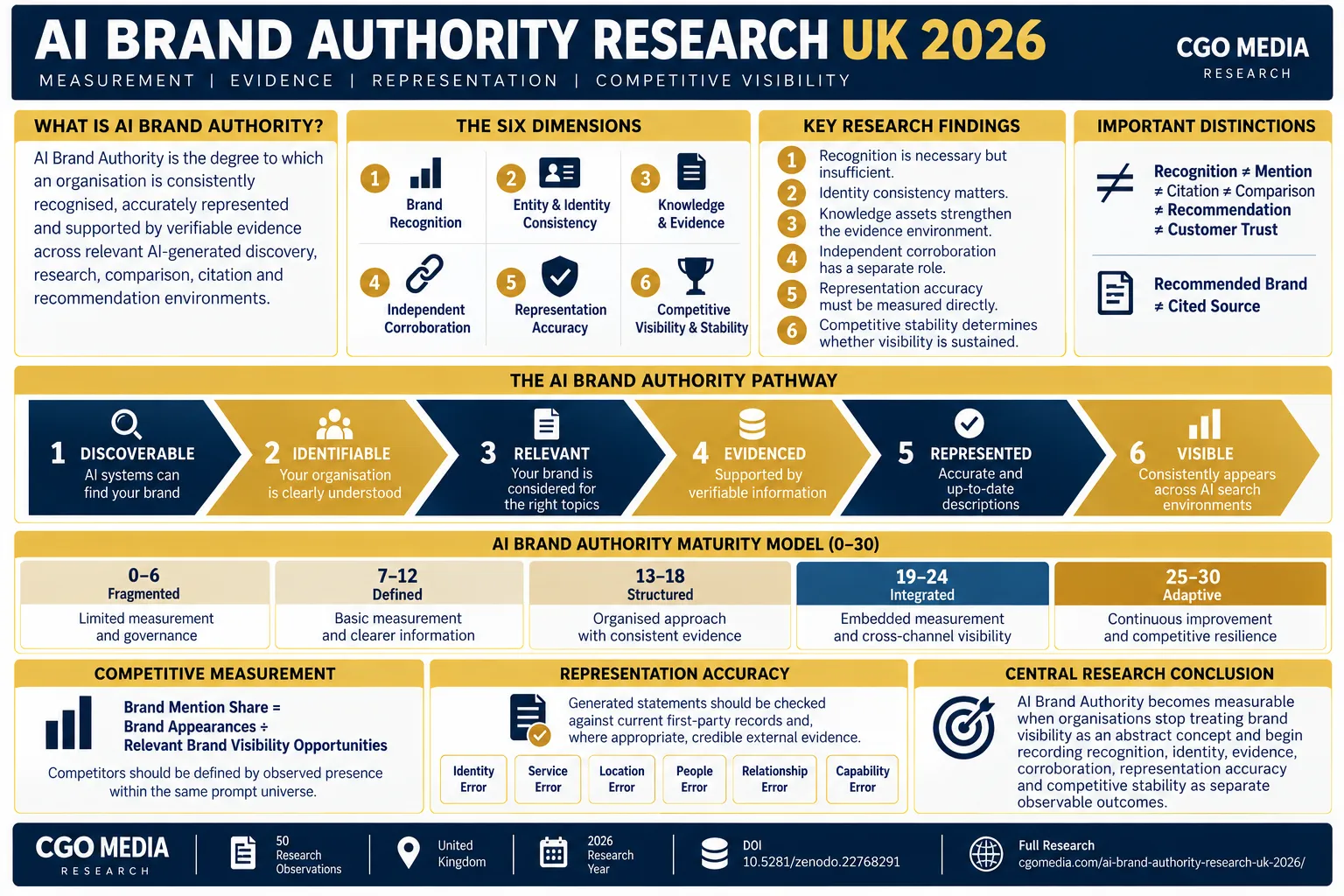
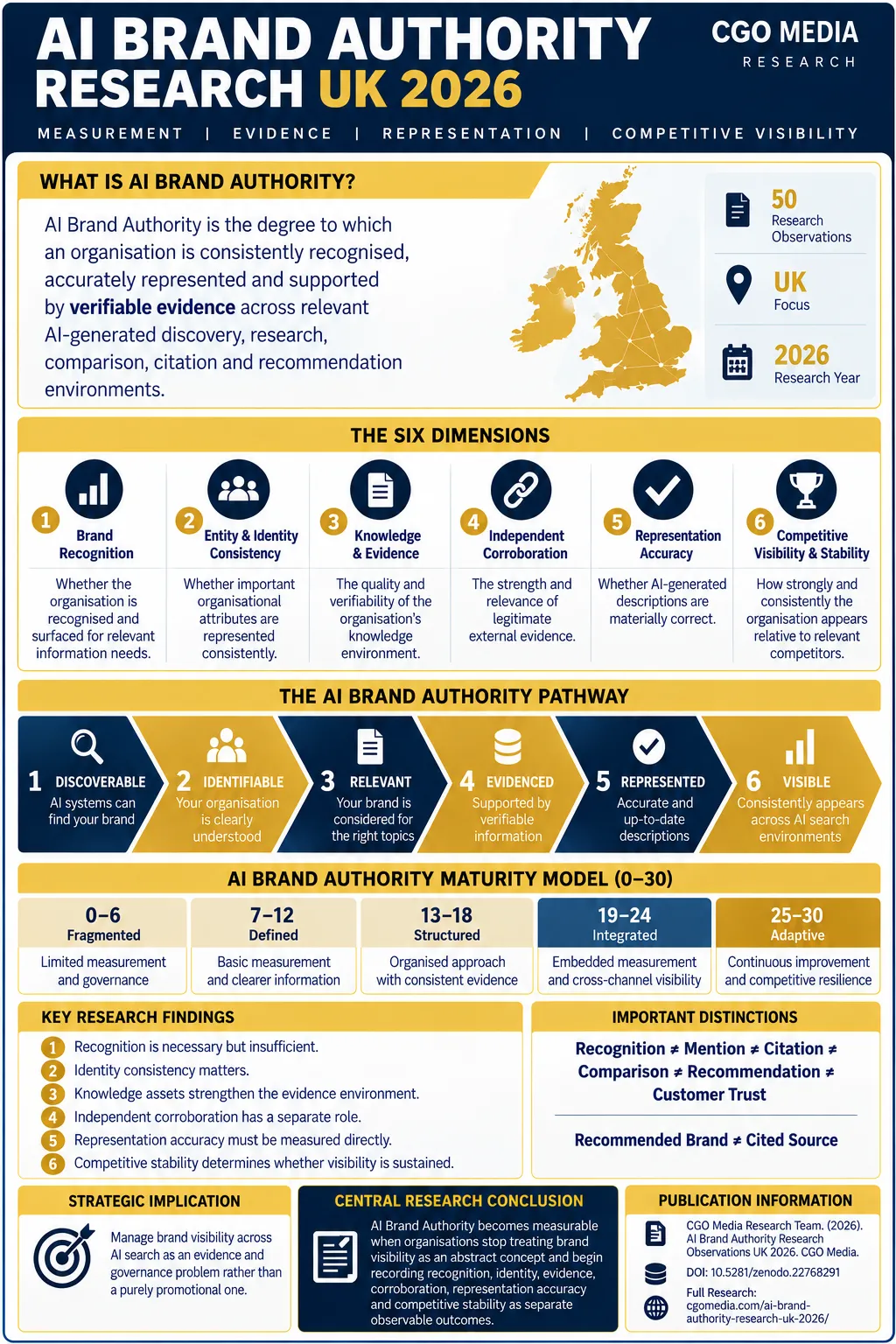
AI Brand Authority is the degree to which an organisation is consistently recognised, accurately represented and supported by verifiable evidence across relevant AI-generated discovery, research, comparison, citation and recommendation environments.
This definition deliberately separates observable brand performance from claims about proprietary AI trust scores, internal confidence values or universal brand-ranking signals.
What AI Brand Authority Does Not Mean
- It does not mean an AI platform has assigned the organisation a universal authority score.
- It does not prove that a platform “trusts” one brand more than another internally.
- It does not mean brand recognition automatically causes recommendation visibility.
- It does not mean Digital PR, backlinks, reviews, schema or research are guaranteed AI ranking factors.
- It does not mean every AI platform evaluates brands using the same architecture.
- It does not mean a brand mention is equivalent to a citation or recommendation.
- It does not mean correlation between brand strength and AI visibility establishes causation.
Observable Brand States in AI Search
| State | What Can Be Observed |
|---|---|
| Recognition | The system identifies or names the organisation correctly. |
| Representation | The answer describes the organisation, its services, expertise, locations or role. |
| Mention | The organisation is named within an AI-generated answer. |
| Citation | A webpage, research asset or other source associated with the organisation receives visible attribution. |
| Comparison | The organisation is evaluated alongside alternative brands, providers, products or services. |
| Recommendation | The organisation is presented as a potentially suitable option for a defined requirement. |
Recognition ≠ Mention ≠ Citation ≠ Comparison ≠ Recommendation ≠ Customer Trust
These outcomes can reinforce one another commercially, but they are not interchangeable measures and should be recorded separately.
The Brand and the Source Are Not Always the Same Thing
An organisation may be discussed or recommended while another publisher, directory, journalist, review platform or research source provides the visible evidence supporting the answer.
Brand Mention ≠ Cited Source | Recommended Brand ≠ Evidence Source
This distinction is particularly important when evaluating the relationship between Brand Authority, Citation Authority and Recommendation Authority.
Why AI Brand Authority Matters
AI-mediated discovery can expose organisations to users before a conventional website visit takes place. This makes accurate brand representation increasingly important throughout the wider search and research journey.
Visibility within relevant AI-generated answers.
Whether the organisation is identified correctly.
Whether services, expertise and organisational facts are described correctly.
Whether proprietary knowledge assets are surfaced or cited.
How often the organisation appears relative to relevant alternatives.
Whether the organisation enters relevant shortlists or provider recommendations.
Research and expertise may provide useful material for external publishers.
Prospective customers can encounter brand information during AI-assisted evaluation.
These potential benefits should be measured separately. Brand visibility does not automatically prove increased trust, traffic, conversion or revenue.
CGO Media Observable Brand Authority Pathway
Discoverable → Identifiable → Relevant → Evidenced → Represented → Visible
This pathway is a CGO Media measurement model. It describes useful stages for auditing brand representation and should not be interpreted as a disclosed sequence used internally by an AI platform.
Six Dimensions of AI Brand Authority
| Dimension | Measurement Focus |
|---|---|
| 1. Brand Recognition | Whether the organisation is correctly recognised and surfaced for relevant topics and information needs. |
| 2. Entity & Identity Consistency | Whether names, people, services, locations and organisational relationships are represented consistently. |
| 3. Knowledge & Evidence | The quality, specificity and verifiability of the information supporting the organisation’s expertise and claims. |
| 4. Independent Corroboration | The presence of legitimate external evidence from relevant publishers, institutions, reviews, research, professional sources and other independent environments. |
| 5. Representation Accuracy | Whether AI-generated answers describe the organisation, its expertise, services and attributes accurately. |
| 6. Competitive Visibility & Stability | How consistently the organisation appears relative to relevant competitors across repeated tests and measurement periods. |
Central Research Finding
The most defensible way to evaluate AI Brand Authority is to measure how consistently an organisation is recognised and accurately represented across relevant AI environments, then examine the verifiable evidence and external corroboration supporting that representation.
Key Research Findings
- Brand recognition should be measured independently from citation and recommendation visibility.
- A recognised organisation can still be represented inaccurately.
- Entity consistency is observable and auditable without assuming a hidden platform confidence score.
- Original research can create distinctive knowledge assets but does not guarantee brand visibility.
- Independent references provide a separate form of evidence from first-party brand claims.
- Third-party evidence should be evaluated for relevance, independence and accuracy rather than volume alone.
- Recommendation visibility should be measured separately from general brand recognition.
- Brand performance can differ significantly between AI platforms and prompt categories.
- Repeated testing is required to distinguish sustained brand visibility from isolated appearances.
- AI Brand Authority is best managed as an evidence, measurement and governance discipline rather than an assumed algorithmic score.
Research Objectives
- Define AI Brand Authority using observable and auditable outcomes.
- Distinguish brand recognition from mentions, citations, comparisons and recommendations.
- Develop a practical method for measuring organisational representation across AI environments.
- Assess the role of first-party knowledge and independent external evidence.
- Measure representation accuracy and misinformation risk.
- Compare brand visibility with relevant competitors.
- Evaluate consistency and volatility through repeated testing.
- Develop an organisational maturity framework for AI Brand Authority governance.
Research Scope
The research examines twelve connected areas:
Research Boundary
This research measures visible brand outcomes and the evidence surrounding them.
It does not claim access to proprietary AI ranking systems, internal confidence scores, recommendation weights, retrieval logic or universal trust signals.
Where a causal mechanism is not publicly documented, CGO Media treats it as unknown rather than replacing it with an inferred ranking factor.
AI Brand Authority Measurement Principle
Recognition → Identity → Evidence → Corroboration → Accuracy → Competitive Stability
Minimum AI Brand Authority Audit Record
Each meaningful observation should retain enough information for later review.
- AI platform or interface;
- date of observation;
- exact prompt or query;
- prompt category and information need;
- whether the brand appeared;
- how the brand was named;
- description of the organisation;
- services, products or expertise attributed to the brand;
- cited or supporting sources where visible;
- representation accuracy;
- competing brands included;
- whether the brand was compared or recommended;
- material factual errors or outdated information;
- repeat-test result; and
- platform or interface changes affecting interpretation.
Evidence & Interpretation Hierarchy
Documented Platform Capability → Observable Brand Output → Verifiable Evidence → CGO Media Interpretation
This hierarchy prevents observations about brand visibility from being converted into unsupported claims about why a particular platform produced that result.
Research Methodology
The broader principles governing evidence, observation, interpretation and limitations across CGO Media research are documented in the
CGO Media Research Methodology
.
Persistent Research Record
This research is associated with DOI
10.5281/zenodo.22768291
.
The DOI provides a persistent research identifier and should not be interpreted as evidence of peer review or independent validation.
Research Principle
Measure what the AI system says about the brand. Verify the evidence supporting that representation. Compare the result with relevant competitors. Do not convert unknown platform mechanisms into invented authority signals.
Research Observations 1–10
Brand Recognition, Entity Identity, Representation & Evidence
The first ten observations establish the foundations of AI Brand Authority: whether an organisation is recognised, identified correctly, described accurately and supported by evidence that can be verified.
Research Observation 1
Brand Recognition Is the First Observable Requirement
Before an organisation can evaluate recommendation, citation or comparative visibility, it must establish whether the brand is recognised at all within relevant AI-generated answers.
Research Observation 2
Recognition Does Not Automatically Mean Understanding
An AI system may name an organisation correctly while describing its services, expertise, location or organisational role inaccurately. Recognition and representation should therefore be measured separately.
Research Observation 3
Brand Identity Should Be Tested Across Multiple Attributes
A complete brand audit should examine organisation name, location, services, people, products, sector role and other material attributes rather than relying on one correct brand mention.
Research Observation 4
Entity Consistency Is Observable Even When Internal Entity Resolution Is Not
Researchers can observe whether an organisation is represented consistently across prompts and platforms without claiming access to the internal entity-resolution systems used by those platforms.
Research Observation 5
Ambiguous Naming Creates Measurement Risk
Brands with common names, inconsistent naming conventions or multiple similar entities may be harder to evaluate because answer outputs can refer to the wrong organisation or merge distinct entities.
Research Observation 6
First-Party Information Establishes the Official Brand Record
Official webpages, team profiles, location pages, service descriptions, policies and research records provide a primary reference point for evaluating whether generated brand information is current and accurate.
Research Observation 7
First-Party Claims and Independent Evidence Should Remain Distinct
An organisation’s own description is appropriate for many factual attributes, but externally verifiable claims should be assessed separately from self-published statements.
Research Observation 8
Representation Accuracy Is More Important Than Simple Mention Volume
A brand appearing frequently but inaccurately may create a weaker outcome than a brand appearing less often but with consistently correct descriptions. Mention frequency and representation quality should therefore be reported independently.
Research Observation 9
Brand Knowledge Assets Extend Beyond Commercial Pages
Research papers, datasets, statistics, frameworks, expert commentary, technical resources and methodology pages can all contribute to the broader information environment surrounding a brand.
Research Observation 10
Brand Authority Should Be Measured Across a Controlled Prompt Set
One favourable answer does not establish Brand Authority. A controlled prompt set across relevant topics, services, attributes and use cases provides a stronger basis for measuring recognition and representation.
What Observations 1–10 Tell Us
Brand Recognition → Identity Accuracy → Evidence → Representation → Measurable Visibility
The first ten observations establish that AI Brand Authority should begin with basic questions about recognition, identity and factual representation before moving into broader claims about trust, reputation or recommendation strength.
They also reinforce a central distinction: evidence about a brand can be measured without claiming to know the hidden mechanism by which an AI platform interpreted that evidence.
Research Principle
A brand should not be considered authoritative merely because it is recognised. Stronger Brand Authority requires accurate identity, useful evidence, consistent representation and repeatable visibility.
Research Observations 11–20
Knowledge Assets, Independent Corroboration, Brand Evidence & External Representation
The second group of observations examines the evidence environment surrounding a brand. Stronger AI Brand Authority depends not only on what an organisation says about itself, but also on the quality, consistency and independence of the wider information available about it.
Research Observation 11
Knowledge Assets Expand the Evidence Surface Around a Brand
Research papers, statistics, datasets, technical resources, frameworks, expert commentary and sector analysis create additional verifiable material through which an organisation can be understood.
Research Observation 12
Original Research Creates Distinctive Brand Evidence
Original research can give an organisation information assets that are not simply copies of existing market commentary. This can strengthen the distinctiveness of its knowledge environment, although publication alone does not guarantee AI visibility.
Research Observation 13
Methodology Improves the Auditability of Brand Research
Research is easier to evaluate when the organisation explains how information was collected, the scope of the work, the dates involved and the limitations of the findings.
Research Observation 14
Persistent Identifiers Improve Research Traceability
DOIs and other persistent identifiers can make research assets easier to distinguish, archive and reference over time. They improve traceability but should not be interpreted as automatic proof of authority or quality.
Research Observation 15
Independent Corroboration Should Be Evaluated for Quality, Not Volume
A large number of low-quality or duplicated references does not necessarily provide stronger corroboration than a smaller number of relevant, independent and well-evidenced sources.
Research Observation 16
Independent Evidence and Repetition Are Not the Same Thing
Multiple websites repeating the same underlying claim may create the appearance of broad coverage without representing genuinely independent evidence. Provenance should therefore be considered where possible.
Research Observation 17
External Representation Can Reinforce or Contradict First-Party Claims
External publishers, directories, reviews, public records and professional profiles can either support an organisation’s self-description or introduce conflicting information. Both outcomes are relevant to brand analysis.
Research Observation 18
External Evidence Should Be Relevant to the Brand Claim Being Assessed
A media mention may support brand recognition but provide little evidence about technical expertise, customer experience or geographic coverage. External evidence should therefore be matched to the specific attribute being evaluated.
Research Observation 19
Outdated External Information Can Distort Brand Representation
Old profiles, obsolete service descriptions, former locations or outdated leadership information can remain visible externally and create inconsistency between current first-party information and wider brand representation.
Research Observation 20
A Stronger Brand Evidence Environment Is Built Across Multiple Source Types
Brand evidence becomes more useful when accurate first-party information, research assets and legitimate external sources form a consistent information environment rather than relying on one channel alone.
Brand Evidence Architecture
Official Brand Facts → Original Knowledge Assets → Independent Evidence → Consistent External Representation
Brand Evidence Classes
| Evidence Class | Primary Brand Function |
|---|---|
| Official First-Party Information | Defines current identity, services, people, locations, products and organisational facts. |
| Original Research & Data | Provides distinctive evidence, expertise and knowledge assets associated with the organisation. |
| Independent Media & Publications | Provides external reporting, commentary, attribution and contextual evidence. |
| Public & Institutional Records | Supports verifiable organisational facts where appropriate. |
| Reviews & Experience Evidence | Provides user or customer experience evidence where relevant to the claim being assessed. |
| Professional Profiles & Directories | Can reinforce identity, location, role or professional relationships when accurate and current. |
What Observations 11–20 Tell Us
Brand Facts → Knowledge Assets → Independent Corroboration → External Representation → Evidence Consistency
Observations 11–20 show that Brand Authority should not be reduced to publicity volume or the number of websites mentioning an organisation.
The more useful question is whether the wider evidence environment is current, independent where appropriate, relevant to the claims being assessed and consistent with the organisation’s verified identity.
Research Principle
Brand evidence is strongest when official information, original knowledge and legitimate external sources are consistent enough to be verified independently.
Research Observations 21–30
Competitive Brand Visibility, Mention Share, Comparison Presence & Recommendation Context
The third group of observations examines AI Brand Authority as a competitive phenomenon. Brand visibility becomes strategically meaningful when it is measured relative to other organisations appearing for the same information needs.
Research Observation 21
Brand Authority Is Inherently Comparative
A brand mention has limited strategic meaning without understanding which other organisations are also surfaced for the same prompt category, use case or information need.
Research Observation 22
AI Brand Competitors May Differ From Traditional SEO Competitors
The organisations appearing within AI-generated comparisons or recommendations may not be identical to the domains competing most visibly in conventional organic search.
Research Observation 23
Mention Share Provides Better Context Than Raw Mention Count
Counting how often a brand appears is useful, but relative visibility within the same controlled prompt universe provides stronger competitive context.
Research Observation 24
Comparison Presence Is Distinct From General Brand Recognition
A brand can be recognised correctly without being included in comparative answers. Comparison presence should therefore be measured separately from basic recognition.
Research Observation 25
Recommendation Inclusion Should Be Measured Separately From Mention Visibility
A brand may be mentioned in an answer without being presented as a suitable option. Recommendation visibility is therefore a separate observable state rather than a stronger form of mention by definition.
Research Observation 26
Recommendation Context Matters
A brand may be recommended for one use case but omitted from another. Recommendation performance should therefore be interpreted against the exact requirement, audience, geography and comparison context.
Research Observation 27
Competitive Visibility Should Be Segmented by Prompt Category
An organisation may perform strongly for expertise-led prompts but weakly for service comparisons, geographic queries or product-selection prompts. Segment-level analysis reveals these differences.
Research Observation 28
Brand Visibility Can Differ Materially Between AI Platforms
A brand may be surfaced frequently in one AI environment and inconsistently in another. Platform-level reporting should therefore be retained before any aggregated view is created.
Research Observation 29
Prominence Within the Answer Can Be Measured Separately From Presence
A brand may appear as a leading example, one item within a shortlist, a passing reference or a secondary alternative. These levels of visible prominence can be recorded without assuming they correspond to a universal internal weighting score.
Research Observation 30
Competitive Brand Visibility Should Be Tracked Over Time
Repeated measurement can show whether an organisation’s comparative position is improving, declining or remaining stable relative to the same defined competitor and prompt set.
CGO Media Brand Mention Share
CGO Media uses Brand Mention Share as a comparative measurement construct rather than as a metric disclosed by an AI platform.
Brand Mention Share = Brand Appearances ÷ Relevant Brand Visibility Opportunities
The denominator should be explicitly defined and applied consistently across measurement periods.
Competitive Brand Measurement
| Metric | What It Shows |
|---|---|
| Brand Recognition | Whether the organisation is recognised correctly. |
| Mention Frequency | How often the brand appears across the defined test set. |
| Mention Share | Relative brand visibility within the defined opportunity set. |
| Comparison Presence | Whether the brand enters relevant comparison environments. |
| Recommendation Presence | Whether the brand is presented as a suitable option. |
| Prominence | How visibly the brand is positioned within the answer. |
| Platform Distribution | How performance differs across AI platforms or interfaces. |
Brand Visibility States Should Remain Separate
Recognised → Mentioned → Compared → Shortlisted → Recommended
This is a useful analytical progression, but it should not be interpreted as a mandatory internal platform sequence. A brand can appear at one state without passing through every other state in a visible answer.
What Observations 21–30 Tell Us
Recognition → Mention Share → Comparison → Recommendation Context → Competitive Trend
Observations 21–30 establish that AI Brand Authority cannot be understood through isolated brand mentions.
The more useful analysis examines where the brand appears, which competitors appear alongside it, whether the brand enters comparisons and recommendations, how prominent it is, and whether its relative position changes over time.
Research Principle
Brand Authority becomes strategically meaningful when recognition and representation are evaluated against the actual competitor set, comparison environment and recommendation context.
Research Observations 31–40
Representation Accuracy, Brand Errors, Freshness, Volatility & Platform Differences
The fourth group of observations focuses on whether an organisation is represented accurately over time. Brand visibility is not inherently positive if descriptions are wrong, outdated, inconsistent or unstable across repeated tests.
Research Observation 31
Representation Accuracy Should Be Measured Independently From Brand Visibility
A brand may appear frequently while being described inaccurately. Visibility and factual accuracy should therefore be reported as separate dimensions.
Research Observation 32
Brand Errors Should Be Classified by Attribute
Incorrect location, services, leadership, founding information, sector position and product details represent different error types. Classification makes recurring weaknesses easier to diagnose.
Research Observation 33
Brand Errors Should Also Be Classified by Severity
Minor wording differences should not be treated the same as errors that materially change what the organisation does, where it operates or who it serves.
Research Observation 34
Freshness Matters Most for Changeable Brand Facts
Current leadership, locations, services, products, pricing, partnerships and corporate structure can change. These attributes require more active review than stable historical facts.
Research Observation 35
Outdated External Sources Can Sustain Incorrect Brand Narratives
Old directories, historical profiles, archived news coverage and obsolete third-party descriptions can continue to conflict with current first-party information.
Research Observation 36
Repeated Testing Reveals Representation Stability
Running the same controlled prompts at different times can reveal whether descriptions remain consistent or fluctuate materially between tests.
Research Observation 37
Brand Volatility Is a Useful Diagnostic
Frequent changes in whether the organisation appears, how it is described or which competitors surround it can indicate an unstable representation environment.
Research Observation 38
Platform Differences Should Be Preserved in Reporting
A brand may be described correctly on one AI platform and inconsistently on another. Platform-level results should therefore remain visible rather than disappearing inside one blended brand score.
Research Observation 39
Changes in AI Interfaces Can Affect Observed Brand Visibility
Interface changes can alter how brands, source links, comparison lists or recommendations are presented. Apparent visibility changes should therefore be interpreted alongside material platform changes.
Research Observation 40
Reliable Brand Authority Requires Recognition, Accuracy & Stability Together
A stronger AI Brand Authority profile combines repeated recognition with accurate representation and sufficient stability to form a meaningful pattern over time.
Brand Error Classification
| Error Type | Example |
|---|---|
| Identity Error | The answer confuses the organisation with another entity. |
| Service Error | The answer attributes a service the organisation does not provide or omits a material current service. |
| Location Error | The organisation is associated with an incorrect or outdated location. |
| People Error | Leadership, founder or team information is incorrect or outdated. |
| Relationship Error | A partnership, ownership relationship or affiliation is represented incorrectly. |
| Capability Error | The answer materially overstates or understates organisational expertise or capability. |
Representation Reliability Model
Recognition + Identity Accuracy + Current Information + Repeatability = Reliable Brand Representation
What Organisations Should Track
What Observations 31–40 Tell Us
Recognition → Accuracy → Freshness → Repeatability → Stability
Observations 31–40 show that AI Brand Authority cannot be assessed through visibility alone. The quality of the brand representation matters just as much as whether the brand appears.
Errors, stale information, platform differences and volatility should therefore be treated as core measurement signals rather than secondary details.
Research Principle
A visible brand is not necessarily a well-represented brand. Reliable AI Brand Authority requires accurate, current and repeatable representation across relevant AI environments.
Research Observations 41–50
Measurement, Governance, Maturity & the AI Brand Authority Framework
The final ten observations move from individual brand appearances toward organisational measurement. They examine how AI Brand Authority can be scored, governed and improved without presenting the framework as a hidden metric used by AI platforms.
Research Observation 41
Brand Authority Should Be Measured Across Multiple Dimensions
No single metric can adequately represent brand visibility, identity accuracy, evidence strength, external corroboration, representation quality and competitive stability.
Research Observation 42
A Baseline Is Required Before Improvement Can Be Demonstrated
Organisations need a documented starting point covering recognition, representation accuracy, prompt categories, competitors, errors and platform-level performance before later changes can be interpreted confidently.
Research Observation 43
Prompt Sets Should Be Versioned and Governed
Brand measurement becomes difficult to compare when prompts change without documentation. Core prompts should remain stable enough for trend analysis, while additions or revisions should be recorded.
Research Observation 44
Platform-Level Reporting Is More Defensible Than One Universal Brand Score
Different AI environments may recognise and represent the same organisation differently. Platform-specific data should therefore be retained before any composite view is created.
Research Observation 45
Brand Errors Should Enter the Governance Process
Repeated misrepresentation, stale facts, identity confusion and outdated external information should be documented and assigned for review rather than treated as isolated anomalies.
Research Observation 46
AI Brand Authority Requires Cross-Functional Ownership
Brand representation intersects with research, content, SEO, GEO, Digital PR, corporate communications, analytics and knowledge management. Mature programmes need clear ownership across these functions.
Research Observation 47
Brand Maturity Reflects Organisational Capability, Not Platform Trust
An organisation with clear identity, strong evidence, accurate representation and disciplined measurement can be described as more mature in brand governance. This does not mean an AI platform has assigned it a higher proprietary trust score.
Research Observation 48
Brand Authority Should Be Reassessed After Material Organisational Change
Rebrands, acquisitions, leadership changes, new market entry, service changes, office moves, major research publication and material platform changes can all justify a new measurement cycle.
Research Observation 49
Composite Scores Should Not Create False Precision
A total score can summarise organisational performance, but it should not replace the six underlying dimensions. Two organisations can reach the same total while having very different strengths, risks and priorities.
Research Observation 50
AI Brand Authority Is a Continuous Measurement Discipline
Brand information, external evidence, competitors, AI platforms and organisational facts change over time. AI Brand Authority should therefore be managed as an ongoing measurement and governance process.
Six Dimensions of the CGO Media AI Brand Authority Framework
| Dimension | Measurement Focus |
|---|---|
| 1. Brand Recognition | Whether the organisation is correctly recognised and surfaced for relevant information needs. |
| 2. Entity & Identity Consistency | Whether names, people, locations, services and organisational relationships are represented consistently. |
| 3. Knowledge & Evidence | The quality, specificity and verifiability of the knowledge assets associated with the brand. |
| 4. Independent Corroboration | The quality and relevance of legitimate external evidence supporting or contextualising brand claims. |
| 5. Representation Accuracy | Whether AI-generated answers describe the organisation and its attributes accurately. |
| 6. Competitive Visibility & Stability | How strongly and consistently the organisation appears relative to relevant competitors over time. |
30-Point AI Brand Authority Score
Each dimension is scored from 0 to 5 using retained evidence.
Absent
Very Weak
Developing
Established
Strong
Leading
6 Dimensions × Maximum 5 Points = 30 Points
AI Brand Authority Maturity Levels
| Score | Maturity Level | Interpretation |
|---|---|---|
| 0–6 | Fragmented | Brand identity, evidence and AI representation are poorly understood or inconsistently measured. |
| 7–12 | Defined | Core brand attributes, evidence and AI visibility are beginning to be documented. |
| 13–18 | Structured | Recognition, evidence, corroboration and representation are measured systematically. |
| 19–24 | Integrated | Brand Authority measurement is integrated with research, content, SEO/GEO, Digital PR and communications. |
| 25–30 | Adaptive | Brand representation is continuously measured, validated and improved as information environments change. |
Important limitation:
the 30-point AI Brand Authority Framework is a CGO Media organisational diagnostic. It is not a trust, confidence, ranking or authority score used internally by an AI provider.
Continuous AI Brand Authority Cycle
Measure → Verify → Compare → Correct → Strengthen Evidence → Retest → Govern
Recommended Executive Brand Authority Scorecard
0–30 diagnostic total
Fragmented to Adaptive
Primary improvement priority
Relative brand visibility
Correct organisational description
Improving, stable or declining
What Observations 41–50 Tell Us
Measure → Diagnose → Correct → Strengthen → Retest → Govern
The final observations establish AI Brand Authority as an evidence, measurement and governance discipline rather than a vague concept of algorithmic trust.
The composite score can summarise organisational position, but the six underlying dimensions and retained evidence provide the real diagnostic value.
Research Principle
The total score summarises Brand Authority. The six dimensions diagnose Brand Authority. The retained evidence explains Brand Authority.
CGO Media Analysis
What the 50 AI Brand Authority Observations Tell Us
Taken together, the fifty observations point toward a more disciplined way of understanding brand visibility across AI-mediated search.
The strongest conclusion is that AI Brand Authority should not be treated as an assumed hidden trust score. It is more usefully measured through observable recognition, identity consistency, evidence, external corroboration, representation accuracy and competitive stability.
1. Brand Recognition Is Only the Starting Point
A brand appearing in an AI-generated answer establishes visibility, but it does not establish accurate understanding, recommendation strength or authority on its own.
2. Recognition and Representation Must Be Separated
An organisation can be named correctly while its services, expertise, locations, leadership or relationships are represented inaccurately. Recognition and representation should therefore remain separate measures.
3. Identity Consistency Is a Foundational Requirement
Clear names, people, locations, services and organisational relationships make brand representation easier to audit and reduce ambiguity when multiple similar entities exist.
4. First-Party Information Establishes the Official Record
An organisation’s own current webpages, team profiles, service pages, policies and research records provide the primary reference point for testing whether AI-generated brand information is accurate.
5. Knowledge Assets Extend the Brand Beyond Commercial Content
Research, statistics, datasets, frameworks, methodology and expert analysis create additional evidence through which an organisation can be understood.
6. Independent Evidence Has a Different Role From Self-Description
External journalism, public records, professional profiles, reviews and independent research can support or challenge first-party claims. These sources should be treated as a separate evidence class.
7. Evidence Quality Matters More Than Evidence Volume
Large quantities of duplicated or weak references are less useful than a smaller number of relevant, independent and verifiable sources with clear provenance.
8. Brand Authority Is Competitive
Brand visibility becomes strategically meaningful when it is measured against the organisations that appear for the same prompts, categories and decision contexts.
9. Mention Share Provides Better Context Than Raw Mentions
A raw mention count does not show how visible the organisation is relative to competitors. Mention Share provides a comparative view within a defined prompt universe.
10. Comparison and Recommendation Visibility Are Separate States
A brand can be recognised without entering a comparison, and it can enter a comparison without being recommended. These outcomes should be measured independently.
11. Representation Accuracy Is as Important as Visibility
Frequent brand visibility can become problematic when factual descriptions are wrong, outdated or misleading. Visibility and accuracy therefore belong in the same measurement system.
12. Brand Errors Should Be Governed Systematically
Recurring identity, service, location, people, relationship and capability errors should be classified, recorded and reviewed rather than treated as isolated exceptions.
13. Brand Stability Must Be Measured Through Repeated Testing
Repeated testing helps distinguish sustained recognition and representation from short-lived or inconsistent appearances.
14. Platform Differences Should Be Preserved
Different AI platforms can recognise, describe, compare and recommend the same organisation differently. Platform-level results should therefore remain visible.
15. AI Brand Authority Requires Governance, Not Just Visibility Optimisation
Mature Brand Authority programmes require controlled prompts, current first-party information, evidence management, competitor tracking, error review, platform-level reporting and clear organisational ownership.
The AI Brand Authority Model
Discoverable → Identifiable → Relevant → Evidenced → Represented → Visible
This model describes useful stages for organising brand analysis. It does not claim that every AI platform follows these stages internally or in this order.
Six Dimensions of Measurable AI Brand Authority
Is the organisation recognised and surfaced for relevant information needs?
Are names, people, locations, services and relationships represented consistently?
Does the organisation publish useful, specific and verifiable knowledge?
Is there legitimate external evidence supporting relevant brand claims?
Are AI-generated descriptions of the organisation materially correct?
How strongly and consistently does the brand appear relative to relevant alternatives?
Eight Questions Every AI Brand Authority Audit Should Answer
Is the brand recognised for relevant topics and needs?
Is the correct organisation being identified?
What verifiable information supports the brand’s expertise and claims?
What independent sources support or contradict those claims?
Is the organisation represented correctly?
Which competing brands repeatedly appear?
Does brand visibility and representation persist across repeated testing?
How does brand performance differ between AI environments?
CGO Media Research Position
Recognition + Identity Consistency + Knowledge & Evidence + Independent Corroboration + Representation Accuracy + Competitive Stability = Measurable AI Brand Authority
This formula is a CGO Media organisational measurement model. It does not describe an internal AI brand-ranking, trust or confidence formula.
Brand Authority, Citation Authority & Recommendation Authority
| Measurement Area | Primary Question |
|---|---|
| AI Brand Authority | Is the organisation recognised, accurately represented and supported by verifiable evidence? |
| AI Citation Authority | Are the organisation’s knowledge assets visibly attributed as sources? |
| AI Recommendation Authority | Is the organisation, product or service presented as a suitable option? |
Brand Recognition ≠ Citation | Citation ≠ Recommendation | Recommendation ≠ Brand Accuracy
How CGO Media Interprets AI Brand Authority
The research supports the following interpretation hierarchy:
Documented Platform Capability → Observable Brand Output → Verifiable Brand Evidence → CGO Media Interpretation
Where the internal mechanism behind a brand mention, comparison or recommendation is not publicly documented, the research should not present that mechanism as established fact.
Central Analysis
AI Brand Authority is not best understood as a hidden trust score that organisations accumulate.
It is better understood as the measurable pattern created when an organisation is repeatedly recognised, accurately represented and supported by a coherent environment of verifiable first-party knowledge and legitimate external evidence.
Measure recognition. Verify identity. Audit the evidence. Check representation. Compare competitors. Retest the result.
Practical Implementation
What UK Organisations Should Do to Improve AI Brand Authority in 2026
The practical objective is not to manufacture an assumed AI trust signal. It is to create a clearer, more accurate and more verifiable information environment around the organisation, then measure how that environment is reflected across AI-generated answers.
The following implementation model turns the fifty research observations into a structured operational programme.
1. Define the Brand Authority Measurement Universe
Identify the subjects, services, expertise areas, locations, products, people and use cases for which the organisation reasonably expects to be recognised or evaluated.
2. Build a Controlled Brand Prompt Library
Create a documented prompt set covering brand recognition, expertise, services, geography, comparison, recommendation, research and factual organisational questions.
3. Establish a Brand Recognition Baseline
Record where the organisation appears, how it is named, which attributes are associated with it, which competitors are surfaced and whether any material errors are present.
4. Audit Entity & Identity Consistency
Check whether company name, key people, services, locations, sector positioning, organisational relationships and other material attributes are represented consistently across first-party and external sources.
5. Correct Conflicting First-Party Information
Resolve contradictory names, outdated biographies, old location data, inconsistent service descriptions and other internal conflicts that make the organisation harder to represent accurately.
6. Strengthen Core Brand Facts
Maintain clear, current and specific information about who the organisation is, what it does, where it operates, who leads it and the markets or sectors it serves.
7. Develop Distinct Knowledge Assets
Publish research, datasets, statistics, frameworks, expert commentary, technical resources and other assets that contribute substantive information beyond promotional brand copy.
8. Make Research Methodology Explicit
Where original research is published, explain the methodology, scope, dates, sample, limitations and source material so that the evidence can be evaluated properly.
9. Build Legitimate Independent Corroboration
Develop genuine external visibility through relevant journalism, research repositories, professional publications, expert contributions, institutional records and other independent sources where appropriate.
10. Audit External Brand Representation
Review important external profiles, directories, publications, review environments and reference sources for outdated, incomplete or contradictory organisational information.
11. Separate Recognition From Recommendation
Track whether the organisation is merely recognised, included in a comparison or actively recommended. These represent different outcomes and should not be collapsed into one metric.
12. Measure Brand Mention Share
Compare the organisation’s appearance rate against relevant competing brands within the same defined prompt universe.
Brand Mention Share = Brand Appearances ÷ Relevant Brand Visibility Opportunities
13. Track the Actual AI Competitor Set
Record the organisations repeatedly appearing for the same prompts rather than assuming traditional SEO or commercial competitors are identical to AI visibility competitors.
14. Measure Representation Accuracy
Check whether AI-generated descriptions of the organisation, its people, services, expertise and relationships are materially correct.
15. Maintain a Brand Error Register
Record identity errors, outdated locations, incorrect services, people errors, relationship errors and capability misrepresentation so recurring problems can be reviewed systematically.
16. Keep Changeable Brand Facts Current
Create review schedules for leadership, locations, services, products, partnerships, ownership, pricing and other attributes likely to change over time.
17. Measure Brand Stability & Volatility
Repeat controlled tests and record whether recognition, prominence, comparison inclusion, recommendation presence and factual representation remain consistent.
18. Retain Platform-Level Results
Do not collapse all AI environments into one generic visibility result. Preserve platform-level differences in recognition, accuracy, competitors and recommendation behaviour.
19. Create an AI Brand Authority Governance Register
Maintain a central record covering priority prompts, brand attributes, knowledge assets, independent sources, errors, competitor visibility, platform results, refresh dates and ownership.
20. Treat AI Brand Authority as Continuous Governance
AI platforms, organisational facts, competitors and external evidence change. Brand Authority should therefore be reassessed rather than treated as a one-time optimisation exercise.
CGO Media AI Brand Authority Implementation Model
Define → Baseline → Verify Identity → Strengthen Evidence → Compare → Correct → Retest → Govern
90-Day AI Brand Authority Implementation Plan
Days 1–30
Define & Baseline
- Define priority brand attributes.
- Create the controlled prompt library.
- Measure current brand recognition.
- Audit identity consistency.
- Record relevant competitors.
- Identify representation errors.
Days 31–60
Strengthen Evidence
- Correct conflicting first-party facts.
- Update outdated brand information.
- Publish missing knowledge assets.
- Strengthen methodology transparency.
- Audit important external profiles.
- Develop legitimate external corroboration.
Days 61–90
Retest & Govern
- Repeat the controlled prompt set.
- Measure Mention Share.
- Review representation accuracy.
- Compare platform-level performance.
- Measure volatility and stability.
- Establish recurring governance reporting.
Cross-Functional Ownership
Identity, messaging and representation accuracy
Original evidence, methodology and knowledge assets
Prompt measurement, entity consistency and search visibility
Current organisational facts and knowledge structure
Legitimate independent coverage and external evidence
Governance, prioritisation and trend reporting
What Organisations Should Not Do
- Do not treat one favourable answer as proof of sustained Brand Authority.
- Do not manufacture prompts solely to force the organisation into results.
- Do not equate brand mentions with citations or recommendations.
- Do not claim backlinks, schema, reviews, Digital PR or research automatically create AI trust.
- Do not assume all AI platforms understand the organisation in the same way.
- Do not ignore incorrect or outdated brand information because overall visibility appears strong.
- Do not treat duplicated external references as independent corroboration.
- Do not merge all platforms into one score without retaining the underlying results.
- Do not present the CGO Media framework as a platform-internal authority score.
- Do not confuse correlation between brand strength and AI visibility with proven causation.
Executive Implementation Principle
The objective is not simply to increase the number of times an organisation is mentioned.
The stronger objective is to create an information environment in which the organisation can be recognised accurately, supported by useful evidence and measured consistently against relevant competitors.
Clear Identity → Verifiable Evidence → Accurate Representation → Competitive Measurement → Continuous Governance
CGO Media Measurement Framework
Full AI Brand Authority Measurement Framework
The CGO Media AI Brand Authority Framework converts the fifty research observations into a repeatable organisational diagnostic.
It measures six dimensions of observable brand performance. Each dimension is scored from 0 to 5, producing a maximum combined score of 30.
6 Dimensions × Maximum 5 Points = 30-Point AI Brand Authority Score
Important:
this is a CGO Media organisational diagnostic framework. It is not an internal brand, trust, confidence or authority score used by an AI provider.
Dimension 1 — Brand Recognition
Brand Recognition measures whether the organisation is correctly identified and surfaced for relevant topics, questions and information needs.
| Score | Interpretation |
|---|---|
| 0 | The organisation is not recognised across the defined prompt set. |
| 1 | Very limited recognition with frequent omission or confusion. |
| 2 | Recognition exists for a narrow set of topics or brand-specific prompts. |
| 3 | Established recognition across several relevant topics and use cases. |
| 4 | Strong recognition across most priority information needs. |
| 5 | Broad and repeatable recognition across the defined brand authority universe. |
Recommended evidence: exact prompt, platform, date, brand appearance, naming accuracy, prompt category and repeat-test result.
Dimension 2 — Entity & Identity Consistency
This dimension measures whether names, people, services, locations, products and organisational relationships are represented consistently.
| Score | Interpretation |
|---|---|
| 0 | Identity is frequently confused, incomplete or materially incorrect. |
| 1 | Major inconsistencies exist across important organisational attributes. |
| 2 | Core identity is usually correct but recurring inconsistencies remain. |
| 3 | Most key organisational attributes are represented consistently. |
| 4 | Strong identity consistency across priority brand attributes and environments. |
| 5 | Highly consistent representation of identity, people, services, locations and relationships across the measured environment. |
Recommended evidence: official brand record, AI-generated descriptions, people and location data, service attributes, relationship data and identified inconsistencies.
Dimension 3 — Knowledge & Evidence
Knowledge & Evidence measures the quality, specificity, depth and verifiability of the information environment associated with the brand.
| Score | Interpretation |
|---|---|
| 0 | Little or no usable evidence supports the organisation’s expertise or brand claims. |
| 1 | Evidence is thin, generic or primarily promotional. |
| 2 | Some useful research, data or specialist information exists but significant gaps remain. |
| 3 | Established knowledge assets support several priority expertise areas. |
| 4 | Strong, differentiated and well-maintained evidence exists across most priority areas. |
| 5 | Extensive, distinctive and continuously maintained knowledge assets support the brand across the defined authority universe. |
Recommended evidence: research papers, statistics, datasets, frameworks, methodology, expert commentary, product/service evidence and current organisational information.
Dimension 4 — Independent Corroboration
Independent Corroboration evaluates the quality and relevance of external evidence surrounding the organisation.
| Score | Interpretation |
|---|---|
| 0 | Little or no relevant independent evidence is identifiable. |
| 1 | External evidence is weak, duplicated, outdated or poorly matched to brand claims. |
| 2 | Some legitimate independent references exist but coverage is limited or inconsistent. |
| 3 | Relevant independent evidence supports several important organisational claims or attributes. |
| 4 | Strong and diverse independent evidence supports most priority brand attributes. |
| 5 | Broad, current and genuinely independent corroboration supports the organisation across priority authority areas. |
Recommended evidence: relevant journalism, public records, professional sources, repositories, independent research, legitimate reviews and other external references.
Dimension 5 — Representation Accuracy
Representation Accuracy measures whether AI-generated answers describe the organisation and its material attributes correctly.
| Score | Interpretation |
|---|---|
| 0 | Material brand representation is frequently incorrect or unusable. |
| 1 | Major factual or identity errors appear regularly. |
| 2 | Mixed accuracy, with recurring outdated or incomplete brand information. |
| 3 | Most material brand information is represented accurately, with manageable exceptions. |
| 4 | High representation accuracy with limited material errors and active monitoring. |
| 5 | Brand identity, services, expertise and relationships are represented consistently and accurately across the defined measurement environment. |
Recommended evidence: AI answer output, official first-party facts, error classifications, outdated-information reviews and repeat-test verification.
Dimension 6 — Competitive Visibility & Stability
This dimension measures how strongly and consistently the organisation appears relative to relevant competitors across repeated testing.
| Score | Interpretation |
|---|---|
| 0 | The organisation is largely absent while competitors dominate relevant prompts. |
| 1 | Brand visibility is very weak or highly volatile. |
| 2 | Developing competitive visibility, but stronger competitor presence or volatility remains. |
| 3 | Established comparative visibility across several priority prompt categories. |
| 4 | Strong comparative visibility with good repeatability across priority environments. |
| 5 | Consistently strong competitive visibility across priority prompt groups, platforms and defined measurement periods. |
Recommended evidence: Mention Share, competitor frequency, comparison presence, recommendation presence, prominence, repeat-test consistency and platform-level variation.
30-Point Scoring Summary
| Dimension | Maximum |
|---|---|
| Brand Recognition | 5 |
| Entity & Identity Consistency | 5 |
| Knowledge & Evidence | 5 |
| Independent Corroboration | 5 |
| Representation Accuracy | 5 |
| Competitive Visibility & Stability | 5 |
| Maximum AI Brand Authority Score | 30 |
AI Brand Authority Maturity Model
0–6 Fragmented → 7–12 Defined → 13–18 Structured → 19–24 Integrated → 25–30 Adaptive
| Score | Level | Organisational Interpretation |
|---|---|---|
| 0–6 | Fragmented | Brand identity, evidence and AI representation are poorly understood or unmanaged. |
| 7–12 | Defined | The organisation has begun to define core brand attributes and measurement practices. |
| 13–18 | Structured | Brand recognition, evidence and representation are measured systematically. |
| 19–24 | Integrated | Brand Authority measurement is integrated with research, content, SEO/GEO, Digital PR and communications. |
| 25–30 | Adaptive | Brand representation is continuously measured, validated and improved as the evidence environment changes. |
Worked Example A — Strong Recognition, Weak Representation Accuracy
| Brand Recognition | 4 |
| Entity & Identity Consistency | 3 |
| Knowledge & Evidence | 3 |
| Independent Corroboration | 3 |
| Representation Accuracy | 2 |
| Competitive Visibility & Stability | 4 |
| Total | 19 / 30 — Integrated |
Diagnosis:
the organisation appears frequently and performs well competitively, but material representation errors remain. The immediate priority is accuracy and identity correction rather than simply increasing mention volume.
Worked Example B — Strong Evidence, Weak Competitive Visibility
| Brand Recognition | 2 |
| Entity & Identity Consistency | 4 |
| Knowledge & Evidence | 5 |
| Independent Corroboration | 4 |
| Representation Accuracy | 4 |
| Competitive Visibility & Stability | 1 |
| Total | 20 / 30 — Integrated |
Diagnosis:
the organisation has strong knowledge, identity and corroborating evidence but limited competitive visibility. The next step is to investigate where relevant competitors are appearing, which prompt categories produce the gap and whether the organisation’s evidence is discoverable within those information environments.
Why Dimension-Level Reporting Matters
A composite score is useful for executive reporting, but it can hide very different organisational problems.
Similar Total Score ≠ Same Brand Authority Problem
Evidence-Backed Scoring Rules
Every score should be supported by retained evidence.
- exact prompt or query;
- AI platform or interface;
- date of observation;
- brand appearance or absence;
- brand naming accuracy;
- services, locations, people and attributes represented;
- cited or supporting evidence where visible;
- competitors included;
- comparison or recommendation presence;
- representation accuracy assessment;
- brand error classification;
- repeat-test result; and
- evidence supporting the assigned dimension score.
What the AI Brand Authority Score Does Not Mean
- It is not an AI platform’s internal brand score.
- It does not reveal proprietary trust or confidence calculations.
- It does not prove why a brand was mentioned, compared or recommended.
- It does not guarantee future AI visibility.
- It does not mean a score of 24 is mathematically twice as authoritative as a score of 12.
- It does not replace platform-level analysis.
- It does not mean all six dimensions contribute equally to every AI-generated answer.
Continuous AI Brand Authority Cycle
Audit → Score → Diagnose → Correct → Strengthen Evidence → Retest → Re-Score → Govern
Framework Principle
The composite score is useful for summarising the organisation’s position, but the real diagnostic value lies in the six dimensions and the evidence retained behind them.
The total score summarises Brand Authority. The six dimensions diagnose Brand Authority. The underlying evidence explains Brand Authority.
Research Outlook
AI Brand Authority Trends 2026–2027
AI-mediated search continued to develop rapidly during 2026. Major search and AI platforms expanded conversational search, source visibility, citations, personalisation, connected applications and agentic functionality.
For organisations, the implication is that brand performance can no longer be evaluated solely through conventional rankings or traffic. Recognition, factual representation, source visibility, competitive inclusion and the ability to move from discovery toward action increasingly require separate measurement.
Interpretation note:
the trends below combine documented 2026 platform developments with CGO Media research interpretation. References to likely 2027 implications are forward-looking analytical conclusions, not announcements by the platforms unless explicitly stated.
Trend 1
AI Brand Visibility Is Becoming a Separate Measurement Layer
Organisations increasingly need to know not only where webpages rank, but whether their brands are recognised, represented, cited, compared and recommended within generated answers.
Trend 2
Source Visibility Is Becoming More Explicit
Search and AI interfaces increasingly expose citations, source panels, website links and supporting material. This creates a clearer distinction between the organisation being discussed and the source used to support the answer.
Trend 3
Brand Authority and Citation Authority Are Converging Operationally
The brand mentioned in an answer and the source cited within that answer may be different entities. Organisations therefore need to monitor both their representation as brands and the visibility of their knowledge assets as sources.
Trend 4
Conversational Search Is Extending the Brand Discovery Journey
Users can increasingly move from an initial question into multiple follow-up queries without beginning a new conventional search. Brand visibility should therefore be examined across an evolving conversation rather than only at the opening query.
Trend 5
Prompt Context Is Becoming More Important Than Isolated Keywords
Longer questions, follow-ups, files, images and conversational context can change the information need materially. Brand Authority measurement therefore needs use-case and intent segmentation rather than simple keyword counting.
Trend 6
Personalisation Is Complicating Universal Visibility Measurement
Search experiences are becoming more capable of incorporating user preferences and personal context. This makes it increasingly difficult to assume that one observed answer represents the experience of every user.
Trend 7
Preferred Sources Introduce an Explicit User Preference Layer
Features that allow users to express preferences for particular publishers or sources demonstrate that source visibility can be influenced by user-level configuration as well as the general search environment.
Trend 8
Original Content and First-Hand Evidence Are Becoming More Strategically Important
As platforms develop additional ways to surface original sources and perspectives, organisations have greater reason to invest in information assets that contribute something distinct rather than reproducing generic market commentary.
Trend 9
Research Assets Are Becoming Part of Brand Infrastructure
Original datasets, statistics, research papers, frameworks and methodology documents can support both brand understanding and source-level visibility. Their value should be evaluated as part of the wider brand evidence environment.
Trend 10
Verification Is Becoming Part of the Search Experience
Source links and citations allow users to inspect the material associated with generated answers. This increases the strategic importance of maintaining accurate, current and defensible source material.
Trend 11
Representation Accuracy Will Become a More Important Brand KPI
As AI-generated summaries become more prominent, organisations have stronger reasons to monitor factual descriptions of their services, leadership, locations, relationships and expertise.
Trend 12
Brand Error Monitoring Will Move Toward Formal Governance
Incorrect or outdated AI-generated brand information can affect discovery and evaluation. CGO Media expects more organisations to formalise error registers, ownership and periodic representation audits during 2027.
Trend 13
AI Competitor Sets Will Become a Standard Research Requirement
Organisations will increasingly need to identify which competitors are actually being surfaced within AI research, comparisons and recommendations rather than relying solely on traditional organic-search competitor lists.
Trend 14
Brand Mention Share Will Become More Useful Than Raw Mention Counts
Competitive share provides context that simple volume cannot. Measuring brand appearances relative to a controlled opportunity set allows organisations to detect relative movement more meaningfully.
Trend 15
Agentic Search Will Extend Brand Authority Into Action Environments
AI search is beginning to connect information discovery with applications and task completion. This creates a broader research question: whether a brand is merely described, or whether it is available within an environment where the user can take the next action.
Trend 16
Brand Authority Measurement Will Need to Separate Discovery From Action
Being recognised during research and being selected during an action-oriented workflow are different outcomes. Future measurement should distinguish informational visibility from transactional or agent-assisted inclusion.
Trend 17
Platform-Level Reporting Will Become Essential
Differences in interfaces, source presentation, personalisation and search behaviour mean that one universal AI visibility number will increasingly hide important variation.
Trend 18
Brand Stability and Volatility Will Become Executive Metrics
Repeated measurement will make it possible to distinguish organisations with sustained visibility and accurate representation from brands whose appearances fluctuate substantially between tests.
Trend 19
Knowledge Architecture Will Matter More Than Isolated Content Production
Organisations will increasingly benefit from connecting brand identity, services, people, research, datasets, sector expertise and external evidence into a coherent information system rather than publishing disconnected pages.
Trend 20
AI Brand Authority Will Become an Organisational Capability
By 2027, CGO Media expects mature organisations to treat AI Brand Authority as a cross-functional capability spanning brand, research, communications, SEO, GEO, Digital PR, analytics and information governance.
Documented Platform Direction in 2026
| Development | Brand Authority Implication |
|---|---|
| AI answers with visible citations and sources | Brand visibility and source visibility can be measured separately. |
| More direct links within AI search experiences | Source-level discovery remains important alongside generated answers. |
| Preferred Sources | User source preference introduces an additional variable into visibility analysis. |
| Conversational follow-up search | Brand discovery can occur across multi-stage research journeys. |
| Connected applications | Search can move more directly from information discovery toward task completion. |
| Personalised AI search experiences | Universal visibility assumptions become less defensible. |
CGO Media Outlook for 2027
CGO Media expects AI Brand Authority measurement to move through five increasingly connected stages:
Recognition → Representation → Verification → Competitive Inclusion → Action
The important change is that these stages should remain measurable independently. A brand may be recognised without being represented accurately, represented without being cited, cited without being recommended, or recommended without becoming the option ultimately selected.
Priority Measures for 2027
How frequently the organisation is recognised.
Relative visibility against relevant competitors.
Whether material brand information is correct.
Whether brand-owned knowledge assets receive visible attribution.
Whether the brand enters relevant comparative answers.
Whether the organisation is presented as a suitable option.
How repeatable visibility is over time.
How results differ between AI environments.
What These Trends Do Not Establish
- They do not establish a universal AI Brand Authority ranking factor.
- They do not prove that original research automatically produces AI visibility.
- They do not prove that citation causes recommendation.
- They do not establish one common retrieval architecture across AI platforms.
- They do not mean personalisation affects every query or every user.
- They do not mean all brands will experience the same changes at the same time.
- They do not make 2027 predictions certain.
Selected Platform Evidence
- OpenAI — Searching the web with ChatGPT: documentation covering web search, citations, source previews and source review.
- Google Search — 5 New Ways to Explore the Web with Generative AI in Search, 6 May 2026: updates covering links, websites, original content and further exploration from AI-generated responses.
- Google Search — New Ways to Find Your Favorite Sources and Original Content in AI Search, 27 May 2026: Preferred Sources and additional mechanisms for surfacing original content.
- Google Search — A New Era for AI Search, 19 May 2026: conversational search, multimodal inputs and expanded AI Mode functionality.
- Google Search — Connect More of Your Apps to Search, 16 July 2026: connected applications and movement from search toward task completion.
- Microsoft Bing — Copilot Search: cited sources, source lists, follow-up questions and AI-generated search summaries.
2027 Research Outlook
The direction of AI search suggests that brand visibility will become increasingly distributed across generated answers, citations, source links, personalised discovery, comparisons, recommendations and agent-assisted actions.
The organisations best prepared for that environment will be those able to define themselves clearly, publish verifiable knowledge, maintain accurate external representation and measure how their brand appears across the full AI-mediated discovery journey.
Research Methodology
Research Methodology & Limitations
This research is designed to measure observable AI brand representation rather than infer proprietary platform mechanisms. The methodology focuses on what can be recorded, compared, verified and reproduced across defined AI-mediated search environments.
Research Purpose
The purpose of the study is to examine how organisations are recognised, described, compared and represented across AI-generated search and research experiences, and to develop a defensible framework for measuring those outcomes.
Core Research Questions
- Is the organisation recognised for relevant topics and information needs?
- Is the correct entity being identified?
- Are material brand attributes represented accurately?
- What first-party knowledge and evidence support the organisation?
- What legitimate external sources corroborate or contradict those claims?
- Which competitors appear within the same AI environments?
- How stable is the organisation’s representation across repeated testing?
- How do results differ between platforms, prompt types and measurement periods?
Evidence Classes
| Evidence Class | Purpose |
|---|---|
| Observable AI Output | Records what the system visibly says, cites, compares or recommends. |
| First-Party Brand Evidence | Provides the official reference for organisational facts, services, people and research. |
| Independent External Evidence | Provides corroboration, contradiction or contextual evidence from third parties. |
| Documented Platform Information | Supports statements about publicly documented platform functionality and interface behaviour. |
| CGO Media Interpretation | Provides analytical interpretation where the evidence supports a reasoned conclusion but not a platform-internal claim. |
Research Process
Define → Observe → Record → Verify → Compare → Interpret → Retest → Govern
Unit of Analysis
The primary unit of analysis is an individual AI-generated response to a defined prompt within a specified platform or interface at a recorded point in time.
Each response is evaluated for brand recognition, identity, representation, citation or source visibility where present, competitor inclusion, recommendation context and factual accuracy.
Prompt Methodology
Prompts should be structured around realistic information needs rather than created solely to force the organisation into the answer.
A controlled prompt library should include several categories, such as:
- brand-specific questions;
- sector and category discovery;
- service or product comparison;
- geographic discovery;
- expertise and research queries;
- recommendation and shortlisting prompts;
- factual organisational questions; and
- competitive comparison prompts.
Platform-Level Separation
Results should be retained separately by platform or interface before any aggregate analysis is performed.
Different AI platforms may use different retrieval systems, source presentation, personalisation features, interfaces and answer-generation processes. A blended score can therefore hide material platform differences.
Minimum Audit Record
- platform or interface;
- date and time of observation;
- exact prompt;
- prompt category;
- brand appearance or absence;
- brand naming accuracy;
- organisational attributes described;
- competitors included;
- comparison presence;
- recommendation presence;
- cited or linked sources where visible;
- representation accuracy;
- identified errors;
- repeat-test result; and
- relevant platform or interface changes.
Brand Output Classification
| Output State | Classification Rule |
|---|---|
| Recognised | The correct organisation is identified. |
| Mentioned | The brand appears within the generated answer. |
| Cited | A source associated with the organisation receives visible attribution. |
| Compared | The organisation is evaluated alongside alternatives. |
| Recommended | The organisation is presented as potentially suitable for the user’s requirement. |
Representation Accuracy Method
Generated statements about the organisation should be checked against current first-party records and, where appropriate, credible external evidence.
Errors should be classified by type and severity rather than recorded simply as correct or incorrect.
Competitive Measurement
Competitors should be defined by observed presence within the same prompt universe rather than assumed from conventional organic-search rankings alone.
Brand Mention Share = Brand Appearances ÷ Relevant Brand Visibility Opportunities
The denominator must be defined explicitly and kept consistent across comparison periods.
30-Point Framework Method
The six dimensions are each scored from 0 to 5:
- Brand Recognition
- Entity & Identity Consistency
- Knowledge & Evidence
- Independent Corroboration
- Representation Accuracy
- Competitive Visibility & Stability
0–6 Fragmented → 7–12 Defined → 13–18 Structured → 19–24 Integrated → 25–30 Adaptive
The maturity level describes organisational measurement and governance capability. It does not represent an internal AI platform score.
Observable Evidence vs CGO Media Interpretation
Documented Platform Capability → Observable Brand Output → Verifiable Evidence → CGO Media Interpretation
Where the platform does not publicly disclose why a brand was included, omitted or recommended, the causal mechanism is treated as unknown.
What This Research Does Not Claim
- It does not claim to reveal proprietary AI ranking algorithms.
- It does not claim that AI platforms maintain a universal Brand Authority score.
- It does not claim that backlinks, schema, reviews, Digital PR or research directly cause brand inclusion.
- It does not claim that citation automatically causes recommendation.
- It does not claim that all AI systems use the same retrieval or answer-generation architecture.
- It does not claim that one favourable answer establishes sustained Brand Authority.
- It does not claim that every user sees the same answer.
- It does not claim that correlation between external evidence and visibility proves causation.
Research Limitations
- AI outputs can change. The same prompt may produce different answers at different times.
- Platform architectures differ. Results should not be generalised automatically across systems.
- Interfaces change. Citation, source and answer presentation can alter without the underlying brand information changing.
- Personalisation may affect outcomes. User context can influence some AI experiences.
- Prompt wording matters. Small changes to wording can affect results.
- Visible outputs do not reveal hidden processes. Retrieval, candidate generation and internal weighting are generally not fully observable.
- External evidence can be incomplete. Public sources do not necessarily represent the entire information environment available to a platform.
- Composite scores simplify complexity. Similar totals can conceal different strengths and weaknesses.
- UK findings may not generalise internationally. Language, geography, platform availability and source ecosystems vary by market.
- Correlation does not establish causation. Observed associations should not be converted into undocumented ranking claims.
Reproducibility & Auditability
A defensible AI Brand Authority audit should preserve enough information for another analyst to understand how a result was obtained and, where practical, attempt to reproduce the observation.
This requires retaining prompts, dates, platforms, answer outputs, relevant sources, scoring evidence and material methodological changes.
Geographic Scope
This paper is framed as UK research. Findings should therefore be interpreted primarily within the United Kingdom information environment unless separately tested in other markets.
Research Governance
The broader principles governing evidence quality, interpretation, transparency and limitations across CGO Media research are documented in the
CGO Media Research Methodology
.
Persistent Research Record
This research is associated with DOI
10.5281/zenodo.22768291
.
The DOI provides a persistent identifier for the research record. It does not imply peer review, endorsement or independent validation.
Methodological Principle
Measure what can be observed. Verify what can be checked. Compare what can be repeated. Clearly label what is interpretation.
Frequently Asked Questions
AI Brand Authority Research UK 2026 — FAQ
The following questions explain how CGO Media defines, measures and interprets AI Brand Authority, including the relationship between brand recognition, evidence, citations, recommendations, competitive visibility and representation accuracy.
1. What is AI Brand Authority?
AI Brand Authority is the degree to which an organisation is consistently recognised, accurately represented and supported by verifiable evidence across relevant AI-generated discovery, research, comparison, citation and recommendation environments.
2. Is AI Brand Authority an official metric used by ChatGPT, Google or other AI platforms?
No. CGO Media uses AI Brand Authority as an organisational measurement framework. It should not be interpreted as a proprietary ranking, trust or confidence score used internally by an AI provider.
3. How is AI Brand Authority different from normal brand awareness?
Traditional brand awareness measures whether people recognise a brand. AI Brand Authority focuses on how an organisation is recognised, represented, evidenced, compared and surfaced within AI-mediated search and research environments.
4. Is a brand mention the same as Brand Authority?
No. A single brand mention establishes only that the organisation appeared in one answer. Stronger Brand Authority requires broader evidence of recognition, accuracy, corroboration, competitive visibility and repeatability.
5. Is a brand mention the same as an AI citation?
No. A brand can be mentioned without one of its webpages or research assets being cited. Citation should therefore be measured separately from brand recognition.
6. Is a cited brand automatically recommended?
No. A brand-owned source may be cited to support information without the organisation itself being recommended as a provider, product or service.
7. Is a recommended brand always the source being cited?
No. An AI answer may recommend one organisation while citing a publisher, review platform, directory, research source or another independent website as supporting evidence.
8. What are the six dimensions of AI Brand Authority?
The six dimensions are Brand Recognition, Entity & Identity Consistency, Knowledge & Evidence, Independent Corroboration, Representation Accuracy, and Competitive Visibility & Stability.
9. What is the CGO Media Observable Brand Authority Pathway?
The analytical pathway is:
Discoverable → Identifiable → Relevant → Evidenced → Represented → Visible.
It is a CGO Media measurement model and not a disclosed internal process used by AI platforms.
10. Why is entity identity important?
An organisation can only be represented accurately if the correct entity is being identified. Naming ambiguity, conflicting locations, outdated people data or inconsistent organisational relationships can create measurement and representation problems.
11. Why does first-party information matter?
Current first-party information establishes the organisation’s official record for services, people, locations, research, products and other material brand facts.
12. Is first-party information enough on its own?
Not always. First-party information is appropriate for official brand facts, but external claims about reputation, expertise, performance or market position may require independent corroboration.
13. Does original research improve AI Brand Authority?
Original research can create distinctive, verifiable knowledge assets associated with an organisation. However, publishing research does not by itself guarantee that an AI platform will mention, cite or recommend the brand.
14. Do DOIs improve AI Brand Authority?
A DOI improves the persistence and traceability of a research record. It does not automatically increase AI visibility, prove research quality or indicate peer review.
15. Does structured data create AI Brand Authority?
Structured data can help make information explicit and machine-readable in contexts where platforms use it, but the research does not treat schema markup as a guaranteed AI Brand Authority or recommendation factor.
16. Do backlinks directly increase AI Brand Authority?
The existence of backlinks may form part of the wider web evidence environment, but this research does not claim that backlinks directly create or increase a proprietary AI Brand Authority score.
17. Does Digital PR strengthen AI Brand Authority?
Legitimate Digital PR can create independent brand coverage, attribution and external evidence. The research does not claim that Digital PR coverage directly causes AI recommendation or ranking outcomes.
18. What is Brand Mention Share?
Brand Mention Share is a CGO Media comparative metric calculated as brand appearances divided by relevant brand visibility opportunities within a defined prompt universe.
19. Why is Mention Share more useful than raw mention count?
Raw counts show volume but not competitive context. Mention Share shows how often the organisation appears relative to the available opportunities or competitor set being measured.
20. Are AI competitors always the same as SEO competitors?
No. AI-generated comparisons and recommendations can surface organisations that differ from the domains most visible in conventional organic search results.
21. What is representation accuracy?
Representation accuracy measures whether AI-generated statements about an organisation’s identity, services, people, locations, relationships and capabilities are materially correct.
22. What kinds of AI brand errors should be tracked?
Useful categories include identity errors, service errors, location errors, people errors, relationship errors and capability errors. Their severity should also be recorded.
23. What is AI brand volatility?
Brand volatility describes changes in recognition, representation, prominence, comparison presence or recommendation visibility across repeated observations.
24. Why should AI Brand Authority be measured separately by platform?
Different platforms can produce different answers, competitors, citations and representations. Retaining platform-level results prevents important differences from disappearing inside one aggregate score.
25. How does the 30-point AI Brand Authority score work?
Each of the six dimensions receives a score from 0 to 5, giving a maximum total of 30. The score is intended as an organisational diagnostic and should always be interpreted alongside the underlying dimension results.
26. What are the AI Brand Authority maturity levels?
The maturity levels are:
0–6 Fragmented, 7–12 Defined, 13–18 Structured, 19–24 Integrated and 25–30 Adaptive.
These describe organisational measurement and governance maturity rather than platform preference.
27. Does a higher Brand Authority score guarantee more AI recommendations?
No. A higher score indicates stronger measured organisational capability across the six dimensions. It does not guarantee that an AI system will recommend the organisation for a particular query.
28. How often should organisations audit AI Brand Authority?
The appropriate frequency depends on the organisation and market, but reassessment is particularly useful after major rebrands, leadership changes, service changes, acquisitions, geographic expansion, significant research publication or material platform changes.
29. What is the main conclusion of the research?
AI Brand Authority is best understood as a measurable pattern of recognition, identity consistency, evidence, corroboration, accurate representation and competitive stability rather than as an assumed hidden platform trust score.
30. How should this research be cited?
Recommended citation:
CGO Media Research Team. (2026). AI Brand Authority Research Observations UK 2026. CGO Media. DOI: 10.5281/zenodo.22768291.
FAQ Research Principle
Recognition is observable. Representation is auditable. Evidence is verifiable. Hidden platform mechanisms should not be invented.
Final Research Conclusion
AI Brand Authority Research UK 2026 — Conclusion
AI Brand Authority is best understood as the degree to which an organisation is consistently recognised, accurately represented and supported by verifiable evidence across relevant AI-generated discovery, research, comparison, citation and recommendation environments.
The research does not support treating Brand Authority as an assumed hidden trust score. A more defensible approach is to measure observable outcomes, verify the underlying evidence and compare results across platforms, competitors and repeated measurement periods.
Six Core Research Conclusions
- Recognition is necessary but insufficient. A brand can be recognised without being represented accurately.
- Identity consistency matters. Organisations need clear and current information about people, services, locations and relationships.
- Knowledge assets strengthen the evidence environment. Research, statistics, frameworks and expert analysis can provide distinctive, verifiable information.
- Independent corroboration has a separate role. External evidence should be evaluated for relevance, independence and accuracy rather than volume alone.
- Representation accuracy must be measured directly. High visibility is not inherently positive when brand information is incorrect or outdated.
- Competitive stability determines whether visibility is sustained. Repeated testing is required to distinguish persistent Brand Authority from isolated appearances.
The Six Dimensions of AI Brand Authority
Whether the organisation is recognised and surfaced for relevant information needs.
Whether important organisational attributes are represented consistently.
The quality and verifiability of the organisation’s knowledge environment.
The strength and relevance of legitimate external evidence.
Whether AI-generated descriptions are materially correct.
How strongly and consistently the organisation appears relative to relevant competitors.
Observable Brand Authority Pathway
Discoverable → Identifiable → Relevant → Evidenced → Represented → Visible
This pathway is a CGO Media analytical model for organising measurement. It is not presented as a disclosed internal sequence used by any AI platform.
Important Distinctions
Recognition ≠ Mention ≠ Citation ≠ Comparison ≠ Recommendation ≠ Customer Trust
Recommended Brand ≠ Cited Source
AI Brand Authority Maturity Model
0–6 Fragmented → 7–12 Defined → 13–18 Structured → 19–24 Integrated → 25–30 Adaptive
The maturity model describes organisational capability to measure and govern Brand Authority. It does not represent an AI platform’s internal trust, authority or confidence score.
Strategic Implication
The practical implication for UK organisations is that brand visibility across AI search should be managed as an evidence and governance problem rather than a purely promotional one.
Organisations need clear identity, current first-party information, useful knowledge assets, legitimate external evidence, accurate representation, competitor measurement and repeated testing.
Central Research Conclusion
AI Brand Authority becomes measurable when organisations stop treating brand visibility as an abstract concept and begin recording recognition, identity, evidence, corroboration, representation accuracy and competitive stability as separate observable outcomes.
Recommended Citation
CGO Media Research Team. (2026). AI Brand Authority Research Observations UK 2026. CGO Media. DOI: 10.5281/zenodo.22768291. Available at: https://cgomedia.com/ai-brand-authority-research-uk-2026/
Short Attribution Format
CGO Media, AI Brand Authority Research Observations UK 2026.
For Journalists, Researchers & Publishers
Journalists, researchers, publishers and organisations may reference individual findings, observations or framework elements with clear attribution to CGO Media.
For press, research or attribution enquiries, visit the
CGO Media Press & Media page
.
DOI & Persistent Research Record
A persistent research record is available via:
https://doi.org/10.5281/zenodo.22768291
The DOI provides a persistent identifier for the research record. DOI registration should not be interpreted as evidence of peer review, platform endorsement or independent validation.
Publication Information
| Title | AI Brand Authority Research Observations UK 2026 |
| Author | CGO Media Research Team |
| Publisher | CGO Media |
| Research Type | Evidence-Led Research Observations |
| Research Observations | 50 |
| Geographic Focus | United Kingdom |
| Research Year | 2026 |
| Last Reviewed | 5 October 2026 |
| DOI | 10.5281/zenodo.22768291 |
| Canonical URL |
Research Status & Interpretation
This publication presents evidence-led research observations and a CGO Media analytical framework. It should not be interpreted as a disclosed specification of any AI platform’s ranking, recommendation or retrieval system.
The research should be interpreted alongside its methodology, limitations and evidence boundaries.
Selected References & Supporting Sources
- OpenAI — documentation relating to ChatGPT Search, citations and source visibility.
- Google Search — official documentation and product updates covering AI-generated search, AI Mode, source links, Preferred Sources, personalisation and connected applications.
- Microsoft Bing / Copilot Search — documentation covering generated search answers, citations and source presentation.
- CGO Media Research Methodology — methodological principles governing observation, evidence, interpretation and limitations.
- CGO Media AI Citation Authority Research UK 2026 — research examining visible source attribution and citation measurement.
- CGO Media AI Recommendation Authority Research UK 2026 — research examining recommendation, comparison and shortlisting visibility.
Ongoing Review
AI search interfaces, source presentation and platform capabilities continue to change. CGO Media may update this research as material evidence, platform documentation or measurement practices develop.
Final Research Principle
Measure recognition. Verify identity. Audit the evidence. Check representation accuracy. Compare competitors. Retest over time. Do not replace unknown platform mechanisms with invented Brand Authority signals.