
1. The Evolution of Local Search in the Age of Artificial Intelligence
Traditional local SEO has historically focused on a relatively straightforward objective: ranking highly for searches such as “plumber near me” or “best dentist in Birmingham.” Businesses competed for visibility by optimising Google Business Profiles, collecting reviews, earning backlinks and creating location-based landing pages.
While these ranking factors remain essential, AI search adds an entirely new layer to the customer journey.
Instead of typing short keywords, users now ask complete questions such as:
- Which accountant in Manchester specialises in small business tax planning?
- Who is the highest-rated family solicitor near Leeds?
- Can you recommend a reliable electrician with excellent customer reviews?
- What’s the best local marketing agency for AI SEO?
These conversational searches require AI systems to analyse multiple sources simultaneously before generating an answer.
Rather than displaying ten blue links, AI evaluates:
- Website content
- Business profiles
- Online reviews
- Industry authority
- News mentions
- Local citations
- Social signals
- Knowledge Graph relationships
- Entity associations
- Customer sentiment
The recommendation users receive is often generated by combining dozens of trusted data sources into a single response.
This means businesses must think beyond keyword rankings alone. Visibility increasingly depends upon whether AI considers a business trustworthy enough to recommend.
The future of local SEO is no longer just about appearing in search results—it is about becoming the answer.
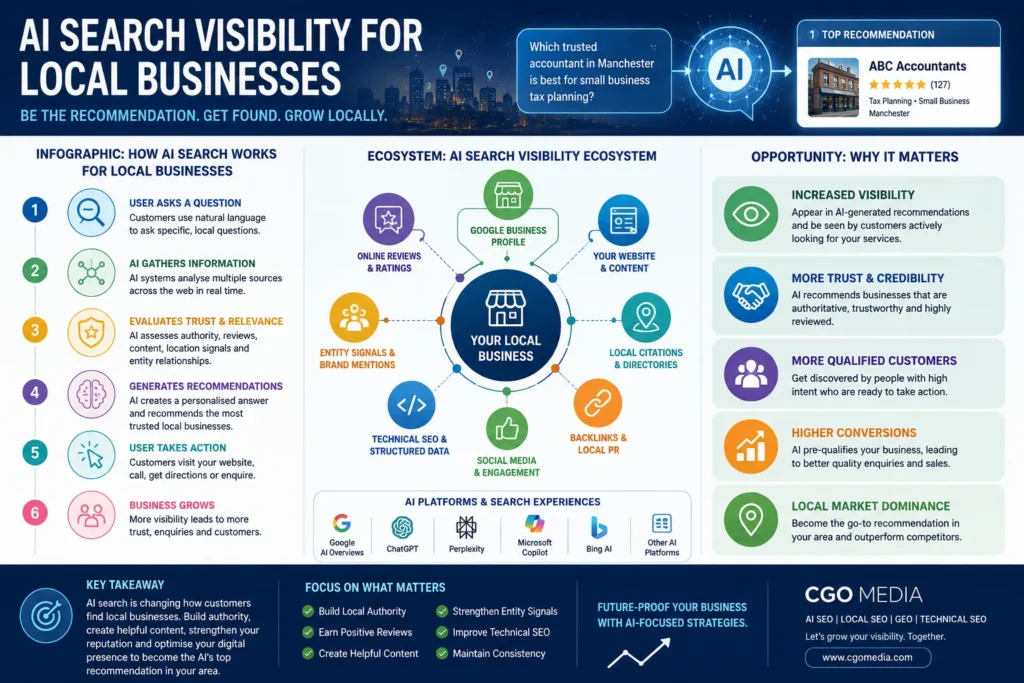
This infographic explains how AI-powered search evaluates local businesses using authority, reviews, entity signals, technical SEO and content to generate trusted recommendations.
2. Building Local Authority That AI Can Trust
Trust is becoming one of the strongest ranking factors within AI-powered search.
Unlike traditional algorithms that often rewarded page optimisation and backlinks, AI systems attempt to evaluate whether a business genuinely deserves recommendation.
That judgement relies upon hundreds of trust signals.
Google Business Profile Optimisation
Your Google Business Profile remains one of the strongest local authority signals available.
Ensure your profile includes:
- Accurate business name
- Correct address and phone number
- Opening hours
- Service descriptions
- Products
- High-quality photography
- Regular updates
- Questions and answers
AI frequently references this information when evaluating local businesses.
Customer Reviews
Reviews provide real-world evidence that customers trust your business.
AI models analyse not only star ratings but also review content, recurring themes, service quality and customer satisfaction.
Businesses with hundreds of detailed, authentic reviews naturally build stronger authority than businesses with only a handful.
Consistent Business Information
Your Name, Address and Phone Number (NAP) should remain consistent across every online platform.
Conflicting information weakens confidence and creates uncertainty for AI systems.
Local Backlinks
Mentions from trusted local organisations strengthen entity relationships.
Examples include:
- Local newspapers
- Business associations
- Universities
- Councils
- Industry organisations
- Community websites
These references demonstrate that your business genuinely operates within its claimed location.
Community Engagement
Supporting charities, sponsoring local events and participating within the community creates additional trust signals that AI increasingly recognises.
Local authority cannot be manufactured overnight. It develops through consistent activity across every digital touchpoint.
3. Content Marketing and Entity SEO for Local AI Visibility
Many local businesses still believe content marketing is only valuable for national brands. In reality, quality content is becoming one of the most influential factors affecting AI recommendations.
Every article published helps AI understand:
- What services you provide
- Which locations you serve
- Your level of expertise
- Your experience
- Your authority
Create Helpful Local Content
Rather than producing generic blogs, businesses should answer genuine customer questions.
Examples include:
- Local buying guides
- Service comparisons
- Industry advice
- Frequently asked questions
- Cost guides
- Case studies
- Success stories
- Seasonal advice
Helpful content earns trust from both users and AI systems.
Demonstrate Experience
Google’s EEAT framework (Experience, Expertise, Authoritativeness and Trustworthiness) aligns closely with how AI evaluates content.
Include:
- Real examples
- Original photography
- Expert commentary
- Named authors
- Client testimonials
- Data-backed research
These elements demonstrate genuine experience rather than automatically generated information.
Entity Recognition
Entity SEO is becoming increasingly important.
An entity may represent:
- A business
- A location
- A service
- A person
- An organisation
AI learns relationships between these entities over time.
For example:
“CGO Media” → “SEO Agency” → “London” → “AI SEO” → “Local SEO” → “Digital PR”
The more consistently these associations appear across trusted sources, the more confident AI becomes when recommending that business.
This is why our GEO Services UK focus heavily on strengthening entity recognition rather than simply improving rankings.
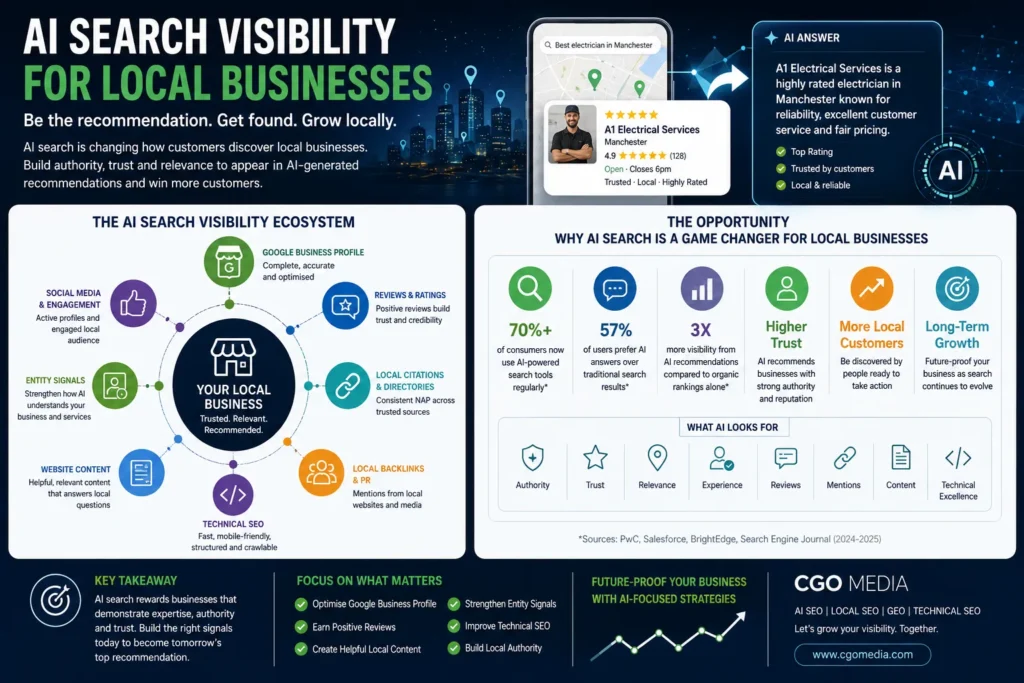
The AI Search Visibility Ecosystem demonstrates how technical SEO, content, reviews and local authority work together to improve AI recommendations and generate more customers.
4. Technical SEO, Brand Signals and AI Readiness
Even the best content cannot perform if search engines struggle to understand your website.
Technical SEO remains the foundation of AI visibility.
Website Structure
AI systems prefer websites that are logically organised.
Use:
- Clear navigation
- Descriptive URLs
- Logical internal linking
- Breadcrumbs
- HTML sitemaps
- XML sitemaps
Schema Markup
Structured data helps AI identify:
- Business details
- Reviews
- Services
- Locations
- Authors
- FAQs
The clearer your structured data, the easier your business becomes for AI to interpret.
Website Speed
Fast websites improve:
- User experience
- Search crawling
- Indexing
- AI processing
Core Web Vitals continue to influence visibility across both traditional and AI search.
Internal Linking
Internal links help AI understand topical relationships.
For example, a Local SEO page should naturally connect with:
- Technical SEO
- AI SEO
- Digital PR
- SEO Audits
- Content Marketing
This creates topical clusters that strengthen semantic understanding.
Businesses investing in Technical SEO UK consistently provide AI with cleaner, more understandable website architecture.
5. Preparing Your Business for the Future of AI Search
AI search is still evolving, but its direction is unmistakable. Businesses that invest today will establish a significant competitive advantage over organisations waiting for the technology to mature.
The most successful local businesses will combine traditional SEO with AI-focused optimisation strategies.
Priorities for the Next Five Years
- Build genuine local authority.
- Create exceptional helpful content.
- Improve entity recognition.
- Earn trusted backlinks.
- Generate authentic customer reviews.
- Strengthen brand awareness.
- Maintain technical excellence.
- Develop consistent citations.
- Publish regular expert insights.
- Monitor AI search visibility.
AI Is Rewarding Trust, Not Tricks
The era of manipulating rankings through shortcuts is rapidly disappearing.
Artificial intelligence rewards businesses that genuinely demonstrate expertise, authority and customer satisfaction.
This creates a more sustainable marketing environment where long-term investment produces long-term visibility.
Businesses that consistently educate customers, improve their websites and strengthen their reputation are becoming the organisations AI confidently recommends.
Partner with Specialists
Preparing for AI search requires more than occasional SEO updates. It involves combining content strategy, technical optimisation, digital PR, entity development and local authority into a unified visibility strategy.
At CGO Media, we help UK businesses improve their visibility across Google Search, AI-powered search engines and emerging answer platforms. Whether you require Local SEO UK, AI SEO Services UK, Technical SEO UK or GEO Services UK, our strategies are designed to future-proof your business as search continues to evolve.
AI search is no longer a future trend—it is already influencing how customers discover local businesses. Organisations that invest in trust, authority, expertise and technical excellence today will be the businesses AI recommends tomorrow.
Frequently Asked Questions
What is AI search visibility?
AI search visibility refers to how often your business is recommended or referenced by AI-powered search platforms such as Google AI Overviews, ChatGPT, Perplexity and Microsoft Copilot.
Is traditional local SEO still important?
Yes. Local SEO remains the foundation of online visibility, but it should now be combined with AI SEO, entity optimisation and authority building.
How do reviews affect AI search?
Reviews provide strong trust signals that help AI evaluate customer satisfaction, credibility and service quality when generating recommendations.
Can small businesses compete in AI search?
Absolutely. Smaller businesses with strong local authority, high-quality content and excellent customer reviews can outperform larger competitors in AI-generated recommendations.
How long does it take to improve AI visibility?
AI visibility improves gradually as authority signals, content, technical SEO and entity recognition strengthen. Businesses investing consistently usually see benefits over several months rather than weeks.
About Roger Wilkinson
Roger Wilkinson is an independent researcher, SEO practitioner and founder of CGO Media with more than 25 years of experience in search, online visibility and business growth. Having worked in search since the late 1990s, he has witnessed the evolution of the industry from traditional keyword optimisation through to today’s AI-driven search landscape.
His current research focuses on how artificial intelligence is reshaping search engines, recommendation systems and digital authority. Through independent research papers and strategic frameworks, Roger examines the relationship between Technical SEO, Entity Authority, Brand Signals, AI Visibility, Citation Authority, Knowledge Graphs and Search Visibility to help organisations prepare for the future of search.
Roger is the creator of the CGO Framework Series, a collection of executive-level methodologies designed to help organisations measure, improve and govern their digital visibility in an increasingly AI-centric environment. These frameworks are intended to bridge the gap between traditional SEO, semantic search, generative AI and long-term organisational authority.
His research combines practical industry experience with strategic analysis, focusing on enterprise governance, executive reporting, AI readiness and sustainable digital growth. Rather than relying on short-term optimisation tactics, his work promotes structured, measurable frameworks that enable organisations to build trusted, resilient and future-ready digital ecosystems.
The research published through CGO Media is intended to contribute to industry discussion and encourage organisations to adopt more integrated approaches to Search Visibility, AI Visibility and Digital Authority. Each framework and research paper is developed as part of an ongoing programme of independent analysis and is periodically reviewed to reflect changes in search technology, artificial intelligence and user behaviour.
Roger continues to work with organisations seeking to strengthen their digital presence while researching the long-term impact of AI on search, marketing and organisational competitiveness.
Research Usage & Citation
CGO Media encourages researchers, journalists, organisations, educators and industry professionals to reference and build upon our research where it contributes to broader discussion and understanding of AI Search, SEO, Digital Authority and Search Visibility.
Reasonable quotations, summaries, charts and excerpts from our research papers and frameworks may be used in articles, reports, presentations, academic work and other publications, provided appropriate acknowledgement is given.
When referencing our work, we kindly request that you include:
- A clear attribution to CGO Media.
- A hyperlink to either the CGO Media homepage or the relevant Framework & Research Library page where the original publication appears.
This acknowledgement helps readers access the complete research, methodology and future updates while supporting our ongoing programme of independent research into AI Search and Digital Visibility.
For permissions relating to extensive reproduction, commercial licensing or republication of substantial portions of our research, please contact CGO Media directly.