
Healthcare SEO and Trust Signals in AI Search Enviroment
 Healthcare search is increasingly shaped by the interaction between traditional search engines, AI-assisted discovery systems, institutional websites, professional profiles, regulatory information, patient-facing resources, local provider data and third-party sources.
For healthcare organisations, visibility is not simply a question of appearing for relevant keywords. Search systems and users must also be able to understand who the provider is, what services are offered, where those services are available, which professionals are responsible, what evidence supports the information presented, and whether the organisation appears trustworthy enough to influence a high-stakes decision.
This paper examines how SEO, trust signals, professional authority, local search, structured information and AI-assisted discovery interact within modern healthcare search environments.
1. Executive Summary
Healthcare is a high-trust search category.
Users may be searching for:
- Symptoms and conditions
- Treatment information
- Clinics
- Hospitals
- Doctors and specialists
- Diagnostic services
- Healthcare technology
- Private healthcare providers
- Pharmacies
- Care services
The decision environment is therefore fundamentally different from many ordinary commercial searches.
2. Healthcare Search Involves Both Information and Provider Selection
A healthcare search journey may begin with an informational question and eventually become a provider-selection decision.
A user may move through:
Question → Condition Understanding → Treatment Options → Provider Discovery → Trust Validation → Comparison → Appointment or Enquiry
3. Search Visibility Is Only the First Stage
A healthcare provider may achieve visibility without necessarily achieving trust.
The user may still need to evaluate:
- Clinical expertise
- Professional credentials
- Regulatory status
- Location
- Availability
- Treatment capability
- Patient experience
- Reputation
4. Healthcare Search Is an Evidence Environment
Search systems and users may encounter evidence from multiple sources before forming an opinion about a provider.
These sources can include:
- Provider websites
- Professional biographies
- Regulatory registers
- Clinical organisations
- Hospital or clinic directories
- Review platforms
- Medical publications
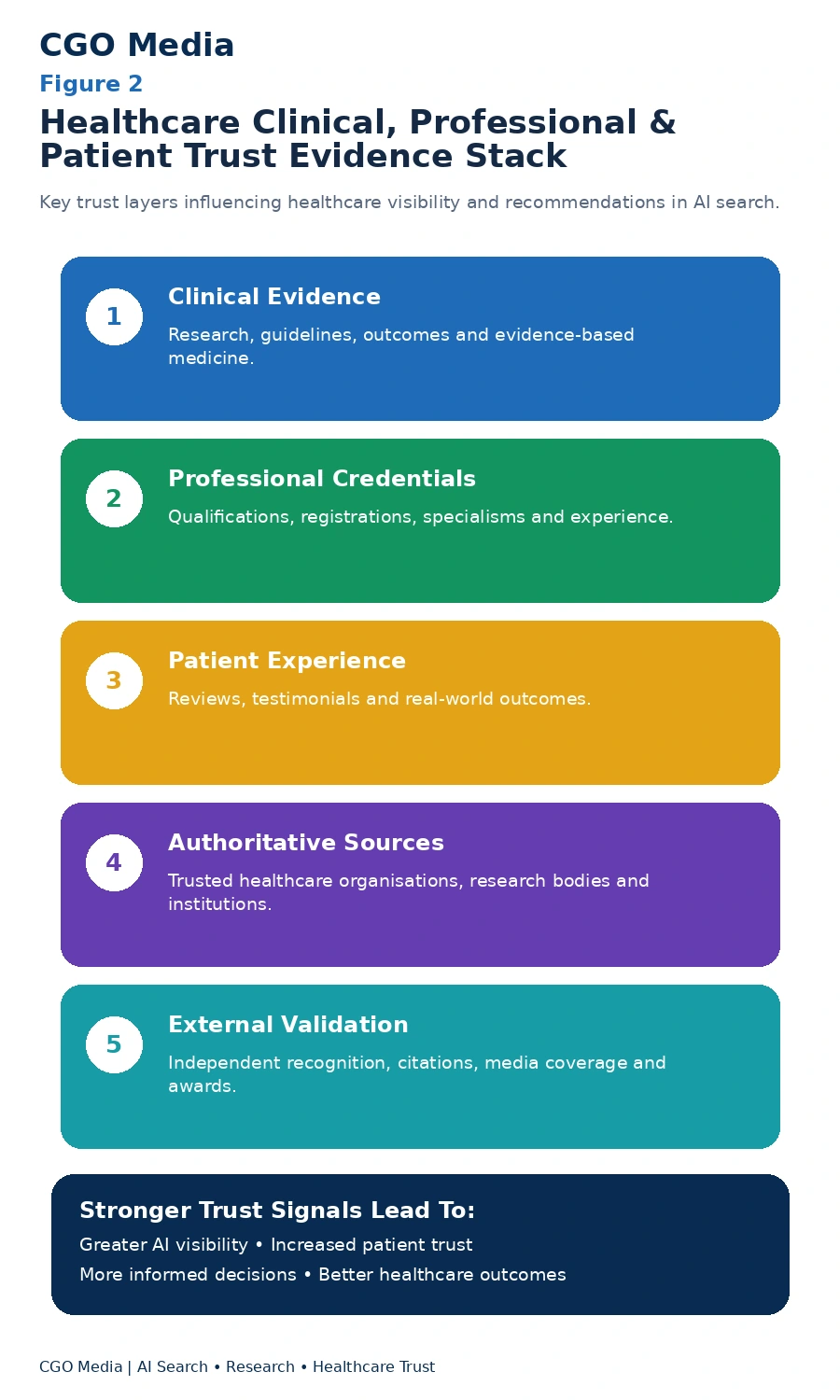
- News coverage
- Local business profiles
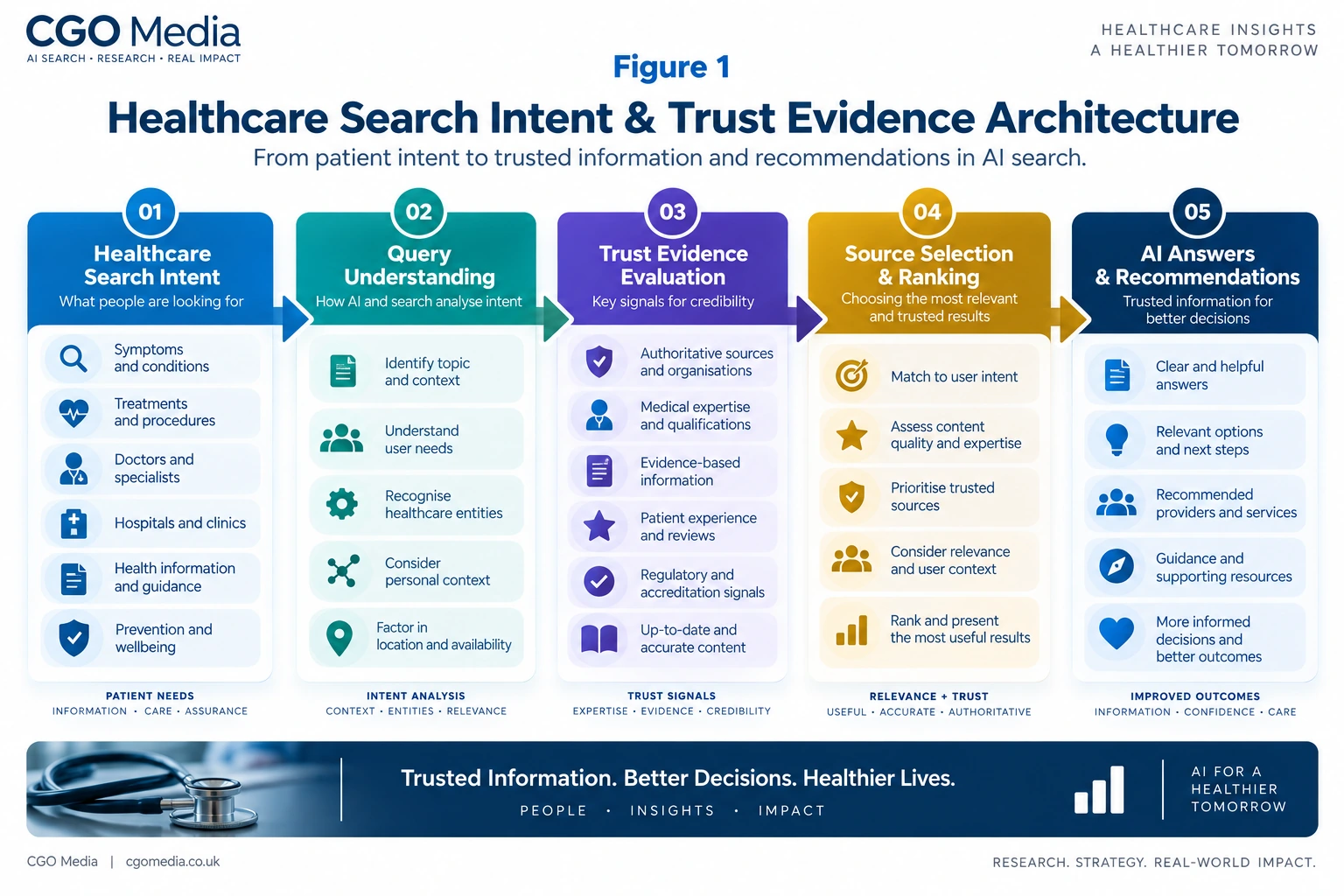
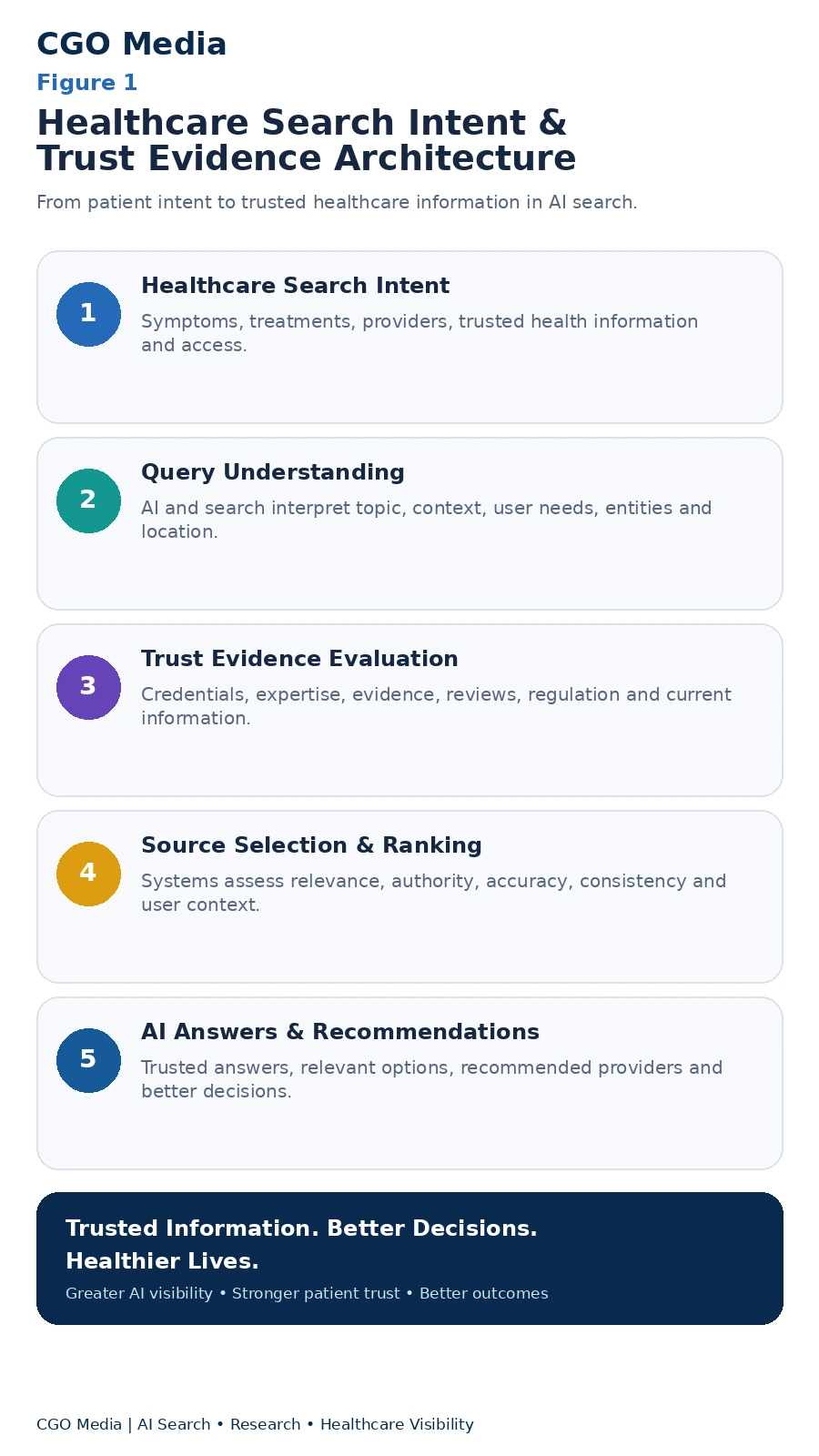
5. AI Search Adds Another Interpretation Layer
AI-assisted search systems can summarise information, compare options, explain treatments and recommend further investigation.
This creates an additional layer between the original source information and the user.
6. Healthcare Organisations Need Clear Machine-Readable Identity
A search system should be able to distinguish between:
- The healthcare organisation
- The clinic or hospital location
- The individual healthcare professional
- The service or treatment
- The condition being discussed
7. Trust Signals Are Distributed
Trust is rarely created by one isolated page.
It may emerge from the combined strength of:
- Professional credentials
- Institutional reputation
- Regulatory evidence
- Clinical information quality
- Patient experience
- External recognition
- Local presence
8. Healthcare SEO Should Reflect the Real Organisation
A strong healthcare search strategy should help digital information reflect the organisation’s real-world structure.
9. Organisational Entity
The organisation should be represented clearly as a distinct healthcare entity.
10. Location Entity
Each physical clinic, hospital or practice location should be distinguishable where appropriate.
11. Professional Entity
Doctors, consultants, clinicians and other professionals should have clear identities and relevant professional context.
12. Service Entity
Treatments, procedures and services should be described consistently and connected with the professionals and locations that provide them.
13. Healthcare Search Intent Is Multi-Layered
Search demand can be divided into several broad intent types.
14. Informational Intent
Examples may include:
- What causes a condition?
- What are the symptoms?
- How is it diagnosed?
- What treatments are available?
15. Provider Discovery Intent
Examples may include:
- Private cardiologist near me
- Best dermatology clinic
- Orthopaedic specialist London
- Private MRI clinic
16. Treatment Intent
Examples may include searches for:
- Specific procedures
- Diagnostic tests
- Therapies
- Surgical options
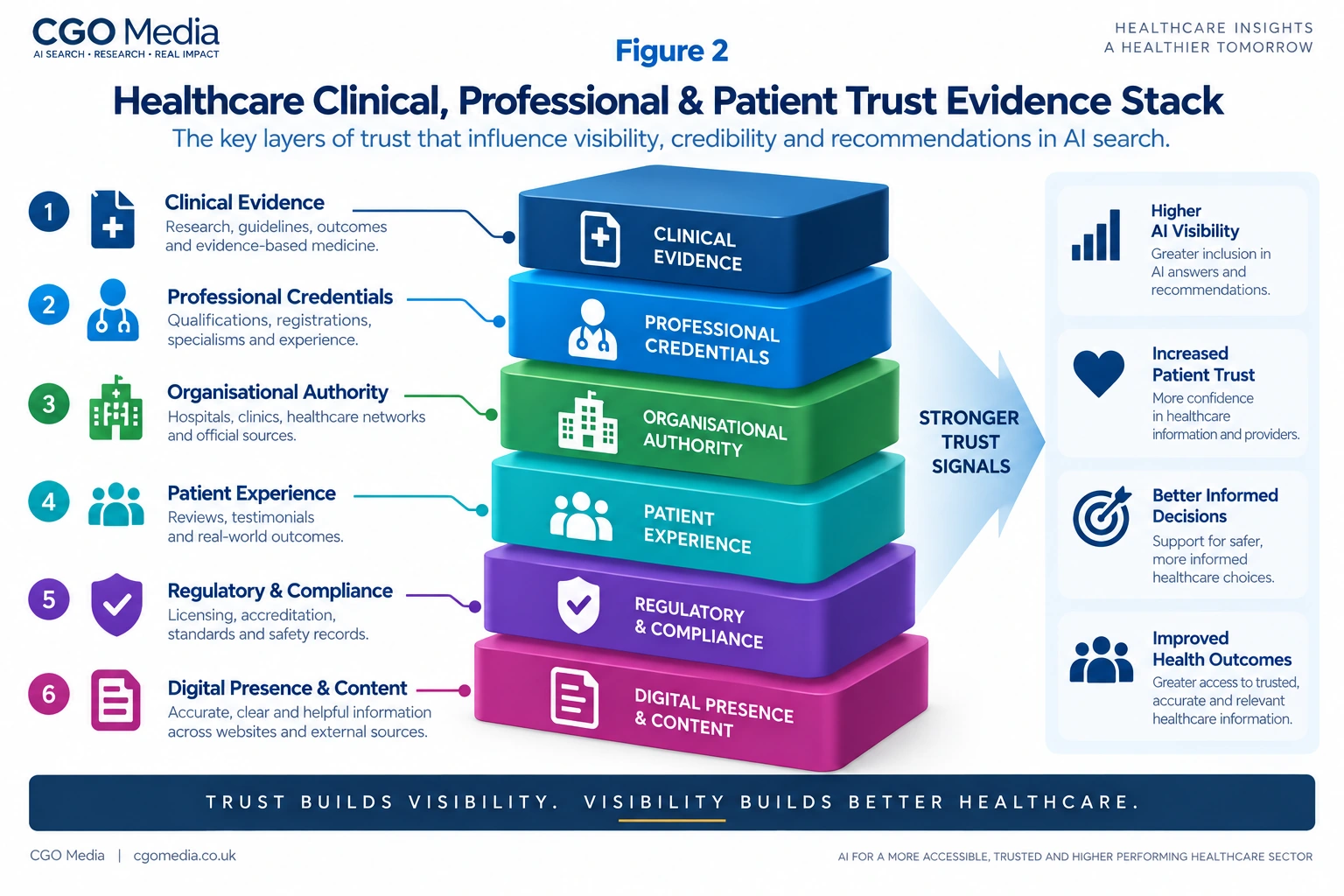
- Specialist consultations
17. Comparison Intent
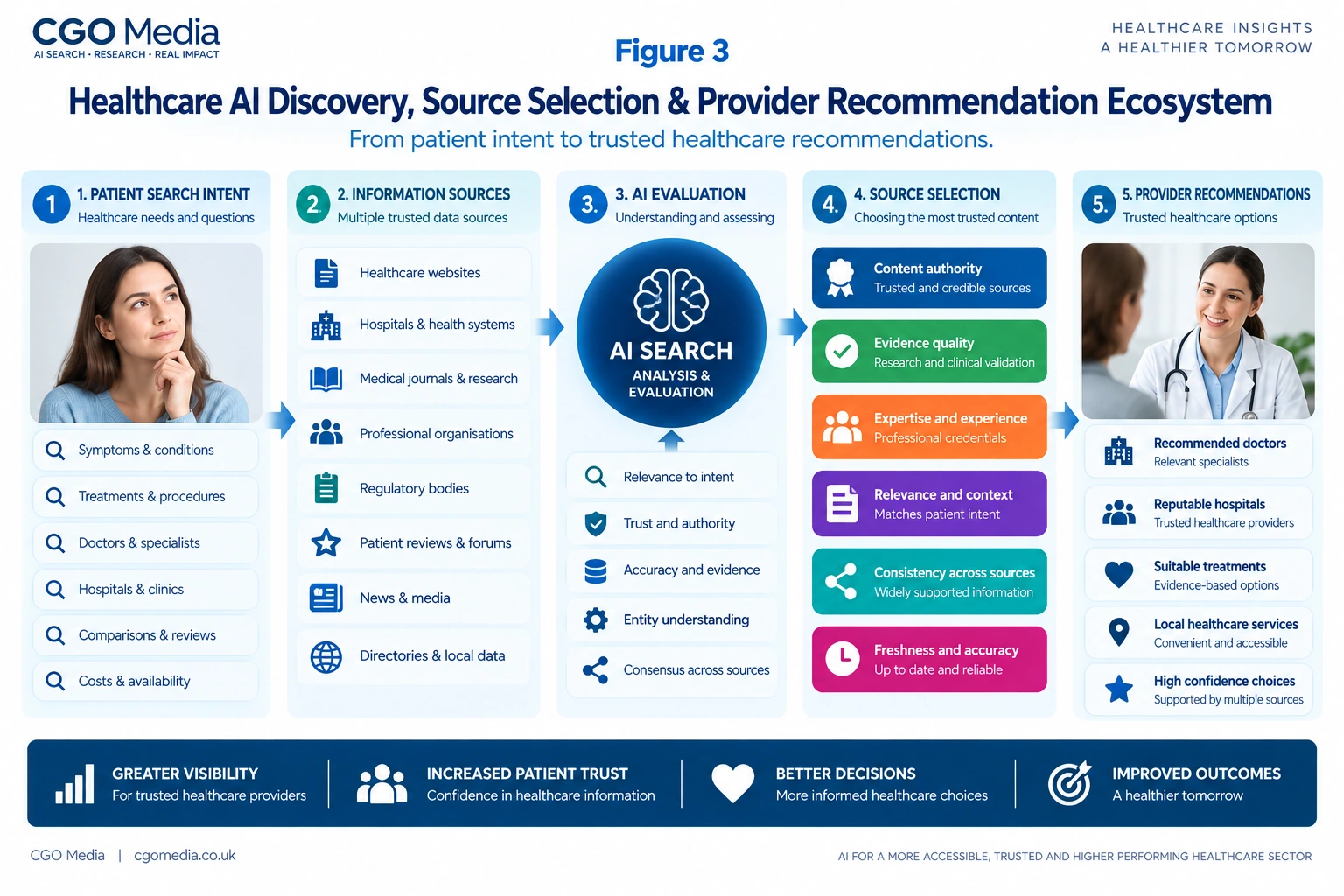
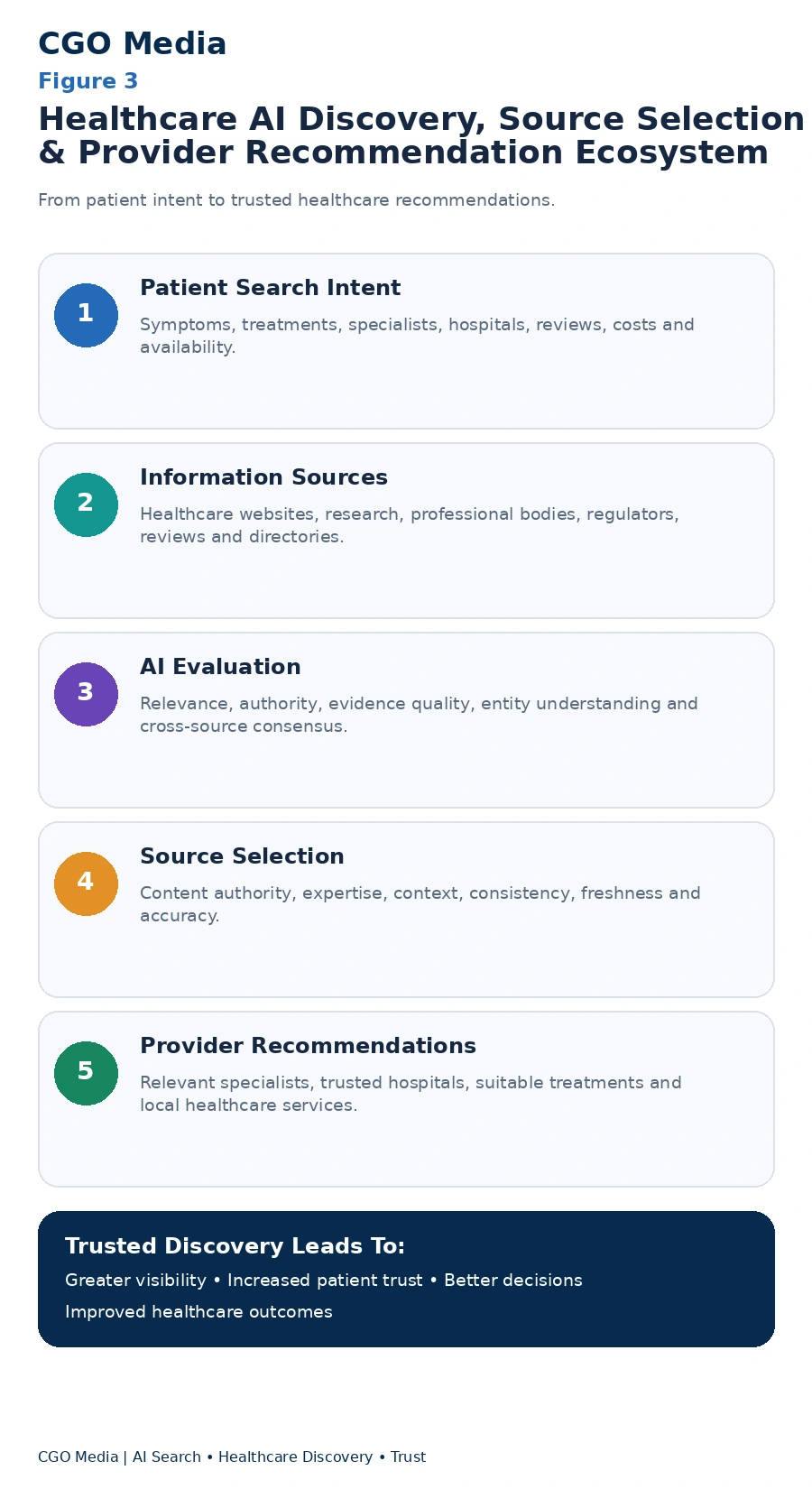
Users may compare:
- Providers
- Specialists
- Treatments
- Locations
- Pricing
- Waiting times
18. Validation Intent
Healthcare users may search directly for:
- Professional credentials
- Regulatory status
- Reviews
- Hospital affiliations
- Clinical experience
19. Transactional Intent
The journey may eventually move toward:
- Booking
- Calling
- Submitting an enquiry
- Requesting a consultation
- Registering as a patient
20. Search Intent Should Shape Information Architecture
A healthcare website should support the full decision journey rather than forcing all users toward a generic service page.
21. Condition Content
Condition pages should explain the topic clearly while connecting users with appropriate diagnostic or treatment pathways where relevant.
22. Treatment Content
Treatment pages should explain:
- What the treatment involves
- Who it may be suitable for
- How it is delivered
- Important considerations
- Which professionals provide it
23. Professional Profile Content
Professional profiles should support verification of:
- Name
- Role
- Qualifications
- Specialist interests
- Professional registration where appropriate
- Location
24. Location Content
Location pages should make clear:
- Address
- Services
- Professionals
- Opening information
- Contact pathways
- Accessibility
25. Trust Content
Trust-related information may include:
- Regulatory information
- Professional standards
- Patient safety
- Clinical governance
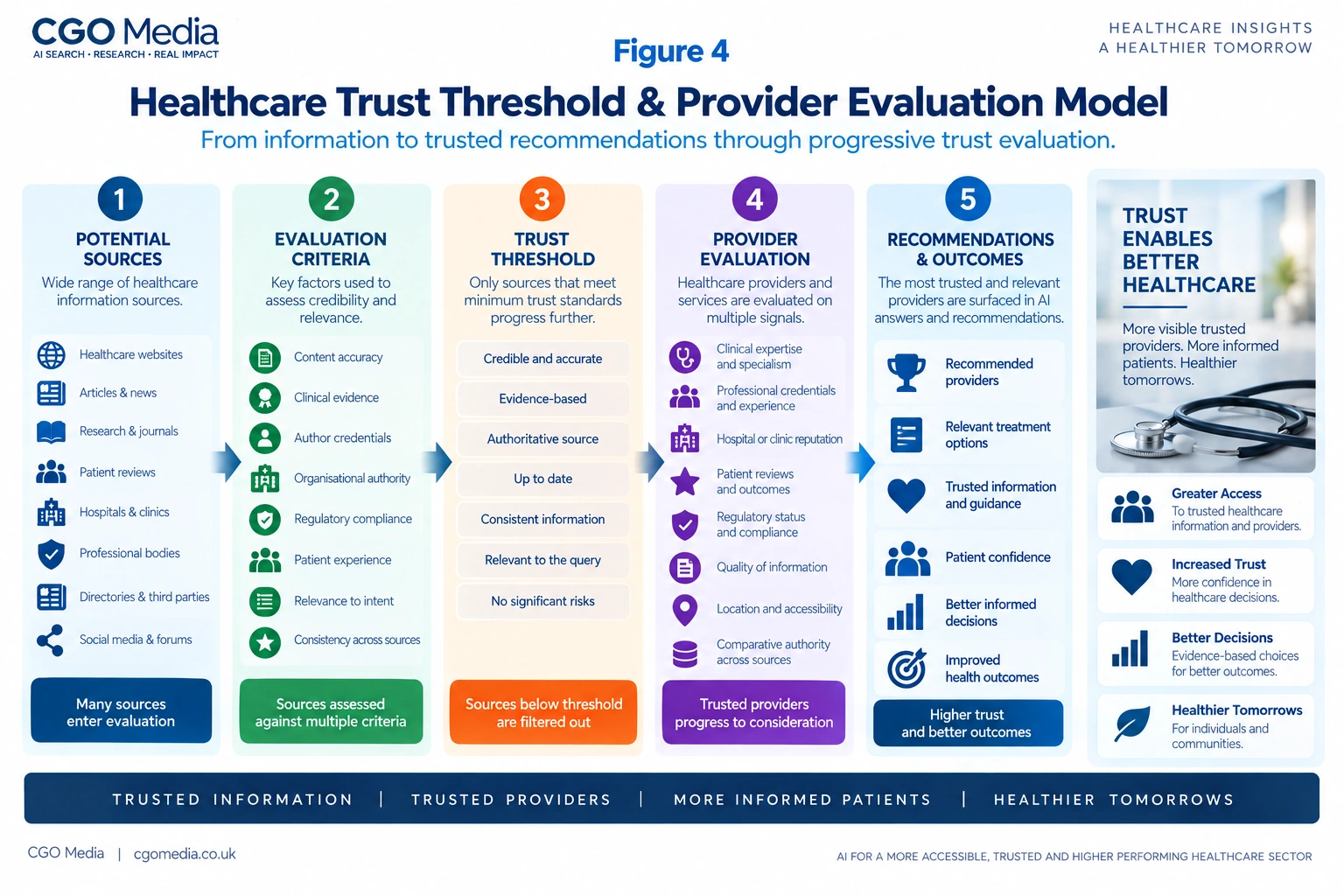
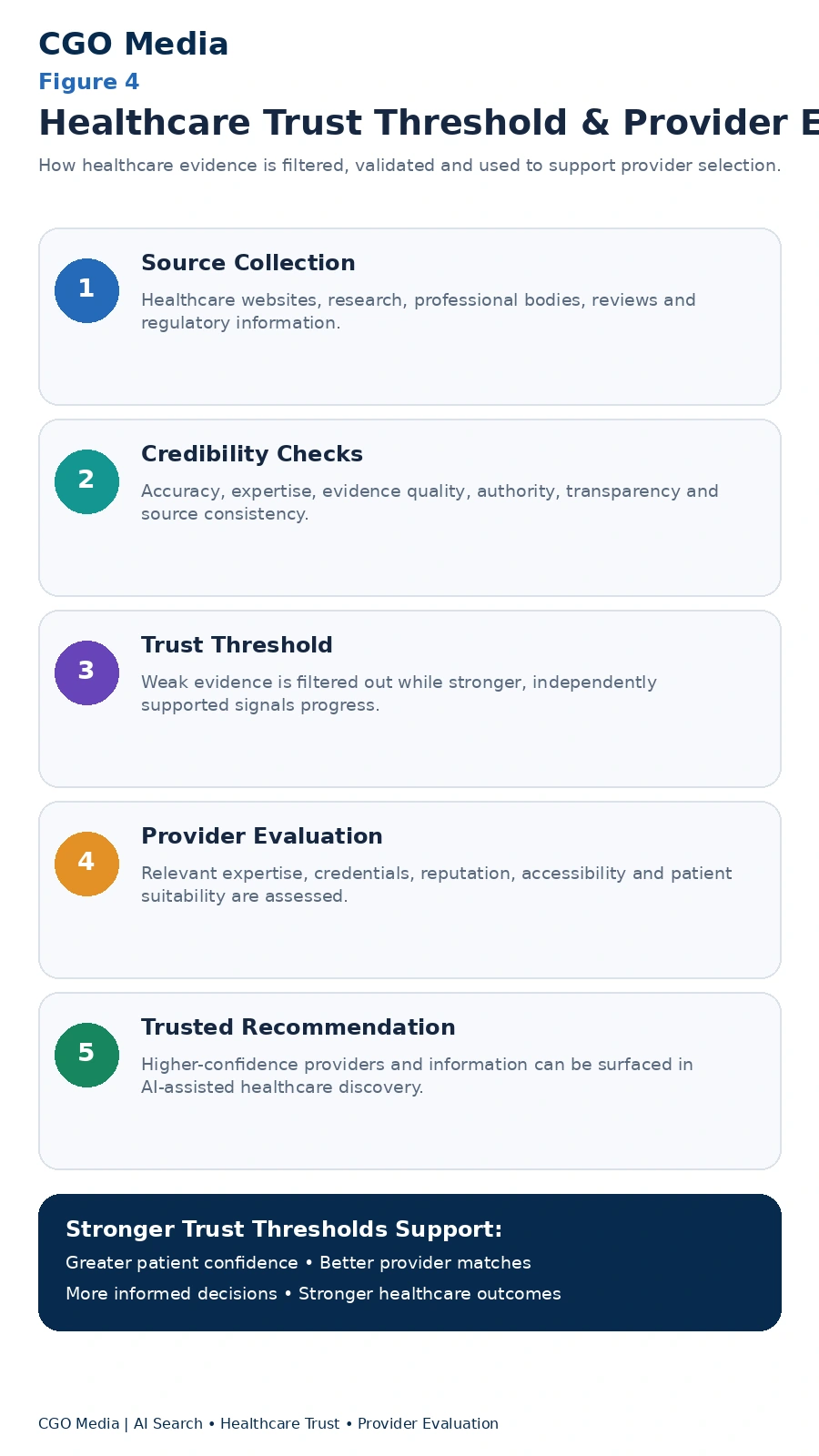
- Privacy
- Complaints processes
26. Healthcare SEO Begins with Entity Clarity
Before expanding content aggressively, healthcare organisations should establish clarity around the entities that matter most.
27. Organisation Identity
The provider’s name, legal identity, brand name and healthcare role should be represented consistently.
28. Location Identity
Each clinic or hospital should have accurate location information across the website and important external platforms.
29. Professional Identity
Professional names, roles and qualifications should be represented consistently where publicly stated.
30. Service Identity
Service naming should be clear enough to distinguish between:
- Consultations
- Diagnostics
- Treatments
- Procedures
- Specialist programmes
31. Entity Relationships Matter
Healthcare information becomes more useful when relationships are explicit.
For example:
Organisation → Location → Professional → Specialty → Service → Condition → Treatment
32. Professional Expertise Should Be Connected with Relevant Content
Where appropriate, clinical information can connect clearly with the professionals responsible for reviewing or contributing to it.
33. Healthcare Content Requires Stronger Editorial Discipline
Because healthcare information can influence consequential decisions, content should be written and reviewed with particular care.
34. Content Should Distinguish Education from Diagnosis
General healthcare information should not imply that a webpage can replace appropriate individual clinical assessment.
35. Content Should Avoid Unqualified Certainty
Healthcare outcomes vary between individuals and circumstances.
Claims should therefore avoid implying certainty where the evidence does not support it.
36. Claims Should Be Supportable
Statements about:
- Treatments
- Outcomes
- Risks
- Recovery
- Clinical effectiveness
should be supported appropriately and presented in context.
37. Content Freshness Matters
Clinical information can become outdated as:
- Guidance changes
- Services change
- Professionals move
- Evidence develops
- Regulation changes
38. Editorial Ownership Matters
Healthcare organisations should know who is responsible for reviewing important clinical and service information.
39. Review Dates Can Support Governance
Internal review schedules can help reduce information decay across high-value healthcare content.
40. Clinical Review and Editorial Review Are Different
A healthcare content workflow may require both:
- Editorial review for clarity and structure
- Clinical or professional review for subject accuracy
41. Search Authority Should Reflect Genuine Expertise
Healthcare providers should develop authority around services and specialisms they genuinely deliver rather than expanding into topics solely because search demand exists.
42. Specialist Depth Can Be More Valuable Than Generic Breadth
A provider with recognised expertise in a specific clinical area may benefit more from deep, structured coverage of that area than from attempting to publish across every medical topic.
43. The Healthcare Search Evidence Stack
A practical healthcare authority stack can include:
- Entity clarity
- Clinical information quality
- Professional expertise
- Regulatory and governance evidence
- Patient and local trust
- External authority
- AI search readiness
44. Healthcare Search Is a Connected System
The strongest healthcare search environments connect informational content, services, professionals, locations and trust evidence into a coherent architecture.
45. The First Strategic Objective
The first objective is therefore not simply to publish more healthcare content.
It is to create a clearer evidence architecture through which users and search systems can understand:
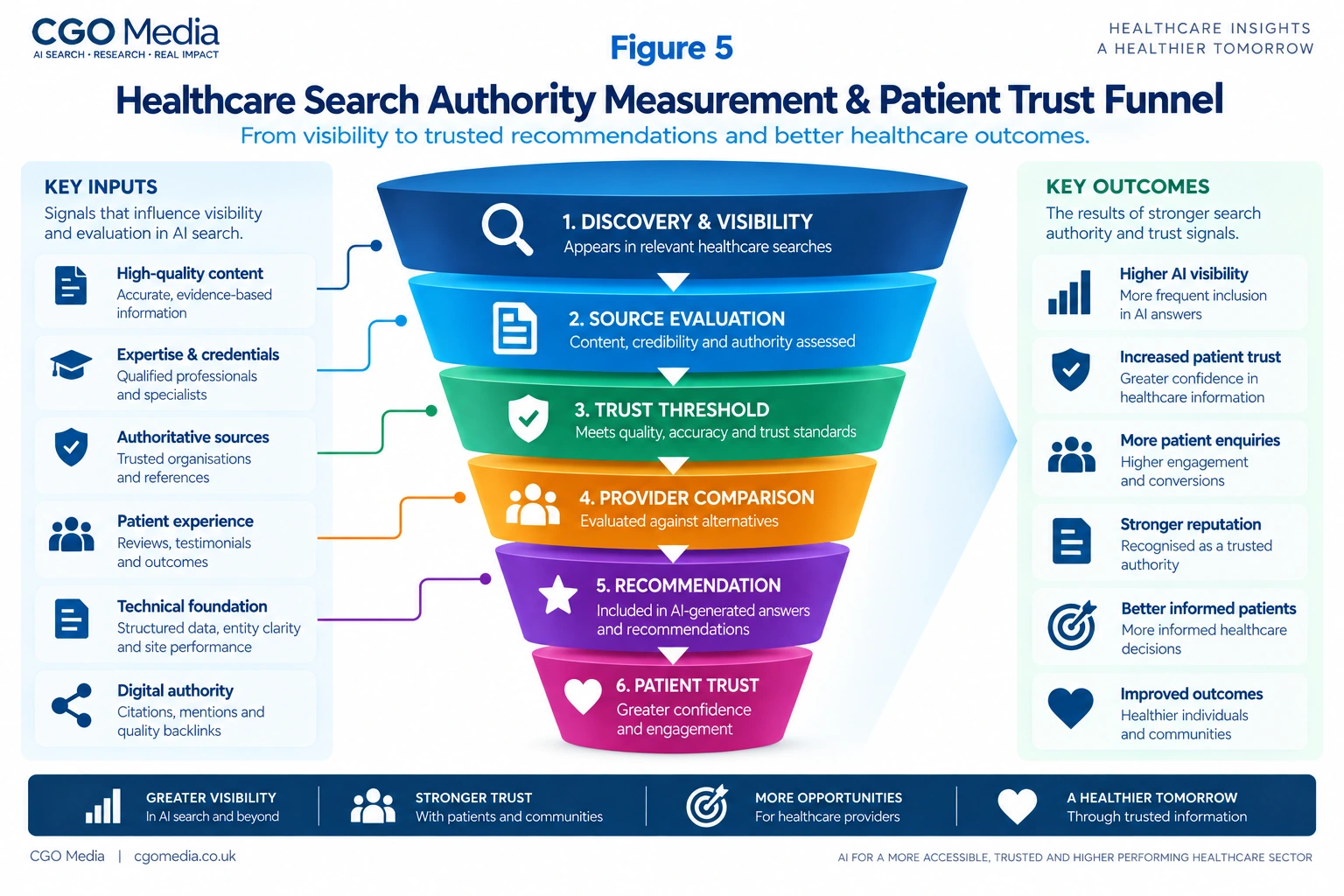
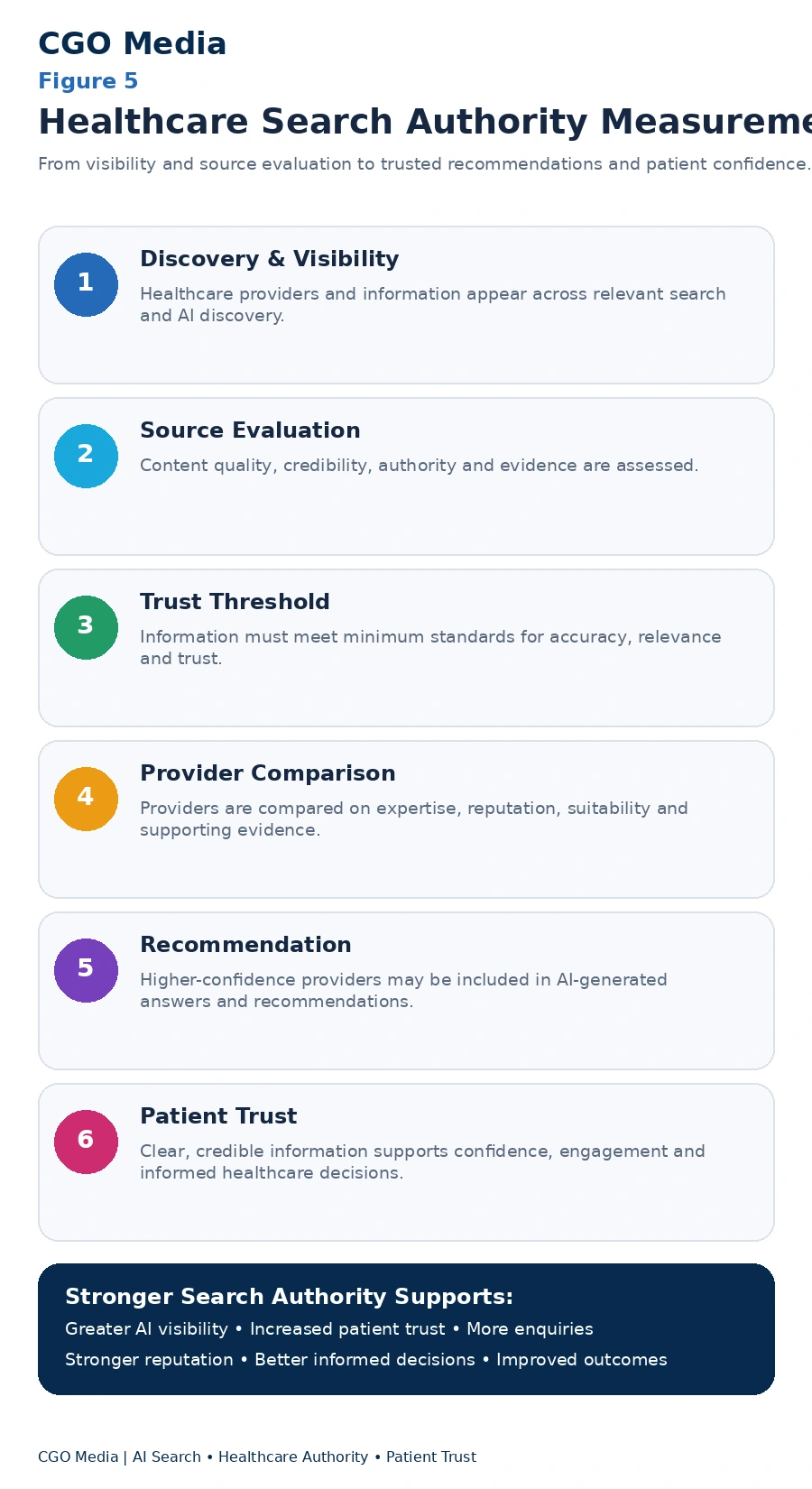
- Who the organisation is
- What it does
- Where it operates
- Who provides the care
- What evidence supports its expertise
- How its trustworthiness can be evaluated
46. Clinical Content Authority
Healthcare content authority should be built around relevance, evidence, review and clarity rather than content volume alone.
47. Clinical Information Should Support Real User Needs
Important content areas may include:
- Conditions
- Symptoms
- Diagnosis
- Treatments
- Procedures
- Recovery
- Prevention
48. Clinical Content Should Connect with Services
Where appropriate, informational pages should provide clear pathways toward relevant services without turning educational content into aggressive sales material.
49. Condition Pages Should Be Structured Carefully
A useful condition-page structure may include:
- Overview
- Common symptoms
- Possible causes
- How diagnosis may work
- Treatment options
- When professional assessment may be appropriate
- Relevant specialists
- Relevant services
50. Treatment Pages Should Support Informed Evaluation
Treatment information should help users understand:
- Purpose
- Process
- Potential benefits
- Possible limitations
- Risks
- Recovery considerations
51. Diagnostic Content Should Explain Process
Diagnostic pages may explain:
- What the test is
- Why it may be used
- How preparation works
- What happens during the test
- How results are handled
52. Healthcare Content Should Be Reviewed by Appropriate Experts
Where clinical claims are made, organisations should establish review processes involving suitably qualified professionals where appropriate.
53. Professional Attribution Can Support Transparency
Important healthcare content may identify:
- Author
- Reviewer
- Qualifications
- Professional role
- Review date
54. Author Profiles Should Be Verifiable
Professional biographies should provide enough information to help users understand the person’s role and expertise.
55. Professional Profile Authority
A strong professional profile may include:
- Full name
- Professional title
- Qualifications
- Specialist interests
- Clinical experience
- Professional registration where relevant
- Hospital or clinic affiliations
56. Professional Profiles Should Connect with Services
Users should be able to identify which services and specialties are associated with each healthcare professional.
57. Professional Profiles Should Connect with Locations
Where clinicians work across multiple locations, those relationships should be represented clearly.
58. Professional Profiles Should Connect with Research and Publications
Where relevant, a profile may reference genuine:
- Research
- Publications
- Conference participation
- Professional memberships
- Teaching roles
59. Professional Credentials Should Not Be Overstated
Titles, qualifications and affiliations should be represented precisely and should not imply expertise or status beyond what can be supported.
60. Institutional Authority Matters
The reputation and clarity of the healthcare organisation itself can influence how individual professionals and services are perceived.
61. Organisational Trust Signals
These may include:
- Regulatory status
- Clinical governance
- Accreditations
- Professional standards
- Patient safety information
- Transparent contact information
62. Regulatory Evidence
Where healthcare organisations or professionals are subject to regulation, accurate regulatory information can become an important trust signal.
63. Regulatory Information Should Be Current
Outdated or ambiguous regulatory references can create unnecessary uncertainty.
64. Regulation Should Be Linked to the Correct Entity
Organisations should distinguish between:
- Provider regulation
- Facility regulation
- Professional registration
- Service-specific accreditation
65. Clinical Governance Evidence
Where appropriate, healthcare organisations may explain how they manage:
- Quality
- Safety
- Complaints
- Incident handling
- Clinical review
66. Privacy and Data Trust
Healthcare organisations handle particularly sensitive information.
Trust content should make privacy and data-handling practices understandable to users.
67. Patient Consent and Information Governance
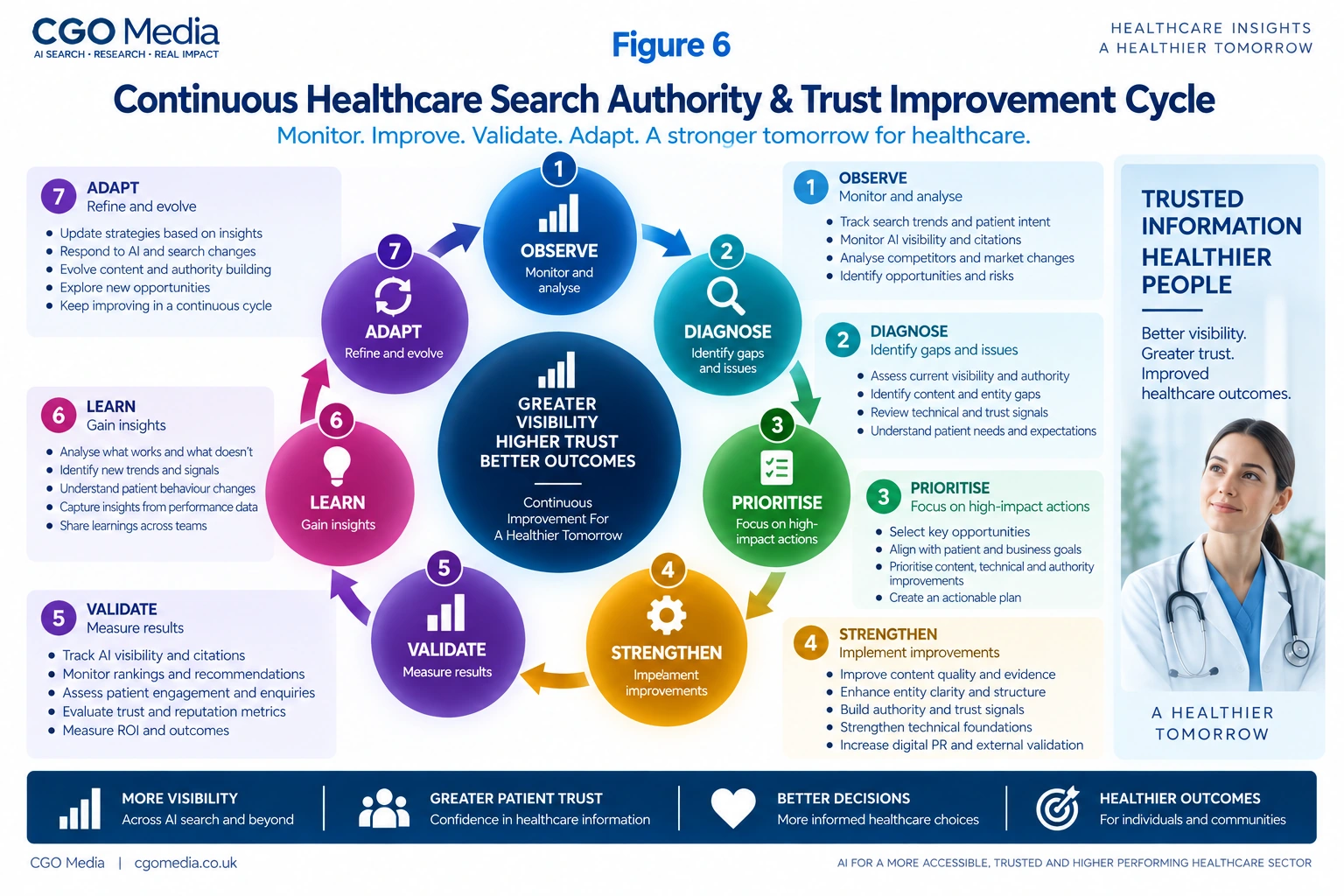
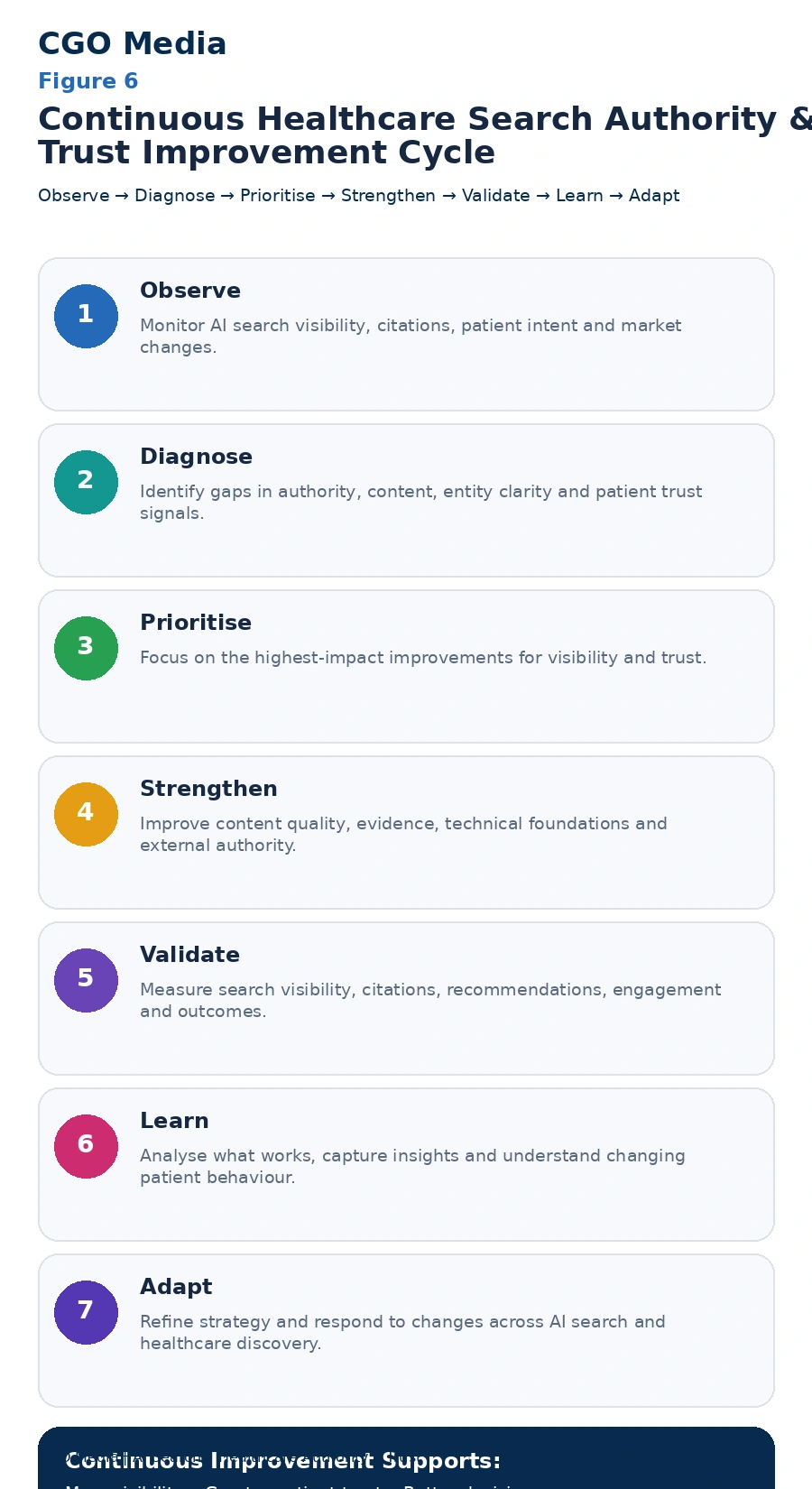
Where relevant, providers should communicate clearly how patient information is collected, used and protected.
68. Local Search Is Central to Provider Discovery
Many healthcare decisions involve proximity, availability and local access.
69. Healthcare Location Pages
Each important physical location should provide clear information about:
- Address
- Contact details
- Opening information
- Services
- Professionals
- Transport
- Accessibility
70. Local Business Profiles
Important local listings should be accurate and consistent with the provider website.
71. Location Consistency
Names, addresses and contact information should be managed consistently across relevant platforms.
72. Multi-Location Healthcare Providers
Large healthcare organisations should distinguish individual clinics, hospitals or practices rather than collapsing every location into one generic entity.
73. Location-Service Relationships
Users should be able to understand which services are available at each location.
74. Location-Professional Relationships
Where appropriate, location pages should identify which professionals practise there.
75. Local Search and Specialist Intent
Healthcare searches often combine location and expertise.
For example:
- Cardiologist in Manchester
- Private dermatologist in London
- MRI clinic near me
- Orthopaedic surgeon in Birmingham
76. Local Content Should Avoid Doorway-Style Duplication
Location pages should contain genuine local information rather than repeating identical content with only the place name changed.
77. Patient Trust Signals
Patients may use multiple forms of evidence when assessing a provider.
78. Patient Reviews
Reviews can provide insight into experiences involving:
- Communication
- Waiting times
- Staff interaction
- Facilities
- Administrative processes
79. Reviews Should Not Replace Clinical Evidence
Patient reviews can contribute to perceived trust but are not a substitute for clinical qualifications, governance or professional evidence.
80. Review Recency
Recent reviews can help users understand the current patient experience.
81. Review Diversity
A broader pattern of feedback may be more informative than isolated positive or negative experiences.
82. Review Governance
Healthcare organisations should manage review responses carefully, particularly where patient confidentiality may be involved.
83. Testimonials
Where testimonials are used, they should be authentic, appropriately presented and compliant with relevant rules and professional standards.
84. Patient Outcome Claims Require Particular Care
Healthcare marketing should avoid implying that an individual outcome is typical unless there is appropriate evidence.
85. Pricing Transparency Can Influence Trust
For private healthcare, users may evaluate:
- Consultation fees
- Diagnostic costs
- Treatment costs
- Finance options
- Insurance compatibility
86. Pricing Should Be Current
Where fees are published, outdated pricing can damage trust and create friction.
87. Waiting-Time Information
Where appropriate and operationally supportable, information about appointment availability or waiting times can influence provider selection.
88. Accessibility Information
Useful healthcare location information may include:
- Wheelchair access
- Parking
- Public transport
- Interpreter support
- Accessibility services
89. Patient Journey Information
Healthcare providers can reduce uncertainty by explaining:
Enquiry → Consultation → Diagnosis → Treatment → Follow-Up
90. Trust Is Reinforced by Operational Clarity
Clear information about what happens next can be as important to patient confidence as promotional messaging.
91. Clinical Authority and Local Authority Should Connect
A strong healthcare search environment combines:
- Clinical expertise
- Professional identity
- Location clarity
- Regulatory evidence
- Patient trust
92. External Healthcare Authority
Trust can also be reinforced by independent evidence from:
- Professional bodies
- Regulatory organisations
- Hospitals
- Universities
- Medical publications
- Reputable media
93. External Authority Should Be Relevant
A healthcare provider benefits more from relevant professional and institutional validation than from unrelated publicity.
94. Citation Quality Matters
Where healthcare content references clinical or scientific evidence, sources should be selected carefully and represented accurately.
95. Healthcare Trust Is Multi-Dimensional
A useful model is:
Clinical Evidence + Professional Authority + Regulatory Trust + Local Presence + Patient Experience + External Validation
96. Strong Healthcare SEO Connects These Dimensions
The objective is to create an information architecture in which users and search systems can move easily between:
Condition → Treatment → Professional → Location → Trust Evidence → Provider
97. AI-Assisted Healthcare Discovery
AI-assisted discovery can influence healthcare research by summarising conditions, treatments, provider types and possible next steps before a user reaches an individual healthcare website.
98. AI Search Changes the Discovery Sequence
Traditional search often presents a list of sources for the user to evaluate.
AI-assisted systems may instead synthesise information across several sources into a direct response.
99. Healthcare Providers May Be Evaluated Before the First Website Visit
A user may encounter information about:
- Provider name
- Specialisms
- Locations
- Professional expertise
- Services
- Reviews
before visiting the provider directly.
100. This Raises the Importance of Information Consistency
Where important facts differ between the provider website and external sources, AI-assisted systems may encounter contradictory evidence.
101. Healthcare AI Readiness Begins with Accurate First-Party Information
Providers should ensure that core information on their own website is accurate, current and sufficiently detailed.
102. Provider Identity Should Be Unambiguous
The organisation should be represented consistently across:
- Website
- Professional directories
- Local profiles
- Regulatory references
- Review platforms
- External publications
103. Professional Identity Should Be Unambiguous
Clinician names, roles, specialties and affiliations should be represented carefully and consistently where publicly available.
104. Service Identity Should Be Clear
AI systems and users should be able to distinguish between:
- Specialty
- Condition
- Treatment
- Diagnostic service
- Procedure
105. Location Identity Should Be Clear
Healthcare providers operating across several locations should make each site distinguishable.
106. Entity Relationships Support Interpretation
A healthcare information environment may contain relationships such as:
Healthcare Organisation → Location → Professional → Specialty → Service → Condition → Treatment
107. Professional Relationships Matter
A specialist profile becomes more useful when connected clearly with:
- Specialties
- Services
- Locations
- Clinical content
- Research
108. Location Relationships Matter
A clinic or hospital page should connect with the services and professionals actually available there.
109. Service Relationships Matter
A treatment or diagnostic service should connect with relevant:
- Conditions
- Professionals
- Locations
- Supporting information
110. Knowledge Architecture Can Reduce Ambiguity
Clear relationships between healthcare entities can make the information environment easier for both users and automated systems to interpret.
111. Structured Data Can Support Entity Clarity
Where supported by visible page content, structured data can help describe entities and relationships.
112. Potential Healthcare Structured Data Types
Relevant types may include:
- Organization
- MedicalOrganization
- Hospital
- Physician
- Person
- LocalBusiness
- MedicalClinic
- Article
- BreadcrumbList
113. Structured Data Must Match the Page
Markup should describe information that is genuinely present and accurate.
114. Structured Data Does Not Create Clinical Authority by Itself
Markup can support interpretation, but it cannot replace:
- Professional expertise
- Clinical evidence
- Regulatory trust
- Patient confidence
- External validation
115. AI Recommendation Readiness in Healthcare
Healthcare recommendation environments require particular caution because provider selection may involve significant personal consequences.
116. Recommendation Visibility Should Not Be Treated as a Guarantee of Suitability
The appearance of a provider in an AI-generated response does not establish that the provider is appropriate for every user or clinical circumstance.
117. Healthcare Provider Recommendation Queries
Potential query types may include:
- Best clinic for a specific treatment
- Specialist for a particular condition
- Private hospital in a location
- Diagnostic provider near me
- Specialist with particular expertise
118. Recommendation Factors Are Multi-Layered
A healthcare recommendation context may involve:
- Relevance
- Location
- Professional expertise
- Service availability
- Trust
- External reputation
119. Recommendation Systems May Draw on Multiple Source Types
Potential information sources can include:
- Provider websites
- Professional directories
- Regulatory registers
- Review platforms
- Local listings
- Editorial publications
- Medical institutions
120. Source Selection Matters
Healthcare providers should consider not only what their own website says, but also which external sources are likely to be encountered by users and automated systems.
121. First-Party Sources
First-party sources may include:
- Organisation pages
- Professional profiles
- Service pages
- Condition resources
- Treatment information
- Location pages
122. Regulatory Sources
Regulatory registers and official professional directories can provide independent verification of status and identity.
123. Institutional Sources
Hospitals, universities, research institutions and professional organisations can contribute important context around expertise and affiliation.
124. Review Sources
Review platforms may provide information about patient experience, communication and operational service quality.
125. Editorial Sources
Relevant media, professional publications and healthcare journalism can contribute external context where coverage is accurate and substantive.
126. Scientific and Clinical Sources
Healthcare information may also depend on authoritative clinical guidance, peer-reviewed research and recognised medical institutions.
127. Source Diversity Can Strengthen Confidence
A provider that is represented consistently across several credible source types may be easier to understand than one supported by a narrow or contradictory evidence base.
128. Source Diversity Should Not Be Manufactured
The objective is not to create artificial repetition across low-quality sources.
External authority should arise from genuine professional, institutional and patient-facing evidence.
129. External Validation Should Be Relevant
Relevant validation may include:
- Professional recognition
- Research affiliations
- Hospital appointments
- Accreditations
- Regulatory information
- Reputable editorial coverage
130. Professional Body Relationships
Where genuine, memberships and professional affiliations may help users understand a healthcare professional’s wider professional context.
131. Academic Relationships
Teaching, research or university affiliations may support professional context where they are current and represented accurately.
132. Research Publication Relationships
Where clinicians contribute to published research, those relationships can connect individual expertise with identifiable subject areas.
133. Hospital Affiliations
Where professionals practise at established hospitals or healthcare institutions, accurate affiliation information may support trust and verification.
134. Media Authority
Relevant media coverage can reinforce professional recognition where it reflects genuine expertise rather than promotional exposure alone.
135. External Authority Should Not Be Confused with Popularity
Visibility is not equivalent to clinical expertise.
Healthcare authority should be assessed through the quality and relevance of supporting evidence.
136. AI Source Analysis
Where AI systems expose citations or source links, healthcare organisations can observe which source types repeatedly appear around relevant queries.
137. Source Analysis Should Be Diagnostic
The purpose is to understand the information environment rather than assume that appearing on a specific website will guarantee AI visibility.
138. Monitor Branded Healthcare Queries
Branded testing can examine whether AI-assisted systems represent correctly:
- Organisation name
- Locations
- Services
- Professionals
- Contact context
139. Monitor Professional Queries
Test whether clinician information is represented accurately across:
- Specialty
- Qualifications
- Affiliations
- Locations
140. Monitor Service Queries
Assess whether the provider is associated appropriately with services it genuinely offers.
141. Monitor Location Queries
Local AI-assisted discovery may require accurate relationships between:
- Provider
- Clinic
- Service
- Professional
142. Monitor Comparison Queries
Healthcare organisations can observe how they are represented when users compare relevant providers, while recognising that generated outputs may vary.
143. Monitor Representation Accuracy
Important facts to review may include:
- Services
- Location
- Professional roles
- Specialties
- Regulatory information
- Pricing where public
144. Correct First-Party Inaccuracies
Where representation problems are identified, healthcare organisations should first ensure that their own evidence is accurate.
145. Correct Important External Inaccuracies Where Possible
Outdated listings, incorrect professional information or stale location information should be corrected on relevant platforms where the provider has legitimate control or correction rights.
146. Avoid Attempting to Control Independent Evidence Improperly
External reviews, professional commentary and independent publications should remain independent.
147. AI Search Readiness Is Broader Than AI Content
Healthcare AI readiness depends on the strength of the entire evidence environment, including:
- Entity clarity
- Professional authority
- Clinical information
- Regulatory trust
- Local accuracy
- External validation
148. Strong Healthcare AI Readiness Is Cumulative
A useful conceptual model is:
Accurate Entities + Trusted Clinical Information + Professional Evidence + Regulatory Validation + External Authority + Local Clarity
149. AI Visibility Should Be Interpreted Cautiously
Generated answers can change across models, prompts, locations and time.
Healthcare organisations should therefore treat AI visibility as a dynamic observation rather than a permanent ranking position.
150. Healthcare AI Search Should Support, Not Replace, Appropriate Clinical Pathways
Digital discovery can help users find information and providers, but healthcare organisations should avoid designing content that encourages users to treat general AI-generated information as a substitute for appropriate professional assessment.
151. Healthcare Trust Thresholds
Healthcare users often require a higher level of confidence before acting than users in lower-risk commercial categories.
152. Visibility Does Not Equal Selection
A provider can be visible without crossing the trust threshold required for a user to make contact.
153. Trust Thresholds Vary by Decision
A low-complexity appointment may require less evidence than a major procedure, long-term treatment pathway or specialist intervention.
154. Informational Trust Threshold
Users evaluating general healthcare information may look for:
- Clear authorship
- Professional review
- Current information
- Balanced explanation
- Appropriate supporting sources
155. Provider Trust Threshold
Users evaluating a healthcare provider may require evidence around:
- Regulation
- Professional credentials
- Clinical experience
- Location
- Service availability
- Patient experience
156. Treatment Trust Threshold
Where a treatment carries greater cost, complexity or perceived risk, users may require stronger evidence around:
- Clinical suitability
- Professional expertise
- Risks
- Potential outcomes
- Aftercare
- Alternative options
157. Trust Accumulates Across the Journey
Healthcare trust can develop progressively as users encounter consistent evidence across:
Information → Professional → Provider → Location → External Validation → Patient Experience
158. Inconsistency Can Reduce Trust
Conflicting information about professionals, services, locations or pricing can create uncertainty even where the provider is otherwise credible.
159. Missing Evidence Can Be as Important as Negative Evidence
Users may become cautious when important information is simply absent.
160. Common Missing Trust Evidence
Examples may include:
- No named professional
- No regulatory information
- No clear location
- No treatment explanation
- No pricing context
- No patient pathway information
161. Healthcare Provider Evaluation Is Multi-Stage
Provider evaluation may include:
- Initial discovery
- Relevance assessment
- Professional verification
- Trust validation
- Comparison
- Contact decision
162. Stage One — Initial Discovery
The provider must first appear within the user’s consideration environment.
163. Stage Two — Relevance Assessment
The user asks whether the provider appears relevant to the specific:
- Condition
- Treatment
- Specialty
- Location
164. Stage Three — Professional Verification
The user may investigate:
- Qualifications
- Registration
- Specialist interests
- Experience
- Affiliations
165. Stage Four — Trust Validation
The user may evaluate:
- Regulatory status
- Governance
- Patient reviews
- Reputation
- Privacy
- Safety information
166. Stage Five — Comparison
Providers may be compared across:
- Expertise
- Location
- Availability
- Patient experience
- Pricing
- Facilities
167. Stage Six — Contact Decision
The final step may involve:
- Booking
- Calling
- Submitting an enquiry
- Requesting more information
168. Provider Elimination Can Occur Early
A user may remove a provider from consideration before reaching detailed comparison.
169. Common Provider Elimination Factors
These may include:
- Unclear professional credentials
- Weak service information
- Inaccurate location details
- Poor reviews
- Limited availability
- Weak trust evidence
170. Comparative Healthcare Search
Healthcare users may compare several providers before making contact, especially for private treatment or specialist care.
171. Comparison Pages Require Caution
Providers should avoid unsupported claims that imply superiority without evidence.
172. Useful Comparison Dimensions
Where appropriate, users may compare:
- Specialist expertise
- Location
- Facilities
- Services
- Availability
- Pricing
- Patient experience
173. Clinical Claims Should Not Be Reduced to Marketing Rankings
Statements such as “best,” “leading” or “number one” should be used only where they are supportable and compliant with relevant standards.
174. Reputation Is Broader Than Reviews
Healthcare reputation can include:
- Professional standing
- Institutional affiliation
- Research activity
- Regulatory history
- Patient feedback
- Media coverage
175. Patient Reviews Are One Layer of Reputation
Reviews can help users understand aspects of the service experience but should not be treated as direct evidence of clinical effectiveness.
176. Review Volume and Review Recency
Users may consider both how much feedback exists and whether it reflects the current service environment.
177. Review Themes May Matter More Than Average Score
Repeated themes may reveal:
- Communication quality
- Administrative reliability
- Waiting times
- Staff interaction
- Facilities
178. Reputation Monitoring Should Be Structured
Healthcare organisations can monitor recurring themes rather than reacting only to isolated comments.
179. Complaints and Negative Feedback
Negative feedback should be handled through appropriate governance rather than defensive public responses.
180. Confidentiality Must Be Protected
Public responses to healthcare reviews should avoid disclosing or confirming confidential patient information.
181. External Reputation Signals
External reputation may also emerge through:
- Professional organisations
- Hospital affiliations
- Academic institutions
- Research publications
- Reputable media
182. External Reputation Should Be Verified
Outdated memberships, affiliations or professional roles should not continue to be represented as current.
183. Trust Signals Should Be Easy to Find
Users should not need to investigate multiple unrelated areas of a website to verify basic trust information.
184. Trust Architecture
Healthcare sites may benefit from clear routes toward:
- Professional profiles
- Regulatory information
- Clinical governance
- Patient information
- Privacy
- Complaints procedures
185. Trust Should Be Distributed Contextually
Important evidence should also appear where users need it rather than being confined to one trust page.
186. Treatment-Page Trust
Treatment pages may connect users with:
- Relevant clinicians
- Clinical review information
- Risks
- Aftercare
- Location
187. Professional-Profile Trust
Professional pages may connect users with:
- Qualifications
- Registration
- Specialist services
- Locations
- Research
188. Location-Page Trust
Location pages may connect users with:
- Regulatory context
- Available services
- Professionals
- Facilities
- Patient information
189. AI Recommendation Readiness Requires Trust Depth
Healthcare providers seeking stronger representation in AI-assisted discovery should focus on the depth and coherence of the evidence environment rather than superficial AI-specific optimisation.
190. Recommendation Readiness Layer One — Entity Clarity
The system should be able to distinguish:
- Organisation
- Professional
- Location
- Service
191. Recommendation Readiness Layer Two — Clinical Relevance
The provider should have clear evidence connecting real expertise with relevant conditions, treatments and services.
192. Recommendation Readiness Layer Three — Professional Evidence
Professional identities should be sufficiently clear and verifiable.
193. Recommendation Readiness Layer Four — Trust Evidence
Regulatory, governance, patient and institutional trust signals should reinforce the provider’s credibility.
194. Recommendation Readiness Layer Five — External Validation
Relevant external sources should provide independent context where genuine evidence exists.
195. Recommendation Readiness Layer Six — Information Consistency
Important facts should remain consistent across first-party and authoritative external environments.
196. Recommendation Readiness Layer Seven — Monitoring
The organisation should observe whether important information is represented accurately across AI-assisted discovery.
197. A Healthcare AI Readiness Stack
The combined model can be represented as:
Entity Clarity → Clinical Relevance → Professional Evidence → Trust Validation → External Authority → Consistency → Monitoring
198. Weakness at One Layer Can Constrain the Whole System
A provider with strong clinical content but poor entity clarity may remain difficult to interpret.
199. Strong Reputation Without Service Relevance Is Insufficient
A well-known healthcare organisation may still be unsuitable for a particular treatment or location requirement.
200. Strong Local Presence Without Professional Evidence Is Insufficient
A nearby provider may fail to cross the trust threshold where professional credentials or specialist expertise are unclear.
201. AI Recommendation Monitoring Should Include Non-Branded Queries
Testing only the provider’s name does not show whether it enters consideration during genuine discovery.
202. Non-Branded Monitoring Areas
Potential areas include:
- Condition-led queries
- Treatment-led queries
- Specialty-led queries
- Location-led queries
- Provider-comparison queries
203. Measure Recommendation Presence Cautiously
Organisations may track whether they appear within relevant generated responses, but this should be treated as observational data rather than a fixed ranking.
204. Measure Representation Accuracy
Review whether generated answers describe accurately:
- Services
- Professionals
- Locations
- Specialties
- Regulatory information
205. Measure Competitor Presence
Observe which providers repeatedly appear within the same relevant discovery scenarios.
206. Measure Source Patterns
Where sources are exposed, identify whether recurring citations come from:
- Provider websites
- Regulatory sources
- Professional directories
- Review platforms
- Medical institutions
- Editorial sources
207. Measure Change Over Time
AI representation can be monitored longitudinally to identify meaningful changes in visibility or accuracy.
208. Avoid Over-Interpreting Small Changes
Individual prompt variations can produce different outputs.
Repeated patterns are generally more useful than one isolated response.
209. Healthcare AI Readiness Is a Governance Issue
Because the underlying evidence may be owned by different teams, AI representation accuracy cannot be treated as a marketing responsibility alone.
210. Cross-Functional Ownership
Relevant contributors may include:
- Clinical teams
- Marketing
- Operations
- Compliance
- IT
- Patient experience teams
211. Trust and Recommendation Readiness Converge
The strongest healthcare discovery environments are those in which clinical relevance, professional evidence, regulatory trust, patient experience and external validation reinforce one another.
212. Provider Selection Is the Commercial Expression of Trust
Search visibility creates the opportunity to be considered.
Trust evidence determines whether the organisation remains within the user’s consideration set.
213. Measuring Healthcare Search Authority
Healthcare search performance should be evaluated across more than rankings and traffic.
A stronger measurement system should consider whether the organisation is being discovered, understood, trusted and selected across the wider patient journey.
214. Healthcare Visibility Should Be Measured by Intent
Different search-intent groups should be assessed separately because they represent different stages of the decision process.
215. Informational Visibility
Track visibility around:
- Conditions
- Symptoms
- Diagnosis
- Treatments
- Procedures
216. Provider Discovery Visibility
Track visibility around:
- Specialist searches
- Clinic searches
- Hospital searches
- Location-led searches
- Private healthcare searches
217. Treatment Visibility
Measure whether relevant treatment and diagnostic services are being surfaced appropriately.
218. Professional Visibility
Assess whether clinicians and specialists are discoverable for their genuine areas of expertise.
219. Local Visibility
Track performance across:
- Location searches
- Local business profiles
- Maps environments
- Location-specific service discovery
220. AI-Assisted Visibility
Monitor whether the provider appears in relevant AI-assisted discovery environments and whether the representation is accurate.
221. Visibility Alone Is Insufficient
A provider may be visible while failing to generate trust, enquiries or bookings.
222. The Healthcare Provider Visibility Funnel
A practical measurement funnel can be represented as:
Discovery → Relevance → Trust → Comparison → Contact → Patient Journey
223. Stage One — Discovery
The provider enters the user’s consideration environment.
224. Stage Two — Relevance
The user determines whether the provider appears suitable for the relevant:
- Condition
- Treatment
- Specialty
- Location
225. Stage Three — Trust
The user evaluates:
- Professional credentials
- Regulatory evidence
- Patient experience
- Clinical information
- External reputation
226. Stage Four — Comparison
The provider is compared with alternative organisations or specialists.
227. Stage Five — Contact
The user may:
- Book an appointment
- Call
- Submit an enquiry
- Request further information
228. Stage Six — Patient Journey
Search and digital discovery may eventually contribute to:
- Consultation
- Diagnosis
- Treatment
- Follow-up
- Long-term patient relationship
229. Healthcare Search Measurement Should Follow the Funnel
Different indicators should be used at different stages.
230. Discovery Measures
Potential measures may include:
- Search visibility
- Impressions
- AI recommendation presence
- Local visibility
231. Relevance Measures
Potential indicators may include:
- Engagement with treatment pages
- Professional profile visits
- Location-page engagement
- Service-page progression
232. Trust Measures
Potential indicators may include:
- Professional-profile engagement
- Regulatory information engagement
- Review interaction
- Trust-page usage
- Clinical content depth
233. Comparison Measures
Potential indicators may include:
- Return visits
- Professional comparison behaviour
- Treatment comparison engagement
- Pricing-page engagement
234. Contact Measures
Potential indicators may include:
- Bookings
- Calls
- Enquiries
- Consultation requests
235. Patient Journey Measures
Where appropriate and legally permissible, organisations may examine whether digital discovery contributes to:
- Completed appointments
- New patient acquisition
- Treatment progression
- Patient retention
236. Healthcare Trust Score Dimensions
Healthcare organisations can assess trust across several evidence dimensions rather than relying on one overall reputation metric.
237. Dimension One — Clinical Information Quality
Review whether important healthcare information is:
- Accurate
- Current
- Balanced
- Professionally reviewed where appropriate
238. Dimension Two — Professional Authority
Assess the quality and clarity of:
- Professional profiles
- Qualifications
- Specialist interests
- Registration information
- Relevant affiliations
239. Dimension Three — Regulatory and Governance Trust
Review evidence around:
- Regulation
- Accreditation
- Clinical governance
- Complaints processes
- Privacy
240. Dimension Four — Patient Trust
Assess:
- Review recency
- Review themes
- Patient journey clarity
- Communication evidence
- Operational transparency
241. Dimension Five — Local and Operational Clarity
Review:
- Location accuracy
- Service availability
- Professional-location relationships
- Accessibility
- Contact information
242. Dimension Six — External Authority
Assess relevant evidence from:
- Professional bodies
- Hospitals
- Academic institutions
- Medical publications
- Reputable media
243. Dimension Seven — AI Representation Accuracy
Review whether important provider information is represented accurately across relevant AI-assisted environments.
244. A Healthcare Trust Scorecard
| Trust Dimension | What to Review |
|---|---|
| Clinical Information | Accuracy, review, freshness and evidence quality. |
| Professional Authority | Qualifications, role, specialty, registration and affiliations. |
| Regulatory Trust | Regulation, governance, privacy and patient-safety information. |
| Patient Trust | Reviews, communication, journey clarity and operational experience. |
| Local Clarity | Locations, services, professionals, accessibility and contact information. |
| External Authority | Institutional, professional, academic and editorial validation. |
| AI Representation | Accuracy, consistency and relevance in AI-assisted discovery. |
245. Scores Should Be Evidence-Based
Any internal healthcare trust score should be based on observable evidence rather than subjective reputation claims.
246. Avoid False Precision
A trust score can support prioritisation, but small numerical differences should not be treated as scientifically precise.
247. Trust Gaps Should Be Prioritised by Risk
Not every weakness carries the same importance.
248. Critical Trust Gaps
These may include:
- Incorrect professional information
- Outdated regulatory information
- Wrong location information
- Unsafe or misleading clinical claims
- Major privacy concerns
249. Patient Journey Trust Gaps
These may include:
- Unclear booking process
- Weak treatment explanation
- No aftercare information
- Poor pricing clarity
- Inaccessible contact pathways
250. Competitive Trust Gaps
These may include areas where alternative providers demonstrate stronger:
- Professional authority
- Patient evidence
- Location clarity
- Clinical information
- External validation
251. AI Representation Gaps
These may include repeated inaccuracies around:
- Services
- Professional roles
- Locations
- Specialties
- Regulatory status
252. Measurement Requires Governance
Healthcare search authority crosses organisational boundaries.
A reliable measurement system therefore requires clear ownership.
253. Clinical Ownership
Clinical teams may be responsible for:
- Clinical accuracy
- Medical review
- Treatment information
- Professional claims
254. Marketing Ownership
Marketing may coordinate:
- Search visibility
- Information architecture
- Local search
- External authority
- AI monitoring
255. Compliance and Governance Ownership
Compliance teams may oversee:
- Regulatory claims
- Privacy
- Patient communications
- Advertising standards
256. Operations Ownership
Operations may own:
- Locations
- Opening information
- Availability
- Facilities
- Patient pathways
257. Patient Experience Ownership
Patient-experience teams may contribute:
- Review intelligence
- Complaints themes
- Communication feedback
- Journey friction
258. Executive Oversight
Larger healthcare organisations may benefit from executive-level visibility into major trust, reputation and discoverability risks.
259. Healthcare Search Governance Council
A cross-functional governance group may review:
- Clinical content quality
- Professional information
- Regulatory evidence
- Patient trust
- Local accuracy
- AI representation
260. Governance Cadence
A practical governance cycle may include:
- Monthly operational monitoring
- Quarterly trust review
- Quarterly AI representation review
- Annual strategic reassessment
261. Professional Change Triggers
Changes involving clinicians should trigger review of:
- Professional profiles
- Service pages
- Location pages
- Clinical content attribution
- External profiles where appropriate
262. Service Change Triggers
The introduction, removal or modification of a service should trigger review of connected treatment, location and professional information.
263. Location Change Triggers
Changes involving addresses, opening information or service availability should be updated across first-party and relevant external environments.
264. Regulatory Change Triggers
Material changes to regulation, accreditation or governance information should trigger immediate evidence review.
265. Clinical Guidance Change Triggers
Important medical content should be reviewed when relevant guidance or clinical evidence changes materially.
266. Review and Reputation Triggers
Repeated negative themes may justify operational investigation rather than reputation-management activity alone.
267. AI Representation Triggers
Repeated material inaccuracies should trigger review of the wider information environment.
268. Patient Journey Measurement
The strongest healthcare measurement programmes connect visibility with the quality of the patient journey.
269. Discovery Should Lead to Appropriate Next Steps
The objective should not be maximum enquiry volume regardless of suitability.
Digital discovery should help appropriate users reach relevant healthcare pathways.
270. Qualified Patient Enquiries
Private healthcare providers may distinguish between total enquiries and enquiries relevant to the services actually provided.
271. Appointment Conversion
Where appropriate, organisations can measure the proportion of relevant enquiries progressing to appointments.
272. Patient Journey Friction
Digital analysis may identify friction involving:
- Booking
- Contact forms
- Telephone pathways
- Pricing information
- Location information
273. Commercial Measurement Requires Context
For private healthcare organisations, revenue may be one outcome, but it should not become the sole measure of search programme quality.
274. Appropriate Care Matters
A strong healthcare discovery environment should help users identify services that are relevant and appropriate rather than encouraging unsuitable demand.
275. Trust Metrics and Commercial Metrics Should Be Considered Together
A useful executive view may combine:
- Visibility
- Trust
- Patient journey
- Reputation
- AI representation
- Commercial outcomes where relevant
276. Healthcare Search Authority Is a Managed System
The measurement model can therefore be summarised as:
Discoverability → Relevance → Trust → Patient Progression → Experience → Reputation → Continuous Improvement
277. Continuous Healthcare Search Authority Improvement
Healthcare search authority should be maintained as an ongoing governance process rather than treated as a one-time SEO project.
Clinical information, professional roles, service availability, locations, regulation and external reputation can all change over time.
278. Continuous Improvement Begins with Observation
Healthcare organisations should monitor the parts of the evidence environment most likely to affect discovery and trust.
279. Monitor Clinical Content
Important condition, treatment and diagnostic information should be reviewed for:
- Accuracy
- Freshness
- Professional review
- Appropriate supporting evidence
280. Monitor Professional Information
Professional profiles should be updated when:
- Roles change
- Qualifications change
- Specialist interests change
- Affiliations change
- Locations change
281. Monitor Service Information
Treatment and service pages should be reviewed when:
- Services are introduced
- Services are discontinued
- Eligibility changes
- Clinical pathways change
- Pricing changes
282. Monitor Location Information
Healthcare organisations should identify changes involving:
- Address
- Telephone
- Opening information
- Professional availability
- Services
- Accessibility
283. Monitor Regulatory and Governance Information
Regulatory references, accreditations and governance information should be reviewed whenever the underlying status changes.
284. Monitor External Profiles
Relevant external directories, local listings and professional profiles should be checked for material inaccuracies.
285. Monitor Patient Reputation
Review monitoring should focus on repeated themes rather than isolated comments.
286. Monitor AI Representation
Healthcare providers can periodically assess whether AI-assisted systems continue to represent accurately:
- Organisation identity
- Locations
- Professionals
- Services
- Specialties
- Regulatory context
287. Healthcare Evidence Decay
Evidence decay occurs when publicly available information no longer reflects the current organisation.
288. Clinical Evidence Decay
Healthcare content may become outdated because:
- Guidance changes
- New evidence emerges
- Treatment pathways change
- Terminology changes
289. Professional Evidence Decay
Professional information may become inaccurate when clinicians:
- Move organisation
- Change role
- Change location
- Change specialist focus
290. Service Evidence Decay
Service pages can become misleading when availability, technology, clinical pathways or pricing changes.
291. Local Evidence Decay
External profiles can retain old addresses, opening information or service descriptions long after the provider website has been updated.
292. Reputation Evidence Decay
Older reviews may no longer reflect the present patient experience where staffing, facilities or operational systems have changed materially.
293. AI Representation Decay
Generated descriptions may continue to reflect older information where stale sources remain visible within the broader information environment.
294. Evidence Decay Requires Ownership
Important information should have defined owners responsible for determining when review is required.
295. Failure Mode — Publishing Without Clinical Governance
A healthcare content programme can create risk when publication volume grows faster than the organisation’s ability to review clinical accuracy.
296. Failure Mode — Generic Medical Content Expansion
Publishing broad healthcare information unrelated to genuine organisational expertise can dilute topical focus and create unnecessary review requirements.
297. Failure Mode — Weak Professional Attribution
Clinical information may appear less transparent where users cannot identify who created or reviewed important content.
298. Failure Mode — Professional Profiles Used as Marketing Biography Only
Profiles that focus on promotional language while omitting verifiable qualifications, roles and specialist context may provide limited trust value.
299. Failure Mode — Regulation Hidden from the Patient Journey
Relevant regulatory evidence may exist but remain difficult for users to locate.
300. Failure Mode — Local SEO Without Service Accuracy
Strong local visibility can create frustration if the promoted location does not actually provide the service being searched for.
301. Failure Mode — Reviews Treated as Clinical Proof
Patient feedback can inform service experience but should not be used as a substitute for clinical evidence.
302. Failure Mode — Reputation Management Without Operational Improvement
Repeated complaints should trigger investigation into the underlying patient experience where appropriate.
303. Failure Mode — AI Monitoring Without Correction
Recording inaccurate AI responses provides little value unless material information problems lead to evidence review and correction.
304. Failure Mode — Chasing Individual AI Responses
Healthcare organisations should avoid making major strategic decisions because of one isolated generated answer.
305. Failure Mode — Overstating AI Recommendation Significance
Appearance in an AI-generated response should not be presented as independent clinical endorsement.
306. Failure Mode — Unsupported Superiority Claims
Healthcare marketing should avoid describing providers, clinicians or outcomes as superior without appropriate evidence.
307. Failure Mode — Search Growth Detached from Patient Suitability
Increased traffic or enquiry volume has limited value if users are being attracted toward services that are not relevant to their needs.
308. Improvement Should Prioritise Accuracy Before Growth
Material inaccuracies should normally be corrected before expanding visibility.
309. Priority One — Patient Safety and Clinical Accuracy
The highest-priority issues may include:
- Incorrect medical information
- Outdated clinical guidance
- Misleading treatment claims
- Incorrect professional information
310. Priority Two — Regulatory and Identity Accuracy
Correct:
- Regulatory information
- Professional registrations
- Provider identity
- Location identity
311. Priority Three — Patient Journey Clarity
Improve evidence that helps users understand:
- What the service provides
- Who provides it
- Where it is available
- What happens next
312. Priority Four — Trust Development
Strengthen:
- Professional profiles
- Governance information
- Patient information
- External validation
313. Priority Five — Visibility Expansion
Once the foundations are strong, organisations can expand into additional:
- Conditions
- Treatments
- Specialties
- Locations
- Research topics
314. Healthcare Search Learning
Search behaviour can reveal changes in how users describe:
- Symptoms
- Conditions
- Treatments
- Healthcare services
- Provider needs
315. Patient Journey Learning
Digital and operational evidence can reveal recurring friction around:
- Booking
- Pricing
- Finding the correct specialist
- Location access
- Understanding treatment pathways
316. Review Learning
Repeated review themes can highlight issues involving:
- Communication
- Administration
- Waiting times
- Facilities
- Patient expectations
317. Clinical Team Learning
Clinical teams may identify frequently misunderstood conditions, treatments or patient expectations that deserve better educational resources.
318. Contact-Centre Learning
Telephone and enquiry teams may reveal repeated questions that are insufficiently answered online.
319. AI Discovery Learning
AI monitoring may identify recurring associations between:
- Providers
- Specialties
- Locations
- Conditions
- External sources
320. Competitive Learning
Healthcare organisations can observe where other providers offer clearer or stronger:
- Professional evidence
- Treatment information
- Patient pathways
- Local information
- Trust signals
321. Learning Should Feed Improvement
The strongest programmes connect observed evidence with practical changes to:
- Clinical content
- Professional profiles
- Service architecture
- Location information
- Patient pathways
- Trust evidence
322. Research Can Support Healthcare Authority
Healthcare organisations with appropriate expertise and data may contribute useful original research to wider professional discussion.
323. Research Requires Strong Governance
Healthcare research programmes should consider:
- Methodology
- Data quality
- Privacy
- Ethics
- Appropriate disclosure
324. Research Authority Should Reflect Genuine Expertise
Research should focus on areas where the organisation can make a credible contribution rather than topics selected solely for publicity.
325. Professional Expert Authority Can Develop Over Time
Healthcare professionals may strengthen public subject authority through genuine:
- Research
- Teaching
- Clinical publications
- Professional commentary
- Conference participation
326. Continuous Local Authority Improvement
Multi-location providers should regularly compare the accuracy and completeness of each location’s digital evidence.
327. Continuous Professional Authority Improvement
Professional profiles should evolve as clinicians develop new qualifications, interests, publications or responsibilities.
328. Continuous Trust Improvement
Trust development should incorporate:
- Governance improvements
- Patient feedback
- Better information
- Operational transparency
329. Continuous AI Readiness Improvement
AI monitoring should remain connected with the wider search and trust programme rather than operating as a standalone activity.
330. The Healthcare Search Improvement Cycle
A practical cycle can be represented as:
Observe → Validate → Prioritise → Improve → Review → Measure → Govern → Reassess
331. Observe
Monitor changes across clinical content, providers, locations, reputation, search and AI-assisted discovery.
332. Validate
Determine whether identified information is accurate and whether a genuine issue exists.
333. Prioritise
Address clinical, regulatory and patient-trust risks before lower-impact visibility opportunities.
334. Improve
Correct or strengthen the relevant evidence.
335. Review
Ensure that appropriate professional, editorial or governance review has taken place.
336. Measure
Assess whether the improvement affects:
- Discovery
- Trust
- Patient progression
- Representation accuracy
337. Govern
Assign ownership so that important information remains current.
338. Reassess
Repeat the cycle as clinical services, patient expectations and discovery environments continue to evolve.
339. The Strategic Objective
The long-term objective of healthcare SEO should not be maximum visibility at any cost.
It should be to create a resilient information environment in which appropriate users can discover relevant healthcare information and providers, evaluate trustworthy evidence, and progress toward suitable next steps.
340. Strategic Implications
Healthcare search authority should be understood as a connected trust system rather than a conventional ranking exercise.
Search visibility may introduce a healthcare organisation to a patient or user, but continued consideration depends on whether the surrounding information environment provides sufficient evidence of relevance, expertise, identity, professional credibility and organisational trust.
341. Healthcare Search Authority Extends Beyond the Website
The provider website remains important, but users and search systems may also encounter evidence through:
- Regulatory registers
- Professional directories
- Hospitals and institutional websites
- Review platforms
- Local search environments
- Research publications
- Media sources
- AI-assisted discovery systems
342. Trust Is Distributed Across Multiple Evidence Layers
The research presented in this paper suggests that healthcare visibility is strengthened when several forms of evidence reinforce one another.
These include:
Clinical Information + Professional Authority + Entity Clarity + Regulatory Trust + Patient Experience + External Validation + AI Readiness
343. Entity Clarity Is Foundational
Healthcare organisations should make clear relationships between:
Organisation → Location → Professional → Specialty → Service → Condition → Treatment
Ambiguity within these relationships can make provider information more difficult for patients, search engines and automated systems to interpret.
344. Clinical Information Requires Strong Governance
Healthcare content carries greater responsibility than many ordinary commercial content categories.
Important medical and treatment information should therefore be managed through appropriate processes for:
- Accuracy
- Clinical or professional review
- Editorial clarity
- Source selection
- Freshness
- Ongoing maintenance
345. Professional Authority Should Be Verifiable
Professional profiles should help users understand who provides healthcare services and why that person is relevant to the subject being considered.
Where appropriate, this may involve clear representation of:
- Qualifications
- Professional registration
- Specialist interests
- Clinical roles
- Institutional affiliations
- Research or academic activity
346. Regulatory Trust Should Be Easy to Verify
Where organisations, facilities or professionals are subject to regulation, this evidence should be represented accurately and linked to the correct entity.
347. Local Authority Is Particularly Important in Healthcare
Healthcare provider discovery is frequently location-dependent.
Search authority therefore depends partly on clear relationships between:
- Healthcare provider
- Physical location
- Available services
- Professionals
- Opening and contact information
348. Patient Trust Is Operational as Well as Clinical
Patients may evaluate not only professional expertise but also:
- Communication
- Accessibility
- Booking processes
- Waiting times
- Facilities
- Pricing clarity
- Patient experience
349. Reviews Should Be Interpreted Appropriately
Patient reviews may provide useful evidence about service experience, but they should not be treated as direct evidence of clinical effectiveness.
350. External Authority Can Reinforce Trust
Healthcare organisations and professionals may also be understood through genuine relationships with:
- Professional bodies
- Hospitals
- Academic institutions
- Research publications
- Reputable media
- Relevant healthcare organisations
351. AI Search Adds a New Discovery Layer
AI-assisted systems may increasingly influence how users discover healthcare information and providers by summarising or synthesising information from several sources.
352. AI Readiness Depends on the Wider Evidence Environment
Healthcare AI readiness should not be reduced to producing content specifically for AI systems.
A stronger foundation consists of:
- Accurate first-party information
- Clear healthcare entities
- Professional expertise
- Trusted clinical information
- Relevant external validation
- Consistent location information
353. AI Recommendation Visibility Is Not Clinical Endorsement
Appearance within an AI-generated answer or provider list should not be interpreted as proof that a healthcare provider is clinically appropriate for an individual patient.
354. AI Monitoring Should Focus on Accuracy and Patterns
Healthcare organisations can monitor:
- Provider representation
- Professional representation
- Service associations
- Location associations
- Recommendation presence
- Source patterns
Repeated patterns are generally more useful than isolated generated responses.
355. Search Authority Requires Cross-Functional Ownership
Healthcare search authority cannot realistically be managed by an SEO or marketing team alone.
Important evidence may be owned by:
- Clinical teams
- Operations
- Compliance
- Marketing
- Patient experience
- IT
- Executive leadership
356. The Strategic Healthcare Search Model
The overall research can be summarised as:
Discoverability → Understanding → Clinical Relevance → Professional Verification → Trust Validation → Provider Selection → Patient Experience → Reputation → Continuous Improvement
357. Relationship with the Healthcare Framework Family
This parent research paper provides the strategic foundation for four related CGO Media Healthcare frameworks.
- Healthcare Trust and Visibility Framework
- Healthcare Information and Provider Selection Process
- Healthcare Trust and Visibility Maturity Model
- Healthcare SEO and AI Trust Implementation Roadmap
358. Healthcare Trust and Visibility Framework
The Healthcare Trust and Visibility Framework examines the connected technical, informational, professional, entity, external-trust and AI-visibility conditions that contribute to stronger healthcare digital authority.
359. Healthcare Information and Provider Selection Process
The Healthcare Information and Provider Selection Process examines the user journey from initial healthcare information need through provider discovery, trust evaluation, comparison and selection.
360. Healthcare Trust and Visibility Maturity Model
The Healthcare Trust and Visibility Maturity Model provides a structured method for assessing how advanced a healthcare organisation has become across the wider search, trust and AI authority environment.
361. Healthcare SEO and AI Trust Implementation Roadmap
The Healthcare SEO and AI Trust Implementation Roadmap translates the research and framework findings into a phased implementation programme.
362. Relationship with the Wider CGO Media Research Architecture
Healthcare search authority also intersects with CGO Media research into entity authority, content authority, knowledge architecture, AI readiness and citation authority.
- CGO Media Entity Authority Framework
- CGO Media Content Authority Framework
- CGO Media AI Citation Framework
- CGO Media AI Search Readiness Framework
- CGO Media Knowledge Architecture Map
363. Methodology
Healthcare SEO and Trust Signals in AI Search is a conceptual and strategic research paper developed by CGO Media to examine the interaction between healthcare information, professional expertise, entity authority, regulatory trust, local search, external validation and AI-assisted discovery.
364. Areas of Analysis
The research framework considers:
- Healthcare search intent
- Clinical information architecture
- Professional identity
- Healthcare provider entities
- Local provider discovery
- Patient trust
- Regulatory evidence
- External authority
- AI-assisted healthcare discovery
365. Evidence Environment Approach
The paper treats healthcare digital authority as an evidence environment in which first-party and relevant external information may contribute to how an organisation is understood.
366. First-Party Evidence
Potential first-party evidence includes:
- Provider websites
- Clinical content
- Professional profiles
- Location pages
- Service pages
- Governance information
367. External Evidence
Potential external evidence includes:
- Regulatory information
- Professional directories
- Research publications
- Institutional affiliations
- Reviews
- Editorial coverage
368. AI Observation
AI-assisted visibility can be examined through repeatable query testing involving branded, non-branded, professional, service, local and provider-comparison queries.
369. Research Limitations
This paper does not describe a disclosed ranking algorithm, healthcare recommendation algorithm or confirmed AI source-selection system.
The relationships described are strategic research constructs intended to support analysis and organisational planning.
370. No Guaranteed Search or AI Outcome
Implementation of the principles discussed in this research does not guarantee:
- Search rankings
- AI citations
- AI recommendations
- Patient enquiries
- Commercial outcomes
371. AI Outputs Are Dynamic
AI-generated responses may vary according to:
- Model
- Prompt wording
- Retrieval environment
- Source availability
- Location
- Time
372. Healthcare Context Varies
The relative importance of trust signals may differ between:
- Hospitals
- Private clinics
- Individual specialists
- Diagnostic providers
- Healthcare technology organisations
- Other healthcare services
373. Professional and Regulatory Requirements Vary
Healthcare organisations should apply this research within the legal, regulatory, clinical and professional requirements relevant to their own jurisdiction and services.
374. This Research Is Not Medical Advice
The paper examines digital visibility, information architecture and trust systems. It does not provide individual medical advice or replace consultation with appropriately qualified healthcare professionals.
375. Conclusion
Healthcare search is moving beyond a model in which visibility can be evaluated through rankings and website traffic alone.
Patients and other healthcare users increasingly encounter a distributed information environment containing healthcare websites, clinicians, locations, regulatory information, reviews, institutional evidence and AI-generated summaries.
Within this environment, sustainable visibility depends increasingly on whether the organisation can be understood and trusted.
Healthcare SEO should therefore connect:
Technical Accessibility + Clinical Information + Professional Expertise + Entity Clarity + Regulatory Trust + Patient Experience + External Authority + AI Readiness
The strongest healthcare organisations will not necessarily be those publishing the greatest quantity of content.
They will be those capable of maintaining a clear, accurate, professionally credible and well-governed evidence environment around the services, professionals and locations they genuinely provide.
The long-term objective is to create a healthcare search ecosystem in which appropriate users can discover relevant information, identify suitable providers, verify important evidence and progress toward informed next steps with greater confidence.
References
External Academic, Technical and Search Sources
- Google Search Central. SEO Starter Guide.
- Google Search Central. Understand how structured data works.
- Schema.org. MedicalOrganization.
- Schema.org. MedicalClinic.
- Schema.org. Physician.
- Schema.org. Person.
- Hogan, A. et al. (2021). Knowledge Graphs. ACM Computing Surveys, 54(4).
- Metzger, M.J. (2007). Making Sense of Credibility on the Web: Models for Evaluating Online Information and Recommendations for Future Research. Journal of the American Society for Information Science and Technology, 58(13), 2078–2091.
- Ji, Z. et al. (2023). Survey of Hallucination in Natural Language Generation. ACM Computing Surveys, 55(12).
CGO Media Healthcare Research and Frameworks
- Wilkinson, R. (2026). Healthcare Trust and Visibility Framework. CGO Media.
- Wilkinson, R. (2026). Healthcare Information and Provider Selection Process. CGO Media.
- Wilkinson, R. (2026). Healthcare Trust and Visibility Maturity Model. CGO Media.
- Wilkinson, R. (2026). Healthcare SEO and AI Trust Implementation Roadmap. CGO Media.
- Wilkinson, R. (2026). CGO Media Entity Authority Framework. CGO Media.
- Wilkinson, R. (2026). CGO Media AI Search Readiness Framework. CGO Media.
CGO Media Research Ecosystem
CGO Media Research Library | CGO Media Framework Library | CGO Media Research Architecture
About Roger Wilkinson
Roger Wilkinson is an independent researcher, SEO practitioner and founder of CGO Media with more than 25 years of experience in search, online visibility and digital strategy.
His current research focuses on how artificial intelligence is reshaping search engines, recommendation systems and digital authority. Through independent research papers and strategic frameworks, Roger examines the relationship between Technical SEO, Entity Authority, Brand Signals, AI Visibility, Citation Authority, Knowledge Graphs and Search Visibility.
Roger is the creator of the CGO Framework Series, a collection of executive-level methodologies designed to help organisations measure, improve and govern their digital visibility in increasingly AI-centric environments.
View Roger Wilkinson’s researcher profile →
Related Healthcare Research and Frameworks
Healthcare Trust and Visibility Framework | Healthcare Information and Provider Selection Process | Healthcare Trust and Visibility Maturity Model | Healthcare SEO and AI Trust Implementation Roadmap | Healthcare GEO: Generative Engine Optimisation
Research Usage & Citation
CGO Media encourages researchers, journalists, healthcare organisations, educators and industry professionals to reference this research where it contributes to broader discussion and understanding of healthcare search, AI-assisted discovery, professional authority and digital trust.
Reasonable quotations, summaries, figures and excerpts may be used in articles, reports, presentations, academic work and other publications provided appropriate acknowledgement is given to Roger Wilkinson and CGO Media.
Cite This Research Paper / Embed Citation
Healthcare SEO and Trust Signals in AI Search by Roger Wilkinson at CGO Media examines healthcare visibility as a connected system involving clinical information, professional authority, entity clarity, regulatory trust, patient experience, external validation and AI-assisted discovery.
APA Citation
APA Citation: Wilkinson, R. (2026). Healthcare SEO and Trust Signals in AI Search. CGO Media. https://cgomedia.com/healthcare-seo-and-trust-signals-in-ai-search/
Author: Roger Wilkinson | Published by: CGO Media
For permissions relating to extensive reproduction, commercial licensing or republication of substantial portions of this research, please contact CGO Media directly.