
Healthcare Information and Provider Selection Process
 The Healthcare Information and Provider Selection Process examines how users move from an initial healthcare information need toward identifying, evaluating and selecting a provider across traditional search, local discovery, professional directories, review environments and AI-assisted search systems.
The process builds on Healthcare SEO and Trust Signals in AI Search and the Healthcare Trust and Visibility Framework.
1. Purpose of the Process
The objective is to map the healthcare decision journey from early information gathering through to provider contact and selection.
2. Healthcare Selection Is Not a Single Search
A user may move through multiple stages involving:
- Condition research
- Treatment research
- Provider discovery
- Professional verification
- Trust assessment
- Comparison
- Contact
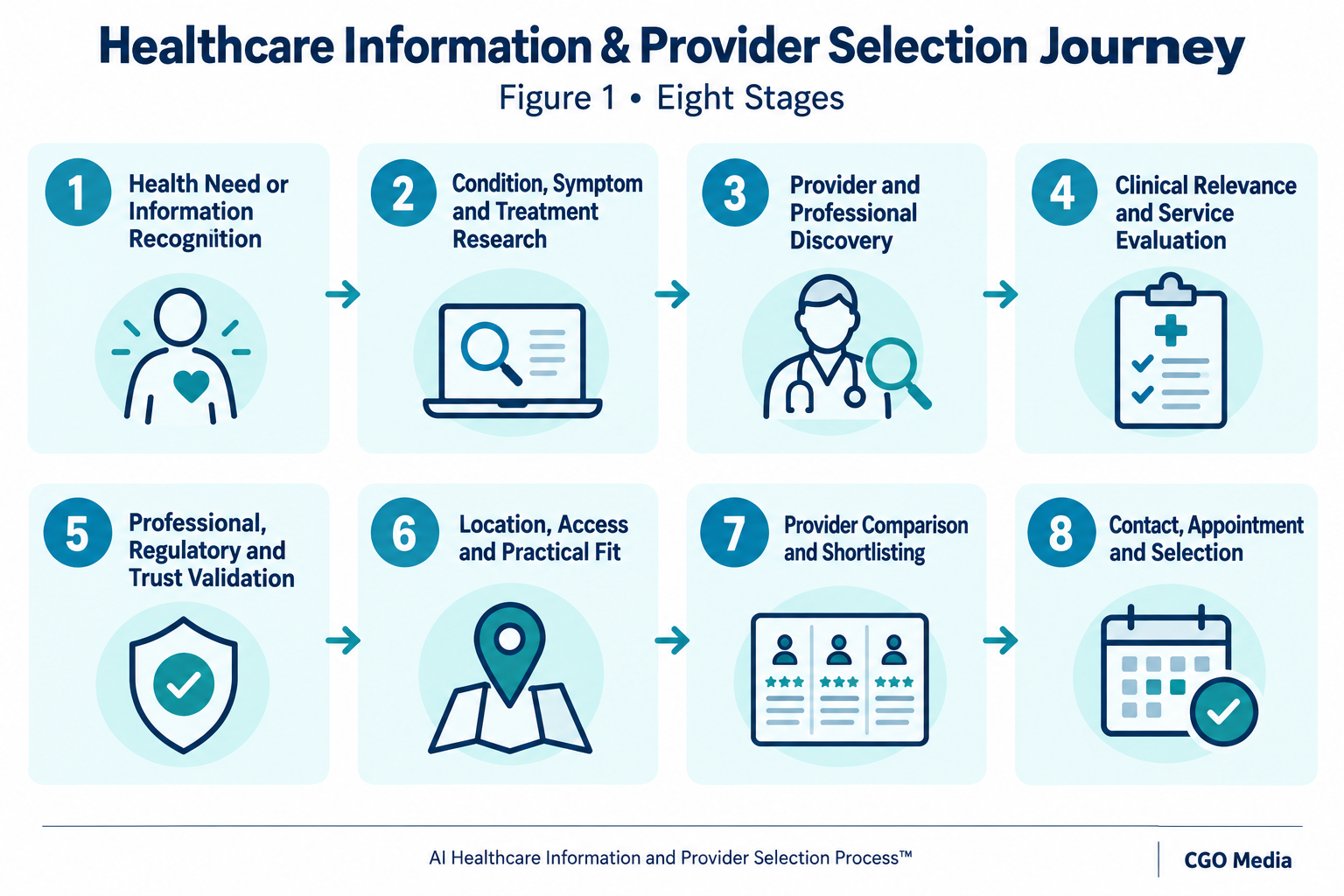
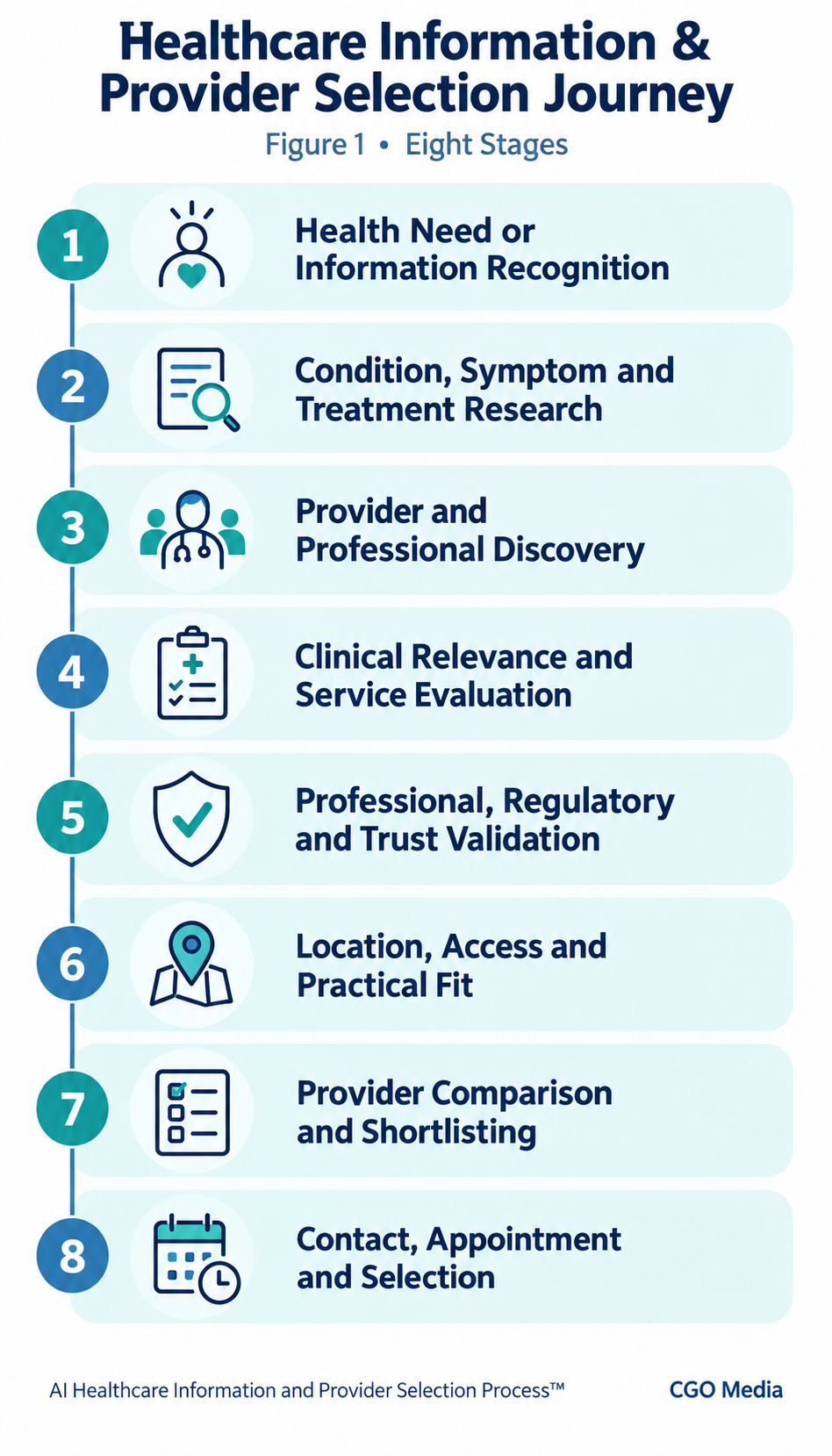
3. The Eight Stages of Healthcare Information and Provider Selection
- Health Need or Information Recognition
- Condition, Symptom and Treatment Research
- Provider and Professional Discovery
- Clinical Relevance and Service Evaluation
- Professional, Regulatory and Trust Validation
- Location, Access and Practical Fit
- Provider Comparison and Shortlisting
- Contact, Appointment and Selection
4. Stage One — Health Need or Information Recognition
The journey often begins when a user recognises a symptom, healthcare concern, need for assessment, or requirement for a particular service.
5. Trigger Types
Potential triggers may include:
- New symptoms
- Existing diagnosis
- Referral
- Second opinion
- Screening
- Private treatment interest
6. Search Behaviour at the Trigger Stage
Initial searches may be broad and exploratory.
7. Symptom-Led Queries
Examples may include:
- What causes this symptom?
- When should I see a specialist?
- What tests might be needed?
8. Condition-Led Queries
Users with an existing diagnosis may search for:
- Condition information
- Treatment options
- Specialists
- Clinics
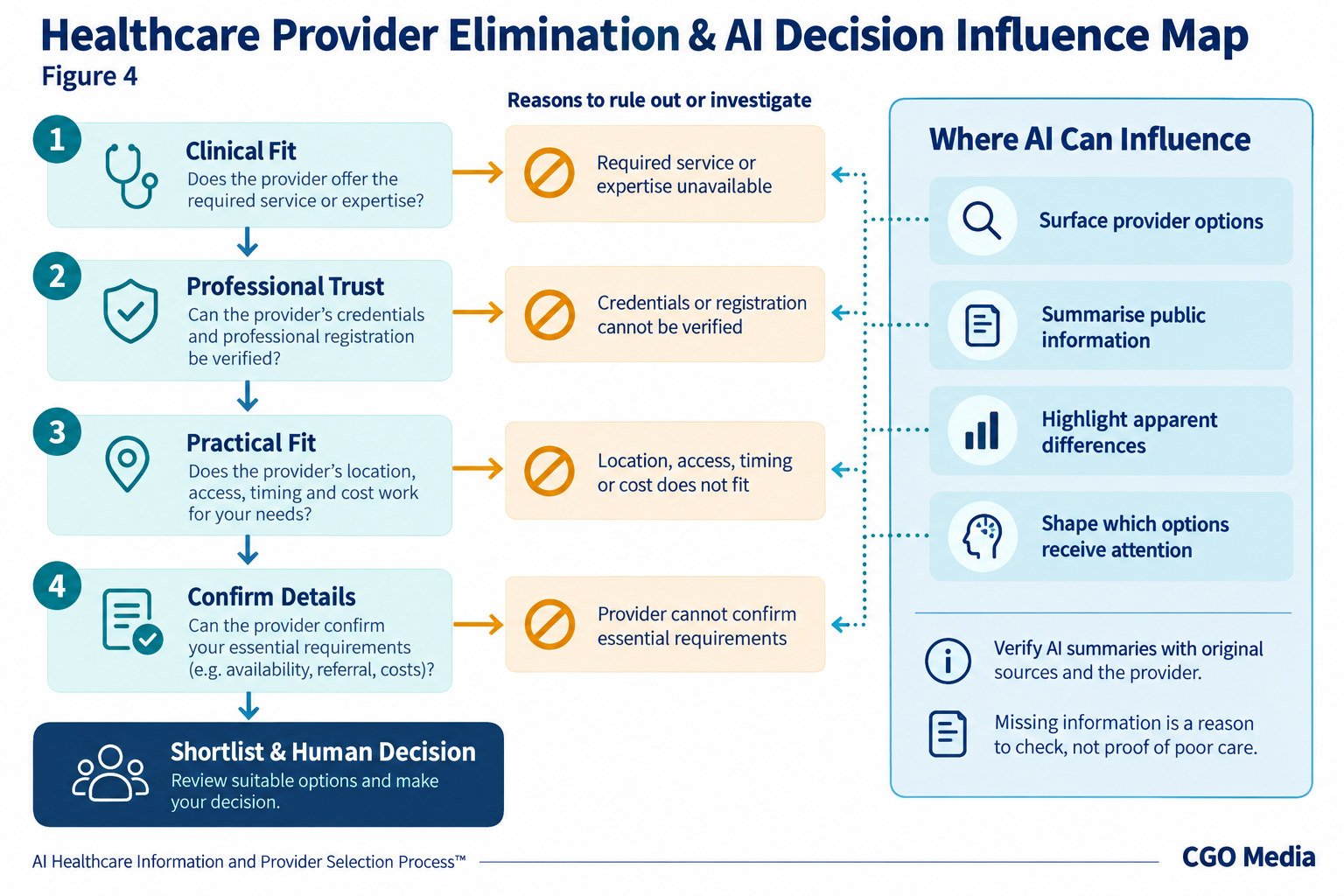
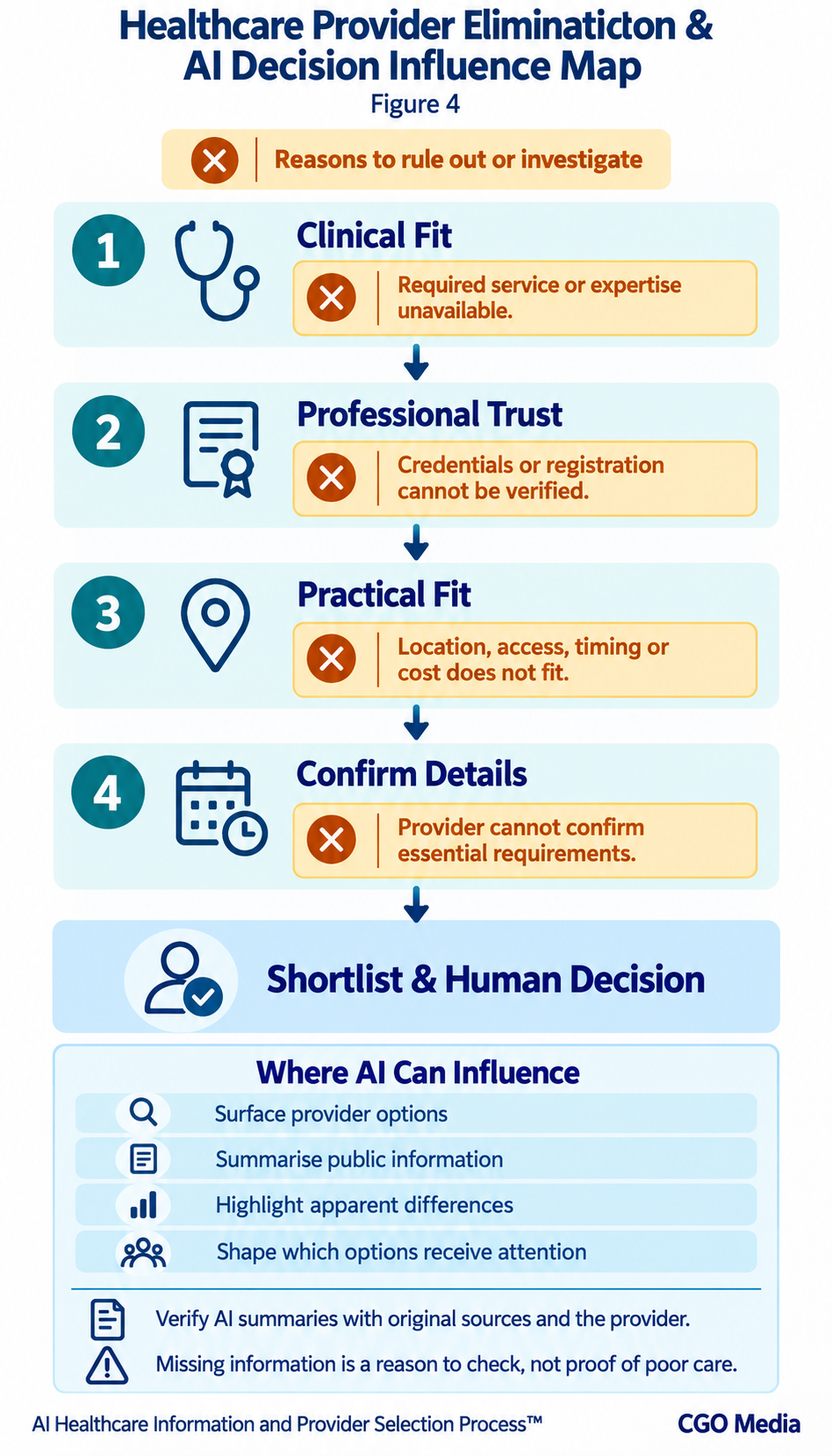
9. Treatment-Led Queries
Some users may already know the treatment or procedure they are considering.
10. Provider-Led Queries
Others may begin with a known hospital, clinic or professional and move directly into validation.
11. AI-Assisted Information Recognition
AI systems may influence the early journey by summarising symptoms, conditions or provider types.
12. Early AI Information Should Be Interpreted Carefully
General AI-generated healthcare information should not be treated as an individual diagnosis.
13. Stage One Information Need
At this stage, the user generally needs:
- Clear explanation
- Appropriate context
- Next-step guidance
- Signals indicating when professional care may be appropriate
14. Stage Two — Condition, Symptom and Treatment Research
The user now moves from recognition toward deeper understanding.
15. Condition Understanding
The user may investigate:
- Causes
- Symptoms
- Severity
- Diagnosis
- Potential treatments
16. Treatment Understanding
Potential questions may include:
- What does the treatment involve?
- Who is it suitable for?
- What are the risks?
- What is the recovery period?
- What alternatives exist?
17. Diagnostic Understanding
Users may research:
- Tests
- Imaging
- Screening
- Diagnostic pathways
18. Information Quality Becomes Important Early
Healthcare organisations that publish clear, professionally governed information can influence understanding before provider selection begins.
19. Content Relevance Should Reflect Real Services
A provider should focus particularly on conditions and treatments connected genuinely with the care it provides.
20. Stage Two Trust Questions
Users may begin asking:
- Who wrote this?
- Has it been professionally reviewed?
- Is the information current?
- Does this provider actually offer the service?
21. Information Can Shape Provider Awareness
A user reading useful condition or treatment information may become aware of:
- A healthcare organisation
- A specialist
- A clinic
- A specific treatment pathway
22. Stage Three — Provider and Professional Discovery
At Stage Three, the journey shifts from information gathering toward identifying possible sources of care.
23. Provider Discovery Channels
Potential channels may include:
- Organic search
- Local search
- AI-assisted search
- Professional directories
- Regulatory directories
- Review platforms
- Referrals
24. Organisation-Level Discovery
Users may search for:
- Hospitals
- Clinics
- Private healthcare groups
- Diagnostic centres
- Specialist centres
25. Professional-Level Discovery
Users may search directly for:
- Doctors
- Consultants
- Specialists
- Other healthcare professionals
26. Specialty-Led Discovery
Examples may include:
- Cardiologist
- Dermatologist
- Orthopaedic specialist
- Neurologist
27. Treatment-Led Provider Discovery
Users may search specifically for providers offering:
- Diagnostic tests
- Procedures
- Therapies
- Specialist consultations
28. Location-Led Provider Discovery
Many healthcare journeys include geographic constraints.
29. Local Search Becomes More Important at Stage Three
Users may evaluate:
- Distance
- Travel time
- Parking
- Transport
- Location convenience
30. AI Provider Discovery
Users may ask AI systems for possible provider types, clinics or specialists relevant to a particular need.
31. AI Recommendation Visibility Can Affect the Consideration Set
A provider appearing within a generated response may enter the user’s awareness earlier than through a conventional search journey.
32. Recommendation Presence Does Not Establish Suitability
The user still needs to evaluate whether the organisation or professional is relevant to their specific circumstances.
33. Stage Three Provider Discovery Evidence
Healthcare organisations need sufficient information for users to identify:
- Who they are
- What they offer
- Where they operate
- Which professionals are available
34. Stage Four — Clinical Relevance and Service Evaluation
After identifying possible providers, users begin evaluating whether those providers actually offer relevant expertise and services.
35. Service Relevance
Users may ask:
- Does this provider treat my condition?
- Does it offer the procedure I need?
- Is the required diagnostic service available?
36. Professional Relevance
Users may investigate whether a particular specialist has relevant:
- Specialty
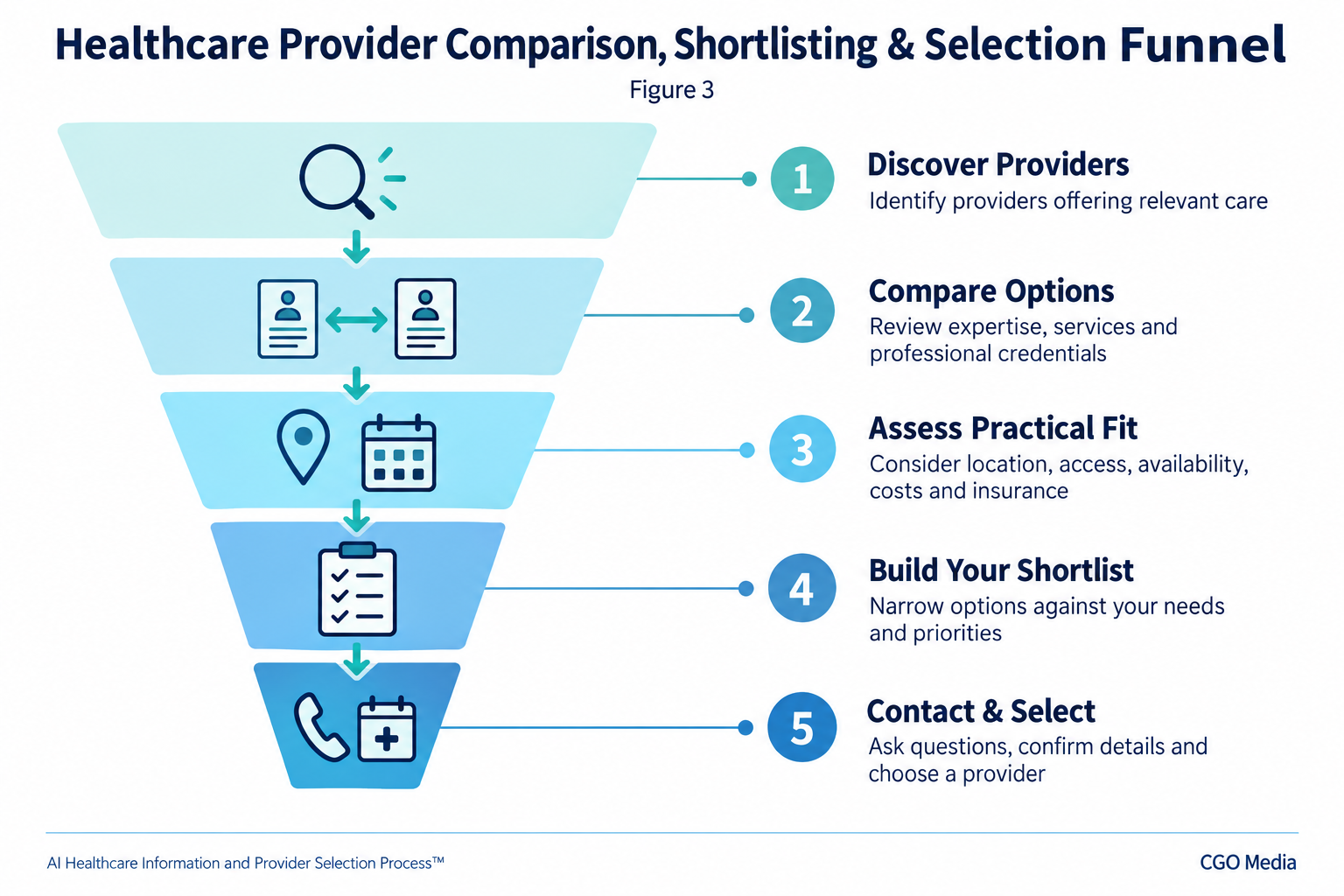
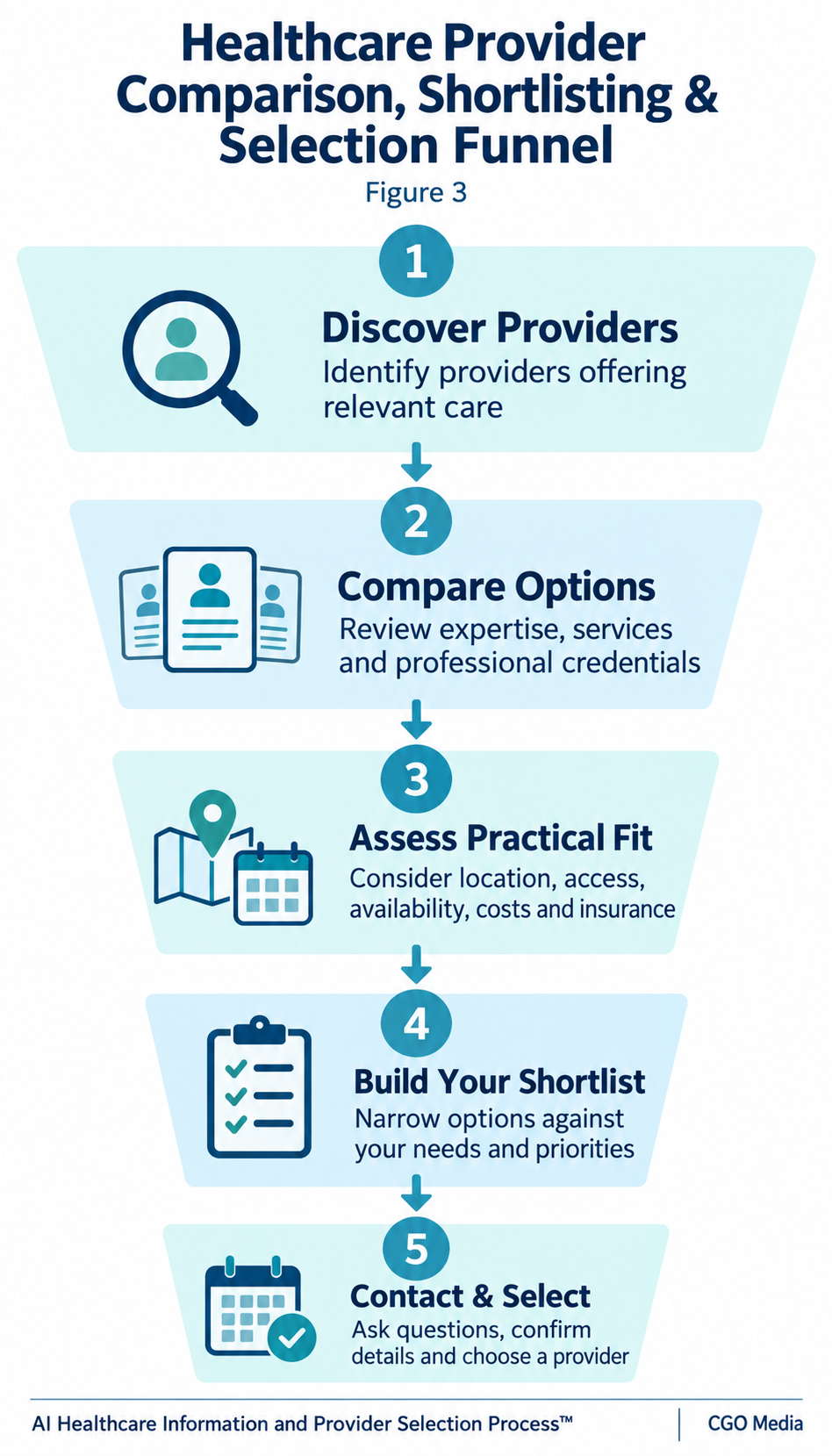
- Subspecialty
- Clinical interests
- Procedural experience
37. Location-Service Fit
A healthcare organisation may offer a service overall but not at every location.
38. Professional-Location Fit
A specialist may work at only selected facilities or on specific days.
39. Diagnostic Capability
Users may examine whether the provider offers the diagnostics needed before or during treatment.
40. Treatment Pathway Clarity
A strong service page should help the user understand:
- How assessment begins
- What diagnosis may involve
- How treatment progresses
- What follow-up may be required
41. Clinical Relevance Should Be Explicit
Providers should avoid forcing users to infer whether a specialist or service is relevant.
42. Service Pages Should Connect the Decision Evidence
A useful structure may be:
Service → Relevant Conditions → Professional → Location → Patient Pathway → Trust Evidence
43. Professional Profiles Should Support Relevance Evaluation
Profiles should make clear the connection between:
- Specialty
- Clinical interests
- Services
- Locations
44. Condition Pages Can Support Relevant Provider Discovery
Condition content may connect users with appropriate services and professionals where the relationship is genuine.
45. Treatment Pages Can Support Relevant Provider Discovery
Treatment information may connect users with:
- Relevant professionals
- Relevant locations
- Supporting patient information
46. Stage Four Elimination Risk
A provider may leave the consideration set where users cannot verify:
- Relevant expertise
- Service availability
- Professional involvement
- Location fit
47. Clinical Relevance Comes Before Deeper Trust Validation
A highly reputable healthcare organisation may still be irrelevant if it does not offer the specific expertise or service required.
48. Provider Selection Is a Filtering Process
The early stages can be represented as:
Need Recognition → Information Research → Provider Discovery → Relevance Filtering
49. Trust Validation Begins After Relevance Is Established
Once users identify providers that appear clinically relevant, the next questions increasingly concern professional credibility, regulation, patient trust and risk.
50. The First Four Stages Establish the Consideration Set
By the end of Stage Four, the user may have moved from a broad healthcare need to a smaller group of potentially relevant providers or professionals.
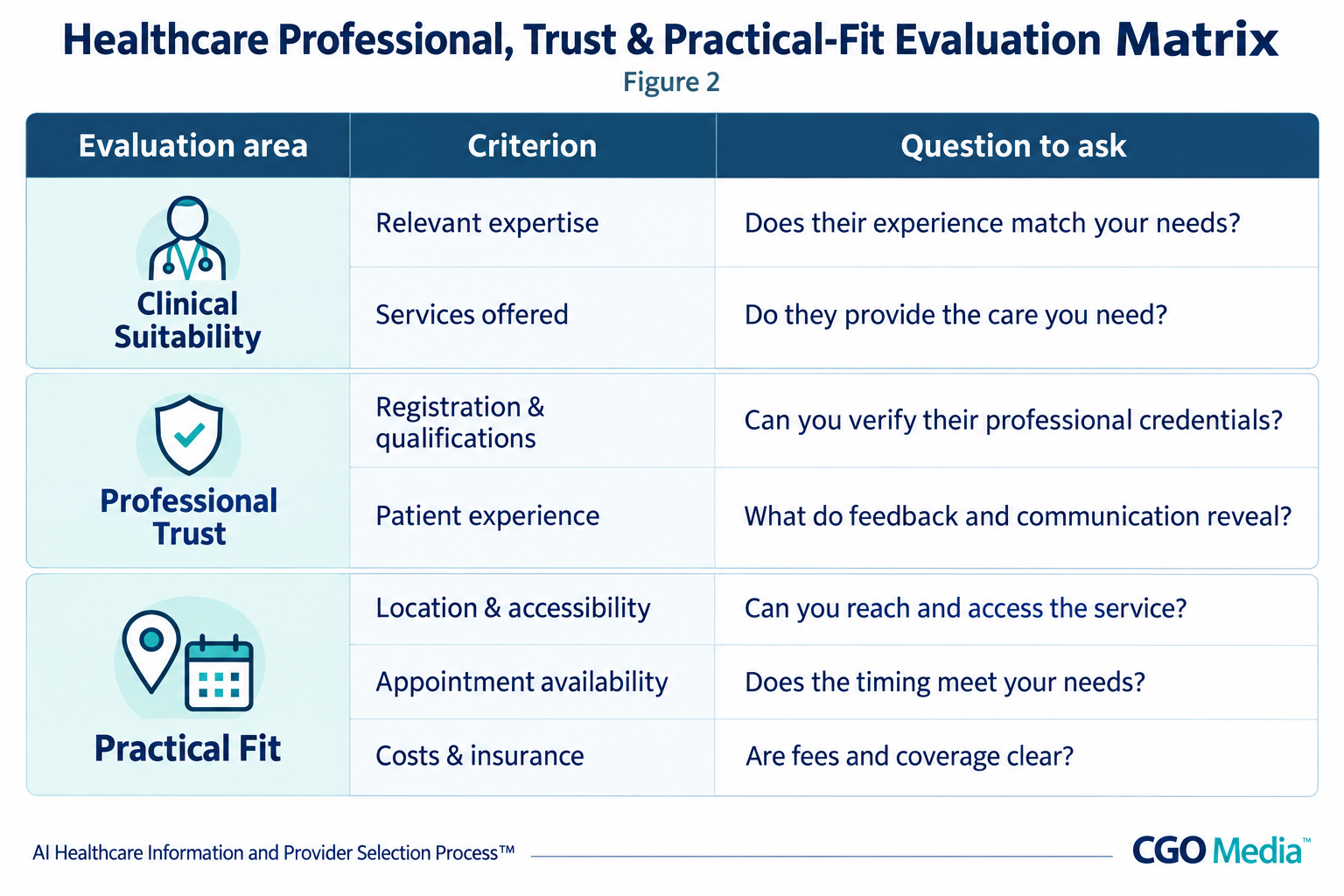
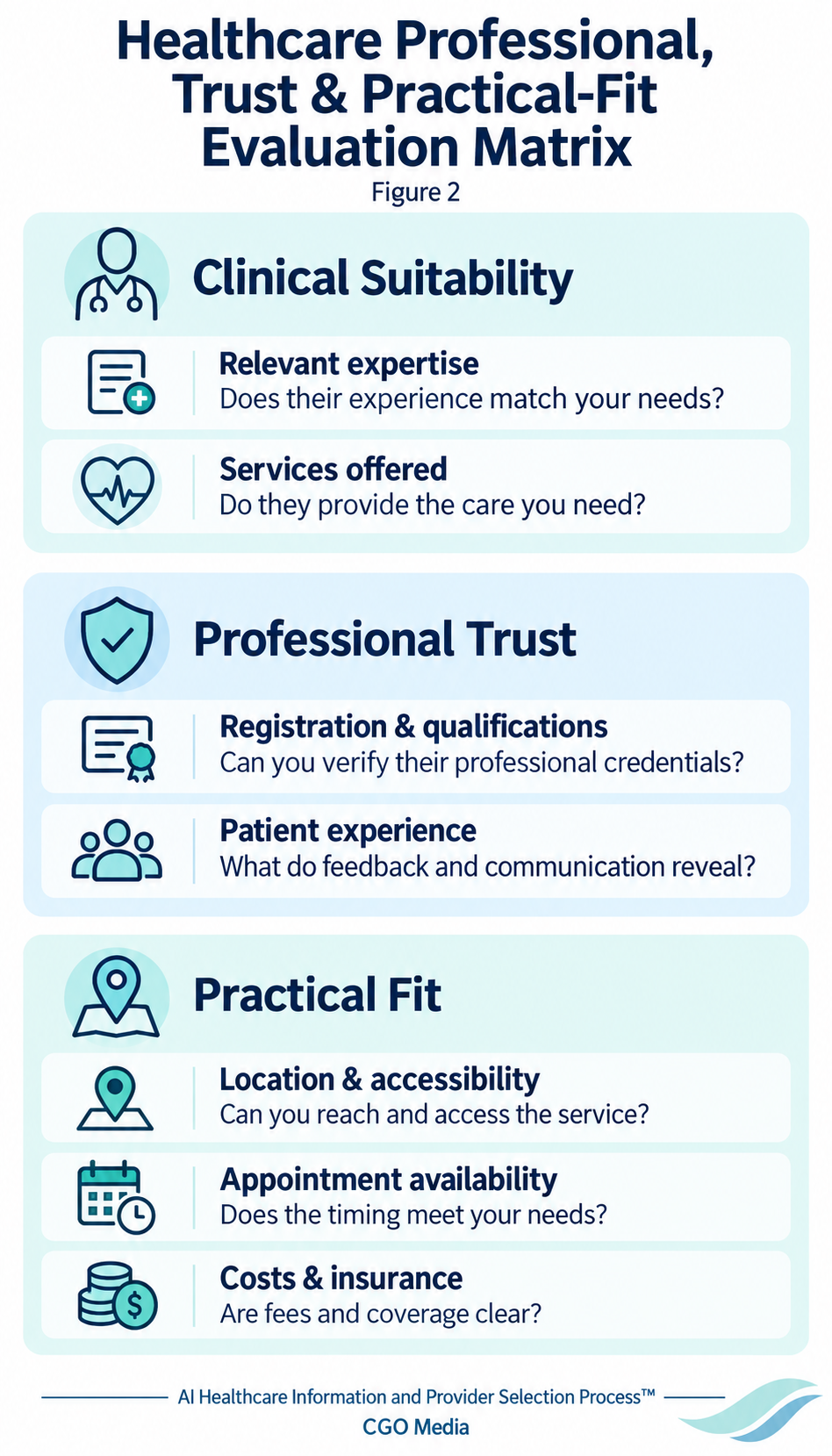
51. Stage Five — Professional, Regulatory and Trust Validation
Once users identify healthcare providers that appear clinically relevant, the decision process shifts toward trust validation.
At this stage, users are no longer asking only whether the service exists. They are asking whether the organisation and the professionals associated with it appear sufficiently credible, appropriately qualified and trustworthy.
52. Professional Verification
Users may examine:
- Professional title
- Qualifications
- Specialty
- Subspecialty
- Professional registration
- Institutional affiliations
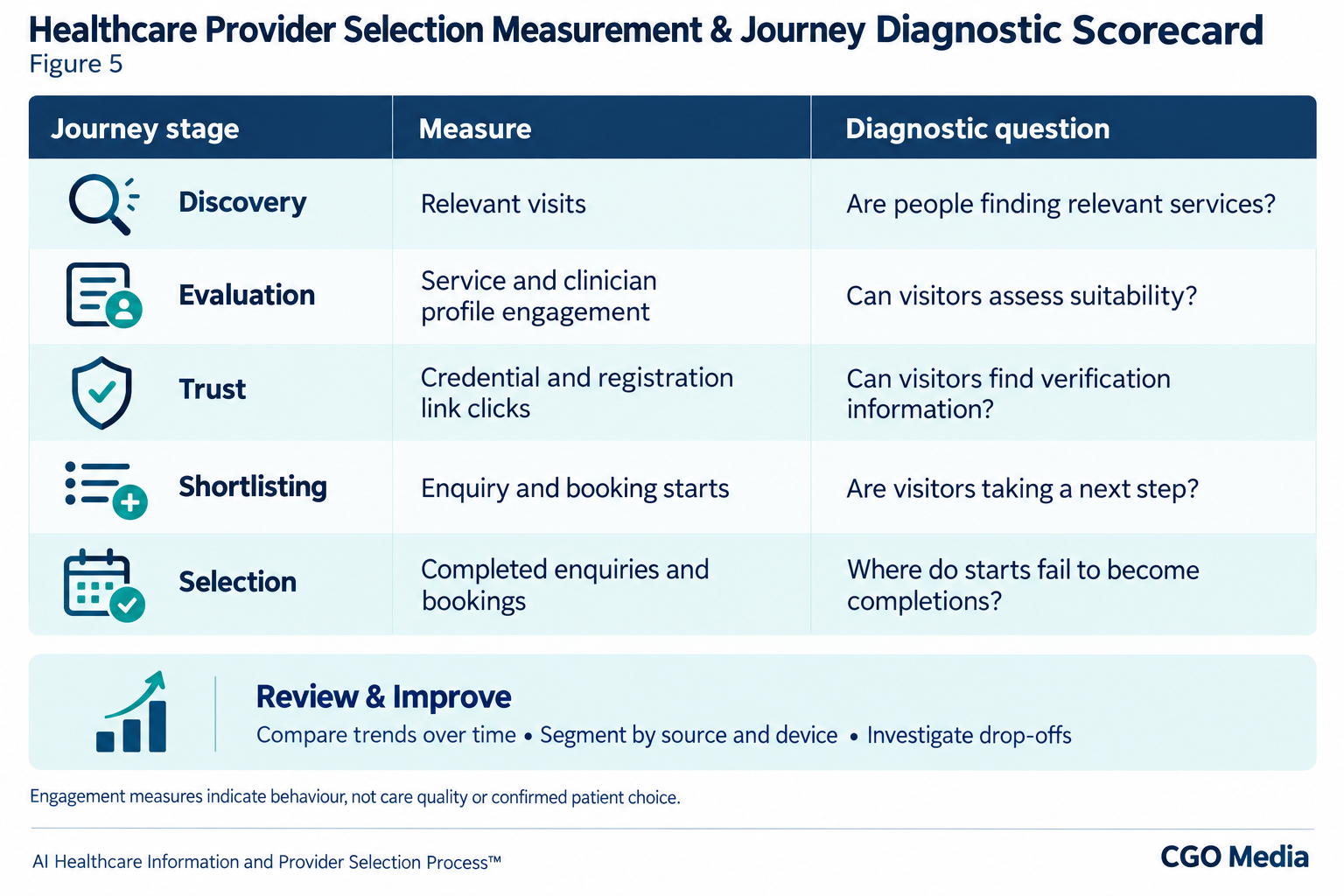
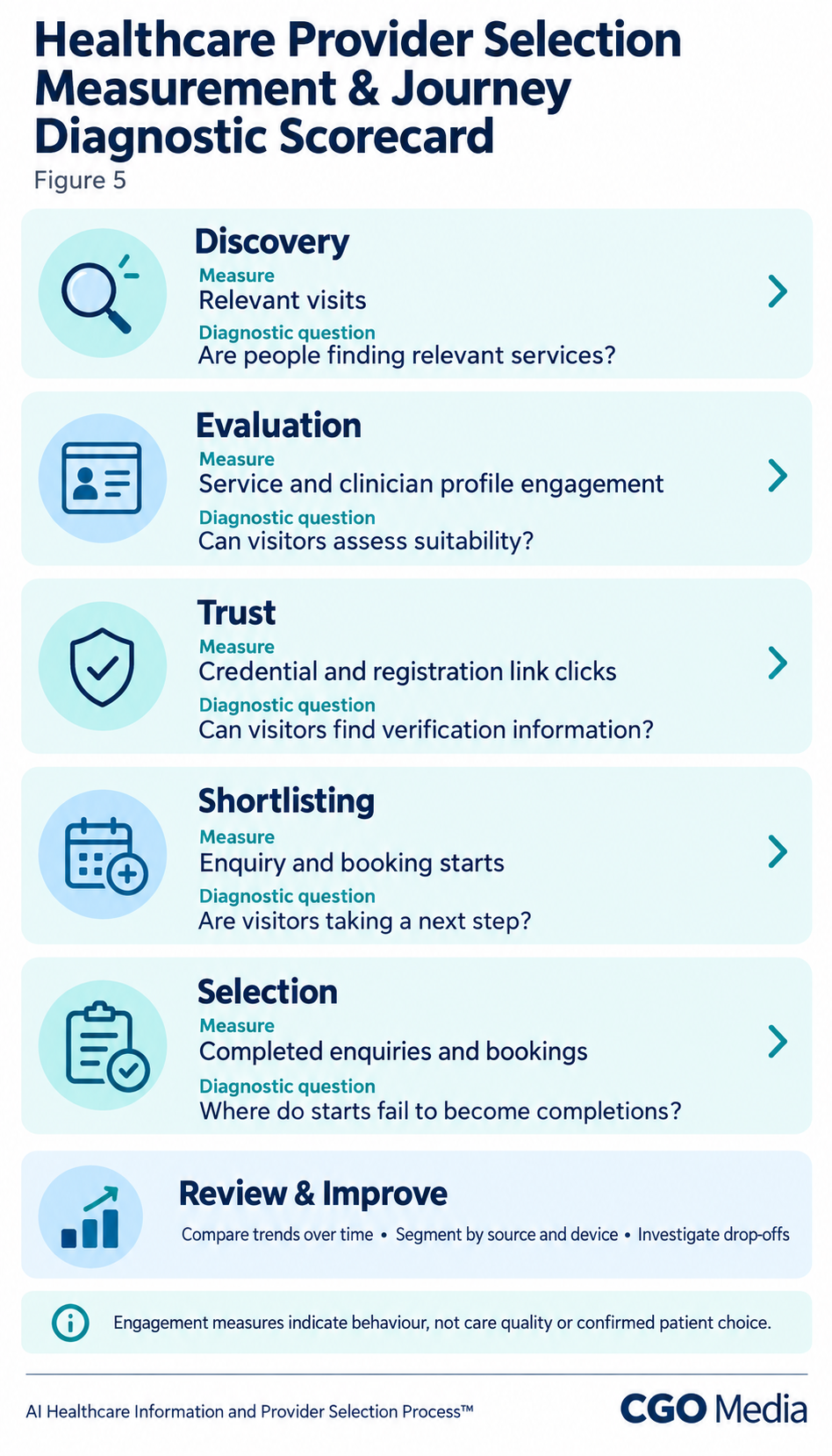
53. Professional Identity Should Be Easy to Verify
Healthcare organisations should avoid forcing users to search across several disconnected pages to understand the professional background of a clinician.
54. Qualifications and Roles Should Be Precise
Professional titles should reflect the practitioner’s actual role and should not imply specialist status or seniority that cannot be supported.
55. Registration Information
Where professional registration is relevant, users may seek independent verification through official or professional sources.
56. Specialty Validation
Users may evaluate whether the professional’s stated expertise matches the treatment or condition under consideration.
57. Professional Experience
Where appropriate, profiles may help users understand:
- Clinical experience
- Areas of practice
- Procedural experience
- Academic work
- Research activity
58. Institutional Affiliations
Current relationships with recognised hospitals, universities or professional organisations may provide additional professional context.
59. Research and Publication Evidence
Where genuine, research and publication activity may support the user’s understanding of a clinician’s subject expertise.
60. Provider-Level Trust Validation
Users may also investigate whether the healthcare organisation itself appears trustworthy.
61. Provider Regulatory Evidence
Relevant questions may include:
- Is the provider regulated?
- Which entity is regulated?
- Does the status apply to this location?
- Is the information current?
62. Regulation Should Be Entity-Specific
Healthcare groups should distinguish between regulatory evidence applying to:
- Parent organisation
- Individual clinic
- Hospital facility
- Professional practitioner
63. Clinical Governance
Users may gain additional confidence from clear information about:
- Patient safety
- Clinical quality
- Complaints procedures
- Incident governance
- Professional oversight
64. Privacy and Data Protection
Healthcare users may also consider how sensitive personal and medical information is handled.
65. Patient Reviews Enter the Evaluation Process
Reviews may help users understand aspects of the healthcare experience that are difficult to judge from formal provider information alone.
66. Common Review Themes
Users may look for repeated feedback around:
- Communication
- Administration
- Waiting times
- Staff interaction
- Facilities
- Booking
67. Reviews Should Not Be Interpreted as Clinical Evidence
Patient reviews can provide service-experience information, but they do not establish treatment efficacy or individual clinical suitability.
68. Review Recency
Recent reviews may be particularly relevant where staffing, facilities or operating processes have changed over time.
69. Review Patterns Are More Useful Than Isolated Comments
Repeated themes may provide stronger operational context than one unusually positive or negative review.
70. Review Diversity
Users may gain a broader perspective where feedback exists across more than one genuine source.
71. Reputation Is Broader Than Reviews
Healthcare reputation may also involve:
- Professional standing
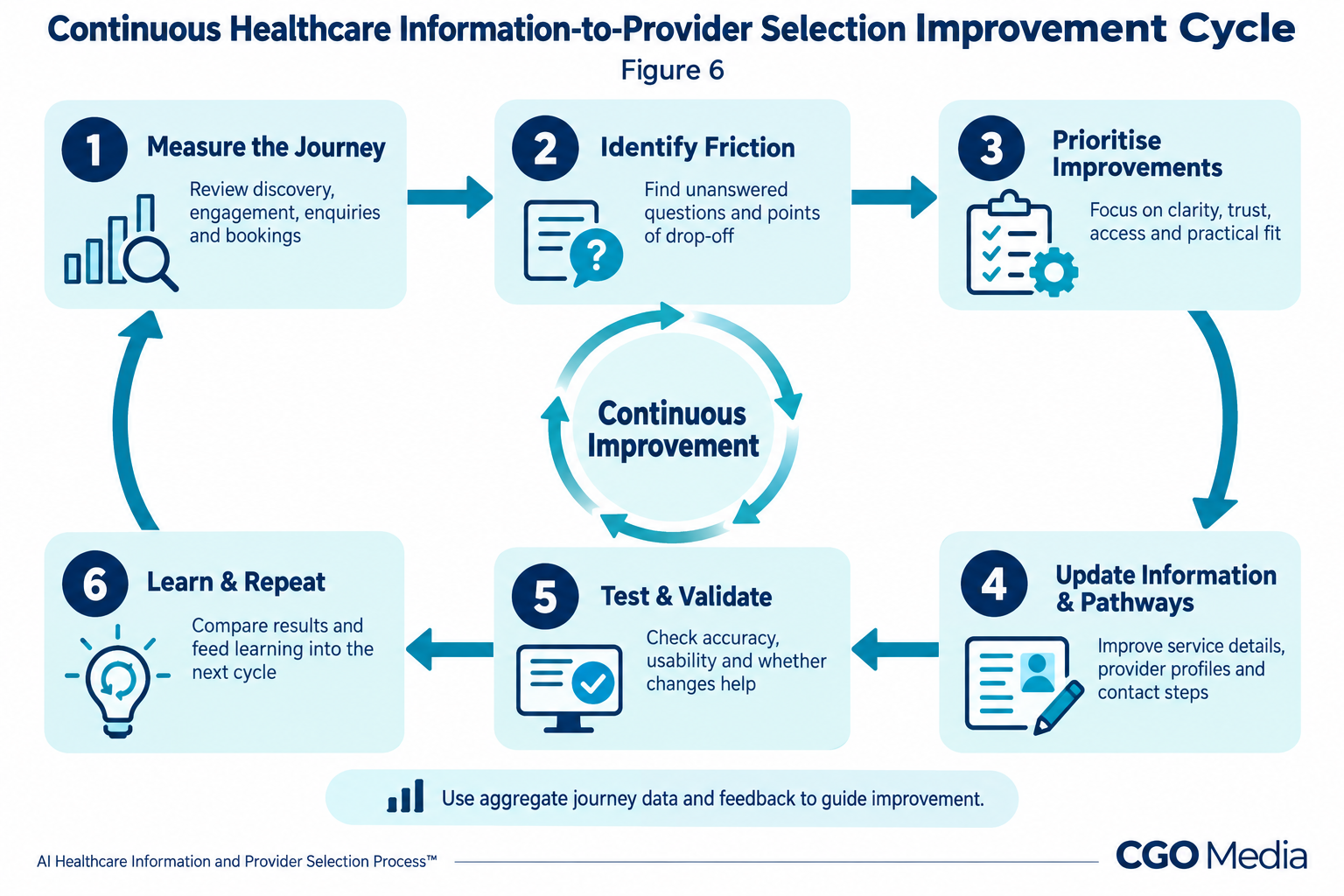
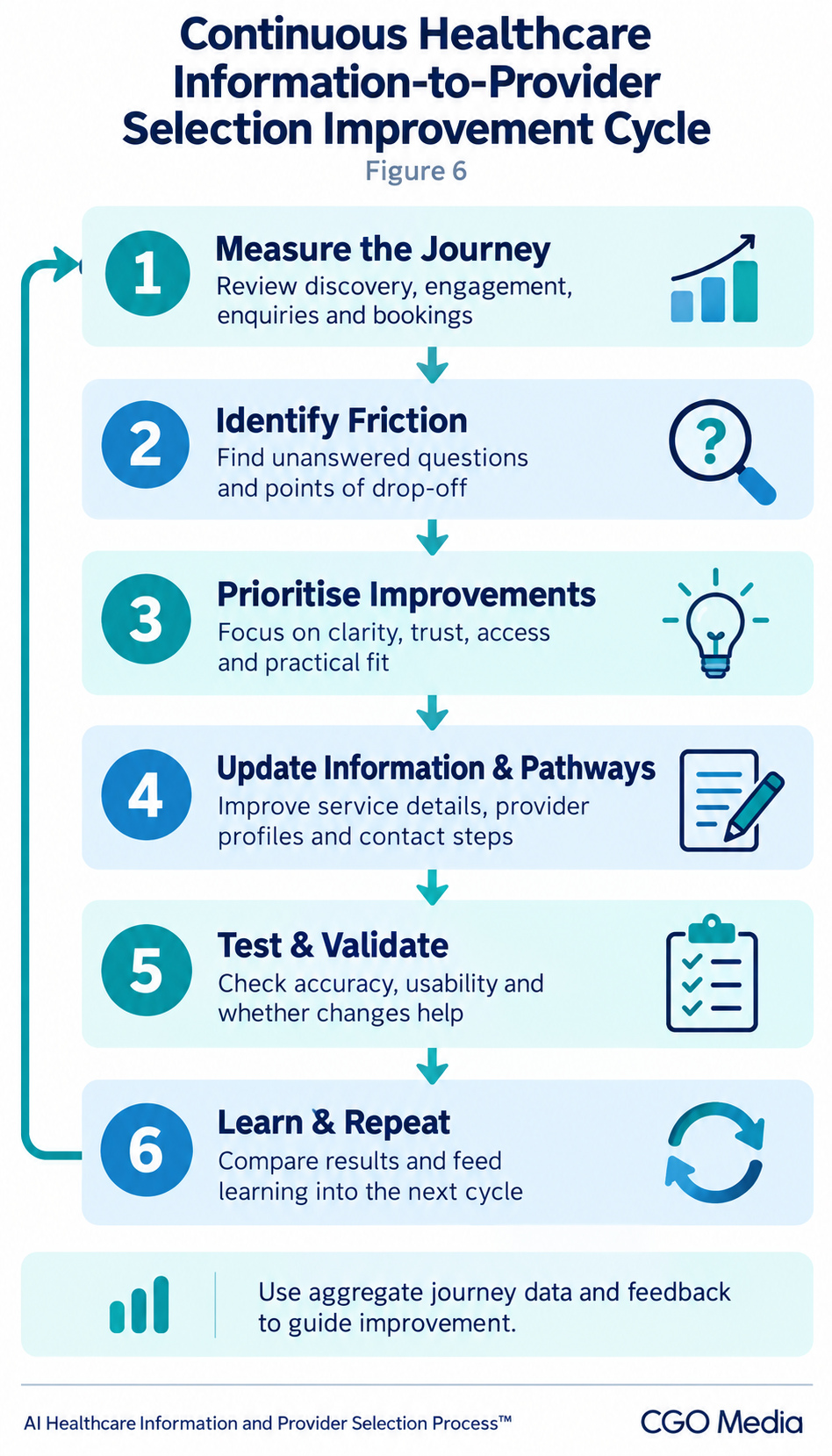
- Institutional relationships
- Academic activity
- Research
- Regulatory history
- Relevant editorial coverage
72. External Validation
Users may encounter independent evidence from:
- Regulatory bodies
- Professional organisations
- Hospitals
- Universities
- Research publications
- Reputable healthcare media
73. Trust Should Be Relevant to the Decision
The strongest validation is evidence directly related to the practitioner, service or organisation being considered.
74. Trust Evidence Should Not Be Manufactured
Healthcare organisations should not attempt to create artificial affiliations, reviews or professional recognition simply to influence selection.
75. Clinical Content Also Supports Trust Validation
Users may evaluate whether important treatment information appears:
- Balanced
- Current
- Professionally reviewed
- Appropriately sourced
- Transparent about risks
76. Treatment Claims Influence Trust
Claims that appear exaggerated or guarantee outcomes may reduce confidence rather than increase it.
77. Professional Attribution Supports Transparency
Users may place greater confidence in clinical content where the organisation clearly identifies relevant authorship or professional review.
78. Trust Validation Can Eliminate Providers
A clinically relevant provider may be removed from consideration if the user cannot verify important trust evidence.
79. Common Trust-Based Elimination Factors
These may include:
- Unclear professional credentials
- Outdated regulatory information
- Weak patient feedback
- Unclear clinical governance
- Unsupported treatment claims
80. AI-Assisted Trust Validation
Users may increasingly ask AI systems to summarise:
- Provider reputation
- Professional background
- Service suitability
- Reviews
- Alternative providers
81. AI Summaries Can Compress Multiple Trust Sources
This makes consistency across provider, professional and external evidence increasingly important.
82. AI Trust Summaries Should Be Verified
Users making significant healthcare decisions should be able to verify important claims through appropriate primary or authoritative sources.
83. Trust Validation Is a Threshold
A provider remains in the consideration set only where the available evidence crosses a sufficient level of confidence for the individual user.
84. Stage Six — Location, Access and Practical Fit
After clinical relevance and trust are established, practical accessibility can become decisive.
85. Healthcare Is Often Location-Constrained
A user may prefer a highly regarded provider but ultimately select another because the practical burden of attending is too great.
86. Location Fit
Users may consider:
- Distance
- Travel time
- Transport
- Parking
- Accessibility
87. Service Availability by Location
A healthcare group may offer a treatment overall without offering it at the user’s nearest location.
88. Professional Availability by Location
A specialist may practise only at selected clinics or hospitals.
89. Appointment Availability
Waiting time can influence provider selection, particularly where treatment urgency or patient anxiety is high.
90. Appointment Type
Users may evaluate whether the provider offers:
- In-person consultation
- Remote consultation where appropriate
- Diagnostic appointments
- Follow-up appointments
91. Opening Information
Clear opening information can influence practical fit for users balancing healthcare with employment, childcare or travel.
92. Accessibility
Users may require information about:
- Wheelchair access
- Lifts
- Accessible parking
- Interpreter support
- Other accessibility services
93. Transport Information
Useful location information may include:
- Nearest public transport
- Parking arrangements
- Building access
- Arrival instructions
94. Pricing and Financial Fit
For private healthcare, practical fit may also involve cost.
95. Consultation Pricing
Users may evaluate:
- Initial consultation fee
- Follow-up fee
- Diagnostic costs
- Potential additional charges
96. Insurance Compatibility
Users may need to know whether:
- The provider accepts their insurer
- Pre-authorisation is required
- Self-pay options exist
97. Treatment Pricing
Where treatment costs are published, users may compare both price and what is included.
98. Price Alone Does Not Determine Value
Healthcare users may evaluate pricing alongside:
- Professional expertise
- Facilities
- Convenience
- Patient experience
- Aftercare
99. Referral Requirements
Some services may require:
- GP referral
- Consultant referral
- Previous diagnostic information
- Insurance authorisation
100. Referral Clarity Reduces Friction
Providers should make referral requirements sufficiently clear before the user begins booking.
101. Preparation Requirements
Diagnostic and treatment services may also require preparation such as:
- Fasting
- Medication guidance
- Previous records
- Transportation arrangements
102. Practical Information Influences Confidence
Clear operational information can reduce uncertainty and make the healthcare journey feel more manageable.
103. Stage Six Is a Feasibility Test
The user is effectively asking:
Can I realistically access this provider and complete this care pathway?
104. Practical Fit Can Eliminate an Otherwise Strong Provider
Common elimination factors may include:
- Excessive travel
- No appropriate appointment availability
- Unclear pricing
- Insurance incompatibility
- Accessibility limitations
105. Local Search Plays a Major Role in Stage Six
Accurate location information becomes particularly important as the user moves closer to contact.
106. Local Listings Should Match First-Party Information
Important information should remain consistent across:
- Provider website
- Local business profiles
- Maps environments
- Relevant healthcare directories
107. Multi-Location Providers Require Strong Service Mapping
A user should not need to telephone every location simply to discover where the required service is available.
108. Stage Six Connects Trust with Practical Access
A healthcare provider must now satisfy both:
Can I trust this provider?
and
Can I practically use this provider?
109. The Six-Stage Filtering Sequence
The journey at this point can be represented as:
Need → Information → Discovery → Clinical Relevance → Trust Validation → Practical Fit
110. The Remaining Providers Form the Shortlist
Providers surviving these first six stages are more likely to enter direct comparison and final selection.
111. Stage Seven — Provider Comparison and Shortlisting
Once a user has identified providers that appear clinically relevant, trustworthy and practically accessible, the decision process moves into direct comparison.
112. Comparison Is Often Multi-Factor
Healthcare users may compare several dimensions simultaneously rather than making a decision on one factor alone.
113. Common Comparison Dimensions
These may include:
- Professional expertise
- Clinical relevance
- Regulatory trust
- Patient experience
- Location
- Availability
- Pricing
- Facilities
114. Professional Expertise Comparison
Users may compare:
- Specialty
- Subspecialty
- Qualifications
- Relevant clinical interests
- Institutional affiliations
115. Service Relevance Comparison
Users may evaluate whether providers differ in:
- Treatment availability
- Diagnostic capability
- Technology
- Multidisciplinary support
- Aftercare
116. Professional-Service Fit
A provider may appear strong overall but be weaker for the specific service or condition under consideration.
117. Provider Reputation Comparison
Users may compare:
- Review patterns
- Institutional reputation
- Professional recognition
- Relevant external evidence
118. Regulatory and Governance Comparison
Where relevant, users may assess whether providers present clearer evidence around:
- Regulation
- Accreditation
- Clinical governance
- Patient safety
- Privacy
119. Location Comparison
Users may compare:
- Distance
- Travel time
- Accessibility
- Parking
- Public transport
120. Availability Comparison
Appointment availability can become a significant differentiator between otherwise similar providers.
121. Pricing Comparison
For private healthcare, users may compare:
- Consultation fees
- Diagnostic fees
- Treatment costs
- Additional charges
- Insurance arrangements
122. Price Comparison Requires Context
A lower price may not represent better value if services differ materially in:
- Professional expertise
- Facilities
- Included diagnostics
- Aftercare
- Support
123. Facility Comparison
Users may compare:
- Diagnostic facilities
- Clinical environment
- Accessibility
- On-site services
- Technology
124. Patient Experience Comparison
Review patterns may influence perceptions around:
- Communication
- Administration
- Waiting times
- Facilities
- Staff interaction
125. Comparison Should Not Reduce Healthcare to Rankings
Healthcare provider selection is contextual.
A provider that is appropriate for one user may not be the best fit for another.
126. “Best Provider” Queries Require Caution
Users may search for terms such as:
- Best clinic
- Best specialist
- Best private hospital
However, suitability depends on the specific clinical and practical context.
127. Unsupported Superiority Claims Should Be Avoided
Healthcare organisations should not rely on unsupported “best,” “leading” or “number one” claims to influence comparison.
128. Evidence-Based Differentiation
Providers can instead communicate genuine differences involving:
- Specialist expertise
- Service model
- Facilities
- Locations
- Patient pathways
- Relevant research
129. Shortlisting
After comparison, users may reduce the consideration set to a small number of providers.
130. A Healthcare Shortlist Is a Trust Achievement
Reaching the shortlist generally means the provider has already passed several filters involving:
- Discovery
- Relevance
- Professional credibility
- Trust
- Practical fit
131. Shortlist Size Varies
Some users may choose between two providers, while others may compare several.
132. Shortlisting Can Be Informal
Users may not create an explicit list.
They may simply return repeatedly to a small group of provider websites, profiles or search results.
133. Search Behaviour During Shortlisting
Users may conduct more specific searches such as:
- Provider name + reviews
- Professional name + qualifications
- Provider name + treatment
- Provider name + price
- Provider A vs Provider B
134. Branded Search Becomes More Important
As the user moves closer to selection, branded queries may increase.
135. Professional Validation May Be Repeated
Users may revisit clinician profiles or external professional sources before final selection.
136. Review Validation May Be Repeated
Users may revisit reviews to look for recurring themes relevant to their own priorities.
137. AI-Assisted Comparison
Users may ask AI systems to compare shortlisted providers based on publicly available information.
138. AI Comparison Areas
Potential questions may involve:
- Specialist expertise
- Locations
- Services
- Reputation
- Pricing
- Practical differences
139. AI Comparisons Can Compress Decision Evidence
Generated comparisons may combine information from several source types into one response.
140. AI Comparison Accuracy Is Therefore Important
Incorrect information about:
- Professionals
- Services
- Locations
- Pricing
- Regulatory status
may distort the comparison process.
141. Healthcare Organisations Should Monitor High-Value Comparison Scenarios
Providers may observe how they are represented in comparisons involving their most relevant competitors.
142. Comparison Monitoring Should Be Repeatable
A consistent prompt and query set provides more useful evidence than isolated tests.
143. Stage Seven Elimination Risk
A provider may leave the shortlist because another organisation presents stronger or clearer evidence around one or more decisive factors.
144. Common Shortlist Elimination Factors
These may include:
- More relevant specialist expertise elsewhere
- Better appointment availability
- Clearer pricing
- Stronger patient confidence
- More convenient location
- Better practical access
145. Stage Eight — Contact, Appointment and Selection
The final stage begins when the user moves from comparison toward direct interaction with the provider.
146. Contact Is Not Always Final Selection
A user may contact several providers before making a final decision.
147. Contact Pathways
Potential pathways may include:
- Telephone
- Online booking
- Contact form
- Referral pathway
148. Booking Experience Matters
A difficult booking process can cause a provider to lose a user even after strong search and trust performance.
149. Online Booking Clarity
Users should understand:
- Which appointment type to select
- Which professional is available
- Which location applies
- What happens after booking
150. Telephone Experience
Telephone contact may influence final confidence through:
- Responsiveness
- Clarity
- Professionalism
- Ability to answer practical questions
151. Enquiry Form Design
Forms should collect enough information to route the user appropriately without creating unnecessary friction.
152. Referral Pathways
Where referral is required, the provider should explain:
- Who can refer
- What information is needed
- How records should be supplied
- What happens next
153. Appointment Confirmation
Confirmation should provide clear information around:
- Date
- Time
- Location
- Professional
- Preparation
- Contact instructions
154. Pre-Appointment Information
Users may require:
- Preparation instructions
- Medication guidance where appropriate
- Previous records
- Referral documentation
- Payment or insurance information
155. Selection May Depend on the Contact Experience
A provider that appeared strongest during online comparison can still lose the patient if the first direct interaction is confusing or unresponsive.
156. Operational Trust Becomes Decisive
At Stage Eight, trust moves from digital evidence into direct organisational behaviour.
157. Response Time
Long or unpredictable response times may introduce friction, particularly where users are anxious or evaluating several providers.
158. Staff Knowledge
Front-line teams should have sufficient information to answer common questions accurately or route them appropriately.
159. Pricing Confirmation
Where relevant, users may seek confirmation of:
- Consultation fees
- Diagnostic fees
- Payment requirements
- Insurance compatibility
160. Availability Confirmation
The practical availability of the specialist or service may finally determine provider selection.
161. Professional Confirmation
Users should be confident that the professional they are booking is genuinely relevant to the required service.
162. Location Confirmation
The appointment should clearly identify the correct physical location.
163. Final Provider Selection
The selected provider is the organisation or professional that survives the combined clinical, trust, practical and operational filters.
164. Selection Is Not Driven by Search Visibility Alone
Search visibility creates an opportunity to enter consideration.
Final selection depends on the cumulative quality of the evidence and experience encountered throughout the journey.
165. Provider Selection Can Be Represented as a Funnel
A practical model is:
Discovered Providers → Relevant Providers → Trusted Providers → Practical Providers → Shortlisted Providers → Selected Provider
166. Each Stage Reduces the Consideration Set
The process therefore operates through progressive elimination rather than a simple ranking-to-booking pathway.
167. The Strongest Provider Does Not Necessarily Win Every Decision
Individual factors such as location, availability, insurance or personal preference can change the final outcome.
168. Provider Selection Is Contextual
The model should therefore be used to understand decision structure rather than to predict which provider every user will choose.
169. Stage Eight Completes the Digital Selection Journey
Once contact and appointment selection occur, the journey moves from digital evaluation into the real patient experience.
170. Patient Experience Can Influence Future Discovery
The eventual care and service experience may contribute to:
- Reviews
- Recommendations
- Reputation
- Future provider-selection journeys
171. The Journey Continues After Selection
Provider selection does not end the broader healthcare information cycle.
The patient’s subsequent experience may influence future trust, reputation, reviews and the discovery journeys of other users.
172. Post-Selection Experience
The real-world experience may include:
- Appointment administration
- Professional interaction
- Diagnosis
- Treatment
- Facilities
- Follow-up
173. Digital Expectations Meet Operational Reality
At this stage, the promises and information presented during the digital journey are tested against the actual healthcare experience.
174. Consistency Between Digital Evidence and Experience Matters
Trust can weaken if:
- Published pricing differs materially from reality
- A listed professional is unavailable
- A service is not offered as described
- Patient pathways differ from published information
175. Post-Selection Trust
Patient confidence may be influenced by:
- Communication
- Professional conduct
- Clarity of information
- Administrative reliability
- Continuity of care
176. Follow-Up Communication
Clear post-appointment communication may include:
- Results
- Next steps
- Medication or treatment instructions
- Follow-up appointments
- Contact pathways
177. Patient Experience Becomes New Evidence
The patient’s experience may later contribute to:
- Reviews
- Word-of-mouth recommendations
- Complaints
- Repeat usage
- Future reputation
178. The Healthcare Selection Feedback Loop
A useful feedback model is:
Discovery → Selection → Experience → Feedback → Reputation → Future Discovery
179. Reviews Re-Enter the Discovery Environment
Patient feedback may influence future users during:
- Provider validation
- Comparison
- Shortlisting
- Final selection
180. Reputation Is Therefore Dynamic
Healthcare reputation changes as new patient, professional and institutional evidence enters the wider information environment.
181. Provider Selection Analysis
Healthcare organisations can use the eight-stage process to identify where potential patients are most likely to leave the journey.
182. Stage One Elimination
The provider may never enter consideration if it has little visibility around the user’s initial health need.
183. Stage Two Elimination
The provider may fail to influence the journey if its information is:
- Too generic
- Outdated
- Unclear
- Poorly aligned with real services
184. Stage Three Elimination
The provider may not appear during relevant:
- Specialty discovery
- Local discovery
- Professional discovery
- AI-assisted recommendation
185. Stage Four Elimination
The user may determine that the provider lacks sufficient:
- Clinical relevance
- Service capability
- Professional expertise
- Location fit
186. Stage Five Elimination
A relevant provider may fail trust validation because of:
- Weak professional evidence
- Unclear regulatory information
- Weak patient confidence
- Unsupported claims
187. Stage Six Elimination
A trusted provider may be impractical because of:
- Location
- Availability
- Cost
- Accessibility
- Insurance
188. Stage Seven Elimination
A provider may lose during direct comparison because another option offers stronger evidence or practical fit.
189. Stage Eight Elimination
A shortlisted provider may still lose the user because of:
- Poor booking experience
- Slow response
- Unclear communication
- Availability issues
- Unexpected costs
190. Provider Elimination Analysis Is More Useful Than Ranking Analysis Alone
Understanding why users leave the decision journey can reveal more actionable weaknesses than tracking rankings in isolation.
191. Build an Elimination Map
Healthcare organisations can map common barriers against each stage.
| Stage | Potential Elimination Factor |
|---|---|
| Need Recognition | Provider not present around relevant information needs. |
| Information Research | Weak, outdated or untrusted information. |
| Provider Discovery | Low visibility or weak local/provider entity clarity. |
| Clinical Relevance | Service or expertise does not appear relevant. |
| Trust Validation | Weak professional, regulatory or patient evidence. |
| Practical Fit | Location, availability, accessibility or pricing barriers. |
| Comparison | Alternative provider presents stronger evidence or fit. |
| Contact & Selection | Poor booking or first-contact experience. |
192. Elimination Should Be Prioritised by Impact
Not every point of friction deserves equal urgency.
193. High-Risk Elimination Factors
These may include:
- Incorrect clinical information
- Incorrect professional information
- Wrong service availability
- Misleading regulatory information
194. High-Volume Elimination Factors
These may include:
- Weak local discovery
- Unclear booking
- Poor mobile experience
- Limited appointment availability information
195. High-Value Elimination Factors
For private healthcare, high-value treatment pathways may deserve additional analysis where significant revenue or specialist resources are involved.
196. AI Influence Across the Eight Stages
AI-assisted systems may influence several stages of the healthcare decision journey rather than only provider discovery.
197. AI at Stage One — Need Recognition
Users may ask AI systems for general explanations of symptoms or healthcare concerns.
198. AI at Stage Two — Information Research
AI systems may summarise:
- Conditions
- Treatment options
- Diagnostic pathways
- Questions to ask a professional
199. AI at Stage Three — Provider Discovery
AI-assisted systems may introduce:
- Provider types
- Hospitals
- Clinics
- Specialists
200. AI at Stage Four — Relevance Evaluation
Users may ask whether a provider offers:
- A particular specialty
- A particular treatment
- A specific diagnostic service
201. AI at Stage Five — Trust Validation
AI systems may summarise publicly available information involving:
- Professional backgrounds
- Provider reputation
- Reviews
- Institutional relationships
202. AI at Stage Six — Practical Fit
Users may ask about:
- Locations
- Travel
- Availability
- Pricing
- Insurance
203. AI at Stage Seven — Provider Comparison
Generated systems may compare multiple providers within one answer.
204. AI at Stage Eight — Contact Preparation
Users may ask AI systems what information to prepare before contacting or attending a provider.
205. AI Can Compress the Decision Journey
Several stages that previously required multiple searches may now occur within one extended AI conversation.
206. AI Can Also Introduce New Error Risk
Incorrect synthesis can affect:
- Provider awareness
- Professional understanding
- Service evaluation
- Comparison
207. Healthcare Organisations Should Monitor AI Across the Journey
Monitoring should not be limited to “best provider” prompts.
208. Early-Journey AI Monitoring
Potential queries may examine:
- Conditions
- Symptoms
- Treatment options
- Provider types
209. Mid-Journey AI Monitoring
Potential queries may examine:
- Specialists
- Services
- Locations
- Professional expertise
210. Late-Journey AI Monitoring
Potential queries may examine:
- Provider comparisons
- Pricing
- Availability
- Reviews
- Practical fit
211. AI Influence Should Be Measured Cautiously
Generated responses are dynamic and can vary across models, prompts, geography and time.
212. The Integrated Healthcare Decision Architecture
The eight stages can be connected with the evidence required at each point.
213. Stage One Evidence
Useful evidence includes:
- Clear health information
- Appropriate next-step guidance
- Clinical review
214. Stage Two Evidence
Useful evidence includes:
- Condition information
- Treatment information
- Diagnostic information
- Professional attribution
215. Stage Three Evidence
Useful evidence includes:
- Provider identity
- Professional identity
- Local visibility
- Service visibility
216. Stage Four Evidence
Useful evidence includes:
- Clinical relevance
- Service-professional relationships
- Location-service relationships
217. Stage Five Evidence
Useful evidence includes:
- Professional credentials
- Regulatory status
- Patient trust
- External validation
218. Stage Six Evidence
Useful evidence includes:
- Location
- Accessibility
- Availability
- Pricing
- Insurance
219. Stage Seven Evidence
Useful evidence includes:
- Comparable professional information
- Service differences
- Practical differences
- Patient experience
220. Stage Eight Evidence
Useful evidence includes:
- Booking pathways
- Contact information
- Appointment preparation
- Clear next steps
221. The Evidence Architecture Mirrors the Decision Architecture
Healthcare organisations should align their information environment with the actual questions users ask at each stage.
222. The Integrated Decision Model
The complete model can be represented as:
Need → Understand → Discover → Verify Relevance → Validate Trust → Test Practical Fit → Compare → Select → Experience → Feedback
223. Selection Is Only One Point in a Continuous System
The patient experience feeds new evidence back into future discovery and selection journeys.
224. Measuring the Healthcare Information and Provider Selection Journey
The eight-stage process can be translated into a practical measurement system by examining how effectively users progress from initial information need through to provider contact and selection.
225. Measurement Should Reflect the Full Journey
Healthcare organisations should avoid evaluating performance only through rankings, traffic or enquiries.
A more complete view considers:
Discovery → Relevance → Trust → Practical Fit → Comparison → Contact → Selection → Experience
226. Stage One — Need Recognition Measures
Potential measures may include:
- Visibility around priority healthcare questions
- Search demand around symptoms and conditions
- Engagement with early-stage informational content
- AI presence around general healthcare queries
227. Stage Two — Information Research Measures
Potential measures may include:
- Condition-page engagement
- Treatment-page engagement
- Diagnostic-content engagement
- Content freshness coverage
- Professional review coverage
228. Stage Three — Provider Discovery Measures
Potential measures may include:
- Non-branded search visibility
- Local search visibility
- Professional discovery visibility
- AI provider recommendation presence
229. Stage Four — Clinical Relevance Measures
Potential measures may include:
- Service-page engagement
- Professional-profile engagement
- Location-service interactions
- Condition-to-service journeys
- Treatment-to-professional journeys
230. Stage Five — Trust Validation Measures
Potential measures may include:
- Professional-profile depth
- Regulatory-information visibility
- Trust-page engagement
- Review themes
- External verification activity
231. Stage Six — Practical Fit Measures
Potential measures may include:
- Location-page engagement
- Pricing-page engagement
- Insurance information usage
- Accessibility information usage
- Appointment-availability checks
232. Stage Seven — Comparison Measures
Potential measures may include:
- Repeated branded visits
- Professional-profile revisits
- Comparison-query visibility
- AI comparison presence
- Movement between related service and provider pages
233. Stage Eight — Contact and Selection Measures
Potential measures may include:
- Telephone enquiries
- Online bookings
- Contact-form submissions
- Referral enquiries
- Appointment conversion
234. Selection KPIs Should Be Qualified
Not every enquiry represents an appropriate patient or suitable care pathway.
Healthcare organisations should distinguish between:
- Total enquiries
- Qualified enquiries
- Appointments booked
- Appointments attended
235. Qualified Enquiry Rate
A useful measure may be the proportion of enquiries that are relevant to:
- The service
- The professional
- The location
- The eligibility criteria
236. Appointment Conversion Rate
This may measure the proportion of qualified enquiries that progress to an appointment.
237. Appointment Attendance
Attendance can provide additional insight into whether users were adequately prepared and whether the booking process created appropriate expectations.
238. Drop-Off Analysis
Healthcare organisations should identify where users abandon the selection journey.
239. Informational Drop-Off
Potential causes may include:
- Weak content
- Unclear next steps
- Low clinical relevance
240. Trust Drop-Off
Potential causes may include:
- Weak professional evidence
- Poor review patterns
- Unclear regulation
- Unsupported claims
241. Practical Drop-Off
Potential causes may include:
- Location
- Cost
- Availability
- Insurance
- Accessibility
242. Booking Drop-Off
Potential causes may include:
- Complex forms
- Slow response
- Unclear appointment options
- Poor mobile usability
243. Journey Diagnostics Should Be Stage-Specific
A decline in overall conversion does not reveal where the problem actually occurs.
244. Example — Good Discovery, Weak Relevance
A provider may attract large volumes of traffic but generate few appropriate enquiries because its service relevance is unclear.
245. Example — Strong Relevance, Weak Trust
Users may engage heavily with service pages but leave before contact because professional or regulatory evidence is insufficient.
246. Example — Strong Trust, Weak Practical Fit
A provider may be trusted but unsuitable because of:
- Distance
- Availability
- Pricing
- Insurance restrictions
247. Example — Strong Shortlist Presence, Weak Contact Experience
A healthcare organisation may reach the final consideration stage but lose users through slow or unclear booking processes.
248. Journey Funnel Measurement
A conceptual selection funnel may be represented as:
Visible Users → Engaged Users → Relevant Users → Trust-Validated Users → Practical-Fit Users → Shortlisted Users → Enquiries → Appointments
249. Funnel Measurement Should Avoid False Precision
Not every stage will be fully observable through analytics.
The objective is to combine available signals into a useful decision model.
250. Search Data
Search data can contribute information around:
- Demand
- Visibility
- Query intent
- Local discovery
251. Website Analytics
Website analytics can contribute information around:
- Page engagement
- Navigation paths
- Return visits
- Conversion actions
252. Call Data
Telephone data may reveal:
- Enquiry volume
- Common questions
- Service relevance
- Booking friction
253. Contact-Centre Intelligence
Front-line teams can reveal repeated patient concerns that digital analytics may not explain.
254. Common Contact-Centre Questions
These may involve:
- Pricing
- Availability
- Insurance
- Referral requirements
- Professional suitability
255. Review Data
Review analysis can provide evidence around post-selection patient experience.
256. Review Themes Should Be Categorised
Useful categories may include:
- Communication
- Administration
- Waiting
- Facilities
- Staff interaction
- Booking
257. Complaint Data
Complaints may identify serious patient-experience or operational weaknesses that should not be hidden within aggregate satisfaction metrics.
258. Clinical-Team Insight
Clinicians may identify:
- Patient misunderstanding
- Inappropriate enquiries
- Missing information
- Expectation gaps
259. AI Observation Data
AI monitoring may contribute information around:
- Provider representation
- Professional representation
- Recommendation presence
- Comparison presence
- Source patterns
260. AI Data Should Be Recorded Consistently
Testing should document:
- Prompt
- Model
- Date
- Geography where relevant
- Result
- Sources where visible
261. Attribution Is Complex in Healthcare
A user may interact with multiple channels before contacting a provider.
262. Example Multi-Touch Journey
A journey may involve:
AI Answer → Organic Search → Professional Profile → Review Platform → Branded Search → Telephone Enquiry
263. Last-Click Attribution Is Therefore Incomplete
The final search or click before contact may not reflect the source that originally created awareness or trust.
264. First-Touch Attribution Is Also Incomplete
Initial awareness does not necessarily explain why the provider was eventually selected.
265. Use Journey Attribution
Where practical, organisations should consider how different interactions contributed to:
- Discovery
- Trust
- Comparison
- Selection
266. Branded Search Can Indicate Progression
Increases in branded and professional-name searches may indicate that users are moving from general discovery toward validation.
267. Professional-Profile Engagement Can Indicate Trust Evaluation
Repeated visits to practitioner profiles may reflect deeper provider consideration.
268. Location-Page Engagement Can Indicate Practical Evaluation
Late-stage users may spend more time evaluating:
- Address
- Travel
- Availability
- Facilities
269. Pricing-Page Engagement Can Indicate Selection Intent
For private healthcare, pricing interactions may occur closer to final comparison and contact.
270. Comparison Queries Can Indicate Shortlisting
Queries involving:
- Provider reviews
- Provider comparisons
- Professional comparisons
may signal that the user has progressed deep into the journey.
271. Measurement Should Support Action
The objective is not to collect the maximum possible number of metrics.
Measurement should help identify where the provider-selection journey needs improvement.
272. Stage-Level Diagnostic Scorecard
| Journey Stage | Core Question | Example Measures |
|---|---|---|
| 1. Need Recognition | Are we visible around relevant information needs? | Search visibility, AI presence, informational demand. |
| 2. Information Research | Does our information help users understand their options? | Content engagement, clinical review coverage, next-step interactions. |
| 3. Provider Discovery | Are we entering the consideration set? | Non-branded visibility, local presence, AI recommendation presence. |
| 4. Clinical Relevance | Can users verify that we provide relevant expertise? | Service engagement, professional engagement, pathway interactions. |
| 5. Trust Validation | Can users verify professional and organisational trust? | Profile completeness, trust-page engagement, review themes. |
| 6. Practical Fit | Can the user realistically access the service? | Location interactions, pricing, insurance, availability. |
| 7. Comparison | Are we surviving direct provider comparison? | Branded revisits, comparison visibility, AI comparison presence. |
| 8. Contact & Selection | Can users progress easily to appropriate contact? | Qualified enquiries, bookings, response time, appointment conversion. |
273. Cross-Functional Governance
The healthcare selection journey spans more than marketing.
274. Clinical Teams
Clinical teams may contribute to:
- Information accuracy
- Professional expertise
- Patient suitability
- Clinical pathway clarity
275. Marketing and Search Teams
These teams may contribute to:
- Discovery
- Information architecture
- Local visibility
- AI monitoring
276. Compliance and Governance Teams
These teams may contribute to:
- Regulatory accuracy
- Privacy
- Claims governance
- Patient information standards
277. Operations Teams
Operations may influence:
- Availability
- Location information
- Booking processes
- Service capacity
278. Patient Experience Teams
These teams may contribute insight around:
- Reviews
- Complaints
- Communication
- Journey friction
279. Contact-Centre and Front-Line Teams
These teams often have direct evidence of:
- Common patient questions
- Booking barriers
- Suitability problems
- Information gaps
280. Data and Analytics Teams
Data teams may help integrate:
- Search data
- Website analytics
- Call data
- Booking data
- AI observation data
281. Executive Ownership
Senior leadership may need to ensure that healthcare visibility growth remains aligned with:
- Patient suitability
- Clinical capacity
- Regulatory obligations
- Service strategy
282. Journey Governance Council
Larger healthcare organisations may benefit from a cross-functional group responsible for reviewing the full provider-selection journey.
283. Governance Review Questions
A periodic review may ask:
- Where are users dropping out?
- Where is information inaccurate?
- Where is trust weakest?
- Where is practical access unclear?
- Where is AI representation inaccurate?
284. Journey Governance Cadence
A practical structure may include:
- Monthly high-risk issue review
- Quarterly journey performance review
- Quarterly AI representation review
- Annual strategic reassessment
285. Measurement Should Protect Patient Relevance
Increasing enquiry volume is not automatically a positive outcome if a large proportion of those enquiries are inappropriate for the service.
286. The Objective Is Appropriate Progression
The measurement goal is to help relevant users move through the decision process with sufficient information, trust and practical clarity to make an informed next step.
287. Continuous Improvement Across the Provider Selection Journey
The Healthcare Information and Provider Selection Process should be treated as a dynamic system that changes as patient needs, healthcare services, professional teams, search environments and AI-assisted discovery evolve.
288. Improvement Begins with Journey Observation
Healthcare organisations should observe how users move through each stage of the process and identify where confidence, relevance or practical access begins to weaken.
289. Decision Friction
Decision friction is any obstacle that makes it harder for a user to understand, trust, compare or contact an appropriate provider.
290. Information Friction
Examples may include:
- Unclear condition information
- Weak treatment explanations
- Missing next-step guidance
- Outdated clinical content
291. Discovery Friction
Users may struggle to identify a relevant provider where:
- Specialty visibility is weak
- Local information is incomplete
- Professional entities are unclear
- Service relationships are poorly represented
292. Relevance Friction
A provider may be visible but fail to demonstrate clearly whether it offers the required expertise or service.
293. Trust Friction
Trust friction may arise from:
- Thin professional profiles
- Unclear regulatory evidence
- Weak patient information
- Unsupported claims
- Conflicting external information
294. Practical Friction
Practical barriers may include:
- Unclear pricing
- Unclear insurance compatibility
- Location uncertainty
- Limited accessibility information
- Unclear availability
295. Comparison Friction
Users may find it difficult to compare providers when services, professional expertise and patient pathways are described inconsistently.
296. Contact Friction
Late-stage barriers may include:
- Complex forms
- Slow responses
- Unclear booking choices
- Insufficient preparation guidance
297. Friction Should Be Prioritised by Consequence
Healthcare organisations should distinguish inconvenience from issues that may affect patient understanding, suitability or safety.
298. High-Risk Friction
Examples may include:
- Incorrect clinical information
- Wrong professional information
- Incorrect treatment availability
- Misleading regulatory information
299. High-Volume Friction
Examples may include:
- Weak mobile navigation
- Poor location clarity
- Confusing booking pathways
- Missing pricing information
300. High-Value Friction
For specialist or high-cost healthcare services, small barriers within late-stage comparison and booking may have significant operational impact.
301. Evidence Decay Across the Journey
Information supporting provider selection can become inaccurate over time even where the original content was correct.
302. Clinical Evidence Decay
Clinical information may weaken when:
- Guidance changes
- Treatment pathways change
- Sources become outdated
- Review dates are missed
303. Professional Evidence Decay
Professional information may become inaccurate when:
- Clinicians leave
- Roles change
- Affiliations change
- Practice locations change
304. Service Evidence Decay
Treatment and diagnostic information may become outdated where:
- Services launch
- Services close
- Technology changes
- Eligibility changes
305. Location Evidence Decay
Local information may become unreliable when:
- Clinics move
- Opening information changes
- Professionals change location
- Service availability changes
306. Pricing Evidence Decay
Outdated pricing can create significant late-stage friction and reduce patient trust.
307. Review Evidence Decay
Older reviews may no longer reflect current:
- Staffing
- Facilities
- Processes
- Waiting times
308. External Evidence Decay
Directories, profiles and institutional pages may continue to display old information after the provider has updated its own website.
309. AI Representation Decay
AI-assisted systems may continue to surface outdated relationships or descriptions where older source material remains accessible.
310. Evidence Decay Requires Change Triggers
Healthcare organisations should define when important information must be reviewed automatically.
311. Professional Change Trigger
When a clinician joins, leaves or changes role, relevant:
- Professional profiles
- Service pages
- Location pages
- External listings
should be reviewed.
312. Service Change Trigger
When a service changes, review:
- Treatment pages
- Condition pages
- Professional profiles
- Location pages
- Pricing
313. Location Change Trigger
When a location changes, review:
- Address information
- Professional availability
- Service availability
- Local profiles
- Booking information
314. Pricing Change Trigger
Pricing changes should be reflected consistently across all relevant patient-facing environments.
315. Regulatory Change Trigger
Material changes in regulation, accreditation or professional status should trigger immediate review of affected information.
316. Failure Mode — Optimising Only for Discovery
A provider may generate strong visibility without improving:
- Clinical relevance
- Trust
- Comparison
- Selection
317. Failure Mode — High Traffic, Low Suitability
Large traffic volumes can create operational inefficiency where many users are not appropriate for the service.
318. Failure Mode — Good Content, Weak Provider Connection
Useful clinical information may fail to contribute to provider discovery if it does not connect naturally with relevant:
- Services
- Professionals
- Locations
319. Failure Mode — Strong Professionals, Weak Profiles
Highly qualified clinicians may be overlooked where public professional information is thin or inconsistent.
320. Failure Mode — Strong Trust, Weak Practical Access
A trusted provider may lose selection because users cannot understand:
- Availability
- Cost
- Location
- Insurance
321. Failure Mode — Strong Comparison Presence, Weak Booking
A provider may survive every earlier stage but lose the final decision through unnecessary contact friction.
322. Failure Mode — Treating Reviews as the Entire Reputation System
Healthcare reputation should also consider professional, regulatory, institutional and clinical evidence.
323. Failure Mode — Unsupported Superiority Positioning
Claims such as “best” or “leading” may undermine trust where supporting evidence is unclear.
324. Failure Mode — AI Visibility Without Accuracy
Appearing frequently in AI-generated responses is not beneficial if important provider information is incorrect.
325. Failure Mode — Monitoring AI in Isolation
AI outputs should be interpreted alongside the first-party and external evidence environment from which they may draw.
326. Failure Mode — No Operational Feedback
Digital teams may miss significant journey problems if front-line staff, clinical teams and patient-experience teams are not included in the feedback process.
327. Failure Mode — No Ownership
Journey problems can persist when no team is responsible for resolving them.
328. Improvement Priority One — Clinical and Safety Accuracy
First address:
- Incorrect clinical information
- Misleading treatment descriptions
- Wrong professional information
- Incorrect service availability
329. Improvement Priority Two — Provider and Professional Trust
Then strengthen:
- Professional profiles
- Regulatory clarity
- Governance information
- Patient trust evidence
330. Improvement Priority Three — Practical Access
Improve:
- Location information
- Pricing
- Insurance guidance
- Availability
- Accessibility
331. Improvement Priority Four — Comparison Readiness
Ensure important provider differences are explained clearly and factually.
332. Improvement Priority Five — Contact and Booking
Reduce unnecessary friction within:
- Forms
- Telephone journeys
- Booking systems
- Referral pathways
333. Improvement Priority Six — Search and AI Discovery
Once core information, trust and access systems are strong, expand relevant discovery across search and AI-assisted environments.
334. Improvement Should Follow the Journey
A useful sequence is:
Accuracy → Relevance → Trust → Access → Comparison → Contact → Visibility Growth
335. Search Demand Can Reveal New Journey Needs
Emerging queries may identify:
- New patient questions
- Changing treatment interest
- New provider comparison criteria
- Local demand changes
336. Site Search Can Reveal Information Gaps
Internal search behaviour may indicate information users expect but cannot locate easily.
337. Contact Data Can Reveal Digital Gaps
Repeated telephone questions may indicate that important information should be improved online.
338. Complaint Data Can Reveal Expectation Gaps
Complaints may reveal where digital information created expectations that operational reality did not meet.
339. Review Analysis Can Reveal Experience Patterns
Repeated patient themes can guide improvements across:
- Communication
- Administration
- Booking
- Facilities
- Waiting
340. Clinical Teams Can Reveal Suitability Gaps
Clinicians may identify recurring inappropriate enquiries caused by unclear public information.
341. Operations Can Reveal Capacity Gaps
Strong digital demand should not be created for services where operational capacity cannot support it appropriately.
342. AI Monitoring Can Reveal Representation Gaps
Repeated inaccuracies may expose underlying problems in:
- Entity clarity
- Professional information
- Service information
- External source consistency
343. Competitor Observation Can Reveal Missing Evidence
Comparison with other providers may identify useful information structures or trust elements that the organisation has overlooked.
344. Competitor Observation Should Not Encourage Imitation
The objective is to identify evidence gaps, not to copy unsupported claims or positioning.
345. Continuous Learning Requires a Closed Loop
Insights should feed directly back into:
- Clinical content
- Professional profiles
- Service pages
- Location pages
- Patient information
- Booking pathways
346. The Healthcare Selection Optimisation Cycle
A practical improvement cycle is:
Observe → Diagnose → Validate → Prioritise → Improve → Measure → Govern → Reassess
347. Observe
Monitor behaviour, feedback, search performance and AI representation across the eight journey stages.
348. Diagnose
Identify where users encounter:
- Information gaps
- Trust gaps
- Practical barriers
- Selection friction
349. Validate
Confirm the underlying issue using appropriate clinical, operational and analytical evidence.
350. Prioritise
Address high-risk and high-impact problems before lower-value optimisation opportunities.
351. Improve
Make appropriate changes across:
- Information
- Professional evidence
- Trust signals
- Access information
- Booking journeys
352. Measure
Assess whether changes improve:
- Qualified discovery
- Journey progression
- Trust
- Appropriate enquiries
- Appointment conversion
353. Govern
Assign:
- Owners
- Review dates
- Change triggers
- Escalation processes
354. Reassess
Repeat the eight-stage evaluation to determine whether the provider-selection journey is becoming clearer, safer and more effective.
355. The Goal Is Appropriate Selection
The objective of the model is not simply to maximise enquiries.
It is to help relevant users identify, understand, evaluate and access appropriate healthcare providers with greater clarity and confidence.
356. Strategic Implications
The Healthcare Information and Provider Selection Process shows that healthcare discovery is not a simple progression from ranking to enquiry.
Users may move through multiple stages of information gathering, clinical evaluation, professional verification, trust validation, practical assessment and comparison before making contact.
357. The Eight Stages Should Be Managed as One Decision System
- Health Need or Information Recognition
- Condition, Symptom and Treatment Research
- Provider and Professional Discovery
- Clinical Relevance and Service Evaluation
- Professional, Regulatory and Trust Validation
- Location, Access and Practical Fit
- Provider Comparison and Shortlisting
- Contact, Appointment and Selection
358. Discovery Is Only the Beginning
Search visibility may help a healthcare organisation enter the consideration set, but it does not guarantee progression through the remaining stages.
359. Relevance Must Be Established Before Trust Can Matter
A highly reputable provider may still be irrelevant if it does not offer the required:
- Specialty
- Treatment
- Diagnostic capability
- Professional expertise
- Location
360. Professional Authority Becomes More Important as Selection Progresses
As users move beyond general information, they increasingly evaluate the people behind the service.
361. Regulatory and Patient Trust Reduce Decision Uncertainty
Clear professional, regulatory, governance and patient-experience evidence can help users validate whether a relevant provider also appears trustworthy.
362. Practical Fit Can Override Strong Authority
Users may reject an otherwise strong provider because of:
- Distance
- Availability
- Cost
- Insurance compatibility
- Accessibility
363. Provider Comparison Is Multi-Dimensional
Healthcare organisations should avoid assuming that users compare providers on one metric alone.
Selection may depend on a combination of clinical expertise, trust, location, availability, price and patient experience.
364. The Contact Experience Is Part of Provider Selection
The final digital decision may still be reversed if the booking or enquiry process is confusing, slow or inconsistent with the information encountered earlier.
365. Patient Experience Feeds Back into Future Discovery
The process continues after selection through:
Experience → Feedback → Reputation → Future Discovery
366. Healthcare Organisations Should Measure Elimination
A useful strategic question is not only:
How many people found us?
but also:
Why did relevant users stop considering us?
367. Provider Elimination Analysis Can Expose Hidden Weaknesses
Examples may include:
- Weak professional evidence
- Unclear treatment relevance
- Incomplete local information
- Pricing friction
- Poor booking processes
368. AI Can Influence Multiple Stages
AI-assisted systems may affect:
- Initial health information
- Treatment understanding
- Provider discovery
- Professional validation
- Comparison
- Contact preparation
369. AI Can Compress the Journey
A user may now move through several traditional search stages within one extended AI conversation.
370. AI Compression Increases the Importance of Source Accuracy
When several information layers are summarised into one response, errors involving professionals, services or locations can influence multiple stages simultaneously.
371. AI Recommendation Presence Should Not Be Treated as Clinical Endorsement
Appearance within an AI-generated provider list does not establish individual clinical suitability.
372. The Provider Selection Model Should Support Cross-Functional Governance
Successful healthcare journeys may involve contributions from:
- Clinical teams
- Marketing
- SEO
- Operations
- Compliance
- Patient experience
- Contact-centre teams
- Data teams
373. The Strategic Provider Selection Model
The overall decision architecture can be represented as:
Need → Understand → Discover → Verify Relevance → Validate Trust → Assess Practical Fit → Compare → Select → Experience → Feedback
374. Relationship with the Healthcare Research Family
The Healthcare Information and Provider Selection Process forms part of the wider CGO Media Healthcare research architecture.
Healthcare SEO and Trust Signals in AI Search | Healthcare Trust and Visibility Framework | Healthcare Trust and Visibility Maturity Model | Healthcare SEO and AI Trust Implementation Roadmap
375. Relationship with Healthcare SEO and Trust Signals in AI Search
The parent paper Healthcare SEO and Trust Signals in AI Search provides the wider research context for healthcare search, trust signals, professional authority, AI-assisted discovery and provider evaluation.
376. Relationship with the Healthcare Trust and Visibility Framework
The Healthcare Trust and Visibility Framework defines the evidence dimensions required to support stronger healthcare trust and discovery.
377. Relationship with the Healthcare Trust and Visibility Maturity Model
The Healthcare Trust and Visibility Maturity Model evaluates how advanced the organisation has become in developing and governing those evidence capabilities.
378. Relationship with the Healthcare SEO and AI Trust Implementation Roadmap
The Healthcare SEO and AI Trust Implementation Roadmap translates observed weaknesses into a staged programme of operational improvement.
379. Methodology
The Healthcare Information and Provider Selection Process is a conceptual and operational decision-journey model developed by CGO Media to examine how users may progress from healthcare information needs toward provider evaluation, comparison and selection.
380. Model Construction
The process combines recurring elements of:
- Healthcare information search
- Provider discovery
- Professional verification
- Trust assessment
- Local and practical evaluation
- Provider comparison
- Contact and booking
381. Eight-Stage Structure
The model is organised into eight stages so that healthcare organisations can identify the evidence, friction and governance requirements associated with each phase of the decision journey.
382. Evidence Sources
Practical application may involve reviewing:
- Search behaviour
- Website analytics
- Professional profiles
- Location pages
- Review platforms
- Contact-centre questions
- Booking data
- AI-assisted search outputs
383. Journey Observation
The model can be used to identify where users appear to:
- Enter consideration
- Verify relevance
- Evaluate trust
- Compare providers
- Drop out
- Convert to contact
384. Stage-Level Measurement
Different stages should be assessed using different indicators rather than one universal conversion metric.
385. Qualitative Evidence
Qualitative evidence may include:
- Patient questions
- Front-line staff feedback
- Clinical-team observations
- Complaint themes
- Review patterns
386. Quantitative Evidence
Quantitative evidence may include:
- Search demand
- Page engagement
- Qualified enquiries
- Booking conversion
- Appointment attendance
387. AI Observation
AI-assisted provider discovery and comparison may be examined using a repeatable prompt set while recording:
- Model
- Prompt
- Date
- Result
- Sources where visible
388. Longitudinal Use
Repeating the process periodically can help healthcare organisations determine whether decision friction is:
- Increasing
- Stable
- Declining
389. Limitations
The Healthcare Information and Provider Selection Process is a strategic framework rather than a deterministic model of patient behaviour.
390. Healthcare Decisions Are Individual
Different users may place different weight on:
- Clinical expertise
- Professional recommendation
- Location
- Cost
- Availability
- Personal preference
391. Not Every Journey Follows All Eight Stages
Some users may begin with:
- A direct professional referral
- A known provider
- An urgent healthcare need
- An existing clinical relationship
392. Stages May Occur in Different Orders
Users may move backwards and forwards between information research, trust validation and comparison.
393. Some Decision Activity Is Not Observable
Healthcare organisations cannot measure every offline conversation, referral, recommendation or private consideration that influences selection.
394. Attribution Remains Imperfect
The final enquiry source should not automatically be interpreted as the only channel that influenced the decision.
395. AI Outputs Are Dynamic
Generated healthcare information and provider comparisons may change according to:
- Model
- Prompt wording
- Source availability
- Geography
- Time
396. AI Recommendations Are Not Clinical Advice
AI-generated provider suggestions should not replace appropriate professional healthcare assessment, referral or individual clinical judgement.
397. Search Visibility Does Not Equal Clinical Suitability
A provider’s visibility should never be interpreted as evidence that it is appropriate for every user or condition.
398. The Model Does Not Guarantee Commercial Outcomes
Improving the selection journey does not guarantee:
- Search rankings
- AI recommendations
- Enquiries
- Appointments
- Revenue
399. Regulatory and Healthcare Contexts Vary
The model should be adapted to the legal, regulatory, clinical and organisational requirements relevant to the provider and jurisdiction.
400. The Model Is Not Medical Advice
The Healthcare Information and Provider Selection Process is a research and digital-strategy model. It does not provide diagnosis, treatment advice or individual medical recommendations.
401. Conclusion
Healthcare provider selection is best understood as a progressive filtering process rather than a simple search-ranking outcome.
Users move through stages of:
Information → Discovery → Relevance → Trust → Practical Fit → Comparison → Contact → Selection
At each stage, providers can remain in or leave the consideration set according to the quality, clarity and relevance of the evidence available.
AI-assisted search introduces an additional discovery and synthesis layer, potentially compressing several stages into fewer interactions while also increasing the consequences of inaccurate source information.
The long-term strategic objective is therefore not merely to generate more healthcare visibility.
It is to create a decision environment in which relevant users can understand their options, verify suitable providers, evaluate trust, assess practical fit and move toward an appropriate next step with greater confidence.
References
External Academic, Technical and Search Sources
- Google Search Central. SEO Starter Guide.
- Google Search Central. Understand how structured data works.
- Schema.org. MedicalOrganization.
- Schema.org. Physician.
- Metzger, M.J. (2007). Making Sense of Credibility on the Web: Models for Evaluating Online Information and Recommendations for Future Research. Journal of the American Society for Information Science and Technology, 58(13), 2078–2091.
- Hogan, A. et al. (2021). Knowledge Graphs. ACM Computing Surveys, 54(4).
- Ji, Z. et al. (2023). Survey of Hallucination in Natural Language Generation. ACM Computing Surveys, 55(12).
CGO Media Healthcare Research and Frameworks
- Wilkinson, R. (2026). Healthcare SEO and Trust Signals in AI Search. CGO Media.
- Wilkinson, R. (2026). Healthcare Trust and Visibility Framework. CGO Media.
- Wilkinson, R. (2026). Healthcare Trust and Visibility Maturity Model. CGO Media.
- Wilkinson, R. (2026). Healthcare SEO and AI Trust Implementation Roadmap. CGO Media.
CGO Media Research Ecosystem
CGO Media Research Library | CGO Media Framework Library | CGO Media Research Architecture
About Roger Wilkinson
Roger Wilkinson is an independent researcher, SEO practitioner and founder of CGO Media with more than 25 years of experience in search, online visibility and digital strategy.
His research focuses on how artificial intelligence is reshaping search engines, recommendation systems, digital authority and organisational visibility.
Through the CGO Framework Series, Roger develops strategic models examining Entity Authority, Content Authority, Citation Authority, AI Search Readiness, Knowledge Architecture and the changing relationship between search visibility and AI-assisted discovery.
View Roger Wilkinson’s researcher profile →
Related Healthcare Research and Frameworks
Healthcare SEO and Trust Signals in AI Search | Healthcare Trust and Visibility Framework | Healthcare Trust and Visibility Maturity Model | Healthcare SEO and AI Trust Implementation Roadmap | Healthcare GEO: Generative Engine Optimisation
Research Usage & Citation
CGO Media encourages researchers, journalists, healthcare organisations, educators and industry professionals to reference this research where it contributes to broader understanding of healthcare information behaviour, provider discovery, professional authority, patient trust and AI-assisted selection.
Reasonable quotations, summaries, figures and excerpts may be used in articles, reports, presentations, academic work and other publications provided appropriate acknowledgement is given to Roger Wilkinson and CGO Media.
Cite This Research / Embed Citation
The Healthcare Information and Provider Selection Process by Roger Wilkinson at CGO Media models healthcare discovery as an eight-stage progression from information recognition through provider discovery, trust validation, comparison and final selection.
APA Citation
APA Citation: Wilkinson, R. (2026). Healthcare Information and Provider Selection Process. CGO Media. https://cgomedia.com/ai-healthcare-information-and-provider-selection-process/
Author: Roger Wilkinson | Published by: CGO Media
For permissions relating to extensive reproduction, commercial licensing or republication of substantial portions of this research, please contact CGO Media directly.