
Healthcare Trust and Visibility Maturity Model
 The Healthcare Trust and Visibility Maturity Model provides a structured method for evaluating how advanced a healthcare organisation has become across the six dimensions defined in the Healthcare Trust and Visibility Framework.
Rather than measuring search performance through rankings or traffic alone, the model assesses how effectively the organisation develops, governs and connects the evidence required for healthcare discovery, professional credibility, patient trust, local authority and AI-assisted provider visibility.
1. Purpose of the Maturity Model
The model is designed to help healthcare organisations understand their current level of capability and identify the organisational changes required to progress toward stronger, more resilient digital authority.
2. Maturity Is Different from Performance
A healthcare organisation may perform strongly in search while still operating with immature governance, fragmented evidence or weak cross-functional processes.
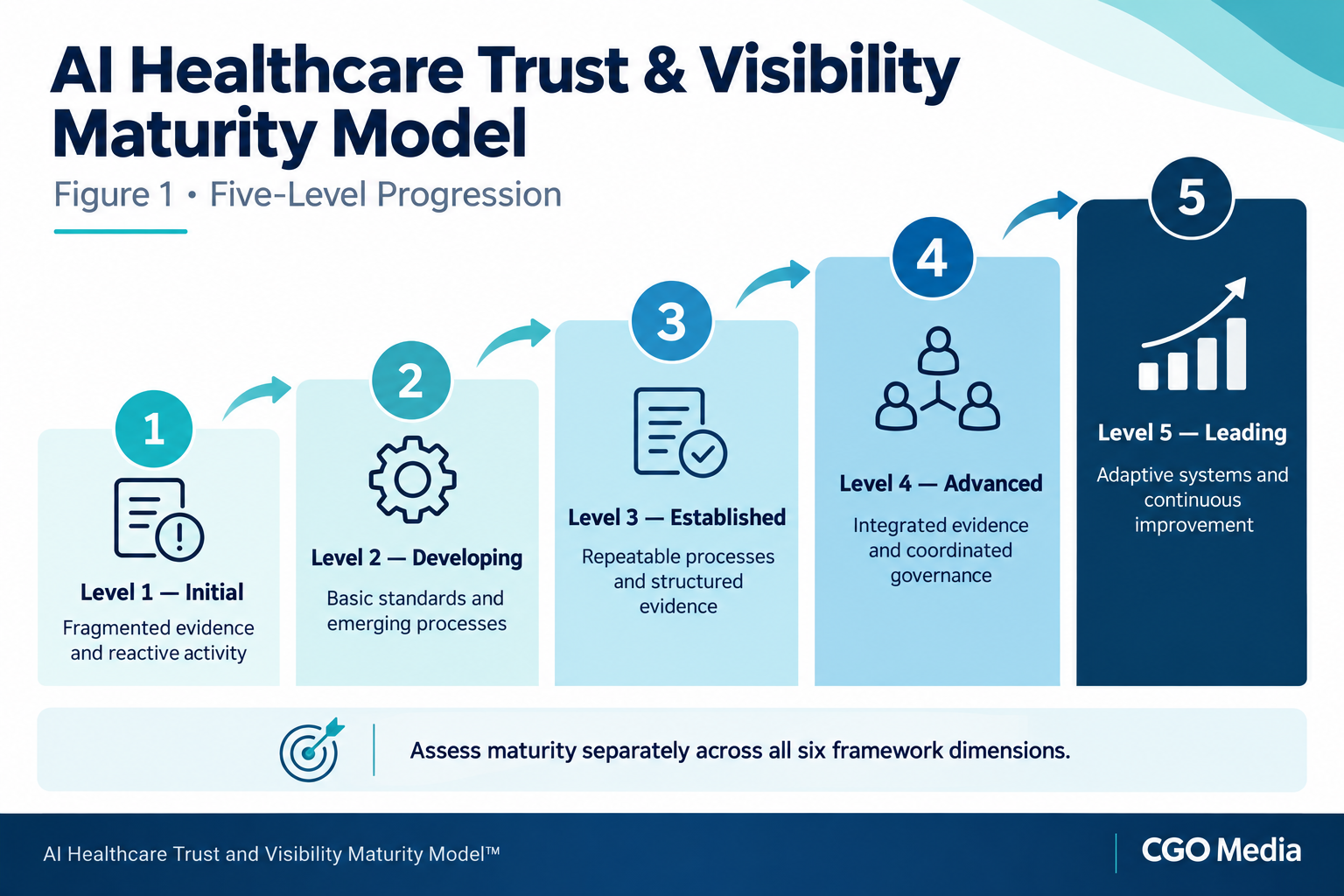
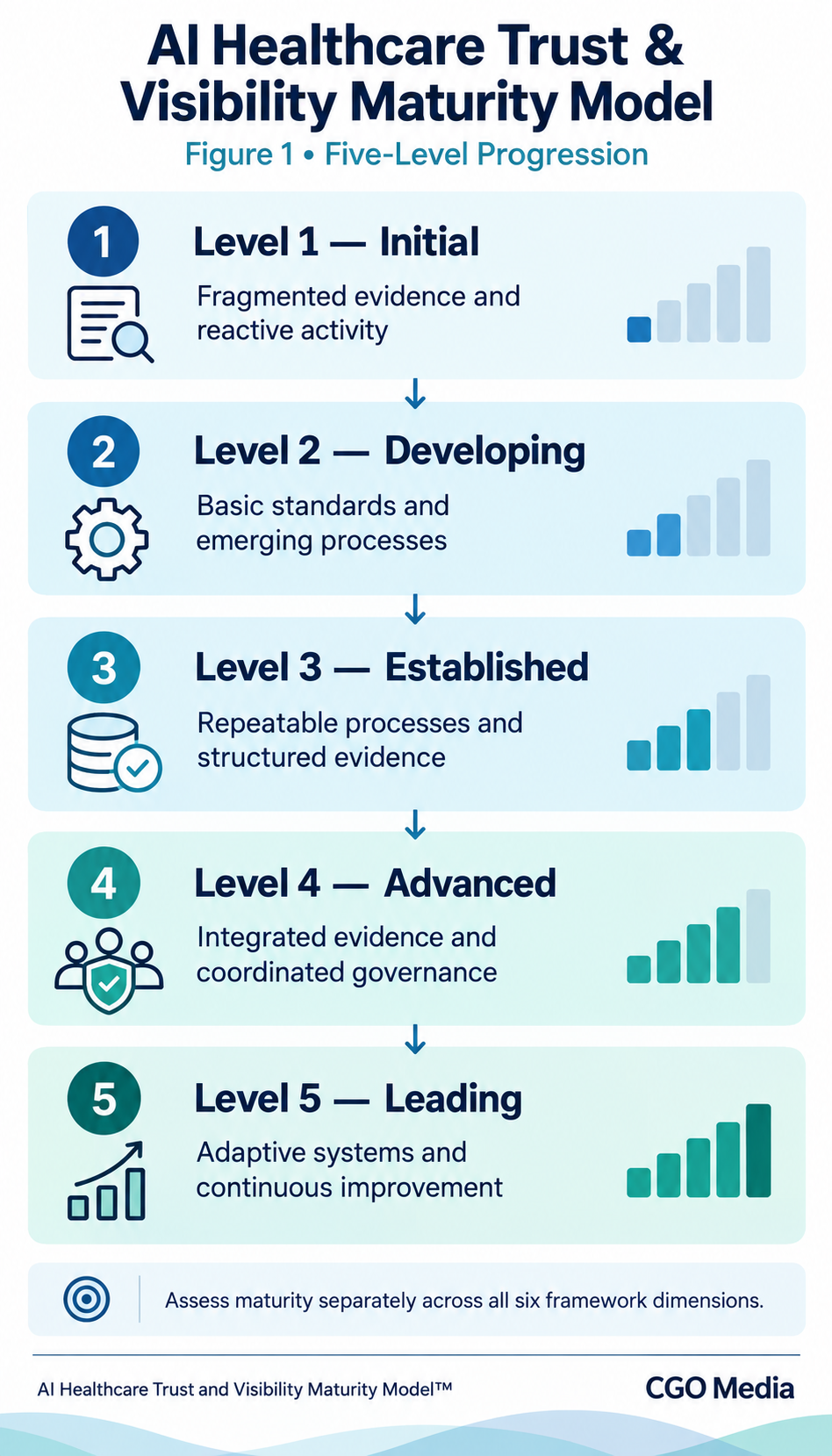
3. Five Maturity Levels
- Level 1 — Initial
- Level 2 — Developing
- Level 3 — Established
- Level 4 — Advanced
- Level 5 — Leading
4. Maturity Should Be Assessed Across Six Dimensions
The six dimensions are:
- Healthcare Entity and Organisational Clarity
- Clinical Information and Content Authority
- Professional and Practitioner Authority
- Regulatory, Governance and Patient Trust
- External, Institutional and Local Authority
- AI Search and Provider Recommendation Readiness
5. Organisations May Be at Different Levels Across Different Dimensions
A provider may demonstrate advanced clinical content governance while remaining weak in entity architecture or AI monitoring.
6. The Model Should Therefore Be Used Dimension by Dimension
Overall maturity can be useful for executive reporting, but the underlying dimension-level profile provides the more actionable view.
7. Maturity Reflects Organisational Capability
The model evaluates whether the organisation has moved from reactive activity toward repeatable, governed and continuously improving systems.
8. The Five-Level Progression
A simplified progression can be represented as:
Fragmented → Developing → Structured → Integrated → Leading
9. Level 1 — Initial
At Level 1, healthcare trust and visibility activities are fragmented, reactive and dependent on individual teams or people.
10. Level 1 — Entity and Organisational Clarity
Common characteristics may include:
- Inconsistent provider naming
- Weak location architecture
- Incomplete professional profiles
- Unclear service relationships
11. Level 1 — Clinical Information and Content Authority
Clinical content may be published without:
- Clear review processes
- Consistent authorship
- Defined update cycles
- Strong source governance
12. Level 1 — Professional Authority
Professional profiles may contain only basic biographical information and may lack:
- Detailed specialty information
- Current affiliations
- Research activity
- Clear service relationships
13. Level 1 — Regulatory and Patient Trust
Trust information may exist but be difficult to locate or inconsistently represented.
14. Level 1 — External and Local Authority
External profiles may be unmanaged, outdated or inconsistent.
15. Level 1 — AI Search Readiness
The organisation may have little or no structured monitoring of how it is represented across AI-assisted search systems.
16. Level 1 — Governance Characteristics
Typical characteristics include:
- No clear ownership
- No formal scorecard
- No review cadence
- No cross-functional authority governance
17. Level 1 — Measurement Characteristics
Measurement is often dominated by:
- Rankings
- Traffic
- Leads
with limited visibility into trust, entity accuracy or professional evidence.
18. Level 1 — Common Risks
Risks may include:
- Outdated clinician information
- Incorrect service-location relationships
- Weak clinical review
- Unmanaged review environments
- AI representation errors
19. Level 1 — Strategic Objective
The immediate goal is to establish visibility into the current evidence environment and identify the most significant accuracy and trust risks.
20. Level 1 — Priority Actions
Typical priorities may include:
- Audit provider entities
- Audit professional profiles
- Audit clinical content
- Audit regulatory information
- Audit local profiles
21. Level 1 — Progression Requirement
Progress toward Level 2 begins when the organisation starts documenting responsibility, correcting major inconsistencies and creating basic standards.
22. Level 2 — Developing
At Level 2, the organisation has recognised the importance of healthcare trust and digital authority and has started introducing more structured processes.
23. Level 2 — Entity and Organisational Clarity
Basic progress may include:
- More consistent organisation naming
- Improved location pages
- Expanded professional profiles
- Initial service mapping
24. Level 2 — Clinical Information and Content Authority
The organisation may begin introducing:
- Clinical review
- Authorship standards
- Source guidance
- Content-update processes
25. Level 2 — Professional Authority
Professional profiles may begin to include:
- Qualifications
- Specialty
- Registration information
- Practice locations
26. Level 2 — Regulatory and Patient Trust
The organisation may begin consolidating important:
- Regulatory information
- Privacy information
- Complaints processes
- Patient guidance
27. Level 2 — External and Local Authority
Local and third-party profiles are increasingly reviewed for accuracy.
28. Level 2 — AI Search Readiness
The organisation may begin testing:
- Branded AI queries
- Professional-name queries
- Basic provider recommendation prompts
29. Level 2 — Governance Characteristics
Responsibilities may exist informally across:
- Marketing
- Clinical teams
- Operations
- Compliance
30. Level 2 — Measurement Characteristics
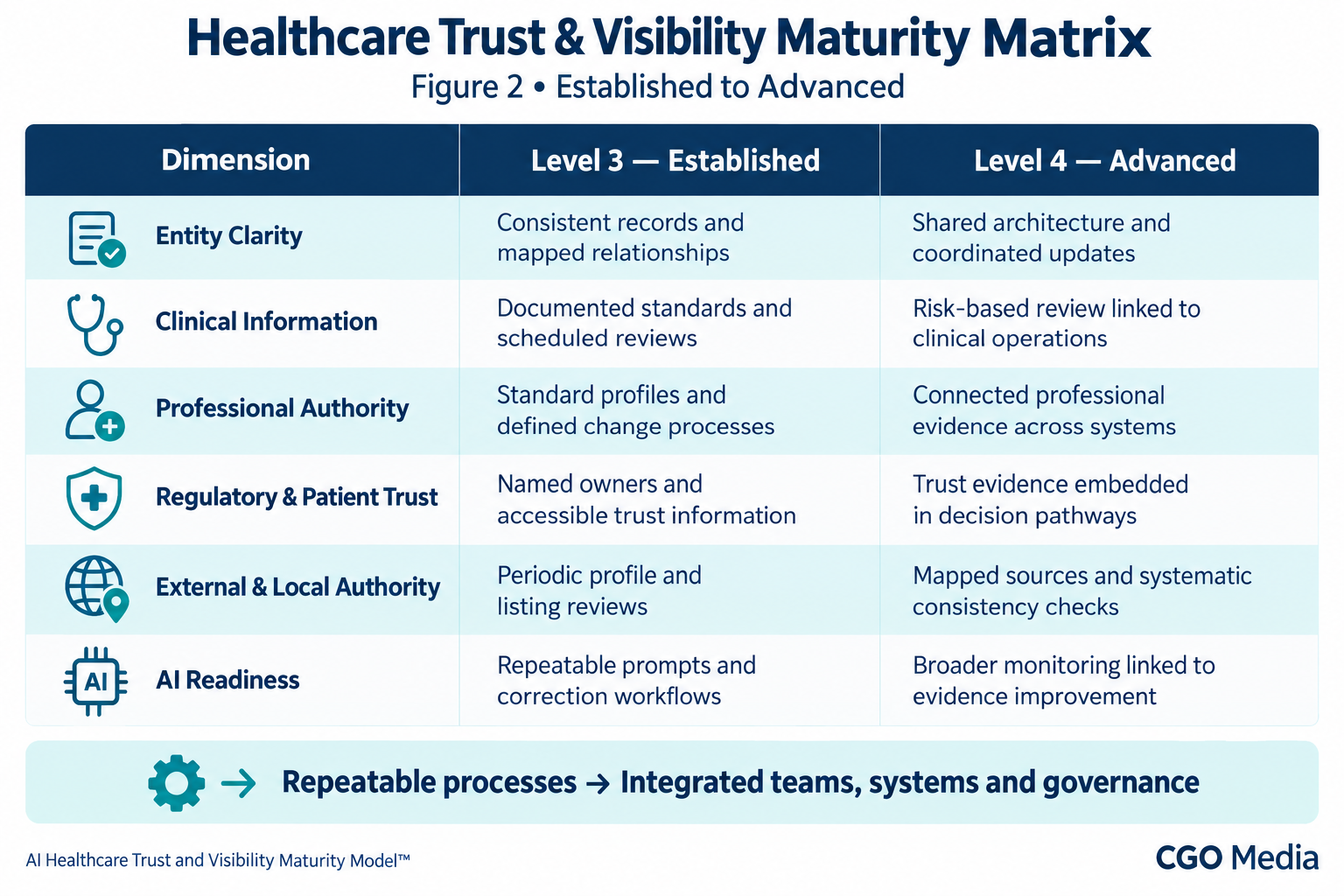
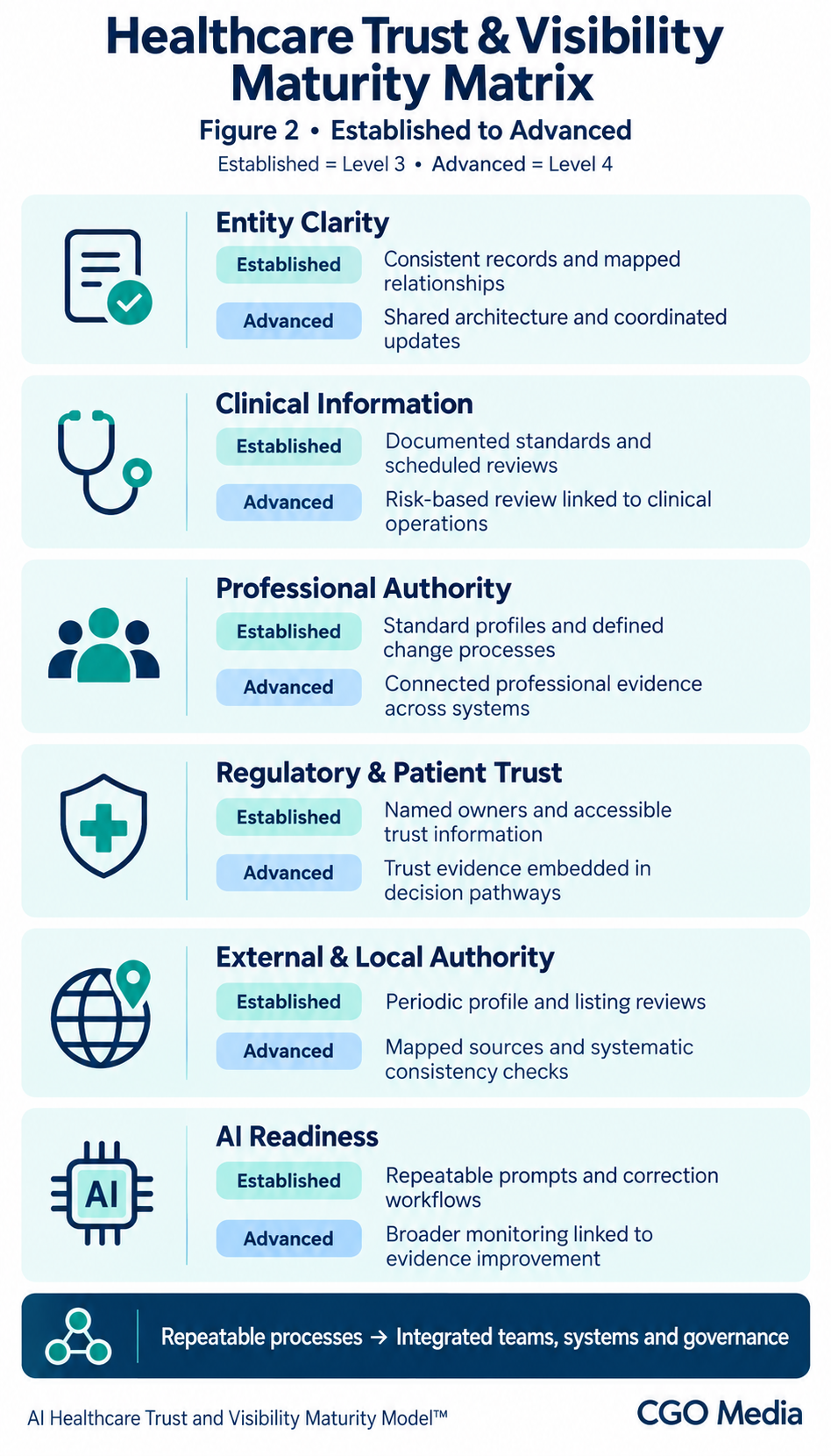
Measurement may expand to include:
- Profile completeness
- Content review status
- Local listing accuracy
- AI representation observations
31. Level 2 — Standardisation Begins
Templates and minimum standards may be introduced for:
- Professional profiles
- Location pages
- Service pages
- Clinical content
32. Level 2 — Initial Change Triggers
The organisation may start defining review actions when:
- A professional joins or leaves
- A location changes
- A service launches
- Clinical information changes
33. Level 2 — Early Cross-Functional Collaboration
Marketing, clinical, operational and governance teams may begin sharing responsibility for selected authority issues.
34. Level 2 — Common Limitations
Despite progress, processes may remain:
- Manual
- Inconsistent
- Reactive
- Dependent on individual teams
35. Level 2 — Typical Authority Gaps
Common gaps may include:
- Uneven profile quality
- Incomplete service mapping
- Limited external authority monitoring
- Irregular AI testing
36. Level 2 — Local Maturity
Multi-location organisations may have strong information for flagship sites while smaller locations remain incomplete.
37. Level 2 — Professional Maturity
Some senior clinicians may have detailed profiles while the wider professional estate remains inconsistent.
38. Level 2 — Clinical Content Maturity
Important high-traffic content may receive review while older or lower-profile pages remain outside formal governance.
39. Level 2 — AI Monitoring Maturity
Testing may exist, but results are often not yet linked consistently with:
- Source analysis
- Correction workflows
- Executive reporting
40. Level 2 — Strategic Objective
The objective is to move from scattered improvements toward consistent organisational standards.
41. Level 2 — Priority Actions
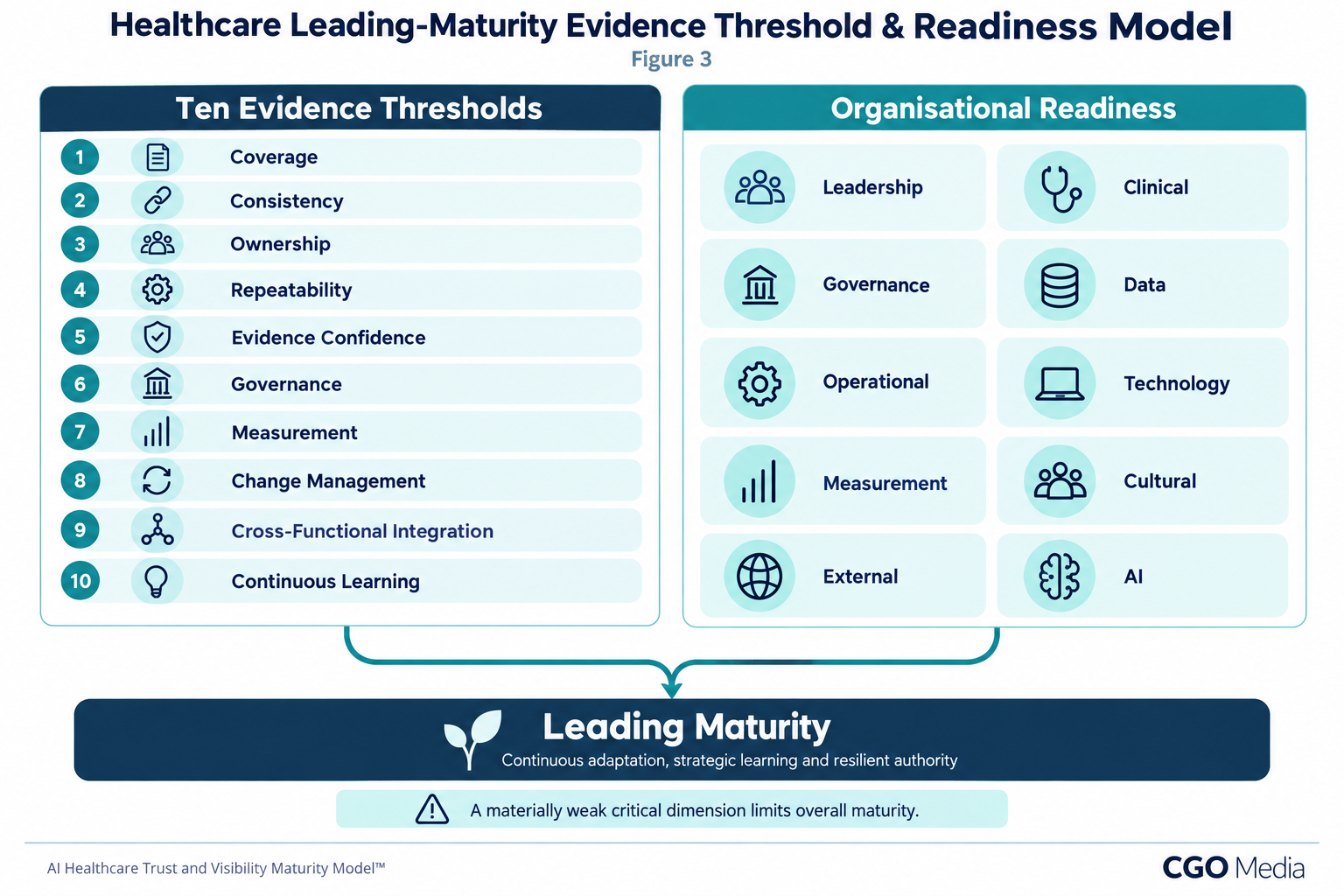
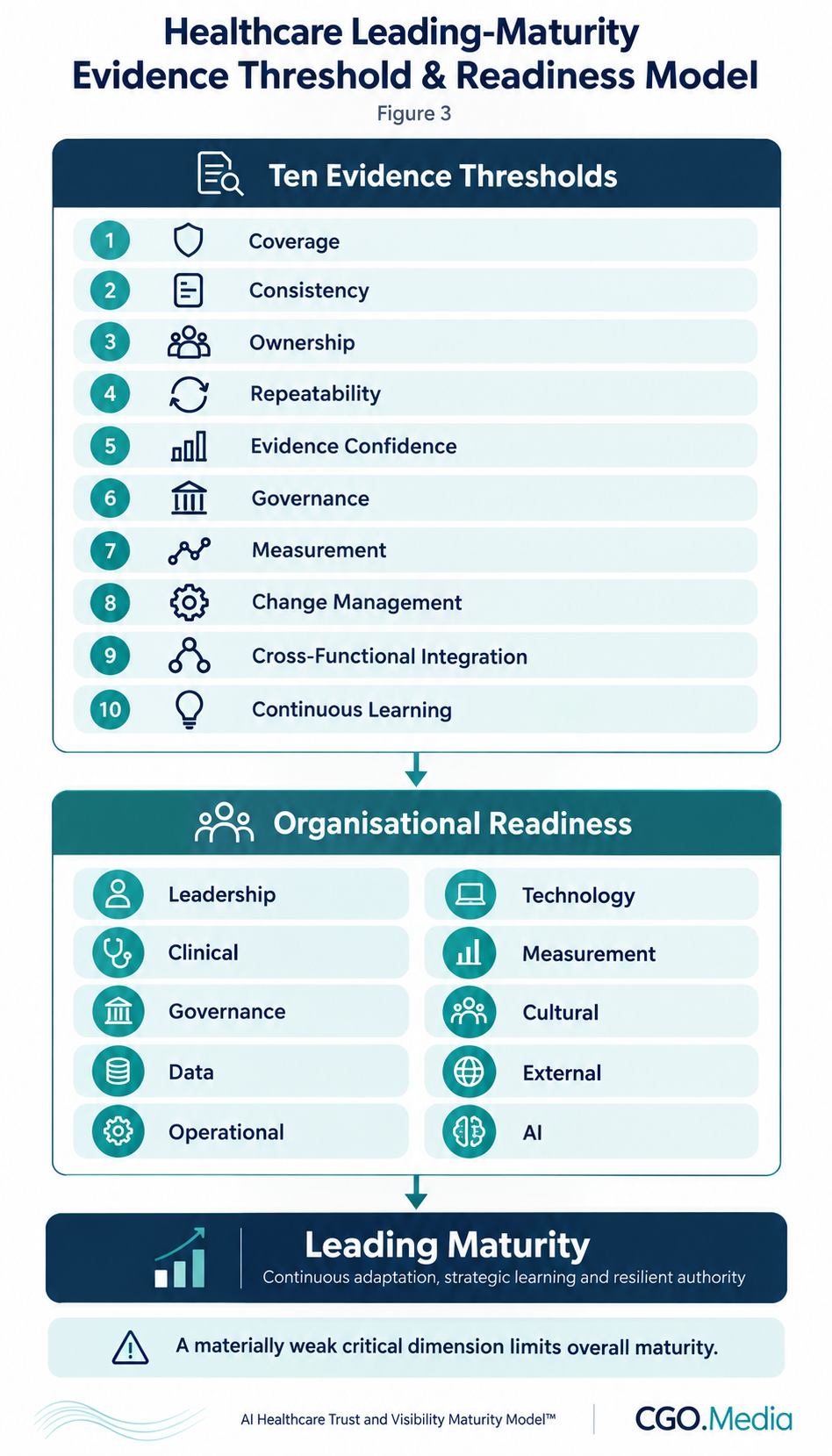
Typical priorities may include:
- Define minimum data standards
- Assign ownership
- Standardise key page types
- Introduce review schedules
- Create baseline scorecards
42. Level 2 — Progression Requirement
Progress toward Level 3 requires repeatable processes that operate consistently across the wider organisation rather than only within isolated teams or priority services.
43. The Difference Between Level 1 and Level 2
Level 1 organisations react to problems.
Level 2 organisations begin building standards intended to prevent the same problems recurring.
44. Early Maturity Is Primarily About Control
The first two levels focus less on advanced AI visibility and more on gaining control of:
- Identity
- Clinical information
- Professional evidence
- Trust data
- Local information
45. Healthcare Authority Cannot Mature Without Reliable Foundations
Advanced visibility is difficult to sustain when fundamental provider, professional and service information remains inconsistent.
46. Foundation Maturity Model
The first two levels can be summarised as:
Initial: Fragmented Evidence → Developing: Emerging Standards
47. Early Maturity Is Uneven by Nature
Healthcare organisations should expect different services, locations and professional groups to progress at different speeds.
48. Avoid Artificial Level Inflation
An organisation should not classify itself at a higher maturity level because of one advanced project if the wider evidence environment remains inconsistent.
49. Maturity Requires Repeatability
A capability becomes more mature when it can be reproduced across:
- Locations
- Services
- Professional groups
- Content types
50. Levels One and Two Establish the Foundation for Scalable Authority
Once the organisation has established basic control and emerging standards, it can begin moving toward a more structured and integrated healthcare authority system.
51. Level 3 — Established
At Level 3, the healthcare organisation has moved beyond isolated improvements and has established repeatable processes across the main trust and visibility dimensions.
52. Level 3 — Entity and Organisational Clarity
Provider, location, professional and service entities are generally represented consistently across the main digital estate.
53. Level 3 — Organisational Relationships
The organisation has clearer documentation of relationships such as:
- Parent organisation to location
- Location to service
- Professional to specialty
- Professional to location
54. Level 3 — Service Architecture
Core services are mapped consistently to the professionals, locations and clinical information that support them.
55. Level 3 — Location Architecture
Major healthcare locations have distinct, sufficiently complete information rather than relying on one generic organisation page.
56. Level 3 — Clinical Information and Content Authority
Clinical information is increasingly governed through documented standards.
57. Level 3 — Clinical Review Coverage
Priority clinical pages are reviewed on a defined schedule by appropriate contributors.
58. Level 3 — Authorship and Review Transparency
Relevant clinical content increasingly includes clear authorship, review information and update dates.
59. Level 3 — Source Governance
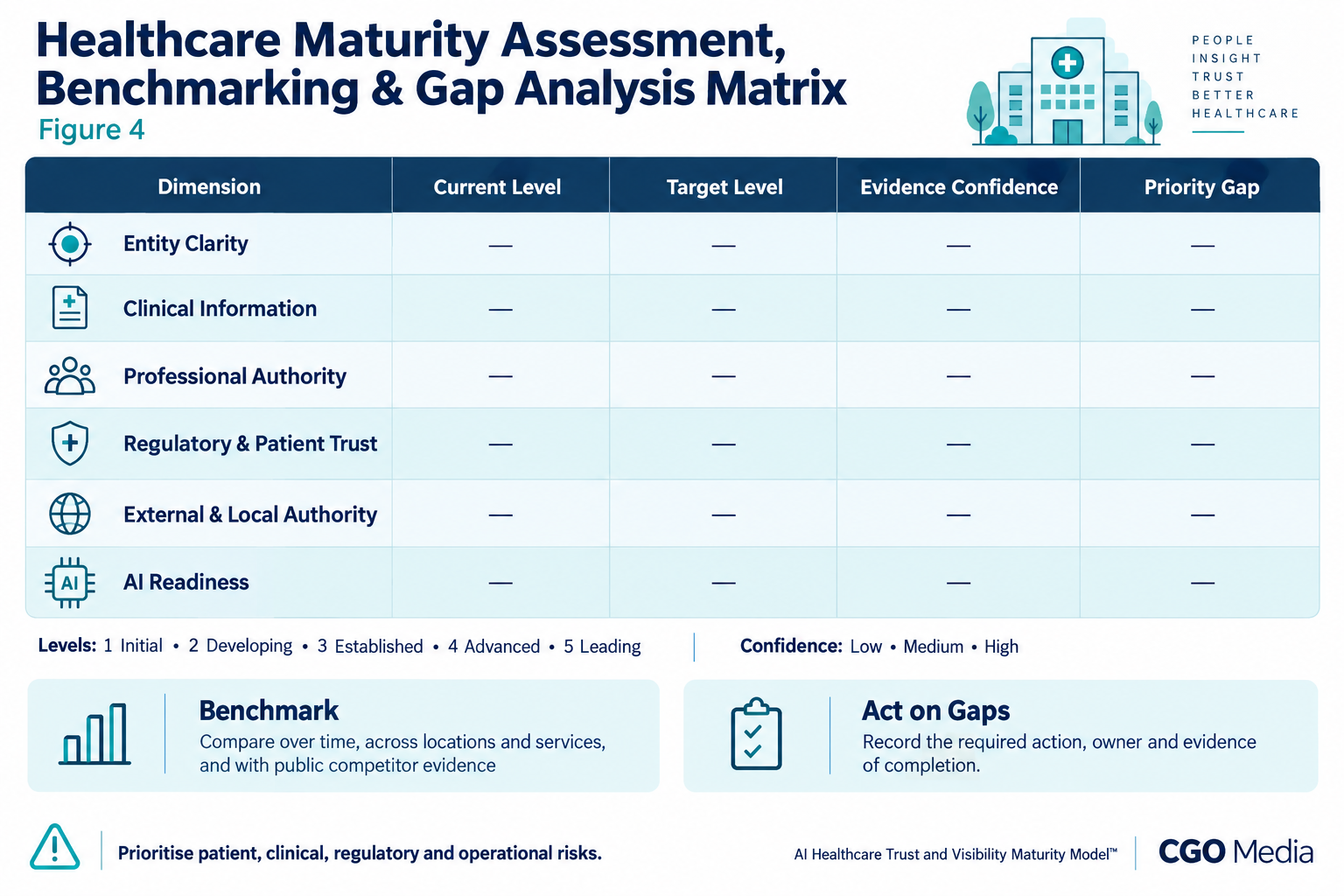
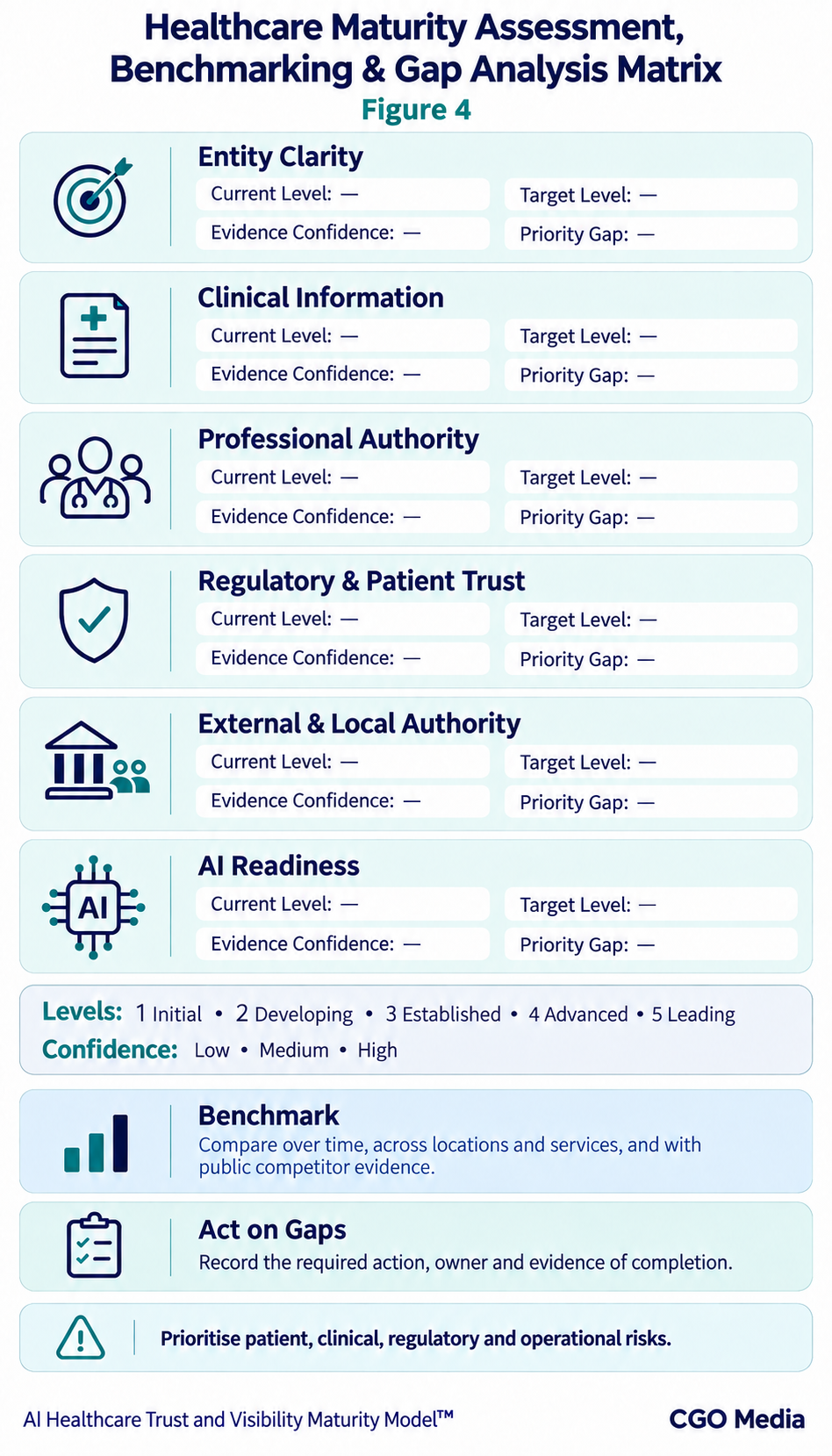
The organisation has established guidance for selecting and maintaining appropriate clinical references.
60. Level 3 — Content Inventory Control
Clinical and service information is managed through a central inventory or similar governance process.
61. Level 3 — Professional and Practitioner Authority
Professional profiles follow a consistent standard across the organisation.
62. Level 3 — Professional Profile Completeness
Profiles commonly include:
- Role
- Qualifications
- Specialty
- Registration where relevant
- Practice locations
- Relevant services
63. Level 3 — Professional Change Governance
Joining, leaving or role changes trigger defined updates across affected digital assets.
64. Level 3 — Professional Authority Relationships
Professionals are increasingly connected with:
- Clinical content
- Services
- Locations
- Research
65. Level 3 — Regulatory, Governance and Patient Trust
Important trust information is easier for users to locate and is maintained through clearer ownership.
66. Level 3 — Regulatory Clarity
Relevant provider, facility and professional regulatory evidence is more consistently linked to the correct entity.
67. Level 3 — Patient Journey Information
Priority services increasingly explain:
- Booking
- Assessment
- Treatment pathway
- Follow-up
68. Level 3 — Pricing and Access Information
Where relevant, private healthcare services provide more consistent information around pricing, insurance and practical access.
69. Level 3 — Review Governance
The organisation monitors review themes and has defined processes for appropriate public response.
70. Level 3 — External, Institutional and Local Authority
External authority is no longer treated as an occasional PR or link-acquisition activity.
71. Level 3 — External Profile Management
Important third-party profiles are identified and reviewed periodically.
72. Level 3 — Local Authority Management
Major locations have stronger consistency across:
- Provider information
- Local listings
- Service availability
- Professional availability
73. Level 3 — Institutional Evidence
Genuine professional, academic and institutional relationships are increasingly documented where relevant.
74. Level 3 — Research and Citation Authority
Healthcare organisations with genuine research activity begin connecting that evidence more systematically with relevant professional and clinical expertise.
75. Level 3 — AI Search and Provider Recommendation Readiness
AI monitoring becomes repeatable rather than occasional.
76. Level 3 — Branded AI Monitoring
The organisation periodically checks:
- Provider descriptions
- Location descriptions
- Professional descriptions
- Service associations
77. Level 3 — Non-Branded AI Monitoring
Priority service and provider-discovery prompts are tested using a consistent monitoring set.
78. Level 3 — AI Source Observation
Where sources are visible, the organisation begins recording which external environments contribute repeatedly to relevant answers.
79. Level 3 — AI Accuracy Workflow
Material representation errors are connected with defined investigation and correction processes.
80. Level 3 — Governance Characteristics
Governance becomes more formal across:
- Clinical teams
- Marketing
- Operations
- Compliance
- Patient experience
81. Level 3 — Named Ownership
Each major evidence category has a defined owner or responsible team.
82. Level 3 — Review Cadence
The organisation uses repeatable review cycles rather than waiting for errors to be reported.
83. Level 3 — Scorecard Adoption
A structured scorecard is used to assess the six framework dimensions periodically.
84. Level 3 — Evidence Confidence
Scores increasingly include documentation showing why the assessment has been made.
85. Level 3 — Benchmarking
The organisation may begin comparing:
- Location to location
- Service line to service line
- Current performance to previous assessments
86. Level 3 — Strategic Objective
The objective is to make healthcare trust and authority management repeatable across the organisation.
87. Level 3 — Typical Limitations
Despite stronger structure, the organisation may still experience:
- Manual workflows
- Uneven adoption
- Limited automation
- Incomplete cross-system integration
88. Level 3 — Progression Requirement
Progress toward Level 4 requires deeper integration between data, governance, clinical evidence, external authority and AI observation.
89. Level 4 — Advanced
At Level 4, trust and visibility capabilities are integrated across teams, systems and decision processes.
90. Level 4 — Entity and Organisational Clarity
The organisation operates a mature healthcare knowledge architecture covering:
- Organisation
- Locations
- Professionals
- Specialties
- Services
- Conditions
- Treatments
91. Level 4 — Entity Governance
Entity changes trigger coordinated updates across the relevant website, internal systems and legitimate external profiles.
92. Level 4 — Relationship Integrity
The organisation actively validates relationships such as:
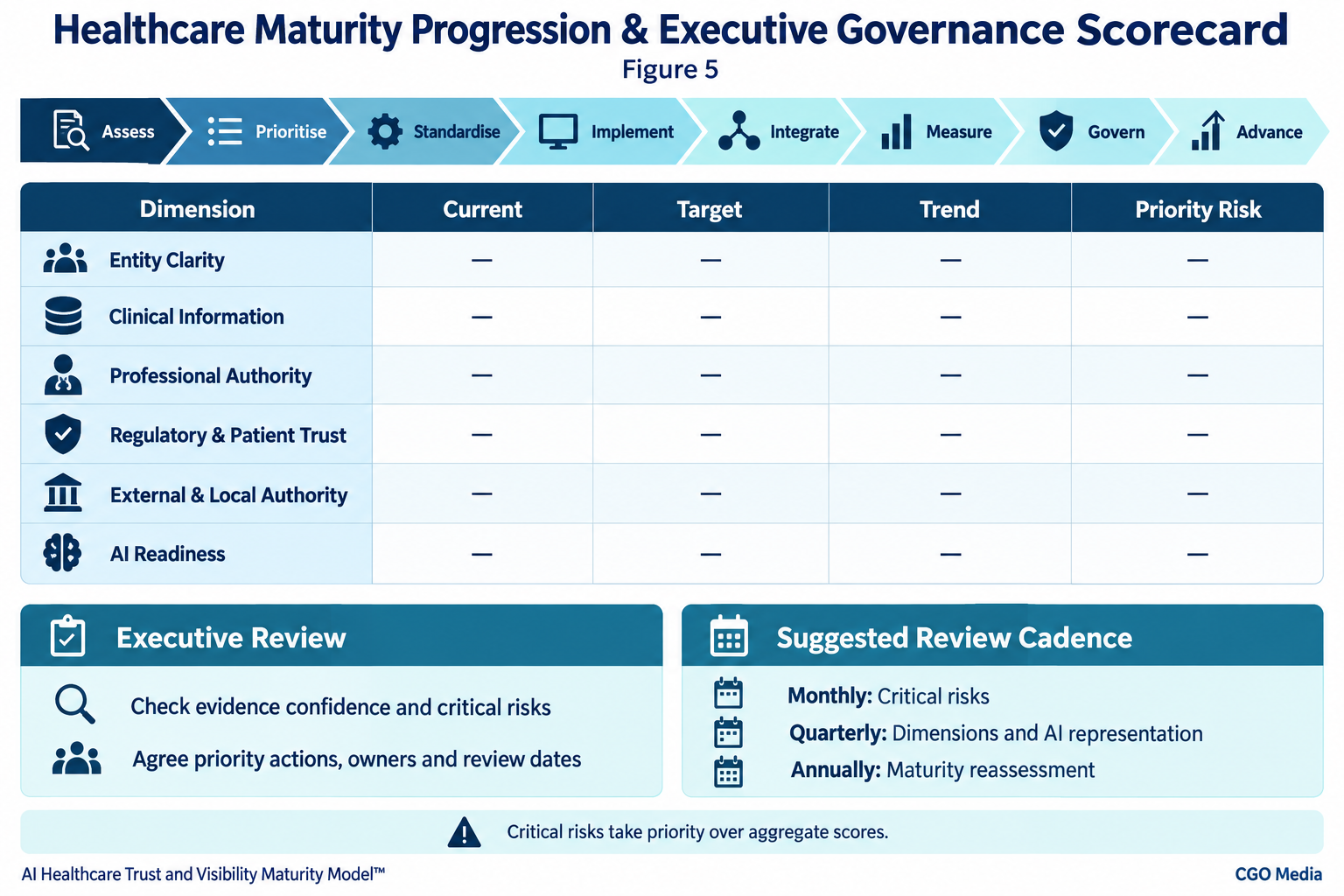
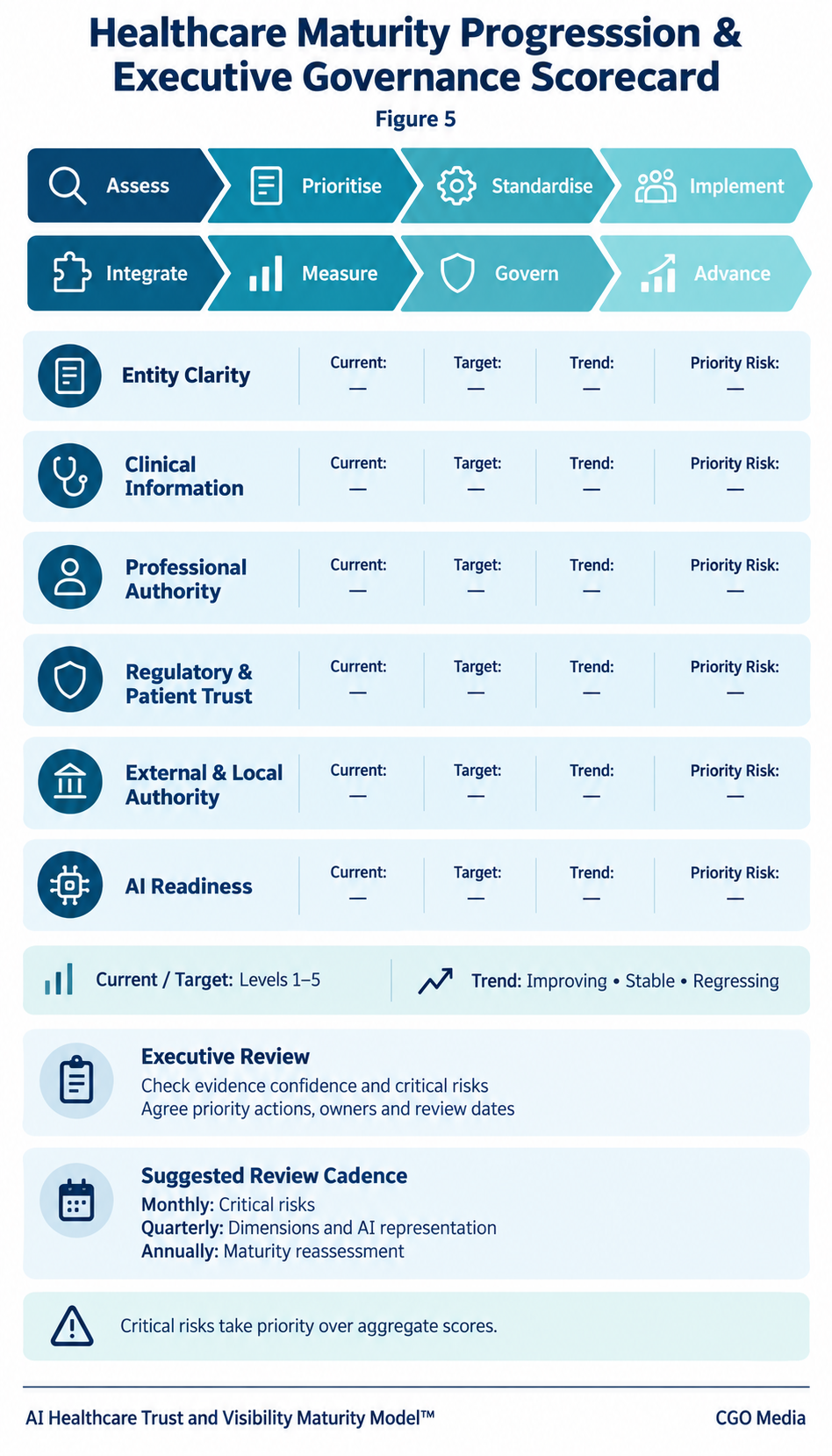
Organisation → Location → Professional → Specialty → Service → Condition → Treatment
93. Level 4 — Structured Data Governance
Where structured data is used, implementation is governed centrally and aligned with visible, current organisational information.
94. Level 4 — Clinical Information and Content Authority
Clinical content governance is integrated with clinical operations rather than existing only within marketing or publishing teams.
95. Level 4 — Risk-Based Clinical Review
Higher-risk healthcare content receives more frequent or more rigorous review according to its potential effect on patient understanding.
96. Level 4 — Content Change Triggers
Clinical updates can trigger review of related:
- Condition pages
- Treatment pages
- Service pages
- Professional profiles
97. Level 4 — Clinical Evidence Traceability
The organisation can identify:
- Who reviewed important content
- When it was reviewed
- Which sources support it
- When it should be reviewed again
98. Level 4 — Professional Authority
Professional evidence is managed as an organisational authority asset rather than a collection of isolated biographies.
99. Level 4 — Professional Entity Integration
Professional profiles are connected systematically with:
- Services
- Locations
- Clinical content
- Research
- Institutional affiliations
100. Level 4 — Professional Authority Validation
Material professional claims are supported by appropriate evidence and reviewed periodically.
101. Level 4 — Regulatory and Patient Trust
Trust evidence is integrated throughout the patient decision journey rather than concentrated on legal or corporate pages.
102. Level 4 — Trust at the Point of Decision
Service, professional and location pages expose relevant trust information where users are most likely to need it.
103. Level 4 — Patient Experience Intelligence
Review, complaint and contact-centre themes are integrated into broader trust and journey improvement processes.
104. Level 4 — Operational Trust Integration
Digital information is increasingly connected with current operational data involving:
- Availability
- Location
- Services
- Professional schedules
105. Level 4 — External and Institutional Authority
The organisation has a coordinated strategy for developing and maintaining relevant external evidence.
106. Level 4 — External Evidence Mapping
Important external source classes are documented across:
- Regulators
- Professional bodies
- Hospitals
- Universities
- Research environments
- Local platforms
- Relevant media
107. Level 4 — Source Consistency Monitoring
Material discrepancies between first-party and external information are identified systematically.
108. Level 4 — Citation and Research Authority
Research-producing organisations measure relevant citation and professional-reference patterns rather than raw mention volume alone.
109. Level 4 — Local Authority Integration
Location information is increasingly connected with operational systems, service availability and professional data.
110. Level 4 — AI Search and Provider Recommendation Readiness
AI monitoring becomes an established organisational capability.
111. Level 4 — Multi-Scenario AI Monitoring
Testing may cover:
- Branded provider queries
- Professional queries
- Service queries
- Local provider queries
- Provider comparison queries
112. Level 4 — AI Representation Accuracy Measurement
The organisation measures material accuracy across recurring prompt sets.
113. Level 4 — AI Source Analysis
Source patterns are compared across models, query types and time periods where practical.
114. Level 4 — AI Competitor Observation
Relevant competitor presence is monitored to identify changes in the broader discovery environment.
115. Level 4 — AI Observation Is Linked to Evidence Improvement
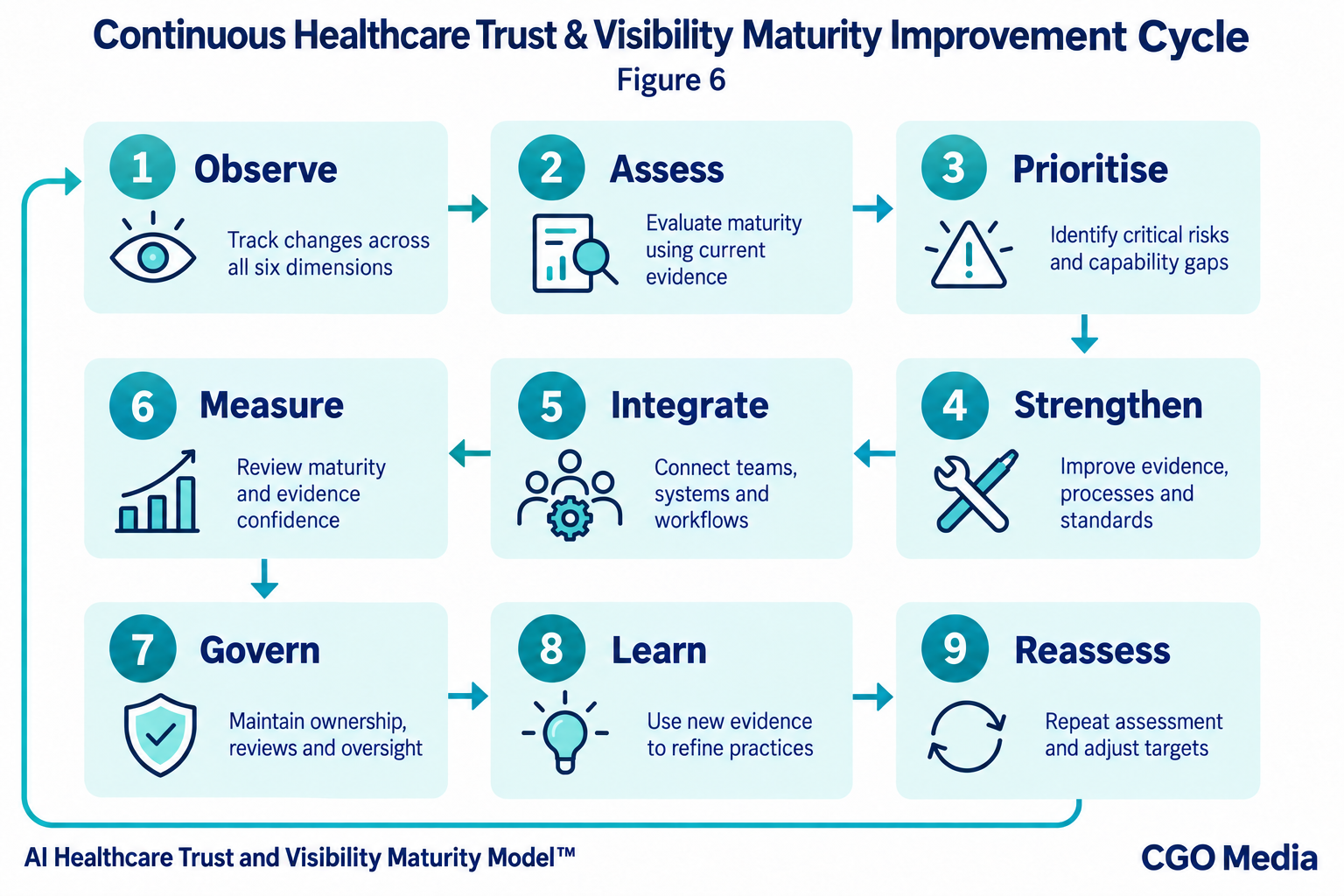
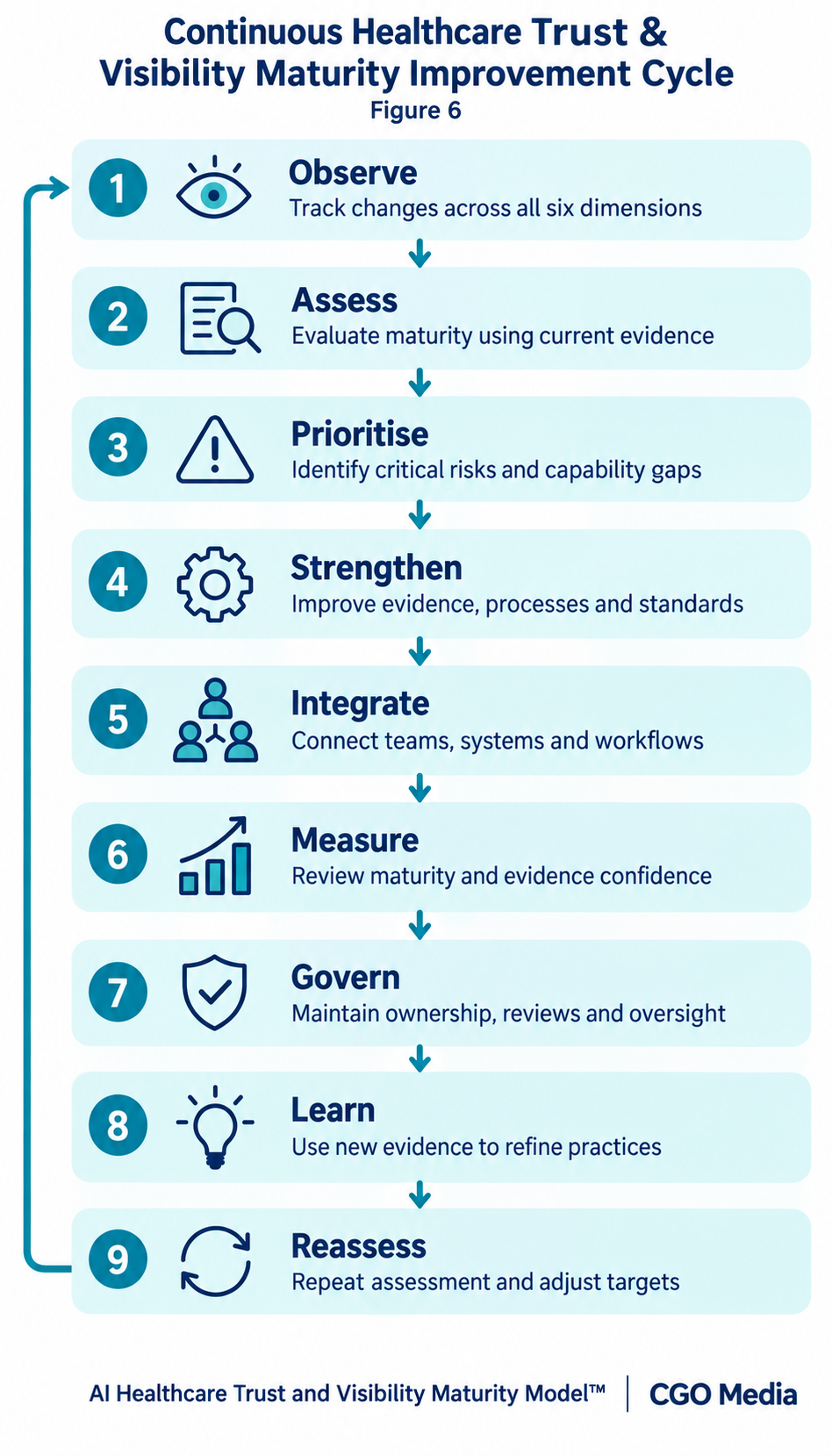
AI representation issues can trigger investigation of:
- Entity clarity
- Clinical information
- Professional evidence
- External source consistency
116. Level 4 — Governance Characteristics
The organisation has formal cross-functional responsibility for healthcare trust and visibility.
117. Level 4 — Governance Council
A cross-functional governance structure may include:
- Clinical leadership
- Marketing
- SEO
- Compliance
- Operations
- Patient experience
- Data teams
118. Level 4 — Executive Reporting
Senior leadership receives a broader view than rankings and traffic alone.
119. Level 4 — Executive Measures
Reporting may include:
- Framework scores
- Evidence confidence
- Critical trust gaps
- Professional completeness
- AI accuracy
- Patient journey friction
120. Level 4 — Change Management
Important professional, service or location changes activate documented workflows rather than relying on ad hoc communication.
121. Level 4 — Cross-System Integration
Where appropriate, the organisation begins connecting digital authority governance with internal:
- Professional records
- Location records
- Service records
- Content governance systems
122. Level 4 — Maturity Is Proactive
The organisation increasingly identifies risks before they become public-facing problems.
123. Level 4 — Strategic Objective
The objective is to integrate healthcare trust and visibility into normal organisational governance and decision-making.
124. Level 4 — Typical Remaining Gaps
Even advanced organisations may still have:
- Legacy systems
- Uneven international or regional adoption
- Incomplete automation
- Complex external-source dependencies
125. Level 4 — Progression Requirement
Progress toward Level 5 requires continuous optimisation, strong evidence resilience, strategic learning and organisation-wide adoption.
126. The Difference Between Level 3 and Level 4
Level 3 organisations have repeatable processes.
Level 4 organisations integrate those processes across teams and systems.
127. Established Maturity Creates Control
At Level 3, the organisation can manage most important evidence classes consistently.
128. Advanced Maturity Creates Integration
At Level 4, evidence, governance, measurement and operational systems begin reinforcing one another.
129. Mid-to-Advanced Maturity Model
The progression can be summarised as:
Established: Repeatable Systems → Advanced: Integrated Authority Governance
130. Levels Three and Four Transform Trust into Organisational Capability
At these stages, healthcare authority becomes less dependent on individual campaigns and more dependent on repeatable, governed and integrated systems.
131. Level 5 — Leading
At Level 5, healthcare trust and visibility are treated as an organisation-wide strategic capability supported by continuous evidence monitoring, cross-functional governance and adaptive decision-making.
132. Level 5 — Entity and Organisational Clarity
The organisation maintains a highly structured and resilient representation of:
- Provider entities
- Locations
- Professionals
- Specialties
- Services
- Conditions
- Treatments
133. Level 5 — Entity Relationships Are Continuously Governed
Material changes are propagated through controlled processes rather than waiting for inconsistencies to appear publicly.
134. Level 5 — Enterprise Healthcare Knowledge Architecture
The organisation maintains a connected information model linking:
Organisation → Location → Professional → Specialty → Service → Condition → Treatment → Trust Evidence
135. Level 5 — Entity Resilience
The organisation can detect and correct material identity inconsistencies across first-party and important external environments.
136. Level 5 — Clinical Information and Content Authority
Clinical information is governed as a strategic healthcare knowledge asset rather than simply as website content.
137. Level 5 — Risk-Based Clinical Governance
Review frequency and approval requirements reflect the potential impact of the information on patient understanding and decision-making.
138. Level 5 — Clinical Evidence Lifecycle
Important healthcare content has defined stages covering:
- Creation
- Professional review
- Publication
- Monitoring
- Update
- Retirement
139. Level 5 — Clinical Evidence Traceability
The organisation can identify the provenance, review history and current ownership of major clinical information assets.
140. Level 5 — Professional and Practitioner Authority
Professional authority is integrated across clinical, research, institutional and digital environments.
141. Level 5 — Professional Identity Governance
Changes to professional status trigger coordinated review of:
- Profiles
- Services
- Locations
- Clinical authorship
- Research relationships
- External profiles
142. Level 5 — Professional Authority Depth
Professional profiles may connect appropriately with:
- Qualifications
- Registration
- Clinical interests
- Research
- Teaching
- Institutional roles
143. Level 5 — Professional Evidence Quality
Professional authority is based primarily on current, relevant and verifiable evidence rather than promotional language.
144. Level 5 — Regulatory, Governance and Patient Trust
Trust is embedded throughout the patient-facing information environment.
145. Level 5 — Regulatory Evidence Resilience
Material regulatory changes are identified and reflected rapidly across relevant digital assets.
146. Level 5 — Patient Trust Intelligence
Review, complaint, contact-centre and patient-experience data are analysed together to identify recurring trust and service issues.
147. Level 5 — Trust at the Point of Decision
Relevant trust evidence is available within the pages and journeys where users evaluate:
- Professionals
- Services
- Locations
- Appointments
148. Level 5 — External, Institutional and Local Authority
External authority is monitored as a connected evidence ecosystem.
149. Level 5 — External Source Mapping
Important external source classes are continuously mapped across:
- Regulatory environments
- Professional bodies
- Hospitals
- Universities
- Research sources
- Local platforms
- Relevant media
150. Level 5 — Citation and Research Authority
Where the organisation produces genuine research, it monitors relevant professional and academic citation patterns and connects those signals with subject expertise.
151. Level 5 — Local Authority Resilience
Location data is maintained consistently as professionals, services and operating arrangements change.
152. Level 5 — AI Search and Provider Recommendation Readiness
AI observation is embedded within the organisation’s wider digital authority and risk-monitoring systems.
153. Level 5 — Multi-Model AI Monitoring
Where strategically justified, the organisation may compare how important providers, professionals and services are represented across multiple AI systems.
154. Level 5 — AI Prompt Architecture
Monitoring sets may cover:
- Branded provider prompts
- Professional prompts
- Service prompts
- Condition-led discovery
- Local provider discovery
- Provider comparison
155. Level 5 — AI Representation Accuracy
The organisation maintains a repeatable process for identifying material inaccuracies involving:
- Provider identity
- Professional roles
- Services
- Locations
- Regulatory context
156. Level 5 — AI Source Intelligence
Where sources are exposed, the organisation studies which information environments recur across strategically important query classes.
157. Level 5 — AI Competitor Intelligence
Relevant competitor representation is monitored over time to understand changes in the broader provider-discovery environment.
158. Level 5 — AI Monitoring Supports Diagnosis
AI observations are used to identify possible weaknesses in:
- Entity clarity
- Professional evidence
- External authority
- Source consistency
- Local information
159. Level 5 — Governance Characteristics
Healthcare trust and visibility are integrated into normal organisational governance.
160. Level 5 — Executive Ownership
Senior leadership receives regular reporting on:
- Authority maturity
- Clinical information risk
- Professional evidence
- Patient trust
- AI representation
- Strategic gaps
161. Level 5 — Cross-Functional Operating Model
Relevant teams operate through clearly defined roles across:
- Clinical governance
- Marketing
- SEO
- Compliance
- Operations
- Patient experience
- Data
162. Level 5 — Continuous Audit Capability
The organisation can reassess important evidence classes without waiting for major annual audits.
163. Level 5 — Automated Change Detection
Where appropriate, internal systems may help identify changes involving:
- Professionals
- Services
- Locations
- Content review dates
164. Level 5 — Strategic Learning
The organisation uses search, patient, operational and AI data to guide future healthcare information and authority strategy.
165. Level 5 — Maturity Is Adaptive
Leading maturity does not mean the environment becomes static.
It means the organisation can respond more effectively when the environment changes.
166. Level 5 — Strategic Objective
The objective is to maintain a resilient healthcare authority system that can remain accurate, trusted and discoverable over time.
167. Level 5 Is Not Perfection
Even leading organisations will experience:
- New data conflicts
- Professional changes
- Clinical updates
- Platform changes
- AI representation variation
168. Leading Maturity Is Defined by Response Capability
The distinction lies in the organisation’s ability to detect, prioritise and resolve significant changes systematically.
169. The Difference Between Level 4 and Level 5
Level 4 integrates authority governance.
Level 5 uses that integration to support continuous adaptation and strategic learning.
170. Complete Five-Level Progression
The maturity pathway can be summarised as:
Initial → Developing → Established → Advanced → Leading
171. Maturity Evidence Thresholds
Progression between levels should be based on evidence rather than aspiration.
172. Threshold One — Coverage
The relevant process should apply across a meaningful proportion of:
- Professionals
- Locations
- Services
- Content
173. Threshold Two — Consistency
The process should operate consistently rather than only for flagship services or high-profile clinicians.
174. Threshold Three — Ownership
The organisation should be able to identify who is responsible for each major evidence category.
175. Threshold Four — Repeatability
The process should continue working when:
- Staff change
- New locations open
- New services launch
- New professionals join
176. Threshold Five — Evidence Confidence
Maturity claims should be supported by current and sufficiently complete evidence.
177. Threshold Six — Governance
Important decisions should be governed through documented processes rather than informal individual judgement alone.
178. Threshold Seven — Measurement
The organisation should be able to determine whether important capabilities are:
- Improving
- Stable
- Regressing
179. Threshold Eight — Change Management
Mature organisations have defined triggers for updating affected evidence when real-world conditions change.
180. Threshold Nine — Cross-Functional Integration
More advanced maturity requires collaboration across teams rather than isolated SEO or marketing ownership.
181. Threshold Ten — Continuous Learning
Leading maturity requires feedback from performance, patient experience, operations and AI observation to inform future improvements.
182. Maturity Cannot Be Claimed from Policy Alone
Having documented procedures is not sufficient if they are not implemented consistently.
183. Maturity Cannot Be Claimed from Technology Alone
Advanced software does not compensate for weak clinical governance, inaccurate professional information or unclear organisational ownership.
184. Maturity Cannot Be Claimed from Visibility Alone
Strong rankings or brand recognition do not prove that the underlying trust and authority system is mature.
185. Cross-Dimension Dependencies
The six dimensions influence one another.
186. Entity Clarity Supports Every Other Dimension
If the organisation cannot represent professionals, locations and services accurately, other authority signals may become difficult to interpret.
187. Clinical Authority Depends on Professional Authority
Clinical information is stronger when relevant expertise and review responsibility are transparent.
188. Professional Authority Depends on Entity Clarity
A strong clinician profile still requires accurate relationships with:
- Organisation
- Specialty
- Service
- Location
189. Regulatory Trust Depends on Correct Entity Relationships
Regulatory evidence loses clarity if users cannot determine which provider, facility or professional it applies to.
190. External Authority Depends on Internal Accuracy
External recognition is less useful when it reinforces outdated or ambiguous first-party information.
191. AI Readiness Depends on the Previous Five Dimensions
AI readiness should be viewed as a cumulative outcome of stronger evidence across the rest of the framework.
192. A Weak Critical Dimension Can Constrain Overall Maturity
An organisation should not be classified as leading where one critical dimension remains materially weak.
193. Example — Advanced AI Monitoring, Weak Clinical Governance
Sophisticated AI analysis does not compensate for outdated or poorly governed healthcare information.
194. Example — Strong Research Authority, Weak Local Accuracy
A respected healthcare organisation may still create practical patient problems if clinic or service information is inaccurate.
195. Example — Strong Professional Profiles, Weak Change Management
Profiles may look excellent at one point in time but deteriorate rapidly if clinician changes are not governed.
196. Organisational Readiness Indicators
Before attempting higher maturity levels, the organisation should assess whether supporting organisational capabilities exist.
197. Leadership Readiness
Leadership should recognise healthcare trust and visibility as more than a marketing issue.
198. Clinical Readiness
Clinical teams should have appropriate involvement in healthcare information quality and review.
199. Governance Readiness
The organisation should have mechanisms for:
- Ownership
- Escalation
- Review
- Change approval
200. Data Readiness
Important information about:
- Professionals
- Locations
- Services
- Content
should be sufficiently structured to support reliable management.
201. Operational Readiness
Digital information should be capable of reflecting real service availability and organisational change.
202. Technology Readiness
Technology should support governance and accuracy rather than become the maturity objective itself.
203. Measurement Readiness
The organisation should be able to collect sufficient evidence to assess progress over time.
204. Cultural Readiness
Teams should be willing to share responsibility for patient-facing accuracy and digital authority.
205. External Readiness
The organisation should understand which external profiles, directories, institutions and information sources materially affect its wider evidence environment.
206. AI Readiness
AI monitoring should begin only with a clear understanding of what the organisation intends to observe and how findings will be acted upon.
207. Maturity Requires Organisational Alignment
The strongest progression occurs when strategy, governance, clinical evidence, operational data and technology reinforce one another.
208. The Leading Healthcare Authority Model
At the highest level, maturity can be represented as:
Accurate Evidence → Repeatable Processes → Integrated Governance → Continuous Monitoring → Strategic Learning → Resilient Authority
209. Translating Maturity into an Assessment System
The five-level maturity structure becomes more useful when each dimension is supported by an explicit assessment method.
210. Assess Each Dimension Separately
The six dimensions should be scored independently before any overall maturity level is assigned.
211. The Six Assessment Dimensions
- Healthcare Entity and Organisational Clarity
- Clinical Information and Content Authority
- Professional and Practitioner Authority
- Regulatory, Governance and Patient Trust
- External, Institutional and Local Authority
- AI Search and Provider Recommendation Readiness
212. Five-Level Maturity Scoring
| Score | Maturity Level | General Condition |
|---|---|---|
| 1 | Initial | Fragmented, reactive and weakly governed. |
| 2 | Developing | Basic standards exist but remain uneven. |
| 3 | Established | Repeatable processes operate across major areas. |
| 4 | Advanced | Capabilities are integrated across teams and systems. |
| 5 | Leading | Authority is continuously monitored, governed and improved. |
213. Scores Should Reflect Observable Capability
Maturity assessments should be based on evidence that a process exists, operates consistently and is governed over time.
214. Evidence Categories
Supporting evidence may include:
- Policies
- Workflows
- Content inventories
- Professional records
- Audit reports
- Monitoring data
- Governance records
215. Policy Alone Is Not Sufficient
A documented process should not receive a high maturity score if it is applied inconsistently in practice.
216. Coverage Should Be Measured
Where possible, assess the proportion of the relevant estate covered by the process.
217. Entity Coverage
Potential measures may include:
- Percentage of locations with complete profiles
- Percentage of professionals with current data
- Percentage of services mapped correctly
218. Clinical Content Coverage
Potential measures may include:
- Percentage of priority pages with current review
- Percentage with named authorship or review
- Percentage with defined update dates
219. Professional Authority Coverage
Potential measures may include:
- Profile completeness
- Registration visibility
- Service connections
- Location connections
220. Trust Coverage
Potential measures may include:
- Regulatory information coverage
- Patient journey coverage
- Privacy information coverage
- Review governance coverage
221. External Authority Coverage
Potential measures may include:
- Local profile completeness
- External-profile accuracy
- Institutional evidence coverage
- Research and citation visibility
222. AI Readiness Coverage
Potential measures may include:
- Branded prompt coverage
- Professional prompt coverage
- Provider recommendation monitoring
- Source-analysis coverage
223. Consistency Should Be Measured Alongside Coverage
A process applied to 100% of locations but implemented poorly should not automatically be considered mature.
224. Consistency Indicators
Possible indicators include:
- Template adherence
- Data-field completeness
- Review-cycle compliance
- Source accuracy
225. Governance Depth
Maturity should also assess whether:
- Owners are named
- Review dates exist
- Escalation routes exist
- Change triggers are documented
226. Measurement Depth
More mature organisations should be able to demonstrate change over time rather than only point-in-time compliance.
227. Maturity Confidence
Each maturity score may be accompanied by an evidence-confidence rating.
228. Low Confidence
Low confidence may apply where:
- Evidence is incomplete
- Records are outdated
- Coverage is uncertain
- Processes are undocumented
229. Medium Confidence
Medium confidence may apply where:
- Evidence is reasonably current
- Major processes are documented
- Coverage is partially verified
230. High Confidence
High confidence may apply where:
- Evidence is current
- Coverage is measurable
- Ownership is clear
- Review history exists
231. Example Maturity Statement
A useful reporting format may be:
Professional Authority: Level 4 — Advanced | Evidence Confidence: High
232. Overall Maturity Should Be Interpreted Carefully
An overall average may support executive reporting, but it should not hide critical weaknesses.
233. The Weakest-Critical-Dimension Principle
Where a critical dimension remains materially weak, the organisation should avoid overstating its overall maturity.
234. Example — Average Score Distortion
A provider scoring:
- 5 in Entity Clarity
- 5 in External Authority
- 4 in AI Readiness
- 2 in Clinical Governance
should not be described simply as “advanced” without highlighting the clinical weakness.
235. Weighted Maturity Assessment
Different healthcare organisations may choose to weight dimensions according to operational and clinical risk.
236. Clinical-Risk Weighting
Clinical Information and Content Authority may receive greater weighting where extensive medical guidance is published.
237. Professional-Risk Weighting
Professional Authority may receive greater weighting where provider selection depends strongly on individual specialists.
238. Regulatory-Risk Weighting
Regulatory, Governance and Patient Trust may receive greater weighting in tightly controlled healthcare environments.
239. Local-Risk Weighting
External and Local Authority may receive greater weighting for multi-location organisations where patients depend on accurate local access information.
240. AI-Risk Weighting
AI Search and Provider Recommendation Readiness may receive greater weighting where AI-assisted discovery has become strategically important.
241. Weighting Should Not Remove Minimum Thresholds
A heavily weighted strength should not compensate entirely for a critical weakness elsewhere.
242. Minimum Maturity Thresholds
Organisations may establish minimum acceptable levels for high-risk dimensions.
243. Example Threshold Policy
An organisation may decide that:
- Clinical Information must be at least Level 3
- Professional Authority must be at least Level 3
- Regulatory and Patient Trust must be at least Level 3
before the overall organisation can be described as Advanced.
244. Dimension-Level Maturity Matrix
| Dimension | Current Level | Evidence Confidence | Target Level |
|---|---|---|---|
| Entity & Organisational Clarity | 1–5 | Low / Medium / High | 1–5 |
| Clinical Information & Content Authority | 1–5 | Low / Medium / High | 1–5 |
| Professional & Practitioner Authority | 1–5 | Low / Medium / High | 1–5 |
| Regulatory, Governance & Patient Trust | 1–5 | Low / Medium / High | 1–5 |
| External, Institutional & Local Authority | 1–5 | Low / Medium / High | 1–5 |
| AI Search & Provider Recommendation Readiness | 1–5 | Low / Medium / High | 1–5 |
245. Target Maturity Should Reflect Organisational Need
Not every healthcare organisation needs to achieve Level 5 across every dimension immediately.
246. Target Maturity by Business Model
Targets may differ between:
- Large hospital groups
- Private clinic networks
- Individual specialists
- Diagnostic providers
- Healthcare technology organisations
247. Target Maturity by Service Risk
Higher-risk clinical services may justify stronger governance targets than low-risk informational areas.
248. Target Maturity by Geographic Complexity
Multi-location or international providers may require stronger maturity in:
- Entity architecture
- Location governance
- Professional relationships
- External-source consistency
249. Target Maturity by Digital Dependency
Providers heavily dependent on digital discovery may place greater strategic emphasis on:
- Search visibility
- Local authority
- AI representation
250. Benchmarking Maturity Over Time
The most reliable benchmark is often the organisation’s own previous assessment.
251. Baseline Maturity Assessment
The first assessment should record:
- Current level by dimension
- Evidence used
- Confidence level
- Critical gaps
- Target maturity
252. Longitudinal Benchmarking
Repeated assessments can identify whether each dimension is:
- Improving
- Stable
- Regressing
253. Maturity Trend Matters More Than One Score
A Level 3 organisation progressing steadily may be in a healthier strategic position than a nominal Level 4 organisation whose evidence is deteriorating.
254. Location-Level Benchmarking
Multi-location providers can compare individual locations across:
- Entity completeness
- Professional coverage
- Trust evidence
- Local authority
- AI representation
255. Service-Line Benchmarking
Different specialties or service lines may be assessed independently to identify uneven maturity.
256. Professional-Group Benchmarking
Organisations may compare how consistently professional evidence is maintained across:
- Consultants
- Specialists
- Departments
- Locations
257. Competitive Maturity Benchmarking
Publicly observable evidence may support directional comparison with selected providers.
258. Competitive Entity Benchmarking
Compare publicly visible:
- Organisation structure
- Location clarity
- Professional profiles
- Service architecture
259. Competitive Clinical Authority Benchmarking
Compare:
- Clinical content depth
- Review transparency
- Authorship
- Content freshness
260. Competitive Professional Authority Benchmarking
Compare:
- Profile completeness
- Specialty clarity
- Institutional affiliations
- Research evidence
261. Competitive Trust Benchmarking
Compare:
- Regulatory transparency
- Patient information
- Privacy information
- Review environment
262. Competitive External Authority Benchmarking
Compare:
- Professional references
- Institutional relationships
- Research visibility
- Local authority
263. Competitive AI Readiness Benchmarking
Using a consistent prompt set, organisations may compare:
- Provider recommendation presence
- Representation accuracy
- Source visibility
- Comparison presence
264. Competitive Benchmarking Has Limits
Public evidence does not reveal the full quality of another healthcare organisation’s internal clinical, compliance or governance processes.
265. Maturity Gap Analysis
Gap analysis compares:
Current Maturity → Target Maturity → Required Capabilities
266. Gap Type One — Evidence Gap
Required information or authority evidence may simply be missing.
267. Gap Type Two — Coverage Gap
A process may work well for some services or locations but not others.
268. Gap Type Three — Consistency Gap
The process may exist but be implemented differently across teams.
269. Gap Type Four — Ownership Gap
Evidence may be present without clear responsibility for maintaining it.
270. Gap Type Five — Governance Gap
Teams may update information without defined review, approval or escalation processes.
271. Gap Type Six — Integration Gap
Relevant systems and teams may operate independently rather than sharing reliable information.
272. Gap Type Seven — Measurement Gap
The organisation may perform activity without being able to determine whether authority is improving.
273. Gap Type Eight — AI Observation Gap
The organisation may have little visibility into how providers, professionals or services are represented across AI-assisted search environments.
274. Gap Severity
Gaps should be prioritised according to:
- Patient impact
- Clinical risk
- Regulatory risk
- Operational impact
- Visibility impact
275. Critical Gaps
Examples may include:
- Incorrect clinical information
- Incorrect professional status
- Wrong service availability
- Misleading regulatory information
276. Major Maturity Gaps
Examples may include:
- No professional change process
- Weak clinical review coverage
- Inconsistent multi-location information
- No cross-functional ownership
277. Development Gaps
Examples may include:
- Limited citation analysis
- Weak competitor benchmarking
- Infrequent AI testing
- Limited automation
278. Gap Analysis Should Produce an Action Path
Every important maturity gap should be linked to:
- Required action
- Owner
- Target maturity
- Evidence of completion
279. The Maturity Assessment Principle
The objective is not to achieve the highest possible number.
It is to understand whether healthcare authority capabilities are sufficiently mature, governed and resilient for the organisation’s clinical and strategic context.
280. The Assessment Model
A practical maturity assessment can therefore be represented as:
Evidence → Coverage → Consistency → Ownership → Governance → Integration → Measurement → Maturity
281. Maturity Progression Planning
A maturity model becomes operationally useful when each current-state assessment is converted into a realistic progression plan.
282. Progression Should Be Capability-Led
Healthcare organisations should not attempt to move directly from a low maturity level to a leading state through isolated projects.
283. Maturity Progression Requires Sequencing
A practical sequence is:
Control → Standardise → Repeat → Integrate → Optimise
284. Transition from Level 1 to Level 2
The first transition focuses on gaining basic control over fragmented evidence.
285. Level 1 to Level 2 — Entity Requirements
Typical requirements may include:
- Audit provider identities
- Audit locations
- Audit professional profiles
- Audit service relationships
286. Level 1 to Level 2 — Clinical Information Requirements
The organisation should begin introducing:
- Clinical review standards
- Authorship guidance
- Content inventories
- Update responsibility
287. Level 1 to Level 2 — Professional Authority Requirements
Minimum professional profile standards should be defined around:
- Identity
- Qualifications
- Specialty
- Registration where relevant
- Practice locations
288. Level 1 to Level 2 — Trust Requirements
Important regulatory, privacy and patient-facing information should become easier to locate and maintain.
289. Level 1 to Level 2 — External and Local Requirements
The organisation should identify high-value external profiles and correct major local information inconsistencies.
290. Level 1 to Level 2 — AI Requirements
Basic AI representation checks may begin with:
- Provider name
- Professional names
- Priority services
291. Level 1 to Level 2 — Governance Requirement
Responsibility should begin moving away from informal individual ownership toward named teams.
292. Transition from Level 2 to Level 3
The second transition focuses on turning emerging standards into repeatable organisational processes.
293. Level 2 to Level 3 — Standardisation
Processes should operate across more than flagship:
- Locations
- Services
- Professionals
- Content areas
294. Level 2 to Level 3 — Coverage
The organisation should measure how much of the relevant healthcare estate is actually governed.
295. Level 2 to Level 3 — Professional Change Processes
Clinician changes should trigger defined updates rather than ad hoc requests.
296. Level 2 to Level 3 — Clinical Review Processes
Clinical review should move from selected priority pages toward systematic coverage.
297. Level 2 to Level 3 — Trust Governance
Regulatory, patient and operational trust information should have defined ownership and review cadence.
298. Level 2 to Level 3 — External Authority Processes
Important external profiles should be documented and reviewed periodically.
299. Level 2 to Level 3 — AI Monitoring Processes
AI testing should move from occasional observation toward a repeatable monitoring set.
300. Level 2 to Level 3 — Measurement
The organisation should establish baseline metrics and a dimension-level scorecard.
301. Transition from Level 3 to Level 4
The third transition focuses on integrating repeatable capabilities across teams, systems and governance structures.
302. Level 3 to Level 4 — Entity Integration
Professional, service and location data should increasingly connect with shared organisational records.
303. Level 3 to Level 4 — Clinical Integration
Clinical content governance should connect more directly with clinical operations and risk management.
304. Level 3 to Level 4 — Professional Integration
Professional identity data should be connected systematically with:
- Services
- Locations
- Clinical content
- Research
305. Level 3 to Level 4 — Trust Integration
Trust evidence should be distributed across the relevant patient journey rather than maintained only on isolated governance pages.
306. Level 3 to Level 4 — External Authority Integration
External evidence should be mapped against the provider’s wider knowledge architecture.
307. Level 3 to Level 4 — AI Integration
AI observations should trigger investigation and improvement within the relevant underlying evidence systems.
308. Level 3 to Level 4 — Cross-Functional Governance
Responsibility should become formalised across relevant teams.
309. Level 3 to Level 4 — Executive Reporting
Leadership reporting should expand beyond search performance to include:
- Authority maturity
- Critical trust gaps
- Evidence confidence
- AI representation risk
310. Transition from Level 4 to Level 5
The final transition focuses on continuous adaptation, resilience and strategic learning.
311. Level 4 to Level 5 — Continuous Monitoring
The organisation should be capable of detecting material changes before they become persistent public inaccuracies.
312. Level 4 to Level 5 — Evidence Resilience
Important information systems should remain reliable despite:
- Professional changes
- Location changes
- Service changes
- Clinical updates
313. Level 4 to Level 5 — Strategic Learning
Search, patient, operational and AI data should feed into future decision-making.
314. Level 4 to Level 5 — Adaptive Governance
Review frequency and control processes should adapt according to observed risk and change.
315. Level 4 to Level 5 — Wider Organisational Adoption
Healthcare trust and visibility should become embedded within normal organisational processes rather than remain the responsibility of specialist digital teams.
316. Level 4 to Level 5 — Continuous Benchmarking
The organisation should be able to track changes in maturity across:
- Time
- Locations
- Services
- Professional groups
317. Maturity Transition Should Be Evidence-Gated
Progression to a higher level should occur only when the organisation can demonstrate that the required capability is operating consistently.
318. Avoid Project-Based Maturity Inflation
A successful one-off transformation project does not prove sustainable maturity if the underlying process cannot be maintained.
319. Avoid Technology-Led Maturity Inflation
New platforms, dashboards or automation should not be confused with mature authority governance.
320. Avoid Visibility-Led Maturity Inflation
Strong rankings, traffic or AI presence should not compensate for weaknesses in clinical accuracy, professional governance or patient trust.
321. Maturity Progression Should Be Risk-Aware
Healthcare organisations should progress faster in areas where weak capability creates greater:
- Clinical risk
- Regulatory risk
- Patient trust risk
- Operational risk
322. Governance Ownership
Each maturity dimension should have clear operational ownership.
323. Entity and Organisational Clarity Ownership
Potential owners may include:
- Digital teams
- Marketing
- Operations
- Corporate communications
324. Clinical Information Ownership
Potential owners may include:
- Clinical leadership
- Medical editors
- Content teams
325. Professional Authority Ownership
Potential owners may include:
- Clinical leadership
- Medical affairs
- HR
- Marketing
326. Regulatory and Patient Trust Ownership
Potential owners may include:
- Compliance
- Clinical governance
- Data protection
- Patient experience
327. External and Local Authority Ownership
Potential owners may include:
- Marketing
- PR
- Operations
- Research teams
328. AI Search Readiness Ownership
Potential owners may include:
- SEO
- Marketing
- Data teams
- Clinical governance
329. Shared Ownership Is Often Necessary
No single team is likely to control all evidence required for mature healthcare authority.
330. Executive Sponsorship
Larger healthcare organisations may require senior sponsorship to ensure cross-functional participation.
331. Maturity Governance Council
A governance group may include representatives from:
- Clinical leadership
- Marketing
- SEO
- Compliance
- Operations
- Patient experience
- Data
332. Governance Council Responsibilities
Responsibilities may include:
- Review maturity scores
- Validate evidence confidence
- Prioritise gaps
- Assign ownership
- Monitor progression
333. Maturity Review Cadence
A practical governance cadence may include:
- Monthly critical-risk review
- Quarterly dimension review
- Quarterly AI representation review
- Annual maturity reassessment
334. Executive Reporting Should Remain Simple
Senior leaders generally need a concise view of:
- Current maturity
- Critical gaps
- Risk
- Direction of travel
- Priority actions
335. Executive Maturity Dashboard
| Dimension | Current | Target | Trend | Priority Risk |
|---|---|---|---|---|
| Entity & Organisational Clarity | 1–5 | 1–5 | Improving / Stable / Regressing | Identity or relationship risk. |
| Clinical Information & Content Authority | 1–5 | 1–5 | Improving / Stable / Regressing | Clinical accuracy or governance risk. |
| Professional & Practitioner Authority | 1–5 | 1–5 | Improving / Stable / Regressing | Professional evidence risk. |
| Regulatory, Governance & Patient Trust | 1–5 | 1–5 | Improving / Stable / Regressing | Regulatory or patient trust risk. |
| External, Institutional & Local Authority | 1–5 | 1–5 | Improving / Stable / Regressing | External or local consistency risk. |
| AI Search & Provider Recommendation Readiness | 1–5 | 1–5 | Improving / Stable / Regressing | AI representation or source risk. |
336. Direction of Travel Matters
Executives should understand not only the current maturity level but whether the organisation is progressing or deteriorating.
337. Critical Risks Should Override Aggregate Scores
A single serious clinical or regulatory weakness may justify executive attention even when the overall maturity profile is strong.
338. Executive Reporting Should Include Evidence Confidence
High maturity scores supported by weak evidence should be challenged.
339. Executive Reporting Should Include Priority Actions
Each review should identify the most important next actions required to move toward target maturity.
340. Maturity Should Inform Investment
The model can help organisations decide whether investment is needed in:
- Content governance
- Professional data
- Local information systems
- Monitoring
- Data integration
- AI observation
341. Maturity Should Inform Resourcing
Capability gaps may indicate the need for:
- Additional specialist roles
- Clinical review capacity
- Data support
- Governance support
342. Maturity Should Inform Technology Decisions
Technology investment should solve defined maturity gaps rather than be purchased in isolation.
343. Maturity Should Inform Training
Different teams may require training in:
- Entity governance
- Clinical content processes
- Professional profile standards
- Patient trust
- AI monitoring
344. Maturity Should Inform Policy
Policies may need to define:
- Who can approve clinical information
- Who owns professional data
- How regulatory claims are verified
- How external inaccuracies are handled
345. Maturity Should Inform Operational Change
Service, professional and location changes should be connected with digital information governance.
346. Maturity Progression Requires Organisational Discipline
Moving from one level to the next depends on sustained adoption rather than short periods of concentrated activity.
347. The Maturity Progression System
The progression process can be represented as:
Assess → Prioritise → Standardise → Implement → Integrate → Measure → Govern → Advance
348. Assess
Determine current maturity using observable evidence.
349. Prioritise
Identify critical capability gaps and risk areas.
350. Standardise
Define minimum organisational standards for the relevant evidence class.
351. Implement
Extend those standards across the appropriate locations, services, professionals and content.
352. Integrate
Connect mature processes across teams and systems.
353. Measure
Determine whether capability is improving and whether evidence remains reliable.
354. Govern
Assign ownership, review cycles and escalation routes.
355. Advance
Move to the next maturity level only when the capability is sufficiently repeatable, integrated and evidence-supported.
356. Continuous Maturity Improvement
Healthcare maturity should be treated as a continuously managed capability rather than a one-time accreditation state.
357. Maturity Can Regress
An organisation that reaches a higher level can move backwards if governance, evidence quality or operational discipline deteriorate.
358. Regression Risk — Professional Change
Professional turnover can weaken maturity when:
- Profiles remain outdated
- Service relationships are not updated
- Location information becomes inaccurate
- Clinical authorship remains attached incorrectly
359. Regression Risk — Clinical Content Decay
Clinical maturity can decline where:
- Review cycles are missed
- Sources become outdated
- Guidance changes
- Content ownership becomes unclear
360. Regression Risk — Location Change
Multi-location providers may regress when:
- Clinics move
- Services shift between sites
- Professional availability changes
- Local listings are not updated
361. Regression Risk — Regulatory Change
Maturity can weaken where regulatory, accreditation or governance information is not reviewed promptly after material change.
362. Regression Risk — Organisational Restructure
Mergers, acquisitions, rebrands and internal restructuring can create ambiguity across:
- Provider identity
- Brand relationships
- Locations
- Professional affiliations
- Service ownership
363. Regression Risk — Technology Migration
Website, CMS or data-platform changes can unintentionally remove:
- Structured relationships
- Professional information
- Review dates
- Internal links
- Metadata
364. Regression Risk — Process Dependency
A capability is fragile when it depends heavily on one person rather than documented organisational processes.
365. Regression Risk — Governance Fatigue
Review systems may weaken when meetings, audits or update processes gradually become less consistent.
366. Regression Risk — Data Fragmentation
Maturity can decline when different systems maintain conflicting versions of:
- Professional data
- Service data
- Location data
- Patient information
367. Regression Risk — External Evidence Decay
Third-party profiles and directories may retain outdated information long after first-party systems have changed.
368. Regression Risk — AI Representation Drift
AI-assisted systems may alter how providers, professionals or services are represented as models, sources and retrieval environments change.
369. Mature Organisations Should Monitor Regression
A maturity programme should therefore examine not only progression but also whether previously strong capabilities are weakening.
370. Maturity Trend Classification
Each dimension may be classified as:
- Advancing
- Stable
- At Risk
- Regressing
371. Advancing
Evidence coverage, governance and integration are improving.
372. Stable
The organisation is maintaining its existing maturity level without material deterioration.
373. At Risk
Weaknesses are emerging that may lead to regression if they are not addressed.
374. Regressing
Important capabilities no longer operate at the level previously assessed.
375. Early Warning Indicators
Potential warning signals may include:
- Falling review-cycle compliance
- Increasing profile inconsistencies
- More unresolved data conflicts
- Increasing AI representation errors
- Reduced cross-functional participation
376. Clinical Early Warning Indicators
Examples may include:
- Expired content review dates
- Unassigned clinical ownership
- Increasing unsupported claims
- Outdated source references
377. Professional Early Warning Indicators
Examples may include:
- Incomplete new clinician profiles
- Former clinicians remaining visible
- Incorrect service relationships
- Inconsistent professional titles
378. Local Early Warning Indicators
Examples may include:
- Conflicting addresses
- Incorrect opening information
- Wrong service availability
- Outdated professional-location relationships
379. Trust Early Warning Indicators
Examples may include:
- Recurring complaint themes
- Declining review patterns
- Outdated governance information
- Unclear privacy or patient information
380. AI Early Warning Indicators
Examples may include:
- Repeated provider inaccuracies
- Incorrect professional descriptions
- Unexpected service associations
- Declining recommendation relevance
381. Maturity Failure Mode — Score Chasing
The organisation may focus on increasing a maturity score without improving the underlying capability.
382. Maturity Failure Mode — Over-Averaging
An aggregate score may conceal serious weaknesses in critical clinical or trust dimensions.
383. Maturity Failure Mode — Policy Without Practice
Documented procedures may create the appearance of maturity while actual implementation remains inconsistent.
384. Maturity Failure Mode — Technology Without Governance
Advanced platforms may automate inaccurate or poorly governed information more efficiently.
385. Maturity Failure Mode — Visibility Without Authority
Strong search or AI presence may create a false impression of maturity where professional, clinical or regulatory evidence remains weak.
386. Maturity Failure Mode — AI Monitoring Without Remediation
Recording representation problems is of limited value if there is no process for investigating and correcting the underlying evidence environment.
387. Maturity Failure Mode — Flagship Bias
A healthcare group may overestimate maturity because its most prominent hospital, clinic or service performs strongly while the wider estate remains inconsistent.
388. Maturity Failure Mode — Senior-Clinician Bias
High-quality profiles for a small number of senior specialists should not be treated as representative of organisation-wide professional maturity.
389. Maturity Failure Mode — One-Time Transformation
A major redesign or data-cleaning project may improve current evidence without creating the processes required to maintain it.
390. Maturity Failure Mode — No Change Triggers
Even strong information estates can decay rapidly when real-world changes do not trigger digital updates.
391. Maturity Failure Mode — Siloed Ownership
Healthcare authority may weaken when:
- Marketing owns the website
- Clinical teams own healthcare information
- Operations own service data
- Compliance owns trust evidence
but those teams do not share reliable processes.
392. Maturity Failure Mode — No Executive Visibility
Systemic trust and information risks may persist when senior leadership sees only traffic, leads and rankings.
393. Continuous Improvement Should Start with Risk
The organisation should first address weaknesses that could affect:
- Patient safety
- Clinical understanding
- Professional accuracy
- Regulatory trust
394. Improvement Priority One — Accuracy
Correct material inaccuracies before investing heavily in advanced authority development.
395. Improvement Priority Two — Coverage
Extend proven standards across the wider healthcare estate.
396. Improvement Priority Three — Consistency
Reduce variation between:
- Locations
- Services
- Professional groups
- Content types
397. Improvement Priority Four — Ownership
Ensure every major evidence class has a responsible team or role.
398. Improvement Priority Five — Governance
Define:
- Review schedules
- Approval processes
- Change triggers
- Escalation routes
399. Improvement Priority Six — Integration
Connect mature processes across clinical, operational, marketing and data systems.
400. Improvement Priority Seven — Measurement
Track whether maturity is:
- Advancing
- Stable
- At risk
- Regressing
401. Improvement Priority Eight — Strategic Learning
Use operational, patient, search and AI observations to guide future maturity development.
402. Strategic Learning from Clinical Teams
Clinical teams may identify:
- Information weaknesses
- Professional evidence gaps
- Patient misunderstanding
- Changing treatment requirements
403. Strategic Learning from Operations
Operations may reveal:
- Service changes
- Capacity issues
- Location changes
- Appointment barriers
404. Strategic Learning from Patient Experience
Patient feedback may reveal maturity gaps that formal digital audits miss.
405. Strategic Learning from Search Behaviour
Search data may reveal:
- Emerging healthcare needs
- Changing terminology
- Local demand patterns
- New comparison behaviours
406. Strategic Learning from AI Observation
AI monitoring may reveal:
- New source patterns
- Unexpected entity associations
- Competitor representation changes
- Persistent accuracy gaps
407. Strategic Learning Should Change the Maturity Model
Healthcare organisations should refine internal standards as new risks, evidence types and discovery behaviours emerge.
408. Mature Governance Should Be Adaptive
Review frequency should increase where:
- Risk rises
- Change accelerates
- Evidence becomes unstable
- Patient impact increases
409. Continuous Maturity Requires Feedback Loops
A closed-loop model may connect:
Assessment → Improvement → Operational Evidence → Measurement → Learning → Reassessment
410. The Continuous Healthcare Maturity Cycle
A practical cycle can be represented as:
Observe → Assess → Prioritise → Strengthen → Integrate → Measure → Govern → Learn → Reassess
411. Observe
Monitor material changes across healthcare entities, clinical information, professionals, trust evidence, external authority and AI representation.
412. Assess
Evaluate the six dimensions against the five maturity levels using current evidence.
413. Prioritise
Identify the most significant:
- Clinical risks
- Professional risks
- Trust risks
- Capability gaps
414. Strengthen
Improve the underlying evidence, processes and organisational standards.
415. Integrate
Connect mature capabilities across teams, systems and workflows.
416. Measure
Determine whether maturity and evidence confidence are improving.
417. Govern
Maintain ownership, review cycles, change triggers and executive oversight.
418. Learn
Use new clinical, operational, patient, search and AI evidence to refine organisational practices.
419. Reassess
Repeat the maturity assessment and adjust targets where appropriate.
420. Maturity Is a Resilience Capability
The ultimate objective is not simply to reach Level 5.
It is to create a healthcare authority system capable of remaining accurate, trusted, governed and adaptable as the organisation and discovery environment continue to change.
421. Strategic Implications
The Healthcare Trust and Visibility Maturity Model provides healthcare organisations with a structured way to move from fragmented digital activity toward integrated, governed and continuously improving authority systems.
422. Maturity Is Organisational, Not Merely Technical
Higher maturity requires more than better websites, stronger SEO or more sophisticated AI monitoring.
It depends on whether the organisation can connect:
- Clinical governance
- Professional data
- Regulatory evidence
- Patient trust
- Local information
- External authority
- AI observation
423. The Five Levels Represent a Capability Progression
The maturity progression can be summarised as:
Initial → Developing → Established → Advanced → Leading
424. Early Maturity Is About Control
Levels 1 and 2 focus on identifying fragmented evidence, assigning ownership and introducing minimum standards.
425. Mid-Level Maturity Is About Repeatability
Level 3 represents the point at which healthcare trust and visibility processes become sufficiently consistent to operate across multiple locations, professionals, services and content types.
426. Advanced Maturity Is About Integration
Level 4 connects previously separate processes across clinical, marketing, operational, compliance and data environments.
427. Leading Maturity Is About Resilience
Level 5 reflects an organisation capable of monitoring change, learning from new evidence and adapting without allowing trust and visibility systems to deteriorate materially.
428. Higher Maturity Does Not Mean Zero Risk
Even advanced healthcare organisations will continue to experience:
- Professional changes
- Clinical updates
- Service changes
- Location changes
- External-source inconsistencies
- AI representation variation
429. Response Capability Is a Core Maturity Indicator
The most mature organisations are not those that never experience problems.
They are those that can identify, prioritise and resolve important problems consistently.
430. The Six Dimensions Should Remain Visible at Executive Level
The maturity model evaluates:
- Healthcare Entity and Organisational Clarity
- Clinical Information and Content Authority
- Professional and Practitioner Authority
- Regulatory, Governance and Patient Trust
- External, Institutional and Local Authority
- AI Search and Provider Recommendation Readiness
431. Critical Weaknesses Should Not Be Hidden by Average Scores
A healthcare organisation should avoid describing itself as highly mature if a critical clinical, regulatory or professional evidence dimension remains materially weak.
432. Maturity Should Inform Investment Decisions
The model can help determine whether the next investment should focus on:
- Content governance
- Professional data
- Entity architecture
- Local information systems
- Patient trust
- External authority
- AI monitoring
433. Maturity Should Inform Resource Allocation
Capability gaps may indicate the need for additional:
- Clinical review capacity
- Data support
- SEO expertise
- Governance resource
- Patient-experience input
434. Maturity Should Inform Technology Selection
Technology should be selected to solve a defined capability problem rather than used as evidence of maturity in itself.
435. Maturity Should Inform Governance Design
The organisation should progressively strengthen:
- Ownership
- Review cycles
- Change triggers
- Escalation routes
- Executive oversight
436. Maturity Should Inform AI Strategy
AI monitoring is most useful when the underlying healthcare evidence environment is sufficiently accurate and governed.
437. AI Readiness Should Not Be Separated from Trust
AI recommendation readiness is stronger when it emerges from:
Entity Clarity → Clinical Authority → Professional Authority → Regulatory Trust → External Validation → AI Readiness
438. Relationship with the Healthcare Research Family
The Healthcare Trust and Visibility Maturity Model forms part of the wider CGO Media Healthcare research architecture.
Healthcare SEO and Trust Signals in AI Search | Healthcare Trust and Visibility Framework | Healthcare Information and Provider Selection Process | Healthcare SEO and AI Trust Implementation Roadmap
439. Relationship with Healthcare SEO and Trust Signals in AI Search
The parent paper Healthcare SEO and Trust Signals in AI Search provides the research context for healthcare search authority, professional trust, patient evidence and AI-assisted provider discovery.
440. Relationship with the Healthcare Trust and Visibility Framework
The Healthcare Trust and Visibility Framework defines the six dimensions that this maturity model evaluates.
441. Relationship with the Healthcare Information and Provider Selection Process
The Healthcare Information and Provider Selection Process explains how users move through healthcare discovery, trust validation, comparison and final provider selection.
442. Relationship with the Healthcare SEO and AI Trust Implementation Roadmap
The Healthcare SEO and AI Trust Implementation Roadmap converts maturity gaps into practical implementation priorities and sequencing.
443. Methodology
The Healthcare Trust and Visibility Maturity Model is a conceptual and operational assessment model developed by CGO Media for evaluating the organisational capability behind healthcare digital authority.
444. Model Structure
The model combines five maturity levels with six healthcare trust and visibility dimensions.
445. Five Maturity Levels
- Initial
- Developing
- Established
- Advanced
- Leading
446. Six Assessment Dimensions
- Healthcare Entity and Organisational Clarity
- Clinical Information and Content Authority
- Professional and Practitioner Authority
- Regulatory, Governance and Patient Trust
- External, Institutional and Local Authority
- AI Search and Provider Recommendation Readiness
447. Assessment Principles
Maturity should be assessed using observable evidence across:
- Coverage
- Consistency
- Ownership
- Repeatability
- Governance
- Measurement
- Integration
448. Evidence Confidence
Dimension-level maturity scores may be accompanied by a confidence rating reflecting the quality, completeness and freshness of the supporting evidence.
449. Current and Target Maturity
The model can be used to compare:
Current Level → Target Level → Required Capabilities
450. Gap Analysis
Maturity gaps may involve:
- Missing evidence
- Weak coverage
- Inconsistent implementation
- Unclear ownership
- Weak governance
- Poor integration
- Limited measurement
451. Longitudinal Assessment
Repeated assessments can identify whether maturity is:
- Advancing
- Stable
- At risk
- Regressing
452. Benchmarking
The model may be used for comparison across:
- Time periods
- Locations
- Service lines
- Professional groups
- Selected external providers
453. Competitive Benchmarking Is Directional
External assessment cannot reveal the complete quality of another healthcare organisation’s internal clinical, governance or operational systems.
454. Limitations
The Healthcare Trust and Visibility Maturity Model is a strategic assessment methodology rather than an industry accreditation system or externally validated clinical quality measure.
455. Maturity Scores Are Diagnostic
The five levels are intended to support strategic comparison and organisational improvement.
They should not be interpreted as precise scientific measurements.
456. Maturity Does Not Equal Clinical Quality
A high digital-authority maturity score does not establish that one healthcare provider delivers better clinical outcomes than another.
457. Maturity Does Not Guarantee Search Performance
Higher maturity does not guarantee:
- Search rankings
- Organic traffic
- Local visibility
458. Maturity Does Not Guarantee AI Recommendation
Stronger AI readiness does not guarantee that a provider will be cited, surfaced or recommended by an AI system.
459. AI Outputs Remain Dynamic
AI-assisted results may vary according to:
- Model
- Prompt
- Retrieval environment
- Available sources
- Geography
- Time
460. Organisational Context Matters
Different healthcare organisations may require different maturity targets.
461. Hospital Group Context
Hospital groups may require stronger maturity around:
- Entity architecture
- Professional relationships
- Clinical governance
- Multi-location data
462. Private Clinic Context
Private clinic groups may place greater emphasis on:
- Professional authority
- Local information
- Patient trust
- Pricing
- Booking pathways
463. Individual Specialist Context
Individual clinicians may require a simpler organisational model but particularly strong professional identity, specialty and institutional evidence.
464. Diagnostic Provider Context
Diagnostic organisations may place greater emphasis on:
- Service data
- Location accuracy
- Referral pathways
- Patient preparation information
465. Jurisdiction Matters
Healthcare organisations should adapt the maturity model to relevant local legal, regulatory and professional requirements.
466. The Maturity Model Is Not Medical Advice
The Healthcare Trust and Visibility Maturity Model is an organisational digital-authority methodology. It does not provide diagnosis, treatment advice or individual healthcare recommendations.
467. Conclusion
Healthcare search authority becomes more resilient when organisations progress from isolated digital optimisation toward structured, governed and continuously improving systems.
The five maturity levels provide a practical progression:
Initial → Developing → Established → Advanced → Leading
The purpose of the model is not to encourage every organisation to claim the highest possible level.
It is to help healthcare providers understand whether the systems supporting entity clarity, clinical information, professional authority, patient trust, external evidence and AI readiness are sufficiently mature for their organisational context.
The strongest long-term state is one in which healthcare authority can remain accurate, transparent, well-governed and adaptable as professionals, services, regulations, patient expectations and discovery technologies continue to change.
References
External Academic, Technical and Search Sources
- Google Search Central. SEO Starter Guide.
- Google Search Central. Understand how structured data works.
- Schema.org. MedicalOrganization.
- Schema.org. Physician.
- Hogan, A. et al. (2021). Knowledge Graphs. ACM Computing Surveys, 54(4).
- Metzger, M.J. (2007). Making Sense of Credibility on the Web: Models for Evaluating Online Information and Recommendations for Future Research. Journal of the American Society for Information Science and Technology, 58(13), 2078–2091.
- Ji, Z. et al. (2023). Survey of Hallucination in Natural Language Generation. ACM Computing Surveys, 55(12).
CGO Media Healthcare Research and Frameworks
- Wilkinson, R. (2026). Healthcare SEO and Trust Signals in AI Search. CGO Media.
- Wilkinson, R. (2026). Healthcare Trust and Visibility Framework. CGO Media.
- Wilkinson, R. (2026). Healthcare Information and Provider Selection Process. CGO Media.
- Wilkinson, R. (2026). Healthcare SEO and AI Trust Implementation Roadmap. CGO Media.
CGO Media Research Ecosystem
CGO Media Research Library | CGO Media Framework Library | CGO Media Research Architecture
About Roger Wilkinson
Roger Wilkinson is an independent researcher, SEO practitioner and founder of CGO Media with more than 25 years of experience in search, online visibility and digital strategy.
His research examines how artificial intelligence is changing search engines, recommendation systems, entity interpretation and digital authority.
Through the CGO Framework Series, Roger develops strategic methodologies covering Entity Authority, Content Authority, Citation Authority, AI Search Readiness, Knowledge Architecture, organisational maturity and the long-term evolution of search visibility.
View Roger Wilkinson’s researcher profile →
Related Healthcare Research and Frameworks
Healthcare SEO and Trust Signals in AI Search | Healthcare Trust and Visibility Framework | Healthcare Information and Provider Selection Process | Healthcare SEO and AI Trust Implementation Roadmap
Research Usage & Citation
CGO Media encourages researchers, journalists, healthcare organisations, educators and industry professionals to reference this maturity model where it contributes to broader discussion of healthcare search authority, professional trust, digital governance, AI readiness and organisational capability.
Reasonable quotations, summaries, figures and excerpts may be used in articles, reports, presentations, academic work and other publications provided appropriate acknowledgement is given to Roger Wilkinson and CGO Media.
Cite This Maturity Model / Embed Citation
The Healthcare Trust and Visibility Maturity Model by Roger Wilkinson at CGO Media defines five organisational maturity levels for developing and governing healthcare entity clarity, clinical authority, professional trust, external evidence and AI search readiness.
APA Citation
APA Citation: Wilkinson, R. (2026). Healthcare Trust and Visibility Maturity Model. CGO Media. https://cgomedia.com/ai-healthcare-trust-and-visibility-maturity-model/
Author: Roger Wilkinson | Published by: CGO Media
For permissions relating to extensive reproduction, commercial licensing or republication of substantial portions of this maturity model, please contact CGO Media directly.