
Healthcare SEO and AI Trust Implementation Roadmap
 The Healthcare SEO and AI Trust Implementation Roadmap translates the findings of the CGO Media Healthcare research family into a practical sequence for improving search visibility, professional authority, patient trust, local discovery and AI-assisted provider representation.
The roadmap builds on Healthcare SEO and Trust Signals in AI Search, the Healthcare Trust and Visibility Framework, the Healthcare Information and Provider Selection Process and the Healthcare Trust and Visibility Maturity Model.
1. Purpose of the Roadmap
The purpose of the roadmap is to help healthcare organisations move from diagnosis of trust and visibility weaknesses toward structured implementation, governance and continuous improvement.
2. The Roadmap Is Sequenced by Risk and Dependency
Healthcare organisations should not begin with advanced AI visibility activity while critical clinical, professional or regulatory information remains inaccurate.
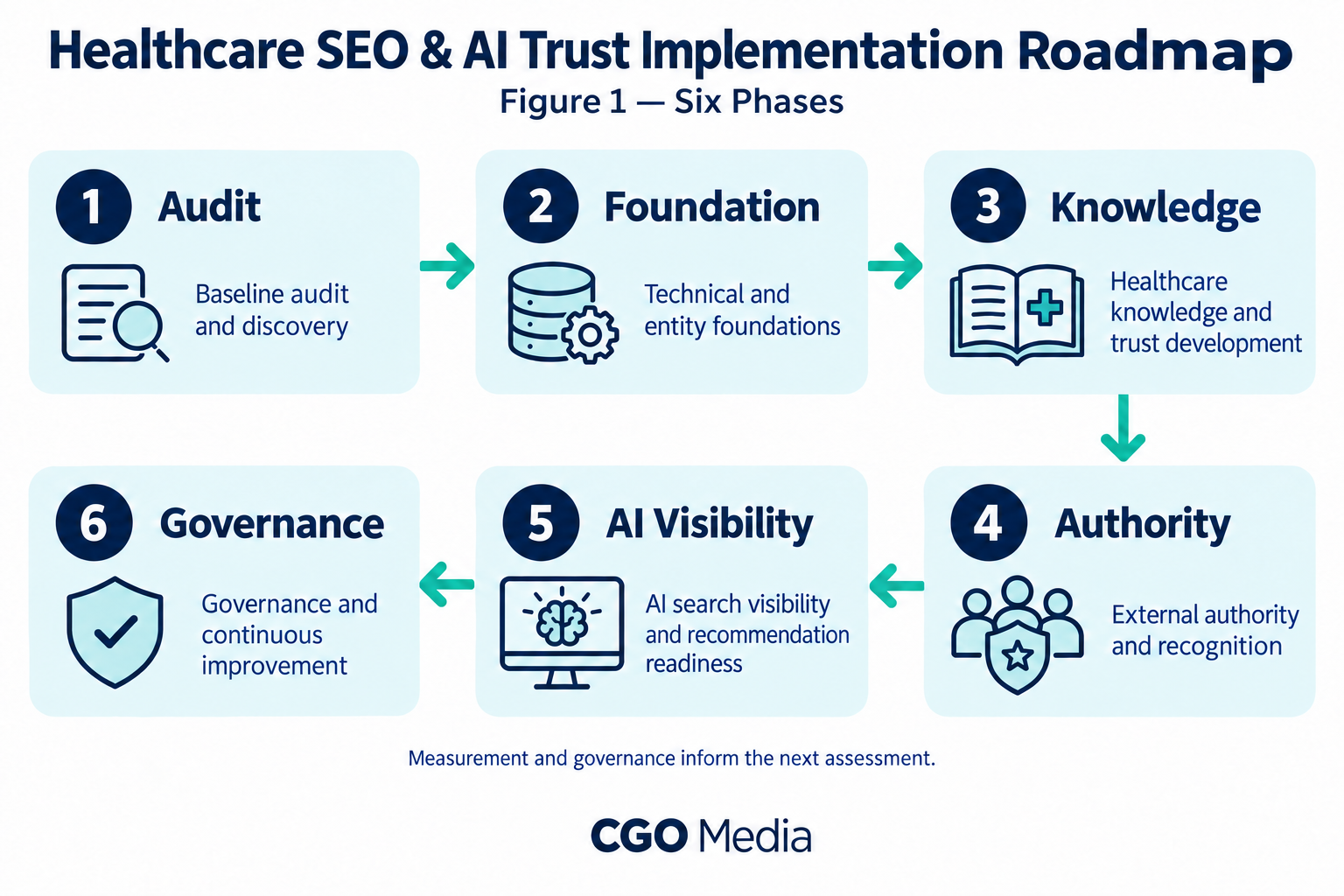
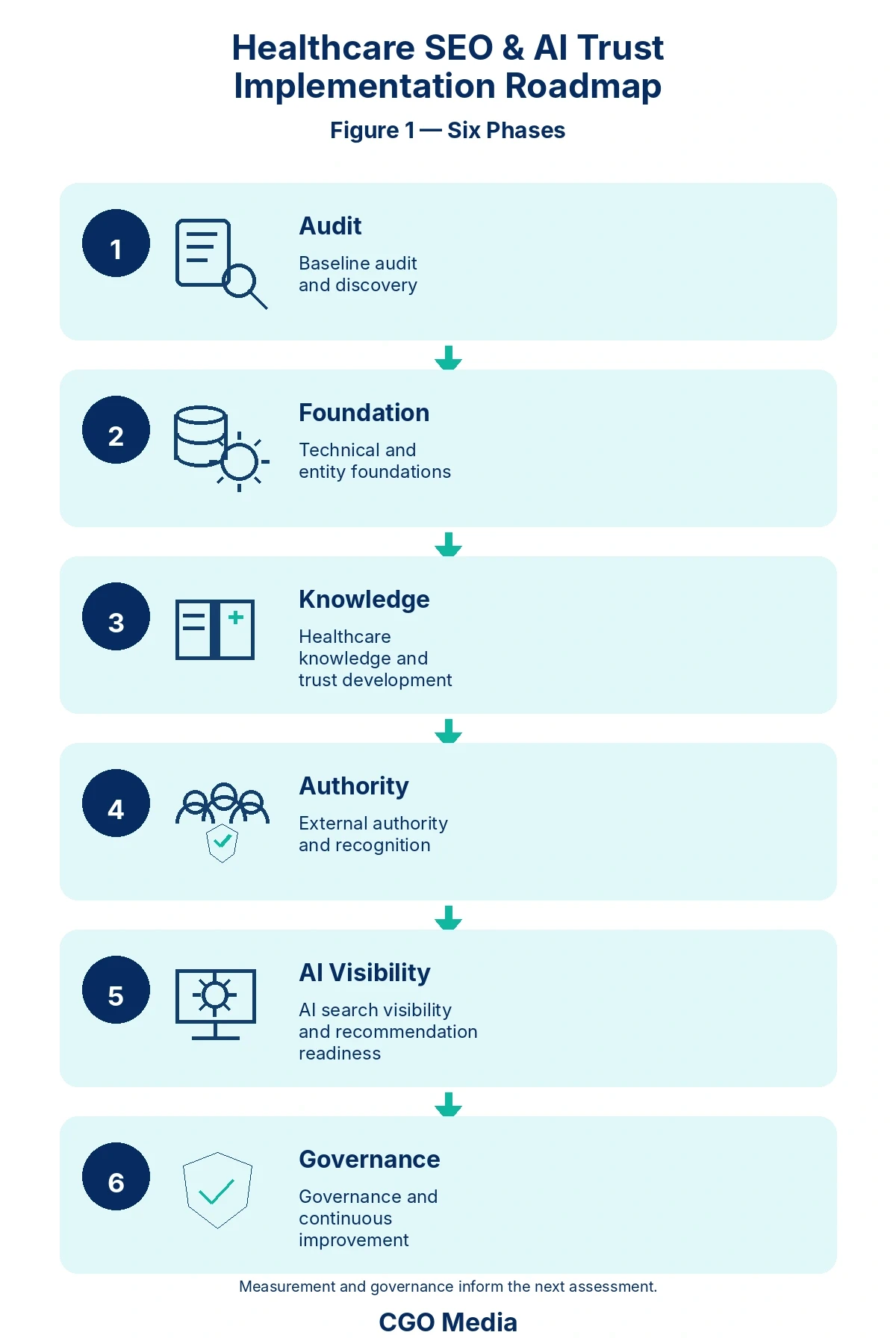
3. Six Implementation Phases
- Phase One — Assess and Stabilise
- Phase Two — Structure and Standardise
- Phase Three — Strengthen Clinical and Professional Authority
- Phase Four — Build Trust, External Authority and Local Visibility
- Phase Five — Develop AI Search and Provider Recommendation Readiness
- Phase Six — Measure, Govern and Continuously Improve
4. Implementation Should Begin with Accuracy
The first objective is to identify and correct information that could create:
- Clinical risk
- Professional identity risk
- Regulatory risk
- Patient trust risk
- Operational confusion
5. Visibility Growth Should Follow Evidence Quality
The roadmap therefore follows the sequence:
Accuracy → Structure → Authority → Trust → AI Readiness → Continuous Improvement
6. Phase One — Assess and Stabilise
Phase One establishes the current state of the healthcare organisation’s search, authority and trust environment.
7. Phase One Objective
The objective is to gain control of the highest-risk information and evidence before broader optimisation begins.
8. Establish the Implementation Baseline
The organisation should record:
- Current framework scores
- Current maturity levels
- Known information risks
- Current search visibility
- Current AI representation
- Priority patient journeys
9. Audit the Healthcare Entity Estate
The first audit should identify all major entities including:
- Healthcare organisation
- Brands
- Locations
- Professionals
- Specialties
- Services
10. Confirm Organisational Identity
Review whether the provider is represented consistently across:
- Website
- Local profiles
- Professional directories
- Regulatory sources
- Relevant external platforms
11. Audit Location Entities
Each healthcare location should be reviewed for:
- Name
- Address
- Telephone
- Opening information
- Services
- Professionals
12. Identify Duplicate and Legacy Locations
Old clinic pages, former addresses and duplicate profiles should be identified before they create wider local or AI ambiguity.
13. Audit Professional Entities
Professional profiles should be checked for:
- Full name
- Current role
- Qualifications
- Specialty
- Registration where relevant
- Practice locations
14. Identify Former Professionals
Professionals who have left the organisation should not continue to be represented as current where correction is required.
15. Identify Incomplete Professional Profiles
Profiles that contain only short promotional biographies should be flagged for later authority development.
16. Audit Service Entities
The organisation should create an inventory of:
- Clinical services
- Diagnostics
- Treatments
- Procedures
- Specialist consultations
17. Confirm Service Availability
Every important service should be mapped to the locations where it is genuinely available.
18. Confirm Professional-Service Relationships
The audit should identify which professionals are currently associated with each priority service.
19. Confirm Professional-Location Relationships
The organisation should verify where each professional actually practises.
20. Audit Clinical Information
Priority condition, treatment and diagnostic content should be reviewed for:
- Accuracy
- Professional review
- Source quality
- Freshness
- Alignment with real services
21. Identify High-Risk Clinical Content
Higher-priority review may be required where information could materially influence:
- Treatment expectations
- Patient understanding
- Urgency decisions
- Provider selection
22. Identify Unsupported Clinical Claims
The audit should flag claims involving:
- Guaranteed outcomes
- Unsupported superiority
- Overstated treatment effectiveness
- Unclear clinical evidence
23. Audit Regulatory Evidence
Review whether relevant regulatory and professional information is:
- Current
- Accurate
- Linked to the correct entity
- Accessible to users
24. Distinguish Provider, Facility and Professional Regulation
The organisation should avoid presenting regulatory evidence ambiguously across entities to which it may not apply.
25. Audit Patient Trust Information
Review public information around:
- Privacy
- Complaints
- Patient rights
- Clinical governance
- Safety
- Consent
26. Audit the Patient Journey
Priority service pathways should be assessed from initial discovery through to contact.
27. Test the Information Journey
A practical test may follow:
Condition → Treatment → Professional → Location → Trust Evidence → Booking
28. Identify Missing Journey Links
Common gaps may include:
- Condition pages with no relevant service link
- Services with no professional connection
- Professionals with no location clarity
- Locations with no booking pathway
29. Audit Pricing and Insurance Information
For private healthcare, review whether users can understand:
- Consultation fees
- Diagnostic costs
- Treatment pricing
- Insurance compatibility
- Potential additional charges
30. Audit Accessibility Information
Location-level reviews may include:
- Wheelchair access
- Parking
- Public transport
- Interpreter support
- Other accessibility services
31. Audit Local Search Information
Important healthcare locations should be checked across relevant local discovery environments.
32. Identify Local Data Conflicts
Priority inconsistencies may involve:
- Address
- Telephone
- Opening information
- Professional availability
- Service availability
33. Audit External Professional Profiles
Relevant third-party professional profiles should be checked for current:
- Roles
- Specialties
- Affiliations
- Locations
34. Audit Institutional Evidence
Where relevant, verify genuine relationships with:
- Hospitals
- Universities
- Research organisations
- Professional bodies
35. Audit Research and Citation Evidence
Where the organisation or its professionals produce research, identify:
- Publications
- Research profiles
- Relevant citations
- Institutional references
36. Audit Patient Reviews
Review patterns should be examined across:
- Locations
- Services
- Providers
37. Categorise Review Themes
Useful categories may include:
- Communication
- Administration
- Waiting
- Facilities
- Booking
- Staff interaction
38. Reviews Are Experience Evidence
Patient reviews should not be interpreted as proof of treatment effectiveness.
39. Establish the AI Representation Baseline
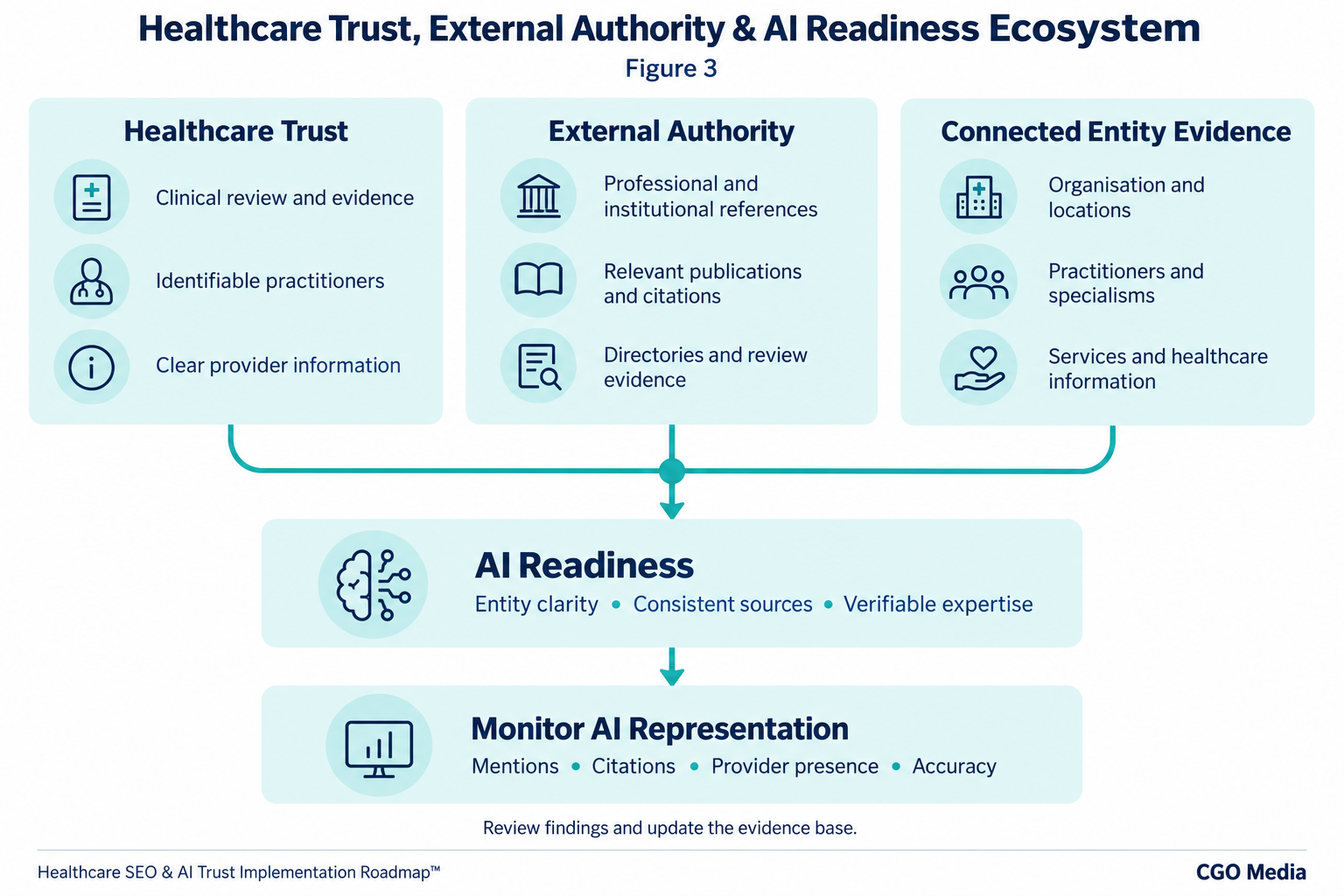
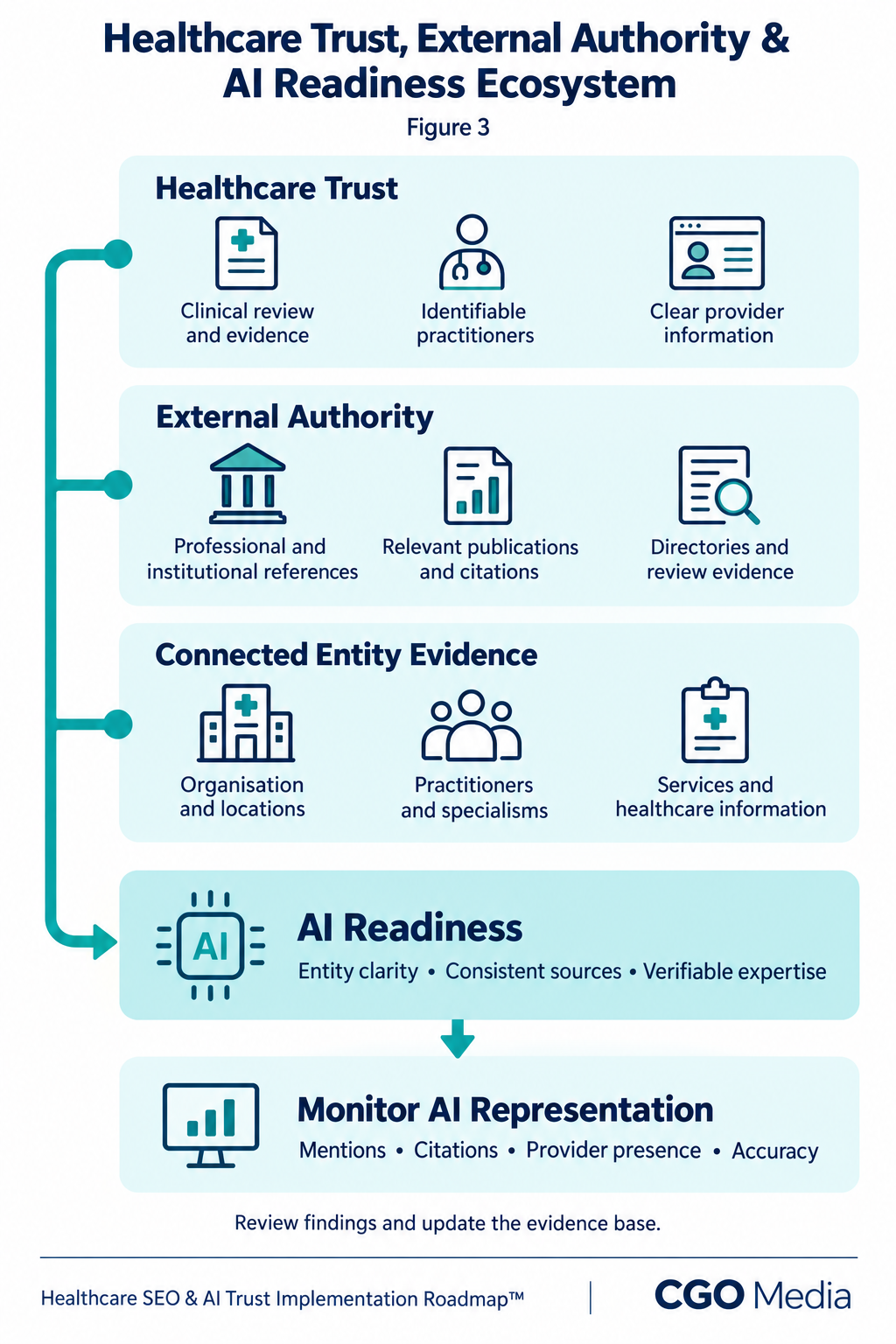
Before trying to improve AI visibility, record how the organisation is currently represented.
40. Branded AI Baseline
Test whether AI systems describe accurately:
- The provider
- Its locations
- Its services
- Its professionals
41. Professional AI Baseline
Test selected professional names for:
- Role
- Specialty
- Affiliation
- Practice location
42. Service AI Baseline
Review whether priority services are associated correctly with the organisation.
43. Local AI Baseline
Test whether local provider discovery returns accurate location and service information.
44. Non-Branded Provider Baseline
Record whether the organisation appears within relevant provider-discovery scenarios.
45. Record AI Source Patterns
Where sources are visible, record which websites or information environments recur around priority queries.
46. Create a Critical Issues Register
The audit should produce a prioritised list of identified risks.
47. Critical Priority
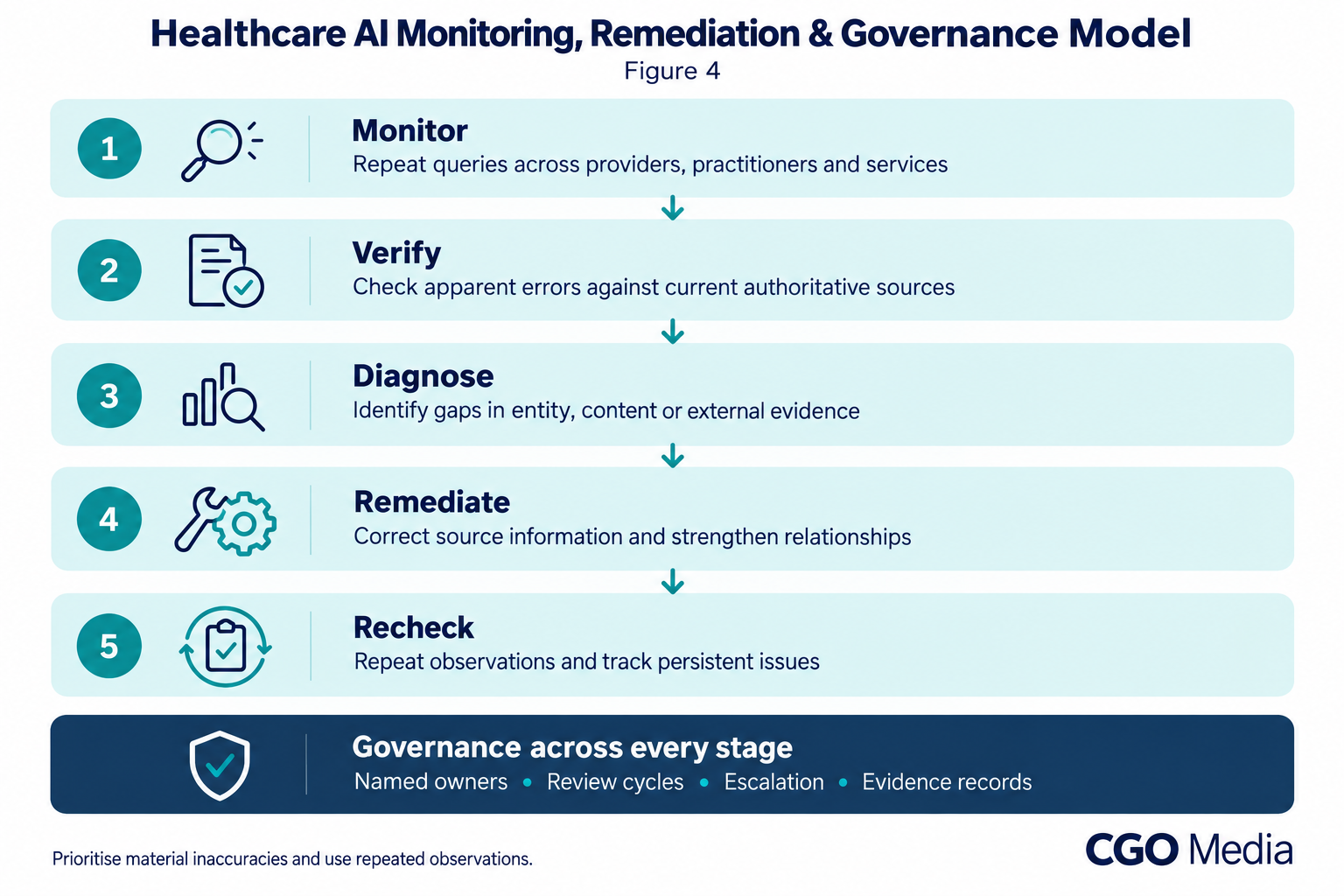
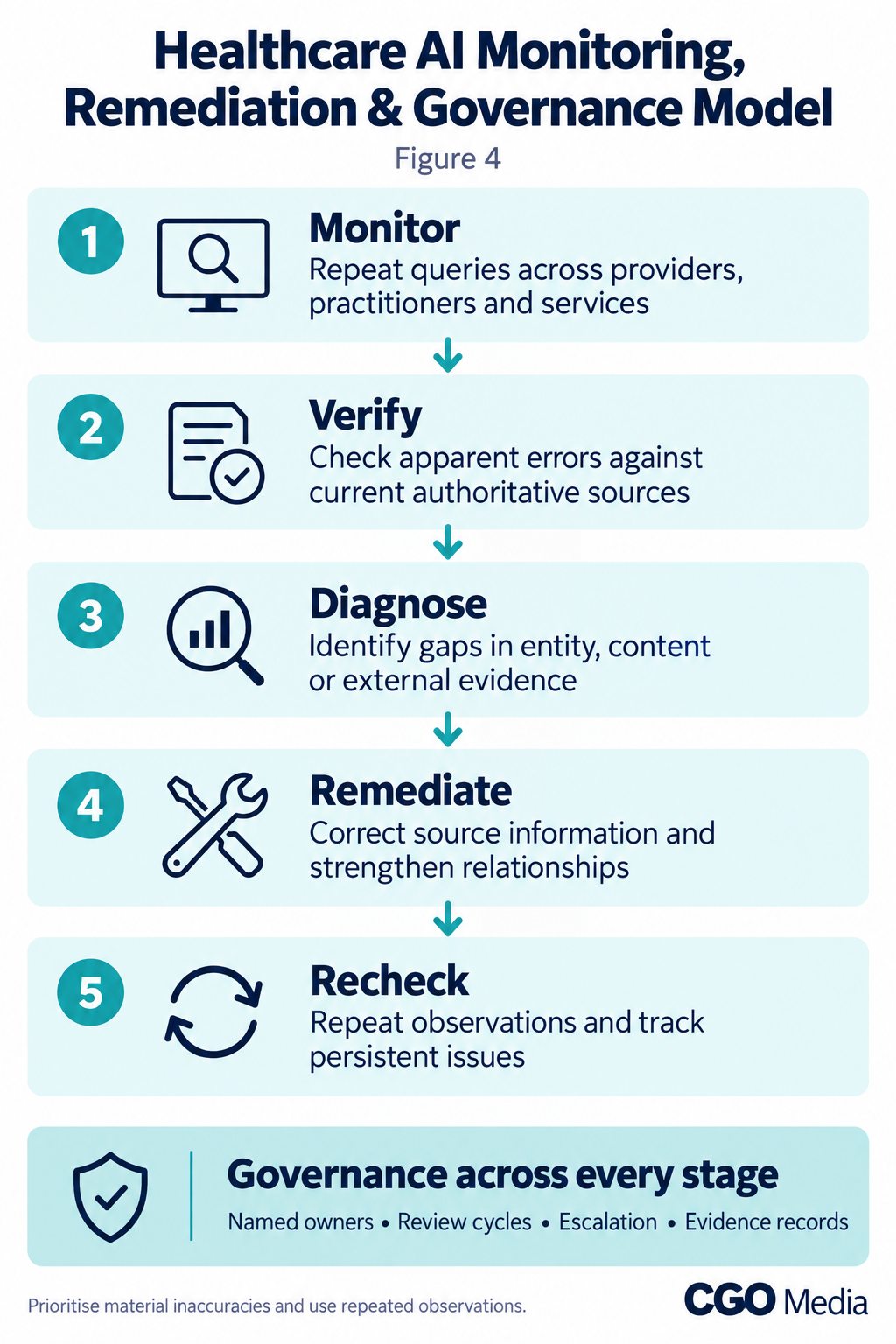
Critical issues may include:
- Incorrect clinical information
- Wrong professional status
- Incorrect regulatory information
- Wrong service availability
48. High Priority
High-priority issues may include:
- Conflicting location data
- Incomplete professional profiles
- Missing patient trust information
- Significant booking friction
49. Medium Priority
Medium-priority issues may include:
- Weak internal linking
- Incomplete external profiles
- Limited research visibility
- Inconsistent structured data
50. Phase One Deliverables
By the end of Phase One, the organisation should have:
- A healthcare entity inventory
- A clinical-content risk inventory
- A professional-profile audit
- A regulatory and patient-trust audit
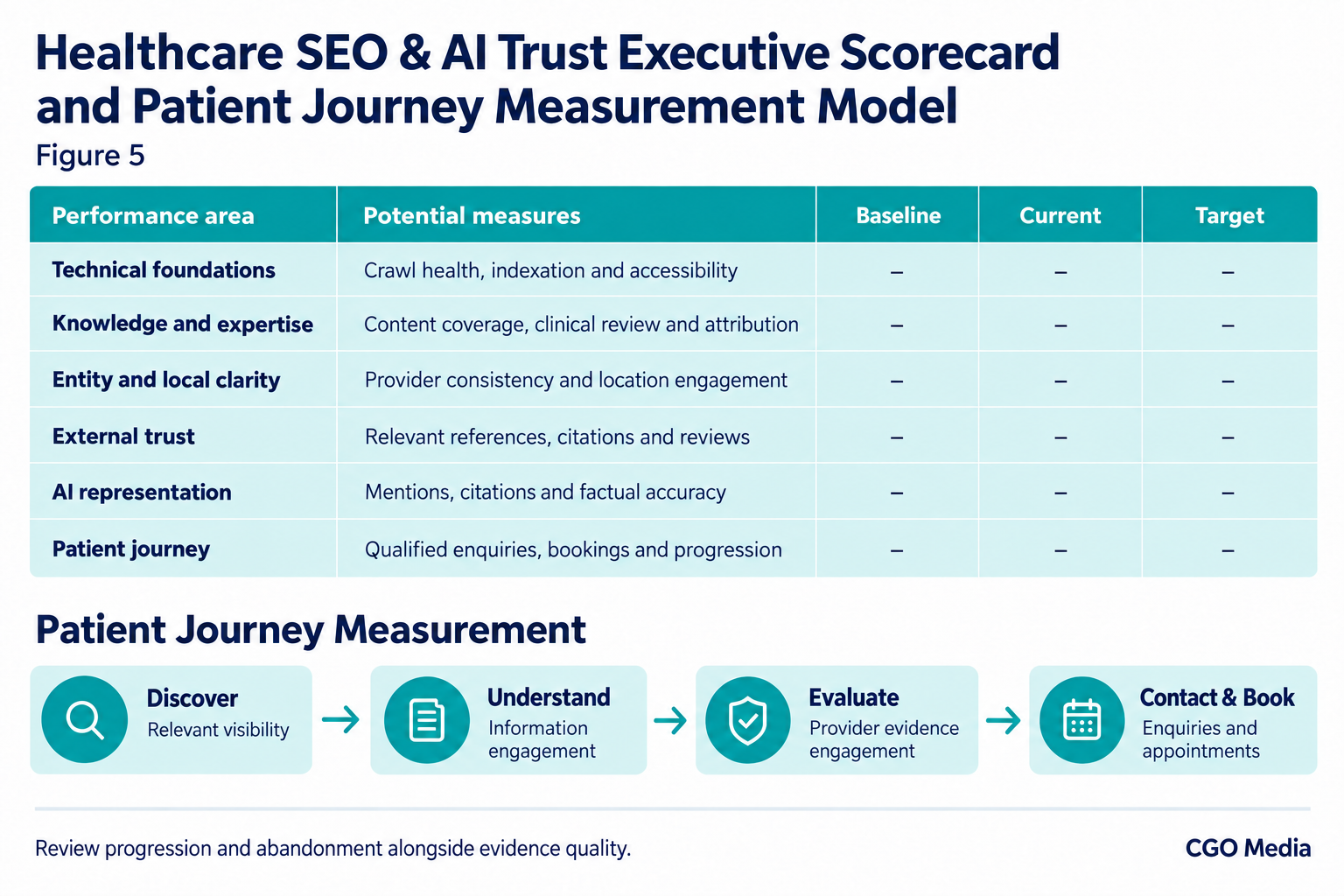
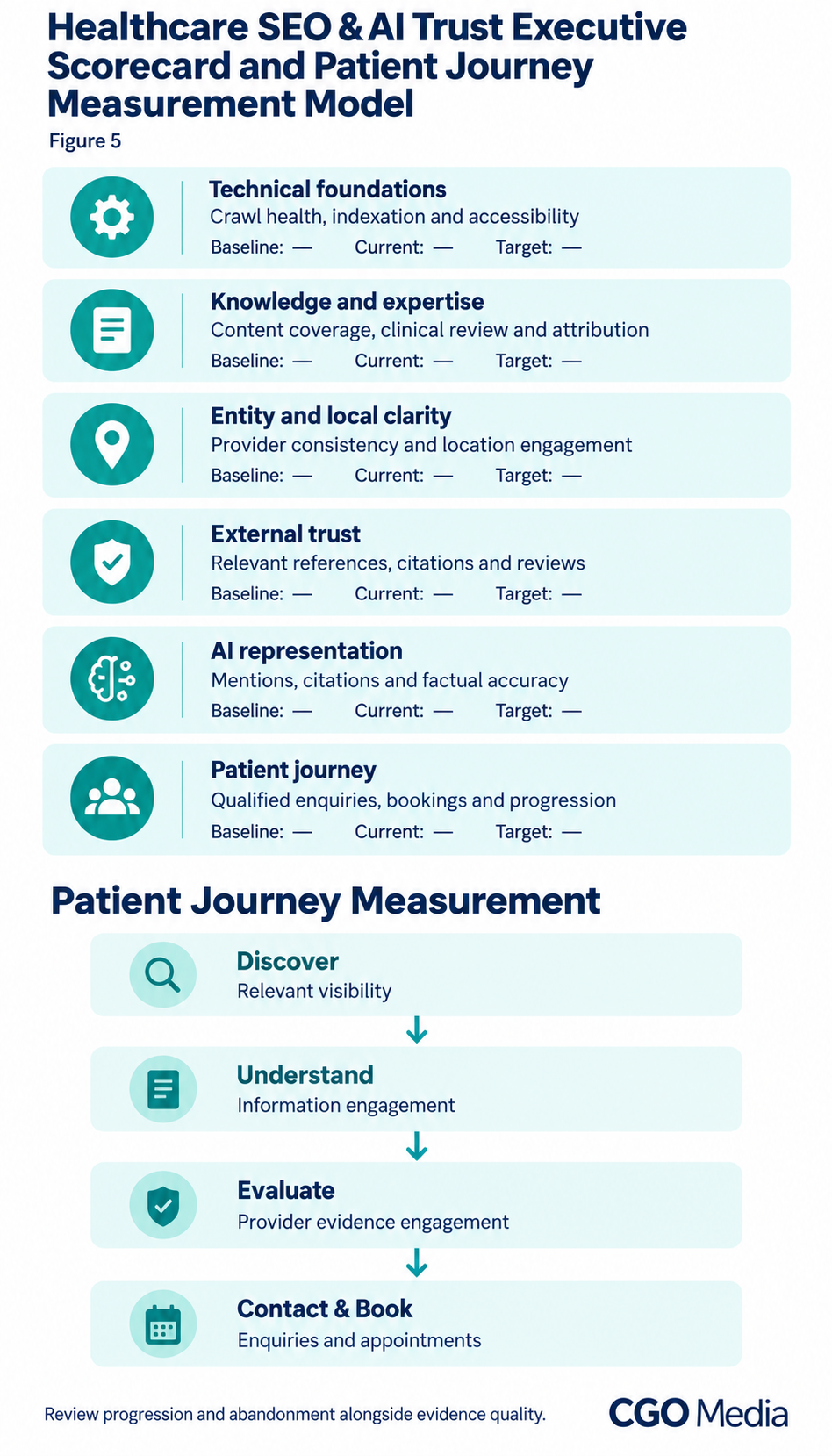
- A local and external authority audit
- An AI representation baseline
- A prioritised issues register
51. Phase One Success Condition
Phase One is complete when the organisation understands its highest-risk information weaknesses and has sufficient evidence to begin structured remediation.
52. Phase Two — Structure and Standardise
Phase Two converts the findings from the initial audit into a more consistent healthcare information architecture.
53. Phase Two Objective
The objective is to create reliable standards for provider, professional, location, service and clinical information before broader authority development continues.
54. Define the Healthcare Entity Model
The organisation should document how its main entities relate to one another.
Organisation → Location → Professional → Specialty → Service → Condition → Treatment
55. Standardise Organisation Identity
Define the preferred public representation of:
- Organisation name
- Brand names
- Parent relationships
- Location naming
56. Standardise Location Pages
Each significant healthcare location should follow a consistent information structure.
57. Location Page Minimum Standard
A location template may include:
- Canonical location name
- Address
- Telephone
- Opening information
- Services
- Professionals
- Facilities
- Accessibility
- Booking information
58. Standardise Professional Profiles
Professional profiles should follow a consistent minimum data standard.
59. Professional Profile Minimum Standard
The profile structure may include:
- Full name
- Current role
- Qualifications
- Specialty
- Registration information where relevant
- Clinical interests
- Locations
- Relevant services
60. Standardise Service Pages
Priority healthcare services should follow a consistent decision-support structure.
61. Service Page Minimum Standard
A service page may connect:
- What the service is
- Who it may be relevant to
- Relevant conditions
- Relevant professionals
- Available locations
- Patient pathway
- Trust information
62. Standardise Condition Pages
Condition information should support patient understanding without becoming unnecessarily promotional.
63. Condition Page Minimum Standard
Potential components include:
- Condition overview
- Symptoms
- Diagnosis
- Treatment approaches
- When professional assessment may be appropriate
- Relevant services
64. Standardise Treatment Pages
Treatment pages should provide sufficiently balanced information to support informed evaluation.
65. Treatment Page Minimum Standard
Potential components include:
- Treatment overview
- Potential suitability
- Risks
- Alternatives
- Recovery or follow-up
- Relevant professionals
- Relevant locations
66. Create a Clinical Content Taxonomy
A structured taxonomy can help distinguish between:
- Conditions
- Symptoms
- Diagnostics
- Treatments
- Services
- Specialties
67. Avoid Taxonomy Overlap
Similar topics should not be represented through multiple competing pages without a clear information purpose.
68. Define Canonical Ownership
The organisation should know which page is the primary source for each major:
- Service
- Location
- Professional
- Condition
- Treatment
69. Build Internal Relationship Pathways
Internal linking should mirror meaningful healthcare relationships.
70. Condition-to-Service Pathway
Relevant condition information should connect naturally with appropriate services.
71. Service-to-Professional Pathway
Service pages should identify the professionals genuinely associated with the service.
72. Professional-to-Location Pathway
Professional profiles should make current practice locations clear.
73. Location-to-Service Pathway
Location pages should show which services are actually available there.
74. Service-to-Trust Pathway
Relevant service pages should make important patient and trust information easy to reach.
75. Standardise Clinical Review Metadata
Where appropriate, important clinical pages should consistently record:
- Author
- Clinical reviewer
- Review date
- Next review date
76. Define Structured Data Standards
Where structured data is used, implementation should reflect visible and current organisational information.
77. Structured Data Should Reinforce, Not Invent, Relationships
Schema markup should not be used to claim professionals, services, locations or organisational relationships that are not represented accurately on the website.
78. Standardise Local Data
Each location should have one canonical data record for:
- Name
- Address
- Telephone
- Opening information
- Website destination
79. Establish Local Update Procedures
Changes to physical or operational location information should trigger updates across relevant local environments.
80. Standardise Trust Information
The organisation should define where users can find:
- Regulatory information
- Privacy information
- Complaints procedures
- Patient rights
- Governance information
81. Standardise Booking Pathways
Priority services should use clear and consistent contact pathways.
82. Standardise Pricing Presentation
Where pricing is published, the organisation should define consistent language around:
- Consultation fees
- Treatment costs
- Diagnostic costs
- Additional charges
- Insurance arrangements
83. Define Change Triggers
Standardisation should include automatic review triggers for important real-world changes.
84. Professional Change Trigger
When a professional joins, leaves or changes role, review:
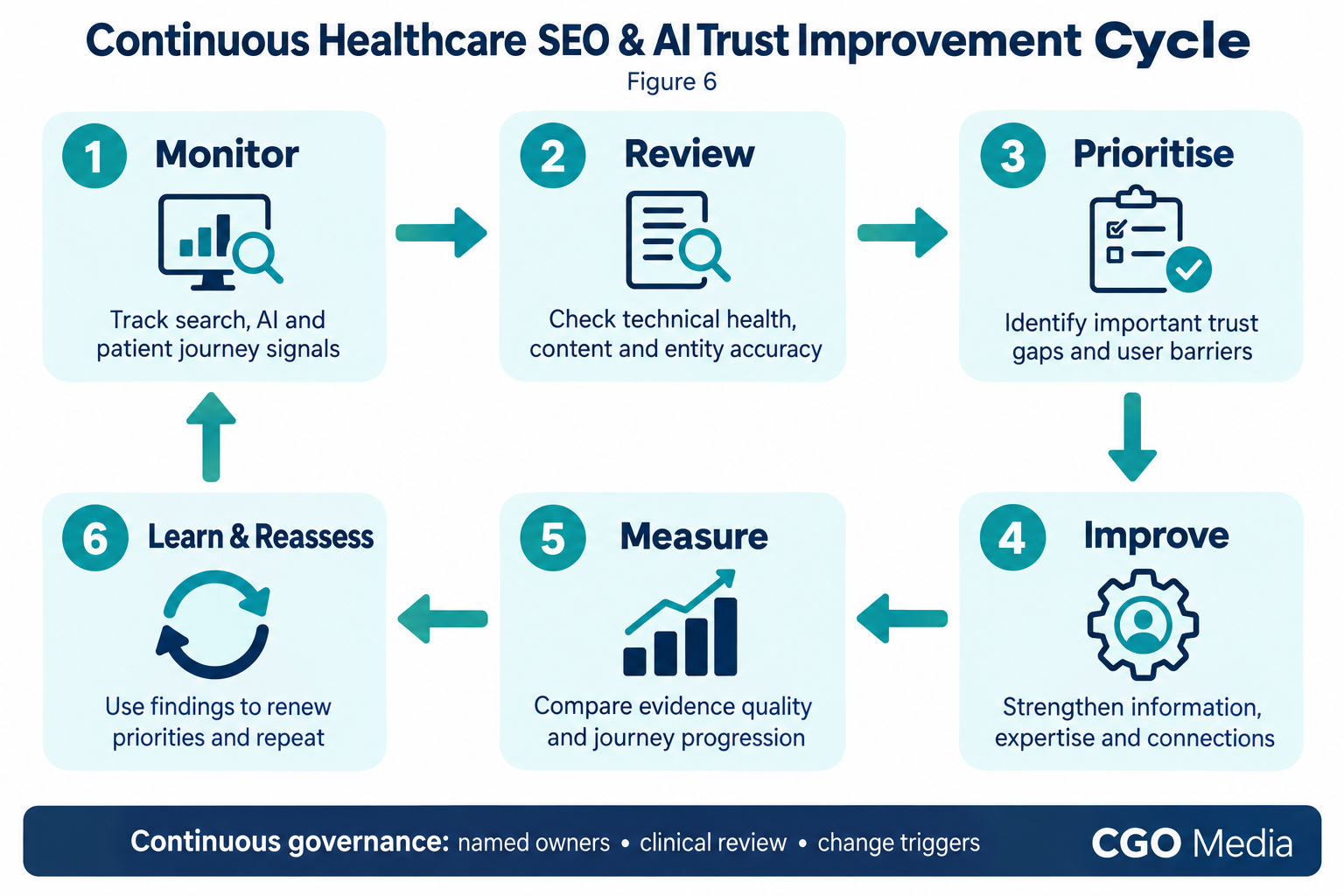
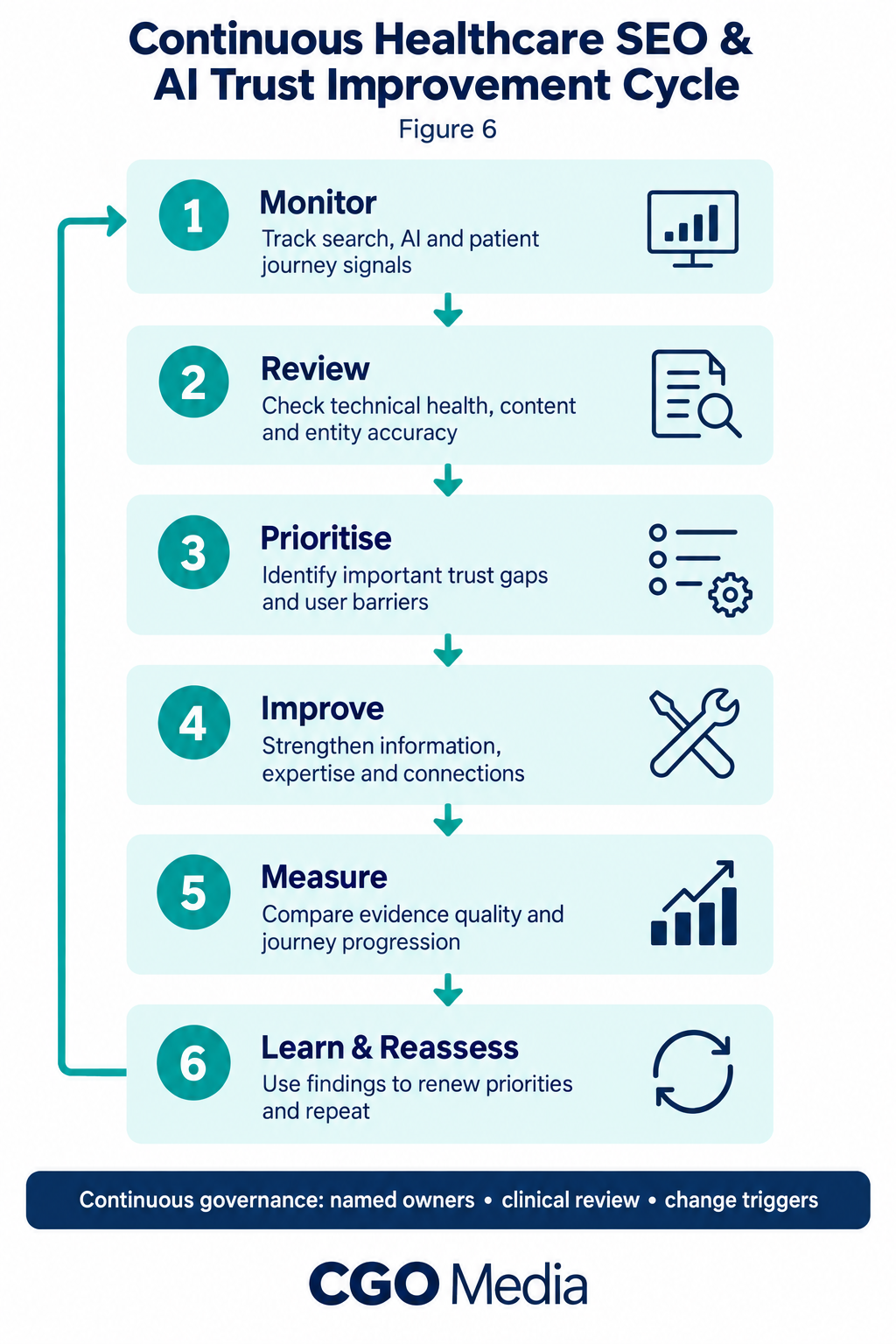
- Professional profile
- Service pages
- Location pages
- Clinical content attribution
- External profiles
85. Service Change Trigger
When a service changes, review:
- Service pages
- Condition pages
- Treatment pages
- Professional profiles
- Location pages
86. Location Change Trigger
When a clinic changes, review:
- Location page
- Local profiles
- Professional relationships
- Service availability
- Contact information
87. Clinical Change Trigger
When relevant clinical guidance or evidence changes, related content should be reviewed.
88. Establish Governance Ownership
Each information class should have a named responsible team.
89. Phase Two Deliverables
By the end of Phase Two, the organisation should have:
- A documented entity model
- Standard location templates
- Standard professional templates
- Standard service templates
- Clinical content standards
- Trust information standards
- Defined change triggers
90. Phase Two Success Condition
Phase Two is complete when the organisation can represent important healthcare entities and patient-facing information consistently across the main digital estate.
91. Phase Three — Strengthen Clinical and Professional Authority
Phase Three develops the depth and credibility of the clinical and professional evidence surrounding priority healthcare services.
92. Phase Three Objective
The objective is to ensure that users can understand not only what the organisation offers, but the expertise and evidence supporting those services.
93. Prioritise High-Value Clinical Areas
Healthcare organisations should identify the services and specialties where stronger information and professional authority will have the greatest strategic value.
94. Prioritisation Factors
Potential factors may include:
- Clinical importance
- Patient demand
- Service strategy
- Existing information weakness
- Professional expertise
95. Improve Condition Content
Priority condition pages should be strengthened through:
- Clear explanations
- Appropriate clinical review
- Current sources
- Relevant service pathways
96. Improve Treatment Content
Priority treatment pages should explain:
- What the treatment involves
- Potential suitability
- Risks
- Alternatives
- Relevant professionals
- Available locations
97. Improve Diagnostic Content
Diagnostic information may include:
- What the test is
- Why it may be used
- Preparation
- What happens during the test
- What happens afterwards
98. Strengthen Clinical Review Processes
Review processes should define:
- Which pages require professional review
- Who may review them
- How often review occurs
- How changes are documented
99. Introduce Risk-Based Review Frequency
Higher-risk content may require more frequent assessment than lower-risk informational material.
100. Improve Source Quality
Clinical information should use sources appropriate to:
- The topic
- The jurisdiction
- The healthcare context
- The level of clinical claim
101. Improve Professional Profiles
Priority practitioner profiles should move beyond basic biography content.
102. Expand Professional Identity Evidence
Profiles may include:
- Current role
- Qualifications
- Registration
- Specialty
- Subspecialty
- Clinical interests
103. Add Professional-Service Relationships
Profiles should connect practitioners clearly with the services they genuinely provide.
104. Add Professional-Location Relationships
Profiles should identify where each practitioner currently works.
105. Add Professional-Content Relationships
Where appropriate, clinicians may be connected with:
- Clinical articles
- Treatment information
- Condition information
- Educational resources
106. Add Institutional Evidence
Where current and genuine, practitioner profiles may include relevant:
- Hospital affiliations
- Academic roles
- Professional memberships
- Research appointments
107. Add Research Evidence
Where relevant, connect professionals with:
- Research publications
- Clinical studies
- Academic work
- Professional contributions
108. Avoid Unsupported Expertise Claims
Professional authority should be demonstrated through evidence rather than repeated use of promotional terms such as “best,” “leading” or “world-class.”
109. Build Specialty Authority Hubs
Larger healthcare organisations may create stronger specialty architectures connecting:
- Specialists
- Conditions
- Treatments
- Research
- Locations
110. Connect Clinical Authority to Patient Decisions
Clinical expertise should be visible where users are evaluating relevant services rather than confined to separate corporate or academic pages.
111. Strengthen Clinical Authorship
Where clinicians contribute directly to healthcare information, authorship should be represented transparently.
112. Strengthen Clinical Review Attribution
Where content is reviewed rather than written by a clinician, the distinction should be clear.
113. Review Professional Consistency Externally
Priority professional identities should be checked across relevant:
- Professional directories
- Institutional profiles
- Research profiles
- External biographies
114. Correct Material Professional Inconsistencies
Where legitimate correction mechanisms exist, outdated professional information should be updated.
115. Strengthen Service Expertise Evidence
Priority service pages should demonstrate the relevant combination of:
Clinical Information + Professional Expertise + Location Capability + Patient Pathway
116. Strengthen Expertise Without Overstatement
Healthcare authority should be built through verifiable depth rather than excessive claims.
117. Create a Clinical Authority Inventory
The organisation may track:
- Priority clinical pages
- Professional reviewer
- Review status
- Source status
- Next review date
118. Create a Professional Authority Inventory
The organisation may track:
- Profile completeness
- Registration status
- Location relationships
- Service relationships
- Research evidence
119. Measure Clinical Authority Improvement
Potential measures may include:
- Review coverage
- Content freshness
- Professional attribution
- Reduction in unsupported claims
120. Measure Professional Authority Improvement
Potential measures may include:
- Profile completeness
- Relationship completeness
- External consistency
- Research or institutional evidence coverage
121. Phase Three Governance
Clinical and professional authority development should involve appropriate collaboration between:
- Clinical teams
- Medical editors
- Marketing
- SEO
- Professional data owners
122. Phase Three Deliverables
By the end of Phase Three, the organisation should have:
- Improved priority clinical content
- Stronger professional profiles
- Documented clinical review processes
- Connected specialty-service-professional relationships
- Clinical authority inventories
- Professional authority inventories
123. Phase Three Success Condition
Phase Three is complete when priority services are supported by sufficiently clear, current and verifiable clinical and professional evidence.
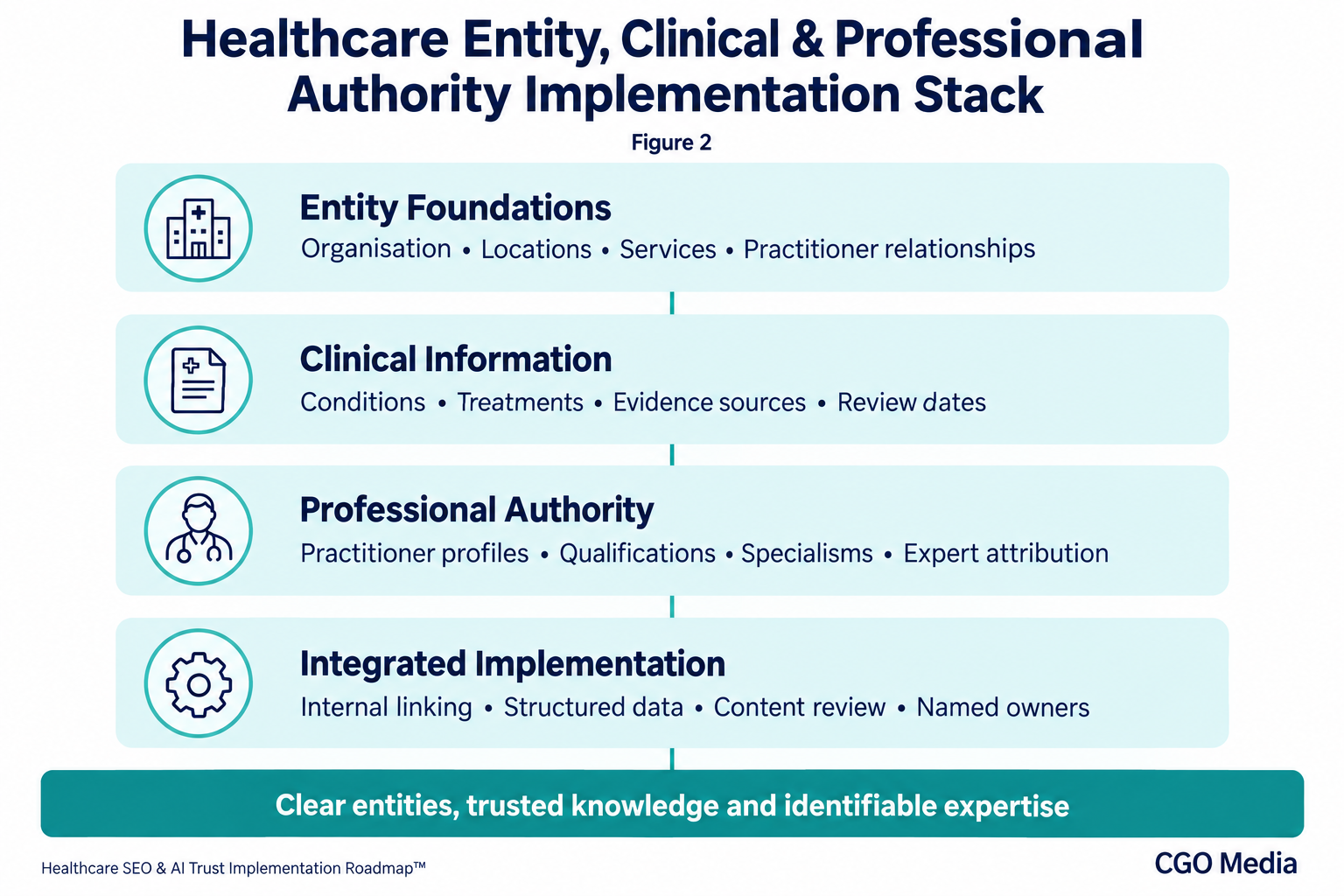
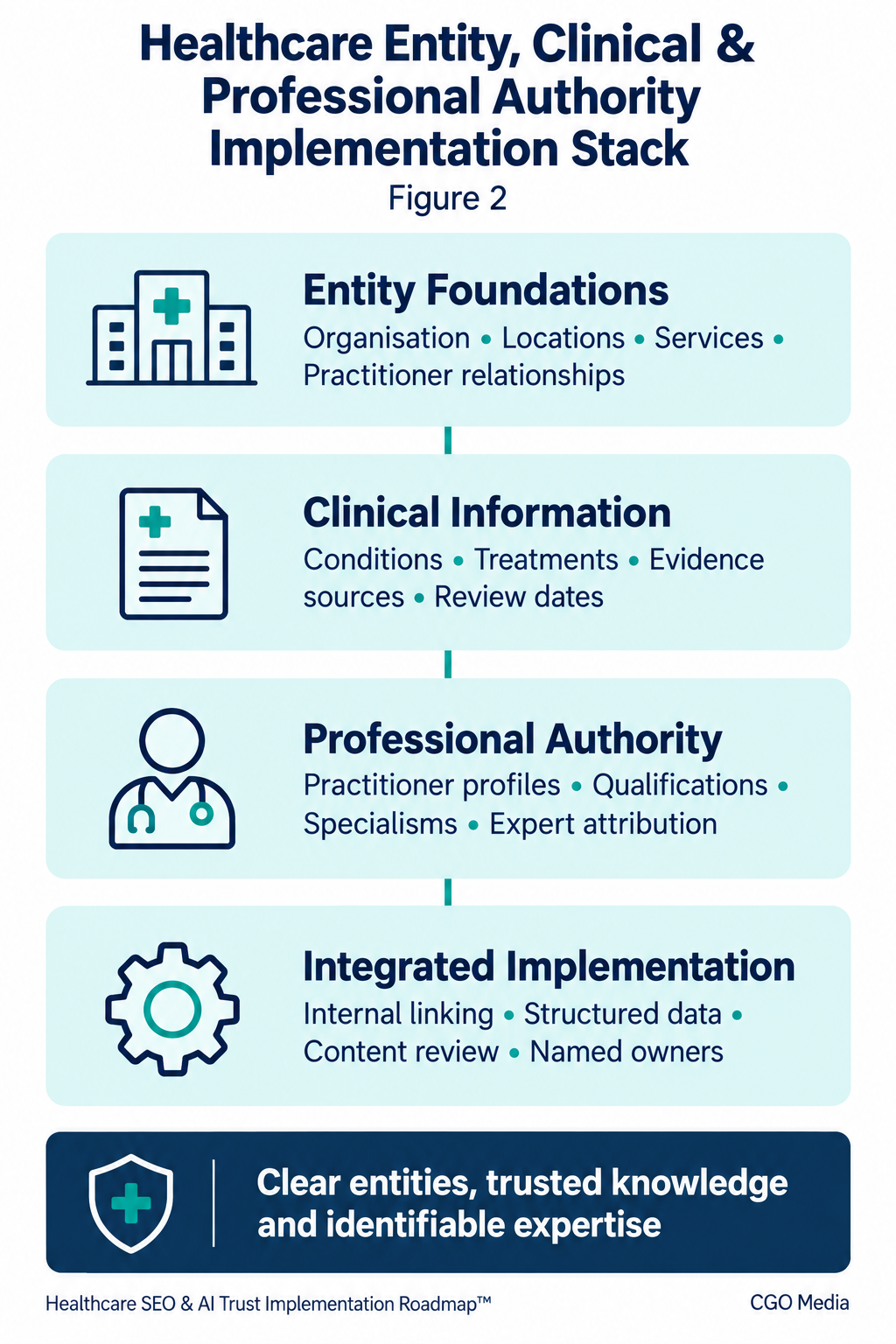
124. The First Three Phases Establish the Authority Foundation
At this point, the roadmap has progressed through:
Assessment → Standardisation → Clinical & Professional Authority
The organisation is then better prepared to strengthen patient trust, external evidence, local visibility and AI-assisted discovery.
125. Phase Four — Build Trust, External Authority and Local Visibility
Phase Four strengthens the evidence users encounter when they move from clinical relevance toward trust validation, practical evaluation and provider comparison.
126. Phase Four Objective
The objective is to make healthcare trust more visible, externally supported and locally accurate across the provider-selection journey.
127. Strengthen Regulatory Transparency
Relevant regulatory information should be connected clearly with the correct:
- Organisation
- Facility
- Location
- Professional
128. Verify Regulatory Accuracy
Review whether public regulatory statements remain:
- Current
- Accurate
- Relevant
- Entity-specific
129. Improve Clinical Governance Information
Where appropriate, healthcare organisations may explain how they manage:
- Clinical quality
- Patient safety
- Professional oversight
- Complaints
- Incident governance
130. Improve Privacy and Patient Information
Patient-facing trust information should make important practices sufficiently clear without forcing users to navigate through unnecessarily complex legal content.
131. Improve Complaints Pathways
Users should be able to understand:
- How to raise a concern
- Where to send it
- What happens next
- How escalation works where relevant
132. Improve Patient Rights Information
Healthcare organisations should ensure that relevant patient rights information is accessible and understandable.
133. Improve Patient Journey Transparency
Priority services should explain how users may progress through:
Enquiry → Assessment → Diagnosis → Treatment → Follow-Up
134. Improve Pricing Transparency
For private healthcare, organisations should reduce unnecessary uncertainty around:
- Consultation fees
- Diagnostic charges
- Treatment pricing
- Additional costs
- Insurance arrangements
135. Improve Insurance Guidance
Where relevant, users should be able to understand whether:
- Insurance is accepted
- Pre-authorisation may be required
- Self-pay pathways exist
136. Improve Accessibility Information
Location pages should include useful information around:
- Physical access
- Parking
- Public transport
- Interpreter support
- Other accessibility arrangements
137. Improve Appointment Information
Users should understand:
- How to book
- What appointment type is appropriate
- Which location applies
- What preparation may be required
138. Strengthen Review Governance
Healthcare organisations should establish a structured approach to monitoring patient feedback without treating reviews as clinical outcome evidence.
139. Build a Review Theme Framework
Review analysis may categorise recurring themes around:
- Communication
- Administration
- Waiting
- Facilities
- Booking
- Staff interaction
140. Monitor Review Recency
Recent patient feedback may provide useful evidence about current operational performance.
141. Monitor Location-Level Review Differences
Multi-location providers should examine whether patient experience varies significantly between clinics or facilities.
142. Define Review Response Standards
Public responses should protect patient confidentiality and follow appropriate organisational and professional standards.
143. Avoid Review Manipulation
Trust development should not rely on artificial reviews, misleading incentives or fabricated patient experiences.
144. Strengthen External Professional Authority
Priority practitioners should be represented accurately across legitimate external professional environments.
145. Verify Professional Directory Profiles
Review relevant profiles for:
- Name
- Current role
- Specialty
- Affiliations
- Practice location
146. Strengthen Institutional Evidence
Where genuine, connect professionals and organisations with relevant:
- Hospitals
- Universities
- Research institutions
- Professional bodies
147. Strengthen Research Authority
Where healthcare professionals or organisations contribute genuine research, improve discoverability of:
- Publications
- Research profiles
- Study participation
- Institutional research relationships
148. Strengthen Citation Authority
Monitor where relevant research, guidance or expert contribution is cited by appropriate third parties.
149. Citation Quality Should Be Prioritised
Relevant professional, academic or institutional citations generally provide stronger authority context than unrelated mention volume.
150. Develop Relevant Editorial Authority
Healthcare professionals with genuine expertise may contribute:
- Expert commentary
- Educational material
- Professional publications
- Healthcare journalism
151. Media Visibility Should Reflect Genuine Expertise
Editorial exposure should not be used to imply clinical superiority where the evidence does not support such a claim.
152. Strengthen Local Search Foundations
Each significant healthcare location should have a clear and distinct local presence.
153. Complete Local Profiles
Priority location information may include:
- Canonical provider name
- Address
- Telephone
- Opening information
- Website destination
- Relevant service information
154. Map Services to Locations
The organisation should ensure that local discovery reflects which healthcare services are genuinely available at each location.
155. Map Professionals to Locations
Users should be able to identify which practitioners work at each facility.
156. Avoid Local Over-Optimisation
Healthcare locations should not be represented as offering services or specialties that are not genuinely available there.
157. Strengthen Local Landing Pages
Strong healthcare location pages may connect:
- Services
- Professionals
- Facilities
- Accessibility
- Patient trust
- Booking pathways
158. Improve Local Internal Linking
Relevant service and professional pages should connect naturally with the locations where care is actually available.
159. Audit Local Source Consistency
Compare first-party information with important external local sources.
160. Correct Material Local Conflicts
Priority conflicts may include:
- Wrong address
- Wrong telephone
- Incorrect opening information
- Incorrect service availability
- Incorrect professional availability
161. Develop a Local Authority Inventory
Multi-location organisations may track:
- Profile completeness
- Listing accuracy
- Review recency
- Service mapping
- Professional mapping
162. Develop an External Authority Inventory
The organisation may record:
- Professional profiles
- Institutional references
- Research references
- Relevant citations
- Editorial mentions
163. Measure Trust Improvement
Potential indicators may include:
- Regulatory-information completeness
- Patient journey coverage
- Review-theme trends
- Pricing clarity
- Accessibility information coverage
164. Measure External Authority Improvement
Potential indicators may include:
- Relevant institutional references
- Professional-profile accuracy
- Research visibility
- Relevant citation growth
- Editorial authority
165. Measure Local Authority Improvement
Potential indicators may include:
- Location-profile completeness
- Reduction in data conflicts
- Service-location accuracy
- Professional-location accuracy
- Review recency
166. Phase Four Governance
Phase Four may require collaboration between:
- Compliance
- Clinical governance
- Patient experience
- Operations
- Marketing
- PR
- SEO
167. Phase Four Deliverables
By the end of Phase Four, the organisation should have:
- Stronger regulatory and patient trust information
- Improved review governance
- More accurate local profiles
- Clear service-location relationships
- Stronger external professional evidence
- More structured institutional and research authority
168. Phase Four Success Condition
Phase Four is complete when priority healthcare services are supported by clearer patient trust, stronger local evidence and relevant external validation.
169. Phase Five — Develop AI Search and Provider Recommendation Readiness
Phase Five builds on the previous four phases by examining how the strengthened evidence environment is represented across AI-assisted discovery.
170. Phase Five Objective
The objective is to improve the accuracy, clarity and resilience of provider representation rather than attempt to manipulate AI recommendation systems.
171. Define the AI Monitoring Scope
The organisation should decide which entities and decision scenarios are strategically important enough to monitor.
172. Priority AI Entity Classes
These may include:
- Organisation
- Locations
- Professionals
- Specialties
- Services
173. Priority AI Query Classes
Monitoring may include:
- Branded provider queries
- Professional-name queries
- Service queries
- Local provider queries
- Non-branded recommendation queries
- Provider comparison queries
174. Build a Standard Prompt Set
Repeatable prompts provide more useful longitudinal evidence than irregular ad hoc testing.
175. Branded Provider Monitoring
Test whether AI systems represent accurately:
- Organisation identity
- Provider type
- Locations
- Services
176. Professional Monitoring
Test selected practitioners for:
- Role
- Specialty
- Affiliation
- Practice locations
177. Service Monitoring
Test whether the organisation is associated appropriately with services it genuinely provides.
178. Local Provider Monitoring
Test local discovery scenarios involving relevant:
- Specialties
- Treatments
- Diagnostics
- Provider types
179. Non-Branded Recommendation Monitoring
Observe whether the provider enters relevant recommendation sets before the user already knows the organisation by name.
180. Comparison Monitoring
Test how the provider is represented when users compare it with appropriate alternatives.
181. Record Representation Accuracy
For each test, assess whether material information is:
- Accurate
- Incomplete
- Outdated
- Incorrect
182. Record Recommendation Relevance
A provider should only be treated as meaningfully visible where the recommendation is relevant to the tested service, specialty and geography.
183. Record Source Visibility
Where AI systems expose sources, record which environments recur.
184. Categorise AI Sources
Source categories may include:
- Provider website
- Professional directories
- Regulatory sources
- Institutional sources
- Review platforms
- Editorial sources
185. Identify Source Gaps
Repeated reliance on inaccurate or weak sources may indicate a wider evidence problem rather than an AI problem alone.
186. Investigate Material AI Errors
When material inaccuracies appear, investigate the first-party and external information environments that may contribute to the error.
187. Correct First-Party Information First
The organisation should ensure its own public information is accurate before attempting wider remediation.
188. Correct External Sources Where Legitimate
Where correction rights exist, important third-party inaccuracies should be updated.
189. AI Readiness Depends on Evidence Consistency
The strongest foundation remains:
Entity Clarity + Clinical Authority + Professional Authority + Trust + External Validation
190. AI Visibility Should Not Be Manufactured
Healthcare organisations should not create false reviews, artificial institutional relationships or misleading evidence in an attempt to influence automated systems.
191. AI Recommendations Should Be Interpreted Cautiously
Generated provider suggestions do not establish individual clinical suitability or professional endorsement.
192. Phase Five Begins with Observation, Not Optimisation
The first objective is to understand how the strengthened healthcare evidence environment is being interpreted before making further strategic changes.
193. Build an AI Observation Register
The organisation should maintain a structured record of strategically important AI observations rather than relying on informal screenshots or isolated tests.
194. AI Observation Record
A useful record may include:
- Prompt
- Model
- Date
- Geography where relevant
- Provider presence
- Representation accuracy
- Sources where visible
195. Establish an AI Accuracy Classification
Results may be classified as:
- Accurate
- Mostly accurate
- Incomplete
- Materially inaccurate
- Unable to verify
196. Prioritise Material Inaccuracies
Errors should be prioritised according to their potential effect on:
- Patient understanding
- Professional identity
- Service suitability
- Location access
- Regulatory trust
197. Critical AI Representation Errors
Examples may include:
- Incorrect professional status
- Wrong service availability
- Incorrect clinic location
- Misleading regulatory information
198. High-Priority AI Representation Errors
Examples may include:
- Outdated professional affiliations
- Incorrect specialty associations
- Missing priority services
- Incorrect location relationships
199. AI Source Analysis
Where sources are visible, the organisation should identify which source types repeatedly influence provider and professional representation.
200. Build a Source Map
The source map may include:
- Provider website
- Regulatory sources
- Professional directories
- Hospitals
- Universities
- Review platforms
- Editorial sources
201. Distinguish First-Party and External Sources
This helps the organisation understand whether a representation problem begins within its own information estate or within an external environment.
202. Identify Frequently Reused Sources
Sources appearing repeatedly across relevant AI answers may deserve closer review for accuracy and completeness.
203. Identify Weak Source Dependencies
The organisation should note where important AI descriptions appear to rely heavily on:
- Outdated directories
- Thin profiles
- Old editorial content
- Weak local information
204. Strengthen First-Party Source Quality
Priority first-party assets should provide clear, current and sufficiently complete information about:
- Provider identity
- Professionals
- Services
- Locations
- Trust evidence
205. Strengthen Source Consistency
Material facts should align across the wider information environment wherever legitimate correction is possible.
206. Monitor Competitor Presence
Relevant competitors may be monitored within the same provider-discovery and comparison scenarios.
207. Competitor Monitoring Should Be Contextual
The objective is to understand changing visibility patterns rather than infer clinical quality from recommendation frequency.
208. Record Competitor Frequency
The organisation may observe which competitors appear repeatedly across priority query classes.
209. Record Competitor Source Patterns
Where sources are visible, compare which information environments support competitor representation.
210. Record Competitor Evidence Differences
Potential differences may include:
- Professional profile depth
- Location clarity
- Research authority
- Review strength
- Institutional validation
211. Competitor Analysis Should Identify Evidence Gaps
The most useful outcome is to identify where the organisation’s own evidence environment is weaker or less complete.
212. Avoid Copying Unsupported Competitor Claims
Competitor visibility should not encourage imitation of weak, exaggerated or unverified healthcare claims.
213. Build an AI Remediation Workflow
Material representation issues should move through a defined process.
Observe → Verify → Diagnose → Correct → Retest → Record
214. Observe
Identify a material AI representation issue.
215. Verify
Confirm whether the generated information is genuinely inaccurate.
216. Diagnose
Investigate which first-party or external evidence may contribute to the problem.
217. Correct
Update inaccurate information where legitimate control or correction rights exist.
218. Retest
Repeat the relevant monitoring scenario after sufficient source updates have been made.
219. Record
Document the outcome so recurring patterns can be identified over time.
220. AI Remediation Is Not Instant
Source corrections may not immediately change generated outputs, and the timing of model or retrieval updates may be outside the organisation’s control.
221. Avoid Repeated Manipulative Prompting
The objective is to improve the underlying evidence environment rather than attempt to force a preferred answer through prompt manipulation.
222. Build an AI Evidence Governance Policy
The organisation should define:
- Which AI systems are monitored
- Which query classes matter
- How often testing occurs
- What constitutes a material error
- Who owns remediation
223. Define AI Monitoring Ownership
Potential contributors may include:
- SEO
- Marketing
- Data teams
- Clinical governance
- Compliance
224. Define Escalation Rules
Material errors involving clinical, professional or regulatory information should have clear escalation pathways.
225. Define AI Monitoring Cadence
A practical cadence may include:
- Monthly branded accuracy checks
- Monthly priority provider-discovery checks
- Quarterly competitor analysis
- Quarterly source analysis
226. Refresh the AI Prompt Set
Monitoring scenarios should evolve when:
- New services launch
- New professionals join
- New locations open
- User terminology changes
- New competitors emerge
227. Measure AI Representation Accuracy
Potential indicators may include:
- Percentage of branded prompts represented accurately
- Percentage of professional prompts represented accurately
- Number of material inaccuracies
- Time taken to resolve controllable source issues
228. Measure AI Provider Presence
Potential indicators may include:
- Presence in relevant non-branded queries
- Presence in local provider queries
- Presence in provider-comparison scenarios
229. Provider Presence Should Be Qualified
Presence should only count as strategically meaningful where the provider is relevant to the tested:
- Service
- Specialty
- Location
- Provider type
230. Measure AI Source Diversity
Where source data is available, observe whether AI representations draw from a diverse and relevant evidence environment.
231. Avoid Over-Interpreting Short-Term AI Changes
AI outputs may fluctuate significantly, so longer-term patterns are generally more useful than one-off movements.
232. Phase Five Deliverables
By the end of Phase Five, the organisation should have:
- A repeatable AI prompt set
- An AI observation register
- An accuracy classification system
- A source map
- A competitor monitoring process
- An AI remediation workflow
- Defined ownership and escalation
233. Phase Five Success Condition
Phase Five is complete when the organisation can monitor important AI representations consistently, investigate material inaccuracies and connect findings with the wider evidence environment.
234. Phase Six — Measure, Govern and Continuously Improve
Phase Six transforms the roadmap from a project into an ongoing healthcare authority operating model.
235. Phase Six Objective
The objective is to ensure that improvements remain accurate, measurable and resilient as the organisation and search environment continue to change.
236. Establish the Healthcare Authority Scorecard
The organisation should measure progress across the six dimensions of the Healthcare Trust and Visibility Framework.
237. Dimension One — Entity and Organisational Clarity
Potential measures may include:
- Location completeness
- Professional completeness
- Service mapping
- External data consistency
238. Dimension Two — Clinical Information and Content Authority
Potential measures may include:
- Clinical review coverage
- Content freshness
- Source quality
- Reduction in unsupported claims
239. Dimension Three — Professional and Practitioner Authority
Potential measures may include:
- Profile completeness
- Registration accuracy
- Professional-service relationships
- Professional-location relationships
240. Dimension Four — Regulatory, Governance and Patient Trust
Potential measures may include:
- Regulatory-information coverage
- Patient journey clarity
- Review-theme trends
- Pricing and access transparency
241. Dimension Five — External, Institutional and Local Authority
Potential measures may include:
- Local profile accuracy
- Institutional evidence
- Relevant citation visibility
- External profile completeness
242. Dimension Six — AI Search and Provider Recommendation Readiness
Potential measures may include:
- Representation accuracy
- Provider recommendation presence
- Source diversity
- Material error rate
243. Connect the Roadmap with the Maturity Model
Progress should also be assessed through the Healthcare Trust and Visibility Maturity Model.
244. Track Current Maturity
Each dimension may be classified as:
- Level 1 — Initial
- Level 2 — Developing
- Level 3 — Established
- Level 4 — Advanced
- Level 5 — Leading
245. Track Target Maturity
Healthcare organisations should define realistic target levels according to:
- Clinical risk
- Organisational scale
- Location complexity
- Digital dependency
- Strategic priorities
246. Track Maturity Trend
Each dimension may be classified as:
- Advancing
- Stable
- At risk
- Regressing
247. Monitor Evidence Confidence
Performance and maturity scores should be supported by sufficiently current evidence.
248. Establish Cross-Functional Governance
Healthcare trust and visibility typically require coordination across:
- Clinical teams
- Marketing
- SEO
- Compliance
- Operations
- Patient experience
- Data teams
249. Establish Named Owners
Each major evidence category should have a defined owner.
250. Entity Governance Owner
Responsibility may involve digital, marketing, operations and corporate communications.
251. Clinical Content Governance Owner
Responsibility may involve clinical leadership, medical editors and content teams.
252. Professional Authority Owner
Responsibility may involve clinical leadership, medical affairs, HR and marketing.
253. Patient Trust Owner
Responsibility may involve clinical governance, compliance, patient experience and data-protection teams.
254. External and Local Authority Owner
Responsibility may involve marketing, PR, operations and research teams.
255. AI Readiness Owner
Responsibility may involve SEO, marketing, data and governance teams.
256. Establish Review Cadence
A practical governance rhythm may include:
- Monthly critical-risk review
- Quarterly framework scorecard
- Quarterly maturity review
- Quarterly AI representation review
- Annual strategic reassessment
257. Maintain a Critical Issues Register
High-risk unresolved items should remain visible until correction and verification are complete.
258. Maintain a Change Register
Material changes involving professionals, locations, services, clinical information or regulation should be documented.
259. Maintain an Evidence Register
Key evidence supporting scores and maturity assessments should be sufficiently documented for future review.
260. Phase Six Establishes the Operating Model
At this point, healthcare SEO and AI trust activity moves from a finite implementation programme toward an ongoing organisational capability.
261. Executive Reporting
Senior leadership should receive a concise view of how healthcare trust, search visibility and AI readiness are progressing across the roadmap.
262. Executive Reporting Should Go Beyond Rankings
A useful executive view may include:
- Framework scores
- Maturity levels
- Critical trust risks
- Professional data quality
- Patient journey friction
- AI representation accuracy
263. Report Current State and Direction of Travel
Executives should be able to see whether each major capability is:
- Improving
- Stable
- At risk
- Regressing
264. Report Critical Issues Separately
Serious clinical, professional or regulatory issues should not be hidden inside an aggregate score.
265. Report Evidence Confidence
Each important score should indicate whether the supporting evidence is:
- Low confidence
- Medium confidence
- High confidence
266. Report Maturity Progression
Executive reporting may compare:
Current Maturity → Target Maturity → Required Actions
267. Report Patient Journey Friction
Leadership should understand where relevant users are most likely to leave the healthcare selection journey.
268. Report Search Visibility in Context
Search visibility should be interpreted alongside:
- Service relevance
- Professional authority
- Trust
- Practical access
- Booking performance
269. Report AI Representation in Context
AI visibility should be interpreted alongside accuracy, relevance and source quality rather than recommendation presence alone.
270. Executive Healthcare Authority Dashboard
| Area | Current State | Trend | Priority |
|---|---|---|---|
| Entity & Organisational Clarity | Framework / maturity score | Improving / Stable / At Risk / Regressing | Identity or relationship gap. |
| Clinical Information Authority | Review and freshness status | Improving / Stable / At Risk / Regressing | Accuracy or governance gap. |
| Professional Authority | Profile and evidence completeness | Improving / Stable / At Risk / Regressing | Professional evidence gap. |
| Patient Trust | Trust and journey status | Improving / Stable / At Risk / Regressing | Trust or access gap. |
| External & Local Authority | Profile and source consistency | Improving / Stable / At Risk / Regressing | External evidence gap. |
| AI Search Readiness | Accuracy and recommendation observations | Improving / Stable / At Risk / Regressing | Representation or source gap. |
271. Define Implementation KPIs
Each roadmap phase should have measures indicating whether implementation is progressing as intended.
272. Phase One KPIs — Assess and Stabilise
Potential indicators may include:
- Percentage of entity estate audited
- Number of critical issues identified
- Number of critical issues resolved
- AI baseline completed
273. Phase Two KPIs — Structure and Standardise
Potential indicators may include:
- Percentage of location pages using standard templates
- Percentage of professional profiles meeting minimum standard
- Percentage of priority services mapped correctly
- Change triggers implemented
274. Phase Three KPIs — Clinical and Professional Authority
Potential indicators may include:
- Clinical review coverage
- Content freshness coverage
- Professional profile completeness
- Professional-service relationship completeness
275. Phase Four KPIs — Trust, External Authority and Local Visibility
Potential indicators may include:
- Regulatory-information coverage
- Patient journey coverage
- Local profile completeness
- Reduction in local information conflicts
- External professional-profile accuracy
276. Phase Five KPIs — AI Readiness
Potential indicators may include:
- Branded accuracy rate
- Professional accuracy rate
- Material AI error count
- Relevant recommendation presence
- Source diversity
277. Phase Six KPIs — Governance and Improvement
Potential indicators may include:
- Framework review completion
- Maturity progression
- Evidence-confidence improvement
- Change-trigger compliance
- Critical issue resolution time
278. Distinguish Implementation from Outcome Metrics
Implementation KPIs measure whether the roadmap is being executed.
Outcome measures examine whether that implementation improves the wider healthcare discovery and patient-selection environment.
279. Search Outcome Measures
Potential indicators may include:
- Relevant non-branded visibility
- Local discovery visibility
- Professional-name visibility
- Service-page engagement
280. Trust Outcome Measures
Potential indicators may include:
- Profile engagement
- Trust-page engagement
- Review-theme trends
- Reduction in recurring patient-information questions
281. Patient Journey Outcome Measures
Potential indicators may include:
- Qualified enquiries
- Booking conversion
- Appointment attendance
- Reduction in booking friction
282. AI Outcome Measures
Potential indicators may include:
- Improved representation accuracy
- More relevant provider presence
- Fewer persistent material errors
- Stronger source consistency
283. Patient Journey Measurement Should Follow the Selection Process
Measurement may follow the stages defined in the Healthcare Information and Provider Selection Process.
284. Stage One — Need Recognition Measurement
Review whether the organisation is visible around relevant informational needs.
285. Stage Two — Information Research Measurement
Assess whether users engage with useful condition, treatment and diagnostic information.
286. Stage Three — Provider Discovery Measurement
Assess whether the organisation enters relevant search, local and AI-assisted consideration sets.
287. Stage Four — Clinical Relevance Measurement
Assess whether users can identify relevant services, professionals and locations.
288. Stage Five — Trust Validation Measurement
Assess whether users can verify:
- Professional evidence
- Regulatory status
- Patient trust
- External authority
289. Stage Six — Practical Fit Measurement
Assess whether users can understand:
- Location
- Availability
- Cost
- Insurance
- Accessibility
290. Stage Seven — Comparison Measurement
Assess whether the provider remains competitive during branded, review and comparison activity.
291. Stage Eight — Contact and Selection Measurement
Assess:
- Qualified enquiries
- Booking completion
- Response time
- Appointment conversion
292. Avoid Over-Reliance on Last-Click Attribution
Healthcare users may encounter multiple information environments before selecting a provider.
293. Example Multi-Touch Journey
A user may move through:
AI Answer → Condition Article → Professional Profile → Review Platform → Branded Search → Booking
294. Use Journey-Level Attribution Where Practical
Different touchpoints may contribute separately to:
- Discovery
- Understanding
- Trust
- Comparison
- Selection
295. Use Operational Feedback Alongside Analytics
Analytics alone may not explain why users struggle during provider selection.
296. Front-Line Feedback
Contact-centre and booking teams may reveal recurring questions around:
- Pricing
- Availability
- Insurance
- Professional suitability
- Referral requirements
297. Clinical Feedback
Clinical teams may identify:
- Inappropriate enquiries
- Misunderstood treatments
- Missing patient information
- Expectation gaps
298. Patient Experience Feedback
Review and complaint analysis may reveal:
- Booking friction
- Communication weaknesses
- Waiting concerns
- Facility issues
299. Build an Integrated Measurement View
A more useful performance system combines:
Search Data + Website Behaviour + Operational Data + Patient Feedback + AI Observation
300. Resource Allocation Should Follow Priority
Roadmap investment should reflect the relative importance of:
- Clinical risk
- Patient impact
- Operational value
- Visibility opportunity
301. Resource Clinical Risk First
Incorrect clinical or professional information should generally take priority over lower-risk growth opportunities.
302. Resource High-Impact Journey Gaps
Large-scale booking, pricing or local-information problems may justify significant operational attention.
303. Resource Strategic Authority Gaps
Where foundational accuracy is strong, investment may shift toward:
- Clinical authority
- Professional depth
- Research visibility
- External validation
- AI readiness
304. Allocate Clinical Review Capacity
Healthcare organisations publishing large volumes of medical information should ensure that clinical review capacity is realistic.
305. Allocate Professional Data Ownership
Professional information requires sufficient administrative ownership to remain current as teams change.
306. Allocate Local Data Ownership
Multi-location healthcare groups may require dedicated processes for maintaining local and operational information.
307. Allocate AI Monitoring Capacity Proportionately
AI observation should focus on strategically important query classes rather than attempting to monitor every possible generated response.
308. Technology Investment Should Solve Defined Problems
Technology may support:
- Content governance
- Professional data management
- Location data management
- Monitoring
- Reporting
309. Avoid Technology Before Process
Automating weak or undefined processes can increase inconsistency rather than reduce it.
310. Governance Maturity Should Progress with Implementation
As the roadmap develops, governance should move from:
Individual Ownership → Team Standards → Cross-Functional Governance → Integrated Operating Model
311. Early Governance
During the first phases, individual teams may own specific remediation workstreams.
312. Developing Governance
As standards expand, teams should share common templates, definitions and change processes.
313. Established Governance
The organisation should have repeatable cross-functional review processes.
314. Advanced Governance
Relevant operational and digital systems should increasingly support one another.
315. Leading Governance
The organisation should be capable of continuous monitoring, adaptive prioritisation and strategic learning.
316. Executive Sponsorship Can Accelerate Integration
Senior sponsorship may be necessary where implementation requires cooperation between clinical, operational, compliance and digital teams.
317. Governance Should Be Proportionate
Smaller healthcare organisations may not require large governance committees, but they still need clear ownership and review processes.
318. Governance Should Support Speed and Safety
The objective is not to create unnecessary bureaucracy.
It is to make accurate healthcare information easier to maintain while reducing avoidable risk.
319. Phase Six Success Requires Institutionalisation
The roadmap becomes sustainable when healthcare trust and visibility processes continue operating without depending on one campaign, one person or one technology platform.
320. The Operating Model
The complete implementation operating model can be represented as:
Measure → Review → Prioritise → Resource → Improve → Govern → Report → Reassess
321. Continuous Improvement After Implementation
The Healthcare SEO and AI Trust Implementation Roadmap should not end once the six implementation phases have been completed.
Healthcare organisations continue to change, and the wider search, local and AI discovery environment changes with them.
322. Continuous Improvement Protects Earlier Investment
Without ongoing review, strong entity architecture, clinical information, professional profiles and trust evidence can gradually become inaccurate.
323. Evidence Decay Is Inevitable Without Governance
Healthcare information changes because of:
- Professional movement
- Service changes
- Clinical updates
- Location changes
- Regulatory changes
- Operational changes
324. Entity Evidence Decay
Entity information may deteriorate when:
- Provider names change
- Brands are restructured
- Locations close
- New locations open
- Service relationships change
325. Professional Evidence Decay
Professional profiles may become unreliable when:
- Clinicians leave
- Roles change
- Specialties change
- Affiliations change
- Practice locations change
326. Clinical Evidence Decay
Clinical content may weaken when:
- Guidance changes
- New evidence emerges
- Sources become outdated
- Review cycles are missed
327. Service Evidence Decay
Service information may become inaccurate when:
- Treatments launch
- Treatments are discontinued
- Technology changes
- Eligibility criteria change
- Locations change
328. Trust Evidence Decay
Trust information may deteriorate when:
- Policies change
- Regulatory status changes
- Privacy information changes
- Patient pathways change
- Pricing changes
329. Local Evidence Decay
Local information may weaken through:
- Address changes
- Telephone changes
- Opening-hour changes
- Professional-location changes
- Service-location changes
330. External Evidence Decay
Third-party profiles may continue to display old:
- Professional roles
- Affiliations
- Locations
- Provider information
331. AI Representation Decay
AI-assisted systems may surface stale or conflicting information as their available sources and retrieval processes change.
332. Continuous Monitoring Should Be Risk-Based
Healthcare organisations should monitor the highest-risk information classes more frequently than lower-risk assets.
333. High-Risk Monitoring Areas
These may include:
- Clinical information
- Professional status
- Regulatory information
- Service availability
- Location accuracy
334. Medium-Risk Monitoring Areas
These may include:
- Professional biographies
- Pricing
- Patient pathways
- External profiles
335. Strategic Monitoring Areas
These may include:
- Search visibility
- AI provider presence
- External citation patterns
- Competitor representation
336. Maintain Change Triggers
Real-world changes should continue to trigger review of connected digital assets.
337. Professional Change Trigger
A professional change may require updates to:
- Professional profile
- Service pages
- Location pages
- Clinical authorship
- External profiles
338. Service Change Trigger
A service change may require updates to:
- Service pages
- Treatment pages
- Condition pages
- Professional profiles
- Location pages
339. Location Change Trigger
A location change may require updates to:
- Location page
- Local profiles
- Professional information
- Service information
- Booking information
340. Clinical Change Trigger
Material clinical changes should trigger review of affected:
- Educational content
- Treatment information
- Patient guidance
- Clinical references
341. Regulatory Change Trigger
Changes in relevant regulation, accreditation or professional status should trigger prompt review of public information.
342. Roadmap Failure Mode — Starting with AI Visibility
Healthcare organisations may waste effort if they begin by trying to improve AI recommendation presence before correcting weak underlying evidence.
343. Roadmap Failure Mode — Optimising Before Stabilising
Growth activity can amplify incorrect information if Phase One risks have not been resolved sufficiently.
344. Roadmap Failure Mode — Templates Without Governance
Standard templates may improve current consistency but deteriorate again if no ownership or change process exists.
345. Roadmap Failure Mode — High Content Volume Without Review Capacity
Publishing more healthcare content than clinical governance can support may increase information risk.
346. Roadmap Failure Mode — Professional Profiles Without Maintenance
High-quality practitioner profiles can become misleading if professional changes are not reflected quickly.
347. Roadmap Failure Mode — External Authority Without Relevance
Unrelated links or media mentions should not be treated as substitutes for relevant professional and institutional evidence.
348. Roadmap Failure Mode — Review Growth Without Review Governance
More patient reviews do not automatically create a stronger trust environment where recurring issues remain unresolved.
349. Roadmap Failure Mode — Local Visibility Without Operational Accuracy
A healthcare location may perform strongly in local discovery while presenting incorrect service or professional availability.
350. Roadmap Failure Mode — AI Monitoring Without Action
Repeatedly recording AI errors creates little value unless findings are connected with investigation and remediation.
351. Roadmap Failure Mode — Treating AI Recommendation as a Ranking
AI-generated provider ordering may change across prompts, systems and time and should not be treated as a fixed league table.
352. Roadmap Failure Mode — Treating Visibility as Clinical Quality
Search or AI visibility should never be interpreted as proof of superior clinical outcomes.
353. Roadmap Failure Mode — Siloed Implementation
The roadmap may underperform if:
- SEO works separately from clinical teams
- Operations are excluded
- Compliance is consulted too late
- Professional data is maintained elsewhere
354. Roadmap Failure Mode — No Executive Sponsorship
Cross-functional implementation may stall where no senior leader can resolve competing ownership or resource priorities.
355. Roadmap Failure Mode — One-Time Transformation
A successful redesign, audit or data-cleaning programme does not create resilience unless ongoing operating processes are established.
356. Roadmap Failure Mode — Over-Automation
Automation can accelerate errors where source data, ownership or validation remains weak.
357. Roadmap Failure Mode — Measuring Activity Instead of Capability
Reporting numbers of pages updated or prompts tested does not necessarily demonstrate stronger authority.
358. Reassess the Roadmap Periodically
Healthcare organisations should review whether the roadmap sequence still reflects:
- Current clinical risk
- Current services
- Current search behaviour
- Current AI discovery patterns
- Current organisational priorities
359. Reassess After Major Organisational Change
A new roadmap assessment may be appropriate after:
- Merger
- Acquisition
- Rebrand
- Major expansion
- Significant service change
360. Reassess After Major Technology Change
Website, CMS, CRM, booking or data-platform migrations may affect healthcare information relationships and should be reviewed.
361. Reassess After Major Clinical Change
Changes in clinical strategy or service delivery may alter which information and authority areas require priority.
362. Reassess After Significant AI Change
Material changes in AI-assisted search behaviour may justify updates to monitoring scenarios and source analysis.
363. Reassess Priority Services
The organisation should periodically confirm which healthcare services deserve the greatest implementation attention.
364. Reassess Priority Locations
Location priorities may shift because of:
- Expansion
- Demand changes
- Service concentration
- Operational changes
365. Reassess Priority Professionals
Professional authority priorities may change as:
- New specialists join
- Leadership roles change
- Research activity develops
- Service strategy evolves
366. Reassess Search Demand
Search behaviour may reveal changing interest in:
- Conditions
- Treatments
- Provider types
- Locations
- Pricing
367. Reassess Patient Questions
Repeated contact-centre, clinical and review feedback may indicate where the healthcare information environment needs to evolve.
368. Reassess AI Prompt Architecture
The monitoring set should evolve as user behaviour and provider-comparison patterns change.
369. Strategic Learning from the Roadmap
Each implementation cycle should generate new evidence about what improves:
- Information quality
- Professional clarity
- Trust
- Patient progression
- Search visibility
- AI representation accuracy
370. Use Search Data for Learning
Search data may reveal:
- Emerging healthcare questions
- New service demand
- Local discovery changes
- Comparison behaviour
371. Use Clinical Data for Learning
Clinical teams may identify:
- Patient misunderstanding
- Information gaps
- Changing clinical questions
- Inappropriate enquiries
372. Use Patient Experience Data for Learning
Reviews, complaints and feedback may reveal recurring weaknesses that digital analytics alone cannot explain.
373. Use Operational Data for Learning
Operations may reveal:
- Capacity problems
- Service availability changes
- Booking friction
- Location constraints
374. Use AI Observation for Learning
AI monitoring may reveal:
- Persistent representation errors
- New source patterns
- Unexpected competitor visibility
- New provider-selection behaviours
375. Strategic Learning Should Update Standards
Organisational templates, processes and monitoring rules should evolve when repeated evidence shows that improvement is needed.
376. Strategic Learning Should Update Governance
Ownership and review frequency may need to change as new risk areas become more important.
377. Strategic Learning Should Update Investment Priorities
Resources should move toward the capabilities that create the greatest improvement in:
- Accuracy
- Trust
- Patient access
- Resilience
378. Continuous Improvement Should Remain Evidence-Led
Healthcare organisations should avoid changing strategy because of isolated search fluctuations or single AI outputs without broader supporting evidence.
379. The Ongoing Healthcare SEO and AI Trust Cycle
A practical continuous cycle is:
Observe → Validate → Prioritise → Implement → Measure → Govern → Learn → Reassess
380. Observe
Monitor important changes across entities, clinical information, professionals, trust evidence, local authority, external sources and AI-assisted discovery.
381. Validate
Confirm whether an identified issue is genuine and determine its underlying cause.
382. Prioritise
Rank issues according to:
- Clinical risk
- Patient impact
- Regulatory risk
- Operational impact
- Strategic visibility value
383. Implement
Make appropriate improvements across the relevant:
- Website
- Professional data
- Location information
- Trust information
- External profiles
384. Measure
Assess whether changes improve:
- Information quality
- Authority
- Trust
- Qualified discovery
- Patient progression
- AI representation accuracy
385. Govern
Maintain:
- Named ownership
- Review cycles
- Change triggers
- Escalation
- Executive reporting
386. Learn
Use new evidence from search, patients, clinicians, operations and AI systems to refine the roadmap.
387. Reassess
Repeat the framework, maturity and implementation assessment to determine the next set of priorities.
388. The Roadmap Is a Closed-Loop System
The complete implementation system can be represented as:
Assessment → Stabilisation → Standardisation → Authority Development → Trust & Local Validation → AI Readiness → Measurement → Governance → Learning → Reassessment
389. The Long-Term Objective Is Healthcare Authority Resilience
The goal is not to complete a finite checklist.
It is to establish an organisational capability that can keep healthcare information accurate, professional evidence current, patient trust visible, local discovery reliable and AI representation appropriately monitored as the environment continues to evolve.
390. Strategic Implications
The Healthcare SEO and AI Trust Implementation Roadmap translates the wider CGO Media Healthcare research architecture into a practical sequence for implementation.
Its core principle is that healthcare visibility should be developed in the correct order:
Accuracy → Structure → Clinical & Professional Authority → Trust & Local Validation → AI Readiness → Measurement & Governance
391. The Roadmap Should Be Risk-Led
Healthcare organisations should address clinical, professional, regulatory and patient-trust risks before focusing heavily on growth, AI recommendation presence or broader visibility.
392. Phase One Creates Control
The first phase establishes an evidence baseline across:
- Healthcare entities
- Clinical information
- Professional identities
- Regulatory evidence
- Local profiles
- AI representation
393. Phase Two Creates Consistency
Standardisation provides a common information structure across:
- Locations
- Professionals
- Services
- Conditions
- Treatments
- Trust information
394. Phase Three Builds Clinical and Professional Authority
Healthcare authority becomes stronger when services are supported by current clinical information and clear professional expertise.
395. Phase Four Builds Trust and External Validation
Patient trust is strengthened through clearer:
- Regulatory information
- Patient pathways
- Pricing and access information
- Local accuracy
- Institutional evidence
- Relevant external authority
396. Phase Five Builds AI Readiness
AI readiness should emerge from a stronger underlying evidence environment rather than from attempts to optimise directly for generated recommendations.
397. Phase Six Institutionalises the System
The final phase ensures that healthcare trust and visibility become ongoing organisational capabilities supported by measurement, governance and continuous improvement.
398. AI Readiness Is an Outcome of Earlier Work
The roadmap treats AI provider recommendation readiness as dependent on:
Entity Clarity + Clinical Authority + Professional Authority + Trust + External Validation + Local Accuracy
399. AI Monitoring Should Focus on Accuracy First
Healthcare organisations should prioritise whether AI systems represent accurately:
- Provider identity
- Professional roles
- Services
- Locations
- Regulatory context
400. AI Recommendation Presence Should Not Be Treated as Endorsement
Appearance within an AI-generated provider list does not establish clinical suitability, professional superiority or guaranteed patient relevance.
401. The Roadmap Is Cross-Functional
Implementation may require coordination across:
- Clinical teams
- Marketing
- SEO
- Compliance
- Operations
- Patient experience
- Data teams
- PR and research teams
402. Executive Sponsorship Can Be Important
Larger healthcare organisations may require senior leadership support where implementation crosses multiple departments and data systems.
403. Progress Should Be Measured Through Capability
The roadmap should not be judged only by the number of pages updated or prompts tested.
More meaningful progress includes:
- Improved accuracy
- Stronger evidence coverage
- Better governance
- Reduced patient friction
- More reliable AI representation
404. Maturity and Implementation Should Be Connected
The Healthcare Trust and Visibility Maturity Model can be used alongside the roadmap to measure whether implementation is producing stronger organisational capability.
405. Provider Selection Should Remain Central
The Healthcare Information and Provider Selection Process provides the decision-journey context for prioritising improvements.
406. The Strategic Implementation Model
The roadmap can be represented as:
Assess → Stabilise → Standardise → Strengthen → Validate → Monitor AI → Measure → Govern → Learn → Reassess
407. Relationship with the Healthcare Research Family
The Healthcare SEO and AI Trust Implementation Roadmap forms part of the wider CGO Media Healthcare research architecture.
Healthcare SEO and Trust Signals in AI Search | Healthcare Trust and Visibility Framework | Healthcare Information and Provider Selection Process | Healthcare Trust and Visibility Maturity Model
408. Relationship with Healthcare SEO and Trust Signals in AI Search
The parent research paper Healthcare SEO and Trust Signals in AI Search provides the research context for healthcare search, trust signals, professional authority, local discovery and AI-assisted provider visibility.
409. Relationship with the Healthcare Trust and Visibility Framework
The Healthcare Trust and Visibility Framework defines the six dimensions the implementation roadmap is designed to strengthen.
410. Relationship with the Healthcare Information and Provider Selection Process
The Healthcare Information and Provider Selection Process explains how users move from healthcare information need through provider discovery, trust validation, comparison and final selection.
411. Relationship with the Healthcare Trust and Visibility Maturity Model
The Healthcare Trust and Visibility Maturity Model provides a structured method for assessing whether roadmap implementation is producing repeatable, integrated and resilient organisational capability.
412. Methodology
The Healthcare SEO and AI Trust Implementation Roadmap is a conceptual and operational implementation model developed by CGO Media to organise healthcare search, trust and AI-readiness improvements into a practical sequence.
413. Roadmap Structure
The roadmap uses six phases:
- Assess and Stabilise
- Structure and Standardise
- Strengthen Clinical and Professional Authority
- Build Trust, External Authority and Local Visibility
- Develop AI Search and Provider Recommendation Readiness
- Measure, Govern and Continuously Improve
414. Sequencing Principle
The sequence is based on dependency and risk.
Higher-order visibility activity should generally build on sufficiently accurate and governed foundational evidence.
415. Assessment Inputs
Practical implementation may use evidence from:
- Website audits
- Clinical content reviews
- Professional profiles
- Regulatory information
- Local profiles
- Patient feedback
- Search data
- AI-assisted search observations
416. Prioritisation Method
Identified gaps may be prioritised according to:
- Clinical risk
- Patient impact
- Regulatory risk
- Operational impact
- Strategic visibility value
417. Phase-Gated Implementation
The roadmap does not require every organisation to complete every action before beginning the next phase.
However, critical risks should be sufficiently controlled before advanced visibility and AI-readiness activity is scaled.
418. Measurement Method
Implementation progress may be assessed through a combination of:
- Framework scores
- Maturity levels
- Evidence coverage
- Implementation KPIs
- Patient journey metrics
- AI representation observations
419. Longitudinal Application
The roadmap is designed for repeated application rather than one-time completion.
420. Governance Application
Each major workstream should have:
- Named ownership
- Review cadence
- Change triggers
- Escalation procedures
- Evidence of completion
421. Limitations
The Healthcare SEO and AI Trust Implementation Roadmap is a strategic implementation framework rather than a universal clinical, regulatory or technical compliance checklist.
422. Implementation Requirements Vary
Priorities may differ according to:
- Provider type
- Organisation size
- Clinical services
- Location complexity
- Jurisdiction
- Existing digital maturity
423. Not Every Organisation Requires the Same Sequence Depth
A single specialist clinic may require a simpler implementation programme than a multi-location hospital group.
424. Hospital Group Context
Hospital groups may require greater emphasis on:
- Entity architecture
- Professional data
- Clinical governance
- Multi-location consistency
425. Private Clinic Context
Private clinics may place greater emphasis on:
- Professional authority
- Patient trust
- Local visibility
- Pricing
- Booking pathways
426. Individual Specialist Context
Individual specialists may require a smaller implementation footprint but stronger focus on professional identity, specialty clarity, current affiliations and service-location relationships.
427. Diagnostic Provider Context
Diagnostic providers may require stronger implementation around:
- Service information
- Referral pathways
- Patient preparation
- Location accuracy
- Professional interpretation
428. Healthcare Technology Context
Healthcare technology organisations may need to adapt the roadmap to the clinical, regulatory, product and organisational evidence relevant to their own service model.
429. AI Outputs Are Dynamic
AI-assisted search results may vary according to:
- Model
- Prompt
- Retrieval environment
- Source availability
- Geography
- Time
430. AI Remediation Is Not Fully Controllable
Correcting first-party or external information does not guarantee that an AI system will update its representation immediately.
431. Strong Roadmap Performance Does Not Guarantee Search Rankings
Improved implementation does not guarantee:
- Organic rankings
- Local rankings
- Search traffic
432. Strong Roadmap Performance Does Not Guarantee AI Recommendation
A healthcare provider cannot guarantee inclusion, citation or recommendation by an AI system through this roadmap.
433. Strong Roadmap Performance Does Not Guarantee Patient Selection
Provider selection remains influenced by:
- Clinical suitability
- Referral
- Availability
- Location
- Cost
- Insurance
- Personal preference
434. The Roadmap Does Not Establish Clinical Quality
Digital authority, visibility and trust evidence should not be treated as equivalent to clinical outcome measurement.
435. Jurisdiction-Specific Requirements Remain Essential
Healthcare organisations should apply the roadmap alongside all relevant legal, regulatory, professional and clinical requirements within the jurisdictions in which they operate.
436. The Roadmap Is Not Medical Advice
The Healthcare SEO and AI Trust Implementation Roadmap is a digital strategy and organisational implementation methodology. It does not provide medical diagnosis, treatment recommendations or individual healthcare advice.
437. Conclusion
Healthcare search and AI visibility become more sustainable when organisations build them on accurate, governed and trustworthy evidence.
The six roadmap phases provide a progression from diagnosis to continuous improvement:
Assess → Standardise → Strengthen Authority → Build Trust → Develop AI Readiness → Measure & Govern
The roadmap deliberately places AI readiness after the development of stronger entity, clinical, professional, regulatory, external and local evidence.
This reflects the wider principle that AI visibility should be supported by a trustworthy healthcare information environment rather than pursued as an isolated optimisation tactic.
The long-term objective is not simply greater search exposure.
It is to create a resilient healthcare authority system in which patients can identify relevant providers, verify professional expertise, understand practical access, encounter clear trust evidence and progress toward appropriate care with greater confidence.
References
External Academic, Technical and Search Sources
- Google Search Central. SEO Starter Guide.
- Google Search Central. Understand how structured data works.
- Schema.org. MedicalOrganization.
- Schema.org. MedicalClinic.
- Schema.org. Physician.
- Schema.org. Person.
- Hogan, A. et al. (2021). Knowledge Graphs. ACM Computing Surveys, 54(4).
- Metzger, M.J. (2007). Making Sense of Credibility on the Web: Models for Evaluating Online Information and Recommendations for Future Research. Journal of the American Society for Information Science and Technology, 58(13), 2078–2091.
- Ji, Z. et al. (2023). Survey of Hallucination in Natural Language Generation. ACM Computing Surveys, 55(12).
CGO Media Healthcare Research and Frameworks
- Wilkinson, R. (2026). Healthcare SEO and Trust Signals in AI Search. CGO Media.
- Wilkinson, R. (2026). Healthcare Trust and Visibility Framework. CGO Media.
- Wilkinson, R. (2026). Healthcare Information and Provider Selection Process. CGO Media.
- Wilkinson, R. (2026). Healthcare Trust and Visibility Maturity Model. CGO Media.
CGO Media Research Ecosystem
CGO Media Research Library | CGO Media Framework Library | CGO Media Research Architecture
About Roger Wilkinson
Roger Wilkinson is an independent researcher, SEO practitioner and founder of CGO Media with more than 25 years of experience in search, online visibility and digital strategy.
His research focuses on how artificial intelligence is reshaping search engines, recommendation systems, digital authority and organisational visibility.
Through the CGO Framework Series, Roger develops executive-level methodologies covering Entity Authority, Content Authority, Citation Authority, Knowledge Architecture, AI Search Readiness, organisational maturity and implementation strategy.
View Roger Wilkinson’s researcher profile →
Related Healthcare Research and Frameworks
Healthcare SEO and Trust Signals in AI Search | Healthcare Trust and Visibility Framework | Healthcare Information and Provider Selection Process | Healthcare Trust and Visibility Maturity Model | Healthcare GEO: Generative Engine Optimisation
Research Usage & Citation
CGO Media encourages researchers, journalists, healthcare organisations, educators and industry professionals to reference this roadmap where it contributes to broader understanding of Healthcare SEO, patient trust, professional authority, local visibility, AI search and organisational implementation.
Reasonable quotations, summaries, figures and excerpts may be used in articles, reports, presentations, academic work and other publications provided appropriate acknowledgement is given to Roger Wilkinson and CGO Media.
Cite This Roadmap / Embed Citation
The Healthcare SEO and AI Trust Implementation Roadmap by Roger Wilkinson at CGO Media provides a six-phase implementation model for improving healthcare entity clarity, clinical and professional authority, patient trust, local visibility and AI search readiness.
APA Citation
APA Citation: Wilkinson, R. (2026). Healthcare SEO and AI Trust Implementation Roadmap. CGO Media. https://cgomedia.com/healthcare-seo-and-ai-trust-implementation-roadmap/
Author: Roger Wilkinson | Published by: CGO Media
For permissions relating to extensive reproduction, commercial licensing or republication of substantial portions of this roadmap, please contact CGO Media directly.