
Healthcare Trust and Visibility Framework
 The Healthcare Trust and Visibility Framework provides a structured model for understanding how healthcare organisations can strengthen discoverability, professional credibility, patient trust and AI-assisted visibility across modern digital search environments.
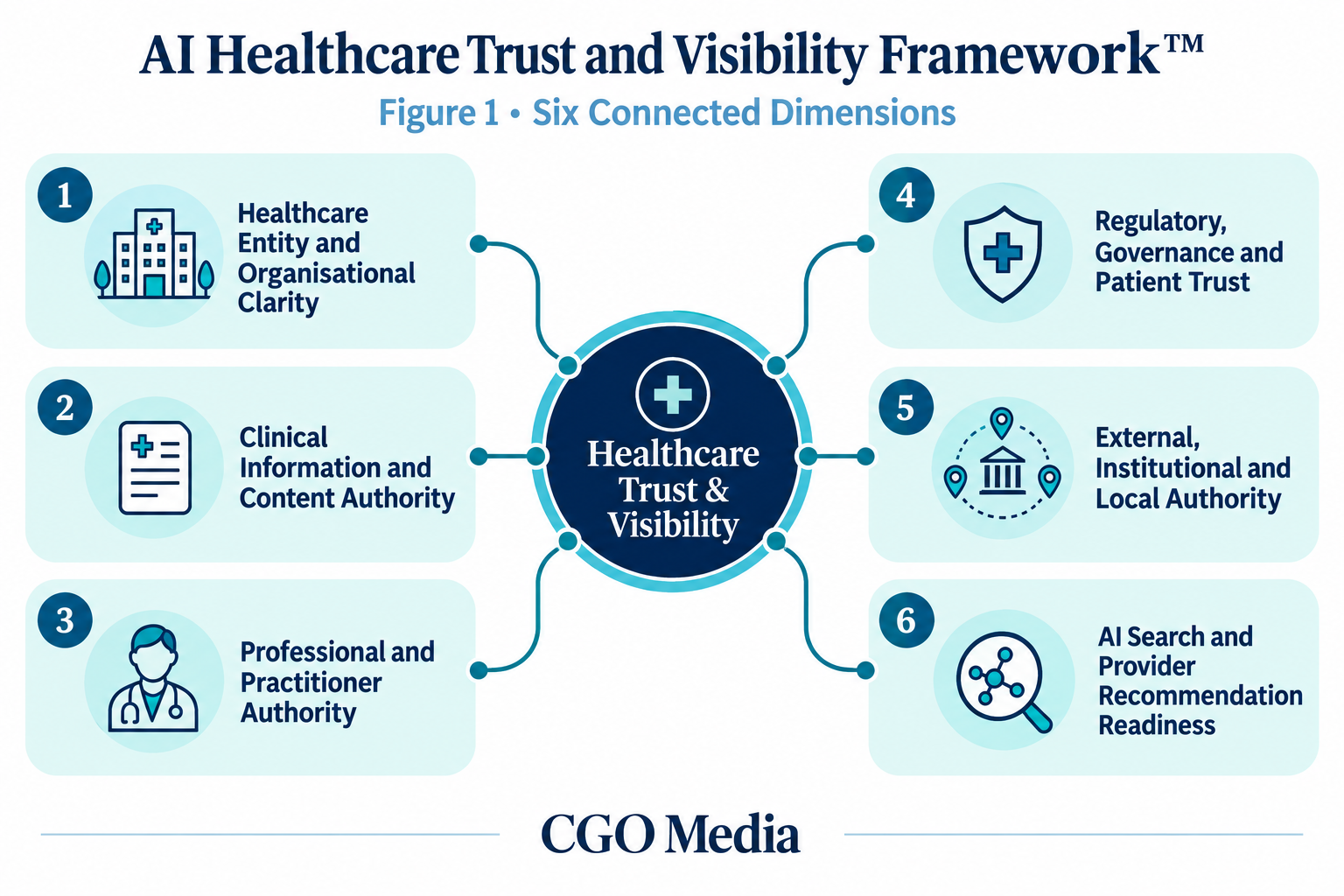
The framework builds on the research presented in Healthcare SEO and Trust Signals in AI Search and translates that research into six connected dimensions of healthcare authority.
1. Purpose of the Framework
The framework is designed to help healthcare organisations assess and improve the evidence environment that influences how they are understood by users, search engines and AI-assisted discovery systems.
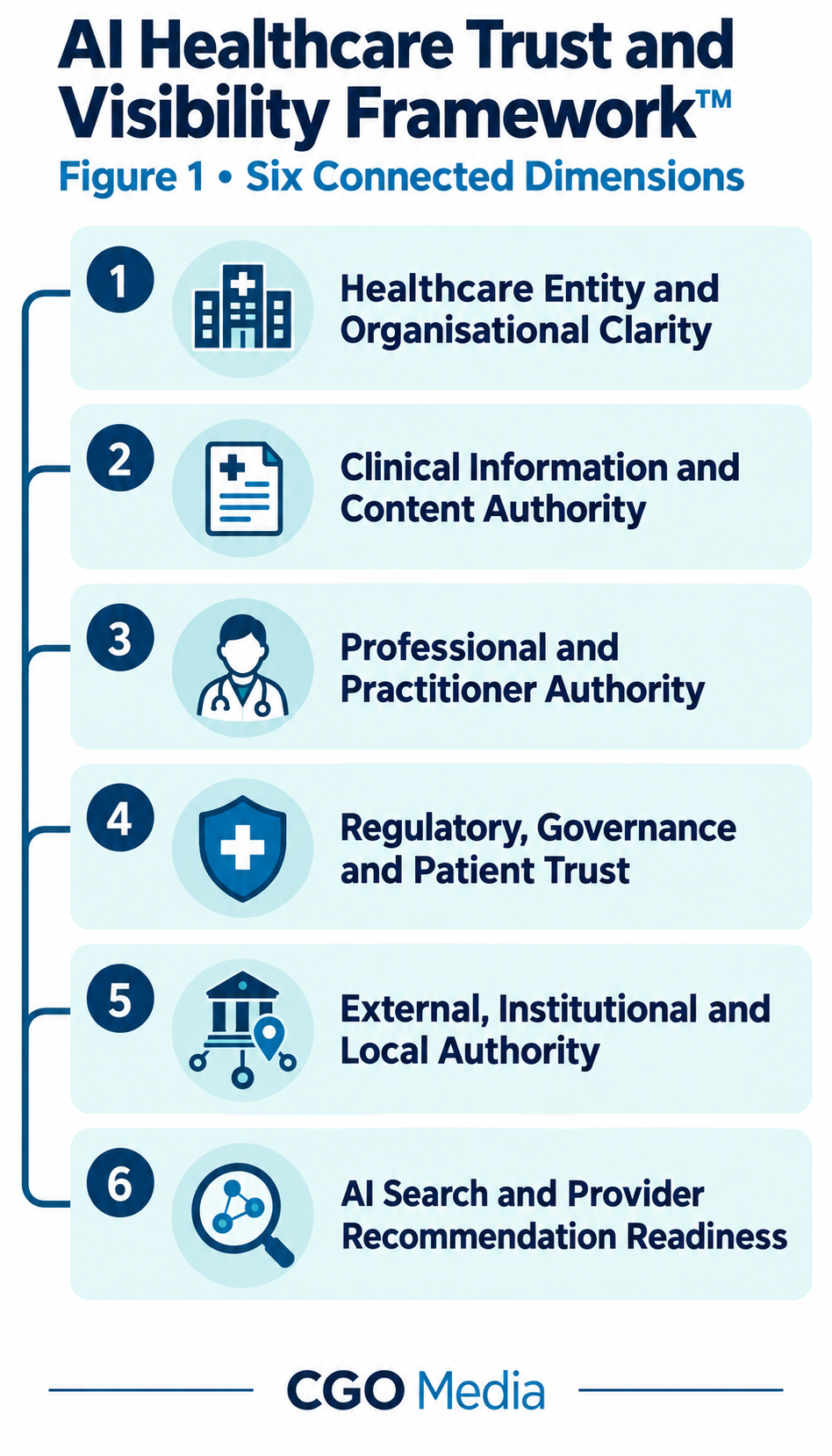
2. The Six Dimensions of Healthcare Trust and Visibility
- Healthcare Entity and Organisational Clarity
- Clinical Information and Content Authority
- Professional and Practitioner Authority
- Regulatory, Governance and Patient Trust
- External, Institutional and Local Authority
- AI Search and Provider Recommendation Readiness
3. Why Healthcare Trust Requires a Multi-Dimensional Model
Healthcare visibility cannot be evaluated through search rankings alone.
A provider may rank strongly but still present weaknesses in:
- Professional verification
- Clinical information quality
- Regulatory transparency
- Patient trust
- External authority
- AI representation accuracy
4. Trust Is Cumulative
Healthcare authority becomes stronger when several independent evidence dimensions reinforce one another.
A useful conceptual model is:
Entity Clarity + Clinical Authority + Professional Authority + Regulatory Trust + External Validation + AI Readiness
5. Weakness in One Dimension Can Constrain the Whole System
A healthcare organisation may have excellent clinical information but still appear difficult to evaluate if professional profiles or location details are unclear.
6. Dimension One — Healthcare Entity and Organisational Clarity
The first dimension examines whether the healthcare organisation and its related entities can be understood clearly.
7. Organisation Identity
The provider should be represented consistently across relevant digital environments.
Core information may include:
- Organisation name
- Brand name
- Legal identity
- Healthcare role
- Primary contact information
8. Healthcare Organisation Type
Users and systems should be able to distinguish whether the entity is a:
- Hospital
- Clinic
- Medical practice
- Diagnostic provider
- Specialist centre
- Healthcare group
9. Location Entity Clarity
Each physical healthcare location should be represented clearly where multiple clinics, hospitals or practices exist.
10. Location Information
Important information may include:
- Address
- Telephone
- Opening information
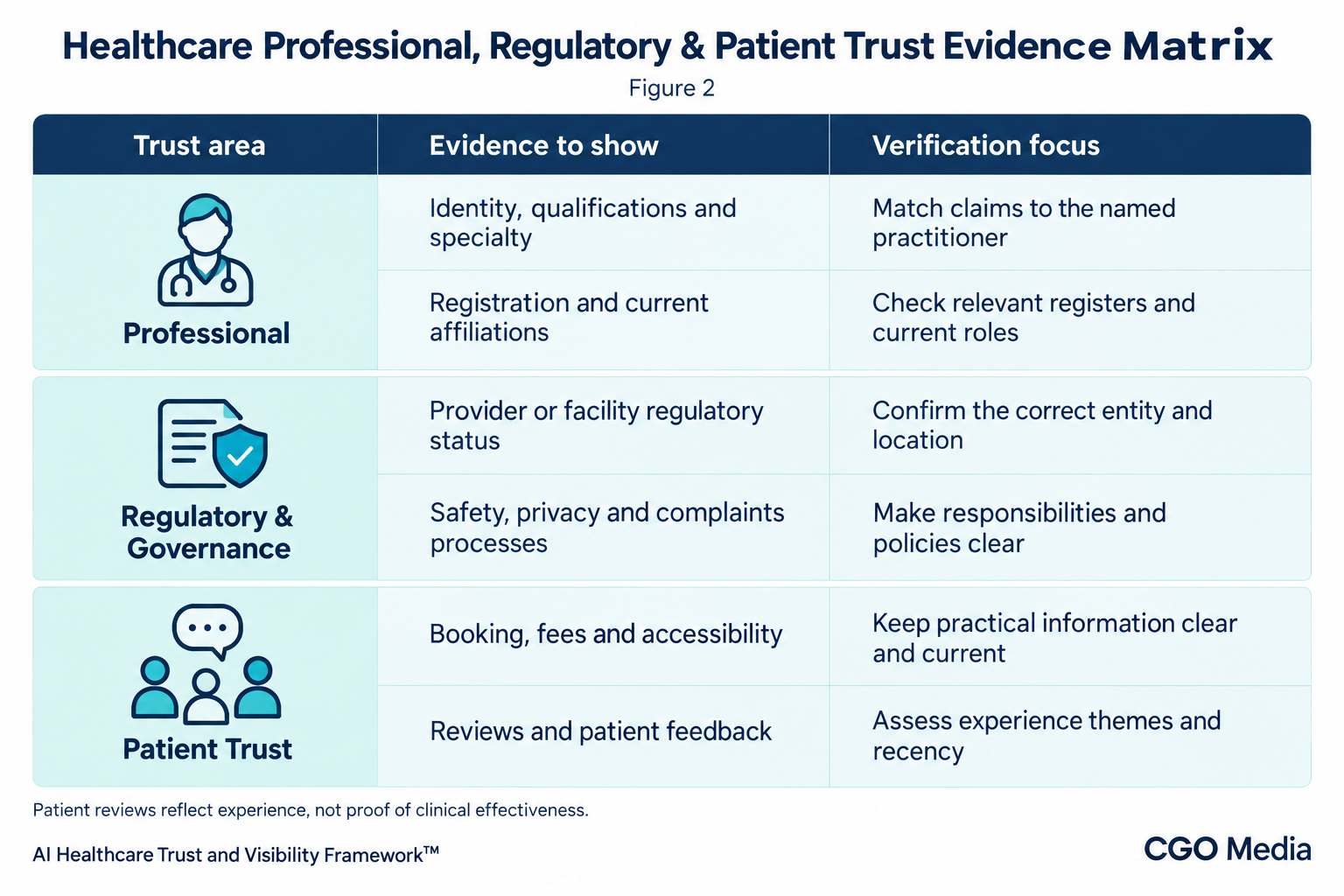
- Accessibility
- Available services
- Professionals practising there
11. Professional Entity Clarity
Clinicians and healthcare professionals should be represented as identifiable professional entities.
12. Professional Identity Information
Relevant information may include:
- Full name
- Professional title
- Qualifications
- Specialty
- Professional registration where appropriate
- Locations
13. Service Entity Clarity
Healthcare services should be named consistently and differentiated clearly from broader specialties or conditions.
14. Specialty, Service and Treatment Are Different
A healthcare information architecture should distinguish between:
- Specialty
- Service
- Diagnostic test
- Procedure
- Treatment
- Condition
15. Healthcare Entity Relationships
The framework treats relationships between entities as central to digital clarity.
A typical structure may be:
Healthcare Organisation → Location → Professional → Specialty → Service → Condition → Treatment
16. Organisational Relationships
Larger healthcare groups may need to distinguish:
- Parent organisation
- Individual hospitals
- Clinics
- Specialist centres
- Associated brands
17. Professional-Location Relationships
Professional profiles should make clear where each clinician practises.
18. Professional-Service Relationships
Users should be able to identify which services or specialties are genuinely associated with each professional.
19. Service-Location Relationships
A healthcare organisation should make clear which locations actually provide each service.
20. Service-Condition Relationships
Condition information should connect appropriately with relevant diagnostic and treatment pathways.
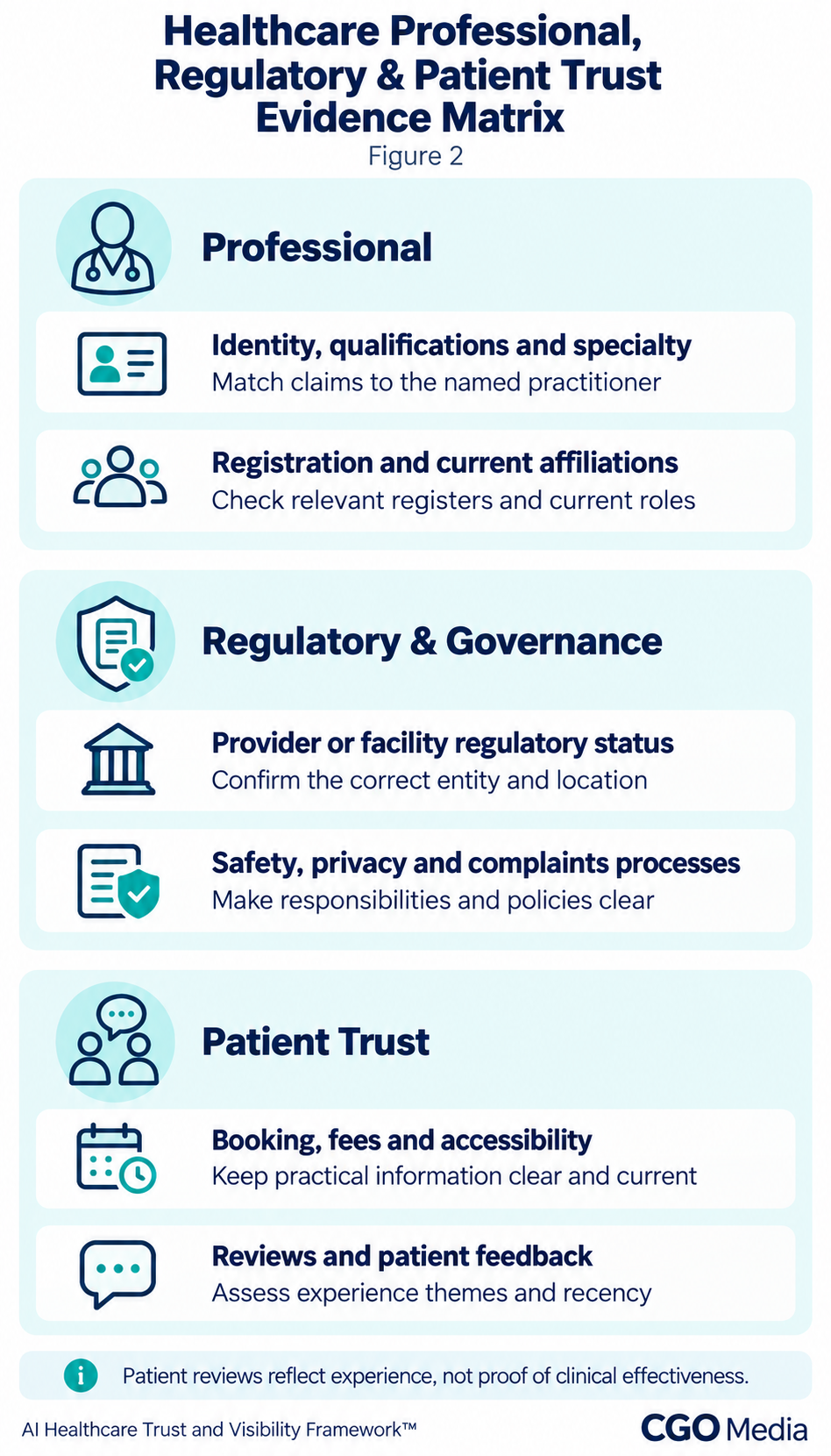
21. Entity Consistency Across External Sources
Entity clarity should extend beyond the provider website.
22. External Entity Environments
These may include:
- Regulatory registers
- Professional directories
- Local business profiles
- Review platforms
- Hospital directories
- Institutional websites
23. Entity Inconsistency Creates Ambiguity
Common problems may include:
- Different provider names
- Old clinic addresses
- Outdated professional affiliations
- Incorrect specialty descriptions
- Duplicate local profiles
24. Structured Data Can Support Entity Interpretation
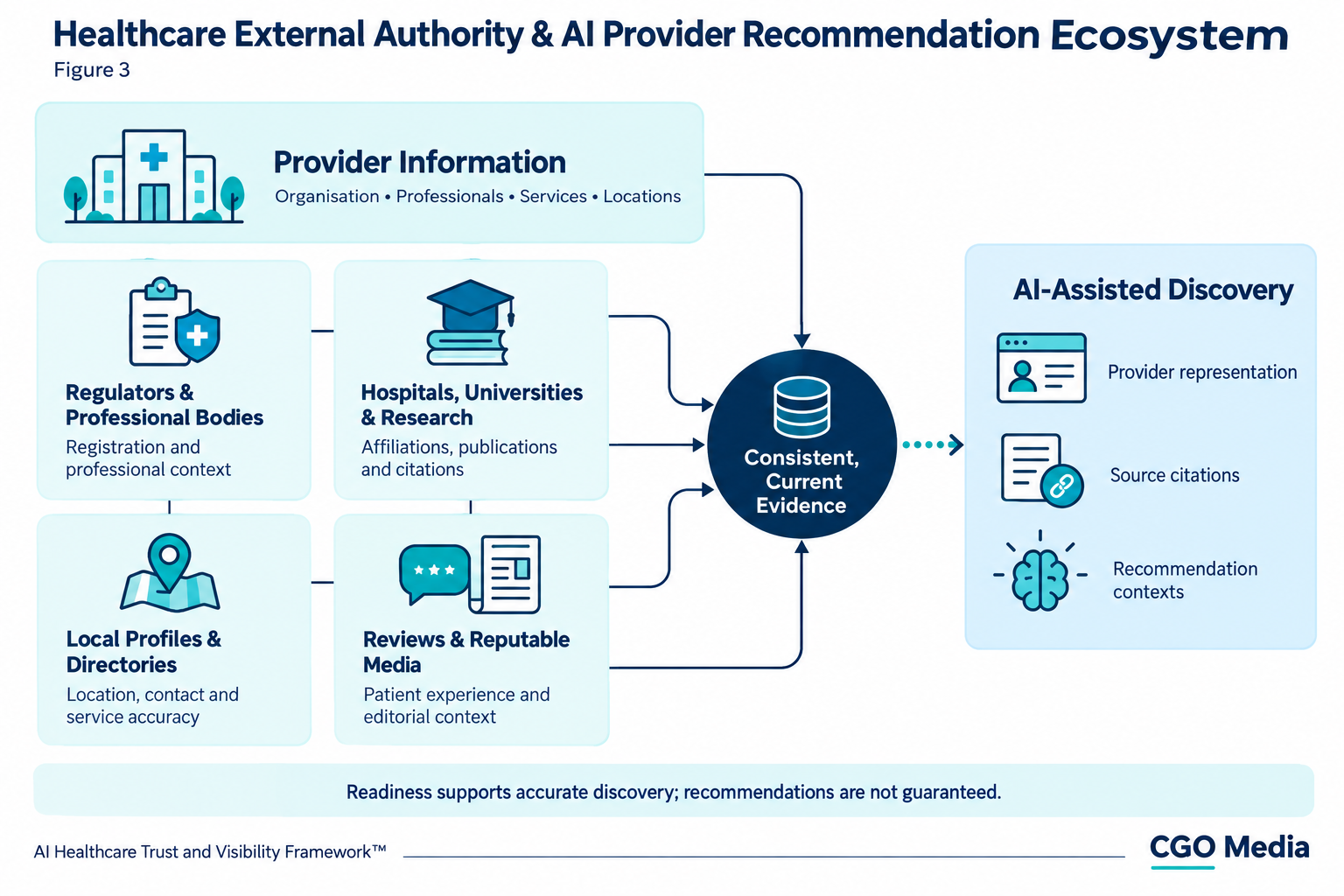
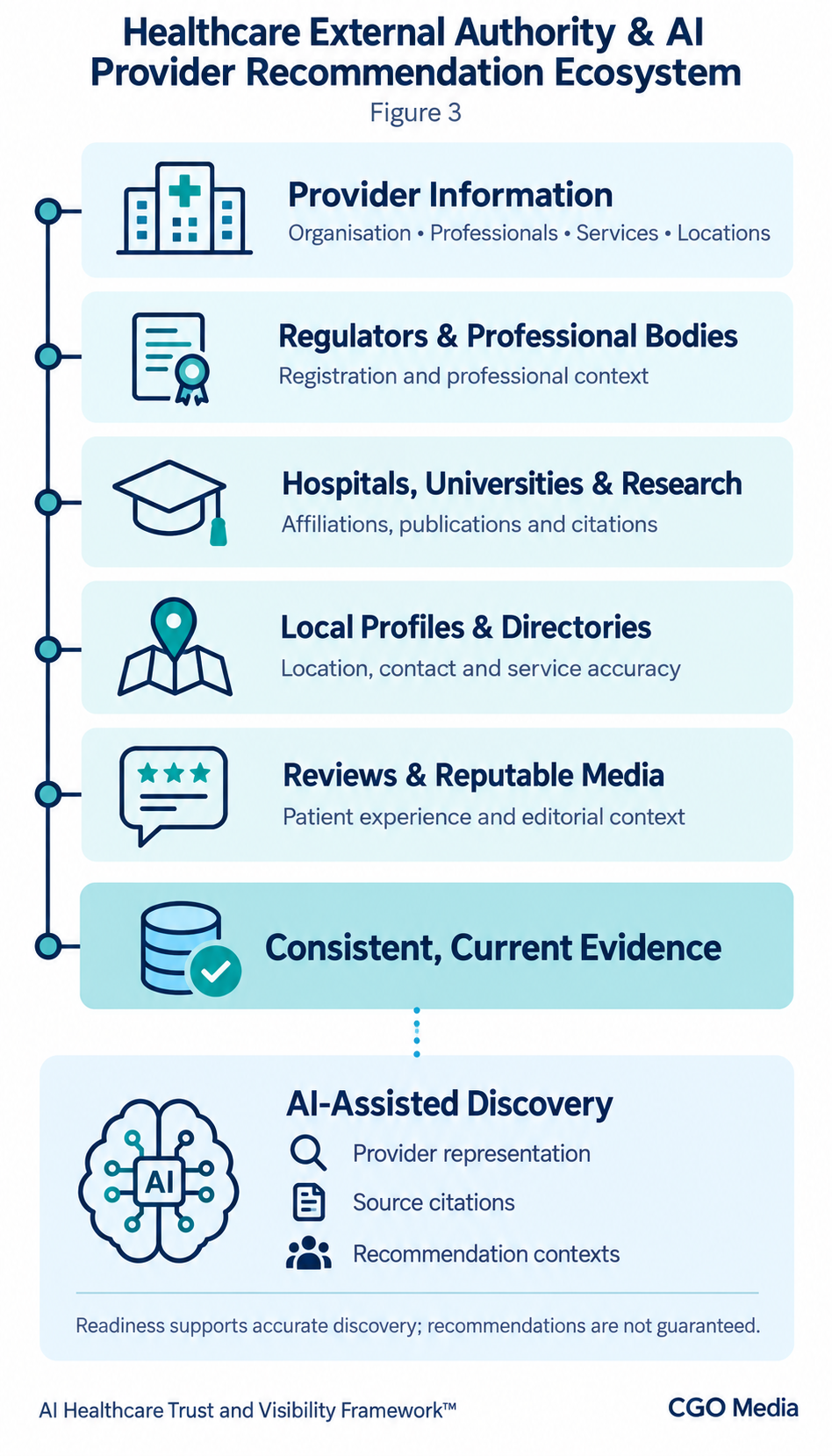
Where appropriate and supported by visible content, structured data may help describe healthcare entities and their relationships.
25. Relevant Structured Data Types
Potential types may include:
- Organization
- MedicalOrganization
- Hospital
- MedicalClinic
- Physician
- Person
- BreadcrumbList
26. Structured Data Should Reflect Reality
Markup should not be used to imply professional relationships, services or accreditations that are not represented accurately on the page.
27. Entity Governance
Healthcare organisations should establish ownership for critical entity information.
28. Entity Change Triggers
Review may be required when:
- A professional joins or leaves
- A clinic moves
- A service launches
- A brand changes
- An affiliation changes
29. Dimension Two — Clinical Information and Content Authority
The second dimension evaluates whether the organisation provides high-quality clinical and healthcare information around the areas in which it genuinely operates.
30. Clinical Authority Is Not Content Volume
Publishing large quantities of generic health information does not necessarily establish meaningful authority.
31. Clinical Content Should Reflect Real Expertise
Priority content should align with:
- Services actually delivered
- Professional expertise
- Specialist facilities
- Clinical pathways
32. Condition Information
Condition pages may explain:
- Overview
- Symptoms
- Possible causes
- Diagnosis
- Treatment pathways
- When professional assessment may be appropriate
33. Treatment Information
Treatment pages may explain:
- Purpose
- Suitability
- Process
- Potential benefits
- Possible risks
- Recovery
- Aftercare
34. Diagnostic Information
Diagnostic content can explain:
- What the test does
- Why it may be used
- Preparation
- Procedure
- Result pathways
35. Clinical Content Requires Appropriate Review
Where healthcare content makes medical or treatment claims, organisations should establish review processes involving appropriate professional expertise.
36. Clinical Review and Editorial Review
These are separate functions.
Editorial review may improve clarity and accessibility, while clinical review may validate professional accuracy and context.
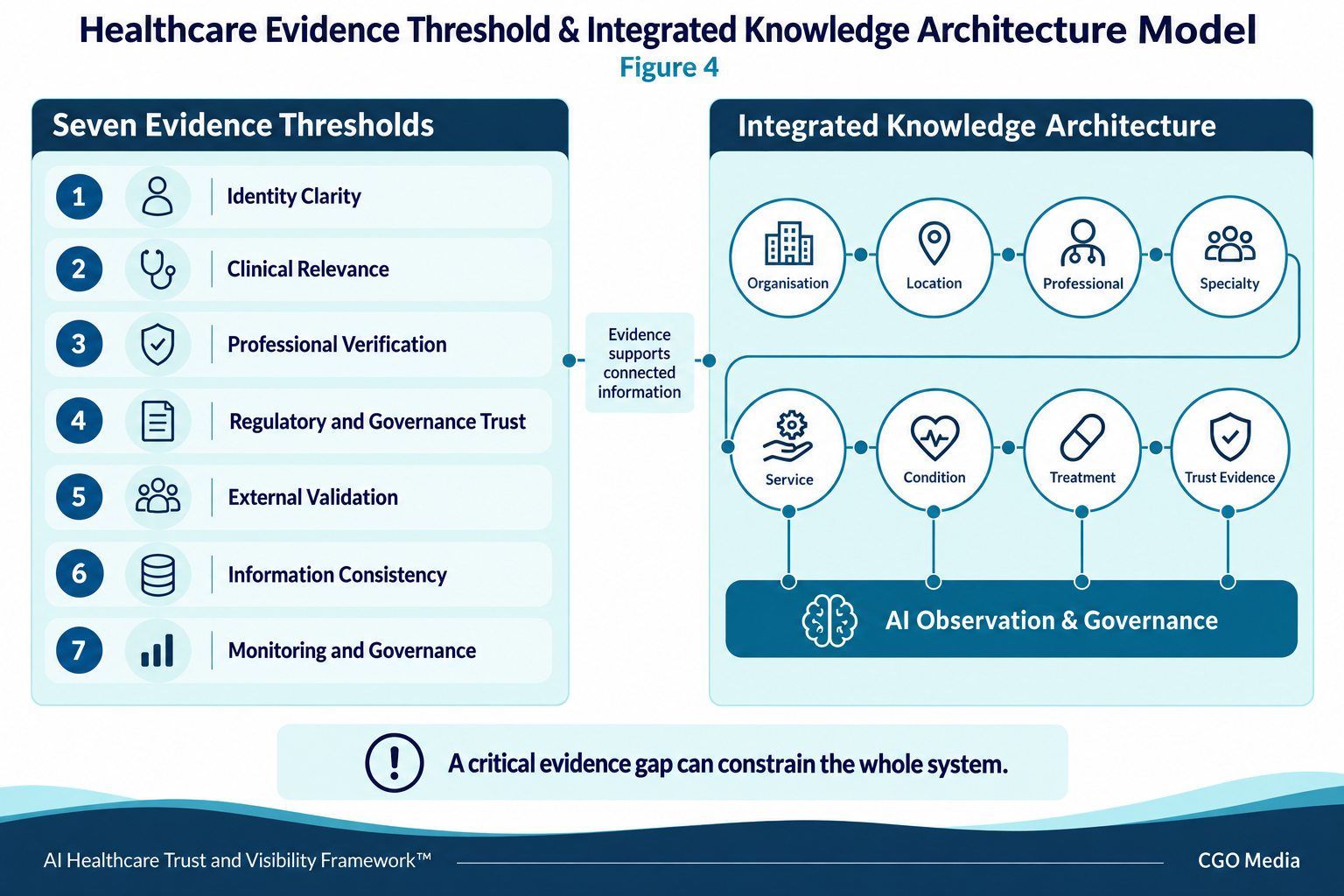
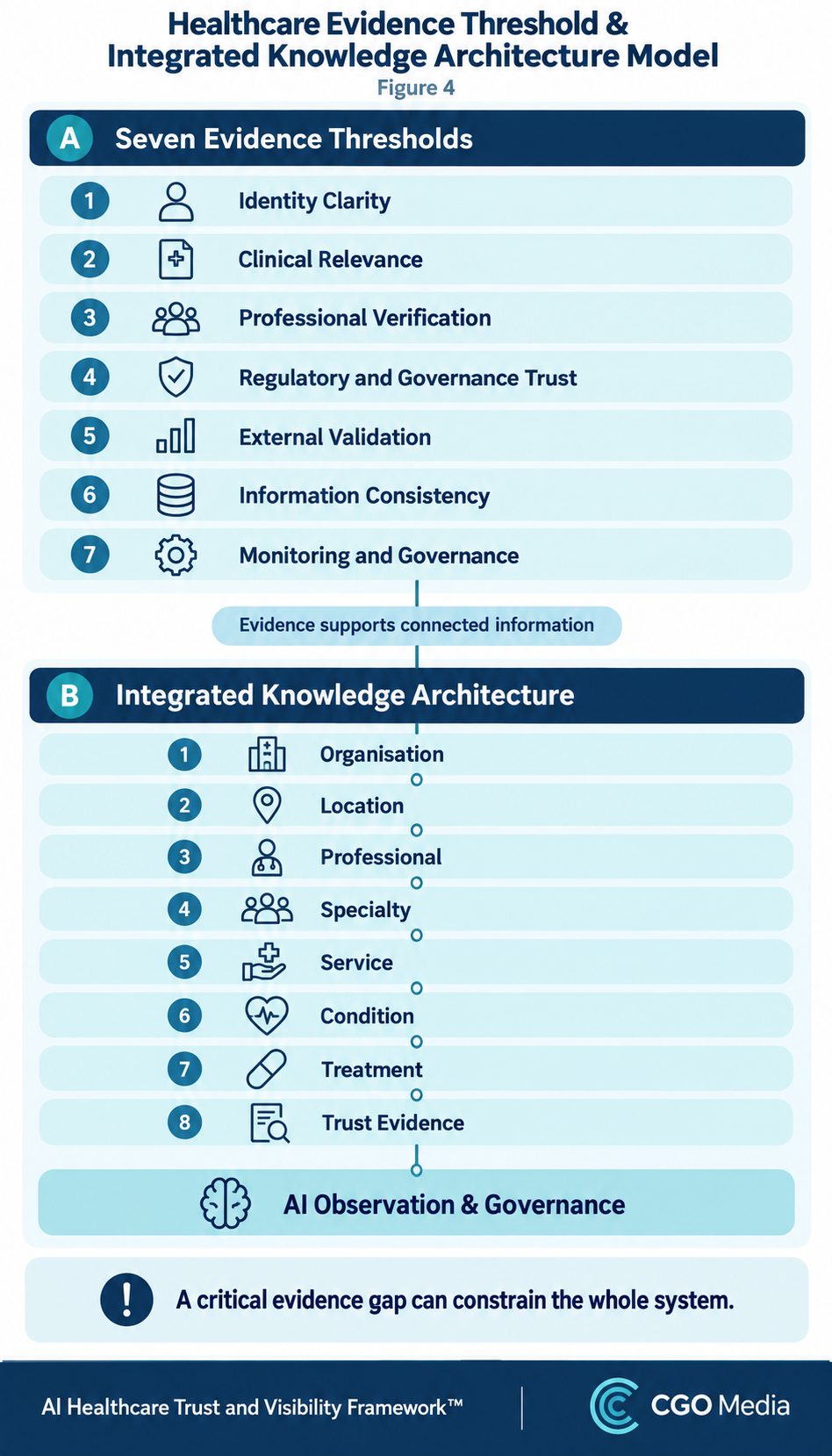
37. Clinical Authorship Transparency
Important information may identify:
- Author
- Clinical reviewer
- Professional role
- Review date
38. Clinical Evidence Quality
Healthcare claims should be supported appropriately and should avoid presenting uncertain evidence as established fact.
39. Source Selection
Healthcare content may draw on:
- Clinical guidance
- Peer-reviewed research
- Professional bodies
- Recognised healthcare institutions
40. Source Relevance Matters
The strongest citation is not necessarily the most prestigious source available, but one that genuinely supports the specific claim being made.
41. Clinical Content Freshness
Healthcare information requires periodic review because clinical guidance and service delivery can change.
42. High-Risk Content Requires Greater Attention
Content discussing diagnosis, treatments, risks, outcomes or urgent care may require stronger governance than lower-risk organisational information.
43. Avoid Diagnostic Overreach
General website information should not imply that a user can receive a definitive diagnosis solely from reading a webpage.
44. Avoid Treatment Guarantees
Healthcare content should not imply guaranteed outcomes where individual results can vary.
45. Clinical Content Should Support the Patient Journey
Useful content helps users move from general understanding toward appropriate professional evaluation where necessary.
46. Clinical Authority Should Connect to Professional Authority
Healthcare information is stronger when users can identify the relevant expertise behind it.
47. Clinical Authority Should Connect to Service Authority
Condition and treatment information should connect appropriately with services genuinely available from the provider.
48. Clinical Authority Should Connect to Location Authority
Users should be able to determine where the relevant service is available.
49. Clinical Content Governance
Organisations should establish:
- Content owners
- Review dates
- Clinical reviewers
- Update triggers
- Retirement processes for outdated content
50. The First Two Dimensions Form the Information Foundation
Healthcare Entity and Organisational Clarity establishes who the provider is and how its people, locations and services relate.
Clinical Information and Content Authority establishes whether the healthcare information associated with those entities is sufficiently accurate, relevant and governed.
Together, they create the foundation upon which professional trust, regulatory credibility, external authority and AI recommendation readiness can develop.
51. Dimension Three — Professional and Practitioner Authority
The third dimension evaluates whether the healthcare professionals associated with the organisation are represented with sufficient clarity, credibility and relevance.
52. Professional Authority Should Be Verifiable
Users should be able to understand who a healthcare professional is, what role they hold and why they are relevant to a particular service or specialty.
53. Professional Identity
A strong professional profile may include:
- Full name
- Professional title
- Qualifications
- Specialty
- Professional registration where appropriate
- Current practice locations
54. Professional Role Clarity
Healthcare organisations should avoid vague role descriptions where the professional relationship can be stated more precisely.
55. Specialty Clarity
Professional profiles should distinguish between:
- Core specialty
- Subspecialty
- Clinical interests
- Procedural expertise
56. Professional Registration
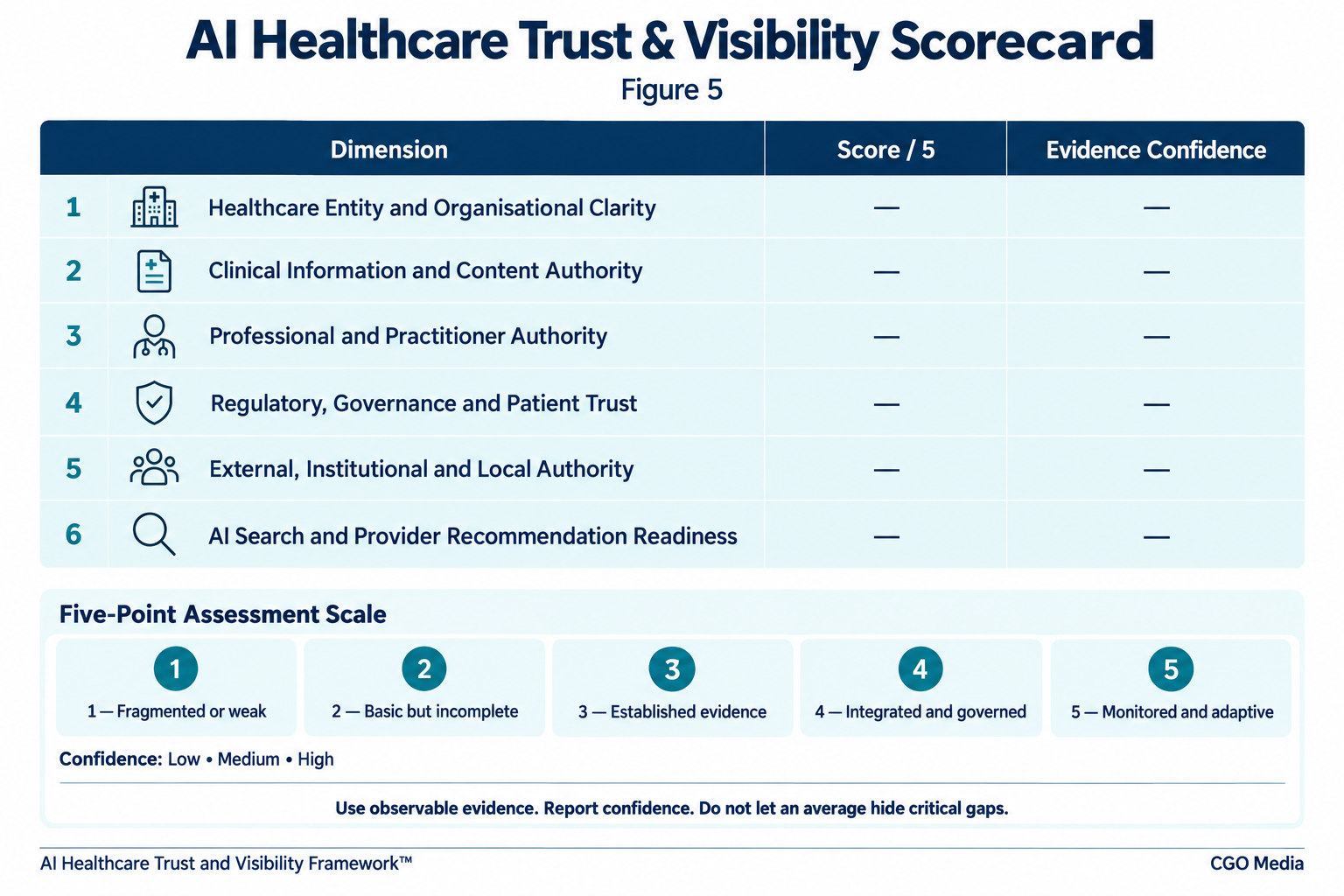
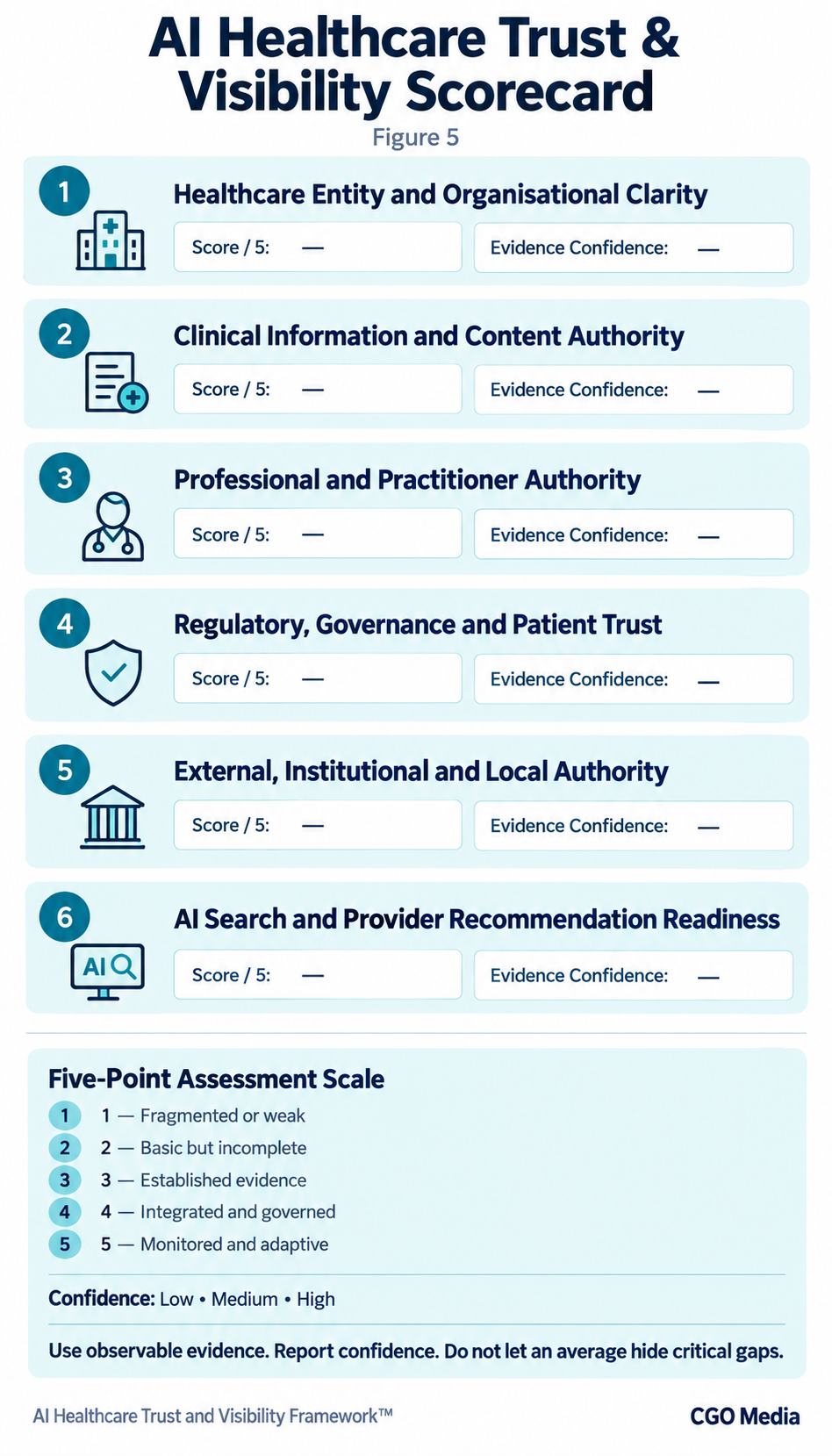
Where registration is relevant, public information should be accurate and current.
57. Qualifications
Professional qualifications should be represented accurately without exaggeration.
58. Institutional Affiliations
Where current and genuine, affiliations may help establish professional context.
Examples may include:
- Hospitals
- Universities
- Research institutions
- Professional bodies
59. Research and Publication Authority
Where practitioners contribute to research or professional literature, those relationships may support a clearer understanding of their subject expertise.
60. Professional Content Relationships
Healthcare professionals should be connected appropriately with:
- Clinical articles
- Treatment information
- Conditions
- Research
- Services
61. Professional-Service Relationships
Users should be able to determine which services each professional actually provides.
62. Professional-Location Relationships
Where clinicians work across several sites, those relationships should be represented clearly.
63. Professional-Condition Relationships
Where appropriate, professional expertise may connect with the conditions and clinical areas they genuinely manage.
64. Professional Authority Should Reflect Current Practice
Profiles should be updated when:
- Roles change
- Affiliations change
- Locations change
- Specialist interests change
- Qualifications change
65. Outdated Professional Information Creates Trust Risk
A clinician who has left an organisation but remains represented as current can create confusion for patients and search systems.
66. Professional Authority Is Not Celebrity
Public visibility or media presence does not by itself establish professional expertise.
67. Evidence of Professional Authority
Relevant evidence may include:
- Professional registration
- Qualifications
- Clinical appointments
- Research publications
- Teaching roles
- Professional memberships
68. Professional Claims Require Precision
Terms such as “expert,” “leading,” or “specialist” should not be used casually where stronger evidence or formal status would be required to support them.
69. Professional Review of Clinical Content
Where practitioners review clinical information, organisations should maintain a clear editorial process showing which content has been reviewed and when.
70. Practitioner Authority Supports Patient Confidence
Users evaluating a healthcare provider may place significant weight on the professionals associated with the service.
71. Professional Authority Also Supports Entity Clarity
Clear practitioner identities can reinforce the wider relationship between:
Provider → Professional → Specialty → Service → Location
72. Professional Authority Should Be Distributed Appropriately
Important practitioner evidence should not be confined to one biography page.
Relevant professional information may also appear on:
- Service pages
- Treatment pages
- Location pages
- Clinical articles
73. Professional Authority Requires Governance
Healthcare organisations should define responsibility for maintaining practitioner information.
74. Professional Change Triggers
Review may be required when:
- A practitioner joins
- A practitioner leaves
- A professional role changes
- A registration changes
- An affiliation changes
75. Dimension Four — Regulatory, Governance and Patient Trust
The fourth dimension examines whether the healthcare organisation provides sufficient evidence of regulation, organisational governance and trustworthy patient-facing operations.
76. Regulatory Trust
Where regulation applies, users should be able to understand the relevant status of the provider or professional.
77. Different Types of Regulatory Evidence
Healthcare organisations may need to distinguish between:
- Provider regulation
- Facility regulation
- Professional registration
- Service-specific accreditation
78. Regulatory Information Should Be Current
Outdated regulatory references can create unnecessary uncertainty.
79. Regulatory Evidence Should Be Linked to the Correct Entity
A regulatory status applying to one clinic should not be presented ambiguously as if it necessarily applies to every location within a wider group.
80. Clinical Governance
Where appropriate, healthcare organisations may explain how they manage:
- Clinical quality
- Patient safety
- Incident handling
- Professional review
- Complaints
81. Governance Transparency
Users may gain confidence when organisations explain how responsibility for care quality and patient safety is managed.
82. Privacy and Data Trust
Healthcare providers often process highly sensitive personal information.
Patient-facing information should therefore make privacy and data-handling practices sufficiently clear.
83. Patient Information Governance
Relevant areas may include:
- Data collection
- Data use
- Retention
- Sharing
- Patient rights
84. Consent Information
Where relevant, healthcare organisations should explain how patient consent is managed within appropriate care and information pathways.
85. Complaints and Feedback Processes
A clear complaints process can contribute to organisational transparency.
86. Patient Safety Information
Where appropriate, healthcare providers may provide information about:
- Safety processes
- Clinical governance
- Incident reporting
- Safeguarding
87. Operational Trust
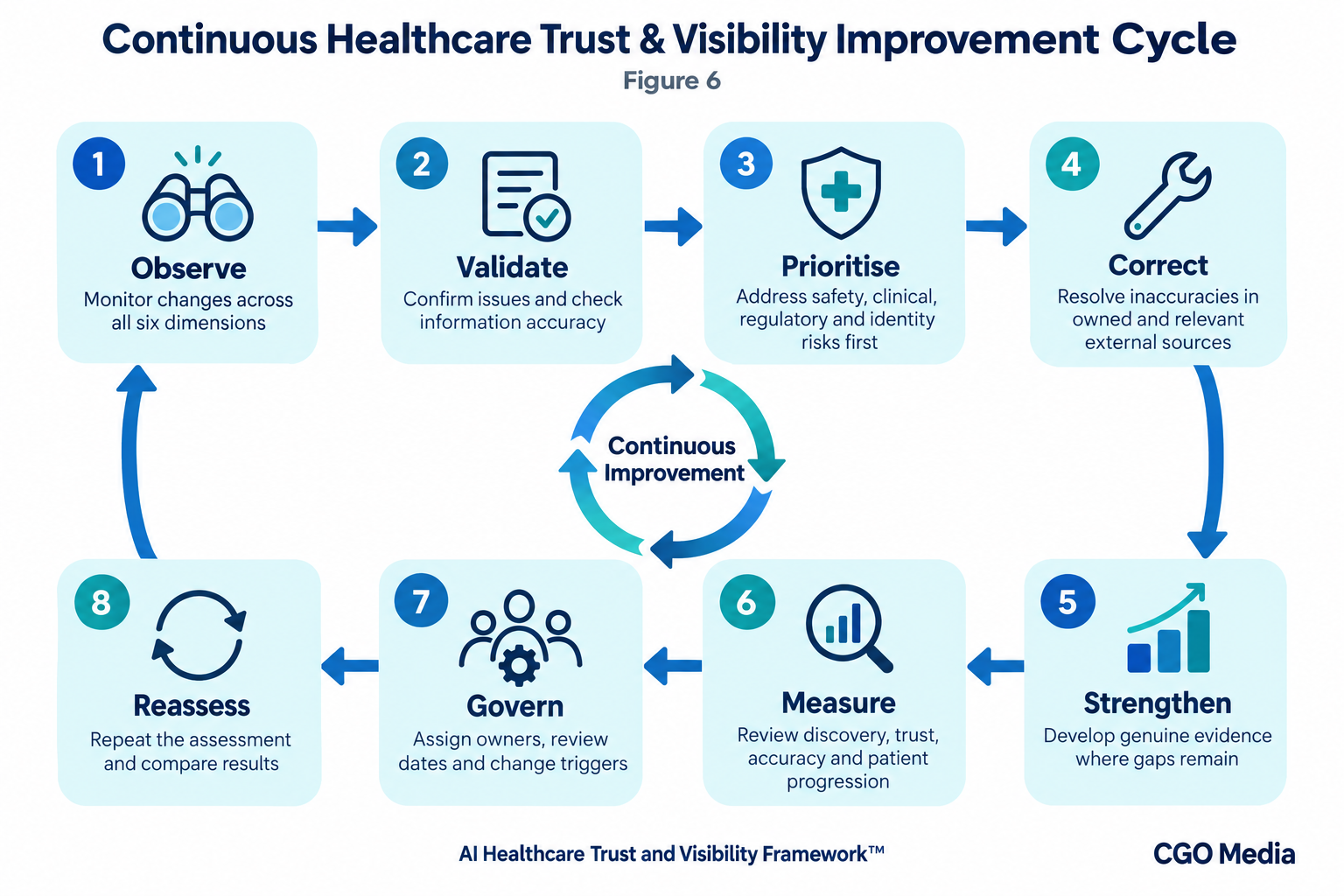
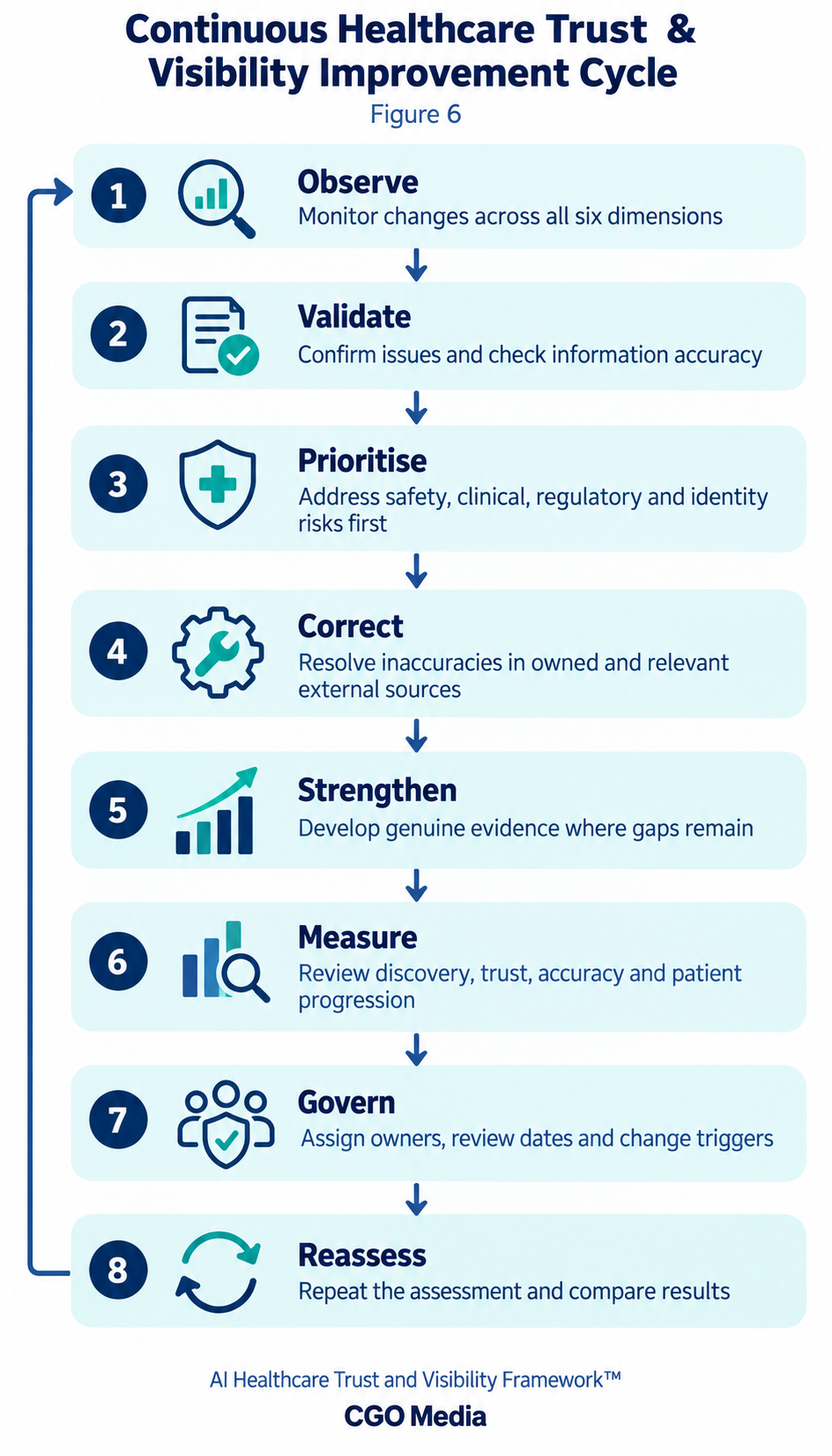
Trust is also affected by whether the organisation appears reliable in practical patient interactions.
88. Appointment Clarity
Users should understand:
- How to book
- What information is required
- What happens next
- How cancellations work
89. Pricing Clarity
For private healthcare, trust may be strengthened through clearer information around:
- Consultation fees
- Diagnostic costs
- Treatment costs
- Additional charges
- Insurance arrangements
90. Waiting-Time Clarity
Where practical and operationally supportable, patients may benefit from realistic information about appointment or treatment availability.
91. Facilities Information
Healthcare location pages may provide detail around:
- Facilities
- Accessibility
- Parking
- Transport
- Interpreter support
92. Patient Journey Clarity
A provider can reduce uncertainty by explaining the likely progression through:
Enquiry → Appointment → Assessment → Diagnosis → Treatment → Follow-Up
93. Patient Reviews
Reviews can contribute evidence about service experience.
94. Review Evidence Should Be Interpreted Carefully
Patient reviews may reflect:
- Communication
- Administration
- Waiting times
- Facilities
- Staff interaction
They should not be treated as direct proof of clinical effectiveness.
95. Review Recency
Recent feedback may provide a better indication of the current operational environment than much older reviews.
96. Review Patterns
Repeated themes can be more informative than individual comments.
97. Review Response Governance
Public responses should be handled carefully to protect patient confidentiality and maintain professional standards.
98. Testimonials
Where testimonials are used, they should be authentic and represented in accordance with relevant professional and regulatory requirements.
99. Outcome Claims Require Particular Care
Healthcare organisations should avoid implying that one patient outcome represents a guaranteed or typical result where this cannot be supported.
100. Regulatory Trust and Patient Trust Are Connected
Strong healthcare trust environments combine institutional evidence with clear patient-facing information.
101. Trust Should Be Available at the Point of Decision
Users should not have to leave a treatment or professional page entirely in order to verify essential information.
102. Treatment-Page Trust Evidence
Relevant treatment pages may connect with:
- Professional expertise
- Risks
- Patient pathways
- Locations
- Clinical review information
103. Professional-Page Trust Evidence
Professional profiles may connect with:
- Registration
- Qualifications
- Affiliations
- Services
- Locations
104. Location-Page Trust Evidence
Location pages may connect with:
- Available professionals
- Services
- Regulatory information
- Facilities
- Accessibility
105. Trust Evidence Should Be Consistent
Important claims should remain aligned across:
- Website
- Professional profiles
- Regulatory information
- Local listings
- External directories
106. Trust Evidence Decays
Healthcare trust information can become outdated when:
- Professionals move
- Locations change
- Accreditations change
- Services change
- Policies change
107. Trust Requires Ongoing Governance
The organisation should identify who owns:
- Regulatory evidence
- Privacy information
- Patient information
- Review governance
- Operational trust content
108. Professional Authority and Regulatory Trust Reinforce One Another
Clear professional identities are stronger when supported by appropriate regulatory and organisational evidence.
109. The Four-Dimension Foundation
At this stage, the framework combines:
- Healthcare Entity and Organisational Clarity
- Clinical Information and Content Authority
- Professional and Practitioner Authority
- Regulatory, Governance and Patient Trust
110. These Four Dimensions Establish the Core Trust Environment
Together, they provide the foundation required before external authority and AI recommendation readiness can be assessed meaningfully.
111. Dimension Five — External, Institutional and Local Authority
The fifth dimension evaluates whether the healthcare organisation and its professionals are supported by relevant evidence beyond their own website.
112. External Authority Provides Independent Context
Healthcare organisations naturally describe their own expertise, services and credentials.
External authority becomes important because users and search systems may also encounter evidence from independent or third-party environments.
113. External Authority Should Be Relevant
The strongest external evidence is generally related directly to the provider’s:
- Healthcare specialty
- Clinical expertise
- Professional role
- Institutional relationships
- Patient services
- Geographic presence
114. Institutional Authority
Relevant institutional evidence may come from:
- Hospitals
- Universities
- Research institutions
- Professional organisations
- Regulatory bodies
115. Hospital Affiliations
Where current and genuine, hospital appointments or affiliations can provide useful context around a healthcare professional’s practice.
116. Academic Affiliations
Teaching or academic appointments may contribute evidence of subject expertise where they are represented accurately.
117. Research Institutional Relationships
Participation in credible research programmes may help connect clinicians or healthcare organisations with specific areas of professional expertise.
118. Professional Body Authority
Professional memberships and roles can contribute context where they are:
- Current
- Relevant
- Accurately represented
119. Research Publication Authority
Published research can provide external evidence of specialist contribution where the publication is genuinely associated with the professional or organisation.
120. Research Should Be Connected to Relevant Expertise
A publication becomes more meaningful when it relates directly to the healthcare professional’s clinical or academic field.
121. Citation Authority
Healthcare organisations and professionals may develop stronger external authority when their research, guidance or expert commentary is referenced by relevant third parties.
122. Citation Quality Matters More Than Raw Volume
A small number of relevant professional or academic citations may provide stronger context than large numbers of unrelated mentions.
123. Editorial Authority
Reputable healthcare journalism and professional media may contribute external visibility where coverage is substantive and accurate.
124. Expert Commentary
Clinicians may contribute to:
- Healthcare journalism
- Professional publications
- Educational resources
- Industry reports
125. Media Visibility Should Reflect Genuine Expertise
Publicity should not be treated as a substitute for professional evidence.
126. Local Authority
Healthcare provider discovery frequently depends on strong local information.
127. Local Authority Is More Than an Address
A strong healthcare location entity should communicate:
- Where the provider operates
- Which services are available
- Which professionals practise there
- How users can make contact
128. Local Business Profiles
Important healthcare locations should be represented accurately across relevant local search environments.
129. Local Information Consistency
Review consistency across:
- Provider name
- Address
- Telephone
- Opening information
- Website
130. Multi-Location Authority
Healthcare groups operating several clinics should establish distinct and accurate information for each location.
131. Avoid Collapsing Locations into One Generic Entity
Different locations may provide different:
- Services
- Professionals
- Facilities
- Opening arrangements
132. Location-Service Authority
Users should be able to verify which services are available at each clinic or facility.
133. Location-Professional Authority
Professional profiles and location pages should represent current practice relationships accurately.
134. Local Reviews
Location-specific reviews may provide evidence about the current patient experience within an individual clinic or hospital environment.
135. Local Review Patterns
Repeated themes may reveal differences between locations involving:
- Communication
- Facilities
- Administration
- Waiting times
- Accessibility
136. Local Accessibility Authority
Healthcare location pages can strengthen operational clarity by including information about:
- Wheelchair access
- Parking
- Public transport
- Interpreter services
- Other accessibility support
137. Local Search Should Reflect Real Service Availability
A location should not be optimised aggressively for treatments that are not genuinely available there.
138. External Authority Requires Source Diversity
Healthcare organisations should avoid excessive reliance on one type of external evidence.
139. A Broader External Evidence Ecosystem
A stronger ecosystem may include:
- Regulators
- Professional bodies
- Hospitals
- Universities
- Research publications
- Local profiles
- Review platforms
- Reputable media
140. External Evidence Should Remain Current
Old affiliations, outdated clinic locations and former professional roles should not continue to be represented as current where correction is possible.
141. External Authority Can Reveal Contradictions
Periodic review can identify inconsistencies between first-party information and external sources.
142. External Authority Should Be Audited
A practical audit may examine:
- Provider profiles
- Professional directories
- Hospital listings
- Academic profiles
- Local listings
- Review platforms
- Editorial references
143. Authority Gaps
Common weaknesses may include:
- Limited professional verification
- Weak institutional context
- Inconsistent local information
- Outdated external profiles
- Little relevant citation evidence
144. External Authority Is Not Link Building Alone
Healthcare authority should not be reduced to acquiring backlinks.
The broader objective is to develop a relevant external evidence environment around real professional and organisational expertise.
145. External Authority Should Reinforce the Other Dimensions
The strongest external signals are those that reinforce:
- Healthcare entity clarity
- Clinical expertise
- Professional authority
- Regulatory trust
146. Dimension Six — AI Search and Provider Recommendation Readiness
The sixth dimension evaluates whether the healthcare organisation is sufficiently clear, trusted and consistently represented to support accurate discovery across AI-assisted search environments.
147. AI Readiness Is an Evidence Condition
The framework does not treat AI readiness as a separate content tactic.
Instead, it emerges from the combined strength of the preceding five dimensions.
148. The AI Readiness Foundation
A healthcare provider is better positioned for accurate machine interpretation when it has:
- Clear entities
- Strong clinical information
- Verifiable professional authority
- Regulatory and patient trust
- Relevant external validation
149. AI-Assisted Healthcare Discovery
Users may ask AI systems questions involving:
- Conditions
- Treatments
- Specialists
- Hospitals
- Clinics
- Local providers
- Healthcare comparisons
150. Branded AI Queries
Branded monitoring can assess whether systems describe accurately:
- The healthcare organisation
- Its locations
- Its services
- Its professionals
151. Professional AI Queries
Healthcare organisations can assess whether practitioners are represented accurately for:
- Specialty
- Qualifications
- Affiliations
- Practice locations
152. Service AI Queries
Testing can evaluate whether the provider is associated appropriately with treatments and services it genuinely delivers.
153. Local AI Queries
Local testing may examine whether users seeking providers within a specific geography encounter accurate:
- Location information
- Service availability
- Professional relationships
154. Non-Branded Provider Recommendation Queries
Non-branded queries are important because they test whether the provider enters consideration before the user already knows its name.
155. Examples of Non-Branded Healthcare Queries
These may include:
- Private specialist for a particular condition
- Clinic offering a particular treatment
- Hospital providing a particular service
- Diagnostic provider in a particular location
156. AI Recommendation Presence
Healthcare organisations may observe whether they appear in relevant generated provider lists or recommendation contexts.
157. Recommendation Presence Is Not a Fixed Ranking
AI-generated outputs may vary according to:
- Model
- Prompt wording
- Geography
- Source availability
- Time
158. AI Representation Accuracy
Important information to monitor may include:
- Organisation identity
- Professional roles
- Services
- Specialties
- Locations
- Regulatory context
159. AI Representation Errors Can Create Trust Risk
Incorrect descriptions of healthcare professionals, services or locations may create confusion during an already sensitive decision journey.
160. AI Source Analysis
Where AI systems expose citations or sources, organisations can observe which information environments repeatedly contribute to relevant answers.
161. Potential AI Source Types
These may include:
- Provider websites
- Professional directories
- Regulatory sources
- Hospitals
- Research institutions
- Review platforms
- Editorial sources
162. Source Analysis Is Diagnostic
The objective is to understand the wider evidence ecosystem rather than to assume that inclusion in one source will guarantee AI visibility.
163. AI Readiness Requires Information Consistency
Important facts should remain aligned across first-party and authoritative external environments.
164. First-Party Accuracy Comes First
When representation problems are identified, the healthcare organisation should first verify its own public information.
165. External Corrections Where Legitimate
Where the organisation has legitimate correction rights, material inaccuracies on relevant external profiles should be updated.
166. AI Readiness Should Not Encourage Artificial Evidence
Healthcare organisations should not attempt to manufacture false professional relationships, reviews, citations or institutional signals to influence automated systems.
167. AI Recommendation Readiness Is Cumulative
A useful representation is:
Entity Clarity → Clinical Authority → Professional Authority → Trust → External Validation → AI Readiness
168. Strong AI Readiness Does Not Guarantee Recommendation
The framework describes conditions that may support clearer and more accurate discovery, not a guaranteed recommendation mechanism.
169. Healthcare Recommendation Requires Particular Caution
Provider recommendations can influence significant decisions.
Healthcare organisations should therefore focus on accurate representation and appropriate discovery rather than maximum recommendation frequency.
170. The Six Dimensions Operate as One System
The framework is strongest when all six dimensions reinforce one another rather than being managed as isolated optimisation programmes.
171. The Complete Trust and Visibility Architecture
The combined model can be represented as:
Entity Clarity + Clinical Authority + Professional Authority + Regulatory & Patient Trust + External Authority + AI Recommendation Readiness
172. Healthcare AI Evidence Thresholds
AI recommendation readiness should be evaluated through the quality and consistency of the wider evidence environment rather than the existence of one isolated optimisation signal.
173. Evidence Threshold One — Identity Clarity
The organisation should be represented clearly enough for users and automated systems to distinguish:
- The healthcare organisation
- Its locations
- Its professionals
- Its services
174. Evidence Threshold Two — Clinical Relevance
The provider should demonstrate genuine relevance to the conditions, specialties and treatments for which it seeks visibility.
175. Evidence Threshold Three — Professional Verification
Relevant practitioners should have sufficiently clear and current professional evidence.
176. Evidence Threshold Four — Regulatory and Governance Trust
Users should be able to verify important regulatory, governance and patient-safety information where applicable.
177. Evidence Threshold Five — External Validation
Independent evidence should reinforce the organisation’s professional and institutional context where genuine validation exists.
178. Evidence Threshold Six — Information Consistency
Critical facts should be represented consistently across first-party and important external sources.
179. Evidence Threshold Seven — Monitoring and Governance
The organisation should have a repeatable method for observing important search and AI representation issues over time.
180. Healthcare AI Readiness Is Threshold-Based
Weakness in one critical layer may constrain the overall system even where several other dimensions are strong.
181. Example — Strong Clinical Authority, Weak Entity Clarity
A healthcare organisation may publish excellent clinical information while presenting unclear relationships between professionals, locations and services.
This can reduce interpretability despite strong content quality.
182. Example — Strong Brand, Weak Professional Evidence
A recognised healthcare brand may still present a weak provider-selection environment if users cannot verify the clinicians associated with important services.
183. Example — Strong Professionals, Weak Local Information
Well-qualified specialists may remain difficult to discover if location and service-availability information is inconsistent.
184. Example — Strong Reviews, Weak Regulatory Clarity
Positive patient feedback does not replace the need for clear regulatory and professional evidence.
185. AI Source Consistency
Healthcare organisations should review whether important facts remain aligned across the source environments most likely to be encountered during discovery.
186. Organisation-Level Source Consistency
Review consistency around:
- Provider name
- Organisation type
- Locations
- Contact information
- Services
187. Professional-Level Source Consistency
Review consistency around:
- Name
- Professional title
- Specialty
- Affiliations
- Practice locations
188. Service-Level Source Consistency
Review whether treatments, diagnostics and services are described consistently across:
- Provider website
- Professional profiles
- Location pages
- Relevant directories
189. Location-Level Source Consistency
Review:
- Address
- Telephone
- Opening information
- Service availability
- Professional availability
190. Regulatory Source Consistency
Where regulatory information is public, compare first-party claims with the relevant official or professional source.
191. Source Conflict Analysis
A practical authority review should identify where two or more sources present materially different information about the same healthcare entity.
192. Source Conflict Severity
Conflicts may be prioritised according to their potential impact on:
- Patient safety
- Provider identity
- Professional verification
- Service suitability
- Local access
193. Critical Source Conflicts
Examples may include:
- Incorrect professional status
- Wrong service availability
- Wrong clinic location
- Outdated regulatory information
194. Moderate Source Conflicts
Examples may include:
- Old professional biographies
- Outdated opening information
- Legacy service descriptions
- Inconsistent naming
195. Correct the Highest-Risk Conflicts First
Healthcare organisations should prioritise accuracy risks before lower-impact authority opportunities.
196. Provider Recommendation Monitoring
Healthcare organisations can build a repeatable monitoring set around relevant provider-discovery scenarios.
197. Recommendation Monitoring Categories
Potential categories may include:
- Specialty-led recommendations
- Treatment-led recommendations
- Condition-led recommendations
- Location-led recommendations
- Diagnostic-provider recommendations
198. Track Recommendation Presence
Record whether the provider appears within relevant recommendation contexts.
199. Track Recommendation Position Cautiously
Where ordering exists, it can be observed, but AI-generated ordering should not be treated as a stable ranking position.
200. Track Recommendation Relevance
The provider should only be considered meaningfully visible where the recommendation is relevant to the service, specialty and geography being tested.
201. Track Professional Recommendation Presence
Where appropriate, monitoring may also examine whether individual practitioners appear in relevant specialist-discovery scenarios.
202. Track Representation Accuracy
Healthcare organisations should record whether generated descriptions are accurate across:
- Organisation identity
- Professional role
- Specialty
- Services
- Locations
- Regulatory context
203. Track Recommendation Confidence Carefully
Generated language may express different levels of certainty.
The organisation should not interpret confident wording as formal endorsement.
204. Track Source Visibility
Where citation or source links are visible, record which sources repeatedly appear around strategically important queries.
205. Track Source Diversity
A useful observation may be whether answers rely repeatedly on:
- Provider sources
- Regulatory sources
- Professional directories
- Institutional sources
- Review platforms
- Editorial sources
206. Track Competitor Presence
Monitor which alternative providers appear within the same relevant recommendation contexts.
207. Competitive Monitoring Should Remain Contextual
A provider appearing more frequently does not automatically indicate superior clinical quality.
208. Repeat Tests Over Time
AI monitoring becomes more useful when the same core prompt set is repeated periodically.
209. Avoid One-Off Conclusions
One generated response should not be treated as sufficient evidence of a stable recommendation pattern.
210. AI Monitoring Cadence
A practical cadence may include:
- Monthly branded accuracy checks
- Monthly priority provider-discovery checks
- Quarterly competitor comparison
- Quarterly source analysis
211. Refresh the Monitoring Set
Prompt sets should evolve when:
- New services launch
- New specialists join
- New locations open
- Patient terminology changes
- New competitors emerge
212. Healthcare Knowledge Architecture
The six framework dimensions become more effective when they are connected through a coherent healthcare knowledge architecture.
213. Core Healthcare Entity Chain
A practical structure may be:
Organisation → Location → Professional → Specialty → Service → Condition → Treatment → Trust Evidence
214. Organisational Knowledge Layer
This layer may define:
- Provider identity
- Group relationships
- Locations
- Brand structure
215. Professional Knowledge Layer
This layer may define:
- Professional identity
- Specialties
- Qualifications
- Affiliations
- Locations
216. Clinical Knowledge Layer
This layer may connect:
- Conditions
- Symptoms
- Diagnostics
- Treatments
- Clinical guidance
217. Service Knowledge Layer
This layer may define:
- Available treatments
- Diagnostic services
- Facilities
- Service locations
- Relevant professionals
218. Trust Knowledge Layer
This layer may connect:
- Regulation
- Clinical governance
- Patient safety
- Privacy
- Complaints processes
219. External Authority Layer
This layer may include relationships with:
- Professional bodies
- Hospitals
- Universities
- Research publications
- Relevant media
220. Local Knowledge Layer
This layer may include:
- Address
- Service availability
- Professional availability
- Accessibility
- Opening information
221. AI Observation Layer
The final layer records how important healthcare entities and relationships are represented across AI-assisted discovery.
222. Internal Linking Should Reflect Healthcare Relationships
Internal links should support meaningful pathways such as:
Condition → Treatment → Professional → Location → Trust Information
223. Professional Profiles Should Act as Authority Hubs
Strong professional profiles can connect:
- Specialties
- Services
- Locations
- Clinical content
- Research
224. Location Pages Should Act as Local Authority Hubs
Strong location pages can connect:
- Services
- Professionals
- Facilities
- Accessibility
- Trust information
225. Service Pages Should Act as Decision Hubs
Service pages may connect users with:
- Treatment information
- Relevant specialists
- Locations
- Patient pathways
- Trust evidence
226. Clinical Content Should Support, Not Duplicate, the Architecture
Condition and educational content should add useful depth while avoiding unnecessary duplication across service and professional pages.
227. Knowledge Architecture Reduces Fragmentation
A connected structure can reduce the risk that important healthcare information is scattered across unrelated parts of the website.
228. Knowledge Architecture Supports Governance
When relationships are documented clearly, organisations can identify which assets need review after a change.
229. Example — Professional Change
If a specialist leaves, the organisation may need to review:
- Professional profile
- Location pages
- Service pages
- Clinical content attribution
- Relevant external profiles
230. Example — Service Change
If a treatment is discontinued, the organisation may need to review:
- Service page
- Condition content
- Professional profiles
- Location pages
- External directories
231. Example — Location Change
If a clinic moves, the organisation may need to review:
- Location page
- Professional profiles
- Local listings
- Contact information
- Service availability
232. Integrated Knowledge Architecture Supports AI Readiness
AI readiness is strengthened when important organisational, professional, clinical, local and trust relationships are represented consistently across the wider evidence environment.
233. The Integrated Healthcare Trust System
The framework can therefore be represented as:
Entities → Clinical Evidence → Professional Authority → Regulatory & Patient Trust → External Authority → AI Observation → Governance
234. Strong Framework Performance Requires Integration
The objective is not to optimise each dimension independently.
The strongest healthcare trust environment emerges when the six dimensions operate as one connected system.
235. Measuring Healthcare Trust and Visibility
The framework can be translated into a practical measurement system by assessing the strength of evidence across all six dimensions.
236. The Six-Dimension Scorecard
The six dimensions are:
- Healthcare Entity and Organisational Clarity
- Clinical Information and Content Authority
- Professional and Practitioner Authority
- Regulatory, Governance and Patient Trust
- External, Institutional and Local Authority
- AI Search and Provider Recommendation Readiness
237. Score Each Dimension Separately
A healthcare organisation may be strong in one dimension and weak in another.
Each dimension should therefore be assessed independently before any overall view is created.
238. A Five-Point Assessment Scale
| Score | Assessment Condition |
|---|---|
| 1 | Fragmented or weak evidence. |
| 2 | Basic evidence exists but remains inconsistent or incomplete. |
| 3 | Established evidence across important areas. |
| 4 | Strong, integrated and governed evidence. |
| 5 | Advanced, continuously monitored and adaptive evidence. |
239. Scores Should Be Evidence-Based
A score should reflect observable evidence rather than internal confidence or brand reputation alone.
240. Avoid False Precision
The scorecard is a strategic diagnostic tool.
Small numerical differences should not be treated as scientifically precise.
241. Dimension One — Entity Clarity Measures
Potential assessment areas include:
- Organisation identity consistency
- Location clarity
- Professional identity clarity
- Service naming consistency
- Entity relationship clarity
242. Entity Clarity Indicators
Possible indicators may include:
- Percentage of major locations with complete profiles
- Percentage of professional profiles with current roles and specialties
- Number of material external inconsistencies
- Number of unresolved duplicate entities
243. Dimension Two — Clinical Information Measures
Potential assessment areas include:
- Clinical accuracy
- Professional review
- Content freshness
- Source quality
- Alignment with real services
244. Clinical Authority Indicators
Possible indicators may include:
- Percentage of priority clinical pages reviewed
- Percentage of high-risk pages with current review dates
- Number of outdated treatment pages
- Number of unsupported clinical claims identified
245. Dimension Three — Professional Authority Measures
Potential assessment areas include:
- Professional profile completeness
- Qualification accuracy
- Registration clarity
- Specialty relevance
- Research and affiliation evidence
246. Professional Authority Indicators
Possible indicators may include:
- Percentage of professionals with complete profiles
- Percentage with verified registration information where relevant
- Percentage connected to correct locations
- Percentage connected to relevant services
247. Dimension Four — Regulatory and Patient Trust Measures
Potential assessment areas include:
- Regulatory transparency
- Clinical governance
- Privacy information
- Complaints processes
- Patient journey clarity
- Review governance
248. Trust Indicators
Possible indicators may include:
- Percentage of locations with clear regulatory information where applicable
- Percentage of major services with visible patient pathway information
- Review recency
- Repeated patient-experience themes
- Number of unresolved trust-information gaps
249. Dimension Five — External and Local Authority Measures
Potential assessment areas include:
- Institutional validation
- Professional body relationships
- Research and citation authority
- Local listing accuracy
- Location-specific reviews
250. External Authority Indicators
Possible indicators may include:
- Number of relevant institutional references
- Number of current professional affiliations
- Number of material local listing inconsistencies
- Relevant research citations
- Location-profile completeness
251. Dimension Six — AI Readiness Measures
Potential assessment areas include:
- Branded representation accuracy
- Professional representation accuracy
- Provider recommendation presence
- Source visibility
- Competitor presence
252. AI Readiness Indicators
Possible indicators may include:
- Percentage of branded prompts represented accurately
- Percentage of priority non-branded prompts with provider presence
- Number of material AI inaccuracies
- Source diversity across relevant AI answers
- Change in recommendation patterns over time
253. Overall Scores Should Be Secondary
An average score may support executive reporting, but it should not hide serious weakness in one critical dimension.
254. The Weakest Dimension Can Become the Bottleneck
A healthcare organisation may have strong external authority but still create patient risk if clinical information is outdated.
255. Critical Dimensions May Require Higher Weighting
Healthcare organisations may choose to weight some dimensions more heavily according to clinical, regulatory and operational risk.
256. Clinical-Risk Weighting
Clinical Information and Content Authority may deserve greater emphasis where the website contains substantial medical guidance.
257. Regulatory-Risk Weighting
Regulatory, Governance and Patient Trust may deserve greater emphasis where services operate within stricter compliance environments.
258. Local-Risk Weighting
Local and operational clarity may deserve greater emphasis where patients depend on accurate location, appointment and service information.
259. AI-Risk Weighting
AI representation accuracy may deserve greater attention where generated systems are increasingly visible within provider-discovery journeys.
260. Evidence Confidence
Scores should also consider how confident the organisation is in the supporting evidence.
261. Low Evidence Confidence
A low-confidence score may rely on:
- Incomplete records
- Outdated information
- Unverified external profiles
- Limited monitoring
262. Medium Evidence Confidence
A medium-confidence score may be supported by:
- Recent audits
- Reasonably complete records
- Some external verification
263. High Evidence Confidence
A high-confidence score may be supported by:
- Current documented evidence
- Named owners
- Regular review
- Repeatable monitoring
264. Confidence Should Be Reported Alongside Score
For example:
Professional Authority: Score 4 — Evidence Confidence: High
265. Benchmarking the Framework
Healthcare organisations can use the framework to compare:
- Current versus previous performance
- Location versus location
- Service line versus service line
- Provider versus selected competitors
266. Internal Benchmarking
Internal benchmarking is often the most reliable starting point because the organisation can assess changes using the same evidence standard over time.
267. Baseline Assessment
The first full framework audit should record:
- Current score by dimension
- Evidence used
- Major gaps
- Evidence owner
- Review date
268. Longitudinal Benchmarking
Future assessments can determine whether each dimension is:
- Improving
- Stable
- Regressing
269. Location Benchmarking
Multi-location providers can compare clinics across:
- Local information completeness
- Professional coverage
- Service clarity
- Review patterns
- Patient journey information
270. Service-Line Benchmarking
Healthcare groups may also compare specialties or service lines to identify uneven authority development.
271. Competitive Benchmarking
Publicly observable evidence can be used to compare selected healthcare providers.
272. Competitive Entity Benchmarking
Compare:
- Provider clarity
- Professional profiles
- Location structure
- Service architecture
273. Competitive Clinical Authority Benchmarking
Compare:
- Clinical content depth
- Authorship
- Professional review
- Information freshness
274. Competitive Professional Authority Benchmarking
Compare the public depth of:
- Qualifications
- Specialty information
- Professional affiliations
- Research evidence
275. Competitive Trust Benchmarking
Compare:
- Regulatory transparency
- Patient information
- Review patterns
- Privacy information
- Patient pathway clarity
276. Competitive External Authority Benchmarking
Compare publicly observable:
- Institutional relationships
- Professional references
- Research visibility
- Local authority
- Editorial recognition
277. Competitive AI Visibility Benchmarking
Using a consistent prompt set, organisations may observe which providers appear repeatedly in relevant discovery contexts.
278. Competitive Benchmarking Has Limits
Public evidence does not reveal the full quality of another healthcare organisation’s internal clinical or governance systems.
279. The Healthcare Trust and Visibility Scorecard
| Dimension | Score | Evidence Confidence | Priority Gap |
|---|---|---|---|
| Healthcare Entity & Organisational Clarity | 1–5 | Low / Medium / High | Identity, location, service or entity relationship. |
| Clinical Information & Content Authority | 1–5 | Low / Medium / High | Accuracy, review, freshness or source quality. |
| Professional & Practitioner Authority | 1–5 | Low / Medium / High | Qualifications, specialty, registration or affiliation. |
| Regulatory, Governance & Patient Trust | 1–5 | Low / Medium / High | Regulation, governance, privacy or patient journey. |
| External, Institutional & Local Authority | 1–5 | Low / Medium / High | Institutional, citation, local or external validation. |
| AI Search & Provider Recommendation Readiness | 1–5 | Low / Medium / High | Representation accuracy, source consistency or recommendation visibility. |
280. Priority Gaps Should Be Risk-Based
Healthcare organisations should prioritise gaps according to patient, clinical, regulatory and operational significance.
281. Priority One — Clinical and Safety Risk
Examples may include:
- Incorrect clinical information
- Misleading treatment claims
- Wrong professional information
- Incorrect service availability
282. Priority Two — Regulatory and Identity Risk
Examples may include:
- Outdated regulatory information
- Incorrect professional registration
- Incorrect location identity
- Ambiguous organisational relationships
283. Priority Three — Patient Journey Risk
Examples may include:
- Unclear booking
- Weak pricing information
- Missing accessibility information
- Poor treatment pathway explanation
284. Priority Four — Authority Development
Once higher-risk gaps are addressed, attention can shift toward:
- Professional authority
- Institutional relationships
- Research visibility
- Local authority
- AI readiness
285. Framework Governance
Measurement becomes more reliable when every dimension has clearly assigned ownership.
286. Entity Governance Ownership
Potential contributors may include:
- Marketing
- Operations
- Corporate communications
287. Clinical Content Ownership
Potential contributors may include:
- Clinical teams
- Medical editors
- Content teams
288. Professional Authority Ownership
Potential contributors may include:
- Clinical leadership
- HR
- Medical affairs
- Marketing
289. Regulatory and Patient Trust Ownership
Potential contributors may include:
- Compliance
- Clinical governance
- Data protection
- Patient experience
290. External and Local Authority Ownership
Potential contributors may include:
- Marketing
- PR
- Operations
- Research teams
291. AI Readiness Ownership
Potential contributors may include:
- SEO
- Data teams
- Marketing
- Clinical governance
292. Cross-Functional Healthcare Authority Governance
Larger organisations may benefit from a cross-functional working group that reviews the framework periodically.
293. Governance Review Areas
A regular review may include:
- Clinical content quality
- Professional changes
- Regulatory updates
- Patient trust issues
- Local information accuracy
- AI representation changes
294. Governance Cadence
A practical cadence may include:
- Monthly high-risk issue monitoring
- Quarterly framework assessment
- Quarterly AI representation review
- Annual strategic reassessment
295. The Framework Should Support Continuous Diagnosis
The six-dimension scorecard is most useful when it helps the organisation identify which trust and visibility capabilities require attention next.
296. The Measurement Principle
The objective is not to maximise a single score.
It is to build a more accurate, trustworthy and resilient healthcare evidence environment across all six dimensions.
297. Continuous Healthcare Trust and Visibility Improvement
The Healthcare Trust and Visibility Framework should be managed as a continuous improvement system rather than a one-time assessment.
Healthcare organisations change continuously as professionals move, services evolve, locations change, regulations develop, research advances and patient expectations shift.
298. Continuous Improvement Begins with Change Detection
The organisation should monitor changes across all six framework dimensions.
299. Entity Change Monitoring
Review changes involving:
- Provider name
- Brand relationships
- Locations
- Professional identities
- Service names
300. Clinical Content Change Monitoring
Review important healthcare information when:
- Clinical guidance changes
- New evidence emerges
- Treatment pathways change
- Services change
301. Professional Change Monitoring
Review practitioner information when:
- A professional joins
- A professional leaves
- A role changes
- An affiliation changes
- A specialist interest changes
302. Regulatory and Governance Change Monitoring
Review evidence whenever:
- Regulatory status changes
- Accreditation changes
- Policies change
- Privacy information changes
- Patient governance procedures change
303. External Authority Change Monitoring
Review external evidence when:
- Institutional affiliations change
- Research is published
- Professional memberships change
- Local listings become inaccurate
- Media references require correction
304. AI Representation Change Monitoring
Track whether material changes occur in:
- Provider descriptions
- Professional descriptions
- Service associations
- Recommendation presence
- Source patterns
305. Evidence Decay Is a Core Healthcare Risk
Even strong authority systems can deteriorate when information is not maintained.
306. Entity Evidence Decay
Examples may include:
- Old provider names
- Duplicate location profiles
- Former professional relationships
- Legacy service names
307. Clinical Evidence Decay
Clinical content may weaken when:
- Guidance changes
- Sources become outdated
- Review dates are missed
- Services evolve
308. Professional Evidence Decay
Professional profiles may become inaccurate if qualifications, affiliations, locations or specialist interests are not updated.
309. Regulatory Evidence Decay
Regulatory and governance information can lose trust value when it no longer reflects current status.
310. Patient Trust Evidence Decay
Old reviews and outdated patient journey information may not reflect the current operational environment.
311. External Evidence Decay
Third-party profiles and institutional references may remain visible long after first-party information has changed.
312. AI Evidence Decay
AI-assisted systems may continue to surface stale information where older source material remains available within the wider evidence environment.
313. Evidence Decay Requires Defined Ownership
Every major evidence class should have a named owner and a review trigger.
314. Failure Mode — Strong Visibility, Weak Trust
A healthcare organisation may attract substantial search traffic while presenting weak professional, regulatory or patient evidence.
315. Failure Mode — Strong Brand, Weak Entity Architecture
A recognised healthcare brand can still create ambiguity where relationships between locations, professionals and services are unclear.
316. Failure Mode — High Content Volume, Low Clinical Governance
Publishing large quantities of healthcare content can create risk where review and maintenance processes cannot keep pace.
317. Failure Mode — Professional Profiles Without Verification
Profiles that rely heavily on promotional language without sufficient factual professional information may provide limited authority value.
318. Failure Mode — Regulatory Evidence Hidden from the Journey
Relevant regulatory information may exist but remain difficult for users to locate when they need it.
319. Failure Mode — Reviews Used as Clinical Evidence
Patient experience data should not be used as proof of treatment effectiveness.
320. Failure Mode — Local Visibility Without Service Accuracy
A location may appear strongly in search while displaying services or professional availability that are no longer current.
321. Failure Mode — External Authority Without Relevance
Unrelated publicity may create visibility without strengthening meaningful healthcare authority.
322. Failure Mode — AI Monitoring Without Governance
Recording AI inaccuracies has limited value unless they are connected with a correction and ownership process.
323. Failure Mode — Treating AI Presence as Endorsement
Generated recommendations should not be described as equivalent to professional, regulatory or clinical endorsement.
324. Failure Mode — Optimising for Recommendation Rather Than Accuracy
Healthcare organisations should prioritise accurate representation and suitable discovery rather than maximum recommendation frequency.
325. Failure Mode — Over-Reliance on a Single Source Type
Trust can become fragile where the organisation depends primarily on one:
- Review platform
- Directory
- Media source
- Institutional relationship
326. Failure Mode — No Review Cycle
Even excellent healthcare information can become unreliable without scheduled reassessment.
327. Prioritise Improvement by Risk
The framework should help the organisation distinguish high-risk corrections from lower-priority authority expansion.
328. Priority One — Clinical Accuracy
Address:
- Incorrect clinical information
- Unsupported treatment claims
- Outdated clinical guidance
- Potentially misleading patient information
329. Priority Two — Professional and Regulatory Accuracy
Address:
- Incorrect professional roles
- Outdated registration information
- Wrong affiliations
- Incorrect regulatory references
330. Priority Three — Entity and Local Accuracy
Address:
- Wrong addresses
- Duplicate profiles
- Incorrect service-location relationships
- Incorrect professional-location relationships
331. Priority Four — Patient Trust and Journey Clarity
Improve:
- Booking information
- Patient pathways
- Pricing clarity
- Accessibility information
- Complaints processes
332. Priority Five — External Authority Development
Once critical accuracy and trust gaps are addressed, organisations can strengthen:
- Institutional relationships
- Professional authority
- Research visibility
- Local authority
- Relevant editorial recognition
333. Priority Six — AI Recommendation Readiness
AI monitoring should build on the preceding evidence layers rather than attempt to bypass them.
334. Strategic Learning from Search Data
Search behaviour can reveal changing patient and user demand around:
- Conditions
- Treatments
- Specialties
- Locations
- Provider types
335. Strategic Learning from Patient Queries
Repeated questions may reveal where healthcare information remains unclear.
336. Strategic Learning from Professional Teams
Clinicians can identify:
- Common misunderstandings
- Emerging treatment questions
- Changing patient expectations
- Important educational gaps
337. Strategic Learning from Patient Experience
Review and feedback analysis can identify operational weaknesses involving:
- Communication
- Booking
- Waiting
- Facilities
- Expectations
338. Strategic Learning from Local Search
Location-level data may reveal:
- Demand differences between areas
- Service gaps
- Accessibility concerns
- Professional availability patterns
339. Strategic Learning from External Sources
External evidence may reveal where the organisation is being understood differently from how it represents itself internally.
340. Strategic Learning from AI Discovery
AI monitoring may reveal:
- Unexpected provider associations
- Incorrect professional relationships
- Competitor visibility patterns
- Recurring source types
- Representation gaps
341. Learning Should Feed Evidence Improvement
Insights should lead to changes where appropriate across:
- Clinical content
- Professional profiles
- Location pages
- Trust information
- External profiles
342. Research Can Strengthen Healthcare Authority
Healthcare organisations with legitimate expertise and appropriate governance may contribute original research, clinical analysis or healthcare data to wider professional discussion.
343. Research Requires Appropriate Controls
Relevant considerations may include:
- Methodology
- Ethics
- Privacy
- Data governance
- Disclosure
344. Research Authority Should Reflect Genuine Contribution
Research should aim to improve understanding rather than exist solely as a visibility tactic.
345. Continuous Professional Authority Development
Professional authority can evolve through genuine:
- Clinical practice
- Research
- Teaching
- Professional publications
- Conference participation
346. Continuous Institutional Authority Development
Healthcare organisations may strengthen relevant institutional relationships where they arise from real clinical, research or professional collaboration.
347. Continuous Local Authority Development
Multi-location organisations should improve weaker location profiles rather than assuming that strong brand authority automatically transfers equally to every site.
348. Continuous AI Readiness Development
AI monitoring should evolve as:
- Services change
- Professionals change
- Locations change
- New competitors emerge
- User language changes
349. The Healthcare Trust and Visibility Improvement Cycle
A practical cycle can be represented as:
Observe → Validate → Prioritise → Correct → Strengthen → Measure → Govern → Reassess
350. Observe
Monitor change across all six dimensions.
351. Validate
Confirm whether identified issues are genuine and whether the underlying information is accurate.
352. Prioritise
Address patient-safety, clinical, regulatory and identity risks before lower-impact visibility opportunities.
353. Correct
Resolve material inaccuracies across first-party and legitimate external environments.
354. Strengthen
Develop deeper professional, trust, clinical and external evidence where genuine gaps exist.
355. Measure
Assess whether changes improve:
- Discoverability
- Trust
- Representation accuracy
- Patient progression
356. Govern
Assign ownership, review dates and change triggers.
357. Reassess
Repeat the framework assessment to determine whether the healthcare trust and visibility environment is strengthening or regressing.
358. The Objective Is Resilience
The purpose of continuous improvement is not to create a perfect or permanent score.
It is to build a resilient healthcare authority system capable of remaining accurate, trustworthy and discoverable as the organisation and wider information environment continue to change.
359. Strategic Implications
The Healthcare Trust and Visibility Framework treats healthcare discoverability as a connected authority system rather than a narrow SEO problem.
Healthcare organisations are increasingly evaluated through combinations of clinical information, professional identities, regulatory evidence, local data, external references and AI-assisted discovery environments.
360. The Six Dimensions Should Operate Together
The framework defines six connected dimensions:
- Healthcare Entity and Organisational Clarity
- Clinical Information and Content Authority
- Professional and Practitioner Authority
- Regulatory, Governance and Patient Trust
- External, Institutional and Local Authority
- AI Search and Provider Recommendation Readiness
361. Entity Clarity Establishes the Foundation
Healthcare organisations should establish clear relationships between:
Organisation → Location → Professional → Specialty → Service → Condition → Treatment
Without this foundation, users and automated systems may struggle to distinguish who provides a service, where it is available and which professional expertise supports it.
362. Clinical Authority Requires More Than Content Production
Healthcare content authority should be developed through:
- Relevant clinical expertise
- Accurate information
- Appropriate professional review
- Useful supporting sources
- Ongoing maintenance
363. Professional Authority Should Be Evidence-Led
Professional profiles should focus on verifiable information rather than promotional language alone.
Important evidence may include:
- Professional role
- Qualifications
- Registration
- Specialty
- Institutional affiliations
- Research activity
364. Regulatory and Patient Trust Should Be Visible
Important trust information should be available where users need it during the provider-selection journey.
365. Trust Is Both Clinical and Operational
Users may evaluate:
- Clinical expertise
- Regulatory status
- Patient safety
- Privacy
- Booking
- Communication
- Pricing
- Accessibility
366. External Authority Should Provide Independent Context
Relevant institutional, academic, professional, local and editorial evidence can reinforce the organisation’s wider authority environment.
367. External Authority Should Not Be Manufactured
The framework does not advocate artificial reviews, affiliations, citations or professional relationships.
External evidence should arise from genuine organisational and professional activity.
368. Local Authority Is a Core Healthcare Requirement
For many healthcare providers, the ability to connect services and professionals with specific physical locations is fundamental to useful discovery.
369. AI Readiness Emerges from the Other Dimensions
AI search and provider recommendation readiness should not be approached as an isolated optimisation discipline.
It is better understood as a higher-order condition created when:
- Entities are clear
- Clinical information is strong
- Professionals are verifiable
- Trust evidence is visible
- External authority is relevant
- Information remains consistent
370. AI Monitoring Should Prioritise Accuracy
Healthcare organisations should focus particularly on whether AI-assisted systems represent accurately:
- Provider identity
- Professional roles
- Services
- Specialties
- Locations
- Regulatory context
371. Recommendation Visibility Is Not Clinical Endorsement
Appearance within an AI-generated provider list or recommendation should not be interpreted as evidence of clinical suitability for every individual patient.
372. The Framework Should Support Governance
Its practical value lies in helping organisations identify:
- Critical accuracy gaps
- Trust weaknesses
- Professional evidence gaps
- External inconsistencies
- AI representation problems
- Governance weaknesses
373. High-Risk Gaps Should Be Addressed First
Clinical accuracy, professional identity, regulatory information and patient-safety issues should generally take priority over lower-risk visibility opportunities.
374. The Framework Should Support Continuous Improvement
Healthcare authority is not permanent.
It can deteriorate as:
- Professionals move
- Services change
- Locations change
- Guidance evolves
- External information becomes stale
- AI representations change
375. The Strategic Trust Model
The overall framework can be represented as:
Clarity → Clinical Evidence → Professional Authority → Trust → External Validation → AI Readiness → Governance
376. Relationship with the Healthcare Research Family
The Healthcare Trust and Visibility Framework forms part of the wider CGO Media Healthcare research architecture.
Healthcare SEO and Trust Signals in AI Search | Healthcare Information and Provider Selection Process | Healthcare Trust and Visibility Maturity Model | Healthcare SEO and AI Trust Implementation Roadmap
377. Relationship with Healthcare SEO and Trust Signals in AI Search
The parent research paper Healthcare SEO and Trust Signals in AI Search provides the wider research context for healthcare discovery, professional authority, local search, patient trust and AI-assisted provider discovery.
378. Relationship with the Healthcare Information and Provider Selection Process
The Healthcare Information and Provider Selection Process examines how users move from healthcare information need through provider discovery, professional verification, trust assessment, comparison and selection.
379. Relationship with the Healthcare Trust and Visibility Maturity Model
The Healthcare Trust and Visibility Maturity Model provides a structured method for evaluating how advanced an organisation has become across the six trust and visibility dimensions.
380. Relationship with the Healthcare SEO and AI Trust Implementation Roadmap
The Healthcare SEO and AI Trust Implementation Roadmap translates framework weaknesses into a phased implementation programme.
381. Relationship with the Wider CGO Media Framework Architecture
The Healthcare framework also connects with wider CGO Media methodologies examining entity authority, content authority, citation authority, knowledge architecture and AI readiness.
CGO Media Entity Authority Framework | CGO Media Content Authority Framework | CGO Media AI Citation Framework | CGO Media AI Search Readiness Framework | CGO Media Knowledge Architecture Map
382. Methodology
The Healthcare Trust and Visibility Framework is a conceptual and operational framework developed by CGO Media for assessing the evidence conditions that contribute to healthcare digital authority across search and AI-assisted discovery environments.
383. Framework Structure
The framework evaluates six dimensions:
- Healthcare Entity and Organisational Clarity
- Clinical Information and Content Authority
- Professional and Practitioner Authority
- Regulatory, Governance and Patient Trust
- External, Institutional and Local Authority
- AI Search and Provider Recommendation Readiness
384. Assessment Evidence
Practical application may involve reviewing:
- Provider websites
- Professional profiles
- Clinical content
- Location pages
- Regulatory information
- Patient information
- Review platforms
- Professional directories
- Institutional references
- AI-assisted discovery results
385. Five-Point Assessment Scale
Each dimension may be assessed on a five-point scale ranging from fragmented evidence to advanced, continuously monitored and governed capability.
386. Evidence Confidence
Scores should ideally be accompanied by an evidence-confidence assessment so that weak or incomplete underlying data is not mistaken for reliable measurement.
387. Longitudinal Application
Repeated assessment can help determine whether healthcare trust and visibility capabilities are:
- Improving
- Stable
- Regressing
388. Competitive Application
Publicly observable evidence may be used for directional comparison with other providers, while recognising that external review cannot reliably assess private clinical or governance systems.
389. Framework Limitations
The Healthcare Trust and Visibility Framework is not a disclosed search-engine ranking algorithm, healthcare recommendation algorithm or AI source-selection model.
Its six dimensions are strategic constructs developed to support organisational assessment and planning.
390. No Guaranteed Ranking or Recommendation Outcome
Strong performance across the framework does not guarantee:
- Search rankings
- AI citations
- AI recommendations
- Patient enquiries
- Commercial outcomes
391. AI Outputs Are Dynamic
Generated outputs may vary according to:
- Model
- Prompt
- Retrieval environment
- Source availability
- Geography
- Time
392. Scores Are Diagnostic Rather Than Predictive
A higher framework score indicates stronger observable authority conditions. It should not be interpreted as a prediction of ranking, recommendation or clinical demand.
393. Healthcare Context Varies
Different organisations may require different emphasis across the framework.
394. Hospital Context
Hospitals may require greater emphasis on:
- Service architecture
- Professional relationships
- Governance
- Location complexity
395. Private Clinic Context
Private clinics may require greater emphasis on:
- Professional authority
- Patient journey clarity
- Pricing
- Local search
- Reviews
396. Individual Specialist Context
Individual practitioners may require particularly strong:
- Professional identity
- Qualifications
- Specialty clarity
- Institutional affiliations
- Location relationships
397. Diagnostic Provider Context
Diagnostic organisations may place additional emphasis on:
- Service clarity
- Referral pathways
- Professional interpretation
- Location accuracy
- Patient preparation information
398. Healthcare Technology Context
Healthcare technology organisations may require a modified application reflecting product, clinical, regulatory and organisational evidence appropriate to their services.
399. Regulatory Requirements Vary by Jurisdiction
Healthcare organisations should apply the framework alongside the legal, regulatory and professional obligations relevant to the jurisdictions in which they operate.
400. The Framework Is Not Medical Advice
The Healthcare Trust and Visibility Framework is a digital authority and organisational assessment methodology. It does not provide medical advice or replace appropriate professional healthcare assessment.
401. Conclusion
Healthcare visibility is increasingly dependent on whether an organisation can maintain a coherent and trustworthy evidence environment across multiple digital systems.
The Healthcare Trust and Visibility Framework identifies six connected dimensions:
Healthcare Entity Clarity + Clinical Information Authority + Professional Authority + Regulatory & Patient Trust + External & Local Authority + AI Recommendation Readiness
These dimensions should not be managed as isolated marketing tactics.
Together, they form a wider organisational authority system that influences how healthcare providers, professionals, services and locations can be discovered and evaluated.
The strongest long-term objective is not maximum digital exposure.
It is a healthcare information environment in which users can identify relevant providers, understand professional expertise, verify important trust evidence and progress toward appropriate next steps with greater clarity and confidence.
References
External Academic, Technical and Search Sources
- Google Search Central. SEO Starter Guide.
- Google Search Central. Understand how structured data works.
- Schema.org. MedicalOrganization.
- Schema.org. MedicalClinic.
- Schema.org. Physician.
- Schema.org. Person.
- Hogan, A. et al. (2021). Knowledge Graphs. ACM Computing Surveys, 54(4).
- Metzger, M.J. (2007). Making Sense of Credibility on the Web: Models for Evaluating Online Information and Recommendations for Future Research. Journal of the American Society for Information Science and Technology, 58(13), 2078–2091.
- Ji, Z. et al. (2023). Survey of Hallucination in Natural Language Generation. ACM Computing Surveys, 55(12).
CGO Media Healthcare Research and Frameworks
- Wilkinson, R. (2026). Healthcare SEO and Trust Signals in AI Search. CGO Media.
- Wilkinson, R. (2026). Healthcare Information and Provider Selection Process. CGO Media.
- Wilkinson, R. (2026). Healthcare Trust and Visibility Maturity Model. CGO Media.
- Wilkinson, R. (2026). Healthcare SEO and AI Trust Implementation Roadmap. CGO Media.
- Wilkinson, R. (2026). CGO Media Entity Authority Framework. CGO Media.
- Wilkinson, R. (2026). CGO Media AI Search Readiness Framework. CGO Media.
CGO Media Research Ecosystem
CGO Media Research Library | CGO Media Framework Library | CGO Media Research Architecture
About Roger Wilkinson
Roger Wilkinson is an independent researcher, SEO practitioner and founder of CGO Media with more than 25 years of experience in search, online visibility and digital strategy.
His current research focuses on how artificial intelligence is reshaping search engines, recommendation systems and digital authority. Through independent research papers and strategic frameworks, Roger examines the relationship between Technical SEO, Entity Authority, Brand Signals, AI Visibility, Citation Authority, Knowledge Graphs and Search Visibility.
Roger is the creator of the CGO Framework Series, a collection of executive-level methodologies designed to help organisations measure, improve and govern their digital visibility in increasingly AI-centric environments.
View Roger Wilkinson’s researcher profile →
Related Healthcare Research and Frameworks
Healthcare SEO and Trust Signals in AI Search | Healthcare Information and Provider Selection Process | Healthcare Trust and Visibility Maturity Model | Healthcare SEO and AI Trust Implementation Roadmap | Healthcare GEO: Generative Engine Optimisation
Research Usage & Citation
CGO Media encourages researchers, journalists, healthcare organisations, educators and industry professionals to reference this framework where it contributes to broader understanding of healthcare search, professional authority, patient trust, digital evidence and AI-assisted provider discovery.
Reasonable quotations, summaries, figures and excerpts may be used in articles, reports, presentations, academic work and other publications provided appropriate acknowledgement is given to Roger Wilkinson and CGO Media.
Cite This Framework / Embed Citation
The Healthcare Trust and Visibility Framework by Roger Wilkinson at CGO Media defines six connected dimensions of healthcare digital authority covering entity clarity, clinical information, professional authority, regulatory and patient trust, external authority and AI provider recommendation readiness.
APA Citation
APA Citation: Wilkinson, R. (2026). Healthcare Trust and Visibility Framework. CGO Media. https://cgomedia.com/ai-healthcare-trust-and-visibility-framework/
Author: Roger Wilkinson | Published by: CGO Media
For permissions relating to extensive reproduction, commercial licensing or republication of substantial portions of this framework, please contact CGO Media directly.