
The CGO Search Visibility Score Methodology
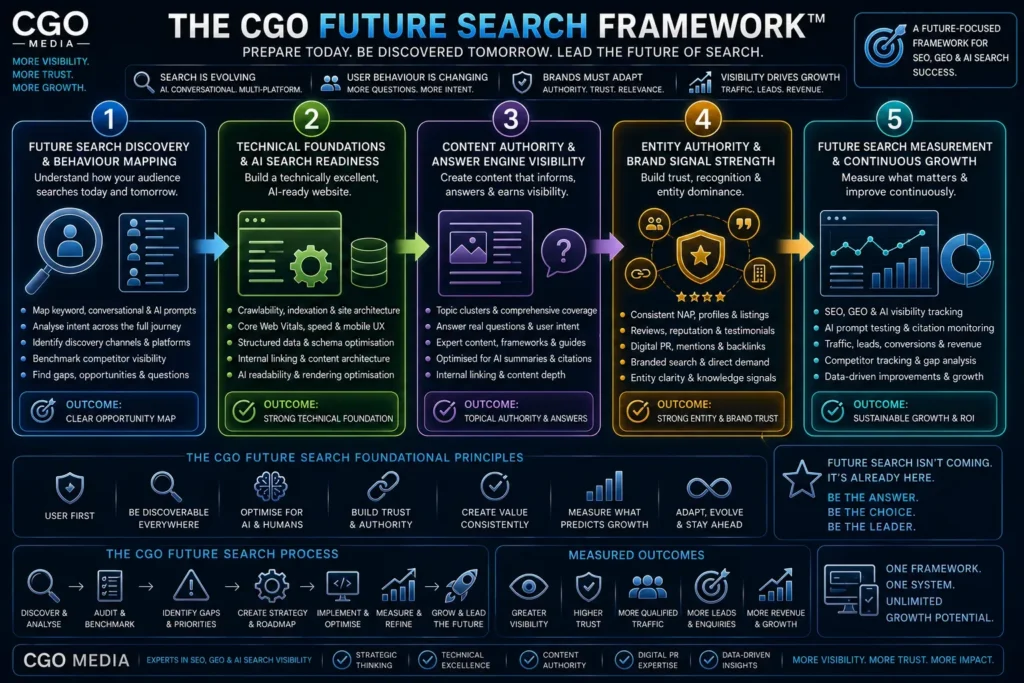
The CGO Search Visibility Score Methodology shows how CGO Media measures search visibility across SEO, GEO, AI search, content authority, technical health and brand signals.
Introduction to the CGO Search Visibility Score Methodology
Modern search visibility can no longer be measured using rankings alone. Organisations today are discovered through traditional search engines, AI-powered search platforms, Google AI Overviews, conversational assistants, local search, digital PR, social media, Knowledge Graphs and numerous other digital touchpoints. Measuring only keyword positions provides an incomplete understanding of how visible a business truly is.
The CGO Search Visibility Score Methodology provides a comprehensive framework for measuring an organisation’s overall digital visibility across the modern search ecosystem. Rather than focusing solely on SEO performance, the methodology evaluates the combined strength of technical infrastructure, Content Authority, Entity Authority, Brand Authority, AI visibility, customer trust and commercial performance to produce a holistic assessment of search maturity.
This methodology supports executive decision-making by identifying strengths, weaknesses and investment priorities while enabling organisations to benchmark progress over time. As search increasingly becomes AI-driven, businesses require broader visibility metrics that reflect how search engines and intelligent systems understand, trust and recommend their digital presence. Modern search visibility is increasingly measured through multiple trust and authority signals rather than rankings alone.
Search Visibility Score Definition
The CGO Search Visibility Score is a strategic measurement framework that evaluates the overall strength of an organisation’s digital visibility by combining technical performance, authority signals, AI readiness, semantic understanding, customer trust and commercial outcomes into one integrated performance model.
Why Traditional Visibility Metrics Are No Longer Enough
Traditional SEO reporting focuses heavily on rankings, impressions and organic traffic. While these metrics remain valuable, they fail to measure many of the factors that influence modern search performance.
A comprehensive visibility methodology should evaluate:
- Technical health.
- Content Authority.
- Entity Authority.
- Brand Authority.
- Knowledge Graph development.
- AI citation visibility.
- Customer trust.
- Commercial performance.
By measuring these interconnected capabilities together, organisations gain a far more accurate understanding of their long-term digital competitiveness. Modern AI visibility methodologies increasingly combine technical, authority and external trust signals rather than relying on ranking data alone.
Visibility Principle
Search visibility should measure how effectively an organisation is understood, trusted and recommended across the complete digital ecosystem rather than how highly individual pages rank for selected keywords.
The Core Components of the Search Visibility Score
The CGO methodology evaluates multiple strategic dimensions that collectively determine digital visibility.
| Visibility Component | Primary Purpose | Strategic Contribution |
|---|---|---|
| ⚙️ Technical Performance | Evaluate digital infrastructure quality. | Supports discoverability. |
| 📚 Content Authority | Measure trusted knowledge development. | Strengthens expertise. |
| 🏢 Entity Authority | Assess semantic organisational identity. | Improves AI understanding. |
| ⭐ Brand Authority | Evaluate trust and reputation. | Builds recommendation confidence. |
| 🤖 AI Visibility | Measure citation and conversational search performance. | Supports future readiness. |
| 📈 Commercial Performance | Assess business outcomes. | Demonstrates strategic value. |
The Search Visibility Score measures the overall health of an organisation’s digital ecosystem rather than isolated marketing metrics.
From SEO Reporting to Executive Visibility Measurement
The CGO Search Visibility Score Methodology transforms reporting from an operational SEO activity into an executive business framework. Leadership teams require visibility metrics that explain not only how the website performs today but also how effectively the organisation is positioned for future AI-powered search environments.
By combining technical quality, trusted knowledge, semantic authority, customer trust and AI readiness into one measurement model, organisations gain a strategic view of their long-term digital competitiveness.
Executive Measurement Principle
The most valuable visibility metrics are those that guide long-term strategic investment rather than simply reporting historical search performance.
The Search Visibility Score as a Strategic Business Asset
Visibility measurement should become a continuous organisational capability rather than a monthly SEO report. Businesses that consistently measure and strengthen every element of their digital ecosystem will be significantly better positioned as search continues evolving towards conversational AI, intelligent recommendations and autonomous digital discovery.
The CGO Search Visibility Score Methodology provides organisations with a structured way to measure, benchmark and continuously improve their complete digital authority across modern search.
Framework Vision
The objective of the CGO Search Visibility Score Methodology is to provide organisations with an executive measurement framework that supports continuous optimisation, stronger AI visibility and sustainable long-term commercial growth.
Part 2 explores the scoring architecture, weighting methodology, governance framework, executive KPIs and implementation principles that underpin the CGO Search Visibility Score.
Search Visibility Scoring Architecture
The CGO Search Visibility Score Methodology is designed to evaluate the complete digital ecosystem rather than isolated SEO metrics. The scoring architecture measures how effectively an organisation develops trusted digital authority across technical performance, content quality, semantic identity, brand reputation, artificial intelligence visibility and commercial performance.
Rather than assigning equal importance to every metric, the methodology groups related indicators into strategic pillars that collectively determine the organisation’s overall Search Visibility Score. This balanced approach provides executives with a realistic representation of digital maturity while identifying the areas that require strategic investment.
Scoring Principle
Search visibility should be measured as the combined strength of interconnected authority signals rather than individual optimisation metrics.
Strategic Visibility Categories
| Visibility Category | Primary Focus | Strategic Contribution |
|---|---|---|
| ⚙️ Technical Excellence | Infrastructure, crawlability and performance. | Supports discoverability. |
| 📚 Knowledge Authority | Content quality, expertise and topical coverage. | Strengthens trust. |
| 🕸️ Semantic Authority | Entity relationships and Knowledge Graph development. | Improves AI understanding. |
| ⭐ Brand & Reputation | Customer trust, reviews and recognition. | Builds recommendation confidence. |
| 🤖 AI Visibility | Citations, conversational search and recommendation presence. | Supports future readiness. |
| 📈 Business Performance | Leads, conversions and commercial outcomes. | Measures strategic value. |
Every strategic category contributes to a unified Search Visibility Score that reflects overall digital authority rather than isolated channel performance.
Weighted Measurement Methodology
Each category contributes proportionally to the overall Search Visibility Score according to its long-term strategic importance. Organisations may adjust weighting based on business objectives, but the methodology recommends maintaining balanced representation across technical quality, authority development, AI readiness and commercial impact.
| Measurement Area | Suggested Weight | Strategic Rationale |
|---|---|---|
| ⚙️ Technical Excellence | 20% | Provides the digital foundation. |
| 📚 Knowledge Authority | 20% | Demonstrates expertise and trust. |
| 🕸️ Semantic Authority | 15% | Strengthens AI interpretation. |
| ⭐ Brand & Reputation | 15% | Builds recommendation confidence. |
| 🤖 AI Visibility | 15% | Measures future search readiness. |
| 📈 Business Performance | 15% | Connects visibility with commercial value. |
These percentages should serve as strategic guidance rather than rigid scoring rules. Organisations operating in specialist industries or highly competitive international markets may adapt weighting to reflect their commercial priorities while maintaining a balanced evaluation of the overall ecosystem.
Balanced Measurement Principle
Search Visibility Scores are most valuable when technical excellence, authority development, AI readiness and commercial performance are evaluated together.
Benchmarking Organisational Visibility
The methodology enables organisations to benchmark visibility against historical performance, industry competitors, regional markets and international operations. Executive teams should use benchmarking to identify strategic opportunities rather than focusing exclusively on numerical scores.
Continuous benchmarking supports investment decisions by highlighting which capabilities deliver the greatest long-term improvements in digital authority and commercial growth.
Benchmarking transforms Search Visibility Scores into actionable business intelligence that supports continuous improvement.
Preparing for Enterprise Measurement
The remaining sections of the CGO Search Visibility Score Methodology explore governance, executive KPIs, maturity models, implementation frameworks and reporting methodologies that enable organisations to integrate Search Visibility Scores into enterprise performance management.
By combining strategic measurement with continuous optimisation, businesses develop reliable visibility intelligence that supports traditional SEO, AI Search, digital transformation and long-term organisational competitiveness.
Section 1 Executive Summary
This section establishes the scoring architecture of the CGO Search Visibility Score Methodology by introducing its strategic categories, balanced weighting model and benchmarking approach. Together these elements create a comprehensive framework for measuring digital authority across traditional search engines, AI-powered discovery platforms and future intelligent search ecosystems.
Technical Visibility Assessment and Infrastructure Scoring
Technical excellence provides the foundation of every Search Visibility Score. Regardless of how authoritative an organisation becomes, search engines and artificial intelligence cannot fully evaluate or recommend digital assets unless they are technically accessible, semantically structured and consistently maintained. The Technical Visibility Assessment measures the quality of an organisation’s infrastructure and its ability to support long-term discoverability across both traditional and AI-powered search environments.
The CGO Search Visibility Score Methodology treats technical performance as more than website speed or indexing. It evaluates the complete technical ecosystem, including architecture, structured data, semantic HTML, Core Web Vitals, crawlability, accessibility, internal linking and scalability. Collectively these elements determine how efficiently search engines and intelligent systems interpret organisational knowledge.
As search technologies continue evolving, technically mature organisations gain increasing advantages because artificial intelligence relies heavily on structured, machine-readable and well-organised digital environments.
Technical Visibility Definition
Technical Visibility measures the ability of an organisation’s digital infrastructure to support efficient discovery, semantic interpretation and trusted indexing by search engines, Knowledge Graphs and artificial intelligence platforms.
Why Technical Visibility Matters
Technical quality directly influences the effectiveness of every other authority signal measured within the Search Visibility Score.
Strong technical visibility improves:
- Search engine crawl efficiency.
- Indexing accuracy.
- Semantic interpretation.
- Structured data quality.
- Core Web Vitals performance.
- AI understanding.
- User experience.
- Long-term search resilience.
These capabilities establish the technical foundations upon which Content Authority, Entity Authority, Brand Authority and AI visibility are built.
Technical Visibility Principle
Every point of digital authority depends upon technical infrastructure that allows search engines and artificial intelligence to understand organisational knowledge accurately.
The Core Components of Technical Visibility
The methodology evaluates multiple technical capabilities that collectively determine infrastructure quality.
| Technical Component | Primary Purpose | Visibility Contribution |
|---|---|---|
| 🏗️ Website Architecture | Provide logical site structure. | Improves discoverability. |
| 📄 Semantic HTML | Create meaningful page hierarchy. | Strengthens AI interpretation. |
| 🧩 Structured Data | Deliver machine-readable information. | Supports semantic visibility. |
| ⚡ Core Web Vitals | Optimise speed and user experience. | Improves performance. |
| 🔗 Internal Linking | Connect related knowledge assets. | Strengthens contextual authority. |
| 🛡️ Technical Governance | Maintain infrastructure quality over time. | Supports sustainable visibility. |
Technical Visibility measures how effectively digital infrastructure enables trusted discovery across search engines and AI-powered search platforms.
Scoring Technical Infrastructure
The Technical Visibility Assessment evaluates infrastructure quality using measurable indicators that reflect both present performance and future AI readiness. Rather than rewarding isolated optimisation activities, the methodology assesses how consistently technical excellence is maintained across the complete digital ecosystem.
This scoring approach enables organisations to identify structural weaknesses that may limit the effectiveness of broader authority-building initiatives.
Infrastructure Assessment Principle
Technical visibility should be measured according to how effectively digital infrastructure supports long-term authority rather than isolated technical metrics.
Technical Visibility as a Strategic Asset
Technical infrastructure should be viewed as a strategic investment that continuously supports discoverability, AI understanding and organisational growth. Businesses that maintain technically mature ecosystems provide stronger foundations for every future search innovation while reducing operational risk as digital platforms evolve.
Technical Visibility provides the engineering foundation upon which the complete CGO Search Visibility Score is built.
Framework Vision
The objective of the Technical Visibility Assessment is to provide organisations with a structured methodology for measuring infrastructure quality, strengthening discoverability and supporting sustainable long-term digital authority across traditional search and AI-powered discovery.
Part 2 explores technical scoring criteria, governance, executive KPIs, maturity models and implementation methodologies used to evaluate Technical Visibility within the overall Search Visibility Score.
Technical Visibility Governance
Technical Visibility requires structured governance to ensure digital infrastructure remains scalable, secure and optimised for both traditional search engines and AI-powered discovery. As websites evolve through new content, services, technologies and international expansion, governance maintains technical consistency while protecting the long-term integrity of the Search Visibility Score.
The CGO Search Visibility Score Methodology recommends documented governance covering website architecture, structured data, semantic HTML, Core Web Vitals, crawlability, accessibility, internal linking, technical quality assurance and continuous infrastructure improvement.
Technical Governance Principle
Technical Visibility improves most effectively when infrastructure is governed through continuous quality management rather than reactive optimisation.
Technical Visibility Assessment Framework
| Assessment Area | Primary Purpose | Visibility Benefit |
|---|---|---|
| 🏗️ Website Architecture | Evaluate structural organisation. | Improves discoverability. |
| 🧩 Structured Data Quality | Measure semantic markup implementation. | Strengthens AI understanding. |
| 📄 Semantic HTML | Assess page hierarchy and accessibility. | Supports machine interpretation. |
| ⚡ Core Web Vitals | Evaluate speed, responsiveness and stability. | Improves user experience. |
| 🔗 Internal Linking Structure | Measure contextual knowledge connections. | Strengthens authority flow. |
| 🛡️ Technical Governance | Assess long-term infrastructure management. | Supports sustainable visibility. |
Governed Technical Visibility creates reliable digital foundations that improve search performance, AI interpretation and long-term organisational resilience.
Technical Visibility KPIs
Executive reporting should evaluate technical performance using strategic indicators that reflect infrastructure quality rather than isolated engineering metrics.
| KPI | Purpose | Strategic Value |
|---|---|---|
| ⚙️ Technical Visibility Score | Measure overall infrastructure quality. | Supports executive planning. |
| 🧩 Structured Data Coverage | Evaluate semantic implementation. | Improves AI visibility. |
| ⚡ Core Web Vitals Index | Monitor performance and user experience. | Strengthens technical quality. |
| 🕷️ Crawl Efficiency Score | Assess discoverability by search engines. | Improves indexing. |
| 📋 Technical Compliance Rate | Measure adherence to enterprise standards. | Maintains consistency. |
| 🤖 Infrastructure Readiness Index | Evaluate preparedness for AI-powered search. | Supports future resilience. |
Measurement Principle
Technical Visibility should be evaluated according to how effectively infrastructure enables trusted discovery, semantic understanding and sustainable digital growth.
Technical Visibility Maturity Model
| Maturity Level | Characteristics | Strategic Outcome |
|---|---|---|
| 🏗️ Level 1 – Basic Infrastructure | Core website functionality with limited optimisation. | Foundational visibility. |
| ⚙️ Level 2 – Structured Technical Platform | Consistent architecture, semantic markup and performance optimisation. | Improved discoverability. |
| 🤖 Level 3 – AI-Ready Infrastructure | Integrated structured data, semantic architecture and governance. | Growing competitive advantage. |
| 🏢 Level 4 – Enterprise Technical Excellence | Advanced governance, predictive monitoring and continuous optimisation. | High operational resilience. |
| 🌍 Level 5 – Global Technical Visibility Leader | International best-practice infrastructure consistently supporting search engines, Knowledge Graphs and AI-powered discovery platforms. | Sustainable long-term leadership. |
Common Technical Visibility Weaknesses
Many organisations continue investing in content and marketing while overlooking the infrastructure required to maximise long-term search visibility.
Common weaknesses include:
- Weak website architecture.
- Incomplete structured data implementation.
- Poor Core Web Vitals performance.
- Limited semantic HTML.
- Weak crawlability and indexing.
- Fragmented internal linking.
- Limited technical governance.
- Reactive maintenance processes.
- Weak AI readiness.
- Short-term infrastructure planning.
Addressing these weaknesses strengthens Technical Visibility Scores while improving AI understanding, search performance and long-term organisational competitiveness.
Technical Visibility becomes a lasting competitive advantage when engineering excellence consistently supports every other authority signal within the Search Visibility Score.
Technical Visibility Implementation Methodology
The methodology recommends improving Technical Visibility through a structured programme.
- Audit technical infrastructure.
- Define enterprise technical standards.
- Strengthen website architecture and semantic HTML.
- Expand structured data implementation.
- Optimise Core Web Vitals and crawlability.
- Monitor Technical Visibility KPIs.
- Conduct recurring infrastructure audits.
- Evaluate AI readiness.
- Maintain governance standards.
- Continuously strengthen technical foundations across the digital ecosystem.
Section 2 Executive Summary
Technical Visibility provides the engineering foundation of the CGO Search Visibility Score Methodology by evaluating the quality, scalability and AI readiness of an organisation’s digital infrastructure. Through structured governance, technical measurement, semantic optimisation, continuous monitoring and long-term investment, organisations strengthen discoverability, improve search performance and build resilient digital ecosystems capable of supporting sustainable commercial growth.
Content Visibility Assessment and Knowledge Authority Scoring
High search visibility depends not only on technical excellence but also on the depth, quality and trustworthiness of an organisation’s knowledge. As search engines and artificial intelligence increasingly evaluate expertise rather than simply matching keywords, Content Authority has become one of the most influential components of overall digital visibility. The Content Visibility Assessment measures how effectively an organisation develops, structures and maintains trusted knowledge across its digital ecosystem.
The CGO Search Visibility Score Methodology evaluates content as a strategic organisational asset rather than a collection of webpages. Research papers, educational guides, case studies, frameworks, original statistics, methodologies and topical clusters collectively demonstrate expertise and provide the knowledge signals that strengthen both traditional search visibility and AI recommendations.
Businesses that consistently publish authoritative knowledge improve not only organic performance but also semantic relevance, customer trust, Entity Authority and citation opportunities across conversational AI platforms.
Content Visibility Definition
Content Visibility measures the strength, quality and authority of an organisation’s knowledge assets and evaluates how effectively they contribute to search visibility, AI understanding, customer trust and long-term digital competitiveness.
Why Content Visibility Matters
Modern search increasingly rewards organisations that contribute valuable knowledge rather than producing content primarily for keyword rankings.
Strong Content Visibility improves:
- Topical expertise.
- Search relevance.
- AI citation opportunities.
- Customer education.
- Entity Authority.
- Knowledge Graph development.
- Brand credibility.
- Long-term search resilience.
These capabilities strengthen the overall Search Visibility Score by increasing the quantity and quality of trusted organisational knowledge available across the digital ecosystem.
Knowledge Visibility Principle
Search visibility increases when organisations continuously expand trusted knowledge that genuinely helps customers and strengthens semantic authority.
The Core Components of Content Visibility
The methodology evaluates several strategic knowledge capabilities that collectively determine Content Visibility.
| Content Component | Primary Purpose | Visibility Contribution |
|---|---|---|
| 🔬 Original Research | Create unique organisational knowledge. | Supports AI citations. |
| 📚 Educational Content | Answer customer questions comprehensively. | Builds trust. |
| 🗂️ Topical Coverage | Develop expertise across core subjects. | Strengthens semantic relevance. |
| 👤 Expert Contributions | Demonstrate identifiable authority. | Improves credibility. |
| 🏛️ Content Architecture | Organise knowledge logically. | Supports discoverability. |
| 🛡️ Content Governance | Maintain quality and consistency. | Supports sustainable visibility. |
Content Visibility measures how effectively organisational knowledge strengthens search authority, AI understanding and customer confidence.
Scoring Knowledge Authority
The Content Visibility Assessment evaluates the quality, originality, semantic depth and strategic organisation of knowledge assets. Rather than rewarding publishing volume, the methodology measures how effectively content contributes to trusted authority across the complete search ecosystem.
This approach enables organisations to identify gaps in expertise while prioritising investment in knowledge assets that generate long-term commercial value.
Knowledge Assessment Principle
Content should be measured according to the authority it creates rather than the quantity that is published.
Content Visibility as a Strategic Business Asset
Knowledge assets appreciate over time as additional research, frameworks, case studies and educational resources strengthen the organisation’s authority. Businesses that continuously invest in trusted knowledge create increasingly valuable digital ecosystems capable of supporting traditional SEO, AI Search and future intelligent discovery.
Content Visibility provides the knowledge foundation that strengthens every component of the CGO Search Visibility Score Methodology.
Framework Vision
The objective of the Content Visibility Assessment is to provide organisations with a structured methodology for measuring knowledge authority, improving AI visibility and supporting sustainable long-term digital growth.
Part 2 explores content scoring criteria, governance, executive KPIs, maturity models and implementation methodologies used to evaluate Content Visibility within the overall Search Visibility Score.
Content Visibility Governance
Content Visibility requires structured governance to ensure every knowledge asset contributes to organisational authority, customer value and long-term search visibility. As content libraries expand across multiple subjects, formats and international markets, governance maintains editorial quality, semantic consistency and strategic alignment while improving the overall Search Visibility Score.
The CGO Search Visibility Score Methodology recommends documented governance covering editorial standards, topical planning, expert review, semantic architecture, content lifecycle management, AI readiness, performance reporting and continuous knowledge development.
Content Governance Principle
Content Visibility grows strongest when every publication contributes to one governed ecosystem of trusted organisational knowledge.
Content Visibility Assessment Framework
| Assessment Area | Primary Purpose | Visibility Benefit |
|---|---|---|
| 📚 Knowledge Quality | Evaluate originality, accuracy and expertise. | Strengthens authority. |
| 🗂️ Topical Coverage | Measure subject depth and completeness. | Improves semantic relevance. |
| 📝 Editorial Governance | Maintain consistent publishing standards. | Builds trust. |
| 🕸️ Semantic Architecture | Assess relationships between knowledge assets. | Supports AI understanding. |
| 🔄 Content Freshness | Evaluate review and update processes. | Maintains long-term relevance. |
| 📈 Knowledge Expansion | Measure continuous growth of organisational expertise. | Supports sustainable visibility. |
Governed Content Visibility enables organisations to transform knowledge into measurable digital authority across search engines and AI-powered discovery.
Content Visibility KPIs
Executive reporting should evaluate knowledge quality, authority and commercial contribution rather than content volume alone.
| KPI | Purpose | Strategic Value |
|---|---|---|
| 📚 Content Visibility Score | Measure overall knowledge authority. | Supports executive planning. |
| 🗂️ Topical Coverage Index | Evaluate subject depth and completeness. | Strengthens semantic authority. |
| 🔄 Knowledge Freshness Score | Track review and update frequency. | Maintains relevance. |
| 🤖 AI Citation Rate | Measure references across AI-generated responses. | Improves AI visibility. |
| 📈 Content Engagement Index | Assess user interaction with knowledge assets. | Builds customer trust. |
| 💼 Commercial Knowledge Contribution | Measure the influence of content on enquiries, leads and revenue. | Demonstrates business value. |
Measurement Principle
Content Visibility should be evaluated according to how effectively trusted knowledge strengthens search authority, AI understanding and sustainable commercial performance.
Content Visibility Maturity Model
| Maturity Level | Characteristics | Strategic Outcome |
|---|---|---|
| 📚 Level 1 – Basic Content Library | Limited knowledge assets with minimal strategic planning. | Foundational visibility. |
| 📝 Level 2 – Structured Knowledge Base | Editorial governance, topical planning and consistent publishing. | Improved authority. |
| 🕸️ Level 3 – Connected Knowledge Ecosystem | Integrated topical clusters, expert content and semantic architecture. | Growing competitive advantage. |
| 🏆 Level 4 – Industry Knowledge Leader | Advanced governance, original research and continuous optimisation. | High market credibility. |
| 🌍 Level 5 – Global Content Visibility Authority | Internationally recognised organisation consistently cited, trusted and recommended across search engines, AI platforms and industry publications. | Sustainable long-term leadership. |
Common Content Visibility Weaknesses
Many organisations produce significant amounts of content without building the knowledge ecosystem required to maximise Search Visibility.
Common weaknesses include:
- Keyword-focused publishing.
- Weak topical depth.
- Limited original research.
- Inconsistent editorial standards.
- Outdated content.
- Poor semantic relationships.
- Limited expert involvement.
- Weak AI optimisation.
- Reactive publishing strategy.
- Minimal governance.
Addressing these weaknesses enables organisations to strengthen Content Visibility Scores while improving AI citations, customer trust and long-term search competitiveness.
Content Visibility becomes a sustainable competitive advantage when every knowledge asset strengthens the organisation’s collective authority rather than existing as an isolated publication.
Content Visibility Implementation Methodology
The methodology recommends improving Content Visibility through a structured programme.
- Audit existing knowledge assets.
- Define editorial governance standards.
- Develop comprehensive topical clusters.
- Create original research and expert resources.
- Strengthen semantic relationships across content.
- Monitor Content Visibility KPIs.
- Conduct recurring content reviews.
- Evaluate AI citation performance.
- Maintain governance standards.
- Continuously expand the organisation’s trusted knowledge ecosystem.
Section 3 Executive Summary
Content Visibility provides the knowledge dimension of the CGO Search Visibility Score Methodology by measuring the quality, authority and strategic value of organisational expertise. Through governance, original research, semantic architecture, executive KPIs, continuous optimisation and AI readiness, organisations strengthen search visibility, improve recommendation confidence and build resilient knowledge ecosystems that support sustainable long-term commercial growth.
Entity Visibility Assessment and Semantic Authority Scoring
Modern search engines and artificial intelligence no longer evaluate websites solely through pages and keywords. They increasingly interpret organisations as identifiable entities connected to people, products, services, locations and trusted knowledge. The Entity Visibility Assessment measures how effectively an organisation establishes a clear semantic identity that can be understood, verified and confidently recommended across the modern search ecosystem.
The CGO Search Visibility Score Methodology positions Entity Visibility as one of the core dimensions of overall digital authority. A strong organisational entity improves Knowledge Graph recognition, strengthens AI interpretation and creates greater confidence across search engines, conversational AI platforms and intelligent recommendation systems.
Businesses with mature Entity Authority develop consistent identities across every digital platform, enabling search technologies to connect information accurately while reducing ambiguity. This semantic clarity becomes increasingly valuable as AI-powered search continues replacing traditional keyword-based retrieval.
Entity Visibility Definition
Entity Visibility measures how effectively an organisation establishes a trusted, consistent and semantically connected digital identity that can be recognised, interpreted and recommended across search engines, Knowledge Graphs and artificial intelligence platforms.
Why Entity Visibility Matters
Search visibility increasingly depends upon trusted semantic understanding rather than isolated optimisation activities.
Strong Entity Visibility improves:
- Knowledge Graph recognition.
- AI understanding.
- Semantic consistency.
- Brand credibility.
- Author authority.
- Contextual relevance.
- Recommendation confidence.
- Long-term digital resilience.
These capabilities strengthen multiple components of the Search Visibility Score by helping intelligent systems accurately identify and connect organisational information.
Semantic Visibility Principle
Search visibility increases when every digital asset consistently reinforces one trusted organisational identity.
The Core Components of Entity Visibility
The methodology evaluates several semantic capabilities that collectively determine Entity Visibility.
| Entity Component | Primary Purpose | Visibility Contribution |
|---|---|---|
| 🏢 Organisational Identity | Maintain consistent business representation. | Improves recognition. |
| 🕸️ Knowledge Graph Relationships | Connect entities through semantic links. | Strengthens AI understanding. |
| 👤 Author Authority | Demonstrate identifiable expertise. | Builds credibility. |
| 🧩 Structured Data | Provide machine-readable entity information. | Supports semantic interpretation. |
| 🌐 Cross-Platform Consistency | Maintain unified organisational identity. | Improves trust. |
| 🛡️ Entity Governance | Manage long-term semantic development. | Supports sustainable visibility. |
Entity Visibility measures how effectively semantic identity strengthens search authority, AI understanding and long-term digital trust.
Scoring Semantic Authority
The Entity Visibility Assessment evaluates the quality, completeness and consistency of organisational identity across the complete digital ecosystem. Rather than measuring isolated entity signals, the methodology assesses how effectively semantic relationships reinforce one coherent and trusted organisational presence.
This approach enables organisations to identify inconsistencies that may reduce AI confidence while prioritising strategic improvements that strengthen semantic authority over time.
Semantic Assessment Principle
Entity Visibility should be measured according to the strength and consistency of organisational identity across every digital touchpoint.
Entity Visibility as a Strategic Business Asset
Semantic identity becomes increasingly valuable as organisations publish more content, expand internationally and strengthen their digital ecosystems. Every verified relationship, structured entity, expert profile and Knowledge Graph connection contributes to a stronger Entity Visibility Score while improving the organisation’s readiness for AI-powered search.
Entity Visibility provides the semantic foundation that enables search engines and artificial intelligence to understand and recommend organisations with greater confidence.
Framework Vision
The objective of the Entity Visibility Assessment is to provide organisations with a structured methodology for measuring semantic authority, strengthening AI understanding and supporting sustainable long-term search visibility.
Part 2 explores entity scoring criteria, governance, executive KPIs, maturity models and implementation methodologies used to evaluate Entity Visibility within the overall Search Visibility Score.
Entity Visibility Governance
Entity Visibility requires structured governance to ensure organisational identity remains accurate, trusted and semantically consistent across every digital platform. As organisations expand their websites, publish new knowledge assets, develop products and enter international markets, governance protects semantic integrity while strengthening the overall Search Visibility Score.
The CGO Search Visibility Score Methodology recommends documented governance covering organisational identity, Knowledge Graph development, structured data, expert attribution, digital profiles, semantic relationships, AI readiness, executive oversight and continuous entity development.
Entity Governance Principle
Entity Visibility increases when every digital representation of an organisation reinforces one consistent semantic identity across the complete search ecosystem.
Entity Visibility Assessment Framework
| Assessment Area | Primary Purpose | Visibility Benefit |
|---|---|---|
| 🏢 Organisational Identity | Evaluate consistency of business representation. | Strengthens recognition. |
| 🕸️ Knowledge Graph Relationships | Assess connected semantic entities. | Improves AI understanding. |
| 🧩 Structured Data Quality | Measure machine-readable entity information. | Supports semantic interpretation. |
| 👤 Author Attribution | Evaluate identifiable expertise. | Builds trust. |
| 🌐 Cross-Platform Consistency | Assess identity across websites and digital platforms. | Strengthens credibility. |
| 🛡️ Entity Governance | Evaluate long-term semantic management. | Supports sustainable visibility. |
Governed Entity Visibility enables organisations to build trusted semantic identities recognised consistently by search engines, Knowledge Graphs and AI platforms.
Entity Visibility KPIs
Executive reporting should evaluate semantic authority, organisational consistency and AI recognition using measurable business indicators.
| KPI | Purpose | Strategic Value |
|---|---|---|
| 🏢 Entity Visibility Score | Measure overall semantic authority. | Supports executive planning. |
| 🕸️ Knowledge Graph Coverage | Evaluate connected organisational entities. | Improves AI understanding. |
| 🌐 Identity Consistency Index | Assess representation across digital properties. | Strengthens trust. |
| 🔗 Entity Relationship Density | Measure semantic connections between business assets. | Supports contextual authority. |
| 👤 Author Authority Rate | Track expert attribution across knowledge assets. | Builds credibility. |
| 🤖 AI Entity Recognition Score | Evaluate organisational understanding within AI-powered search. | Supports future competitiveness. |
Measurement Principle
Entity Visibility should be evaluated according to how effectively semantic identity improves search understanding, AI recognition and long-term organisational authority.
Entity Visibility Maturity Model
| Maturity Level | Characteristics | Strategic Outcome |
|---|---|---|
| 🏢 Level 1 – Basic Entity Presence | Limited semantic identity with inconsistent organisational representation. | Foundational recognition. |
| 🧩 Level 2 – Structured Organisational Entity | Consistent identity, structured data and documented entity standards. | Improved semantic clarity. |
| 🕸️ Level 3 – Connected Semantic Ecosystem | Integrated Knowledge Graph relationships, expert attribution and AI-ready entity architecture. | Growing competitive advantage. |
| 🏛️ Level 4 – Enterprise Entity Authority | Advanced governance, continuous semantic optimisation and enterprise entity management. | High organisational credibility. |
| 🌍 Level 5 – Global Entity Visibility Leader | Internationally recognised organisation consistently understood, trusted and recommended across search engines, Knowledge Graphs and AI-powered discovery platforms. | Sustainable long-term leadership. |
Common Entity Visibility Weaknesses
Many organisations continue managing websites, author profiles, business listings and digital properties independently, reducing semantic consistency and limiting the ability of search engines and AI systems to accurately understand organisational identity.
Common weaknesses include:
- Inconsistent organisational identity.
- Weak Knowledge Graph relationships.
- Incomplete structured data implementation.
- Limited expert attribution.
- Fragmented digital profiles.
- Poor semantic consistency.
- Weak governance.
- Reactive entity management.
- Limited AI readiness.
- Short-term identity planning.
Addressing these weaknesses enables organisations to strengthen Entity Visibility Scores while improving AI understanding, recommendation confidence and long-term search competitiveness.
Entity Visibility becomes a sustainable competitive advantage when every digital relationship strengthens one trusted organisational identity.
Entity Visibility Implementation Methodology
The methodology recommends improving Entity Visibility through a structured programme.
- Audit organisational identity across digital platforms.
- Define enterprise entity governance standards.
- Strengthen Knowledge Graph relationships.
- Expand structured data implementation.
- Develop identifiable expert profiles.
- Monitor Entity Visibility KPIs.
- Conduct recurring semantic audits.
- Evaluate AI entity recognition.
- Maintain governance standards.
- Continuously strengthen semantic authority across the digital ecosystem.
Section 4 Executive Summary
Entity Visibility provides the semantic authority dimension of the CGO Search Visibility Score Methodology by measuring how effectively an organisation develops a trusted and consistent digital identity. Through structured governance, Knowledge Graph development, semantic relationships, expert attribution, executive KPIs and continuous optimisation, organisations improve AI understanding, strengthen search visibility and build resilient digital ecosystems that support sustainable long-term commercial growth.
Brand Visibility Assessment and Trust Signal Scoring
Brand visibility extends far beyond how frequently an organisation appears in search results. Modern search engines and artificial intelligence evaluate whether a business is recognised, trusted and consistently referenced across the wider digital ecosystem. Customer reviews, media coverage, expert recognition, digital PR, social proof and industry reputation all influence how confidently search technologies recommend an organisation.
The CGO Search Visibility Score Methodology positions Brand Visibility as the trust dimension of overall digital authority. While Technical Visibility ensures discoverability and Content Visibility demonstrates expertise, Brand Visibility measures the confidence that customers, search engines and AI systems place in the organisation itself. This trust increasingly determines long-term search performance as recommendation-driven discovery becomes more prevalent.
Businesses that continuously strengthen brand credibility create resilient visibility because trusted organisations are more likely to be referenced, cited and recommended across both traditional search engines and AI-powered conversational platforms.
Brand Visibility Definition
Brand Visibility measures the level of recognition, trust and reputation an organisation has established across the digital ecosystem and evaluates how effectively these signals strengthen search visibility, AI recommendations and long-term commercial performance.
Why Brand Visibility Matters
Search visibility increasingly reflects organisational trust rather than website performance alone.
Strong Brand Visibility improves:
- Customer confidence.
- Brand recognition.
- AI recommendation potential.
- Media credibility.
- Entity Authority.
- Commercial conversions.
- Knowledge Graph confidence.
- Long-term digital resilience.
These capabilities reinforce the overall Search Visibility Score by strengthening the trust signals that support intelligent recommendation systems and customer decision-making.
Brand Trust Principle
Search visibility increases when organisations consistently earn trust through expertise, customer experience and independent recognition.
The Core Components of Brand Visibility
The methodology evaluates several strategic trust capabilities that collectively determine Brand Visibility.
| Brand Component | Primary Purpose | Visibility Contribution |
|---|---|---|
| ⭐ Brand Recognition | Increase awareness across digital channels. | Strengthens visibility. |
| 💬 Customer Reputation | Measure reviews and customer trust. | Builds credibility. |
| 📰 Media Authority | Evaluate recognition by trusted publications. | Supports authority. |
| 🎓 Thought Leadership | Demonstrate expert industry knowledge. | Improves trust. |
| 🌐 Cross-Platform Consistency | Maintain a unified brand identity. | Strengthens semantic confidence. |
| 🛡️ Brand Governance | Protect long-term organisational reputation. | Supports sustainable visibility. |
Brand Visibility measures how effectively organisational trust strengthens digital authority across search engines, AI platforms and customer touchpoints.
Scoring Organisational Trust
The Brand Visibility Assessment evaluates the quality, consistency and influence of organisational reputation rather than simply measuring brand mentions. The methodology considers whether trust signals are authentic, sustainable and reinforced across multiple independent digital sources.
This strategic approach enables organisations to prioritise long-term reputation development while strengthening their overall Search Visibility Score.
Trust Assessment Principle
Brand Visibility should be measured according to the strength of organisational trust rather than the quantity of brand exposure.
Brand Visibility as a Strategic Business Asset
Brand reputation compounds over time as organisations deliver positive customer experiences, publish trusted knowledge and earn recognition from respected industry sources. These cumulative trust signals create increasingly resilient search visibility while strengthening recommendation confidence across future AI-powered discovery platforms.
Brand Visibility provides the trust foundation that enables every other component of the CGO Search Visibility Score Methodology to perform more effectively.
Framework Vision
The objective of the Brand Visibility Assessment is to provide organisations with a structured methodology for measuring trust, strengthening digital reputation and supporting sustainable long-term search visibility across the evolving search ecosystem.
Part 2 explores brand scoring criteria, governance, executive KPIs, maturity models and implementation methodologies used to evaluate Brand Visibility within the overall Search Visibility Score.
Brand Visibility Governance
Brand Visibility requires structured governance to ensure organisational trust is developed consistently across every digital channel and customer interaction. As businesses expand their online presence through websites, social media, digital PR, reviews, partnerships and international operations, governance protects brand integrity while strengthening the overall Search Visibility Score.
The CGO Search Visibility Score Methodology recommends documented governance covering brand identity, reputation management, customer experience, digital PR, review management, thought leadership, AI readiness, executive oversight and continuous brand development.
Brand Governance Principle
Brand Visibility grows strongest when every customer interaction and digital asset consistently reinforces organisational trust and credibility.
Brand Visibility Assessment Framework
| Assessment Area | Primary Purpose | Visibility Benefit |
|---|---|---|
| ⭐ Brand Recognition | Evaluate awareness across digital channels. | Strengthens visibility. |
| 💬 Customer Reputation | Assess reviews, ratings and customer satisfaction. | Builds trust. |
| 📰 Media Authority | Measure recognition by trusted publications. | Improves credibility. |
| 🎓 Thought Leadership | Evaluate expert contributions and industry influence. | Supports authority. |
| 🌐 Cross-Platform Consistency | Assess unified brand identity across digital properties. | Strengthens semantic confidence. |
| 🛡️ Brand Governance | Evaluate long-term reputation management. | Supports sustainable visibility. |
Governed Brand Visibility enables organisations to build enduring trust that strengthens search performance, AI recommendations and commercial growth.
Brand Visibility KPIs
Executive reporting should evaluate reputation, recognition and customer confidence using strategic business indicators.
| KPI | Purpose | Strategic Value |
|---|---|---|
| ⭐ Brand Visibility Score | Measure overall brand authority and recognition. | Supports executive planning. |
| 📣 Brand Mention Quality | Evaluate trusted references across digital channels. | Strengthens authority. |
| 🤝 Customer Trust Index | Measure reviews, ratings and satisfaction. | Builds commercial confidence. |
| 📰 Media Coverage Authority | Assess recognition from respected publications. | Improves credibility. |
| 🤖 AI Recommendation Confidence | Evaluate brand recognition within AI-powered search. | Supports future readiness. |
| 🛡️ Reputation Consistency Score | Measure brand consistency across digital platforms. | Maintains long-term trust. |
Measurement Principle
Brand Visibility should be evaluated according to how effectively trust, recognition and reputation strengthen sustainable search visibility and long-term business growth.
Brand Visibility Maturity Model
| Maturity Level | Characteristics | Strategic Outcome |
|---|---|---|
| ⭐ Level 1 – Basic Brand Presence | Limited brand recognition with inconsistent reputation management. | Foundational visibility. |
| 📈 Level 2 – Structured Brand Development | Consistent messaging, review management and brand standards. | Improved customer confidence. |
| 🌐 Level 3 – Trusted Brand Ecosystem | Integrated digital PR, thought leadership and reputation governance. | Growing competitive advantage. |
| 🏆 Level 4 – Industry Brand Leader | Advanced governance, recognised expertise and continuous reputation optimisation. | High market credibility. |
| 🌍 Level 5 – Global Brand Visibility Authority | Internationally recognised organisation consistently trusted, cited and recommended across search engines, AI platforms, industry media and customer communities. | Sustainable long-term leadership. |
Common Brand Visibility Weaknesses
Many organisations focus on increasing exposure while underinvesting in the trust signals that determine long-term digital authority.
Common weaknesses include:
- Inconsistent brand messaging.
- Weak reputation management.
- Limited thought leadership.
- Poor media visibility.
- Minimal customer engagement.
- Fragmented digital identity.
- Weak governance.
- Reactive reputation management.
- Limited AI recognition.
- Short-term branding initiatives.
Addressing these weaknesses enables organisations to strengthen Brand Visibility Scores while improving AI recommendation confidence, customer trust and sustainable search competitiveness.
Brand Visibility becomes a lasting competitive advantage when trust is continuously strengthened through expertise, consistency and exceptional customer experience.
Brand Visibility Implementation Methodology
The methodology recommends improving Brand Visibility through a structured programme.
- Audit brand reputation and recognition.
- Define enterprise brand governance standards.
- Strengthen customer trust initiatives.
- Expand digital PR and thought leadership programmes.
- Improve cross-platform brand consistency.
- Monitor Brand Visibility KPIs.
- Conduct recurring reputation assessments.
- Evaluate AI recommendation performance.
- Maintain governance standards.
- Continuously strengthen organisational trust across the digital ecosystem.
Section 5 Executive Summary
Brand Visibility provides the trust dimension of the CGO Search Visibility Score Methodology by measuring organisational reputation, customer confidence and digital recognition. Through structured governance, reputation management, executive KPIs, digital PR, thought leadership, AI readiness and continuous optimisation, organisations strengthen search visibility, improve recommendation confidence and build resilient brands capable of delivering sustainable long-term commercial growth.
AI Visibility Assessment and Generative Search Performance Scoring
Artificial intelligence is fundamentally changing how organisations are discovered online. Rather than presenting a list of webpages, AI-powered search platforms increasingly generate answers, recommend businesses and summarise trusted sources. Visibility therefore depends not only on whether an organisation ranks in search results but also on whether artificial intelligence recognises, cites and confidently recommends its knowledge.
The CGO Search Visibility Score Methodology introduces AI Visibility as a dedicated measurement category that evaluates how effectively an organisation performs within conversational search environments. This assessment considers AI citations, semantic clarity, structured knowledge, recommendation confidence and readiness for emerging AI-powered discovery systems. As generative search becomes increasingly influential, organisations require measurement frameworks that extend beyond traditional SEO reporting.
Businesses that invest in trusted knowledge, Entity Authority, structured data and semantic relationships consistently improve their ability to appear within AI-generated responses. These capabilities increasingly influence digital visibility as intelligent systems become primary gateways between organisations and customers.
AI Visibility Definition
AI Visibility measures how effectively an organisation is recognised, interpreted, cited and recommended by artificial intelligence platforms, conversational search systems and emerging intelligent discovery technologies.
Why AI Visibility Matters
AI-powered search increasingly rewards organisations with trusted, well-structured and semantically connected knowledge.
Strong AI Visibility improves:
- AI citations.
- Conversational search presence.
- Recommendation confidence.
- Semantic understanding.
- Knowledge Graph recognition.
- Entity Authority.
- Customer trust.
- Long-term digital resilience.
These capabilities strengthen the overall Search Visibility Score by measuring performance across the next generation of intelligent search environments rather than traditional search engines alone.
AI Visibility Principle
Search visibility increasingly depends upon how confidently artificial intelligence understands and recommends trusted organisational knowledge.
The Core Components of AI Visibility
The methodology evaluates several strategic capabilities that collectively determine AI Visibility.
| AI Component | Primary Purpose | Visibility Contribution |
|---|---|---|
| 🤖 AI Citation Performance | Measure references in AI-generated responses. | Strengthens discoverability. |
| 🧠 Semantic Readiness | Evaluate structured organisational knowledge. | Improves AI interpretation. |
| 🏢 Entity Authority | Assess recognised organisational identity. | Builds recommendation confidence. |
| 🕸️ Knowledge Graph Integration | Measure connected semantic relationships. | Supports intelligent discovery. |
| 💬 Conversational Content | Evaluate natural language knowledge assets. | Improves AI responses. |
| 🛡️ AI Governance | Maintain long-term optimisation standards. | Supports sustainable visibility. |
AI Visibility measures how effectively organisations participate within the growing ecosystem of conversational search and intelligent digital discovery.
Scoring AI Search Performance
The AI Visibility Assessment evaluates an organisation’s preparedness for generative search by measuring trust, semantic clarity, structured knowledge and recommendation potential. Rather than concentrating on individual AI platforms, the methodology assesses the broader capabilities that support visibility across evolving artificial intelligence ecosystems.
This strategic approach enables organisations to build sustainable AI visibility while reducing dependence on any single technology or platform.
AI Assessment Principle
AI Visibility should be measured according to how effectively trusted knowledge supports intelligent recommendation rather than individual search rankings.
AI Visibility as a Strategic Business Asset
As conversational AI continues transforming customer behaviour, organisations that invest in semantic authority and trusted knowledge will strengthen both present and future search performance. AI Visibility therefore becomes a strategic capability that complements Technical Visibility, Content Visibility, Entity Visibility and Brand Visibility within the overall Search Visibility Score.
AI Visibility provides the future-focused measurement layer that evaluates organisational readiness for the next generation of intelligent search.
Framework Vision
The objective of the AI Visibility Assessment is to provide organisations with a structured methodology for measuring AI search performance, strengthening recommendation confidence and supporting sustainable long-term digital visibility.
Part 2 explores AI scoring criteria, governance, executive KPIs, maturity models and implementation methodologies used to evaluate AI Visibility within the overall Search Visibility Score.
AI Visibility Governance
AI Visibility requires structured governance to ensure organisational knowledge remains accurate, trusted and optimised for artificial intelligence platforms. As conversational search, Large Language Models and intelligent recommendation systems continue evolving, governance enables organisations to strengthen semantic authority while maintaining consistency across the complete digital ecosystem.
The CGO Search Visibility Score Methodology recommends documented governance covering AI Search strategy, trusted knowledge management, Entity Authority, structured data, semantic architecture, AI performance reporting, executive oversight and continuous optimisation.
AI Governance Principle
AI Visibility improves most effectively when trusted knowledge is governed consistently across the entire digital ecosystem rather than optimised for individual AI platforms.
AI Visibility Assessment Framework
| Assessment Area | Primary Purpose | Visibility Benefit |
|---|---|---|
| 🤖 AI Citation Performance | Evaluate references within AI-generated responses. | Strengthens recommendation potential. |
| 🧠 Semantic Readiness | Assess structured organisational knowledge. | Improves AI interpretation. |
| 🏢 Entity Authority | Measure recognised organisational identity. | Builds recommendation confidence. |
| 🕸️ Knowledge Graph Integration | Evaluate semantic relationships across entities. | Supports intelligent discovery. |
| 💬 Conversational Content | Assess content designed for natural language queries. | Improves AI visibility. |
| 🛡️ AI Governance | Evaluate long-term AI optimisation strategy. | Supports sustainable visibility. |
Governed AI Visibility enables organisations to strengthen recommendation confidence across conversational search, AI assistants and future intelligent discovery platforms.
AI Visibility KPIs
Executive reporting should measure organisational performance across AI-powered search environments using strategic business indicators rather than traditional SEO metrics alone.
| KPI | Purpose | Strategic Value |
|---|---|---|
| 🤖 AI Visibility Score | Measure overall AI search performance. | Supports executive planning. |
| 📑 AI Citation Frequency | Track references across AI-generated answers. | Strengthens authority. |
| ⭐ Recommendation Confidence Index | Evaluate AI recommendation quality. | Improves competitiveness. |
| 🧠 Semantic Readiness Score | Assess machine-readable knowledge quality. | Supports AI understanding. |
| 💬 Conversational Search Coverage | Measure visibility for natural language queries. | Improves customer discovery. |
| 🚀 AI Readiness Index | Evaluate preparedness for future AI search technologies. | Builds long-term resilience. |
Measurement Principle
AI Visibility should be evaluated according to how effectively trusted knowledge, semantic clarity and organisational authority strengthen recommendation confidence across intelligent search ecosystems.
AI Visibility Maturity Model
| Maturity Level | Characteristics | Strategic Outcome |
|---|---|---|
| 🔍 Level 1 – Traditional Search Organisation | Limited AI optimisation with primary focus on conventional SEO. | Foundational AI readiness. |
| 🤖 Level 2 – AI-Aware Organisation | Structured semantic optimisation and emerging AI measurement. | Improved visibility. |
| 🧠 Level 3 – AI-Optimised Organisation | Integrated Entity Authority, structured data, Knowledge Graph development and AI governance. | Growing recommendation confidence. |
| 🏆 Level 4 – Intelligent Search Leader | Advanced governance, enterprise AI measurement and continuous optimisation. | High digital resilience. |
| 🌍 Level 5 – Global AI Visibility Authority | Internationally recognised organisation consistently cited, trusted and recommended across conversational AI, intelligent search platforms and future digital assistants. | Sustainable long-term leadership. |
Common AI Visibility Weaknesses
Many organisations continue optimising exclusively for traditional search engines while overlooking the semantic, technical and governance capabilities increasingly required for AI-powered discovery.
Common weaknesses include:
- Limited structured knowledge.
- Weak semantic architecture.
- Poor Entity Authority.
- Incomplete structured data.
- Minimal AI performance measurement.
- Weak conversational content.
- Limited Knowledge Graph development.
- Reactive AI adoption.
- Weak governance.
- Short-term optimisation strategies.
Addressing these weaknesses enables organisations to strengthen AI Visibility Scores while improving recommendation confidence, conversational search performance and long-term digital competitiveness.
AI Visibility becomes a sustainable competitive advantage when trusted knowledge, semantic authority and continuous governance evolve together.
AI Visibility Implementation Methodology
The methodology recommends improving AI Visibility through a structured programme.
- Audit organisational AI readiness.
- Define enterprise AI governance standards.
- Strengthen structured knowledge and semantic architecture.
- Expand Entity Authority and Knowledge Graph relationships.
- Create AI-friendly conversational content.
- Monitor AI Visibility KPIs.
- Conduct recurring AI visibility assessments.
- Evaluate recommendation performance across AI platforms.
- Maintain governance standards.
- Continuously strengthen organisational AI readiness and intelligent search performance.
Section 6 Executive Summary
AI Visibility provides the future-focused dimension of the CGO Search Visibility Score Methodology by measuring how effectively organisations perform across conversational AI, intelligent search platforms and emerging recommendation systems. Through structured governance, semantic optimisation, Entity Authority, executive KPIs, continuous measurement and AI readiness, organisations strengthen recommendation confidence, improve digital visibility and build resilient ecosystems capable of supporting sustainable long-term commercial growth.
Commercial Visibility Assessment and Business Impact Scoring
Search visibility only creates long-term business value when it contributes to measurable commercial outcomes. Rankings, impressions and traffic are important indicators, but they do not demonstrate whether an organisation is generating enquiries, acquiring customers or increasing revenue. The Commercial Visibility Assessment measures how effectively digital visibility translates into sustainable business growth.
The CGO Search Visibility Score Methodology positions Commercial Visibility as the business performance dimension of the overall framework. It evaluates how technical excellence, Content Visibility, Entity Visibility, Brand Visibility and AI Visibility combine to influence lead generation, conversions, customer acquisition, revenue growth and long-term return on investment.
As search ecosystems become increasingly sophisticated, executive leadership requires measurement frameworks that connect digital authority with commercial performance. This enables investment decisions to be based on measurable business outcomes rather than marketing activity alone.
Commercial Visibility Definition
Commercial Visibility measures how effectively an organisation’s digital authority generates measurable business outcomes by converting search visibility into enquiries, customers, revenue and sustainable commercial growth.
Why Commercial Visibility Matters
Strong search performance becomes strategically valuable only when it contributes to organisational success.
Effective Commercial Visibility improves:
- Lead generation.
- Customer acquisition.
- Conversion performance.
- Revenue growth.
- Marketing efficiency.
- Executive decision-making.
- Return on investment.
- Long-term business resilience.
These capabilities complete the Search Visibility Score by demonstrating the commercial value created through sustained investment in digital authority.
Commercial Visibility Principle
Search visibility achieves its greatest value when trusted digital authority consistently generates measurable commercial outcomes.
The Core Components of Commercial Visibility
The methodology evaluates several commercial capabilities that collectively determine business impact.
| Commercial Component | Primary Purpose | Visibility Contribution |
|---|---|---|
| 🎯 Lead Generation | Measure enquiry growth. | Supports revenue opportunities. |
| 📈 Conversion Performance | Evaluate customer acquisition efficiency. | Improves profitability. |
| 💷 Revenue Contribution | Assess financial impact. | Demonstrates business value. |
| 🤝 Customer Lifetime Value | Measure long-term commercial relationships. | Strengthens sustainable growth. |
| 💹 Return on Investment | Evaluate marketing effectiveness. | Supports executive planning. |
| 🛡️ Commercial Governance | Maintain strategic business measurement. | Supports long-term optimisation. |
Commercial Visibility measures how effectively digital authority creates measurable business value across the complete customer journey.
Scoring Business Performance
The Commercial Visibility Assessment evaluates how effectively search visibility contributes to commercial objectives rather than measuring marketing activity in isolation. The methodology focuses on business outcomes, enabling executive teams to prioritise investments that strengthen sustainable growth and long-term profitability.
This strategic approach ensures that every improvement in search visibility is evaluated according to its contribution to organisational success.
Business Assessment Principle
Commercial Visibility should be measured according to the value generated from digital authority rather than the volume of website traffic alone.
Commercial Visibility as a Strategic Asset
Commercial performance strengthens over time when organisations continuously improve technical quality, trusted knowledge, semantic authority, customer trust and AI readiness. Together these capabilities create increasingly valuable digital ecosystems capable of delivering predictable commercial growth across evolving search environments.
Commercial Visibility provides the business performance dimension that connects every component of the CGO Search Visibility Score Methodology to measurable organisational success.
Framework Vision
The objective of the Commercial Visibility Assessment is to provide organisations with a structured methodology for measuring business impact, strengthening executive decision-making and supporting sustainable long-term commercial growth through digital authority.
Part 2 explores commercial scoring criteria, governance, executive KPIs, maturity models and implementation methodologies used to evaluate Commercial Visibility within the overall Search Visibility Score.
Commercial Visibility Governance
Commercial Visibility requires structured governance to ensure digital authority is consistently aligned with organisational objectives and measurable business outcomes. As organisations invest in SEO, AI Search, content marketing, digital PR and brand development, governance ensures these initiatives contribute to lead generation, customer acquisition, revenue growth and long-term commercial performance.
The CGO Search Visibility Score Methodology recommends documented governance covering commercial strategy, conversion optimisation, revenue attribution, customer journey analysis, executive reporting, AI performance measurement, investment evaluation and continuous business improvement.
Commercial Governance Principle
Commercial Visibility delivers the greatest value when every improvement in digital authority is measured according to its contribution to sustainable business growth.
Commercial Visibility Assessment Framework
| Assessment Area | Primary Purpose | Visibility Benefit |
|---|---|---|
| 🎯 Lead Generation | Evaluate enquiry growth and opportunity creation. | Supports revenue expansion. |
| 📈 Conversion Performance | Measure customer acquisition efficiency. | Improves profitability. |
| 💷 Revenue Attribution | Assess commercial contribution from search visibility. | Demonstrates strategic value. |
| 🤝 Customer Lifetime Value | Evaluate long-term customer profitability. | Strengthens sustainable growth. |
| 💹 Return on Investment | Measure efficiency of digital investment. | Supports executive decision-making. |
| 🛡️ Commercial Governance | Evaluate strategic management of business performance. | Supports continuous optimisation. |
Governed Commercial Visibility enables organisations to transform digital authority into measurable commercial performance and long-term competitive advantage.
Commercial Visibility KPIs
Executive reporting should evaluate business outcomes using strategic indicators that connect search performance directly to commercial success.
| KPI | Purpose | Strategic Value |
|---|---|---|
| 💼 Commercial Visibility Score | Measure overall business impact from digital visibility. | Supports executive planning. |
| 📈 Qualified Lead Growth | Track increases in high-quality enquiries. | Strengthens sales performance. |
| 🎯 Conversion Efficiency Index | Evaluate customer acquisition performance. | Improves profitability. |
| 💷 Revenue Contribution Rate | Measure revenue generated through search visibility. | Demonstrates investment value. |
| 💰 Customer Acquisition Cost | Assess marketing efficiency. | Supports budget optimisation. |
| 📊 Search ROI Index | Measure long-term return on digital investment. | Supports strategic decision-making. |
Measurement Principle
Commercial Visibility should be evaluated according to how effectively digital authority contributes to revenue, customer acquisition and sustainable organisational growth.
Commercial Visibility Maturity Model
| Maturity Level | Characteristics | Strategic Outcome |
|---|---|---|
| 📊 Level 1 – Basic Commercial Reporting | Limited measurement of business outcomes from search activity. | Foundational commercial insight. |
| 📈 Level 2 – Structured Commercial Measurement | Consistent lead tracking, conversion reporting and ROI analysis. | Improved investment visibility. |
| 💼 Level 3 – Integrated Commercial Intelligence | Search visibility fully connected to revenue, customer acquisition and executive reporting. | Growing competitive advantage. |
| 🚀 Level 4 – Enterprise Commercial Optimisation | Advanced forecasting, attribution modelling and continuous optimisation. | High organisational performance. |
| 🌍 Level 5 – Global Commercial Visibility Leader | Internationally recognised organisation consistently converting digital authority into sustainable commercial growth across search engines, AI platforms and global markets. | Sustainable long-term leadership. |
Common Commercial Visibility Weaknesses
Many organisations measure digital marketing activity without establishing a clear connection between search visibility and commercial performance.
Common weaknesses include:
- Weak revenue attribution.
- Limited lead quality measurement.
- Poor conversion analysis.
- Fragmented reporting systems.
- Limited executive visibility.
- Weak ROI measurement.
- Reactive commercial planning.
- Minimal AI performance integration.
- Weak governance.
- Short-term optimisation focus.
Addressing these weaknesses enables organisations to strengthen Commercial Visibility Scores while improving executive decision-making, increasing return on investment and building resilient digital ecosystems that support sustainable long-term business growth.
Commercial Visibility becomes a sustainable competitive advantage when digital authority consistently delivers measurable business outcomes and executive confidence.
Commercial Visibility Implementation Methodology
The methodology recommends improving Commercial Visibility through a structured programme.
- Audit commercial performance and attribution models.
- Define executive commercial KPIs.
- Strengthen lead generation and conversion measurement.
- Integrate revenue reporting with Search Visibility Scores.
- Improve customer journey analytics.
- Monitor Commercial Visibility KPIs.
- Conduct recurring business performance reviews.
- Evaluate AI-driven commercial opportunities.
- Maintain governance standards.
- Continuously strengthen commercial performance across the digital ecosystem.
Section 7 Executive Summary
Commercial Visibility provides the business performance dimension of the CGO Search Visibility Score Methodology by measuring how effectively digital authority generates leads, customers, revenue and long-term commercial value. Through structured governance, executive KPIs, revenue attribution, conversion optimisation, AI readiness and continuous measurement, organisations strengthen strategic decision-making and build resilient digital ecosystems capable of delivering sustainable commercial growth.
Integrated Search Visibility Score Calculation and Executive Dashboard Framework
Individual visibility metrics provide valuable operational insight, but executive leadership requires a single strategic view of overall digital performance. The Integrated Search Visibility Score combines Technical Visibility, Content Visibility, Entity Visibility, Brand Visibility, AI Visibility and Commercial Visibility into one comprehensive measurement framework that reflects the maturity and competitiveness of the entire digital ecosystem.
The CGO Search Visibility Score Methodology transforms multiple specialist assessments into a unified executive score that supports strategic planning, investment prioritisation and long-term performance management. Rather than replacing individual measurements, the integrated score demonstrates how each component contributes to overall organisational visibility while identifying the areas that offer the greatest opportunity for improvement.
As organisations increasingly compete across search engines, AI platforms and multiple digital channels, executive dashboards must present clear, business-focused intelligence rather than isolated marketing metrics. The integrated score therefore becomes a strategic indicator of organisational digital authority.
Integrated Search Visibility Score Definition
The Integrated Search Visibility Score is a consolidated executive metric that combines technical performance, knowledge authority, semantic authority, brand trust, AI readiness and commercial outcomes into a single strategic measurement of organisational digital visibility.
Why an Integrated Score Matters
Executive decision-making benefits from holistic measurement rather than disconnected reports produced by individual departments.
An integrated score improves:
- Strategic planning.
- Executive reporting.
- Investment prioritisation.
- Cross-functional collaboration.
- AI readiness measurement.
- Competitive benchmarking.
- Digital governance.
- Long-term organisational resilience.
These capabilities allow leadership teams to monitor digital authority as an enterprise capability rather than a collection of independent marketing activities.
Integrated Measurement Principle
The most valuable Search Visibility Score is one that reflects the health of the complete digital ecosystem rather than individual optimisation disciplines.
The Executive Dashboard Components
The executive dashboard consolidates the major visibility dimensions into one strategic reporting framework.
| Dashboard Component | Primary Purpose | Executive Value |
|---|---|---|
| ⚙️ Technical Visibility | Monitor infrastructure performance. | Supports discoverability. |
| 📚 Knowledge Authority | Measure trusted organisational expertise. | Strengthens strategic authority. |
| 🏢 Entity Visibility | Monitor semantic identity and AI understanding. | Improves recommendation confidence. |
| ⭐ Brand Visibility | Evaluate organisational trust and reputation. | Supports customer confidence. |
| 🤖 AI Visibility | Measure conversational search performance. | Supports future readiness. |
| 💼 Commercial Visibility | Track business outcomes and ROI. | Demonstrates commercial impact. |
The executive dashboard transforms complex digital performance into strategic intelligence that supports long-term organisational decision-making.
Using Visibility Scores for Strategic Decision-Making
The Integrated Search Visibility Score should support continuous business improvement rather than simply reporting current performance. Leadership teams should review trends, identify emerging weaknesses and prioritise investments that strengthen the complete digital ecosystem rather than isolated technical or marketing activities.
Regular executive reporting encourages collaboration between technical, marketing, commercial and leadership teams while ensuring digital authority remains aligned with organisational objectives.
Executive Intelligence Principle
Search Visibility Scores create the greatest value when they guide strategic decisions that strengthen the entire organisation rather than individual departments.
The Integrated Score as a Strategic Asset
Over time, the Integrated Search Visibility Score becomes a leading indicator of digital competitiveness. Organisations that continuously improve every component of the score strengthen customer trust, AI recommendation potential and commercial resilience while preparing for future developments in intelligent search.
The Integrated Search Visibility Score provides executive leadership with a measurable framework for building sustainable digital authority across the evolving search ecosystem.
Framework Vision
The objective of the Integrated Search Visibility Score is to provide a unified executive measurement system that supports governance, investment planning and continuous optimisation across every dimension of digital visibility.
Part 2 explores dashboard governance, executive KPIs, maturity models, reporting methodology and implementation best practices for enterprise Search Visibility management.
Executive Dashboard Governance
The Integrated Search Visibility Score requires structured governance to ensure executive reporting remains accurate, consistent and strategically aligned with organisational objectives. As organisations expand across multiple websites, international markets, AI platforms and digital channels, governance enables leadership teams to make informed decisions using a single, trusted measurement framework.
The CGO Search Visibility Score Methodology recommends documented governance covering executive reporting standards, score calculation, KPI management, benchmarking, AI visibility reporting, commercial measurement, performance reviews and continuous optimisation.
Dashboard Governance Principle
Executive dashboards become valuable strategic assets when every Search Visibility Score is measured consistently across the complete digital ecosystem.
Executive Dashboard Governance Framework
| Governance Area | Primary Purpose | Strategic Benefit |
|---|---|---|
| 📊 Executive Reporting Standards | Maintain consistent score calculation and presentation. | Supports informed decision-making. |
| 📈 KPI Governance | Coordinate strategic performance indicators. | Improves reporting accuracy. |
| 📉 Benchmarking Governance | Compare internal and external performance. | Strengthens competitive insight. |
| 🤖 AI Visibility Reporting | Monitor conversational search and recommendation performance. | Supports future readiness. |
| 💼 Commercial Performance Governance | Align visibility reporting with business outcomes. | Demonstrates strategic value. |
| 🔄 Continuous Reporting Improvement | Refine measurement methodologies over time. | Supports sustainable growth. |
Governed executive dashboards transform Search Visibility Scores into trusted business intelligence for long-term strategic leadership.
Executive Search Visibility KPIs
Leadership teams should monitor integrated business indicators that reflect the health of the complete digital ecosystem.
| KPI | Purpose | Strategic Value |
|---|---|---|
| 🌐 Integrated Search Visibility Score | Measure overall digital authority. | Supports executive planning. |
| ⚙️ Technical Visibility Index | Monitor infrastructure performance. | Maintains discoverability. |
| 🏛️ Authority Development Score | Measure Content, Entity and Brand Visibility. | Strengthens competitive positioning. |
| 🤖 AI Visibility Index | Track AI citations, recommendations and conversational presence. | Supports future readiness. |
| 💼 Commercial Performance Index | Measure business outcomes generated through digital visibility. | Demonstrates organisational value. |
| 📈 Continuous Improvement Rate | Evaluate implementation of strategic recommendations. | Supports long-term resilience. |
Measurement Principle
Integrated Search Visibility should be evaluated according to how effectively every strategic capability contributes to sustainable digital authority, AI readiness and commercial growth.
Executive Dashboard Maturity Model
| Maturity Level | Characteristics | Strategic Outcome |
|---|---|---|
| 📊 Level 1 – Basic Performance Reporting | Independent reports with limited executive integration. | Foundational business insight. |
| 📈 Level 2 – Structured Executive Dashboard | Consistent KPI reporting across major visibility categories. | Improved strategic visibility. |
| 🌐 Level 3 – Integrated Search Intelligence | Unified reporting covering Technical, Content, Entity, Brand, AI and Commercial Visibility. | Growing competitive advantage. |
| 🔮 Level 4 – Predictive Executive Intelligence | Advanced forecasting, benchmarking and continuous optimisation. | High organisational agility. |
| 🌍 Level 5 – Global Digital Intelligence Leader | International best-practice organisation using integrated Search Visibility Scores to guide enterprise strategy, AI readiness and long-term commercial growth. | Sustainable market leadership. |
Common Executive Reporting Weaknesses
Many organisations continue producing isolated marketing reports that fail to provide executive leadership with a complete understanding of digital competitiveness.
Common weaknesses include:
- Fragmented reporting systems.
- Overreliance on rankings and traffic.
- Limited AI visibility measurement.
- Weak commercial attribution.
- Poor executive governance.
- Inconsistent KPI definitions.
- Limited benchmarking.
- Reactive reporting cycles.
- Minimal cross-functional collaboration.
- Short-term performance analysis.
Addressing these weaknesses enables organisations to strengthen executive decision-making, improve organisational alignment and build integrated reporting systems that support sustainable digital growth across traditional and AI-powered search.
Integrated executive dashboards become a sustainable competitive advantage when they consistently transform Search Visibility Scores into strategic business intelligence.
Executive Dashboard Implementation Methodology
The methodology recommends implementing integrated Search Visibility reporting through a structured programme.
- Audit existing reporting capabilities.
- Define executive Search Visibility KPIs.
- Develop integrated dashboard standards.
- Combine technical, authority, AI and commercial reporting.
- Benchmark performance against industry competitors.
- Monitor Integrated Search Visibility Scores continuously.
- Conduct recurring executive strategy reviews.
- Evaluate emerging AI search developments.
- Maintain governance standards.
- Continuously strengthen enterprise reporting across the complete digital ecosystem.
Section 8 Executive Summary
The Integrated Search Visibility Score provides the executive intelligence layer of the CGO Search Visibility Score Methodology by combining technical performance, authority development, AI visibility and commercial outcomes into one unified reporting framework. Through structured governance, integrated KPIs, executive dashboards, benchmarking and continuous optimisation, organisations strengthen strategic decision-making, improve digital competitiveness and build resilient ecosystems capable of delivering sustainable long-term commercial growth.
Benchmarking, Competitive Analysis and Industry Comparison
A Search Visibility Score becomes significantly more valuable when it is viewed within the context of competitors, industry standards and historical organisational performance. Measuring an organisation in isolation provides useful operational insight, but benchmarking reveals whether improvements are sufficient to strengthen competitive position within the wider digital marketplace. The CGO Search Visibility Score Methodology therefore incorporates benchmarking as a core component of executive decision-making.
Benchmarking enables organisations to compare their Technical Visibility, Content Visibility, Entity Visibility, Brand Visibility, AI Visibility and Commercial Visibility against direct competitors and recognised industry leaders. This broader perspective highlights strategic opportunities, identifies competitive weaknesses and supports more informed investment decisions.
As artificial intelligence increasingly recommends organisations rather than simply displaying search results, comparative visibility becomes even more important. Businesses that outperform competitors across multiple authority signals are more likely to be recognised as trusted sources by both search engines and AI-powered discovery platforms.
Search Visibility Benchmarking Definition
Search Visibility Benchmarking is the structured comparison of an organisation’s digital authority, AI readiness and commercial performance against competitors, industry standards and historical performance to guide continuous strategic improvement.
Why Benchmarking Matters
Benchmarking transforms performance measurement into competitive business intelligence.
Effective benchmarking improves:
- Competitive awareness.
- Strategic planning.
- Investment prioritisation.
- AI readiness.
- Executive reporting.
- Digital innovation.
- Commercial decision-making.
- Long-term organisational resilience.
These capabilities strengthen executive understanding by placing Search Visibility Scores within a meaningful competitive context rather than viewing them as isolated organisational metrics.
Benchmarking Principle
Search Visibility Scores create greater strategic value when they measure competitive position as well as internal performance.
The Core Components of Competitive Benchmarking
The methodology evaluates several dimensions that collectively provide a comprehensive competitive assessment.
| Benchmarking Component | Primary Purpose | Strategic Contribution |
|---|---|---|
| ⚙️ Technical Benchmarking | Compare infrastructure quality. | Supports discoverability. |
| 🏛️ Authority Benchmarking | Evaluate Content, Entity and Brand Visibility. | Strengthens competitive insight. |
| 🤖 AI Benchmarking | Compare AI citations and recommendation performance. | Improves future readiness. |
| 💼 Commercial Benchmarking | Assess business outcomes. | Supports strategic investment. |
| 🏆 Industry Comparison | Evaluate sector leadership. | Improves market positioning. |
| 📈 Historical Performance | Measure organisational progress over time. | Supports continuous improvement. |
Benchmarking transforms Search Visibility Scores into strategic intelligence that supports sustainable competitive advantage.
From Internal Reporting to Market Intelligence
Executive teams should use benchmarking to identify strategic opportunities rather than focusing solely on performance reporting. Comparing visibility across competitors reveals where investments in technical quality, trusted knowledge, AI readiness or Brand Authority can produce the greatest long-term competitive gains.
This broader perspective enables organisations to respond proactively to changing market conditions while strengthening overall digital resilience.
Competitive Intelligence Principle
The strongest Search Visibility strategies are informed by both internal performance and continuous understanding of the competitive landscape.
Benchmarking as a Strategic Business Capability
Competitive benchmarking should become a continuous executive capability rather than an occasional research exercise. Organisations that consistently compare their visibility against industry leaders gain deeper insight into emerging trends, strengthen strategic planning and improve their ability to compete across traditional search engines and AI-powered discovery platforms.
Search Visibility Benchmarking provides organisations with the competitive intelligence required to strengthen digital authority and sustain long-term market leadership.
Framework Vision
The objective of Search Visibility Benchmarking is to provide organisations with a structured methodology for measuring competitive performance, strengthening strategic decision-making and supporting sustainable long-term digital growth.
Part 2 explores benchmarking governance, executive KPIs, maturity models, implementation methodology and best practices for developing enterprise-wide competitive intelligence.
Benchmarking Governance
Competitive benchmarking requires structured governance to ensure comparisons remain accurate, consistent and strategically relevant. As organisations compete across traditional search engines, AI-powered search platforms and multiple international markets, governance enables executive teams to compare performance using standardised measurement criteria rather than inconsistent or isolated marketing metrics.
The CGO Search Visibility Score Methodology recommends documented governance covering competitor selection, benchmarking standards, KPI consistency, AI visibility comparisons, commercial analysis, executive reporting, performance reviews and continuous competitive intelligence development.
Benchmarking Governance Principle
Competitive intelligence becomes strategically valuable when every comparison is measured using consistent visibility standards across the complete digital ecosystem.
Benchmarking Governance Framework
| Governance Area | Primary Purpose | Strategic Benefit |
|---|---|---|
| 🎯 Competitor Selection | Define relevant benchmark organisations. | Supports meaningful comparisons. |
| 📏 Benchmark Standards | Maintain consistent assessment methodology. | Improves reporting accuracy. |
| 📊 Executive Reporting | Provide strategic competitive intelligence. | Supports informed decision-making. |
| 🤖 AI Visibility Benchmarking | Compare conversational search performance. | Improves future readiness. |
| 💼 Commercial Benchmarking | Evaluate comparative business performance. | Strengthens investment planning. |
| 🔄 Continuous Competitive Review | Monitor changing market conditions. | Supports long-term competitiveness. |
Governed benchmarking transforms Search Visibility Scores into reliable competitive intelligence that supports executive strategy and sustainable market leadership.
Competitive Benchmarking KPIs
Executive reporting should compare organisational performance against industry competitors using strategic business indicators.
| KPI | Purpose | Strategic Value |
|---|---|---|
| 🏆 Competitive Search Visibility Score | Measure comparative digital authority. | Supports executive planning. |
| 📊 Industry Ranking Position | Evaluate relative market performance. | Strengthens competitive insight. |
| 📈 Authority Gap Index | Measure differences in Technical, Content, Entity and Brand Visibility. | Identifies strategic priorities. |
| 🤖 AI Competitive Visibility | Compare AI citations and recommendation performance. | Supports AI readiness. |
| 💼 Commercial Market Share Indicator | Assess comparative commercial performance. | Supports investment decisions. |
| 🚀 Improvement Velocity | Measure progress against benchmark organisations. | Supports continuous optimisation. |
Measurement Principle
Competitive benchmarking should evaluate how effectively organisations strengthen digital authority relative to market leaders while continuously improving their own Search Visibility Scores.
Competitive Intelligence Maturity Model
Maturity Level Characteristics Strategic Outcome
Level 1 – Basic Competitor Monitoring Limited comparison of rankings and website performance. Foundational awareness.
Level 2 – Structured Benchmarking Consistent comparison across major visibility metrics. Improved competitive understanding.
Level 3 – Integrated Competitive Intelligence Benchmarking includes Technical, Content, Entity, Brand, AI and Commercial Visibility. Growing strategic advantage.
Level 4 – Predictive Market Intelligence Advanced forecasting, trend analysis and executive reporting. High organisational agility.
Level 5 – Global Competitive Intelligence Leader International best-practice organisation continuously benchmarking digital authority, AI performance and commercial competitiveness to maintain long-term market leadership. Sustainable competitive excellence.
Common Benchmarking Weaknesses
Many organisations compare only keyword rankings while overlooking the broader visibility factors that increasingly determine digital competitiveness.
Common weaknesses include:
- Overreliance on ranking comparisons.
- Limited authority benchmarking.
- Poor AI visibility analysis.
- Weak commercial comparison.
- Inconsistent benchmarking criteria.
- Limited historical analysis.
- Reactive competitor monitoring.
- Weak executive reporting.
- Minimal governance.
- Short-term competitive planning.
Addressing these weaknesses enables organisations to strengthen Search Visibility Scores, improve competitive positioning and develop intelligence frameworks that support sustainable long-term digital growth across traditional and AI-powered search environments.
Competitive benchmarking becomes a lasting competitive advantage when organisations continuously compare, learn and improve across every dimension of digital authority.
Benchmarking Implementation Methodology
The methodology recommends implementing competitive benchmarking through a structured programme.
- Identify strategic competitors and industry leaders.
- Define enterprise benchmarking standards.
- Measure Technical, Content, Entity, Brand, AI and Commercial Visibility consistently.
- Develop integrated executive benchmarking dashboards.
- Monitor competitive KPIs continuously.
- Conduct recurring market intelligence reviews.
- Evaluate emerging AI search competitors and technologies.
- Refine benchmarking methodologies over time.
- Maintain governance standards.
- Continuously strengthen competitive intelligence across the digital ecosystem.
Section 9 Executive Summary
Benchmarking, Competitive Analysis and Industry Comparison provide the competitive intelligence dimension of the CGO Search Visibility Score Methodology by comparing organisational performance across Technical, Content, Entity, Brand, AI and Commercial Visibility. Through structured governance, executive KPIs, integrated benchmarking, AI readiness and continuous optimisation, organisations strengthen strategic decision-making, improve market positioning and build resilient digital ecosystems capable of sustaining long-term competitive advantage.
Search Visibility Governance, Executive Reporting and Organisational Alignment
Achieving a high Search Visibility Score requires more than technical optimisation or effective content marketing. Sustainable digital authority is created when governance, executive leadership and operational teams work together using shared objectives, consistent measurement standards and clearly defined responsibilities. Search visibility therefore becomes an organisational capability rather than a departmental activity.
The CGO Search Visibility Score Methodology positions governance as the framework that ensures every component of digital visibility evolves in a coordinated manner. Technical teams, content specialists, marketing departments, commercial leaders, customer experience teams and executive management all contribute to the overall Search Visibility Score. Without structured governance, improvements remain fragmented and long-term visibility becomes difficult to sustain.
As search engines and artificial intelligence increasingly evaluate organisations holistically, businesses must also manage visibility holistically. Enterprise governance enables organisations to align operational priorities with long-term digital authority while ensuring investments deliver measurable commercial value.
Search Visibility Governance Definition
Search Visibility Governance is the structured management of people, processes, technologies and performance standards that ensures continuous improvement across every component of an organisation’s digital visibility ecosystem.
Why Governance Matters
Search Visibility Scores improve most effectively when supported by consistent executive leadership and cross-functional collaboration.
Strong governance improves:
- Strategic alignment.
- Executive decision-making.
- Cross-department collaboration.
- Performance consistency.
- AI readiness.
- Commercial accountability.
- Continuous improvement.
- Long-term organisational resilience.
These capabilities ensure that Search Visibility becomes a sustainable business capability rather than a series of isolated optimisation projects.
Governance Principle
Search Visibility Scores deliver maximum business value when governance aligns every organisational function around one shared digital authority strategy.
The Core Components of Search Visibility Governance
The methodology evaluates several governance capabilities that collectively support sustainable digital growth.
| Maturity Level | Characteristics | Strategic Outcome |
|---|---|---|
| 📊 Level 1 – Basic Competitor Monitoring | Limited comparison of rankings and website performance. | Foundational awareness. |
| 📈 Level 2 – Structured Benchmarking | Consistent comparison across major visibility metrics. | Improved competitive understanding. |
| 🌐 Level 3 – Integrated Competitive Intelligence | Benchmarking includes Technical, Content, Entity, Brand, AI and Commercial Visibility. | Growing strategic advantage. |
| 🔮 Level 4 – Predictive Market Intelligence | Advanced forecasting, trend analysis and executive reporting. | High organisational agility. |
| 🌍 Level 5 – Global Competitive Intelligence Leader | International best-practice organisation continuously benchmarking digital authority, AI performance and commercial competitiveness to maintain long-term market leadership. | Sustainable competitive excellence. |
Search Visibility Governance transforms measurement into a coordinated organisational capability that strengthens long-term digital authority.
Building an Organisation Around Visibility Excellence
Search visibility should influence decision-making across every department. Product development, customer service, digital PR, marketing, technology and executive leadership each contribute valuable signals that strengthen technical quality, trusted knowledge, brand reputation and AI readiness.
Embedding visibility governance into organisational culture creates stronger collaboration while ensuring every strategic initiative contributes positively to the overall Search Visibility Score.
Executive Alignment Principle
Organisations achieve sustainable search leadership when digital visibility becomes a shared responsibility rather than a specialist function.
Governance as a Strategic Business Asset
Search Visibility Governance should become a permanent organisational capability that continuously strengthens digital authority, commercial performance and AI readiness. Businesses with mature governance frameworks are better positioned to adapt to future search technologies while maintaining consistent visibility across the evolving digital ecosystem.
Effective governance enables organisations to scale Search Visibility systematically while protecting long-term digital competitiveness.
Framework Vision
The objective of Search Visibility Governance is to establish an enterprise operating model that continuously strengthens digital authority, executive decision-making and sustainable commercial growth.
Part 2 explores governance frameworks, executive KPIs, maturity models, implementation methodology and best practices for embedding Search Visibility management into enterprise strategy.
Enterprise Search Visibility Governance Framework
Enterprise governance provides the operational structure required to maintain high Search Visibility Scores over the long term. As organisations expand their digital presence across websites, AI platforms, international markets and multiple business units, governance ensures that visibility standards remain consistent while supporting innovation and commercial growth.
The CGO Search Visibility Score Methodology recommends a governance framework that integrates executive leadership, operational management, technical excellence, content strategy, AI readiness and commercial performance into one coordinated operating model.
Enterprise Governance Principle
Long-term Search Visibility is sustained through coordinated governance that aligns every organisational function around a shared digital authority strategy.
Search Visibility Governance Framework
| Governance Area | Primary Purpose | Strategic Benefit |
|---|---|---|
| 👔 Executive Leadership | Provide strategic direction and investment priorities. | Strengthens organisational alignment. |
| ⚙️ Operational Governance | Coordinate implementation across departments. | Improves execution. |
| 📊 Performance Governance | Monitor Search Visibility Scores and KPIs. | Supports informed decision-making. |
| 🤖 AI Governance | Manage AI readiness and intelligent search performance. | Improves future resilience. |
| 💼 Commercial Governance | Align visibility improvements with business objectives. | Strengthens ROI. |
| 🔄 Continuous Improvement | Review, refine and strengthen governance standards. | Supports sustainable growth. |
Structured governance enables Search Visibility to become a measurable enterprise capability rather than an isolated marketing function.
Executive Governance KPIs
Leadership teams should monitor governance effectiveness through strategic business indicators that measure organisational performance across the complete search ecosystem.
| KPI | Purpose | Strategic Value |
|---|---|---|
| 🏛️ Enterprise Search Visibility Score | Measure overall digital authority. | Supports executive planning. |
| 📋 Governance Compliance Rate | Evaluate adherence to enterprise standards. | Maintains consistency. |
| 🤝 Cross-Functional Collaboration Index | Measure organisational alignment. | Improves operational efficiency. |
| 🤖 AI Readiness Score | Assess preparedness for intelligent search. | Supports innovation. |
| 💼 Commercial Impact Index | Measure business outcomes from governance. | Demonstrates strategic value. |
| 📈 Continuous Improvement Rate | Track implementation of governance recommendations. | Strengthens long-term resilience. |
Measurement Principle
Governance should be evaluated according to how effectively it strengthens digital authority, organisational alignment and sustainable commercial performance.
Search Visibility Governance Maturity Model
| Maturity Level | Characteristics | Strategic Outcome |
|---|---|---|
| 🏢 Level 1 – Departmental Governance | Independent teams with limited strategic coordination. | Foundational capability. |
| 📋 Level 2 – Structured Governance | Consistent standards and shared reporting processes. | Improved organisational alignment. |
| 🌐 Level 3 – Integrated Enterprise Governance | Executive oversight across Technical, Content, Entity, Brand, AI and Commercial Visibility. | Growing competitive advantage. |
| 🔮 Level 4 – Predictive Governance | Advanced performance management, forecasting and continuous optimisation. | High organisational agility. |
| 🌍 Level 5 – Global Search Governance Leader | International best-practice governance integrating digital authority, AI readiness and enterprise strategy across all business operations. | Sustainable long-term leadership. |
Common Governance Weaknesses
Many organisations continue managing search visibility through disconnected teams and inconsistent reporting, reducing long-term strategic effectiveness.
Common weaknesses include:
- Limited executive ownership.
- Fragmented departmental responsibilities.
- Inconsistent reporting standards.
- Weak AI governance.
- Poor cross-functional collaboration.
- Reactive optimisation.
- Limited commercial alignment.
- Weak governance documentation.
- Minimal continuous improvement.
- Short-term strategic planning.
Addressing these weaknesses enables organisations to strengthen governance maturity, improve Search Visibility Scores and develop coordinated enterprise capabilities that support sustainable digital growth.
Enterprise governance becomes a lasting competitive advantage when every department contributes consistently to one unified Search Visibility strategy.
Governance Implementation Methodology
The methodology recommends implementing enterprise Search Visibility governance through a structured programme.
- Audit current governance structures.
- Define executive ownership and responsibilities.
- Establish enterprise reporting standards.
- Align Technical, Content, Entity, Brand, AI and Commercial Visibility initiatives.
- Monitor governance KPIs continuously.
- Conduct recurring executive performance reviews.
- Evaluate emerging AI search developments.
- Refine governance processes.
- Maintain enterprise standards.
- Continuously strengthen organisational alignment across the complete digital ecosystem.
Section 10 Executive Summary
Search Visibility Governance provides the organisational management layer of the CGO Search Visibility Score Methodology by aligning executive leadership, operational delivery, AI readiness and commercial performance within one integrated governance framework. Through structured governance, executive KPIs, enterprise reporting, continuous optimisation and cross-functional collaboration, organisations strengthen digital authority, improve strategic decision-making and build resilient ecosystems capable of sustaining long-term competitive advantage.
International Search Visibility Measurement and Multi-Market Performance
As organisations expand into multiple countries and languages, measuring search visibility becomes increasingly complex. Success can no longer be evaluated using a single website or regional performance report. Executive teams require a unified methodology capable of measuring global digital authority while recognising the unique characteristics of individual markets. The CGO Search Visibility Score Methodology therefore extends beyond domestic measurement to provide a structured framework for evaluating international search performance.
International Search Visibility measures how effectively an organisation maintains consistent digital authority across global websites, multilingual content, regional entities, AI-powered search platforms and local customer experiences. It combines global governance with regional optimisation, enabling businesses to strengthen worldwide brand authority while remaining highly relevant within individual markets.
As artificial intelligence increasingly evaluates organisations on a global scale, maintaining semantic consistency across international operations becomes a significant competitive advantage. Organisations that successfully integrate regional expertise into one connected digital ecosystem strengthen both traditional search performance and AI recommendation confidence.
International Search Visibility Definition
International Search Visibility measures the strength, consistency and commercial effectiveness of an organisation’s digital authority across multiple countries, languages and regional search ecosystems while maintaining one connected global organisational identity.
Why International Measurement Matters
Global organisations require visibility metrics that measure both worldwide authority and regional performance.
Effective international measurement improves:
- Global brand consistency.
- Regional search performance.
- Multilingual optimisation.
- Entity consistency.
- AI recognition.
- Executive reporting.
- Commercial scalability.
- Long-term international resilience.
These capabilities ensure that organisations can expand internationally while maintaining consistent digital authority across every market they serve.
International Visibility Principle
Global Search Visibility strengthens when every regional market reinforces one connected ecosystem of trusted organisational authority.
The Core Components of International Search Visibility
The methodology evaluates several strategic dimensions that collectively determine international performance.
| International Component | Primary Purpose | Visibility Contribution |
|---|---|---|
| 🌍 Global Brand Governance | Maintain consistent organisational identity. | Strengthens international authority. |
| 📍 Regional Search Performance | Measure local market visibility. | Improves regional competitiveness. |
| 🌐 Multilingual Content | Support semantic consistency across languages. | Improves AI understanding. |
| 🕸️ International Entity Authority | Maintain connected organisational identity. | Strengthens Knowledge Graph recognition. |
| 💼 Regional Commercial Performance | Evaluate business outcomes by market. | Supports strategic investment. |
| 🛡️ International Governance | Coordinate long-term global development. | Supports sustainable visibility. |
International Search Visibility measures how effectively organisations combine global authority with local market expertise across the complete digital ecosystem.
Measuring Global Digital Authority
The International Search Visibility Assessment evaluates organisational performance across countries using consistent measurement standards while allowing flexibility for local market characteristics. Rather than comparing countries in isolation, the methodology measures how regional operations contribute to overall organisational authority.
This strategic approach enables executive leadership to identify international opportunities, allocate investment efficiently and strengthen long-term global competitiveness.
Global Measurement Principle
International visibility should be measured according to the strength of one connected global ecosystem rather than isolated country performance.
International Visibility as a Strategic Asset
International digital authority compounds over time as organisations develop trusted knowledge, semantic consistency, strong technical infrastructure and regional expertise across multiple markets. Businesses that invest strategically in international visibility create resilient global ecosystems capable of supporting traditional search engines, AI platforms and future intelligent discovery technologies.
International Search Visibility provides organisations with a scalable framework for measuring and strengthening global digital authority across every market they serve.
Framework Vision
The objective of International Search Visibility Measurement is to provide organisations with a structured methodology for evaluating global digital authority, strengthening AI recognition and supporting sustainable international commercial growth.
Part 2 explores international governance, executive KPIs, maturity models, implementation methodology and best practices for measuring enterprise search visibility across global markets.
International Search Visibility Governance
International Search Visibility requires structured governance to ensure global digital authority remains consistent across every country, language and regional operation. As organisations expand internationally, governance enables executive teams to coordinate technical standards, semantic architecture, AI readiness, commercial measurement and regional optimisation while preserving one unified organisational identity.
The CGO Search Visibility Score Methodology recommends documented governance covering international brand standards, multilingual content governance, Entity Authority, technical infrastructure, AI visibility, regional reporting, executive oversight and continuous international optimisation.
International Governance Principle
International Search Visibility grows strongest when every regional market strengthens one globally connected ecosystem of trusted digital authority.
International Visibility Governance Framework
| Governance Area | Primary Purpose | Strategic Benefit |
|---|---|---|
| 🌍 Global Brand Governance | Maintain consistent organisational identity worldwide. | Strengthens international authority. |
| 📍 Regional Optimisation | Support local search performance and customer relevance. | Improves market competitiveness. |
| 🌐 Multilingual Governance | Coordinate language consistency and semantic accuracy. | Enhances AI understanding. |
| 🤖 International AI Governance | Monitor AI visibility across multiple regions. | Supports future readiness. |
| 💼 Commercial Governance | Measure business performance by market. | Improves investment decisions. |
| 🔄 Continuous Global Improvement | Refine international visibility standards. | Supports sustainable growth. |
Governed international visibility enables organisations to scale globally while maintaining trusted local relevance and consistent digital authority.
International Search Visibility KPIs
Executive reporting should evaluate global and regional performance using integrated business indicators that measure both international authority and local success.
| KPI | Purpose | Strategic Value |
|---|---|---|
| 🌍 International Search Visibility Score | Measure global digital authority. | Supports executive planning. |
| 📍 Regional Visibility Index | Evaluate search performance by country or region. | Improves local optimisation. |
| 🕸️ Global Entity Consistency Score | Measure semantic consistency across markets. | Strengthens AI recognition. |
| 🌐 Multilingual Content Coverage | Assess market-specific knowledge development. | Improves customer relevance. |
| 🤖 International AI Recommendation Index | Track AI citations and recommendations globally. | Supports future competitiveness. |
| 💼 Global Commercial Contribution | Measure business growth generated across international markets. | Demonstrates strategic value. |
Measurement Principle
International Search Visibility should be evaluated according to how effectively global authority and regional expertise combine to strengthen sustainable commercial growth.
International Search Visibility Maturity Model
| Maturity Level | Characteristics | Strategic Outcome |
|---|---|---|
| 🏠 Level 1 – Domestic Digital Presence | Primary focus on a single country with limited international optimisation. | Foundational capability. |
| 🌍 Level 2 – Multi-Regional Expansion | Regional websites with shared brand standards and structured governance. | Improved international visibility. |
| 🕸️ Level 3 – Connected Global Ecosystem | Integrated multilingual content, Entity Authority and AI readiness across markets. | Growing competitive advantage. |
| 🏢 Level 4 – Enterprise Global Visibility | Advanced governance, executive reporting and continuous international optimisation. | High organisational resilience. |
| 🌐 Level 5 – Global Search Visibility Leader | Internationally recognised organisation consistently trusted, cited and recommended across search engines, AI platforms and regional digital ecosystems worldwide. | Sustainable long-term market leadership. |
Common International Visibility Weaknesses
Many organisations expand internationally without developing the governance and semantic consistency necessary to maintain one connected global search ecosystem.
Common weaknesses include:
- Inconsistent global branding.
- Weak multilingual governance.
- Fragmented Entity Authority.
- Poor regional optimisation.
- Limited AI visibility measurement.
- Weak international reporting.
- Inconsistent technical standards.
- Reactive market expansion.
- Minimal governance.
- Short-term international strategy.
Addressing these weaknesses enables organisations to strengthen International Search Visibility Scores while improving AI recognition, regional competitiveness and sustainable global commercial performance.
International Search Visibility becomes a sustainable competitive advantage when every regional operation strengthens one trusted global digital ecosystem.
International Visibility Implementation Methodology
The methodology recommends improving International Search Visibility through a structured programme.
- Audit international digital assets and regional performance.
- Define global governance standards.
- Strengthen multilingual semantic architecture.
- Expand Entity Authority across all markets.
- Monitor International Search Visibility KPIs.
- Conduct recurring regional performance reviews.
- Evaluate AI recommendation performance globally.
- Refine international optimisation strategies.
- Maintain governance standards.
- Continuously strengthen global digital authority across every market.
Section 11 Executive Summary
International Search Visibility extends the CGO Search Visibility Score Methodology beyond domestic measurement by integrating global governance, multilingual optimisation, Entity Authority, AI readiness and regional commercial performance into one connected framework. Through structured governance, executive KPIs, continuous optimisation and scalable international strategy, organisations strengthen global digital authority, improve AI recommendation confidence and build resilient ecosystems capable of delivering sustainable long-term growth across international markets.
Search Visibility Maturity Model, Executive Roadmap and Future Outlook
The CGO Search Visibility Score Methodology concludes by bringing together every strategic capability presented throughout this framework into one comprehensive operating model for measuring digital authority. Rather than viewing Search Visibility Scores as individual marketing metrics, organisations should treat them as executive indicators that measure the strength, resilience and future readiness of the complete digital ecosystem.
The methodology demonstrates that sustainable search performance is created through the integration of Technical Visibility, Content Visibility, Entity Visibility, Brand Visibility, AI Visibility, Commercial Visibility, governance and continuous optimisation. When these capabilities evolve together, organisations build digital ecosystems that become increasingly trusted by search engines, artificial intelligence and customers alike.
As search technology continues evolving towards intelligent recommendations, conversational interfaces and autonomous digital assistants, organisations with mature Search Visibility frameworks will possess a significant competitive advantage because their digital authority will already be recognised across multiple discovery environments.
Search Visibility Maturity Definition
Search Visibility Maturity is the organisational capability to continuously measure, strengthen and govern digital authority across technical infrastructure, trusted knowledge, semantic identity, AI readiness and commercial performance using one integrated executive measurement framework.
The Enterprise Search Visibility Maturity Model
| Maturity Level | Characteristics | Strategic Outcome |
|---|---|---|
| 📊 Level 1 – Foundational Measurement | Basic reporting focused on rankings, traffic and website performance. | Initial visibility insight. |
| 📈 Level 2 – Structured Visibility Management | Integrated measurement covering technical quality, content and authority signals. | Improved strategic decision-making. |
| 🌐 Level 3 – Connected Search Visibility Framework | Executive reporting combines Technical, Content, Entity, Brand, AI and Commercial Visibility into one performance model. | Growing competitive advantage. |
| 🔮 Level 4 – Enterprise Visibility Intelligence | Advanced governance, predictive analytics, AI measurement and international benchmarking. | High organisational resilience. |
| 🌍 Level 5 – Global Search Visibility Leader | Internationally recognised organisation continuously measuring, improving and governing digital authority across search engines, AI platforms and future intelligent discovery ecosystems. | Sustainable long-term market leadership. |
Search Visibility maturity reflects an organisation’s ability to continuously strengthen digital authority through integrated measurement, governance and innovation.
Executive Search Visibility Roadmap
The methodology recommends a structured roadmap that enables organisations to improve Search Visibility progressively while aligning digital authority with broader commercial objectives.
| Strategic Phase | Executive Objective | Expected Outcome |
|---|---|---|
| 🔍 Phase 1 – Assess | Audit current Search Visibility capabilities. | Establish strategic baseline. |
| 📈 Phase 2 – Strengthen | Improve Technical, Content, Entity and Brand Visibility. | Increase digital authority. |
| 🤖 Phase 3 – Integrate | Develop AI Visibility, executive reporting and governance. | Create unified measurement. |
| 🌍 Phase 4 – Optimise | Benchmark competitors and international markets. | Strengthen competitiveness. |
| 🚀 Phase 5 – Innovate | Continuously adapt to AI-driven search evolution. | Maintain long-term leadership. |
Executive Strategic Recommendations
Organisations seeking sustainable Search Visibility leadership should prioritise the following strategic initiatives:
- Measure digital authority using integrated executive dashboards.
- Invest continuously in trusted knowledge and original research.
- Strengthen Entity Authority and semantic consistency.
- Develop Brand Authority through reputation and customer trust.
- Prepare technical infrastructure for AI-powered search.
- Implement structured governance across every digital function.
- Benchmark performance against industry leaders.
- Expand internationally through connected semantic ecosystems.
- Review Search Visibility Scores regularly at executive level.
- Embed continuous innovation into organisational strategy.
Executive Principle
Search Visibility becomes a lasting competitive advantage when measurement, governance and continuous improvement are embedded throughout the organisation.
The Future of Search Visibility
The next generation of digital discovery will increasingly depend on artificial intelligence, autonomous agents, multimodal search and trusted knowledge ecosystems. Rankings alone will no longer determine visibility. Organisations will instead compete on how effectively they are understood, trusted and recommended by intelligent systems capable of evaluating expertise, authority and customer value.
The CGO Search Visibility Score Methodology prepares organisations for this transition by providing an executive framework that measures digital authority across the complete search ecosystem. Businesses that adopt integrated visibility measurement today will be significantly better positioned to adapt as search technologies continue evolving over the coming decade.
The future of Search Visibility belongs to organisations that continuously measure, strengthen and govern every dimension of digital authority across both traditional search engines and artificial intelligence.
Framework Executive Summary
The CGO Search Visibility Score Methodology provides a comprehensive executive framework for measuring digital authority across Technical Visibility, Content Visibility, Entity Visibility, Brand Visibility, AI Visibility, Commercial Visibility, governance, benchmarking and international performance. By integrating these dimensions into one unified measurement model, organisations gain deeper strategic insight, improve executive decision-making, strengthen AI readiness and build resilient digital ecosystems capable of delivering sustainable long-term commercial growth in the evolving era of intelligent search.
Enterprise Search Visibility Implementation Roadmap
The successful adoption of the CGO Search Visibility Score Methodology requires organisations to move beyond periodic SEO reporting and establish Search Visibility as an enterprise performance discipline. Implementation should be approached as a continuous programme that integrates governance, technology, content, semantic authority, artificial intelligence readiness and commercial measurement into one coordinated operating model.
Rather than attempting to improve every visibility metric simultaneously, organisations should progressively strengthen each capability while ensuring every improvement contributes to the overall Search Visibility Score. This phased methodology enables sustainable growth, better executive decision-making and continuous organisational learning.
Implementation Principle
The highest Search Visibility Scores are achieved through continuous organisational improvement rather than isolated optimisation projects.
Enterprise Implementation Roadmap
| Implementation Phase | Primary Objective | Expected Business Outcome |
|---|---|---|
| 🔍 Phase 1 – Assessment | Audit current Search Visibility capabilities and establish a baseline score. | Clear strategic direction. |
| 🏗️ Phase 2 – Foundation | Strengthen technical infrastructure, governance and measurement standards. | Improved digital resilience. |
| 🏛️ Phase 3 – Authority Development | Expand Content, Entity and Brand Visibility across the organisation. | Greater trust and competitiveness. |
| 🤖 Phase 4 – AI Integration | Develop AI Visibility, semantic optimisation and recommendation readiness. | Improved future search performance. |
| 📊 Phase 5 – Executive Intelligence | Implement integrated dashboards, benchmarking and strategic reporting. | Better executive decision-making. |
| 🚀 Phase 6 – Continuous Innovation | Adapt measurement methodologies to evolving search technologies. | Sustainable long-term leadership. |
Enterprise implementation transforms Search Visibility from an SEO metric into a strategic business capability that supports long-term organisational growth.
Executive Success Factors
Organisations that consistently achieve high Search Visibility Scores generally share several strategic characteristics that extend well beyond technical optimisation.
| Success Factor | Executive Focus | Strategic Benefit |
|---|---|---|
| 👔 Leadership Commitment | Position Search Visibility as an enterprise priority. | Supports long-term investment. |
| 🤝 Cross-Functional Collaboration | Align technical, marketing and commercial teams. | Improves execution. |
| 📚 Knowledge Leadership | Invest in original research and trusted expertise. | Strengthens authority. |
| 🤖 AI Readiness | Prepare continuously for evolving search technologies. | Maintains competitiveness. |
| 📊 Performance Governance | Maintain integrated reporting standards. | Improves decision-making. |
| 🚀 Continuous Innovation | Review and refine visibility strategies regularly. | Supports sustainable growth. |
Long-Term Strategic Priorities
To maximise the value of the Search Visibility Score Methodology, executive leadership should maintain focus on several long-term priorities.
- Embed Search Visibility within corporate strategy.
- Develop trusted knowledge that differentiates the organisation.
- Strengthen semantic authority across every digital asset.
- Build customer trust through consistent Brand Authority.
- Maintain AI-ready technical infrastructure.
- Use integrated dashboards to guide investment decisions.
- Benchmark continuously against industry leaders.
- Expand internationally using connected digital ecosystems.
- Invest in continuous organisational learning.
- Review and improve Search Visibility governance every year.
Executive Principle
Search Visibility delivers its greatest commercial value when measurement, governance and innovation become permanent organisational capabilities.
The Next Generation of Search Measurement
Over the coming decade, organisations will increasingly compete for recommendation confidence rather than rankings alone. AI assistants, autonomous agents and multimodal search experiences will evaluate businesses according to trusted knowledge, semantic clarity, reputation and commercial credibility. Measurement frameworks must therefore evolve beyond traditional SEO metrics to reflect how organisations perform across the complete digital ecosystem.
The CGO Search Visibility Score Methodology provides that broader perspective by integrating technical quality, authority development, AI readiness, governance and business outcomes into one executive framework. Businesses that adopt comprehensive visibility measurement today will be significantly better prepared for the continuing transformation of digital search.
The future belongs to organisations that continuously measure, strengthen and govern every dimension of digital authority rather than focusing solely on rankings, traffic or individual optimisation metrics.
Final Conclusion
The CGO Search Visibility Score Methodology establishes a comprehensive executive framework for measuring and improving digital authority across Technical Visibility, Content Visibility, Entity Visibility, Brand Visibility, AI Visibility, Commercial Visibility, governance, benchmarking and international performance. By integrating these capabilities into one strategic operating model, organisations gain a clearer understanding of their competitive position, strengthen AI recommendation confidence and create resilient digital ecosystems capable of sustaining long-term commercial success.
As search continues evolving towards intelligent discovery, businesses that manage Search Visibility as a core organisational capability will be better positioned to earn trust, increase visibility, improve commercial performance and maintain competitive leadership across both traditional search engines and future AI-powered platforms.
Search Visibility is no longer simply a measure of how easily an organisation can be found—it is a measure of how confidently it can be understood, trusted and recommended in the intelligent search ecosystem of the future.
About Roger Wilkinson
Roger Wilkinson is an independent researcher, SEO practitioner and founder of CGO Media with more than 25 years of experience in search, online visibility and business growth. Having worked in search since the late 1990s, he has witnessed the evolution of the industry from traditional keyword optimisation through to today’s AI-driven search landscape.
His current research focuses on how artificial intelligence is reshaping search engines, recommendation systems and digital authority. Through independent research papers and strategic frameworks, Roger examines the relationship between Technical SEO, Entity Authority, Brand Signals, AI Visibility, Citation Authority, Knowledge Graphs and Search Visibility to help organisations prepare for the future of search.
Roger is the creator of the CGO Framework Series, a collection of executive-level methodologies designed to help organisations measure, improve and govern their digital visibility in an increasingly AI-centric environment. These frameworks are intended to bridge the gap between traditional SEO, semantic search, generative AI and long-term organisational authority.
His research combines practical industry experience with strategic analysis, focusing on enterprise governance, executive reporting, AI readiness and sustainable digital growth. Rather than relying on short-term optimisation tactics, his work promotes structured, measurable frameworks that enable organisations to build trusted, resilient and future-ready digital ecosystems.
The research published through CGO Media is intended to contribute to industry discussion and encourage organisations to adopt more integrated approaches to Search Visibility, AI Visibility and Digital Authority. Each framework and research paper is developed as part of an ongoing programme of independent analysis and is periodically reviewed to reflect changes in search technology, artificial intelligence and user behaviour.
Roger continues to work with organisations seeking to strengthen their digital presence while researching the long-term impact of AI on search, marketing and organisational competitiveness.
Research Usage & Citation
CGO Media encourages researchers, journalists, organisations, educators and industry professionals to reference and build upon our research where it contributes to broader discussion and understanding of AI Search, SEO, Digital Authority and Search Visibility.
Reasonable quotations, summaries, charts and excerpts from our research papers and frameworks may be used in articles, reports, presentations, academic work and other publications, provided appropriate acknowledgement is given.
When referencing our work, we kindly request that you include one of the citations:
Cite This Methodology / Embed Citation
Researchers, journalists, organisations and publishers may reference this methodology with attribution to CGO Media.
APA Citation:
CGO Media. (2026).
The CGO Search Visibility Score Methodology.
CGO Search Visibility Score Methodology
Methodology:
CGO Search Visibility Score Methodology
Developed and published by:
CGO Media
Digital Object Identifier: 10.5281/zenodo.22955927
This acknowledgement helps readers access the complete research, methodology and future updates while supporting our ongoing programme of independent research into AI Search and Digital Visibility.
For permissions relating to extensive reproduction, commercial licensing or republication of substantial portions of our research, please contact CGO Media directly.