

Ecommerce SEO Manchester | Increase Organic Sales, Product Visibility & AI Search Performance
Ecommerce SEO has evolved into one of the most commercially valuable digital marketing disciplines for online retailers. As competition continues to increase across virtually every sector, simply launching an ecommerce website is no longer enough. Businesses must ensure their products, categories and brand are highly visible wherever customers search, whether through Google Search, Google Shopping, AI-powered search engines or conversational assistants.
At CGO Media, our Ecommerce SEO services in Manchester help online retailers increase qualified traffic, improve product visibility and generate sustainable revenue growth through technical optimisation, content strategy, authority building and AI-ready search optimisation.
From ambitious startups to established national retailers, we build ecommerce SEO strategies that improve rankings, strengthen brand authority and create exceptional shopping experiences that convert visitors into loyal customers.
Grow Your Ecommerce Business Organically
Discover how a strategic Ecommerce SEO campaign can increase visibility, attract qualified buyers and drive long-term online revenue.
Executive Summary
Ecommerce SEO is about far more than ranking product pages. It combines technical optimisation, website architecture, category development, content marketing, structured data and authority building to create an online store that performs exceptionally across both traditional search engines and emerging AI-powered search platforms. Businesses that invest in Ecommerce SEO benefit from greater visibility, increased conversions and sustainable long-term growth.
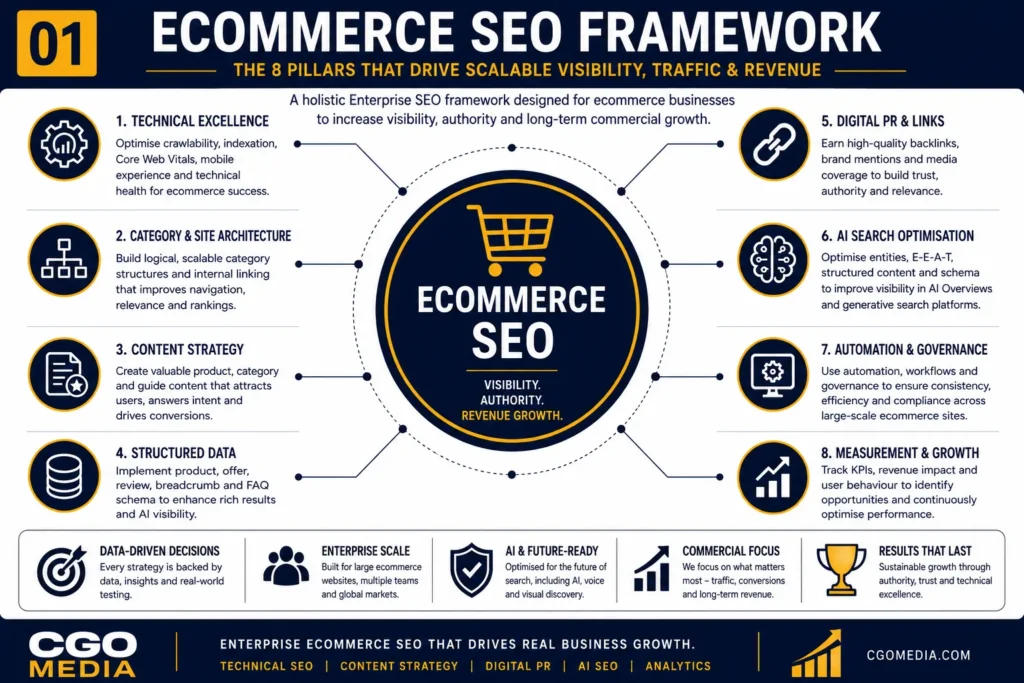
Ecommerce SEO Framework
What Is Ecommerce SEO?
Ecommerce SEO is the process of optimising online stores so products, categories and supporting content are easily discovered through organic search. Unlike standard business websites, ecommerce platforms often contain thousands of pages, making technical quality, information architecture and content strategy particularly important.
A successful Ecommerce SEO strategy ensures search engines can efficiently crawl, understand and index every important page while providing customers with an intuitive shopping experience. It also helps AI-powered search platforms understand product information, pricing, availability and brand authority when generating shopping recommendations.
Modern Ecommerce SEO therefore combines traditional optimisation with user experience, structured data and AI search readiness.
Why Ecommerce SEO Matters in 2026
Consumer buying journeys have become increasingly fragmented. Customers may discover products through Google Search, Google Shopping, AI Overviews, ChatGPT, Gemini, Perplexity, YouTube, social platforms or marketplace searches before eventually making a purchase.
Organic visibility across these discovery channels reduces dependence on paid advertising while attracting customers actively searching for products. This often results in higher-quality traffic, stronger conversion rates and improved long-term profitability.
Ecommerce businesses that neglect SEO frequently become overly reliant on paid acquisition, making growth increasingly expensive as advertising costs continue to rise.
Benefits of Ecommerce SEO
- Higher product visibility
- Increased organic traffic
- Improved conversion rates
- Lower customer acquisition costs
- Greater AI search visibility
- Improved shopping experience
- Higher online revenue
- Long-term sustainable growth
Ecommerce SEO vs Traditional SEO
Although both disciplines share common optimisation principles, Ecommerce SEO introduces additional complexity due to the size and structure of online stores. Product variations, faceted navigation, inventory changes and duplicate content require specialist strategies that go beyond traditional SEO campaigns.
Every product, category and collection page contributes to the overall authority of the website. Effective optimisation therefore requires careful planning to ensure each page serves a clear commercial purpose while supporting the wider architecture of the site.
| Traditional SEO | Ecommerce SEO |
|---|---|
| 📄 Service pages | 🛍️ Product and category pages |
| 🤝 Lead generation | 💳 Online sales optimisation |
| 🏢 Relatively small websites | 📦 Large-scale product catalogues |
| 📑 Limited page templates | 🗂️ Complex product architecture |
| ✍️ General content strategy | 🛒 Commercial buying intent |
Product Page Optimisation
Product pages are often the primary landing pages for ecommerce websites. Every page should provide comprehensive information that helps both search engines and customers understand the product while encouraging confident purchasing decisions.
High-performing product pages include unique descriptions, optimised metadata, clear imagery, customer reviews, technical specifications, internal links and structured data. Together, these elements improve search visibility while increasing conversion rates.
Essential Product Page Elements
- Unique product descriptions
- Keyword-optimised titles
- High-quality product imagery
- Customer reviews
- Product specifications
- Clear calls to action
- Internal product recommendations
- Structured product schema
Category Page Optimisation
Category pages frequently attract the highest levels of organic traffic because they target broader commercial search queries. Rather than functioning as simple product listings, these pages should provide useful introductory content, logical filtering and strong internal linking.
Optimised category pages help search engines understand the relationship between products while guiding customers towards the most relevant options. This improves both crawl efficiency and user experience.
Strong category optimisation also supports topical authority by demonstrating expertise across entire product ranges rather than isolated items.
Ecommerce SEO and AI Search
AI-powered search is reshaping how consumers discover products. Instead of simply displaying a list of links, AI platforms increasingly recommend products, summarise reviews, compare features and answer purchasing questions directly.
Ecommerce websites that provide structured product data, authoritative content, accurate pricing, clear specifications and trusted brand signals are more likely to be referenced within these AI-generated shopping experiences.
Preparing for AI search therefore requires more than keyword optimisation. It demands comprehensive product information, entity authority, structured data and a strong reputation across the wider web.
| Traditional SEO Benefit | AI Search Benefit |
|---|---|
| 📈 Higher rankings | 🤖 Product recommendations |
| 🚦 Organic traffic | 🛍️ AI shopping visibility |
| 🖱️ Improved click-through rates | 🔗 Greater citation potential |
| 🔍 Enhanced product discovery | 🧩 Knowledge Graph recognition |
| 💳 Increased online sales | 🌐 Broader AI commerce exposure |

How Ecommerce SEO Drives Revenue and AI Visibility
Technical SEO for Ecommerce Websites
Technical SEO forms the foundation of every successful ecommerce website. Online stores often contain thousands of product pages, multiple category levels, filters, search functionality and dynamic content that can make crawling and indexing significantly more complex than a standard business website.
Search engines need to efficiently discover, understand and prioritise the pages that matter most. Without a strong technical foundation, even the best products and content may struggle to achieve consistent visibility in organic search.
At CGO Media, our technical ecommerce audits examine crawl efficiency, Core Web Vitals, mobile usability, structured data, duplicate content, canonicalisation, XML sitemaps, indexation and page performance to ensure your website is fully optimised for both search engines and AI-powered search platforms.
Key Technical Ecommerce SEO Priorities
- Fast page loading speeds
- Mobile-first optimisation
- Core Web Vitals improvements
- Efficient crawl management
- Canonical URL implementation
- Optimised XML sitemaps
- Secure HTTPS architecture
- Indexation management
Site Architecture and Internal Linking
A well-structured ecommerce website helps both users and search engines navigate large product catalogues efficiently. Logical site architecture improves crawl depth, distributes authority throughout the website and ensures important commercial pages receive sufficient internal link equity.
Product categories, subcategories and collections should follow a clear hierarchy that reflects how customers naturally browse products. Strong internal linking also encourages visitors to explore related products, increasing engagement and average order value.
Search engines interpret these internal relationships to better understand topical relevance, while AI systems benefit from clearly organised information when summarising products and recommending solutions.
| Well-Structured Ecommerce Site | Poorly Structured Ecommerce Site |
|---|---|
| 🗂️ Logical category hierarchy | 🧩 Confusing navigation |
| 🔗 Strong internal linking | 🚫 Orphaned product pages |
| 🌐 Simple URL structure | 🔀 Long, complex URLs |
| 🛒 Clear customer journey | 🧭 Inconsistent navigation paths |
| 🕷️ Efficient crawl paths | ⚠️ Wasted crawl budget |
Product Schema and Structured Data
Structured data enables search engines and AI platforms to interpret product information with far greater accuracy. By providing machine-readable details about pricing, availability, reviews, product specifications and brand information, ecommerce websites become easier to understand and more likely to appear in enhanced search experiences.
Product schema also supports rich results within Google Search, improves eligibility for shopping features and strengthens the information available to AI systems when generating recommendations.
Comprehensive structured data is increasingly becoming a competitive advantage as search evolves beyond traditional blue links.
Important Ecommerce Schema Types
- Product Schema
- Offer Schema
- Review Schema
- Aggregate Rating Schema
- Breadcrumb Schema
- Organisation Schema
- FAQ Schema
- Video Schema
Content Marketing for Ecommerce
While product and category pages drive transactional traffic, content marketing supports the wider customer journey by answering questions, comparing products and demonstrating expertise. Educational content attracts potential buyers earlier in the purchasing process while strengthening topical authority.
Buying guides, comparison articles, tutorials, FAQs and product demonstrations all contribute to stronger organic visibility while providing valuable internal linking opportunities back to commercial pages.
This broader content ecosystem also helps AI-powered search platforms identify your website as a trusted source of product knowledge rather than simply an online catalogue.
| Content Type | Primary Purpose |
|---|---|
| 🛒 Buying Guides | Support purchase decisions |
| ⚖️ Comparison Articles | Target commercial research queries |
| 🎥 Product Tutorials | Improve customer confidence |
| 📈 Industry Insights | Build topical authority |
| ❓ Frequently Asked Questions | Capture informational searches |
Digital PR and Link Building for Ecommerce Brands
Ecommerce SEO extends beyond your own website. Search engines increasingly assess how frequently your brand is referenced across trusted publications, industry websites and authoritative sources.
Editorial backlinks earned through Digital PR strengthen domain authority while improving the trust signals associated with your products and brand. Product launches, industry research, customer insights and original data can all create valuable opportunities for media coverage.
These external endorsements contribute to stronger rankings while increasing the likelihood of your products being recognised within AI-generated shopping recommendations.
Authority Building Strategies
- Editorial outreach
- Digital PR campaigns
- Original industry research
- Influencer collaborations
- Product launch campaigns
- Expert commentary
- Strategic partnerships
- High-authority backlink acquisition
Local Ecommerce Strategies
Many ecommerce businesses also serve customers within specific regions through physical stores, showrooms or local delivery services. Combining Ecommerce SEO with Local SEO helps capture high-intent searches from nearby customers while strengthening regional authority.
Optimising Google Business Profile listings, creating location-specific landing pages and encouraging customer reviews all contribute to stronger local visibility alongside national ecommerce performance.
For Manchester retailers, integrating local search signals with ecommerce optimisation creates additional opportunities to attract customers both online and offline.
Measuring Ecommerce SEO Success
Successful Ecommerce SEO campaigns are measured through commercial outcomes rather than rankings alone. While improved visibility is important, the primary objective is generating sustainable revenue growth through organic search.
Our reporting combines SEO performance metrics with ecommerce KPIs to provide a complete picture of campaign effectiveness.
- Organic revenue growth
- Organic transactions
- Product page visibility
- Category rankings
- Conversion rate improvements
- Average order value
- Customer acquisition costs
- AI shopping visibility opportunities
- Returning customer growth
- Overall return on investment
Building a Long-Term Ecommerce Growth Strategy
Sustainable ecommerce success requires ongoing optimisation rather than one-time improvements. Search behaviour, product trends, customer expectations and AI search capabilities continue to evolve, making continuous development essential.
Businesses that consistently improve their technical foundations, product content, authority signals and customer experience are significantly better positioned to outperform competitors over the long term.
At CGO Media, we build Ecommerce SEO strategies that continue delivering value as your product catalogue expands, search algorithms evolve and AI-powered commerce becomes increasingly influential.

Ecommerce SEO Implementation Roadmap
Our Ecommerce SEO Methodology
At CGO Media, we believe successful Ecommerce SEO combines technical excellence, exceptional user experience, authoritative content and long-term digital authority. Rather than focusing on rankings alone, we develop strategies that increase qualified traffic, improve conversion rates and generate sustainable revenue growth.
Every ecommerce business is different. Product ranges, customer journeys, technology platforms and commercial objectives all influence how an SEO strategy should be developed. Our consultants therefore build bespoke campaigns aligned with your catalogue, competitive landscape and long-term business goals.
We combine Technical SEO, AI SEO, Generative Engine Optimisation (GEO), Content Marketing, Digital PR and authority building into a single integrated strategy that prepares your online store for both today’s search engines and tomorrow’s AI-powered shopping experiences.
| Campaign Stage | Primary Objective |
|---|---|
| 🔍 Technical Audit | Identify crawl, indexing, Core Web Vitals, site speed and architecture improvements. |
| 🎯 Keyword & Customer Research | Understand commercial intent, purchasing behaviour and high-value search opportunities. |
| 🛒 Website Optimisation | Improve product pages, category pages, metadata, structured data and user experience. |
| 🏆 Authority Building | Strengthen trust through Digital PR, authoritative backlinks, brand mentions and topical authority. |
| 🤖 AI Search Optimisation | Enhance structured data, entity signals, product knowledge and visibility across AI search platforms. |
| 📈 Continuous Growth | Measure performance, refine strategy and optimise for sustainable long-term revenue growth. |
Ecommerce SEO Implementation Roadmap
Long-term ecommerce growth is achieved through continuous optimisation rather than isolated projects. Our structured roadmap ensures every stage builds upon the previous one, creating a scalable SEO strategy that supports expanding product catalogues and evolving customer expectations.
Typical Ecommerce SEO Roadmap
- Technical ecommerce audit
- Competitor and keyword analysis
- Information architecture improvements
- Product and category optimisation
- Structured data implementation
- Content marketing development
- Digital PR and authority building
- AI search optimisation
- Performance reporting
- Continuous commercial optimisation
Common Ecommerce SEO Mistakes
Many online retailers unknowingly limit their organic growth through technical issues, weak content or poorly structured websites. Addressing these common problems often delivers significant improvements in both visibility and sales performance.
- Using duplicate manufacturer product descriptions.
- Publishing thin category pages.
- Poor internal linking between products and collections.
- Ignoring structured product data.
- Slow page loading speeds.
- Unoptimised mobile shopping experiences.
- Poor handling of out-of-stock products.
- Overlooking image optimisation.
- Neglecting Digital PR and authority building.
- Ignoring AI search optimisation opportunities.
Avoiding these issues creates a stronger technical foundation, improves user experience and increases the likelihood of long-term organic growth.
Frequently Asked Questions
What is Ecommerce SEO?
Ecommerce SEO is the process of optimising online stores to improve product visibility, attract qualified organic traffic and increase online sales.
How is Ecommerce SEO different from traditional SEO?
It focuses on large product catalogues, category optimisation, structured product data, technical scalability and commercial buying intent.
Does Ecommerce SEO help AI search?
Yes. Structured data, entity optimisation and authoritative product information increase visibility across AI-powered shopping and search experiences.
How important are product descriptions?
Unique, informative product descriptions improve rankings, reduce duplicate content and help customers make confident purchasing decisions.
Should every product page be optimised?
Yes. Every product page should include unique content, optimised metadata, structured data and internal links where appropriate.
Why are category pages important?
Category pages target broader commercial searches and often become some of the highest-traffic pages within an ecommerce website.
Does site speed affect Ecommerce SEO?
Absolutely. Faster websites improve customer experience, increase conversion rates and support stronger search performance.
How long does Ecommerce SEO take?
Most businesses begin seeing measurable improvements within several months, although sustainable growth is achieved through continuous optimisation.
Can Ecommerce SEO reduce advertising costs?
Yes. Increased organic visibility often reduces reliance on paid acquisition while improving long-term profitability.
How do you measure success?
We monitor organic revenue, transactions, rankings, product visibility, conversion rates, customer acquisition and return on investment.
Can local retailers benefit from Ecommerce SEO?
Yes. Combining Ecommerce SEO with Local SEO helps businesses attract both online shoppers and nearby customers.
Why choose CGO Media?
Our integrated approach combines Ecommerce SEO, Technical SEO, AI SEO, GEO, Digital PR and authority building to deliver measurable commercial growth.
Explore Our Other Manchester SEO Services
Explore Our UK SEO & AI Search Services
- SEO UK
- Technical SEO UK
- AI SEO Services UK
- GEO Services UK
- Link Building UK
- Digital PR UK
- Content Marketing UK
- Local SEO UK
- Enterprise SEO UK
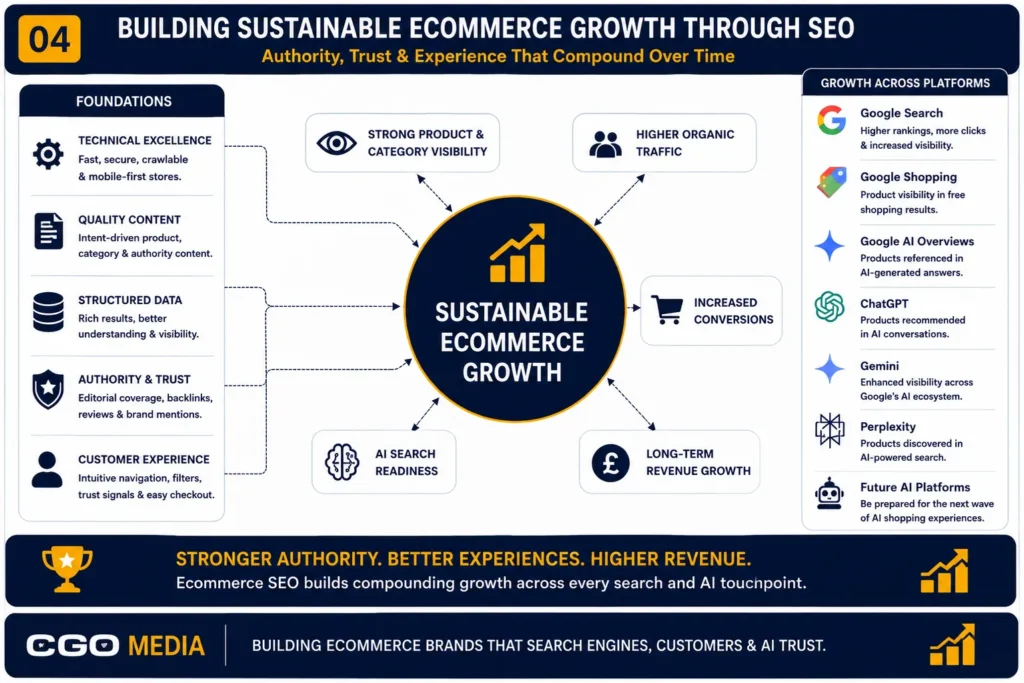
Building Sustainable Ecommerce Growth
Scale Your Ecommerce Business with Sustainable Organic Growth
Ecommerce success is built on visibility, trust and exceptional customer experiences. Our integrated Ecommerce SEO strategies help online retailers attract more qualified customers, improve conversion rates and prepare for the future of AI-powered commerce.
Whether you manage hundreds or thousands of products, CGO Media develops scalable SEO campaigns that deliver measurable commercial results while strengthening your long-term digital authority.
Conclusion
Ecommerce SEO has become one of the most important investments an online retailer can make. By combining technical excellence, high-quality content, structured data, Digital PR and AI search optimisation, businesses can create a sustainable competitive advantage that extends far beyond traditional rankings.
As search continues to evolve towards AI-driven product discovery and conversational shopping experiences, businesses that invest in authority, trust and customer-focused optimisation will be best positioned to achieve long-term organic growth and increased online revenue.