CGO Media Research
How Local Search, Marketplace Technology and On-Demand Delivery Built an International Platform
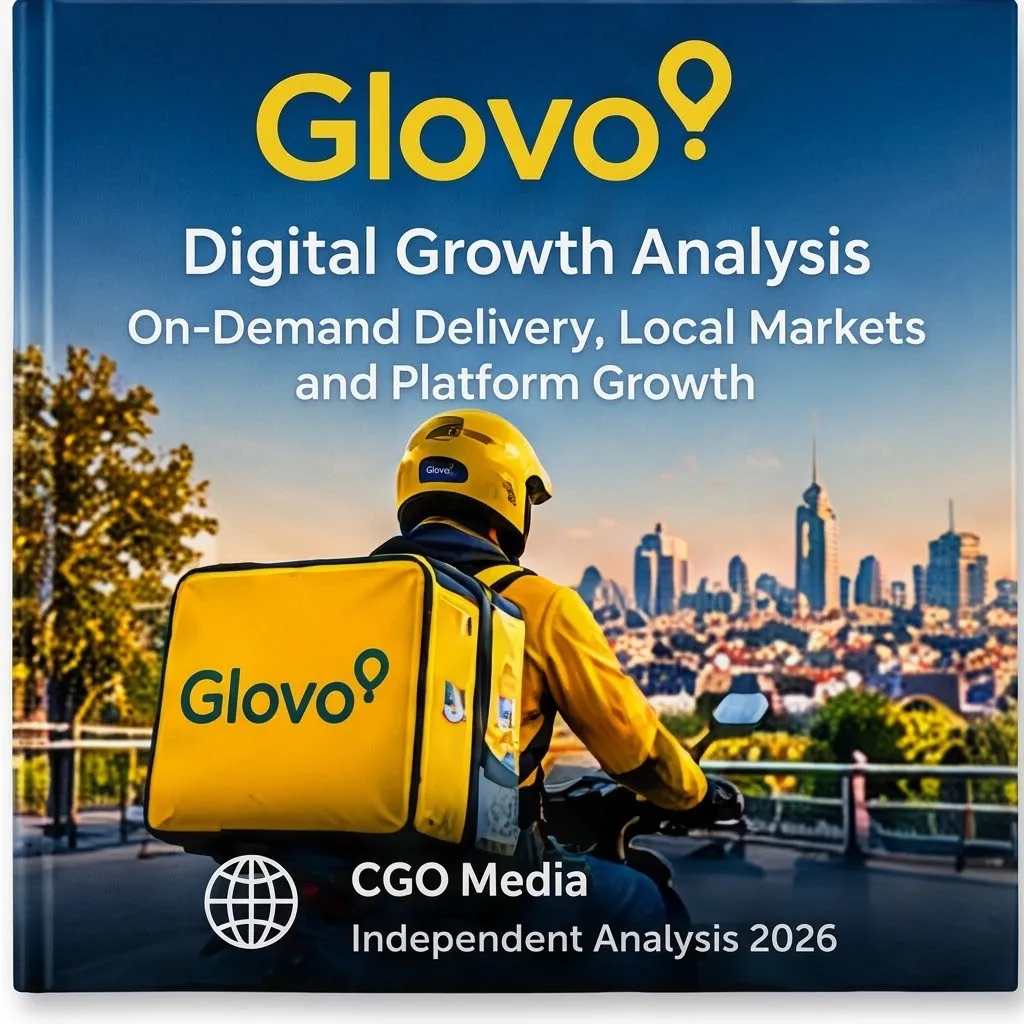
An independent analysis of how Glovo combines city-based marketplace architecture, restaurant and retail discovery, courier logistics, merchant technology, subscriptions and local brand authority to operate a major multi-category delivery platform.
Growth Analysis Overview
- Company: Glovo
- Founded: 2015
- Origins: Barcelona, Spain
- Primary regions: Europe, Central Asia and Africa
- Industry: On-demand delivery, quick commerce and local marketplaces
- Primary categories: Restaurants, supermarkets, groceries, retail stores, pharmacies where permitted and local services
- Primary digital disciplines: Local SEO, marketplace SEO, app acquisition, city landing pages, merchant discovery, logistics, conversion optimisation and AI-search readiness
- Case-study type: Independent analysis based on publicly available information
- Relationship disclosure: Glovo is not presented as a CGO Media client
Introduction
Glovo is one of the most prominent technology companies to emerge from Barcelona’s startup ecosystem.
Founded in 2015, the company developed a platform designed to connect customers with restaurants, supermarkets, retailers and couriers operating within their cities.
The original proposition was based on a simple idea:
Give people digital access to products available within their city and deliver those products rapidly.
Glovo developed beyond restaurant food delivery into a multi-category marketplace.
Depending on the country and city, customers may use the platform to order:
- Restaurant meals
- Groceries
- Supermarket products
- Pharmacy and personal-care products where legally permitted
- Flowers
- Electronics
- Books and toys
- Convenience items
- Products from high-street retailers
This creates a complex digital ecosystem involving several distinct participant groups.
- Customers want convenience, selection, speed and predictable delivery.
- Restaurants and retailers want more orders, digital visibility and access to local customers.
- Couriers require sufficient demand, operational support and clear working arrangements.
- Glovo must coordinate technology, payments, customer service, merchant information and delivery logistics.
Glovo’s digital growth therefore depends on much more than encouraging people to download an application.
It depends on creating a balanced local marketplace in every city where the company operates.
The Local-Commerce Problem
Local businesses have traditionally depended on physical footfall, telephone orders and their immediate neighbourhoods.
A restaurant may serve excellent food but have limited digital infrastructure. A local retailer may stock useful products without offering ecommerce or home delivery.
Customers may encounter several forms of friction:
- Not knowing which businesses deliver
- Difficulty finding current menus
- Unclear opening hours
- No online payment option
- No delivery tracking
- Limited product discovery
- Different ordering processes for every business
Glovo reduces this friction by placing multiple local businesses within one searchable platform.
Customers can enter their address, browse available merchants, choose products, pay digitally and monitor delivery progress.
Participating businesses gain a digital storefront without necessarily building an independent ordering and logistics platform from the beginning.
Why Glovo Is an Important Digital Growth Analysis
Glovo operates a marketplace whose inventory changes according to location, time, opening hours and delivery coverage.
A restaurant available to one customer may not be available to another customer several kilometres away.
Availability may also change because:
- The business is closed
- The delivery radius changes
- Products are unavailable
- Courier supply is limited
- The customer is outside the service area
- The merchant temporarily pauses orders
This makes Glovo’s search environment more dynamic than a conventional national ecommerce website.
Its public website must create stable, indexable pages from information that is highly local and frequently changing.
The business must also balance the needs of customers, merchants and couriers in each city.
A Three-Sided Local Marketplace
Glovo operates a marketplace connecting three principal participant groups.
Customers
Customers use the platform to discover local businesses and request delivery.
Merchant Partners
Restaurants, supermarkets and retailers use the platform to present products and receive orders.
Couriers
Couriers complete the physical delivery between the merchant and customer.
The marketplace becomes more valuable when all three groups are sufficiently active.
A strong cycle can develop:
More merchants → greater selection → more customers → more orders → more courier demand → better marketplace coverage.
However, imbalance can weaken the service.
Too few merchants reduce customer choice. Too few couriers create slower delivery. Too few customers reduce the commercial value available to merchants and couriers.
Growth must therefore be managed locally rather than measured only through international totals.
City-Level Marketplace Growth
Delivery platforms expand city by city.
National brand awareness does not guarantee that a marketplace will work equally well in every location.
Each city has its own:
- Population density
- Restaurant market
- Retail environment
- Courier supply
- Consumer habits
- Transport conditions
- Competition
- Local regulations
Glovo’s city pages help connect national visibility with local availability.
A city landing page can show:
- Available restaurant categories
- Popular local merchants
- Supermarkets and shops
- Delivery categories
- Merchant-registration options
- Courier opportunities
- Customer account access
This gives each operational market a dedicated digital entry point.
Local SEO and City Landing Pages
Glovo can participate in city-specific search journeys such as:
- Food delivery Madrid
- Order food Barcelona
- Pizza delivery Málaga
- Supermarket delivery Valencia
- Grocery delivery near me
- Restaurant delivery in Seville
- Glovo Zaragoza
Effective city pages should provide real local value.
They should not simply duplicate a national template and replace the place name.
A valuable local page can contain:
- Current service availability
- Relevant local categories
- Popular cuisines
- Recognisable local partners
- Neighbourhood or delivery-zone information
- Clear ordering instructions
- Merchant and courier calls to action
Local pages need ongoing maintenance because merchants, operating areas and available categories can change.
Restaurant and Store Pages
Individual merchant pages form a major part of Glovo’s search ecosystem.
These pages can display:
- Business name
- City
- Product or menu categories
- Available items
- Prices
- Promotions
- Opening hours
- Estimated delivery information
- Subscription eligibility
- Customer ratings where available
Merchant pages can rank for searches combining a brand, city and delivery intention.
Examples include:
- Restaurant delivery in Madrid
- Carrefour delivery Barcelona
- Order from a specific restaurant online
- Supermarket delivery in Pamplona
These pages have strong commercial intent because the user may already know which restaurant or retailer they want.
Category Pages and Cuisine Discovery
Customers do not always begin with a particular merchant.
They may search by cuisine or product category.
Examples include:
- Pizza delivery
- Hamburgers near me
- Healthy food delivery
- Japanese food delivery
- Breakfast delivery
- Groceries online
- Flower delivery
- Pharmacy delivery where available
Category pages help users move from a general need to suitable local merchants.
A strong category page should combine:
- Clear local intent
- Relevant merchant availability
- Current products
- Logical filters
- Useful internal links
- Mobile usability
A category page should not remain indexable when it contains no meaningful inventory.
Programmatic SEO at Delivery-Marketplace Scale
Glovo contains many repeatable combinations of location, merchant and category information.
Structured fields can include:
- Country
- City
- Merchant
- Business category
- Cuisine
- Product category
- Opening hours
- Delivery availability
- Price
- Promotion status
These fields can support large numbers of useful landing pages.
However, the ability to create a page automatically does not mean it should automatically be indexed.
A strong programmatic page needs:
- Genuine search demand
- Current merchant inventory
- Stable local relevance
- Clear metadata
- Useful customer options
- Controlled canonical signals
- Strong internal linking
Empty or duplicated category-location combinations can weaken overall website quality.
Managing Dynamic Availability
Glovo’s marketplace is highly dynamic.
Merchant availability can change throughout the day.
Search engines, however, require stable public URLs and understandable content.
The platform must distinguish between:
- A permanently unavailable merchant
- A merchant that is currently closed
- A product that is temporarily out of stock
- A merchant outside the customer’s delivery radius
- A city where Glovo no longer operates
Each situation requires a different response.
Temporarily closed merchants may remain useful. Permanently removed businesses may need a relevant alternative page or a proper error status.
Showing outdated menus or unavailable merchants as though they were active can reduce trust.
Merchant Acquisition
Glovo’s growth depends on attracting restaurants and retailers as well as consumers.
Potential partners may search for:
- Sell through Glovo
- Register restaurant on Glovo
- Glovo restaurant commission
- Delivery platform for restaurants
- Glovo partner requirements
- How to increase delivery orders
Merchant-acquisition pages should explain:
- How registration works
- Available commercial arrangements
- Ordering technology
- Delivery options
- Advertising products
- Merchant support
- Performance information
The most useful content communicates commercial value without presenting every partner relationship as identical.
Restaurant economics, retail margins, product complexity and delivery requirements differ considerably.
Glovo Ads and Merchant Visibility
Glovo can monetise marketplace attention by offering advertising and promotional tools to merchant partners.
These tools can help businesses increase visibility within relevant searches and categories.
Merchant advertising may support:
- New-location launches
- Product promotions
- Category visibility
- Customer reacquisition
- Brand awareness
- Incremental order growth
The platform has published merchant examples showing how advertising and marketplace insights can contribute to restaurant growth.
Advertising must still preserve customer relevance.
Paid placement that repeatedly shows unsuitable merchants can weaken the customer experience and reduce trust in search results.
Courier Acquisition and Marketplace Supply
Courier availability is essential to delivery-platform performance.
Potential couriers may search for:
- Work delivering for Glovo
- Glovo courier jobs
- Glovo rider requirements
- Delivery work in Madrid
- Courier jobs with a bicycle
Recruitment pages need accurate local information covering:
- Age requirements
- Work authorisation
- Vehicle requirements
- Equipment
- Employment or contractual arrangements
- City availability
- Registration steps
These requirements can differ by country because labour laws and operational models vary.
A generic international page cannot replace market-specific guidance.
Logistics and Delivery Experience
The customer’s experience depends on what happens after an order is placed.
Important operational elements include:
- Merchant preparation time
- Courier assignment
- Collection efficiency
- Route selection
- Delivery accuracy
- Order condition
- Customer communication
A strong search ranking or app promotion can generate an order, but unreliable fulfilment can prevent repeat use.
Logistics performance therefore influences:
- Customer ratings
- Brand searches
- Reviews
- Customer retention
- Merchant satisfaction
- Courier participation
Glovo Prime and Customer Retention
Subscription products can encourage customers to use the platform more frequently.
Glovo Prime can provide eligible users with benefits such as reduced or included delivery fees from participating merchants.
A subscription model can support:
- Higher ordering frequency
- Customer retention
- Reduced switching
- Cross-category purchasing
- Predictable recurring revenue
This is particularly important because customers may have several competing delivery applications installed.
Subscription benefits provide an additional reason to choose Glovo for the next order.
From Food Delivery to Multi-Category Commerce
Expanding beyond restaurants changes the scale and complexity of the platform.
Restaurant delivery normally involves a relatively short menu and immediate consumption.
Supermarket and retail orders may involve:
- Thousands of products
- Brand variations
- Different package sizes
- Stock substitutions
- Age-restricted products
- Product availability changes
Glovo must therefore manage increasingly sophisticated product data and inventory relationships.
Multi-category growth increases search coverage but also creates greater demands for structured information and feed accuracy.
International and Multilingual SEO
Glovo operates across multiple countries, languages and regulatory environments.
Markets can differ in:
- Currency
- Language
- Restaurant categories
- Popular cuisines
- Delivery regulations
- Courier employment structures
- Merchant conditions
- Customer expectations
Effective international SEO requires:
- Country-specific URLs
- Language localisation
- Hreflang implementation
- Regional canonical tags
- Local merchant content
- Market-specific legal information
- Localised help resources
Translation alone is insufficient.
Search terminology, cuisine names and customer behaviour can differ substantially between countries.
Technical SEO Challenges
Glovo’s public platform contains large numbers of city, category, merchant and product pages.
Important technical challenges include:
- Location-based availability
- Dynamic merchant status
- Product and menu changes
- Duplicate merchant pages
- Country and language duplication
- JavaScript rendering
- Canonicalisation
- Hreflang
- Mobile performance
- Image optimisation
- Expired merchant URLs
- Crawl-budget allocation
Personalised search results created after a user enters an address should not automatically become permanent indexable URLs.
Search engines should primarily discover stable city, category, merchant and informational pages.
Structured Data and Local-Commerce Entities
Glovo’s ecosystem contains numerous identifiable entities.
These include:
- Restaurants
- Retail stores
- Supermarkets
- Products
- Menus
- Locations
- Offers
- Opening hours
- Delivery areas
- Customer reviews
Machine-readable information can help search and AI systems understand:
- Which merchant provides a product
- Where the merchant operates
- Whether the merchant is open
- Which products are available
- How much products cost
- Whether delivery is offered
Structured markup is valuable only when it reflects accurate and visible information.
Mobile Experience and App Conversion
Glovo is fundamentally a mobile-led service.
The customer journey may begin through a search engine but frequently continues within the application.
Important mobile requirements include:
- Fast address entry
- Clear merchant categories
- Accurate menu information
- Simple basket management
- Transparent fees
- Reliable payment
- Order tracking
- Accessible customer support
Website-to-app transitions should also be measurable.
Glovo needs to understand which public landing pages contribute to:
- App installations
- Account creation
- First orders
- Subscription adoption
- Repeat purchases
Trust, Safety and Customer Support
Customers trust the platform with payment information, personal addresses and order details.
Trust can be influenced by:
- Merchant accuracy
- Courier behaviour
- Food and product condition
- Delivery reliability
- Refund handling
- Data protection
- Customer support
A single transaction involves several independent participants, but the customer may attribute the entire experience to the Glovo brand.
Marketplace governance and support therefore form part of the company’s wider digital reputation.
Sustainability and Social Impact
On-demand delivery platforms face scrutiny regarding transport emissions, packaging, food waste, courier welfare and the impact on local businesses.
Glovo publishes impact and sustainability reporting covering its environmental and social commitments.
Its stated priorities include:
- Reducing emissions
- Supporting sustainable packaging
- Reducing food waste
- Supporting local communities
- Improving road safety
- Funding impact projects
Glovo has stated a goal of reducing carbon emissions by 42% by 2030, supported by targets validated through the Science Based Targets initiative.
Environmental claims should clearly distinguish:
- Direct operational reductions
- Courier transport emissions
- Packaging improvements
- Carbon offsets
- Long-term reduction targets
The Impact Fund
Glovo’s Impact Fund links a proportion of platform activity with funding for social and environmental projects.
The concept is designed so that increasing order activity also contributes funding towards selected impact initiatives.
Projects can address:
- Food rescue
- Community support
- Sustainable packaging
- Courier initiatives
- Environmental programmes
This creates a measurable relationship between business activity and stated impact objectives.
Transparent reporting remains essential so stakeholders can understand how funds are allocated and what outcomes are achieved.
Content Authority and Digital PR
Glovo’s content opportunities extend beyond merchant and ordering pages.
Relevant topics include:
- Restaurant growth
- Quick commerce
- Local retail digitisation
- Delivery trends
- Food waste
- Sustainable packaging
- Courier road safety
- Urban logistics
- Consumer ordering behaviour
Glovo can use aggregated marketplace information to produce original insights about local commerce and delivery.
Data-led content can attract:
- Business media
- Retail publications
- Restaurant-industry coverage
- Sustainability citations
- Technology press
- AI-search references
AI Search and Conversational Local Discovery
Local-commerce discovery is likely to become increasingly conversational.
Customers may ask:
- Which restaurants deliver healthy food near me?
- Where can I order groceries in Madrid tonight?
- Find a Japanese restaurant delivering in central Barcelona.
- Which supermarkets deliver within an hour?
- Can I order flowers for delivery in Valencia?
Answering these questions requires current information about:
- Customer location
- Merchant availability
- Opening hours
- Product inventory
- Delivery radius
- Estimated delivery time
- Price
- Customer preferences
Glovo’s structured marketplace provides a strong foundation for conversational commerce.
The central challenge is freshness. AI recommendations must remain connected to businesses and products that are currently available.
Generative Engine Optimisation Opportunities
Generative Engine Optimisation helps AI platforms interpret and reference marketplace information accurately.
Opportunities for Glovo include:
- Consistent merchant entities
- Structured city and delivery-zone information
- Machine-readable opening hours
- Accurate menus and product feeds
- Current availability signals
- Clear subscription information
- Authoritative merchant guidance
- Clearly sourced impact reporting
- Strong external brand citations
AI systems should be able to distinguish between:
- A currently open merchant
- A temporarily closed merchant
- A permanently removed business
- A current promotion
- An expired offer
- A live menu
- Historical merchant information
These distinctions are essential for trustworthy recommendations.
What Glovo Did Well
Built Around Local Marketplace Demand
Glovo recognised that delivery growth depends on balancing merchants, customers and couriers within individual cities.
Expanded Beyond Restaurant Delivery
Multi-category commerce increased customer use cases and the potential ordering frequency of the platform.
Created Digital Storefronts for Local Businesses
Restaurants and retailers gained access to online ordering, payments, delivery and customer discovery.
Developed Strong City and Merchant Architecture
Local pages allow the platform to participate in city, cuisine, merchant and product-related search journeys.
Introduced Merchant Advertising Products
Glovo Ads creates another source of merchant value and platform revenue.
Invested in Customer Retention
Glovo Prime gives frequent users another reason to choose the platform repeatedly.
Expanded Internationally
Glovo adapted its marketplace to numerous countries across Europe, Central Asia and Africa.
Published Impact Commitments
Sustainability reports, packaging programmes and impact initiatives provide a public framework for evaluating the company’s wider contribution.
Challenges and Risks
Courier Working Conditions
Employment status, pay, safety and working conditions remain major legal and reputational issues within the delivery sector.
Marketplace Balance
Insufficient courier or merchant participation can reduce service quality within individual cities.
Merchant Economics
Commissions, advertising costs and delivery expenses must remain commercially sustainable for participating businesses.
Dynamic Inventory
Menus, stock, opening hours and delivery availability require constant updating.
Technical Indexation
Large numbers of city, category, merchant and product combinations can create duplicate or low-value URLs.
Strong Competition
Glovo competes with restaurant-owned delivery, supermarkets, specialist ecommerce companies and other delivery platforms.
Customer-Support Complexity
Problems may involve the customer, merchant, courier, payment provider or logistics process.
Sustainability Scrutiny
Packaging, transport emissions and carbon claims require measurable and transparent evidence.
AI Disintermediation
Search engines and AI assistants may increasingly recommend local businesses directly, reducing reliance on conventional marketplace pages.
How CGO Media Would Approach a Similar Delivery Platform
A CGO Media strategy for an international delivery marketplace would connect local SEO, technical architecture, merchant acquisition, app conversion and AI-search readiness.
Phase 1: City-Level Marketplace Diagnosis
The initial analysis would examine:
- Organic demand by city
- Merchant inventory
- Category coverage
- Customer conversion
- Courier supply
- Repeat ordering
- Subscription adoption
- Competitor visibility
Phase 2: Technical SEO Audit
CGO Media would evaluate:
- Crawlability
- Indexation
- City-page duplication
- Merchant-page quality
- Dynamic availability
- Canonicalisation
- Hreflang
- JavaScript rendering
- Mobile performance
- Structured data
Phase 3: Local Marketplace Architecture
The website would connect:
- Countries
- Cities
- Categories
- Cuisines
- Merchants
- Products
- Customer information
- Merchant registration
- Courier recruitment
Phase 4: Merchant-Page Quality
Merchant information would be checked for:
- Business identity
- Correct location
- Opening hours
- Menu accuracy
- Product availability
- Image quality
- Current delivery status
Phase 5: Merchant and Courier Acquisition
Dedicated search journeys would be built for restaurants, retailers, couriers and fleet partners using accurate local information.
Phase 6: Content and Digital PR
Aggregated marketplace data could support research into:
- Local food trends
- Restaurant growth
- Shopping behaviour
- Delivery demand
- Food waste
- Sustainable packaging
- Urban logistics
Phase 7: App Conversion
Website journeys would be measured against:
- App installations
- Account registrations
- First orders
- Repeat orders
- Prime subscriptions
Phase 8: AI and GEO Readiness
CGO Media would test how merchants, products, cities and company information appear across conversational-search platforms.
Improvements would focus on:
- Merchant entity consistency
- Opening-hour accuracy
- Inventory freshness
- Location information
- Offer expiry
- Impact-report citations
Phase 9: Commercial Measurement
Reporting would connect search visibility to:
- Completed orders
- New customers
- Repeat ordering
- Merchant revenue
- Courier utilisation
- Advertising revenue
- Subscription revenue
- City-level marketplace profitability
Key Lessons for Spanish and International Businesses
- Marketplace growth must be balanced locally.
A delivery platform needs customers, merchants and courier supply within each city. - App businesses still require public search architecture.
City, category and merchant pages create discovery before the customer opens the app. - Dynamic information needs permanent governance.
Menus, stock, availability and opening hours can become outdated quickly. - Programmatic SEO requires selective indexation.
Not every city and category combination deserves a permanent search result. - Merchant success strengthens the marketplace.
Restaurants and retailers must receive enough value to continue supplying inventory. - Logistics is part of the brand experience.
Marketing cannot compensate for consistently slow or unreliable delivery. - Subscriptions can improve retention.
Recurring benefits encourage customers to use the same platform more frequently. - International SEO requires operational localisation.
Languages, regulations, merchant categories and courier arrangements differ by country. - Original marketplace data creates authority.
Delivery and merchant insights can support media coverage, backlinks and AI citations. - AI discovery depends on live local information.
Merchant recommendations are useful only when opening hours, inventory and delivery coverage are current.
Conclusion
Glovo demonstrates how a Spanish technology company can build an international marketplace around local commerce.
Its growth is not based solely on restaurant delivery.
It is supported by the interaction of:
- City-level demand
- Restaurant and retail partners
- Courier logistics
- Local search architecture
- Merchant pages
- Multi-category commerce
- Subscriptions
- Merchant advertising
- International operations
- Impact reporting
Glovo’s central challenge is creating a consistent digital experience from thousands of independent local businesses and constantly changing availability.
Search visibility can introduce the customer, but marketplace liquidity, delivery quality and customer support determine whether that customer returns.
For CGO Media, the central lesson is:
The strongest delivery platforms do not simply move products. They organise local businesses, customer intent, logistics and live availability into one searchable commercial ecosystem.
When technical SEO, local marketplace supply, logistics, structured information and customer retention reinforce one another, digital visibility becomes a scalable commercial asset.
Build a Stronger Local Marketplace Ecosystem
CGO Media helps delivery companies, marketplaces and international technology platforms improve local search, technical performance, organic visibility and AI-search readiness.
Explore
Local SEO UK,
learn more about
Technical SEO UK
or discover how
GEO Services UK
can support complex local marketplaces.
Contact CGO Media to discuss your marketplace growth strategy
Research Sources