
Financial Services AI Trust Framework
 The Financial Services AI Trust Framework provides a structured model for understanding how financial organisations can build, evidence and govern trust across traditional search, AI-assisted discovery, comparison environments and digital provider-selection journeys.
The framework forms part of the wider CGO Media Financial Services research architecture and should be read alongside Financial Services SEO in an AI Search Environment, the Financial Provider Selection Model, the Financial Search Authority Maturity Model and the Financial SEO & AI Implementation Roadmap.
Its purpose is to help banks, lenders, insurers, investment organisations, payment providers, fintechs and other financial businesses understand the evidence users and machine-mediated systems may rely upon when deciding whether a provider appears credible, legitimate, relevant and sufficiently trustworthy to investigate further.
1. Purpose of the Financial Services AI Trust Framework
The framework is designed to answer a central question:
What evidence contributes to financial provider trust across search and AI-assisted discovery environments?
2. Financial Trust Is Multi-Dimensional
Trust in financial services is rarely created by one signal.
It can emerge from the interaction between:
- Provider identity
- Regulatory evidence
- Product transparency
- Operational security
- Reputation
- External corroboration
- Information consistency
3. The Framework Uses Six Core Trust Domains
- Entity and Provider Trust
- Regulatory and Institutional Trust
- Product and Information Trust
- Security and Operational Trust
- Reputation and External Validation
- AI Representation and Evidence Consistency
4. The Core Trust Equation
The framework can be represented as:
Identity + Regulation + Product Clarity + Security + Reputation + Evidence Consistency = Stronger Financial Trust
5. Trust Should Be Treated as a System
Financial organisations should avoid treating trust as a collection of isolated badges, review scores or reassurance statements.
6. Trust Begins with Identity
Users first need to understand:
- Who the provider is
- Which legal entity operates it
- Which entity provides the product
- Which entity is regulated where applicable
7. Trust Depends on Information Accuracy
Even a well-known financial brand can lose trust when users encounter conflicting:
- Rates
- Fees
- Eligibility
- Product availability
- Provider descriptions
8. Trust Depends on Verification
Users may seek independent confirmation through:
- Regulatory sources
- Comparison platforms
- Financial media
- Review platforms
- Professional recommendations
9. AI Changes the Trust Environment
AI assistants may compress multiple trust checks into one generated response.
10. AI Compression Increases the Importance of Evidence Quality
If generated systems summarise provider identity, products, pricing and trust in one answer, inconsistent public evidence can become more consequential.
11. Trust Is Not Equivalent to Popularity
A highly visible provider is not automatically the most trusted provider for every user or financial need.
12. Trust Is Not Equivalent to Suitability
A trusted provider may still offer products that are inappropriate for a particular user.
13. Trust Is Not Equivalent to Endorsement
Appearance in a search result, comparison platform or AI answer should not be interpreted as independent certification of financial suitability.
14. Domain One — Entity and Provider Trust
The first trust domain concerns whether the organisation can be identified clearly and consistently.
15. Entity Trust Begins with Brand Clarity
The organisation should use sufficiently consistent brand naming across:
- Website
- Search profiles
- External directories
- Comparison platforms
- Media references
16. Brand and Legal Entity Are Not Always the Same
Financial organisations often operate consumer brands that differ from the underlying legal entity.
17. Brand-to-Legal-Entity Relationship Should Be Clear
Users should be able to understand:
Brand → Legal Entity
18. Legal Entity and Regulated Entity May Also Differ
Some financial groups include multiple entities with different roles.
19. Regulatory Relationship Should Be Understandable
Where relevant, users should be able to identify:
Brand → Legal Entity → Regulated Entity
20. Product Ownership Should Be Clear
The user should be able to identify which entity actually provides or underwrites the relevant product.
21. Product-to-Provider Relationship
A useful model is:
Provider → Product Category → Product → Market
22. Market Availability Should Be Clear
Users should not need to infer whether a product is available in their country, region or customer segment.
23. Audience Fit Should Be Clear
Where relevant, distinguish between:
- Consumer
- SME
- Enterprise
- Specialist audiences
24. Entity Trust Depends on Consistency
Conflicting names, ownership relationships or provider descriptions can create uncertainty.
25. Entity Trust Can Be Weakened by Historic Information
Rebrands, acquisitions and product migrations can leave old information visible for long periods.
26. Entity Trust Requires Change Governance
Major organisational changes should trigger review of:
- Provider pages
- Structured data
- External profiles
- Comparison platforms
- AI representations
27. Entity Trust Diagnostic Questions
A financial organisation should be able to answer:
- Who are we?
- Which entity operates the brand?
- Which entity provides each product?
- Which entity is regulated?
- Where is each product available?
28. Entity Trust Failure Signals
Potential warning signs include:
- Conflicting provider names
- Unclear ownership
- Incorrect regulated-entity relationships
- Historic brand references
- Wrong market availability
29. Entity Trust Should Be Visible, Not Implied
Important provider relationships should not depend entirely on legal interpretation or hidden technical data.
30. Structured Data Can Reinforce Entity Trust
Appropriate structured data can support clearer machine interpretation when it reflects visible, accurate information.
31. Structured Data Should Reflect Reality
Markup should not be used to assert unsupported:
- Ownership relationships
- Provider relationships
- Regulatory relationships
32. Domain Two — Regulatory and Institutional Trust
The second trust domain concerns whether users can validate the provider through relevant institutional and regulatory evidence.
33. Regulatory Trust Is Context-Specific
Different products and markets may involve different regulatory structures.
34. Regulatory Information Should Be Current
Outdated regulatory descriptions can create significant trust problems.
35. Regulatory Information Should Be Specific
Generic phrases such as “fully regulated” may provide less useful evidence than a clear explanation of the relevant entity and regulatory context.
36. Regulatory Trust Should Clarify Scope
Where relevant, clarify:
- Which entity is regulated
- Which activities are regulated
- Which market the information applies to
37. Regulation Should Not Be Used as Generic Marketing
Regulatory information should be factual and appropriately contextualised.
38. Regulatory Trust Depends on Consistency
Provider websites and relevant external sources should not materially contradict each other.
39. Institutional Trust Can Include Official Sources
Where relevant, official records may help users verify:
- Entity identity
- Authorisation
- Registration
- Provider status
40. Institutional Trust Can Include Industry Bodies
Relevant professional or industry bodies may provide additional context where membership or accreditation is genuine and current.
41. Institutional Trust Requires Scope Awareness
Membership in one organisation should not be presented as proof of broader financial quality or product suitability.
42. Regulatory Evidence Should Be Accessible
Users should not have to search extensively to understand basic provider legitimacy.
43. Regulatory Evidence Should Be Linked from Relevant Journeys
Important verification information may need to be accessible from:
- Product pages
- Provider pages
- Application journeys
- Trust sections
44. Regulatory Evidence Should Be Governed
The organisation should define:
- Owner
- Review cycle
- Change trigger
- Approval process
45. Regulatory Change Should Trigger Review
Material changes should initiate updates across affected digital environments.
46. Institutional Trust Can Be Weakened by Inconsistency
If external official records and the provider website appear inconsistent, users may hesitate or continue verification elsewhere.
47. Regulatory Trust Diagnostic Questions
Assess whether users can determine:
- Who regulates the relevant entity
- Which activities are covered
- Which market the information applies to
- Where they can verify the information independently
48. Regulatory Trust Failure Signals
Potential warning signs include:
- Ambiguous regulatory claims
- Outdated entity information
- Incorrect market scope
- Broken verification links
- Conflicting official records
49. Regulatory Trust Should Support, Not Replace, Product Understanding
A regulated provider may still offer products with important costs, risks or eligibility requirements that users need to understand separately.
50. Domain Three — Product and Information Trust
The third trust domain concerns whether financial product information is accurate, current, understandable and sufficiently complete for informed evaluation.
51. Product Trust Begins with Accuracy
Users need confidence that the provider’s product information reflects current reality.
52. Pricing Accuracy Is Central
Where applicable, users should be able to understand:
- Rates
- Fees
- Charges
- Promotional periods
- Ongoing costs
53. Eligibility Accuracy Is Central
Important qualifying conditions should be clear before users invest substantial time in an application.
54. Feature Accuracy Is Central
Key product benefits and limitations should be represented without unnecessary ambiguity.
55. Risk Clarity Is Central
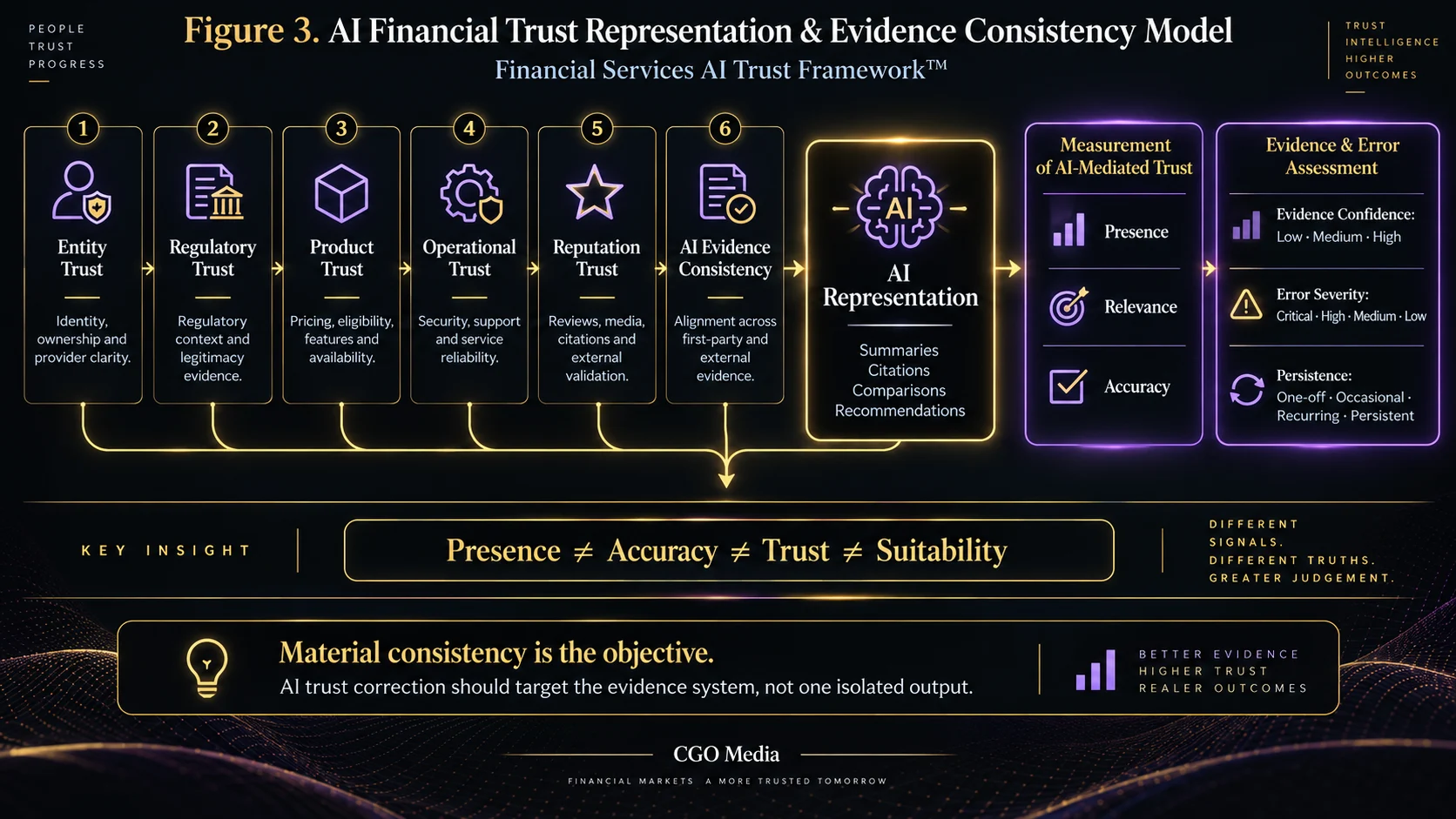
Relevant risks should not be hidden behind promotional language.
56. Product Availability Must Be Current
Withdrawn or market-restricted products should not be represented as broadly available.
57. Product Trust Depends on Freshness
Financial information can become unreliable quickly where:
- Rates change
- Fees change
- Eligibility changes
- Products are withdrawn
58. Product Trust Requires Review Cycles
Different information types should be reviewed according to:
- Risk
- Change velocity
- User impact
59. High-Change Product Fields
These may include:
- Interest rates
- Fees
- Promotions
- Eligibility thresholds
- Availability
60. Lower-Change Product Fields
These may include:
- General product purpose
- Core product category
- Stable service characteristics
61. Product Trust Requires Internal Consistency
The same product should not have materially different descriptions across controlled pages without a clear reason.
62. Product Trust Requires External Consistency
Important comparison or distribution environments should reflect current information where updates are possible.
63. Product Information Should Support Understanding
A useful structure is:
Purpose → Eligibility → Pricing → Features → Risk → Restrictions → Application
64. Product Trust Requires Plain Language
Complex financial information should be explained clearly without removing necessary technical or legal precision.
65. Product Trust Requires Transparency Around Conditions
Important limitations should not appear only after users begin an application.
66. Product Trust Requires Comparison Readiness
Users should be able to understand how a product differs from relevant alternatives.
67. Product Trust Is Weakened by Headline-Only Pricing
Prominent rates or promotional prices can create mistrust where important fees or ongoing costs are difficult to discover.
68. Product Trust Is Weakened by Eligibility Ambiguity
Users may perceive unnecessary friction when qualifying conditions appear late.
69. Product Trust Is Weakened by Overclaiming
Strong marketing language should not exceed the evidence available.
70. Product Trust Diagnostic Questions
Assess whether users can understand:
- What the product is
- Who it is for
- What it costs
- What the major conditions are
- What the important risks are
- How to apply
71. Product Trust Failure Signals
Potential warning signs include:
- Outdated rates
- Conflicting fees
- Missing eligibility information
- Unclear risk
- Withdrawn products remaining active
72. Trust Should Be Evaluated Across the Entire Financial Journey
Entity, regulatory and product trust do not operate independently.
73. Early-Stage Trust
Users may first ask whether the provider appears legitimate and relevant.
74. Mid-Stage Trust
Users may then test product clarity, costs, reputation and external evidence.
75. Late-Stage Trust
Before acting, users may validate:
- Security
- Application requirements
- Support
- Operational confidence
76. Trust Is Therefore Layered
A useful progression is:
Identify → Verify → Understand → Validate → Compare → Act
77. The First Three Trust Domains Establish the Evidence Foundation
The framework begins with:
Entity Trust + Regulatory Trust + Product Trust
78. These Three Domains Reduce Basic Uncertainty
They help answer:
- Who is the provider?
- Is the relevant entity legitimate?
- Is the product information reliable?
79. Trust Remains Incomplete Without Operational and External Evidence
The next stage examines security, operational reliability, reputation and external validation.
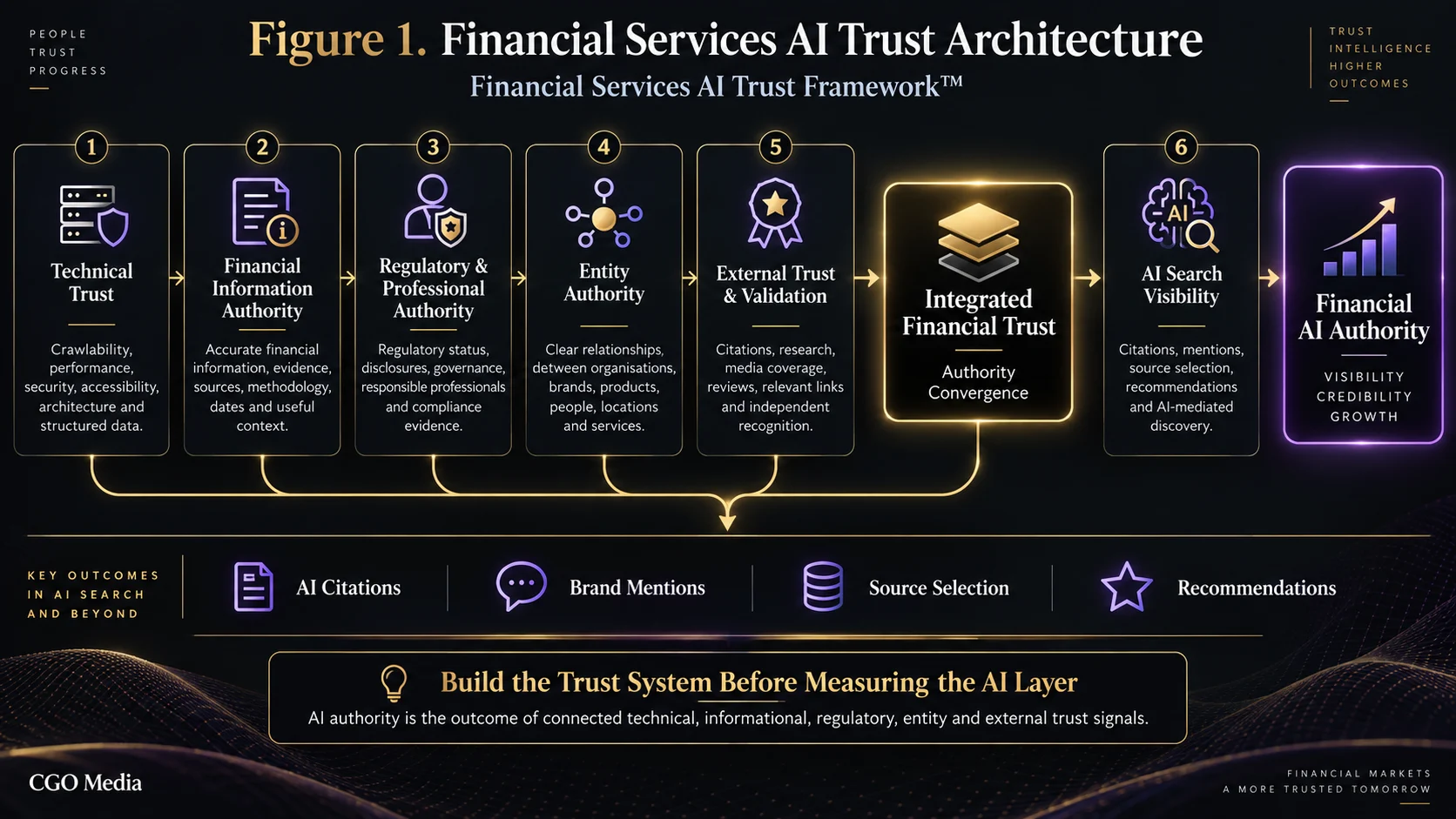
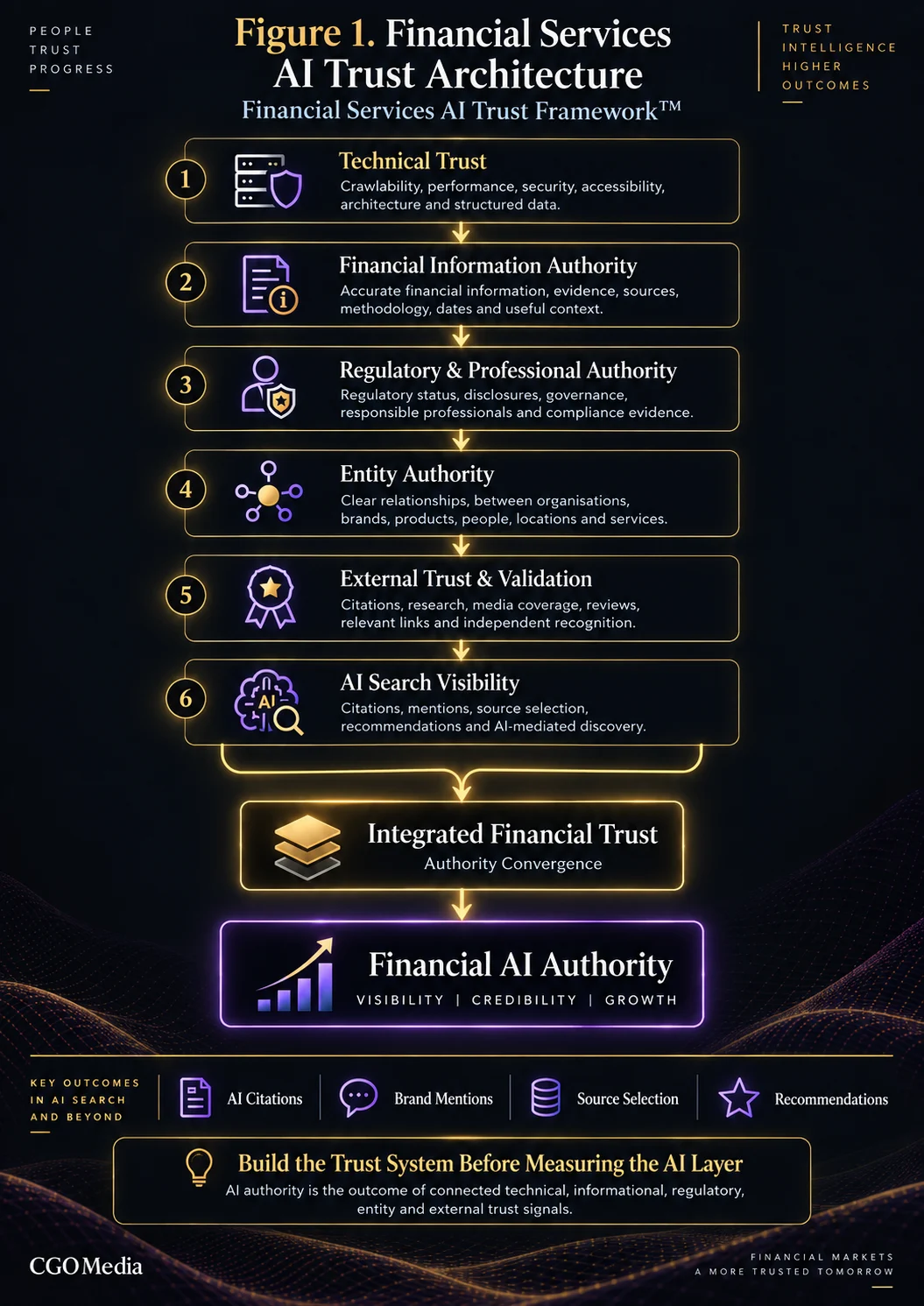
Figure 1 : Financial Services AI Trust Framework — Six Core Trust Domains.
80. Domain Four — Security and Operational Trust
The fourth trust domain concerns whether users believe the financial provider can operate securely, reliably and competently after provider selection.
81. Operational Trust Extends Beyond Brand Recognition
A familiar brand can still lose trust if users encounter poor security communication, unreliable systems or weak service processes.
82. Security Trust Begins with Clarity
Users should be able to understand how the provider protects:
- Accounts
- Transactions
- Personal information
- Business information
83. Security Trust Should Be Evidence-Led
Generic claims such as “secure platform” are weaker than specific, verifiable explanations.
84. Authentication Can Contribute to Security Trust
Relevant information may explain the use of:
- Multi-factor authentication
- Identity verification
- Account recovery controls
- Transaction confirmation
85. Fraud Prevention Can Contribute to Trust
Users may value clear information about how suspicious activity is identified and handled.
86. Fraud Communication Should Avoid Overclaiming
No security system should be represented as eliminating all risk where that cannot be supported.
87. Data Protection Contributes to Trust
Users may seek clarity around:
- Data collection
- Data use
- Account security
- Privacy controls
88. Security Information Should Be Understandable
Highly technical explanations may not provide reassurance if ordinary users cannot interpret them.
89. Security Information Should Also Remain Accurate
Simplification should not create misleading claims.
90. Operational Trust Includes Service Reliability
Financial users may also evaluate whether the provider appears capable of delivering the product consistently.
91. Service Reliability Can Influence Provider Selection
Users may consider:
- Platform uptime
- Transaction reliability
- Claims handling
- Payment processing
- Customer support
92. Different Products Create Different Operational Expectations
Operational trust for a payments provider differs from operational trust for a mortgage lender or insurer.
93. Payments Operational Trust
Relevant concerns may include:
- Transaction processing
- Settlement reliability
- System availability
- Support
94. Insurance Operational Trust
Relevant concerns may include:
- Claims processes
- Support
- Documentation
- Communication
95. Lending Operational Trust
Relevant concerns may include:
- Application processing
- Decision communication
- Document handling
- Servicing
96. Investment Operational Trust
Relevant concerns may include:
- Platform access
- Account administration
- Transaction processing
- Reporting
97. Customer Support Is a Trust Signal
Users may seek confidence that help is available if something goes wrong.
98. Support Information Should Be Specific
Where appropriate, explain:
- Contact methods
- Availability
- Support scope
- Escalation pathways
99. Poor Support Clarity Can Increase Perceived Risk
Financial products often involve long-term or high-value relationships.
100. Complaint Handling Contributes to Operational Trust
Users may evaluate whether the provider has a clear process for resolving problems.
101. Complaint Information Should Be Accessible
The process should not be unnecessarily difficult to locate.
102. Complaint Handling Should Not Be Hidden from Trust Architecture
Transparent problem-resolution processes can provide useful reassurance.
103. Operational Trust Includes Onboarding Quality
The application or onboarding process itself can confirm or weaken confidence.
104. Clear Onboarding Supports Trust
Users should understand:
- What information is required
- What documents may be needed
- What stages are involved
- What happens next
105. Unexpected Friction Can Damage Trust
Unexpected requirements late in the journey can create uncertainty.
106. Necessary Controls Should Remain
Appropriate:
- Identity verification
- Eligibility checks
- Risk controls
- Compliance controls
should not be removed solely to reduce friction.
107. Good Friction Can Reinforce Trust
Users may interpret proportionate security and verification controls as evidence of operational seriousness.
108. Bad Friction Can Weaken Trust
Examples include:
- Broken forms
- Repeated information requests
- Unexplained delays
- Unclear support
109. Operational Trust Continues After Selection
The customer experience becomes new trust evidence.
110. Post-Selection Trust Evidence
Customer experience can influence:
- Reviews
- Referrals
- Complaints
- Renewals
- Future provider selection
111. Operational Trust Creates a Feedback Loop
The relationship can be represented as:
Selection → Experience → Feedback → Reputation → Future Trust
112. Operational Trust Diagnostic Questions
Assess whether users can understand:
- How the provider protects them
- How support works
- How problems are resolved
- What onboarding involves
- What operational evidence exists
113. Operational Trust Failure Signals
Potential warning signs include:
- Weak security communication
- Persistent support complaints
- Broken onboarding
- Unclear complaint processes
- Repeated operational failures
114. Domain Five — Reputation and External Validation
The fifth trust domain concerns how external sources influence financial-provider credibility.
115. Users Rarely Rely on First-Party Information Alone
They may seek validation through:
- Reviews
- Financial media
- Comparison platforms
- Industry publications
- Professional recommendations
- Official records
116. External Validation Reduces Information Dependence
Independent evidence allows users to compare the provider’s own claims with wider public information.
117. External Validation Should Be Relevant
Not every mention contributes equally to trust.
118. Relevant Validation Is Product-Specific
A source may be influential for one financial category and unimportant for another.
119. Relevant Validation Is Audience-Specific
Consumer users and enterprise buyers may rely on different external evidence.
120. Relevant Validation Is Market-Specific
Different countries and regions may have different:
- Comparison platforms
- Media
- Industry bodies
- Review environments
121. Reviews Can Contribute to Reputation Trust
Customer reviews can reveal recurring service experiences.
122. Review Volume Is Not Enough
A mature review analysis also considers:
- Recency
- Theme
- Severity
- Persistence
123. Review Recency Matters
Recent evidence may be more useful for understanding current service performance.
124. Review Themes Matter
Recurring themes can reveal strengths or weaknesses around:
- Support
- Pricing
- Onboarding
- Claims
- Account access
125. Review Severity Matters
A small number of serious recurring issues may be more important than a larger volume of minor complaints.
126. Review Persistence Matters
Repeated themes over time can indicate a structural operational issue.
127. Reviews Are Not Proof of Financial Suitability
Customer feedback describes experience but does not establish whether a product is suitable for another individual or organisation.
128. Reviews Are Not Regulatory Evidence
High ratings do not substitute for formal provider verification.
129. Comparison Platforms Can Influence Trust
Users may treat comparison environments as independent sources of:
- Pricing
- Features
- Product availability
- Provider options
130. Comparison Platforms Have Limitations
Coverage may be affected by:
- Commercial relationships
- Platform scope
- Filtering
- Product availability
131. Comparison Visibility Is Not Universal Endorsement
Inclusion should not automatically be interpreted as proof that a provider is best or suitable for every user.
132. Financial Media Can Contribute to Trust
Relevant editorial coverage can provide external context around:
- Provider expertise
- Product innovation
- Market participation
- Research
133. Media Authority Should Be Evaluated by Relevance
A highly visible publication does not automatically provide meaningful validation for every financial topic.
134. Specialist Media Can Be Highly Valuable
Niche financial or industry publications may provide strong context for specialist products.
135. Research Can Strengthen External Validation
Original research can support trust when it is:
- Methodologically clear
- Transparent
- Citable
- Useful
136. Data-Led Research Can Support Citation Authority
Well-documented research may be referenced by:
- Journalists
- Researchers
- Industry analysts
- Educational institutions
137. Research Should Include Limitations
Transparency about methodology and uncertainty can strengthen credibility.
138. Awards Can Contribute to Reputation
Relevant awards may provide additional external context.
139. Awards Should Be Current and Specific
Historic or broad awards should not be used to imply current superiority without context.
140. Awards Are Not Product-Suitability Evidence
Recognition does not establish that a product is appropriate for a specific user.
141. Professional Recommendations Can Influence Trust
Some users may rely on:
- Accountants
- Advisers
- Brokers
- Industry peers
- Professional networks
142. Referral Trust Is Contextual
A recommendation may carry weight because the referrer understands the user’s circumstances.
143. Referral Trust Is Not Automatically Transferable
A provider suitable for one business or consumer may not be suitable for another.
144. Official Sources Can Provide Strong Validation
Where relevant, official records may help confirm:
- Entity identity
- Registration
- Authorisation
- Provider status
145. External Validation Depends on Consistency
Conflicting third-party information can weaken trust even when the provider’s own website is accurate.
146. External Source Conflicts Should Be Monitored
Priority sources should be compared against authoritative internal information.
147. External Evidence Should Be Tiered
A useful model is:
- Critical sources
- High-influence sources
- Medium-influence sources
- Low-influence sources
148. Critical Sources
These may include sources where inaccuracies create significant:
- Regulatory confusion
- Pricing confusion
- Provider confusion
- Product misunderstanding
149. High-Influence Sources
These may include:
- Major comparison platforms
- Relevant financial media
- Important review platforms
- Relevant official sources
150. Medium-Influence Sources
These may include secondary industry publications and specialist directories.
151. Low-Influence Sources
These may include minor mentions with limited relevance to provider selection.
152. External Authority Management Should Be Proportionate
Not every source requires the same monitoring intensity.
153. Reputation Trust Should Be Longitudinal
Trust is better understood through trends than isolated snapshots.
154. Reputation Trend Categories
The organisation may classify reputation as:
- Improving
- Stable
- At Risk
- Deteriorating
155. Reputation Changes Should Trigger Diagnosis
A deteriorating trend may reflect:
- Product problems
- Service problems
- Pricing problems
- Communication problems
156. Reputation Problems Should Not Be Solved with Content Alone
Operational causes may require operational fixes.
157. External Validation Can Affect AI Representation
Machine-mediated systems may encounter financial-provider evidence across multiple public sources.
158. External Consistency Can Reduce Ambiguity
Consistent identity, product and trust information across influential sources may create a clearer evidence environment.
159. External Validation Does Not Guarantee AI Inclusion
No external authority strategy can guarantee citation or recommendation by a particular AI system.
160. Reputation and External Validation Diagnostic Questions
Assess:
- Which external sources influence provider discovery?
- Which sources influence trust?
- Where do material conflicts exist?
- Which themes recur in reviews?
- Which sources deserve priority monitoring?
161. Reputation and External Validation Failure Signals
Potential warning signs include:
- Outdated comparison information
- Persistent negative review themes
- Incorrect third-party provider descriptions
- Weak independent corroboration
- Conflicting external evidence
162. Domains Four and Five Extend Trust Beyond Information
The framework now includes:
Operational Trust + Reputation Trust
163. Operational Evidence Shows What Happens After Selection
It helps users assess whether the provider is likely to deliver reliably.
164. External Evidence Shows How Others Represent the Provider
It helps users test first-party claims against independent sources.
165. Trust Is Now Distributed Across Five Domains
The framework can be expressed as:
Entity Trust → Regulatory Trust → Product Trust → Operational Trust → Reputation Trust
166. The Sixth Domain Adds AI Representation and Evidence Consistency
The next section examines how these trust domains interact when AI systems summarise, compare and recommend financial providers.
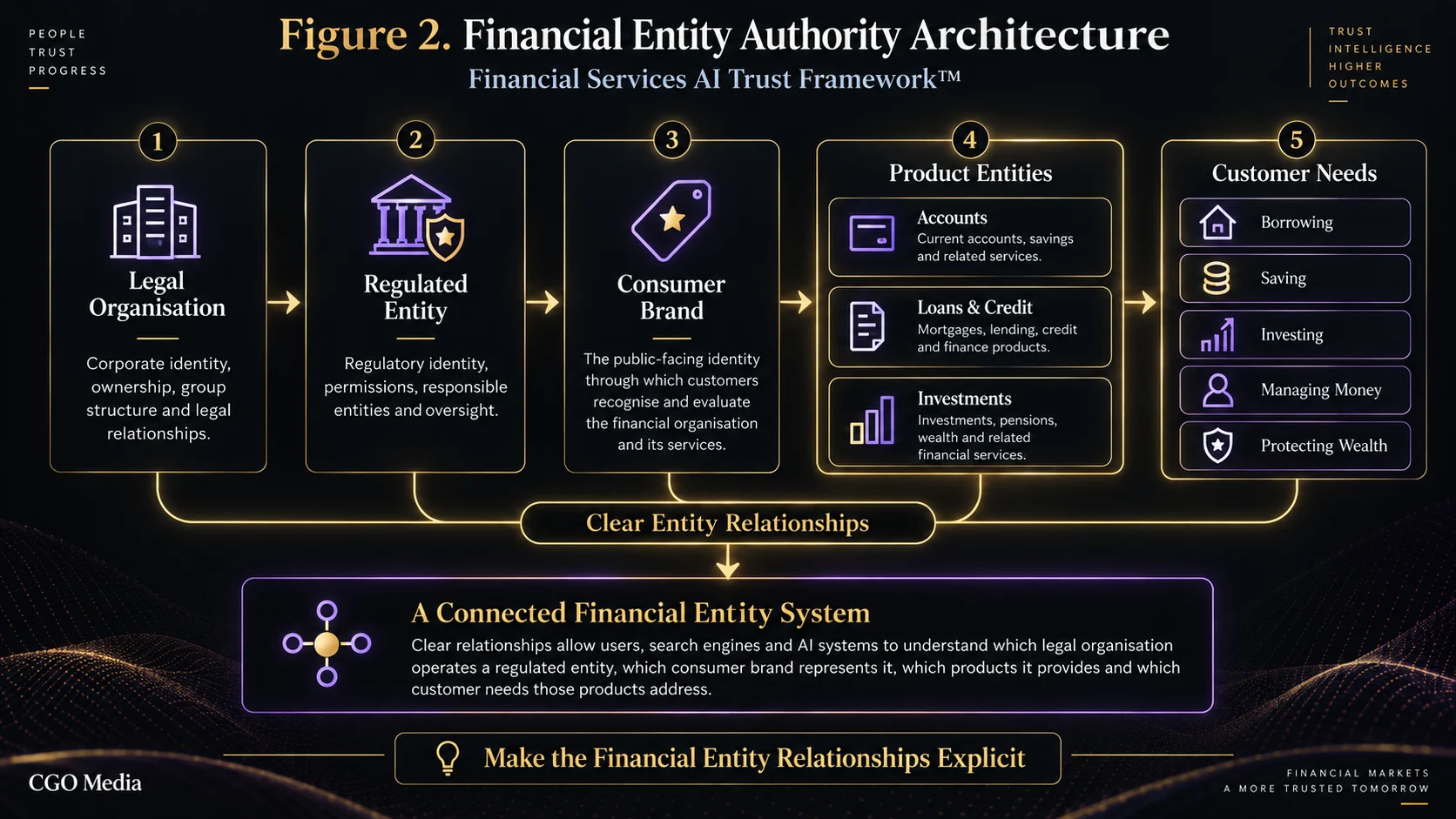
Figure 2 : Financial Operational, Reputation & External Trust Validation Matrix.
167. Domain Six — AI Representation and Evidence Consistency
The sixth trust domain examines how financial providers are represented within AI-assisted discovery environments and whether those representations align sufficiently with current, verifiable public evidence.
168. AI Systems Compress Multiple Trust Questions
A user may ask a single prompt that implicitly combines:
- Provider discovery
- Product understanding
- Trust validation
- Comparison
- Recommendation
169. AI Compression Can Increase the Cost of Inconsistency
Where different sources disagree about provider identity, pricing, product availability or regulation, generated systems may surface incomplete or conflicting representations.
170. AI Representation Is Built from an Evidence Environment
Financial providers should therefore consider the wider public evidence system rather than focusing only on one website page.
171. The Public Evidence Environment May Include
- Provider websites
- Regulatory sources
- Comparison platforms
- Financial media
- Review platforms
- Industry publications
- Public datasets
172. AI Trust Begins with Entity Consistency
Generated systems need enough evidence to distinguish between:
- Brand
- Legal entity
- Regulated entity
- Product
- Market
173. Entity Ambiguity Can Produce AI Trust Errors
Common problems may include:
- Wrong parent company
- Old brand names
- Incorrect regulated entity
- Incorrect product ownership
174. AI Product Trust Depends on Current Information
Generated systems may summarise financial products using information gathered from multiple environments.
175. Stale Product Information Can Persist
Outdated:
- Rates
- Fees
- Eligibility
- Availability
may remain visible after first-party pages have changed.
176. AI Pricing Trust Requires Particular Caution
Rates and fees can change quickly and generated information may become stale.
177. Generated Pricing Should Be Verified Against Authoritative Sources
Users should not be encouraged to rely on generated pricing alone where the current provider source can be checked.
178. AI Trust Depends on Regulatory Accuracy
Material errors involving regulatory relationships can have greater consequences than minor descriptive variation.
179. AI Regulatory Errors Should Receive High Priority
Examples may include:
- Incorrect regulated entity
- Incorrect authorisation context
- Wrong jurisdiction
- Historic regulatory status represented as current
180. AI Market Accuracy Also Matters
A provider may operate internationally while specific products remain market-restricted.
181. Market-Level AI Errors Can Mislead Users
A generated answer may imply that a product is available in a market where it is not offered.
182. AI Audience Accuracy Matters
Financial products designed for:
- Consumers
- SMEs
- Enterprise customers
should not be treated as interchangeable.
183. AI Recommendation Context Should Be Examined Carefully
A provider may appear relevant for one use case but inappropriate for another.
184. AI Inclusion Does Not Establish Suitability
Generated inclusion should not be interpreted as evidence that a provider or product is suitable for the specific user.
185. AI Inclusion Does Not Establish Regulatory Endorsement
A model mentioning a provider does not constitute approval by a regulator or official body.
186. AI Inclusion Does Not Establish Financial Quality
Presence in an answer does not prove superior product performance, financial strength or customer outcomes.
187. AI Ordering Is Not a Stable Ranking
Provider sequence may change according to:
- Prompt wording
- Model
- Location
- Time
- Available evidence
188. AI Trust Monitoring Should Be Repeatable
One screenshot or one prompt is insufficient for robust interpretation.
189. Build Stable Prompt Groups
A practical monitoring structure may include:
- Brand prompts
- Product prompts
- Trust prompts
- Comparison prompts
- Market prompts
- Audience prompts
190. Brand Prompt Group
Questions may test:
- Provider identity
- Ownership
- Business model
- Operating markets
191. Product Prompt Group
Questions may test:
- Product categories
- Features
- Eligibility
- Pricing
- Availability
192. Trust Prompt Group
Questions may test:
- Regulatory context
- Security
- Reputation
- Customer support
193. Comparison Prompt Group
Questions may test whether the provider is represented appropriately alongside relevant alternatives.
194. Market Prompt Group
Questions may test whether product and provider availability is represented correctly by geography.
195. Audience Prompt Group
Questions may test whether providers are matched appropriately with:
- Consumers
- Small businesses
- Enterprise organisations
- Specialist audiences
196. Record the Prompt Context
Each observation should ideally include:
- Prompt
- Model
- Date
- Market
- Audience
- Observed output
197. Record Material Accuracy
The most important question is whether the generated representation is materially correct.
198. Material Accuracy Categories
A practical classification may include:
- Accurate
- Mostly Accurate
- Materially Incomplete
- Materially Incorrect
199. Accuracy Should Be Assessed Against Authoritative Evidence
Generated claims should be checked against reliable, current sources rather than user expectation alone.
200. Record Provider Presence Separately from Accuracy
A provider can appear frequently while being described inaccurately.
201. Presence and Trust Are Different Variables
A useful distinction is:
Presence ≠ Accuracy ≠ Trust ≠ Suitability
202. Record Relevance Separately
A provider may be accurately described but still be irrelevant to the user’s specific financial need.
203. AI Trust Monitoring Should Therefore Measure Three Things
- Presence
- Relevance
- Accuracy
204. Add Evidence Confidence
Not every AI observation supports the same level of certainty.
205. High-Confidence AI Findings
These may be supported by:
- Repeated observations
- Clear authoritative evidence
- Consistent material error
206. Medium-Confidence AI Findings
These may involve:
- Some repeated variation
- Partial source evidence
- Moderate ambiguity
207. Low-Confidence AI Findings
These may involve:
- One-off outputs
- Unclear source context
- Minor wording differences
208. AI Error Severity Should Be Classified
A practical severity scale is:
- Critical
- High
- Medium
- Low
209. Critical AI Trust Errors
Potential examples include:
- Incorrect regulated entity
- Wrong provider ownership
- Materially incorrect product availability
- Serious pricing misinformation
210. High-Severity AI Trust Errors
Potential examples include:
- Wrong audience classification
- Significant eligibility error
- Material feature error
- Incorrect market scope
211. Medium-Severity AI Trust Errors
These may include incomplete but non-critical descriptions.
212. Low-Severity AI Trust Errors
These may include minor wording variation with little impact on user understanding.
213. Persistence Should Be Measured
An error that appears repeatedly deserves more attention than an isolated variation.
214. Persistence Categories
A useful classification is:
- One-off
- Occasional
- Recurring
- Persistent
215. Error Priority Should Combine Multiple Factors
A practical model is:
Priority = Severity + Persistence + User Impact + Evidence Confidence
216. Source Visibility Can Support Diagnosis
Where sources are displayed, they may help identify parts of the evidence environment contributing to the answer.
217. Visible Sources Should Be Logged
Record:
- Source domain
- Source type
- Current relevance
- Potential conflict
218. Source Categories May Include
- First-party provider source
- Regulatory source
- Comparison source
- Financial media
- Review source
- Industry publication
219. Visible Sources Are Partial Evidence
Displayed citations do not necessarily reveal every influence involved in generation.
220. Visible Source Appearance Does Not Establish Full Causation
A source appearing beside an answer should not automatically be treated as the sole reason a provider was included.
221. Source Patterns Are More Useful Than Individual Citations
Repeated source categories across multiple observations can provide more useful diagnostic context.
222. AI Trust Requires Source Consistency
Material conflicts across influential sources can increase ambiguity.
223. Source Consistency Does Not Mean Identical Wording
Different sources may describe the provider differently while remaining factually compatible.
224. Material Consistency Is the Objective
Important facts should broadly agree around:
- Identity
- Products
- Market
- Pricing
- Regulatory context
225. First-Party and External Evidence Should Be Compared
The organisation should identify where public representations diverge materially from authoritative internal records.
226. AI Errors May Expose Existing Evidence Problems
A generated error may sometimes be a symptom rather than the underlying problem.
227. Root Causes May Include
- Old first-party pages
- Historic comparison data
- Outdated editorial content
- Conflicting entity records
- Legacy product pages
228. AI Correction Should Target the Evidence System
The objective should not be to manipulate one isolated output.
229. AI Trust Correction Workflow
A practical process is:
Observe → Verify → Trace → Correct → Validate → Reobserve
230. Observe
Identify a potentially material AI trust issue.
231. Verify
Confirm whether the output is genuinely inaccurate.
232. Trace
Investigate which public evidence may be contributing to the issue.
233. Correct
Update the underlying source or record where appropriate and possible.
234. Validate
Confirm that the authoritative information is now correct across controlled environments.
235. Reobserve
Monitor future outputs rather than expecting immediate deterministic change.
236. AI Trust Improvement Should Be Longitudinal
Repeated observations are more useful than single before-and-after tests.
237. AI Trust Should Be Monitored by Product
Different product categories may exhibit different representation patterns.
238. AI Trust Should Be Monitored by Market
A provider may be represented accurately in one country and inaccurately in another.
239. AI Trust Should Be Monitored by Audience
Consumer and business-provider recommendations may differ materially.
240. AI Trust Should Be Monitored Across Multiple Models Where Strategically Important
Different systems may surface different evidence and provider representations.
241. Multi-Model Observation Improves Context
It can help distinguish:
- Model-specific variation
- Recurring cross-model issues
- Persistent evidence conflicts
242. AI Trust Monitoring Should Avoid False Precision
Small prompt sets should not be presented as definitive measures of whole-market AI visibility.
243. Prompt Samples Should Be Documented
Where reporting is published, the organisation should explain:
- Prompt classes
- Sampling method
- Observation period
- Limitations
244. AI Trust Metrics Should Support Decisions
Monitoring should answer questions such as:
- Are material errors decreasing?
- Is provider identity represented correctly?
- Are product associations improving?
- Are market errors persistent?
245. AI Trust Metrics Should Not Become Vanity Metrics
Raw mention counts can be misleading without relevance and accuracy context.
246. A Provider Can Be Frequently Mentioned for the Wrong Reason
High presence does not necessarily represent high-quality trust.
247. A Provider Can Be Rarely Mentioned but Accurately Represented
Lower presence may still coexist with a strong evidence environment.
248. The AI Trust Objective
The objective is stronger:
Accuracy + Relevance + Evidence Consistency + Appropriate Trust Context
249. Domain Six Connects the Whole Framework
AI representation can reflect weaknesses or strengths across all five earlier trust domains.
250. Entity Trust Influences AI Identity
Clear entity relationships support more coherent provider representation.
251. Regulatory Trust Influences AI Legitimacy Context
Current regulatory evidence can reduce ambiguity around provider status.
252. Product Trust Influences AI Product Accuracy
Current and consistent product information supports more reliable summaries.
253. Operational Trust Influences AI Reputation Context
Public evidence around service and security may influence how users interpret provider reliability.
254. External Reputation Influences AI Corroboration
Third-party evidence can reinforce or contradict first-party representations.
255. The Complete Six-Domain Trust Model
The framework can now be represented as:
Entity Trust + Regulatory Trust + Product Trust + Operational Trust + Reputation Trust + AI Evidence Consistency
256. The Next Stage Is Trust Measurement
The next section converts the six trust domains into a practical diagnostic and measurement system for assessing current trust strength, evidence confidence and strategic gaps.
Figure 3 : AI Financial Trust Representation & Evidence Consistency Model.
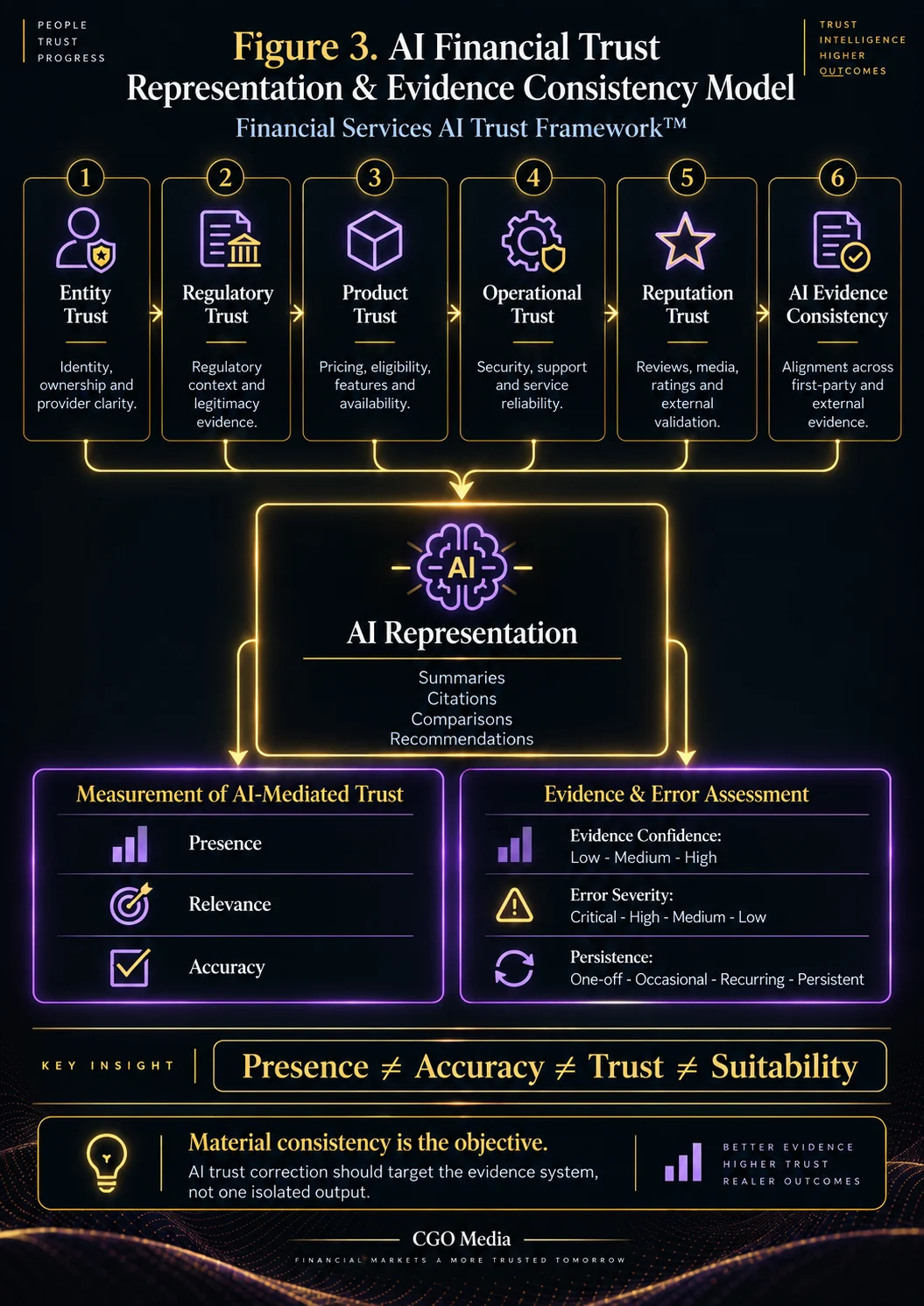
257. Financial Trust Diagnostic Framework
The six trust domains can be converted into a practical diagnostic model for assessing current trust strength, identifying weaknesses and defining priority improvements.
258. Trust Should Be Assessed by Domain
A financial provider may be strong in one trust area and weak in another.
259. Six Diagnostic Domains
- Entity and Provider Trust
- Regulatory and Institutional Trust
- Product and Information Trust
- Security and Operational Trust
- Reputation and External Validation
- AI Representation and Evidence Consistency
260. Use a Five-Level Trust Scale
A practical diagnostic scale is:
- Weak
- Emerging
- Established
- Strong
- Resilient
261. Level One — Weak
Evidence is fragmented, inconsistent, outdated or difficult to verify.
262. Level Two — Emerging
Some important trust signals are present, but standards and ownership remain inconsistent.
263. Level Three — Established
Core trust evidence is generally current, accessible and supported by repeatable processes.
264. Level Four — Strong
Trust evidence is actively governed, externally corroborated and monitored across important customer journeys.
265. Level Five — Resilient
Trust is supported by integrated evidence, change governance, continuous monitoring and rapid correction of material inconsistencies.
266. Score Each Trust Domain Independently
Each domain should receive its own current score rather than being compressed immediately into one overall value.
267. Example Trust Profile
A provider may record:
- Entity Trust — 4
- Regulatory Trust — 5
- Product Trust — 3
- Operational Trust — 3
- Reputation Trust — 2
- AI Evidence Consistency — 2
268. Uneven Trust Is Normal
Financial organisations often develop trust capabilities at different speeds.
269. Uneven Trust Should Remain Visible
An overall average should not hide a serious weakness in one critical domain.
270. Critical Trust Domains May Override the Average
Material weaknesses involving:
- Provider identity
- Regulatory status
- Pricing
- Product availability
- Security
should remain prominent regardless of the overall score.
271. Introduce a Critical Trust Override
A diagnostic dashboard may record:
Overall Trust Score: 3.6 | Critical Override: Product Pricing Conflict
272. Domain One Diagnostic — Entity and Provider Trust
Assess whether users can identify the organisation clearly.
273. Entity Trust Questions
- Is the brand name consistent?
- Is the legal entity clear?
- Is the product provider clear?
- Is the regulated entity clear?
- Are market relationships accurate?
274. Entity Trust Weakness Indicators
- Conflicting names
- Legacy branding
- Incorrect ownership
- Ambiguous entity relationships
- Duplicate location records
275. Entity Trust Evidence Sources
Potential evidence may include:
- Provider website
- Official records
- Structured data
- External profiles
- Comparison platforms
276. Domain Two Diagnostic — Regulatory and Institutional Trust
Assess whether relevant regulatory relationships are current, specific and independently verifiable.
277. Regulatory Trust Questions
- Which entity is regulated?
- Which activities are covered?
- Which market does the information apply to?
- Can users verify the information independently?
278. Regulatory Trust Weakness Indicators
- Generic regulatory claims
- Outdated disclosures
- Incorrect entity references
- Broken verification links
- Conflicting external records
279. Regulatory Trust Evidence Sources
Potential evidence may include:
- Official regulator records
- Provider disclosures
- Legal documentation
- Relevant institutional sources
280. Domain Three Diagnostic — Product and Information Trust
Assess whether product information is current, accurate, understandable and sufficiently complete.
281. Product Trust Questions
- Is pricing current?
- Is eligibility clear?
- Are risks explained?
- Are key conditions visible?
- Is product availability accurate?
282. Product Trust Weakness Indicators
- Stale rates
- Conflicting fees
- Missing eligibility
- Unclear restrictions
- Withdrawn products remaining active
283. Product Trust Evidence Sources
Potential evidence may include:
- Product pages
- Terms and conditions
- Comparison sources
- Product feeds
- Customer-support documentation
284. Domain Four Diagnostic — Security and Operational Trust
Assess whether the organisation demonstrates sufficient operational reliability and security evidence.
285. Operational Trust Questions
- Are security controls explained?
- Is customer support accessible?
- Are complaint pathways clear?
- Is onboarding understandable?
- Are operational issues recurring?
286. Operational Trust Weakness Indicators
- Weak security communication
- Persistent support complaints
- Broken onboarding
- Unclear escalation
- Repeated system failures
287. Operational Trust Evidence Sources
Potential evidence may include:
- Security documentation
- Support information
- Complaint data
- Customer reviews
- Operational reporting
288. Domain Five Diagnostic — Reputation and External Validation
Assess whether external evidence supports, contradicts or weakens first-party trust claims.
289. Reputation Trust Questions
- What do current reviews indicate?
- Are comparison profiles accurate?
- Is there credible editorial coverage?
- Are external descriptions current?
- Do recurring negative themes exist?
290. Reputation Trust Weakness Indicators
- Persistent negative review themes
- Outdated comparison data
- Incorrect external descriptions
- Weak independent corroboration
- Conflicting third-party evidence
291. Reputation Trust Evidence Sources
Potential evidence may include:
- Review platforms
- Comparison sites
- Financial media
- Industry publications
- Professional referrals
292. Domain Six Diagnostic — AI Representation and Evidence Consistency
Assess whether AI systems represent the provider accurately, relevantly and consistently enough across important prompt categories.
293. AI Trust Questions
- Is provider identity accurate?
- Are products represented correctly?
- Is market availability correct?
- Is regulatory context accurate?
- Do material errors persist?
294. AI Trust Weakness Indicators
- Wrong provider identity
- Incorrect product ownership
- Outdated pricing
- Wrong market availability
- Persistent regulatory error
295. AI Trust Evidence Sources
Potential evidence may include:
- Repeatable prompt observations
- Visible citations
- Provider source data
- External source comparisons
296. Add Evidence Confidence to Every Domain
Trust scores should indicate how strongly the available evidence supports the assessment.
297. High-Confidence Trust Assessment
High confidence may be supported by:
- Current authoritative records
- Repeated observations
- Multiple evidence sources
- Clear ownership
298. Medium-Confidence Trust Assessment
Medium confidence may involve:
- Partial evidence
- Sampled observations
- Some uncertainty
- Incomplete external data
299. Low-Confidence Trust Assessment
Low confidence may involve:
- One-off observations
- Outdated records
- Unverified assumptions
- Weak source coverage
300. Low Confidence Is Itself a Trust Governance Signal
If the organisation cannot verify important trust claims confidently, that evidence gap should be treated as a weakness.
301. Add Coverage to Trust Assessment
A trust process may work well for one product while remaining absent elsewhere.
302. Product Coverage
Assess whether trust standards apply across:
- Priority products
- Secondary products
- New products
- Legacy products
303. Market Coverage
Assess whether trust evidence differs materially across:
- Countries
- Regions
- Local markets
- Digital-only markets
304. Audience Coverage
Assess whether trust architecture supports:
- Consumers
- SMEs
- Enterprise buyers
- Specialist audiences
305. Channel Coverage
Assess whether trust is coherent across:
- Website
- Search
- Comparison platforms
- Review environments
- AI systems
306. Add Trend to Trust Assessment
Current trust strength should be accompanied by direction of travel.
307. Suggested Trust Trend Categories
- Improving
- Stable
- At Risk
- Deteriorating
308. Improving
The domain is strengthening and the supporting evidence confirms progress.
309. Stable
The domain remains broadly consistent without significant positive or negative movement.
310. At Risk
Signals suggest that trust may weaken if no action is taken.
311. Deteriorating
The domain has materially weakened compared with the previous assessment.
312. High Trust Can Still Be Deteriorating
A provider may have strong current trust but worsening review themes or product freshness.
313. Low Trust Can Still Be Improving
An emerging trust capability may be progressing rapidly after governance changes.
314. Define Current and Target Trust
Each domain should record:
- Current trust level
- Target trust level
- Target rationale
315. Not Every Domain Requires the Same Target
Target trust should reflect:
- Risk
- Product type
- Market complexity
- Customer expectations
- Strategic importance
316. Calculate the Trust Gap
A simple model is:
Target Trust − Current Trust = Trust Gap
317. Gap Size Is Not the Same as Priority
A small regulatory gap may matter more than a larger lower-risk reputation gap.
318. Trust Priority Should Include Risk
A practical prioritisation model is:
Trust Gap + Risk + Strategic Importance + Evidence Confidence
319. Add User Impact to Prioritisation
A more complete model is:
Priority = Trust Gap + Risk + Strategic Importance + User Impact + Evidence Confidence
320. Identify Trust Failure Points Across the Journey
The Financial Provider Selection Model can be used to identify where trust breaks down.
321. Discovery-Stage Trust Failure
The provider may fail to enter consideration because identity or relevance is unclear.
322. Product-Understanding Trust Failure
Users may leave because pricing, eligibility or risk is unclear.
323. Provider-Discovery Trust Failure
Users may discover the organisation but remain uncertain about legitimacy or fit.
324. Trust-Validation Failure
Users may be unable to verify regulatory, reputation or operational evidence.
325. Comparison-Stage Trust Failure
The provider may appear credible but still lose because product differences are unclear.
326. Selection-Stage Trust Failure
Users may abandon because application or onboarding introduces unexpected friction.
327. Post-Selection Trust Failure
Poor customer experience can create future reputation damage.
328. Trust Failure Can Propagate Forward
A weakness at one stage can affect later provider selection.
329. Trust Failure Can Also Propagate Backward
Post-selection complaints can influence future users at the discovery stage.
330. Trust Is Therefore Circular
A useful model is:
Discovery → Trust → Selection → Experience → Reputation → Future Discovery
331. Build a Trust Gap Register
Each significant trust gap should record:
- Domain
- Issue
- Severity
- Confidence
- Owner
- Required action
332. Trust Gap Severity
A practical scale is:
- Critical
- High
- Medium
- Low
333. Critical Trust Gap
Potential examples include:
- Incorrect regulated entity
- Material pricing conflict
- Wrong product ownership
- Serious security misrepresentation
334. High Trust Gap
Potential examples include:
- Persistent reputation deterioration
- Significant eligibility confusion
- Recurring external provider errors
- Persistent high-impact AI errors
335. Medium Trust Gap
These may include incomplete supporting evidence that creates moderate user uncertainty.
336. Low Trust Gap
These may include minor inconsistencies with limited practical impact.
337. Trust Gap Ownership Should Be Explicit
Different gaps may require different owners.
338. Entity Trust Ownership
Potential owners may include:
- Digital governance
- SEO
- Legal
- Corporate communications
339. Regulatory Trust Ownership
Potential owners may include:
- Compliance
- Legal
- Product governance
340. Product Trust Ownership
Potential owners may include:
- Product
- Compliance
- Content
- SEO
341. Operational Trust Ownership
Potential owners may include:
- Operations
- Customer experience
- Security
- Technology
342. Reputation Trust Ownership
Potential owners may include:
- Customer experience
- Communications
- Digital PR
- SEO
343. AI Trust Ownership
Potential owners may include:
- Search
- AI visibility
- Data
- Product
- Compliance
344. Build a Trust Diagnostic Scorecard
A practical scorecard can include:
- Current trust level
- Target trust level
- Gap
- Confidence
- Coverage
- Trend
- Priority
345. Example Financial Trust Diagnostic
| Trust Domain | Current | Target | Confidence | Trend | Priority |
|---|---|---|---|---|---|
| Entity & Provider Trust | 1–5 | 1–5 | Low / Medium / High | Improving / Stable / At Risk / Deteriorating | Critical / High / Medium / Low |
| Regulatory & Institutional Trust | 1–5 | 1–5 | Low / Medium / High | Improving / Stable / At Risk / Deteriorating | Critical / High / Medium / Low |
| Product & Information Trust | 1–5 | 1–5 | Low / Medium / High | Improving / Stable / At Risk / Deteriorating | Critical / High / Medium / Low |
| Security & Operational Trust | 1–5 | 1–5 | Low / Medium / High | Improving / Stable / At Risk / Deteriorating | Critical / High / Medium / Low |
| Reputation & External Validation | 1–5 | 1–5 | Low / Medium / High | Improving / Stable / At Risk / Deteriorating | Critical / High / Medium / Low |
| AI Representation & Evidence Consistency | 1–5 | 1–5 | Low / Medium / High | Improving / Stable / At Risk / Deteriorating | Critical / High / Medium / Low |
346. Trust Diagnostics Should Lead to Action
The objective is not merely to create a score.
347. Trust Improvement Portfolio
Actions can be grouped into:
- Critical corrections
- Evidence improvements
- Operational improvements
- External validation improvements
- AI evidence improvements
348. Critical Corrections
These may include:
- Provider identity correction
- Regulatory correction
- Pricing correction
- Product availability correction
349. Evidence Improvements
These may include:
- Clearer trust pages
- Better product disclosure
- Improved security explanation
- Stronger citation architecture
350. Operational Improvements
These may include:
- Better support
- Improved onboarding
- Complaint-process improvements
- Reliability improvements
351. External Validation Improvements
These may include:
- Comparison-platform corrections
- Review governance
- Relevant media authority
- Research publication
352. AI Evidence Improvements
These may include:
- Entity clarification
- Product-data correction
- External source reconciliation
- Repeatable monitoring
353. Trust Improvement Should Follow Dependency
Advanced AI monitoring should not be prioritised ahead of basic provider and product accuracy.
354. Identity Before Amplification
The organisation should establish who it is before attempting to maximise visibility.
355. Product Accuracy Before Comparison Growth
Comparison visibility is less valuable if product information is unreliable.
356. Trust Evidence Before Recommendation Expansion
Greater provider discovery may increase verification friction if trust architecture remains weak.
357. Governance Before Scale
Trust systems should be maintainable before being expanded across large product or market portfolios.
358. Trust Diagnostic Principle
The complete diagnostic process can be expressed as:
Assess Domain → Establish Current Trust → Define Target → Measure Gap → Apply Confidence → Prioritise Improvement
359. The Next Stage Is Trust Measurement and Governance
The next section translates these trust diagnostics into ongoing KPIs, executive reporting, governance ownership and continuous trust improvement.
Figure 4 : Financial Services Trust Diagnostic & Current-to-Target Gap Model.
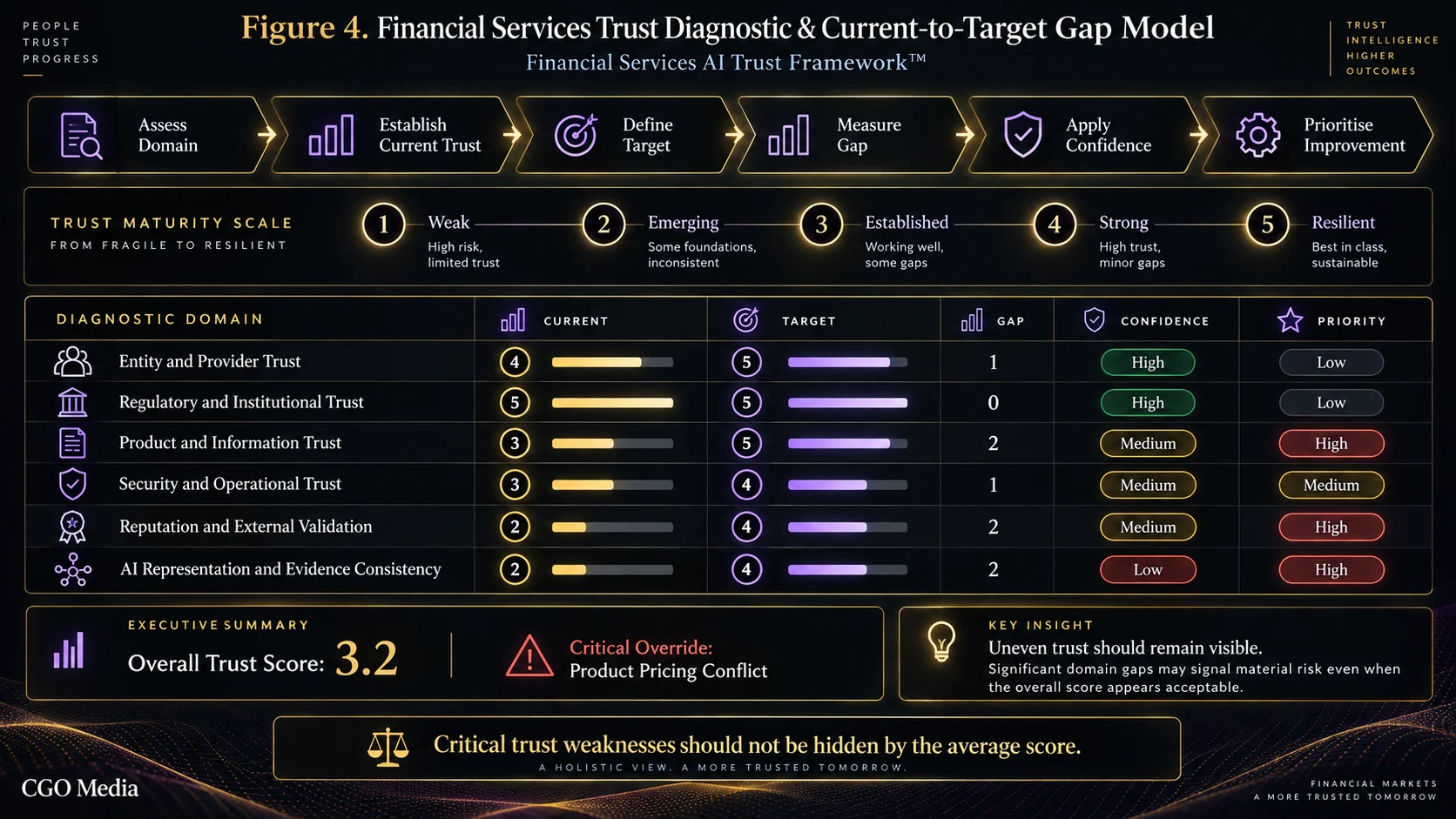
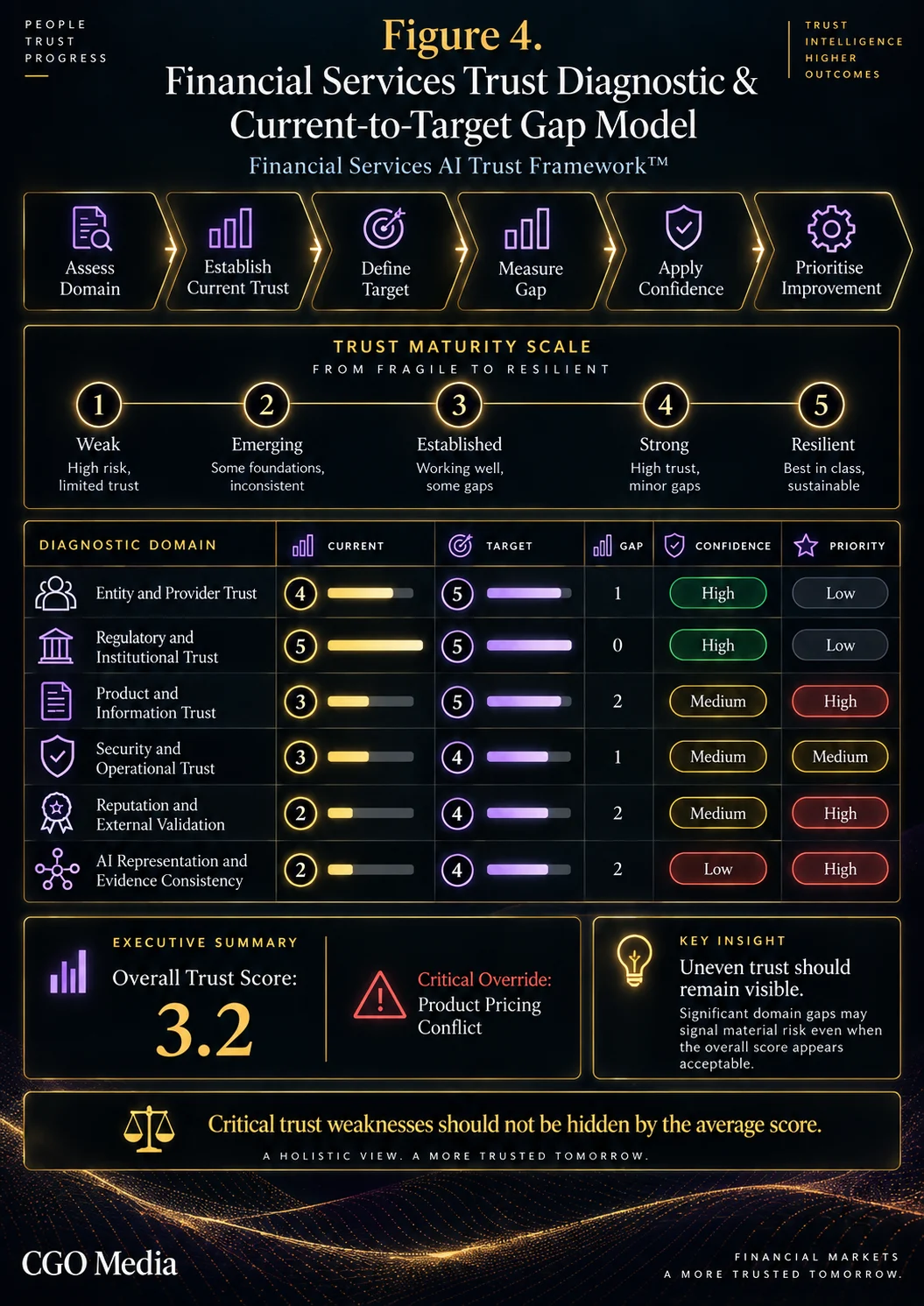
360. Financial Trust Measurement
Once the organisation has identified trust gaps, it needs a measurement system that shows whether trust evidence is becoming stronger, more consistent and more useful across financial provider-selection journeys.
361. Trust Measurement Should Follow the Six Domains
The measurement framework should cover:
- Entity and Provider Trust
- Regulatory and Institutional Trust
- Product and Information Trust
- Security and Operational Trust
- Reputation and External Validation
- AI Representation and Evidence Consistency
362. Trust Measurement Should Separate Evidence from Outcome
The organisation should distinguish between:
- Trust evidence available
- Trust evidence quality
- User trust behaviour
- Provider-selection outcomes
363. Evidence Availability Is the First Layer
A provider cannot expect users to validate trust evidence that is difficult to find.
364. Evidence Quality Is the Second Layer
Available trust information should be:
- Current
- Specific
- Verifiable
- Relevant
- Understandable
365. User Behaviour Is the Third Layer
The organisation can observe whether users engage with:
- Trust pages
- Regulatory information
- Security information
- Review content
- Comparison content
366. Provider-Selection Outcome Is the Fourth Layer
Trust improvement should ideally support more qualified progression from provider discovery toward comparison and action.
367. Measure Entity and Provider Trust
Potential KPIs include:
- Entity conflict rate
- Brand consistency
- Product ownership accuracy
- Market mapping accuracy
368. Entity Conflict Rate
Track material inconsistencies across:
- Provider website
- External profiles
- Comparison platforms
- AI outputs
369. Brand Consistency
Measure whether current brand naming is consistent across priority digital environments.
370. Product Ownership Accuracy
Track whether products are consistently associated with the correct provider and legal entity.
371. Market Mapping Accuracy
Track whether the organisation’s products are represented correctly by geography and audience.
372. Measure Regulatory and Institutional Trust
Potential KPIs include:
- Regulatory identity accuracy
- Verification-link availability
- Regulatory-content freshness
- External record consistency
373. Regulatory Identity Accuracy
Measure whether the correct entity and regulatory context are represented consistently.
374. Regulatory Verification Accessibility
Measure whether users can reach relevant independent verification sources without unnecessary friction.
375. Regulatory Information Freshness
Track whether important regulatory information is current and within its review cycle.
376. Regulatory External Consistency
Monitor whether priority external sources materially align with current provider information.
377. Measure Product and Information Trust
Potential KPIs include:
- Pricing accuracy
- Eligibility clarity
- Product freshness
- Risk clarity
- Availability accuracy
378. Pricing Accuracy
Monitor whether rates, fees and charges are consistent across controlled and high-priority external environments.
379. Eligibility Clarity
Assess whether users can identify important eligibility criteria before beginning a substantial application process.
380. Product Freshness
Track the proportion of priority product information that is:
- Current
- Due for review
- Overdue
- At risk
381. Risk Clarity
Assess whether material product risks and restrictions are represented sufficiently clearly.
382. Product Availability Accuracy
Track whether users are being shown products that are actually available to them.
383. Measure Security and Operational Trust
Potential KPIs include:
- Security-information completeness
- Support accessibility
- Complaint-resolution trends
- Onboarding friction
- Operational issue recurrence
384. Security Information Completeness
Assess whether users can understand relevant:
- Authentication
- Fraud controls
- Data protection
- Account security
385. Support Accessibility
Measure whether support information is easy to find and whether appropriate channels are available.
386. Complaint-Resolution Trends
Track whether recurring complaint themes are:
- Improving
- Stable
- At Risk
- Deteriorating
387. Onboarding Friction
Measure where suitable users encounter unnecessary delay or confusion.
388. Operational Issue Recurrence
Recurring problems may indicate structural trust weaknesses rather than isolated incidents.
389. Measure Reputation and External Validation
Potential KPIs include:
- Review recency
- Review theme trends
- Comparison-platform accuracy
- Relevant editorial references
- Research citations
390. Review Recency
Monitor whether public customer feedback remains recent enough to provide a meaningful current picture.
391. Review Theme Trends
Track recurring positive and negative themes rather than relying solely on average rating.
392. Comparison-Platform Accuracy
Monitor whether important product and provider information remains sufficiently current.
393. Editorial Validation
Track relevant independent coverage that contributes to provider context and authority.
394. Research Citation Performance
Where the organisation publishes original research, monitor whether it is referenced by:
- Journalists
- Researchers
- Industry analysts
- Relevant organisations
395. Measure AI Representation and Evidence Consistency
Potential KPIs include:
- Brand accuracy
- Product accuracy
- Regulatory accuracy
- Market accuracy
- Material error persistence
396. AI Brand Accuracy
Measure whether AI systems identify the provider correctly.
397. AI Product Accuracy
Measure whether generated systems represent products correctly.
398. AI Regulatory Accuracy
Measure whether material regulatory relationships are represented correctly.
399. AI Market Accuracy
Measure whether generated systems correctly describe where products are available.
400. AI Error Persistence
Track whether material errors are:
- One-off
- Occasional
- Recurring
- Persistent
401. AI Presence Should Be Measured Separately
Provider presence can be useful context, but it should not be treated as a trust score.
402. AI Presence Without Accuracy Can Be Harmful
Frequent inaccurate representation can increase confusion rather than trust.
403. AI Relevance Should Also Be Measured
The provider should appear in contexts where its products and audience genuinely fit.
404. AI Trust Measurement Should Therefore Use Three Core Metrics
A useful model is:
Presence + Relevance + Accuracy
405. Add Evidence Confidence to Trust Metrics
Every important metric should indicate how reliable the supporting evidence is.
406. High Confidence
High-confidence findings may be supported by:
- Direct authoritative evidence
- Multiple sources
- Repeated observations
- Current data
407. Medium Confidence
Medium-confidence findings may rely on:
- Partial evidence
- Sampled observations
- Moderate inference
408. Low Confidence
Low-confidence findings may rely on:
- One-off observations
- Weak data
- Outdated evidence
- Unverified assumptions
409. Confidence Should Influence Priority
High-risk findings supported by high-confidence evidence should normally receive faster attention.
410. Add Trend to Trust Metrics
A current number without direction of travel can be misleading.
411. Suggested Trend Labels
- Improving
- Stable
- At Risk
- Deteriorating
412. Track Trust by Product
Trust patterns can differ significantly across:
- Mortgages
- Insurance
- Investments
- Payments
- Business finance
- Banking products
413. Track Trust by Audience
Consumer and business customers may place different weight on:
- Price
- Regulation
- Support
- Integration
- Operational reliability
414. Track Trust by Market
Multi-market providers should not assume the same trust architecture works identically everywhere.
415. Track Trust by Journey Stage
The Financial Provider Selection Model can be used to segment trust measurement across:
Discovery → Understanding → Provider Discovery → Trust Validation → Comparison → Selection
416. Early-Stage Trust Metrics
Potential indicators include:
- Brand recognition
- Provider identity clarity
- Relevant discovery visibility
417. Mid-Stage Trust Metrics
Potential indicators include:
- Product engagement
- Pricing clarity
- Regulatory verification
- Review interaction
418. Late-Stage Trust Metrics
Potential indicators include:
- Application progression
- Support engagement
- Abandonment reasons
- Completion confidence
419. Post-Selection Trust Metrics
Potential indicators include:
- Early customer satisfaction
- Complaint themes
- Review behaviour
- Referral behaviour
420. Trust Attribution Is Multi-Touch
Financial trust rarely comes from one source.
421. Example Multi-Touch Trust Journey
A user may move through:
Google Search → Product Page → Review Platform → Regulatory Source → Provider Website → Application
422. Example AI-Assisted Trust Journey
A user may move through:
AI Answer → Provider Website → Comparison Platform → Branded Trust Search → Application
423. Example Referral-Led Trust Journey
A user may move through:
Professional Referral → Branded Search → Regulatory Verification → Provider Website → Consultation
424. First-Touch Attribution Has Limits
The first observable source may not have created the final trust decision.
425. Last-Touch Attribution Has Limits
The final interaction may capture conversion but miss earlier trust-building influences.
426. Assisted Attribution Adds Context
Where possible, include:
- Search
- AI
- Comparison
- Reviews
- Referrals
427. AI Attribution Requires Caution
Closed interfaces and incomplete referral data can make precise AI attribution difficult.
428. Self-Reported Discovery Can Add Evidence
Where appropriate, organisations may ask customers how they first heard about the provider.
429. Self-Reported Data Also Has Limitations
Users may remember only the most recent or most salient source.
430. Avoid Unsupported Causal Claims
An increase in trust engagement following an AI visibility increase does not automatically prove direct causation.
431. Build a Trust Executive Scorecard
Leadership should receive a compact view of the six trust domains.
432. Recommended Executive Fields
Each domain may include:
- Current Trust Level
- Target Trust Level
- Confidence
- Trend
- Critical Issue
- Priority
433. Example Financial Services AI Trust Executive Scorecard
| Trust Domain | Current | Target | Confidence | Trend | Priority |
|---|---|---|---|---|---|
| Entity & Provider Trust | 1–5 | 1–5 | Low / Medium / High | Improving / Stable / At Risk / Deteriorating | Critical / High / Medium / Low |
| Regulatory & Institutional Trust | 1–5 | 1–5 | Low / Medium / High | Improving / Stable / At Risk / Deteriorating | Critical / High / Medium / Low |
| Product & Information Trust | 1–5 | 1–5 | Low / Medium / High | Improving / Stable / At Risk / Deteriorating | Critical / High / Medium / Low |
| Security & Operational Trust | 1–5 | 1–5 | Low / Medium / High | Improving / Stable / At Risk / Deteriorating | Critical / High / Medium / Low |
| Reputation & External Validation | 1–5 | 1–5 | Low / Medium / High | Improving / Stable / At Risk / Deteriorating | Critical / High / Medium / Low |
| AI Representation & Evidence Consistency | 1–5 | 1–5 | Low / Medium / High | Improving / Stable / At Risk / Deteriorating | Critical / High / Medium / Low |
434. Critical Issues Should Sit Outside the Average Score
A serious regulatory or product error should remain visible until resolved.
435. Executive Trust Reporting Should Separate Risk from Growth
Leadership should be able to distinguish:
- Trust risk
- Trust improvement
- Visibility opportunity
- Provider-selection opportunity
436. Governance Ownership Should Follow the Trust Domain
Different domains require different organisational expertise.
437. Entity Trust Governance
Potential ownership may involve:
- Digital governance
- Legal
- SEO
- Corporate communications
438. Regulatory Trust Governance
Potential ownership may involve:
- Compliance
- Legal
- Product governance
439. Product Trust Governance
Potential ownership may involve:
- Product
- Compliance
- Content
- SEO
440. Operational Trust Governance
Potential ownership may involve:
- Operations
- Customer experience
- Security
- Technology
441. Reputation Trust Governance
Potential ownership may involve:
- Customer experience
- Communications
- Digital PR
- SEO
442. AI Trust Governance
Potential ownership may involve:
- Search
- AI visibility
- Data
- Product
- Compliance
443. Cross-Functional Trust Governance Is Essential
No single team can independently maintain every financial trust domain.
444. Build a Trust Governance Group Where Appropriate
Larger organisations may benefit from a cross-functional group covering:
- Trust standards
- Critical issues
- Product changes
- External conflicts
- AI representation
445. Define Decision Rights
The organisation should know who can:
- Create trust information
- Approve trust information
- Correct trust information
- Escalate material issues
446. Define Review Cadence
Trust evidence should be reviewed according to:
- Risk
- Change velocity
- User impact
- Strategic value
447. High-Frequency Trust Review
Potential areas include:
- Pricing
- Eligibility
- Product availability
- Major complaint themes
448. Medium-Frequency Trust Review
Potential areas include:
- Security content
- External profiles
- Comparison information
- Review trends
449. Strategic Trust Review
Potential areas include:
- Entity architecture
- Trust maturity
- AI representation
- External validation strategy
450. Define Change Triggers
Important events should trigger trust reassessment.
451. Product Launch Trigger
A new product should trigger:
- Product trust review
- Regulatory review
- Security review
- AI monitoring updates
452. Product Change Trigger
Changes to pricing, eligibility or terms should trigger relevant trust updates.
453. Regulatory Change Trigger
Material regulatory changes should trigger review of affected trust evidence.
454. Brand Change Trigger
Rebrands or acquisitions should trigger entity and external-source reconciliation.
455. Reputation Event Trigger
Significant complaint or media events should trigger review of reputation and operational trust.
456. AI Drift Trigger
Persistent material AI inaccuracies should trigger deeper evidence investigation.
457. Trust Measurement Should Support Prioritisation
A practical priority model is:
Priority = Trust Gap + Risk + User Impact + Strategic Importance + Evidence Confidence
458. Trust Measurement Should Support Resource Allocation
Resources should be concentrated on the most material gaps rather than distributed equally across every trust domain.
459. Trust Measurement Should Support Longitudinal Learning
The organisation should be able to compare trust strength over time.
460. The Next Stage Is Continuous Trust Improvement
The next section examines trust decay, failure modes, change triggers and the continuous improvement cycle required to maintain financial trust over time.
Figure 5 : Financial Services AI Trust Measurement & Executive Scorecard.
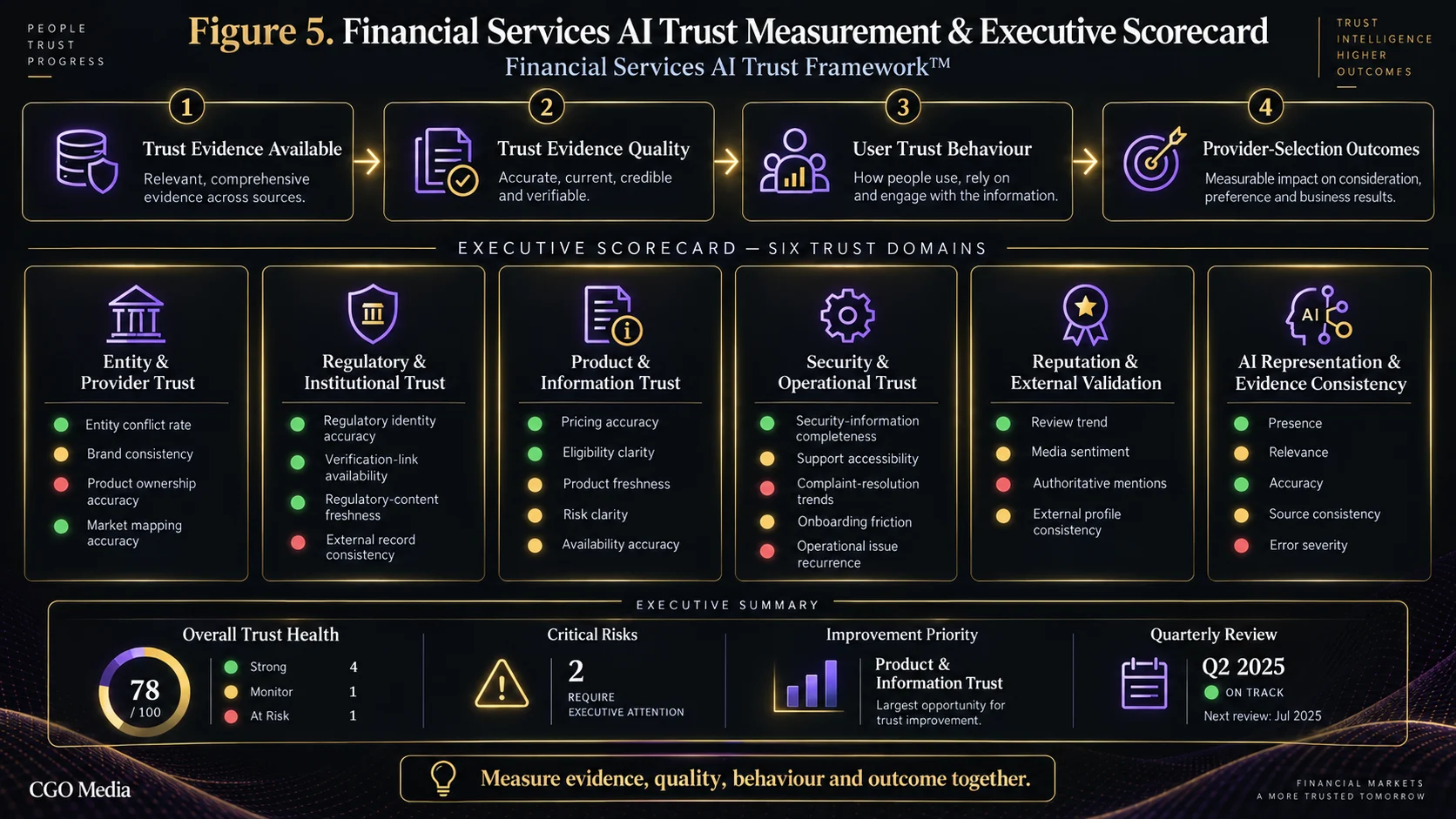
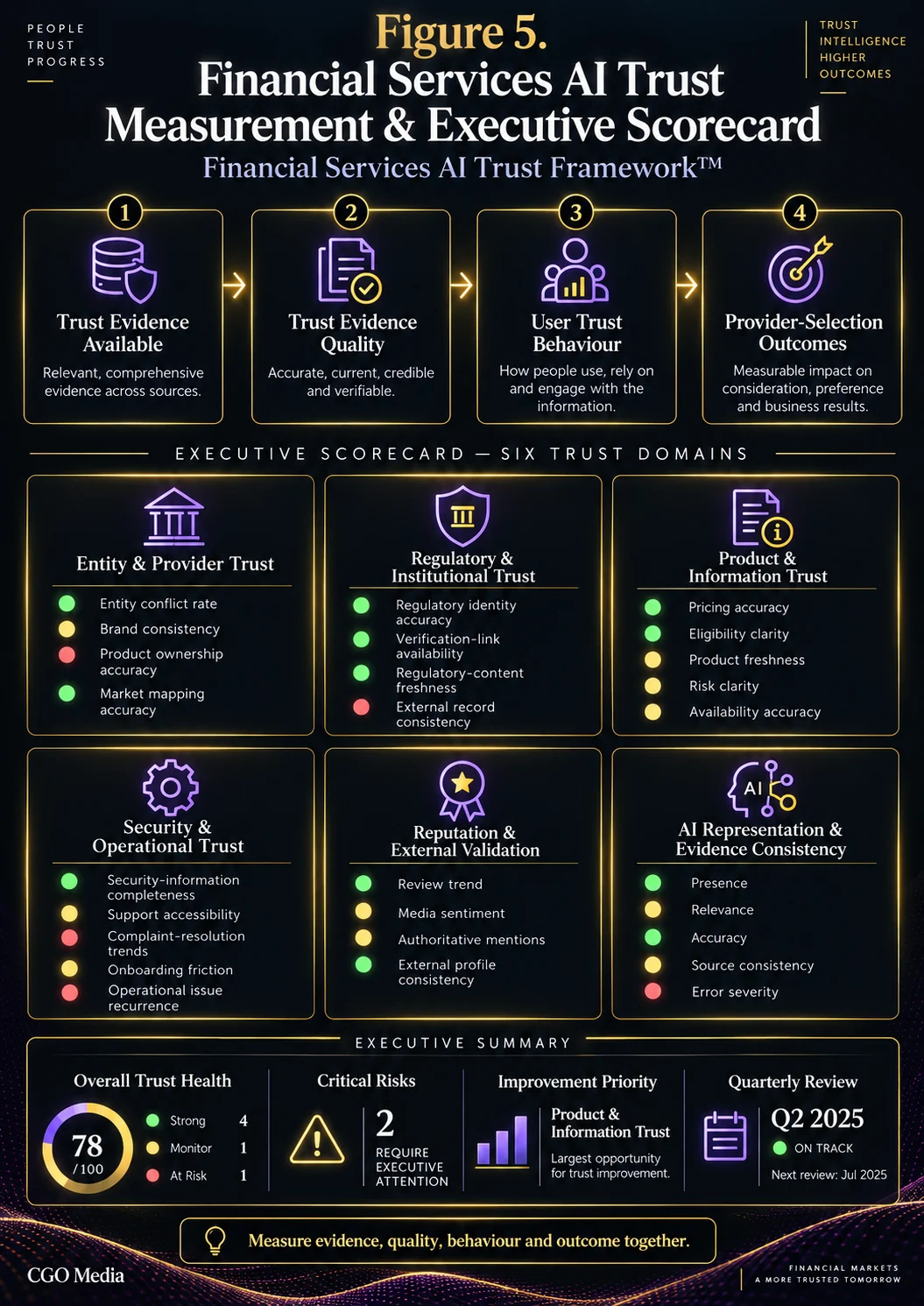
461. Financial Trust Can Decay
Trust is not permanent. A financial organisation can lose trust strength when products, markets, regulation, operations or public evidence change faster than its trust systems can adapt.
462. Trust Decay Can Affect Any Domain
Even providers with strong current trust can regress if governance weakens.
463. Entity Trust Decay
Potential causes include:
- Rebrands
- Acquisitions
- Ownership changes
- Legacy brand references
- Duplicate profiles
464. Regulatory Trust Decay
Potential causes include:
- Outdated regulatory descriptions
- Changed entity relationships
- Broken verification links
- Market-specific changes
465. Product Trust Decay
Potential causes include:
- Stale pricing
- Old eligibility criteria
- Changed product features
- Withdrawn products
466. Operational Trust Decay
Potential causes include:
- Support deterioration
- Onboarding problems
- Security incidents
- Service disruption
- Complaint growth
467. Reputation Trust Decay
Potential causes include:
- Persistent negative reviews
- Adverse media coverage
- Outdated comparison information
- Unresolved complaint themes
468. AI Trust Decay
Potential causes include:
- Outdated product summaries
- Incorrect provider relationships
- Wrong market availability
- Persistent regulatory errors
469. Trust Decay Should Be Detected Early
Early warning signals can reduce the risk of larger downstream trust problems.
470. Entity Decay Signals
- Conflicting provider names
- Old ownership references
- Duplicate entities
- Incorrect product-provider links
471. Regulatory Decay Signals
- Outdated disclosures
- Mismatch with official records
- Unclear regulated entity
- Broken verification pathways
472. Product Decay Signals
- Expired offers
- Stale rates
- Conflicting fees
- Unavailable products still promoted
473. Operational Decay Signals
- Rising support complaints
- Higher onboarding abandonment
- Recurring system issues
- Increased escalation
474. Reputation Decay Signals
- Negative theme growth
- Falling review recency
- External profile conflicts
- Reputation volatility
475. AI Decay Signals
- Recurring provider misclassification
- Persistent pricing errors
- Incorrect market coverage
- Repeated regulatory misrepresentation
476. Trust Regression Should Trigger Reassessment
Material deterioration should not wait for the next routine review cycle.
477. Product Change Trigger
Changes to:
- Pricing
- Eligibility
- Features
- Availability
should initiate trust review.
478. Product Withdrawal Trigger
Withdrawn products should be checked across first-party and influential external sources.
479. Brand Change Trigger
Rebrands, mergers or acquisitions should trigger entity reconciliation.
480. Regulatory Change Trigger
Material regulatory change should initiate review across relevant trust environments.
481. Security Event Trigger
Significant security incidents may require review of:
- Security communication
- Customer support
- Reputation
- AI representation
482. Reputation Event Trigger
A major public issue may require immediate cross-domain trust reassessment.
483. Persistent AI Error Trigger
Repeated high-impact inaccuracies should prompt deeper evidence investigation.
484. Financial Trust Failure Modes
Several recurring patterns can weaken trust systems or prevent meaningful improvement.
485. Failure Mode — Treating Trust as Branding
Trust cannot be created sustainably through visual identity and promotional reassurance alone.
486. Failure Mode — Treating Regulation as Marketing
Regulatory status should be represented factually and with appropriate scope.
487. Failure Mode — Generic Trust Language
Statements such as “trusted”, “secure” or “leading” are weak where verifiable evidence is absent.
488. Failure Mode — Trust Without Product Clarity
A credible provider can still lose users if product pricing, eligibility or conditions remain unclear.
489. Failure Mode — Product Clarity Without Provider Clarity
Users may understand the product but remain uncertain about who actually provides it.
490. Failure Mode — Strong Regulation but Weak Operations
Formal provider legitimacy does not compensate for poor support, onboarding or service reliability.
491. Failure Mode — Strong Operations but Weak External Validation
A provider may perform well while public evidence remains too weak to support confident discovery.
492. Failure Mode — Relying on Review Scores Alone
Average ratings can conceal:
- Serious recurring themes
- Product-specific issues
- Recent deterioration
493. Failure Mode — Treating Reviews as Suitability Evidence
Reviews describe experience but do not establish whether a financial product is appropriate for another user.
494. Failure Mode — Treating Awards as Proof
Awards can provide context but should not be presented as proof of universal product quality.
495. Failure Mode — Ignoring Complaint Data
Complaint patterns can reveal trust problems that public reviews do not show fully.
496. Failure Mode — Ignoring External Conflicts
First-party accuracy may be undermined by outdated information elsewhere.
497. Failure Mode — Treating AI Presence as Trust
Frequent mention in generated answers does not establish provider credibility.
498. Failure Mode — Treating AI Order as Ranking
Generated provider order is unstable and context-dependent.
499. Failure Mode — Chasing Individual AI Outputs
Optimising aggressively around one isolated response can produce unstable strategy.
500. Failure Mode — No Evidence Confidence
Weakly supported trust assumptions may be treated as established facts.
501. Failure Mode — No Trust Ownership
Important trust gaps are likely to persist when nobody is accountable for them.
502. Failure Mode — No Change Triggers
Stale trust information may remain live until a periodic review finds it.
503. Failure Mode — No Trend Monitoring
A single trust score cannot show whether the organisation is improving or deteriorating.
504. Failure Mode — No Coverage Assessment
Strong trust governance in one product should not be mistaken for organisation-wide trust maturity.
505. Failure Mode — No User-Journey Context
Trust evidence should be connected to the stages where users actually seek reassurance.
506. Failure Mode — Solving Operational Problems with Content
Persistent service failures require operational improvement, not merely stronger reassurance messaging.
507. Failure Mode — Solving Evidence Problems with Promotion
More visibility can amplify weak or conflicting trust information.
508. Failure Mode — Over-Automating Trust Claims
High-risk financial claims require appropriate human oversight.
509. Failure Mode — No Longitudinal AI Monitoring
One-time prompt testing cannot establish whether representation is stable.
510. Trust Improvement Should Target Root Causes
Repeated problems should lead to stronger systems rather than repeated surface-level correction.
511. The Continuous Trust Improvement Cycle
A practical operating cycle is:
Observe → Verify → Diagnose → Prioritise → Improve → Validate → Measure → Learn → Reassess
512. Observe
Monitor trust signals across all six domains.
513. Verify
Confirm whether an apparent trust issue is current, material and supported by evidence.
514. Diagnose
Identify the underlying cause.
515. Diagnosis Categories
A trust issue may originate from:
- Entity data
- Regulatory information
- Product information
- Operations
- External sources
- AI representation
516. Prioritise
Use:
Trust Gap + Risk + User Impact + Strategic Importance + Evidence Confidence
517. Improve
Correct the underlying evidence, process or operational weakness.
518. Validate
Confirm that the corrected information or process is now working as intended.
519. Measure
Compare the new state with the previous baseline.
520. Learn
Use recurring patterns to improve:
- Standards
- Review cycles
- Ownership
- Change triggers
521. Reassess
Repeat relevant trust diagnostics after meaningful change.
522. Trust Improvement Should Be Product-Specific
Different financial products create different trust requirements.
523. Trust Improvement Should Be Market-Specific
Different jurisdictions may involve different:
- Regulation
- Institutional sources
- Comparison platforms
- Trust expectations
524. Trust Improvement Should Be Audience-Specific
Consumer, SME and enterprise audiences may weigh trust factors differently.
525. Trust Improvement Should Be Channel-Specific
The provider should consider trust across:
- Search
- Website
- Comparison platforms
- Reviews
- AI systems
526. Trust Resilience Requires Redundancy
A provider should not depend on one source, one platform or one trust signal.
527. Entity Trust Resilience
Provider identity should be supported consistently across multiple relevant environments.
528. Regulatory Trust Resilience
Regulatory context should remain verifiable even if one page or source changes.
529. Product Trust Resilience
Core product truth should be maintained through reliable source-of-truth processes.
530. Operational Trust Resilience
Customer support and service processes should remain dependable during periods of high demand or disruption.
531. Reputation Trust Resilience
A strong reputation should be built on sustained customer experience rather than isolated publicity.
532. AI Trust Resilience
AI monitoring should examine multiple prompt groups and, where strategically relevant, multiple systems.
533. Trust Resilience Depends on Governance
Without governance, even strong evidence can decay.
534. Trust Resilience Depends on Institutional Learning
Repeated issues should improve future:
- Product launches
- Brand changes
- Market expansion
- AI monitoring
535. Trust Resilience Depends on Cross-Functional Coordination
The strongest systems connect:
Product + Compliance + Operations + Customer Experience + Search + Communications + Data
536. Trust Should Be Embedded into Product Launches
New products should not reach the market without appropriate:
- Entity clarity
- Product disclosure
- Regulatory context
- Trust information
537. Trust Should Be Embedded into Market Expansion
Entering a new market should trigger review of:
- Local regulation
- Product availability
- External evidence
- AI representation
538. Trust Should Be Embedded into Rebrands
Brand changes should include entity, provider and external evidence reconciliation.
539. Trust Should Be Embedded into Technical Change
Website migrations and redesigns should preserve:
- Trust content
- Verification paths
- Structured data
- Product relationships
540. Trust Should Be Embedded into AI Governance
AI monitoring should operate as part of the wider trust-governance system rather than as a separate experiment.
541. Trust Reassessment Should Be Scheduled and Event-Driven
A robust model combines:
- Periodic review
- Change-triggered review
542. High-Change Domains May Require More Frequent Review
These may include:
- Product Trust
- Reputation Trust
- AI Evidence Consistency
543. Lower-Change Domains May Require Less Frequent Full Review
Stable entity structures may require less frequent reassessment unless significant organisational change occurs.
544. Historical Trust Scores Should Be Preserved
Longitudinal records help identify:
- Improvement
- Regression
- Recurring weakness
- Successful intervention
545. Score Movement Needs Context
A score of 3 has different meaning if it:
- Improved from 1
- Remained at 3 for several periods
- Declined from 4
546. Trust Improvement Can Occur Without a Score Change
A provider may remove a critical issue or improve evidence confidence before moving to the next level.
547. Trust Score Improvement Without Real Capability Improvement Is Weak
The framework should remain grounded in observable evidence rather than favourable self-assessment.
548. The Complete Trust Improvement Model
The framework can now be expressed as:
Identify → Verify → Understand → Validate → Compare → Act → Experience → Reassess
549. The Complete Trust Governance Cycle
The ongoing management cycle is:
Observe → Verify → Diagnose → Prioritise → Improve → Validate → Measure → Learn → Reassess
550. The Strategic Trust Objective
The long-term objective is not maximum reassurance messaging.
It is a financial trust system that remains:
- Accurate
- Verifiable
- Relevant
- Consistent
- Resilient
551. The Next Step Is Final Strategic Integration
The final section consolidates the framework’s strategic implications, methodology, limitations, conclusion, references and research citation guidance.
Figure 6 : Continuous Financial Trust Improvement & Resilience Cycle.
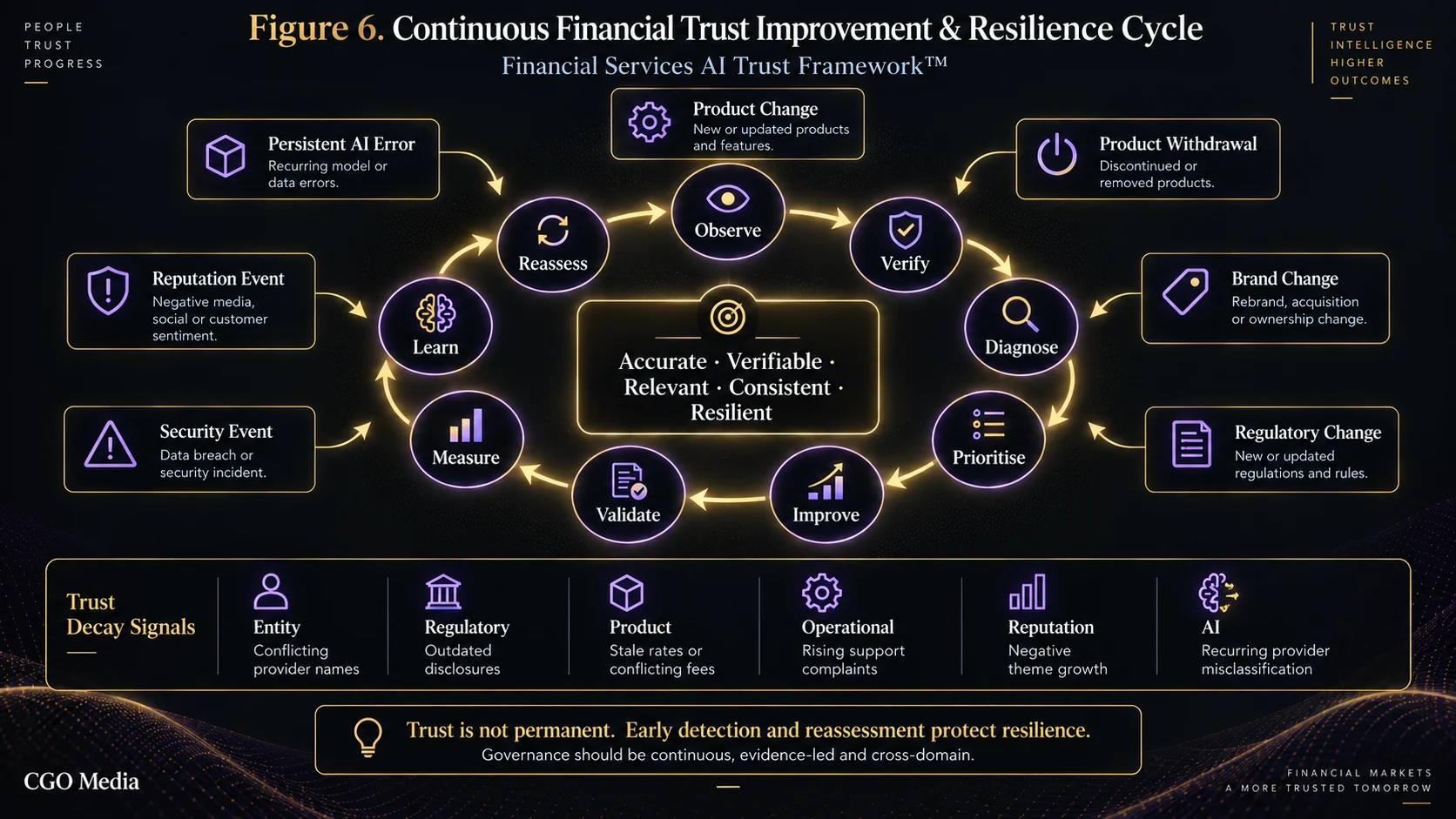
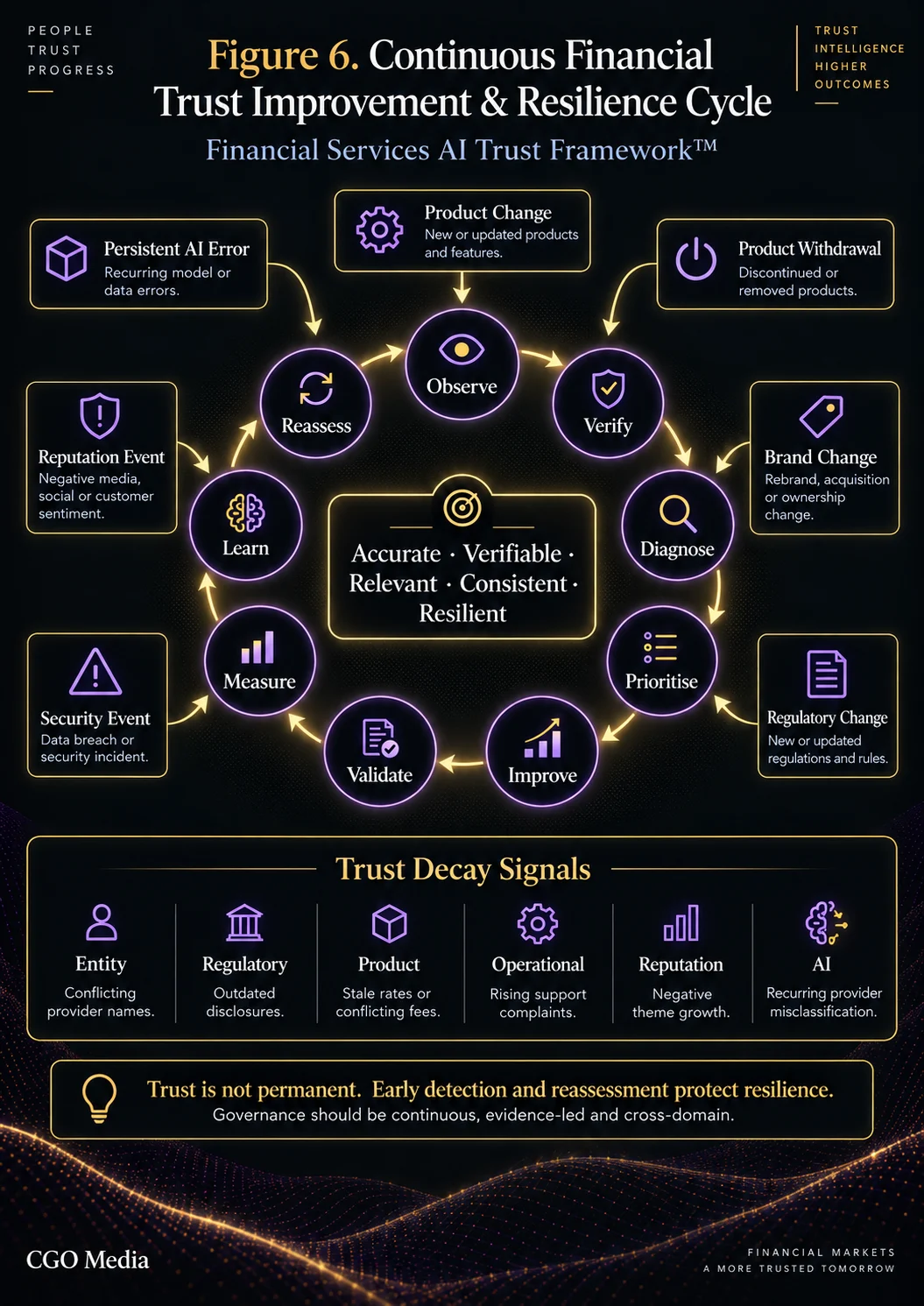
552. Strategic Implications
The Financial Services AI Trust Framework provides a structured model for understanding how trust is built, weakened, verified and maintained across financial search and AI-assisted discovery environments.
553. Financial Trust Is Multi-Layered
Trust emerges from the interaction between:
- Entity clarity
- Regulatory evidence
- Product information
- Operational reliability
- External reputation
- AI evidence consistency
554. Trust Should Not Be Reduced to One Metric
A financial organisation can appear strong overall while retaining serious weaknesses in one high-risk domain.
555. Critical Trust Weaknesses Should Override Average Scores
Material errors involving provider identity, regulation, pricing, security or product availability should remain visible until resolved.
556. Trust Begins with Verifiable Identity
Users and machine-mediated systems need sufficient clarity around:
Brand → Legal Entity → Regulated Entity → Product → Market
557. Entity Clarity Reduces Ambiguity
Clear provider relationships can support stronger interpretation across search engines, comparison platforms and AI-assisted discovery.
558. Regulation Provides Context, Not Universal Endorsement
Regulatory information can help users verify legitimacy but should not be interpreted as proof that a product is appropriate for every user.
559. Product Trust Depends on Transparency
Financial product information should make important:
- Pricing
- Eligibility
- Features
- Risks
- Restrictions
sufficiently clear for informed evaluation.
560. Product Freshness Is a Trust Requirement
Outdated product information can weaken both human trust and machine-mediated representation.
561. Security Trust Should Be Evidence-Led
Financial providers should avoid vague reassurance where more specific and verifiable explanations can be provided.
562. Operational Trust Extends Beyond Security
Users may also assess:
- Support quality
- Onboarding
- Reliability
- Complaint handling
563. Customer Experience Becomes Future Trust Evidence
Post-selection experience can influence:
Reviews → Reputation → Referrals → Future Provider Selection
564. External Validation Matters Because Trust Is Distributed
Users may evaluate a provider across multiple independent environments before acting.
565. External Evidence Should Be Relevant and Current
Trust is better supported by current, relevant sources than by a large volume of weak mentions.
566. Reviews Are Experience Evidence
Reviews can help reveal recurring service themes, but they should not be treated as proof of product suitability or regulatory quality.
567. Comparison Platforms Influence Trust but Have Limits
Comparison environments can support evaluation while still reflecting platform scope, commercial relationships and product availability.
568. Research Can Strengthen Trust Architecture
Original research can contribute to external authority when it is:
- Transparent
- Methodologically clear
- Citable
- Useful
569. AI Adds a New Trust Layer
AI systems can compress identity, product, trust and comparison information into one response.
570. AI Compression Makes Evidence Consistency More Important
Conflicting public evidence can create:
- Provider confusion
- Product errors
- Market errors
- Regulatory misrepresentation
571. AI Trust Should Focus on Accuracy Before Presence
Frequent provider mentions have limited value if the underlying representation is materially wrong.
572. AI Trust Should Be Assessed Through Presence, Relevance and Accuracy
A useful model is:
Presence + Relevance + Accuracy
573. AI Inclusion Is Not Financial Endorsement
Generated inclusion should not be interpreted as independent validation of provider quality or product suitability.
574. AI Ordering Is Not a Stable Ranking
Provider sequence can vary by model, prompt, location and time.
575. AI Errors Should Be Diagnosed at the Evidence Level
Persistent inaccuracies may reflect wider source problems rather than isolated model behaviour.
576. Trust Measurement Should Be Longitudinal
Trend is often more useful than one-time assessment.
577. Trust Measurement Should Include Confidence
A score is more useful when the organisation also understands how strongly the evidence supports it.
578. Trust Measurement Should Include Coverage
Strong trust governance for one product or market should not be mistaken for organisation-wide capability.
579. Trust Improvement Should Be Risk-Proportionate
Higher-risk gaps should receive more attention than low-impact inconsistencies.
580. Trust Governance Should Be Cross-Functional
A durable trust system may require coordination between:
Product + Compliance + Operations + Customer Experience + Search + Communications + Data
581. Trust Governance Should Be Event-Driven as Well as Scheduled
Important product, regulatory, brand, security and reputation events should trigger reassessment.
582. Trust Decay Should Be Expected
Financial organisations should assume that trust evidence will weaken over time unless it is actively maintained.
583. Trust Resilience Is the Long-Term Objective
A resilient financial trust system should remain:
- Accurate
- Verifiable
- Current
- Consistent
- Adaptable
584. Relationship with the CGO Media Financial Services Research Family
The Financial Services AI Trust Framework forms the trust layer of the wider CGO Media Financial Services research architecture.
Financial Services SEO in an AI Search Environment | Financial Provider Selection Model | Financial Search Authority Maturity Model | Financial SEO & AI Implementation Roadmap
585. Relationship with Financial Services SEO in an AI Search Environment
The parent paper Financial Services SEO in an AI Search Environment provides the wider research context for search visibility, authority, provider discovery and AI-assisted financial search.
586. Relationship with the Financial Provider Selection Model
The Financial Provider Selection Model explains where trust is evaluated across the provider-selection journey.
587. Relationship with the Financial Search Authority Maturity Model
The Financial Search Authority Maturity Model provides a capability framework for measuring broader search authority development.
588. Relationship with the Financial SEO & AI Implementation Roadmap
The Financial SEO & AI Implementation Roadmap translates the trust and authority principles into a practical implementation sequence.
589. Methodology
The Financial Services AI Trust Framework is a conceptual research framework developed by CGO Media to organise the principal forms of trust evidence relevant to financial-provider discovery, verification, comparison and AI-assisted representation.
590. Six-Domain Method
The framework is organised around six primary domains:
- Entity and Provider Trust
- Regulatory and Institutional Trust
- Product and Information Trust
- Security and Operational Trust
- Reputation and External Validation
- AI Representation and Evidence Consistency
591. Entity Trust Method
The framework examines whether provider identity and organisational relationships are sufficiently clear and consistent.
592. Regulatory Trust Method
The framework evaluates whether relevant regulatory evidence is current, specific and independently verifiable.
593. Product Trust Method
The framework examines whether financial product information is accurate, current and understandable.
594. Operational Trust Method
The framework evaluates security communication, support, onboarding, complaint handling and operational reliability.
595. Reputation Trust Method
The framework examines external validation across reviews, comparison platforms, media, research and professional sources.
596. AI Trust Method
The framework evaluates provider representation across repeatable AI prompt classes, with particular attention to:
- Presence
- Relevance
- Accuracy
- Error persistence
597. Diagnostic Method
Each trust domain can be scored using a five-level model:
- Weak
- Emerging
- Established
- Strong
- Resilient
598. Evidence Confidence Method
Findings can be classified as:
- Low confidence
- Medium confidence
- High confidence
599. Trend Method
Direction of travel can be classified as:
- Improving
- Stable
- At Risk
- Deteriorating
600. Gap Analysis Method
Each domain can be assessed through:
Target Trust − Current Trust = Trust Gap
601. Prioritisation Method
A practical prioritisation model is:
Priority = Trust Gap + Risk + User Impact + Strategic Importance + Evidence Confidence
602. Continuous Improvement Method
The long-term governance cycle is:
Observe → Verify → Diagnose → Prioritise → Improve → Validate → Measure → Learn → Reassess
603. Limitations
The Financial Services AI Trust Framework is a conceptual research and strategic framework. It is not a regulatory audit, compliance certification, legal opinion, investment recommendation or substitute for professional financial advice.
604. Trust Is Contextual
Different financial products, markets and audiences may place different weight on different forms of trust evidence.
605. Regulatory Context Varies
Regulatory structures differ across jurisdictions and financial categories.
606. Trust Scores Are Diagnostic, Not Absolute
A score should support comparison and improvement rather than being interpreted as an objective universal measure of provider quality.
607. External Evidence Is Incomplete
No organisation can observe every source that influences user or machine-mediated trust.
608. Reviews Are Biased Samples
Public reviews may overrepresent especially positive or negative experiences and should not be treated as a complete view of customer experience.
609. Comparison Platforms Have Scope Limitations
Product coverage and presentation may vary according to platform design, commercial model and available data.
610. Media Coverage Is Selective
Editorial visibility does not provide a complete measure of provider quality or market relevance.
611. Search Behaviour Changes
User expectations and trust queries can evolve over time.
612. AI Outputs Are Variable
Generated results can differ by:
- Model
- Prompt
- Location
- Time
- Retrieval behaviour
613. Visible AI Citations Are Partial Evidence
Displayed sources do not necessarily reveal every influence involved in answer construction.
614. AI Source Appearance Does Not Establish Full Causation
A cited source should not automatically be treated as the sole reason a provider was included.
615. AI Presence Does Not Establish Trust
A provider can be frequently mentioned while being inaccurately represented.
616. AI Inclusion Is Not Independent Endorsement
Generated inclusion does not establish suitability, regulatory approval or superior financial quality.
617. AI Ordering Is Not a Stable Ranking
Provider order should not be interpreted as a permanent or universally meaningful hierarchy.
618. Trust Attribution Is Incomplete
Users may form trust through combinations of:
- Search
- AI
- Comparison platforms
- Reviews
- Offline recommendations
619. Trust Does Not Guarantee Provider Selection
Selection also depends on:
- Need
- Eligibility
- Price
- Product fit
- Competition
620. Trust Does Not Establish Product Suitability
A highly trusted provider can still offer a product that is inappropriate for a specific user.
621. Trust Does Not Guarantee Financial Outcomes
Provider trust does not determine individual lending, investment, insurance, credit or other financial outcomes.
622. Conclusion
Financial trust is increasingly distributed across websites, search engines, regulators, comparison platforms, review environments, media and AI systems.
This means that financial organisations can no longer manage trust effectively through branding or first-party reassurance alone.
The Financial Services AI Trust Framework proposes six interconnected trust domains:
Entity Trust + Regulatory Trust + Product Trust + Operational Trust + Reputation Trust + AI Evidence Consistency
Together, these domains provide a practical structure for assessing whether a financial provider is represented in a way that is sufficiently clear, verifiable and resilient across modern discovery environments.
The framework also emphasises that trust is not static.
It should be continuously:
Observed → Verified → Diagnosed → Prioritised → Improved → Validated → Measured → Learned From → Reassessed
The strategic objective is not maximum reassurance messaging or maximum AI visibility.
It is a stronger evidence environment in which relevant users can identify, understand, verify and compare financial providers with greater confidence.
References
External Academic, Technical and Search Sources
- Google Search Central. SEO Starter Guide.
- Google Search Central. Understand how structured data works.
- Schema.org. FinancialService.
- Schema.org. Organization.
- Hogan, A. et al. (2021). Knowledge Graphs. ACM Computing Surveys, 54(4).
- Metzger, M.J. (2007). Making Sense of Credibility on the Web: Models for Evaluating Online Information and Recommendations for Future Research. Journal of the American Society for Information Science and Technology, 58(13), 2078–2091.
- Ji, Z. et al. (2023). Survey of Hallucination in Natural Language Generation. ACM Computing Surveys, 55(12).
CGO Media Financial Services Research and Frameworks
- Wilkinson, R. (2026). Financial Services SEO in an AI Search Environment. CGO Media.
- Wilkinson, R. (2026). Financial Provider Selection Model. CGO Media.
- Wilkinson, R. (2026). Financial Search Authority Maturity Model. CGO Media.
- Wilkinson, R. (2026). Financial SEO & AI Implementation Roadmap. CGO Media.
- Wilkinson, R. (2026). Financial GEO: Generative Engine Optimisation. CGO Media.
CGO Media Research Ecosystem
CGO Media Research Library | CGO Media Framework Library | CGO Media Research Architecture
About Roger Wilkinson
Roger Wilkinson is an independent researcher, SEO practitioner and founder of CGO Media with more than 25 years of experience in search, digital visibility and business growth.
His research focuses on how artificial intelligence is reshaping search engines, recommendation systems, entity representation, digital authority and organisational visibility.
Roger is the creator of the CGO Framework Series, a collection of research-led methodologies designed to help organisations measure, improve and govern Search Visibility, AI Visibility and Digital Authority.
His work examines the relationship between Technical SEO, Entity Authority, Content Authority, Citation Authority, Brand Signals, Knowledge Architecture and AI Search Readiness.
View Roger Wilkinson’s researcher profile →
Related Financial Services Research and Frameworks
Financial Services SEO in an AI Search Environment |
Financial Provider Selection Model |
Financial Search Authority Maturity Model |
Financial SEO & AI Implementation Roadmap |
Financial GEO: Generative Engine Optimisation
Research Usage & Citation
CGO Media encourages researchers, journalists, financial organisations, fintechs, educators, analysts and professional-services firms to reference this framework where it contributes to wider discussion and understanding of financial trust, AI search, provider authority, digital verification and financial-provider discovery.
Reasonable quotations, summaries, figures and excerpts may be used in articles, reports, presentations, academic work and other publications provided appropriate acknowledgement is given to Roger Wilkinson and CGO Media.
Cite This Framework / Embed Citation
The Financial Services AI Trust Framework by Roger Wilkinson at CGO Media defines six interconnected trust domains for evaluating financial-provider identity, regulation, product information, operational reliability, external validation and AI representation.
APA Citation
APA Citation: Wilkinson, R. (2026). Financial Services AI Trust Framework. CGO Media. https://cgomedia.com/financial-services-ai-trust-framework/
Author: Roger Wilkinson | Published by: CGO Media
For permissions relating to extensive reproduction, commercial licensing or republication of substantial portions of this framework, please contact CGO Media directly.