
Financial Services SEO in an AI Search Environment
 Financial Services SEO in an AI Search Environment examines how banks, fintech companies, insurers, lenders, investment organisations, payment providers and other financial-service businesses can build the technical clarity, information authority, entity structure, regulatory trust and external recognition required for visibility across conventional search engines and AI-assisted discovery systems.
Financial search is evolving beyond a model based primarily on keyword rankings and webpage optimisation. Users increasingly move between search engines, comparison platforms, regulatory sources, financial media, review environments, professional recommendations and AI-generated answers before selecting a provider.
The result is a more complex discovery environment in which financial organisations are judged through a network of evidence rather than through their own websites alone.
This research paper forms the parent study for the wider CGO Media Financial Services research family, including the Financial Services AI Trust Framework, the Financial Provider Selection Model, the Financial Search Authority Maturity Model and the Financial SEO & AI Implementation Roadmap.
1. Executive Summary
Financial SEO is becoming an authority-management problem as much as a ranking problem.
Traditional SEO remains important. Financial organisations still require:
- Crawlable websites
- Strong technical architecture
- Useful content
- Internal linking
- Relevant external links
- Local visibility
- Effective conversion journeys
However, these disciplines increasingly operate inside a wider financial discovery ecosystem.
2. Financial Discovery Is Becoming Distributed
A user investigating a financial provider may encounter:
- Organic search results
- Paid search
- Financial comparison platforms
- Regulatory information
- Review platforms
- Financial media
- Professional commentary
- AI-generated answers
- AI recommendations
- Maps and branch information
3. The Financial Website Is No Longer the Entire Search Environment
The provider website remains important, but it is only one component of the wider evidence network through which users and machine-mediated systems can interpret the organisation.
4. Financial Search Is Increasingly an Evidence Problem
Modern visibility depends partly on whether the organisation can be understood consistently across:
- Brand
- Legal entity
- Regulated entity
- Products
- People
- Locations
- External sources
5. Financial Search Is Also a Trust Problem
Users may be making decisions involving:
- Savings
- Credit
- Mortgages
- Insurance
- Investments
- Pensions
- Payments
- Business finance
These decisions can carry material financial consequences, increasing the importance of reliable provider and product information.
6. AI Search Changes the Discovery Interface
Generative systems can increasingly:
- Explain financial concepts
- Summarise providers
- Compare product categories
- Identify potential options
- Answer trust questions
- Surface source material
7. AI Search Can Compress the Research Journey
A user may ask one question that previously required several searches.
8. Example Traditional Journey
A conventional journey might involve:
Search → Guide → Product Page → Comparison Site → Reviews → Regulatory Verification → Provider Website
9. Example AI-Assisted Journey
An AI-assisted journey may begin:
AI Question → Generated Summary → Source Review → Provider Comparison → Verification → Provider Website
10. AI Does Not Remove the Need for Verification
For important financial decisions, users may still seek independent confirmation before acting.
11. AI Can Increase the Importance of Verification
A generated answer may encourage users to verify:
- Provider identity
- Pricing
- Eligibility
- Regulation
- Product availability
12. The Central Financial Search Question Has Changed
The strategic question is no longer simply:
“Does the provider rank?”
It increasingly becomes:
“Can the provider be understood, validated and appropriately represented across the wider financial discovery ecosystem?”
13. Financial SEO Requires a Dedicated Authority Model
Financial search differs from many lower-risk commercial categories because users may require substantially greater confidence before acting.
14. Users May Need to Verify Who Provides the Product
The public-facing brand may not always be the same entity that:
- Provides the product
- Underwrites the product
- Operates the platform
- Holds the relevant regulatory relationship
15. Users May Need to Understand Product Risk
Financial information should not present benefits without appropriate context around material risks and limitations.
16. Users May Need to Understand Fees
Relevant charges may materially influence provider comparison.
17. Users May Need to Understand Eligibility
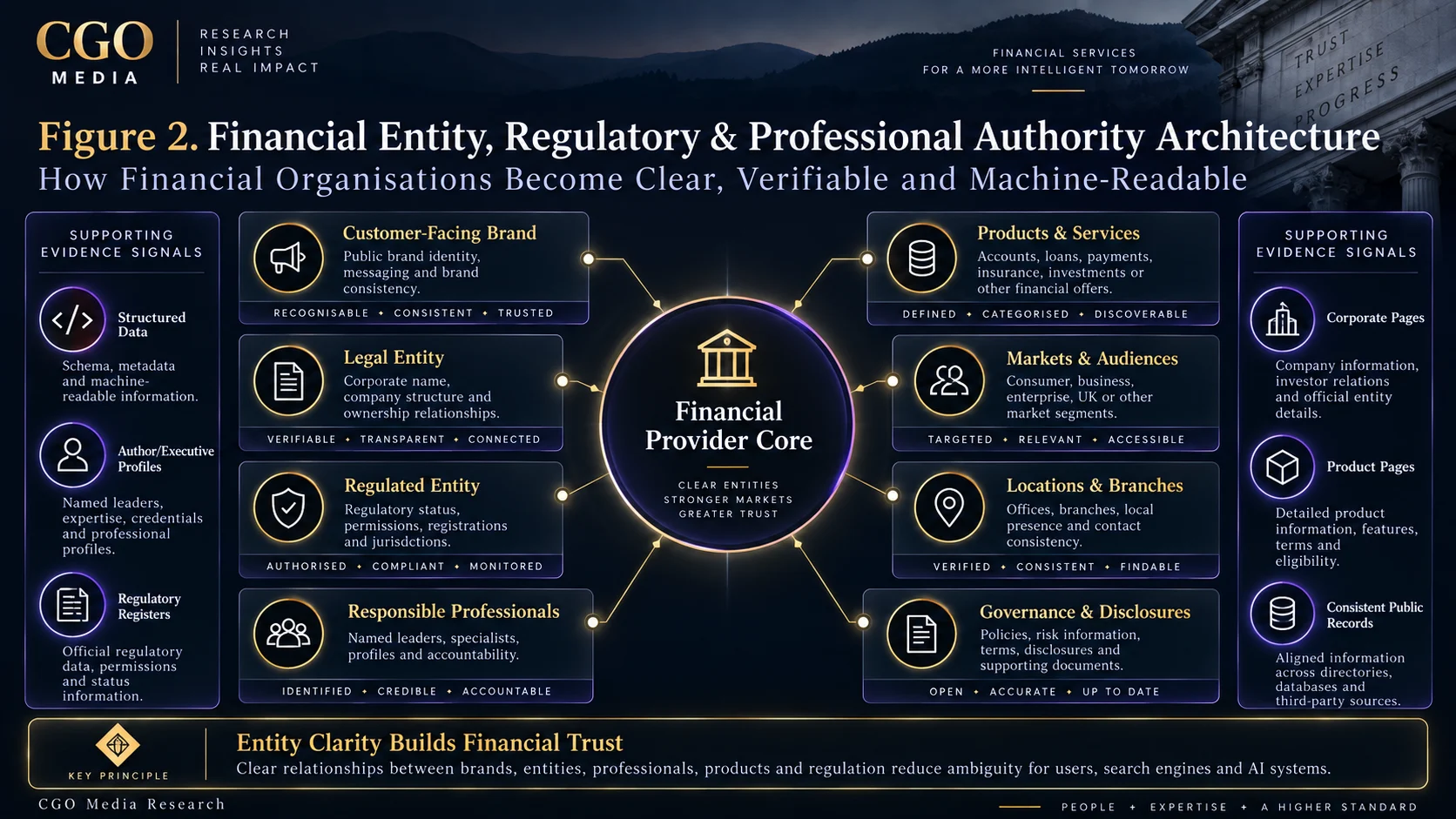
A financial product may appear attractive while being unavailable to a particular user or organisation.
18. Users May Need to Understand Protections
Depending on product and jurisdiction, users may seek information about applicable protection arrangements or complaint pathways.
19. Users May Need to Understand Responsibility
Financial information may be produced by:
- The organisation
- A named professional
- A research team
- A product team
- An external contributor
20. Financial Authority Therefore Requires Multiple Evidence Layers
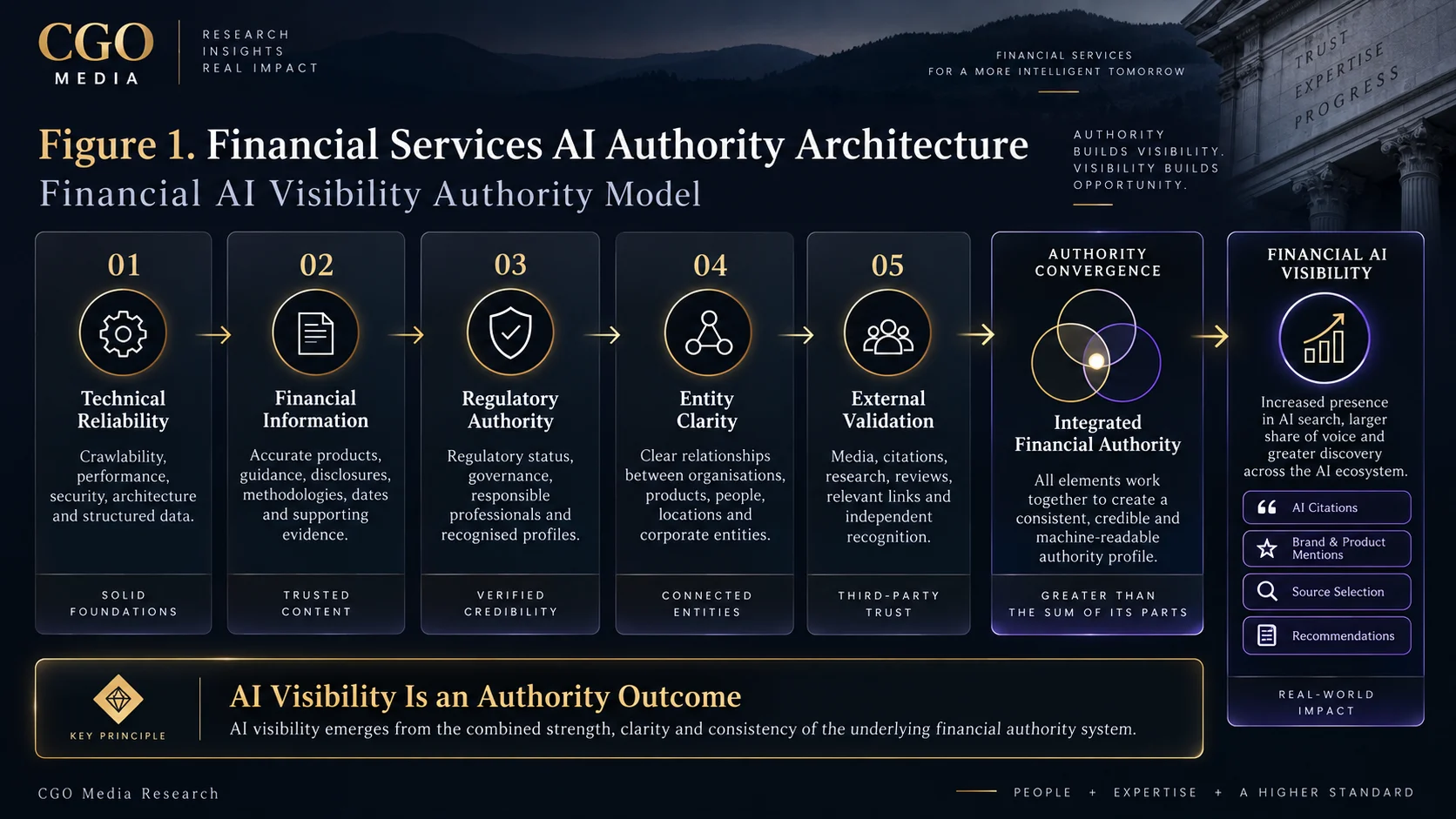
CGO Media proposes a six-layer Financial Search Authority Stack.
21. Layer One — Technical Authority
Technical authority asks:
Can search engines and AI-mediated systems reliably access and interpret the digital estate?
22. Technical Authority Evidence
Potential evidence includes:
- Crawlability
- Indexation control
- Canonicalisation
- Site architecture
- Performance
- Security
- Structured data
23. Layer Two — Financial Information Authority
Financial information authority asks:
Does the organisation provide useful, accurate, current and sufficiently complete financial information?
24. Financial Information Authority Evidence
Potential evidence includes:
- Product information
- Guides
- Disclosures
- Review dates
- Methodologies
- Supporting references
- Risk explanations
25. Layer Three — Regulatory and Professional Authority
This layer asks:
Can the provider and relevant professional expertise be independently validated?
26. Regulatory and Professional Evidence
Potential evidence includes:
- Regulatory information
- Legal identity
- Professional roles
- Governance information
- Recognised profiles
27. Layer Four — Entity Authority
Entity authority asks:
Are the relationships between the organisation, brands, products, people and locations sufficiently clear?
28. Entity Authority Evidence
Potential evidence includes:
- Brand consistency
- Corporate relationships
- Product relationships
- Professional relationships
- Location relationships
- Structured data
29. Layer Five — External Authority
External authority asks:
What independent evidence supports the provider’s relevance, expertise and reputation?
30. External Authority Evidence
Potential evidence includes:
- Financial media
- Research citations
- Industry publications
- Comparison platforms
- Reviews
- Relevant links
31. Layer Six — AI Search Authority
AI search authority asks:
Does the wider authority system support accurate and relevant representation within AI-mediated discovery?
32. AI Search Authority Evidence
Potential evidence includes:
- AI citations
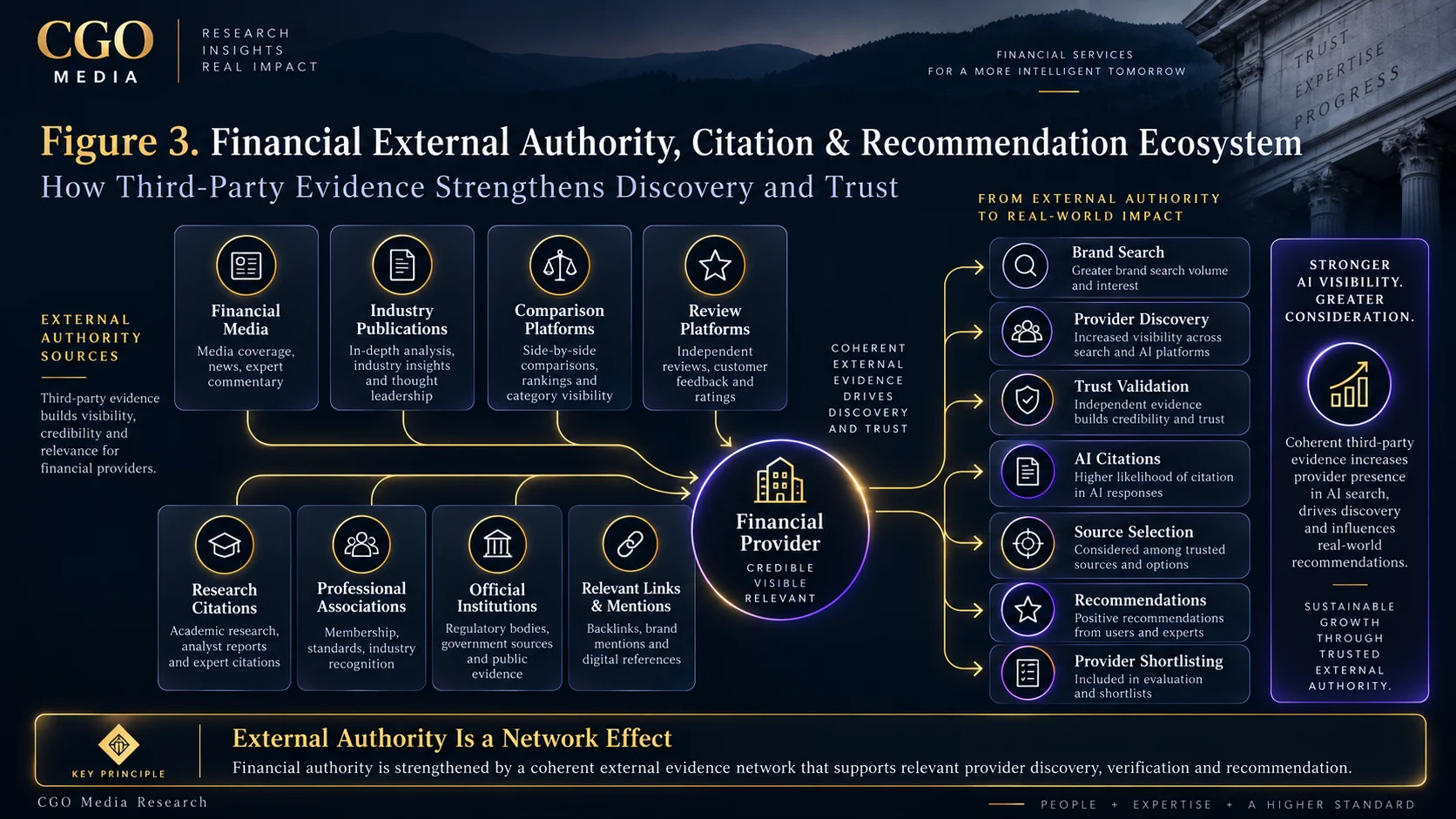
- Brand mentions
- Product mentions
- Source selection
- Recommendation visibility
- Material accuracy
33. The Six Layers Are Interdependent
Strong technical SEO cannot compensate fully for unreliable financial information.
34. Strong Content Alone Is Also Incomplete
Useful content can remain ambiguous where provider and regulatory entities are unclear.
35. Regulatory Authority Alone Does Not Guarantee Visibility
A legitimate provider can still be difficult for search systems to understand if its digital architecture is weak.
36. External Authority Alone Does Not Guarantee Product Accuracy
A highly mentioned provider may still have inconsistent rates, fees or eligibility information.
37. AI Visibility Should Be Treated as an Authority Outcome
The strongest model is:
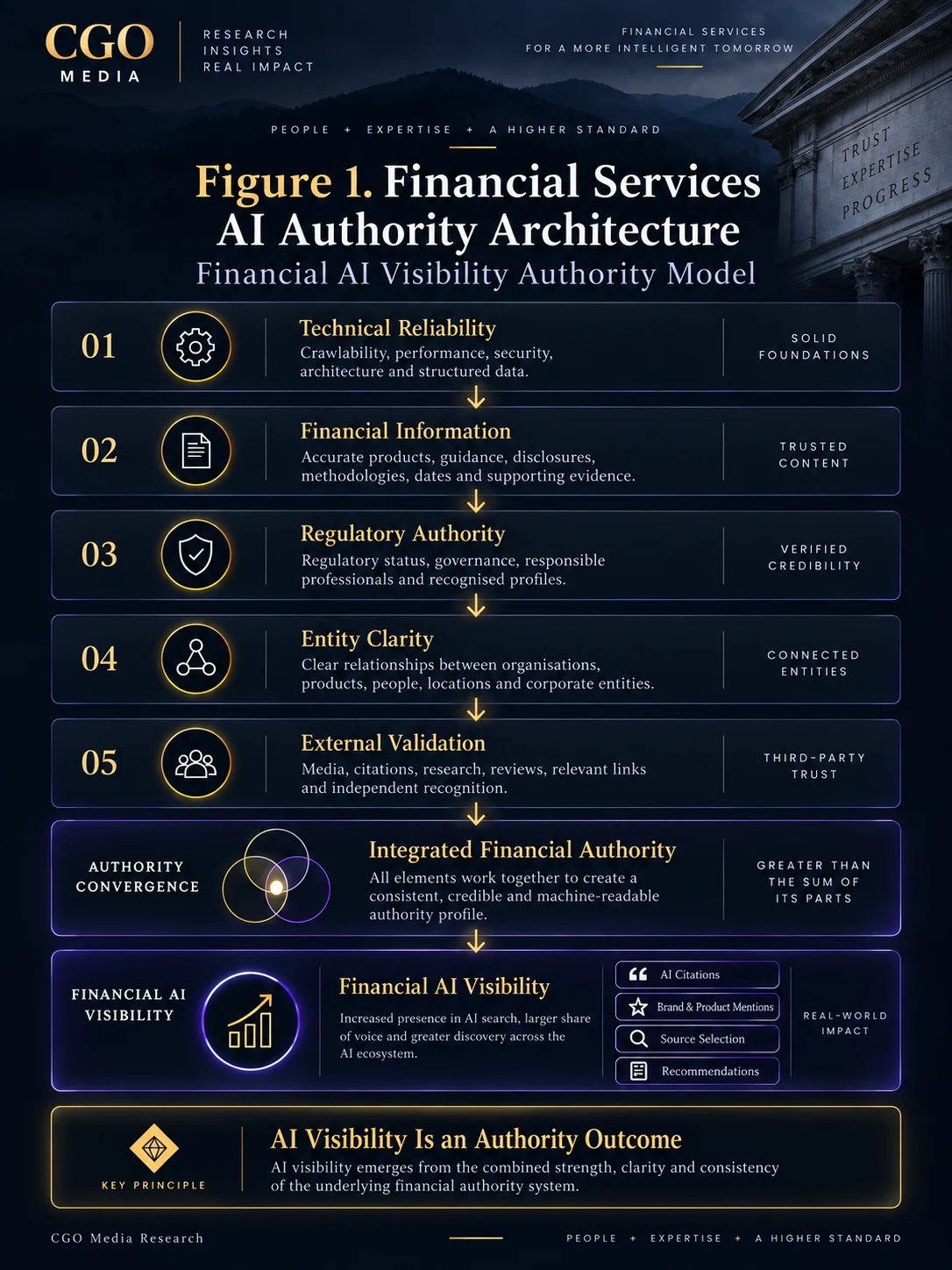
Technical Authority → Financial Information Authority → Regulatory Authority → Entity Authority → External Authority → AI Search Authority
38. Authority Convergence Matters
Financial AI visibility becomes more defensible when multiple authority layers reinforce one another.
39. Authority Convergence Is Not a Guarantee
No combination of authority signals guarantees search ranking, AI citation or recommendation.
40. Technical Trust Is the Foundation
Financial organisations frequently operate complex digital estates containing large numbers of URLs.
41. Financial Websites May Contain Multiple Product Families
Examples include:
- Current accounts
- Savings
- Credit cards
- Mortgages
- Loans
- Insurance
- Investments
- Pensions
- Business banking
- Payments
42. Financial Websites May Also Contain Support Content
This can include:
- Help centres
- FAQs
- Calculators
- Branch information
- Policy documents
- Research
43. Complexity Creates Technical Authority Risk
Large digital estates can create:
- Duplicate pages
- Conflicting product information
- Orphaned content
- Legacy URLs
- Indexation problems
44. Product Lifecycle Management Is Part of Technical SEO
Financial products change frequently enough that URL and content governance should be connected to the product lifecycle.
45. Product Launches Create New Search Entities
A new product may require:
- Product page
- Supporting guidance
- Internal links
- Structured data
- External updates
46. Product Changes Create Freshness Risk
Changes in rates, fees, eligibility or features can make older information inaccurate.
47. Product Withdrawals Create Legacy Risk
Withdrawn products may remain:
- Indexed
- Linked
- Cited
- Referenced externally
48. Financial Technical SEO Therefore Requires Governance
The technical system should support:
Create → Publish → Monitor → Update → Withdraw → Archive
49. Canonicalisation Matters
Duplicate or near-duplicate financial content can weaken interpretation when multiple URLs describe similar products.
50. Indexation Control Matters
Not every historical, filtered or duplicated financial page necessarily needs to remain indexable.
51. Internal Linking Matters
Internal links should connect financial information to relevant:
- Product categories
- Products
- Trust evidence
- Provider entities
52. Page Performance Matters
Slow or unstable financial journeys can reduce both discoverability and user confidence.
53. Mobile Performance Matters
Many financial research and application journeys begin or continue on mobile devices.
54. Security Matters
Secure infrastructure is both an operational requirement and a component of user trust.
55. Accessibility Matters
Financial information should be usable by as broad a range of users as reasonably possible.
56. Structured Data Can Support Interpretation
Appropriate structured data can clarify visible information about:
- Organisation
- Products
- People
- Locations
- Published research
57. Structured Data Should Reflect Visible Reality
Markup should not be used to manufacture unsupported authority.
58. Technical SEO Should Support Information Reliability
The objective is not simply efficient crawling.
It is to increase the probability that search and AI-mediated systems encounter the correct current financial information.
59. Financial Information Authority Is the Next Layer
Once the digital estate can be accessed reliably, the next question is whether the information itself deserves to be understood and reused.
60. Financial Information Is Decision-Support Content
Users may search for:
- Interest rates
- APR
- Mortgage costs
- Insurance coverage
- Investment risk
- Account fees
- Pension options
- Payment products
- Business lending
61. High Search Visibility Increases Information Responsibility
Financial information can influence decisions with material economic consequences.
62. Financial Information Authority Requires Accuracy
Published information should align with the current product or service reality.
63. Financial Information Authority Requires Clarity
Complex topics should be explained clearly without removing necessary precision.
64. Financial Information Authority Requires Freshness
Material changes should be reflected within appropriate review cycles.
65. Financial Information Authority Requires Responsibility
Users should be able to understand who is responsible for the information where appropriate.
66. Financial Information Authority Requires Evidence
Claims should be supported where evidence is available and appropriate.
67. Financial Information Authority Requires Risk Context
Relevant risks and limitations should not be obscured by promotional emphasis.
68. Financial Information Authority Requires Assumptions
Calculators, projections, examples and comparisons should explain important assumptions where necessary.
69. Financial Information Authority Requires Review Dates
Users may benefit from knowing when material content was last reviewed or updated.
70. More Financial Content Is Not Automatically Better
Large content libraries can create duplication and inconsistency if they are not governed.
71. The Objective Is a Financial Knowledge System
A stronger model connects:
Financial Need → Explanation → Product Category → Product → Provider → Trust → Action
72. Financial Knowledge Architecture Reduces Fragmentation
It connects informational content with the entities and products that users are ultimately trying to understand.
73. Mortgage Knowledge Architecture Example
A mortgage knowledge system may connect:
Mortgage Need → Mortgage Type → Eligibility → Deposit → Rate → Fees → Affordability → Risk → Product → Provider
74. Insurance Knowledge Architecture Example
An insurance system may connect:
Insurance Need → Cover Type → Risk → Policy → Exclusion → Premium → Claim → Provider
75. Investment Knowledge Architecture Example
An investment information system may connect:
Investment Objective → Risk → Asset Type → Product → Fees → Tax Context → Provider
76. Payments Knowledge Architecture Example
A business payments architecture may connect:
Payment Need → Acceptance Method → Pricing → Settlement → Integration → Risk → Provider
77. Knowledge Architecture Helps Search Systems Understand Relationships
The value lies not only in individual pages but in how the pages connect semantically.
78. Knowledge Architecture Helps Users Progress
A coherent structure supports movement from:
Question → Understanding → Product → Verification → Action
79. Financial Authority Begins to Converge at This Point
Technical accessibility and reliable financial information create the foundation upon which entity, regulatory, external and AI authority can be developed.
80. The First Research Principle
Financial AI visibility should not be treated as an isolated optimisation channel.
It is more usefully understood as an outcome of a wider financial authority system.
Figure 1 : Financial Services AI Authority Architecture — Six Connected Authority Layers.
81. Regulatory Authority Is a Distinct Financial Search Layer
Financial organisations operate in environments where legitimacy, authorisation and permitted activity can materially influence trust and provider selection.
82. Regulatory Authority Should Be Verifiable
Users should be able to understand, where relevant:
- Which entity is regulated
- Which activities are covered
- Which market the information applies to
- How the information can be independently verified
83. Regulatory Authority Should Be Specific
Generic phrases such as “regulated financial provider” may be less useful than a clear description of the relevant entity, activity and jurisdiction.
84. Regulatory Authority Should Be Current
Historic descriptions, legacy entity names and old authorisation language can create confusion if they remain visible after organisational or regulatory change.
85. Regulatory Authority Should Be Contextual
The same organisation may operate multiple entities with different permissions, products and responsibilities.
86. Regulatory Authority Should Not Be Treated as Marketing Decoration
Regulatory information should support accurate verification rather than promotional exaggeration.
87. Regulatory Evidence Can Support Search Trust
Clear regulatory information can help users move from:
Provider Discovery → Verification → Consideration
88. Regulatory Evidence Can Also Support Machine Interpretation
Consistent entity and regulatory relationships can create a clearer public evidence environment.
89. Financial Entity Architecture Is Often Complex
Many financial organisations operate through:
- Consumer brands
- Parent companies
- Subsidiaries
- Regulated entities
- Product-specific entities
- Regional entities
90. Brand and Legal Entity Are Not Always the Same
A customer-facing brand may represent products provided by a separate legal entity.
91. Legal Entity and Regulated Entity May Also Differ
The organisation should make these relationships sufficiently clear where they matter to provider understanding.
92. Product Provider Relationships Matter
Users may need to know whether a product is:
- Provided directly
- Underwritten elsewhere
- Distributed by a partner
- Powered by another platform
93. The Core Financial Entity Model
A useful architecture is:
Brand → Legal Entity → Regulated Entity → Product Category → Product → Market → Audience
94. Market Relationships Should Be Explicit
A provider can operate globally while particular products remain restricted to specific markets.
95. Audience Relationships Should Be Explicit
Consumer, SME and enterprise products should not be treated as interchangeable.
96. Entity Clarity Supports Search Relevance
Clear relationships help reduce ambiguity around which organisation and product match a particular financial need.
97. Entity Clarity Supports Trust
Users may be more confident when they can understand who stands behind the product.
98. Entity Clarity Supports AI Representation
AI systems may otherwise conflate:
- Brand names
- Parent companies
- Subsidiaries
- Regulated entities
- Historic names
99. Entity Ambiguity Can Propagate
Incorrect relationships can spread across:
- Search profiles
- Comparison platforms
- Directories
- Editorial content
- AI-generated answers
100. Entity Governance Should Be Continuous
Major changes should trigger review across the entire public evidence environment.
101. Rebrands Require Entity Reconciliation
Old names should not remain dominant where they create confusion about current provider identity.
102. Mergers and Acquisitions Require Entity Reconciliation
Ownership changes can create complex legacy references across the web.
103. Product Migrations Require Entity Reconciliation
A product transferred between entities should be updated consistently where appropriate.
104. Professional Authority Is Another Financial Search Layer
Some financial topics involve named professionals, analysts, advisers, economists, researchers or subject-matter experts.
105. Professional Authority Can Support Content Credibility
Users may value clear information about:
- Author
- Role
- Expertise
- Relevant experience
- Institutional affiliation
106. Professional Authority Should Be Proportionate
Not every transactional product page requires extensive individual-author profiling.
107. Professional Authority Is More Important for Complex Information
It may be especially relevant for:
- Investment analysis
- Financial research
- Economic commentary
- Technical guides
- Specialist business finance
108. Named Expertise Should Be Genuine
Authors and reviewers should not be presented as specialists beyond their actual role or expertise.
109. Professional Profiles Should Be Consistent
Where used, profiles should align across:
- Author pages
- Research papers
- Professional profiles
- External publications
110. Professional Authority Can Support Entity Resolution
Consistent person-to-organisation relationships can make authorship and expertise easier to interpret.
111. Financial Trust Architecture Should Reflect the Decision Environment
Users may need to assess both the provider and the information source before acting.
112. Provider Trust and Information Trust Are Related but Distinct
A strong provider can publish weak information, and a useful article can appear on a relatively unknown provider website.
113. Financial Search Strategy Should Strengthen Both
The objective is to improve:
Provider Authority + Information Authority
114. Consumer Duty Context Increases the Importance of Clear Information
For UK financial organisations, customer-outcome expectations reinforce the importance of presenting information in ways that support understanding and appropriate decision-making.
115. Search Visibility Should Not Encourage Misunderstanding
A highly visible financial page can create risk if it simplifies important conditions too aggressively or omits material context.
116. Search Copy Should Balance Accessibility and Precision
Plain language should not remove necessary financial or regulatory meaning.
117. Product Pages Should Support Informed Evaluation
Where relevant, users should be able to understand:
- What the product is
- Who it is for
- What it costs
- What important risks exist
- What conditions apply
118. Comparison Content Should Avoid False Equivalence
Financial products should not be presented as interchangeable where they differ materially in:
- Risk
- Eligibility
- Cost
- Protection
- Purpose
119. Search Snippets Can Influence Expectations
Titles and descriptions should avoid creating a misleading impression about:
- Pricing
- Approval likelihood
- Returns
- Availability
120. AI Summaries Can Also Influence Expectations
This increases the importance of clear source information and unambiguous product context.
121. Data Governance Is Part of Financial Search Authority
Search teams often rely on product data maintained elsewhere in the organisation.
122. Product Data Should Have a Source of Truth
Core fields may include:
- Product name
- Pricing
- Fees
- Eligibility
- Availability
- Product status
123. Entity Data Should Have a Source of Truth
Core fields may include:
- Brand name
- Legal entity
- Regulated entity
- Parent organisation
- Market relationships
124. Regulatory Data Should Have a Source of Truth
Regulatory information should not be recreated independently across multiple teams without governance.
125. Location Data Should Have a Source of Truth
Branches and offices should be maintained consistently where local discovery matters.
126. Data Fragmentation Creates Search Risk
Different systems may otherwise publish conflicting versions of the same financial fact.
127. Search Teams Should Not Invent Product Truth
SEO specialists should consume validated product data rather than making independent assumptions about financial products.
128. Content Teams Should Not Become Shadow Product Owners
Editorial convenience should not override product governance.
129. Structured Data Should Consume Trusted Data Where Possible
The most robust architecture reduces manual duplication of important entity and product fields.
130. Automation Can Improve Consistency
Appropriate automation can help propagate approved information across:
- Web pages
- Structured data
- Internal search
- Product feeds
131. Automation Can Also Amplify Errors
If the source data is wrong, automated distribution can spread the problem rapidly.
132. High-Risk Data Needs Stronger Controls
Fields such as:
- Pricing
- Eligibility
- Regulatory status
- Risk statements
should receive proportionate validation and review.
133. Financial Search Authority Requires Change Management
Important changes should trigger coordinated updates rather than rely on individual teams noticing them later.
134. Product Launch Change Trigger
A launch may require updates to:
- Product architecture
- Supporting content
- Internal links
- Structured data
- Comparison profiles
135. Pricing Change Trigger
Material price changes should propagate quickly through controlled environments.
136. Product Withdrawal Trigger
Withdrawn products should be reviewed for:
- Indexation
- Redirects
- Archives
- External references
137. Regulatory Change Trigger
Relevant regulatory changes should prompt review of public-facing trust and product information.
138. Brand Change Trigger
Rebrands should prompt entity and external-profile reconciliation.
139. Market Expansion Trigger
Entering a new market may require:
- New product availability rules
- Local terminology
- Local regulatory context
- Local authority building
140. Financial Search Authority Varies by Business Model
Banks, fintechs, insurers and other financial providers do not share identical authority requirements.
141. Bank Authority Profile
Banks may require particular strength in:
- Entity clarity
- Regulatory trust
- Branch and local information
- Large product portfolios
- Customer-support authority
142. Banks Often Have Complex Legacy Estates
Long-established institutions may manage:
- Historic product pages
- Acquired brands
- Legacy subdomains
- Multiple business divisions
143. Bank SEO Therefore Requires Strong Lifecycle Governance
Legacy content can remain visible long after a product or brand relationship has changed.
144. Fintech Authority Profile
Fintech organisations may require particular strength in:
- Entity explanation
- Product innovation clarity
- Security trust
- External validation
- AI discovery
145. Fintechs May Need to Explain New Categories
New product models can require more educational content because users may not yet understand the category.
146. Fintechs May Depend More Heavily on External Trust
A newer brand may need stronger:
- Media validation
- Reviews
- Partnership evidence
- Research
147. Fintech Speed Creates Freshness Risk
Rapid product development can create inconsistencies if search and content systems lag behind.
148. Insurer Authority Profile
Insurance organisations may require particular strength in:
- Product definition
- Coverage clarity
- Exclusions
- Claims information
- Reputation evidence
149. Insurance Search Is Strongly Need-Led
Users often begin with:
- A risk
- A life event
- A legal requirement
- A business need
150. Insurance Knowledge Architecture Should Reflect Need
A useful sequence is:
Risk → Cover Type → Policy → Exclusions → Premium → Claims → Provider
151. Insurance Trust Extends into Claims Experience
Claims handling can strongly influence:
- Reviews
- Reputation
- Future provider selection
152. Lender Authority Profile
Lenders may require particular strength in:
- Eligibility clarity
- Pricing clarity
- Affordability information
- Approval expectations
- Regulatory trust
153. Lending Search Should Avoid Unrealistic Approval Expectations
Search and AI content should not imply approval certainty where underwriting or eligibility assessment is required.
154. Investment Provider Authority Profile
Investment organisations may require particular strength in:
- Risk communication
- Professional authority
- Research quality
- Fee transparency
- Product governance
155. Investment Content Requires Careful Distinction Between Information and Advice
General educational content should not be presented as personalised financial advice where it is not.
156. Payment Provider Authority Profile
Payments businesses may require particular strength in:
- Pricing clarity
- Security
- Integration information
- Operational reliability
- Merchant support
157. Payments Search Is Often Operational
Business users may evaluate:
- Transaction costs
- Settlement
- Hardware
- Integrations
- Support
158. Authority Profiles Should Influence SEO Priorities
The strongest financial SEO strategy reflects the actual risk, product and decision environment rather than applying one universal template.
159. Financial Authority Should Be Product-Specific
A provider may have strong authority in one category and weak authority in another.
160. Financial Authority Should Be Market-Specific
Strong UK authority does not automatically transfer to another jurisdiction.
161. Financial Authority Should Be Audience-Specific
A provider recognised by enterprise buyers may remain unfamiliar to consumers.
162. Financial Authority Should Be Journey-Specific
The evidence needed for initial discovery may differ from the evidence needed before application or purchase.
163. The Second Research Principle
Financial search authority should be modelled around the provider’s real entity, product, market and trust architecture rather than around keywords alone.
164. The Next Layer Is External and Recommendation Authority
The next section examines how financial media, comparison platforms, reviews, Digital PR, research citations, links and recommendation systems influence provider discovery and authority.
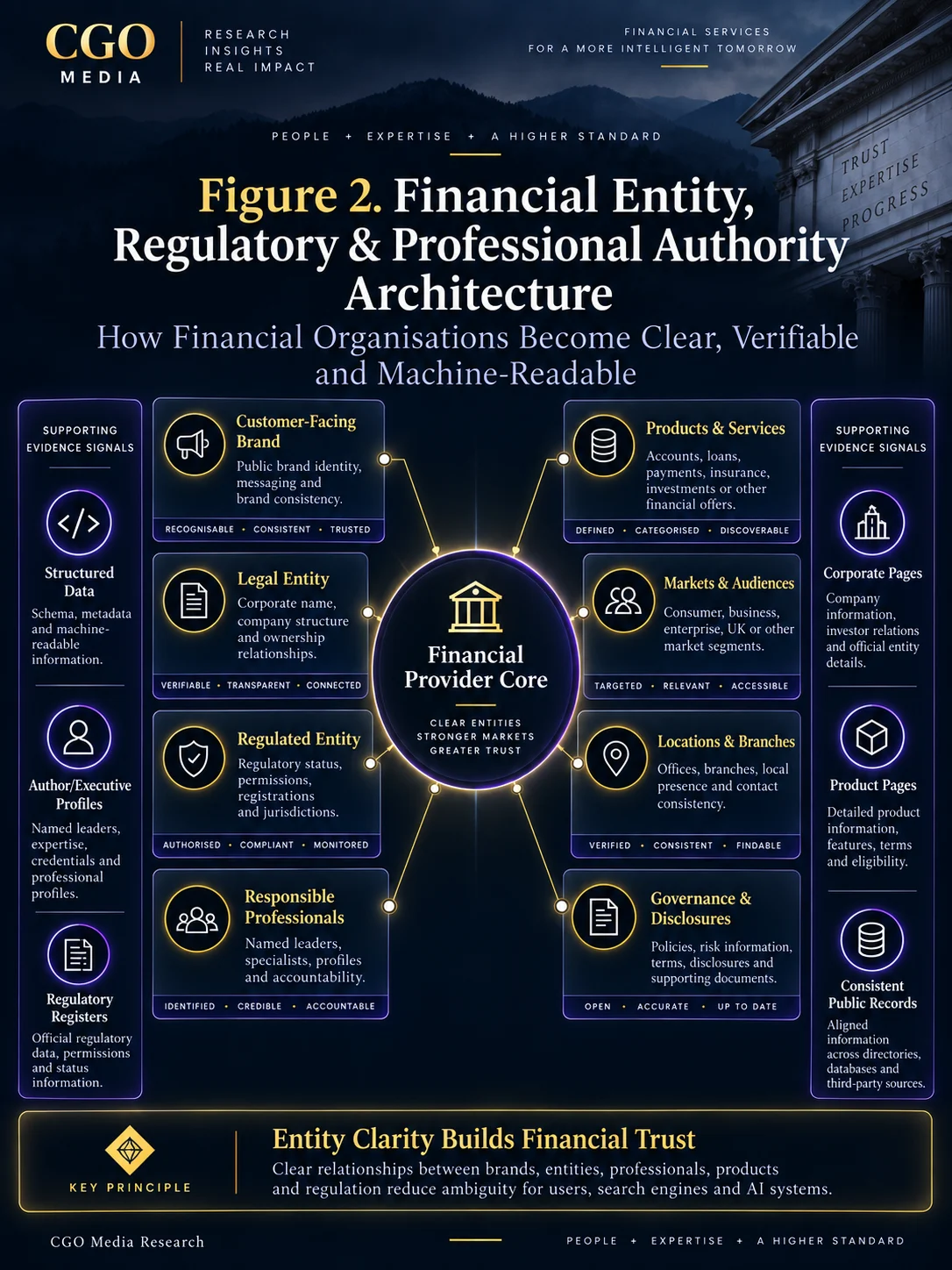
Figure 2 : Financial Entity, Regulatory & Professional Authority Architecture.
165. External Authority Extends Financial Search Beyond the Website
Financial-provider discovery increasingly depends on evidence distributed across the wider web.
166. External Authority Should Be Evaluated by Relevance
Not every link, mention or citation contributes equally to financial-provider authority.
167. Relevant External Sources May Include
- Financial media
- Industry publications
- Comparison platforms
- Review platforms
- Professional associations
- Research repositories
- Official institutions
168. Financial Media Can Influence Provider Discovery
Editorial coverage may introduce users to providers they were not previously considering.
169. Financial Media Can Influence Trust
Independent coverage can provide context around:
- Provider expertise
- Market activity
- Product development
- Industry relevance
170. Financial Media Authority Should Be Topic-Specific
A publication may be influential for investments but less relevant for merchant payments or business lending.
171. Specialist Financial Media Can Be Highly Valuable
Niche publications may carry significant authority within tightly defined product categories.
172. Editorial Relevance Is More Important Than Raw Mention Volume
A smaller number of highly relevant references can be more meaningful than broad low-context coverage.
173. Comparison Platforms Are Major Financial Discovery Environments
Users may rely on comparison platforms to identify:
- Providers
- Products
- Rates
- Fees
- Features
174. Comparison Platforms Can Shape Consideration Sets
A provider may enter or leave a user’s shortlist based on how it appears in a comparison environment.
175. Comparison Data Accuracy Is Therefore Important
Material inconsistencies can weaken:
- Trust
- Comparison performance
- AI evidence consistency
176. Comparison Coverage Has Limits
Platform scope may be influenced by:
- Commercial relationships
- Available products
- Data feeds
- Filtering rules
177. Comparison Visibility Should Not Be Treated as Universal Endorsement
Inclusion does not prove that a provider or product is appropriate for every user.
178. Comparison Platforms Can Become Source Nodes
Their data may be referenced directly or indirectly by other search and AI environments.
179. Review Platforms Influence Reputation Authority
Customer feedback can shape expectations around:
- Support
- Onboarding
- Pricing
- Claims
- Account access
180. Review Scores Alone Are Incomplete
A meaningful analysis should also consider:
- Recency
- Theme
- Severity
- Persistence
181. Review Recency Matters
Older reviews may reflect a historical operating model rather than current service.
182. Review Themes Matter
Repeated themes can reveal systemic strengths or weaknesses.
183. Review Severity Matters
A small number of serious recurring issues may matter more than numerous minor complaints.
184. Review Persistence Matters
Recurring themes over time may indicate structural operational problems.
185. Reviews Should Not Be Treated as Regulatory Evidence
High ratings do not prove provider legitimacy or regulatory quality.
186. Reviews Should Not Be Treated as Product-Suitability Evidence
One customer’s experience does not establish suitability for another.
187. Digital PR Can Strengthen Financial Authority
Digital PR can support both discovery and external validation when it produces useful, relevant evidence.
188. Effective Financial Digital PR Is Evidence-Led
Potential formats include:
- Original research
- Market analysis
- Data studies
- Expert commentary
- Industry forecasts
189. Financial PR Should Avoid Unsupported Claims
Promotional narratives should not exceed the strength of the underlying data.
190. Methodology Strengthens Research Credibility
Research should explain:
- Sample
- Method
- Time period
- Limitations
- Source data
191. Research Citation Authority Is a Distinct Asset
Financial organisations can strengthen authority when useful research is cited by:
- Journalists
- Analysts
- Researchers
- Industry bodies
- Educational institutions
192. Citation Authority Is Different from Link Volume
A citation can contribute context even when it does not behave like a conventional SEO backlink.
193. Citable Financial Research Should Be Easy to Attribute
Research pages should clearly identify:
- Author
- Publisher
- Date
- Methodology
- References
- Citation format
194. Research Should Be Designed for Reuse
Useful assets can include:
- Tables
- Figures
- Charts
- Definitions
- Methodologies
195. Research Quality Matters More Than Publication Volume
A large number of weak studies can dilute rather than strengthen authority.
196. Links Still Matter
Relevant links can continue to support:
- Discovery
- Authority
- Referral traffic
- Source connectivity
197. Link Context Matters
A link from a highly relevant financial source may provide more meaningful context than an unrelated high-authority domain.
198. Link Quality Should Be Evaluated Broadly
Useful considerations include:
- Topical relevance
- Editorial context
- Audience relevance
- Source credibility
- Traffic potential
199. Link Acquisition Should Not Be Separated from Authority Strategy
The stronger model connects:
Research → Coverage → Citation → Link → Brand Authority → Search Authority
200. Brand Signals Matter in Financial Search
Users may search directly for provider names when moving from discovery to verification.
201. Branded Search Can Indicate Consideration
Users may search:
- Brand + reviews
- Brand + fees
- Brand + regulated
- Brand + complaints
- Brand + comparison
202. Branded Trust Queries Reveal User Concerns
These queries can provide useful insight into what users want to verify.
203. Brand Authority Should Be Monitored by Theme
The organisation may segment branded search into:
- Navigation
- Product
- Trust
- Comparison
- Support
204. Brand Mentions Can Contribute External Context
Unlinked mentions can still help users encounter and understand a provider.
205. Brand Mentions Should Be Evaluated for Accuracy
A mention is less useful if it contains outdated or incorrect provider information.
206. Recommendation Systems Add Another Discovery Layer
Users increasingly ask systems to recommend providers rather than search only for documents.
207. Recommendation Queries Are Often Comparative
Examples include:
- Best current accounts for small businesses
- Good payment providers for retailers
- Insurance options for a specific need
- Mortgage providers for a defined borrower profile
208. Recommendation Queries Require Context
The answer depends on:
- User need
- Market
- Eligibility
- Risk
- Product availability
209. Recommendation Visibility Is Not the Same as Ranking
Different systems may produce different provider sets and ordering.
210. Recommendation Inclusion Is Not Endorsement
A generated provider list should not be interpreted as independent certification of quality or suitability.
211. Recommendation Authority Depends on Evidence Fit
Providers are more defensible candidates when their public evidence aligns clearly with the user’s stated need.
212. Recommendation Authority Is Product-Specific
A provider can be highly relevant for one financial category and weak for another.
213. Recommendation Authority Is Market-Specific
Product availability and regulatory context vary by geography.
214. Recommendation Authority Is Audience-Specific
An enterprise provider may not be appropriate for a consumer query.
215. Recommendation Authority Should Be Monitored Through Prompt Classes
Useful prompt groups may include:
- Best provider prompts
- Comparison prompts
- Trust prompts
- Use-case prompts
- Market prompts
216. Best-Provider Prompts Should Be Treated Carefully
“Best” is subjective unless explicit criteria are defined.
217. Comparison Prompts Can Reveal Competitive Context
These may show which providers are repeatedly considered together.
218. Trust Prompts Can Reveal Evidence Gaps
Questions about legitimacy, security or reputation may expose missing or conflicting information.
219. Use-Case Prompts Can Reveal Relevance
Providers may appear more or less frequently depending on the specific customer need.
220. Market Prompts Can Reveal Geographic Misalignment
A provider should not be treated as broadly available where products are restricted.
221. Recommendation Monitoring Should Separate Presence from Accuracy
A provider can appear frequently but be represented incorrectly.
222. Recommendation Monitoring Should Separate Presence from Relevance
A provider can be accurately described but still be a poor fit for the stated need.
223. A Better Recommendation Measurement Model
Use:
Presence + Relevance + Accuracy + Trust Context
224. AI Source Selection Is Important but Not Fully Transparent
Visible citations can provide clues about the evidence environment.
225. Visible Citations Should Be Logged
Useful fields include:
- Source domain
- Source type
- Topic relevance
- Freshness
- Potential conflict
226. Visible Citations Are Partial Evidence
Displayed sources do not necessarily represent every input involved in answer generation.
227. Source Appearance Does Not Establish Full Causation
A cited webpage should not automatically be treated as the sole cause of provider inclusion.
228. Source Patterns Are More Useful Than One-Off Citations
Repeated source categories across many observations may provide stronger strategic insight.
229. Source Diversity Can Strengthen External Authority
A provider supported by multiple relevant source types may be easier to validate.
230. Source Diversity Should Not Become Artificial Link Building
The objective is genuine corroboration, not manufactured citation volume.
231. Financial AI Authority Is an Ecosystem Outcome
A stronger evidence environment may combine:
First-Party Information + Regulatory Evidence + Comparison Data + Media Authority + Reviews + Research Citations
232. External Authority Can Reinforce Internal Authority
Third-party evidence can corroborate first-party claims.
233. External Authority Can Also Contradict Internal Authority
Outdated external information can create persistent confusion.
234. External Contradictions Should Be Prioritised by Impact
Higher-priority conflicts may involve:
- Provider identity
- Pricing
- Product availability
- Regulatory context
235. Not Every External Inconsistency Requires Correction
Minor descriptive differences may not materially affect user understanding.
236. Material Consistency Is the Objective
Important facts should broadly agree even when wording differs.
237. Financial Recommendation Authority Should Be Governed Longitudinally
One-time observations provide limited evidence.
238. Repeated Observation Improves Confidence
Monitoring over time can help distinguish:
- One-off variation
- Recurring patterns
- Persistent errors
239. Cross-Model Comparison Can Add Context
Where strategically important, comparing multiple systems can help identify whether an issue is model-specific or more widespread.
240. AI Monitoring Should Avoid False Precision
A small prompt set should not be represented as a definitive measure of total market visibility.
241. Published AI Research Should Explain Sampling
Useful methodology should include:
- Prompt classes
- Observation period
- Markets
- Models
- Limitations
242. External Authority Should Feed the Wider Financial Search System
The strongest model connects:
Research → Media → Citations → Comparisons → Reviews → Brand Search → AI Discovery
243. External Authority Should Also Feed Provider Selection
Users may use external evidence to decide whether a provider remains in the consideration set.
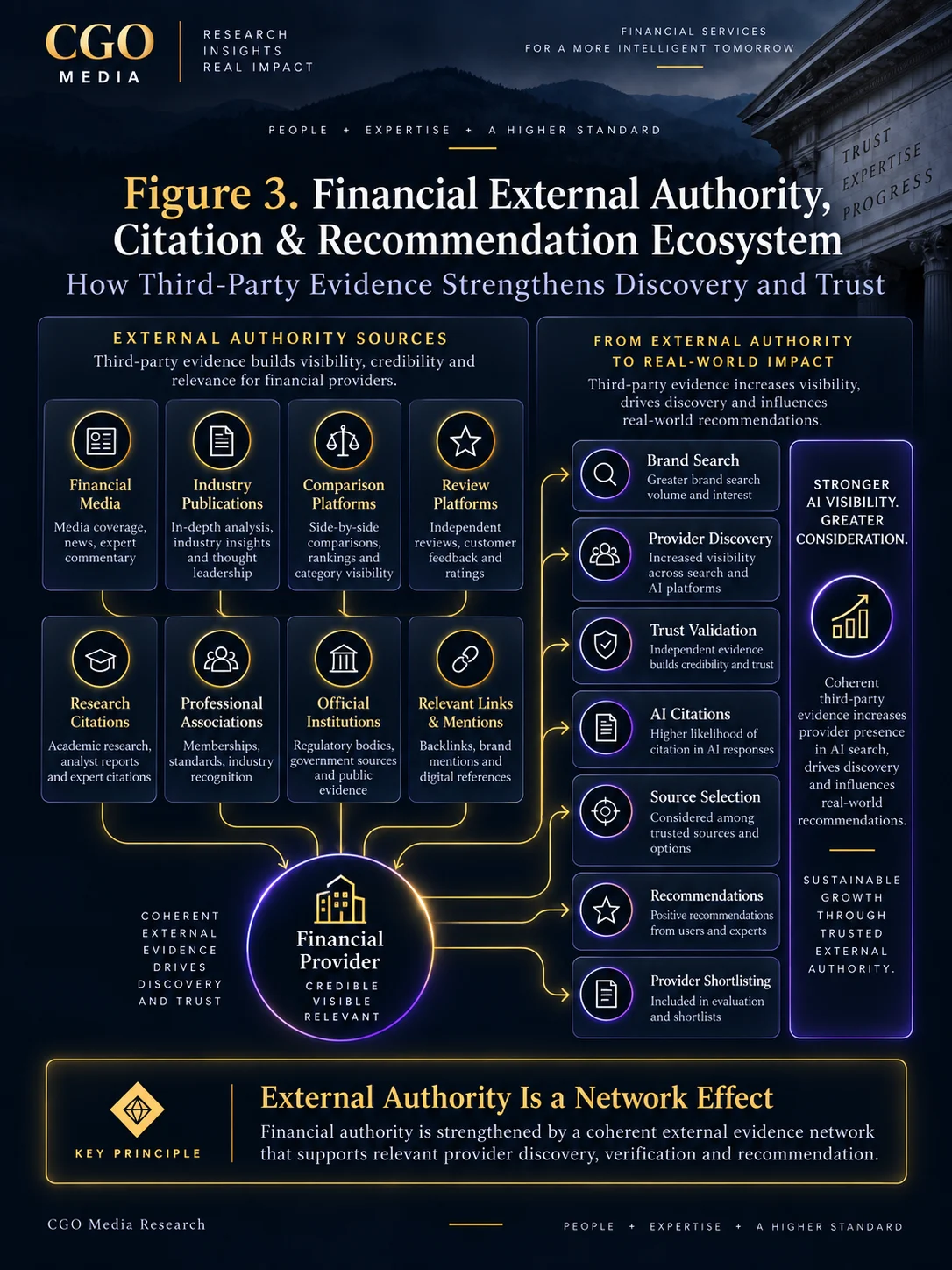
244. The Third Research Principle
Financial search authority is strengthened not by isolated backlinks or mentions, but by a coherent external evidence network that supports relevant provider discovery and verification.
245. The Next Layer Is Measurement and Provider-Selection Performance
The next section examines how financial organisations can measure authority, search visibility, provider-selection progression, AI representation and business outcomes without relying on rankings or traffic alone.
Figure 3 : Financial External Authority, Citation & Recommendation Ecosystem.
246. Financial Search Measurement Requires a Broader Model
Traditional SEO reporting often concentrates on rankings, traffic and conversions. These remain useful, but they are insufficient for understanding modern financial search authority.
247. Financial Search Measurement Should Cover Multiple Layers
A practical measurement architecture should include:
- Technical performance
- Information authority
- Entity clarity
- Regulatory trust
- External authority
- Provider-selection behaviour
- AI representation
248. Rankings Should Be Treated as One Signal
Search position can indicate discoverability but does not explain whether the user ultimately trusts or selects the provider.
249. Traffic Should Be Treated as One Signal
Higher traffic does not automatically mean:
- Higher authority
- Better product fit
- Stronger trust
- Higher-quality applications
250. Conversion Should Be Interpreted Carefully
An apparent increase in conversion can be misleading if it is accompanied by:
- Lower qualification
- Higher decline rates
- Higher complaint rates
- Poorer retention
251. Financial SEO Should Measure Qualified Progression
A stronger model examines whether suitable users progress appropriately through the provider-selection journey.
252. The Provider-Selection Measurement Sequence
A useful sequence is:
Need → Information → Product → Provider → Trust → Comparison → Action
253. Measure Need-Led Search Visibility
Track whether the organisation is visible for searches that begin with a financial problem or objective.
254. Need-Led Query Examples
- How to reduce card-processing costs
- How much deposit is needed for a mortgage
- What insurance does a small business need
- How to finance business equipment
255. Need-Led Visibility Indicates Early Discovery
Strong visibility can help the provider enter consideration before the user has selected a product category.
256. Measure Product Search Visibility
Track visibility for explicit product-category and product-intent searches.
257. Product Search Examples
- Business current account
- Merchant account
- Fixed-rate mortgage
- Professional indemnity insurance
- Investment platform
258. Measure Provider Search Visibility
Track branded and provider-led searches that indicate active consideration.
259. Provider Search Examples
- Brand + product
- Brand + pricing
- Brand + reviews
- Brand + regulated
260. Measure Trust Search Visibility
Trust queries reveal what users need to verify before acting.
261. Trust Search Examples
- Is [provider] regulated?
- Is [provider] safe?
- [provider] complaints
- [provider] reviews
262. Measure Comparison Search Visibility
Comparison queries can reveal whether the provider remains visible during shortlisting.
263. Comparison Search Examples
- [provider] vs [competitor]
- best business bank accounts
- payment provider comparison
- mortgage lender comparison
264. Search Visibility Should Be Segmented by Journey Stage
Reporting should distinguish between:
- Discovery
- Understanding
- Validation
- Comparison
- Selection
265. Search Visibility Should Be Segmented by Product
Strong performance in one financial category should not conceal weakness in another.
266. Search Visibility Should Be Segmented by Audience
Consumer, SME and enterprise performance should be interpreted separately where relevant.
267. Search Visibility Should Be Segmented by Market
International organisations should avoid combining all markets into a single authority picture.
268. Financial Provider Selection Should Be Measured Explicitly
The Financial Provider Selection Model provides a structured way to analyse user progression.
269. Measure Need-to-Information Progression
Assess whether users finding educational content move toward relevant product understanding.
270. Measure Information-to-Product Progression
Assess whether users can move from explanation toward an appropriate product category.
271. Measure Product-to-Provider Progression
Assess whether users understand who provides the product and why the provider is relevant.
272. Measure Provider-to-Trust Progression
Assess whether users can reach relevant:
- Regulatory information
- Security information
- Reviews
- Support information
273. Measure Trust-to-Comparison Progression
Assess whether trust validation supports continued consideration rather than abandonment.
274. Measure Comparison-to-Action Progression
Assess whether shortlisted users continue into:
- Application
- Quote
- Consultation
- Contact
275. Measure Action-to-Completion Progression
Completion should be interpreted in the context of legitimate:
- Eligibility checks
- Risk controls
- Compliance checks
- Underwriting
276. Qualified Application Rate Is More Useful Than Application Volume Alone
A large number of unsuitable applications can create operational cost without commercial benefit.
277. Decline Rate Should Be Analysed by Reason
Potential categories include:
- Eligibility
- Credit
- Underwriting
- Compliance
- Risk
278. Application Abandonment Should Be Analysed Carefully
Not all abandonment is harmful.
279. Necessary Filtering Can Be Beneficial
Some users should stop if they are:
- Ineligible
- Unsuitable
- Outside the supported market
280. Unnecessary Friction Should Be Distinguished
Problematic abandonment may arise from:
- Broken forms
- Unexpected requirements
- Unclear pricing
- Weak support
281. Measure Qualified Conversion
Qualified conversion focuses on suitable users rather than raw completion volume.
282. Measure Activation Where Relevant
For some financial products, completed application does not equal active customer value.
283. Measure Early Retention Where Relevant
Poor early retention can indicate:
- Expectation mismatch
- Onboarding problems
- Product misunderstanding
284. Search Measurement Should Include Authority Metrics
Visibility should be interpreted alongside whether authority is strengthening.
285. Technical Authority Metrics
Potential indicators include:
- Indexation health
- Crawl errors
- Canonical conflicts
- Performance
- Structured data validity
286. Information Authority Metrics
Potential indicators include:
- Content freshness
- Product completeness
- Risk clarity
- Review-date compliance
287. Entity Authority Metrics
Potential indicators include:
- Entity consistency
- Product ownership accuracy
- Market mapping accuracy
- Duplicate-entity conflicts
288. Regulatory Authority Metrics
Potential indicators include:
- Regulatory identity accuracy
- Verification accessibility
- Disclosure freshness
- External consistency
289. External Authority Metrics
Potential indicators include:
- Relevant editorial references
- Research citations
- Comparison-platform accuracy
- Review trends
290. AI Search Authority Metrics
Potential indicators include:
- Provider presence
- Provider relevance
- Material accuracy
- Source patterns
- Error persistence
291. AI Presence Should Be Measured Separately
Frequency of appearance can provide visibility context but should not be treated as a quality score.
292. AI Relevance Should Be Measured Separately
The provider should be relevant to the prompt and user context.
293. AI Accuracy Should Be Measured Separately
Generated information should be checked against reliable current evidence.
294. AI Trust Context Should Also Be Considered
A provider can be mentioned accurately while important trust context remains absent.
295. A Practical AI Measurement Model
Use:
Presence + Relevance + Accuracy + Trust Context
296. Measure AI Brand Accuracy
Check whether the provider is identified correctly.
297. Measure AI Product Accuracy
Check whether products, features and availability are represented correctly.
298. Measure AI Pricing Accuracy
Where generated pricing appears, assess whether the information is current enough to avoid material user misunderstanding.
299. Measure AI Regulatory Accuracy
Check whether relevant entity and regulatory relationships are represented correctly.
300. Measure AI Market Accuracy
Check whether products are associated with appropriate geographies.
301. Measure AI Error Severity
A practical classification is:
- Critical
- High
- Medium
- Low
302. Critical AI Error Examples
- Wrong regulated entity
- Wrong provider ownership
- Serious pricing misinformation
- Incorrect product availability
303. Measure AI Error Persistence
Classify errors as:
- One-off
- Occasional
- Recurring
- Persistent
304. Measure AI Source Patterns
Where sources are visible, record recurring:
- Provider sources
- Regulatory sources
- Comparison sources
- Financial media
- Review sources
305. AI Source Visibility Is Partial Evidence
Displayed citations should not be assumed to reveal the full answer-construction process.
306. Avoid Treating AI Ordering as a Ranking Metric
Provider order can vary substantially between prompts, models and sessions.
307. Longitudinal AI Measurement Is More Useful
Repeated observations over time can reveal:
- Persistent errors
- Improving accuracy
- Source-pattern changes
- Recommendation volatility
308. Financial Attribution Is Increasingly Multi-Touch
Search and provider-selection journeys can involve many digital and offline interactions.
309. Example Organic Search Journey
A user may move through:
Organic Search → Financial Guide → Product Page → Reviews → Branded Search → Application
310. Example AI-Assisted Journey
A user may move through:
AI Answer → Financial Guide → Comparison Platform → Provider Website → Application
311. Example Comparison-Led Journey
A user may move through:
Comparison Platform → Provider Website → Trust Search → Product Page → Application
312. Example Referral-Led Journey
A user may move through:
Professional Referral → Branded Search → Regulatory Verification → Provider Website → Consultation
313. First-Touch Attribution Is Incomplete
The first measurable interaction may not represent the strongest influence on provider selection.
314. Last-Touch Attribution Is Incomplete
The final interaction may capture conversion but ignore earlier trust-building activity.
315. Assisted Attribution Can Add Context
Where possible, organisations should consider:
- Organic search
- AI
- Comparison platforms
- Reviews
- Direct brand searches
- Referrals
316. AI Attribution Is Particularly Difficult
Closed interfaces, changing referral behaviour and limited tracking can make precise attribution unreliable.
317. Self-Reported Discovery Can Supplement Attribution
Customer surveys or onboarding questions can ask how users first discovered or evaluated the provider.
318. Self-Reported Data Also Has Limitations
Users may:
- Forget earlier touchpoints
- Remember only the final interaction
- Simplify a multi-stage journey
319. Attribution Should Be Triangulated
A stronger method combines:
- Analytics
- CRM data
- Search data
- Customer feedback
- AI observations
320. Avoid Unsupported Causal Claims
A rise in AI mentions followed by increased branded search does not by itself prove that AI caused the increase.
321. Financial Search Measurement Should Include Business Quality
The strongest measurement models connect visibility with:
- Qualified applications
- Activation
- Retention
- Customer experience
322. Search Value Differs by Product
A high-value mortgage lead cannot be compared directly with a low-value informational interaction.
323. Search Value Differs by Audience
Enterprise and consumer journeys can produce very different commercial outcomes.
324. Search Value Differs by Market
Commercial value, competition and regulatory context vary geographically.
325. Build Product-Level Dashboards
A priority product dashboard may combine:
- Search visibility
- Authority strength
- Trust signals
- Provider-selection progression
- AI representation
326. Build Market-Level Dashboards
International providers should distinguish performance between individual countries or regions.
327. Build Audience-Level Dashboards
Where relevant, track:
- Consumer
- SME
- Enterprise
- Specialist audiences
328. Build an Executive Financial Search Authority Scorecard
Leadership reporting should remain concise while preserving important risk signals.
329. Recommended Executive Scorecard Dimensions
- Technical Authority
- Financial Information Authority
- Regulatory and Professional Authority
- Entity Authority
- External Authority
- AI Search Authority
330. Record Current State
Each authority dimension should have a current score or status.
331. Record Target State
The organisation should define the capability level it is trying to reach.
332. Record Evidence Confidence
Use:
- Low
- Medium
- High
333. Record Trend
Use:
- Improving
- Stable
- At Risk
- Deteriorating
334. Record Priority
Use:
- Critical
- High
- Medium
- Low
335. Example Executive Financial Search Authority Scorecard
| Authority Dimension | Current | Target | Confidence | Trend | Priority |
|---|---|---|---|---|---|
| Technical Authority | 1–5 | 1–5 | Low / Medium / High | Improving / Stable / At Risk / Deteriorating | Critical / High / Medium / Low |
| Financial Information Authority | 1–5 | 1–5 | Low / Medium / High | Improving / Stable / At Risk / Deteriorating | Critical / High / Medium / Low |
| Regulatory & Professional Authority | 1–5 | 1–5 | Low / Medium / High | Improving / Stable / At Risk / Deteriorating | Critical / High / Medium / Low |
| Entity Authority | 1–5 | 1–5 | Low / Medium / High | Improving / Stable / At Risk / Deteriorating | Critical / High / Medium / Low |
| External Authority | 1–5 | 1–5 | Low / Medium / High | Improving / Stable / At Risk / Deteriorating | Critical / High / Medium / Low |
| AI Search Authority | 1–5 | 1–5 | Low / Medium / High | Improving / Stable / At Risk / Deteriorating | Critical / High / Medium / Low |
336. Critical Issues Should Be Shown Separately
An average authority score should not hide:
- Serious pricing errors
- Regulatory conflicts
- Wrong provider identity
- Major AI misinformation
337. Executive Reporting Should Distinguish Risk from Opportunity
Leadership should be able to separate:
- Critical correction
- Foundational improvement
- Growth opportunity
- Long-term resilience
338. Measure Before-and-After Change
Important interventions should be compared against an appropriate baseline.
339. Use Multiple Evidence Types
A stronger evaluation combines:
- Search data
- Website data
- Product data
- Customer feedback
- External evidence
- AI observations
340. Longitudinal Measurement Reduces Overreaction
Short-term fluctuation should not automatically trigger strategic change.
341. Measurement Should Feed the Maturity Model
The Financial Search Authority Maturity Model can be used to assess whether organisational capability is improving over time.
342. Measurement Should Feed the Implementation Roadmap
The Financial SEO & AI Implementation Roadmap can translate identified gaps into structured implementation priorities.
343. Measurement Should Feed the Trust Framework
The Financial Services AI Trust Framework can help diagnose whether weaknesses are primarily related to identity, regulation, product information, operations, reputation or AI evidence consistency.
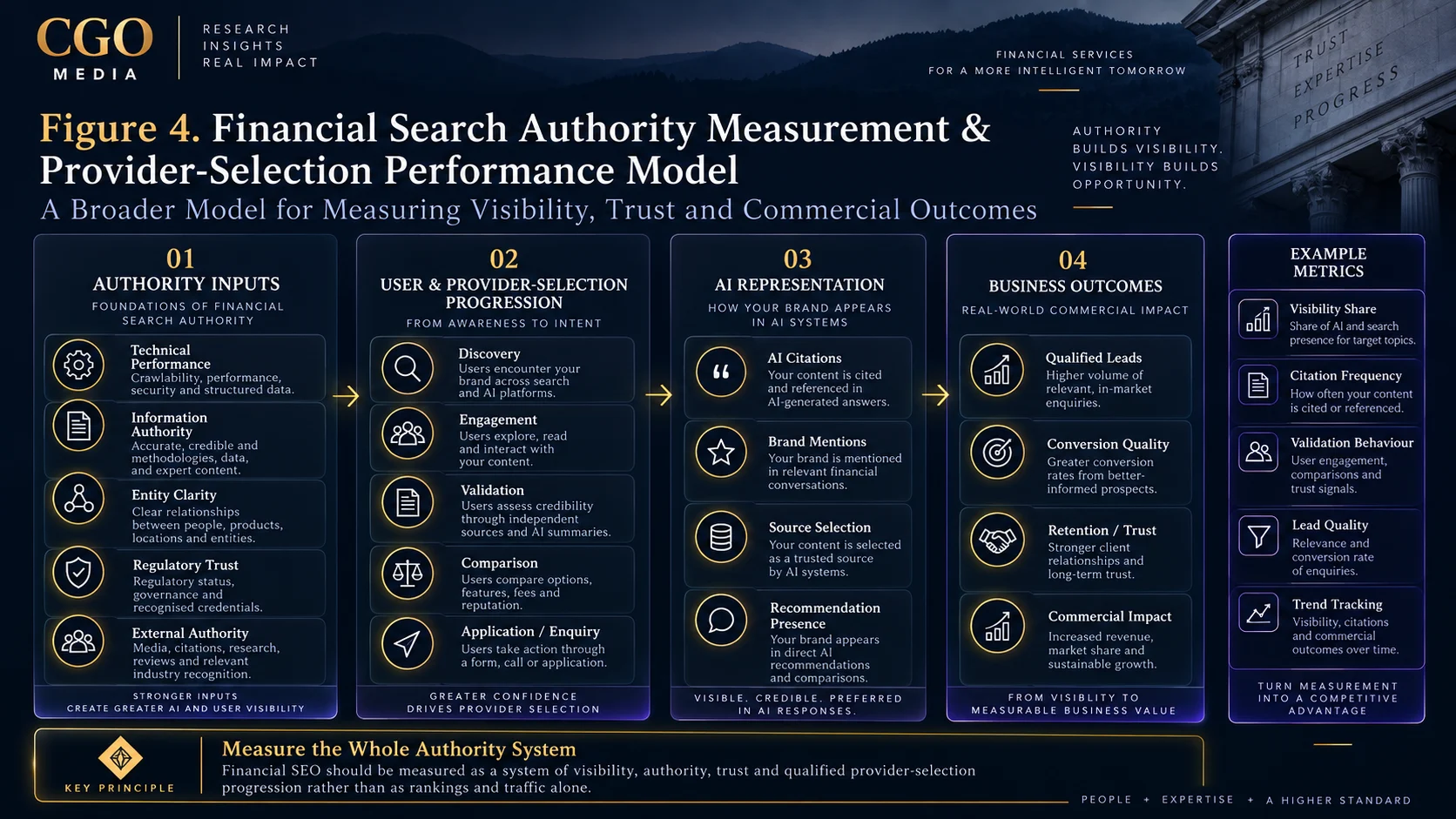
344. The Fourth Research Principle
Financial SEO should be measured as a system of visibility, authority, trust and qualified provider-selection progression rather than as a rankings-and-traffic discipline alone.
345. The Next Layer Is AI Search Governance and Future Resilience
The next section examines AI search readiness, evidence governance, hallucination risk, source consistency, organisational change and the operational capabilities financial organisations need to remain resilient as discovery systems evolve.
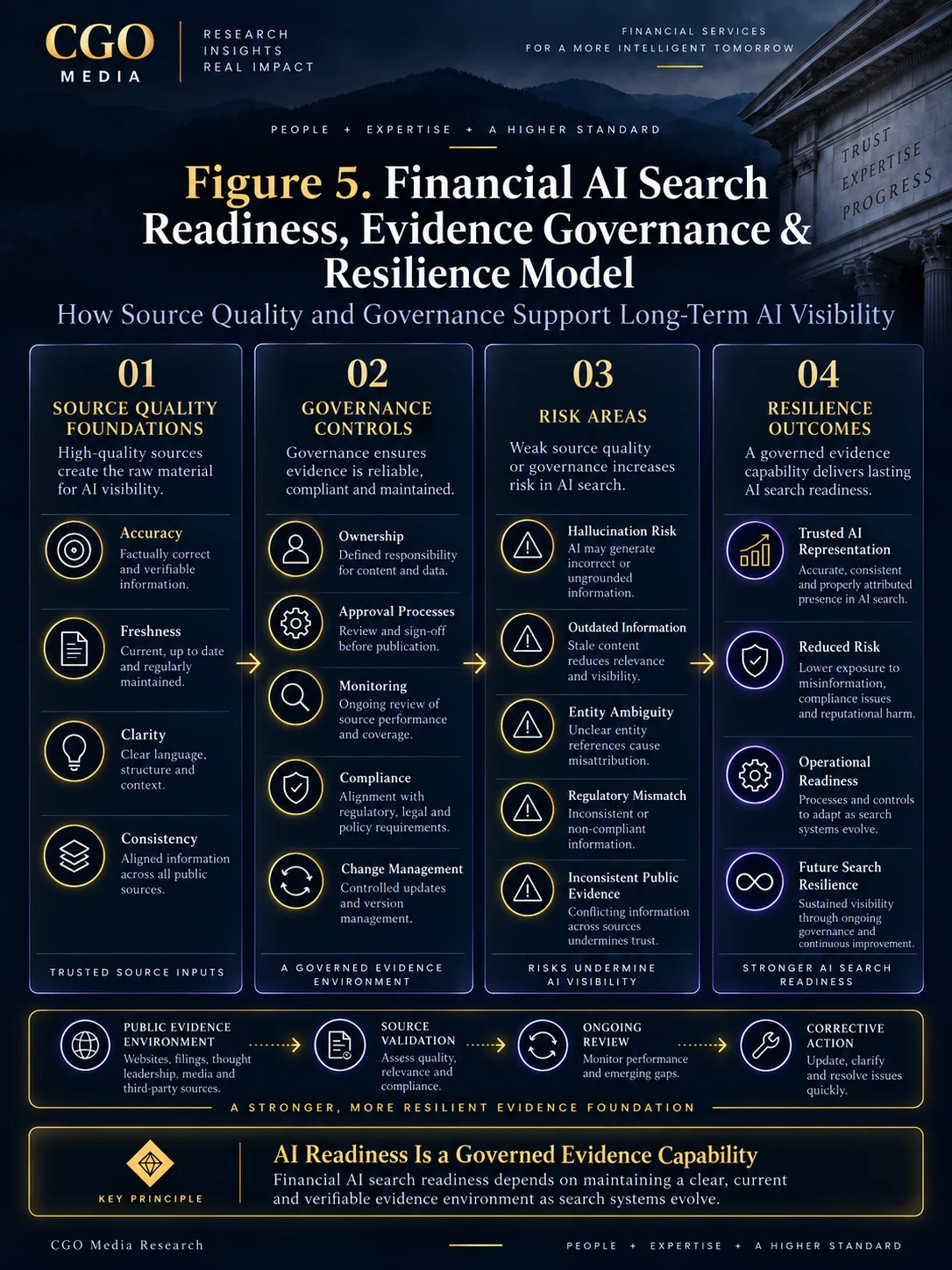
Figure 4 : Financial Search Authority Measurement & Provider-Selection Performance Model.
346. AI Search Readiness Is a Governance Capability
Financial AI visibility should not be treated as a one-off optimisation exercise.
It is more usefully understood as the ability of an organisation to maintain a sufficiently clear, current and verifiable public evidence environment as search systems evolve.
347. AI Search Readiness Begins with Source Quality
Generated systems can only interpret the public evidence they encounter.
348. Source Quality Depends on Accuracy
Incorrect financial information can create downstream representation problems.
349. Source Quality Depends on Freshness
Outdated product or regulatory information may continue to influence discovery after it should have been replaced.
350. Source Quality Depends on Clarity
Ambiguous relationships between:
- Brand
- Legal entity
- Regulated entity
- Product
- Market
can increase interpretation risk.
351. Source Quality Depends on Consistency
Material facts should remain broadly aligned across influential environments.
352. AI Search Readiness Requires an Evidence Map
Financial organisations should understand which public sources contribute to their wider digital representation.
353. First-Party Evidence Sources
These may include:
- Corporate website
- Product pages
- Trust pages
- Research pages
- Author profiles
- Location pages
354. Official Evidence Sources
These may include:
- Regulatory records
- Corporate registries
- Official institutional sources
355. Commercial External Evidence Sources
These may include:
- Comparison platforms
- Review platforms
- Directories
- Partner listings
356. Editorial Evidence Sources
These may include:
- Financial media
- Industry publications
- Research repositories
- Professional publications
357. Machine-Mediated Evidence Surfaces
These may include:
- AI assistants
- AI-generated search summaries
- Recommendation systems
- Conversational interfaces
358. Evidence Mapping Helps Identify Weakness
The organisation can compare what it publishes with what influential external environments represent.
359. Evidence Mapping Helps Identify Conflict
Material disagreements can be logged and prioritised.
360. Evidence Mapping Helps Identify Gaps
Important topics may be poorly represented across the wider evidence ecosystem.
361. Evidence Governance Should Follow a Source-of-Truth Model
High-risk financial facts should have an identifiable authoritative internal source.
362. Provider Identity Source of Truth
The organisation should maintain authoritative records for:
- Brand name
- Legal entity
- Regulated entity
- Parent relationships
- Market relationships
363. Product Source of Truth
The organisation should maintain authoritative records for:
- Product name
- Pricing
- Eligibility
- Features
- Availability
- Product status
364. Regulatory Source of Truth
Relevant regulatory statements should be controlled through appropriate legal or compliance processes.
365. Location Source of Truth
Where branches or offices matter, location data should be governed centrally enough to prevent material inconsistencies.
366. External Evidence Should Be Reconciled Against Internal Truth
The organisation should identify where important public sources diverge from validated information.
367. Material Conflict Should Be Prioritised
High-priority conflicts may involve:
- Wrong provider identity
- Incorrect product availability
- Material pricing errors
- Incorrect regulatory relationships
368. Minor Descriptive Variation Is Not Always a Problem
Different wording can remain acceptable where the underlying facts are consistent.
369. Material Consistency Is the Goal
The objective is not identical text everywhere.
It is consistent interpretation of important facts.
370. AI Hallucination Risk Requires Special Attention
Generative systems can produce plausible but incorrect information.
371. Financial Hallucination Risk Can Be Material
Examples may include:
- Invented product features
- Outdated pricing
- Incorrect regulatory status
- Wrong provider ownership
- Unsupported availability claims
372. Hallucination Risk Should Be Classified by Impact
A practical scale is:
- Critical
- High
- Medium
- Low
373. Critical AI Hallucination Examples
- Incorrect regulated entity
- Materially false pricing
- Wrong provider identity
- Serious product availability error
374. High-Severity AI Hallucination Examples
- Incorrect eligibility
- Material feature error
- Wrong market scope
- Misleading risk representation
375. Medium-Severity AI Hallucination Examples
These may include incomplete but non-critical product descriptions.
376. Low-Severity AI Hallucination Examples
These may include minor wording differences with little effect on user understanding.
377. Hallucination Persistence Should Also Be Measured
Classify issues as:
- One-off
- Occasional
- Recurring
- Persistent
378. Persistent Errors Deserve Deeper Investigation
Repeated material inaccuracies may indicate an evidence-system problem rather than isolated model variation.
379. Do Not Assume Every AI Error Is Caused by the Provider Website
Possible sources may include:
- Historic third-party content
- Comparison data
- Old editorial references
- Legacy provider pages
- Conflicting entity records
380. AI Error Diagnosis Should Trace the Evidence Environment
A practical workflow is:
Observe → Verify → Trace → Correct → Validate → Reobserve
381. Observe
Identify potentially material AI representation issues.
382. Verify
Confirm whether the generated statement is genuinely incorrect.
383. Trace
Investigate which public evidence may be contributing to the problem.
384. Correct
Update the underlying evidence where appropriate and possible.
385. Validate
Confirm that controlled sources now contain the correct information.
386. Reobserve
Monitor later outputs rather than assuming immediate deterministic change.
387. AI Search Readiness Requires Longitudinal Monitoring
One-time prompt testing cannot establish stable representation.
388. Prompt Sets Should Be Repeatable
Useful categories include:
- Brand
- Product
- Trust
- Comparison
- Market
- Audience
389. Brand Prompts
These may test:
- Provider identity
- Ownership
- Business model
- Operating markets
390. Product Prompts
These may test:
- Features
- Eligibility
- Pricing
- Availability
391. Trust Prompts
These may test:
- Regulatory context
- Security
- Reputation
- Support
392. Comparison Prompts
These may test how the provider is represented relative to relevant alternatives.
393. Market Prompts
These may test whether products are matched correctly with geography.
394. Audience Prompts
These may test whether products are matched appropriately with:
- Consumers
- SMEs
- Enterprise customers
- Specialist audiences
395. Prompt Context Should Be Recorded
Useful fields include:
- Prompt
- Model
- Date
- Market
- Audience
- Observed output
396. AI Evidence Confidence Should Be Recorded
A useful classification is:
- Low
- Medium
- High
397. High-Confidence AI Findings
These may involve:
- Repeated observations
- Clear authoritative evidence
- Persistent material error
398. Medium-Confidence AI Findings
These may involve partial repetition or incomplete evidence.
399. Low-Confidence AI Findings
These may involve:
- One-off outputs
- Minor wording differences
- Unclear source context
400. AI Search Readiness Requires Human Oversight
High-risk financial information should not be governed solely through automated monitoring or correction.
401. Automation Is Useful for Scale
Automation can help detect:
- Product conflicts
- Broken links
- Stale pages
- Structured data errors
- External inconsistencies
402. Automation Is Not a Substitute for Validation
High-risk changes should retain appropriate human review.
403. Automation Can Amplify Bad Data
If an authoritative source contains incorrect information, automated propagation can distribute that error rapidly.
404. Financial AI Governance Should Be Cross-Functional
Relevant teams may include:
- SEO
- Product
- Compliance
- Legal
- Data
- Technology
- Customer experience
- Communications
405. Define AI Search Ownership
A named team or owner should coordinate:
- Prompt monitoring
- Error classification
- Source diagnosis
- Escalation
406. Define Product-Data Ownership
Product teams should remain accountable for validated product truth.
407. Define Regulatory Ownership
Compliance or legal teams should remain accountable for material regulatory statements.
408. Define External Authority Ownership
SEO, Digital PR or communications teams may coordinate relevant external evidence.
409. Define Customer-Experience Ownership
Operational trust issues should be routed to teams capable of correcting underlying service problems.
410. Define Escalation Rules
Not every discrepancy requires executive intervention.
411. Critical Escalation
Potential triggers include:
- Material regulatory error
- Major pricing misinformation
- Wrong provider identity
- Serious reputation event
412. High Escalation
Potential triggers include:
- Persistent eligibility error
- Repeated market misrepresentation
- Major product-data conflict
413. Medium Escalation
These may involve important but contained inconsistencies.
414. Low Escalation
These may involve minor descriptive differences.
415. AI Governance Should Avoid Prompt Chasing
Teams should not repeatedly rewrite content merely to influence one isolated AI response.
416. AI Governance Should Focus on Evidence Quality
The stronger strategy is to improve:
- Source accuracy
- Entity clarity
- Product clarity
- External corroboration
417. AI Governance Should Avoid Unsupported Ranking Claims
Generated provider order is not a stable search-ranking equivalent.
418. AI Governance Should Avoid Guaranteed Visibility Claims
No methodology can guarantee recommendation, citation or inclusion by a particular AI system.
419. Future Search Resilience Requires More Than AI Monitoring
Financial organisations should strengthen the wider system that survives changes in interface and platform.
420. Resilient Technical Architecture
The organisation should maintain:
- Crawlability
- Indexation control
- Performance
- Structured relationships
421. Resilient Information Architecture
Financial knowledge should remain well structured even if search interfaces change.
422. Resilient Entity Architecture
Provider and product relationships should remain clear across multiple environments.
423. Resilient Trust Architecture
Users should be able to verify important provider claims independently.
424. Resilient External Authority
The organisation should build authority across multiple relevant sources rather than depend on one platform.
425. Resilient Measurement
Measurement should not depend exclusively on one traffic source or attribution model.
426. Resilient Governance
Review cycles and change triggers should continue even when search priorities change.
427. Future Search Resilience Requires Institutional Learning
Repeated search, AI and provider-selection observations should improve organisational standards over time.
428. Search Intelligence Can Feed Product Strategy
Search behaviour may reveal:
- Emerging customer needs
- New trust concerns
- Comparison criteria
- Product misunderstandings
429. AI Intelligence Can Feed Information Strategy
Repeated generated questions may reveal where the market lacks clear explanations.
430. Review Intelligence Can Feed Operations
Recurring customer complaints can expose operational weaknesses.
431. Comparison Intelligence Can Feed Product Positioning
Comparison environments may reveal which product attributes users and intermediaries treat as important.
432. Financial Search Can Become a Strategic Intelligence Function
The discipline can contribute insight to:
- Product
- Customer experience
- Brand
- Compliance
- Growth strategy
433. AI Search Readiness Should Be Reassessed Over Time
The Financial Search Authority Maturity Model can support periodic reassessment of organisational capability.
434. Governance Improvements Should Feed Implementation
The Financial SEO & AI Implementation Roadmap can translate identified governance gaps into structured action.
435. Trust Issues Should Feed the Trust Framework
The Financial Services AI Trust Framework can help determine whether an issue relates primarily to:
- Identity
- Regulation
- Product information
- Operations
- Reputation
- AI evidence consistency
436. The Fifth Research Principle
Financial AI search readiness is best understood as a governed evidence capability rather than a separate optimisation channel.
437. The Next Stage Is the Future Financial Search Operating Model
The next section examines how financial organisations can combine SEO, content, entities, trust, Digital PR, AI monitoring and governance into a continuous operating model for the next generation of search.
Figure 5 : Financial AI Search Readiness, Evidence Governance & Resilience Model.
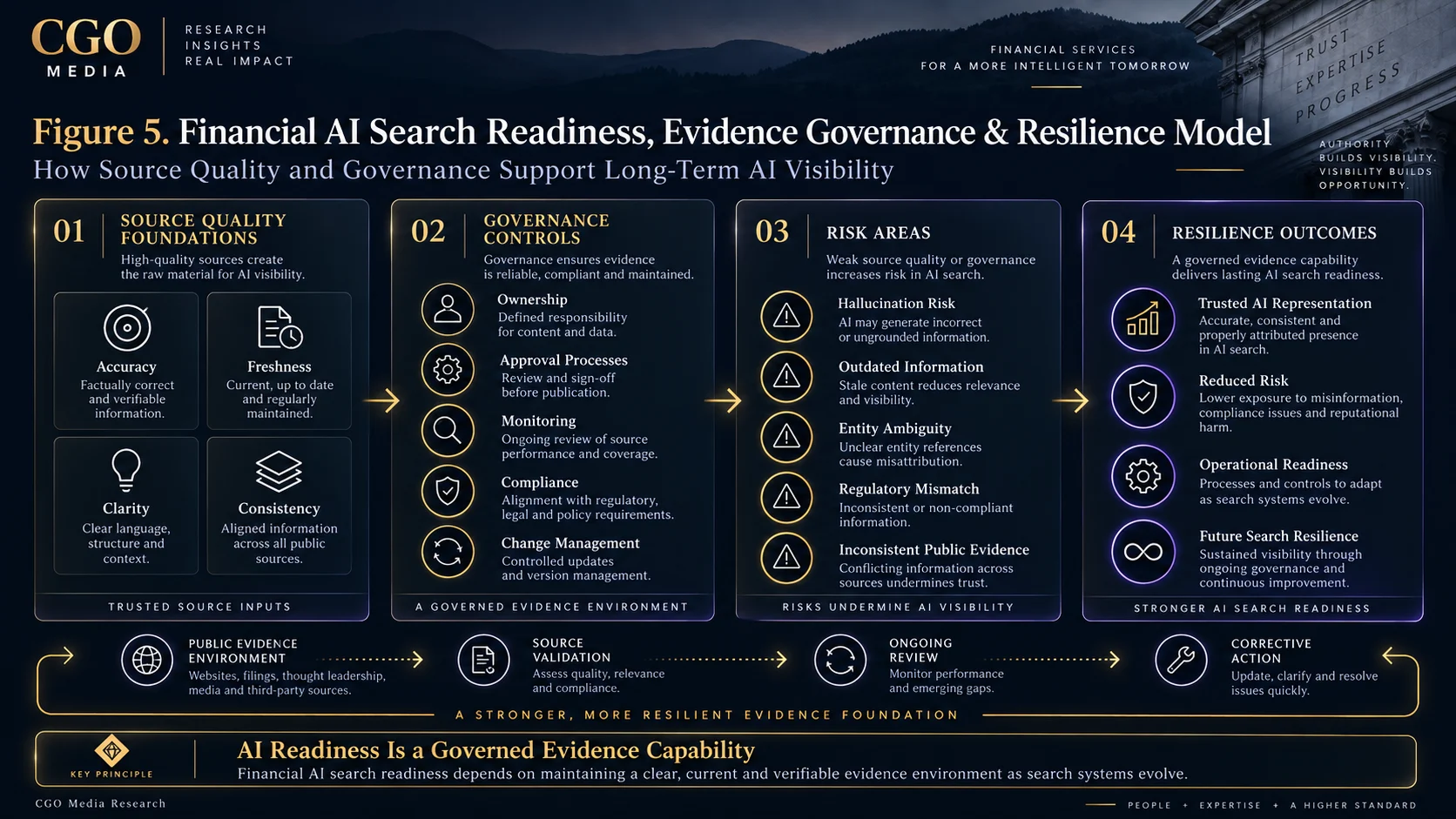
438. The Future Financial Search Operating Model
The next generation of financial SEO requires a continuous operating model that connects search, content, entities, product data, trust, Digital PR, AI monitoring and governance.
439. Financial SEO Should Move from Campaign to Capability
The strongest organisations will treat search visibility as an enduring organisational capability rather than a sequence of isolated campaigns.
440. The Core Operating Model
A practical structure is:
Observe → Diagnose → Prioritise → Improve → Validate → Measure → Learn → Reassess
441. Observe
Monitor:
- Search demand
- Product changes
- Trust signals
- External authority
- AI representation
442. Diagnose
Identify whether the issue is primarily:
- Technical
- Informational
- Entity-related
- Regulatory
- External
- Operational
- AI-related
443. Prioritise
Rank work according to:
- Risk
- Strategic importance
- User impact
- Evidence confidence
- Commercial value
444. Improve
Apply the most appropriate intervention rather than defaulting automatically to new content production.
445. Validate
Confirm that the intended correction or improvement has been implemented accurately.
446. Measure
Compare outcomes against the previous baseline.
447. Learn
Use repeated patterns to improve:
- Standards
- Governance
- Review cycles
- Search strategy
448. Reassess
Periodically reassess authority maturity and strategic priorities.
449. SEO Should Connect with Product
Search behaviour can reveal:
- Unmet customer needs
- Product misunderstandings
- Emerging comparison criteria
- Pricing concerns
450. SEO Should Connect with Compliance
Important financial information should be accurate without becoming unnecessarily difficult for users to understand.
451. SEO Should Connect with Customer Experience
Search visibility can create demand that exposes weaknesses in:
- Onboarding
- Support
- Claims
- Application processes
452. SEO Should Connect with Digital PR
External authority is stronger when research, media activity and search strategy reinforce one another.
453. SEO Should Connect with Data Teams
Product, entity and market data increasingly influence search architecture and AI readiness.
454. SEO Should Connect with Technology
Technical delivery supports:
- Structured data
- Performance
- Product feeds
- Automation
- Measurement
455. SEO Should Connect with Leadership
Senior stakeholders should understand search authority as a strategic capability rather than a narrow marketing metric.
456. The Future Financial Search Team Is Cross-Functional
A mature operating model may involve:
SEO + Content + Product + Compliance + Customer Experience + Digital PR + Technology + Data
457. Central Coordination Can Reduce Fragmentation
A central search-authority function can help coordinate:
- Standards
- Priorities
- Measurement
- Governance
458. Distributed Expertise Still Matters
Product, compliance and operational expertise should remain close to the teams that own the underlying truth.
459. The Stronger Model Is Federated
A federated model combines:
Central Standards + Distributed Ownership
460. Financial Search Governance Needs Decision Rights
The organisation should know who can:
- Approve product changes
- Correct regulatory information
- Publish research
- Escalate AI errors
- Retire outdated pages
461. Financial Search Governance Needs Review Cycles
Different information classes require different review intensity.
462. High-Change Areas
These may include:
- Pricing
- Rates
- Eligibility
- Product availability
463. Medium-Change Areas
These may include:
- Product explanations
- Trust content
- Comparison data
- External profiles
464. Strategic Areas
These may include:
- Entity architecture
- Authority maturity
- AI representation
- Search strategy
465. Event-Driven Review Is Also Necessary
Important changes should trigger review outside the normal schedule.
466. Product Launch Trigger
A product launch should initiate:
- Search architecture
- Content
- Structured data
- Trust evidence
- AI monitoring
467. Pricing Change Trigger
Material changes should propagate across controlled environments.
468. Regulatory Change Trigger
Affected pages and external representations should be reviewed.
469. Brand Change Trigger
Rebrands and acquisitions should initiate entity reconciliation.
470. Market Expansion Trigger
New markets should prompt review of:
- Regulation
- Product availability
- Language
- Local authority
471. Reputation Event Trigger
Significant reputation events should prompt cross-functional review.
472. Persistent AI Error Trigger
Repeated high-impact inaccuracies should prompt source and evidence investigation.
473. Continuous Improvement Should Be Structured
The organisation should not depend on ad hoc problem-solving.
474. Continuous Improvement Cycle
A practical cycle is:
Observe → Verify → Diagnose → Prioritise → Improve → Measure → Learn → Reassess
475. Continuous Improvement Should Be Product-Specific
Different products will require different priorities.
476. Continuous Improvement Should Be Market-Specific
Different jurisdictions may have different:
- Regulation
- Search demand
- Trust expectations
- Competitors
477. Continuous Improvement Should Be Audience-Specific
Consumer, SME and enterprise journeys may require different:
- Content
- Trust evidence
- Comparison support
- Application journeys
478. Authority Decay Should Be Expected
Even strong financial search systems can deteriorate over time.
479. Technical Authority Decay
Potential causes include:
- Site migrations
- Broken internal links
- Indexation changes
- Performance degradation
480. Information Authority Decay
Potential causes include:
- Stale product information
- Old guidance
- Outdated references
- Unreviewed research
481. Entity Authority Decay
Potential causes include:
- Rebrands
- Acquisitions
- Duplicate profiles
- Legacy provider relationships
482. Regulatory Authority Decay
Potential causes include:
- Outdated disclosures
- Changed entity relationships
- Broken verification pathways
483. External Authority Decay
Potential causes include:
- Outdated comparison profiles
- Falling review quality
- Loss of relevant editorial authority
484. AI Search Authority Decay
Potential causes include:
- Stale product summaries
- Persistent entity confusion
- Outdated source material
- Market misrepresentation
485. Authority Decay Should Be Monitored
The objective is to identify deterioration before it becomes a larger strategic problem.
486. Build an Authority Health Register
A practical register may include:
- Authority dimension
- Current state
- Risk
- Trend
- Owner
- Next action
487. Build an Authority Change Log
Important updates should record:
- What changed
- Why it changed
- When it changed
- Who approved it
488. Change Logs Support Auditability
They help organisations understand why search, product or trust information changed over time.
489. Versioning Can Support Resilience
Historic financial information may need to be retained appropriately without remaining active or misleading.
490. Financial Search Strategy Should Operate on Multiple Time Horizons
A mature programme combines:
- Immediate correction
- Quarterly improvement
- Annual strategic development
491. Immediate Horizon — Correct Material Risk
Priority issues may include:
- Wrong provider identity
- Incorrect pricing
- Regulatory conflict
- Serious AI misinformation
492. Quarterly Horizon — Improve Authority
Quarterly work may focus on:
- Product clusters
- Trust improvements
- Research
- Digital PR
- Measurement
493. Annual Horizon — Build Resilience
Annual strategy may focus on:
- Maturity progression
- Market expansion
- Data architecture
- Automation
- AI readiness
494. A 12-Month Financial Search Authority Cycle
A practical annual model is:
Q1: Diagnose and Correct
Q2: Structure and Strengthen
Q3: Scale and Measure
Q4: Govern and Reassess
495. Quarter One — Diagnose and Correct
Focus on:
- Technical audit
- Entity audit
- Product accuracy
- Regulatory accuracy
- AI baseline
496. Quarter Two — Structure and Strengthen
Focus on:
- Knowledge architecture
- Product content
- Trust architecture
- Internal linking
- Research
497. Quarter Three — Scale and Measure
Focus on:
- Additional products
- Additional markets
- Digital PR
- AI monitoring
- Provider-selection performance
498. Quarter Four — Govern and Reassess
Focus on:
- Maturity reassessment
- Governance refinement
- Authority decay
- Next-year priorities
499. The Annual Cycle Should Not Be Rigid
High-risk issues should be addressed when they arise rather than waiting for a scheduled quarter.
500. Strategic Recommendation One — Build Financial Knowledge Architecture
Organisations should connect user needs, financial information, products, providers and trust evidence into a coherent structure.
501. Strategic Recommendation Two — Establish Entity Clarity
Clarify relationships between:
- Brand
- Legal entity
- Regulated entity
- Product
- Market
502. Strategic Recommendation Three — Govern Product Truth
Product data should remain accurate, current and controlled.
503. Strategic Recommendation Four — Strengthen Trust Architecture
Users should be able to verify:
- Provider legitimacy
- Product terms
- Security
- Reputation
504. Strategic Recommendation Five — Develop External Authority
Prioritise relevant:
- Financial media
- Research citations
- Comparison platforms
- Industry publications
505. Strategic Recommendation Six — Publish Defensible Research
Research should include:
- Methodology
- Limitations
- References
- Clear authorship
506. Strategic Recommendation Seven — Measure Provider Selection
Do not stop reporting at traffic or lead volume.
507. Strategic Recommendation Eight — Monitor AI Representation
Track:
- Presence
- Relevance
- Accuracy
- Trust context
508. Strategic Recommendation Nine — Prioritise Material AI Errors
Focus on persistent inaccuracies that affect user understanding or provider trust.
509. Strategic Recommendation Ten — Avoid AI Prompt Chasing
Improve the evidence system rather than optimising for one isolated generated answer.
510. Strategic Recommendation Eleven — Build Cross-Functional Governance
Search authority should have clear ownership across relevant business functions.
511. Strategic Recommendation Twelve — Connect Search with Customer Experience
Recurring search and reputation signals should inform operational improvement.
512. Strategic Recommendation Thirteen — Preserve Necessary Friction
Do not remove legitimate:
- Eligibility checks
- Identity verification
- Compliance controls
- Risk assessment
merely to increase conversion.
513. Strategic Recommendation Fourteen — Reduce Unnecessary Friction
Investigate:
- Broken forms
- Unclear requirements
- Unexpected conditions
- Poor support
514. Strategic Recommendation Fifteen — Reassess Maturity
Use the Financial Search Authority Maturity Model to assess whether capabilities are becoming stronger and more resilient.
515. Strategic Recommendation Sixteen — Use a Structured Implementation Roadmap
Use the Financial SEO & AI Implementation Roadmap to translate strategic gaps into operational workstreams.
516. Strategic Recommendation Seventeen — Integrate Trust Explicitly
Use the Financial Services AI Trust Framework to assess provider trust across the full evidence ecosystem.
517. Strategic Recommendation Eighteen — Connect Search with Provider Selection
Use the Financial Provider Selection Model to understand how discovery, trust, comparison and action interact.
518. The Future Financial Search Equation
The operating model can be summarised as:
Technical Clarity + Financial Information Authority + Entity Clarity + Regulatory Trust + External Authority + AI Readiness + Governance
519. The Strategic Outcome Is Not Maximum Traffic
The objective is not to attract every possible user.
520. The Strategic Outcome Is Relevant Discovery
The provider should be visible where its products genuinely fit the user’s need.
521. The Strategic Outcome Is Accurate Representation
Users and machine-mediated systems should encounter sufficiently reliable provider and product information.
522. The Strategic Outcome Is Verifiable Trust
Users should be able to validate important provider claims efficiently.
523. The Strategic Outcome Is Qualified Progression
Suitable users should be able to move through:
Discovery → Understanding → Trust → Comparison → Selection
524. The Strategic Outcome Is Resilience
Search authority should remain useful as interfaces, platforms and discovery behaviours evolve.
525. The Sixth Research Principle
The future of Financial Services SEO lies in building a governed authority system that connects technical SEO, financial information, entities, trust, external evidence and AI-assisted discovery.
526. The Next Step Is Final Research Integration
The final section consolidates the paper’s strategic implications, methodology, limitations, conclusion, references and research citation guidance.
Figure 6 : Continuous Financial Search Authority & 12-Month Improvement Cycle.
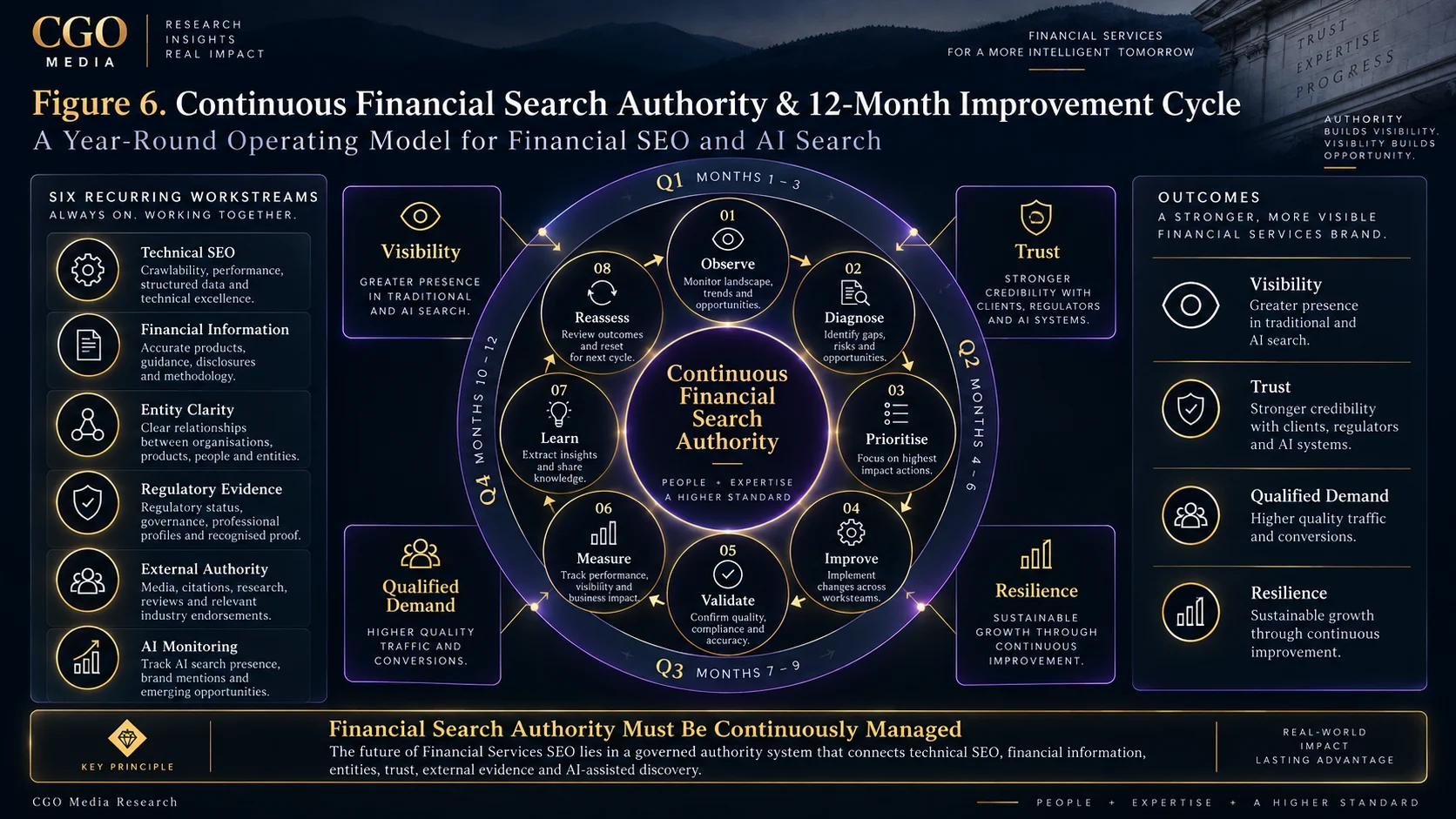
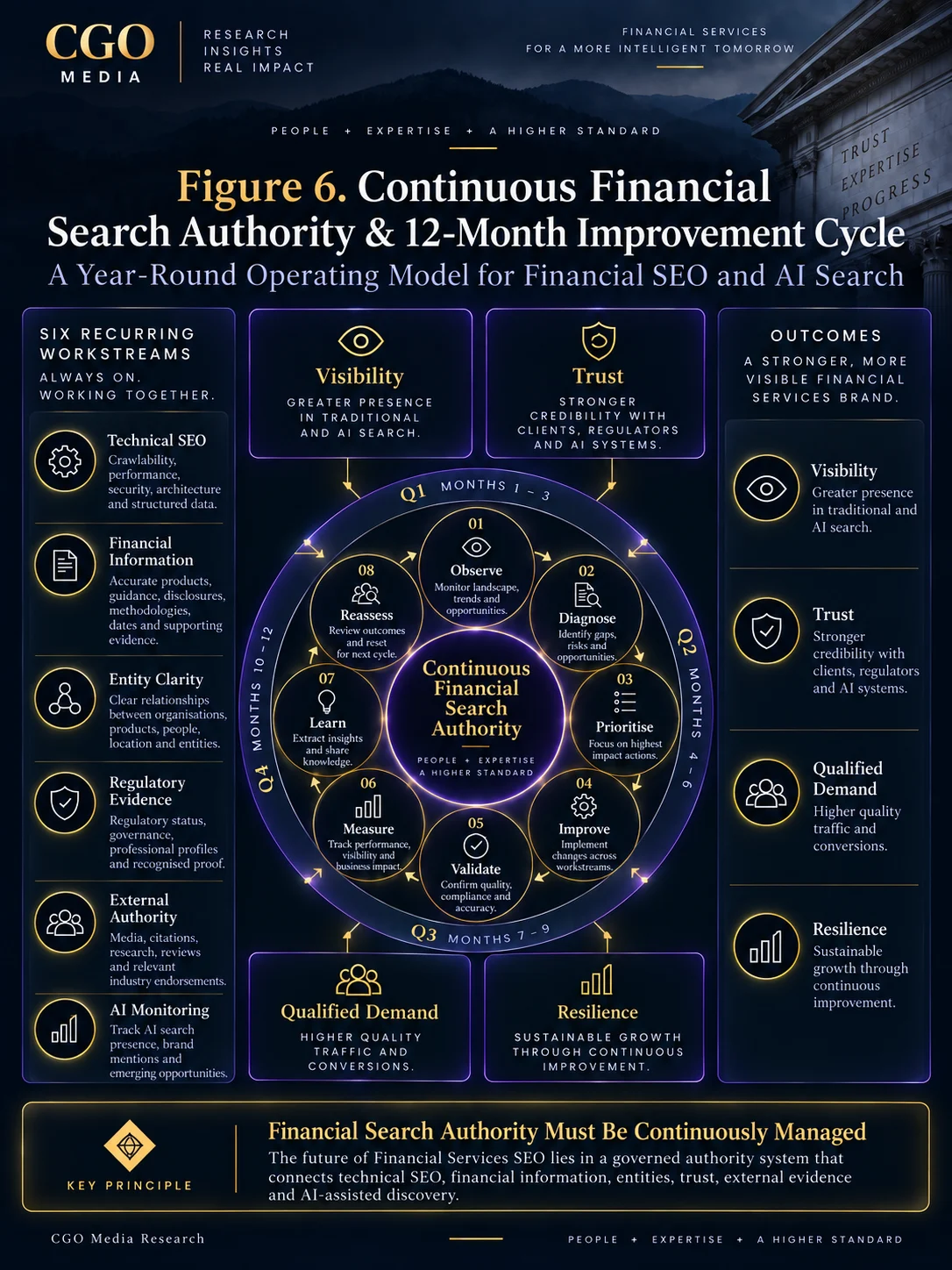
527. Strategic Implications
Financial Services SEO is moving from a page-ranking discipline toward a broader authority-management model.
The organisations most likely to remain visible and credible across evolving search environments will be those that can connect technical accessibility, reliable financial information, clear entities, regulatory evidence, external validation and AI readiness into one governed system.
528. Technical SEO Remains Foundational
Financial organisations still require:
- Crawlability
- Indexation control
- Canonicalisation
- Site performance
- Internal linking
- Structured data
529. Technical SEO Alone Is Insufficient
A technically strong website can still underperform if product information, entity relationships or trust evidence are weak.
530. Financial Information Authority Is Central
High-visibility financial information should be sufficiently:
- Accurate
- Current
- Clear
- Evidence-led
- Risk-aware
531. Entity Clarity Is a Strategic Requirement
Financial providers should reduce ambiguity around:
Brand → Legal Entity → Regulated Entity → Product → Market → Audience
532. Regulatory Evidence Is Part of Search Authority
Relevant users should be able to verify provider identity and regulatory context without excessive friction.
533. Product Truth Should Be Governed
Search teams should not independently invent or infer material product facts.
534. External Authority Should Corroborate Internal Evidence
Relevant media, comparison platforms, research citations and review environments can strengthen provider understanding when they remain accurate and contextually relevant.
535. AI Visibility Should Be Treated as an Outcome
AI-assisted discovery is more usefully understood as an outcome of a wider authority system than as a standalone optimisation channel.
536. AI Accuracy Should Matter More Than Mention Volume
Frequent but incorrect representation can create more risk than value.
537. AI Presence, Relevance and Accuracy Should Be Measured Separately
A provider can appear often, be accurately described and still be irrelevant to the user’s need.
538. Recommendation Visibility Should Be Interpreted Cautiously
Generated inclusion does not establish universal quality, suitability or regulatory endorsement.
539. Search Performance Should Be Connected to Provider Selection
The strategic journey is:
Discovery → Understanding → Trust → Comparison → Selection
540. Qualified Progression Is More Valuable Than Raw Volume
Financial search should help suitable users progress while making important restrictions and eligibility conditions clear enough for unsuitable users to self-select out where appropriate.
541. Search Intelligence Can Inform Wider Business Strategy
Search and AI observations may reveal:
- Emerging financial needs
- Customer concerns
- Trust gaps
- Product misunderstandings
- Comparison criteria
542. Financial SEO Should Become Cross-Functional
The strongest operating model connects:
SEO + Content + Product + Compliance + Customer Experience + Digital PR + Technology + Data
543. Governance Protects Long-Term Authority
Without ownership, review cycles and change triggers, financial search authority can decay after implementation.
544. Authority Decay Should Be Expected
Potential causes include:
- Product changes
- Rebrands
- Regulatory changes
- Site migrations
- Outdated external profiles
- AI representation drift
545. Resilience Is the Long-Term Objective
A resilient financial search system should remain:
- Accurate
- Interpretable
- Verifiable
- Measurable
- Governed
546. Relationship with the Financial Services Research Family
This parent research paper establishes the wider strategic context for the four supporting Financial Services frameworks.
Financial Services AI Trust Framework | Financial Provider Selection Model | Financial Search Authority Maturity Model | Financial SEO & AI Implementation Roadmap
547. Relationship with the Financial Services AI Trust Framework
The Financial Services AI Trust Framework defines six interconnected domains for evaluating provider trust, regulatory evidence, product information, operational reliability, external validation and AI representation.
548. Relationship with the Financial Provider Selection Model
The Financial Provider Selection Model explains how users move from financial need recognition through discovery, verification, comparison and provider selection.
549. Relationship with the Financial Search Authority Maturity Model
The Financial Search Authority Maturity Model provides a five-level system for assessing organisational search-authority capability.
550. Relationship with the Financial SEO & AI Implementation Roadmap
The Financial SEO & AI Implementation Roadmap translates the research principles into a practical implementation and governance sequence.
551. Methodology
This paper is a conceptual research study developed by CGO Media to examine how Financial Services SEO changes when search discovery extends beyond conventional results into comparison, recommendation and AI-assisted environments.
552. Research Scope
The study considers:
- Banks
- Fintech organisations
- Insurers
- Lenders
- Investment providers
- Payment providers
- Other financial-service organisations
553. Six-Layer Authority Method
The research organises modern financial search authority into six connected layers:
- Technical Authority
- Financial Information Authority
- Regulatory and Professional Authority
- Entity Authority
- External Authority
- AI Search Authority
554. Technical Authority Method
The technical layer considers whether financial content and entities can be accessed and interpreted reliably.
555. Information Authority Method
The information layer considers:
- Accuracy
- Freshness
- Clarity
- Risk context
- Evidence
556. Regulatory and Professional Authority Method
This layer examines whether provider legitimacy, professional responsibility and relevant institutional context can be validated.
557. Entity Authority Method
The research considers relationships between:
- Brands
- Legal entities
- Regulated entities
- Products
- People
- Markets
- Locations
558. External Authority Method
The external layer considers:
- Media
- Research citations
- Comparison platforms
- Reviews
- Links
559. AI Search Authority Method
The AI layer considers:
- Provider presence
- Relevance
- Material accuracy
- Visible source patterns
- Error persistence
560. Provider-Selection Method
The paper uses the progression:
Need → Information → Product → Provider → Trust → Comparison → Action
561. Measurement Method
Performance is evaluated through multiple evidence types, including:
- Search data
- Website behaviour
- Product data
- External evidence
- Customer feedback
- AI observations
562. Evidence Confidence Method
Important findings may be classified as:
- Low confidence
- Medium confidence
- High confidence
563. Trend Method
Direction of travel may be classified as:
- Improving
- Stable
- At Risk
- Deteriorating
564. AI Observation Method
AI monitoring should use repeatable prompt groups, document model and market context, and distinguish between one-off variation and persistent material error.
565. Governance Method
The research treats search authority as a governed system requiring:
- Ownership
- Review cycles
- Change triggers
- Escalation
- Continuous reassessment
566. Limitations
This research is a conceptual strategic framework. It is not a regulatory audit, legal opinion, compliance certification, investment recommendation or substitute for professional financial advice.
567. Financial Search Behaviour Is Dynamic
Search queries, product demand and provider-selection behaviour can change over time.
568. Financial Markets Differ
Regulatory frameworks, terminology, products and user expectations vary by jurisdiction.
569. Financial Products Differ
The authority requirements for insurance, mortgages, payments and investment products are not identical.
570. Search Engines Change
Ranking systems, result formats and crawling behaviour can evolve.
571. AI Systems Change
Models, retrieval methods, interfaces and source-display behaviour can change over time.
572. AI Outputs Are Variable
Generated responses may differ according to:
- Model
- Prompt
- Location
- Time
- Retrieval behaviour
573. AI Source Visibility Is Partial
Displayed citations do not necessarily reveal every source or signal involved in answer construction.
574. AI Source Appearance Does Not Establish Full Causation
A visible citation should not automatically be treated as the sole reason a provider was included.
575. AI Inclusion Is Not Independent Endorsement
Generated inclusion does not establish provider quality, product suitability or regulatory approval.
576. AI Recommendation Order Is Not a Stable Ranking
Provider order can vary between prompts, systems and sessions.
577. External Authority Is Not Fully Controllable
Providers cannot always directly change third-party editorial or historic information.
578. Review Data Is Incomplete
Public reviews may not represent the full customer base and can overrepresent unusually positive or negative experiences.
579. Comparison Data Has Limitations
Comparison platforms may not include every provider or product and may apply their own commercial and methodological criteria.
580. Search Attribution Is Incomplete
Users may encounter multiple online and offline influences before provider selection.
581. AI Attribution Is Particularly Difficult
Closed interfaces and inconsistent referral data can make exact contribution difficult to measure.
582. Correlation Should Not Be Presented as Causation
Changes in branded search, AI mentions or conversions should not automatically be attributed to one intervention without sufficient evidence.
583. Rankings Are Not Guaranteed
No authority framework can guarantee specific organic search positions.
584. AI Visibility Is Not Guaranteed
No methodology can guarantee citation, recommendation or inclusion by an AI system.
585. Provider Selection Is Not Guaranteed
Financial users may select competitors because of:
- Price
- Eligibility
- Product fit
- Service
- Existing relationships
586. Financial Outcomes Are Not Guaranteed
Search and provider-selection visibility do not determine individual financial outcomes.
587. Conclusion
Financial Services SEO is entering a period in which traditional search optimisation remains necessary but is no longer sufficient as a complete strategic model.
Financial discovery now takes place across search engines, comparison platforms, review environments, financial media, official sources, professional referrals and AI-assisted systems.
This wider environment changes the central SEO question from:
“How do we rank this page?”
to:
“How do we build a sufficiently clear, trusted and resilient financial authority system that can be discovered and interpreted across multiple environments?”
The research proposes six interconnected authority layers:
Technical Authority + Financial Information Authority + Regulatory and Professional Authority + Entity Authority + External Authority + AI Search Authority
These layers combine with provider-selection measurement and ongoing governance to create a broader model for Financial Services SEO.
The strategic operating cycle becomes:
Observe → Diagnose → Prioritise → Improve → Validate → Measure → Learn → Reassess
The long-term objective is not maximum traffic or maximum AI mention volume.
It is a search-authority system capable of supporting relevant discovery, accurate provider representation, verifiable trust and qualified progression across the changing search ecosystem.
References
External Academic, Technical and Search Sources
- Google Search Central. SEO Starter Guide.
- Google Search Central. Understand how structured data works.
- Schema.org. FinancialService.
- Schema.org. Organization.
- Hogan, A. et al. (2021). Knowledge Graphs. ACM Computing Surveys, 54(4).
- Metzger, M.J. (2007). Making Sense of Credibility on the Web: Models for Evaluating Online Information and Recommendations for Future Research. Journal of the American Society for Information Science and Technology, 58(13), 2078–2091.
- Ji, Z. et al. (2023). Survey of Hallucination in Natural Language Generation. ACM Computing Surveys, 55(12).
CGO Media Financial Services Research and Frameworks
- Wilkinson, R. (2026). Financial Services AI Trust Framework. CGO Media.
- Wilkinson, R. (2026). Financial Provider Selection Model. CGO Media.
- Wilkinson, R. (2026). Financial Search Authority Maturity Model. CGO Media.
- Wilkinson, R. (2026). Financial SEO & AI Implementation Roadmap. CGO Media.
- Wilkinson, R. (2026). Financial GEO: Generative Engine Optimisation . CGO Media.
CGO Media Research Ecosystem
CGO Media Research Library | CGO Media Framework Library | CGO Media Research Architecture
About Roger Wilkinson
Roger Wilkinson is an independent researcher, SEO practitioner and founder of CGO Media with more than 25 years of experience in search, digital visibility and business growth.
His research focuses on how artificial intelligence is reshaping search engines, recommendation systems, entity representation, digital authority and organisational visibility.
Roger is the creator of the CGO Framework Series, a collection of research-led methodologies designed to help organisations measure, improve and govern Search Visibility, AI Visibility and Digital Authority.
His work examines the relationship between Technical SEO, Entity Authority, Content Authority, Citation Authority, Brand Signals, Knowledge Architecture and AI Search Readiness.
View Roger Wilkinson’s researcher profile →
Related Financial Services Research and Frameworks
Financial Services AI Trust Framework |
Financial Provider Selection Model |
Financial Search Authority Maturity Model |
Financial SEO & AI Implementation Roadmap |
Financial GEO: Generative Engine Optimisation
Research Usage & Citation
CGO Media encourages researchers, journalists, financial organisations, fintechs, insurers, lenders, educators, analysts and professional-services firms to reference this research where it contributes to wider discussion and understanding of financial SEO, AI search, financial authority, provider discovery and digital trust.
Reasonable quotations, summaries, figures and excerpts may be used in articles, reports, presentations, academic work and other publications provided appropriate acknowledgement is given to Roger Wilkinson and CGO Media.
Cite This Research Paper / Embed Citation
Financial Services SEO in an AI Search Environment by Roger Wilkinson at CGO Media examines how technical SEO, financial information authority, regulatory trust, entity clarity, external evidence and AI search authority combine within modern financial-provider discovery.
APA Citation
APA Citation: Wilkinson, R. (2026). Financial Services SEO in an AI Search Environment. CGO Media. https://cgomedia.com/financial-services-seo-ai-search/
Author: Roger Wilkinson | Published by: CGO Media
For permissions relating to extensive reproduction, commercial licensing or republication of substantial portions of this research, please contact CGO Media directly.