
Financial SEO & AI Implementation Roadmap
 The Financial SEO & AI Implementation Roadmap provides a structured method for turning financial search, trust, entity authority and AI-readiness research into a practical programme of organisational action.
The roadmap forms part of the wider CGO Media Financial Services research architecture and should be read alongside Financial Services SEO in an AI Search Environment, the Financial Services AI Trust Framework, the Financial Provider Selection Model and the Financial Search Authority Maturity Model.
Its purpose is to help banks, lenders, insurers, payment providers, investment organisations, fintechs and other financial businesses move from fragmented optimisation toward a governed search and AI authority system.
1. Purpose of the Financial SEO & AI Implementation Roadmap
The roadmap is designed to answer a practical question:
What should a financial organisation do first, what should come next, and how should search and AI authority be governed over time?
2. Financial Search Improvement Requires Sequencing
Attempting to improve every product, trust signal, search channel and AI prompt simultaneously can create unnecessary complexity.
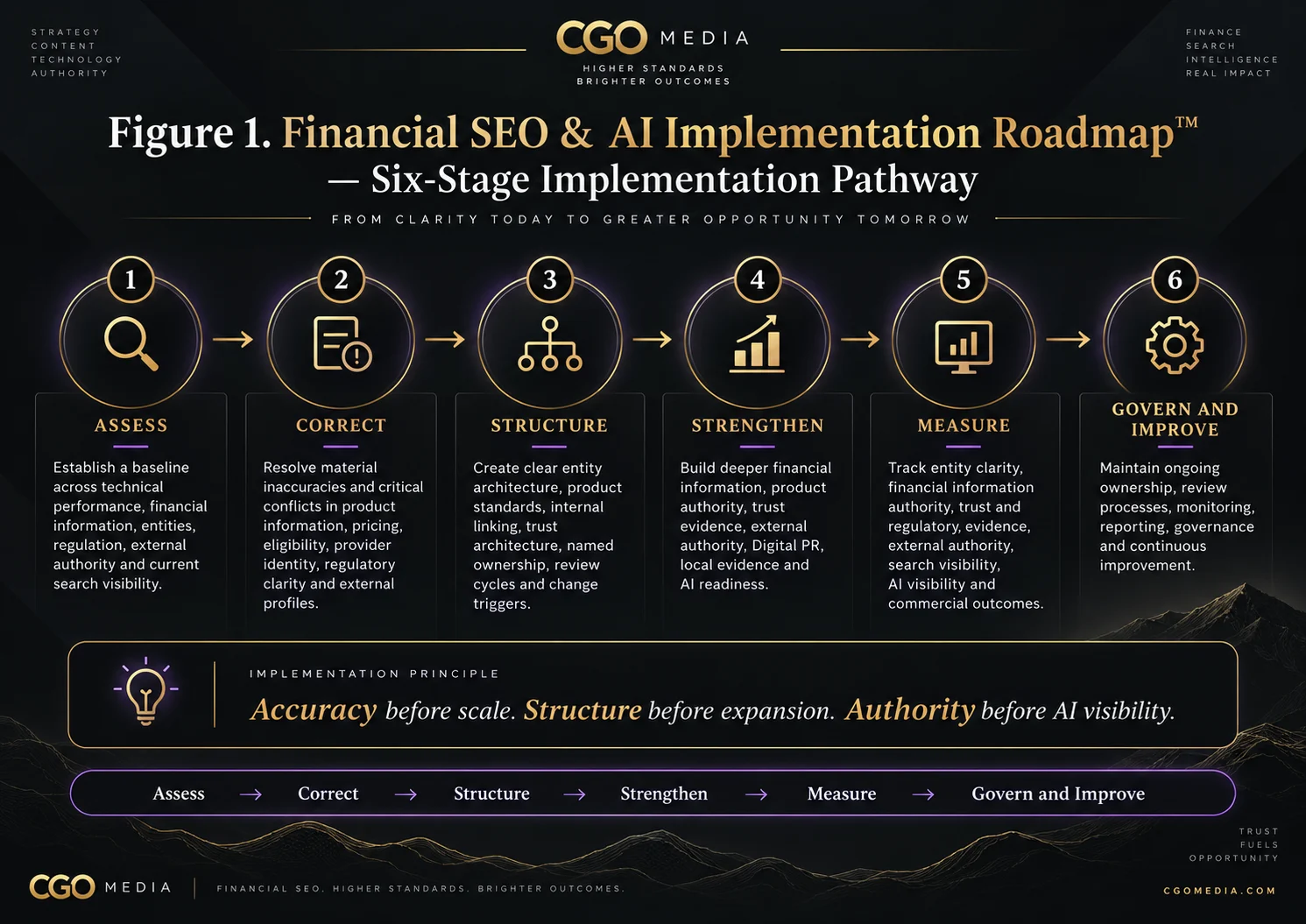
3. The Roadmap Uses Six Stages
- Assess
- Correct
- Structure
- Strengthen
- Measure
- Govern and Improve
4. The Core Implementation Sequence
The roadmap can be represented as:
Assess → Correct → Structure → Strengthen → Measure → Govern → Improve
5. Assessment Comes Before Expansion
Before adding new content, new schema or new AI monitoring, the organisation should establish what already exists and where the most material weaknesses are.
6. Accuracy Comes Before Scale
The roadmap prioritises factual and product accuracy before large-scale amplification.
7. Structure Comes Before Authority Expansion
Financial providers should establish clear relationships between:
- Brand
- Legal entity
- Regulated entity
- Product
- Market
- Audience
8. Authority Strengthening Comes After Structural Clarity
Only once the core information environment is sufficiently reliable should the organisation expand:
- Financial content
- Trust evidence
- External authority
- Digital PR
- AI monitoring
9. Measurement Comes Before Scaling
Large investment should ideally follow evidence that earlier stages are improving authority, qualified discovery or provider-selection progression.
10. Governance Protects the Investment
Without ownership, review cycles and change triggers, search authority can decay as products, pricing and markets change.
11. Stage One — Assess
The first stage establishes a baseline of current financial search authority.
12. Define the Scope
The assessment should specify which areas are included.
13. Possible Assessment Scope
The scope may include:
- Whole organisation
- Priority product lines
- Priority markets
- Priority brands
- Priority customer segments
14. Avoid Assessing Everything at Equal Depth
High-value or high-risk products may justify deeper assessment first.
15. Identify Priority Products
Priority may be influenced by:
- Revenue importance
- Growth potential
- Regulatory risk
- Competitive pressure
- Search opportunity
16. Identify Priority Markets
Financial providers operating across regions should define which markets matter most strategically.
17. Identify Priority Audiences
The organisation may distinguish between:
- Consumers
- SMEs
- Enterprise
- Specialist customer groups
18. Build the Financial Entity Inventory
The assessment should identify the core entities that search and AI systems may need to understand.
19. Organisation Entity Inventory
Record:
- Brand names
- Legal entities
- Regulated entities
- Parent companies
- Subsidiaries
20. Product Entity Inventory
Record:
- Product categories
- Individual products
- Eligibility
- Markets
- Customer segments
21. Location Entity Inventory
Where locations matter, record:
- Branches
- Offices
- Service regions
- Digital-only markets
22. Core Financial Entity Architecture
A useful baseline model is:
Brand → Legal Entity → Regulated Entity → Product Category → Product → Market → Audience
23. Audit Entity Relationships
Assess whether those relationships are clear across the website and relevant external sources.
24. Audit Provider Identity
Check whether users can understand:
- Who operates the brand
- Which entity provides the product
- Which entity is regulated where applicable
- Which market the product serves
25. Audit Product Accuracy
Review strategic product information for:
- Rates
- Fees
- Eligibility
- Features
- Restrictions
- Availability
26. Audit Product Freshness
Determine whether key information is:
- Current
- Due for review
- Overdue
- Potentially stale
27. Audit Financial Information Coverage
Assess whether the organisation adequately explains:
- Financial needs
- Product categories
- Product mechanics
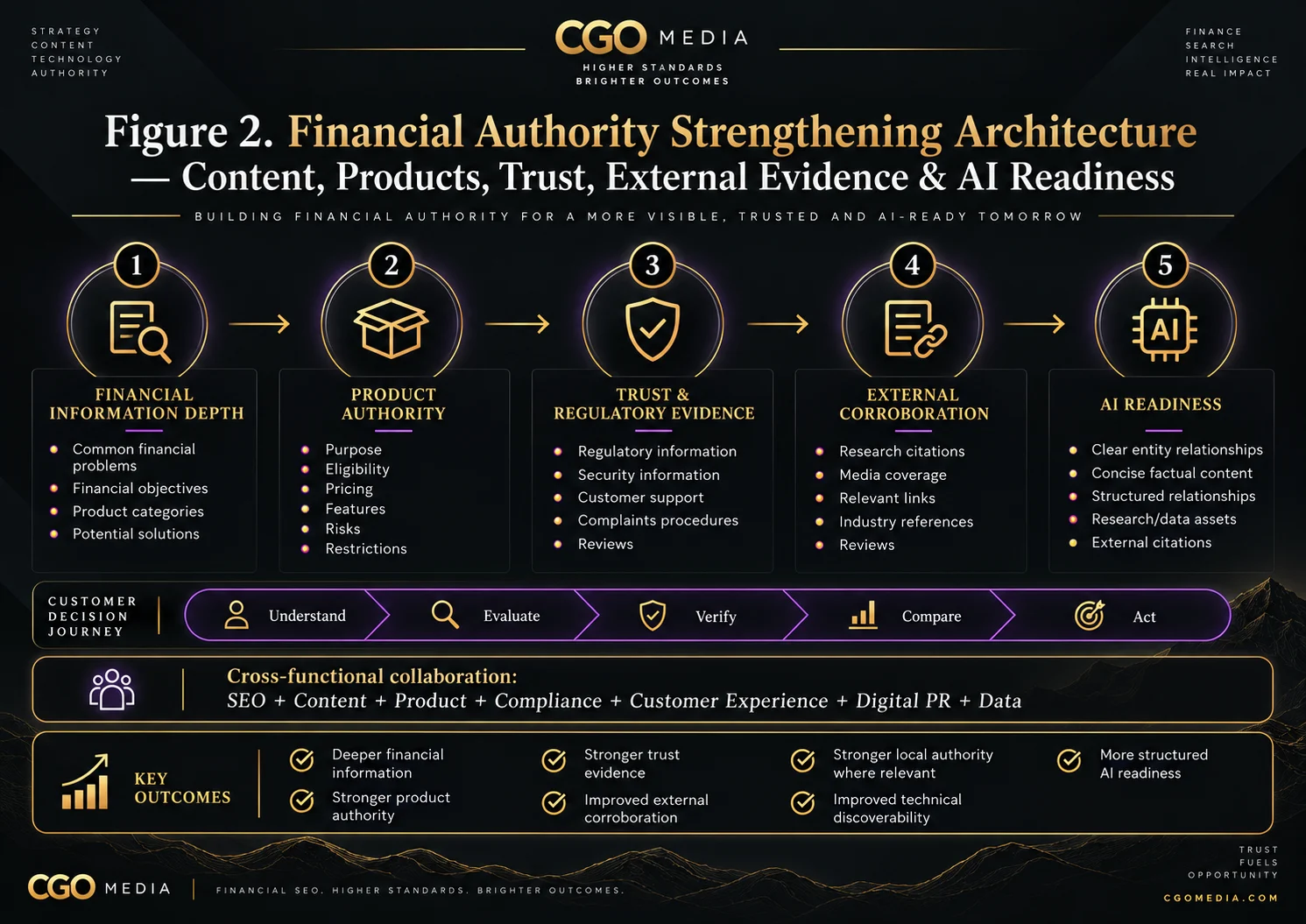
- Costs
- Risks
- Alternatives
28. Audit Trust Evidence
Review the availability and clarity of:
- Regulatory information
- Security information
- Customer-support information
- Reputation evidence
- Complaint pathways
29. Audit External Authority
Review important third-party environments including:
- Comparison platforms
- Financial media
- Review platforms
- Industry directories
- Official sources
30. Audit Local Authority
Where physical presence matters, review:
- Branch data
- Office information
- Local listings
- Service availability
31. Audit Search Visibility
Measure visibility across:
- Need-led queries
- Product queries
- Provider queries
- Trust queries
- Comparison queries
32. Audit Branded Search
Review how users search for the provider in relation to:
- Reviews
- Complaints
- Regulation
- Pricing
- Products
33. Audit Provider-Selection Behaviour
Use the Financial Provider Selection Model to assess where users:
- Discover
- Understand
- Verify
- Compare
- Apply
34. Audit AI Representation
The assessment should establish a baseline of how selected AI systems represent the organisation.
35. AI Brand Prompts
Observe whether generated systems describe the provider accurately.
36. AI Product Prompts
Observe whether the organisation is associated with the correct products.
37. AI Trust Prompts
Observe whether regulatory or legitimacy information is represented accurately.
38. AI Comparison Prompts
Observe whether the provider appears in relevant comparison scenarios.
39. AI Market Prompts
Observe whether product availability is described correctly by geography or market.
40. AI Observation Should Record Context
Record:
- Prompt
- Model
- Date
- Market
- Provider presence
- Material accuracy
- Visible sources
41. AI Source Visibility Should Be Treated Carefully
Visible citations can support diagnosis but should not be treated as complete evidence of why a provider appeared.
42. Establish the Authority Baseline
The assessment should produce a baseline across the six maturity dimensions:
- Entity and Provider Clarity
- Financial Information and Product Authority
- Trust and Regulatory Evidence
- External, Reputation and Local Authority
- Search and Provider-Selection Performance
- AI Search and Governance Readiness
43. Use the Financial Search Authority Maturity Model
Current capability can be assessed using the Financial Search Authority Maturity Model.
44. Score Current Maturity
Each dimension may be assessed from:
- Foundation
- Developing
- Operational
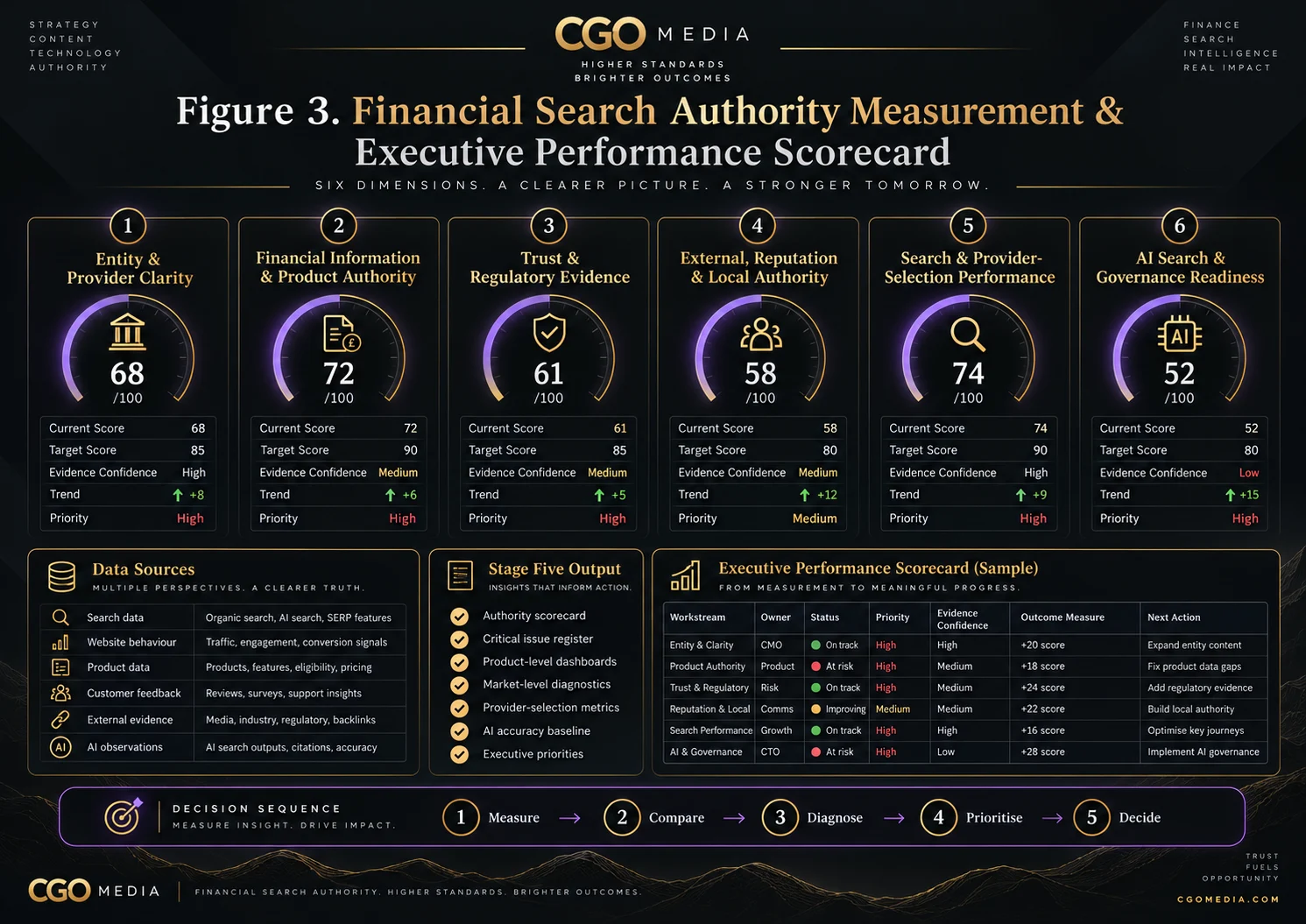
- Advanced
- Leading
45. Record Evidence Confidence
Each important finding should indicate:
- Low confidence
- Medium confidence
- High confidence
46. Identify Critical Issues
Critical findings may include:
- Incorrect regulated entity
- Material pricing error
- Wrong product availability
- Incorrect provider identity
- High-impact AI misinformation
47. Classify Severity
A practical severity scale is:
- Critical
- High
- Medium
- Low
48. Critical Issues Come Before Growth Opportunities
Material accuracy and trust problems should normally be corrected before large-scale visibility expansion.
49. Stage One Output
The assessment stage should produce:
- Entity inventory
- Product inventory
- Trust audit
- External-source audit
- Search baseline
- AI baseline
- Maturity assessment
- Critical issue register
50. Stage Two — Correct
The second stage resolves the most material factual, product, trust and representation errors identified during assessment.
51. Correction Should Be Risk-Led
Priority should reflect the potential impact of the error.
52. Correct Provider Identity Errors
Resolve confusion involving:
- Brand
- Legal entity
- Parent company
- Regulated entity
53. Correct Product Ownership Errors
Ensure products are associated with the correct provider and entity.
54. Correct Product Availability Errors
Remove or revise claims where products are no longer available or unavailable in a specific market.
55. Correct Pricing Errors
Resolve material differences in:
- Rates
- Fees
- Charges
- Promotional terms
56. Correct Eligibility Errors
Ensure important eligibility information is current and clear.
57. Correct Regulatory Errors
Material inaccuracies involving regulated status or relevant entity relationships should receive high priority.
58. Correct Trust Information
Update:
- Security information
- Support information
- Complaint information
- Relevant disclosures
59. Correct External Profiles
Priority third-party sources should be updated where materially inaccurate.
60. Correct Comparison-Platform Information
Where possible, resolve outdated:
- Pricing
- Features
- Product descriptions
- Availability information
61. Correct Local Information
Where branches or offices matter, update:
- Addresses
- Opening status
- Contact information
- Available services
62. Correct High-Risk Financial Content
Prioritise content containing material inaccuracies around:
- Costs
- Eligibility
- Risk
- Regulation
- Product conditions
63. Correct Persistent AI Errors at the Evidence Level
The objective should not be to manipulate one generated response.
The organisation should investigate the underlying evidence environment.
64. AI Correction Workflow
A practical process is:
Identify → Verify → Locate Source → Correct Evidence → Validate → Retest
65. Verify Before Correcting
Not every observed discrepancy is necessarily an organisational error.
66. Identify the Authoritative Source
Determine which internal or official record should control the correction.
67. Correct the Root Record Where Possible
Fixing only the visible webpage may leave the underlying source unchanged.
68. Propagate the Correction
Relevant changes may need to reach:
- Website content
- Product systems
- Structured data
- External feeds
- Comparison platforms
69. Validate the Correction
Confirm that the corrected information appears accurately in the intended environment.
70. Retest AI Representation
Where the original issue involved AI outputs, reassess over time rather than relying on one immediate retest.
71. Stage Two Output
The correction stage should produce:
- Reduced critical conflicts
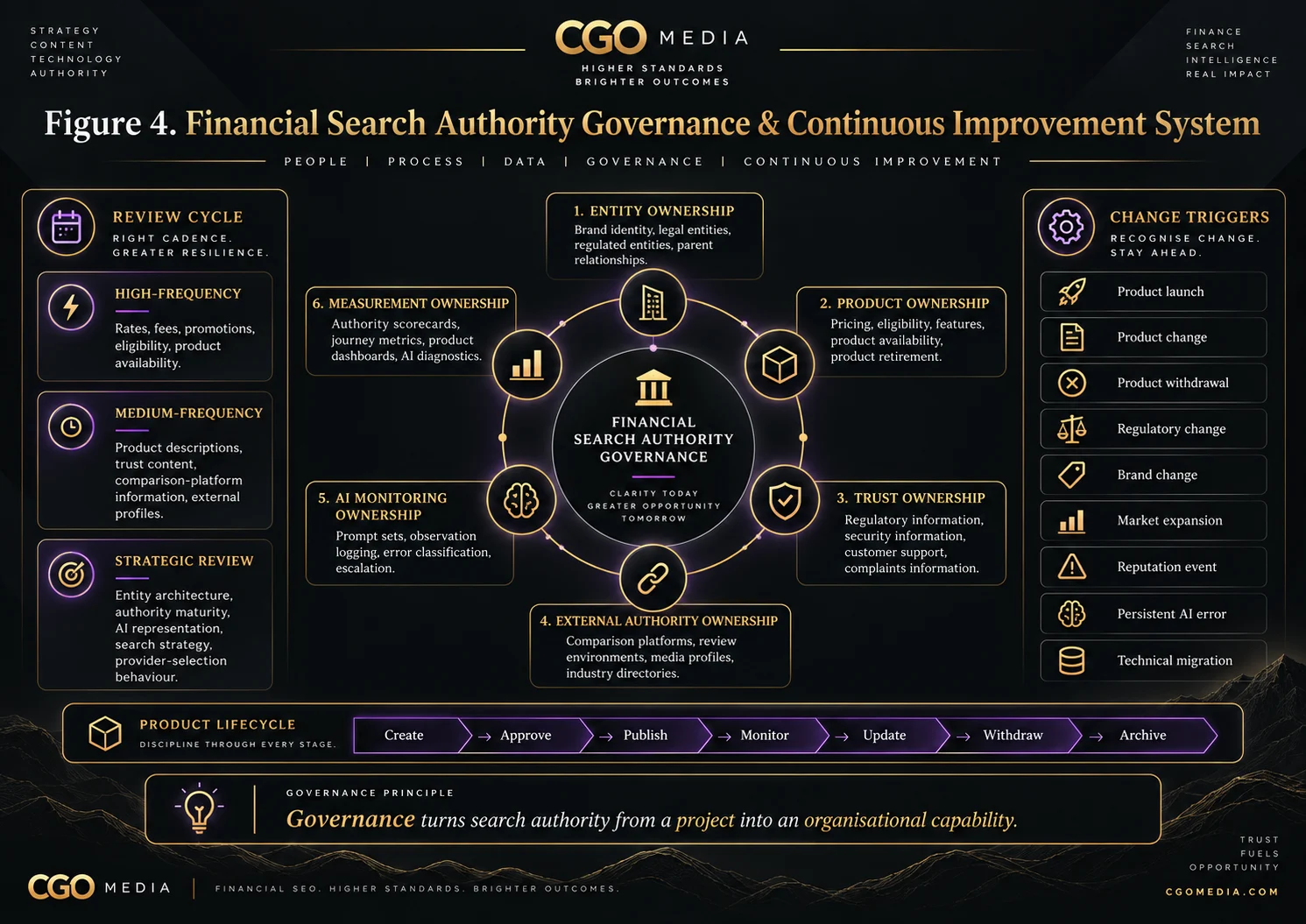
- Improved product accuracy
- Improved regulatory clarity
- Cleaner external evidence
- Updated high-risk content
72. Stage Three — Structure
Once critical inaccuracies are controlled, the organisation can establish more reliable information architecture and governance standards.
73. Structure the Organisation Entity
Create a clear internal representation of:
- Brand
- Legal entity
- Regulated entity
- Parent relationships
74. Structure the Product Entity
Each strategic product should have clear relationships with:
- Category
- Provider
- Market
- Audience
- Eligibility
75. Structure Market Relationships
Clarify where each financial product is:
- Available
- Unavailable
- Restricted
- Delivered digitally
76. Structure Audience Relationships
Products should be mapped where relevant to:
- Consumer
- SME
- Enterprise
- Specialist segments
77. Build the Integrated Financial Knowledge Architecture
A practical structure is:
Brand → Legal Entity → Regulated Entity → Product Category → Product → Market → Audience → Trust Evidence → External Evidence
78. Avoid Over-Connecting Entities
Not every brand, product and market should be linked artificially.
79. Relationships Should Reflect Operational Reality
Entity architecture should represent what the organisation genuinely offers.
80. Structure Financial Content by User Need
A useful path is:
Financial Need → Explanation → Product Category → Product → Provider → Trust → Action
81. Structure Product Pages Consistently
Priority products should follow minimum information standards.
82. Product Page Standards May Include
- Purpose
- Eligibility
- Pricing
- Features
- Risks
- Restrictions
- Application process
83. Structure Trust Information
Relevant trust evidence should be easy to locate from:
- Product pages
- Provider pages
- Application journeys
84. Structure Regulatory Relationships
Where applicable, explain the connection between:
Brand → Legal Entity → Regulated Entity → Product
85. Structure External Authority
Identify which external sources are strategically important.
86. External Source Categories
These may include:
- Comparison platforms
- Regulators
- Financial media
- Review platforms
- Industry sources
87. Structure Local Authority
Where physical presence matters, connect:
Provider → Location → Services → Market
88. Structure Internal Linking
Internal links should reinforce meaningful relationships rather than simply increase link volume.
89. Need-to-Product Linking
Problem-led content should guide users toward appropriate product categories.
90. Product-to-Trust Linking
Product pages should provide natural routes to trust and verification information.
91. Trust-to-Action Linking
Users who have completed verification should be able to move toward an appropriate application or contact path.
92. Structure Review Ownership
Each important information class should have a named owner.
93. Product Information Ownership
Define responsibility for:
- Pricing
- Eligibility
- Features
- Availability
94. Regulatory Information Ownership
Define responsibility for relevant entity and regulatory accuracy.
95. Trust Information Ownership
Define responsibility for:
- Security
- Customer support
- Reviews
- Complaints
96. External Authority Ownership
Define responsibility for important third-party representations.
97. AI Monitoring Ownership
Define responsibility for:
- Prompt sets
- Observation logging
- Error classification
- Escalation
98. Structure Review Cycles
Different information classes should be reviewed according to their change velocity and risk.
99. High-Frequency Review Areas
These may include:
- Pricing
- Rates
- Promotions
- Eligibility
- Product availability
100. Medium-Frequency Review Areas
These may include:
- Product descriptions
- Trust information
- External profiles
- Comparison-platform data
101. Strategic Review Areas
These may include:
- Search architecture
- Authority maturity
- AI representation trends
- External authority strategy
102. Structure Change Triggers
The organisation should define events that automatically initiate review.
103. Product Launch Trigger
A new product should initiate:
- Product-page creation
- Trust review
- Structured data review
- External-source updates
- AI monitoring updates
104. Product Change Trigger
Material changes to pricing, eligibility or features should initiate coordinated updates.
105. Product Withdrawal Trigger
Retired products should be removed, redirected or archived appropriately.
106. Regulatory Change Trigger
Relevant regulatory changes should initiate review of affected information.
107. Brand Change Trigger
Rebrands, mergers or acquisitions should initiate broader entity reconciliation.
108. Reputation Event Trigger
Significant changes in reviews, complaints or media coverage may initiate trust review.
109. Persistent AI Error Trigger
Repeated high-impact AI inaccuracies should initiate source investigation.
110. Stage Three Output
The structure stage should produce:
- Clear entity architecture
- Consistent product standards
- Trust architecture
- Named ownership
- Review cycles
- Change triggers
111. The Next Stage Is Authority Strengthening
With critical inaccuracies corrected and the authority structure defined, the organisation can begin strengthening product depth, trust, external authority, local evidence and AI readiness.
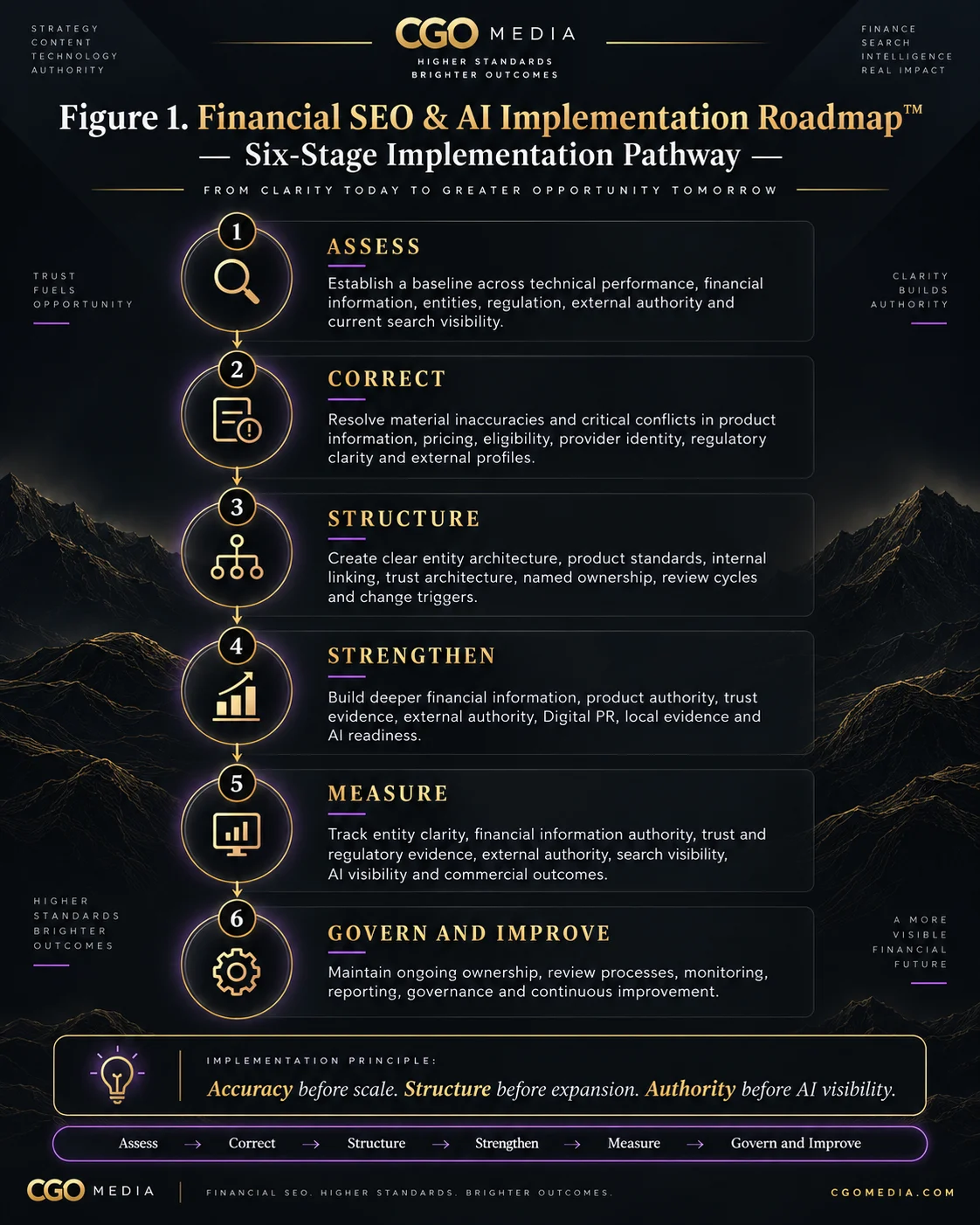
Figure 1 : Financial SEO & AI Implementation Roadmap — Six-Stage Implementation Pathway.
112. Stage Four — Strengthen Authority
Once the organisation has corrected material inaccuracies and established clearer structures, it can begin strengthening the evidence that supports financial discovery, trust, comparison and selection.
113. Authority Strengthening Should Follow Strategic Priority
The organisation should avoid expanding every content and authority area simultaneously.
114. Prioritise Strategic Product Areas
Priority may be based on:
- Commercial importance
- Growth potential
- Search demand
- Competitive weakness
- Current authority gaps
115. Prioritise Strategic Markets
Multi-market financial organisations should decide where stronger authority is most valuable.
116. Prioritise Strategic Audiences
Consumer, SME and enterprise audiences may require different information and trust evidence.
117. Strengthen Financial Information Depth
Priority product ecosystems should answer the real questions users ask before provider selection.
118. Financial Information Should Cover Need Recognition
Useful content may explain:
- Common financial problems
- Financial objectives
- Product categories
- Potential solutions
119. Financial Information Should Cover Product Understanding
Priority content should explain:
- Purpose
- Eligibility
- Pricing
- Features
- Risks
- Restrictions
120. Financial Information Should Cover Comparison Questions
Users may need help understanding:
- Product differences
- Alternative options
- Cost structures
- Suitability factors
121. Build Product Content Clusters
A strong product cluster may include:
- Core product page
- Eligibility guide
- Pricing explanation
- Comparison content
- FAQs
- Supporting research
122. Product Clusters Should Follow User Decisions
The architecture should help users move through:
Understand → Evaluate → Verify → Compare → Act
123. Strengthen Product Authority
Priority product pages should communicate a complete and current view of the offer.
124. Product Authority Requires Pricing Clarity
Where applicable, users should be able to identify:
- Rates
- Fees
- Charges
- Promotional periods
- Ongoing costs
125. Product Authority Requires Eligibility Clarity
Users should understand important qualifying conditions before progressing.
126. Product Authority Requires Risk Clarity
Relevant product risks and limitations should not be obscured by promotional messaging.
127. Product Authority Requires Freshness
Search authority can weaken when the provider itself contains stale product information.
128. Product Authority Requires Internal Consistency
Pricing, eligibility and features should align across relevant controlled pages.
129. Product Authority Requires External Consistency
Important third-party sources should reflect sufficiently current information where the organisation has influence over updates.
130. Strengthen Trust Architecture
The Financial Services AI Trust Framework can be used to strengthen the trust layer supporting provider selection.
131. Regulatory Trust
Where applicable, explain clearly:
- Legal entity
- Relevant regulated entity
- Provider relationship
- Applicable market
132. Security Trust
Financial users may look for evidence around:
- Authentication
- Fraud prevention
- Data protection
- Account security
133. Customer-Service Trust
Users should be able to understand:
- Support channels
- Contact options
- Service availability
- Complaint processes
134. Reputation Trust
Relevant reputation evidence may include:
- Customer reviews
- Independent assessments
- Editorial references
- Recognition
135. Trust Evidence Should Be Specific
Generic statements such as “trusted financial provider” are weaker than verifiable evidence.
136. Trust Evidence Should Be Current
Historic recognition or old regulatory descriptions should not be represented as current without appropriate context.
137. Reviews Are Experience Evidence
Reviews can help users understand service and operational experience.
138. Reviews Are Not Regulatory Evidence
High ratings do not replace formal verification where regulatory status matters.
139. Reviews Are Not Product-Suitability Evidence
Positive feedback from other customers does not establish whether a product is appropriate for a particular user.
140. Analyse Review Themes
Recurring themes can reveal strengths or weaknesses involving:
- Onboarding
- Support
- Pricing
- Claims
- Account access
141. Strengthen External Authority
Relevant third-party corroboration can strengthen provider discovery and validation.
142. External Authority Should Be Relevant
Priority should be given to sources that matter to the financial product and audience.
143. Comparison Platforms
Where important to the category, financial providers should monitor whether comparison environments describe products accurately.
144. Financial Media
Editorial coverage can contribute to authority where the organisation provides useful expertise, data or market insight.
145. Industry Publications
Specialist financial or sector publications may support authority around specific products or markets.
146. Institutional and Official Sources
Official sources can provide high-value independent verification where relevant.
147. External Authority Is Not Link Volume
The objective should not be to maximise the number of external mentions regardless of relevance.
148. Prioritise Authority Quality
Useful external evidence is:
- Relevant
- Credible
- Current
- Properly attributed
149. Strengthen Digital PR
Digital PR can support financial authority where it is grounded in genuine expertise, useful data or defensible research.
150. Expert Commentary
Financial specialists may contribute commentary around:
- Market developments
- Consumer trends
- Business finance
- Payments
- Risk
- Product innovation
151. Data-Led Research
Original research can strengthen citation authority where:
- Methodology is clear
- Data is defensible
- Findings are useful
- Limitations are acknowledged
152. Financial Statistics Can Become Citable Assets
Well-documented statistics may support:
- Journalists
- Researchers
- Industry analysts
- AI source environments
153. Research Should Avoid Unsupported Precision
Estimates should not be presented as measured findings where the underlying evidence does not support that level of certainty.
154. Strengthen Citation Architecture
Research assets should make it easy for others to understand:
- Author
- Publisher
- Publication date
- Methodology
- Citation format
155. Structured Citation Supports Reuse
Useful citation formats may include:
- APA
- BibTeX
- Plain-text attribution
156. Strengthen Brand Authority
Brand consistency should support the same organisational identity across:
- Website
- Media
- Comparison platforms
- Reviews
- AI representations
157. Brand Authority Should Not Rely on Familiarity Alone
Even established financial brands benefit from clear current evidence.
158. Newer Financial Providers Need Stronger Corroboration
Fintechs and specialist providers may need to compensate for lower brand familiarity through:
- Trust transparency
- External evidence
- Product clarity
- Relevant media authority
159. Strengthen Local Authority Where Relevant
Local authority matters where branches, offices or regional service availability influence provider selection.
160. Branch Pages Should Reflect Operational Reality
A location should not be represented as offering services that are not genuinely available there.
161. Local Profiles Should Be Accurate
Monitor:
- Address
- Opening information
- Telephone
- Services
- Operational status
162. Avoid Artificial Local Expansion
Financial providers should not manufacture local presence unsupported by real operational evidence.
163. Strengthen Internal Linking
Internal links should reflect the financial decision journey.
164. Need-to-Product Links
Educational content should guide users toward the relevant product category.
165. Product-to-Trust Links
Product pages should connect naturally with:
- Regulatory information
- Security information
- Support
- Reputation evidence
166. Product-to-Comparison Links
Where useful, help users understand how products differ from alternatives.
167. Trust-to-Action Links
Once users have validated the provider, the next action should be clear.
168. Strengthen Technical Discoverability
Authority content must remain technically accessible to search systems.
169. Technical Priorities
Review:
- Crawlability
- Indexability
- Canonicalisation
- Internal linking
- Performance
- Structured data
170. Product Pages Should Be Crawlable
Important product information should not be unnecessarily hidden from relevant search systems.
171. Product Canonicals Should Be Controlled
Duplicate or variant product pages should not create unnecessary ambiguity.
172. Structured Data Should Reinforce Visible Facts
Markup should correspond with the information users can actually see and verify.
173. Structured Data Should Not Manufacture Authority
It should not be used to assert unsupported:
- Provider relationships
- Product claims
- Regulatory relationships
174. Strengthen AI Search Readiness
AI readiness should be built from the same evidence system supporting traditional search and provider selection.
175. AI Readiness Begins with Entity Clarity
AI systems should have sufficient evidence to distinguish between:
- Brand
- Legal entity
- Regulated entity
- Product
176. AI Readiness Requires Product Clarity
Priority product information should be:
- Current
- Consistent
- Clearly structured
- Accessible
177. AI Readiness Requires Trust Clarity
Regulatory, security and provider information should be sufficiently explicit to reduce ambiguity.
178. AI Readiness Requires External Corroboration
Relevant independent sources can help reinforce provider identity and product context.
179. Build a Repeatable AI Observation Set
Monitor:
- Brand prompts
- Product prompts
- Trust prompts
- Comparison prompts
- Market prompts
180. Record AI Observation Context
Record:
- Prompt
- Model
- Date
- Market
- Output accuracy
- Visible sources
181. Prioritise Material AI Accuracy
High-impact inaccuracies may include:
- Wrong regulated entity
- Incorrect pricing
- Wrong product availability
- Incorrect market coverage
- Provider ownership errors
182. Do Not Treat Every AI Variation as a Problem
Minor wording differences should be distinguished from persistent material inaccuracies.
183. Do Not Treat AI Presence as Endorsement
Generated inclusion does not constitute independent certification or financial advice.
184. Do Not Treat AI Recommendation Order as a Stable Ranking
Provider order can vary by prompt, model, time and context.
185. Strengthen Provider-Selection Readiness
The Financial Provider Selection Model can be used to test whether authority improvements support the actual decision journey.
186. Need-Recognition Readiness
Users should be able to discover useful information before they know the product category.
187. Product-Understanding Readiness
Users should be able to understand:
- Purpose
- Cost
- Eligibility
- Risk
- Alternatives
188. Provider-Discovery Readiness
The organisation should appear where appropriate users discover relevant providers.
189. Trust-Validation Readiness
Users should be able to verify material provider information efficiently.
190. Comparison Readiness
The organisation should make important product differences sufficiently clear for informed comparison.
191. Selection Readiness
Qualified users should have a clear path toward:
- Application
- Account opening
- Consultation
- Purchase
192. Strengthen Application Experience
Authority gains can be lost if qualified users encounter unnecessary friction during the final action stage.
193. Application Clarity
Explain:
- Required information
- Required documents
- Likely stages
- What happens next
194. Application Friction Should Be Diagnosed
Potential weaknesses may include:
- Broken forms
- Repeated data entry
- Unclear requirements
- Poor support
195. Necessary Financial Controls Should Remain
Conversion optimisation should not remove appropriate:
- Verification
- Eligibility
- Risk
- Compliance
196. Strengthen Cross-Functional Collaboration
Authority strengthening depends on cooperation across:
SEO + Content + Product + Compliance + Customer Experience + Digital PR + Data
197. Product Teams Should Validate Product Reality
Marketing and SEO teams should not independently determine product terms.
198. Compliance Teams Should Validate High-Risk Information
Relevant regulatory claims should be checked through appropriate internal processes.
199. Customer Experience Teams Should Feed Reputation Insight
Review and complaint patterns can reveal authority weaknesses that content teams cannot see alone.
200. Data Teams Should Support Measurement
Reliable measurement is needed to determine whether authority strengthening improves qualified discovery and progression.
201. Stage Four Output
The authority-strengthening stage should produce:
- Deeper financial information
- Stronger product authority
- Stronger trust evidence
- Improved external corroboration
- Stronger local authority where relevant
- Improved technical discoverability
- More structured AI readiness
202. The Next Stage Is Measurement
Once authority has been strengthened, the organisation needs to determine whether those improvements are producing better accuracy, stronger discovery, higher trust and more qualified provider-selection outcomes.
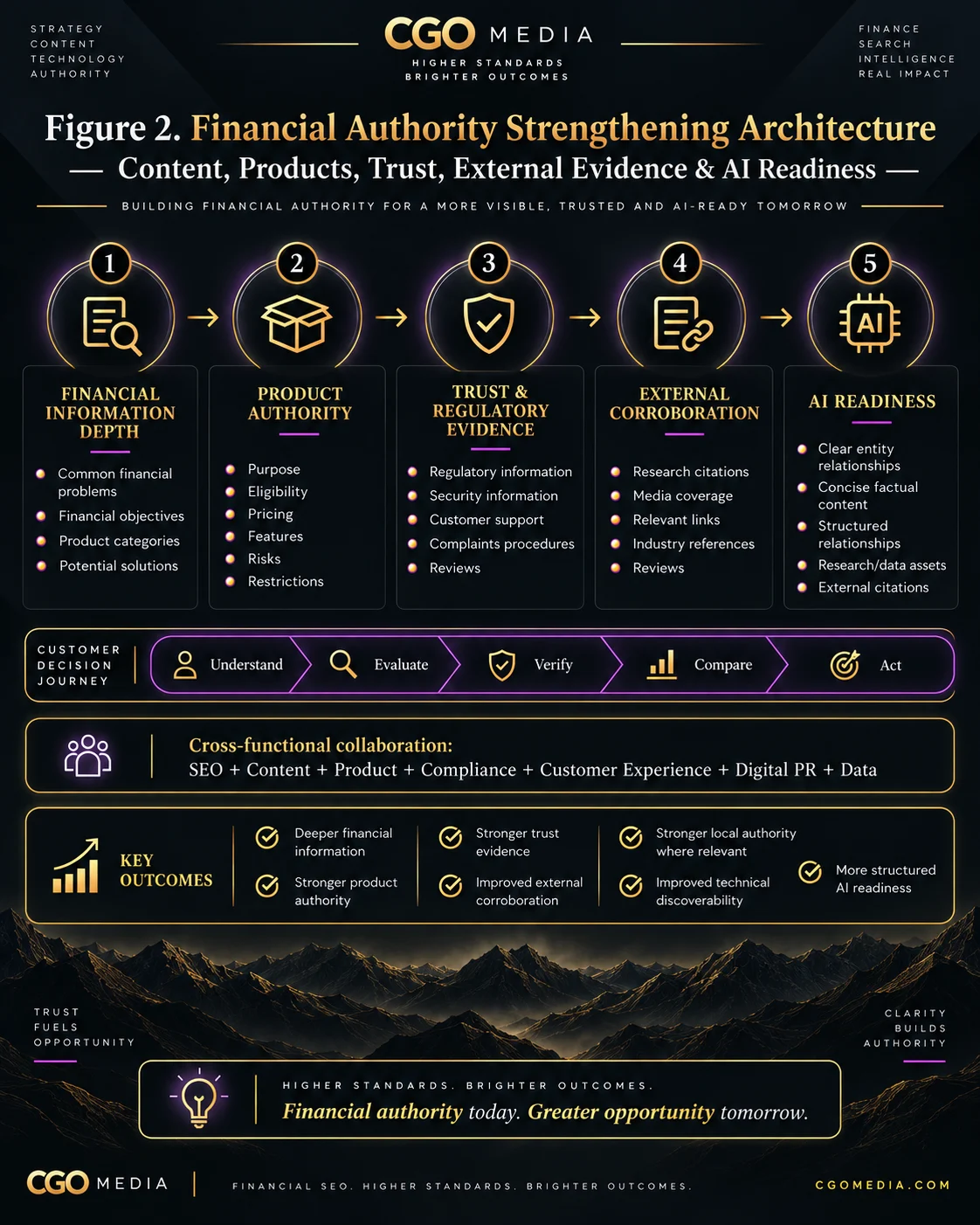
Figure 2 : Financial Authority Strengthening Architecture — Content, Products, Trust, External Evidence & AI Readiness.
203. Stage Five — Measure Performance and Authority
Once the financial authority system has been strengthened, the organisation needs to determine whether those improvements are producing stronger search visibility, better trust, more accurate AI representation and more qualified provider-selection outcomes.
204. Measurement Should Reflect the Full Authority System
A practical measurement framework should cover:
- Entity and Provider Clarity
- Financial Information and Product Authority
- Trust and Regulatory Evidence
- External, Reputation and Local Authority
- Search and Provider-Selection Performance
- AI Search and Governance Readiness
205. Measurement Should Compare Current and Target State
Each major dimension should record:
- Current score
- Target score
- Evidence confidence
- Trend
- Priority
206. Use the Financial Search Authority Maturity Model
The Financial Search Authority Maturity Model can provide a consistent structure for assessing progression.
207. Measure Entity and Provider Clarity
Potential indicators include:
- Entity completeness
- Relationship accuracy
- Conflict rate
- Market mapping
- Product ownership accuracy
208. Entity Completeness
Assess whether priority:
- Brands
- Legal entities
- Regulated entities
- Products
- Markets
are represented clearly enough for users and search systems.
209. Entity Conflict Rate
Track material inconsistencies across controlled and priority external environments.
210. Product Ownership Accuracy
Measure whether products are consistently associated with the correct:
- Brand
- Legal entity
- Regulated entity
211. Market Mapping Accuracy
Assess whether product availability is represented correctly across markets.
212. Measure Financial Information and Product Authority
Potential indicators include:
- Priority product coverage
- Product freshness
- Pricing accuracy
- Eligibility clarity
- Risk clarity
213. Product Coverage
Measure whether strategic product areas have sufficient information to support:
- Discovery
- Understanding
- Comparison
- Selection
214. Product Freshness
Track the proportion of high-priority product information that is:
- Current
- Due for review
- Overdue
- At risk
215. Pricing Accuracy
Monitor whether rates, fees and charges remain consistent across the main controlled environments.
216. Eligibility Clarity
Assess whether users can identify important eligibility conditions before beginning an application.
217. Product Risk Clarity
Assess whether material risks and limitations are represented sufficiently clearly.
218. Measure Trust and Regulatory Evidence
Potential indicators include:
- Regulatory clarity
- Security evidence
- Customer-support visibility
- Review patterns
- Complaint themes
219. Regulatory Identity Accuracy
Track whether relevant provider and regulated-entity relationships are represented correctly.
220. Trust Evidence Accessibility
Measure whether users can easily locate:
- Regulatory information
- Security information
- Customer support
- Complaints procedures
221. Review Recency
Monitor whether customer feedback remains recent enough to support current reputation understanding.
222. Review Themes
Analyse recurring patterns around:
- Pricing
- Support
- Onboarding
- Claims
- Account access
223. Complaint Themes
Recurring complaint categories can reveal operational weaknesses that may later affect provider selection.
224. Measure External, Reputation and Local Authority
Potential indicators include:
- External profile accuracy
- Comparison-platform consistency
- Editorial authority
- Review-platform accuracy
- Local consistency
225. External Profile Accuracy
Track whether material provider information is current across priority third-party sources.
226. Comparison-Platform Consistency
Monitor whether:
- Pricing
- Features
- Availability
- Product descriptions
remain sufficiently accurate.
227. Editorial Authority
Measure the quality and relevance of:
- Media coverage
- Expert commentary
- Research citations
- Industry references
228. Research Citation Performance
Where the organisation publishes original research, monitor:
- Editorial citations
- Academic references
- Industry reuse
- Relevant backlinks
229. Local Authority Measurement
Where branches or offices matter, monitor:
- Location accuracy
- Service accuracy
- Duplicate records
- Local review evidence
230. Measure Search Performance
Search performance should be segmented beyond whole-domain traffic.
231. Measure Need-Led Visibility
Track relevant search visibility where users are still identifying financial problems or objectives.
232. Measure Product Visibility
Track visibility around:
- Product categories
- Specific products
- Eligibility
- Pricing
- Features
233. Measure Provider Visibility
Track whether the organisation enters relevant provider-discovery queries.
234. Measure Trust Visibility
Monitor branded searches involving:
- Reviews
- Complaints
- Regulation
- Security
235. Measure Comparison Visibility
Track relevant visibility for:
- Provider comparisons
- Product alternatives
- Best-provider searches
- Competitor comparisons
236. Segment Search Metrics by Product
Whole-site averages can conceal major differences between product lines.
237. Segment Search Metrics by Audience
Where appropriate, distinguish:
- Consumer
- SME
- Enterprise
- Specialist segments
238. Segment Search Metrics by Market
Multi-market providers should measure authority separately across relevant geographies.
239. Segment Search Metrics by Journey Stage
A useful segmentation is:
Need → Information → Product → Provider → Trust → Comparison → Action
240. Measure Provider-Selection Performance
The Financial Provider Selection Model provides the basis for measuring whether users progress through the decision journey.
241. Need-to-Information Progression
Measure whether early-stage users move toward deeper financial information.
242. Information-to-Product Progression
Measure whether users move from general education toward relevant product evaluation.
243. Product-to-Provider Progression
Measure whether users move from understanding the product toward evaluating the organisation.
244. Provider-to-Trust Progression
Measure whether provider-discovery users engage with trust and verification information.
245. Trust-to-Comparison Progression
Measure whether trust validation leads into deeper product or provider comparison.
246. Comparison-to-Action Progression
Measure whether shortlisted users move toward:
- Application
- Purchase
- Account opening
- Consultation
247. Action-to-Completion Progression
Measure whether initiated processes reach an appropriate final outcome.
248. Measure Qualified Application Rate
Distinguish raw application volume from users who genuinely meet product criteria.
249. Measure Decline Rate
Where relevant, track how often applications fail because of:
- Eligibility
- Credit assessment
- Underwriting
- Compliance
- Risk
250. Measure Application Abandonment
Track where suitable users leave before completion.
251. Diagnose Application Friction
Potential causes may include:
- Broken forms
- Unclear requirements
- Unexpected conditions
- Repeated data entry
- Slow verification
252. Good Abandonment and Bad Abandonment
Not all abandonment should be treated as failure.
253. Good Abandonment
Examples may include:
- Ineligible users self-selecting out
- Unsuitable product users leaving early
- Out-of-market users being filtered
254. Bad Abandonment
Examples may include:
- Qualified users confused by pricing
- Trusted users blocked by technical failure
- Suitable users unable to obtain support
255. Measure Qualified Conversion
The objective is not maximum conversion from every visitor.
It is stronger progression among users genuinely suited to the provider’s offer.
256. Measure Activation Where Relevant
For some products, application approval is not the final commercial outcome.
257. Measure Early Retention Where Appropriate
Early retention can reveal whether expectations created during provider selection match the actual customer experience.
258. Measure AI Search Readiness
AI measurement should focus on material provider representation rather than raw appearance counts alone.
259. AI Brand Accuracy
Monitor whether generated systems describe the organisation correctly.
260. AI Product Accuracy
Monitor whether products are:
- Correctly named
- Currently available
- Associated with the right provider
- Described accurately
261. AI Pricing Accuracy
Where generated systems mention rates, fees or costs, compare them with current authoritative information.
262. AI Trust Accuracy
Monitor whether generated descriptions correctly represent:
- Provider identity
- Regulatory context
- Ownership
- Market availability
263. AI Comparison Presence
Observe whether the provider appears in strategically relevant comparison scenarios.
264. AI Comparison Relevance
Presence should be assessed for whether it matches the correct:
- Product
- Audience
- Market
- Decision context
265. AI Error Severity
Classify material inaccuracies as:
- Critical
- High
- Medium
- Low
266. AI Error Persistence
Track whether a material error:
- Appears once
- Appears occasionally
- Persists over repeated observations
267. AI Source Analysis
Where visible, record which source categories appear alongside relevant generated responses.
268. AI Source Visibility Is Partial Evidence
Displayed citations should not be assumed to reveal every signal involved in provider selection or generation.
269. AI Recommendation Order Should Not Be Treated as Ranking
Provider sequence can vary across models, prompts and time.
270. Measure Authority Maturity
Each of the six authority dimensions can be scored from 1 to 5.
271. Suggested Maturity Scale
- Foundation
- Developing
- Operational
- Advanced
- Leading
272. Record Current and Target Maturity
For each dimension, record:
- Current maturity
- Target maturity
- Gap
273. Record Trend
A practical trend scale is:
- Improving
- Stable
- At Risk
- Regressing
274. Record Evidence Confidence
Classify supporting evidence as:
- Low confidence
- Medium confidence
- High confidence
275. Low-Confidence Findings Require Caution
Major decisions should not be made from weak evidence where stronger verification is practical.
276. High-Confidence Critical Issues Require Fast Attention
Material provider, pricing, regulatory or trust errors supported by strong evidence should normally receive high priority.
277. Measure Coverage
A mature capability should be assessed for how broadly it applies across:
- Products
- Markets
- Audiences
- Channels
278. Avoid Portfolio-Wide Conclusions from One Product
Strong governance in one flagship financial product does not establish organisation-wide maturity.
279. Attribution Across the Financial Journey
Financial provider selection may involve multiple discovery and verification sources.
280. First-Touch Attribution
Use first-touch data to understand where initial financial discovery began.
281. Last-Touch Attribution
Use last-touch data to understand the final measurable interaction before action.
282. Assisted Attribution
Where possible, recognise intermediate influence from:
- AI assistants
- Comparison platforms
- Reviews
- Financial media
- Referrals
283. Example AI-Assisted Journey
A journey may appear as:
AI Answer → Financial Guide → Product Page → Comparison Site → Branded Search → Application
284. Example Comparison-Led Journey
A journey may appear as:
Comparison Platform → Provider Website → Trust Search → Product Page → Application
285. Example Referral-Led Journey
A journey may appear as:
Professional Referral → Branded Search → Regulatory Verification → Provider Website → Consultation
286. Financial Attribution Will Remain Incomplete
Offline recommendations, cross-device behaviour and closed AI environments may limit precise attribution.
287. Self-Reported Attribution Can Add Context
Where appropriate, onboarding processes may ask users how they heard about the provider.
288. Self-Reported Attribution Has Limitations
Users may recall only the most recent or memorable source.
289. AI Attribution Requires Triangulation
Potential evidence may combine:
- Referral traffic
- Self-reported discovery
- Branded-search changes
- AI observation
290. Avoid Unsupported Causal Claims
Correlation between increased AI presence and increased demand does not automatically establish direct causation.
291. Build Product-Level Dashboards
Strategic product teams should be able to see:
- Visibility
- Authority
- Trust
- AI accuracy
- Qualified progression
292. Build Market-Level Dashboards
Multi-market organisations should compare performance across geographies.
293. Build Audience-Level Dashboards
Where relevant, compare:
- Consumer journeys
- SME journeys
- Enterprise journeys
294. Build Executive Authority Reporting
Leadership requires a concise view of the overall authority system.
295. Executive Reporting Should Separate Risk from Growth
Critical accuracy or regulatory issues should not be hidden inside general visibility reporting.
296. Example Executive Authority Scorecard
| Authority Dimension | Current | Target | Confidence | Trend | Priority |
|---|---|---|---|---|---|
| Entity & Provider Clarity | 1–5 | 1–5 | Low / Medium / High | Improving / Stable / At Risk / Regressing | Critical / High / Medium / Low |
| Financial Information & Product Authority | 1–5 | 1–5 | Low / Medium / High | Improving / Stable / At Risk / Regressing | Critical / High / Medium / Low |
| Trust & Regulatory Evidence | 1–5 | 1–5 | Low / Medium / High | Improving / Stable / At Risk / Regressing | Critical / High / Medium / Low |
| External, Reputation & Local Authority | 1–5 | 1–5 | Low / Medium / High | Improving / Stable / At Risk / Regressing | Critical / High / Medium / Low |
| Search & Provider-Selection Performance | 1–5 | 1–5 | Low / Medium / High | Improving / Stable / At Risk / Regressing | Critical / High / Medium / Low |
| AI Search & Governance Readiness | 1–5 | 1–5 | Low / Medium / High | Improving / Stable / At Risk / Regressing | Critical / High / Medium / Low |
297. Report Critical Issues Separately
Material provider, product, pricing or regulatory conflicts should remain visible outside the aggregate scorecard.
298. Report Journey Bottlenecks Separately
Leadership should know whether major user loss occurs during:
- Discovery
- Trust
- Comparison
- Application
299. Report AI Errors Separately
Persistent high-impact AI inaccuracies should remain visible until adequately resolved.
300. Report Improvement Against Baseline
Measurement should compare current performance with the original Stage One assessment.
301. Before-and-After Comparison
Assess whether major initiatives improved:
- Accuracy
- Coverage
- Trust
- Search visibility
- Qualified progression
- AI representation
302. Avoid Declaring Causation Too Quickly
Search and financial markets are influenced by many variables.
303. Use Multiple Evidence Types
Useful evaluation may combine:
- Search data
- Website behaviour
- Product data
- Customer feedback
- External evidence
- AI observations
304. Use Longitudinal Measurement
Repeated measurement is more useful than isolated before-and-after snapshots.
305. Stage Five Output
The measurement stage should produce:
- Authority scorecard
- Critical issue register
- Product-level dashboards
- Market-level diagnostics
- Provider-selection metrics
- AI accuracy baseline
- Executive priorities
306. Measurement Should Lead to Decisions
The operating sequence is:
Measure → Compare → Diagnose → Prioritise → Decide
307. The Next Stage Is Governance and Continuous Improvement
Once the organisation can measure authority performance, it needs a governance system capable of maintaining product accuracy, trust evidence, external consistency, AI readiness and qualified provider-selection performance over time.
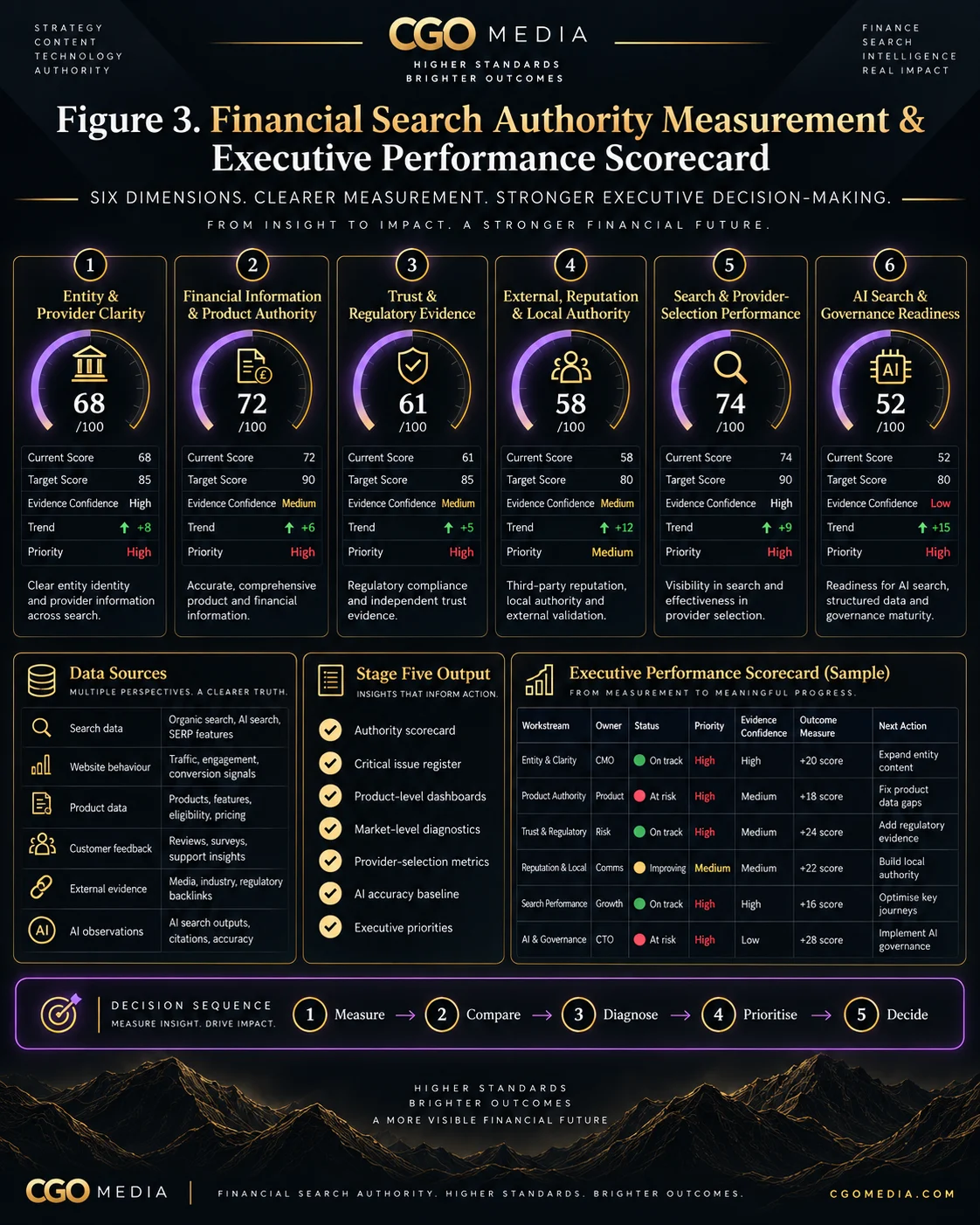
Figure 3 : Financial Search Authority Measurement & Executive Performance Scorecard.
308. Stage Six — Govern and Improve
The final implementation stage turns financial search authority from a project into an ongoing organisational capability.
309. Governance Protects Accuracy
Without clear ownership and review processes, even well-implemented financial content can become outdated.
310. Governance Protects Trust
Regulatory, security and customer-support information can weaken if updates are not coordinated.
311. Governance Protects AI Readiness
Persistent inconsistencies across public sources can increase the risk of inaccurate provider representation in AI-assisted environments.
312. Governance Should Be Cross-Functional
Financial search authority may require participation from:
- SEO
- Content
- Product
- Compliance
- Customer experience
- Digital PR
- Technology
- Data
313. Define Authority Ownership
Each major authority class should have a clearly identified owner.
314. Entity Ownership
Define responsibility for:
- Brand identity
- Legal entities
- Regulated entities
- Parent relationships
315. Product Ownership
Define responsibility for:
- Pricing
- Eligibility
- Features
- Product availability
- Product retirement
316. Trust Ownership
Define responsibility for:
- Regulatory information
- Security information
- Customer support
- Complaints information
317. External Authority Ownership
Define responsibility for:
- Comparison platforms
- Review environments
- Media profiles
- Industry directories
318. AI Monitoring Ownership
Define responsibility for:
- Prompt sets
- Observation logging
- Error classification
- Escalation
319. Measurement Ownership
Define responsibility for maintaining:
- Authority scorecards
- Journey metrics
- Product dashboards
- AI diagnostics
320. Define Review Cycles
Different information types should be reviewed according to risk and change velocity.
321. High-Frequency Review Areas
These may include:
- Rates
- Fees
- Promotions
- Eligibility
- Product availability
322. Medium-Frequency Review Areas
These may include:
- Product descriptions
- Trust content
- Comparison-platform information
- External profiles
323. Strategic Review Areas
These may include:
- Entity architecture
- Authority maturity
- AI representation
- Search strategy
- Provider-selection behaviour
324. Scheduled Reviews Should Not Be the Only Control
Important business changes should trigger immediate review where appropriate.
325. Define Change Triggers
A robust governance system should respond to meaningful events automatically or procedurally.
326. Product Launch Trigger
A new financial product should initiate review of:
- Entity relationships
- Product pages
- Trust information
- Search architecture
- External profiles
- AI monitoring
327. Product Change Trigger
Material changes in rates, fees, eligibility or features should initiate coordinated updates.
328. Product Withdrawal Trigger
Withdrawn products should be removed, redirected or archived appropriately.
329. Regulatory Change Trigger
Relevant regulatory changes should initiate review of affected:
- Provider pages
- Product pages
- Trust information
- External representations
330. Brand Change Trigger
Rebrands, mergers and acquisitions should initiate broader entity reconciliation.
331. Market Expansion Trigger
Entering a new market should initiate review of:
- Product availability
- Regulatory context
- Local terminology
- Trust evidence
- Search behaviour
332. Reputation Event Trigger
A major reputation event should initiate review of:
- Trust information
- Customer communication
- Review patterns
- AI representation
333. Persistent AI Error Trigger
Repeated material inaccuracies should initiate deeper source and evidence investigation.
334. Technical Migration Trigger
A major website migration or platform change should initiate:
- Technical SEO review
- Structured data review
- Internal-linking review
- Product-page validation
335. Govern the Product Lifecycle
Financial products should be managed through a defined lifecycle.
336. Product Lifecycle Governance
A practical model is:
Create → Approve → Publish → Monitor → Update → Withdraw → Archive
337. Create
Product information is prepared according to defined standards.
338. Approve
Relevant teams review:
- Product facts
- Pricing
- Eligibility
- Risk
- Regulatory claims
339. Publish
Approved information is deployed across relevant controlled channels.
340. Monitor
The organisation tracks:
- Accuracy
- Freshness
- Visibility
- Trust
- AI representation
341. Update
Material changes should propagate through relevant systems.
342. Withdraw
When a product is no longer available, active promotional pathways should be reviewed.
343. Archive
Historical information should be retained only where there is a clear reason.
344. Govern High-Risk Financial Information
Higher-risk content should receive stronger controls.
345. High-Risk Information May Include
- Pricing
- Eligibility
- Regulatory claims
- Risk statements
- Material product restrictions
346. High-Risk Information Should Have Clear Approval
Relevant claims should be reviewed by appropriate internal owners before publication.
347. High-Risk Information Should Be Auditable
The organisation should be able to understand:
- What changed
- When it changed
- Who approved it
- Why it changed
348. Govern AI Monitoring
AI observation should follow a stable methodology rather than informal spot checking.
349. Maintain Repeatable Prompt Groups
Prompt groups may cover:
- Brand
- Product
- Trust
- Comparison
- Market
350. Maintain Observation Records
Record:
- Prompt
- Model
- Date
- Market
- Provider presence
- Material accuracy
- Visible sources
351. Classify AI Errors
Errors may be classified by:
- Severity
- Persistence
- User impact
- Evidence confidence
352. Escalate High-Impact AI Errors
Priority may be given to inaccuracies involving:
- Regulatory identity
- Pricing
- Product availability
- Provider identity
- Market availability
353. Avoid Chasing Individual AI Outputs
One unusual response should not automatically trigger extensive remediation.
354. Prioritise Persistent Material Errors
Repeated inaccuracies supported by high-confidence evidence deserve deeper investigation.
355. Govern External Authority
The organisation should maintain a priority list of external sources that materially influence provider discovery or trust.
356. External Sources Should Be Prioritised
Potential tiers may include:
- Critical
- High influence
- Medium influence
- Low influence
357. Critical External Sources
These may include sources where incorrect information creates significant:
- User confusion
- Trust risk
- Product misunderstanding
358. High-Influence Sources
These may include:
- Major comparison platforms
- Financial media
- Important review platforms
- Relevant official sources
359. External Monitoring Should Be Proportionate
Not every mention requires active monitoring.
360. Govern Reputation Evidence
Customer feedback should be monitored for meaningful trends.
361. Review Volume Alone Is Insufficient
The organisation should also assess:
- Recency
- Theme
- Severity
- Persistence
362. Complaint Trends Can Reveal Operational Problems
Persistent issues may require operational intervention rather than additional marketing content.
363. Governance Should Connect Reputation and Product Teams
Recurring complaints about pricing, onboarding or product expectations should feed back into the relevant teams.
364. Govern Local Authority
Where branches or offices matter, local records should be maintained as operational data.
365. Local Changes Should Propagate
Opening, closure, relocation or service changes should update relevant public records.
366. Avoid Stale Local Presence
Closed locations should not remain represented as active where this could mislead users.
367. Govern Search Performance
Search metrics should remain connected to the broader provider-selection journey.
368. Avoid Ranking-Only Reporting
High rankings can coexist with:
- Weak trust
- Low qualification
- Poor application experience
369. Avoid Traffic-Only Reporting
Traffic volume alone does not demonstrate commercial or authority quality.
370. Govern Qualified Progression
Measurement should focus on whether relevant users progress appropriately through:
Discovery → Understanding → Trust → Comparison → Action
371. Diagnose Journey Bottlenecks
The organisation should identify where suitable users are lost disproportionately.
372. Discovery Bottleneck
Potential causes include:
- Weak visibility
- Weak category relevance
- Poor market alignment
373. Understanding Bottleneck
Potential causes include:
- Unclear pricing
- Weak product explanations
- Missing eligibility information
374. Trust Bottleneck
Potential causes include:
- Regulatory ambiguity
- Weak reputation evidence
- Unclear security information
375. Comparison Bottleneck
Potential causes include:
- Poor differentiation
- Weak pricing clarity
- Feature ambiguity
376. Application Bottleneck
Potential causes include:
- Technical friction
- Unclear requirements
- Unexpected conditions
- Insufficient support
377. Governance Should Distinguish Good and Bad Friction
Some friction protects:
- Eligibility
- Risk
- Verification
- Compliance
378. Good Friction Should Remain
Necessary checks should not be removed simply to increase conversion.
379. Bad Friction Should Be Reduced
Unnecessary complexity that blocks otherwise suitable users should be investigated.
380. Authority Decay Should Be Expected
Financial search authority can weaken over time if it is not maintained.
381. Product Authority Decay
Common causes include:
- Stale pricing
- Old eligibility rules
- Withdrawn products
- Outdated features
382. Entity Authority Decay
Common causes include:
- Rebrands
- Acquisitions
- Ownership changes
- Duplicate records
383. Trust Authority Decay
Common causes include:
- Outdated regulatory information
- Persistent customer complaints
- Weak security communication
384. External Authority Decay
Common causes include:
- Outdated third-party descriptions
- Comparison-data conflicts
- Old local records
385. AI Authority Decay
Common causes include:
- Persistent outdated product summaries
- Incorrect provider relationships
- Market-availability errors
386. Search Behaviour Can Also Change
A previously strong information architecture may become less effective if user language or decision behaviour evolves.
387. Continuous Improvement Should Address Root Causes
Repeated issues should lead to stronger systems rather than repeated manual correction.
388. Continuous Improvement Cycle
A practical cycle is:
Observe → Verify → Diagnose → Prioritise → Improve → Measure → Learn → Reassess
389. Observe
Monitor search, product, trust, external and AI evidence.
390. Verify
Confirm that apparent issues are genuine and current.
391. Diagnose
Identify whether the underlying problem is:
- Entity-related
- Product-related
- Trust-related
- External
- Technical
- Operational
392. Prioritise
Rank issues using:
- Risk
- Strategic importance
- Evidence confidence
- User impact
393. Improve
Correct the underlying system or process where practical.
394. Measure
Compare outcomes against the previous baseline.
395. Learn
Use repeated findings to improve:
- Standards
- Review cycles
- Change triggers
- Governance
396. Reassess
Repeat the relevant authority assessment after meaningful change.
397. Continuous Improvement Should Be Product-Specific
Different products may require different levels of monitoring intensity.
398. Continuous Improvement Should Be Market-Specific
Different markets may have distinct:
- Regulation
- Search behaviour
- Trust expectations
- Competition
399. Continuous Improvement Should Be Audience-Specific
Consumer, SME and enterprise journeys should not automatically be treated as identical.
400. Governance Should Use the Maturity Model
The Financial Search Authority Maturity Model can be used to reassess whether capability is improving.
401. Governance Should Use the Provider Selection Model
The Financial Provider Selection Model can be used to understand whether suitable users are progressing more effectively.
402. Governance Should Use the Trust Framework
The Financial Services AI Trust Framework can be used to reassess trust evidence and representation.
403. Stage Six Output
The governance stage should produce:
- Clear authority ownership
- Review cycles
- Change triggers
- Product lifecycle controls
- AI monitoring governance
- External-source governance
- Continuous improvement processes
404. The Six-Stage Roadmap Is Now Operationally Complete
The organisation has moved through:
Assess → Correct → Structure → Strengthen → Measure → Govern and Improve
405. The Next Step Is Implementation Sequencing
The next section translates the roadmap into practical 30-day, 60-day and 90-day deployment phases so financial organisations can sequence work without attempting to implement every authority capability at once.
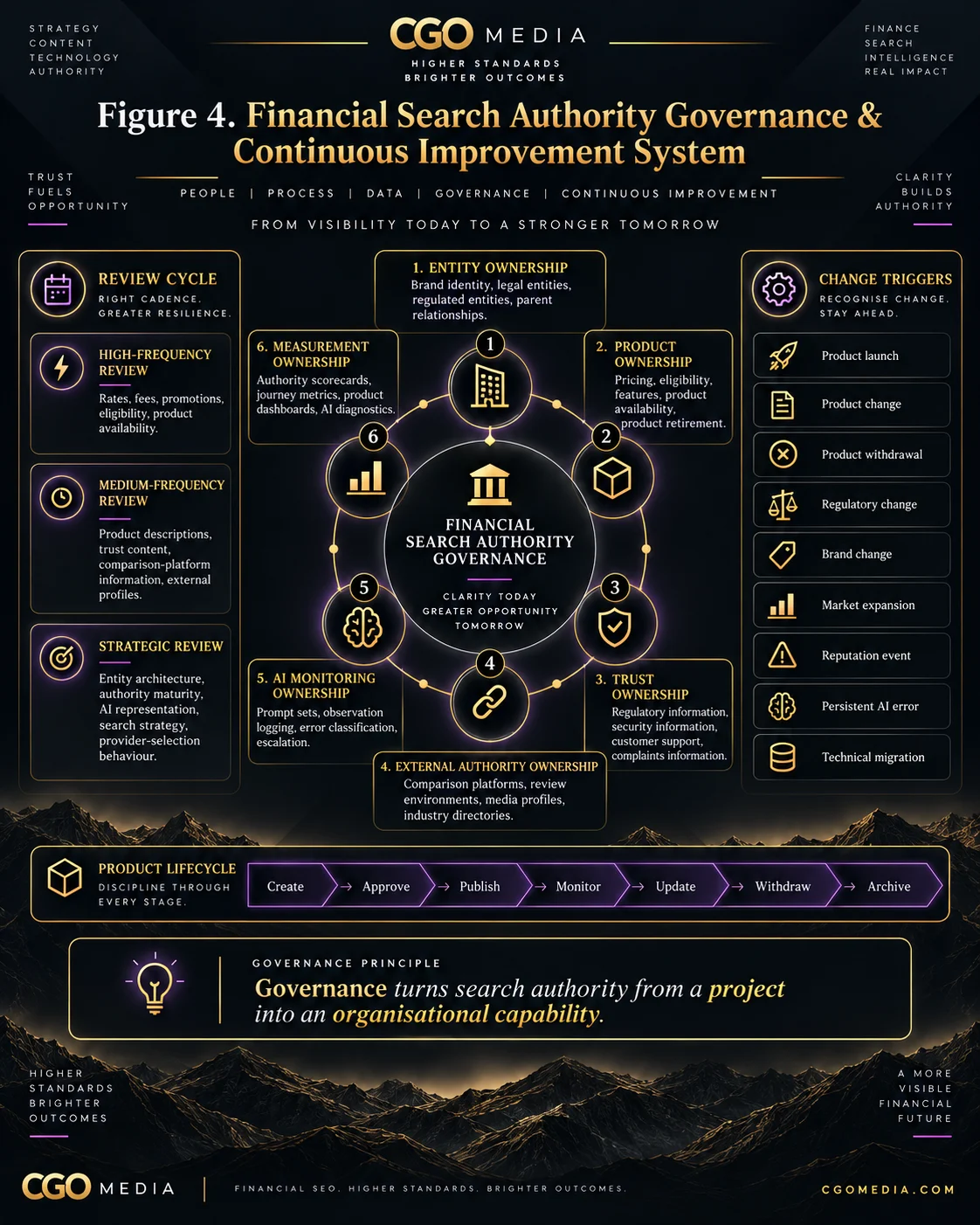
Figure 4 : Financial Search Authority Governance & Continuous Improvement System.
406. 30/60/90-Day Implementation Plan
The Financial SEO & AI Implementation Roadmap can be translated into a phased 90-day programme that establishes the most important foundations first and delays more advanced work until the underlying evidence system is sufficiently reliable.
407. The 90-Day Plan Should Be Treated as a Sequencing Model
The exact timing will vary according to:
- Organisation size
- Product complexity
- Market count
- Regulatory requirements
- Technical resources
- Existing maturity
408. Phase One — Days 1 to 30
The first 30 days should focus on:
Assessment + Critical Correction + Ownership
409. Day 1–30 Objective
The primary objective is to establish a defensible baseline and remove the most material authority risks.
410. Workstream One — Define Scope
Confirm:
- Priority products
- Priority markets
- Priority audiences
- Priority brands
411. Workstream Two — Build Entity Inventory
Document:
- Brand
- Legal entities
- Regulated entities
- Products
- Markets
- Locations
412. Workstream Three — Build Product Inventory
For each priority product, record:
- Product owner
- Eligibility
- Pricing
- Features
- Risk
- Availability
413. Workstream Four — Audit High-Risk Information
Review:
- Pricing
- Eligibility
- Regulatory information
- Product availability
- Provider identity
414. Workstream Five — Audit Trust Evidence
Assess:
- Regulatory clarity
- Security evidence
- Customer-support information
- Complaint information
- Reputation evidence
415. Workstream Six — Audit Search Visibility
Establish a baseline across:
- Need-led search
- Product search
- Provider search
- Trust search
- Comparison search
416. Workstream Seven — Audit AI Representation
Run repeatable prompt groups covering:
- Brand
- Product
- Trust
- Comparison
- Market
417. Workstream Eight — Audit External Authority
Review priority:
- Comparison platforms
- Review sites
- Financial media
- Directories
- Official sources
418. Workstream Nine — Assess Maturity
Use the Financial Search Authority Maturity Model to establish the starting position.
419. Workstream Ten — Create Critical Issue Register
Record:
- Issue
- Severity
- Owner
- Evidence
- Required action
420. First 30 Days Should Prioritise Risk Over Expansion
Do not prioritise new content production while serious provider, pricing or regulatory inconsistencies remain unresolved.
421. Correct Critical Provider Identity Issues
Resolve:
- Brand confusion
- Incorrect legal entities
- Incorrect regulated entities
- Incorrect ownership relationships
422. Correct Critical Product Errors
Resolve:
- Wrong pricing
- Stale rates
- Incorrect eligibility
- Wrong availability
423. Correct Critical Trust Errors
Resolve:
- Material regulatory ambiguity
- Incorrect support information
- Outdated security claims
- Incorrect complaints information
424. Correct Critical External Errors
Where possible, update high-impact third-party sources.
425. Correct Critical AI Evidence Problems
Persistent generated errors should be investigated at the underlying evidence level.
426. Assign Named Owners
By the end of the first month, ownership should be defined for:
- Entity data
- Product information
- Trust information
- External authority
- AI monitoring
- Measurement
427. Day 30 Deliverables
A practical first-month output may include:
- Entity inventory
- Product inventory
- Trust audit
- External-source audit
- Search baseline
- AI baseline
- Maturity baseline
- Critical issue register
- Ownership map
428. Day 30 Decision Gate
Before moving into large-scale authority strengthening, confirm:
- Critical factual errors are controlled
- Ownership is clear
- Priority products are defined
- High-risk information is sufficiently reliable
429. Phase Two — Days 31 to 60
The second 30-day phase should focus on:
Structure + Authority Development + Measurement Foundations
430. Day 31–60 Objective
The objective is to turn corrected information into a more coherent authority system.
431. Workstream Eleven — Build Entity Architecture
Formalise:
Brand → Legal Entity → Regulated Entity → Product → Market → Audience
432. Workstream Twelve — Standardise Product Pages
Priority product pages should adopt consistent structures for:
- Purpose
- Eligibility
- Pricing
- Features
- Risk
- Application
433. Workstream Thirteen — Build Need-Led Content
Create content that connects financial problems and objectives with relevant product categories.
434. Workstream Fourteen — Strengthen Trust Architecture
Improve:
- Regulatory clarity
- Security evidence
- Support information
- Complaint information
- Reputation evidence
435. Workstream Fifteen — Improve Internal Linking
Connect:
Need → Product → Trust → Comparison → Action
436. Workstream Sixteen — Review Structured Data
Ensure markup supports visible organisational and product relationships without asserting unsupported facts.
437. Workstream Seventeen — Strengthen Technical Discoverability
Review:
- Crawlability
- Indexability
- Canonicals
- Site architecture
- Performance
438. Workstream Eighteen — Prioritise External Authority Sources
Classify external sources as:
- Critical
- High influence
- Medium influence
- Low influence
439. Workstream Nineteen — Strengthen Comparison Data
Where strategically relevant, improve consistency across priority comparison environments.
440. Workstream Twenty — Strengthen Review Governance
Begin analysing:
- Review recency
- Theme
- Severity
- Persistence
441. Workstream Twenty-One — Build Digital PR Assets
Potential assets may include:
- Original research
- Industry statistics
- Expert commentary
- Market analysis
442. Workstream Twenty-Two — Improve Research Citation Architecture
Research pages should clearly identify:
- Author
- Publisher
- Date
- Methodology
- References
- Citation format
443. Workstream Twenty-Three — Establish AI Monitoring Process
Define:
- Prompt groups
- Observation criteria
- Error severity
- Escalation rules
444. Workstream Twenty-Four — Establish Measurement Architecture
Connect:
- Search data
- Product data
- Provider-selection behaviour
- Trust data
- AI observations
445. Workstream Twenty-Five — Build Product Dashboards
Each priority product may track:
- Search visibility
- Product authority
- Trust
- AI accuracy
- Qualified progression
446. Day 60 Deliverables
A practical second-month output may include:
- Entity architecture
- Standardised product templates
- Need-led content architecture
- Trust improvements
- Internal-linking improvements
- Structured data review
- External source tiers
- AI monitoring process
- Product dashboards
447. Day 60 Decision Gate
Before moving into broader scaling, confirm:
- Priority product structures are stable
- Trust evidence is improving
- Measurement is functioning
- Major external conflicts are understood
- AI observation is repeatable
448. Phase Three — Days 61 to 90
The final 30-day phase should focus on:
Scale + Governance + Continuous Improvement
449. Day 61–90 Objective
The objective is to turn early improvements into repeatable organisational capability.
450. Workstream Twenty-Six — Expand Product Coverage
Extend proven standards into additional priority products.
451. Workstream Twenty-Seven — Expand Market Coverage
Where appropriate, extend the framework across additional markets.
452. Workstream Twenty-Eight — Expand Audience Coverage
Adapt the model for:
- Consumers
- SMEs
- Enterprise users
- Specialist segments
453. Workstream Twenty-Nine — Expand Content Authority
Build deeper:
- Product education
- Comparison content
- Trust content
- Research assets
454. Workstream Thirty — Expand Digital PR
Use evidence-led campaigns to strengthen:
- Editorial authority
- Citation authority
- Brand authority
- Research visibility
455. Workstream Thirty-One — Formalise Review Cycles
Set review frequencies based on:
- Risk
- Change velocity
- Strategic importance
456. Workstream Thirty-Two — Formalise Change Triggers
Define triggers for:
- Product launch
- Pricing change
- Product withdrawal
- Regulatory change
- Brand change
- AI drift
457. Workstream Thirty-Three — Formalise Product Lifecycle Governance
Adopt:
Create → Approve → Publish → Monitor → Update → Withdraw → Archive
458. Workstream Thirty-Four — Formalise AI Escalation
Define when generated inaccuracies should trigger:
- Verification
- Source investigation
- Correction
- Executive escalation
459. Workstream Thirty-Five — Formalise Executive Reporting
Leadership reporting should include:
- Maturity
- Critical issues
- Product freshness
- Trust trends
- Search performance
- AI accuracy
- Journey bottlenecks
460. Workstream Thirty-Six — Establish Continuous Improvement Cycle
Use:
Observe → Verify → Diagnose → Prioritise → Improve → Measure → Learn → Reassess
461. Day 90 Deliverables
A practical end-of-quarter output may include:
- Expanded product authority
- Operational governance
- Review cycles
- Change triggers
- Executive scorecards
- Continuous AI monitoring
- Continuous improvement process
462. Day 90 Does Not Mean Completion
The first 90 days should establish operating capability rather than finish every SEO or AI initiative.
463. The First 90 Days Create the Operating System
A useful summary is:
Days 1–30: Understand and Correct
Days 31–60: Structure and Strengthen
Days 61–90: Scale and Govern
464. Dependencies Matter
Some activities should not be scaled until prerequisite work is complete.
465. Entity Clarity Is a Dependency
AI and structured data work is weaker where provider identity remains unclear.
466. Product Accuracy Is a Dependency
Large content programmes should not amplify outdated product information.
467. Trust Clarity Is a Dependency
Provider-discovery growth may create additional verification friction where trust evidence is weak.
468. Measurement Is a Dependency for Scaling
The organisation should know whether early improvements are working before committing disproportionate resources to expansion.
469. Governance Is a Dependency for Long-Term Scale
Expansion without ownership and review cycles can create larger authority problems later.
470. Build a Dependency Map
A practical sequence is:
Accuracy → Structure → Authority → Measurement → Scale → Governance
471. Prioritisation Should Be Explicit
Implementation teams should distinguish between:
- Critical
- High
- Medium
- Low
472. Critical Priority
Examples may include:
- Incorrect regulated entity
- Material pricing errors
- Wrong product availability
- Serious provider identity conflicts
473. High Priority
Examples may include:
- Strategic product authority gaps
- Major trust weaknesses
- Important comparison-platform errors
- Persistent high-impact AI inaccuracies
474. Medium Priority
Examples may include:
- Secondary product gaps
- Non-critical external inconsistencies
- Moderate content-depth weaknesses
475. Low Priority
Examples may include:
- Minor wording differences
- Low-impact citation inconsistencies
- Low-value external references
476. Use a Prioritisation Equation
A practical model is:
Priority = Risk + Strategic Importance + Maturity Gap + Evidence Confidence
477. Risk Should Carry Strong Weight
A high-risk product or regulatory issue may outrank a larger visibility opportunity.
478. Strategic Importance Should Influence Priority
Flagship products may justify greater investment than low-value peripheral offerings.
479. Maturity Gap Should Influence Priority
Large capability gaps may require structured improvement programmes rather than isolated fixes.
480. Evidence Confidence Should Influence Priority
High-confidence issues can often be acted upon more decisively.
481. Ownership Should Be Visible in the Roadmap
Each major workstream should have:
- Primary owner
- Supporting teams
- Decision authority
482. Example Entity Workstream Ownership
Possible ownership:
Primary: SEO / Digital Governance | Supporting: Legal, Compliance, Product, Technology
483. Example Product Workstream Ownership
Possible ownership:
Primary: Product | Supporting: Compliance, SEO, Content, Data
484. Example Trust Workstream Ownership
Possible ownership:
Primary: Compliance / Customer Experience | Supporting: Product, SEO, Content
485. Example External Authority Workstream Ownership
Possible ownership:
Primary: Digital PR / SEO | Supporting: Product, Communications, Customer Experience
486. Example AI Monitoring Ownership
Possible ownership:
Primary: Search / AI Visibility Team | Supporting: Product, Compliance, Data
487. Avoid Unowned Workstreams
If no team is accountable, the issue is likely to recur.
488. Build a Workstream Register
Each workstream can record:
- Objective
- Owner
- Dependency
- Priority
- Status
- Evidence
- Success measure
489. Status Should Be Standardised
A simple status system may include:
- Not Started
- In Progress
- Blocked
- Complete
- Monitoring
490. Blockers Should Be Visible
Common blockers may include:
- Missing data
- Compliance approval
- Technical dependency
- External platform access
- Ownership ambiguity
491. Distinguish Output from Outcome
Completing a task is not the same as improving authority.
492. Output Example
A product-page template is launched.
493. Outcome Example
Pricing accuracy, search visibility and qualified product progression improve.
494. Every Major Workstream Should Have an Outcome Measure
Useful outcome measures may include:
- Lower conflict rate
- Higher maturity
- Improved qualified progression
- Lower AI error persistence
- Improved trust engagement
495. Avoid a 90-Day Vanity Programme
The purpose is not to complete the largest possible number of tasks.
496. The Objective Is Capability Building
The 90-day programme should leave the organisation with stronger:
- Accuracy
- Structure
- Authority
- Measurement
- Governance
497. The 90-Day Roadmap Should Support the Next 12 Months
The first quarter establishes the foundations for a longer programme of:
- Content expansion
- Authority development
- Digital PR
- Product optimisation
- AI-readiness improvement
498. The Next Stage Is Strategic Scorecarding
The next section translates implementation activity into a practical Financial SEO & AI Implementation Scorecard for leadership, workstream owners and ongoing governance.
Figure 5 : Financial SEO & AI 30/60/90-Day Implementation Plan & Workstream Map.
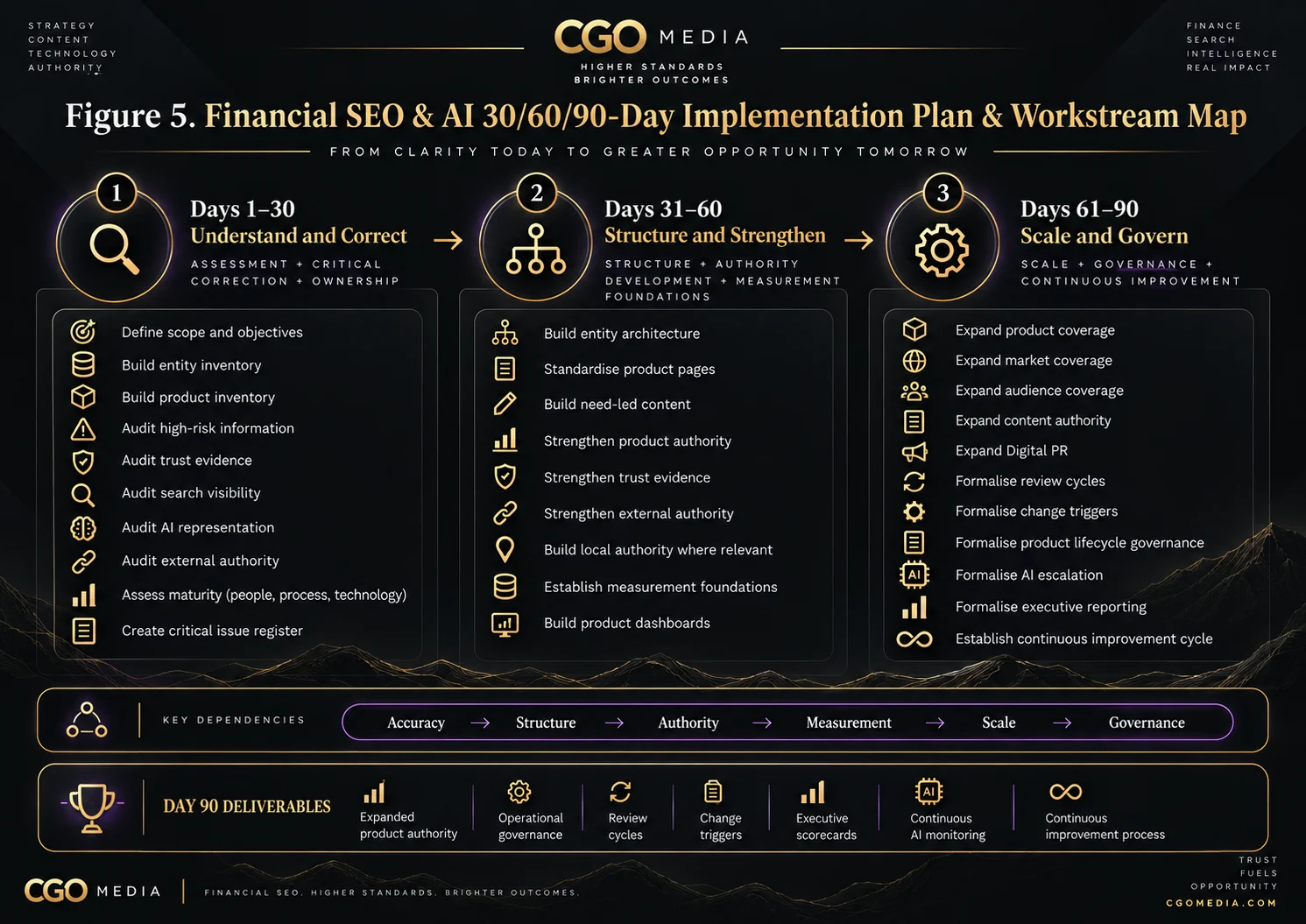
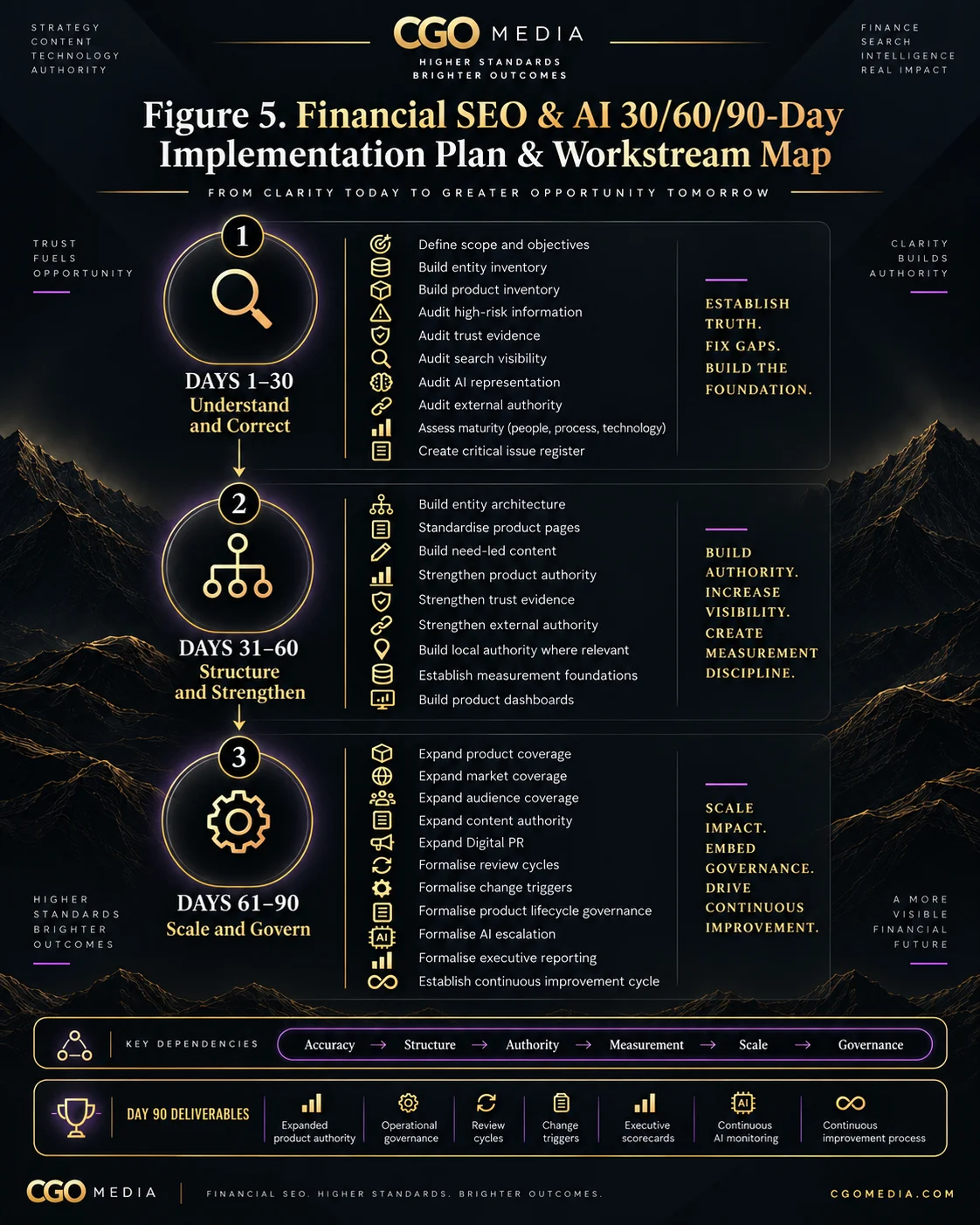
499. Financial SEO & AI Implementation Scorecard
The Financial SEO & AI Implementation Roadmap should be supported by a scorecard that tracks both implementation progress and the business effects of that implementation.
500. The Scorecard Should Separate Inputs, Outputs and Outcomes
A mature implementation programme distinguishes between:
- Inputs
- Outputs
- Outcomes
501. Inputs
Inputs may include:
- Team capacity
- Data access
- Technology
- Governance support
- Budget
502. Outputs
Outputs may include:
- Audits completed
- Product pages updated
- Trust pages improved
- External profiles corrected
- AI monitoring established
503. Outcomes
Outcomes may include:
- Lower information conflict
- Higher authority maturity
- Improved qualified discovery
- Stronger trust progression
- Lower AI error persistence
504. Implementation Progress Alone Is Not Enough
A programme can complete many tasks without materially improving financial search authority.
505. Build an Executive Implementation Scorecard
Leadership should be able to see the status of each major roadmap stage.
506. Recommended Executive Fields
- Workstream
- Owner
- Status
- Priority
- Evidence Confidence
- Outcome Measure
- Next Action
507. Example Executive Implementation Scorecard
| Workstream | Owner | Status | Priority | Confidence | Outcome |
|---|---|---|---|---|---|
| Entity & Provider Clarity | Assigned Team | Not Started / In Progress / Complete / Monitoring | Critical / High / Medium / Low | Low / Medium / High | Reduced entity conflicts |
| Product Authority | Assigned Team | Not Started / In Progress / Complete / Monitoring | Critical / High / Medium / Low | Low / Medium / High | Improved product accuracy and freshness |
| Trust & Regulatory Evidence | Assigned Team | Not Started / In Progress / Complete / Monitoring | Critical / High / Medium / Low | Low / Medium / High | Improved verification and trust clarity |
| External Authority | Assigned Team | Not Started / In Progress / Complete / Monitoring | Critical / High / Medium / Low | Low / Medium / High | Improved external consistency |
| Search & Provider Selection | Assigned Team | Not Started / In Progress / Complete / Monitoring | Critical / High / Medium / Low | Low / Medium / High | Improved qualified progression |
| AI Search Readiness | Assigned Team | Not Started / In Progress / Complete / Monitoring | Critical / High / Medium / Low | Low / Medium / High | Reduced material AI errors |
508. Add Authority Maturity to the Scorecard
Each workstream should also indicate whether it is helping the organisation progress through the Financial Search Authority Maturity Model.
509. Track Current Maturity
Record whether the relevant authority dimension is:
- Foundation
- Developing
- Operational
- Advanced
- Leading
510. Track Target Maturity
The roadmap should state the intended maturity level for each major workstream.
511. Track Maturity Gap
A useful measure is:
Target Maturity − Current Maturity = Implementation Gap
512. Track Trend
Each area can be labelled:
- Improving
- Stable
- At Risk
- Regressing
513. Track Coverage
A roadmap should show whether a capability applies across:
- One pilot product
- Priority products
- Priority markets
- Organisation-wide scope
514. Track Critical Overrides
Material risks should remain visible even where implementation progress is strong.
515. Critical Override Examples
- Incorrect regulated entity
- Material pricing conflict
- Wrong product availability
- Serious provider identity error
516. Build KPI Groups Around the Roadmap
A practical implementation scorecard should include KPIs for:
- Accuracy
- Authority
- Trust
- Discovery
- Selection
- AI representation
- Governance
517. Accuracy KPIs
Potential measures include:
- Entity conflict rate
- Product accuracy rate
- Pricing conflict rate
- External discrepancy rate
518. Authority KPIs
Potential measures include:
- Maturity level
- Priority product coverage
- Content freshness
- Research citation growth
519. Trust KPIs
Potential measures include:
- Regulatory clarity
- Trust-content engagement
- Review themes
- Complaint trends
520. Discovery KPIs
Potential measures include:
- Need-led visibility
- Product visibility
- Provider visibility
- Branded trust search
521. Provider-Selection KPIs
Potential measures include:
- Information-to-product progression
- Trust-to-comparison progression
- Comparison-to-action progression
- Qualified conversion
522. AI Representation KPIs
Potential measures include:
- Brand accuracy
- Product accuracy
- Market accuracy
- Trust accuracy
- Error persistence
523. Governance KPIs
Potential measures include:
- Review-cycle completion
- Change-trigger compliance
- Owner coverage
- Time to resolve critical issues
524. KPI Volume Should Remain Manageable
A roadmap overloaded with hundreds of indicators can become difficult to govern.
525. Select KPIs That Support Decisions
Every executive KPI should help answer a practical question.
526. Example Accuracy Question
Are material product and provider conflicts decreasing?
527. Example Authority Question
Are priority products moving toward the required maturity level?
528. Example Trust Question
Can users verify the provider more easily and accurately?
529. Example Search Question
Are suitable users discovering the provider more often?
530. Example Provider-Selection Question
Are suitable users progressing more effectively through comparison and action?
531. Example AI Question
Are persistent material AI inaccuracies reducing?
532. Example Governance Question
Are authority improvements being maintained after implementation?
533. Establish Review Cadence
The implementation scorecard should be reviewed on a cadence appropriate to organisational risk and change velocity.
534. Operational Review
Operational teams may review:
- Critical issues
- Product changes
- Blocked workstreams
- AI errors
535. Strategic Review
Leadership may review:
- Maturity progression
- Authority risk
- Product coverage
- Search outcomes
- Resource needs
536. Event-Triggered Review
Major events should trigger review outside the normal reporting cadence.
537. Failure Mode — Task Completion as Success
Completing a checklist does not demonstrate improved authority.
538. Failure Mode — Scaling Before Accuracy
Publishing more content can amplify misinformation if product or provider data remains unreliable.
539. Failure Mode — Scaling Before Entity Clarity
AI and search systems may encounter greater ambiguity if unclear provider relationships are amplified.
540. Failure Mode — Scaling Before Trust
Greater visibility can send more users into a weak verification environment.
541. Failure Mode — Scaling Before Measurement
The organisation may spend heavily without knowing whether authority is actually improving.
542. Failure Mode — Scaling Before Governance
A large content and product portfolio can become increasingly difficult to maintain.
543. Failure Mode — SEO-Only Roadmap
Financial authority cannot be sustained by SEO teams alone.
544. Failure Mode — Content-Only Roadmap
High content volume cannot compensate for weak product, trust or entity governance.
545. Failure Mode — Link-Only Authority Strategy
External link acquisition alone does not establish:
- Provider accuracy
- Product clarity
- Trust
- AI readiness
546. Failure Mode — Schema-Only AI Strategy
Structured data cannot substitute for weak underlying evidence.
547. Failure Mode — AI Prompt Chasing
Changing content solely to influence one generated answer can produce unstable and low-value optimisation.
548. Failure Mode — Treating AI Inclusion as Endorsement
Generated inclusion does not establish financial quality, suitability or regulatory approval.
549. Failure Mode — Treating Provider Order as Ranking
AI answer ordering can vary by:
- Model
- Prompt
- Location
- Time
550. Failure Mode — Ignoring External Sources
Strong first-party content may still be weakened by outdated comparison, review or editorial information.
551. Failure Mode — Ignoring Customer Experience
Poor service can create future trust and reputation weaknesses.
552. Failure Mode — Treating Reviews as Product Suitability Evidence
Customer reviews can describe experience but do not establish whether a financial product is appropriate for another user.
553. Failure Mode — Over-Automating High-Risk Financial Information
Automation can propagate material errors rapidly where human controls are inadequate.
554. Failure Mode — No Named Ownership
Unowned workstreams tend to become:
- Delayed
- Inconsistent
- Reactive
555. Failure Mode — No Change Triggers
Information can remain stale until the next scheduled review.
556. Failure Mode — No Product Retirement Process
Withdrawn products may remain discoverable long after they should have been updated or archived.
557. Failure Mode — No Baseline
Without a starting point, improvement is difficult to demonstrate.
558. Failure Mode — No Target State
Without a defined target, teams can complete activities without knowing what capability they are trying to build.
559. Failure Mode — No Evidence Confidence
Weakly supported assumptions may be treated as established facts.
560. Failure Mode — No Learning Loop
Recurring problems continue when lessons are not incorporated into standards and governance.
561. Scaling Rules
The roadmap should be scaled only when core dependencies are sufficiently stable.
562. Scaling Rule One — Prove Before Expanding
Test new authority structures on priority products before portfolio-wide deployment.
563. Scaling Rule Two — Standardise Before Automating
A weak process should not be automated simply because automation is available.
564. Scaling Rule Three — Measure Before Increasing Investment
Confirm that early work is producing useful outcomes.
565. Scaling Rule Four — Preserve Risk Controls
Growth should not weaken:
- Product accuracy
- Regulatory accuracy
- Risk communication
- Eligibility controls
566. Scaling Rule Five — Preserve Market Context
A model that works in one market may require adaptation elsewhere.
567. Scaling Rule Six — Preserve Audience Context
Consumer, SME and enterprise users may require different:
- Content
- Trust evidence
- Comparison information
- Application paths
568. Scaling Rule Seven — Preserve Ownership
Every new product or market added to the programme should have clear authority ownership.
569. Scaling Rule Eight — Preserve Measurement
Expanded programmes should retain comparable metrics.
570. Scaling Rule Nine — Preserve Evidence Quality
Increasing publication volume should not reduce:
- Research quality
- Product accuracy
- Review quality
- Citation standards
571. Scaling Rule Ten — Reassess Maturity
Portfolio expansion may create new capability gaps and should therefore trigger reassessment.
572. The 12-Month Operating Cycle
The first 90 days establish the operating system. The remaining year should extend and improve that system.
573. Months 1–3 — Foundation and Operating System
Focus on:
- Assessment
- Critical corrections
- Entity structure
- Priority product authority
- Measurement
- Governance
574. Months 4–6 — Authority Expansion
Focus may shift toward:
- Additional product clusters
- Additional trust assets
- Research content
- Digital PR
- External authority
575. Months 7–9 — Scale and Optimisation
The organisation can expand proven methods across:
- Additional products
- Additional audiences
- Additional markets
576. Months 10–12 — Consolidation and Resilience
The final quarter can focus on:
- Maturity reassessment
- Governance refinement
- Automation where appropriate
- AI resilience
- Next-year priorities
577. Quarterly Maturity Reviews
A quarterly strategic review can assess:
- Current maturity
- Target gaps
- Critical issues
- Coverage
- Trend
578. Quarterly Product Reviews
Review whether strategic products remain:
- Accurate
- Current
- Competitive
- Discoverable
579. Quarterly Trust Reviews
Review:
- Regulatory clarity
- Security communication
- Review themes
- Complaint patterns
580. Quarterly External Authority Reviews
Review:
- Comparison platforms
- Editorial coverage
- Research citations
- Priority third-party conflicts
581. Quarterly AI Reviews
Review:
- Material accuracy
- Error persistence
- Provider relevance
- Visible source patterns
582. Annual Authority Reassessment
A wider annual review can reassess the organisation against the full maturity model.
583. Annual Reassessment Should Examine Progression
Leadership should determine:
- Which dimensions improved
- Which remained static
- Which regressed
- Why
584. Annual Reassessment Should Examine Coverage
Determine whether mature processes have expanded sufficiently across the portfolio.
585. Annual Reassessment Should Examine Risk
New products, markets or technologies may introduce new authority risk.
586. Annual Reassessment Should Inform the Next Roadmap
The following year’s priorities should emerge from evidence rather than simply continuing old activity.
587. Continuous Improvement Should Become Institutional
The longer-term goal is for authority improvement to become part of normal business operations.
588. Product Changes Should Automatically Enter the Authority System
New products, pricing updates and withdrawals should no longer depend on manual SEO discovery.
589. Trust Changes Should Automatically Enter the Authority System
Relevant regulatory, security and reputation changes should trigger review.
590. External Changes Should Enter the Authority System
Important comparison or third-party conflicts should be tracked and assigned.
591. AI Changes Should Enter the Authority System
Persistent material AI errors should enter the same governance and prioritisation process.
592. Search Behaviour Should Feed Strategy
Changing financial queries can reveal:
- New customer concerns
- Emerging product questions
- New comparison criteria
- Trust concerns
593. Provider-Selection Data Should Feed Product Strategy
Loss reasons may reveal problems involving:
- Pricing
- Eligibility
- Features
- Trust
- Application experience
594. Customer Experience Should Feed Search Authority
Recurring service issues can eventually influence:
- Reviews
- Referrals
- Reputation
- Future provider selection
595. The Roadmap Creates a Feedback System
The long-term operating model becomes:
Search Evidence → Product Insight → Trust Insight → Provider Selection → Customer Experience → Reputation → Search Evidence
596. Strategic Success Is Not Maximum Visibility
The objective is not to appear for every possible financial search.
597. Strategic Success Is Relevant Visibility
The organisation should aim to be discoverable where its products genuinely match user needs.
598. Strategic Success Is Accurate Representation
Users and machine-mediated systems should encounter sufficiently reliable provider and product information.
599. Strategic Success Is Verifiable Trust
Relevant users should be able to validate important provider information efficiently.
600. Strategic Success Is Qualified Progression
Suitable users should be able to progress through:
Discovery → Understanding → Trust → Comparison → Selection
601. Strategic Success Is Operational Resilience
Authority improvements should survive:
- Product changes
- Market changes
- Search changes
- AI changes
602. The Complete Implementation Model
The roadmap can now be summarised as:
Assess → Correct → Structure → Strengthen → Measure → Govern → Scale → Learn → Reassess
603. The Complete Authority Objective
The programme ultimately aims to strengthen:
Accuracy + Entity Clarity + Product Authority + Trust + External Corroboration + Search Visibility + AI Readiness + Qualified Provider Selection
604. The Next Step Is Final Strategic Integration
The final section consolidates the roadmap’s strategic implications, methodology, limitations, conclusion, references and research citation guidance.
Figure 6 : Continuous Financial SEO & AI Improvement and 12-Month Operating Cycle.
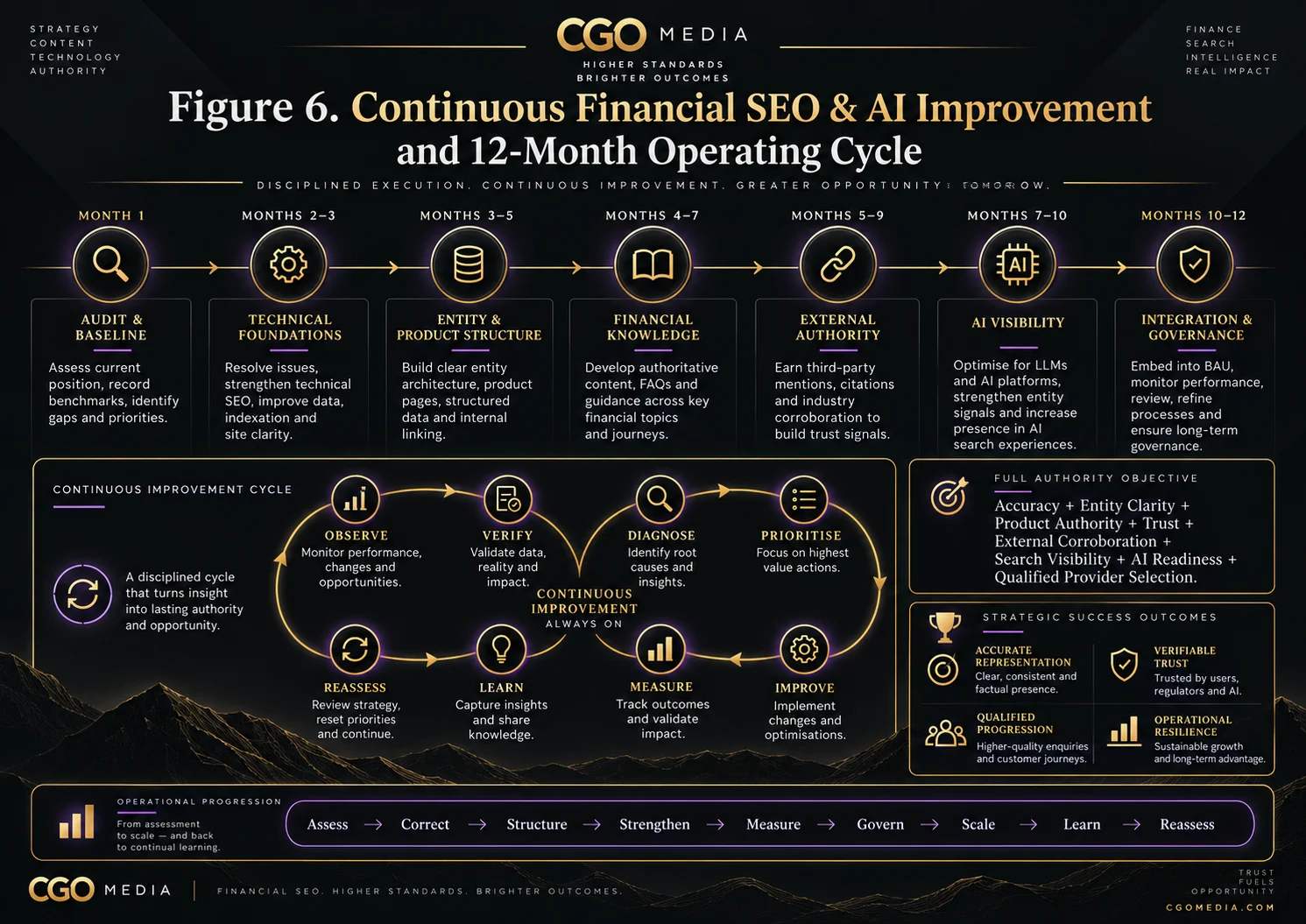
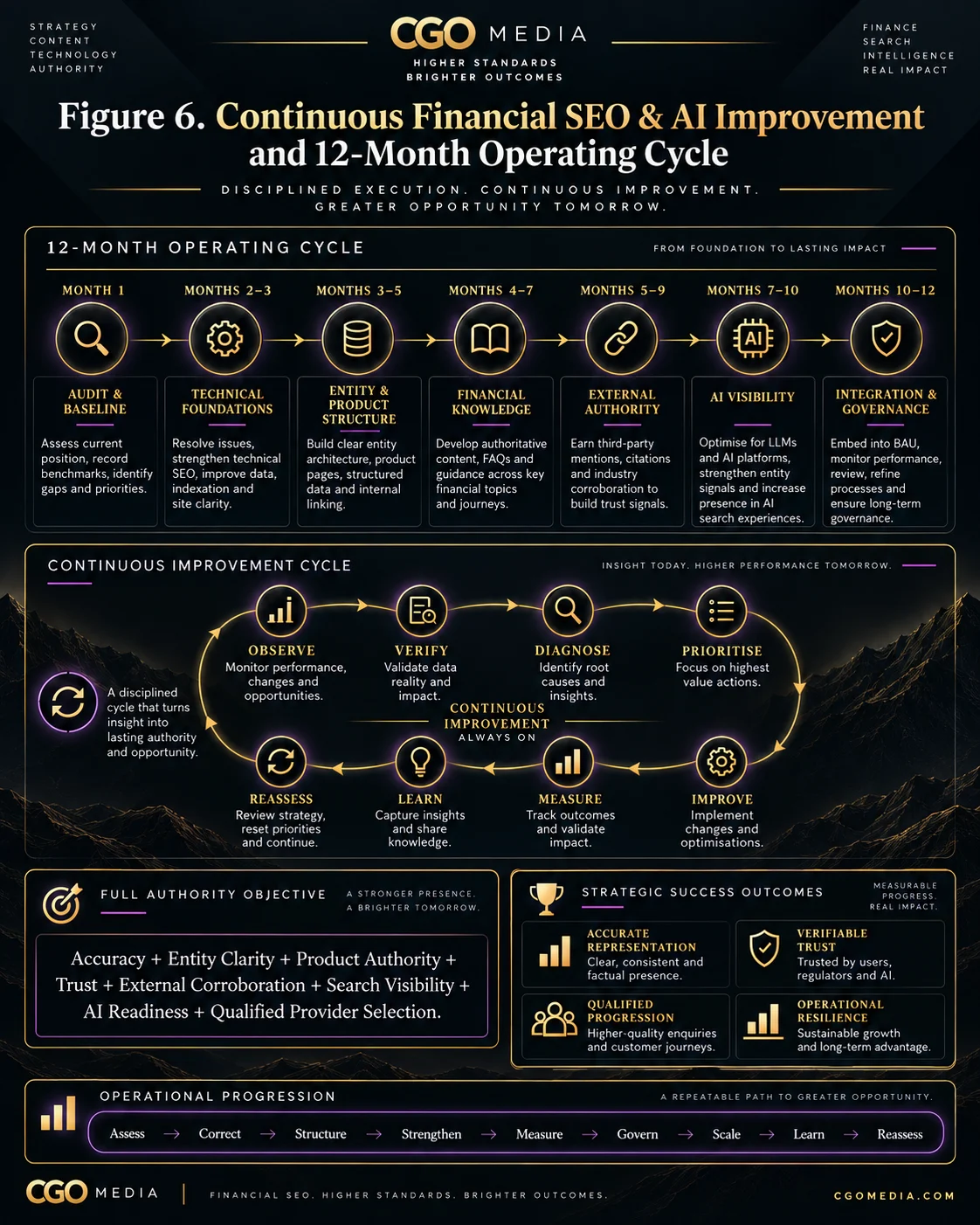
605. Strategic Implications
The Financial SEO & AI Implementation Roadmap provides a structured way for financial organisations to move from fragmented optimisation toward a governed authority system that supports search visibility, provider trust, product understanding and AI-assisted discovery.
606. Implementation Should Begin with Accuracy
Search and AI expansion should not outpace the organisation’s ability to maintain accurate:
- Provider identity
- Product information
- Pricing
- Eligibility
- Regulatory context
607. Accuracy Reduces Downstream Risk
Incorrect information can propagate through:
- Search engines
- Comparison platforms
- Financial media
- Review environments
- AI systems
608. Structure Should Precede Large-Scale Expansion
Before scaling content and authority work, financial organisations benefit from clearer relationships between:
Brand → Legal Entity → Regulated Entity → Product → Market → Audience
609. Product Authority Should Be Built Systematically
Priority financial products should be supported by sufficiently clear information around:
- Purpose
- Eligibility
- Pricing
- Features
- Risk
- Restrictions
- Application
610. Trust Should Be Embedded Across the Journey
Trust should not be treated as a single page or late-stage reassurance device.
611. Trust Supports Discovery, Comparison and Selection
Users may validate a provider before:
- Shortlisting
- Comparing
- Applying
- Opening an account
- Beginning a commercial relationship
612. External Authority Should Corroborate First-Party Information
Relevant third-party evidence can help users and machine-mediated systems validate provider identity and context.
613. External Authority Should Be Selective
The roadmap prioritises relevant, credible and current evidence rather than raw link or mention volume.
614. AI Readiness Depends on the Wider Authority System
AI visibility should not be treated as a standalone optimisation discipline.
615. AI Readiness Builds on Existing Evidence
A useful relationship is:
Entity Clarity + Product Authority + Trust Evidence + External Corroboration + Governance = Stronger AI Readiness
616. AI Presence Is Not the Primary Objective
Provider inclusion in generated answers has limited value if the organisation is represented inaccurately.
617. AI Accuracy Should Receive Greater Weight
Priority monitoring should focus on:
- Provider identity
- Product availability
- Pricing
- Market coverage
- Regulatory relationships
618. AI Inclusion Is Not Endorsement
Appearance in a generated answer should not be interpreted as independent financial validation, product suitability or regulatory approval.
619. AI Ordering Is Not a Stable Ranking
Provider order may change according to:
- Prompt
- Model
- Location
- Time
- Retrieval behaviour
620. Provider Selection Should Inform SEO Strategy
The roadmap connects directly with the Financial Provider Selection Model.
621. Visibility Is Only the First Condition
Financial organisations also need to support:
Discovery → Understanding → Trust → Comparison → Selection
622. Qualified Progression Is More Valuable Than Maximum Progression
The strongest financial search programmes do not attempt to convert every visitor.
They help suitable users progress while enabling unsuitable users to identify misalignment earlier.
623. Good Filtering Can Improve Commercial Quality
Clear pricing, eligibility and product conditions can reduce unsuitable applications.
624. Governance Protects Search Investment
Without review cycles and ownership, authority improvements can deteriorate after implementation.
625. Product Lifecycle Governance Is Central
Financial products should move through a controlled lifecycle:
Create → Approve → Publish → Monitor → Update → Withdraw → Archive
626. Change Triggers Protect Freshness
Important changes should initiate review before stale information spreads widely.
627. Measurement Should Guide Scaling
The roadmap encourages organisations to prove that initial authority improvements are useful before expanding them across larger portfolios.
628. Scaling Should Preserve Quality
Expansion should not weaken:
- Accuracy
- Evidence quality
- Trust
- Governance
- Measurement
629. Search Authority Is Cross-Functional
Implementation may involve:
SEO + Content + Product + Compliance + Customer Experience + Digital PR + Technology + Data
630. SEO Teams Should Not Own Product Truth Alone
Product facts should be validated through appropriate product and governance processes.
631. Compliance Teams Should Not Operate in Isolation
Accurate internal information is insufficient if public-facing environments remain inconsistent.
632. Customer Experience Is Part of Search Authority
Customer experience influences:
- Reviews
- Complaints
- Reputation
- Referrals
- Future provider selection
633. Digital PR Should Be Evidence-Led
Financial PR is stronger when built around:
- Original research
- Useful statistics
- Expert commentary
- Defensible analysis
634. Research Assets Can Support Citation Authority
Clear authorship, methodology and citation formats can make financial research easier for journalists, researchers and industry professionals to reference.
635. Implementation Should Become an Operating System
The first 90 days establish the foundation, but the longer-term objective is institutional capability.
636. The Roadmap Is Designed to Extend Beyond 90 Days
A typical operating sequence is:
Months 1–3: Foundation and Operating System
Months 4–6: Authority Expansion
Months 7–9: Scale and Optimisation
Months 10–12: Consolidation and Resilience
637. Continuous Improvement Is the Final Strategic Layer
The long-term cycle is:
Observe → Verify → Diagnose → Prioritise → Improve → Measure → Learn → Reassess
638. Relationship with the CGO Media Financial Services Research Family
The Financial SEO & AI Implementation Roadmap forms the practical implementation layer of the wider CGO Media Financial Services research architecture.
Financial Services SEO in an AI Search Environment | Financial Services AI Trust Framework | Financial Provider Selection Model | Financial Search Authority Maturity Model
639. Relationship with Financial Services SEO in an AI Search Environment
The parent paper Financial Services SEO in an AI Search Environment establishes the wider research context for financial search, authority, trust and AI-assisted discovery.
640. Relationship with the Financial Services AI Trust Framework
The Financial Services AI Trust Framework provides the trust architecture that informs several roadmap workstreams.
641. Relationship with the Financial Provider Selection Model
The Financial Provider Selection Model explains the user journey that implementation should support.
642. Relationship with the Financial Search Authority Maturity Model
The Financial Search Authority Maturity Model provides the capability framework used to assess current state, target state and progression.
643. Methodology
The Financial SEO & AI Implementation Roadmap is a conceptual implementation framework developed by CGO Media to translate financial-search and authority principles into an operational sequence.
644. Six Primary Implementation Stages
- Assess
- Correct
- Structure
- Strengthen
- Measure
- Govern and Improve
645. Assessment Method
The assessment stage examines:
- Entity clarity
- Product accuracy
- Trust evidence
- External authority
- Search visibility
- AI representation
646. Correction Method
The correction stage prioritises material inaccuracies and conflicts before large-scale growth activity.
647. Structure Method
The structure stage establishes clearer relationships between:
- Provider entities
- Products
- Markets
- Audiences
- Trust evidence
648. Authority-Strengthening Method
The strengthening stage expands:
- Financial information depth
- Product authority
- Trust evidence
- External corroboration
- Technical discoverability
- AI readiness
649. Measurement Method
The measurement stage uses:
- Search data
- Product data
- Trust data
- Provider-selection behaviour
- External evidence
- AI observations
650. Governance Method
The governance stage defines:
- Ownership
- Review cycles
- Change triggers
- Escalation
- Product lifecycle processes
651. 30/60/90-Day Method
The implementation sequence groups activity into:
- Days 1–30 — Understand and Correct
- Days 31–60 — Structure and Strengthen
- Days 61–90 — Scale and Govern
652. Twelve-Month Operating Method
The initial 90-day programme extends into a longer operating cycle for authority expansion, optimisation and resilience.
653. Evidence Confidence Method
Important findings may be classified as:
- Low confidence
- Medium confidence
- High confidence
654. Prioritisation Method
Roadmap priorities may be informed by:
Risk + Strategic Importance + Maturity Gap + Evidence Confidence
655. Maturity Assessment Method
The roadmap uses the five-level structure:
- Foundation
- Developing
- Operational
- Advanced
- Leading
656. Continuous Improvement Method
Long-term operation follows:
Observe → Verify → Diagnose → Prioritise → Improve → Measure → Learn → Reassess
657. Limitations
The Financial SEO & AI Implementation Roadmap is a conceptual research and implementation framework. It is not a regulatory compliance programme, financial audit, legal opinion, investment framework or substitute for professional financial advice.
658. Implementation Timelines Vary
The 30/60/90-day structure is an implementation model rather than a guaranteed delivery timetable.
659. Organisational Complexity Varies
Large financial institutions may require substantially longer for:
- Data integration
- Compliance approval
- Technology change
- Multi-market rollout
660. Product Complexity Varies
Different financial products require different levels of:
- Risk explanation
- Regulatory review
- Eligibility assessment
- Comparison support
661. Jurisdictions Differ
Regulatory obligations, terminology, consumer protections and product structures vary across markets.
662. Search Demand Is Not Static
User language and financial concerns can change over time.
663. Search Performance Has Multiple Causes
Changes in visibility may be influenced by:
- Competition
- Search-system changes
- Product demand
- Seasonality
- Brand activity
664. Attribution Is Incomplete
Financial provider-selection journeys may involve:
- Offline referrals
- Comparison sites
- Multiple devices
- AI assistants
- Professional recommendations
665. Reviews Have Limits
Customer reviews can help describe service experience but should not be treated as proof of financial product suitability or regulatory quality.
666. External Authority Is Not Fully Controllable
Financial organisations cannot always directly change third-party editorial or historical information.
667. AI Outputs Are Variable
Generated results can vary according to:
- Model
- Prompt
- Time
- Location
- Retrieval behaviour
668. Visible AI Sources May Be Incomplete
Displayed citations do not necessarily reveal every source or signal involved in generating an answer.
669. AI Source Appearance Does Not Establish Full Causation
A visible citation should not automatically be treated as the sole reason a provider was mentioned.
670. AI Inclusion Is Not Independent Financial Endorsement
Appearance in a generated answer does not establish provider quality, suitability or regulatory approval.
671. AI Recommendation Order Is Not a Stable Ranking
Provider sequence can vary and should not be interpreted as a permanent hierarchy.
672. The Roadmap Does Not Guarantee Search Rankings
Implementation may strengthen organisational capability but does not guarantee any particular search-engine position.
673. The Roadmap Does Not Guarantee AI Inclusion
No implementation process can guarantee citation, recommendation or inclusion by an AI system.
674. The Roadmap Does Not Guarantee Provider Selection
Financial selection depends on:
- User needs
- Product suitability
- Eligibility
- Pricing
- Trust
- Competition
675. The Roadmap Does Not Guarantee Financial Outcomes
Search visibility and provider selection do not determine individual investment, credit, insurance, lending or other financial outcomes.
676. Conclusion
Financial SEO and AI search readiness are increasingly difficult to manage through isolated content, keyword or link-building campaigns.
Financial organisations operate within a distributed discovery environment that includes search engines, AI assistants, comparison platforms, financial media, regulatory sources, review platforms and professional recommendations.
The Financial SEO & AI Implementation Roadmap provides a practical sequence for building authority within that environment.
Its core implementation path is:
Assess → Correct → Structure → Strengthen → Measure → Govern and Improve
Its longer-term operating model is:
Assess → Correct → Structure → Strengthen → Measure → Govern → Scale → Learn → Reassess
The central principle is that sustainable financial search authority depends on more than visibility.
It depends on:
Accuracy + Entity Clarity + Product Authority + Trust + External Corroboration + Qualified Discovery + AI Readiness + Governance
The strongest implementation programmes therefore aim not simply to attract more traffic, but to create a more reliable, verifiable and resilient financial information system capable of supporting users across search and AI-assisted provider discovery.
References
External Academic, Technical and Search Sources
- Google Search Central. SEO Starter Guide.
- Google Search Central. Understand how structured data works.
- Schema.org. FinancialService.
- Schema.org. Organization.
- Hogan, A. et al. (2021). Knowledge Graphs. ACM Computing Surveys, 54(4).
- Metzger, M.J. (2007). Making Sense of Credibility on the Web: Models for Evaluating Online Information and Recommendations for Future Research. Journal of the American Society for Information Science and Technology, 58(13), 2078–2091.
- Ji, Z. et al. (2023). Survey of Hallucination in Natural Language Generation. ACM Computing Surveys, 55(12).
CGO Media Financial Services Research and Frameworks
- Wilkinson, R. (2026). Financial Services SEO in an AI Search Environment. CGO Media.
- Wilkinson, R. (2026). Financial Services AI Trust Framework. CGO Media.
- Wilkinson, R. (2026). Financial Provider Selection Model. CGO Media.
- Wilkinson, R. (2026). Financial Search Authority Maturity Model. CGO Media.
- Wilkinson, R. (2026). Financial GEO: Generative Engine Optimisation . CGO Media.
CGO Media Research Ecosystem
CGO Media Research Library | CGO Media Framework Library | CGO Media Research Architecture
About Roger Wilkinson
Roger Wilkinson is an independent researcher, SEO practitioner and founder of CGO Media with more than 25 years of experience in search, digital visibility and business growth.
His research focuses on how artificial intelligence is reshaping search engines, recommendation systems, entity representation, digital authority and organisational visibility.
Roger is the creator of the CGO Framework Series, a collection of research-led methodologies designed to help organisations measure, improve and govern Search Visibility, AI Visibility and Digital Authority.
His work examines the relationship between Technical SEO, Entity Authority, Content Authority, Citation Authority, Brand Signals, Knowledge Architecture and AI Search Readiness.
View Roger Wilkinson’s researcher profile →
Related Financial Services Research and Frameworks
Financial Services SEO in an AI Search Environment |
Financial Services AI Trust Framework |
Financial Provider Selection Model |
Financial Search Authority Maturity Model |
Financial GEO: Generative Engine Optimisation
Research Usage & Citation
CGO Media encourages researchers, journalists, financial organisations, fintechs, educators, analysts and professional-services firms to reference this roadmap where it contributes to wider discussion and understanding of financial SEO, AI search readiness, provider authority, trust governance and implementation strategy.
Reasonable quotations, summaries, figures and excerpts may be used in articles, reports, presentations, academic work and other publications provided appropriate acknowledgement is given to Roger Wilkinson and CGO Media.
Cite This Framework / Embed Citation
The Financial SEO & AI Implementation Roadmap by Roger Wilkinson at CGO Media provides a six-stage framework for helping financial organisations assess, correct, structure, strengthen, measure and govern their search authority and AI-search readiness.
APA Citation
APA Citation: Wilkinson, R. (2026). Financial SEO & AI Implementation Roadmap. CGO Media. https://cgomedia.com/financial-seo-ai-implementation-roadmap/
Author: Roger Wilkinson | Published by: CGO Media
For permissions relating to extensive reproduction, commercial licensing or republication of substantial portions of this framework, please contact CGO Media directly.