CGO Media Research
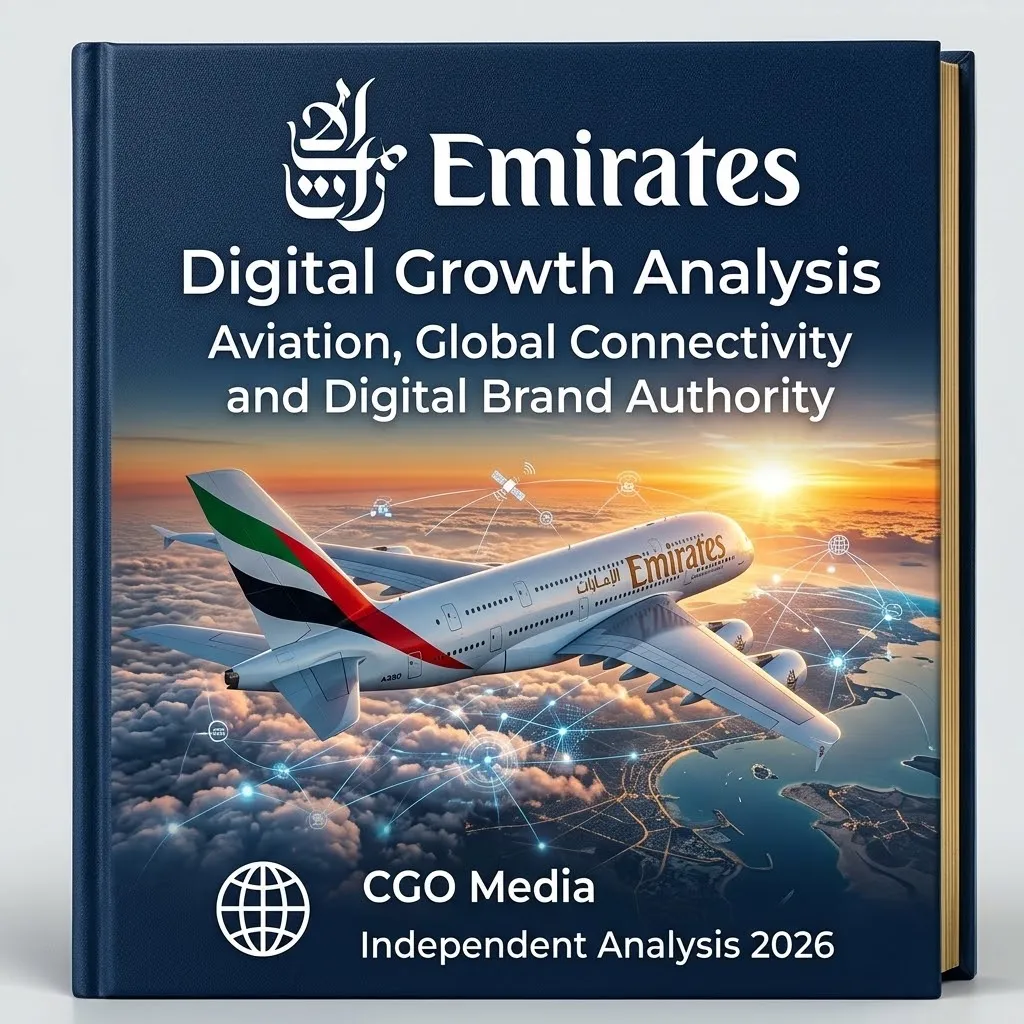
How International SEO, Destination Content and Premium Brand Authority Built a Global Airline
An independent analysis of how Emirates combines global route architecture, multilingual ecommerce, destination content, customer loyalty, premium digital experiences and Dubai’s position as an international aviation hub to operate one of the world’s most recognisable airline brands.
Growth Analysis Overview
- Company: Emirates
- Founded: 1985
- Headquarters: Dubai, United Arab Emirates
- Industry: International aviation, travel and air cargo
- Primary hub: Dubai International Airport
- Primary services: Passenger flights, premium cabins, air cargo, loyalty, holidays and related travel services
- Primary digital disciplines: International SEO, route architecture, destination content, direct booking, multilingual localisation, loyalty, digital customer experience and AI-search readiness
- Case-study type: Independent analysis based on publicly available information
- Relationship disclosure: Emirates is not presented as a CGO Media client
Introduction
Emirates is one of the world’s most recognisable international airline brands.
Founded in Dubai in 1985, the airline developed around a geographically powerful proposition: connecting passengers between Europe, Asia, Africa, the Middle East, the Americas and Australasia through a major global hub.
This model allowed Emirates to serve travellers whose journeys did not necessarily begin or end in the United Arab Emirates.
A passenger travelling between Manchester and Bangkok, Madrid and Sydney or Johannesburg and Tokyo could connect through Dubai using one airline and one coordinated booking journey.
Emirates has built its commercial position through the interaction of:
- A large international route network
- Dubai’s strategic geographical location
- A premium global brand
- Wide-body aircraft
- Direct digital booking
- Airport and onboard experiences
- Destination marketing
- Customer loyalty
- Airline partnerships
- International sponsorship
The Emirates website is central to this ecosystem.
It is not simply an online ticket-payment system.
It helps travellers discover destinations, research routes, understand baggage and visa requirements, compare cabins, manage bookings, check flights, join loyalty programmes and plan activities in Dubai.
Emirates therefore provides a valuable case study in how an international travel company can connect technical SEO, content, ecommerce, brand authority and customer service within one global digital platform.
The International Travel Problem
International air travel can be complicated.
Travellers may need to understand:
- Available routes
- Departure and arrival airports
- Connecting flights
- Travel dates
- Cabin classes
- Baggage allowances
- Visa requirements
- Airport transfers
- Seat selection
- Journey duration
- Ticket-change rules
- Frequent-flyer benefits
Long-haul travellers may compare direct flights with connecting journeys, several airports, alternative airlines and different travel dates.
Emirates reduces part of this complexity by operating a hub-and-spoke system through Dubai.
Passengers can access a broad network of destinations through one connecting airport, while digital tools help them plan and manage the journey.
The commercial challenge is to make this network understandable.
A large route network has limited value when users cannot discover the relevant connection, understand the itinerary or confidently complete the booking.
Why Emirates Is an Important SEO Growth Analysis
Flight search contains enormous volumes of commercial and informational demand.
Travellers may search for:
- Flights to Dubai
- London to Dubai flights
- Manchester to Bangkok flights
- Business Class flights to Australia
- Emirates baggage allowance
- Dubai stopover
- Flights from Madrid to Bali
- Emirates Premium Economy
- Dubai visa requirements
- Emirates flight status
These searches cover several stages of the customer journey.
Destination Inspiration
The traveller is deciding where to travel and may be influenced by climate, culture, activities, price or season.
Route Research
The traveller knows the approximate origin and destination and is comparing airlines, airports, schedules and connections.
Commercial Comparison
The traveller is evaluating fares, cabin classes, baggage and ticket conditions.
Booking
The traveller selects an itinerary and completes the transaction.
Pre-Flight Support
The customer returns for check-in, baggage guidance, seat selection, visa information and flight status.
Post-Flight Loyalty
The airline encourages repeat travel through Emirates Skywards, personalised communication and future destination inspiration.
Emirates can participate across this entire journey through a combination of landing pages, booking tools, travel guidance and loyalty services.
Dubai as the Centre of the Digital Ecosystem
Emirates’ network is organised around Dubai.
This gives the city several roles within the digital strategy.
Dubai is:
- The airline’s operating hub
- A global connection point
- A major holiday destination
- A stopover opportunity
- A business-travel centre
- A central part of Emirates’ brand identity
Emirates does not need to treat every connecting passenger as someone merely changing aircraft.
Destination guides, Dubai stopover services, hotels, tours and activity content can encourage passengers to extend their journey and spend time within the city.
The customer journey can therefore evolve from:
Connecting flight through Dubai → Dubai stopover → hotel and activity booking → stronger association with Emirates and the destination.
This creates value for Emirates, Dubai tourism, hotels, attractions and related travel providers.
Route Architecture at Global Scale
Airline SEO depends heavily on route architecture.
Emirates can organise flight demand through relationships between:
- Country
- City
- Airport
- Departure point
- Destination
- Flight route
- Cabin
- Available schedule
A typical hierarchy can connect:
Europe → United Kingdom → London → flights from London → flights from London to Dubai.
Similar structures can support routes such as:
- Madrid to Dubai
- Dubai to Sydney
- Manchester to Bangkok
- Barcelona to Bali
- Dubai to Cape Town
- London to Mauritius
Route pages should clearly communicate:
- Departure and arrival airports
- Indicative journey time
- Connection information
- Flight frequency
- Available cabin classes
- Baggage guidance
- Destination information
- A booking call to action
The strongest route pages combine commercial utility with useful travel context.
Programmatic SEO for Flight Routes
Airline route networks naturally support scalable landing-page creation.
Structured information may include:
- Origin
- Destination
- Airport code
- Operating days
- Journey duration
- Aircraft type
- Cabin availability
- Connection point
This information can be used to create relevant route pages using repeatable templates.
However, successful programmatic SEO requires more than placing two city names into a heading.
A route page should provide:
- A real and bookable travel option
- Accurate schedule information
- Clear destination relationships
- Useful supporting content
- Stable canonical signals
- Relevant internal links
- Strong mobile usability
Pages for discontinued or highly seasonal routes require careful handling.
Outdated route pages can create poor customer experiences when they imply that direct or connecting services remain available when the network has changed.
Destination Pages as Organic Discovery Assets
Emirates publishes destination pages covering cities across its global network.
These pages can help users research:
- Local attractions
- Culture
- Food
- Weather
- Neighbourhoods
- Hotels
- Transport
- Family activities
- Seasonal events
Destination content expands Emirates’ organic visibility beyond searches containing the word “flight”.
A traveller may begin by asking:
- Best time to visit Mauritius
- What to do in Dubai
- Family holidays in Thailand
- City breaks in Asia
- Wildlife holidays in Africa
Emirates can use useful content to introduce the destination and then connect the reader with available flights.
The journey becomes:
Travel inspiration → destination research → route discovery → fare search → booking.
Holiday-Intent Architecture
Travellers do not always choose destinations by country or city.
They may begin with a type of experience.
Holiday-intent categories can include:
- Beach holidays
- Wildlife holidays
- City breaks
- Food-focused trips
- History and culture
- Family holidays
- Luxury travel
- Outdoor adventures
This content helps Emirates reach users who have not yet selected a destination.
It also allows the airline to connect multiple destinations through shared customer intent.
For example, a beach-holiday hub can connect Mauritius, the Maldives, Bali, Phuket and other suitable destinations.
This strengthens internal linking and allows customers to compare possibilities within one thematic journey.
International and Multilingual SEO
Emirates serves customers across dozens of countries and territories.
Its website must manage:
- Different languages
- Different currencies
- Regional departure airports
- Local payment options
- Country-specific offers
- Local legal information
- Market-specific customer support
- Regional travel restrictions
International SEO requires genuine localisation.
A page for customers in Spain should not simply be an English page translated word for word.
It should account for:
- Spanish departure airports
- Local travel terminology
- Local currency and payment expectations
- Regional promotions
- Customer-service information
- Relevant onward destinations
Search demand also varies by market.
British users may search for “holidays”, while American users may search for “vacations”. Spanish users may search for routes using different city spellings or travel terminology.
Hreflang and Regional Page Governance
Emirates needs to help search engines understand which market and language version should appear for each user.
Important signals include:
- Hreflang annotations
- Country and language URLs
- Canonical tags
- Regional XML sitemaps
- Localised internal links
- Currency and booking-market signals
These signals must remain consistent.
Incorrect implementation can cause:
- The wrong country page to rank
- Users to encounter incorrect currencies
- Regional pages to compete against one another
- Local pages to be treated as duplicates
- Unsupported offers to appear in search results
At airline scale, a technical configuration issue can affect thousands of route, destination and service pages.
Direct Booking as a Strategic Objective
Airlines distribute tickets through several channels.
These can include:
- The airline’s own website
- The airline’s mobile application
- Travel agencies
- Online travel agencies
- Corporate booking systems
- Metasearch platforms
Direct bookings can provide important advantages.
Emirates gains greater control over:
- Customer data
- Brand experience
- Seat and baggage sales
- Upgrade offers
- Loyalty enrolment
- Post-booking communication
- Customer-service journeys
SEO helps support direct booking by introducing travellers through route and destination searches before they reach a third-party booking platform.
However, the direct website must provide a competitive and trustworthy experience.
Customers need clear fares, accurate availability, understandable conditions and a reliable checkout process.
The Flight-Booking Experience
An airline booking engine is more complex than a conventional ecommerce checkout.
The platform may need to process:
- Origin and destination
- Travel dates
- One-way or return travel
- Passenger numbers
- Adult, child and infant categories
- Cabin selection
- Fare conditions
- Seat availability
- Payment
- Customer identity
Conversion can be weakened by:
- Slow search results
- Unexpected fees
- Unclear fare differences
- Session errors
- Payment failures
- Poor mobile usability
- Confusing connection information
The booking system must balance commercial upselling with clarity.
Seat selection, baggage, upgrades and related services can increase revenue, but customers should not feel that essential information is being concealed.
Cabin Architecture and Premium Search Intent
Emirates operates distinct cabin products including:
- First Class
- Business Class
- Premium Economy
- Economy Class
Each cabin attracts different customer needs and search behaviour.
Relevant searches can include:
- Emirates First Class
- Emirates Business Class seats
- Emirates Premium Economy review
- Emirates A380 Business Class
- Emirates chauffeur service
- Emirates lounge access
Cabin pages can communicate:
- Seat design
- Privacy
- Dining
- Entertainment
- Lounge access
- Airport services
- Baggage allowance
- Aircraft availability
The page should clarify that cabin products may vary according to route and aircraft.
Showing a premium feature without explaining its availability can create unrealistic expectations.
Aircraft Pages and Product Differentiation
Emirates’ fleet is an important part of its digital identity.
Aircraft pages can help users understand the experience available on:
- Airbus A380
- Boeing 777
- Airbus A350
These pages can include:
- Cabin layouts
- Seating charts
- Entertainment
- Onboard Wi-Fi
- Dining
- Cabin features
- Route deployment
Aircraft content supports both brand storytelling and practical customer research.
Aviation enthusiasts may discover Emirates through aircraft-related content, while passengers use the same information to understand their expected journey.
Emirates Skywards and Customer Retention
Emirates Skywards is central to the airline’s retention strategy.
Members can earn and redeem Miles through Emirates, flydubai and participating partners.
The loyalty ecosystem can include:
- Flights
- Upgrades
- Partner airlines
- Hotels
- Retail partners
- Exclusive experiences
- Family accounts
- Tier-based benefits
Loyalty can strengthen:
- Repeat booking
- Customer lifetime value
- Direct-channel usage
- Premium-cabin upgrades
- Partner engagement
- First-party customer data
This is particularly important because international travellers may compare several airlines for each journey.
Accumulated Miles and tier benefits create an additional reason to remain within the Emirates ecosystem.
Business Rewards
Emirates also provides a dedicated loyalty proposition for small and medium-sized organisations.
Business Rewards can help companies receive value from employee travel while individual travellers continue earning personal Skywards Miles.
This creates business search opportunities such as:
- Corporate airline rewards
- Business travel programme
- SME flight rewards
- Company airline account
Dedicated business content should address:
- Registration
- Earning rules
- Reward redemption
- Employee management
- Eligible travel
- Account administration
This allows Emirates to build direct commercial relationships with companies rather than relying entirely on individual leisure passengers.
Travel Guidance and Customer Support Content
International passengers need reliable information before flying.
Emirates publishes guidance covering:
- Baggage allowances
- Cabin baggage
- Additional baggage
- Visa and passport requirements
- Health information
- Special assistance
- Family travel
- Children and infants
- Flight changes
- Travel disruptions
These pages can attract substantial organic demand.
They also reduce pressure on customer-service teams when users can find clear answers without contacting support.
Accuracy is essential.
Baggage, visa, health and travel rules can change, so pages need visible ownership, review processes and current update information.
Accessible and Inclusive Travel
Airlines need to serve passengers with a wide range of accessibility and assistance requirements.
Relevant information may cover:
- Wheelchair assistance
- Mobility devices
- Visual and hearing needs
- Medical conditions
- Service animals
- Travelling with medication
- Unaccompanied minors
- Pregnancy
Accessibility information should be easy to discover before booking.
Passengers should understand which services require advance notice, which documents may be needed and how to request assistance.
Clear accessibility content supports customer trust and improves AI-generated responses to specialised travel questions.
Brand Authority Through Sponsorship
Emirates has built international recognition through extensive sponsorship across sport, culture and entertainment.
Sponsorship activity can generate:
- Global brand exposure
- Media mentions
- Social engagement
- Branded searches
- Partner links
- Event-related content
- Hospitality opportunities
The airline has created associations with football, tennis, motorsport, sailing and other international events.
This supports a premium global identity and keeps the brand visible even when consumers are not actively booking flights.
Sponsorship therefore contributes indirectly to search performance by increasing familiarity and direct demand.
Technical SEO Challenges
Emirates operates a technically complex international platform.
Important SEO challenges include:
- Country and language duplication
- Route-page scale
- Changing flight schedules
- Seasonal destinations
- Regional offers
- Booking-engine JavaScript
- Canonicalisation
- Hreflang
- Mobile performance
- Structured data
- Redirect management
- Content freshness
Search-result pages created from specific passenger dates and fare requests should not automatically become public indexable URLs.
Search engines should primarily discover stable route, destination, cabin, aircraft and travel-information pages.
Temporary booking states, personal itineraries and session-specific fare results require strict indexation control.
Structured Data and Travel Entities
Emirates’ digital ecosystem contains clearly identifiable entities.
These include:
- The Emirates organisation
- Flights
- Airports
- Cities
- Countries
- Aircraft
- Cabin classes
- Travel offers
- Loyalty programmes
- Destination guides
Search and AI systems should understand relationships such as:
- A flight departs from one airport and arrives at another.
- An airport serves a city.
- A route may connect through Dubai.
- A cabin product is available on selected aircraft.
- A destination is served by Emirates.
- A fare applies to specific travel dates and conditions.
Machine-readable information can improve the interpretation of:
- Flight routes
- Schedules
- Offers
- Organisation information
- Articles
- Frequently asked questions
- Mobile applications
AI Search and Conversational Travel Discovery
Travel search is becoming increasingly conversational.
Instead of performing multiple searches, travellers may ask:
- Find a flight from Manchester to Thailand with one comfortable connection.
- Which Emirates routes offer Premium Economy?
- Can I stop in Dubai for three days when flying to Australia?
- What baggage allowance applies to an Emirates Economy ticket?
- Which Emirates destinations are suitable for a winter beach holiday?
- What is the difference between Emirates Business Class on the A380 and Boeing 777?
Answering these questions requires systems to combine:
- Current route information
- Schedules
- Aircraft deployment
- Cabin availability
- Fare conditions
- Baggage rules
- Destination information
- Customer preferences
Emirates has a strong foundation for AI-assisted travel discovery because it already operates a large structured network of routes, destinations, cabins and customer information.
The principal challenge is keeping recommendations connected to current operations and clearly separating live availability from general travel guidance.
Generative Engine Optimisation Opportunities
Generative Engine Optimisation helps AI platforms interpret and reference official company information accurately.
Opportunities for Emirates include:
- Consistent route entities
- Clear airport and city relationships
- Machine-readable schedules
- Accurate cabin availability
- Clearly dated travel guidance
- Structured baggage information
- Authoritative destination content
- Transparent environmental reporting
- Strong independent brand citations
AI systems should be able to distinguish between:
- A currently operating route
- A temporarily suspended route
- A planned future destination
- Live fare availability
- Indicative destination pricing
- Current baggage policy
- Historical aircraft information
- Cabin features available only on selected aircraft
These distinctions are essential for trustworthy travel recommendations.
Sustainability and Environmental Communication
Aviation faces substantial scrutiny regarding fuel use, emissions, noise and long-term environmental impact.
Emirates publishes environmental information covering:
- Operational fuel efficiency
- Fleet technology
- Emissions-reduction initiatives
- Environmental management
- Responsible consumption
- Wildlife and habitat protection
Environmental communication needs precision.
Users should be able to distinguish between:
- Reduced fuel consumption
- Fleet replacement
- Sustainable aviation fuel
- Operational efficiency
- Long-term emissions targets
- Conservation projects
Broad claims should be supported by clearly defined data, reporting periods and methodologies.
Transparent reporting strengthens trust and provides more reliable source material for journalists, researchers and AI systems.
Commercial Performance
Emirates reported record financial performance for its 2025–26 financial year.
The airline generated record revenue and a profit before tax of approximately AED 22.8 billion.
Emirates carried approximately 53.2 million passengers during the financial year.
The wider Emirates Group reported:
- Revenue of approximately AED 150.5 billion
- Profit before tax of approximately AED 24.4 billion
- A record cash balance
These results reflect strong international travel demand, network reach, premium products and effective commercial management.
Important digital measurements should include:
- Direct booking revenue
- Organic route traffic
- Destination-content assisted bookings
- Booking conversion rate
- Mobile booking performance
- Ancillary revenue
- Skywards enrolment
- Repeat booking
- Customer lifetime value
- Revenue by market and route
Rankings and website traffic have limited value when they do not contribute to profitable bookings, loyalty or improved customer service.
What Emirates Did Well
Built a Powerful Global Hub
Emirates used Dubai’s location to connect travellers between major international regions.
Created a Recognisable Premium Brand
Aircraft, cabins, sponsorships and service design support a consistent global identity.
Built Extensive Route Architecture
Origin, destination and city pages allow Emirates to address a wide range of commercial flight searches.
Connected Destination Content With Booking
Travel guides introduce customers earlier in the planning journey and direct them towards relevant routes.
Developed a Strong Direct-Booking Ecosystem
The website and app support booking, check-in, seat selection, flight management and customer service.
Invested in Customer Loyalty
Emirates Skywards creates reasons for customers to book repeatedly and remain within the wider partner network.
Built International Localisation
Regional websites, languages, currencies and departure-market content support customers across the global network.
Turned Dubai Into More Than a Connection
Stopover, destination and activity content encourage travellers to experience the airline’s home city.
Challenges and Risks
International Technical Complexity
Languages, currencies, routes and local offers create substantial hreflang and canonicalisation requirements.
Changing Route Availability
Operational disruption, seasonal schedules and market conditions can make route pages outdated quickly.
Strong Search Competition
Emirates competes with airlines, online travel agencies, metasearch platforms and search-engine travel products.
Booking-Engine Performance
Slow or confusing booking journeys can reduce direct conversion and encourage users to purchase elsewhere.
Cabin-Product Variation
Aircraft and cabin features vary by route, creating a need for precise product communication.
Travel-Information Accuracy
Visa, baggage, health and operational information require continuous review.
Environmental Scrutiny
Aviation sustainability claims need transparent evidence and careful explanation.
AI and Search Disintermediation
AI assistants and flight-search platforms may increasingly answer route questions before the customer reaches Emirates.com.
How CGO Media Would Approach a Similar International Airline
A CGO Media strategy for a global airline would connect technical SEO, route architecture, destination authority, direct booking and AI-search visibility.
Phase 1: Search and Commercial Diagnosis
The initial analysis would examine:
- Organic traffic by route and market
- Branded and non-branded demand
- Destination-content performance
- Direct booking conversion
- Mobile performance
- Loyalty enrolment
- Revenue by landing-page type
- Competitor visibility
Phase 2: International Technical SEO Audit
CGO Media would evaluate:
- Hreflang
- Regional canonicals
- Country and language URLs
- Booking-engine crawl controls
- JavaScript rendering
- Redirect management
- XML sitemaps
- Core Web Vitals
- Structured data
- Mobile usability
Phase 3: Route Architecture
The website would clearly connect:
- Countries
- Cities
- Airports
- Origins
- Destinations
- Flight routes
- Cabin products
- Booking journeys
Phase 4: Route and Schedule Governance
Route pages would be reviewed for current availability, schedule accuracy, seasonal operation, aircraft information and alternative connections.
Phase 5: Destination Authority
Content clusters could cover:
- Destination guides
- Dubai stopovers
- Family travel
- Beach holidays
- Business travel
- Luxury travel
- Food and culture
- Seasonal travel
Phase 6: Direct-Booking Optimisation
Booking journeys would be evaluated for:
- Search speed
- Fare clarity
- Mobile completion
- Payment failures
- Session abandonment
- Ancillary selection
Phase 7: Customer-Service Content
Baggage, visa, disruption, family and accessibility information would receive clear ownership and update schedules.
Phase 8: Digital PR and Brand Authority
Network expansion, destination insights, customer research, fleet innovation and sustainability reporting would support editorial coverage and authoritative citations.
Phase 9: AI and GEO Readiness
CGO Media would test how routes, cabins, baggage policies, destinations and company information appear across AI assistants and generative-search platforms.
Improvements would focus on:
- Route freshness
- Airport entity consistency
- Cabin availability
- Structured schedules
- Policy update dates
- Destination authority
- Independent brand citations
Phase 10: Commercial Measurement
Reporting would connect organic visibility to:
- Direct bookings
- Route revenue
- Premium-cabin sales
- Ancillary revenue
- Skywards registrations
- Repeat bookings
- Booking-acquisition cost
- Customer lifetime value
Key Lessons for Dubai and International Businesses
- Digital architecture should reflect the commercial network.
Emirates organises search around origins, destinations, airports, cabins and travel services. - International SEO requires operational localisation.
Language, currency, departure points, offers and support information vary by market. - Destination content can create commercial demand.
Travel inspiration introduces customers before they begin comparing fares. - Programmatic SEO needs live services.
Route pages provide value only when they represent genuine and current travel options. - Direct booking creates deeper customer relationships.
The airline gains greater control over data, loyalty, service and ancillary revenue. - Premium product information must be precise.
Cabin and aircraft features should be connected to actual route availability. - Support content is part of acquisition and retention.
Baggage, visa and accessibility guidance influence customer confidence. - Brand advertising strengthens search performance.
Sponsorship and premium positioning create recognition and branded demand. - AI travel discovery depends on current structured data.
Routes, schedules, fares and policies must be clearly defined and regularly updated. - Traffic must produce profitable customer relationships.
The final objective is direct booking, loyalty and repeat international travel.
Conclusion
Emirates demonstrates how a Dubai-based airline can build a global commercial ecosystem around international connectivity.
Its strength is not based only on operating aircraft or publishing flight schedules.
It is supported by the interaction of:
- A global route network
- Dubai’s hub position
- International website architecture
- Destination content
- Direct booking
- Premium cabin products
- Customer-service information
- Emirates Skywards
- Global sponsorship
- Strong brand authority
Emirates participates throughout the travel journey, from initial destination inspiration to booking, airport preparation, onboard experience and future loyalty.
Its digital platform translates a highly complicated international network into routes, destinations, cabins and services that travellers can understand and purchase.
For CGO Media, the central lesson is:
The strongest international travel brands do not merely sell journeys. They organise destinations, routes, service, loyalty and global customer intent into one connected digital ecosystem.
When technical SEO, international localisation, destination authority, direct booking and brand trust reinforce one another, digital visibility becomes a durable commercial asset.
Build a Stronger International Search Ecosystem
CGO Media helps airlines, travel companies and international digital brands improve technical performance, organic visibility, destination authority and AI-search readiness.
Explore
Enterprise SEO UK,
learn more about
Technical SEO UK
or discover how
GEO Services UK
can support complex international platforms.
Contact CGO Media to discuss your international search strategy
Research Sources
Emirates Official Website
Emirates: About Us
Emirates Destinations
Emirates Route Map
Emirates Fleet
Emirates Cabin Features
Emirates Skywards
Emirates Business Rewards
Emirates Group Annual Reports
Emirates Group 2025–26 Financial Results
Emirates Environmental Strategy
Emirates Environmental Reports