
SaaS SEO in an AI Search Environment
 SaaS discovery is evolving from a conventional search-and-click journey into a broader decision environment shaped by search engines, AI assistants, software review platforms, comparison sites, documentation, integration ecosystems, industry publications and peer recommendations.A prospective customer may now move from a business problem directly into an AI-generated shortlist, compare several products without visiting every provider website, check integrations and customer reviews, investigate security and pricing, and only then decide which vendors deserve direct evaluation.This changes the role of SEO for SaaS organisations.The strategic objective is no longer simply to rank individual pages. It is to create a connected product evidence environment that helps buyers and machine systems understand:What the software does
Which problems it solves
Who it is designed for
Which features it provides
Which integrations it supports
How it compares with alternatives
Whether the provider is credible
Whether customers trust the product
Whether pricing and implementation are suitable
This broader discipline can be understood as SaaS Search Authority.
1. Executive Summary
Traditional SaaS SEO has often concentrated on:
- Category keywords
- Feature pages
- Comparison pages
- Blog content
- Free-trial acquisition
These remain important, but they are no longer sufficient on their own.
Modern SaaS discovery increasingly depends on whether the wider digital environment provides enough consistent evidence for a buyer or AI-assisted system to understand the product and determine whether it belongs within a particular consideration set.
2. From SaaS SEO to SaaS Search Authority
SaaS Search Authority extends beyond ranking landing pages.
It describes the strength and coherence of the digital evidence surrounding a software company across:
- Provider identity
- Product identity
- Feature authority
- Integration relationships
- Category relevance
- Use-case authority
- Industry relevance
- Customer evidence
- External reviews
- AI recommendation visibility
The stronger these relationships are, the easier the provider becomes to discover, understand, compare and evaluate.
3. SaaS Discovery Is Becoming More Distributed
Software buyers rarely rely on one information source.
A typical SaaS journey may involve:
- Google Search
- AI assistants
- Software review platforms
- Comparison websites
- Professional communities
- YouTube demonstrations
- Industry publications
- Vendor documentation
- Partner ecosystems
This creates a distributed discovery environment in which the SaaS provider’s website remains important but no longer controls the whole buying journey.
4. SaaS Discovery Often Begins with a Problem
Many buyers do not begin with a known software category.
They begin with an operational problem.
For example:
How can we automate invoice approval across multiple departments?
The buyer may only later determine that accounts-payable automation software represents an appropriate category of solution.
5. Problem-Led Search Creates Early Discovery Opportunity
Problem-led content can connect the SaaS provider with buyers before they know the language of the product category.
Useful problem-led content should explain:
- The operational problem
- Why it occurs
- Possible approaches
- Where software can help
- Which constraints matter
This creates authority earlier in the decision journey.
6. Category-Led SaaS Discovery
As the buyer’s problem becomes clearer, discovery can move into recognised software categories such as:
- CRM software
- Project management software
- HR software
- Cybersecurity software
- Accounting software
- Marketing automation software
Category visibility remains important because it places the provider within an established market context.
7. Category Authority Requires More Than Keyword Use
A SaaS provider should demonstrate why the product belongs within the category.
Category authority can be strengthened through:
- Clear product positioning
- Relevant feature coverage
- Use-case evidence
- Integration relationships
- Customer proof
- External recognition
Simply placing a category phrase in headings does not create strong category authority.
8. Feature-Led SaaS Discovery
Some buyers search for a specific capability rather than an entire product category.
Examples include:
- AI meeting transcription
- Workflow automation
- SSO support
- API integrations
- Automated reporting
- Multi-currency billing
Feature-led searches can indicate a buyer who already understands an important requirement.
9. Feature Pages Should Explain Capability
A feature page should do more than state that a feature exists.
Strong feature evidence can explain:
- What the feature does
- How it works
- Who needs it
- Which workflow it supports
- Which limitations apply
- Which integrations are involved
This creates stronger product understanding and comparison readiness.
10. Use-Case-Led SaaS Discovery
Buyers may search according to a specific operational situation.
Examples can include:
- CRM for recruitment agencies
- Project management software for construction
- Accounting software for ecommerce businesses
- Customer support software for SaaS teams
Use-case discovery links the product more directly with a real business problem.
11. Use-Case Authority Should Connect Problem and Product
A useful structure is:
Business Problem → Workflow → Product Capability → Integration → Outcome
This helps the buyer understand how individual product features work together within a practical scenario.
12. Industry-Led SaaS Discovery
Industry-specific discovery becomes particularly important where workflows, regulation, terminology or integrations differ materially between sectors.
A SaaS provider may therefore need to demonstrate genuine relevance to specific industries rather than simply duplicate generic category pages with different headlines.
13. Strong Industry Pages Require Sector Evidence
Useful industry content can demonstrate understanding of:
- Sector workflows
- Regulatory requirements
- Common integrations
- Operational constraints
- Buyer priorities
Industry relevance should be supported by genuine evidence rather than superficial localisation.
14. Role-Led SaaS Discovery
Different stakeholders can evaluate the same software through very different priorities.
A CFO may focus on:
- Cost
- ROI
- Reporting
- Governance
A technical buyer may focus on:
- API capability
- Security
- Architecture
- Integrations
- Implementation
15. SaaS Search Architecture Should Reflect Stakeholder Needs
Product information should provide enough evidence for different decision-makers to evaluate the same platform from their own perspective.
This can require connected information for:
- Finance
- Operations
- IT
- Security
- Procurement
- End users
16. Comparison-Led SaaS Discovery
Comparison searches usually emerge once buyers have identified several possible vendors.
Typical queries can include:
- Vendor A vs Vendor B
- Best alternatives to Vendor A
- Vendor A competitors
- Best software for a specific use case
This stage moves the buyer from discovery toward active vendor evaluation.
17. Comparison Intent Is Commercially Important
A buyer performing comparison research is often closer to a decision than someone conducting broad informational research.
Comparison content should therefore help buyers understand genuine differences involving:
- Features
- Pricing
- Integrations
- Target customer
- Implementation
- Support
18. AI-Assisted SaaS Discovery Compresses the Journey
AI assistants can combine multiple buyer criteria within one request.
For example:
What are the best CRM platforms for a 50-person UK professional-services company that need HubSpot integration, GDPR controls and strong reporting?
This single request combines:
- Product category
- Company size
- Geography
- Integration requirement
- Compliance need
- Feature requirement
- Vendor comparison
19. AI Discovery Can Move Evaluation Earlier
Traditional search often required buyers to visit several pages before forming a shortlist.
AI-assisted discovery can introduce:
- Provider comparison
- Feature filtering
- Use-case matching
- Commercial framing
before the buyer visits an individual SaaS website.
20. SaaS SEO Must Therefore Support Pre-Click Evaluation
The provider’s public information should make decision-critical facts sufficiently clear even when buyers encounter them through:
- Search summaries
- AI answers
- Review platforms
- Comparison environments
- External publications
This increases the strategic importance of clear and consistent product evidence.
21. The SaaS Search Intent Architecture
A useful SaaS discovery progression is:
Problem → Category → Feature → Use Case → Industry → Comparison → Vendor → Trial or Demo
This is not a rigid linear funnel.
It is a model for understanding the main forms of intent that can contribute to software discovery and evaluation.
22. SaaS Buyers Move Between Intent Types
A buyer may:
- Begin with a problem
- Discover a category
- Investigate a feature
- Compare vendors
- Return to documentation
- Check reviews
- Reconsider the category
The search journey should therefore be understood as iterative rather than perfectly sequential.
23. Search Intent Should Reflect Commercial Reality
SaaS SEO strategies should avoid treating every keyword as an isolated traffic opportunity.
Queries should instead be understood in relation to:
- Buyer problems
- Product categories
- Features
- Use cases
- Industries
- Roles
- Comparisons
- Commercial decisions
24. Product-Led Search Architecture
The SaaS product should sit at the centre of a connected information environment.
A useful architecture is:
SaaS Provider → Product → Feature → Integration → Use Case → Industry → Customer Evidence → Pricing → Demo
This connects product understanding with discovery and conversion.
25. SaaS Provider Entity Clarity
Search engines, AI-assisted systems and buyers should be able to distinguish between:
- The company
- The software product
- Individual product modules
- Sub-brands
- Parent companies
- Acquired products
Entity ambiguity can weaken both product discovery and comparison accuracy.
26. Product Identity Should Be Consistent
A SaaS product should maintain a coherent identity across:
- Website pages
- Documentation
- Review platforms
- App marketplaces
- Partner websites
- Industry publications
Material disagreement about product identity can create confusion for both buyers and machine systems.
27. Product Category Clarity Matters
The provider should make clear which software categories the product genuinely belongs to.
Ambiguous positioning can weaken authority when a product attempts to present itself simultaneously as too many unrelated solutions.
28. Category Breadth Should Reflect Product Reality
A SaaS platform can legitimately operate across several related categories.
However, each category association should be supported by relevant:
- Capabilities
- Use cases
- Integrations
- Customer evidence
Category expansion unsupported by evidence can weaken clarity.
29. Feature Authority Connects Search Demand with Product Capability
Priority features should be represented clearly enough for buyers to determine:
- What the capability does
- How it works
- Why it matters
- Which plans support it
- Which workflows depend on it
Feature authority is particularly important when individual capabilities function as buyer selection criteria.
30. Integration Authority Can Drive High-Intent Discovery
Software buyers frequently need to confirm whether a new product works with systems they already use.
Priority integrations may therefore justify dedicated evidence explaining:
- What connects
- Which data is exchanged
- Who the integration is useful for
- How implementation works
- Which technical or plan requirements apply
31. Integration Claims Should Be Specific
Statements such as:
Integrates seamlessly with your existing tools.
provide limited evaluation value.
Buyers often need to know whether an integration is:
- Native
- API-based
- Middleware-dependent
- Plan-restricted
- Subject to technical limitations
32. Use-Case Authority Connects Capability with Business Value
Use-case content should explain how product capabilities contribute to a real workflow rather than presenting disconnected feature lists.
The useful relationship remains:
Business Problem → Workflow → Product Capability → Integration → Outcome
33. Industry Authority Requires Genuine Specificity
Industry pages should demonstrate knowledge of:
- Sector workflows
- Regulation
- Buyer roles
- Common integrations
- Operational constraints
Changing only the industry name on generic copy creates limited authority.
34. Customer Evidence Connects Product Claims with Real Use
Customer stories can strengthen SaaS authority when they demonstrate:
- Initial problem
- Implementation context
- Product usage
- Relevant features
- Measured outcome
This provides evidence that product claims have been applied in real operational environments.
35. Customer Evidence Should Be Connected to Relevant Pages
Case studies should not exist only in an isolated customer-success library.
Relevant customer evidence can reinforce:
- Feature pages
- Use-case pages
- Industry pages
- Integration pages
- Comparison pages
This creates a stronger evidence network around the product.
36. Pricing Is Part of SaaS Search Evidence
Pricing can influence both product discovery and provider evaluation.
Buyers may need to understand:
- Entry price
- Pricing model
- User limits
- Feature restrictions
- Enterprise options
- Implementation costs
Pricing ambiguity can create unnecessary evaluation friction.
37. Pricing Transparency Does Not Always Require Publishing Every Price
Enterprise SaaS products may not publish a fixed price.
However, buyers can still benefit from clear information about:
- Pricing basis
- Packaging structure
- Major cost drivers
- Enterprise purchasing process
Commercial clarity can support buyer qualification even when exact pricing remains customised.
38. Trial and Demo Intent Represents High Commercial Intent
High-intent SaaS discovery often culminates in:
- Free trial
- Freemium account
- Product demo
- Sales enquiry
- Pricing consultation
These actions represent a transition from research into direct provider evaluation.
39. Different SaaS Models Require Different Conversion Paths
A low-friction SaaS product may favour:
- Free trial
- Self-service onboarding
- Freemium adoption
A complex enterprise platform may favour:
- Guided demonstration
- Technical consultation
- Sales-led evaluation
Search architecture should reflect the actual commercial model.
40. Trial and Demo Pages Should Continue the Evidence Journey
High-intent conversion pages should reinforce rather than abandon the information the buyer used to reach them.
Relevant evidence can include:
- Product scope
- Buyer fit
- Implementation expectations
- Pricing context
- Next steps
41. Search Visibility Should Support the Whole SaaS Journey
The strategic objective is not simply to rank for broad category terms.
A strong SaaS search environment should support buyers from:
Problem Recognition → Product Discovery → Product Understanding → Comparison → Validation → Commercial Engagement
Different pages and evidence types contribute at different stages.
42. SaaS Visibility Should Be Qualified
More search traffic does not automatically create stronger SaaS performance.
Visibility should increasingly be evaluated according to whether it attracts buyers whose:
- Problems
- Requirements
- Company profile
- Commercial needs
align with the product.
43. Poor-Fit Visibility Can Create Commercial Waste
Broad visibility can generate:
- Low-quality trials
- Poor-fit demos
- High sales effort
- Weak conversion
- Low retention
The objective should therefore be qualified discovery rather than traffic volume alone.
44. Search Authority Should Connect Discovery and Product Truth
A strong SaaS search system should ensure that the information used for discovery remains aligned with the actual product.
This requires coordination between:
- SEO
- Product marketing
- Product management
- Documentation
- Sales
- Customer success
45. Product Truth Should Remain Consistent Across the Journey
The buyer should not encounter materially different versions of the product across:
- Category pages
- Feature pages
- Documentation
- Pricing pages
- Review platforms
- Sales conversations
Consistency strengthens both buyer trust and machine interpretation.
46. The First SaaS Search Authority Principle
SaaS SEO should be organised around the complete product-discovery journey rather than isolated keyword rankings because buyers move between problems, categories, features, use cases, comparisons and commercial evaluation.
47. The Second SaaS Search Authority Principle
The SaaS product should sit at the centre of a connected information architecture linking features, integrations, use cases, industries, customers, pricing and commercial conversion.
48. The Third SaaS Search Authority Principle
AI-assisted discovery increases the importance of explicit product evidence because category, feature, company-size, geography and comparison criteria can now be evaluated within a single interaction.
49. The Fourth SaaS Search Authority Principle
Qualified SaaS visibility is more valuable than raw traffic because sustainable commercial performance depends on attracting buyers whose problems and requirements genuinely align with the product.
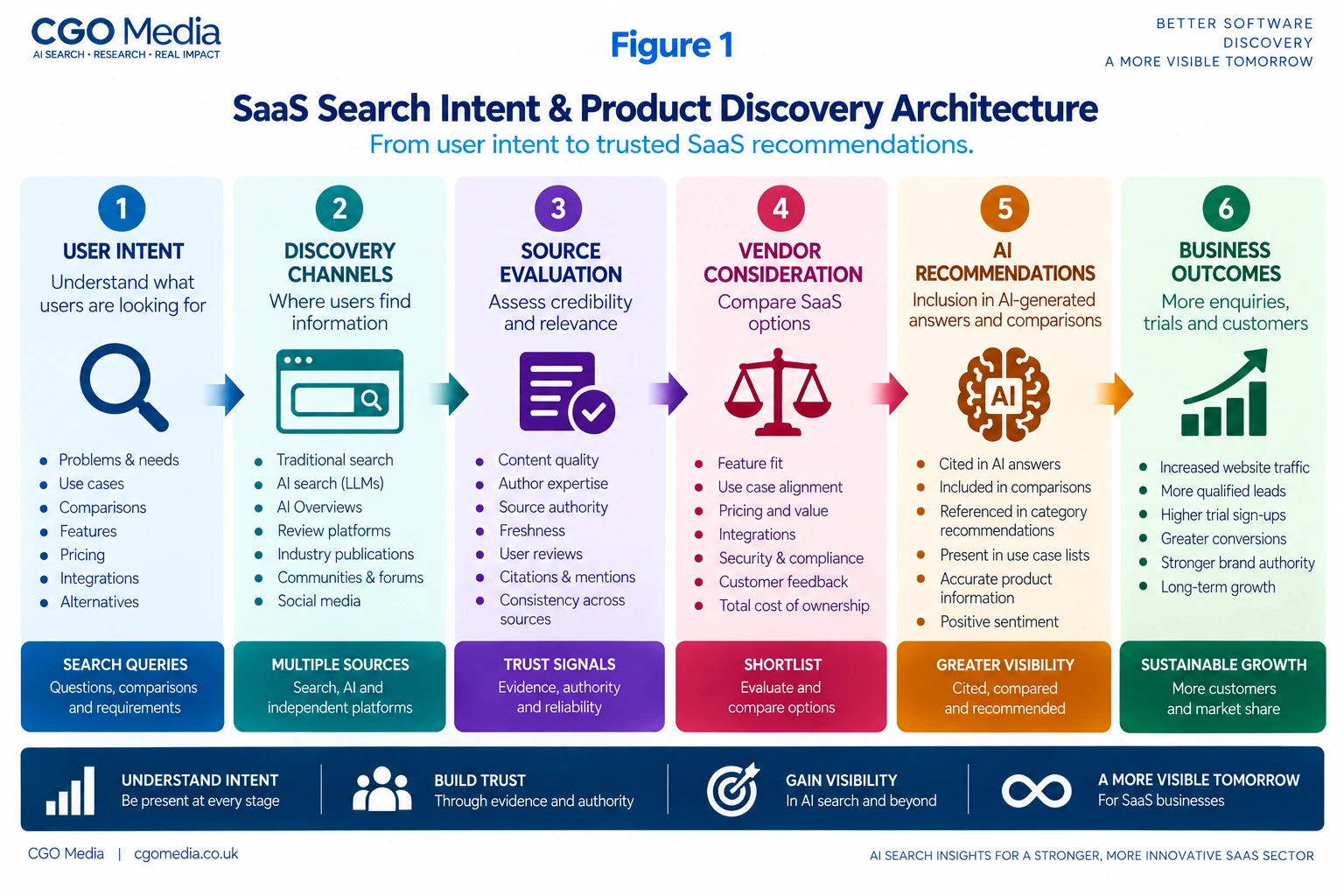
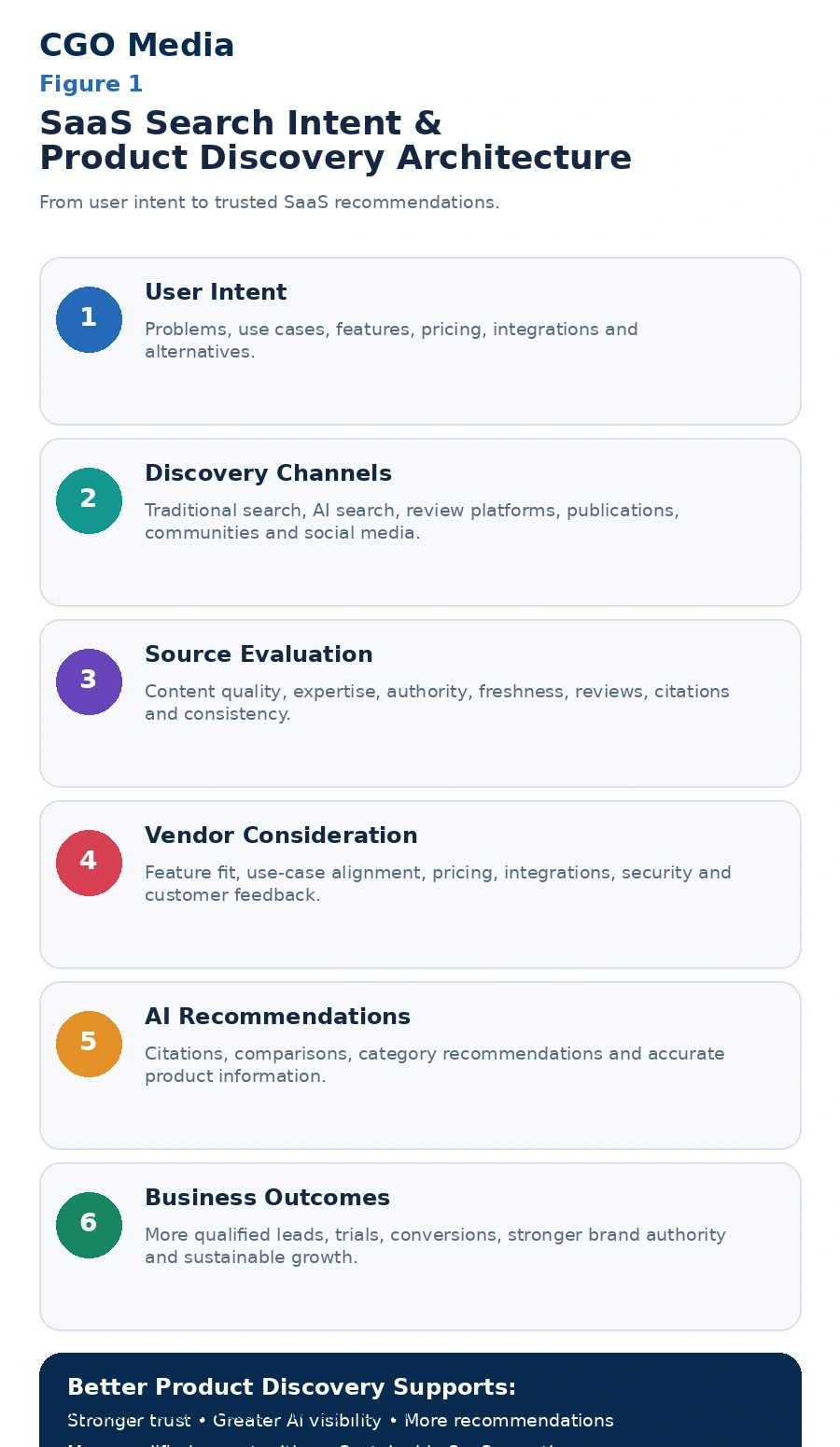
50. SaaS Search Intent & Product Discovery Architecture
The core SaaS discovery journey can be represented as:
Problem → Category → Feature → Use Case → Industry → Comparison → Vendor → Trial or Demo
Problem
The buyer identifies an operational, technical or commercial challenge that may require software.
Category
The buyer determines which type of software may address the problem.
Feature
Specific capabilities become important requirements or evaluation filters.
Use Case
The buyer evaluates whether the product supports the relevant workflow or business situation.
Industry
Sector-specific regulation, processes, integrations and operational requirements influence product fit.
Comparison
The buyer evaluates alternatives according to features, pricing, integrations, evidence and commercial suitability.
Vendor
Individual SaaS providers are investigated directly for product, trust and implementation evidence.
Trial or Demo
The buyer moves into direct product or commercial evaluation through self-service adoption, guided demonstration or sales engagement.
51. The Strategic Implication
SaaS organisations should build search architecture around how buyers actually discover and evaluate software.
The strongest system connects:
- Problem discovery
- Category authority
- Feature evidence
- Use-case relevance
- Industry context
- Comparison
- Product understanding
- Commercial engagement
The objective is not simply to increase rankings.
It is to create a connected discovery environment in which buyers and AI-assisted systems can understand what the product does, determine where it fits and progress toward appropriate evaluation with sufficient evidence and minimal unnecessary friction.
52. SaaS Entity Authority
SaaS visibility becomes stronger when the relationships between the organisation, product, modules, integrations, leadership, customers and markets are represented clearly.
Entity authority helps search engines, AI-assisted systems and buyers understand what the company is, what it owns and how its products relate to the wider software ecosystem.
53. Company-to-Product Relationships
It should be possible to determine:
- Which company owns the product
- Whether the product is standalone or part of a wider suite
- Whether the organisation operates multiple SaaS products
- Whether acquired products retain separate branding
These relationships become particularly important after acquisitions, rebrands or product consolidation.
54. Product-to-Module Relationships
Complex SaaS platforms can contain multiple:
- Modules
- Applications
- Workspaces
- Product areas
These relationships should be explicit so individual capabilities can be understood within the wider platform.
55. Module Clarity Reduces Product Ambiguity
A buyer should not need to infer whether a capability belongs to:
- The core product
- An optional module
- An enterprise package
- A separate product
Clear module architecture improves evaluation and commercial qualification.
56. Product-to-Feature Relationships
Feature pages should connect explicitly with the relevant product or module rather than operating as isolated marketing pages.
A useful relationship is:
Product → Module → Feature → Workflow → Outcome
57. Product-to-Integration Relationships
Integrations should be treated as part of the wider SaaS knowledge architecture.
Relevant relationships can include:
- Product → Integration
- Feature → Integration
- Workflow → Integration
- Industry → Integration
58. Product-to-Industry Relationships
Industry positioning should explain why the software is relevant to a sector rather than simply attaching an industry name to generic product copy.
Useful sector evidence can include:
- Workflows
- Regulation
- Customer examples
- Integrations
- Operational constraints
59. Product-to-Role Relationships
Different stakeholders can require different evidence from the same SaaS product.
Relevant audiences may include:
- Finance leaders
- Marketing teams
- HR teams
- IT teams
- Operations teams
- Security teams
Role-specific information should remain connected to one consistent product truth.
60. Founder and Leadership Authority
Founder and executive visibility can strengthen organisational authority where leadership demonstrates genuine:
- Industry experience
- Research
- Technical knowledge
- Professional contribution
Leadership authority should reinforce product and market credibility rather than exist as biography alone.
61. Product Expert Authority
Subject specialists can strengthen SaaS evidence through:
- Technical documentation
- Product guides
- Research
- Webinars
- Industry commentary
- Implementation guidance
Named expert contribution can connect the organisation with specialist knowledge beyond general marketing content.
62. Documentation Is Authority Infrastructure
Documentation provides factual evidence about how the software operates.
It can support buyer and machine understanding of:
- Features
- APIs
- Integrations
- Configuration
- Security
- Implementation
For technically evaluated SaaS products, documentation can become one of the strongest authority assets.
63. Documentation Should Connect with Commercial Pages
Documentation and marketing content should reinforce rather than contradict one another.
A product page may establish the commercial proposition while documentation provides deeper evidence explaining how the capability works.
64. Documentation Conflict Creates Trust Risk
Buyer confidence can weaken where:
- A product page claims a feature exists
- Documentation suggests otherwise
- An older help article describes a retired workflow
Product and documentation governance should therefore be coordinated.
65. Mature SaaS Feature Architecture
A connected feature architecture can be represented as:
Product → Feature → Workflow → Integration → Use Case → Customer Evidence
This structure connects product capability with buyer context and proof.
66. Core Feature Authority
Priority features should contain enough evidence to demonstrate:
- Functionality
- Use case
- Limitations
- Configuration
- Relevant integrations
Features used as buyer filters deserve stronger evidence than minor supporting functionality.
67. Supporting Feature Authority
Secondary capabilities should still be represented clearly where they influence:
- Product fit
- Comparison
- Workflow design
- Plan selection
Not every supporting feature requires the same depth as a strategic differentiator.
68. Feature Differentiation
Feature content becomes more commercially useful when it explains how the capability differs from alternative approaches.
Useful differentiation can involve:
- Workflow design
- Automation depth
- Configuration
- Integrations
- User control
Unsupported claims of superiority provide limited comparison value.
69. Integration Search Demand Can Carry High Intent
Integration searches often indicate that buyers already know an important part of their technology environment.
A requirement such as:
CRM software that integrates with Xero.
can be closer to vendor evaluation than a broad category query.
70. Integration Pages Can Become Search Landing Assets
Dedicated integration pages can support queries involving:
- Product A integration with Product B
- CRM with accounting software integration
- Software that integrates with Slack
- Platform with Salesforce integration
These pages should also provide useful product evidence rather than exist only for keyword targeting.
71. Integration Evidence Quality Matters
Vague claims such as:
Connect seamlessly with your favourite tools.
provide limited technical value.
A stronger integration page should explain:
- What connects
- What data moves
- Which triggers or actions exist
- Whether the integration is native
- Whether middleware is required
- Which plans support it
72. Integration Status Should Be Current
SaaS integrations can change quickly.
A product may:
- Add an integration
- Remove an integration
- Change API behaviour
- Move functionality between plans
Outdated integration pages can therefore create direct buyer-selection problems.
73. API Authority Matters for Technical Buyers
API capability can become a significant selection factor for:
- Developers
- IT teams
- Enterprise buyers
- Integration-heavy organisations
Strong API evidence can make a SaaS product easier to validate technically.
74. Strong API Evidence Can Include
- API documentation
- Authentication methods
- Endpoints
- Rate limits
- Webhooks
- Developer resources
This information helps buyers assess whether the product can fit their wider technical architecture.
75. Developer Experience Can Influence Product Authority
Technical evaluators may consider how easy it is to:
- Understand the API
- Authenticate
- Build an integration
- Troubleshoot
- Access examples
Developer experience can therefore contribute directly to product-selection confidence.
76. SaaS Marketplace Authority
Listings within recognised app marketplaces can reinforce product relationships and provide external confirmation of integration compatibility.
Marketplace listings can also create additional discovery paths outside the provider’s website.
77. Marketplace Information Should Match Product Reality
Marketplace descriptions should remain aligned with:
- Current features
- Integration status
- Product naming
- Availability
Outdated marketplace information can create source conflict.
78. Comparison Search Is a Major SaaS Intent Layer
Software buyers frequently use comparison searches because products can appear similar at category level.
Comparison research helps the buyer determine where important differences exist.
79. Direct Competitor Comparisons
Direct comparison content can address:
- Features
- Pricing
- Integrations
- Target customer
- Implementation
- Support
The most useful comparisons recognise meaningful strengths and limitations rather than presenting every dimension as a vendor victory.
80. Alternative Pages
“Alternatives to” searches can attract buyers already considering another provider.
These pages can be commercially valuable when they provide genuine evidence explaining:
- Who the alternative suits
- Where capabilities differ
- Which trade-offs matter
81. Alternative Pages Should Avoid Artificial Comparison
Weak alternative pages often:
- Misrepresent competitors
- Use outdated pricing
- Ignore competitor strengths
- Make unsupported superiority claims
This can reduce rather than increase buyer trust.
82. Category Comparison Pages
Broader comparison pages can help buyers evaluate several products within the same market.
Useful category comparisons may organise options according to:
- Buyer size
- Use case
- Feature requirements
- Price model
- Implementation complexity
83. Comparison Accuracy Requires Governance
Competitor pricing, features and capabilities can change frequently.
Comparison content should therefore have clear:
- Ownership
- Review dates
- Update processes
Outdated comparison information can damage provider credibility.
84. AI Comparison Changes the Competitive Environment
AI assistants can compare several vendors without requiring the buyer to visit individual comparison pages first.
This creates an additional comparison layer before direct website interaction.
85. AI Comparison Can Combine Multiple Requirements
A buyer might ask:
Compare the leading project management platforms for a UK agency with 30 employees, client portals and time tracking.
This requires interpretation of:
- Category
- Company size
- Geography
- Workflow
- Feature requirements
within one comparative interaction.
86. SaaS Evidence Must Support Multi-Attribute Comparison
AI-assisted comparison increases the importance of explicit evidence around:
- Features
- Integrations
- Pricing
- Company fit
- Industry relevance
Missing or ambiguous information can affect shortlist inclusion before the buyer visits the provider.
87. Customer Evidence Bridges Claims and Product Use
Customer evidence provides an important connection between provider statements and demonstrated implementation.
It helps buyers determine whether the software has solved similar problems in real organisations.
88. Strong SaaS Case Studies
A strong case study can include:
- Customer profile
- Initial problem
- Implementation
- Features used
- Integrations used
- Outcome
This gives the evidence enough context to be useful during vendor evaluation.
89. Customer Outcome Evidence
Where credible measurement exists, outcomes can include:
- Time saved
- Cost reduction
- Revenue growth
- Conversion improvement
- Reduced manual work
- Improved reporting
Outcome claims should remain properly contextualised.
90. Customer Evidence Should Be Specific
Statements such as:
Customers love our platform.
provide substantially less evidence than identifiable customer stories explaining the situation, product usage and outcome.
91. Customer Evidence Can Support Multiple Authority Paths
The same customer story may strengthen:
- Feature authority
- Industry authority
- Use-case authority
- Integration authority
Customer evidence should therefore be connected intelligently across the wider content architecture.
92. Review Platform Authority
Software review platforms can influence discovery and comparison through:
- Customer ratings
- Written reviews
- Category placement
- Feature comparisons
- Alternative suggestions
These platforms form part of the external SaaS evidence environment.
93. Review Volume Is Not the Only Signal
Buyers may also consider:
- Review recency
- Reviewer relevance
- Repeated strengths
- Repeated weaknesses
- Vendor response quality
A large review count alone does not provide a complete picture of customer experience.
94. Review Patterns Can Reveal Product Strengths
Recurring positive themes can provide evidence around:
- Usability
- Support
- Implementation
- Product value
These recurring themes can help organisations understand which strengths customers actually recognise.
95. Review Patterns Can Also Reveal Weaknesses
Recurring negative themes can expose issues involving:
- Reliability
- Pricing
- Support
- Product complexity
- Missing features
These patterns should inform product and customer-experience strategy rather than being treated only as reputation problems.
96. Independent Analyst Authority
Analyst firms, specialist publications and industry researchers can influence provider consideration in some SaaS categories.
The strategic value of analyst authority varies according to:
- Market
- Buyer type
- Product category
- Purchase complexity
97. Analyst Recognition Is Not Universal
Some SaaS categories depend heavily on analyst and research environments.
Others are influenced more strongly by:
- Peer communities
- Review platforms
- Product-led adoption
Authority investment should reflect how the actual market evaluates software.
98. Partner Authority
Technology, implementation and integration partners can reinforce a SaaS product’s role within a wider ecosystem.
Partner evidence can support:
- Integration credibility
- Implementation capacity
- Market reach
- Technical compatibility
99. Partnership Claims Should Be Verifiable
Important partnership relationships should be sufficiently clear and current.
Legacy partnerships or outdated badges can create misleading evidence if the relationship no longer exists.
100. Community Authority
Professional communities can strongly influence SaaS perception through peer discussion of:
- Product reliability
- Implementation
- Support
- Pricing
- Alternatives
- Real-world limitations
This evidence exists outside the provider’s controlled marketing environment.
101. Community Evidence Can Be Highly Contextual
Community experiences may depend on:
- Product version
- Plan
- Customer size
- Implementation quality
- Time period
Individual comments should therefore not automatically be treated as representative of the whole customer base.
102. Media Authority
Relevant technology and industry publications can reinforce SaaS authority through:
- Product analysis
- Founder interviews
- Research coverage
- Market commentary
- Customer stories
Media value increases when coverage connects directly with product expertise or market relevance.
103. Relevant Media Authority Is Stronger Than Generic Publicity
A specialist publication closely connected to the product category may provide greater decision value than unrelated high-volume coverage.
Authority quality should therefore be evaluated alongside reach.
104. Research Authority
Original research can give SaaS organisations an authority asset beyond ordinary product marketing.
Research topics can include:
- Industry benchmarks
- Workflow trends
- Productivity data
- Customer behaviour
- Technology adoption
- Market change
105. Research Can Strengthen Category Association
High-quality research can connect a SaaS provider with:
- Industry expertise
- Market understanding
- Technical competence
- Original evidence
This can support both external authority and future citation opportunities.
106. Research Requires Methodological Credibility
Useful research should explain relevant aspects of:
- Data source
- Sample
- Method
- Time period
- Limitations
Transparent methodology helps external audiences judge whether the findings support the conclusions presented.
107. External Validation Reduces Vendor Uncertainty
A SaaS provider becomes easier to evaluate when important product and market claims are reinforced across multiple independent environments.
A useful relationship is:
Vendor Evidence + Customer Evidence + Independent Validation → Greater Buyer Confidence
108. External Validation Should Be Relevant
Recognition from a source closely connected with the product’s market may provide greater strategic value than large quantities of unrelated publicity.
External authority should therefore be evaluated by:
- Relevance
- Credibility
- Independence
- Context
109. SaaS Evidence Should Be Consistent Across Sources
Critical product information should remain materially aligned across:
- Vendor website
- Documentation
- App marketplaces
- Review platforms
- Partner websites
- External publications
Exact wording is unnecessary, but important facts should not conflict.
110. Product Information Can Decay Quickly
SaaS products evolve continuously.
Over time:
- Features are added
- Pricing changes
- Integrations are removed
- Packaging evolves
- Products are renamed
This makes information freshness a strategic issue.
111. Information Freshness Affects Search and AI Representation
Outdated product information can affect:
- Buyer trust
- Comparison accuracy
- Search relevance
- AI representation
High-change information therefore requires active governance.
112. SaaS Evidence Requires Ownership
Important information should have clear responsibility across teams such as:
- Product
- Marketing
- Engineering
- Security
- Customer success
Without ownership, conflicting or outdated information can remain public for long periods.
113. Evidence Relationships Matter More Than Content Volume
A large collection of disconnected pages does not automatically create strong SaaS authority.
The strategic value comes from connecting:
- Product capability
- Buyer need
- Technical evidence
- Customer evidence
- External validation
114. The Fifth SaaS Search Authority Principle
SaaS entity authority depends on explicit relationships between company, product, modules, features, integrations, industries, customers and experts because disconnected product information creates weaker discovery and evaluation signals.
115. The Sixth SaaS Search Authority Principle
Documentation, feature pages, integration evidence and API resources should operate as connected authority infrastructure rather than separate marketing and technical environments.
116. The Seventh SaaS Search Authority Principle
Customer reviews, partner relationships, media coverage, research and community discussion provide independent evidence that can reinforce SaaS authority when they remain relevant to the product and buyer context.
117. The Eighth SaaS Search Authority Principle
SaaS product information requires active freshness governance because features, integrations, pricing and packaging can change quickly while outdated evidence continues to influence search, comparison and AI-assisted discovery.
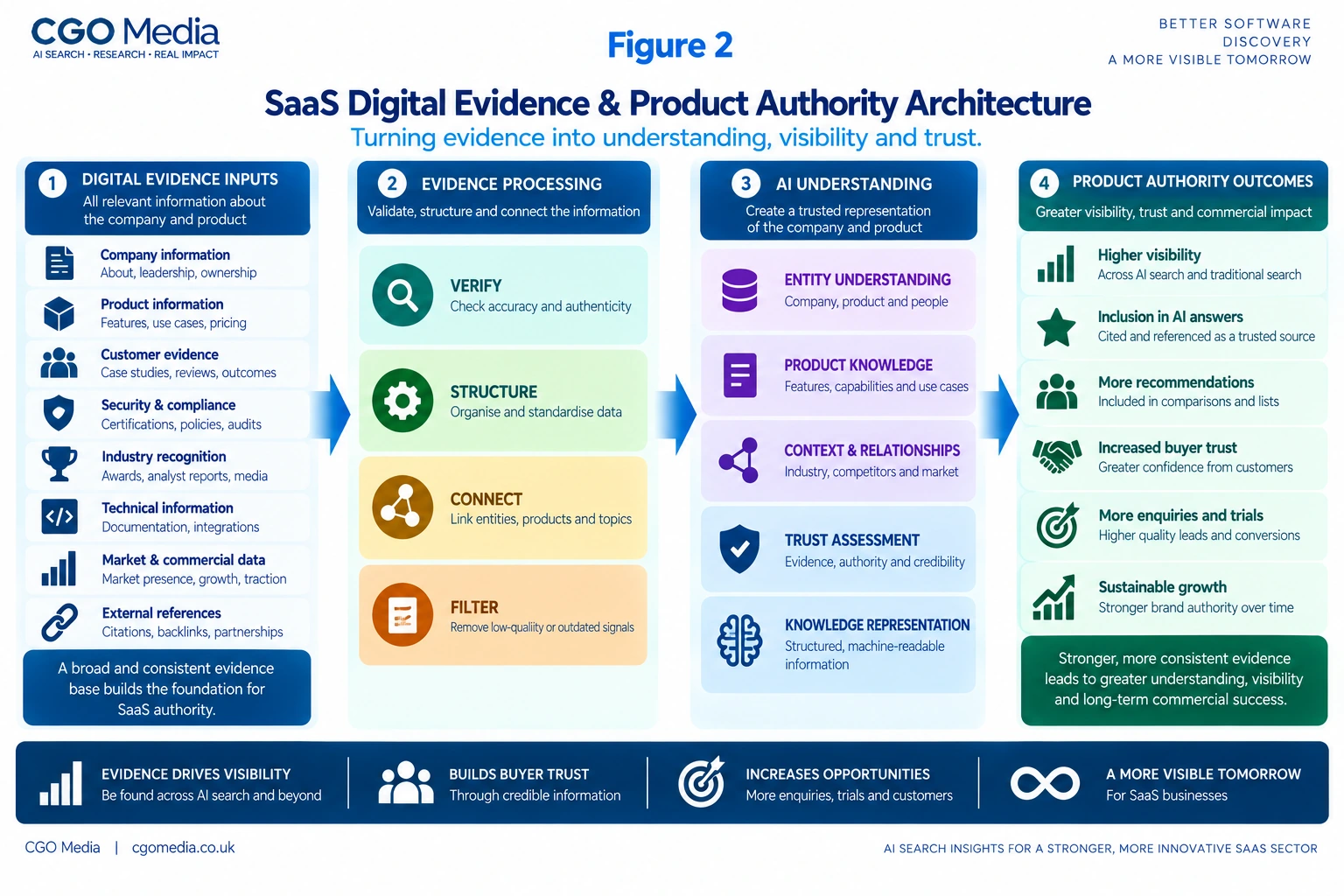
118. SaaS Digital Evidence & Product Authority Architecture
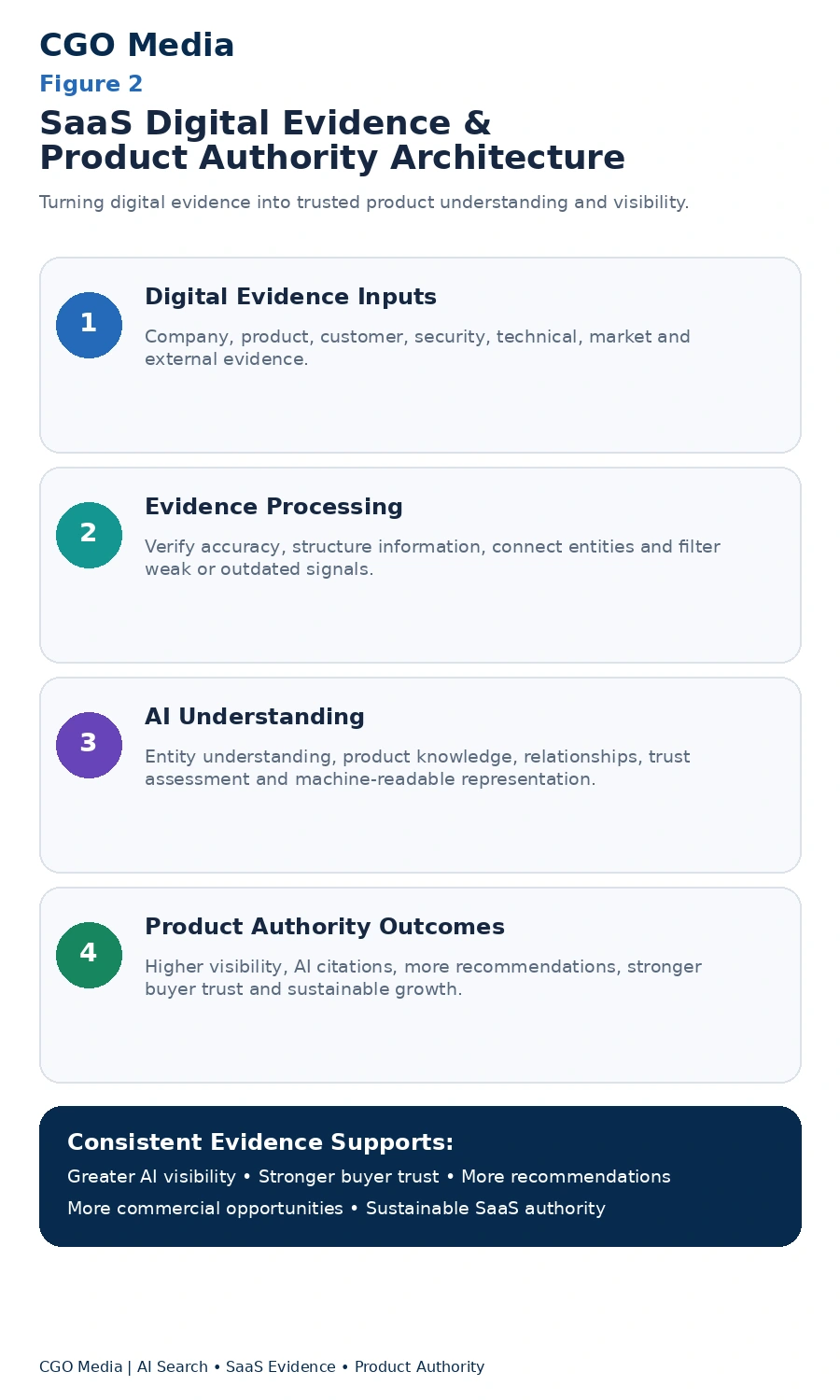
The connected SaaS evidence environment can be represented as:
Provider → Product → Feature → Integration → Use Case → Industry → Customer → Review → External Validation
Provider
Establishes the organisation responsible for developing, supporting and commercialising the software.
Product
Defines the software platform, application or suite being evaluated.
Feature
Provides evidence of the specific capabilities buyers use to determine product fit.
Integration
Connects the product with the wider technology environment in which customers operate.
Use Case
Explains how product capabilities support a real operational requirement or workflow.
Industry
Provides sector-specific context around regulation, workflows, customer requirements and implementation.
Customer
Demonstrates practical product use and outcomes within real organisations.
Review
Provides external customer experience and comparative evidence outside the provider’s controlled website.
External Validation
Reinforces provider and product authority through credible partners, publications, analysts, communities, research and other relevant independent sources.
119. The Strategic Implication
SaaS search authority should be built as an evidence architecture rather than a collection of isolated landing pages.
The strongest environment connects:
- Organisation identity
- Product architecture
- Feature evidence
- Integrations
- Use cases
- Industry relevance
- Customer proof
- Independent validation
This connected architecture helps buyers and AI-assisted systems move from discovering the provider to understanding the product, validating its capabilities and determining whether it belongs within a credible consideration set.
120. SaaS Trust Is a Search and Selection Requirement
Software buyers do not evaluate visibility in isolation.
They also need sufficient confidence to allow a SaaS provider to become part of:
- Business workflows
- Internal systems
- Customer processes
- Data infrastructure
- Long-term operations
Search visibility therefore becomes commercially valuable only when it is supported by enough evidence to reduce adoption risk.
121. Product Trust Is Multi-Dimensional
SaaS trust can depend on several connected factors:
- Security
- Privacy
- Reliability
- Customer evidence
- Implementation credibility
- Support quality
- Commercial transparency
- External validation
Weakness in one decision-critical area can outweigh strength elsewhere.
122. Security Authority
Security becomes particularly important where the software handles:
- Commercially sensitive information
- Personal data
- Employee data
- Regulated information
- Mission-critical workflows
For many enterprise buyers, security is an eligibility requirement rather than a secondary preference.
123. Security Evidence Should Be Explicit
Relevant evidence can include information about:
- Security architecture
- Encryption
- Access controls
- Authentication
- Data hosting
- Incident response
Important security claims should be specific enough for buyers to understand what is actually supported.
124. Dedicated Security Resources Can Reduce Evaluation Friction
High-consideration SaaS providers can benefit from a dedicated security or trust environment that brings together decision-critical evidence.
This can help both technical and non-technical buyers locate the information required for vendor evaluation.
125. Security Claims Should Be Properly Qualified
Statements such as:
- Enterprise-grade security
- Highly secure
- Bank-level protection
provide limited evaluation value without supporting evidence.
The stronger the security claim, the stronger the supporting proof should generally become.
126. Independent Security Assurance Can Strengthen Confidence
Where relevant, certifications, audits or other external assurance can provide evidence beyond the provider’s own claims.
The strategic value depends on whether the assurance is:
- Current
- Relevant
- Applicable to the product or service being evaluated
127. Security Evidence Must Remain Current
Security controls, infrastructure and certification status can change.
Outdated security evidence can therefore create direct trust risk.
High-impact security information should have clear ownership and review cycles.
128. Privacy Authority
Privacy evidence becomes important wherever customer, employee or other personal information is processed through the platform.
Buyers may need to understand:
- What information is processed
- Why it is processed
- Where it is stored
- How it is retained
- How it can be deleted
129. Data Processing Clarity
Decision-makers may also need information about:
- Subprocessors
- Data transfers
- Hosting locations
- Retention periods
- Deletion processes
Ambiguity can create unnecessary procurement and compliance friction.
130. Regional Privacy Requirements Affect SaaS Evaluation
For UK and European buyers, data protection and processing information can become part of early provider evaluation.
Regional requirements can influence:
- Data-location expectations
- Contracting
- Subprocessor review
- Internal governance approval
131. Enterprise SaaS Trust Has a Higher Evidence Threshold
Larger buyers often require deeper validation around:
- Security
- Privacy
- Procurement
- Business continuity
- Governance
- Contractual terms
The trust threshold generally increases as organisational risk and dependency increase.
132. Reliability Authority
A SaaS platform becomes commercially valuable only when buyers believe it can remain sufficiently available and dependable.
Reliability evidence can therefore influence both technical evaluation and long-term vendor confidence.
133. Uptime Evidence
Where relevant, providers can support availability claims through:
- Status pages
- Service history
- Availability reporting
- Incident transparency
Evidence should be sufficiently clear to distinguish measured performance from generic reliability claims.
134. Performance Evidence
Performance can matter particularly where customers depend on:
- Real-time workflows
- Large datasets
- High transaction volumes
- Distributed teams
Performance claims should be supported by evidence appropriate to the workloads and environments being discussed.
135. Business Continuity Evidence
Larger buyers may also evaluate:
- Backup procedures
- Disaster recovery
- Operational resilience
- Service continuity
These factors become more important as the cost of product failure increases.
136. Support Authority
Support quality can become a significant differentiator where:
- Implementation is complex
- Workflows are business-critical
- Users need ongoing assistance
- Technical integrations require maintenance
137. Support Model Clarity
Buyers may need to understand:
- Support channels
- Support hours
- Response expectations
- Plan restrictions
- Dedicated account support
Support information should align with actual contractual and operational capability.
138. Knowledge Base Authority
A strong knowledge base can demonstrate investment in:
- User education
- Troubleshooting
- Implementation support
- Product understanding
It can also reduce dependency on direct support for common tasks.
139. Support Content Can Become Search Authority
Useful help and knowledge content can attract discovery from existing and prospective users searching for specific:
- Features
- Workflows
- Integrations
- Technical problems
Support content therefore contributes to both customer experience and the wider product information environment.
140. Onboarding Authority
Onboarding evidence reduces uncertainty around how quickly a customer can move from purchase to productive product use.
Buyers may need to understand:
- Initial setup
- Configuration
- Data migration
- User training
- Implementation support
141. Implementation Complexity Varies Across SaaS Models
Some SaaS products can be deployed in minutes.
Others may require:
- Configuration
- Data migration
- Integration
- Training
- Professional services
Search and product content should reflect the real implementation model.
142. Implementation Evidence Reduces Uncertainty
Providers can strengthen buyer confidence by explaining:
- Implementation stages
- Typical responsibilities
- Migration requirements
- Integration requirements
- Expected customer involvement
Implementation clarity becomes particularly important in complex or enterprise purchases.
143. Time-to-Value Evidence
Where credible data exists, SaaS providers can explain how quickly customers typically reach:
- Product adoption
- Workflow completion
- Operational benefit
- Business outcome
Time-to-value claims should remain contextual and avoid implying universal results where outcomes vary substantially.
144. Implementation Evidence Should Match Customer Complexity
A small self-service customer and a multinational enterprise can have very different implementation experiences.
Evidence should therefore be segmented where necessary according to:
- Company size
- Technical environment
- Data complexity
- Number of users
145. Pricing Transparency Is a Trust Factor
Pricing is one of the strongest commercial filters in SaaS selection.
Buyers need enough information to determine whether the software is broadly compatible with:
- Budget
- Usage model
- Company size
- Growth expectations
146. Pricing Model Clarity
SaaS pricing can be based on:
- Users
- Usage
- Transactions
- Contacts
- Storage
- Modules
- Enterprise contracts
The pricing architecture should make the commercial logic understandable.
147. Feature-to-Plan Relationships Matter
Where pricing information is public, buyers should be able to understand which:
- Features
- Integrations
- Limits
- Support levels
apply to each package or plan.
This reduces ambiguity during comparison.
148. Hidden Costs Can Weaken Buyer Trust
Commercial confidence can deteriorate when significant charges appear late in the evaluation process.
Potential areas include:
- Implementation fees
- Migration fees
- Premium support
- Additional integrations
- Usage overages
149. Enterprise Pricing Can Still Be Transparent
An enterprise SaaS provider does not necessarily need to publish an exact fixed price.
However, it can still clarify:
- Commercial model
- Main pricing variables
- Contract structure
- Implementation considerations
This gives buyers useful commercial context before formal negotiation.
150. Pricing Evidence Should Remain Current
Outdated pricing pages, review listings or comparison pages can create direct buyer confusion.
Pricing information should therefore be treated as high-change commercial evidence requiring regular review.
151. Free Trials Reduce Product Uncertainty
A free trial can allow prospective customers to evaluate the product directly.
Buyers can test:
- Ease of use
- Feature suitability
- Workflow compatibility
- Initial implementation effort
This moves trust from marketing evidence toward direct product experience.
152. Trial Experience Is Part of Product Authority
If the trial experience differs significantly from the promise made during search and marketing discovery, trust can deteriorate rapidly.
The product experience should reinforce the expectations created by public information.
153. Freemium Can Create Product-Led Authority
Freemium SaaS products can generate:
- Large user communities
- Peer discussion
- Product familiarity
- Organic recommendation
This can create authority beyond conventional marketing channels.
154. Free-User Scale Does Not Automatically Create Enterprise Trust
A product can have millions of free users while still requiring stronger enterprise evidence around:
- Security
- Governance
- Support
- Scalability
- Procurement
Product-led popularity and enterprise readiness should therefore be distinguished.
155. Product Demos Reduce Uncertainty for Complex SaaS
For more complex software, guided demonstrations can help buyers understand:
- Workflow
- Configuration
- Feature depth
- Integration possibilities
- Product fit
156. Demo Content Should Reflect Buyer Intent
A demo pathway can become more relevant when it reflects:
- Company size
- Industry
- Use case
- Technical requirements
- Buying role
Generic product tours may provide less value for complex buying groups.
157. Trial and Demo Paths Represent Different Buying Models
Self-service SaaS may optimise around:
Search → Signup → Activation → Product Value → Paid Conversion
Enterprise SaaS may instead follow:
Search → Research → Demo → Technical Evaluation → Procurement → Contract
SEO should support the real commercial model rather than one universal funnel.
158. Trial-to-Paid Evidence Can Improve Search Strategy
Internal product-led conversion data can help identify which:
- Features
- Use cases
- Industries
- Customer profiles
create stronger purchase intent.
This can inform future search and content investment.
159. SaaS Provider Selection Is Multi-Factor
Once the buyer has identified a small group of potential vendors, the decision is no longer a search-ranking contest.
Selection becomes a comparison across product, technical, trust and commercial dimensions.
160. Category Fit Comes First
The buyer needs to determine whether the software genuinely:
- Belongs in the required category
- Addresses the core problem
- Matches the intended workflow
A product that fails this basic fit test should not progress simply because it has strong visibility.
161. Feature Fit Can Operate as a Hard Filter
Some capabilities are mandatory.
A SaaS provider can perform strongly in search and still be removed from consideration if it lacks a critical feature.
Feature visibility should therefore reflect real product capability.
162. Integration Fit
Integration requirements can determine whether the product fits the buyer’s existing technology environment.
A missing mandatory integration can eliminate an otherwise suitable platform.
163. Security Fit
Security requirements may remove a product from consideration before:
- Pricing
- Usability
- Feature preference
are evaluated further.
This makes security evidence particularly important in higher-risk buying scenarios.
164. Compliance Fit
Regulated or privacy-sensitive buyers may require evidence that the product supports their legal and governance obligations.
Compliance fit should be represented carefully and without overstating what the SaaS provider alone can guarantee.
165. Pricing Fit
A technically strong product can still be commercially unsuitable.
Pricing fit depends on:
- Budget
- Usage profile
- Company size
- Growth expectations
- Total cost
166. Implementation Fit
Implementation effort can influence selection where the buyer has:
- Limited technical resources
- A tight deployment timeline
- Complex migration requirements
- Multiple integrations
Implementation complexity should therefore be part of product positioning.
167. Scalability Fit
Buyers may need confidence that the platform can support future growth involving:
- More users
- More data
- More transactions
- Additional business units
- International expansion
Scalability claims should be supported by appropriate product and technical evidence.
168. User Experience Fit
Ease of use can influence:
- Adoption
- Training requirements
- Implementation speed
- Long-term utilisation
Usability can therefore become a significant comparative factor even where technical capabilities are similar.
169. Support Fit
Different buyers require different levels of support.
A startup may accept self-service assistance while an enterprise may require:
- Dedicated support
- Defined response expectations
- Implementation assistance
- Account management
170. Vendor Stability
SaaS adoption can create long-term operational dependency.
Buyers may therefore consider whether the provider appears capable of:
- Maintaining the product
- Supporting customers
- Continuing development
- Sustaining the relationship
171. Roadmap Confidence
Some buyers evaluate whether the provider’s product direction appears compatible with their future requirements.
Roadmap information should be communicated carefully because future plans can change.
172. Ecosystem Fit
A wider ecosystem can reduce adoption risk through:
- Integrations
- Implementation partners
- Developers
- Community resources
- Training
Ecosystem strength can become an important differentiator in mature SaaS categories.
173. Customer Fit Evidence
Buyers often look for evidence from organisations similar in:
- Industry
- Company size
- Use case
- Geography
- Technology environment
Similarity can make customer proof more relevant to the selection decision.
174. Peer Validation
Reviews and professional recommendations provide evidence outside the provider’s controlled marketing environment.
Peer validation can influence perceptions around:
- Usability
- Support
- Implementation
- Reliability
- Value
175. Provider Selection Is a Risk-Reduction Process
SaaS buyers progressively reduce uncertainty around:
- Problem fit
- Feature fit
- Technical fit
- Security
- Cost
- Implementation
- Vendor reliability
The role of search authority is to make the evidence required for this risk reduction easier to discover and evaluate.
176. Product Evidence Reduces Capability Uncertainty
Product evidence helps establish:
- What the software does
- Which features exist
- Which workflows are supported
- Which limitations apply
177. Technical Evidence Reduces Implementation Uncertainty
Technical evidence can establish:
- Architecture
- Integrations
- API capability
- Configuration
- Performance
178. Security and Privacy Evidence Reduce Risk Uncertainty
Security and privacy information helps buyers evaluate whether the SaaS platform is suitable for the data, users and workflows involved.
179. Customer Evidence Reduces Outcome Uncertainty
Customer stories show whether the product has been implemented successfully in real organisations and whether relevant outcomes have been achieved.
180. Reviews Reduce Experience Uncertainty
External reviews provide additional evidence about:
- Usability
- Support
- Product limitations
- Customer experience
Review evidence should be interpreted as one part of the wider trust environment.
181. External Validation Reduces Vendor Uncertainty
Relevant external authority can provide additional confidence that the SaaS provider is established and credible within its market.
This can include:
- Partners
- Independent publications
- Research
- Professional recognition
182. Commercial Confidence Emerges from Evidence Convergence
No single evidence type normally determines the entire SaaS decision.
Commercial confidence becomes stronger when product, technical, security, customer and external evidence reinforce one another.
183. The Ninth SaaS Search Authority Principle
SaaS trust should be treated as a multi-dimensional evidence system combining security, privacy, reliability, implementation, support, customer proof, commercial transparency and independent validation.
184. The Tenth SaaS Search Authority Principle
Security, privacy and reliability information should be governed as decision-critical product evidence because these factors can remove a SaaS provider from consideration before feature preferences or pricing are evaluated.
185. The Eleventh SaaS Search Authority Principle
Onboarding, implementation, pricing, trials and demonstrations should be treated as part of search authority because they reduce uncertainty at the point where discovery becomes direct product evaluation.
186. The Twelfth SaaS Search Authority Principle
SaaS provider selection is fundamentally a process of reducing uncertainty across product fit, technical fit, security, commercial suitability, implementation and vendor reliability.
187. SaaS Provider Trust & Evaluation Evidence Stack
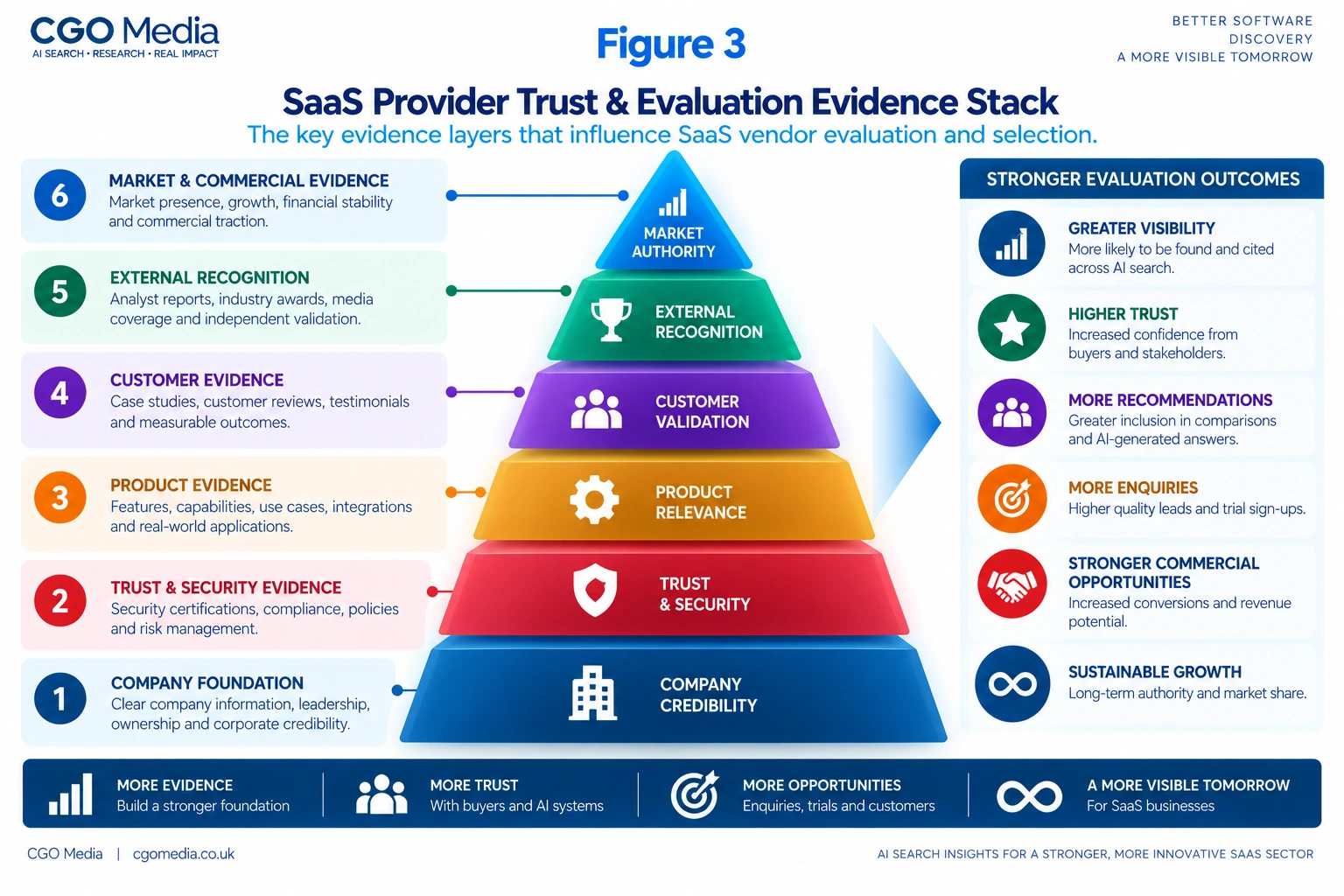
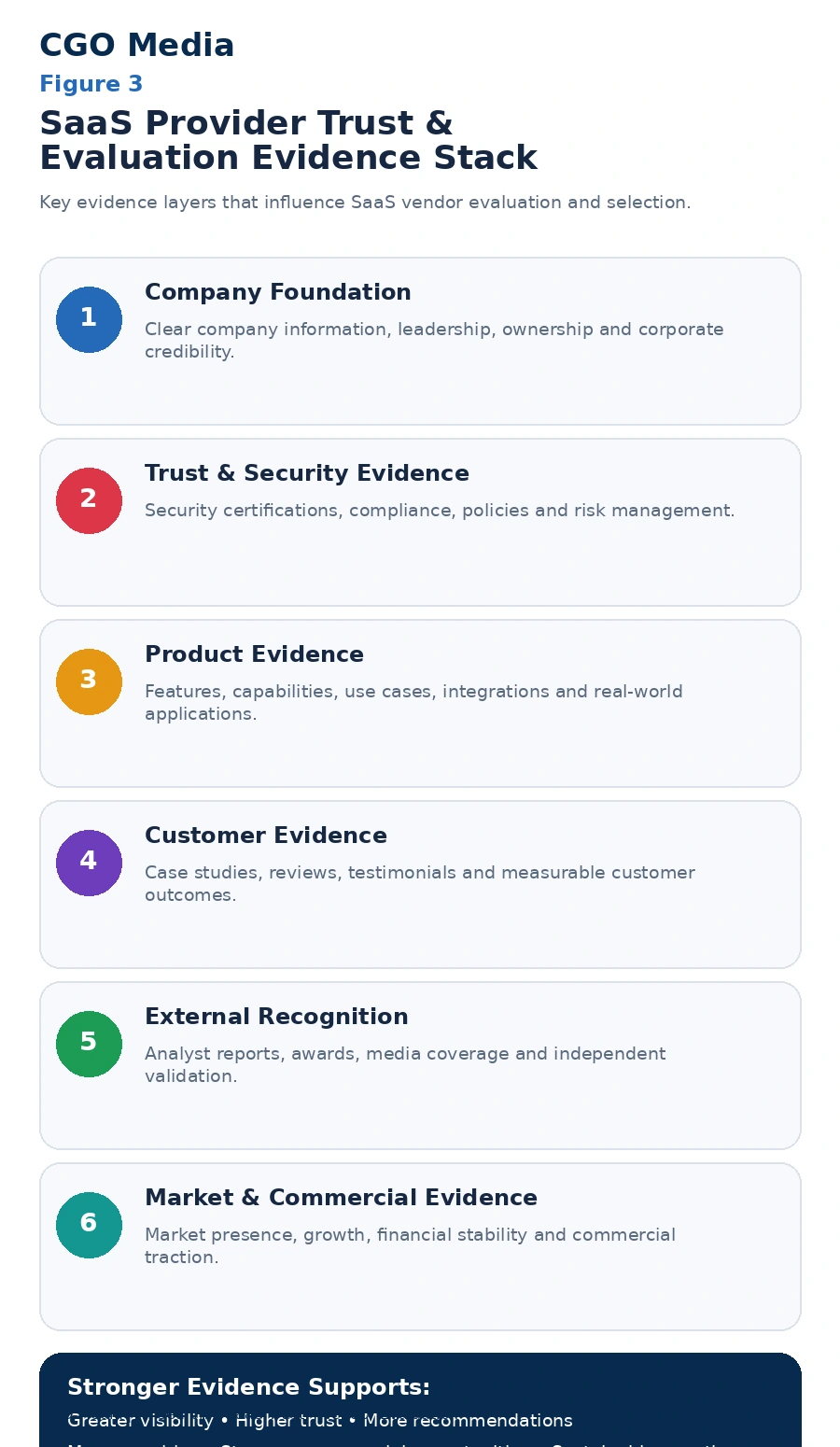
The combined trust environment can be represented as:
Product Evidence → Technical Evidence → Security & Privacy → Customer Evidence → Reviews → External Validation → Commercial Confidence
Product Evidence
Establishes what the SaaS product does, which capabilities exist, how the product is packaged and where important limitations apply.
Technical Evidence
Explains architecture, integrations, APIs, configuration, implementation and performance in sufficient depth for technical evaluation.
Security & Privacy
Provides the evidence required to evaluate data handling, security controls, certifications, privacy and higher-risk operational requirements.
Customer Evidence
Demonstrates product use within real organisations and provides context around implementation and outcomes.
Reviews
Adds external customer-experience evidence around usability, support, implementation, value and recurring product strengths or weaknesses.
External Validation
Reinforces provider credibility through relevant partners, publications, research, professional recognition and other independent sources.
Commercial Confidence
Represents the reduction of sufficient product, technical, trust and commercial uncertainty for the buyer to progress toward trial, demonstration, procurement or purchase.
188. The Strategic Implication
SaaS search authority should help buyers progressively reduce uncertainty.
The strongest evidence environment connects:
- Product capability
- Technical feasibility
- Security and privacy
- Implementation
- Customer proof
- Independent validation
- Commercial clarity
The objective is not simply to make the product visible.
It is to provide enough coherent evidence for a relevant buyer to move from discovery into serious product evaluation with increasing confidence that the software can satisfy the organisation’s technical, operational and commercial requirements.
189. AI Recommendation Behaviour Changes SaaS Discovery
AI-assisted discovery can compress several stages of software research into one interaction.
A buyer can ask a single question that combines:
- Software category
- Required features
- Integrations
- Company size
- Industry
- Geography
- Pricing
- Security
This creates a recommendation environment in which vendor discovery and evaluation can begin before the buyer visits individual provider websites.
190. Recommendation Visibility Is Different from Brand Visibility
A SaaS provider may be recognised accurately when its brand is named explicitly while failing to appear when a buyer asks for products satisfying a particular requirement.
These are different visibility conditions.
Brand Recognition ≠ Non-Branded Recommendation Visibility
191. Branded AI Visibility
Branded visibility tests whether AI-assisted systems can accurately describe the company and product when the name is already known.
Useful questions include whether generated responses correctly represent:
- Product category
- Core features
- Integrations
- Pricing model
- Target customers
192. Non-Branded AI Visibility
Non-branded visibility tests whether the product enters consideration when the buyer describes a requirement without naming the vendor.
This is strategically important because it reveals whether the provider can be discovered before the buyer already knows the brand.
193. Category Recommendation Queries
Category-led prompts can include:
- Best CRM software for UK SMEs
- Best HR platform for distributed teams
- Best project management software for agencies
- Best accounting software for ecommerce businesses
These scenarios test whether the provider is associated with the software category in which it genuinely competes.
194. Category Recommendation Requires Clear Category Fit
A provider is more recommendation-ready when public evidence consistently demonstrates:
- What type of product it is
- Which problems it solves
- Which customers it serves
- Why it belongs within the category
Ambiguous positioning can weaken category-level recommendation visibility.
195. Feature-Led Recommendation Queries
Buyers can ask directly for software with particular capabilities.
Examples include:
- CRM with workflow automation
- Project management software with client portals
- HR software with payroll integration
- Analytics software with white-label reporting
Feature evidence therefore influences whether the provider remains relevant once buyer requirements become specific.
196. Feature Recommendation Requires Explicit Evidence
Important capabilities should be sufficiently clear across:
- Product pages
- Feature pages
- Documentation
- Customer evidence
A capability that exists but cannot be verified publicly can create an evidence gap during AI-assisted comparison.
197. Integration-Led Recommendation Queries
Integration requirements can significantly narrow the vendor set.
For example:
Which customer-support platforms integrate with Salesforce, Slack and Microsoft Teams?
Integration evidence can therefore function as a direct eligibility signal.
198. Integration Evidence Should Distinguish Compatibility Types
Where relevant, buyers should be able to determine whether an integration is:
- Native
- API-based
- Middleware-dependent
- Available only on specific plans
Specificity reduces ambiguity during vendor comparison.
199. Industry-Led Recommendation Queries
Industry context becomes important when:
- Workflows differ
- Regulation applies
- Specific integrations are expected
- Sector terminology matters
A SaaS provider should demonstrate genuine sector relevance rather than generic industry targeting.
200. Role-Led Recommendation Queries
The same SaaS product can be evaluated differently by:
- CFOs
- CTOs
- Marketing directors
- HR leaders
- Operations managers
- Security professionals
Different stakeholders can assign different weight to product, technical, commercial and governance evidence.
201. Company-Size Recommendation Queries
A product suitable for a ten-person organisation may be inappropriate for an enterprise with thousands of users.
Company-size fit can depend on:
- Scalability
- Governance
- Support
- Pricing
- Implementation
Recommendation readiness should therefore reflect the intended customer profile.
202. Geography-Led Recommendation Queries
Geographic requirements can include:
- Data residency
- Local support
- Currency
- Tax
- Regional integrations
- Compliance requirements
A globally visible SaaS product may still be unsuitable for a particular market.
203. Price-Led Recommendation Queries
Buyers may request software within a defined budget or commercial model.
Relevant distinctions can include:
- Free
- Freemium
- Per-user pricing
- Usage pricing
- Enterprise contracts
Pricing evidence therefore influences recommendation fit as well as final conversion.
204. Security-Led Recommendation Queries
Security and compliance can become explicit filters within AI-assisted discovery.
Buyers may require evidence involving:
- Authentication
- Encryption
- Certifications
- Data residency
- Access controls
Security gaps can remove a provider from consideration before other attributes are evaluated.
205. AI Vendor Comparison Is Multi-Attribute
AI-assisted systems can compare several providers across attributes including:
- Features
- Integrations
- Pricing
- Security
- Ease of use
- Support
- Target market
This means product evidence must remain coherent across multiple dimensions simultaneously.
206. Comparison Quality Depends on Evidence Quality
Generated comparisons are constrained by the information that can be discovered, interpreted and reconciled.
Incomplete, ambiguous or outdated evidence can therefore affect how accurately a SaaS provider is represented.
207. Missing Evidence Can Become a Comparison Disadvantage
A competitor may appear stronger simply because its relevant evidence is easier to locate and interpret.
This makes information completeness part of competitive readiness.
208. Product Information Freshness Is Essential
SaaS products change rapidly.
Common changes include:
- Feature launches
- Feature removals
- Pricing changes
- Packaging changes
- Integration changes
- Brand changes
Recommendation readiness therefore depends partly on maintaining current product information.
209. Pricing Freshness
Outdated pricing can create substantial comparison errors.
Where pricing is public, SaaS providers should ensure that current:
- Prices
- Plans
- Feature limits
- Commercial conditions
are represented consistently across priority first-party environments.
210. Integration Freshness
Integration directories should evolve as:
- Partners change
- APIs change
- Native integrations launch
- Integrations are retired
Outdated integration claims can create hard selection errors.
211. Security Information Freshness
Security, compliance and certification information should be reviewed regularly because buyers can treat these details as mandatory selection criteria.
Expired or outdated security evidence can undermine otherwise strong recommendation readiness.
212. AI-Assisted SaaS Discovery Uses a Wider Source Environment
Where sources are exposed, they can provide useful observational evidence about which parts of the SaaS information ecosystem contribute to generated answers.
The wider source environment can include both first-party and independent evidence.
213. First-Party SaaS Sources
Potential first-party evidence includes:
- Product pages
- Feature pages
- Integration pages
- Pricing pages
- Documentation
- Security resources
- Case studies
- Research
214. First-Party Sources Establish Product Truth
First-party sources should provide the clearest current explanation of:
- Capabilities
- Product status
- Pricing
- Integrations
- Security information
They form the factual foundation of the wider evidence environment.
215. Third-Party SaaS Sources
Potential external evidence includes:
- Review platforms
- Software comparison websites
- App marketplaces
- Industry publications
- Technology partners
- Customer websites
- Professional communities
These sources provide evidence beyond vendor-controlled messaging.
216. Source Diversity Can Strengthen External Validation
A provider represented only through its own website can have a weaker external validation environment than one supported across several relevant independent sources.
A useful relationship is:
Strong First-Party Evidence + Relevant Independent Evidence
217. Source Diversity Should Be Relevant
Not every external mention contributes equal strategic value.
Evidence from a source with genuine:
- Category relevance
- Industry relevance
- Technical expertise
- Buyer relevance
can provide more useful validation than unrelated general publicity.
218. Source Consistency Matters
Conflicting descriptions across vendor, review, marketplace and partner environments can create ambiguity around:
- Product category
- Features
- Pricing
- Integrations
- Target customers
Material conflicts should be investigated and corrected where possible.
219. SaaS Citation Authority
Citation authority develops when useful SaaS resources become credible reference points within the wider information ecosystem.
This extends authority beyond ordinary product promotion.
220. Citation-Useful SaaS Assets
Potential assets include:
- Original market research
- Industry benchmarks
- Technical documentation
- Data studies
- Implementation guides
- Productivity research
- Security resources
These assets can provide evidence worth referencing independently of the provider’s commercial message.
221. Original Research Can Build SaaS Authority
Original research can help a provider contribute useful evidence to its broader market.
Research topics can include:
- Customer workflow benchmarks
- Industry adoption trends
- Productivity studies
- Usage patterns
- Operational benchmarks
222. Research Should Remain Methodologically Clear
Credible studies should explain relevant aspects of:
- Sample size
- Data source
- Time period
- Method
- Limitations
Transparent methodology makes research easier for external audiences to evaluate and cite responsibly.
223. Product Data Can Support Research Carefully
Aggregated product or customer data can sometimes support valuable research where appropriate:
- Privacy
- Contractual
- Ethical
- Data-governance
requirements are respected.
224. External Research Can Strengthen SaaS Content
SaaS organisations should also reference credible independent evidence where appropriate.
Strong authority does not require every claim to originate from the provider itself.
225. Vendor Recommendation Readiness Is Cumulative
No single:
- Page
- Review
- Schema property
- Citation
is likely to determine whether a SaaS provider becomes a credible recommendation candidate.
Recommendation readiness develops through cumulative evidence.
226. Category Fit Supports Recommendation
The product should be clearly associated with the software categories in which it genuinely competes.
Strong category fit helps establish initial eligibility.
227. Feature Fit Supports Recommendation
Feature evidence should allow buyers and machine systems to determine whether the product satisfies the requirements contained within the query.
Important capability claims should be explicit and current.
228. Integration Fit Supports Recommendation
Clear integration evidence becomes particularly important when compatibility forms part of the buyer’s requirement.
A missing mandatory integration can remove the product from consideration entirely.
229. Trust Supports Recommendation
Security, privacy, customer evidence and independent reviews help reduce uncertainty around vendor suitability.
Trust requirements generally increase with:
- Purchase value
- Technical dependence
- Data sensitivity
- Organisational risk
230. Commercial Fit Supports Recommendation
Pricing, implementation, company-size suitability and support model can determine whether a provider is appropriate for a particular buyer.
A technically strong provider can still be commercially unsuitable.
231. External Validation Supports Recommendation
Independent evidence can reinforce market position beyond vendor-controlled messaging.
Useful external validation can come from:
- Customers
- Partners
- Review platforms
- Industry publications
- Research
232. Recommendation Readiness Requires Evidence Convergence
A useful relationship is:
Category Fit + Feature Fit + Integration Fit + Trust + Commercial Fit + External Validation
Recommendation readiness becomes stronger as these evidence dimensions reinforce one another.
233. Representation Accuracy Supports Recommendation Quality
A SaaS provider cannot control every AI-generated answer.
It can, however, reduce ambiguity within the underlying information ecosystem by maintaining clear and consistent evidence.
234. SaaS AI Representation Auditing
Providers can monitor whether critical facts are represented accurately across:
- Company
- Product
- Category
- Features
- Integrations
- Pricing
- Security
- Target customers
These facts have different levels of buyer and commercial importance.
235. Common SaaS AI Representation Errors
Potential errors include:
- Listing discontinued features
- Using outdated pricing
- Claiming unsupported integrations
- Confusing product modules
- Misrepresenting target customer size
- Repeating outdated company information
236. Material Errors Should Trigger Evidence Investigation
Repeated inaccuracies should lead to investigation across the wider product information environment.
The objective is to identify the evidence source or ambiguity contributing to the problem.
237. First-Party Evidence Should Be Checked First
The provider should confirm that its own:
- Product pages
- Documentation
- Pricing
- Integration information
- Support content
are internally consistent and current.
238. External Evidence Should Then Be Reviewed
Relevant:
- Review profiles
- Marketplace listings
- Partner pages
- Directories
- Comparison sites
should be checked for stale or conflicting information where material inaccuracies persist.
239. Recommendation Readiness Can Be Modelled as a Progression
The SaaS recommendation evidence progression is:
Discoverable → Categorised → Relevant → Comparable → Trusted → Commercially Suitable → Recommendation Ready
Each stage represents a progressively stronger evidence threshold.
240. Discoverable
The provider appears within relevant:
- Category
- Feature
- Use-case
- Industry
discovery environments.
Without discovery, later recommendation stages cannot occur.
241. Categorised
Buyers and machine systems can determine:
- What type of software the product is
- Which market it belongs to
- Which problems it addresses
Category clarity reduces early evaluation ambiguity.
242. Relevant
The product provides sufficient evidence that it satisfies relevant:
- Features
- Integrations
- Workflows
- Industry requirements
Relevance is scenario-specific.
243. Comparable
Enough structured evidence exists for meaningful comparison with alternatives.
Useful comparison dimensions can include:
- Features
- Pricing
- Integrations
- Target customer
- Implementation
244. Trusted
Security, privacy, customer evidence, reviews and external validation reduce perceived adoption risk.
Trust becomes increasingly important as product dependence and organisational risk rise.
245. Commercially Suitable
The product’s:
- Pricing
- Implementation
- Company-size fit
- Support model
are compatible with the buyer’s actual requirements.
246. Recommendation Ready
The product has sufficient coherent evidence to become a credible candidate within relevant:
- Search
- Comparison
- AI-assisted recommendation
environments.
Recommendation readiness does not imply universal recommendation.
247. Recommendation Readiness Is Scenario-Specific
A SaaS product may be recommendation-ready for:
- SMBs but not enterprises
- One industry but not another
- One geography but not another
- One technical environment but not another
This can reflect appropriate product positioning rather than weak authority.
248. Recommendation Readiness Is Dynamic
Readiness changes as:
- Products evolve
- Competitors change
- Pricing changes
- Reviews accumulate
- New integrations launch
- AI source environments evolve
A provider that is recommendation-ready today may require new evidence as the market changes.
249. Product Changes Can Increase Recommendation Readiness
New capabilities can expand the scenarios in which the product genuinely fits.
However, the public information environment must also be updated so those capabilities can be discovered and evaluated.
250. Product Changes Can Also Reduce Readiness
Removing a feature, integration or plan option can make historic recommendations inaccurate.
Product change therefore requires coordinated evidence maintenance.
251. Competitor Change Affects Relative Recommendation Readiness
Competitors can strengthen their:
- Feature set
- Pricing
- Integrations
- Evidence
- External authority
Recommendation readiness should therefore be interpreted within the active competitive environment.
252. Continuous Evidence Maintenance Is Essential
For SaaS providers, maintaining search and AI authority is inseparable from maintaining current product information.
A useful operating relationship is:
Product Change → Evidence Review → Source Update → Representation Monitoring
253. The Thirteenth SaaS Search Authority Principle
AI-assisted SaaS visibility should be evaluated through non-branded recommendation scenarios because brand recognition alone does not demonstrate that a provider enters consideration before the buyer already knows the product.
254. The Fourteenth SaaS Search Authority Principle
SaaS recommendation quality depends on current and coherent evidence across category, features, integrations, pricing, security, customer fit and external validation because AI-assisted comparison can combine these requirements within one interaction.
255. The Fifteenth SaaS Search Authority Principle
SaaS citation authority is strengthened by useful product, technical, research and evidence assets that become credible reference points beyond direct vendor promotion.
256. The Sixteenth SaaS Search Authority Principle
Recommendation readiness is dynamic and requires continuous evidence maintenance because product capabilities, integrations, pricing, reviews, competitors and AI source environments all change over time.
257. SaaS AI Vendor Recommendation Readiness Model
The recommendation-readiness progression can be represented as:
Discoverable → Categorised → Relevant → Comparable → Trusted → Commercially Suitable → Recommendation Ready
Discoverable
The SaaS provider appears within relevant category, feature, use-case, industry and problem-discovery environments.
Categorised
Buyers and machine systems can determine clearly what type of software the product is and which market it serves.
Relevant
The product provides sufficiently explicit evidence that it satisfies the features, integrations, workflows and contextual requirements contained within the buyer scenario.
Comparable
Enough structured product, feature, pricing and technical evidence exists for meaningful comparison with alternative providers.
Trusted
Security, privacy, customer evidence, reviews and independent validation reduce uncertainty around product and vendor suitability.
Commercially Suitable
Pricing, implementation model, customer-size fit and support structure align sufficiently with the buyer’s commercial and operational requirements.
Recommendation Ready
The provider has sufficient coherent evidence to become a credible recommendation candidate within relevant search, comparison and AI-assisted discovery environments.
258. The Strategic Implication
SaaS organisations should treat AI recommendation visibility as an extension of the wider product-evidence environment rather than a separate optimisation channel.
The organisation should make it possible to determine:
- What the product is
- Which requirements it satisfies
- Which integrations it supports
- Which customers it fits
- Whether it can be trusted
- Whether it is commercially suitable
The objective is not to maximise appearances across every AI-generated list.
It is to build enough current, consistent and relevant evidence for the product to become a credible recommendation candidate within the buyer scenarios where it genuinely belongs.
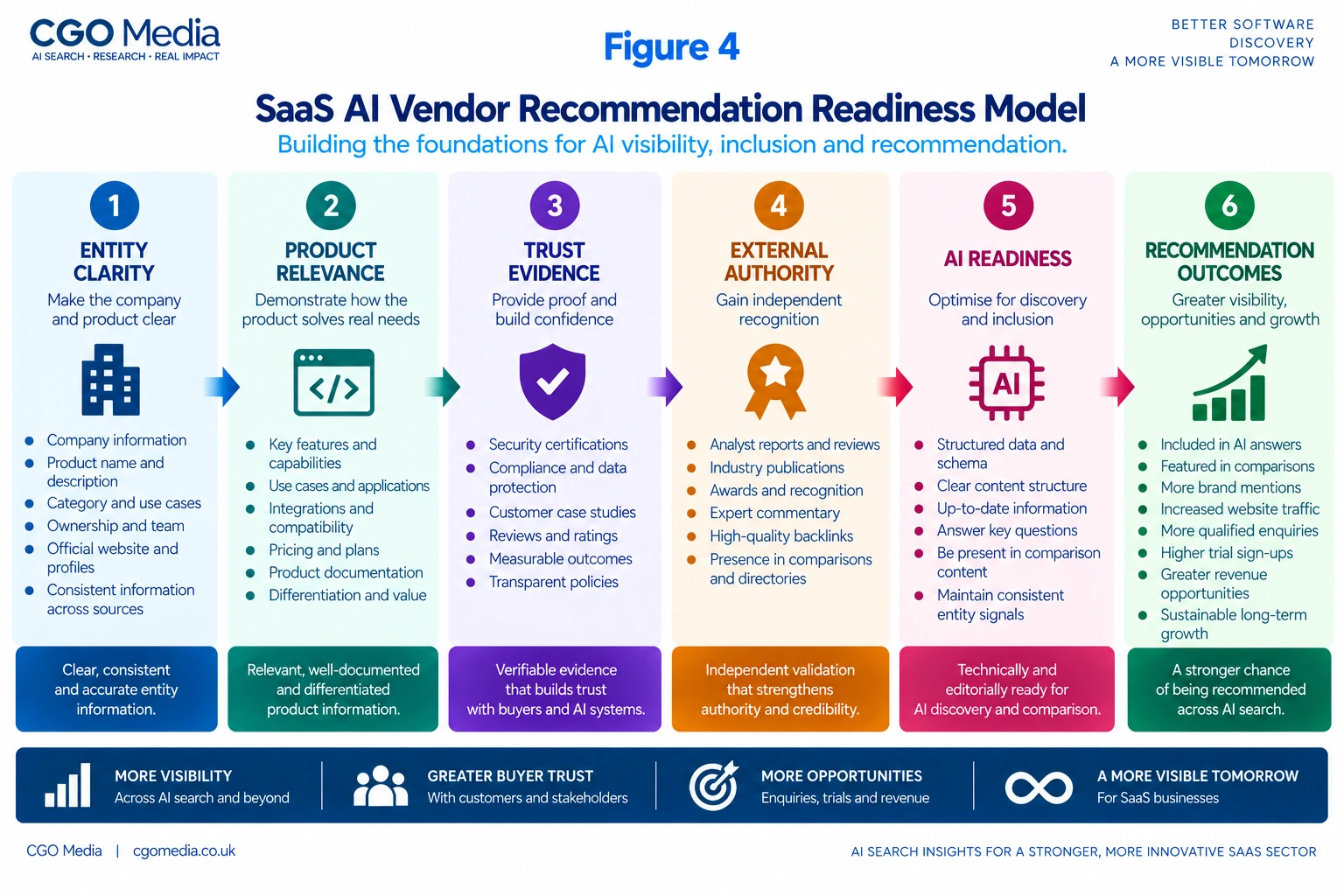
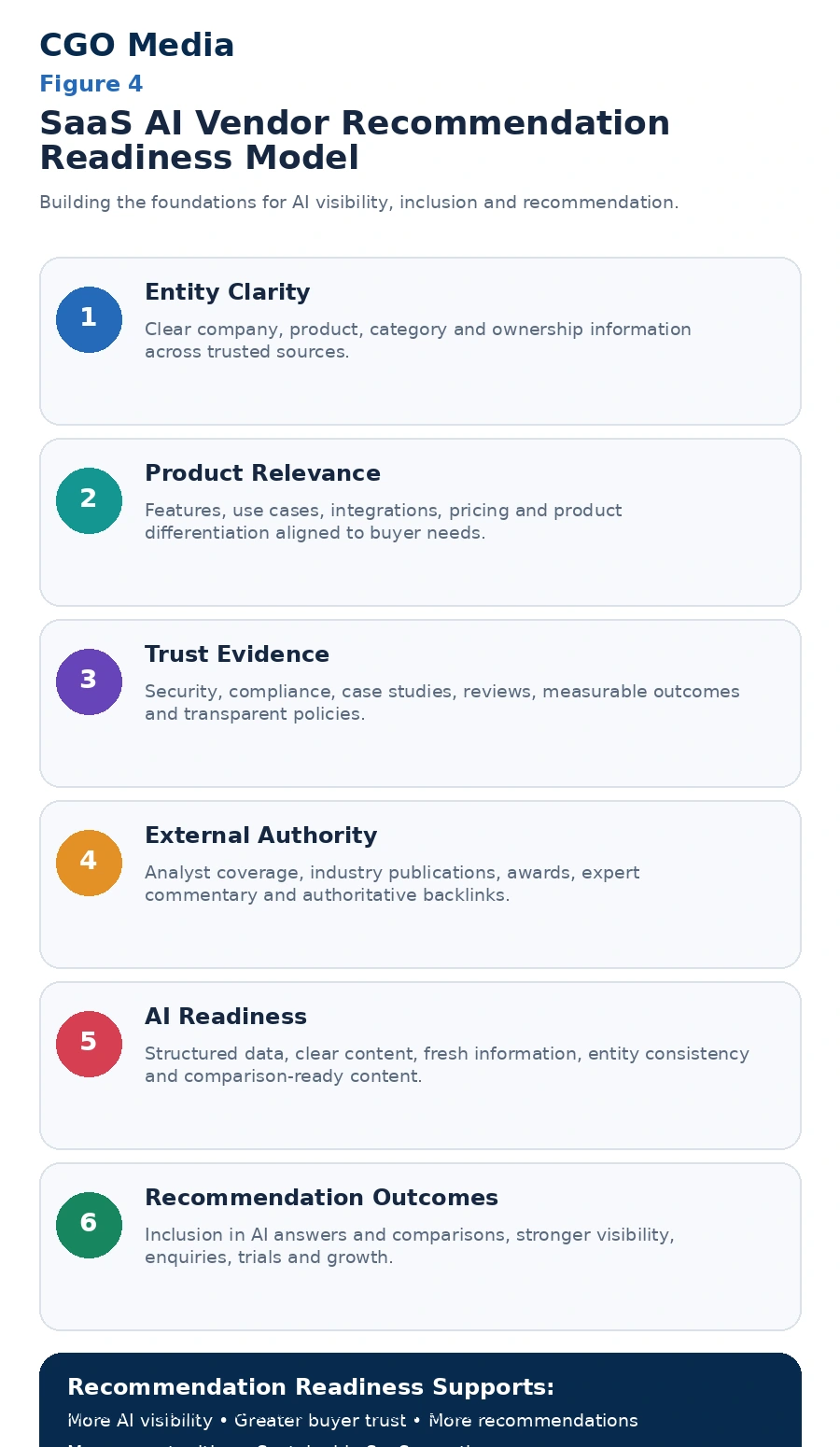
259. Measuring SaaS Search Authority
SaaS search strategy becomes more useful when visibility is measured against the stages that influence product discovery, vendor consideration and commercial pipeline.
Traditional measures such as rankings, clicks and sessions remain valuable, but they should be interpreted alongside:
- Product authority
- AI recommendation visibility
- External validation
- Product evaluation
- Qualified conversion
- Pipeline contribution
The objective is to understand whether digital authority contributes to meaningful buyer progression.
260. Category Visibility
SaaS providers should track whether they appear across the software categories in which they genuinely compete.
Category measurement can include:
- Organic visibility
- AI-assisted discovery
- Review-platform category presence
- Comparison visibility
Category visibility establishes whether the provider enters the relevant market conversation.
261. Problem Visibility
Problem-led measurement identifies whether the product becomes visible before the buyer has selected a software category.
This is strategically useful because early discovery can influence:
- Category understanding
- Vendor consideration
- Feature expectations
262. Feature Visibility
Priority product features can be measured through:
- Search visibility
- AI visibility
- Landing-page engagement
- Commercial contribution
Feature measurement should focus on capabilities that materially influence buyer choice rather than every minor product function.
263. Feature Visibility Should Be Connected to Product Value
A feature that attracts substantial search demand but contributes little to product adoption or customer fit may deserve less investment than a lower-volume capability associated with strong commercial outcomes.
This creates a stronger relationship between SEO and product strategy.
264. Integration Visibility
Integration-led discovery can be commercially important because compatibility can act as a hard selection criterion.
Relevant measurement can include:
- Integration search visibility
- Marketplace visibility
- AI integration recommendations
- Integration-page engagement
265. Use-Case Visibility
Use-case measurement should determine whether the provider appears for commercially important operational scenarios rather than only broad category terms.
This helps assess whether the product is associated with real buyer problems.
266. Industry Visibility
SaaS organisations serving vertical markets can compare authority across priority sectors.
Useful dimensions can include:
- Organic visibility
- AI recommendation visibility
- Industry customer evidence
- Sector-specific conversion
267. Comparison Visibility
Comparison visibility should include:
- Brand-versus-brand searches
- Alternative searches
- Category comparisons
- AI-generated vendor comparisons
Strong comparison visibility indicates that the provider remains present deeper into the buying journey.
268. Share of Search Consideration
A useful strategic question is not simply:
Do we rank?
A stronger question is:
How frequently do we appear across the commercially important search journeys used by prospective buyers?
269. Search Consideration Should Be Segmented
Consideration visibility can be segmented according to:
- Category
- Feature
- Integration
- Use case
- Industry
- Comparison
This reveals where search authority is strongest and where meaningful gaps remain.
270. AI Brand Visibility
Branded monitoring establishes whether AI-assisted systems understand the provider correctly when the company or product is named explicitly.
Important facts can include:
- Product category
- Core capabilities
- Integrations
- Pricing model
- Target customers
271. AI Non-Branded Visibility
Non-branded monitoring tests whether the product enters consideration when the buyer describes a requirement without naming the vendor.
This is a stronger measure of genuine discovery than branded recognition alone.
272. AI Recommendation Share
A repeatable scenario set can estimate how frequently the SaaS provider appears within strategically relevant recommendation environments.
Recommendation share should be segmented by buyer context rather than treated as one universal metric.
273. Recommendation Share Should Be Qualified
High recommendation frequency is only valuable when inclusion is:
- Accurate
- Relevant
- Appropriately framed
- Supported by evidence
Poor-fit recommendation can create low-quality demand.
274. AI Shortlist Share
A more selective measure can examine how frequently the provider appears within relatively small recommendation sets.
Examples can include the first:
- Three products
- Five products
- Ten products
This can help distinguish broad mention from serious consideration.
275. Shortlist Share Is Scenario-Dependent
A specialist provider may have low overall shortlist share but strong inclusion within the scenarios that matter most commercially.
That can represent stronger positioning than broad but poorly qualified inclusion.
276. AI Comparison Share
Providers can monitor how frequently they appear within AI-generated comparisons involving strategically important competitors.
This can reveal whether the provider is part of the effective competitive set.
277. Competitive Co-Occurrence Is Useful Context
Repeated co-occurrence can reveal:
- Primary AI competitors
- Emerging competitors
- Category association
- Changing market position
Co-occurrence should be interpreted as an observational signal rather than a direct measure of market share.
278. AI Source Visibility
Where AI systems expose sources, SaaS providers can observe whether relevant answers surface:
- Product pages
- Documentation
- Integration pages
- Case studies
- Research
- Relevant external sources
This provides additional information about the wider evidence environment.
279. Source Visibility Is Not the Same as Recommendation Visibility
A SaaS page can be cited as a useful source without the software itself being recommended.
Likewise, the product can be mentioned while another source supports the generated answer.
Source authority and vendor recommendation should therefore be measured separately.
280. AI Representation Accuracy
Decision-critical product facts should be checked for accuracy across:
- Category
- Features
- Integrations
- Pricing
- Security
- Company-size fit
- Geographic availability
281. Accuracy Should Be Weighted by Buyer Impact
An incorrect minor feature description should not automatically receive the same priority as incorrect:
- Pricing
- Security
- Integration support
- Availability
Representation monitoring should prioritise material facts.
282. Review Platform Visibility
Review-platform performance can be assessed through:
- Category presence
- Review volume
- Review recency
- Average rating
- Repeated strengths
- Repeated weaknesses
These measures provide insight into external customer evidence.
283. Review Recency Matters
Older reviews may describe:
- Previous product versions
- Retired workflows
- Old pricing
- Historical support experiences
Review quantity should therefore be interpreted alongside recency and context.
284. Review Themes Can Be More Useful Than Average Rating
Recurring themes can reveal persistent product strengths or weaknesses involving:
- Usability
- Support
- Implementation
- Reliability
- Value
These themes can inform both search strategy and product improvement.
285. Marketplace Visibility
Where relevant, SaaS organisations should monitor visibility within:
- Application marketplaces
- Integration ecosystems
- Partner directories
Marketplace visibility can strengthen both discovery and product-relationship evidence.
286. Marketplace Accuracy Matters
Marketplace listings should remain aligned with current:
- Product naming
- Integration status
- Features
- Availability
Outdated listings can create source conflict even where the provider website is current.
287. External Authority Measurement
External authority should focus on relevant validation rather than raw mention volume.
Potential measures can include:
- Industry publication citations
- Partner references
- Customer citations
- Research references
- Analyst mentions
288. Relevant External Authority Is More Valuable Than Generic Coverage
A specialist publication closely related to the SaaS category can provide greater authority value than unrelated high-reach coverage.
External authority should therefore be evaluated through:
- Relevance
- Credibility
- Independence
- Context
289. Citation Diversity
Authority can become more resilient when independent recognition is distributed across several relevant source types.
A provider dependent on one review platform or publication can have a more fragile external-authority profile.
290. Citation Diversity Should Remain Relevant
The objective is not to accumulate the largest possible number of mentions.
A stronger evidence environment can combine:
- Customers
- Partners
- Media
- Research
- Marketplaces
- Professional communities
where those sources are relevant to the buyer and product category.
291. Research Authority Measurement
SaaS providers publishing original research can monitor:
- Media citations
- Academic or industry references
- Backlinks
- AI source visibility
- Branded research searches
This helps distinguish research authority from ordinary content traffic.
292. Research Authority Should Measure Use, Not Publication Volume
Publishing many studies does not automatically create stronger authority.
A stronger question is whether the research becomes:
- Referenced
- Cited
- Discussed
- Used as supporting evidence
within the relevant market.
293. Product-Led Conversion
Search and AI visibility should eventually connect with meaningful product actions such as:
- Free-trial starts
- Freemium registrations
- Demo requests
- Sales enquiries
- Pricing engagements
These actions represent stronger commercial intent than traffic alone.
294. Qualified Trial Starts
Trial volume can be misleading when sign-ups do not match the product’s intended customer profile.
Providers can therefore distinguish:
- Target-customer trials
- Low-fit trials
- Non-commercial usage
This creates a more meaningful measure of acquisition quality.
295. Trial Quality Should Be Connected to Activation
A stronger product-led view can examine:
Trial Start → Activation → Meaningful Product Use → Paid Conversion
This helps distinguish superficial sign-up volume from actual product fit.
296. Demo Quality
Demo enquiries can be segmented by:
- Company size
- Industry
- Use case
- Geography
- Commercial potential
This helps determine whether search authority attracts the buyers the sales organisation actually wants to serve.
297. Search-to-Trial Conversion
For product-led SaaS businesses, the relationship between organic discovery and trial starts provides an important performance indicator.
The measure becomes more useful when broken down by:
- Category
- Feature
- Use case
- Comparison journey
298. Trial-to-Paid Conversion
Trial-to-paid conversion helps distinguish visibility that attracts genuine product fit from visibility that produces superficial sign-ups.
Strong search acquisition should ultimately contribute to users who can obtain enough product value to justify purchase.
299. Search-to-Demo Conversion
Sales-led SaaS providers can measure how frequently commercially relevant search journeys progress into:
- Product demonstrations
- Technical consultations
- Sales conversations
This connects digital discovery with direct vendor evaluation.
300. Demo-to-Opportunity Conversion
This measure helps determine whether the provider is attracting suitable buyers rather than simply increasing enquiry volume.
A high number of low-fit demos can create substantial sales inefficiency.
301. Marketing-Qualified Pipeline
Search performance becomes more commercially meaningful when connected with qualified pipeline rather than isolated form submissions.
Useful segmentation can include:
- Source theme
- Product
- Industry
- Company size
- Use case
302. Sales-Qualified Pipeline
Where attribution allows, SaaS organisations can examine how search and AI-assisted discovery contribute to opportunities accepted by sales.
This helps identify which discovery paths generate credible commercial demand.
303. Pipeline Value
Pipeline value can provide a stronger strategic measure than traffic where customer contract values vary substantially.
A smaller amount of high-intent discovery may create more value than large volumes of low-fit traffic.
304. Closed-Won Revenue
Attribution to closed revenue can be difficult in multi-touch SaaS journeys, but it remains useful where reliable data exists.
Revenue analysis can help identify which search and evidence themes contribute to customers rather than merely leads.
305. Opportunity-to-Customer Conversion
Win-rate analysis can reveal whether search-led opportunities align with the product’s competitive strengths.
Weak win rates can indicate problems involving:
- Buyer fit
- Product fit
- Pricing
- Competitive positioning
306. Customer Lifetime Value Context
Search acquisition should also be interpreted in the context of customer quality where lifetime value differs significantly between segments.
A channel or topic that produces fewer customers can still create more long-term commercial value.
307. Retention as a Search Quality Signal
Internally, SaaS organisations can compare whether customers acquired through particular search themes retain differently over time.
This can reveal whether certain acquisition paths repeatedly attract:
- Strong-fit customers
- Poor-fit customers
- Short-term users
308. Expansion Revenue Context
Customers acquired through search may later create additional revenue through:
- More users
- Higher plans
- Additional modules
- Greater usage
Initial conversion value can therefore understate the long-term contribution of qualified discovery.
309. Search Quality Should Extend Beyond Acquisition
A strong SaaS search programme should ultimately contribute to customers who:
- Activate
- Adopt
- Retain
- Expand
This creates a stronger definition of acquisition quality than lead volume alone.
310. Multi-Touch Attribution
SaaS buying journeys frequently involve several interactions before conversion.
A buyer may:
- Discover the product through search
- Read external reviews
- Return through branded search
- Compare competitors
- Use an AI assistant
- Book a demonstration
No single interaction necessarily explains the complete decision.
311. Avoid Over-Crediting the Final Touch
Last-click attribution can understate the role of earlier:
- Problem-led content
- Feature pages
- Comparison content
- Research
- AI discovery
The final conversion page may only capture the end of a much longer evaluation journey.
312. First-Touch Attribution Is Also Incomplete
The first recorded visit can explain where discovery began without revealing which:
- Evidence built trust
- Comparisons influenced choice
- External sources validated the provider
313. Search Journey Attribution
Where data allows, reporting should identify the sequence of content and discovery environments involved before commercial conversion.
A useful conceptual journey can be:
Discovery → Evidence → Comparison → Validation → Trial or Demo → Opportunity → Customer
314. Attribution Should Reflect Evidence Influence
Some assets influence decisions without generating the final click.
Examples include:
- Case studies
- Documentation
- Research
- Reviews
- Security resources
Measurement should recognise this assisted role where evidence is available.
315. SaaS Search Authority Scorecard
A practical scorecard can combine authority, visibility and commercial outcomes.
| Area | Measurement Focus | Example Indicators |
|---|---|---|
| Product Authority | Whether the product is clearly understood. | Category, feature, integration and use-case visibility. |
| Trust | Whether buyers can validate provider credibility. | Security evidence, reviews, customer proof and support information. |
| External Authority | Whether relevant independent sources reinforce the provider. | Media citations, partner references, research mentions and marketplace visibility. |
| AI Visibility | Whether the product appears accurately in recommendation environments. | Recommendation share, shortlist share, comparison visibility and source visibility. |
| Commercial Discovery | Whether visibility creates meaningful product evaluation. | Trials, demos, qualified enquiries and product engagement. |
| Pipeline Impact | Whether discovery contributes to commercial opportunity. | Qualified pipeline, opportunity value and closed-won revenue. |
316. Search Authority Should Be Measured as a System
The scorecard prevents isolated metrics from becoming the sole definition of success.
For example:
- High rankings with weak trials indicate poor commercial progression.
- Strong AI visibility with inaccurate product representation indicates trust risk.
- Strong traffic with weak pipeline may indicate poor buyer fit.
317. Governance Is Essential in SaaS
SaaS information changes quickly.
Search authority therefore depends on coordinated governance across the teams responsible for:
- Product truth
- Technical truth
- Security truth
- Commercial information
- Customer evidence
318. Product Team Ownership
Product teams should validate:
- Features
- Packaging
- Roadmap-sensitive claims
- Product availability
This helps keep public product information aligned with current reality.
319. Engineering Ownership
Engineering or technical teams may validate:
- APIs
- Integrations
- Architecture
- Technical limitations
Marketing teams should not independently define decision-critical technical truth.
320. Security and Privacy Ownership
Security, legal or compliance specialists should approve relevant claims involving:
- Security controls
- Privacy
- Certifications
- Data processing
These claims can materially influence buyer eligibility and trust.
321. Marketing Ownership
Marketing can coordinate:
- Search strategy
- Content architecture
- Comparison content
- External authority
- AI visibility monitoring
Its role is to communicate validated product truth rather than independently create it.
322. Customer Success Ownership
Customer-success teams can contribute evidence around:
- Customer questions
- Implementation insights
- Adoption patterns
- Case-study opportunities
This connects the authority system with real customer experience.
323. Sales Ownership
Sales teams can contribute intelligence around:
- Buyer objections
- Competitor comparisons
- Feature requirements
- Pricing questions
- Win and loss reasons
This identifies where search authority fails or succeeds during real commercial evaluation.
324. Revenue Operations Ownership
Revenue operations can help connect digital discovery with:
- Pipeline
- Lead quality
- Opportunity stage
- Revenue outcomes
This is essential where SEO is expected to demonstrate commercial contribution rather than traffic growth alone.
325. Product Information Changes Should Trigger Authority Review
Changes involving the following should trigger coordinated review of relevant search and authority assets:
- Pricing
- Features
- Integrations
- Packaging
- Security status
- Product naming
Governance should be event-driven as well as calendar-driven.
326. Pricing Change Trigger
A material pricing change should prompt review of:
- Pricing pages
- Comparison pages
- Product pages
- Relevant external profiles
Pricing information can become inaccurate quickly if updates are not coordinated.
327. Feature Change Trigger
A feature launch, removal or packaging change can affect:
- Feature pages
- Documentation
- Comparison content
- Pricing pages
- AI representation
328. Integration Change Trigger
Integration changes should prompt review of:
- Integration pages
- Documentation
- Marketplaces
- Relevant use cases
- Comparison content
329. Security Change Trigger
Changes to:
- Infrastructure
- Security controls
- Certifications
- Subprocessors
should trigger review by the appropriate technical, security, legal or compliance owner.
330. Product Naming Trigger
Rebranding, acquisitions and product-suite changes require coordinated updates across:
- Website
- Documentation
- Review platforms
- Marketplaces
- Partner sources
Entity consistency should be preserved during organisational change.
331. Review Cadence Should Reflect Information Volatility
A practical SaaS authority programme can include:
- Monthly product and AI monitoring
- Quarterly comparison-content reviews
- Quarterly integration reviews
- Six-monthly authority assessment
- Annual strategic benchmarking
The exact cadence should reflect product velocity and risk.
332. Executive Reporting Should Remain Focused
Leadership reporting should concentrate on a manageable set of strategic indicators rather than detailed operational SEO metrics.
Potential executive indicators include:
- Category visibility
- AI recommendation share
- Comparison visibility
- Qualified trial or demo volume
- Pipeline contribution
- External authority growth
333. Executive Risk Indicators
Leadership should also have visibility into risks such as:
- Outdated pricing
- Incorrect AI representation
- Declining category visibility
- Weak review sentiment
- Integration information gaps
- Security-information inconsistency
Authority reporting should therefore include both opportunity and risk.
334. Measurement Should Support Decisions
The purpose of SaaS search measurement is not to create increasingly complex dashboards.
It is to answer strategic questions such as:
- Where are we being discovered?
- Which capabilities create consideration?
- Which competitors dominate comparison?
- Where are we absent from AI recommendations?
- Which authority gaps affect pipeline?
- Which markets deserve further investment?
335. The Seventeenth SaaS Search Authority Principle
SaaS search authority should be measured across category, problem, feature, integration, use-case, industry and comparison visibility because no single ranking captures the complete software-discovery environment.
336. The Eighteenth SaaS Search Authority Principle
AI visibility should be separated into branded understanding, non-branded discovery, recommendation share, shortlist presence, comparison visibility and representation accuracy because these describe different levels of buyer consideration.
337. The Nineteenth SaaS Search Authority Principle
SaaS SEO should connect visibility with product-led and sales-led commercial outcomes including qualified trials, demos, pipeline, revenue, retention and expansion rather than treating traffic as the final performance objective.
338. The Twentieth SaaS Search Authority Principle
Search authority measurement requires cross-functional governance because product, technical, security, customer and commercial evidence changes continuously and cannot be maintained accurately by marketing alone.
339. SaaS Search Authority Measurement Funnel
The measurement system should connect discovery and authority with progressively stronger commercial outcomes.
Product Authority
Measures whether the product is understood correctly across categories, features, integrations and use cases.
Trust
Measures whether buyers can validate product and provider credibility through security evidence, customer proof, reviews, documentation and support information.
External Authority
Measures whether relevant independent sources reinforce the SaaS provider through customers, partners, marketplaces, publications, research and professional communities.
AI Visibility
Measures whether the product appears accurately and appropriately within branded, non-branded, comparison and recommendation environments.
Commercial Discovery
Measures whether authority contributes to meaningful product evaluation through qualified trials, demos, pricing engagement and sales enquiries.
Pipeline Impact
Measures whether discovery contributes to qualified opportunities, pipeline value, closed-won revenue and commercially valuable customers.
340. The Strategic Implication
SaaS organisations should measure search authority as a connected commercial system.
The strongest measurement framework connects:
- Product authority
- Trust
- External validation
- AI visibility
- Product evaluation
- Qualified conversion
- Pipeline and revenue
This allows teams to distinguish between:
- Visibility without product fit
- Authority without discovery
- Discovery without conversion
- Conversion without long-term customer quality
The objective is not simply to report more metrics.
It is to identify which parts of the SaaS authority system create qualified buyer progression and which gaps prevent strong product evidence from becoming commercially valuable discovery.
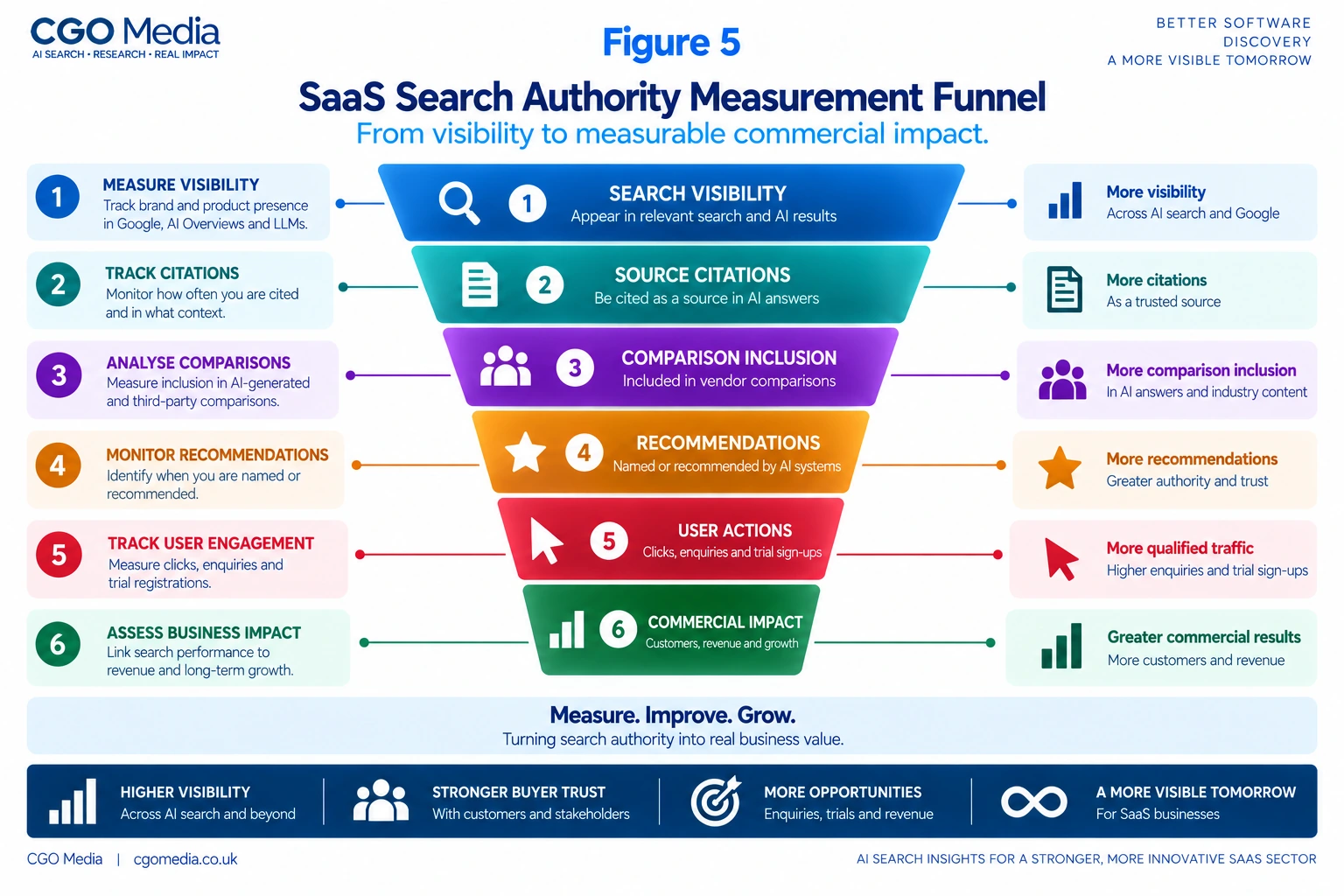
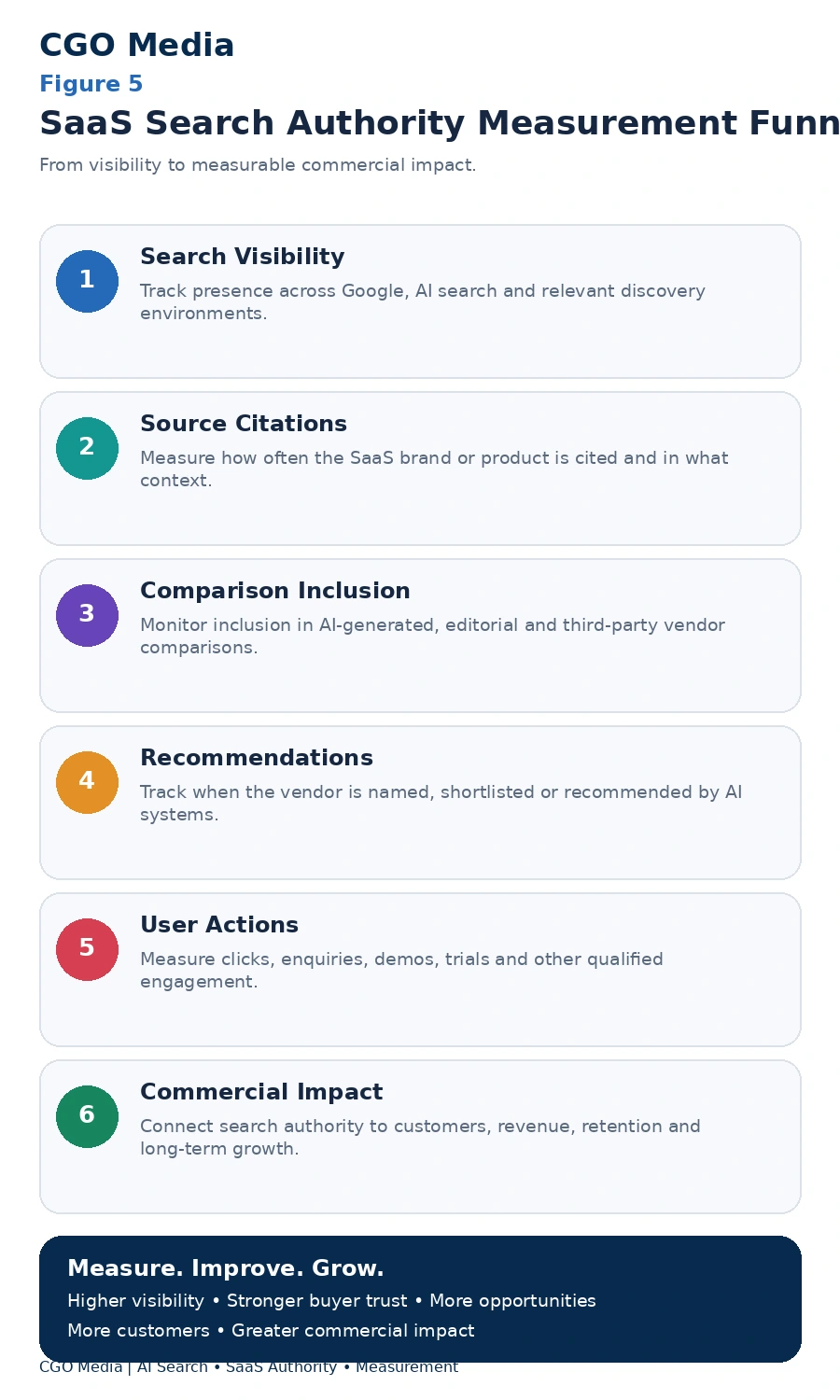
341. Common SaaS Search Authority Failure Modes
SaaS organisations can invest heavily in SEO, content and product marketing while still leaving important authority gaps unresolved.
Common problems usually involve:
- Weak category clarity
- Thin product evidence
- Outdated information
- Disconnected documentation
- Weak trust evidence
- Poor commercial fit
- Weak governance
342. Failure Mode — Category Ambiguity
A SaaS product may attempt to position itself across too many categories without establishing strong authority in the markets where it genuinely competes.
This can weaken:
- Buyer understanding
- Search relevance
- AI categorisation
- Competitive positioning
Category breadth should remain supported by real product capability and customer evidence.
343. Failure Mode — Generic Feature Content
Feature pages become weak when they describe benefits without explaining:
- How the feature works
- Which workflow it supports
- Who it is designed for
- Which integrations are involved
- What limitations apply
Generic feature promotion creates less evidence for buyers and machine systems.
344. Failure Mode — Thin Integration Pages
Integration pages can become little more than keyword-targeted landing pages when they fail to explain the actual technical relationship between two products.
Strong integration evidence should clarify:
- What connects
- How data moves
- Which workflow is supported
- Whether middleware is required
- Which plans support the integration
345. Failure Mode — Outdated Integration Claims
SaaS integrations change frequently.
An integration can:
- Become unavailable
- Move to third-party middleware
- Change technical behaviour
- Become restricted to certain plans
Outdated integration claims can create direct vendor-selection errors.
346. Failure Mode — Outdated Pricing
Pricing can become stale across:
- Vendor pages
- Comparison pages
- Review platforms
- Partner websites
- Third-party articles
Commercial evidence should therefore be reviewed whenever plans, usage limits or packaging change.
347. Failure Mode — Outdated Feature Comparisons
Competitor comparison content loses credibility when it continues describing:
- Features
- Packages
- Prices
- Integrations
that have materially changed.
Comparison evidence requires a stronger review cadence than evergreen informational content.
348. Failure Mode — Overly Promotional Comparison Content
Comparison pages become less useful when every criterion is constructed to make the publisher’s product appear superior.
Decision-support content should acknowledge genuine:
- Differences
- Trade-offs
- Alternative buyer needs
- Competitor strengths
Credibility can be more valuable than artificial superiority.
349. Failure Mode — Weak Product Documentation
High-level marketing claims create friction when technical buyers cannot confirm product behaviour through sufficiently detailed documentation.
This can weaken confidence around:
- Implementation
- Integrations
- APIs
- Technical limitations
350. Failure Mode — Documentation Silos
Documentation can contain excellent technical information while remaining poorly connected with:
- Feature pages
- Integration pages
- Use cases
- Pricing
- Commercial content
Disconnected documentation weakens the wider product evidence architecture.
351. Failure Mode — Weak Security Evidence
Statements such as:
Enterprise-grade security.
provide limited assurance without stronger supporting evidence.
High-risk claims require appropriate security documentation, current validation and clear ownership.
352. Failure Mode — Inconsistent Security Information
Conflicting security or privacy statements can increase uncertainty during due diligence.
Critical information should remain materially aligned across:
- Security pages
- Documentation
- Privacy resources
- Sales materials
- External profiles
353. Failure Mode — Review Platform Neglect
A SaaS provider may optimise its own website extensively while allowing major external product profiles to become:
- Outdated
- Incomplete
- Misclassified
External product profiles form part of the wider discovery environment and should be monitored where material.
354. Failure Mode — Weak Customer Evidence
Generic testimonials often provide less decision value than detailed evidence showing:
- Customer context
- Initial problem
- Implementation
- Product usage
- Outcome
Customer evidence should help buyers determine whether similar organisations have succeeded with the product.
355. Failure Mode — No Evidence for Priority Segments
A provider may claim suitability for several customer groups without demonstrating relevant:
- Case studies
- Use cases
- Integrations
- Workflows
- Commercial fit
Segment claims should be supported by genuine evidence.
356. Failure Mode — Content Volume Without Product Authority
Large blog libraries can generate traffic without strengthening the product’s relationship with:
- Core categories
- Features
- Integrations
- Use cases
- Buyer problems
Content scale and product authority should not be treated as equivalent.
357. Failure Mode — Traffic Without Commercial Fit
High traffic can create limited business value when visitors do not match the product’s target customer profile.
Poor-fit traffic can generate:
- Low-quality trials
- Weak demo conversion
- Sales inefficiency
- Poor retention
358. Failure Mode — Brand Visibility Without Non-Branded Discovery
A recognised SaaS company may perform strongly when buyers search for its brand while remaining absent from:
- Category discovery
- Feature discovery
- Use-case searches
- AI recommendation scenarios
Brand recognition and discovery authority should therefore be measured separately.
359. Failure Mode — AI Monitoring Without Diagnostic Action
Recording AI mentions or recommendations creates limited strategic value unless findings lead to:
- Evidence correction
- Product clarification
- Source analysis
- Authority development
Monitoring should lead to diagnosis and improvement.
360. Failure Mode — Treating AI Visibility as a Standalone Channel
AI-assisted discovery should be treated as part of the wider:
- Product
- Search
- Trust
- External-authority
environment.
Strong AI recommendation visibility should emerge from stronger underlying evidence rather than isolated optimisation tactics.
361. Failure Mode — No Product Information Governance
SaaS authority can deteriorate quickly when product, pricing, integration and security information changes without coordinated updates.
The faster the product evolves, the more important information governance becomes.
362. Product Information Decay
Information decay is especially important in SaaS because the underlying product can change continuously.
A useful relationship is:
Product Change + Time Without Review → Evidence Decay
363. Feature Decay
Feature evidence becomes inaccurate when:
- Capabilities change
- Features are renamed
- Features move between plans
- Features are removed
High-value feature changes should trigger review across all affected evidence.
364. Pricing Decay
Pricing evidence becomes unreliable when:
- Plans change
- Billing models change
- Discount structures change
- Usage limits change
- Enterprise packaging evolves
Pricing decay is particularly risky because commercial suitability can influence early buyer filtering.
365. Integration Decay
Integration information becomes stale as:
- APIs change
- Partnerships evolve
- Native integrations launch
- Older integrations are retired
Integration directories should therefore be treated as dynamic product infrastructure.
366. Security Evidence Decay
Security and compliance information can become outdated as:
- Certifications change
- Infrastructure changes
- Subprocessors change
- Policies evolve
Decision-critical security information should have stronger review controls than ordinary marketing copy.
367. Customer Evidence Decay
Case studies can become less representative if they describe:
- Older product versions
- Retired workflows
- Previous pricing models
- Deprecated integrations
Historic customer evidence can remain valuable, but context should make its age and relevance clear.
368. Comparison Evidence Decay
Competitor information may decay even faster because the SaaS provider does not control the competing product.
Comparison pages therefore require:
- Regular verification
- Review dates
- Clear ownership
369. Authority Maintenance Requires Change Triggers
Product changes should trigger coordinated review of affected search and authority assets.
A trigger-based system is often more reliable than waiting for an annual content audit.
370. Feature Change Trigger
When a strategically important feature changes, review:
- Feature pages
- Pricing pages
- Comparison pages
- Documentation
- Integration content
- Relevant use cases
371. Pricing Change Trigger
Pricing changes should trigger coordinated review across relevant:
- Pricing pages
- Comparison assets
- Feature-to-plan information
- Commercial content
Priority external profiles should also be monitored where pricing information is displayed.
372. Integration Change Trigger
Integration changes should trigger review of:
- Integration directory
- Feature pages
- Documentation
- Marketplace listings
- Relevant use cases
373. Security Change Trigger
Changes to:
- Security architecture
- Infrastructure
- Certifications
- Privacy processes
should trigger review by the appropriate technical, legal, privacy or compliance owner.
374. Brand or Product Naming Trigger
Rebranding, acquisitions and product-suite changes should trigger coordinated updates across the wider entity ecosystem.
Relevant environments can include:
- Website
- Documentation
- Review platforms
- Marketplaces
- Partner sites
- External profiles
375. Continuous SaaS Search Authority Development
SaaS search authority should operate as a continuous development cycle rather than a fixed project.
A practical operating sequence is:
Observe → Validate → Correct → Expand → Measure → Govern → Reassess
376. Observe
Monitor changes across:
- Search demand
- AI recommendations
- Competitor positioning
- Reviews
- Customer questions
- Product usage
Observation reveals where product reality and public representation may be diverging.
377. Validate
Determine whether the evidence being surfaced remains accurate and aligned with the current product.
Validation should prioritise decision-critical claims rather than every wording variation.
378. Correct
Resolve inaccurate, conflicting or outdated information before expanding content further.
Correction can involve:
- Updating product information
- Reconciling documentation
- Correcting comparison content
- Updating external profiles
379. Expand
Develop deeper authority around strategically important:
- Categories
- Features
- Integrations
- Use cases
- Industries
- Buyer roles
Expansion should follow proven product fit rather than arbitrary keyword volume.
380. Measure
Track whether authority improvements influence:
- Search visibility
- AI recommendation
- Comparison visibility
- Trials
- Demos
- Pipeline
Measurement should connect evidence improvements with buyer progression where possible.
381. Govern
Assign clear ownership across:
- Product
- Technical
- Security
- Commercial
- Customer evidence
Governance helps ensure decision-critical information remains current as the software changes.
382. Reassess
Repeat authority and competitive analysis as the:
- Product evolves
- Market changes
- Competitors reposition
- Discovery systems develop
Search authority is a moving strategic condition rather than a permanent achievement.
383. Expand Authority Around Proven Product Strengths
Areas producing strong customer adoption and commercial outcomes can become priorities for deeper:
- Technical content
- Case studies
- Research
- Comparison assets
- External authority
This aligns authority investment with demonstrated product value.
384. Expand Into Adjacent Use Cases Carefully
SaaS providers can develop authority around adjacent use cases where the product already supports genuine customer demand.
Expansion should be supported by:
- Product capability
- Customer behaviour
- Workflow evidence
rather than marketing ambition alone.
385. Expand Into New Industries Carefully
Vertical expansion should be supported by genuine evidence including:
- Relevant customers
- Industry workflows
- Required integrations
- Compliance support
- Case studies
Industry authority should follow product reality.
386. Expand Into New Geographic Markets
International SaaS authority can require stronger evidence around:
- Language
- Currency
- Data residency
- Regional compliance
- Local customer support
- Regional customer evidence
Global product availability does not automatically create local market authority.
387. Expand Research Authority
Original research can be developed around data and subject areas where the provider possesses genuine expertise.
Relevant research can strengthen:
- Category authority
- External citation
- Media relevance
- Expert visibility
388. Expand Expert Authority
Internal specialists can contribute through:
- Research
- Technical analysis
- Industry commentary
- Educational resources
- Conference participation
Expert authority should connect with real subject knowledge and product relevance.
389. Expand External Validation
Relevant authority can be developed through:
- Technology partners
- Customers
- Industry publications
- App marketplaces
- Professional communities
- Research organisations
The objective is meaningful independent reinforcement rather than mention volume alone.
390. Search Authority Should Reflect Product Reality
The objective is not to construct an artificial authority layer around the software.
It is to make genuine:
- Product capability
- Customer value
- Technical evidence
- External validation
easier to discover and evaluate.
391. The Twenty-First SaaS Search Authority Principle
SaaS search authority deteriorates when product information changes without coordinated evidence updates, making information decay a core strategic risk for software companies.
392. The Twenty-Second SaaS Search Authority Principle
Authority maintenance should use event-driven change triggers for features, pricing, integrations, security and product naming so high-impact evidence is reviewed when the underlying product changes.
393. The Twenty-Third SaaS Search Authority Principle
SaaS authority expansion should follow proven product strengths, real customer use cases and commercially relevant markets rather than pursuing category, industry or geographic visibility unsupported by product evidence.
394. The Twenty-Fourth SaaS Search Authority Principle
Sustainable SaaS search authority requires a continuous operating cycle in which product reality, public evidence, search visibility, AI recommendation, buyer evaluation and commercial outcomes continuously inform one another.
395. The Complete SaaS Search Authority Cycle
The overall strategic relationship can be represented as:
Product Reality → Structured Evidence → Search Discovery → External Validation → AI Recommendation → Product Evaluation → Commercial Outcome → Feedback → Evidence Improvement
Product Reality
Authority begins with what the SaaS product genuinely does, who it serves and which problems it can solve.
Structured Evidence
Product capability is translated into clear category, feature, integration, use-case, industry and documentation architecture.
Search Discovery
Buyers encounter the product through problem, category, feature, integration, industry and comparison searches.
External Validation
Customers, reviews, partners, marketplaces, publications, communities and research provide evidence outside the provider’s own website.
AI Recommendation
AI-assisted systems can introduce, compare or recommend the product within relevant buyer scenarios where sufficient evidence exists.
Product Evaluation
The buyer evaluates:
- Fit
- Features
- Integrations
- Trust
- Pricing
- Implementation
Commercial Outcome
Qualified buyers can progress into:
- Trials
- Demos
- Sales opportunities
- Paid subscriptions
Feedback
Product, sales, customer-success and search data reveal where the authority environment remains incomplete or misaligned with real buyer needs.
Evidence Improvement
Those findings feed back into the product-information system, creating a continuous authority-development loop.
396. SaaS Search Authority Is Dynamic
The defining characteristic of the SaaS environment is continuous change.
Products evolve.
Customer expectations change.
Competitors reposition.
Integrations expand and disappear.
Pricing changes.
Search and AI discovery systems continue to develop.
Sustainable SaaS authority therefore depends on the organisation’s ability to keep public evidence aligned with changing product reality.
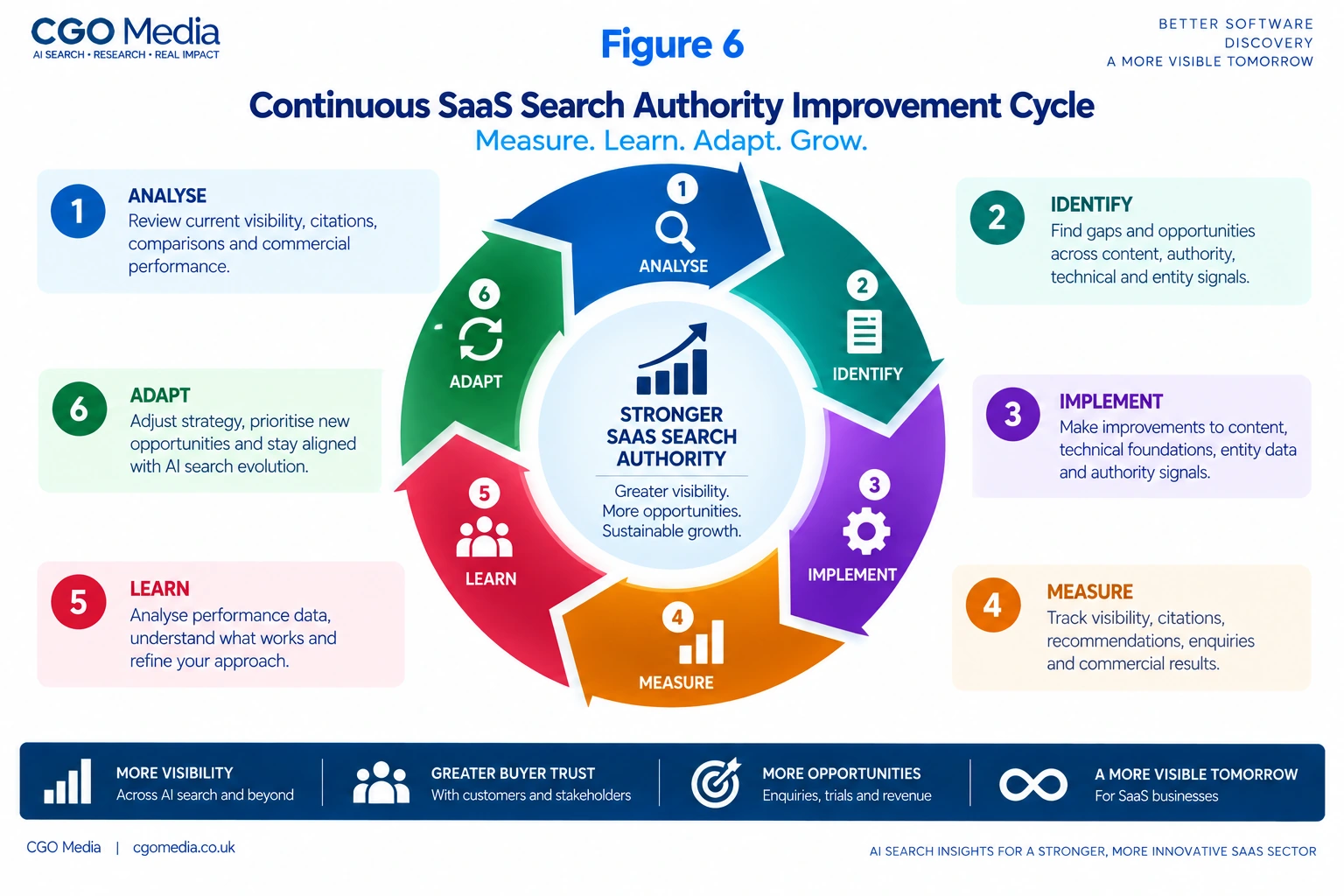
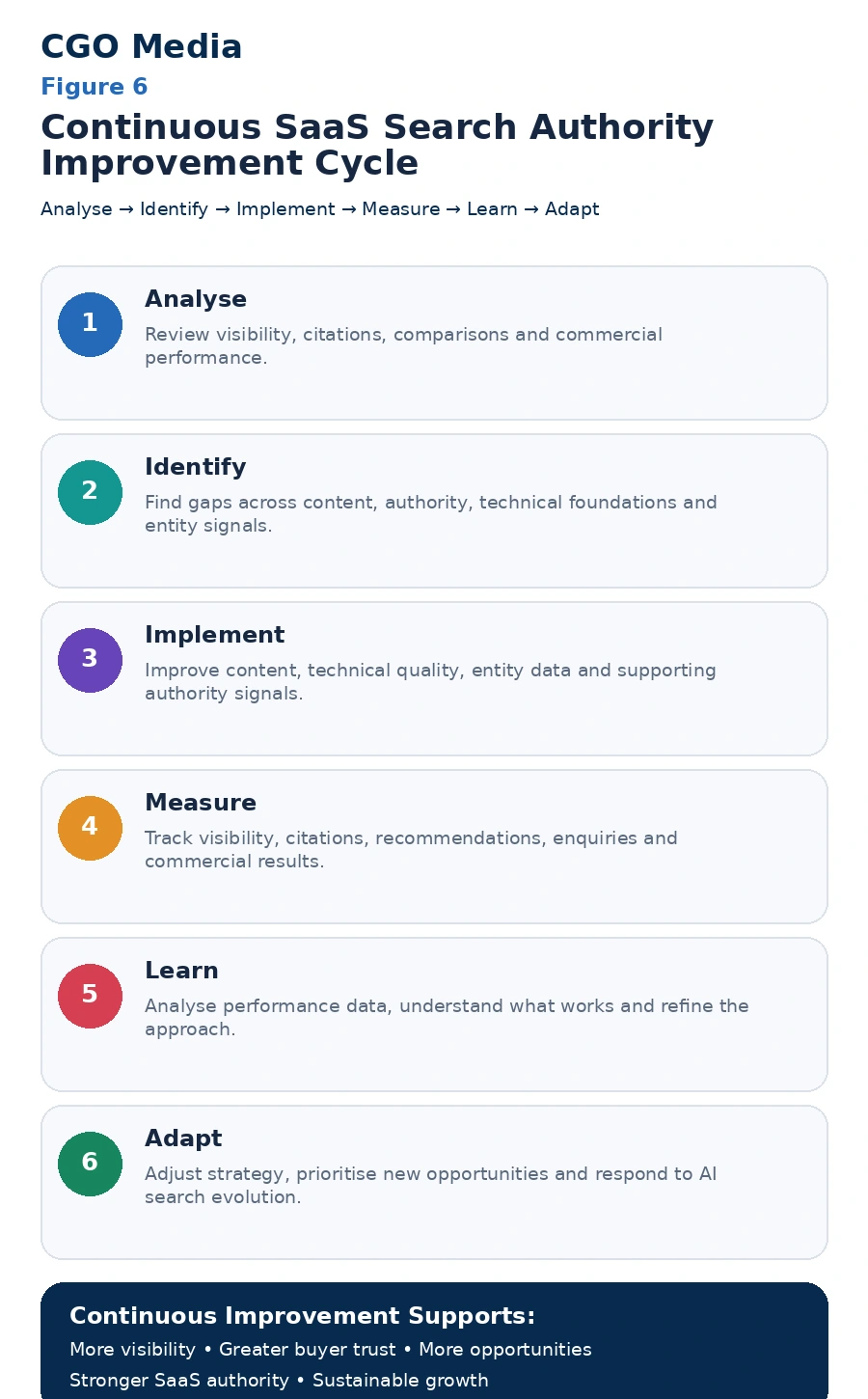
397. Strategic Implications
The evolution of SaaS discovery means search strategy can no longer be treated purely as a traffic-acquisition function.
For software companies, search increasingly intersects with:
- Product positioning
- Category definition
- Feature communication
- Integration visibility
- Security and trust
- Customer evidence
- Competitive comparison
- AI-assisted recommendation
This expands the role of SEO from page optimisation into management of a wider product evidence environment.
398. SaaS SEO Is Becoming an Evidence Architecture Problem
The strategic challenge is no longer simply to publish more content around target keywords.
The stronger objective is to create a coherent evidence architecture explaining:
- What the product is
- What it does
- Who it is for
- Which problems it solves
- How it integrates
- Why buyers should trust it
- How it compares with alternatives
Search authority becomes stronger when these relationships are explicit, connected and current.
399. Product Reality Must Remain the Foundation
SaaS authority should reflect the real capabilities of the product rather than an aspirational market position unsupported by current functionality.
A useful principle is:
Product Reality → Public Evidence → Discovery Authority
Search strategy should make genuine capabilities easier to understand rather than attempting to manufacture authority independently of the product.
400. Product Information Governance Is Strategic
Because SaaS products evolve continuously, outdated evidence can create significant visibility, comparison and trust problems.
Changes involving:
- Features
- Pricing
- Integrations
- Packaging
- Security
- Product naming
should trigger coordinated review across relevant digital assets.
401. Search Strategy Should Follow Buyer Intent
A mature SaaS information architecture should support buyers across:
Problem → Category → Feature → Integration → Use Case → Comparison → Validation → Trial or Demo
Different evidence types become important at different stages of that journey.
402. Comparison Visibility Is a Core Competitive Layer
SaaS buying journeys are unusually comparison-heavy because multiple products can appear similar at category level.
Providers should therefore understand how they are represented across:
- Direct competitor comparisons
- Alternative searches
- Review platforms
- Professional communities
- AI-generated comparisons
403. Trust Should Be Embedded Throughout the Buyer Journey
Security, privacy, implementation, customer evidence and reliability should not exist only within isolated trust pages.
Relevant trust evidence should reinforce:
- Product pages
- Feature pages
- Industry pages
- Comparison pages
- Commercial evaluation
Trust becomes stronger when evidence appears where buyers need it.
404. External Validation Increases Authority Resilience
A SaaS provider’s authority becomes more resilient when relevant independent sources reinforce its market position.
Potential validation can come from:
- Customers
- Technology partners
- Review platforms
- App marketplaces
- Industry publications
- Analysts
- Professional communities
405. AI Recommendation Should Be Treated as an Authority Outcome
AI recommendation visibility is more useful when understood as an outcome of the wider evidence ecosystem rather than as an isolated optimisation channel.
Recommendation readiness is supported by:
- Clear product identity
- Accurate feature evidence
- Strong integration relationships
- Security and trust information
- Customer evidence
- Relevant external validation
406. AI Visibility Cannot Be Guaranteed
No SaaS provider can guarantee inclusion within every generated recommendation, comparison or citation.
Outputs can differ by:
- System
- Prompt
- Buyer context
- Market
- Date
The practical objective is therefore to strengthen the quality, consistency and authority of the evidence available across the wider discovery environment.
407. Measurement Should Move Toward Commercial Outcomes
The progression of SaaS search measurement should move beyond rankings and traffic toward:
Visibility → Consideration → Trial or Demo → Qualified Pipeline → Revenue
Earlier indicators remain useful, but commercial progression provides stronger evidence that visibility is reaching suitable buyers.
408. Search Authority Should Reflect Customer Quality
High traffic, lead or trial volume can be misleading if the users attracted do not match the product’s intended customer profile.
Commercial evaluation should therefore consider:
- Customer fit
- Pipeline quality
- Conversion
- Retention
- Expansion potential
The strongest SaaS authority attracts customers capable of receiving long-term value from the product.
409. Methodological Position
SaaS SEO in an AI Search Environment is a conceptual and strategic research paper developed by CGO Media to examine how software discovery, product authority, digital trust, external validation, comparison behaviour and AI-assisted recommendation interact within modern SaaS buying journeys.
The research addresses the broader question:
How should SaaS organisations structure and govern their digital evidence so buyers and machine-assisted discovery systems can understand, compare, validate and appropriately consider their products?
Research Scope
The analysis focuses on software-as-a-service organisations operating across product-led, sales-led and hybrid commercial models.
Research themes include:
- Problem and category discovery
- Product and entity clarity
- Feature authority
- Integration authority
- Use-case and industry authority
- Technical documentation
- Security and privacy evidence
- Customer evidence
- External validation
- Competitive comparison
- AI-assisted recommendation
- Commercial measurement
Buyer-Journey Analysis
The paper analyses SaaS discovery through the conceptual sequence:
Problem → Category → Feature → Integration → Use Case → Comparison → Validation → Trial or Demo
This sequence is not intended to imply that every software buyer follows an identical linear path.
Evidence Architecture Analysis
The paper examines relationships between:
Provider → Product → Feature → Integration → Use Case → Industry → Customer → Review → External Validation
This model is used to assess whether product evidence forms a connected authority system rather than a collection of disconnected webpages.
Provider Trust Analysis
Trust is examined across:
- Product evidence
- Technical evidence
- Security and privacy
- Customer evidence
- Reviews
- Independent validation
AI Recommendation Analysis
The research treats AI recommendation readiness as a progressive condition:
Discoverable → Categorised → Relevant → Comparable → Trusted → Commercially Suitable → Recommendation Ready
Measurement Analysis
The research connects digital authority with:
- Search visibility
- AI visibility
- Qualified trials
- Demo requests
- Pipeline
- Revenue
- Retention
Continuous Improvement
The final model examines how product and market feedback should continuously improve the public evidence environment:
Product Reality → Structured Evidence → Search Discovery → External Validation → AI Recommendation → Product Evaluation → Commercial Outcome → Feedback → Evidence Improvement
The framework does not claim that search engines or AI systems use these concepts as confirmed ranking or recommendation factors.
Its purpose is to provide a structured methodology for analysing the observable evidence environment surrounding SaaS discovery and provider evaluation.
410. Intended Use of the Research
This paper can support:
- SaaS search strategy
- Product information architecture
- AI visibility assessment
- Content planning
- Competitive analysis
- Product marketing
- Executive reporting
- Digital authority governance
Organisations should adapt the framework to their own product complexity, commercial model and customer requirements.
411. Limitations
The SaaS Search Authority model is conceptual and diagnostic.
It does not reproduce proprietary algorithms or internal source-selection, ranking or recommendation systems used by search engines, AI companies, software marketplaces or review platforms.
SaaS Markets Differ
SaaS markets vary considerably in:
- Buying cycle
- Product complexity
- Price
- Customer size
- Security requirements
- Implementation model
- Regulatory environment
The relative importance of different evidence dimensions should therefore be adapted to the commercial and technical context.
Buyer Journeys Are Not Fully Linear
Buyers can move repeatedly between:
- Search
- Reviews
- Documentation
- Comparison
- Product testing
- Sales engagement
The discovery models within this paper are analytical structures rather than universal funnels.
AI Systems Are Partially Observable
External researchers cannot see every internal process involved in AI retrieval, synthesis, source selection or recommendation.
Observed outputs and citations should therefore be interpreted cautiously.
Visible Citations Are Incomplete Evidence
Where AI systems expose citations, those sources can provide useful observational information.
They do not necessarily reveal every source or internal process contributing to an answer.
AI Outputs Can Vary
Generated responses can change according to:
- Model
- Prompt
- Conversation context
- Market
- Language
- Time
Individual responses should not automatically be treated as stable market measurements.
Review Evidence Can Be Selective
Public review populations may not represent every:
- Customer segment
- Product plan
- Use case
- Geography
Review evidence should therefore be interpreted contextually.
Customer Case Studies Are Selective
Published customer stories typically represent successful implementations and should not automatically be interpreted as evidence of average customer outcomes.
Product Information Changes Rapidly
Features, integrations, pricing, packaging and security evidence can become outdated after publication.
Information freshness is therefore an ongoing limitation in SaaS research and comparison.
Competitor Information Is Difficult to Maintain
Comparison analysis can become outdated because competing providers change products independently.
Comparative claims require regular validation.
Attribution Is Incomplete
A buyer influenced by search, AI, reviews and research may later convert through a direct visit, sales contact or another channel.
Search and AI contribution can therefore be difficult to attribute precisely.
Correlation Does Not Establish Causation
Improved search visibility may occur alongside stronger commercial performance without proving that search visibility alone caused that result.
AI Visibility Cannot Be Guaranteed
No methodology can guarantee:
- AI inclusion
- AI citation
- Recommendation
- Organic ranking
- Commercial conversion
The framework is intended to strengthen the conditions supporting accurate discovery and evaluation rather than predict individual system outputs.
412. Conclusion
SaaS discovery is evolving from a conventional search journey into a multi-source decision environment shaped by search engines, AI assistants, review platforms, comparison sites, documentation, integration ecosystems, customers and professional communities.
Within this environment, sustainable visibility increasingly depends on more than keyword rankings.
SaaS Providers Need Clear Product Identity
Buyers and machine systems should be able to determine:
- Who provides the software
- Which product is being evaluated
- Which category it belongs to
- Which modules and features exist
Search Architecture Should Reflect Buyer Intent
Strong SaaS discovery connects:
Problem → Category → Feature → Integration → Use Case → Comparison → Validation → Trial or Demo
Product Evidence Must Be Connected
The SaaS information environment should create explicit relationships between:
- Provider
- Product
- Features
- Integrations
- Use cases
- Industries
- Customers
Trust Is Part of Product Discovery
Security, privacy, reliability, customer evidence, implementation and commercial clarity help determine whether initial discovery can progress into serious evaluation.
External Validation Reinforces Provider Claims
Relevant evidence from customers, reviews, partners, marketplaces, publications, communities and research can make product authority more resilient.
AI Recommendation Is an Authority Outcome
Recommendation readiness develops through:
Discoverable → Categorised → Relevant → Comparable → Trusted → Commercially Suitable → Recommendation Ready
Visibility Should Be Qualified
The objective is not maximum traffic or universal recommendation.
Visibility is more valuable when the product genuinely fits the buyer’s:
- Problem
- Technical requirements
- Security requirements
- Commercial requirements
Measurement Should Connect with Commercial Outcomes
A mature measurement system moves toward:
Visibility → Consideration → Trial or Demo → Qualified Pipeline → Revenue
Information Governance Is Essential
SaaS products change continuously.
Features, pricing, integrations, security and packaging should therefore be governed as dynamic product evidence rather than static marketing copy.
SaaS Search Authority Is Continuous
The complete authority system is:
Product Reality → Structured Evidence → Search Discovery → External Validation → AI Recommendation → Product Evaluation → Commercial Outcome → Feedback → Evidence Improvement
Final Strategic Position
The resulting discipline can be understood as SaaS Search Authority.
Strong SaaS Search Authority makes it easier for buyers and machine-assisted discovery systems to understand what a product does, determine whether it fits a requirement, compare it with alternatives, validate the provider and progress toward appropriate commercial engagement.
The strategic objective is therefore not simply to increase search traffic.
It is to build a current, verifiable and continuously governed product evidence ecosystem capable of supporting discovery, comparison, recommendation and long-term commercial growth across both traditional and AI-assisted search environments.
References
External Academic, Technical and Search Sources
- Google Search Central. SEO Starter Guide.
- Google Search Central. Understand How Structured Data Works.
- Schema.org. Organization.
- Schema.org. SoftwareApplication.
- Schema.org. Product.
- Schema.org. Person.
- Hogan, A. et al. (2021). Knowledge Graphs. ACM Computing Surveys, 54(4).
- Metzger, M.J. (2007). Making Sense of Credibility on the Web: Models for Evaluating Online Information and Recommendations for Future Research. Journal of the American Society for Information Science and Technology, 58(13), 2078–2091.
- Ji, Z. et al. (2023). Survey of Hallucination in Natural Language Generation. ACM Computing Surveys, 55(12).
CGO Media Research and Frameworks
- Wilkinson, R. (2026). CGO Media Entity Authority Framework. CGO Media.
- Wilkinson, R. (2026). CGO Media Content Authority Framework. CGO Media.
- Wilkinson, R. (2026). CGO Media Brand Signal Framework. CGO Media.
- Wilkinson, R. (2026). CGO Media AI Citation Framework. CGO Media.
- Wilkinson, R. (2026). CGO Media AI Search Readiness Framework. CGO Media.
- Wilkinson, R. (2026). CGO Media Knowledge Architecture Map. CGO Media.
- Wilkinson, R. (2026). CGO Media Search Ecosystem Model. CGO Media.
CGO Media Research Ecosystem
SaaS SEO in an AI Search Environment forms part of the wider CGO Media research programme examining SEO, Generative Engine Optimisation, AI Search, entity authority, citation authority, knowledge architecture and recommendation-led discovery.
CGO Media Research Library | CGO Media Framework Library | CGO Media Research Architecture
About Roger Wilkinson
Roger Wilkinson is an independent researcher, SEO practitioner and founder of CGO Media with more than 25 years of experience in search, digital visibility and business growth.
His research examines how artificial intelligence is reshaping search engines, recommendation systems, software discovery and digital authority.
Through independent research papers and strategic frameworks, Roger examines the relationships between Technical SEO, Entity Authority, Brand Signals, AI Visibility, Citation Authority, Knowledge Architecture and Search Visibility.
Roger is the creator of the CGO Framework Series, a collection of research-led methodologies designed to help organisations measure, improve and govern their digital authority within increasingly AI-assisted discovery environments.
Related SaaS AI, GEO & Search Research
The SaaS research family contains seven connected pages. This parent research paper connects with the six supporting SaaS research and framework resources below.
SaaS AI & GEO Search Research | SaaS AI Trust and Visibility Framework | SaaS Discovery and Provider Selection Model | SaaS Search Authority Maturity Model | SaaS SEO and AI Implementation Roadmap | SaaS GEO: Generative Engine Optimisation
Research Usage & Citation
CGO Media encourages researchers, journalists, SaaS companies, software professionals, technology leaders, educators and industry practitioners to reference this research where it contributes to broader understanding of SaaS SEO, AI Search, Generative Engine Optimisation, software discovery and digital authority.
Reasonable quotations, summaries, figures and excerpts may be used in articles, reports, presentations, academic work and other publications provided appropriate acknowledgement is given to Roger Wilkinson and CGO Media.
Cite This Research Paper / Embed Citation
SaaS SEO in an AI Search Environment by Roger Wilkinson at CGO Media examines how software discovery is evolving across search engines, AI assistants, review platforms, comparison environments and other digital sources, and introduces SaaS Search Authority as a framework for understanding product visibility, trust and recommendation readiness.
APA Citation
Wilkinson, R. (2026). SaaS SEO in an AI Search Environment. CGO Media. https://cgomedia.com/saas-seo-in-an-ai-search-environment/
Author: Roger Wilkinson | Published by: CGO Media
For permissions relating to substantial reproduction, commercial licensing or republication of significant portions of this research, please contact CGO Media directly.