
SaaS SEO and AI Implementation Roadmap
 The SaaS SEO and AI Implementation Roadmap provides a phased programme for improving how software companies are discovered, understood, trusted, compared and recommended across traditional search engines, AI-assisted discovery systems, review platforms, software marketplaces and other digital decision environments.The roadmap translates the wider SaaS research programme into a practical implementation sequence designed to move organisations from fragmented optimisation activity toward a governed search-authority system.
The central implementation principle is:
Audit → Foundation → Product Authority → Trust & External Authority → AI Readiness → Governance & Measurement → Continuous Expansion
1. Purpose of the Roadmap
The roadmap is intended to help SaaS organisations connect the major evidence systems that influence modern product discovery and evaluation.
These include:
- Product information
- Technical evidence
- Customer evidence
- Security and trust
- External authority
- AI visibility
- Commercial measurement
The objective is to create one coordinated implementation system rather than a collection of disconnected SEO and AI initiatives.
2. Why SaaS Implementation Requires Sequencing
SaaS organisations can easily attempt too many initiatives simultaneously.
Common activity includes:
- Publishing new content
- Creating comparison pages
- Building integration pages
- Launching Digital PR
- Monitoring AI recommendations
- Improving structured data
- Expanding customer case studies
Without sequencing, these activities can consume substantial resources while leaving fundamental authority weaknesses unresolved.
3. Foundation Before Expansion
The roadmap prioritises accuracy, entity clarity and product evidence before large-scale authority expansion.
A provider should not accelerate content production or AI visibility work while important information about its:
- Products
- Features
- Integrations
- Pricing
- Security
remains materially unclear or inconsistent.
4. The Seven Phases of SaaS SEO and AI Implementation
- Baseline, Audit and Strategic Prioritisation
- Entity, Product and Technical Foundation
- Feature, Use Case and Integration Authority Development
- Trust, Customer and External Authority Development
- AI Search and Vendor Recommendation Readiness
- Measurement, Governance and Commercial Integration
- Continuous Optimisation and Authority Expansion
Each phase is intended to create capabilities required by the next.
5. Phase One — Baseline, Audit and Strategic Prioritisation
Implementation should begin with a structured understanding of the current SaaS authority environment.
The first phase establishes:
- Commercial priorities
- Search visibility
- Technical condition
- Product evidence quality
- Trust strength
- AI visibility
- Competitive position
6. Establish the Commercial Context
The audit should begin with the business rather than the keyword list.
Define:
- Core products
- Priority customer segments
- Priority industries
- Target geographies
- Revenue priorities
- Main competitors
This creates the commercial context against which later SEO and AI priorities should be assessed.
7. Define the Product Portfolio
Map the relationships between:
- Company
- Products
- Modules
- Features
- Integrations
- Pricing tiers
This provides the foundation for a coherent product authority architecture.
8. Define Priority Product Categories
Identify the software categories in which the provider genuinely competes.
Priority should reflect:
- Product reality
- Customer demand
- Revenue potential
- Competitive position
Category ambition unsupported by product evidence should not drive implementation.
9. Define Priority Buyer Problems
Map the operational and commercial problems that lead prospective customers toward the software category.
This helps connect search strategy with the buyer’s starting point rather than assuming every buyer begins with a known product category.
10. Define Priority Use Cases
Identify the workflows most strongly associated with:
- Product adoption
- Customer value
- Commercial opportunity
- Competitive differentiation
These use cases should become priorities for stronger evidence development.
11. Define Priority Industries
Where the provider serves several verticals, determine which industries deserve dedicated authority development.
Priority should be based on genuine:
- Customer demand
- Product fit
- Revenue value
- Sector expertise
12. Define Priority Integrations
Not every integration carries equal commercial value.
Priority can be informed by:
- Customer demand
- Sales objections
- Search demand
- Implementation dependency
- Strategic partnerships
High-value integrations should receive stronger evidence and governance.
13. Define Priority Buyer Roles
Different stakeholders can evaluate the same SaaS product through very different criteria.
Relevant audiences can include:
- Executives
- Finance leaders
- Operations teams
- IT teams
- Security teams
- End users
The authority environment should provide sufficient evidence for each important decision-maker.
14. Search Visibility Audit
Assess current visibility across the principal SaaS intent layers:
- Problem-led searches
- Category searches
- Feature searches
- Integration searches
- Use-case searches
- Industry searches
- Comparison searches
This reveals where the provider enters and disappears from the buyer journey.
15. Technical SEO Audit
The technical review should determine whether the website reliably supports discovery and indexing.
Core areas include:
- Crawlability
- Indexation
- Canonicalisation
- Internal linking
- Page performance
- Structured data
- JavaScript rendering where relevant
16. Product Information Audit
Review whether decision-critical product information is:
- Accurate
- Complete
- Current
- Consistent
- Connected
Product information weaknesses should be corrected before larger-scale expansion.
17. Entity Audit
Assess clarity across:
- Company identity
- Product naming
- Module relationships
- Leadership entities
- Brand architecture
- Regional entities
Entity ambiguity can weaken search visibility and AI-assisted understanding simultaneously.
18. Feature Authority Audit
Identify whether commercially important features have sufficient evidence across:
- Product pages
- Documentation
- Use cases
- Integrations
- Customer evidence
Priority features should be supported by deeper evidence than minor functionality.
19. Integration Authority Audit
Review priority integrations for:
- Dedicated landing pages
- Technical accuracy
- Marketplace visibility
- Documentation
- Plan availability
Missing or outdated integration evidence can become a direct buyer-elimination issue.
20. Use-Case Authority Audit
Evaluate whether important workflows are represented with enough detail to demonstrate genuine product relevance.
Strong use-case evidence should connect:
Buyer Problem → Workflow → Product Capability → Integration → Outcome
21. Industry Authority Audit
Review whether industry pages contain genuine sector-specific evidence or simply repeat generic product messaging.
Useful evidence can include:
- Sector workflows
- Relevant integrations
- Customer examples
- Regulatory context
- Implementation requirements
22. Customer Evidence Audit
Map case studies and customer proof against:
- Industries
- Company sizes
- Use cases
- Geographies
- Product modules
This reveals where strategic buyer segments lack credible customer validation.
23. Security and Trust Audit
Review whether relevant buyers can locate current evidence around:
- Security
- Privacy
- Data processing
- Reliability
- Implementation
- Support
Trust gaps should be prioritised according to buyer and commercial risk.
24. Pricing and Commercial Audit
Assess whether buyers can understand:
- Pricing model
- Plan structure
- Feature-to-plan relationships
- Additional costs
- Enterprise arrangements
Commercial ambiguity can create unnecessary evaluation friction.
25. External Authority Audit
Review the provider’s presence and accuracy across relevant:
- Review platforms
- Software marketplaces
- Technology partners
- Implementation partners
- Industry publications
- Customer references
- Research citations
The goal is to understand how strongly independent sources reinforce the provider’s claims and market position.
26. Establish the AI Visibility Baseline
Create an initial view of how the SaaS provider is represented across AI-assisted discovery environments.
The baseline should distinguish between:
- Branded understanding
- Non-branded discovery
- Comparison visibility
- Representation accuracy
- Source visibility
27. Branded AI Testing
Test whether AI-assisted systems accurately identify:
- The company
- The product
- The product category
- Core capabilities
Branded testing establishes whether the basic entity and product information environment is coherent.
28. Non-Branded AI Testing
Test whether the product appears across relevant:
- Category prompts
- Feature prompts
- Integration prompts
- Use-case prompts
- Industry prompts
This provides a stronger view of discovery before the buyer already knows the brand.
29. Comparison AI Testing
Assess how the provider is represented against strategically important competitors.
Important dimensions can include:
- Features
- Integrations
- Pricing
- Security
- Customer fit
- Commercial positioning
30. AI Accuracy Audit
Record material inaccuracies involving:
- Features
- Pricing
- Integrations
- Security
- Customer suitability
- Geographic availability
Decision-critical errors should receive higher priority than minor descriptive variation.
31. AI Source Audit
Where source information is exposed, identify the first-party and external sources associated with relevant generated answers.
This can reveal whether important SaaS facts are being supported by:
- Current provider evidence
- External validation
- Outdated information
- Weak secondary sources
32. Establish the Maturity Baseline
Use the SaaS Search Authority Maturity Model to determine the current level of organisational capability across the principal authority dimensions.
This helps distinguish isolated tactical weaknesses from broader capability gaps.
33. Audit the Buyer Journey
Use the SaaS Discovery and Provider Selection Model to identify where buyers may be:
- Failing to discover the provider
- Failing to verify capability
- Failing trust validation
- Rejecting commercial fit
- Selecting competitors
This connects implementation priorities with actual buyer progression.
34. Competitive Authority Audit
Compare the provider with strategically important competitors across:
- Product clarity
- Feature evidence
- Integration coverage
- Customer proof
- Security evidence
- External authority
- AI visibility
The objective is to identify material authority differences within markets that matter commercially.
35. Identify Critical Accuracy Issues
The first implementation priorities should normally address information that is materially:
- Wrong
- Outdated
- Contradictory
Accuracy should normally take priority over authority expansion.
36. Identify Buyer-Elimination Issues
Next, identify evidence gaps that repeatedly remove the SaaS provider from consideration.
Examples include:
- Missing integration evidence
- Weak security information
- No enterprise customer proof
- Poor implementation clarity
- Commercial ambiguity
These gaps can have greater commercial impact than broad ranking improvements.
37. Identify Competitive Authority Gaps
Determine where competitors provide substantially stronger evidence within priority markets.
A useful question is:
Which competitor evidence advantages are materially influencing discovery, trust, comparison or shortlist formation?
38. Identify Growth Opportunities
The audit should also identify opportunities involving:
- Emerging use cases
- New industry demand
- Integration demand
- Research opportunities
- AI recommendation gaps
Growth expansion should follow after critical accuracy and buyer-progression problems are stabilised.
39. Build a Prioritisation Matrix
Implementation priorities can be assessed against:
- Commercial impact
- Buyer risk
- Competitive importance
- Implementation complexity
- Evidence urgency
This prevents low-impact activity from consuming resources simply because it is easy to execute.
40. Priority One — Accuracy
Correct material inaccuracies before expanding authority.
This includes high-risk errors involving:
- Product capability
- Pricing
- Integrations
- Security
- Availability
41. Priority Two — Buyer Progression
Fix evidence gaps preventing qualified buyers from progressing through evaluation.
Typical constraints can involve:
- Missing proof
- Unclear implementation
- Trust gaps
- Poor comparison readiness
- Commercial uncertainty
42. Priority Three — Competitive Authority
Strengthen areas where relevant competitors possess a material discovery, evidence or trust advantage.
Competitive response should focus on strategically important gaps rather than copying competitor content indiscriminately.
43. Priority Four — Growth Expansion
Once critical weaknesses are stabilised, expand into strategically valuable:
- Categories
- Use cases
- Industries
- Integrations
- Markets
Expansion should remain grounded in real product capability and commercial opportunity.
44. Establish the Baseline Roadmap
Phase One should conclude with a documented implementation backlog covering:
- Critical corrections
- Foundation work
- Authority development
- AI readiness
- Measurement
- Governance
This backlog becomes the operating bridge between diagnosis and implementation.
45. Phase One Output
The organisation should leave Phase One with:
- A defined commercial priority map
- A search and technical baseline
- A product evidence inventory
- A trust and authority baseline
- An AI visibility baseline
- A maturity assessment
- A prioritised implementation plan
Only once this baseline is established should the organisation move systematically into structural foundation work and larger-scale authority development.
46. Phase Two — Entity, Product and Technical Foundation
Phase Two establishes the structural foundation required for later authority development.
The objective is to ensure that the organisation, product portfolio and technical information environment are sufficiently:
- Clear
- Consistent
- Accessible
- Governed
before larger-scale content, Digital PR or AI visibility initiatives are expanded.
47. Standardise Company Identity
Review how the organisation is represented across:
- Corporate website
- Product websites
- Review platforms
- Marketplaces
- Partner websites
- External publications
Important information about the organisation should remain materially consistent across these environments.
48. Standardise Product Naming
Establish authoritative names for:
- Core products
- Modules
- Add-ons
- Product suites
- Legacy products
Stable naming reduces ambiguity during search, comparison and AI-assisted discovery.
49. Resolve Legacy Naming
Products that have been:
- Renamed
- Acquired
- Consolidated
- Retired
can leave outdated references across the wider information ecosystem.
Legacy relationships should be documented clearly enough for buyers and machine systems to understand product continuity.
50. Clarify Product Categories
Each SaaS product should be associated clearly with the software categories in which it genuinely competes.
Category relationships should be supported by:
- Product capability
- Use cases
- Customer evidence
- Relevant integrations
51. Avoid Excessive Category Expansion
Attempting to position one SaaS product as the answer to every adjacent category can dilute product clarity.
Category expansion should reflect genuine capability rather than search-volume opportunity alone.
52. Define the Product Entity Architecture
A practical SaaS entity architecture can be represented as:
Company → Product → Module → Feature → Integration → Use Case → Industry
This establishes the main relationships required for product understanding and discovery.
53. Define Parent and Child Product Relationships
Where products form part of a wider suite, buyers should be able to determine which capabilities belong to:
- The core platform
- Individual modules
- Paid add-ons
- Separate products
Commercial and technical boundaries should be explicit.
54. Clarify Product Ownership
Where multiple brands, subsidiaries or acquired products are involved, make clear which organisation:
- Owns the product
- Operates the service
- Provides support
- Maintains the technology
This reduces entity confusion.
55. Establish Leadership and Expert Entities
Identify the people who genuinely contribute expertise around:
- Product development
- Engineering
- Security
- Industry expertise
- Research
Expert authority should be based on real contribution rather than job title alone.
56. Connect Experts with Relevant Evidence
Author and expert profiles should connect naturally with:
- Research
- Technical articles
- Product documentation
- Webinars
- Industry commentary
This helps demonstrate where knowledge and organisational authority originate.
57. Build a SaaS Knowledge Architecture
The organisation should document relationships between its major information entities.
A practical knowledge architecture can include:
Provider → Product → Feature → Integration → Workflow → Industry → Customer → Trust Evidence
This provides a stronger foundation than treating pages as isolated assets.
58. Internal Linking as Knowledge Infrastructure
Internal linking should reflect genuine information relationships rather than simply distribute link equity.
Important connections can include:
- Product to feature
- Feature to documentation
- Feature to use case
- Integration to workflow
- Industry to customer evidence
59. Connect Product Pages to Features
Core product pages should provide clear routes toward the capabilities most important to buyer evaluation.
This helps move buyers from high-level understanding into deeper product validation.
60. Connect Features to Documentation
Feature claims should link to deeper technical evidence where verification is appropriate.
A useful relationship is:
Commercial Claim → Technical Explanation → Product Evidence
61. Connect Features to Use Cases
Feature pages should demonstrate where capabilities create practical operational value.
This helps translate product functionality into buyer relevance.
62. Connect Integrations to Product Workflows
Integration pages should explain the role of the connection within specific workflows rather than existing as isolated landing pages.
Relevant context can include:
- Data exchanged
- Workflow supported
- Feature dependency
- Implementation requirements
63. Connect Industries to Customer Evidence
Industry pages become stronger when supported by:
- Relevant customers
- Sector workflows
- Product examples
- Industry-specific integrations
This provides evidence that the SaaS product genuinely operates within the sector.
64. Technical SEO Foundation
The website should provide a technically stable environment for discovery, crawling, indexing and interpretation.
Technical implementation should support the product evidence system rather than operate separately from it.
65. Crawlability
Important:
- Product pages
- Feature pages
- Integration pages
- Trust resources
- Documentation
should be accessible through deliberate site architecture and crawl paths.
66. Indexation
Review whether strategically important pages are being indexed appropriately.
At the same time, identify low-value duplication that may create unnecessary indexation noise.
67. Canonicalisation
SaaS sites can create duplication through:
- Regional URLs
- Parameterised pages
- Documentation variants
- Campaign landing pages
- Product editions
Canonicalisation should be reviewed where duplicate or near-duplicate URLs exist.
68. JavaScript Rendering
Where critical product information depends heavily on client-side rendering, verify that important content remains reliably accessible to search systems.
Decision-critical evidence should not depend unnecessarily on fragile rendering paths.
69. Site Performance
Performance improvements should support user experience across:
- Product pages
- Documentation
- Pricing
- Trial pathways
- Mobile experiences
Performance should be treated as enabling infrastructure rather than an isolated score.
70. Mobile Experience
SaaS evaluation increasingly occurs across devices even where final procurement may happen on desktop.
Important product evidence should remain readable and usable on smaller screens.
71. Information Architecture
The site structure should make it easy to distinguish between:
- Products
- Features
- Solutions
- Industries
- Integrations
- Resources
- Documentation
Clear architecture reduces cognitive and machine interpretation friction.
72. Breadcrumb Architecture
Breadcrumbs can reinforce hierarchy between:
- Product areas
- Feature sections
- Supporting content
- Documentation
They should reflect real site structure rather than artificial keyword hierarchy.
73. Structured Data Foundation
Where supported by visible content, relevant structured data can reinforce machine-readable relationships involving:
- Organization
- SoftwareApplication
- Product
- Person
- Article
- BreadcrumbList
Structured data should remain focused and maintainable.
74. Structured Data Should Match Visible Content
Markup should describe information genuinely represented on the page.
Structured data should not introduce unsupported:
- Claims
- Relationships
- Capabilities
that visitors cannot verify.
75. Structured Data Is Supporting Infrastructure
Structured data can support interpretation, but it does not replace:
- Clear product information
- Strong documentation
- Customer evidence
- External authority
The evidence architecture should remain strong without depending on markup alone.
76. Documentation Foundation
Technical documentation should be treated as part of the SaaS authority system rather than as an isolated support environment.
It provides direct evidence around:
- Features
- APIs
- Integrations
- Configuration
- Implementation
77. Documentation Navigation
Users should be able to locate documentation by:
- Product
- Feature
- Integration
- API
- Implementation task
Documentation architecture should follow how users actually verify the product.
78. Documentation Freshness
Establish processes for identifying:
- Outdated instructions
- Deprecated features
- Changed interfaces
- Unsupported integrations
- Old API information
Technical evidence can become misleading quickly if change is not governed.
79. Documentation Ownership
Named teams or individuals should be responsible for maintaining decision-critical documentation.
Ownership reduces the likelihood that technical information remains outdated after product changes.
80. Pricing Information Foundation
Where pricing is public, ensure that:
- Plan structures
- Feature relationships
- Usage limits
- Commercial conditions
are represented consistently across the primary buying journey.
81. Security Information Foundation
Security and privacy information should be easy for relevant buyers to locate and understand.
Priority evidence can include:
- Security controls
- Privacy
- Data handling
- Certifications
- Subprocessors
82. Foundation Change Governance
The organisation should establish review triggers whenever strategically important information changes.
Triggers should include:
- Product naming
- Features
- Integrations
- Pricing
- Security
- Brand architecture
This creates event-driven governance rather than relying entirely on periodic audits.
83. Phase Two Output
By the end of Phase Two, the SaaS provider should have:
- Clear provider and product identity
- A defined product knowledge architecture
- Improved technical discoverability
- Better documentation structure
- Stronger internal linking
- Clear evidence ownership
- Change-governance foundations
The organisation now has the infrastructure required for deliberate authority expansion.
84. Phase Three — Feature, Use Case and Integration Authority Development
Once the structural foundation is stable, the organisation can expand authority around the product capabilities and customer problems that matter most commercially.
The objective is not simply to create more pages.
It is to strengthen the evidence surrounding the parts of the product most relevant to buyer discovery and selection.
85. Prioritise Feature Authority
Create a ranked inventory of important features based on factors such as:
- Buyer importance
- Search demand
- Competitive differentiation
- Commercial value
- Sales frequency
Priority features should receive the strongest evidence investment.
86. Build Strong Feature Pages
Priority feature pages should explain:
- What the feature does
- Who needs it
- How it works
- Which workflows it supports
- Which integrations are relevant
- Which limitations apply
Feature pages should function as evidence rather than promotional labels.
87. Connect Feature Evidence
Important features should connect with:
- Documentation
- Use cases
- Customer stories
- Integrations
- Pricing plans
This creates a stronger product evidence cluster around each commercially important capability.
88. Prioritise Integration Authority
Identify integrations carrying the greatest:
- Buyer importance
- Commercial value
- Technical dependency
- Search demand
These integrations should receive deeper evidence and stronger governance.
89. Build Strong Integration Pages
Priority integration pages should explain:
- Which systems connect
- What data is exchanged
- Which workflows are supported
- Whether the integration is native
- Whether middleware is required
- Which plans support it
This makes integration evidence useful during both discovery and technical evaluation.
90. Marketplace Alignment
Where relevant, marketplace listings should reflect the same integration information as the provider’s:
- Website
- Documentation
- Product information
Material inconsistencies should be corrected.
91. Prioritise Use-Case Authority
Use-case development should focus on genuine workflows where the product creates measurable or clearly observable value.
Priority should reflect actual customer demand rather than hypothetical scenarios alone.
92. Build Use-Case Evidence
A useful evidence structure is:
Problem → Workflow → Feature → Integration → Customer Evidence → Outcome
This links buyer need with specific product capability and proof.
93. Prioritise Industry Authority
Industry expansion should begin with sectors where the organisation already possesses:
- Relevant customers
- Strong product fit
- Industry knowledge
- Required integrations
- Commercial opportunity
Authority should follow genuine market strength.
94. Avoid Generic Industry Pages
Industry pages should demonstrate actual understanding of:
- Sector workflows
- Operational requirements
- Integrations
- Buyer priorities
- Relevant customer evidence
Changing only the industry name on generic copy creates limited authority.
95. Build Role-Based Product Evidence
Where commercially useful, product information can address the priorities of different stakeholders such as:
- Executives
- Finance
- Operations
- IT
- Security
- End users
Role-based evidence should remain connected to one consistent product truth.
96. Phase Three Begins the Authority Expansion Stage
At this point the SaaS organisation moves from correcting and structuring existing evidence toward deliberately strengthening authority across commercially important discovery paths.
The transition can be summarised as:
Entity Clarity → Technical Stability → Knowledge Architecture → Product Evidence → Feature Authority → Integration Authority → Use-Case Authority
This creates the foundation required for deeper comparison, customer, trust and external-authority development in the next implementation stage.
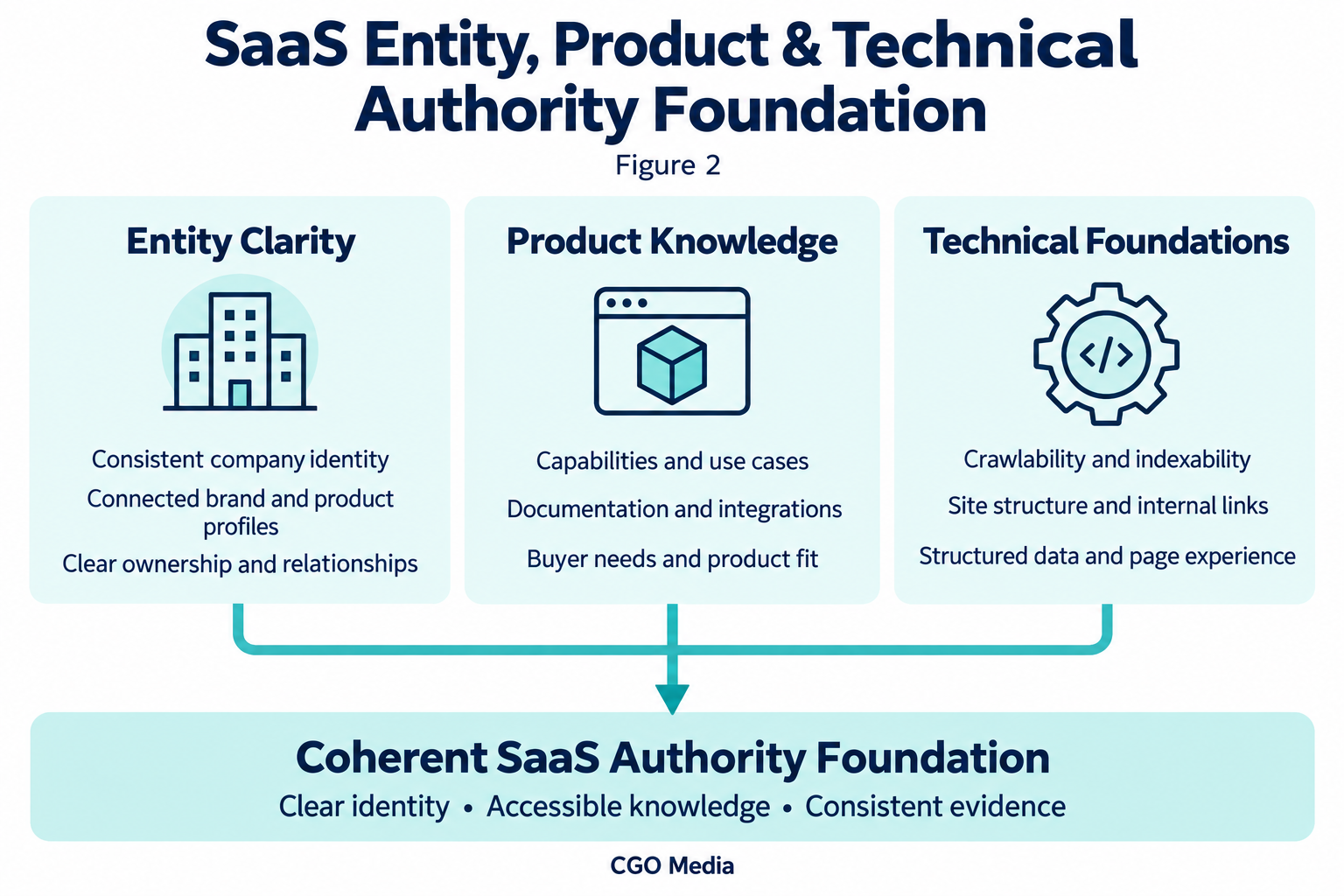
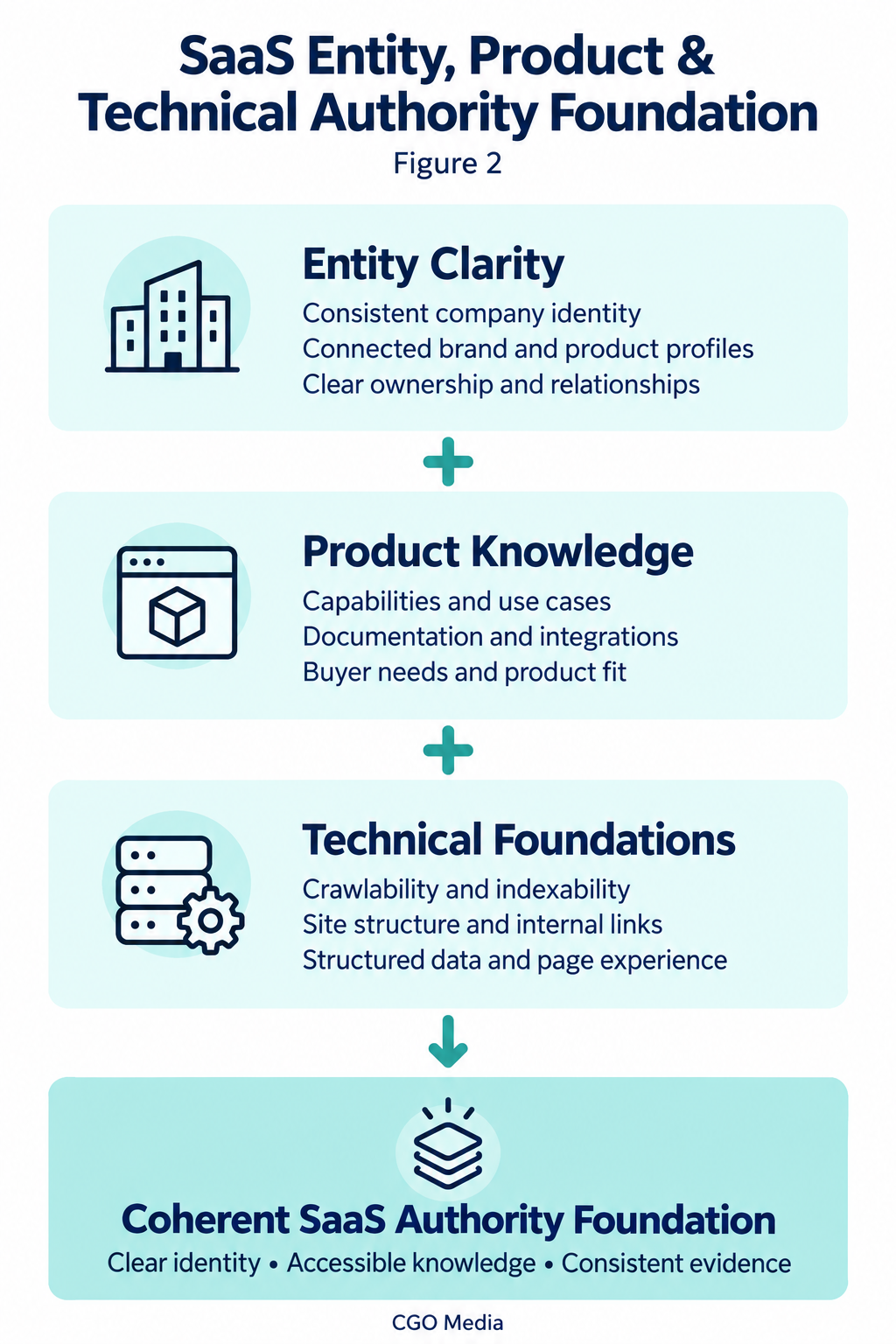
97. Continuing Phase Three — Feature, Use Case and Integration Authority Development
Phase Three should deepen the evidence surrounding the product rather than simply increase the number of pages on the website.
The objective is to make strategically important capabilities easier to:
- Discover
- Understand
- Verify
- Compare
Authority expansion should therefore follow product importance and buyer relevance.
98. Build Feature Clusters
Priority features can be organised into connected authority clusters containing:
- Feature overview
- Technical documentation
- Relevant integrations
- Use cases
- Customer evidence
- Comparison context
This creates deeper evidence around capabilities that materially influence product selection.
99. Feature Clusters Should Answer Different Buyer Questions
A strong feature cluster should help buyers determine:
- What the capability does
- How it works
- Where it is used
- Which integrations it depends on
- Who has used it successfully
- How it differs from alternatives
100. Build Integration Clusters
Priority integrations can connect:
- Integration landing page
- Technical setup guidance
- Relevant features
- Workflow examples
- Marketplace listing
- Customer evidence
This strengthens both discovery and technical evaluation.
101. Integration Clusters Should Reflect Product Reality
For important integrations, buyers should be able to determine:
- Whether the connection is native
- What data is exchanged
- Which workflows are supported
- Whether middleware is required
- Which plans provide access
Technical specificity reduces ambiguity during provider comparison.
102. Build Use-Case Clusters
Use-case authority should connect a practical business problem with specific product capabilities.
A useful relationship is:
Problem → Workflow → Feature → Integration → Customer Evidence → Outcome
This translates software functionality into buyer relevance.
103. Use-Case Clusters Should Reflect Real Customer Behaviour
Priority should be given to use cases supported by genuine:
- Customer demand
- Product usage
- Sales opportunity
- Retention value
Use-case authority should not be expanded purely because a keyword appears attractive.
104. Build Industry Clusters
Priority industry authority can include:
- Industry overview
- Sector workflows
- Relevant features
- Relevant integrations
- Customer case studies
- Security or compliance considerations
This creates a stronger sector evidence environment than generic industry landing pages.
105. Industry Clusters Should Demonstrate Genuine Relevance
An effective sector cluster should answer:
- Which problems occur in the industry?
- Which workflows does the product support?
- Which integrations matter?
- Which customer examples exist?
- Which risk or compliance considerations apply?
106. Build Role-Based Clusters Where Commercially Useful
Some SaaS products benefit from dedicated evidence for different buying roles.
Relevant audiences can include:
- CFO
- CTO
- Operations Director
- HR Director
- Marketing Director
- Security Lead
Role-based evidence should remain connected to one consistent product truth.
107. Different Roles Require Different Evidence
For example:
- CFO — cost, ROI, controls and reporting
- CTO — architecture, APIs, integrations and scalability
- Operations — workflow efficiency and implementation
- Security — controls, privacy and governance
The same product can therefore require several evidence perspectives.
108. Strengthen Comparison Authority
Comparison content should help buyers understand meaningful differences between products without relying on exaggerated or unsupported claims.
Comparison authority becomes especially important once buyers move from category discovery into active vendor evaluation.
109. Build Direct Competitor Comparisons
Where appropriate, comparison pages can examine:
- Features
- Integrations
- Pricing
- Security
- Implementation
- Target customer
The objective should be decision support rather than artificial superiority.
110. Build Alternative Pages
“Alternatives to” content can support buyers already considering a competing provider.
Strong alternative content should explain:
- Which buyer each product suits
- Where capabilities differ
- Which trade-offs matter
111. Maintain Comparison Accuracy
Comparison content should have explicit review processes because competitor:
- Features
- Pricing
- Integrations
- Packaging
can change frequently.
Outdated comparison evidence can undermine trust.
112. Expand Documentation Depth
Documentation should become more comprehensive around commercially important capabilities.
Priority areas can include:
- Implementation
- Configuration
- Integrations
- APIs
- Limitations
113. Expand API and Developer Evidence
Where technical buyers influence selection, developer resources should support:
- Authentication
- Endpoints
- Webhooks
- Error handling
- Rate limits
- Implementation examples
Strong technical evidence can reduce uncertainty for developer-led and enterprise buyers.
114. Developer Evidence Should Support Evaluation
Developer resources should help technical teams determine whether the product can realistically fit their existing environment.
This makes developer experience part of provider-selection readiness.
115. Strengthen Product Demonstration Evidence
Providers can support evaluation through:
- Recorded demos
- Interactive demos
- Product tours
- Sandbox environments
- Free trials
Direct product experience can reduce uncertainty that marketing copy alone cannot resolve.
116. Demonstration Evidence Should Match the Sales Model
Product-led SaaS may rely heavily on:
- Free trials
- Interactive product tours
- Self-service onboarding
Complex enterprise SaaS may require guided demonstrations and technical consultation.
117. Align Product Evidence with Sales Questions
Recurring buyer questions should feed directly into:
- Content priorities
- Documentation
- Comparison pages
- Product explanations
If sales teams repeatedly answer the same question, the public evidence environment may be incomplete.
118. Align Product Evidence with Support Questions
Repeated support and onboarding issues can reveal information gaps affecting both:
- Existing customer experience
- Pre-sale product evaluation
Customer-support evidence can therefore improve future authority development.
119. Align Product Evidence with Product Analytics
Usage data can help identify which capabilities matter most in practice, provided it is interpreted appropriately and within relevant privacy and governance constraints.
Product analytics can inform priorities around:
- Feature authority
- Use cases
- Onboarding
- Customer evidence
120. Phase Three Output
By the end of Phase Three, the SaaS provider should have stronger authority around:
- Priority features
- Priority integrations
- Priority use cases
- Priority industries
- Comparison journeys
- Technical evaluation
The provider should now possess a deeper evidence environment around the product areas that matter most to buyers.
121. Phase Four — Trust, Customer and External Authority Development
Phase Four strengthens the evidence that reduces adoption risk and validates the provider beyond its own product claims.
The objective is to create stronger confidence across:
- Security
- Privacy
- Reliability
- Implementation
- Customer outcomes
- Independent authority
122. Build a Trust Evidence Inventory
Map the current evidence available around:
- Security
- Privacy
- Reliability
- Implementation
- Support
- Commercial transparency
This reveals which buyer-risk questions remain insufficiently supported.
123. Prioritise Trust Evidence by Buyer Risk
Not every SaaS product requires the same level of trust evidence.
Evidence requirements generally increase with:
- Data sensitivity
- Purchase value
- Product dependency
- Customer size
- Regulatory exposure
124. Strengthen Security Evidence
Priority security information can include:
- Encryption
- Authentication
- Access control
- Infrastructure
- Incident management
- Security governance
High-risk claims should be specific and appropriately validated.
125. Build or Improve a Trust Centre
Where appropriate, a central trust environment can help buyers locate:
- Security information
- Certifications
- Privacy information
- Subprocessor information
- Reliability evidence
- Compliance documentation
A trust centre can reduce friction during technical and procurement evaluation.
126. Improve Privacy Transparency
Make it easier for relevant buyers to understand:
- Data processing
- Data storage
- Retention
- Deletion
- Subprocessors
- Regional options
Privacy evidence should reflect current product and operational reality.
127. Improve Reliability Evidence
Where relevant, provide clear access to:
- Status information
- Incident communication
- Availability information
- Business continuity evidence
Reliability evidence becomes more important as customer dependency increases.
128. Strengthen Implementation Evidence
Buyers should understand:
- Implementation stages
- Customer responsibilities
- Migration requirements
- Training requirements
- Typical deployment complexity
Implementation clarity helps buyers assess operational fit before purchase.
129. Strengthen Support Evidence
Clarify:
- Support channels
- Support hours
- Plan differences
- Escalation routes
- Dedicated support options
Support evidence should align with actual service delivery.
130. Strengthen Pricing Transparency
Where pricing is public, buyers should be able to understand:
- Pricing model
- Plan differences
- Usage limits
- Feature availability
- Material additional costs
Commercial clarity helps unsuitable buyers self-filter earlier.
131. Build Customer Evidence Strategically
Customer proof should be developed around the markets and workflows most important to growth.
The strongest evidence is generally specific to real buyer scenarios.
132. Build Case Studies by Industry
Priority industries should have relevant customer evidence where genuine examples exist.
Useful industry case studies should connect:
- Customer context
- Sector problem
- Implementation
- Product usage
- Outcome
133. Build Case Studies by Use Case
Case studies should also demonstrate how specific workflows are supported in practice.
This connects customer proof directly with the use-case authority architecture developed in Phase Three.
134. Build Case Studies by Company Size
Customer evidence may need to demonstrate suitability for:
- Startups
- SMEs
- Mid-market organisations
- Enterprise buyers
Different customer sizes can have materially different requirements.
135. Strengthen Customer Outcome Evidence
Where credible data exists, case studies can include outcomes such as:
- Time savings
- Cost reductions
- Revenue improvement
- Productivity gains
- Reduced manual effort
Measured outcomes can strengthen evidence when sufficient context is provided.
136. Avoid Unsupported Outcome Claims
Illustrative examples, estimates and measured customer outcomes should be distinguished clearly.
Providers should avoid presenting one customer’s result as a universal expectation.
137. Improve Review Platform Authority
Identify which review environments materially influence the product category.
Priority should reflect where actual buyers conduct software evaluation rather than the number of review platforms available.
138. Correct Review Platform Profiles
Ensure that important external profiles contain current:
- Product names
- Categories
- Features
- Pricing context where applicable
- Company information
Material inconsistencies should be corrected where possible.
139. Improve Review Recency
Where appropriate and consistent with platform policies, organisations can encourage genuine recent customers to share independent product experiences.
Review recency helps reduce dependence on experiences relating to older product versions.
140. Analyse Review Themes
Review data can reveal repeated themes around:
- Product usability
- Support
- Implementation
- Reliability
- Pricing
- Feature limitations
Recurring themes can reveal both evidence opportunities and underlying product issues.
141. Feed Review Insights Back into Product and Evidence
Repeated criticism may indicate:
- A product problem
- A communication problem
- An expectation problem
- A combination of these
Review insight should therefore inform both product development and public evidence.
142. Improve Marketplace Authority
Priority marketplace listings should be:
- Accurate
- Current
- Well described
- Connected with relevant documentation
Marketplace evidence can strengthen both discovery and technical relationships.
143. Strengthen Technology Partner Authority
Relevant partnerships can reinforce:
- Integration credibility
- Technical compatibility
- Market positioning
Partner authority should be based on genuine current relationships.
144. Strengthen Implementation Partner Authority
For complex SaaS products, implementation partners can help demonstrate:
- Deployment capability
- Industry experience
- Regional reach
- Technical expertise
This can reduce implementation uncertainty for larger buyers.
145. Build Digital PR Around Authority Objectives
Digital PR should support specific authority goals rather than generic visibility alone.
Priority objectives can include:
- Category authority
- Technical authority
- Industry authority
- Research authority
146. Product-Led Digital PR
Potential product-led areas can include:
- Product innovation
- Technical expertise
- Industry insight
- Customer outcomes
PR activity should reinforce genuine product and organisational expertise.
147. Research-Led Digital PR
Original research can generate stronger external authority when the methodology and findings are genuinely useful to:
- Journalists
- Analysts
- Industry professionals
- Researchers
Research can become a durable authority asset rather than a one-time publicity campaign.
148. Develop Citation-Useful Research Assets
Potential formats include:
- Industry benchmarks
- Market studies
- Customer behaviour research
- Workflow analysis
- Technology adoption studies
The objective is to create evidence other organisations have a legitimate reason to reference.
149. Publish Research Methodology Clearly
Research assets should explain relevant:
- Sample
- Data source
- Time period
- Method
- Limitations
Methodological transparency strengthens research credibility.
150. Build Expert Authority
Relevant internal specialists can contribute through:
- Research
- Technical articles
- Industry commentary
- Webinars
- Events
Expert visibility should connect directly with genuine subject knowledge.
151. Strengthen External Source Diversity
Avoid excessive dependence on one review platform, publication or marketplace.
A broader authority ecosystem can include:
- Customers
- Partners
- Marketplaces
- Review platforms
- Industry publications
- Research citations
- Professional communities
152. External Diversity Should Remain Relevant
The objective is not to accumulate the maximum number of mentions.
External authority is strongest when the source has genuine relevance to:
- The category
- The buyer
- The product
- The claim being supported
153. Audit External Information Consistency
Compare strategically important external descriptions against current first-party evidence for:
- Product category
- Features
- Integrations
- Pricing
- Target customer
Material inconsistencies can weaken both trust and AI-assisted representation.
154. The Phase Four Authority Relationship
The completed trust-development stage can be summarised as:
Security & Privacy + Reliability + Implementation + Customer Proof + Reviews + Partners + Research + External Validation
These evidence layers collectively reduce uncertainty beyond the provider’s own product claims.
155. Phase Four Output
By the end of Phase Four, the SaaS provider should have:
- Stronger security and privacy evidence
- Better implementation and support clarity
- Deeper customer proof
- Improved review authority
- Stronger partner and marketplace presence
- More relevant independent validation
- A foundation for citation authority
The provider is now better positioned to move from general search authority into deliberate AI search and recommendation-readiness work.
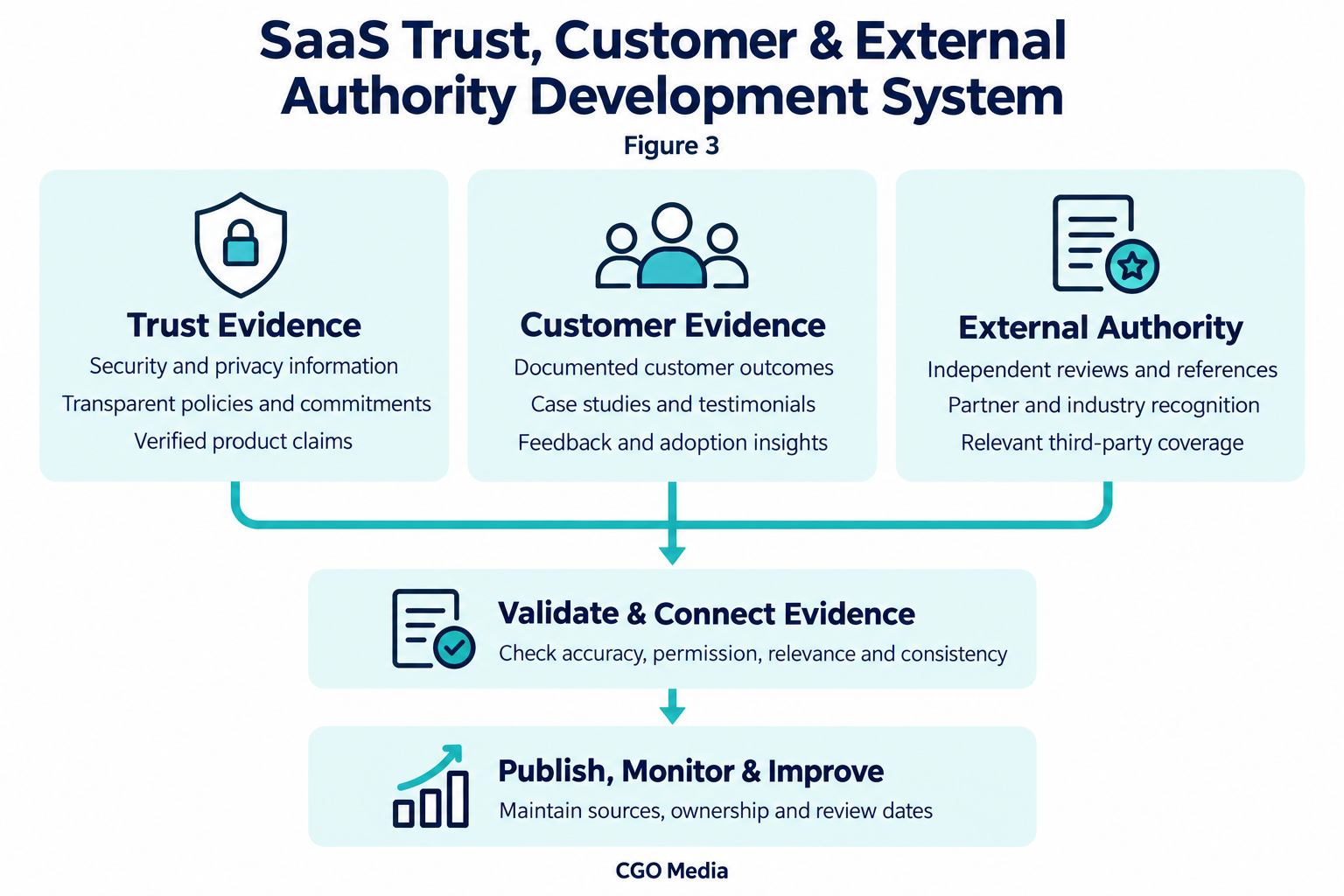
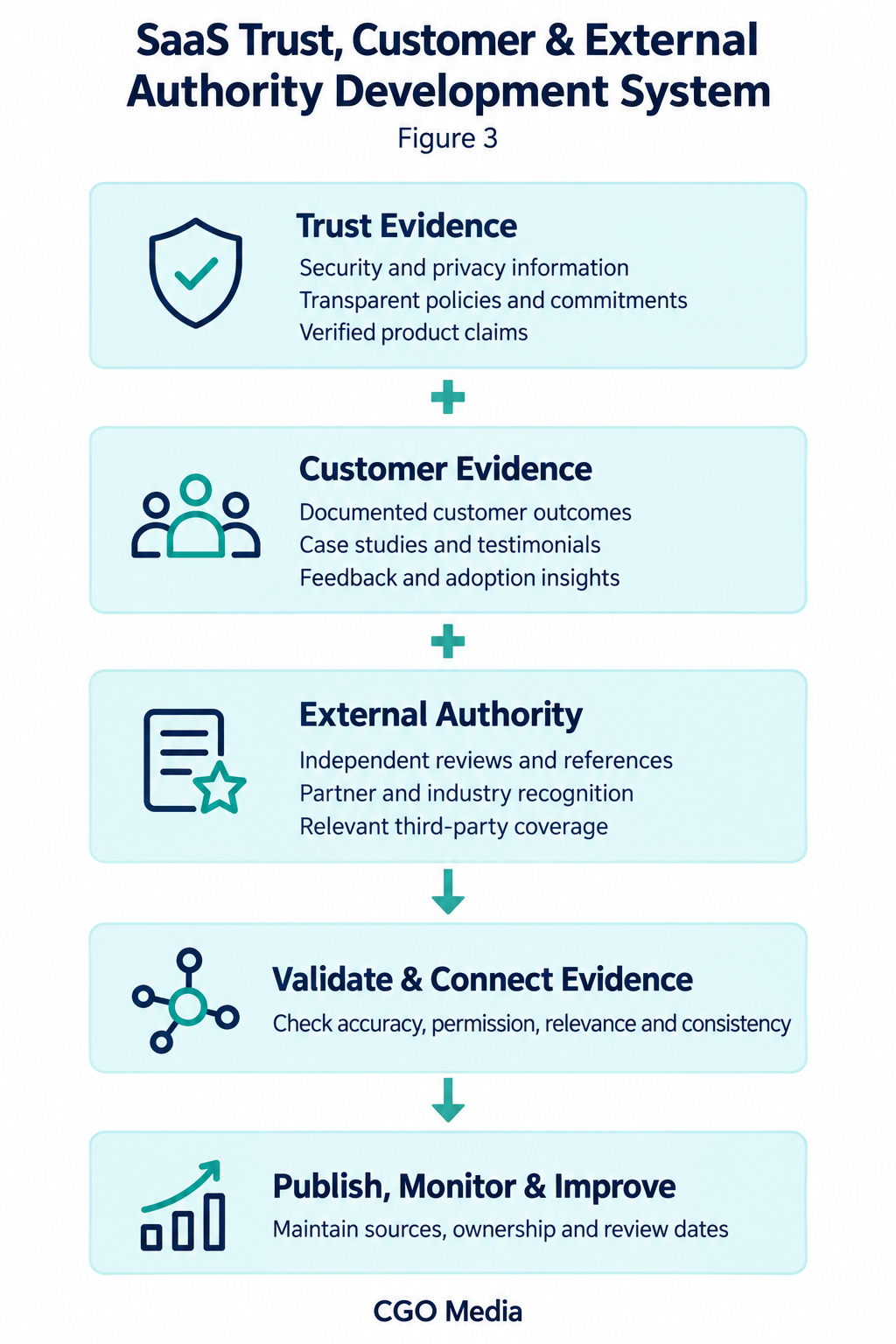
156. Phase Five — AI Search and Vendor Recommendation Readiness
Phase Five focuses on improving how accurately and appropriately the SaaS provider is represented within AI-assisted discovery, comparison and recommendation environments.
The objective is not to manipulate individual AI systems directly.
It is to strengthen the quality, clarity and consistency of the evidence available across the wider digital ecosystem.
157. Establish a Structured AI Query Architecture
Create a repeatable query set covering the buying scenarios most important to the business.
The monitoring architecture can include:
- Category prompts
- Feature prompts
- Integration prompts
- Use-case prompts
- Industry prompts
- Company-size prompts
- Geographic prompts
- Pricing prompts
- Security prompts
- Competitor-comparison prompts
This creates a stable basis for repeated observation.
158. Separate Branded and Non-Branded AI Visibility
Branded and non-branded testing answer different strategic questions.
Branded visibility asks whether AI systems understand the provider when the company or product is named directly.
Non-branded visibility asks whether the provider enters consideration before the buyer already knows the brand.
159. Build a Branded Accuracy Set
Branded testing should assess whether important information is represented correctly, including:
- Company identity
- Product identity
- Category
- Core features
- Integrations
- Pricing
- Security characteristics
- Target customers
This establishes whether the basic provider evidence environment is coherent.
160. Build a Category Recommendation Set
Test whether the SaaS provider appears within strategically important category recommendations.
Category prompts should reflect the markets where the product genuinely competes.
Broad visibility outside genuine product fit should not be treated automatically as a positive result.
161. Build a Feature Recommendation Set
Feature-led prompts can test whether the product is associated with commercially important capabilities.
Priority should be given to features that materially influence:
- Product selection
- Competitive differentiation
- Customer adoption
162. Build an Integration Recommendation Set
Integration-led testing should examine whether the SaaS provider is understood as compatible with important technology platforms.
This becomes especially important where integration compatibility acts as a mandatory buyer requirement.
163. Build a Use-Case Recommendation Set
Use-case prompts should describe real operational requirements rather than generic product-category language.
A useful structure is:
Buyer Type + Problem + Workflow + Required Capability + Context
This creates more commercially meaningful recommendation testing.
164. Build an Industry Recommendation Set
Where vertical markets are strategically important, test whether the provider appears appropriately within sector-specific recommendation scenarios.
Industry testing can include relevant:
- Workflows
- Regulation
- Integrations
- Operational requirements
165. Build a Company-Size Recommendation Set
Test whether the product is represented appropriately for different customer profiles such as:
- Startups
- SMEs
- Mid-market organisations
- Enterprise buyers
Company-size suitability can materially affect recommendation quality.
166. Build a Geographic Recommendation Set
Where geography influences provider fit, prompts can incorporate:
- Country
- Region
- Currency
- Data residency
- Local support
- Compliance requirements
Global availability should not automatically be interpreted as equal suitability across every market.
167. Build a Pricing Recommendation Set
Pricing-led prompts can reveal whether the product is associated accurately with:
- Budget level
- Pricing model
- Company size
- Value positioning
This is particularly important where pricing acts as an early buyer filter.
168. Build a Security and Compliance Recommendation Set
For enterprise, regulated or data-sensitive SaaS categories, test whether security and compliance information is represented accurately.
Priority facts can include:
- Certifications
- Authentication
- Data handling
- Privacy
- Data residency
169. Build a Competitor Comparison Set
Create repeatable prompts comparing the provider with strategically important competitors across:
- Features
- Integrations
- Pricing
- Security
- Implementation
- Target market
This helps identify how the provider is framed within active buyer comparison.
170. Measure AI Recommendation Share
Record how frequently the provider appears within relevant recommendation scenarios.
Recommendation share should be segmented by:
- Category
- Feature
- Use case
- Industry
- Buyer segment
This avoids reducing diverse recommendation environments to one universal number.
171. Measure AI Shortlist Share
Track how often the provider appears within smaller recommendation sets such as the first:
- Three vendors
- Five vendors
- Ten vendors
Shortlist visibility can provide stronger evidence of serious consideration than broad mention frequency.
172. Measure AI Comparison Visibility
Record how frequently the provider appears within relevant competitor-comparison scenarios.
This helps determine whether the product is part of the effective competitive set within strategically important markets.
173. Measure AI Representation Accuracy
Important product facts should be assessed for:
- Correctness
- Completeness
- Freshness
- Commercial relevance
Visibility should not be considered strong where decision-critical product information is represented inaccurately.
174. Identify Material AI Representation Errors
Potential problems can include:
- Incorrect product category
- Discontinued features
- Unsupported integrations
- Outdated pricing
- Incorrect customer fit
- Stale company information
Errors should be prioritised according to their likely buyer and commercial impact.
175. Classify Representation Errors by Severity
A practical structure can include:
- Critical — security, compliance or fundamental product misinformation
- High — errors likely to affect shortlist inclusion
- Medium — errors affecting positioning or comparison
- Low — minor descriptive variation
This prevents every generated difference from receiving equal attention.
176. Investigate the Evidence Environment
When repeated inaccuracies appear, investigate the wider evidence system rather than treating the generated response as the root cause.
Relevant sources can include:
- First-party pages
- Documentation
- Review profiles
- Marketplace listings
- Partner websites
- External publications
177. Correct First-Party Evidence First
The organisation should verify that its own product information is:
- Correct
- Current
- Consistent
- Sufficiently explicit
External correction is less effective when the provider’s own evidence remains ambiguous.
178. Correct Important External Profiles
Where practical, update or request correction of material inaccuracies across strategically important:
- Review platforms
- Marketplaces
- Partner pages
- Directories
- Industry profiles
Priority should reflect source relevance and buyer impact.
179. Build a Remediation Workflow
A repeatable process can be represented as:
Detect → Verify → Diagnose → Correct → Monitor
This creates a more resilient response than ad hoc correction.
180. Detect
Identify material inaccuracies or significant shifts in recommendation visibility through scheduled monitoring.
181. Verify
Confirm whether the generated representation is genuinely incorrect, outdated or commercially misleading.
Minor wording variation should not automatically trigger remediation.
182. Diagnose
Identify whether the likely cause involves:
- First-party ambiguity
- Outdated documentation
- External profile conflict
- Entity confusion
- Missing evidence
183. Correct
Strengthen the evidence environment through the intervention appropriate to the underlying cause.
The objective is durable information improvement rather than one-response manipulation.
184. Monitor
Re-test comparable scenarios to determine whether the material problem continues to appear.
Monitoring should focus on patterns rather than expecting identical generated outputs.
185. Improve Source-Useful Product Content
Create first-party resources that can function as reliable reference material for buyers, journalists, partners and other information environments.
Useful assets can include:
- Detailed feature documentation
- Integration documentation
- Security resources
- Implementation guides
- Pricing explanations
186. Improve Source-Useful Research Content
Potential research assets can include:
- Market benchmarks
- Customer behaviour studies
- Workflow research
- Technology adoption analysis
- Industry data
The strongest research provides evidence other organisations have a legitimate reason to reference.
187. Strengthen Citation Authority
Citation authority develops when useful first-party resources become credible reference points within the wider information ecosystem.
The objective is not simply to attract links.
It is to create resources that contribute meaningful evidence to:
- Industry analysis
- Buyer research
- Technical discussion
- Journalistic coverage
188. Strengthen Entity Relationships
AI readiness also depends on clear relationships between:
- Company
- Product
- Feature
- Integration
- Customer
- Expert
- Research
These relationships should reinforce the product knowledge architecture established earlier in the roadmap.
189. Strengthen External Validation
Independent evidence can reinforce provider suitability through:
- Customer reviews
- Marketplace listings
- Partner relationships
- Editorial coverage
- Research citations
External validation should remain relevant to the product and buyer scenario.
190. AI Recommendation Readiness Is Cumulative
The provider should avoid looking for one tactic that guarantees recommendation visibility.
A stronger readiness condition emerges from the combined quality of:
- Entity clarity
- Product evidence
- Trust
- External validation
- Commercial relevance
191. Recommendation Readiness Should Remain Scenario-Specific
A provider may be highly appropriate for one:
- Industry
- Company size
- Technical environment
- Price range
and less appropriate for another.
The objective is accurate recommendation within relevant scenarios rather than universal inclusion.
192. AI Recommendation Visibility Cannot Be Guaranteed
No SaaS provider can guarantee inclusion within AI-generated recommendations, comparisons or citations.
The roadmap therefore focuses on improving the evidence conditions supporting accurate discovery and evaluation.
193. Establish AI Monitoring Cadence
A practical monitoring programme can include:
- Monthly branded accuracy checks
- Monthly priority recommendation testing
- Quarterly competitive comparison reviews
- Quarterly source analysis
- Periodic query-set expansion
The cadence should reflect product velocity and commercial risk.
194. Refresh the AI Query Set
Prompt libraries should evolve as:
- Products change
- New features launch
- New competitors emerge
- New industries are targeted
- Buyer language changes
Static query sets can become less representative of the real market over time.
195. Preserve Comparable Core Queries
Although the query library should evolve, a stable core set should be retained where possible.
This allows the organisation to compare changes in:
- Recommendation visibility
- Accuracy
- Competitive framing
over time.
196. Phase Five Output
By the end of Phase Five, the SaaS organisation should have:
- A repeatable AI query architecture
- A recommendation visibility baseline
- A representation accuracy process
- A competitor comparison benchmark
- An AI source-analysis process
- A remediation workflow
- A stronger recommendation-readiness evidence environment
197. Phase Six — Measurement, Governance and Commercial Integration
Phase Six converts the search and authority programme into a repeatable organisational operating system.
The focus moves from individual implementation activities toward:
- Measurement
- Ownership
- Commercial integration
- Change governance
198. Define the SaaS Search Authority Scorecard
Select a manageable set of indicators across:
- Search visibility
- Product authority
- Customer authority
- Trust
- External authority
- AI visibility
- Commercial progression
The scorecard should support decisions rather than simply create more reporting.
199. Search Visibility Measures
Potential indicators include:
- Category visibility
- Feature visibility
- Integration visibility
- Use-case visibility
- Comparison visibility
200. Product Authority Measures
Potential indicators include:
- Priority feature coverage
- Documentation completeness
- Integration coverage
- Information freshness
- Entity consistency
These measures indicate whether product evidence is sufficiently complete and maintainable.
201. Customer Authority Measures
Potential indicators include:
- Case-study coverage
- Industry evidence coverage
- Customer outcome evidence
- Review recency
- Customer-segment coverage
202. Trust Measures
Potential indicators include:
- Security evidence completeness
- Privacy evidence freshness
- Implementation clarity
- Support transparency
- Pricing transparency
203. External Authority Measures
Potential indicators include:
- Relevant media citations
- Partner references
- Marketplace visibility
- Review authority
- Research citations
204. AI Measures
Potential indicators include:
- Recommendation share
- Shortlist share
- Comparison visibility
- Source visibility
- Representation accuracy
205. Commercial Measures
Potential indicators include:
- Trial starts
- Demo requests
- Qualified pipeline
- Shortlist rate
- Competitive win rate
- Revenue contribution
These indicators connect authority development with commercial progression.
206. Connect Search Data with Revenue Operations
Where systems and data quality permit, connect discovery activity with:
- Lead source
- Opportunity creation
- Opportunity value
- Win/loss outcome
- Customer value
This gives the roadmap a stronger commercial feedback loop.
207. Avoid Last-Click Dependence
SaaS buying journeys often involve multiple interactions across:
- Search
- Reviews
- AI systems
- Direct visits
- Sales conversations
The final recorded touchpoint should not automatically be treated as the complete discovery journey.
208. Establish Evidence Ownership
Every decision-critical evidence category should have a named internal owner.
Ownership makes it easier to:
- Validate changes
- Correct errors
- Maintain freshness
- Escalate material issues
209. Product Ownership
Product teams may own or validate:
- Feature accuracy
- Module relationships
- Product positioning
- Packaging information
210. Engineering Ownership
Technical teams may own:
- API accuracy
- Integration accuracy
- Developer documentation
- Technical limitations
211. Security and Legal Ownership
Security, privacy and legal teams may own or approve:
- Security claims
- Certifications
- Privacy information
- Subprocessor information
- Compliance documentation
212. Marketing Ownership
Marketing can coordinate:
- Search visibility
- Content architecture
- External authority
- Review monitoring
- AI visibility analysis
Marketing should communicate validated product truth rather than independently define it.
213. Customer Success Ownership
Customer-success teams can support:
- Case studies
- Customer outcomes
- Review insight
- Implementation feedback
- Adoption evidence
214. Sales and Revenue Operations Ownership
Sales and revenue operations can contribute:
- Buyer objections
- Win/loss reasons
- Competitive intelligence
- Pipeline measurement
- Commercial attribution
This connects authority development with real buyer outcomes.
215. Establish Change Triggers
Governance should include defined review triggers whenever strategically important information changes.
High-priority trigger categories include:
- Product
- Integrations
- Pricing
- Security
- Customer evidence
- AI representation
This begins the transition from campaign-based optimisation toward continuous authority governance.
216. Continuing Phase Six — Measurement, Governance and Commercial Integration
The next stage is to make the measurement and governance system operational enough to support regular decision-making.
The objective is to move from occasional reporting toward a repeatable authority-management process.
217. Establish a Reporting Cadence
A practical reporting structure can include:
- Monthly operational monitoring
- Quarterly authority reviews
- Quarterly competitive benchmarking
- Annual strategic reassessment
The exact cadence should reflect product velocity, competitive intensity and commercial risk.
218. Monthly Operational Monitoring
Monthly monitoring can focus on changes most likely to require action.
Priority areas include:
- Search visibility
- AI representation
- Review trends
- Product information changes
- Critical trust issues
The purpose is early detection rather than exhaustive reporting.
219. Quarterly Authority Review
Quarterly reviews can examine broader progress across:
- Maturity targets
- Evidence gaps
- Competitive changes
- External authority growth
- AI recommendation trends
- Commercial progression
This provides enough distance to identify strategic patterns rather than short-term volatility.
220. Annual Strategic Reassessment
An annual review should determine whether the authority programme remains aligned with:
- Business strategy
- Product roadmap
- Target markets
- Revenue priorities
- Competitive conditions
The roadmap should evolve as the business changes.
221. Executive Dashboard Design
Executive reporting should avoid excessive operational SEO detail.
A concise dashboard can include:
- Search authority maturity level
- AI recommendation share
- Representation accuracy
- External authority trend
- Largest trust gap
- Largest competitive gap
- Qualified pipeline contribution
These indicators connect authority performance with commercial and organisational risk.
222. Separate Activity from Outcomes
Publishing more pages, gaining more links or running more AI tests are activities.
The stronger question is whether those activities improve:
- Discovery
- Buyer progression
- Trust
- Recommendation visibility
- Commercial performance
Activity volume should not be mistaken for strategic progress.
223. Maintain a SaaS Authority Backlog
The programme should maintain a prioritised backlog covering:
- Accuracy corrections
- Product evidence gaps
- Customer evidence gaps
- Trust gaps
- External authority opportunities
- AI representation issues
This creates one operational system for authority improvement.
224. Prioritise by Impact and Urgency
Backlog items can be evaluated according to:
- Commercial importance
- Buyer risk
- Competitive urgency
- Implementation effort
- Evidence decay risk
This prevents low-impact work from displacing higher-value authority problems.
225. Use Win/Loss Analysis
Win/loss evidence can reveal where the authority programme should focus next.
Recurring losses may involve:
- Missing features
- Integration gaps
- Security requirements
- Pricing
- Implementation
- Competitor preference
These patterns can expose weaknesses that search data alone cannot reveal.
226. Use Sales Questions
Repeated pre-sale questions can identify areas where important information remains unclear or difficult to find.
Common themes can reveal gaps in:
- Feature evidence
- Integration evidence
- Pricing
- Security
- Implementation
227. Use Customer-Success Evidence
Customer-success teams can reveal authority gaps involving:
- Onboarding
- Feature understanding
- Integration adoption
- Product expectations
- Support
Post-sale experience should feed back into pre-sale evidence development.
228. Use Product Analytics
Where appropriate and consistent with privacy and governance requirements, product usage can help identify which features and workflows create genuine value.
This can inform priorities around:
- Feature authority
- Use-case content
- Customer evidence
- Expansion strategy
229. Use Review Intelligence
Review trends can reveal whether external perception is improving or deteriorating around:
- Support
- Reliability
- Pricing
- Ease of use
- Implementation
Repeated themes should inform both product and authority priorities.
230. Use AI Monitoring as Diagnostic Intelligence
AI visibility data should help identify where the wider evidence environment needs strengthening.
Changes in recommendation or representation should trigger investigation rather than immediate assumptions about cause.
231. Phase Six Output
By the end of Phase Six, the SaaS provider should have:
- A defined authority scorecard
- Named evidence owners
- Change triggers
- A reporting cadence
- Commercial integration
- A prioritised authority backlog
- A repeatable governance process
The search and AI programme has now become a managed organisational capability rather than a series of independent initiatives.
232. Phase Seven — Continuous Optimisation and Authority Expansion
Phase Seven moves the programme from implementation into continuous improvement.
The objective is to maintain authority while expanding into new opportunities without allowing product information, trust evidence or external representation to decay.
233. Continuous Optimisation Begins with Change Detection
The provider should monitor change across:
- Product
- Search demand
- Competitors
- Reviews
- Customer behaviour
- AI recommendation environments
Authority development should respond to meaningful change rather than remain fixed around historical assumptions.
234. Monitor Product Change
New:
- Features
- Modules
- Pricing structures
- Integrations
should be reflected across connected evidence assets.
Product change without evidence change creates authority decay.
235. Monitor Search Demand
Search behaviour can reveal emerging:
- Problems
- Use cases
- Features
- Industries
- Buyer terminology
These changes can expose new discovery opportunities or shifts in how buyers describe existing needs.
236. Monitor Competitive Change
Competitors may alter:
- Pricing
- Positioning
- Feature depth
- Integrations
- Trust evidence
- AI visibility
Competitive authority is therefore dynamic rather than fixed.
237. Monitor Review Change
Review trends can reveal changes in real customer experience before they become visible through other channels.
A deterioration in:
- Support perception
- Reliability
- Implementation
- Pricing satisfaction
may require both product and authority intervention.
238. Monitor AI Recommendation Change
Track meaningful shifts in:
- Recommendation frequency
- Shortlist share
- Competitor presence
- Source patterns
- Representation accuracy
Short-term output variation should be distinguished from repeated strategic change.
239. Investigate Before Reacting
A decline in rankings or AI visibility should trigger diagnosis before major strategic changes are made.
Potential causes can include:
- Product change
- Evidence decay
- Competitive improvement
- Search-demand change
- Source change
240. Continuous Evidence Refresh
The organisation should maintain regular review cycles for:
- Feature content
- Integration pages
- Documentation
- Pricing
- Security resources
- Comparison pages
- Customer evidence
Review frequency should reflect how quickly each evidence type can become outdated.
241. Expand Around Proven Product Strengths
Where evidence shows strong buyer demand and commercial success, the provider can deepen authority around the corresponding:
- Features
- Use cases
- Industries
- Integrations
- Customer segments
Expansion should follow demonstrated product value.
242. Expand into Adjacent Use Cases
Adjacent use-case development should follow real product capability rather than speculative keyword opportunity.
New use cases should ideally be supported by:
- Existing customer behaviour
- Product functionality
- Operational evidence
243. Expand into New Industries
New sector authority should be supported by genuine:
- Product fit
- Customer evidence
- Industry knowledge
- Required integrations
- Commercial opportunity
Industry expansion should follow evidence rather than generic vertical-page production.
244. Expand into New Geographic Markets
International expansion can require new evidence around:
- Language
- Currency
- Regional support
- Data residency
- Local compliance
- Regional customers
Global product availability does not automatically create local authority.
245. Expand Integration Authority
New partnerships or customer demand can justify deeper authority around additional technology ecosystems.
Integration expansion should reflect genuine:
- Technical capability
- Customer demand
- Strategic relevance
246. Expand Comparison Authority
As the competitive set changes, providers can update and extend comparison assets around:
- New competitors
- AI-native alternatives
- Different customer segments
- Different pricing models
Comparison expansion should remain evidence-led and current.
247. Expand Customer Evidence
Customer proof should evolve as the organisation grows into new:
- Markets
- Industries
- Use cases
- Customer sizes
- Geographies
This ensures external proof remains representative of current strategic priorities.
248. Expand Research Authority
Original research can support long-term authority where the organisation possesses credible data, specialist expertise or access to meaningful market observations.
Research should contribute useful evidence rather than operate purely as promotional content.
249. Research Expansion Areas
Potential research areas include:
- Industry benchmarks
- Customer behaviour
- Workflow efficiency
- Technology adoption
- Operational trends
The strongest research aligns organisational expertise with questions relevant to the wider market.
250. Expand Citation Authority
The organisation can create resources designed to be genuinely useful to:
- Journalists
- Analysts
- Researchers
- Customers
- Industry professionals
Citation authority is strengthened when external audiences have a legitimate reason to reference the provider’s work.
251. Expand Expert Authority
Relevant product, technical and industry experts can contribute through:
- Research
- Technical commentary
- Webinars
- Industry publications
- Conference participation
Expert visibility should remain grounded in genuine knowledge and contribution.
252. Expand Partner Authority
Technology and implementation partnerships can strengthen:
- Market visibility
- Integration credibility
- Implementation confidence
- External validation
Partner relationships should remain current and verifiable.
253. Expand AI Query Coverage
As the product and market expand, the AI monitoring programme should incorporate new:
- Categories
- Features
- Industries
- Geographies
- Competitors
The query architecture should evolve alongside the business.
254. Expand AI Source Intelligence
Monitor whether new source types begin influencing product discovery or recommendation.
Potential changes can involve:
- Review platforms
- Industry publications
- Marketplaces
- Partner sources
- Research resources
255. Continuous Competitive Benchmarking
Competitive analysis should track where other providers are developing stronger:
- Product evidence
- Customer proof
- Trust authority
- External validation
- AI recommendation visibility
The purpose is to identify meaningful market change rather than reproduce competitor tactics indiscriminately.
256. Continuous Maturity Assessment
Repeat the SaaS Search Authority Maturity Model periodically to determine whether the organisation is:
- Progressing
- Stable
- Regressing
This provides a strategic view of authority capability over time.
257. Detect Authority Regression
Regression can occur through:
- Product information decay
- Review deterioration
- Weak governance
- Competitive acceleration
- Outdated AI evidence
Authority should therefore be monitored for deterioration as well as growth.
258. Correct Regression Early
Higher-maturity organisations should detect deterioration before it develops into a major:
- Search problem
- Trust problem
- Commercial problem
Early correction reduces the cost of rebuilding authority later.
259. Continuous Improvement Cycle
A practical operating cycle is:
Observe → Diagnose → Prioritise → Improve → Validate → Measure → Govern → Expand → Reassess
260. Observe
Monitor the:
- Product
- Market
- Customers
- Search environment
- AI discovery landscape
Observation identifies meaningful change requiring investigation.
261. Diagnose
Determine whether the issue is primarily related to:
- Visibility
- Evidence
- Trust
- Competition
- Commercial fit
Diagnosis should precede intervention.
262. Prioritise
Focus resources on issues with the greatest:
- Commercial impact
- Buyer impact
- Trust impact
- Competitive importance
263. Improve
Strengthen the relevant:
- Product evidence
- Content
- Technical foundation
- Trust evidence
- External authority
The intervention should match the diagnosed problem.
264. Validate
Confirm that new or corrected evidence is:
- Accurate
- Current
- Clear
- Supported
Validation prevents optimisation activity from introducing new inconsistencies.
265. Measure
Track whether the intervention improves:
- Search outcomes
- AI outcomes
- Buyer progression
- Commercial outcomes
Measurement closes the loop between activity and result.
266. Govern
Assign ownership so the improvement remains current over time.
Without governance, successful improvements can decay as the product evolves.
267. Expand
Use successful authority patterns to support additional:
- Features
- Products
- Use cases
- Industries
- Markets
Expansion should follow validated success.
268. Reassess
Repeat the process as the SaaS product, customer base and discovery environment continue to change.
Authority development should therefore remain iterative rather than fixed.
269. Phase Seven Output
By the end of Phase Seven, the organisation should have transformed the roadmap into an ongoing authority-development system capable of:
- Maintaining current evidence
- Detecting deterioration
- Identifying new growth opportunities
- Expanding proven authority patterns
- Adapting to market and AI change
The roadmap is now an operating cycle rather than a one-time implementation project.
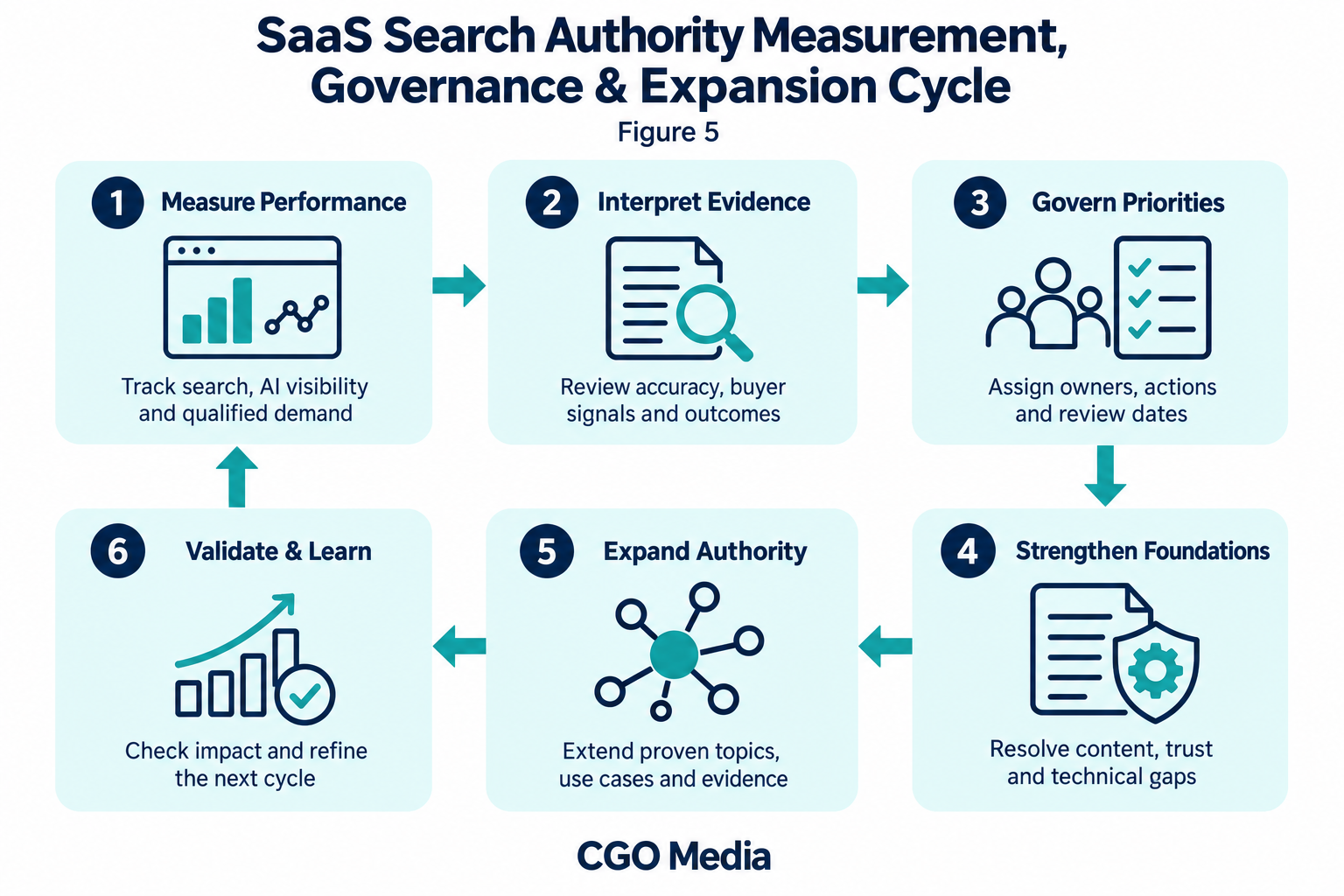
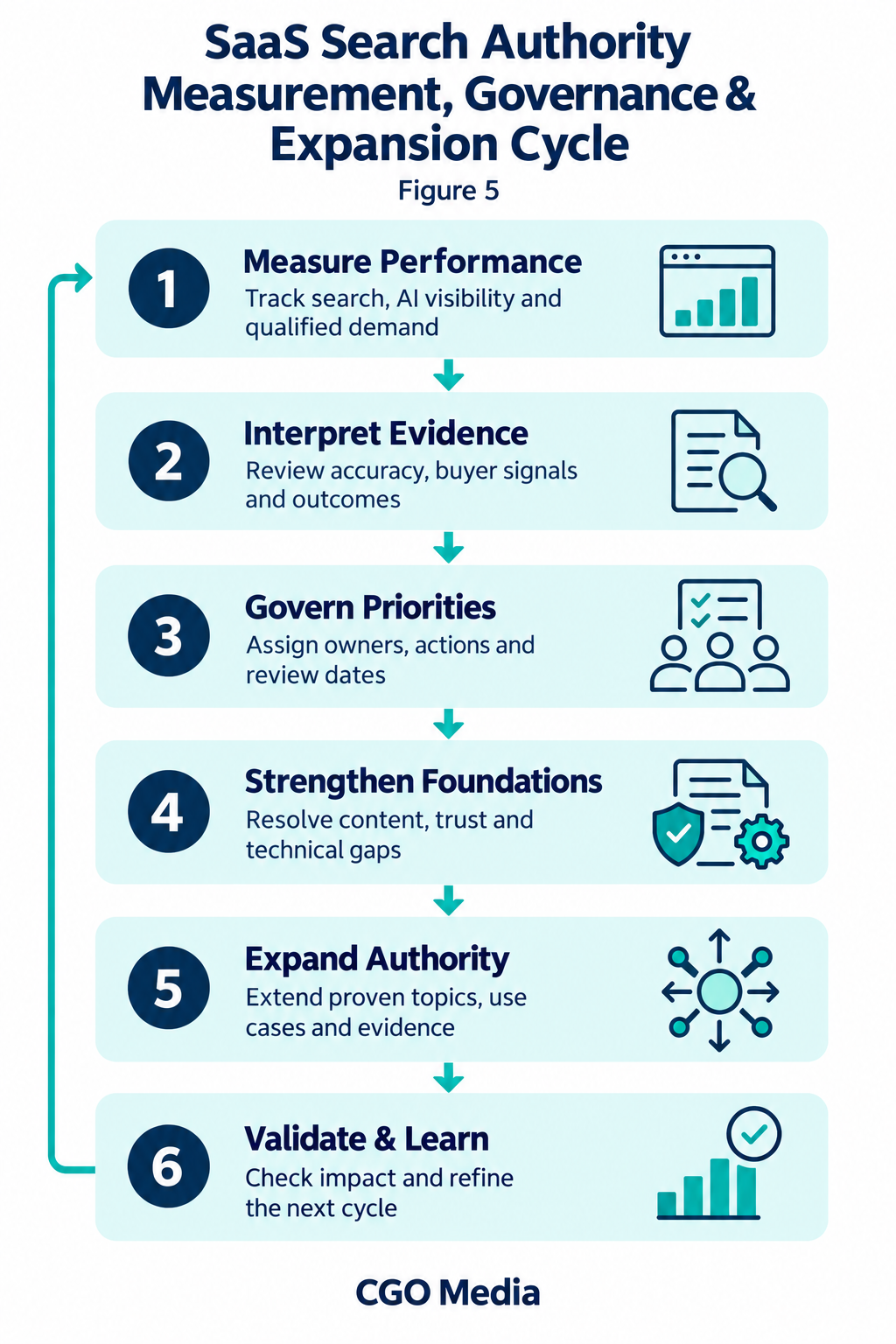
270. Common SaaS Implementation Failure Modes
The roadmap is designed to prevent a recurring SaaS growth problem: attempting advanced search, authority and AI activity before the underlying evidence environment is sufficiently strong.
Implementation should therefore identify not only what should be built, but also which sequencing mistakes can weaken the entire programme.
271. Failure Mode — Content Expansion Before Product Clarity
Publishing large volumes of content before product identity, category positioning and module relationships are clear can amplify inconsistency rather than authority.
Product architecture should be stabilised before large-scale expansion.
272. Failure Mode — AI Monitoring Before Evidence Correction
Monitoring AI recommendations provides limited strategic value when known inaccuracies remain unresolved across:
- Product pages
- Pricing
- Integrations
- Security information
- Documentation
Known evidence problems should normally be corrected before interpretation of AI visibility becomes a priority.
273. Failure Mode — Integration Pages Without Technical Evidence
Large integration libraries can create the appearance of depth while providing little useful evaluation evidence.
Priority integration pages should explain:
- What connects
- How the integration works
- Which workflows are supported
- Whether middleware is required
- Which plans support it
274. Failure Mode — Comparison Pages Without Governance
Comparison assets deteriorate quickly when competitor pricing, capabilities or packaging change without structured review.
Important comparison content should have:
- Named ownership
- Review dates
- Verification processes
275. Failure Mode — Digital PR Without Authority Objectives
Media coverage can increase visibility without materially strengthening the product categories, industries or use cases that matter commercially.
Digital PR should therefore support explicit authority objectives.
276. Failure Mode — Research Without Methodological Discipline
Research authority becomes weaker where studies fail to explain:
- Data source
- Sample
- Time period
- Method
- Limitations
Research should provide evidence capable of being evaluated independently.
277. Failure Mode — Review Acquisition Without Product Improvement
Encouraging more customer reviews cannot resolve genuine recurring problems involving:
- Product quality
- Onboarding
- Support
- Reliability
Repeated negative themes should trigger product and customer-experience investigation as well as reputation activity.
278. Failure Mode — Search Metrics Without Commercial Context
Traffic, rankings and AI mentions can appear positive while:
- Trial quality remains weak
- Demo quality declines
- Pipeline remains poor
- Customer fit deteriorates
Visibility should therefore be connected with commercial progression.
279. Failure Mode — No Cross-Functional Ownership
Search authority can deteriorate when marketing is expected to maintain information actually controlled by:
- Product
- Engineering
- Security
- Legal
- Customer success
Decision-critical evidence should be owned by the teams responsible for the underlying truth.
280. Failure Mode — Over-Engineering Governance
Governance should reduce information decay without making routine product updates unnecessarily slow.
The strongest system creates:
- Clear ownership
- Simple review triggers
- Appropriate approval
- Fast correction paths
rather than excessive process.
281. Failure Mode — Treating the Roadmap as a One-Time Project
SaaS products and markets evolve continuously.
The roadmap should therefore become an operating cycle rather than a fixed implementation checklist.
282. Sequencing for Product-Led SaaS
Product-led organisations may place greater early emphasis on:
- Product clarity
- Feature authority
- Self-service documentation
- Integrations
- Trial experience
- Review authority
283. Product-Led Priority Sequence
A practical product-led sequence is:
Product Clarity → Feature Evidence → Documentation → Integration Authority → Trial Experience → Reviews → AI Discovery → Commercial Measurement
This reflects the importance of direct product experience within lower-friction SaaS buying journeys.
284. Sequencing for Sales-Led SaaS
Sales-led SaaS providers may require greater early investment in:
- Use-case authority
- Customer evidence
- Security
- Implementation
- Comparison content
- Demo journeys
285. Sales-Led Priority Sequence
A practical sequence is:
Product Clarity → Use Cases → Customer Proof → Security → Comparison → Demo Evidence → AI Recommendation Readiness → Pipeline Measurement
This reflects a longer buyer journey in which trust and provider validation become important before purchase.
286. Sequencing for Enterprise SaaS
Enterprise SaaS implementation typically requires deeper authority and governance from the beginning because adoption risk is higher.
Priority areas may include:
- Entity and product architecture
- Technical documentation
- Security and compliance evidence
- Implementation resources
- Enterprise customer proof
- Procurement readiness
- Competitive authority
287. Enterprise Priority Sequence
A practical enterprise sequence is:
Entity Architecture → Technical Evidence → Trust & Compliance → Customer Proof → Procurement Support → Competitive Authority → AI Readiness → Revenue Integration
288. Sequencing for Vertical SaaS
Vertical SaaS organisations may need stronger authority around sector-specific evidence.
Priority areas can include:
- Industry workflows
- Sector terminology
- Industry integrations
- Regulatory requirements
- Vertical customer evidence
- Industry publications
289. Vertical SaaS Priority Sequence
A practical vertical SaaS sequence is:
Product Clarity → Industry Authority → Use Cases → Customer Evidence → Trust → External Industry Validation → AI Recommendation Readiness
290. Sequencing for International SaaS
International expansion creates additional authority requirements around regional relevance.
Priority areas can include:
- Language
- Regional entity clarity
- Pricing and currency
- Data residency
- Regional compliance
- Local customer evidence
- Regional integrations
291. International Priority Sequence
A practical international sequence is:
Market Validation → Regional Entity Structure → Localised Product Evidence → Trust & Compliance → Customer Evidence → External Authority → AI Market Monitoring
292. Sequencing Should Follow the Bottleneck
The roadmap should not be applied mechanically.
If one critical weakness is preventing buyer progression, that weakness should usually be addressed before lower-impact improvements elsewhere.
A useful rule is:
Critical Bottleneck → Evidence Correction → Validation → Next Priority
293. 90-Day SaaS SEO and AI Implementation Programme
The first 90 days should focus primarily on establishing the baseline and correcting the most important structural weaknesses.
The objective is not to complete the full roadmap within three months.
It is to create a substantially clearer and more accurate authority foundation.
294. Days 1–30 — Audit and Baseline
Priority actions can include:
- Define commercial priorities
- Map products, modules and categories
- Complete technical SEO audit
- Audit feature and integration evidence
- Audit customer and trust evidence
- Establish AI visibility baseline
- Complete initial maturity assessment
295. Days 31–60 — Critical Foundation Corrections
Priority actions can include:
- Correct product identity inconsistencies
- Resolve major technical SEO issues
- Improve priority product pages
- Correct critical pricing or integration information
- Strengthen essential security evidence
- Improve internal linking
296. Days 61–90 — Initial Authority Development
Priority actions can include:
- Expand priority feature evidence
- Improve key integration pages
- Develop high-value use cases
- Strengthen priority customer evidence
- Correct important external profiles
- Begin repeatable AI monitoring
297. 90-Day Output
By the end of the first 90 days, the organisation should have:
- A clearer product architecture
- Fewer critical accuracy problems
- A stronger technical foundation
- Improved priority product evidence
- A defined AI visibility baseline
- A prioritised authority backlog
298. Six-Month SaaS Authority Programme
The six-month horizon moves from basic correction toward deeper product, trust and external authority development.
The objective is to connect the foundation established during the first 90 days with a more complete buyer evidence environment.
299. Months 4–6 — Product Authority Expansion
Priority work can include:
- Feature clusters
- Integration clusters
- Use-case architecture
- Industry authority
- Comparison content
- Technical documentation improvement
300. Months 4–6 — Trust Expansion
Priority trust development can include:
- Trust-centre improvement
- Security and privacy resources
- Implementation evidence
- Support transparency
- Pricing clarity
301. Months 4–6 — Customer Authority Expansion
Develop stronger evidence across priority:
- Industries
- Company sizes
- Use cases
- Geographic markets
Customer proof should increasingly reflect the segments the organisation intends to grow.
302. Months 4–6 — External Authority Expansion
Begin or deepen programmes around:
- Reviews
- Marketplaces
- Partners
- Digital PR
- Original research
External authority development should remain tied to relevant categories, industries and customer groups.
303. Months 4–6 — AI Visibility Development
Expand AI monitoring into:
- Non-branded recommendations
- Competitor comparisons
- Industry prompts
- Source analysis
- Accuracy tracking
The purpose is to develop repeatable observation rather than guarantee individual recommendation outcomes.
304. Six-Month Output
By month six, the SaaS organisation should have moved beyond basic correction toward a connected authority system combining:
- Product evidence
- Technical depth
- Trust
- Customer proof
- External authority
- AI monitoring
305. Twelve-Month SaaS Authority Programme
The twelve-month horizon should focus increasingly on:
- Organisational integration
- Governance
- Competitive differentiation
- Research authority
- Strategic expansion
The objective is to establish a permanent search-authority operating system.
306. Months 7–9 — Measurement and Governance
Priority work can include:
- Formal scorecards
- Evidence ownership
- Change triggers
- Quarterly maturity reviews
- Competitive benchmarking
- Commercial attribution
307. Months 7–9 — Research and Citation Authority
Where appropriate, the organisation can establish a more formal research programme around areas where it possesses genuine:
- Data
- Experience
- Technical knowledge
- Market insight
The aim is to create resources capable of earning meaningful external reference and citation.
308. Months 10–12 — Strategic Expansion
Priority work can include:
- New industries
- New geographic markets
- New use cases
- Additional integration ecosystems
- Expanded comparison authority
- Deeper external validation
Expansion should follow proven product and market fit.
309. Months 10–12 — Advanced AI Intelligence
The monitoring programme can mature into a broader competitive-intelligence system covering:
- Recommendation share
- Shortlist share
- Competitor movement
- Source changes
- Representation accuracy
310. Twelve-Month Output
By the end of the first year, the intended outcome is not simply the completion of a large collection of SEO tasks.
The stronger result is an operating system capable of:
- Maintaining accurate product evidence
- Strengthening trust
- Monitoring AI visibility
- Developing external authority
- Connecting authority with commercial outcomes
- Identifying new growth opportunities
311. Roadmap Timing Is Indicative
The 90-day, six-month and twelve-month structures should be adapted according to:
- Organisation size
- Technical complexity
- Number of products
- Internal resources
- Competitive pressure
- Market opportunity
These horizons are planning structures rather than fixed deadlines.
312. Some Critical Work Should Happen Faster
Material inaccuracies involving:
- Pricing
- Security
- Integrations
- Product availability
should not be delayed simply to preserve a roadmap timetable.
Buyer-risk issues should override artificial sequencing where necessary.
313. Some Authority Work Requires Longer Horizons
Other improvements may require substantially more time because they depend on genuine outcomes and third-party participation.
Examples include:
- External validation
- Customer case studies
- Research authority
- Competitive recognition
- Industry reputation
314. The Complete SaaS Implementation System
The seven phases combine into an end-to-end progression:
Audit → Foundation → Product Authority → Trust & External Authority → AI Readiness → Governance & Measurement → Continuous Expansion
315. Audit
Understand the current state across:
- Buyer journeys
- Search visibility
- Evidence gaps
- Competitors
- Trust
- AI visibility
The audit establishes where implementation should begin.
316. Foundation
Correct weaknesses involving:
- Entity identity
- Technical SEO
- Product structure
- Documentation
- Critical commercial information
The foundation phase creates the structure required for deeper authority development.
317. Product Authority
Build stronger evidence around:
- Features
- Integrations
- Use cases
- Industries
- Comparisons
This makes product capability easier to discover and evaluate.
318. Trust and External Authority
Strengthen:
- Security
- Customer evidence
- Reviews
- Partners
- Research
- Independent validation
This reduces the gap between provider claims and what buyers can verify independently.
319. AI Readiness
Establish structured monitoring and improve the evidence environment supporting accurate AI-assisted discovery and recommendation.
This stage should build on stronger underlying authority rather than operate independently.
320. Governance and Measurement
Connect authority activity with:
- Named ownership
- Commercial outcomes
- Executive reporting
- Change governance
- Competitive intelligence
This converts implementation into an organisational capability.
321. Continuous Expansion
Maintain current evidence while expanding strategically into new:
- Products
- Features
- Use cases
- Industries
- Geographies
- Authority opportunities
Expansion should remain evidence-led.
322. The SaaS Implementation Feedback Loop
The roadmap should ultimately operate as:
Assess → Build → Validate → Measure → Learn → Govern → Expand → Reassess
323. Assess
Determine the current product, trust, external and AI authority position.
324. Build
Create or improve the evidence required by buyers and discovery systems.
325. Validate
Ensure that decision-critical claims are:
- Accurate
- Current
- Supported
326. Measure
Track whether changes affect:
- Discovery
- Recommendation
- Buyer progression
- Commercial outcomes
327. Learn
Use evidence from:
- Search
- Sales
- Customers
- Reviews
- AI monitoring
to identify the next priority.
328. Govern
Assign responsibility for maintaining the improved authority environment as the product changes.
329. Expand
Apply successful authority patterns to new:
- Products
- Customer groups
- Industries
- Markets
Successful patterns should be scaled only where product reality supports them.
330. Reassess
Repeat the process as the SaaS product, customer base, competitive environment and discovery landscape continue to evolve.
The completed system therefore becomes:
Assess → Build → Validate → Measure → Learn → Govern → Expand → Reassess → Assess Again
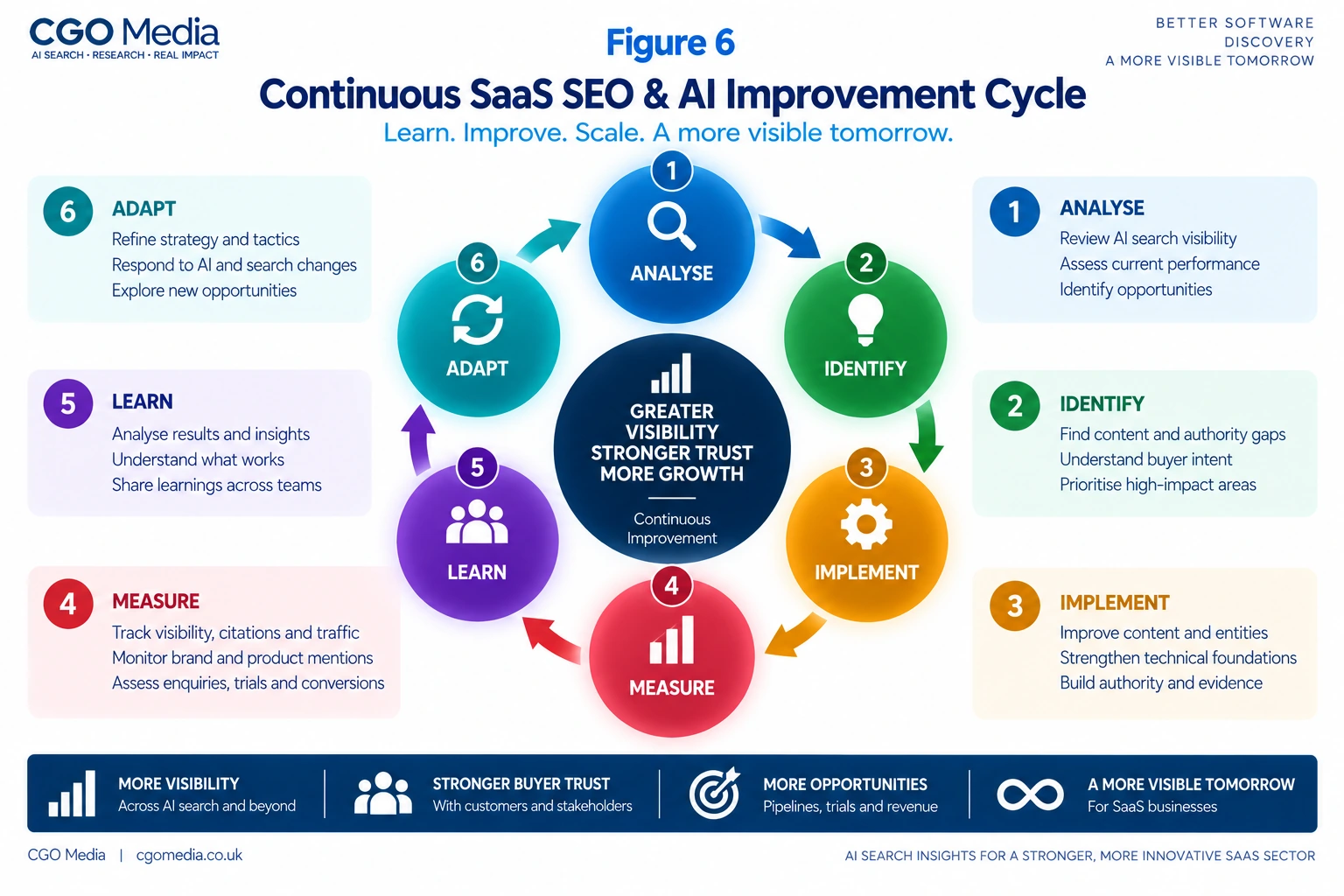
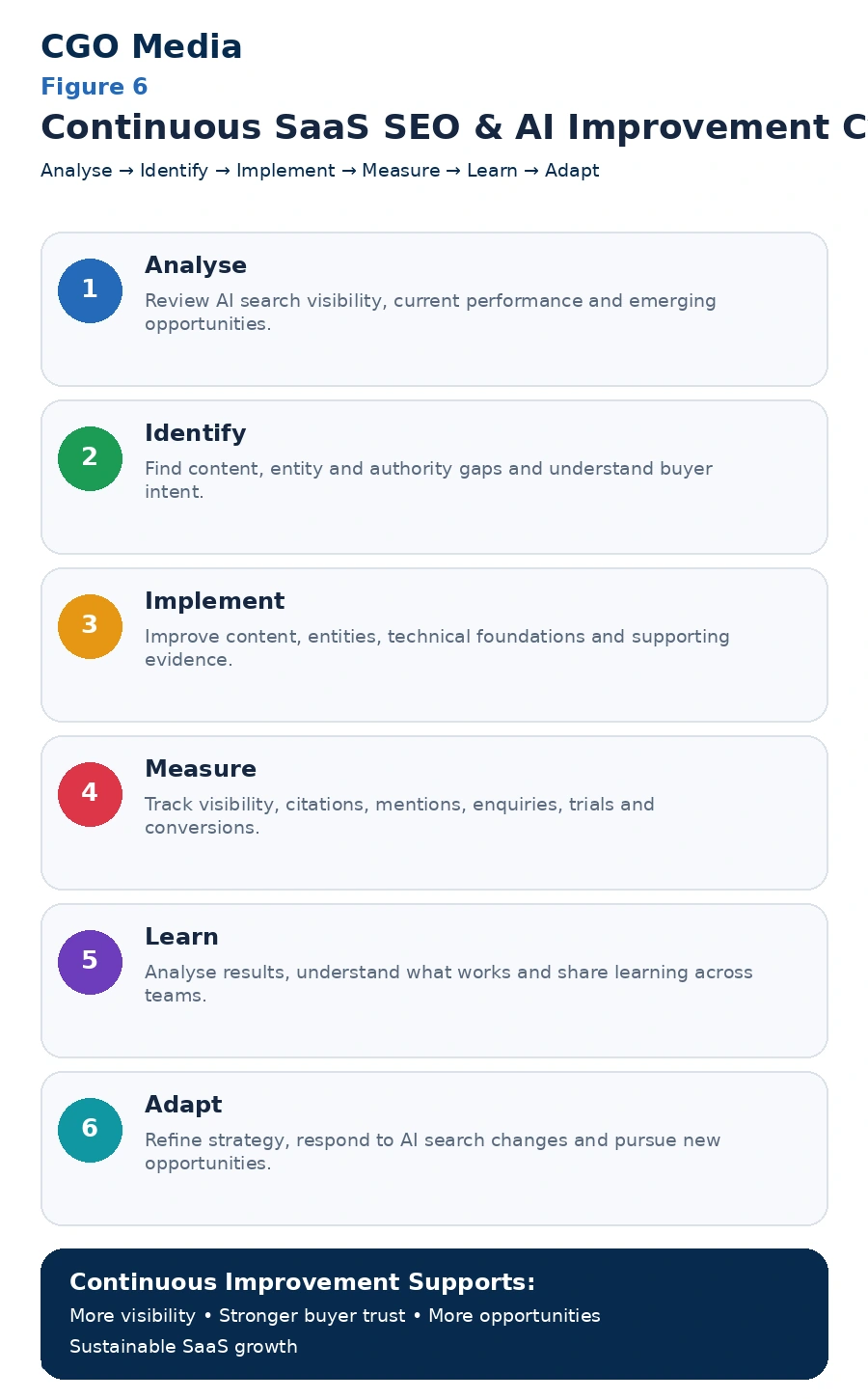
331. Strategic Implications
The SaaS SEO and AI Implementation Roadmap converts fragmented visibility activity into a structured authority-development programme.
Its central principle is that SaaS organisations should strengthen the evidence environment supporting discovery, evaluation, trust and recommendation before attempting to scale more advanced search and AI initiatives.
The seven-phase progression is:
Baseline & Audit → Entity & Technical Foundation → Product Authority → Trust & External Authority → AI Readiness → Governance & Measurement → Continuous Expansion
Each stage creates capabilities required by the next.
332. Implementation Should Follow Capability
The roadmap should not be treated as a race to complete seven phases as quickly as possible.
A SaaS organisation with unresolved product information, technical or trust problems should normally strengthen those foundations before allocating substantial resources to advanced AI monitoring or authority expansion.
A useful implementation principle is:
Fix Critical Weaknesses → Establish Capability → Validate → Expand
333. The Roadmap Is More Than a Content Programme
Content creation is only one part of implementation.
A mature SaaS authority programme can require:
- Technical corrections
- Product-information governance
- Documentation improvement
- Customer evidence
- Security transparency
- Review-platform management
- External authority development
- AI visibility monitoring
- Commercial measurement
This is why responsibility cannot sit with an SEO or content team alone.
334. The Roadmap Is Not an AI Optimisation Shortcut
AI-assisted discovery should be treated as part of the broader product-information and authority ecosystem.
No single:
- Schema type
- Content format
- Prompt strategy
- Link-building tactic
- Technical implementation
should be expected to guarantee inclusion within AI-generated recommendations.
The more sustainable objective is to improve the evidence available to buyers and machine-assisted discovery systems.
335. Search and AI Programmes Should Share Evidence
Traditional search, AI-assisted discovery and buyer evaluation rely on many of the same underlying information assets.
These include:
- Clear product information
- Technical documentation
- Entity relationships
- Customer evidence
- Security resources
- Independent validation
SaaS organisations should therefore avoid operating SEO and AI visibility as entirely separate programmes.
336. Implementation Should Be Evidence-Led
Priority actions should respond to identifiable weaknesses in areas such as:
- Discovery
- Product understanding
- Buyer trust
- Competitive authority
- AI representation
- Commercial progression
This creates a stronger implementation discipline than pursuing tactics because they are currently fashionable.
337. Implementation Should Be Commercially Prioritised
Not every product, feature, integration, use case, industry or geography deserves equal investment.
Priority should reflect factors such as:
- Revenue importance
- Customer demand
- Buyer risk
- Competitive opportunity
- Strategic market value
This keeps authority development aligned with business strategy.
338. Governance Is Particularly Important for SaaS
Software changes quickly.
Product development can alter:
- Features
- Interfaces
- Integrations
- Pricing
- Security
- Documentation
Without coordinated governance, public information can diverge from the live product.
Search authority therefore depends partly on the organisation’s ability to keep product truth and public evidence aligned.
339. AI Monitoring Should Be Diagnostic
A change in AI recommendation or representation should trigger investigation rather than immediate assumptions about cause.
Questions should include:
- Has the product changed?
- Have external sources changed?
- Have competitors strengthened?
- Has buyer language changed?
- Is the representation factually inaccurate?
Monitoring becomes useful when it supports diagnosis and evidence improvement.
340. External Authority Should Be Relevant
The roadmap does not assume that every mention, citation or backlink contributes equally to authority.
External evidence is generally more useful where the source is relevant to the provider’s:
- Software category
- Technology
- Industry
- Customers
- Expertise
Authority quality should therefore be considered alongside quantity.
341. Original Research Should Add Genuine Value
Research can become an important SaaS authority asset where the organisation possesses credible:
- Data
- Methodology
- Specialist knowledge
- Market observations
Research should contribute useful evidence to the market rather than exist solely as a link-acquisition device.
342. Implementation and the SaaS Search Authority Maturity Model
The SaaS Search Authority Maturity Model can be used before, during and after roadmap implementation to assess organisational development.
A typical progression is:
Accuracy & Foundation → Evidence Development → Cross-Functional Authority → Continuous Governance & Expansion
Organisations should progress according to capability rather than arbitrary completion dates.
343. Early, Mid and Advanced Implementation
Early Stage
An organisation beginning with fragmented visibility may initially focus on:
- Accuracy
- Entity clarity
- Technical foundations
- Basic product evidence
Mid Stage
As capability increases, implementation can expand toward:
- Customer evidence
- External authority
- AI monitoring
- Cross-functional integration
Advanced Stage
Higher-maturity organisations may focus increasingly on:
- Continuous evidence monitoring
- Competitive intelligence
- Research authority
- Executive governance
- Adaptive expansion
344. Relationship with the SaaS Research Family
The SaaS SEO and AI Implementation Roadmap translates the wider CGO Media SaaS research architecture into an implementation programme.
The supporting research defines:
- The broader SaaS discovery environment
- The trust and visibility system
- The provider-selection process
- The authority maturity structure
- The GEO and AI recommendation environment
The roadmap provides the practical sequence for turning those models into organisational action.
345. Methodology
The SaaS SEO and AI Implementation Roadmap is a strategic implementation methodology developed by CGO Media to organise the practical development of SaaS search authority across seven phases.
Framework Inputs
The roadmap draws on the conceptual relationships explored across the wider SaaS research family, including:
- Software discovery behaviour
- Product and entity clarity
- Technical authority
- Customer evidence
- Trust and external validation
- AI recommendation readiness
- Organisational maturity
Implementation Assessment
Practical application may involve reviewing:
- Website architecture
- Technical SEO
- Product information
- Documentation
- Customer evidence
- Security and privacy resources
- Review platforms
- Marketplaces
- External citations
- AI-assisted discovery results
Commercial Evidence
Where available, priorities may also be informed by:
- Sales objections
- Win/loss analysis
- Customer-success feedback
- Product analytics
- Revenue data
Evidence-Based Prioritisation
Actions should be prioritised according to the combined significance of:
- Accuracy risk
- Buyer impact
- Competitive importance
- Commercial value
- Implementation complexity
Implementation Horizons
The 90-day, six-month and twelve-month programmes within this roadmap are indicative planning structures rather than fixed implementation deadlines.
Critical accuracy, security, pricing or integration issues may require immediate correction, while durable customer, research and external authority development can require substantially longer periods.
346. Limitations
The roadmap is a strategic methodology rather than a disclosed search-engine ranking model or AI recommendation algorithm.
No Guaranteed Search or AI Outcome
Implementation does not guarantee:
- Specific rankings
- Traffic growth
- AI citations
- AI recommendations
- Commercial growth
AI Systems Are Dynamic
Generated responses can vary according to:
- Model
- Prompt
- Retrieval behaviour
- Source availability
- Geography
- Time
Correlation Does Not Establish Causation
An improvement in search or AI visibility following an implementation action does not by itself demonstrate that the action caused the change.
Business Context Matters
Roadmap priorities should be adapted according to:
- Product complexity
- Business model
- Market maturity
- Regulatory requirements
- Internal capability
- Available resources
Public Evidence Has Limits
Competitive research can analyse publicly visible evidence but cannot reliably determine undisclosed internal systems, processes or commercial decisions.
Research Requires Appropriate Governance
Research using customer, product or behavioural data should consider appropriate:
- Methodological controls
- Privacy requirements
- Data governance
- Disclosure
347. Application by SaaS Business Model
Product-Led SaaS
Product-led organisations may accelerate implementation around:
- Self-service discovery
- Feature authority
- Documentation
- Integrations
- Trials
- Reviews
Enterprise SaaS
Enterprise providers may require additional depth around:
- Security
- Compliance
- Procurement
- Implementation
- Customer evidence
- Technical architecture
Vertical SaaS
Vertical providers may place greater emphasis on:
- Industry expertise
- Sector workflows
- Specialist integrations
- Regulatory context
- Vertical customer evidence
International SaaS
International providers may require additional work around:
- Regional product representation
- Language
- Currency
- Data residency
- Regional compliance
- Local customer authority
348. Conclusion
SaaS visibility increasingly depends on the quality of the wider evidence environment surrounding the product.
A software provider may be evaluated through search results, product pages, documentation, reviews, marketplaces, customer evidence, security resources, comparison content and AI-generated recommendations before direct sales contact occurs.
The SaaS SEO and AI Implementation Roadmap therefore treats search authority as a connected organisational capability rather than a collection of isolated optimisation tactics.
Its seven-phase progression is:
Audit → Foundation → Product Authority → Trust & External Authority → AI Readiness → Governance → Continuous Expansion
The roadmap begins with accuracy and structure, develops stronger product and independent evidence, introduces repeatable AI monitoring and establishes the governance required to maintain authority as products and markets evolve.
The intended outcome is not simply greater search visibility.
It is a more resilient product-information and authority architecture capable of supporting:
- Discovery
- Understanding
- Trust
- Comparison
- Recommendation
- Commercial evaluation
The long-term operating cycle is:
Assess → Build → Validate → Measure → Learn → Govern → Expand → Reassess
This converts SaaS SEO and AI visibility from a sequence of campaigns into a continuous organisational capability.
References
External Academic, Technical and Search Sources
- Google Search Central. SEO Starter Guide.
- Google Search Central. Understand How Structured Data Works.
- Schema.org. Organization.
- Schema.org. SoftwareApplication.
- Schema.org. Product.
- Hogan, A. et al. (2021). Knowledge Graphs. ACM Computing Surveys, 54(4).
- Metzger, M.J. (2007). Making Sense of Credibility on the Web: Models for Evaluating Online Information and Recommendations for Future Research. Journal of the American Society for Information Science and Technology, 58(13), 2078–2091.
- Ji, Z. et al. (2023). Survey of Hallucination in Natural Language Generation. ACM Computing Surveys, 55(12).
CGO Media SaaS Research and Frameworks
- Wilkinson, R. (2026). SaaS SEO in an AI Search Environment. CGO Media.
- Wilkinson, R. (2026). SaaS AI Trust and Visibility Framework. CGO Media.
- Wilkinson, R. (2026). SaaS Discovery and Provider Selection Model. CGO Media.
- Wilkinson, R. (2026). SaaS Search Authority Maturity Model. CGO Media.
- Wilkinson, R. (2026). CGO Media Entity Authority Framework. CGO Media.
- Wilkinson, R. (2026). CGO Media AI Search Readiness Framework. CGO Media.
- Wilkinson, R. (2026). CGO Media Knowledge Architecture Map. CGO Media.
CGO Media Research Ecosystem
The SaaS SEO and AI Implementation Roadmap forms part of the wider CGO Media research programme examining SEO, GEO, AI Search, knowledge architecture, digital authority and recommendation-led discovery.
Research Library | Framework Library | Research Architecture | Research Observations | Statistics Library
About Roger Wilkinson
Roger Wilkinson is an independent researcher, SEO practitioner and founder of CGO Media with more than 25 years of experience in search, online visibility and digital strategy.
His research examines how artificial intelligence is reshaping search engines, recommendation systems, digital authority and commercial discovery.
Through independent research papers and strategic frameworks, Roger examines relationships between Technical SEO, Entity Authority, Brand Signals, AI Visibility, Citation Authority, Knowledge Architecture and Search Visibility.
Roger is the creator of the CGO Framework Series, a collection of research-led methodologies designed to help organisations measure, improve and govern digital authority across traditional and AI-assisted discovery systems.
Related SaaS AI, GEO & Search Research
This roadmap forms part of the seven-page CGO Media SaaS research family. The six companion resources are:
Research Usage & Citation
CGO Media encourages researchers, journalists, SaaS companies, technology professionals, educators and industry practitioners to reference this roadmap where it contributes to broader discussion and understanding of SaaS SEO, AI Search, GEO, software authority and AI-assisted product discovery.
Reasonable quotations, summaries, figures and excerpts may be used in articles, reports, presentations, academic work and other publications provided appropriate acknowledgement is given to Roger Wilkinson and CGO Media.
Cite This Framework / Embed Citation
The SaaS SEO and AI Implementation Roadmap by Roger Wilkinson at CGO Media provides a seven-phase implementation pathway connecting SaaS technical foundations, product authority, trust, external validation, AI recommendation readiness, governance and continuous authority development.
APA Citation
Wilkinson, R. (2026). SaaS SEO and AI Implementation Roadmap. CGO Media. https://cgomedia.com/saas-seo-ai-implementation-roadmap/
Author: Roger Wilkinson | Published by: CGO Media
For permissions relating to substantial reproduction, commercial licensing or republication of significant portions of this framework, please contact CGO Media directly.