
SaaS AI Trust and Visibility Framework
Executive Summary
 The SaaS AI Trust and Visibility Framework provides a structured methodology for assessing whether a software provider possesses the product clarity, technical evidence, customer trust, external validation and AI-readiness required to be discovered, understood, evaluated and recommended across modern search environments.
The framework is designed for SaaS companies, software platforms, subscription technology businesses, vertical SaaS providers, product-led growth companies and enterprise software vendors operating across increasingly complex digital buying journeys.
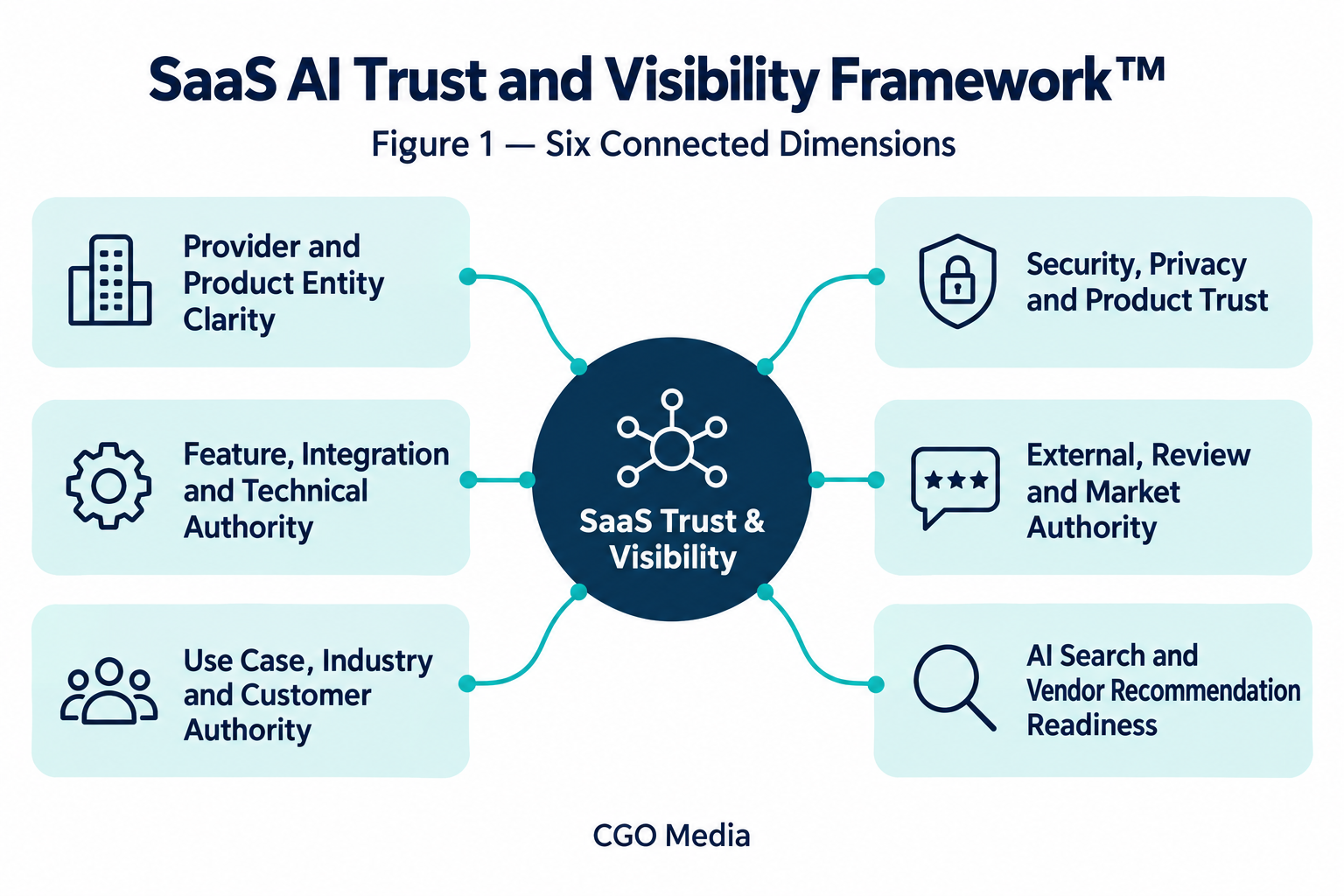
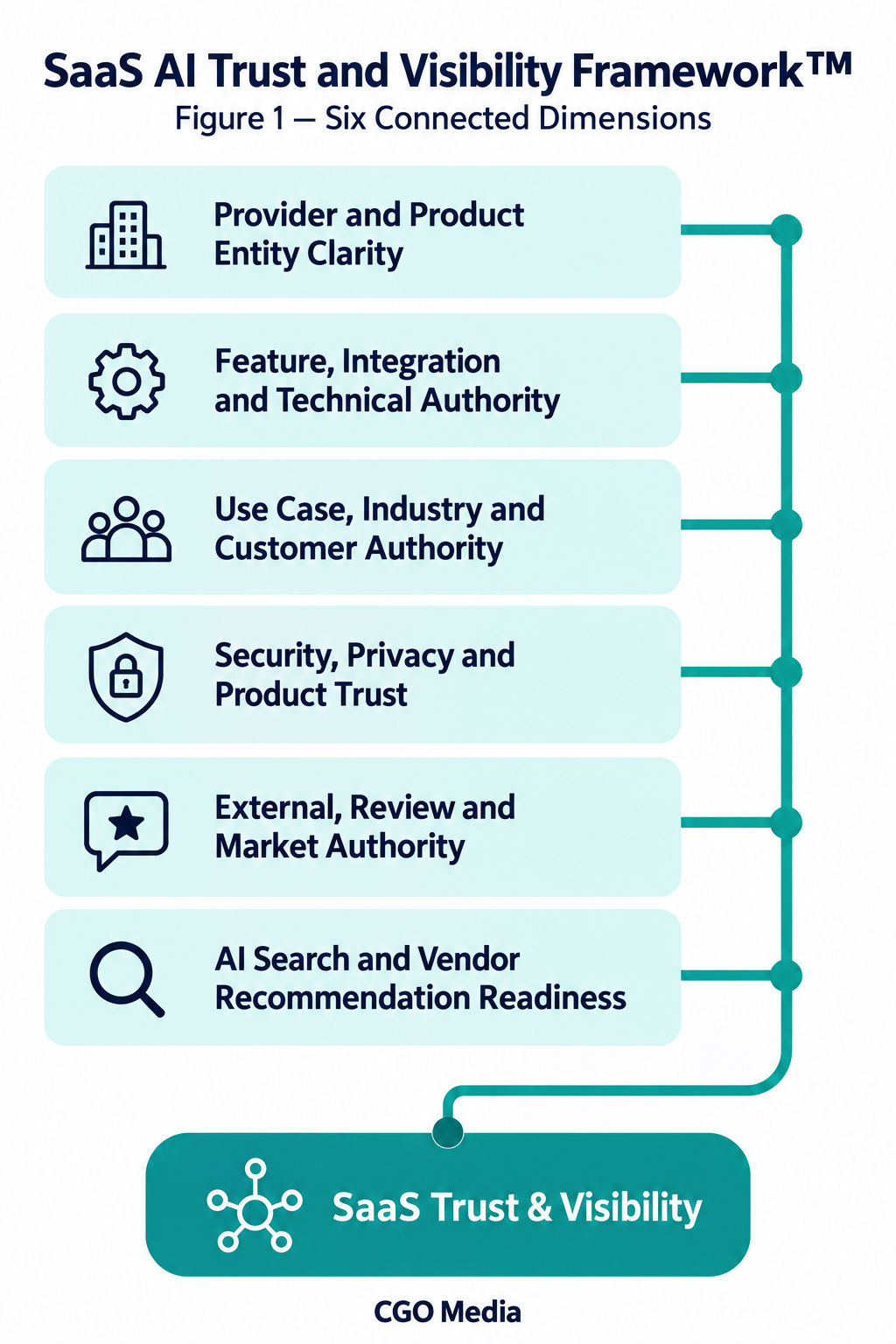
It evaluates six connected dimensions:
Provider and Product Entity Clarity
Feature, Integration and Technical Authority
Use Case, Industry and Customer Authority
Security, Privacy and Product Trust
External, Review and Market Authority
AI Search and Vendor Recommendation Readiness
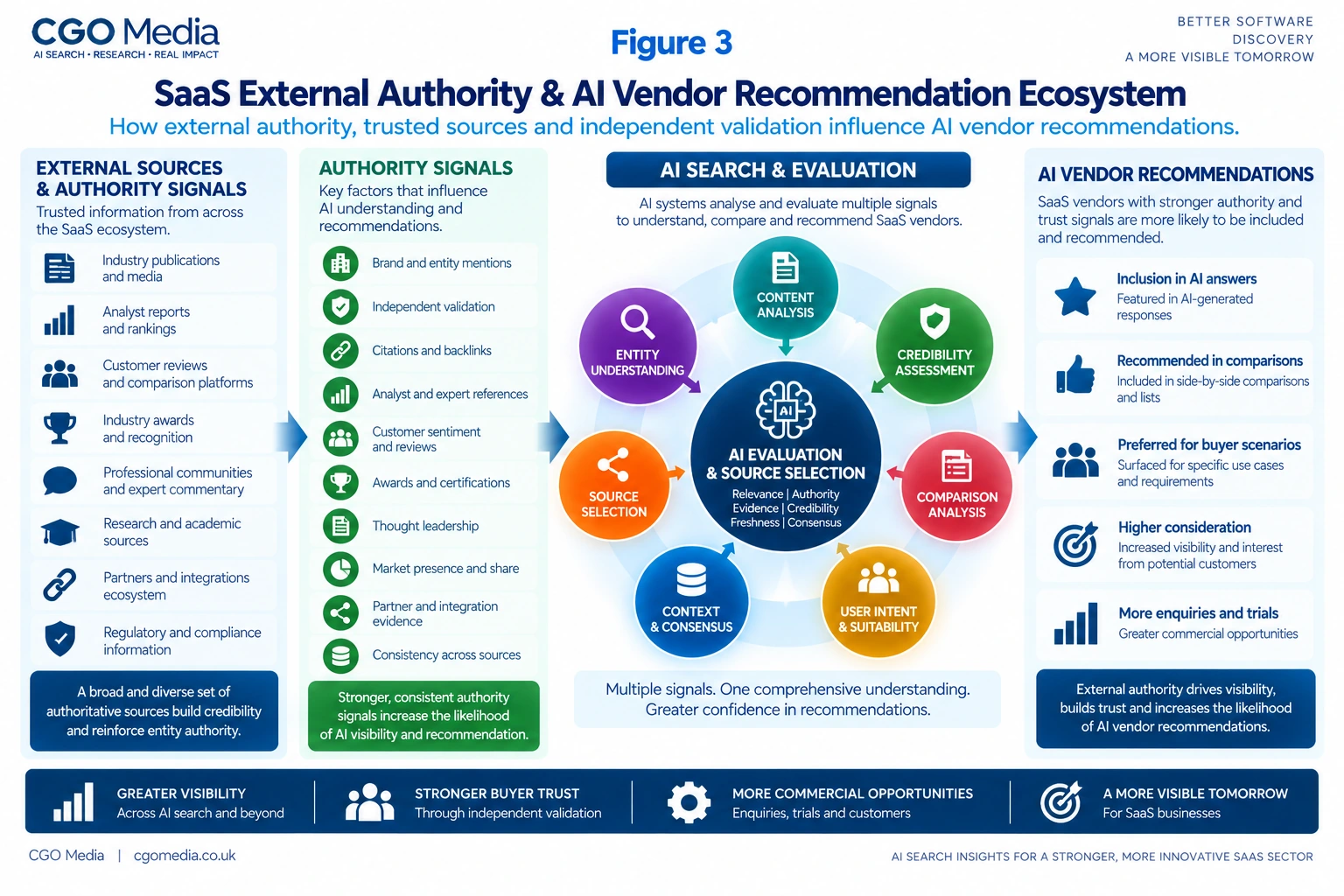
The complete authority progression can be represented as:
Entity Clarity → Technical Authority → Customer Authority → Product Trust → External Validation → AI Recommendation Readiness
1. Why SaaS Needs a Trust and Visibility Framework
Software buyers increasingly evaluate products across multiple sources before deciding which providers deserve serious consideration.
A buyer may need to establish:
- What the product does
- Which software category it belongs to
- Which features it provides
- Which integrations it supports
- Whether the provider is secure
- Whether customers trust the product
- Whether implementation is practical
- Whether pricing fits the organisation
- Whether independent sources validate the vendor
Trust and visibility should therefore be treated as a connected evidence system rather than separate marketing disciplines.
2. Visibility Without Trust
A SaaS product can achieve strong search visibility while still failing to become a credible buying option.
This can occur when buyers cannot verify:
- Product capability
- Security
- Pricing
- Customer outcomes
- Integration support
- Vendor reliability
Visibility creates discovery, but evidence determines whether the provider progresses into serious evaluation.
3. Trust Without Discoverability
The opposite problem can also occur.
A SaaS company may have a strong product, loyal customers, credible security practices and excellent support while remaining difficult to discover for strategically important:
- Category searches
- Feature searches
- Integration searches
- Use-case searches
- Industry searches
- AI-assisted recommendations
Strong trust evidence has limited acquisition value if suitable buyers rarely encounter the provider.
4. The Six Dimensions of SaaS Trust and Visibility
The framework evaluates SaaS authority through six interconnected dimensions.
| Dimension | Primary Question |
|---|---|
| Provider and Product Entity Clarity | Can the organisation and product be identified correctly? |
| Feature, Integration and Technical Authority | Can product capability be understood and verified? |
| Use Case, Industry and Customer Authority | Is there evidence that the product fits real buyers and workflows? |
| Security, Privacy and Product Trust | Can adoption risk be reduced sufficiently? |
| External, Review and Market Authority | Do credible external sources reinforce the provider’s claims? |
| AI Search and Vendor Recommendation Readiness | Is the provider sufficiently clear, relevant and validated to enter AI-assisted consideration? |
No single dimension should be interpreted in isolation.
5. Dimension One — Provider and Product Entity Clarity
The first dimension assesses whether buyers, search engines and AI systems can understand the basic identity and structure of the SaaS organisation.
A useful entity relationship is:
Organisation → Product → Product Suite → Module → Feature → Integration → Use Case
Ambiguity anywhere in this structure can weaken product understanding and comparison.
6. Provider Identity Clarity
The company should be represented consistently across relevant:
- Corporate websites
- Product websites
- App marketplaces
- Review platforms
- Partner websites
- External publications
Basic company identity should not vary unnecessarily between important sources.
7. Product Identity Clarity
The software product should have a clear and consistent identity that distinguishes it from:
- The parent company
- Other products in the portfolio
- Modules
- Acquired products
- Legacy product names
This becomes particularly important for SaaS organisations operating several products under one corporate brand.
8. Product Category Clarity
The provider should make clear which software categories the product genuinely belongs to.
A useful relationship is:
Product Identity → Primary Category → Supporting Categories → Core Capabilities
Overly broad category positioning can weaken understanding when one platform is presented as several unrelated types of software.
9. Module and Suite Clarity
Large SaaS platforms should make relationships between the core product and individual modules explicit.
Buyers should be able to determine whether a capability is:
- Part of the core platform
- An optional module
- A paid add-on
- A separate product
- An enterprise extension
10. Brand Architecture Clarity
Acquisitions, rebrands and product-suite expansion can create confusion when old and new names remain distributed across the digital ecosystem.
Providers should manage relationships between:
- Current brand names
- Legacy brands
- Acquired companies
- Product names
- Former product names
Brand evolution should not leave buyers uncertain about whether two names represent the same product or different services.
11. Founder and Leadership Entity Clarity
Founder and executive profiles can strengthen organisational clarity where they are connected consistently with:
- The company
- The product
- Their professional role
- Relevant expertise
This can provide additional context around organisational leadership and accountability.
12. Expert Entity Clarity
Product, engineering, security and subject specialists can reinforce technical and professional authority through:
- Documentation
- Research
- Technical articles
- Webinars
- Product education
Expert attribution is particularly valuable where complex technical or security claims require specialist explanation.
13. Geographic Entity Clarity
International SaaS providers should distinguish clearly between:
- Headquarters
- Regional offices
- Data-hosting regions
- Markets served
- Support regions
This can reduce ambiguity for buyers evaluating geographic availability, support and data-location requirements.
14. Provider-to-Product Relationships
The relationship between the organisation and its software products should remain explicit across first-party and relevant external sources.
A useful structure is:
Provider → Product → Category → Capability
This helps distinguish the organisation itself from the software products it operates.
15. Product-to-Module Relationships
Individual modules should be connected clearly with the wider product suite.
Users should be able to determine whether each module is:
- A standalone product
- An add-on
- An included module
- An enterprise extension
Clear relationships reduce both commercial and technical ambiguity.
16. Dimension Two — Feature, Integration and Technical Authority
The second dimension assesses whether the SaaS provider supplies enough technical specificity for buyers to understand what the product actually does.
Technical authority requires more than marketing language.
The product’s important capabilities should be sufficiently documented and verifiable to support serious evaluation.
17. Core Feature Authority
Priority features should be described in enough depth to explain:
- Functionality
- Workflow
- Target user
- Business outcome
- Important limitations
A feature name alone provides limited evidence of practical capability.
18. Feature Architecture
Features should be connected with relevant:
- Products
- Use cases
- Integrations
- Documentation
- Customer evidence
A useful relationship is:
Feature → Workflow → Use Case → Integration → Customer Evidence
This creates stronger product understanding than isolated feature landing pages.
19. Integration Authority
Integration evidence should explain:
- Which systems connect
- Whether the integration is native
- What data is exchanged
- Which workflows are supported
- Whether middleware is required
- Which plans or technical requirements apply
Simply displaying an integration logo may not provide enough evidence for technical evaluation.
20. API Authority
For technically sophisticated buyers, API evidence can include:
- Authentication
- Endpoints
- Webhooks
- Rate limits
- Developer documentation
API availability and API suitability should remain separate concepts.
A product may offer an API without providing sufficient functionality for the buyer’s intended integration.
21. Documentation Authority
Documentation provides some of the strongest first-party evidence about how a SaaS product actually works.
Priority documentation should remain:
- Current
- Accessible
- Searchable
- Technically accurate
- Connected with relevant commercial pages
Documentation can become particularly influential during technical validation and implementation planning.
22. Technical Limitation Clarity
Trust can increase when SaaS providers communicate important limitations accurately instead of implying that every capability supports every buyer, workflow or technical environment.
Useful limitations can include:
- Usage limits
- Plan restrictions
- Integration limitations
- Regional restrictions
- Technical dependencies
Transparent limitations help buyers determine genuine product fit.
23. Feature-to-Plan Clarity
Where pricing tiers are public, buyers should be able to determine which capabilities belong to which plan.
The relationship should be clear:
Feature → Product Plan → Usage Limit → Commercial Availability
A capability that exists only in a higher tier should not be represented as universally available.
24. Technical Change Governance
SaaS products change continuously.
Updates involving features, APIs, integrations and product architecture should trigger coordinated review across:
- Product pages
- Documentation
- Pricing pages
- Integration directories
- Help centres
- Relevant external listings
Without change governance, product information can become inconsistent across the wider evidence environment.
25. Product Capability Must Be Verifiable
Strong technical authority depends on more than claims made within marketing content.
Important capabilities should be verifiable through appropriate:
- Documentation
- Product demonstrations
- Integration evidence
- Customer examples
- Technical resources
The first two framework dimensions therefore establish the foundation:
Clear Provider & Product Identity + Verifiable Feature, Integration & Technical Evidence
This foundation makes it easier for buyers, search engines and AI-assisted discovery systems to understand what the product is, where it fits and what it can genuinely do.
26. Dimension Three — Use Case, Industry and Customer Authority
The third dimension assesses whether the SaaS provider demonstrates clear relevance to the problems, workflows, industries and customer environments in which the product is expected to operate.
Strong SaaS authority should connect product capability with real buyer context rather than describe functionality in isolation.
27. Use-Case Authority
Use-case evidence should explain how the product addresses a recognisable operational problem.
A useful structure is:
Business Problem → Workflow → Product Capability → Integration → Outcome
This allows buyers to understand how individual product features combine within practical business processes.
28. Workflow Authority
Buyers should be able to understand how the product fits into real operational processes rather than simply which features exist.
Workflow evidence can explain:
- What initiates the process
- Which users participate
- Which product capabilities are used
- Which systems exchange data
- What operational outcome is produced
29. Role-Based Authority
The same SaaS product may need to demonstrate different value to different stakeholders.
Relevant roles can include:
- Finance teams
- Marketing teams
- HR teams
- Operations teams
- IT teams
- Security teams
Role-specific evidence can help buyers determine whether the platform supports the needs of individual users and wider organisational stakeholders.
30. Industry Authority
Industry authority requires evidence that the provider understands sector-specific workflows, constraints and buying requirements.
Relevant evidence can include:
- Industry workflows
- Compliance considerations
- Required integrations
- Customer examples
- Sector-specific product usage
31. Industry Authority Should Not Be Generic
Changing a page headline from “software for businesses” to “software for healthcare” or “software for finance” does not create meaningful industry authority.
Strong industry positioning should demonstrate genuine differences in:
- Workflow
- Risk
- Terminology
- Integration requirements
- Customer evidence
32. Company-Size Authority
SaaS providers should make clear whether their products are primarily suited to:
- Startups
- Small businesses
- Mid-market organisations
- Enterprise customers
Suitability can vary because different organisational sizes require different levels of administration, security, scalability, support and commercial flexibility.
33. Customer Segment Authority
Customer relevance should not be defined by company size alone.
Useful segmentation can also include:
- Industry
- Geography
- Business model
- Technology stack
- Operational complexity
A product may perform strongly for one customer segment while being inappropriate for another.
34. Customer Case Study Authority
Case studies provide stronger evidence when they show how the product operated within a real customer environment.
Useful case-study elements include:
- Customer context
- Initial problem
- Implementation
- Features used
- Integrations used
- Measured outcome
This gives buyers more decision-relevant evidence than a short testimonial alone.
35. Customer Outcome Authority
Where credible data exists, providers can communicate outcomes involving:
- Time saved
- Cost reduction
- Revenue improvement
- Conversion improvement
- Productivity gains
- Reduced manual work
Outcome evidence should distinguish measured results from estimates or promotional projections.
36. Customer Evidence Should Be Representative
A provider should avoid implying that one exceptional customer outcome represents the typical experience of all customers.
Results can differ according to:
- Organisation size
- Industry
- Implementation quality
- Product configuration
- User adoption
37. Customer Evidence Diversity
A stronger evidence environment can include customers across different:
- Industries
- Company sizes
- Use cases
- Geographies
Diversity helps buyers identify evidence that more closely resembles their own operating environment.
38. Customer Logo Authority
Recognisable customer logos can create rapid trust signals, particularly where respected organisations are associated with the provider.
However, logos alone provide limited information about:
- Which product was used
- Which capabilities were deployed
- How extensively the software was adopted
- What outcome was achieved
39. Customer Testimonial Authority
Testimonials become more useful when they are specific and attributable.
Strong testimonial evidence may explain:
- The customer problem
- The product capability used
- The implementation context
- The resulting improvement
Generic statements of satisfaction provide substantially less decision value.
40. Customer Review Authority
Independent review platforms can provide additional evidence around:
- Ease of use
- Support
- Implementation
- Product strengths
- Product limitations
Review evidence is particularly useful where buyers want perspectives beyond vendor-controlled content.
41. Product Adoption Evidence
Where accurate and appropriately contextualised, providers may communicate evidence involving:
- Customer adoption
- Product usage
- Geographic reach
- User base
- Customer retention
Definitions should remain clear so scale claims are not misinterpreted.
42. Customer Evidence Should Remain Current
Case studies, customer logos, testimonials and adoption claims should be reviewed when:
- Customer relationships change
- Product configurations change
- Major features are replaced
- Commercial circumstances change
Outdated customer evidence can create misleading associations.
43. Dimension Four — Security, Privacy and Product Trust
The fourth dimension assesses whether the SaaS provider supplies enough evidence to reduce technical, operational, privacy, implementation and commercial risk.
For many software buyers, trust becomes a formal selection requirement rather than a general brand perception.
44. Security Authority
Security information should move beyond generic statements such as “enterprise-grade security”.
Depending on the product and buyer environment, useful evidence can include:
- Encryption
- Authentication
- Access control
- Infrastructure
- Incident management
- Security governance
45. Security Documentation Authority
A dedicated security centre or documentation environment can help buyers locate evidence efficiently.
Useful resources can include:
- Security architecture
- Security policies
- Compliance documentation
- Frequently asked security questions
- Responsible disclosure information
Security evidence should be sufficiently current for procurement and technical review.
46. Independent Security Assurance
Where relevant, independent certifications, audits or assurance programmes can strengthen trust by providing evidence beyond the provider’s own statements.
Independent assurance does not replace internal security evidence, but it can support verification.
47. Certification Scope Clarity
Security or compliance certifications should be represented with sufficient context around:
- Scope
- Applicable product or service
- Applicable organisation
- Current status
A certification badge without scope information can create ambiguity about what has actually been assessed.
48. Privacy Authority
Privacy evidence becomes especially important where the product processes:
- Personal data
- Employee data
- Customer information
- Commercially sensitive information
Buyers should be able to understand how data is handled throughout the relationship.
49. Data Processing Clarity
Buyers may need to understand:
- What data is processed
- Why it is processed
- Where it is stored
- How long it is retained
- How deletion works
Clear data-processing information can reduce uncertainty during privacy and procurement review.
50. Subprocessor Transparency
Enterprise and privacy-sensitive buyers may require visibility into relevant subprocessors and service-provider relationships.
Useful information can include:
- Provider identity
- Service function
- Processing location
- Relevant change procedures
51. Data Residency Clarity
International SaaS providers should explain regional hosting or data-location options where these affect:
- Buyer policy
- Regulation
- Security requirements
- Procurement
Geographic product availability and geographic data residency should not be treated as the same concept.
52. Access Control Authority
Buyers may investigate whether the product supports:
- Single sign-on
- Multi-factor authentication
- Role-based permissions
- Administrative controls
- User provisioning
These controls can become mandatory in enterprise and regulated environments.
53. Availability and Reliability Authority
The provider should make it possible to evaluate whether the service is sufficiently reliable for the intended use case.
Relevant evidence can include:
- Service availability
- Operational history
- Service commitments
- Incident communication
Required reliability normally increases with the business criticality of the software.
54. Status and Incident Transparency
Status pages and incident communication can demonstrate operational transparency when they are maintained consistently.
Buyers may assess:
- Current status
- Incident history
- Communication quality
- Recovery performance
55. Backup and Recovery Authority
Where appropriate, providers can explain their approach to:
- Backups
- Disaster recovery
- Service continuity
- Recovery procedures
Evidence depth should reflect the operational importance of the product.
56. Implementation Trust
Buyer risk is not limited to software functionality.
A capable product can still appear unsuitable where implementation is perceived as excessively:
- Complex
- Slow
- Expensive
- Resource-intensive
Implementation evidence therefore contributes directly to product trust.
57. Onboarding Clarity
Providers can reduce implementation uncertainty by explaining:
- Typical onboarding stages
- Customer responsibilities
- Migration requirements
- Configuration requirements
- Training
Clear onboarding expectations help buyers estimate both time and internal resource requirements.
58. Data Migration Authority
Migration evidence becomes particularly important where customers must move important operational data from an existing platform.
Useful information can include:
- Supported migration paths
- Import formats
- Migration assistance
- Data validation
- Expected customer responsibilities
59. Support Authority
The support model should be clear enough for buyers to understand:
- Available channels
- Support hours
- Plan differences
- Escalation pathways
- Dedicated support options
Support requirements become more important as product complexity and operational dependence increase.
60. Knowledge Base Authority
A comprehensive knowledge base can provide evidence of product maturity and continuing customer support.
Useful resources can help users:
- Configure the product
- Resolve problems
- Understand workflows
- Manage integrations
- Use advanced capabilities
61. Pricing Trust
Pricing clarity can significantly influence buyer confidence.
Unexpected commercial information introduced late in the buying process can weaken trust even where product suitability is strong.
62. Pricing Model Transparency
Where pricing is public, buyers should be able to determine whether charges are based on:
- Users
- Usage
- Transactions
- Contacts
- Storage
- Modules
The pricing mechanism should be sufficiently clear for buyers to estimate likely costs.
63. Feature-to-Plan Transparency
The provider should make clear which capabilities are included within different pricing tiers where practical.
A useful relationship is:
Required Capability → Available Plan → Usage Limit → Expected Cost
This allows buyers to evaluate product and commercial suitability together.
64. Additional Cost Transparency
Trust can be weakened when material costs appear only late in the buying process.
Potential additional charges can involve:
- Implementation
- Migration
- Premium support
- Usage overages
- Additional modules
Commercial transparency reduces avoidable procurement friction.
65. Commercial Trust
Commercial trust also depends on clarity around:
- Contract terms
- Billing periods
- Cancellation
- Upgrade paths
- Enterprise arrangements
Buyers should be able to understand the long-term commercial relationship as well as the initial subscription price.
66. Vendor Stability
For strategically important software, buyers may consider whether the provider appears capable of maintaining and developing the product throughout the expected relationship.
Relevant signals can include:
- Product development
- Customer support
- Operational continuity
- Market presence
Vendor stability becomes more important as switching cost and operational dependency increase.
67. Product Trust Is Cumulative
No single badge, certification, review or customer logo creates complete SaaS trust.
Trust develops cumulatively through the combined strength of:
- Security
- Privacy
- Reliability
- Implementation evidence
- Customer outcomes
- Support
- Commercial transparency
A useful relationship is:
Customer Relevance + Customer Evidence + Security + Privacy + Reliability + Implementation Confidence + Commercial Transparency → Product Trust
68. Trust Evidence Must Be Verifiable
The strongest trust signals are those that buyers can examine directly or confirm through appropriate independent sources.
Verifiable evidence is generally stronger than unsupported claims because it allows the buyer to reduce uncertainty independently.
69. SaaS Trust Reduces Adoption Risk
The purpose of trust evidence is ultimately to reduce uncertainty around adopting software that may become embedded within important organisational workflows.
The combined third and fourth framework dimensions can therefore be expressed as:
Use-Case Relevance → Customer Evidence → Security & Privacy Evidence → Implementation Confidence → Commercial Trust → Reduced Adoption Risk
This creates the evidence foundation required before external market authority and AI recommendation readiness can be evaluated.
70. Dimension Five — External, Review and Market Authority
The fifth dimension assesses whether credible sources outside the SaaS provider’s own website reinforce its product relevance, customer trust and market position.
External authority matters because software buyers frequently validate provider claims through reviews, marketplaces, partners, communities, publications and independent research before making a final decision.
71. Review Platform Authority
Review platforms can provide independent customer evidence around:
- Ease of use
- Implementation
- Support quality
- Feature depth
- Value for money
- Product limitations
Review authority should therefore be evaluated as part of the wider trust environment rather than as a simple rating metric.
72. Review Volume
Review volume can provide useful context about the breadth of visible customer experience.
However, volume alone does not establish:
- Product quality
- Buyer fit
- Review relevance
- Current product performance
73. Review Recency
SaaS products can change rapidly through:
- Feature launches
- Pricing changes
- Product redesign
- Support changes
- Integration changes
Recent reviews may therefore provide a more representative picture of the current customer experience than older feedback.
74. Review Relevance
A review becomes more commercially useful when the reviewer resembles the prospective buyer in:
- Industry
- Company size
- Use case
- Technical environment
Relevant customer context should therefore be considered alongside overall review volume.
75. Review Sentiment Patterns
Repeated themes across reviews can reveal perceived strengths and weaknesses involving:
- Product usability
- Support
- Implementation
- Reliability
- Pricing
- Feature gaps
Recurring themes generally provide more useful evidence than isolated comments.
76. Review Response Quality
Where platforms allow public vendor responses, those responses can provide additional evidence about how the provider handles:
- Customer praise
- Criticism
- Support problems
- Product concerns
Professional and substantive responses can strengthen trust without removing the underlying importance of the customer’s experience.
77. Marketplace Authority
Listings within recognised software and integration marketplaces can reinforce:
- Product presence
- Technical compatibility
- Ecosystem relationships
- Integration availability
Marketplace information should remain current and consistent with the provider’s own product evidence.
78. Integration Partner Authority
Technology partners can provide external evidence that a product genuinely connects with strategically important systems.
This can strengthen confidence where integrations are critical to the buyer’s workflow or technical environment.
79. Implementation Partner Authority
For more complex SaaS products, implementation partners can reinforce:
- Deployment capability
- Geographic coverage
- Industry expertise
- Technical compatibility
A strong partner ecosystem can reduce buyer concerns around implementation capacity.
80. Customer Citation Authority
References from customer websites, public case studies and partner stories can strengthen associations between the SaaS provider and specific:
- Industries
- Use cases
- Company sizes
- Geographic markets
These external relationships can reinforce first-party customer evidence.
81. Industry Publication Authority
Relevant technology and sector publications can strengthen market authority through:
- Product analysis
- Industry commentary
- Founder or expert interviews
- Research coverage
- Customer stories
Coverage is more valuable when the publication and subject are relevant to the provider’s actual market.
82. Analyst Authority
Analyst firms and specialist research organisations can influence provider consideration in some SaaS categories, particularly for enterprise buyers.
Analyst evidence should be interpreted according to the methodology, market coverage and intended audience of the research.
83. Professional Community Authority
Peer communities can materially influence SaaS perception because buyers often seek experience from professionals who have already evaluated or used comparable products.
Community authority can reveal practical evidence not always visible within formal marketing material.
84. Community Discussion Themes
Common community discussions may focus on:
- Best alternatives
- Implementation difficulty
- Hidden costs
- Support quality
- Reliability
- Feature limitations
These themes can influence how buyers interpret the provider before entering formal evaluation.
85. Research Authority
Original research can strengthen SaaS authority when it contributes useful evidence beyond product promotion.
Research topics can include:
- Buyer behaviour
- Adoption trends
- Industry change
- Workflow performance
- Software usage
86. Benchmark Authority
Providers may publish useful benchmark data around:
- Industry performance
- Workflow efficiency
- Adoption trends
- Productivity
- Operational behaviour
Benchmarks become more useful when definitions and comparison groups are clear.
87. Methodological Transparency
Research becomes more credible when it explains:
- Sample size
- Data source
- Measurement period
- Method
- Limitations
Methodological transparency makes research easier for journalists, analysts, buyers and other researchers to evaluate.
88. Citation Authority
Useful research, technical resources and benchmarks can become reference assets for:
- Journalists
- Analysts
- Customers
- Industry publishers
- AI-assisted discovery environments
Repeated relevant citation can strengthen the provider’s wider authority ecosystem.
89. External Source Diversity
A stronger SaaS authority environment may combine validation from:
- Customers
- Review platforms
- Technology partners
- Implementation partners
- Marketplaces
- Industry publications
- Research organisations
- Professional communities
Diversity reduces dependence on one external platform or authority source.
90. External Source Relevance
The relevance of external evidence should be considered alongside the quantity of mentions.
A small number of authoritative sources closely aligned with the provider’s market can be more meaningful than broad but commercially irrelevant exposure.
91. External Information Consistency
Important product facts should remain broadly consistent across external environments.
Potential conflict areas include:
- Product category
- Features
- Pricing
- Integrations
- Company-size suitability
- Geographic availability
External inconsistency can create buyer uncertainty and weaken AI representation accuracy.
92. Dimension Six — AI Search and Vendor Recommendation Readiness
The sixth dimension assesses whether the SaaS provider possesses sufficiently clear, current and validated evidence to participate credibly in AI-assisted software discovery and recommendation.
AI readiness should be evaluated across multiple buyer contexts rather than reduced to whether the brand appears in one generated answer.
93. AI Brand Visibility
Providers can monitor whether AI systems accurately identify:
- The company
- The product
- The product category
- The target market
Incorrect brand or product identity can distort every later recommendation stage.
94. AI Category Visibility
Category monitoring tests whether the product appears when buyers ask for relevant software without mentioning the brand.
This provides evidence about whether the provider participates in non-branded AI-assisted discovery.
95. AI Feature Visibility
Feature-led prompts can reveal whether the provider is associated with strategically important capabilities.
This can expose:
- Strong capability associations
- Missing associations
- Incorrect feature claims
96. AI Integration Visibility
Integration prompts can test whether AI systems understand which platforms the product genuinely supports.
Integration representation should be checked for both:
- Presence
- Accuracy
97. AI Use-Case Visibility
Use-case prompts can test whether the product appears for realistic operational requirements rather than category labels alone.
This helps determine whether product capabilities are connected with genuine buyer problems.
98. AI Industry Visibility
Industry-led monitoring can assess whether the product is associated with sectors it genuinely serves.
Visibility should be interpreted against actual:
- Product suitability
- Customer evidence
- Workflow evidence
99. AI Company-Size Visibility
Providers can test whether recommendations accurately reflect suitability for:
- Startups
- SMEs
- Mid-market organisations
- Enterprise customers
A product can be relevant to one company-size segment while unsuitable for another.
100. AI Geographic Visibility
Geographic recommendation testing can examine whether the product is surfaced appropriately for different countries or regions.
Relevant factors can include:
- Product availability
- Language
- Pricing
- Support
- Data residency
101. AI Security and Compliance Visibility
Security-led prompts can test whether important trust attributes are represented accurately.
Incorrect security or compliance information should be treated as a high-priority representation issue because it can materially affect provider selection.
102. AI Pricing Visibility
Pricing-led prompts can reveal whether publicly available commercial information is being represented accurately.
Monitoring should distinguish:
- Current pricing
- Historic pricing
- Plan structure
- Usage-based costs
103. AI Vendor Recommendation Visibility
The provider should monitor whether it appears within commercially important recommendation scenarios.
Recommendation testing can be segmented by:
- Category
- Buyer segment
- Use case
- Industry
- Geography
104. AI Shortlist Visibility
A narrower measure examines whether the product appears within a small recommendation set rather than simply somewhere within a long generated response.
Shortlist visibility is particularly relevant where buyers are actively narrowing provider options.
105. AI Comparison Visibility
Providers can test how they are represented when compared directly with strategically important competitors.
Useful comparison checks include:
- Features
- Integrations
- Pricing
- Security
- Buyer suitability
106. AI Source Visibility
Where sources are exposed, providers can examine whether generated answers rely on:
- Product pages
- Documentation
- Review platforms
- Marketplaces
- Partner websites
- Independent publications
This helps identify which parts of the wider evidence environment are contributing to AI-assisted discovery.
107. AI Citation Visibility
Citation monitoring can identify whether specific first-party or external assets are surfaced as supporting evidence.
Useful citation assets can include:
- Documentation
- Research
- Product information
- Technical resources
- Independent validation
108. AI Representation Accuracy
Critical product facts should be checked systematically for accuracy across:
- Product category
- Features
- Integrations
- Pricing
- Security
- Target customer
- Geographic availability
Visibility without factual accuracy should not be treated as successful AI readiness.
109. AI Temporal Accuracy
SaaS providers should pay particular attention to stale information because products change rapidly.
High-volatility information can include:
- Pricing
- Features
- Integrations
- Product packaging
- Security capabilities
110. AI Recommendation Readiness
Recommendation readiness develops cumulatively from:
- Clear provider and product identity
- Strong feature and integration evidence
- Relevant use-case and industry authority
- Security and product trust
- Customer evidence
- External validation
- Commercial suitability
No one signal should be expected to create recommendation readiness on its own.
111. Recommendation Readiness Is Not a Single Signal
No individual feature page, review, citation or structured-data property should be treated as a guaranteed route into AI recommendation.
Recommendation confidence emerges from the wider evidence environment.
112. Product Fit Matters
The product must genuinely satisfy the requirements embedded within the buyer’s query.
Visibility cannot compensate for a product that lacks the required capability, integration or operational fit.
113. Evidence Clarity Matters
The stronger and clearer the available evidence, the easier it becomes for buyers and machine systems to determine whether the product is relevant.
Important claims should therefore be supported by evidence appropriate to the claim.
114. External Validation Matters
Independent reviews, customer evidence, marketplace relationships and relevant external sources can strengthen confidence beyond vendor-controlled messaging.
External validation is particularly useful where buyers need independent confirmation of product or provider claims.
115. Commercial Suitability Matters
Recommendation quality also depends on whether the product is appropriate for the buyer’s:
- Budget
- Company size
- Industry
- Technical environment
- Implementation requirements
A technically relevant product may still be commercially unsuitable.
116. Recommendation Readiness Is Dynamic
SaaS visibility and recommendation conditions can change as:
- Products evolve
- Pricing changes
- Competitors improve
- Reviews accumulate
- Source ecosystems change
Recommendation readiness should therefore be treated as a changing condition rather than a permanent status.
117. SaaS Authority Requires Continuous Observation
SaaS providers should monitor how their companies, products, capabilities and trust signals are represented across search, review, comparison and AI-assisted discovery environments.
The combined relationship is:
External Validation + Accurate Product Evidence + Buyer Relevance + Commercial Suitability → AI Recommendation Readiness
The objective is not maximum recommendation frequency.
It is to increase the probability that the provider appears accurately and appropriately when the product genuinely fits the buyer’s requirements.
118. The SaaS Evidence Threshold
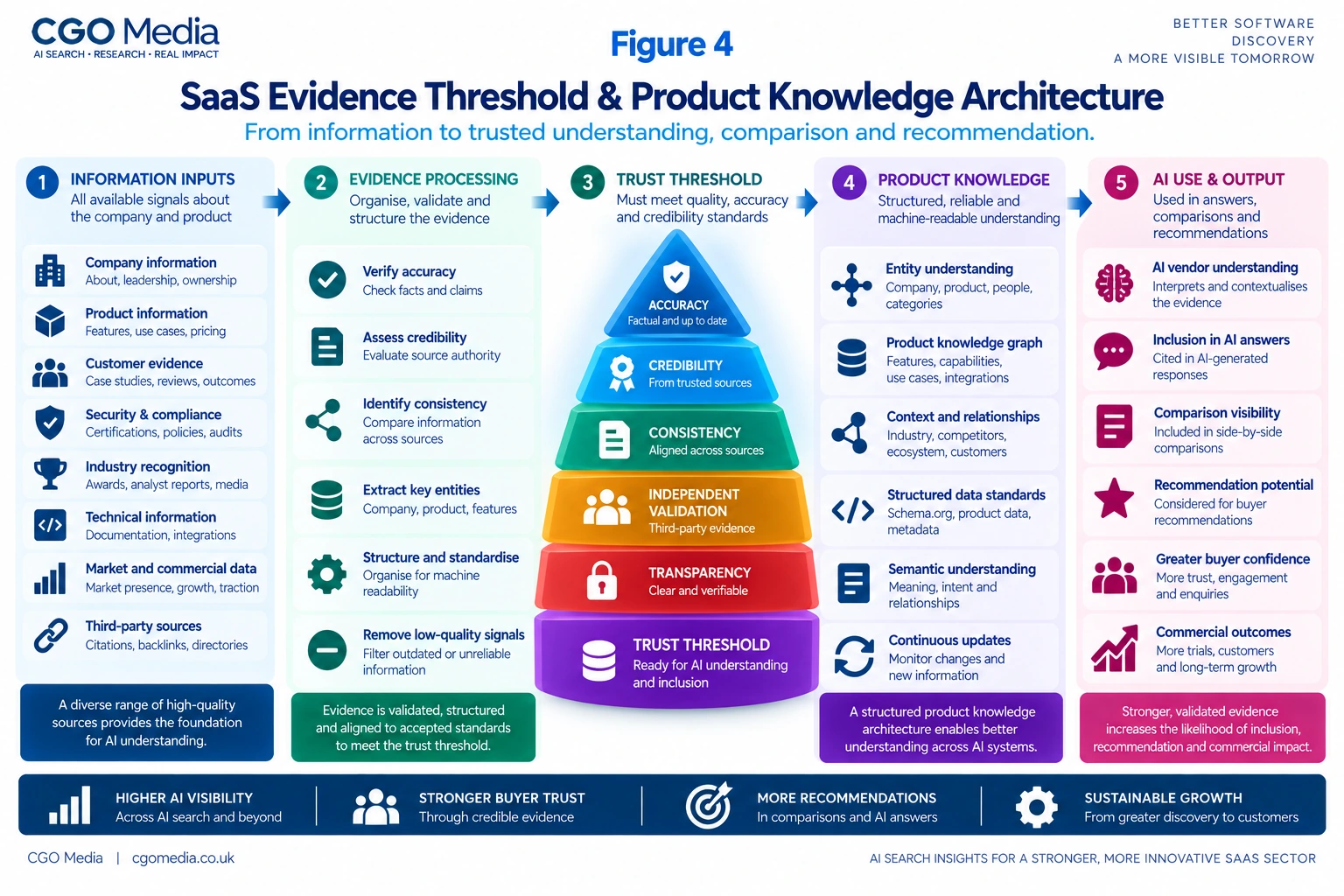
The SaaS AI Trust and Visibility Framework uses an evidence progression to assess whether a software provider possesses enough clarity, relevance and independent validation to move from simple discoverability toward credible recommendation.
The progression is:
Discoverable → Understandable → Relevant → Verifiable → Trusted → Comparable → Commercially Suitable → Recommendation Ready
Each stage raises the evidence threshold required from the provider.
119. Discoverable
The provider can be found across relevant:
- Search environments
- Comparison platforms
- Review sites
- Marketplaces
- AI-assisted discovery environments
Discoverability creates the opportunity to enter consideration, but does not establish suitability or trust.
120. Understandable
Buyers and machine systems can determine:
- Who the provider is
- What the product is
- Which category it belongs to
- Who it is designed for
- Which problems it solves
Entity and product clarity provide the foundation for every later evaluation stage.
121. Relevant
The product demonstrates alignment with the buyer’s actual:
- Feature requirements
- Integration needs
- Workflows
- Industry context
- Company profile
Visibility becomes commercially useful only where genuine relevance exists.
122. Verifiable
Important product claims can be checked through appropriate evidence including:
- Documentation
- Security resources
- Customer evidence
- Pricing information
- Marketplace listings
- Independent reviews
Verification reduces dependence on unsupported promotional claims.
123. Trusted
Security, privacy, reliability, customer outcomes, implementation evidence and external validation reduce perceived adoption risk.
A product can be relevant and verifiable while still failing if buyers do not consider the provider sufficiently trustworthy.
124. Comparable
Enough evidence exists for buyers to compare the product meaningfully with alternatives across:
- Features
- Integrations
- Pricing
- Security
- Support
- Implementation
Comparability is essential because most SaaS decisions are made within a competitive set.
125. Commercially Suitable
The product appears appropriate for the buyer’s:
- Budget
- Company size
- Geography
- Technical environment
- Implementation resources
- Growth requirements
Technical relevance does not automatically establish commercial fit.
126. Recommendation Ready
The provider possesses sufficiently coherent and validated evidence to become a credible candidate within:
- Search environments
- Comparison environments
- AI-assisted recommendation systems
Recommendation readiness should be treated as an evidence condition rather than a guaranteed outcome.
127. The Six Dimensions Must Reinforce One Another
The strongest SaaS authority does not emerge from one isolated dimension.
The six dimensions should operate as a connected evidence system:
Entity Clarity + Technical Authority + Customer Authority + Product Trust + External Validation + AI Readiness
128. Provider Clarity Supports Product Understanding
Clear relationships between company, product, module and brand help buyers and machine systems determine exactly what is being evaluated.
Without this clarity, later feature, trust and recommendation evidence can become ambiguous.
129. Technical Authority Supports Relevance
Feature, integration, API and documentation evidence helps establish whether the product can satisfy the buyer’s operational requirements.
This turns general category visibility into specific product relevance.
130. Use-Case and Customer Authority Support Context
Use cases, industry evidence and customer stories demonstrate where software capabilities are relevant in practice.
This connects product functionality with real buyer environments.
131. Security and Product Trust Support Adoption Confidence
Security, privacy, implementation, support and commercial transparency reduce uncertainty around adopting the product.
Trust becomes increasingly important as software dependency and organisational risk increase.
132. External Authority Supports Independent Validation
Reviews, marketplaces, technology partners, customers, publications and research provide evidence beyond the provider’s controlled channels.
Independent validation helps buyers verify product and trust claims from additional sources.
133. AI Recommendation Readiness Reflects the Whole System
AI recommendation visibility is more likely to be meaningful where the wider evidence environment is already:
- Clear
- Current
- Relevant
- Trusted
- Commercially appropriate
AI readiness should therefore be treated as an outcome of wider product authority rather than an isolated optimisation layer.
134. SaaS Product Knowledge Architecture
A useful SaaS knowledge architecture can connect:
Provider → Product → Module → Feature → Integration → Use Case → Industry → Customer → Trust Evidence
This architecture helps users and machine systems understand how individual product entities relate to one another.
135. Provider-to-Product Relationships
Each product should be clearly connected with the organisation that owns and operates it.
This becomes particularly important where one provider manages several products or acquired brands.
136. Product-to-Module Relationships
Modules should be mapped clearly so buyers can determine whether they are:
- Core functionality
- Add-ons
- Optional modules
- Standalone products
Clear product architecture reduces both technical and commercial ambiguity.
137. Module-to-Feature Relationships
Features should connect with the product or module in which they actually exist.
This helps prevent buyers from assuming that one capability is universally available across an entire product suite.
138. Feature-to-Integration Relationships
Where integrations depend on specific product functionality, those relationships should be represented clearly.
A useful structure is:
Feature → Integration → Supported Workflow
139. Feature-to-Use-Case Relationships
Feature pages become more useful when they connect functionality with practical workflows and business problems.
This helps buyers move from understanding what a feature does to understanding why it matters.
140. Use-Case-to-Industry Relationships
Industry pages should demonstrate which:
- Workflows
- Features
- Integrations
- Trust requirements
are particularly relevant within that market.
Industry authority should therefore emerge from real product relationships rather than generic sector wording.
141. Customer-to-Use-Case Relationships
Case studies should reinforce the relationship between:
Customer Problem → Product Capability → Implementation → Outcome
This converts customer evidence into useful proof of practical product relevance.
142. Customer-to-Industry Relationships
Relevant customer evidence can strengthen authority within strategically important sectors.
Industry-specific proof becomes stronger when customer context, workflow and product usage are clear.
143. Trust-to-Product Relationships
Security, privacy, reliability and commercial evidence should connect clearly with the specific product or service being evaluated.
Trust information that applies only to part of a product portfolio should not be represented as universal.
144. Internal Linking as SaaS Knowledge Infrastructure
Internal linking should help users and machine systems move between related product entities.
For example:
CRM Platform → Workflow Automation → Salesforce Integration → Professional Services Use Case → Customer Case Study
Internal links can therefore reinforce product relationships as well as support navigation.
145. Documentation Should Not Become an Isolated Knowledge Layer
Technical documentation may contain the most precise information about the product, but strategically important facts should also connect with relevant commercial and product pages.
Important relationships can include:
- Product page → Documentation
- Feature page → Technical guide
- Integration page → Integration documentation
- Use-case page → Customer evidence
146. Structured Data and SaaS Entity Relationships
Where appropriate and supported by visible content, structured data can help reinforce relationships involving:
- Organization
- SoftwareApplication
- Product
- Person
- Article
- BreadcrumbList
Markup should describe relationships already supported by the visible evidence environment.
147. Structured Data Does Not Create SaaS Authority
Markup cannot compensate for:
- Weak product evidence
- Outdated pricing
- Incorrect integrations
- Thin use-case content
- Weak customer proof
- Limited external validation
Structured data supports clarity; it does not replace substance.
148. Evidence Consistency Across Channels
Critical product information should remain broadly consistent across:
- Corporate websites
- Product pages
- Documentation
- Pricing pages
- Marketplace listings
- Review platforms
- Partner websites
Cross-channel consistency reduces buyer confusion and machine ambiguity.
149. Product Identity Consistency
Providers should avoid conflicting descriptions of:
- Product name
- Category
- Product suite
- Modules
- Target market
Legacy names and historic descriptions should be updated where they create material ambiguity.
150. Feature Evidence Consistency
Feature claims should remain aligned across:
- Marketing pages
- Documentation
- Help centres
- Marketplace information
Conflicting capability information can weaken both buyer confidence and AI representation accuracy.
151. Integration Evidence Consistency
Integration availability should be represented consistently across:
- Integration directories
- Documentation
- Marketplace listings
- Comparison pages
Deprecated integrations should be corrected promptly across all relevant environments.
152. Pricing Evidence Consistency
Where pricing is public, first-party pricing and comparison content should remain aligned with current commercial packaging.
High-volatility information such as:
- Plan names
- Feature limits
- Usage allowances
- Additional charges
requires particularly strong update governance.
153. Security Evidence Consistency
Security and privacy claims should remain coordinated across:
- Security pages
- Trust centres
- Legal documentation
- Sales materials
- Relevant external profiles
Incorrect or outdated security information can create significant buyer and reputational risk.
154. SaaS Trust and Visibility Gap Analysis
The six framework dimensions can be used to identify where evidence is:
- Incomplete
- Outdated
- Ambiguous
- Insufficiently validated
Gap analysis helps move the framework from conceptual assessment into practical prioritisation.
155. Provider and Product Entity Gaps
Common weaknesses can include:
- Conflicting product names
- Legacy brand references
- Unclear module relationships
- Poor provider-to-product clarity
- Outdated company descriptions
156. Feature and Technical Authority Gaps
Potential weaknesses include:
- Generic feature descriptions
- Incomplete documentation
- Missing API information
- Weak integration detail
- No clear limitation information
These gaps make genuine product fit harder to verify.
157. Use-Case and Customer Authority Gaps
Potential weaknesses can include:
- Thin industry pages
- Weak workflow evidence
- Limited customer case studies
- No evidence for priority company sizes
- Generic testimonials
These gaps reduce confidence that the product works in real buyer environments.
158. Product Trust Gaps
Trust weaknesses can include:
- Vague security claims
- Outdated compliance information
- Unclear data residency
- Poor onboarding information
- Weak support clarity
- Commercial ambiguity
159. External Authority Gaps
A provider may possess a strong product but limited independent validation within the markets that matter commercially.
This can weaken trust where buyers expect confirmation beyond first-party claims.
160. Review Authority Gaps
Potential weaknesses include:
- Low review recency
- Incomplete product profiles
- Outdated category information
- Repeated unresolved complaints
Review gaps should be interpreted against the importance of individual review platforms within the provider’s actual market.
161. Marketplace Authority Gaps
Relevant integrations may exist while marketplace listings remain:
- Incomplete
- Outdated
- Poorly described
This can weaken both technical validation and external discoverability.
162. AI Visibility Gaps
AI weaknesses can include:
- Absence from relevant category recommendations
- Incorrect feature representation
- Outdated pricing
- Weak comparison visibility
- Poor source visibility
These should be evaluated by commercially relevant query type rather than isolated examples.
163. AI Source Gap Analysis
Providers can identify which sources repeatedly support generated recommendations for competitors while their own evidence remains absent.
These source gaps may reveal weaknesses in:
- Documentation
- Research
- Review presence
- Marketplace representation
- External authority
164. AI Recommendation Gap Analysis
Repeated scenario testing can reveal the combinations of:
- Category
- Feature
- Industry
- Geography
- Company size
in which relevant competitors consistently appear while the provider does not.
This produces a more useful diagnostic than a single generic AI visibility score.
165. Prioritising SaaS Trust and Visibility Improvements
Improvement should begin with evidence gaps that most strongly affect:
- Product accuracy
- Buyer trust
- Commercial relevance
Not every weakness has equal strategic importance.
166. Accuracy Before Expansion
Incorrect:
- Pricing
- Feature information
- Security information
- Integration information
should generally be corrected before additional content is published around the affected topic.
Expanding an inaccurate evidence environment can reinforce rather than solve the problem.
167. Commercially Important Product Areas First
Providers can prioritise the categories, features, integrations and use cases that contribute most strongly to growth.
This keeps authority investment aligned with commercial strategy.
168. Priority Customer Segments First
Authority development can focus first on the:
- Industries
- Company sizes
- Buyer groups
- Geographic markets
that matter most strategically.
169. Evidence Quality Before Content Volume
The SaaS AI Trust and Visibility Framework prioritises clear, current and verifiable evidence over simple publishing frequency.
The combined model can be represented as:
Product Reality → Clear Knowledge Architecture → Verifiable Evidence → Cross-Channel Consistency → Independent Validation → Trust → Recommendation Readiness
The purpose is not to create the largest possible volume of SaaS content.
It is to build an evidence environment that makes the product easier to understand, verify, trust, compare and recommend appropriately.
170. Measuring the SaaS AI Trust and Visibility Framework
The framework becomes operational when each of its six dimensions is assessed using repeatable evidence rather than subjective impressions.
The objective is to identify:
- Where product understanding is strong
- Where trust evidence is incomplete
- Where external authority is weak
- Where AI representation is inaccurate
- Which gaps deserve priority
171. Dimension One Measurement — Provider and Product Entity Clarity
The first dimension assesses whether the organisation, product, category and related entities are represented consistently enough for buyers and machine systems to understand them correctly.
172. Provider Identity Consistency
Providers can audit whether core company information remains consistent across:
- Corporate websites
- Product websites
- Review platforms
- Marketplaces
- Partner websites
- Relevant external sources
173. Product Identity Consistency
Measurement should examine whether:
- Product names are current
- Legacy names are handled clearly
- Product and company entities remain distinct
- Suite and module relationships are understandable
174. Product Category Consistency
Providers can review whether the software is categorised consistently across:
- Website content
- Review platforms
- Marketplaces
- Partner websites
- Relevant external publications
Category inconsistency can reduce both buyer understanding and recommendation accuracy.
175. Dimension Two Measurement — Feature, Integration and Technical Authority
The second dimension evaluates whether commercially important product capabilities are represented with sufficient depth, accuracy and supporting evidence.
176. Priority Feature Coverage
Strategically important features can be reviewed for:
- Dedicated product coverage
- Current documentation
- Relevant use-case evidence
- Integration relationships
- Customer proof
177. Feature Evidence Completeness
Each priority feature should answer:
- What does it do?
- Who is it for?
- Which workflows does it support?
- Which limitations apply?
- Where can the buyer verify it?
Feature evidence should support evaluation rather than simply announce capability.
178. Integration Coverage
Priority integrations can be assessed according to whether they possess:
- Dedicated integration information
- Current technical documentation
- Marketplace representation
- Relevant use-case links
- Accurate plan information
179. Integration Accuracy
Providers should verify that publicly represented integrations remain:
- Active
- Correctly named
- Accurately described
- Commercially available where claimed
Deprecated integrations should be treated as evidence-maintenance priorities.
180. Documentation Coverage
Technical authority can be assessed by measuring whether important product capabilities are supported by current documentation.
Documentation gaps can weaken both technical evaluation and AI representation accuracy.
181. Documentation Freshness
Useful indicators include:
- Last reviewed date
- Product-version alignment
- Deprecated instructions
- Broken documentation
- Outdated screenshots
182. API Evidence Coverage
Where APIs form part of the product proposition, measurement can include:
- Documentation availability
- Authentication guidance
- Endpoint coverage
- Webhook information
- Error-handling guidance
183. Dimension Three Measurement — Use Case, Industry and Customer Authority
This dimension assesses whether the provider demonstrates genuine relevance across the customer environments that matter commercially.
184. Priority Use-Case Coverage
Strategically important workflows can be mapped against available:
- Use-case content
- Feature evidence
- Integration evidence
- Customer proof
Missing coverage can expose important authority gaps.
185. Use-Case Evidence Depth
A strong use-case asset should make the following relationship clear:
Problem → Workflow → Product Capability → Integration → Customer Outcome
186. Industry Coverage
SaaS providers operating across several verticals can assess whether each priority industry has sufficient evidence around:
- Sector-specific workflows
- Relevant integrations
- Compliance considerations
- Customer evidence
- Product guidance
187. Customer Case Study Coverage
The provider can measure whether strategically important customer segments are supported by relevant case studies.
Coverage can be reviewed by:
- Industry
- Company size
- Geography
- Use case
- Product tier
188. Customer Outcome Evidence
Where credible measurement exists, providers can distinguish customer stories containing specific outcomes from generic testimonials.
Measured evidence is particularly useful where buyers need proof of practical value.
189. Customer Evidence Freshness
Case studies and testimonials should be reviewed where:
- The product changes materially
- The customer relationship changes
- The quoted person’s role changes
- The described workflow becomes outdated
190. Dimension Four Measurement — Security, Privacy and Product Trust
The fourth dimension evaluates whether buyers can locate enough current and verifiable evidence to reduce technical, operational and commercial risk.
191. Security Evidence Coverage
Potential assessment areas include:
- Encryption
- Authentication
- Access control
- Infrastructure
- Incident management
- Security governance
192. Security Information Freshness
Security evidence should be reviewed whenever material:
- Controls change
- Infrastructure changes
- Certification status changes
- Subprocessor relationships change
193. Certification Accuracy
Public references to certifications and assurance programmes should accurately describe:
- Current status
- Scope
- Applicable product
- Applicable organisation
194. Privacy Evidence Coverage
Potential indicators include whether buyers can locate clear information about:
- Data processing
- Retention
- Deletion
- Subprocessors
- Regional data options
195. Reliability Evidence Coverage
Providers can assess whether sufficient evidence exists around:
- Availability
- Status monitoring
- Incident communication
- Backup
- Recovery
196. Implementation Trust Coverage
Buyers should be able to understand:
- Onboarding
- Migration
- Configuration
- Training
- Implementation responsibility
Implementation uncertainty can weaken otherwise strong product trust.
197. Support Transparency
Providers can assess whether support information clearly explains:
- Available channels
- Support hours
- Plan differences
- Service expectations
- Escalation paths
198. Pricing Transparency
Where pricing is public, assessment can examine whether:
- Plan differences are clear
- Usage limits are clear
- Feature availability is clear
- Material additional costs are disclosed
199. Dimension Five Measurement — External, Review and Market Authority
External authority should be evaluated through relevance, quality, diversity and consistency rather than raw mention volume alone.
200. Review Platform Coverage
Providers can identify the review platforms that materially influence their category and assess:
- Presence
- Profile accuracy
- Review volume
- Review freshness
- Customer themes
201. Review Recency and Sentiment
Review analysis can classify repeated themes around:
- Ease of use
- Support
- Pricing
- Implementation
- Reliability
- Feature capability
Freshness should be considered because older reviews may describe a materially different product.
202. Review Resolution
Where platforms permit vendor responses, providers can monitor whether substantive customer concerns receive appropriate acknowledgement and resolution.
Repeated unresolved issues can indicate structural trust weaknesses.
203. Marketplace Coverage
Priority integration marketplaces can be reviewed for:
- Presence
- Accuracy
- Description quality
- Current integration status
204. Partner Authority Coverage
Relevant validation can be assessed across:
- Technology partners
- Implementation partners
- Consultancies
- Resellers
Partner evidence can strengthen both technical authority and buyer confidence.
205. Media and Publication Authority
Relevant external coverage can reinforce:
- Product category
- Leadership expertise
- Research authority
- Industry relevance
- Customer outcomes
206. Research Citation Authority
SaaS providers publishing original research can monitor:
- Editorial citations
- Backlinks
- Industry references
- Research mentions
- AI source visibility
Citation authority becomes stronger when research is useful beyond the provider’s own promotional environment.
207. External Authority Diversity
A useful assessment should determine whether independent validation is distributed across several relevant source types rather than concentrated heavily in one platform.
Source diversity can reduce external-authority fragility.
208. Dimension Six Measurement — AI Search and Vendor Recommendation Readiness
AI visibility should be measured with a defined and repeatable query set rather than occasional anecdotal testing.
The objective is to understand whether the provider is represented accurately across commercially meaningful buyer scenarios.
209. Establish a SaaS AI Query Set
A monitoring programme can include prompts covering:
- Category discovery
- Features
- Integrations
- Industries
- Use cases
- Company size
- Geography
- Pricing
- Security
- Competitor comparison
210. AI Brand Accuracy
Track whether the provider is represented accurately when the company or product is named directly.
This establishes whether the basic entity and product information environment is functioning correctly.
211. AI Non-Branded Visibility
Measure whether the product appears when buyers ask for software meeting relevant requirements without naming the provider.
This helps distinguish genuine discovery visibility from branded recognition.
212. AI Recommendation Share
A repeatable test set can estimate:
AI Recommendation Share = Relevant Recommendation Appearances ÷ Relevant AI Scenarios Tested
This should be interpreted by category, buyer type, industry and use case rather than as one universal score.
213. AI Shortlist Share
Shortlist share measures how frequently the product appears within limited recommendation sets such as the first three or five products mentioned.
This can provide a more demanding measure than general mention visibility.
214. AI Comparison Visibility
Providers can monitor whether the product appears in relevant comparisons and whether:
- Strengths
- Weaknesses
- Positioning
- Commercial fit
are represented accurately.
215. AI Source Visibility
Where sources are exposed, organisations can record which evidence environments support generated answers.
These can include:
- Vendor pages
- Documentation
- Reviews
- Marketplaces
- Research
- Industry publications
216. AI Citation Diversity
Citation monitoring should assess whether evidence is concentrated within one source or distributed across several credible environments.
Diversity can strengthen the resilience of the provider’s AI evidence footprint.
217. AI Representation Accuracy
Critical product facts should be tested systematically.
Priority checks include:
- Product category
- Features
- Integrations
- Pricing
- Security
- Target customer
- Geographic availability
218. AI Staleness Rate
Providers can record how often generated answers contain materially outdated information.
High-volatility subjects such as pricing, integrations and product packaging deserve particular attention.
219. AI Competitor Presence
Competitor monitoring can reveal which vendors repeatedly appear within the same commercially important query set.
This can identify the actual AI recommendation competitor set, which may differ from traditional organic-search competitors.
220. SaaS Trust and Visibility Scorecard
The six dimensions can be combined within a practical internal scorecard.
| Dimension | Primary Question | Example Evidence |
|---|---|---|
| Provider & Product Entity Clarity | Can buyers and systems determine exactly who the provider is and what the product represents? | Company identity, product identity, category clarity, suite relationships and naming consistency. |
| Feature, Integration & Technical Authority | Can important capabilities be understood and verified? | Feature pages, integration evidence, API resources and documentation. |
| Use Case, Industry & Customer Authority | Does the provider demonstrate relevance to real customer environments? | Use cases, industry evidence, customer stories and outcome evidence. |
| Security, Privacy & Product Trust | Can buyers reduce technical, operational and commercial risk? | Security, privacy, reliability, implementation, support and pricing transparency. |
| External, Review & Market Authority | Do independent sources reinforce the provider’s credibility? | Reviews, marketplaces, partners, customers, media and research citations. |
| AI Search & Recommendation Readiness | Is the product accurately represented and surfaced in relevant AI-assisted discovery? | Recommendation share, shortlist share, comparison visibility, citations and representation accuracy. |
221. Internal Framework Scoring
For internal benchmarking, each dimension can use a consistent maturity scale such as:
- 0 — No meaningful evidence
- 1 — Fragmented
- 2 — Developing
- 3 — Established
- 4 — Advanced
- 5 — Leading
The purpose is diagnostic consistency rather than mathematical precision.
222. Scoring Should Be Evidence-Based
Scores should be supported by documented evidence rather than subjective impressions.
Each assessment should identify the evidence supporting the score and the material gaps preventing progression.
223. Dimension Scores Should Remain Separate
An overall framework score can support executive communication, but individual dimension scores should be preserved.
A high-performing area should not hide weaknesses involving security, product accuracy, customer evidence or AI representation.
224. Weighted Scoring
Organisations may apply different weights where particular dimensions carry greater commercial or risk importance.
For example, security and compliance may receive greater emphasis within enterprise or regulated SaaS environments.
225. Avoid False Precision
The framework is a strategic diagnostic model rather than a scientifically validated prediction of search or recommendation performance.
Small numerical differences should therefore not be treated as inherently meaningful.
226. Benchmark Against the Organisation Itself
Longitudinal benchmarking can reveal whether the provider’s evidence environment is strengthening or deteriorating over time.
This is often more useful than a one-time absolute score.
227. Competitive Benchmarking
Where public evidence permits, organisations can compare themselves with strategically important competitors across:
- Entity clarity
- Feature evidence
- Integration coverage
- Customer proof
- Review authority
- Security evidence
- AI recommendation visibility
228. Benchmark the Correct Competitors
The relevant comparison set may include:
- Direct category competitors
- Enterprise alternatives
- Lower-cost alternatives
- Emerging AI-native competitors
- Products frequently appearing in AI recommendations
The effective competitive environment may therefore be wider than the traditional SEO competitor set.
229. Longitudinal Tracking
Framework assessments should be repeated on a consistent cadence so meaningful changes can be observed.
A useful sequence is:
Baseline → Regular Review → Strategic Reassessment
230. Baseline Assessment
The first audit establishes the starting condition across all six dimensions.
It should identify:
- Current strengths
- Material evidence gaps
- High-risk inaccuracies
- Priority improvement opportunities
231. Quarterly Assessment
Regular reviews can capture:
- Product changes
- New reviews
- Integration changes
- External citations
- AI visibility shifts
The appropriate cadence should reflect product and market volatility.
232. Annual Strategic Assessment
A deeper strategic review can reassess:
- Competitive position
- Priority markets
- Framework weighting
- Authority investments
- Governance effectiveness
233. Governance of the SaaS Trust and Visibility Framework
The framework works best when responsibility for evidence is distributed across the teams that control the underlying facts.
Trust and visibility should not be treated as a marketing-only responsibility.
234. Marketing Ownership
Marketing may coordinate:
- Search visibility
- Content architecture
- Comparison visibility
- Review monitoring
- AI visibility monitoring
235. Product Ownership
Product teams should validate:
- Feature accuracy
- Product positioning
- Packaging
- Module relationships
- Roadmap-sensitive claims
236. Engineering Ownership
Engineering or technical teams can own:
- API accuracy
- Integration accuracy
- Technical architecture
- Developer documentation
237. Security and Legal Ownership
Security, privacy and legal teams should control or validate:
- Security claims
- Certifications
- Privacy information
- Data processing
- Compliance evidence
238. Customer Success Ownership
Customer-success teams can contribute:
- Customer feedback
- Implementation evidence
- Product-adoption insights
- Case-study identification
239. Sales Ownership
Sales teams can identify recurring:
- Buyer objections
- Competitor comparisons
- Security questions
- Feature requirements
- Commercial concerns
This evidence helps connect the framework with real buying behaviour.
240. Executive Ownership
Leadership should review trust and visibility alongside wider:
- Market position
- Growth priorities
- Competitive risk
- Digital risk
Executive governance helps ensure evidence weaknesses receive organisational attention.
241. Evidence Owners Should Be Named
Each major information category should have a defined owner responsible for:
- Accuracy
- Review
- Updates
- Escalation
Ownership reduces the risk of evidence decay.
242. Create Change Triggers
Procedural review triggers should be established for changes involving:
- Product naming
- Features
- Pricing
- Integrations
- Security
- Certifications
- Customer claims
Material product change should automatically trigger evidence review.
243. Executive SaaS Trust and Visibility Dashboard
Executive reporting should remain concise and focus on a limited number of high-value indicators rather than presenting the full operational dataset.
244. Recommended Executive Indicators
Useful executive indicators can include:
- Overall framework position
- Lowest-performing dimension
- AI recommendation share
- AI representation accuracy
- Review authority trend
- Priority evidence gaps
- Competitive authority changes
245. The Lowest-Performing Dimension Often Matters Most
A provider with strong search visibility and customer evidence may still face material risk where one dimension remains weak.
Examples include:
- Poor security evidence
- Weak technical documentation
- Limited external validation
- Incorrect AI representation
The scorecard should therefore expose constraints rather than hide them within an average.
246. AI Recommendation Share and Accuracy Should Be Read Together
High recommendation visibility should not be treated as success where the product is represented inaccurately.
A stronger executive view combines:
Recommendation Visibility + Representation Accuracy + Buyer Relevance
247. Review Authority Should Be Trend-Based
Executive reporting should focus on changes in:
- Review recency
- Recurring sentiment
- Customer concerns
- Review-platform coverage
rather than one static rating alone.
248. Priority Evidence Gaps Should Be Explicit
The dashboard should identify a small number of high-value weaknesses requiring attention.
Examples can include:
- Missing enterprise security evidence
- Outdated pricing information
- Weak industry customer proof
- Incomplete integration documentation
- Persistent AI representation errors
249. Measurement Should Lead to Prioritisation
The purpose of the scorecard is not measurement for its own sake.
It should identify where improvements are most likely to strengthen:
- Product understanding
- Buyer trust
- Comparison visibility
- External authority
- Recommendation readiness
250. The SaaS Trust and Visibility Measurement Principle
The complete measurement system can be expressed as:
Measure the Six Dimensions → Identify the Weakest Evidence → Prioritise by Commercial and Risk Impact → Assign Ownership → Correct → Reassess
This turns the SaaS AI Trust and Visibility Framework from a descriptive framework into an operating system for continuous product-authority improvement.
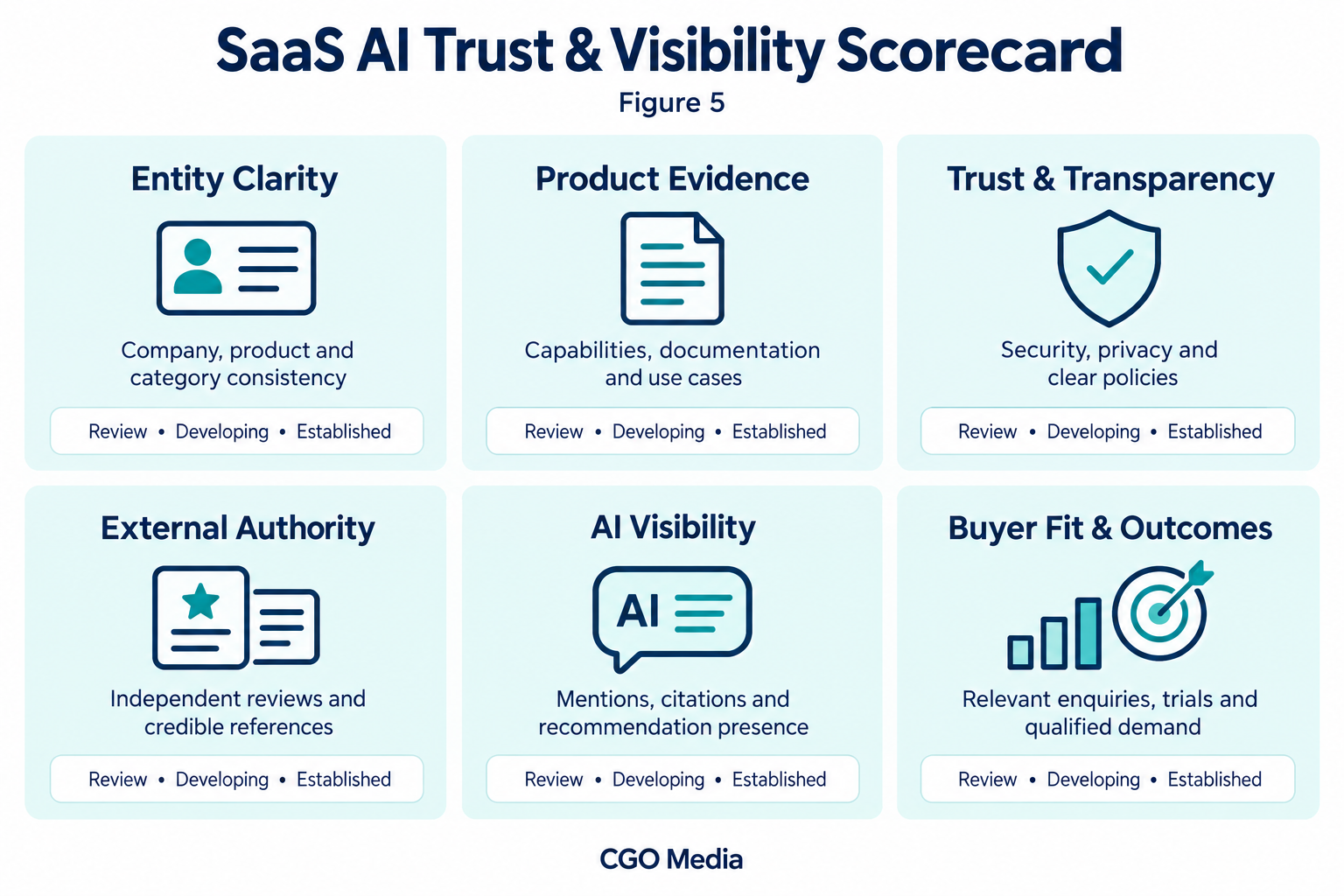
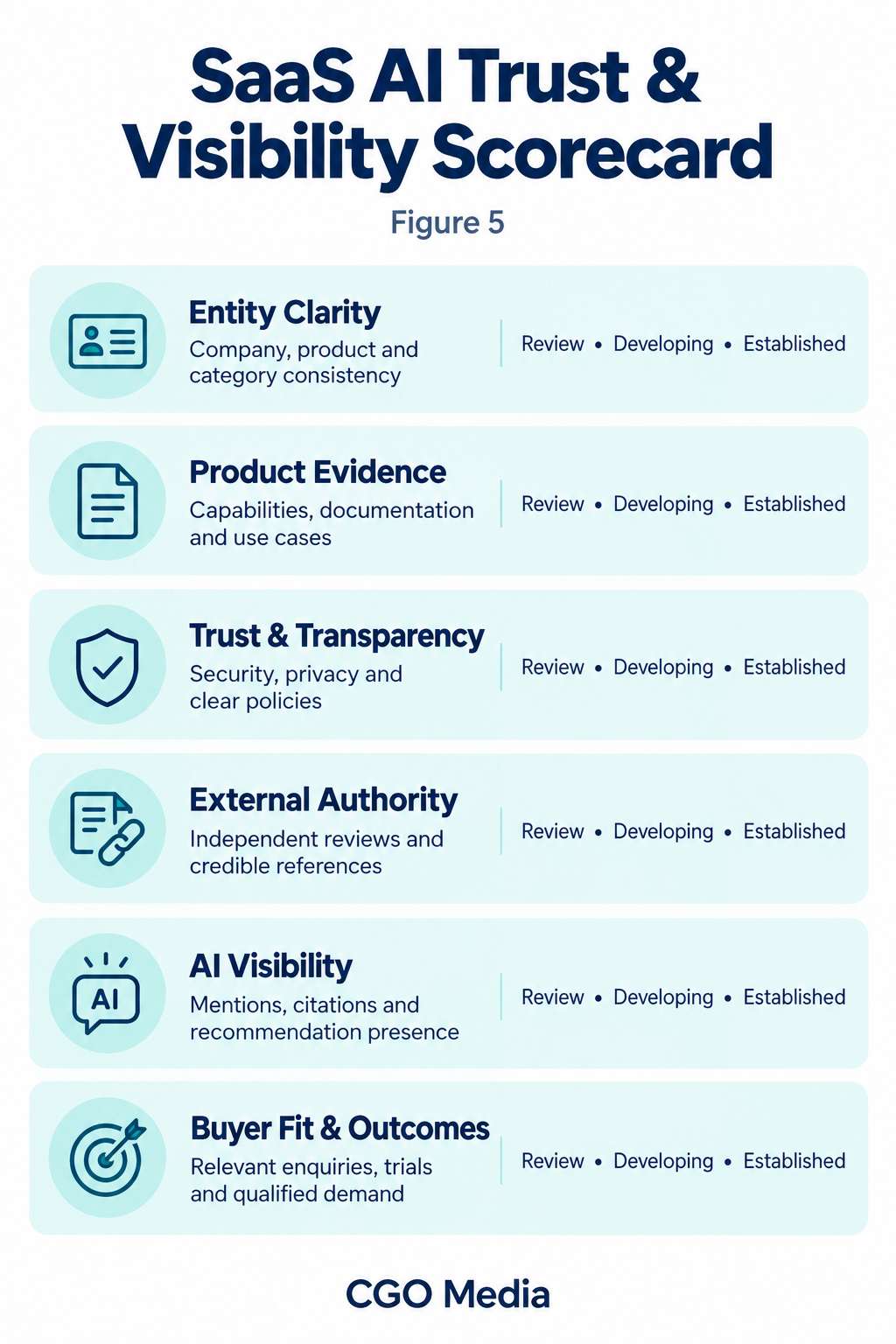
251. Common SaaS Trust and Visibility Failure Modes
The framework can be used diagnostically to identify structural weaknesses that reduce product understanding, buyer trust, external authority and recommendation readiness.
These weaknesses frequently arise not because the product lacks value, but because the wider evidence environment is incomplete, inconsistent or outdated.
252. Failure Mode — Unclear Product Positioning
A SaaS provider may describe the same product differently across:
- Landing pages
- Review platforms
- Marketplaces
- Partner websites
Inconsistent positioning can weaken category clarity and make the product harder to evaluate consistently.
253. Failure Mode — Product and Company Confusion
Where company and product names are used interchangeably, buyers and machine systems may struggle to distinguish the organisation from the software it operates.
Clear relationships should be maintained between:
Provider → Product → Suite → Module → Feature
254. Failure Mode — Legacy Brand Residue
Rebrands and acquisitions can leave outdated names distributed across:
- Documentation
- Review platforms
- Partner pages
- Directories
- Customer references
Legacy information should be managed deliberately rather than allowed to create persistent entity ambiguity.
255. Failure Mode — Weak Feature Evidence
Feature pages can make broad benefit claims without providing enough technical or operational detail for serious evaluation.
Strong feature evidence should explain:
- What the capability does
- Which workflows it supports
- Who it is designed for
- Which limitations apply
- Where it can be verified
256. Failure Mode — Weak Integration Evidence
An integration logo alone may not establish meaningful compatibility.
Buyers may need to know:
- What connects
- How the integration works
- Which data is exchanged
- Whether middleware is required
- Which plans support it
257. Failure Mode — Outdated Documentation
Documentation can lose authority when it contains:
- Deprecated features
- Old interface references
- Broken instructions
- Unsupported integrations
- Outdated API information
Documentation freshness should therefore be treated as part of product governance.
258. Failure Mode — Generic Industry Pages
Industry pages provide limited authority when they contain generic marketing copy with only the sector name changed.
Meaningful sector authority should reflect real differences in:
- Workflows
- Integrations
- Compliance
- Customer evidence
- Operational requirements
259. Failure Mode — Weak Customer Proof
Customer evidence can remain weak where the provider relies primarily on logos or short testimonials without explaining:
- The customer problem
- The product usage
- The implementation context
- The resulting outcome
260. Failure Mode — Customer Evidence Concentration
A provider serving several markets may possess strong customer proof in one segment while having limited evidence in other strategically important:
- Industries
- Company sizes
- Use cases
- Geographies
Authority should be assessed against the markets the provider actually wants to grow.
261. Failure Mode — Vague Security Claims
Statements such as “secure by design” or “enterprise-grade security” provide limited decision value where supporting evidence cannot be located.
Security authority requires verifiable information appropriate to the buyer’s risk level.
262. Failure Mode — Outdated Certification Claims
Public references to certifications, audits and assurance programmes should remain current and accurately describe:
- Status
- Scope
- Applicable organisation
- Applicable product
263. Failure Mode — Privacy Information Fragmentation
Privacy evidence can become difficult to interpret when important information is spread across disconnected:
- Policies
- Legal pages
- Trust centres
- Support documentation
Decision-critical privacy information should be connected clearly enough for buyers to navigate.
264. Failure Mode — Pricing Ambiguity
Commercial uncertainty increases when buyers cannot determine:
- How pricing works
- Which features belong to each plan
- Which additional costs may apply
- Whether enterprise pricing follows a different model
Pricing clarity is therefore a trust signal as well as a commercial consideration.
265. Failure Mode — Support Ambiguity
Buyers may hesitate when support availability, response expectations or service levels are unclear.
The provider should explain where support differs by plan, customer tier or service agreement.
266. Failure Mode — Review Platform Neglect
Major review profiles can become outdated even while the provider continues improving its own website.
Review-platform maintenance should include:
- Product naming
- Category information
- Feature descriptions
- Pricing references
267. Failure Mode — Unresolved Review Patterns
Repeated criticism involving:
- Implementation
- Support
- Pricing
- Reliability
can become a strategic trust problem where the same themes persist over time.
Recurring feedback should therefore inform product, service and evidence improvement.
268. Failure Mode — Weak Marketplace Presence
Important integrations may exist while marketplace profiles remain incomplete, poorly maintained or difficult to verify.
This can reduce both technical confidence and external discoverability.
269. Failure Mode — Limited External Validation
A provider may make strong claims about market leadership or product quality while possessing little independent recognition from:
- Customers
- Partners
- Publications
- Marketplaces
- Research sources
First-party claims become stronger when appropriate independent evidence supports them.
270. Failure Mode — Excessive Dependence on One External Platform
External authority can become fragile when most validation depends on one review platform, marketplace or publisher.
A more resilient evidence environment combines several relevant source types.
271. Failure Mode — AI Visibility Without Accuracy
AI visibility is not automatically beneficial when product information is incorrect.
Errors involving:
- Features
- Pricing
- Integrations
- Security
- Buyer suitability
can create more risk than simple absence.
272. Failure Mode — Branded AI Visibility Only
A provider may appear accurately when users ask directly about the brand while remaining absent from non-branded:
- Category queries
- Feature queries
- Use-case queries
- Industry recommendations
This can indicate strong brand recognition but weak discovery authority.
273. Failure Mode — AI Recommendation Without Commercial Fit
A product may be recommended within scenarios that do not match its intended:
- Customer size
- Industry
- Price point
- Geography
- Implementation model
Recommendation relevance should therefore be measured alongside recommendation frequency.
274. Failure Mode — Monitoring Without Remediation
AI monitoring provides limited strategic value if recurring inaccuracies and visibility gaps do not lead to improvement.
The useful relationship is:
Observe → Diagnose → Correct → Validate → Re-Test
275. SaaS Evidence Decay
A defining challenge of SaaS authority is that its evidence environment can become outdated quickly.
Unlike relatively stable corporate information, product, integration, pricing and technical evidence may change frequently.
276. Product Evidence Decay
Product evidence becomes stale as:
- Features change
- Modules are renamed
- Products merge
- Capabilities are retired
These changes can create contradictions across product pages, documentation and external profiles.
277. Integration Evidence Decay
Integration information can become outdated because of:
- API changes
- Partner decisions
- Product deprecation
- Migration to middleware
- Commercial changes
Integration authority therefore requires continuing maintenance.
278. Pricing Evidence Decay
Pricing information can become inaccurate as providers alter:
- Plans
- Usage limits
- Billing models
- Feature access
- Enterprise packaging
Because pricing is decision-critical, stale commercial evidence should be treated as a high-priority risk.
279. Security Evidence Decay
Security and compliance evidence can become outdated as:
- Infrastructure changes
- Subprocessors change
- Certifications are renewed
- Controls evolve
- Policies are revised
Security governance should therefore include content and evidence maintenance.
280. Customer Evidence Decay
Case studies can become less representative when the product used by the customer has changed materially since publication.
Customer evidence should be reviewed when:
- Features change
- Product names change
- Customer relationships change
- Quoted outcomes become outdated
281. Review Evidence Decay
Historical reviews may describe product experiences that no longer reflect current:
- Functionality
- Pricing
- Support
- Implementation
Review analysis should therefore account for both sentiment and recency.
282. AI Representation Decay
Generated answers may continue surfacing older information even after first-party product changes have been published.
This makes longitudinal monitoring especially important for high-volatility subjects such as:
- Pricing
- Features
- Integrations
- Product packaging
283. Evidence Maintenance Should Be Systematic
SaaS organisations should treat evidence maintenance as an operating process rather than an occasional content-cleanup exercise.
A useful model is:
Product Change → Evidence Review → Cross-Channel Update → Validation → Monitoring
284. Product Change Trigger
Material product changes should trigger review of:
- Product pages
- Feature pages
- Documentation
- Comparison pages
- Customer-facing resources
285. Integration Change Trigger
Integration changes should trigger coordinated updates across:
- Integration directories
- Documentation
- Marketplace profiles
- Use cases
- Comparison content
286. Pricing Change Trigger
Pricing changes should trigger immediate review of first-party assets containing:
- Plan names
- Prices
- Usage limits
- Feature availability
- Commercial comparisons
High-value external profiles should also be reviewed where outdated pricing could materially affect buyer decisions.
287. Security Change Trigger
Security, privacy or certification changes should trigger review across relevant:
- Technical content
- Legal information
- Trust centres
- Procurement resources
- Sales materials
288. Brand Change Trigger
Rebrands, acquisitions and product-suite restructuring should trigger broader entity audits across:
- Internal websites
- Documentation
- Review platforms
- Marketplaces
- Partner sites
- Relevant directories
The objective is to prevent legacy identity information from persisting indefinitely.
289. Continuous SaaS Trust and Visibility Improvement
The framework is designed to operate as a continuous improvement system.
The practical cycle is:
Assess → Prioritise → Correct → Strengthen → Validate → Measure → Govern → Reassess
290. Assess
Review the organisation across all six trust and visibility dimensions:
- Provider and Product Entity Clarity
- Feature, Integration and Technical Authority
- Use Case, Industry and Customer Authority
- Security, Privacy and Product Trust
- External, Review and Market Authority
- AI Search and Vendor Recommendation Readiness
291. Prioritise
Identify the weaknesses most likely to affect:
- Product understanding
- Buyer trust
- Commercial suitability
- External authority
- AI representation
Prioritisation should reflect both commercial importance and potential risk.
292. Correct
Resolve inaccurate, conflicting or outdated evidence before investing heavily in additional authority expansion.
Accuracy should generally precede scale.
293. Strengthen
Develop stronger evidence around strategically important:
- Features
- Integrations
- Use cases
- Industries
- Security requirements
- Customer segments
Evidence expansion should follow commercial priorities.
294. Validate
Confirm important claims through appropriate:
- Documentation
- Customers
- Partners
- Review platforms
- Marketplaces
- Independent sources
The strongest validation source depends on the claim being assessed.
295. Measure
Track meaningful changes across:
- Search visibility
- Review authority
- External citations
- AI recommendations
- AI representation accuracy
- Commercial outcomes
Measurement should test whether interventions improved the intended authority constraint.
296. Govern
Assign ownership for maintaining:
- Product evidence
- Technical information
- Security evidence
- Customer evidence
- Commercial information
Governance prevents corrected information from becoming outdated again.
297. Reassess
Repeat the framework assessment so improvements and emerging weaknesses can be identified over time.
SaaS authority should be treated as dynamic because the product and market continue to change.
298. Improvement Should Begin with Accuracy
The first priority should normally be correcting information that is materially:
- Wrong
- Outdated
- Conflicting
- Misleading
Publishing more content around an inaccurate foundation can amplify the problem.
299. Improvement Should Then Strengthen Commercial Relevance
Once critical inaccuracies are corrected, providers should strengthen authority around the markets, use cases and product capabilities most important to growth.
This can include:
- Priority categories
- High-value features
- Strategic integrations
- Core industries
- Priority customer segments
300. Improvement Should Expand External Validation
Once first-party evidence is strong, deeper authority can be developed through:
- Customers
- Partners
- Marketplaces
- Relevant publications
- Original research
External authority should reinforce genuine product evidence rather than compensate for weak product reality.
301. Improvement Should Include AI Observation
AI monitoring can help determine whether improvements within the wider evidence environment are reflected in:
- Product representation
- Comparisons
- Source visibility
- Citations
- Recommendations
AI observation should be treated as one feedback layer within the wider framework.
302. Continuous Improvement Should Follow Product Development
Search authority, product authority and trust should evolve alongside the software itself.
A mature system connects:
Product Development → Evidence Development → Market Validation → Search & AI Observation → Feedback
303. The Complete SaaS Trust and Visibility Cycle
The complete framework can be represented as:
Product Reality → Clear Entity Structure → Technical Evidence → Customer Evidence → Trust Evidence → External Validation → AI Representation → Buyer Consideration → Feedback → Evidence Improvement
304. Product Reality
The process begins with the actual capabilities, limitations and commercial model of the software.
The framework should strengthen the visibility of genuine product value rather than manufacture unsupported authority.
305. Clear Entity Structure
The organisation, products, modules and related entities should be represented consistently enough for buyers and machine systems to understand their relationships.
306. Technical Evidence
Features, integrations, APIs and documentation explain what the software genuinely does and where technical limitations apply.
307. Customer Evidence
Use cases, industry evidence and customer stories demonstrate where the product creates real value within appropriate buyer environments.
308. Trust Evidence
Security, privacy, reliability, implementation and pricing information reduce uncertainty around adoption.
Trust evidence becomes increasingly important as product dependency and organisational risk rise.
309. External Validation
Reviews, partners, marketplaces, publications and independent references reinforce credibility beyond the provider’s own website.
Relevant independent evidence makes important claims easier for buyers to verify.
310. AI Representation
AI-assisted systems may interpret, compare and recommend the provider using evidence drawn from the wider information environment.
The provider should therefore monitor both:
- Visibility
- Accuracy
311. Buyer Consideration
The buyer combines:
- Product relevance
- Technical fit
- Trust
- External validation
- Commercial suitability
when determining whether the provider deserves deeper evaluation.
312. Feedback
Search, product, sales, customer-success and AI-monitoring data can reveal where the evidence environment remains incomplete, inaccurate or commercially misaligned.
These signals should feed back into product-authority governance.
313. Evidence Improvement
Findings should produce specific improvements to:
- Entity clarity
- Product evidence
- Documentation
- Customer proof
- Trust evidence
- External authority
This closes the continuous improvement loop.
314. SaaS Trust and Visibility Is Never Finished
Products, buyers, competitors, external sources and AI-assisted discovery environments continue to evolve.
The SaaS AI Trust and Visibility Framework should therefore operate as an ongoing governance model rather than a one-time optimisation exercise.
The two continuous relationships are:
Assess → Prioritise → Correct → Strengthen → Validate → Measure → Govern → Reassess
and:
Product Reality → Clear Entity Structure → Technical Evidence → Customer Evidence → Trust Evidence → External Validation → AI Representation → Buyer Consideration → Feedback → Evidence Improvement
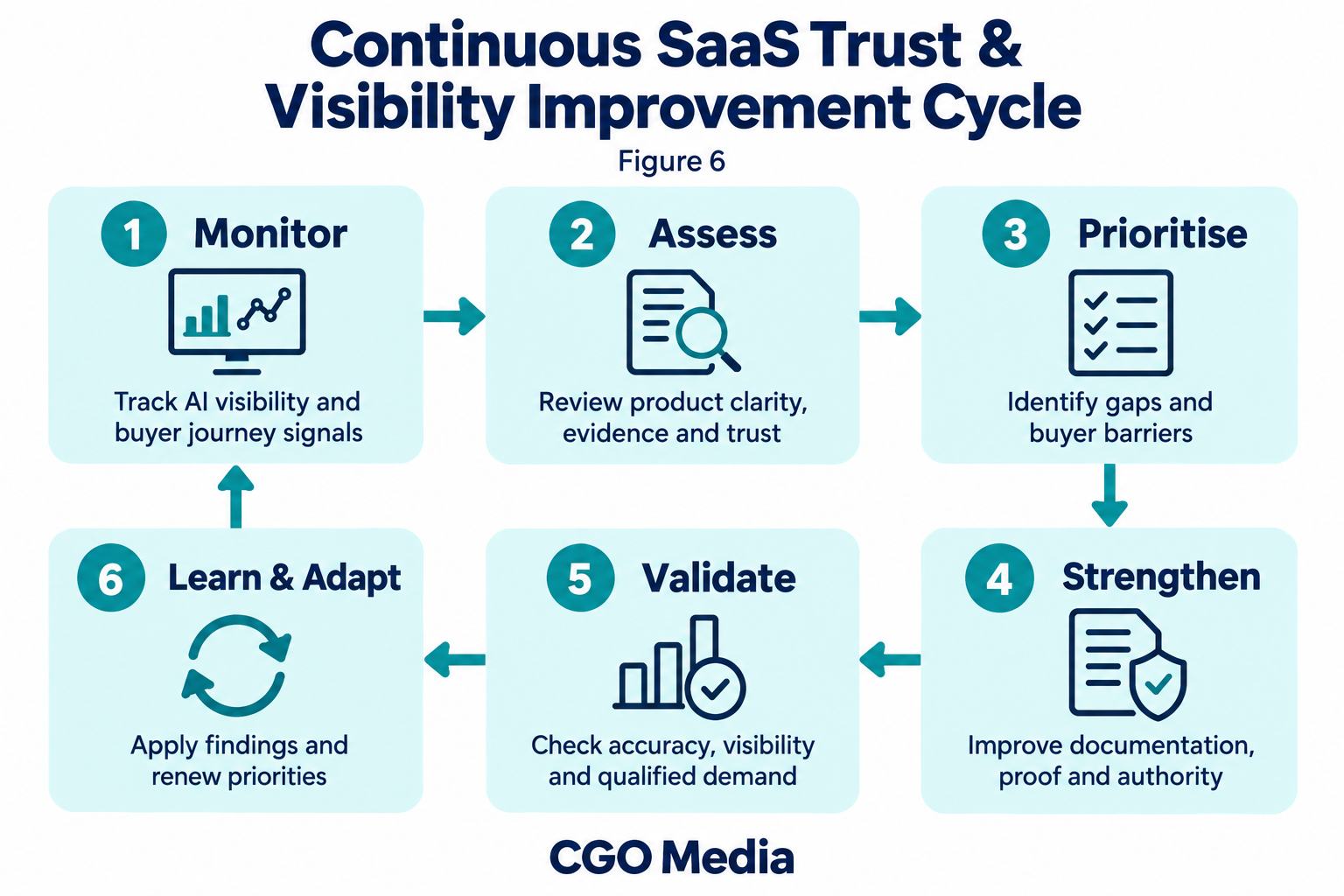
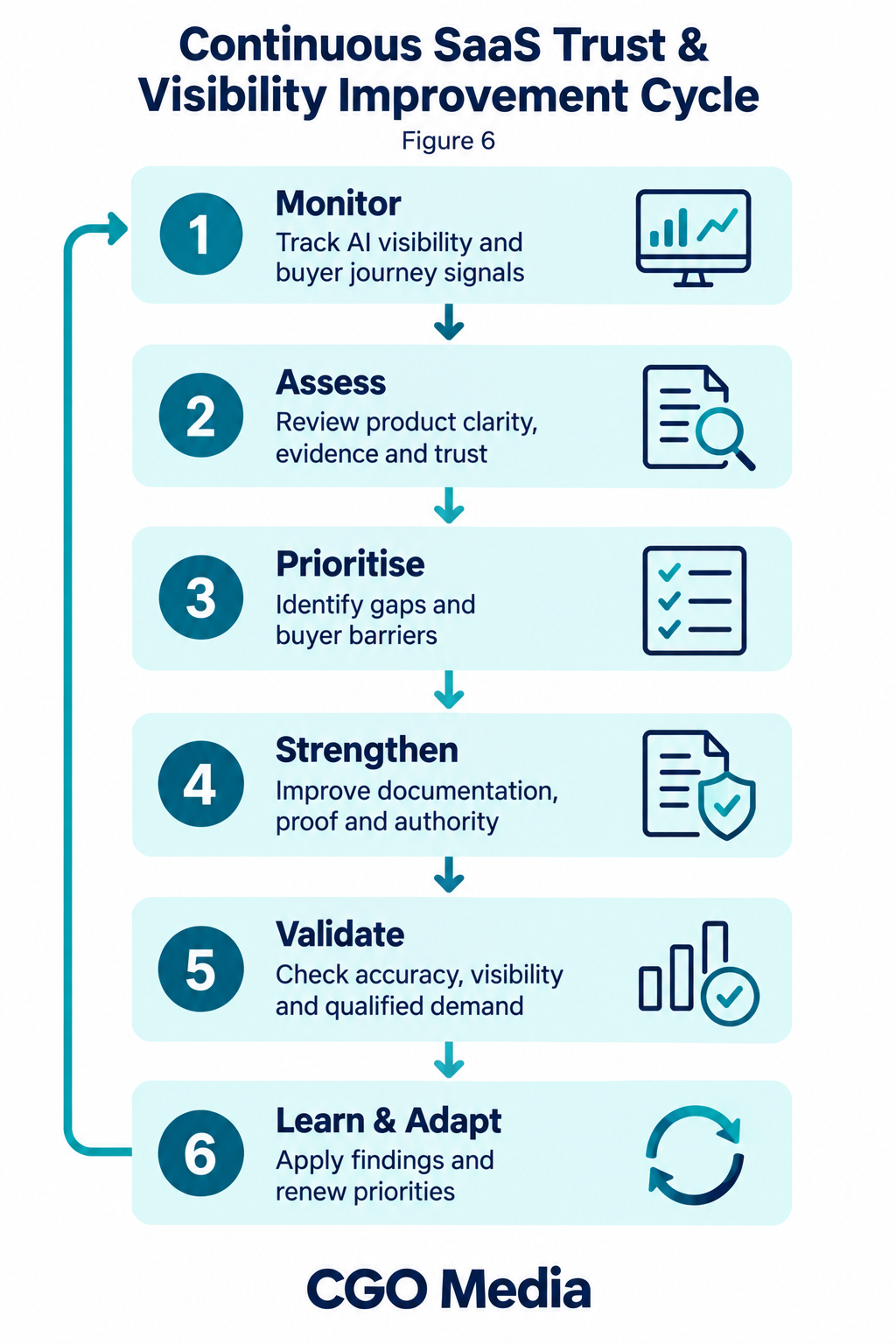
315. Strategic Implications
The SaaS AI Trust and Visibility Framework reframes software visibility as a connected authority problem rather than a conventional search-ranking problem.
Long-term SaaS visibility becomes stronger when the provider combines:
- Clear company and product identity
- Strong feature and integration evidence
- Relevant use-case and industry authority
- Customer proof
- Security and privacy evidence
- Independent market validation
- Accurate AI representation
The strategic objective is not simply to increase exposure. It is to create an evidence environment that makes the provider easier to understand, verify, trust, compare and recommend appropriately.
316. Trust and Visibility Should Be Managed Together
SaaS organisations often separate SEO, product marketing, security, customer success, Digital PR and reputation management into different operating functions.
From a buyer perspective, however, these areas form one connected evaluation environment.
A buyer may move directly from:
Search Result → Product Page → Documentation → Review Platform → Security Centre → AI Comparison → Sales Conversation
without recognising the organisational boundaries behind those assets.
317. Product Authority Begins with Product Reality
The framework does not encourage SaaS companies to manufacture authority around products that do not satisfy buyer requirements.
The starting point must remain the actual:
- Product capability
- Technical performance
- Reliability
- Security
- Customer value
- Commercial suitability
Authority should make genuine product value easier to discover and verify.
318. Evidence Architecture Makes Product Reality Discoverable
Product reality should be translated into a structured evidence environment that allows buyers and machine systems to understand:
- What the software does
- Where it fits
- Which capabilities it provides
- Which integrations it supports
- Who uses it
- Why it can be trusted
A useful relationship is:
Product Reality → Structured Evidence → Verification → Trust → Consideration
319. SaaS Trust Is Distributed
Trust is rarely created by one page, certification, review or customer logo.
It develops through the combined effect of:
- Product evidence
- Documentation
- Security information
- Customer experience
- Reviews
- Partner relationships
- Market recognition
The strongest SaaS trust environment therefore combines first-party clarity with appropriate independent validation.
320. Independent Validation Strengthens First-Party Claims
Vendor-controlled content remains necessary because the provider is normally the authoritative source for current product specifications, documentation, pricing and security information.
Relevant independent evidence can then reinforce those claims through:
- Customers
- Review platforms
- Technology partners
- Marketplaces
- Industry publications
- Research references
321. AI Visibility Should Be Treated as an Outcome
AI recommendation and comparison visibility should not be treated as an isolated optimisation layer.
It is more useful to view AI visibility as one possible outcome of a wider evidence environment that is already:
- Clear
- Current
- Relevant
- Trusted
- Externally validated
The practical progression is:
Product Reality → Evidence Quality → Authority → Recommendation Readiness
322. Recommendation Visibility Cannot Be Guaranteed
No SaaS provider can guarantee inclusion within AI-generated recommendations, comparisons or citations.
The framework is therefore designed to improve recommendation readiness rather than claim deterministic control over generative systems.
323. Product Information Governance Is a Competitive Capability
SaaS products change continuously.
Organisations that maintain more accurate and coherent product evidence may create stronger discovery and trust environments over time.
This makes information governance part of competitive infrastructure rather than routine website maintenance.
324. SaaS Evidence Should Follow Commercial Priorities
Authority investment should focus first on the product areas that matter most to growth.
These can include:
- Priority product categories
- High-value features
- Strategic integrations
- Core industries
- Priority customer segments
- Important geographic markets
Not every possible product topic requires equal authority investment.
325. Relationship with the SaaS Research Family
The SaaS AI Trust and Visibility Framework forms part of the seven-page CGO Media SaaS AI, GEO and Search Research family.
The wider architecture connects sector research, trust, provider selection, organisational maturity, implementation and Generative Engine Optimisation into one integrated research system.
326. Relationship with SaaS AI & GEO Search Research
The SaaS AI & GEO Search Research pillar brings together the complete CGO Media research programme for SaaS search, AI discovery, GEO, authority and software recommendation.
The Trust and Visibility Framework provides the evidence and trust layer within that wider architecture.
327. Relationship with SaaS SEO in an AI Search Environment
The SaaS SEO in an AI Search Environment paper establishes the broader research context for software discovery, digital authority, product evidence and AI-assisted recommendations.
The SaaS AI Trust and Visibility Framework converts those principles into six practical dimensions that can be assessed and governed.
328. Relationship with the SaaS Discovery and Provider Selection Model
The SaaS Discovery and Provider Selection Model examines how prospective buyers move from problem recognition through software discovery, evaluation, trust validation, commercial fit and final provider selection.
The Trust and Visibility Framework defines much of the evidence required for a provider to survive those stages.
329. Relationship with the SaaS Search Authority Maturity Model
The SaaS Search Authority Maturity Model assesses how advanced an organisation has become across the authority capabilities described in this framework.
The framework identifies what should exist; the maturity model helps assess how systematically it has been developed.
330. Relationship with the SaaS SEO and AI Implementation Roadmap
The SaaS SEO and AI Implementation Roadmap provides the phased implementation pathway for strengthening weaknesses identified through the framework.
It translates diagnostic findings into technical, product, customer, external-authority and AI-readiness actions.
331. Relationship with SaaS GEO
SaaS GEO: Generative Engine Optimisation extends the evidence model into generative discovery, source selection, citation visibility, comparison visibility and qualified software recommendation.
The Trust and Visibility Framework provides many of the underlying evidence conditions required for strong GEO performance.
332. Relationship with the Wider CGO Media Framework Architecture
The SaaS AI Trust and Visibility Framework also connects with wider CGO Media methodologies covering entity clarity, knowledge authority, brand signals, citations and AI Search readiness.
333. Methodology
The SaaS AI Trust and Visibility Framework is a conceptual and operational assessment model developed by CGO Media to support structured analysis of SaaS digital authority.
The methodology synthesises six areas of observable evidence:
- Provider and Product Entity Clarity
- Feature, Integration and Technical Authority
- Use Case, Industry and Customer Authority
- Security, Privacy and Product Trust
- External, Review and Market Authority
- AI Search and Vendor Recommendation Readiness
The framework does not depend on access to proprietary search-engine or AI-system internals. It evaluates evidence and outputs that can be observed externally.
334. Assessment Method
A practical framework assessment can combine:
- First-party website review
- Product and documentation audit
- Integration and marketplace review
- Customer evidence analysis
- Security and trust review
- External authority assessment
- Review-platform analysis
- Repeatable AI prompt testing
- Competitor benchmarking
The precise depth of assessment should reflect product complexity, buyer risk and commercial importance.
335. Evidence-Based Scoring
Where internal scoring is used, assessments should be supported by documented evidence and applied consistently between review periods.
A practical internal scale can remain:
- 0 — No meaningful evidence
- 1 — Fragmented
- 2 — Developing
- 3 — Established
- 4 — Advanced
- 5 — Leading
The purpose is strategic diagnosis and prioritisation rather than mathematical prediction.
336. Longitudinal Use
The framework becomes particularly useful when repeated over time.
Successive assessments can identify whether individual dimensions are:
- Improving
- Remaining static
- Deteriorating
This is important because SaaS evidence can decay rapidly as products, integrations, pricing and security environments change.
337. Competitive Use
Publicly observable evidence can also be used to compare strategically important competitors.
However, competitive comparison will remain incomplete where relevant information such as private security controls, contractual arrangements, internal product performance or customer data is unavailable.
338. Framework Limitations
The SaaS AI Trust and Visibility Framework does not represent a confirmed search-engine ranking model or disclosed AI recommendation algorithm.
It should not be interpreted as evidence that any individual search engine, large language model or AI assistant uses these six dimensions as explicit ranking factors.
339. AI Systems Are Dynamic
Generated outputs can vary because of:
- Model updates
- Retrieval changes
- Prompt formulation
- Source availability
- Personalisation
- Geographic context
Individual observations should therefore not be treated as permanent rankings.
340. Scores Should Not Imply False Precision
Framework scores are intended to support strategic comparison and prioritisation.
They should not be presented as statistically validated predictions of:
- Rankings
- Organic traffic
- Lead generation
- Revenue
- AI recommendation probability
341. Different SaaS Markets Require Different Weighting
The relative importance of individual dimensions can vary according to:
- Product complexity
- Customer size
- Industry
- Regulation
- Security sensitivity
- Contract value
- Buying cycle
The six dimensions provide a common structure, but their relative importance should reflect the actual market.
342. Enterprise SaaS Application
Enterprise SaaS providers may place greater emphasis on:
- Security
- Compliance
- Implementation
- Integration depth
- Customer evidence
- Vendor stability
Higher contract value and operational dependence usually increase the evidence threshold required for selection.
343. Product-Led SaaS Application
Product-led providers may place greater emphasis on:
- Feature clarity
- Self-service onboarding
- Documentation
- Integration discovery
- Trial conversion
- User reviews
Direct product experience becomes an important component of trust.
344. Vertical SaaS Application
Vertical SaaS providers may place greater emphasis on:
- Industry expertise
- Sector workflows
- Compliance
- Industry integrations
- Sector-specific customer evidence
The strongest authority model should demonstrate genuine sector relevance rather than generic vertical positioning.
345. The Framework Should Be Adapted, Not Applied Mechanically
The six dimensions create a common analytical structure, but SaaS organisations should adapt weighting, evidence thresholds and review frequency to their:
- Product
- Market
- Buyer
- Risk environment
The framework should support decision-making rather than become a rigid scoring exercise.
346. Conclusion
Modern SaaS visibility increasingly depends on whether a software provider can be discovered, understood, verified and trusted across a distributed digital environment.
That environment can include:
- Search engines
- AI assistants
- Product websites
- Documentation
- Review platforms
- App marketplaces
- Technology partners
- Customers
- Industry publications
- Professional communities
The SaaS AI Trust and Visibility Framework provides a structured way to evaluate this environment across six connected dimensions.
347. SaaS Authority Is Cumulative
The central principle is that SaaS authority develops cumulatively.
Clear Entities → Strong Technical Evidence → Customer Relevance → Product Trust → External Validation → AI Recommendation Readiness
Clear entities improve understanding.
Strong technical evidence improves product relevance.
Customer evidence demonstrates practical value.
Security and privacy evidence reduce risk.
Independent validation reinforces credibility.
Together, these factors create a stronger foundation for search discovery and AI-assisted recommendation.
348. Final Strategic Position
The strategic objective is not simply to increase online visibility.
It is to build a continuously maintained evidence ecosystem that makes the SaaS provider:
- Easier to understand
- Easier to verify
- Easier to trust
- Easier to compare
- More appropriate to recommend
The continuous operating system remains:
Assess → Prioritise → Correct → Strengthen → Validate → Measure → Govern → Reassess
References
External Academic, Technical and Search Sources
- Google Search Central. SEO Starter Guide.
- Google Search Central. Understand How Structured Data Works.
- Schema.org. Organization.
- Schema.org. SoftwareApplication.
- Schema.org. Product.
- Schema.org. Person.
- Hogan, A. et al. (2021). Knowledge Graphs. ACM Computing Surveys, 54(4).
- Metzger, M.J. (2007). Making Sense of Credibility on the Web: Models for Evaluating Online Information and Recommendations for Future Research. Journal of the American Society for Information Science and Technology, 58(13), 2078–2091.
- Ji, Z. et al. (2023). Survey of Hallucination in Natural Language Generation. ACM Computing Surveys, 55(12).
CGO Media Research and Frameworks
- Wilkinson, R. (2026). SaaS SEO in an AI Search Environment. CGO Media.
- Wilkinson, R. (2026). CGO Media Entity Authority Framework. CGO Media.
- Wilkinson, R. (2026). CGO Media Content Authority Framework. CGO Media.
- Wilkinson, R. (2026). CGO Brand Signal Framework. CGO Media.
- Wilkinson, R. (2026). CGO Media AI Citation Framework. CGO Media.
- Wilkinson, R. (2026). CGO Media AI Search Readiness Framework. CGO Media.
- Wilkinson, R. (2026). CGO Media Knowledge Architecture Map. CGO Media.
CGO Media Research Ecosystem
The SaaS AI Trust and Visibility Framework forms part of the CGO Media research programme examining SEO, GEO, AI Search, Entity Authority, Citation Authority, Digital Trust and recommendation-led discovery.
Research Library | Framework Library | Research Architecture | Research Observations | Statistics Library
About Roger Wilkinson
Roger Wilkinson is an independent researcher, SEO practitioner and founder of CGO Media with more than 25 years of experience in search, online visibility and digital strategy.
His research examines how artificial intelligence is reshaping search engines, recommendation systems and digital authority, including the relationships between Technical SEO, Entity Authority, Brand Signals, AI Visibility, Citation Authority, Knowledge Graphs and Search Visibility.
Roger is the creator of the CGO Framework Series, a collection of research-led methodologies designed to help organisations measure, improve and govern digital visibility across traditional and AI-assisted discovery environments.
Related SaaS AI, GEO & Search Research
This framework forms part of the seven-page CGO Media SaaS research family. The six companion resources are:
Research Usage & Citation
CGO Media encourages researchers, journalists, SaaS companies, technology professionals, educators and industry practitioners to reference this framework where it contributes to broader understanding of SaaS discovery, AI Search, digital trust, product authority and software-provider visibility.
Reasonable quotations, summaries, figures and excerpts may be used in articles, reports, presentations, academic work and other publications provided appropriate acknowledgement is given to Roger Wilkinson and CGO Media.
Cite This Framework / Embed Citation
The SaaS AI Trust and Visibility Framework by Roger Wilkinson at CGO Media evaluates software-provider authority across six connected dimensions: entity clarity, technical authority, use-case and customer authority, product trust, external validation and AI recommendation readiness.
APA Citation
Wilkinson, R. (2026). SaaS AI Trust and Visibility Framework. CGO Media. https://cgomedia.com/saas-ai-trust-visibility-framework/
Author: Roger Wilkinson | Published by: CGO Media
For permissions relating to extensive reproduction, commercial licensing or republication of substantial portions of this framework, please contact CGO Media directly.