
SaaS Discovery and Provider Selection Model
Executive Summary
 The SaaS Discovery and Provider Selection Model maps how prospective buyers recognise a software need, define requirements, discover possible solutions, evaluate providers, reduce risk and progress toward trial, demonstration, procurement or purchase.
The model is designed for SaaS companies, software platforms, enterprise software vendors, vertical SaaS providers, product-led growth businesses and subscription technology organisations operating within increasingly distributed digital buying journeys.
The complete buyer journey is:
Problem Recognition → Requirement Definition → Provider Discovery → Capability Evaluation → Risk Validation → Commercial Fit → Shortlisting → Trial, Demo, Procurement & Selection
The central principle is that discovery creates consideration, but evidence determines progression.
1. Why SaaS Provider Selection Has Changed
Software buying is no longer dominated by vendor websites, sales teams, analyst reports and traditional search alone.
Modern buyers may move between:
- Search engines
- AI assistants
- Review platforms
- Software marketplaces
- Comparison websites
- Professional communities
- Peer recommendations
- Vendor documentation
- Product trials
- Sales demonstrations
The provider-selection environment has therefore become distributed across multiple discovery and evidence systems.
2. SaaS Selection Is Usually a Risk-Reduction Process
At each stage, the buyer attempts to reduce uncertainty around whether the software is suitable.
Typical uncertainties include:
- Problem fit
- Feature fit
- Integration fit
- Security
- Pricing
- Implementation
- Vendor reliability
Provider selection can therefore be understood as a progressive evidence and risk-reduction process.
3. The Eight Stages of SaaS Discovery and Provider Selection
- Problem and Need Recognition
- Requirement Definition
- Software and Provider Discovery
- Feature, Use-Case and Integration Evaluation
- Trust, Security and Risk Validation
- Commercial and Operational Fit
- Comparison and Shortlisting
- Trial, Demo, Procurement and Selection
Providers can gain or lose consideration at every stage.
4. Stage One — Problem and Need Recognition
The SaaS buying journey frequently begins with a business problem rather than a known software product or category.
The buyer may initially be trying to understand how to improve an operational process rather than searching for a vendor.
5. Problem-Led Discovery
Early-stage problems can include:
- Reducing manual reporting
- Improving customer support
- Automating invoice approval
- Managing distributed teams
- Improving sales pipeline visibility
At this point, the buyer may not yet know which software category provides the appropriate solution.
6. Problem Recognition Can Be Internal
Internal triggers can include:
- Management priorities
- Employee feedback
- Customer requirements
- Compliance obligations
- Operational inefficiency
- Business growth
7. Problem Recognition Can Be External
External triggers can include:
- Competitor adoption
- Industry change
- New regulation
- Technology change
- Partner requirements
- Customer expectations
External change can create demand before the buyer has identified a specific software solution.
8. AI Can Influence Problem Recognition
A buyer may ask an AI assistant how to solve an operational problem before understanding the relevant software category.
AI-assisted discovery can therefore connect:
Business Problem → Possible Approach → Software Category → Candidate Provider
9. Problem Queries Are Strategically Important
SaaS providers that focus only on category or product keywords may enter the buying journey relatively late.
Problem-led visibility creates an opportunity to participate before a formal provider set has been created.
10. Educational Content Can Support Early Discovery
Useful early-stage resources can include:
- Problem guides
- Workflow analysis
- Industry research
- Operational benchmarks
- Educational tools
The purpose should be to help the buyer understand the problem before promoting a particular product.
11. Stage Two — Requirement Definition
Once the problem is recognised, the buyer begins translating the problem into software requirements.
This stage determines which capabilities later become filters during provider discovery and evaluation.
12. Functional Requirements
Functional criteria may include:
- Core features
- Automation
- Reporting
- Collaboration
- Data management
These requirements define what the product must actually enable the organisation to do.
13. Integration Requirements
Existing technology can create mandatory compatibility requirements.
Common examples include:
- CRM
- Accounting software
- ERP
- Communication tools
- Payment platforms
- Identity providers
An otherwise suitable product can be eliminated if it cannot operate effectively within the existing technology environment.
14. Technical Requirements
Technical evaluators may establish requirements involving:
- API availability
- Authentication
- Data export
- Webhooks
- Architecture
- Scalability
Technical evidence becomes increasingly important as product complexity rises.
15. Security Requirements
Security requirements may include:
- Single sign-on
- Multi-factor authentication
- Role-based permissions
- Encryption
- Audit logging
- Security assurance
For some buyers, failure to satisfy a mandatory security requirement can immediately eliminate a provider.
16. Privacy Requirements
Buyers may define requirements around:
- Data processing
- Data residency
- Subprocessors
- Retention
- Deletion
Privacy requirements may differ materially according to geography, industry and organisational risk.
17. Compliance Requirements
For regulated organisations, legal and governance requirements can become hard selection filters rather than optional preferences.
A functionally strong product may therefore be unsuitable if the provider cannot satisfy required compliance conditions.
18. Commercial Requirements
The buyer may define:
- Budget
- Preferred pricing model
- Contract length
- Expected user count
- Expected usage
Commercial constraints should be established early enough to prevent unrealistic providers from remaining in consideration unnecessarily.
19. Implementation Requirements
The organisation may need to understand:
- Deployment speed
- Migration complexity
- Training requirements
- Internal technical resources
- External implementation support
Implementation feasibility can become as important as product functionality.
20. Company-Size Requirements
A product suitable for a startup may be unsuitable for a large enterprise, while an enterprise platform may be unnecessarily complex or expensive for a smaller organisation.
Company size can affect requirements around:
- Administration
- Scalability
- Security
- Support
- Pricing
21. Geographic Requirements
Geographic considerations can include:
- Local support
- Data residency
- Currency
- Tax
- Regional compliance
- Language
International suitability should not be assumed simply because a product is available online.
22. Requirement Definition Creates a Selection Filter
Once requirements have been defined, buyers can begin excluding products that fail critical criteria.
A useful relationship is:
Business Problem → Requirements → Mandatory Filters → Candidate Provider Set
23. Mandatory Versus Preferred Requirements
A practical evaluation should distinguish:
- Mandatory requirements — conditions that must be satisfied.
- Preferred requirements — capabilities that increase suitability.
This distinction prevents optional advantages from obscuring critical deficiencies.
24. Requirement Weighting
Not every criterion carries equal importance.
Security may dominate for one buyer, while another may place greater weight on:
- Ease of use
- Price
- Integration coverage
- Implementation speed
Provider evaluation should therefore reflect the buyer’s actual priority structure.
25. Stage Three — Software and Provider Discovery
Once requirements become sufficiently clear, buyers begin identifying products and providers that might satisfy them.
Discovery determines which vendors gain the opportunity to enter deeper evaluation.
26. Search Engine Discovery
Traditional search can surface:
- Vendor websites
- Category pages
- Comparison content
- Review platforms
- Industry publications
Search therefore remains an important route into the initial provider set.
27. AI-Assisted Discovery
AI assistants can compress several discovery steps by responding to detailed buyer requirements with candidate providers.
A buyer may combine:
Company Size + Industry + Feature Requirement + Integration Requirement + Security Requirement
within a single discovery interaction.
28. Review Platform Discovery
Review platforms can introduce providers through:
- Category listings
- Alternative-product pages
- Feature filtering
- Customer ratings
- Market comparisons
They can therefore influence both discovery and later evaluation.
29. Marketplace Discovery
Buyers may discover software through ecosystems associated with technology they already use.
Marketplace visibility can be particularly important where compatibility with an existing platform is a strong buying requirement.
30. Partner-Led Discovery
Consultancies, agencies, implementation partners and technology partners can influence which vendors enter consideration.
Partner recommendations may carry additional weight where the partner understands the buyer’s existing environment.
31. Peer-Led Discovery
Peer recommendations can be influential because they provide experience from organisations that have already:
- Evaluated
- Implemented
- Used
comparable software.
32. Community-Led Discovery
Professional communities can help buyers identify:
- Emerging providers
- Alternative products
- Implementation concerns
- Pricing experiences
- Product limitations
Community evidence can therefore introduce both opportunities and warnings before formal evaluation begins.
33. Media and Analyst Discovery
Technology publications, industry analysts and specialist research organisations can influence discovery in complex or enterprise software categories.
These sources may help buyers understand market structure before individual products are evaluated in detail.
34. Branded Discovery
Some buyers enter the journey already aware of one or more providers.
Brand awareness can create an advantage, but it does not remove the need to satisfy functional, technical, trust and commercial requirements.
35. Non-Branded Discovery
Non-branded discovery determines whether the provider can enter consideration before the buyer already knows the company or product.
This is strategically important for category growth and competitive acquisition.
36. Category Discovery
Buyers may begin with broad searches around categories such as:
- CRM software
- HR platforms
- Project-management software
- Reporting software
Category discovery produces a broad competitive environment rather than a final shortlist.
37. Feature-Led Discovery
Buyers may search directly for products supporting capabilities such as:
- Workflow automation
- White-label reporting
- AI functionality
- Single sign-on
- Custom dashboards
Feature-led discovery can bypass broader category research.
38. Integration-Led Discovery
Integration requirements can immediately exclude products that cannot connect with the buyer’s existing technology environment.
A useful relationship is:
Existing Technology Stack + Required Integration → Eligible Provider Set
39. Use-Case-Led Discovery
A buyer may search for software designed around a specific workflow rather than a broad software category.
Use-case visibility helps providers enter consideration where the buyer’s need is already relatively well defined.
40. Industry-Led Discovery
Sector-specific buyers may prefer products with demonstrated relevance to their industry.
Useful evidence can include:
- Industry workflows
- Sector integrations
- Compliance knowledge
- Comparable customers
41. Role-Led Discovery
Discovery can differ substantially according to the stakeholder conducting the research.
A finance leader, IT manager, operational manager and end user may create different provider sets for the same software category because each prioritises different requirements.
42. The Initial Provider Set
The discovery stage creates an initial universe of possible products.
This can include:
- Market leaders
- Established specialists
- Lower-cost alternatives
- New entrants
- AI-native providers
Inclusion creates an opportunity for evaluation rather than evidence of eventual selection.
43. Discovery Visibility Does Not Equal Selection
Appearing within an initial provider set is only the beginning.
The provider must still survive increasingly detailed evaluation around:
- Capability
- Use-case fit
- Integrations
- Trust
- Security
- Pricing
- Implementation
This distinction is fundamental to the model:
Discovery Visibility ≠ Provider Selection
44. The Early SaaS Selection Funnel
The first three stages can be represented as:
Problem Recognition → Requirement Definition → Provider Discovery
The buyer has now moved from understanding a business problem to establishing requirements and identifying an initial provider set.
The next stage asks a more demanding question:
Which of these products can actually meet our requirements?
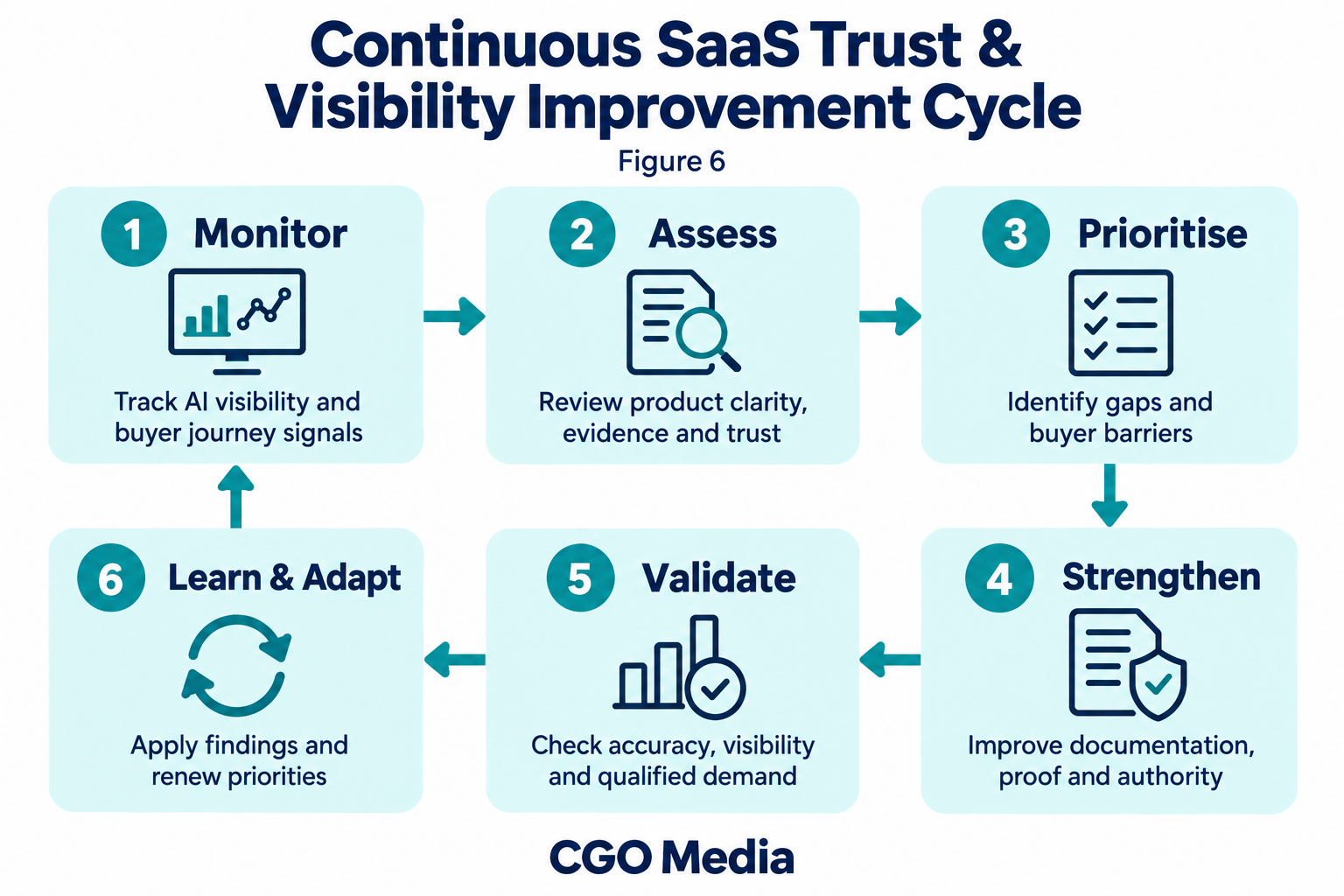
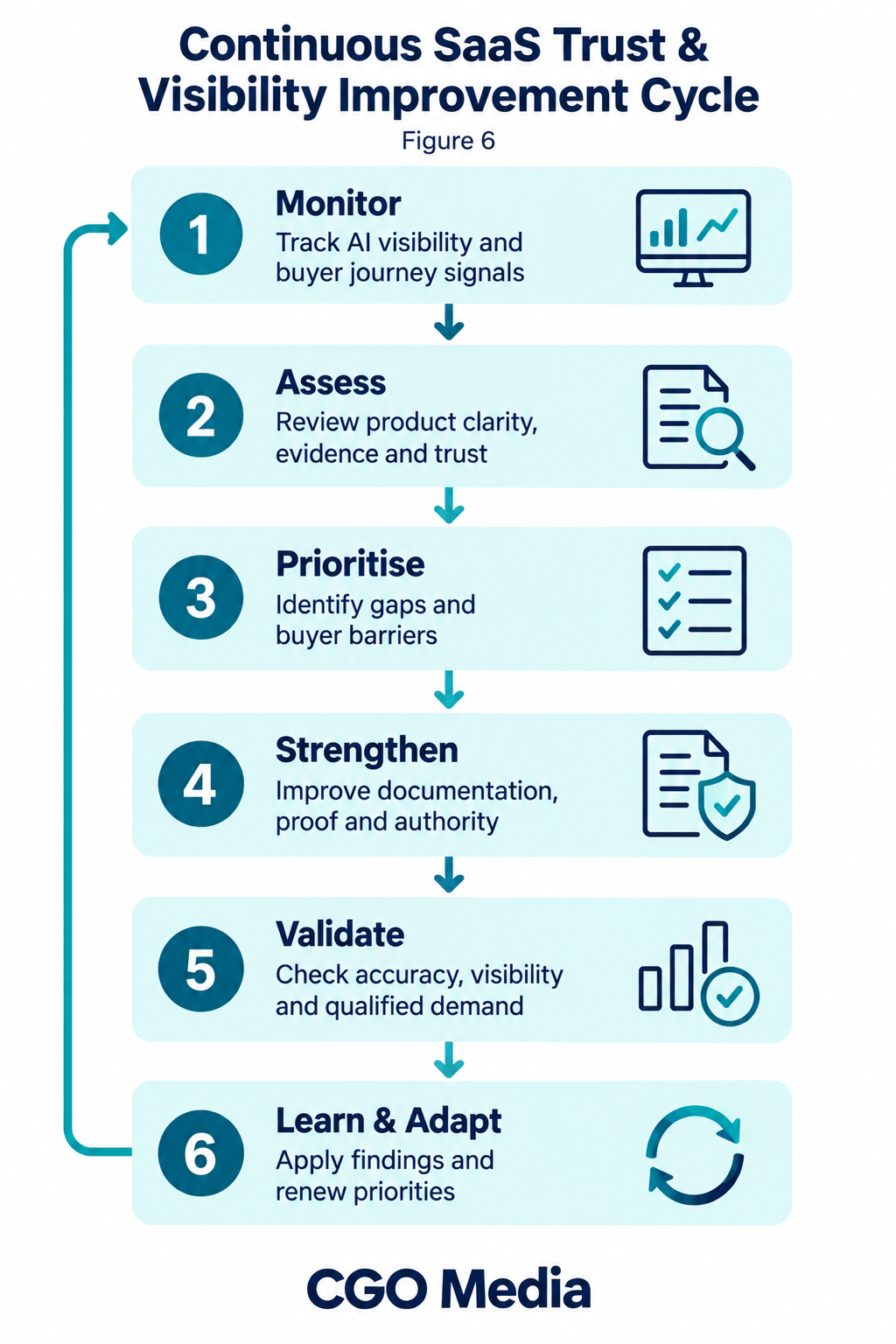
45. Stage Four — Feature, Use-Case and Integration Evaluation
Once an initial provider set has been created, the buyer moves from asking:
“Which products exist?”
to:
“Which of these products can actually meet our requirements?”
This stage tests practical product fit rather than discovery visibility.
46. Feature Fit
Buyers compare whether each product provides the capabilities defined during requirement discovery.
A useful relationship is:
Required Capability → Product Evidence → Feature Fit
47. Mandatory Feature Evaluation
Some capabilities operate as hard filters.
If a required feature is unavailable, the provider may be removed from consideration regardless of:
- Brand awareness
- Search visibility
- Review volume
- Market reputation
48. Preferred Feature Evaluation
Other features increase suitability without being essential.
Preferred capabilities can help differentiate providers that already satisfy all mandatory requirements.
49. Feature Depth Matters
A statement that a feature exists may not provide enough evidence.
Buyers may need to understand:
- How it works
- Which workflows it supports
- Which plans include it
- Whether limitations apply
- Whether configuration is required
Feature presence and feature suitability are therefore different.
50. Feature Evidence Sources
Feature claims may be validated through:
- Product pages
- Documentation
- Product demonstrations
- Help centres
- Customer reviews
- Independent comparisons
Evidence should become stronger as the buyer approaches selection.
51. Feature Claim Consistency
Conflicting feature descriptions across:
- Marketing pages
- Documentation
- Pricing pages
- External profiles
can increase uncertainty and slow progression.
52. Use-Case Fit
A product may contain the required features while remaining poorly suited to the buyer’s real workflow.
Use-case fit asks whether the product works effectively within the operational context in which it will be used.
53. Workflow Evaluation
Buyers may evaluate:
- How tasks are completed
- How teams collaborate
- How data moves
- How approvals work
- How reporting is generated
A useful relationship is:
Feature Availability → Workflow Fit → Operational Suitability
54. Role-Based Evaluation
Different stakeholders can assess the same SaaS product against very different criteria.
Provider evaluation should therefore account for multiple user and decision-maker perspectives.
55. End-User Evaluation
End users may focus on:
- Ease of use
- Workflow efficiency
- Learning curve
- Accessibility
- Daily productivity
56. Management Evaluation
Managers may focus on:
- Reporting
- Control
- Visibility
- Workflow standardisation
- Performance measurement
57. Technical Evaluation
Technical stakeholders may evaluate:
- Architecture
- APIs
- Authentication
- Integrations
- Data portability
- Security controls
58. Executive Evaluation
Senior decision-makers may place greater emphasis on:
- Strategic fit
- Commercial return
- Scalability
- Vendor stability
- Implementation risk
A strong provider must often satisfy all four evaluation perspectives.
59. Industry Fit
Sector-specific buyers may assess whether the provider understands:
- Industry terminology
- Specialist workflows
- Regulatory constraints
- Required integrations
- Typical operational challenges
60. Customer Evidence for Industry Fit
Case studies from comparable organisations can help demonstrate that the product has been implemented successfully within the buyer’s sector.
Evidence becomes stronger when the customer resembles the buyer in:
- Industry
- Company size
- Use case
- Technical environment
61. Company-Size Fit
Product suitability can differ significantly across:
- Startups
- SMEs
- Mid-market companies
- Large enterprises
62. Small-Business Fit
Smaller buyers may prioritise:
- Ease of setup
- Transparent pricing
- Low implementation burden
- Self-service support
63. Enterprise Fit
Enterprise buyers may require:
- Advanced permissions
- Single sign-on
- Audit controls
- Custom integrations
- Procurement support
- Enterprise service levels
Enterprise suitability normally requires deeper operational and trust evidence.
64. Integration Fit
Integration capability can become a decisive selection criterion because the new software must operate inside an existing technology environment.
A useful relationship is:
Required Workflow + Existing Technology Stack + Integration Capability → Integration Fit
65. Native Integration Evaluation
Native integrations may offer:
- Lower implementation complexity
- Clearer support ownership
- More predictable data exchange
- Reduced middleware dependency
Native availability does not automatically guarantee sufficient depth.
66. Middleware Evaluation
Third-party automation or middleware can expand compatibility but may introduce:
- Additional cost
- Additional configuration
- Additional failure points
- Separate support dependencies
Middleware compatibility should therefore be evaluated as part of the complete solution architecture.
67. API Evaluation
Technical buyers may assess whether APIs provide sufficient flexibility for:
- Custom integrations
- Data synchronisation
- Workflow automation
- Internal applications
API availability and API suitability should be treated separately.
68. Data Portability
The ability to import and export data can influence selection because buyers may want to reduce long-term dependence on one provider.
Portability also affects:
- Migration
- Business continuity
- Future switching cost
69. Ecosystem Fit
A wider ecosystem of:
- Integrations
- Apps
- Developers
- Implementation partners
can reduce adoption friction and expand the practical value of a platform.
70. Feature-to-Plan Fit
A required capability may exist but only within a pricing tier that changes the commercial viability of the product.
Evaluation should therefore connect:
Required Feature → Available Plan → Actual Cost
71. Product Roadmap Consideration
Where an important capability is not yet available, buyers may consider future product-roadmap commitments.
Roadmap evidence should be treated cautiously because planned functionality is not the same as current capability.
72. Existing and Planned Capability Must Be Distinguished
Providers should clearly separate:
- Available today
- In development
- Planned
- Exploratory
Presenting planned functionality as existing capability can damage buyer trust.
73. Product Demonstration as Evaluation Evidence
A live or recorded demonstration can help buyers determine whether claimed functionality translates into practical workflows.
Demonstrations can validate:
- Workflow fit
- Feature depth
- User experience
- Administrative capability
74. Interactive Product Experience
Providers may also use:
- Interactive demos
- Product tours
- Sandbox environments
- Free trials
Direct experience can reduce information asymmetry by allowing buyers to test claims themselves.
75. Product-Led Evaluation
In lower-friction SaaS categories, direct product usage may replace much of the traditional sales-led evaluation process.
The buyer can progress through:
Discovery → Trial → Product Experience → Purchase
76. Sales-Led Evaluation
More complex SaaS purchases may require:
- Discovery calls
- Custom demonstrations
- Technical workshops
- Solution design
- Proof-of-concept activity
Sales-led evaluation becomes more important as product complexity and buyer risk increase.
77. Evaluation Evidence Should Reduce Ambiguity
The strongest feature and integration evidence should help the buyer answer one practical question:
Can this product actually work in our environment?
If the answer remains unclear, the provider may struggle to progress regardless of initial discovery strength.
78. Stage Five — Trust, Security and Risk Validation
Once functional suitability has been established, the buyer increasingly evaluates whether adopting the provider creates acceptable organisational risk.
This stage tests whether the product is not only capable, but sufficiently trustworthy to adopt.
79. Trust Validation Can Begin Earlier
Trust is not confined to one point in the buyer journey.
Security, reviews, customer reputation and vendor credibility may influence the buyer from the first discovery interaction.
The formal risk-validation stage simply makes this evidence more systematic.
80. Security Validation
Security-conscious buyers may evaluate:
- Encryption
- Authentication
- Access controls
- Infrastructure
- Monitoring
- Incident response
81. Certification and Assurance Validation
Where relevant, buyers may investigate:
- Certifications
- Audits
- Independent assurance
- Security standards
The existence of assurance evidence can reduce uncertainty, but its scope must still be understood.
82. Certification Scope Matters
A certification may apply only to particular:
- Systems
- Services
- Locations
- Organisational units
Buyers need enough detail to determine whether the assurance applies to the product being evaluated.
83. Privacy Validation
Privacy-sensitive buyers may investigate:
- Data-processing arrangements
- Data residency
- Retention
- Deletion
- Subprocessors
84. Regulatory and Compliance Validation
For some organisations, regulatory requirements act as hard selection filters.
A functionally strong product can still be removed where it cannot satisfy mandatory compliance conditions.
85. Identity and Access Validation
Technical evaluators may require:
- Single sign-on
- Multi-factor authentication
- Role-based access control
- User provisioning
- Audit logs
These capabilities can be critical in larger or regulated organisations.
86. Reliability Validation
Buyers may seek evidence that the service is sufficiently dependable for the business process it will support.
The required reliability threshold usually rises with operational dependence.
87. Status and Incident History
Operational status information can provide evidence around:
- Service availability
- Recent incidents
- Communication quality
- Recovery performance
Current operational evidence can be more informative than generic reliability claims.
88. Business Continuity
Higher-risk buyers may investigate:
- Backup practices
- Disaster recovery
- Continuity planning
- Operational resilience
89. Vendor Stability
A strategically important SaaS purchase can create significant long-term dependency.
Buyers may therefore consider whether the provider appears capable of maintaining:
- The product
- Support
- Security
- Service continuity
over the expected relationship period.
90. Customer Trust Validation
Customer reviews and case studies can provide evidence about how the vendor performs after purchase.
Relevant themes can include:
- Support quality
- Implementation
- Reliability
- Ease of use
- Commercial experience
91. Review Pattern Analysis
Buyers may look beyond average ratings to identify repeated themes involving:
- Support
- Implementation
- Reliability
- Pricing
- Product limitations
Repeated themes can be more useful than an isolated positive or negative review.
92. Review Recency
Recent reviews become particularly important where:
- The product has changed
- Pricing has changed
- Support arrangements have changed
- The company has undergone major organisational change
Historic review evidence may not describe the current provider accurately.
93. Reference Customer Validation
Enterprise buyers may request direct references where the software will support strategically important business processes.
Reference customers are most useful when they resemble the buyer in:
- Scale
- Industry
- Use case
- Implementation complexity
94. Support Validation
Buyers may evaluate:
- Support channels
- Availability
- Response expectations
- Escalation
- Premium support options
Support fit becomes increasingly important where downtime or implementation problems can materially affect operations.
95. Implementation Risk
A technically suitable product may still be rejected if implementation appears too:
- Complex
- Disruptive
- Expensive
- Resource-intensive
Implementation risk therefore sits between product capability and real-world adoption.
96. Migration Risk
The buyer may investigate:
- Migration tools
- Data mapping
- Historical data
- Downtime
- Vendor assistance
Migration complexity can materially alter the attractiveness of an otherwise strong product.
97. Adoption Risk
A SaaS product can fail commercially if employees do not use it effectively.
Buyers may therefore consider:
- Ease of use
- Training
- Onboarding
- Change-management requirements
98. Switching Risk
Buyers may also assess how difficult it would be to leave the platform later.
Relevant considerations include:
- Data portability
- Contract terms
- Integration dependency
- Migration complexity
- Custom configuration
99. Data Exit and Portability
Clear export and data-access processes can reduce concerns about vendor lock-in.
Exit planning becomes more important as the SaaS platform becomes deeply embedded within business operations.
100. Trust Validation Is Evidence Accumulation
The buyer progressively combines:
Security Evidence + Privacy Evidence + Customer Evidence + Reliability Evidence + Implementation Evidence + Vendor Evidence
The stronger and more consistent this evidence becomes, the easier it is for the provider to survive the risk-validation stage.
The practical progression is:
Capability Fit → Workflow Fit → Integration Fit → Trust Validation → Reduced Buyer Risk
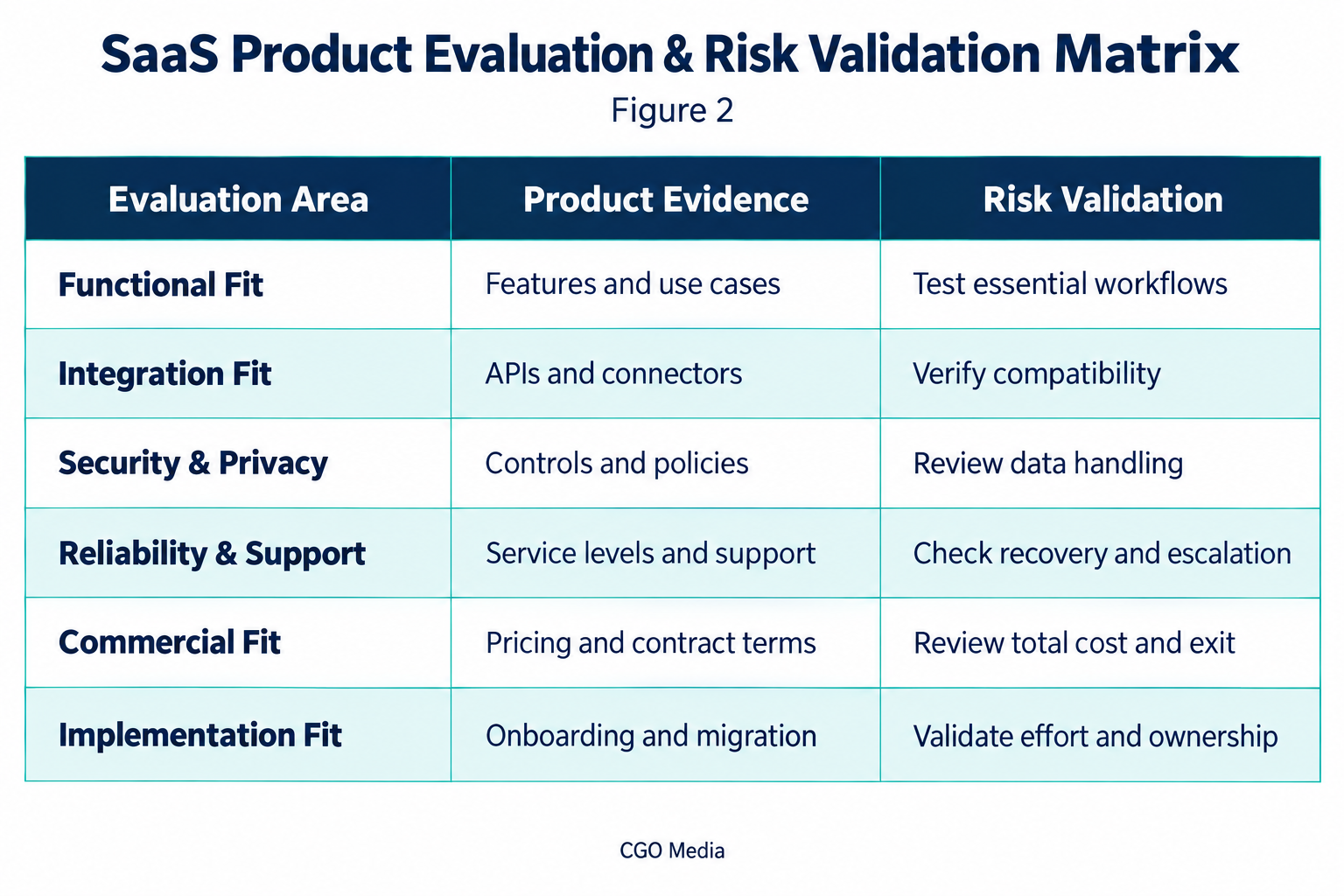
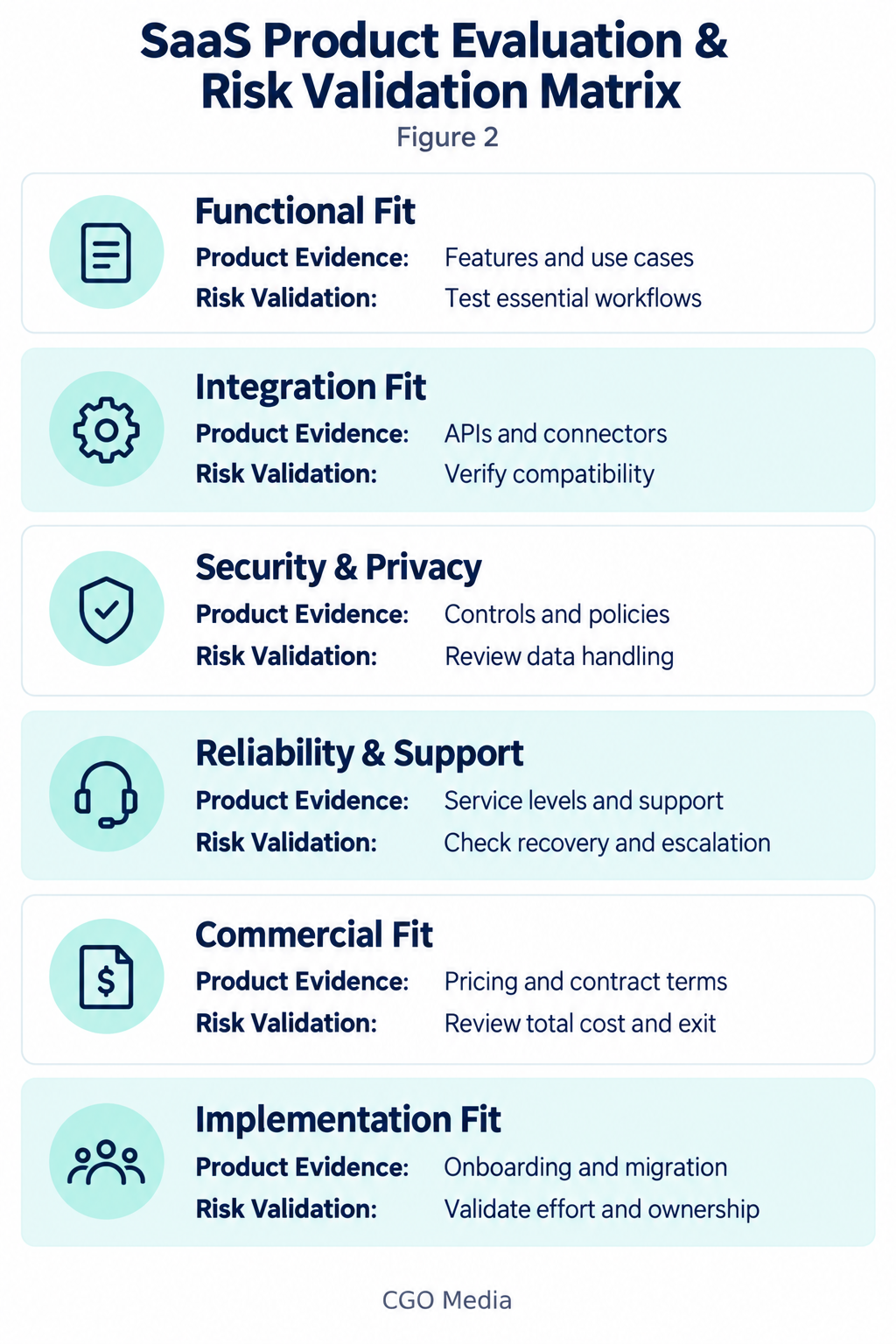
101. Continuing Stage Five — Trust, Security and Risk Validation
Risk validation becomes increasingly formal as the buyer moves from general product interest toward serious commercial consideration.
The provider must now demonstrate that product suitability is supported by sufficient security, legal, operational and organisational evidence.
102. Security Questionnaires
Enterprise buyers may require structured assessments covering:
- Access control
- Encryption
- Infrastructure
- Incident response
- Vulnerability management
- Business continuity
Clear, current security evidence can reduce repeated procurement friction.
103. Trust Centres
A well-maintained trust centre can consolidate:
- Security information
- Privacy information
- Compliance evidence
- Certifications
- Operational assurance
This can make formal evaluation faster and more transparent.
104. Legal Review
Legal teams may examine:
- Terms of service
- Data-processing agreements
- Liability provisions
- Termination rights
- Intellectual-property clauses
A technically suitable product can still fail selection where contractual conditions are unacceptable.
105. Procurement Review
Procurement teams may introduce requirements involving:
- Commercial terms
- Vendor registration
- Insurance
- Payment terms
- Contract duration
Procurement therefore adds another layer of provider qualification beyond product evaluation.
106. Financial Risk Assessment
For strategically important software, larger organisations may consider whether the provider appears financially capable of supporting a long-term relationship.
This becomes more important where the buyer expects significant operational dependence on the platform.
107. Reputational Risk
Buyers may investigate concerns arising from:
- Security incidents
- Customer controversies
- Regulatory issues
- Repeated service failures
Reputational evidence can influence confidence even where the product itself remains technically strong.
108. Product Dependency Risk
The deeper a SaaS product becomes embedded within business operations, the more important:
- Long-term reliability
- Data portability
- Exit planning
- Vendor continuity
become.
109. AI-Assisted Risk Research
Buyers may use AI assistants to investigate a provider’s:
- Security reputation
- Customer feedback
- Known limitations
- Alternatives
- Recent market perception
This increases the importance of accurate and current evidence across both first-party and external sources.
110. Risk Evidence Should Be Discoverable
A provider can possess strong controls while still creating buyer friction if relevant evidence is difficult to locate.
Decision-critical trust information should therefore be:
- Accessible
- Current
- Specific
- Verifiable
111. Stage Six — Commercial and Operational Fit
Once functional and trust requirements are sufficiently satisfied, the buyer asks whether the product makes practical and financial sense.
This stage connects software capability with the real economics and operational burden of adoption.
112. Pricing Fit
The buyer must determine whether the software fits the available budget and expected usage model.
Pricing suitability should be assessed against the configuration the organisation actually requires.
113. Pricing Model Evaluation
SaaS pricing may be based on:
- Users
- Usage
- Transactions
- Contacts
- Storage
- Modules
- Enterprise contracts
The economic effect of each model can change substantially as usage grows.
114. Entry Price
The advertised starting price can influence initial consideration but may not represent the cost required for the buyer’s actual configuration.
Entry pricing should therefore not be confused with effective pricing.
115. Effective Price
The more useful question is:
What will this product cost for our actual users, features, integrations and expected usage?
This provides a more realistic basis for provider comparison.
116. Feature-to-Plan Evaluation
Buyers should identify whether mandatory capabilities are available within:
- Entry plans
- Mid-tier plans
- Premium plans
- Enterprise packages
A feature can exist while remaining commercially inaccessible within the buyer’s intended plan.
117. Usage-Based Pricing Risk
Usage-based models can create uncertainty where future consumption is difficult to predict.
Buyers may therefore model several usage scenarios before comparing total cost.
118. Seat-Based Pricing Risk
Per-user pricing can become materially more expensive as adoption expands across the organisation.
Expected future user growth should therefore be included in commercial evaluation.
119. Additional Commercial Costs
Total cost may also include:
- Implementation
- Migration
- Training
- Premium support
- Additional modules
- Third-party integrations
Subscription price alone may therefore provide an incomplete economic picture.
120. Total Cost of Ownership
A stronger commercial evaluation considers the wider cost of adopting, operating and maintaining the product.
A useful relationship is:
Subscription + Implementation + Migration + Training + Support + Integration Cost → Total Cost of Ownership
121. Commercial Predictability
Pricing models that are easier to forecast can reduce procurement uncertainty.
Predictability can become especially important for larger deployments or usage-based software.
122. Contract Length
Buyers may compare:
- Monthly contracts
- Annual commitments
- Multi-year agreements
- Enterprise contracts
Longer commitments can affect both price and switching flexibility.
123. Renewal Terms
Renewal processes, notice periods and future pricing arrangements influence long-term commercial confidence.
Unclear renewal conditions can create avoidable procurement resistance.
124. Cancellation Terms
Buyers may evaluate the practical and financial consequences of leaving the platform.
Exit flexibility becomes more important where adoption creates significant product dependency.
125. Trial Availability
A free trial can reduce uncertainty when the buyer can test meaningful product functionality before committing.
The value of the trial depends on whether it represents the actual intended use case.
126. Freemium Evaluation
Freemium plans may allow buyers to establish familiarity with the software before formal purchase.
This can move part of the evaluation process into direct product usage.
127. Trial Limitations
A trial may provide limited evaluation value if critical:
- Features
- Integrations
- Data volumes
- Administrative controls
are unavailable.
Trial scope should therefore be considered when interpreting trial results.
128. Implementation Cost
Implementation effort can materially change the economic case for the software.
A lower subscription price may be offset by significantly greater deployment complexity.
129. Internal Resource Cost
Implementation may require internal resources from:
- IT
- Operations
- Finance
- Security
- Training
Internal effort should be included when comparing competing solutions.
130. Time-to-Value
Buyers may compare how quickly each provider can move from contract or registration to meaningful operational value.
A useful relationship is:
Purchase → Implementation → Adoption → Meaningful Business Value
131. Self-Service Implementation
Lower-complexity SaaS products may allow buyers to configure and deploy the product independently.
This can reduce implementation cost and shorten time-to-value.
132. Assisted Implementation
More complex products may require:
- Structured onboarding
- Professional services
- Technical assistance
- Migration support
Assisted implementation may increase cost while reducing deployment risk.
133. Partner-Led Implementation
Some software ecosystems depend heavily on:
- Certified partners
- Consultants
- Implementation specialists
The quality and availability of that partner ecosystem can therefore influence provider suitability.
134. Integration Implementation Cost
An integration being technically available does not mean it is inexpensive or simple to deploy.
Buyers should consider:
- Configuration
- Development
- Testing
- Maintenance
135. Training Requirements
Training can affect:
- Deployment speed
- Internal cost
- User adoption
- Operational disruption
Training burden should therefore form part of operational-fit evaluation.
136. Ease of Adoption
A feature-rich product can lose commercial attractiveness if users find it excessively difficult to adopt.
Usability should therefore be evaluated alongside capability depth.
137. Change-Management Fit
Larger implementations may require changes to:
- Processes
- Roles
- Reporting
- Governance
- Employee behaviour
The organisational cost of change can materially influence the final decision.
138. Scalability Fit
Buyers may evaluate whether the platform can support future:
- User growth
- Data growth
- Transaction growth
- Additional departments
- International operations
Scalability should reflect expected future requirements rather than current requirements alone.
139. Product Packaging Fit
A product may provide suitable functionality while packaging makes adoption inefficient because required capabilities are distributed across multiple paid modules.
Packaging therefore affects both cost and operational simplicity.
140. Support Model Fit
Support requirements can vary according to:
- Product complexity
- Customer size
- Business criticality
- Internal expertise
The appropriate support model should match the consequences of product failure or implementation difficulty.
141. Geographic Fit
International buyers may evaluate:
- Support hours
- Local language
- Currency
- Data residency
- Regional contracts
Global availability does not automatically establish local operational suitability.
142. Operational Fit Is Broader Than Feature Fit
A product can satisfy every major functional requirement while remaining unsuitable because it is:
- Too expensive
- Too difficult to deploy
- Too complex to administer
- Too difficult to scale
- Poorly aligned with existing operations
This is why product fit and operational fit should remain distinct.
143. Commercial Fit Should Be Tested Against Expected Value
The buyer may compare cost with anticipated improvements in:
- Productivity
- Revenue
- Cost efficiency
- Risk reduction
- Customer experience
The relevant question is not simply whether the software is affordable, but whether its expected value justifies adoption.
144. Business Case Development
Higher-value SaaS purchases may require a formal internal business case before final shortlisting or procurement.
The business case converts product suitability into an organisational investment decision.
145. Business Case Evidence
Useful evidence can include:
- Expected return
- Implementation cost
- Efficiency improvement
- Risk reduction
- Customer outcomes
146. ROI Calculators
Vendor-supplied calculators can support evaluation where assumptions are transparent and buyers can adjust inputs to reflect their own circumstances.
Opaque or unrealistic assumptions can reduce credibility rather than strengthen it.
147. Business Case Credibility
Commercial claims become stronger when providers distinguish clearly between:
- Measured customer results
- Illustrative scenarios
- Estimated outcomes
Expected value should not be presented as guaranteed performance.
148. Stage Seven — Comparison and Shortlisting
Once functionality, risk and commercial fit have been evaluated, the provider set normally becomes much smaller.
The buyer now shifts from qualification toward comparative selection.
149. The Shortlist
A shortlist usually contains only providers that satisfy most important requirements and do not fail critical mandatory criteria.
The purpose is to identify candidates suitable for final validation.
150. Shortlisting Is Multi-Factor
A provider may remain under consideration because of a combination of:
- Strong product fit
- Trust
- Pricing
- Implementation
- Customer evidence
- Vendor credibility
No single factor necessarily determines the shortlist.
151. Comparison Criteria
The buyer may create a structured comparison across:
- Features
- Integrations
- Security
- Pricing
- Support
- Implementation
- Customer evidence
- Scalability
152. Weighted Vendor Comparison
Criteria should reflect the buyer’s priorities.
A useful relationship is:
Criteria Importance × Provider Performance → Weighted Provider Assessment
The weighting can differ substantially between organisations evaluating the same products.
153. Mandatory Criteria
A provider that fails a mandatory requirement may be removed even when it performs strongly elsewhere.
Common elimination criteria can include:
- Security
- Integration
- Compliance
- Budget
154. Differentiating Criteria
Once minimum requirements are satisfied, smaller differences can become decisive.
These can include:
- Usability
- Implementation
- Support
- Commercial terms
- Product direction
155. Direct Vendor Comparison Searches
Late-stage buyers may search directly for:
- Vendor A vs Vendor B
- Vendor A alternatives
- Vendor A reviews
- Vendor A pricing
Comparison visibility can therefore influence providers already close to final selection.
156. Third-Party Comparison Content
Review platforms, technology publications and specialist comparison sites can influence how competing providers are understood.
Comparison evidence should be current because:
- Features change
- Pricing changes
- Products evolve
157. AI-Assisted Vendor Comparison
AI assistants can compare several providers against multiple criteria within one interaction.
A buyer may request comparison across:
- Integrations
- Security
- Reporting
- Implementation
- Pricing
This can compress a significant amount of shortlist research into a single discovery environment.
158. AI Comparison Accuracy Matters
The commercial value of AI-assisted comparison depends on whether the underlying information is current and correctly represented.
Errors involving:
- Features
- Integrations
- Security
- Pricing
can materially distort provider evaluation.
159. Buyer-Created Comparison Tables
Procurement teams may create internal scorecards combining evidence from:
- Vendor responses
- Documentation
- Reviews
- Demos
- Security assessments
- Commercial proposals
This brings multiple evidence sources into one formal comparison process.
160. The Mid-to-Late SaaS Selection Funnel
Stages four to seven can be represented as:
Capability Evaluation → Risk Validation → Commercial Fit → Shortlisting
The provider set progressively narrows as buyers test functionality, trust, cost, implementation and operational suitability.
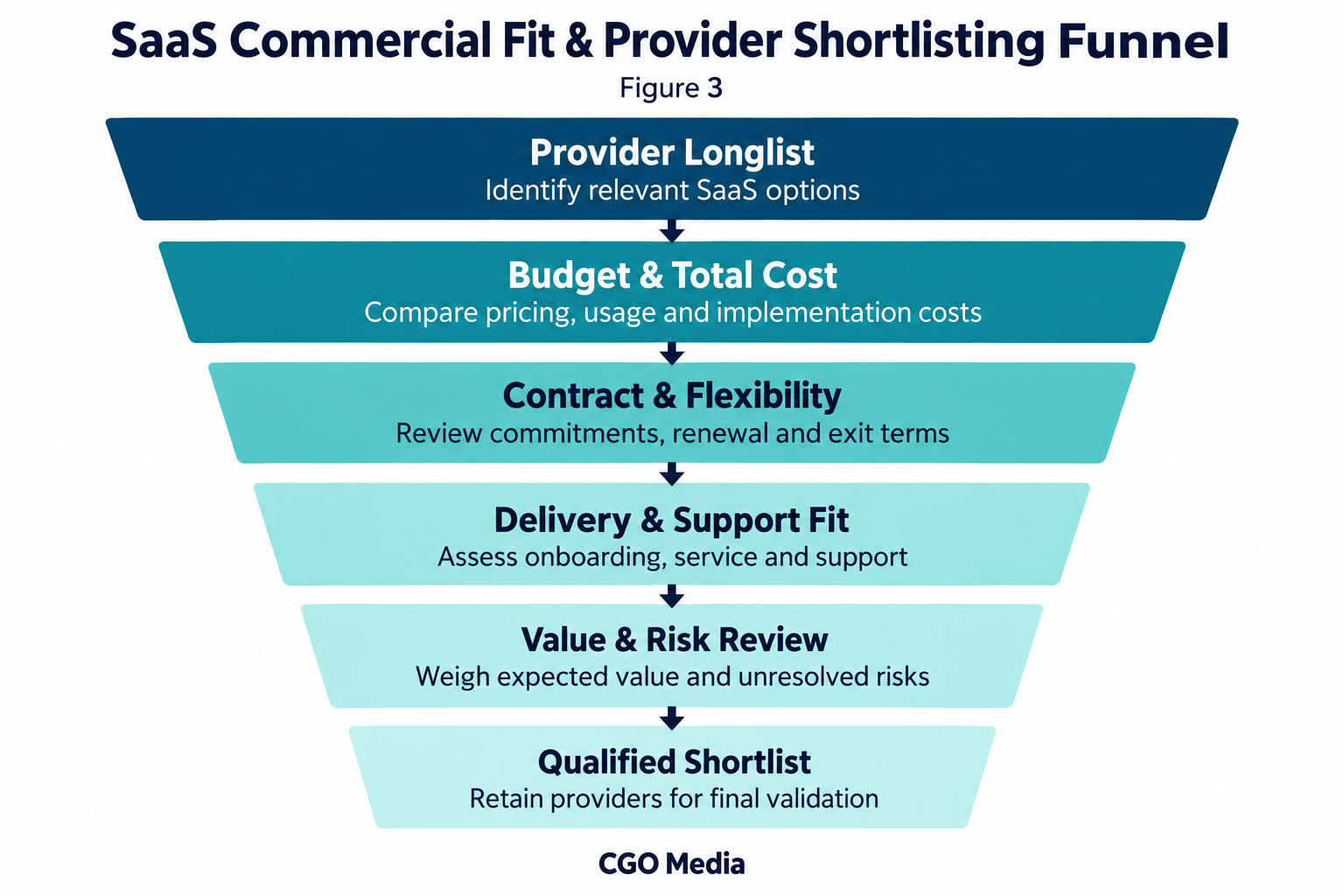
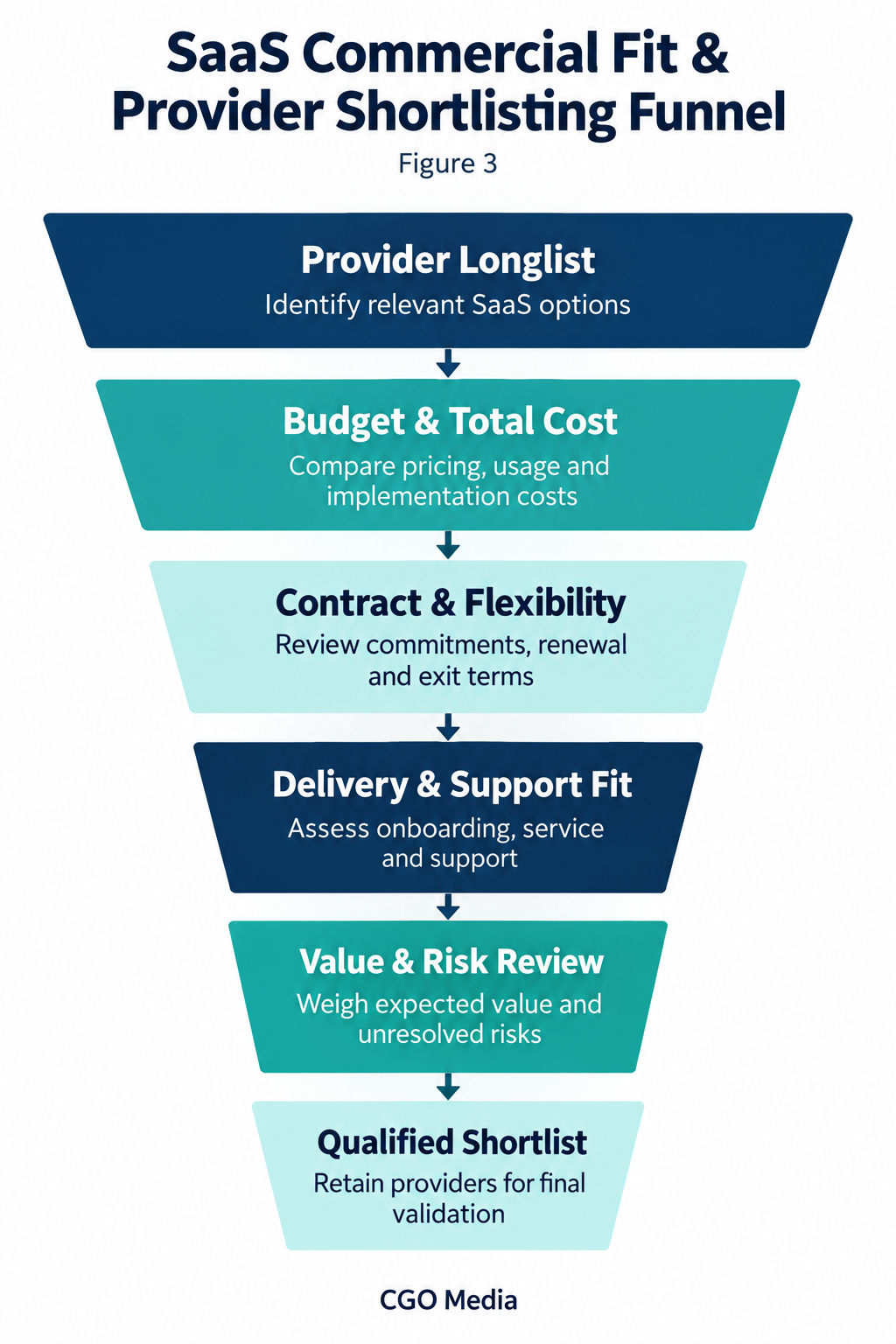
A practical shortlisting progression is:
Provider Longlist → Budget & Total Cost → Contract & Flexibility → Delivery & Support Fit → Value & Risk Review → Qualified Shortlist
The remaining providers are now suitable for final trial, demonstration, procurement and provider selection.
161. Completing Stage Seven — Comparison and Shortlisting
The final shortlist normally contains only providers that have survived functional, technical, trust and commercial evaluation.
At this stage, the buyer is no longer asking which products might work.
The question becomes:
Which of the remaining providers offers the strongest overall fit with the lowest unacceptable risk?
162. Shortlist Confidence
A provider is more likely to remain under consideration when buyers can verify important claims without repeatedly contacting sales teams for basic information.
Confidence increases where product, trust, implementation and commercial evidence is easy to find and internally consistent.
163. Shortlist Evidence Quality
Strong shortlist evidence can include:
- Current pricing
- Clear feature information
- Verified integrations
- Security documentation
- Relevant customer evidence
- Implementation guidance
Evidence quality becomes increasingly important as the number of providers narrows.
164. Shortlist Friction
Providers can lose consideration because of friction rather than product weakness.
Common friction points include:
- Unclear pricing
- Slow sales response
- Missing security information
- Weak documentation
- Poor implementation clarity
- Inconsistent product claims
165. Competitive Differentiation
Once several vendors satisfy the buyer’s minimum requirements, differentiation becomes more important.
The provider now needs to demonstrate why its product is more suitable for the buyer’s specific environment.
166. Differentiation Should Be Specific
Generic claims such as:
- Easy to use
- Powerful
- Flexible
- All-in-one
provide limited decision value unless supported by evidence.
Differentiation should be connected to observable product, workflow, trust or commercial advantages.
167. Differentiation Through Workflow
A product may differentiate itself through a more efficient workflow rather than through a unique individual feature.
Useful workflow differentiation can involve:
- Fewer manual steps
- Better automation
- Stronger collaboration
- Lower administrative burden
168. Differentiation Through Ecosystem
A stronger ecosystem of:
- Integrations
- Partners
- Extensions
- Implementation specialists
can become an important competitive advantage.
169. Differentiation Through Trust
Where feature differences are relatively small, final selection can be influenced by:
- Security
- Reliability
- Customer evidence
- Implementation confidence
- Vendor credibility
170. Differentiation Through Commercial Model
Pricing structure can also differentiate providers where competing products offer similar functionality.
Relevant differences can include:
- Pricing predictability
- Contract flexibility
- Included support
- Implementation cost
- Total cost of ownership
171. Product Roadmap Differentiation
Buyers may consider future product direction when selecting software intended for a long-term relationship.
A credible roadmap can strengthen confidence where the provider demonstrates continuing investment in strategically important capabilities.
172. Roadmap Claims Require Care
Planned functionality should not be presented as equivalent to currently available capability.
Providers should distinguish clearly between:
- Available now
- In development
- Planned
- Exploratory
173. Stage Eight — Trial, Demo, Procurement and Final Selection
The final stage converts research and evaluation into direct product or commercial engagement.
The exact pathway differs substantially between product-led and sales-led SaaS businesses.
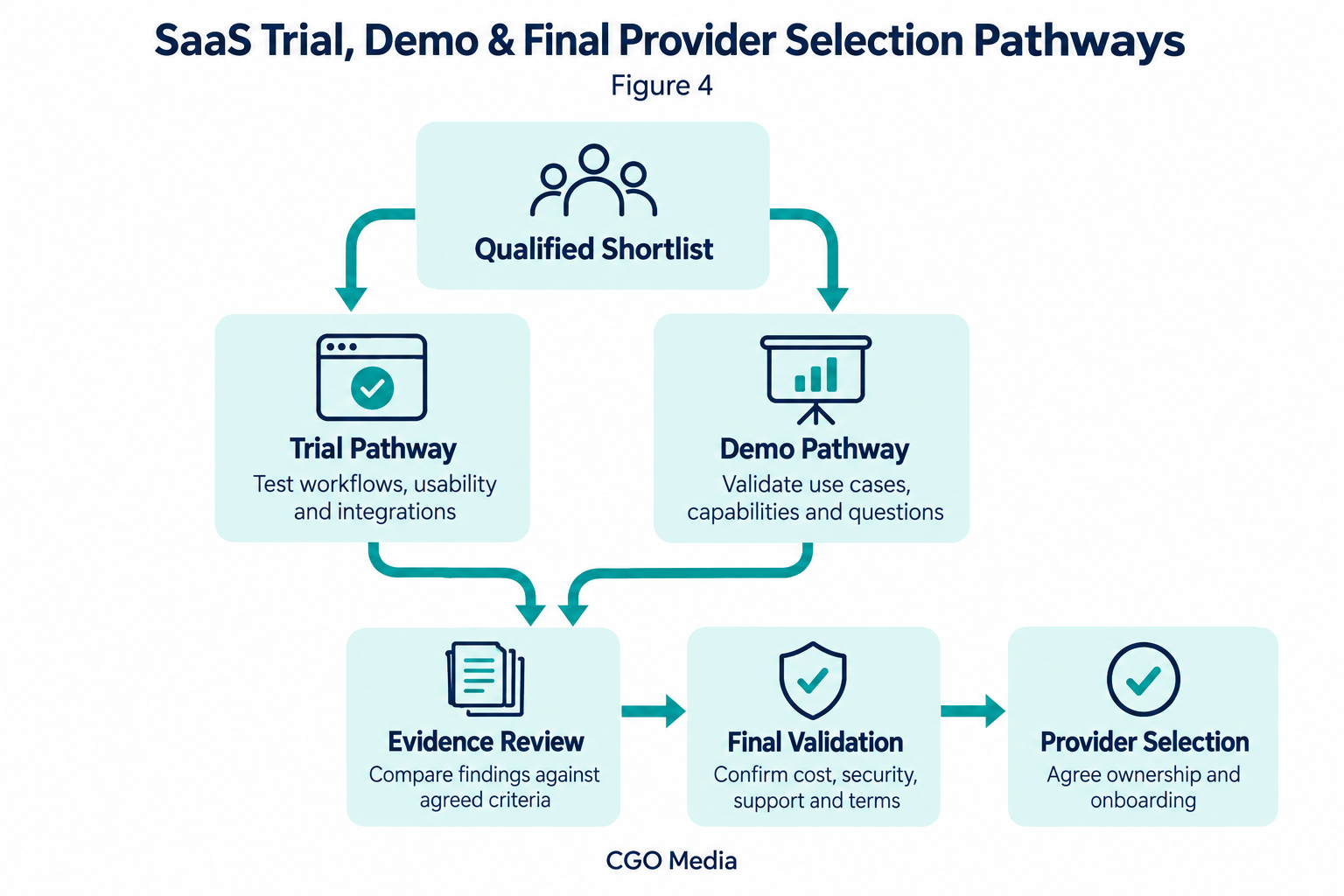
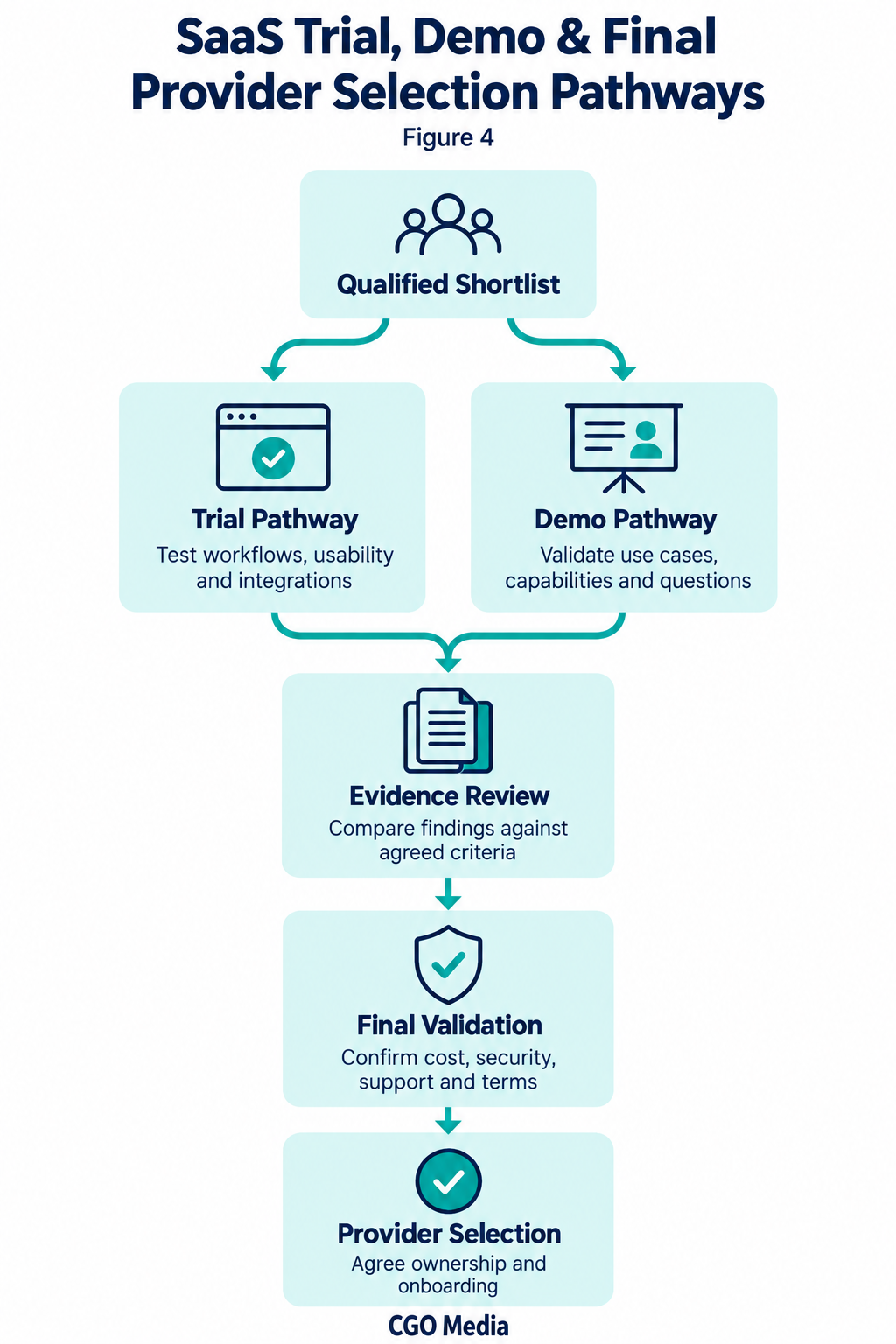
174. Product-Led SaaS Selection Path
For lower-friction products, the journey may be:
Discovery → Free Trial or Freemium → Product Usage → Upgrade → Paid Customer
Direct product experience becomes the primary final validation mechanism.
175. Trial as Final Product Evidence
A trial allows the buyer to test whether product claims translate into operational value.
It can provide direct evidence around usability, workflow fit, integration and performance.
176. Trial Evaluation Criteria
Buyers may assess:
- Ease of setup
- Feature usability
- Integration quality
- Workflow fit
- Performance
- Support
177. Trial Activation
A successful trial depends on the user reaching meaningful product value rather than simply registering an account.
A useful relationship is:
Registration → Setup → Core Action → Meaningful Value → Purchase Intent
178. Activation Friction
Trial conversion can weaken where users encounter:
- Complex setup
- Missing data
- Integration barriers
- Poor onboarding
- Unclear next steps
Activation friction can eliminate a provider even after successful discovery and evaluation.
179. Freemium Selection Path
Freemium models can extend the evaluation period considerably.
Users may adopt the free product first and later assess whether paid functionality justifies expansion.
180. User-Led Expansion
Adoption can sometimes spread from:
Individual User → Team → Department → Organisation
Product experience can therefore precede formal organisational procurement.
181. Product-Led Buying Committees
Even where initial adoption is self-service, larger expansion can eventually involve:
- Management
- IT
- Security
- Finance
- Procurement
Product-led growth does not eliminate enterprise evaluation when deployment expands.
182. Sales-Led SaaS Selection Path
More complex or higher-value products may follow:
Discovery → Qualification → Demo → Technical Evaluation → Commercial Proposal → Procurement → Contract
Each stage adds another layer of evidence and validation.
183. Discovery Call
The discovery call helps the provider understand:
- Buyer objectives
- Current systems
- Required features
- Implementation constraints
- Commercial context
This allows later evaluation to reflect the buyer’s real requirements.
184. Demonstration
A strong SaaS demonstration should reflect the buyer’s workflows rather than rely exclusively on a generic product tour.
The objective is to demonstrate practical relevance.
185. Technical Demonstration
Technical stakeholders may require deeper evaluation involving:
- Integrations
- APIs
- Administration
- Security controls
- Data architecture
186. Proof of Concept
Complex enterprise software may require a proof of concept before final selection.
This allows the buyer to test the product within a controlled representation of the real operating environment.
187. Proof-of-Concept Criteria
The buyer should define success criteria before the proof of concept begins.
Potential criteria include:
- Workflow completion
- Integration success
- Performance
- Data quality
- User adoption
This reduces ambiguity when results are evaluated.
188. Procurement Entry
After product and technical evaluation, the provider may enter a formal procurement process.
This shifts the decision from product suitability toward complete organisational acceptability.
189. Procurement Documentation
The buyer may request:
- Commercial proposal
- Security responses
- Legal documentation
- Insurance evidence
- Implementation plan
- Service-level information
190. Vendor Due Diligence
Final due diligence can combine:
- Security review
- Privacy review
- Financial review
- Legal review
- Operational review
The provider must satisfy the organisation as a vendor, not only as a product.
191. Contract Negotiation
Enterprise buyers may negotiate:
- Pricing
- Contract length
- Service levels
- Liability
- Renewal terms
- Implementation obligations
Commercial agreement can therefore remain a final source of selection friction.
192. Final Provider Selection
The final decision normally reflects the provider offering the strongest overall balance of:
- Product fit
- Trust
- Technical suitability
- Commercial value
- Implementation confidence
- Vendor credibility
A useful relationship is:
Product Fit + Trust + Technical Fit + Commercial Value + Implementation Confidence → Final Provider Selection
193. Lowest Price Does Not Always Win
A lower-cost product may lose where the buyer perceives greater:
- Implementation risk
- Security risk
- Operational risk
- Support risk
Price should therefore be interpreted within total provider value.
194. Most Feature-Rich Product Does Not Always Win
A product with more functionality may lose to a simpler alternative that better matches the buyer’s actual requirements.
Feature quantity and buyer suitability are not the same.
195. Brand Strength Does Not Guarantee Selection
A recognised SaaS brand can enter consideration more easily, but final selection still depends on evidence and fit.
Brand authority can reduce discovery friction without eliminating evaluation.
196. Search Visibility Does Not Guarantee Selection
Search discovery creates an opportunity to enter the buying journey.
It does not remove the need to satisfy:
- Technical requirements
- Trust requirements
- Commercial requirements
- Implementation requirements
197. AI Recommendation Does Not Guarantee Selection
Appearing within an AI-generated shortlist can create consideration without determining the final purchase decision.
AI visibility is therefore an early or intermediate influence rather than proof of commercial success.
198. Final Selection Is Contextual
Different organisations can select different providers from the same competitive set because they have different:
- Requirements
- Risk tolerance
- Budgets
- Technology environments
- Implementation resources
There is rarely one universally correct SaaS provider.
199. Stakeholder Alignment
Final selection may require agreement across several internal stakeholders.
A provider that satisfies only one buyer role can still fail during final governance.
200. Economic Buyer
The economic buyer may focus heavily on:
- Cost
- ROI
- Strategic value
- Commercial risk
201. Technical Buyer
Technical stakeholders may prioritise:
- Architecture
- Security
- Integrations
- Data portability
- Administration
202. End-User Buyer
End users may prioritise:
- Ease of use
- Workflow quality
- Productivity
- Training requirements
203. Procurement Stakeholder
Procurement may focus on:
- Contract terms
- Pricing
- Vendor risk
- Commercial governance
204. Security Stakeholder
Security teams may retain effective veto power where mandatory controls are not met.
This means a provider can perform strongly across every other area and still fail selection.
205. Decision Consensus
The winning provider often needs to satisfy several stakeholder groups rather than impress one individual buyer.
A useful relationship is:
Economic Approval + Technical Approval + User Fit + Security Approval + Procurement Approval → Decision Consensus
206. Selection Can Still Fail After Contract
Signing the agreement does not guarantee successful adoption.
The product must still deliver the value and operational fit promised during evaluation.
207. Implementation Becomes the Next Trust Test
After selection, the buyer evaluates whether the provider delivers against:
- Implementation promises
- Migration commitments
- Training
- Support
- Product reliability
Implementation converts pre-sale claims into operational experience.
208. Time-to-Value After Selection
A strong post-selection experience should move the customer toward meaningful product value as efficiently as practical.
Long delays can weaken confidence even where the product ultimately performs well.
209. Adoption Quality
Customer adoption should be assessed through actual usage rather than account creation alone.
Useful evidence can include:
- Core feature usage
- Workflow adoption
- Active users
- Implementation milestones
210. Customer Success
Customer-success activity can identify:
- Adoption barriers
- Training requirements
- Expansion opportunities
- Retention risks
These signals provide evidence about whether the original provider-selection decision is delivering expected value.
211. Renewal Begins During Implementation
Long-term retention is influenced by the experience created from onboarding onwards.
Renewal should therefore be viewed as the cumulative result of:
Implementation → Adoption → Value → Support → Trust
212. Expansion Selection
Existing customers may later repeat parts of the selection process when considering:
- Additional modules
- More users
- Higher pricing tiers
- Enterprise agreements
Expansion is therefore a new provider-selection event within an existing relationship.
213. Renewal Selection
At renewal, the customer may reconsider whether the existing provider remains the best option.
The incumbent vendor benefits from existing adoption but must still justify continued value.
214. Competitive Re-Evaluation
Renewal can trigger new comparison activity involving:
- Competitor products
- Alternative pricing
- Emerging technology
- New AI-native providers
The competitive environment at renewal may therefore differ substantially from the original purchase environment.
215. Selection Is Therefore a Lifecycle
SaaS provider selection does not necessarily end at initial purchase.
The wider lifecycle can be represented as:
Discover → Evaluate → Select → Implement → Adopt → Renew → Expand or Reconsider
216. Product-Led and Enterprise Journeys Converge
Self-service and enterprise SaaS journeys can begin very differently, but both eventually depend on the same underlying questions:
- Does the product work?
- Does it fit?
- Can we trust the provider?
- Is the commercial model acceptable?
- Can we adopt it successfully?
217. The Complete Eight-Stage SaaS Selection Model
The complete provider-selection model is:
Problem Recognition → Requirement Definition → Provider Discovery → Capability Evaluation → Risk Validation → Commercial Fit → Shortlisting → Trial, Demo, Procurement & Selection
This progression demonstrates why discovery visibility is only the beginning of SaaS provider selection.
Providers must continuously supply the product, trust, technical, commercial and implementation evidence required to move buyers from early awareness toward final selection and successful adoption.
218. Search and AI Influence Across the Eight-Stage Selection Journey
Search engines, AI assistants, review platforms, marketplaces and independent publications can influence different stages of the SaaS buying journey in different ways.
The strategic challenge is not simply whether the provider is visible, but where visibility occurs, what evidence is available and whether the buyer can progress confidently to the next stage.
219. Search Influence During Problem Recognition
At the earliest stage, search can introduce buyers to:
- Possible causes of an operational problem
- Potential workflow improvements
- Relevant software categories
- Alternative approaches
220. AI Influence During Problem Recognition
AI assistants can accelerate early discovery by translating broad operational questions into possible solution categories.
A buyer may move from a question about reducing manual reporting into consideration of CRM, analytics, workflow automation or business-intelligence platforms within one interaction.
221. Visibility at the Problem Stage
SaaS providers can participate earlier through useful resources focused on:
- Business problems
- Operational inefficiency
- Workflow design
- Industry benchmarks
- Educational research
222. Search Influence During Requirement Definition
As buyers translate problems into software requirements, search activity becomes more specific.
Common topics include:
- Required features
- Security standards
- Integrations
- Pricing models
- Implementation approaches
223. AI Influence During Requirement Definition
AI systems can help buyers construct:
- Requirement lists
- Comparison criteria
- Procurement questions
- Technical checklists
This can shape the selection framework before any provider is formally considered.
224. Providers Can Influence Requirement Language
Clear educational content can help define the terminology buyers use when evaluating a software category.
Useful subjects include features, technical concepts, security requirements, implementation models and commercial structures.
225. Search Influence During Provider Discovery
At the provider-discovery stage, visibility becomes directly competitive.
Buyers may encounter:
- Vendor category pages
- Review platforms
- Comparison articles
- Marketplaces
- Industry publications
226. AI Influence During Provider Discovery
AI assistants can generate a candidate provider set without requiring buyers to visit multiple individual search-result pages.
This can compress early market research substantially.
227. Recommendation Inclusion
Providers should monitor whether they appear in strategically important recommendation scenarios involving:
- Category
- Use case
- Industry
- Company size
- Geography
- Feature requirements
228. Recommendation Exclusion
Repeated absence may indicate that the product is insufficiently associated with a requirement or is being overshadowed by competitors with stronger discoverable evidence.
Relevant exclusion is therefore a diagnostic signal rather than simply a visibility metric.
229. Search Influence During Capability Evaluation
Once a provider enters consideration, buyers conduct increasingly detailed searches around:
- Features
- Integrations
- APIs
- Use cases
- Product limitations
230. Documentation Discovery
Technical documentation can become more influential than commercial landing pages during detailed evaluation.
Buyers may use documentation to verify whether product claims are operationally and technically credible.
231. Integration Search Influence
Integration searches can determine whether a provider remains under consideration where compatibility is mandatory.
Missing or unclear integration evidence can therefore become a direct elimination point.
232. Comparison Search Influence
Buyers may search directly for:
- Product comparisons
- Alternatives
- Feature differences
- Integration differences
Comparison visibility becomes more commercially important as the shortlist narrows.
233. AI Influence During Capability Evaluation
AI assistants can summarise feature differences and suggest products based on detailed operational criteria.
The quality of this assistance depends on whether the underlying product information is current and sufficiently precise.
234. Product Representation Accuracy Becomes Critical
Incorrect feature or integration information at this stage can directly affect whether the product remains in the buyer’s evaluation set.
Visibility without accuracy can therefore reduce rather than strengthen provider-selection quality.
235. Search Influence During Risk Validation
Buyers may actively search for evidence around:
- Security
- Privacy
- Customer complaints
- Downtime
- Support
- Company reputation
236. Reputation Search Behaviour
Late-stage trust searches can include:
- Brand reviews
- Brand security
- Brand complaints
- Brand downtime
- Brand support
These queries frequently occur after the provider has already passed basic product evaluation.
237. AI Influence During Risk Validation
Buyers may use AI assistants to summarise publicly available information about a provider’s strengths, weaknesses and known concerns.
This makes external evidence increasingly relevant to perceived trust.
238. Risk Representation Should Be Monitored Carefully
Where AI-generated answers contain inaccurate or outdated risk information, providers should investigate the underlying evidence environment rather than treating the issue as a single generated-answer problem.
239. Search Influence During Commercial Evaluation
Commercial-stage queries may investigate:
- Pricing
- Contract terms
- Implementation costs
- Alternatives
- Discounts
- Total cost
240. Pricing Search Visibility
Buyers may encounter pricing information from both first-party and third-party sources.
Providers should therefore reduce avoidable conflict between current official pricing and external descriptions.
241. Pricing Inconsistency Can Create Friction
Conflicting commercial information can undermine confidence and slow decision-making.
This is particularly important where pricing changes frequently or depends heavily on product configuration.
242. AI Influence During Commercial Evaluation
AI-generated comparisons may summarise:
- Pricing
- Plan differences
- Product suitability
- Commercial trade-offs
Incorrect or outdated commercial data can materially distort selection.
243. Search Influence During Shortlisting
Shortlisted vendors often attract more branded and comparison-led searches as buyers investigate differentiating strengths and weaknesses.
244. Branded Search Becomes More Important Late in the Journey
Late-stage searches may include:
- Brand pricing
- Brand reviews
- Brand integrations
- Brand implementation
- Brand security
- Brand alternatives
245. AI Influence During Shortlisting
The buyer may ask AI systems to rank, compare or narrow an existing provider set against specific criteria.
This turns AI from a discovery tool into a shortlist-compression tool.
246. AI Shortlist Compression
A long provider list can be narrowed rapidly when the buyer supplies constraints such as:
- Budget
- Company size
- Required integrations
- Security requirements
- Geography
- Implementation limits
247. Search Influence During Final Selection
Search can still influence final-stage:
- Vendor validation
- Contract confidence
- Reference checking
- Implementation planning
- Alternative comparison
248. AI Influence During Final Selection
AI tools may be used to:
- Summarise procurement documentation
- Compare proposals
- Identify differences between shortlisted providers
At this stage, accuracy becomes especially important because the decision is approaching commitment.
249. Search Visibility Has Different Value at Different Stages
A ranking at problem recognition serves a different purpose from a pricing, integration or security result encountered during final validation.
Visibility should therefore be interpreted according to the stage of the buyer journey it supports.
250. SaaS Providers Need Stage-Specific Evidence
| Selection Stage | Buyer Question | Priority Evidence |
|---|---|---|
| Problem Recognition | What is causing this problem and how can it be solved? | Educational content, research, workflow analysis and benchmarks |
| Requirement Definition | What should the software be able to do? | Feature guidance, integration requirements, security and implementation information |
| Provider Discovery | Which products could solve the problem? | Category authority, use-case pages, reviews, marketplaces and external recommendations |
| Capability Evaluation | Can this product work in our environment? | Features, integrations, documentation, APIs and demos |
| Risk Validation | Can we trust the product and provider? | Security, privacy, reviews, reliability and customer evidence |
| Commercial Fit | Can we afford and implement it? | Pricing, plan information, implementation costs and business-case evidence |
| Shortlisting | Why this provider rather than the alternatives? | Comparison evidence, differentiation, customer proof and commercial proposals |
| Final Selection | Are we confident enough to commit? | Trial, demo, due diligence, references, procurement and contractual evidence |
251. Source Selection Across the Buyer Journey
Different source types influence different stages.
The most valuable source depends on the question the buyer is attempting to answer.
252. Vendor-Controlled Sources
First-party sources can include:
- Product pages
- Feature pages
- Documentation
- Security centres
- Pricing pages
- Customer case studies
These are especially important for current product and commercial facts.
253. Customer-Controlled Sources
Customers can contribute evidence through:
- Reviews
- Testimonials
- Case studies
- Public implementation stories
- Peer recommendations
254. Platform-Controlled Sources
Review platforms and marketplaces can influence discovery, comparison and validation independently of the vendor’s own website.
These environments can therefore shape the provider-selection journey without direct vendor control.
255. Editorial Sources
Technology publications, sector media and analysts can influence:
- Category understanding
- Market positioning
- Product comparison
- Reputation
256. Community Sources
Professional communities can expose practical experiences that may not appear in formal vendor documentation.
This can influence perceptions of implementation difficulty, support quality and product limitations.
257. Source Influence Changes by Stage
A vendor landing page may be useful during capability evaluation, while independent reviews may carry greater weight during trust validation.
Source authority should therefore be evaluated according to the stage and claim being investigated.
258. Source Diversity Reduces Dependence
Providers with authority distributed across multiple relevant source types are less dependent on one search, review or recommendation environment.
259. Source Consistency Reduces Buyer Friction
When decision-critical facts remain consistent across first-party and external sources, buyers can validate the provider more efficiently.
Consistency strengthens progression through the selection journey.
260. Source Conflict Creates Decision Friction
Conflicting evidence can force buyers to investigate:
- Which source is current
- Which pricing is accurate
- Which features exist
- Which integrations are supported
This delays progression and can reduce confidence.
261. SaaS Buyer-Journey Elimination Points
A provider can be removed from consideration at almost any stage.
Understanding where elimination occurs is often more useful than simply measuring overall visibility or conversion.
262. Elimination at Problem Recognition
The provider may never enter consideration because it lacks visibility around the buyer’s underlying business problem.
263. Elimination at Requirement Definition
The buyer may define requirements that appear incompatible with the product because relevant evidence is missing or unclear.
264. Elimination at Provider Discovery
The provider may simply fail to appear within:
- Search
- Review platforms
- Marketplaces
- AI recommendation environments
265. Elimination at Capability Evaluation
The provider may appear unsuitable because:
- A required feature seems absent
- An integration cannot be confirmed
- Documentation is insufficient
- The product appears poorly aligned with the use case
266. Elimination at Risk Validation
The buyer may reject the provider because of:
- Security concerns
- Privacy uncertainty
- Poor reviews
- Reliability concerns
- Weak vendor confidence
267. Elimination at Commercial Evaluation
The product may be technically suitable but too expensive, too complex or commercially inflexible.
This is a reminder that product relevance does not automatically create commercial suitability.
268. Elimination at Shortlisting
Another provider may demonstrate stronger:
- Differentiation
- Customer evidence
- Trust
- Implementation fit
- Commercial value
269. Elimination at Final Selection
Late-stage failure can arise from:
- Procurement issues
- Security failure
- Poor trial experience
- Weak demonstration
- Contract disagreement
- Reference concerns
270. Visibility Gap Versus Evidence Gap
Two different problems should be distinguished:
Visibility Gap — the provider is not entering consideration.
Evidence Gap — the provider enters consideration but cannot demonstrate enough evidence to progress.
271. Trust Gap
A trust gap exists where product fit appears strong but buyers cannot reduce:
- Security risk
- Reliability risk
- Customer risk
- Vendor risk
sufficiently to proceed.
272. Commercial Gap
A commercial gap exists where the product is relevant and trusted but appears:
- Too expensive
- Too difficult to implement
- Poorly packaged
- Commercially inflexible
273. Differentiation Gap
A differentiation gap exists where the provider satisfies minimum requirements but provides insufficient reason to win against close alternatives.
274. AI Representation Gap
An AI representation gap exists where generated answers portray the provider inaccurately or incompletely during a commercially important stage.
This can affect discovery, comparison, trust or final recommendation.
275. Source Gap
A source gap exists where strategically important external environments contain little or no reliable information about the provider.
Source gaps can weaken both discovery and later validation.
276. Stage-by-Stage Diagnostic Analysis
Providers can map the eight stages against available evidence and ask:
- Are we visible?
- Is our product understood?
- Can capability be verified?
- Can trust be established?
- Is commercial fit clear?
- Can differentiation be demonstrated?
- Can buyers progress without unnecessary friction?
277. Sales Data Can Reveal Late-Stage Gaps
Sales teams can identify recurring reasons why shortlisted buyers fail to progress.
These reasons can expose weaknesses that search or content metrics alone cannot reveal.
278. Search Data Can Reveal Early-Stage Gaps
Search behaviour can reveal where buyers investigate problems and requirements before contacting a provider.
This can expose missing problem-led, feature-led or integration-led authority.
279. Customer Success Can Reveal Post-Selection Gaps
Implementation and adoption problems can reveal where pre-sale expectations were incomplete, unclear or inaccurate.
These insights should feed back into future provider-selection evidence.
280. Review Data Can Reveal Trust Gaps
Repeated review themes can identify areas where actual customer experience differs from the provider’s intended positioning.
Recurring themes should receive greater attention than isolated comments.
281. AI Monitoring Can Reveal Representation Gaps
Repeatable AI monitoring can identify where systems:
- Omit the provider
- Misclassify the product
- Misrepresent features
- Use outdated pricing
- Repeat stale comparisons
282. Competitor Analysis Can Reveal Authority Gaps
The most useful competitor analysis asks why another provider survives a particular buyer stage more successfully.
This shifts analysis from generic visibility comparison toward buyer-progression intelligence.
283. Competitor Evidence Analysis
Review whether competitors provide stronger:
- Product clarity
- Feature documentation
- Integration evidence
- Customer proof
- Security information
- External validation
284. Prioritise the Earliest Critical Failure
If a provider is consistently eliminated during discovery, improving final-stage procurement content will have limited immediate impact.
Conversely, increasing early visibility adds little value if buyers repeatedly abandon evaluation because security, integration or commercial evidence is inadequate.
285. The SaaS Selection Diagnostic Principle
A practical prioritisation sequence is:
Find the Stage → Identify the Gap → Strengthen the Evidence → Measure Progression
This allows SaaS organisations to focus investment on the earliest material constraint within the buyer journey rather than optimising every stage equally.
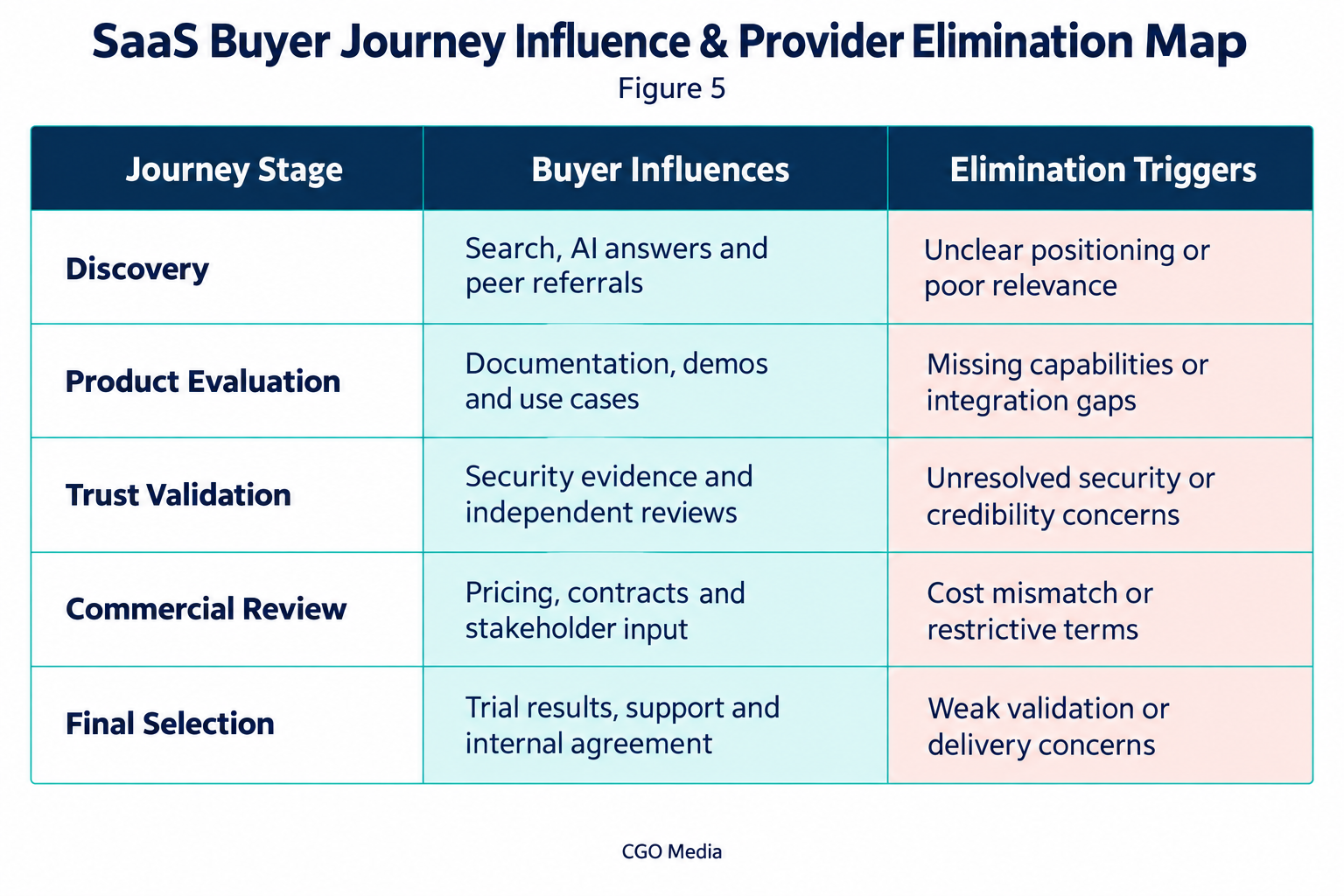
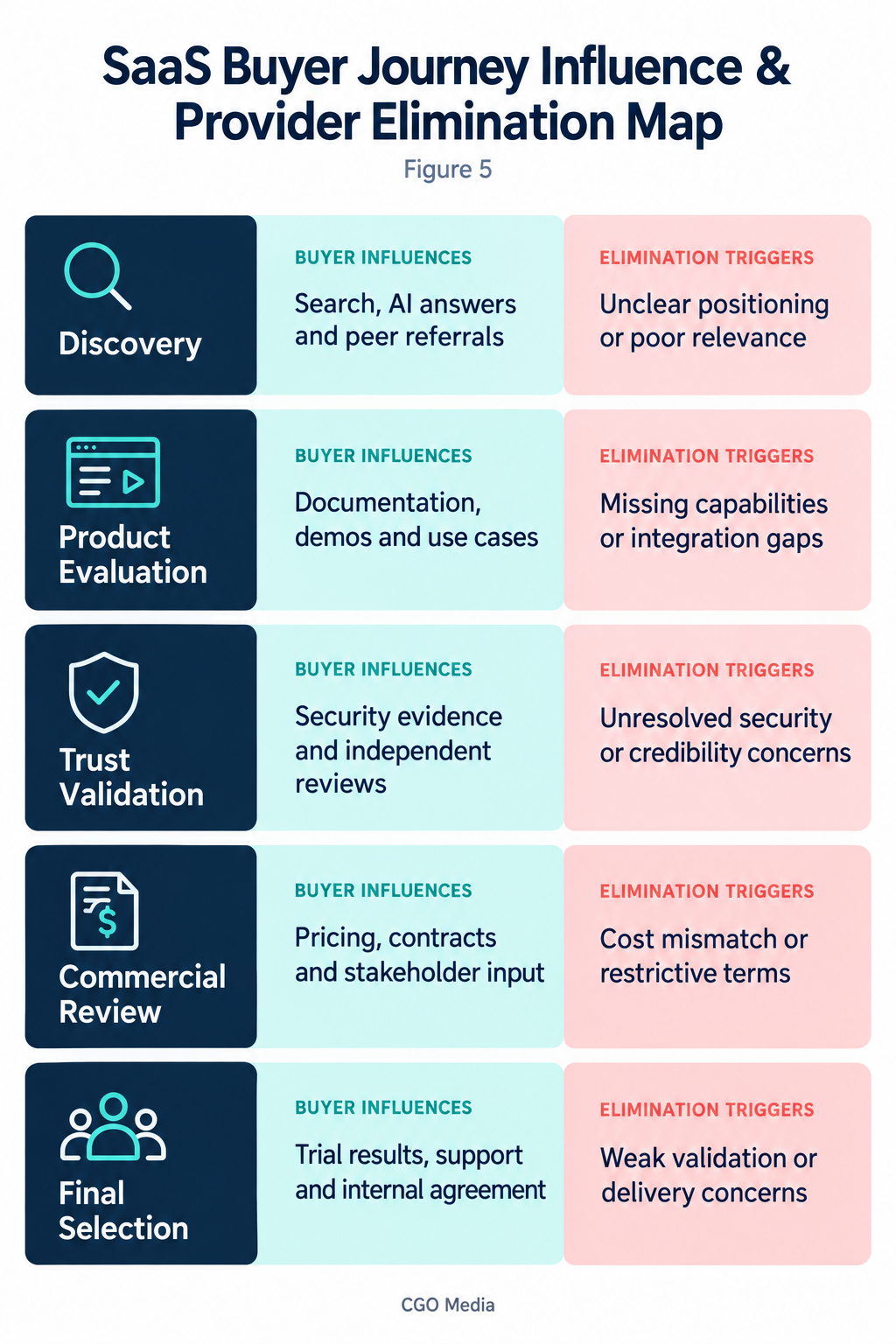
286. Measuring the SaaS Provider Selection Journey
The SaaS Discovery and Provider Selection Model becomes more useful when organisations measure how prospective buyers progress through each stage of the journey.
The objective is not simply to count traffic or leads, but to understand:
- Where buyers enter
- Where they progress
- Where they hesitate
- Where they are eliminated
- Why competitors are selected instead
287. Stage One Measurement — Problem Recognition
Early-stage measurement should examine whether the provider is visible for the business problems that eventually lead buyers toward the software category.
288. Problem Visibility Indicators
Useful indicators can include:
- Organic visibility around priority business problems
- Engagement with educational content
- Research visibility
- AI mentions in problem-led queries
This helps determine whether the provider enters the journey early enough.
289. Stage Two Measurement — Requirement Definition
The provider should assess whether buyers encounter its content while defining:
- Features
- Integrations
- Security requirements
- Implementation criteria
- Pricing expectations
290. Requirement-Stage Content Engagement
Useful indicators can include engagement with:
- Feature guides
- Integration resources
- Security content
- Implementation guides
- Buyer checklists
This stage helps reveal whether the provider is shaping buyer evaluation criteria before formal product comparison begins.
291. Stage Three Measurement — Provider Discovery
The provider should measure whether it enters consideration across the discovery environments that matter commercially.
292. Provider Discovery Indicators
Potential measures include:
- Category rankings
- Review-platform visibility
- Marketplace presence
- AI recommendation share
- Referral discovery
- Direct branded discovery
293. Discovery Share
A practical internal measure can estimate how frequently the provider appears within a defined set of strategically important discovery scenarios.
The precise calculation can vary according to the monitoring methodology, but the principle is:
Relevant Provider Appearances ÷ Relevant Discovery Scenarios Tested
294. Non-Branded Discovery Share
Non-branded visibility is particularly important because it indicates whether the provider enters consideration before buyers already know the company or product.
This helps distinguish genuine category discovery from existing brand demand.
295. Stage Four Measurement — Capability Evaluation
Capability-stage measurement should examine whether buyers can verify the product against their functional and technical requirements.
296. Feature Engagement
Providers can monitor engagement with high-priority feature pages and supporting documentation.
This can reveal which capabilities buyers investigate during evaluation.
297. Integration Engagement
Integration-page usage can indicate which ecosystem relationships matter most during evaluation.
Repeated integration demand can also expose product or documentation priorities.
298. Documentation Engagement
Documentation usage can provide evidence of deeper technical evaluation, especially within complex SaaS buying journeys.
High-value documentation can include:
- API resources
- Integration guides
- Authentication documentation
- Implementation resources
299. Demo and Product-Tour Engagement
Product demonstrations, tours and trial interactions can indicate progression from information gathering toward active product assessment.
300. Capability Evaluation Failure Rate
Where sales or product data permits, providers should record how frequently prospects fail because required:
- Features
- Integrations
- Technical capabilities
- Workflow requirements
cannot be satisfied.
This helps distinguish visibility problems from genuine product-fit limitations.
301. Stage Five Measurement — Trust and Risk Validation
Trust-stage measurement should identify whether buyers can obtain the evidence required to approve the provider.
302. Security Engagement
Potential indicators can include:
- Trust-centre visits
- Security-document requests
- Security questionnaire activity
- Compliance-document engagement
303. Review Validation Indicators
Providers can monitor:
- Review volume
- Review recency
- Sentiment trends
- Repeated objections
The purpose is to understand the trust evidence buyers encounter rather than rely on average rating alone.
304. Security Elimination Rate
Sales and procurement data can identify how frequently opportunities are lost because minimum security or compliance requirements are not satisfied.
This can reveal where product-market fit exists but enterprise suitability remains constrained.
305. Trust Elimination Rate
A wider measure can include losses associated with:
- Security
- Privacy
- Reliability
- Customer confidence
- Vendor stability
306. Stage Six Measurement — Commercial and Operational Fit
Commercial-stage measurement should identify whether buyers consider the product financially and operationally viable.
307. Pricing Engagement
Pricing-page behaviour can indicate commercial intent when interpreted alongside other buyer signals.
Useful context can include:
- Plan comparison
- Pricing return visits
- Enterprise-pricing enquiries
- Movement from pricing to trial or demo
308. Proposal Conversion
Sales-led SaaS providers can measure the proportion of qualified opportunities progressing from proposal to formal commercial consideration.
This helps reveal whether commercial offers remain viable after product and trust validation.
309. Commercial Loss Reasons
Loss analysis should distinguish between causes such as:
- Price
- Packaging
- Contract length
- Implementation cost
- Support model
- Total cost of ownership
These reasons should remain separate because each requires a different response.
310. Implementation-Fit Losses
Providers should distinguish commercial losses from operational losses caused by:
- Migration complexity
- Training burden
- Internal resource requirements
- Deployment timescale
This helps determine whether the problem is pricing or implementation feasibility.
311. Stage Seven Measurement — Comparison and Shortlisting
Shortlisting measurement can reveal whether the provider survives detailed comparison against its most important competitors.
312. Shortlist Rate
A shortlist rate can measure the proportion of qualified opportunities that progress into a final competitive set.
It provides a stronger late-stage signal than general lead volume.
313. Shortlist Share
Where sales intelligence or market research permits, providers can estimate how frequently they appear within buying shortlists in their target market.
Shortlist share is particularly useful where buyers consistently consider a relatively small number of vendors.
314. Comparison Visibility
Digital comparison monitoring can include:
- Direct competitor searches
- Alternative searches
- Review-platform comparisons
- AI-generated comparisons
This reveals how the provider is positioned relative to the vendors buyers actually consider.
315. Competitive Win Rate
Providers should track win rates against specific competitors rather than treating all competitive losses as one category.
This helps reveal which providers are most significant within particular buyer segments and use cases.
316. Competitor-Specific Loss Reasons
Another provider may win because of:
- Features
- Pricing
- Security
- Implementation
- Brand strength
- Customer evidence
- Ecosystem fit
Competitor-specific loss analysis provides more actionable intelligence than a generic “lost to competitor” label.
317. Stage Eight Measurement — Trial, Demo, Procurement and Selection
Final-stage measurement should connect buyer evaluation with actual purchase outcomes.
318. Trial Start Rate
Product-led SaaS organisations can measure the proportion of qualified visitors or users progressing into product trials.
This provides an early indicator of active product evaluation.
319. Trial Activation Rate
Activation is generally more meaningful than registration alone because it indicates whether users reached an important product milestone.
A useful progression is:
Trial Start → Setup → Core Action → Activation → Product Value
320. Trial-to-Paid Conversion
This measure helps determine whether direct product experience converts qualified evaluation into commercial adoption.
Weak conversion can indicate problems involving:
- Product fit
- Onboarding
- Pricing
- Activation
321. Demo Request Rate
Sales-led providers can monitor the proportion of suitable visitors progressing into direct product evaluation.
Demo volume should be interpreted alongside lead quality.
322. Demo-to-Opportunity Conversion
This helps distinguish genuine buyer demand from exploratory or low-fit enquiries.
Repeated low conversion can expose weak audience targeting or product-fit problems.
323. Opportunity-to-Proposal Conversion
The provider can assess whether qualified opportunities progress into serious commercial discussion.
This is a useful indicator of whether product, technical and trust evaluation has been completed successfully.
324. Proposal-to-Win Conversion
The final commercial win rate provides an important measure of late-stage competitiveness.
Weak performance should trigger deeper analysis of:
- Price
- Differentiation
- Implementation
- Contract terms
- Competitor strength
325. Procurement Completion Rate
Enterprise providers can monitor how frequently opportunities entering formal procurement successfully reach contract.
This separates procurement capability from general sales effectiveness.
326. Procurement Failure Analysis
Potential failure reasons can include:
- Security
- Legal terms
- Commercial terms
- Insurance
- Vendor risk
- Implementation concerns
Procurement failure should be treated as a specific diagnostic category.
327. Time Through the Selection Journey
Time-to-decision can reveal where friction accumulates even when opportunities eventually convert.
Excessive duration can increase both buyer effort and sales cost.
328. Stage Duration
Providers can measure how long opportunities typically remain within:
- Evaluation
- Security review
- Commercial negotiation
- Procurement
Stage duration creates a practical indicator of decision friction.
329. Decision Friction
Long stage duration can indicate:
- Missing information
- Slow internal approval
- Slow vendor response
- Complex implementation
- Commercial uncertainty
Reducing friction can improve progression without increasing top-of-funnel demand.
330. Win/Loss Analysis
Win/loss analysis is one of the most useful evidence sources for improving the SaaS provider-selection journey.
It connects actual commercial outcomes with the earlier discovery and evaluation system.
331. Capture Structured Loss Reasons
Loss reasons should be sufficiently specific to support action.
“Lost to competitor” provides much less insight than:
- Missing Salesforce integration
- Security requirement not met
- Implementation too complex
- Pricing model unsuitable
- Competitor easier to use
332. Capture Win Reasons
Wins can reveal which product, trust, commercial and authority strengths genuinely influence purchase.
These strengths can then be reinforced across future:
- Content
- Sales enablement
- Product positioning
- Customer evidence
333. Compare Stated and Observed Reasons
The reason recorded by sales may not always capture the complete decision.
Where practical, providers should combine:
- Sales feedback
- Buyer interviews
- Product behaviour
- Marketing attribution
- Customer-success evidence
This creates a stronger view of why buyers actually win, lose or delay decisions.
334. Buyer Interviews
Post-decision interviews can help explain:
- How the provider was discovered
- Which sources influenced trust
- Which competitors were considered
- Which evidence affected selection
- Which friction points existed
335. Customer Interviews After Purchase
New customers can provide valuable insight into the difference between the organisation’s intended buying journey and the actual journey experienced.
This helps identify missing or misleading evidence that internal teams may not recognise.
336. Lost-Buyer Interviews
Where practical, interviews with lost prospects can identify authority, trust, product or commercial weaknesses that internal teams underestimate.
These interviews can provide context that CRM loss codes alone cannot capture.
337. AI Recommendation Measurement
A repeatable AI monitoring programme can support the provider-selection model by measuring:
- Recommendation inclusion
- Shortlist inclusion
- Comparison visibility
- Product accuracy
- Source visibility
AI measurement should remain connected to the eight-stage buyer journey rather than operate as a standalone visibility score.
338. Stage-Specific AI Prompt Sets
AI scenarios should be grouped according to the eight selection stages rather than maintained as one generic visibility list.
This allows monitoring to reflect how buyers actually progress.
339. Early-Stage AI Prompts
Early-stage scenarios can focus on:
- Business problems
- Software categories
- Requirements
The purpose is to measure whether the provider enters the discovery process before a formal shortlist exists.
340. Mid-Stage AI Prompts
Mid-stage scenarios can focus on:
- Features
- Integrations
- Security
- Pricing
These help evaluate product representation and validation visibility.
341. Late-Stage AI Prompts
Late-stage scenarios can focus on:
- Comparisons
- Alternatives
- Provider strengths and weaknesses
- Commercial suitability
This helps determine whether the provider survives AI-assisted shortlist and selection activity.
342. SaaS Selection Journey Scorecard
The eight stages can be summarised within an internal scorecard.
| Stage | Primary Measure | Diagnostic Question |
|---|---|---|
| Problem Recognition | Problem visibility | Do we enter the journey early enough? |
| Requirement Definition | Requirement-content visibility | Are we helping shape evaluation criteria? |
| Provider Discovery | Discovery share | Are we entering consideration? |
| Capability Evaluation | Capability progression | Can buyers verify that we fit? |
| Risk Validation | Trust progression | Can buyers approve the risk? |
| Commercial Fit | Commercial progression | Does the buying case remain viable? |
| Shortlisting | Shortlist and competitive win rate | Why do we win or lose against alternatives? |
| Final Selection | Trial, demo and proposal conversion | Do qualified evaluations become customers? |
343. Continuous SaaS Selection Journey Improvement
The provider-selection model should operate as a continuous feedback system rather than a static representation of the buyer journey.
A useful cycle is:
Observe → Diagnose → Prioritise → Improve → Measure → Learn → Reassess
344. Observe
Collect evidence from:
- Search
- AI monitoring
- Sales
- Product analytics
- Reviews
- Customer success
The objective is to build a complete picture of buyer progression rather than rely on one data source.
345. Diagnose
Identify the stage at which buyer progression is weakest.
This can reveal whether the primary constraint is:
- Visibility
- Product evidence
- Trust
- Commercial fit
- Final-stage conversion
346. Prioritise
Focus first on problems that most strongly affect qualified buyers.
Priority should reflect:
- Frequency
- Buyer impact
- Commercial value
- Ease of correction
347. Improve
Potential improvements can involve:
- Better content
- Stronger documentation
- Clearer security evidence
- Improved pricing transparency
- Stronger customer proof
- Better product onboarding
348. Measure
Track whether the intervention improves progression through the affected stage.
Measurement should focus on the bottleneck the intervention was designed to address.
349. Learn
Use buyer, sales, product and customer evidence to determine why the change succeeded or failed.
Successful interventions should become part of organisational knowledge rather than remain isolated campaign results.
350. Reassess
Repeat the process as the product, buyer market and competitive environment change.
Selection journeys should therefore be reviewed continuously rather than treated as fixed funnels.
351. The Complete SaaS Provider Selection Feedback Loop
The complete lifecycle can be represented as:
Problem → Requirements → Discovery → Evaluation → Validation → Commercial Fit → Shortlist → Selection → Adoption → Feedback → Journey Improvement
352. Search Supports Entry
Search visibility helps the provider enter the buyer journey.
Without discovery, strong downstream product and trust evidence may never be evaluated.
353. Evidence Supports Progression
Feature, integration, trust and commercial evidence helps the provider survive evaluation.
Discovery creates the opportunity; evidence keeps the provider in consideration.
354. Product Experience Supports Selection
Trials, demonstrations and proof-of-concept experiences translate product claims into direct buyer evidence.
This is where perceived suitability can become actual product confidence.
355. Customer Experience Supports Renewal
Implementation, support and product value determine whether the relationship continues after initial selection.
Renewal therefore provides evidence about whether the original provider choice delivered expected value.
356. Feedback Strengthens Future Discovery
Customer outcomes, reviews, case studies and product insights can strengthen the evidence available to the next generation of buyers.
The post-purchase experience therefore feeds back into future discovery and evaluation.
357. Provider Selection Is a Closed Evidence Loop
The strongest SaaS organisations use the outcomes of existing customer relationships to improve how future buyers discover, evaluate and trust the product.
The closed-loop relationship is:
Discovery → Evidence → Evaluation → Selection → Adoption → Customer Outcome → New Evidence → Stronger Future Discovery
This transforms provider selection from a one-directional funnel into a continuous evidence and learning system.
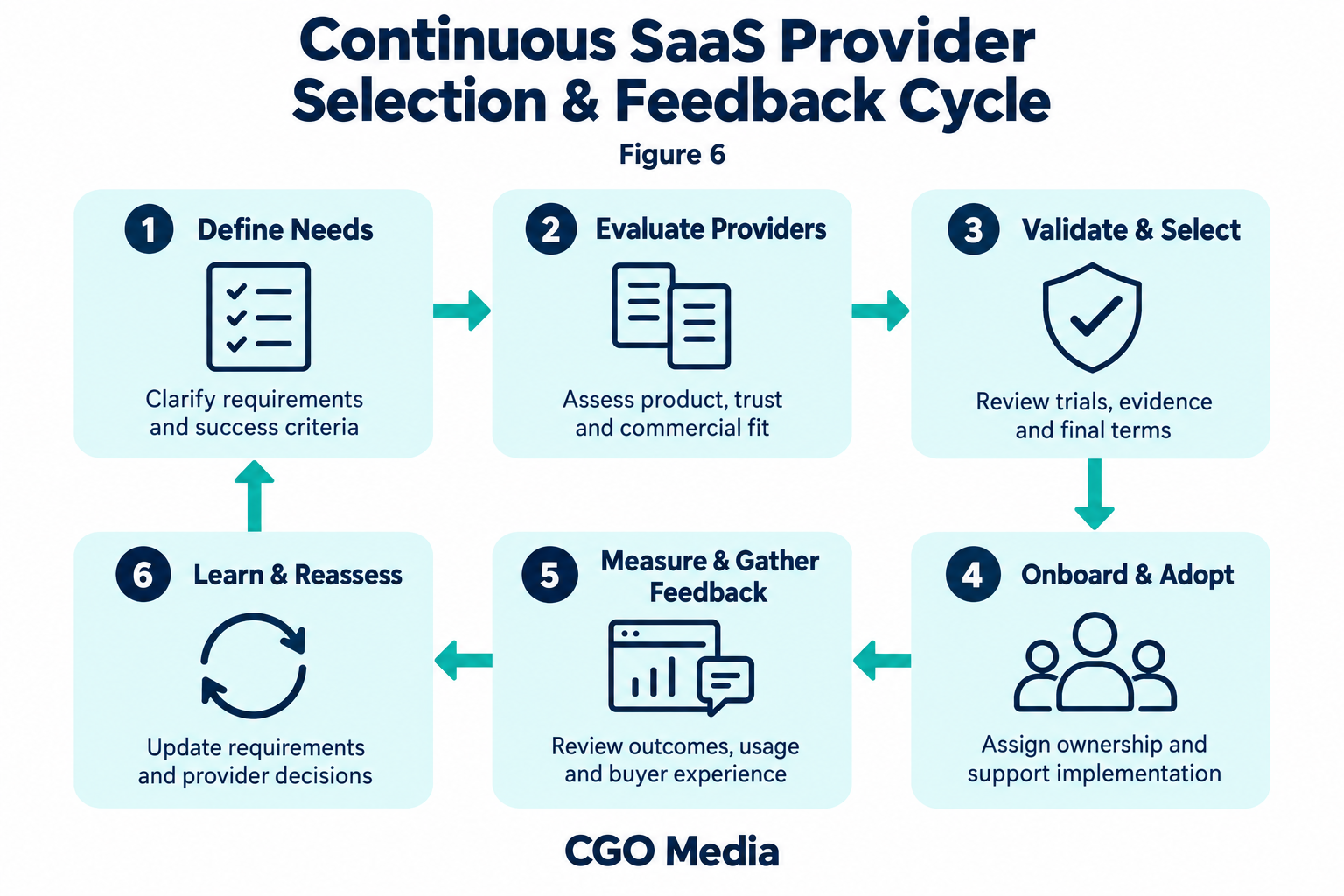
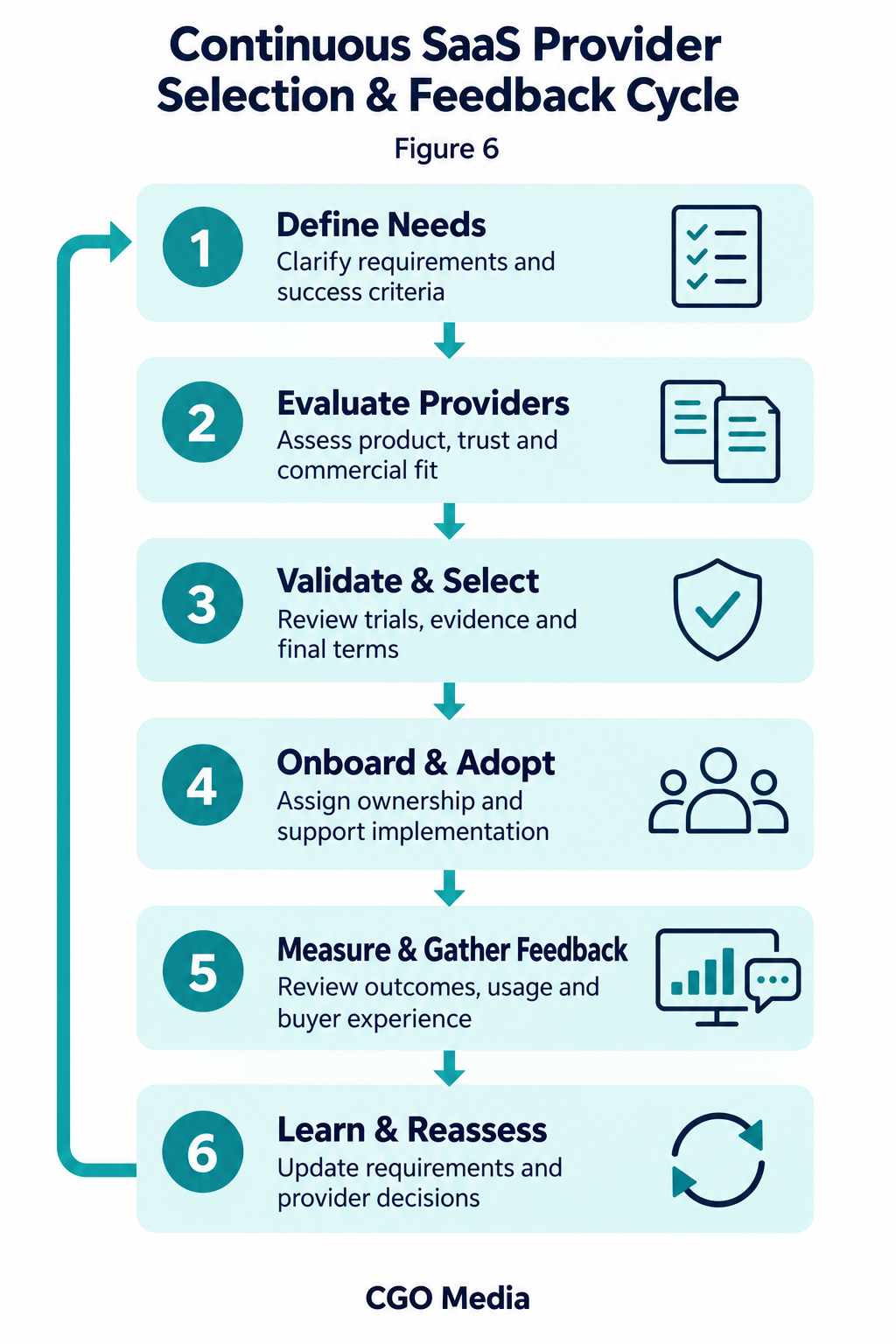
358. Strategic Implications
The SaaS Discovery and Provider Selection Model demonstrates that software purchasing is no longer a simple sequence of search, website visit and sales enquiry.
Modern buyers move across a distributed decision environment involving:
- Search engines
- AI assistants
- Review platforms
- Marketplaces
- Comparison resources
- Professional communities
- Documentation
- Trials
- Demos
- Procurement processes
The strategic requirement is therefore to support buyer progression across the entire decision journey rather than optimise only the initial point of discovery.
359. Discovery and Selection Are Different Problems
Being discovered creates an opportunity to enter consideration.
Being selected requires the provider to survive functional, technical, trust, commercial and operational evaluation.
The core distinction is:
Visibility Creates Consideration → Evidence Creates Progression → Fit Creates Selection
360. Search Visibility Should Support the Entire Journey
A mature SaaS search strategy should provide useful evidence across:
Problem Recognition → Requirement Definition → Provider Discovery → Capability Evaluation → Risk Validation → Commercial Fit → Shortlisting → Selection
361. Early Visibility Can Shape the Buying Process
Providers that contribute useful information during problem recognition and requirement definition can enter the buyer journey before the competitive shortlist has formed.
This allows SaaS companies to influence how buyers understand:
- The business problem
- The software category
- Required capabilities
- Evaluation criteria
362. Late-Stage Evidence Determines Survival
Strong early visibility has limited commercial value where buyers later cannot verify:
- Required features
- Integrations
- Security
- Pricing
- Implementation
- Customer suitability
The later stages therefore depend increasingly on evidence rather than general visibility.
363. SaaS Selection Is an Evidence Progression
The buyer progressively asks:
Does a solution exist? → Does this provider fit? → Can we verify it? → Can we trust it? → Can we afford and implement it? → Is it better for us than the alternatives?
Each question requires a different type of evidence.
364. Different Buyer Types Follow Different Paths
The relative importance and duration of each stage varies according to:
- Business model
- Contract value
- Product complexity
- Buyer risk
- Implementation burden
The eight-stage model should therefore be adapted to the buying environment rather than treated as a rigid funnel.
365. Product-Led SaaS
Product-led journeys may compress several stages through:
- Self-service signup
- Freemium usage
- Product tours
- Free trials
- In-product conversion
Direct product experience becomes an important form of evaluation evidence.
366. Sales-Led SaaS
Sales-led journeys may involve a longer sequence of:
- Qualification
- Demonstration
- Technical evaluation
- Commercial proposal
- Security review
- Procurement
Evidence depth generally increases with contract value and organisational risk.
367. Enterprise SaaS
Enterprise provider selection may involve formal buying committees containing:
- Business leadership
- IT
- Security
- Legal
- Finance
- Procurement
Selection therefore depends on multi-stakeholder approval rather than one buyer alone.
368. Vertical SaaS
Vertical SaaS providers may require stronger evidence around:
- Industry workflows
- Sector integrations
- Regulatory requirements
- Industry-specific customer outcomes
Industry relevance can become as important as general product capability.
369. AI Discovery Changes the Entry Point
AI-assisted discovery can allow buyers to move from a detailed business problem directly to a software shortlist without progressing through a traditional sequence of multiple search-result pages.
This can compress:
Problem Recognition → Requirement Definition → Provider Discovery
into a much shorter interaction.
370. AI Can Also Influence Evaluation
AI tools may be used to:
- Generate requirements
- Compare features
- Summarise reviews
- Investigate risks
- Compare pricing
- Analyse shortlisted vendors
This means AI visibility can influence several stages rather than discovery alone.
371. AI Recommendation Is Not Final Selection
Appearing in an AI-generated recommendation can increase consideration, but buyers still need to validate whether the product fits their actual:
- Functional requirements
- Technical environment
- Security requirements
- Commercial constraints
- Implementation capacity
372. Optimise for Buyer Progression, Not Mentions Alone
The more commercially useful objective is to ensure that appropriate buyers can move from discovery through verification and selection with minimal unnecessary friction.
Raw visibility should therefore remain secondary to qualified progression.
373. Elimination Analysis Is Strategically Important
SaaS organisations should understand not only why they win, but where and why they disappear from consideration.
Selection failure can be grouped into several broad categories.
374. Visibility Failures
A visibility failure occurs where the provider never enters the candidate set.
Potential causes include weak:
- Problem visibility
- Category visibility
- Review presence
- Marketplace presence
- AI recommendation visibility
375. Capability Failures
A capability failure occurs where required:
- Features
- Integrations
- Technical capabilities
- Workflows
cannot be confirmed or do not satisfy the buyer.
376. Trust Failures
A trust failure occurs where:
- Security
- Privacy
- Reliability
- Customer confidence
- Vendor credibility
remain insufficient for the buyer to proceed.
377. Commercial Failures
A commercial failure occurs where the product appears unsuitable because of:
- Pricing
- Packaging
- Implementation
- Contract requirements
- Operational burden
378. Competitive Failures
A competitive failure occurs where another provider demonstrates a stronger overall combination of:
- Product fit
- Trust
- Commercial value
- Implementation confidence
- Customer evidence
379. Feedback Should Inform Search and Product Strategy
Buyer objections, sales losses, trial behaviour and customer experience can expose weaknesses within the discovery environment.
These findings should feed back into:
- Search strategy
- Product positioning
- Documentation
- Customer evidence
- Sales enablement
380. The Model Should Connect Marketing and Revenue Teams
The buyer journey crosses departmental boundaries.
Useful evidence can come from:
- SEO
- Product marketing
- Sales
- Revenue operations
- Product
- Customer success
- Security
Provider-selection intelligence becomes stronger when these sources are analysed together.
381. Relationship with the SaaS Research Family
The SaaS Discovery and Provider Selection Model forms part of the wider CGO Media SaaS research architecture.
The model should be interpreted alongside the wider research family examining SaaS SEO, AI visibility, trust, maturity, implementation and GEO.
382. Relationship with SaaS SEO in an AI Search Environment
The SaaS SEO in an AI Search Environment research paper establishes the broader context for software discovery, product authority, digital trust and AI-assisted recommendation.
The Discovery and Provider Selection Model maps how those authority signals influence progression through the buying journey.
383. Relationship with the SaaS AI Trust and Visibility Framework
The SaaS AI Trust and Visibility Framework defines the evidence dimensions that help a provider survive trust and validation stages.
The provider-selection model shows where those trust signals become commercially important.
384. Relationship with the SaaS Search Authority Maturity Model
The SaaS Search Authority Maturity Model evaluates how advanced an organisation has become in building and governing the authority capabilities required to support discovery and selection.
385. Relationship with the SaaS SEO and AI Implementation Roadmap
The SaaS SEO and AI Implementation Roadmap provides a phased pathway for correcting weaknesses identified across the buyer journey.
386. Relationship with SaaS GEO
The SaaS GEO: Generative Engine Optimisation research examines how SaaS companies can improve product understanding, source authority, citation eligibility, comparison visibility and qualified recommendation across generative discovery environments.
The provider-selection model explains where that AI-assisted discovery can influence real buyer progression.
387. Methodology
The SaaS Discovery and Provider Selection Model is a conceptual and operational framework developed by CGO Media to structure analysis of modern software buying journeys.
It divides provider selection into eight observable stages:
- Problem and Need Recognition
- Requirement Definition
- Software and Provider Discovery
- Feature, Use-Case and Integration Evaluation
- Trust, Security and Risk Validation
- Commercial and Operational Fit
- Comparison and Shortlisting
- Trial, Demo, Procurement and Selection
388. Practical Assessment Method
The model can be applied through a combination of:
- Search-intent analysis
- Content and documentation audits
- AI recommendation testing
- Review-platform analysis
- Marketplace analysis
- Sales-funnel data
- Win/loss analysis
- Buyer interviews
- Customer-success feedback
- Competitive benchmarking
No single data source should be expected to explain the complete buying journey.
389. Stage Mapping
Organisations can map important buyer questions, evidence assets, conversion events and failure reasons against each of the eight stages.
A practical structure is:
Buyer Question → Required Evidence → Available Evidence → Progression Event → Failure Reason
390. Selection Journey Measurement
Where reliable data exists, providers may measure:
- Discovery share
- Shortlist rate
- Trial activation
- Demo conversion
- Procurement completion
- Competitive win rate
- Loss reasons
These metrics should be interpreted by buyer segment, product, market and stage where possible.
391. AI Testing Method
AI-assisted discovery can be examined using a defined prompt set representing different buyer stages and requirements.
Testing should be repeated over time because generated outputs can vary as:
- Models change
- Retrieval methods change
- Available sources change
- Market information changes
AI observations should therefore be treated as evidence of observable output rather than proof of internal recommendation mechanisms.
392. Framework Limitations
The eight-stage model does not imply that every SaaS buyer follows an identical linear journey.
It is an analytical framework intended to help organisations understand common decision stages, evidence requirements and elimination points.
393. Buyer Journeys Can Skip Stages
A buyer may already understand the category, know several providers or begin directly with:
- A product trial
- A sales demonstration
- A peer recommendation
- A procurement shortlist
The model therefore describes possible stages rather than a mandatory sequence.
394. Buyer Journeys Can Repeat Stages
New information may cause the buyer to return to:
- Requirement definition
- Provider discovery
- Comparison
- Risk validation
Provider selection is therefore iterative as well as progressive.
395. Multiple Stakeholders Can Occupy Different Stages
One stakeholder may already be conducting commercial evaluation while another remains focused on technical requirements or security validation.
The buyer journey should therefore not be assumed to move uniformly across the organisation.
396. Selection Criteria Vary by Market
The relative importance of individual stages can vary according to:
- Contract value
- Product complexity
- Customer size
- Industry regulation
- Security sensitivity
- Implementation burden
Selection criteria should therefore be interpreted within the actual commercial context.
397. The Model Does Not Predict a Specific Vendor Outcome
The framework provides a structured method for understanding provider-selection conditions.
It does not predict with certainty which vendor an individual buyer will choose.
Human preference, organisational context, negotiation and changing market conditions can all affect the final decision.
398. AI Outputs Should Not Be Treated as Deterministic
AI-generated recommendations can vary according to:
- Prompt wording
- Model
- Retrieval behaviour
- Available sources
- Geographic context
- Time
Single outputs should therefore not be treated as permanent evidence of provider visibility or buyer recommendation.
399. Conclusion
SaaS provider selection is increasingly distributed across search, AI, reviews, marketplaces, product environments and human decision processes.
The journey begins with a business need but progressively becomes a test of:
- Product relevance
- Technical fit
- Trust
- Commercial viability
- Competitive differentiation
The complete model is:
Problem Recognition → Requirement Definition → Provider Discovery → Capability Evaluation → Risk Validation → Commercial Fit → Shortlisting → Trial, Demo, Procurement & Selection
The framework highlights an important distinction between being visible and being selectable.
Search and AI-assisted discovery may place a provider into consideration, but the provider must still supply enough credible evidence to survive later evaluation.
The strategic opportunity is therefore to build an evidence environment that supports buyers continuously from first problem recognition through final selection, implementation, renewal and future expansion.
References
External Academic, Technical and Search Sources
- Google Search Central. SEO Starter Guide.
- Google Search Central. Understand How Structured Data Works.
- Schema.org. Organization.
- Schema.org. SoftwareApplication.
- Hogan, A. et al. (2021). Knowledge Graphs. ACM Computing Surveys, 54(4).
- Metzger, M.J. (2007). Making Sense of Credibility on the Web: Models for Evaluating Online Information and Recommendations for Future Research. Journal of the American Society for Information Science and Technology, 58(13), 2078–2091.
- Ji, Z. et al. (2023). Survey of Hallucination in Natural Language Generation. ACM Computing Surveys, 55(12).
CGO Media Research and Frameworks
- Wilkinson, R. (2026). SaaS SEO in an AI Search Environment. CGO Media.
- Wilkinson, R. (2026). SaaS AI Trust and Visibility Framework. CGO Media.
- Wilkinson, R. (2026). CGO Media Entity Authority Framework. CGO Media.
- Wilkinson, R. (2026). CGO Media Content Authority Framework. CGO Media.
- Wilkinson, R. (2026). CGO Media AI Search Readiness Framework. CGO Media.
- Wilkinson, R. (2026). CGO Media AI Citation Framework. CGO Media.
CGO Media Research Ecosystem
The SaaS Discovery and Provider Selection Model forms part of the CGO Media research programme examining search, AI-assisted discovery, entity authority, buyer behaviour, digital trust and recommendation-led decision systems.
Research Library | Framework Library | Research Architecture | Research Observations | Statistics Library
About Roger Wilkinson
Roger Wilkinson is an independent researcher, SEO practitioner and founder of CGO Media with more than 25 years of experience in search, online visibility and digital strategy.
His research examines how artificial intelligence is reshaping search engines, recommendation systems and digital authority, including the relationships between Technical SEO, Entity Authority, Brand Signals, AI Visibility, Citation Authority, Knowledge Graphs and Search Visibility.
Roger is the creator of the CGO Framework Series, a collection of research-led methodologies designed to help organisations measure, improve and govern digital visibility across traditional and AI-assisted discovery environments.
Related SaaS AI, GEO & Search Research
This model forms part of the seven-page CGO Media SaaS research family. The six companion resources are:
Research Usage & Citation
CGO Media encourages researchers, journalists, SaaS companies, technology professionals, educators and industry practitioners to reference this model where it contributes to broader understanding of SaaS purchasing, software discovery, AI Search and digital provider selection.
Reasonable quotations, summaries, figures and excerpts may be used in articles, reports, presentations, academic work and other publications provided appropriate acknowledgement is given to Roger Wilkinson and CGO Media.
Cite This Model / Embed Citation
The SaaS Discovery and Provider Selection Model by Roger Wilkinson at CGO Media maps eight stages through which software buyers progress from problem recognition and requirement definition through provider discovery, capability evaluation, trust validation, commercial comparison and final provider selection.
APA Citation
Wilkinson, R. (2026). SaaS Discovery and Provider Selection Model. CGO Media. https://cgomedia.com/saas-discovery-provider-selection-model/
Author: Roger Wilkinson | Published by: CGO Media
For permissions relating to extensive reproduction, commercial licensing or republication of substantial portions of this model, please contact CGO Media directly.