
SaaS GEO: Generative Engine Optimisation

1. SaaS GEO Extends Traditional SaaS SEO
Traditional SaaS SEO remains important for discovery across:
- Software categories
- Product capabilities
- Use cases
- Comparisons
- Vendor selection
Generative Engine Optimisation extends this environment into AI-generated answers, software comparisons, citations and recommendations.
2. SaaS GEO Adds Generative Discovery
Generative systems can influence:
- Software discovery
- Vendor discovery
- Product comparison
- Use-case matching
- Software citation
- Vendor recommendation
The visibility challenge therefore extends beyond rankings into how software is interpreted and positioned within generated answers.
3. SaaS Search Is Increasingly Conversational
Buyers may ask questions such as:
- What is the best CRM for a small sales team?
- Which project-management platform integrates with Slack?
- Which software is suitable for enterprise analytics?
- What are the alternatives to a specific vendor?
- Which SaaS platform best fits a particular workflow?
These questions combine category, capability, buyer and use-case context within one discovery interaction.
4. SaaS GEO Should Be Buyer and Use-Case Aware
A useful relationship is:
Buyer Need → Business Problem → Use Case → Product Requirement → Vendor Recommendation
The strongest generative visibility occurs when the software genuinely fits the buyer scenario rather than merely matching broad category language.
5. Six Principal SaaS GEO Visibility Layers
- Source Visibility
- Citation Visibility
- Entity Accuracy
- Product Relevance
- Comparison Visibility
- Recommendation Visibility
These layers represent progressively stronger forms of generative visibility.
6. Source Visibility
A SaaS source may contribute to an AI-generated answer even where the company or source is not explicitly cited.
Useful source assets can include:
- Product pages
- Documentation
- Research
- Customer evidence
- External reviews
7. Citation Visibility
Citation visibility occurs where a software company, product, documentation resource, review platform or industry source is referenced directly within a generated answer.
Citation can strengthen both source visibility and product recognition.
8. Entity Accuracy
Generative systems should ideally represent accurately:
- Company identity
- Product identity
- Software category
- Core capabilities
- Pricing model
- Integration ecosystem
Visibility loses value when fundamental product information is incorrect.
9. Product Relevance
A SaaS product should be associated with the correct:
- Use cases
- Buyer types
- Industries
- Operational requirements
- Technical environments
Product relevance determines whether inclusion within an AI answer is genuinely useful.
10. Comparison Visibility
Software products may enter AI-generated comparison sets before buyers visit individual vendor websites.
Comparison visibility therefore affects which products become part of the buyer’s effective competitive set.
11. Recommendation Visibility
The highest-value outcome occurs where a product is appropriately recommended for a specific buyer scenario.
Recommendation visibility should therefore be evaluated more carefully than simple mention frequency.
12. SaaS GEO Should Optimise for Qualified Visibility
A useful model is:
Relevant Presence + Accurate Product Representation + Strong Trust Evidence + Appropriate Recommendation
The objective is not maximum exposure. It is visibility where the software is genuinely relevant.
13. Mention Volume Alone Is Not Success
High generative visibility can still be poor where:
- The wrong category is assigned
- Capabilities are represented inaccurately
- Integrations are outdated
- Pricing is wrong
- The buyer fit is weak
Qualified visibility matters more than raw mention volume.
14. SaaS Entity Clarity Is Fundamental
AI-assisted discovery depends partly on understanding relationships between:
- Company
- Product
- Software category
- Feature
- Integration
- Use case
15. SaaS Entity Relationship
A useful relationship is:
Company → Product → Category → Capability → Integration → Use Case → Buyer Need
Weakness at any point in this chain can reduce product understanding or recommendation relevance.
16. Company Identity Should Be Explicit
Relevant company information can include:
- Company name
- Product portfolio
- Markets served
- Locations
- Customer segments
- Commercial model
This becomes especially important for organisations operating multiple SaaS products or brands.
17. Product Identity Should Be Distinct
A company may provide several:
- Products
- Modules
- Platforms
- Service tiers
Each can serve different buyer needs and competitive sets.
Company identity and product identity should therefore not be treated as interchangeable.
18. Software Categories Should Be Clear
Products may need to be distinguished across categories such as:
- CRM
- ERP
- Project management
- Marketing automation
- Analytics
- Cybersecurity
Unclear category positioning can create weak or misleading comparison sets.
19. Product Positioning Should Be Explicit
A SaaS product may be positioned primarily for:
- Startups
- SMEs
- Enterprise organisations
- Specific industries
- Technical teams
- Non-technical teams
Buyer positioning helps establish recommendation context.
20. Capability Identity Should Be Specific
Generic claims such as “powerful automation” or “advanced analytics” may provide limited evaluation value.
Buyers and discovery systems need clearer evidence of what the software actually supports.
21. SaaS Capability Clarity
Capability evidence can include:
- Core features
- Workflow support
- Automation
- Analytics
- Collaboration
- Administration
Capabilities should be connected to practical buyer requirements.
22. Product Relevance Should Be Evidence-Based
Product positioning should be supported by observable evidence rather than promotional claims alone.
A provider claiming suitability for a particular use case should make it possible to understand why that suitability exists.
23. Product Evidence
Relevant evidence can include:
- Product pages
- Documentation
- Feature specifications
- Integration documentation
- Case studies
- Independent reviews
Different evidence types support different parts of buyer evaluation.
24. Product Functionality Is a Core GEO Variable
Software recommendations can become materially misleading when:
- Features are represented incorrectly
- Integrations are unsupported
- Technical limitations are omitted
Product truth must remain central to SaaS GEO.
25. Functionality Should Be Explicit
A prospective buyer should be able to determine whether the platform actually supports the required workflow.
A useful relationship is:
Business Need + Required Capability + Product Functionality + Integration Requirement → Product Fit
26. Integration Fit Influences Recommendation Confidence
Relevant integration requirements can include:
- CRM platforms
- Accounting systems
- Collaboration tools
- Data warehouses
- Marketing platforms
- Identity providers
A strong product can still be unsuitable if it does not fit the buyer’s existing technology environment.
27. Technical Compatibility Matters
Technical fit can involve:
- APIs
- Authentication
- Data architecture
- Integration stack
- Deployment requirements
Recommendation systems should ideally distinguish broad product capability from actual technical suitability.
28. SaaS GEO Should Include Trust Evidence
Software purchases can involve operational, financial, security and implementation risk.
Trust therefore contributes directly to recommendation confidence.
29. Vendor Trust
Vendor-level evidence can include:
- Company stability
- Security evidence
- Customer references
- Independent reviews
- Support capability
30. Product Trust
Product-level trust can include:
- Reliable documentation
- Transparent capabilities
- Product maturity
- Integration quality
- Independent validation
31. Trust Should Be Evidenced Rather Than Asserted
Claims such as:
- Industry-leading
- Enterprise-ready
- Best-in-class
- Highly secure
are more useful when supported by evidence that can be independently evaluated.
32. Reviews Provide Buyer Evidence
Reviews can contribute information about:
- Ease of use
- Support quality
- Implementation
- Reliability
- Value
They can help complement first-party product information.
33. Review Scores Alone Do Not Define Suitability
A highly rated product may still be unsuitable for a specific:
- Use case
- Company size
- Industry
- Technical environment
Buyer context should remain central.
34. Review Themes Can Be More Useful Than Raw Scores
Repeated review themes can reveal patterns around:
- Onboarding
- Feature depth
- Support
- Performance
- Pricing concerns
These patterns can provide more meaningful context than an aggregate rating alone.
35. SaaS Source Authority Is Claim-Specific
Different software claims require different evidence sources.
No single source type should automatically be treated as authoritative for every aspect of a product.
36. Principal SaaS Source Types
Relevant sources can include:
- Official product websites
- Technical documentation
- Developer documentation
- Review platforms
- Industry publications
- Independent software analysts
- Original research
37. Product Websites Support First-Party Facts
Official product sources can be particularly useful for:
- Features
- Pricing
- Packages
- Use cases
- Integrations
These sources may provide the most direct evidence of current product configuration.
38. Documentation Supports Technical Truth
Documentation can provide direct evidence around:
- Functionality
- Configuration
- APIs
- Integrations
- Technical limitations
For technical claims, documentation can be more useful than promotional product copy.
39. Review Platforms Add Customer Context
Review environments can contribute:
- Customer experience
- Ease-of-use evidence
- Support feedback
- Implementation commentary
- Alternative-product context
40. Industry Publications Add Interpretive Context
Industry sources can help explain:
- Market categories
- Vendor differences
- Technology trends
- Product maturity
They can therefore contribute context beyond direct product facts.
41. Source Selection Should Match the Claim
A useful model is:
Software Question + Buyer Context + Evidence Type + Source Independence → Source Confidence
Source quality should be evaluated in relation to the specific claim being supported.
42. SaaS Information Changes Frequently
High-volatility information can include:
- Features
- Pricing
- Integrations
- Product names
- Plan structures
- Usage limits
Information freshness is therefore particularly important in software discovery.
43. SaaS Freshness Should Reflect Volatility
A useful relationship is:
Product Volatility + Buyer Impact + Decision Importance → Required Freshness
Information capable of changing a purchase decision should generally receive more frequent review.
44. High-Volatility SaaS Information
Priority review areas can include:
- Pricing
- Feature availability
- Integrations
- Usage limits
- Product packaging
Outdated information in these areas can materially reduce recommendation quality.
45. Source Convergence Can Increase Confidence
Confidence can strengthen where multiple relevant sources materially agree.
A useful relationship is:
Product Evidence + Technical Documentation + Customer Evidence + Independent Validation → Source Confidence
46. Source Conflict Should Reduce Confidence
Important conflicts can involve:
- Feature availability
- Pricing
- Integration support
- Product naming
- Plan limitations
Conflicting evidence should trigger investigation rather than automatic source selection.
47. Source Conflict Should Be Diagnosed
Potential causes can include:
- Old product pages
- Outdated documentation
- Third-party review lag
- Recent pricing changes
- Product rebranding
Correcting the underlying information environment is more useful than simply reacting to a generated answer.
48. Product Identity Can Become Fragmented
A SaaS product may be represented across:
- Official websites
- Documentation
- Review platforms
- Software directories
- Marketplace listings
Inconsistency between these environments can create entity risk.
49. Product Entity Resolution
Generative systems should ideally recognise when several listings describe the same software product.
Useful identifiers can include:
- Product name
- Company name
- Official website
- Documentation domain
- Marketplace profile
50. Company Entity Resolution
Entity resolution becomes more complex where SaaS businesses operate:
- Multiple products
- Multiple brands
- Acquired products
- Different legal entities
- Different geographic markets
Clear organisational relationships help reduce ambiguity.
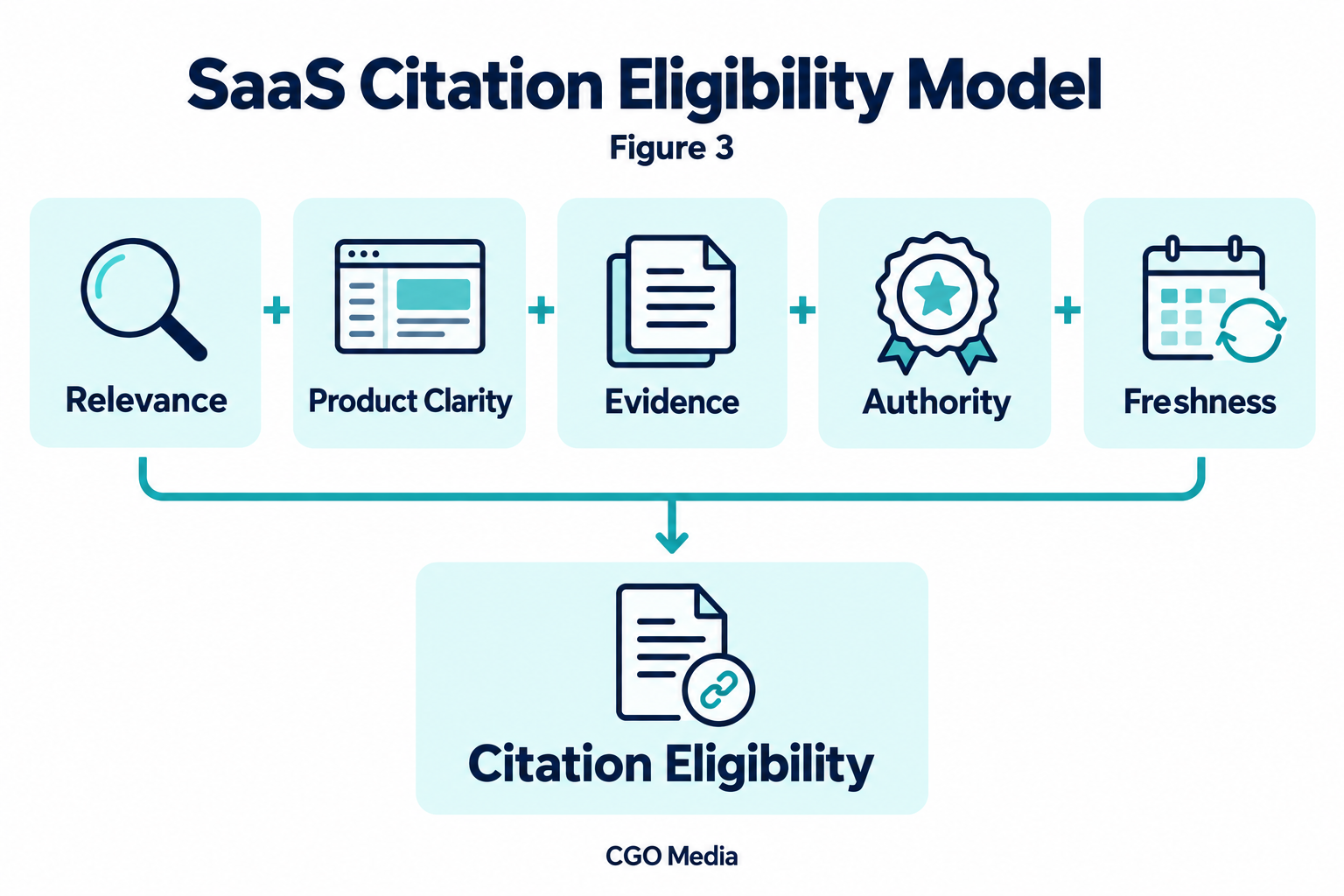
51. Citation Eligibility
A SaaS source can become more suitable for citation where it combines:
- Relevance
- Product clarity
- Evidence
- Authority
- Freshness
A useful model is:
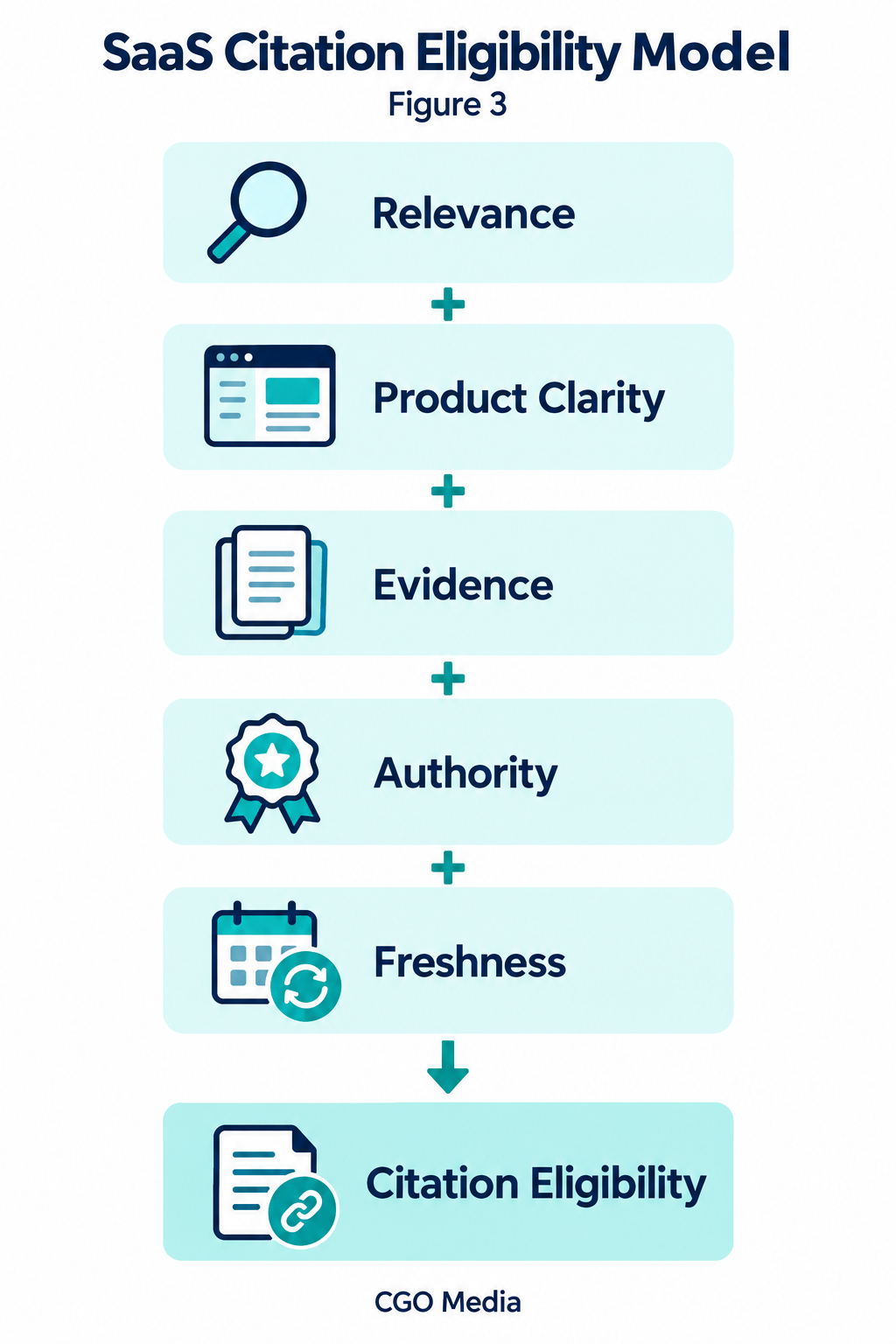
Relevance + Product Clarity + Evidence + Authority + Freshness → Citation Eligibility
52. Documentation Can Be Citation-Useful
Technical documentation can support claims involving:
- Features
- APIs
- Integrations
- Configuration
- Technical requirements
Clear, current documentation can therefore support both user evaluation and generative source selection.
53. Product Pages Can Support Commercial Facts
Official product pages can provide current evidence around:
- Plans
- Pricing structures
- Features
- Use cases
- Target customers
54. Independent Sources Add Comparison Authority
Independent sources can add context around:
- Ease of use
- Alternatives
- Buyer fit
- Implementation
- Value
These sources can complement rather than replace first-party product evidence.
55. Original SaaS Research Can Strengthen Citation Authority
Useful research can examine:
- Software adoption
- Buyer behaviour
- Implementation challenges
- Technology trends
- Productivity outcomes
Research should provide genuinely useful evidence rather than exist purely as a visibility tactic.
56. Research Methodology Should Be Transparent
Credible research should state relevant:
- Dataset
- Sample
- Market
- Time period
- Definitions
- Limitations
Methodological transparency strengthens citation usefulness.
57. Comparison Visibility Is a Core GEO Outcome
Generative systems may assemble comparison sets involving:
- Software categories
- Vendors
- Use cases
- Customer segments
These sets can shape which providers enter serious consideration.
58. Product and Vendor Co-Occurrence
Products repeatedly appearing together may indicate competition for similar:
- Use cases
- Customer segments
- Budgets
- Technical environments
AI-generated comparison sets can therefore reveal effective competitors that differ from conventional market assumptions.
59. Recommendation Confidence Is More Selective Than Visibility
Product recommendation confidence can depend on:
- Product fit
- Use-case fit
- Integration fit
- Buyer trust
- Commercial fit
Vendor-level confidence can also depend on:
- Product maturity
- Support capability
- Security evidence
- Customer proof
- Independent validation
60. SaaS Recommendation Model
A useful relationship is:
Buyer Scenario → Product Fit → Use-Case Fit → Trust Evidence → Commercial Fit → External Validation → Recommendation Confidence
Buyer fit should come before brand popularity.
61. Buyer Fit
Buyer fit can include:
- Company size
- Industry
- Team structure
- Technical maturity
- Budget
- Compliance requirements
A recognised software vendor may still be inappropriate for a particular buyer environment.
62. Product Fit
Product fit can include:
- Required capabilities
- Workflow support
- Technical compatibility
- Scalability
- Administration
63. Use-Case Fit
Use-case suitability can depend on:
- Primary business problem
- Workflow complexity
- User type
- Data requirements
- Integration requirements
64. Commercial Fit
A technically strong SaaS product can still be unsuitable because of:
- Pricing
- Contract terms
- Minimum commitments
- Implementation cost
- Support model
Commercial suitability is therefore part of recommendation quality.
65. Relevant and Irrelevant Inclusion
SaaS GEO should distinguish four different outcomes:
- Relevant Inclusion — a suitable product appears.
- Irrelevant Inclusion — an unsuitable product appears.
- Relevant Exclusion — a suitable product is absent.
- Appropriate Exclusion — an unsuitable product is correctly omitted.
These outcomes should not be interpreted as equivalent.
66. Scenario Libraries
Useful GEO monitoring scenarios can cover:
- Software discovery
- Vendor comparison
- Feature discovery
- Integration discovery
- Use-case selection
- Software research discovery
Scenario libraries make monitoring more representative of real buyer journeys.
67. SaaS GEO Should Be Measured Longitudinally
Single generated outputs should not be treated as permanent evidence.
Longitudinal monitoring can reveal:
- Persistent visibility
- Persistent exclusion
- Product inaccuracies
- Outdated product information
- Changing recommendation patterns
68. Risk Prioritisation
A useful relationship is:
Severity + Persistence + Buyer Impact + Decision Importance → GEO Risk Priority
High-risk problems can include:
- Wrong product category
- Incorrect feature claims
- Unsupported integration claims
- Outdated pricing
- Inappropriate vendor recommendations
69. SaaS GEO Should Be Cross-Functional
Relevant functions can include:
- SEO
- Marketing
- Product
- Sales
- Customer success
- Research
- Digital PR
Generative visibility depends on information controlled across several parts of the organisation.
70. Product Teams Have a Central Role
Product teams should help maintain current information around:
- Features
- Integrations
- Packaging
- Limitations
SaaS GEO should support rather than replace product-data governance.
71. Discovery and Procurement Should Remain Distinct
AI-assisted software discovery can help buyers identify and explore products.
Final procurement decisions still depend on current:
- Pricing
- Technical requirements
- Security review
- Implementation
- Contractual terms
A useful progression is:
Software Discovery → Product Understanding → Vendor Evaluation → Procurement Selection
72. Source Authority and Product Authority Can Reinforce Each Other
A SaaS company may first become visible because its documentation, research or product information is useful.
Repeated use of strong information can increase recognition of the product or vendor behind it.
Conversely, recognised product expertise can increase confidence in clearly attributed technical resources.
A useful relationship is:
Product Expertise → Useful Software Evidence → Citation → Vendor Recognition → Greater Future Source Utility
73. Four Core SaaS GEO Principles
Qualified Visibility
SaaS GEO should optimise for relevant and accurate generative visibility rather than maximum mention frequency.
Connected Product Meaning
Company identity, product identity, category, capability and use-case fit should be treated as connected relationships.
Claim-Specific Source Authority
Official product pages, documentation, reviews, industry publications, analyst sources and original research serve different evidence roles.
Contextual Recommendation Quality
Recommendations should be evaluated through buyer context, product fit, trust, commercial fit and evidence confidence.
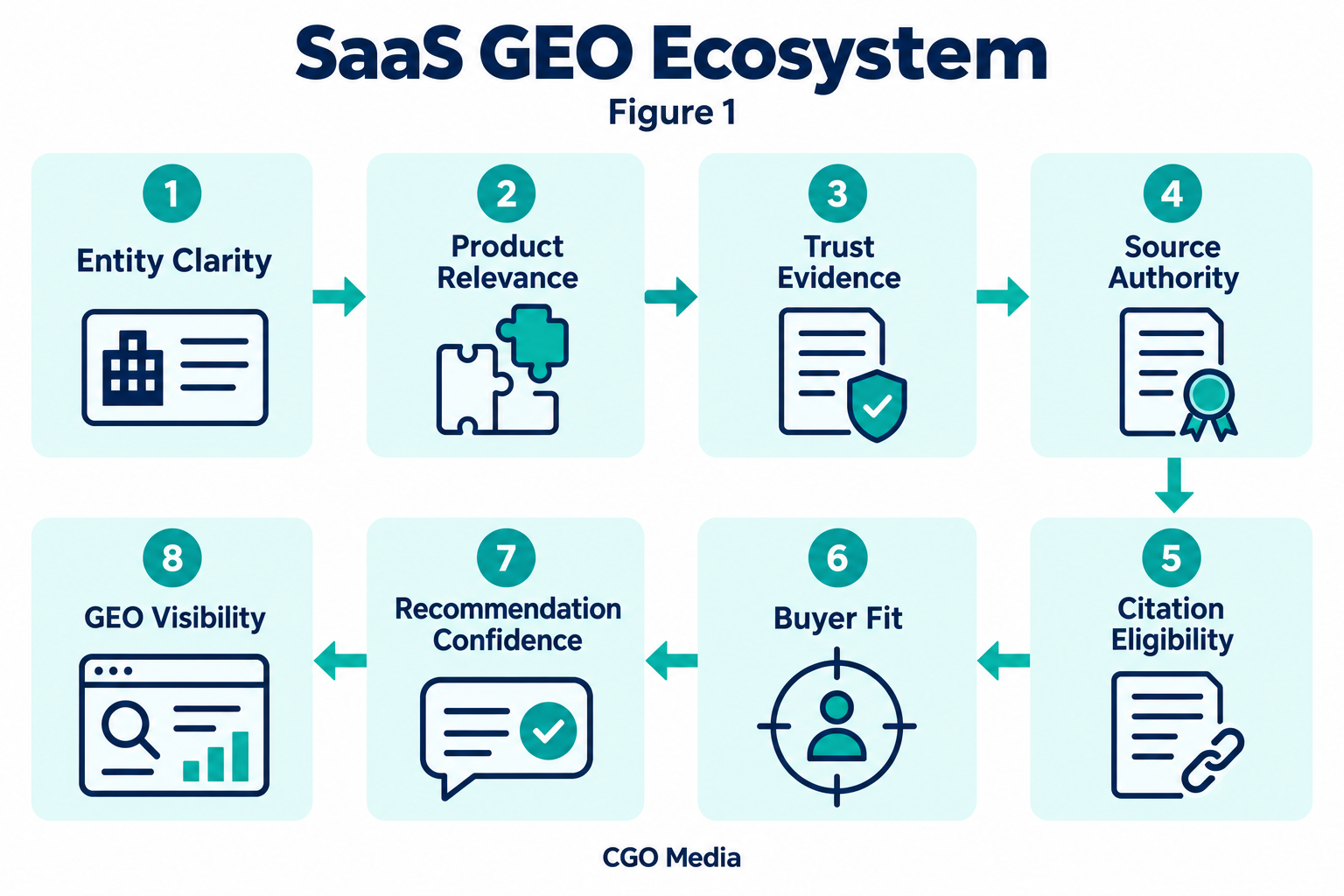
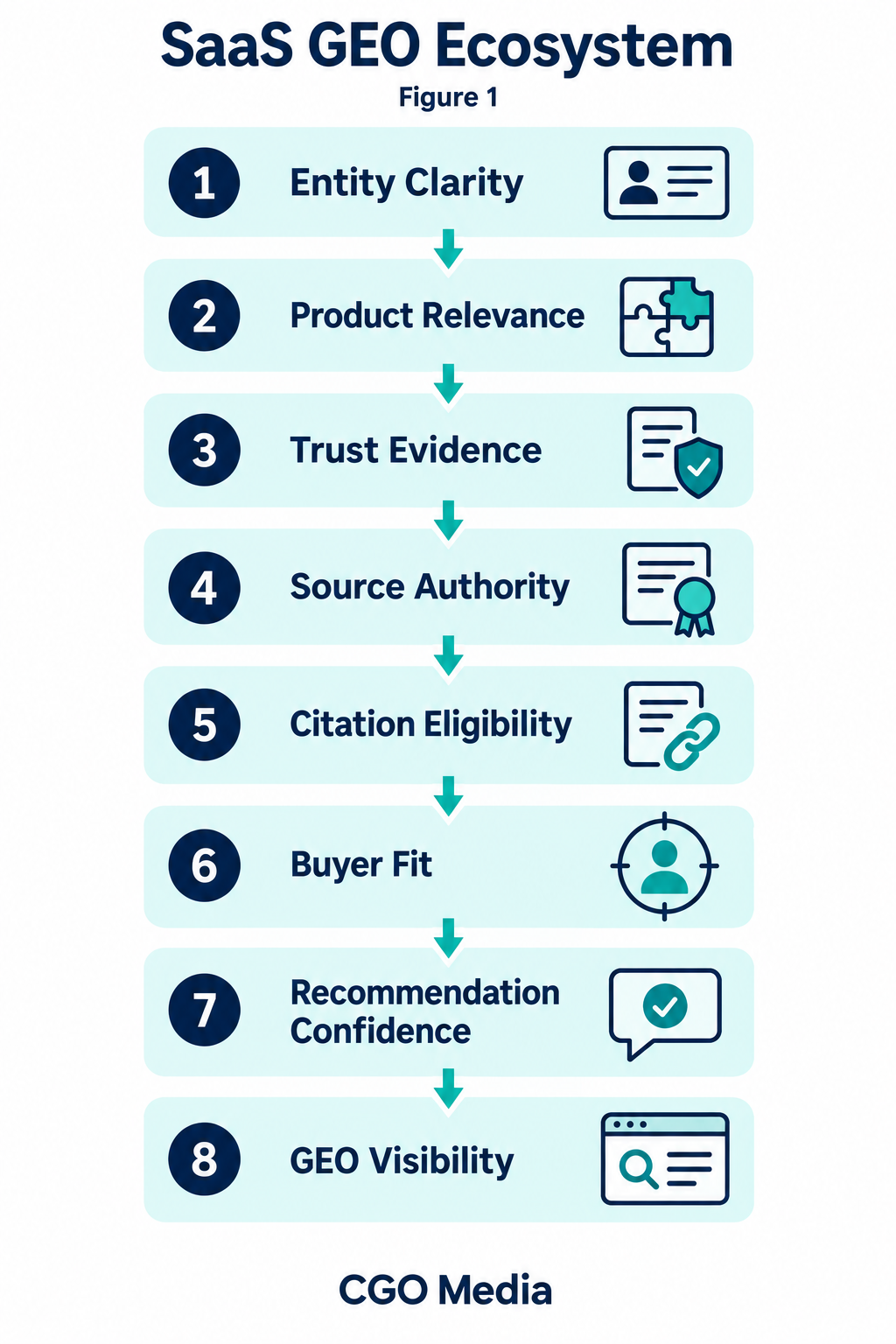
74. The SaaS GEO Ecosystem
The core relationship is:
Entity Clarity → Product Relevance → Trust Evidence → Source Authority → Citation Eligibility → Buyer Fit → Recommendation Confidence → GEO Visibility
This model places product truth, evidence quality and buyer relevance before recommendation visibility.
75. Long-Term SaaS GEO Objective
The strongest generative visibility occurs when companies, products and capabilities are represented accurately across multiple relevant sources and repeatedly associated with genuine buyer needs.
The objective is therefore durable authority rather than isolated promotional visibility.
76. Strategic Implication
SaaS companies should treat Generative Engine Optimisation as a structured product, entity and recommendation system.
They should strengthen relationships between:
- Company identity
- Product capabilities
- Integrations
- Use cases
- Buyer needs
while ensuring documentation, customer evidence, original research and independent trust signals collectively support accurate citation, comparison and recommendation across AI-assisted software discovery environments.
77. SaaS Generative Source Selection
Generative systems may draw on different source types depending on the software question, buyer context and evidence required.
The strongest source is therefore not necessarily the most visible domain. It is the source most capable of supporting the specific claim being evaluated.
78. Source Selection Should Begin with the Software Query
The query determines which evidence is required.
A useful relationship is:
Software Query → Required Evidence → Candidate Sources → Product Relevance → Authority → Source Selection
79. Candidate Sources Can Include First-Party Product Pages
Official product pages can provide current information about:
- Features
- Pricing structures
- Plans
- Use cases
- Integrations
- Target customers
They are particularly useful for direct first-party product facts.
80. Candidate Sources Can Include Technical Documentation
Documentation can provide stronger evidence for technical questions involving:
- APIs
- Authentication
- Configuration
- Integrations
- Technical requirements
- Limitations
For technical claims, documentation may be more useful than promotional product copy.
81. Candidate Sources Can Include Developer Documentation
Developer resources can provide evidence around:
- SDKs
- Code examples
- Webhooks
- API behaviour
- Implementation requirements
These sources can be particularly important where technical compatibility affects provider selection.
82. Candidate Sources Can Include Review Platforms
Review platforms can contribute evidence around:
- Ease of use
- Support
- Implementation
- Reliability
- Value
- Alternative products
They are useful primarily for customer-experience context rather than direct technical truth.
83. Candidate Sources Can Include Industry Publications
Industry publications can contribute:
- Market context
- Technology trends
- Category interpretation
- Vendor analysis
- Independent commentary
84. Candidate Sources Can Include Analyst and Research Sources
Analyst and research sources can support:
- Market analysis
- Vendor positioning
- Technology adoption
- Buyer behaviour
- Category definitions
Research can add evidence where methodology and scope are sufficiently clear.
85. Product Relevance Should Be Evaluated Early
A highly authoritative source can still be unsuitable if it does not address the actual:
- Software category
- Business problem
- Required capability
- Buyer segment
- Technical environment
- Industry context
Relevance should therefore be assessed before general source authority.
86. Buyer Segment Relevance Matters
A product designed primarily for an enterprise organisation may be inappropriate for a small team with simpler requirements.
Source selection should preserve the context of the buyer being evaluated.
87. Industry Relevance Can Affect Product Fit
Some SaaS products are designed specifically for sectors such as:
- Healthcare
- Financial services
- Legal services
- Manufacturing
- Ecommerce
Industry context can therefore materially change the relevance of both the product and the supporting evidence.
88. Technical Environment Can Affect Relevance
A product may be unsuitable where it does not support the buyer’s required:
- Data architecture
- Identity provider
- API requirements
- Integration stack
- Operating environment
89. Source Selection Should Match the Buyer Journey Stage
Different source types become more useful at different stages of software evaluation.
Relevant stages can include:
- Category discovery
- Product research
- Comparison
- Technical validation
- Procurement
90. Category Discovery Sources
During early discovery, useful sources can include:
- Industry publications
- Software guides
- Analyst sources
- Review platforms
- Category research
The objective is to establish relevant product and vendor options.
91. Product Research Sources
During product research, buyers need stronger first-party evidence around:
- Features
- Use cases
- Plans
- Integrations
- Customer fit
92. Comparison Sources
Comparison can require a mixture of:
- Official product information
- Independent reviews
- Industry analysis
- Customer evidence
No single source type should automatically dominate every comparison.
93. Technical Validation Sources
Technical evaluation may depend heavily on:
- Developer documentation
- API documentation
- Integration guides
- Security resources
- Implementation documentation
94. Procurement Sources
Later-stage procurement may require current information about:
- Pricing
- Contracts
- Security
- Compliance
- Implementation
- Support
Discovery evidence should not automatically be treated as sufficient procurement evidence.
95. Official Product Sources Are Strong for Current Product Facts
They can be particularly useful for:
- Current features
- Pricing structure
- Integration availability
- Plan differences
- Product packaging
However, first-party sources naturally present the product from the vendor’s perspective.
96. Independent Sources Add Comparative Context
Independent sources can provide useful evidence around:
- Relative strengths
- Relative weaknesses
- Alternative products
- Implementation difficulty
- Customer experience
They can complement first-party facts rather than replace them.
97. Technical Documentation Is Often Strongest for Technical Truth
Documentation can provide current evidence around:
- API behaviour
- Authentication
- Configuration
- Supported integrations
- Technical limitations
The strongest technical source may differ from the strongest commercial source.
98. Technical Accuracy and Buyer Accessibility Are Different
Highly detailed documentation can be technically accurate while remaining difficult for non-technical buyers to interpret.
Commercial product pages can help translate technical capability into:
Feature → Workflow → Business Problem → User Type → Outcome
99. Pricing Information Is Highly Volatile
Pricing can vary according to:
- Plan
- User count
- Usage
- Billing period
- Contract duration
Pricing sources should therefore be assessed for substantive freshness.
100. Review Evidence Should Be Interpreted Carefully
Review volume alone does not establish strong buyer evidence.
Useful review evaluation can consider:
- Recency
- Buyer relevance
- Industry relevance
- Review volume
- Theme consistency
101. Review Themes Can Be More Useful Than Raw Ratings
A useful relationship is:
Rating + Review Theme + Buyer Type + Recency → Customer Experience Confidence
This preserves important context that can disappear within an aggregate score.
102. Buyer Type Should Be Preserved in Review Interpretation
A product praised by:
- Startups
- SMEs
- Enterprise teams
- Technical users
- Non-technical users
may not suit each group equally.
103. Specialist Authority Can Outperform General Authority
A niche technical or industry source can provide stronger evidence for a specialist question than a larger general publication.
Source authority should therefore be evaluated by function and subject relevance rather than domain strength alone.
104. Developer Sources Can Be Critical
Developer evidence can determine whether a commercially attractive product is technically suitable.
Useful sources can include:
- API documentation
- SDK documentation
- Integration guides
- Code examples
- Technical limitations
105. Security Sources Can Influence Enterprise Fit
Enterprise recommendations may require current evidence around:
- Data protection
- Access control
- Compliance
- Encryption
- Security governance
Trust evidence should remain current because security environments and certifications can change.
106. SaaS Research Can Support Source Authority
Original research can contribute useful evidence around:
- Software adoption
- Buyer behaviour
- Technology investment
- Implementation challenges
- Productivity outcomes
Research should clearly state its methodology, scope and limitations.
107. SaaS Research Should Distinguish Perception from Behaviour
Surveyed preferences do not always match:
- Purchasing behaviour
- Product adoption
- Actual software usage
Research interpretation should distinguish stated opinion from observed behaviour where possible.
108. SaaS Source Authority Is Multi-Dimensional
Useful source dimensions can include:
- Product authority
- Technical authority
- Buyer authority
- Market authority
- Freshness
A source can be strong in one dimension and weak in another.
109. Freshness Requirements Should Vary by Information Type
A useful relationship is:
Product Volatility + Buyer Impact + Decision Importance → Required Freshness
Not every SaaS fact requires the same update frequency.
110. High-Freshness Information
High-volatility information can include:
- Pricing
- Feature availability
- Integrations
- Usage limits
- Security information
- Product packaging
111. Product Naming Also Requires Freshness
SaaS products can be:
- Renamed
- Merged
- Acquired
- Retired
- Repositioned
Old naming can create both source conflict and entity ambiguity.
112. Publication Date Is Not the Same as Substantive Freshness
The important question is whether the information remains true.
A recently updated page can still contain stale product information, while older stable documentation may remain accurate.
113. Source Extractability Matters
Important facts should be clearly identifiable within the source.
Critical product facts can include:
- Category
- Core capability
- Plan availability
- Integration support
- Usage limitations
- Target customer
114. Technical Facts Should Also Be Explicit
Technical sources should clearly identify information such as:
- Authentication method
- API availability
- Technical requirements
- Integration limitations
- Data requirements
115. Marketing Claims and Product Facts Serve Different Roles
Promotional language can help communicate positioning, but decision-critical product and technical claims require clearer supporting evidence.
SaaS source selection should preserve this distinction.
116. Source Convergence Can Strengthen Confidence
Confidence increases where different relevant source types materially agree.
A useful relationship is:
Product Evidence + Technical Evidence + Customer Evidence + Independent Evidence → SaaS Confidence
117. Convergence Should Be Claim-Specific
Different evidence sources can converge around questions involving:
- Feature support
- Integration support
- Buyer fit
- Implementation quality
- Product maturity
The required source mix depends on the claim.
118. Source Conflict Should Be Logged
Material discrepancies should trigger investigation rather than being ignored.
Useful conflict categories include:
- Feature conflict
- Pricing conflict
- Integration conflict
- Product identity conflict
- Buyer-fit conflict
119. Feature Conflict Can Be High Impact
Incorrectly stating that a product supports a capability can materially affect a buyer’s decision.
Feature evidence should therefore be validated against current product reality.
120. Pricing Conflict Can Reduce Recommendation Quality
A buyer may consider a product suitable based on pricing information that is no longer current.
Commercial conflicts should therefore be treated as decision-critical evidence problems.
121. Integration Conflict Can Create Technical Risk
A SaaS product may be recommended because of an integration that has been:
- Deprecated
- Changed
- Restricted
- Moved to a third party
Integration status should be maintained explicitly.
122. Product Identity Conflict Creates Entity Risk
Renamed, acquired or merged software products can remain associated with outdated identities across the web.
These inconsistencies can make product interpretation more difficult.
123. Buyer-Fit Conflict Can Be Contextual
Different buyer segments can legitimately experience the same software differently.
Conflicting buyer-fit evidence should therefore be interpreted according to:
- Company size
- Industry
- Use case
- Technical maturity
124. Maintain Canonical Product Facts
SaaS companies should maintain clear canonical information around:
- Product name
- Company name
- Category
- Core features
- Pricing model
- Official documentation
This provides a stable reference point when external sources diverge.
125. Maintain Canonical Company Facts
Useful company-level information can include:
- Company name
- Product portfolio
- Markets served
- Ownership
- Official website
126. Maintain Canonical Integration Facts
Important integration information can include:
- Integration name
- Supported product
- Integration type
- Setup requirements
- Current status
Integration clarity is particularly important where compatibility is a buyer requirement.
127. Build SaaS Source Maps
A source map identifies the strongest evidence source for an important software fact.
Relevant categories can include:
- Product fact
- Technical fact
- Commercial fact
- Customer-experience evidence
- Independent validation
128. Source Maps Reveal Evidence Gaps
A useful relationship is:
Software Question → Required Evidence → Best Source → Existing Source → Evidence Gap
This turns source analysis into an actionable GEO process.
129. Product Evidence Gaps
Common gaps can include:
- Missing feature detail
- Weak use-case explanation
- Outdated pricing
- Unclear buyer segment
130. Technical Evidence Gaps
Common gaps can include:
- Missing API documentation
- Weak integration guidance
- Outdated authentication information
- Unclear technical limits
131. External Evidence Gaps
A SaaS company may lack sufficient:
- Independent reviews
- Industry coverage
- Analyst references
- Research citations
External evidence should reinforce direct product authority rather than substitute for it.
132. Avoid Dependence on Review Platforms Alone
Review platforms can support discovery and buyer context, but they should not replace:
- Product pages
- Technical documentation
- Integration evidence
- Direct product authority
133. Strong Owned Sources Build Direct SaaS Authority
Useful owned assets can include:
- Product pages
- Documentation
- Integration pages
- Use-case content
- Original research
Owned evidence allows the provider to establish clear product and technical facts directly.
134. External Sources Reinforce Owned Authority
A useful relationship is:
Owned SaaS Evidence → External Validation → Source Convergence → Greater Source Confidence
The strongest environment combines first-party clarity with relevant independent support.
135. Software Guides Can Become Source Assets
High-quality guides can explain:
- Software categories
- Use cases
- Implementation
- Integrations
- Buyer considerations
They become useful when they help users understand the market rather than simply promote one product.
136. Comparison Guides Can Strengthen Decision Support
Useful comparison resources can distinguish products according to:
- Buyer type
- Capability
- Technical fit
- Pricing
- Use case
Comparison authority should be based on current evidence.
137. Expert Commentary Can Support Specialist Authority
Technology specialists can contribute interpretation around:
- Product trends
- Software categories
- Technology change
- Buyer behaviour
Commentary is stronger where expertise and authorship are clear.
138. Author Transparency Supports Source Evaluation
Useful attribution can include:
- Author
- Role
- Organisation
- Relevant expertise
- Publication date
Clearly attributed analysis can be easier to evaluate than anonymous content.
139. Source Selection Should Include Negative Evidence
Not all relevant product evidence is positive.
Material negative evidence can include:
- Persistent reliability complaints
- Major support issues
- Implementation problems
- Feature limitations
- Security concerns
140. Negative Evidence Can Reduce Recommendation Confidence
Where negative evidence is current, repeated and relevant, it can materially reduce product suitability for particular buyer scenarios.
However, isolated historical complaints should not automatically outweigh a large body of current evidence.
141. Source Diversity Can Improve Evidence Quality
A useful SaaS evidence environment can combine:
- Product pages
- Technical documentation
- Review platforms
- Industry publications
- Independent research
Different source types can reinforce one another.
142. Source Diversity Does Not Mean Maximum Quantity
A smaller number of relevant, current and decision-useful sources may provide stronger evidence than many stale or generic references.
Source quality should therefore be evaluated by function.
143. Source Selection Should Improve Product Understanding
Strong product sources should make it easier to understand:
- Capabilities
- Use cases
- Plans
- Integrations
- Limitations
144. Source Selection Should Improve Technical Evaluation
Strong technical sources should clarify:
- Compatibility
- APIs
- Security
- Integrations
- Administration
Better technical evidence improves provider-selection quality.
145. Source Selection Should Improve Comparison Quality
Product and vendor comparisons become stronger where claims are supported by appropriate product, technical, customer and independent evidence.
The goal is better buyer understanding rather than source visibility alone.
146. Source Selection Should Improve Recommendation Quality
Recommendation confidence can strengthen where:
Product Evidence + Technical Evidence + Customer Evidence + Independent Validation
converge around the same buyer scenario.
147. Source Selection Should Be Evidence-Led
A source should be useful because it contributes relevant, current and decision-supporting software information.
Its purpose is to improve understanding of the product rather than simply increase visibility.
148. Source Patterns Should Be Monitored Longitudinally
Source selection can change as:
- Products evolve
- Categories change
- Buyer behaviour changes
- New research appears
- New authoritative sources emerge
Repeated monitoring helps identify durable patterns rather than one-off outputs.
149. Longitudinal Source Monitoring Can Reveal
- New authoritative sources
- Declining source importance
- Updated product information
- Improved vendor visibility
- New research authority
These changes can provide useful evidence for future GEO priorities.
150. Manufactured Source Signals Should Be Avoided
The objective of SaaS GEO should not be to create artificial citation or authority signals.
Source authority should emerge from:
- Buyer utility
- Product accuracy
- Technical usefulness
- Independent evidence
- Current information
151. Source Utility Should Be the Core Objective
A useful SaaS source should add one or more of the following:
- Reliable product information
- Accurate technical information
- Useful buyer context
- Current commercial information
- Independent evidence
Source usefulness is more durable than attempts to influence individual generated outputs.
152. SaaS Generative Source Selection Principle
Generative source selection should be query-specific and product-relevant.
Official product pages, technical documentation, review platforms, analyst sources, industry publications and independent research each serve different evidential roles.
153. Source Convergence Principle
SaaS organisations should reduce conflicting evidence across:
- Product information
- Documentation
- Integrations
- Pricing
- Customer evidence
- Independent coverage
Greater convergence can improve confidence when products and vendors are interpreted across multiple sources.
154. Source Freshness Principle
Freshness requirements should reflect product volatility and buyer impact.
Pricing, features, integrations, security information and plan limits generally require more frequent review than relatively stable company history or long-term category positioning.
155. Direct and Independent Authority Should Work Together
SaaS organisations should build direct authority through:
- Accurate product information
- Detailed documentation
- Useful software guides
- Original research
Independent reviews, analyst commentary and industry evidence should reinforce rather than replace first-party product authority.
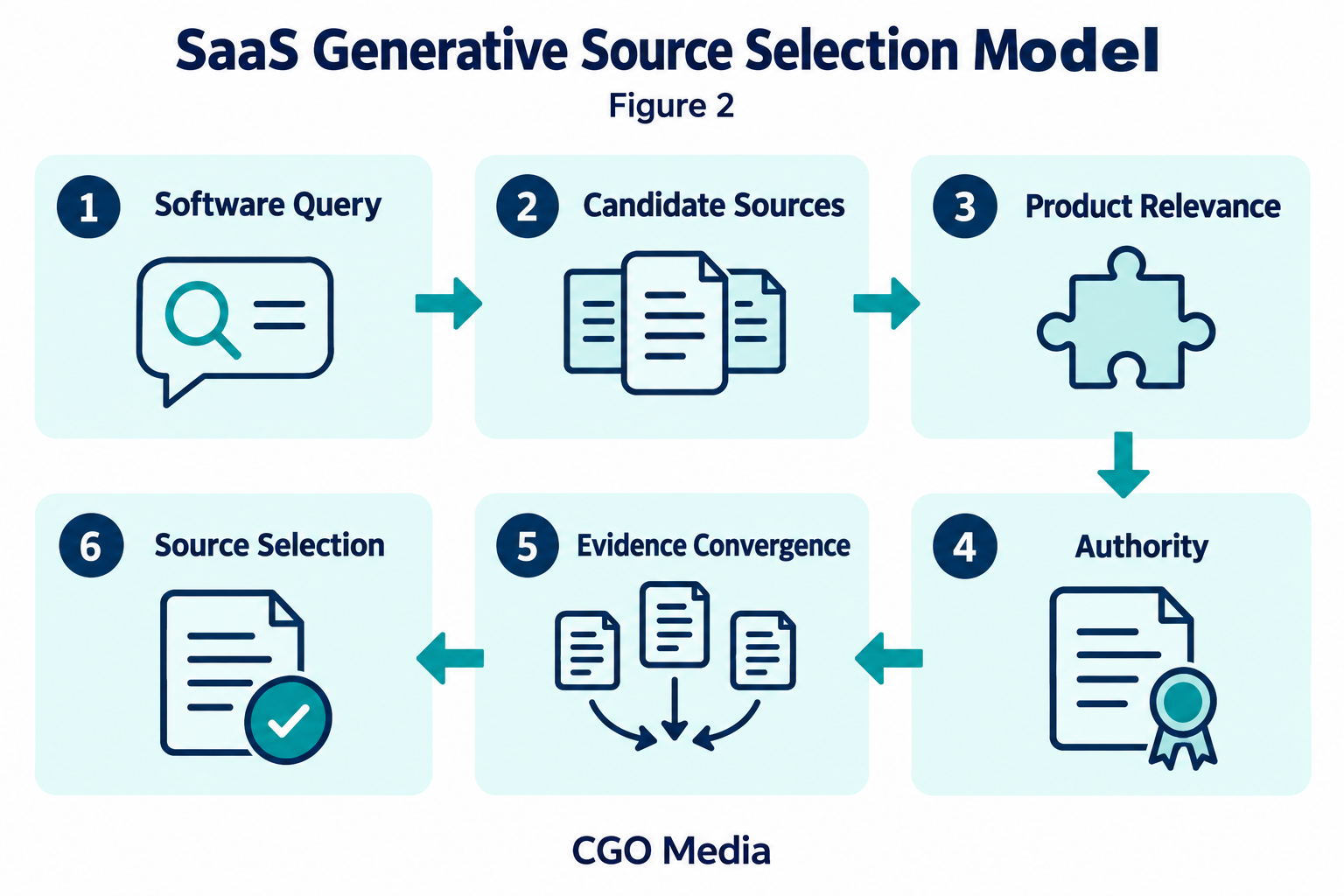
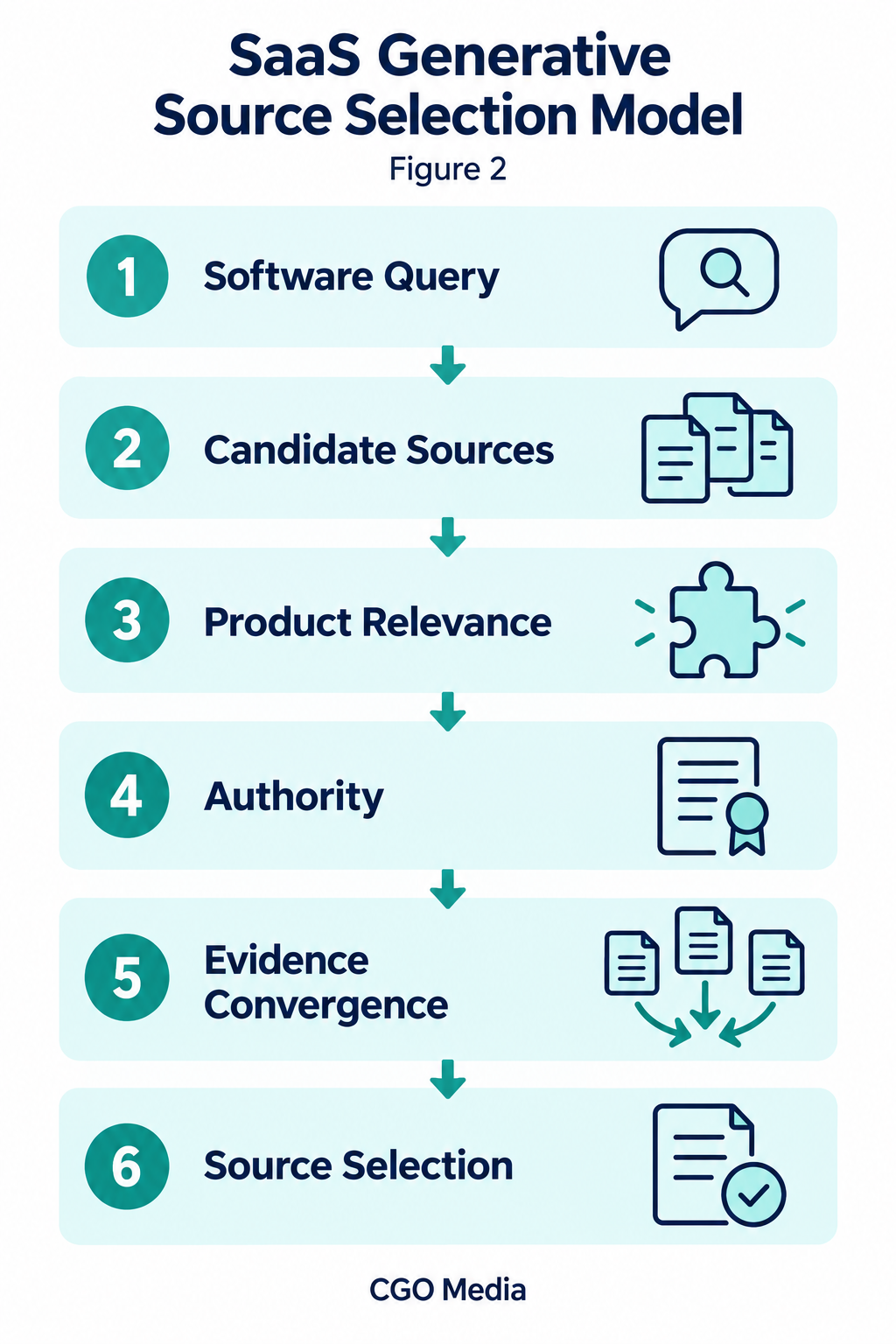
156. The SaaS Generative Source Selection Model
The full source-selection relationship is:
Software Query → Candidate Sources → Product Relevance → Authority → Evidence Convergence → Source Selection
This model places buyer and product relevance before generic source visibility.
157. Strategic Implication
SaaS companies should treat generative source selection as a structured product and technical evidence system.
Important claims involving:
- Products
- Features
- Integrations
- Pricing
- Buyer fit
should be supported by appropriate source types.
Outdated or conflicting information should be identified quickly, while owned product content, technical documentation, customer evidence and independent authority should collectively support more accurate AI-assisted software discovery.
158. SaaS Citation Eligibility Is Distinct from General Visibility
A software source may influence a generated answer without being selected as an explicit citation.
Citation eligibility should therefore be assessed as a separate GEO outcome.
159. Citation Eligibility Should Be Evaluated at Claim Level
The central question is:
Is this source sufficiently relevant, accurate, authoritative, evidenced and current to support this specific software, technical or commercial claim?
A useful model is:
Relevance + Product Clarity + Evidence + Authority + Freshness → Citation Eligibility
160. Relevance Is the First Citation Requirement
A source should directly support the capability, integration, use case, pricing model or buyer requirement being discussed.
Broad software relevance is not always sufficient for narrow claims involving:
- Specific features
- Named integrations
- Pricing plans
- Security requirements
- Buyer segments
161. Buyer Context Should Be Preserved
A source relevant to one customer group may be less useful for another.
Buyer context can include:
- Startup
- SME
- Enterprise
- Technical buyer
- Non-technical buyer
- Regulated organisation
162. Product Clarity Is the Second Citation Requirement
The source should make clear exactly what product, feature, plan, integration or use case it supports.
Useful product identifiers can include:
- Product name
- Category
- Feature
- Plan availability
- Integration
- Target customer
163. Distinguish Product Facts from Marketing Claims
Citation-ready information should distinguish between:
- Technical documentation
- Product specifications
- Customer evidence
- Independent review
- Promotional language
This makes software evidence easier to interpret and verify.
164. Technical Documentation Can Carry Strong Citation Authority
Documentation can support claims involving:
- API behaviour
- Authentication
- Integration support
- Configuration
- Technical limitations
165. Product Pages Can Support First-Party Commercial Facts
Official product sources can support:
- Current features
- Plans
- Use cases
- Pricing structure
- Product positioning
They are particularly important for information controlled directly by the vendor.
166. Review Platforms Can Support Customer Experience Claims
Review evidence can provide useful context around recurring customer experiences.
Useful review dimensions include:
- Recency
- Customer segment
- Industry
- Review volume
- Theme consistency
167. Raw Ratings Are Not Evidence for Every Claim
A high review score does not automatically establish:
- Enterprise suitability
- Security quality
- Technical scalability
- Integration depth
- Commercial value for every buyer
168. Evidence Is the Third Citation Requirement
Citation strength increases when claims are supported by observable evidence.
Product claims can be supported by:
- Official documentation
- Release notes
- Technical specifications
- Customer evidence
- Independent analysis
169. Integration Claims Need Direct Evidence
Useful sources can include:
- Integration directories
- API documentation
- Marketplace listings
- Partner documentation
- Implementation guides
This helps distinguish confirmed integrations from broad compatibility claims.
170. Commercial Claims May Require Multiple Evidence Types
A statement such as “good value for enterprise teams” may require evidence across:
- Pricing structure
- Feature depth
- Customer reviews
- Implementation evidence
- Independent comparison
Complex commercial claims should not depend on one weak signal.
171. Authority Is the Fourth Citation Requirement
Authority should be appropriate to the claim being supported.
Different forms of SaaS authority include:
- Product authority
- Technical authority
- Comparative authority
- Customer authority
- Research authority
172. Product Authority Can Be First-Party
Relevant sources include:
- Official product pages
- Documentation
- Release notes
- Help centres
These can provide the strongest evidence for current product facts.
173. Technical Authority Can Be Specialist
Technical authority can come from:
- Developer documentation
- Engineering publications
- Technical communities
- Specialist technology publications
A specialist technical source can provide stronger evidence for an API or integration claim than a broad business publication.
174. Comparative Authority Can Be Independent
Review platforms, analysts and specialist publications can contribute broader market context around:
- Alternatives
- Buyer fit
- Relative strengths
- Implementation
- Commercial value
175. Authority Should Remain Claim-Specific
A source highly authoritative for buyer reviews may be weak for a technical API claim.
Source authority should therefore be matched to the function of the evidence.
176. Freshness Is the Fifth Citation Requirement
SaaS information can become outdated rapidly.
A useful freshness relationship is:
Product Volatility + Buyer Impact + Decision Importance → Required Freshness
177. Features Require High Freshness
Products can:
- Launch features
- Rename features
- Remove features
- Restrict features by plan
Feature citations should reflect the current product state.
178. Pricing Requires High Freshness
Commercial terms can change according to:
- Plan
- Seat count
- Usage
- Billing period
- Contract duration
Outdated pricing can materially distort product comparison.
179. Integrations and Security Also Require Current Evidence
Integrations can be added, changed or deprecated, while security certifications and policies can expire or evolve.
These areas should therefore be treated as high-volatility citation evidence.
180. Product Identity Can Also Require Freshness
SaaS products can be:
- Renamed
- Merged
- Acquired
- Retired
- Repositioned
Older sources can therefore remain accurate historically while being unsuitable for current product identification.
181. Substantive Freshness Matters More Than Publication Date
The important question is not simply when a source was published.
The stronger question is:
Does the software information remain true today?
182. Citation Eligibility Also Requires Extractability
Important facts should be clearly identifiable within the source.
Product content should separate information such as:
- Capabilities
- Use cases
- Integrations
- Pricing
- Security
- Limitations
183. Citation-Ready Technical Content Should Be Structured
Technical content can use clear sections for:
- Authentication
- API endpoints
- Permissions
- Technical requirements
- Rate limits
- Known limitations
This improves both human and machine evaluation.
184. Explicit Software Facts Are Easier to Evaluate
Critical claims should not depend entirely on vague promotional language.
Direct and specific product facts make citation suitability easier to assess.
185. Product Commentary Should Be Clearly Attributed
Useful attribution can include:
- Author
- Role
- Company
- Relevant product expertise
- Publication or update date
Clearly attributed analysis can be easier to evaluate than anonymous product commentary.
186. Product and Comparison Guides Can Become Citation Assets
Useful guides can explain:
- Product categories
- Use cases
- Implementation
- Integrations
- Buyer considerations
- Alternative products
They should distinguish relatively stable category information from volatile pricing, feature and integration facts.
187. Original SaaS Research Can Strengthen Citation Eligibility
Useful research can examine:
- Software adoption
- Buyer behaviour
- Implementation challenges
- Technology investment
- Productivity outcomes
Research becomes more useful when the methodology is transparent.
188. Research Methodology Should Be Transparent
Useful SaaS research should define:
- Market
- Sample
- Dataset
- Measurement period
- Definitions
- Limitations
It should also distinguish observation from interpretation, product promotion and forecasting.
189. Customer Case Studies Can Support Citation Evidence
Case studies can provide evidence about:
- Implementation
- Use cases
- Workflow change
- Operational outcomes
- Customer segment
However, one successful customer example should not be treated as a universal outcome.
190. Case-Study Context Should Be Explicit
Useful context can include:
- Customer size
- Industry
- Use case
- Implementation conditions
- Measurement period
This helps preserve buyer relevance.
191. Security Evidence Can Become a Citation Asset
Enterprise buyers may require evidence around:
- Data security
- Access control
- Compliance
- Encryption
- Data processing
A well-maintained trust centre can consolidate current security and compliance information.
192. Pricing and Plan Evidence Should Be Explicit
Pricing pages can become citation sources where they explain:
- Plan structure
- Billing logic
- Feature availability
- Material limits
A feature available only on one plan should not be represented as universally available.
193. Integration Pages Can Become Citation Sources
A strong integration page can clarify:
- What is supported
- How the integration works
- Who maintains it
- Known limitations
- Setup requirements
Marketplace listings and partner documentation can provide additional validation.
194. Release Notes Can Support Product Freshness
Release notes can demonstrate:
- New capabilities
- Changed functionality
- Deprecations
- Bug fixes
- Product evolution
They should be interpreted alongside current product documentation rather than in isolation.
195. Citation Authority Can Build Through Repeated Use
A useful relationship is:
Citable SaaS Source → Repeated Citation → Wider Recognition → Citation Authority
Persistent citation can indicate continuing source utility.
196. Citation Authority Can Be Category-Specific
A source may become recognised around categories such as:
- CRM
- Marketing automation
- Analytics
- Cybersecurity
- Project management
197. Citation Authority Can Be Capability or Buyer-Segment Specific
A source may become particularly useful for:
- Automation
- Reporting
- Integration
- Security
- Collaboration
or for particular startups, SMEs, enterprise buyers or specialist industries.
198. Map Citation Authority at Multiple Levels
Useful levels include:
- Vendor
- Product
- Category
- Capability
- Use case
This avoids treating citation authority as one universal property.
199. Monitor Citation Recurrence and Context
Repeated citation should be evaluated according to what the source is being used to support.
A source may be cited for:
- Product capability
- Technical documentation
- Pricing
- Buyer evidence
- Research data
200. Citation Quality Matters as Much as Frequency
A frequently cited source can still create problems if it is:
- Outdated
- Incorrect
- Overly generic
- Applied to the wrong buyer context
Frequency alone should not define citation success.
201. Citation Accuracy Is a Risk Metric
High-risk citation errors can include:
- Unsupported feature claims
- Incorrect integrations
- Outdated pricing
- Wrong plan availability
- Incorrect security information
A useful risk model is:
Error Severity + Citation Persistence + Buyer Impact + Decision Importance → Citation Risk Priority
202. Citation Recovery Should Target the Source Environment
The strongest response is usually to correct or strengthen the underlying evidence rather than focus only on the generated answer.
A useful recovery cycle is:
Detect → Verify → Diagnose → Correct Source → Strengthen Evidence → Re-Test
203. Detect and Verify
Identify inaccurate, outdated or weak citation patterns and confirm whether the information is materially wrong or no longer current.
204. Diagnose the Root Cause
Possible causes include:
- Outdated product content
- Old documentation
- Third-party review lag
- Entity confusion
- Pricing or packaging changes
205. Correct the Source and Strengthen Evidence
Improve the relevant product, technical or commercial information.
Where useful, reinforce the corrected fact through:
- Documentation
- Customer evidence
- Independent sources
Then re-test whether citation accuracy improves.
206. Digital PR Can Support Citation Authority
Evidence-led digital PR can create external reference opportunities through:
- Original SaaS research
- Buyer surveys
- Technology adoption data
- Implementation studies
- Productivity research
Promotional announcements alone may provide limited citation utility.
207. Data-Led Research Can Create Reusable Citation Assets
Strong research can be referenced repeatedly by:
- Journalists
- Researchers
- Analysts
- AI systems
Specialist research can be particularly valuable where broad technology reports leave important evidence gaps.
208. Citation Gap Analysis Can Reveal Research Opportunities
A useful relationship is:
Important Software Question → Existing Evidence → Evidence Weakness → Research Opportunity → Citation Asset
Citation gaps can inform:
- Product guides
- Comparison studies
- Buyer research
- Technical explainers
209. Citation Competitors Can Differ from Search Competitors
Generative systems may frequently cite:
- Official documentation
- Review platforms
- Analyst sources
- Technology publications
- Developer resources
rather than the websites ranking highest in conventional search.
210. Citation Competitor Analysis Should Ask Why a Source Is Useful
Useful questions include:
- Is it more current?
- Is it more technically precise?
- Does it provide stronger buyer context?
- Does it include better evidence?
- Is it easier to verify?
The objective is to understand source utility rather than imitate citation competitors mechanically.
211. Citation Authority Should Be Built Systematically
A useful long-term sequence is:
Product Expertise → Citation-Ready Publication → External Reference → Repeated Citation → Greater SaaS Authority
212. Source Selection and Citation Authority Can Reinforce Each Other
A useful relationship is:
Useful SaaS Source → Citation → External Recognition → Stronger Authority → Greater Future Source Utility
Repeated recognition can strengthen the visibility of genuinely useful source assets over time.
213. Avoid Manufactured Citation Signals
The objective should be useful product and technical information combined with genuine external recognition rather than artificial mention generation.
Strong citation authority is earned through source utility.
214. Citation Utility Should Be the Strategic Objective
A SaaS source should be worth citing because it contributes:
- Reliable product information
- Accurate technical evidence
- Useful buyer context
- Independent validation
- Current commercial information
215. SaaS Citation Eligibility Principle
Citation eligibility should depend on:
- Claim-specific relevance
- Product clarity
- Technical or commercial evidence
- Appropriate authority
- Substantive freshness
General website prominence or vendor popularity alone should not determine citation suitability.
216. SaaS Citation Authority Principle
SaaS companies should build citation authority through:
- Accurate product information
- Detailed technical documentation
- Clearly attributed expertise
- Transparent research
- Independent validation
Product facts, customer evidence, technical evidence and vendor marketing should remain distinguishable.
217. Citation Monitoring Principle
Citation monitoring should evaluate:
- Frequency
- Context
- Accuracy
- Buyer relevance
- Freshness
A citation can increase visibility while still creating decision risk if the underlying product information is wrong.
218. SaaS Citation Eligibility Model
The complete relationship is:
Relevance + Product Clarity + Evidence + Authority + Freshness → Citation Eligibility → Citation Visibility → Citation Authority
SaaS companies should therefore treat citation authority as a product, technical and publishing capability, ensuring that product facts, documentation, integrations, pricing, customer evidence, expert commentary and original research remain clearly differentiated, accurately attributed and sufficiently current.
219. SaaS Recommendation Is More Selective Than Visibility
A SaaS product can appear within generative discovery without being sufficiently suitable to justify recommendation.
Recommendation therefore represents a higher-confidence outcome than:
- Source visibility
- Citation visibility
- Product mention
- Comparison inclusion
220. Recommendation Should Be Scenario-Specific
The central question is:
Does this software genuinely fit the buyer’s business problem, technical environment, operational requirements, commercial constraints and implementation capability?
A useful model is:
Buyer Scenario → Product Fit → Use-Case Fit → Trust Evidence → Commercial Fit → External Validation → Recommendation Confidence
221. Buyer Scenario Is the Starting Point
Recommendation quality depends on understanding:
- Business problem
- Organisation size
- Industry
- Technical maturity
- Budget
- Implementation capacity
Vendor popularity should not replace buyer context.
222. Organisation Size Can Affect Suitability
Different products may be better suited to:
- Startups
- Small businesses
- Mid-market organisations
- Enterprise organisations
- Multinational organisations
Scalability, administration, support and commercial requirements can differ substantially between these groups.
223. Industry Context Can Affect Recommendation
A broadly capable SaaS product may still be unsuitable for an industry with specialist:
- Workflows
- Regulation
- Data requirements
- Security obligations
- Integration needs
224. Technical Maturity Can Affect Product Fit
A platform designed for highly technical teams may be inappropriate for organisations requiring:
- Simple administration
- Low-code configuration
- Minimal implementation support
Conversely, technically mature organisations may require deeper APIs, extensibility and infrastructure controls.
225. Budget Can Be a Hard Constraint
A technically strong product can remain unsuitable where:
- Licence cost
- Implementation cost
- Minimum commitment
- Required service packages
exceed the buyer’s realistic commercial capacity.
226. Implementation Capacity Matters
Some SaaS products require:
- Dedicated administrators
- Technical implementation
- Consulting support
- Data migration
- Change management
Implementation feasibility should therefore be part of recommendation quality.
227. Product Fit Is the First Recommendation Layer
The product should satisfy the buyer’s core functional requirements.
Product fit can include:
- Required capabilities
- Workflow support
- Scalability
- Administration
- Data handling
- Integration capability
228. Feature Presence Alone Is Not Enough
A product may technically contain a feature while implementing it in a way that does not suit the buyer’s workflow.
Recommendation should therefore consider:
- Capability depth
- Configurability
- Workflow suitability
- User experience
229. Product Depth and Breadth Should Be Distinguished
Some buyers require deep specialist functionality.
Others require a broader platform covering several connected workflows.
Recommendation should reflect which form of capability matters most to the buyer.
230. Product Fit Should Be Evidence-Led
Useful evidence can include:
- Product documentation
- Feature specifications
- Demo environments
- Integration information
- Customer evidence
Product suitability should not rely on broad marketing claims alone.
231. Use-Case Fit Is the Second Recommendation Layer
A product should not be recommended simply because it belongs to the correct software category.
Use-case fit can include:
- Primary workflow
- User role
- Process complexity
- Data requirements
- Automation requirements
- Reporting requirements
232. Connect Product Capability with the Business Problem
A useful relationship is:
Business Problem + Workflow Requirement + Product Capability → Use-Case Fit
This is stronger than category-only matching.
233. Category Fit and Use-Case Fit Are Different
Two products within the same category can perform very differently for a particular operational requirement.
Generic “best software” comparisons may therefore provide limited value without scenario context.
234. Integration Fit Can Be Critical
A product may be functionally strong but unsuitable if it cannot connect effectively with the buyer’s existing systems.
Integration fit can include:
- Native integration
- API availability
- Middleware requirement
- Data synchronisation
- Authentication compatibility
235. Integration Presence Should Not Be Assumed to Mean Integration Quality
An integration can vary in:
- Depth
- Reliability
- Supported workflows
- Configuration complexity
- Maintenance responsibility
Recommendation should therefore consider integration quality where it is decision-critical.
236. Technical Fit Should Be Evaluated Separately
Technical suitability can involve:
- API architecture
- Authentication
- Data architecture
- Security model
- Deployment requirements
- Existing technology stack
A commercially attractive product can still be technically unsuitable.
237. Trust Evidence Is the Third Recommendation Layer
Recommendation confidence should incorporate evidence around:
- Security
- Privacy
- Reliability
- Support
- Implementation
- Company stability
Trust requirements increase as buyer and operational risk increase.
238. Security Fit Can Be Mandatory
Relevant security requirements can include:
- Encryption
- Access control
- Authentication
- Certifications
- Data residency
- Security governance
A product that fails a mandatory security requirement should not be recommended simply because its functional fit is strong.
239. Privacy Fit Also Matters
Relevant evidence can include:
- Data processing
- Subprocessors
- Retention
- Deletion
- Regional processing options
Privacy requirements can vary according to geography and buyer type.
240. Reliability Can Affect Recommendation
Business-critical software may require evidence around:
- Availability
- Service status
- Incident communication
- Business continuity
Reliability requirements should reflect how dependent the buyer will become on the platform.
241. Support Capability Can Affect Vendor Fit
Support evaluation can include:
- Support channels
- Support hours
- Response expectations
- Dedicated account support
- Implementation assistance
Support requirements often increase with organisational complexity.
242. Customer Proof Can Support Trust
Useful evidence can include:
- Case studies
- Customer reviews
- Reference customers
- Usage evidence
- Independent commentary
Customer evidence should be relevant to the buyer scenario being evaluated.
243. Customer Context Matters
A successful enterprise deployment may provide limited evidence for a small business with different:
- Resources
- Workflows
- Budget
- Technical capability
Customer proof should therefore be interpreted by context rather than volume alone.
244. Commercial Fit Is the Fourth Recommendation Layer
Commercial feasibility can include:
- Price
- Pricing model
- Contract requirements
- Implementation cost
- Support cost
- Scalability
A product can be functionally suitable while remaining commercially inappropriate.
245. Pricing Model Matters
Relevant pricing models can include:
- Per user
- Usage based
- Tiered plans
- Enterprise contract
- Hybrid models
The suitability of each model depends on the buyer’s expected usage and growth.
246. Implementation Cost Should Be Included
Total commercial fit can extend beyond licence price to include:
- Migration
- Consulting
- Integration
- Training
- Internal administration
These costs can materially alter provider suitability.
247. Contract Terms Can Affect Fit
Commercial requirements can include:
- Minimum commitment
- Annual contracts
- Seat minimums
- Usage commitments
- Cancellation terms
Recommendation should reflect material commercial constraints where known.
248. External Validation Is the Fifth Recommendation Layer
Independent validation can include:
- Customer reviews
- Software marketplaces
- Industry publications
- Analyst sources
- Research
- Technology partners
External evidence can strengthen confidence where it materially supports first-party claims.
249. Independent Evidence Should Be Relevant
A review source, analyst report or publication is most useful where it relates directly to the:
- Product
- Category
- Use case
- Buyer segment
- Claim being evaluated
250. External Validation Should Be Current
Historic awards, reviews or market positions may no longer reflect the current product.
External authority should therefore be assessed for:
- Recency
- Current product relevance
- Current market relevance
251. Recommendation Confidence Increases Where Evidence Converges
A useful relationship is:
Product Evidence + Technical Evidence + Customer Trust + Commercial Fit + External Validation → Recommendation Confidence
Confidence should increase where relevant evidence types materially agree.
252. Recommendation Confidence Should Fall Where Evidence Conflicts
Important conflicts can include:
- Different feature claims
- Conflicting pricing information
- Unsupported integration claims
- Old product names
- Contradictory customer experiences
Material conflict should trigger investigation rather than confident recommendation.
253. Missing Evidence Should Also Reduce Confidence
Relevant gaps can include:
- Unclear pricing
- Weak documentation
- No current integration evidence
- Limited customer proof
- Missing security information
Missing evidence does not prove poor product quality, but it reduces external recommendation certainty.
254. Recommendation Evidence Should Be Fresh
Current information is particularly important for:
- Features
- Pricing
- Integrations
- Security
- Product packaging
Freshness requirements become stricter as the buyer moves closer to procurement.
255. Discovery-Stage Recommendations Can Be Broader
Early discovery can include:
- Categories to consider
- Vendors to investigate
- Capabilities to compare
- Alternative products
These recommendations do not require the same evidence threshold as final selection.
256. Comparison-Stage Recommendations Require More Precision
Buyers may compare:
- Specific products
- Feature depth
- Integrations
- Security
- Pricing models
The evidence threshold should rise as comparison becomes more specific.
257. Selection-Stage Recommendations Require the Highest Confidence
Final-stage recommendation should use current evidence around:
- Pricing
- Security
- Implementation
- Contract terms
- Integration support
Recommendation confidence should reflect the consequences of the decision.
258. Recommendation Should Include Product Limitations
A strong product can still have meaningful disadvantages.
Recommendation quality improves when strengths and limitations are presented together.
259. Enterprise Platform Limitations
Potential limitations can include:
- High implementation complexity
- Higher cost
- Administrative overhead
- Longer deployment
260. SME-Focused Product Limitations
Potential limitations can include:
- Limited configurability
- Lower scalability
- Fewer enterprise controls
- Limited advanced reporting
261. Specialist SaaS Product Limitations
Potential limitations can include:
- Narrower use cases
- Smaller integration ecosystem
- Limited geographic coverage
- Fewer adjacent capabilities
The strongest recommendation is the product whose strengths and constraints fit the buyer most closely.
262. Unsupported Superlatives Should Be Avoided
Claims such as:
- Best CRM
- Top SaaS platform
- Most secure software
- Best value product
should be defined against explicit criteria rather than treated as universal facts.
263. “Best” Should Be Scenario-Specific
A stronger formulation is:
Most suitable under the defined buyer, product, technical and commercial criteria.
This aligns recommendation with buyer fit rather than generic ranking.
264. Product Selection and Vendor Selection Are Different
Product selection asks:
Which software product fits the required business problem and use case?
Vendor selection asks:
Which provider offers the most suitable commercial, trust, implementation and support environment?
265. Implementation Selection Is a Third Decision
Implementation selection asks whether the product and vendor combination can be deployed successfully within the organisation.
A useful relationship is:
Qualified Product + Qualified Vendor + Feasible Implementation → Qualified Software Choice
266. Recommendation Can Be Product-Led
Some buyers may select a provider primarily because of a particular:
- Capability
- Integration
- Workflow
- Technical feature
- Product architecture
267. Recommendation Can Be Vendor-Led
Other buyers may place greater emphasis on:
- Vendor trust
- Support
- Enterprise capability
- Commercial stability
- Existing relationship
268. Recommendation Can Be Ecosystem-Led
A buyer may choose software partly because it fits an existing:
- Cloud ecosystem
- CRM ecosystem
- Developer ecosystem
- Data stack
- Collaboration stack
269. Recommendation Logic Should Reflect the Dominant Buyer Driver
A useful relationship is:
Primary Buyer Driver → Product Fit → Vendor Fit → Technical Fit → Commercial Feasibility
The dominant buying criterion can vary significantly between organisations.
270. User Type Should Be Included
Relevant distinctions can include:
- Administrator
- Developer
- Sales user
- Marketing user
- Finance user
- Executive user
The same product can provide very different value to different user roles.
271. Deployment Scale Should Be Included
A product suitable for ten users may not remain suitable for ten thousand users.
Recommendation should consider:
- User volume
- Administrative overhead
- Scalability
- Performance
- Governance requirements
272. Technical Complexity Should Be Included
Useful distinctions can include:
- No-code
- Low-code
- Configurable SaaS
- Developer-led platform
- Enterprise architecture
Technical complexity should align with buyer capability.
273. Security and Compliance Should Be Included Where Relevant
Mandatory security or compliance requirements should be treated as core suitability criteria rather than optional enhancements.
A product failing a mandatory requirement should not be considered qualified simply because its functionality is strong.
274. Timing Can Affect Recommendation
Implementation deadlines, contract renewal dates and migration windows can change product suitability.
A platform requiring a long implementation may be unsuitable where the buyer requires rapid deployment.
275. Recommendation Confidence Should Be Monitored Longitudinally
One generated recommendation should not be treated as permanent evidence.
Longitudinal monitoring can reveal:
- Product recurrence
- Vendor recurrence
- Comparison recurrence
- Recommendation reasoning
276. Stable Product Recommendation Can Reveal Strong Use-Case Association
A product may repeatedly appear for particular:
- Categories
- Capabilities
- Use cases
- Buyer segments
Repeated association can provide useful positioning intelligence.
277. Stable Recommendation Does Not Prove Accuracy
A generative system can repeatedly reproduce the same outdated or incorrect information.
Stable but inaccurate recommendation is therefore a high-risk outcome.
278. High-Risk Stable Errors
Examples include:
- Unsupported feature claims
- Wrong pricing
- Deprecated integrations
- Incorrect security claims
- Unsuitable buyer fit
Presence and accuracy should always be measured separately.
279. Recommendation Monitoring Should Track Four Outcomes
- Relevant Inclusion — a suitable product appears.
- Irrelevant Inclusion — an unsuitable product appears.
- Relevant Exclusion — a suitable product is omitted.
- Appropriate Exclusion — an unsuitable product remains absent.
These outcomes should not be interpreted as equivalent visibility results.
280. Relevant Inclusion Is the Preferred Outcome
The product appears where genuine:
- Buyer fit
- Product fit
- Technical fit
- Commercial fit
exist.
281. Irrelevant Inclusion Is a Quality Problem
Poorly matched recommendation can create:
- Poor-fit leads
- Failed trials
- Sales friction
- Buyer dissatisfaction
Maximum recommendation frequency should therefore not be the objective.
282. Relevant Exclusion Is a GEO Opportunity
A suitable product that is repeatedly absent may indicate weaknesses in:
- Product evidence
- Source authority
- Use-case clarity
- External validation
Relevant exclusion deserves investigation.
283. Appropriate Exclusion Is Not Failure
An unsuitable product should remain absent from scenarios where it does not genuinely fit.
Qualified visibility is more valuable than universal visibility.
284. Qualified Recommendation Is the Better Objective
A useful relationship is:
Relevant Buyer Scenario + Product Fit + Use-Case Fit + Strong Trust Evidence + Commercial Fit → Qualified SaaS Recommendation
The objective is better software fit rather than maximum vendor exposure.
285. Qualified Recommendation Can Improve Buyer Decision Quality
Better product matching can reduce:
- Unused features
- Workflow mismatch
- Technical incompatibility
- Low adoption
286. Better Commercial Fit Can Reduce Procurement Friction
Weak matching can create:
- Budget mismatch
- Unexpected implementation costs
- Contract difficulty
- Support mismatch
287. Better Implementation Fit Can Improve Adoption
Appropriate selection can improve:
- Deployment speed
- User adoption
- Operational stability
- Return on investment
288. Recommendation Intelligence Can Support SaaS Strategy
Repeated AI recommendations can reveal which:
- Categories
- Use cases
- Buyer groups
- Capabilities
the market increasingly associates with a product.
289. Recommendation Intelligence Can Support Product Strategy
Recurring patterns can reveal:
- Strong use cases
- Weak use cases
- Feature gaps
- Positioning opportunities
These observations can supplement product and customer research.
290. Recommendation Intelligence Can Support Commercial Strategy
SaaS providers can compare intended market positioning with observed AI-assisted recommendation patterns.
Material differences can reveal:
- Market drift
- Buyer misunderstanding
- Unexpected demand
- Competitive repositioning
291. Recommendation Intelligence Can Support Content Strategy
Repeated buyer questions can reveal missing:
- Product pages
- Use-case pages
- Integration content
- Comparison guides
- Buyer FAQs
292. Recommendation Intelligence Can Support Research and Digital PR
Repeated evidence gaps can reveal opportunities for:
- Original SaaS research
- Buyer studies
- Technology data
- Industry analysis
Useful research can strengthen external authority where it adds genuine evidence.
293. Recommendation Confidence Should Be Segmented
Monitoring should distinguish performance by:
- Buyer segment
- Software category
- Use case
- Industry
- AI environment
A single universal recommendation score can conceal important differences.
294. Cross-Environment Monitoring Matters
Different AI systems may select different:
- Products
- Vendors
- Sources
- Recommendation reasons
Monitoring should therefore be portfolio-based rather than dependent on one system or prompt.
295. Scenario Libraries Should Be Stable but Adaptable
A stable core set supports longitudinal comparison.
The library should also evolve as new:
- Categories
- Capabilities
- Buyer needs
- Technical environments
- Competitors
emerge.
296. Recommendation Risk Should Be Prioritised
A useful model is:
Severity + Persistence + Buyer Impact + Decision Importance → Recommendation Risk Priority
297. High-Risk Recommendation Errors
Examples include:
- Unsupported product capability
- Incorrect pricing assumption
- Deprecated integration
- Security mismatch
- Inappropriate vendor recommendation
Decision-critical errors should receive greater attention than minor descriptive variation.
298. Recommendation Recovery Should Address Root Causes
SaaS companies should strengthen the underlying product, technical and source environment rather than attempt to alter one generated answer.
A useful cycle is:
Detect → Verify → Diagnose → Correct → Strengthen Evidence → Re-Test
299. Recommendation Quality Can Be Compared with Lead Quality
Actual buyer behaviour can help determine whether AI-assisted discovery is generating appropriate demand.
Repeated poor-fit leads can indicate:
- Incorrect buyer positioning
- Weak capability clarity
- Overly broad product claims
- Irrelevant recommendation
300. Commercial Attribution Should Remain Cautious
Software buyers can interact with multiple channels before purchase.
AI-assisted discovery may therefore contribute to a journey without being the final recorded source.
Attribution should avoid assuming that one interaction explains the entire purchase decision.
301. Measure Qualified Recommendation Quality
Useful dimensions include:
- Buyer relevance
- Product fit
- Use-case fit
- Technical fit
- Commercial feasibility
Recommendation frequency alone is insufficient.
302. Recommendation Quality Is the Strategic Objective
A useful relationship is:
Relevant Buyer + Appropriate Product + Suitable Use Case + Technical Fit + Commercial Fit + Strong Evidence → Qualified SaaS Recommendation
This places buyer outcomes ahead of raw generative visibility.
303. The AI SaaS Vendor Recommendation Model
The complete relationship is:
Buyer Scenario → Product Fit → Use-Case Fit → Trust Evidence → Commercial Fit → External Validation → Recommendation Confidence → Qualified SaaS Recommendation
304. Strategic Implication
SaaS companies should treat AI-assisted recommendation as a high-confidence buyer-decision layer rather than a simple visibility outcome.
Products and vendors should be recommended only where:
- Business need
- Product capability
- Technical compatibility
- Security
- Implementation requirements
- Commercial fit
- Independent evidence
materially align with the buyer scenario.
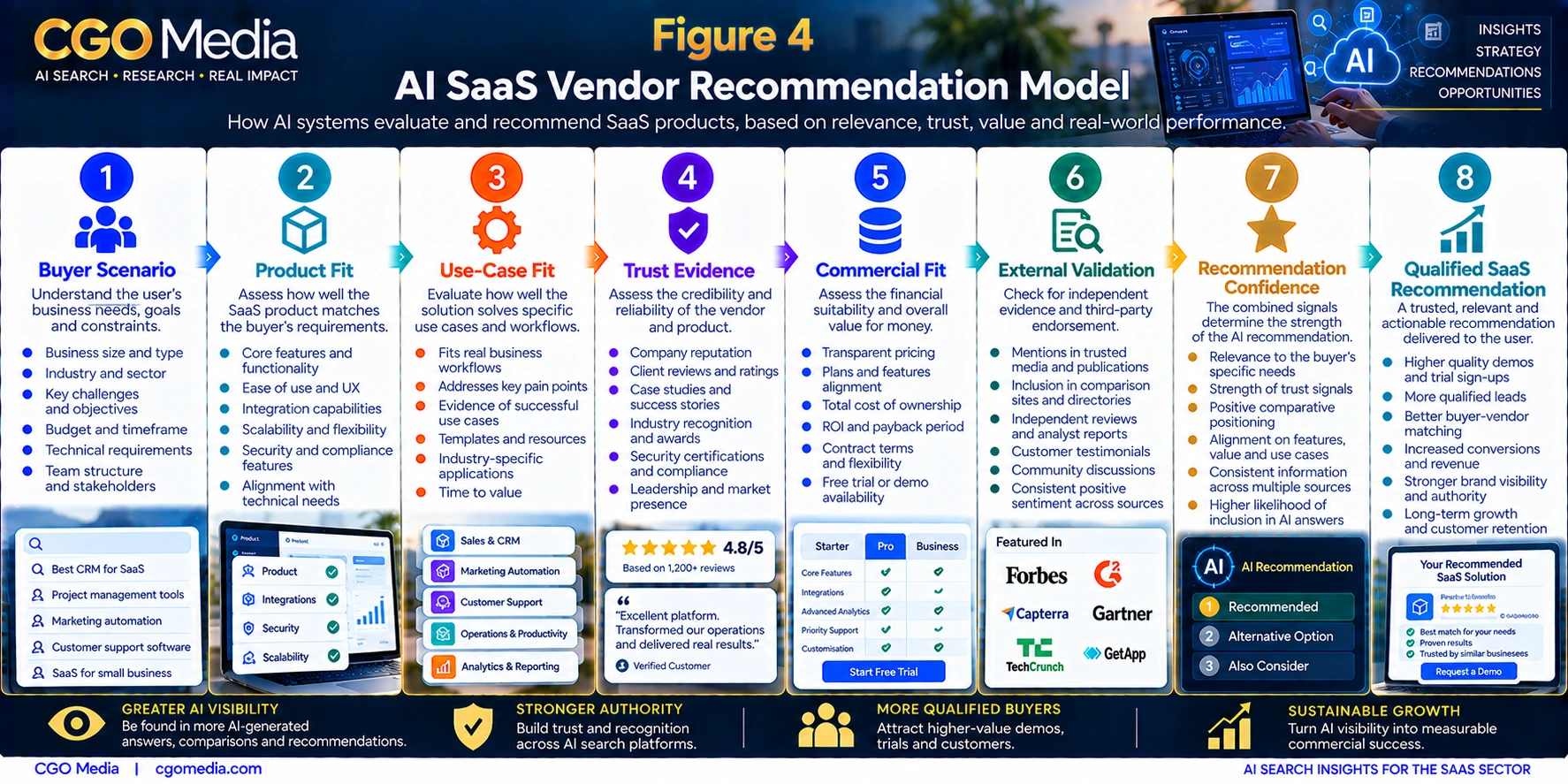
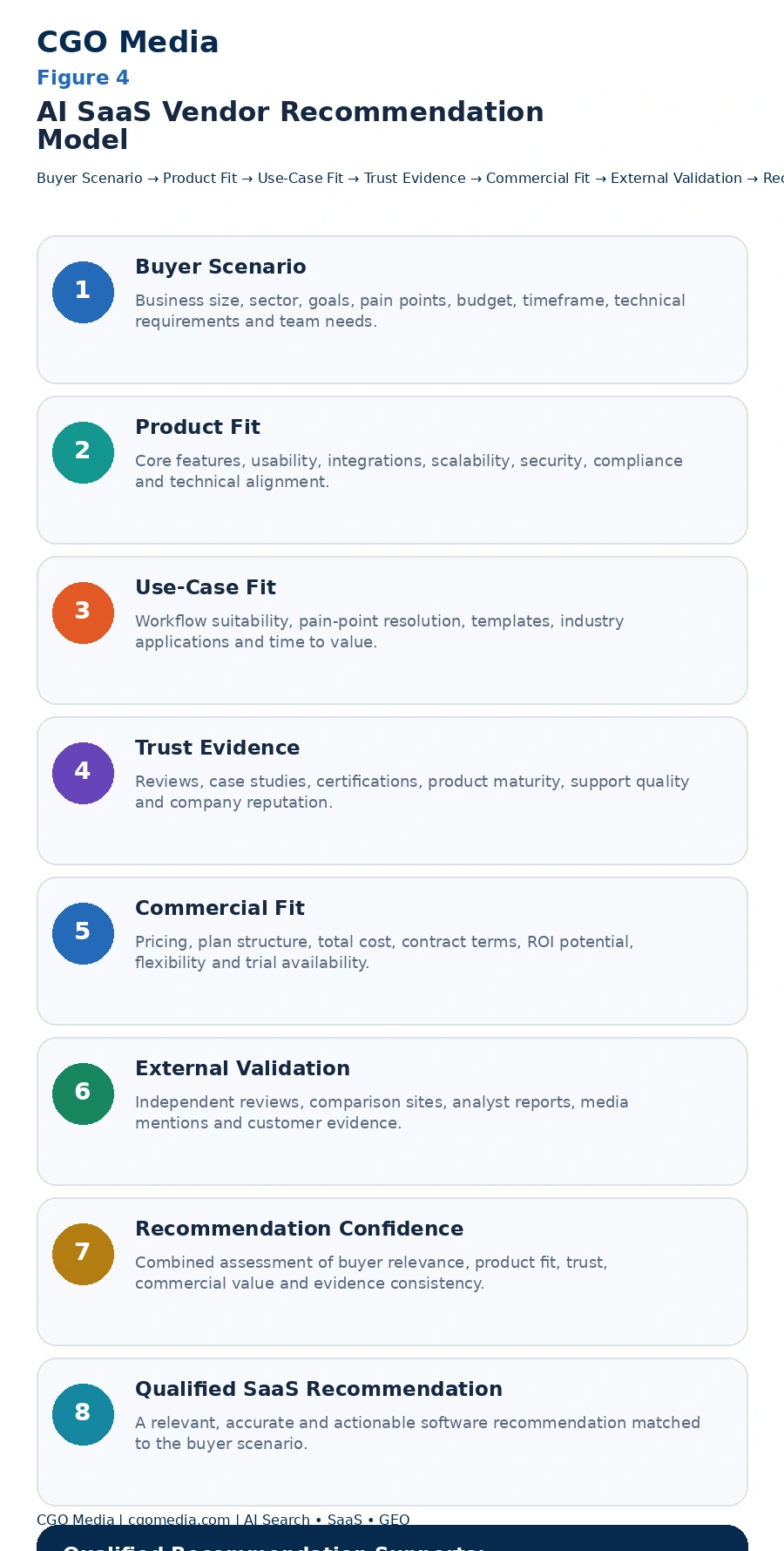
305. SaaS GEO Requires a Distinct Measurement Framework
Traditional SaaS SEO metrics such as rankings, organic traffic, trials, demos, qualified leads and revenue remain important, but they do not fully describe how software products, vendors and capabilities appear within generative discovery environments.
SaaS GEO measurement should therefore distinguish:
- Source Visibility
- Citation Visibility
- Entity & Product Accuracy
- Comparison Visibility
- Recommendation Visibility
The complete progression is:
Source Visibility → Citation Visibility → Entity & Product Accuracy → Comparison Visibility → Recommendation Visibility → Qualified GEO Performance
306. Source Visibility Is the First Measurement Layer
Source visibility measures whether product, technical, commercial, customer or research information contributes to AI-assisted software answers.
Relevant source types can include:
- Vendor websites
- Product pages
- Documentation
- Review platforms
- Industry publications
- Research
307. Direct and Indirect Source Visibility Should Be Distinguished
Direct source visibility occurs where a particular source is clearly surfaced or attributed.
Indirect source visibility may occur where software information appears to contribute to an answer without an explicit citation.
These represent different levels of observability and should not automatically be treated as equivalent.
308. Source Visibility Should Be Segmented
A SaaS source may perform strongly in one area and weakly in another.
Useful segmentation can include:
- Software category
- Buyer segment
- Capability
- Use case
- Industry
- Buyer journey stage
309. Buyer Journey Stage Matters
Source visibility can differ across:
- Category discovery
- Product research
- Comparison
- Technical validation
- Procurement
A source useful during early discovery may be less important during technical or commercial validation.
310. Citation Visibility Is the Second Measurement Layer
Citation visibility measures whether a SaaS vendor, product page, technical document, review source, publication or research source is explicitly referenced.
It should be measured separately from general source visibility.
311. Citation Share
A simple metric is:
Citation Share = Relevant Citation Appearances ÷ Relevant SaaS Scenarios Tested
This metric should always be interpreted within the context of the query and buyer scenario.
312. Citation Quality Matters More Than Raw Count
A useful SaaS citation should be:
- Relevant
- Accurate
- Current
- Useful
- Appropriate to the buyer context
A frequently cited but outdated product source can create more risk than value.
313. Record Citation Context
Useful monitoring fields can include:
- Source cited
- Claim supported
- Buyer scenario
- Product or category
- Information freshness
This makes citation analysis more actionable than simple volume tracking.
314. Citation Diversity Can Add Context
SaaS citations may come from:
- Official product sources
- Technical documentation
- Review platforms
- Industry publications
- Analyst sources
- Independent research
Different source types support different evidential functions.
315. Entity & Product Accuracy Is the Third Measurement Layer
This layer evaluates whether companies, products, features, integrations, pricing and use cases are represented correctly.
Visibility without factual accuracy should not be interpreted as strong GEO performance.
316. Company Accuracy
Company-level checks can include:
- Company name
- Product portfolio
- Ownership
- Markets served
- Official website
317. Product Accuracy
Product-level checks can include:
- Product name
- Software category
- Core capabilities
- Plan structure
- Operating status
318. Capability Accuracy
Capability accuracy should examine:
- Feature presence
- Feature depth
- Feature limitations
- Plan availability
- Workflow relevance
A product can be correctly identified while an individual feature claim remains materially wrong.
319. Integration Accuracy
Integration checks can include:
- Availability
- Integration type
- Ownership
- Setup requirements
- Current status
Deprecated or misunderstood integrations can create significant technical-selection risk.
320. Commercial Accuracy
Commercial checks can include:
- Pricing model
- Plan differences
- Usage limits
- Contract requirements
- Support costs
Commercial misinformation can materially alter product-selection decisions.
321. Product Accuracy and Buyer-Fit Accuracy Are Different
An AI system may identify the correct software product but misrepresent whether it is suitable for:
- An SME
- An enterprise buyer
- A regulated organisation
- A specialist workflow
Product truth and buyer suitability should therefore be assessed separately.
322. Observation-Level Accuracy Classification
Each material observation can be classified as:
- Accurate
- Partially accurate
- Materially inaccurate
- Unverifiable
Partial accuracy should not automatically be counted as full accuracy.
323. SaaS Accuracy Model
A useful relationship is:
Company Accuracy + Product Accuracy + Capability Accuracy + Commercial Accuracy
These components provide a more useful view than one generic accuracy metric.
324. Error Severity Should Be Weighted
Not every error has the same commercial or operational consequence.
A useful risk model is:
Severity + Persistence + Buyer Impact + Decision Importance → GEO Risk Priority
325. Severity and Persistence
Severity measures how materially wrong the information is.
Persistence measures whether the error repeats across observations or environments.
A recurring incorrect security or pricing claim should generally receive higher priority than a minor one-off wording issue.
326. Buyer Impact and Decision Importance
Priority should increase where an error can materially affect:
- Product selection
- Vendor evaluation
- Technical validation
- Procurement
Errors involving security, pricing, integrations, implementation or contract requirements can be particularly important.
327. Maintain a SaaS GEO Error Taxonomy
Useful categories include:
- Company error
- Product error
- Feature error
- Integration error
- Commercial error
- Recommendation error
This makes diagnosis and prioritisation more consistent.
328. Typical Company and Product Errors
Examples include:
- Wrong ownership
- Outdated portfolio
- Wrong category
- Retired product
- Old product name
- Incorrect product scope
329. Typical Feature and Integration Errors
Examples include:
- Unsupported feature
- Wrong plan availability
- Misrepresented capability depth
- Deprecated integration
- Incorrect technical compatibility
- Unsupported partner claim
330. Typical Commercial and Recommendation Errors
Examples include:
- Outdated pricing
- Wrong billing model
- Incorrect usage limit
- Irrelevant product inclusion
- Relevant product exclusion
- Unsuitable buyer recommendation
331. Comparison Visibility Is the Fourth Measurement Layer
Comparison visibility measures whether relevant software products and vendors enter active consideration sets.
This is distinct from final recommendation.
332. Product Comparison Share
A useful metric is:
Product Comparison Share = Relevant Product Comparison Appearances ÷ Relevant Product Comparison Scenarios Tested
333. Vendor and Use-Case Comparison Share
Additional metrics can include:
Vendor Comparison Share = Relevant Vendor Comparison Appearances ÷ Relevant Vendor Comparison Scenarios Tested
Use-Case Comparison Share = Relevant Product Appearances ÷ Relevant Use-Case Comparison Scenarios Tested
334. Comparison Share Is Not Recommendation Share
Entering the buyer’s consideration set is different from being selected as an appropriate recommendation.
These stages should remain separate within GEO reporting.
335. Product and Vendor Co-Occurrence
Frequently co-occurring products can reveal effective competitors across:
- Software categories
- Use cases
- Pricing positions
- Technical environments
Vendor co-occurrence can reveal competition for similar buyer segments, budgets and industries.
336. Comparison Reasoning Should Be Recorded
Products may be compared because of:
- Capability
- Ease of use
- Integrations
- Pricing
- Buyer suitability
Vendors may be compared because of:
- Market position
- Security
- Support
- Product portfolio
- Commercial model
337. Comparison Positioning Can Reveal Market Drift
A SaaS product can become associated with competitors or buyer scenarios that differ from its intended market position.
This can reveal:
- Unexpected opportunity
- Category drift
- Buyer misunderstanding
- Competitive repositioning
338. Recommendation Visibility Is the Fifth Measurement Layer
Recommendation visibility measures whether a product or vendor is positively selected for a relevant buyer scenario.
This is one of the highest-value GEO outcomes because it moves beyond presence into active suitability.
339. Recommendation Share
A simple metric is:
Recommendation Share = Relevant Recommendation Appearances ÷ Relevant SaaS Scenarios Tested
Recommendation share should be segmented rather than treated as one universal number.
340. Recommendation Share Should Be Segmented
Useful segmentation can include:
- Buyer segment
- Software category
- Use case
- Industry
- AI environment
341. Recommendation Share Must Be Interpreted with Fit
High recommendation visibility is not necessarily positive where products are repeatedly recommended to unsuitable buyers.
The four outcomes remain:
- Relevant Inclusion
- Irrelevant Inclusion
- Relevant Exclusion
- Appropriate Exclusion
342. Qualified Recommendation Share
A stronger metric is:
Qualified Recommendation Share = Relevant and Accurate SaaS Recommendations ÷ Relevant Scenarios Tested
This places recommendation quality ahead of raw frequency.
343. Qualified Recommendation Requires More Than Appearance
A recommendation should be:
- Relevant
- Accurate
- Current
- Buyer-appropriate
- Technically feasible
344. Buyer-Fit Accuracy
Recommendation quality should evaluate whether the software genuinely fits:
- Organisation size
- Industry
- Budget
- Technical maturity
- Implementation capacity
345. Product, Use-Case and Technical-Fit Accuracy
A product can belong to the correct category while still lacking sufficient:
- Capability depth
- Workflow fit
- Integration support
- Security fit
- Technical compatibility
These dimensions should therefore be evaluated independently where material.
346. Recommendation Reasoning Should Be Audited
Monitoring should record why a product, vendor or platform was recommended.
A correct product recommendation can still carry risk where the stated reason contains incorrect:
- Feature information
- Pricing
- Security information
- Integration claims
347. Reason Accuracy Classification
Recommendation reasoning can be classified as:
- Accurate
- Partially accurate
- Materially inaccurate
- Unclear
This separates outcome accuracy from explanation accuracy.
348. SaaS GEO Should Measure Stability Over Time
Visibility appearing once and disappearing immediately may have limited strategic significance.
A useful stability model is:
Presence Frequency + Representation Consistency + Comparison Consistency + Recommendation Consistency
349. Four SaaS GEO Stability States
- Stable and Accurate — repeatable visibility with reliable representation.
- Stable but Inaccurate — misinformation is being reinforced repeatedly.
- Unstable but Accurate — correct when visible but lacking persistence.
- Unstable and Inaccurate — weak consistency and weak accuracy.
Stable but inaccurate visibility should be treated as a significant risk, not a success.
350. SaaS GEO Diagnostic Workflow
A practical diagnostic cycle is:
Observe → Classify → Compare → Diagnose → Prioritise → Improve → Re-Test
351. Observe and Classify
Record the generated output, sources, products and comparison environment.
Classify the issue as primarily related to:
- Source
- Citation
- Product accuracy
- Commercial accuracy
- Recommendation
352. Compare and Diagnose
Compare the observed output with current:
- Product information
- Technical documentation
- Customer evidence
- Independent evidence
Then identify the most plausible root cause.
353. Common Root Causes
Problems can originate from:
- Outdated feature pages
- Weak use-case explanations
- Old API documentation
- Deprecated integrations
- Outdated security resources
- Old review profiles
- Incorrect third-party listings
- Unclear buyer positioning
354. Prioritise and Improve
Prioritisation should continue to use:
Severity + Persistence + Buyer Impact + Decision Importance
Improvement should target the underlying product, technical, commercial or source problem rather than the individual generated answer alone.
355. Re-Test Comparable Scenarios
Where possible, use the same or directly comparable scenario after intervention.
This improves confidence when assessing whether representation, citation or recommendation quality has changed.
356. Monitor Competitive Movement
Competitor visibility can change even where the organisation itself has not changed.
Important events can include:
- New entrants
- Acquisitions
- Product launches
- Category changes
- Repositioning
Longitudinal monitoring can help distinguish organisation-specific change from market-wide movement.
357. Monitor Strength and Weakness Attribution
Products may repeatedly become associated with strengths such as:
- Ease of use
- Automation
- Enterprise scale
- Integrations
- Value
They may also become associated with weaknesses such as:
- High price
- Complexity
- Limited integrations
- Weak support
- Feature gaps
358. Attribution Patterns Can Reveal Positioning Drift
AI-assisted perception can differ from intended product positioning.
This drift can be positive where a valuable new use case emerges, or problematic where the product becomes associated with buyers it cannot serve effectively.
359. Connect GEO Measurement with Traditional SEO
Useful comparative indicators can include:
- Organic visibility
- Product-page traffic
- Comparison-page traffic
- Branded search demand
SEO and GEO metrics should remain distinct because strong rankings do not guarantee strong AI citation or recommendation visibility.
360. Connect GEO Measurement with Lead and CRM Data
Where appropriate, compare GEO patterns with:
- Demo requests
- Trial starts
- Lead quality
- Buyer segment
- Use case
- Industry
- Deal stage
- Deal value
CRM evidence can help test whether observed AI positioning aligns with actual market demand.
361. Commercial Attribution Should Remain Cautious
Software buyers may interact with:
- Search engines
- AI assistants
- Review sites
- Analyst sources
- Sales teams
before purchasing.
GEO should therefore be treated as one influence within a wider buyer journey rather than automatically receiving full attribution.
362. Leading and Lagging GEO Indicators
Leading indicators can include:
- Source visibility
- Citation visibility
- Product accuracy
- Comparison inclusion
- Recommendation inclusion
Lagging indicators can include:
- Qualified leads
- Trial conversion
- Demo conversion
- Pipeline value
- Customer acquisition
Improved visibility should not be assumed to produce immediate commercial outcomes.
363. Executive SaaS GEO Scorecard
A concise executive scorecard can include:
- Source Visibility
- Citation Share
- Entity & Product Accuracy
- Comparison Share
- Recommendation Share
- Critical GEO Risk
The scorecard should highlight the primary constraint rather than maximise metric volume.
364. Avoid GEO Vanity Metrics
High mention volume without buyer relevance or factual accuracy can be misleading.
Similarly:
- Raw citation count can ignore citation quality.
- Raw recommendation count can ignore buyer fit.
- Raw visibility can ignore incorrect product representation.
365. Qualified GEO Performance Is the Better Objective
A useful conceptual model is:
Relevant Buyer Presence + Accurate Product Representation + Strong Trust Evidence + Appropriate Recommendation
This places buyer and decision quality ahead of raw generative visibility.
366. Qualified Performance Should Be Segmented
Performance can differ materially across:
- Software categories
- Buyer segments
- Use cases
- Industries
- Technical environments
One blended GEO metric can conceal these differences.
367. Qualified Performance Should Be Longitudinal
The objective is stable and accurate visibility rather than isolated success.
Monitoring processes should therefore document:
- Scenario
- AI environment
- Date
- Observed sources
- Observed output
368. Control Scenario Libraries
Scenario-library changes should be recorded so longitudinal comparison remains interpretable.
Major product changes should also be logged, including:
- Feature launches
- Pricing changes
- Rebranding
- Integration changes
- Product packaging changes
369. Record AI Environment Changes
Significant model, platform or retrieval changes can affect observed behaviour.
These changes should be considered when interpreting sudden movement in:
- Sources
- Citations
- Comparisons
- Recommendations
370. Measurement Should Produce Decisions
The purpose of SaaS GEO measurement is not to create dashboards for their own sake.
Measurement should answer questions such as:
- Which product needs stronger authority?
- Which capability is being misrepresented?
- Which buyer segment lacks visibility?
- Which sources are being cited?
- Which scenarios show relevant exclusion?
371. Measurement Should Feed Improvement
A useful relationship is:
Measurement → Diagnosis → Prioritisation → Intervention → Re-Test
This creates a direct connection between observation and authority improvement.
372. SaaS GEO Measurement Principle
Source visibility, citation visibility, entity and product accuracy, comparison visibility and recommendation visibility should be measured separately because each represents a different stage of AI-assisted software discovery.
373. Qualified Outcome Principle
SaaS GEO performance should be evaluated through qualified outcomes rather than raw mention, citation or recommendation volume.
Buyer relevance, product fit, technical accuracy, commercial suitability and recommendation quality should all contribute to interpretation.
374. Longitudinal and Risk-Weighted Measurement Principle
Measurement should distinguish persistent high-impact misinformation and recommendation errors from ordinary generative variability.
It should also track changes in:
- Competitor sets
- Citation patterns
- Product associations
- Technical information
over time.
375. Commercial Integration Principle
SaaS GEO measurement can be connected with:
- Traditional SEO
- CRM intelligence
- Product analytics
- Sales data
- Customer behaviour
without overstating causal attribution.
376. The SaaS GEO Measurement Framework
The complete relationship is:
Source Visibility → Citation Visibility → Entity & Product Accuracy → Comparison Visibility → Recommendation Visibility → Qualified GEO Performance
377. Strategic Implication
SaaS companies should build repeatable GEO measurement systems that distinguish source, citation, accuracy, comparison and recommendation outcomes.
Performance should be evaluated by:
- Category
- Buyer segment
- Use case
- Industry
- AI environment
The highest priority should be given to persistent errors involving features, pricing, integrations, security information or buyer suitability where misinformation could materially affect software purchasing decisions.
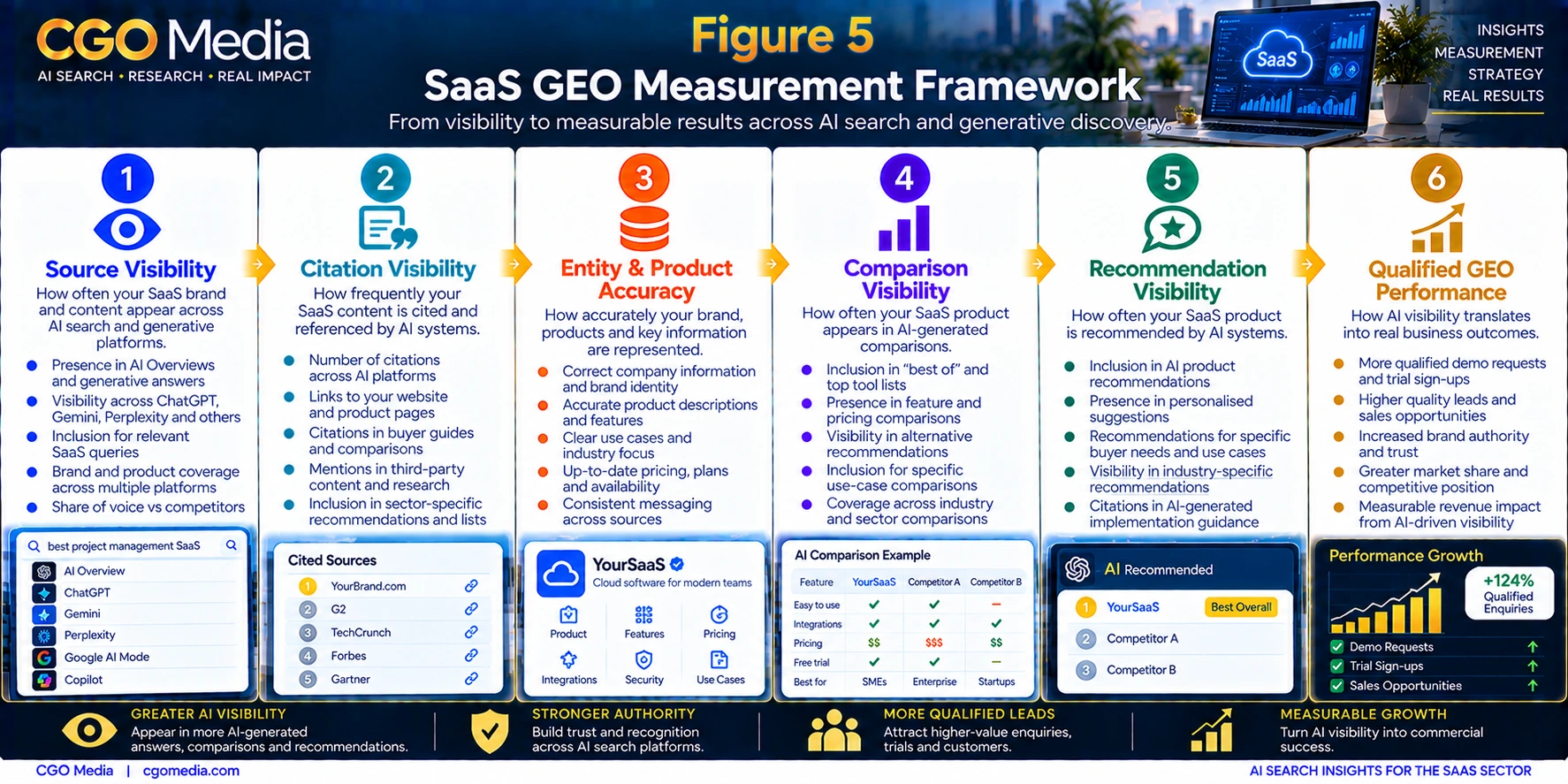
378. SaaS GEO Should Operate as a Continuous Improvement System
Products, pricing, integrations, buyer needs, competitors and AI-assisted discovery environments change continuously.
SaaS GEO should therefore operate as an ongoing authority and information-management capability rather than a one-time optimisation project.
379. Product Information Changes Continuously
Important changes can include:
- New features
- Deprecated features
- Plan restructuring
- Product rebranding
- Changed limitations
Each can affect how the product should be discovered, compared and recommended.
380. Technical and Commercial Information Also Changes
Technical change can involve:
- APIs
- Integrations
- Authentication
- SDKs
- Technical requirements
Commercial change can involve:
- Pricing
- Usage limits
- Contract terms
- Minimum commitments
- Support packages
381. Buyer Demand Changes
Demand can shift because of:
- Technology trends
- Economic conditions
- Regulation
- New workflows
- Category evolution
Scenario libraries should therefore evolve alongside the market.
382. AI-Assisted Discovery Can Change Independently
Generative systems can change:
- Source selection
- Citation patterns
- Comparison sets
- Recommendation behaviour
A change in AI visibility does not necessarily mean the underlying product changed.
383. Continuous Observation Comes First
SaaS organisations should repeatedly monitor:
- Source visibility
- Citation visibility
- Product accuracy
- Comparison visibility
- Recommendation visibility
Observation creates the evidence required for diagnosis.
384. Use Stable Scenario Libraries
A stable core scenario set makes longitudinal comparison more meaningful.
Useful segmentation includes:
- Buyer segment
- Software category
- Use case
- Industry
- Buyer journey stage
385. Scenarios Should Reflect Real Buyer Needs
Scenario variables can include:
- Organisation size
- Budget
- Required capability
- Integration environment
- Security requirements
- Implementation capacity
This creates more commercially meaningful monitoring than generic prompt testing.
386. Distinguish Normal Variation from Structural Change
One unusual generated answer should not automatically trigger major intervention.
Structural change becomes more plausible where the same issue persists across:
- Repeated observations
- Comparable scenarios
- Multiple AI environments
387. Persistent Change Deserves Investigation
Examples include:
- Repeated product inaccuracy
- Persistent pricing misinformation
- Loss of citation visibility
- Relevant product exclusion
- Changing recommendation patterns
388. Diagnose Before Reacting
The organisation should identify the likely root cause before making material changes.
Problems can be classified as:
- Product issue
- Technical issue
- Commercial issue
- Source issue
- Recommendation issue
389. Product Information Can Be the Root Cause
Common weaknesses include:
- Outdated feature pages
- Weak use-case explanation
- Old plan descriptions
- Missing product limitations
390. Technical Documentation Can Be the Root Cause
Examples include:
- Old API documentation
- Deprecated integration pages
- Weak implementation guidance
- Outdated security information
391. External Sources Can Be the Root Cause
Problems can originate from:
- Old review profiles
- Outdated comparison content
- Historic product descriptions
- Incorrect software directories
392. Commercial Data Can Be the Root Cause
Examples include:
- Old pricing
- Wrong usage limits
- Incorrect contract assumptions
- Outdated support models
393. Prioritisation Should Be Risk-Based
A useful relationship is:
Severity + Persistence + Buyer Impact + Decision Importance → GEO Priority
Not every observed issue deserves the same response.
394. Severity and Persistence
Severity distinguishes minor wording problems from material errors involving:
- Unsupported features
- Incorrect pricing
- Deprecated integrations
- False security claims
Persistence determines whether the problem repeats sufficiently to create structural risk.
395. Buyer Impact and Decision Importance
Priority should increase where misinformation can affect:
- Product selection
- Vendor evaluation
- Technical validation
- Procurement
Security, pricing, integrations, implementation and contract terms can carry particularly high decision importance.
396. Improvement Should Target Root Causes
The objective should be to strengthen the underlying:
- Product evidence
- Technical evidence
- Commercial information
- Customer evidence
- External authority
rather than attempting to alter one generated answer in isolation.
397. Product-Level Improvements
Improvements can include:
- Clearer feature descriptions
- Better use-case mapping
- Explicit limitations
- Updated plan information
- Improved comparison content
398. Technical-Level Improvements
Improvements can include:
- Current API documentation
- Accurate integration pages
- Security documentation
- Implementation guides
- Technical architecture content
399. Customer and Research Improvements
Customer evidence can be strengthened through:
- Better case studies
- Segment-specific proof
- Implementation evidence
- Customer references
Research improvements can include buyer studies, adoption research, implementation analysis and technology-trend research.
400. External Authority Improvements
Digital PR and external authority activity can support:
- Technology-media citations
- Industry coverage
- Research references
- Expert commentary
External authority should reinforce genuine product and research evidence.
401. Validate After Intervention
After strengthening the evidence environment, the organisation should re-test the same or equivalent scenarios.
Where possible, preserve:
- Scenario wording
- Buyer type
- Software category
- Use-case requirements
- Technical constraints
402. The Core SaaS GEO Operating Cycle
A practical operating relationship is:
Observe → Diagnose → Prioritise → Strengthen → Validate → Learn → Adapt
403. Observe
Monitor products, sources, citations, comparisons and recommendations across strategically important scenarios.
404. Diagnose
Identify the most plausible root cause of significant representation, source or recommendation changes.
405. Prioritise
Focus first on issues with the greatest:
- Buyer impact
- Commercial significance
- Technical significance
- Risk
406. Strengthen
Improve the relevant:
- Product evidence
- Documentation
- Customer proof
- Research
- External authority
407. Validate
Re-test and compare the new observation against the previous baseline.
408. Learn
Record what changed, which intervention was made and whether the result improved.
This converts GEO activity into organisational knowledge.
409. Adapt
Update:
- Monitoring standards
- Scenario libraries
- Governance
- Evidence priorities
according to what has been learned.
410. SaaS GEO Governance Should Be Cross-Functional
A useful governance model is:
SEO + Marketing + Product + Engineering + Sales + Customer Success + Research + Digital PR
No single function controls every variable affecting SaaS GEO.
411. Product and Engineering Have Critical Governance Roles
Product teams can validate:
- Features
- Product positioning
- Plan information
- Limitations
Engineering can validate APIs, integrations, technical architecture and implementation requirements.
412. Sales and Customer Success Validate Market Reality
Sales can contribute:
- Buyer objections
- Comparison patterns
- Procurement requirements
- Commercial constraints
Customer success can contribute implementation, adoption, product-fit and retention evidence.
413. Research and Digital PR Support External Authority
Research teams can contribute:
- Original studies
- Buyer surveys
- Market analysis
- Research integrity
Digital PR can distribute credible findings and expert commentary into relevant external environments.
414. Governance Should Define Evidence Ownership
The organisation should know who owns:
- Product information
- Technical documentation
- Pricing
- Integration accuracy
- Security documentation
- Research updates
Without ownership, evidence decay becomes more likely.
415. Review Frequency Should Match Volatility
A useful relationship is:
Information Volatility + Buyer Impact + Decision Importance → Review Frequency
Pricing, features, integrations, usage limits and packaging generally require more frequent review than company history or long-term positioning.
416. Escalation Procedures Are Necessary
Critical issues should move beyond routine content maintenance.
Examples include:
- False security claims
- Unsupported features
- Deprecated integrations
- Incorrect pricing
- Wrong product identity
417. SaaS GEO Should Include Recovery Capability
Not every misinformation event can be prevented.
A useful recovery cycle is:
Detect → Verify → Diagnose → Correct → Re-Test → Learn
418. Recovery Speed Can Be Measured
Useful measures can include:
- Time to detect
- Time to verify
- Time to correct
- Time to validate
Faster recovery can reduce the period during which inaccurate information remains decision-relevant.
419. SaaS GEO Should Include Experimentation
Some interventions should be tested rather than assumed to work.
A useful hypothesis is:
Improved product clarity + stronger documentation + better customer evidence + stronger external authority → improved qualified SaaS GEO visibility
420. Establish an Experimental Baseline
Before a material intervention, record current:
- Source visibility
- Citation visibility
- Product accuracy
- Comparison inclusion
- Recommendation quality
421. Define the Intervention
Experiments can involve:
- Expanded product pages
- Improved use-case content
- New technical documentation
- Original SaaS research
- Digital PR
422. Define Success Criteria
Success can include:
- Improved source visibility
- Improved citation visibility
- Higher product accuracy
- More relevant comparison inclusion
- More qualified recommendations
Observation windows should be long enough to distinguish persistent change from short-term generative variation.
423. Connect SaaS GEO with Traditional SEO
SaaS SEO supports GEO through strong:
- Product pages
- Information architecture
- Documentation
- Internal linking
- Search discoverability
GEO extends this by analysing sources, citations, representation, comparisons and recommendations.
424. Connect SaaS GEO with Product Analytics
Product analytics can reveal:
- Feature adoption
- Workflow patterns
- User roles
- Retention
- Product depth
This can make GEO scenarios more representative of real product use.
425. Product Analytics Can Reveal Fit Problems
Repeated low adoption can indicate:
- Feature mismatch
- Buyer mismatch
- Implementation problems
- Product complexity
These signals can help distinguish a visibility problem from a genuine product-fit problem.
426. Integrate Sales Intelligence
Sales data can reveal:
- High-demand use cases
- Priority buyer segments
- Common comparison products
- Recurring objections
- Budget ranges
It can also identify selection drivers such as feature depth, integration, security, price and implementation speed.
427. Integrate Customer Success Intelligence
Customer success can reveal:
- Implementation friction
- Adoption problems
- Strong use cases
- Renewal drivers
- Product limitations
These outcomes can validate whether AI-assisted positioning aligns with successful real-world use.
428. Integrate Research and Review Intelligence
Original research can strengthen both source authority and product positioning.
Review intelligence can reveal recurring themes around:
- Ease of use
- Support
- Implementation
- Pricing
- Feature limitations
Reviews should not be treated as a complete measure of product quality.
429. Integrate Digital PR
Digital PR can strengthen external authority through:
- Original research
- Technology commentary
- Buyer data
- Software trend insight
The objective should be relevant external authority rather than generic mention volume.
430. Scaling SaaS GEO Should Be Strategic
Large software companies may operate across many:
- Products
- Categories
- Use cases
- Customer segments
Scaling should begin with priority areas rather than attempting equal coverage everywhere.
431. Prioritise Products, Categories and Buyers
Priority can reflect:
- Revenue importance
- Strategic value
- Growth potential
- Competitive opportunity
- Market importance
Monitoring can then focus on the buyer segments and use cases most important to growth.
432. International SaaS GEO Requires Market-Specific Analysis
Software discovery can differ significantly by country, language and commercial market.
Relevant market factors include:
- Language
- Currency
- Data residency
- Regulation
- Local integrations
433. Preserve Product Identity Across Markets
The same:
- Company
- Product
- Category
- Feature
- Integration
should remain clearly identifiable across language and regional versions while commercial and compliance context is localised appropriately.
434. SaaS GEO Should Build Organisational Learning
Repeated observation should improve:
- Product content
- Technical documentation
- Buyer positioning
- Research
- Sales intelligence
GEO becomes more valuable when findings change the organisation’s knowledge systems.
435. Preserve Organisational Memory
Useful systems include:
- Scenario libraries
- Error logs
- Source maps
- Product entity maps
- Experiment records
- SaaS GEO playbooks
These reduce repeated rediscovery of the same problems.
436. Product Entity Maps and Source Maps
Product entity maps can document:
Company → Product → Category → Feature → Integration → Buyer Segment
Source maps can identify the strongest evidence source for:
- Product facts
- Technical facts
- Pricing
- Customer evidence
- Research
437. Error and Experiment Logs Reveal Systemic Weakness
Repeated errors can reveal weaknesses in:
- Data governance
- Documentation
- Content architecture
- External profiles
Experiment records can show which interventions improved visibility, accuracy or qualified recommendation.
438. Adaptive SaaS GEO Is the Long-Term Goal
SaaS companies should be able to respond as:
- Products change
- Categories change
- Buyer needs change
- Technical environments change
- AI systems change
439. Adaptive GEO Does Not Mean Constant Tactical Reaction
Stable strategic principles should remain, including:
- Clear product identity
- Clear category identity
- Accurate software information
- Strong technical evidence
- Source authority
- Buyer fit
Tactics can evolve around these stable principles.
440. Adaptive SaaS GEO Should Be Evidence-Led and Risk-Aware
Changes should respond to observed product, buyer and market patterns rather than speculation.
High-impact product, security and commercial misinformation should receive greater priority than minor visibility fluctuations.
441. Adaptive SaaS GEO Should Be Strategically Relevant
Monitoring should focus on:
- Priority products
- Priority categories
- Priority buyer segments
- High-value use cases
This keeps GEO aligned with commercial strategy.
442. Adaptive SaaS GEO Should Integrate Multiple Intelligence Sources
A useful relationship is:
Search Intelligence + AI Discovery Intelligence + Product Intelligence + Sales Intelligence + Customer Intelligence + Research Intelligence
Combined intelligence can reveal:
- Which products need stronger authority
- Which capabilities require clearer evidence
- Which buyer segments lack visibility
- Which software topics offer citation potential
- Which recommendation scenarios deserve priority
443. Strategic SaaS GEO Priorities
A mature SaaS GEO programme should prioritise:
- Realistic buyer scenario libraries
- Canonical product records
- Canonical technical records
- Clear product and technical evidence
- Original SaaS research
- Citation-ready assets
- Product and technical accuracy monitoring
- Qualified recommendation monitoring
- Recovery capability
- Adaptive governance
444. Canonical Product and Technical Records
Core product records should keep:
- Product identity
- Company identity
- Category
- Capabilities
- Pricing model
- Integrations
consistent.
Technical records should keep APIs, authentication, security, integration status and technical limitations current.
445. Strengthen Product and Technical Clarity
Explain clearly:
- Which buyers the product serves
- Which use cases it supports
- Which workflows it fits
- Which integrations it provides
- Which technical limitations apply
Clarity reduces ambiguity across both human and AI-assisted evaluation.
446. Build Original Research and Citation-Ready Assets
Useful SaaS research can include:
- Buyer studies
- Software-adoption research
- Implementation studies
- Technology-trend research
Publications should be clearly attributed, methodologically transparent and reviewed for continuing relevance.
447. Monitor Product and Technical Accuracy Continuously
Product monitoring should cover:
- Category
- Features
- Pricing
- Integrations
- Product status
Technical monitoring should cover:
- APIs
- Security
- Authentication
- Implementation
- Technical limitations
448. Build Recovery and Experimentation Capability
Persistent:
- Product inaccuracies
- Pricing misinformation
- Citation errors
- Relevant exclusions
- Recommendation weaknesses
should be diagnosed, corrected, re-tested and converted into organisational learning.
449. Four Final SaaS GEO Principles
Continuous Improvement: products, features, integrations, pricing, buyer demand and AI discovery patterns all change over time.
Cross-Functional Governance: SEO, marketing, product, engineering, sales, customer success, research and Digital PR should remain coordinated.
Recovery and Experimentation: important inaccuracies and exclusions should be investigated and tested systematically.
Adaptive GEO: stable principles around product accuracy, technical evidence, source authority, citation quality, trust and buyer fit should remain constant while tactics evolve.
450. The Continuous SaaS GEO Cycle
The complete operational cycle is:
Observe → Diagnose → Prioritise → Strengthen → Validate → Learn → Adapt
451. The Long-Term SaaS GEO System
The wider relationship is:
Clear Company Entity → Clear Product Identity → Accurate Product Evidence → Strong Technical Trust → Source Authority → Citation Visibility → Comparison Visibility → Recommendation Confidence → Qualified GEO Visibility → Organisational Learning
452. Strategic Implication
SaaS companies should operate Generative Engine Optimisation as a continuous, evidence-led and cross-functional capability.
They should repeatedly monitor how:
- Companies
- Products
- Features
- Integrations
- Pricing
- Recommendations
are represented, strengthen the underlying product and technical evidence environment, validate material changes and adapt as buyer needs, software categories, product functionality and generative discovery systems evolve.
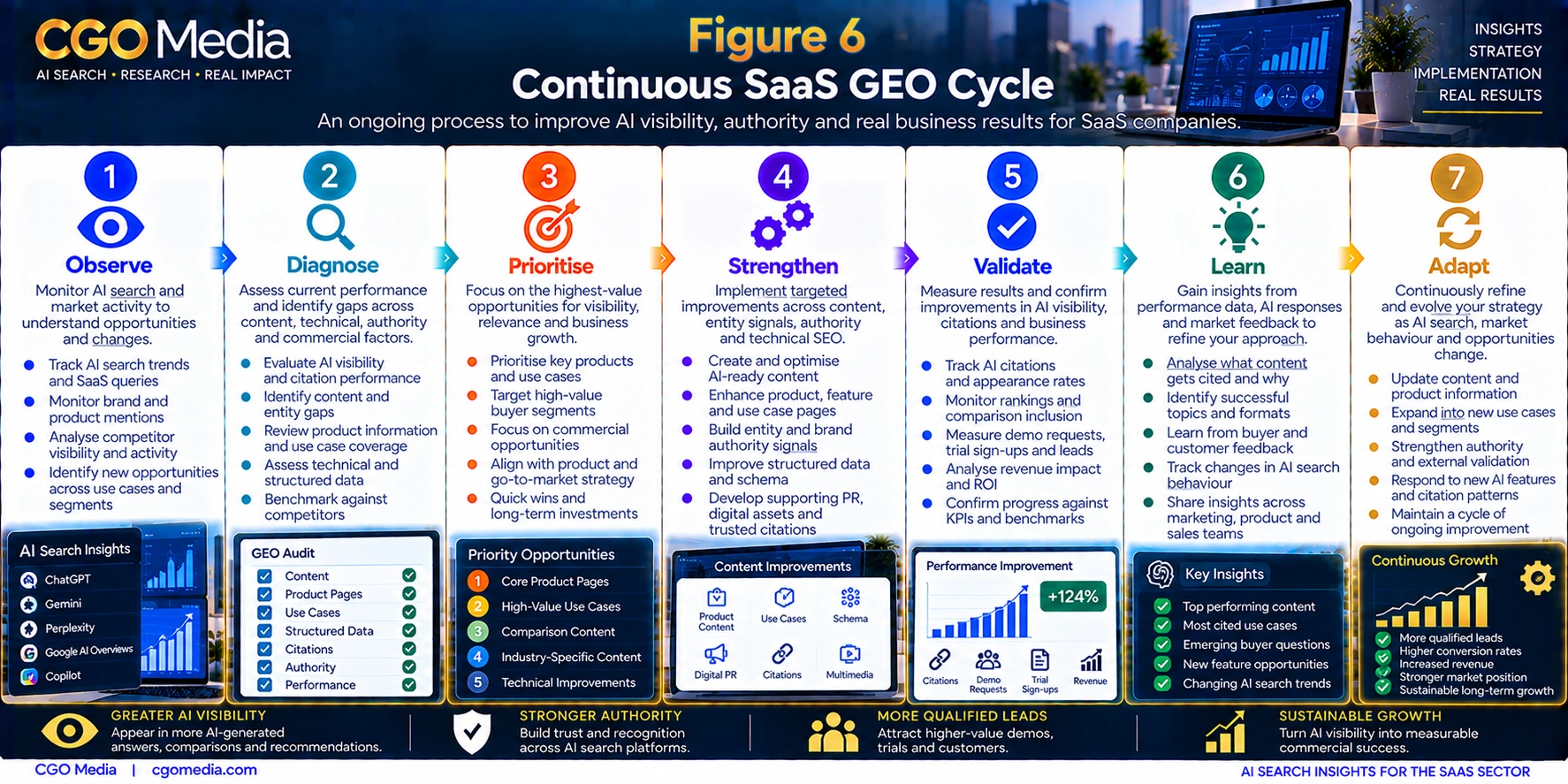
453. Methodology
SaaS GEO: Generative Engine Optimisation for AI Software Discovery, Vendor Selection and Recommendation Systems is a conceptual research framework developed by CGO Media to examine how software companies can strengthen product clarity, technical authority, citation eligibility, comparison visibility and recommendation confidence across generative search and AI-assisted software discovery environments.
The framework addresses a central question:
How can SaaS companies increase the probability that their products, capabilities, technical evidence and commercial positioning are accurately understood, appropriately cited, meaningfully compared and responsibly recommended?
454. Framework Scope
The methodology can be applied to:
- SaaS companies
- Cloud-software vendors
- Enterprise software providers
- Vertical SaaS businesses
- Developer platforms
- Software marketplaces
- Product-led growth companies
The framework treats GEO as a discovery and evidence system rather than an attempt to influence individual generated answers.
455. Core SaaS GEO System
The framework examines the interaction between:
- Company clarity
- Product clarity
- Capability clarity
- Technical evidence
- Buyer trust
- Source authority
- Citation eligibility
- Comparison visibility
- Recommendation confidence
The core progression is:
Entity Clarity → Product Relevance → Trust Evidence → Source Authority → Citation Eligibility → Buyer Fit → Recommendation Confidence → GEO Visibility
456. Entity and Product Method
Analysis begins by identifying the principal software-discovery relationships:
Company → Product → Category → Capability → Integration → Use Case → Buyer Need
Company and product analysis can examine:
- Product identity
- Software category
- Core capabilities
- Pricing model
- Integrations
- Operating status
- Customer segments
457. Product and Use-Case Method
Product relevance can be assessed through observable evidence including:
- Features
- Documentation
- Integration support
- Use cases
- Customer evidence
- Independent analysis
A useful suitability relationship is:
Buyer Need + Required Capability + Product Functionality + Technical Compatibility → Product Suitability
458. Technical Compatibility Method
Technical fit can consider:
- APIs
- Integrations
- Authentication
- Data architecture
- Security requirements
- Implementation requirements
This helps distinguish broad product relevance from actual implementation suitability.
459. SaaS Source Method
Sources are evaluated according to their evidential role.
Official Product Sources
These can include product pages, pricing pages, release notes, use-case pages and integration directories.
Technical Sources
These can include developer documentation, API documentation, security resources and implementation guides.
Independent Sources
These can include software review platforms, technology publications, analyst sources, comparison platforms and independent research.
460. Customer Evidence Method
Customer evidence can include:
- Reviews
- Case studies
- Reference customers
- Implementation evidence
- Customer-success research
Customer context should remain visible because outcomes can vary by company size, industry, use case and implementation conditions.
461. Generative Source Selection Method
The framework conceptualises source selection as:
Software Query → Candidate Sources → Product Relevance → Authority → Evidence Convergence → Source Selection
Confidence can increase where appropriate evidence materially agrees:
Product Evidence + Technical Evidence + Customer Evidence + Independent Evidence → SaaS Confidence
462. Source Conflict and Evidence-Gap Method
Material disagreement can be tracked across:
- Feature availability
- Pricing
- Integration support
- Product identity
- Buyer suitability
Evidence gaps can be analysed through:
Software Question → Required Evidence → Best Source → Existing Source → Evidence Gap
463. Citation Method
The framework conceptualises citation eligibility through:
Relevance + Product Clarity + Evidence + Authority + Freshness → Citation Eligibility
Citation analysis can record:
- Source cited
- Claim supported
- Buyer context
- Evidence type
- Accuracy
- Freshness
Citation authority can develop through:
Citable SaaS Source → Repeated Citation → Wider Recognition → Citation Authority
464. SaaS Research Method
Where original SaaS research is published, methodology should define:
- Research question
- Market
- Dataset
- Sample
- Measurement period
- Definitions
- Limitations
Buyer surveys and market research should remain distinguishable from product-usage data, reviews, case studies, analyst opinion and commercial recommendations.
465. Buyer Scenario Method
GEO monitoring should use realistic buyer scenarios incorporating variables such as:
- Organisation size
- Industry
- Business problem
- Budget
- Technical environment
- Implementation capacity
This produces more meaningful measurement than generic software prompts.
466. Recommendation Method
The core recommendation relationship is:
Buyer Scenario → Product Fit → Use-Case Fit → Trust Evidence → Commercial Fit → External Validation → Recommendation Confidence
A stronger qualified outcome is:
Relevant Buyer Scenario + Product Fit + Use-Case Fit + Strong Trust Evidence + Commercial Fit → Qualified SaaS Recommendation
467. Recommendation Outcome Method
The framework distinguishes four outcomes:
- Relevant Inclusion
- Irrelevant Inclusion
- Relevant Exclusion
- Appropriate Exclusion
This prevents maximum recommendation frequency from being treated automatically as success.
468. SaaS GEO Measurement Method
The framework separates five measurement layers:
- Source Visibility
- Citation Visibility
- Entity & Product Accuracy
- Comparison Visibility
- Recommendation Visibility
The full progression is:
Source Visibility → Citation Visibility → Entity & Product Accuracy → Comparison Visibility → Recommendation Visibility → Qualified GEO Performance
469. Core GEO Metrics
Useful measures include:
Citation Share = Relevant Citation Appearances ÷ Relevant SaaS Scenarios Tested
Product Comparison Share = Relevant Product Comparison Appearances ÷ Relevant Product Comparison Scenarios Tested
Vendor Comparison Share = Relevant Vendor Comparison Appearances ÷ Relevant Vendor Comparison Scenarios Tested
Recommendation Share = Relevant Recommendation Appearances ÷ Relevant SaaS Scenarios Tested
Qualified Recommendation Share = Relevant and Accurate SaaS Recommendations ÷ Relevant Scenarios Tested
470. Risk and Stability Method
Material issues can be prioritised through:
Severity + Persistence + Buyer Impact + Decision Importance
Visibility stability can be interpreted through:
Presence Frequency + Representation Consistency + Comparison Consistency + Recommendation Consistency
This creates four broad states:
- Stable and accurate
- Stable but inaccurate
- Unstable but accurate
- Unstable and inaccurate
471. Continuous Improvement Method
The operational cycle is:
Observe → Diagnose → Prioritise → Strengthen → Validate → Learn → Adapt
Where material misinformation is detected, a recovery cycle can be:
Detect → Verify → Diagnose → Correct → Re-Test → Learn
472. Governance Method
SaaS GEO should operate across:
SEO + Marketing + Product + Engineering + Sales + Customer Success + Research + Digital PR
Cross-functional governance is necessary because product information, technical evidence, customer experience, commercial data and external authority are controlled by different teams.
473. Limitations
The SaaS GEO framework does not describe or reproduce proprietary retrieval, ranking, citation or recommendation systems operated by individual AI, search, software-review or technology providers.
It is a conceptual research framework for analysing observable evidence and outcomes.
474. Generative Systems Are Only Partially Observable
External researchers cannot directly observe every internal:
- Retrieval decision
- Source-selection process
- Ranking process
- Entity-resolution process
- Recommendation calculation
Observed outputs should therefore not be presented as direct evidence of proprietary internal mechanisms.
475. Citation Does Not Establish Complete Causality
The presence of a cited source does not prove that every statement within a generated answer originated from that source.
Citation analysis should therefore distinguish observable attribution from assumptions about hidden generation processes.
476. AI Outputs Can Vary
Variation can occur according to:
- Model
- Prompt wording
- Conversation context
- Date
- User context
- Available source environment
Single outputs should not be treated as permanent evidence of software visibility or recommendation behaviour.
477. Longitudinal Observation Reduces but Does Not Remove Uncertainty
Repeated testing can reveal useful patterns in:
- Sources
- Citations
- Product representation
- Comparisons
- Recommendations
but cannot reveal every internal decision made by generative systems.
478. SaaS Information Is Highly Volatile
Software evidence can become outdated through:
- Feature launches or retirement
- Pricing changes
- Integration changes
- Product rebranding
- Plan restructuring
Current verification is therefore particularly important for decision-critical facts.
479. Reviews and Case Studies Are Imperfect Evidence
Reviews can be subjective, selective, outdated and buyer-segment dependent.
Case studies are also selective and do not establish that identical outcomes will occur across different industries, team sizes, workflows or implementation conditions.
Both should be interpreted alongside other evidence.
480. Vendor Marketing Is Not Independent Evaluation
Self-published claims about being the:
- Best
- Fastest
- Most secure
- Easiest
product require appropriate evidence and buyer context.
First-party product facts remain valuable, but promotional interpretation should remain distinguishable from independent evaluation.
481. Absence of Public Evidence Does Not Prove Poor Product Quality
A provider may possess strong internal capabilities without publishing extensive external evidence.
However, limited observable product, technical or customer evidence can reduce external recommendation confidence because those capabilities are harder to verify.
482. Software Recommendations Are Contextual
Suitability can depend on:
- Organisation size
- Industry
- Budget
- Technical environment
- Security requirements
- Implementation capability
Procurement decisions should therefore verify current product functionality, commercial terms, security, integrations and contractual requirements directly.
483. High Visibility Does Not Equal High GEO Quality
A SaaS product can receive significant generative visibility while being:
- Represented inaccurately
- Cited from weak evidence
- Compared inappropriately
- Recommended to unsuitable buyers
Qualified visibility is a stronger objective than raw exposure.
484. Commercial Attribution Has Limits
Software buyers may interact with search engines, AI assistants, review platforms, industry publications, peer recommendations and sales teams before purchasing.
Improved generative visibility should therefore not automatically be claimed as the direct cause of:
- Pipeline
- Customer acquisition
- Revenue
485. SaaS GEO Does Not Replace SaaS SEO
Traditional search remains a major software-discovery environment.
GEO extends measurement into:
- Generative source selection
- Citation visibility
- Product and technical accuracy
- Comparison visibility
- Recommendation quality
The two disciplines should therefore operate as connected rather than competing systems.
486. GEO Techniques Will Continue to Evolve
Specific AI platforms, retrieval systems and discovery interfaces can change rapidly.
More durable principles include:
- Product clarity
- Technical accuracy
- Evidence quality
- Source authority
- Freshness
- Buyer fit
487. Application Across SaaS Business Models
Product-Led SaaS
Product-led companies may emphasise self-service product clarity, trials, documentation, integrations and customer reviews.
Enterprise SaaS
Enterprise providers may require deeper evidence around security, implementation, technical architecture, procurement and customer references.
Vertical SaaS
Vertical platforms may require stronger industry-specific workflows, integrations, compliance evidence and customer proof.
Developer Platforms
Developer-led products may place greater weight on APIs, SDKs, authentication, documentation and technical-community authority.
International SaaS
International providers may require market-specific evidence around language, currency, data residency, regulation, integrations and regional customers.
488. Strategic Implications
SaaS GEO introduces a broader model of software visibility in which companies compete not only for traditional rankings, but also to become:
- Correctly understood company and product entities
- Trusted technical sources
- Appropriate citations
- Relevant comparison candidates
- Qualified vendor recommendations
This requires stronger coordination between product truth, technical evidence, buyer trust, external authority and AI-assisted discovery measurement.
489. Company and Product Clarity Establish the Foundation
Strong generative visibility begins with clear relationships between:
Company → Product → Category → Capability → Integration → Buyer Need
Accurate product name, category, capabilities, pricing, integrations and operating status reduce ambiguity.
490. Technical Evidence Establishes Implementation Confidence
The strongest SaaS information environments combine:
- Product documentation
- Technical documentation
- Security evidence
- Customer evidence
- Independent research
This makes product suitability easier to investigate and verify.
491. Source Authority Establishes Generative Utility
SaaS sources become more useful when they provide clear, current and decision-relevant product information.
Citation eligibility strengthens where sources combine:
Relevance + Product Clarity + Evidence + Appropriate Authority + Freshness
492. Buyer Fit Establishes Recommendation Relevance
The strongest recommendation reflects the individual buyer scenario rather than vendor popularity alone.
Qualified recommendation requires alignment across:
- Product fit
- Use-case fit
- Technical fit
- Trust
- Commercial fit
493. Qualified Recommendation Is Preferable to Maximum Visibility
The objective should not be to place every SaaS product into every generated answer.
The framework distinguishes:
- Relevant Inclusion — desirable
- Relevant Exclusion — an opportunity
- Irrelevant Inclusion — a quality problem
- Appropriate Exclusion — correct
494. Qualified SaaS GEO Performance
The core outcome can be expressed as:
Relevant Buyer Presence + Accurate Product Representation + Strong Technical Trust + Appropriate Recommendation
The strongest performance is repeated, accurate and relevant visibility rather than isolated mention volume.
495. Conclusion
SaaS GEO expands software visibility beyond traditional search rankings into a wider generative discovery environment involving entity understanding, source selection, citation, comparison and recommendation.
The strongest SaaS GEO programmes make products easier to:
- Identify
- Understand
- Verify
- Cite
- Compare
- Recommend appropriately
The complete SaaS GEO model is:
Clear Company Entity → Clear Product Identity → Accurate Product Evidence → Strong Technical Trust → Source Authority → Citation Eligibility → Comparison Visibility → Recommendation Confidence → Qualified GEO Visibility → Organisational Learning
496. Final Strategic Position
SaaS companies should treat Generative Engine Optimisation as a permanent extension of SaaS SEO, product information management, technical documentation, product marketing, customer intelligence, research and Digital PR rather than as a short-term attempt to influence individual AI-generated answers.
The strategic objective is not maximum AI visibility.
It is to increase the probability that the right software product appears for the right buyer and use case with accurate product information, appropriate technical evidence and suitable recommendation confidence.
The long-term operating cycle remains:
Observe → Diagnose → Prioritise → Strengthen → Validate → Learn → Adapt
References
External Technical, Search and Research Sources
- Google Search Central. SEO Starter Guide.
- Google Search Central. Organization Structured Data.
- Google Search Central. Software Application Structured Data.
- Google Search Central. General Structured Data Guidelines.
- Schema.org. SoftwareApplication.
- Schema.org. Organization.
- Schema.org. Offer.
- Hogan, A. et al. (2021). Knowledge Graphs. ACM Computing Surveys, 54(4).
- Metzger, M.J. (2007). Making Sense of Credibility on the Web: Models for Evaluating Online Information and Recommendations for Future Research. Journal of the American Society for Information Science and Technology, 58(13), 2078–2091.
- Ji, Z. et al. (2023). Survey of Hallucination in Natural Language Generation. ACM Computing Surveys, 55(12).
CGO Media SaaS Research and Frameworks
- Wilkinson, R. (2026). SaaS AI & GEO Search Research. CGO Media.
- Wilkinson, R. (2026). SaaS SEO in an AI Search Environment. CGO Media.
- Wilkinson, R. (2026). SaaS AI Trust and Visibility Framework. CGO Media.
- Wilkinson, R. (2026). SaaS Discovery and Provider Selection Model. CGO Media.
- Wilkinson, R. (2026). SaaS Search Authority Maturity Model. CGO Media.
- Wilkinson, R. (2026). SaaS SEO and AI Implementation Roadmap. CGO Media.
CGO Media Research Ecosystem
The SaaS GEO paper forms part of the wider CGO Media research programme examining SEO, GEO, AI Search, entity authority, knowledge architecture, citation systems, recommendation systems and digital authority.
Research Library | Framework Library | Research Architecture | Research Observations | Statistics Library
About Roger Wilkinson
Roger Wilkinson is an independent researcher, SEO practitioner and founder of CGO Media with more than 25 years of experience in search, digital visibility and business growth.
His research examines how artificial intelligence is reshaping search engines, recommendation systems, entity representation, citation authority, digital trust and organisational visibility.
He is the creator of the CGO Framework Series, a research-led collection of methodologies designed to help organisations measure, improve and govern Search Visibility, AI Visibility, GEO and Digital Authority.
Within SaaS search, this research applies those concepts to software discovery, product identity, technical evidence, source selection, citation behaviour, vendor comparison and AI-assisted software recommendation.
Related SaaS AI, GEO & Search Research
This paper forms the GEO layer of the seven-page CGO Media SaaS research family. The six companion resources are:
- SaaS AI & GEO Search Research
- SaaS SEO in an AI Search Environment
- SaaS AI Trust and Visibility Framework
- SaaS Discovery and Provider Selection Model
- SaaS Search Authority Maturity Model
- SaaS SEO and AI Implementation Roadmap
Together these resources examine SaaS SEO, AI visibility, technical authority, trust, software discovery, provider selection, organisational maturity, implementation and qualified generative recommendations.
Research Usage & Citation
CGO Media encourages SaaS companies, technology organisations, software researchers, journalists, analysts, investors and digital teams to reference this research where it contributes to analysis of Generative Engine Optimisation, AI software discovery, vendor selection, SaaS source authority, citation visibility or AI-assisted software recommendation.
Reasonable quotations, summaries, figures and excerpts may be used in articles, reports, presentations, academic work and other publications provided appropriate acknowledgement is given to Roger Wilkinson and CGO Media.
Cite This Research / Embed Citation
SaaS GEO: Generative Engine Optimisation for AI Software Discovery, Vendor Selection and Recommendation Systems by Roger Wilkinson at CGO Media presents a research framework for understanding how SaaS companies can improve product clarity, technical authority, citation eligibility, buyer trust, comparison visibility and qualified recommendation performance across generative software-discovery environments.
APA Citation
Wilkinson, R. (2026). SaaS GEO: Generative Engine Optimisation for AI Software Discovery, Vendor Selection and Recommendation Systems. CGO Media. https://cgomedia.com/saas-geo-generative-engine-optimisation/
Author: Roger Wilkinson | Published by: CGO Media
For permissions relating to substantial reproduction, commercial licensing or republication of significant portions of this research, please contact CGO Media directly.