
SaaS Search Authority Maturity Model
 The SaaS Search Authority Maturity Model provides a structured method for assessing how advanced a software organisation has become in building, connecting and governing the signals that support discovery, trust, comparison and recommendation across traditional and AI-assisted search environments.The model builds on the wider CGO Media SaaS research programme and treats search authority as an organisational capability rather than a collection of isolated SEO tactics.
Its central progression is:
Fragmented → Structured → Established → Integrated → Adaptive
1. Purpose of the Maturity Model
Many SaaS organisations possess individual strengths without operating them as one coordinated authority system.
A provider may have:
- Good organic visibility
- Strong documentation
- Positive customer reviews
- Useful integrations
- Recognisable branding
- Growing AI visibility
yet still lack the governance, consistency or external validation required to turn those strengths into durable search authority.
2. Search Authority Develops Progressively
The maturity model assumes that SaaS authority develops through stages.
Organisations generally move from fragmented digital evidence toward increasingly:
- Structured
- Connected
- Measured
- Governed
- Adaptive
authority systems.
3. The Five SaaS Search Authority Maturity Levels
- Level 1 — Fragmented Visibility
- Level 2 — Structured SaaS Search Foundation
- Level 3 — Established Product Authority
- Level 4 — Integrated Search and AI Authority
- Level 5 — Adaptive SaaS Search Leadership
Each level represents a different organisational capability rather than a simple performance score.
4. The Six Assessment Dimensions
Each maturity level is assessed across six connected dimensions:
- Provider and Product Entity Clarity
- Feature, Integration and Technical Authority
- Use Case, Industry and Customer Authority
- Security, Privacy and Product Trust
- External, Review and Market Authority
- AI Search and Recommendation Readiness
5. Why Multiple Dimensions Are Necessary
A SaaS provider can appear highly mature in one area while remaining weak in another.
For example:
- Strong rankings may coexist with weak review authority.
- Strong brand recognition may coexist with poor documentation.
- Strong technical evidence may coexist with limited customer proof.
- Strong AI visibility may coexist with inaccurate product representation.
A maturity assessment should therefore examine the system as a whole.
6. A Single Metric Is Not Sufficient
The purpose of the maturity model is not to reduce SaaS authority to one superficial score.
It is to reveal:
- Which capabilities already exist
- Which remain weak
- Which gaps constrain progression
- Which capability should be strengthened next
7. Level 1 — Fragmented Visibility
At Level 1, the organisation has some digital presence but little coordinated authority architecture.
Search, product, trust, customer and AI activity may exist independently without clear governance or shared evidence standards.
8. Typical Level 1 Characteristics
- Inconsistent product positioning
- Thin feature pages
- Weak integration evidence
- Limited customer proof
- Fragmented trust information
- Low external validation
- No systematic AI monitoring
9. Level 1 Entity Clarity
Company, product and module relationships may be represented inconsistently across:
- Website pages
- Review platforms
- Marketplaces
- Partner websites
- External references
Buyers and machine systems may therefore struggle to determine exactly what the organisation sells and how its products relate.
10. Level 1 Product Authority
Feature and integration information may exist, but it is often:
- Incomplete
- Highly promotional
- Disconnected
- Poorly documented
Critical product capability can therefore be difficult to verify.
11. Level 1 Customer Authority
Customer evidence may rely heavily on:
- Customer logos
- Short testimonials
- Generic success claims
without enough evidence showing real workflows, implementation context or outcomes.
12. Level 1 Trust
Security, privacy, implementation, support and pricing information may be:
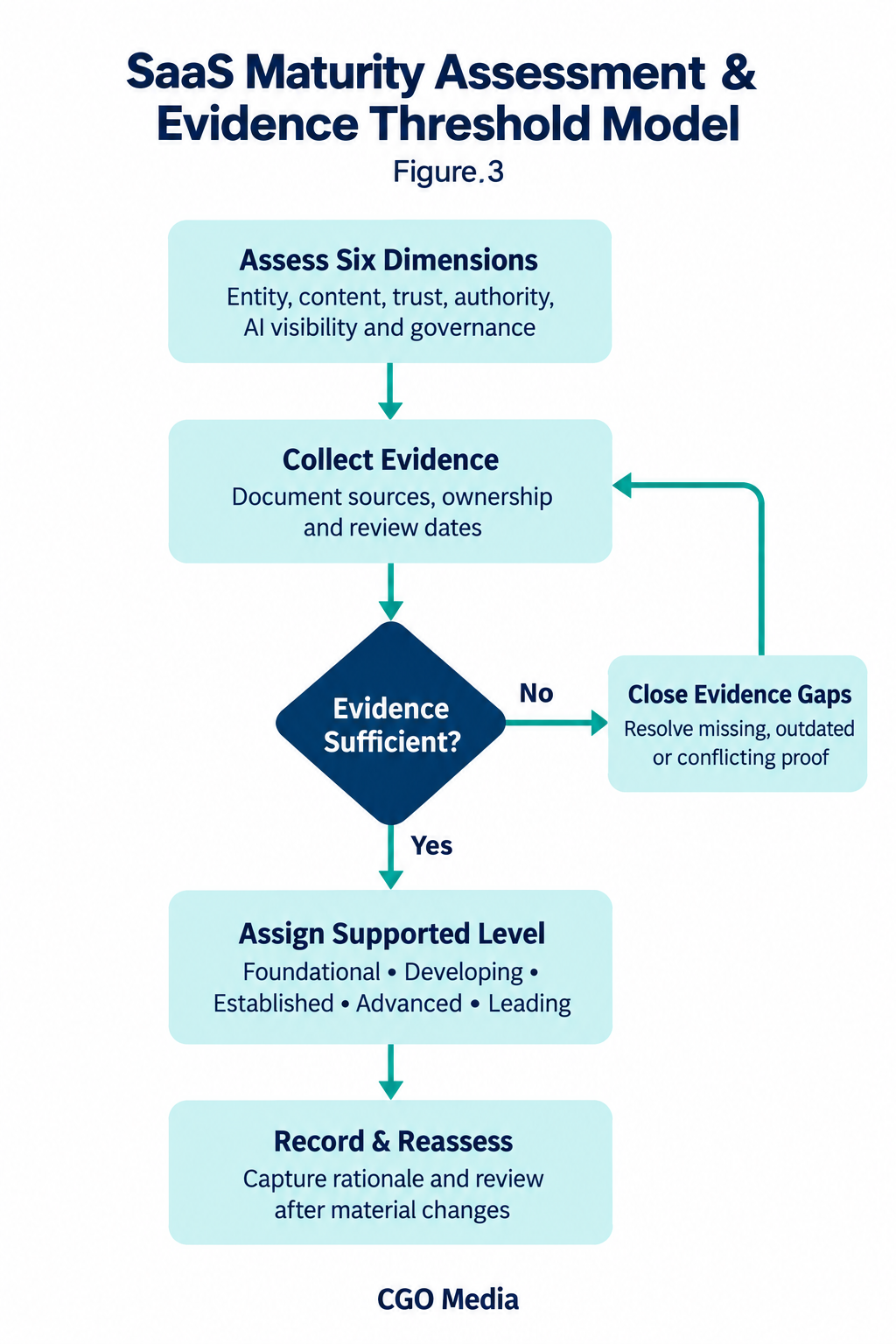
- Difficult to locate
- Generic
- Inconsistently maintained
This can create unnecessary friction for serious buyers.
13. Level 1 External Authority
External validation may depend on:
- A small number of reviews
- Occasional media coverage
- Limited partner references
The provider has little authority resilience beyond its own website.
14. Level 1 AI Readiness
AI visibility is usually:
- Unmonitored
- Anecdotal
- Inconsistently tested
The organisation has little reliable understanding of how its products are represented within AI-assisted discovery.
15. Level 1 Primary Risk
The main risk at Level 1 is fragmentation.
The product may be difficult to:
- Understand
- Verify
- Compare
- Recommend
consistently across the wider digital environment.
16. Level 2 — Structured SaaS Search Foundation
At Level 2, the organisation has begun creating a more deliberate product-information and search architecture.
The emphasis moves from isolated activity toward basic consistency and repeatable structure.
17. Typical Level 2 Characteristics
- Clearer product positioning
- Improved feature architecture
- Dedicated integration pages
- More structured customer evidence
- Improved security documentation
- Basic external authority development
- Initial AI visibility testing
18. Level 2 Entity Clarity
Provider, product, module and brand relationships are becoming more consistent.
Core naming conventions begin to stabilise across priority first-party and external environments.
19. Level 2 Product Authority
Priority features and integrations receive clearer dedicated evidence.
Product content begins to connect with:
- Documentation
- Use cases
- Integration evidence
20. Level 2 Customer Authority
The organisation begins building more structured:
- Use cases
- Industry pages
- Case studies
- Customer outcomes
Evidence begins moving beyond logos and testimonials.
21. Level 2 Trust
Security, privacy and implementation information becomes easier to locate and more consistent.
Trust content is still developing, but major gaps are beginning to be addressed.
22. Level 2 External Authority
The provider begins improving strategically important:
- Review profiles
- Marketplace listings
- Partner relationships
- Industry references
External validation becomes more deliberate.
23. Level 2 AI Readiness
Basic monitoring begins around:
- Brand prompts
- Category prompts
- Feature prompts
- Competitor prompts
AI visibility starts moving from anecdotal observation toward repeatable testing.
24. Level 2 Primary Objective
The central objective is to move from fragmented information toward a coherent foundation of:
- Product evidence
- Trust evidence
- Search architecture
- External validation
25. Level 3 — Established Product Authority
At Level 3, the organisation has developed meaningful authority around its core products, priority customer segments and competitive position.
The provider is no longer simply building foundations; it is developing evidence depth.
26. Typical Level 3 Characteristics
- Clear provider and product identity
- Strong priority feature coverage
- Established integration architecture
- Relevant customer case studies
- Current security and trust evidence
- Growing review and external authority
- Structured AI monitoring
27. Level 3 Entity Clarity
Core relationships between:
- Company
- Product
- Module
- Brand
are generally consistent across important first-party and external sources.
28. Level 3 Product Authority
Priority features are supported by:
- Dedicated product content
- Documentation
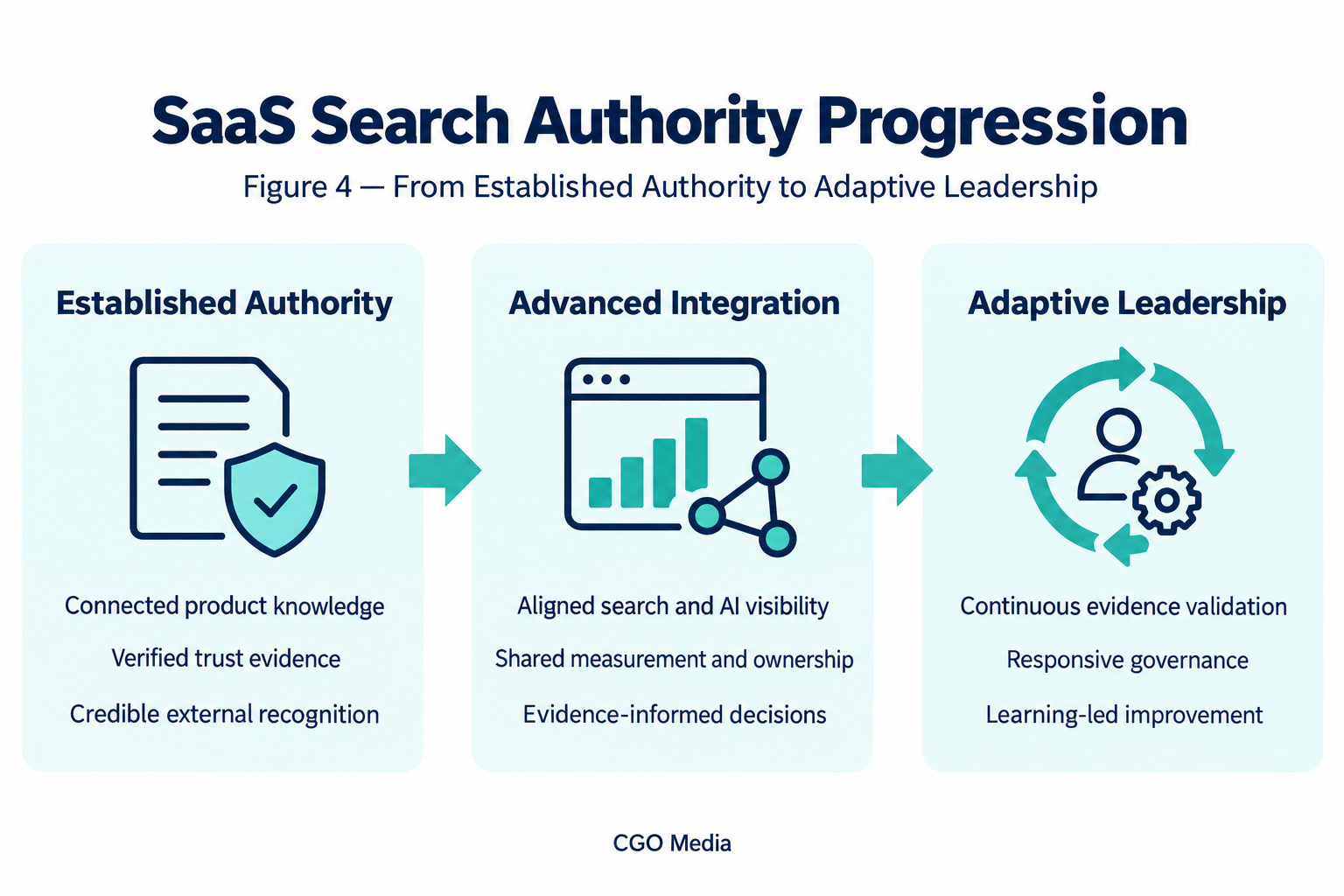
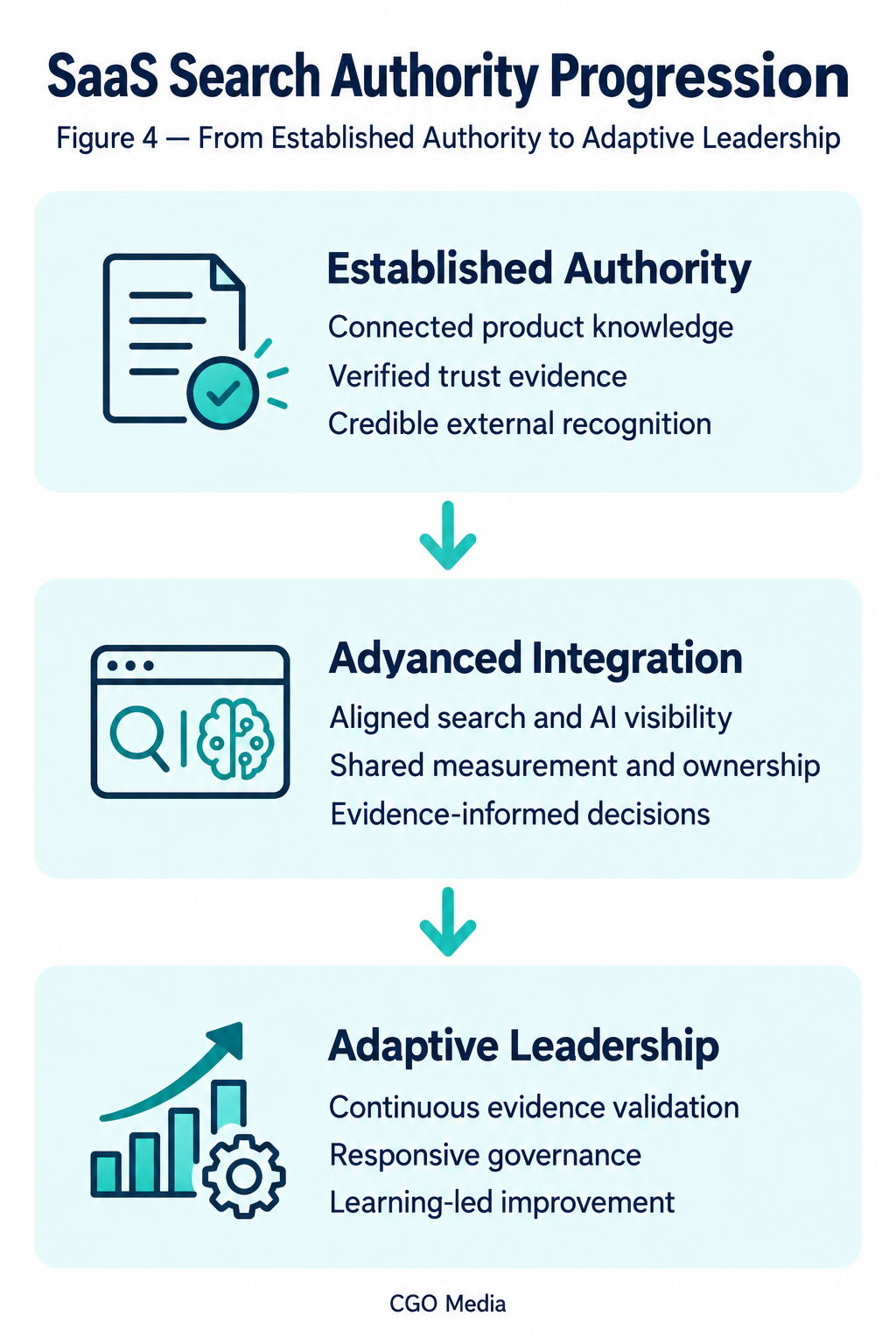
- Use-case relationships
- Integration evidence
- Customer proof
The product becomes easier to evaluate in detail.
29. Level 3 Customer Authority
The provider demonstrates relevance across strategically important:
- Industries
- Company sizes
- Use cases
- Customer profiles
Customer evidence begins to reflect commercial priorities.
30. Level 3 Trust
Security, privacy, reliability, implementation and support evidence is sufficiently developed to support serious buyer evaluation.
Trust information is becoming a consistent part of the buying journey.
31. Level 3 External Authority
The organisation has recognisable validation across several relevant third-party environments.
Authority no longer depends entirely on first-party messaging.
32. Level 3 AI Readiness
AI monitoring becomes systematic rather than occasional.
The organisation may begin tracking:
- Non-branded recommendation visibility
- Comparison visibility
- Source visibility
- Representation accuracy
33. Level 3 Primary Objective
The central objective is to connect established product authority with:
- Buyer trust
- Customer evidence
- External market authority
- AI-assisted discovery
34. Level 4 — Integrated Search and AI Authority
At Level 4, search, product evidence, trust, external authority and AI visibility are managed as interconnected systems.
Authority development is increasingly cross-functional.
35. Typical Level 4 Characteristics
- Integrated product knowledge architecture
- Strong technical and documentation authority
- Deep customer and industry evidence
- Mature trust governance
- Diverse external validation
- Structured AI recommendation measurement
- Executive search-authority reporting
36. Level 4 Entity Clarity
Company, product, module, feature and integration relationships are governed systematically.
Changes in product architecture trigger coordinated updates across relevant evidence environments.
37. Level 4 Product Authority
Product evidence is connected across:
- Features
- Integrations
- Documentation
- Use cases
- Industries
- Customer evidence
The information environment operates as a connected knowledge system.
38. Level 4 Customer Authority
Customer evidence is developed strategically around priority:
- Industries
- Markets
- Use cases
- Customer segments
Evidence development is planned rather than opportunistic.
39. Level 4 Trust
Security, privacy, reliability and commercial evidence operate under defined ownership and review processes.
Trust information becomes part of organisational governance rather than an isolated marketing resource.
40. Level 4 External Authority
The provider possesses stronger validation across:
- Customers
- Technology partners
- Review platforms
- Marketplaces
- Industry publications
- Research and citations
External authority becomes broader and more resilient.
41. Level 4 AI Readiness
AI visibility is measured through a repeatable query architecture covering:
- Category
- Feature
- Integration
- Use case
- Industry
- Comparison
- Recommendation
42. Level 4 Commercial Integration
Search and AI performance begins to connect with:
- Trials
- Demos
- Qualified pipeline
- Competitive win rates
- Revenue outcomes
This creates a stronger relationship between authority development and commercial performance.
43. Level 4 Primary Objective
The main objective at Level 4 is integration.
Product, authority, trust, AI and commercial measurement should operate as a coordinated organisational system.
44. Level 5 — Adaptive SaaS Search Leadership
At Level 5, the SaaS organisation treats search authority as a dynamic strategic capability.
The focus shifts from building authority to continuously maintaining, extending and adapting it.
45. Typical Level 5 Characteristics
- Continuously maintained product evidence
- Advanced knowledge architecture
- Strong research and citation authority
- Broad and relevant market validation
- Continuous AI representation monitoring
- Cross-functional authority governance
- Strategic competitive intelligence
46. Level 5 Entity Clarity
Entity relationships remain accurate as the organisation:
- Launches products
- Adds modules
- Enters new markets
- Completes acquisitions
- Rebrands
Change is incorporated rapidly into the wider evidence architecture.
47. Level 5 Product Authority
Product information is maintained as an evolving evidence system rather than a set of static marketing pages.
New capabilities trigger coordinated updates across:
- Commercial content
- Documentation
- Integrations
- Use cases
- Customer evidence
48. Level 5 Customer Authority
Customer evidence expands continuously across priority:
- Industries
- Markets
- Use cases
- Company sizes
Evidence development remains aligned with changing market strategy.
49. Level 5 Trust
Security, privacy, reliability and commercial evidence is deeply integrated with product and governance processes.
Emerging risk and regulatory requirements are incorporated into the evidence system as they develop.
50. Level 5 External Authority
The organisation develops a durable authority ecosystem that does not depend excessively on one platform or source type.
External validation is distributed across relevant:
- Customers
- Partners
- Reviews
- Marketplaces
- Publications
- Research
51. Level 5 AI Readiness
AI recommendation, comparison, source and representation monitoring becomes part of ongoing competitive intelligence.
AI visibility is no longer treated as a separate experiment.
52. Level 5 Commercial Integration
Authority measurement is connected with:
- Customer acquisition
- Pipeline quality
- Win/loss analysis
- Retention
- Expansion
This creates a stronger feedback loop between search authority and business performance.
53. Level 5 Primary Objective
The central objective at Level 5 is adaptability.
The organisation should be capable of maintaining and strengthening authority as:
- Products change
- Buyers change
- Competitors change
- Discovery systems change
54. Maturity Is Not Simply a Function of Company Size
A large SaaS company can remain relatively immature if its product evidence is fragmented and poorly governed.
A smaller provider can achieve stronger maturity where its:
- Information architecture
- Trust evidence
- Customer proof
- External authority
- AI monitoring
are deliberately managed.
55. The SaaS Search Authority Maturity Progression
The complete five-level progression is:
Fragmented → Structured → Established → Integrated → Adaptive
Fragmented
Authority exists in isolated areas without a coherent system.
Structured
Core product, technical, customer and trust evidence begins to follow repeatable architecture.
Established
The provider develops meaningful authority around priority products, markets and buyer journeys.
Integrated
Search, product evidence, trust, external authority, AI visibility and commercial measurement operate as connected systems.
Adaptive
The organisation continuously governs, measures and evolves its authority as products, customers, competitors and discovery systems change.


56. Dimension One — Provider and Product Entity Clarity
The first maturity dimension evaluates how clearly the organisation, products, modules and related entities are represented across the wider digital environment.
This includes the consistency of relationships between:
- Organisation
- Product
- Module
- Feature
- Integration
- Brand
- Leadership
Entity maturity increases as these relationships become more standardised, governed and adaptable.
57. Entity Clarity — Level 1 to Level 5
Level 1 — Fragmented
Product naming, category relationships and organisational identity are inconsistent across first-party and external sources.
Level 2 — Standardised
Priority company, product and module names are becoming consistent across the main website and strategically important external environments.
Level 3 — Consistent
Entity relationships are generally clear across product pages, documentation, review platforms, marketplaces and important partner sources.
Level 4 — Governed
Entity architecture has defined ownership, standards and change processes.
Level 5 — Adaptive
Entity relationships are updated systematically as the organisation launches products, enters markets, completes acquisitions or changes its brand architecture.
58. Dimension Two — Feature, Integration and Technical Authority
The second dimension assesses whether buyers can understand and verify the technical capabilities of the SaaS product.
Relevant evidence includes:
- Feature pages
- Integration pages
- Product documentation
- API documentation
- Developer resources
- Implementation guidance
59. Technical Authority — Level 1 to Level 5
Level 1 — Thin
Feature and integration content exists but provides limited technical depth or verifiable evidence.
Level 2 — Structured
Priority features and integrations receive dedicated pages and basic supporting documentation.
Level 3 — Established
Important capabilities are supported by detailed product, technical and implementation evidence.
Level 4 — Integrated
Features, integrations, documentation, APIs, use cases and customer evidence operate as connected authority clusters.
Level 5 — Continuous
Technical evidence is updated systematically as product capabilities, integrations and APIs change.
60. Dimension Three — Use Case, Industry and Customer Authority
The third dimension evaluates whether the provider can demonstrate relevance beyond product claims.
Evidence should show how the software performs within real:
- Workflows
- Industries
- Customer environments
- Company sizes
- Operational scenarios
61. Customer Authority — Level 1 to Level 5
Level 1 — Generic
Customer evidence consists primarily of logos, short testimonials or broad outcome claims.
Level 2 — Developing
More structured use cases, industry pages and customer stories begin to emerge.
Level 3 — Relevant
Customer evidence covers strategically important industries, workflows and buyer segments.
Level 4 — Strategic
Customer proof is planned deliberately around commercial priorities, competitive positioning and target markets.
Level 5 — Expanding
Customer authority evolves continuously as the provider enters new industries, markets, use cases and customer segments.
62. Dimension Four — Security, Privacy and Product Trust
The fourth dimension assesses whether buyers can verify the trust signals required for adoption.
Relevant evidence can include:
- Security controls
- Privacy information
- Certifications
- Data processing
- Reliability
- Implementation
- Support
- Commercial transparency
63. Product Trust — Level 1 to Level 5
Level 1 — Opaque
Security, privacy, reliability and implementation information is incomplete, generic or difficult to locate.
Level 2 — Documented
Core trust information is available and becoming more structured.
Level 3 — Verifiable
Priority security, privacy, reliability and implementation claims can be supported through current evidence.
Level 4 — Governed
Trust information has clear ownership, review cycles and change triggers.
Level 5 — Proactive
The provider anticipates emerging buyer, security, regulatory and procurement requirements and updates evidence before gaps materially affect evaluation.
64. Dimension Five — External, Review and Market Authority
The fifth dimension assesses whether the SaaS provider is validated beyond its own controlled digital properties.
Relevant external authority can come from:
- Review platforms
- Software marketplaces
- Technology partners
- Implementation partners
- Industry publications
- Research citations
- Customer references
- Professional communities
65. External Authority — Level 1 to Level 5
Level 1 — Limited
External evidence is sparse, inconsistent or concentrated within a small number of sources.
Level 2 — Developing
The organisation begins improving important review, marketplace and partner profiles.
Level 3 — Established
Relevant independent sources provide repeatable validation of the provider’s products and market position.
Level 4 — Diversified
External authority is distributed across multiple relevant source types rather than depending heavily on one platform.
Level 5 — Durable
The provider maintains a resilient authority ecosystem incorporating customers, partners, reviews, publications, research and professional recognition.
66. Dimension Six — AI Search and Recommendation Readiness
The sixth dimension evaluates how systematically the organisation understands and manages its representation within AI-assisted discovery environments.
Relevant areas include:
- Branded understanding
- Non-branded discovery
- Comparison visibility
- Recommendation share
- Shortlist share
- Representation accuracy
- Source visibility
67. AI Readiness — Level 1 to Level 5
Level 1 — Unmonitored
- No formal AI visibility monitoring
- Testing is anecdotal
- Product inaccuracies may go unnoticed
- No defined recommendation query set exists
Level 2 — Observed
- Basic branded and category testing begins
- Competitor recommendations are observed
- Major representation errors are documented
- Initial source analysis begins
Level 3 — Measured
- Repeatable prompt sets are used
- Non-branded recommendation visibility is tracked
- Comparison visibility is monitored
- Representation accuracy is reviewed systematically
Level 4 — Integrated
- AI visibility is connected with product and authority governance
- Source visibility is analysed
- Recommendation share and shortlist share are tracked
- AI insights contribute to competitive intelligence
Level 5 — Adaptive
- AI monitoring operates continuously as part of search intelligence
- Changes in recommendation environments trigger investigation
- Evidence gaps are corrected systematically
- AI visibility is interpreted alongside commercial and market outcomes
68. Maturity Develops Unevenly
Most SaaS organisations will not operate at exactly the same maturity level across all six dimensions.
For example, one organisation might operate at:
- Level 4 for product authority
- Level 3 for customer authority
- Level 2 for external authority
- Level 1 for AI readiness
This is why dimension-level assessment is more useful than assigning one simplistic organisational label.
69. Strong Dimensions Should Not Conceal Weak Ones
A recognised SaaS brand can still possess material weaknesses.
For example:
- Strong product documentation cannot replace weak trust evidence.
- Strong customer reviews cannot replace missing integration information.
- Strong organic visibility cannot replace inaccurate AI representation.
- Strong external authority cannot replace unclear product identity.
The maturity model is designed to expose these imbalances.
70. The Weakest Dimension Can Become a Commercial Bottleneck
A provider can perform strongly across several dimensions yet lose buyers because one mandatory requirement remains weak.
Examples include:
- Strong product authority but weak security evidence
- Strong search visibility but poor implementation clarity
- Strong customer proof but weak integration coverage
- Strong brand authority but poor pricing transparency
Progression should therefore prioritise the authority gap most likely to constrain buyer progression.
71. Maturity Should Reflect SaaS Business Context
The meaning of advanced maturity varies according to product and market.
Product-Led SaaS
Product-led businesses may place greater weight on:
- Feature clarity
- Documentation
- Self-service onboarding
- Review authority
- Trial conversion
Enterprise SaaS
Enterprise providers may require deeper maturity around:
- Security
- Compliance
- Procurement readiness
- Implementation evidence
- Customer references
- Vendor governance
Vertical SaaS
Vertical SaaS companies may place greater emphasis on:
- Industry expertise
- Sector workflows
- Regulatory understanding
- Industry integrations
- Sector-specific customer evidence
International SaaS
International providers may require stronger maturity around:
- Regional product availability
- Language
- Data residency
- Local customer evidence
- Regional compliance
- Geographic entity clarity
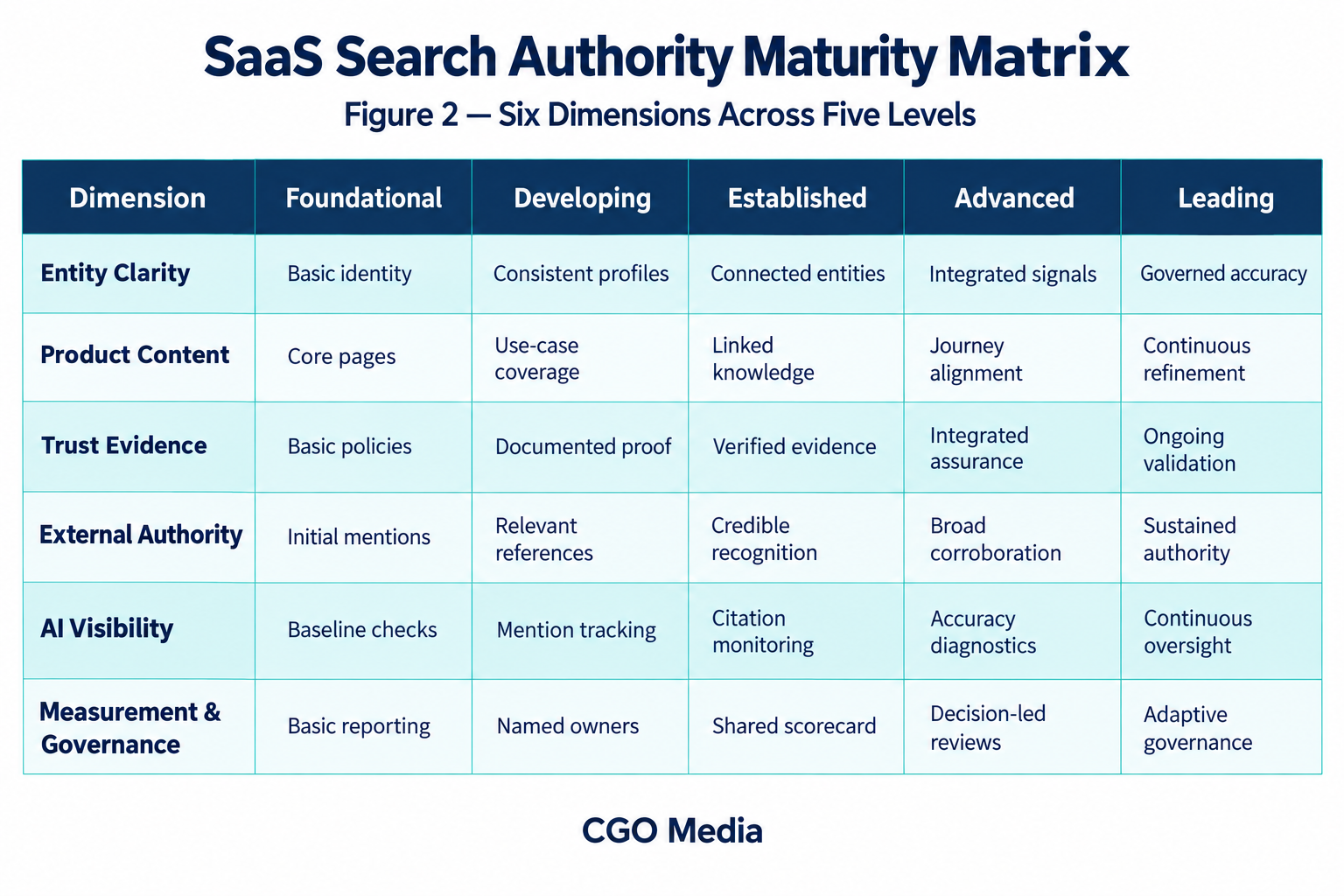
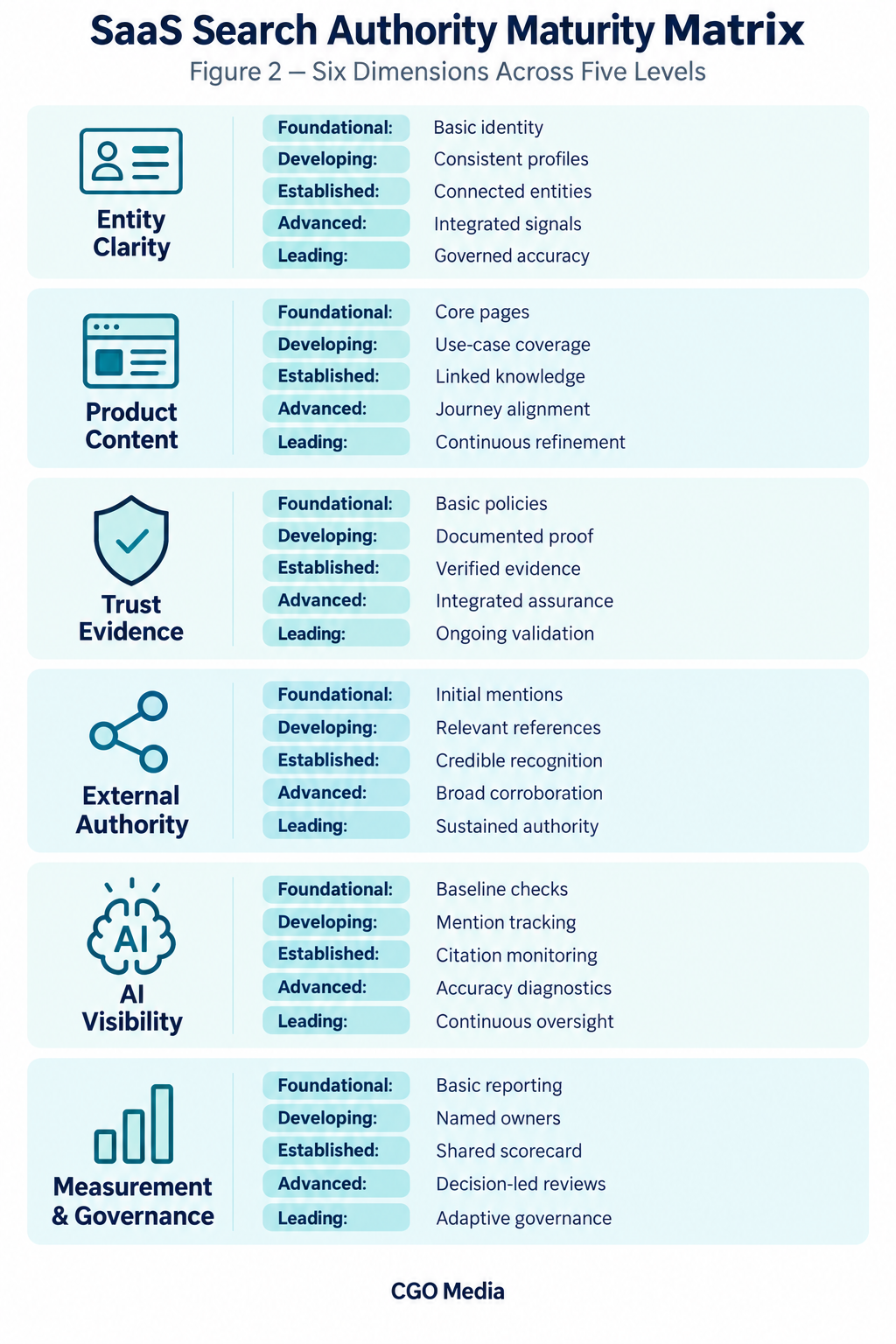
72. SaaS Search Authority Maturity Matrix
The model can therefore be understood as a matrix in which the five maturity levels intersect with the six authority dimensions.
| Dimension | Level 1 | Level 2 | Level 3 | Level 4 | Level 5 |
|---|---|---|---|---|---|
| Entity Clarity | Fragmented | Standardised | Consistent | Governed | Adaptive |
| Technical Authority | Thin | Structured | Established | Integrated | Continuous |
| Customer Authority | Generic | Developing | Relevant | Strategic | Expanding |
| Product Trust | Opaque | Documented | Verifiable | Governed | Proactive |
| External Authority | Limited | Developing | Established | Diversified | Durable |
| AI Readiness | Unmonitored | Observed | Measured | Integrated | Adaptive |
The purpose of the matrix is not to force every organisation into one label.
Its value lies in making capability gaps visible so that the next stage of authority development can be prioritised intelligently.
73. Assessing SaaS Search Authority Maturity in Practice
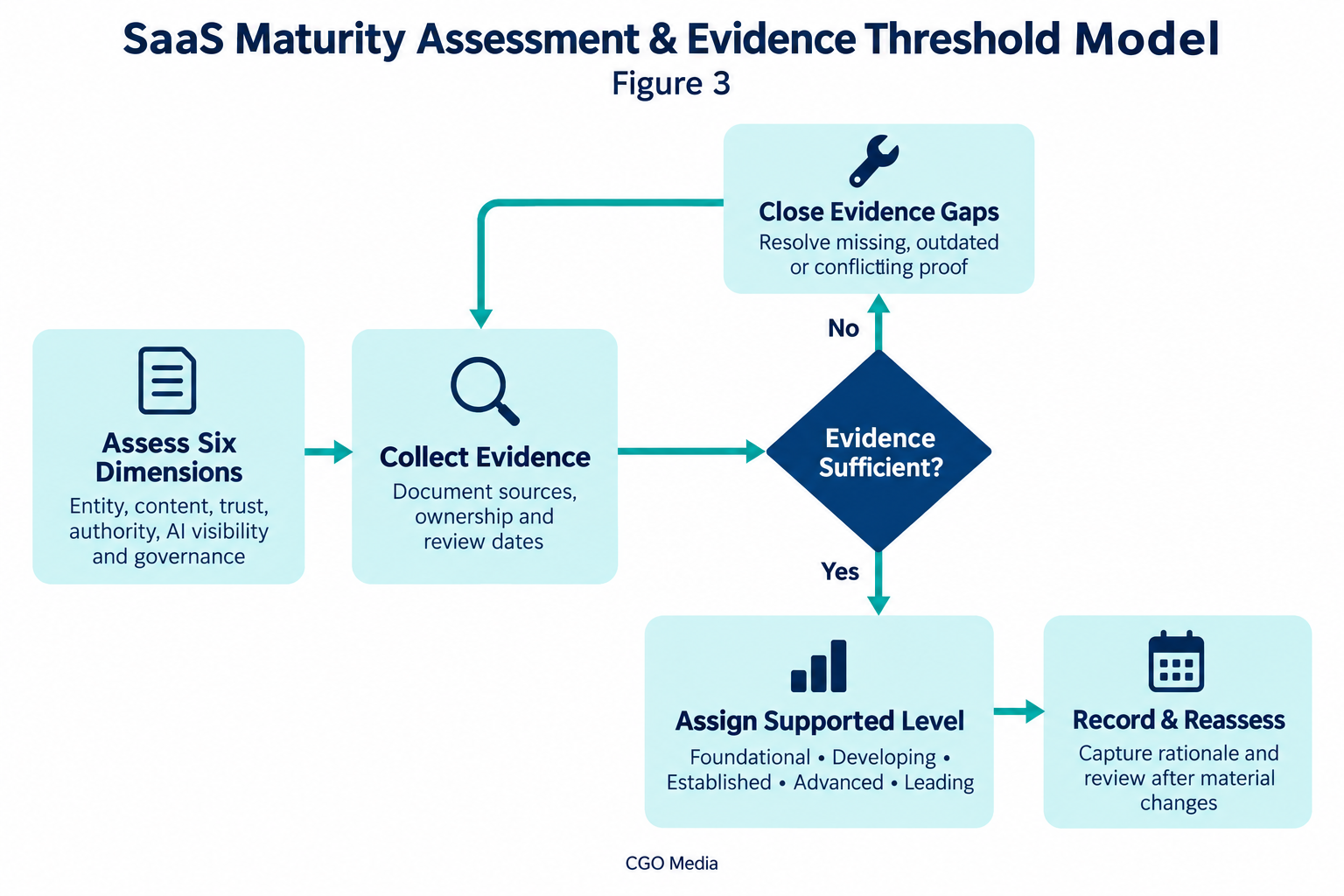
The SaaS Search Authority Maturity Model should be applied through structured evidence review rather than subjective impression.
The organisation should assess what it can actually demonstrate across each of the six authority dimensions.
The core assessment principle is:
Observable Evidence → Capability Assessment → Gap Identification → Priority Action → Reassessment
74. Evidence Should Be Observable
Where possible, maturity assessments should rely on evidence that can be reviewed directly.
Examples include:
- Product pages
- Feature pages
- Documentation
- Integration directories
- Security resources
- Customer case studies
- Review-platform profiles
- Marketplace listings
- External citations
- AI recommendation tests
Observable evidence creates a stronger basis for assessment than internal perception alone.
75. Evidence Should Be Current
Maturity is not defined simply by what the organisation has published historically.
Evidence should remain aligned with the current:
- Product
- Features
- Pricing
- Integrations
- Security position
- Customer proposition
- Market position
Outdated evidence should not support an advanced maturity assessment.
76. Evidence Should Be Relevant
Authority should be assessed against the buyer requirements and markets that matter commercially.
A SaaS provider targeting enterprise buyers should not be considered highly mature simply because it performs strongly with small-business customers if its enterprise:
- Security evidence
- Implementation evidence
- Procurement readiness
- Customer proof
remain weak.
77. Evidence Should Be Consistent
Decision-critical facts should remain materially consistent across the wider information environment.
Consistency should not require identical wording, but important facts should not conflict.
78. Evidence Consistency Areas
Priority consistency checks can include:
- Company and product naming
- Category definition
- Feature availability
- Integration support
- Pricing
- Security
- Target customer
- Geographic availability
Material contradictions indicate weaker governance and therefore lower maturity.
79. Evidence Should Be Verifiable
Important product and trust claims become stronger when they can be supported through appropriate:
- Technical documentation
- Customer evidence
- Security resources
- Independent validation
Advanced maturity should reflect evidence capable of surviving closer buyer evaluation.
80. Evidence Should Be Connected
Advanced maturity requires more than a collection of strong individual assets.
The organisation should demonstrate meaningful relationships across:
Provider → Product → Feature → Integration → Use Case → Customer → Trust → External Validation
Connected evidence is a defining difference between isolated strength and mature authority architecture.
81. The SaaS Maturity Assessment Scale
Each of the six dimensions can be assessed using the same five-level scale.
| Score | Maturity Level | General Condition |
|---|---|---|
| 1 | Fragmented Visibility | Evidence exists but is incomplete, inconsistent or poorly governed. |
| 2 | Structured SaaS Search Foundation | Core evidence is being organised and standardised. |
| 3 | Established Product Authority | Strong evidence exists across commercially important areas. |
| 4 | Integrated Search and AI Authority | Authority is connected across teams, evidence systems and measurement. |
| 5 | Adaptive SaaS Search Leadership | Authority is continuously monitored, governed and improved. |
82. Do Not Score from Perception Alone
A recognised SaaS brand should not classify itself automatically as Level 4 or Level 5 simply because it has:
- Strong organic rankings
- High brand awareness
- Large traffic volumes
- A significant customer base
Maturity should reflect observable organisational capability.
83. Higher Maturity Requires Evidence of Capability
Higher maturity levels should demonstrate increasingly strong evidence of:
- Structured processes
- Consistent implementation
- Cross-functional governance
- Measurement
- Repeatability
The organisation should be able to reproduce its authority-management capability rather than depend on isolated projects or individuals.
84. Dimension-Level Scoring
Each of the six dimensions should receive its own assessment.
An illustrative maturity profile might look like:
| Dimension | Example Score |
|---|---|
| Provider and Product Entity Clarity | 4 |
| Feature, Integration and Technical Authority | 3 |
| Use Case, Industry and Customer Authority | 3 |
| Security, Privacy and Product Trust | 4 |
| External, Review and Market Authority | 2 |
| AI Search and Recommendation Readiness | 2 |
This profile is more strategically useful than one blended number because it shows where the main capability gaps exist.
85. The Overall Score Is Secondary
An average maturity score may support executive reporting, but it should not replace the six individual dimension assessments.
For example, an average score of 3 can conceal:
- A Level 5 capability in one area
- A Level 1 weakness in another
The weaker dimension may still create a major buyer or commercial bottleneck.
86. Avoid False Precision
The maturity model is a strategic diagnostic framework rather than a scientific measurement instrument.
Small numerical differences should therefore not be interpreted as statistically meaningful.
The important distinction is whether the organisation possesses the observable capability required by each maturity level.
87. Evidence Thresholds
Each maturity level should require the organisation to cross an evidence threshold before progression is recognised.
This prevents maturity from becoming a self-declared status based on aspiration rather than demonstrated capability.
88. Level 1 Evidence Threshold
At Level 1, authority evidence exists but remains fragmented.
Typical conditions include:
- No clear evidence ownership
- Inconsistent product information
- Weak customer proof
- Limited external validation
- No repeatable AI measurement
The principal challenge is creating order.
89. Level 2 Evidence Threshold
Level 2 requires evidence that the organisation has begun standardising its authority foundations.
Typical requirements can include:
- Clear product naming
- Structured priority feature pages
- Defined integration coverage
- Improved security information
- Basic review-platform management
- Initial AI monitoring
The authority environment is becoming structured but remains relatively immature.
90. Level 3 Evidence Threshold
Level 3 requires evidence that authority has become established across commercially important areas.
Typical requirements can include:
- Strong product and category clarity
- Current technical documentation
- Relevant customer case studies
- Verifiable trust evidence
- Multiple external validation sources
- Repeatable AI testing
This represents a significant maturity threshold because authority has moved beyond basic organisation into meaningful market capability.
91. Level 4 Evidence Threshold
Level 4 requires evidence that previously separate authority systems have become integrated.
Typical requirements can include:
- Cross-functional evidence ownership
- Product change triggers
- Connected knowledge architecture
- Competitive benchmarking
- AI recommendation measurement
- Commercial reporting
The defining capability is integration.
92. Level 5 Evidence Threshold
Level 5 requires evidence that authority management has become adaptive and continuous.
Typical requirements can include:
- Continuous evidence monitoring
- Rapid correction of information decay
- Dynamic competitive intelligence
- Research and citation authority
- Executive governance
- Continuous AI representation analysis
The defining capability is the ability to adapt authority systems as the product and market change.
93. Maturity Should Be Demonstrated Across Time
An organisation should not move to a higher maturity level simply because of:
- A temporary campaign
- A successful content launch
- A one-time technical audit
- A short-lived AI visibility improvement
Higher maturity should reflect repeatable capability that can be maintained over time.
94. Maturity Regression Is Possible
SaaS organisations can move backwards when governance fails or organisational change outpaces authority management.
Maturity should therefore be treated as a condition requiring maintenance rather than a permanent achievement.
95. Common Causes of Maturity Regression
Regression can occur through:
- Rapid product change
- Acquisitions
- Rebranding
- Pricing changes
- Documentation decay
- Team restructuring
- Loss of evidence ownership
These changes can weaken authority even where search performance initially appears stable.
96. SaaS Maturity Gap Analysis
A maturity gap is the difference between the organisation’s current capability and the capability required to reach the next strategically meaningful level.
A useful relationship is:
Current Capability → Required Capability → Gap → Priority Action
97. Entity Maturity Gap
An entity gap can include:
- Inconsistent company or product naming
- Unclear product architecture
- Legacy brands
- Poor external entity consistency
These weaknesses can limit machine and buyer understanding of the provider.
98. Technical Authority Gap
A technical maturity gap can involve:
- Weak feature evidence
- Missing integration detail
- Incomplete documentation
- Outdated API information
These gaps reduce the buyer’s ability to verify whether the product satisfies technical requirements.
99. Customer Authority Gap
A customer-authority gap can involve:
- Limited case studies
- Weak industry evidence
- Generic testimonials
- No measurable outcome evidence
This weakens the connection between product claims and demonstrated real-world use.
100. Trust Maturity Gap
A trust gap can include:
- Weak security information
- Unclear privacy evidence
- Poor implementation guidance
- Commercial ambiguity
These weaknesses can become direct barriers to provider selection.
101. External Authority Gap
An external-authority gap can involve:
- Weak review visibility
- Poor marketplace presence
- Limited partner authority
- Few relevant citations
This leaves the provider overly dependent on first-party claims.
102. AI Maturity Gap
An AI-readiness gap can involve:
- No structured prompt set
- Weak non-branded visibility
- Low recommendation share
- Poor representation accuracy
- No source analysis
These gaps make it difficult to understand how the product is represented within AI-assisted discovery.
103. Prioritise Maturity Gaps by Commercial Impact
Not every gap deserves equal urgency.
Priority should be given to weaknesses affecting:
- Priority buyer segments
- High-value product areas
- Important competitive battles
- Security-sensitive opportunities
- Revenue growth
A low maturity score is most strategically important when it constrains a commercially important buyer journey.
104. Progressing from Level 1 to Level 2
The transition from Fragmented Visibility to a Structured SaaS Search Foundation is primarily about creating order.
The objective is to establish basic:
- Consistency
- Structure
- Ownership
- Repeatability
across the six maturity dimensions.
105. Level 1 to Level 2 — Entity Actions
Priority actions can include:
- Standardise company and product naming
- Clarify product categories
- Map modules and product suites
- Correct critical external profiles
106. Level 1 to Level 2 — Product Actions
Priority actions can include:
- Identify priority features
- Create stronger feature evidence
- Build an integration inventory
- Improve documentation structure
107. Level 1 to Level 2 — Customer Actions
Priority actions can include:
- Define key use cases
- Identify priority industries
- Standardise case-study structure
- Collect stronger customer evidence
108. Level 1 to Level 2 — Trust Actions
Priority actions can include:
- Consolidate security information
- Clarify privacy information
- Document onboarding
- Improve support and pricing clarity
109. Level 1 to Level 2 — External Authority Actions
Priority actions can include:
- Correct priority review profiles
- Improve marketplace listings
- Map relevant partners
- Identify important external publications and communities
110. Level 1 to Level 2 — AI Actions
Priority actions can include:
- Create a baseline prompt set
- Test branded queries
- Test category queries
- Document material inaccuracies
The objective is to establish basic repeatable observation.
111. Progressing from Level 2 to Level 3
The transition from Structured Foundation to Established Product Authority requires greater depth, consistency and evidence quality.
The organisation moves from organising information toward demonstrating credible authority.
112. Level 2 to Level 3 — Entity Actions
The provider should expand from basic naming consistency toward stronger relationships between:
- Provider
- Product
- Module
- Category
- External profiles
Priority entity relationships should now be clear across major digital environments.
113. Level 2 to Level 3 — Product Actions
Priority features should be supported by deeper:
- Documentation
- Use cases
- Integration evidence
- Technical explanation
Product authority should increasingly support detailed buyer evaluation rather than basic discovery alone.
114. Level 2 to Level 3 — Customer Actions
Customer evidence should become more representative of priority:
- Industries
- Company sizes
- Use cases
- Buyer segments
The organisation should increasingly demonstrate product fit within the markets it actively targets.
115. Level 2 to Level 3 — Trust Actions
Security, privacy, implementation and support evidence should become sufficiently detailed to support serious buyer evaluation.
The objective is to move from basic documentation toward verifiable trust.
116. Level 2 to Level 3 — External Authority Actions
The provider should develop validation across several relevant source types rather than relying excessively on one:
- Review platform
- Marketplace
- Publication
- Partner ecosystem
External authority should become broader and more resilient.
117. Level 2 to Level 3 — AI Actions
AI testing should become repeatable and expand beyond branded questions.
Priority testing can include:
- Non-branded prompts
- Competitor comparisons
- Feature prompts
- Use-case prompts
- Representation-accuracy checks
The organisation should begin developing a consistent AI visibility baseline.
118. Level 3 Represents a Significant Threshold
At Level 3, the organisation has moved beyond basic SEO organisation and developed a credible foundation of:
- Product authority
- Customer evidence
- Trust
- External validation
- Repeatable AI monitoring
The next stage requires more than simply publishing additional evidence.
Progression toward Level 4 depends increasingly on:
- Integration
- Cross-functional ownership
- Governance
- Commercial measurement
This marks the transition from established authority into a genuinely integrated SaaS search and AI operating system.
119. Progressing from Level 3 to Level 4
The transition from Established Product Authority to Integrated Search and AI Authority is not primarily about publishing more content.
It is about connecting existing authority capabilities so that product information, trust evidence, external validation, AI monitoring and commercial measurement operate as one coordinated system.
The transition can be represented as:
Strong Evidence → Connected Systems → Defined Ownership → Measurement → Governance → Commercial Integration
120. Level 3 to Level 4 — Entity Integration
At Level 3, core company and product relationships are generally clear.
At Level 4, those relationships should become governed consistently across:
- Website architecture
- Documentation
- Product interfaces
- External profiles
- Marketplaces
- Partner environments
The objective is to prevent entity consistency from depending on manual correction after problems appear.
121. Formalise Product Knowledge Architecture
The organisation should document how important product entities relate to one another.
A practical SaaS knowledge architecture can include:
Company → Product → Module → Feature → Integration → Use Case → Industry → Customer Evidence → Trust Evidence
This provides a common structure across marketing, product, documentation and external authority environments.
122. Knowledge Architecture Should Support Change
The purpose of knowledge architecture is not simply to describe the current website.
It should make future changes easier to propagate consistently when the organisation:
- Launches products
- Introduces modules
- Renames features
- Adds integrations
- Enters new markets
123. Product Naming Governance
New:
- Products
- Modules
- Features
- Packages
should follow defined naming conventions.
This reduces inconsistent representations across website content, documentation, sales collateral and external sources.
124. Acquisition and Rebrand Governance
Where products are acquired, renamed or consolidated, the organisation should coordinate updates across:
- Product pages
- Documentation
- Review platforms
- Marketplace listings
- Partner references
- Structured data
This helps preserve entity continuity during organisational change.
125. Level 3 to Level 4 — Technical Authority Integration
Technical evidence should move from a collection of individually strong assets toward a connected product-information system.
The defining Level 4 capability is not simply greater technical depth.
It is integration between product evidence and the wider buyer journey.
126. Feature Architecture Integration
Priority features should connect with:
- Documentation
- Integrations
- Use cases
- Industries
- Pricing tiers
- Customer evidence
This transforms feature pages from isolated content assets into part of a broader product knowledge system.
127. Integration Architecture Integration
Integration directories should connect with:
- Relevant products
- Features
- Workflows
- Documentation
- Marketplaces
- Customer examples
Integration authority becomes stronger when it reflects real product relationships rather than standalone SEO landing pages.
128. Documentation Integration
Technical documentation should be linked deliberately with relevant commercial and product content.
A useful relationship is:
Commercial Claim → Feature Explanation → Documentation → Technical Validation
This helps buyers move smoothly from discovery into verification.
129. Technical Evidence Ownership
Named owners should be responsible for the accuracy of:
- Feature claims
- Integration claims
- API information
- Developer documentation
- Technical limitations
This reduces the risk that marketing material becomes disconnected from product reality.
130. Product Change Triggers
Material product changes should trigger review of affected authority assets automatically.
Important triggers can include:
- Feature launches
- Feature retirement
- Integration changes
- Pricing changes
- Product naming changes
Level 4 maturity requires change governance rather than periodic correction alone.
131. Level 3 to Level 4 — Customer Authority Integration
Customer evidence should move from opportunistic case-study creation toward deliberate coverage of commercially important markets.
The organisation should understand where customer proof is strong and where strategic gaps remain.
132. Strategic Customer Evidence Mapping
Customer evidence can be mapped against:
- Priority industries
- Priority use cases
- Company sizes
- Product modules
- Geographic markets
This makes customer-proof development more systematic.
133. Identify Evidence Coverage Gaps
The resulting evidence map can reveal where the provider claims strong market relevance without sufficient customer proof.
Examples can include:
- An industry with no case studies
- An enterprise proposition supported only by small-business customers
- A major use case with no measurable outcomes
134. Customer Success Integration
Customer-success teams can contribute structured evidence around:
- Adoption barriers
- Feature value
- Implementation challenges
- Expansion patterns
- Outcome evidence
This creates a stronger feedback loop between actual customer experience and public authority.
135. Customer Evidence Governance
Case studies, testimonials and customer claims should have defined:
- Ownership
- Approval processes
- Review cycles
- Retirement rules
Customer evidence can become outdated as products, markets and customer circumstances change.
136. Level 3 to Level 4 — Trust Integration
Security, privacy and product-trust information should become connected with the wider buyer journey rather than remaining isolated within technical or legal sections.
Relevant trust evidence should appear wherever it influences provider evaluation.
137. Trust Centre Integration
Where appropriate, a trust centre can provide a central route to:
- Security information
- Compliance information
- Privacy information
- Subprocessor information
- Reliability information
- Operational assurance
The trust centre should connect with product and commercial journeys rather than exist as an isolated repository.
138. Trust Change Governance
Changes involving:
- Certifications
- Infrastructure
- Subprocessors
- Security controls
- Privacy processes
should trigger coordinated review of public trust evidence.
139. Trust Evidence in Commercial Journeys
Relevant trust information should be accessible from:
- Enterprise pages
- Pricing pages
- Industry pages
- Product comparisons
- Procurement resources
Trust becomes more effective when buyers encounter it at the point where uncertainty arises.
140. Level 3 to Level 4 — External Authority Integration
External authority should move from general awareness-building toward deliberate reinforcement of commercial priorities.
The organisation should understand which external sources strengthen specific categories, industries, use cases and product relationships.
141. External Authority Mapping
Relevant validation can be mapped against:
- Product categories
- Industries
- Use cases
- Integrations
- Customer segments
This helps identify which commercial areas possess strong external validation and which remain dependent on first-party claims.
142. Review Strategy Integration
Review-platform activity should be coordinated with:
- Customer success
- Product
- Marketing
rather than treated solely as reputation management.
Review themes can provide useful evidence about product strengths, weaknesses and expectation gaps.
143. Marketplace Strategy Integration
Marketplace presence should align with product and integration strategy.
Priority listings should remain current around:
- Product naming
- Capabilities
- Integration status
- Availability
144. Digital PR Integration
Digital PR can support defined authority objectives such as:
- Category recognition
- Research citation
- Expert authority
- Industry validation
- Product differentiation
This creates a stronger relationship between communications activity and search-authority development.
145. Research Authority Integration
Original research can become part of the wider authority system where it contributes useful data or analysis to the market.
Research can support:
- Industry authority
- External citations
- Media relevance
- Expert visibility
- AI source visibility
where the evidence is sufficiently credible and methodologically transparent.
146. Level 3 to Level 4 — AI Measurement Integration
AI monitoring should move from isolated prompt testing toward a defined measurement programme.
The organisation should establish:
- A repeatable query set
- A measurement cadence
- Defined metrics
- Evidence remediation processes
147. Create a Structured AI Query Architecture
The monitoring set can include:
- Category prompts
- Feature prompts
- Integration prompts
- Use-case prompts
- Industry prompts
- Pricing prompts
- Security prompts
- Competitor-comparison prompts
The query architecture should represent commercially important buyer scenarios.
148. AI Recommendation Share
Track the proportion of relevant prompts in which the SaaS provider appears as a recommendation candidate.
Recommendation share should be segmented by scenario rather than reduced to one universal measure.
149. AI Shortlist Share
Track how often the provider appears within relatively small recommendation sets.
This can provide stronger evidence of serious consideration than broad mention frequency alone.
150. AI Representation Accuracy
Monitor whether decision-critical product information is represented correctly across:
- Product category
- Features
- Integrations
- Pricing
- Security
- Customer fit
High visibility with poor accuracy should not be interpreted as strong authority.
151. AI Source Analysis
Where source information is exposed, record which first-party and external sources repeatedly appear alongside relevant answers.
This can help identify:
- Strong source assets
- Source gaps
- Outdated references
- Competitor source advantages
152. AI Competitor Benchmarking
Using the same query architecture, compare which competitors:
- Appear most frequently
- Enter shortlists
- Dominate comparisons
- Receive stronger source support
Repeated competitive patterns can provide useful strategic context.
153. AI Findings Should Feed Evidence Improvement
Monitoring becomes strategically useful when identified gaps lead to action.
Potential actions include:
- Product clarification
- Content improvement
- Documentation updates
- External authority development
- Source correction
AI monitoring should therefore operate as a diagnostic input rather than a standalone reporting activity.
154. Level 3 to Level 4 — Commercial Integration
Search authority measurement should begin connecting with commercial outcomes.
The organisation should increasingly understand whether stronger authority contributes to:
- Better-qualified discovery
- Product evaluation
- Pipeline
- Competitive success
- Revenue
155. Commercial Measures
Relevant indicators can include:
- Trial starts
- Demo requests
- Qualified pipeline
- Shortlist rate
- Competitive win rate
- Revenue contribution
The exact measures should reflect the provider’s commercial model.
156. Connect Search with Revenue Operations
Revenue operations can help determine whether authority improvements are contributing to stronger buyer journeys rather than simply increasing visibility.
This can include connecting search and AI data with:
- Opportunity creation
- Pipeline value
- Win/loss outcomes
- Customer acquisition
157. Executive Reporting
At Level 4, leadership should receive a concise view combining:
- Search visibility
- AI visibility
- Trust gaps
- External authority
- Competitive position
- Commercial progression
The objective is strategic decision support rather than operational metric volume.
158. The Level 4 Threshold
An organisation should not be considered Level 4 merely because it performs strongly across several channels.
The defining characteristic is integration.
Authority evidence, ownership, measurement, governance and commercial reporting should operate as connected systems.
159. Progressing from Level 4 to Level 5
The transition from Integrated Search and AI Authority to Adaptive SaaS Search Leadership requires the organisation to move from structured integration toward continuous strategic adaptation.
The defining progression is:
Integrated Systems → Continuous Monitoring → Dynamic Prioritisation → Adaptive Authority
160. Level 5 Is Defined by Adaptability
A Level 5 organisation can respond systematically as:
- Products change
- Competitors reposition
- Buyer behaviour evolves
- AI discovery systems change
- New markets emerge
Adaptability rather than perfect visibility is the defining characteristic.
161. Level 4 to Level 5 — Continuous Entity Governance
Entity architecture should be monitored continuously rather than reviewed only during periodic audits.
Changes should trigger coordinated updates across connected evidence environments.
162. Product Launch Integration
New products and modules should enter the authority architecture through a defined process covering:
- Naming
- Category positioning
- Documentation
- Structured data
- External profiles
- AI monitoring
This prevents authority fragmentation during product expansion.
163. Level 4 to Level 5 — Continuous Product Authority
Product evidence should evolve alongside the product-development roadmap.
Major product changes should automatically trigger review of connected:
- Feature content
- Documentation
- Integrations
- Use cases
- Comparisons
164. Documentation Decay Monitoring
Level 5 organisations should actively identify:
- Outdated documentation
- Deprecated features
- Changed interfaces
- Broken integrations
- Stale technical claims
Information decay should be detected before it becomes a major buyer or trust problem.
165. Dynamic Priority Management
Authority investment should shift as the commercial importance of:
- Features
- Industries
- Markets
- Customer segments
changes.
Level 5 maturity requires prioritisation systems capable of adapting with the business.
166. Level 4 to Level 5 — Adaptive Customer Authority
Customer evidence should develop continuously as the provider enters new:
- Industries
- Use cases
- Geographies
- Customer segments
Evidence coverage should evolve with commercial strategy.
167. Customer Outcome Research
Aggregated customer evidence may also support research where:
- Data governance
- Privacy
- Methodology
- Disclosure
requirements allow.
This can strengthen the connection between customer authority and original research.
168. Level 4 to Level 5 — Adaptive Trust Governance
Trust systems should respond proactively to:
- New regulation
- New security requirements
- Infrastructure changes
- Customer due-diligence trends
- Emerging procurement requirements
The objective is to identify trust gaps before they repeatedly remove the provider from consideration.
169. Level 4 to Level 5 — Adaptive External Authority
External authority development should respond to changing market narratives, buyer priorities and competitive conditions.
Authority activity should evolve as the markets the provider serves evolve.
170. Research-Led Authority
Advanced SaaS organisations may contribute original:
- Research
- Benchmarks
- Technical analysis
- Market observations
that strengthen their role within relevant industry discussion.
171. Expert Authority
Internal specialists can develop stronger external authority through:
- Research
- Technical commentary
- Industry publications
- Events
- Professional communities
Expert authority should remain connected to genuine organisational expertise.
172. Level 4 to Level 5 — Adaptive AI Intelligence
AI monitoring should become part of ongoing:
- Market intelligence
- Competitive intelligence
- Product-evidence governance
rather than remain a separate experimental activity.
173. Detect Recommendation Change
The organisation should be able to identify meaningful changes in:
- Recommendation frequency
- Competitor presence
- Source patterns
- Product representation
Repeated change should be distinguished from normal variation in generated outputs.
174. Investigate Change Rather Than Reacting Blindly
A shift in AI visibility should trigger evidence investigation before major strategic conclusions are drawn.
Possible causes can include:
- Product change
- Competitive change
- Source change
- Information decay
- Market change
175. Adaptive Source Analysis
The organisation can monitor whether new source types begin influencing software discovery and recommendation.
This can reveal emerging authority environments such as:
- New review platforms
- Specialist publications
- New marketplaces
- Professional communities
176. Level 4 to Level 5 — Predictive Commercial Intelligence
Advanced organisations can combine search, product, sales and customer evidence to identify emerging commercial opportunities.
This does not require predicting outcomes with certainty.
It means using several signals together to identify where buyer demand appears to be developing.
177. Emerging Demand Detection
Potential signals can include:
- New problem-led search demand
- Growing feature interest
- Increasing integration demand
- New AI recommendation patterns
- Changing sales objections
Multiple aligned signals can justify deeper investigation.
178. Authority Investment Can Follow Opportunity
Where several signals indicate a credible market opportunity, the organisation can develop new:
- Product evidence
- Use cases
- Customer proof
- Research
- External authority
Authority expansion should follow evidence of opportunity rather than speculation alone.
179. Executive Governance at Level 5
At advanced maturity, search authority becomes a strategic governance issue rather than a marketing-only responsibility.
Leadership should understand where authority is strengthening, weakening and creating commercial risk or opportunity.
180. Executive-Level Questions
Leadership can review questions such as:
- Where is authority strengthening?
- Where is it deteriorating?
- Which competitors are gaining consideration?
- Where are AI recommendations changing?
- Which evidence gaps create commercial risk?
- Which markets deserve new authority investment?
181. The Level 5 Threshold
A Level 5 organisation should demonstrate that authority management is:
- Continuous
- Cross-functional
- Evidence-led
- Commercially connected
- Adaptive to market change
The defining capability is not perfection but sustained adaptability.
182. Level 5 Does Not Mean Perfect Visibility
Advanced maturity does not mean that a provider:
- Ranks first for every search
- Appears in every AI recommendation
- Wins every competitive comparison
It means the organisation possesses mature systems for understanding, maintaining and improving its authority environment.
183. Search Authority Maturity as an Organisational Capability
At the highest level, SaaS search authority becomes less about individual optimisation tactics and more about organisational capability.
The progression can be represented as:
Pages → Evidence → Systems → Governance → Adaptive Intelligence
Each stage increases the organisation’s ability to maintain authority as the market changes.
184. The Strategic Difference Between Level 3 and Level 5
A Level 3 organisation possesses strong authority assets.
A Level 5 organisation possesses a system capable of maintaining, connecting and expanding those assets as:
- The product changes
- Markets evolve
- Competitors reposition
- Discovery systems develop
The core progression is therefore:
Established Authority → Integrated Authority → Adaptive Search Leadership
This distinction separates organisations that have built strong evidence from those capable of sustaining authority over time.
185. Internal Benchmarking
SaaS maturity assessment becomes more useful when repeated over time.
The organisation should compare its current capability with previous assessments to determine whether authority is:
- Improving
- Stable
- Regressing
This creates a longitudinal view of organisational development rather than a one-time maturity label.
186. Establish a Baseline Evidence Register
The first formal maturity assessment should record the evidence supporting each dimension.
The register can include:
- Current maturity level
- Supporting evidence
- Known gaps
- Named owner
- Priority action
- Target maturity level
This provides a reference point for future reassessment.
187. Evidence Registers Reduce Subjective Assessment
Without a documented evidence register, maturity assessments can become influenced by:
- Internal perception
- Recent campaigns
- Individual stakeholder opinion
Documented evidence creates stronger continuity between assessments.
188. Quarterly Maturity Review
A quarterly review can examine whether strategically important capabilities have changed across:
- Entity clarity
- Technical authority
- Customer authority
- Trust
- External authority
- AI readiness
The objective is to identify meaningful capability movement rather than rescore every minor activity.
189. Annual Strategic Maturity Assessment
A deeper annual review can reassess the complete maturity profile against:
- Business strategy
- Product roadmap
- Target markets
- Competitive change
- Buyer expectations
- AI discovery change
This helps ensure that the target maturity profile remains commercially relevant.
190. Target Maturity Should Be Contextual
Not every organisation needs Level 5 capability across every dimension immediately.
A more practical approach is to define target maturity according to:
- Commercial importance
- Buyer risk
- Competitive intensity
- Product complexity
- Available resources
191. Current Versus Target Maturity
A simple planning relationship is:
Current Level → Target Level → Capability Gap → Priority Programme
This turns the maturity model into an implementation-planning tool rather than a descriptive framework alone.
192. Critical-Risk Gaps
Some gaps require immediate attention because they create material buyer or organisational risk.
Examples can include:
- Incorrect security information
- Outdated pricing
- Unsupported integration claims
- Product naming confusion
- Privacy-information gaps
Critical-risk gaps should take precedence over lower-impact maturity improvements.
193. Buyer-Elimination Gaps
Some maturity weaknesses repeatedly remove the provider from consideration.
Examples include:
- Missing required integrations
- Insufficient security evidence
- No enterprise customer proof
- Weak implementation clarity
- Pricing incompatibility
These gaps can be more commercially important than broader visibility improvements.
194. Competitive Gaps
A maturity gap becomes strategically important where competitors consistently demonstrate stronger capability across the same buyer journey.
Relevant comparisons can involve:
- Product evidence
- Customer proof
- Trust
- External validation
- AI recommendation presence
195. Expansion Gaps
An organisation may also identify maturity gaps that limit growth into new:
- Industries
- Geographies
- Customer segments
- Use cases
These gaps can become priorities when expansion forms part of the business strategy.
196. Competitive Maturity Benchmarking
The maturity framework can also be used to compare publicly observable competitor capability.
The purpose is not to assign definitive internal maturity levels to competitors.
It is to compare visible evidence across the same six dimensions.
197. Competitor Entity Benchmark
Compare whether competitors communicate their:
- Company identity
- Product architecture
- Modules
- Categories
more clearly across public environments.
198. Competitor Technical Authority Benchmark
Compare the relative depth of:
- Feature evidence
- Integration evidence
- Documentation
- API resources
- Technical explanation
This can reveal evidence advantages that influence technical buyer evaluation.
199. Competitor Customer Authority Benchmark
Compare how effectively competitors demonstrate:
- Industry experience
- Use cases
- Customer outcomes
- Company-size relevance
Customer evidence can strongly influence perceived market fit.
200. Competitor Trust Benchmark
Compare publicly available evidence around:
- Security
- Privacy
- Reliability
- Implementation
- Support
This can reveal where competitors reduce buyer uncertainty more effectively.
201. Competitor External Authority Benchmark
Compare:
- Review visibility
- Marketplace presence
- Partner authority
- Media coverage
- Research citations
The objective is to understand the relative strength of external validation.
202. Competitor AI Readiness Benchmark
Using comparable query scenarios, observe which competitors:
- Appear more frequently
- Enter shortlists
- Receive stronger source support
- Are represented more accurately
This provides an external view of competitive recommendation visibility.
203. Public Evidence Does Not Reveal Internal Capability
Competitive maturity assessment should remain cautious.
External observers cannot reliably determine internal:
- Governance
- Ownership
- Processes
- Commercial measurement
Competitor benchmarking should therefore describe observable evidence rather than claim certainty about internal maturity.
204. SaaS Search Authority Scorecard
A practical scorecard can summarise maturity across all six dimensions.
| Dimension | Current Level | Target Level | Key Gap | Priority |
|---|---|---|---|---|
| Entity Clarity | 3 | 4 | Weak change governance | High |
| Technical Authority | 3 | 4 | Documentation integration | High |
| Customer Authority | 2 | 3 | Industry case-study coverage | High |
| Product Trust | 4 | 4 | Maintain current evidence | Medium |
| External Authority | 2 | 3 | Limited citation diversity | High |
| AI Readiness | 2 | 4 | No formal recommendation measurement | High |
The values above are illustrative rather than universal benchmarks.
205. Scorecards Should Support Action
A maturity scorecard should make it easier to answer:
- Where are we now?
- Where do we need to be?
- What capability is missing?
- Who owns the improvement?
- What should happen next?
The scorecard is useful only when it leads to prioritised action.
206. Avoid Overweighting the Average
A blended maturity score can provide useful executive context, but it should never hide a serious weakness.
An average of Level 4 can still conceal a Level 1 security or AI-readiness gap.
Critical dimensions should therefore remain visible independently.
207. Confidence in the Assessment
The organisation can also record confidence in each maturity assessment.
Confidence may be lower where:
- Evidence is incomplete
- Data is unavailable
- External conditions are difficult to observe
- Assessment criteria remain ambiguous
This helps distinguish evidence-backed maturity from uncertain judgement.
208. Evidence Ownership
Higher maturity requires clear ownership of decision-critical evidence.
Without ownership, information can become inaccurate as the product evolves.
209. Product Ownership
Product teams may own or validate:
- Feature capability
- Module structure
- Product availability
- Packaging information
210. Engineering Ownership
Engineering teams may own or validate:
- API information
- Integration behaviour
- Technical documentation
- Technical limitations
211. Security and Privacy Ownership
Security, privacy and legal specialists may own:
- Security claims
- Certifications
- Data-processing information
- Subprocessor information
- Compliance documentation
212. Marketing Ownership
Marketing can coordinate:
- Search architecture
- Content authority
- External visibility
- Review monitoring
- AI visibility analysis
Marketing should communicate validated product truth rather than independently define it.
213. Customer-Success Ownership
Customer-success teams can support:
- Case-study development
- Customer outcomes
- Review intelligence
- Implementation insights
- Adoption evidence
214. Sales and Revenue Operations Ownership
Sales and revenue operations can provide evidence around:
- Buyer objections
- Win/loss reasons
- Competitor selection
- Pipeline quality
- Revenue outcomes
This connects maturity improvement with real commercial behaviour.
215. Cross-Functional Search Authority Governance
Level 4 and Level 5 maturity increasingly require cross-functional governance because no single department controls every authority dimension.
A governance structure can bring together representatives from:
- Marketing
- Product
- Engineering
- Security
- Customer success
- Sales
- Revenue operations
216. Purpose of a Search Authority Governance Group
A cross-functional group can review:
- Maturity progress
- Critical evidence gaps
- Product changes
- Competitive movement
- AI representation issues
- Commercial outcomes
The objective is coordination rather than bureaucracy.
217. Governance Should Focus on High-Impact Evidence
Not every content change requires cross-functional review.
Governance should focus primarily on decision-critical information involving:
- Product capability
- Pricing
- Integrations
- Security
- Privacy
- Customer claims
218. Change Governance
Higher maturity requires a process for identifying which authority assets are affected when important business information changes.
A practical relationship is:
Change Event → Impacted Evidence → Owner → Update → Validation
219. Feature Change Governance
A major feature launch, removal or packaging change should trigger review of relevant:
- Feature pages
- Documentation
- Pricing
- Comparisons
- Use cases
- AI monitoring scenarios
220. Integration Change Governance
Integration changes should trigger review of:
- Integration pages
- Documentation
- Marketplace listings
- Use cases
- Comparison content
221. Pricing Change Governance
Pricing changes can affect:
- Pricing pages
- Plan comparisons
- Feature availability
- External profiles
- AI representation
Commercial information should be treated as high-volatility evidence.
222. Security Change Governance
Changes involving:
- Certifications
- Infrastructure
- Authentication
- Data processing
- Subprocessors
should trigger review by the appropriate security, privacy or legal owner.
223. Customer Evidence Governance
Customer evidence should also be reviewed where:
- The product has changed substantially
- The customer relationship has ended
- The cited workflow is no longer representative
- The outcome claim requires updating
224. AI Representation Change Governance
Repeated material inaccuracies in AI-assisted representation should trigger investigation across both first-party and external evidence.
A useful workflow is:
Detect → Verify → Diagnose → Correct → Re-Test
225. Mature Governance Is Designed to Prevent Regression
The purpose of governance is not only to improve maturity.
It also reduces the risk that mature authority systems deteriorate as:
- Products change
- Teams change
- Markets change
- External sources age
226. SaaS Search Authority Executive Scorecard
Executive reporting can summarise the maturity system through a small number of indicators:
- Current maturity by dimension
- Target maturity by dimension
- Largest critical gap
- Largest competitive gap
- Highest-priority remediation
- AI representation risk
- Commercial progression
This provides leadership with a strategic view without requiring detailed operational SEO reporting.
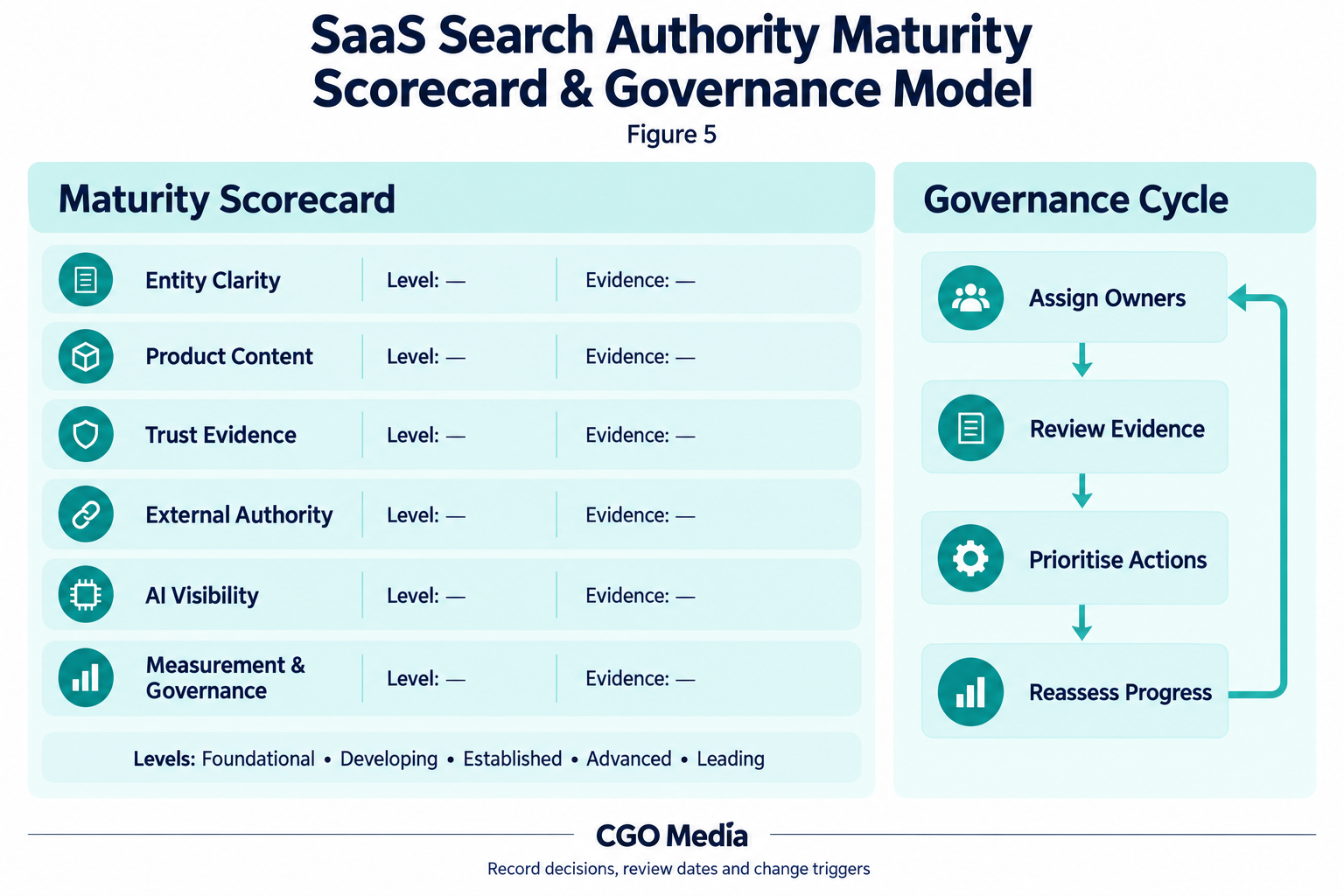
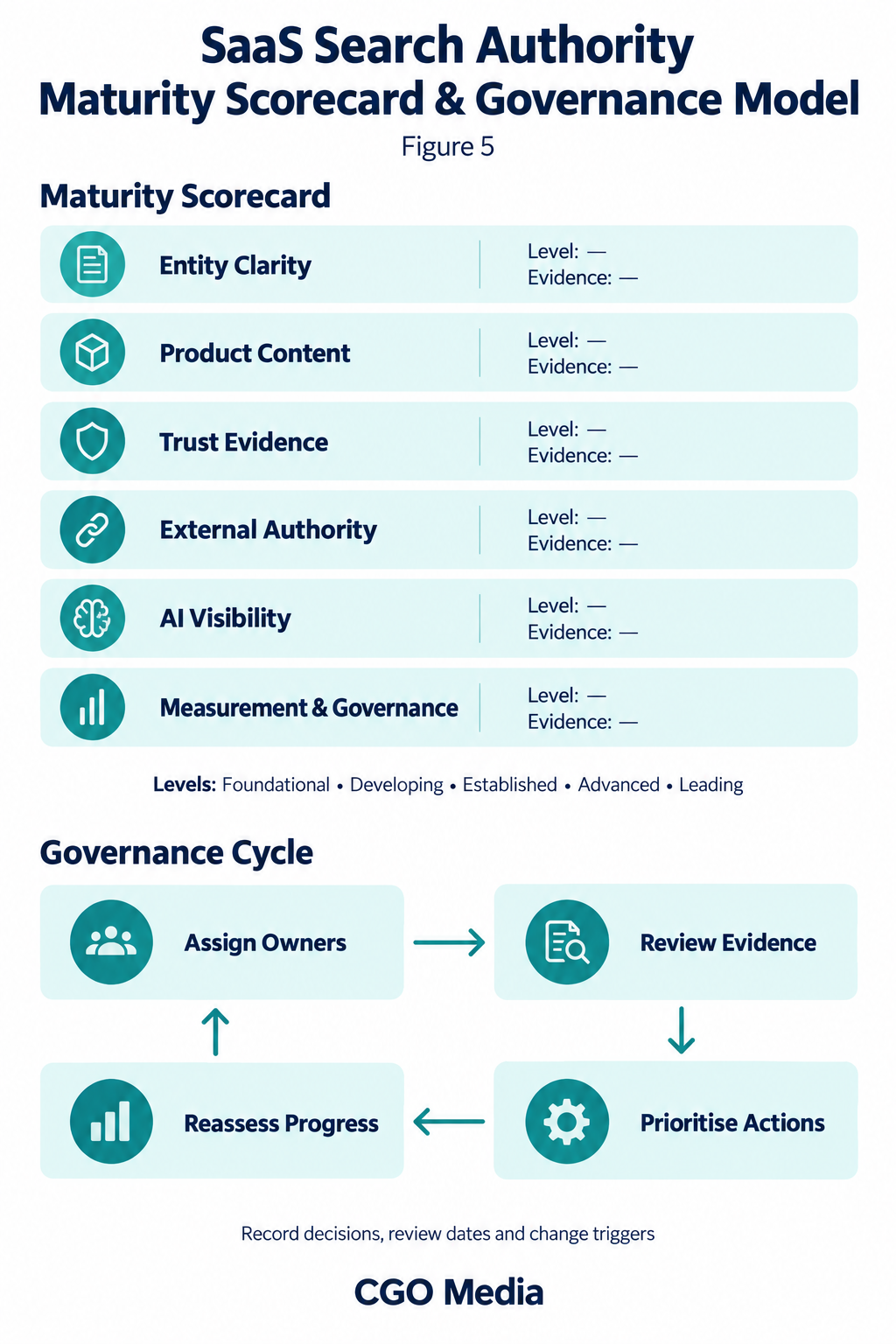
227. Continuous Maturity Improvement
The SaaS Search Authority Maturity Model is designed to support continuous improvement rather than one-time classification.
Maturity should evolve as the organisation strengthens the evidence, systems, ownership and governance supporting:
- Discovery
- Product understanding
- Trust
- Comparison
- Recommendation
228. Maturity Improvement Should Be Sequential
Organisations should generally avoid attempting advanced Level 5 practices before establishing the capabilities required at earlier stages.
The core improvement sequence is:
Clarify → Structure → Establish → Integrate → Adapt
229. Clarify
Resolve ambiguity around:
- Company identity
- Product naming
- Category positioning
- Product relationships
- Target markets
Clarity provides the foundation for everything that follows.
230. Structure
Organise evidence around:
- Features
- Integrations
- Documentation
- Use cases
- Security
- Customers
The objective is to replace fragmented information with deliberate architecture.
231. Establish
Increase the depth, relevance and consistency of product, customer, trust and external evidence.
At this stage the provider begins developing durable authority rather than basic visibility.
232. Integrate
Connect previously separate systems across:
- Product evidence
- Customer evidence
- Trust
- External authority
- AI measurement
- Commercial reporting
Integration is the defining capability of Level 4.
233. Adapt
Use continuous monitoring, governance and market intelligence to maintain authority as conditions change.
Adaptability is the defining capability of Level 5.
234. Failure Modes at Level 1
Level 1 organisations commonly remain stuck because authority development is reactive.
Typical problems include:
- Content without architecture
- SEO without product evidence
- No evidence ownership
- Trust treated as an afterthought
- No AI visibility baseline
235. Level 1 — Content Without Architecture
The provider may publish large volumes of content without establishing clear relationships between:
- Product
- Feature
- Integration
- Use case
- Customer
Content volume alone does not create authority.
236. Level 1 — SEO Without Product Evidence
Search activity may focus heavily on keywords while important product capabilities remain difficult for buyers to verify.
The priority should be accurate and structured product evidence rather than advanced optimisation.
237. Level 1 — No Evidence Ownership
Important information can become outdated when no team is clearly responsible for maintaining it.
This commonly affects:
- Features
- Pricing
- Integrations
- Security
238. Level 1 — Trust as an Afterthought
Security, privacy, support and implementation information may become visible only after buyers contact sales.
This creates unnecessary friction during earlier discovery and evaluation.
239. Moving Beyond Level 1
The priority is to establish:
- Accurate product identity
- Clear product relationships
- Basic evidence ownership
- Structured product and trust information
Advanced AI optimisation should not be the immediate objective.
240. Failure Modes at Level 2
Level 2 organisations have useful foundations but can struggle to convert structure into credible authority.
Common weaknesses include:
- Incomplete standardisation
- Thin feature expansion
- Generic customer evidence
- Irregular AI testing
241. Level 2 — Incomplete Standardisation
Core website information may improve while older:
- Pages
- Review profiles
- Marketplace listings
- Partner references
remain inconsistent.
Authority requires broader evidence alignment.
242. Level 2 — Thin Authority Expansion
Identified content gaps can lead to large numbers of shallow:
- Feature pages
- Integration pages
- Industry pages
Depth and usefulness should take priority over URL volume.
243. Level 2 — Generic Customer Evidence
Case-study volume may increase without demonstrating relevance to specific:
- Industries
- Use cases
- Company sizes
- Buyer problems
Customer evidence should become progressively more contextual.
244. Level 2 — AI Testing Without Repeatability
Occasional AI testing creates limited intelligence if:
- No stable query set exists
- Results are not benchmarked
- Accuracy is not recorded
- No remediation process exists
245. Moving Beyond Level 2
The priority is to deepen evidence and demonstrate genuine relevance within commercially important product and customer areas.
The organisation must move from structured information toward established authority.
246. Failure Modes at Level 3
Level 3 organisations can possess strong authority assets while remaining operationally fragmented.
Typical weaknesses include:
- Strong assets but weak coordination
- Manual information maintenance
- Isolated AI measurement
- External authority without strategy
247. Level 3 — Strong Assets, Weak Coordination
Product, security, customer and communications teams may each perform well without sharing:
- Evidence
- Ownership
- Governance
- Measurement
This limits organisational maturity despite individually strong assets.
248. Level 3 — Manual Information Maintenance
Important product changes may depend on individuals remembering which pages, documents and external profiles need updating.
This creates increasing information-decay risk as the organisation grows.
249. Level 3 — AI Measurement Without Action
AI dashboards provide limited strategic value if observations do not influence:
- Product information
- Content priorities
- Competitive strategy
- Commercial decisions
250. Level 3 — External Authority Without Strategy
Digital PR and other visibility programmes may generate attention without strengthening priority:
- Product categories
- Industries
- Customer segments
- Research themes
External authority should reinforce commercial positioning.
251. Moving Beyond Level 3
The priority is integration.
Strong authority assets should be connected through:
- Shared processes
- Evidence ownership
- Measurement
- Governance
252. Failure Modes at Level 4
Level 4 organisations can possess sophisticated authority systems yet fail to adapt quickly enough.
Typical weaknesses include:
- Governance becoming bureaucracy
- Dashboards replacing investigation
- Fixed competitive models
- Static AI query sets
253. Level 4 — Governance Becomes Bureaucracy
Complex approval structures can slow updates to decision-critical product evidence.
Mature governance should increase accuracy without preventing rapid correction.
254. Level 4 — Dashboards Replace Investigation
Sophisticated reporting can create false confidence if teams record changes without asking why those changes occurred.
Measurement should support diagnosis rather than replace it.
255. Level 4 — Fixed Competitive Models
A provider may continue benchmarking against established competitors while:
- New entrants emerge
- AI-native products appear
- Categories converge
- Buyer expectations change
Competitive intelligence should remain dynamic.
256. Level 4 — Static AI Query Sets
An AI monitoring programme can become less useful when buyer questions and markets change while the monitored query set remains fixed.
A stable core set should be retained for comparison, while additional scenarios evolve with the market.
257. Moving Beyond Level 4
The priority is adaptability.
The organisation must become capable of detecting and responding to meaningful changes across:
- Product
- Buyer demand
- Competition
- External authority
- AI discovery
258. Failure Modes at Level 5
Even advanced organisations can lose maturity.
Level 5 should not create the assumption that authority has been permanently solved.
259. Level 5 — Over-Optimisation
An organisation can become overly focused on:
- Visibility scores
- Recommendation frequency
- Citations
- Dashboards
while losing sight of actual product and customer value.
Authority should remain grounded in genuine product relevance.
260. Level 5 — False Certainty
Advanced measurement does not mean search or AI outcomes can be predicted perfectly.
AI-generated results and search environments remain variable and partly externally controlled.
261. Level 5 — Excessive Automation
Automation can support monitoring and maintenance, but human oversight remains important where:
- Product claims change
- Security information is sensitive
- Competitive interpretation is required
- Customer evidence requires validation
262. Level 5 — Authority Detached from Product Strategy
Search authority should continue to reflect the actual direction of the SaaS product and business.
Mature authority is not maximum visibility.
It is appropriate visibility within the markets where the product genuinely belongs.
263. Maturity Maintenance
Once higher maturity has been achieved, the organisation must preserve the processes and evidence systems supporting it.
Authority should be maintained across all six dimensions.
264. Maintain Entity Integrity
Continuously review:
- Company naming
- Product naming
- Module relationships
- Brand architecture
- Regional representations
265. Maintain Product Evidence
Product changes should remain connected with relevant:
- Feature pages
- Documentation
- Integrations
- Pricing
- Comparison assets
Product change without evidence change can reduce maturity rapidly.
266. Maintain Customer Evidence
Review whether customer stories and outcome claims remain:
- Current
- Representative
- Relevant to strategic markets
Customer authority should evolve with the customer base.
267. Maintain Trust Evidence
Security, privacy, reliability and implementation resources should evolve with:
- Product changes
- Infrastructure changes
- Regulatory requirements
- Buyer expectations
268. Maintain External Authority
External:
- Profiles
- Reviews
- Partnerships
- Marketplace listings
- Citations
require ongoing attention because independent evidence can also become outdated.
269. Maintain AI Intelligence
The AI monitoring architecture should evolve alongside:
- Buyer intent
- Product changes
- Competitors
- New markets
- Discovery systems
AI intelligence should remain representative of the real commercial environment.
270. Maturity Should Support Commercial Priorities
Authority resources should be concentrated where stronger maturity can contribute to:
- Qualified discovery
- Buyer progression
- Strategic markets
- Competitive differentiation
- Revenue growth
Maturity for its own sake should not become the objective.
271. Market Expansion Can Require New Maturity
An organisation can be highly mature in one market while comparatively immature in another.
Expansion can introduce new evidence and authority requirements.
272. New Industry Expansion
Entering a new sector can require new:
- Use-case evidence
- Industry content
- Customer proof
- External validation
- Trust information
Previous maturity does not automatically transfer across industries.
273. Geographic Expansion
Entering new countries can require stronger evidence around:
- Language
- Currency
- Support
- Data residency
- Regional compliance
- Local customers
274. Product Expansion
New modules or products can temporarily reduce overall maturity if:
- Entity architecture
- Documentation
- Customer evidence
- External authority
do not expand at the same pace.
275. Acquisition Expansion
Acquired SaaS products can create integration challenges involving:
- Brand architecture
- Product naming
- Documentation
- Review profiles
- Market positioning
Acquisition should therefore trigger maturity reassessment.
276. Research as a Higher-Maturity Capability
Advanced SaaS organisations may use original research to contribute credible evidence and analysis to the wider market.
Research should be connected with areas where the organisation possesses genuine:
- Data
- Operational experience
- Technical knowledge
- Subject expertise
277. Research Can Strengthen Multiple Authority Dimensions
Strong research can contribute to:
- Content authority
- Expert authority
- External citation
- Digital PR
- AI source visibility
Research maturity depends on evidence quality rather than publication volume.
278. Organisational Learning Is a Level 5 Capability
The highest maturity level is characterised partly by the ability to learn continuously from the wider discovery environment.
The organisation should convert signals into evidence improvement.
279. Search Learning
Search data can reveal changes in:
- Buyer problems
- Software categories
- Feature demand
- Buyer language
These changes can reveal new market opportunities or weakening relevance.
280. Sales Learning
Sales evidence can reveal:
- Competitive pressure
- Buyer objections
- Missing capabilities
- Trust concerns
- Commercial barriers
Sales intelligence should feed directly into authority development.
281. Customer Learning
Customer evidence can reveal:
- Adoption patterns
- Unexpected use cases
- Implementation friction
- Expansion opportunities
Existing customers therefore provide evidence for future authority priorities.
282. AI Discovery Learning
AI monitoring can reveal changing associations between:
- Products
- Categories
- Features
- Competitors
- Sources
These observations should be treated as diagnostic signals rather than definitive explanations of internal AI mechanisms.
283. Competitive Learning
Competitor analysis can identify where other providers are developing stronger:
- Evidence
- Authority
- Market positioning
- Customer relevance
This helps expose emerging capability gaps.
284. Learning Should Feed Authority Improvement
Insights from search, sales, customers, competitors and AI discovery should influence:
- Product information
- Search strategy
- Customer evidence
- External authority programmes
- AI monitoring
This creates a continuous feedback loop between the market and the authority system.
285. The Adaptive SaaS Maturity Cycle
The complete maturity cycle can be represented as:
Assess → Structure → Establish → Integrate → Monitor → Learn → Adapt → Reassess
286. Assess
Determine the current maturity position across all six dimensions using observable evidence.
287. Structure
Create clear ownership, coherent relationships and consistent evidence foundations.
288. Establish
Build sufficient:
- Product authority
- Customer authority
- Trust
- External validation
to support serious buyer evaluation.
289. Integrate
Connect authority systems across teams, information environments and buyer journeys.
290. Monitor
Track:
- Search signals
- Product changes
- External authority
- AI representation
- Commercial outcomes
over time.
291. Learn
Identify meaningful changes in:
- Buyer needs
- Competitive conditions
- Product representation
- Market opportunity
292. Adapt
Adjust:
- Authority investment
- Evidence systems
- Governance
- Measurement
in response to material change.
293. Reassess
Repeat the maturity evaluation to determine whether capability has:
- Strengthened
- Remained stable
- Regressed
The result becomes the starting point for the next improvement cycle.
294. The Purpose of Level 5
Level 5 should not be viewed as a permanent destination or a declaration that search authority has been completed.
It represents the organisational capability to maintain and improve authority despite continuous change.
The defining cycle remains:
Assess → Structure → Establish → Integrate → Monitor → Learn → Adapt → Reassess
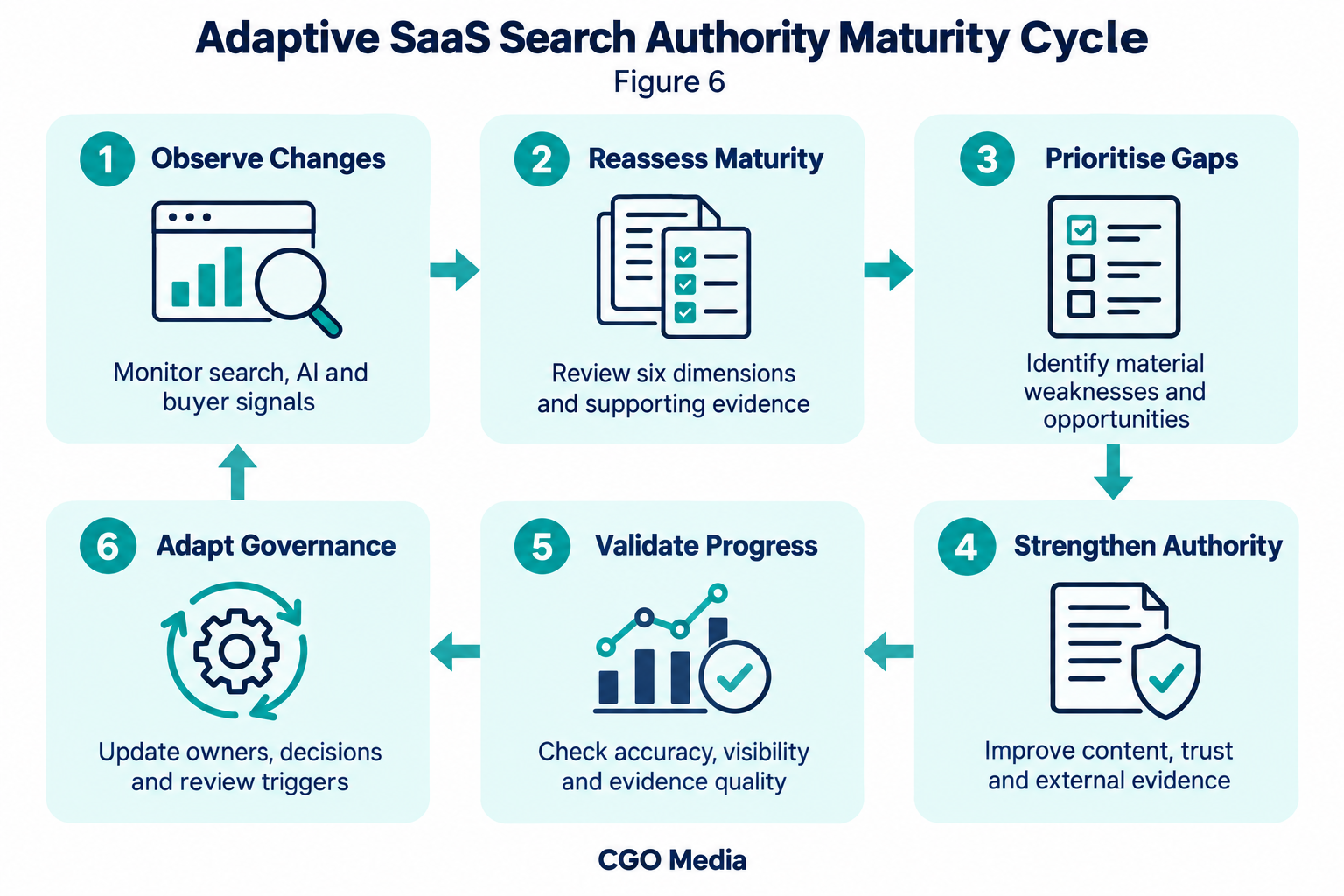
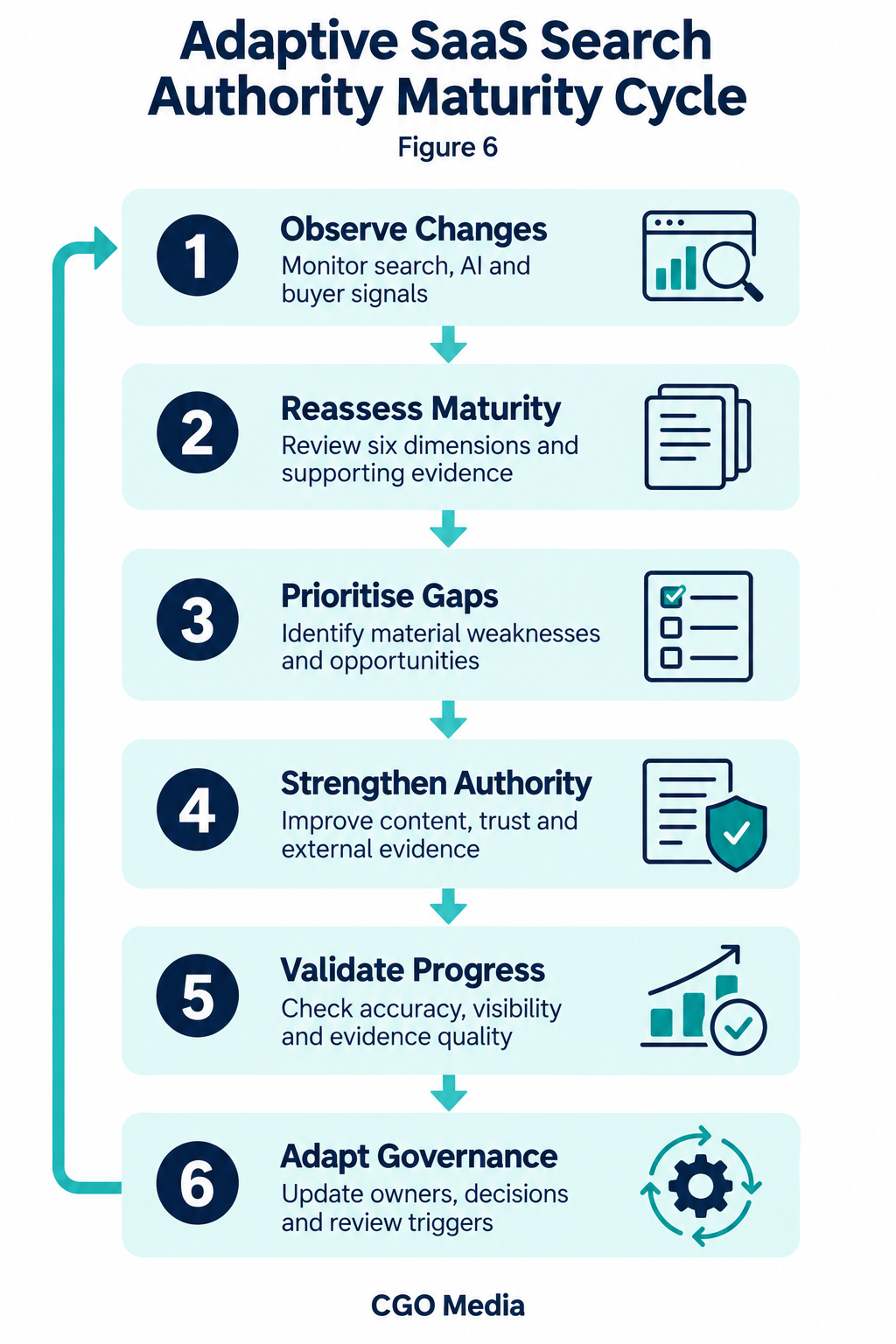
295. Strategic Implications
The SaaS Search Authority Maturity Model distinguishes between isolated visibility improvements and genuine organisational capability.
Its central principle is that search authority develops progressively:
Fragmented → Structured → Established → Integrated → Adaptive
The objective is not simply to achieve greater visibility. It is to build an organisation capable of maintaining accurate product evidence, trust, external validation and AI-assisted discovery as the market changes.
296. Maturity Is More Than SEO Performance
A SaaS provider can rank well while remaining immature in:
- Product evidence
- Security and trust
- Customer authority
- External validation
- AI recommendation readiness
The model therefore evaluates organisational capability rather than rankings alone.
297. The Five-Level Progression
The model defines five stages:
- Fragmented Visibility
- Structured SaaS Search Foundation
- Established Product Authority
- Integrated Search and AI Authority
- Adaptive SaaS Search Leadership
Each level represents a different authority-management capability.
298. Level 1 — Primarily an Information Problem
At Level 1, important product, trust, customer and external evidence exists but remains fragmented, inconsistent or difficult to verify.
The primary requirement is clarity.
299. Level 2 — Primarily a Structure Problem
At Level 2, the organisation begins standardising:
- Product identity
- Feature architecture
- Documentation
- Trust evidence
- External profiles
The priority is to convert fragmented information into repeatable structure.
300. Level 3 — Primarily an Authority Problem
At Level 3, the provider has developed sufficiently strong product, customer, trust and external evidence to support serious buyer evaluation.
The challenge becomes increasing the depth and relevance of that authority across strategically important markets.
301. Level 4 — Primarily an Integration Problem
At Level 4, the organisation moves from building individual authority assets toward connecting them through:
- Knowledge architecture
- Evidence ownership
- Governance
- AI measurement
- Commercial reporting
Integration is the defining capability.
302. Level 5 — Primarily an Adaptation Problem
At Level 5, the organisation must maintain authority while:
- Products evolve
- Buyer behaviour changes
- Competitors reposition
- New markets emerge
- Search and AI systems change
The defining capability is adaptability rather than permanent visibility.
303. The Weakest Dimension Matters
A SaaS provider may perform strongly across several dimensions while one critical weakness constrains buyer progression.
For example:
- Strong product authority can coexist with inadequate security evidence.
- Strong search visibility can coexist with poor implementation clarity.
- Strong customer proof can coexist with weak integration evidence.
- Strong brand authority can coexist with inaccurate AI representation.
Maturity improvement should therefore focus on strategically important bottlenecks rather than averages alone.
304. Maturity Should Reflect Commercial Context
The appropriate maturity target depends on:
- Business model
- Product complexity
- Buyer risk
- Market maturity
- Competitive intensity
- Commercial strategy
A self-service SaaS product may require different evidence depth from an enterprise platform handling sensitive organisational data.
305. Maturity Should Not Become a Vanity Score
The purpose of the model is diagnostic.
Its value lies in identifying:
- Evidence gaps
- Governance weaknesses
- Competitive disadvantages
- Authority opportunities
- Regression risks
A maturity number without corresponding action provides limited strategic value.
306. Maturity Should Inform Investment
The model can help determine whether the next major authority investment should focus on:
- Entity clarity
- Technical documentation
- Customer evidence
- Security and trust
- External authority
- AI measurement
Investment should follow the most commercially important capability gap.
307. Maturity Should Inform Governance
Higher maturity increasingly requires coordinated ownership across:
- Marketing
- Product
- Engineering
- Security
- Legal
- Customer success
- Revenue operations
No single department controls every authority dimension.
308. Maturity Should Inform Executive Reporting
Leadership should understand whether digital authority is:
- Strengthening
- Weakening
- Becoming more competitive
- Creating new commercial risk
Executive reporting should therefore focus on meaningful capability change rather than excessive operational metrics.
309. AI Visibility Within the Wider Maturity System
AI recommendation visibility alone does not demonstrate advanced maturity.
A provider can appear within generated recommendations while still possessing:
- Weak product evidence
- Limited trust
- Inconsistent external representation
- Poor information governance
AI visibility should therefore be interpreted alongside the wider authority system.
310. Recommendation Readiness Is a Higher-Order Outcome
AI recommendation readiness can be viewed as one potential outcome of stronger underlying authority across:
- Entity clarity
- Product evidence
- Customer authority
- Trust
- External validation
No individual signal should be assumed to guarantee recommendation visibility.
311. Level 5 Does Not Mean Guaranteed Visibility
No maturity level guarantees:
- Search rankings
- Traffic
- AI citations
- AI recommendations
- Revenue growth
Level 5 indicates that the organisation has developed stronger systems for observing, maintaining and improving its authority environment.
312. Relationship with the SaaS Research Family
The SaaS Search Authority Maturity Model forms part of the wider CGO Media SaaS research architecture.
The research family examines the SaaS discovery environment from complementary perspectives:
- Search and product authority
- Trust and visibility
- Provider discovery and selection
- Organisational maturity
- Implementation
- Generative Engine Optimisation
313. Relationship with SaaS SEO in an AI Search Environment
The SaaS SEO in an AI Search Environment research paper establishes the wider context for software discovery, product authority, buyer evaluation and AI-assisted recommendation.
The maturity model provides a way to assess how advanced an organisation has become in developing those capabilities.
314. Relationship with the SaaS AI Trust and Visibility Framework
The SaaS AI Trust and Visibility Framework examines the evidence dimensions contributing to SaaS trust, visibility and recommendation readiness.
The maturity model evaluates how systematically those capabilities have been developed and governed.
315. Relationship with the SaaS Discovery and Provider Selection Model
The SaaS Discovery and Provider Selection Model examines how product, trust and external evidence influence progression from early discovery through comparison and provider selection.
The maturity model evaluates whether the organisation possesses the capabilities required to support those buyer journeys consistently.
316. Relationship with the SaaS SEO and AI Implementation Roadmap
The SaaS SEO and AI Implementation Roadmap translates maturity gaps into a structured implementation programme.
The maturity model identifies where the organisation is; the roadmap helps define what should happen next.
317. Relationship with SaaS GEO
The SaaS GEO: Generative Engine Optimisation research examines how software providers can strengthen the evidence environment supporting generative discovery, citation and recommendation.
GEO capability becomes increasingly relevant as organisations progress from basic AI observation toward integrated and adaptive AI authority management.
318. Relationship with the Wider CGO Media Framework Architecture
The maturity model also connects with wider CGO Media methodologies examining:
- Entity Authority
- Content Authority
- Brand Signals
- AI Citation
- AI Search Readiness
- Knowledge Architecture
Together these models provide supporting approaches for diagnosing individual components within a broader search-authority system.
319. Methodology
The SaaS Search Authority Maturity Model is a conceptual and operational assessment methodology developed by CGO Media for evaluating how advanced a SaaS organisation has become in building, connecting and governing digital search authority.
The model evaluates six authority dimensions across five maturity levels.
320. The Six Assessment Dimensions
- Provider and Product Entity Clarity
- Feature, Integration and Technical Authority
- Use Case, Industry and Customer Authority
- Security, Privacy and Product Trust
- External, Review and Market Authority
- AI Search and Recommendation Readiness
The dimensions are intended to be assessed individually before an overall organisational interpretation is made.
321. The Five Maturity Levels
- Fragmented Visibility
- Structured SaaS Search Foundation
- Established Product Authority
- Integrated Search and AI Authority
- Adaptive SaaS Search Leadership
The levels represent progressively stronger organisational capabilities rather than guaranteed performance outcomes.
322. Evidence Collection
A practical maturity assessment may examine:
- Website architecture
- Product pages
- Technical documentation
- Integration resources
- Security and privacy evidence
- Customer case studies
- Review platforms
- Marketplaces
- External citations
- AI recommendation tests
Evidence should be current, observable and relevant to the markets being assessed.
323. Internal Evidence
Where available, maturity assessment may also incorporate:
- Sales feedback
- Win/loss analysis
- Customer-success data
- Product analytics
- Revenue attribution
- Governance records
Internal evidence can help connect public authority with actual buyer and customer behaviour.
324. Scoring Method
Each authority dimension may be assigned a maturity level from 1 to 5 based on observable evidence and organisational capability.
Scores should be supported by documented reasoning rather than subjective perception alone.
A useful assessment structure is:
Evidence → Current Capability → Current Level → Target Capability → Priority Gap
325. Evidence Threshold Principle
A higher maturity assessment should require evidence that the relevant capability is:
- Established
- Repeatable
- Governed
- Current
Temporary projects or isolated successes should not automatically justify higher maturity classification.
326. Longitudinal Assessment
The model becomes particularly useful when assessments are repeated over time.
Changes can reveal whether authority capability is:
- Strengthening
- Stable
- Regressing
This helps transform maturity analysis from a static audit into an ongoing management process.
327. Competitive Assessment
Publicly observable competitor evidence can support directional benchmarking across the six dimensions.
However, internal:
- Processes
- Governance
- Ownership
- Commercial measurement
should not be assumed where supporting evidence is unavailable.
328. Framework Limitations
The SaaS Search Authority Maturity Model is not a confirmed search-engine ranking system or a disclosed AI recommendation model.
The five levels and six dimensions are strategic assessment constructs developed by CGO Media to support organisational analysis and planning.
329. Maturity Scores Are Not Predictions
A Level 4 or Level 5 organisation is not guaranteed to outperform a lower-maturity competitor in:
- Search rankings
- Traffic
- AI citations
- Recommendations
- Revenue
Maturity represents organisational capability rather than a forecast of specific outcomes.
330. Market Conditions Affect Outcomes
Performance is influenced by factors beyond authority maturity, including:
- Market demand
- Competition
- Product quality
- Pricing
- Brand awareness
- Customer preference
The maturity model should therefore be interpreted within the broader commercial environment.
331. AI Results Are Dynamic
AI-generated responses and recommendations can vary according to:
- Prompt wording
- Model
- Retrieval behaviour
- Source availability
- Geography
- Time
Individual outputs should therefore be interpreted cautiously and assessed through repeated observation where appropriate.
332. Maturity Does Not Replace Product Strategy
The framework should support product and market strategy rather than encourage authority development around products or markets that lack genuine commercial fit.
Search authority should reinforce product reality rather than substitute for it.
333. Maturity Assessment Should Be Contextual
Different SaaS business models can require different maturity priorities.
The model should therefore be adapted to the product, buyer and commercial environment being assessed.
334. Product-Led SaaS Context
Product-led businesses may place greater emphasis on:
- Product clarity
- Feature evidence
- Documentation
- Onboarding
- Reviews
- Trial visibility
Self-service evidence often carries greater importance within lower-friction buying journeys.
335. Enterprise SaaS Context
Enterprise providers may require deeper maturity around:
- Security
- Compliance
- Technical depth
- Implementation
- Customer evidence
- Governance
Higher buyer risk typically increases the evidence threshold required for provider selection.
336. Vertical SaaS Context
Vertical SaaS organisations may require greater maturity around:
- Industry knowledge
- Sector workflows
- Regulation
- Industry integrations
- Vertical customer proof
Sector-specific evidence can become central to demonstrating genuine market relevance.
337. International SaaS Context
International SaaS providers may require additional authority around:
- Regional entity clarity
- Language
- Currency
- Data residency
- Local customer evidence
- Regional compliance
Maturity in one geography should not automatically be assumed to transfer to another.
338. Conclusion
SaaS search authority does not emerge from one successful SEO campaign, one strong review profile or one period of AI visibility.
It develops through the organisation’s ability to build, connect, govern and continuously maintain evidence across product, customer, trust, external and AI-assisted discovery environments.
The SaaS Search Authority Maturity Model defines the progression as:
Fragmented → Structured → Established → Integrated → Adaptive
Each level represents a different organisational capability.
The model is intended to help SaaS organisations identify where they are today, determine which authority capabilities are required next and avoid investing heavily in advanced activity before the underlying evidence foundations are sufficiently mature.
The long-term objective is not simply to achieve a high maturity score.
It is to develop a resilient authority-management system capable of keeping:
- Product information
- Customer evidence
- Trust signals
- External validation
- AI representation
aligned as the SaaS market continues to evolve.
The continuous operating cycle is:
Assess → Structure → Establish → Integrate → Monitor → Learn → Adapt → Reassess
References
External Academic, Technical and Search Sources
- Google Search Central. SEO Starter Guide.
- Google Search Central. Understand How Structured Data Works.
- Schema.org. Organization.
- Schema.org. SoftwareApplication.
- Hogan, A. et al. (2021). Knowledge Graphs. ACM Computing Surveys, 54(4).
- Metzger, M.J. (2007). Making Sense of Credibility on the Web: Models for Evaluating Online Information and Recommendations for Future Research. Journal of the American Society for Information Science and Technology, 58(13), 2078–2091.
- Ji, Z. et al. (2023). Survey of Hallucination in Natural Language Generation. ACM Computing Surveys, 55(12).
CGO Media SaaS Research and Frameworks
- Wilkinson, R. (2026). SaaS SEO in an AI Search Environment. CGO Media.
- Wilkinson, R. (2026). SaaS AI Trust and Visibility Framework. CGO Media.
- Wilkinson, R. (2026). SaaS Discovery and Provider Selection Model. CGO Media.
- Wilkinson, R. (2026). CGO Media Entity Authority Framework. CGO Media.
- Wilkinson, R. (2026). CGO Media AI Search Readiness Framework. CGO Media.
- Wilkinson, R. (2026). CGO Media Knowledge Architecture Map. CGO Media.
CGO Media Research Ecosystem
The SaaS Search Authority Maturity Model forms part of the wider CGO Media research programme examining SEO, AI Search, GEO, knowledge architecture, digital authority and recommendation-led discovery.
Research Library | Framework Library | Research Architecture | Research Observations | Statistics Library
About Roger Wilkinson
Roger Wilkinson is an independent researcher, SEO practitioner and founder of CGO Media with more than 25 years of experience in search, online visibility and digital strategy.
His research examines how artificial intelligence is reshaping search engines, recommendation systems and digital authority. Through independent research papers and strategic frameworks, Roger examines relationships between Technical SEO, Entity Authority, Brand Signals, AI Visibility, Citation Authority, Knowledge Graphs and Search Visibility.
Roger is the creator of the CGO Framework Series, a collection of research-led methodologies designed to help organisations measure, improve and govern digital authority across traditional and AI-assisted discovery systems.
Related SaaS AI, GEO & Search Research
This maturity model forms part of the seven-page CGO Media SaaS research family. The six companion resources are:
Research Usage & Citation
CGO Media encourages researchers, journalists, SaaS companies, technology professionals, educators and industry practitioners to reference this maturity model where it contributes to broader understanding of SaaS SEO, AI Search, software authority and digital maturity.
Reasonable quotations, summaries, figures and excerpts may be used in articles, reports, presentations, academic work and other publications provided appropriate acknowledgement is given to Roger Wilkinson and CGO Media.
Cite This Model / Embed Citation
The SaaS Search Authority Maturity Model by Roger Wilkinson at CGO Media defines five levels of SaaS search maturity across six dimensions covering entity clarity, technical authority, customer authority, product trust, external validation and AI recommendation readiness.
APA Citation
Wilkinson, R. (2026). SaaS Search Authority Maturity Model. CGO Media. https://cgomedia.com/saas-search-authority-maturity-model/
Author: Roger Wilkinson | Published by: CGO Media
For permissions relating to extensive reproduction, commercial licensing or republication of substantial portions of this model, please contact CGO Media directly.