
Manufacturing SEO in an AI Search Environment
Executive Summary
 Manufacturing SEO is entering a new phase in which search visibility depends on more than keyword rankings, product pages and traditional lead generation. Industrial buyers increasingly discover and evaluate manufacturers through search engines, AI assistants, supplier directories, technical publications, professional networks and industry-specific research platforms.
This research examines how manufacturing organisations can strengthen their visibility across these interconnected discovery environments. It considers the relationships between manufacturer identity, technical capability, product expertise, production processes, industry experience, geographic relevance, certifications and independently verifiable evidence.
For manufacturers, the central challenge is no longer simply appearing in search results. It is ensuring that engineers, procurement teams, original equipment manufacturers (OEMs), distributors and AI-assisted research systems can accurately identify what a company manufactures, which capabilities it possesses, where it operates and whether it satisfies specific technical and commercial requirements.
The research examines six interconnected dimensions of manufacturing search authority:
- Manufacturer Entity Authority: Establishing clear relationships between manufacturing organisations, facilities, products, processes and markets.
- Technical and Capability Authority: Demonstrating production expertise through specifications, materials, tolerances, machinery, quality controls and engineering evidence.
- Industry and Application Relevance: Connecting manufacturing capabilities with the industries, applications and technical requirements of prospective buyers.
- Supplier Trust and External Validation: Supporting manufacturing claims through certifications, case studies, standards, industry recognition and independent evidence.
- Geographic and Commercial Relevance: Communicating production locations, export capabilities, supply-chain suitability and procurement requirements.
- AI Search and Recommendation Visibility: Improving the clarity, accessibility and credibility of manufacturing information used in AI-assisted supplier discovery and comparison.
The research also considers how manufacturers can organise their digital knowledge architecture so that relationships between facilities, production capabilities, materials, certifications and customer applications are understandable to both human buyers and machine-based discovery systems.
The central conclusion is that manufacturing search visibility increasingly depends on demonstrable supplier suitability rather than keyword presence alone. Manufacturers that communicate their capabilities clearly, connect technical information with buyer requirements and provide verifiable evidence are better positioned for consideration across traditional and AI-assisted discovery environments.
This paper provides a research-led foundation for manufacturing SEO, Generative Engine Optimisation (GEO), technical content development, supplier authority building and AI search readiness.
1. The Changing Nature of Manufacturing Search
Manufacturing search has traditionally been treated as a specialist form of B2B SEO centred on product pages, technical specifications, industry terminology, geographic markets and lead generation.
That model remains important, but it is becoming incomplete.
Engineers, procurement teams, distributors, OEMs, consultants, project managers and technical buyers increasingly move across multiple discovery environments before identifying or selecting a manufacturer.
Those environments may include:
- Traditional search engines
- AI assistants
- Industry directories
- Distributor websites
- Technical publications
- Trade associations
- Standards bodies
- Research resources
- Professional networks
- Supplier databases
Manufacturing visibility therefore depends on more than whether a company ranks for a product keyword.
The wider question is whether digital systems can understand:
- Who the manufacturer is
- What it produces
- Which processes it operates
- Which industries it serves
- Which standards and certifications it holds
- Where it operates
- What production capabilities it possesses
- Whether external sources validate its claims
2. From Manufacturing Rankings to Supplier Discovery
A traditional manufacturing SEO strategy may focus heavily on terms such as:
- Precision engineering company
- CNC machining services
- Plastic injection moulding manufacturer
- Sheet metal fabrication
- Industrial component manufacturer
- Contract manufacturing services
These searches remain commercially important.
However, modern supplier discovery can begin with much broader questions.
A buyer may ask:
- Which manufacturers can produce aerospace components to a particular tolerance?
- Which suppliers manufacture medical-grade plastic components in Europe?
- Which UK companies offer low-volume CNC production with ISO certification?
- Which manufacturers can support prototype-to-production programmes?
- Which suppliers have experience with a specific material or production method?
AI systems are particularly suited to these multi-condition queries because they can synthesise information across several sources and present shortlists rather than isolated search results.
This shifts the competitive environment from ranking for individual phrases toward becoming a credible candidate within a supplier recommendation set.
3. Manufacturing Search Is a Multi-Entity Problem
Manufacturing websites contain many entities that search and AI systems may need to understand independently and relationally.
These may include:
- Manufacturer
- Factory
- Production facility
- Product
- Component
- Material
- Manufacturing process
- Industry
- Certification
- Standard
- Machine capability
- Engineer
- Distributor
- Supplier
- Country or production region
Weak relationships between these entities can create ambiguity even when individual pages contain substantial technical information.
4. Manufacturer Entity Clarity
A manufacturer should be represented consistently across its own website and wider digital environment.
Core identity evidence can include:
- Official business name
- Trading names
- Headquarters
- Production locations
- Parent organisation
- Subsidiaries
- Leadership
- Industries served
- Primary manufacturing capabilities
This clarity becomes particularly important where multiple factories, brands or business units operate under a wider manufacturing group.
5. Manufacturing Capability Authority
One of the most important distinctions in industrial search is the difference between claiming a capability and demonstrating one.
A weak manufacturing page may state:
“We provide precision manufacturing services.”
A stronger evidence environment may explain:
- Processes used
- Materials handled
- Tolerance ranges
- Machine types
- Component sizes
- Production volumes
- Quality-control procedures
- Relevant industries
- Certifications
The second representation provides much more useful evidence for both technical buyers and machine-based systems attempting to determine supplier suitability.
6. Process Authority
Manufacturing-process authority develops when a company demonstrates genuine depth around the methods it uses.
For example, a CNC machining provider might explain:
- 3-axis machining
- 5-axis machining
- Turning
- Milling
- Tooling capability
- Materials
- Tolerances
- Inspection processes
- Production scale
A process page should therefore function as more than a commercial landing page.
It should act as a structured source of technical evidence.
7. Product Authority
Product authority becomes particularly important for manufacturers supplying repeatable components, assemblies or product families.
Strong product information may include:
- Dimensions
- Materials
- Performance properties
- Applications
- Standards
- Compatibility
- Manufacturing method
- Technical documentation
Clear product evidence can support both conventional commercial search and AI-assisted product discovery.
8. Industry Authority
Manufacturers frequently serve several industries, but broad claims such as “we work across multiple sectors” provide limited evidence of real market expertise.
Stronger industry authority may demonstrate:
- Relevant manufacturing processes
- Industry-specific materials
- Applicable standards
- Quality requirements
- Case studies
- Typical applications
- Sector-specific expertise
9. Application Authority
Industrial buyers often search according to an engineering or commercial application rather than a specific manufacturing process.
Examples may include:
- Components for aerospace assemblies
- Medical-device manufacturing
- Automotive prototype production
- Food-processing equipment components
- Renewable-energy fabrication
Application-led content can connect technical manufacturing capability with the buyer’s actual problem.
10. Material Authority
Materials are often central to manufacturing selection.
A supplier may need to demonstrate experience with:
- Aluminium
- Stainless steel
- Titanium
- Engineering plastics
- Composites
- Copper alloys
- Specialist polymers
Material authority becomes stronger when the manufacturer explains not merely that it works with a material, but how that material relates to manufacturing process, application and performance requirements.
11. Manufacturing Search Intent
Manufacturing search intent is unusually diverse.
A useful search architecture may distinguish between:
- Supplier discovery
- Process discovery
- Product discovery
- Technical research
- Material research
- Standards verification
- Capability comparison
- Commercial quotation
12. Supplier Discovery Intent
Supplier-discovery searches identify potential manufacturers capable of satisfying a broad requirement.
Examples include:
- UK aerospace component manufacturers
- European injection moulding suppliers
- medical device contract manufacturers
13. Process Discovery Intent
Process-led searches begin with a manufacturing method.
Examples include:
- 5-axis CNC machining
- metal stamping services
- laser cutting supplier
- plastic injection moulding
14. Product Discovery Intent
Product-led searches begin with the component or assembly required rather than the manufacturing process.
15. Technical Research Intent
Engineers and technical buyers may search for information before identifying a supplier.
This can include:
- Material comparisons
- Manufacturing tolerances
- Process limitations
- Production-volume guidance
- Design-for-manufacture information
16. Standards and Certification Intent
Some buyers begin with a compliance requirement.
They may search for manufacturers holding a specific quality, environmental or industry certification.
17. Commercial Intent
Commercial searches may involve:
- Request for quotation
- Lead times
- Minimum order quantities
- Prototype costs
- Production capacity
18. Manufacturing Search Intent Architecture
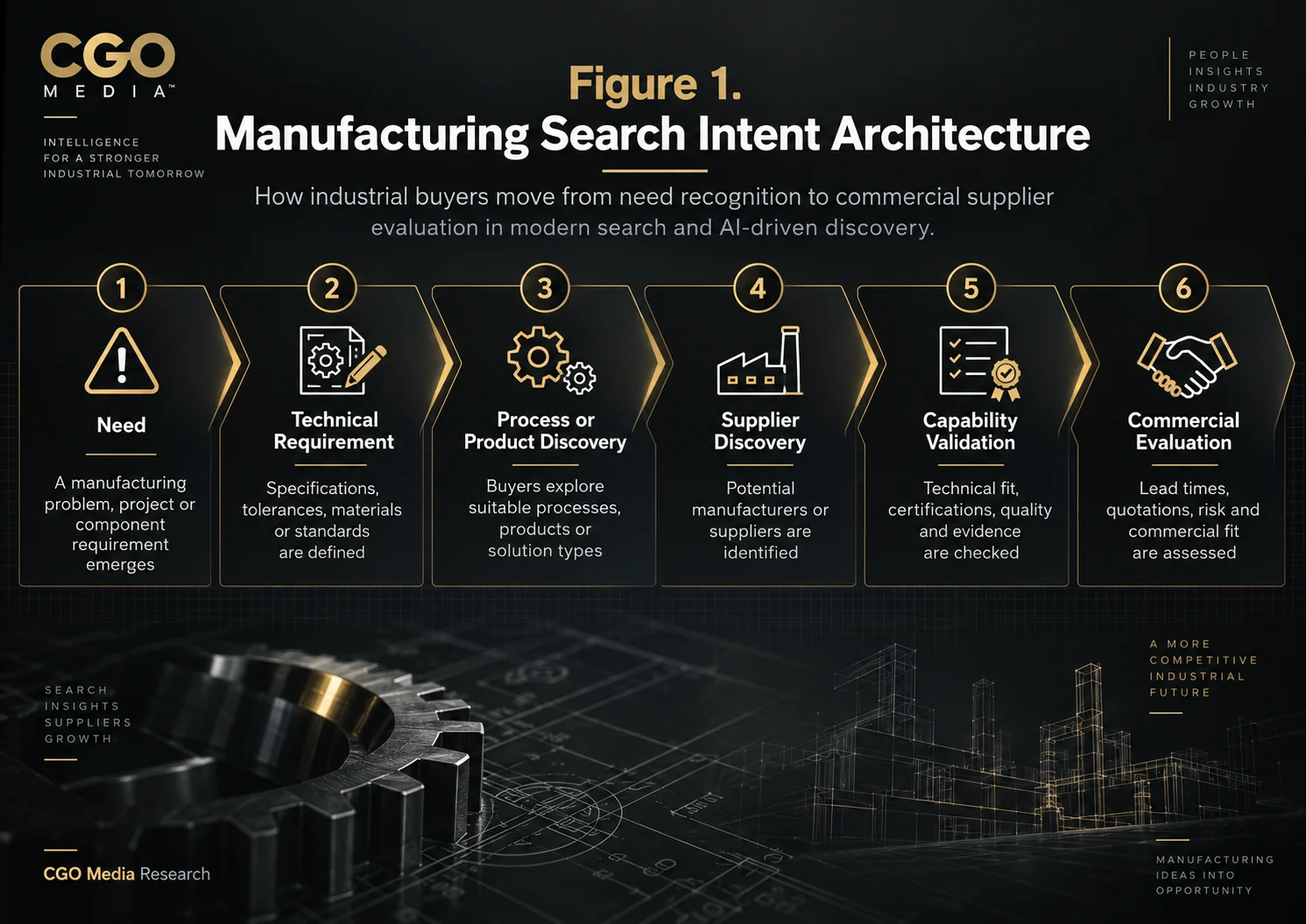
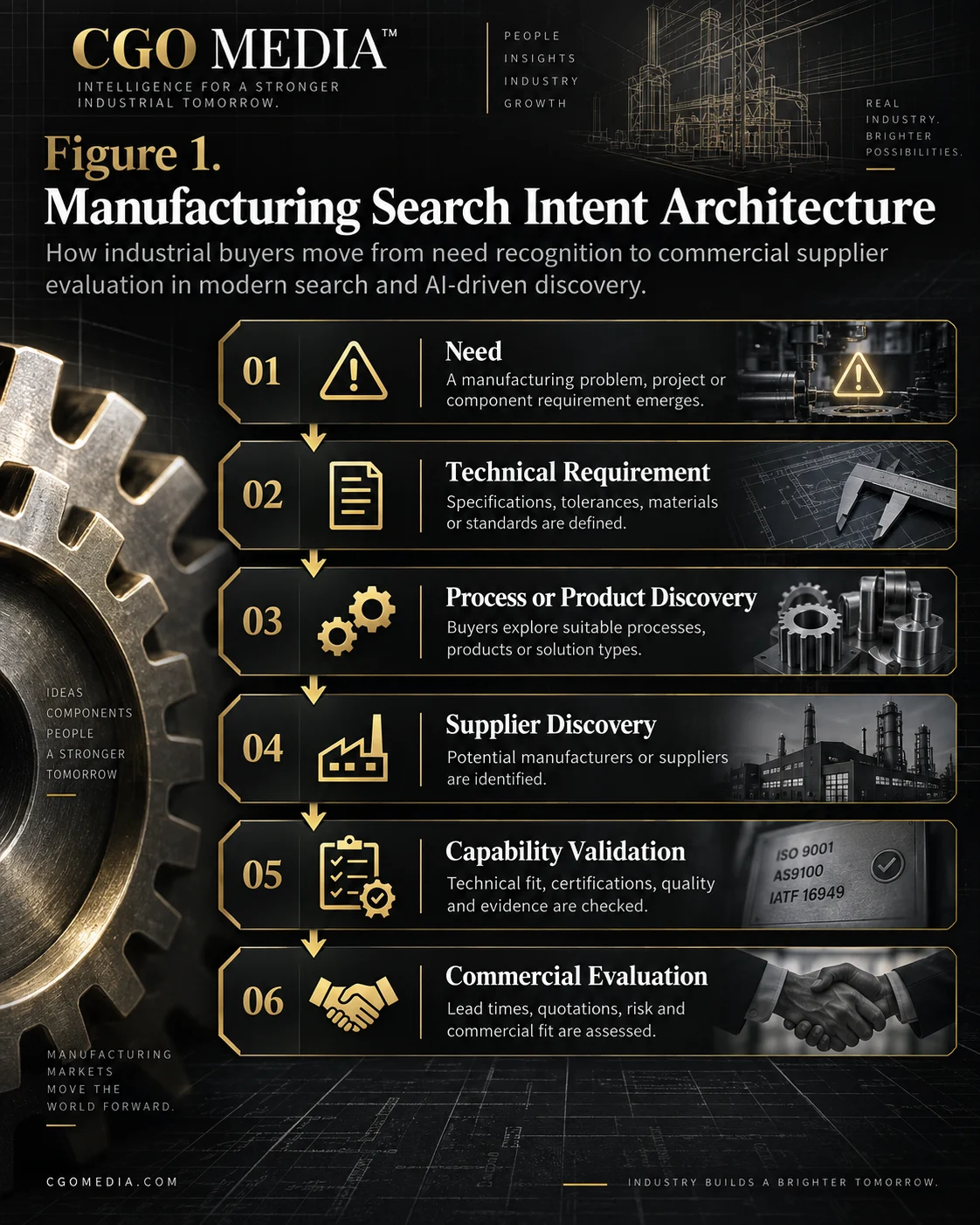
These search intents can be represented as a progression:
Need → Technical Requirement → Process or Product Discovery → Supplier Discovery → Capability Validation → Commercial Evaluation
This progression illustrates why manufacturing search should not be reduced to a simple keyword-to-landing-page model.
Figure 1 : Manufacturing Search Intent Architecture.
Need → Technical Requirement → Process or Product Discovery → Supplier Discovery → Capability Validation → Commercial Evaluation
19. Technical Manufacturing Authority
Manufacturing search authority depends heavily on technical specificity.
Buyers evaluating a supplier may need to understand:
- Production processes
- Machine capabilities
- Tolerance ranges
- Materials
- Quality controls
- Inspection methods
- Production volumes
- Engineering support
Technical detail helps distinguish genuine manufacturing capability from generic commercial claims.
20. Machine and Equipment Evidence
Where relevant, manufacturers can strengthen capability evidence by documenting:
- Machine types
- Machine brands
- Axis capability
- Working envelopes
- Automation capability
- Inspection equipment
- Secondary processes
This information may be especially valuable where procurement teams are comparing suppliers for technically demanding work.
21. Tolerance Authority
Tolerance requirements can be central to supplier selection.
Manufacturers should avoid unsupported claims such as “high precision” where more useful evidence can be provided.
Where commercially appropriate, capability information can explain:
- Typical tolerances
- Process-specific tolerances
- Inspection methods
- Measurement equipment
- Quality-assurance procedures
22. Production Volume Authority
Supplier suitability can depend on whether the manufacturer specialises in:
- Prototypes
- Low-volume production
- Medium-volume production
- High-volume production
- Mass manufacturing
Clear production-volume evidence helps buyers understand whether the supplier is operationally appropriate before making contact.
23. Prototype-to-Production Authority
Some manufacturers differentiate by supporting clients from early engineering development through full production.
Useful evidence may describe:
- Prototype support
- Design-for-manufacture input
- Tooling
- Pilot production
- Production scaling
- Ongoing manufacturing
24. Quality Authority
Quality authority should be demonstrated through evidence rather than generic claims.
Relevant evidence can include:
- Inspection processes
- Quality-management systems
- Traceability
- Testing
- Documentation
- Non-conformance procedures
25. Certification Authority
Certifications can become important supplier-selection signals where they relate directly to buyer requirements.
Manufacturers should make clear:
- Certification name
- Certification scope
- Applicable site or facility
- Current status
- Relevant industry context
26. Certification Scope Matters
A certification should not be presented in a way that creates ambiguity about which entity, factory or manufacturing process it actually covers.
For multi-site groups, certification relationships should be particularly clear.
27. Standards Authority
Manufacturers may operate against standards involving:
- Quality
- Materials
- Dimensions
- Safety
- Environmental management
- Industry-specific compliance
Standards content can support technical discovery when it explains how requirements affect production rather than merely listing acronyms.
28. Regulatory Authority
Certain sectors require additional evidence around regulatory compliance.
This may be particularly important in industries such as:
- Aerospace
- Automotive
- Medical devices
- Food manufacturing
- Energy
- Defence
29. Facility Authority
A manufacturing facility can function as an important operational entity.
Facility information may include:
- Location
- Production capability
- Floor space
- Machinery
- Certifications
- Workforce
- Markets served
30. Multi-Site Manufacturing Architecture
Manufacturing groups operating multiple facilities should clearly explain the relationship between:
- Parent company
- Manufacturing sites
- Business units
- Capabilities
- Certifications
- Markets served
Without this clarity, search and AI systems may struggle to determine which facility can provide which service.
31. Engineering Authority
Engineering capability can become a major differentiator where buyers require more than production capacity.
Evidence may include:
- Design support
- Design-for-manufacture
- CAD capability
- Prototype engineering
- Testing
- Process optimisation
32. Design-for-Manufacture Authority
Design-for-manufacture content can demonstrate how the supplier helps clients reduce:
- Production complexity
- Material waste
- Lead time
- Manufacturing cost
- Quality risk
This type of technical content can support both early-stage research and later supplier evaluation.
33. Engineer and Expert Authority
Manufacturing organisations often possess substantial expertise that remains invisible online.
Engineer or technical expert profiles can connect individuals with:
- Manufacturing processes
- Materials
- Industries
- Technical articles
- Case studies
- Research
34. Case Study Authority
Case studies can provide strong evidence where they explain:
- Customer requirement
- Technical challenge
- Manufacturing process
- Materials
- Engineering solution
- Outcome
A useful case study demonstrates capability rather than functioning solely as promotional content.
35. Confidentiality and Manufacturing Evidence
Industrial manufacturers may be restricted by customer confidentiality.
This does not necessarily prevent evidence-led content.
Manufacturers may still be able to describe:
- Industry
- Technical challenge
- Process
- Material
- Outcome
without identifying the client.
36. Geographic Manufacturing Authority
Geography can influence manufacturing selection for reasons including:
- Lead times
- Logistics
- Tariffs
- Regulation
- Supply-chain resilience
- Language
- Customer support
37. Local Manufacturing Search
Some buyers deliberately seek manufacturers within a specific city, region or country.
Examples may include:
- CNC machining company Birmingham
- sheet metal manufacturer Manchester
- precision engineers West Midlands
- UK injection moulding manufacturer
38. National Manufacturing Authority
Manufacturers may need to demonstrate why their production capability is relevant at a national level.
Useful evidence can include:
- UK production facilities
- National logistics capability
- Industry certifications
- Domestic supply-chain experience
- National customer coverage
39. International Supplier Discovery
International buyers may compare suppliers across countries according to:
- Production capability
- Cost
- Quality
- Lead time
- Certification
- Logistics
- Trade conditions
40. Export Authority
Manufacturers serving export markets can strengthen clarity by explaining:
- Countries served
- Export experience
- Shipping capability
- Documentation
- Standards compliance
- International customer support
41. Nearshoring and Reshoring Search
Supply-chain disruption and procurement risk can create searches around:
- UK manufacturing alternatives
- European suppliers
- Nearshore production
- Domestic manufacturing
- Supply-chain diversification
Manufacturers able to demonstrate geographic and operational suitability may gain visibility within these searches.
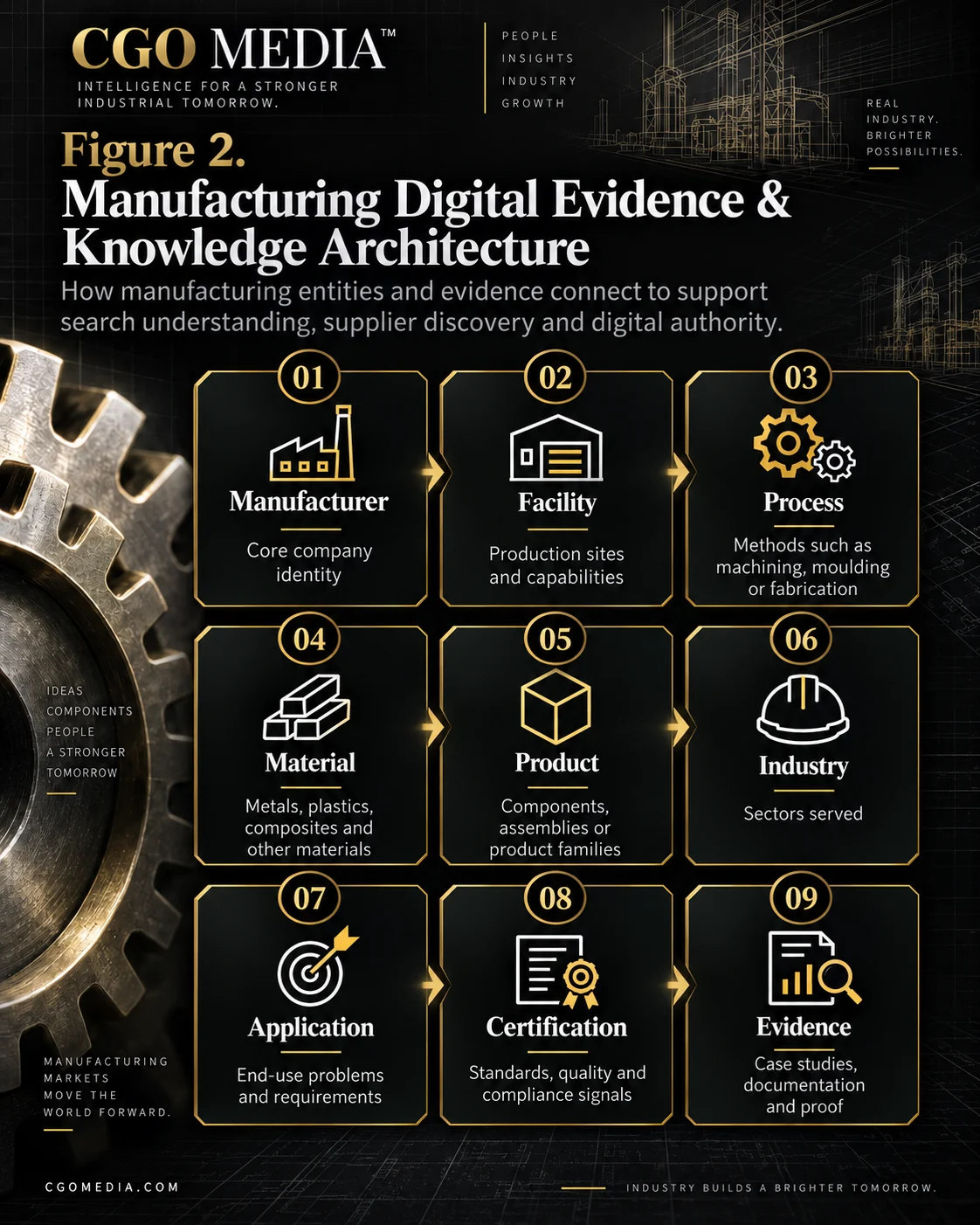
42. Manufacturing Knowledge Architecture
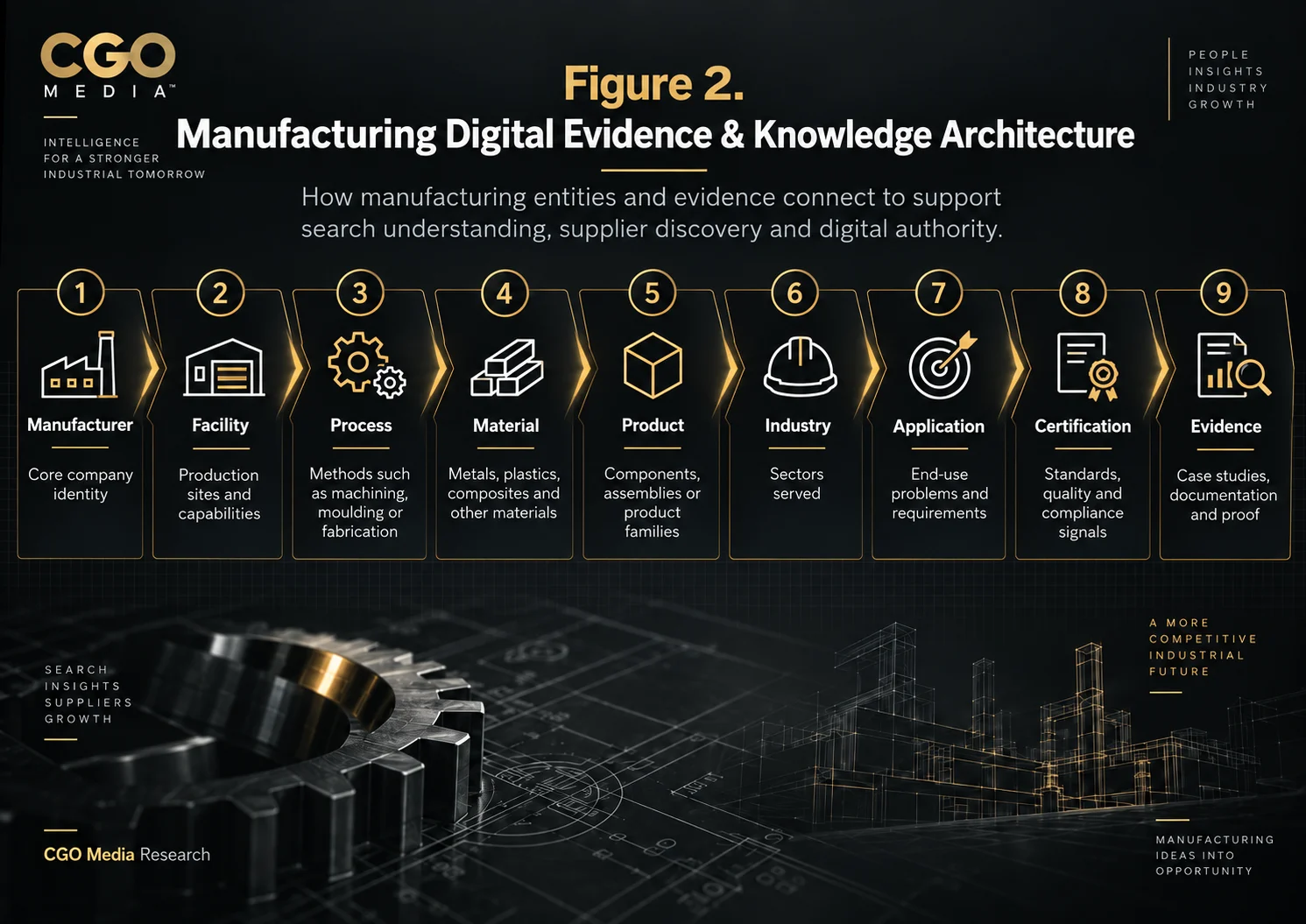
A strong manufacturing website can connect several important entity relationships:
Manufacturer → Facility → Process → Material → Product → Industry → Application → Certification → Evidence
This structure can make technical capability easier to understand for both human buyers and machine-based discovery systems.
43. Process-to-Material Relationships
Manufacturing processes should connect with the materials that can realistically be produced using them.
44. Process-to-Industry Relationships
Process pages should explain where particular manufacturing methods are relevant across industries.
45. Product-to-Application Relationships
Product content becomes more useful when it explains practical industrial applications.
46. Certification-to-Facility Relationships
Certifications should connect clearly with the manufacturing sites or operational entities they cover.
47. Research and Technical Content Relationships
Technical articles should connect back to relevant:
- Processes
- Products
- Materials
- Industries
- Experts
48. Internal Linking as Manufacturing Knowledge Infrastructure
Internal linking can help establish relationships between manufacturing capabilities and supporting evidence.
For example:
5-Axis Machining → Titanium → Aerospace → AS9100 → Case Study → Request for Quote
The objective is not simply to distribute page authority.
It is to help users and machines understand how capabilities, evidence and commercial relevance fit together.
Figure 2 : Manufacturing Digital Evidence & Knowledge Architecture.
Manufacturer → Facility → Process → Material → Product → Industry → Application → Certification → Evidence.
49. Manufacturing Supplier Trust
Manufacturing supplier selection often involves higher commercial and operational risk than many other search journeys.
A buyer may be committing to:
- Prototype development
- Tooling investment
- Long production runs
- Regulated components
- Critical supply-chain relationships
- Long-term procurement agreements
Search visibility therefore creates only the beginning of the decision process.
The supplier must also demonstrate sufficient evidence to reduce perceived procurement risk.
50. Trust Is More Than Brand Recognition
A recognisable manufacturing brand may benefit from familiarity, but industrial trust is usually built from multiple evidence layers.
These may include:
- Technical capability
- Certifications
- Quality procedures
- Facility evidence
- Customer experience
- External references
- Industry participation
- Commercial transparency
51. Procurement Evidence
Procurement teams may evaluate evidence that goes far beyond the marketing copy on a manufacturing website.
Relevant evidence can include:
- Certifications
- Quality systems
- Insurance
- Financial stability
- Production capacity
- Supply-chain resilience
- Lead times
- Track record
52. Technical Due Diligence
Technical buyers may validate whether claimed capabilities are consistent with:
- Machines
- Materials
- Tolerances
- Inspection processes
- Certifications
- Published case studies
53. Commercial Due Diligence
Commercial evaluation may consider:
- Minimum order quantities
- Pricing structure
- Payment terms
- Lead times
- Production scale
- Shipping capability
54. Supply-Chain Risk Evidence
Modern procurement decisions increasingly consider supply-chain resilience.
Manufacturers may strengthen this area by explaining:
- Production locations
- Alternative facilities
- Material sourcing
- Business continuity
- Inventory capability
- Logistics
55. Quality and Traceability Evidence
Where traceability is commercially important, manufacturers should explain how materials, batches, components and inspections are recorded and governed.
56. Sustainability Evidence
Environmental and sustainability evidence may influence procurement in sectors where buyers are required to assess supplier impacts.
Relevant evidence may include:
- Environmental management systems
- Energy use
- Waste management
- Material efficiency
- Carbon reporting
- Recycling processes
57. Social and Governance Evidence
Larger procurement teams may also review:
- Modern slavery policies
- Health and safety
- Governance
- Ethical sourcing
- Workforce standards
58. Customer Evidence
Customer evidence can strengthen supplier trust where appropriate.
Examples include:
- Case studies
- Testimonials
- Named customers
- Long-term contracts
- Industry references
Where confidentiality limits disclosure, anonymised technical evidence can still demonstrate capability.
59. Independent Validation
Manufacturing trust becomes stronger when important claims are supported by sources outside the supplier’s own website.
These sources may include:
- Certification bodies
- Trade associations
- Customers
- Industry publications
- Government organisations
- Universities
- Technical partners
60. Trade Association Authority
Membership of recognised industry organisations can contribute to external authority when the relationship is current and relevant.
61. Certification Body Authority
Where certificates can be independently verified, those external records may reinforce supplier credibility.
62. Distributor Authority
Manufacturers supplying through distributor networks may gain additional authority when distributor pages clearly identify:
- Manufacturer
- Products
- Markets
- Territories
- Technical specifications
63. Customer Citation Authority
References from credible customers can provide particularly strong validation where they demonstrate real-world application of manufacturing capability.
64. Academic and Research Authority
Some manufacturers participate in:
- University research
- Engineering projects
- Materials research
- Technical development programmes
- Innovation partnerships
These relationships can reinforce expertise when they are clearly documented by independent sources.
65. Government and Institutional Authority
Manufacturers may gain external validation through:
- Government programmes
- Export initiatives
- Innovation grants
- Research partnerships
- Regional manufacturing networks
66. Industry Media Authority
Trade media can strengthen manufacturing authority through:
- Technical commentary
- New facility coverage
- Industry awards
- Product innovation
- Case studies
- Expert interviews
67. Digital PR for Manufacturing
Digital PR in manufacturing should not be reduced to generic brand mentions.
The strongest opportunities often emerge from real industrial evidence.
Examples include:
- Original manufacturing data
- Supply-chain research
- Export analysis
- Production investment
- Automation research
- Engineering innovation
- Skills and workforce data
68. Research-Led Manufacturing PR
Original research can create authority where it contributes genuinely useful information to industry discussion.
Potential research areas may include:
- Manufacturing lead times
- Reshoring trends
- Skills shortages
- Automation adoption
- Energy costs
- Materials pricing
- Supply-chain resilience
69. Technical Citation Authority
Technical guides may earn citations when they provide reliable explanations of:
- Processes
- Materials
- Tolerances
- Standards
- Design principles
- Manufacturing limitations
70. Citation Relevance Matters
A manufacturing company does not necessarily need the largest possible number of mentions.
It needs recognition within environments relevant to the capabilities, industries and markets it wants to be associated with.
71. External Authority as Supplier Evidence
External citations can help create a broader evidence environment in which the manufacturer is consistently associated with specific:
- Processes
- Products
- Industries
- Certifications
- Locations
- Technical expertise
72. Manufacturing Brand Authority
Brand authority develops when repeated external and first-party evidence creates consistent associations around what the company actually manufactures and where it has expertise.
73. Branded Validation Searches
Before selecting a supplier, buyers may search:
- Manufacturer reviews
- Manufacturer certifications
- Manufacturer quality
- Manufacturer customers
- Manufacturer complaints
- Manufacturer financial information
Manufacturers should understand the wider digital evidence presented during these validation searches.
74. Reputation Search
Reputation monitoring should extend beyond conventional review platforms.
Relevant sources may include:
- Trade publications
- Industry forums
- Customer references
- Certification records
- Company databases
- Legal or regulatory sources where relevant
75. Supplier Selection Is an Evidence Problem
A manufacturer may have the correct machines and technical capability while still failing to become a credible supplier candidate if those capabilities are difficult to verify.
Search authority therefore depends on converting operational capability into accessible digital evidence.
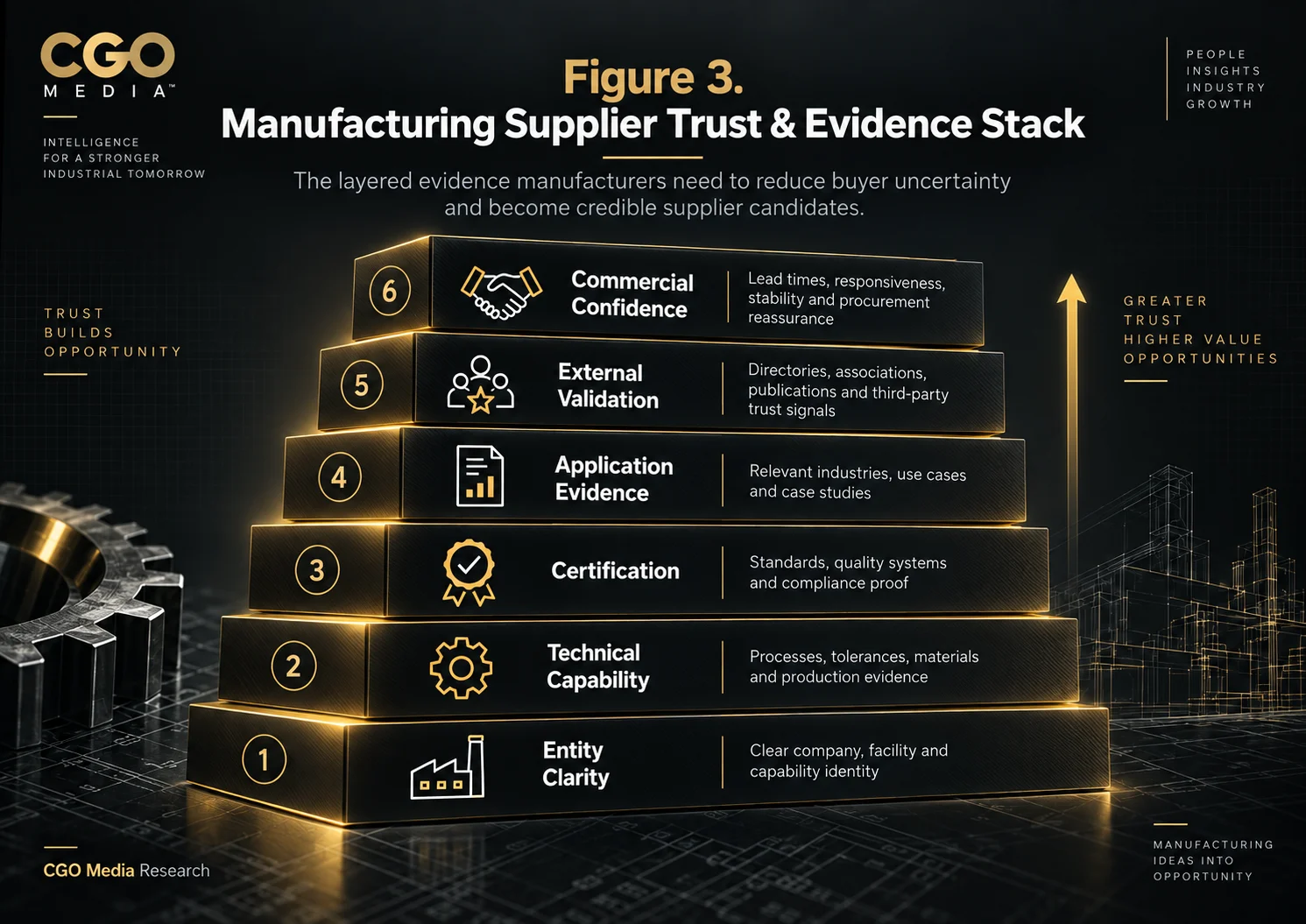
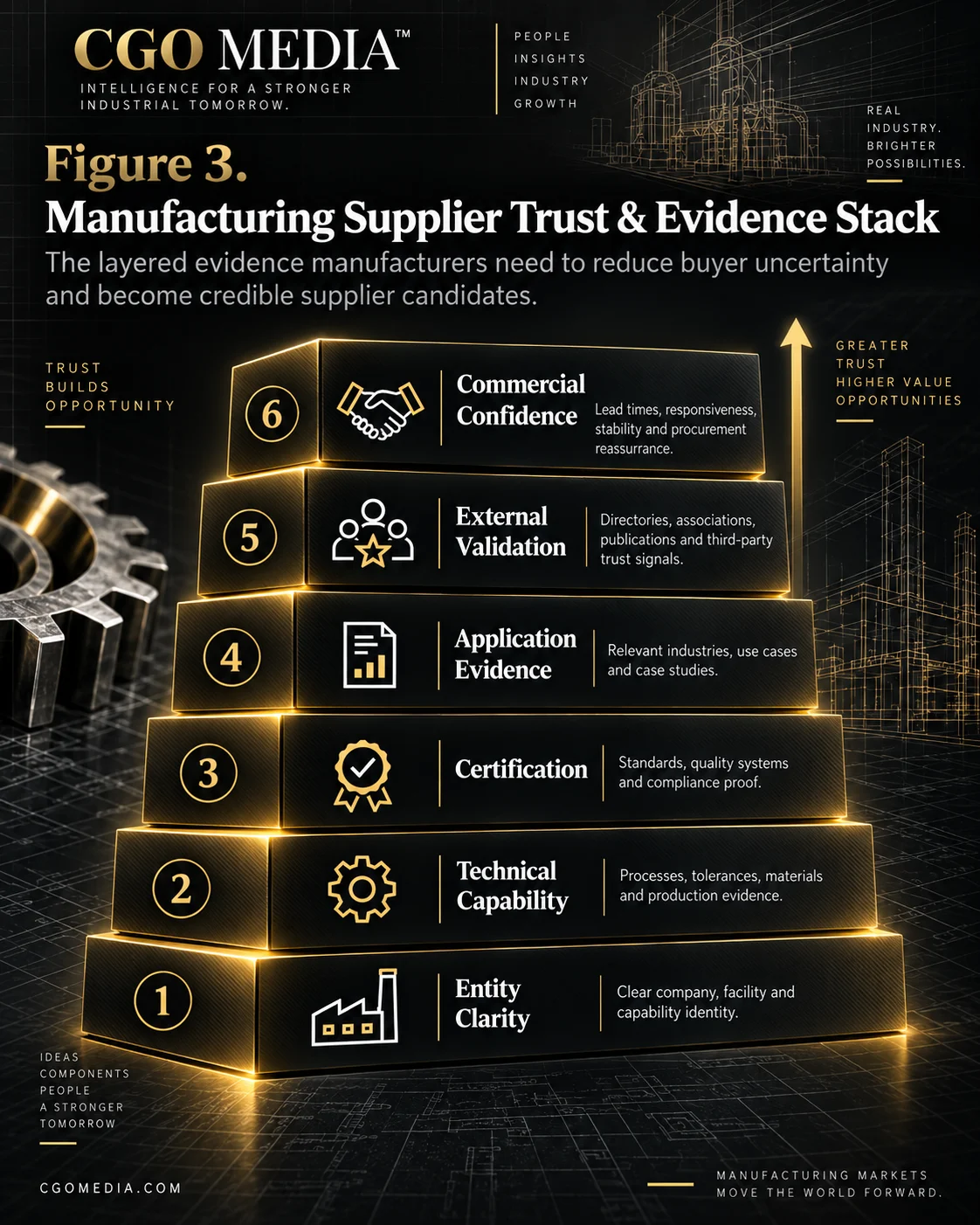
76. The Manufacturing Evidence Stack
A useful evidence stack can be represented as:
Entity Clarity → Technical Capability → Certification → Application Evidence → External Validation → Commercial Confidence
Each layer reduces a different form of buyer uncertainty.
Figure 3 : Manufacturing Supplier Trust & Evidence Stack.
Entity Clarity → Technical Capability → Certification → Application Evidence → External Validation → Commercial Confidence.
77. AI-Assisted Manufacturing Discovery
AI systems introduce a new layer into manufacturing search by helping users move from broad technical requirements toward potential suppliers, processes, materials and evidence sources.
A buyer may ask:
- Which UK manufacturers can produce titanium aerospace components?
- Which European suppliers offer low-volume medical injection moulding?
- Which manufacturers combine 5-axis machining with ISO 13485 certification?
- Which companies can support prototype-to-production manufacturing?
- Which suppliers are suitable for reshoring a specific component?
These are recommendation-oriented queries rather than conventional keyword searches.
78. AI Supplier Discovery
AI systems may identify potential manufacturers by combining evidence relating to:
- Process capability
- Materials
- Industry experience
- Geographic location
- Certifications
- External references
79. AI Process Discovery
Users may also ask AI systems to recommend a manufacturing process before identifying a supplier.
For example:
- What manufacturing method is suitable for this component?
- Should this part be machined, cast or moulded?
- Which process is best for low-volume aluminium production?
Manufacturers publishing useful technical guidance may become visible earlier in the buyer journey.
80. AI Material Discovery
AI-assisted research may involve comparing materials according to:
- Strength
- Weight
- Corrosion resistance
- Cost
- Machinability
- Temperature performance
Material authority can therefore contribute indirectly to supplier discovery.
81. AI Application Discovery
A buyer may describe the intended application rather than name a manufacturing process.
AI systems may then connect:
Application → Material → Manufacturing Process → Supplier Type → Potential Manufacturers
82. AI Technical Source Selection
AI-generated technical answers may draw from multiple source types.
These can include:
- Manufacturer websites
- Engineering publications
- Universities
- Standards organisations
- Trade associations
- Technical documentation
- Industry media
83. Manufacturers Compete as Information Sources
A manufacturing company may therefore compete not only with other suppliers but also with independent technical publishers for source visibility.
This makes useful, precise and well-supported technical content increasingly important.
84. First-Party Manufacturing Evidence
First-party evidence may include:
- Capability pages
- Process documentation
- Technical specifications
- Case studies
- Certification information
- Facility pages
- Engineering articles
85. Third-Party Manufacturing Evidence
Third-party evidence may include:
- Customer references
- Trade media
- Certification bodies
- Government programmes
- Industry organisations
- Academic collaborations
86. AI Source Authority Is Distributed
Manufacturing authority is rarely contained within one website.
It is distributed across:
- Supplier-owned properties
- Customer websites
- Industry directories
- Trade associations
- Media publications
- Technical resources
- Certification systems
87. AI Citation Visibility
Where AI systems expose citations or sources, manufacturers can examine whether their:
- Technical guides
- Process pages
- Product resources
- Research
- Case studies
appear within generated answers.
88. AI Supplier Shortlists
AI systems can compress discovery and comparison into a shortlist.
A shortlist may be influenced by evidence around:
- Relevant process capability
- Materials
- Industry experience
- Certifications
- Location
- External authority
- Commercial suitability
89. Recommendation Sets Change the Competitive Environment
Traditional search presents many results.
AI recommendations may present only a small number of potential suppliers.
This creates a more concentrated competitive environment in which being omitted from the recommendation set may be commercially significant.
90. AI Comparison of Manufacturers
Buyers may ask AI systems to compare manufacturers directly.
For example:
“Compare these four CNC machining companies for aerospace experience, titanium capability, quality certification and UK production.”
91. Comparison Requires Structured Evidence
Manufacturers become easier to compare when important information is consistently available across:
- Capabilities
- Processes
- Materials
- Industries
- Certifications
- Locations
- Commercial information
92. AI Representation Accuracy
Manufacturers should monitor whether AI systems correctly represent:
- Company name
- Locations
- Processes
- Products
- Industries served
- Certifications
- Production capabilities
93. Outdated Manufacturing Information
AI systems may repeat outdated information involving:
- Closed facilities
- Old certifications
- Discontinued products
- Former capabilities
- Previous ownership
Manufacturers should therefore treat information freshness as part of authority management.
94. Capability Misrepresentation
Incorrect AI representation can be commercially problematic if a manufacturer is associated with capabilities it does not possess or omitted from capabilities it does offer.
95. Certification Misrepresentation
Certification information is particularly sensitive because buyers may use it as an eligibility requirement.
Manufacturers should monitor whether AI systems associate the correct certifications with the correct company or facility.
96. Geographic Misrepresentation
AI systems may confuse:
- Headquarters
- Factories
- Sales offices
- Distributor locations
- Former sites
Clear geographic entity architecture can reduce this ambiguity.
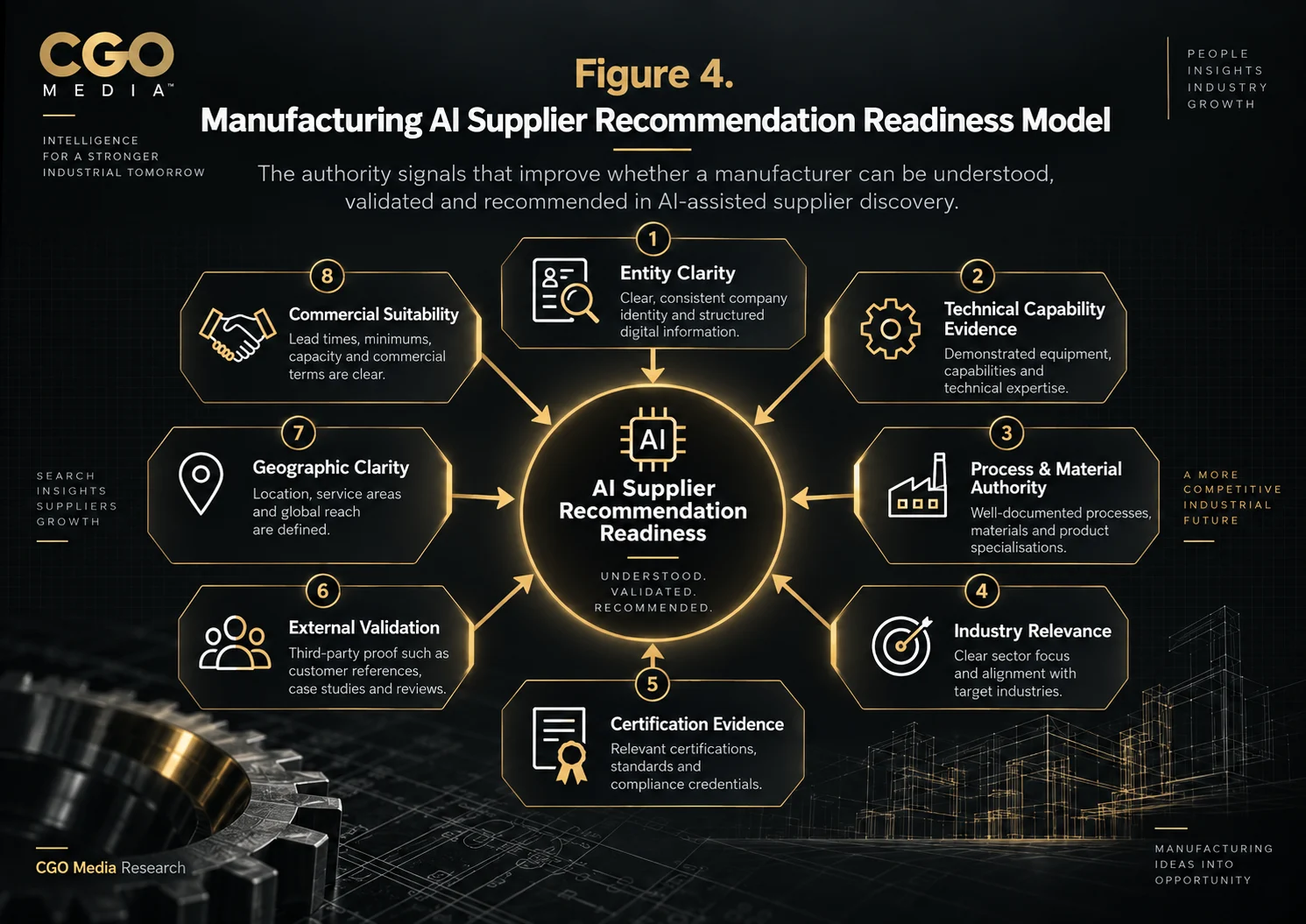
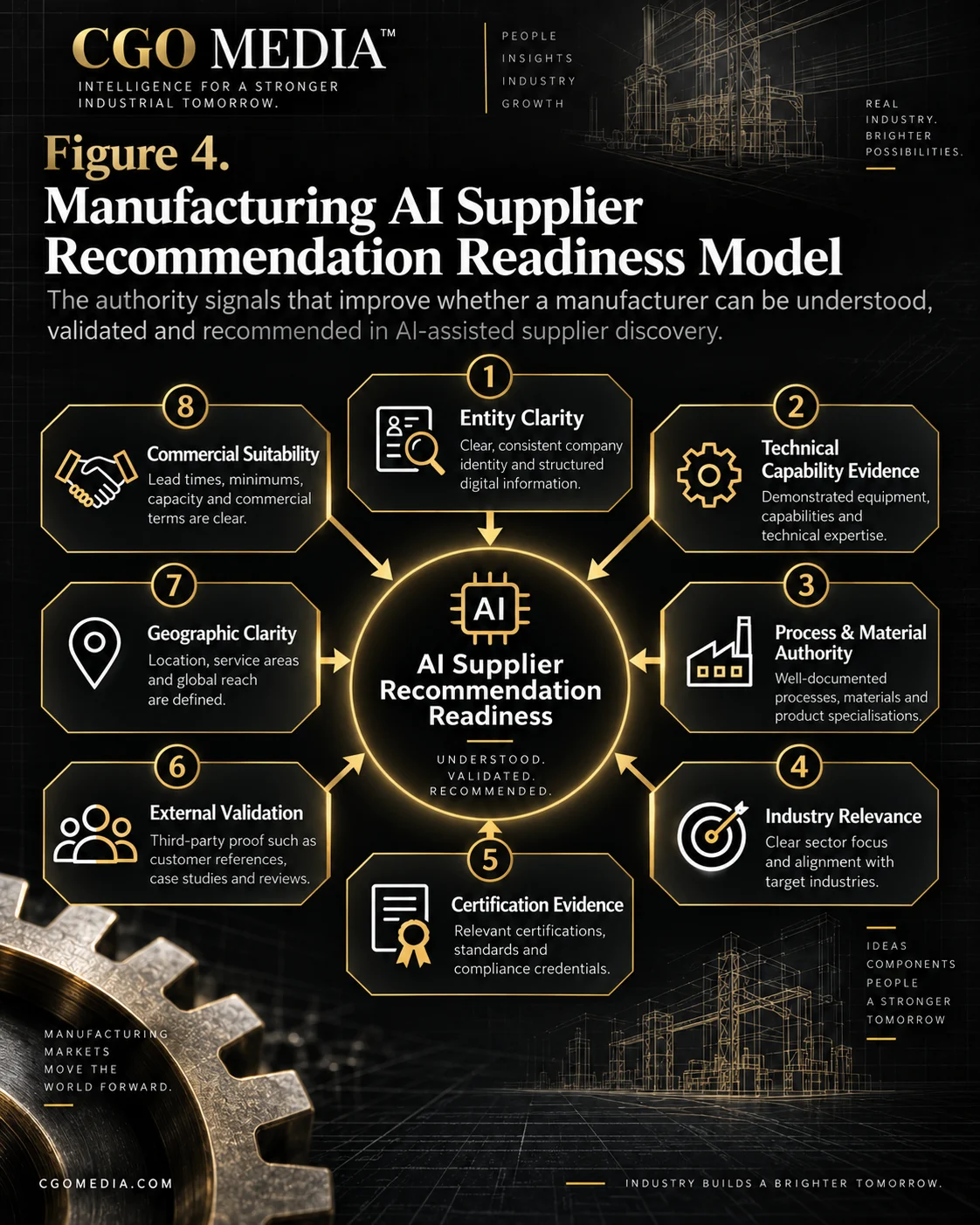
97. AI Recommendation Readiness
Recommendation readiness is not created by one isolated optimisation technique.
It develops cumulatively from:
- Entity clarity
- Technical capability evidence
- Process and material authority
- Industry relevance
- Certification evidence
- External validation
- Geographic clarity
- Commercial suitability
98. Manufacturing Recommendation Readiness Threshold
A useful progression can be represented as:
Discoverable → Understandable → Technically Relevant → Verifiable → Trusted → Commercially Suitable → Shortlist Ready → Recommendation Ready
99. Discoverable
The manufacturer can be found through search, AI, industry sources or supplier networks.
100. Understandable
Users and systems can determine what the manufacturer does, where it operates and which markets it serves.
101. Technically Relevant
The manufacturer demonstrates capabilities that match the engineering or procurement requirement.
102. Verifiable
Important claims are supported by technical documentation, certifications, case studies or independent evidence.
103. Trusted
Quality, operational history, external validation and institutional evidence create sufficient confidence.
104. Commercially Suitable
The manufacturer appears capable of satisfying relevant constraints such as:
- Volume
- Lead time
- Geography
- Certification
- Logistics
105. Shortlist Ready
The supplier possesses sufficient relevance and evidence to remain within a smaller procurement consideration set.
106. Recommendation Ready
The manufacturer possesses sufficiently coherent and validated evidence to become a credible candidate for AI-assisted supplier recommendation.
107. AI Visibility Should Be Measured by Query Class
Manufacturers should avoid measuring AI visibility through a small number of branded prompts.
Useful query classes may include:
- Supplier recommendations
- Process recommendations
- Material questions
- Industry-specific supplier searches
- Geographic supplier searches
- Certification-led searches
- Manufacturer comparisons
108. AI Source Gap Analysis
A source gap exists where competitors or independent sources repeatedly appear within AI answers while the manufacturer does not.
109. AI Recommendation Gap Analysis
A recommendation gap exists where relevant competitors repeatedly appear within supplier shortlists and the manufacturer is consistently absent.
110. Evidence Gap Before AI Gap
An AI visibility weakness should not automatically be treated as a platform-specific problem.
The underlying cause may instead involve:
- Weak capability evidence
- Poor entity clarity
- Limited external validation
- Insufficient industry relevance
- Outdated technical information
111. Manufacturing AI Visibility as an Authority Outcome
AI visibility is therefore better understood as one outcome of the wider manufacturing authority ecosystem.
The stronger and more consistent the available evidence, the easier it becomes for search and AI systems to understand when the manufacturer is relevant.
Figure 4 : Manufacturing AI Supplier Recommendation Readiness Model.
Entity Clarity + Technical Capability Evidence + Process & Material Authority + Industry Relevance + Certification Evidence + External Validation + Geographic Clarity + Commercial Suitability.
112. Measuring Manufacturing Search Authority
Manufacturing SEO measurement should extend beyond rankings and traffic.
A useful measurement system should help determine whether the manufacturer is becoming easier to discover, understand, validate, shortlist and recommend.
113. Manufacturing Visibility
Visibility can be assessed across:
- Manufacturer searches
- Process searches
- Product searches
- Material searches
- Industry searches
- Geographic supplier searches
- Certification-led searches
114. Capability Visibility
Manufacturers should monitor whether strategically important capabilities appear for relevant technical queries.
Examples include:
- 5-axis CNC machining
- medical injection moulding
- precision sheet metal fabrication
- prototype tooling
- contract manufacturing
115. Industry Visibility
Industry-level measurement can identify whether the manufacturer is visible within sectors such as:
- Aerospace
- Automotive
- Medical
- Energy
- Food production
- Industrial equipment
116. Geographic Visibility
Geographic measurement can examine performance across:
- Local markets
- National markets
- Export markets
- Priority countries
- Regional manufacturing clusters
117. Facility Visibility
Multi-site manufacturers should measure whether individual facilities are visible for the capabilities they actually provide.
118. Product Visibility
Product-level measurement can assess whether important product families are being discovered through commercial, technical and application-led searches.
119. Process Visibility
Process-level measurement can assess whether the organisation is associated consistently with its core manufacturing capabilities.
120. Material Visibility
Material-related measurement can reveal whether the manufacturer is visible in searches involving strategically important metals, plastics, composites or specialist materials.
121. Research and Technical Content Visibility
Manufacturers publishing technical content can measure:
- Search impressions
- Organic entrances
- External citations
- Referral traffic
- AI citations
- Research usage
122. External Authority Measurement
External authority can be assessed through:
- Trade media references
- Government citations
- Academic mentions
- Trade association references
- Customer citations
- Partner references
123. Certification Visibility
Manufacturers should monitor whether certifications are visible and accurately associated with the correct business entity or facility.
124. Branded Validation Search Measurement
Branded search analysis can help identify what procurement teams encounter when validating the manufacturer.
125. AI Organisation Visibility
AI monitoring can examine whether the manufacturer appears in relevant supplier-discovery prompts.
126. AI Capability Visibility
Capability-level prompts can test whether AI systems associate the company with:
- Processes
- Materials
- Industries
- Certifications
- Production locations
127. AI Source Visibility
Where source information is available, manufacturers can monitor which first-party and third-party resources are selected within AI-generated answers.
128. AI Recommendation Visibility
Recommendation monitoring can examine whether the manufacturer appears in shortlists for relevant supplier scenarios.
129. AI Comparison Visibility
Manufacturers should also understand how they are represented when users ask AI systems to compare them directly with competitors.
130. AI Representation Accuracy
Important facts should be checked for accuracy, including:
- Company identity
- Locations
- Processes
- Products
- Industries
- Certifications
- Current capabilities
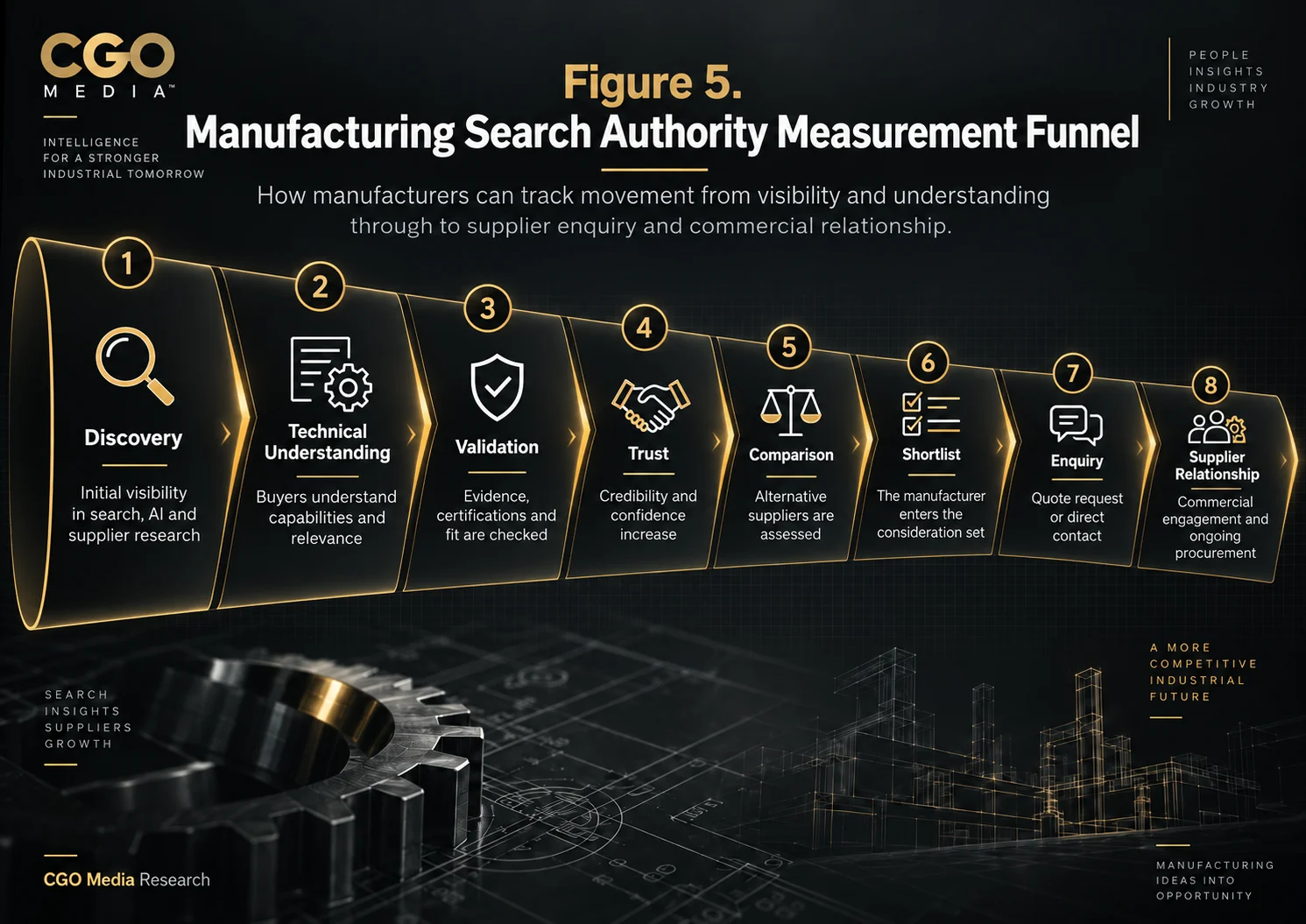
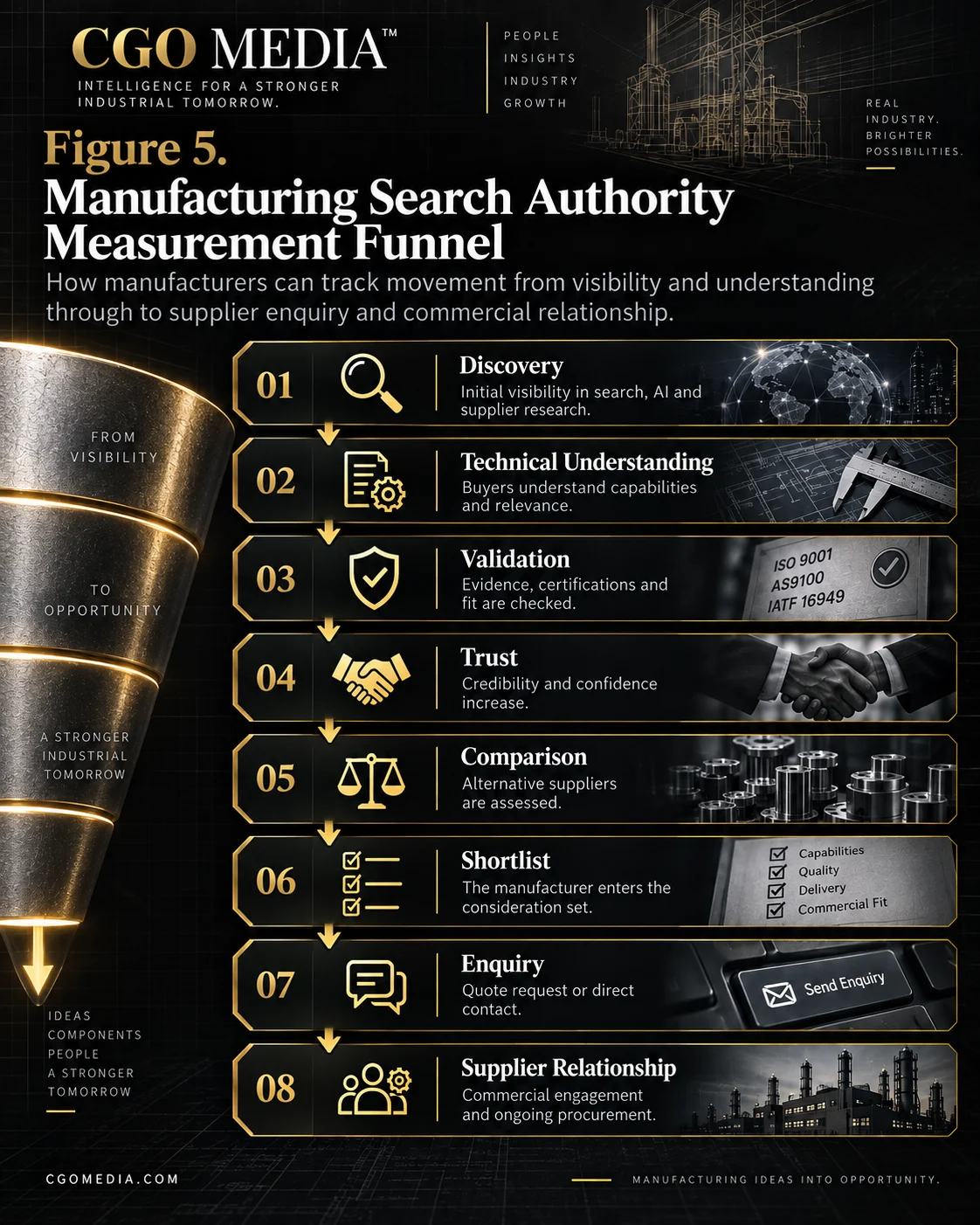
131. Manufacturing Search Authority Measurement Funnel
A practical measurement funnel can be represented as:
Discovery → Technical Understanding → Validation → Trust → Comparison → Shortlist → Enquiry → Supplier Relationship
132. Discovery Measurement
Discovery metrics identify whether potential buyers are finding the manufacturer during early supplier research.
133. Technical Understanding Measurement
Relevant indicators may include engagement with:
- Process pages
- Material guides
- Technical specifications
- Facility pages
- Certification information
134. Validation Measurement
Validation activity may include visits to:
- Case studies
- Quality pages
- Certification pages
- Customer evidence
- Company information
135. Comparison Measurement
Comparison behaviour may be reflected through:
- Repeated visits
- Branded competitor searches
- Supplier comparison queries
- AI comparison prompts
136. Shortlist Measurement
Shortlist behaviour may include:
- RFQ activity
- Technical document downloads
- Capability enquiries
- Sample requests
- Direct contact
137. Enquiry Measurement
Commercial measurement should distinguish between:
- General enquiries
- Technical enquiries
- Request-for-quotation submissions
- Prototype enquiries
- Production enquiries
138. Supplier Relationship Measurement
Longer-term outcomes may include:
- Qualified opportunities
- Prototype projects
- Production contracts
- Repeat orders
- Long-term supply relationships
139. Search Visibility Is Not the Final Outcome
A manufacturing page can rank strongly without contributing meaningfully to supplier selection.
The more commercially useful question is whether search visibility supports progression toward technical confidence, validation and procurement engagement.
140. Manufacturing Search Authority Scorecard
A practical scorecard can assess performance across:
- Entity clarity
- Technical capability authority
- Product and process visibility
- Industry relevance
- Geographic authority
- Certification and trust evidence
- External authority
- AI recommendation visibility
141. Strategic Versus Vanity Metrics
Manufacturers should distinguish strategic authority indicators from metrics that may look impressive but provide limited procurement insight.
Strategic indicators may include:
- Visibility for high-value capabilities
- Qualified RFQs
- Priority-market visibility
- External citations
- AI shortlist inclusion
- Technical content usage
142. Segment Measurement by Commercial Priority
Measurement should reflect business strategy.
A manufacturer may therefore create separate reporting for:
- Priority processes
- Priority sectors
- Priority countries
- Priority product groups
- Priority customer types
143. Competitor Authority Mapping
Competitor analysis should examine more than rankings.
Useful comparison areas may include:
- Technical content depth
- Industry evidence
- Certification clarity
- Case study quality
- External citations
- AI recommendation visibility
144. Supplier Shortlist Share
A useful emerging concept is the proportion of relevant supplier-recommendation scenarios in which the manufacturer appears within the consideration set.
This can be monitored across repeatable search and AI prompt groups.
145. Manufacturing Authority Should Be Measured Longitudinally
Authority develops over time.
Manufacturers should therefore measure change in visibility, evidence, external recognition and recommendation presence rather than relying only on one-off snapshots.
Figure 5 : Manufacturing Search Authority Measurement Funnel.
Discovery → Technical Understanding → Validation → Trust → Comparison → Shortlist → Enquiry → Supplier Relationship.
146. Manufacturing Search Governance
Manufacturing Search Authority usually spans several teams.
These may include:
- Marketing
- SEO
- Sales
- Engineering
- Quality
- Operations
- Procurement
- Leadership
Without defined ownership, technical information, certifications, facility data and commercial content can quickly become inconsistent.
147. Technical SEO Ownership
Technical teams should maintain standards for:
- Crawlability
- Indexation
- Site performance
- Structured data
- Internal linking
- International architecture where relevant
148. Manufacturer Entity Ownership
A defined owner should maintain authoritative information about:
- Company name
- Trading names
- Locations
- Facilities
- Leadership
- Business units
149. Capability Ownership
Manufacturing capability information should be validated by appropriate technical or operational teams.
This includes:
- Processes
- Materials
- Tolerances
- Machine capability
- Production volumes
- Inspection methods
150. Certification Ownership
Quality teams should maintain current information about:
- Certification name
- Scope
- Applicable facility
- Status
- Renewal dates
151. Product Information Ownership
Product data should remain aligned across:
- Website pages
- Technical datasheets
- Distributor listings
- Sales documentation
152. Industry Content Ownership
Industry pages should be reviewed by people with genuine sector knowledge rather than being created solely from generic marketing copy.
153. Research and Technical Content Ownership
Technical content should have defined review processes involving relevant engineers, specialists or subject experts.
154. Sales Feedback as Search Intelligence
Sales teams possess valuable insight into:
- Buyer terminology
- Common technical questions
- Procurement objections
- Competitor comparisons
- Frequently requested capabilities
This information can improve search architecture and technical content.
155. RFQ Data as Search Intelligence
Request-for-quotation data can reveal:
- High-demand processes
- Important materials
- Common industries
- Typical production volumes
- Buyer geography
156. Engineering Feedback Loop
Engineering teams can identify gaps where website content does not accurately reflect operational capability.
157. Quality Feedback Loop
Quality teams can help ensure that certification and compliance claims remain precise and current.
158. Procurement Feedback Loop
Understanding how customers evaluate suppliers can reveal which trust and validation signals should be made more accessible.
159. Customer Feedback Loop
Customer questions and objections can help identify weaknesses in:
- Technical clarity
- Commercial information
- Capability evidence
- Trust signals
160. Common Manufacturing SEO Failure Modes
Several recurring weaknesses can restrict manufacturing search authority.
161. Generic Capability Pages
Pages containing broad claims with little technical evidence make supplier evaluation difficult.
162. Weak Industry Pages
Industry pages often fail when they simply replace sector names in otherwise identical copy.
163. Poor Facility Clarity
Multi-site manufacturers can create confusion when users cannot determine which facility provides which capability.
164. Outdated Certifications
Expired or ambiguous certification information can create significant procurement risk.
165. Product Data Inconsistency
Conflicting information between website pages, PDFs and distributor listings can weaken trust.
166. Excessive Reliance on PDFs
Technical PDFs can be useful, but important capability information should not exist only inside isolated documents.
167. Weak Technical Internal Linking
Manufacturers often fail to connect:
- Processes
- Materials
- Industries
- Applications
- Case studies
- Certifications
168. Publishing Without Technical Review
Inaccurate technical content can damage credibility with engineers and procurement teams.
169. Measuring Only Rankings
Ranking reports alone provide limited insight into whether the company is becoming more credible within supplier-selection environments.
170. Link Building Without Industrial Relevance
Links from unrelated websites may contribute less strategic authority than a smaller number of relevant industry, customer, government or technical citations.
171. AI Monitoring Without Evidence Improvement
Tracking AI mentions creates limited value if identified weaknesses in capability, certification or entity information remain unresolved.
172. Application to Precision Engineering
Precision engineering businesses may place particular emphasis on:
- Tolerance authority
- Machine capability
- Materials
- Inspection
- Industry certifications
173. Application to Contract Manufacturing
Contract manufacturers may prioritise:
- Production scale
- Supply-chain capability
- Quality systems
- Programme management
- Prototype-to-production evidence
174. Application to Injection Moulding
Injection moulding companies may focus on:
- Materials
- Tooling
- Production volumes
- Part complexity
- Quality evidence
175. Application to Fabrication
Fabrication businesses may prioritise:
- Processes
- Materials
- Component size
- Welding capability
- Finishing
- Inspection
176. Application to Aerospace Manufacturing
Aerospace suppliers may require particularly strong evidence around:
- Certification
- Traceability
- Materials
- Tolerances
- Quality systems
- Customer validation
177. Application to Automotive Manufacturing
Automotive manufacturers may focus on:
- Production scale
- Quality systems
- Process repeatability
- Supply-chain reliability
- Cost efficiency
178. Application to Medical Manufacturing
Medical manufacturers may require strong evidence around:
- Regulatory compliance
- Quality systems
- Traceability
- Clean production
- Materials
- Documentation
179. Application to Industrial Equipment Manufacturers
Industrial equipment manufacturers may prioritise:
- Product authority
- Technical specifications
- Applications
- Service capability
- Distributor networks
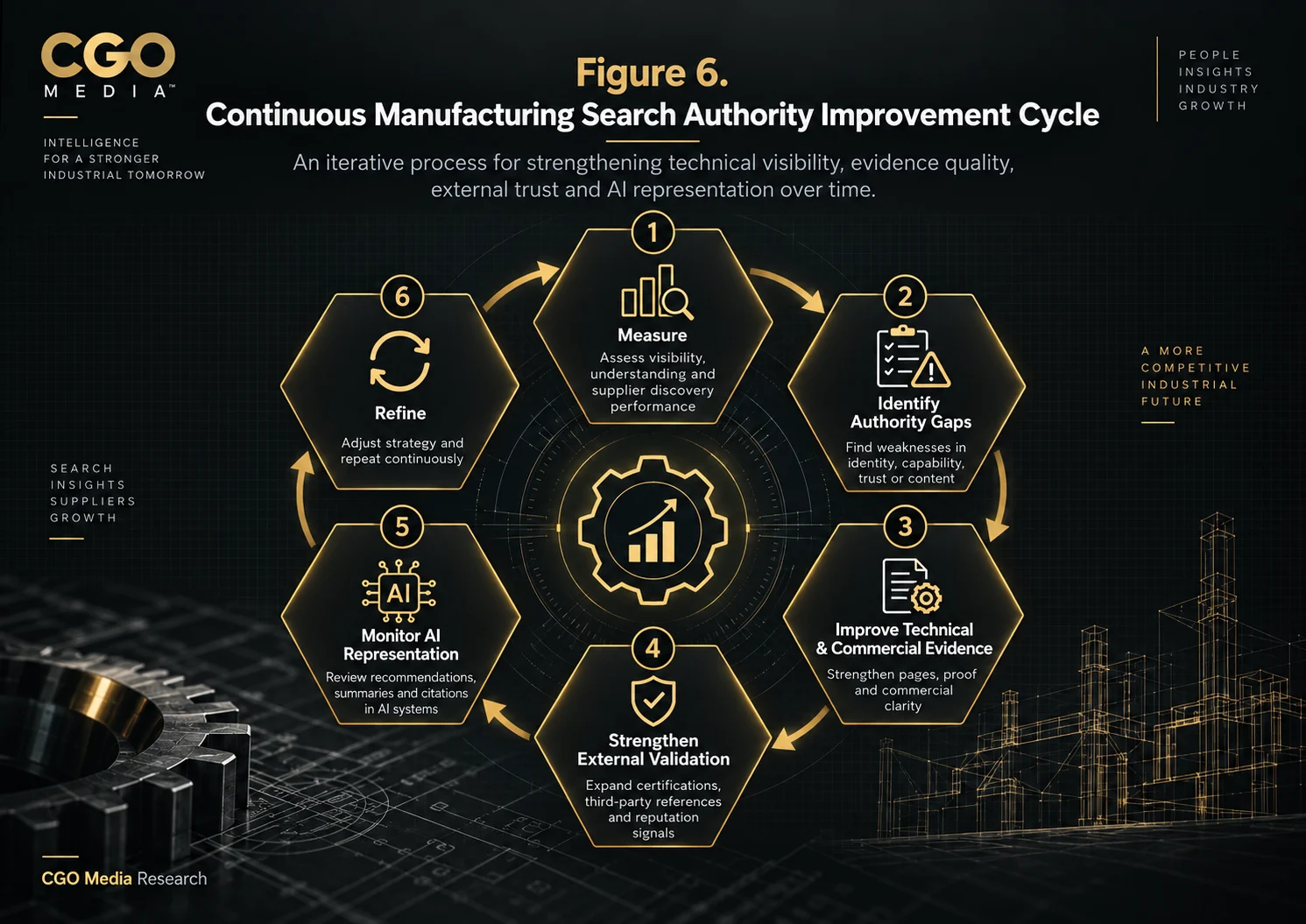
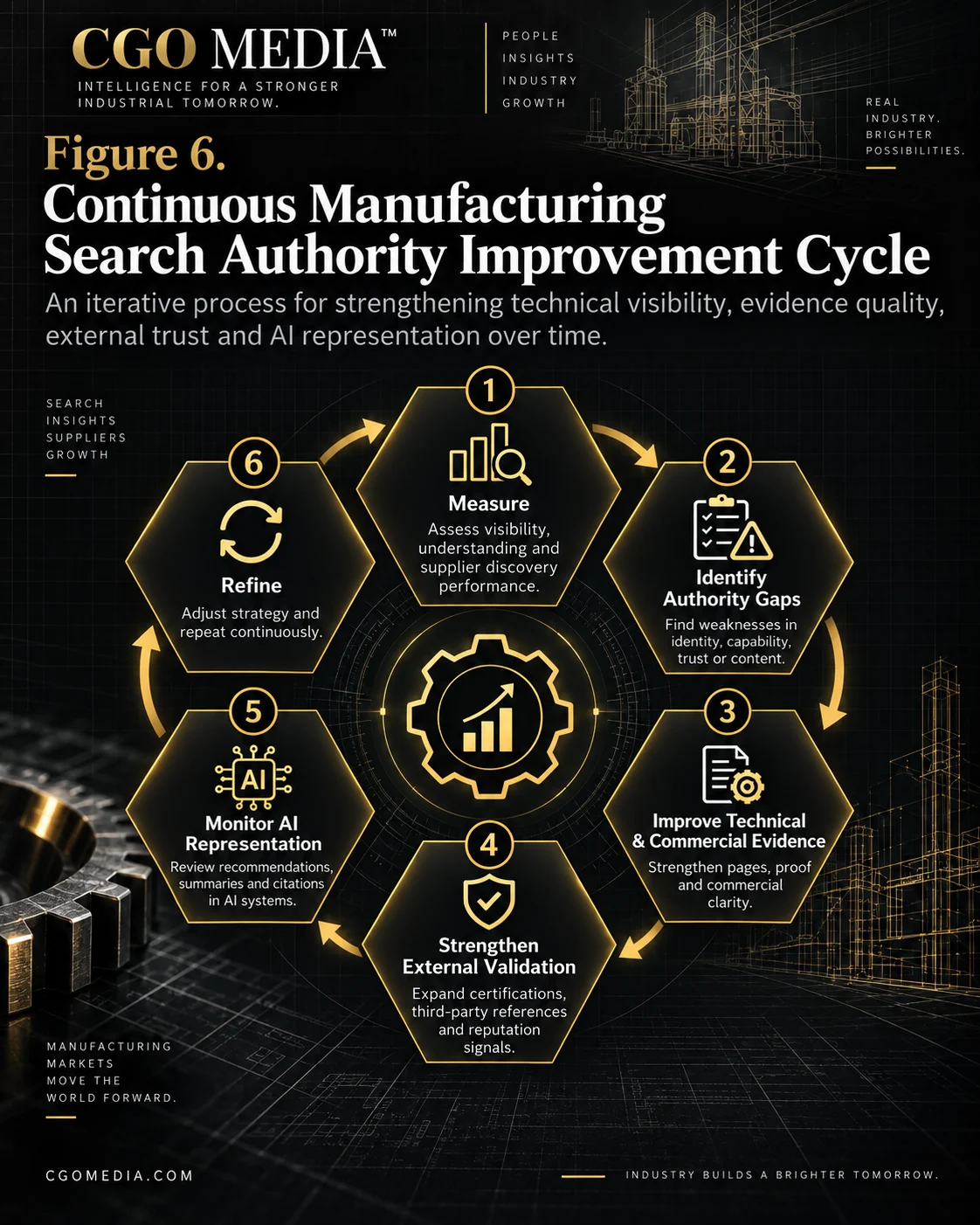
180. Continuous Manufacturing Search Improvement
Manufacturing Search Authority should operate as a continuous improvement cycle.
A practical sequence is:
Measure → Identify Authority Gaps → Improve Technical and Commercial Evidence → Strengthen External Validation → Monitor AI Representation → Refine
181. Continuous Capability Review
Manufacturing capabilities evolve as companies:
- Buy new machinery
- Add certifications
- Open facilities
- Enter new sectors
- Expand export markets
- Change production capacity
Digital evidence should evolve alongside operational capability.
182. Continuous Market Review
Buyer priorities also change.
Manufacturers should monitor emerging demand around:
- Reshoring
- Automation
- Sustainability
- Supply-chain resilience
- New materials
- New regulatory requirements
183. Continuous AI Review
AI-assisted supplier discovery should be reassessed as recommendation systems, citation patterns and source-selection behaviour change.
184. From Manufacturing SEO to Manufacturing Search Authority
The strategic progression can be summarised as:
Technical Presence → Capability Visibility → Supplier Trust → External Authority → AI Recommendation Readiness → Continuous Search Authority
Figure 6 : Continuous Manufacturing Search Authority Improvement Cycle.
Measure → Identify Authority Gaps → Improve Technical & Commercial Evidence → Strengthen External Validation → Monitor AI Representation → Refine.
185. Relationship with the Manufacturing AI Trust and Visibility Framework
The Manufacturing AI Trust and Visibility Framework translates the research in this paper into a structured assessment of manufacturing entity clarity, technical capability authority, industry relevance, supplier trust, external validation and AI recommendation readiness.
The framework is designed to help manufacturers evaluate whether their digital evidence is sufficiently clear, credible and connected to support modern supplier discovery.
186. Relationship with the Manufacturing Discovery and Supplier Selection Model
The Manufacturing Discovery and Supplier Selection Model examines the buyer and procurement journey in greater detail.
It explains how engineers, procurement teams, OEMs, distributors and other industrial buyers may move from an initial manufacturing requirement through supplier discovery, technical evaluation, trust validation, comparison, shortlisting and final engagement.
187. Relationship with the Manufacturing Search Authority Maturity Model
The Manufacturing Search Authority Maturity Model provides a structured method for evaluating how advanced a manufacturer has become in building and governing the capabilities discussed throughout this research.
It distinguishes basic digital presence from more sophisticated systems in which technical SEO, entity authority, manufacturing knowledge, supplier trust, external validation and AI visibility operate together.
188. Relationship with the Manufacturing SEO and AI Implementation Roadmap
The Manufacturing SEO and AI Implementation Roadmap provides the practical implementation sequence for addressing authority gaps identified through this research.
It connects assessment, technical stabilisation, manufacturing knowledge architecture, evidence development, external validation, AI monitoring and continuous improvement.
189. The Manufacturing Research Framework Family
Together, the five Manufacturing research assets form a connected research architecture:
- Manufacturing SEO in an AI Search Environment — establishes the research foundation.
- Manufacturing AI Trust and Visibility Framework — defines the evidence and authority dimensions.
- Manufacturing Discovery and Supplier Selection Model — models the industrial buyer and procurement journey.
- Manufacturing Search Authority Maturity Model — assesses organisational capability and maturity.
- Manufacturing SEO and AI Implementation Roadmap — translates the research into an implementation sequence.
190. Methodological Position
This research presents a conceptual and strategic model for understanding manufacturing visibility in an increasingly AI-mediated search environment.
It draws together established principles from technical SEO, information architecture, entity representation, B2B buyer behaviour, supplier evaluation, credibility research and knowledge-graph concepts.
The paper does not claim that search engines or AI systems use the specific stages, authority dimensions or terminology presented here as confirmed ranking or recommendation factors.
Instead, the research provides a structured methodology for examining whether manufacturers are sufficiently:
- Discoverable
- Understandable
- Technically relevant
- Verifiable
- Trusted
- Commercially suitable
- Shortlist ready
- Recommendation ready
191. Manufacturing Search as an Evidence System
One of the central conclusions of this research is that modern manufacturing visibility can be understood as an evidence system.
The manufacturer must communicate not simply that it exists, but why it is a credible supplier for a particular technical and commercial requirement.
That evidence can be distributed across:
- Corporate pages
- Capability pages
- Process pages
- Product pages
- Material resources
- Industry pages
- Facility pages
- Certification evidence
- Case studies
- Technical research
- External citations
192. Strategic Implications for Manufacturers
The strategic question is therefore no longer simply:
“How do we rank higher for manufacturing keywords?”
A more useful question is:
“Can a buyer, search engine or AI system understand what we manufacture, verify that we can manufacture it, establish that we are suitable for the required industry and geography, and find sufficient evidence to consider us a credible supplier?”
193. Search Strategy Should Reflect Procurement Reality
Manufacturing SEO becomes more valuable when it reflects the actual procurement journey.
Industrial buyers rarely select a supplier purely because one page ranked first.
They may need to establish:
- Technical fit
- Material capability
- Production capacity
- Industry experience
- Certification
- Quality
- Geographic suitability
- Commercial fit
- Supplier reliability
194. Search, Sales and Engineering Should Become More Connected
Manufacturing search programmes can become significantly stronger when digital strategy incorporates information from sales and engineering teams.
Sales teams understand the questions buyers ask.
Engineering teams understand the technical capabilities the manufacturer genuinely possesses.
Quality teams understand the evidence required for validation.
Search strategy can connect these perspectives into a coherent information architecture.
195. Original Technical Research Can Become a Strategic Asset
Manufacturers with access to distinctive technical or market data may be able to build authority through original research.
Potential subjects include:
- Manufacturing productivity
- Supply-chain resilience
- Automation adoption
- Skills shortages
- Material trends
- Lead times
- Reshoring
- Energy usage
Where the methodology is credible and the findings are genuinely useful, such research can support journalists, researchers, procurement teams and AI information systems.
196. AI Search Does Not Eliminate Manufacturing SEO
AI-assisted discovery does not make technical SEO, content architecture or conventional search visibility irrelevant.
Instead, it increases the importance of making manufacturing evidence accessible, structured, current and externally validated.
Search engines, websites, AI systems and third-party information sources increasingly operate within the same wider discovery ecosystem.
197. The Competitive Advantage of Manufacturing Clarity
Many manufacturers possess greater operational capability than their websites communicate.
This creates a strategic opportunity.
Manufacturers that translate real technical capability into accurate, connected and verifiable digital evidence may become easier to discover and evaluate than competitors with similar physical capability but weaker information architecture.
198. Conclusion
Manufacturing search is moving beyond conventional keyword optimisation.
Search engines and AI-assisted discovery systems increasingly operate within a broader environment in which manufacturers are evaluated through entity clarity, process expertise, product and material authority, industry relevance, certifications, facilities, external validation and commercial suitability.
The strongest manufacturing search strategies therefore connect:
- Technical SEO
- Manufacturer Entity Authority
- Process and Product Authority
- Material and Industry Authority
- Facility and Geographic Authority
- Certification and Supplier Trust
- External Citation Authority
- AI Search and Recommendation Visibility
The objective is not simply to generate more search traffic.
It is to create a digital evidence environment in which manufacturers can be discovered, understood, verified, trusted, compared and ultimately selected.
In that environment, Manufacturing SEO becomes part of a broader strategic discipline:
Manufacturing Search Authority.
References
External Academic, Technical and Search Sources
- Google Search Central.SEO Starter Guide.
- Google Search Central.Understand how structured data works.
- Schema.org.Organization.
- Schema.org.Product.
- Schema.org.Person.
- Hogan, A. et al. (2021).Knowledge Graphs. ACM Computing Surveys, 54(4).
- Metzger, M.J. (2007).Making Sense of Credibility on the Web: Models for Evaluating Online Information and Recommendations for Future Research.Journal of the American Society for Information Science and Technology, 58(13), 2078–2091.
- Ji, Z. et al. (2023).Survey of Hallucination in Natural Language Generation.ACM Computing Surveys, 55(12).
CGO Media Research and Frameworks
- Wilkinson, R. (2026).CGO Media Entity Authority Framework.CGO Media.
- Wilkinson, R. (2026).CGO Media Content Authority Framework.CGO Media.
- Wilkinson, R. (2026). CGO Media AI Citation Framework.CGO Media.
- Wilkinson, R. (2026).CGO Media AI Search Readiness Framework.CGO Media.
- Wilkinson, R. (2026).CGO Media Brand Signal Framework.CGO Media.
- Wilkinson, R. (2026).CGO Media Knowledge Architecture Map.CGO Media.
- Wilkinson, R. (2026).CGO Media Search Ecosystem Model.CGO Media.
CGO Media Research Ecosystem
This paper forms part of the wider CGO Media research programme examining SEO, AI Search, GEO, entity authority, citation authority, knowledge architecture and recommendation-led discovery.
Explore the wider research ecosystem:
About Roger Wilkinson
Roger Wilkinson is an independent researcher, SEO practitioner and founder of CGO Media with more than 25 years of experience in search, online visibility and digital strategy.
His current research focuses on how artificial intelligence is reshaping search engines, recommendation systems and digital authority. Through independent research papers and strategic frameworks, Roger examines the relationship between Technical SEO, Entity Authority, Brand Signals, AI Visibility, Citation Authority, Knowledge Graphs and Search Visibility.
Roger is the creator of the CGO Framework Series, a collection of executive-level methodologies designed to help organisations measure, improve and govern their digital visibility in an increasingly AI-centric environment.
His research increasingly examines sector-specific discovery environments, including how complex purchasing and provider-selection decisions are influenced by evidence, authority and AI-assisted recommendation.
View Roger Wilkinson’s researcher profile →
Related Manufacturing Research and Frameworks
- Manufacturing AI Trust and Visibility Framework
- Manufacturing Discovery and Supplier Selection Model
- Manufacturing Search Authority Maturity Model
- Manufacturing SEO and AI Implementation Roadmap
- Manufacturing GEO: Generative Engine Optimisation
Research Usage & Citation
CGO Media encourages researchers, journalists, manufacturers, engineers, procurement professionals, industry bodies, educators and practitioners to reference this research where it contributes to broader discussion and understanding of Manufacturing SEO, supplier discovery, industrial authority and AI-assisted search.
Reasonable quotations, summaries, charts and excerpts from this research may be used in articles, reports, presentations, academic work and other publications provided appropriate acknowledgement is given.
Cite This Research Paper / Embed Citation
Manufacturing SEO in an AI Search Environment, developed by Roger Wilkinson at CGO Media, examines how manufacturing discovery is evolving from conventional keyword optimisation toward an evidence-led environment shaped by technical capability, entity authority, supplier trust, external validation and AI-assisted recommendation.
APA Citation
Wilkinson, R. (2026). Manufacturing SEO in an AI Search Environment. CGO Media.
https://cgomedia.com/manufacturing-seo-in-an-ai-search-environment/
Author and Publisher
Author: Roger Wilkinson
Publisher: CGO Media
For permissions relating to extensive reproduction, commercial licensing or republication of substantial portions of this research, please contact CGO Media directly.