
Manufacturing GEO: Generative Engine Optimisation
 Manufacturing GEO — Generative Engine Optimisation — is the process of improving how manufacturers, industrial suppliers, OEMs, engineering companies and specialist B2B providers are understood, sourced, cited, compared and recommended within AI-assisted search and generative answer environments.
Unlike conventional SEO, which primarily focuses on ranking webpages within search results, Manufacturing GEO addresses a wider commercial visibility problem: whether generative systems can identify the manufacturer correctly, understand its capabilities, verify its technical and operational evidence, match it to relevant procurement scenarios and recommend it appropriately to buyers.
1. Manufacturing GEO Extends Beyond Traditional Industrial SEO
Traditional manufacturing SEO remains essential because AI systems still depend on accessible, structured and authoritative information.
However, GEO introduces additional questions:
- Is the manufacturer understood as the correct entity?
- Are its products and capabilities classified correctly?
- Is there enough technical evidence to support inclusion?
- Can AI systems understand certifications, tolerances, materials and production capacity?
- Is the manufacturer suitable for the buyer’s industry, geography and procurement requirements?
2. GEO Is About Industrial Representation as Well as Discovery
A manufacturer can rank for valuable commercial searches while still being poorly represented in generative answers.
3. Poor Manufacturing Representation Can Include
- Incorrect production capabilities
- Outdated certifications
- Wrong industry associations
- Missing material expertise
- Incorrect geographic supply capability
4. Manufacturing GEO Requires Search, Evidence and Supplier-Fit Alignment
The organisation should be:
- Discoverable
- Understandable
- Technically verifiable
- Commercially comparable
- Appropriately recommendable
5. A Manufacturing GEO System Can Be Viewed as a Sequence
A useful conceptual relationship is:
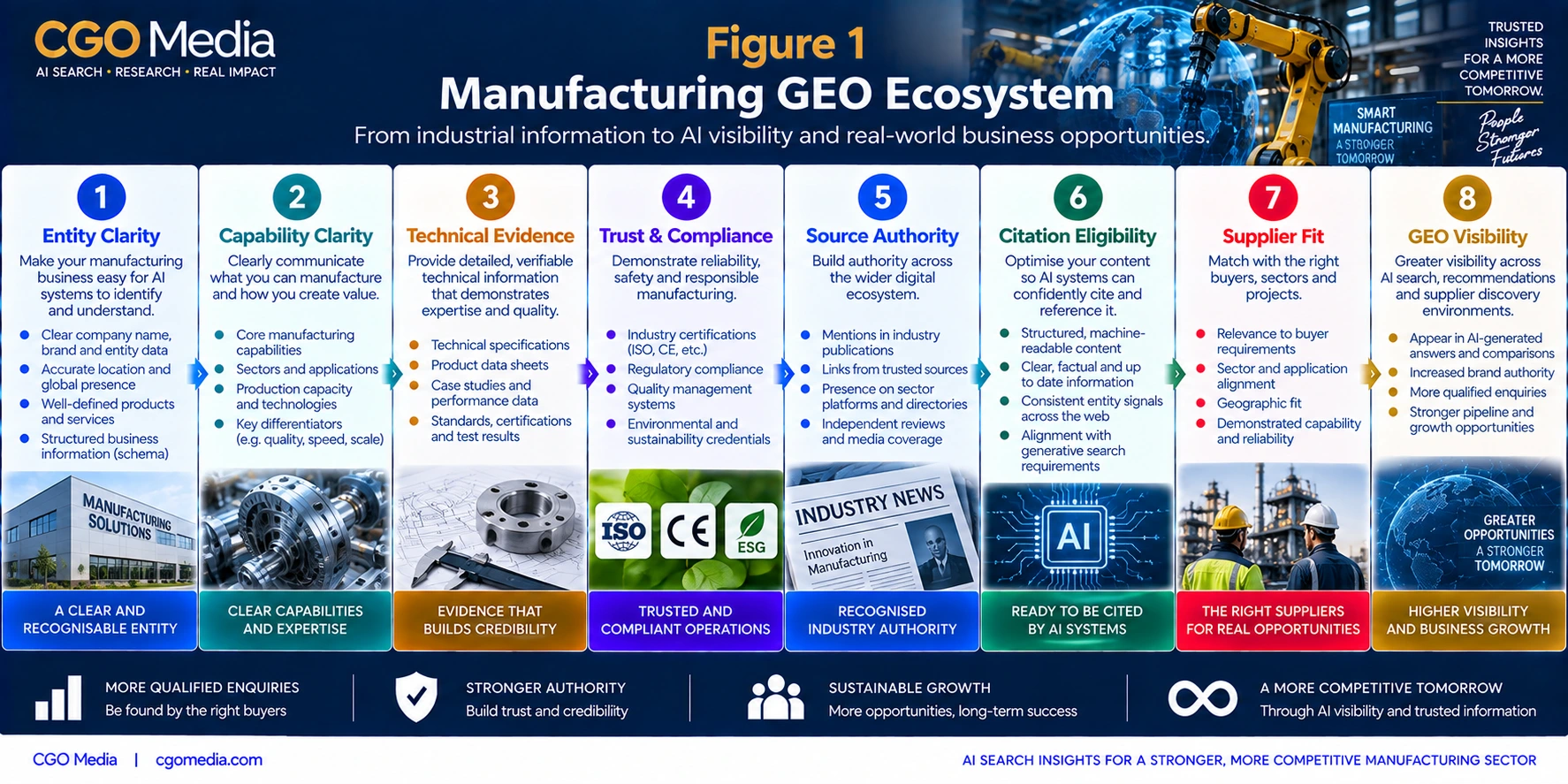
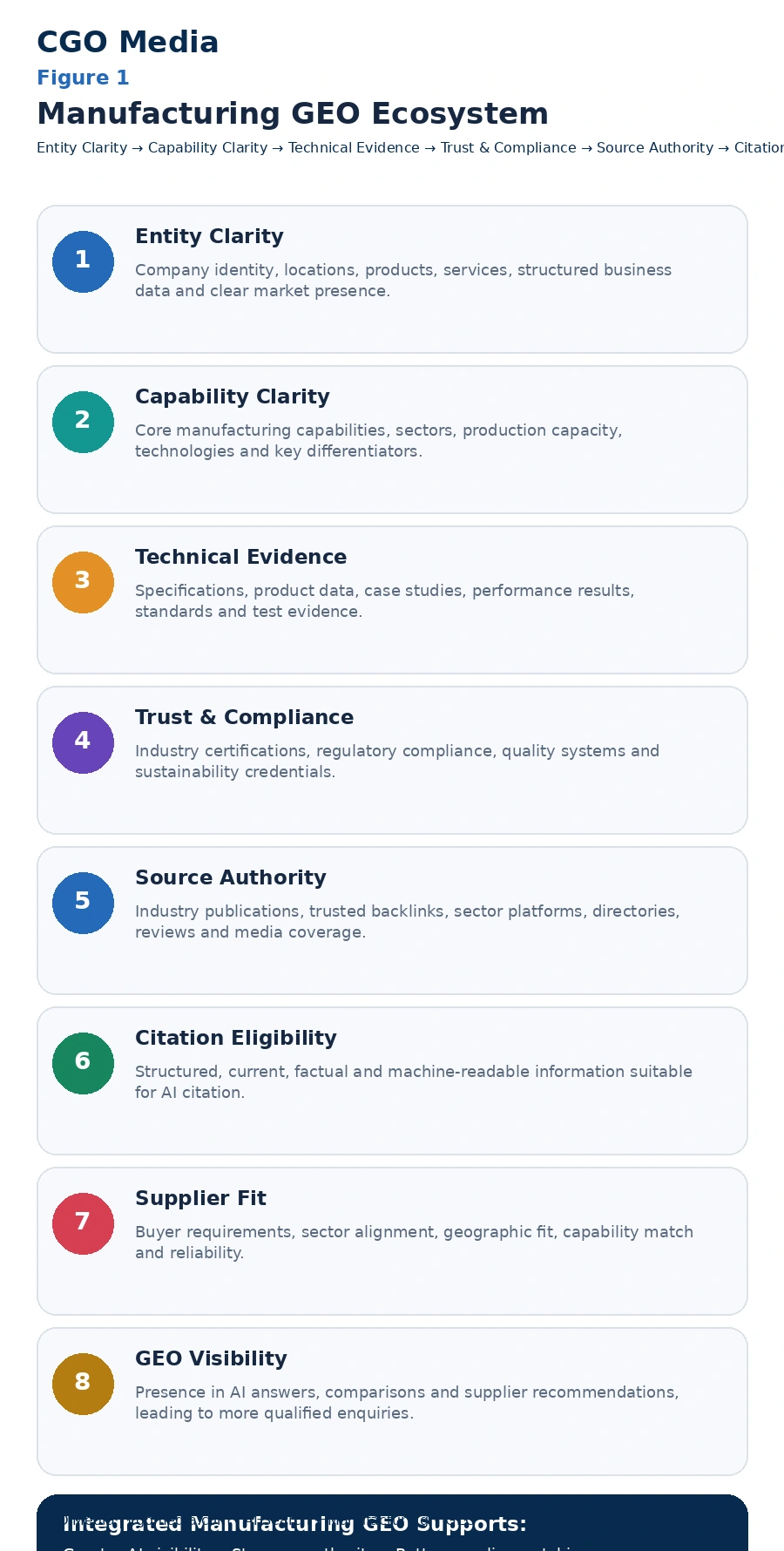
Entity Clarity → Capability Clarity → Technical Evidence → Trust & Compliance → Source Authority → Citation Eligibility → Supplier Fit → GEO Visibility
6. Entity Clarity Is the First Manufacturing GEO Layer
Generative systems need to understand:
- Who the manufacturer is
- What it produces
- Which industries it serves
- Where it operates
- Which brands, facilities or subsidiaries are connected
7. Entity Ambiguity Weakens Manufacturing GEO
Common causes can include:
- Multiple trading names
- Acquisitions
- Parent-company structures
- Legacy brands
- Regional subsidiaries
8. Manufacturing Entity Relationships Should Be Explicit
A useful industrial relationship can be represented as:
Organisation → Facility → Capability → Process → Material → Product → Industry → Market
9. OEM and Supplier Relationships Can Also Be Explicit
For example:
Manufacturer → Component → Application → OEM Sector → Qualification Evidence
10. Entity Clarity Helps Reduce Incorrect Supplier Classification
Generative systems should not need to infer whether a company is:
- A manufacturer
- A distributor
- An engineering consultancy
- An OEM
- A contract manufacturer
11. Capability Clarity Is the Second Manufacturing GEO Layer
Industrial buyers often search by capability rather than brand.
12. Capability Information Can Include
- Manufacturing processes
- Production volumes
- Materials
- Tolerances
- Equipment
- Quality standards
13. Capability Ambiguity Can Reduce Supplier Discovery
A manufacturer may genuinely provide a service but fail to communicate it clearly enough to be considered.
14. Manufacturing GEO Should Map Capability Explicitly
A useful relationship is:
Process → Material → Specification → Volume → Industry Application → Evidence
15. Process Clarity Matters
Examples can include:
- CNC machining
- Injection moulding
- Metal fabrication
- Casting
- Assembly
- Additive manufacturing
16. Material Clarity Matters
Relevant material expertise can include:
- Steel
- Aluminium
- Titanium
- Plastics
- Composites
- Specialist alloys
17. Specification Clarity Matters
Buyers may need explicit information about:
- Tolerances
- Surface finish
- Dimensions
- Testing
- Certification requirements
18. Production Volume Should Be Clear
The provider may specialise in:
- Prototype production
- Low-volume production
- Medium-volume production
- High-volume manufacturing
19. Industry Application Should Be Explicit
Industrial buyers often require sector-specific experience.
20. Important Manufacturing Sectors Can Include
- Aerospace
- Automotive
- Medical devices
- Energy
- Defence
- Electronics
21. Technical Evidence Is the Third Manufacturing GEO Layer
Manufacturing claims should be supported by evidence.
22. Technical Evidence Can Include
- Equipment lists
- Process specifications
- Quality documentation
- Inspection capability
- Production case studies
- Technical datasheets
23. Generic Capability Claims Are Weak Evidence
Statements such as “high quality manufacturing” are less useful than verifiable detail.
24. Specific Technical Evidence Is Stronger
For example:
- Machine type
- Maximum component size
- Tolerance range
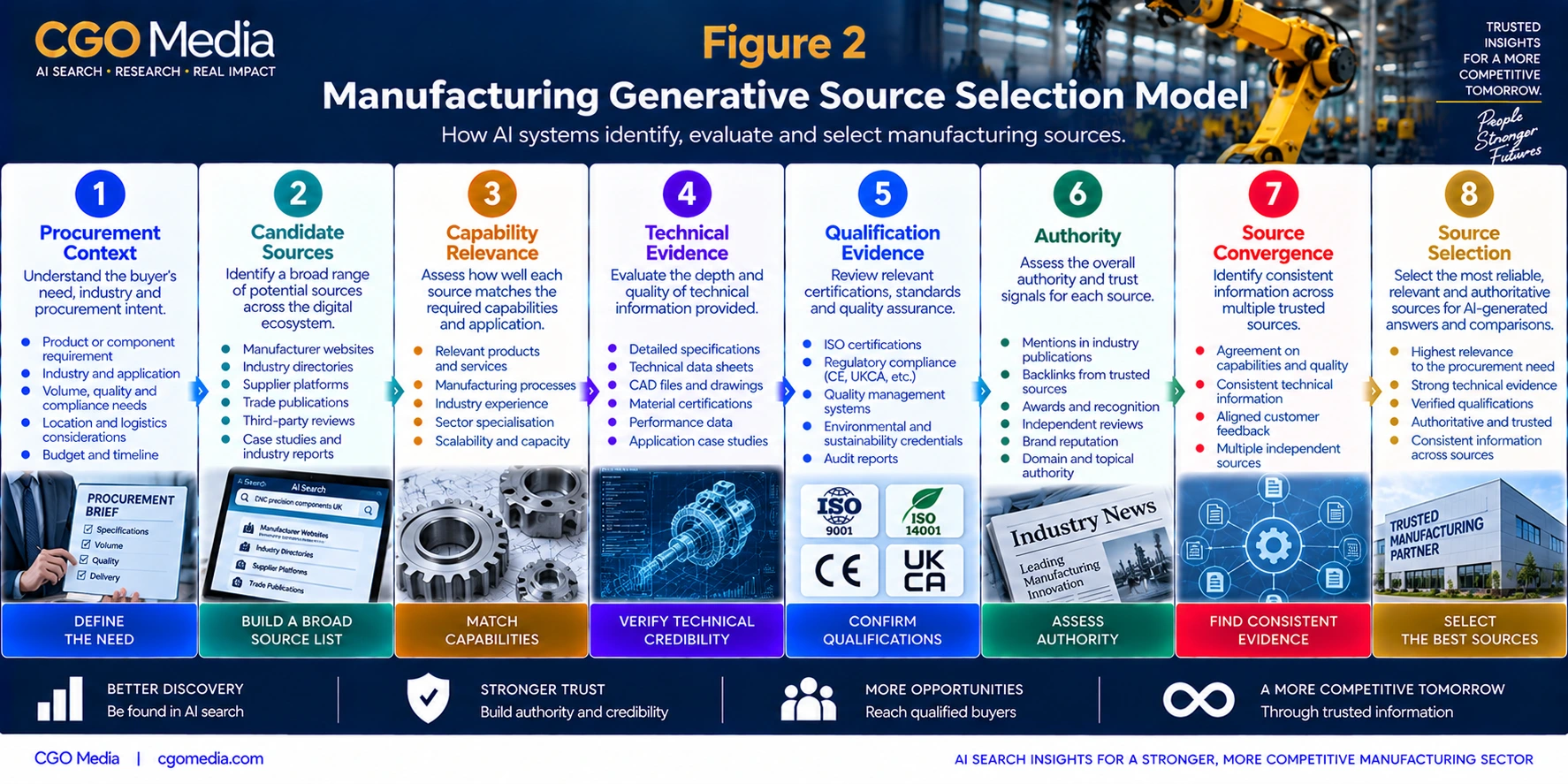
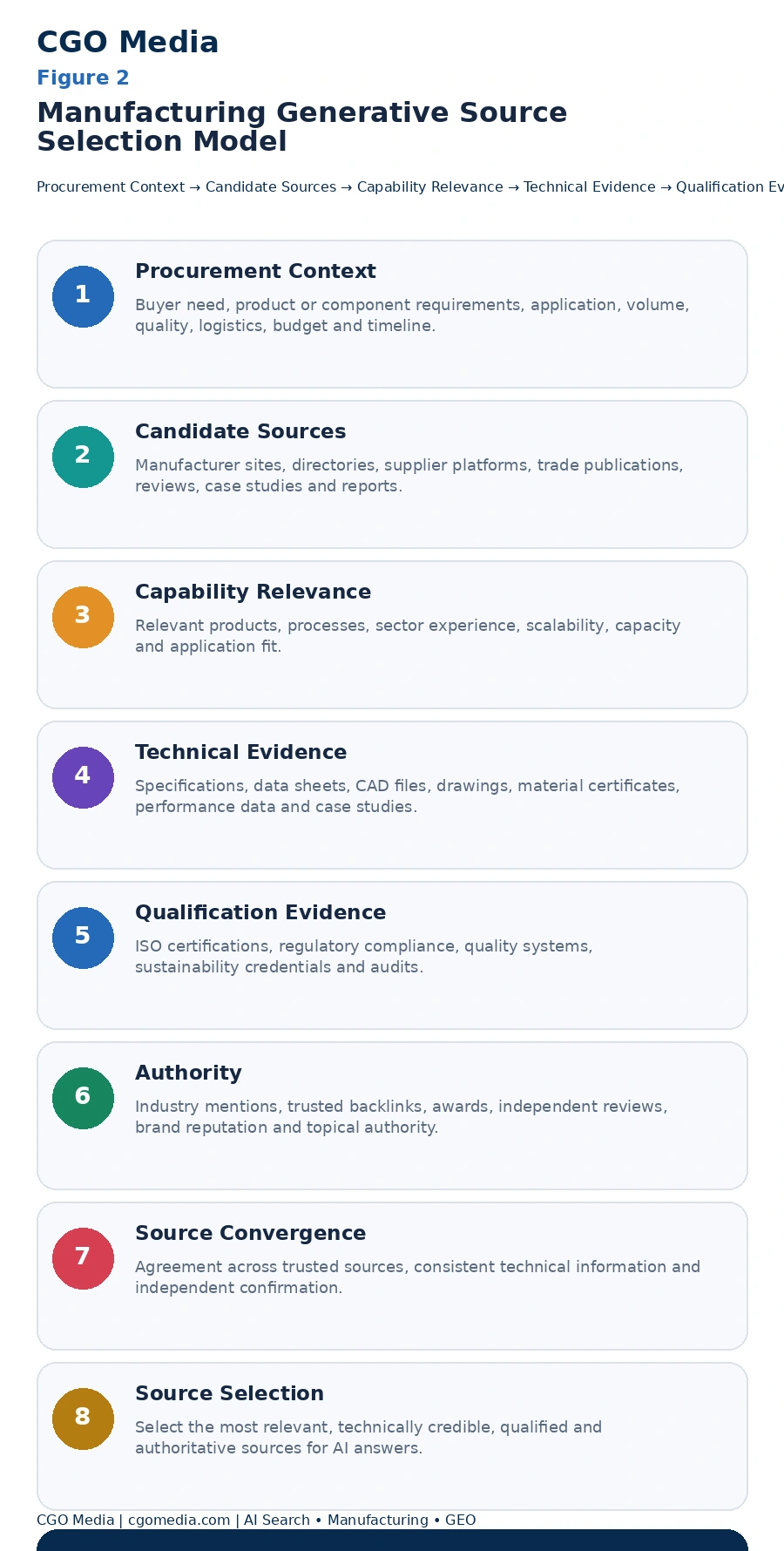
- Material capability
- Inspection process
25. Manufacturing GEO Should Connect Claims to Evidence
A useful relationship is:
Capability Claim → Technical Evidence → Qualification Evidence → Customer Evidence → Confidence
26. Quality and Compliance Are the Fourth Manufacturing GEO Layer
Industrial procurement frequently depends on standards and certification.
27. Quality Evidence Can Include
- ISO certifications
- Industry-specific certifications
- Quality management systems
- Inspection procedures
- Traceability processes
28. Certification Should Be Explicit and Current
Outdated or ambiguous certification information can weaken buyer and AI confidence.
29. Certification Scope Matters
A certification should not be interpreted more broadly than its actual scope.
30. Compliance Evidence Should Match Industry Requirements
Different sectors can require different evidence.
31. Aerospace Manufacturing May Require
- Industry-specific quality systems
- Traceability
- Controlled processes
- Material certification
32. Medical Manufacturing May Require
- Quality management
- Regulatory documentation
- Validation
- Traceability
33. Automotive Manufacturing May Require
- Automotive quality systems
- Production control
- Process capability
- Supplier assurance
34. Trust Should Be Evidence-Led
Manufacturing GEO should not rely only on marketing claims such as:
- Trusted supplier
- Leading manufacturer
- Best-in-class quality
35. Better Trust Evidence Can Include
- Certification
- Customer case studies
- Independent accreditation
- Manufacturing data
- Long-term customer relationships
36. Source Authority Is the Fifth Manufacturing GEO Layer
Generative systems can rely on a combination of owned and independent sources.
37. Owned Manufacturing Sources Can Include
- Capability pages
- Technical resources
- Quality pages
- Case studies
- Datasheets
38. External Manufacturing Sources Can Include
- Trade media
- Industry associations
- Certification bodies
- OEM partner pages
- Supplier directories
39. Source Diversity Can Strengthen Manufacturing Authority
A manufacturer supported by multiple credible sources may be easier to evaluate.
40. Source Consistency Is Equally Important
Important facts should materially agree across:
- Corporate website
- Certification listings
- Supplier directories
- Trade profiles
- Partner pages
41. Source Conflict Can Create Procurement Risk
Conflicting information can affect:
- Capabilities
- Certifications
- Factory locations
- Industry scope
- Product availability
42. Citation Eligibility Is the Sixth Manufacturing GEO Layer
A manufacturing source may be visible but still be weak for explicit reference.
43. Citation Eligibility Can Be Considered Through
Relevance + Technical Specificity + Evidence + Authority + Freshness
44. Relevance
The source should directly answer the buyer’s question.
45. Technical Specificity
The source should contain enough detail to support industrial evaluation.
46. Evidence
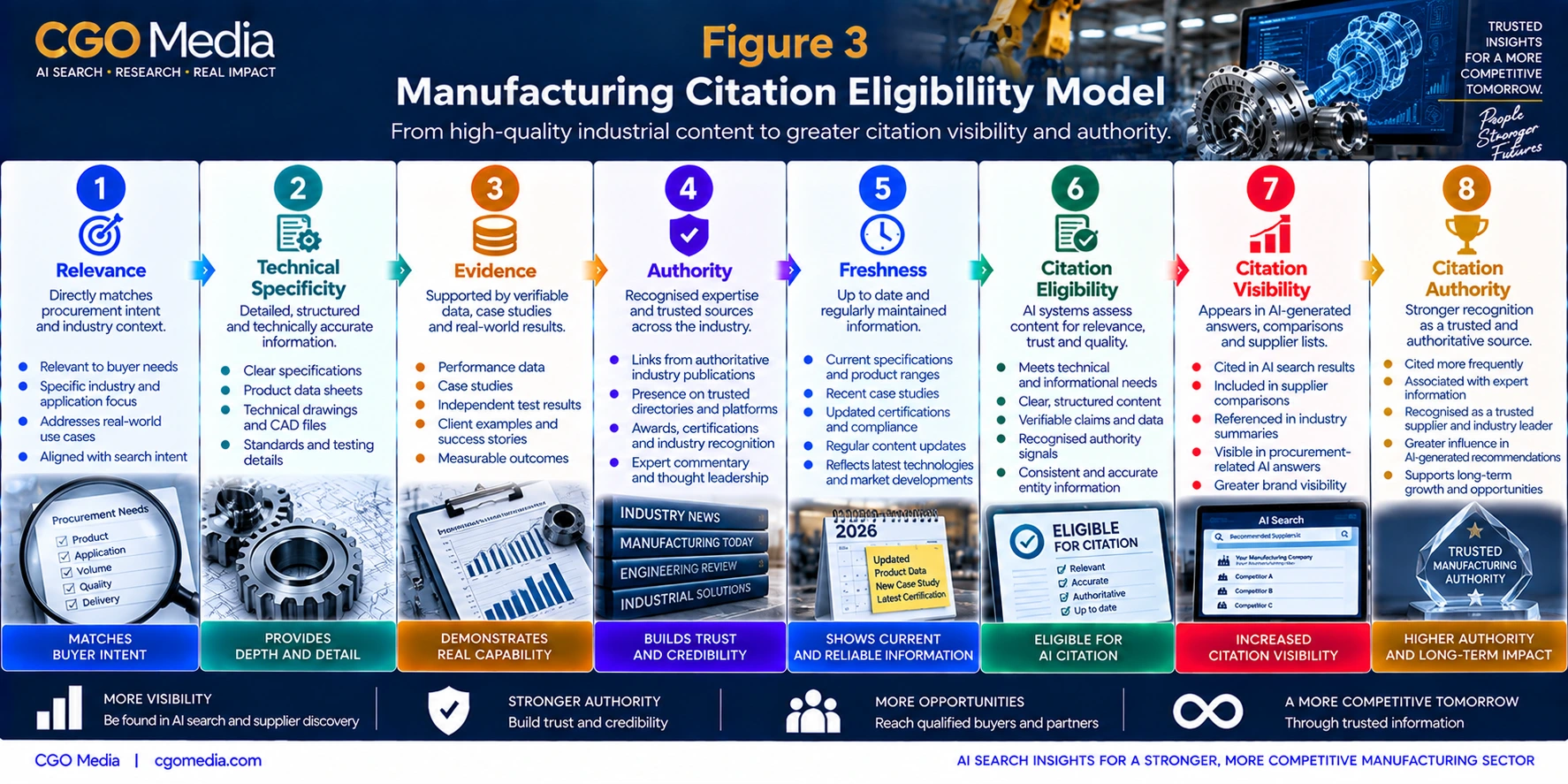
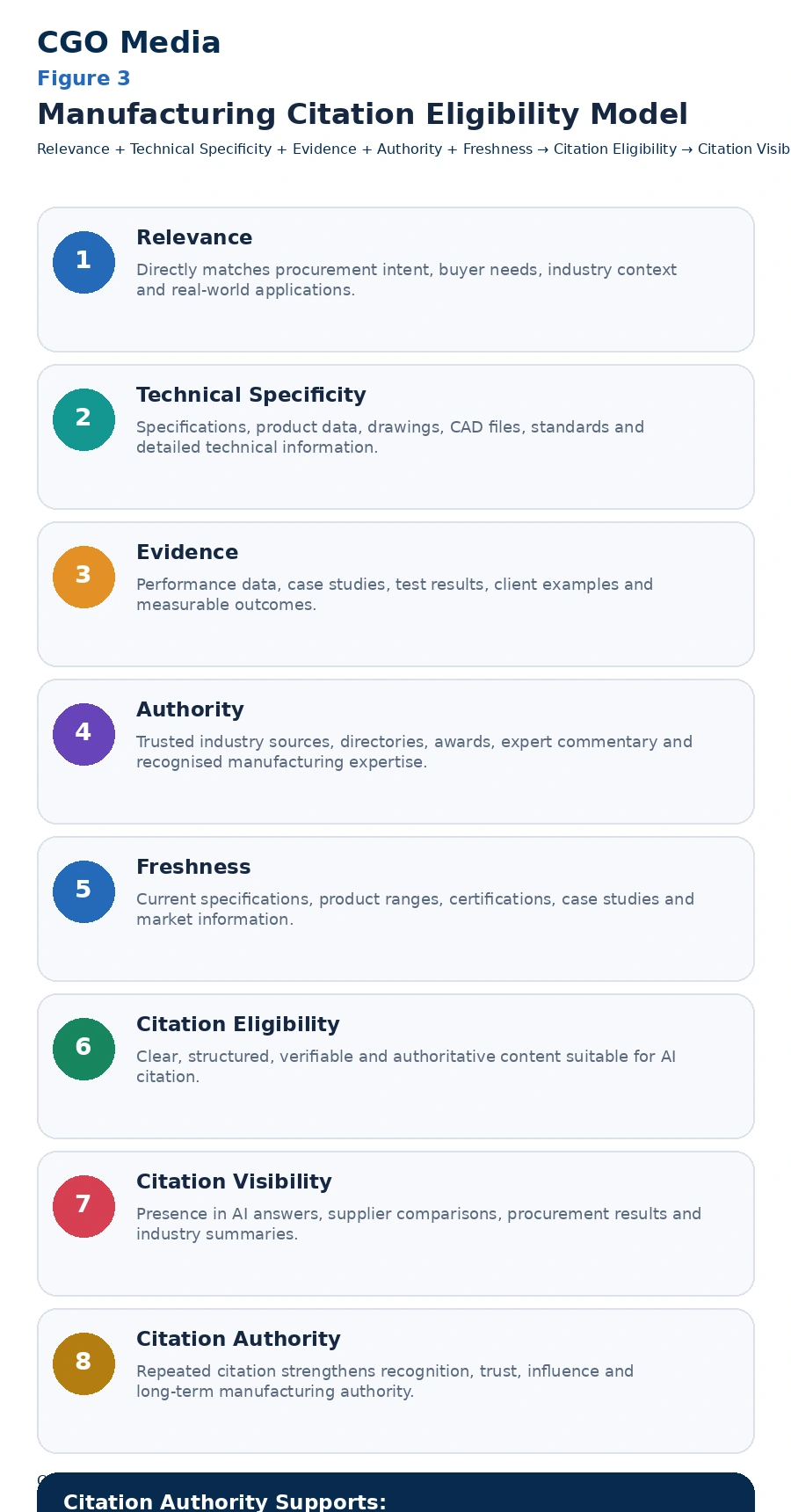
Claims should be supported by technical or commercial proof.
47. Authority
The source should demonstrate credible expertise or validation.
48. Freshness
Information should remain current enough for procurement decisions.
49. Manufacturing Citation Opportunities Can Include
- Technical explanations
- Material guidance
- Manufacturing research
- Industry benchmarks
- Process definitions
50. Original Manufacturing Research Can Strengthen Citation Authority
Manufacturers can publish useful evidence on:
- Lead times
- Material trends
- Supply-chain conditions
- Production efficiency
- Quality trends
51. Supplier Fit Is the Seventh Manufacturing GEO Layer
Being discoverable does not automatically make a manufacturer suitable for a buyer.
52. Supplier Fit Is Highly Contextual
It can depend on:
- Process capability
- Material capability
- Volume
- Certification
- Geography
- Lead time
53. Manufacturing GEO Should Optimise for Qualified Supplier Fit
The objective is not to appear in every supplier recommendation.
54. The Objective Is Appropriate Inclusion
The manufacturer should appear where:
- Its capabilities match
- Its certifications are appropriate
- Its production model fits
- Its geography is relevant
55. Supplier Fit Can Be Represented as
Buyer Requirement → Manufacturing Capability → Qualification Evidence → Commercial Fit → Supplier Recommendation
56. GEO Visibility Is the Final Manufacturing Outcome Layer
Manufacturing GEO visibility can include several distinct states.
57. Source Visibility
The manufacturer’s information is used within an AI-generated answer.
58. Citation Visibility
The manufacturer’s content is explicitly referenced.
59. Entity Visibility
The manufacturer is correctly identified.
60. Comparison Visibility
The manufacturer appears alongside alternative suppliers.
61. Recommendation Visibility
The manufacturer is recommended within a relevant sourcing scenario.
62. Manufacturing GEO Visibility Should Be Layered
A useful model is:
Source → Citation → Entity → Comparison → Recommendation
63. Source Visibility Is the Broadest Layer
Technical information may contribute to an answer even where the manufacturer is not prominently named.
64. Citation Visibility Adds Explicit Attribution
This can strengthen:
- Brand recognition
- Referral potential
- Technical authority
65. Entity Visibility Adds Supplier Recognition
The manufacturer becomes part of the answer itself.
66. Comparison Visibility Adds Procurement Context
The manufacturer enters the active supplier consideration set.
67. Recommendation Visibility Adds Selection Intent
The manufacturer is positioned as potentially suitable for the buyer’s needs.
68. These Layers Should Be Measured Separately
A single AI visibility score can conceal important differences.
69. High Citation Visibility Does Not Guarantee Supplier Recommendation Visibility
A manufacturer’s technical information may be useful even where another supplier fits the requirement better.
70. High Recommendation Visibility Does Not Guarantee Strong Source Visibility
A manufacturer can be frequently named without its own content being heavily cited.
71. Manufacturing GEO Measurement Should Therefore Be Multi-Dimensional
Organisations should evaluate:
- Source presence
- Citation presence
- Entity accuracy
- Comparison inclusion
- Recommendation fit
72. Manufacturing GEO Queries Should Be Procurement-Based
Generic prompts provide limited commercial insight.
73. Useful Procurement Scenarios Can Include
- Finding a CNC supplier for aerospace parts
- Finding an injection moulding supplier for medical devices
- Comparing contract manufacturers
- Finding regional metal fabrication suppliers
- Identifying ISO-certified manufacturers
74. Procurement Scenario Design Should Reflect Real Buying Criteria
Monitoring should align with:
- Capabilities
- Specifications
- Certifications
- Geography
- Volumes
75. GEO Monitoring Should Include Supplier Co-Occurrence
AI-generated comparisons can reveal the effective competitive set.
76. Supplier Co-Occurrence Can Reveal
- Emerging competitors
- Regional alternatives
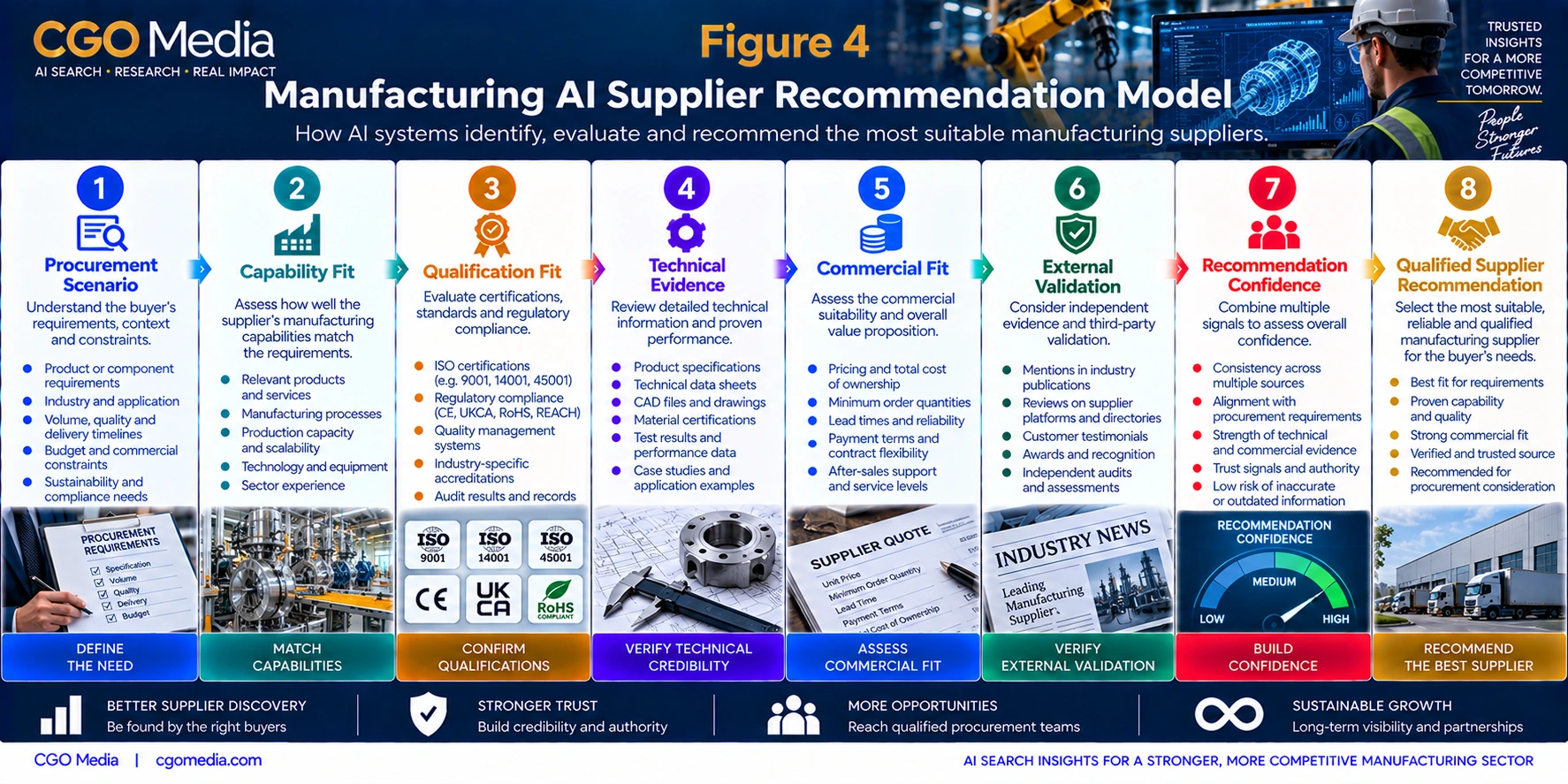
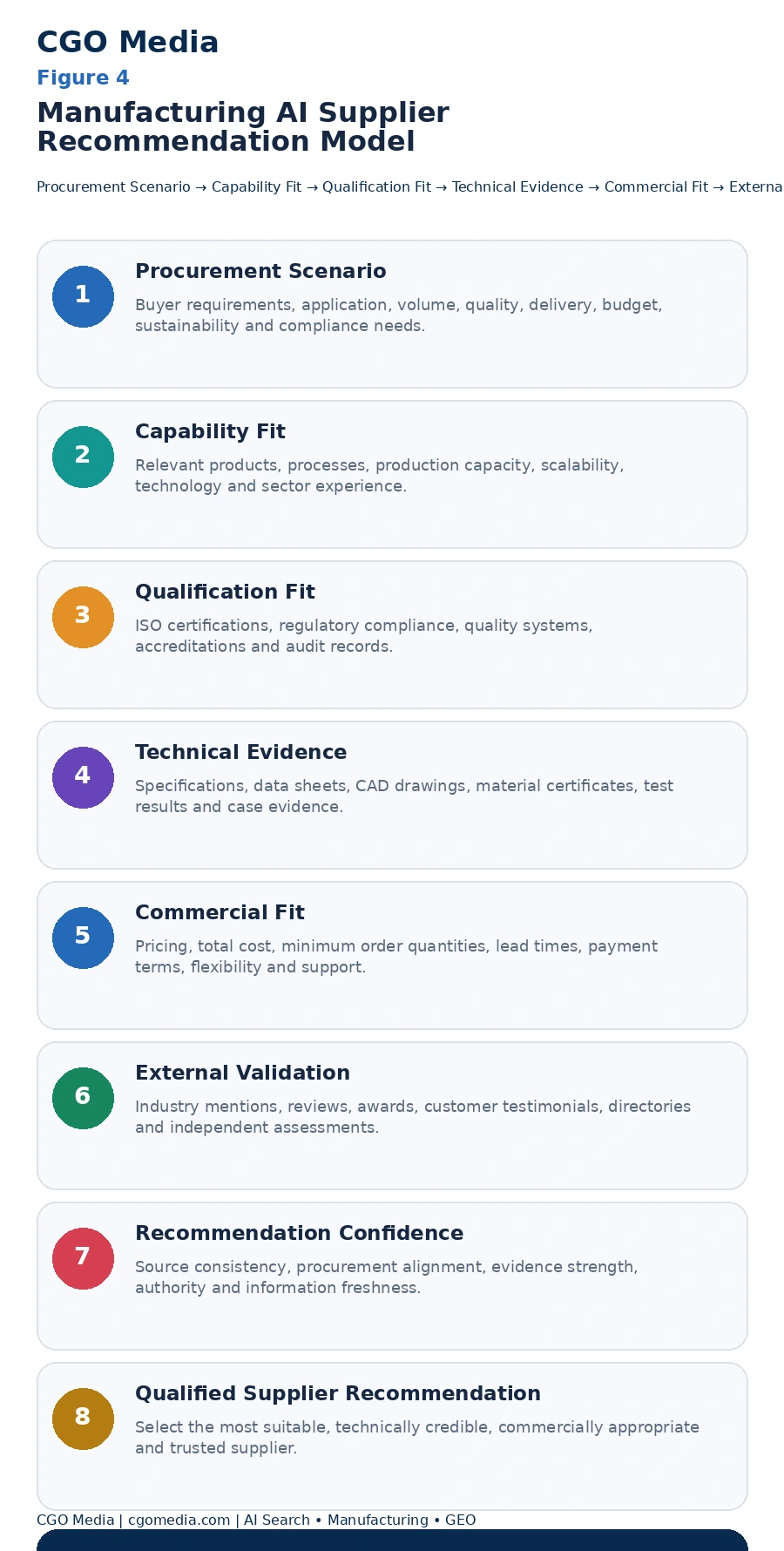
- Adjacent manufacturing capabilities
- Unexpected supplier categories
77. GEO Monitoring Should Include Comparative Framing
The manufacturer should observe how it is repeatedly characterised.
78. Comparative Framing Can Include
- High-volume
- Precision-focused
- Specialist
- Low-cost
- High-compliance
- Rapid-prototyping
79. Persistent Framing Can Influence Procurement Perception
Repeated AI descriptions may reinforce a particular market position.
80. Misaligned Framing Should Be Investigated
The organisation should compare:
- Intended positioning
- Actual capability
- Owned information
- External information
- Generated representation
81. Manufacturing GEO Is Not Controlled Through Prompt Testing Alone
Manufacturers cannot optimise generative visibility simply by experimenting with prompts.
82. The Underlying Evidence Environment Matters More
Long-term GEO strength depends on:
- Clear entities
- Clear capabilities
- Strong technical evidence
- Current certifications
- External validation
83. Manufacturing GEO Is Therefore an Organisational Capability
It can require coordination between:
- SEO
- Marketing
- Engineering
- Quality
- Sales
- Operations
84. Engineering Teams Support Manufacturing GEO Through Technical Truth
They help validate:
- Capabilities
- Tolerances
- Materials
- Production constraints
85. Quality Teams Support GEO Through Certification and Compliance Evidence
They can validate:
- Quality systems
- Certifications
- Inspection processes
- Traceability
86. Operations Teams Support GEO Through Capacity Evidence
They can clarify:
- Production volumes
- Lead times
- Facility capability
- Supply capacity
87. Sales Teams Support GEO Through Procurement Intelligence
They can identify:
- Buyer requirements
- Common objections
- Competitors
- Selection criteria
88. Research and Marketing Teams Can Support Citation Authority
They can create:
- Industry studies
- Technical guides
- Market data
- Manufacturing benchmarks
89. Manufacturing GEO Should Be Connected to Procurement Decisions
Generative visibility is most valuable where it supports:
- Supplier discovery
- Technical evaluation
- Supplier comparison
- Shortlisting
90. GEO Should Not Be Optimised for Mention Volume Alone
High mention volume can be commercially misleading.
91. High Mention Volume Can Include Poor-Fit Procurement Scenarios
This can create visibility without sourcing value.
92. Qualified Manufacturing GEO Visibility Is More Useful
A useful conceptual relationship is:
Relevant Presence + Accurate Capability Representation + Strong Evidence + Appropriate Supplier Recommendation
93. Relevant Presence
The manufacturer appears in sourcing scenarios aligned with its real capabilities.
94. Accurate Capability Representation
Technical and operational facts are represented correctly.
95. Strong Evidence
Important manufacturing claims are supportable.
96. Appropriate Supplier Recommendation
The manufacturer is recommended where procurement fit is reasonable.
97. Qualified GEO Visibility Should Be the Strategic Goal
This is more valuable than broad but inaccurate supplier visibility.
98. Manufacturing GEO Should Also Protect Against Procurement Misinformation
Incorrect generated information can create substantial commercial risk.
99. Critical Manufacturing GEO Errors Can Include
- Incorrect certification claims
- Wrong production capabilities
- Wrong material capabilities
- Incorrect facility locations
- Incorrect production volumes
100. Manufacturing GEO Risk Should Be Prioritised
A useful model is:
Severity + Persistence + Procurement Impact + Commercial Importance
101. High-Risk Errors Should Trigger Escalation
Relevant teams can include:
- Quality
- Engineering
- Sales
- Marketing
- Leadership
102. Manufacturing GEO Should Be Monitored Longitudinally
Individual AI outputs can vary.
103. Longitudinal Monitoring Reveals Durable Patterns
Examples include:
- Persistent supplier inclusion
- Persistent supplier exclusion
- Recurring capability errors
- Changing competitor sets
104. The First Manufacturing GEO Principle
Manufacturing GEO should be treated as the optimisation of an industrial information, evidence and supplier-authority ecosystem rather than as a narrow extension of keyword SEO, because generative systems evaluate manufacturers through capability, technical evidence, qualification, source authority and buyer fit.
105. The Second Manufacturing GEO Principle
Manufacturing visibility should be assessed across source, citation, entity, comparison and recommendation layers because a supplier can perform strongly at one layer while remaining weak at another.
106. The Third Manufacturing GEO Principle
Manufacturers should prioritise qualified GEO visibility — relevant presence, accurate capability representation, strong technical evidence and appropriate supplier recommendation — rather than maximising raw AI mention volume.
107. The Fourth Manufacturing GEO Principle
Long-term GEO performance should be built through clear entity architecture, explicit capability information, current qualification evidence, credible external sources and ongoing procurement-focused monitoring rather than through prompt testing alone.
108. The Manufacturing GEO Ecosystem
The complete conceptual progression can be summarised as:
Entity Clarity → Capability Clarity → Technical Evidence → Trust & Compliance → Source Authority → Citation Eligibility → Supplier Fit → GEO Visibility
109. The Strategic Implication
Manufacturers should approach Generative Engine Optimisation as a coordinated search, engineering, quality, evidence and supplier-authority discipline, ensuring that AI systems can identify the organisation correctly, understand its real manufacturing capabilities, verify technical and compliance evidence, evaluate procurement fit and recommend the supplier appropriately within generative sourcing environments.
110. Generative Source Selection Is a Core Manufacturing GEO Problem
A manufacturer can publish technically accurate information without that information necessarily becoming a preferred source within AI-generated answers.
111. Manufacturing GEO Therefore Needs to Consider Source Selection
The practical question is:
Why would a generative system select this manufacturing source rather than another?
112. Source Selection Begins with Candidate Availability
Relevant manufacturing information must first be accessible enough to enter the candidate source set.
113. Candidate Manufacturing Sources Can Include
- Capability pages
- Technical datasheets
- Quality documentation
- Industry case studies
- Trade publications
- Supplier directories
114. Candidate Availability Is Not Enough
A source can be visible but still lose to more specific, authoritative or better-evidenced alternatives.
115. Manufacturing Candidate Sources Can Compete on
- Procurement relevance
- Technical specificity
- Qualification evidence
- Source authority
- Freshness
116. Procurement Relevance Determines Buyer Fit
The source should address the actual sourcing requirement rather than offer broad marketing language.
117. Broad Manufacturing Pages Can Lose to Specific Technical Pages
For example, a generic precision engineering page may be less useful for an aerospace procurement query than a dedicated aerospace machining page containing certification and tolerance evidence.
118. Technical Specificity Can Improve Source Suitability
Useful specificity can include:
- Machine capability
- Material capability
- Dimensional tolerance
- Production volume
- Inspection capability
119. Qualification Evidence Influences Source Confidence
Industrial buyers and generative systems may require more than claims of quality.
120. Qualification Evidence Can Include
- ISO certification
- Sector-specific certification
- Accreditation
- Testing procedures
- Traceability evidence
121. Source Authority Influences Trust
Authority can be reinforced through:
- Industry association references
- Trade media
- OEM relationships
- Independent certification
- Customer evidence
122. Freshness Influences Procurement Suitability
Old manufacturing information can become commercially risky.
123. High-Change Manufacturing Information Can Include
- Certification status
- Facility capability
- Production capacity
- Equipment
- Lead times
124. A Manufacturing Source Selection Model Can Be Represented as
Procurement Context → Candidate Sources → Capability Relevance → Technical Evidence → Qualification Evidence → Authority → Source Selection
125. Procurement Context Comes First
Different sourcing questions require different evidence.
126. Capability Discovery Queries Can Favour
- Process pages
- Capability pages
- Facility pages
- Industry pages
127. Technical Validation Queries Can Favour
- Datasheets
- Engineering specifications
- Inspection information
- Process documentation
128. Compliance Queries Can Favour
- Certification pages
- Quality documentation
- Accreditation evidence
- Traceability information
129. Supplier Comparison Queries Can Favour
- Capability matrices
- Case studies
- Independent supplier profiles
- Industry references
130. Manufacturing Research Queries Can Favour
- Original studies
- Technical reports
- Industry benchmarks
- Market data
131. GEO Should Therefore Build Query-Specific Manufacturing Source Strength
A single corporate page cannot satisfy every industrial information need.
132. Source Architecture Should Reflect Procurement Architecture
A useful structure is:
Buyer Question → Required Evidence → Best Source Format
133. Question-Type Mapping Can Reveal Manufacturing Source Gaps
Teams can identify where buyers may struggle to validate the organisation.
134. Common Source Gaps Can Include
- No detailed capability page
- No certification evidence
- No material-specific information
- No sector-specific case studies
- No technical performance data
135. Source Gaps Should Be Prioritised by Procurement Importance
Not every missing page has equal commercial value.
136. High-Priority Source Gaps Affect Supplier Qualification
These can include:
- Certification gaps
- Capability ambiguity
- Missing material evidence
- Missing production constraints
137. Manufacturing Source Selection Can Involve Source Convergence
Multiple independent sources may reinforce the same supplier conclusion.
138. Source Convergence Can Strengthen Confidence
A capability supported consistently across credible sources is easier to trust.
139. A Manufacturing Source Convergence Model Can Be Represented as
Owned Technical Evidence + Quality Evidence + Customer Evidence + Independent Industry Evidence
140. Owned Technical Evidence Provides Capability Detail
Examples include:
- Process descriptions
- Machine lists
- Tolerances
- Material capability
- Facility information
141. Quality Evidence Provides Qualification Confidence
Examples include:
- Certificates
- Inspection processes
- Quality systems
- Traceability procedures
142. Customer Evidence Provides Commercial Validation
Examples include:
- Case studies
- Testimonials
- OEM relationships
- Reference projects
143. Independent Industry Evidence Provides External Validation
Examples include:
- Trade press
- Industry associations
- Certification databases
- Supplier directories
144. Source Convergence Should Be Materially Consistent
The language does not need to be identical, but critical facts should agree.
145. Critical Manufacturing Facts Can Include
- Production capability
- Certification status
- Facility location
- Material expertise
- Industry coverage
146. Source Conflict Should Be Treated as a Manufacturing GEO Risk
Conflicting public information can weaken both AI confidence and procurement confidence.
147. Common Manufacturing Source Conflicts Can Include
- Different factory locations
- Different certification status
- Different process claims
- Different material capabilities
- Different production volumes
148. Source Conflict Can Be Internal
Different pages on the manufacturer’s own site may contradict one another.
149. Source Conflict Can Be External
Directories, partner pages or industry profiles may contain outdated data.
150. Manufacturing GEO Programmes Should Map Critical Supplier Facts
For each important fact, teams can identify:
- Primary source
- Supporting source
- External references
- Review owner
151. Canonical Supplier-Fact Management Can Strengthen GEO
Decision-critical information should have a defined and maintainable source of truth.
152. Manufacturing Content Should Be Explicit Rather Than Implied
Generative systems should not need to infer technical capability from vague descriptions.
153. Explicit Capability Statements Can Include
- Maximum component dimensions
- Minimum tolerances
- Supported materials
- Production volumes
- Available finishing processes
154. Explicit Qualification Statements Can Include
- Certification name
- Certification scope
- Facility covered
- Expiry or review date
155. Explicit Market Statements Can Include
- Countries served
- Export capability
- Local manufacturing presence
- Logistics coverage
156. Manufacturing GEO Content Should Be Extractable Without Losing Meaning
Important capability statements should remain clear when removed from surrounding page context.
157. Context Independence Can Improve Source Utility
A useful statement should explain enough of the subject, capability and limitation to stand alone.
158. Ambiguous Industrial Language Can Reduce Extractability
Examples include:
- Advanced capabilities
- High precision
- World-class manufacturing
- Extensive capacity
159. Specific Industrial Language Is More Useful
For example:
- 5-axis CNC machining
- ±0.01 mm tolerance capability
- AS9100-certified quality system
- Low-volume aerospace production
160. Manufacturing Claims Should Include Conditions Where Relevant
A capability may depend on:
- Material
- Part geometry
- Volume
- Facility
- Production method
161. Conditional Claims Improve Supplier Matching
Generative systems can make better recommendations when limitations are explicit.
162. Manufacturing GEO Should Include Evidence Granularity
Different industrial claims require different levels of proof.
163. Basic Capability Claims Can Use
- Capability pages
- Equipment lists
- Process pages
164. Precision and Performance Claims Need Stronger Evidence
Examples include:
- Inspection data
- Test results
- Process capability studies
- Benchmark evidence
165. Compliance Claims Need Strong Qualification Evidence
Examples include:
- Certificates
- Accreditation
- Audit evidence
- Quality-system information
166. Customer Outcome Claims Need Context
Useful case studies can explain:
- Customer requirement
- Manufacturing challenge
- Process used
- Outcome achieved
167. Manufacturing Research Assets Can Be Designed for Citation
Original industrial information can become useful source material.
168. Citation-Oriented Manufacturing Research Can Include
- Industry surveys
- Production benchmarks
- Lead-time studies
- Material trend analysis
- Supply-chain research
169. Research Should Explain Methodology Clearly
Useful methodological elements can include:
- Sample size
- Industry scope
- Geographic scope
- Measurement period
- Limitations
170. Research Findings Should Be Explicit
Key results should be easy for journalists, buyers, researchers and AI systems to identify.
171. Research Findings Can Be Supported by Figures and Tables
Visual evidence can improve interpretability.
172. Primary Manufacturing Data Can Strengthen Authority
Original information creates reasons for others to reference the manufacturer.
173. GEO Source Strength Should Be Evaluated Across Owned and External Information
Manufacturers should not focus only on their own websites.
174. External Source Strength Can Include
- Trade media
- Industry directories
- Professional associations
- Certification databases
- Customer references
175. Certification Databases Can Be Especially Important
They can independently validate quality and compliance information.
176. Supplier Directories Can Influence Category Association
They can connect manufacturers with:
- Processes
- Industries
- Materials
- Geographic markets
177. Directory Information Should Be Maintained
Old supplier information can create capability or location conflict.
178. Customer Pages Can Reinforce Supplier Relationships
Where appropriate and publicly available, customer references can strengthen external validation.
179. Trade Media Can Reinforce Manufacturing Expertise
Coverage can support:
- Technical authority
- Innovation authority
- Industry association
- Market recognition
180. Manufacturing GEO Should Monitor Which External Sources Recur
Repeated source appearance can reveal influential information environments.
181. Source Recurrence Can Reveal Competitor Advantage
Competitors may be supported by stronger:
- Trade coverage
- Certification visibility
- Customer references
- Technical content
182. Manufacturing GEO Analysis Should Remain Empirical
AI systems do not expose every internal source-selection mechanism.
183. Teams Should Distinguish
- Observed source patterns
- Reasonable hypotheses
- Unverified assumptions
184. Observed Patterns Can Still Be Strategically Useful
They can help identify:
- Technical content gaps
- Evidence gaps
- Authority gaps
- Qualification gaps
185. Manufacturing GEO Should Prioritise Source Utility Over Manipulation
The strongest long-term approach is to create genuinely useful industrial information.
186. Manufacturing Source Utility Can Be Improved Through
- Technical specificity
- Clarity
- Evidence
- Freshness
- Procurement relevance
187. Source Utility Also Depends on Accessibility
Important manufacturing information should not be unnecessarily hidden within:
- Unsearchable PDFs
- Poor navigation
- Disconnected portals
- Weak internal linking
188. PDFs Can Still Be Useful
But critical information should also be available in accessible web content where practical.
189. Manufacturing Source Selection Is Competitive
A supplier does not improve in isolation.
190. Competitors May Have Stronger Candidate Sources
They may provide:
- More detailed capability information
- Stronger certification evidence
- Better customer proof
- More current technical data
191. Manufacturing GEO Competitor Analysis Should Examine Source Strength
Teams should compare more than search rankings.
192. Source-Level Competitor Comparison Can Include
- Capability coverage
- Technical depth
- Certification visibility
- External authority
- Freshness
193. Capability Coverage Measures Breadth
Does the competitor clearly document more processes, materials and applications?
194. Technical Depth Measures Evidence Quality
Does the competitor provide stronger supporting detail?
195. Certification Visibility Measures Qualification Clarity
Can buyers easily verify standards and approvals?
196. External Authority Measures Independent Reinforcement
Is the competitor referenced more strongly by credible industry sources?
197. Freshness Measures Current Procurement Relevance
Is the competitor’s public information more up to date?
198. Manufacturing GEO Improvement Should Address the Weakest Source Dimension
A supplier may need:
- Better capability content
- Better qualification evidence
- Better customer proof
- Better external authority
199. The Fifth Manufacturing GEO Principle
Generative source selection should be treated as a competitive procurement-evidence problem in which manufacturing sources must be sufficiently relevant, technically specific, qualified, authoritative and current to outperform alternative supplier sources for the same industrial information need.
200. The Sixth Manufacturing GEO Principle
Manufacturers should build procurement-specific source architecture because capability discovery, technical validation, compliance verification, supplier comparison and industry research often require different evidence types and source formats.
201. The Seventh Manufacturing GEO Principle
Source convergence should be strengthened across owned technical information, quality evidence, customer proof and independent industry sources so critical supplier claims are reinforced consistently across the public information environment.
202. The Eighth Manufacturing GEO Principle
Manufacturing GEO content should prioritise source utility through technical specificity, clear qualification evidence, freshness, procurement relevance and extractability rather than relying on generic industrial marketing language.
203. The Manufacturing Generative Source Selection Model
The conceptual process can be summarised as:
Procurement Context → Candidate Sources → Capability Relevance → Technical Evidence → Qualification Evidence → Authority → Source Convergence → Source Selection
204. The Strategic Implication
Manufacturers should treat generative source selection as a competitive industrial information problem, building the right source type for each procurement question, strengthening technical and qualification evidence, reducing source conflict and making critical capability information sufficiently explicit, current and useful to compete for inclusion within AI-generated sourcing and supplier-evaluation answers.
205. Citation Visibility Is a Distinct Manufacturing GEO Outcome
A manufacturer’s information may influence a generated answer without the manufacturer being explicitly cited.
206. Citation Visibility Adds Explicit Attribution
This can strengthen:
- Technical authority
- Supplier credibility
- Referral opportunity
- Industry recognition
207. Citation Eligibility Should Be Evaluated Separately from General Visibility
The practical question is:
Is this manufacturing source suitable for explicit reference within the answer?
208. Manufacturing Citation Eligibility Can Be Represented as
Relevance + Technical Specificity + Evidence + Authority + Freshness = Citation Eligibility
209. Relevance Is the First Citation Dimension
The source should directly support the industrial claim being made.
210. Broad Relevance Is Weaker Than Procurement-Specific Relevance
A general company page may be less useful than a dedicated capability, certification or technical resource.
211. Citation-Oriented Manufacturing Content Should Answer Specific Questions
Examples can include:
- Which process is used?
- Which materials are supported?
- Which tolerances are achievable?
- Which certifications apply?
- Which industries are served?
212. Technical Specificity Is the Second Citation Dimension
Manufacturing information is more useful when it contains enough detail to support technical evaluation.
213. Technically Specific Information Can Include
- Machine capability
- Material grades
- Dimensional ranges
- Tolerance capability
- Inspection methods
214. Generic Statements Create Weak Citation Utility
Claims such as “advanced manufacturing capability” provide limited evidence unless supported by detail.
215. Evidence Is the Third Citation Dimension
A strong manufacturing citation should be supported by verifiable industrial evidence.
216. Evidence Can Be First-Party
Examples include:
- Technical specifications
- Quality documentation
- Process descriptions
- Original research
217. Evidence Can Be Independently Validated
Examples include:
- Certification databases
- Trade publications
- Industry associations
- Customer references
218. First-Party Evidence Is Often Strongest for Operational Facts
The manufacturer is usually the primary source for:
- Current equipment
- Production processes
- Material capability
- Factory capacity
219. Independent Evidence Can Strengthen Qualification Confidence
External validation is particularly useful for:
- Certification
- Market reputation
- Customer relationships
- Industry standing
220. Strong Manufacturing GEO Combines Both Evidence Types
A healthy evidence system can be represented as:
First-Party Technical Truth + Independent Industrial Validation
221. Authority Is the Fourth Citation Dimension
Generative systems may prefer sources that demonstrate credible subject expertise.
222. Manufacturing Authority Can Be Reinforced Through
- Engineering expertise
- Industry research
- Trade references
- Quality accreditations
- Customer evidence
223. Manufacturing Authority Should Be Capability-Specific
A company may be authoritative in precision machining but not in every manufacturing discipline.
224. Capability-Specific Authority Can Be Built Through Depth
The organisation should demonstrate sustained expertise across:
- Process
- Material
- Application
- Quality
- Industry
225. Freshness Is the Fifth Citation Dimension
Manufacturing information can decay quickly when operational conditions change.
226. High-Change Manufacturing Information Can Include
- Certification status
- Equipment
- Capacity
- Lead times
- Production locations
227. Lower-Change Manufacturing Information Can Include
- Process definitions
- Historical research
- Material fundamentals
- Conceptual frameworks
228. Review Frequency Should Reflect Information Volatility
A useful principle is:
Rate of Operational Change ↑ → Review Frequency ↑
229. Citation Eligibility Can Therefore Be Managed
Manufacturers can improve citation readiness by strengthening:
- Procurement relevance
- Technical specificity
- Evidence
- Authority
- Freshness
230. Citation Authority Extends Beyond Individual Manufacturing Pages
An organisation can become recognised as a useful source for industrial knowledge.
231. Citation Authority Develops Through Repeated External Use
The manufacturer’s information may increasingly be:
- Referenced
- Linked
- Quoted
- Summarised
232. Citation Authority Can Become Self-Reinforcing
A useful cycle is:
Useful Industrial Evidence → External Reference → Greater Authority → Wider Discovery → More Citation Opportunities
233. Original Manufacturing Research Is Especially Valuable
Manufacturers can produce information that is unavailable elsewhere.
234. Original Manufacturing Research Can Include
- Lead-time studies
- Material cost trends
- Defect-rate analysis
- Production-efficiency studies
- Supply-chain surveys
235. Primary Manufacturing Data Creates Citation Utility
Journalists, buyers, analysts and researchers may need original industrial data.
236. Research Should Begin with a Clear Question
The study should explain what it is trying to understand.
237. Manufacturing Research Should Explain Methodology
Useful methodological elements can include:
- Sample
- Factory or supplier scope
- Geographic coverage
- Measurement period
- Definitions
- Limitations
238. Research Findings Should Be Explicit
Important results should not be buried within long narrative sections.
239. Explicit Findings Improve Human and Machine Utility
Important results can be presented through:
- Summary statements
- Tables
- Figures
- Methodology sections
240. Findings Should Be Separated from Interpretation
Readers should be able to distinguish:
- What was measured
- What the manufacturer believes it means
241. Research Limitations Should Be Visible
Transparent limitations improve credibility.
242. Manufacturing Research Limitations Can Include
- Sample constraints
- Regional scope
- Sector bias
- Measurement limitations
- Time limitations
243. Publication Dates Should Be Clear
Industrial data can become outdated as market conditions change.
244. Research Versioning Can Be Valuable
Repeated studies can reveal:
- Lead-time change
- Cost change
- Capacity change
- Supply-chain development
245. Longitudinal Industrial Research Can Build Strong Citation Authority
A recurring study can become a reference point for the sector.
246. Manufacturing Research Can Create Multiple Citation Assets
One study can support:
- Research papers
- Statistics pages
- Charts
- Trade media commentary
- Press materials
247. Citation Authority Can Also Be Built Through Technical Definitions
Manufacturing terminology can be specialised and inconsistent.
248. Strong Definitions Can Become Useful Reference Material
Useful definitions can clarify:
- Process
- Material
- Specification
- Quality standard
- Industry application
249. Comparison Guides Can Also Become Citation Assets
Manufacturers can explain differences between:
- Processes
- Materials
- Production methods
- Inspection approaches
250. Technical Guides Can Build Category Authority
Useful guidance can demonstrate practical engineering expertise.
251. Citation Authority Can Be Strengthened Through Expert Contribution
Named engineers, quality specialists and manufacturing leaders can contribute:
- Technical commentary
- Research
- Industry analysis
- Process guidance
252. Expert Identity Should Be Clear
Useful signals can include:
- Name
- Role
- Specialism
- Experience
- Publications
253. Expert Authority Should Be Supported by Substantive Output
A biography alone does not establish manufacturing expertise.
254. Expertise Can Be Demonstrated Through
- Technical papers
- Research
- Trade commentary
- Industry presentations
255. Digital PR Can Strengthen Manufacturing Citation Authority
Industrial PR can distribute useful evidence to relevant external audiences.
256. Strong Manufacturing Digital PR Should Promote Evidence
Useful assets can include:
- Original studies
- Supply-chain data
- Material trends
- Production benchmarks
- Expert analysis
257. Trade Journalists Need Citable Industrial Material
A useful research asset should make it easy to identify:
- Finding
- Number
- Method
- Source
- Date
258. Press and Research Pages Can Support Citation Accessibility
They can provide:
- Research summaries
- Downloadable figures
- Methodology
- Expert contacts
259. Citation Authority Should Extend Beyond Media
Other important environments can include:
- Industry associations
- Professional bodies
- Technical repositories
- Supplier ecosystems
260. Distribution Matters Because Strong Industrial Research Can Remain Invisible
Publishing evidence does not automatically create external citation.
261. Manufacturing Research Distribution Should Be Intentional
Relevant audiences can include:
- Trade journalists
- Engineers
- Procurement teams
- Industry analysts
- Professional associations
262. Citation Authority Should Be Monitored
Manufacturers can track:
- Trade references
- Research citations
- Technical citations
- AI citations
263. Citation Monitoring Should Include Source Quality
Not every industrial reference carries equal strategic value.
264. High-Value Manufacturing Citations Can Come from
- Specialist trade publications
- Industry bodies
- Research organisations
- Technical institutions
- Relevant OEMs
265. Citation Diversity Should Be Monitored
Authority is more resilient when evidence is reinforced across different credible environments.
266. Citation Concentration Can Create Risk
Heavy dependence on one directory, publication or customer creates fragility.
267. Citation Recency Can Matter
Current references can reinforce continuing operational relevance.
268. Older Citations Can Still Be Valuable
Especially for:
- Foundational research
- Long-standing expertise
- Historical innovation
269. Citation Context Should Be Monitored
The manufacturer should understand how it is being referenced.
270. Positive Citation Context Can Include
- Technical authority
- Specialist supplier
- Research source
- Quality leader
- Innovation example
271. Negative Citation Context Can Also Matter
External sources can reference:
- Quality failures
- Product recalls
- Supply problems
- Compliance issues
272. Manufacturing GEO Should Not Ignore Negative Evidence
Generative systems can incorporate critical information as well as positive information.
273. Negative Industrial Evidence Should Be Addressed Through Reality
The strongest response is to improve:
- Quality
- Operations
- Evidence
- Communication
274. Trust Recovery Can Improve Future Citation Context
A mature recovery sequence can include:
Issue → Correction → Evidence → Communication → External Reassessment
275. Manufacturing GEO Should Distinguish Owned Citation Assets from External Citation Sources
Owned citation assets are materials the manufacturer produces.
276. Owned Manufacturing Citation Assets Can Include
- Technical research
- Datasets
- Material guides
- Process studies
- Industry frameworks
277. External Citation Sources Provide Independent Reinforcement
Examples include:
- Trade media
- Industry associations
- Certification bodies
- Customer publications
278. Strong Manufacturing GEO Connects the Two
Owned evidence creates something worth citing.
279. External Distribution Creates Opportunities for Independent Citation
Together they strengthen the public industrial authority system.
280. Citation Eligibility Should Be Evaluated at Page Level
Manufacturers can ask:
- Is this page procurement-relevant?
- Is the technical claim explicit?
- Is supporting evidence available?
- Is the information current?
- Is the source authoritative?
281. Citation Authority Should Be Evaluated at Organisational Level
Manufacturers can ask:
- Are we referenced by credible industrial sources?
- Are we cited for the right capabilities?
- Are citations diverse?
- Are they current?
282. Citation Fit Matters
A manufacturer should aim to be cited for areas where it has real industrial expertise.
283. Irrelevant Citation Volume Can Distort Perceived Authority
More references are not always strategically better.
284. Qualified Manufacturing Citation Authority Is More Useful
A useful conceptual relationship is:
Relevant Citation + Credible Industrial Source + Correct Context + Strong Technical Evidence
285. Citation Authority Can Strengthen Supplier Recommendation Confidence
Independent reinforcement can reduce uncertainty around capability and quality claims.
286. Citation Authority Can Strengthen Industry Association
Repeated relevant references can connect the manufacturer with specific:
- Processes
- Industries
- Materials
- Applications
287. Citation Authority Should Be Developed Over Time
It is rarely created through one campaign or one article.
288. Long-Term Manufacturing Citation Programmes Can Include
- Research publication
- Technical education
- Trade PR
- Expert commentary
- Industry participation
289. Citation Authority Should Be Integrated with Manufacturing Content Strategy
The organisation should know which assets are intended primarily to:
- Rank
- Educate
- Support procurement
- Attract citations
290. One Manufacturing Asset Can Serve Multiple Purposes
But its strategic role should remain clear.
291. Citation-Oriented Manufacturing Content May Require Different Design
It can emphasise:
- Data
- Specifications
- Methodology
- Definitions
- Explicit findings
292. Citation Strategy Should Consider Accessibility
Engineers, buyers, researchers and journalists should be able to find and understand the material efficiently.
293. Useful Accessibility Features Can Include
- Clear headings
- Stable URLs
- Publication dates
- Named technical authors
- Methodology sections
294. Citation Strategy Should Consider Persistence
High-value technical and research URLs should not disappear unnecessarily.
295. Persistent Manufacturing Assets Support Long-Term Authority
Older citations remain useful when destination information remains available and accurate.
296. The Ninth Manufacturing GEO Principle
Citation eligibility should be treated as a distinct manufacturing GEO capability, requiring sources to combine procurement relevance, technical specificity, credible evidence, industrial authority and appropriate freshness for the information need being answered.
297. The Tenth Manufacturing GEO Principle
Manufacturers should build citation authority through useful primary industrial evidence, transparent research, substantive technical expertise and independent distribution rather than pursuing citation volume without capability or sector relevance.
298. The Eleventh Manufacturing GEO Principle
Citation strategy should connect owned manufacturing assets with independent industry references so technical research, data, process guidance and supplier evidence can generate broader external validation.
299. The Twelfth Manufacturing GEO Principle
Manufacturing citation authority should be evaluated through relevance, source credibility, context, diversity and persistence because explicit reference carries greatest value when it reinforces genuine capability, quality and industry association.
300. The Manufacturing Citation Eligibility Model
The conceptual relationship can be summarised as:
Relevance + Technical Specificity + Evidence + Authority + Freshness → Citation Eligibility → Citation Visibility → Citation Authority
301. The Strategic Implication
Manufacturers should treat citation visibility as a deliberate GEO objective, developing technically specific, evidence-rich and current source material while building original industrial research, expert authority and external distribution systems that make the organisation increasingly useful as an explicit reference within AI-generated procurement, engineering and supplier-evaluation answers.
302. Supplier Recommendation Visibility Is the Most Commercially Significant Manufacturing GEO Layer
A manufacturer can be cited in an AI-generated answer without being considered a suitable supplier.
303. Recommendation Visibility Should Therefore Be Measured Separately
The key question is:
Under which procurement scenarios is the manufacturer considered an appropriate supplier?
304. Supplier Recommendation Visibility Is Contextual
A manufacturer can be highly suitable for one sourcing requirement and unsuitable for another.
305. Procurement Context Can Include
- Industry
- Material
- Process
- Certification
- Production volume
- Geography
306. Manufacturing Recommendation Fit Should Be Scenario-Based
Generic supplier visibility does not reveal whether the manufacturer fits real sourcing conditions.
307. A Manufacturing Supplier Recommendation Model Can Be Represented as
Procurement Scenario → Capability Fit → Qualification Fit → Technical Evidence → Commercial Fit → External Validation → Recommendation Confidence
308. Procurement Scenario Is the Starting Point
Industrial buyers often include multiple requirements in a single sourcing request.
309. A Single Procurement Scenario Can Include
- Specific material
- Required manufacturing process
- Target tolerance
- Required certification
- Minimum production volume
- Preferred geography
310. Multi-Constraint Procurement Queries Compress the Supplier Journey
They can combine:
- Discovery
- Technical qualification
- Compliance filtering
- Comparison
- Shortlisting
311. Manufacturing GEO Should Therefore Optimise for Constraint Clarity
Important capability and qualification attributes should be explicit.
312. Capability Fit Is the Second Recommendation Dimension
Capability fit measures whether the manufacturer can actually produce what the buyer requires.
313. Capability Fit Can Include
- Process fit
- Material fit
- Dimensional fit
- Volume fit
- Application fit
314. Process Fit
Measures whether the manufacturer uses the required production method.
315. Material Fit
Measures whether the supplier can work with the required material or grade.
316. Dimensional Fit
Measures whether the component size and tolerance requirements are achievable.
317. Volume Fit
Measures whether production capacity matches the sourcing requirement.
318. Application Fit
Measures whether the manufacturer has relevant experience for the product or industry application.
319. Qualification Fit Is the Third Recommendation Dimension
A technically capable supplier may still fail procurement requirements if qualification evidence is inadequate.
320. Qualification Fit Can Include
- Quality-system requirements
- Industry certification
- Traceability
- Testing capability
- Regulatory compliance
321. Certification Fit Is Particularly Important in Regulated Industries
Examples can include:
- Aerospace
- Medical devices
- Automotive
- Defence
- Energy
322. Qualification Information Should Be Explicit
Generative systems should not need to infer whether a certification applies to:
- The organisation
- A particular facility
- A particular process
- A particular product line
323. Technical Evidence Is the Fourth Recommendation Dimension
Capability and qualification claims should be supported by relevant proof.
324. Recommendation-Relevant Technical Evidence Can Include
- Machine capability
- Inspection capability
- Material expertise
- Process documentation
- Production case studies
325. Evidence Should Match the Procurement Requirement
A tolerance requirement needs precision evidence.
326. A Material Requirement Needs Material Evidence
A broad company claim is not sufficient.
327. A Compliance Requirement Needs Qualification Evidence
This may require certification or accredited quality-system information.
328. Commercial Fit Is the Fifth Recommendation Dimension
Supplier suitability is not determined by technical capability alone.
329. Commercial Fit Can Include
- Lead time
- Minimum order quantity
- Production volume
- Pricing model
- Logistics
- Support
330. Lead-Time Fit Can Be Critical
A technically capable supplier may be commercially unsuitable if production windows do not match buyer requirements.
331. Volume Fit Can Affect Commercial Suitability
A prototype specialist may not be appropriate for high-volume production.
332. High-Volume Manufacturers May Be Poor Fits for Small Prototype Runs
Recommendation logic should reflect genuine production economics.
333. Geographic Fit Can Influence Commercial Recommendation
Factors can include:
- Shipping distance
- Customs
- Local-content requirements
- Supply-chain resilience
- Time-zone support
334. External Validation Is the Sixth Recommendation Dimension
Independent evidence can reinforce supplier claims.
335. External Validation Can Include
- Certification-body records
- Trade references
- Customer references
- Industry awards
- Partner relationships
336. External Validation Should Be Procurement-Relevant
Unrelated publicity carries less value than evidence connected to the actual buying criteria.
337. Recommendation Confidence Is the Final Supplier Decision Layer
Confidence can increase where the system finds:
- Strong capability fit
- Strong qualification fit
- Strong technical evidence
- Strong commercial fit
- Independent validation
338. A Manufacturing Recommendation Confidence Model Can Be Represented as
Procurement Relevance + Capability Fit + Qualification Fit + Evidence Confidence + Commercial Fit + External Validation
339. Procurement Relevance
Measures whether the manufacturer belongs in the supplier consideration set.
340. Capability Fit
Measures whether the supplier can actually produce the required component or product.
341. Qualification Fit
Measures whether quality, regulatory and certification requirements are satisfied.
342. Evidence Confidence
Measures whether the supporting information is strong enough to validate the claim.
343. Commercial Fit
Measures whether delivery, volume, pricing and logistics align with buyer needs.
344. External Validation
Measures whether independent evidence reinforces supplier suitability.
345. Recommendation Confidence Is a Conceptual Diagnostic
It should not be interpreted as a proprietary score used by any specific AI platform.
346. The Model Helps Identify Supplier Recommendation Weakness
A manufacturer may be:
- Unknown
- Misclassified
- Technically under-evidenced
- Poorly qualified
- Commercially unclear
347. Unknown Manufacturers Have a Discovery Problem
They fail to enter the candidate supplier set.
348. Misclassified Manufacturers Have an Entity or Capability Problem
Their industrial role or technical capabilities are misunderstood.
349. Under-Evidenced Manufacturers Have a Validation Problem
Their claims are not supported strongly enough.
350. Poorly Qualified Manufacturers Have a Compliance Problem
Certification or quality evidence is insufficient or unclear.
351. Commercially Unclear Manufacturers Have a Procurement-Fit Problem
Important information about volume, lead time or geography may be missing.
352. GEO Diagnostics Should Identify the Actual Failure Mode
Different recommendation problems require different responses.
353. Discovery Problems Can Require
- Broader topical coverage
- Stronger capability pages
- Better category association
- More external visibility
354. Capability Problems Can Require
- Clearer process information
- Better material information
- Explicit tolerance evidence
- Better industry mapping
355. Qualification Problems Can Require
- Current certificates
- Clear certification scope
- Better quality documentation
- Stronger traceability evidence
356. Evidence Problems Can Require
- Technical case studies
- Inspection data
- Production examples
- Research
357. Commercial-Fit Problems Can Require
- Volume information
- Lead-time guidance
- Geographic coverage
- Logistics information
358. Recommendation Visibility Should Be Measured Across the Procurement Journey
Different AI prompts correspond to different sourcing stages.
359. Early Procurement Prompts Can Include
- What manufacturing process should be used?
- Which suppliers offer this capability?
- Which materials are suitable?
360. Mid-Stage Procurement Prompts Can Include
- Which manufacturers meet these specifications?
- Which suppliers are certified for this industry?
- Which companies can produce this volume?
361. Late-Stage Procurement Prompts Can Include
- Which supplier should I shortlist?
- Which manufacturer best matches these requirements?
- Which supplier is suitable for this application?
362. GEO Should Monitor Visibility Across All Procurement Stages
Otherwise organisations may focus too narrowly on final shortlist queries.
363. Early Discovery Visibility Builds Capability Awareness
The manufacturer enters the buyer’s consideration process sooner.
364. Mid-Stage Visibility Builds Supplier Consideration
The organisation becomes part of the active comparison set.
365. Late-Stage Visibility Builds Supplier Recommendation Presence
The manufacturer survives more detailed procurement filtering.
366. Recommendation Visibility Should Be Evaluated by Quality
A supplier mention is not automatically a successful outcome.
367. High-Quality Supplier Recommendation Visibility Includes
- Correct process capability
- Correct industry fit
- Correct certification context
- Correct production fit
- Correct geography
368. Low-Quality Supplier Recommendation Visibility Can Include
- Wrong production process
- Incorrect certification
- Unsupported material capability
- Wrong volume assumptions
- Wrong facility location
369. Poor Recommendation Quality Can Create Procurement Risk
Inappropriate supplier matching can create:
- Wasted RFQs
- Engineering review costs
- Sales friction
- Procurement delays
370. Qualified Recommendation Visibility Can Improve RFQ Quality
Better supplier matching can generate more commercially relevant enquiries.
371. Manufacturing GEO Should Monitor Recommendation Exclusion
Absence can be as informative as inclusion.
372. Appropriate Exclusion Is Not Necessarily a Failure
A manufacturer should not appear where it cannot satisfy the buyer’s requirements.
373. Inappropriate Exclusion Is More Significant
The organisation should investigate when it genuinely fits a procurement scenario but is repeatedly omitted.
374. Inappropriate Exclusion Can Indicate
- Capability ambiguity
- Weak qualification evidence
- Low external authority
- Insufficient technical detail
- Entity confusion
375. GEO Should Track Inclusion Quality and Exclusion Quality
This creates a more useful view of supplier recommendation performance.
376. Supplier Co-Occurrence Should Be Monitored
Generative recommendations can reveal which manufacturers are repeatedly evaluated together.
377. Supplier Co-Occurrence Can Reveal the Effective Competitive Set
This may differ from the competitor list maintained internally by sales teams.
378. Different Procurement Scenarios Can Produce Different Competitive Sets
For example:
- Aerospace machining
- Medical injection moulding
- Automotive metal fabrication
- Low-volume prototyping
- High-volume component manufacturing
379. Static Competitor Lists Can Therefore Be Misleading
Manufacturing competition changes according to the capability and qualification requirements of the buyer.
380. Supplier Co-Occurrence Can Reveal Adjacent Competitors
A manufacturer may compete against companies it does not traditionally monitor.
381. Supplier Co-Occurrence Can Reveal Geographic Competition
AI-generated recommendations can introduce suppliers from:
- Nearby regions
- Lower-cost markets
- Specialist manufacturing clusters
- Alternative supply regions
382. Recommendation Monitoring Should Include Comparative Framing
The manufacturer should record how it is characterised relative to other suppliers.
383. Comparative Manufacturing Framing Can Include
- Precision specialist
- High-volume supplier
- Rapid-prototyping provider
- Low-cost manufacturer
- High-compliance supplier
- Specialist material provider
384. Comparative Framing Can Strengthen Positioning
Repeated association with a real competitive strength can reinforce supplier identity.
385. Comparative Framing Can Also Become Restrictive
A manufacturer may be repeatedly associated with only one capability even when its offering is broader.
386. GEO Should Not Attempt to Broaden Positioning Without Evidence
The goal is accurate supplier representation rather than artificial category expansion.
387. Manufacturing GEO Should Monitor Strength Attribution
Teams can record which advantages are repeatedly associated with the manufacturer.
388. Strength Attribution Can Include
- Quality
- Precision
- Speed
- Capacity
- Specialisation
- Compliance
389. Weakness Attribution Should Also Be Monitored
Generated comparisons may repeatedly identify perceived disadvantages.
390. Weakness Attribution Can Include
- Higher cost
- Longer lead times
- Limited scale
- Narrow material range
- Geographic limitations
391. Repeated Weakness Attribution Should Be Investigated
The organisation should determine whether the issue is:
- Accurate
- Outdated
- Misleading
- Unsupported
392. Accurate Weaknesses May Require Operational Improvement
GEO cannot solve real production or commercial limitations through content alone.
393. Outdated Weaknesses May Require Better Public Evidence
The organisation may have improved but failed to update the information environment.
394. Unsupported Weaknesses May Require Source Investigation
Teams should identify where the claim may be originating.
395. Recommendation Visibility Should Be Monitored by Industry
Supplier fit can vary substantially across sectors.
396. Aerospace Recommendation Fit Can Depend on
- Certification
- Precision
- Traceability
- Controlled processes
397. Medical Recommendation Fit Can Depend on
- Quality systems
- Regulatory requirements
- Clean production
- Validation capability
398. Automotive Recommendation Fit Can Depend on
- Volume capability
- Process consistency
- Supplier quality
- Delivery reliability
399. Energy Recommendation Fit Can Depend on
- Material performance
- Heavy engineering capability
- Testing
- Project experience
400. Recommendation Visibility Should Be Monitored by Geography
Regional sourcing requirements can substantially change supplier suitability.
401. Geographic Factors Can Include
- Export capability
- Tariffs
- Local-content rules
- Shipping costs
- Supply-chain risk
402. Local Manufacturing Can Be a Recommendation Advantage
Buyers may prioritise proximity for:
- Resilience
- Shorter lead times
- Technical collaboration
- Reduced logistics complexity
403. Offshore Manufacturing Can Also Be a Recommendation Advantage
Where priorities include:
- Cost efficiency
- Large-scale capacity
- Specialist production clusters
404. Recommendation Fit Should Therefore Reflect the Actual Buyer Trade-Off
No sourcing model is universally optimal.
405. Recommendation Visibility Should Be Monitored by Production Volume
Supplier suitability can change significantly between:
- Prototype
- Low-volume
- Medium-volume
- High-volume
406. Recommendation Visibility Should Also Be Monitored by Material
Material expertise is frequently a major supplier-selection constraint.
407. Material-Specific Visibility Can Include
- Titanium machining
- Aluminium fabrication
- Stainless-steel production
- Engineering plastics
- Composite manufacturing
408. Material Authority Should Be Supported by Evidence
Useful evidence can include:
- Case studies
- Technical guides
- Machine capability
- Inspection processes
409. Recommendation Visibility Should Be Connected to RFQ Outcomes
Generative supplier visibility has greater commercial value when it contributes to appropriate enquiries.
410. RFQ Quality Can Help Validate Recommendation Fit
Useful indicators can include:
- Technical fit
- Production fit
- Commercial fit
- Win probability
411. Poor RFQ Quality Can Reveal Over-Broad GEO Positioning
The manufacturer may be attracting enquiries it cannot realistically serve.
412. Strong RFQ Quality Can Reinforce GEO Strategy
It indicates that supplier representation is reaching appropriate buyer contexts.
413. Customer Outcomes Can Validate Supplier Recommendation Fit
Useful indicators can include:
- Quality performance
- On-time delivery
- Repeat orders
- Customer retention
- Account expansion
414. Successful Customer Outcomes Can Strengthen Future GEO
They can create:
- Case studies
- Customer references
- Trade coverage
- Independent reviews
415. This Creates a Manufacturing Recommendation Reinforcement Loop
A useful relationship is:
Qualified Supplier Recommendation → Strong Procurement Fit → Successful Delivery → Better Evidence → Greater Supplier Authority → Stronger Future Recommendation Confidence
416. Manufacturing GEO Should Optimise for Sustainable Recommendation Quality
The objective is not temporary prominence within AI-generated supplier lists.
417. Sustainable Recommendation Quality Requires
- Accurate capability information
- Current qualification evidence
- Strong procurement fit
- Successful customer outcomes
418. The Thirteenth Manufacturing GEO Principle
Manufacturing recommendation visibility should be evaluated through realistic procurement scenarios because supplier suitability depends on process, material, qualification, production, commercial and geographic constraints rather than generic manufacturing relevance alone.
419. The Fourteenth Manufacturing GEO Principle
Supplier recommendation confidence should be strengthened through capability fit, qualification fit, technical evidence, commercial suitability and independent validation so generative systems have clearer grounds for appropriate supplier inclusion.
420. The Fifteenth Manufacturing GEO Principle
Manufacturers should monitor both inclusion and exclusion quality, recognising that appropriate exclusion can reflect good supplier matching while repeated exclusion from genuinely suitable sourcing scenarios can reveal capability, evidence, qualification or authority weaknesses.
421. The Sixteenth Manufacturing GEO Principle
Recommendation visibility should ultimately be connected to RFQ and customer outcomes because strong Manufacturing GEO should improve the quality of supplier-buyer matching rather than merely increase the frequency with which a manufacturer appears in generated lists.
422. The Manufacturing AI Supplier Recommendation Model
The conceptual progression can be summarised as:
Procurement Scenario → Capability Fit → Qualification Fit → Technical Evidence → Commercial Fit → External Validation → Recommendation Confidence → Qualified Supplier Recommendation
423. The Strategic Implication
Manufacturers should optimise supplier recommendation visibility around genuine procurement constraints, strengthening the technical, qualification, commercial and external evidence required for appropriate shortlist inclusion while avoiding the false objective of appearing in every AI-generated supplier recommendation.
424. Manufacturing GEO Requires Its Own Measurement Framework
Traditional SEO metrics cannot fully explain how a manufacturer is represented within generative search and AI-assisted sourcing environments.
425. Rankings and Organic Traffic Remain Useful
But they do not show whether a manufacturer is being:
- Used as a source
- Cited
- Compared with competitors
- Recommended as a supplier
- Represented accurately
426. Manufacturing GEO Measurement Should Therefore Be Layered
A useful measurement sequence is:
Source Visibility → Citation Visibility → Entity Accuracy → Comparison Visibility → Recommendation Visibility
427. Source Visibility Is the First Measurement Layer
It examines whether the manufacturer’s information appears to contribute to AI-generated sourcing or technical answers.
428. Source Visibility Can Be Explicit
Where the system displays:
- Citations
- Links
- Source panels
- References
429. Source Visibility Can Also Be Indirect
Where generated information appears materially consistent with the manufacturer’s published evidence without visible attribution.
430. Indirect Source Influence Is Difficult to Prove
Manufacturers should distinguish:
- Observed citation
- Probable influence
- Unverified assumption
431. Source Visibility Should Therefore Be Classified Carefully
Useful categories can include:
- Explicitly cited
- Explicitly linked
- Probable source influence
- Unverified influence
432. Citation Visibility Is the Second Measurement Layer
It records whether manufacturing information is explicitly referenced in generated answers.
433. Citation Visibility Can Be Measured by Procurement Scenario
Examples can include:
- Capability queries
- Material queries
- Certification queries
- Supplier comparison queries
- Industry research queries
434. Citation Frequency Can Be Useful
But raw citation count should not be treated as the only success measure.
435. Citation Quality Should Also Be Evaluated
A strong citation can be:
- Procurement-relevant
- Technically accurate
- Prominent
- Contextually useful
436. Citation Context Matters
The manufacturer should understand why it is being cited.
437. Manufacturing Citation Context Can Include
- Technical process evidence
- Material expertise
- Quality evidence
- Research data
- Industry authority
438. Citation Context Can Also Be Negative
The manufacturer may be referenced in relation to:
- Quality failures
- Recalls
- Supply disruption
- Compliance concerns
439. Negative Citation Visibility Should Be Monitored
Growing citation frequency is not necessarily positive if the surrounding context damages supplier confidence.
440. Entity Accuracy Is the Third Measurement Layer
It examines whether the organisation, factories, products and capabilities are represented correctly.
441. Entity Accuracy Should Be Measured Separately from Presence
A manufacturer can be frequently mentioned while still being misrepresented.
442. Entity Accuracy Can Include
- Correct company identity
- Correct manufacturing role
- Correct facility location
- Correct brand relationships
- Correct product ownership
443. Manufacturing-Role Accuracy Is Particularly Important
AI systems may confuse:
- Manufacturers
- Distributors
- Engineering consultancies
- OEMs
- Contract manufacturers
444. Capability Accuracy Should Also Be Measured
The system should correctly represent:
- Processes
- Materials
- Tolerances
- Volumes
- Industry applications
445. Qualification Accuracy Should Be Measured Separately
The manufacturer should monitor whether AI systems correctly state:
- Certifications
- Accreditations
- Quality standards
- Compliance scope
446. Persistent Capability Errors Can Indicate Structural Information Problems
Possible causes can include:
- Vague capability pages
- Conflicting directories
- Outdated certifications
- Poor entity structure
447. Error Persistence Should Be Measured
One isolated error differs from a repeated pattern across multiple observations.
448. Comparison Visibility Is the Fourth Measurement Layer
It records whether the manufacturer appears during supplier comparison and evaluation.
449. Comparison Visibility Can Be Measured Through Supplier Co-Occurrence
Teams can record which manufacturers repeatedly appear together.
450. Supplier Co-Occurrence Can Reveal the Effective Competitive Set
This may differ significantly from the sales team’s assumed competitor list.
451. Comparison Visibility Should Measure Procurement Context
The same supplier can compete against different manufacturers depending on:
- Process
- Material
- Industry
- Volume
- Geography
452. Comparison Visibility Should Measure Positioning
The manufacturer should record how it is described relative to competitors.
453. Manufacturing Positioning Attributes Can Include
- Precision specialist
- High-volume supplier
- Low-volume specialist
- High-compliance supplier
- Low-cost supplier
- Regional supplier
454. Comparison Visibility Should Include Omission Analysis
Repeated absence from relevant supplier comparisons can indicate a GEO weakness.
455. Omission Should Be Evaluated Contextually
The key question is:
Should this manufacturer reasonably have appeared in this comparison?
456. Relevant Omission Can Be Significant
Especially where competitors with similar or weaker capabilities appear consistently.
457. Recommendation Visibility Is the Fifth Measurement Layer
It records whether the manufacturer is included in scenario-specific supplier recommendations.
458. Recommendation Visibility Should Be Qualified
Manufacturers should distinguish:
- Relevant inclusion
- Irrelevant inclusion
- Relevant exclusion
- Appropriate exclusion
459. Relevant Inclusion Is the Strongest Outcome
The manufacturer appears where procurement fit is genuine.
460. Irrelevant Inclusion Can Create Poor RFQs
The manufacturer appears where it cannot satisfy the buyer’s needs.
461. Relevant Exclusion Can Reveal Opportunity
The manufacturer fits the requirement but is repeatedly omitted.
462. Appropriate Exclusion Is Not a Failure
The manufacturer does not satisfy the buyer’s constraints and is correctly excluded.
463. Supplier Recommendation Share Can Be Measured
A useful conceptual calculation is:
Relevant Recommendation Appearances ÷ Relevant Procurement Scenarios Tested
464. Recommendation Share Should Remain Scenario-Specific
It should not be treated as a universal market-share metric.
465. Procurement Scenario Design Strongly Influences GEO Measurement
Poor scenario design can produce misleading conclusions.
466. Scenario Libraries Should Reflect Real Procurement Demand
They should be based on:
- Real RFQs
- Sales enquiries
- Search demand
- Buyer interviews
- Procurement criteria
467. Scenario Libraries Should Be Segmented
Useful dimensions can include:
- Process
- Material
- Industry
- Volume
- Geography
- Qualification
468. Process Segmentation Can Reveal Capability Visibility
For example:
- CNC machining
- Injection moulding
- Metal fabrication
- Precision casting
- Additive manufacturing
469. Material Segmentation Can Reveal Specialist Authority
Visibility may differ across:
- Aluminium
- Titanium
- Stainless steel
- Engineering plastics
- Composites
470. Industry Segmentation Can Reveal Sector Strength
A supplier may be highly visible in aerospace but weak in medical manufacturing.
471. Volume Segmentation Can Reveal Production-Fit Visibility
Different manufacturers may perform differently across:
- Prototype
- Low-volume
- Medium-volume
- High-volume
472. Geographic Segmentation Can Reveal Regional Supplier Visibility
AI recommendations can vary according to:
- Country
- Region
- Language
- Logistics requirements
- Local-content requirements
473. Qualification Segmentation Can Reveal Compliance Visibility
For example:
- ISO-qualified suppliers
- Aerospace-certified suppliers
- Medical manufacturing suppliers
- Automotive suppliers
474. Manufacturing GEO Measurement Should Be Longitudinal
Single AI outputs can vary considerably.
475. Longitudinal Monitoring Reveals Durable Patterns
Examples include:
- Stable supplier inclusion
- Stable supplier exclusion
- Persistent citation
- Recurring capability errors
- Competitive displacement
476. GEO Stability Should Be Measured
A supplier appearing once has different visibility from a supplier appearing consistently across repeated tests.
477. Manufacturing GEO Stability Can Be Considered Through
Presence Frequency + Representation Consistency + Recommendation Consistency
478. Presence Frequency
Measures how often the manufacturer appears across repeated procurement scenarios.
479. Representation Consistency
Measures whether capability, qualification and supplier identity remain accurate over time.
480. Recommendation Consistency
Measures whether supplier inclusion remains stable where fit is genuine.
481. Manufacturing GEO Measurement Should Include Error Rates
Visibility is not useful when material supplier information is wrong.
482. Manufacturing GEO Error Categories Can Include
- Entity Error
- Capability Error
- Qualification Error
- Commercial Error
- Availability Error
483. Entity Errors
Misidentify the manufacturer, ownership, brand or facility.
484. Capability Errors
Misstate:
- Processes
- Materials
- Tolerances
- Volumes
485. Qualification Errors
Misstate:
- Certification
- Accreditation
- Quality systems
- Regulatory suitability
486. Commercial Errors
Misstate:
- Lead times
- Order volumes
- Pricing assumptions
- Logistics capability
487. Availability Errors
Misstate:
- Factory location
- Export capability
- Market coverage
- Current production capability
488. Manufacturing GEO Error Severity Should Be Weighted
Not every error creates the same procurement risk.
489. A Manufacturing GEO Risk Model Can Use
Severity + Persistence + Procurement Impact + Commercial Importance
490. Severity
Measures how materially incorrect the information is.
491. Persistence
Measures whether the error repeatedly appears.
492. Procurement Impact
Measures whether the error could influence:
- Qualification
- RFQ submission
- Shortlisting
- Supplier selection
493. Commercial Importance
Measures whether the issue affects strategic:
- Capabilities
- Industries
- Markets
- Customers
494. Critical Manufacturing GEO Errors Should Be Escalated
Examples can include:
- Incorrect certification
- False production capability
- Incorrect facility information
- Misstated regulated-industry suitability
495. GEO Measurement Should Include Source Support
Where sources are visible, manufacturers can record:
- Which sources support their inclusion
- Which sources support competitors
- Which sources recur
- Which source types dominate
496. Source Recurrence Can Reveal Industrial Information Influence
Repeatedly appearing sources may shape supplier discovery within a category.
497. Manufacturing Source-Type Analysis Can Include
- Owned
- Trade media
- Industry associations
- Certification bodies
- Supplier directories
- Customer sources
498. Source-Type Mix Can Reveal Authority Gaps
A manufacturer may have strong owned technical information but weak independent industry validation.
499. GEO Measurement Should Include Citation Share
Within a defined procurement scenario set, manufacturers can compare how often their sources are cited relative to competing sources.
500. Citation Share Should Remain Contextual
It should not be interpreted as a universal market-share measure.
501. GEO Measurement Should Include Comparison Share
This measures how often the manufacturer enters relevant supplier comparison sets.
502. Comparison Share Reflects Consideration Visibility
A manufacturer may be heavily cited but rarely considered as a supplier.
503. GEO Measurement Should Include Recommendation Share
This measures qualified supplier recommendation inclusion across defined sourcing scenarios.
504. The Three Shares Measure Different Outcomes
They are:
- Citation Share
- Comparison Share
- Recommendation Share
505. Citation Share Measures Reference Visibility
Is the manufacturer’s information being used as evidence?
506. Comparison Share Measures Supplier Consideration Visibility
Is the manufacturer entering relevant competitive sets?
507. Recommendation Share Measures Selection Visibility
Is the manufacturer being recommended where procurement fit is genuine?
508. These Metrics Should Not Be Collapsed Into One Number
They represent different stages of manufacturing GEO performance.
509. Manufacturing GEO Should Measure Competitive Movement
Industrial supplier markets change over time.
510. Competitive Movement Can Include
- New suppliers appearing
- Existing suppliers disappearing
- Changing comparative framing
- New capability associations
511. Supplier Co-Occurrence Can Reveal Emerging Competitors
Generative systems may surface manufacturers not previously monitored by sales teams.
512. GEO Measurement Can Therefore Support Competitive Intelligence
It can contribute evidence about:
- Supplier landscape
- Capability competition
- Regional competition
- Industry positioning
513. Manufacturing GEO Should Measure Capability Association
The manufacturer should monitor which production capabilities it is repeatedly connected with.
514. Capability Association Can Strengthen or Drift
A manufacturer may increasingly be associated with:
- New processes
- Legacy processes
- Adjacent services
- Incorrect capabilities
515. Capability Drift Should Be Investigated
Especially where generated associations do not match current production reality.
516. Manufacturing GEO Should Measure Industry Association
The organisation should understand which sectors it is repeatedly linked to.
517. Strong Industry Association Can Improve Supplier Fit
Weak or inaccurate industry association can reduce shortlist visibility.
518. Manufacturing GEO Should Measure Material Association
Material-specific authority can be commercially important in specialist manufacturing.
519. GEO Measurement Should Connect with Traditional Search Data
Search data can provide additional context around:
- Buyer demand
- Capability language
- Industry terminology
- Technical questions
520. Search and GEO Metrics Should Remain Distinct
They answer different questions.
521. SEO Metrics Explain Search Discoverability
GEO metrics explain generated representation, comparison visibility and supplier recommendation performance.
522. GEO Measurement Should Connect with RFQ Data
Manufacturers can examine whether incoming enquiries align with:
- Target processes
- Target materials
- Target industries
- Target production volumes
523. RFQ Data Can Validate GEO Scenario Design
Repeated real-world enquiry patterns should influence the procurement scenario library.
524. GEO Measurement Should Connect with Sales Data
Sales teams can identify whether buyers mention:
- AI recommendations
- Supplier comparison tools
- Industry research
- Third-party references
525. GEO Measurement Should Connect with Customer Outcomes
Successful delivery can help validate supplier recommendation quality.
526. Useful Customer Outcome Measures Can Include
- On-time delivery
- Quality performance
- Repeat orders
- Customer retention
- Account expansion
527. Strong GEO Should Support Better Supplier-Buyer Fit
But observed correlation should not automatically be interpreted as direct causation.
528. Manufacturing GEO Attribution Is Inherently Imperfect
AI influence can occur:
- Before an RFQ
- Without a website click
- Across multiple research sessions
- Alongside trade directories and search
529. Direct Revenue Attribution Should Therefore Be Cautious
Manufacturers should avoid claiming precision that the available evidence cannot support.
530. Assisted Influence Can Still Be Studied
Useful evidence can come from:
- CRM notes
- RFQ forms
- Buyer interviews
- Sales feedback
- Attribution data
531. Manufacturing GEO Should Use Leading and Lagging Indicators
Leading indicators can show authority improvement before commercial outcomes become visible.
532. Manufacturing GEO Leading Indicators Can Include
- Entity accuracy
- Capability accuracy
- Source visibility
- Citation visibility
- Comparison inclusion
- Recommendation fit
533. Manufacturing GEO Lagging Indicators Can Include
- Qualified RFQs
- Shortlist inclusion
- Quote-to-order conversion
- Customer fit
- Revenue quality
534. Executive Manufacturing GEO Reporting Should Be Concise
Leadership does not need every prompt-level observation.
535. An Executive Manufacturing GEO Scorecard Can Include
- Source Visibility
- Citation Share
- Entity & Capability Accuracy
- Comparison Share
- Recommendation Share
- Critical GEO Risk
536. Source Visibility
Shows whether the manufacturer’s information is entering generative sourcing environments.
537. Citation Share
Shows explicit reference visibility across the defined procurement scenarios.
538. Entity & Capability Accuracy
Shows whether the organisation and its manufacturing capabilities are represented correctly.
539. Comparison Share
Shows whether the manufacturer enters relevant supplier consideration sets.
540. Recommendation Share
Shows whether the manufacturer is appropriately included in supplier recommendations.
541. Critical GEO Risk
Shows material misinformation or qualification problems requiring action.
542. Executive Reporting Should Include Trend
Each measure can be classified as:
- Improving
- Stable
- At Risk
- Deteriorating
543. Executive Reporting Should Highlight the Primary Constraint
The main constraint may be:
- Source weakness
- Capability weakness
- Qualification weakness
- Comparison weakness
- Recommendation weakness
544. Manufacturing GEO Measurement Should Drive Diagnosis
The purpose is not simply to create another marketing dashboard.
545. A Manufacturing GEO Diagnostic Cycle Can Be Used
Observe → Classify → Compare → Diagnose → Prioritise → Improve → Re-Test
546. Observe
Capture supplier visibility, generated descriptions and source patterns.
547. Classify
Identify whether the issue concerns:
- Source
- Citation
- Entity
- Capability
- Comparison
- Recommendation
548. Compare
Compare performance against:
- Previous periods
- Relevant competitors
- Target procurement scenarios
549. Diagnose
Identify the likely underlying information, evidence or authority problem.
550. Prioritise
Focus on issues with the greatest:
- Procurement impact
- Commercial importance
- Strategic risk
551. Improve
Strengthen the relevant:
- Capability information
- Technical evidence
- Qualification evidence
- External authority
552. Re-Test
Determine whether the intervention changed the observed sourcing pattern.
553. Manufacturing GEO Measurement Should Preserve Test Context
Each observation should record enough context to support meaningful comparison.
554. Useful Test Context Can Include
- Procurement scenario
- Date
- Industry
- Market
- Language
- AI system or model
555. Test Context Improves Longitudinal Analysis
Without consistent context, apparent changes can be difficult to interpret.
556. Manufacturing GEO Monitoring Should Be Repeatable
Scenario libraries and recording methods should remain sufficiently consistent to support trend analysis.
557. Monitoring Should Also Adapt
New scenarios should be added when:
- New capabilities launch
- New factories open
- New markets are entered
- New competitors emerge
- Buyer requirements change
558. Old Scenarios Should Be Retired
Scenario libraries should not grow indefinitely without commercial purpose.
559. GEO Measurement Should Focus on Decision Value
A metric is useful when it helps determine:
- What changed
- Why it matters
- What should be improved
560. Vanity Manufacturing GEO Metrics Should Be Avoided
Examples can include:
- Raw mention count without supplier context
- Unqualified recommendation volume
- Large prompt sets with no procurement relevance
561. Qualified Manufacturing GEO Metrics Should Be Preferred
A useful relationship is:
Relevant Procurement Scenario + Accurate Supplier Representation + Strong Evidence + Appropriate Inclusion
562. The Seventeenth Manufacturing GEO Principle
Manufacturing GEO measurement should separate source, citation, entity, comparison and recommendation visibility because each represents a different stage of industrial discovery and supplier evaluation.
563. The Eighteenth Manufacturing GEO Principle
Manufacturing GEO performance should be evaluated through commercially relevant procurement scenario libraries and longitudinal monitoring rather than isolated AI outputs, allowing organisations to distinguish persistent supplier visibility patterns from temporary model variation.
564. The Nineteenth Manufacturing GEO Principle
Entity accuracy, capability accuracy, citation quality, comparison inclusion and recommendation fit should be measured alongside presence so increasing visibility does not conceal technical misinformation, qualification errors or poor supplier matching.
565. The Twentieth Manufacturing GEO Principle
Manufacturing GEO measurement should remain diagnostic and decision-oriented, connecting observed generative visibility with the underlying capability information, technical evidence, qualification evidence and external authority systems that can actually be improved.
566. The Manufacturing GEO Measurement Framework
The measurement relationship can be summarised as:
Source Visibility → Citation Visibility → Entity & Capability Accuracy → Comparison Visibility → Recommendation Visibility → Qualified Manufacturing GEO Performance
567. The Strategic Implication
Manufacturers should measure Generative Engine Optimisation as a layered industrial visibility and supplier-representation system, distinguishing between being used as a source, explicitly cited, accurately understood, included in supplier comparisons and appropriately recommended so GEO investment can be directed toward the specific capability, evidence, qualification or authority constraint limiting qualified AI-driven procurement visibility.
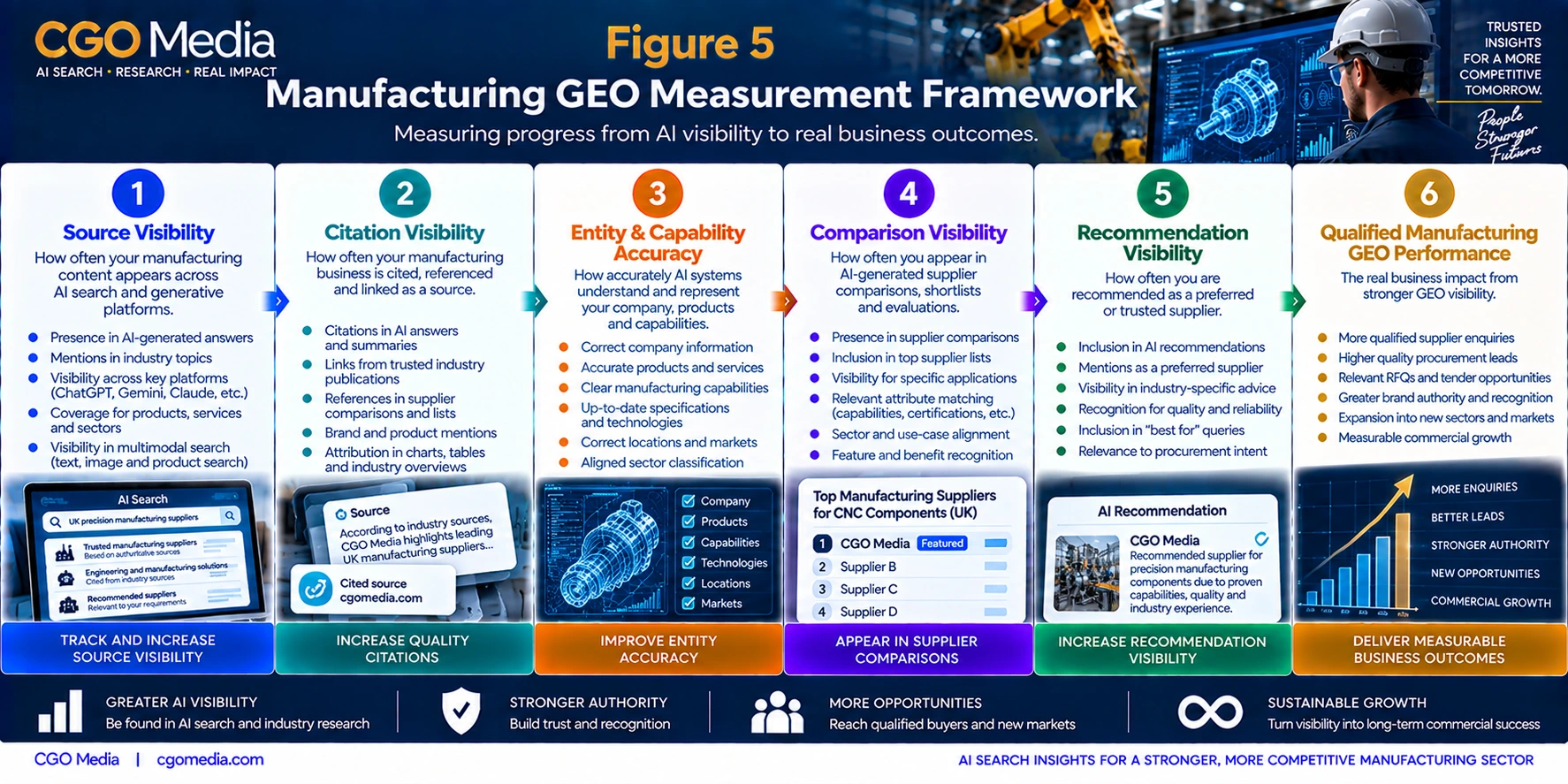
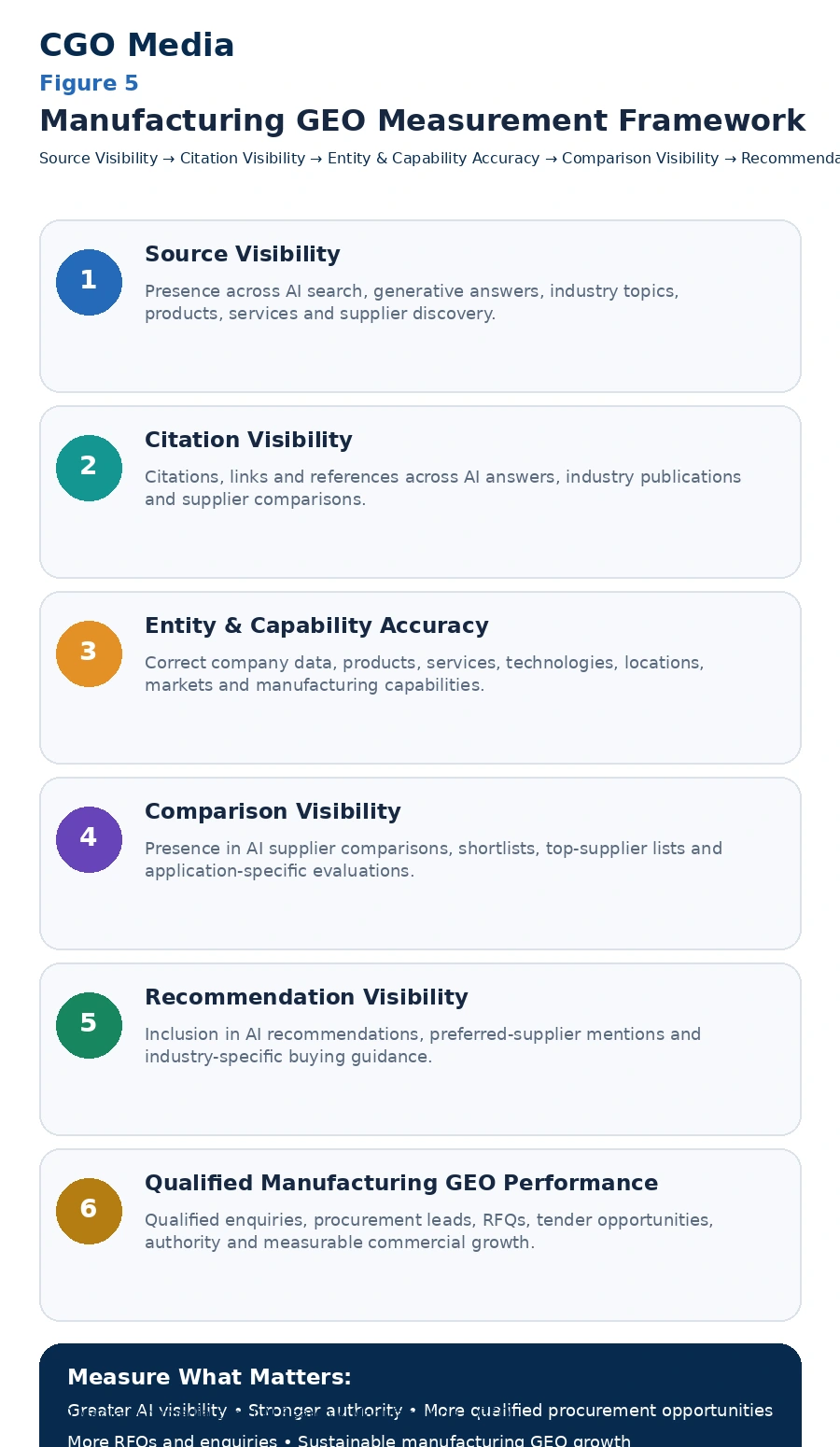
568. Manufacturing GEO Should Operate as a Continuous Improvement System
Generative visibility should not be treated as a one-time optimisation project.
569. Industrial Information Changes Continuously
Manufacturers should expect change across:
- Capabilities
- Equipment
- Certifications
- Markets
- Buyer requirements
570. Continuous Manufacturing GEO Should Begin with Observation
Teams should repeatedly observe:
- Source visibility
- Citation visibility
- Entity accuracy
- Capability accuracy
- Supplier recommendation fit
571. Observation Should Be Structured
Procurement scenario libraries and recording methods should remain sufficiently consistent to support comparison.
572. Continuous GEO Should Diagnose Change
A material visibility shift should trigger investigation rather than immediate tactical reaction.
573. Diagnosis Should Distinguish Surface Variation from Structural Change
One unusual AI output may represent noise.
574. Persistent Change Can Indicate a Structural Manufacturing GEO Problem
Examples can include:
- Capability ambiguity
- Qualification decay
- Source conflict
- Competitive displacement
- Category drift
575. Continuous GEO Should Prioritise by Procurement Impact
Not every visibility change has equal commercial significance.
576. A Manufacturing GEO Priority Model Can Use
Procurement Impact + Commercial Importance + Persistence + Risk
577. Procurement Impact
Measures whether the issue can affect:
- Supplier discovery
- RFQ inclusion
- Shortlisting
- Selection
578. Commercial Importance
Measures whether the issue affects strategic:
- Processes
- Industries
- Markets
- Customers
579. Persistence
Measures whether the issue repeats across time and scenarios.
580. Risk
Measures the consequence of leaving the problem unresolved.
581. Continuous GEO Should Improve the Underlying Industrial Information System
The intervention may involve:
- Capability content
- Technical evidence
- Certification evidence
- External authority
- Research
582. GEO Improvement Should Target Root Causes
The organisation should avoid trying to manipulate individual outputs directly.
583. Root Causes Can Exist in Owned Information
Examples include:
- Outdated capability pages
- Missing certificates
- Weak material information
- Ambiguous facility data
584. Root Causes Can Exist in External Information
Examples include:
- Old directory profiles
- Outdated supplier pages
- Weak trade coverage
- Incorrect certification references
585. Manufacturing GEO Improvement Should Be Followed by Re-Testing
The organisation should determine whether the intervention changed the observed supplier visibility pattern.
586. Re-Testing Should Preserve Scenario Consistency
Otherwise comparison becomes difficult.
587. Continuous Manufacturing GEO Can Be Summarised as
Observe → Diagnose → Prioritise → Strengthen → Validate → Learn → Adapt
588. Governance Is Essential to Manufacturing GEO
Industrial GEO crosses multiple organisational functions.
589. A Manufacturing GEO Governance Model Can Include
SEO + Marketing + Engineering + Quality + Operations + Sales + Research
590. SEO Can Coordinate Visibility Monitoring
SEO can connect:
- Search demand
- AI visibility
- Information architecture
- Source analysis
591. Marketing Can Improve Information Clarity
Marketing can strengthen:
- Capability explanations
- Industry pages
- Case studies
- Research distribution
592. Engineering Can Validate Technical Truth
Engineering can confirm:
- Processes
- Materials
- Tolerances
- Technical constraints
593. Quality Teams Can Validate Qualification Evidence
Quality can confirm:
- Certification
- Accreditation
- Inspection capability
- Traceability
594. Operations Can Validate Capacity and Delivery Information
Operations can confirm:
- Production capacity
- Lead times
- Facility capability
- Supply coverage
595. Sales Can Improve Procurement Scenario Design
Sales teams can identify:
- Real buyer questions
- Selection criteria
- Competitors
- RFQ patterns
596. Research Can Strengthen Manufacturing Citation Authority
Research teams can create:
- Industrial studies
- Benchmark data
- Market analysis
- Technical frameworks
597. Manufacturing GEO Governance Should Include Ownership
The organisation should know who owns:
- Monitoring
- Capability accuracy
- Certification accuracy
- Evidence quality
- Escalation
598. GEO Governance Should Include Review Cadence
Different information types require different review frequencies.
599. High-Risk Manufacturing Information May Require Frequent Review
Examples include:
- Certification status
- Production capability
- Facility availability
- Lead times
600. Review Frequency Should Reflect Risk and Volatility
A useful principle is:
Rate of Change + Procurement Impact + Risk → Review Frequency
601. GEO Governance Should Include Escalation
Critical procurement misinformation should not remain within ordinary reporting queues.
602. Critical Manufacturing GEO Escalation Can Involve
- Quality
- Engineering
- Operations
- Sales
- Leadership
603. Manufacturing GEO Should Include Recovery Capability
Not every misinformation event can be prevented.
604. A Manufacturing GEO Recovery Cycle Can Be Used
Detect → Verify → Diagnose → Correct → Re-Test → Learn
605. Detect
Identifies material capability, qualification or supplier-representation errors.
606. Verify
Confirms whether the observation is genuine and persistent.
607. Diagnose
Identifies the likely source, capability, evidence or external-information problem.
608. Correct
Improves the underlying information environment.
609. Re-Test
Checks whether the observed pattern changes.
610. Learn
Improves future monitoring, governance and content standards.
611. Recovery Speed Can Be Measured
Useful measures can include:
- Time to detect
- Time to verify
- Time to correct
- Time to validate
612. Manufacturing GEO Should Also Include Experimentation
Some interventions should be tested rather than assumed to work.
613. Manufacturing GEO Experiments Should Begin with a Hypothesis
For example:
Publishing explicit aerospace machining tolerances and current certification evidence should improve qualified supplier recommendation visibility for aerospace sourcing scenarios.
614. Experiments Should Establish a Baseline
The organisation should record the starting visibility position.
615. Experiments Should Define the Intervention
Examples can include:
- New capability pages
- Updated certification pages
- Technical case studies
- Original manufacturing research
616. Experiments Should Define Success Criteria
Success can include:
- Improved source visibility
- Improved citation visibility
- Improved capability accuracy
- Improved recommendation fit
617. Experiments Should Have Observation Windows
Generative visibility may not change immediately after publication.
618. Confounding Factors Should Be Recorded
Examples can include:
- AI model changes
- Competitive activity
- Certification changes
- Market disruption
619. Negative Results Should Be Preserved
They help prevent repeated ineffective work.
620. Successful Experiments Should Become Standards
Validated approaches can be added to:
- Content standards
- Capability templates
- Evidence standards
- Monitoring playbooks
621. Manufacturing GEO Should Integrate with Traditional SEO
The two disciplines overlap substantially.
622. SEO Supports GEO Through Technical Accessibility
Search engines and generative systems both benefit from accessible and well-structured industrial information.
623. SEO Supports GEO Through Information Architecture
Clear relationships between:
- Processes
- Materials
- Industries
- Facilities
- Capabilities
can improve discovery and understanding.
624. SEO Supports GEO Through Topical Coverage
Strong manufacturing content ecosystems can strengthen subject relevance.
625. GEO Extends SEO Through Supplier Representation Analysis
GEO adds explicit focus on:
- Citation
- Capability accuracy
- Comparison
- Supplier recommendation
626. SEO and GEO Should Share Infrastructure
But they should not be treated as identical disciplines.
627. Manufacturing GEO Should Integrate with Digital PR
External industrial authority is central to the supplier evidence environment.
628. Digital PR Can Strengthen Manufacturing GEO Through
- Trade research coverage
- Technical commentary
- Industry citations
- Expert references
629. Manufacturing GEO Should Integrate with Research Strategy
Original industrial research can create high-value citation assets.
630. Research Can Support GEO Through
- Primary data
- Industry benchmarks
- Material trends
- Supply-chain studies
631. Manufacturing GEO Should Integrate with Customer Evidence
Successful supplier relationships provide real-world validation.
632. Customer Evidence Can Improve
- Industry fit
- Capability authority
- Recommendation confidence
- External trust
633. Manufacturing GEO Should Integrate with Operational Strategy
Generated representation can expose gaps between public claims and operational reality.
634. Persistent Capability Misunderstanding Can Be an Operational Communication Signal
The problem may not be marketing alone.
635. GEO Intelligence Can Reveal Capability Drift
The manufacturer may increasingly be associated with capabilities it no longer prioritises.
636. Capability Drift Can Be Strategic or Problematic
It should be assessed against current manufacturing strategy.
637. GEO Intelligence Can Reveal Emerging Supplier Competitors
Repeated co-occurrence can identify new competitive relationships.
638. GEO Intelligence Can Reveal New Procurement Language
Buyer prompts may use terminology that differs from internal company language.
639. GEO Can Therefore Contribute to Industrial Market Intelligence
Its value extends beyond marketing visibility.
640. Manufacturing GEO Should Be Scaled Carefully
Large procurement scenario libraries can create noise without strategic value.
641. Scaling Should Follow Commercial Priority
Scenario expansion can follow:
- New processes
- New materials
- New industries
- New markets
642. Manufacturing GEO Scaling Should Include International Markets
Supplier recommendations can vary substantially by geography.
643. International GEO Should Reflect Local Procurement Context
Direct translation of sourcing prompts may not capture local buying behaviour.
644. Local Industrial Source Ecosystems Can Differ
Different countries may have different:
- Trade publications
- Industry bodies
- Supplier directories
- Certification organisations
645. International Manufacturing GEO Should Preserve Entity Consistency
Organisation, facility and product identity should remain coherent across markets.
646. Localisation Should Preserve Capability Truth
Core technical information should remain consistent.
647. Localisation Should Adapt Procurement Evidence
Different markets may require different:
- Certificates
- Standards
- Case studies
- Logistics information
648. GEO Scaling Should Include Multiple Facilities
Large manufacturing groups may need facility-level monitoring.
649. Facility-Level GEO Can Reveal Location Confusion
AI systems may:
- Attribute capabilities to the wrong plant
- Confuse certificates between facilities
- Misstate production locations
- Misrepresent regional availability
650. Facility-Level Entity Governance Is Therefore Important
Each major production site should have clear public information.
651. GEO Scaling Should Include Product and Capability Portfolios
Complex manufacturers may need monitoring across multiple:
- Processes
- Materials
- Facilities
- Industry applications
652. Portfolio-Level GEO Can Reveal Capability Confusion
Generative systems may merge, omit or misattribute manufacturing capabilities.
653. Manufacturing GEO Scaling Should Include Organisational Learning
Repeated observations should improve:
- Standards
- Training
- Research
- Governance
654. Institutional Memory Reduces Repeated GEO Failure
The organisation should not repeatedly rediscover the same capability or source problems.
655. Manufacturing GEO Learning Can Be Preserved Through
- Scenario libraries
- Issue logs
- Experiment records
- Capability maps
- Source maps
- Playbooks
656. Adaptive Manufacturing GEO Is the Long-Term Goal
The organisation should be able to respond as:
- AI systems change
- Capabilities change
- Markets change
- Procurement behaviour changes
657. Adaptive GEO Does Not Mean Constant Tactical Reaction
Stable principles should remain.
658. Stable Manufacturing GEO Principles Can Include
- Clear entities
- Clear capabilities
- Current qualification evidence
- Useful technical sources
- Relevant external authority
- Supplier fit
659. Tactics Can Change Around Stable Principles
This creates resilience without strategic confusion.
660. Adaptive Manufacturing GEO Should Be Evidence-Led
Changes should respond to observed supplier-visibility patterns rather than speculation.
661. Adaptive Manufacturing GEO Should Be Risk-Aware
Critical certification or capability misinformation should receive priority over low-value mention changes.
662. Adaptive Manufacturing GEO Should Be Commercially Relevant
The programme should focus on sourcing scenarios that matter to the business.
663. Adaptive Manufacturing GEO Should Be Integrated
It should connect:
Search Intelligence + AI Intelligence + Engineering Intelligence + Quality Intelligence + Sales Intelligence + Customer Evidence
664. Combined Intelligence Improves GEO Decisions
Teams can better determine:
- What to improve
- What to monitor
- What to research
- What to communicate
665. Strategic Recommendation One — Build a Defined Procurement Scenario Library
Focus monitoring on commercially relevant sourcing questions.
666. Strategic Recommendation Two — Map Manufacturing Source Visibility
Identify which owned and external sources appear around priority capabilities.
667. Strategic Recommendation Three — Strengthen Technical Citation Assets
Create useful:
- Research
- Technical guides
- Material studies
- Industry benchmarks
668. Strategic Recommendation Four — Improve Entity and Facility Clarity
Reduce ambiguity around organisations, plants, brands and production relationships.
669. Strategic Recommendation Five — Improve Capability Clarity
Make:
- Processes
- Materials
- Tolerances
- Volumes
- Industries
explicit and verifiable.
670. Strategic Recommendation Six — Strengthen Qualification Evidence
Maintain current and clearly scoped certification and quality information.
671. Strategic Recommendation Seven — Strengthen Source Convergence
Ensure critical supplier information materially agrees across public sources.
672. Strategic Recommendation Eight — Monitor Supplier Recommendation Fit
Track whether inclusion is appropriate to procurement context.
673. Strategic Recommendation Nine — Monitor Exclusion Quality
Investigate repeated omission where supplier fit is genuine.
674. Strategic Recommendation Ten — Track Critical Procurement Misinformation
Escalate high-risk capability and certification errors quickly.
675. Strategic Recommendation Eleven — Build GEO Recovery Processes
Create clear detection, diagnosis, correction and re-testing procedures.
676. Strategic Recommendation Twelve — Integrate GEO with Manufacturing Research and Trade PR
Build external authority around useful industrial evidence.
677. Strategic Recommendation Thirteen — Connect GEO to RFQ Intelligence
Use real buyer enquiries to improve procurement scenario design.
678. Strategic Recommendation Fourteen — Connect GEO to Customer Outcomes
Use successful delivery evidence to strengthen future supplier recommendation confidence.
679. Strategic Recommendation Fifteen — Expand International GEO Carefully
Use market-specific sourcing scenarios, evidence and industrial source ecosystems.
680. Strategic Recommendation Sixteen — Experiment Systematically
Test interventions using baselines and defined success criteria.
681. Strategic Recommendation Seventeen — Preserve Organisational Learning
Convert repeated findings into standards, training and playbooks.
682. Strategic Recommendation Eighteen — Build Adaptive Manufacturing GEO
Treat Generative Engine Optimisation as a permanent industrial visibility capability rather than a short-term marketing campaign.
683. The Twenty-First Manufacturing GEO Principle
Manufacturing GEO should operate as a continuous improvement system because supplier visibility, citations, competitive sets, capabilities, certifications and procurement requirements can all change over time.
684. The Twenty-Second Manufacturing GEO Principle
Manufacturing GEO governance should connect SEO, marketing, engineering, quality, operations, sales and research so generated supplier representation is grounded in current technical truth, qualification evidence and real procurement behaviour.
685. The Twenty-Third Manufacturing GEO Principle
Manufacturers should build recovery and experimentation capability so recurring capability errors, certification misinformation, citation weaknesses and supplier recommendation gaps can be diagnosed, corrected, re-tested and converted into institutional learning.
686. The Twenty-Fourth Manufacturing GEO Principle
The highest Manufacturing GEO capability is adaptive GEO, where stable principles around entity clarity, capability truth, qualification evidence, source quality and supplier fit are preserved while tactics evolve in response to changing generative search environments.
687. The Continuous Manufacturing GEO Cycle
The complete operational cycle can be summarised as:
Observe → Diagnose → Prioritise → Strengthen → Validate → Learn → Adapt
688. The Long-Term Manufacturing GEO System
The wider relationship can be summarised as:
Clear Entity → Clear Capability → Strong Technical Evidence → Qualification Confidence → Source Authority → Citation Visibility → Supplier Recommendation Confidence → Qualified Manufacturing GEO Visibility → Organisational Learning
689. The Strategic Implication
Manufacturers should operate Generative Engine Optimisation as a continuous, cross-functional and evidence-led discipline, repeatedly monitoring how organisations, facilities, capabilities, certifications, sources, comparisons and supplier recommendations are represented, strengthening the underlying industrial information and authority system, validating change and adapting as AI sourcing environments, markets and procurement expectations evolve.
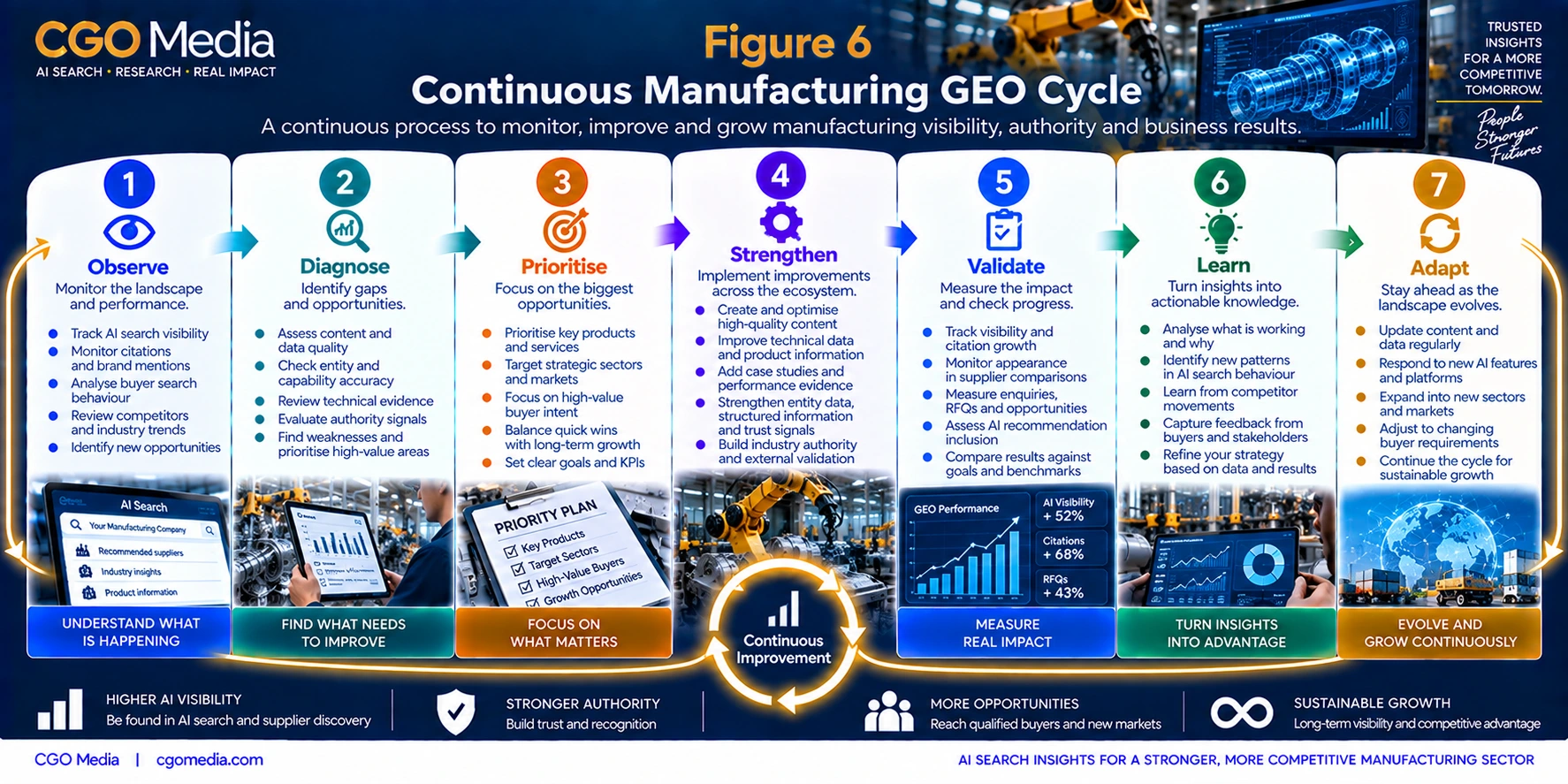
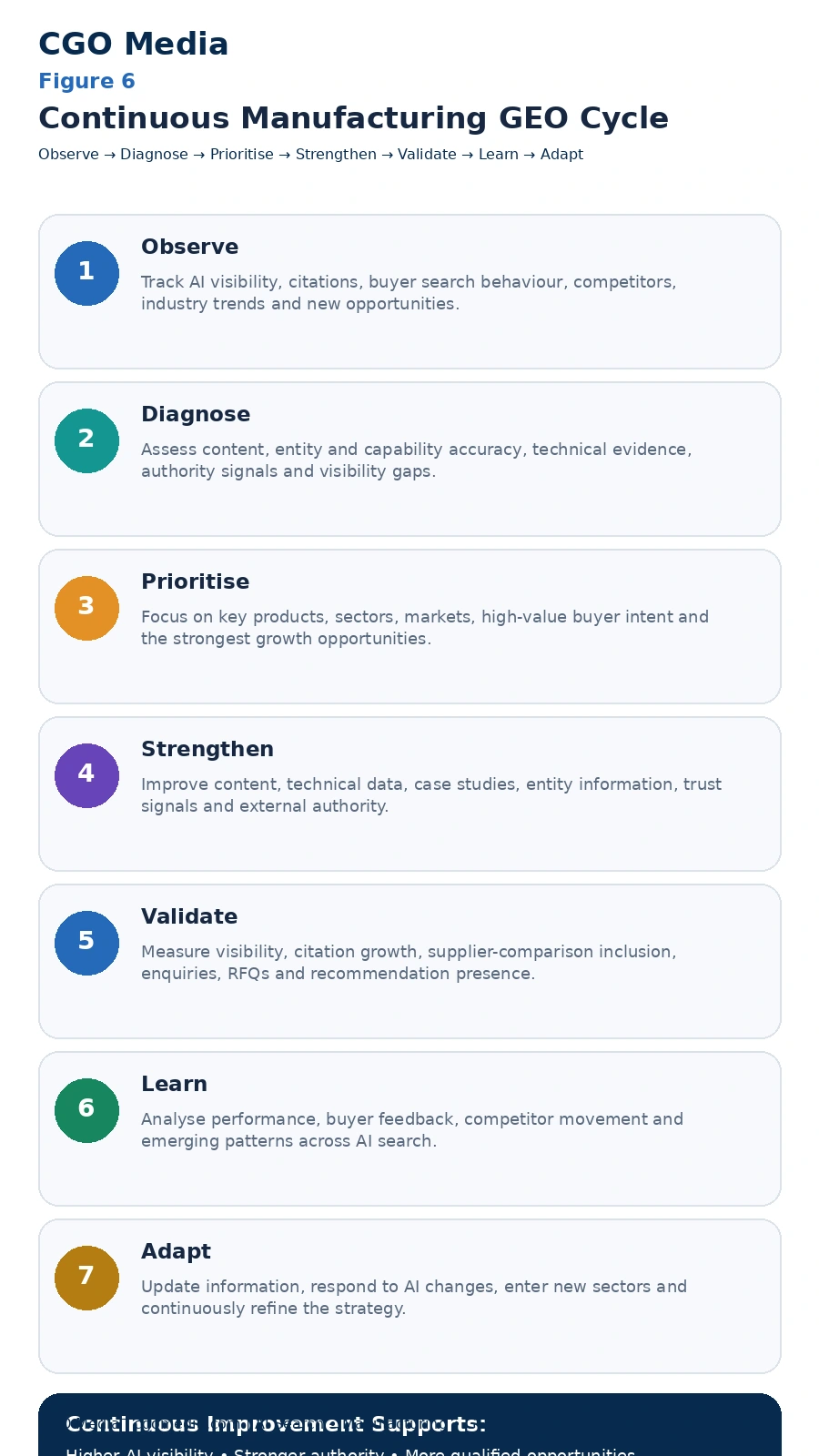
690. Methodology
Manufacturing GEO: Generative Engine Optimisation for AI Search and Supplier Recommendation Systems is a conceptual research framework developed by CGO Media to help manufacturers understand and improve how their organisations, facilities, capabilities, certifications, technical evidence and supplier suitability are represented across generative search and AI-assisted procurement environments.
691. Research Purpose
The paper addresses a central question:
How can manufacturers improve the quality, authority and procurement relevance of their visibility within generative answer, supplier-comparison and recommendation systems?
692. Framework Scope
The framework can be applied to organisations including:
- Manufacturers
- OEMs
- Contract manufacturers
- Engineering companies
- Industrial suppliers
- Component manufacturers
- Precision engineering companies
- Materials manufacturers
- Industrial technology providers
- Specialist B2B suppliers
693. Manufacturing GEO Is Treated as an Industrial Information and Authority System
The framework does not treat GEO as a collection of isolated prompt techniques or AI visibility tactics.
694. The Core Manufacturing GEO System Includes
- Entity clarity
- Capability clarity
- Technical evidence
- Trust and compliance
- Source authority
- Citation eligibility
- Supplier fit
- GEO visibility
695. Core Manufacturing GEO Progression
The conceptual sequence is:
Entity Clarity → Capability Clarity → Technical Evidence → Trust & Compliance → Source Authority → Citation Eligibility → Supplier Fit → GEO Visibility
696. Entity Method
Entity analysis can examine whether public information clearly represents:
- The manufacturer
- Parent and subsidiary relationships
- Facilities
- Brands
- Products
- Industrial roles
697. Manufacturing Entity Relationships Can Be Mapped
A useful model is:
Organisation → Facility → Capability → Process → Material → Product → Industry → Market
698. Capability Method
Capability analysis can assess whether the manufacturer clearly documents:
- Processes
- Materials
- Tolerances
- Equipment
- Production volume
- Industry applications
699. Capability Relationships Can Be Mapped
A useful relationship is:
Process → Material → Specification → Volume → Application → Evidence
700. Technical Evidence Method
Capability claims can be assessed through:
Capability Claim → Technical Evidence → Qualification Evidence → Customer Evidence → Confidence
701. Technical Evidence Can Include
- Equipment lists
- Process specifications
- Inspection capability
- Technical datasheets
- Production case studies
- Testing evidence
702. Trust and Compliance Method
Qualification analysis can examine:
- Certification
- Accreditation
- Quality systems
- Traceability
- Testing
- Regulatory requirements
703. Certification Scope Should Be Evaluated Carefully
A certification should be connected accurately to the organisation, facility, process or relevant operational scope.
704. Information Accessibility Method
Manufacturing information can be assessed for:
- Crawlability
- Indexability
- Internal linking
- Document accessibility
- Technical clarity
705. Manufacturing Source Estate Method
Relevant information can be mapped across:
- Corporate websites
- Technical resource centres
- Quality pages
- Certification records
- Supplier directories
- Industry publications
706. Source Selection Method
The framework conceptualises manufacturing source selection as:
Procurement Context → Candidate Sources → Capability Relevance → Technical Evidence → Qualification Evidence → Authority → Source Convergence → Source Selection
707. Procurement-Specific Source Analysis
Different industrial questions can require different evidence formats.
708. Capability Queries May Require
- Process pages
- Capability pages
- Facility pages
- Industry pages
709. Technical Queries May Require
- Technical datasheets
- Engineering specifications
- Testing information
- Inspection information
710. Compliance Queries May Require
- Certification pages
- Quality documentation
- Accreditation evidence
- Traceability information
711. Supplier Comparison Queries May Require
- Capability matrices
- Case studies
- Supplier profiles
- Independent references
712. Research Queries May Require
- Original studies
- Industry benchmarks
- Supply-chain research
- Manufacturing datasets
713. Source Convergence Method
Manufacturing claims can be compared across:
Owned Technical Evidence + Quality Evidence + Customer Evidence + Independent Industry Evidence
714. Source Conflict Method
Material disagreements can be identified across:
- Production capability
- Certification status
- Facility location
- Material expertise
- Industry scope
715. Citation Eligibility Method
Citation readiness is conceptualised through:
Relevance + Technical Specificity + Evidence + Authority + Freshness
716. Citation Authority Method
Manufacturing citation authority can be evaluated through:
- Trade references
- Research citations
- Technical citations
- Industry association references
- AI citations
717. Manufacturing Research Method
Where manufacturers create primary research, methodology should explain:
- Research question
- Sample
- Industrial scope
- Geographic scope
- Measurement period
- Definitions
- Limitations
718. Manufacturing Citation Assets Can Include
- Industry studies
- Technical datasets
- Material research
- Process studies
- Supply-chain research
- Original frameworks
719. Supplier Recommendation Method
Supplier recommendation visibility is conceptualised through:
Procurement Scenario → Capability Fit → Qualification Fit → Technical Evidence → Commercial Fit → External Validation → Recommendation Confidence → Qualified Supplier Recommendation
720. Capability Fit Method
Capability fit can include:
- Process fit
- Material fit
- Dimensional fit
- Volume fit
- Application fit
721. Qualification Fit Method
Qualification fit can include:
- Certification requirements
- Quality systems
- Regulatory requirements
- Testing requirements
- Traceability requirements
722. Commercial Fit Method
Commercial fit can include:
- Lead time
- Production volume
- Minimum order quantity
- Logistics
- Geography
- Commercial structure
723. Recommendation Confidence Method
Recommendation confidence can be analysed conceptually through:
Procurement Relevance + Capability Fit + Qualification Fit + Evidence Confidence + Commercial Fit + External Validation
724. Manufacturing GEO Measurement Method
The framework separates five visibility layers:
- Source Visibility
- Citation Visibility
- Entity & Capability Accuracy
- Comparison Visibility
- Recommendation Visibility
725. Source Visibility
Evaluates whether manufacturing information appears to contribute to AI-generated answers.
726. Citation Visibility
Evaluates whether manufacturing sources are explicitly referenced.
727. Entity & Capability Accuracy
Evaluates whether the organisation, facilities, processes, materials, qualifications and production capabilities are represented accurately.
728. Comparison Visibility
Evaluates whether the manufacturer enters relevant supplier comparison sets.
729. Recommendation Visibility
Evaluates whether the manufacturer is appropriately recommended within relevant procurement scenarios.
730. Qualified Manufacturing GEO Performance
A useful conceptual relationship is:
Relevant Procurement Presence + Accurate Supplier Representation + Strong Evidence + Appropriate Recommendation
731. Procurement Scenario Library Method
Manufacturing GEO monitoring should use scenario libraries based on commercially meaningful sourcing requirements.
732. Scenario Segmentation Can Include
- Process
- Material
- Industry
- Production volume
- Geography
- Certification requirement
733. Longitudinal Method
Repeated monitoring can help identify:
- Persistent supplier inclusion
- Persistent supplier exclusion
- Recurring capability misinformation
- Supplier co-occurrence
- Competitive displacement
734. Manufacturing GEO Risk Method
Material errors can be prioritised through:
Severity + Persistence + Procurement Impact + Commercial Importance
735. Critical Manufacturing GEO Risk Can Include
- Incorrect certification claims
- False manufacturing capability
- Incorrect material capability
- Incorrect facility attribution
- Incorrect industry suitability
736. Continuous Improvement Method
The Manufacturing GEO operational cycle is:
Observe → Diagnose → Prioritise → Strengthen → Validate → Learn → Adapt
737. Recovery Method
Material GEO errors can be managed through:
Detect → Verify → Diagnose → Correct → Re-Test → Learn
738. Experimentation Method
Manufacturing GEO experiments should include:
- Hypothesis
- Baseline
- Intervention
- Observation period
- Success criteria
- Result
739. Governance Method
Manufacturing GEO should be governed cross-functionally.
Relevant functions can include:
SEO + Marketing + Engineering + Quality + Operations + Sales + Research
740. International GEO Method
International Manufacturing GEO should preserve coherent supplier truth while adapting:
- Buyer language
- Standards
- Certification expectations
- Logistics information
- Local industrial sources
741. Facility-Level Method
Multi-site manufacturers should evaluate GEO at both:
- Organisation level
- Facility level
742. Portfolio-Level Method
Complex manufacturers may also require GEO analysis across:
- Processes
- Materials
- Product families
- Industry applications
743. Limitations
Manufacturing GEO: Generative Engine Optimisation for AI Search and Supplier Recommendation Systems is a conceptual research framework. It does not represent the proprietary internal retrieval, ranking, source-selection or recommendation systems used by OpenAI, Google, Microsoft, Anthropic, Perplexity or any other search, AI or procurement technology provider.
744. Generative Systems Are Partially Observable
External researchers and manufacturers cannot observe every internal:
- Retrieval process
- Ranking process
- Source-selection process
- Recommendation process
745. Source Influence Can Be Difficult to Verify
AI systems may not expose every source contributing to a generated answer.
746. Citation Visibility Is Platform-Dependent
Some systems expose sources clearly while others provide limited attribution.
747. AI Outputs Can Vary
Variation can occur according to:
- Model
- Prompt
- Conversation context
- Date
- Language
- Market
748. Single AI Outputs Should Not Be Over-Interpreted
One observation may not represent a durable supplier-visibility pattern.
749. Longitudinal Testing Reduces but Does Not Eliminate Uncertainty
Repeated testing can reveal patterns without proving the internal mechanisms producing them.
750. Supplier Recommendation Visibility Is Contextual
A manufacturer can be highly suitable for one procurement scenario and irrelevant to another.
751. High Mention Volume Does Not Prove Strong Manufacturing GEO
High visibility can coexist with:
- Incorrect capabilities
- Wrong qualification information
- Poor procurement fit
- Low commercial relevance
752. Citation Frequency Does Not Automatically Equal Industrial Authority
Citation relevance, source quality, context and technical accuracy also matter.
753. Certification Information Can Change
Manufacturers should maintain current qualification evidence rather than assuming historical certification data remains valid indefinitely.
754. Capability Information Can Also Change
Facilities, machinery, processes and production capacity can evolve over time.
755. Manufacturing GEO Attribution Is Incomplete
AI influence can occur:
- Before an RFQ
- Without a click
- Across multiple research sessions
- Alongside traditional search and supplier directories
756. Direct Revenue Attribution Should Therefore Be Cautious
The framework should not be used to claim direct causal commercial impact where the evidence cannot support it.
757. SEO and Manufacturing GEO Overlap Substantially
Many GEO capabilities depend on established:
- Technical SEO
- Information architecture
- Content authority
- Entity clarity
- External authority
758. Manufacturing GEO Should Not Be Positioned as a Replacement for SEO
Traditional search discovery remains important throughout industrial research and supplier selection.
759. GEO Is Better Understood as an Extension of Industrial Discovery
It adds explicit focus on:
- Generative sources
- Citations
- Capability representation
- Supplier comparison
- Supplier recommendation
760. GEO Terminology and Measurement Are Still Evolving
Industry conventions may continue to develop as generative search and procurement systems evolve.
761. The Framework Should Therefore Remain Adaptive
Stable principles can remain useful while individual measurement methods and tactics change.
762. Conclusion
Manufacturing GEO introduces a broader model of industrial visibility in which manufacturers are not only competing for search rankings, but also competing to become trusted technical sources, accurately represented supplier entities, credible comparison candidates and appropriate recommendations within AI-assisted sourcing environments.
763. Entity Clarity Establishes Supplier Identity
AI systems need to understand:
- Who the organisation is
- Where it manufactures
- What role it performs
- How facilities, brands and products relate
764. Capability Clarity Establishes Manufacturing Fit
Buyers and generative systems need clear information about:
- Processes
- Materials
- Tolerances
- Volumes
- Industry applications
765. Technical Evidence Establishes Capability Confidence
Manufacturing claims should be supported by specific, verifiable evidence.
766. Trust and Compliance Establish Qualification Confidence
Current certifications, quality systems and traceability evidence can reduce uncertainty.
767. Source Authority Establishes Industrial Trust
Owned information becomes stronger when reinforced by credible:
- Trade media
- Industry associations
- Certification bodies
- Customer evidence
768. Citation Eligibility Establishes Reference Potential
Useful manufacturing sources combine:
- Relevance
- Technical specificity
- Evidence
- Authority
- Freshness
769. Citation Authority Establishes Knowledge Influence
Manufacturers can increasingly become recognised sources for:
- Industrial data
- Process expertise
- Material knowledge
- Industry research
770. Supplier Fit Establishes Recommendation Relevance
The most valuable generative visibility occurs when the manufacturer genuinely fits the procurement requirement.
771. Comparison Visibility Establishes Supplier Consideration
The organisation enters the active competitive supplier set.
772. Qualified Recommendation Visibility Establishes Selection Presence
The manufacturer remains relevant after capability, qualification and commercial filters are applied.
773. Manufacturing GEO Measurement Should Preserve These Distinctions
Source, citation, entity, comparison and recommendation visibility represent different industrial outcomes.
774. Manufacturing GEO Should Prioritise Quality Over Volume
The strategic objective is not maximum AI mention frequency.
775. The Strategic Objective Is Qualified Manufacturing GEO Visibility
This can be represented as:
Relevant Procurement Presence + Accurate Supplier Representation + Strong Technical Evidence + Appropriate Supplier Recommendation
776. Original Manufacturing Research Can Become a Significant GEO Asset
Primary industrial evidence can strengthen:
- Source utility
- Citation visibility
- Trade authority
- Industry association
777. Trade PR Can Strengthen External Authority
Relevant industry references can reinforce the public evidence environment around the manufacturer.
778. Customer Outcomes Can Strengthen Recommendation Confidence
Successful supplier relationships can generate:
- Case studies
- Customer references
- Trade coverage
- Independent validation
779. Manufacturing GEO Can Become Self-Reinforcing
A useful long-term relationship is:
Useful Technical Information → Strong Evidence → External Reference → Greater Supplier Authority → Better GEO Visibility → More Qualified Discovery → More Evidence
780. Manufacturing GEO Should Operate Continuously
AI systems, supplier markets, capabilities, qualifications and buyer requirements all change.
781. Continuous Monitoring Supports Industrial Resilience
Manufacturers should be able to:
- Detect change
- Diagnose errors
- Strengthen evidence
- Validate interventions
- Learn
782. Adaptive Manufacturing GEO Is the Long-Term Capability
Manufacturers should preserve stable principles while adapting to changes in generative search and procurement environments.
783. Stable Manufacturing GEO Principles Include
- Clear entities
- Clear capabilities
- Accessible technical information
- Current qualification evidence
- Relevant external authority
- Supplier fit
784. Manufacturing GEO Should Ultimately Improve Procurement Decision Quality
The strongest outcome is not simply that AI systems mention a manufacturer more frequently.
785. The Stronger Outcome Is Better Supplier Representation
Buyers should receive more accurate information about:
- Capabilities
- Qualifications
- Production fit
- Evidence
- Limitations
786. Better Representation Can Support Better Supplier Selection
Appropriate manufacturers are more likely to reach buyers with requirements they can genuinely satisfy.
787. Better Supplier Selection Can Support Better Commercial Outcomes
Strong-fit customer relationships are more likely to create:
- Successful production
- Quality performance
- Repeat orders
- Long-term supplier relationships
788. Successful Outcomes Can Reinforce Future Manufacturing GEO
A long-term cycle can be represented as:
Qualified Manufacturing GEO Visibility → Better Supplier Fit → Successful Delivery → Stronger Evidence → Greater Authority → Better Future GEO Visibility
789. The Complete Manufacturing GEO Model
The strategic relationship can be summarised as:
Clear Entity → Clear Capability → Strong Technical Evidence → Qualification Confidence → Source Authority → Citation Visibility → Supplier Comparison Visibility → Recommendation Confidence → Qualified Manufacturing GEO Visibility
790. Final Strategic Position
Manufacturers should treat Generative Engine Optimisation as a permanent extension of industrial SEO, technical content, entity management, quality evidence, research and supplier-authority strategy rather than as a short-term attempt to influence individual AI-generated answers.
The strongest Manufacturing GEO programmes build an industrial information ecosystem that makes the manufacturer easier to identify, understand, verify, cite, compare and recommend across changing generative search and procurement environments.
The objective is not simply to appear more frequently. It is to increase the probability that manufacturers are represented accurately, supported by credible technical and qualification evidence and recommended appropriately when buyers use AI-assisted systems to discover, evaluate and shortlist suppliers.
References
External Academic, Technical and Search Sources
- Google Search Central. SEO Starter Guide.
- Google Search Central. Crawling and indexing overview.
- Google Search Central. Understand how structured data works.
- Google Search Central. Tell Google about localised versions of your page.
- Schema.org. Organization.
- Schema.org. Product.
- Schema.org. TechArticle.
- Hogan, A. et al. (2021). Knowledge Graphs. ACM Computing Surveys, 54(4).
- Metzger, M.J. (2007). Making Sense of Credibility on the Web: Models for Evaluating Online Information and Recommendations for Future Research. Journal of the American Society for Information Science and Technology, 58(13), 2078–2091.
- Ji, Z. et al. (2023). Survey of Hallucination in Natural Language Generation. ACM Computing Surveys, 55(12).
CGO Media Manufacturing Research and Frameworks
- Wilkinson, R. (2026). Manufacturing SEO in an AI Search Environment. CGO Media.
- Wilkinson, R. (2026). Manufacturing AI Trust and Visibility Framework. CGO Media.
- Wilkinson, R. (2026). Manufacturing Discovery and Supplier Selection Model. CGO Media.
- Wilkinson, R. (2026). Manufacturing Search Authority Maturity Model. CGO Media.
- Wilkinson, R. (2026). Manufacturing SEO and AI Implementation Roadmap. CGO Media.
- Wilkinson, R. (2026). CGO AI Search Readiness Framework. CGO Media.
- Wilkinson, R. (2026). CGO AI Citation Framework. CGO Media.
- Wilkinson, R. (2026). CGO Entity Authority Framework. CGO Media.
- Wilkinson, R. (2026). CGO Content Authority Framework. CGO Media.
CGO Media Research Ecosystem
CGO Media Research Library |
CGO Media Framework Library |
CGO Media Research Architecture |
CGO Media Research Observations Library |
CGO Media Statistics Library
About Roger Wilkinson
Roger Wilkinson is an independent researcher, SEO practitioner and founder of CGO Media with more than 25 years of experience in search, digital visibility and business growth.
His research focuses on how artificial intelligence is reshaping search engines, recommendation systems, entity representation, digital authority and organisational visibility.
Roger is the creator of the CGO Framework Series, a collection of research-led methodologies designed to help organisations measure, improve and govern Search Visibility, AI Visibility, GEO and Digital Authority.
His work examines the relationship between Technical SEO, Generative Engine Optimisation, Entity Authority, Content Authority, Citation Authority, Brand Signals, Knowledge Architecture and AI Search Readiness.
View Roger Wilkinson’s researcher profile →
Related Manufacturing Research
Manufacturing SEO in an AI Search Environment |
Manufacturing AI Trust and Visibility Framework |
Manufacturing Discovery and Supplier Selection Model |
Manufacturing Search Authority Maturity Model |
Manufacturing SEO and AI Implementation Roadmap
Together with this Manufacturing GEO paper, these assets form an extended Manufacturing research family covering industrial SEO, AI trust, supplier discovery, authority maturity, implementation and Generative Engine Optimisation.
Research Usage & Citation
CGO Media encourages manufacturers, engineers, procurement professionals, researchers, journalists, analysts, consultants and digital teams to reference this research where it contributes to analysis of Generative Engine Optimisation, AI supplier discovery, manufacturing citation authority, supplier recommendation systems or industrial digital authority.
Reasonable quotations, summaries, figures and excerpts may be used in articles, reports, presentations, academic work and other publications provided appropriate acknowledgement is given to Roger Wilkinson and CGO Media.
Cite This Research / Embed Citation
Manufacturing GEO: Generative Engine Optimisation for AI Search and Supplier Recommendation Systems by Roger Wilkinson at CGO Media presents a research framework for understanding how manufacturers can improve entity clarity, capability representation, technical evidence, citation eligibility, supplier recommendation confidence and qualified visibility across generative procurement environments.
APA Citation
APA Citation: Wilkinson, R. (2026). Manufacturing GEO: Generative Engine Optimisation for AI Search and Supplier Recommendation Systems. CGO Media.
Author: Roger Wilkinson |
Published by: CGO Media
For permissions relating to substantial reproduction, commercial licensing or republication of significant portions of this research, please contact CGO Media directly.