
Manufacturing Discovery and Supplier Selection Model
 The Manufacturing Discovery and Supplier Selection Model explains how engineers, procurement teams, OEMs, distributors, project managers and technical buyers move from an initial manufacturing requirement through supplier discovery, technical evaluation, trust validation, comparison, shortlisting and final engagement.
The model is designed for industrial manufacturers, engineering companies, contract manufacturers, component suppliers, specialist fabricators and production businesses operating across domestic and international supply chains.
It builds on the parent research paper Manufacturing SEO in an AI Search Environment and connects directly with the Manufacturing AI Trust and Visibility Framework.
1. Why Manufacturing Needs a Supplier Selection Model
Manufacturing supplier selection is rarely a simple search-and-enquire journey.
Industrial buyers may move between:
- Search engines
- AI assistants
- Supplier directories
- Trade associations
- Certification records
- Distributor websites
- Technical publications
- Customer recommendations
- Professional networks
The model provides a structured way to understand that fragmented discovery and evaluation process.
2. The Eight Stages of Manufacturing Supplier Selection
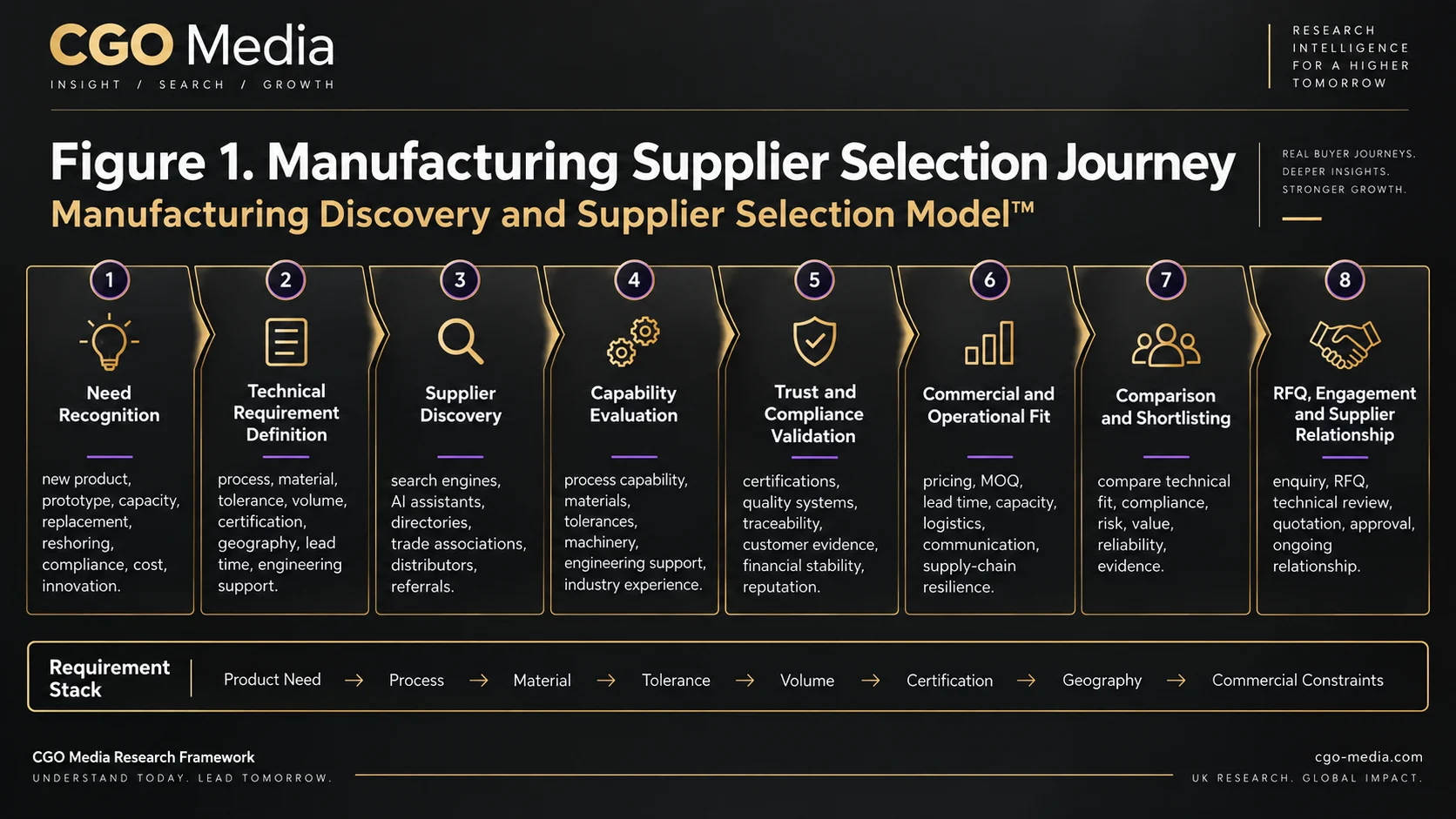
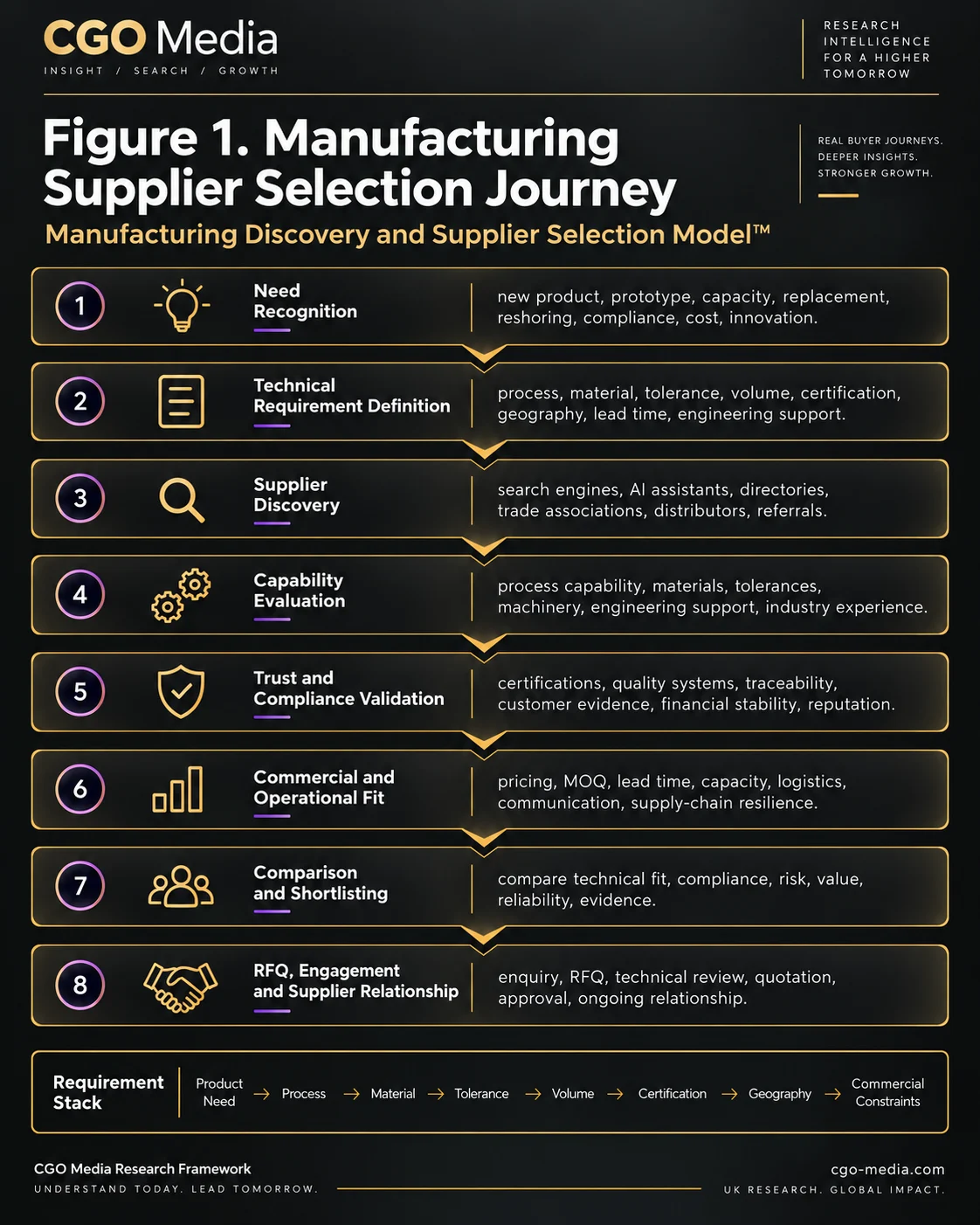
The model identifies eight connected stages:
- Need Recognition
- Technical Requirement Definition
- Supplier Discovery
- Capability Evaluation
- Trust and Compliance Validation
- Commercial and Operational Fit
- Comparison and Shortlisting
- RFQ, Engagement and Supplier Relationship
3. Stage One — Need Recognition
The journey begins when an organisation identifies a production, sourcing, engineering or supply-chain requirement.
4. New Product Requirement
A buyer may require a manufacturing partner for a new product, component or assembly.
5. Prototype Requirement
Engineering teams may seek a supplier capable of producing prototypes before production commitment.
6. Capacity Requirement
An existing supply chain may require additional production capacity.
7. Supplier Replacement Requirement
A buyer may need to replace an existing manufacturer because of:
- Quality issues
- Lead-time problems
- Cost pressures
- Business closure
- Capacity constraints
8. Reshoring and Nearshoring Requirement
Procurement teams may seek geographically closer suppliers to improve:
- Supply-chain resilience
- Lead times
- Communication
- Inventory control
9. Compliance-Led Requirement
Some supplier searches begin because a buyer requires a manufacturer holding a specific certification, quality system or regulatory capability.
10. Cost-Led Requirement
Cost pressure may trigger a new supplier search, although price is rarely the only selection factor.
11. Innovation-Led Requirement
A buyer may seek a new manufacturing partner because additional engineering, automation, material or process capability is required.
12. AI in Need Recognition
AI assistants can help buyers translate broad production problems into potential manufacturing requirements.
For example:
“What type of manufacturer would be suitable for producing low-volume titanium aerospace brackets?”
13. Stage Two — Technical Requirement Definition
Once the need is recognised, the buyer defines the technical and commercial conditions a suitable supplier must satisfy.
14. Process Requirement
The requirement may specify a process such as:
- CNC machining
- Injection moulding
- Laser cutting
- Fabrication
- Casting
- Assembly
15. Material Requirement
Material requirements may include:
- Aluminium
- Stainless steel
- Titanium
- Engineering plastics
- Composites
- Specialist alloys
16. Tolerance Requirement
Some suppliers may be eliminated immediately if they cannot meet required dimensional or geometric tolerances.
17. Volume Requirement
The buyer may require:
- Prototype production
- Low-volume manufacturing
- Medium-volume production
- High-volume production
18. Certification Requirement
Certain programmes require suppliers to hold specific certifications before entering consideration.
19. Industry Requirement
Buyers may prefer manufacturers with proven experience within their own sector.
20. Geographic Requirement
The supplier may need to operate within a specific:
- City
- Region
- Country
- Trade area
21. Lead-Time Requirement
Required production and delivery times may remove otherwise capable manufacturers from consideration.
22. Engineering Support Requirement
Some buyers need support beyond production, including:
- Design-for-manufacture
- Material selection
- Prototype development
- Tooling advice
- Process optimisation
23. Quality Requirement
The requirement may define specific expectations around:
- Inspection
- Traceability
- Documentation
- Testing
- Quality systems
24. Commercial Requirement
Commercial constraints may include:
- Budget
- MOQ
- Payment terms
- Tooling costs
- Delivery terms
25. Hard Requirements and Soft Preferences
The supplier-selection process becomes clearer when buyers distinguish hard requirements from preferences.
A required certification may be non-negotiable, while geographic proximity may be preferred but not essential.
26. Requirement Stack
A manufacturing requirement can therefore be represented as:
Product Need → Process → Material → Tolerance → Volume → Certification → Geography → Commercial Constraints
Figure 1 : Manufacturing Supplier Selection Journey.
27. Stage Three — Supplier Discovery
Once the technical requirement is sufficiently defined, the buyer begins identifying manufacturers that may be capable of satisfying it.
28. Search Engine Supplier Discovery
Search engines may surface suppliers through:
- Capability pages
- Product pages
- Industry pages
- Local supplier pages
- Technical content
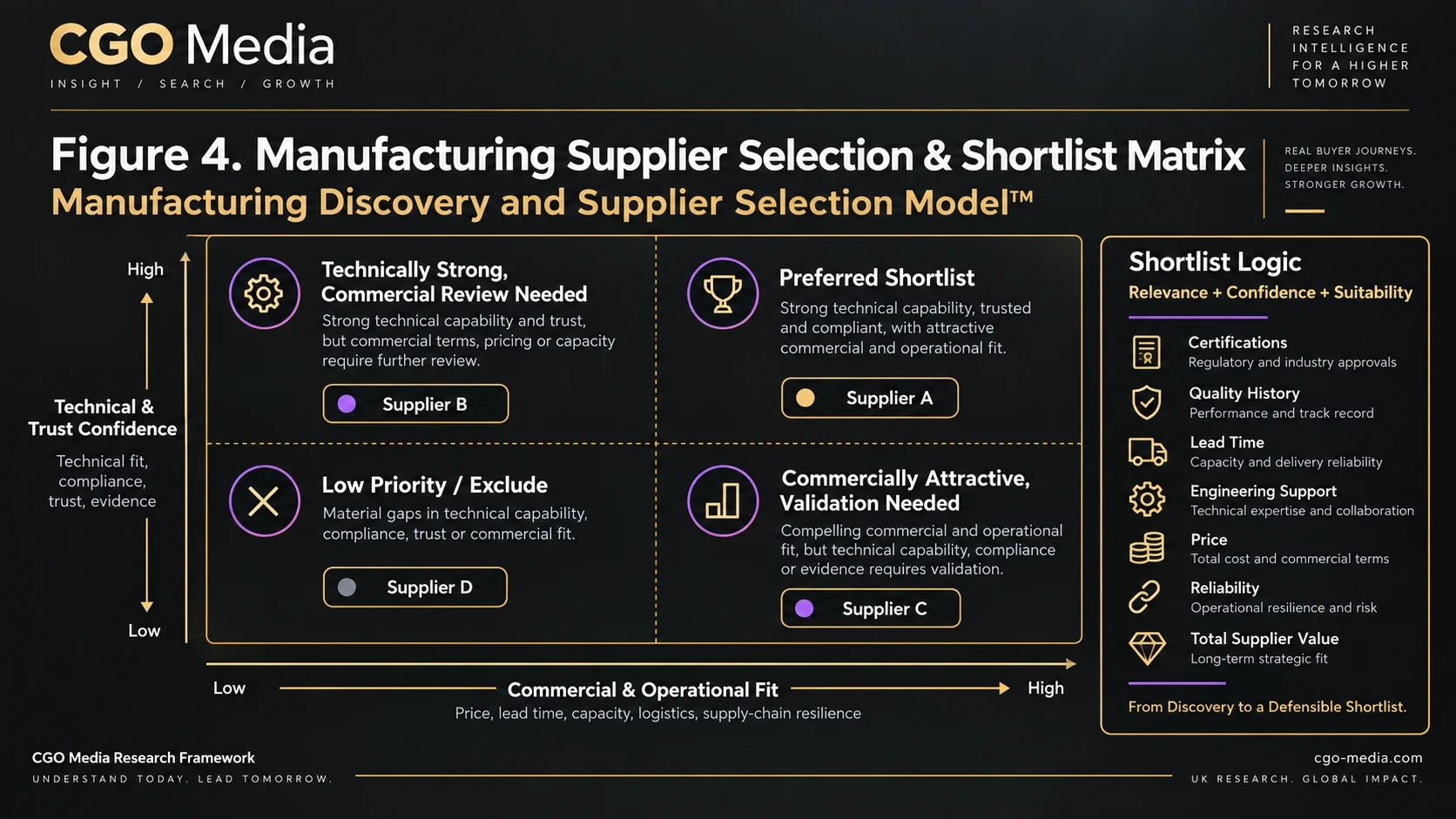
- Case studies
29. AI Supplier Discovery
AI assistants can combine multiple technical and commercial criteria within a single supplier-discovery query.
For example:
“Which UK manufacturers offer 5-axis titanium machining for aerospace components and hold relevant quality certification?”
30. Trade Association Discovery
Industry bodies may introduce potential suppliers through member directories, specialist networks and technical communities.
31. Supplier Directory Discovery
Industrial directories can help buyers identify manufacturers according to:
- Process
- Product
- Industry
- Location
- Certification
32. Distributor and Partner Discovery
Buyers may encounter manufacturers through distributors, integrators or existing supply-chain partners.
33. Customer Recommendation Discovery
Recommendations from existing customers or professional contacts can create high-trust supplier discovery.
34. Trade Media Discovery
Industry publications may introduce manufacturers through:
- Technical articles
- Factory investment news
- Case studies
- Awards
- Expert commentary
35. Government and Regional Manufacturing Discovery
Government programmes, export initiatives and regional manufacturing networks may also surface relevant suppliers.
36. Academic and Innovation Network Discovery
Manufacturers involved in research, university partnerships or innovation programmes may be discovered through those institutional relationships.
37. Geographic Supplier Discovery
Buyers may deliberately search for manufacturers within a particular country or region because of:
- Lead time
- Logistics
- Tariffs
- Communication
- Supply-chain resilience
38. Local Supplier Discovery
Local search can be particularly important where buyers value proximity for:
- Site visits
- Prototype development
- Rapid delivery
- Engineering collaboration
39. The Discoverable Supplier Market
The practical supplier market is not every manufacturer that could theoretically perform the work.
It is the subset that can actually be discovered through the search, AI, industry and network environments used by the buyer.
40. Discoverability Does Not Equal Suitability
A visible manufacturer may still fail technical, compliance, geographic or commercial requirements.
41. Supplier Consideration Set
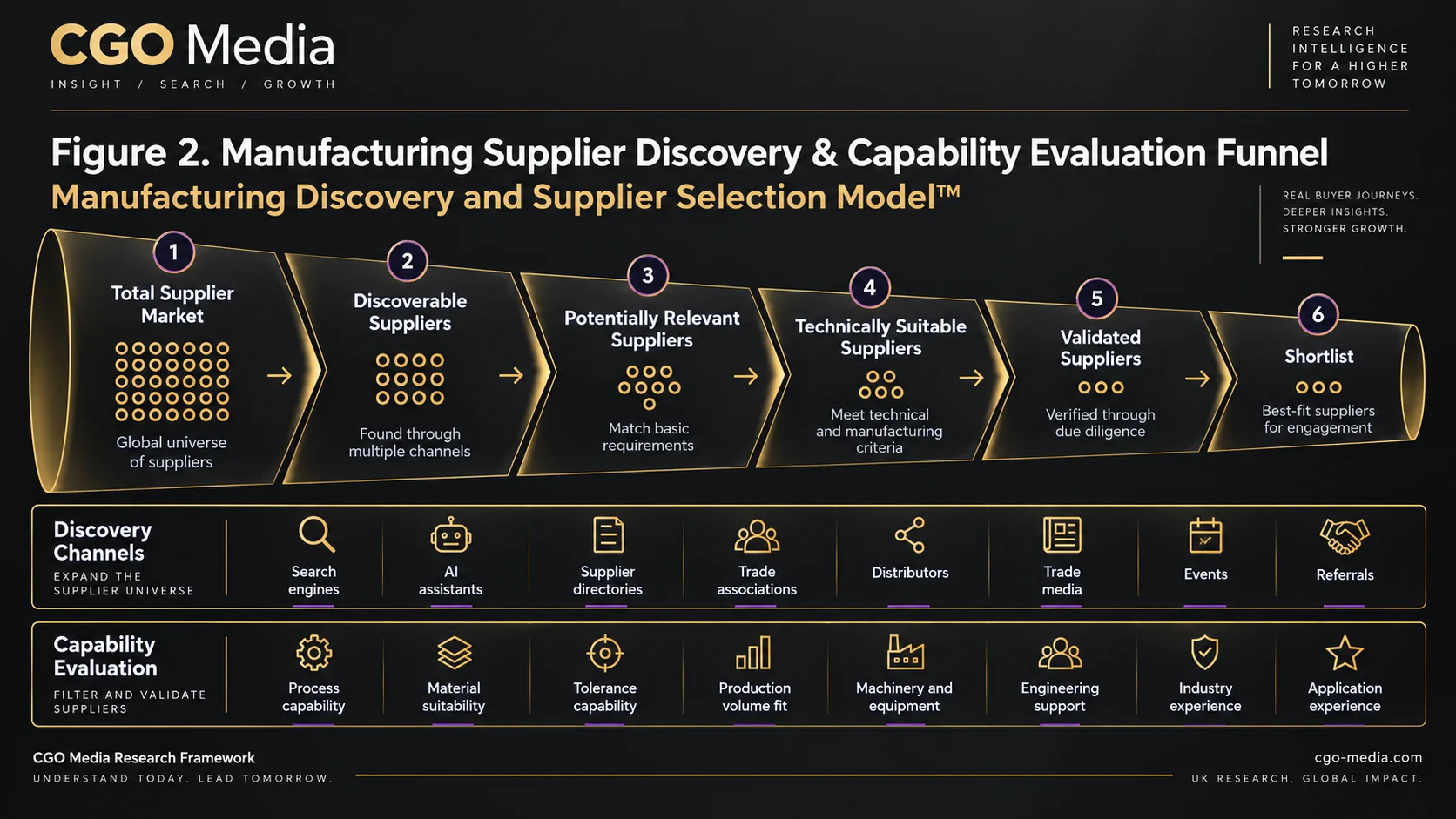
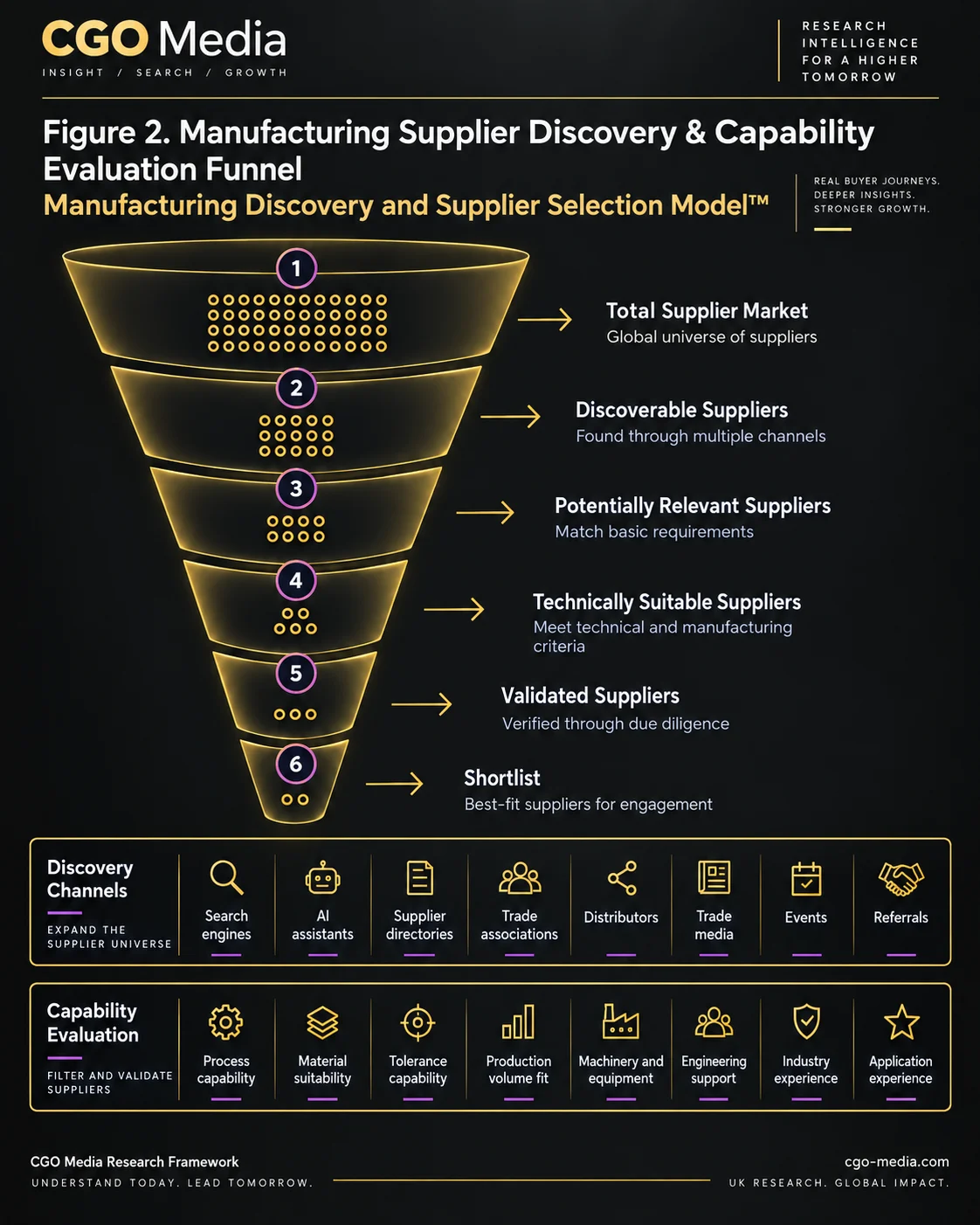
The buyer gradually narrows the market from:
Total Supplier Market → Discoverable Suppliers → Potentially Relevant Suppliers → Technically Suitable Suppliers → Validated Suppliers → Shortlist
42. Stage Four — Capability Evaluation
During Capability Evaluation, the buyer tests whether discovered suppliers can genuinely satisfy the manufacturing requirement.
43. Process Capability Evaluation
The buyer may assess:
- Manufacturing method
- Machine capability
- Process range
- Secondary operations
- Automation
44. Material Capability Evaluation
Material suitability may involve:
- Material experience
- Machinability or process suitability
- Material sourcing
- Specialist handling
- Traceability
45. Tolerance Capability Evaluation
The buyer may examine whether the supplier can reliably meet the required tolerance range and verify it through appropriate inspection.
46. Production Volume Evaluation
Supplier fit may depend on whether the manufacturer is optimised for:
- One-off prototypes
- Small batches
- Medium production runs
- High-volume programmes
47. Machine and Equipment Evaluation
Buyers may assess whether the supplier possesses machinery suitable for the:
- Part size
- Complexity
- Material
- Tolerance
- Production volume
48. Engineering Capability Evaluation
Engineering support may become important where the buyer requires:
- Design-for-manufacture
- Prototype development
- Material guidance
- Process optimisation
- Tooling input
49. Industry Experience Evaluation
Sector experience may strengthen confidence where manufacturing requirements are shaped by specialised standards, materials or quality expectations.
50. Application Experience Evaluation
Relevant case studies and examples can demonstrate whether the supplier has solved comparable technical problems.
51. Facility Evaluation
Buyers may examine:
- Factory location
- Production capacity
- Machine inventory
- Quality infrastructure
- Expansion capability
52. Multi-Site Capability Evaluation
For larger manufacturing groups, the buyer may need to determine which specific facility would perform the work.
53. Technical Documentation Evaluation
Useful documentation can include:
- Capability statements
- Product datasheets
- Process specifications
- Quality documents
- Certification evidence
54. Case Study Evaluation
A strong technical case study can demonstrate:
- Comparable requirement
- Process suitability
- Material expertise
- Engineering input
- Quality outcome
55. Evidence Quality During Capability Evaluation
Supplier confidence increases when technical claims are specific, current and supported by visible evidence.
56. Generic Capability Claims Create Evaluation Friction
Statements such as “we manufacture to the highest standards” provide little practical information during supplier comparison.
57. Technical Specificity Reduces Uncertainty
Clear evidence around processes, materials, tolerances, machinery, volumes and applications allows buyers to remove unsuitable suppliers more quickly.
58. AI-Assisted Capability Evaluation
AI systems may increasingly help buyers compare technical supplier evidence across multiple manufacturers.
This creates additional value for structured and accurate capability information.
59. Capability Evaluation Is a Filtering Stage
By the end of Stage Four, the buyer should have removed suppliers that cannot satisfy essential technical requirements.
The remaining suppliers move into deeper trust, compliance and commercial validation.
Figure 2 : Manufacturing Supplier Discovery & Capability Evaluation Funnel.
60. Stage Five — Trust and Compliance Validation
Once technical suitability has been established, the buyer evaluates whether the supplier is sufficiently credible, compliant and operationally reliable to continue in the selection process.
61. Quality Management Validation
The buyer may review:
- Quality-management systems
- Inspection processes
- Non-conformance procedures
- Continuous-improvement practices
- Testing capability
62. Certification Validation
Required certifications may be treated as hard eligibility criteria.
The buyer may need to confirm:
- Certification name
- Scope
- Applicable facility
- Current status
- Relevant industry application
63. Certification Scope Validation
Multi-site manufacturers should make clear whether a certification applies to the specific facility expected to perform the work.
64. Traceability Validation
Buyers may require evidence that materials, batches, processes and inspections can be traced reliably.
65. Regulatory Validation
Regulated industries may require additional evidence around:
- Quality systems
- Documentation
- Material controls
- Process validation
- Regulatory compliance
66. Health and Safety Validation
Larger customers may examine the supplier’s health and safety standards before approving it.
67. Environmental Validation
Environmental evidence may include:
- Environmental-management systems
- Waste management
- Energy efficiency
- Recycling
- Carbon reporting
68. Ethical and Governance Validation
Procurement teams may also review:
- Modern slavery policies
- Ethical sourcing
- Governance
- Workforce practices
- Compliance policies
69. Financial and Business Stability Validation
For strategically important supplier relationships, buyers may assess whether the manufacturer appears financially and operationally stable.
70. Customer Reference Validation
Existing or former customers may provide important evidence of:
- Technical delivery
- Quality
- Reliability
- Communication
- Long-term performance
71. Case Study Validation
Case studies can support trust when they demonstrate real technical outcomes rather than generic promotional claims.
72. Trade Association Validation
Relevant industry memberships can provide additional external context around the supplier.
73. Certification Body Validation
Independent certification records can strengthen confidence when they confirm current supplier status.
74. Government and Institutional Validation
References from government programmes, innovation initiatives or recognised institutional partnerships may reinforce supplier credibility.
75. Academic and Research Validation
Research collaborations can strengthen technical authority where they demonstrate genuine engineering or manufacturing expertise.
76. Media Validation
Relevant trade media may provide additional evidence around:
- Manufacturing investment
- Technical expertise
- Industry awards
- New facilities
- Innovation
77. Branded Validation Search
Buyers may independently search for:
- Supplier reviews
- Supplier certifications
- Supplier complaints
- Supplier quality
- Supplier customers
- Supplier financial information
78. Trust Validation Is Risk Dependent
The level of validation usually increases with the commercial or operational risk of the supplier relationship.
79. High-Risk Supplier Relationships
Deeper validation may be required for:
- Safety-critical components
- Regulated products
- Long production programmes
- Single-source supply arrangements
- Large tooling commitments
80. Stage Six — Commercial and Operational Fit
A supplier can be technically capable and trustworthy while still being commercially unsuitable.
Stage Six evaluates whether the supplier can satisfy the operational conditions of the programme.
81. Pricing Fit
Price remains important but should be evaluated in the context of:
- Quality
- Lead time
- Production risk
- Engineering support
- Logistics
82. Minimum Order Quantity Fit
A manufacturer may be unsuitable where minimum order quantities do not match the buyer’s required volume.
83. Prototype Fit
Some suppliers are well suited to prototypes but not serial production, while others are optimised for higher-volume manufacturing.
84. Production Capacity Fit
The buyer may evaluate whether the manufacturer has sufficient capacity to support:
- Initial programme demand
- Future growth
- Peak periods
- Contingency requirements
85. Lead-Time Fit
A technically strong manufacturer may still be rejected if production and delivery times are incompatible with project requirements.
86. Logistics Fit
Logistics considerations may include:
- Shipping time
- Freight cost
- Customs
- Import documentation
- Delivery reliability
87. Geographic Fit
Location may influence selection because of:
- Supply-chain resilience
- Site access
- Communication
- Transport
- Trade conditions
88. Communication Fit
Buyers may prefer suppliers that provide clear and responsive communication during technical and commercial discussions.
89. Engineering Collaboration Fit
Some programmes require close collaboration between buyer and supplier engineering teams.
90. Tooling Fit
Tooling cost, ownership, maintenance and lead time may significantly influence supplier selection.
91. Payment and Commercial Terms
Commercial fit may also depend on:
- Payment terms
- Credit arrangements
- Contract conditions
- Currency
- Incoterms where relevant
92. Scalability Fit
The buyer may consider whether the supplier can support future increases in production.
93. Supply-Chain Resilience Fit
Relevant evidence may include:
- Alternative capacity
- Multiple facilities
- Material sourcing resilience
- Inventory strategies
- Business continuity planning
94. Strategic Relationship Fit
Long-term supplier relationships may also depend on alignment around:
- Innovation
- Cost reduction
- Quality improvement
- Product development
- Continuous improvement
95. Commercial and Operational Fit Is Multi-Factor
The lowest-cost supplier is not always the most commercially suitable supplier.
Selection depends on the combined balance of:
- Price
- Quality
- Lead time
- Capacity
- Logistics
- Risk
- Collaboration
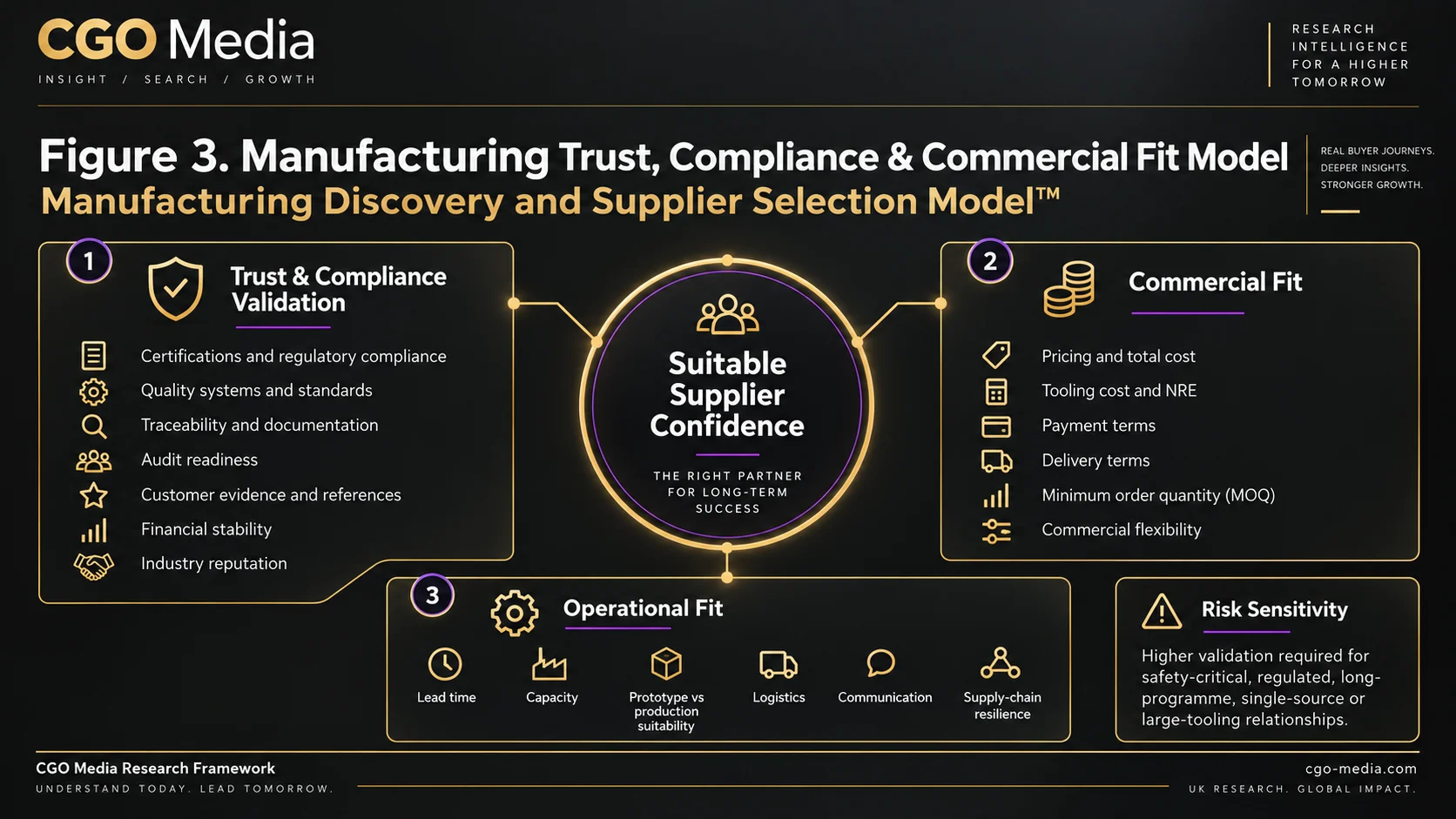
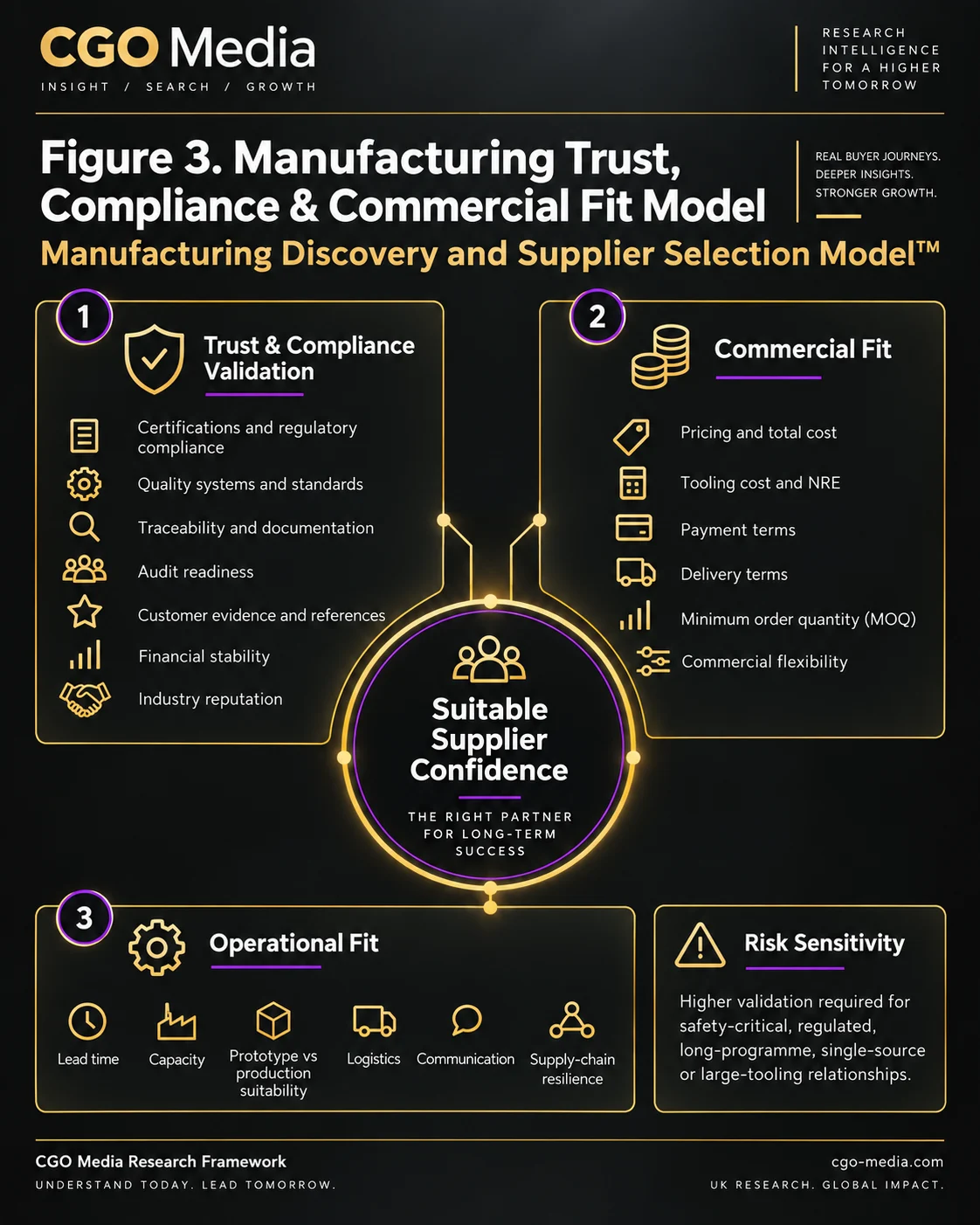
Figure 3 : Manufacturing Trust, Compliance & Commercial Fit Model.
96. Stage Seven — Comparison and Shortlisting
At this stage, the buyer compares a smaller group of manufacturers that have already passed the essential technical, trust, compliance and operational-fit tests.
The comparison becomes more selective because remaining suppliers are usually credible candidates rather than merely discoverable companies.
97. The Seven Core Supplier Selection Signals
The Manufacturing Discovery and Supplier Selection Model identifies seven broad signals that commonly influence final supplier comparison:
- Technical Capability Fit
- Quality and Compliance Confidence
- Industry and Application Relevance
- Commercial and Operational Suitability
- Geographic and Supply-Chain Fit
- External and Market Authority
- Engagement and Relationship Potential
98. Technical Capability Fit
The supplier must demonstrate that it can produce the required component or product using suitable processes, materials, machinery and quality controls.
99. Quality and Compliance Confidence
The buyer assesses whether the manufacturer’s quality systems, certifications, inspection processes and documentation provide sufficient confidence.
100. Industry and Application Relevance
A supplier with directly relevant sector and application experience may be preferred over a technically capable manufacturer with limited evidence in the target market.
101. Commercial and Operational Suitability
The buyer evaluates whether the supplier can meet practical requirements involving:
- Price
- Volume
- Lead time
- Tooling
- Delivery
- Payment terms
102. Geographic and Supply-Chain Fit
Location and supply-chain characteristics may influence:
- Delivery risk
- Site access
- Communication
- Customs
- Resilience
103. External and Market Authority
Independent validation from customers, certification bodies, industry organisations, government sources, technical publications and research partners can strengthen selection confidence.
104. Engagement and Relationship Potential
The buyer may also evaluate whether the manufacturer appears capable of supporting a productive long-term working relationship.
Relevant evidence may include:
- Responsiveness
- Engineering collaboration
- Technical support
- Commercial clarity
- Continuous-improvement capability
105. Selection Signals Are Context Dependent
The importance of each selection signal varies according to the manufacturing requirement.
106. Prototype Selection Context
Prototype buyers may place greater emphasis on:
- Engineering support
- Speed
- Low-volume capability
- Flexibility
- Design-for-manufacture
107. High-Volume Production Context
High-volume programmes may prioritise:
- Capacity
- Repeatability
- Automation
- Quality systems
- Cost control
- Supply-chain resilience
108. Aerospace Selection Context
Aerospace procurement may place particular emphasis on:
- Certification
- Traceability
- Tolerance capability
- Material control
- Inspection
- Supplier history
109. Medical Manufacturing Selection Context
Medical manufacturing decisions may place greater weight on:
- Quality systems
- Documentation
- Traceability
- Regulatory capability
- Controlled production
110. Automotive Selection Context
Automotive buyers may prioritise:
- Scale
- Repeatability
- Lead time
- Cost
- Quality
- Continuous improvement
111. Reshoring Selection Context
Reshoring and nearshoring decisions may place greater emphasis on:
- Geographic proximity
- Lead-time reduction
- Supply-chain resilience
- Communication
- Domestic or regional capacity
112. Supplier Comparison Content
Manufacturers become easier to compare when they provide clear evidence across:
- Capabilities
- Materials
- Certifications
- Industries
- Facilities
- Production volumes
- Commercial processes
113. Capability Comparison
Buyers may compare whether different manufacturers offer:
- Equivalent processes
- Comparable machine capability
- Similar tolerance ranges
- The same materials
- Suitable production capacity
114. Certification Comparison
Certification comparison can determine whether all suppliers meet mandatory compliance thresholds.
115. Facility Comparison
Buyers may compare:
- Factory size
- Machine inventory
- Location
- Capacity
- Quality infrastructure
116. Commercial Comparison
Commercial comparison may include:
- Unit price
- Tooling cost
- MOQ
- Lead time
- Delivery terms
- Payment terms
117. Risk Comparison
Supplier risk may be compared through:
- Financial stability
- Quality history
- Production resilience
- Single-site dependency
- Material sourcing
- Logistics
118. Total Supplier Value
Industrial procurement increasingly evaluates total supplier value rather than headline price alone.
A higher-cost supplier may create greater overall value through:
- Lower defect rates
- Shorter lead times
- Engineering support
- Reduced logistics risk
- Greater reliability
119. AI-Assisted Supplier Comparison
AI systems can compress multiple comparison criteria into one answer.
For example:
“Compare these five UK manufacturers for titanium machining, aerospace certification, prototype capability, lead times and engineering support.”
120. AI Comparison Depends on Available Evidence
AI-generated comparisons are constrained by the evidence systems can discover and interpret.
Manufacturers with clearer and more current capability information may therefore be easier to represent accurately.
121. AI Comparison Risks
AI comparisons can become unreliable where:
- Certifications are outdated
- Facilities are confused
- Capabilities are poorly documented
- Product information conflicts
- External sources are stale
122. Supplier Shortlist Formation
The shortlist represents the small number of manufacturers that satisfy the buyer’s essential technical, compliance, commercial and risk criteria.
123. Shortlist Size
The number of suppliers shortlisted varies according to:
- Complexity
- Procurement policy
- Risk
- Market availability
- Programme scale
124. Technical Differentiation
Manufacturers can differentiate through:
- Specialist machinery
- Tolerance capability
- Materials expertise
- Engineering support
- Process combinations
125. Industry Differentiation
Strong evidence of specialist sector experience can distinguish manufacturers with otherwise similar capabilities.
126. Quality Differentiation
Quality systems, inspection capability, traceability and low defect performance may become important differentiators.
127. Geographic Differentiation
A supplier may differentiate through:
- Local production
- Regional access
- Shorter logistics routes
- Reduced trade complexity
- Supply-chain resilience
128. Research and Innovation Differentiation
Manufacturers involved in technical research, product development or university collaborations may demonstrate a stronger innovation position.
129. External Authority Differentiation
Independent recognition can strengthen the position of a supplier where competing technical evidence appears similar.
130. Relationship Differentiation
Responsiveness, engineering collaboration and commercial clarity can influence the final shortlist even when several suppliers appear technically equivalent.
131. Strong Visibility Does Not Guarantee Shortlist Inclusion
A manufacturer may dominate search visibility while still being eliminated because of:
- Missing certification
- Wrong volume capability
- Geographic constraints
- Weak technical evidence
- Commercial mismatch
132. Strong Capability Does Not Guarantee Shortlist Inclusion
A technically capable manufacturer can also be excluded if its evidence is difficult to discover or verify.
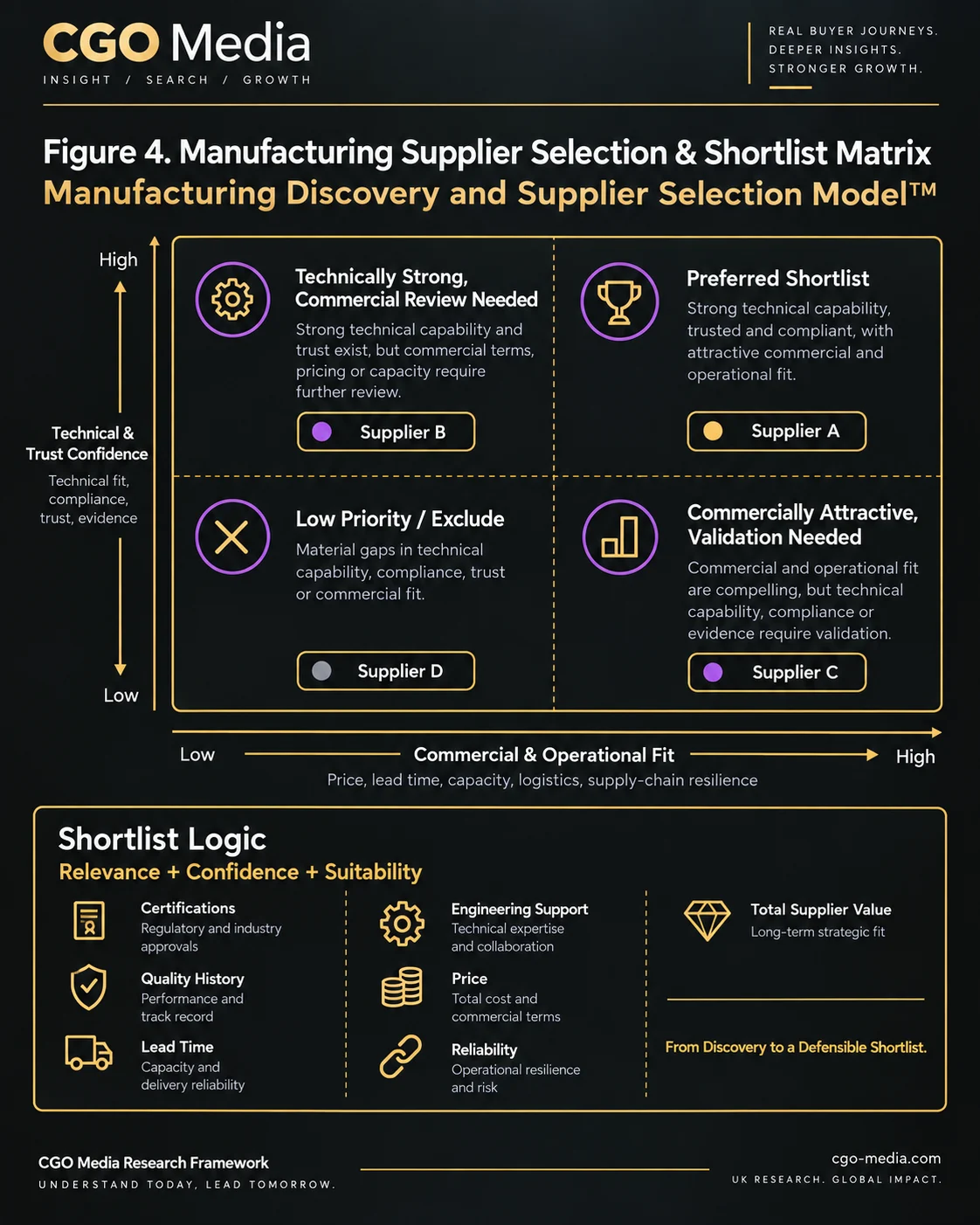
133. Supplier Selection Requires Relevance and Confidence
The strongest shortlist candidates combine:
- Technical fit
- Compliance
- Commercial suitability
- Operational resilience
- Trust
- Clear evidence
Figure 4 : Manufacturing Supplier Selection & Shortlist Matrix.
134. Stage Eight — RFQ, Engagement and Supplier Relationship
The final stage begins when shortlisted manufacturers move from research and evaluation into direct commercial engagement.
135. Request for Quotation
The RFQ process converts supplier research into a formal commercial and technical response.
A buyer may provide:
- Drawings
- Specifications
- Materials
- Volumes
- Quality requirements
- Delivery requirements
136. RFQ Response Quality
The quality of the supplier’s response can influence final selection.
Strong RFQ responses may demonstrate:
- Technical understanding
- Commercial clarity
- Realistic lead times
- Relevant engineering questions
- Transparent assumptions
137. Technical Clarification
The RFQ stage may reveal unresolved technical questions around:
- Tolerances
- Materials
- Finishes
- Inspection
- Tooling
- Production method
138. Supplier Qualification
Some organisations require suppliers to complete formal approval or qualification processes before purchase orders can be issued.
139. Supplier Audit
Higher-risk manufacturing relationships may involve on-site or remote supplier audits.
Audits can assess:
- Facilities
- Quality systems
- Processes
- Capacity
- Traceability
- Governance
140. Sample and Prototype Evaluation
Buyers may use prototypes, samples or first-off components to validate whether the supplier can meet technical and quality expectations.
141. First Article and Initial Production Validation
Some manufacturing programmes require formal validation before full production begins.
142. Negotiation
Commercial negotiation may address:
- Price
- Tooling
- MOQ
- Lead times
- Payment terms
- Delivery conditions
143. Supplier Appointment
The final decision typically reflects the combined result of technical capability, trust, compliance, commercial fit and operational confidence.
144. Purchase Order and Contract
Supplier selection becomes operational once commercial terms are agreed and the buyer formally awards work.
145. Supplier Onboarding
Onboarding may include:
- Quality documentation
- Technical contacts
- Logistics arrangements
- Ordering procedures
- Reporting requirements
146. The Supplier Journey Does Not End at Selection
Manufacturing supplier relationships continue to be evaluated after the initial appointment.
147. Delivery Performance
Buyers may monitor:
- On-time delivery
- Schedule reliability
- Expedite performance
- Communication
148. Quality Performance
Supplier performance can be assessed through:
- Reject rates
- Non-conformances
- Corrective actions
- Inspection performance
- Customer complaints
149. Commercial Performance
Long-term supplier value can also be influenced by:
- Cost stability
- Cost reduction
- Commercial transparency
- Payment and contract performance
150. Engineering Performance
Buyers may evaluate whether suppliers contribute to:
- Design improvement
- Process optimisation
- Material optimisation
- Cost reduction
- Product development
151. Supplier Development
Strategic buyers may work with selected manufacturers to improve:
- Quality
- Capacity
- Lead time
- Cost
- Innovation
152. Supplier Relationship Strength
Strong supplier relationships can reduce the likelihood that buyers re-enter the open market for every future requirement.
153. Repeat Procurement
Successful delivery can move the manufacturer from an unknown supplier to an established procurement option.
154. Approved Supplier Status
Approved supplier status can create a significant commercial advantage because future opportunities may begin within a smaller pre-qualified supplier pool.
155. Supplier Performance as Future Discovery Evidence
Successful customer relationships can create future evidence through:
- Case studies
- Testimonials
- Customer references
- Industry recognition
- Repeat contracts
156. Procurement Feedback as Search Intelligence
Questions raised during supplier selection can reveal important gaps in the manufacturer’s public information.
157. RFQ Feedback Loop
Repeated RFQ questions can identify information that should potentially become clearer within:
- Capability pages
- Product pages
- Technical guides
- FAQ content
- Case studies
158. Sales Feedback Loop
Sales teams can identify the reasons manufacturers:
- Enter shortlists
- Lose opportunities
- Face recurring objections
- Win against competitors
159. Engineering Feedback Loop
Engineering teams can validate whether external digital claims accurately reflect operational capability.
160. Quality Feedback Loop
Quality teams can identify which certifications, inspection processes and traceability requirements buyers repeatedly need to verify.
161. Procurement Feedback Loop
Customer procurement teams may reveal which commercial, governance and supply-chain evidence matters most during supplier approval.
162. Lost Opportunity Analysis
Manufacturers can examine lost opportunities to determine whether exclusion resulted from:
- Technical mismatch
- Certification gaps
- Commercial terms
- Lead time
- Weak evidence
- Low visibility
163. Win Analysis
Won opportunities can reveal the factors that genuinely differentiate the manufacturer in real procurement situations.
164. Buyer Behaviour Should Inform Digital Strategy
Search and content priorities become stronger when they reflect the questions buyers actually ask during supplier evaluation.
165. AI Influence Across the Supplier Selection Journey
AI-assisted discovery can potentially influence multiple stages of the journey rather than operating only at initial supplier discovery.
166. AI During Requirement Definition
Buyers may use AI systems to understand:
- Suitable manufacturing processes
- Material options
- Likely supplier categories
- Relevant certifications
167. AI During Supplier Discovery
AI systems may help produce initial supplier lists based on multiple criteria.
168. AI During Capability Evaluation
AI can help summarise or compare publicly available capability information across manufacturers.
169. AI During Trust Validation
Buyers may use AI systems to investigate:
- Certifications
- Company background
- Industry reputation
- External references
170. AI During Supplier Comparison
AI may compress multiple supplier attributes into comparative summaries.
171. AI During Shortlisting
Recommendation systems may influence which manufacturers remain visible during final consideration.
172. AI Does Not Replace Procurement Validation
AI-generated information should not be treated as a substitute for formal engineering, quality, compliance or commercial due diligence.
173. AI Recommendation Accuracy Matters
Incorrect information can affect supplier perception if AI systems misrepresent:
- Capabilities
- Certifications
- Facilities
- Products
- Industries served
174. Evidence Quality Influences AI Representation
Manufacturers can reduce ambiguity by maintaining clear, current and internally consistent information across first-party and relevant external sources.
175. The Complete Manufacturing Supplier Selection Sequence
The overall model can be summarised as:
Need Recognition → Requirement Definition → Supplier Discovery → Capability Evaluation → Trust & Compliance Validation → Commercial & Operational Fit → Comparison & Shortlisting → RFQ & Engagement → Supplier Relationship
176. Selection Is Progressive Risk Reduction
Each stage reduces a different form of uncertainty.
- Discovery reduces awareness uncertainty.
- Capability Evaluation reduces technical uncertainty.
- Trust Validation reduces quality and compliance uncertainty.
- Commercial Evaluation reduces operational uncertainty.
- Shortlisting reduces comparative uncertainty.
- RFQ and Qualification reduce final procurement uncertainty.
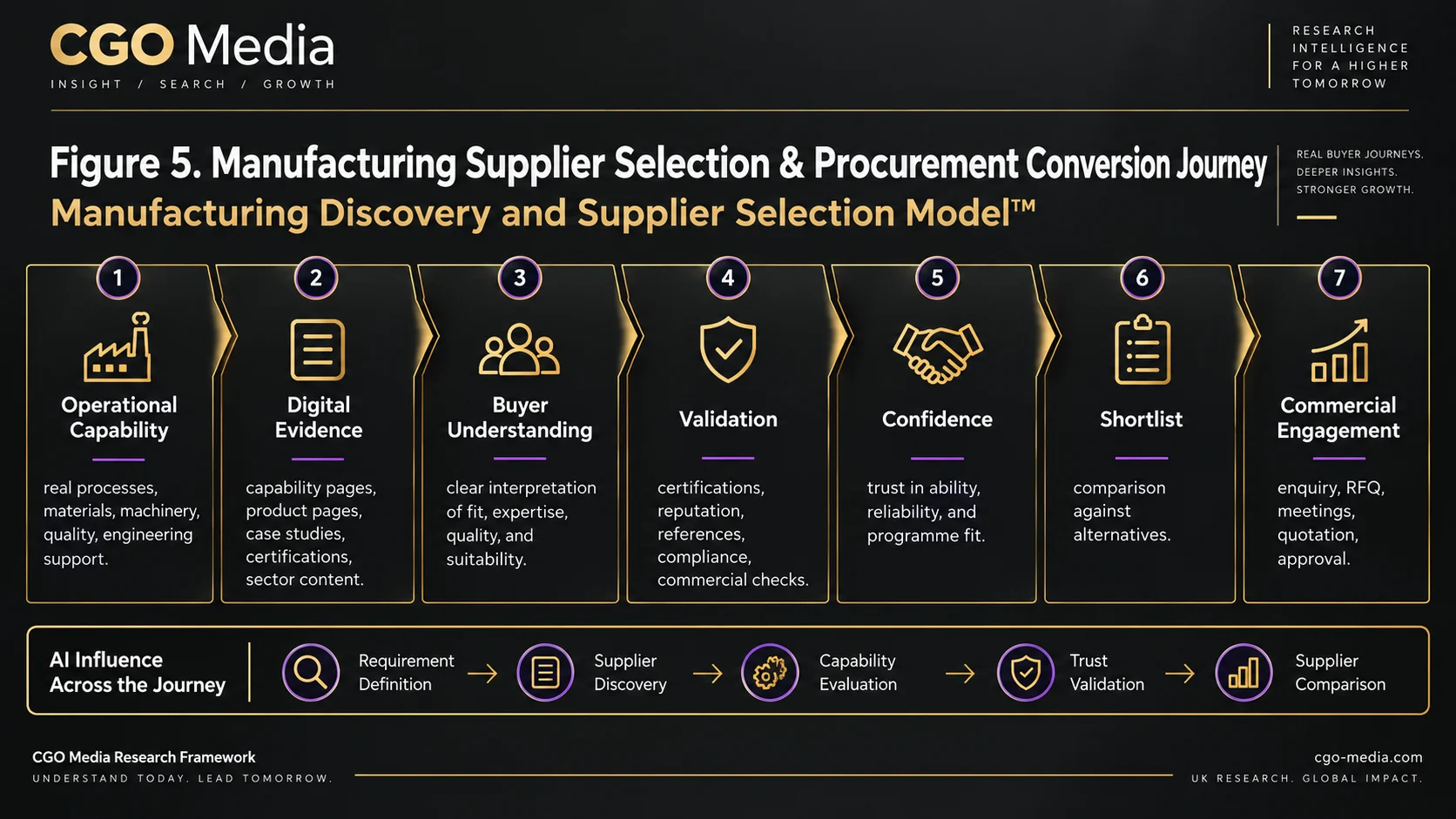
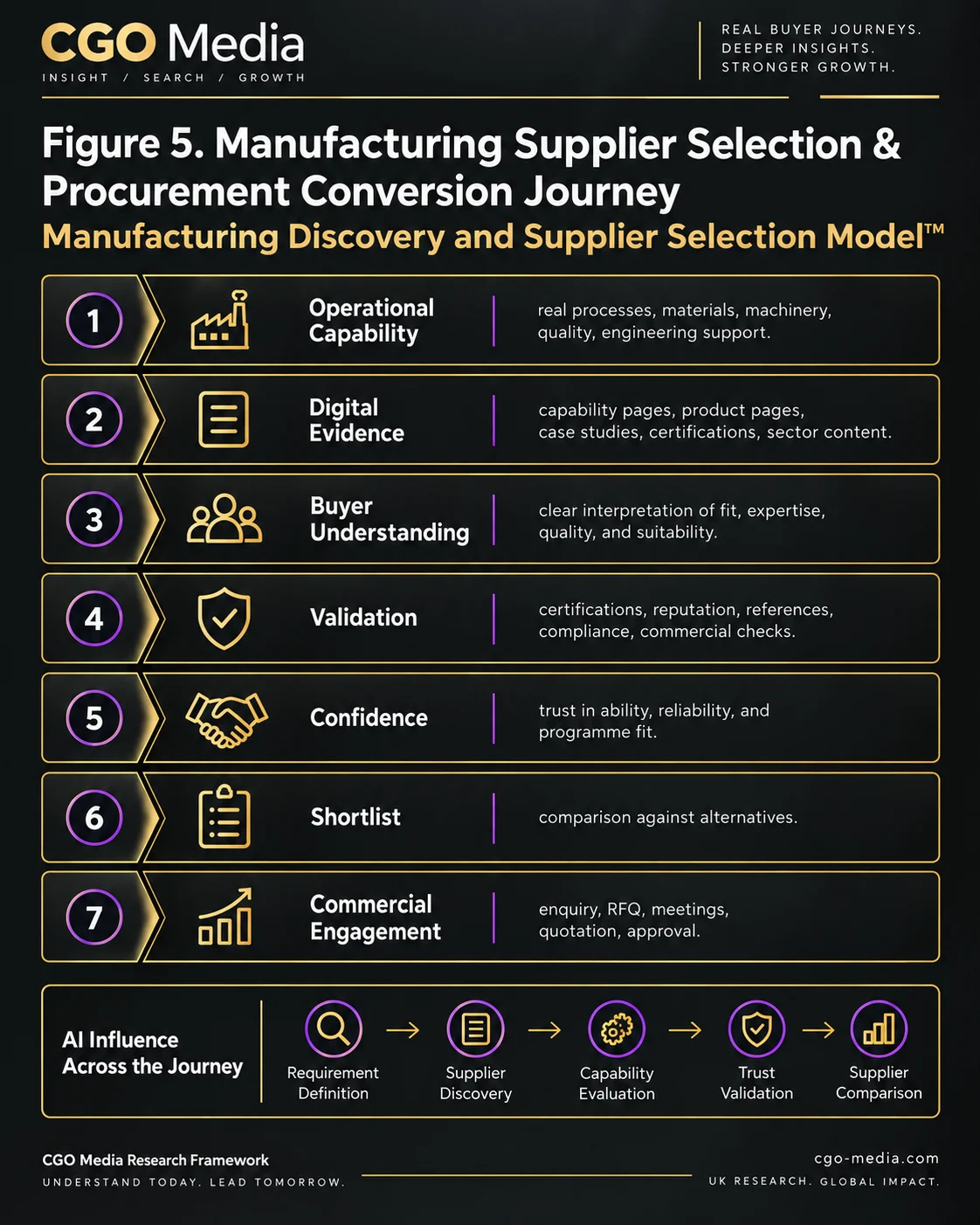
177. Supplier Selection Is an Evidence Conversion Process
The manufacturer’s digital presence converts operational capability into evidence that buyers can use during decision making.
That progression can be expressed as:
Operational Capability → Digital Evidence → Buyer Understanding → Validation → Confidence → Shortlist → Commercial Engagement
Figure 5 : Manufacturing Supplier Selection & Procurement Conversion Journey.
178. Measuring Manufacturing Supplier Selection Performance
The Manufacturing Discovery and Supplier Selection Model can also be used as a measurement framework for understanding where a manufacturer gains or loses visibility, trust and commercial opportunity during the buying journey.
179. Discovery Visibility
Manufacturers can measure whether they appear across relevant discovery environments including:
- Organic search
- AI-assisted search
- Supplier directories
- Trade associations
- Technical media
- Industry networks
180. Requirement Match Visibility
The manufacturer should assess whether it appears for commercially important combinations of:
- Process
- Material
- Industry
- Certification
- Geography
- Production volume
181. Capability Evaluation Success
Manufacturers can examine whether buyers consistently find enough technical evidence to confirm suitability without requiring unnecessary clarification.
182. Trust Validation Success
Relevant indicators can include whether buyers can easily verify:
- Certifications
- Quality systems
- Facility information
- Case studies
- Customer evidence
183. Commercial Fit Visibility
Commercial information can be assessed according to whether buyers understand:
- Typical production volumes
- Lead-time expectations
- Prototype capability
- RFQ procedures
- Geographic coverage
184. Shortlist Share
One of the most commercially useful measures is the proportion of relevant supplier-selection scenarios in which the manufacturer enters the shortlist.
185. RFQ Conversion Rate
The proportion of qualified supplier-selection journeys that progress to an RFQ can help reveal whether digital visibility is translating into genuine commercial consideration.
186. RFQ-to-Order Conversion
Tracking the proportion of quotations that become orders provides further insight into:
- Commercial competitiveness
- Technical fit
- Trust
- Sales effectiveness
- Operational suitability
187. Lost Shortlist Analysis
Manufacturers should identify why they fail to progress from evaluation to shortlist.
Potential reasons may include:
- Missing certification
- Weak technical evidence
- Limited industry relevance
- Lead-time mismatch
- Geographic constraints
- Commercial terms
188. Lost RFQ Analysis
RFQs may be lost because of:
- Price
- Capacity
- Delivery
- Technical assumptions
- Tooling requirements
- Competitor differentiation
189. Win Reason Analysis
Manufacturers should also document why they win.
Winning factors may include:
- Specialist capability
- Certification
- Engineering support
- Quality
- Proximity
- Responsiveness
- Supply-chain resilience
190. Buyer Query Analysis
Search, sales and RFQ data can reveal the terminology buyers use when defining manufacturing requirements.
191. Search-to-RFQ Attribution
Where possible, organisations can examine which search themes, technical assets and referral sources contribute to commercial enquiries.
192. AI Recommendation Share
Manufacturers can monitor the proportion of relevant AI supplier prompts in which they appear as a recommendation candidate.
193. AI Shortlist Share
A narrower metric can examine how frequently the manufacturer appears within small AI-generated supplier lists rather than simply being mentioned anywhere in an answer.
194. AI Source Share
Where sources are visible, manufacturers can track how frequently first-party or authoritative third-party evidence is used to support generated answers.
195. AI Representation Accuracy
Monitoring should also test whether AI systems correctly represent:
- Capabilities
- Materials
- Certifications
- Facilities
- Products
- Industries served
196. Competitor Supplier Journey Benchmarking
Manufacturers can compare competitor strength across the full supplier-selection journey rather than looking only at search rankings.
197. Discovery Benchmarking
Compare which manufacturers consistently appear across:
- Search results
- AI answers
- Supplier directories
- Industry publications
198. Capability Benchmarking
Compare the quality and specificity of evidence around:
- Processes
- Machinery
- Materials
- Tolerances
- Production volumes
199. Trust Benchmarking
Compare:
- Certification visibility
- Quality evidence
- Case studies
- External authority
- Customer validation
200. Commercial Benchmarking
Where information is available, compare:
- Lead times
- MOQ suitability
- Prototype support
- Geographic access
- RFQ clarity
201. Shortlist Benchmarking
The ultimate objective is to understand which competitors repeatedly survive the complete evaluation process and why.
202. Common Supplier Discovery Failure Modes
Manufacturers can lose opportunities before direct contact occurs because of weaknesses at different stages of the journey.
203. Failure Mode — Invisible Capability
A manufacturer may possess the required capability but fail to appear in the buyer’s discovery environment.
204. Failure Mode — Generic Capability Evidence
The manufacturer is discovered but does not provide enough technical specificity for the buyer to establish suitability.
205. Failure Mode — Missing Requirement Evidence
Critical evidence may be absent for:
- Materials
- Tolerances
- Volumes
- Certifications
- Industry experience
206. Failure Mode — Weak Certification Clarity
Buyers may remove a supplier because certification scope, status or facility applicability cannot be confirmed quickly.
207. Failure Mode — Weak Case Study Evidence
The manufacturer may claim broad capability but provide little evidence of comparable real-world applications.
208. Failure Mode — Commercial Ambiguity
Unclear volume suitability, lead times or RFQ procedures can create unnecessary friction.
209. Failure Mode — Poor External Validation
A supplier may appear technically suitable but lack enough independent evidence to support buyer confidence.
210. Failure Mode — Conflicting Information
Different sources may provide inconsistent information around:
- Facilities
- Products
- Certifications
- Capabilities
211. Failure Mode — Weak RFQ Response
A manufacturer can complete the digital journey successfully and still lose the opportunity through a slow, incomplete or poorly structured commercial response.
212. Failure Mode — No Feedback Integration
Organisations lose strategic insight when sales, engineering and procurement feedback is not used to improve future discovery and evaluation evidence.
213. Supplier Selection Governance
Improving supplier discovery requires coordination across multiple organisational functions.
214. Marketing Governance
Marketing teams may own:
- Search visibility
- Technical content
- Industry pages
- External authority
- AI monitoring
215. Engineering Governance
Engineering teams should validate:
- Processes
- Materials
- Tolerances
- Applications
- Machine capability
216. Quality Governance
Quality teams should maintain:
- Certifications
- Inspection information
- Traceability
- Compliance evidence
217. Sales Governance
Sales teams can capture:
- RFQ objections
- Win reasons
- Loss reasons
- Competitor comparisons
- Buyer questions
218. Procurement and Operations Governance
Operations teams can validate:
- Lead times
- Capacity
- Logistics
- Production volumes
- Supply-chain resilience
219. Leadership Governance
Leadership should ensure that the organisation’s digital supplier proposition remains aligned with commercial strategy and real operational capability.
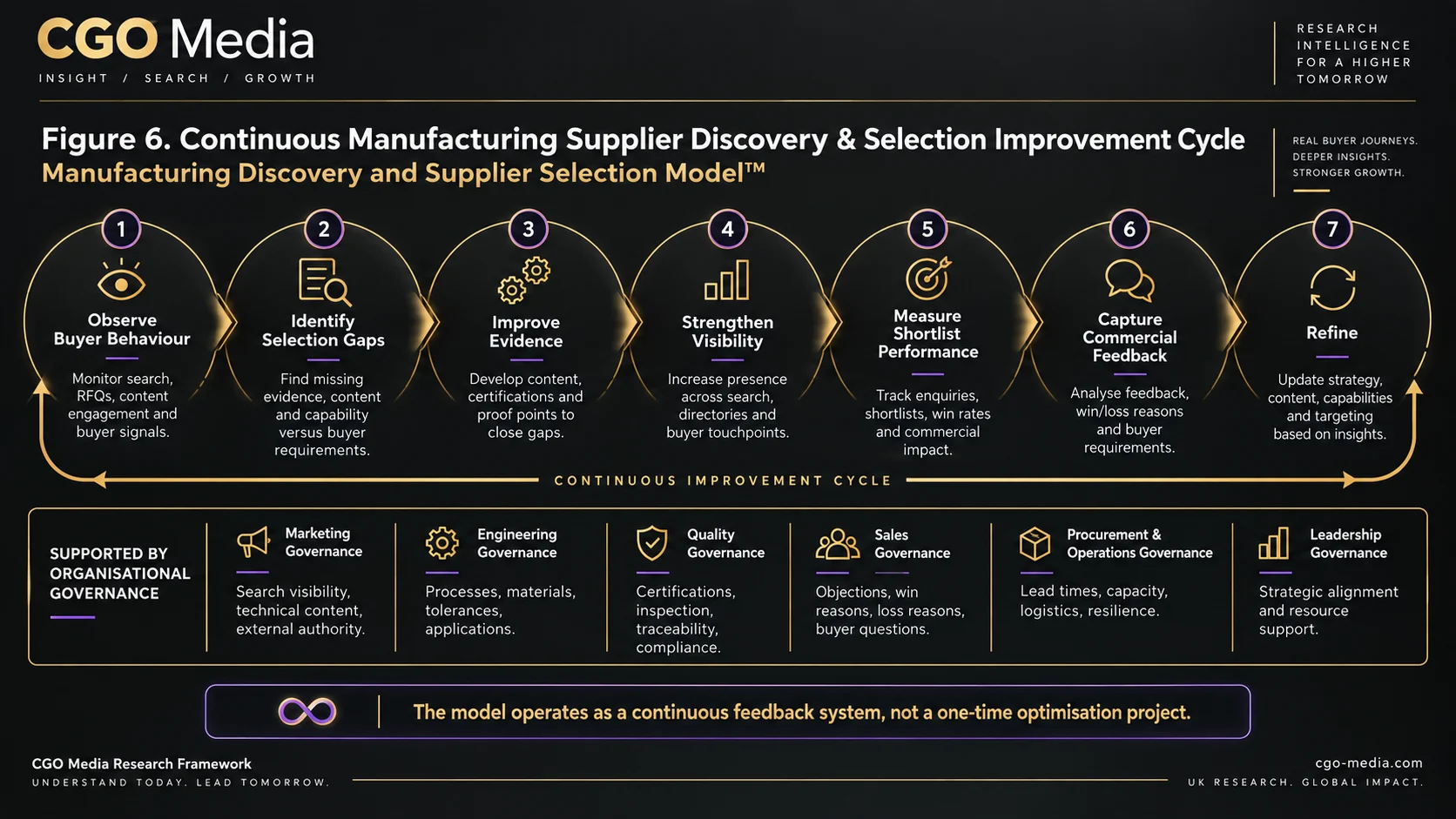
220. Continuous Supplier Discovery Improvement
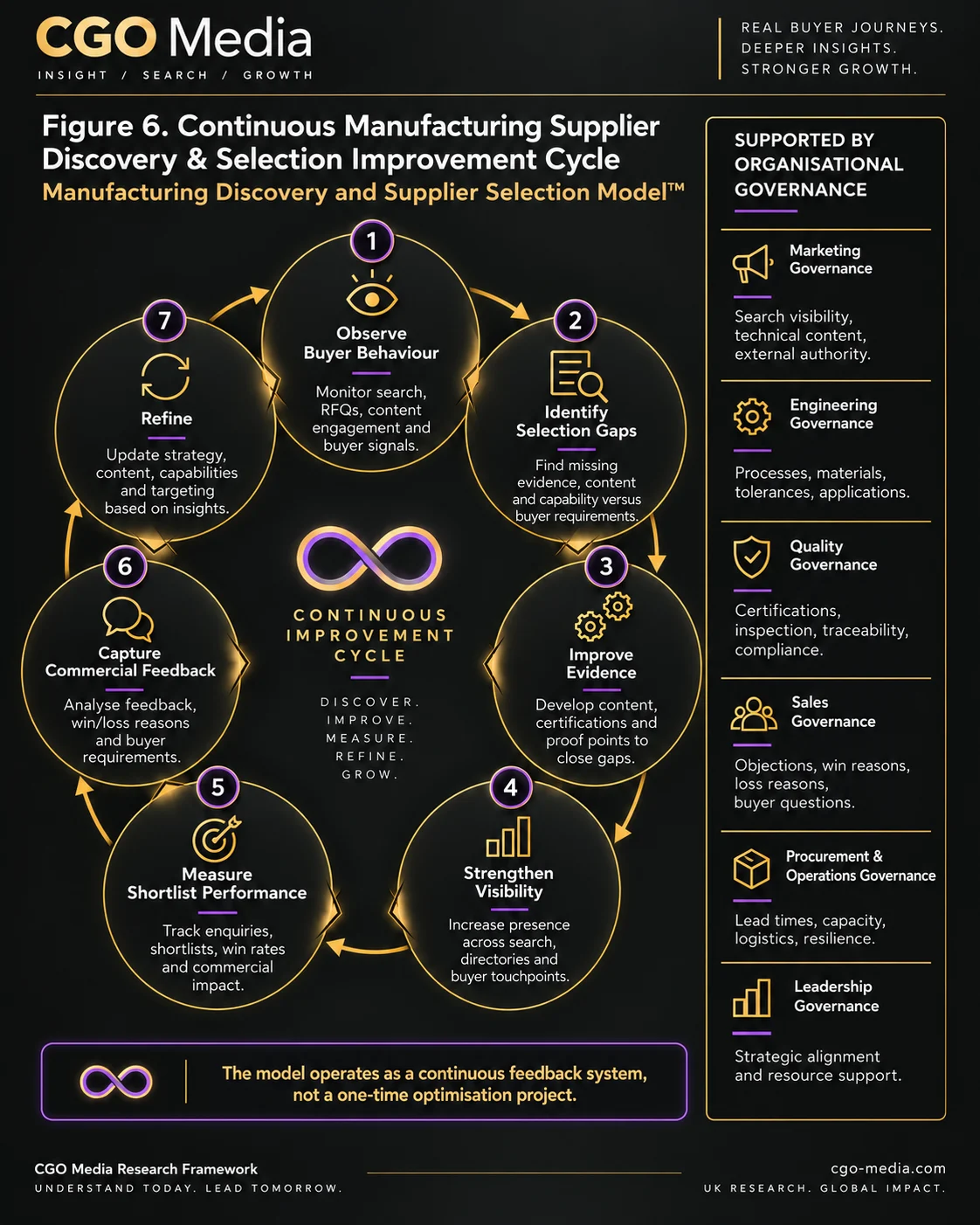
The model should operate as a continuous feedback system rather than a one-time optimisation project.
The cycle can be represented as:
Observe Buyer Behaviour → Identify Selection Gaps → Improve Evidence → Strengthen Visibility → Measure Shortlist Performance → Capture Commercial Feedback → Refine
221. Search Data Feeds the Cycle
Search behaviour can reveal which manufacturing requirements buyers investigate most frequently.
222. AI Data Feeds the Cycle
AI monitoring can reveal whether the manufacturer appears within emerging recommendation and comparison environments.
223. Sales Data Feeds the Cycle
Sales interactions show which information buyers still need after digital research.
224. RFQ Data Feeds the Cycle
RFQ patterns help identify commercially important combinations of:
- Process
- Material
- Volume
- Industry
- Certification
225. Lost Opportunity Data Feeds the Cycle
Lost opportunities can reveal where the organisation is failing during:
- Discovery
- Capability evaluation
- Trust validation
- Commercial comparison
- Final selection
226. Customer Success Data Feeds the Cycle
Successful supplier relationships can generate stronger evidence for future buyers through:
- Case studies
- Testimonials
- Performance data
- Repeat programmes
227. Supplier Selection Becomes a Learning System
The most mature manufacturing organisations use buyer behaviour, search visibility, AI representation and commercial outcomes to improve the complete supplier discovery environment continuously.
Figure 6 : Continuous Manufacturing Supplier Discovery & Selection Improvement Cycle.
228. Strategic Implications
The Manufacturing Discovery and Supplier Selection Model reframes manufacturing visibility as part of a wider commercial decision system.
The objective is not simply to appear when a buyer searches for a supplier. The objective is to remain credible through each stage of:
- Requirement definition
- Supplier discovery
- Capability evaluation
- Trust validation
- Commercial comparison
- Shortlisting
- RFQ and engagement
229. Search Visibility Is Only the Entry Point
A manufacturer can perform strongly in search and still fail to generate commercial opportunity if buyers cannot validate its capability, certifications, facilities, industry relevance or commercial suitability.
230. Supplier Selection Requires Evidence Continuity
Evidence should remain coherent across the full buyer journey.
A buyer who discovers a manufacturer through a process page should be able to progress naturally toward:
Capability → Material → Application → Certification → Case Study → Facility → RFQ
231. Technical Content Should Support Procurement Decisions
Manufacturing content becomes more commercially useful when it answers the questions that determine supplier suitability.
This may include:
- Can the manufacturer produce the component?
- Can it work with the required material?
- Can it meet the required tolerance?
- Does it hold the required certification?
- Can it support the required volume?
- Can it deliver within the required timeframe?
232. Commercial Pages Should Reduce Buyer Friction
RFQ and contact pathways should make it straightforward for qualified buyers to provide relevant technical information and move into discussion.
233. AI Search Expands the Supplier Discovery Layer
AI-assisted search introduces an additional discovery and comparison environment in which multiple supplier attributes can be evaluated within a single query.
This increases the importance of clear, current and verifiable manufacturing evidence.
234. AI Recommendations Should Be Treated as Discovery Inputs
AI-generated supplier suggestions should not replace engineering, quality, compliance or procurement due diligence.
They should instead be viewed as an emerging layer within the broader supplier-discovery process.
235. Manufacturer Authority Improves Selection Resilience
Manufacturers that combine technical depth, quality evidence, external validation and clear commercial information are better positioned to remain visible as the buyer moves from broad discovery toward a smaller shortlist.
236. Relationship with the Manufacturing AI Trust and Visibility Framework
The Manufacturing AI Trust and Visibility Framework defines the six evidence dimensions that support manufacturing trust, authority and recommendation readiness.
The Supplier Selection Model explains where those signals influence buyer decisions during the discovery and procurement journey.
237. Relationship with the Manufacturing Search Authority Maturity Model
The Manufacturing Search Authority Maturity Model provides a structured way to assess how advanced a manufacturing organisation has become in supporting this supplier-selection journey.
238. Relationship with the Manufacturing SEO and AI Implementation Roadmap
The Manufacturing SEO and AI Implementation Roadmap converts the findings from the supplier-selection model into a sequenced programme of implementation.
239. Relationship with the Parent Research
This model forms part of the research architecture established in Manufacturing SEO in an AI Search Environment.
240. The Manufacturing Research Framework Family
The complete Manufacturing research family consists of:
- Manufacturing SEO in an AI Search Environment — the parent research paper.
- Manufacturing AI Trust and Visibility Framework — the evidence and authority framework.
- Manufacturing Discovery and Supplier Selection Model — the buyer and procurement journey model.
- Manufacturing Search Authority Maturity Model — the organisational maturity model.
- Manufacturing SEO and AI Implementation Roadmap — the implementation roadmap.
241. Methodological Position
The Manufacturing Discovery and Supplier Selection Model is a conceptual framework for analysing the information, trust and commercial stages involved in manufacturing supplier selection.
It does not claim that every procurement decision follows an identical linear sequence.
Supplier journeys can involve:
- Repeated evaluation
- Parallel research
- Internal approval stages
- Existing supplier relationships
- Formal procurement procedures
The model provides a structured reference architecture for understanding the principal transitions from initial requirement to supplier engagement.
242. The Model Is Not a Substitute for Procurement Due Diligence
The framework is intended for strategic analysis, search planning, evidence architecture and supplier-discovery research.
It should not replace formal technical assessment, quality assurance, compliance checks, financial review, legal review or supplier audits where those processes are required.
243. A Manufacturing Search Strategy Should Follow Buyer Risk
Manufacturing content and evidence should become progressively stronger as buyer risk increases.
A low-risk prototype enquiry may require relatively limited evidence, while a safety-critical or high-volume programme may involve extensive technical, quality, commercial and institutional validation.
244. The Supplier Selection Model as a Search Architecture
The model can also guide website structure by ensuring that manufacturing evidence supports each stage of the buyer journey.
A useful architecture may connect:
Need → Process → Material → Product → Industry → Application → Quality → Certification → Case Study → Facility → RFQ
245. The Supplier Selection Model as a Measurement Architecture
Manufacturers can also use the framework to measure where commercial opportunities are being lost.
This shifts reporting from isolated traffic metrics toward questions such as:
- Are we being discovered?
- Are we technically understood?
- Are we trusted?
- Are we entering supplier shortlists?
- Are shortlists converting into RFQs?
- Are RFQs converting into orders?
246. The Supplier Selection Model as an Organisational Framework
Effective supplier visibility depends on coordination between:
- Marketing
- Engineering
- Quality
- Sales
- Operations
- Leadership
The digital supplier proposition should therefore reflect the combined operational knowledge of the organisation rather than being managed as a marketing-only asset.
247. Conclusion
The Manufacturing Discovery and Supplier Selection Model identifies eight connected stages:
- Need Recognition
- Technical Requirement Definition
- Supplier Discovery
- Capability Evaluation
- Trust and Compliance Validation
- Commercial and Operational Fit
- Comparison and Shortlisting
- RFQ, Engagement and Supplier Relationship
The model demonstrates that manufacturing discovery is only the beginning of the commercial journey.
A supplier must remain relevant and credible as the buyer progressively evaluates technical suitability, quality, certification, operational fit, risk and commercial value.
In AI-assisted search environments, this creates a growing requirement for manufacturing organisations to maintain structured, current and verifiable evidence across the complete supplier-selection ecosystem.
The strategic objective is therefore not simply to rank for manufacturing keywords.
It is to become sufficiently discoverable, understandable, trustworthy and commercially relevant to survive the complete journey from requirement recognition to supplier appointment.
References
External Academic, Technical and Search Sources
- Google Search Central. SEO Starter Guide.
- Google Search Central. Understand how structured data works.
- Schema.org. Organization.
- Schema.org. Product.
- Hogan, A. et al. (2021). Knowledge Graphs. ACM Computing Surveys, 54(4).
- Metzger, M.J. (2007). Making Sense of Credibility on the Web: Models for Evaluating Online Information and Recommendations for Future Research. Journal of the American Society for Information Science and Technology, 58(13), 2078–2091.
- Ji, Z. et al. (2023). Survey of Hallucination in Natural Language Generation. ACM Computing Surveys, 55(12).
CGO Media Research and Frameworks
- Wilkinson, R. (2026). Manufacturing SEO in an AI Search Environment. CGO Media.
- Wilkinson, R. (2026). Manufacturing AI Trust and Visibility Framework. CGO Media.
- Wilkinson, R. (2026). CGO Media Entity Authority Framework. CGO Media.
- Wilkinson, R. (2026). CGO Media Content Authority Framework. CGO Media.
- Wilkinson, R. (2026). CGO Media AI Search Readiness Framework. CGO Media.
- Wilkinson, R. (2026). CGO Media AI Citation Framework. CGO Media.
- Wilkinson, R. (2026). CGO Media Knowledge Architecture Map. CGO Media.
CGO Media Research Ecosystem
The Manufacturing Discovery and Supplier Selection Model forms part of the wider CGO Media research programme examining SEO, AI Search, GEO, digital authority, entity relationships, source selection and recommendation-led discovery.
About Roger Wilkinson
Roger Wilkinson is an independent researcher, SEO practitioner and founder of CGO Media with more than 25 years of experience in search, online visibility and digital strategy.
His current research focuses on how artificial intelligence is reshaping search engines, recommendation systems and digital authority. Through independent research papers and strategic frameworks, Roger examines the relationship between Technical SEO, Entity Authority, Brand Signals, AI Visibility, Citation Authority, Knowledge Graphs and Search Visibility.
Roger is the creator of the CGO Framework Series, a collection of executive-level methodologies designed to help organisations measure, improve and govern their digital visibility in an increasingly AI-centric environment.
View Roger Wilkinson’s researcher profile →
Related Manufacturing Research and Frameworks
- Manufacturing SEO in an AI Search Environment
- Manufacturing AI Trust and Visibility Framework
- Manufacturing Search Authority Maturity Model
- Manufacturing SEO and AI Implementation Roadmap
- Manufacturing GEO: Generative Engine Optimisation
Research Usage & Citation
CGO Media encourages researchers, journalists, manufacturers, engineers, procurement professionals, industry bodies, educators and practitioners to reference this model where it contributes to broader understanding of manufacturing supplier discovery, industrial search behaviour and AI-assisted procurement.
Reasonable quotations, summaries, figures and excerpts may be used in articles, reports, presentations and academic work provided appropriate acknowledgement is given.
Cite This Model / Embed Citation
The Manufacturing Discovery and Supplier Selection Model, developed by Roger Wilkinson at CGO Media, maps the manufacturing buyer journey from requirement recognition and supplier discovery through capability evaluation, trust validation, shortlisting, RFQ and ongoing supplier relationships.
APA Citation
Wilkinson, R. (2026). Manufacturing Discovery and Supplier Selection Model. CGO Media.
https://cgomedia.com/manufacturing-discovery-supplier-selection-model/
Supporting Research
This model is supported by the parent research paper:
Manufacturing SEO in an AI Search Environment.
Author: Roger Wilkinson
Published by: CGO Media
For permissions relating to extensive reproduction, commercial licensing or republication of substantial portions of this model, please contact CGO Media directly.