
Manufacturing SEO & AI Implementation Roadmap
 The Manufacturing SEO & AI Implementation Roadmap provides a structured sequence for improving manufacturing visibility, technical authority, supplier trust and AI recommendation readiness across modern search environments.
It is designed for manufacturers, engineering businesses, contract manufacturers, industrial suppliers, component producers and multi-site manufacturing groups that need to move from fragmented digital visibility toward a more mature, measurable and governed search authority system.
The roadmap builds directly on the parent research paper Manufacturing SEO in an AI Search Environment, the Manufacturing AI Trust and Visibility Framework, the Manufacturing Discovery and Supplier Selection Model and the Manufacturing Search Authority Maturity Model.
1. Why Manufacturing Needs an Implementation Roadmap
Manufacturing organisations often know that their digital visibility could be stronger but lack a clear sequence for deciding what should be improved first.
The roadmap addresses that problem by organising implementation into practical phases.
2. The Seven Manufacturing Implementation Phases
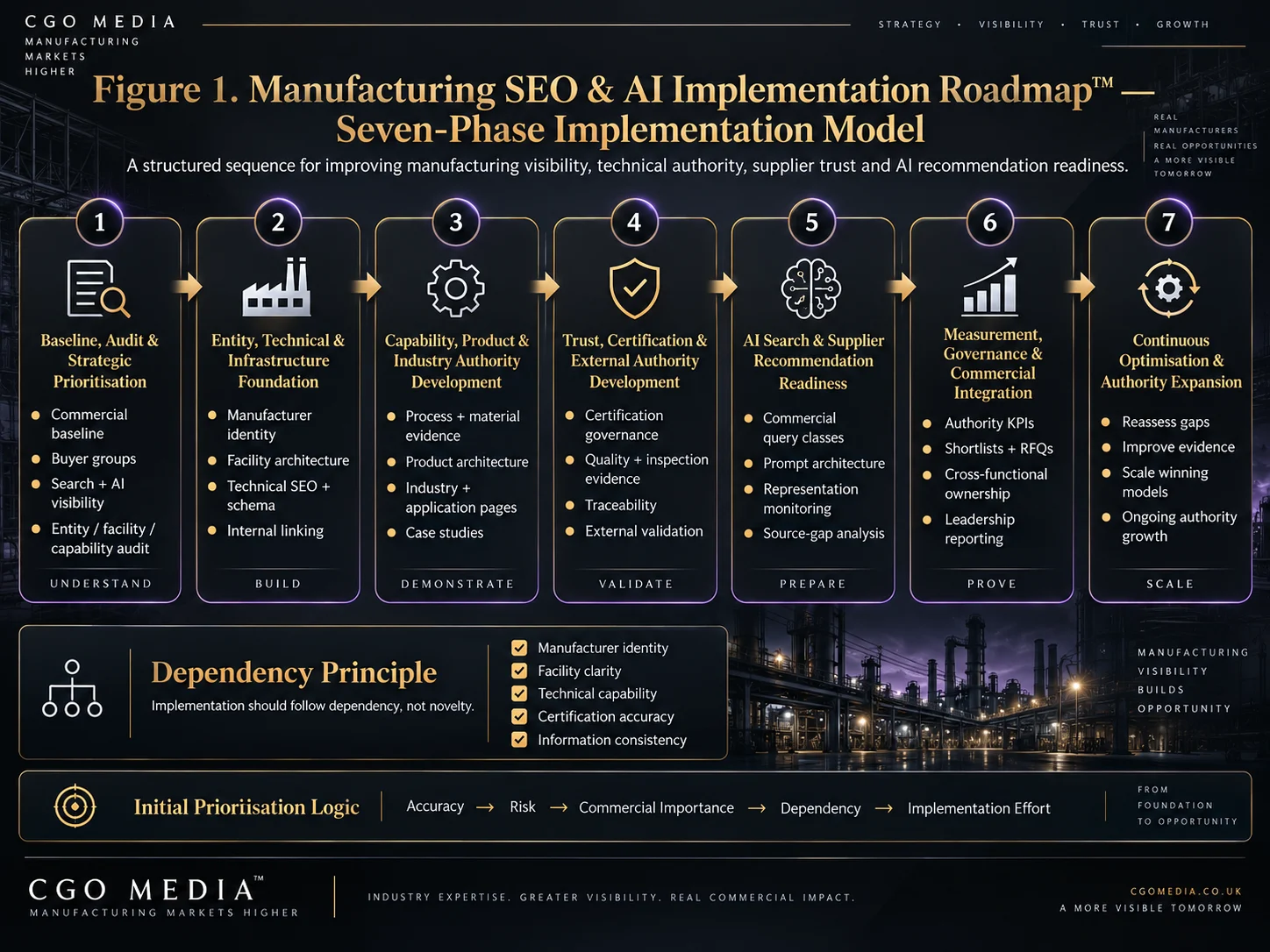
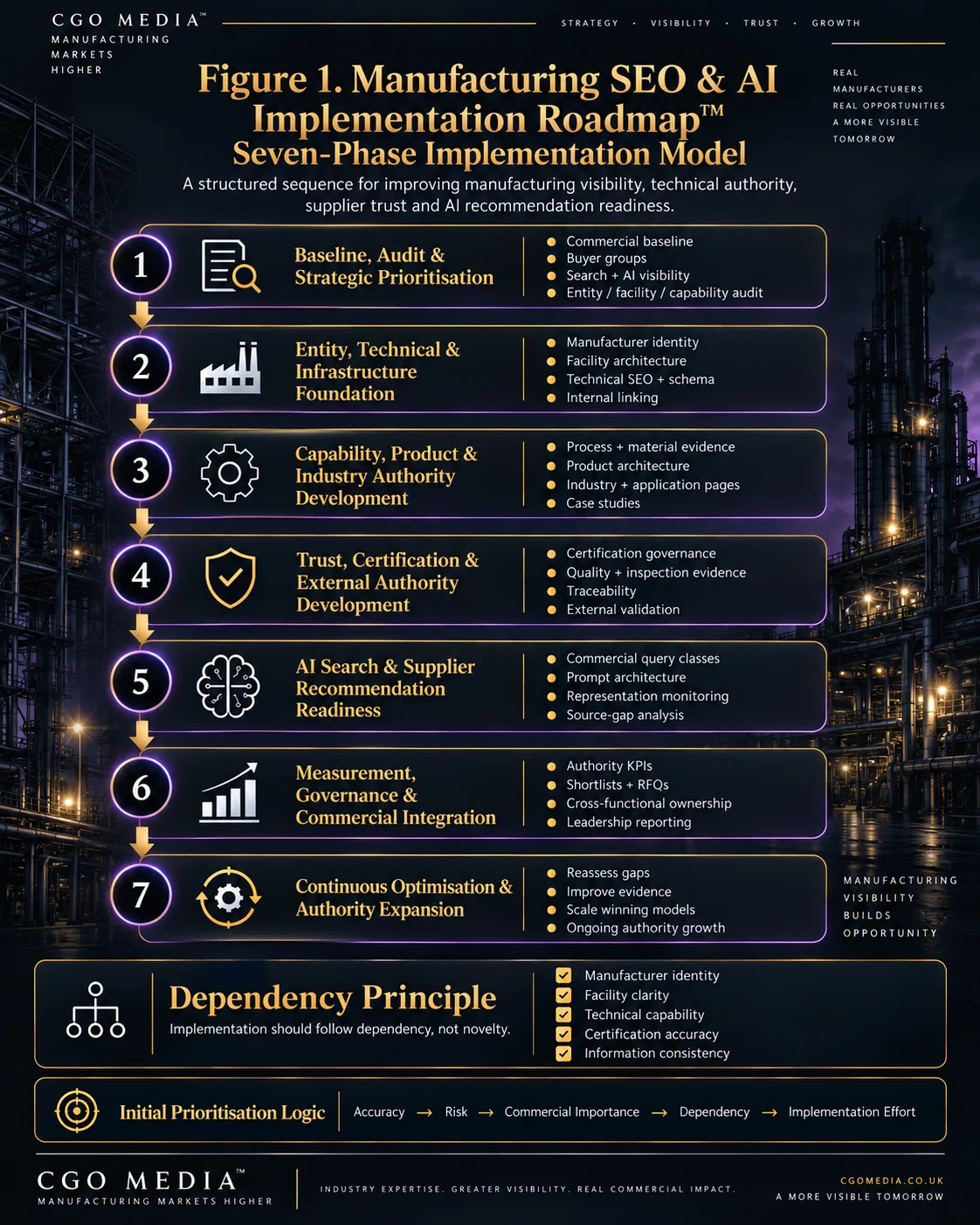
The roadmap identifies seven connected phases:
- Phase One — Baseline, Audit and Strategic Prioritisation
- Phase Two — Entity, Technical and Infrastructure Foundation
- Phase Three — Capability, Product and Industry Authority Development
- Phase Four — Trust, Certification and External Authority Development
- Phase Five — AI Search and Supplier Recommendation Readiness
- Phase Six — Measurement, Governance and Commercial Integration
- Phase Seven — Continuous Optimisation and Authority Expansion
3. Implementation Should Follow Dependency
The roadmap is designed around dependency rather than novelty.
Advanced AI activity should not take priority over unresolved problems involving:
- Manufacturer identity
- Facility clarity
- Technical capability
- Certification accuracy
- Information consistency
4. Phase One — Baseline, Audit and Strategic Prioritisation
The first phase establishes the manufacturer’s current position and identifies the gaps most likely to constrain supplier discovery and authority development.
5. Establish the Commercial Baseline
The organisation should define which parts of the business are commercially most important.
This may include:
- Priority capabilities
- Priority products
- Priority industries
- Priority facilities
- Priority geographic markets
6. Define Priority Buyer Groups
Implementation should reflect the people making or influencing supplier decisions.
Potential audiences include:
- Engineers
- Procurement teams
- OEM buyers
- Technical directors
- Operations managers
- Distributors
7. Define Priority Supplier Discovery Scenarios
The organisation should document the combinations of requirements most likely to generate valuable opportunities.
For example:
Process + Material + Industry + Certification + Geography + Volume
8. Baseline Search Visibility
Measure current visibility across strategically important search themes including:
- Processes
- Products
- Materials
- Industries
- Applications
- Locations
9. Baseline AI Visibility
Establish whether the manufacturer appears across relevant AI-assisted discovery scenarios.
This can include:
- Brand prompts
- Process prompts
- Industry prompts
- Supplier recommendations
- Competitor comparisons
10. Baseline Entity Audit
Review whether core manufacturer information is represented consistently.
Important areas include:
- Company name
- Business units
- Facilities
- Leadership
- Locations
- Manufacturer-distributor relationships
11. Baseline Facility Audit
Each strategic facility should be assessed for:
- Location accuracy
- Capabilities
- Machinery
- Certifications
- Industries served
- Production role
12. Baseline Technical Capability Audit
Priority process pages should be assessed for whether they clearly communicate:
- Process capability
- Materials
- Tolerances
- Machine capability
- Production volumes
- Engineering support
13. Baseline Product Audit
Product architecture should be reviewed for:
- Completeness
- Technical specificity
- Product-family relationships
- Industry relevance
- Application evidence
14. Baseline Industry and Application Audit
Industry content should be assessed for evidence of genuine manufacturing relevance rather than generic sector language.
15. Baseline Trust and Certification Audit
Review:
- Quality systems
- Certifications
- Certification scope
- Applicable facilities
- Inspection evidence
- Traceability
16. Baseline External Authority Audit
Identify whether strategically relevant third-party sources already validate the manufacturer.
Potential sources include:
- Customers
- Trade associations
- Certification bodies
- Industry media
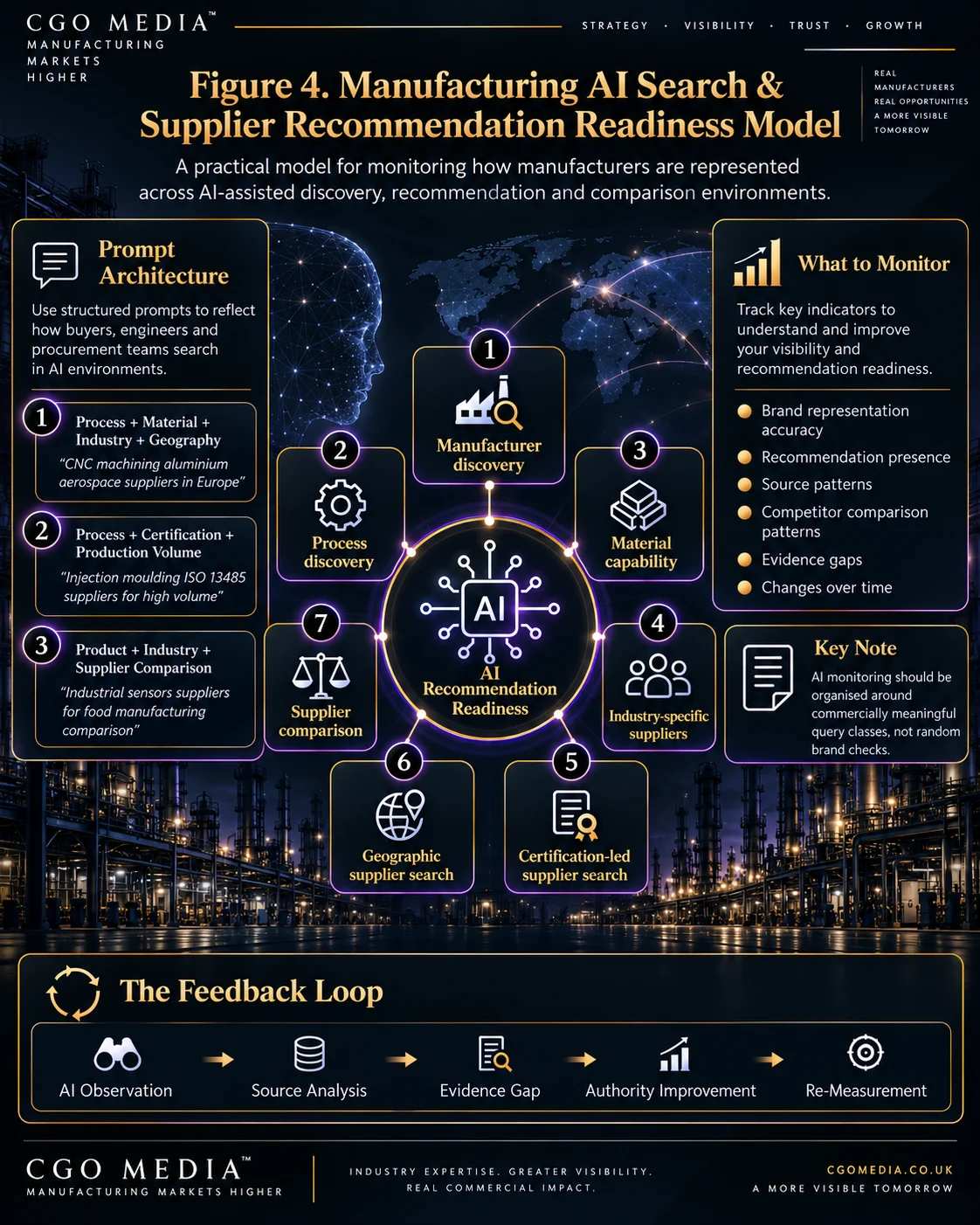
- Government organisations
- Research institutions
17. Baseline Knowledge Architecture Audit
Assess whether the website clearly connects:
Manufacturer → Facility → Process → Material → Product → Industry → Application → Certification → Evidence
18. Baseline Internal Linking Audit
Internal linking should be reviewed for whether buyers can move naturally between:
- Capabilities
- Products
- Industries
- Applications
- Case studies
- Facilities
- Certifications
19. Baseline Technical SEO Audit
Technical foundations should also be reviewed across:
- Crawlability
- Indexation
- Canonicalisation
- Internal linking
- Mobile performance
- Page performance
- Structured data
20. Baseline Content Quality Audit
Content should be classified according to whether it is:
- Accurate
- Current
- Specific
- Useful
- Expert validated
- Commercially relevant
21. Baseline Measurement Audit
Review which metrics are already available across:
- Search visibility
- AI visibility
- Qualified enquiries
- RFQs
- Shortlists
- Opportunity value
- Wins
22. Baseline Governance Audit
Identify who currently owns:
- Technical content
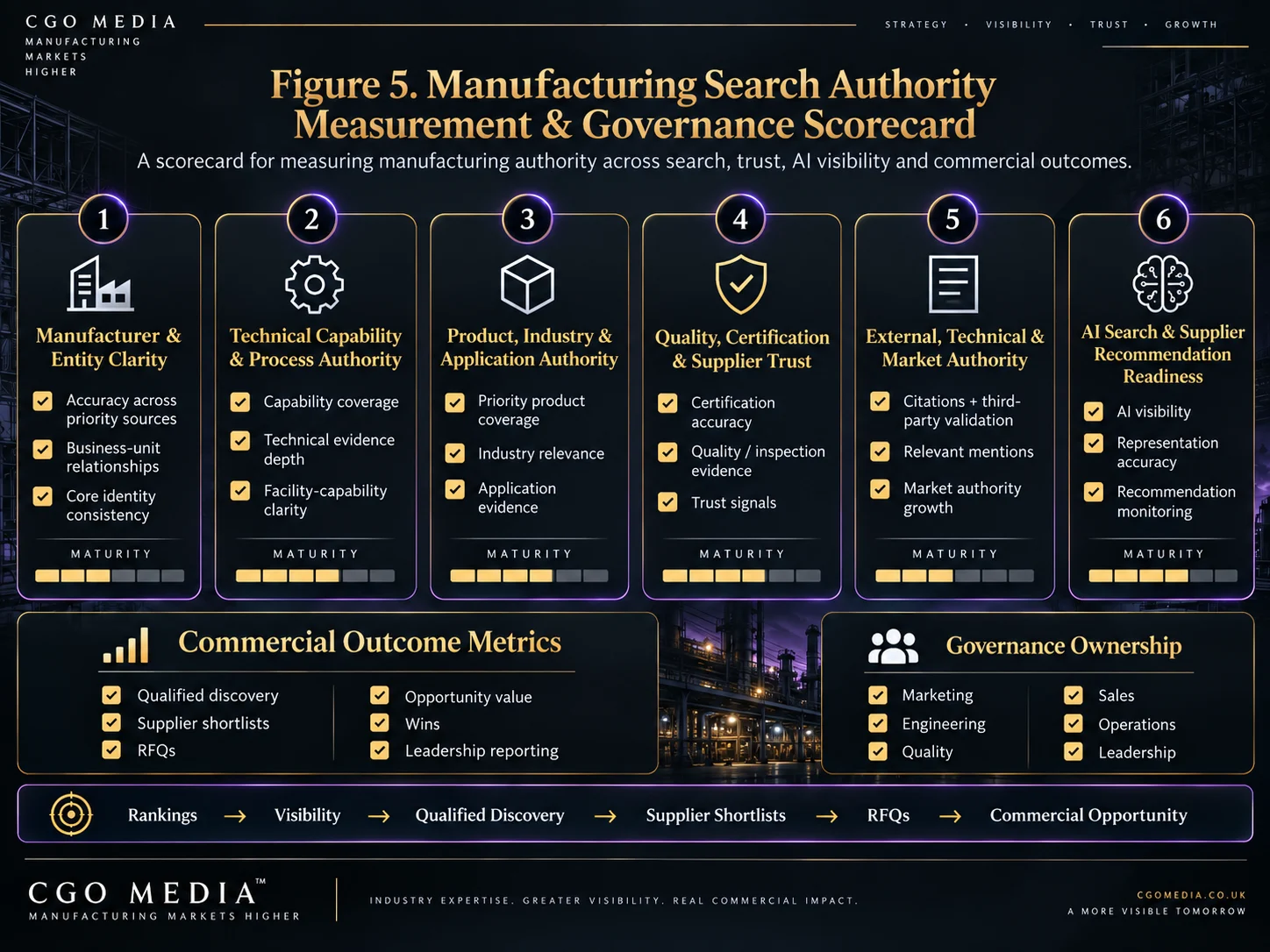
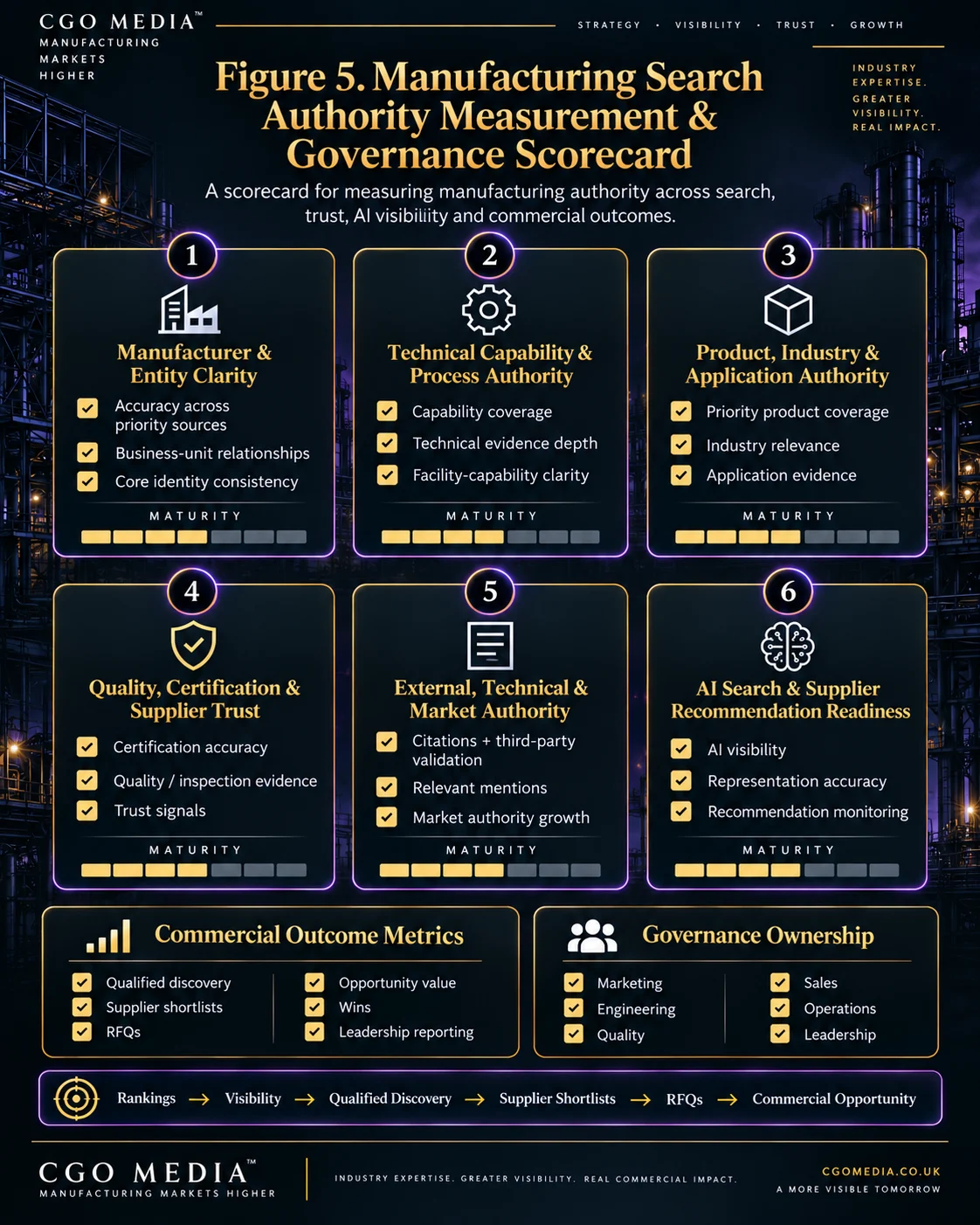
- Facility information
- Certifications
- Product information
- External authority
- AI monitoring
23. Create the Manufacturing Authority Gap Register
The audit should produce a structured gap register rather than a generic list of SEO recommendations.
Each gap should identify:
- Affected authority dimension
- Commercial impact
- Risk level
- Priority market
- Responsible owner
- Recommended action
24. Prioritise Critical Accuracy Gaps
The highest-priority issues are normally those involving inaccurate or misleading information about:
- Facilities
- Capabilities
- Certifications
- Products
- Business identity
25. Prioritise Commercial Opportunity Gaps
The next priority should be weaknesses affecting strategically important:
- Capabilities
- Industries
- Products
- Geographic markets
- Supplier programmes
26. Establish the Initial Implementation Sequence
The first phase should conclude with a prioritised implementation sequence based on:
Accuracy → Risk → Commercial Importance → Dependency → Implementation Effort
Figure 1 : Manufacturing SEO & AI Implementation Roadmap — Seven-Phase Implementation Model.
27. Phase Two — Entity, Technical and Infrastructure Foundation
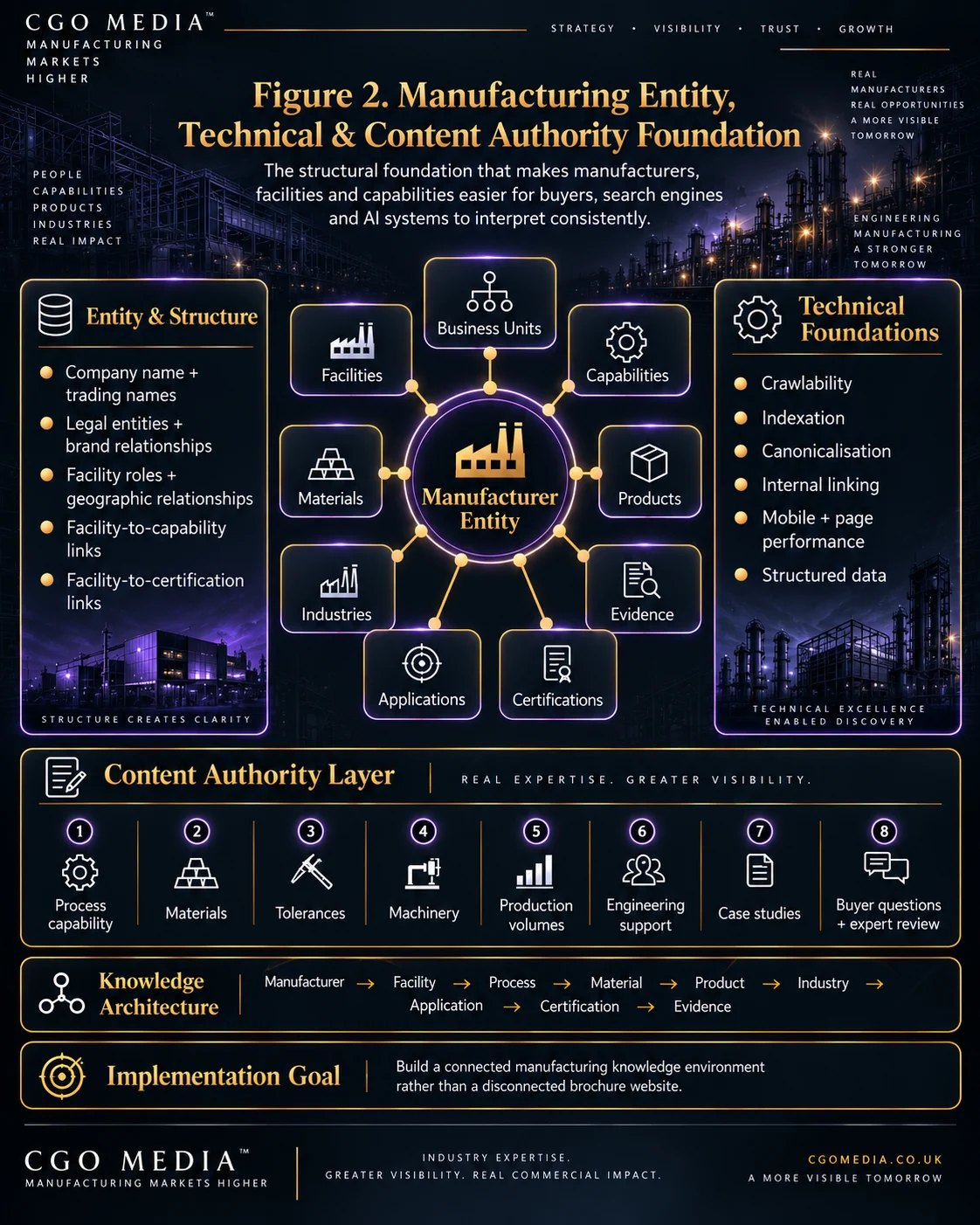
Phase Two establishes the structural foundation required for stronger manufacturing authority.
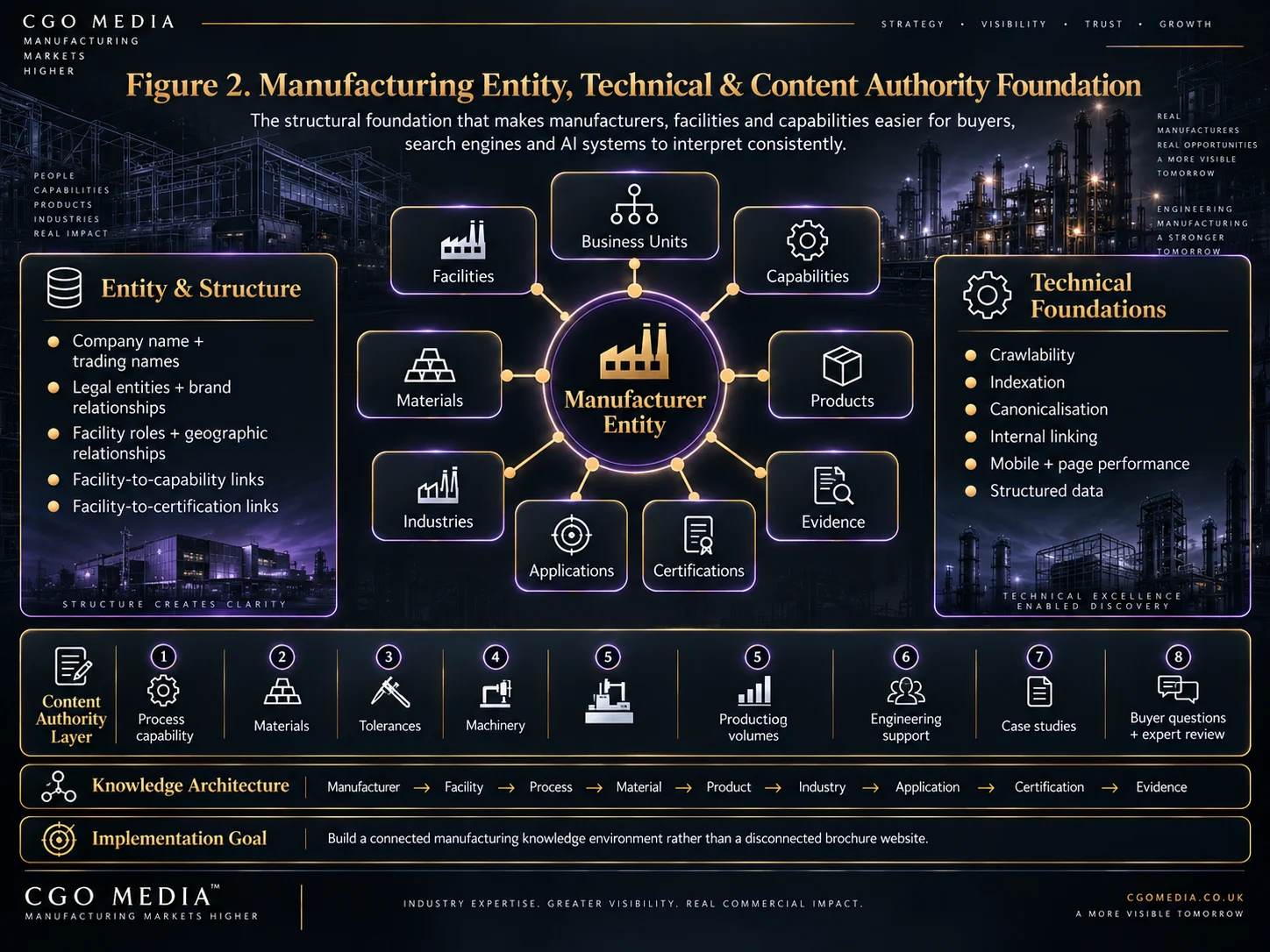
The objective is to make the organisation, its facilities and its technical capabilities easier for buyers, search engines and AI systems to interpret consistently.
28. Correct Manufacturer Identity
The organisation should first resolve inconsistencies involving:
- Company name
- Trading names
- Legal entities
- Brand relationships
- Corporate descriptions
29. Clarify Business Unit Relationships
Where a manufacturing group operates multiple divisions, the relationship between parent company, business units and specialist brands should be explicit.
30. Build Facility Architecture
Each strategically important production facility should have a clear role within the digital architecture.
Facility information may include:
- Location
- Capabilities
- Machinery
- Certifications
- Industries served
- Contact information
31. Connect Facilities with Capabilities
Users should be able to determine which production sites provide specific processes and services.
32. Connect Facilities with Certifications
Certification information should identify which facility, business unit or legal entity is actually covered.
33. Clarify Geographic Relationships
Manufacturers operating nationally or internationally should distinguish:
- Production locations
- Sales offices
- Distribution sites
- Regional offices
- Markets served
34. Strengthen Leadership and Expert Entities
Relevant leadership, engineering and technical specialists can be represented more clearly through:
- Author profiles
- Technical contributions
- Research
- Case studies
- Industry commentary
35. Establish Core Technical Taxonomy
The website should use a consistent vocabulary for commercially important manufacturing concepts.
This may include:
- Processes
- Materials
- Machines
- Products
- Industries
- Applications
- Certifications
36. Build Process Architecture
Priority manufacturing processes should have dedicated technical pages rather than being compressed into generic service summaries.
37. Build Material Architecture
Where material capability influences supplier selection, the manufacturer should create structured relationships between materials and relevant:
- Processes
- Products
- Industries
- Applications
38. Build Machine Capability Evidence
Where machinery materially determines capability, machine information should explain:
- Machine type
- Size or working envelope
- Axis capability
- Materials
- Relevant processes
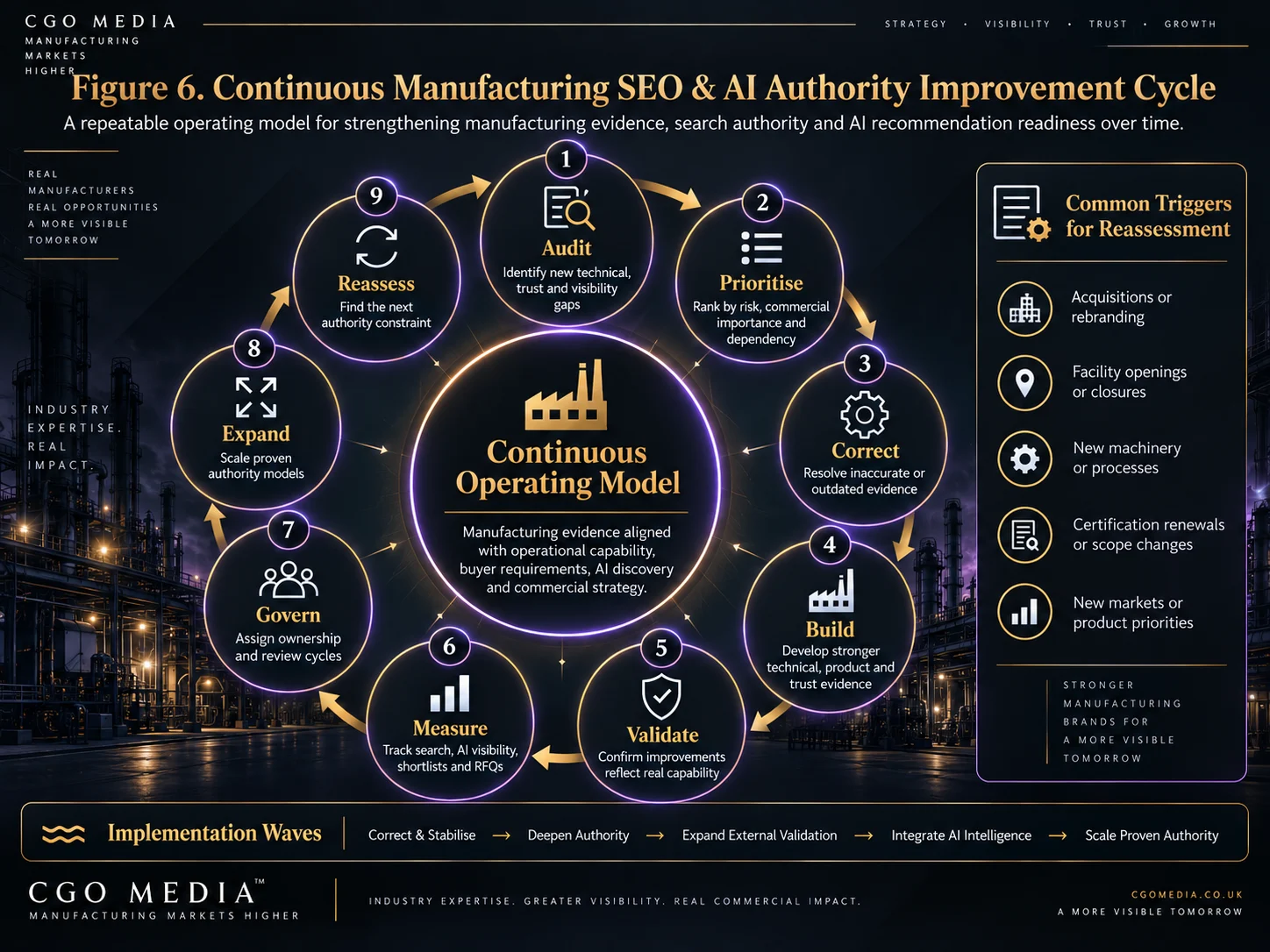
- Facility location
39. Improve Tolerance and Specification Clarity
Manufacturers should provide appropriate technical specificity where buyers need to determine whether requirements can be met.
40. Clarify Production Volume Capability
Pages should indicate whether the organisation supports:
- Prototype production
- Low-volume manufacturing
- Medium-volume production
- High-volume programmes
41. Clarify Engineering Support
Where available, explain services such as:
- Design-for-manufacture
- Material guidance
- Prototype development
- Tooling support
- Process optimisation
42. Improve Technical Documentation Accessibility
Important technical information should not be hidden exclusively within downloadable PDFs.
Core evidence should also be represented in accessible web content and connected with the relevant product, capability or facility.
43. Establish Internal Knowledge Relationships
A useful relationship model is:
Manufacturer → Facility → Process → Material → Product → Industry → Application → Certification → Evidence
44. Strengthen Internal Linking
Internal links should reflect genuine technical and commercial relationships.
For example:
Aerospace → Titanium → 5-Axis Machining → AS9100 → Facility → Case Study
45. Resolve Crawlability Issues
Important manufacturing assets should be accessible to search crawlers without unnecessary technical barriers.
46. Resolve Indexation Issues
Priority pages should be checked for:
- Incorrect noindex directives
- Duplicate content
- Canonical conflicts
- Soft errors
- Unintended exclusions
47. Consolidate Duplicate Capability Pages
Near-duplicate pages targeting minor keyword variations can fragment authority and create a poor technical information architecture.
48. Improve Site Hierarchy
Priority capabilities, products, industries and facilities should sit within a logical hierarchy that reflects how buyers investigate suppliers.
49. Improve Mobile Usability
Technical content, tables, specifications and RFQ pathways should remain usable across smaller screens.
50. Improve Performance and Page Experience
Large manufacturing websites often contain heavy imagery, video, PDFs and technical assets.
Performance improvements can focus on reducing unnecessary friction without removing useful evidence.
51. Implement Appropriate Structured Data
Where supported by visible page content, structured data may help clarify relationships involving:
- Organization
- Product
- Person
- Article
- BreadcrumbList
52. Structured Data Must Reflect Visible Reality
Markup should reinforce accurate information rather than introduce claims that are not supported by the page.
53. Establish Technical Quality Control
Changes to important manufacturing pages should be checked for:
- Accuracy
- Indexability
- Internal links
- Structured data
- Mobile usability
- Page performance
54. Phase Two Completion Criteria
Phase Two can be considered substantially complete when:
- Manufacturer identity is consistent
- Facilities are clearly represented
- Core capabilities are structurally defined
- Key technical relationships are connected
- Priority technical SEO issues are resolved
- Critical trust information is accessible
55. Phase Three — Capability, Product and Industry Authority Development
Phase Three moves from foundational clarity toward deeper manufacturing authority.
The objective is to transform operational expertise into useful, specific and searchable evidence.
56. Prioritise Commercially Important Capabilities
Capability development should begin with processes most closely aligned with:
- Revenue
- Strategic growth
- High-value opportunities
- Competitive differentiation
57. Build Advanced Process Pages
A strong process page may include:
- Process explanation
- Machine capability
- Materials
- Tolerances
- Production volumes
- Applications
- Quality evidence
- Relevant case studies
58. Build Material Authority
Manufacturers with meaningful material expertise can develop dedicated resources explaining:
- Material properties
- Process suitability
- Manufacturing considerations
- Applications
- Relevant industries
59. Build Product Family Architecture
Product families should be organised so buyers can understand relationships between:
- Product categories
- Individual products
- Specifications
- Applications
- Industries
60. Strengthen Product Specifications
Product pages should provide the level of technical information buyers need to determine initial suitability.
61. Develop Priority Industry Authority
Industry pages should demonstrate specific understanding of sector requirements rather than simply repeating general manufacturing claims.
62. Connect Industry Pages with Technical Evidence
A strong sector page can connect with:
- Relevant processes
- Materials
- Products
- Certifications
- Applications
- Case studies
63. Build Application Authority
Application content should explain how technical capability solves real engineering or production requirements.
64. Develop Use-Case Evidence
Use cases can demonstrate combinations such as:
Industry Requirement → Material → Process → Engineering Challenge → Manufacturing Solution
65. Develop Technical Case Studies
Case studies can provide some of the strongest evidence connecting manufacturing claims with real outcomes.
A useful structure may include:
- Customer or anonymised context
- Technical challenge
- Requirements
- Process
- Material
- Quality considerations
- Outcome
66. Develop Expert-Led Technical Content
Engineers and subject specialists can contribute to:
- Technical guides
- Design-for-manufacture resources
- Material comparisons
- Process explanations
- Industry analysis
67. Develop Comparison Content Where Useful
Decision-support content may compare:
- Processes
- Materials
- Production methods
- Prototype versus production approaches
68. Build Content Around Buyer Questions
Sales and engineering teams should identify recurring questions buyers ask during:
- Initial enquiries
- Technical evaluation
- RFQs
- Supplier qualification
69. Use RFQ Intelligence to Guide Content
Recurring RFQ requirements can reveal where additional public evidence may reduce friction in future supplier selection.
70. Avoid Artificial Content Expansion
The objective is not to create a page for every possible keyword variation.
Content should exist where it adds meaningful technical, commercial or decision-making value.
71. Phase Three Begins the Authority Layer
Once the foundation is technically sound, deeper process, product, industry and application evidence begins transforming the website from a company brochure into a manufacturing knowledge environment.
Figure 2 : Manufacturing Entity, Technical & Content Authority Foundation.
72. Complete Phase Three with Evidence Depth
Phase Three should not stop once capability, product and industry pages exist.
The organisation should continue strengthening the evidence connecting operational capability with real buyer requirements.
73. Build Process-to-Application Relationships
Priority manufacturing processes should connect directly with practical applications so buyers can understand where those processes are relevant.
74. Build Material-to-Application Relationships
Material content should explain how different materials influence:
- Performance
- Durability
- Weight
- Corrosion resistance
- Temperature tolerance
- Cost
75. Build Product-to-Industry Relationships
Product pages should connect clearly with the sectors in which those products are used.
76. Build Capability-to-Industry Relationships
Process pages should demonstrate where technical capability is relevant to strategically important markets.
77. Strengthen Industry-Specific Evidence
High-value sectors may require tailored evidence around:
- Certifications
- Materials
- Quality systems
- Production requirements
- Traceability
- Case studies
78. Strengthen Geographic Market Evidence
Manufacturers serving multiple regions should clarify:
- Markets served
- Export capability
- Logistics
- Local facilities
- Regional distributors
79. Develop Commercially Useful FAQs
Frequently asked questions should address real supplier-selection issues rather than generic marketing topics.
80. Add Evidence Around Production Scale
Buyers should be able to understand whether a manufacturer is suited to:
- Prototype work
- Low-volume production
- Medium-volume production
- High-volume programmes
81. Add Evidence Around Engineering Collaboration
Where relevant, manufacturers should demonstrate support for:
- Design-for-manufacture
- Material selection
- Tooling
- Prototype development
- Process optimisation
82. Improve Technical Content Governance
Priority technical assets should have defined ownership and review cycles.
83. Establish Content Freshness Rules
Content should be reviewed when:
- Machinery changes
- Capabilities change
- Certifications change
- Products change
- Facilities change
- New markets are entered
84. Phase Three Completion Criteria
Phase Three can be considered substantially complete when:
- Priority capabilities have deep technical evidence
- Priority products are structurally organised
- Priority industries contain genuine application evidence
- Technical case studies support key commercial areas
- Buyer questions are reflected in content
- Expert review is established
85. Phase Four — Trust, Certification and External Authority Development
Phase Four strengthens the evidence that helps buyers, procurement teams, search engines and AI systems validate the manufacturer beyond its own claims.
86. Establish Certification Governance
The organisation should create a controlled record of:
- Certification name
- Certification scope
- Applicable entity
- Applicable facility
- Issue date
- Renewal or expiry date
87. Clarify Certification Scope Publicly
Certification pages should make clear which parts of the organisation are actually covered.
88. Connect Certifications with Facilities
Each facility page should reference the certifications relevant to that production site.
89. Connect Certifications with Industries
Where certifications are strategically important for specific markets, industry pages should explain their relevance accurately.
90. Strengthen Quality Management Evidence
Manufacturers can provide evidence around:
- Quality-management systems
- Inspection
- Testing
- Non-conformance procedures
- Continuous improvement
91. Strengthen Inspection Evidence
Inspection capability may be documented through:
- Equipment
- Measurement processes
- Inspection stages
- Final inspection
- Reporting
92. Strengthen Traceability Evidence
Where relevant, explain how the organisation maintains traceability across:
- Materials
- Batches
- Processes
- Inspection
- Production history
93. Strengthen Supply-Chain Trust
Buyers may require evidence around:
- Material sourcing
- Alternative capacity
- Business continuity
- Inventory
- Logistics
- Lead-time resilience
94. Strengthen Customer Evidence
Customer trust can be reinforced through:
- Case studies
- Testimonials
- Named customers where permitted
- Repeat programme evidence
- Customer references
95. Develop Relevant Trade Association Authority
Memberships and relationships with credible industry organisations should be represented where they genuinely reinforce manufacturing relevance.
96. Develop Certification Body Authority
Where public verification is available, certification evidence should be consistent with independent records.
97. Develop Industry Media Authority
Manufacturers can pursue editorial visibility around substantive themes such as:
- Factory investment
- Automation
- New production capability
- Export growth
- Engineering innovation
- Original research
98. Develop Customer Citation Authority
Where appropriate, customer references can reinforce relationships between the manufacturer and particular:
- Industries
- Products
- Applications
- Capabilities
99. Develop Government and Institutional Authority
Relevant external evidence may come from:
- Government manufacturing programmes
- Export initiatives
- Regional development organisations
- Innovation schemes
- Industry partnerships
100. Develop Academic and Research Authority
Manufacturers involved in technical development can strengthen authority through legitimate relationships with:
- Universities
- Research centres
- Technical institutes
- Collaborative innovation programmes
101. Build Original Manufacturing Research
Where the organisation possesses sufficient expertise or data, original research can contribute to external authority.
Potential subjects may include:
- Automation adoption
- Reshoring
- Supply-chain resilience
- Skills
- Materials
- Energy costs
- Industrial productivity
102. Use Digital PR to Distribute Evidence
Digital PR should support substantive evidence rather than operate as a separate publicity exercise.
103. Prioritise Citation Relevance
A smaller number of strong citations from relevant technical or industrial sources may provide more strategic value than large quantities of unrelated coverage.
104. Build Citation Diversity
A resilient authority environment can include:
- Customers
- Trade bodies
- Certification organisations
- Government institutions
- Universities
- Technical media
- Commercial partners
105. Audit External Information Consistency
Third-party records should be reviewed for outdated or conflicting information involving:
- Company names
- Facilities
- Products
- Capabilities
- Certifications
106. Strengthen Brand and Manufacturer Validation
Branded search results should make it easier for buyers to confirm the organisation’s identity, expertise, market position and external credibility.
107. Build Trust Evidence Around Priority Markets
Authority development should be weighted toward the industries, capabilities and regions most important to commercial strategy.
108. Establish External Authority Monitoring
The manufacturer should maintain visibility into:
- New citations
- Lost citations
- Industry coverage
- Customer references
- Competitor authority growth
109. Phase Four Completion Criteria
Phase Four can be considered substantially established when:
- Certification evidence is accurate and governed
- Quality and traceability evidence is accessible
- Priority sectors have strong trust signals
- Relevant external validation is growing
- Authority sources are increasingly diverse
- External information consistency is monitored
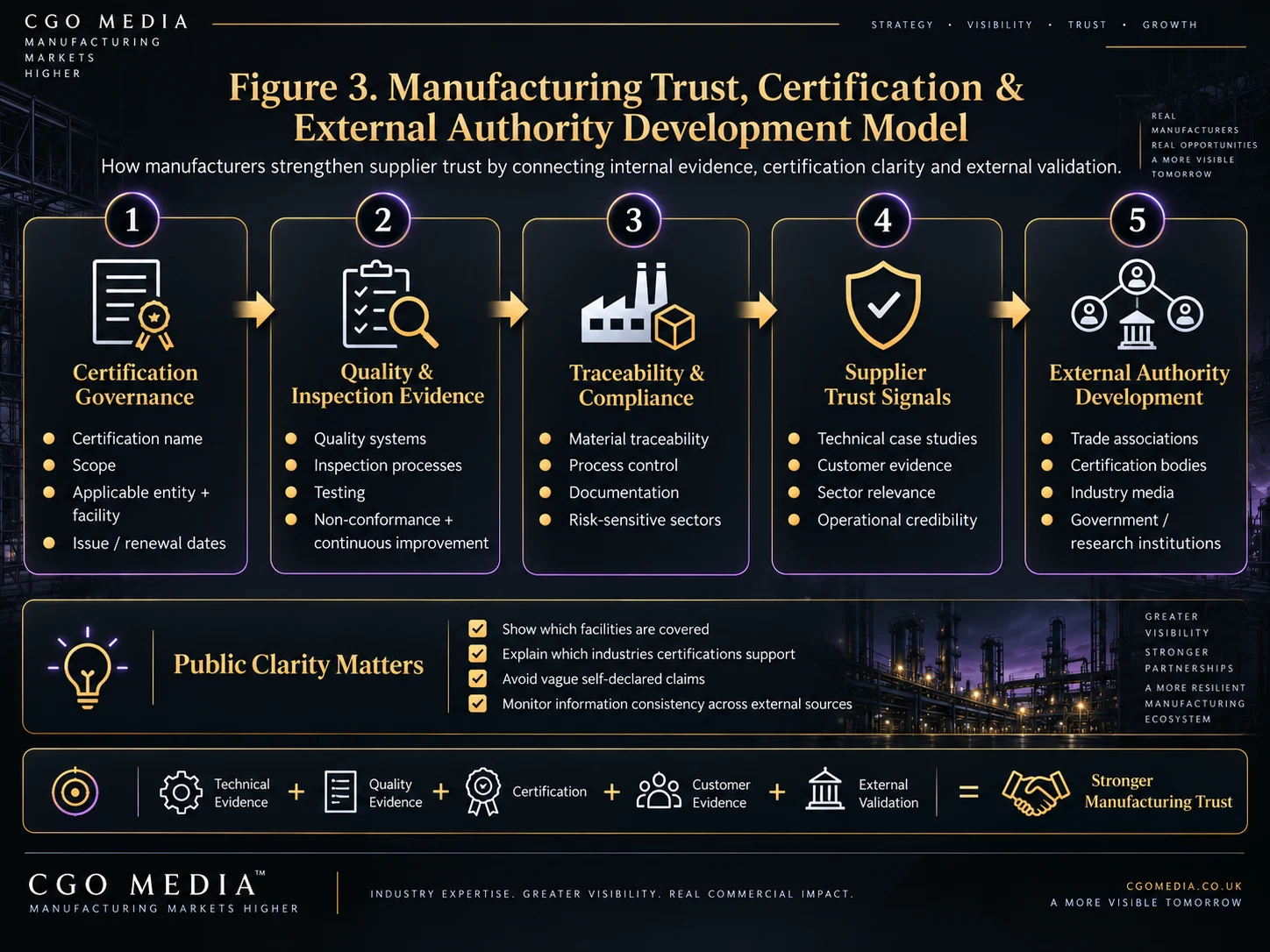
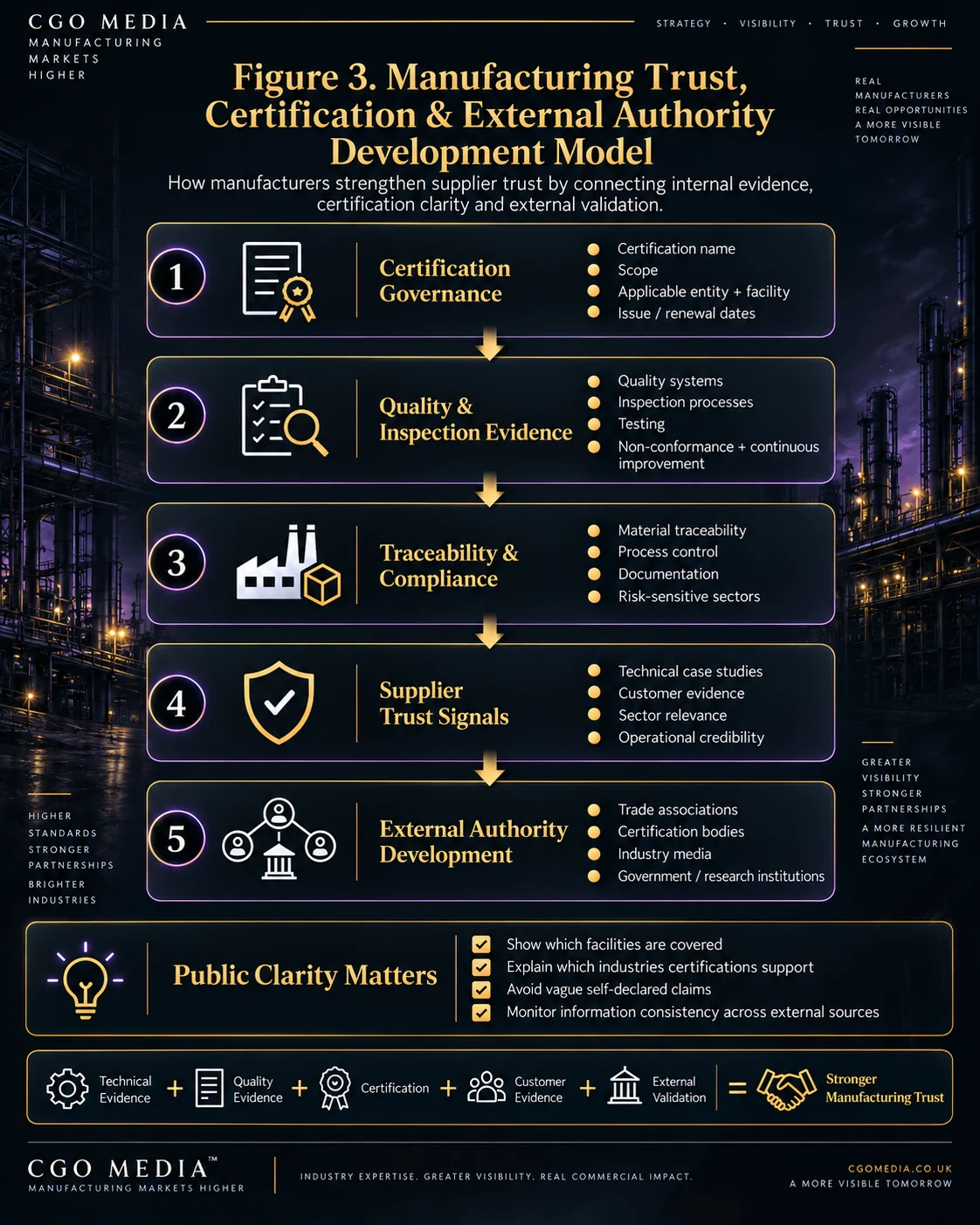
110. Trust Development Changes the Supplier Proposition
By the end of Phase Four, the manufacturer should no longer rely primarily on self-declared capability.
Its digital proposition should increasingly combine:
Technical Evidence + Quality Evidence + Certification + Customer Evidence + External Validation
Figure 3 : Manufacturing Trust, Certification & External Authority Development Model.
111. Phase Five — AI Search and Supplier Recommendation Readiness
Phase Five focuses on how the manufacturer is represented across AI-assisted discovery, recommendation and comparison environments.
This phase should begin only after the organisation has established sufficiently strong entity, technical, trust and external-authority foundations.
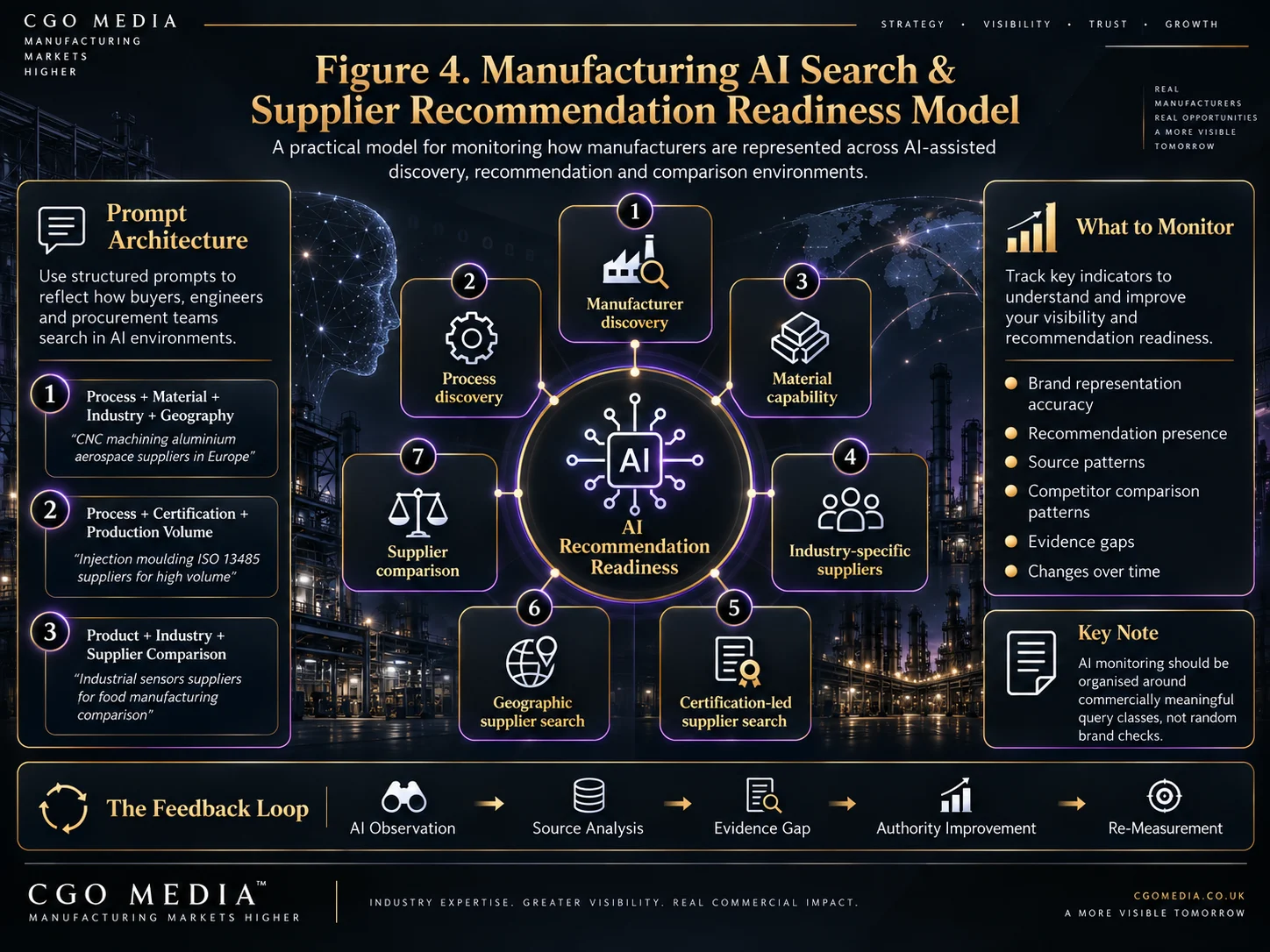
112. Define Commercial AI Query Classes
AI monitoring should be organised around commercially meaningful prompt groups rather than random brand checks.
Relevant classes may include:
- Manufacturer discovery
- Process discovery
- Material capability
- Industry-specific suppliers
- Certification-led supplier search
- Geographic supplier search
- Supplier comparison
113. Build the AI Prompt Architecture
A structured prompt set can combine the criteria buyers use during supplier discovery.
Examples may follow patterns such as:
Process + Material + Industry + Geography
Process + Certification + Production Volume
Product + Industry + Supplier Comparison
114. Establish Brand Prompt Monitoring
Monitor whether AI systems represent the manufacturer accurately when asked directly about the company.
115. Establish Capability Prompt Monitoring
Test whether the organisation appears in queries relating to its strategically important manufacturing capabilities.
116. Establish Material Prompt Monitoring
Where material expertise is commercially important, monitor whether AI systems associate the manufacturer with the correct materials.
117. Establish Industry Prompt Monitoring
Test whether the manufacturer appears in relevant sector-specific supplier discovery scenarios.
118. Establish Geographic Prompt Monitoring
Geographic testing can examine whether the organisation appears for:
- Local supplier searches
- National supplier searches
- Regional supplier searches
- Export-market discovery
119. Establish Certification-Led Prompt Monitoring
Manufacturers should test scenarios in which certifications form part of the selection requirement.
120. Monitor Supplier Recommendation Presence
The organisation should track whether it appears within relevant AI-generated supplier recommendations.
121. Monitor Supplier Shortlist Presence
A more demanding measure is whether the manufacturer appears within smaller recommendation sets rather than simply being mentioned anywhere in an answer.
122. Monitor Competitor Co-Occurrence
Identify which manufacturers repeatedly appear alongside or instead of the organisation.
123. Analyse Competitor Recommendation Advantages
Competitor analysis can examine whether frequently recommended suppliers possess stronger:
- Technical evidence
- Industry authority
- Certification clarity
- External citations
- Case studies
124. Establish AI Source Monitoring
Where AI systems expose sources, record which websites and documents support relevant answers.
125. Identify First-Party Source Visibility
Determine whether the manufacturer’s own:
- Capability pages
- Technical guides
- Product pages
- Case studies
- Research
appear as supporting evidence.
126. Identify Third-Party Source Visibility
Third-party sources may include:
- Industry publications
- Trade associations
- Customers
- Directories
- Certification organisations
- Research institutions
127. Map AI Source Gaps
If competitors are repeatedly supported by authoritative sources that do not mention the manufacturer, those gaps can become candidates for external-authority development.
128. Monitor Citation Visibility
Where citations are visible, track whether technically important first-party assets are being referenced.
129. Build Citation-Useful Technical Assets
Potential citation-oriented assets may include:
- Technical guides
- Material resources
- Process comparisons
- Industry data
- Original research
- Detailed case studies
130. Strengthen Factual Extractability
Important information should be presented clearly enough for users and machines to identify key facts without ambiguity.
131. Use Clear Technical Terminology
Capability terminology should remain aligned with the language used by engineers, buyers and the wider industry.
132. Strengthen Entity Relationships
AI representation can be supported by clear relationships between:
- Manufacturer
- Facility
- Process
- Product
- Material
- Industry
- Certification
133. Monitor Representation Accuracy
AI outputs should be reviewed for errors involving:
- Company identity
- Facilities
- Capabilities
- Products
- Materials
- Industries
- Certifications
134. Create an AI Representation Issue Register
Repeated inaccuracies can be recorded in a structured issue register containing:
- Prompt
- Incorrect statement
- Likely source conflict
- Affected commercial area
- Recommended evidence correction
135. Investigate the Wider Evidence Ecosystem
AI inaccuracies should not be treated only as platform problems.
The organisation should investigate whether conflicting or outdated information exists across first-party and external sources.
136. Correct First-Party Ambiguity
If the manufacturer’s own website is unclear, inconsistent or outdated, those issues should be corrected first.
137. Correct External Information Where Possible
Relevant third-party listings, profiles and records should be updated where inaccurate information can legitimately be corrected.
138. Test Supplier Comparison Prompts
Comparison prompts can reveal which attributes AI systems associate with the manufacturer and its competitors.
139. Compare Capability Representation
Evaluate whether AI-generated comparisons represent differences in:
- Processes
- Materials
- Production scale
- Engineering support
- Industries
140. Compare Trust Representation
Test whether AI systems correctly identify:
- Certifications
- Quality systems
- Customer evidence
- External validation
141. Compare Commercial Representation Carefully
AI-generated commercial comparisons may rely on incomplete public information.
Manufacturers should distinguish between verified facts and assumptions generated from limited evidence.
142. Measure AI Recommendation Share
A repeatable prompt set can be used to estimate how frequently the manufacturer appears across commercially important recommendation scenarios.
143. Measure AI Shortlist Share
Track how often the manufacturer appears within small candidate sets for relevant supplier queries.
144. Measure Source Share
Where source data is available, measure how frequently the manufacturer’s first-party or relevant third-party evidence appears within cited sources.
145. Measure Representation Accuracy
Maintain a benchmark for the proportion of monitored answers that represent critical manufacturer facts accurately.
146. Create the AI Visibility Baseline
The first structured monitoring cycle establishes a baseline against which future improvement can be compared.
147. Repeat Prompt Sets Consistently
Monitoring should use reasonably consistent query classes so that changes in recommendation visibility can be interpreted over time.
148. Separate Brand Visibility from Supplier Recommendation Visibility
Being recognised when the company name is supplied is different from being recommended when the buyer does not already know the manufacturer.
149. Prioritise Non-Branded Supplier Discovery
Non-branded recommendation scenarios can provide greater insight into whether the manufacturer has become part of the wider supplier consideration environment.
150. Use AI Data as Diagnostic Evidence
AI monitoring should inform questions such as:
- Where are we absent?
- Where are competitors stronger?
- Which sources dominate?
- Which facts are represented incorrectly?
- Which authority gaps should be improved?
151. Avoid Treating AI Visibility as a Guaranteed Outcome
No implementation programme can guarantee inclusion within an AI-generated answer or supplier recommendation.
The practical objective is to strengthen the quality, clarity and authority of the evidence available across the wider discovery ecosystem.
152. Phase Five Completion Criteria
Phase Five can be considered operational when:
- Commercial prompt classes are defined
- Recommendation visibility is monitored
- Source patterns are tracked where available
- Representation accuracy is measured
- Competitor recommendation patterns are analysed
- Identified gaps feed into evidence improvement
153. AI Readiness Becomes a Feedback System
The most useful outcome of Phase Five is not a static AI visibility score.
It is a continuous feedback loop connecting:
AI Observation → Source Analysis → Evidence Gap → Authority Improvement → Re-Measurement
Figure 4 : Manufacturing AI Search & Supplier Recommendation Readiness Model.
154. Phase Six — Measurement, Governance and Commercial Integration
Phase Six connects manufacturing search authority with measurable business outcomes and formal organisational ownership.
The objective is to move beyond isolated SEO and AI metrics toward a reporting system that reflects supplier discovery, shortlist visibility, RFQ generation and commercial opportunity.
155. Establish the Measurement Architecture
Measurement should reflect the six authority dimensions developed across the wider Manufacturing framework family:
- Manufacturer and Entity Clarity
- Technical Capability and Process Authority
- Product, Industry and Application Authority
- Quality, Certification and Supplier Trust
- External, Technical and Market Authority
- AI Search and Supplier Recommendation Readiness
156. Measure Entity Accuracy
Monitor whether core manufacturer information remains accurate across priority first-party and external sources.
157. Measure Facility Clarity
Multi-site manufacturers should track whether strategically important facilities have complete and current evidence around:
- Location
- Capabilities
- Machinery
- Certifications
- Industries
158. Measure Technical Capability Coverage
Track the proportion of priority manufacturing capabilities supported by sufficiently detailed technical evidence.
159. Measure Technical Evidence Completeness
Priority capability pages can be assessed against a defined evidence standard covering:
- Process
- Materials
- Tolerances
- Machinery
- Production volumes
- Applications
- Quality evidence
160. Measure Product and Industry Coverage
Track whether strategically important products, industries and applications are supported by complete and connected evidence.
161. Measure Case Study Coverage
Case-study coverage can be assessed across:
- Priority capabilities
- Priority sectors
- Priority products
- Priority facilities
162. Measure Certification Accuracy
Certification information should be monitored for:
- Current status
- Correct scope
- Applicable facility
- Consistency across the website
163. Measure Supplier Trust Coverage
Track whether priority commercial areas have sufficient evidence around:
- Quality
- Inspection
- Traceability
- Customer validation
- Operational reliability
164. Measure External Authority Growth
External authority measurement should prioritise strategically relevant citations rather than raw mention volume.
165. Measure Source Diversity
Track whether external validation is distributed across:
- Customers
- Trade associations
- Technical media
- Certification organisations
- Government bodies
- Research institutions
166. Measure AI Recommendation Share
Track how frequently the manufacturer appears across repeatable, commercially relevant AI supplier recommendation prompts.
167. Measure AI Shortlist Share
A narrower metric can track how frequently the organisation appears within small recommendation sets.
168. Measure AI Representation Accuracy
Monitor whether critical facts are represented accurately across:
- Facilities
- Processes
- Products
- Materials
- Industries
- Certifications
169. Measure Qualified Search Visibility
Search reporting should distinguish between general visibility and visibility connected with commercially valuable supplier requirements.
170. Measure Qualified Enquiries
The organisation should distinguish high-value supplier enquiries from unrelated or low-fit traffic.
171. Measure Supplier Shortlist Share
Where commercial data is available, track the proportion of relevant procurement scenarios in which the manufacturer reaches shortlist consideration.
172. Measure RFQ Contribution
Assess whether search, technical content, AI discovery and external authority contribute to RFQ generation.
173. Measure RFQ-to-Opportunity Conversion
Track how many qualified RFQs progress into substantive commercial opportunities.
174. Measure Opportunity Value
Where possible, connect digital discovery with the value of commercial opportunities influenced.
175. Measure Win Rate
Win-rate analysis can help determine whether stronger authority is generating better-fit opportunities.
176. Build the Manufacturing Authority Scorecard
A practical scorecard can combine strategic measures across authority, visibility and commercial performance.
| Area | Example Measures | Primary Purpose |
|---|---|---|
| Entity Clarity | Entity accuracy, facility clarity, location consistency. | Reduce identity and organisational ambiguity. |
| Technical Authority | Capability coverage, evidence completeness, expert validation. | Improve technical understanding and supplier suitability. |
| Product & Industry Authority | Sector coverage, application depth, case-study coverage. | Strengthen commercial relevance. |
| Supplier Trust | Certification accuracy, trust evidence, traceability. | Reduce procurement uncertainty. |
| External Authority | Citation relevance, source diversity, market validation. | Strengthen independent credibility. |
| AI Readiness | Recommendation share, shortlist share, representation accuracy. | Monitor emerging supplier discovery environments. |
| Commercial Impact | Qualified enquiries, RFQs, opportunity value, win rate. | Connect authority with business outcomes. |
177. Establish Baseline Values
The first reporting cycle should create baseline values before ambitious targets are introduced.
178. Establish Target Values
Targets should reflect:
- Current maturity
- Strategic markets
- Commercial opportunity
- Competitive conditions
- Available resources
179. Track Direction of Travel
Each strategic measure should show:
- Current position
- Previous position
- Target
- Trend
- Priority action
180. Establish Monthly Operational Reporting
Monthly reporting may focus on:
- Technical issues
- Search visibility
- AI monitoring
- Certification changes
- Content completion
181. Establish Quarterly Authority Reviews
Quarterly reviews can evaluate:
- Authority growth
- Competitor changes
- External citations
- Supplier shortlist performance
- RFQ contribution
182. Establish Six-Monthly Maturity Reviews
The Manufacturing Search Authority Maturity Model can be reapplied periodically to determine whether structural maturity has genuinely improved.
183. Establish Annual Strategic Reviews
Annual assessment can reconsider:
- Priority markets
- Priority capabilities
- Competitor landscape
- AI discovery trends
- Commercial objectives
184. Establish Cross-Functional Governance
Manufacturing authority cannot be governed effectively by marketing alone.
185. Marketing Ownership
Marketing may coordinate:
- Search visibility
- Content architecture
- External authority
- AI monitoring
- Reporting
186. Engineering Ownership
Engineering should validate:
- Capabilities
- Processes
- Materials
- Tolerances
- Applications
187. Quality Ownership
Quality teams should own or approve:
- Certification information
- Inspection evidence
- Traceability
- Compliance statements
188. Sales Ownership
Sales should provide intelligence around:
- Buyer questions
- RFQ patterns
- Competitor comparisons
- Win reasons
- Loss reasons
189. Operations Ownership
Operations should validate:
- Capacity
- Lead times
- Facility capability
- Production volumes
- Logistics
190. Leadership Ownership
Leadership should define:
- Strategic priorities
- Target markets
- Investment levels
- Governance expectations
- Commercial success criteria
191. Create an Authority Governance Register
A governance register can define:
- Information area
- Responsible owner
- Approval owner
- Review frequency
- Last review date
- Next review date
192. Establish Change Triggers
Certain events should automatically trigger digital evidence review.
Examples include:
- New machinery
- New facilities
- Certification renewal
- New product launches
- Market expansion
- Acquisitions
- Leadership changes
193. Connect Sales Intelligence with Search Strategy
Buyer objections and RFQ questions should inform future technical and commercial content development.
194. Connect Quality Intelligence with Trust Content
Frequently requested quality evidence can reveal which trust information should become easier to access publicly.
195. Connect Engineering Intelligence with Technical Content
New processes, materials and production capability should feed directly into technical authority development.
196. Connect Commercial Outcomes with Prioritisation
Investment should increasingly favour authority areas that contribute to:
- Qualified supplier discovery
- High-value RFQs
- Priority market growth
- Strategic customer acquisition
197. Build Executive Reporting
Executive reporting should reduce detailed operational metrics into a smaller strategic view.
198. Executive Authority Indicators
Leadership reporting may include:
- Manufacturing authority maturity
- Priority capability visibility
- AI recommendation share
- Supplier shortlist share
- RFQ contribution
- Opportunity value
199. Executive Risk Indicators
Critical risks may include:
- Incorrect certification information
- Facility ambiguity
- Strategic capability gaps
- AI misinformation
- Declining recommendation visibility
200. Executive Opportunity Indicators
Opportunities may include:
- Growing sector visibility
- New citation authority
- Improved AI recommendation share
- Increasing RFQs
- Emerging export-market demand
201. Phase Six Completion Criteria
Phase Six can be considered operational when:
- Authority KPIs are defined
- Baseline values exist
- Commercial metrics are connected where possible
- Cross-functional ownership is established
- Regular reporting cycles are operating
- Leadership receives strategic authority reporting
202. Measurement Converts Activity into Governance
By the end of Phase Six, the organisation should be able to move beyond the question:
“What SEO work did we complete?”
toward:
“Is our manufacturing authority becoming stronger, more trusted and more commercially valuable?”
Figure 5 : Manufacturing Search Authority Measurement & Governance Scorecard
203. Phase Seven — Continuous Optimisation and Authority Expansion
Phase Seven turns the implementation roadmap into an ongoing operating system for manufacturing search authority.
The objective is to prevent the organisation from treating SEO, AI visibility and digital evidence as projects that become complete once a particular set of pages, technical fixes or reporting systems has been delivered.
204. Continuous Optimisation Begins with Reassessment
The organisation should periodically revisit the baseline created during Phase One and compare it with the current authority environment.
205. Reassess Entity Accuracy
Entity information should be reviewed when the manufacturer experiences:
- Acquisitions
- Rebranding
- Facility openings or closures
- Leadership changes
- Business-unit restructuring
206. Reassess Technical Capability
Technical evidence should evolve when:
- New machinery is installed
- Processes are added
- Materials change
- Tolerances improve
- Production capacity changes
- Engineering capability expands
207. Reassess Product and Industry Priorities
Commercial priorities may change as the manufacturer enters new markets, launches new products or shifts investment toward different sectors.
208. Reassess Trust and Certification Evidence
Quality and certification information should be reviewed whenever:
- Certifications are renewed
- Scopes change
- Facilities change
- Quality systems evolve
- New regulatory requirements apply
209. Reassess External Authority
External authority should be monitored for:
- New citations
- Lost citations
- Outdated references
- Competitor gains
- New institutional opportunities
210. Reassess AI Recommendation Visibility
AI visibility should be reviewed as:
- Models change
- Source ecosystems evolve
- Competitors publish new evidence
- New recommendation patterns emerge
211. Reassess Commercial Outcomes
The organisation should examine whether changes in authority are contributing to:
- More qualified enquiries
- Higher shortlist inclusion
- More relevant RFQs
- Greater opportunity value
- Improved win rates
212. Expand Authority Around Proven Commercial Strengths
Where a capability, product or sector consistently generates strong commercial outcomes, authority investment can be expanded around that area.
213. Expand Into Adjacent Capabilities
Manufacturers may extend authority into related processes, materials or production services where operational capability genuinely exists.
214. Expand Into New Industries
New sector authority should be built only where the organisation can support its claims with relevant:
- Technical evidence
- Applications
- Certifications
- Case studies
- Commercial experience
215. Expand Into New Geographic Markets
International expansion may require stronger evidence around:
- Export capability
- Logistics
- Regional facilities
- Standards
- Language
- Distribution relationships
216. Expand External Authority by Market
External authority development should increasingly reflect the countries, industries and technical communities the manufacturer wants to influence.
217. Expand Research and Technical Leadership
Mature manufacturers may develop original research, benchmarking, technical reports or industry observations around subjects where they possess genuine expertise or data.
218. Expand Expert Participation
Engineers and technical specialists can strengthen authority through:
- Research contributions
- Technical commentary
- Conference participation
- Industry articles
- Case-study authorship
219. Expand Citation-Oriented Assets
The organisation can continue developing useful resources that third parties may legitimately reference.
220. Expand Supplier Recommendation Coverage
AI monitoring can identify commercially important supplier scenarios where the manufacturer remains absent despite possessing relevant capability.
221. Use Gap Analysis to Guide Expansion
Expansion should be driven by identified authority gaps rather than indiscriminate content production.
222. Maintain the Gap Register
The Manufacturing Authority Gap Register should remain active throughout the implementation lifecycle.
Each issue can be tracked according to:
- Status
- Priority
- Owner
- Commercial importance
- Evidence required
- Completion date
223. Close Gaps with Evidence
A gap should not be considered resolved because a task has been completed.
It should be considered resolved when sufficient evidence exists to address the underlying authority weakness.
224. Validate Completed Improvements
After implementation, verify whether the change has improved:
- Accuracy
- Discoverability
- Technical clarity
- Trust
- External authority
- AI representation
225. Common Manufacturing Implementation Failure Modes
Roadmaps can fail even when organisations complete large amounts of activity.
226. Failure Mode — Starting with Advanced AI Activity
Manufacturers may invest heavily in AI visibility while core entity, technical and certification information remains weak.
227. Failure Mode — Treating the Website as a Marketing Brochure
A brochure-style website may describe the company positively without providing enough technical evidence for serious supplier evaluation.
228. Failure Mode — Publishing Without Technical Validation
Content created without engineering or quality review can introduce inaccuracies into strategically important manufacturing information.
229. Failure Mode — Keyword Expansion Without Knowledge Architecture
Creating large numbers of near-duplicate pages for keyword variations can fragment information rather than strengthen authority.
230. Failure Mode — Ignoring Facility Differences
Multi-site organisations can create misleading signals when every capability and certification is presented as though it applies equally across all locations.
231. Failure Mode — Weak Certification Governance
Outdated or incorrectly scoped certification information can undermine trust rapidly.
232. Failure Mode — Isolated External PR
Publicity that has little connection with technical capability, research or market relevance may contribute limited long-term authority.
233. Failure Mode — Measuring Traffic Instead of Supplier Outcomes
Traffic growth may provide limited strategic insight if the organisation cannot determine whether relevant buyers are moving toward enquiries, shortlists or RFQs.
234. Failure Mode — AI Monitoring Without Action
Recording recommendation gaps creates little value unless the findings feed back into evidence, authority and source development.
235. Failure Mode — No Cross-Functional Ownership
Authority can deteriorate when marketing, engineering, sales, quality and operations maintain different versions of the same information.
236. Failure Mode — No Maintenance Budget
Implementation can regress where organisations fund initial development but allocate no ongoing resources to maintain technical evidence, monitoring and governance.
237. Regression Prevention
The roadmap should include controls designed specifically to prevent previously solved problems from returning.
238. Prevent Entity Regression
Changes involving company structure, locations or leadership should trigger coordinated updates across relevant first-party and external records.
239. Prevent Technical Regression
Technical pages should have review dates and named subject owners so that machinery, capability and material information does not become stale.
240. Prevent Certification Regression
Certification renewal processes should trigger updates to all affected:
- Certification pages
- Facility pages
- Industry pages
- Technical assets
241. Prevent Content Regression
New content should follow agreed standards for:
- Accuracy
- Technical depth
- Internal relationships
- Expert validation
- Commercial relevance
242. Prevent External Authority Regression
Important external references should be monitored for removal, change or outdated information.
243. Prevent AI Representation Regression
Repeatable prompt monitoring can reveal whether previously accurate AI representations have changed.
244. Prevent Measurement Regression
Reporting frameworks should remain stable enough to preserve historical comparisons even as new metrics are introduced.
245. Implementation Should Move in Waves
Large manufacturing organisations may find it more practical to implement the roadmap in repeated waves.
A wave may focus on:
- One capability family
- One industry
- One facility
- One product division
- One geographic market
246. Wave One — Correct and Stabilise
The first wave should correct high-risk inaccuracies and establish core technical foundations.
247. Wave Two — Deepen Authority
The second wave can develop stronger capability, application and trust evidence.
248. Wave Three — Expand External Validation
The third wave can strengthen research, customer evidence, citations and external authority.
249. Wave Four — Integrate AI Intelligence
AI recommendation, source and representation monitoring can then be integrated more deeply.
250. Wave Five — Scale Proven Authority
The organisation can expand the strongest evidence models across additional capabilities, industries, facilities and markets.
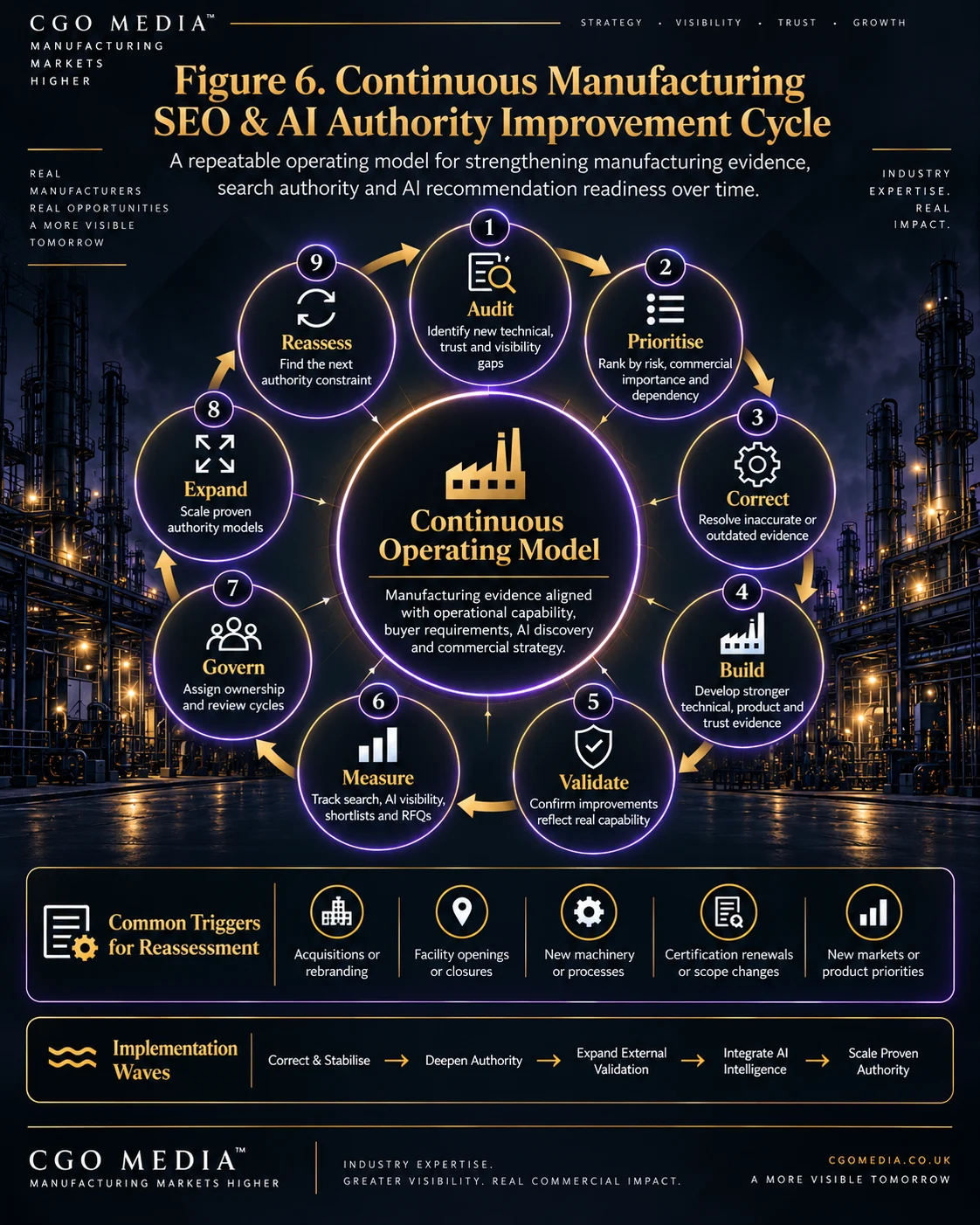
251. The Continuous Manufacturing Authority Cycle
The complete implementation system can be represented as:
Audit → Prioritise → Correct → Build → Validate → Measure → Govern → Expand → Reassess
252. Audit
Re-examine the authority environment to identify new technical, trust, visibility and commercial gaps.
253. Prioritise
Rank improvement opportunities according to:
- Risk
- Commercial importance
- Strategic market relevance
- Dependency
- Resource requirement
254. Correct
Resolve inaccurate, conflicting or outdated evidence before expanding the information architecture.
255. Build
Develop stronger technical, product, industry, trust and external-authority evidence.
256. Validate
Ensure improvements accurately reflect real manufacturing capability and appropriate external evidence.
257. Measure
Track whether authority improvements affect:
- Search visibility
- AI visibility
- Supplier recommendations
- Shortlists
- RFQs
- Commercial outcomes
258. Govern
Assign ownership and review cycles so improvements remain current.
259. Expand
Scale proven authority models into additional strategically valuable areas.
260. Reassess
Repeat the process to identify the next authority constraint.
261. The Roadmap Is a Continuous Operating Model
The final objective is not to complete seven phases and stop.
It is to establish a repeatable operating model that keeps manufacturing evidence aligned with:
- Operational capability
- Buyer requirements
- Search behaviour
- AI discovery
- Competitive conditions
- Commercial strategy
Figure 6 : Continuous Manufacturing SEO & AI Authority Improvement Cycle.
262. Strategic Implications
The Manufacturing SEO & AI Implementation Roadmap reframes implementation as a coordinated authority-building programme rather than a sequence of disconnected SEO tasks.
The strategic objective is to create a manufacturing information environment that is:
- Accurate
- Technically specific
- Commercially relevant
- Verifiable
- Trusted
- Externally supported
- Measurable
- Governed
263. Implementation Should Follow Evidence Dependency
The roadmap deliberately prioritises foundational evidence before advanced visibility activity.
A manufacturer should generally resolve:
- Entity ambiguity
- Facility confusion
- Weak technical evidence
- Certification inaccuracies
- Information inconsistency
before expecting durable gains from AI recommendation or authority-development programmes.
264. Search Authority Is an Organisational Capability
Manufacturing authority cannot be built by marketing alone.
It depends on coordinated input from:
- Engineering
- Quality
- Operations
- Sales
- Marketing
- Leadership
265. The Roadmap Connects Operational Reality with Digital Evidence
The strongest implementation programmes do not create artificial digital authority.
They make real operational capability easier to discover, understand, validate and compare.
266. Technical Evidence Should Support Supplier Selection
Implementation should therefore be evaluated according to whether it helps buyers answer questions such as:
- Can this manufacturer perform the required process?
- Can it work with the required material?
- Can it achieve the required tolerance?
- Does it possess the correct certification?
- Can it support the required production volume?
- Is the supplier operationally and commercially suitable?
267. AI Search Should Be Integrated, Not Isolated
AI visibility should not be treated as a separate marketing discipline disconnected from the wider manufacturing evidence system.
Recommendation readiness is more sustainable when it is supported by:
- Clear manufacturer identity
- Deep technical evidence
- Strong trust signals
- Relevant external authority
- Consistent information
268. AI Observation Should Feed Evidence Improvement
AI monitoring becomes strategically useful when recommendation gaps, source patterns and inaccuracies feed directly back into the implementation cycle.
269. Measurement Should Move Toward Commercial Outcomes
As implementation matures, reporting should progress from:
Rankings → Visibility → Qualified Discovery → Supplier Shortlists → RFQs → Commercial Opportunity
270. Implementation Should Reflect Manufacturing Risk
Higher-risk industries and supplier relationships may require stronger evidence around:
- Certifications
- Traceability
- Quality
- Inspection
- Compliance
- Operational resilience
271. Implementation Should Reflect Commercial Priority
The roadmap should not attempt to optimise every capability, industry and market equally.
Investment should be weighted toward the areas most important to:
- Revenue
- Strategic growth
- Competitive differentiation
- Export development
- Future market opportunity
272. Relationship with the Manufacturing AI Trust and Visibility Framework
The Manufacturing AI Trust and Visibility Framework defines the six evidence and authority dimensions that manufacturing organisations need to strengthen.
The Implementation Roadmap provides the practical sequence for developing those dimensions.
273. Relationship with the Manufacturing Discovery and Supplier Selection Model
The Manufacturing Discovery and Supplier Selection Model explains how buyers move from requirement recognition through supplier discovery, capability evaluation, validation, shortlisting and engagement.
The Roadmap ensures that implementation activity supports those real supplier-selection stages.
274. Relationship with the Manufacturing Search Authority Maturity Model
The Manufacturing Search Authority Maturity Model assesses how advanced the manufacturer has become in building and governing its search authority.
Together, the two assets create a practical management cycle:
Maturity Assessment → Gap Identification → Implementation → Measurement → Reassessment
275. Relationship with the Parent Research
The Roadmap forms part of the research architecture established in Manufacturing SEO in an AI Search Environment.
276. The Manufacturing Research Framework Family
The complete Manufacturing research family consists of:
- Manufacturing SEO in an AI Search Environment — the parent research paper.
- Manufacturing AI Trust and Visibility Framework — the evidence and authority framework.
- Manufacturing Discovery and Supplier Selection Model — the supplier-selection model.
- Manufacturing Search Authority Maturity Model — the organisational maturity model.
- Manufacturing SEO and AI Implementation Roadmap — the implementation roadmap.
277. Methodological Position
The Manufacturing SEO & AI Implementation Roadmap is a conceptual implementation framework intended to help manufacturing organisations sequence improvements across search visibility, technical authority, trust, external validation, AI readiness, measurement and governance.
The seven phases are not intended to imply that every organisation must follow an identical rigid timeline.
Implementation may vary according to:
- Current maturity
- Industry
- Business model
- Risk
- Internal resources
- Commercial objectives
278. The Roadmap Is Not a Confirmed Ranking Model
The roadmap should not be interpreted as describing a confirmed set of search-engine or AI-system ranking factors.
It provides a strategic method for improving the clarity, quality and authority of manufacturing evidence across increasingly complex discovery environments.
279. AI Visibility Cannot Be Guaranteed
No implementation framework can guarantee inclusion within AI-generated recommendations, summaries or citations.
The purpose of the roadmap is to strengthen the evidence environment from which users and machine systems may evaluate the manufacturer.
280. Implementation Should Be Evidence Led
Activities should be prioritised according to observed gaps, buyer needs and commercial importance rather than simply because a tactic is currently popular.
281. Implementation Should Be Measurable
Each major programme should define:
- Baseline
- Target
- Owner
- Evidence required
- Review date
- Success measure
282. Implementation Should Be Governed
Improved information can deteriorate rapidly if responsibility for maintaining it is unclear.
Governance should therefore be treated as part of implementation rather than a final administrative step.
283. Implementation Should Be Continuous
Manufacturing businesses evolve continuously.
Facilities change, machines are added, certifications renew, products evolve and markets shift.
The digital authority system must evolve with them.
284. Conclusion
The Manufacturing SEO & AI Implementation Roadmap defines seven connected phases:
- Baseline, Audit and Strategic Prioritisation
- Entity, Technical and Infrastructure Foundation
- Capability, Product and Industry Authority Development
- Trust, Certification and External Authority Development
- AI Search and Supplier Recommendation Readiness
- Measurement, Governance and Commercial Integration
- Continuous Optimisation and Authority Expansion
The roadmap provides manufacturers with a structured way to move from fragmented digital visibility toward a more mature search authority system.
Its central principle is that advanced visibility depends on the quality of the underlying evidence.
Strong manufacturing authority develops when real operational capability is translated into accurate technical information, supported by trust evidence, validated externally, measured across search and AI environments, and maintained through formal governance.
The strategic objective is not simply to complete SEO actions.
It is to create a continuously improving manufacturing authority system capable of supporting supplier discovery, procurement confidence, AI recommendation readiness and long-term commercial growth.
References
External Academic, Technical and Search Sources
- Google Search Central.
SEO Starter Guide. - Google Search Central. Understand how structured data works.
- Schema.org. Organization.
- Schema.org. Product.
- Schema.org. Person.
- Hogan, A. et al. (2021). Knowledge Graphs. ACM Computing Surveys, 54(4).
- Metzger, M.J. (2007). Making Sense of Credibility on the Web: Models for Evaluating Online Information and Recommendations for Future Research.
Journal of the American Society for Information Science and Technology, 58(13), 2078–2091. - Ji, Z. et al. (2023). Survey of Hallucination in Natural Language Generation. ACM Computing Surveys, 55(12).
CGO Media Research and Frameworks
- Wilkinson, R. (2026). Manufacturing SEO in an AI Search Environment.CGO Media.
- Wilkinson, R. (2026).Manufacturing AI Trust and Visibility Framework.CGO Media.
- Wilkinson, R. (2026). Manufacturing Discovery and Supplier Selection Model.CGO Media.
- Wilkinson, R. (2026). Manufacturing Search Authority Maturity Model.CGO Media.
- Wilkinson, R. (2026).CGO Media Entity Authority Framework.CGO Media.
- Wilkinson, R. (2026).CGO Media Content Authority Framework.CGO Media.
- Wilkinson, R. (2026).CGO Media Brand Signal Framework. CGO Media.
- Wilkinson, R. (2026).CGO Media AI Citation Framework CGO Media.
- Wilkinson, R. (2026). CGO Media AI Search Readiness Framework. CGO Media.
- Wilkinson, R. (2026). CGO Media Knowledge Architecture Map.CGO Media.
CGO Media Research Ecosystem
The Manufacturing SEO & AI Implementation Roadmap forms part of the wider CGO Media research programme examining SEO, AI Search, GEO, entity authority, citation authority, supplier discovery and recommendation-led search.
About Roger Wilkinson
Roger Wilkinson is an independent researcher, SEO practitioner and founder of CGO Media with more than 25 years of experience in search, online visibility and digital strategy.
His current research focuses on how artificial intelligence is reshaping search engines, recommendation systems and digital authority. Through independent research papers and strategic frameworks, Roger examines the relationship between Technical SEO, Entity Authority, Brand Signals, AI Visibility, Citation Authority, Knowledge Graphs and Search Visibility.
Roger is the creator of the CGO Framework Series, a collection of executive-level methodologies designed to help organisations measure, improve and govern their digital visibility in an increasingly AI-centric environment.
View Roger Wilkinson’s researcher profile →
Related Manufacturing Research and Frameworks
- Manufacturing SEO in an AI Search Environment
- Manufacturing AI Trust and Visibility Framework
- Manufacturing Discovery and Supplier Selection Model
- Manufacturing Search Authority Maturity Model
- Manufacturing GEO: Generative Engine Optimisation
Research Usage & Citation
CGO Media encourages researchers, journalists, manufacturers, engineers, procurement professionals, industry bodies, educators and practitioners to reference this roadmap where it contributes to broader understanding of Manufacturing SEO, AI Search, supplier authority and implementation strategy.
Reasonable quotations, summaries, figures and excerpts may be used in articles, reports, presentations and academic work provided appropriate acknowledgement is given.
Cite This Roadmap / Embed Citation
The Manufacturing SEO & AI Implementation Roadmap, developed by Roger Wilkinson at CGO Media, provides a seven-phase implementation methodology for strengthening manufacturing entity clarity, technical authority, supplier trust, external validation, AI recommendation readiness, measurement and governance.
APA Citation
Wilkinson, R. (2026). Manufacturing SEO and AI Implementation Roadmap. CGO Media.
https://cgomedia.com/manufacturing-seo-and-ai-implementation-roadmap/
Supporting Research
This roadmap is supported by the parent research paper:
Manufacturing SEO in an AI Search Environment.
Author: Roger Wilkinson
Published by: CGO Media
For permissions relating to extensive reproduction, commercial licensing or republication of substantial portions of this roadmap, please contact CGO Media directly.