
Manufacturing AI Trust and Visibility Framework
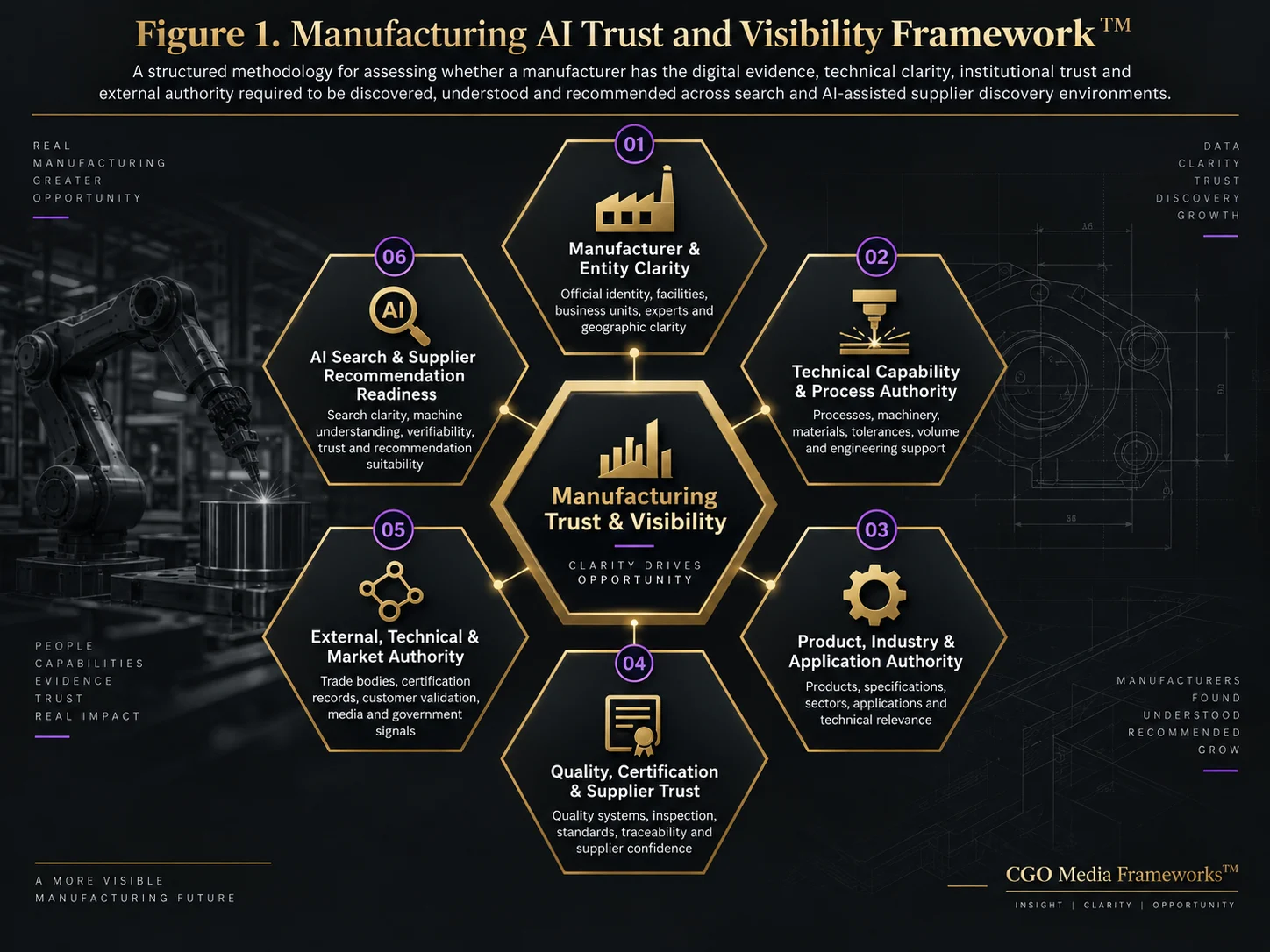
 The Manufacturing AI Trust and Visibility Framework provides a structured methodology for assessing whether a manufacturer possesses the digital evidence, technical clarity, institutional trust and external authority required to be discovered, understood and recommended across search and AI-assisted supplier discovery environments.
It is designed for manufacturers, engineering businesses, contract manufacturers, component suppliers, industrial groups and specialist production companies operating across domestic and international markets.
The framework builds on the parent research paper Manufacturing SEO in an AI Search Environment.
1. Why Manufacturing Needs a Trust and Visibility Framework
Manufacturing search involves unusually high levels of technical and commercial validation.
A buyer may need to establish:
- Whether the supplier can manufacture the required component
- Whether the correct process is available
- Whether required materials can be handled
- Whether certifications are valid
- Whether production volume is suitable
- Whether quality systems are credible
- Whether the supplier operates in the right geography
- Whether external evidence supports the manufacturer’s claims
A framework is therefore needed to assess more than simple visibility.
2. Visibility Without Technical Trust
A manufacturer can rank strongly while still failing to provide enough evidence for a technical buyer to proceed.
Generic commercial copy may generate impressions, but it may not reduce procurement uncertainty.
3. Technical Capability Without Discoverability
The opposite problem also occurs.
A manufacturer may possess exceptional machinery, engineering expertise and quality systems while communicating them poorly online.
This creates a visibility gap between operational capability and digital evidence.
4. The Six Dimensions of Manufacturing Trust and Visibility
The framework evaluates six connected dimensions:
- Manufacturer and Entity Clarity
- Technical Capability and Process Authority
- Product, Industry and Application Authority
- Quality, Certification and Supplier Trust
- External, Technical and Market Authority
- AI Search and Supplier Recommendation Readiness
5. Dimension One — Manufacturer and Entity Clarity
The first dimension assesses whether the manufacturer is represented consistently and unambiguously across its digital environment.
6. Official Manufacturer Identity
The organisation should maintain consistent information around:
- Official business name
- Trading names
- Parent organisation
- Subsidiaries
- Headquarters
- Production facilities
7. Multi-Site Entity Clarity
Where multiple factories or business units exist, their relationship with the wider manufacturing group should be explicit.
8. Facility Entity Clarity
Each manufacturing facility should make clear:
- Location
- Capabilities
- Certifications
- Industries served
- Production role
9. Business Unit Clarity
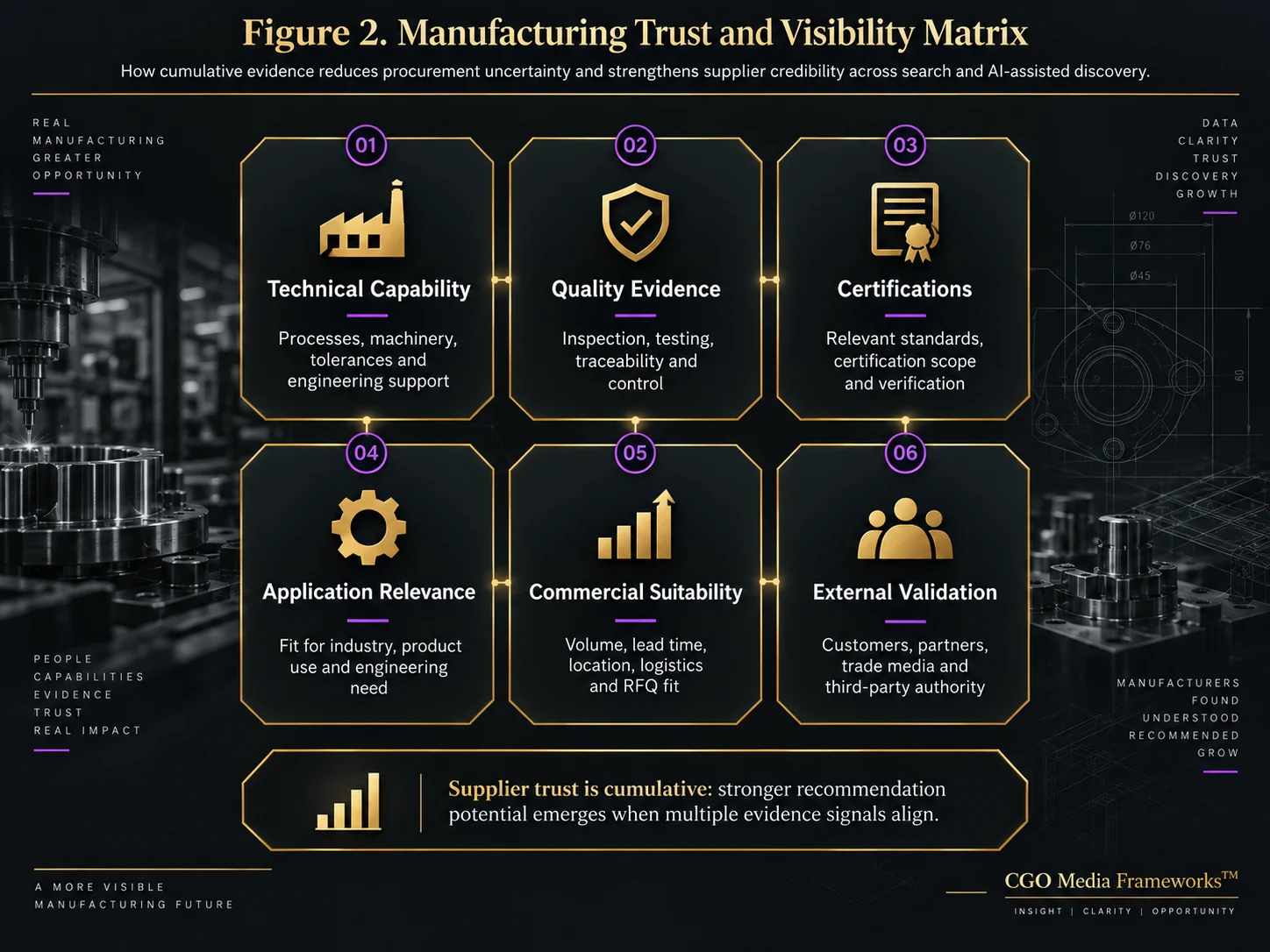
Manufacturing groups operating specialist divisions should explain which products, processes and markets belong to each unit.
10. Leadership Entity Clarity
Senior leadership and technical management should be represented accurately where their expertise contributes to institutional credibility.
11. Engineer and Expert Entity Clarity
Engineers and technical specialists can become meaningful authority entities when connected with:
- Processes
- Materials
- Industries
- Research
- Case studies
- Technical commentary
12. Manufacturer Relationship Clarity
The digital environment should distinguish clearly between:
- Manufacturer
- Distributor
- Reseller
- Partner
- Parent company
- Subsidiary
13. Geographic Entity Clarity
The manufacturer should make clear which locations are:
- Headquarters
- Factories
- Sales offices
- Distribution centres
- Service locations
14. Dimension Two — Technical Capability and Process Authority
The second dimension assesses whether the manufacturer demonstrates genuine production capability rather than relying on broad commercial claims.
15. Process Authority
Core manufacturing processes should be documented with sufficient depth to demonstrate operational reality.
16. Machine Capability Authority
Where relevant, the organisation should explain:
- Machine types
- Axis capability
- Working envelope
- Automation
- Inspection equipment
- Secondary processes
17. Material Authority
Materials should be connected with:
- Processes
- Applications
- Performance requirements
- Industries
18. Tolerance Authority
Claims of precision should be supported with meaningful evidence around achievable tolerances, inspection and process control.
19. Production Volume Authority
Manufacturers should make clear whether they are suited to:
- Prototype work
- Low-volume production
- Medium-volume production
- High-volume production
20. Prototype-to-Production Authority
Where relevant, manufacturers should explain how they support the progression from concept and prototype through tooling, pilot production and full manufacturing.
21. Engineering Support Authority
Engineering support can include:
- Design-for-manufacture
- CAD support
- Process optimisation
- Material selection
- Prototype development
- Testing
22. Technical Documentation Authority
Technical documents can reinforce capability when they are current, consistent and connected with relevant products, processes and facilities.
Figure 1 : Manufacturing AI Trust and Visibility Framework.
23. Dimension Three — Product, Industry and Application Authority
The third dimension assesses whether the manufacturer demonstrates clear relevance to the products, markets and use cases buyers actually search for.
24. Product Authority
Product authority is strongest where product information explains:
- What the product is
- How it is manufactured
- Which materials are used
- Which applications it supports
- Which industries it serves
- Which standards or certifications are relevant
25. Product Family Architecture
Manufacturers with multiple product lines should structure relationships between:
- Product families
- Individual products
- Materials
- Applications
- Industries
- Technical documentation
26. Product Specification Authority
Where appropriate, product evidence should include clear and current information around:
- Dimensions
- Performance characteristics
- Materials
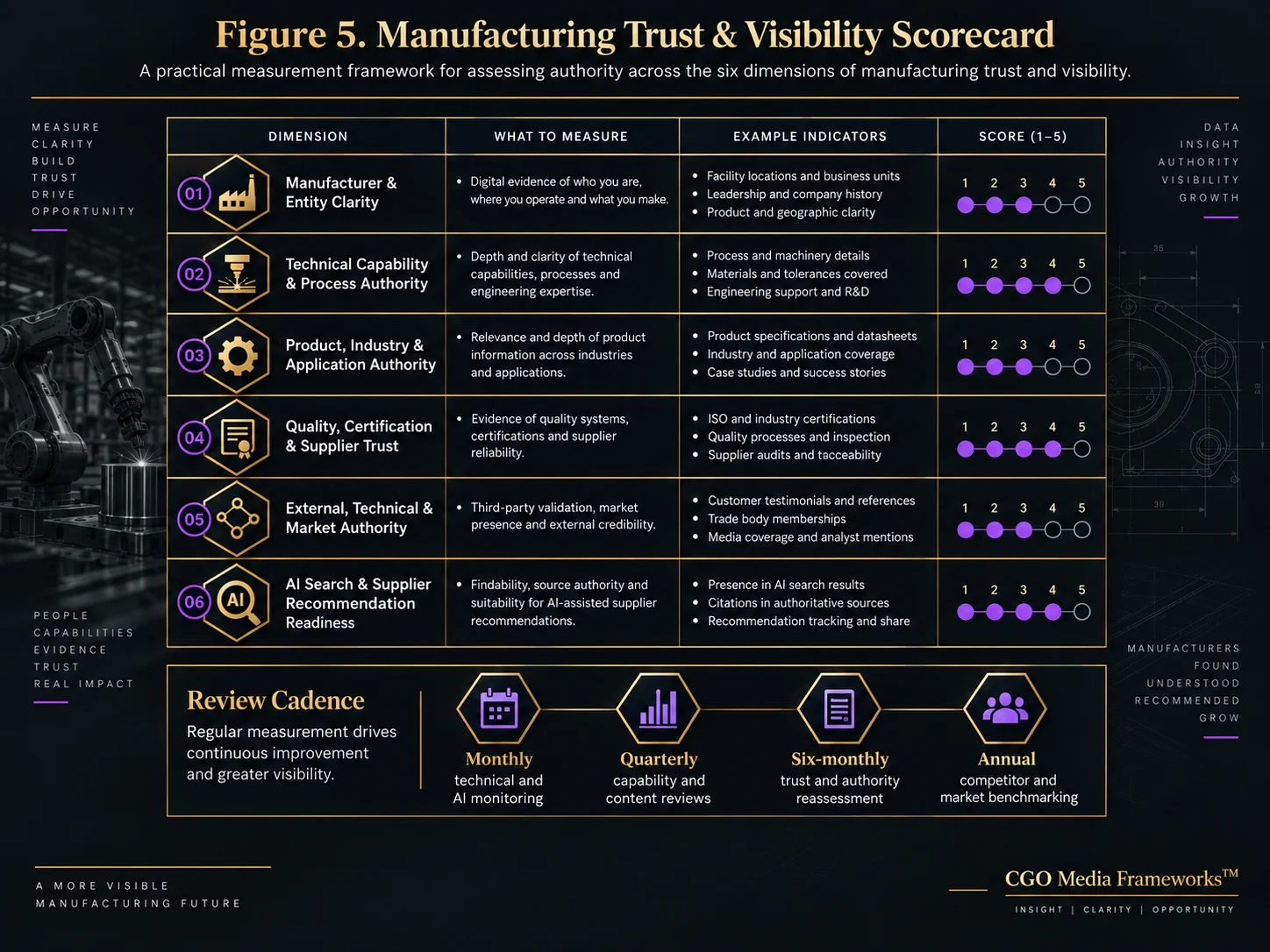
- Compatibility
- Operating conditions
- Relevant standards
27. Application Authority
Application content connects manufacturing capability with the buyer’s practical engineering or commercial requirement.
Examples may include:
- Aerospace structural components
- Medical-device assemblies
- Automotive prototype parts
- Food-processing equipment
- Energy-sector fabrication
28. Industry Authority
Industry authority develops when the manufacturer demonstrates genuine understanding of sector-specific requirements rather than publishing generic vertical pages.
29. Aerospace Authority
Aerospace evidence may include:
- Relevant certifications
- Traceability
- Materials
- Tolerances
- Inspection
- Case studies
30. Automotive Authority
Automotive authority may depend on:
- Production scale
- Repeatability
- Quality systems
- Cost control
- Supply-chain reliability
31. Medical Manufacturing Authority
Medical manufacturing evidence may need to demonstrate:
- Regulatory awareness
- Quality management
- Material control
- Traceability
- Documentation
- Production cleanliness
32. Energy and Industrial Authority
Energy and industrial applications may require stronger evidence around durability, materials, testing, scale and long-term operational reliability.
33. Industry Evidence Should Be Specific
A manufacturer should be able to explain why its capabilities are relevant to the operational requirements of a particular market.
Simply naming an industry provides limited authority.
34. Application-to-Process Relationships
Applications should connect clearly with the manufacturing processes used to produce the relevant component or product.
35. Application-to-Material Relationships
Material choices should be explained where they influence:
- Performance
- Durability
- Weight
- Corrosion resistance
- Temperature tolerance
- Cost
36. Case Studies as Application Evidence
Case studies can provide strong application authority where they demonstrate:
- Problem
- Technical requirement
- Process
- Material
- Solution
- Outcome
37. Customer Confidentiality and Industry Evidence
Manufacturers operating under confidentiality restrictions can still demonstrate sector expertise through anonymised technical evidence.
38. Dimension Four — Quality, Certification and Supplier Trust
The fourth dimension assesses whether the manufacturer provides enough evidence to reduce procurement and operational risk.
39. Quality Management Authority
Quality authority can be demonstrated through:
- Quality-management systems
- Inspection processes
- Testing procedures
- Traceability
- Non-conformance processes
- Continuous improvement
40. Certification Authority
Certifications should be represented accurately and with sufficient context.
Important information may include:
- Certification name
- Certification scope
- Applicable business entity
- Applicable facility
- Current status
- Relevant industry
41. Certification Verification
Where independent verification exists, manufacturers should make it easy for buyers to confirm certification status.
42. Certification Scope Clarity
A manufacturing group should avoid implying that a certification applies across all facilities where it covers only one site or business unit.
43. Standards Authority
Manufacturers should connect standards with the products, processes or industries to which they actually apply.
44. Inspection Authority
Inspection evidence can include:
- Measurement equipment
- Inspection stages
- Final inspection
- Documentation
- Traceability
45. Traceability Authority
Traceability can become a critical trust signal where buyers require reliable records of:
- Materials
- Batches
- Processes
- Inspection
- Production history
46. Supply-Chain Trust
Supplier trust may depend on evidence around:
- Material sourcing
- Business continuity
- Alternative capacity
- Inventory
- Logistics
- Lead-time resilience
47. Commercial Trust
Commercial clarity can reduce friction around:
- Minimum order quantities
- Production volumes
- Lead times
- RFQ processes
- Prototype availability
48. Sustainability and Environmental Trust
Where relevant to procurement, manufacturers can provide evidence around:
- Environmental management
- Energy efficiency
- Waste reduction
- Recycling
- Material efficiency
- Carbon reporting
49. Governance and Ethical Trust
Larger procurement environments may also examine:
- Health and safety
- Modern slavery policies
- Ethical sourcing
- Governance
- Workforce standards
50. Customer Trust Evidence
Customer evidence may include:
- Case studies
- Testimonials
- Named clients where permitted
- Repeat relationships
- Industry references
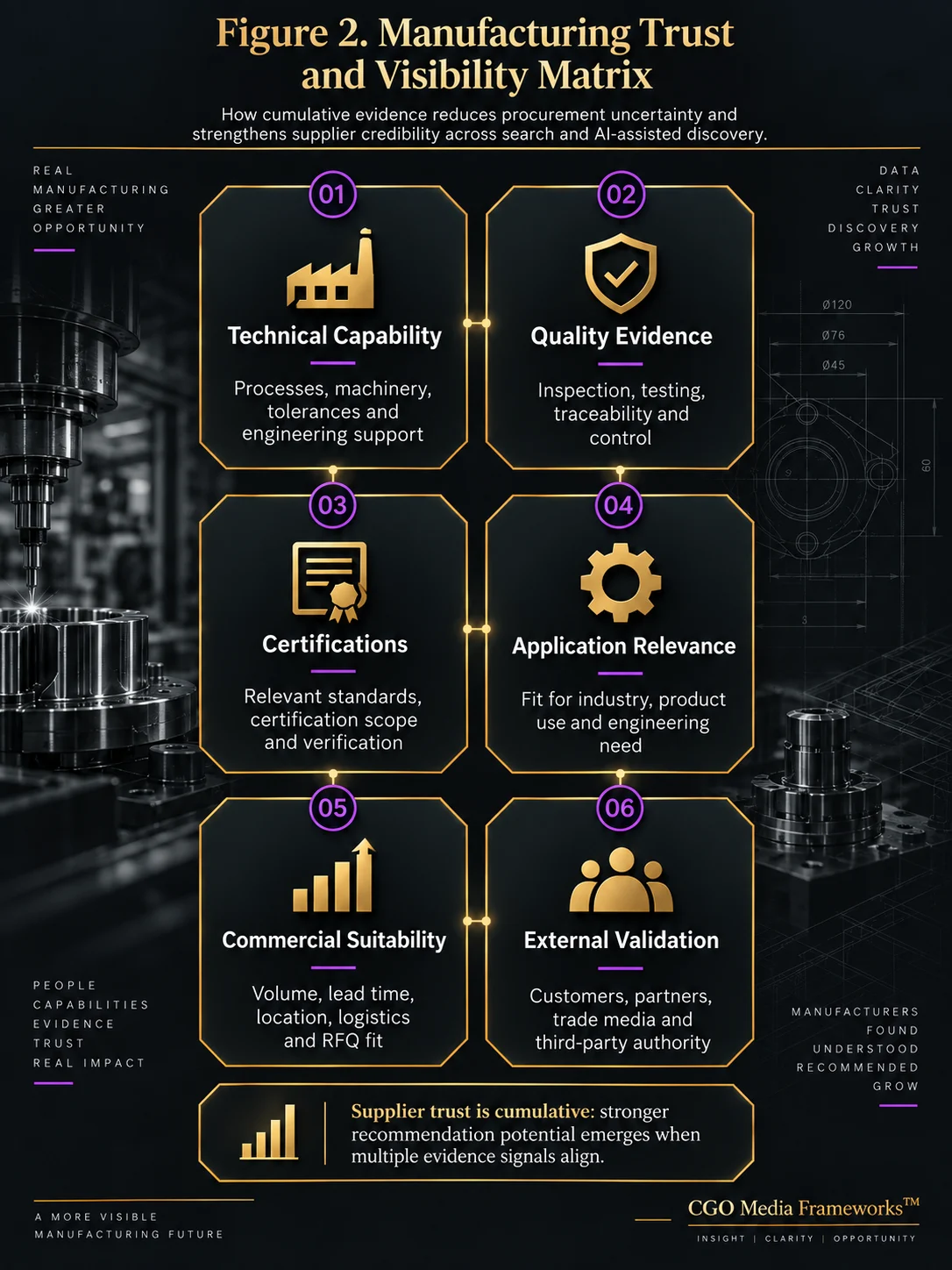
51. Supplier Trust Is Cumulative
Manufacturing trust rarely depends on one signal.
It develops through the combined strength of:
- Technical capability
- Quality evidence
- Certifications
- Application relevance
- Commercial suitability
- External validation
Figure 2 : Manufacturing Trust and Visibility Matrix.
52. Dimension Five — External, Technical and Market Authority
The fifth dimension evaluates whether credible third-party sources reinforce the manufacturer’s claimed technical capability, market relevance and institutional credibility.
Manufacturing authority becomes stronger when the wider information environment consistently connects the company with the processes, products, industries and capabilities it wants to be known for.
53. Trade Association Authority
Membership of recognised industry bodies can strengthen external authority where the relationship is current and relevant.
54. Certification Body Authority
Independent certification records can provide important validation of:
- Quality systems
- Environmental standards
- Industry certifications
- Facility-specific compliance
55. Customer Authority
External references from customers can provide strong evidence where they confirm:
- Supplier relationships
- Technical capability
- Industry relevance
- Production quality
- Long-term reliability
56. Distributor and Partner Authority
Distributors and commercial partners can reinforce relationships between the manufacturer and its:
- Products
- Markets
- Territories
- Applications
57. Technical Media Authority
Trade and engineering publications may strengthen authority through:
- Technical interviews
- Factory investment coverage
- Product launches
- Engineering case studies
- Expert commentary
- Industry research
58. Government Authority
Manufacturing organisations may gain validation through:
- Government innovation programmes
- Export initiatives
- Regional development schemes
- Industrial strategy programmes
- Grant-supported projects
59. Academic Authority
University and research relationships can reinforce technical expertise where the manufacturer participates in:
- Materials research
- Engineering development
- Manufacturing innovation
- Automation projects
- Testing programmes
60. Research Authority
Original manufacturing research can create stronger external authority where it provides genuinely useful data or analysis.
Potential subjects may include:
- Reshoring trends
- Automation adoption
- Skills shortages
- Supply-chain resilience
- Energy costs
- Production lead times
- Material trends
61. Technical Citation Authority
Technical resources may earn citations when they provide reliable, useful information around:
- Manufacturing processes
- Materials
- Tolerances
- Design-for-manufacture
- Industry standards
- Production constraints
62. Citation Relevance
The strategic value of external recognition depends on relevance as well as volume.
A citation from a recognised engineering publication may be more meaningful for a specialist manufacturer than numerous unrelated mentions.
63. Citation Diversity
A resilient external authority environment may include:
- Customers
- Trade associations
- Certification organisations
- Government bodies
- Universities
- Industry media
- Commercial partners
64. Geographic Citation Authority
Manufacturers operating in multiple markets should consider whether external recognition exists within the countries and regions they want to serve.
65. Industry-Specific Citation Authority
External authority becomes more useful when the manufacturer is associated consistently with strategically important sectors.
66. Process-Specific Citation Authority
A manufacturer seeking authority for a specialist capability should ideally receive external recognition in contexts directly related to that process.
67. Digital PR as Manufacturing Authority Development
Digital PR can strengthen manufacturing authority when campaigns are built around substantive industrial evidence rather than generic publicity.
Potential themes include:
- New production investment
- Manufacturing innovation
- Original industry research
- Export growth
- Automation
- Sustainability
- Workforce development
68. External Authority as Independent Verification
Third-party references create an important validation layer between what the manufacturer claims and how the wider market recognises it.
69. Dimension Six — AI Search and Supplier Recommendation Readiness
The sixth dimension assesses whether the manufacturer possesses sufficiently clear, current and validated evidence to participate credibly in AI-assisted supplier discovery.
70. AI Manufacturer Visibility
Manufacturers can monitor whether they appear in prompts relating to:
- Relevant suppliers
- Manufacturing companies
- Specialist processes
- Industry-specific manufacturers
- Geographic supplier searches
71. AI Process Visibility
Process-level monitoring can examine whether AI systems associate the company with its actual manufacturing capabilities.
72. AI Product Visibility
Product manufacturers can test whether relevant product families appear within AI-assisted discovery.
73. AI Material Visibility
Manufacturers can assess whether their experience with strategically important materials is represented accurately.
74. AI Industry Visibility
Industry-level prompts can reveal whether the manufacturer is associated with the sectors it genuinely serves.
75. AI Certification Visibility
Certification-led prompts can identify whether AI systems understand which standards and certifications apply to the manufacturer.
76. AI Facility Visibility
Multi-site organisations should test whether specific production facilities are represented accurately.
77. AI Source Visibility
Where citations or source information are available, manufacturers can identify whether their technical resources are being used within generated answers.
78. AI Citation Visibility
Potential source assets may include:
- Technical guides
- Process pages
- Product documentation
- Research
- Case studies
- Material guides
79. AI Supplier Recommendation Visibility
Manufacturers should monitor whether they appear within relevant supplier recommendation sets.
80. AI Comparison Visibility
Direct comparison prompts can reveal which evidence AI systems associate with competing manufacturers.
81. AI Representation Accuracy
Important facts should be monitored for accuracy, including:
- Company name
- Facilities
- Capabilities
- Products
- Materials
- Industries
- Certifications
82. AI Temporal Accuracy
Manufacturing information can become outdated as:
- Facilities change
- Machines are added
- Certifications expire or renew
- Products are discontinued
- Capabilities expand
83. AI Supplier Recommendation Readiness
Recommendation readiness develops cumulatively from:
- Clear entity identity
- Demonstrated technical capability
- Product and industry relevance
- Quality and certification evidence
- External validation
- Commercial suitability
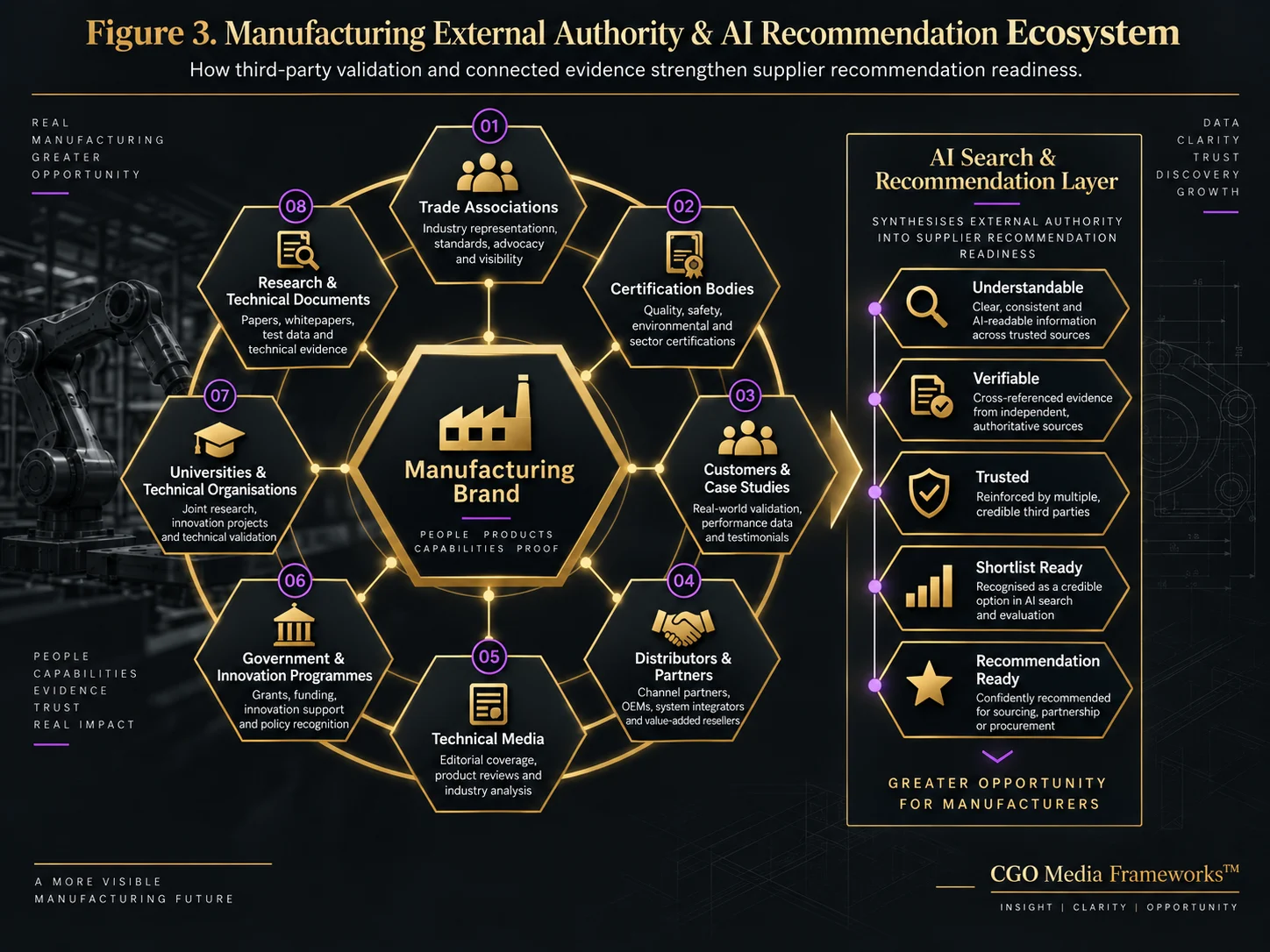
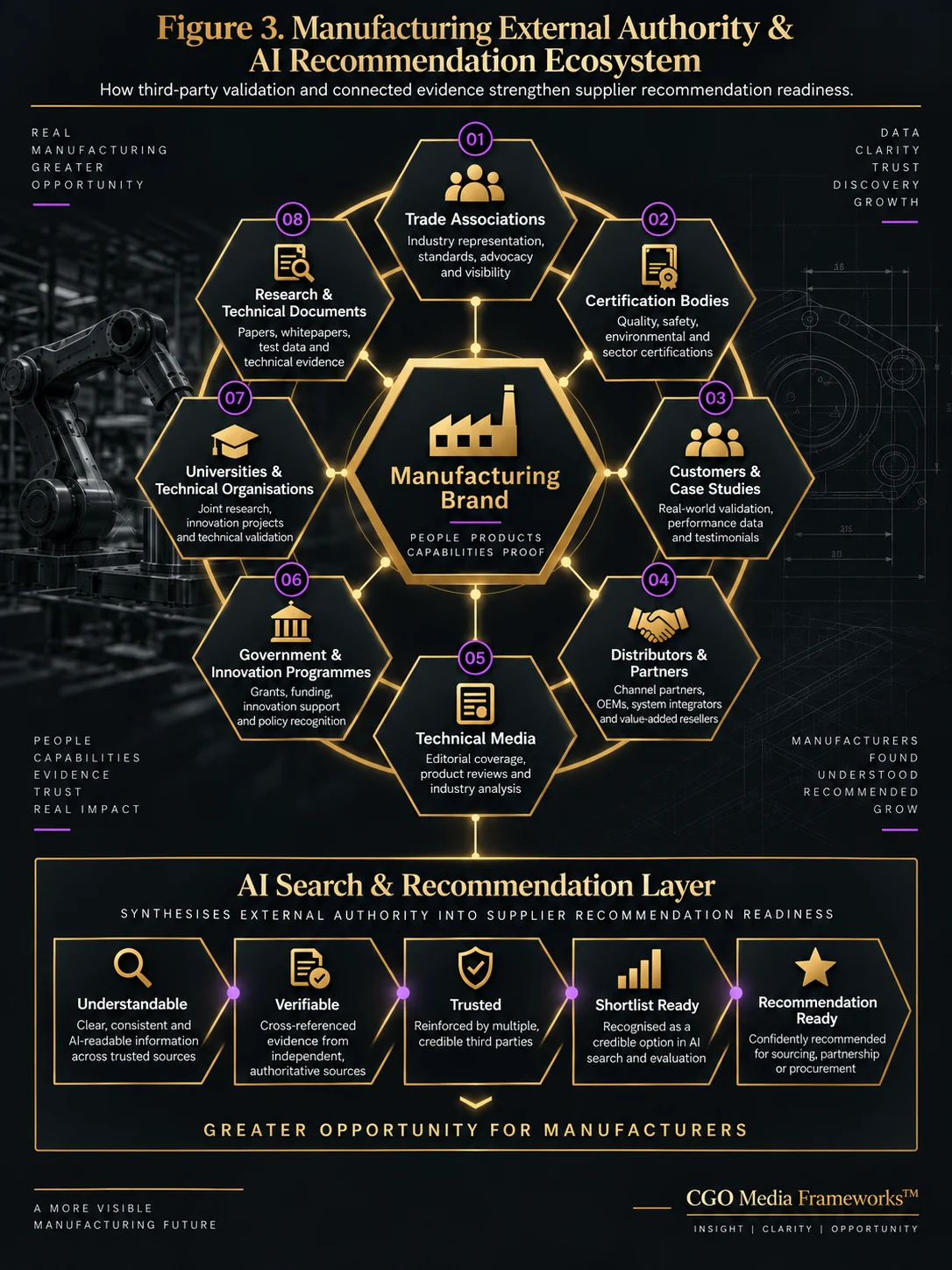
84. Recommendation Readiness Is Not a Single Signal
No single piece of content, citation or technical optimisation is likely to determine whether a manufacturer becomes a credible recommendation candidate.
The framework therefore treats recommendation readiness as an authority outcome produced by the wider manufacturing evidence ecosystem.
Figure 3 : Manufacturing External Authority & AI Recommendation Ecosystem.
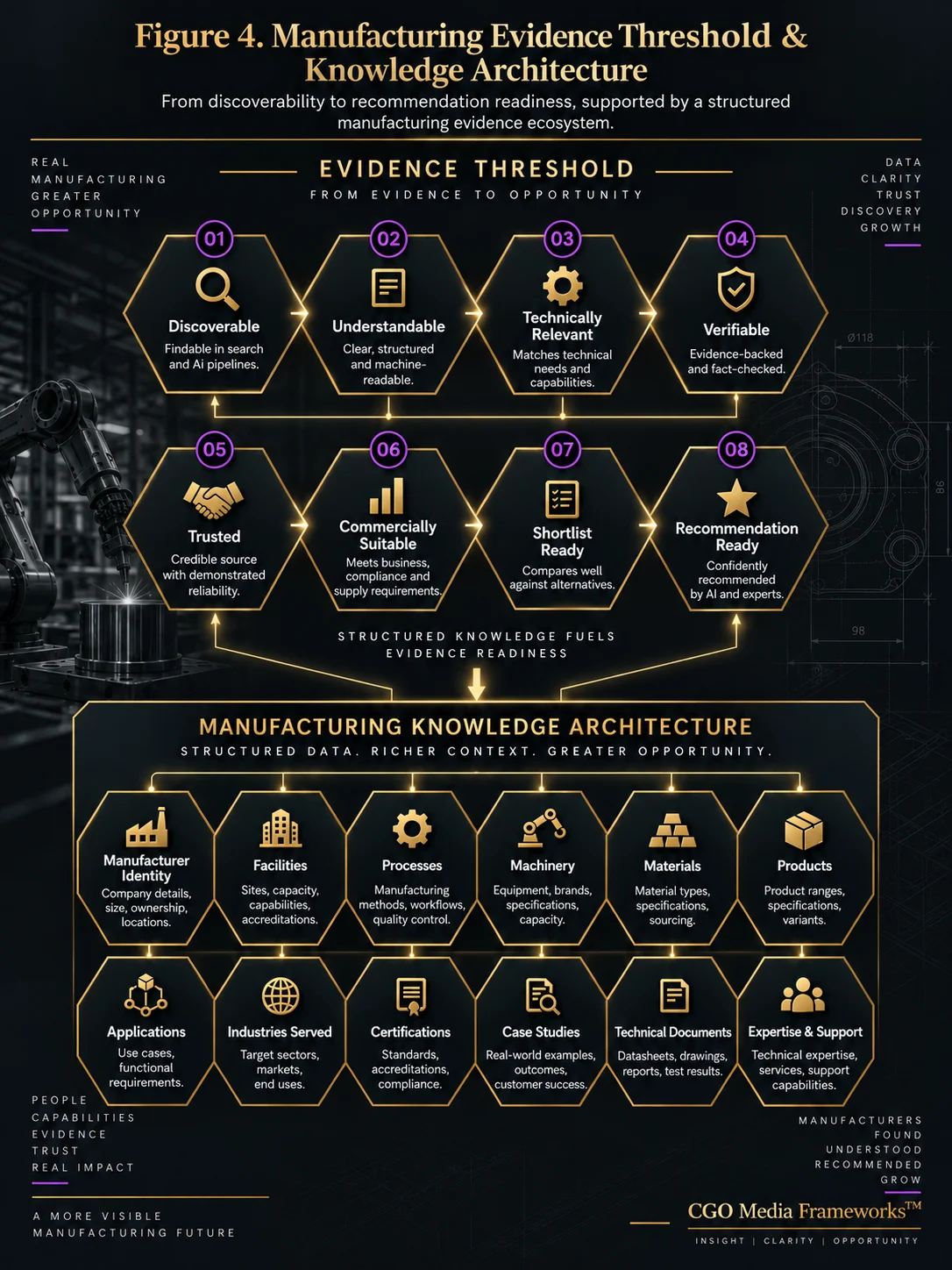
85. The Manufacturing Evidence Threshold
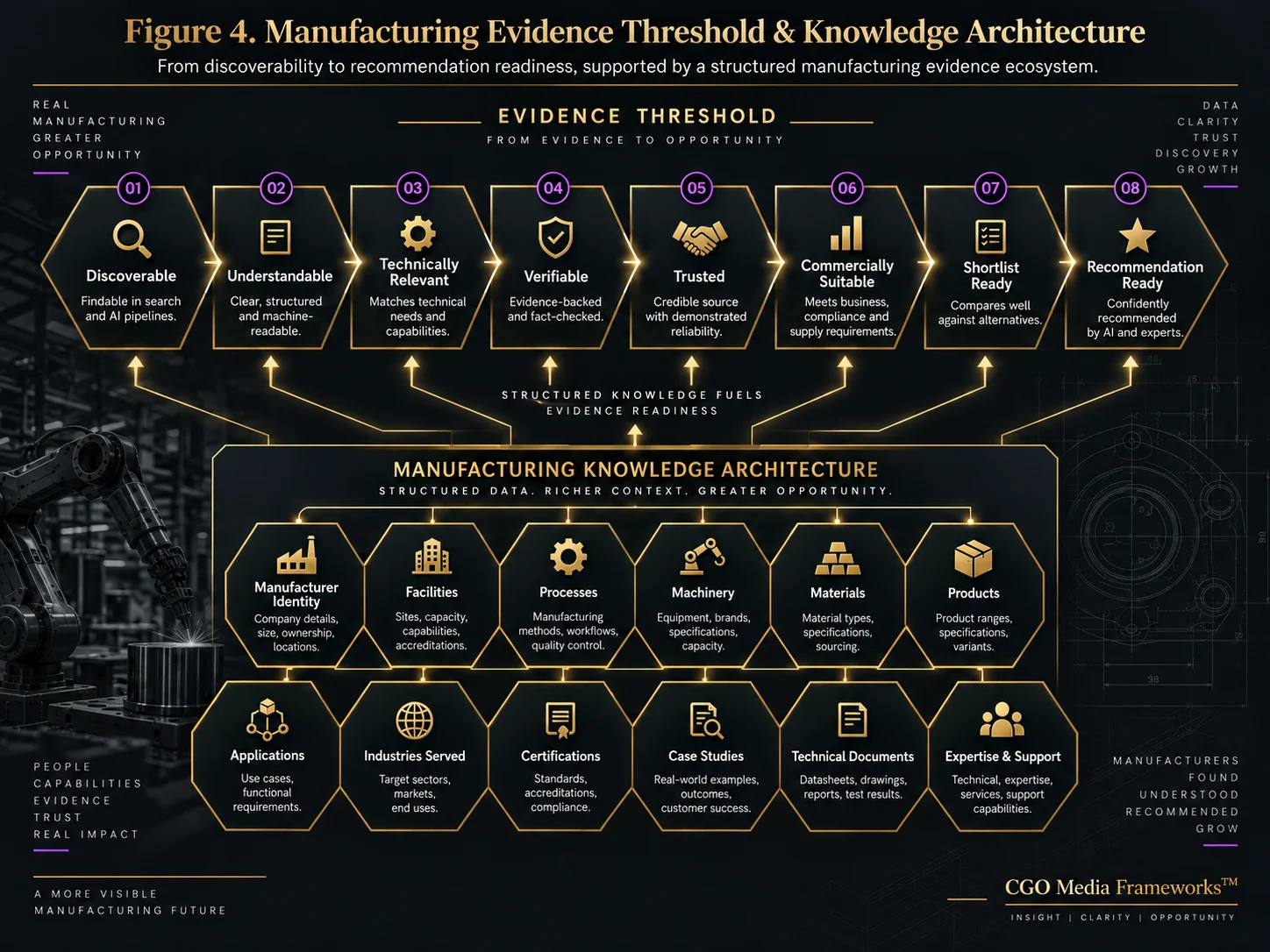
The Manufacturing AI Trust and Visibility Framework uses an evidence progression to assess whether a manufacturer possesses enough information and external validation to move from simple visibility toward credible supplier recommendation.
The progression can be represented as:
Discoverable → Understandable → Technically Relevant → Verifiable → Trusted → Commercially Suitable → Shortlist Ready → Recommendation Ready
86. Discoverable
The manufacturer can be found through relevant search, AI, industry or supplier-discovery environments.
87. Understandable
Users and machine systems can determine:
- Who the manufacturer is
- What it produces
- Which processes it operates
- Where it manufactures
- Which industries it serves
88. Technically Relevant
The manufacturer demonstrates capabilities that match the buyer’s engineering or production requirement.
Relevant evidence may involve:
- Process capability
- Materials
- Tolerances
- Production volumes
- Machine capability
- Industry experience
89. Verifiable
Important claims can be checked against:
- Technical specifications
- Case studies
- Certifications
- Facility evidence
- Customer references
- Independent sources
90. Trusted
Quality systems, certification, operational history and external recognition provide sufficient confidence to continue supplier evaluation.
91. Commercially Suitable
The manufacturer appears capable of satisfying commercial and operational constraints such as:
- Production volume
- Lead time
- Location
- Logistics
- Quality requirements
- RFQ requirements
92. Shortlist Ready
The manufacturer possesses sufficient technical relevance, trust and commercial suitability to remain within a smaller procurement consideration set.
93. Recommendation Ready
The manufacturer possesses sufficiently coherent and validated evidence to become a credible candidate within AI-assisted supplier recommendations.
94. The Six Dimensions Must Reinforce One Another
The framework should not be interpreted as six isolated optimisation areas.
The strongest Manufacturing Search Authority emerges when the six dimensions reinforce one another.
95. Entity Clarity Supports Technical Understanding
Clear company, facility and business-unit relationships help users and machine systems determine where manufacturing capability actually resides.
96. Technical Capability Supports Relevance
Process, material, tolerance and production evidence helps establish whether the manufacturer is suitable for a specific requirement.
97. Product and Industry Authority Supports Context
Product, application and industry evidence explains where manufacturing capabilities are relevant in practical commercial environments.
98. Quality and Certification Support Trust
Quality systems, certifications and inspection evidence reduce uncertainty around supplier reliability.
99. External Authority Supports Independent Validation
Recognition from customers, technical organisations, trade media, government bodies and research institutions provides evidence beyond the manufacturer’s own claims.
100. AI Recommendation Readiness Reflects the Whole System
AI supplier visibility is more likely to be durable where the wider manufacturing evidence environment is already clear, relevant, trusted and independently validated.
101. Manufacturing Knowledge Architecture
A useful manufacturing knowledge architecture can connect:
Manufacturer → Facility → Process → Material → Product → Industry → Application → Certification → Evidence
102. Manufacturer-to-Facility Relationships
Multi-site organisations should make clear which facilities provide which manufacturing capabilities.
103. Facility-to-Process Relationships
Facility pages should connect directly with the processes, machinery and certifications relevant to that site.
104. Process-to-Material Relationships
Process pages should explain which materials the manufacturer can handle and where capability differs according to material properties.
105. Process-to-Product Relationships
Manufacturing processes should connect with representative products, components or assemblies where appropriate.
106. Product-to-Industry Relationships
Products should connect with the industries and operational environments in which they are used.
107. Industry-to-Application Relationships
Industry pages should demonstrate practical applications rather than functioning as generic vertical landing pages.
108. Certification-to-Facility Relationships
Certification evidence should make clear which facility, legal entity or production environment is covered.
109. Case Studies as Relationship Evidence
Case studies can connect multiple authority dimensions by demonstrating:
- Industry
- Application
- Process
- Material
- Technical requirement
- Quality evidence
- Outcome
110. Internal Linking as Manufacturing Knowledge Infrastructure
Internal linking should help users and machines move between related manufacturing entities.
For example:
Aerospace → Titanium → 5-Axis Machining → AS9100 → Case Study → Facility
111. Technical Documents Should Not Become Information Silos
Datasheets, certification documents and technical PDFs can provide valuable evidence, but important information should also be represented within the wider website architecture.
112. Structured Data and Manufacturing Entity Relationships
Appropriate structured data may help reinforce visible relationships between relevant entities.
Potential types can include:
- Organization
- LocalBusiness where genuinely appropriate
- Product
- Person
- Article
- BreadcrumbList
113. Structured Data Does Not Create Manufacturing Authority
Markup can clarify information, but it cannot compensate for:
- Weak capability evidence
- Outdated certifications
- Generic industry pages
- Inconsistent facility information
- Limited external validation
114. Evidence Consistency Across Channels
Important manufacturing information should remain broadly consistent across:
- Corporate website
- Technical documentation
- Distributor listings
- Industry profiles
- Certification records
- Commercial documentation
115. Facility Evidence Consistency
Manufacturers should avoid situations where different pages provide conflicting information about:
- Production locations
- Capabilities
- Machinery
- Certifications
- Industries served
116. Product Evidence Consistency
Product specifications should remain aligned across website pages, technical PDFs and distributor information.
117. Certification Evidence Consistency
Certification names, scopes and applicable facilities should be represented consistently wherever they appear.
118. Manufacturing Trust Gap Analysis
The six dimensions can be used to identify areas where digital evidence is incomplete, ambiguous, outdated or insufficiently validated.
119. Entity Clarity Gaps
Common entity gaps may include:
- Conflicting company names
- Unclear business-unit relationships
- Poor facility differentiation
- Outdated addresses
- Weak manufacturer-versus-distributor clarity
120. Technical Capability Gaps
Capability gaps may include:
- Generic process descriptions
- Missing tolerance information
- Weak material evidence
- No production-volume clarity
- Outdated machinery information
121. Product and Industry Authority Gaps
These may include:
- Thin product pages
- Generic sector pages
- Weak application evidence
- No process-to-industry relationships
- Limited case studies
122. Supplier Trust Gaps
Trust weaknesses may include:
- Ambiguous certifications
- Weak quality information
- No inspection evidence
- Limited supply-chain evidence
- Little customer validation
123. External Authority Gaps
A manufacturer may possess strong technical capability but limited independent recognition within relevant industrial environments.
124. AI Visibility Gaps
AI gaps may include:
- Missing supplier recommendations
- Incorrect capability associations
- Outdated certification information
- Weak source visibility
- Poor industry association
125. AI Source Gap Analysis
Manufacturers can identify which competitor or third-party sources repeatedly appear in AI-generated answers while their own evidence is absent.
126. AI Recommendation Gap Analysis
Repeated supplier prompts can reveal where peer manufacturers consistently enter shortlists while the organisation does not.
127. Prioritising Manufacturing Trust Improvements
Improvements should normally be prioritised according to the evidence gap most strongly constraining technical relevance, trust or supplier selection.
128. Accuracy Before Expansion
Correcting outdated capability, facility and certification information should generally take priority over publishing additional generic content.
129. Commercially Important Capabilities First
Manufacturers can prioritise the products, processes, materials and industries that contribute most strongly to commercial objectives.
130. Priority Markets First
Where geographic resources are limited, authority development can focus initially on strategically important markets and export regions.
131. Evidence Quality Before Content Volume
The framework prioritises accurate, specific and verifiable technical evidence over simply increasing publishing frequency.
Figure 4 : Manufacturing Evidence Threshold & Knowledge Architecture.
132. Measuring Manufacturing Trust and Visibility
The Manufacturing AI Trust and Visibility Framework can be measured across the six dimensions to identify where authority is strongest and where technical, institutional or external evidence remains insufficient.
133. Measuring Manufacturer and Entity Clarity
Relevant indicators may include:
- Business-name consistency
- Facility clarity
- Business-unit clarity
- Leadership accuracy
- Manufacturer-versus-distributor clarity
- Geographic entity consistency
134. Measuring Technical Capability and Process Authority
Relevant indicators can include:
- Process-page depth
- Machine capability visibility
- Material coverage
- Tolerance clarity
- Production-volume clarity
- Engineering support evidence
135. Measuring Product, Industry and Application Authority
This dimension can be assessed through:
- Product completeness
- Industry-page quality
- Application evidence
- Case studies
- Product-to-industry relationships
- Application-to-process relationships
136. Measuring Quality, Certification and Supplier Trust
Relevant indicators may include:
- Certification accuracy
- Certification scope clarity
- Inspection evidence
- Traceability information
- Supply-chain evidence
- Customer validation
137. Measuring External, Technical and Market Authority
External authority can be assessed through:
- Trade association references
- Certification body validation
- Customer citations
- Industry media coverage
- Government references
- Academic or technical citations
138. Measuring AI Search and Supplier Recommendation Readiness
AI visibility can be evaluated through:
- Manufacturer mentions
- Process associations
- Product visibility
- Industry visibility
- Certification accuracy
- Source visibility
- Supplier recommendation visibility
139. Manufacturing Trust and Visibility Scorecard
A practical scorecard can assess each dimension according to the strength, accuracy and consistency of the available evidence.
| Dimension | Assessment Focus | Key Question |
|---|---|---|
| Manufacturer and Entity Clarity | Business identity, facilities, business units and geographic relationships. | Can users and machines understand who the manufacturer is and where capability resides? |
| Technical Capability and Process Authority | Processes, machinery, materials, tolerances, volumes and engineering support. | Does the organisation demonstrate real manufacturing capability with sufficient technical specificity? |
| Product, Industry and Application Authority | Products, sectors, applications and practical use cases. | Is it clear where the manufacturer’s capabilities are relevant? |
| Quality, Certification and Supplier Trust | Quality systems, certifications, traceability and procurement confidence. | Is sufficient evidence available to reduce supplier risk? |
| External, Technical and Market Authority | Independent validation from credible industrial and institutional sources. | Do relevant external sources validate the manufacturer’s authority? |
| AI Search and Supplier Recommendation Readiness | AI representation, sourcing, comparison and shortlist visibility. | Is the manufacturer represented accurately and competitively within AI-assisted supplier discovery? |
140. Scoring Should Reflect Evidence Quality
The scorecard should not reward content volume alone.
A manufacturer with fewer but stronger capability pages may possess higher authority than one with hundreds of thin, repetitive pages.
141. Longitudinal Measurement
Manufacturing trust and visibility should be measured over time.
This helps determine whether evidence quality, external validation and AI representation are genuinely improving.
142. Capability-Level Benchmarking
Manufacturers can compare individual capability areas such as:
- CNC machining
- Injection moulding
- Fabrication
- Assembly
- Tooling
143. Industry-Level Benchmarking
Authority may differ considerably between industries.
A manufacturer may possess strong aerospace visibility while remaining weak in medical or energy markets.
144. Product-Level Benchmarking
Product families can be assessed independently where they have distinct markets, competitors or buying journeys.
145. Facility-Level Benchmarking
Multi-site groups can compare the digital authority of different production facilities.
146. Geographic Benchmarking
Manufacturers can compare visibility and authority across:
- Local markets
- National markets
- Export markets
- Priority international regions
147. Competitor Benchmarking
Competitor benchmarking should compare more than rankings.
Useful areas may include:
- Technical content depth
- Facility clarity
- Certification evidence
- Industry authority
- External citations
- AI recommendation visibility
148. AI Benchmarking
Repeatable prompt sets can be used to compare how often different manufacturers appear in:
- Supplier recommendations
- Process recommendations
- Industry-specific lists
- Certification-led searches
- Direct supplier comparisons
149. Source Benchmarking
Manufacturers can examine which sources dominate AI-generated answers and compare their own evidence with those sources.
150. Supplier Shortlist Share
A useful emerging metric is the proportion of commercially relevant supplier scenarios in which the manufacturer appears within the consideration set.
151. Manufacturing Trust Governance
Measurement becomes more useful when ownership exists for each authority dimension.
152. Entity Governance
A defined owner should maintain:
- Business identity
- Facilities
- Business units
- Locations
- Leadership
153. Technical Capability Governance
Engineering or operations teams should validate:
- Processes
- Materials
- Machinery
- Tolerances
- Production volumes
154. Product and Industry Governance
Product and sector information should remain aligned with actual operational capability and commercial strategy.
155. Certification Governance
Quality teams should maintain:
- Certification status
- Scope
- Applicable site
- Renewal dates
- Supporting evidence
156. External Authority Governance
Marketing, communications and leadership teams can coordinate:
- Trade media
- Industry associations
- Customer validation
- Research partnerships
- Digital PR
157. AI Visibility Governance
Responsibility should be defined for:
- Prompt monitoring
- Source analysis
- Representation accuracy
- Recommendation tracking
- Competitor comparison
158. Review Cadence
A practical review cadence may include:
- Monthly technical and AI monitoring
- Quarterly capability and content reviews
- Six-monthly trust and authority reassessment
- Annual competitor and market benchmarking
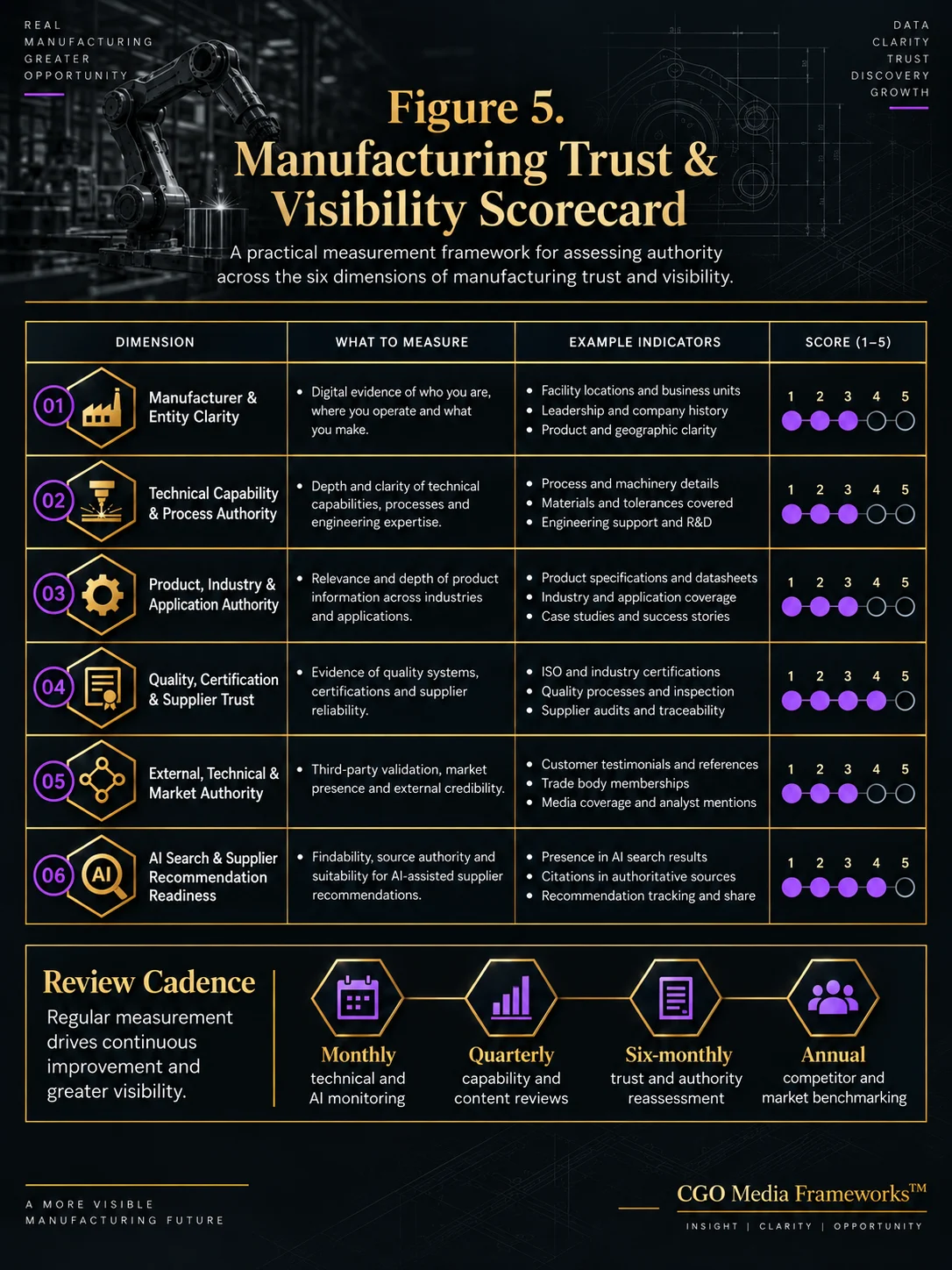
Figure 5 : Manufacturing Trust & Visibility Scorecard.
159. Common Manufacturing Trust and Visibility Failure Modes
Several recurring weaknesses can undermine manufacturing authority even where the underlying operational capability is strong.
160. Generic Technical Claims
Statements such as “high quality”, “precision manufacturing” or “industry-leading capability” provide limited value without supporting evidence.
161. Weak Facility Clarity
Multi-site manufacturers can create uncertainty when users cannot determine which factory provides which process, certification or product capability.
162. Outdated Certification Information
Expired, incomplete or incorrectly scoped certification information can damage procurement trust.
163. Inconsistent Product Information
Conflicting specifications across web pages, PDFs and distributor listings can weaken credibility.
164. Weak Industry Evidence
Generic sector pages that contain little more than industry terminology fail to demonstrate genuine market expertise.
165. Limited Application Evidence
Manufacturers may describe what they do without explaining where their capabilities are used in real operational contexts.
166. Poor Expert Visibility
Engineering expertise often remains invisible because technical staff are not connected with research, case studies or subject-specific content.
167. Strong Capability with Weak External Validation
A manufacturer may possess excellent technical capability but limited third-party recognition within relevant industrial environments.
168. Strong External Recognition with Weak First-Party Evidence
External mentions cannot fully compensate for outdated or incomplete information on the manufacturer’s own website.
169. Excessive Dependence on PDFs
Technical documentation is valuable, but critical capability and trust evidence should not exist only within isolated PDF files.
170. Weak Internal Knowledge Relationships
Manufacturing evidence becomes fragmented when processes, materials, industries, certifications, products and case studies are poorly connected.
171. Publishing Without Technical Validation
Technical content that has not been reviewed by appropriate subject specialists can introduce factual errors and reduce buyer confidence.
172. Measuring Visibility Without Supplier Trust
Strong rankings or traffic may provide limited commercial value if buyers do not find enough evidence to validate the supplier.
173. AI Monitoring Without Evidence Improvement
Tracking AI mentions creates limited value unless identified gaps are translated into stronger entity, capability, certification and external-authority evidence.
174. Application to Precision Engineering
Precision engineering organisations may place particular emphasis on:
- Tolerance authority
- Inspection capability
- Machine evidence
- Materials
- Industry certifications
175. Application to CNC Machining
CNC manufacturers may prioritise:
- Axis capability
- Materials
- Tolerances
- Component size
- Prototype and production volumes
- Inspection
176. Application to Injection Moulding
Injection moulding manufacturers may focus on:
- Tooling
- Polymer expertise
- Part complexity
- Production scale
- Quality systems
- Industry applications
177. Application to Fabrication
Fabrication businesses may prioritise:
- Cutting capability
- Forming
- Welding
- Materials
- Component size
- Finishing
178. Application to Contract Manufacturing
Contract manufacturers may require particularly strong evidence around:
- Production scale
- Programme management
- Supply-chain capability
- Quality systems
- Prototype-to-production support
179. Application to Aerospace Manufacturing
Aerospace manufacturers may prioritise:
- Certification
- Traceability
- Precision
- Materials
- Inspection
- Customer validation
180. Application to Automotive Manufacturing
Automotive suppliers may focus on:
- Scale
- Repeatability
- Quality
- Lead times
- Supply-chain resilience
181. Application to Medical Manufacturing
Medical manufacturers may require particularly strong trust evidence involving:
- Quality management
- Traceability
- Regulatory requirements
- Materials
- Documentation
- Controlled production environments
182. Application to Industrial Equipment Manufacturers
Industrial equipment manufacturers may place greater emphasis on:
- Product authority
- Technical specifications
- Applications
- Service capability
- Distributor and partner networks
183. Application to Export Manufacturers
Export-focused manufacturers may need stronger evidence around:
- Markets served
- International logistics
- Standards compliance
- Export documentation
- Language capability
- Local distributor relationships
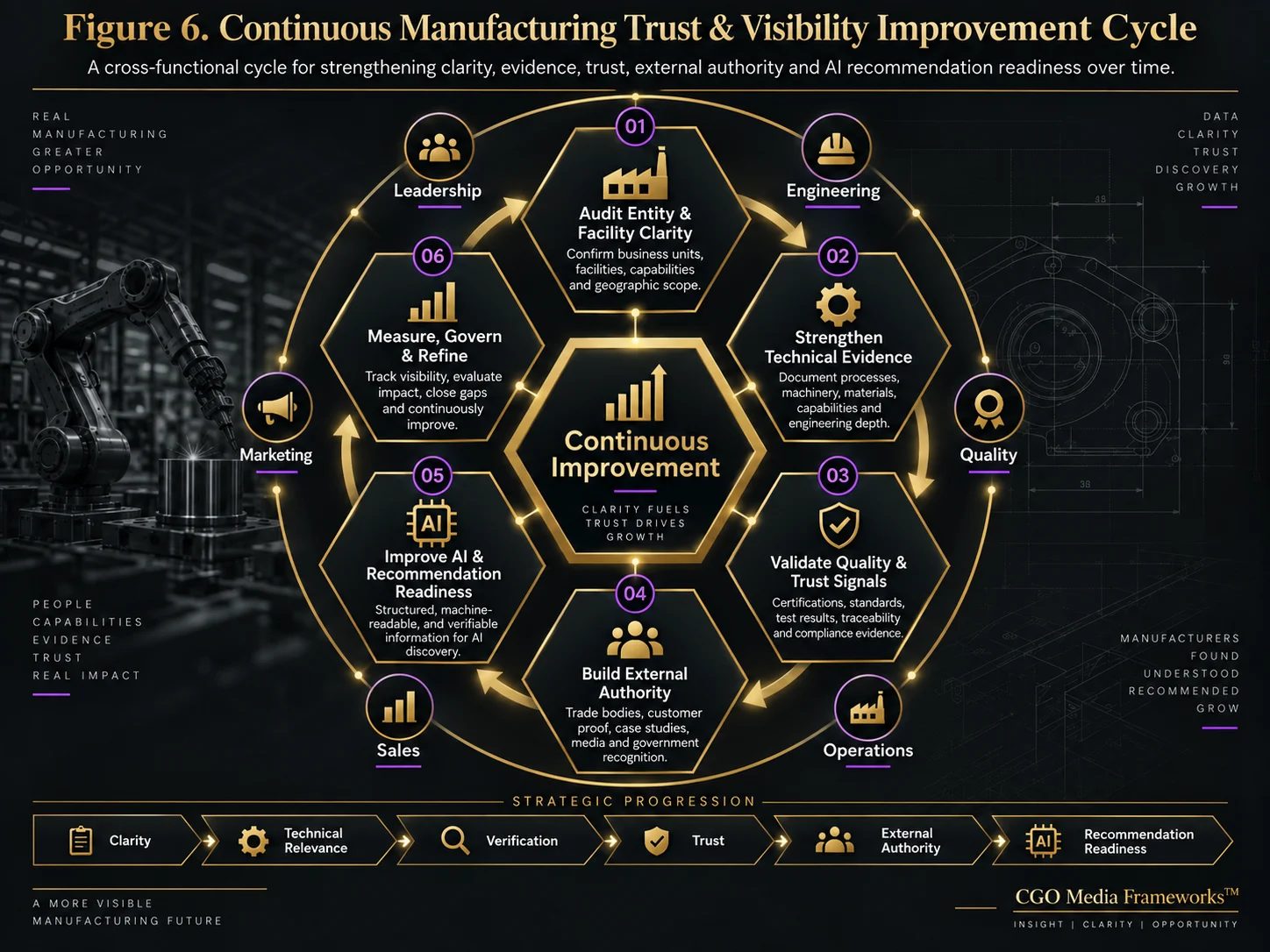
184. Continuous Manufacturing Trust and Visibility Development
The framework should operate as a continuous authority-development system rather than a one-off audit.
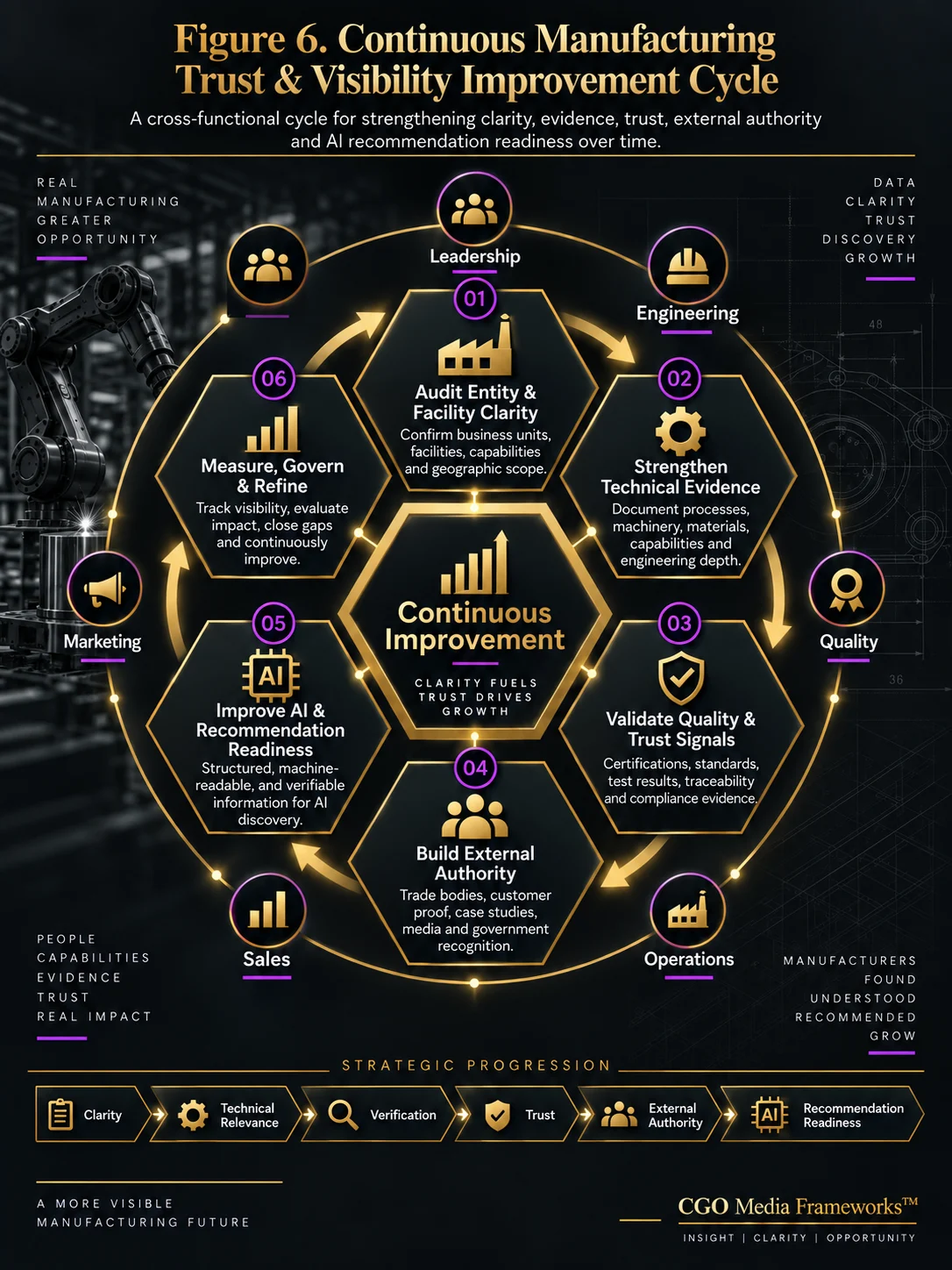
A practical cycle can be represented as:
Measure → Identify Trust Gaps → Improve Technical Evidence → Strengthen External Validation → Monitor AI Representation → Refine
185. Continuous Entity Review
Entity information should be reassessed when:
- Facilities open or close
- Ownership changes
- Business units change
- Leadership changes
- Distribution relationships evolve
186. Continuous Capability Review
Technical evidence should evolve when the manufacturer:
- Adds machinery
- Adds processes
- Expands materials
- Changes production capacity
- Introduces new inspection capability
187. Continuous Certification Review
Certification evidence should be updated as certifications are renewed, expanded, suspended or replaced.
188. Continuous Product and Industry Review
Products, applications and sector evidence should evolve as the manufacturer enters new markets or changes commercial focus.
189. Continuous External Authority Review
External authority should be monitored across:
- Customers
- Trade associations
- Government programmes
- Industry media
- Universities
- Technical organisations
190. Continuous AI Review
AI-assisted supplier discovery should be reassessed as:
- Source patterns change
- Competitors emerge
- Recommendation sets evolve
- New AI systems become relevant
191. From Trust Signals to Manufacturing Authority
The strategic progression can be summarised as:
Clarity → Technical Relevance → Verification → Trust → External Authority → Recommendation Readiness
192. Manufacturing Trust Is an Organisational Capability
Sustainable trust cannot be created by marketing alone.
It depends on alignment between:
- Engineering
- Quality
- Operations
- Sales
- Marketing
- Leadership
The strongest digital authority emerges when real operational capability and online evidence remain closely aligned.
Figure 6 : Continuous Manufacturing Trust & Visibility Improvement Cycle.
193. Relationship with the Manufacturing Discovery and Supplier Selection Model
The Manufacturing Discovery and Supplier Selection Model explains how engineers, procurement teams, OEMs, distributors and other industrial buyers move from initial need through supplier discovery, technical evaluation, trust validation, comparison, shortlisting and engagement.
The Manufacturing AI Trust and Visibility Framework defines the evidence conditions that help a manufacturer remain credible throughout that decision journey.
194. Relationship with the Manufacturing Search Authority Maturity Model
The Manufacturing Search Authority Maturity Model assesses how advanced a manufacturer has become in building and governing the six authority dimensions defined within this framework.
195. Relationship with the Manufacturing SEO and AI Implementation Roadmap
The Manufacturing SEO and AI Implementation Roadmap translates the framework into a practical sequence for improving entity clarity, technical evidence, product and industry authority, supplier trust, external validation and AI recommendation readiness.
196. Relationship with the Parent Research
This framework forms part of the research architecture established in Manufacturing SEO in an AI Search Environment.
197. The Manufacturing Research Framework Family
The complete Manufacturing research family consists of:
- Manufacturing SEO in an AI Search Environment — the parent research paper.
- Manufacturing AI Trust and Visibility Framework — the evidence and authority framework.
- Manufacturing Discovery and Supplier Selection Model — the supplier-selection model.
- Manufacturing Search Authority Maturity Model — the capability maturity model.
- Manufacturing SEO and AI Implementation Roadmap — the implementation roadmap.
198. Methodological Position
The Manufacturing AI Trust and Visibility Framework is a conceptual and strategic framework for assessing whether manufacturing organisations provide sufficiently clear, relevant, verifiable and externally supported evidence across modern search and AI-assisted discovery environments.
It does not claim that search engines or AI systems use the six dimensions as confirmed ranking or recommendation criteria.
The framework instead provides a structured methodology for examining whether a manufacturer possesses the evidence required to become:
- Discoverable
- Understandable
- Technically relevant
- Verifiable
- Trusted
- Commercially suitable
- Shortlist ready
- Recommendation ready
199. Strategic Implications
The framework changes the strategic question from:
“How do we increase manufacturing search visibility?”
to:
“Can buyers, search engines and AI systems understand what we manufacture, verify our capability, trust our quality and certifications, and find enough evidence to consider us a credible supplier?”
200. Trust Must Reflect Operational Reality
Manufacturing trust cannot be created through messaging alone.
The strongest digital authority exists when online evidence accurately reflects real:
- Production capability
- Engineering expertise
- Quality systems
- Certifications
- Facility capability
- Industry experience
201. Technical Specificity Is a Competitive Advantage
Many manufacturing websites remain commercially generic despite the underlying business possessing highly specialised capability.
Manufacturers that communicate processes, materials, tolerances, applications, facilities and certifications more clearly may become easier to discover, validate and compare.
202. External Authority Strengthens First-Party Evidence
Manufacturing claims become more resilient when credible external sources independently reinforce technical and market authority.
Relevant validation may come from:
- Customers
- Certification bodies
- Trade associations
- Government institutions
- Universities
- Industry media
- Technical organisations
203. AI Visibility Should Be Treated as an Authority Outcome
AI recommendation readiness should not be treated as a separate optimisation layer disconnected from the manufacturer’s wider evidence environment.
It is more useful to view AI visibility as an outcome of strong entity clarity, technical relevance, trust, external validation and information consistency.
204. Conclusion
The Manufacturing AI Trust and Visibility Framework defines six connected dimensions:
- Manufacturer and Entity Clarity
- Technical Capability and Process Authority
- Product, Industry and Application Authority
- Quality, Certification and Supplier Trust
- External, Technical and Market Authority
- AI Search and Supplier Recommendation Readiness
Together, these dimensions provide a structured way to evaluate whether a manufacturer possesses the digital evidence required for modern supplier discovery.
The strongest manufacturing organisations align operational reality with searchable, verifiable and independently supported evidence.
That creates a more durable authority environment in which the manufacturer can be discovered, understood, validated, trusted, compared and recommended.
References
External Academic, Technical and Search Sources
- Google Search Central. SEO Starter Guide.
- Google Search Central. Understand how structured data works.
- Schema.org. Organization.
- Schema.org. Product.
- Schema.org. Person.
- Hogan, A. et al. (2021). Knowledge Graphs. ACM Computing Surveys, 54(4).
- Metzger, M.J. (2007). Making Sense of Credibility on the Web: Models for Evaluating Online Information and Recommendations for Future Research. Journal of the American Society for Information Science and Technology, 58(13), 2078–2091.
- Ji, Z. et al. (2023). Survey of Hallucination in Natural Language Generation. ACM Computing Surveys, 55(12).
CGO Media Research and Frameworks
- Wilkinson, R. (2026). Manufacturing SEO in an AI Search Environment. CGO Media.
- Wilkinson, R. (2026). CGO Media Entity Authority Framework. CGO Media.
- Wilkinson, R. (2026). CGO Media Content Authority Framework. CGO Media.
- Wilkinson, R. (2026). CGO Media AI Citation Framework. CGO Media.
- Wilkinson, R. (2026). CGO Media AI Search Readiness Framework. CGO Media.
- Wilkinson, R. (2026). CGO Media Brand Signal Framework. CGO Media.
- Wilkinson, R. (2026). CGO Media Knowledge Architecture Map. CGO Media.
CGO Media Research Ecosystem
The Manufacturing AI Trust and Visibility Framework forms part of the CGO Media Framework Library and the wider CGO Media research programme examining SEO, AI Search, GEO, entity authority, citation authority, supplier discovery and recommendation-led search.
Explore:
About Roger Wilkinson
Roger Wilkinson is an independent researcher, SEO practitioner and founder of CGO Media with more than 25 years of experience in search, online visibility and digital strategy.
His current research focuses on how artificial intelligence is reshaping search engines, recommendation systems and digital authority. Through independent research papers and strategic frameworks, Roger examines the relationship between Technical SEO, Entity Authority, Brand Signals, AI Visibility, Citation Authority, Knowledge Graphs and Search Visibility.
Roger is the creator of the CGO Framework Series, a collection of executive-level methodologies designed to help organisations measure, improve and govern their digital visibility in an increasingly AI-centric environment.
View Roger Wilkinson’s researcher profile →
Related Manufacturing Research and Frameworks
- Manufacturing SEO in an AI Search Environment
- Manufacturing Discovery and Supplier Selection Model
- Manufacturing Search Authority Maturity Model
- Manufacturing SEO and AI Implementation Roadmap
- Manufacturing GEO: Generative Engine Optimisation
Research Usage & Citation
CGO Media encourages researchers, journalists, manufacturers, engineers, procurement professionals, industry bodies, educators and practitioners to reference this framework where it contributes to broader understanding of Manufacturing SEO, supplier trust, industrial authority and AI-assisted discovery.
Reasonable quotations, summaries, figures and excerpts may be used in articles, reports, presentations and academic work provided appropriate acknowledgement is given.
Cite This Framework / Embed Citation
The Manufacturing AI Trust and Visibility Framework, developed by Roger Wilkinson at CGO Media, evaluates manufacturing authority across entity clarity, technical capability, product and industry relevance, supplier trust, external validation and AI recommendation readiness.
APA Citation
Wilkinson, R. (2026). Manufacturing AI Trust and Visibility Framework. CGO Media.
https://cgomedia.com/manufacturing-ai-trust-visibility-framework/
Research Paper
This framework is supported by the parent research paper:
Manufacturing SEO in an AI Search Environment.
Author: Roger Wilkinson
Published by: CGO Media
For permissions relating to extensive reproduction, commercial licensing or republication of substantial portions of this framework, please contact CGO Media directly.