
Manufacturing Search Authority Maturity Model
 The Manufacturing Search Authority Maturity Model provides a structured method for assessing how advanced a manufacturing organisation has become in building, governing and measuring digital authority across search and AI-assisted supplier discovery environments.
The model is designed for manufacturers, engineering businesses, contract manufacturers, industrial suppliers, component producers, specialist fabricators and multi-site manufacturing groups that need to evaluate not only whether they are visible, but whether their digital evidence is sufficiently mature to support technical understanding, supplier trust and recommendation readiness.
It builds on the parent research paper Manufacturing SEO in an AI Search Environment, the Manufacturing AI Trust and Visibility Framework and the Manufacturing Discovery and Supplier Selection Model.
1. Why Manufacturing Needs a Search Authority Maturity Model
Manufacturing organisations often invest in websites, SEO, technical content and digital marketing without a clear way to determine how advanced their overall search authority has become.
A maturity model provides a progression from fragmented visibility toward structured, measurable and governed authority.
2. Visibility Is Not the Same as Maturity
A manufacturer may rank for important keywords while still possessing weak:
- Entity clarity
- Technical evidence
- Certification visibility
- Industry authority
- External validation
- AI recommendation readiness
The model therefore evaluates the strength of the underlying authority system rather than rankings alone.
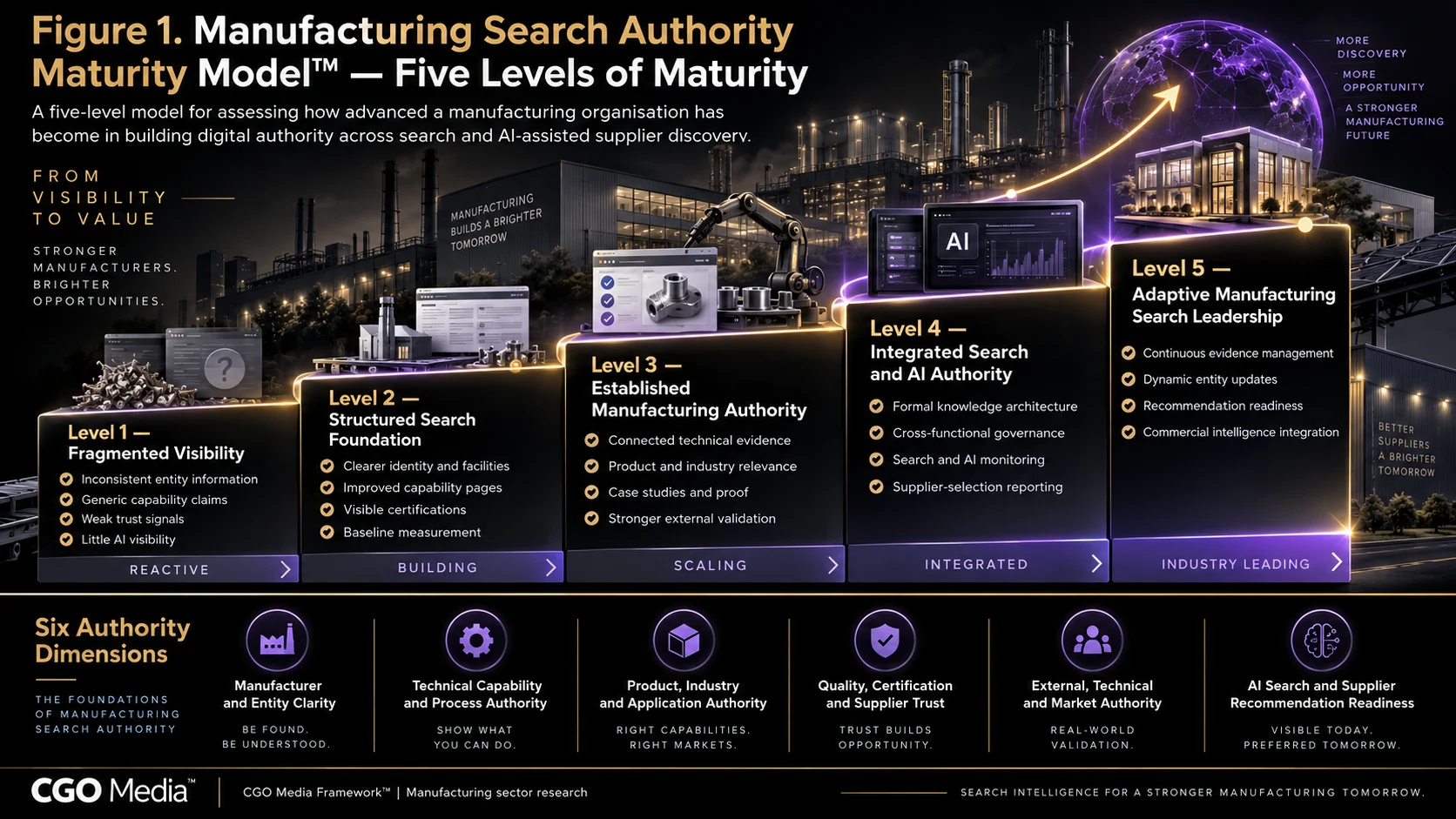
3. The Five Manufacturing Search Authority Maturity Levels
The model identifies five levels:
- Level 1 — Fragmented Visibility
- Level 2 — Structured Search Foundation
- Level 3 — Established Manufacturing Authority
- Level 4 — Integrated Search and AI Authority
- Level 5 — Adaptive Manufacturing Search Leadership
4. Maturity Is Multi-Dimensional
A manufacturer should not be considered mature because of strength in only one area.
The model assesses maturity across six connected authority dimensions:
- Manufacturer and Entity Clarity
- Technical Capability and Process Authority
- Product, Industry and Application Authority
- Quality, Certification and Supplier Trust
- External, Technical and Market Authority
- AI Search and Supplier Recommendation Readiness
5. Level 1 — Fragmented Visibility
At Level 1, digital visibility exists but is inconsistent, incomplete or largely disconnected from the manufacturer’s real operational capability.
6. Level 1 Entity Characteristics
Common characteristics may include:
- Inconsistent company naming
- Poor facility differentiation
- Weak business-unit relationships
- Outdated addresses
- Unclear leadership information
7. Level 1 Technical Capability Characteristics
Technical capability may be represented through generic statements such as:
- Precision engineering
- High-quality manufacturing
- Industry-leading production
- Full-service engineering
without enough detail to verify actual process, material, tolerance or production capability.
8. Level 1 Product and Industry Characteristics
Product and sector pages may be:
- Thin
- Generic
- Duplicative
- Poorly connected to technical capabilities
9. Level 1 Trust Characteristics
Certification, quality and supplier-trust evidence may be incomplete or difficult to verify.
10. Level 1 External Authority Characteristics
External recognition may be limited, inconsistent or concentrated in low-relevance sources.
11. Level 1 AI Characteristics
The manufacturer may:
- Rarely appear in AI supplier recommendations
- Be associated with incorrect capabilities
- Have outdated facility information surfaced
- Possess little measurable source visibility
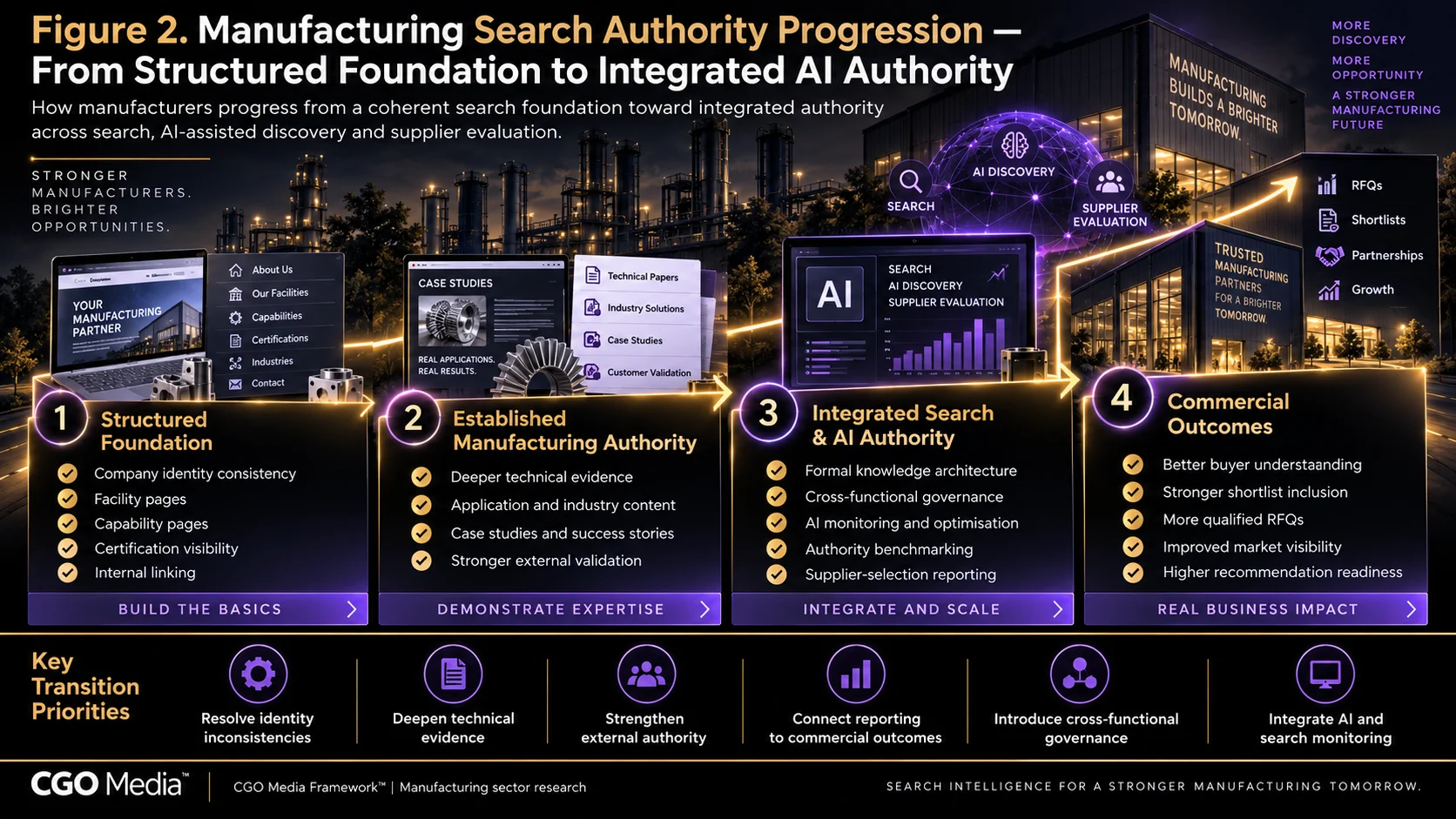
12. Level 1 Measurement Characteristics
Reporting is often dominated by:
- Traffic
- Rankings
- Generic enquiry volume
with limited connection to supplier selection or commercial outcomes.
13. Level 1 Governance Characteristics
Digital authority is usually managed as a marketing activity with limited involvement from engineering, quality, operations or leadership.
14. Level 1 Strategic Risk
The manufacturer may possess substantial real-world capability while remaining difficult for buyers, search engines and AI systems to understand accurately.
15. Level 2 — Structured Search Foundation
At Level 2, the organisation has begun organising its manufacturing evidence into a more coherent digital structure.
16. Level 2 Entity Characteristics
The manufacturer has improved:
- Company identity consistency
- Location information
- Facility pages
- Leadership visibility
- Business-unit clarity
17. Level 2 Technical Capability Characteristics
Core capability pages now provide clearer evidence around:
- Processes
- Materials
- Machinery
- Production volumes
- Engineering support
18. Level 2 Product and Industry Characteristics
Priority products and industries begin to receive dedicated, structured content.
19. Level 2 Trust Characteristics
Certifications and quality information are more visible, although scope and relationship clarity may still be inconsistent.
20. Level 2 External Authority Characteristics
The organisation begins developing stronger relationships with:
- Trade associations
- Industry media
- Commercial partners
- Relevant directories
21. Level 2 AI Characteristics
AI monitoring may begin, but activity is often exploratory rather than integrated into formal reporting.
22. Level 2 Measurement Characteristics
Reporting begins to incorporate:
- Capability visibility
- Industry visibility
- Qualified enquiries
- Priority market performance
23. Level 2 Governance Characteristics
Marketing begins to collaborate with subject specialists to validate technical content.
24. Level 2 Strategic Position
The organisation has moved beyond fragmented visibility but has not yet developed a fully connected manufacturing authority system.
25. The Transition from Level 1 to Level 2
The first maturity transition is primarily about establishing clarity and structure.
Typical priorities include:
- Correct entity inconsistencies
- Build facility architecture
- Strengthen capability pages
- Clarify certifications
- Improve internal linking
- Establish baseline measurement
26. Maturity Requires Evidence, Not Labels
An organisation should not assign itself a maturity level simply because it has completed a website redesign or implemented technical SEO.
Progress should be based on observable evidence across the six dimensions.
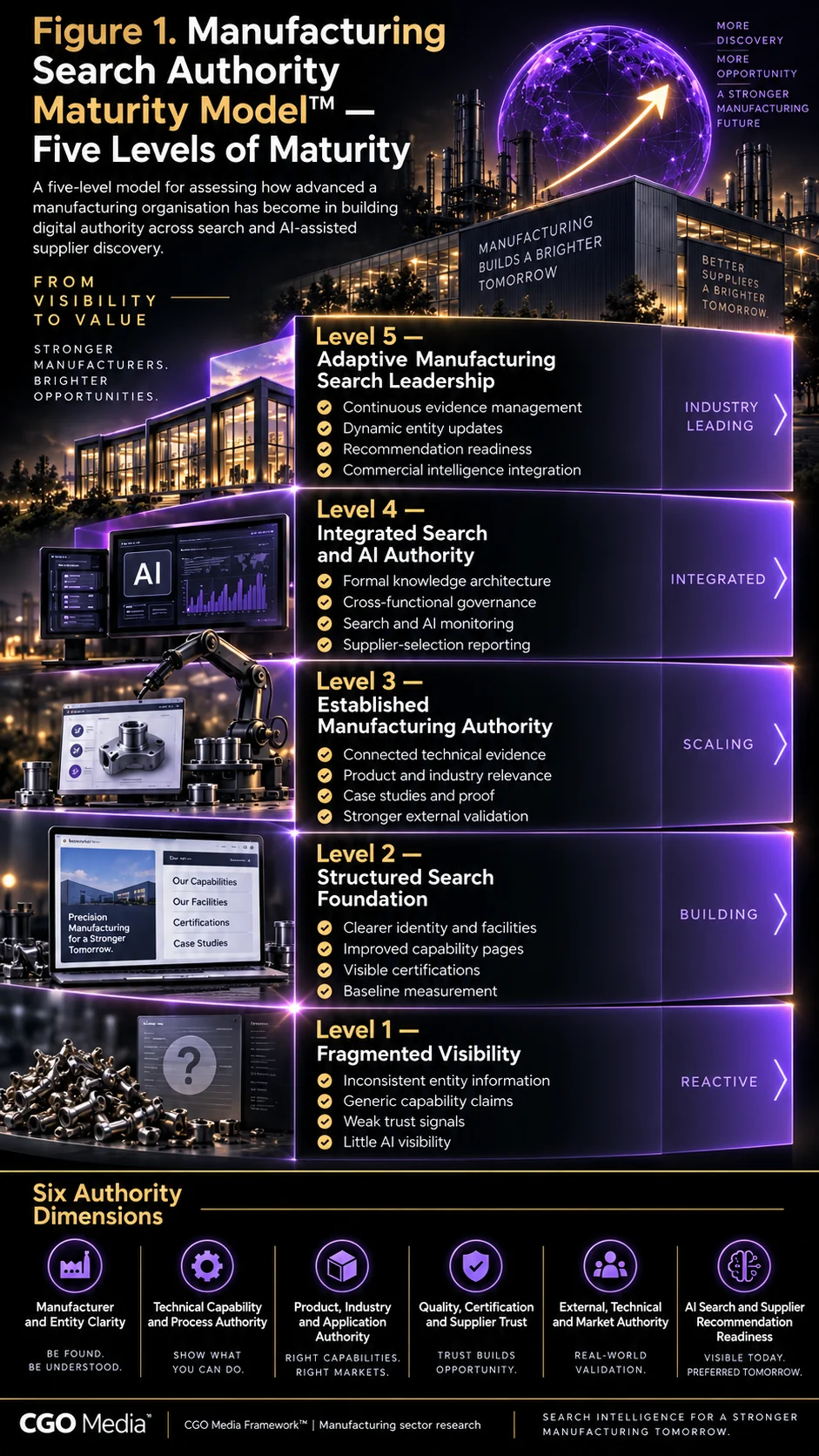
Figure 1 : Manufacturing Search Authority Maturity Model — Five Levels of Maturity.
27. Level 3 — Established Manufacturing Authority
At Level 3, the manufacturer has developed a substantially stronger digital authority system in which entity identity, technical capability, product relevance, trust evidence and external validation are increasingly connected.
28. Level 3 Entity Characteristics
Manufacturer identity is usually clear across:
- Corporate pages
- Facility pages
- Business units
- Leadership profiles
- Industry listings
- Relevant external sources
29. Level 3 Facility Authority
Individual facilities are represented with clearer relationships to:
- Processes
- Machinery
- Certifications
- Industries
- Production capability
30. Level 3 Technical Capability Characteristics
Technical pages now provide more decision-useful evidence around:
- Process capability
- Materials
- Tolerances
- Machine capability
- Prototype and production volumes
- Engineering support
31. Level 3 Technical Evidence Depth
Capabilities are increasingly supported by:
- Technical guides
- Case studies
- Specifications
- Inspection information
- Application examples
32. Level 3 Product Authority
Product families are organised coherently and connected with relevant:
- Processes
- Materials
- Industries
- Applications
- Technical documentation
33. Level 3 Industry Authority
Priority sector pages move beyond generic claims and begin demonstrating:
- Specific industry experience
- Relevant certifications
- Technical requirements
- Representative applications
- Supporting case studies
34. Level 3 Application Authority
The organisation shows how manufacturing capability applies to real engineering and commercial problems.
35. Level 3 Quality Characteristics
Quality systems are represented with greater clarity around:
- Inspection
- Traceability
- Testing
- Quality management
- Non-conformance processes
36. Level 3 Certification Characteristics
Certification evidence clearly identifies:
- Certification name
- Scope
- Applicable facility
- Current status
- Relevant industry context
37. Level 3 Supplier Trust Characteristics
The manufacturer provides stronger evidence of:
- Operational reliability
- Customer outcomes
- Commercial suitability
- Supply-chain resilience
38. Level 3 External Authority Characteristics
External authority begins to develop across relevant sources such as:
- Trade media
- Industry associations
- Certification bodies
- Customers
- Government programmes
- Research partners
39. Level 3 Citation Relevance
The manufacturer moves from pursuing broad mention volume toward building recognition in technically and commercially relevant environments.
40. Level 3 AI Characteristics
The manufacturer begins systematic monitoring of:
- Brand mentions
- Process visibility
- Industry visibility
- Supplier recommendations
- Representation accuracy
41. Level 3 AI Source Analysis
The organisation begins identifying which first-party and third-party sources are associated with relevant AI-generated answers.
42. Level 3 Measurement Characteristics
Reporting begins to connect search visibility with:
- Qualified enquiries
- Capability-level performance
- Industry visibility
- RFQs
- Commercial opportunity
43. Level 3 Governance Characteristics
Marketing increasingly collaborates with:
- Engineering
- Quality
- Sales
- Operations
to maintain accurate and useful manufacturing evidence.
44. Level 3 Strategic Position
The manufacturer has moved beyond foundational SEO and is beginning to operate a genuine digital authority system.
45. The Transition from Level 2 to Level 3
This transition is primarily about increasing technical depth, evidence quality and cross-functional integration.
Typical priorities include:
- Expand process evidence
- Build stronger application content
- Clarify certification relationships
- Develop case studies
- Strengthen external validation
- Introduce AI visibility monitoring
46. Level 4 — Integrated Search and AI Authority
At Level 4, the manufacturer manages search, digital evidence, external authority and AI visibility as an integrated strategic system.
47. Level 4 Entity Characteristics
Entity relationships are deliberately maintained across:
- Manufacturer
- Facilities
- Business units
- Leadership
- Products
- Processes
- Industries
48. Level 4 Knowledge Architecture
The website and supporting evidence environment reflect clear relationships such as:
Manufacturer → Facility → Process → Material → Product → Industry → Application → Certification → Evidence
49. Level 4 Technical Capability Characteristics
Technical content is comprehensive, maintained and aligned with current operational capability.
50. Level 4 Technical Validation
Engineering teams formally review high-value technical content and capability claims.
51. Level 4 Product and Industry Characteristics
Product, industry and application architecture is closely aligned with commercial priorities and real customer requirements.
52. Level 4 Trust Characteristics
Quality, certification, governance and supplier-trust evidence is routinely maintained and easy to verify.
53. Level 4 External Authority Characteristics
The organisation deliberately develops authority through:
- Technical media
- Original research
- Industry partnerships
- Customer evidence
- Professional associations
- Institutional relationships
54. Level 4 Research Authority
The manufacturer may publish original data, technical analysis, industry observations or engineering research that contributes to wider market understanding.
55. Level 4 Digital PR Characteristics
Digital PR activity is increasingly based on substantive manufacturing evidence rather than general corporate publicity.
56. Level 4 AI Search Characteristics
AI visibility is monitored systematically across:
- Brand prompts
- Capability prompts
- Industry prompts
- Geographic prompts
- Supplier recommendations
- Competitor comparisons
57. Level 4 AI Recommendation Analysis
The manufacturer evaluates not only whether it is mentioned, but whether it appears within commercially important supplier recommendation sets.
58. Level 4 AI Source Analysis
Source patterns are used to identify:
- Evidence gaps
- Citation opportunities
- Competitor advantages
- Third-party authority gaps
59. Level 4 Representation Governance
Incorrect or outdated AI representations are investigated against the wider evidence ecosystem rather than treated as isolated platform issues.
60. Level 4 Measurement Characteristics
Performance reporting may include:
- Search visibility
- AI visibility
- Supplier recommendation share
- Shortlist share
- RFQ contribution
- Commercial opportunity
61. Level 4 Benchmarking
The manufacturer benchmarks authority against competitors by:
- Capability
- Industry
- Market
- Geography
- AI recommendation visibility
62. Level 4 Governance Characteristics
Digital authority is managed through formal collaboration between:
- Marketing
- Engineering
- Quality
- Sales
- Operations
- Leadership
63. Level 4 Strategic Position
Search visibility has become an organisational authority capability rather than a standalone marketing channel.
64. The Transition from Level 3 to Level 4
This transition is primarily about integration, governance and measurement.
Typical priorities include:
- Formalise knowledge architecture
- Integrate search and AI monitoring
- Strengthen external authority development
- Connect reporting with supplier-selection outcomes
- Introduce cross-functional governance
- Benchmark authority systematically
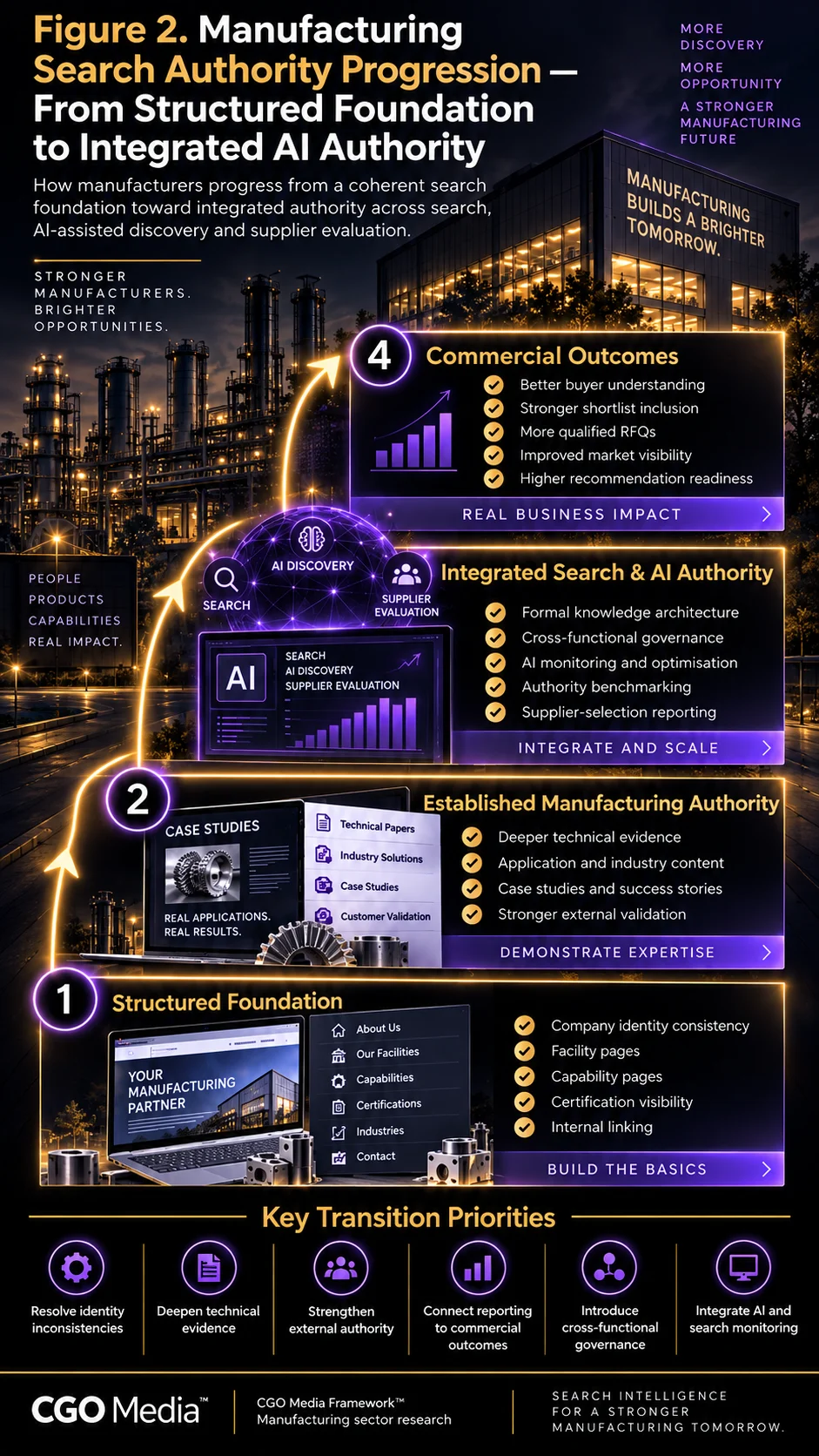
Figure 2 : Manufacturing Search Authority Progression — From Structured Foundation to Integrated AI Authority.
65. Level 5 — Adaptive Manufacturing Search Leadership
At Level 5, the manufacturer operates search authority as a continuously evolving organisational capability.
Digital evidence, external authority, AI visibility, supplier-selection intelligence and commercial outcomes are connected through formal governance and ongoing measurement.
66. Level 5 Entity Characteristics
Manufacturer identity and entity relationships are maintained dynamically as the organisation changes.
Updates may reflect:
- New facilities
- Acquisitions
- Business-unit changes
- Leadership changes
- New geographic markets
- New manufacturing capabilities
67. Level 5 Facility Intelligence
Facility information is treated as operational search infrastructure rather than static corporate content.
Each site is connected clearly to its:
- Processes
- Machinery
- Certifications
- Industries
- Products
- Production capacity
68. Level 5 Technical Capability Characteristics
Technical authority is continuously updated to reflect changes in:
- Machinery
- Materials
- Tolerances
- Processes
- Inspection
- Production capability
69. Level 5 Technical Knowledge System
Technical content is organised as a connected knowledge system rather than a collection of isolated marketing pages.
70. Level 5 Expert Integration
Engineers, technical specialists and quality professionals contribute directly to the organisation’s authority environment.
Their expertise may support:
- Research
- Technical guides
- Case studies
- Industry commentary
- Product development evidence
71. Level 5 Product Authority Characteristics
Product architecture evolves with the commercial portfolio and remains aligned with technical specifications, applications and industry requirements.
72. Level 5 Industry Authority Characteristics
The manufacturer develops deep authority in strategically important sectors rather than attempting to appear equally relevant everywhere.
73. Level 5 Application Intelligence
Application evidence is informed by:
- Customer requirements
- RFQ patterns
- Engineering challenges
- Commercial opportunity
- Industry change
74. Level 5 Trust Characteristics
Quality, certification and supplier-trust evidence is actively governed as part of the digital information system.
75. Level 5 Certification Intelligence
Certification changes trigger updates across all affected:
- Facility pages
- Industry pages
- Technical content
- Supplier documentation
- Structured information
76. Level 5 External Authority Characteristics
External authority development is strategic, selective and linked with commercially important manufacturing themes.
77. Level 5 Research and Thought Leadership
The organisation may contribute original evidence around subjects such as:
- Manufacturing technology
- Automation
- Materials
- Supply-chain resilience
- Reshoring
- Sustainability
- Industrial productivity
78. Level 5 Authority Network
The manufacturer develops a diverse external evidence network including:
- Customers
- Trade bodies
- Research institutions
- Universities
- Technical media
- Government organisations
- Commercial partners
79. Level 5 AI Search Characteristics
AI visibility is monitored as part of the wider search and supplier-selection intelligence system.
80. Level 5 AI Prompt Architecture
Prompt monitoring is organised around commercially relevant query classes such as:
- Process
- Material
- Industry
- Product
- Certification
- Geography
- Supplier comparison
81. Level 5 Recommendation Intelligence
The manufacturer evaluates:
- Recommendation frequency
- Shortlist presence
- Competitor presence
- Citation sources
- Representation accuracy
82. Level 5 Source Intelligence
Recurring AI source patterns are used to identify which external and first-party evidence environments shape supplier visibility.
83. Level 5 Competitive Intelligence
Competitor analysis extends beyond rankings to compare:
- Technical evidence
- Trust evidence
- External authority
- AI visibility
- Supplier recommendation presence
- Commercial positioning
84. Level 5 Measurement Characteristics
Reporting is connected increasingly with commercial outcomes including:
- Qualified supplier visibility
- Shortlist share
- RFQ contribution
- Opportunity value
- Win rates
- Strategic market penetration
85. Level 5 Governance Characteristics
Digital authority has formal cross-functional ownership across:
- Marketing
- Engineering
- Quality
- Sales
- Operations
- Leadership
86. Level 5 Adaptive Improvement
The organisation continually adjusts its authority environment according to:
- Search behaviour
- AI source changes
- Buyer questions
- RFQ patterns
- Competitive movement
- Commercial strategy
87. Level 5 Strategic Position
Search authority becomes a long-term organisational asset supporting discovery, procurement confidence, market positioning and future AI-assisted supplier recommendation.
88. The Transition from Level 4 to Level 5
The final maturity transition is primarily about adaptability and organisational learning.
Typical priorities include:
- Connect search data with commercial intelligence
- Formalise AI recommendation measurement
- Automate evidence monitoring where appropriate
- Use buyer feedback to improve technical architecture
- Integrate external authority with market strategy
- Establish continuous review cycles
89. Manufacturing Authority Maturity Is Not Linear
Manufacturers may progress unevenly across the six dimensions.
For example, an organisation may possess Level 4 technical authority while remaining at Level 2 in AI visibility or external authority.
90. Overall Maturity Should Reflect the Weakest Critical Dimensions
A manufacturer should not be classified as highly mature if a critical dimension remains substantially underdeveloped.
Aerospace manufacturers, for example, cannot compensate for weak certification clarity simply through strong technical content.
91. The Maturity Threshold Principle
Progression occurs when sufficient evidence exists across the majority of strategically important dimensions to support the next level of authority.
92. Critical Dimensions May Carry Greater Weight
The relative importance of each dimension can vary according to:
- Industry
- Product risk
- Regulatory environment
- Buyer requirements
- Commercial strategy
93. Manufacturing Maturity Scoring Logic
A practical assessment can score each dimension from one to five according to observable evidence.
| Score | Maturity Level | Typical Condition |
|---|---|---|
| 1 | Fragmented Visibility | Evidence is incomplete, generic, inconsistent or poorly governed. |
| 2 | Structured Search Foundation | Core information is becoming structured but remains uneven. |
| 3 | Established Manufacturing Authority | Strong evidence exists across core capabilities and trust dimensions. |
| 4 | Integrated Search and AI Authority | Search, external authority and AI visibility are integrated and governed. |
| 5 | Adaptive Manufacturing Search Leadership | Authority is continuously measured, refined and connected with commercial intelligence. |
94. Dimension One Maturity — Manufacturer and Entity Clarity
Entity maturity progresses from inconsistent identity toward actively governed relationships between:
- Manufacturer
- Facilities
- Business units
- Leadership
- Products
- Markets
95. Dimension Two Maturity — Technical Capability and Process Authority
Technical maturity progresses from generic capability claims toward comprehensive, expert-validated and continuously maintained technical evidence.
96. Dimension Three Maturity — Product, Industry and Application Authority
Product and industry maturity progresses from thin sector pages toward connected evidence demonstrating genuine application relevance.
97. Dimension Four Maturity — Quality, Certification and Supplier Trust
Trust maturity progresses from limited certification visibility toward governed, verifiable and facility-specific quality evidence.
98. Dimension Five Maturity — External, Technical and Market Authority
External authority progresses from isolated mentions toward a diversified network of relevant independent validation.
99. Dimension Six Maturity — AI Search and Supplier Recommendation Readiness
AI maturity progresses from little or no monitoring toward structured recommendation, source, competitor and representation intelligence.
100. The Six-Dimension Maturity Profile
Rather than relying only on one overall score, manufacturers can create a six-dimension profile showing where maturity is strongest and weakest.
101. Balanced Maturity
A balanced profile indicates that the manufacturer has developed authority relatively consistently across the full framework.
102. Unbalanced Maturity
An unbalanced profile may reveal strategic weaknesses.
Examples include:
- Strong technical authority but weak trust evidence
- Strong search visibility but weak AI visibility
- Strong certifications but weak product authority
- Strong external coverage but poor entity clarity
103. Maturity Gaps Create Selection Friction
Weakness in one dimension can reduce the commercial value generated by strength elsewhere.
104. Maturity Assessment Should Be Evidence Based
Each score should be supported by observable evidence rather than subjective opinion.
Useful evidence can include:
- Published technical assets
- Certification records
- Facility information
- External citations
- Search visibility data
- AI recommendation tests
- RFQ and shortlist data
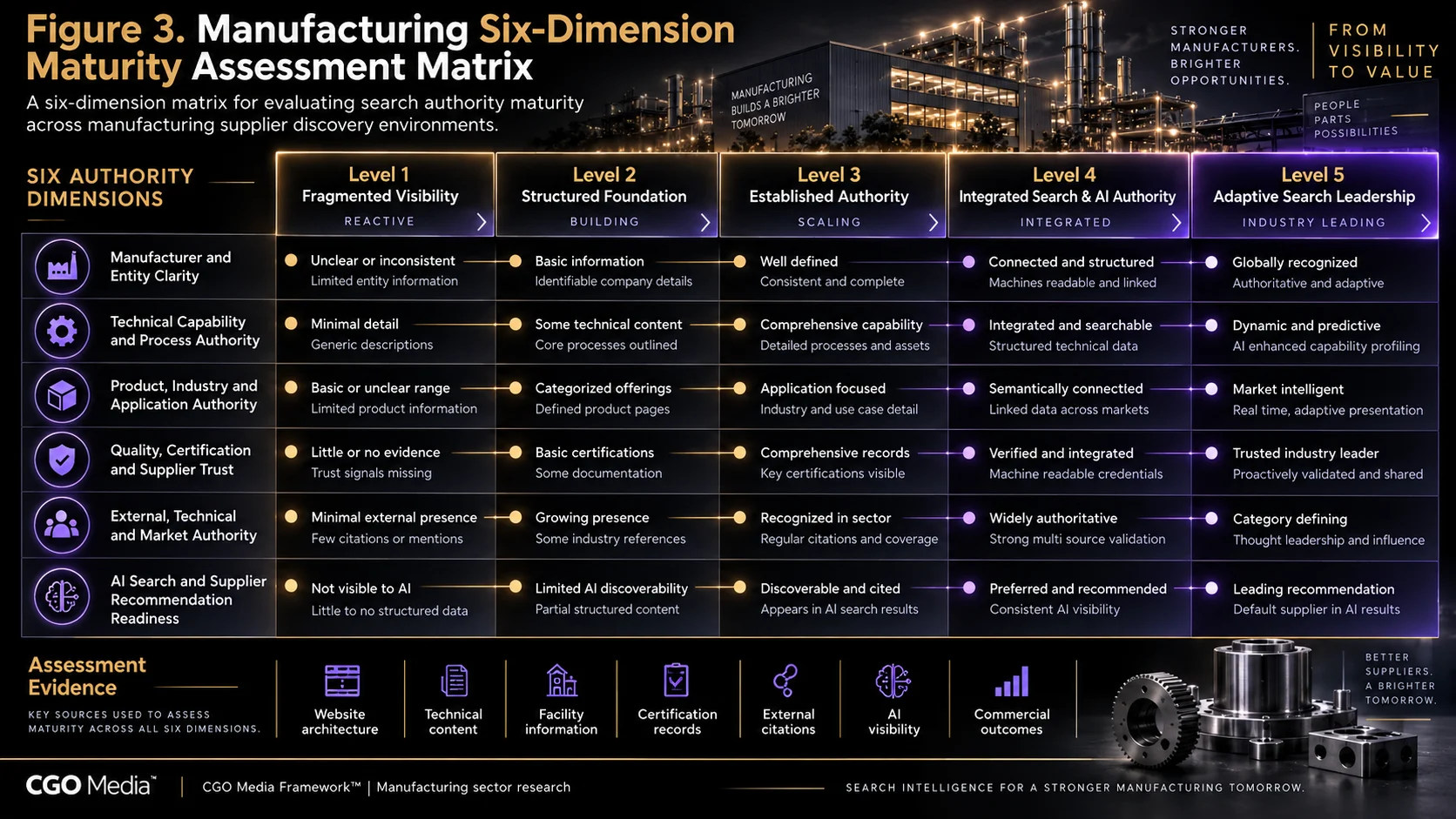
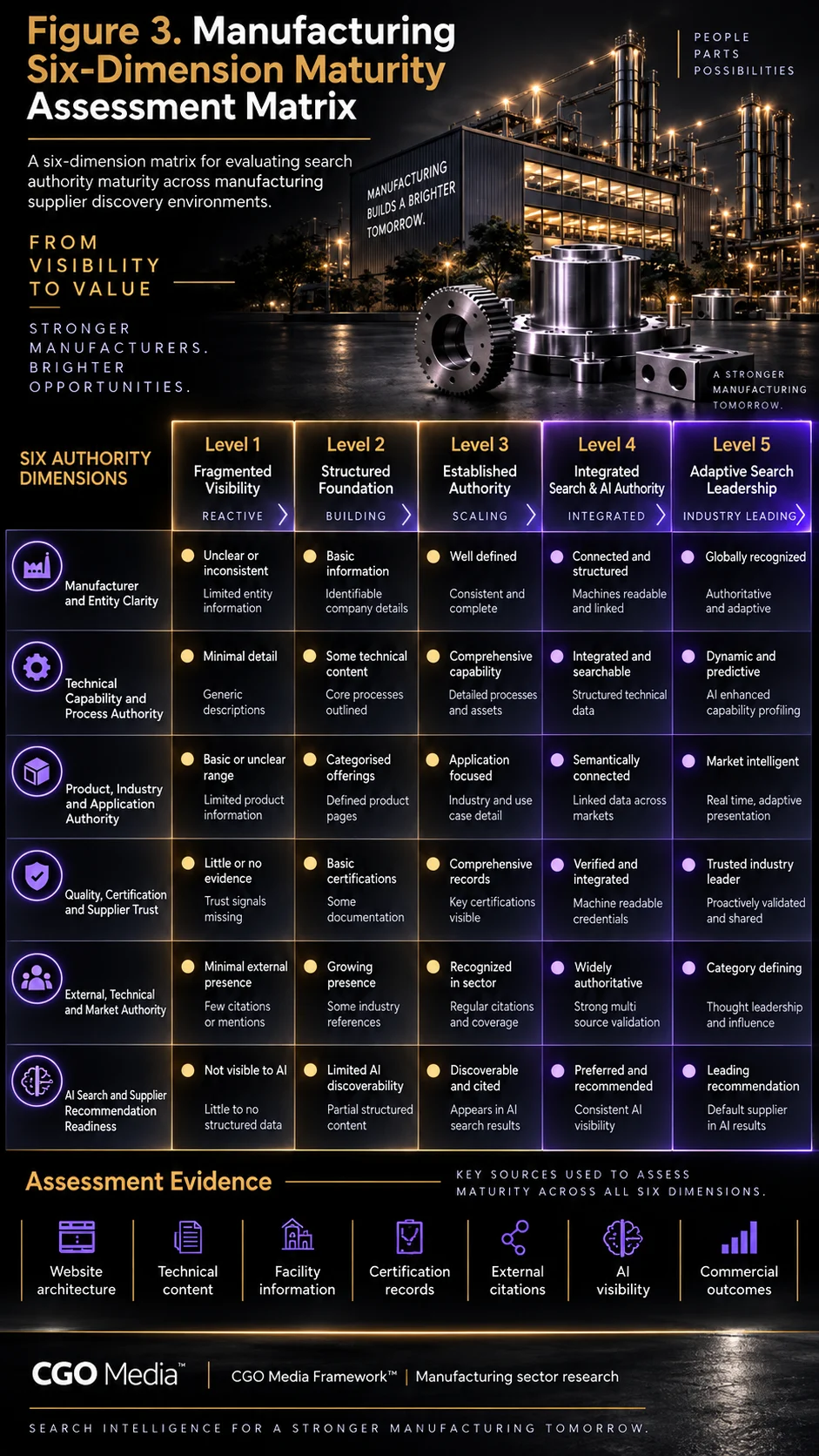
Figure 3 : Manufacturing Six-Dimension Maturity Assessment Matrix.
105. Manufacturing Maturity Assessment Methodology
A useful maturity assessment should evaluate both the presence of evidence and the way that evidence is governed, connected and measured.
The objective is not to produce a superficial score, but to identify the structural conditions limiting manufacturing search authority.
106. Assessment Should Combine Quantitative and Qualitative Evidence
Quantitative indicators can show visibility, coverage and performance, while qualitative review determines whether the underlying information is accurate, specific, coherent and commercially useful.
107. Evidence Categories
Assessment evidence may include:
- Website architecture
- Technical content
- Facility information
- Product information
- Certification records
- Case studies
- External references
- Search visibility
- AI visibility
- Commercial outcomes
108. Entity Evidence Review
The organisation should examine whether important manufacturer entities are represented consistently across first-party and relevant external sources.
109. Technical Evidence Review
Technical evidence should be reviewed for:
- Specificity
- Accuracy
- Currency
- Expert validation
- Commercial relevance
110. Product and Industry Evidence Review
The assessment should determine whether product, sector and application content demonstrates genuine operational relevance rather than generic marketing language.
111. Trust Evidence Review
Trust evidence should be assessed for clarity around:
- Certification scope
- Quality systems
- Inspection
- Traceability
- Customer evidence
112. External Authority Review
External evidence should be assessed for relevance, diversity and independence.
113. AI Visibility Review
AI assessment can examine:
- Brand visibility
- Process associations
- Industry associations
- Supplier recommendations
- Source visibility
- Representation accuracy
114. Commercial Outcome Review
Where data is available, authority maturity should be connected with:
- Qualified enquiries
- Shortlist inclusion
- RFQs
- Opportunity value
- Win rates
115. Manufacturing Authority Baseline
The first formal assessment creates a baseline against which future progress can be measured.
116. Baseline by Authority Dimension
Each of the six dimensions should receive its own baseline score rather than relying only on one blended rating.
117. Baseline by Capability
Manufacturers can assess commercially important capabilities independently.
Examples may include:
- 5-axis machining
- Sheet-metal fabrication
- Injection moulding
- Assembly
- Tooling
118. Baseline by Industry
Maturity may vary substantially between sectors such as:
- Aerospace
- Automotive
- Medical
- Energy
- Industrial equipment
119. Baseline by Facility
Multi-site manufacturers can create separate maturity profiles for individual production facilities.
120. Baseline by Geography
Authority maturity can also differ between domestic and export markets.
121. Organisational Benchmarking
Benchmarking helps determine whether current maturity is competitive within the markets that matter commercially.
122. Internal Benchmarking
Large manufacturing groups can compare:
- Facilities
- Business units
- Product divisions
- Geographic markets
123. Competitor Benchmarking
Competitor maturity can be compared across:
- Technical evidence
- Industry authority
- Trust signals
- External validation
- AI visibility
- Commercial clarity
124. Market-Leader Benchmarking
Manufacturers can also compare themselves with recognised market leaders to understand what higher levels of authority maturity look like in practice.
125. Benchmarking Should Reflect Strategic Competitors
The most useful comparison set is not necessarily the companies with the highest search traffic.
It should include manufacturers competing for the same:
- Customers
- Processes
- Industries
- Markets
- Supplier programmes
126. Manufacturing Maturity Gap Analysis
The difference between current maturity and target maturity creates the basis for improvement planning.
127. Entity Maturity Gaps
Common gaps may include:
- Inconsistent business identity
- Unclear facility relationships
- Weak leadership representation
- Poor geographic clarity
128. Technical Maturity Gaps
Common technical gaps may include:
- Thin capability pages
- Missing material evidence
- Weak tolerance information
- Outdated machinery data
- Limited expert validation
129. Product and Industry Maturity Gaps
Common weaknesses may include:
- Generic industry pages
- Weak application evidence
- Unclear product architecture
- Limited case studies
130. Trust Maturity Gaps
Trust weaknesses may include:
- Ambiguous certification scope
- Limited inspection evidence
- Weak traceability information
- Poor customer validation
131. External Authority Maturity Gaps
External authority may be constrained by:
- Low citation relevance
- Limited source diversity
- Weak industry coverage
- Few institutional relationships
132. AI Maturity Gaps
AI weaknesses may include:
- No systematic monitoring
- Weak recommendation presence
- Poor source visibility
- Incorrect capability representation
- Limited competitor intelligence
133. Maturity Gaps Should Be Prioritised by Commercial Importance
Not every weakness requires immediate correction.
Priority should be given to gaps that most directly affect:
- Strategic capabilities
- Priority industries
- High-value supplier programmes
- Target export markets
134. Critical Risk Gaps First
Accuracy issues involving certifications, facilities, capabilities or regulatory evidence should normally receive immediate attention.
135. High-Opportunity Gaps Second
The next priority may be areas where improved authority could support significant commercial growth.
136. Foundational Gaps Before Advanced AI Work
Manufacturers should generally correct weak entity, technical and trust foundations before investing heavily in sophisticated AI visibility activity.
137. Progression Planning
The maturity assessment can be converted into a sequenced progression plan.
138. Level 1 to Level 2 Progression
Typical priorities include:
- Resolve identity inconsistencies
- Build core facility pages
- Improve capability content
- Clarify certifications
- Establish baseline reporting
139. Level 2 to Level 3 Progression
Typical priorities include:
- Deepen technical evidence
- Build application authority
- Develop case studies
- Strengthen external validation
- Introduce structured AI monitoring
140. Level 3 to Level 4 Progression
Typical priorities include:
- Integrate knowledge architecture
- Formalise cross-functional governance
- Connect search and AI measurement
- Develop research and digital PR
- Track supplier-selection outcomes
141. Level 4 to Level 5 Progression
Typical priorities include:
- Integrate search with commercial intelligence
- Develop continuous evidence monitoring
- Use source and recommendation intelligence
- Automate selected measurement workflows
- Operate continuous improvement cycles
142. Target Maturity Should Reflect Business Strategy
Not every manufacturer needs to achieve Level 5 across every dimension.
A specialist regional manufacturer may require a different authority profile from a multinational industrial group competing across multiple countries and sectors.
143. Target Maturity by Strategic Market
Manufacturers can define higher maturity targets for:
- Priority products
- Priority industries
- Priority facilities
- Priority export markets
144. Maturity Roadmaps Should Be Time Bound
Improvement plans should define:
- Current level
- Target level
- Priority gaps
- Responsible owners
- Review dates
- Evidence of completion
145. Maturity Assessment Is a Governance Tool
The model becomes most useful when it creates shared visibility across leadership, marketing, engineering, quality, sales and operations.
146. Measuring Manufacturing Search Authority Maturity
A maturity model becomes strategically useful when progress can be measured consistently over time.
The objective is not simply to produce a one-off score, but to establish whether the manufacturer is developing stronger authority across the six dimensions in a way that supports discovery, supplier evaluation and commercial outcomes.
147. Measurement Should Reflect Maturity Progression
Metrics should evolve as the organisation matures.
A Level 1 manufacturer may begin with basic visibility and information-quality measures, while a Level 4 or Level 5 organisation may track AI recommendations, shortlist share and commercial contribution.
148. Dimension One KPI Set — Manufacturer and Entity Clarity
Potential indicators include:
- Company identity consistency
- Facility accuracy
- Business-unit clarity
- Leadership profile completeness
- Location consistency
- External entity consistency
149. Entity Accuracy Rate
A practical measure can assess the proportion of priority first-party and external records that accurately represent the manufacturer’s current identity, facilities and organisational relationships.
150. Facility Clarity Coverage
Multi-site organisations can measure the proportion of strategic facilities with clear evidence around:
- Location
- Processes
- Machinery
- Industries
- Certifications
151. Dimension Two KPI Set — Technical Capability and Process Authority
Potential indicators include:
- Priority capability coverage
- Technical-content completeness
- Material coverage
- Tolerance evidence
- Machine capability accuracy
- Expert-validation status
152. Priority Capability Coverage
Manufacturers can measure the percentage of commercially important processes supported by complete and current technical evidence.
153. Technical Evidence Completeness
A capability page can be evaluated against a defined evidence standard including:
- Process description
- Materials
- Machinery
- Tolerances
- Production volume
- Applications
- Quality evidence
154. Expert Validation Rate
The organisation can track the proportion of priority technical assets formally reviewed by engineering, quality or relevant subject specialists.
155. Dimension Three KPI Set — Product, Industry and Application Authority
Potential indicators include:
- Product-family coverage
- Priority industry coverage
- Application depth
- Case-study coverage
- Product-to-industry relationship clarity
156. Priority Industry Authority Coverage
Manufacturers can measure how many strategic sectors are supported by meaningful technical, application and trust evidence.
157. Application Evidence Coverage
A useful indicator can assess the proportion of priority capabilities connected with real-world applications or representative use cases.
158. Case Study Coverage
The organisation can track whether strategically important:
- Capabilities
- Industries
- Products
- Facilities
are supported by relevant case-study evidence.
159. Dimension Four KPI Set — Quality, Certification and Supplier Trust
Potential indicators include:
- Certification accuracy
- Certification scope clarity
- Inspection evidence coverage
- Traceability evidence
- Customer validation
- Trust-information freshness
160. Certification Accuracy Rate
The organisation can measure whether all published certification references correctly represent current certification status and applicable facilities.
161. Certification Scope Clarity Rate
A separate measure can assess whether buyers can determine exactly which legal entity, facility or production environment each certification covers.
162. Supplier Trust Evidence Coverage
Trust coverage can examine whether priority capabilities or sectors are supported by:
- Quality information
- Certification evidence
- Case studies
- Customer references
- Operational reliability evidence
163. Dimension Five KPI Set — External, Technical and Market Authority
Potential indicators include:
- Relevant external citations
- Source diversity
- Industry media coverage
- Institutional references
- Customer citations
- Research authority
164. Relevant Citation Growth
Citation measurement should focus on strategically relevant external sources rather than raw mention volume.
165. Authority Source Diversity
Manufacturers can measure how broadly external validation is distributed across:
- Customers
- Trade associations
- Technical publications
- Certification organisations
- Government bodies
- Research institutions
166. Industry Authority Share
The organisation can compare its external visibility with competitors across commercially important industry environments.
167. Dimension Six KPI Set — AI Search and Supplier Recommendation Readiness
Potential indicators include:
- AI brand visibility
- Capability visibility
- Industry visibility
- Recommendation presence
- Shortlist share
- Source visibility
- Representation accuracy
168. AI Recommendation Share
AI Recommendation Share can measure how frequently the manufacturer appears across a repeatable set of relevant supplier recommendation prompts.
169. AI Shortlist Share
A narrower indicator can measure how often the manufacturer appears within small recommendation sets, such as the top three, five or ten suppliers returned for commercially important scenarios.
170. AI Source Visibility
Where source information is available, manufacturers can track whether their own technical evidence or relevant third-party sources are being surfaced.
171. AI Representation Accuracy
The organisation can maintain an accuracy measure across important facts including:
- Facilities
- Processes
- Products
- Materials
- Industries
- Certifications
172. Commercial KPI Set
Search authority maturity should increasingly connect with commercial outcomes.
Potential indicators include:
- Qualified enquiries
- Supplier shortlist inclusion
- RFQs
- Opportunity value
- Win rate
- Repeat supplier relationships
173. Qualified Enquiry Rate
The organisation can distinguish between general website enquiries and opportunities aligned with priority capabilities, products or industries.
174. Supplier Shortlist Share
Supplier Shortlist Share measures the proportion of relevant procurement opportunities in which the manufacturer reaches formal or informal shortlist consideration.
175. RFQ Contribution
Search, content and AI visibility can be connected with RFQ generation where attribution data is available.
176. Opportunity Value
Commercial reporting becomes more meaningful when search authority can be connected with the value of opportunities influenced rather than enquiry volume alone.
177. Win Rate
Win-rate analysis can identify whether stronger digital authority is attracting better-fit opportunities or improving commercial confidence.
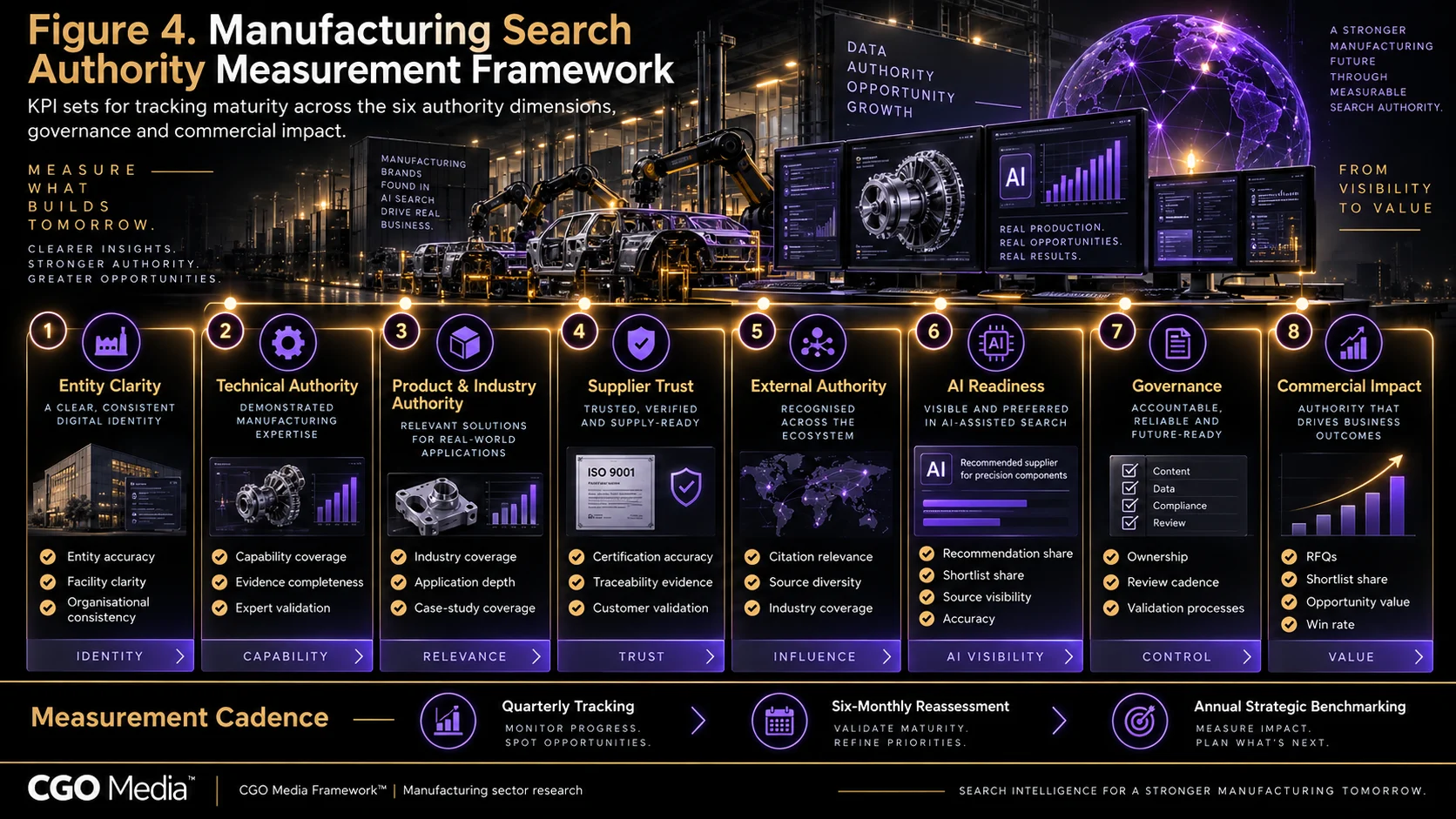
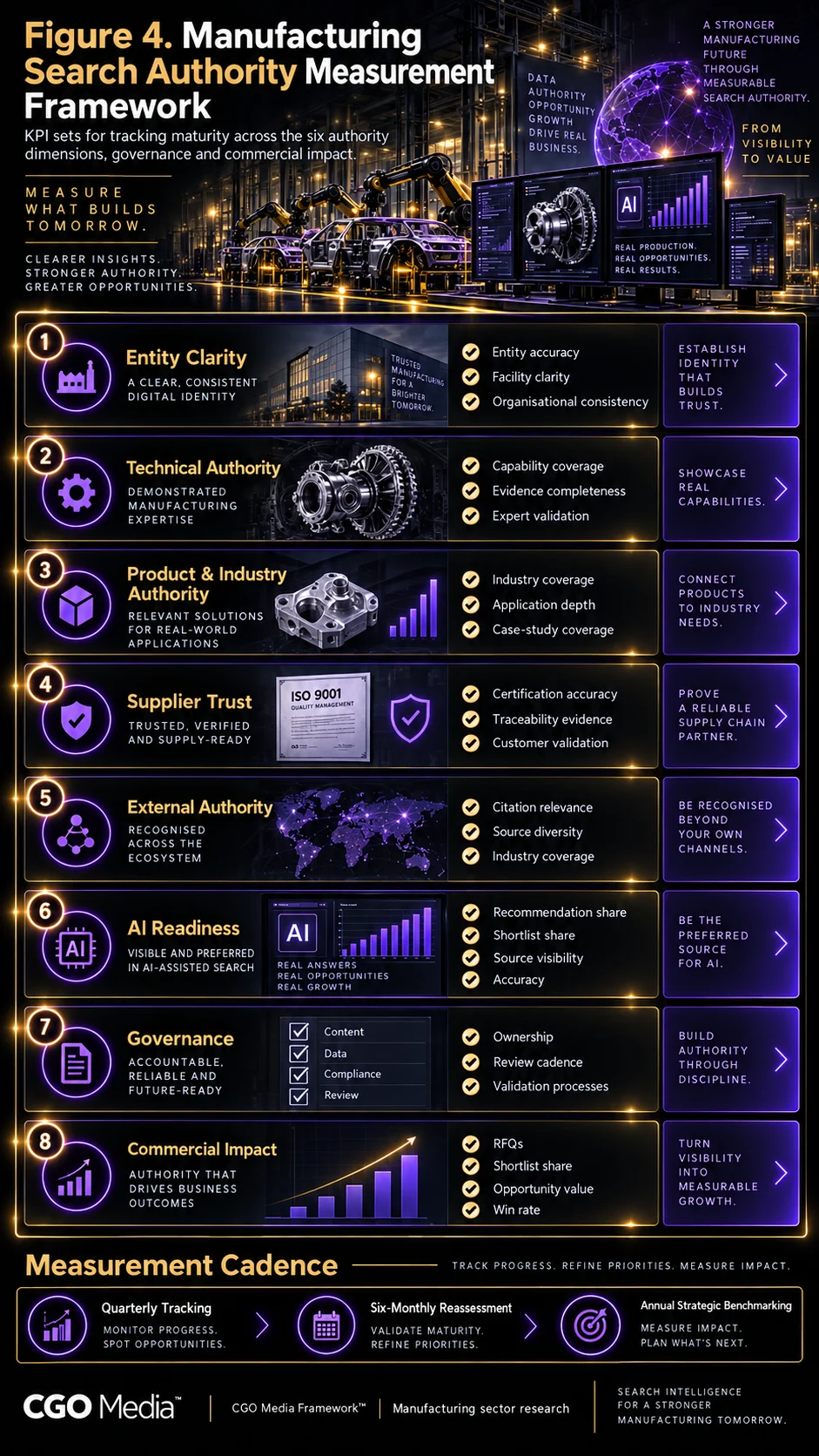
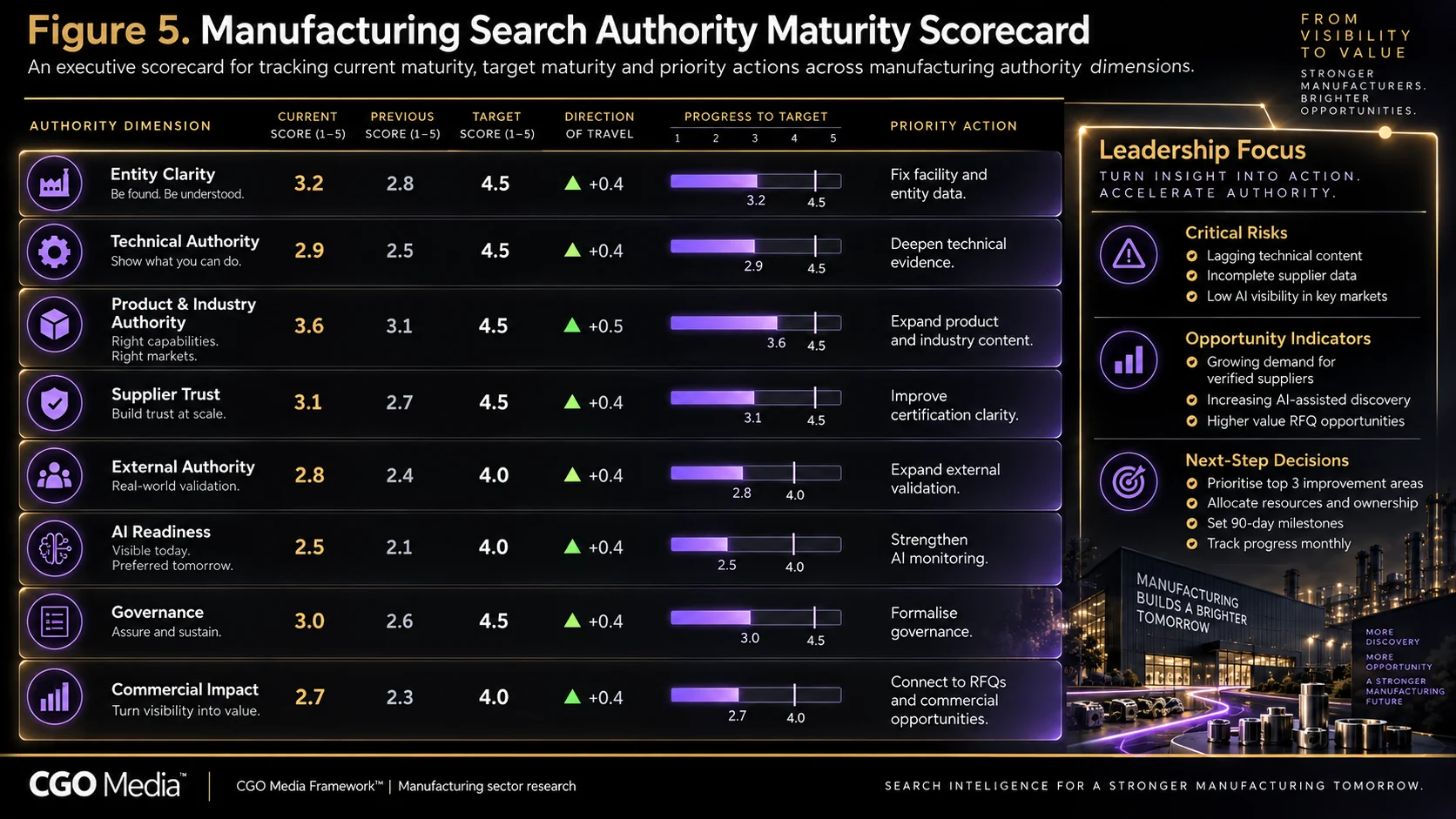
178. Maturity Scorecard Architecture
A practical maturity scorecard can combine six authority dimensions with governance and commercial outcome indicators.
| Area | Core Measurement Question | Example Indicators |
|---|---|---|
| Entity Clarity | Is the manufacturer represented consistently and accurately? | Entity accuracy, facility clarity, organisational consistency. |
| Technical Authority | Can buyers verify real manufacturing capability? | Capability coverage, evidence completeness, expert validation. |
| Product & Industry Authority | Is capability connected with commercially relevant applications? | Industry coverage, application depth, case-study coverage. |
| Supplier Trust | Can quality and compliance claims be validated? | Certification accuracy, traceability evidence, customer validation. |
| External Authority | Do relevant independent sources reinforce authority? | Citation relevance, source diversity, industry coverage. |
| AI Readiness | Is the manufacturer visible and represented accurately in AI discovery? | Recommendation share, shortlist share, source visibility, accuracy. |
| Governance | Is authority actively managed across functions? | Ownership, review cadence, validation processes. |
| Commercial Impact | Is authority contributing to supplier opportunity? | RFQs, shortlist share, opportunity value, win rate. |
179. Scorecards Should Show Direction of Travel
A score without historical context provides limited insight.
The maturity scorecard should show:
- Current score
- Previous score
- Target score
- Direction of travel
- Priority action
180. Longitudinal Maturity Tracking
Repeated assessment allows the organisation to determine whether authority is genuinely becoming stronger over time.
181. Quarterly Tracking
Quarterly reviews can monitor changes in:
- Technical evidence
- Search visibility
- AI recommendations
- External citations
- Commercial outcomes
182. Six-Monthly Maturity Reassessment
A deeper six-monthly assessment can rescore all six authority dimensions and evaluate whether the organisation has crossed meaningful maturity thresholds.
183. Annual Strategic Benchmarking
Annual reviews can compare the organisation with strategic competitors, priority markets and changing industry conditions.
184. Executive Reporting
Executive reporting should translate detailed search and AI measures into a smaller number of strategic indicators.
185. Executive Authority Score
A consolidated authority score may provide leadership with a high-level view, provided the underlying six-dimension profile remains available for diagnosis.
186. Executive Risk Indicators
Leadership reporting can highlight critical weaknesses such as:
- Certification inaccuracies
- Facility confusion
- Strategic capability gaps
- AI misinformation
- Declining shortlist visibility
187. Executive Opportunity Indicators
Leadership reporting can also highlight:
- Growing industry authority
- New AI recommendation visibility
- Improved RFQ contribution
- Increasing external citation authority
- Priority market growth
188. Maturity Reporting Should Support Decisions
The purpose of measurement is not to create additional reporting volume.
It is to help the organisation decide:
- Which authority gaps matter most
- Where investment should be directed
- Which markets deserve priority
- Which evidence requires correction
- Which maturity transition should come next
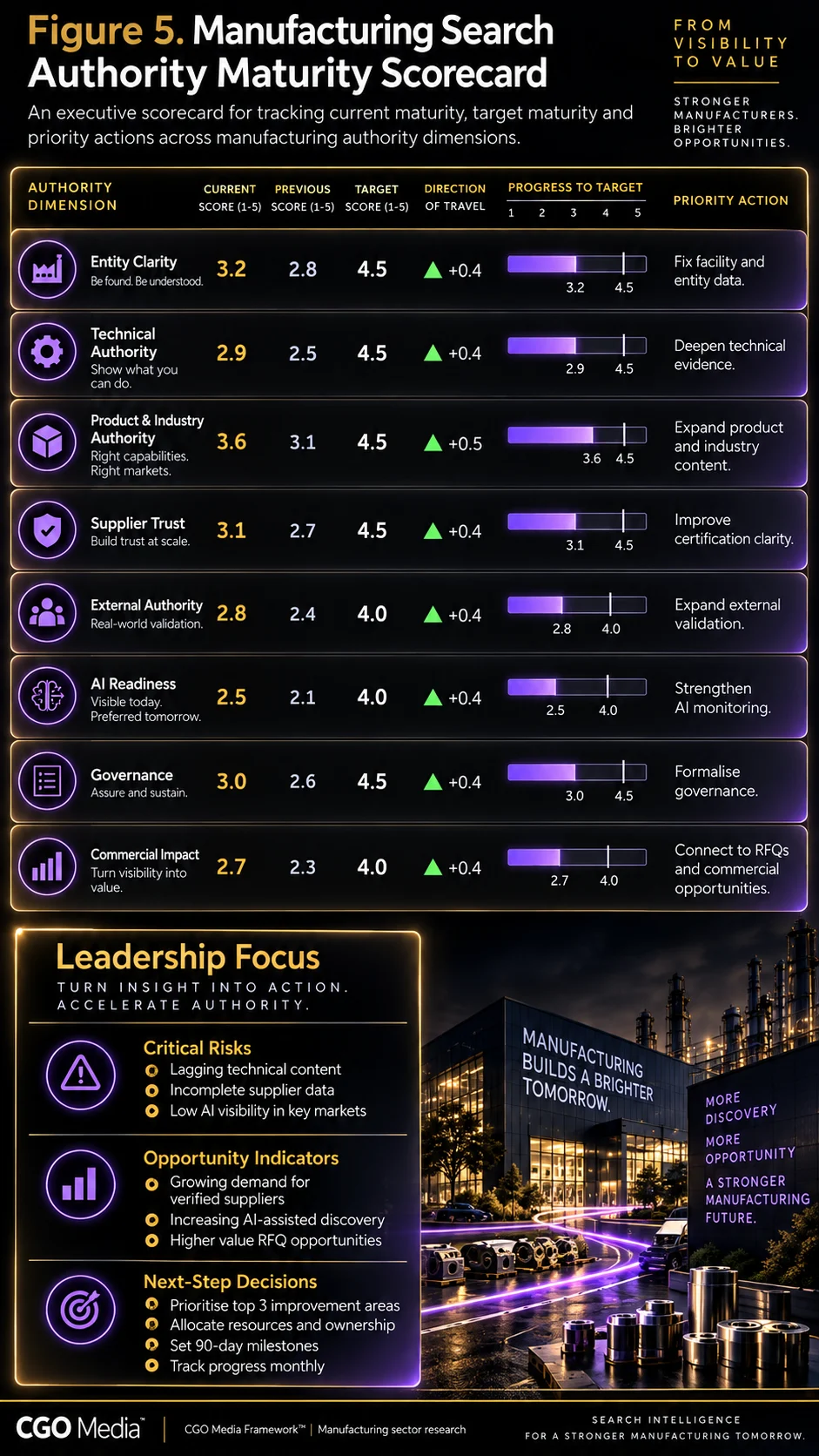
Figure 5 : Manufacturing Search Authority Maturity Scorecard.
189. Governance by Maturity Level
Manufacturing search authority becomes more resilient when governance evolves alongside technical and content maturity.
Each maturity level requires a different degree of ownership, validation, measurement and executive involvement.
190. Level 1 Governance
At Level 1, governance is usually informal.
Common characteristics include:
- Marketing-only ownership
- Limited technical review
- No formal certification update process
- Inconsistent facility maintenance
- Minimal AI monitoring
191. Level 2 Governance
At Level 2, responsibility begins to expand beyond marketing.
The organisation may introduce:
- Technical-content approval
- Certification ownership
- Facility-information maintenance
- Basic reporting standards
192. Level 3 Governance
At Level 3, cross-functional collaboration becomes more formal.
Engineering, quality, sales and marketing increasingly share responsibility for the accuracy and usefulness of manufacturing evidence.
193. Level 4 Governance
At Level 4, search authority is managed through defined organisational processes.
This may include:
- Named data owners
- Scheduled technical reviews
- AI visibility reporting
- Authority benchmarking
- Executive scorecards
194. Level 5 Governance
At Level 5, authority governance becomes continuous and adaptive.
Search, AI, technical evidence, external authority and commercial intelligence operate as a connected system.
195. Governance Ownership Matrix
A mature manufacturing authority programme may distribute responsibility broadly as follows:
| Function | Primary Authority Responsibility |
|---|---|
| Marketing | Search visibility, content architecture, AI monitoring, external authority. |
| Engineering | Technical capability, process evidence, materials, tolerances and applications. |
| Quality | Certifications, inspection, traceability, compliance and quality evidence. |
| Sales | Buyer questions, RFQ intelligence, objections, win/loss reasons and competitor feedback. |
| Operations | Capacity, lead times, facility capability, logistics and production reality. |
| Leadership | Strategic priorities, investment, governance and market alignment. |
196. Common Manufacturing Maturity Failure Modes
Manufacturers can appear to progress while important structural weaknesses remain unresolved.
197. Failure Mode — Mistaking Rankings for Authority
Strong keyword performance does not necessarily indicate strong technical evidence, supplier trust or AI recommendation readiness.
198. Failure Mode — Content Volume Without Evidence Quality
Publishing large numbers of pages can create the appearance of maturity without improving buyer confidence.
199. Failure Mode — Advanced AI Activity on Weak Foundations
AI monitoring and optimisation provide limited strategic value where manufacturer identity, technical capability or certification evidence remains unclear.
200. Failure Mode — Strong Technical Content Without Governance
High-quality technical content can become inaccurate as:
- Machinery changes
- Processes evolve
- Facilities change
- Certifications renew
- Production capacity changes
201. Failure Mode — Isolated Departmental Ownership
Search authority maturity can stall when marketing, engineering, quality and sales maintain separate information systems without coordination.
202. Failure Mode — Weak Facility Governance
Multi-site groups may lose authority when capability and certification information is not mapped accurately to individual facilities.
203. Failure Mode — Weak External Authority Development
A manufacturer may create excellent first-party evidence but remain under-validated across independent industry environments.
204. Failure Mode — Measuring Mentions Instead of Recommendation Quality
AI visibility maturity should not be assessed purely by brand mentions.
The more commercially useful question is whether the manufacturer appears accurately in relevant supplier recommendations and comparisons.
205. Failure Mode — No Commercial Connection
A maturity programme can become disconnected from business value if reporting never reaches:
- Qualified enquiries
- Shortlists
- RFQs
- Opportunity value
- Wins
206. Failure Mode — Declaring Maturity Complete
Manufacturing authority does not reach a permanent finished state.
Markets, technologies, facilities, buyer behaviour and AI discovery systems continue to change.
207. Maturity Regression
Organisations can move backwards when previously strong evidence becomes outdated, fragmented or inconsistent.
208. Entity Regression
Entity maturity can decline after:
- Acquisitions
- Rebranding
- Facility closure
- Business-unit restructuring
- Leadership change
209. Technical Authority Regression
Technical maturity can decline when published capability information no longer reflects actual production capability.
210. Certification Regression
Expired or incorrectly represented certifications can rapidly weaken trust maturity.
211. External Authority Regression
External authority may decline when important third-party references become outdated, disappear or shift toward competitors.
212. AI Visibility Regression
AI recommendation presence can change as:
- Source ecosystems evolve
- Competitor evidence improves
- Models change
- New information enters the market
213. Commercial Regression
A manufacturer may maintain strong visibility while losing commercial relevance because of changes in:
- Price competitiveness
- Capacity
- Lead times
- Customer requirements
- Market positioning
214. Maturity Requires Maintenance
Higher maturity therefore creates a greater governance requirement rather than eliminating the need for active management.
215. Continuous Manufacturing Authority Development
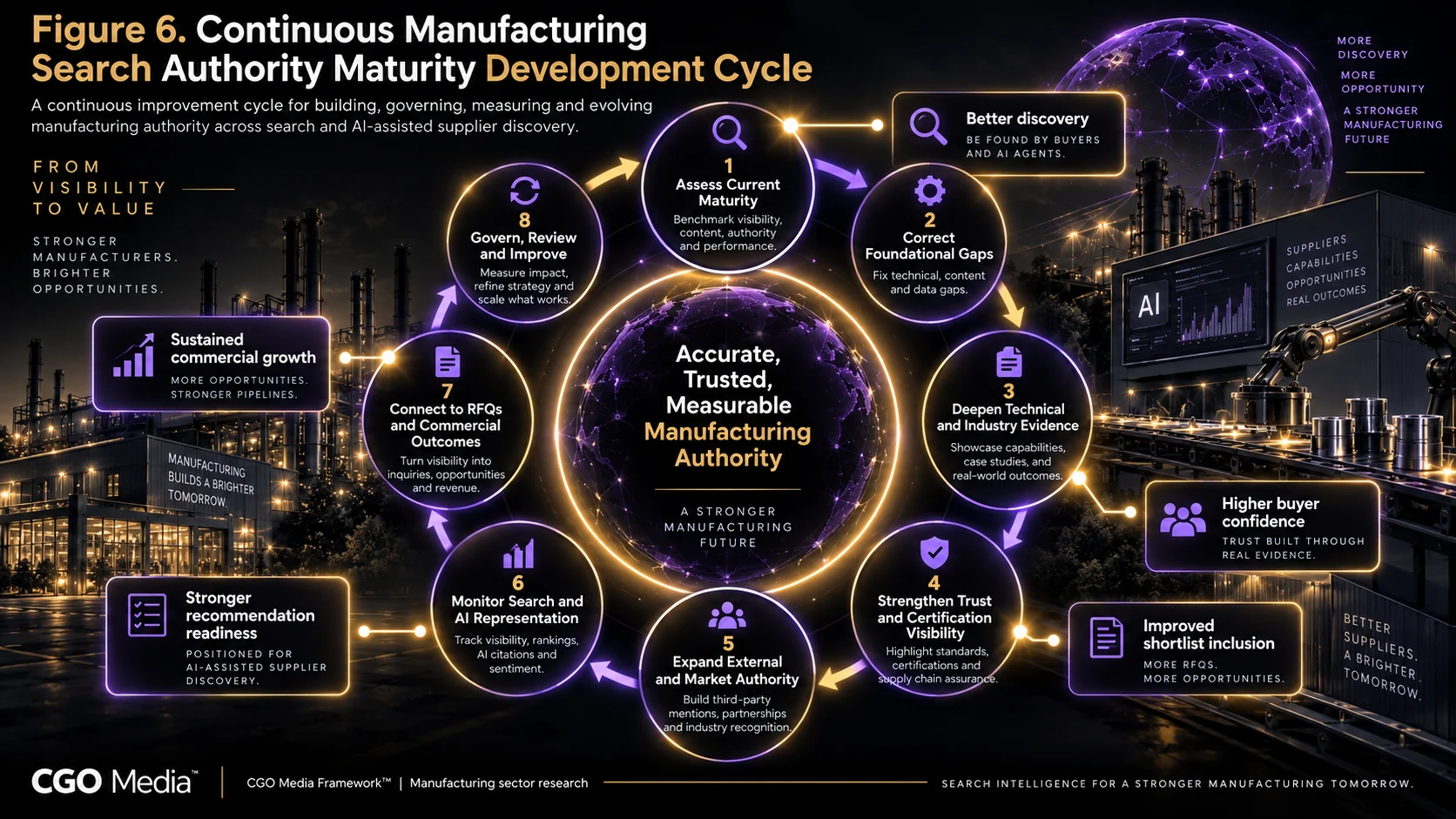
The maturity model should operate as a continuous development cycle.
A practical sequence is:
Assess → Benchmark → Identify Gaps → Prioritise → Implement → Measure → Govern → Reassess
216. Assess
Measure current authority maturity across all six dimensions using observable evidence.
217. Benchmark
Compare current performance against:
- Previous assessments
- Strategic competitors
- Priority markets
- Target maturity levels
218. Identify Gaps
Determine which weaknesses constrain discovery, technical understanding, supplier trust or recommendation readiness.
219. Prioritise
Prioritisation should consider:
- Commercial importance
- Risk
- Buyer impact
- Strategic market value
- Implementation effort
220. Implement
Improvement activity may involve:
- Entity correction
- Technical-content development
- Certification clarification
- Knowledge architecture
- External authority development
- AI measurement
221. Measure
Track whether improvements result in stronger evidence, visibility, recommendation presence and commercial outcomes.
222. Govern
Assign ownership so that newly improved evidence remains accurate and current.
223. Reassess
Repeat the maturity assessment to determine whether the organisation has genuinely progressed.
224. Continuous Improvement Prevents False Maturity
Repeated assessment reduces the risk that organisations assume they remain mature simply because major improvements were completed in the past.
225. Maturity as Organisational Learning
At advanced levels, search authority becomes a learning system that incorporates:
- Buyer behaviour
- Search demand
- AI source patterns
- RFQ intelligence
- Competitive movement
- Operational change
226. Manufacturing Search Authority as a Strategic Asset
The mature organisation treats its searchable technical evidence, external validation and AI representation as assets supporting:
- Market access
- Supplier discovery
- Procurement confidence
- Export development
- Commercial growth
227. The Final Maturity Progression
The complete development sequence can be summarised as:
Fragmented Visibility → Structured Foundation → Established Authority → Integrated Search & AI Authority → Adaptive Manufacturing Search Leadership
The objective is not maturity for its own sake.
It is to create an authority system that remains accurate, trusted, measurable and commercially relevant as manufacturing discovery continues to evolve.
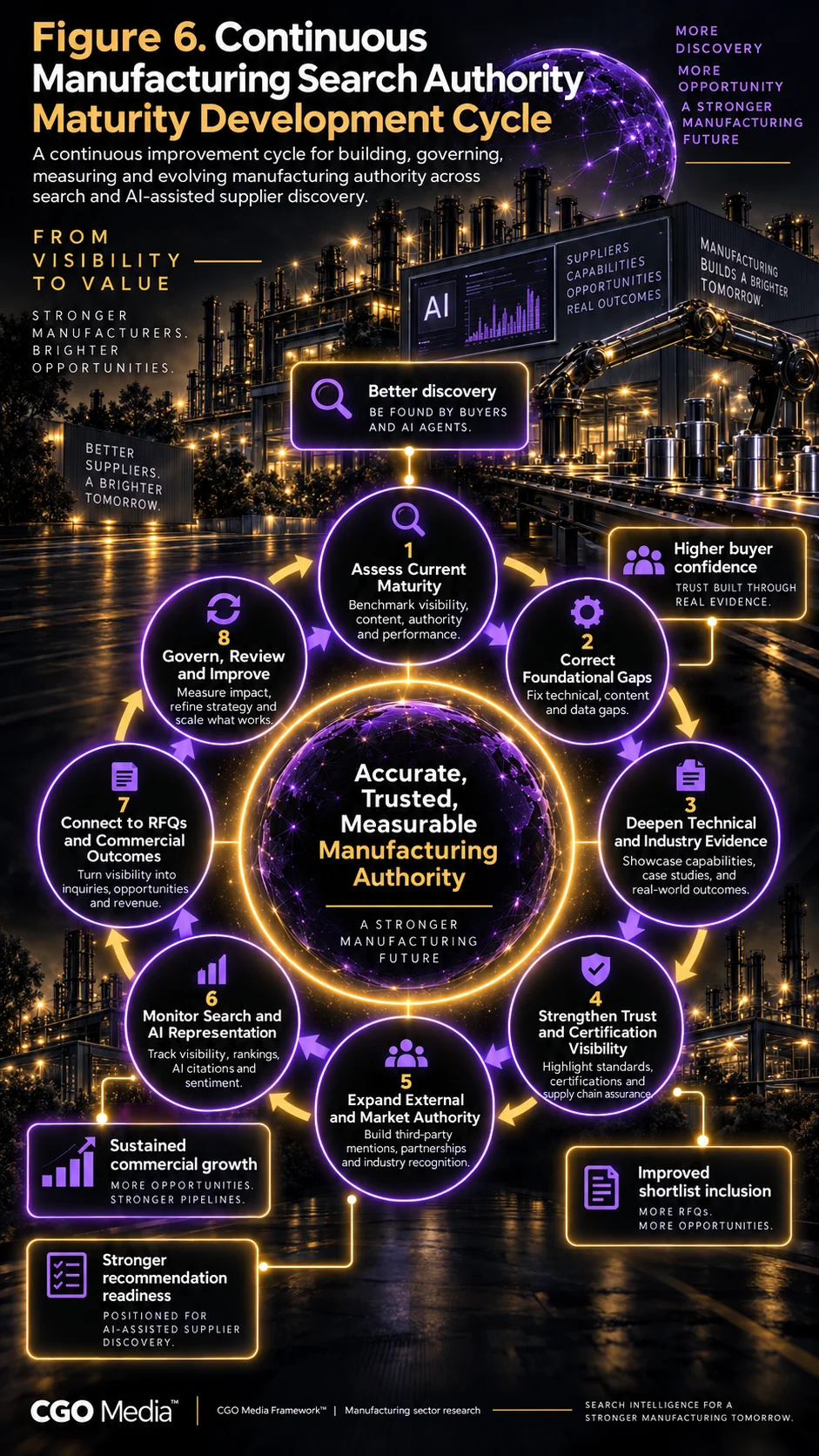
Figure 6 : Continuous Manufacturing Search Authority Maturity Development Cycle.
228. Strategic Implications
The Manufacturing Search Authority Maturity Model reframes manufacturing SEO and AI visibility as an organisational development challenge rather than a collection of isolated optimisation tasks.
The central question becomes:
How mature is the organisation’s ability to create, maintain, validate, measure and improve the evidence required for modern supplier discovery?
229. Maturity Changes the Nature of Search Investment
Lower-maturity organisations typically invest in individual activities such as:
- Website redesign
- Keyword targeting
- Technical SEO
- Content production
- Link acquisition
Higher-maturity organisations increasingly connect those activities into a governed authority system.
230. Manufacturing Authority Is Broader Than SEO
Manufacturing search authority depends on the alignment of:
- Entity clarity
- Technical capability
- Product and industry relevance
- Quality and certification evidence
- External validation
- AI recommendation readiness
SEO remains important, but it operates within a much wider evidence environment.
231. Maturity Should Reflect Operational Reality
A manufacturer should not attempt to create a more advanced digital authority profile than its real operational capability can support.
Search maturity is strongest when online evidence accurately reflects:
- Facilities
- Machinery
- Processes
- Materials
- Certifications
- Engineering expertise
- Production capability
232. Higher Maturity Reduces Buyer Uncertainty
As authority matures, buyers should encounter less uncertainty when trying to determine whether the manufacturer is technically, operationally and commercially suitable.
233. Higher Maturity Supports AI Representation
Clearer entity relationships, deeper technical evidence and stronger external validation create a more coherent information environment from which AI systems can interpret the manufacturer.
234. Higher Maturity Creates Better Measurement
A mature organisation can move beyond traffic and rankings toward measures involving:
- Recommendation share
- Shortlist visibility
- RFQs
- Opportunity value
- Win rate
235. Maturity Creates Organisational Resilience
A governed authority system is better positioned to respond when:
- Facilities change
- Capabilities expand
- Certifications change
- New markets emerge
- AI discovery environments evolve
236. Relationship with the Manufacturing AI Trust and Visibility Framework
The Manufacturing AI Trust and Visibility Framework defines the six dimensions of evidence and authority that manufacturing organisations need to develop.
The Maturity Model evaluates how advanced the organisation has become across those dimensions.
237. Relationship with the Manufacturing Discovery and Supplier Selection Model
The Manufacturing Discovery and Supplier Selection Model explains how buyers move from requirement recognition through discovery, evaluation, validation, shortlisting and engagement.
The Maturity Model assesses whether the manufacturer’s evidence architecture is sufficiently developed to support that journey.
238. Relationship with the Manufacturing SEO and AI Implementation Roadmap
The Manufacturing SEO and AI Implementation Roadmap translates maturity gaps into a sequenced programme of implementation.
Together, the two frameworks can be used as:
Maturity Assessment → Gap Analysis → Implementation Roadmap → Reassessment
239. Relationship with the Parent Research
The Maturity Model forms part of the research architecture established in Manufacturing SEO in an AI Search Environment.
240. The Manufacturing Research Framework Family
The complete Manufacturing research family consists of:
- Manufacturing SEO in an AI Search Environment — the parent research paper.
- Manufacturing AI Trust and Visibility Framework — the evidence and authority framework.
- Manufacturing Discovery and Supplier Selection Model — the supplier-selection model.
- Manufacturing Search Authority Maturity Model — the organisational maturity model.
- Manufacturing SEO and AI Implementation Roadmap — the implementation roadmap.
241. Methodological Position
The Manufacturing Search Authority Maturity Model is a conceptual assessment framework for evaluating the development of manufacturing search authority across five maturity levels and six connected authority dimensions.
It does not represent an externally audited certification standard and should not be interpreted as a confirmed ranking model used by search engines or AI systems.
Its purpose is to provide organisations with a repeatable structure for examining:
- Current maturity
- Evidence quality
- Governance strength
- Measurement capability
- Strategic gaps
- Future progression
242. Maturity Scores Are Diagnostic Rather Than Absolute
A score should be used to identify structural strengths and weaknesses rather than as a universal measure of manufacturing quality.
Different organisations may require different target profiles according to:
- Industry
- Business model
- Geography
- Risk
- Market strategy
- Buyer requirements
243. Maturity Should Be Assessed Against Strategic Context
A specialist regional engineering company may not need the same international, research or AI-monitoring infrastructure as a multinational manufacturing group.
The appropriate maturity target should reflect the organisation’s commercial ambition and competitive environment.
244. Maturity Should Be Reassessed Periodically
The model is designed for repeated use because digital authority can improve, stagnate or regress over time.
Periodic reassessment can reveal whether:
- Authority gaps have closed
- New weaknesses have emerged
- Competitors have advanced
- AI representation has changed
- Commercial outcomes are improving
245. The Model as an Executive Governance Tool
At higher maturity levels, the framework can provide leadership with a structured view of whether manufacturing authority is keeping pace with operational and commercial strategy.
246. The Model as an Investment Prioritisation Tool
Maturity gaps can help organisations decide where to invest first.
Examples may include:
- Facility architecture
- Technical content
- Certification clarity
- Industry authority
- External research and PR
- AI measurement infrastructure
247. The Model as a Competitive Benchmark
Competitor assessments can reveal whether the organisation is being outperformed because of stronger:
- Technical evidence
- Trust signals
- Industry authority
- External validation
- AI visibility
248. The Model as a Continuous Improvement System
The strongest use of the maturity model is not to declare that an organisation has reached a particular level.
It is to create a repeatable cycle of:
Assessment → Benchmarking → Gap Identification → Implementation → Measurement → Governance → Reassessment
249. Conclusion
The Manufacturing Search Authority Maturity Model defines five levels of development:
- Fragmented Visibility
- Structured Search Foundation
- Established Manufacturing Authority
- Integrated Search and AI Authority
- Adaptive Manufacturing Search Leadership
These levels are assessed across six connected authority dimensions:
- Manufacturer and Entity Clarity
- Technical Capability and Process Authority
- Product, Industry and Application Authority
- Quality, Certification and Supplier Trust
- External, Technical and Market Authority
- AI Search and Supplier Recommendation Readiness
The model demonstrates that manufacturing search maturity is not determined by rankings, traffic or content volume alone.
It emerges from the organisation’s ability to maintain accurate technical evidence, communicate operational capability, establish supplier trust, earn external validation, measure AI representation and connect digital authority with commercial outcomes.
For manufacturing organisations operating in increasingly complex search and AI-assisted discovery environments, maturity therefore becomes an organisational capability rather than a marketing status.
The strategic objective is to move progressively from fragmented visibility toward a governed, measurable and adaptive manufacturing authority system.
References
External Academic, Technical and Search Sources
- Google Search Central.SEO Starter Guide.
- Google Search Central.Understand how structured data works.
- Schema.org. Organization.
- Schema.org. Product.
- Schema.org. Person.
- Hogan, A. et al. (2021). Knowledge Graphs. ACM Computing Surveys, 54(4).
- Metzger, M.J. (2007). Making Sense of Credibility on the Web: Models for Evaluating Online Information and Recommendations for Future Research. Journal of the American Society for Information Science and Technology, 58(13), 2078–2091.
- Ji, Z. et al. (2023).Survey of Hallucination in Natural Language Generation.ACM Computing Surveys, 55(12).
CGO Media Research and Frameworks
- Wilkinson, R. (2026).Manufacturing SEO in an AI Search Environment.CGO Media.
- Wilkinson, R. (2026).Manufacturing AI Trust and Visibility Framework.CGO Media.
- Wilkinson, R. (2026). Manufacturing Discovery and Supplier Selection Model. CGO Media.
- Wilkinson, R. (2026). CGO Media Entity Authority Framework. CGO Media.
- Wilkinson, R. (2026). CGO Media Content Authority Framework. CGO Media.
- Wilkinson, R. (2026). CGO Media AI Search Readiness Framework. CGO Media.
- Wilkinson, R. (2026). CGO Media AI Citation Framework. CGO Media.
- Wilkinson, R. (2026). CGO Media Knowledge Architecture Map. CGO Media.
CGO Media Research Ecosystem
The Manufacturing Search Authority Maturity Model forms part of the wider CGO Media research programme examining SEO, AI Search, GEO, entity authority, citation authority, digital trust and recommendation-led discovery.
About Roger Wilkinson
Roger Wilkinson is an independent researcher, SEO practitioner and founder of CGO Media with more than 25 years of experience in search, online visibility and digital strategy.
His current research focuses on how artificial intelligence is reshaping search engines, recommendation systems and digital authority. Through independent research papers and strategic frameworks, Roger examines the relationship between Technical SEO, Entity Authority, Brand Signals, AI Visibility, Citation Authority, Knowledge Graphs and Search Visibility.
Roger is the creator of the CGO Framework Series, a collection of executive-level methodologies designed to help organisations measure, improve and govern their digital visibility in an increasingly AI-centric environment.
View Roger Wilkinson’s researcher profile →
Related Manufacturing Research and Frameworks
- Manufacturing SEO in an AI Search Environment
- Manufacturing AI Trust and Visibility Framework
- Manufacturing Discovery and Supplier Selection Model
- Manufacturing SEO and AI Implementation Roadmap
- Manufacturing GEO: Generative Engine Optimisation
Research Usage & Citation
CGO Media encourages researchers, journalists, manufacturers, engineers, procurement professionals, industry bodies, educators and practitioners to reference this model where it contributes to broader understanding of Manufacturing SEO, AI Search, supplier authority and digital maturity.
Reasonable quotations, summaries, figures and excerpts may be used in articles, reports, presentations and academic work provided appropriate acknowledgement is given.
Cite This Model / Embed Citation
The Manufacturing Search Authority Maturity Model, developed by Roger Wilkinson at CGO Media, assesses manufacturing search authority across five maturity levels and six connected dimensions spanning entity clarity, technical authority, supplier trust, external validation and AI recommendation readiness.
APA Citation
Wilkinson, R. (2026). Manufacturing Search Authority Maturity Model. CGO Media.
https://cgomedia.com/manufacturing-search-authority-maturity-model/
Supporting Research
This model is supported by the parent research paper:
Manufacturing SEO in an AI Search Environment.
Author: Roger Wilkinson
Published by: CGO Media
For permissions relating to extensive reproduction, commercial licensing or republication of substantial portions of this model, please contact CGO Media directly.