
International Search Authority Maturity Model
 The International Search Authority Maturity Model provides a structured five-level framework for assessing how effectively an international organisation manages global search visibility, institutional identity, country and regional architecture, multilingual publishing, programme authority, research visibility, external validation and AI-assisted discovery.
International organisations operate within search environments that are considerably more complex than those faced by most commercial organisations. Their digital estates may extend across countries, languages, regional structures, programme areas, research libraries, policy resources, institutional partnerships and multiple stakeholder groups. At the same time, they may be expected to communicate consistently with governments, researchers, journalists, donors, members, programme participants, businesses, policy makers and the wider public.
The scale of this environment creates a strategic problem. A large international website can appear sophisticated while underlying search capability remains fragmented. An organisation may publish thousands of pages, operate in dozens of countries, translate material into multiple languages and receive significant media attention without possessing a coherent system for managing how its institutional identity, programmes, research, geographic operations and external authority are represented across search engines and AI-assisted discovery systems.
The International Search Authority Maturity Model is designed to distinguish digital scale from search authority capability. It asks not simply how much content an institution publishes or how many international markets it serves, but how effectively its digital, institutional and authority systems operate together.
The model is particularly relevant to intergovernmental organisations, international NGOs, development organisations, international associations, standards bodies, foundations, research institutions, global charities and other organisations whose authority depends on being accurately understood across multiple jurisdictions and information environments.
It forms part of the wider CGO Media International Organisations research architecture and should be read alongside
International Organisations SEO in an AI Search Environment, the International Organisations AI Trust and Visibility Framework, the International Discovery and Organisation Selection Model, the International Organisations SEO and AI Implementation Roadmap and International Organisations GEO: Generative Engine Optimisation.
Together, these resources examine how institutional visibility, trust, discoverability, recommendation potential and implementation maturity interact.
1. Why International Search Needs a Maturity Model
International search performance cannot be understood adequately through rankings, organic traffic or keyword visibility alone. Those measures remain useful, but they reveal only part of the environment in which an international organisation operates.
A global institution may receive substantial organic traffic while still presenting search engines with inconsistent organisational relationships. Country pages may rank successfully without being connected clearly to the programmes, offices, experts, reports and institutional evidence relevant to those countries. Research papers may attract links and citations while remaining isolated from the organisation’s broader knowledge architecture. Multilingual sections may generate traffic while containing inconsistent translations, outdated material or incomplete relationships with equivalent pages in other languages.
The emergence of AI-assisted discovery introduces an additional layer. Search systems increasingly need to interpret organisations rather than simply retrieve pages. Users may ask questions about which organisation works in a particular country, which institutions publish evidence on a specific subject, which organisations operate programmes in a region, which research body is authoritative on an issue or which international organisation should be consulted for a particular policy question.
These are not purely ranking questions. They depend on whether digital systems can establish sufficiently clear relationships between the institution, its geographic operations, programmes, leadership, research, expertise, external references and evidence of authority.
This creates an important distinction between having international SEO activity and possessing an international search authority capability.
An organisation may have SEO specialists optimising pages, communications teams publishing reports, country teams maintaining local content, researchers producing evidence, policy teams developing guidance and public-relations teams generating external coverage. Yet those activities can remain disconnected.
A maturity model provides a way to determine whether individual activities have evolved into an institutional system.
The central question therefore becomes:
How advanced is the organisation’s capability to create, connect, maintain, validate, measure and adapt the information signals required for international search and AI-assisted discovery?
This perspective shifts assessment away from isolated campaigns and towards long-term institutional capability.
2. Digital Scale Is Not the Same as International Search Maturity
One of the most important principles within the model is that organisational size should not be confused with maturity.
International organisations frequently possess characteristics that create the appearance of advanced digital capability. These may include strong brand recognition, established domains, extensive research libraries, country offices, regional websites, high-authority backlinks, multilingual content and significant media visibility.
Those characteristics can provide substantial advantages. They do not, however, guarantee that the organisation has developed a coherent international authority system.
A large institution may still have weaknesses such as:
- unclear relationships between headquarters, regional offices and country operations;
- inconsistent country-page templates and information standards;
- outdated or incomplete programme information;
- different organisational descriptions across language versions;
- research reports disconnected from authors, programmes and geographic evidence;
- limited structured representation of institutional entities;
- weak control over duplicate or competing international pages;
- poorly maintained hreflang relationships;
- inconsistent terminology across countries or departments;
- fragmented external citation monitoring;
- limited understanding of which sources influence AI-generated answers;
- and no common governance framework connecting SEO, communications, research, policy and digital teams.
The purpose of maturity assessment is therefore not to reward scale. It is to assess whether scale has been converted into structured authority.
A smaller international institution with clear entity relationships, well-governed multilingual architecture, strong programme evidence, connected research, transparent governance and systematic measurement may possess a more mature international search capability than a much larger institution operating hundreds of fragmented websites.
Maturity describes the quality and coordination of the system rather than its physical size.
3. From International SEO Activity to Search Authority Capability
International search maturity normally develops gradually. Organisations rarely move directly from basic international publishing to a fully integrated authority system.
The progression often begins with a practical requirement: make international information available online.
The organisation establishes a website, adds country information, publishes reports, launches programme pages and potentially provides content in multiple languages. Search visibility is initially a consequence of publishing rather than a deliberately governed institutional capability.
The next stage usually involves optimisation. Technical SEO problems are addressed. Priority pages receive better titles and metadata. Hreflang implementation improves. Country pages are strengthened. Research resources become easier to find. Analytics becomes more sophisticated.
These improvements can significantly increase visibility, but optimisation remains primarily page- or channel-focused.
Greater maturity begins when the organisation starts structuring relationships.
Instead of treating a country page simply as a landing page, it becomes a geographic authority hub connected with the country’s programmes, reports, experts, offices, partners and impact evidence. A research paper is no longer an isolated PDF or article; it becomes part of a knowledge system connected with authors, subjects, programmes, datasets and institutional priorities.
A typical progression can therefore be represented as:
Publishing International Information → Optimising Countries and Languages → Structuring Institutional Relationships → Integrating Authority Systems → Continuously Adapting to Search and AI Discovery
The transition between these stages is important because each represents a different organisational mindset.
At the earliest stage, the question is:
Do we have the information online?
At the optimisation stage:
Can people find it through search?
At the structured stage:
Are the relationships between our organisation, locations, programmes, research and expertise understandable?
At the integrated stage:
Are our search, knowledge, institutional and authority systems operating together?
At the adaptive stage:
Can that system continuously learn and change as our organisation, audiences, programmes and discovery environments evolve?
That progression forms the foundation of the International Search Authority Maturity Model.
4. The Five Levels of International Search Authority Maturity
The model defines five progressive maturity levels:
- Functional
- Optimised
- Structured
- Integrated
- Adaptive Authority
These levels should not be interpreted as rigid certifications. International organisations are complex, and maturity rarely develops uniformly. An organisation may demonstrate advanced research authority while maintaining relatively weak multilingual governance. Another may have sophisticated international technical SEO but limited external citation analysis or AI visibility monitoring.
The five levels therefore provide an analytical structure rather than a pass-or-fail classification system.
The purpose is to identify the organisation’s dominant operating characteristics, expose capability gaps and establish what changes are required to progress toward a more connected international authority system.
The maturity position should also be understood dynamically. Country structures change. New programmes launch. Research priorities evolve. Websites are migrated. Leadership changes. Languages are added. Partnerships develop. Search engines change how they retrieve and interpret information. AI assistants introduce new discovery behaviours.
An organisation that appears mature at one point can regress if governance and maintenance do not keep pace with institutional change.
For that reason, maturity should eventually become a repeatable management process rather than a one-time assessment.
5. Level One — Functional International Search Authority
The Functional level represents the point at which an organisation possesses the basic digital infrastructure required to participate in international search but has not yet transformed that infrastructure into a coordinated authority system.
This should not necessarily be interpreted as poor performance. Many established international organisations operate partly at this level because their digital estates have developed organically over long periods. Websites may have been created by different departments, country offices, funding programmes or regional teams. Content-management systems may have been introduced at different times. Translation processes may vary between offices. Research libraries may have evolved independently from programme websites.
The result is an environment that functions but depends heavily on local knowledge, manual intervention and reactive maintenance.
Typical Functional-level characteristics include:
- an operational global or institutional website;
- basic country or regional sections;
- some multilingual publishing;
- programme and project information;
- research reports or institutional publications;
- basic search optimisation;
- standard web analytics;
- external references and media coverage;
- and an identifiable organisational brand.
These components allow users to find and interact with the organisation. The limitation is that they are often not governed as parts of one connected search authority architecture.
Functional maturity can therefore be described as digital presence without complete institutional coordination.
6. Functional Technical Foundations
At Level One, the organisation’s principal website is normally crawlable and indexable, but international technical SEO is frequently reactive rather than systematically governed.
Problems may be discovered after traffic declines, a website migration takes place, a country office reports missing pages or users encounter problems accessing translated content. Technical management tends to focus on individual issues rather than maintaining a unified international standard.
Common weaknesses can include:
- incomplete or incorrect hreflang relationships;
- conflicting canonical signals;
- duplicate country or language pages;
- indexation of outdated programme content;
- orphaned research pages;
- broken internal links following organisational changes;
- slow regional or country sites;
- inconsistent templates;
- poor mobile performance;
- multiple XML sitemap conventions;
- and differences in structured data implementation between departments or platforms.
These issues matter because international technical SEO provides the infrastructure through which institutional relationships are discovered.
If search engines cannot reliably determine which language version corresponds with which audience, which URL represents the canonical resource or how regional and country content fits within the wider domain, more sophisticated authority signals become harder to interpret.
At this level, technical SEO therefore supports availability but does not yet provide comprehensive institutional architecture.
The transition toward higher maturity requires technical governance to move from problem resolution toward documented international standards, repeatable monitoring and coordination with the organisation’s wider content and entity architecture.
7. Functional Organisation Identity
A Functional organisation is normally recognisable online. Its official name, logo, headquarters and broad mission can be identified, and major search engines can generally associate the primary website with the institution.
The problem is often not whether the organisation exists as an identifiable entity. The problem is whether its internal and external relationships are represented clearly enough.
International organisations can operate through complicated institutional arrangements involving:
- global headquarters;
- regional offices;
- country offices;
- national affiliates;
- member organisations;
- programme partnerships;
- legal entities;
- foundations;
- research units;
- and independently branded initiatives.
Humans familiar with the organisation may understand these relationships intuitively. Search and AI systems require much stronger explicit evidence.
At Functional maturity, different parts of the digital estate may describe the organisation differently. Country offices may use variations of the official name. Programme microsites may not make their relationship with the parent institution obvious. Leadership pages may be inconsistent. Partner organisations may use outdated organisational descriptions.
This fragmentation limits entity clarity.
The next stages of maturity therefore require the organisation to move beyond simple brand consistency toward systematic management of institutional relationships.
8. Functional Country and Regional Architecture
Country visibility is particularly important for international organisations because institutional authority at global level does not automatically establish relevance within every country.
At the Functional level, country pages usually exist, but they may have developed according to local operational requirements rather than a common search architecture.
One country page may contain programme descriptions, contact information, staff biographies and research links. Another may contain only a short introduction and postal address. A third may operate as an almost independent website.
This inconsistency creates several problems.
Users receive different levels of evidence depending on the country they are researching. Search engines encounter inconsistent relationships between the parent institution and its local operations. AI systems may find substantially more evidence for some countries than others and therefore form an incomplete representation of the organisation’s actual geographic activity.
Regional architecture can suffer from the same problem.
A regional hub may simply list countries without explaining how regional priorities, programmes, research, experts and partnerships relate to those countries. In other cases, regional pages may compete with country pages for similar search intent.
Functional architecture therefore provides geographic presence, but the relationships between global organisation → region → country → programme → evidence remain inconsistent.
9. Functional Language Architecture
Multilingual publishing is often one of the clearest indicators of international reach, but the presence of several languages should not automatically be interpreted as multilingual maturity.
At Level One, translations may be produced according to immediate operational needs rather than a governed international content strategy.
Typical characteristics include:
- different levels of translation coverage between languages;
- important pages available only in the primary institutional language;
- translated pages updated later than originals;
- literal translation where local terminology would be more appropriate;
- inconsistent navigation between language versions;
- missing equivalent-page relationships;
- and difficulty determining which version represents the latest official information.
This is particularly significant for international organisations because translation is not simply a usability function. Language can affect institutional meaning.
Programme names, legal terminology, policy language, geographic references and technical concepts may require localisation and subject expertise. A translated page that is technically accurate but uses terminology unfamiliar to the intended audience may still perform poorly in search and AI discovery.
At Functional maturity, multilingual content therefore exists, but language governance remains incomplete.
10. Functional Programme and Project Information
Programmes, projects and initiatives frequently represent some of the most important entities within an international organisation’s digital environment.
They may also generate substantial discovery demand. Users may search for a programme by name, geography, funding area, policy subject, beneficiary group or institutional partner without initially searching for the parent organisation.
At Level One, programme pages normally provide enough information to confirm that a programme exists, but the depth and consistency of that information may vary significantly.
Important evidence can be missing or difficult to locate, including:
- programme status;
- start and completion dates;
- countries and regions covered;
- funding arrangements;
- delivery partners;
- programme leadership;
- objectives;
- outputs;
- measured results;
- related research;
- and impact evidence.
This creates an authority problem because a programme page can become the primary evidence source from which search systems, journalists, researchers and AI assistants attempt to understand the initiative.
Where essential context is missing, external sources may become more informative than the organisation’s own website.
A more mature system therefore requires programme information to move from basic description toward structured evidence.
11. Functional Research and Knowledge Publishing
International organisations frequently possess one major advantage over ordinary commercial websites: they produce original knowledge.
This may include research reports, datasets, policy papers, statistics, standards, technical guidance, evaluations, consultation documents, methodologies, case studies and programme evidence.
At Functional maturity, substantial volumes of this material may already exist. The weakness lies in how those resources are organised and connected.
Research can become trapped inside chronological publication libraries. Reports may exist primarily as PDFs. Author information may be incomplete. Topic taxonomies may be inconsistent. Datasets may not connect clearly to the research that uses them. Research may have no visible relationship with relevant country programmes.
Consequently, the organisation possesses knowledge but has not yet developed a complete knowledge authority architecture.
This distinction becomes increasingly important as AI systems use multiple sources to construct answers. The authority of a report is strengthened when its institutional context is understandable: who produced it, what evidence supports it, which programme or subject it relates to, when it was updated and how external organisations use or cite it.
CGO Media’s wider Research Library, Research Architecture and Knowledge Architecture research examine this transition from isolated publication toward connected knowledge authority in greater detail.
12. Functional External Authority and Institutional Validation
Many established international organisations naturally accumulate substantial external authority.
Government departments may cite their reports. Universities may reference their research. Journalists may interview their experts. Partner organisations may link to programme pages. Policy documents may reference institutional guidance. Academic papers may cite datasets or methodologies.
At Functional maturity, much of this authority develops organically.
The organisation benefits from the references but may not systematically understand them.
It may not know:
- which research papers receive the strongest academic citations;
- which country offices receive the strongest governmental validation;
- which experts are most frequently quoted in external media;
- which programmes attract references from institutional partners;
- which reports appear in policy documents;
- or which third-party sources repeatedly influence AI-generated descriptions of the organisation.
This represents an important maturity gap.
External authority is not simply a link-building metric. For international organisations it can provide evidence of institutional recognition.
A reference from a government, university, recognised policy institution, standards body or respected media organisation can help establish context around why a particular organisation, report, programme or expert matters.
Higher maturity therefore requires external authority to become observable, categorised and connected with the institution’s strategic knowledge and programme architecture.
13. Functional AI Visibility and Generative Discovery
At Level One, awareness of AI search is usually increasing, but monitoring remains informal.
Staff may test ChatGPT, Google AI experiences or other generative systems to see whether the organisation appears in answers. Communications teams may notice incorrect descriptions. Researchers may observe whether reports are mentioned. Senior leadership may ask why another organisation appears in recommendations.
These observations are useful but do not yet constitute an AI visibility programme.
Typical Functional-level monitoring may consist of occasional manual searches without:
- defined prompt sets;
- country segmentation;
- language segmentation;
- source tracking;
- citation analysis;
- recommendation monitoring;
- accuracy scoring;
- peer comparison;
- or historical measurement.
The organisation therefore knows that AI discovery matters but cannot reliably determine whether representation is improving or deteriorating.
This creates another distinction between visibility and capability.
An organisation may already appear prominently in AI-generated answers because of its historical authority. That does not necessarily mean it possesses a mature AI search strategy.
Maturity depends on whether the institution understands how it is represented, which sources influence that representation, where inaccuracies occur and what evidence needs to be strengthened.
This is one of the central issues explored in the International Organisations AI Trust and Visibility Framework and the international GEO research.
14. Functional Measurement and Governance
Measurement at Level One is usually dominated by conventional website metrics.
Reporting may include:
- organic traffic;
- search rankings;
- page views;
- report downloads;
- country traffic;
- top-performing pages;
- referral traffic;
- and conversion or engagement metrics.
These measures are valuable, but they provide limited insight into institutional search authority.
For example, an increase in traffic does not reveal whether the organisation’s relationship with a country programme is correctly understood. A high-ranking research paper does not show whether AI systems associate its findings with the correct institution. Download numbers do not show whether a report is influencing policy, academic citations or external recommendation systems.
A mature measurement system therefore needs to extend beyond website consumption and assess whether authority is being established across the institution’s broader discovery environment.
Governance is similarly limited at the Functional stage.
Responsibility may be divided between digital, communications, research, IT, policy and country teams without a shared international search governance model.
SEO may be owned by one department. Translation by another. Research metadata by a third. Structured data may be managed by developers. Country content may belong to local teams. External media monitoring may sit within communications. AI experimentation may occur independently across several departments.
Each activity can be performed competently while the overall system remains fragmented.
This organisational fragmentation is one of the clearest indicators that the institution has not yet progressed beyond Functional maturity.
15. The Strategic Limitations of Level One
The central limitation of Functional maturity is not that the organisation lacks digital assets. In many cases it possesses a very large number of them.
The limitation is that those assets are managed primarily as separate outputs rather than components of a connected international authority system.
The organisation publishes country pages but does not systematically connect them with local programmes and evidence. It publishes reports but does not consistently connect them with authors, subjects and geographies. It receives external citations but does not map how those citations reinforce authority. It publishes in several languages but does not maintain complete multilingual parity. It appears in AI answers but does not measure representation systematically.
As a result, performance is dependent on historical authority, organisational reputation and individual team competence rather than on a mature institutional search architecture.
This can remain workable for many years, especially for established organisations with strong brands. However, the approach becomes increasingly difficult to sustain as the institution expands.
Every additional country, language, programme, research stream, digital platform and partner increases the number of relationships that need to be maintained.
Eventually the organisation reaches a point where publishing more information can increase complexity faster than it increases authority.
Progression beyond Level One therefore requires the institution to move from reactive maintenance toward deliberate optimisation and coordination.
The first major transition is not yet complete integration. It is the establishment of repeatable optimisation practices across the most important international search capabilities.
That transition leads to Level Two — Optimised.
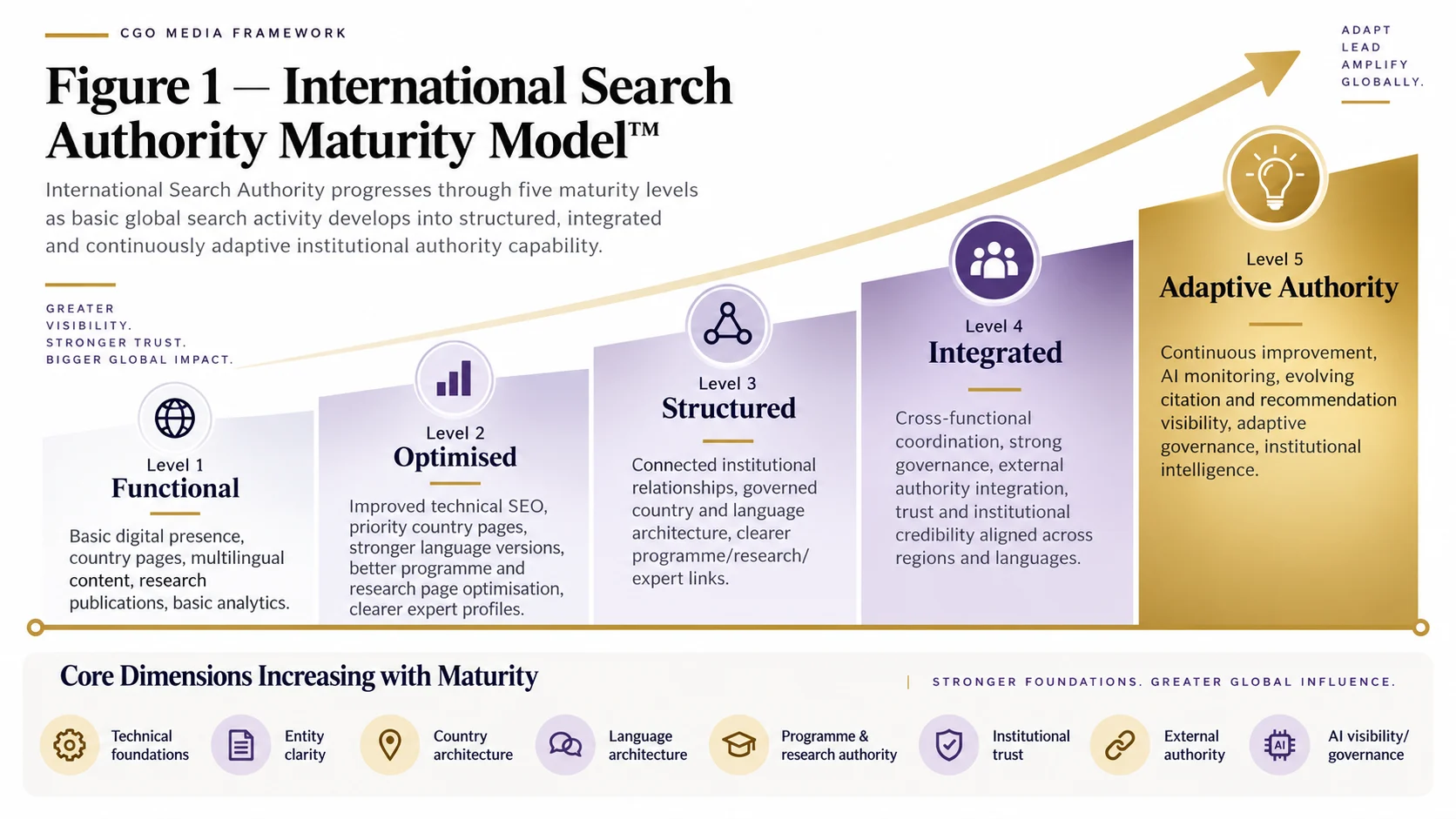
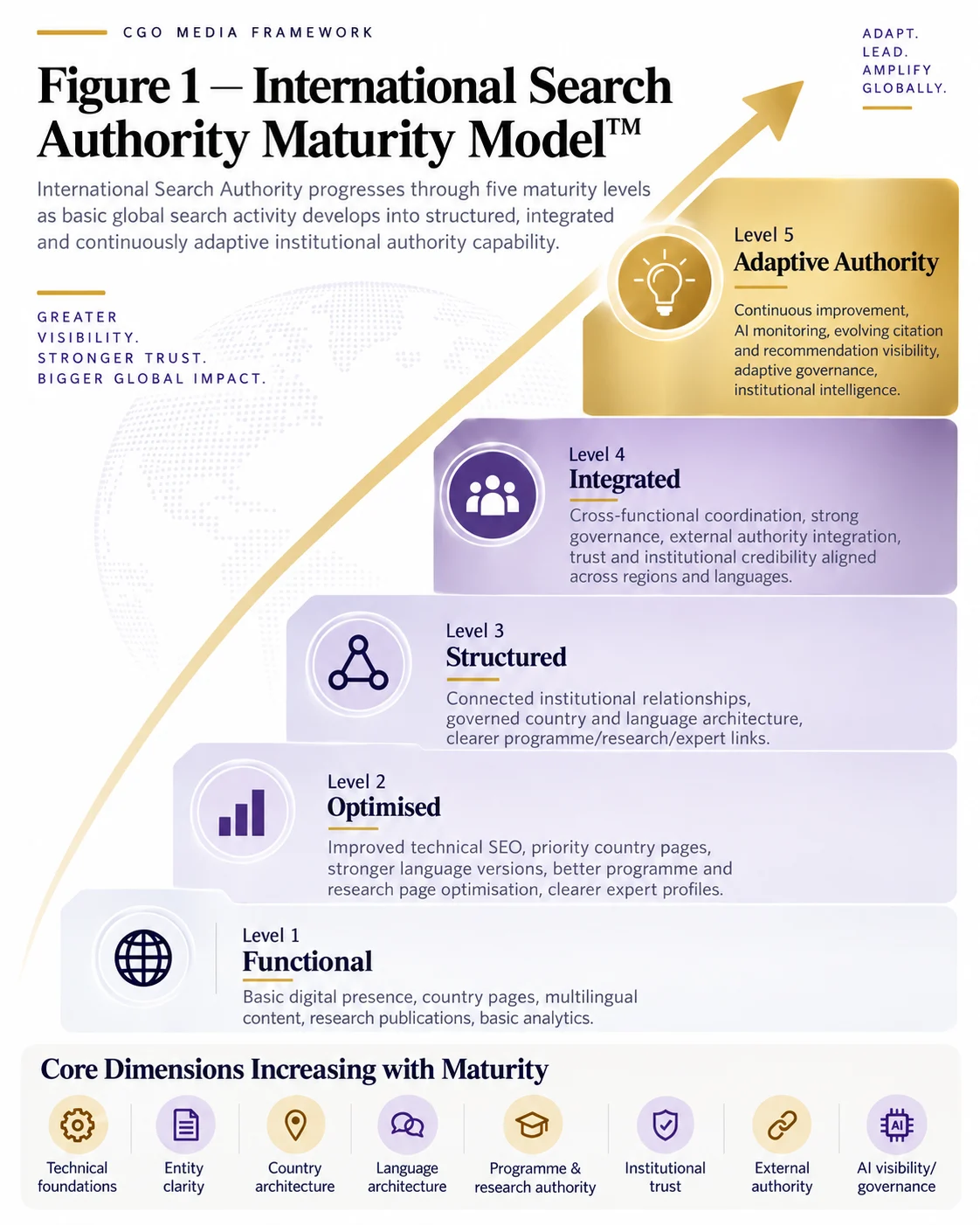
International Search Authority progresses through five maturity levels as isolated international publishing and optimisation activities develop into structured, integrated and continuously adaptive institutional capabilities.
1. Functional
Digital presence exists.
The organisation has global websites, country information, programmes, research and multilingual content, but technical, geographic, knowledge and authority systems remain largely reactive or fragmented.
2. Optimised
Individual capabilities improve.
Technical SEO, country pages, language versions, programme information, research discoverability, external authority and AI monitoring are deliberately strengthened.
3. Structured
Institutional relationships become explicit.
Countries, regions, languages, programmes, research, experts, partners and evidence are organised within a clearer international knowledge and authority architecture.
4. Integrated
Authority systems operate together.
Technical SEO, institutional entities, multilingual publishing, programme evidence, research, trust, external validation and AI monitoring become coordinated organisational capabilities.
5. Adaptive Authority
The system continuously learns and evolves.
International Search Authority adapts as countries, programmes, research priorities, institutional structures, user behaviour, external evidence and AI discovery environments change.
Figure 1. International Search Authority progresses from Functional through Optimised, Structured and Integrated maturity to Adaptive Authority as separate international search activities become a coordinated and continuously evolving institutional capability.
16. Level Two — Optimised International Search Authority
At the Optimised level, the organisation moves beyond basic international digital presence and begins improving individual search capabilities deliberately. Technical problems are addressed more systematically, priority country and regional pages receive greater attention, multilingual publishing standards improve, programme information becomes more complete, research resources become easier to discover and external authority begins to be measured rather than simply accumulated.
This represents an important advance from Functional maturity because international search is no longer treated entirely as a consequence of publishing. Teams begin recognising that visibility can be improved through deliberate technical, editorial and authority-building interventions.
The defining characteristic of Level Two, however, is that improvement generally remains capability-specific rather than institution-wide.
Technical teams may improve hreflang implementation without being involved in translation governance. Communications teams may strengthen country pages without connecting them systematically with research architecture. Research teams may improve publication metadata without linking authors, programmes and geographic evidence. Digital teams may begin testing AI visibility without integrating those findings with public relations, policy, programme or knowledge-management activity.
Optimisation therefore creates stronger individual components, but those components do not yet operate as one international authority system.
This distinction is critical.
An organisation can become significantly better at International SEO without yet reaching the point where its digital estate represents the full structure of the institution clearly enough for search engines, AI systems and external audiences to interpret relationships consistently.
Level Two can therefore be described as:
Deliberate improvement without complete institutional integration.
For many organisations, this stage produces substantial gains. Technical visibility improves. Priority markets perform better. Multilingual errors decline. Research receives more search exposure. Programme pages become stronger. AI representation becomes more visible to internal teams.
Yet the organisation is still largely optimising individual assets rather than designing an authority architecture.
17. Optimised Technical International SEO
Technical SEO becomes considerably more deliberate at the Optimised stage.
Instead of responding only when problems become visible, the organisation begins auditing its international digital environment, identifying recurring technical weaknesses and introducing clearer standards for how international pages should be crawled, indexed and connected.
Typical improvements may include:
- systematic crawl analysis;
- better indexation monitoring;
- correction of hreflang errors;
- stronger canonical management;
- improved XML sitemap organisation;
- removal or consolidation of duplicate international pages;
- improved mobile performance;
- better Core Web Vitals performance;
- cleaner internal linking;
- more consistent structured data;
- stronger handling of discontinued programmes;
- and improved migration procedures for country and regional websites.
The organisation may also begin establishing technical standards that apply across more than one team or country operation.
For example, a central digital function may define how country subdirectories should be structured, how translated pages should reference one another, how canonical URLs should be assigned and which content types require structured data.
This reduces the number of technical decisions made independently by local teams and creates a more predictable international environment.
However, Level Two technical maturity remains predominantly focused on technical correctness.
The organisation is becoming better at ensuring that search engines can crawl and interpret pages, but it may not yet have designed the deeper relationships that explain how those pages represent the institution itself.
A technically perfect country page can still be weak if it does not connect the country office with relevant programmes, experts, research, partners and impact evidence.
A correctly implemented language version can still provide incomplete institutional information.
Structured data can still describe individual pages without representing the wider organisation accurately.
Technical optimisation is therefore necessary, but it becomes substantially more valuable when it begins supporting a structured institutional model.
18. Optimised Country Pages
At Level Two, priority country pages begin receiving more deliberate optimisation.
The organisation recognises that a generic international brand page is not sufficient for every geographic discovery journey. Users searching from or about a specific country often need evidence that demonstrates actual local presence, relevance and activity.
Country pages therefore begin evolving beyond short institutional summaries.
Stronger pages may introduce:
- clear descriptions of the organisation’s role within the country;
- current programme information;
- country office details;
- relevant leadership or local contacts;
- links to country-specific research;
- programme outcomes;
- partner references;
- government relationships where appropriate;
- local news or institutional updates;
- and evidence of current activity.
This creates a more useful local authority surface.
Rather than forcing a search engine or user to assemble information from dozens of disconnected URLs, the country page begins acting as an entry point into the organisation’s local institutional footprint.
Optimisation may also improve page titles, descriptions, headings, internal links and content structure around relevant country terminology.
The important shift is that country visibility becomes an explicit objective rather than an accidental outcome of global brand strength.
However, inconsistency can remain.
The countries receiving greatest organisational investment may develop strong pages while smaller operations remain thin. Different regional teams may adopt different templates. Programme data may still be maintained manually. Research connections may depend on editors knowing which reports relate to which country.
The organisation is therefore improving geographic relevance but has not yet created a fully structured country authority architecture.
19. Optimised Regional Architecture
Regional architecture also begins to develop more deliberately at Level Two.
This is particularly important for organisations whose operational structures are not organised purely at global and national level.
A region may have its own leadership, programmes, policy priorities, research agenda, partnerships and communication requirements. Treating the regional section merely as a directory of country links fails to represent these relationships.
At the Optimised stage, regional hubs begin carrying greater institutional value.
They may include:
- regional strategy;
- regional leadership;
- participating countries;
- cross-border programmes;
- regional research;
- policy initiatives;
- statistics;
- regional partnerships;
- and links to country-level implementation.
This creates a clearer bridge between global institutional strategy and national activity.
Search visibility may also improve for users whose queries relate to regions rather than individual countries.
The challenge is ensuring that regional pages complement rather than compete with global, country and programme pages.
Without a clearly defined information architecture, multiple levels of the organisation can begin targeting similar topics using overlapping content.
The result may be internal competition, duplication and uncertainty around which page should act as the principal source for a particular question.
Optimised regional architecture therefore represents progress, but it also exposes the need for a more structured model of institutional relationships.
20. Optimised Multilingual Search Architecture
Language management becomes more systematic at the Optimised level.
The organisation begins recognising that multilingual search performance requires more than translation. Content must also remain accurate, current, locally understandable and technically connected with equivalent versions.
Improvement may include:
- better translation quality assurance;
- greater use of native-language reviewers;
- improved hreflang implementation;
- clearer equivalent-page mapping;
- better navigation between languages;
- more consistent terminology;
- local keyword and topic research;
- faster translation of updated institutional information;
- and removal of obsolete language pages.
A more mature distinction also begins emerging between translation and localisation.
Translation reproduces meaning in another language. Localisation considers how that information should be expressed for a particular audience, regulatory environment, institutional culture or search behaviour.
For an international organisation, this distinction can be substantial.
A programme may have different terminology in different countries. Acronyms may be recognised in one market but not another. A policy concept may require different contextual explanation. Country-specific institutional partners may need to be represented in local-language versions.
At Level Two, stronger organisations begin taking these differences into account.
However, the multilingual environment often remains prioritised according to resources. Major institutional languages receive systematic optimisation while secondary languages remain incomplete.
The organisation may therefore possess pockets of advanced multilingual capability without a fully governed language architecture across the entire digital estate.
21. Optimised Programme Authority
Programme and project pages become substantially stronger at the Optimised stage.
The organisation begins recognising that programme information must provide enough evidence for users and discovery systems to understand what an initiative does, where it operates and why it matters.
Programme pages may increasingly include:
- clear objectives;
- geographic scope;
- programme status;
- implementation dates;
- participating countries;
- funding information;
- delivery partners;
- programme leadership;
- target populations or beneficiaries;
- outputs;
- results;
- evaluation evidence;
- related reports;
- and measurable impact.
This strengthens both usability and institutional trust.
It also improves the organisation’s ability to surface in discovery journeys that begin with a problem or programme area rather than with the institutional brand.
A user may not initially search for the organisation itself. They may search for programmes addressing food security in a particular country, climate adaptation projects within a region, international standards relating to a sector or evidence concerning a development issue.
Well-developed programme pages create additional pathways through which institutional expertise can be discovered.
At Level Two, however, programme improvement can still be editorial rather than architectural.
Editors add better evidence, but programmes may not yet be represented systematically as entities connected with countries, partners, research, funding sources, experts and measurable results.
That entity-level connection becomes a defining characteristic of the Structured stage.
22. Optimised Research and Knowledge Visibility
At the Optimised level, research publishing starts moving beyond the simple uploading of reports.
The organisation recognises that important research must be discoverable through search and navigable within the institutional website.
Research resources may therefore receive improvements such as:
- descriptive HTML landing pages;
- clear publication titles;
- better metadata;
- publication dates;
- author information;
- topic classifications;
- executive summaries;
- related-resource links;
- country and regional references;
- structured data;
- and more accessible download options.
This significantly improves the discovery potential of institutional knowledge.
It can also reduce dependence on PDFs as the sole indexable representation of major research.
Research libraries may introduce improved filtering and categorisation so that users can browse by subject, publication type, geography or programme.
Yet the underlying knowledge model can remain shallow.
A report may be tagged as relevant to a country without being systematically connected with the country authority page. An author’s name may appear on a report without linking to a comprehensive expert profile. A dataset may be downloadable without showing which reports, programmes or methodological resources depend upon it.
Optimised research visibility therefore makes knowledge easier to find, but it does not yet guarantee that knowledge is represented as a connected institutional system.
23. Optimised Expert and Leadership Visibility
People begin playing a more deliberate role in institutional authority at Level Two.
International organisations frequently contain substantial subject expertise, yet that expertise can remain poorly represented online.
Researchers, policy specialists, programme directors, country representatives and senior leaders may be cited frequently outside the organisation while possessing limited first-party profiles.
Optimisation begins correcting this gap.
Expert and leadership pages may become more complete by including:
- full names and current positions;
- professional biographies;
- areas of expertise;
- institutional responsibilities;
- relevant programmes;
- research publications;
- country or regional responsibilities;
- public speaking;
- media commentary;
- and links to authoritative external professional profiles where appropriate.
This creates stronger relationships between institutional knowledge and the people responsible for producing, interpreting or implementing it.
However, individual profile improvement still tends to depend on communications priorities. Senior leadership may receive detailed profiles while specialist researchers remain minimally represented.
The Structured stage requires these people relationships to become part of the knowledge architecture rather than isolated biography pages.
24. Optimised Institutional Trust Evidence
Trust evidence becomes more visible and more intentionally managed at the Optimised stage.
International organisations may possess extensive evidence of legitimacy, governance and impact, but that evidence is not always easily discoverable.
Important information can be distributed across annual reports, governance documents, policy pages, financial statements, programme evaluations and external partner websites.
Optimisation begins consolidating and clarifying this material.
Relevant trust evidence can include:
- institutional history;
- governance structure;
- leadership;
- legal status;
- member or participating organisations;
- funding structures;
- financial reporting;
- accountability policies;
- methodologies;
- programme evaluations;
- impact reporting;
- ethical standards;
- and transparency information.
Making this information accessible helps audiences verify the institution and assess the basis on which it makes claims.
It may also provide search and AI systems with stronger first-party evidence when attempting to describe the organisation.
At Level Two, however, trust evidence often remains divided across departments. Governance teams maintain one set of information, communications teams another and programme teams another.
The next maturity stage requires these signals to become more consistently connected with the entities and claims they support.
25. Optimised External, Academic and Policy Authority
External authority becomes more observable at the Optimised stage.
Rather than treating all backlinks or external references as equivalent, the organisation begins distinguishing between different forms of institutional validation.
These may include:
- government references;
- academic citations;
- university links;
- policy-document references;
- citations from recognised research organisations;
- partner references;
- standards references;
- media coverage;
- expert quotations;
- conference participation;
- and references from other international organisations.
This represents a substantial shift in how authority is understood.
A conventional SEO approach might view an external reference mainly through the domain authority or traffic potential of the referring site.
An institutional authority approach considers the meaning of the relationship.
A government department citing an organisation’s methodology demonstrates something different from a newspaper quoting an executive. An academic citation provides different evidence from a partner link. A policy paper using institutional statistics has a different authority function from a directory listing.
At Level Two, the organisation begins recognising these distinctions and may track high-value external references deliberately.
However, the information can still remain distributed between SEO tools, media-monitoring systems, research citation databases and policy teams.
The organisation understands more about its external authority, but it has not yet integrated those signals into a unified institutional authority map.
26. Optimised AI Search Visibility
AI search monitoring becomes more deliberate at Level Two.
The organisation moves beyond occasional curiosity-driven testing and begins examining how generative systems represent important areas of institutional activity.
Monitoring may include questions such as:
- Is the organisation mentioned for its principal areas of expertise?
- Are major programmes recognised?
- Are country activities described accurately?
- Does the system identify the correct organisational relationship?
- Are institutional reports referenced?
- Are experts associated with the correct subject areas?
- Which external sources appear to influence answers?
- Are competitors or peer organisations represented more prominently?
- Are outdated facts being repeated?
- Do answers change between languages or markets?
Teams may begin saving prompts, recording outputs and identifying recurring inaccuracies.
This creates the beginnings of an AI visibility dataset.
The key limitation is that the monitoring process remains largely observational.
The organisation may know that an AI answer is incomplete without yet understanding the underlying authority gap responsible for the omission.
For example, weak country-level visibility may result from thin country pages, limited external references, poor programme-country relationships, inconsistent terminology or insufficient evidence across independent sources.
Moving from observation to diagnosis requires stronger relationships between AI monitoring and the wider institutional architecture.
27. Optimised Measurement
Measurement broadens considerably at Level Two.
Traditional traffic and ranking metrics remain important, but organisations begin segmenting performance according to the structure of their international operations.
Reporting may increasingly include:
- country visibility;
- regional visibility;
- language visibility;
- programme search performance;
- research visibility;
- publication engagement;
- expert visibility;
- external institutional citations;
- academic references;
- media mentions;
- AI mentions;
- and selected generative-search citations.
This creates a more informative picture than aggregate organic traffic.
It becomes possible to identify situations where the organisation performs well globally but poorly in strategically important countries, or where research receives strong academic recognition but limited general search visibility.
The organisation may also begin establishing benchmarks.
Rather than asking whether traffic increased, it can ask whether country visibility improved, whether more research is being discovered or whether institutional representation across AI systems became more accurate.
Yet measurement remains predominantly divided by channel.
SEO data, research citations, media coverage, programme metrics and AI monitoring can exist in separate dashboards owned by separate teams.
The next maturity stage requires the organisation to measure relationships between these signals rather than simply adding more metrics.
28. The Strategic Limitations of Level Two
The Optimised stage can generate substantial improvements, but its primary limitation is fragmentation.
The organisation becomes better at many things without necessarily becoming better at connecting them.
Technical SEO improves.
Country pages improve.
Regional pages improve.
Translation improves.
Research discoverability improves.
Programme evidence improves.
External authority monitoring improves.
AI visibility monitoring improves.
However, each area may still operate through separate teams, tools, taxonomies and governance processes.
The result can be an organisation with numerous optimisation programmes but no common authority architecture.
This becomes particularly visible when teams attempt to answer apparently simple questions.
For example:
- Which programmes establish our authority on this subject in this country?
- Which research supports those programmes?
- Which experts are associated with that research?
- Which government or academic sources independently validate the work?
- Which language versions contain equivalent evidence?
- Which AI systems currently recognise those relationships?
If answering these questions requires manual investigation across multiple teams and systems, the organisation remains primarily Optimised rather than Structured.
The transition to Level Three occurs when relationships themselves become objects of deliberate management.
29. Level Three — Structured International Search Authority
Level Three represents one of the most important transitions within the International Search Authority Maturity Model.
At the Structured level, the organisation moves beyond improving individual pages and capabilities and begins organising its international digital environment around explicit institutional relationships.
The central question changes.
Instead of asking primarily:
Which pages should we optimise?
the organisation increasingly asks:
How should the institution, its locations, programmes, people, research, partners, evidence and external authority be connected?
This changes the role of search strategy fundamentally.
Search is no longer applied only to published content after that content exists. Search architecture begins influencing how institutional information itself is structured.
A useful conceptual relationship may be expressed as:
Global Organisation → Region → Country → Programme → Research → Evidence → Impact
This is not intended as a rigid hierarchy. Real international organisations contain many overlapping relationships.
A single report may relate to multiple countries. A programme may operate across regions. An expert may contribute to several programme areas. A partner may work with the institution through many initiatives.
The significance of Level Three is therefore not the creation of one hierarchy but the deliberate representation of these relationships across the digital estate.
30. Structured Organisation Architecture
Institutional identity becomes more explicitly modelled at Level Three.
The organisation establishes clearer relationships between the parent institution and the components through which it operates.
These relationships may include:
- headquarters;
- regional offices;
- country offices;
- subsidiary or affiliated entities;
- leadership;
- departments;
- programmes;
- research units;
- partners;
- and institutional initiatives.
Naming conventions become more consistent. Organisational descriptions are standardised. Parent-child relationships become clearer. Structured data begins reflecting institutional reality more accurately.
This reduces ambiguity.
A programme website no longer needs to appear as an isolated branded project. Its relationship with the organisation can be made explicit.
A regional office can be understood as part of the wider institution rather than an apparently unrelated web property.
An expert can be associated with both the organisation and relevant areas of institutional work.
This is the beginning of entity-centred international search architecture.
31. Structured Regional Authority
Regional pages become genuine institutional hubs at Level Three.
Their function is not simply to provide navigation to a collection of countries.
A structured regional hub explains how the organisation operates across the region and connects the major entities necessary to understand that activity.
These connections may include:
- regional leadership;
- participating countries;
- regional programmes;
- cross-border initiatives;
- regional research;
- policy priorities;
- institutional partnerships;
- regional statistics;
- experts;
- and impact evidence.
Regional architecture can therefore support both broad regional discovery and deeper country-level exploration.
It also provides an intermediate level of authority between a large global institution and individual country operations.
This is particularly valuable where programmes or policy priorities operate across national borders.
32. Structured Country Authority
Country architecture becomes more consistent and evidence-led.
Rather than each country team deciding independently what its website should contain, common authority requirements are established.
A mature country hub may consistently connect:
- the country office;
- local leadership;
- active programmes;
- completed programmes where historically relevant;
- country-specific research;
- datasets and statistics;
- local partners;
- government relationships where appropriate;
- subject experts;
- impact evidence;
- news and institutional updates;
- and relevant regional and global resources.
Country pages therefore become authority nodes rather than conventional landing pages.
The purpose is not necessarily to make every country page identical.
Different national operations will require different content.
The goal is to establish a consistent information model so that core relationships remain understandable regardless of geography.
33. Structured Language Architecture
Multilingual publishing becomes part of the organisation’s information architecture rather than a downstream translation process.
The institution begins defining clearer rules for:
- which content requires equivalent language versions;
- which content may be localised independently;
- how hreflang relationships are maintained;
- how translated pages are updated;
- who owns terminology standards;
- how translated institutional names are used;
- how local programme terminology is represented;
- and how obsolete translations are managed.
This allows language versions to remain aligned with the underlying institutional model.
A programme translated into three languages remains the same programme entity even if terminology varies.
A country office retains the same organisational relationship regardless of language.
A research report can maintain clear authorship, publication and subject relationships across translated summaries.
This creates substantially greater consistency for users and machine interpretation.
34. Structured Programme Authority
Programmes become explicit elements within the institutional authority architecture at Level Three.
Rather than existing simply as webpages, they are represented through consistent relationships.
A programme may be connected with:
- the parent organisation;
- responsible departments;
- regions;
- countries;
- partners;
- funding sources;
- programme leadership;
- subject experts;
- research;
- datasets;
- outputs;
- results;
- evaluations;
- and impact evidence.
This changes the value of programme content.
A programme becomes not merely something the organisation says it operates, but a structured body of evidence demonstrating where it exists, who is involved, what knowledge it produces and what outcomes it has generated.
These relationships also improve resilience when programmes change status.
Completed programmes do not necessarily need to disappear. Their research, evidence and institutional history may remain valuable if archived and connected appropriately.
35. Structured Research Authority
Research architecture becomes significantly more sophisticated at Level Three.
Libraries are increasingly organised around meaningful relationships rather than simply publication chronology.
Research can be connected with:
- subjects;
- authors;
- programmes;
- countries;
- regions;
- publication types;
- datasets;
- methodologies;
- policy areas;
- and related institutional resources.
This creates a genuine knowledge architecture.
A user discovering a research paper can move to the author’s expertise, the programme that generated the evidence, related country information, connected datasets and subsequent publications.
Likewise, a country page can surface the most relevant institutional research without relying entirely on manually maintained link lists.
Search systems receive stronger contextual signals concerning what the research is about and how it relates to the institution.
The result is a shift from publishing documents toward organising institutional knowledge.
36. Structured Expert Authority
Experts, researchers and senior specialists become explicit knowledge entities at the Structured stage.
Profiles connect people with:
- current institutional roles;
- subject expertise;
- programmes;
- research publications;
- countries or regions;
- datasets;
- policy work;
- conference contributions;
- and relevant media commentary.
This provides stronger evidence of institutional expertise and reduces ambiguity where individuals have common names or complex professional histories.
It also allows institutional authority to operate in both directions.
The organisation strengthens the context around its experts, while recognised experts strengthen the perceived authority of the organisation’s knowledge and programmes.
37. Structured Governance and Trust Evidence
Institutional trust information becomes governed more systematically.
The organisation establishes clearer ownership for factual information that requires high accuracy, including governance, leadership, funding, legal status, institutional structure and accountability.
Review cycles become more explicit.
Outdated leadership information is corrected. Programme statuses are maintained. Governance documents are easier to locate. Funding information connects with relevant initiatives where appropriate. Impact claims can be supported by evidence.
The objective is not merely transparency for its own sake.
Structured trust evidence makes important institutional claims easier to verify.
This becomes increasingly important in environments where search and generative systems may combine first-party and third-party sources when describing an organisation.
38. Structured External Authority
External authority begins to be mapped against the organisation’s internal knowledge architecture.
This represents a substantial advance from simply tracking backlinks or media mentions.
External validation can be categorised according to source and institutional relationship, including:
- government citations;
- academic citations;
- university references;
- policy references;
- think-tank references;
- international organisation references;
- partner references;
- standards-body references;
- media citations;
- and recognised expert commentary.
The organisation can then begin asking which internal entities those external signals reinforce.
For example:
- Which research papers receive strong academic citation?
- Which programmes are referenced by government institutions?
- Which country operations receive independent validation?
- Which experts are cited by respected media or policy organisations?
- Which datasets are reused externally?
This transforms external authority from a generic domain-level concept into an institutional evidence system.
39. Structured AI Monitoring
AI visibility monitoring becomes repeatable at Level Three.
Rather than asking random questions periodically, the organisation develops defined prompt groups connected with its actual authority architecture.
Monitoring may be segmented by:
- institutional discovery;
- subject expertise;
- country;
- region;
- programme;
- research topic;
- expert;
- language;
- comparison query;
- and recommendation scenario.
Outputs can then be assessed against common criteria such as:
- visibility;
- factual accuracy;
- entity accuracy;
- programme accuracy;
- citation presence;
- source selection;
- recommendation visibility;
- and representation relative to peer organisations.
This allows AI search findings to be connected with underlying institutional weaknesses.
If a programme is consistently omitted from relevant answers, teams can investigate whether the problem relates to programme evidence, internal architecture, external validation, entity clarity or source availability.
AI monitoring therefore begins evolving from observation into diagnosis.
40. Structured Measurement
Measurement begins evaluating connected authority areas rather than isolated channel performance.
Instead of treating search rankings, citations, media coverage and AI visibility as unrelated datasets, the organisation begins analysing how they reinforce one another.
A research resource, for example, might be assessed through:
- organic visibility;
- country relevance;
- expert associations;
- internal programme relationships;
- academic citations;
- policy references;
- external links;
- media references;
- and AI citation visibility.
This provides a substantially richer understanding of authority than traffic alone.
The organisation can identify where strong internal evidence lacks external validation, where internationally recognised research has weak digital discoverability or where strong search visibility is unsupported by sufficient institutional trust evidence.
These observations enable better prioritisation.
Resources can increasingly be directed toward structural gaps rather than simply toward whichever pages currently attract the most traffic.
41. The Shift from International Optimisation to Institutional Authority Architecture
Level Three marks the point at which International Search Authority becomes more than an optimisation programme.
The organisation begins treating its digital estate as a representation of institutional reality.
Countries are not simply keywords.
They are operational contexts connected with offices, programmes, partners, research and impact.
Programmes are not simply landing pages.
They are institutional entities connected with locations, funding, partners, experts and evidence.
Research is not simply content.
It is institutional knowledge connected with authors, programmes, data and external citations.
Experts are not simply biographies.
They are people connected with research, programmes, subjects and external recognition.
External links are not simply authority scores.
They can provide independent validation of specific institutional claims, research outputs and areas of expertise.
AI visibility is not simply another traffic channel.
It becomes a test of whether the wider discovery ecosystem has enough consistent evidence to understand and represent the organisation accurately.
This is the defining change between Optimised and Structured maturity.
The organisation moves from asking:
“Which international pages should we optimise next?”
toward asking:
“How are our institution, countries, languages, programmes, research, experts, evidence and external authority connected?”
Once those relationships become explicit, the organisation is positioned to move toward Level Four, where the individual authority capabilities no longer merely connect conceptually but begin operating as an integrated institutional system.
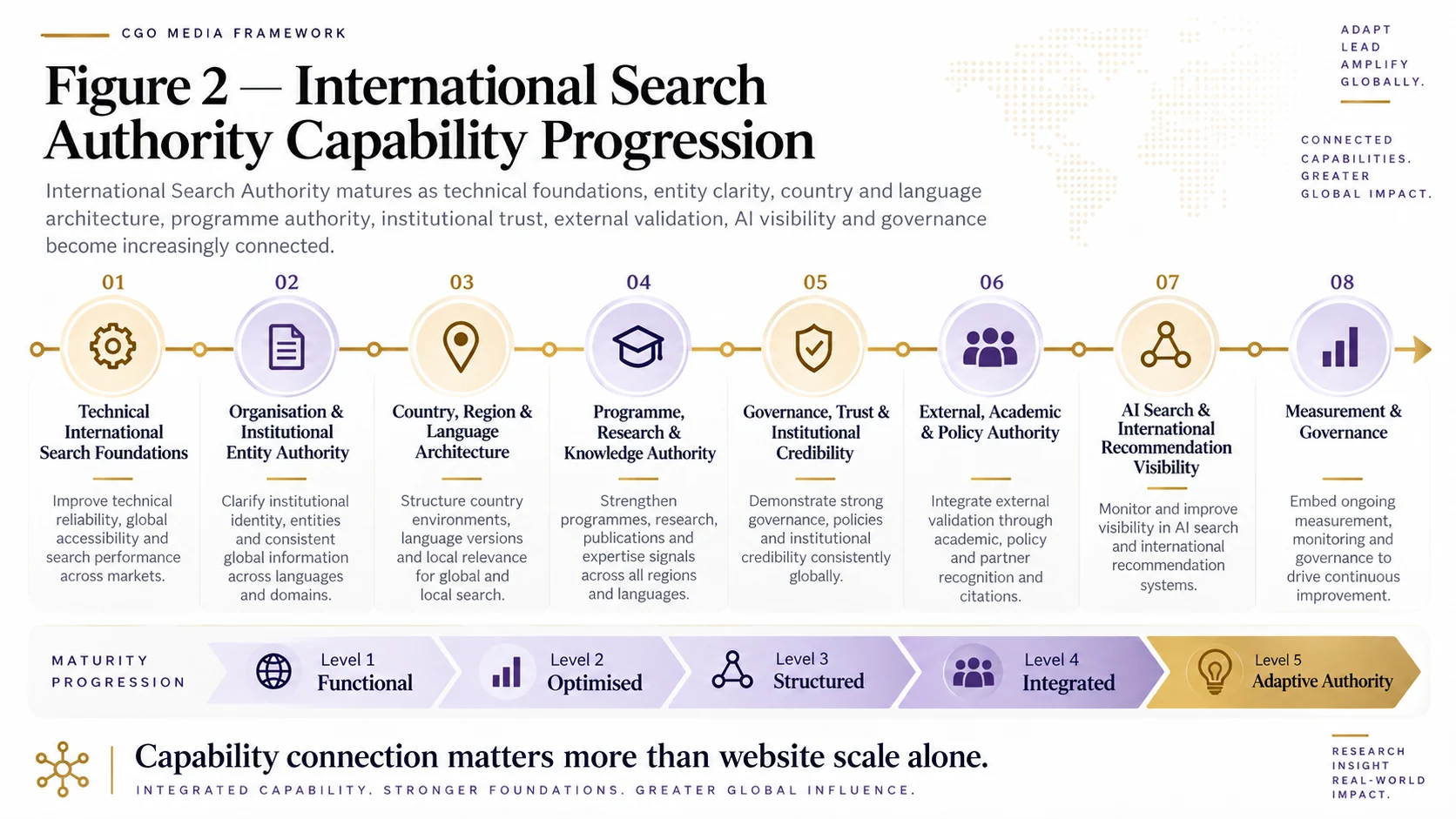
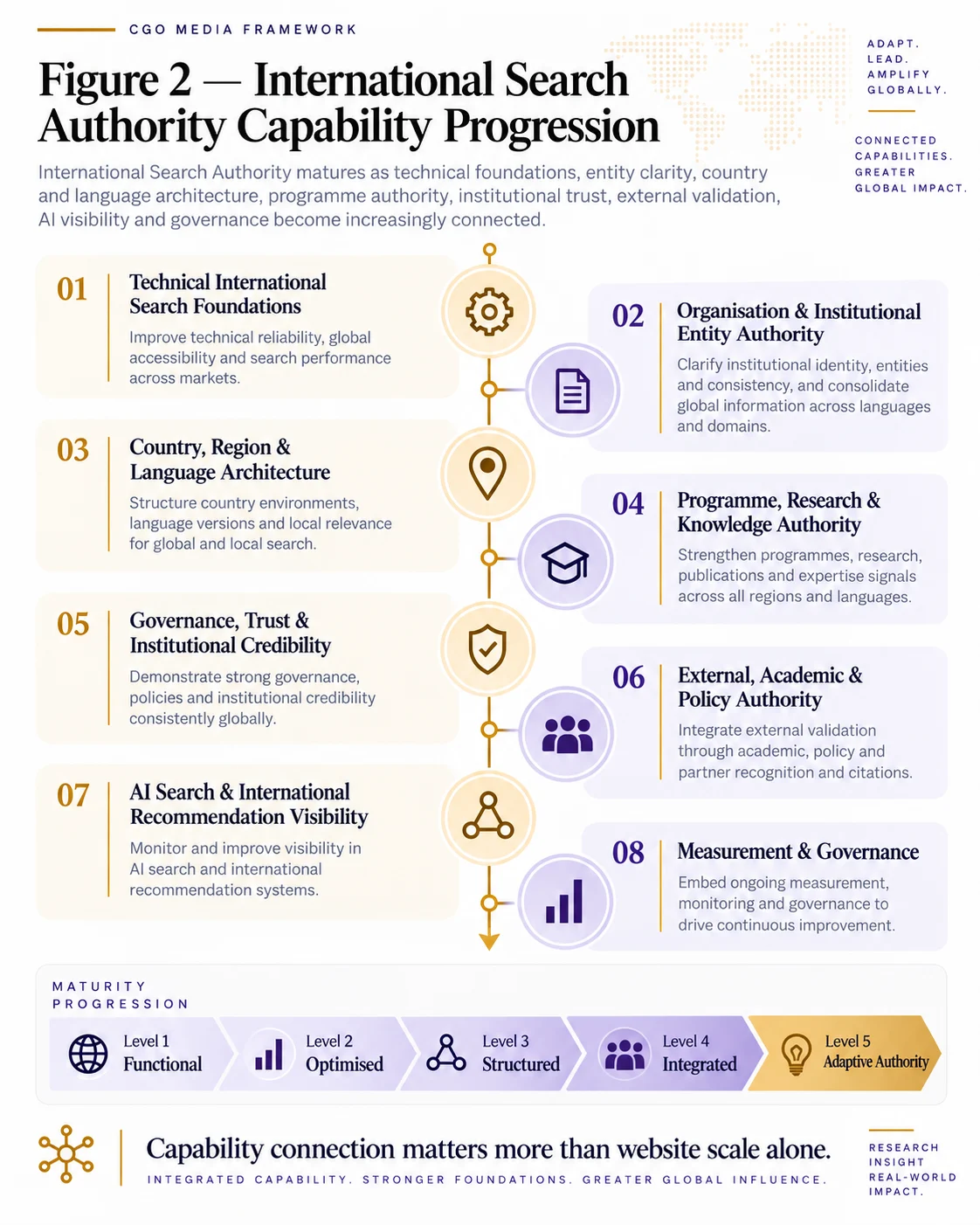
International Search Authority develops through the progressive connection of technical, institutional, geographic, knowledge, trust, external authority, AI visibility and governance capabilities. Maturity is therefore determined by how effectively these capabilities reinforce one another rather than by website scale, country count or content volume alone.
Technical Foundations
Crawlability, indexation, international targeting, hreflang, canonicals, performance, structured data and internal linking establish the technical environment required for international discovery.
Institutional Entity Clarity
The global organisation, headquarters, regional offices, country operations, leadership, programmes and associated entities are represented through clearer and more consistent relationships.
Country, Region & Language Architecture
Geographic operations and multilingual content develop from independent pages into structured international authority environments.
Programme, Research & Knowledge Authority
Programmes, research, experts, datasets, evidence and institutional knowledge become connected rather than existing as isolated digital resources.
Governance & Institutional Trust
Leadership, governance, funding, accountability, impact and other trust evidence provide clearer support for institutional claims and authority.
External, Academic & Policy Authority
Government, academic, policy, partner, media and other independent references reinforce specific areas of institutional expertise and activity.
AI Search & Recommendation Visibility
AI representation, citation visibility, source selection, institutional accuracy and recommendation presence are monitored systematically across countries, languages and stakeholder scenarios.
Measurement & Governance
Ownership, standards, review cycles and connected performance measurement turn individual optimisation activities into a repeatable institutional authority capability.
Figure 2. International Search Authority matures as technical foundations, institutional entity clarity, country and language architecture, programme and knowledge authority, trust evidence, external validation, AI visibility and governance become progressively more connected.
1. Why International Search Needs a Maturity Model
International search performance cannot be understood adequately through rankings, organic traffic or keyword visibility alone. Those measures remain useful, but they reveal only part of the environment in which an international organisation operates.
A global institution may receive substantial organic traffic while still presenting search engines with inconsistent organisational relationships. Country pages may rank successfully without being connected clearly to the programmes, offices, experts, reports and institutional evidence relevant to those countries. Research papers may attract links and citations while remaining isolated from the organisation’s broader knowledge architecture. Multilingual sections may generate traffic while containing inconsistent translations, outdated material or incomplete relationships with equivalent pages in other languages.
The emergence of AI-assisted discovery introduces an additional layer. Search systems increasingly need to interpret organisations rather than simply retrieve pages. Users may ask questions about which organisation works in a particular country, which institutions publish evidence on a specific subject, which organisations operate programmes in a region, which research body is authoritative on an issue or which international organisation should be consulted for a particular policy question.
These are not purely ranking questions. They depend on whether digital systems can establish sufficiently clear relationships between the institution, its geographic operations, programmes, leadership, research, expertise, external references and evidence of authority.
This creates an important distinction between having international SEO activity and possessing an international search authority capability.
An organisation may have SEO specialists optimising pages, communications teams publishing reports, country teams maintaining local content, researchers producing evidence, policy teams developing guidance and public-relations teams generating external coverage. Yet those activities can remain disconnected.
A maturity model provides a way to determine whether individual activities have evolved into an institutional system.
The central question therefore becomes:
How advanced is the organisation’s capability to create, connect, maintain, validate, measure and adapt the information signals required for international search and AI-assisted discovery?
This perspective shifts assessment away from isolated campaigns and towards long-term institutional capability.
2. Digital Scale Is Not the Same as International Search Maturity
One of the most important principles within the model is that organisational size should not be confused with maturity.
International organisations frequently possess characteristics that create the appearance of advanced digital capability. These may include strong brand recognition, established domains, extensive research libraries, country offices, regional websites, high-authority backlinks, multilingual content and significant media visibility.
Those characteristics can provide substantial advantages. They do not, however, guarantee that the organisation has developed a coherent international authority system.
A large institution may still have weaknesses such as:
- unclear relationships between headquarters, regional offices and country operations;
- inconsistent country-page templates and information standards;
- outdated or incomplete programme information;
- different organisational descriptions across language versions;
- research reports disconnected from authors, programmes and geographic evidence;
- limited structured representation of institutional entities;
- weak control over duplicate or competing international pages;
- poorly maintained hreflang relationships;
- inconsistent terminology across countries or departments;
- fragmented external citation monitoring;
- limited understanding of which sources influence AI-generated answers;
- and no common governance framework connecting SEO, communications, research, policy and digital teams.
The purpose of maturity assessment is therefore not to reward scale. It is to assess whether scale has been converted into structured authority.
A smaller international institution with clear entity relationships, well-governed multilingual architecture, strong programme evidence, connected research, transparent governance and systematic measurement may possess a more mature international search capability than a much larger institution operating hundreds of fragmented websites.
Maturity describes the quality and coordination of the system rather than its physical size.
3. From International SEO Activity to Search Authority Capability
International search maturity normally develops gradually. Organisations rarely move directly from basic international publishing to a fully integrated authority system.
The progression often begins with a practical requirement: make international information available online.
The organisation establishes a website, adds country information, publishes reports, launches programme pages and potentially provides content in multiple languages. Search visibility is initially a consequence of publishing rather than a deliberately governed institutional capability.
The next stage usually involves optimisation. Technical SEO problems are addressed. Priority pages receive better titles and metadata. Hreflang implementation improves. Country pages are strengthened. Research resources become easier to find. Analytics becomes more sophisticated.
These improvements can significantly increase visibility, but optimisation remains primarily page- or channel-focused.
Greater maturity begins when the organisation starts structuring relationships.
Instead of treating a country page simply as a landing page, it becomes a geographic authority hub connected with the country’s programmes, reports, experts, offices, partners and impact evidence. A research paper is no longer an isolated PDF or article; it becomes part of a knowledge system connected with authors, subjects, programmes, datasets and institutional priorities.
A typical progression can therefore be represented as:
Publishing International Information → Optimising Countries and Languages → Structuring Institutional Relationships → Integrating Authority Systems → Continuously Adapting to Search and AI Discovery
The transition between these stages is important because each represents a different organisational mindset.
At the earliest stage, the question is:
Do we have the information online?
At the optimisation stage:
Can people find it through search?
At the structured stage:
Are the relationships between our organisation, locations, programmes, research and expertise understandable?
At the integrated stage:
Are our search, knowledge, institutional and authority systems operating together?
At the adaptive stage:
Can that system continuously learn and change as our organisation, audiences, programmes and discovery environments evolve?
That progression forms the foundation of the International Search Authority Maturity Model.
4. The Five Levels of International Search Authority Maturity
The model defines five progressive maturity levels:
- Functional
- Optimised
- Structured
- Integrated
- Adaptive Authority
These levels should not be interpreted as rigid certifications. International organisations are complex, and maturity rarely develops uniformly. An organisation may demonstrate advanced research authority while maintaining relatively weak multilingual governance. Another may have sophisticated international technical SEO but limited external citation analysis or AI visibility monitoring.
The five levels therefore provide an analytical structure rather than a pass-or-fail classification system.
The purpose is to identify the organisation’s dominant operating characteristics, expose capability gaps and establish what changes are required to progress toward a more connected international authority system.
The maturity position should also be understood dynamically. Country structures change. New programmes launch. Research priorities evolve. Websites are migrated. Leadership changes. Languages are added. Partnerships develop. Search engines change how they retrieve and interpret information. AI assistants introduce new discovery behaviours.
An organisation that appears mature at one point can regress if governance and maintenance do not keep pace with institutional change.
For that reason, maturity should eventually become a repeatable management process rather than a one-time assessment.
5. Level One — Functional International Search Authority
The Functional level represents the point at which an organisation possesses the basic digital infrastructure required to participate in international search but has not yet transformed that infrastructure into a coordinated authority system.
This should not necessarily be interpreted as poor performance. Many established international organisations operate partly at this level because their digital estates have developed organically over long periods. Websites may have been created by different departments, country offices, funding programmes or regional teams. Content-management systems may have been introduced at different times. Translation processes may vary between offices. Research libraries may have evolved independently from programme websites.
The result is an environment that functions but depends heavily on local knowledge, manual intervention and reactive maintenance.
Typical Functional-level characteristics include:
- an operational global or institutional website;
- basic country or regional sections;
- some multilingual publishing;
- programme and project information;
- research reports or institutional publications;
- basic search optimisation;
- standard web analytics;
- external references and media coverage;
- and an identifiable organisational brand.
These components allow users to find and interact with the organisation. The limitation is that they are often not governed as parts of one connected search authority architecture.
Functional maturity can therefore be described as digital presence without complete institutional coordination.
6. Functional Technical Foundations
At Level One, the organisation’s principal website is normally crawlable and indexable, but international technical SEO is frequently reactive rather than systematically governed.
Problems may be discovered after traffic declines, a website migration takes place, a country office reports missing pages or users encounter problems accessing translated content. Technical management tends to focus on individual issues rather than maintaining a unified international standard.
Common weaknesses can include:
- incomplete or incorrect hreflang relationships;
- conflicting canonical signals;
- duplicate country or language pages;
- indexation of outdated programme content;
- orphaned research pages;
- broken internal links following organisational changes;
- slow regional or country sites;
- inconsistent templates;
- poor mobile performance;
- multiple XML sitemap conventions;
- and differences in structured data implementation between departments or platforms.
These issues matter because international technical SEO provides the infrastructure through which institutional relationships are discovered.
If search engines cannot reliably determine which language version corresponds with which audience, which URL represents the canonical resource or how regional and country content fits within the wider domain, more sophisticated authority signals become harder to interpret.
At this level, technical SEO therefore supports availability but does not yet provide comprehensive institutional architecture.
The transition toward higher maturity requires technical governance to move from problem resolution toward documented international standards, repeatable monitoring and coordination with the organisation’s wider content and entity architecture.
7. Functional Organisation Identity
A Functional organisation is normally recognisable online. Its official name, logo, headquarters and broad mission can be identified, and major search engines can generally associate the primary website with the institution.
The problem is often not whether the organisation exists as an identifiable entity. The problem is whether its internal and external relationships are represented clearly enough.
International organisations can operate through complicated institutional arrangements involving:
- global headquarters;
- regional offices;
- country offices;
- national affiliates;
- member organisations;
- programme partnerships;
- legal entities;
- foundations;
- research units;
- and independently branded initiatives.
Humans familiar with the organisation may understand these relationships intuitively. Search and AI systems require much stronger explicit evidence.
At Functional maturity, different parts of the digital estate may describe the organisation differently. Country offices may use variations of the official name. Programme microsites may not make their relationship with the parent institution obvious. Leadership pages may be inconsistent. Partner organisations may use outdated organisational descriptions.
This fragmentation limits entity clarity.
The next stages of maturity therefore require the organisation to move beyond simple brand consistency toward systematic management of institutional relationships.
8. Functional Country and Regional Architecture
Country visibility is particularly important for international organisations because institutional authority at global level does not automatically establish relevance within every country.
At the Functional level, country pages usually exist, but they may have developed according to local operational requirements rather than a common search architecture.
One country page may contain programme descriptions, contact information, staff biographies and research links. Another may contain only a short introduction and postal address. A third may operate as an almost independent website.
This inconsistency creates several problems.
Users receive different levels of evidence depending on the country they are researching. Search engines encounter inconsistent relationships between the parent institution and its local operations. AI systems may find substantially more evidence for some countries than others and therefore form an incomplete representation of the organisation’s actual geographic activity.
Regional architecture can suffer from the same problem.
A regional hub may simply list countries without explaining how regional priorities, programmes, research, experts and partnerships relate to those countries. In other cases, regional pages may compete with country pages for similar search intent.
Functional architecture therefore provides geographic presence, but the relationships between global organisation → region → country → programme → evidence remain inconsistent.
9. Functional Language Architecture
Multilingual publishing is often one of the clearest indicators of international reach, but the presence of several languages should not automatically be interpreted as multilingual maturity.
At Level One, translations may be produced according to immediate operational needs rather than a governed international content strategy.
Typical characteristics include:
- different levels of translation coverage between languages;
- important pages available only in the primary institutional language;
- translated pages updated later than originals;
- literal translation where local terminology would be more appropriate;
- inconsistent navigation between language versions;
- missing equivalent-page relationships;
- and difficulty determining which version represents the latest official information.
This is particularly significant for international organisations because translation is not simply a usability function. Language can affect institutional meaning.
Programme names, legal terminology, policy language, geographic references and technical concepts may require localisation and subject expertise. A translated page that is technically accurate but uses terminology unfamiliar to the intended audience may still perform poorly in search and AI discovery.
At Functional maturity, multilingual content therefore exists, but language governance remains incomplete.
10. Functional Programme and Project Information
Programmes, projects and initiatives frequently represent some of the most important entities within an international organisation’s digital environment.
They may also generate substantial discovery demand. Users may search for a programme by name, geography, funding area, policy subject, beneficiary group or institutional partner without initially searching for the parent organisation.
At Level One, programme pages normally provide enough information to confirm that a programme exists, but the depth and consistency of that information may vary significantly.
Important evidence can be missing or difficult to locate, including:
- programme status;
- start and completion dates;
- countries and regions covered;
- funding arrangements;
- delivery partners;
- programme leadership;
- objectives;
- outputs;
- measured results;
- related research;
- and impact evidence.
This creates an authority problem because a programme page can become the primary evidence source from which search systems, journalists, researchers and AI assistants attempt to understand the initiative.
Where essential context is missing, external sources may become more informative than the organisation’s own website.
A more mature system therefore requires programme information to move from basic description toward structured evidence.
11. Functional Research and Knowledge Publishing
International organisations frequently possess one major advantage over ordinary commercial websites: they produce original knowledge.
This may include research reports, datasets, policy papers, statistics, standards, technical guidance, evaluations, consultation documents, methodologies, case studies and programme evidence.
At Functional maturity, substantial volumes of this material may already exist. The weakness lies in how those resources are organised and connected.
Research can become trapped inside chronological publication libraries. Reports may exist primarily as PDFs. Author information may be incomplete. Topic taxonomies may be inconsistent. Datasets may not connect clearly to the research that uses them. Research may have no visible relationship with relevant country programmes.
Consequently, the organisation possesses knowledge but has not yet developed a complete knowledge authority architecture.
This distinction becomes increasingly important as AI systems use multiple sources to construct answers. The authority of a report is strengthened when its institutional context is understandable: who produced it, what evidence supports it, which programme or subject it relates to, when it was updated and how external organisations use or cite it.
CGO Media’s wider
Research Library,
Research Architecture
and
Knowledge Architecture
research examine this transition from isolated publication toward connected knowledge authority in greater detail.
12. Functional External Authority and Institutional Validation
Many established international organisations naturally accumulate substantial external authority.
Government departments may cite their reports. Universities may reference their research. Journalists may interview their experts. Partner organisations may link to programme pages. Policy documents may reference institutional guidance. Academic papers may cite datasets or methodologies.
At Functional maturity, much of this authority develops organically.
The organisation benefits from the references but may not systematically understand them.
It may not know:
- which research papers receive the strongest academic citations;
- which country offices receive the strongest governmental validation;
- which experts are most frequently quoted in external media;
- which programmes attract references from institutional partners;
- which reports appear in policy documents;
- or which third-party sources repeatedly influence AI-generated descriptions of the organisation.
This represents an important maturity gap.
External authority is not simply a link-building metric. For international organisations it can provide evidence of institutional recognition.
A reference from a government, university, recognised policy institution, standards body or respected media organisation can help establish context around why a particular organisation, report, programme or expert matters.
Higher maturity therefore requires external authority to become observable, categorised and connected with the institution’s strategic knowledge and programme architecture.
13. Functional AI Visibility and Generative Discovery
At Level One, awareness of AI search is usually increasing, but monitoring remains informal.
Staff may test ChatGPT, Google AI experiences or other generative systems to see whether the organisation appears in answers. Communications teams may notice incorrect descriptions. Researchers may observe whether reports are mentioned. Senior leadership may ask why another organisation appears in recommendations.
These observations are useful but do not yet constitute an AI visibility programme.
Typical Functional-level monitoring may consist of occasional manual searches without:
- defined prompt sets;
- country segmentation;
- language segmentation;
- source tracking;
- citation analysis;
- recommendation monitoring;
- accuracy scoring;
- peer comparison;
- or historical measurement.
The organisation therefore knows that AI discovery matters but cannot reliably determine whether representation is improving or deteriorating.
This creates another distinction between visibility and capability.
An organisation may already appear prominently in AI-generated answers because of its historical authority. That does not necessarily mean it possesses a mature AI search strategy.
Maturity depends on whether the institution understands how it is represented, which sources influence that representation, where inaccuracies occur and what evidence needs to be strengthened.
This is one of the central issues explored in the
International Organisations AI Trust and Visibility Framework
and the international
GEO research.
14. Functional Measurement and Governance
Measurement at Level One is usually dominated by conventional website metrics.
Reporting may include:
- organic traffic;
- search rankings;
- page views;
- report downloads;
- country traffic;
- top-performing pages;
- referral traffic;
- and conversion or engagement metrics.
These measures are valuable, but they provide limited insight into institutional search authority.
For example, an increase in traffic does not reveal whether the organisation’s relationship with a country programme is correctly understood. A high-ranking research paper does not show whether AI systems associate its findings with the correct institution. Download numbers do not show whether a report is influencing policy, academic citations or external recommendation systems.
A mature measurement system therefore needs to extend beyond website consumption and assess whether authority is being established across the institution’s broader discovery environment.
Governance is similarly limited at the Functional stage.
Responsibility may be divided between digital, communications, research, IT, policy and country teams without a shared international search governance model.
SEO may be owned by one department. Translation by another. Research metadata by a third. Structured data may be managed by developers. Country content may belong to local teams. External media monitoring may sit within communications. AI experimentation may occur independently across several departments.
Each activity can be performed competently while the overall system remains fragmented.
This organisational fragmentation is one of the clearest indicators that the institution has not yet progressed beyond Functional maturity.
15. The Strategic Limitations of Level One
The central limitation of Functional maturity is not that the organisation lacks digital assets. In many cases it possesses a very large number of them.
The limitation is that those assets are managed primarily as separate outputs rather than components of a connected international authority system.
The organisation publishes country pages but does not systematically connect them with local programmes and evidence. It publishes reports but does not consistently connect them with authors, subjects and geographies. It receives external citations but does not map how those citations reinforce authority. It publishes in several languages but does not maintain complete multilingual parity. It appears in AI answers but does not measure representation systematically.
As a result, performance is dependent on historical authority, organisational reputation and individual team competence rather than on a mature institutional search architecture.
This can remain workable for many years, especially for established organisations with strong brands. However, the approach becomes increasingly difficult to sustain as the institution expands.
Every additional country, language, programme, research stream, digital platform and partner increases the number of relationships that need to be maintained.
Eventually the organisation reaches a point where publishing more information can increase complexity faster than it increases authority.
Progression beyond Level One therefore requires the institution to move from reactive maintenance toward deliberate optimisation and coordination.
The first major transition is not yet complete integration. It is the establishment of repeatable optimisation practices across the most important international search capabilities.
That transition leads to Level Two — Optimised.
International Search Authority progresses through five maturity levels as isolated international publishing and optimisation activities develop into structured, integrated and continuously adaptive institutional capabilities.
1. Functional
Digital presence exists.
The organisation has global websites, country information, programmes, research and multilingual content, but technical, geographic, knowledge and authority systems remain largely reactive or fragmented.
2. Optimised
Individual capabilities improve.
Technical SEO, country pages, language versions, programme information, research discoverability, external authority and AI monitoring are deliberately strengthened.
3. Structured
Institutional relationships become explicit.
Countries, regions, languages, programmes, research, experts, partners and evidence are organised within a clearer international knowledge and authority architecture.
4. Integrated
Authority systems operate together.
Technical SEO, institutional entities, multilingual publishing, programme evidence, research, trust, external validation and AI monitoring become coordinated organisational capabilities.
5. Adaptive Authority
The system continuously learns and evolves.
International Search Authority adapts as countries, programmes, research priorities, institutional structures, user behaviour, external evidence and AI discovery environments change.
Figure 1. International Search Authority progresses from Functional through Optimised, Structured and Integrated maturity to Adaptive Authority as separate international search activities become a coordinated and continuously evolving institutional capability.
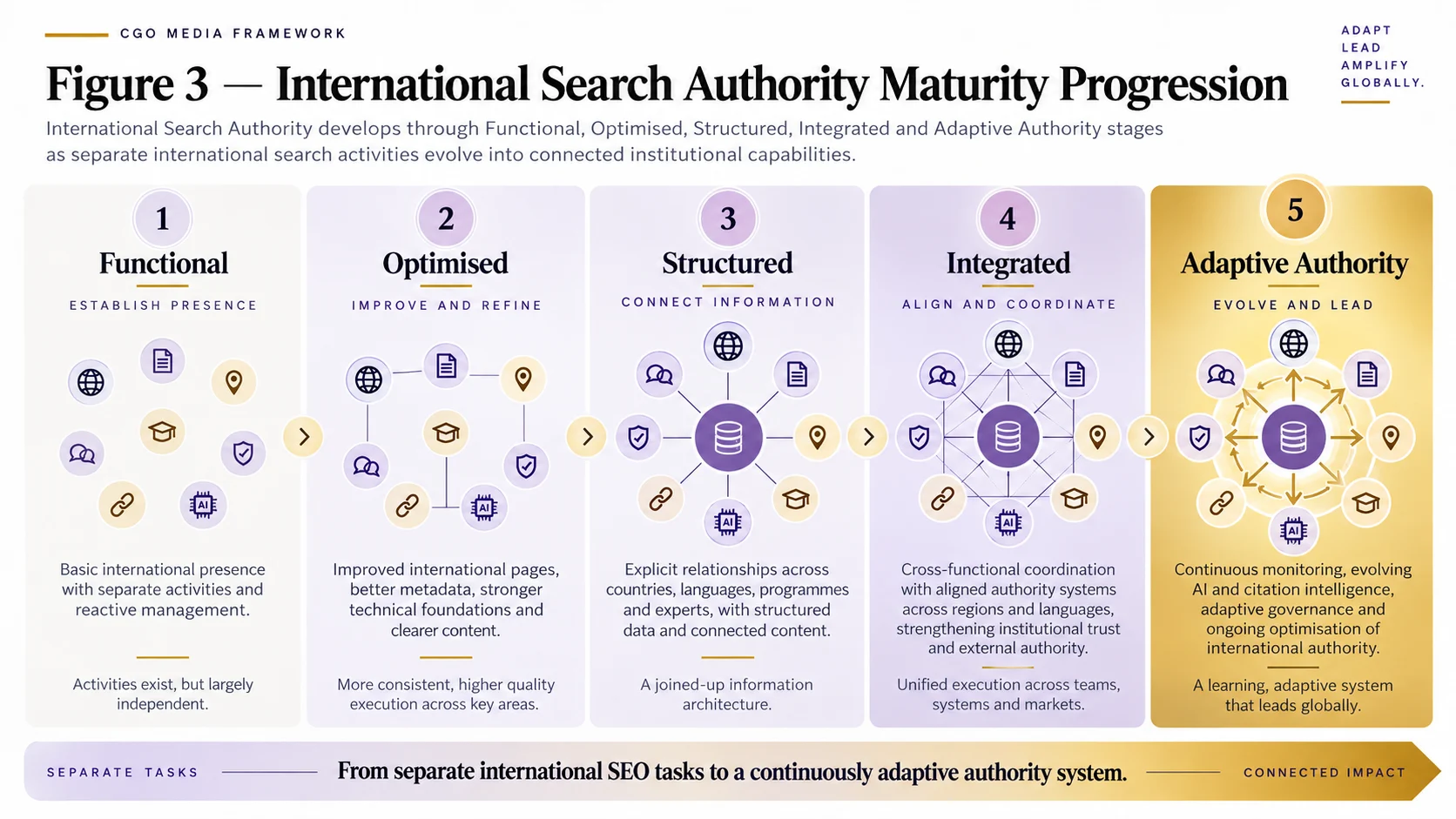
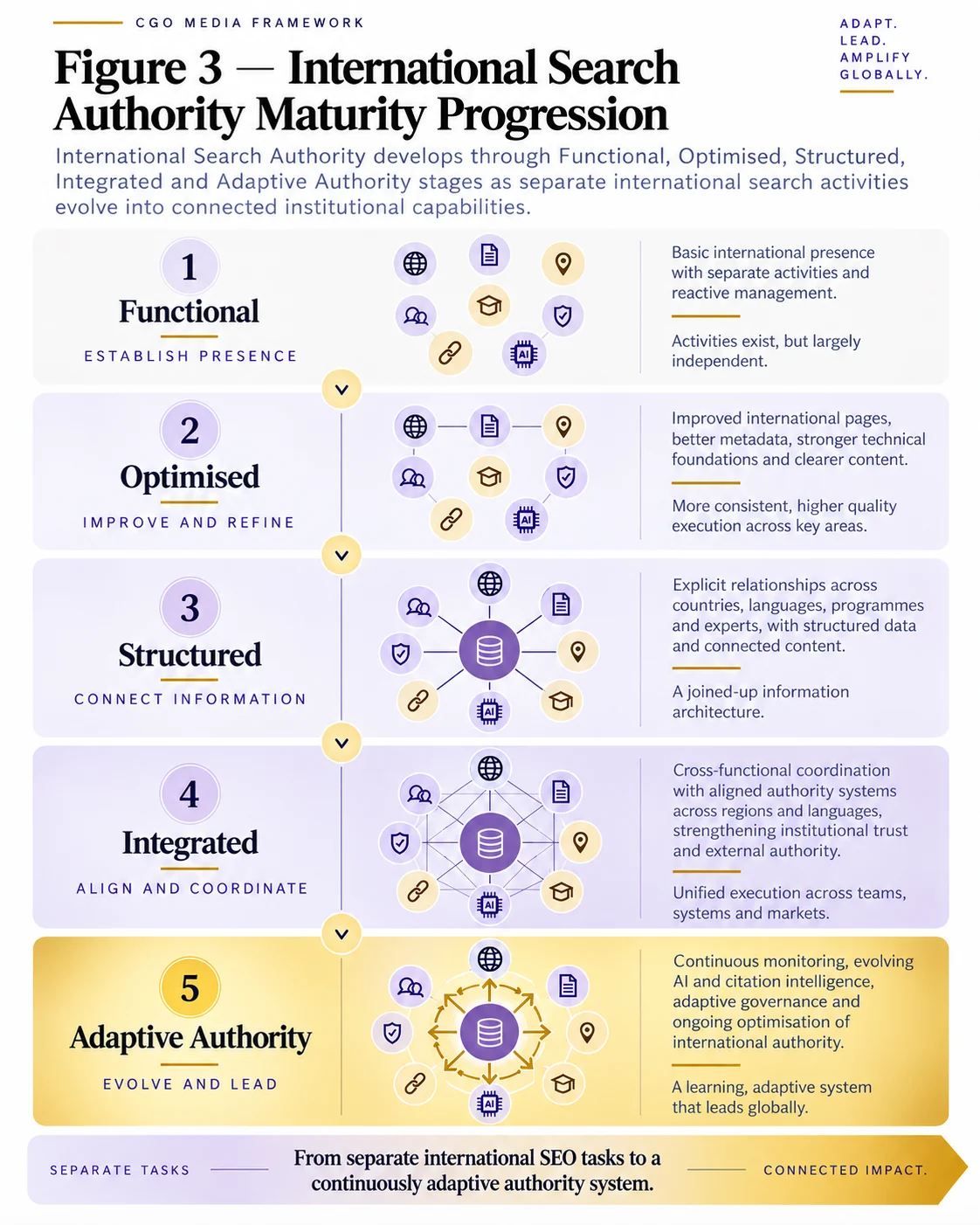
16. Level Two — Optimised International Search Authority
At the Optimised level, the organisation moves beyond basic international digital presence and begins improving individual search capabilities deliberately. Technical problems are addressed more systematically, priority country and regional pages receive greater attention, multilingual publishing standards improve, programme information becomes more complete, research resources become easier to discover and external authority begins to be measured rather than simply accumulated.
This represents an important advance from Functional maturity because international search is no longer treated entirely as a consequence of publishing. Teams begin recognising that visibility can be improved through deliberate technical, editorial and authority-building interventions.
The defining characteristic of Level Two, however, is that improvement generally remains capability-specific rather than institution-wide.
Technical teams may improve hreflang implementation without being involved in translation governance. Communications teams may strengthen country pages without connecting them systematically with research architecture. Research teams may improve publication metadata without linking authors, programmes and geographic evidence. Digital teams may begin testing AI visibility without integrating those findings with public relations, policy, programme or knowledge-management activity.
Optimisation therefore creates stronger individual components, but those components do not yet operate as one international authority system.
This distinction is critical.
An organisation can become significantly better at International SEO without yet reaching the point where its digital estate represents the full structure of the institution clearly enough for search engines, AI systems and external audiences to interpret relationships consistently.
Level Two can therefore be described as:
Deliberate improvement without complete institutional integration.
For many organisations, this stage produces substantial gains. Technical visibility improves. Priority markets perform better. Multilingual errors decline. Research receives more search exposure. Programme pages become stronger. AI representation becomes more visible to internal teams.
Yet the organisation is still largely optimising individual assets rather than designing an authority architecture.
17. Optimised Technical International SEO
Technical SEO becomes considerably more deliberate at the Optimised stage.
Instead of responding only when problems become visible, the organisation begins auditing its international digital environment, identifying recurring technical weaknesses and introducing clearer standards for how international pages should be crawled, indexed and connected.
Typical improvements may include:
- systematic crawl analysis;
- better indexation monitoring;
- correction of hreflang errors;
- stronger canonical management;
- improved XML sitemap organisation;
- removal or consolidation of duplicate international pages;
- improved mobile performance;
- better Core Web Vitals performance;
- cleaner internal linking;
- more consistent structured data;
- stronger handling of discontinued programmes;
- and improved migration procedures for country and regional websites.
The organisation may also begin establishing technical standards that apply across more than one team or country operation.
For example, a central digital function may define how country subdirectories should be structured, how translated pages should reference one another, how canonical URLs should be assigned and which content types require structured data.
This reduces the number of technical decisions made independently by local teams and creates a more predictable international environment.
However, Level Two technical maturity remains predominantly focused on technical correctness.
The organisation is becoming better at ensuring that search engines can crawl and interpret pages, but it may not yet have designed the deeper relationships that explain how those pages represent the institution itself.
A technically perfect country page can still be weak if it does not connect the country office with relevant programmes, experts, research, partners and impact evidence.
A correctly implemented language version can still provide incomplete institutional information.
Structured data can still describe individual pages without representing the wider organisation accurately.
Technical optimisation is therefore necessary, but it becomes substantially more valuable when it begins supporting a structured institutional model.
18. Optimised Country Pages
At Level Two, priority country pages begin receiving more deliberate optimisation.
The organisation recognises that a generic international brand page is not sufficient for every geographic discovery journey. Users searching from or about a specific country often need evidence that demonstrates actual local presence, relevance and activity.
Country pages therefore begin evolving beyond short institutional summaries.
Stronger pages may introduce:
- clear descriptions of the organisation’s role within the country;
- current programme information;
- country office details;
- relevant leadership or local contacts;
- links to country-specific research;
- programme outcomes;
- partner references;
- government relationships where appropriate;
- local news or institutional updates;
- and evidence of current activity.
This creates a more useful local authority surface.
Rather than forcing a search engine or user to assemble information from dozens of disconnected URLs, the country page begins acting as an entry point into the organisation’s local institutional footprint.
Optimisation may also improve page titles, descriptions, headings, internal links and content structure around relevant country terminology.
The important shift is that country visibility becomes an explicit objective rather than an accidental outcome of global brand strength.
However, inconsistency can remain.
The countries receiving greatest organisational investment may develop strong pages while smaller operations remain thin. Different regional teams may adopt different templates. Programme data may still be maintained manually. Research connections may depend on editors knowing which reports relate to which country.
The organisation is therefore improving geographic relevance but has not yet created a fully structured country authority architecture.
19. Optimised Regional Architecture
Regional architecture also begins to develop more deliberately at Level Two.
This is particularly important for organisations whose operational structures are not organised purely at global and national level.
A region may have its own leadership, programmes, policy priorities, research agenda, partnerships and communication requirements. Treating the regional section merely as a directory of country links fails to represent these relationships.
At the Optimised stage, regional hubs begin carrying greater institutional value.
They may include:
- regional strategy;
- regional leadership;
- participating countries;
- cross-border programmes;
- regional research;
- policy initiatives;
- statistics;
- regional partnerships;
- and links to country-level implementation.
This creates a clearer bridge between global institutional strategy and national activity.
Search visibility may also improve for users whose queries relate to regions rather than individual countries.
The challenge is ensuring that regional pages complement rather than compete with global, country and programme pages.
Without a clearly defined information architecture, multiple levels of the organisation can begin targeting similar topics using overlapping content.
The result may be internal competition, duplication and uncertainty around which page should act as the principal source for a particular question.
Optimised regional architecture therefore represents progress, but it also exposes the need for a more structured model of institutional relationships.
20. Optimised Multilingual Search Architecture
Language management becomes more systematic at the Optimised level.
The organisation begins recognising that multilingual search performance requires more than translation. Content must also remain accurate, current, locally understandable and technically connected with equivalent versions.
Improvement may include:
- better translation quality assurance;
- greater use of native-language reviewers;
- improved hreflang implementation;
- clearer equivalent-page mapping;
- better navigation between languages;
- more consistent terminology;
- local keyword and topic research;
- faster translation of updated institutional information;
- and removal of obsolete language pages.
A more mature distinction also begins emerging between translation and localisation.
Translation reproduces meaning in another language. Localisation considers how that information should be expressed for a particular audience, regulatory environment, institutional culture or search behaviour.
For an international organisation, this distinction can be substantial.
A programme may have different terminology in different countries. Acronyms may be recognised in one market but not another. A policy concept may require different contextual explanation. Country-specific institutional partners may need to be represented in local-language versions.
At Level Two, stronger organisations begin taking these differences into account.
However, the multilingual environment often remains prioritised according to resources. Major institutional languages receive systematic optimisation while secondary languages remain incomplete.
The organisation may therefore possess pockets of advanced multilingual capability without a fully governed language architecture across the entire digital estate.
21. Optimised Programme Authority
Programme and project pages become substantially stronger at the Optimised stage.
The organisation begins recognising that programme information must provide enough evidence for users and discovery systems to understand what an initiative does, where it operates and why it matters.
Programme pages may increasingly include:
- clear objectives;
- geographic scope;
- programme status;
- implementation dates;
- participating countries;
- funding information;
- delivery partners;
- programme leadership;
- target populations or beneficiaries;
- outputs;
- results;
- evaluation evidence;
- related reports;
- and measurable impact.
This strengthens both usability and institutional trust.
It also improves the organisation’s ability to surface in discovery journeys that begin with a problem or programme area rather than with the institutional brand.
A user may not initially search for the organisation itself. They may search for programmes addressing food security in a particular country, climate adaptation projects within a region, international standards relating to a sector or evidence concerning a development issue.
Well-developed programme pages create additional pathways through which institutional expertise can be discovered.
At Level Two, however, programme improvement can still be editorial rather than architectural.
Editors add better evidence, but programmes may not yet be represented systematically as entities connected with countries, partners, research, funding sources, experts and measurable results.
That entity-level connection becomes a defining characteristic of the Structured stage.
22. Optimised Research and Knowledge Visibility
At the Optimised level, research publishing starts moving beyond the simple uploading of reports.
The organisation recognises that important research must be discoverable through search and navigable within the institutional website.
Research resources may therefore receive improvements such as:
- descriptive HTML landing pages;
- clear publication titles;
- better metadata;
- publication dates;
- author information;
- topic classifications;
- executive summaries;
- related-resource links;
- country and regional references;
- structured data;
- and more accessible download options.
This significantly improves the discovery potential of institutional knowledge.
It can also reduce dependence on PDFs as the sole indexable representation of major research.
Research libraries may introduce improved filtering and categorisation so that users can browse by subject, publication type, geography or programme.
Yet the underlying knowledge model can remain shallow.
A report may be tagged as relevant to a country without being systematically connected with the country authority page. An author’s name may appear on a report without linking to a comprehensive expert profile. A dataset may be downloadable without showing which reports, programmes or methodological resources depend upon it.
Optimised research visibility therefore makes knowledge easier to find, but it does not yet guarantee that knowledge is represented as a connected institutional system.
23. Optimised Expert and Leadership Visibility
People begin playing a more deliberate role in institutional authority at Level Two.
International organisations frequently contain substantial subject expertise, yet that expertise can remain poorly represented online.
Researchers, policy specialists, programme directors, country representatives and senior leaders may be cited frequently outside the organisation while possessing limited first-party profiles.
Optimisation begins correcting this gap.
Expert and leadership pages may become more complete by including:
- full names and current positions;
- professional biographies;
- areas of expertise;
- institutional responsibilities;
- relevant programmes;
- research publications;
- country or regional responsibilities;
- public speaking;
- media commentary;
- and links to authoritative external professional profiles where appropriate.
This creates stronger relationships between institutional knowledge and the people responsible for producing, interpreting or implementing it.
However, individual profile improvement still tends to depend on communications priorities. Senior leadership may receive detailed profiles while specialist researchers remain minimally represented.
The Structured stage requires these people relationships to become part of the knowledge architecture rather than isolated biography pages.
24. Optimised Institutional Trust Evidence
Trust evidence becomes more visible and more intentionally managed at the Optimised stage.
International organisations may possess extensive evidence of legitimacy, governance and impact, but that evidence is not always easily discoverable.
Important information can be distributed across annual reports, governance documents, policy pages, financial statements, programme evaluations and external partner websites.
Optimisation begins consolidating and clarifying this material.
Relevant trust evidence can include:
- institutional history;
- governance structure;
- leadership;
- legal status;
- member or participating organisations;
- funding structures;
- financial reporting;
- accountability policies;
- methodologies;
- programme evaluations;
- impact reporting;
- ethical standards;
- and transparency information.
Making this information accessible helps audiences verify the institution and assess the basis on which it makes claims.
It may also provide search and AI systems with stronger first-party evidence when attempting to describe the organisation.
At Level Two, however, trust evidence often remains divided across departments. Governance teams maintain one set of information, communications teams another and programme teams another.
The next maturity stage requires these signals to become more consistently connected with the entities and claims they support.
25. Optimised External, Academic and Policy Authority
External authority becomes more observable at the Optimised stage.
Rather than treating all backlinks or external references as equivalent, the organisation begins distinguishing between different forms of institutional validation.
These may include:
- government references;
- academic citations;
- university links;
- policy-document references;
- citations from recognised research organisations;
- partner references;
- standards references;
- media coverage;
- expert quotations;
- conference participation;
- and references from other international organisations.
This represents a substantial shift in how authority is understood.
A conventional SEO approach might view an external reference mainly through the domain authority or traffic potential of the referring site.
An institutional authority approach considers the meaning of the relationship.
A government department citing an organisation’s methodology demonstrates something different from a newspaper quoting an executive. An academic citation provides different evidence from a partner link. A policy paper using institutional statistics has a different authority function from a directory listing.
At Level Two, the organisation begins recognising these distinctions and may track high-value external references deliberately.
However, the information can still remain distributed between SEO tools, media-monitoring systems, research citation databases and policy teams.
The organisation understands more about its external authority, but it has not yet integrated those signals into a unified institutional authority map.
26. Optimised AI Search Visibility
AI search monitoring becomes more deliberate at Level Two.
The organisation moves beyond occasional curiosity-driven testing and begins examining how generative systems represent important areas of institutional activity.
Monitoring may include questions such as:
- Is the organisation mentioned for its principal areas of expertise?
- Are major programmes recognised?
- Are country activities described accurately?
- Does the system identify the correct organisational relationship?
- Are institutional reports referenced?
- Are experts associated with the correct subject areas?
- Which external sources appear to influence answers?
- Are competitors or peer organisations represented more prominently?
- Are outdated facts being repeated?
- Do answers change between languages or markets?
Teams may begin saving prompts, recording outputs and identifying recurring inaccuracies.
This creates the beginnings of an AI visibility dataset.
The key limitation is that the monitoring process remains largely observational.
The organisation may know that an AI answer is incomplete without yet understanding the underlying authority gap responsible for the omission.
For example, weak country-level visibility may result from thin country pages, limited external references, poor programme-country relationships, inconsistent terminology or insufficient evidence across independent sources.
Moving from observation to diagnosis requires stronger relationships between AI monitoring and the wider institutional architecture.
27. Optimised Measurement
Measurement broadens considerably at Level Two.
Traditional traffic and ranking metrics remain important, but organisations begin segmenting performance according to the structure of their international operations.
Reporting may increasingly include:
- country visibility;
- regional visibility;
- language visibility;
- programme search performance;
- research visibility;
- publication engagement;
- expert visibility;
- external institutional citations;
- academic references;
- media mentions;
- AI mentions;
- and selected generative-search citations.
This creates a more informative picture than aggregate organic traffic.
It becomes possible to identify situations where the organisation performs well globally but poorly in strategically important countries, or where research receives strong academic recognition but limited general search visibility.
The organisation may also begin establishing benchmarks.
Rather than asking whether traffic increased, it can ask whether country visibility improved, whether more research is being discovered or whether institutional representation across AI systems became more accurate.
Yet measurement remains predominantly divided by channel.
SEO data, research citations, media coverage, programme metrics and AI monitoring can exist in separate dashboards owned by separate teams.
The next maturity stage requires the organisation to measure relationships between these signals rather than simply adding more metrics.
28. The Strategic Limitations of Level Two
The Optimised stage can generate substantial improvements, but its primary limitation is fragmentation.
The organisation becomes better at many things without necessarily becoming better at connecting them.
Technical SEO improves.
Country pages improve.
Regional pages improve.
Translation improves.
Research discoverability improves.
Programme evidence improves.
External authority monitoring improves.
AI visibility monitoring improves.
However, each area may still operate through separate teams, tools, taxonomies and governance processes.
The result can be an organisation with numerous optimisation programmes but no common authority architecture.
This becomes particularly visible when teams attempt to answer apparently simple questions.
For example:
- Which programmes establish our authority on this subject in this country?
- Which research supports those programmes?
- Which experts are associated with that research?
- Which government or academic sources independently validate the work?
- Which language versions contain equivalent evidence?
- Which AI systems currently recognise those relationships?
If answering these questions requires manual investigation across multiple teams and systems, the organisation remains primarily Optimised rather than Structured.
The transition to Level Three occurs when relationships themselves become objects of deliberate management.
29. Level Three — Structured International Search Authority
Level Three represents one of the most important transitions within the International Search Authority Maturity Model.
At the Structured level, the organisation moves beyond improving individual pages and capabilities and begins organising its international digital environment around explicit institutional relationships.
The central question changes.
Instead of asking primarily:
Which pages should we optimise?
the organisation increasingly asks:
How should the institution, its locations, programmes, people, research, partners, evidence and external authority be connected?
This changes the role of search strategy fundamentally.
Search is no longer applied only to published content after that content exists. Search architecture begins influencing how institutional information itself is structured.
A useful conceptual relationship may be expressed as:
Global Organisation → Region → Country → Programme → Research → Evidence → Impact
This is not intended as a rigid hierarchy. Real international organisations contain many overlapping relationships.
A single report may relate to multiple countries. A programme may operate across regions. An expert may contribute to several programme areas. A partner may work with the institution through many initiatives.
The significance of Level Three is therefore not the creation of one hierarchy but the deliberate representation of these relationships across the digital estate.
30. Structured Organisation Architecture
Institutional identity becomes more explicitly modelled at Level Three.
The organisation establishes clearer relationships between the parent institution and the components through which it operates.
These relationships may include:
- headquarters;
- regional offices;
- country offices;
- subsidiary or affiliated entities;
- leadership;
- departments;
- programmes;
- research units;
- partners;
- and institutional initiatives.
Naming conventions become more consistent. Organisational descriptions are standardised. Parent-child relationships become clearer. Structured data begins reflecting institutional reality more accurately.
This reduces ambiguity.
A programme website no longer needs to appear as an isolated branded project. Its relationship with the organisation can be made explicit.
A regional office can be understood as part of the wider institution rather than an apparently unrelated web property.
An expert can be associated with both the organisation and relevant areas of institutional work.
This is the beginning of entity-centred international search architecture.
31. Structured Regional Authority
Regional pages become genuine institutional hubs at Level Three.
Their function is not simply to provide navigation to a collection of countries.
A structured regional hub explains how the organisation operates across the region and connects the major entities necessary to understand that activity.
These connections may include:
- regional leadership;
- participating countries;
- regional programmes;
- cross-border initiatives;
- regional research;
- policy priorities;
- institutional partnerships;
- regional statistics;
- experts;
- and impact evidence.
Regional architecture can therefore support both broad regional discovery and deeper country-level exploration.
It also provides an intermediate level of authority between a large global institution and individual country operations.
This is particularly valuable where programmes or policy priorities operate across national borders.
32. Structured Country Authority
Country architecture becomes more consistent and evidence-led.
Rather than each country team deciding independently what its website should contain, common authority requirements are established.
A mature country hub may consistently connect:
- the country office;
- local leadership;
- active programmes;
- completed programmes where historically relevant;
- country-specific research;
- datasets and statistics;
- local partners;
- government relationships where appropriate;
- subject experts;
- impact evidence;
- news and institutional updates;
- and relevant regional and global resources.
Country pages therefore become authority nodes rather than conventional landing pages.
The purpose is not necessarily to make every country page identical.
Different national operations will require different content.
The goal is to establish a consistent information model so that core relationships remain understandable regardless of geography.
33. Structured Language Architecture
Multilingual publishing becomes part of the organisation’s information architecture rather than a downstream translation process.
The institution begins defining clearer rules for:
- which content requires equivalent language versions;
- which content may be localised independently;
- how hreflang relationships are maintained;
- how translated pages are updated;
- who owns terminology standards;
- how translated institutional names are used;
- how local programme terminology is represented;
- and how obsolete translations are managed.
This allows language versions to remain aligned with the underlying institutional model.
A programme translated into three languages remains the same programme entity even if terminology varies.
A country office retains the same organisational relationship regardless of language.
A research report can maintain clear authorship, publication and subject relationships across translated summaries.
This creates substantially greater consistency for users and machine interpretation.
34. Structured Programme Authority
Programmes become explicit elements within the institutional authority architecture at Level Three.
Rather than existing simply as webpages, they are represented through consistent relationships.
A programme may be connected with:
- the parent organisation;
- responsible departments;
- regions;
- countries;
- partners;
- funding sources;
- programme leadership;
- subject experts;
- research;
- datasets;
- outputs;
- results;
- evaluations;
- and impact evidence.
This changes the value of programme content.
A programme becomes not merely something the organisation says it operates, but a structured body of evidence demonstrating where it exists, who is involved, what knowledge it produces and what outcomes it has generated.
These relationships also improve resilience when programmes change status.
Completed programmes do not necessarily need to disappear. Their research, evidence and institutional history may remain valuable if archived and connected appropriately.
35. Structured Research Authority
Research architecture becomes significantly more sophisticated at Level Three.
Libraries are increasingly organised around meaningful relationships rather than simply publication chronology.
Research can be connected with:
- subjects;
- authors;
- programmes;
- countries;
- regions;
- publication types;
- datasets;
- methodologies;
- policy areas;
- and related institutional resources.
This creates a genuine knowledge architecture.
A user discovering a research paper can move to the author’s expertise, the programme that generated the evidence, related country information, connected datasets and subsequent publications.
Likewise, a country page can surface the most relevant institutional research without relying entirely on manually maintained link lists.
Search systems receive stronger contextual signals concerning what the research is about and how it relates to the institution.
The result is a shift from publishing documents toward organising institutional knowledge.
36. Structured Expert Authority
Experts, researchers and senior specialists become explicit knowledge entities at the Structured stage.
Profiles connect people with:
- current institutional roles;
- subject expertise;
- programmes;
- research publications;
- countries or regions;
- datasets;
- policy work;
- conference contributions;
- and relevant media commentary.
This provides stronger evidence of institutional expertise and reduces ambiguity where individuals have common names or complex professional histories.
It also allows institutional authority to operate in both directions.
The organisation strengthens the context around its experts, while recognised experts strengthen the perceived authority of the organisation’s knowledge and programmes.
37. Structured Governance and Trust Evidence
Institutional trust information becomes governed more systematically.
The organisation establishes clearer ownership for factual information that requires high accuracy, including governance, leadership, funding, legal status, institutional structure and accountability.
Review cycles become more explicit.
Outdated leadership information is corrected. Programme statuses are maintained. Governance documents are easier to locate. Funding information connects with relevant initiatives where appropriate. Impact claims can be supported by evidence.
The objective is not merely transparency for its own sake.
Structured trust evidence makes important institutional claims easier to verify.
This becomes increasingly important in environments where search and generative systems may combine first-party and third-party sources when describing an organisation.
38. Structured External Authority
External authority begins to be mapped against the organisation’s internal knowledge architecture.
This represents a substantial advance from simply tracking backlinks or media mentions.
External validation can be categorised according to source and institutional relationship, including:
- government citations;
- academic citations;
- university references;
- policy references;
- think-tank references;
- international organisation references;
- partner references;
- standards-body references;
- media citations;
- and recognised expert commentary.
The organisation can then begin asking which internal entities those external signals reinforce.
For example:
- Which research papers receive strong academic citation?
- Which programmes are referenced by government institutions?
- Which country operations receive independent validation?
- Which experts are cited by respected media or policy organisations?
- Which datasets are reused externally?
This transforms external authority from a generic domain-level concept into an institutional evidence system.
39. Structured AI Monitoring
AI visibility monitoring becomes repeatable at Level Three.
Rather than asking random questions periodically, the organisation develops defined prompt groups connected with its actual authority architecture.
Monitoring may be segmented by:
- institutional discovery;
- subject expertise;
- country;
- region;
- programme;
- research topic;
- expert;
- language;
- comparison query;
- and recommendation scenario.
Outputs can then be assessed against common criteria such as:
- visibility;
- factual accuracy;
- entity accuracy;
- programme accuracy;
- citation presence;
- source selection;
- recommendation visibility;
- and representation relative to peer organisations.
This allows AI search findings to be connected with underlying institutional weaknesses.
If a programme is consistently omitted from relevant answers, teams can investigate whether the problem relates to programme evidence, internal architecture, external validation, entity clarity or source availability.
AI monitoring therefore begins evolving from observation into diagnosis.
40. Structured Measurement
Measurement begins evaluating connected authority areas rather than isolated channel performance.
Instead of treating search rankings, citations, media coverage and AI visibility as unrelated datasets, the organisation begins analysing how they reinforce one another.
A research resource, for example, might be assessed through:
- organic visibility;
- country relevance;
- expert associations;
- internal programme relationships;
- academic citations;
- policy references;
- external links;
- media references;
- and AI citation visibility.
This provides a substantially richer understanding of authority than traffic alone.
The organisation can identify where strong internal evidence lacks external validation, where internationally recognised research has weak digital discoverability or where strong search visibility is unsupported by sufficient institutional trust evidence.
These observations enable better prioritisation.
Resources can increasingly be directed toward structural gaps rather than simply toward whichever pages currently attract the most traffic.
41. The Shift from International Optimisation to Institutional Authority Architecture
Level Three marks the point at which International Search Authority becomes more than an optimisation programme.
The organisation begins treating its digital estate as a representation of institutional reality.
Countries are not simply keywords.
They are operational contexts connected with offices, programmes, partners, research and impact.
Programmes are not simply landing pages.
They are institutional entities connected with locations, funding, partners, experts and evidence.
Research is not simply content.
It is institutional knowledge connected with authors, programmes, data and external citations.
Experts are not simply biographies.
They are people connected with research, programmes, subjects and external recognition.
External links are not simply authority scores.
They can provide independent validation of specific institutional claims, research outputs and areas of expertise.
AI visibility is not simply another traffic channel.
It becomes a test of whether the wider discovery ecosystem has enough consistent evidence to understand and represent the organisation accurately.
This is the defining change between Optimised and Structured maturity.
The organisation moves from asking:
“Which international pages should we optimise next?”
toward asking:
“How are our institution, countries, languages, programmes, research, experts, evidence and external authority connected?”
Once those relationships become explicit, the organisation is positioned to move toward Level Four, where the individual authority capabilities no longer merely connect conceptually but begin operating as an integrated institutional system.
International Search Authority develops through the progressive connection of technical, institutional, geographic, knowledge, trust, external authority, AI visibility and governance capabilities. Maturity is therefore determined by how effectively these capabilities reinforce one another rather than by website scale, country count or content volume alone.
Technical Foundations
Crawlability, indexation, international targeting, hreflang, canonicals, performance, structured data and internal linking establish the technical environment required for international discovery.
Institutional Entity Clarity
The global organisation, headquarters, regional offices, country operations, leadership, programmes and associated entities are represented through clearer and more consistent relationships.
Country, Region & Language Architecture
Geographic operations and multilingual content develop from independent pages into structured international authority environments.
Programme, Research & Knowledge Authority
Programmes, research, experts, datasets, evidence and institutional knowledge become connected rather than existing as isolated digital resources.
Governance & Institutional Trust
Leadership, governance, funding, accountability, impact and other trust evidence provide clearer support for institutional claims and authority.
External, Academic & Policy Authority
Government, academic, policy, partner, media and other independent references reinforce specific areas of institutional expertise and activity.
AI Search & Recommendation Visibility
AI representation, citation visibility, source selection, institutional accuracy and recommendation presence are monitored systematically across countries, languages and stakeholder scenarios.
Measurement & Governance
Ownership, standards, review cycles and connected performance measurement turn individual optimisation activities into a repeatable institutional authority capability.
Figure 2. International Search Authority matures as technical foundations, institutional entity clarity, country and language architecture, programme and knowledge authority, trust evidence, external validation, AI visibility and governance become progressively more connected.
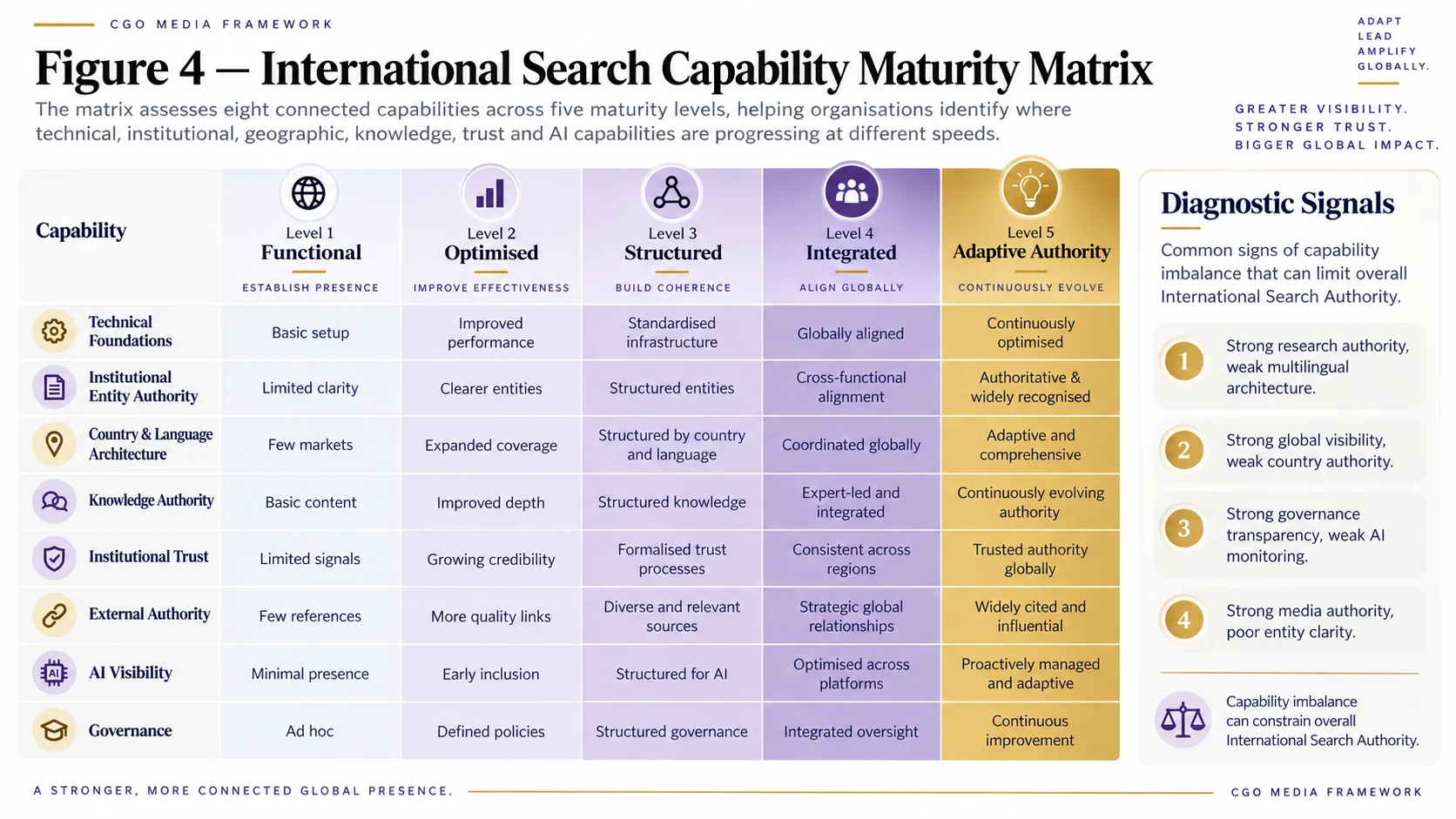
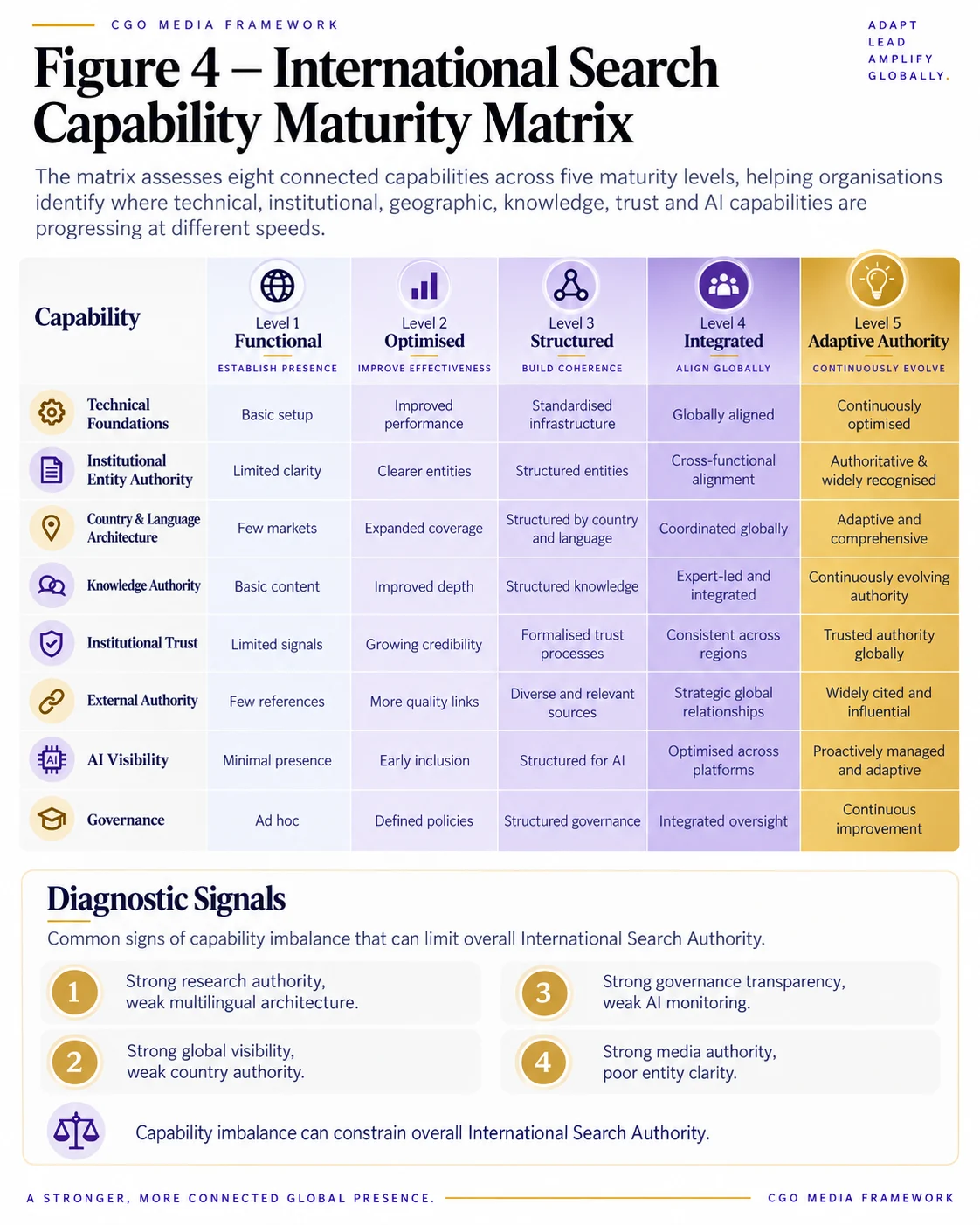
42. The Eight International Search Authority Capabilities
The five maturity levels describe how an organisation’s overall International Search Authority develops. To make that progression measurable, the model evaluates maturity across eight connected capabilities.
These capabilities represent the principal systems through which an international organisation becomes discoverable, understandable, credible and selectable across conventional search and AI-assisted discovery environments.
- Technical International Search Foundations
- Organisation and Institutional Entity Authority
- Country, Region and Language Architecture
- Programme, Research and Knowledge Authority
- Governance, Trust and Institutional Credibility
- External, Academic and Policy Authority
- AI Search and International Recommendation Visibility
- Measurement and Governance
The capabilities should not be assessed independently of one another. Their value depends increasingly on the relationships between them.
For example, excellent research authority can be weakened if the research is poorly connected with country operations. Strong external citations may provide limited benefit if institutional entities are represented inconsistently. Sophisticated AI monitoring may reveal visibility gaps without providing a mechanism for correcting the underlying technical, geographic, knowledge or authority problems.
International Search Authority therefore develops through capability balance and capability connection.
43. Capability One — Technical International Search Foundations
Technical International Search Foundations assess whether the digital environment enables reliable discovery across global, regional, national and multilingual contexts.
Core considerations include:
- crawlability;
- indexation;
- international URL architecture;
- hreflang accuracy;
- canonical management;
- mobile usability;
- site performance;
- XML sitemaps;
- structured data;
- internal linking;
- redirect governance;
- and technical management of archived or discontinued resources.
At lower maturity levels, technical SEO is primarily reactive. At higher levels, it becomes part of institutional infrastructure.
The important distinction is that mature technical architecture does more than prevent errors. It helps search systems understand relationships between the organisation’s information assets.
Country, regional, language, programme and research resources should not merely be technically accessible. Their relationships should also be reinforced through logical architecture, internal linking and structured representations.
44. Capability Two — Organisation and Institutional Entity Authority
Institutional Entity Authority evaluates how clearly the organisation and its related entities are represented.
International organisations frequently contain complex relationships between headquarters, regional structures, national offices, programmes, partnerships, leadership teams and associated initiatives.
Maturity therefore depends on whether these relationships can be interpreted consistently.
Assessment should consider:
- official organisational naming;
- acronym consistency;
- headquarters relationships;
- regional-office relationships;
- country-office relationships;
- leadership accuracy;
- programme ownership;
- partner relationships;
- institutional descriptions;
- and structured entity representation.
At advanced maturity, entity governance becomes continuous. Changes to leadership, organisational structures, programmes and offices are reflected systematically across the digital environment.
45. Capability Three — Country, Region and Language Architecture
This capability evaluates whether geographic and linguistic relationships remain coherent as the organisation expands.
International presence creates several overlapping information requirements.
The organisation must communicate a consistent global identity while demonstrating genuine country relevance. Regional structures must connect broader institutional priorities with national implementation. Language versions must preserve institutional accuracy while adapting appropriately to local terminology and user expectations.
Maturity can therefore be assessed through:
- country-page completeness;
- regional hub quality;
- local programme representation;
- local research visibility;
- language parity;
- localisation standards;
- equivalent-page relationships;
- hreflang governance;
- content freshness;
- and local search visibility.
The objective is not to make every country or language environment identical. It is to ensure that variation occurs within a controlled and understandable institutional architecture.
46. Capability Four — Programme, Research and Knowledge Authority
Programme, Research and Knowledge Authority assesses whether the organisation’s operational and intellectual outputs form a coherent knowledge environment.
International institutions often publish large volumes of valuable material. Advanced maturity depends on whether that knowledge can be discovered, understood and connected.
Relevant components include:
- programme information;
- research publications;
- authors;
- experts;
- datasets;
- methodologies;
- statistics;
- policy guidance;
- country evidence;
- programme evaluations;
- case studies;
- and impact evidence.
A mature knowledge architecture enables users and machines to understand relationships such as:
Research → Author → Programme → Country → Evidence → Institutional Expertise
This creates substantially stronger authority than isolated documents or programme pages can provide independently.
47. Capability Five — Governance, Trust and Institutional Credibility
Search Authority for international organisations depends heavily on institutional trust.
Users may be making decisions about policy information, programme participation, research evidence, funding, standards or international cooperation. The organisation therefore needs sufficient first-party evidence to support its claims and explain its institutional legitimacy.
Important trust areas include:
- governance;
- leadership;
- legal status;
- funding;
- financial reporting;
- accountability;
- methodologies;
- programme transparency;
- correction policies;
- impact reporting;
- and institutional history.
Higher maturity is achieved when trust evidence is not merely published but maintained through documented ownership and review processes.
48. Capability Six — External, Academic and Policy Authority
External Authority evaluates whether credible independent sources reinforce the organisation’s institutional expertise.
International authority frequently develops through recognition by other organisations.
Relevant evidence may include:
- government citations;
- academic citations;
- university references;
- policy-document citations;
- references from international organisations;
- standards-body references;
- partner validation;
- credible media coverage;
- conference participation;
- and expert quotations.
Advanced organisations do not simply count these references. They identify which subjects, programmes, countries, researchers and institutional claims those references reinforce.
External authority therefore becomes connected with internal authority architecture.
49. Capability Seven — AI Search and International Recommendation Visibility
AI Search and International Recommendation Visibility assesses how effectively the institution is represented within generative discovery environments.
Important monitoring areas can include:
- organisation discovery;
- programme recommendations;
- research source selection;
- citation visibility;
- country-level representation;
- language-level representation;
- institution comparisons;
- expert visibility;
- factual accuracy;
- and source convergence.
At higher levels of maturity, the objective is not simply to record whether the organisation appears.
The organisation seeks to understand why particular sources are selected, why competitors or peer institutions appear in some scenarios, where institutional information is misrepresented and what underlying authority signals may need strengthening.
50. Capability Eight — Measurement and Governance
Measurement and Governance determine whether International Search Authority can be managed as a repeatable organisational capability.
This includes:
- defined ownership;
- documented standards;
- cross-functional coordination;
- review cycles;
- country governance;
- language governance;
- research governance;
- AI monitoring procedures;
- performance reporting;
- executive oversight;
- and continuous improvement.
Without governance, even advanced search capability can deteriorate.
International organisations are continuously changing. Programmes begin and end. Country offices open or close. Leadership changes. Research is updated. Languages are added. Websites migrate. Partners change.
Governance ensures that the organisation’s digital representation continues to reflect institutional reality.
51. International Search Maturity Is Multi-Dimensional
International Search Authority should not be reduced to a single activity or channel.
An organisation may demonstrate very different maturity levels across the eight capabilities.
For example, an institution may possess exceptional academic authority while maintaining weak multilingual architecture. Another may have technically sophisticated international websites but poorly structured programme evidence. A third may have strong country visibility but limited AI monitoring.
These differences are normal.
The purpose of the maturity model is therefore not simply to assign a label to the institution. It is to reveal where capability is uneven.
A capability gap may become strategically important when it prevents stronger parts of the system from producing their full value.
52. Overall Maturity Depends on the Wider System
International Search Authority is increasingly constrained by the relationships between capabilities.
A large research library cannot provide its full authority value if its publications remain disconnected from programmes and countries.
Strong country pages cannot provide maximum discovery value if multilingual architecture is unreliable.
Significant media coverage may have limited long-term institutional value if experts, research and programmes remain poorly represented on the organisation’s own website.
Likewise, advanced AI monitoring creates limited strategic value if no governance process exists for converting observations into technical, content, research or authority improvements.
The objective is therefore not to maximise one capability independently.
It is to build a sufficiently balanced system in which each capability strengthens the others.
53. Level Four — Integrated International Search Authority
At Level Four, International Search Authority becomes an integrated institutional capability.
The organisation no longer manages technical SEO, country architecture, multilingual publishing, research visibility, programme evidence, institutional trust, external authority and AI monitoring as largely separate activities.
These functions begin operating within a common authority system.
This is a substantial organisational transition.
At earlier levels, collaboration may occur when a project requires it. At the Integrated level, collaboration is built into ongoing operating processes.
Digital teams understand research architecture. Research teams understand discoverability. Communications teams understand external authority. Country teams operate within shared information standards. Technical teams understand institutional entities. AI monitoring feeds back into content, knowledge and authority development.
Search therefore becomes embedded within the way institutional information is created, maintained and distributed.
54. Integrated Technical Architecture
Technical architecture at Level Four operates across the entire international estate rather than being managed primarily site by site.
Shared standards govern:
- crawlability;
- indexation;
- international URLs;
- hreflang;
- canonicals;
- structured data;
- site performance;
- internal linking;
- XML sitemaps;
- redirects;
- and content lifecycle management.
Technical systems also support institutional architecture.
A new country page, programme or research publication enters an environment in which expected relationships are already defined.
Technical infrastructure therefore becomes an enabling layer for institutional knowledge rather than a separate optimisation discipline.
55. Integrated Organisation Entity Management
Institutional entities are governed consistently across the digital estate.
Relationships between the global organisation, headquarters, regions, country offices, leaders, programmes, partners and institutional initiatives are maintained through shared standards.
When organisational changes occur, teams understand where those changes need to be reflected.
A leadership change does not remain isolated to one biography page. Relevant country, programme, governance and structured-data relationships can be reviewed.
A new programme is not simply published as an independent webpage. It is connected with the relevant organisation, geography, people, research and evidence environment.
Entity management therefore becomes part of institutional governance.
56. Integrated Country Architecture
Country environments operate within common institutional standards while retaining sufficient flexibility to represent local realities.
The organisation avoids two extremes.
It does not allow every country to develop an entirely independent digital architecture, but it also does not impose a rigid global template incapable of reflecting different programmes, partners and policy environments.
Integrated country architecture therefore combines global consistency with local evidence.
Core relationships are standardised while individual country teams retain appropriate scope to demonstrate local activity, research, expertise and impact.
57. Integrated Regional Architecture
Regional hubs operate as active layers within the international authority architecture.
They connect global institutional priorities with country implementation and provide context for programmes, research and partnerships that operate across national borders.
A well-integrated regional environment may connect:
- regional leadership;
- country operations;
- cross-border programmes;
- regional research;
- policy priorities;
- statistics;
- partners;
- experts;
- and impact evidence.
This reduces the gap between broad global information and highly specific country content.
58. Integrated Language Architecture
Language governance becomes coordinated across translation, localisation, terminology, equivalent-page mapping, update processes and quality assurance.
The organisation establishes clearer decisions concerning:
- which resources require complete translation;
- which require localised adaptation;
- which pages should remain language-specific;
- how terminology is governed;
- how urgent updates are propagated;
- how hreflang is validated;
- and how outdated translations are identified.
Multilingual publishing therefore becomes integrated with content lifecycle management rather than occurring after publication as a separate process.
59. Integrated Programme Authority
Programme information is systematically connected with the institutional environment supporting it.
Programmes can be linked consistently with:
- countries;
- regions;
- organisational units;
- partners;
- funding;
- leadership;
- research;
- datasets;
- results;
- evaluations;
- and impact evidence.
This creates a more complete evidentiary chain.
Users can move from a claim about programme impact to the underlying programme information, research or evaluation supporting that claim.
Search and AI systems have access to more consistent evidence connecting the institution with its operational activity.
60. Integrated Research Authority
Research libraries no longer operate primarily as standalone repositories.
Publications are integrated with relevant institutional entities and knowledge areas.
Research can be surfaced through country pages, programme pages, expert profiles and thematic resources because the relationships supporting those connections are governed systematically.
The organisation can also distinguish between different forms of knowledge authority, including original research, statistical resources, methodologies, policy guidance, programme evaluations and institutional analysis.
This makes the research environment substantially more useful for both human discovery and machine interpretation.
61. Integrated Research and Programme Relationships
One of the clearest indicators of Integrated maturity is the disappearance of artificial separation between programme activity and institutional research.
Programmes generate evidence.
Research interprets evidence.
Policy teams may convert evidence into guidance.
Communications teams explain the findings externally.
Experts contextualise the results.
External institutions may cite the research.
AI systems may subsequently use those sources when constructing answers.
At Level Four, these stages increasingly operate as one authority chain rather than unrelated publishing events.
62. Integrated Expert Authority
Experts are integrated with the institutional knowledge system.
Profiles can connect researchers and specialists with:
- current organisational roles;
- subjects;
- programmes;
- research;
- countries and regions;
- policy expertise;
- conference activity;
- and relevant media commentary.
This improves the organisation’s ability to demonstrate who possesses expertise and what evidence supports that expertise.
It can also strengthen journalist, researcher and stakeholder discovery when users seek authoritative individuals rather than organisations.
63. Integrated Governance and Trust Evidence
Governance and trust information is maintained through coordinated institutional processes.
Ownership becomes clearer for leadership details, governance information, financial reporting, institutional structures, programme transparency and impact claims.
Review cycles reduce the likelihood that outdated information remains visible across different parts of the website.
Trust therefore becomes embedded into information management rather than treated as a collection of static transparency pages.
64. Integrated External Authority
External authority development becomes aligned with strategic institutional priorities.
Instead of generating publicity independently of search and knowledge strategy, the organisation considers where credible external validation would strengthen existing evidence.
Priority subjects, programmes, countries and research areas can be examined according to both internal authority and external recognition.
This allows communications, research, policy and digital teams to identify areas where strong institutional evidence exists but independent visibility remains limited.
65. Integrated Academic Authority
Academic citation monitoring becomes connected with institutional research strategy.
The organisation can identify which reports, datasets, researchers and subject areas receive meaningful academic recognition.
This information can help reveal where the institution already possesses strong scholarly authority and where important research remains under-discovered.
Academic authority therefore becomes more than an external reputation measure. It becomes part of the organisation’s knowledge intelligence.
66. Integrated Policy Authority
Policy citations provide another important form of external institutional validation.
The organisation begins monitoring where its evidence, methodologies, statistics or recommendations appear in policy documents, governmental resources and other decision environments.
This can provide evidence that institutional knowledge is not merely being viewed but is contributing to external analysis and decision-making.
67. Integrated Media Authority
Media activity increasingly reinforces strategic knowledge and expert authority.
Press activity can connect journalists with relevant researchers, programme leaders and evidence rather than focusing exclusively on institutional announcements.
This helps external coverage reinforce the same subjects, experts and knowledge areas represented within the organisation’s own authority architecture.
68. Integrated AI Monitoring
AI monitoring becomes systematic across institutional discovery, programme recommendations, research-source selection, country questions, languages and peer comparisons.
The organisation maintains defined prompt environments and evaluates changes over time.
Monitoring increasingly distinguishes between:
- mention visibility;
- citation visibility;
- source visibility;
- recommendation visibility;
- entity accuracy;
- country accuracy;
- programme accuracy;
- and comparative representation.
This provides a more useful view of generative discovery than simply recording whether the institutional name appears in an answer.
69. Integrated AI Source Analysis
At Level Four, organisations also begin investigating the sources that repeatedly influence generative answers.
This can reveal whether AI systems rely primarily on:
- the organisation’s own website;
- government resources;
- academic publications;
- media coverage;
- partner organisations;
- reference sources;
- or other third-party materials.
Source analysis helps explain why some institutional narratives are represented consistently while others are incomplete or outdated.
It also connects AI visibility directly with external authority strategy.
70. Integrated International Measurement
Reporting combines multiple dimensions of authority within a common performance environment.
Relevant measures can include:
- global search visibility;
- country visibility;
- language visibility;
- programme discoverability;
- research authority;
- external citations;
- academic citations;
- policy references;
- AI representation;
- and recommendation visibility.
The purpose is not to create the largest possible dashboard.
It is to identify how different authority signals interact and where institutional weaknesses constrain discovery.
71. The Strategic Characteristic of Level Four
The defining characteristic of Level Four is integration.
The institution stops treating International SEO, research publishing, communications, country websites, multilingual content and AI monitoring as unrelated disciplines.
Instead, they become parts of one International Search Authority system.
This greatly improves consistency and institutional resilience.
However, even an integrated system can become static if it simply formalises current best practice.
Search environments change. Programmes change. Countries change. User behaviour changes. AI systems change.
The final maturity transition therefore requires the organisation to develop the ability to learn continuously from those changes.
72. Level Five — Adaptive Authority
Adaptive Authority represents the most advanced level of the International Search Authority Maturity Model.
At this stage, the organisation operates a continuously learning institutional search capability.
Its architecture is not regarded as finished.
Instead, technical systems, country environments, language governance, programme evidence, research priorities, external authority and AI monitoring evolve in response to changing institutional and discovery conditions.
Adaptive Authority can therefore be described as:
Integrated authority combined with continuous institutional learning.
The organisation does not simply maintain standards. It continually evaluates whether those standards remain appropriate.
73. Adaptive Technical Architecture
Technical architecture evolves as the organisation changes.
Adaptation may be required when:
- new countries are added;
- country offices close;
- languages expand;
- CMS platforms change;
- programmes launch or end;
- research libraries grow;
- websites consolidate;
- new content formats emerge;
- or search-engine requirements change.
Technical governance therefore becomes proactive rather than periodic.
The organisation monitors whether its architecture continues to reflect operational reality and modifies systems before fragmentation becomes severe.
74. Adaptive Country Architecture
Country structures evolve according to organisational activity and evidence rather than remaining fixed indefinitely.
Changes may reflect:
- programme activity;
- local stakeholder demand;
- changing search behaviour;
- new partnerships;
- country-office changes;
- regional strategy;
- emerging policy issues;
- and new research priorities.
This prevents country pages from becoming static institutional brochures.
They remain living authority hubs reflecting current operations and knowledge.
75. Adaptive Language Governance
Language strategy evolves according to audience needs and actual discovery behaviour.
The organisation may identify growing demand for a language, new terminology within an existing market or significant differences between how audiences formulate questions across countries.
Translation priorities can therefore be informed by evidence rather than historic convention alone.
Adaptive language governance also includes monitoring content parity, localisation quality and the continued accuracy of institutional terminology.
76. Adaptive Programme Authority
Programme authority changes throughout the programme lifecycle.
Information systems respond as:
- programme status changes;
- partners change;
- funding evolves;
- new evidence emerges;
- results become available;
- evaluations are published;
- and geographic scope changes.
Completed programmes are transitioned appropriately into institutional knowledge rather than simply disappearing from the active site.
This protects historical evidence while ensuring users can distinguish between current and completed activity.
77. Adaptive Research Authority
Research priorities respond to changing policy, programme and information environments.
Search behaviour, AI prompts, media enquiries, academic interest and programme evidence can all provide intelligence concerning emerging information demand.
The organisation can use this intelligence to identify:
- unanswered stakeholder questions;
- emerging policy concerns;
- data gaps;
- new research opportunities;
- areas of public misunderstanding;
- and topics where institutional expertise exists but is poorly represented.
Search and AI data therefore begin contributing to research planning rather than simply measuring the visibility of research after publication.
78. Adaptive Institutional Trust
Trust evidence changes as the institution changes.
Leadership appointments, governance structures, funding arrangements, programme responsibilities and reporting requirements can all create new information needs.
An adaptive institution identifies these changes quickly and updates its digital evidence systematically.
Trust is therefore treated as an actively maintained capability rather than a static collection of corporate information.
79. Adaptive External Authority
External authority strategy responds to new institutional priorities.
A new programme may require external validation. An emerging policy subject may create opportunities for research citations. A country expansion may require stronger local institutional references. New evidence may create media or academic opportunities.
The organisation continually evaluates where independent authority would most meaningfully strengthen institutional understanding.
80. Adaptive AI Monitoring
AI monitoring evolves as generative discovery environments change.
Prompt sets, source patterns and measurement systems are reviewed as:
- new AI assistants appear;
- existing systems change;
- citation mechanisms evolve;
- search interfaces incorporate more generative features;
- language capabilities improve;
- and recommendation behaviours change.
The organisation therefore avoids building its AI strategy around one platform or one moment in the development of generative search.
The underlying capability is the ability to observe and understand institutional representation across changing discovery systems.
81. Adaptive Peer and Institutional Intelligence
At advanced maturity, peer analysis becomes systematic.
The organisation can compare how similar institutions are represented across:
- research output;
- country authority;
- programme visibility;
- academic citations;
- policy references;
- media authority;
- AI source selection;
- and recommendation environments.
The purpose is not simply competitive ranking.
For many international organisations, peer institutions may also be partners, collaborators or complementary sources of expertise.
Peer intelligence helps reveal where authority ecosystems are changing and where users or AI systems increasingly rely on particular institutions for particular information needs.
82. Adaptive Institutional Intelligence
One of the most important characteristics of Level Five is that search and AI information becomes useful beyond the digital team.
Discovery data can provide signals concerning:
- emerging policy concerns;
- new geographic demand;
- changing terminology;
- research demand;
- misunderstood institutional roles;
- new partnership opportunities;
- stakeholder questions;
- and shifts in comparative institutional visibility.
International Search Authority therefore becomes a source of institutional intelligence.
Information about how the organisation is searched for, cited, compared and represented can help teams understand the external information environment in which the institution operates.
83. Adaptive Governance
Adaptive Authority requires governance capable of supporting continuous change without creating uncontrolled fragmentation.
The organisation establishes a balance between central standards and distributed expertise.
Central teams may maintain institutional architecture, technical standards, measurement systems and governance principles, while regional, country, programme, research and language teams contribute specialised knowledge and local evidence.
Effective adaptive governance therefore depends on clear responsibilities.
Teams need to understand:
- who owns institutional entity information;
- who maintains country evidence;
- who governs language quality;
- who maintains programme status;
- who manages research metadata;
- who monitors external authority;
- who reviews AI representation;
- and how identified problems are escalated and corrected.
This governance structure prevents continuous adaptation from becoming continuous inconsistency.
At Level Five, the institution possesses both the flexibility to change and the controls required to maintain institutional coherence.
The complete maturity progression can therefore be summarised as:
Functional Presence → Deliberate Optimisation → Structured Relationships → Integrated Authority → Adaptive Institutional Intelligence
Each stage represents an expansion in organisational capability.
The institution progresses from publishing information to optimising it, from optimising it to structuring relationships, from structuring relationships to integrating authority and finally from integration to continuous learning.
The International Search Authority Maturity progression illustrates how international organisations develop from basic digital functionality toward a continuously adaptive institutional authority system.
Level 1 — Functional
Presence
Global websites, country content, multilingual resources, programmes and research exist, but search management remains largely reactive and fragmented.
Level 2 — Optimised
Improvement
Technical SEO, country pages, languages, programmes, research, external authority and AI visibility are deliberately strengthened, but capabilities remain partly separate.
Level 3 — Structured
Relationships
Countries, regions, languages, programmes, research, experts, governance evidence and external authority are organised through clearer institutional relationships.
Level 4 — Integrated
Coordination
Technical, geographic, multilingual, knowledge, trust, external authority and AI visibility systems operate as a coordinated International Search Authority capability.
Level 5 — Adaptive Authority
Continuous Learning
The authority system continually adapts as institutional structures, countries, programmes, languages, research priorities, external evidence, user behaviour and AI discovery environments change.
Figure 3. International Search Authority develops through Functional, Optimised, Structured, Integrated and Adaptive Authority stages as separate international search activities evolve into connected, governed and continuously learning institutional capabilities.
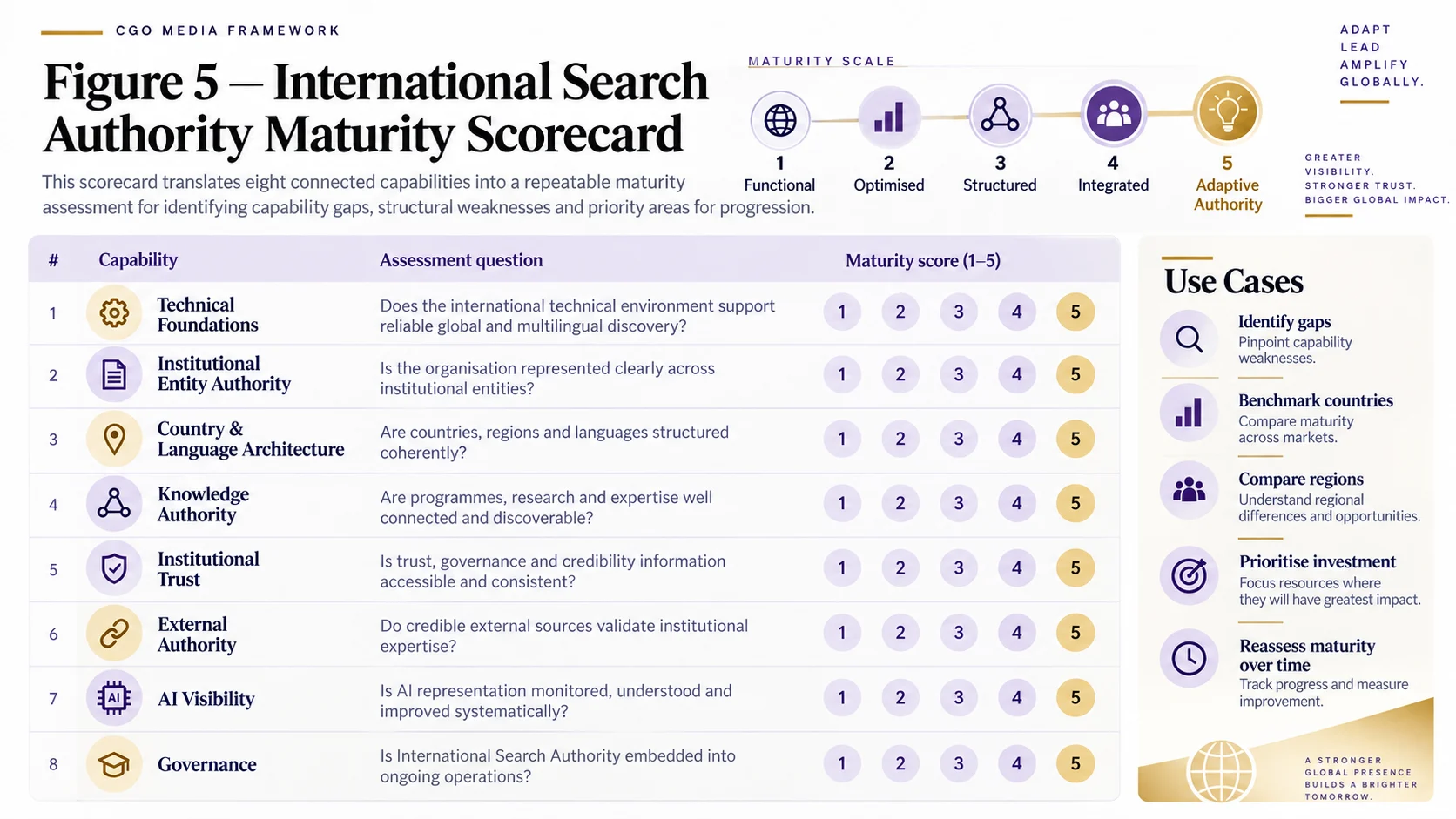
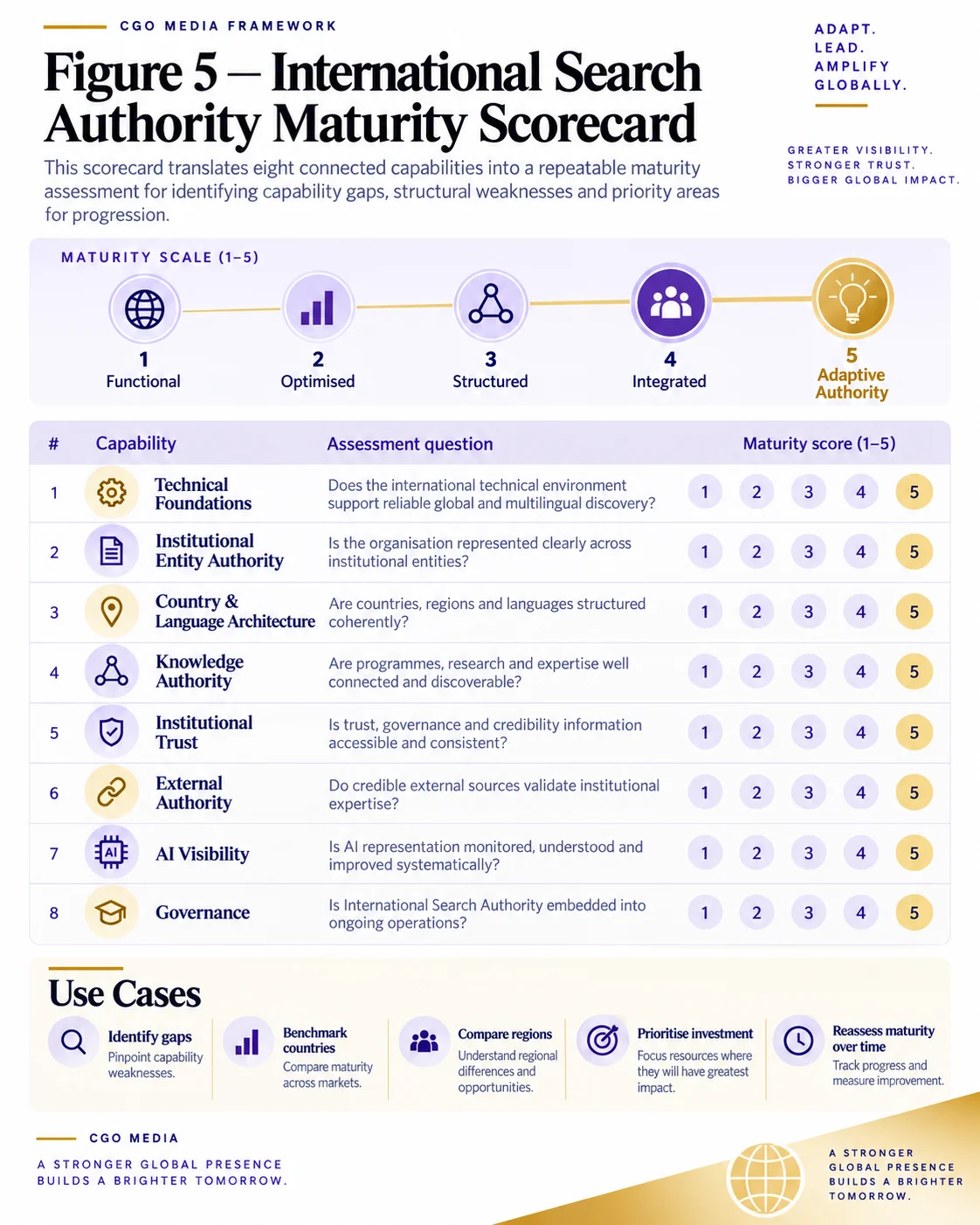
83. Capability Progression Across the Five Levels
The five maturity levels provide an overall view of organisational development, but International Search Authority rarely progresses uniformly. Each of the eight capabilities can mature at a different rate depending on institutional priorities, resources, historical systems, geographic complexity and governance.
An organisation may, for example, have highly advanced technical infrastructure while its research architecture remains relatively fragmented. Another institution may possess exceptional research and external authority but weak country and multilingual structures. A third may have sophisticated AI monitoring but insufficient institutional data governance to correct the problems that monitoring reveals.
For this reason, the maturity model should be applied at two levels.
First, the organisation should establish an overall maturity position representing the dominant way International Search Authority is managed.
Second, each of the eight capabilities should be assessed independently.
This produces a more accurate picture because maturity is not simply a label applied to the institution. It is a map of how different organisational capabilities are developing.
The value of this approach becomes particularly clear when an institution appears advanced overall but continues to experience specific visibility problems.
A weakness may not originate in the area where the problem is visible.
For example, weak AI representation of a country programme may appear to be an AI visibility issue. The underlying cause might instead be incomplete programme evidence, weak country architecture, inconsistent entity naming or insufficient external validation.
Capability-level maturity assessment therefore helps distinguish symptoms from structural causes.
84. Technical International Search Foundations — Functional
At the Functional level, the international digital environment is broadly accessible but technical management remains reactive.
Search engines can generally discover the primary website, yet inconsistencies may exist across countries, language versions, programme areas and older digital platforms.
Common characteristics include:
- basic crawlability and indexation;
- partial hreflang implementation;
- inconsistent canonical management;
- limited international sitemap governance;
- reactive handling of duplicate content;
- different technical standards between country sites;
- and limited monitoring of technical relationships across the wider digital estate.
Technical systems function sufficiently to support an international web presence, but they have not yet become a deliberately governed global infrastructure.
85. Technical International Search Foundations — Optimised
At the Optimised level, technical weaknesses are identified and addressed systematically.
The organisation begins conducting regular audits, improving hreflang, monitoring international indexation, correcting canonical conflicts and improving page performance.
Technical standards are increasingly documented.
The digital team may define preferred international URL structures, structured-data requirements, sitemap conventions and migration procedures.
The significant improvement is that technical SEO becomes proactive rather than predominantly reactive.
However, much of the work still focuses on improving individual technical components rather than supporting a unified institutional architecture.
86. Technical International Search Foundations — Structured
At the Structured level, technical architecture begins reinforcing explicit institutional relationships.
The technical system supports relationships between:
- global resources;
- regional hubs;
- country operations;
- language versions;
- programmes;
- research;
- experts;
- and other institutional entities.
Internal linking, structured data, URL architecture and metadata increasingly reflect the organisation’s information model rather than simply individual page requirements.
Technical SEO therefore begins supporting institutional understanding.
87. Technical International Search Foundations — Integrated
At the Integrated level, international technical SEO operates alongside country publishing, research management, programme architecture, multilingual workflows and institutional data governance.
Technical requirements are incorporated into publishing processes rather than corrected after publication.
When new programmes, countries, language versions or research resources are introduced, the expected technical relationships are already understood.
Quality assurance can therefore occur throughout the publishing lifecycle.
This substantially reduces fragmentation and increases the reliability of the international search environment.
88. Technical International Search Foundations — Adaptive
At the Adaptive level, technical architecture evolves continuously as institutional structures and discovery environments change.
The organisation monitors the consequences of:
- new countries;
- new languages;
- new platforms;
- site migrations;
- programme launches and closures;
- research growth;
- changing search-engine behaviour;
- and new AI-assisted discovery environments.
Technical architecture is therefore treated as a living institutional system rather than a configuration that can be completed once and left unchanged.
89. Organisation and Institutional Entity Authority Progression
Institutional Entity Authority develops from basic organisational identification toward continuous governance of the entities and relationships that define the institution.
At the Functional level, the organisation itself is usually recognisable, but relationships between headquarters, regions, country offices, programmes, leadership and affiliated initiatives may remain inconsistent.
At the Optimised level, naming conventions, organisational descriptions, leadership information and major institutional relationships become more consistent.
At the Structured level, entities are represented through explicit relationships. Countries are linked with the relevant organisational units. Programmes are connected with the parent institution. Experts are linked with subjects, publications and programmes.
At the Integrated level, institutional entity information is maintained through coordinated governance across digital, communications, research and programme systems.
At the Adaptive level, entity governance responds continuously to changes in leadership, offices, programmes, partnerships, legal structures and organisational priorities.
The progression can therefore be represented as:
Recognised Organisation → Consistent Institutional Information → Structured Entity Relationships → Integrated Entity Governance → Continuously Maintained Institutional Knowledge
This progression is important because international organisations rarely fail to have an identity. The challenge is ensuring that the full institutional structure behind that identity remains understandable across many digital environments.
90. Country, Region and Language Architecture Progression
Geographic and multilingual maturity develops from basic international presence toward a governed, integrated and continuously maintained architecture.
At the Functional level, country and language resources exist but vary widely in completeness and quality.
At the Optimised level, priority countries, regional hubs and important language environments receive deliberate improvements.
At the Structured level, global, regional, country and language relationships are explicitly organised. Country hubs connect with programmes, research, experts and evidence. Regional hubs provide context between global and national structures.
At the Integrated level, common standards govern country information, regional relationships, translation, localisation and multilingual publishing.
At the Adaptive level, geographic and language architecture evolves according to changes in programmes, institutional activity, stakeholder demand, search behaviour and strategic priorities.
The progression can be expressed as:
International Presence → Geographic Optimisation → Structured Geographic Relationships → Integrated Global-Local Architecture → Adaptive International Information System
This capability is particularly important because international organisations can appear globally authoritative while possessing weak evidence in individual countries or language environments.
91. Programme, Research and Knowledge Authority Progression
Knowledge Authority develops from basic publication toward a connected institutional knowledge architecture.
At the Functional level, programme pages, reports and other resources exist, but their relationships may be unclear.
At the Optimised level, programmes become more informative and research resources become easier to discover. Metadata, author information, topic organisation and publication landing pages improve.
At the Structured level, programmes, research, experts, countries, datasets, methodologies and evidence begin to form explicit relationships.
At the Integrated level, programme activity and research publishing operate as connected parts of the institutional knowledge system.
At the Adaptive level, knowledge architecture evolves as research priorities, stakeholder needs, programme evidence and information demand change.
The progression can therefore be represented as:
Publication → Discoverability → Knowledge Relationships → Integrated Institutional Knowledge → Adaptive Research and Evidence Intelligence
The distinction between publishing and knowledge authority is fundamental.
An organisation can publish thousands of resources without creating a coherent knowledge system. Mature authority depends on whether those resources can be placed within understandable institutional, thematic and geographic contexts.
92. Governance, Trust and Institutional Credibility Progression
Institutional trust develops from basic organisational information toward continuously maintained evidence supporting governance, legitimacy, transparency and impact.
At the Functional level, essential governance and organisational information exists but may be distributed across many different sections.
At the Optimised level, important trust information becomes easier to discover and more consistently maintained.
At the Structured level, governance, leadership, financial, programme and impact evidence becomes connected with the institutional claims it supports.
At the Integrated level, responsibility for maintaining trust information is incorporated into ongoing organisational processes.
At the Adaptive level, governance evidence changes as the organisation itself changes, reducing the gap between institutional reality and its digital representation.
The progression can be expressed as:
Basic Transparency → Improved Trust Evidence → Structured Institutional Evidence → Integrated Trust Governance → Continuously Maintained Institutional Credibility
93. External, Academic and Policy Authority Progression
External Authority develops from incidental recognition toward strategic and continuously evolving institutional validation.
At the Functional level, the organisation receives citations, links, media coverage and institutional references largely because of its existing reputation and activity.
At the Optimised level, teams begin monitoring which research, experts, programmes and institutional resources receive meaningful external references.
At the Structured level, external citations are connected with internal entities and areas of expertise.
At the Integrated level, communications, research, policy and digital teams use external-authority information collectively to strengthen institutional visibility.
At the Adaptive level, authority development responds to new research, countries, partnerships, policy priorities and emerging information demand.
The progression can be represented as:
Incidental Recognition → External Authority Monitoring → Structured Validation → Integrated Authority Development → Adaptive Institutional Validation
The significance of this capability extends well beyond backlink acquisition.
High-quality external references help demonstrate how independent institutions recognise, use and validate the organisation’s work.
94. AI Search and International Recommendation Visibility Progression
AI Search maturity develops from informal experimentation toward systematic institutional intelligence.
A typical progression is:
Occasional Testing → Repeatable Monitoring → Structured Prompt Sets → Source and Peer Analysis → Adaptive AI Intelligence
At the Functional level, employees test generative systems occasionally and notice whether the organisation appears.
At the Optimised level, key prompts begin to be repeated and recurring representation problems are recorded.
At the Structured level, monitoring is segmented by country, programme, language, subject, expert and recommendation scenario.
At the Integrated level, AI findings are connected with institutional architecture, external authority, research, communications and search strategy.
At the Adaptive level, the institution monitors changing assistants, source patterns, citation mechanisms and recommendation behaviour and adjusts its authority strategy accordingly.
AI Search capability therefore develops from asking whether the institution is mentioned toward understanding why particular institutional evidence is or is not selected.
95. Measurement and Governance Progression
Measurement progresses from basic website reporting toward integrated institutional authority intelligence.
At the Functional level, measurement is dominated by traffic, rankings, engagement and downloads.
At the Optimised level, reporting expands to countries, languages, programmes, research resources and selected external-authority measures.
At the Structured level, the organisation begins measuring relationships between different forms of authority.
At the Integrated level, International Search Authority becomes part of regular organisational reporting and cross-functional governance.
At the Adaptive level, performance data feeds continuous improvement and institutional decision-making.
The progression can therefore be expressed as:
Traffic Reporting → Segmented Performance → Connected Authority Measurement → Integrated Governance → Adaptive Institutional Intelligence
This progression changes the role of measurement.
At lower levels, reporting describes what happened.
At higher levels, measurement helps explain why authority is changing and where organisational action is required.
96. Maturity Is Not Determined by Number of Countries
Geographic scale and International Search Authority maturity are different concepts.
An organisation operating in a hundred countries is not automatically more mature than an organisation operating in ten.
Large geographic scale can actually make maturity more difficult to achieve because every additional country increases the number of institutional relationships that need to be maintained.
A large international organisation may have extensive global reach while its country architecture remains inconsistent.
Some country pages may contain comprehensive programme, research and partner evidence while others contain only basic contact information.
A smaller institution may operate across fewer countries but maintain a much clearer and more reliable architecture across all of them.
Maturity therefore measures the organisation’s ability to govern geographic complexity rather than the amount of geographic complexity it possesses.
97. Maturity Is Not Determined by Number of Languages
The same principle applies to multilingual publishing.
Publishing information in twenty languages does not demonstrate greater maturity than publishing in five if most translations are incomplete, outdated or poorly connected.
Language maturity depends on the quality of the system supporting multilingual information.
Important questions include:
- Are priority pages available in the appropriate languages?
- Are equivalent resources correctly connected?
- Are translations maintained when original content changes?
- Is terminology appropriate for local audiences?
- Are institutional relationships consistent across languages?
- Are obsolete translations identified and managed?
- Can users navigate confidently between equivalent versions?
A smaller multilingual environment with rigorous governance may therefore be substantially more mature than a much larger translation estate with inconsistent maintenance.
98. Maturity Is Not Determined by Research Volume
Research volume is another potentially misleading indicator.
International institutions may publish thousands of reports, datasets, policy documents and technical resources over many years.
This creates intellectual depth but can also create significant discovery problems.
A very large research library can remain immature if:
- publications lack useful landing pages;
- authors are poorly represented;
- topics are inconsistently classified;
- countries are not associated with relevant evidence;
- programme relationships are unclear;
- older resources cannot be differentiated from current guidance;
- datasets are disconnected from research;
- and users cannot identify the institution’s strongest evidence efficiently.
Mature research authority is therefore determined not by the number of resources published but by the organisation’s ability to structure, maintain, connect and surface institutional knowledge.
99. Maturity Is Not Determined by Institutional Reputation Alone
International organisations can possess considerable offline authority while maintaining relatively weak digital authority architecture.
An institution may be well known among governments, academics, policy professionals or industry stakeholders and still suffer from:
- fragmented country websites;
- incomplete entity relationships;
- outdated programme pages;
- weak multilingual governance;
- poorly structured research libraries;
- and inconsistent AI representation.
Historic reputation can mask these weaknesses because users who already know the organisation may find what they need through branded search or direct navigation.
The limitation becomes more visible when discovery begins with a problem rather than an organisational name.
Users may ask which organisations work on a particular issue, which institutions publish research on a topic or which international bodies operate within a specific country.
In those situations, established offline reputation alone may not be sufficient.
The organisation’s digital evidence needs to make its relevance understandable.
100. Maturity Is About Organisational Capability
The central purpose of maturity assessment is therefore to evaluate organisational capability.
The relevant question is whether the organisation can repeatedly and reliably:
- maintain institutional clarity;
- manage global, regional and country relationships;
- govern multilingual information;
- keep programme evidence current;
- structure institutional research;
- represent experts accurately;
- maintain governance and trust evidence;
- develop and understand external validation;
- monitor AI representation;
- and continuously improve the wider authority system.
A mature organisation does not depend entirely on the knowledge of individual employees.
Processes, standards, ownership and information relationships remain sufficiently documented that capability survives staff turnover, programme transitions and structural change.
This is why International Search Authority maturity is fundamentally an organisational concept rather than simply an SEO metric.
101. Maturity Can Vary by Country
Global organisations frequently possess very different levels of authority between countries.
A strategically important country may have:
- a well-developed local website;
- strong programme information;
- local research;
- clear leadership;
- institutional partnerships;
- strong external references;
- and substantial media visibility.
Another country within the same organisation may contain only a brief office description and several outdated programme pages.
The global organisation therefore cannot assume that strong institutional authority automatically transfers to every geographic market.
Country-level maturity assessment helps identify these variations.
It can also reveal whether weak local visibility represents a strategic problem or simply reflects a lower level of institutional activity within that country.
102. Maturity Can Vary by Language
Language environments can display similarly uneven maturity.
An organisation’s primary language may contain comprehensive information, sophisticated internal linking, detailed research architecture and current programme evidence.
Other strategic languages may contain substantially less information.
This creates an important risk.
Users searching in different languages may encounter significantly different representations of the same organisation.
AI systems operating in those languages may also have access to different quantities and qualities of evidence.
An organisation might therefore operate at an Integrated level in English while remaining Optimised or even Functional in another important language.
Multilingual maturity needs to be assessed independently rather than inferred from the strongest language environment.
103. Maturity Can Vary by Programme
Programme maturity can vary substantially even within one department or country.
Flagship programmes often receive more investment, stronger communications support, greater research coverage and higher external visibility.
Smaller or newer programmes may have limited digital evidence despite being operationally significant.
Differences can appear in:
- programme completeness;
- geographic information;
- partner visibility;
- research support;
- impact evidence;
- expert representation;
- external citations;
- and AI visibility.
Programme-level maturity assessment can therefore reveal where important institutional activity is insufficiently represented.
It also helps organisations distinguish between programmes that are poorly visible because they are genuinely new and programmes whose digital evidence has simply been neglected.
104. Maturity Can Vary by Research Area
An organisation may possess highly developed authority in long-established research areas while emerging strategic subjects remain comparatively weak.
Established areas may benefit from decades of publications, recognised experts, academic citations, policy references and institutional partnerships.
Newer subject areas may possess strong internal expertise but limited external evidence and a relatively small body of published material.
Research maturity should therefore be considered by subject as well as across the overall institution.
Useful questions include:
- Does the organisation have clearly identifiable experts in the area?
- Is relevant research easy to discover?
- Are programmes connected with the research?
- Is the work receiving academic or policy citation?
- Does external media recognise the organisation’s expertise?
- Do AI systems identify the organisation when discussing the subject?
These questions help distinguish genuine knowledge gaps from visibility and architecture gaps.
105. Capability Imbalance
Capability imbalance occurs when different parts of the International Search Authority system develop at substantially different rates.
This is common and should not automatically be interpreted as organisational failure.
Different teams receive different levels of investment. Historic systems create different starting points. Some capabilities may have been strategically important for many years while others have only recently emerged.
Examples of imbalance include:
- strong research authority but weak multilingual architecture;
- strong global visibility but weak country authority;
- strong programme evidence but limited external validation;
- strong governance transparency but weak AI monitoring;
- strong media authority but poor institutional entity clarity;
- strong technical SEO but fragmented knowledge architecture;
- strong academic citation but limited general search discovery;
- or advanced AI monitoring without sufficient governance to act on the findings.
The significance of imbalance depends on whether it constrains strategically important outcomes.
For example, weak multilingual maturity may matter relatively little for an organisation whose stakeholders primarily use one language. The same weakness could be critical for an institution whose programmes depend on effective communication across multiple linguistic markets.
Similarly, limited academic citation may not represent a serious constraint for every programme, whereas it could be highly important for a research-led institution seeking to establish evidence authority.
Maturity assessment should therefore avoid assuming that every capability must always receive identical priority.
The purpose is to identify whether capability differences are intentional and appropriate or whether they represent structural weaknesses that prevent stronger areas from producing their full institutional value.
This distinction leads to one of the most useful applications of the model: the International Search Capability Maturity Matrix.
The matrix allows the organisation to assess all eight capabilities across the five maturity stages and identify where development is balanced, where bottlenecks exist and where investment may produce the greatest improvement.
The International Search Capability Maturity Matrix maps the eight core capabilities against the five maturity levels. It allows organisations to identify where individual capabilities are developing at different speeds and where structural imbalance may constrain overall International Search Authority.
| Capability | Level 1 Functional | Level 2 Optimised | Level 3 Structured | Level 4 Integrated | Level 5 Adaptive Authority |
|---|---|---|---|---|---|
| Technical International Search Foundations | Basic international accessibility with reactive technical management. | Hreflang, indexation, canonicals, performance and structured data are actively improved. | Technical architecture supports explicit global, regional, country, language and entity relationships. | Technical SEO is embedded within international publishing and institutional data workflows. | Architecture evolves continuously as platforms, countries, languages and discovery environments change. |
| Organisation and Institutional Entity Authority | The institution is identifiable but organisational relationships may be inconsistent. | Naming, leadership and major organisational information are standardised. | Offices, leaders, programmes, partners and institutional entities are explicitly connected. | Entity information is governed consistently across organisational systems. | Institutional relationships are continuously updated as organisational reality changes. |
| Country, Region and Language Architecture | Country and language resources exist but coverage and quality are uneven. | Priority geographic and language environments receive deliberate optimisation. | Global, regional, country and multilingual relationships follow a clear information architecture. | Global standards and local evidence operate within one coordinated international system. | Geographic and language architecture adapts to institutional activity, demand and changing audience behaviour. |
| Programme, Research and Knowledge Authority | Programmes and publications exist but remain largely independent resources. | Programme evidence and research discoverability improve. | Programmes, research, experts, datasets, countries and evidence form explicit knowledge relationships. | Programme activity and institutional knowledge operate within one connected authority architecture. | Knowledge structures evolve continuously according to emerging research, programme and stakeholder needs. |
| Governance, Trust and Institutional Credibility | Basic governance and transparency information is available. | Trust information becomes clearer, more complete and easier to discover. | Governance, leadership, financial and impact evidence is connected with relevant institutional claims. | Trust evidence is embedded within ongoing organisational governance. | Institutional credibility evidence is continuously maintained as governance and organisational structures change. |
| External, Academic and Policy Authority | External recognition develops mainly through existing institutional reputation. | Important citations, media coverage and institutional references are monitored deliberately. | External validation is mapped against specific research, programmes, experts and institutional subjects. | External authority strategy is coordinated across research, policy, communications and digital functions. | Validation strategy adapts to new priorities, evidence, countries, partnerships and information demand. |
| AI Search and International Recommendation Visibility | AI systems are tested occasionally without systematic measurement. | Key prompts and recurring representation issues are monitored. | Structured prompt sets measure countries, programmes, research, languages, citations and recommendations. | AI findings are integrated with institutional architecture, source analysis and authority strategy. | AI intelligence adapts continuously as assistants, citation systems, source patterns and recommendation behaviour evolve. |
| Measurement and Governance | Reporting focuses primarily on traffic, rankings and engagement. | Measurement expands across countries, languages, programmes and authority signals. | Connected authority relationships are measured and capability ownership becomes clearer. | International Search Authority becomes part of institutional governance and executive reporting. | Measurement supports continuous learning, strategic prioritisation and institutional intelligence. |
Figure 4. The International Search Capability Maturity Matrix assesses Technical Foundations, Institutional Entity Authority, Country and Language Architecture, Programme and Knowledge Authority, Institutional Trust, External Authority, AI Search Visibility and Governance across Functional, Optimised, Structured, Integrated and Adaptive Authority levels.
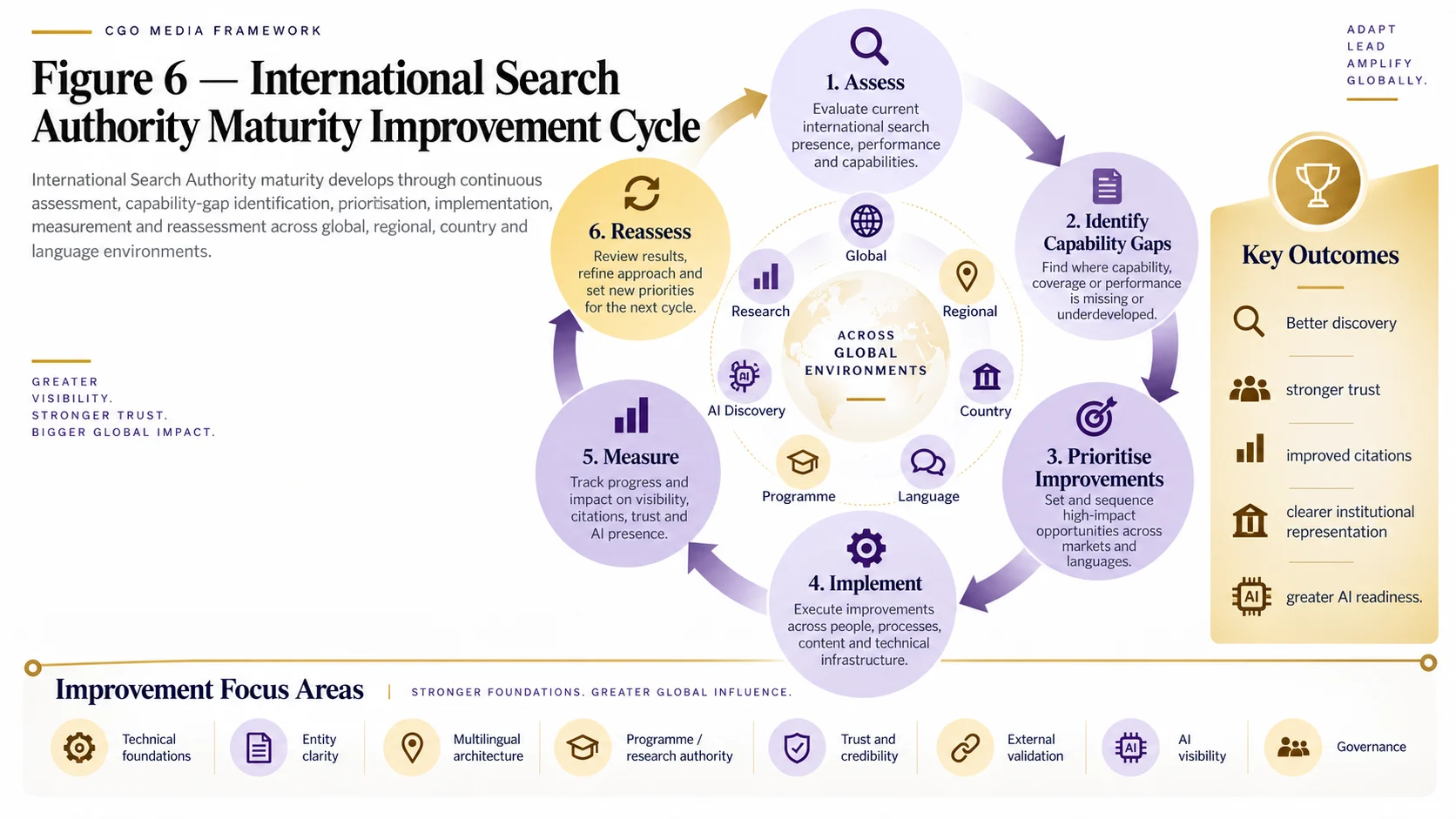
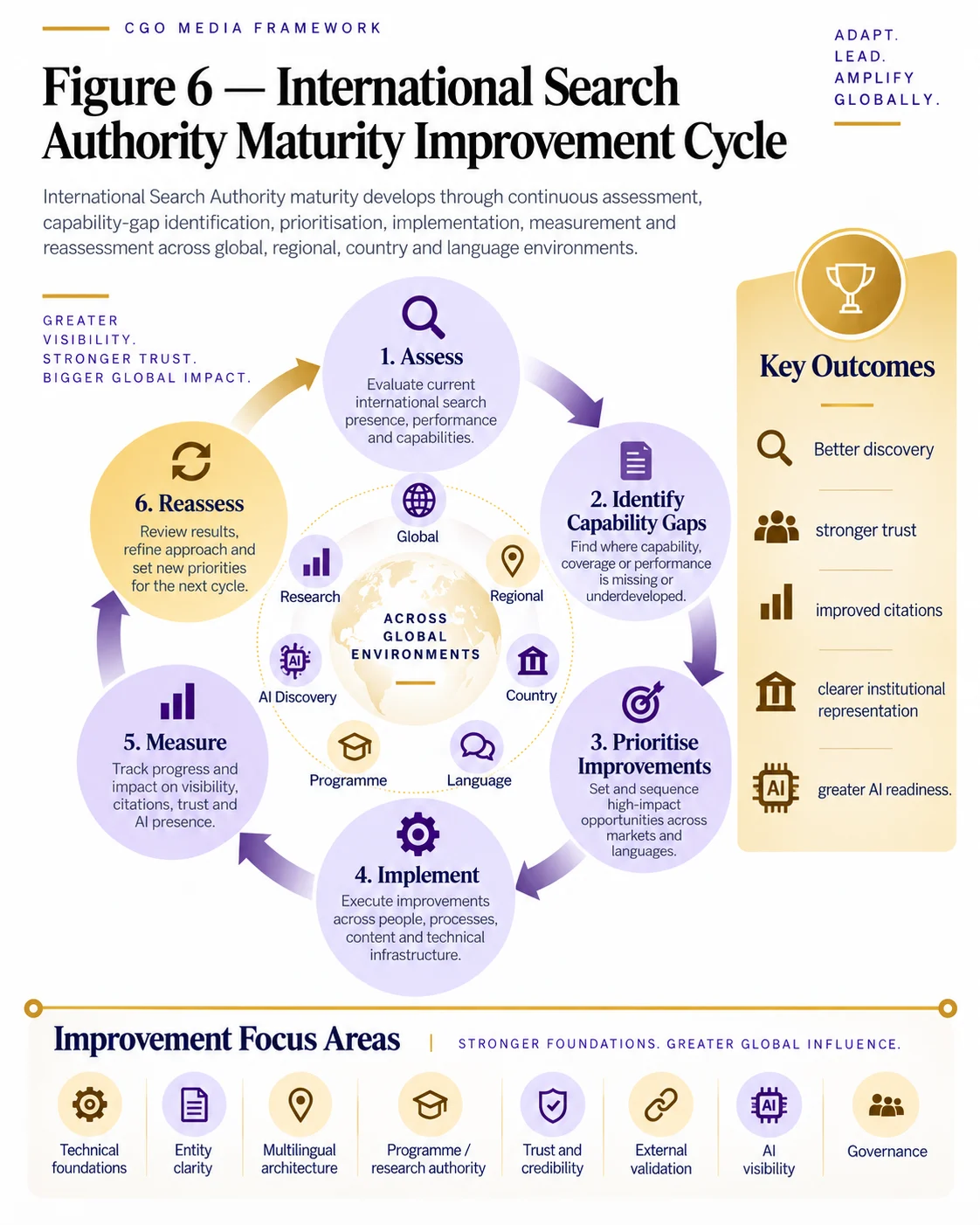
903. Measuring Manufacturing Search Authority
Manufacturing SEO measurement should extend beyond rankings, impressions, clicks and website traffic because industrial search visibility becomes commercially meaningful only when it contributes to supplier understanding, technical validation, procurement confidence and qualified commercial engagement.
904. Search Visibility Is an Early-Stage Indicator
Visibility can demonstrate that a manufacturer is being discovered, but it does not establish whether the organisation is being understood or considered seriously by technical buyers.
905. Traffic Is Also an Incomplete Outcome
A high volume of visits can have limited commercial value if visitors do not match the manufacturer’s:
- Processes
- Industries
- Production scale
- Geographic markets
- Commercial priorities
906. Manufacturing Measurement Should therefore Follow Buyer Progression
A stronger measurement system asks whether users are moving from discovery toward:
- Technical understanding
- Supplier validation
- Trust
- Comparison
- Shortlisting
- Enquiry
- Supplier relationship
907. Measurement Should Reflect Industrial Buying Behaviour
Engineers, procurement teams, OEMs, distributors and technical buyers often use several information sources before creating an enquiry.
908. Measurement Should therefore Combine Digital and Commercial Evidence
Useful inputs can include:
- Search analytics
- Website analytics
- AI observations
- CRM data
- RFQ records
- Sales feedback
- Win and loss analysis
909. Manufacturing Measurement Should Be Segmented
Aggregate traffic can hide substantial differences between important capability areas.
910. Segmentation by Process Is One Approach
The organisation can measure performance separately for:
- CNC machining
- Fabrication
- Moulding
- Casting
- Stamping
- Assembly
911. Segmentation by Product Is Another Approach
Different product groups can have different:
- Demand
- Margins
- Buyer types
- Sales cycles
912. Segmentation by Industry Is Another Approach
Aerospace, automotive, medical, energy and industrial-equipment buyers can behave differently.
913. Segmentation by Geography Is Another Approach
Domestic, European and export markets can produce different search and procurement patterns.
914. Segmentation by Customer Type Is Another Approach
A manufacturer may distinguish between:
- OEMs
- Tier suppliers
- Distributors
- Engineering consultancies
- Start-ups
- Large enterprises
915. Segmentation by Commercial Value Is Another Approach
High-value programmes can justify deeper measurement than low-value transactional work.
916. Entity Visibility Measurement
Manufacturers should assess whether the organisation itself is represented clearly across search and AI-assisted discovery.
917. Manufacturer Name Visibility Is One Indicator
Branded search should provide a clear and accurate representation of the company.
918. Facility Visibility Is Another Indicator
Multi-site manufacturers should determine whether individual facilities can be discovered for the capabilities they actually provide.
919. Business-Unit Visibility Is Another Indicator
Specialist divisions can require their own search visibility where they perform distinct commercial functions.
920. Leadership Visibility Can Also Be Relevant
Named technical or executive leaders can strengthen organisational transparency.
921. Entity Accuracy Should Be Measured alongside Visibility
A visible manufacturer represented inaccurately still has an authority problem.
922. Relevant Entity Accuracy Checks Include
- Company name
- Trading name
- Headquarters
- Manufacturing facilities
- Business units
- Leadership
923. Process Visibility Measurement
Process-level measurement should determine whether the manufacturer is associated consistently with its strategically important production capabilities.
924. Search Visibility for Priority Processes Is One Indicator
The organisation can monitor conventional search performance for commercially important process families.
925. AI Capability Association Is Another Indicator
Scenario testing can assess whether AI systems associate the manufacturer correctly with its real processes.
926. Process-Page Engagement Is Another Indicator
Relevant measures can include:
- Entrances
- Engaged sessions
- Internal navigation
- Technical-document usage
- Enquiry progression
927. Process Visibility Should Be Evaluated against Commercial Priority
Visibility for low-value capabilities should not automatically receive the same attention as priority processes.
928. Product Visibility Measurement
Manufacturers supplying repeatable products or product families can measure whether important commercial and technical assets are being discovered.
929. Product Search Impressions Are One Indicator
They can reveal the level of demand around specific product categories.
930. Product Organic Entrances Are Another Indicator
The organisation can identify which product pages generate meaningful discovery.
931. Product Specification Engagement Is Another Indicator
Technical buyers may engage with:
- Dimensions
- Materials
- Performance data
- Documentation
932. Product RFQ Activity Is Another Indicator
The strongest commercial measure is whether discovery leads toward a relevant quotation request or technical conversation.
933. Product Visibility Should Be Evaluated with Margin and Strategic Importance
The most visible product is not necessarily the most commercially valuable.
934. Material Visibility Measurement
Material-related visibility can reveal whether the manufacturer is being discovered for strategically important metals, plastics, composites or specialist materials.
935. Search Visibility by Material Is One Indicator
Relevant combinations can include:
- Material + process
- Material + product
- Material + industry
936. Material Technical-Content Usage Is Another Indicator
Educational pages can attract early-stage engineering research.
937. AI Material Association Is Another Indicator
Scenario testing can determine whether the manufacturer is associated with materials it genuinely works with.
938. Incorrect Material Association Should Be Treated as a Representation Problem
The manufacturer should not be credited with unsupported capabilities.
939. Industry Visibility Measurement
Industry-level measurement can reveal whether the organisation is visible within sectors where genuine commercial opportunity exists.
940. Aerospace Visibility Can Be Measured Separately
The organisation can assess searches involving:
- Processes
- Materials
- Certifications
- Applications
- Supplier discovery
941. Automotive Visibility Can Be Measured Separately
Relevant indicators may focus more heavily on:
- Production scale
- Repeatability
- Quality
- Supply-chain capability
942. Medical Visibility Can Be Measured Separately
Quality, traceability and material evidence can become particularly important.
943. Energy Visibility Can Be Measured Separately
Application, materials, engineering and reliability evidence can carry significant value.
944. Food-Production Visibility Can Be Measured Separately
Material, hygiene and process suitability can influence discovery.
945. Industrial-Equipment Visibility Can Be Measured Separately
Broad capability may need to be segmented by product type and application.
946. Industry Visibility Should Be Compared with Actual Sector Capability
Search success is not valuable if it attracts buyers from industries the manufacturer does not want or cannot support.
947. Geographic Visibility Measurement
Geographic authority should reflect how the manufacturer actually serves customers.
948. Local Visibility Can Be Measured
This is relevant for buyers seeking manufacturers within a particular city, region or industrial cluster.
949. National Visibility Can Be Measured
The organisation can assess whether it is visible for strategic supplier-discovery searches across the domestic market.
950. Export Visibility Can Be Measured
The manufacturer can assess discovery within strategically important international markets.
951. Priority-Country Visibility Can Be Measured Separately
International SEO performance should reflect real commercial priorities.
952. Geographic Visibility Should Be Connected to Facility and Logistics Evidence
Appearing in a geographic search provides limited value if the site cannot explain how that market is served.
953. Facility Visibility Measurement
Multi-site manufacturers should assess whether each facility appears accurately for the capabilities located there.
954. Facility Process Visibility Is One Measure
The organisation can determine whether a site is associated with the correct processes.
955. Facility Certification Visibility Is Another Measure
Relevant certifications should be associated with the correct operational location.
956. Facility Industry Visibility Is Another Measure
Some sites may specialise in particular sectors.
957. Facility Geographic Visibility Is Another Measure
The site should be discoverable where regional sourcing matters.
958. Facility Accuracy Should Be Checked across AI Systems
AI-assisted answers can occasionally confuse:
- Headquarters
- Sales offices
- Production facilities
- Former sites
959. Certification Visibility Measurement
Manufacturers should monitor whether important certifications are both visible and associated with the correct business entity or facility.
960. Search Visibility for Certification Terms Is One Indicator
Buyers may use certification-led searches to identify eligible suppliers.
961. Certification-Page Engagement Is Another Indicator
Procurement teams may visit certification information during validation.
962. AI Certification Accuracy Is Another Indicator
Scenario testing can reveal whether certifications are represented correctly.
963. Certification Scope Accuracy Is Another Indicator
The manufacturer should verify that digital systems do not overstate:
- Facility coverage
- Business-unit coverage
- Product coverage
- Industry coverage
964. Certification Freshness Is Another Indicator
Expired or superseded information should not continue driving supplier interpretation.
965. Research and Technical Content Visibility
Manufacturers publishing educational or original research content should measure how those assets contribute to wider authority.
966. Search Impressions Are One Research Metric
They can reveal whether technical content is discoverable.
967. Organic Entrances Are Another Research Metric
The organisation can identify which articles or guides attract relevant users.
968. External Citations Are Another Research Metric
References from credible external sources can strengthen technical authority.
969. Referral Traffic Is Another Research Metric
External mentions can produce qualified discovery.
970. AI Citation Visibility Is Another Research Metric
Useful technical content may appear as source material within generated answers.
971. Research Usage Is Another Metric
Downloads, views, citations or professional reuse can demonstrate practical utility.
972. Research Measurement Should Separate Visibility from Authority
A highly viewed article is not necessarily highly influential.
973. Research Measurement Should Separate Authority from Commercial Conversion
Some technical content contributes indirectly to brand and expertise recognition rather than generating immediate enquiries.
974. External Authority Measurement
External authority should be assessed through sources that reinforce manufacturing capability independently.
975. Trade Media References Are One Indicator
Relevant coverage can strengthen industry authority.
976. Government Citations Are Another Indicator
Institutional references can reinforce participation within industrial programmes.
977. Academic Mentions Are Another Indicator
Research or technical collaborations can strengthen specialist authority.
978. Trade Association References Are Another Indicator
Industry-body recognition can support sector participation.
979. Customer Citations Are Another Indicator
Public customer references can provide powerful applied evidence.
980. Partner References Are Another Indicator
Technical or commercial partners can reinforce external credibility.
981. External Authority Should Be Evaluated by Relevance
A manufacturing citation is strongest when it reinforces a capability the organisation actually wants to be known for.
982. External Authority Should Be Evaluated by Independence
Earned recognition differs from self-submitted directory listings.
983. External Authority Should Be Evaluated by Specificity
A citation to a named process, product, expert or research asset can carry greater contextual value than a generic brand mention.
984. External Authority Should Be Evaluated by Freshness
Current recognition can provide stronger evidence of present capability.
985. Branded Validation Search Measurement
Branded searches can reveal what procurement teams encounter when they investigate a manufacturer after initial discovery.
986. Manufacturer Reviews Are One Branded Validation Search
The buyer may investigate customer experience.
987. Manufacturer Certifications Are Another Branded Validation Search
The buyer may want formal validation.
988. Manufacturer Quality Is Another Branded Validation Search
Users may investigate reputation or quality systems.
989. Manufacturer Customers Are Another Branded Validation Search
The buyer may want evidence of market experience.
990. Manufacturer Complaints Are Another Branded Validation Search
Negative evidence can materially affect trust.
991. Manufacturer Financial Information Is Another Branded Validation Search
Financial stability can matter for long-term supply relationships.
992. Branded Search Measurement Should Examine the Result Environment
The organisation should understand which:
- Owned pages
- Directories
- Media results
- Reviews
- Corporate databases
- Certification sources
appear prominently.
993. Branded Search Is therefore a Trust Measurement Layer
It reveals the wider reputation environment surrounding the supplier.
994. AI Organisation Visibility
AI monitoring can assess whether the manufacturer appears within relevant company-level supplier-discovery scenarios.
995. AI Organisation Visibility Should Be Scenario-Specific
The manufacturer may perform differently by:
- Process
- Industry
- Location
- Certification
- Production scale
996. AI Organisation Visibility Should Be Recorded over Time
Single observations provide limited diagnostic value.
106. Assessing International Search Authority Maturity
The International Search Authority Maturity Model is most useful when it is applied as a structured assessment rather than treated only as a conceptual description of organisational development.
A maturity assessment should establish three things:
- the organisation’s current capability level;
- the structural weaknesses preventing progression;
- and the areas where improvement would create the greatest strategic value.
The objective is not to generate a superficial score.
A useful assessment should reveal how effectively the organisation manages the systems that influence international search visibility, institutional understanding, external authority and AI-assisted discovery.
This means examining evidence across the eight capabilities rather than relying on assumptions about organisational size, reputation or website sophistication.
Assessment should therefore consider both observable outputs and underlying organisational capability.
For example, a country page may appear comprehensive, but the organisation should also establish whether there is a repeatable process for keeping its programme, leadership, research and partner information current.
A research library may look sophisticated, but assessment should determine whether publications are consistently connected with authors, subjects, countries, programmes and supporting data.
An organisation may appear frequently in generative answers, but maturity depends on whether those appearances are monitored, understood and connected with a process for improving representation.
Maturity should therefore be assessed through evidence of capability, consistency, governance and repeatability.
107. Assessment Should Be Evidence-Based
Maturity should not be determined primarily through opinion.
Different departments may perceive the same capability very differently.
A global digital team may believe multilingual architecture is mature because hreflang implementation is technically correct, while local teams know that many translated pages are outdated.
A research department may consider publication visibility strong because reports receive academic citations, while the digital team can demonstrate that many important publications are almost invisible in non-branded search.
A communications team may consider external authority strong because the organisation receives regular press coverage, while programme teams may find that important country initiatives receive little independent recognition.
These differences make observable evidence essential.
Relevant evidence can include:
- technical crawl data;
- indexation reports;
- hreflang validation;
- country-page inventories;
- regional architecture;
- language coverage;
- content freshness;
- programme-page completeness;
- publication metadata;
- expert profiles;
- governance documents;
- academic citation records;
- government references;
- media coverage;
- AI prompt testing;
- source analysis;
- and internal ownership documentation.
The more evidence supporting an assessment, the more useful the resulting maturity classification becomes.
108. Assess Capability Before Assigning an Overall Level
The assessment should begin with the eight capabilities rather than attempting to assign an overall maturity level immediately.
This avoids a common problem in maturity modelling: reducing a complex international organisation to one label before understanding the underlying system.
An organisation might initially describe itself as Integrated because it has sophisticated international websites and strong institutional recognition.
Capability assessment may reveal a more complicated picture:
- Technical Foundations — Integrated;
- Institutional Entity Authority — Structured;
- Country and Language Architecture — Optimised;
- Programme and Knowledge Authority — Structured;
- Governance and Trust — Integrated;
- External Authority — Integrated;
- AI Search Visibility — Functional;
- Measurement and Governance — Optimised.
That profile provides far more strategic value than assigning a single organisation-wide level.
It reveals where the organisation is genuinely advanced and where gaps may prevent stronger capabilities from operating effectively together.
The overall maturity position can then be determined after reviewing the capability profile.
109. Avoid Mechanical Averaging
The model should not be applied through simple mathematical averaging alone.
Assigning numerical values such as Functional = 1 and Adaptive = 5 can be useful for dashboards and longitudinal tracking, but averaging those numbers can conceal strategically important weaknesses.
Consider an organisation with highly advanced capabilities in six areas but Functional maturity in multilingual architecture and institutional entity governance.
A numerical average might suggest relatively high overall maturity.
However, if the institution operates across multiple languages and countries, those two weaknesses could materially undermine its international authority.
The assessment should therefore consider:
- average maturity;
- lowest strategically important capability;
- capability dependencies;
- institutional priorities;
- and the degree of imbalance across the system.
Numerical scoring should support judgement rather than replace it.
110. Capability Dependency Analysis
Capabilities within the model are interconnected.
For that reason, assessment should examine not only the maturity of each capability but also whether one weak capability is constraining another.
Typical dependencies include:
- Technical architecture → multilingual visibility: language governance cannot reach full search maturity if hreflang, canonicals or equivalent-page relationships remain unreliable.
- Entity clarity → AI representation: generative systems may represent an organisation inconsistently if institutional relationships are unclear.
- Country architecture → programme visibility: programmes operating within a country may remain difficult to discover when country-programme relationships are weak.
- Research architecture → external authority: academic and policy citations may be harder to consolidate when publications, authors and supporting datasets are poorly represented.
- Trust evidence → recommendation readiness: institutional recommendations may be weakened where governance, impact or programme evidence is difficult to verify.
- Measurement → adaptive maturity: an organisation cannot adapt systematically if it lacks reliable mechanisms for observing performance.
Dependency analysis helps identify where investment will create wider effects across the authority system.
111. Assessing Technical International Search Foundations
Technical assessment should determine whether the international digital estate provides a reliable infrastructure for discovery and institutional understanding.
The assessment should examine more than conventional technical SEO errors.
Relevant indicators include:
- crawlability across global, regional and country environments;
- indexation quality;
- international URL consistency;
- hreflang completeness and validity;
- canonical accuracy;
- XML sitemap architecture;
- internal-link relationships;
- structured-data implementation;
- mobile performance;
- page performance;
- redirect governance;
- duplicate-content control;
- archived-content handling;
- and technical standards across separate platforms.
Assessment should also determine whether technical quality is maintained consistently.
A technically strong primary website does not necessarily indicate mature international infrastructure if regional or country environments operate according to different standards.
Evidence of higher maturity includes repeatable monitoring, shared technical standards, documented ownership and integration with publishing workflows.
A key progression question is:
Can the organisation reliably maintain the technical relationships required for international and multilingual discovery as its digital estate changes?
112. Assessing Organisation and Institutional Entity Authority
Entity Authority assessment should determine whether the organisation’s institutional structure can be understood consistently across its digital environment.
Relevant indicators include:
- consistent official naming;
- consistent acronym use;
- clear organisational descriptions;
- headquarters representation;
- regional-office relationships;
- country-office relationships;
- leadership accuracy;
- programme ownership;
- department relationships;
- partner relationships;
- expert affiliation;
- and structured entity representation.
Assessment should identify conflicting descriptions and ambiguous organisational relationships.
For example, different country sections may describe the parent institution differently. A programme microsite may fail to explain clearly which institution operates it. Leadership information may differ between governance pages and local-office profiles.
These inconsistencies can appear minor when viewed individually, but across a large international organisation they can create significant entity ambiguity.
Higher maturity requires a system through which authoritative entity information is maintained and propagated across relevant digital environments.
The progression question is:
Are the organisation and its associated entities represented clearly, consistently and maintainably across the international digital estate?
113. Assessing Country Authority
Country Authority should be assessed separately because global institutional recognition does not guarantee local search authority.
Relevant indicators include:
- quality of the principal country hub;
- country-office information;
- local leadership;
- active programme coverage;
- country-specific research;
- local statistics or evidence;
- government and institutional partnerships;
- expert representation;
- programme outcomes;
- local external citations;
- country-level organic visibility;
- and AI representation for country-specific questions.
Country assessment should distinguish between low authority and low organisational activity.
A country with limited institutional operations would not necessarily require the same evidence depth as a strategic market containing numerous programmes and partnerships.
Assessment should therefore compare digital representation with actual institutional activity.
A significant maturity gap exists when substantial operations are poorly represented online.
114. Assessing Regional Authority
Regional Authority should be assessed where regional structures form an important part of organisational operations.
Relevant indicators can include:
- regional hub completeness;
- relationship with global headquarters;
- country relationships;
- regional leadership;
- cross-border programmes;
- regional research;
- regional policy priorities;
- experts;
- partners;
- external authority;
- and AI representation.
The assessment should establish whether the regional environment provides genuine contextual value or functions primarily as an additional navigation layer.
Higher maturity is demonstrated when regional structures help users understand how international strategy translates into geographically relevant programmes, evidence and institutional relationships.
115. Assessing Language Architecture
Language maturity should be evaluated through both technical and editorial evidence.
Relevant indicators include:
- coverage of strategically important content;
- translation quality;
- localisation quality;
- terminology consistency;
- content freshness;
- equivalent-page relationships;
- hreflang accuracy;
- navigation between language versions;
- local search demand;
- translated programme evidence;
- translated research information;
- and ownership of language maintenance.
A useful assessment should compare language environments rather than evaluating them only in isolation.
For example, the organisation may discover that its English-language environment operates at Integrated maturity while Spanish content remains Structured and French content remains largely Functional.
This difference can materially affect how the institution is understood across markets.
Language assessment should therefore ask:
Can users and discovery systems access an accurate and sufficiently complete representation of the institution in every strategically important language?
116. Assessing Programme, Research and Knowledge Authority
Programme, Research and Knowledge Authority should be evaluated according to how effectively operational activity and institutional knowledge are represented, connected and discoverable.
Relevant programme indicators include:
- programme completeness;
- status accuracy;
- geographic scope;
- partner information;
- funding information where relevant;
- programme leadership;
- objectives;
- outputs;
- results;
- evaluation evidence;
- impact evidence;
- and links with supporting research.
Research indicators include:
- research discoverability;
- publication architecture;
- HTML landing pages;
- author representation;
- publication dates;
- topic classification;
- country relationships;
- programme relationships;
- dataset quality;
- methodology visibility;
- versioning;
- citation information;
- and related-resource architecture.
Expert Authority should also be considered within the knowledge assessment.
Relevant signals include:
- complete expert profiles;
- subject associations;
- research authorship;
- programme involvement;
- country or regional responsibilities;
- external citations;
- media commentary;
- and institutional roles.
The central assessment question is:
Does the organisation possess a coherent institutional knowledge architecture, or does knowledge remain distributed across disconnected publications, programme pages and individual departments?
117. Assessing Governance, Trust and Institutional Credibility
Trust maturity should be assessed according to the availability, clarity, consistency and maintenance of evidence supporting institutional claims.
Relevant indicators include:
- governance transparency;
- leadership transparency;
- institutional history;
- legal status;
- funding transparency;
- financial reporting;
- accountability mechanisms;
- programme transparency;
- methodology transparency;
- impact reporting;
- correction procedures;
- versioning;
- and ownership of factual institutional information.
Assessment should not be limited to whether these resources exist.
The organisation should determine whether trust evidence is sufficiently connected with the claims it supports.
For example, a programme impact claim is stronger when users can access supporting evaluation evidence. A statistical claim becomes easier to trust when methodology and source information are readily available. Institutional descriptions are more reliable when governance and legal information can be independently verified.
Higher maturity therefore involves a transition from publishing transparency information toward maintaining a verifiable institutional evidence system.
118. Assessing External, Academic and Policy Authority
External Authority assessment should distinguish between different forms of third-party validation rather than treating all mentions and links as equivalent.
Relevant evidence may include:
- government references;
- academic citations;
- university references;
- policy citations;
- think-tank references;
- international-organisation references;
- standards-body citations;
- partner validation;
- credible media coverage;
- expert quotations;
- conference participation;
- and reuse of institutional datasets or methodologies.
The assessment should identify not merely how much external authority exists but what it validates.
For example, academic citations may reinforce research authority but provide limited evidence concerning programme delivery. Government references may validate policy relevance. Partner references may demonstrate operational relationships. Media citations may reinforce expert visibility.
A mature institution should increasingly be able to connect external validation with:
- subjects;
- research resources;
- programmes;
- countries;
- experts;
- datasets;
- and institutional claims.
The central progression question is:
Do credible external sources consistently reinforce the areas in which the organisation claims institutional authority?
119. Assessing AI Search and International Recommendation Visibility
AI Search maturity should be assessed through repeatable observation rather than occasional anecdotal testing.
The organisation should define prompt groups reflecting genuine stakeholder discovery journeys.
These may include:
- organisation discovery prompts;
- subject-expertise prompts;
- country-specific questions;
- regional questions;
- programme-discovery questions;
- research-source questions;
- expert-discovery questions;
- institution comparisons;
- recommendation scenarios;
- and multilingual variants.
Relevant assessment indicators include:
- organisation recommendation visibility;
- programme visibility;
- country-level representation;
- research citations;
- expert representation;
- source visibility;
- citation visibility;
- representation accuracy;
- peer visibility;
- and recommendation consistency.
The organisation should also determine whether monitoring leads to action.
A team that records inaccurate answers without identifying and strengthening the underlying evidence remains at a lower maturity level than an organisation where AI observations trigger structured investigation.
For example, repeated omission of an important programme might lead to examination of:
- the programme page;
- country relationships;
- external references;
- institutional entity clarity;
- research evidence;
- and third-party source coverage.
AI maturity therefore depends both on monitoring sophistication and on the institution’s ability to convert observations into authority improvements.
120. Assessing Measurement and Governance
Measurement and Governance determine whether the organisation can maintain International Search Authority beyond individual projects or campaigns.
Relevant indicators include:
- defined ownership;
- documented standards;
- review cycles;
- cross-functional coordination;
- country governance;
- language governance;
- programme governance;
- research governance;
- AI monitoring ownership;
- executive reporting;
- capability benchmarking;
- and continuous improvement processes.
Assessment should establish whether responsibilities are explicit.
For example:
- Who owns official organisation information?
- Who updates leadership changes?
- Who maintains country-page standards?
- Who owns hreflang validation?
- Who controls terminology in each language?
- Who updates programme status?
- Who maintains publication metadata?
- Who monitors external citations?
- Who owns AI prompt testing?
- Who decides which authority gaps receive priority?
Where these questions cannot be answered clearly, maturity remains constrained regardless of the sophistication of individual digital assets.
Higher maturity is characterised by institutional processes that continue operating even when staff, platforms or programmes change.
121. Building the International Search Authority Maturity Scorecard
Once the eight capabilities have been assessed, the findings can be translated into an International Search Authority Maturity Scorecard.
The scorecard provides a repeatable way to summarise capability maturity, identify bottlenecks and establish progression priorities.
Each capability should be assigned one of the five maturity levels:
- Functional
- Optimised
- Structured
- Integrated
- Adaptive Authority
Where evidence falls between two levels, the organisation should normally assign the lower level until the higher-level characteristics are demonstrated consistently.
This prevents isolated examples of good practice from being interpreted as institution-wide capability.
For example, one highly advanced country environment does not demonstrate Integrated country maturity if most other countries remain inconsistently structured.
Likewise, one sophisticated research repository does not demonstrate Integrated Knowledge Authority if the wider research estate remains fragmented.
Recommended Scorecard Fields
A practical scorecard can contain the following fields:
- Capability — the authority area being assessed;
- Current Maturity Level — Functional to Adaptive Authority;
- Evidence — the observations supporting the assigned level;
- Primary Gap — the most important weakness constraining progression;
- Target Level — the next realistic maturity position;
- Required Action — the principal improvement required;
- Owner — the team responsible for progression;
- Priority — relative strategic importance;
- Review Date — when the capability should be reassessed.
Technical International Search Foundations
Progression question: Can the technical environment support reliable international and multilingual discovery across the organisation’s changing digital estate?
Organisation and Institutional Entity Authority
Progression question: Are institutional entities and their relationships represented clearly, consistently and maintainably?
Country, Region and Language Architecture
Progression question: Can users and machines understand the organisation’s activity across relevant countries, regions and languages?
Programme, Research and Knowledge Authority
Progression question: Does the organisation maintain a coherent knowledge architecture connecting programmes, research, experts, geographies and evidence?
Governance, Trust and Institutional Credibility
Progression question: Is sufficient accessible evidence available to verify important institutional claims and demonstrate organisational legitimacy?
External, Academic and Policy Authority
Progression question: Do credible independent sources consistently validate the organisation’s principal areas of expertise and activity?
AI Search and International Recommendation Visibility
Progression question: Is AI representation monitored, understood and improved systematically across strategic discovery scenarios?
Measurement and Governance
Progression question: Is International Search Authority embedded into repeatable organisational processes rather than dependent on individual projects or employees?
Using the Scorecard for Prioritisation
The scorecard should not automatically prioritise the lowest-scoring capability.
Priority should reflect the interaction between maturity, strategic importance and dependency.
A capability may warrant immediate attention where:
- it supports a major institutional objective;
- it constrains several other capabilities;
- the maturity gap is substantial;
- the organisation possesses strong underlying evidence but poor digital representation;
- the weakness creates reputational or accuracy risk;
- or relatively limited investment could unlock significant authority value.
For example, a weak research architecture may deserve higher priority than a moderate technical issue if research represents the institution’s principal source of external and AI authority.
Conversely, a critical indexation or international canonical problem may require immediate technical intervention because it prevents large parts of the institutional evidence base from being discovered at all.
Priority therefore requires strategic interpretation.
Progression Should Usually Target the Next Level
Organisations should generally focus on progressing one maturity stage at a time rather than attempting to move directly from Functional to Adaptive Authority.
The intermediate levels exist because capabilities develop through dependencies.
A Functional research environment first needs better discoverability and metadata before it can become a structured knowledge architecture.
A Functional multilingual environment needs consistent technical and editorial governance before it can become fully integrated.
An organisation conducting informal AI testing needs repeatable monitoring before it can use AI observations as institutional intelligence.
The scorecard should therefore identify the next credible maturity transition rather than an aspirational final state.
Reassessment
The scorecard should be reviewed periodically because maturity can change in both directions.
A major site migration may weaken previously strong technical architecture. A rapid programme expansion may reduce country consistency. Staff changes may weaken governance. A new research platform may improve Knowledge Authority. Better AI monitoring may expose previously unknown institutional gaps.
Maturity assessment should therefore be treated as a recurring management discipline.
The International Search Authority Maturity Scorecard translates the eight authority capabilities into a repeatable assessment framework. Each capability is evaluated against the five maturity levels, supported by observable evidence and a defined progression question.
| Capability | Current Maturity | Primary Assessment Question | Evidence to Review | Progression Focus |
|---|---|---|---|---|
| Technical International Search Foundations | Functional → Adaptive Authority | Can the technical environment support reliable international and multilingual discovery? | Crawlability, indexation, hreflang, canonicals, sitemaps, performance, structured data and internal linking. | Move from reactive technical maintenance toward governed and continuously adaptive international infrastructure. |
| Organisation and Institutional Entity Authority | Functional → Adaptive Authority | Are institutional entities and relationships represented clearly and consistently? | Organisation identity, offices, leadership, programmes, partners, naming conventions and entity relationships. | Move from basic organisational identification toward continuously maintained institutional entity governance. |
| Country, Region and Language Architecture | Functional → Adaptive Authority | Can users and machines understand the organisation across relevant countries, regions and languages? | Country hubs, regional architecture, language coverage, localisation, hreflang, equivalent pages and local evidence. | Move from uneven international publishing toward governed global-local and multilingual authority architecture. |
| Programme, Research and Knowledge Authority | Functional → Adaptive Authority | Does the organisation maintain a coherent institutional knowledge architecture? | Programmes, publications, authors, experts, datasets, methodologies, countries, evidence and internal knowledge relationships. | Move from disconnected resources toward integrated and adaptive institutional knowledge. |
| Governance, Trust and Institutional Credibility | Functional → Adaptive Authority | Is sufficient institutional evidence available to support trust and verify important claims? | Governance, leadership, financial transparency, accountability, programme evidence, methodology and impact reporting. | Move from published transparency information toward continuously maintained and verifiable trust evidence. |
| External, Academic and Policy Authority | Functional → Adaptive Authority | Do credible external sources consistently validate institutional expertise? | Government references, academic citations, policy citations, partner validation, media coverage and institutional references. | Move from incidental recognition toward structured and strategically developed external validation. |
| AI Search and International Recommendation Visibility | Functional → Adaptive Authority | Is AI representation monitored, understood and improved systematically? | Prompt sets, mentions, citations, source selection, recommendation visibility, factual accuracy and peer representation. | Move from occasional AI testing toward integrated and adaptive generative-search intelligence. |
| Measurement and Governance | Functional → Adaptive Authority | Is International Search Authority embedded into ongoing institutional operations? | Ownership, standards, review cycles, cross-team coordination, reporting, benchmarking and improvement processes. | Move from isolated reporting toward continuous institutional authority governance and learning. |
Scorecard Interpretation
The scorecard should be interpreted as a capability profile rather than a league table. Organisations should examine capability gaps, dependencies and strategic priorities before determining which improvements require immediate investment.
The objective is not to maximise a numerical score. It is to create a sufficiently balanced international authority system in which technical architecture, institutional entities, countries, languages, programmes, knowledge, trust, external validation, AI visibility and governance reinforce one another.
Figure 5. The International Search Authority Maturity Scorecard evaluates eight connected capabilities across Functional, Optimised, Structured, Integrated and Adaptive Authority levels, allowing organisations to identify capability gaps, determine realistic progression priorities and monitor maturity over time.
122. Maturity Benchmarking
Maturity assessment becomes more useful when the organisation can compare different parts of its international digital estate rather than looking only at an institution-wide average.
Benchmarking helps distinguish between isolated weaknesses and systemic capability gaps.
For example, weak visibility in one country may result from a local content problem. Weak visibility across most countries may indicate a broader geographic architecture or governance problem.
Similarly, limited AI representation within one language may reflect a shortage of local evidence, while poor representation across every major language may indicate deeper institutional entity or source-authority weaknesses.
Benchmarking should therefore help the organisation answer questions such as:
- Which countries possess the strongest institutional search authority?
- Which regions have the most complete programme and research environments?
- Which language versions provide the strongest representation of the institution?
- Which programmes possess sufficient evidence to support search and AI discovery?
- Which research areas receive the strongest academic, policy and media validation?
- Where are capability gaps repeated across multiple markets?
- Which improvements could be replicated from mature environments into weaker ones?
Benchmarking is most valuable when it identifies transferable organisational capability rather than simply producing rankings.
The objective is to understand why one environment performs more strongly and determine whether the underlying practices can be applied elsewhere.
123. Internal Benchmarking
Internal benchmarking compares maturity across different parts of the same organisation.
This is often the most practical starting point because international institutions already possess substantial variation in capability.
Useful internal comparisons include:
- countries;
- regions;
- languages;
- programmes;
- research areas;
- departments;
- and different website or platform environments.
Internal benchmarking can reveal practices that already work well within the institution.
For example, one country team may maintain exceptionally strong programme pages, research relationships and external authority. Another may have superior multilingual localisation. A particular research unit may possess much better publication architecture than the rest of the organisation.
These internal examples can become operational models.
Rather than designing every improvement from the beginning, the organisation can identify existing high-maturity practices and determine whether they can be standardised, adapted and scaled.
This is particularly valuable within decentralised international institutions where individual teams may have developed sophisticated approaches independently.
124. Country Benchmarking
Country benchmarking compares how effectively different national environments represent the institution's authority.
A useful country benchmark can consider:
- country-hub completeness;
- local programme visibility;
- research coverage;
- country-specific experts;
- local leadership information;
- partner representation;
- impact evidence;
- external institutional references;
- organic search visibility;
- and AI representation.
The objective should not be to assume that every country requires equal digital scale.
Country performance should be interpreted relative to actual institutional activity.
A large programme country with extensive funding, partnerships, research and operational activity would normally require a richer authority environment than a country where institutional activity remains limited.
Country benchmarking is therefore most useful when it compares digital representation with operational significance.
A major maturity gap exists where strategically important countries have weak digital evidence despite substantial real-world activity.
125. Regional Benchmarking
Regional benchmarking can help organisations understand whether authority is being developed consistently across broader geographic structures.
Regions may be compared according to:
- search visibility;
- country coverage;
- programme depth;
- research visibility;
- institutional partnerships;
- expert representation;
- external authority;
- and AI visibility.
Regional comparison can reveal whether particular regions have developed stronger authority systems because of better governance, more mature teams or more complete digital architecture.
It can also expose geographic blind spots.
An organisation may possess substantial institutional authority in Europe and North America while its activities in Africa, Latin America or Asia remain comparatively difficult to discover.
Regional benchmarking helps determine whether those differences reflect genuine organisational priorities or weaknesses in representation.
126. Language Benchmarking
Language benchmarking assesses whether the organisation's authority is concentrated excessively within one language environment.
This is particularly important where the institution serves stakeholders in multiple languages.
A useful comparison may examine:
- content completeness;
- translation freshness;
- localisation quality;
- programme coverage;
- research availability;
- country evidence;
- search visibility;
- external references;
- and AI representation.
The organisation may discover that one language provides a comprehensive representation of its activities while another presents only a partial institutional picture.
This difference matters because users searching in the weaker language may receive less complete evidence about programmes, expertise, governance or research.
Generative systems operating in different languages may also draw from different source environments.
Language benchmarking therefore helps expose authority inequality within the multilingual estate.
127. Programme Benchmarking
Programme benchmarking compares the discoverability and authority characteristics of different institutional initiatives.
Useful indicators can include:
- programme discoverability;
- evidence depth;
- country relationships;
- partner visibility;
- research support;
- impact evidence;
- external citations;
- media visibility;
- expert representation;
- and AI visibility.
This comparison can be particularly valuable when flagship programmes perform significantly better than smaller initiatives.
The organisation can determine whether the difference is appropriate or whether important programmes have simply received insufficient digital and authority support.
Programme benchmarking can also reveal which information structures are associated with stronger discovery.
For example, programmes with clear country relationships, evidence, research, partners and impact information may perform substantially better than programmes described only through general promotional language.
128. Research Benchmarking
Research benchmarking evaluates the relative authority of different subjects, publication families or research programmes.
Relevant indicators can include:
- organic search visibility;
- publication discoverability;
- academic citations;
- government citations;
- policy references;
- media usage;
- dataset reuse;
- expert visibility;
- and AI citation visibility.
This enables the organisation to distinguish between research that is merely published and research that has developed wider authority.
The organisation may discover that certain subjects possess strong scholarly citation but limited general discovery, while others receive substantial media attention but relatively little academic recognition.
These differences can help inform research dissemination and authority strategy.
129. Peer Organisation Benchmarking
External maturity cannot be measured with the same certainty as internal capability because many organisational processes are not visible publicly.
Nevertheless, approximate peer benchmarking can help institutions understand how their visible authority environment compares with organisations operating in similar fields.
Observable evidence may include:
- international website architecture;
- country-page quality;
- regional structure;
- multilingual coverage;
- programme-page depth;
- research architecture;
- expert representation;
- governance transparency;
- external citations;
- AI citation visibility;
- and organisation recommendation visibility.
Peer benchmarking should be used carefully.
The objective is not to infer internal maturity from appearance alone.
A well-designed public website does not necessarily demonstrate sophisticated governance behind the scenes.
External comparison is best used to identify visible authority patterns, emerging practices and areas where another institution provides clearer evidence for comparable stakeholder questions.
130. Maturity Governance
Progression through the maturity model ultimately depends on organisational governance.
International Search Authority intersects with multiple functions, including:
- global digital teams;
- SEO;
- communications;
- research;
- programme teams;
- regional offices;
- country teams;
- IT;
- translation and localisation teams;
- data teams;
- policy teams;
- and institutional leadership.
No single department is likely to control every signal required for international authority.
The challenge is therefore to create sufficient coordination that institutional information remains accurate and connected without forcing every publishing decision through one central team.
Effective maturity governance typically requires:
- clear ownership;
- shared standards;
- defined escalation routes;
- review cycles;
- cross-functional reporting;
- and mechanisms for resolving inconsistencies between central and local information.
The objective is coordinated authority rather than centralised control.
131. Technical Ownership
Technical ownership should define responsibility for maintaining the international search infrastructure.
Core areas may include:
- crawlability;
- indexation;
- international URL architecture;
- hreflang;
- canonicals;
- site performance;
- mobile usability;
- structured data;
- sitemaps;
- redirects;
- and technical quality assurance.
Technical teams should also maintain documented standards that can be applied when new countries, languages, platforms or programme environments are introduced.
Without defined ownership, international technical architecture can fragment rapidly as different teams implement local solutions.
132. Entity Ownership
Institutional entity information requires authoritative ownership because inconsistencies can propagate across many digital environments.
Defined owners should maintain accurate information concerning:
- organisation identity;
- official naming;
- acronyms;
- leadership;
- headquarters;
- regional offices;
- country offices;
- institutional relationships;
- and major organisational changes.
This information may be used by websites, structured data, programme pages, reports, media resources and external databases.
A governed source of truth reduces the risk of different teams publishing conflicting information.
133. Country and Regional Ownership
Country and regional teams possess knowledge that central teams cannot always maintain independently.
Local teams should therefore have responsibility for keeping appropriate information current, including:
- programme activity;
- local leadership;
- partners;
- country evidence;
- local research;
- institutional relationships;
- and local impact.
However, local ownership should operate within global standards.
This creates a federated model in which central governance defines the information architecture while country and regional teams provide the evidence required to keep that architecture accurate.
134. Language Ownership
Multilingual maturity requires clear responsibility for both technical and editorial quality.
Language governance should define ownership for:
- translation quality;
- local terminology;
- localisation;
- publication freshness;
- equivalent-page relationships;
- translation updates;
- and removal or correction of obsolete language content.
A language should not become an unmanaged copy of the primary institutional website.
Each strategically important language environment requires sufficient ownership to remain accurate and useful.
135. Programme Ownership
Programme teams should maintain the authoritative operational evidence relating to their initiatives.
Core information may include:
- programme status;
- objectives;
- geographic scope;
- countries;
- partners;
- funding where appropriate;
- leadership;
- outputs;
- results;
- evaluations;
- and impact evidence.
Digital and communications teams can help structure and publish the information, but programme teams are normally best positioned to confirm whether it remains factually current.
This separation between information ownership and publishing ownership should be made explicit.
136. Research Ownership
Research governance should define standards for how institutional knowledge is published, maintained and connected.
Relevant areas include:
- authorship;
- publication dates;
- methodology;
- versioning;
- citations;
- supporting data;
- subject classification;
- country associations;
- programme relationships;
- and publication architecture.
Research teams should also work with digital teams to ensure that important institutional knowledge is discoverable outside specialist publication systems.
The objective is to protect scholarly integrity while also strengthening accessibility and institutional context.
137. Trust and Governance Ownership
Trust evidence requires reliable institutional ownership because inaccurate governance information can create reputational as well as search risks.
Relevant teams should maintain authoritative information concerning:
- leadership;
- governance structures;
- legal status;
- financial transparency;
- institutional policies;
- accountability;
- impact reporting;
- and organisational history.
Changes should propagate into relevant public information rather than remaining isolated inside internal governance systems.
138. External Authority Ownership
External Authority is normally distributed across several institutional functions.
Communications, research and policy teams may collectively influence:
- media relations;
- academic outreach;
- government references;
- policy engagement;
- partner validation;
- conference participation;
- and expert visibility.
A mature governance system allows these activities to reinforce shared strategic authority priorities.
For example, research teams may identify high-value evidence, policy teams can explain its relevance, communications teams can increase external awareness and digital teams can ensure that authoritative first-party resources are easy to discover and cite.
139. AI Monitoring Ownership
AI monitoring also requires defined responsibility.
Without ownership, generative-search testing can become fragmented experimentation conducted by different employees without consistent methodology.
A mature process should define responsibility for:
- prompt-set management;
- organisation recommendation tracking;
- source analysis;
- citation monitoring;
- representation accuracy;
- country and language monitoring;
- peer monitoring;
- and escalation of material inaccuracies.
AI monitoring should also connect with the teams capable of correcting underlying evidence gaps.
A digital team may identify the problem, but programme, research, governance, communications or country teams may need to provide the information required to resolve it.
140. Maturity Review Cadence
International Search Authority should be reviewed frequently enough to identify meaningful change without creating unnecessary administrative burden.
A practical review cadence may include:
- monthly operational monitoring for technical issues, major visibility changes and critical institutional inaccuracies;
- quarterly country and programme reviews for content freshness, evidence depth and significant authority gaps;
- six-monthly maturity reassessment across the eight capability areas;
- annual international authority benchmarking covering geographic, multilingual, research, external-authority and AI environments.
The exact cadence should reflect organisational scale and rate of change.
A rapidly expanding institution may require more frequent reassessment than an organisation operating within a relatively stable structure.
The important principle is that maturity should not become a one-time audit.
141. Common International Search Maturity Risks
Several recurring mistakes can prevent organisations from progressing effectively through the maturity model.
Many occur because institutions invest in visible new capabilities without strengthening the underlying information and governance systems on which those capabilities depend.
The following risks are particularly important within complex international environments.
142. Risk One — Attempting to Jump Levels
Organisations can be attracted to advanced technologies before foundational capabilities are sufficiently mature.
A common example is investing heavily in AI monitoring while country information, programme evidence, multilingual architecture or entity data remains unreliable.
The result is sophisticated observation of problems the organisation is not yet equipped to solve.
Similarly, advanced knowledge-graph projects can deliver limited value if the underlying institutional information is inconsistent.
Maturity progression is not rigidly sequential, but advanced capabilities generally depend on stronger foundations.
143. Risk Two — Mistaking International Scale for Maturity
Large organisations may assume that operating in many countries and languages demonstrates advanced international search capability.
In reality, scale can increase fragmentation.
Every additional country, language, programme and platform creates additional relationships that require governance.
Maturity should therefore be measured through consistency, evidence and organisational capability rather than geographic scale alone.
144. Risk Three — Research Volume Without Knowledge Architecture
Publishing large quantities of research can create the appearance of substantial authority while making institutional knowledge progressively more difficult to navigate.
Without clear relationships between publications, authors, programmes, subjects, countries and datasets, valuable evidence can become buried inside large repositories.
The solution is not simply better search functionality within the library.
The institution needs a knowledge architecture capable of showing how research connects with the wider organisation.
145. Risk Four — Fragmented Global and Local Ownership
International authority weakens when global, regional and country teams operate without common information standards.
Complete centralisation is rarely practical, but uncontrolled decentralisation can create inconsistent organisation descriptions, outdated programme information, different terminology and duplicated resources.
A federated governance model is normally more sustainable.
Central teams define common standards while regional and local teams maintain the evidence requiring local knowledge.
146. Risk Five — Translation Without Governance
Multilingual publishing can increase inconsistency when translation is treated as a one-time production activity rather than a continuing information-management responsibility.
Pages may remain online long after the source version changes.
Different translators may use different terminology. Equivalent pages may disappear. Important programmes may exist only in one language.
Language scale therefore needs governance proportionate to the number and strategic importance of the languages being maintained.
147. Risk Six — External Authority Without First-Party Clarity
Strong external citations cannot fully compensate for weak or outdated first-party information.
An organisation may be cited extensively by governments, universities and media organisations while its own programme pages remain incomplete.
This forces users and discovery systems to depend disproportionately on third-party interpretation.
External Authority works most effectively when independent validation reinforces clear and accurate first-party evidence.
148. Risk Seven — AI Monitoring Without Evidence Improvement
Tracking AI outputs creates limited institutional value unless representation problems are translated into evidence improvements.
A recurring inaccurate answer should initiate investigation.
The organisation should examine whether the underlying problem involves:
- weak first-party information;
- entity ambiguity;
- insufficient external validation;
- outdated third-party sources;
- poor country evidence;
- missing research relationships;
- or weak source availability.
AI monitoring becomes strategically useful only when it contributes to institutional improvement.
149. Risk Eight — Static Maturity Assessment
A maturity classification loses value if it is never revisited.
International organisations change continuously.
Programmes launch and finish. Leadership changes. Country operations evolve. Platforms are migrated. Research priorities shift. AI systems change how information is retrieved and represented.
A capability that was Integrated eighteen months earlier may deteriorate if governance does not keep pace with those changes.
Maturity must therefore be treated as a dynamic organisational condition rather than a permanent status.
150. Application for Intergovernmental Organisations
Intergovernmental organisations often operate within particularly complex institutional environments because their authority may depend on formal relationships with member states, governments, policy systems and international bodies.
Priority maturity areas may include:
- member-state relationships;
- policy authority;
- statistical authority;
- government citations;
- multilingual governance;
- country and regional structures;
- standards or treaty information;
- and institutional entity clarity.
For these organisations, maturity often depends on making complex governance and jurisdictional relationships understandable without oversimplifying them.
151. Application for International NGOs
International NGOs frequently depend on demonstrating both global institutional credibility and genuine local impact.
Priority areas may therefore include:
- country architecture;
- programme evidence;
- impact reporting;
- funding transparency;
- local partnerships;
- field expertise;
- research and evidence;
- and local institutional authority.
A mature NGO authority system should make it possible to move from the organisation's global mission to specific evidence of where and how that mission is being implemented.
152. Application for Development Organisations
Development organisations may require particularly strong relationships between country operations, programmes, funding, research and impact evidence.
Priority maturity areas can include:
- country programmes;
- regional development priorities;
- research;
- government relationships;
- funding;
- implementation partners;
- evaluation;
- and impact evidence.
The maturity model can help determine whether substantial development activity is represented through an equally strong digital authority architecture.
153. Application for International Associations
International associations often derive authority from members, standards, events, specialist knowledge and industry representation.
Priority areas may include:
- member-entity architecture;
- country or chapter relationships;
- standards;
- policy representation;
- industry research;
- expert committees;
- events;
- and international sector authority.
A mature architecture should clarify how the parent association, national members, working groups, standards and specialist knowledge relate to one another.
154. Application for Foundations
Foundations may assess maturity through the visibility and credibility of both institutional governance and funded activity.
Priority areas can include:
- governance;
- grant programmes;
- funding transparency;
- recipient relationships;
- research;
- programme outcomes;
- impact evidence;
- and external validation.
Where a foundation funds rather than directly delivers programmes, the information architecture should make those relationships explicit.
155. Application for Standards Bodies
Standards bodies may depend particularly heavily on technical knowledge, version control and external adoption.
Priority maturity areas can include:
- standards architecture;
- version control;
- technical authority;
- expert committees;
- supporting guidance;
- industry citations;
- international adoption;
- and multilingual standards information.
For these organisations, clarity concerning current and superseded standards can be as important as traditional search visibility.
Authority depends on users and machines being able to identify the correct current resource and understand its institutional provenance.
156. Application for Research Organisations
Research-led institutions may place greater emphasis on knowledge and citation authority than organisations whose primary purpose is operational delivery.
Priority areas can include:
- researcher authority;
- publication architecture;
- datasets;
- methodologies;
- academic citations;
- policy references;
- subject authority;
- and AI source visibility.
For these organisations, maturity depends on whether research can be discovered, attributed, verified, cited and connected with the people and evidence responsible for producing it.
157. Application for Multinational Charities
Multinational charities often need to combine mission clarity with strong local evidence.
Priority areas may include:
- country programme visibility;
- mission clarity;
- impact reporting;
- donor trust;
- financial transparency;
- local institutional authority;
- programme evidence;
- beneficiary information;
- and partner validation.
Global reputation can help establish initial trust, but mature country authority requires sufficient evidence of local activity and impact.
158. Continuous International Search Maturity Development
The International Search Authority Maturity Model should ultimately operate as a continuous improvement system rather than a one-time classification exercise.
The organisation should repeatedly move through a structured cycle:
Assess → Identify Capability Gaps → Prioritise Improvements → Implement → Measure → Reassess
Each stage performs a distinct function.
Assess
The organisation establishes its current maturity position across the eight capabilities using observable evidence.
Assessment should identify variation across countries, regions, languages, programmes and research areas rather than relying solely on institution-wide averages.
Identify Capability Gaps
The organisation determines where maturity is constrained.
The objective is to identify structural weaknesses rather than simply list individual technical or content problems.
A recurring country visibility issue may indicate weak country architecture. Poor research discovery may reveal knowledge-architecture problems. Inaccurate AI representation may expose entity or external-authority weaknesses.
Prioritise Improvements
Not every gap requires immediate investment.
Priority should reflect:
- strategic importance;
- capability dependency;
- risk;
- potential authority impact;
- implementation difficulty;
- and the organisation's current institutional priorities.
The highest priority is normally the weakness that most strongly restricts important discovery, trust, citation or recommendation outcomes.
Implement
Improvement activity should then be assigned to the relevant owners.
Implementation may involve:
- technical changes;
- country-page development;
- programme evidence improvement;
- research restructuring;
- multilingual governance;
- entity clarification;
- trust evidence;
- external authority development;
- or AI monitoring improvements.
The implementation stage should focus on building repeatable capability rather than resolving isolated symptoms wherever possible.
Measure
The organisation measures whether the intervention produced the expected improvement.
Relevant outcomes may include:
- better technical reliability;
- stronger country visibility;
- greater programme discoverability;
- improved research visibility;
- more external citations;
- better institutional accuracy;
- stronger AI source visibility;
- or improved recommendation representation.
Measurement should determine both whether the immediate issue improved and whether the underlying organisational capability became stronger.
Reassess
Finally, the institution reassesses maturity.
The question is not merely whether a project was completed.
The organisation should determine whether the capability itself has progressed.
For example, correcting hreflang errors on one site may solve an immediate problem but does not demonstrate higher maturity unless processes exist to prevent the same errors recurring across future international publishing.
Similarly, rewriting one country page may improve visibility without creating a scalable country-authority system.
Maturity therefore develops when improvements become embedded within organisational practice.
Once reassessment is complete, the cycle begins again.
This continuous approach recognises that there is no permanent final state of International Search Authority.
Even organisations operating at Adaptive Authority maturity must continue observing changes in:
- institutional structures;
- countries;
- languages;
- programmes;
- research;
- stakeholder behaviour;
- external authority;
- search systems;
- and generative discovery environments.
The long-term objective is therefore not to complete the maturity model.
It is to establish an institutional capability capable of learning and adapting continuously.
International Search Authority develops through a continuous improvement cycle. Organisations assess current capability, identify structural weaknesses, prioritise the most important improvements, implement changes, measure outcomes and reassess maturity as institutional and discovery environments evolve.
1. Assess
Evaluate the eight International Search Authority capabilities across global, regional, country, language, programme and research environments.
2. Identify Capability Gaps
Determine which technical, institutional, geographic, knowledge, trust, external-authority or AI weaknesses constrain the wider authority system.
3. Prioritise Improvements
Prioritise gaps according to strategic importance, dependencies, institutional risk, implementation feasibility and potential authority impact.
4. Implement
Strengthen the relevant architecture, evidence, governance, content, technical systems or external-authority capability through defined ownership and repeatable processes.
5. Measure
Measure whether discovery, institutional clarity, programme visibility, research authority, trust, external validation and AI representation have improved.
6. Reassess
Re-evaluate maturity to determine whether the intervention created lasting organisational capability and identify the next strategic constraint.
Continuous Authority Development
The cycle does not end when an organisation reaches Integrated or Adaptive Authority. International Search Authority must continue evolving as organisational structures, programmes, countries, languages, evidence, stakeholder behaviour and AI-powered discovery systems change.
The defining characteristic of advanced maturity is therefore not completion. It is the organisation's ability to observe change, learn from evidence and continually strengthen the institutional authority system.
Figure 6. International Search Authority maturity develops through continuous assessment, capability-gap identification, prioritisation, implementation, measurement and reassessment across global, regional, country and language environments.
159. Relationship with the International Organisations AI Trust and Visibility Framework
The International Organisations AI Trust and Visibility Framework examines the evidence conditions that help an international institution become understandable, credible and visible across search and AI-assisted discovery environments.
That framework focuses on the quality of the authority environment itself: organisation clarity, programme and knowledge authority, geographic and language architecture, institutional trust, external validation and AI recommendation readiness.
The International Search Authority Maturity Model addresses a different but complementary question:
How advanced is the organisation in building, governing and continuously improving those authority conditions?
An institution may understand what strong trust and visibility should look like without yet possessing the organisational capability to maintain it consistently across dozens of countries, programmes, languages and research areas.
The maturity model therefore converts the authority conditions identified in the trust framework into a progression model.
At Functional maturity, many of the required signals may exist independently. At Optimised maturity, those signals begin receiving deliberate improvement. At Structured maturity, relationships become clearer. At Integrated maturity, the authority system becomes coordinated. At Adaptive Authority, the organisation can monitor and evolve that system continuously.
The two frameworks should therefore be interpreted together:
Trust and Visibility Framework = What authority conditions should exist.
Maturity Model = How advanced the organisation is in developing and governing those conditions.
160. Relationship with the International Discovery and Organisation Selection Model
The International Discovery and Organisation Selection Model examines the stakeholder side of the international discovery environment.
It explores how users can progress from recognising an institutional need through discovery, evaluation, trust validation, comparison and eventual engagement with an organisation.
The International Search Authority Maturity Model examines whether the institution possesses the underlying capabilities necessary to support that journey.
For example, discovery may depend on technical accessibility, country relevance and topic authority. Evaluation may depend on programme evidence, research and expert information. Validation may depend on governance, external citations and institutional trust. Comparison may depend on entity clarity and sufficiently specific evidence to distinguish one organisation from another.
Recommendation environments introduce additional requirements because AI systems may need to identify, compare and explain suitable organisations before a stakeholder visits any institutional website.
An institution operating at a lower maturity level may support some stages of the discovery journey successfully while leaving others dependent on fragmented or third-party evidence.
Higher maturity creates a more consistent discovery environment in which the institution can be found, interpreted, validated and evaluated through connected evidence.
The relationship can therefore be summarised as:
Discovery and Selection Model = How stakeholders identify and evaluate organisations.
Maturity Model = Whether the organisation has developed the capabilities required to support that process consistently.
161. Relationship with the International Organisations SEO and AI Implementation Roadmap
The International Organisations SEO and AI Implementation Roadmap provides the implementation layer within the wider international organisations research architecture.
The maturity model establishes the current capability position.
The implementation roadmap helps determine how the institution can move from that position toward stronger search, institutional and AI authority.
The sequence can be represented as:
Assess Maturity → Identify Constraints → Establish Priorities → Implement Improvements → Measure Results → Reassess Maturity
This connection is important because maturity assessment without implementation can become a purely descriptive exercise.
The purpose of establishing a maturity level is not simply to describe the institution. It is to identify what needs to change.
Likewise, an implementation roadmap becomes more useful when initiatives are tied to identified maturity gaps rather than selected independently.
An organisation at Functional maturity may need to prioritise technical reliability, country information and ownership before investing heavily in advanced AI monitoring.
An organisation at Structured maturity may instead need to focus on integration between its programme, research, country, external-authority and AI measurement systems.
The roadmap therefore provides the operational pathway through which maturity progression can occur.
162. Relationship with International Organisations GEO
The International Organisations GEO: Generative Engine Optimisation research examines how international institutions can strengthen representation, source visibility, citation potential and recommendation readiness across generative search environments.
The maturity model provides an organisational context for that work.
Generative Engine Optimisation cannot be treated effectively as an isolated publishing technique when the institution itself operates across complex geographic, linguistic and organisational structures.
AI representation can depend on the same underlying capabilities assessed within this maturity model:
- technical accessibility;
- entity clarity;
- country and regional evidence;
- language consistency;
- programme authority;
- research quality;
- institutional trust;
- external validation;
- and measurement.
An organisation attempting GEO while these capabilities remain fragmented may improve individual resources without resolving the wider institutional authority problem.
As maturity increases, GEO becomes increasingly integrated with the organisation's broader search, research, communications and authority architecture.
163. Relationship with the Parent Research
This model forms part of the research architecture established in
International Organisations SEO in an AI Search Environment.
The parent research examines how international organisations are discovered and interpreted across traditional search engines, institutional information environments and AI-assisted discovery.
It considers the interaction between technical international SEO, organisational identity, geographic architecture, multilingual information, programme authority, research, institutional trust, external citations and emerging generative-search behaviour.
The maturity model translates those research themes into an organisational-development structure.
Rather than asking only which search signals matter, it asks how advanced an organisation has become in managing those signals systematically.
This distinction is central to the CGO Media international organisations research programme.
International Search Authority should not be treated only as a collection of SEO techniques. It can be understood more usefully as an institutional capability that develops through technical infrastructure, information architecture, authority, evidence, governance and continuous measurement.
164. Methodological Position
The International Search Authority Maturity Model is a conceptual and strategic maturity framework developed to organise observable international search and institutional authority capabilities into a practical progression model.
It defines five maturity levels and eight capability areas to support assessment, benchmarking, prioritisation, governance and long-term capability development.
The framework should not be interpreted as a description of a proprietary Google, Microsoft, OpenAI, Anthropic, Perplexity or other search or artificial-intelligence algorithm.
The five maturity levels are not search-engine certification levels.
They are not confirmed ranking thresholds.
They are not guaranteed AI recommendation stages.
They are an analytical structure for evaluating how effectively an international institution organises and manages the information and authority systems associated with modern digital discovery.
The framework draws conceptually on observable areas including international technical SEO, multilingual search architecture, structured information, organisational entities, knowledge graphs, web credibility, accessibility, institutional evidence, academic and policy authority and generative-system accuracy.
Different organisations may progress through the maturity levels in different ways.
Relevant differences include:
- institutional type;
- number of countries;
- language coverage;
- programme complexity;
- research intensity;
- governance structure;
- digital resources;
- decentralisation;
- and the audiences the organisation serves.
The model should therefore be used diagnostically rather than as a rigid certification mechanism.
Its primary value is in identifying capability gaps, relationships and progression priorities.
165. Strategic Implications
The International Search Authority Maturity Model changes the strategic question international organisations should ask about search.
A conventional approach may ask:
“How much International SEO activity are we doing?”
The maturity approach asks:
“How advanced is our capability to manage institutional identity, country and language architecture, programme evidence, research authority, external validation and AI representation across an international digital environment?”
This shift is significant because activity and capability are not the same.
An organisation can undertake substantial SEO activity without creating a mature authority system.
Teams may optimise thousands of pages, conduct technical audits, translate content and generate external media coverage while the relationships between those activities remain fragmented.
The maturity model encourages institutions to focus on the systems behind performance.
Strategically, this means moving from:
- campaigns toward capability;
- pages toward entities and relationships;
- traffic toward institutional discovery;
- translation toward multilingual governance;
- publication volume toward knowledge architecture;
- links toward external validation;
- AI experimentation toward systematic monitoring;
- and isolated optimisation toward continuous authority development.
This perspective can also support better investment decisions.
Instead of allocating resources only according to immediate traffic opportunities, the organisation can identify authority bottlenecks that affect multiple countries, programmes or discovery environments simultaneously.
Improving one structural capability can therefore create wider institutional value than optimising a large number of individual pages independently.
166. Conclusion
International Search Authority develops progressively.
The International Search Authority Maturity Model defines five levels:
- Functional
- Optimised
- Structured
- Integrated
- Adaptive Authority
The framework evaluates progression across eight connected capabilities:
- Technical International Search Foundations
- Organisation and Institutional Entity Authority
- Country, Region and Language Architecture
- Programme, Research and Knowledge Authority
- Governance, Trust and Institutional Credibility
- External, Academic and Policy Authority
- AI Search and International Recommendation Visibility
- Measurement and Governance
The central argument of the model is that International Search Authority cannot be measured adequately through scale alone.
Publishing in more countries does not automatically create maturity.
Operating more websites does not create maturity.
Translating more pages does not create maturity.
Publishing more research does not create maturity.
Generating more traffic does not create maturity.
Maturity emerges when these assets form part of a sufficiently coherent institutional system.
The strongest international search environments connect technical architecture with organisational identity, geographic relevance, multilingual governance, programme evidence, research, experts, institutional trust and credible independent validation.
Search engines and AI-assisted discovery systems operate within an increasingly complex information environment. International organisations therefore need to ensure that the evidence describing who they are, where they operate, what they know, what they do and why they should be considered authoritative remains understandable across that environment.
The objective is not to reach a permanent final state.
Even an organisation operating at Adaptive Authority maturity must continue learning.
Countries change. Programmes evolve. Leadership changes. Research expands. Languages develop. Stakeholder questions change. Search technologies change. Generative systems change how information is retrieved, compared, cited and recommended.
The long-term objective is therefore to create an International Search Authority capability capable of adapting alongside the institution itself.
When that capability exists, search ceases to be an isolated digital-marketing activity.
It becomes part of how the organisation structures, communicates, validates and maintains its institutional knowledge across the international information environment.
References
External Academic, Technical and Institutional Sources
- 1. Google Search Central. Tell Google about localized versions of your page.
- 2. Google Search Central. Managing multi-regional and multilingual sites.
- 3. Schema.org. Organization.
- 4. Schema.org. Person.
- 5. Schema.org. Report.
- 6. Schema.org. Dataset.
- 7. World Wide Web Consortium. Web Content Accessibility Guidelines (WCAG) 2.2.
- 8. Metzger, M.J. (2007). Making Sense of Credibility on the Web: Models for Evaluating Online Information and Recommendations for Future Research. Journal of the American Society for Information Science and Technology, 58(13), 2078–2091.
- 9. Hogan, A. et al. (2021). Knowledge Graphs. ACM Computing Surveys, 54(4).
- 10. Ji, Z. et al. (2023). Survey of Hallucination in Natural Language Generation. ACM Computing Surveys, 55(12).
CGO Media Research Frameworks
- 11. Wilkinson, R. (2026). CGO AI Authority Model. CGO Media.
- 12. Wilkinson, R. (2026). CGO Media Entity Authority Framework. CGO Media.
- 13. Wilkinson, R. (2026). CGO Media Content Authority Framework. CGO Media.
- 14. Wilkinson, R. (2026). CGO Media Brand Signal Framework. CGO Media.
- 15. Wilkinson, R. (2026). CGO Media AI Citation Framework. CGO Media.
- 16. Wilkinson, R. (2026). CGO Media AI Search Readiness Framework. CGO Media.
- 17. Wilkinson, R. (2026). CGO Media Knowledge Architecture Map. CGO Media.
- 18. Wilkinson, R. (2026). CGO Media Search Ecosystem Model. CGO Media.
These sources provide supporting technical, accessibility, credibility, knowledge-architecture and generative-system context. The International Search Authority Maturity Model itself remains a CGO Media conceptual framework rather than a representation of any search engine or AI platform's proprietary internal systems.
CGO Media Research Ecosystem
The International Search Authority Maturity Model forms part of the wider CGO Media research programme examining International SEO, institutional authority, multilingual search, Entity Authority, Knowledge Architecture, Citation Authority, Generative Engine Optimisation and AI-assisted discovery.
The wider programme is structured through the
CGO Media Research Library,
CGO Media Framework Library
and
CGO Media Research Architecture.
These resources are intended to connect individual papers and frameworks into a broader analytical system covering technical discovery, entity understanding, authority, citations, recommendations, measurement and the continued evolution of AI-mediated search.
About Roger Wilkinson
Roger Wilkinson is an independent Search and AI researcher, SEO practitioner and founder of CGO Media with more than 25 years of experience in search, online visibility and digital strategy.
His current research examines how artificial intelligence is changing search engines, recommendation systems and digital authority, with particular focus on Technical SEO, Entity Authority, Content Authority, Brand Signals, Citation Authority, Knowledge Architecture, GEO and AI Search Visibility.
Through the CGO Media research programme, Roger develops research papers, analytical models and strategic frameworks intended to help organisations understand how traditional search visibility increasingly interacts with entity recognition, independent authority, source selection, AI citations and generative recommendation systems.
View Roger Wilkinson’s researcher profile →
Author: Roger Wilkinson
Publisher: CGO Media
Last reviewed: September 2026
Related International Organisations Research and Frameworks
Research Libraries
Research Usage & Citation
CGO Media encourages researchers, journalists, international organisations, NGOs, policy institutions, associations, educators and practitioners to reference this model where it contributes to broader understanding of International SEO, institutional search maturity, multilingual visibility, digital authority and AI-assisted discovery.
Reasonable quotations, summaries, figures and excerpts may be used in articles, reports, presentations and academic work provided appropriate acknowledgement is given.
Cite This Model / Embed Citation
According to the International Search Authority Maturity Model developed by Roger Wilkinson at CGO Media, international institutional search maturity develops across five levels — Functional, Optimised, Structured, Integrated and Adaptive Authority — as technical, geographic, multilingual, knowledge, trust, external-authority and AI-search capabilities become progressively more connected and governed.
APA Citation
Wilkinson, R. (2026). International Search Authority Maturity Model. CGO Media. https://cgomedia.com/international-search-authority-maturity-model/
Parent Research Paper
This model is supported by the parent research paper:
International Organisations SEO in an AI Search Environment.
Author: Roger Wilkinson
Published by: CGO Media
For permissions relating to extensive reproduction, commercial licensing or republication of substantial portions of this model, please contact CGO Media directly.