
International Discovery and Organisation Selection Model
 The International Discovery and Organisation Selection Model explains how governments, researchers, journalists, donors, institutional partners, members, programme participants and other stakeholders move from recognising a need through organisation discovery, evidence evaluation, trust validation, geographic and operational assessment, comparison, shortlisting, engagement and ongoing institutional relationship.
International organisation discovery is not a single search event.
A stakeholder rarely begins with complete knowledge of the institution they ultimately select, cite, fund, contact, join, partner with or rely upon.
The process usually begins with a need.
A government may require comparative evidence.
A journalist may require a reliable statistic or subject expert.
A researcher may need a dataset.
A donor may need an organisation capable of delivering a programme within a particular country.
A business association may require an international standards body.
A local organisation may seek a multinational partner with specific geographic reach.
The stakeholder then converts that broad need into a more precise requirement.
Potential institutions are discovered.
Their expertise is evaluated.
Their evidence is examined.
Their credibility is validated.
Their geographic and operational fit is assessed.
Comparable institutions are narrowed into a smaller consideration set.
Only then does engagement normally occur.
The model therefore describes selection as an evidence-reduction process in which uncertainty is progressively removed.
The core progression is:
Need → Requirement → Discovery → Evaluation → Validation → Fit → Comparison → Engagement
This model builds on the parent research paper International Organisations SEO in an AI Search Environment and connects directly with the International Organisations AI Trust and Visibility Framework.
It should also be considered alongside the International Search Authority Maturity Model, International Organisations SEO and AI Implementation Roadmap and International Organisations GEO: Generative Engine Optimisation.
1. Why International Discovery Needs a Selection Model
Institutional discovery rarely begins and ends with a branded search.
A stakeholder may not know which organisation is relevant when the journey begins.
Instead, the starting point is often an issue, policy question, geographic requirement, research need, funding objective or operational problem.
The stakeholder may move between:
- search engines;
- government websites;
- academic sources;
- research repositories;
- media coverage;
- partner organisations;
- policy databases;
- professional networks;
- institutional directories;
- and AI assistants.
Different discovery environments reveal different forms of institutional evidence.
Search engines may surface organisation and programme pages.
Academic databases may reveal research authority.
Government websites may confirm policy relationships.
Partner sites may demonstrate operational activity.
Media coverage may reveal experts and current institutional activity.
AI assistants may combine several of these evidence types into a single response.
The practical organisation-selection environment is therefore distributed.
This distribution makes a structured model useful because an organisation can enter consideration through many different pathways.
A stakeholder may discover the organisation first and then investigate its research.
Alternatively, the stakeholder may discover a research paper first and only later identify the parent institution.
A programme may become the initial discovery object.
A named expert may introduce the organisation.
A government citation may create credibility before the user has visited the organisation’s own website.
The model therefore avoids assuming that the homepage is always the beginning of the institutional journey.
Instead, it treats the entire evidence ecosystem as a discovery environment.
Discovery Is Only the Beginning
Being discovered does not mean being selected.
A stakeholder may identify dozens of potentially relevant institutions before narrowing the field.
Each later stage introduces additional evidence requirements.
An organisation may be highly visible but fail because it lacks the required country presence.
Another may possess the correct geographic presence but lack sufficient programme evidence.
Another may appear operationally suitable but provide limited governance transparency.
Another may possess strong institutional credibility but offer no practical route for engagement.
The selection model therefore separates visibility from suitability.
Institutional Selection Is Contextual
There is no universally strongest international organisation.
Suitability depends on the stakeholder’s specific requirement.
The same institution may be highly suitable for one need and irrelevant to another.
A research organisation may be an excellent source of statistical evidence but a poor programme-delivery partner.
A development organisation may possess strong implementation capacity but limited standards-setting authority.
A foundation may provide funding but not operational delivery.
A professional association may possess extensive member authority but little country implementation infrastructure.
Selection therefore depends on contextual fit rather than generic institutional reputation alone.
AI Can Compress the Journey
AI-assisted discovery can shorten several stages that previously required multiple searches.
A user can ask for organisations that simultaneously meet several requirements.
For example:
“Which international organisations work on food security in East Africa, publish reliable data and have active local programmes?”
This single question contains:
- a subject requirement;
- a geographic requirement;
- an evidence requirement;
- and an operational requirement.
The AI system may perform discovery, preliminary evaluation and comparison inside one response.
This increases the importance of clear institutional evidence because organisations can be filtered before the user visits their websites.
The selection model therefore becomes increasingly relevant as search evolves from document retrieval toward answer construction and recommendation.
2. The Eight Stages of International Organisation Selection
The model identifies eight connected stages through which institutional selection can progress:
- Need Recognition
- Requirement Definition
- Organisation Discovery
- Institutional Evaluation
- Trust and Authority Validation
- Geographic and Operational Fit Assessment
- Comparison and Shortlisting
- Engagement and Ongoing Relationship
The stages should not be interpreted as a perfectly linear human decision process.
Stakeholders may move backwards and forwards between them.
New evidence may change the requirement.
A discovered programme may reveal that a different organisation type is more appropriate.
Trust concerns may cause the stakeholder to reopen the discovery stage.
A strong institutional recommendation from a government or trusted partner may compress several stages.
AI-assisted discovery can compress them further.
Nevertheless, the eight-stage structure provides a useful framework for identifying which information the organisation needs to make available at each point.
Each stage removes a different form of uncertainty.
Need Recognition determines what problem must be solved.
Requirement Definition determines what a suitable institution must possess.
Organisation Discovery identifies the practical candidate market.
Institutional Evaluation tests relevance.
Trust and Authority Validation tests credibility.
Geographic and Operational Fit determines practical suitability.
Comparison and Shortlisting reduce the field.
Engagement determines whether the institutional relationship can actually begin.
3. Stage One — Need Recognition
The selection process begins when a stakeholder identifies an institutional need, information requirement, policy objective, funding requirement, partnership opportunity or research problem.
At this stage, the stakeholder may not know which organisation is appropriate.
The problem may still be expressed broadly.
Examples can include:
- finding reliable evidence about a policy issue;
- identifying an organisation capable of delivering a programme;
- locating funding support;
- finding a suitable international partner;
- identifying a recognised technical standard;
- finding comparative international statistics;
- locating subject experts;
- or obtaining evidence about a country or region.
Need Recognition is important because it determines the language through which discovery begins.
Stakeholders rarely begin with the organisation’s preferred terminology.
They begin with their own problem.
International organisations therefore need to understand the difference between:
How the Institution Describes Itself
and:
How Stakeholders Describe the Need the Institution Can Solve
This difference has implications for search, content architecture, research publishing and AI visibility.
4. Policy-Led Need Recognition
Governments, regulators, policy teams and public institutions may begin their discovery journey with a policy requirement rather than an organisation name.
They may need:
- international guidance;
- standards;
- comparative evidence;
- policy frameworks;
- implementation support;
- country comparisons;
- technical expertise;
- or international best practice.
The initial search may therefore concern the problem itself.
For example:
- international guidance on digital identity;
- comparative youth-employment data;
- global standards for a particular technical process;
- international policy frameworks for public health;
- or organisations supporting climate adaptation programmes.
The institutions surfaced during this stage become potential candidates because their evidence is associated with the policy issue.
Policy Authority can therefore create institutional discovery before a branded search occurs.
5. Research-Led Need Recognition
Researchers may begin with an evidence requirement rather than a need for institutional engagement.
They may require:
- datasets;
- statistics;
- reports;
- methodologies;
- working papers;
- comparative international evidence;
- subject specialists;
- or historical data.
An international organisation may therefore enter the researcher’s awareness because one of its publications or datasets appears during evidence discovery.
Research-led discovery can subsequently develop into broader institutional recognition.
The researcher may begin with one report and then identify:
- the organisation’s wider publication programme;
- related datasets;
- subject experts;
- country evidence;
- or relevant programmes.
This creates a pathway from:
Research Discovery → Research Authority → Organisation Discovery
Research Architecture therefore becomes part of institutional discovery rather than simply a repository function.
6. Funding-Led Need Recognition
Organisations, communities, researchers, programme teams and other institutions may begin with a funding requirement.
They may search for:
- grant providers;
- development funds;
- programme finance;
- foundation support;
- research funding;
- capacity-building support;
- or country-specific funding opportunities.
Funding-led discovery requires particularly clear eligibility and programme information.
Stakeholders may need to determine:
- whether the funding programme is active;
- who can apply;
- which countries are eligible;
- which activities qualify;
- what deadlines apply;
- and what evidence is required.
An organisation may possess substantial funding capability but remain difficult to discover if grant information is fragmented or outdated.
Funding visibility therefore depends on both search discoverability and operational clarity.
7. Partnership-Led Need Recognition
Potential partners may seek institutions with complementary expertise, operational reach or institutional relationships.
They may require:
- specialist subject knowledge;
- geographic reach;
- implementation capacity;
- government relationships;
- research expertise;
- funding capability;
- local networks;
- or shared policy objectives.
Partnership discovery often requires more evidence than general informational discovery.
A potential partner may need to understand not only what the organisation claims to do but whether it possesses:
- relevant programme experience;
- operational resources;
- compatible institutional objectives;
- local credibility;
- and a track record of collaboration.
The need therefore begins with a capability gap that another institution may be able to fill.
8. Media-Led Need Recognition
Journalists often begin with an information or expert requirement.
They may need:
- reliable statistics;
- expert commentary;
- current reports;
- policy interpretation;
- country-level evidence;
- historical context;
- or independent analysis.
Speed can become an important selection factor.
A journalist working to a deadline may favour an institution whose evidence, expert profiles and media-contact routes are easy to find.
The organisation’s research and expert architecture therefore affects whether it enters the journalist’s practical consideration set.
Media-led discovery can also reinforce wider institutional authority when credible reporting cites the organisation’s research, statistics or specialists.
9. Public and Member-Led Need Recognition
Individuals, professional communities and member organisations may begin with different practical needs.
These may include:
- advice;
- membership;
- standards;
- programme access;
- local representation;
- training;
- events;
- certification;
- or institutional guidance.
The discovery pathway may therefore differ significantly from government, research or donor journeys.
A member may already know the institution but need to identify a specific programme or local chapter.
A member of the public may know only the problem and need to determine which international institution can provide reliable information.
Selection architecture should therefore recognise that stakeholder familiarity varies.
10. AI in Need Recognition
AI assistants can help stakeholders translate broad problems into more structured institutional requirements.
A user may begin with:
“I need help understanding youth unemployment in North Africa.”
An AI-assisted interaction may convert that broad need into several possible institutional requirements:
- reliable labour-market statistics;
- regional policy expertise;
- country-level programme evidence;
- development organisations;
- research institutions;
- or specialist international agencies.
The user may then ask:
“Which organisations can provide reliable data and policy guidance on youth unemployment in North Africa?”
At this point, Need Recognition has already begun to merge with Requirement Definition and Organisation Discovery.
AI systems can therefore compress the early selection journey.
This makes clear institutional evidence increasingly important because the organisation may be evaluated before the user performs any branded search.
11. Stage Two — Requirement Definition
Once the initial need is understood, the stakeholder begins defining the conditions a suitable organisation must satisfy.
Requirement Definition converts a broad problem into a selection framework.
A stakeholder may begin with:
“We need an international partner for an education programme.”
After defining the requirement, this may become:
“We need an international non-profit organisation with active secondary-education programmes in West Africa, French-language capability, government partnerships, measurable programme outcomes and capacity to operate across three countries.”
This shift dramatically reduces the potential institutional market.
Requirement Definition can therefore determine which organisations are eligible for consideration before discovery becomes detailed.
A requirement stack may contain:
- subject requirements;
- geographic requirements;
- organisation-type requirements;
- programme requirements;
- evidence requirements;
- trust requirements;
- and engagement requirements.
12. Subject Requirement
The organisation must demonstrate sufficient expertise in the relevant issue.
Subject requirements can be broad or highly specialised.
Examples include:
- public health;
- education;
- food security;
- economic development;
- climate adaptation;
- humanitarian response;
- international standards;
- digital policy;
- or labour-market research.
Subject fit should be supported by evidence.
Relevant evidence may include:
- programmes;
- research;
- statistics;
- experts;
- policy work;
- standards;
- and independent citations.
An organisation mentioning a topic on one page does not necessarily demonstrate meaningful expertise.
Selection becomes stronger when multiple evidence types converge around the same subject.
13. Geographic Requirement
Many institutional needs contain explicit geographic constraints.
The requirement may specify:
- a country;
- a region;
- multi-country coverage;
- cross-border capability;
- or global reach.
Geographic requirement is often more demanding than simple country-page existence.
A stakeholder may need evidence of:
- active local programmes;
- country offices;
- regional coordination;
- government relationships;
- local partners;
- language capability;
- and relevant country experience.
The organisation may therefore satisfy the subject requirement but fail the geographic requirement.
This is one reason generic global authority cannot substitute automatically for local operational fit.
14. Organisation-Type Requirement
Some needs are best served by specific institutional types.
Potential organisation categories can include:
- intergovernmental organisations;
- international NGOs;
- development organisations;
- research institutions;
- standards bodies;
- foundations;
- international associations;
- professional bodies;
- and multinational charities.
Organisation type can affect:
- mandate;
- funding capability;
- programme delivery;
- policy authority;
- membership structure;
- research function;
- and legal or governance requirements.
A stakeholder seeking grant funding may need a foundation.
A government seeking an internationally recognised technical standard may require a standards organisation.
A researcher seeking comparative data may prefer an institution with a strong research and statistical mandate.
Organisation-type clarity therefore helps reduce unsuitable candidates early.
15. Programme Requirement
Some stakeholder needs require an active programme rather than broad institutional expertise.
Programme requirements can include:
- specific issue coverage;
- current operational activity;
- geographic coverage;
- target audience;
- type of intervention;
- available funding;
- delivery capacity;
- or participation opportunities.
This distinction matters because an organisation may possess substantial historical expertise in a subject without maintaining a current programme capable of meeting the stakeholder’s need.
Programme lifecycle information therefore becomes directly relevant to selection.
Stakeholders need to know whether a programme is:
- planned;
- active;
- completed;
- or archived.
Current operational requirements cannot be satisfied by historical programme evidence alone.
16. Evidence Requirement
Different institutional decisions require different levels and types of evidence.
Relevant evidence may include:
- research;
- statistics;
- programme outcomes;
- independent evaluations;
- standards;
- policy guidance;
- datasets;
- methodologies;
- case studies;
- and impact reporting.
A journalist may require a current statistic.
A researcher may require methodological detail.
A government may require policy evidence.
A donor may require programme outcomes.
The evidence requirement therefore determines which institutional assets need to be visible during selection.
An organisation can satisfy subject and geographic requirements while still failing because the evidence required for the decision cannot be found or verified.
17. Trust Requirement
Stakeholders may require explicit evidence that the institution is credible enough for the proposed relationship.
Trust requirements can include:
- governance;
- funding transparency;
- leadership;
- track record;
- independent validation;
- research quality;
- financial evidence;
- programme history;
- and external institutional recognition.
The required level of trust normally rises with the consequence of the decision.
Reading a public report may require relatively little institutional validation.
Entering a multi-year programme partnership may require extensive due diligence.
Allocating major funding may require stronger governance and financial evidence.
Using institutional research to inform public policy may require detailed methodological confidence.
Trust should therefore be understood as proportional to stakeholder risk.
18. Engagement Requirement
A suitable organisation must also provide a practical route for the stakeholder to act.
Engagement requirements can include:
- contact;
- partnership;
- membership;
- funding application;
- programme participation;
- research access;
- media contact;
- procurement;
- or expert engagement.
An institution can satisfy every authority requirement and still create friction if the user cannot determine what to do next.
The engagement pathway should correspond to the stakeholder’s intended relationship.
A journalist should not need to use a generic programme contact form to request an expert.
A potential partner should be able to identify an appropriate institutional route.
A member organisation should be able to understand how membership works.
A research user should be able to access the relevant evidence.
Engagement therefore belongs inside the selection model rather than being treated purely as a conversion-design concern.
19. Hard Requirements
Hard requirements determine whether an organisation is eligible for serious consideration.
Failure to satisfy a hard requirement can remove the organisation from the selection set regardless of its wider reputation.
Examples can include:
- operating in a specific country;
- publishing a required dataset;
- having an active grant programme;
- maintaining a recognised standard;
- working formally with governments;
- possessing required legal status;
- supporting a particular language;
- or maintaining an active programme in the required field.
Hard requirements vary completely by selection context.
The same institutional characteristic can be essential in one scenario and irrelevant in another.
For example, physical country presence may be essential for local programme delivery but unnecessary when the stakeholder only requires internationally comparable research.
The organisation should therefore understand which capabilities represent genuine eligibility conditions within its main stakeholder journeys.
Digital visibility cannot compensate for failure to satisfy a true hard requirement.
20. Soft Requirements
Soft requirements influence preference among organisations that already satisfy the essential conditions.
Examples can include:
- international reputation;
- language capability;
- speed of response;
- network strength;
- ease of engagement;
- research depth;
- brand familiarity;
- institutional history;
- breadth of geographic coverage;
- and communication quality.
Soft requirements may not remove an organisation immediately from consideration.
Instead, they influence comparative preference.
For example, two organisations may both operate relevant programmes in the required country.
One may possess stronger local partnerships.
Another may offer better multilingual capability.
Another may provide stronger research evidence.
These characteristics become increasingly important during later comparison and shortlisting.
The distinction between hard and soft requirements is therefore fundamental.
A useful conceptual model is:
Hard Requirements → Determine Eligibility
Soft Requirements → Influence Preference
Together, the requirement stack defines the selection environment before detailed organisation discovery begins.
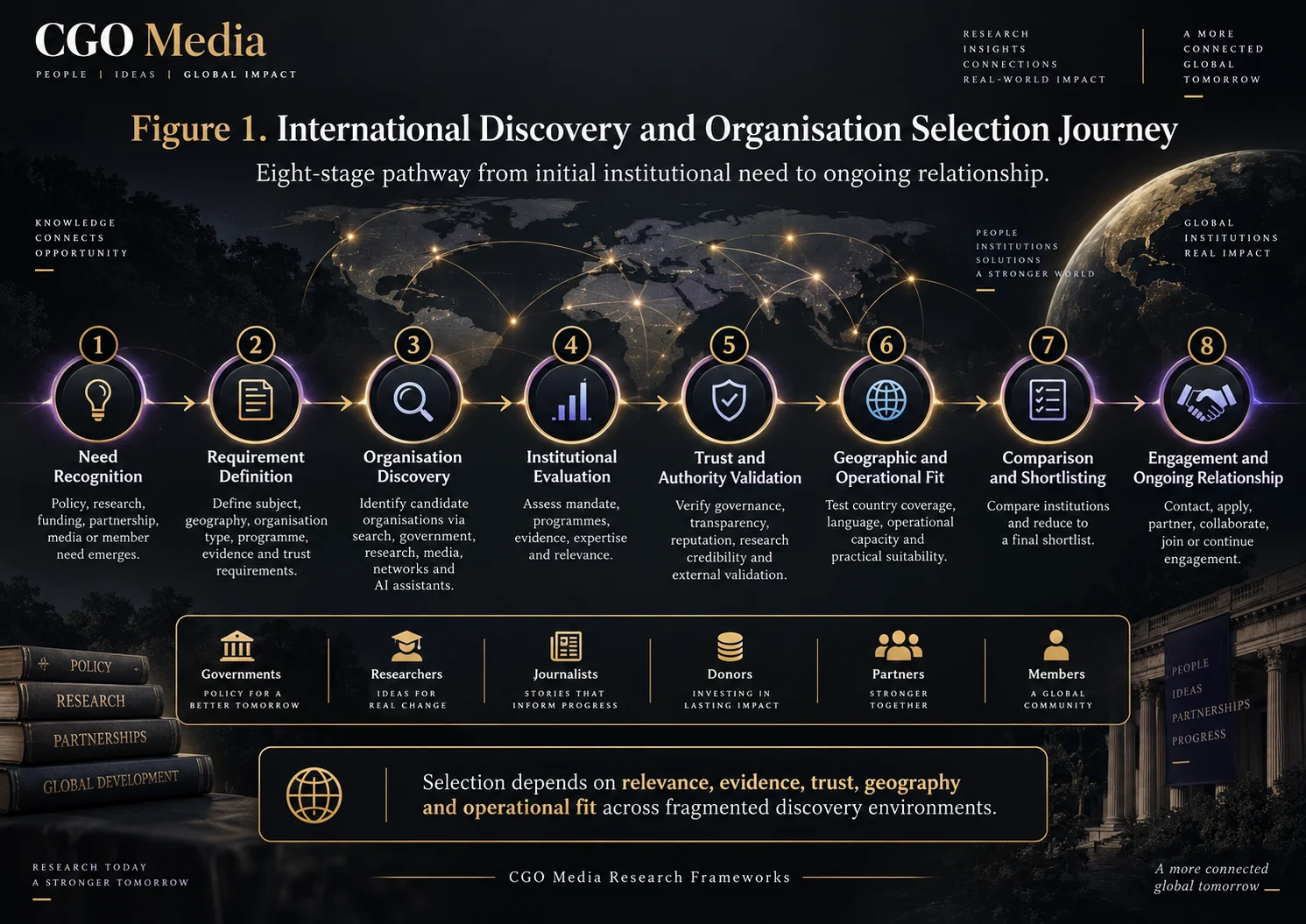
The International Discovery and Organisation Selection Journey presents the eight-stage progression through which stakeholders move from identifying an institutional need to defining requirements, discovering candidate organisations, evaluating evidence, validating trust, assessing practical fit, comparing alternatives and establishing an ongoing relationship.
1. Need Recognition
The stakeholder identifies a policy, research, funding, programme, partnership, membership, media or information need.
2. Requirement Definition
The need is converted into subject, geographic, organisation-type, programme, evidence, trust and engagement requirements.
3. Organisation Discovery
Potential institutions are identified through search engines, governments, research, media, partners, professional networks and AI-assisted discovery.
4. Institutional Evaluation
Candidate organisations are evaluated for mission, subject, programme, research, geographic and operational relevance.
5. Trust & Authority Validation
Governance, funding, research quality, programme evidence, government recognition, academic use, media authority and partner validation are examined.
6. Geographic & Operational Fit
The stakeholder determines whether the organisation possesses the local presence, language capability, partner network and practical capacity required for the specific context.
7. Comparison & Shortlisting
Organisations satisfying the core requirements are compared according to contextual authority, evidence quality, operational fit and engagement suitability.
8. Engagement & Ongoing Relationship
The stakeholder selects an appropriate engagement route and the organisation may become a continuing programme provider, partner, member body, research source, funder, policy reference or institutional relationship.
Selection principle: International organisation selection is not determined by visibility alone. Institutions must satisfy progressively more demanding requirements involving relevance, evidence, trust, geography, operational capability and engagement fit.
Discovery principle: Stakeholders may enter the journey through organisation pages, programmes, research, statistics, experts, governments, media, partners or AI-assisted recommendations. The complete institutional evidence ecosystem therefore contributes to discoverability.
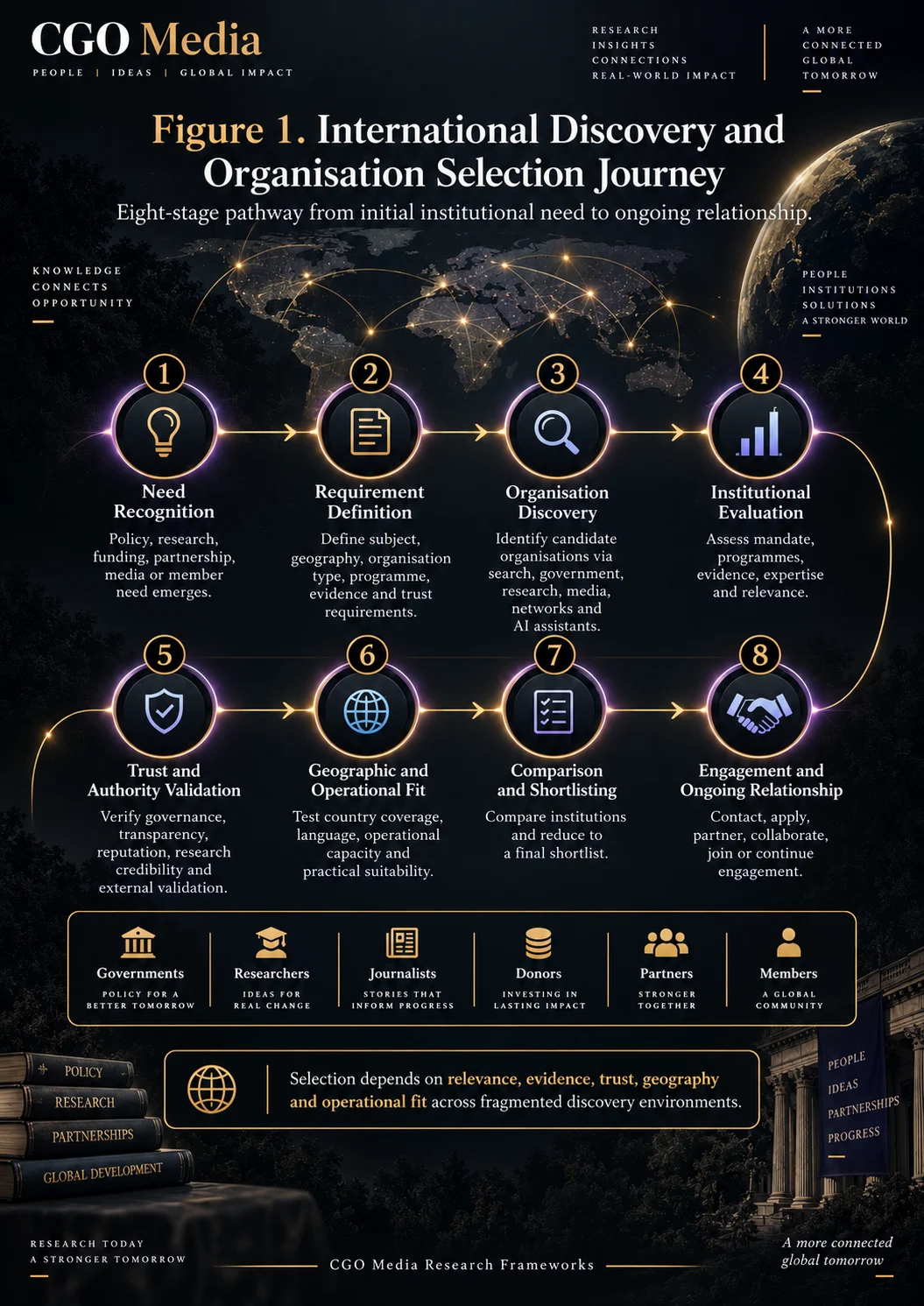
Figure 1. International organisation selection progresses through Need Recognition, Requirement Definition, Organisation Discovery, Institutional Evaluation, Trust and Authority Validation, Geographic and Operational Fit, Comparison and Shortlisting, and Engagement and Ongoing Relationship.
21. Stage Three — Organisation Discovery
Once the stakeholder has defined the requirement sufficiently, the selection process moves into Organisation Discovery.
At this stage, the objective is not yet to determine which institution should be selected.
The objective is to identify which organisations are visible within the information environments used by the stakeholder and appear capable of satisfying at least part of the requirement stack.
This distinction matters because the practical institutional market is rarely identical to the total number of organisations that could theoretically meet the need.
Many potentially suitable institutions may never enter consideration because they are not visible within the stakeholder’s discovery pathways.
Discovery can occur through:
- search engines;
- government websites;
- academic literature;
- research repositories;
- media coverage;
- partner networks;
- professional associations;
- institutional directories;
- conferences;
- and AI assistants.
Different discovery channels reveal different evidence.
A search engine may surface a programme page.
A government report may introduce the organisation through a policy citation.
An academic paper may expose the institution through research use.
A partner website may demonstrate operational involvement.
An AI system may synthesise several of these sources into a shortlist.
Organisation Discovery should therefore be understood as an ecosystem rather than as a single search-results page.
22. Search Engine Discovery
Search engines remain one of the principal routes through which stakeholders identify potentially relevant institutions.
Search discovery may surface:
- organisation pages;
- programme pages;
- country pages;
- research reports;
- statistics;
- government references;
- media coverage;
- expert profiles;
- and partner resources.
The query used by the stakeholder may not mention the organisation by name.
Examples can include:
- international organisations working on maternal health in West Africa;
- global institutions publishing water-security statistics;
- organisations offering technical standards for digital identity;
- international NGOs working on education in Jordan;
- or research organisations studying food security in East Africa.
These searches are important because they determine which organisations enter the user’s initial candidate set.
The organisation therefore needs evidence that aligns with the problems, geographies and institutional categories through which stakeholders search.
Search Engine Discovery is consequently influenced by both technical visibility and institutional relevance.
23. Government-Led Discovery
Government websites can become powerful institutional discovery environments.
Public-sector references may introduce relevant organisations through:
- policy documents;
- programme partnerships;
- funding arrangements;
- consultation papers;
- official guidance;
- procurement resources;
- research citations;
- and implementation frameworks.
Government-led discovery can carry a significant credibility effect because the stakeholder encounters the organisation within an official institutional context.
For example, a government report citing an international organisation’s methodology may expose that organisation to policy teams who had not previously considered it.
A ministry programme page may introduce an implementation partner.
An official strategy may cite a dataset produced by an international research institution.
These references do not automatically mean that the organisation is suitable for every related need.
They do, however, provide a strong route into the discovery and validation process.
24. Academic Discovery
Academic publications and university resources can introduce international organisations through evidence use rather than organisational branding.
An academic source may cite:
- a report;
- a dataset;
- a methodology;
- a statistical series;
- a policy framework;
- or a named institutional expert.
The stakeholder may discover the evidence first and the organisation second.
This pathway is particularly important for research-led organisations.
A strong citation environment can create a progression such as:
Academic Citation → Research Discovery → Institutional Recognition → Wider Organisation Evaluation
Academic discovery can therefore support both Research Authority and broader Organisation Authority.
25. Research Repository Discovery
Research repositories can surface institutions through the evidence they publish.
Relevant resources can include:
- reports;
- datasets;
- working papers;
- methodologies;
- country studies;
- policy papers;
- author profiles;
- and statistical publications.
Repositories become especially important where stakeholders search directly for evidence rather than organisations.
A well-structured research environment should help users move from an individual publication into the wider institutional context.
This can include links to:
- the author;
- the relevant programme;
- the country or region;
- related datasets;
- and the parent organisation.
This creates a stronger pathway from knowledge discovery into institutional discovery.
26. Media Discovery
Media coverage can introduce organisations through current events, expertise, statistics or institutional activity.
Stakeholders may discover organisations through:
- news coverage;
- expert commentary;
- research citations;
- interviews;
- investigations;
- programme reporting;
- and data-driven journalism.
Media discovery can be particularly influential because journalists often translate institutional evidence into language accessible to broader audiences.
A statistic cited in a major article may generate considerably more public discovery than the original research page.
A named expert may become the first recognisable representation of the organisation.
This reinforces the importance of accurate external references and clear links between experts, evidence and the parent institution.
27. Partner-Network Discovery
Institutional networks can introduce organisations through trusted relationships.
A potential stakeholder may discover an institution through:
- existing programme partners;
- government contacts;
- academic collaborators;
- professional associations;
- member networks;
- funding bodies;
- and other international organisations.
Partner-led discovery can carry strong contextual credibility because the recommendation is embedded within an existing institutional relationship.
For example, a government agency may identify a suitable international partner through another ministry.
A research team may identify a data provider through an academic collaborator.
A foundation may identify a programme-delivery organisation through an existing grantee network.
These discovery routes demonstrate why partnership visibility and external authority matter beyond conventional link acquisition.
28. AI Organisation Discovery
AI assistants can create institutional candidate lists by combining several requirements within one question.
For example:
“Which organisations work on food security in East Africa and publish reliable data?”
This query combines:
- subject relevance;
- geographic relevance;
- institutional capability;
- and evidence quality.
An AI-generated response may therefore perform part of the discovery and preliminary evaluation process simultaneously.
The organisation may be included or excluded before the user visits any first-party resource.
This increases the importance of having clear and current evidence across:
- organisation identity;
- programme activity;
- country presence;
- research;
- statistics;
- and external validation.
AI Organisation Discovery should therefore be treated as a new discovery layer built on the wider institutional evidence ecosystem.
29. AI Programme Discovery
AI systems may surface individual programmes rather than parent organisations.
This can occur when the user’s requirement is operationally specific.
For example, a stakeholder may ask:
“Which programmes provide technical support for renewable-energy planning in Southeast Asia?”
The answer may identify named initiatives operated by several different institutions.
Programme discovery therefore depends on evidence around:
- programme name;
- purpose;
- current status;
- geographic coverage;
- target audience;
- partners;
- and current activity.
Programme Entity Clarity becomes particularly important because the user may encounter the initiative without understanding immediately which institution operates it.
30. AI Research Source Discovery
An international organisation can enter consideration because its research, statistics or datasets are surfaced as useful evidence.
A user may ask for:
- reliable international statistics;
- comparative country data;
- recent policy research;
- historical datasets;
- or authoritative methodological guidance.
Where an institutional resource is selected or cited, the organisation itself may subsequently become part of the user’s consideration set.
This creates a pathway such as:
Source Selection → Evidence Evaluation → Organisation Recognition
Research visibility therefore contributes to institution discovery even when the original query is not organisational.
31. The Discoverable Institutional Market
The practical institutional market is not every organisation capable of satisfying the need.
It is the subset of organisations visible within the discovery environments used by the stakeholder.
This can be represented conceptually as:
Total Institutional Market → Discoverable Institutional Market → Relevant Candidate Set
Many theoretically suitable institutions may remain outside the practical market because their evidence is difficult to find.
Others may enter because strong external sources make their capabilities highly visible.
The Discoverable Institutional Market is therefore shaped by:
- search visibility;
- research visibility;
- government references;
- partner networks;
- media visibility;
- academic citations;
- and AI-assisted recommendations.
Discovery capability therefore influences whether the organisation receives the opportunity to be evaluated at all.
32. Discoverability Does Not Equal Suitability
High visibility does not automatically make an institution a suitable candidate.
An organisation may dominate search results because of brand recognition, publication volume or media visibility while still failing the stakeholder’s actual requirement.
It may lack:
- country presence;
- the required programme;
- local-language capability;
- research depth;
- delivery capacity;
- or the correct institutional mandate.
Discovery therefore creates an opportunity for evaluation rather than evidence of selection.
The next stage tests whether the organisation satisfies the requirement stack.
33. Stage Four — Institutional Evaluation
During Institutional Evaluation, the stakeholder tests whether discovered organisations genuinely satisfy the defined need.
The candidate set begins to narrow.
Evaluation commonly examines:
- subject fit;
- mission fit;
- programme fit;
- research fit;
- geographic fit;
- operational fit;
- and evidence quality.
This stage converts visibility into relevance.
The stakeholder is no longer asking:
“Which organisations exist?”
The question becomes:
“Which of these organisations genuinely match our requirement?”
34. Subject Fit
The institution must demonstrate genuine expertise in the subject relevant to the stakeholder’s requirement.
Evidence can include:
- active programmes;
- research;
- datasets;
- statistics;
- experts;
- policy work;
- standards;
- and external citations.
Subject fit should reflect current and substantive activity.
An institution mentioning a subject occasionally is not equivalent to one with sustained evidence across programmes, research and recognised expertise.
A useful evaluation question is:
Does the institution demonstrate repeated and current evidence of authority within the required subject?
35. Mission Fit
The institution’s formal mission should align sufficiently with the stakeholder’s objective.
Mission fit matters because it helps establish whether the proposed activity belongs naturally within the organisation’s institutional role.
For example, two organisations may possess expertise in the same subject but differ significantly in purpose.
One may focus on research.
Another may deliver programmes.
Another may provide funding.
Another may create standards.
Mission fit therefore helps distinguish thematic similarity from institutional suitability.
36. Programme Fit
Relevant programmes should align with the required:
- issue;
- geography;
- audience;
- type of intervention;
- programme status;
- and practical form of support.
Programme fit may become decisive when the stakeholder needs an active operational capability rather than general expertise.
The organisation should provide enough evidence to determine:
- whether the programme is currently active;
- where it operates;
- who participates;
- what it provides;
- and whether the stakeholder could realistically engage with it.
Historical experience can strengthen credibility, but it cannot replace current operational fit where active delivery is required.
37. Research Fit
Where evidence is central to the requirement, stakeholders may evaluate the organisation’s research capability directly.
Relevant factors can include:
- research depth;
- methodology;
- freshness;
- data availability;
- geographic scope;
- historical continuity;
- author expertise;
- and citation quality.
Research fit differs from general Research Authority.
An institution may possess excellent research overall while lacking evidence specific to the stakeholder’s question.
The relevant issue is whether the available research is sufficiently applicable to the decision being made.
38. Geographic Fit
Geographic fit determines whether the organisation’s authority and operational capability apply to the required location.
Stakeholders may evaluate:
- country presence;
- regional offices;
- active local programmes;
- local partners;
- government relationships;
- local research;
- and relevant language capability.
A global organisation may possess excellent subject authority while remaining unsuitable for a highly local requirement.
Conversely, a smaller institution with strong country evidence may provide better contextual fit.
Geographic fit therefore acts as an important filter between broad global authority and practical relevance.
39. Operational Fit
Operational fit evaluates whether the organisation appears capable of delivering what the stakeholder requires.
Relevant evidence can include:
- programme scale;
- implementation capacity;
- staffing;
- infrastructure;
- partner network;
- operational history;
- and programme-management capability.
Operational fit becomes particularly important for partnerships, funding relationships and programme delivery.
The institution may possess strong subject authority but lack the capacity required for the specific engagement.
Selection therefore depends not only on what the organisation knows but also on what it can realistically do.
40. Evidence Quality
Institutional claims become stronger when they are supported by evidence proportionate to their significance.
Relevant supporting evidence may include:
- research;
- statistics;
- programme results;
- independent evaluation;
- methodology;
- case studies;
- government references;
- academic citations;
- and external partner evidence.
Evidence quality should consider:
- freshness;
- methodological clarity;
- source provenance;
- relevance;
- and independence where appropriate.
The stakeholder is therefore evaluating both the claim and the evidence supporting the claim.
This becomes the bridge into the next stage: Trust and Authority Validation.
41. Stage Five — Trust and Authority Validation
Once an organisation appears relevant, the stakeholder may investigate whether it is sufficiently credible for the intended use or relationship.
Trust validation is distinct from relevance evaluation.
An institution can be highly relevant while still presenting insufficient evidence for a high-consequence decision.
Validation can examine:
- governance;
- financial evidence;
- programme status;
- research quality;
- government recognition;
- academic recognition;
- media evidence;
- and partner validation.
The required level of validation depends on institutional risk.
42. Governance Validation
Stakeholders may review the institution’s governance structure to understand who is responsible for leadership, oversight and accountability.
Relevant evidence may include:
- governing body;
- leadership;
- institutional mandate;
- legal or constitutional structure;
- member relationships;
- and accountability mechanisms.
Governance validation becomes particularly important where the stakeholder is considering a formal or long-term relationship.
Clear governance evidence can reduce uncertainty around institutional legitimacy and responsibility.
43. Financial Validation
Financial evidence may be important when the stakeholder needs confidence in organisational sustainability, funding transparency or programme accountability.
Relevant evidence can include:
- annual accounts;
- financial statements;
- funding sources;
- audits;
- donor relationships;
- and programme funding information.
Not every stakeholder journey requires detailed financial validation.
However, financial evidence can become critical for:
- funding decisions;
- major partnerships;
- programme delivery;
- procurement;
- and long-term institutional relationships.
44. Programme Validation
Programme claims should be checked where the programme forms a significant part of the selection decision.
Stakeholders may investigate whether the initiative is:
- current;
- active;
- funded;
- operational in the stated geography;
- supported by credible partners;
- and producing documented results.
Programme validation can involve both first-party and external evidence.
The institution may describe the programme itself.
Partners may confirm participation.
Governments may reference implementation.
Evaluations may document outcomes.
The convergence of these sources strengthens confidence.
45. Research Validation
Research credibility can be assessed through evidence such as:
- methodological transparency;
- author expertise;
- source data;
- publication history;
- external citation;
- peer or academic use;
- and data quality.
The relevant validation threshold depends on how the research will be used.
A journalist may need confidence that a statistic is current and properly sourced.
A researcher may need detailed methodological documentation.
A government may need confidence that the evidence can support policy analysis.
Research validation therefore remains use-case dependent.
46. Government Validation
Government references can provide strong external validation where they relate directly to the organisation’s institutional role, research, programme activity or policy authority.
Useful evidence can include:
- official programme partnerships;
- government reports;
- policy citations;
- public-sector funding relationships;
- formal guidance;
- and recognised institutional collaboration.
Government validation should be interpreted contextually.
A substantive policy citation provides different evidence from inclusion within a generic directory.
The strongest validation is therefore directly connected with the capability under evaluation.
47. Academic Validation
Academic use of institutional research can reinforce subject and evidence authority.
Relevant academic signals may include:
- citations;
- dataset reuse;
- methodology references;
- joint research;
- university partnerships;
- and scholarly recognition of institutional experts.
Academic Validation is especially relevant when the stakeholder is evaluating the institution as a research or evidence source.
It provides an independent signal that institutional knowledge has been considered useful within scholarly environments.
48. Media Validation
Independent media coverage can provide additional evidence around institutional reputation, expertise and current activity.
Relevant coverage can involve:
- research citations;
- expert commentary;
- programme reporting;
- interviews;
- statistical references;
- and institutional analysis.
Media validation should not be interpreted as uniformly positive or as equivalent to formal institutional endorsement.
Its value lies in providing independent context around how the organisation, its experts and its work are represented publicly.
49. Partner Validation
Partners can provide direct external confirmation of operational relationships.
Relevant partner evidence may validate:
- programme participation;
- research collaboration;
- country activity;
- implementation capability;
- technical cooperation;
- or funding relationships.
Partner validation becomes particularly useful when the relationship being evaluated is similar to the stakeholder’s intended engagement.
For example, evidence of successful multi-country collaboration may strengthen confidence for another institution considering a comparable partnership.
Clear reciprocal partner information therefore supports both trust and operational evaluation.
50. Trust Requirements Increase with Institutional Risk
The level of evidence required for selection normally increases as the consequence and duration of the relationship increase.
A stakeholder reading a public report may require relatively little validation.
A government entering a long-term programme partnership may require substantial due diligence.
A donor making a significant funding commitment may need detailed financial, governance and impact evidence.
A policymaker relying on institutional research may require methodological confidence.
A standards user may need assurance that the selected version is current and authoritative.
Higher-risk relationships can therefore require validation across multiple evidence layers.
Examples include:
- large funding commitments;
- government partnerships;
- multi-year programmes;
- policy reliance;
- high-impact research use;
- formal membership;
- and strategic institutional partnerships.
The relationship between consequence and validation can be expressed conceptually as:
Higher Institutional Risk → Greater Evidence Requirement → Stronger Validation Threshold
This is one reason why discoverability alone cannot determine final institutional selection.
As the candidate set moves through evaluation and validation, organisations lacking sufficient evidence are progressively removed.
The result is a narrowing funnel from the total potential institutional market toward a smaller group of validated organisations.
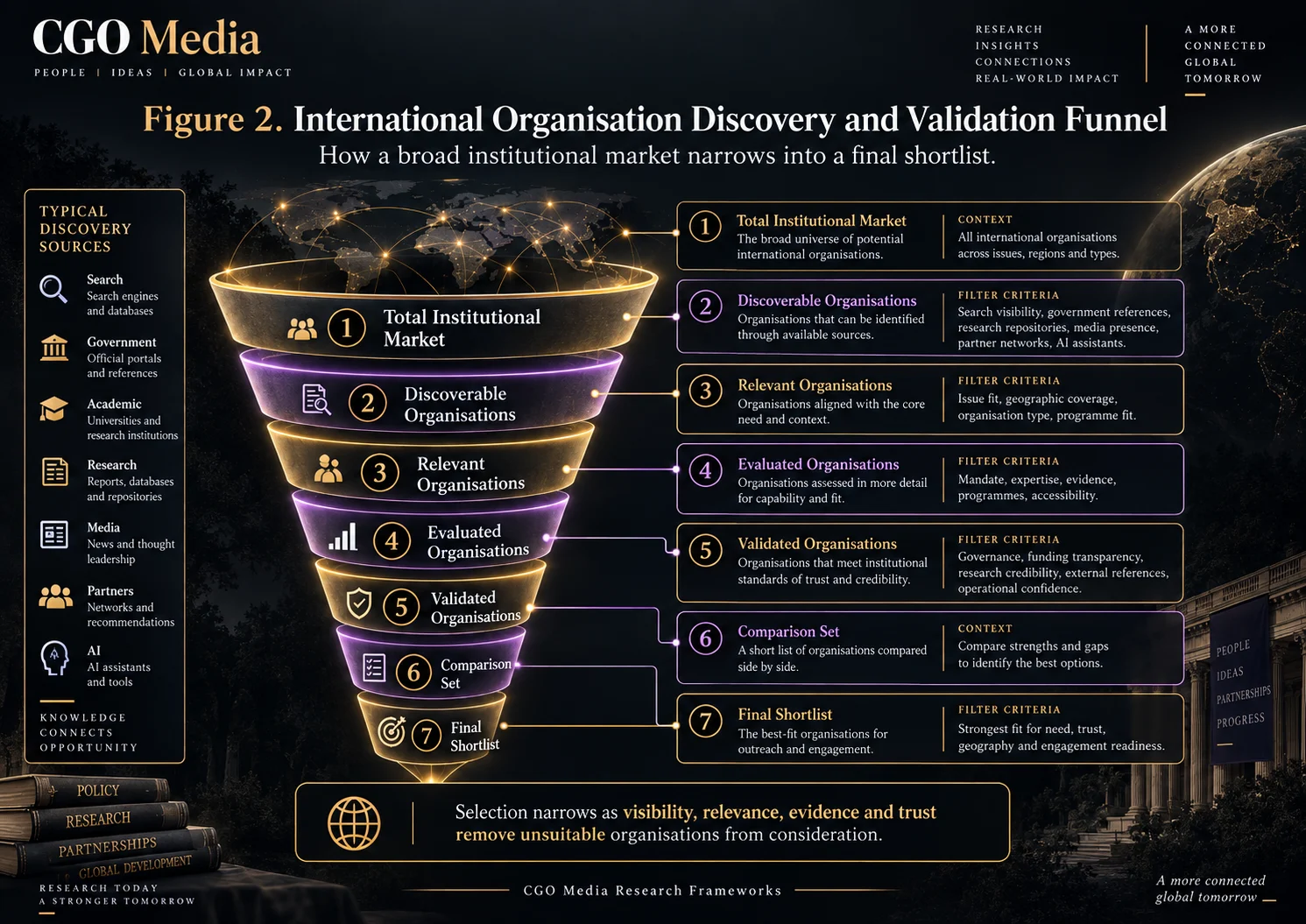
The International Organisation Discovery and Validation Funnel shows how the broad universe of potentially relevant institutions narrows as discovery, requirement fit, evidence quality, trust and independent validation progressively remove unsuitable candidates.
Total Institutional Market
All organisations that may theoretically possess some connection with the stakeholder’s subject, geography or institutional need.
Discoverable Organisations
The subset visible through search engines, government sources, research, academic citations, media, partner networks and AI-assisted discovery.
Requirement-Matched Organisations
Candidates that satisfy the core subject, geography, organisation-type, programme or evidence requirements defined by the stakeholder.
Evaluated Organisations
Institutions demonstrating sufficient mission, programme, research, geographic, operational and evidence fit to remain under serious consideration.
Validated Organisations
Candidates supported by sufficient governance, programme, research, government, academic, media or partner evidence for the risk level of the decision.
Comparison Set
The smaller group of organisations that have survived discovery, relevance, evidence-quality and trust filters and can now be compared directly.
Shortlist
The final group of institutions considered sufficiently relevant, credible and operationally suitable to progress toward engagement or selection.
Discovery-funnel principle: The practical institutional market narrows continuously. Visibility creates eligibility for evaluation, but subject relevance, geographic fit, programme evidence, research quality and institutional trust determine whether an organisation survives later selection stages.
Validation principle: The amount of evidence required increases with the consequence of the decision. High-risk partnerships, funding relationships, policy reliance and long-term programmes normally require stronger validation than low-risk informational use.
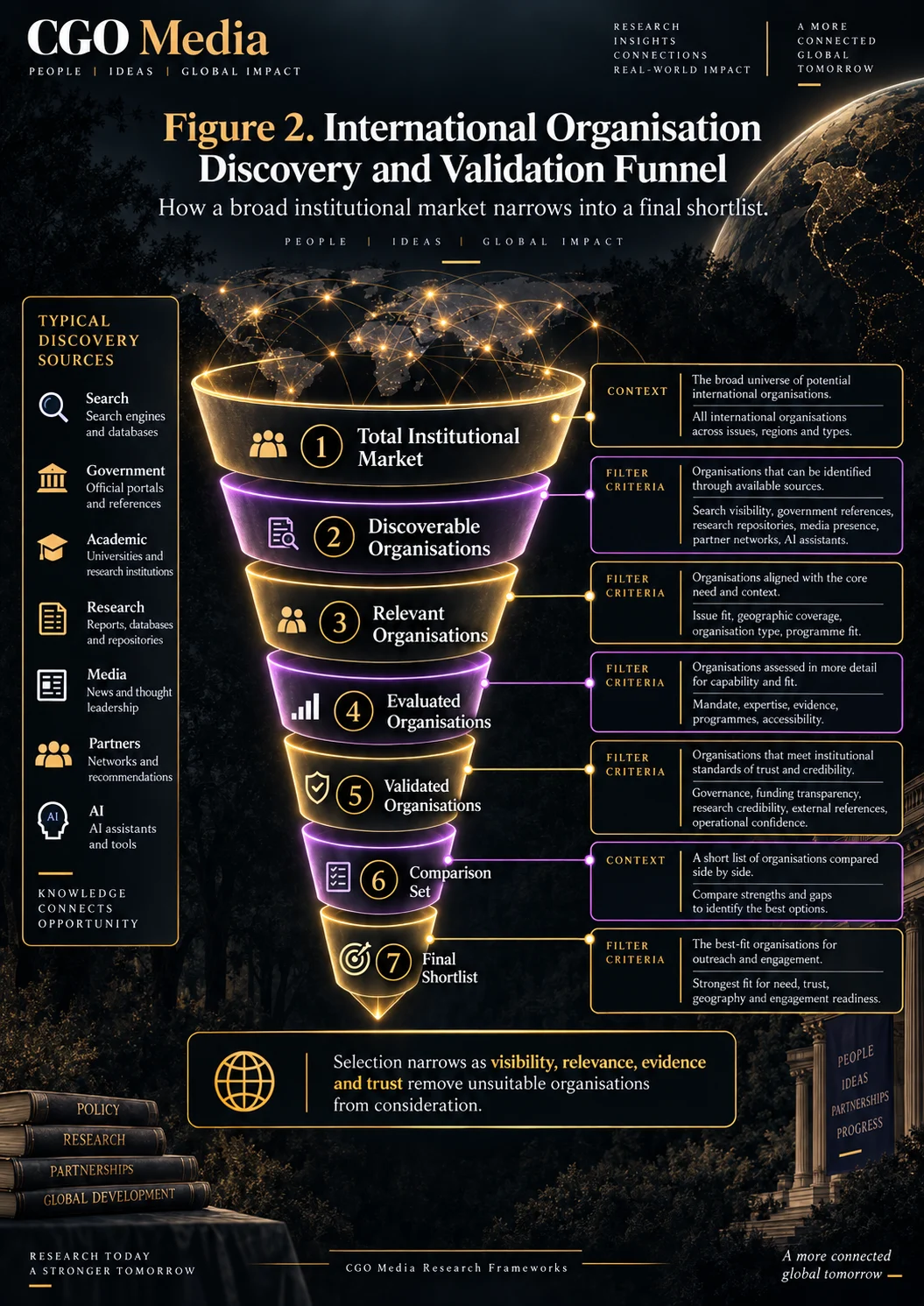
Figure 2. International organisation selection narrows from the Total Institutional Market through Discoverable, Requirement-Matched, Evaluated and Validated Organisations toward a final Comparison Set and Shortlist.
51. From Discovery to Validated Consideration
By the end of Stage Five, the stakeholder has moved beyond identifying institutions that simply appear relevant.
The remaining organisations have survived a series of increasingly demanding evidence tests involving:
- subject fit;
- programme fit;
- geographic relevance;
- research quality;
- Institutional Trust;
- and independent validation.
This transition is strategically important because it separates broad discovery from credible consideration.
An institution can enter the discovery set because it ranks strongly, is well known, appears in a government report or is suggested by an AI assistant.
However, remaining within the consideration set requires stronger evidence.
The organisation must demonstrate that its authority is not merely visible but applicable to the stakeholder’s specific requirement.
The selection environment can therefore be understood as a progressive filtering process:
Visibility → Relevance → Evidence → Trust → Practical Suitability
Each stage reduces the number of viable candidates.
By the time the stakeholder reaches validated consideration, the question is no longer:
“Which organisations might be relevant?”
It becomes:
“Which of these organisations have provided enough evidence to justify deeper comparison?”
This is the point at which institutional differentiation becomes increasingly important.
Several organisations may possess credible subject expertise.
Several may operate in the same region.
Several may have strong research.
The stakeholder must therefore begin examining which combination of authority, geography, evidence and operational capability offers the strongest contextual fit.
52. Evidence Accumulation
Institutional confidence develops cumulatively.
No single report, citation, programme page or partnership normally explains the complete selection decision.
Instead, stakeholders build confidence as several forms of evidence reinforce one another.
A programme page may establish operational relevance.
A government reference may confirm institutional recognition.
A research report may demonstrate subject expertise.
An academic citation may reinforce research quality.
A country office may establish local presence.
A partner reference may validate implementation capability.
Governance information may provide institutional confidence.
The resulting selection picture is stronger when these signals converge.
A useful conceptual progression is:
Claim → Supporting Evidence → Independent Evidence → Contextual Fit → Greater Confidence
Evidence accumulation is therefore fundamentally different from simply increasing content volume.
The stakeholder is not counting pages.
They are determining whether multiple independent and first-party evidence sources support a coherent interpretation of the institution.
53. Risk Reduction
Each stage of the International Discovery and Organisation Selection Model reduces a different type of uncertainty.
Requirement Definition reduces uncertainty about what type of organisation is needed.
Organisation Discovery reduces uncertainty about which institutions exist within the practical market.
Institutional Evaluation reduces uncertainty about relevance.
Trust Validation reduces uncertainty about credibility.
Geographic and Operational Fit reduces uncertainty about whether the organisation can function effectively within the required context.
Comparison and Shortlisting reduce uncertainty about relative suitability.
Engagement reduces uncertainty about whether a workable institutional relationship can actually be established.
This risk-reduction model becomes particularly important where the decision has substantial consequences.
Examples include:
- multi-year partnerships;
- major programme funding;
- policy reliance;
- government collaboration;
- procurement;
- standards adoption;
- and high-impact research use.
In these situations, stakeholders are unlikely to rely on one discovery signal.
They require progressive reduction of uncertainty through stronger evidence.
54. AI Can Compress Multiple Selection Stages
AI assistants can combine discovery, evaluation and preliminary comparison within a single response.
A user may ask:
“Which international organisations operate climate adaptation programmes in Sub-Saharan Africa, work with governments and publish reliable research?”
This one request combines:
- subject relevance;
- geographic fit;
- programme evidence;
- government relationships;
- and research quality.
An AI-generated answer may therefore perform several stages simultaneously.
It may identify candidate organisations.
It may summarise their programmes.
It may compare geography.
It may describe research strengths.
It may even recommend which institutions appear most suitable for the stated requirement.
This compression changes the discovery environment because organisations can be evaluated before the stakeholder performs any first-party research.
The quality of distributed institutional evidence therefore becomes increasingly important.
If programme information is outdated, country architecture is weak or external references are inconsistent, the organisation may be filtered inaccurately during this compressed process.
55. Strategic Consequence
International organisations should not optimise solely for being found.
They should build sufficient evidence to remain credible as stakeholders move from discovery into validation, comparison and engagement.
The strategic objective therefore changes from:
“Increase institutional visibility.”
to:
“Increase the probability that the organisation remains relevant, credible and operationally suitable throughout the selection journey.”
This requires investment across several connected areas:
- Entity Clarity;
- programme evidence;
- Research Authority;
- country architecture;
- Institutional Trust;
- external validation;
- and engagement design.
The strongest organisation-selection strategy is therefore evidence-led rather than traffic-led.
56. Stage Six — Geographic and Operational Fit Assessment
Once an organisation appears relevant and credible, the stakeholder evaluates whether it can operate effectively within the required geographic and institutional context.
This stage is distinct from broad relevance.
An institution may understand the issue and possess significant authority while lacking the local relationships, language capability, delivery capacity or institutional compatibility required for the specific engagement.
Geographic and Operational Fit can include:
- country presence;
- regional presence;
- local partner networks;
- language capability;
- cultural and institutional knowledge;
- delivery capacity;
- scale fit;
- timeframe fit;
- funding fit;
- and governance compatibility.
These factors determine whether an organisation that looks credible in principle is workable in practice.
57. Country Presence
Country-level presence can influence selection where local implementation, regulation, stakeholder relationships or public-sector engagement matter.
Evidence of country presence can include:
- a current country office;
- active programmes;
- local employees;
- government relationships;
- country research;
- implementation partners;
- and long-term operational history.
Physical office presence is not always essential.
Some organisations operate effectively through regional teams or formal partner networks.
The relevant question is whether the institution possesses enough credible local capability for the stakeholder’s requirement.
Country presence should therefore be interpreted functionally rather than simply as an address.
58. Regional Presence
Regional offices and networks can strengthen suitability for requirements extending across several countries.
Regional capability may provide:
- cross-country coordination;
- regional policy knowledge;
- shared technical expertise;
- regional partnerships;
- multilingual capability;
- and programme oversight.
A strong regional structure can be particularly valuable where the stakeholder requires consistency across several national environments while still retaining local implementation.
Regional fit should therefore be assessed according to real institutional function rather than simply the existence of a regional webpage.
59. Local Partner Networks
Local partners can significantly strengthen operational fit.
They may provide:
- local knowledge;
- implementation capacity;
- institutional access;
- language capability;
- community relationships;
- specialist expertise;
- and established local trust.
Partner networks can allow an international organisation to operate effectively in locations where it does not maintain a large permanent presence.
Stakeholders may therefore examine both direct organisational capacity and distributed partner capacity.
The institution should make major operational partnerships sufficiently clear for users to understand how local delivery actually occurs.
60. Language Capability
Language capability can affect whether the organisation can communicate effectively with:
- governments;
- communities;
- researchers;
- partners;
- programme participants;
- media;
- and local institutions.
Language fit extends beyond website translation.
A stakeholder may need evidence that the organisation can conduct:
- programme delivery;
- technical engagement;
- research;
- training;
- reporting;
- and stakeholder communication
in the relevant language.
Multilingual institutional evidence can help demonstrate that capability, but operational language capacity should remain connected with real organisational resources.
61. Cultural and Institutional Fit
Operational suitability may depend on understanding local political, legal, cultural and institutional conditions.
This can include familiarity with:
- government structures;
- regulatory environments;
- local procurement;
- community expectations;
- professional norms;
- policy priorities;
- and institutional decision-making.
Cultural and institutional fit should not be reduced to broad claims of local understanding.
It is more credible when demonstrated through:
- local programmes;
- regional staff;
- long-term partnerships;
- government collaboration;
- and country-specific evidence.
62. Delivery Capacity
Stakeholders may evaluate whether the organisation has sufficient resources to deliver at the required level.
Relevant evidence can include:
- staff;
- funding;
- infrastructure;
- partners;
- programme-management capacity;
- technical expertise;
- and previous delivery history.
Delivery Capacity is especially important where the proposed relationship requires implementation rather than only research, advice or policy input.
The stakeholder may therefore examine whether the organisation has already delivered programmes of comparable complexity.
Documented programme history can become an important proof point at this stage.
63. Scale Fit
Different organisations are suited to different programme scales.
A large multilateral institution may be capable of coordinating major cross-border programmes.
A smaller specialist organisation may be better suited to focused technical delivery within one geography.
Scale fit should therefore consider whether the institution’s operating model matches the requirement.
Relevant questions can include:
- Has the organisation delivered programmes of comparable size?
- Can it manage multiple countries?
- Can it coordinate several partners?
- Does it possess sufficient administrative capacity?
- Would the proposed project be too small for its operating model?
Bigger is not automatically better.
The strongest fit is the institution whose capability and operating structure match the scale of the requirement.
64. Timeframe Fit
An organisation may be relevant and credible but unsuitable if it cannot operate within the required project or policy timeframe.
Timeframe considerations can involve:
- programme mobilisation;
- procurement;
- internal approvals;
- funding cycles;
- research timelines;
- partnership agreements;
- and local implementation requirements.
Large international organisations may possess considerable authority but also require complex internal approval processes.
Smaller institutions may sometimes respond more quickly.
Timeframe fit should therefore be treated as a genuine operational selection factor rather than a secondary administrative concern.
65. Funding Fit
Funding structures may materially affect institutional suitability.
Relevant considerations can include:
- grant eligibility;
- co-financing requirements;
- donor restrictions;
- procurement models;
- programme budgets;
- financial reporting;
- and permitted expenditure.
The organisation may possess strong operational capability while being incompatible with the stakeholder’s funding mechanism.
Alternatively, a funding institution may only support specific organisation types or countries.
Clear funding information can therefore reduce friction during selection and prevent unsuitable organisations from progressing unnecessarily.
66. Governance Fit
Institutional partnerships may require compatibility around governance and accountability.
Relevant requirements can include:
- procurement;
- reporting;
- accountability;
- data governance;
- compliance;
- audit;
- risk management;
- and decision-making structures.
Two credible organisations may still be operationally incompatible if their governance systems cannot support the proposed relationship.
Governance fit is therefore not simply evidence of Institutional Trust.
It is also evidence of whether the institutions can work together practically.
67. Stage Seven — Comparison and Shortlisting
At this stage, the stakeholder compares a smaller group of organisations that have already passed relevance, trust and operational-fit thresholds.
The comparison stage is fundamentally different from broad discovery.
The organisations under consideration are now likely to be credible.
The decision therefore depends increasingly on relative differences.
The stakeholder may compare:
- issue expertise;
- geographic fit;
- programme authority;
- research quality;
- Institutional Trust;
- external recognition;
- operational suitability;
- and ease of engagement.
At this point, differentiation becomes a major selection factor.
The institution needs to make clear not only that it is credible, but what makes it particularly suitable for the requirement.
68. The Seven Core Selection Signals
The model identifies seven broad signals that frequently influence final institutional selection:
- Issue Relevance
- Geographic Fit
- Programme and Mission Authority
- Research and Evidence Quality
- Institutional Trust
- External and Policy Authority
- Engagement and Operational Suitability
These signals do not carry universal weight.
Their importance depends on the stakeholder, decision and relationship being considered.
A researcher may weight Research and Evidence Quality heavily.
A government may place greater emphasis on policy authority, mandate and long-term credibility.
A donor may focus on governance, programme history and impact.
A partner may prioritise operational capability and geographic reach.
The seven signals therefore provide a comparison structure rather than a fixed scoring algorithm.
69. Issue Relevance
The organisation should demonstrate direct and current expertise in the subject area.
Issue Relevance can be evidenced through:
- active programmes;
- research;
- statistics;
- experts;
- policy work;
- standards;
- and external citations.
Relevance should be sufficiently specific to the decision.
A broad organisational association with climate policy does not necessarily establish expertise in climate adaptation finance.
Likewise, general education activity does not automatically establish authority in tertiary digital learning.
The narrower the stakeholder requirement, the more important precise evidence becomes.
70. Geographic Fit
The organisation should be able to operate effectively within the relevant country, region or cross-border environment.
Geographic Fit can include:
- country presence;
- regional infrastructure;
- local-language capability;
- government relationships;
- local partners;
- country research;
- and programme experience.
Geographic fit can become a decisive differentiator when several organisations possess similar subject authority.
A stakeholder may prefer the institution that can demonstrate stronger local evidence and implementation capability.
71. Programme and Mission Authority
Programme Authority helps distinguish organisations with active, credible involvement from those with only broad thematic alignment.
Strong Programme and Mission Authority can include:
- clear institutional mandate;
- active programmes;
- programme history;
- credible outcomes;
- relevant partnerships;
- and alignment between stated mission and observed activity.
The stakeholder should be able to see that the institution’s claimed purpose is reflected in sustained operational evidence.
This becomes particularly important where organisations present similar high-level positioning.
72. Research and Evidence Quality
Evidence quality may become decisive where the stakeholder requires reliable data, methodology or policy guidance.
Relevant dimensions include:
- methodological clarity;
- data provenance;
- research freshness;
- author expertise;
- statistical quality;
- historical continuity;
- external citation;
- and accessibility.
An institution that produces clear, reusable and well-documented evidence may become more attractive even when competing organisations possess similar programme expertise.
Research quality can therefore differentiate the organisation within both policy and operational selection contexts.
73. Institutional Trust
Institutional Trust reflects the extent to which governance, transparency, leadership and operational history inspire confidence.
Relevant evidence can include:
- governance structure;
- current leadership;
- financial transparency;
- programme reporting;
- funding clarity;
- impact reporting;
- institutional history;
- and accountability.
Trust becomes particularly important when several organisations appear similarly capable.
Where subject and geographic fit are comparable, the organisation providing clearer and more verifiable institutional evidence may be easier for the stakeholder to justify internally.
74. External and Policy Authority
Independent references from governments, universities, policy bodies, media and partners can strengthen selection confidence.
External Authority can demonstrate that the organisation’s expertise is recognised beyond its own website.
Relevant evidence can include:
- government citations;
- academic references;
- policy use;
- partner confirmation;
- media citations;
- standards adoption;
- and professional recognition.
The strongest external authority is contextual.
A government citation may carry particular weight for a policy partnership.
Academic recognition may matter more for research selection.
Partner evidence may be especially valuable when operational delivery is central.
External Authority therefore strengthens comparison when it aligns with the stakeholder’s actual requirement.
75. Engagement and Operational Suitability
A strong institution may still be unsuitable if practical engagement is difficult or operational requirements cannot be met.
Engagement and Operational Suitability can include:
- clear contact routes;
- responsive teams;
- appropriate programme access;
- partnership processes;
- funding compatibility;
- procurement compatibility;
- research accessibility;
- language capability;
- and operational capacity.
This final signal reminds organisations that institutional authority must eventually connect with practical action.
A stakeholder may trust the organisation completely yet still select another institution because it offers a clearer partnership mechanism, better local capacity or more suitable programme structure.
The seven selection signals therefore combine authority with practical fit.
Together they determine whether the institution remains competitive within the final comparison set.
The International Organisation Selection Evidence Model identifies the seven core evidence signals that influence whether a validated institution survives final comparison and progresses into the stakeholder’s shortlist.
1. Issue Relevance
The organisation demonstrates direct and current expertise in the stakeholder’s specific subject, policy, programme or institutional need.
2. Geographic Fit
Country presence, regional capability, local partners, language capacity and geographic experience demonstrate practical relevance to the required location.
3. Programme & Mission Authority
The institution’s mandate, active programmes, programme history and documented activity demonstrate genuine involvement rather than broad thematic association.
4. Research & Evidence Quality
Research, data, methodology, statistics, evaluation and evidence quality support informed stakeholder assessment and decision-making.
5. Institutional Trust
Governance, transparency, leadership, funding, reporting and institutional history provide confidence in the organisation’s credibility and accountability.
6. External & Policy Authority
Government references, academic citations, policy use, media authority, partner validation and professional recognition provide independent support.
7. Engagement & Operational Suitability
Practical contact routes, operational capacity, funding compatibility, partnership processes and engagement accessibility determine whether the institutional relationship can work in practice.
Selection-evidence principle: Final institutional selection rarely depends on one signal. Strong shortlist candidates combine issue relevance, geographic fit, programme authority, evidence quality, Institutional Trust, independent authority and practical engagement suitability.
Context principle: The relative importance of the seven signals changes according to stakeholder type and objective. Governments, researchers, journalists, donors, partners and members may therefore select differently even when evaluating the same organisation.
Figure 3. International organisation selection is shaped by Issue Relevance, Geographic Fit, Programme and Mission Authority, Research and Evidence Quality, Institutional Trust, External and Policy Authority, and Engagement and Operational Suitability.
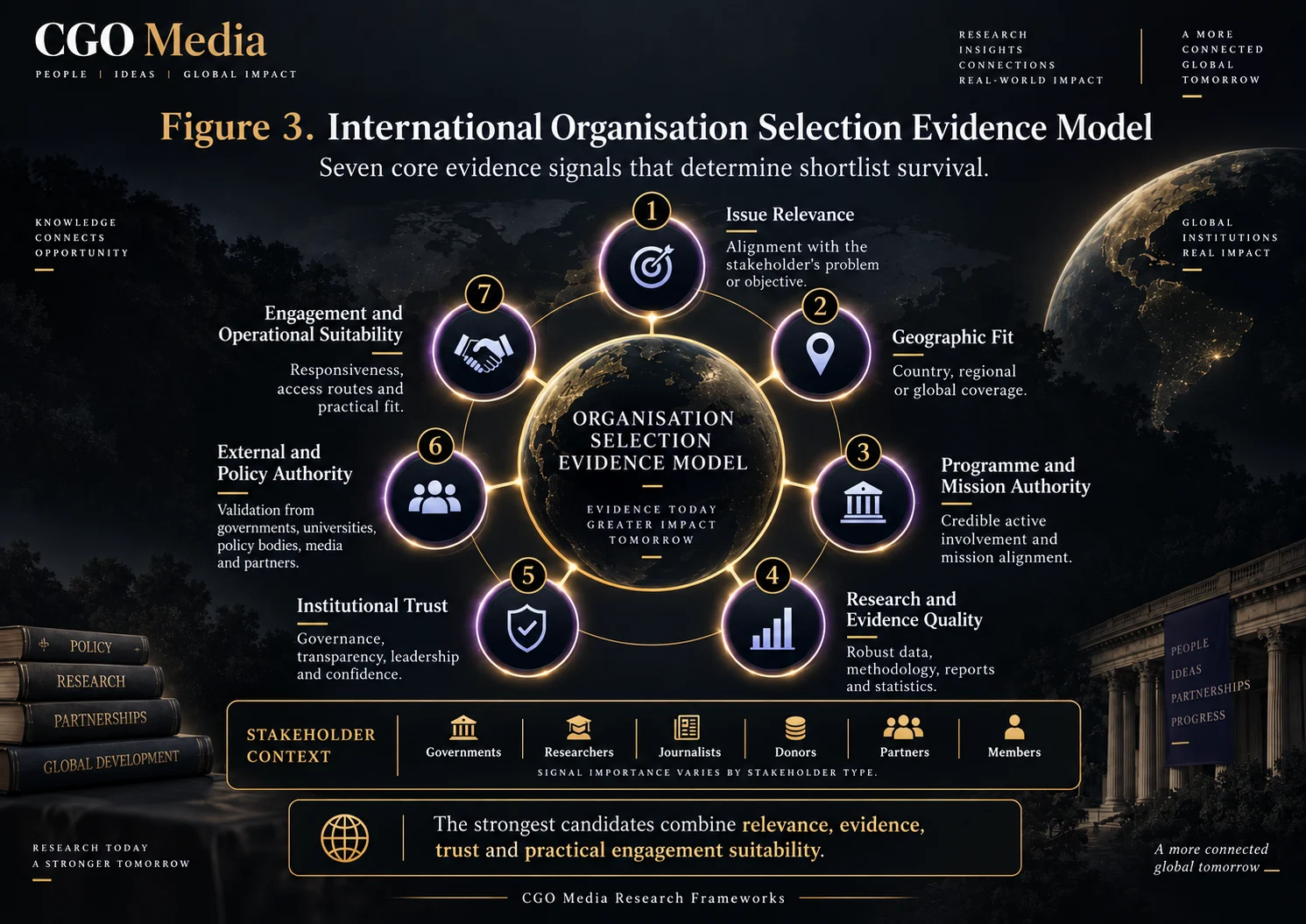
76. Selection Signals Are Context Dependent
The seven core selection signals do not carry identical importance in every institutional decision.
Their relative weight changes according to:
- stakeholder type;
- institutional objective;
- geography;
- decision risk;
- programme scale;
- evidence requirement;
- timeframe;
- and the type of relationship being considered.
A government seeking a long-term programme partner may place considerable emphasis on mandate, policy authority, governance and operational reliability.
A researcher looking for comparative international data may place much greater weight on methodology, dataset quality and citation history.
A journalist working to a deadline may favour an organisation with current statistics, identifiable experts and rapid media access.
A donor may prioritise governance, financial transparency and measurable programme outcomes.
A membership organisation may be evaluated according to network quality, representation, events, standards and practical member benefits.
Selection should therefore be understood as a contextual weighting process rather than a universal hierarchy.
The same institution can perform strongly in one selection scenario and weakly in another without any contradiction.
For example, an organisation may possess world-class research but have no local delivery capability.
It may therefore be highly suitable as an evidence source and poorly suited as an implementation partner.
Another organisation may possess excellent country delivery capacity but little original research.
That organisation may be strong operationally while being a weaker choice for a stakeholder seeking a methodological research authority.
The selection model should therefore be applied around the requirement rather than around generic institutional prestige.
77. Government Selection Context
Governments may place greater weight on evidence that demonstrates formal institutional legitimacy, policy relevance and long-term operational credibility.
Important selection considerations can include:
- official mandate;
- policy authority;
- government relationships;
- recognised standards;
- programme history;
- governance;
- country presence;
- technical expertise;
- and long-term institutional credibility.
A government stakeholder may also need evidence that the organisation can operate within formal administrative and accountability structures.
This can include:
- procurement compatibility;
- reporting capability;
- data governance;
- financial controls;
- public-sector partnership experience;
- and appropriate institutional oversight.
Selection may therefore depend on a combination of policy fit and institutional reliability.
An organisation can possess strong subject expertise but still fail government selection if the evidence required for formal engagement is incomplete.
Government selection frequently carries higher institutional risk than simple informational use.
As a result, the validation threshold can be significantly higher.
The institution should therefore make it possible for government users to move from:
Subject Expertise → Policy Relevance → Institutional Credibility → Operational Suitability
without reconstructing that evidence manually from fragmented sources.
78. Researcher Selection Context
Researchers may prioritise evidence quality more heavily than brand recognition or operational scale.
Important selection criteria can include:
- methodology;
- dataset quality;
- research accessibility;
- citation history;
- subject expertise;
- publication date;
- versioning;
- geographic coverage;
- and supporting documentation.
A researcher may also need to determine whether evidence is suitable for:
- academic citation;
- secondary analysis;
- policy research;
- cross-country comparison;
- longitudinal analysis;
- or methodological replication.
Research selection therefore depends not only on whether a report appears authoritative.
The underlying evidence must be sufficiently transparent and usable.
The strongest institutional research environments make it easy to identify:
- who produced the evidence;
- how it was produced;
- when it was produced;
- which population or geography it covers;
- which limitations apply;
- and which version should be cited.
Researchers may also evaluate the broader research record of the institution.
A single useful paper may introduce the organisation, but repeated high-quality outputs can create a stronger perception of institutional Research Authority.
79. Journalist Selection Context
Journalists may prioritise credibility and speed simultaneously.
Relevant selection factors can include:
- current statistics;
- research credibility;
- expert availability;
- clear sources;
- fast access to information;
- current institutional context;
- and straightforward media contact.
The selection environment can be particularly time-sensitive.
A journalist may have only a few hours to identify:
- a credible statistic;
- a subject expert;
- a country-specific perspective;
- or an authoritative research source.
An institution may therefore lose selection opportunities even where its evidence is excellent if that evidence is difficult to locate or expert contact is unclear.
Journalist selection often rewards information that is:
- current;
- clearly attributed;
- easy to quote accurately;
- methodologically understandable;
- and supported by accessible expert context.
Media architecture should therefore help users move quickly from:
Issue → Evidence → Expert → Contact
without weakening methodological or institutional accuracy.
80. Donor Selection Context
Donors may place greater emphasis on evidence that demonstrates organisational reliability, responsible use of funds and credible programme outcomes.
Relevant criteria may include:
- governance;
- impact;
- financial transparency;
- programme track record;
- reporting quality;
- local delivery capability;
- partner relationships;
- and long-term institutional stability.
A donor may need to determine not only whether the organisation addresses the right issue but whether funding can be converted into reliable delivery.
Important questions can include:
- Has the institution delivered comparable programmes?
- How are outcomes measured?
- How is funding governed?
- Which organisations have funded or partnered with it previously?
- What evidence exists regarding impact?
- How transparent is programme reporting?
Donor selection can therefore require strong alignment between mission claims, operational evidence, governance and independent validation.
A highly visible institution may still perform poorly in donor selection where funding or impact evidence is difficult to verify.
81. Partner Selection Context
Potential partners may prioritise the organisation’s ability to contribute complementary capabilities to a shared objective.
Relevant selection factors can include:
- complementary expertise;
- operational capacity;
- geographic reach;
- institutional reputation;
- programme compatibility;
- government relationships;
- local networks;
- research capability;
- and partnership experience.
Partnership selection is often reciprocal.
Both organisations may evaluate one another.
Each institution therefore becomes both selector and candidate.
Compatibility can involve:
- aligned objectives;
- appropriate division of responsibility;
- compatible governance;
- complementary geographic strengths;
- shared reporting standards;
- and realistic resource expectations.
An organisation may possess substantial authority yet remain a poor partner if the proposed relationship creates duplication rather than complementarity.
Partner selection therefore places particular emphasis on operational and institutional fit.
82. Member Selection Context
Membership organisations may be evaluated according to the value and representation they provide to potential or existing members.
Relevant factors can include:
- member benefits;
- representation;
- standards;
- events;
- networks;
- advocacy;
- research;
- professional development;
- and geographic reach.
Potential members may also assess:
- who already belongs;
- how membership works;
- what institutional influence the organisation possesses;
- which services are available;
- and whether the network is relevant to their own objectives.
Membership selection therefore depends on perceived institutional value rather than on simple organisation visibility.
Strong member architecture should make the relationship between:
Organisation → Members → Benefits → Networks → Representation
easy to understand.
83. Organisation Comparison Content
As the selection journey progresses, stakeholders may actively compare institutions rather than evaluate them individually.
Comparison can involve:
- mandate;
- geography;
- programmes;
- research;
- authority;
- funding;
- partnership opportunities;
- and practical engagement.
Comparison content may exist formally or informally.
A stakeholder may build an internal spreadsheet.
A government may conduct procurement or due diligence.
A donor may use a structured evaluation process.
A researcher may compare methodologies across institutions.
An AI assistant may generate the comparison directly.
The organisation therefore benefits from making important institutional facts clear enough to be compared accurately.
This does not mean producing promotional competitor-comparison pages.
It means providing structured evidence that allows stakeholders to determine where the organisation genuinely differs.
84. Programme Comparison
Programme comparison may focus on:
- objectives;
- geographic coverage;
- eligibility;
- funding;
- partners;
- outcomes;
- duration;
- target audiences;
- and participation requirements.
Clear programme architecture makes these differences easier to evaluate.
Weak programme information forces the stakeholder to reconstruct important facts from:
- news releases;
- PDFs;
- partner websites;
- social posts;
- and historical pages.
This can create selection friction.
Programme comparison is especially important where several international organisations operate on similar issues within the same geography.
Differentiation may then depend on:
- programme model;
- scale;
- local delivery capability;
- evidence quality;
- partner network;
- and documented results.
85. Research Source Comparison
Researchers and policy users may compare institutional evidence sources according to:
- methodology;
- data recency;
- geographic coverage;
- accessibility;
- historical continuity;
- subject specificity;
- publication frequency;
- and citation history.
One institution may publish highly current data.
Another may provide superior historical continuity.
Another may offer stronger country coverage.
Another may provide more transparent methodology.
The most appropriate source therefore depends on the user’s research requirement.
Research institutions should make these characteristics explicit rather than expecting users to infer them.
Useful source information can include:
- update schedule;
- coverage period;
- sample or population;
- geographic scope;
- version history;
- and methodological documentation.
This improves both human comparison and machine-assisted source evaluation.
86. AI Organisation Comparison
AI assistants can compare several organisations across multiple criteria within one interaction.
For example:
“Compare these four international organisations for climate adaptation research, African programme coverage and government partnerships.”
This request combines:
- Research Authority;
- geographic fit;
- programme evidence;
- and external institutional relationships.
AI-generated comparisons can compress significant parts of the stakeholder evaluation journey.
The systems may draw from:
- first-party institutional pages;
- government websites;
- research publications;
- media coverage;
- partner sources;
- and other web evidence.
International organisations should therefore consider how clearly their evidence supports comparison.
If the institution’s country presence, programme status or research authority is ambiguous, AI-mediated comparisons may understate or misrepresent its capabilities.
The objective is not to engineer a preferred comparison outcome.
It is to make accurate evidence sufficiently clear that legitimate comparison can take place.
87. AI Programme Comparison
AI systems may compare specific programmes according to:
- scope;
- eligibility;
- funding;
- geography;
- results;
- partners;
- target audience;
- and current status.
Programme comparison becomes unreliable when information is distributed across old or inconsistent resources.
For example:
- one page may describe the programme as active;
- another may indicate it has ended;
- a partner site may contain a different country list;
- and a historical funding announcement may remain highly visible.
Programme evidence should therefore provide strong temporal and institutional clarity.
AI comparison readiness depends substantially on the same information quality required for human comparison.
88. AI Research Comparison
AI systems may compare institutional evidence sources according to:
- recency;
- methodology;
- coverage;
- authority;
- specificity;
- geography;
- and apparent relevance to the user’s question.
Research resources should therefore communicate these characteristics explicitly.
A publication should make clear:
- when it was produced;
- what it covers;
- which method was used;
- who produced it;
- and whether a newer version exists.
This helps reduce ambiguity when institutional research is compared with government, academic, commercial or peer-organisation sources.
89. Evidence Consistency in Comparison
Institutional comparison becomes more difficult when important sources provide conflicting information.
Common inconsistencies include:
- programme status;
- leadership;
- country presence;
- funding;
- statistics;
- partnership relationships;
- and current organisational scope.
Conflicting evidence increases uncertainty at precisely the point when the stakeholder is trying to reduce it.
For example, if one source states that a programme is active while another describes it as completed, the stakeholder may need additional validation.
If leadership information differs across language or country environments, Institutional Trust can weaken.
If country coverage varies between first-party and partner sources, geographic fit becomes harder to assess.
Evidence consistency therefore has direct selection value.
The organisation should prioritise consistency particularly around high-impact comparison facts.
90. AI Comparison Risks
AI-generated institutional comparisons may become unreliable when the underlying evidence environment contains ambiguity or outdated information.
Common risks include:
- programme information being outdated;
- acronyms being ambiguous;
- leadership having changed;
- country operations having ended;
- statistics being old;
- programme names being similar;
- or third-party summaries being more visible than current first-party information.
These risks can produce several forms of comparison error.
An inactive organisation programme may be compared with active competitors as if all were current.
A former executive may be attributed as present leadership.
A global organisation may be credited with country operations that have already closed.
An older dataset may be described as the latest available evidence.
The organisation cannot control every generated comparison.
It can improve the information environment by maintaining stronger:
- dates;
- versioning;
- entity relationships;
- archive treatment;
- country status;
- and programme lifecycle information.
91. Shortlist Formation
The shortlist represents the small number of organisations that have survived subject, geographic, evidence, trust and operational filtering.
At this stage, each remaining institution normally satisfies the core requirements sufficiently to justify deeper engagement.
Shortlist formation can involve:
- formal procurement;
- internal stakeholder review;
- partner due diligence;
- research-source assessment;
- grant evaluation;
- membership consideration;
- or informal institutional comparison.
The number of shortlisted organisations depends on the decision context.
Some decisions may involve two or three realistic candidates.
Others may retain a broader set.
The key distinction is that shortlisted institutions have progressed beyond general relevance.
They possess enough contextual authority to be seriously considered.
The remaining selection challenge therefore becomes differentiation.
92. Institutional Differentiation
International organisations can strengthen shortlist position through clear and evidence-based differentiation around:
- unique mandate;
- subject expertise;
- geographic reach;
- research quality;
- operational capacity;
- institutional networks;
- policy authority;
- or programme specialisation.
Differentiation should reflect genuine institutional characteristics.
It should not rely on vague claims such as:
- leading;
- world-class;
- innovative;
- trusted;
- or global;
without supporting evidence.
A stronger form of differentiation demonstrates:
What the Institution Uniquely Does + Where It Does It + What Evidence Supports It
This makes comparative value clearer to stakeholders.
93. Programme Differentiation
Programmes can differentiate through:
- unique scope;
- specialist expertise;
- strong partnerships;
- demonstrated impact;
- accessible participation;
- specific geographic capability;
- or distinctive delivery models.
Programme differentiation is strongest when it can be verified.
For example, a programme may demonstrate:
- long-term work in a difficult operating environment;
- a unique government partnership model;
- specialist technical capability;
- a strong evidence base;
- or measurable outcomes over several years.
The organisation should therefore connect programme positioning with evidence rather than relying solely on promotional descriptions.
94. Research Differentiation
Research institutions can differentiate through:
- original datasets;
- longitudinal research;
- methodological quality;
- open access;
- academic recognition;
- unique geographic coverage;
- specialist expertise;
- and long-term publication continuity.
Research differentiation may be especially valuable in areas where many organisations publish commentary but relatively few produce original evidence.
The ability to provide:
- primary data;
- repeatable methodology;
- historical series;
- or detailed cross-country evidence
can create a meaningful selection advantage.
Research differentiation also strengthens citation potential because users have a clearer reason to choose one institutional source over another.
95. Geographic Differentiation
Local presence and regional networks can distinguish institutions that otherwise appear similar globally.
Geographic differentiation can develop through:
- country offices;
- regional infrastructure;
- long-term local programmes;
- government relationships;
- local research;
- multilingual capability;
- and established partner networks.
This can be particularly important where several institutions possess similar global subject authority.
The organisation with stronger evidence of local understanding and operational capability may represent a better fit for the stakeholder’s specific requirement.
Geographic differentiation should therefore be supported through substantive local evidence rather than simple claims of global reach.
96. Trust Differentiation
Transparency, governance and clear institutional reporting can differentiate organisations when competing expertise appears similar.
Trust differentiation can emerge through:
- clear governance;
- financial transparency;
- methodological openness;
- impact reporting;
- programme accountability;
- version control;
- and strong external validation.
When two institutions appear equally relevant, the one that is easier to verify may become easier for the stakeholder to select and defend internally.
Trust therefore becomes not only a risk-management factor but also a comparative attribute.
The organisation does not need to publish every internal detail.
It needs to make the evidence relevant to stakeholder confidence sufficiently clear and accessible.
97. Engagement Differentiation
Organisations may also differentiate through the quality and clarity of practical engagement.
Relevant characteristics can include:
- clear contact routes;
- accessible programme information;
- responsive partnership processes;
- open research access;
- transparent eligibility criteria;
- clear application processes;
- and visible institutional ownership.
Engagement differentiation is important because the selection journey ultimately needs to produce action.
An institution may possess exceptional authority but create substantial friction when users attempt to:
- contact an expert;
- apply for funding;
- join a programme;
- propose a partnership;
- download data;
- or become a member.
The practical user experience can therefore affect final selection even after authority has already been established.
98. Stage Eight — Engagement and Ongoing Relationship
Selection does not end when the stakeholder makes initial contact.
The engagement experience validates or contradicts the authority and trust developed during discovery.
An institution may appear highly organised online but provide a poor engagement experience.
Alternatively, a modest digital presence may lead into an exceptionally capable institutional relationship.
Stage Eight therefore extends the model beyond website conversion.
Engagement can include:
- contact;
- programme application;
- funding application;
- membership;
- partnership discussions;
- research collaboration;
- expert engagement;
- and long-term institutional relationships.
The stakeholder now tests whether the organisation can translate its documented authority into a functioning relationship.
99. Contact Experience
Stakeholders should be able to identify the appropriate:
- office;
- team;
- expert;
- programme contact;
- application route;
- or institutional function.
Generic contact mechanisms can create unnecessary friction for specialised institutional needs.
For example:
- a journalist may require a media team;
- a researcher may need a data or publication contact;
- a donor may require partnership or development staff;
- a government may need a policy or programme function;
- and a potential member may need membership support.
The contact architecture should therefore reflect real stakeholder journeys.
Strong contact experiences reinforce the credibility developed during earlier selection stages.
Poor routing, outdated contacts or unclear ownership can weaken confidence at the final point of engagement.
100. Partnership Experience
Potential partners may evaluate:
- responsiveness;
- clarity;
- decision processes;
- documentation;
- compatibility;
- communication;
- and institutional ownership.
The early partnership experience can reveal whether the operational reality matches the organisation’s public positioning.
A clear programme, strong governance and impressive institutional evidence create expectations regarding how the organisation will behave during engagement.
If the subsequent process is confused, inconsistent or unresponsive, those expectations may not be met.
Partnership experience therefore becomes a form of post-selection validation.
101. Research Access Experience
Researchers may judge the institution according to how easily they can access:
- reports;
- data;
- methodology;
- historical publications;
- expert contacts;
- supporting documentation;
- and citation information.
Access friction can reduce the practical value of otherwise strong research.
Common barriers may include:
- broken archive links;
- unclear dataset access;
- missing methodology;
- no persistent publication URLs;
- or difficulty identifying the responsible researcher.
A strong Research Access Experience makes institutional evidence easier to reuse responsibly.
This can contribute to:
- academic citation;
- policy use;
- media references;
- research collaboration;
- and AI source visibility.
102. Funding and Programme Application Experience
Applicants may evaluate:
- eligibility clarity;
- application process;
- deadlines;
- documentation;
- decision transparency;
- country requirements;
- funding conditions;
- and programme expectations.
Unclear eligibility creates unnecessary applications and stakeholder frustration.
Unclear deadlines can undermine trust.
Poor documentation can make even legitimate opportunities appear difficult to access.
The strongest application architecture therefore answers key qualification questions before the user invests significant effort.
This supports both stakeholder experience and internal programme efficiency.
103. Ongoing Institutional Relationship
Successful engagement can create relationships extending far beyond the original selection event.
These can include:
- long-term partnerships;
- repeat research usage;
- membership renewal;
- programme continuation;
- future referrals;
- renewed funding;
- repeat government collaboration;
- and ongoing expert relationships.
The value of selection should therefore not be measured only through the first interaction.
A stakeholder who repeatedly uses institutional research creates a different relationship from a one-time visitor.
A programme partner renewing collaboration provides stronger evidence of practical institutional fit than an initial enquiry alone.
A government repeatedly citing the organisation’s evidence can strengthen Policy Authority over time.
An ongoing relationship therefore becomes both an outcome and a new source of institutional evidence.
104. Selection Is a Feedback System
The quality of engagement creates new evidence that can influence future discovery and selection.
Relevant outputs can include:
- partner references;
- government citations;
- academic usage;
- media coverage;
- institutional reputation;
- case studies;
- programme evidence;
- and repeat relationships.
This creates a feedback loop.
A successful programme partnership may produce a government reference.
That government reference may improve future discovery and validation.
A research collaboration may create academic citations.
Those citations may reinforce Research Authority and expose the organisation to new stakeholders.
A successful funding relationship may produce impact evidence.
That evidence may strengthen donor confidence during future selection.
The complete relationship can therefore be represented as:
Discovery → Selection → Engagement → Evidence → Authority → Future Discovery
Selection is consequently not the end of the authority process.
Successful institutional relationships strengthen the external and first-party evidence environment that influences subsequent discovery.
This feedback system also explains why real operational quality matters to digital authority.
Search, citation and AI visibility can expose institutional evidence.
However, sustained authority ultimately depends on whether real stakeholder experience supports the claims that evidence makes.
The interaction between relevance and institutional confidence can be represented through the International Organisation Authority and Selection Matrix.
The International Organisation Authority and Selection Matrix maps Institutional Relevance against Institutional Trust and Authority, demonstrating why strong issue fit alone may not produce selection when evidence, credibility or operational confidence remains weak.
| Low Institutional Trust & Authority | High Institutional Trust & Authority | |
|---|---|---|
| High Institutional Relevance | Relevant but High-Risk Candidate The organisation appears well matched to the issue, geography or programme requirement but provides insufficient governance, evidence, external validation or operational confidence for reliable selection. | Strong Selection Candidate The organisation combines high issue and geographic relevance with strong evidence, Institutional Trust, independent authority and practical operational suitability. |
| Low Institutional Relevance | Weak Selection Candidate The organisation lacks both sufficient contextual fit and enough evidence or authority to justify deeper stakeholder consideration. | Authoritative but Poorly Matched The institution may be highly respected and well validated but remains unsuitable because its mandate, programme, geography or operational model does not align with the specific requirement. |
Selection-matrix principle: Institutional authority cannot compensate fully for weak contextual relevance, and strong issue relevance cannot compensate fully for insufficient trust, evidence or operational confidence.
Strong-candidate principle: International organisation selection is strongest where high Issue and Geographic Relevance is combined with strong Institutional Trust, External Authority, evidence quality and Operational Suitability.
Figure 4. International organisation selection is strongest where high Issue and Geographic Relevance is combined with strong Institutional Trust, External Authority and Operational Suitability.
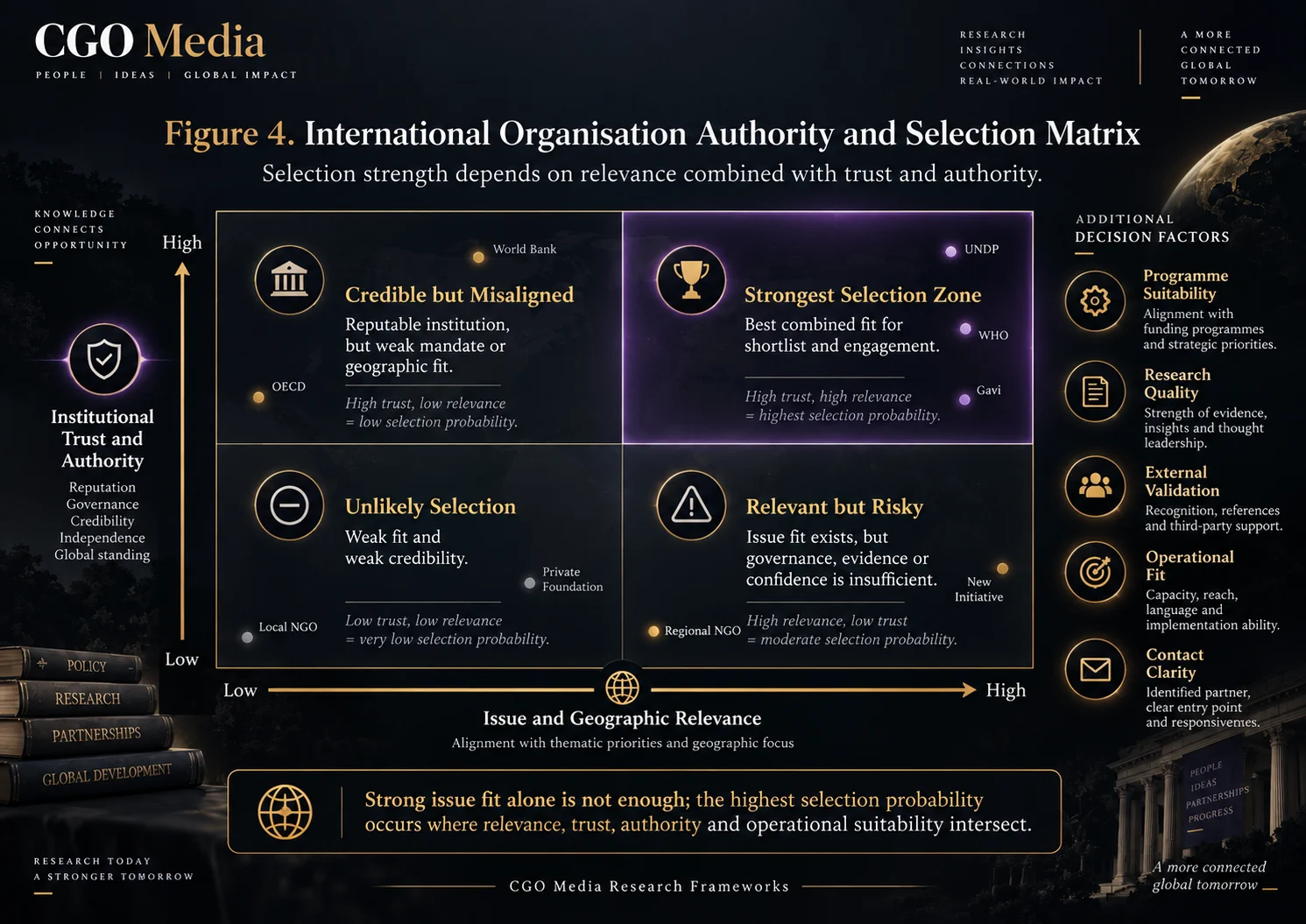
105. Strong Relevance with Weak Institutional Trust
An organisation can appear highly relevant to a stakeholder’s requirement while still failing to progress because the evidence required to establish sufficient confidence is weak.
This situation can arise when the organisation demonstrates:
- strong subject expertise;
- appropriate programme activity;
- relevant geography;
- or substantial practical experience;
but provides limited evidence around:
- governance;
- leadership;
- funding;
- programme accountability;
- research methodology;
- institutional history;
- or independent validation.
The organisation may therefore satisfy the relevance test while remaining a higher-risk selection candidate.
For low-risk informational use, this weakness may not prevent the stakeholder from using the institution’s resources.
For higher-consequence decisions, however, weak Institutional Trust can become decisive.
A government may hesitate to enter a long-term partnership.
A donor may require stronger financial transparency.
A researcher may require more methodological detail.
A partner may need clearer evidence of programme governance.
The organisation should therefore recognise that relevance creates an opportunity to be considered, while trust determines whether that consideration can progress safely.
A useful diagnostic question is:
“If a stakeholder already believed we were relevant, what evidence would they still need before feeling confident enough to engage?”
The answer identifies the trust layer that needs strengthening.
106. Strong Institutional Trust with Weak Relevance
The opposite condition can also occur.
An international organisation may possess exceptional reputation, governance, research quality and external recognition while remaining poorly matched to the stakeholder’s actual requirement.
The institution may be:
- highly respected;
- well governed;
- frequently cited;
- strongly recognised by governments;
- and internationally visible;
while still lacking:
- the required programme;
- the correct geographic presence;
- the necessary organisation type;
- the required operational capability;
- or sufficient subject specificity.
Institutional reputation therefore cannot substitute fully for contextual relevance.
For example, a globally recognised research institution may not be an appropriate programme-delivery partner.
A major development organisation may be highly credible but have no current activity in the country required by the stakeholder.
A well-established standards body may possess substantial authority while remaining irrelevant to a funding requirement.
The selection model therefore prevents generic authority from being interpreted as universal suitability.
The stronger principle is:
Authority increases confidence in an organisation that is already relevant; it does not automatically create relevance where the requirement does not match.
107. Selection Requires Both Relevance and Confidence
The strongest institutional candidates combine contextual relevance with sufficient evidence to support confidence.
This combination usually includes:
- Issue Relevance;
- Geographic Fit;
- evidence quality;
- Institutional Trust;
- external validation;
- and Operational Suitability.
No single dimension guarantees selection.
Instead, stakeholders progressively determine whether the combined evidence supports continued consideration.
A strong candidate should be able to demonstrate:
We Address the Right Problem
We Operate in the Right Context
We Possess Relevant Evidence
Our Institutional Claims Can Be Verified
We Can Operate Effectively
There Is a Practical Route to Engagement
These conditions help move the stakeholder from simple awareness toward informed selection.
The organisation should therefore assess where relevant candidates are most commonly lost.
Some may fail because the institution is not discovered.
Others may fail because programme evidence is unclear.
Others may be lost during due diligence.
Others may survive the evidence stages but lose selection because operational fit is weak.
Understanding the point of failure is essential because each problem requires a different intervention.
108. The Complete International Selection Sequence
The complete International Discovery and Organisation Selection sequence can be represented as:
Need → Requirements → Discovery → Evaluation → Trust Validation → Operational Fit → Comparison → Shortlist → Engagement → Relationship
Each stage answers a different question.
Need
What problem, opportunity or institutional requirement exists?
Requirements
What conditions must an appropriate organisation satisfy?
Discovery
Which organisations are visible within the stakeholder’s practical information environment?
Evaluation
Which organisations appear genuinely relevant to the requirement?
Trust Validation
Which organisations provide enough evidence to support institutional confidence?
Operational Fit
Which organisations can function effectively in the required geographic, financial, linguistic and institutional context?
Comparison
How do the remaining organisations differ?
Shortlist
Which institutions remain serious candidates?
Engagement
Can the stakeholder establish a practical route into the organisation?
Relationship
Does the engagement develop into successful ongoing institutional value?
The complete model therefore extends well beyond organic visibility.
Search is one entry mechanism.
Research can be another.
Government citations can be another.
Partner referrals can be another.
AI assistants can now combine several of these pathways.
The organisation’s objective should therefore be to support the complete sequence rather than optimise one isolated stage.
109. Strategic Meaning for International Organisations
International organisations should build evidence for the complete stakeholder journey rather than concentrating only on institutional visibility.
The organisation that becomes discoverable early, demonstrates clear relevance, survives trust validation, differentiates itself effectively and provides a practical route to engagement is more likely to remain within the stakeholder’s consideration set.
This changes the strategic objective from:
“How can we generate more visibility?”
to:
“How can we remain useful and credible through every stage of stakeholder selection?”
That question has several implications.
Discovery Content Should Reflect Stakeholder Needs
The institution should be discoverable around the issues, geographies, programmes and evidence requirements its stakeholders actually use.
Programme Evidence Should Support Evaluation
Programme pages should allow stakeholders to understand status, scope, geography, partners and outcomes.
Trust Evidence Should Support Validation
Governance, leadership, funding, methodology and institutional reporting should be accessible enough to support confidence.
Country and Language Evidence Should Support Operational Assessment
Stakeholders should be able to determine whether global authority translates into the local context that matters.
Differentiation Should Be Evidenced
Unique institutional strengths should be demonstrated through programmes, research, networks, geography and results rather than unsupported positioning language.
Engagement Should Be Actionable
Users should be able to move from evidence into an appropriate institutional pathway.
The complete selection model therefore links Search Authority with institutional experience.
110. Measuring International Discovery and Selection
The International Discovery and Organisation Selection Model can be measured by examining how effectively stakeholders move through discovery, evaluation, validation, comparison, engagement and ongoing institutional relationships.
The objective is not simply to measure visibility.
It is to understand whether the organisation remains relevant and credible as stakeholders progressively reduce a broad institutional market into a shortlist.
Measurement should therefore reflect the complete selection journey.
Useful questions include:
- Are we visible for the needs stakeholders actually express?
- Which resources introduce stakeholders to the organisation?
- Which programmes generate the strongest discovery?
- Which research assets attract repeated external use?
- Do stakeholders proceed from programme pages into governance or trust evidence?
- Which countries generate partnership interest?
- Where do institutional enquiries originate?
- Which organisations appear alongside us in AI-generated comparisons?
- Which evidence appears to support shortlisting?
- Do selected relationships produce repeat engagement?
No single metric can answer all these questions.
The organisation therefore needs a measurement architecture capable of combining:
- search behaviour;
- website behaviour;
- citation evidence;
- referral activity;
- programme engagement;
- partnership data;
- research use;
- and AI observations.
Measurement should identify constraints rather than merely produce dashboards.
If discovery is strong but engagement is weak, the problem may be relevance or operational fit.
If research visibility is high but citations remain low, the evidence may be difficult to reuse or cite.
If organisation visibility is strong but country-level selection remains weak, local authority may require attention.
The value of measurement therefore lies in identifying where the selection journey loses momentum.
111. Measuring Need and Requirement Discovery
The earliest stage of measurement examines whether the organisation appears around the problems and requirements stakeholders are trying to solve.
Relevant indicators may include:
- problem-led search visibility;
- policy-query visibility;
- research-query visibility;
- funding-related searches;
- partnership-related discovery;
- programme-topic visibility;
- and AI need-based mentions.
These measures help determine whether the organisation is visible before branded recognition occurs.
For example, the institution may rank strongly for its own name while appearing rarely for the issue areas in which it claims significant authority.
This would indicate strong branded visibility but weaker need-led discovery.
The organisation can also examine which stakeholder requirements repeatedly generate demand.
Search and AI behaviour may reveal interest in:
- specific policy topics;
- country programmes;
- funding opportunities;
- research questions;
- statistics;
- standards;
- or partnership opportunities.
This creates a demand-intelligence layer that can improve both discovery and institutional planning.
112. Measuring Organisation Discovery
Organisation Discovery can be assessed by examining the environments through which users first encounter the institution.
Relevant indicators can include:
- search impressions;
- organisation-page entrances;
- referral traffic;
- government references;
- academic references;
- media references;
- partner referrals;
- direct branded discovery;
- and AI organisation mentions.
Measurement should distinguish between branded and non-branded discovery.
Branded discovery demonstrates existing awareness.
Non-branded discovery can demonstrate whether the institution enters consideration before the stakeholder already knows its name.
This distinction becomes especially important for:
- new programmes;
- new geographies;
- less recognised research functions;
- and institutions competing within crowded subject environments.
External discovery should also be measured where possible.
A government citation, academic source or media article may introduce the organisation without creating immediate website traffic.
The complete discovery picture therefore extends beyond analytics on the organisation’s own domain.
113. Measuring Programme Discovery
Programme visibility can be assessed through:
- programme search impressions;
- programme-page traffic;
- partner referrals;
- programme citations;
- funding-related searches;
- country-programme discovery;
- and AI programme mentions.
Programme measurement should determine whether users are discovering:
- active initiatives;
- relevant country programmes;
- appropriate application routes;
- and current programme evidence.
High traffic to archived or completed programmes can indicate a temporal discovery problem.
Likewise, weak visibility for major current programmes may indicate insufficient search or Knowledge Architecture.
The institution can therefore compare:
Programme Importance → Programme Visibility → Stakeholder Engagement
Where strategic importance and digital visibility differ significantly, a discovery gap may exist.
Programme visibility should also be evaluated against downstream action.
A programme may attract substantial traffic but generate little relevant stakeholder engagement.
This could indicate unclear eligibility, weak operational fit or a mismatch between the queries generating visits and the programme’s actual purpose.
114. Measuring Research Discovery
Research visibility can be measured through several different forms of use.
Relevant indicators may include:
- report-page impressions;
- publication-page traffic;
- downloads;
- dataset usage;
- academic citations;
- government citations;
- policy references;
- media citations;
- AI citations;
- and research referral traffic.
Research measurement should distinguish between simple exposure and evidence reuse.
A publication receiving large numbers of impressions may be visible.
A publication being cited repeatedly by governments and universities demonstrates a different form of authority.
A dataset reused by external researchers may create substantial institutional value despite comparatively low webpage traffic.
Research discovery should therefore be evaluated according to the purpose of the resource.
Relevant questions include:
- Which publications generate sustained discovery?
- Which datasets receive repeated use?
- Which subjects attract academic citations?
- Which countries generate research demand?
- Which resources appear within AI-assisted answers?
- Which evidence assets create journalist or government referrals?
This produces a richer picture of Research Authority than pageviews alone.
115. Measuring Institutional Evaluation
Institutional Evaluation is more difficult to measure directly because stakeholders may evaluate several pages before taking an observable action.
Relevant behavioural indicators can include:
- programme-page engagement;
- research-page engagement;
- country-page visits;
- governance-page visits;
- leadership-page visits;
- partner-page visits;
- repeated sessions;
- and navigation between related evidence resources.
The organisation can examine whether users move from discovery resources into deeper evaluative evidence.
For example:
A visitor may enter through a research report and then move into:
- the author profile;
- the relevant programme;
- the country page;
- and the organisation’s governance information.
Another user may begin with a country page and proceed into:
- programmes;
- partners;
- research;
- and contact information.
These pathways can indicate institutional evaluation rather than simple content consumption.
The organisation should therefore measure relationships between evidence assets, not just each page independently.
116. Measuring Trust Validation
Trust-validation signals can include:
- annual-report visits;
- governance-page traffic;
- funding-information visits;
- impact-report engagement;
- external citation growth;
- government references;
- academic recognition;
- and partner validation.
Website behaviour alone cannot demonstrate that a stakeholder trusts the institution.
However, interaction with trust resources can reveal which evidence users examine during evaluation.
External validation provides another measurement layer.
For example:
- government references may strengthen Policy Authority;
- academic citation may strengthen Research Authority;
- partner references may strengthen operational confidence;
- and credible media citations may strengthen expert visibility.
The organisation should therefore combine first-party trust behaviour with external authority development.
A useful measurement question is:
Which evidence do stakeholders repeatedly use when validating us?
The answer can help prioritise the resources that deserve the strongest accuracy, accessibility and maintenance.
117. Measuring Geographic and Operational Fit
Relevant indicators can include:
- country-office traffic;
- regional-page engagement;
- local-language visibility;
- programme application activity;
- partnership enquiries;
- country-level referrals;
- local government references;
- and local partner traffic.
Measurement should distinguish between global interest and local suitability.
A global programme page may attract significant traffic while priority country pages generate little activity.
This can indicate that the organisation possesses broad awareness without equivalent local discovery.
Conversely, country-specific programme pages may generate highly qualified engagement even with comparatively modest traffic.
Operational-fit measurement should therefore focus on quality as well as scale.
A small number of high-value partnership enquiries can be more significant than large volumes of low-intent traffic.
Geographic measurement can also reveal which markets are developing stronger institutional demand.
This information can support both Search Authority strategy and wider organisational planning.
118. Measuring Comparison Behaviour
Comparison behaviour can be difficult to observe because much of it occurs outside the organisation’s own website.
Potential signals can include:
- repeated organisation visits;
- programme comparison searches;
- branded versus peer-institution searches;
- AI organisation comparison prompts;
- partner due-diligence activity;
- and repeated visits to trust or programme evidence.
Search-query patterns can sometimes reveal explicit comparison behaviour.
Users may search:
- Organisation A versus Organisation B;
- best international organisations for a specific programme type;
- alternatives to a particular institution;
- or which organisations operate in a specific country or subject area.
AI-assisted comparison creates a further observable environment.
Repeated testing can identify:
- which peer institutions appear;
- which attributes are compared;
- which evidence sources are cited;
- and whether the organisation is represented accurately.
The purpose is not to manipulate comparison outcomes.
It is to understand which institutional attributes become important when stakeholders compare credible candidates.
119. Measuring Shortlist Behaviour
Shortlisting is often reflected through higher-intent actions.
Potential indicators include:
- direct enquiries;
- research downloads;
- funding applications;
- programme applications;
- meeting requests;
- partnership discussions;
- expert contact;
- and repeat visits to high-trust resources.
The meaning of these signals depends on stakeholder type.
For example:
- a government stakeholder may request a formal discussion;
- a researcher may repeatedly download related publications;
- a donor may request programme documentation;
- a partner may initiate due diligence;
- and a potential member may begin an application.
The organisation should distinguish between general engagement and behaviour suggesting serious institutional consideration.
This can help identify which discovery pathways produce the most meaningful stakeholder outcomes.
120. Measuring Engagement
Engagement represents the point at which institutional selection begins producing direct organisational action.
Relevant outcomes can include:
- contact submissions;
- programme participation;
- partnership agreements;
- membership applications;
- funding relationships;
- research collaboration;
- expert engagement;
- media enquiries;
- and formal institutional discussions.
Measurement should distinguish between quantity and strategic value.
A small number of high-value government or partner engagements may matter more than large numbers of generic enquiries.
The institution should therefore classify engagement according to:
- stakeholder type;
- programme;
- country;
- subject;
- relationship type;
- and strategic significance.
This creates a clearer connection between discovery activity and real institutional outcomes.
121. Measuring Ongoing Relationship
Long-term relationship indicators can include:
- repeat partnerships;
- renewed funding;
- repeat research usage;
- membership renewal;
- recurring institutional citations;
- repeat programme participation;
- ongoing government collaboration;
- and repeated media or expert engagement.
These indicators are particularly valuable because they provide evidence that selection resulted in sustained institutional value rather than a one-time interaction.
Repeat relationships can also strengthen future discovery.
A renewed government partnership may generate further official references.
Repeat academic use may create a stronger citation network around institutional research.
Renewed donor funding may provide further evidence of programme continuity.
Long-term relationships therefore connect back into the authority feedback loop identified earlier in the model.
A useful conceptual sequence is:
Successful Relationship → New Evidence → Greater Authority → Stronger Future Discovery
122. International Discovery and Selection Measurement Funnel
The complete selection journey can be converted into a measurable institutional funnel.
The sequence is:
Need → Discovery → Evaluation → Validation → Operational Fit → Comparison → Shortlist → Engagement → Relationship
Each stage can be associated with different observable signals.
Need can be reflected through problem-led search and AI demand.
Discovery can be reflected through impressions, referrals and institutional mentions.
Evaluation can be reflected through deeper engagement with programme, country, research and organisational evidence.
Validation can be reflected through trust-resource usage and external authority.
Operational Fit can be reflected through local engagement, country activity and programme enquiries.
Comparison can be reflected through peer searches, repeat visits and AI comparison behaviour.
Shortlisting can be reflected through higher-intent engagement.
Engagement can be measured through actual organisational contact and participation.
Relationship can be measured through recurring institutional use and renewed collaboration.
The objective is not to force every stakeholder journey into a commercial conversion funnel.
Institutional journeys are often non-linear, long term and difficult to attribute.
The measurement funnel provides a conceptual structure for understanding where stakeholder progression appears strongest and where significant evidence gaps may be restricting selection.
The central analytical question is:
At which stage does the organisation most often lose relevant stakeholder momentum?
If the weakness occurs at Discovery, the organisation may need stronger Search Authority.
If it occurs at Evaluation, programme or knowledge evidence may be insufficient.
If it occurs at Validation, Institutional Trust may need strengthening.
If it occurs at Operational Fit, country, language or delivery capability may be weak.
If it occurs at Engagement, contact architecture or practical institutional processes may need improvement.
The funnel therefore transforms stakeholder behaviour into a diagnostic institutional tool.
The International Discovery and Selection Measurement Funnel connects each stage of the organisation-selection journey with measurable stakeholder behaviours, allowing institutions to identify where visibility, relevance, trust, operational fit or engagement may be restricting progression.
1. Need
Measure problem-led search demand, policy questions, research queries, programme needs, funding requirements, partnership demand and AI need-based prompts.
2. Discovery
Measure search impressions, referral visibility, organisation mentions, government references, academic discovery, programme visibility and AI organisation discovery.
3. Evaluation
Measure stakeholder interaction with programme pages, research, countries, leadership, partners and other evidence used to determine institutional relevance.
4. Validation
Measure engagement with governance, funding, impact, annual reports and other trust resources together with growth in credible external validation.
5. Operational Fit
Measure country and regional engagement, local-language visibility, programme applications, partnership enquiries and evidence of practical geographic suitability.
6. Comparison
Observe peer-institution searches, repeat visits, programme comparisons, due-diligence behaviour and AI-assisted organisation comparison patterns.
7. Shortlist
Measure higher-intent signals including meeting requests, direct institutional enquiries, applications, expert contact and active partnership discussions.
8. Engagement
Measure programme participation, formal partnerships, memberships, funding relationships, research collaboration and other direct institutional outcomes.
9. Relationship
Measure repeat partnerships, renewed funding, repeat research use, recurring citations, membership renewal and other evidence of continuing institutional value.
Measurement principle: International selection performance should be measured across the full stakeholder journey rather than through search visibility alone. Strong discovery has limited institutional value when relevant users fail to progress into evaluation, validation, engagement or continuing relationships.
Diagnostic principle: The stage at which stakeholder progression weakens indicates the type of institutional capability requiring attention — discovery, evidence, trust, geography, operational fit, differentiation or engagement.
Figure 5. International organisation selection can be measured from initial need and discovery through evaluation, institutional validation, operational fit, comparison, shortlisting, engagement and ongoing relationship.
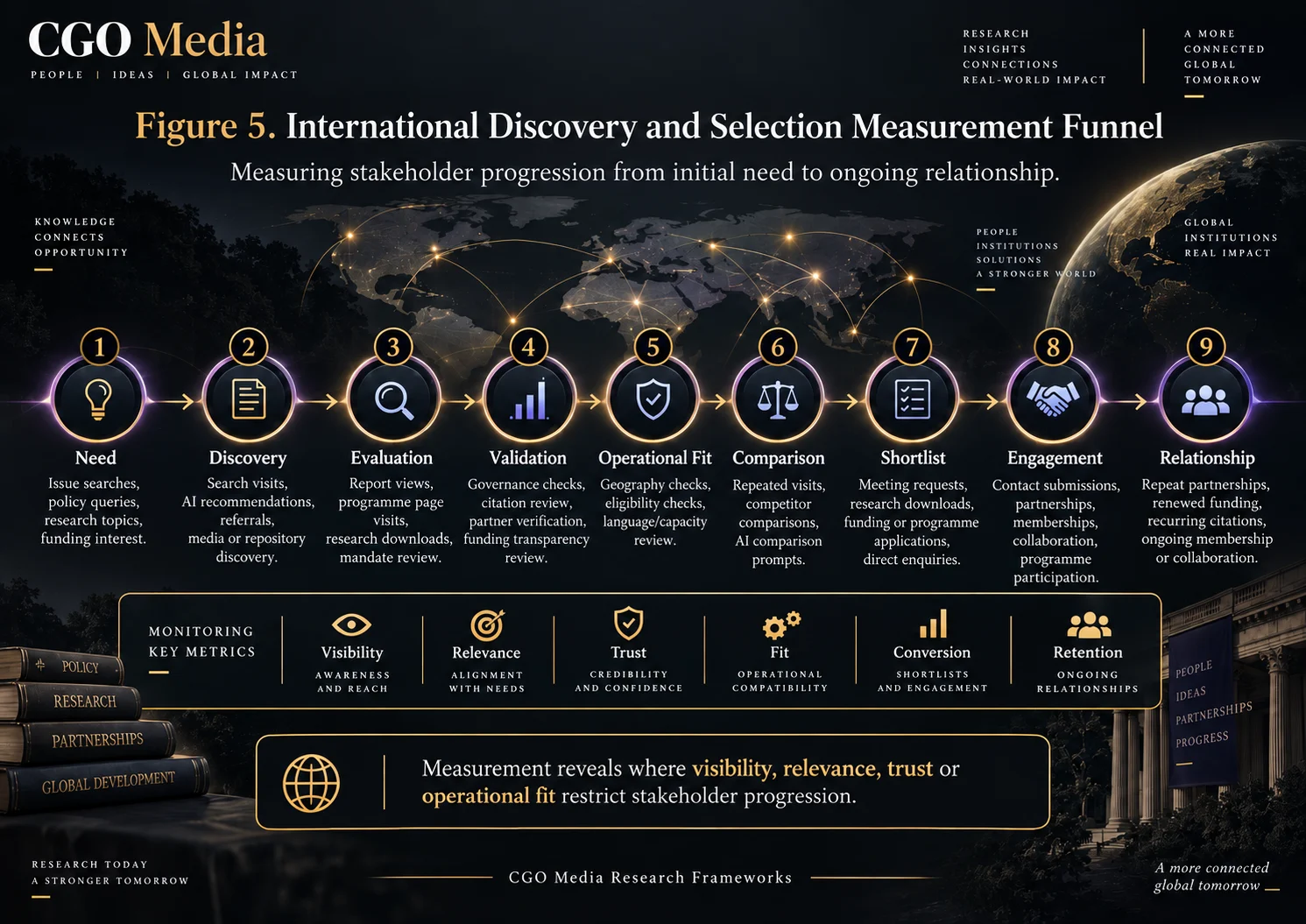
123. International Discovery as Institutional Intelligence
Discovery data can reveal more than whether an international organisation is visible.
It can also provide intelligence about how governments, researchers, journalists, donors, partners, members and other stakeholders understand the institution and where demand is changing.
Search behaviour, research usage, referral patterns, partnership enquiries and AI-assisted discovery can reveal:
- which issues attract the strongest interest;
- which countries generate rising demand;
- which programmes are being discovered most frequently;
- which research assets are being reused;
- which external institutions influence discovery;
- and which organisational capabilities stakeholders appear to value most.
This creates an intelligence layer beyond conventional visibility reporting.
An increase in searches for one country may indicate changing policy or programme interest.
A rise in dataset use may reveal growing demand around a research topic.
Repeated questions about one programme may indicate insufficient clarity or increasing institutional relevance.
AI comparison prompts may reveal how the organisation is being evaluated against peer institutions.
Discovery data can therefore help answer not only:
“Are stakeholders finding us?”
but also:
“What are stakeholders trying to understand about us, and how is that demand changing?”
124. Issue Intelligence
Search and AI behaviour can reveal emerging interest in:
- policy issues;
- programme themes;
- research questions;
- standards;
- funding priorities;
- and institutional capabilities.
Issue Intelligence can help organisations understand whether stakeholder demand aligns with current institutional priorities.
For example, an organisation may observe increasing interest around a topic that historically received limited digital attention.
This may indicate:
- an emerging policy issue;
- new programme demand;
- changing media attention;
- or growing research interest.
The organisation should not treat search or AI demand as a substitute for institutional strategy.
However, it can provide an additional source of evidence about how external audiences are framing current issues.
Issue Intelligence can therefore support:
- research planning;
- programme communication;
- media preparation;
- policy engagement;
- and stakeholder education.
125. Geographic Intelligence
Country and regional search behaviour can indicate where institutional interest is increasing, declining or changing.
Relevant signals may include:
- country-page search demand;
- regional programme interest;
- local-language discovery;
- government referrals;
- country research usage;
- partner enquiries;
- and AI country-level recommendations.
Geographic Intelligence can reveal differences between institutional importance and current digital demand.
A strategically important country may receive little discovery because evidence is weak.
Another market may demonstrate rising programme interest without corresponding institutional investment.
A region may generate increased research demand while programme visibility remains low.
These differences can help the organisation identify where digital evidence may be underrepresenting real institutional opportunity.
Geographic Intelligence should always be interpreted alongside programme strategy and real-world operating priorities.
126. Research Intelligence
Research discovery patterns can reveal which reports, datasets, statistics, topics and countries generate the strongest external demand.
Relevant indicators can include:
- publication discovery;
- downloads;
- dataset reuse;
- government citations;
- academic citations;
- media references;
- AI citations;
- and recurring topic searches.
Research Intelligence can help identify which institutional knowledge assets are functioning as durable authority resources.
It may also reveal gaps.
For example:
- a strategically important research area may receive little external use;
- an older publication may continue attracting strong demand;
- a dataset may generate significant academic citation but little direct website traffic;
- or one country may dominate research discovery unexpectedly.
These signals can inform:
- future research priorities;
- update schedules;
- publication architecture;
- media outreach;
- and academic dissemination.
The strongest Research Intelligence therefore connects usage patterns with institutional decision-making rather than treating publication analytics as an isolated reporting exercise.
127. Programme Intelligence
Programme search and engagement data can reveal which initiatives attract the strongest institutional interest.
Relevant signals may include:
- programme-page discovery;
- programme-related search demand;
- country-specific programme interest;
- applications;
- partner referrals;
- government references;
- funding enquiries;
- and AI programme mentions.
Programme Intelligence can help distinguish between:
- high-visibility programmes;
- high-engagement programmes;
- under-discovered strategic programmes;
- and outdated programmes still attracting significant traffic.
This matters because visibility does not always align with current institutional priorities.
A completed initiative may continue attracting more digital attention than a major active programme.
A new programme may receive significant stakeholder interest despite limited institutional promotion.
The organisation can use these differences to improve programme architecture, lifecycle clarity and stakeholder communication.
128. Partnership Intelligence
Partnership enquiries can indicate emerging institutional networks and opportunities.
Relevant patterns may include:
- which organisation types make contact;
- which countries generate partnership interest;
- which programmes attract potential collaborators;
- which expertise is requested;
- which referral sources introduce partners;
- and which existing partnerships generate further institutional interest.
Partnership Intelligence can help identify where the organisation is perceived as possessing distinctive capability.
For example, repeated enquiries around a specific programme or country may indicate that external institutions already associate the organisation with that capability.
Conversely, weak partnership demand around strategically important activities may indicate insufficient discovery or unclear programme positioning.
Partnership Intelligence should therefore be shared across digital, programme and institutional-development teams.
129. AI Recommendation Intelligence
AI monitoring can reveal which organisations, programmes and evidence sources are being surfaced within relevant recommendation scenarios.
Useful observations can include:
- which organisations are recommended;
- which programmes are surfaced;
- which research sources dominate;
- which selection criteria are emphasised;
- which peer institutions appear repeatedly;
- and which organisations are omitted.
Recommendation Intelligence should not be interpreted as a stable ranking.
AI outputs can vary by system, date, prompt wording, source availability and other factors.
The useful insight lies in repeated patterns.
If the same peer organisations consistently appear for a relevant institutional question, the organisation may investigate:
- their programme evidence;
- their external citations;
- their country visibility;
- their research authority;
- and the sources supporting their appearance.
The purpose is not to imitate competitors mechanically.
It is to understand which evidence conditions appear repeatedly within relevant recommendation environments.
130. AI Source Intelligence
Source analysis can identify whether AI systems rely heavily on:
- government sources;
- universities;
- international organisations;
- think tanks;
- media;
- commercial research sources;
- or first-party institutional pages.
This information can help organisations understand the external evidence ecosystems influencing generated answers.
For example, one subject may be dominated by government sources.
Another may rely heavily on academic literature.
Another may favour specialist media or industry research.
The relevant institutional strategy will differ accordingly.
If governments dominate a policy question, stronger government recognition may be especially important.
If academic sources dominate a research question, publication quality and academic citation may matter more.
If peer international organisations are frequently used as sources, the institution may need stronger comparative research visibility.
AI Source Intelligence therefore helps connect external authority development with actual source environments.
131. AI Comparison Intelligence
Repeated comparison prompts can reveal which institutional attributes are emphasised within AI-mediated selection.
Relevant comparison factors may include:
- programme coverage;
- country presence;
- research quality;
- government relationships;
- institutional scale;
- funding capability;
- policy authority;
- and operational specialisation.
Comparison Intelligence can reveal whether the organisation is being evaluated on the dimensions it considers strategically important.
For example, the institution may view Research Authority as a major differentiator while AI-generated comparisons focus primarily on programme scale.
This does not necessarily mean the organisation should change its positioning.
It may indicate that research strengths are not represented clearly enough within accessible evidence.
Repeated comparisons can therefore become a diagnostic tool for institutional differentiation.
132. Country Selection Intelligence
Country-level monitoring can identify whether local organisations, partners or peer institutions are becoming more prominent within specific markets.
Relevant indicators can include:
- local search visibility;
- local AI recommendations;
- government citations;
- country programme discovery;
- regional competitors;
- and partner visibility.
Country Selection Intelligence can show that global authority does not transfer equally into every local environment.
A globally recognised institution may be absent from country-level recommendations because its local evidence is weak.
A less recognised organisation may perform strongly because it possesses extensive country programmes and external validation.
This information can help prioritise local evidence development and country-specific authority work.
133. Language Selection Intelligence
Language-specific monitoring can reveal different recommendation and source-selection patterns across multilingual environments.
An organisation may appear prominently in English-language discovery while being largely absent from French, Spanish, Arabic or another strategically important language.
Possible causes include:
- weaker local-language content;
- less local citation authority;
- different terminology;
- different government or media source ecosystems;
- and inconsistent programme representation.
Language Selection Intelligence should therefore examine both organisation visibility and the sources influencing that visibility.
This can help identify where multilingual authority requires stronger local evidence rather than translation alone.
134. Selection Governance
International organisation selection performance requires coordinated governance across multiple functions.
Relevant teams can include:
- SEO;
- communications;
- research;
- programme teams;
- country offices;
- policy teams;
- partnership teams;
- and leadership.
No single team owns the complete selection journey.
SEO may improve discovery.
Research teams provide evidence.
Programme teams maintain operational information.
Country teams provide local context.
Governance functions maintain trust evidence.
Partnership teams manage engagement.
Leadership establishes institutional priorities.
Selection Governance should therefore define how these capabilities connect.
The objective is not to centralise all decisions.
It is to ensure that critical stakeholder evidence remains coherent enough for selection to progress.
135. Organisation Entity Governance
Ownership should be clear for core institutional facts including:
- official organisation name;
- acronym;
- leadership;
- headquarters;
- regional offices;
- country offices;
- and important entity relationships.
These facts should not vary unnecessarily between programme, country, language or research environments.
Entity Governance should define:
- the authoritative source;
- who can update it;
- how changes are distributed;
- and how outdated information is corrected.
Strong Entity Governance reduces avoidable selection friction caused by conflicting institutional information.
136. Programme Governance
Programme owners should maintain current information relating to:
- status;
- objectives;
- geographic scope;
- partners;
- funding;
- results;
- participation requirements;
- and completion or transition.
Programme Governance is particularly important because programme suitability often influences selection directly.
A stakeholder may reject an otherwise relevant organisation if programme information is unclear or obviously outdated.
Programme owners should therefore validate the facts, while digital teams ensure those facts are represented accessibly across search, country and programme environments.
137. Research Governance
Research teams should maintain standards for:
- authorship;
- publication dates;
- methodology;
- versioning;
- supporting data;
- citation guidance;
- and institutional attribution.
Research Governance helps ensure that evidence used during selection remains credible and reusable.
A stakeholder should not need to guess:
- who produced the research;
- which version is current;
- how the data was generated;
- or which organisation should be cited.
Research governance therefore contributes directly to selection confidence where evidence quality matters.
138. Country and Language Governance
Country and language teams should maintain accurate local evidence while ensuring that major institutional information remains aligned with the global organisation.
Relevant responsibilities can include:
- country-office information;
- programme status;
- local partners;
- government relationships;
- local research;
- translation quality;
- terminology;
- and language-version freshness.
The objective is to preserve local accuracy without allowing the institution to fragment into contradictory representations.
A federated model can provide the strongest balance:
Global Standards + Local Ownership + Shared Institutional Facts
139. Trust Governance
Responsibility should be defined for institutional trust evidence including:
- governance information;
- financial transparency;
- impact reporting;
- leadership information;
- institutional policies;
- accountability;
- and funding information.
Trust evidence may be distributed across several departments.
The organisation does not need to centralise every source.
It needs clear ownership so that users can access accurate and current information during validation.
Trust Governance should prioritise evidence categories that carry the greatest consequences if incorrect.
140. AI Selection Governance
AI monitoring should include repeatable evaluation of:
- organisation recommendations;
- programme recommendations;
- research-source selection;
- institution comparisons;
- country-level visibility;
- language-level visibility;
- and representation accuracy.
The monitoring function should identify patterns and escalate them to the relevant institutional owners.
For example:
- programme errors can be routed to programme teams;
- country gaps to local teams;
- research attribution issues to research governance;
- leadership inaccuracies to Entity Governance;
- and weak external authority to communications or policy teams.
AI Selection Governance therefore connects observation with institutional improvement.
141. Common International Selection Failure Modes
Several recurring weaknesses can remove otherwise relevant organisations from consideration.
These failure modes are useful because they identify where selection performance can break even when other authority signals remain strong.
An organisation may be discoverable but poorly explained.
It may be relevant but outdated.
It may possess strong programmes but weak Institutional Trust.
It may have significant global authority but insufficient local evidence.
Understanding these patterns helps organisations diagnose the actual selection constraint rather than simply increasing visibility.
142. Discoverable but Poorly Explained
An institution may appear prominently but still fail evaluation if its mission, programmes or geographic role are unclear.
Common symptoms include:
- generic institutional language;
- unclear programme relationships;
- weak country structure;
- ambiguous organisation type;
- and insufficient evidence of current activity.
The corrective priority is stronger Entity Clarity and institutional explanation.
Visibility should lead into understanding.
143. Relevant but Outdated
An organisation may appear suitable but be rejected because programme, leadership or country information is no longer current.
Common weaknesses include:
- completed programmes presented as active;
- former leaders shown as current;
- outdated statistics;
- obsolete funding opportunities;
- and country offices whose status has changed.
Outdated information creates risk because stakeholders cannot determine which evidence remains reliable.
The corrective priority is stronger temporal governance.
144. Strong Programme with Weak Institutional Trust
A relevant programme can lose credibility if governance, funding or institutional evidence is weak.
The programme may demonstrate:
- strong subject fit;
- good geographic relevance;
- and credible operational activity;
while the parent institution provides limited evidence around:
- leadership;
- funding;
- governance;
- reporting;
- or institutional accountability.
The corrective priority is to strengthen the trust layer supporting the programme.
145. Strong Institution with Weak Geographic Fit
A highly authoritative organisation may still be unsuitable where local presence or operational capacity is insufficient.
This can occur when:
- global expertise is strong;
- research is recognised;
- and institutional trust is high;
but the organisation lacks:
- country experience;
- local partners;
- language capability;
- government relationships;
- or programme infrastructure.
The corrective priority is not generic authority development.
It is stronger evidence of local relevance where genuine capability exists.
146. Strong Research with Weak Engagement Routes
An institution may provide excellent evidence but make partnership, programme or expert contact unnecessarily difficult.
Common barriers can include:
- generic contact forms;
- unclear expert contacts;
- no research enquiry route;
- poor dataset access;
- and difficult partnership navigation.
The organisation may therefore succeed as an information source while failing to convert authority into deeper institutional relationships.
The corrective priority is stronger engagement architecture.
147. Strong Global Authority with Weak Local Validation
Global reputation may not compensate for limited local evidence in country-specific decisions.
A stakeholder may recognise the parent organisation but still need evidence of:
- local programmes;
- country partners;
- government relationships;
- local research;
- or regional operational history.
The corrective priority is stronger country-level validation.
Global Authority should reinforce local evidence, not replace it.
148. Strong Visibility with Weak Differentiation
Institutions can become interchangeable during comparison if their unique mandate, expertise or programme strengths are not clearly communicated.
This often occurs when organisations rely on similar broad positioning language.
Statements such as:
- global leader;
- trusted organisation;
- innovative institution;
- or international expert
provide limited differentiation without evidence.
The stronger approach is to communicate:
Distinctive Capability + Relevant Geography + Verifiable Evidence
Differentiation should therefore arise from real institutional characteristics rather than generic promotional language.
149. No Relationship Feedback Loop
Organisations lose valuable selection intelligence when partnership outcomes, research usage and stakeholder feedback are not used to improve institutional evidence.
A successful engagement can create:
- partner evidence;
- government references;
- research citations;
- impact evidence;
- new case studies;
- and future referrals.
If these outcomes remain disconnected from the organisation’s digital evidence environment, their authority value is lost.
The corrective priority is to connect successful institutional relationships back into:
- programme evidence;
- research architecture;
- country authority;
- external validation;
- and future selection intelligence.
The selection process should therefore operate as a feedback system rather than a sequence that ends after initial engagement.
150. Application for Intergovernmental Organisations
Intergovernmental organisations can use the model to improve:
- policy discovery;
- mandate clarity;
- member-state relationships;
- Programme Authority;
- government engagement;
- research discovery;
- and country-level institutional relevance.
Their selection environment may place particularly strong emphasis on:
- formal mandate;
- Policy Authority;
- government recognition;
- multilingual evidence;
- and Institutional Trust.
The model can help ensure that formal authority is translated into clear evidence throughout the stakeholder journey.
151. Application for International NGOs
International NGOs can apply the model to:
- programme discovery;
- impact validation;
- donor confidence;
- partnership selection;
- country engagement;
- research visibility;
- and local authority.
Selection may depend heavily on the organisation’s ability to demonstrate:
- active programmes;
- funding transparency;
- local delivery capability;
- partners;
- and measurable outcomes.
The model helps connect global mission with verifiable operational evidence.
152. Application for Development Organisations
Development organisations may use the model to strengthen:
- country programme discovery;
- funding visibility;
- government partnerships;
- Research Authority;
- programme selection;
- regional visibility;
- and donor engagement.
Their stakeholder journeys often combine policy, funding and implementation requirements.
The selection model can therefore help coordinate evidence across:
- programmes;
- countries;
- research;
- funding;
- partners;
- and impact.
153. Application for International Associations
Associations may apply the model to:
- membership discovery;
- industry representation;
- standards;
- events;
- policy engagement;
- member value;
- and professional authority.
Potential members may evaluate both institutional reputation and practical value.
The selection model helps associations clarify:
- who they represent;
- what membership provides;
- which standards or policy functions they perform;
- and how users can engage.
154. Application for Foundations
Foundations can use the model to improve:
- grant discovery;
- funding clarity;
- programme transparency;
- applicant confidence;
- Research Visibility;
- governance;
- and impact understanding.
Applicants may need to determine quickly:
- whether funding is available;
- who is eligible;
- which countries or issues qualify;
- and how decisions are made.
The model can therefore help foundations reduce unnecessary selection friction while maintaining strong trust standards.
155. Application for Standards Bodies
Standards organisations may use the model to strengthen:
- standards discovery;
- Technical Authority;
- version clarity;
- industry adoption;
- institutional engagement;
- expert visibility;
- and implementation guidance.
Selection may depend heavily on whether users can determine:
- which standard is current;
- which organisation issued it;
- what technical scope it covers;
- and how widely it is recognised.
Versioning and external adoption therefore become particularly important selection signals.
156. Application for Research Organisations
Research organisations can apply the model to:
- research discovery;
- dataset discovery;
- Researcher Authority;
- citation development;
- research collaboration;
- expert discovery;
- and AI source visibility.
Their selection environment may be driven less by programme delivery and more by:
- methodological quality;
- original evidence;
- citation history;
- data accessibility;
- and recognised subject expertise.
The model helps connect individual research outputs with wider Organisation Authority and future research relationships.
157. Application for Multinational Charities
Charities may use the model to improve:
- mission discovery;
- country programme visibility;
- donor trust;
- impact validation;
- partnership engagement;
- beneficiary discovery;
- and local institutional authority.
Different audiences may use different selection criteria.
Donors may prioritise:
- governance;
- impact;
- and financial transparency.
Partners may prioritise:
- operational capability;
- country presence;
- and programme experience.
Beneficiaries may prioritise:
- programme availability;
- eligibility;
- local access;
- and language.
The model therefore helps multinational charities support several overlapping selection journeys within one coherent institutional architecture.
158. Continuous International Selection Improvement
The International Discovery and Organisation Selection Model should operate as a continuous improvement system rather than as a one-time framework.
The core cycle is:
Measure → Identify Selection Gaps → Improve Institutional Evidence → Strengthen Trust → Improve Operational Fit → Monitor Selection Behaviour → Refine
Measure
Assess how stakeholders move through need recognition, discovery, evaluation, validation, operational assessment, comparison, engagement and ongoing relationship.
Relevant measurement can include:
- search visibility;
- programme discovery;
- research usage;
- country engagement;
- external citations;
- AI recommendations;
- enquiries;
- and recurring relationships.
Identify Selection Gaps
Determine where relevant stakeholders are most commonly lost.
Possible gaps can include:
- weak discovery;
- unclear institutional relevance;
- insufficient trust evidence;
- poor geographic fit;
- weak differentiation;
- or engagement friction.
Improve Institutional Evidence
Strengthen the first-party information required for stakeholder evaluation.
This can include:
- programme evidence;
- Research Architecture;
- country pages;
- expert profiles;
- governance;
- impact evidence;
- and organisation-entity clarity.
Strengthen Trust
Improve the evidence required for institutional confidence.
This can involve:
- governance transparency;
- funding clarity;
- research methodology;
- external validation;
- government recognition;
- academic citation;
- and partner confirmation.
Improve Operational Fit
Strengthen the evidence and capability required to demonstrate that the institution can operate in the specific stakeholder context.
Relevant areas include:
- country presence;
- local partners;
- language capability;
- delivery capacity;
- funding compatibility;
- and clear engagement routes.
Monitor Selection Behaviour
Observe how organisations, programmes and research resources are being discovered, compared and recommended across search, policy, research and AI environments.
Monitoring should include:
- peer institutions;
- source patterns;
- comparison criteria;
- AI recommendation behaviour;
- and stakeholder engagement outcomes.
Refine
Use new discovery, engagement and relationship intelligence to update the organisation’s evidence and selection strategy.
The cycle then begins again.
This creates a learning system in which institutional evidence continually improves according to real stakeholder behaviour rather than remaining static.
The long-term objective is therefore not simply to maximise discovery.
It is to create an organisation that becomes progressively easier to understand, verify, compare, select and engage with in the contexts where it is genuinely relevant.
The International Discovery and Organisation Selection Improvement Cycle presents institutional selection as a continuous learning process in which organisations measure stakeholder behaviour, identify evidence and trust gaps, strengthen operational fit, monitor AI-mediated selection and use new intelligence to improve future discovery and engagement.
1. Measure
Assess discovery, programme visibility, research usage, stakeholder evaluation, trust validation, comparison, engagement and ongoing institutional relationships.
2. Identify Selection Gaps
Determine where stakeholders are being lost because of weak discovery, unclear relevance, insufficient evidence, poor trust, limited geographic fit or engagement friction.
3. Improve Institutional Evidence
Strengthen organisation identity, programmes, research, country evidence, expert profiles, governance, impact reporting and Knowledge Architecture.
4. Strengthen Trust
Improve governance transparency, external validation, research credibility, government recognition, partner evidence and other institutional confidence signals.
5. Improve Operational Fit
Strengthen country presence, local partnerships, multilingual capability, delivery evidence, funding compatibility and practical engagement routes.
6. Monitor Selection Behaviour
Track peer comparisons, AI recommendations, source selection, stakeholder shortlisting, programme enquiries and relationship outcomes.
7. Refine
Use stakeholder behaviour, institutional outcomes and selection intelligence to reprioritise evidence, authority and engagement improvements.
Continuous-selection principle: International organisation discovery and selection should be treated as a learning system. Stakeholder behaviour, institutional relationships, research usage and AI-mediated comparisons continuously generate new evidence about how the organisation is understood and selected.
Improvement principle: The strongest organisations use that intelligence to improve discoverability, relevance, Institutional Trust, geographic fit, differentiation and engagement rather than treating visibility as a completed objective.
Figure 6. International organisation selection improves through continuous measurement, institutional evidence development, trust strengthening, operational alignment, AI monitoring and stakeholder learning.
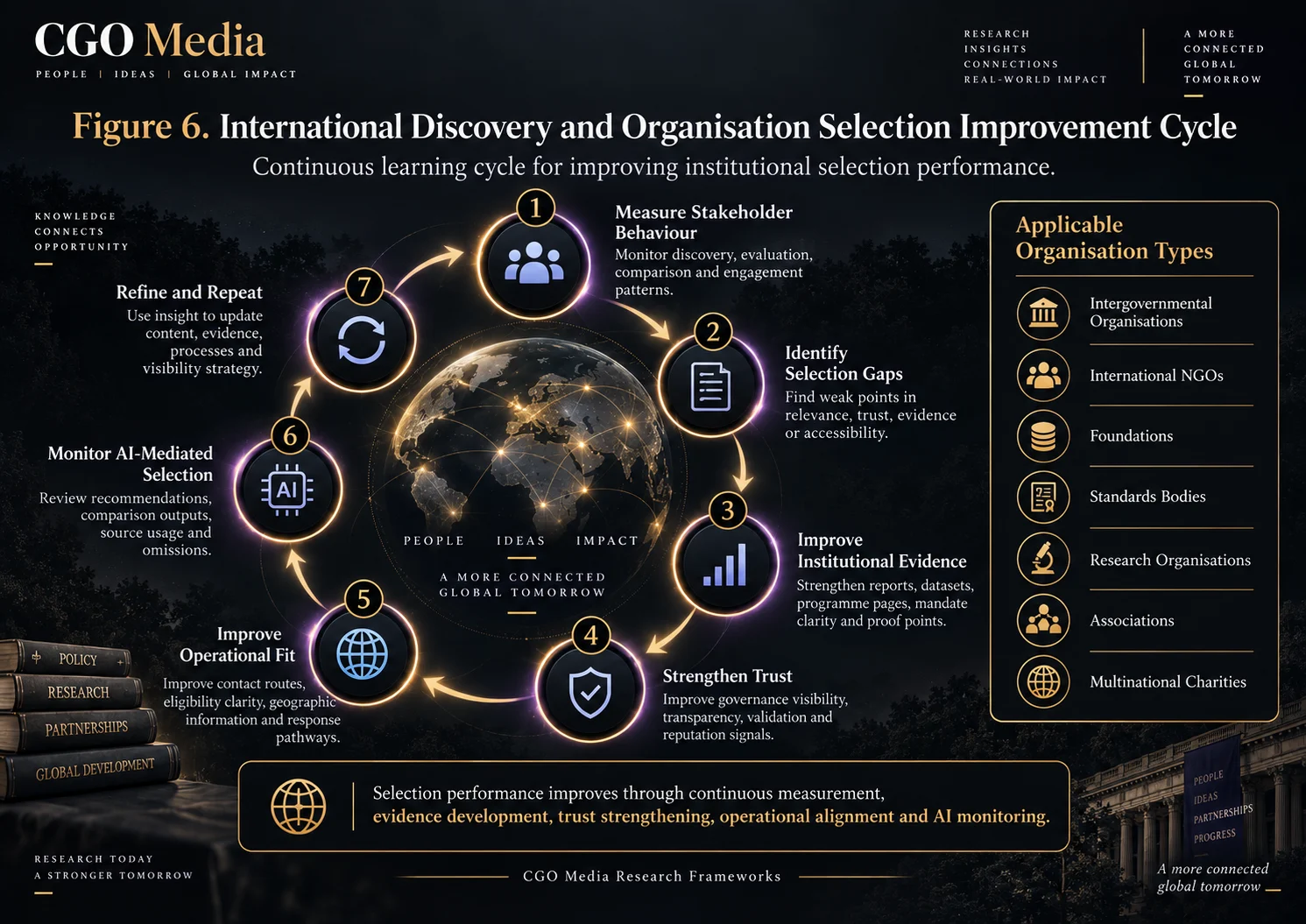
159. Relationship with the International Organisations AI Trust and Visibility Framework
The International Organisations AI Trust and Visibility Framework defines the institutional evidence conditions that support trust, authority, discoverability and recommendation readiness.
The International Discovery and Organisation Selection Model explains where those conditions influence stakeholder decisions.
The relationship between the two resources can therefore be represented as:
Trust and Visibility Framework → Defines the Evidence Environment
Discovery and Selection Model → Explains How Stakeholders Use That Evidence
For example, the Trust and Visibility Framework examines:
- Organisation and Entity Clarity;
- Mission, Programme and Knowledge Authority;
- Country, Region and Language Architecture;
- Trust, Governance and Institutional Credibility;
- External, Academic and Policy Authority;
- and AI Search and International Recommendation Readiness.
Those dimensions become selection evidence within the Discovery and Organisation Selection Model.
Entity Clarity helps a stakeholder determine which institution, programme or office they are evaluating.
Programme and Knowledge Authority help establish whether the institution possesses substantive expertise in the required area.
Country and Language Architecture provide evidence of geographic and contextual relevance.
Governance and Institutional Credibility support due diligence and trust validation.
External Authority provides independent evidence that the institution's expertise or activity is recognised outside its own digital properties.
AI readiness influences whether those evidence layers can be surfaced and interpreted effectively within generative discovery environments.
The two models therefore represent different stages of the same wider authority system.
The Trust and Visibility Framework asks:
"Is the evidence strong enough?"
The Discovery and Organisation Selection Model asks:
"How does that evidence affect whether the institution remains within the stakeholder's consideration set?"
Used together, the two resources help organisations move beyond simple visibility measurement toward a more complete understanding of institutional selection.
160. Relationship with the International Search Authority Maturity Model
The
International Search Authority Maturity Model
evaluates how advanced an organisation has become in developing and governing the capabilities required to support international discovery and selection.
The Discovery and Organisation Selection Model describes the stakeholder journey.
The Maturity Model assesses the organisation's ability to support that journey consistently.
The relationship can be represented as:
Selection Model → What the Stakeholder Needs
Maturity Model → How Capable the Organisation Is of Supplying and Governing It
An organisation at an early maturity stage may possess useful individual resources but lack the architecture required to support a coherent selection journey.
For example:
- research may be strong but disconnected from programmes;
- country information may exist but remain inconsistent;
- governance evidence may be difficult to discover;
- programmes may be current but weakly linked with geographic evidence;
- and stakeholder engagement may be handled through generic contact routes.
At more advanced maturity levels, these capabilities become coordinated.
The organisation can connect:
- search discovery with programme evidence;
- programme evidence with country authority;
- research with expert and policy authority;
- Institutional Trust with stakeholder validation;
- and AI monitoring with continuous improvement.
Maturity therefore influences how reliably the organisation can remain visible and credible throughout the complete selection journey.
A useful feedback relationship is:
Assess Selection Journey → Identify Capability Constraint → Improve Maturity → Strengthen Evidence → Measure Stakeholder Progression
This prevents the organisation from interpreting weak selection outcomes as purely marketing problems when the underlying constraint may be structural, evidentiary or operational.
161. Relationship with the International Organisations SEO and AI Implementation Roadmap
The
International Organisations SEO and AI Implementation Roadmap
provides the practical development sequence through which organisations can strengthen the evidence required across the selection journey.
The roadmap progresses through:
- Assess
- Stabilise
- Structure
- Strengthen
- Validate
- Integrate
- Evolve
These phases can be applied directly to selection constraints.
If the organisation is failing at discovery, it may need to assess technical visibility, Entity Clarity, research architecture or problem-led search coverage.
If stakeholders discover the institution but fail to progress into evaluation, programme or subject evidence may need strengthening.
If relevant organisations are repeatedly lost during validation, governance, funding, methodology or independent authority may require attention.
If the organisation reaches shortlists but rarely progresses into engagement, geographic fit, delivery evidence or engagement architecture may be the limiting factor.
The relationship between the models can therefore be expressed as:
Selection Model → Identifies Where Stakeholder Progression Weakens
Implementation Roadmap → Provides the Sequence for Correcting the Underlying Constraint
This connection allows selection behaviour to influence implementation priorities.
Rather than improving the website uniformly, the institution can concentrate resources on the evidence gap most likely to affect an important stakeholder journey.
162. Relationship with the Parent Research
This model forms part of the research architecture established in
International Organisations SEO in an AI Search Environment.
The parent research examines how international search visibility increasingly depends on the interaction between:
- Technical SEO;
- institutional entities;
- country and regional architecture;
- multilingual discovery;
- Programme Authority;
- Research Authority;
- Statistical Authority;
- Institutional Trust;
- external citations;
- AI source selection;
- and AI-assisted recommendation.
The Discovery and Organisation Selection Model converts those authority concepts into a stakeholder-decision sequence.
The parent research explains the changing search environment.
The
International Organisations AI Trust and Visibility Framework
defines the evidence required for trust and authority.
The
International Discovery and Organisation Selection Model
explains how that evidence influences stakeholder evaluation and selection.
The
International Search Authority Maturity Model
evaluates organisational capability.
The
International Organisations SEO and AI Implementation Roadmap
provides the implementation sequence.
The
International Organisations GEO: Generative Engine Optimisation
extends the architecture into generative source selection, citation, representation and recommendation.
The
International Organisations AI & GEO Search Research
acts as the sector-level pillar connecting the complete research family.
Together, these resources create a connected research architecture:
Sector Research → Trust and Visibility → Discovery and Selection → Authority Maturity → Implementation → GEO
The purpose of this architecture is to analyse international search as an institutional evidence and stakeholder-selection system rather than as a collection of isolated SEO tactics.
163. Methodological Position
The International Discovery and Organisation Selection Model is a conceptual and strategic stakeholder-decision framework developed by CGO Media.
It provides a structured methodology for examining how international organisations may move from initial stakeholder visibility into evaluation, validation, shortlisting, engagement and ongoing institutional relationships.
The model does not claim that every stakeholder follows the eight stages in a fixed sequence.
Real institutional decision-making can be:
- iterative;
- non-linear;
- multi-stakeholder;
- policy constrained;
- procurement constrained;
- relationship driven;
- or influenced by prior institutional experience.
A government may begin with a pre-existing shortlist.
A researcher may discover the organisation through one dataset and bypass several early stages.
A donor may conduct extensive due diligence before any direct engagement.
A partner referral may create immediate trust that would otherwise need to be established gradually.
AI-assisted discovery may compress several stages into one interaction.
The eight-stage model therefore represents an analytical structure rather than a claim about universal human decision behaviour.
Likewise, the seven selection signals are not presented as fixed scores or proprietary ranking factors.
They provide categories for examining recurring forms of evidence that can influence institutional suitability:
- Issue Relevance;
- Geographic Fit;
- Programme and Mission Authority;
- Research and Evidence Quality;
- Institutional Trust;
- External and Policy Authority;
- and Engagement and Operational Suitability.
The relative importance of each signal should be determined by the specific stakeholder context.
The model also does not claim that search engines or generative AI systems evaluate institutions through the exact sequence described here.
AI recommendations and generated comparisons should be treated as observable outputs rather than direct evidence of proprietary system logic.
Monitoring can identify recurring patterns involving:
- which institutions appear;
- which sources are cited;
- which evidence is emphasised;
- and which organisations are compared.
Those observations can inform further investigation, but they should not be interpreted automatically as proof of underlying algorithmic criteria.
The framework is therefore designed for strategic diagnosis.
It helps organisations ask:
- Are relevant stakeholders discovering us?
- Can they understand why we are relevant?
- Can they verify important claims?
- Can they establish local and operational fit?
- Can they distinguish us from credible alternatives?
- Can they engage effectively?
- And does successful engagement generate new authority that strengthens future discovery?
These questions can be applied across organisation types while allowing each institution to adapt the model to its mandate, geography, audience and operating environment.
164. Strategic Implications
The central strategic implication of the model is that International SEO should be evaluated partly by its contribution to stakeholder selection rather than by visibility alone.
The traditional question:
"How do we make the organisation more visible?"
is incomplete.
A stronger question is:
"What evidence does each stakeholder need for our organisation to remain credible from discovery through validation, comparison and engagement?"
Discovery Must Connect with Relevance
Visibility has limited strategic value if the organisation attracts audiences for whom it is not genuinely suitable.
Search architecture should therefore reflect the issues, programmes, countries and evidence areas in which the institution possesses real authority.
Relevance Must Connect with Evidence
A stakeholder should be able to move from a broad claim of expertise into substantive proof.
This means connecting:
Mission → Programmes → Research → Geography → Evidence → Outcomes
The organisation should not rely on generic positioning when stronger first-party evidence exists.
Evidence Must Connect with Trust
Relevant activity alone may not satisfy higher-risk institutional decisions.
Governance, methodology, funding transparency, impact evidence and external validation become increasingly important as stakeholder risk rises.
Global Authority Must Connect with Local Fit
International recognition does not automatically establish country-level suitability.
Local programmes, government relationships, language capability, partners and country research can become decisive during operational assessment.
Differentiation Must Be Verifiable
International organisations frequently operate within fields containing many credible peer institutions.
Differentiation should therefore arise from real characteristics such as:
- unique mandate;
- distinctive datasets;
- specialist programme capability;
- long-term geographic experience;
- policy authority;
- or established institutional networks.
Unsupported superiority claims contribute little to rigorous institutional comparison.
Engagement Is Part of Selection
The selection journey does not end when the stakeholder decides an institution appears suitable.
The organisation still needs to make practical engagement possible.
Contact, partnership, membership, programme, funding and research pathways should therefore reflect real stakeholder objectives.
Successful Relationships Create Future Authority
The model also demonstrates that engagement can create new evidence.
Successful programmes can produce:
- partner references;
- government citations;
- impact evidence;
- research outputs;
- media coverage;
- and future referrals.
Those signals can strengthen later discovery and selection.
The long-term strategic system therefore becomes:
Discovery → Selection → Engagement → Evidence → Authority → Future Discovery
AI Makes Institutional Evidence More Important
AI-assisted environments can compress discovery, comparison and preliminary recommendation into one interaction.
This means stakeholders may form an initial institutional shortlist before visiting first-party websites.
The organisation's wider evidence ecosystem therefore becomes increasingly important.
Programme pages, government citations, research, country information, media references, partner evidence and structured institutional information can all contribute to the environment through which the organisation is interpreted.
The strategic objective should not be to engineer AI recommendations.
It should be to maintain sufficiently strong, accurate and contextual evidence so that the institution can be represented appropriately where it is genuinely relevant.
165. Conclusion
Modern international organisation selection occurs across a distributed environment involving search engines, governments, academic research, programme networks, media, partners, professional institutions and AI-assisted discovery.
The stakeholder journey therefore extends well beyond a branded search or website visit.
The International Discovery and Organisation Selection Model identifies eight core stages:
- Need Recognition
- Requirement Definition
- Organisation Discovery
- Institutional Evaluation
- Trust and Authority Validation
- Geographic and Operational Fit Assessment
- Comparison and Shortlisting
- Engagement and Ongoing Relationship
The model also identifies seven recurring selection signals:
- Issue Relevance
- Geographic Fit
- Programme and Mission Authority
- Research and Evidence Quality
- Institutional Trust
- External and Policy Authority
- Engagement and Operational Suitability
These signals interact rather than operate independently.
A highly relevant organisation may still fail selection if trust evidence is weak.
A highly authoritative organisation may remain unsuitable where geographic fit is poor.
Strong research may create discovery but fail to develop into engagement if institutional pathways are unclear.
Global reputation may create awareness while country-level evidence determines practical suitability.
The strongest selection candidate therefore combines:
Relevant Expertise + Geographic Fit + Strong Evidence + Institutional Trust + Independent Authority + Operational Suitability
The model also demonstrates why international search should not be assessed only through rankings or traffic.
Search visibility creates the opportunity to enter the stakeholder's candidate set.
Programme, country, research and trust evidence determine whether the organisation survives evaluation.
Independent validation strengthens credibility.
Operational evidence determines practical fit.
Differentiation influences shortlisting.
Engagement determines whether the relationship can actually begin.
Successful relationships then produce new evidence that can strengthen future authority.
This creates a continuous institutional selection system:
Measure → Identify Selection Gaps → Improve Institutional Evidence → Strengthen Trust → Improve Operational Fit → Monitor Selection Behaviour → Refine
The long-term objective is therefore not maximum visibility.
It is to ensure that the organisation can be discovered accurately, understood clearly, validated credibly, compared fairly and engaged appropriately within the situations where it possesses genuine institutional relevance.
International organisations capable of building this evidence architecture are better positioned to remain credible throughout increasingly complex human and AI-assisted selection journeys.
References
External Academic, Technical and Institutional Sources
- 1. Google Search Central. Tell Google about localized versions of your page.
- 2. Google Search Central. Managing multi-regional and multilingual sites.
- 3. Schema.org. Organization.
- 4. Schema.org. Person.
- 5. Schema.org. Report.
- 6. Schema.org. Dataset.
- 7. World Wide Web Consortium. Web Content Accessibility Guidelines (WCAG) 2.2.
- 8. Metzger, M. J. (2007). Making Sense of Credibility on the Web: Models for Evaluating Online Information and Recommendations for Future Research. Journal of the American Society for Information Science and Technology, 58(13), 2078–2091.
- 9. Hogan, A. et al. (2021). Knowledge Graphs. ACM Computing Surveys, 54(4).
- 10. Ji, Z. et al. (2023). Survey of Hallucination in Natural Language Generation. ACM Computing Surveys, 55(12).
CGO Media Research Frameworks
- 11. Wilkinson, R. (2026). CGO AI Authority Model. CGO Media.
- 12. Wilkinson, R. (2026). CGO Media Entity Authority Framework. CGO Media.
- 13. Wilkinson, R. (2026). CGO Media Content Authority Framework. CGO Media.
- 14. Wilkinson, R. (2026). CGO Media Brand Signal Framework. CGO Media.
- 15. Wilkinson, R. (2026). CGO Media AI Citation Framework. CGO Media.
- 16. Wilkinson, R. (2026). CGO Media AI Search Readiness Framework. CGO Media.
- 17. Wilkinson, R. (2026). CGO Media Knowledge Architecture Map. CGO Media.
- 18. Wilkinson, R. (2026). CGO Media Search Ecosystem Model. CGO Media.
These sources provide supporting context around International SEO, multilingual architecture, institutional credibility, Knowledge Graphs, structured entities and generative-system reliability. The eight-stage selection sequence and seven selection signals remain a CGO Media strategic research model rather than a description of proprietary search-engine or AI-system decision processes.
CGO Media Research Ecosystem
The International Discovery and Organisation Selection Model forms part of the
CGO Media Framework Library
and the wider CGO Media research programme examining International SEO, institutional authority, multilingual discovery, policy authority, stakeholder selection and AI-assisted recommendation systems.
The wider research ecosystem can be explored through:
- CGO Media Research Library
- CGO Media Framework Library
- CGO Media Research Observations Library
- CGO Media Statistics Library
- CGO Media Research Architecture
- CGO Media Knowledge Architecture Map
Together, these resources connect individual papers, frameworks, research observations, statistics and sector studies within the wider CGO Media Knowledge Architecture.
About Roger Wilkinson
Roger Wilkinson is an independent Search and AI researcher, SEO practitioner and founder of CGO Media with more than 25 years of experience in search, online visibility and digital strategy.
His current research examines how artificial intelligence is changing search engines, recommendation systems and digital authority, with particular focus on Technical SEO, Entity Authority, Content Authority, Brand Signals, Citation Authority, Knowledge Architecture, GEO and AI Search Visibility.
Through the CGO Media research programme, Roger develops independent research papers and strategic frameworks examining how organisations become discoverable, trusted, cited, compared and recommended across search and generative systems.
His work focuses on building practical models for analysing changing search behaviour without presenting individual observations as confirmed proprietary ranking or recommendation mechanisms unless supporting evidence justifies that conclusion.
View Roger Wilkinson's researcher profile →
Author: Roger Wilkinson
Published by: CGO Media
Published: September 2026
Last reviewed: September 2026
Related International Organisations Research and Frameworks
This model forms part of the seven-page International Organisations research architecture.
- International Organisations AI & GEO Search Research
- International Organisations SEO in an AI Search Environment
- International Organisations AI Trust and Visibility Framework
- International Search Authority Maturity Model
- International Organisations SEO and AI Implementation Roadmap
- International Organisations GEO: Generative Engine Optimisation
Together, these resources cover the sector research foundation, Institutional Trust, stakeholder discovery and selection, authority maturity, implementation and generative discovery.
Research Usage & Citation
CGO Media encourages researchers, journalists, international organisations, NGOs, policy institutions, associations, academics and practitioners to reference this model where it contributes to broader understanding of institutional discovery, organisation selection, International SEO and AI-assisted recommendation.
Reasonable quotations, summaries, figures and excerpts may be used in articles, reports, presentations, academic work and other publications provided appropriate acknowledgement is given to Roger Wilkinson and CGO Media.
Cite This Model / Embed Citation
The International Discovery and Organisation Selection Model, developed by Roger Wilkinson at CGO Media, describes an eight-stage institutional selection journey connecting stakeholder need, organisation discovery, evidence evaluation, trust validation, geographic and operational fit, comparison, engagement and ongoing institutional relationship.
APA Citation
Wilkinson, R. (2026). International Discovery and Organisation Selection Model. CGO Media. https://cgomedia.com/international-discovery-organisation-selection-model/
BibTeX Citation
@article
Research Paper
This model is supported by the parent research paper:
International Organisations SEO in an AI Search Environment.
Author: Roger Wilkinson
Published by: CGO Media
Published: September 2026
Last reviewed: September 2026
For permissions relating to extensive reproduction, commercial licensing or republication of substantial portions of this model, please contact CGO Media directly.