
International Organisations SEO in an AI Search Environment
 International Organisations SEO in an AI Search Environment examines how intergovernmental organisations, international NGOs, development agencies, global associations, foundations, standards bodies, research institutions and other internationally active organisations can build the technical clarity, institutional authority, geographic relevance, multilingual architecture, research visibility and external evidence required for discovery across traditional search and AI-assisted information environments.
Search visibility for international organisations is undergoing a structural change.
Traditional International SEO remains important. Search engines still need to crawl websites, index useful resources, understand language and country targeting, interpret canonical relationships and determine which documents are relevant to particular queries.
However, international discovery increasingly extends beyond the conventional process in which a user types a keyword into a search engine, reviews a list of blue links and chooses a website.
Users can now encounter organisations through search features, knowledge panels, research citations, news results, datasets, institutional references and AI-generated answers that synthesise information from multiple sources.
This changes the strategic problem.
An international organisation no longer needs only to ensure that its individual webpages rank.
It increasingly needs to ensure that the wider information environment provides enough accurate, consistent and credible evidence for search and AI systems to understand:
- what the organisation is;
- what mandate or mission it serves;
- where it operates;
- which countries and regions it works within;
- which programmes it operates;
- which subjects it possesses expertise in;
- what research and evidence it produces;
- which experts represent that knowledge;
- which institutions independently reference its work;
- and when it is relevant to a particular user’s question.
This paper therefore treats international search visibility as an institutional information and authority problem, not simply a keyword-ranking problem.
It forms part of the wider CGO Media International Organisations research architecture and should be read alongside the
International Organisations AI Trust and Visibility Framework,
International Discovery and Organisation Selection Model,
International Search Authority Maturity Model,
International Organisations SEO and AI Implementation Roadmap
and
International Organisations GEO: Generative Engine Optimisation.
1. The Changing Nature of International Search
International organisations operate within one of the most complex search environments on the web.
Their audiences can include governments, policy makers, researchers, journalists, donors, members, businesses, programme participants, partner institutions, students, civil-society organisations and members of the public.
Those audiences do not necessarily search for the same information or use the same terminology.
A government official may search for an institutional standard.
A researcher may search for a dataset.
A journalist may search for a recognised expert or current statistic.
A donor may search for programme evidence and financial transparency.
A potential partner may search for activity within a particular country.
A member of the public may simply want to know what the organisation does.
Each user may also be located in a different country, searching in a different language and approaching the institution with a different level of prior knowledge.
International organisations therefore need to support multiple discovery pathways simultaneously.
The challenge is not merely to rank a homepage for the institution’s name.
It is to ensure that users can discover the organisation through its mission, programmes, research, countries, experts, statistics, policy resources and other areas in which it possesses genuine institutional relevance.
This broadens the scope of International SEO substantially.
A modern international search strategy may need to coordinate:
- technical international SEO;
- country and regional architecture;
- multilingual publishing;
- institutional entity clarity;
- programme architecture;
- research discoverability;
- expert representation;
- statistical authority;
- external citation authority;
- media visibility;
- institutional trust evidence;
- and AI search monitoring.
These areas increasingly reinforce one another.
A country programme may be easier to understand when it is connected with the parent institution, supporting research and recognised partners.
A research report may become more authoritative when authorship, methodology, supporting data and independent citations are clear.
A subject expert may become more discoverable when their profile connects them with programmes, research and external commentary.
Search visibility therefore becomes progressively dependent on the quality of the organisation’s complete information environment.
2. From International Rankings to Global Discovery
Traditional International SEO has historically placed considerable emphasis on rankings.
Organisations have monitored whether important pages appear for target queries in particular countries or languages and have improved technical and editorial signals in order to increase those rankings.
That remains an important part of search strategy.
International websites still need:
- crawlable architecture;
- correct indexation;
- appropriate canonicalisation;
- language and regional relationships;
- useful internal linking;
- high-quality content;
- accessible page experiences;
- and sufficient authority.
The difference is that discovery now takes place across a wider range of surfaces.
A user may discover an organisation through a research result without ever seeing its homepage.
A journalist may discover one of its experts through a citation.
A policy researcher may encounter an institutional dataset through a third-party academic paper.
An AI assistant may identify the organisation when responding to a question about which institutions work on a particular global issue.
This creates a broader concept of Global Discovery.
Global Discovery includes ranking visibility, but it also includes:
- entity recognition;
- source visibility;
- citation visibility;
- research discovery;
- programme discovery;
- country-level discovery;
- expert discovery;
- comparative visibility;
- and recommendation visibility.
The organisation therefore needs to be discoverable not only when users already know its name, but when they search for the problems, evidence, programmes and expertise with which the organisation is genuinely associated.
This is especially important for institutions whose work is extensive but whose public brand recognition may be lower than the recognition of their programmes, reports, standards or datasets.
3. International Search Is an Entity and Context Problem
International organisations frequently contain complex institutional structures.
A global institution may consist of headquarters, regional offices, country offices, legal entities, member organisations, research divisions, funding programmes, programme brands, local partnerships and temporary initiatives.
Humans familiar with the institution may understand these relationships easily.
External users and machine systems may not.
For example, a programme may have a distinctive name that does not immediately reveal which international organisation operates it.
A country website may use a local variation of the parent organisation’s name.
A regional initiative may have several institutional partners and no obvious parent entity.
A research publication may identify an internal department without explaining how that department relates to the wider organisation.
These situations create an entity and context problem.
Search and AI systems need enough consistent evidence to interpret relationships such as:
Global Organisation → Regional Office → Country Office → Programme → Research → Expert → Evidence
The relationship is rarely as simple as a linear hierarchy.
One programme may operate in multiple countries. One expert may contribute to several research themes. One report may apply across multiple regions. One partner organisation may participate in several programmes.
International Search Authority therefore depends on how clearly these overlapping relationships are represented.
This is why modern International SEO increasingly intersects with Entity Authority and Knowledge Architecture.
4. Organisation Entity Clarity
A strong international search environment begins with clear institutional identity.
Users and machine systems should be able to determine what the organisation is and distinguish it from unrelated institutions with similar names.
Core organisational information should remain consistent across important digital environments.
This can include:
- official organisation name;
- recognised acronym;
- legal or institutional status;
- headquarters;
- regional structures;
- country offices;
- leadership;
- mission;
- mandate;
- geographic scope;
- and principal areas of activity.
Entity clarity matters because many subsequent authority relationships depend on the organisation being identified correctly.
If programmes, research, offices and experts cannot be connected reliably with the correct parent institution, authority signals can become fragmented.
An international organisation should therefore treat institutional identity as managed information rather than assuming that brand recognition alone resolves ambiguity.
This becomes particularly important where the organisation operates multiple digital properties.
Country sites, programme microsites, research repositories, recruitment platforms, media resources and regional websites should provide enough context to make their institutional relationship understandable.
Entity clarity does not require every website to use identical wording.
It requires the core organisational relationships to remain sufficiently consistent that different descriptions reinforce rather than contradict one another.
5. Acronym Ambiguity
Acronyms are particularly common within international institutional environments.
They are useful internally and can become recognised brands in their own right.
However, they can also create ambiguity.
The same sequence of letters may represent:
- another international organisation;
- a national agency;
- a commercial company;
- a technical term;
- a medical condition;
- a university;
- a product;
- or an unrelated professional association.
Acronym authority should therefore be reinforced by contextual evidence.
Where appropriate, pages should connect the acronym with:
- the full institutional name;
- the organisation’s mission;
- geographic scope;
- official domain;
- leadership;
- programmes;
- and recognised external references.
The objective is not to repeat the full organisation name mechanically throughout every page.
It is to ensure that sufficient contextual signals exist across the digital estate for users and systems to resolve the acronym accurately.
This becomes especially important when programme names and department names also use acronyms.
An institution can accumulate several layers of abbreviated terminology that make sense internally but are difficult for external audiences to interpret.
Clear first-use definitions, consistent naming conventions and strong parent-organisation relationships can reduce this ambiguity substantially.
6. Mission Authority
The mission of an international organisation provides one of the strongest conceptual anchors for understanding the institution.
However, a mission statement alone does not create search authority.
Mission Authority develops when the organisation’s claimed purpose is reinforced consistently through observable activity and evidence.
This may include relationships between:
- mission;
- mandate;
- strategic priorities;
- programmes;
- research;
- countries;
- beneficiary groups;
- partnerships;
- and measurable outcomes.
If an institution claims authority within a particular global issue, users should be able to identify the operational and knowledge evidence supporting that claim.
For example, an organisation working on international education may reinforce Mission Authority through:
- education programmes;
- country initiatives;
- education research;
- statistical resources;
- recognised experts;
- government partnerships;
- policy publications;
- and external citations.
Mission Authority therefore connects what the institution says it exists to do with evidence demonstrating that it actually possesses activity, knowledge and recognition in those areas.
This relationship can become particularly important in AI-assisted discovery because users may ask systems to identify organisations by mission or capability rather than by name.
7. Programme Authority
Programmes frequently become search entities in their own right.
A user may know the name of an initiative without knowing the institution behind it.
Alternatively, a user may search by need, geography or programme type and encounter the programme before encountering the parent organisation.
Programme Authority therefore deserves explicit treatment within international search architecture.
A useful programme page should normally provide enough information for users to understand:
- what the programme does;
- why it exists;
- which organisation operates it;
- where it operates;
- when it began;
- whether it remains active;
- which partners are involved;
- how it is funded where relevant;
- what outputs have been produced;
- what results have been observed;
- and what evidence supports those results.
Programme pages should also connect with the wider institutional environment.
A programme operating in several countries should connect with the relevant country hubs.
Research produced through the programme should be discoverable from the programme environment.
Experts responsible for the programme should be identifiable where appropriate.
External partners should be represented accurately.
This turns the programme page from a promotional description into a structured institutional evidence source.
Programme Authority becomes particularly valuable in sectors where stakeholders need to assess whether an organisation actually operates in a particular geography or issue area.
8. Knowledge Authority
Many international organisations possess a substantial advantage within modern search environments: they produce original knowledge.
This knowledge may include:
- research papers;
- policy reports;
- statistical datasets;
- guidance documents;
- international standards;
- methodologies;
- programme evaluations;
- case studies;
- consultation papers;
- technical documentation;
- and longitudinal data.
These assets can create durable Search Authority because users frequently search for evidence rather than for institutions.
However, publishing knowledge does not automatically create Knowledge Authority.
Authority is weakened when resources are difficult to discover, poorly attributed, disconnected from supporting data, hidden inside PDFs or isolated from the programmes and experts responsible for producing them.
A stronger knowledge architecture should make relationships clear.
For example:
Research → Author → Organisation → Subject → Programme → Geography → Evidence → Supporting Data
These relationships improve navigation for users while also providing greater context for search and AI systems.
Research resources should therefore be treated as institutional authority assets rather than simply as downloadable documents.
Where a publication represents significant original evidence, the organisation should consider whether users can understand:
- what was studied;
- who produced the work;
- which institution published it;
- when it was published;
- which methodology was used;
- which geography it concerns;
- which programme or research area it relates to;
- and whether supporting data or subsequent updates exist.
Knowledge Authority develops when these relationships become consistent across the wider research estate.
9. Global and Local Authority Must Coexist
International organisations require both global institutional authority and locally relevant evidence.
These two layers should reinforce one another.
Global authority can establish the identity, scale, mission and broad credibility of the institution.
Local authority demonstrates whether the institution is actually relevant within a particular country or region.
A globally recognised organisation may still have weak country-level Search Authority if users cannot identify:
- local programmes;
- country offices;
- regional leadership;
- local research;
- partners;
- statistics;
- or evidence of impact.
The inverse can also occur.
A successful country programme may possess substantial local recognition but remain poorly connected with the authority of the wider international institution.
A mature International SEO architecture should therefore preserve both levels.
The global institution provides identity and authority context.
Country and regional environments provide relevance and operational evidence.
The relationship can be represented as:
Global Institutional Authority + Local Evidence = International Search Relevance
Neither component should be expected to substitute fully for the other.
10. Country-Level Search Authority
Country pages can become some of the most important resources within an international organisation’s search architecture.
They provide the bridge between global institutional identity and local operational relevance.
A country authority hub may connect:
- the organisation’s role within the country;
- country-office information;
- local leadership;
- active programmes;
- completed programmes where historically relevant;
- local research;
- statistics;
- institutional partners;
- government relationships where appropriate;
- experts;
- programme outcomes;
- impact evidence;
- and contact information.
The country page should not necessarily attempt to reproduce all of this information in full.
Its value lies partly in connecting users with the relevant evidence elsewhere in the institutional ecosystem.
This transforms the country page from a generic location landing page into a geographic authority node.
Search demand can also differ considerably by country.
Users may search for:
- the organisation’s country office;
- a specific programme;
- funding information;
- research concerning the country;
- local statistics;
- employment opportunities;
- partnership opportunities;
- or contact information.
Country architecture should therefore reflect real stakeholder information needs rather than simply applying the same generic text across every market.
11. Regional Authority
Regional structures can provide an important layer between the global institution and individual country operations.
This is particularly valuable where programmes, research or policy priorities operate across borders.
A regional hub may provide context around:
- regional strategy;
- participating countries;
- regional leadership;
- cross-border programmes;
- regional research;
- common policy issues;
- regional statistics;
- institutional partnerships;
- and shared impact evidence.
Regions should not simply become additional folders in the website hierarchy.
They should have a clear information purpose.
For example, a regional page may explain how a global strategy is implemented across several countries and then connect users with national programmes.
It may also surface research that is more appropriately understood at regional rather than country level.
Common international regions can include Europe, Asia-Pacific, the Middle East, Africa, Latin America, North America and other institution-specific geographic structures.
The correct architecture should reflect the organisation’s actual operational model rather than forcing its work into arbitrary geographic categories.
12. Language Authority
Multilingual publishing should not be treated as a simple duplication of the primary-language website.
Language creates its own search and information environment.
Users in different languages may use different terminology, ask different questions and rely on different external institutions when evaluating credibility.
A mature language strategy may therefore need to consider:
- translation;
- localisation;
- terminology;
- regional language variants;
- local examples;
- country-specific institutions;
- local policy context;
- local search demand;
- and the availability of equivalent research and programme evidence.
Language Authority also depends on consistency.
If the primary-language page is updated while translated versions remain unchanged for several years, users may encounter materially different representations of the same institution.
The same problem can affect AI systems.
A generative system answering in one language may have access to much stronger institutional evidence than when answering the same question in another.
Multilingual Search Authority therefore depends on maintaining meaningful information parity where parity is strategically required.
This does not mean every piece of content must exist in every language.
It means the organisation should make deliberate decisions about which institutional information needs to remain available, accurate and sufficiently complete for each important audience.
13. International Search Intent
International organisations need to account for a far broader range of search intent than conventional brand discovery.
Users can approach the organisation through several distinct information needs.
These include:
- Organisation discovery — identifying what the institution is and what it does;
- Programme discovery — finding specific programmes or initiatives;
- Research discovery — locating evidence, reports, datasets or methodologies;
- Policy discovery — finding standards, guidance, recommendations or consultation material;
- Geographic discovery — identifying country or regional activity;
- Funding discovery — understanding grants, funding programmes or institutional financing;
- Partnership discovery — identifying opportunities for institutional collaboration;
- Expert discovery — locating researchers, programme specialists or spokespeople;
- Career discovery — finding vacancies, internships or recruitment information;
- Public-information discovery — finding contacts, offices, leadership, governance or organisational information.
These intents can overlap.
A researcher may begin with a statistical question and later want to identify the institution that produced the data.
A journalist may begin with a policy issue and then search for an expert capable of commenting on it.
A potential partner may begin with a country programme and then investigate the organisation’s governance, track record and international network.
International search architecture should therefore support movement between intent categories.
A research resource should connect naturally with relevant experts and institutional context.
A programme page should connect with country information, results and supporting research.
A country page should connect users with relevant programmes, evidence and contact pathways.
The objective is not simply to attract search visits.
It is to help different stakeholders progress from initial discovery toward the evidence they require.
14. Research-Led Discovery
Research-led discovery is particularly important for international organisations because users may encounter institutional knowledge before they encounter the institution itself.
A user might search for:
- economic statistics;
- healthcare data;
- development indicators;
- climate evidence;
- education research;
- humanitarian reports;
- migration statistics;
- trade analysis;
- technical standards;
- or policy evidence.
The organisation publishing that evidence may become visible only after the user discovers the resource.
Research therefore creates a powerful non-branded acquisition pathway.
This differs from conventional corporate search behaviour.
The search intent is not necessarily commercial and may not mention the organisation at all.
Instead, visibility depends on whether the organisation has produced an authoritative resource that directly satisfies the evidence need.
Research-led discovery can therefore strengthen broader institutional authority when the relationship between the resource and organisation is clear.
A strong research resource should make it easy to determine:
- who produced it;
- which institution published it;
- what evidence it contains;
- when the evidence was produced;
- which geography it concerns;
- which methodology was used;
- and where related evidence can be found.
Research should also remain discoverable outside internal library interfaces.
Important findings need appropriate HTML context, titles, summaries, metadata and internal relationships if they are to participate effectively in general web and AI-assisted discovery.
15. Policy-Led Discovery
Policy-led discovery occurs when users encounter the institution through standards, guidance, consultation material, policy analysis or formal recommendations.
Relevant resources can include:
- policy frameworks;
- standards;
- codes of practice;
- consultation papers;
- technical guidance;
- recommendations;
- implementation manuals;
- position papers;
- and regulatory or institutional analysis.
Policy resources often have a long useful life and can attract citations from governments, universities, professional bodies and other institutions.
This creates the potential for durable authority.
However, policy information also requires careful lifecycle management.
Users should be able to determine whether guidance is current, superseded or historical.
Where multiple versions exist, the relationship between them should be clear.
Important policy documents should also identify the issuing institution and relevant authority context.
A document that circulates widely without clear institutional attribution may still inform users, but it contributes less effectively to the parent organisation’s discoverability and entity authority.
Policy-led discovery therefore depends on the combination of useful information, clear provenance and strong publication governance.
16. Media-Led Discovery
Journalists represent another important discovery audience for international organisations.
Media discovery can begin with searches for:
- current statistics;
- research findings;
- subject experts;
- spokespeople;
- programme evidence;
- country insights;
- policy interpretation;
- and institutional reaction to current events.
Journalists frequently operate under time pressure.
This places a premium on information that is easy to locate, verify and attribute.
A strong media-oriented authority environment should therefore make it straightforward to identify:
- relevant research;
- publication dates;
- methodologies;
- usable statistics;
- named experts;
- expert biographies;
- institutional contact information;
- and the organisation’s current position on relevant subjects.
Media visibility can also reinforce wider Search Authority.
When recognised journalists repeatedly associate the organisation with particular expertise, those references contribute to the wider external evidence environment surrounding the institution.
The strongest relationship therefore works in both directions.
Institutional research and expertise make the organisation useful to journalists.
Independent media references subsequently reinforce public evidence that the organisation is recognised for that expertise.
International organisations should therefore avoid treating press activity and search visibility as completely separate functions.
Research architecture, expert profiles, media resources, country information and external coverage can operate together as part of one authority system.
Taken together, the discovery pathways examined so far demonstrate that International SEO must accommodate a wider range of stakeholder intentions than traditional corporate website optimisation.
A user may discover the institution because they already know its name.
But they may equally discover it through a programme, a country question, a research paper, a policy document, a statistic, an expert or an independent external citation.
The organisation therefore needs an architecture capable of supporting all of these pathways while keeping institutional relationships clear.
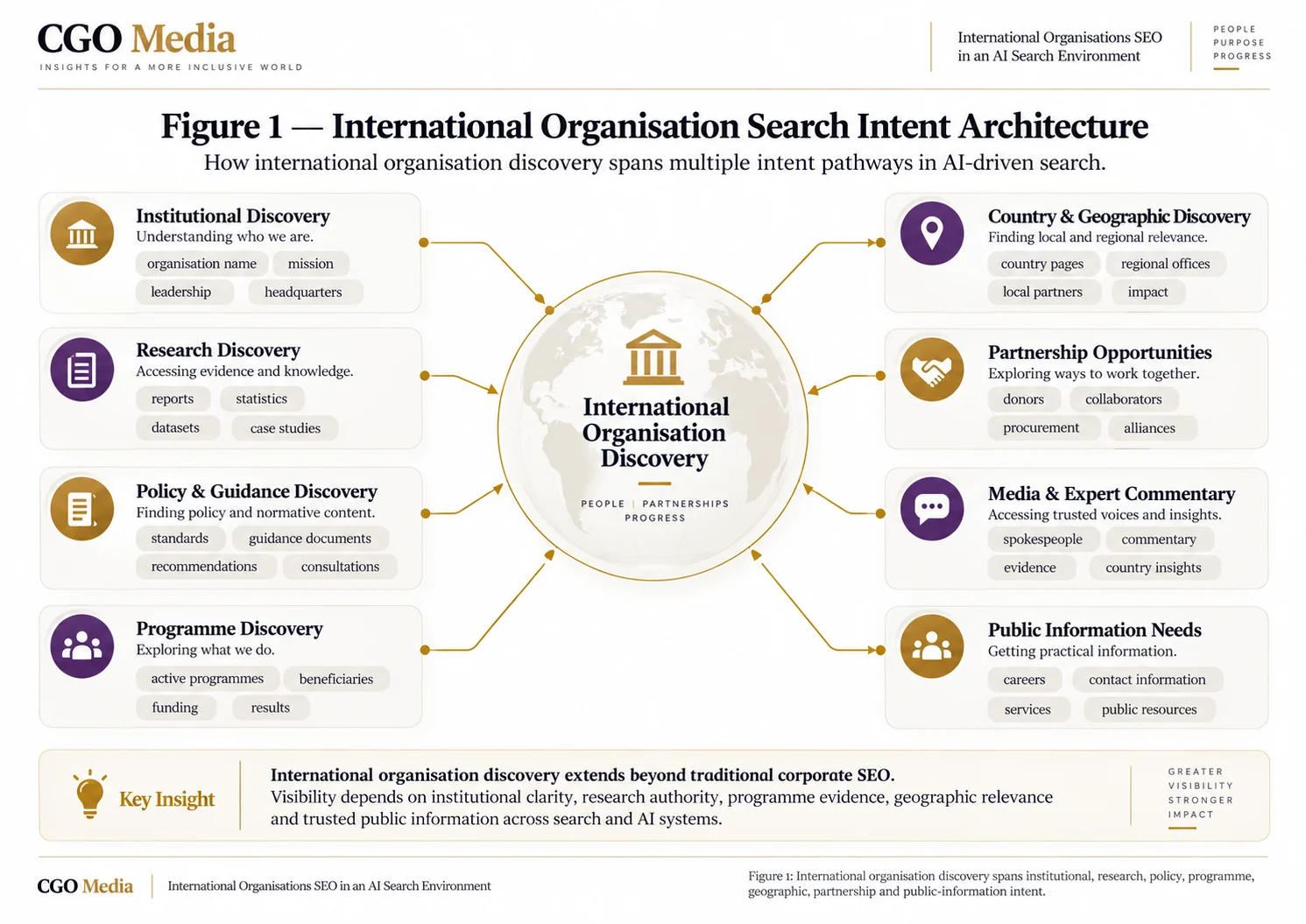
International organisation discovery can begin through multiple stakeholder needs. The Search Intent Architecture connects those discovery routes with the institutional evidence required to satisfy them.
Institutional Discovery
Users seek to understand what the organisation is, its mission, mandate, leadership, governance, geographic scope and institutional role.
Research Discovery
Researchers, policy professionals and other users seek reports, statistics, datasets, methodologies, evidence and original analysis.
Policy & Standards Discovery
Users seek policy guidance, recommendations, standards, frameworks, consultation documents and authoritative institutional positions.
Programme Discovery
Stakeholders seek programmes, initiatives, implementation evidence, funding information, programme results and operational opportunities.
Geographic Discovery
Users seek country offices, regional activity, local programmes, country evidence, partners, statistics and local institutional presence.
Partnership & Funding Discovery
Governments, NGOs, companies, researchers and other institutions seek collaboration, grant, funding, procurement or partnership pathways.
Media & Expert Discovery
Journalists and analysts seek credible statistics, research, experts, spokespeople, commentary and evidence relating to current issues.
Public Information Discovery
Users seek offices, contact details, careers, leadership information, governance resources, organisational history and other practical institutional information.
Search architecture implication: International organisations should not design their search presence around one branded customer journey. Their digital architecture must connect institutional, geographic, programme, research, policy, expert and public-information intent so users can enter through one discovery route and reach the wider evidence needed to understand the organisation.
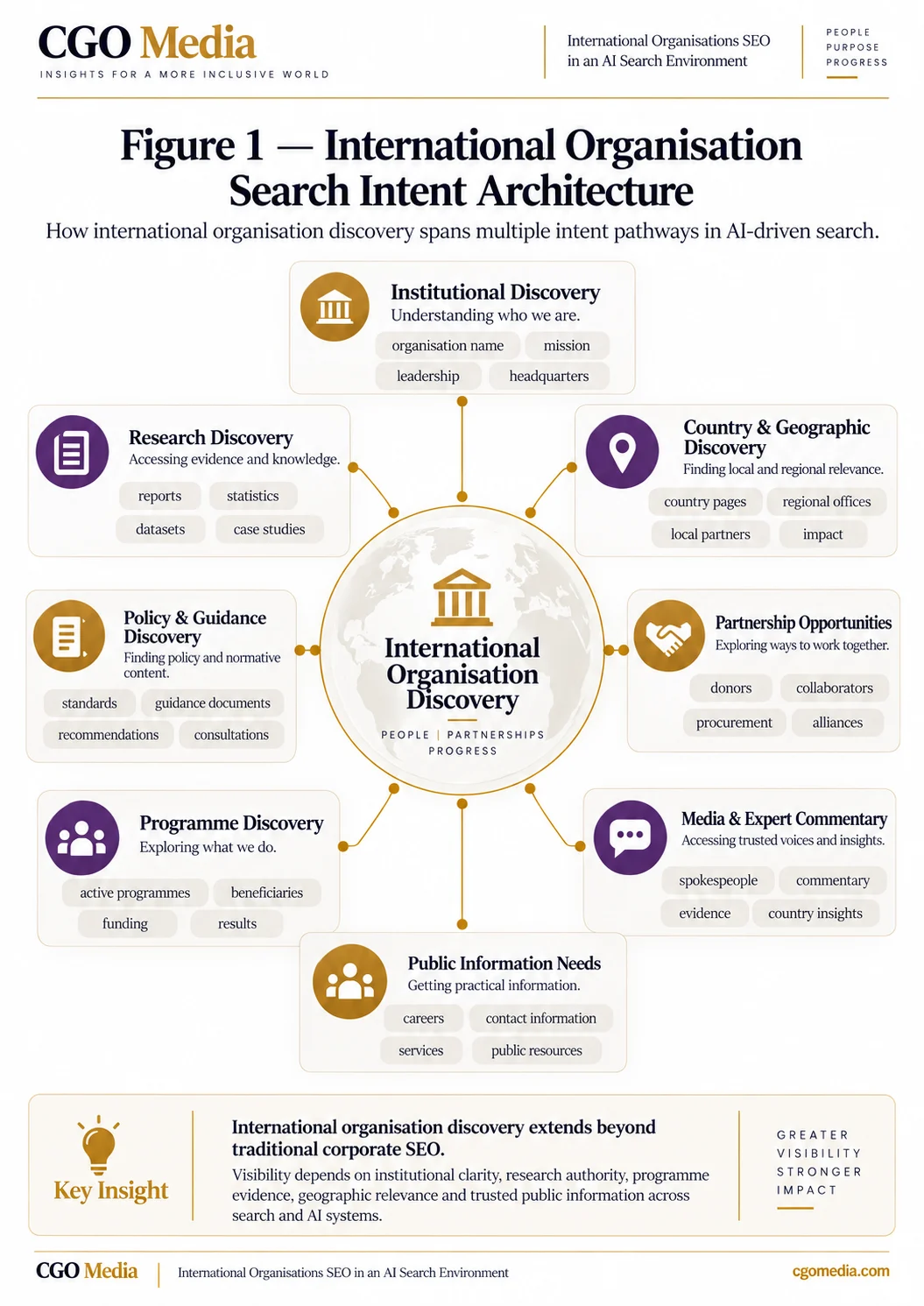
Figure 1. International organisation discovery spans institutional, research, policy, programme, geographic, partnership, media and public-information intent, requiring a broader search architecture than conventional corporate SEO.
17. Multilingual Search Architecture
Multilingual Search Architecture is one of the most important structural requirements for international organisations because language affects far more than page translation.
A multilingual institution may need to communicate the same mission, programme, policy, research resource or statistical evidence to audiences using different languages while preserving consistent institutional meaning.
This creates several simultaneous requirements.
Search engines need to understand which pages represent equivalent or closely related language versions.
Users need to understand whether the information they are reading is current and authoritative.
Editors need to know which language version is the primary source and how updates should propagate.
AI systems may need to identify equivalent institutional evidence across languages when generating answers.
A mature multilingual architecture should therefore consider:
- language-specific URLs;
- regional language variants;
- hreflang relationships;
- canonical relationships;
- navigation consistency;
- translation quality;
- terminology governance;
- content freshness;
- localisation;
- and equivalent-page maintenance.
These components need to operate together.
Correct hreflang implementation cannot compensate fully for outdated translated content.
High-quality translation cannot compensate for an architecture in which users cannot move between equivalent pages.
Consistent navigation cannot resolve situations where translated pages contain materially different institutional facts.
Multilingual SEO therefore needs to be understood as an information-governance problem as well as a technical search problem.
International organisations should also distinguish between content that requires strict equivalence and content that requires local adaptation.
Governance information, leadership, programme status and institutional facts may require particularly strong consistency.
Other resources may need localisation to account for country-specific policy environments, terminology, examples or stakeholder needs.
The objective is not to make every language environment identical.
It is to preserve institutional accuracy while allowing appropriate local relevance.
18. Multiregional Architecture
Multiregional architecture addresses a different problem from multilingual architecture.
An international organisation may operate within many countries that share a language, and one country may itself require several languages.
Geography and language therefore need to be modelled as separate dimensions.
A useful high-level structure may resemble:
Global Organisation → Region → Country → Programme → Resource
This representation provides a conceptual pathway rather than a rigid URL structure.
The important principle is that geographic relationships should remain understandable.
A user reaching a programme should be able to determine where it operates.
A user reaching a country page should be able to identify relevant programmes and evidence.
A regional page should clarify which countries and initiatives sit within its scope.
The global institution should remain visibly connected with all of these environments.
Multiregional architecture can become difficult where different countries have developed separate websites over many years.
Common complications include:
- country-specific domains;
- subdomains;
- subdirectories;
- independent content-management systems;
- separate editorial teams;
- different navigation structures;
- inconsistent programme naming;
- and duplicated global content.
No single technical structure is appropriate for every institution.
The search objective is to ensure that whatever technical model is chosen supports clear relationships between the global organisation and its regional and national environments.
This also means avoiding unnecessary duplication.
A country page should provide local institutional value rather than reproducing generic global text simply because a country URL is required.
19. Country and Language Are Different Dimensions
A common weakness in international website architecture is the assumption that each country corresponds neatly to one language and each language corresponds neatly to one country.
Real international environments are more complex.
English may serve audiences across dozens of countries.
Spanish can serve audiences across Europe, Latin America and other markets.
French can be relevant across several continents.
Individual countries may also use several official or widely used languages.
International organisations should therefore avoid treating country targeting and language targeting as interchangeable.
The distinction affects:
- URL architecture;
- hreflang;
- content strategy;
- localisation;
- country evidence;
- regional terminology;
- and measurement.
A French-language resource intended for multiple countries may require a different information strategy from a France-specific institutional page.
Likewise, an English-language country page for Kenya may require very different evidence from an English-language country page for Canada.
The language may be the same, but geographic intent is different.
Mature international architecture therefore models both dimensions explicitly:
Language answers: “In which language should this information be understood?”
Geography answers: “To which country or region is this information institutionally relevant?”
20. International Knowledge Architecture
Knowledge Architecture provides the structure through which institutional information becomes connected rather than existing as independent pages and documents.
For an international organisation, a useful conceptual model may connect:
Organisation → Mission → Programme → Region → Country → Research → Evidence → Impact
This sequence illustrates the way institutional knowledge can reinforce authority across multiple dimensions.
The organisation establishes the parent identity.
The mission establishes the institutional purpose.
Programmes demonstrate how that purpose is translated into activity.
Regions and countries establish geographic relevance.
Research provides supporting knowledge.
Evidence helps validate claims.
Impact demonstrates outcomes.
These relationships need not exist in a single navigation path.
They can be reinforced through:
- internal linking;
- taxonomies;
- metadata;
- structured data;
- related-content systems;
- expert profiles;
- country hubs;
- programme hubs;
- and research architecture.
The key point is that important institutional resources should not remain semantically isolated.
An international organisation may publish excellent research, run important programmes and maintain strong country operations, yet search systems may fail to associate these assets effectively if their relationships remain implicit.
Knowledge Architecture makes those relationships more explicit.
21. Research Entity Architecture
Research resources should be treated as distinct institutional entities with clear provenance and relationships.
A research asset may need to establish:
- title;
- author;
- publishing organisation;
- research programme;
- publication date;
- subject;
- geography;
- supporting data;
- methodology;
- version;
- and related publications.
These signals improve discoverability and make the research easier to interpret.
A publication should not depend solely on a PDF filename to communicate its identity.
Where appropriate, significant research should have an HTML environment that explains what the resource is, who produced it, when it was published and what evidence it contains.
This can also help distinguish between:
- research papers;
- working papers;
- policy briefs;
- datasets;
- methodology documents;
- annual reports;
- evaluation reports;
- and statistical updates.
Clear research architecture becomes increasingly important when institutional libraries contain thousands of publications.
Without strong entity relationships, older resources can become difficult to distinguish from current evidence and subject expertise can become fragmented across many disconnected documents.
A mature research architecture therefore helps establish both individual publication authority and wider institutional Knowledge Authority.
22. Statistical Authority
Statistics can become some of the most powerful authority assets produced by international organisations.
Governments, journalists, academics, businesses and members of the public may all rely on institutional statistics to understand global or regional conditions.
Statistical Authority depends on more than publishing numbers.
Useful statistical resources should make clear:
- what is being measured;
- the relevant geography;
- the relevant period;
- the methodology;
- the source;
- the publication or update date;
- any known limitations;
- and how historical values should be interpreted.
Statistics should also remain citable.
A user should ideally be able to reference the institutional source rather than relying on screenshots, secondary summaries or unattributed reproductions.
Machine-readable formats can strengthen utility where appropriate because researchers and data users may need to work directly with the underlying information.
Historical maintenance is also important.
Removing older datasets whenever new figures are released can undermine research reproducibility and create broken citations.
A stronger system preserves historical context while making the current data state clear.
Statistical Authority therefore combines methodological transparency, accessibility, freshness, provenance and long-term information management.
23. Policy and Standards Authority
Policy resources, standards and guidance can create durable Search Authority because they may remain relevant long after their initial publication.
Users may search specifically for:
- international standards;
- policy recommendations;
- implementation guidance;
- codes of practice;
- technical protocols;
- consultation documents;
- and formal institutional frameworks.
These resources can accumulate external citations over time.
Governments may reference them.
Professional organisations may adopt them.
Academic papers may cite them.
Media organisations may use them as authoritative context.
This can generate strong long-term authority signals.
However, policy and standards resources require particularly careful lifecycle management.
Users need to know whether a document is:
- current;
- draft;
- superseded;
- withdrawn;
- historical;
- or under consultation.
Search systems should also be given sufficient signals to identify the current authoritative version where appropriate.
The issuing organisation should remain clear throughout the resource environment.
Policy Authority is therefore strengthened when technical accessibility, versioning and institutional provenance operate together.
24. Institutional Trust
International organisations frequently operate in information environments where users need to establish institutional credibility before relying on research, joining a programme, entering a partnership or citing a resource.
Trust can therefore influence search performance indirectly by shaping how users and external institutions interact with the organisation’s evidence.
Relevant institutional trust signals may include:
- governance;
- leadership;
- funding transparency;
- annual reports;
- audit information;
- impact reporting;
- methodology;
- legal status;
- accountability policies;
- and institutional history.
The presence of these resources helps audiences determine whether claims can be verified.
Trust becomes especially important in AI-assisted environments because generative systems may combine information from first-party and third-party sources.
Where first-party institutional information is incomplete, outdated or ambiguous, external sources can have greater influence over how the organisation is represented.
International organisations should therefore treat institutional transparency as part of the wider search evidence environment.
25. Governance Transparency
Governance information provides context around how an organisation is structured, controlled and held accountable.
Depending on institutional type, relevant information may include:
- governing bodies;
- board membership;
- member states;
- trustees;
- executive leadership;
- committee structures;
- oversight mechanisms;
- institutional policies;
- and legal status.
Governance transparency can strengthen institutional understanding because it clarifies relationships between the organisation and the people or bodies responsible for its decisions.
This information should remain current.
Outdated leadership or governance information can create contradictory entity signals across the web.
Where governance changes occur, organisations should consider the wider set of pages and structured information that may require updating.
26. Funding Transparency
Funding information can be important to users evaluating international organisations, programmes or partnerships.
The level of disclosure appropriate to an institution will vary, but relevant information may include:
- funding sources;
- donor relationships;
- programme funding;
- grant structures;
- financial reporting;
- annual accounts;
- and funding allocation where appropriate.
Transparency can help users understand the institutional context behind programmes and research.
It can also reduce ambiguity when multiple organisations participate in a programme.
A programme page that identifies implementing organisations, funders and strategic partners can provide substantially greater institutional clarity than one that lists organisations without explaining their roles.
Funding information should therefore be treated as part of programme and institutional context rather than as isolated financial documentation.
27. Leadership Authority
Leadership profiles can contribute to institutional Entity Authority by establishing clear relationships between individuals, roles and organisational responsibilities.
A leadership profile may include:
- full name;
- official role;
- biography;
- areas of responsibility;
- regional or programme responsibilities;
- appointment information where relevant;
- institutional history;
- and recognised external professional profiles.
Leadership information should be maintained carefully because outdated role descriptions can propagate across search results, media databases and AI-generated responses.
Where a senior leader changes, the organisation may need to review more than the biography itself.
Relevant structured data, governance pages, programme pages, media resources and country pages may also contain the old information.
Leadership Authority therefore depends on accuracy as much as visibility.
28. Expert Authority
Researchers, programme specialists, technical experts and policy professionals can become important authority entities independently of senior leadership.
A journalist searching for expertise on climate adaptation may care far more about a subject specialist than the organisation’s chief executive.
An academic researcher may seek the author of a particular institutional report.
A government official may need to identify the specialist responsible for a standard or programme.
Expert pages can therefore connect:
- biography;
- expertise;
- research;
- media commentary;
- programmes;
- publications;
- countries or regions;
- and institutional role.
The objective is not to create biographies for every employee.
It is to represent individuals whose expertise forms a meaningful part of the organisation’s public Knowledge Authority.
Expert Authority can also reinforce institutional authority in both directions.
The organisation provides context and legitimacy around the expert.
The expert’s research, citations, external commentary and recognised specialist knowledge strengthen the institution’s authority in relevant subjects.
29. External Citation Authority
International organisations often accumulate authority through independent references from third parties.
These references can include citations from:
- academic research;
- governments;
- universities;
- think tanks;
- policy institutions;
- news organisations;
- partner organisations;
- industry bodies;
- and other international institutions.
External citations matter because they demonstrate that the organisation’s work is being recognised and used beyond its own digital properties.
Not every external reference carries the same meaning.
A government citing an institutional methodology provides different evidence from a newspaper mentioning an executive.
A university referencing a dataset provides different evidence from a partner linking to a programme.
The organisation should therefore consider both the quantity and context of its external citations.
A stronger authority strategy asks:
- Which publications are being cited?
- Which subjects receive external recognition?
- Which countries receive institutional validation?
- Which experts are referenced?
- Which programmes receive independent evidence?
- Which sources repeatedly describe the organisation?
This turns citation monitoring into institutional authority intelligence.
30. Academic Authority
Academic citations can provide particularly durable validation for organisations that publish original research, datasets or methodologies.
A report that is repeatedly cited by scholars can develop authority beyond its original publication cycle.
Academic recognition may also identify areas in which institutional knowledge has become particularly influential.
Organisations can strengthen academic discoverability by ensuring that research includes clear:
- titles;
- authors;
- publication dates;
- institutional attribution;
- methodologies;
- persistent URLs;
- citation information;
- and related datasets where relevant.
The objective should not be to manipulate academic citation.
It is to make legitimate institutional research sufficiently clear and accessible that researchers can identify, evaluate and reference it properly.
Academic Authority can then reinforce broader search and AI visibility when scholarly sources themselves become part of the wider evidence ecosystem surrounding the organisation.
31. Government and Policy Citations
Government and policy citations can provide strong evidence of institutional relevance where an organisation’s research, statistics, standards or guidance are used within public-sector decision environments.
Examples may include:
- government reports;
- parliamentary papers;
- departmental guidance;
- regulatory documents;
- public consultations;
- national strategies;
- and policy frameworks.
These citations can reinforce the relationship between the organisation and particular areas of expertise.
They may also provide geographically specific validation.
For example, references from national institutions can support evidence that an international organisation is genuinely relevant within that country’s policy environment.
Monitoring government and policy references can therefore help organisations understand where institutional knowledge is influencing decision-making outside their own websites.
32. Media Authority
Media coverage can reinforce organisational authority when journalists consistently associate the institution with relevant evidence or expertise.
This may include:
- citations of research;
- use of statistics;
- expert interviews;
- programme coverage;
- country commentary;
- and references to institutional analysis.
Media Authority is strongest when the coverage reflects areas in which the organisation genuinely possesses evidence and expertise.
Repeated association with a subject can strengthen the external context surrounding the institution.
However, media visibility should not be treated as a substitute for first-party authority.
The organisation’s own website should provide clear resources supporting the expertise being cited externally.
This creates a reinforcing cycle:
Institutional Evidence → Journalist Discovery → Independent Media Citation → Stronger External Authority → Greater Future Discoverability
33. Partnership Authority
Partnerships create another layer of international entity relationships.
International organisations frequently collaborate with:
- governments;
- universities;
- NGOs;
- foundations;
- businesses;
- research institutes;
- professional associations;
- and other international organisations.
These relationships can strengthen authority when they are represented accurately by participating institutions.
A programme involving several partners should make clear which organisation is responsible for which role.
This reduces ambiguity and provides stronger corroboration across independent domains.
Partnership Authority therefore does not arise merely because logos appear together on a page.
It develops when external organisations provide consistent evidence of a meaningful institutional relationship.
34. AI Search and International Organisations
AI-assisted search introduces a significant change in how users can discover international organisations.
Instead of searching manually across many websites, users can ask systems to synthesise information about:
- which organisations work on a particular issue;
- which institutions publish relevant data;
- which programmes operate in a specific country;
- which sources provide credible statistics;
- which organisations are relevant to a policy question;
- or which institution could provide expertise on a subject.
This creates substantial opportunity.
An organisation with strong institutional evidence may be surfaced in discovery journeys even when the user did not know its name beforehand.
It also creates risk.
AI systems can produce incomplete, outdated or incorrect representations.
They can confuse similarly named organisations, miss current programmes, attribute outdated leadership or rely on secondary sources that no longer reflect institutional reality.
International organisations therefore need to understand AI visibility as an extension of the wider information environment rather than as a completely separate marketing channel.
35. AI-Assisted Research Discovery
Research discovery is one of the clearest areas in which AI systems can influence institutional visibility.
Users may ask AI systems to identify:
- research reports;
- statistical sources;
- policy guidance;
- relevant institutions;
- international programmes;
- datasets;
- or subject experts.
The organisation may therefore gain visibility through a specific research asset rather than through a general institutional description.
Research resources are better positioned for this environment when they are:
- clearly titled;
- accessible;
- well attributed;
- methodologically transparent;
- current where freshness matters;
- connected with relevant subjects and geographies;
- and independently referenced.
This does not guarantee selection by any particular AI system.
It creates a stronger evidence environment from which systems can identify and evaluate the resource.
36. AI-Assisted Organisation Discovery
AI systems can also function as institutional discovery layers.
A user may ask:
“Which international organisations publish reliable data on global education?”
Or:
“Which organisations operate climate adaptation programmes in East Africa?”
Or:
“Which international bodies publish standards for this sector?”
These questions require systems to identify organisations by relevance rather than simply retrieve pages containing exact keywords.
This increases the importance of clear evidence connecting the institution with:
- subjects;
- countries;
- programmes;
- research;
- experts;
- and external validation.
Organisation discovery therefore depends increasingly on the strength of the entire institutional evidence ecosystem.
37. AI Source Selection
International organisations can become source candidates when they provide evidence that is sufficiently accessible, relevant and authoritative for a particular information need.
Potential source assets can include:
- research papers;
- datasets;
- statistics;
- programme evidence;
- policy resources;
- methodologies;
- standards;
- expert material;
- and institutional information.
Source selection should not be interpreted as a simple consequence of domain authority.
Relevance, clarity, freshness, evidence quality, accessibility and external corroboration can all affect the usefulness of a source within a particular context.
The organisation should therefore focus on making high-value institutional evidence genuinely useful and interpretable rather than attempting to optimise superficially for citation.
38. AI Citation Authority
Where AI interfaces provide citations or source links, international organisations may gain direct visibility through the resources used to support generated answers.
Potential citation assets include:
- original research;
- statistical resources;
- policy reports;
- standards;
- programme evidence;
- methodologies;
- and authoritative institutional guidance.
Citation visibility differs from ordinary ranking visibility.
A resource might be selected as supporting evidence for a generated answer even where the user did not explicitly search for the publication title.
This creates a new reason to strengthen publication clarity, provenance and evidence quality.
AI Citation Authority also reinforces the need to maintain durable URLs and publication context.
If an important report is replaced by an inaccessible file or removed without appropriate archival handling, citations can break and institutional evidence can become harder to verify.
39. AI Representation Accuracy
International organisations should monitor whether AI systems represent the institution accurately.
Important factual areas include:
- mission;
- leadership;
- geographic scope;
- programmes;
- research;
- current statistics;
- institutional status;
- and important partnerships.
Accuracy monitoring is particularly important where information changes frequently.
Leadership, programme status, funding relationships and country activity can all change more quickly than older third-party sources are updated.
If AI systems consistently reproduce outdated information, the organisation should investigate the wider evidence environment.
Possible causes may include:
- outdated first-party pages;
- contradictory institutional descriptions;
- old external sources;
- unclear programme lifecycle information;
- or insufficiently prominent current evidence.
Monitoring should therefore focus not only on whether the organisation appears but on whether the representation is accurate enough to be useful.
40. International AI Recommendation Readiness
Recommendation readiness describes whether the wider evidence environment provides enough information for an AI system to identify the institution as relevant to a particular scenario.
This should not be reduced to one page or one optimisation technique.
Recommendation readiness may depend on a combination of:
- clear organisational identity;
- demonstrated subject expertise;
- country relevance;
- programme evidence;
- research authority;
- trust evidence;
- external citations;
- current information;
- and sufficient source convergence.
For example, a user asking for organisations with expertise in food security in a particular region may trigger an evaluation involving multiple dimensions.
The system may need evidence that the organisation works on food security, that it operates within the relevant geography, that it has active programmes, that credible research exists and that external institutions recognise its work.
Recommendation readiness therefore emerges from the combined institutional evidence ecosystem.
41. The International Organisation Digital Evidence Ecosystem
International Search Authority is distributed across a much wider environment than the organisation’s own website.
Owned digital properties remain central because they provide the institution’s primary representation of its identity, programmes, research and governance.
However, external sources can independently reinforce or challenge that representation.
The wider evidence ecosystem may include:
- owned websites;
- country websites and offices;
- programme environments;
- research repositories;
- government references;
- academic citations;
- media coverage;
- partner organisations;
- policy documents;
- professional databases;
- and AI citations.
These sources create a distributed institutional evidence network.
An organisation may describe itself as active within a country.
A government partner may independently reference the programme.
A university may cite the related research.
A journalist may quote an institutional expert.
An AI system may then encounter several converging sources supporting the same broad interpretation of institutional authority.
This concept of evidence convergence is important.
Authority becomes stronger when independent sources reinforce accurate first-party information.
Conversely, authority becomes more difficult to interpret when first-party and third-party sources conflict.
The organisation therefore cannot control the complete evidence ecosystem.
It can, however, improve the clarity and reliability of the evidence it publishes, monitor important external representations and ensure that genuine institutional relationships are visible.
The strategic objective is not to manufacture artificial consensus.
It is to ensure that the organisation’s real-world activity, knowledge and authority are represented through sufficiently strong evidence that independent discovery systems can understand them accurately.
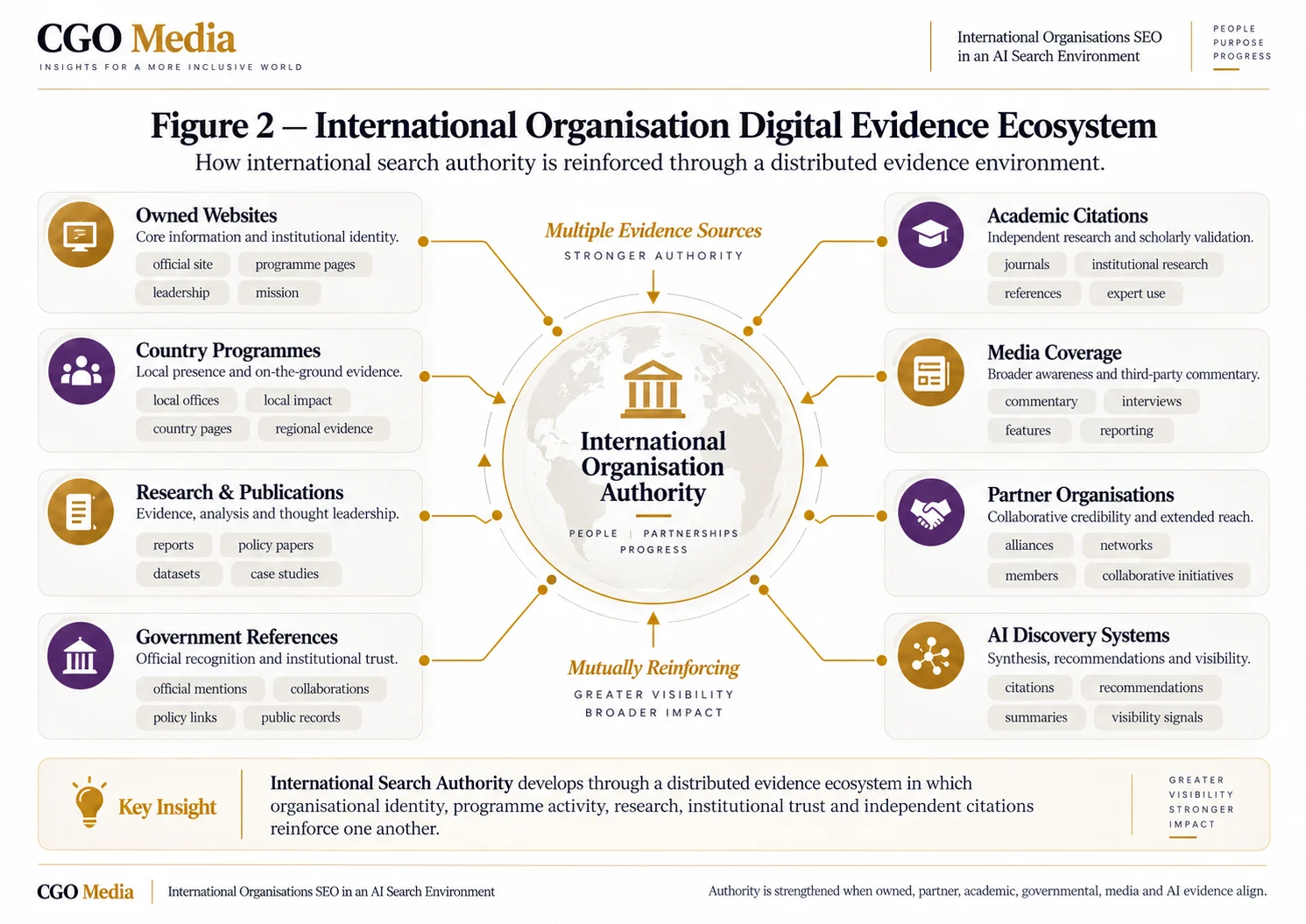
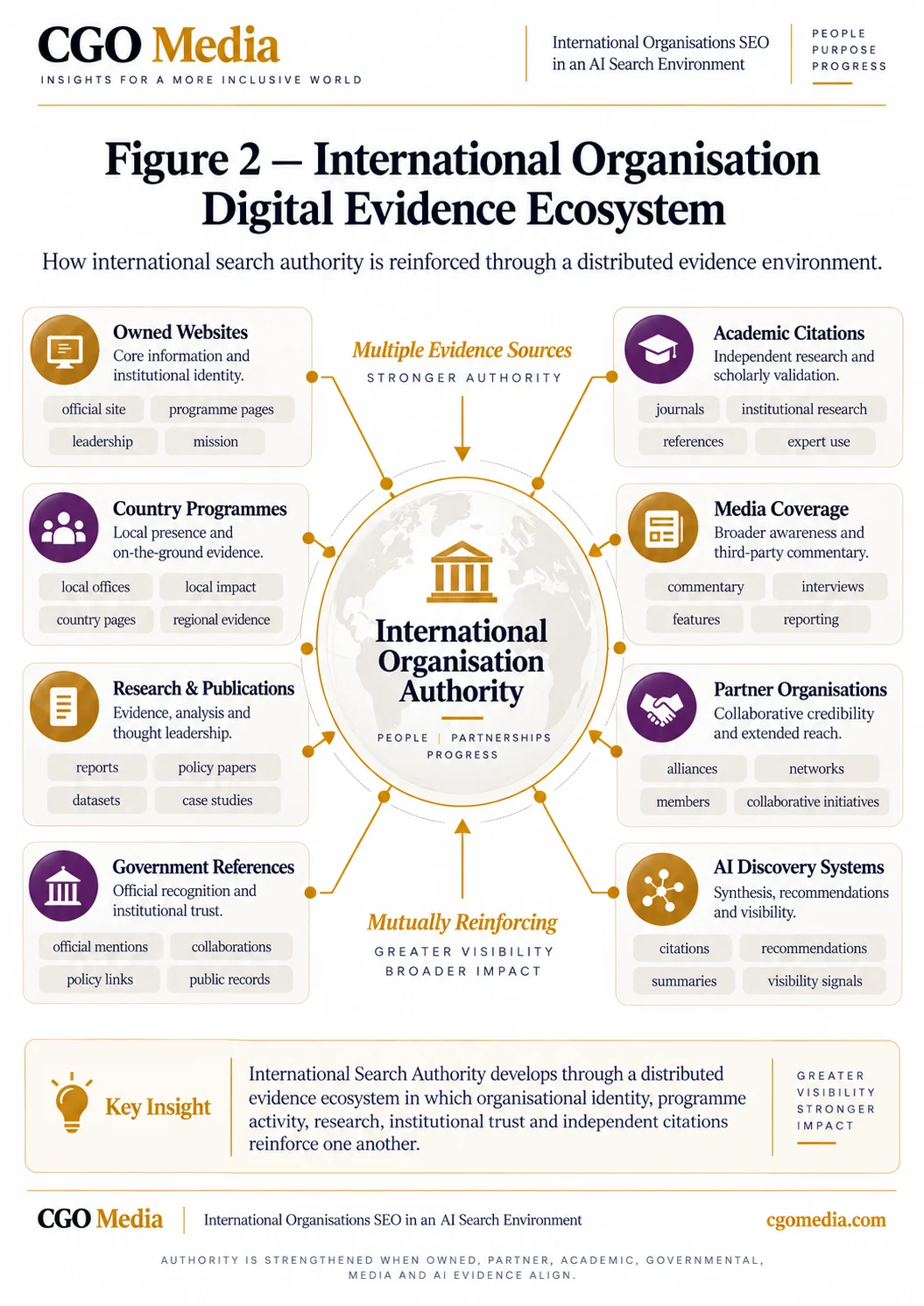
International Search Authority develops through a distributed evidence ecosystem in which first-party institutional information and independent third-party references reinforce organisational identity, programme activity, research authority, geographic relevance and trust.
Owned Institutional Websites
Primary organisational websites provide authoritative information about mission, governance, leadership, programmes, research, policy resources and institutional identity.
Country & Regional Evidence
Country offices, regional hubs and local programme environments establish geographic relevance and demonstrate where institutional activity occurs.
Programme Evidence
Programme pages, evaluations, outcomes and implementation resources provide operational evidence connecting institutional mission with real-world activity.
Research & Data
Research papers, datasets, statistics, methodologies, standards and policy resources establish institutional knowledge and subject authority.
Government & Policy References
Government citations, policy documents and public-sector references provide independent evidence of institutional relevance and knowledge use.
Academic Authority
Universities, researchers and scholarly publications reinforce the authority of institutional research, datasets, methodologies and experts through independent citation.
Media Authority
Credible media coverage can reinforce subject expertise, research visibility, programme recognition and expert authority.
Partner Organisations
Institutional partners provide corroborating evidence of programmes, collaborations, geographic activity and shared objectives.
AI Discovery & Citations
AI-assisted discovery environments may surface, synthesise, cite or recommend institutional evidence drawn from first-party and third-party sources.
Evidence ecosystem principle: International Search Authority becomes stronger when accurate first-party institutional information is reinforced by credible independent sources. Search and AI visibility should therefore be understood as an ecosystem outcome rather than the product of one website, one page or one optimisation tactic.
Figure 2. International Search Authority develops through a distributed evidence ecosystem in which organisational identity, programme activity, research, institutional trust and independent citations reinforce one another across owned, institutional and AI-assisted discovery environments.
42. International Organisation Discovery as a Decision System
International organisation discovery frequently involves more than finding the name or website of an institution.
Users may be trying to determine which organisation is most relevant to a particular problem, geography, programme requirement, policy objective, research need, funding opportunity or partnership scenario.
This means international search can operate as a decision system.
The search process may begin with a broad question such as:
Which organisations work on climate adaptation?
It may then become progressively more specific:
Which international organisations work on climate adaptation in East Africa?
The user may then need to know:
- which organisations operate relevant programmes;
- whether they possess credible research;
- whether they have current activity in the required countries;
- whether governments or other institutions recognise their work;
- whether their programme model fits the user’s objective;
- and whether a practical route to engagement exists.
Search visibility therefore does not end when the organisation is discovered.
Discovery can represent only the first stage in a much longer selection process.
International organisations should consequently design their digital evidence environment not only to answer:
“Can people find us?”
but also:
“Can people determine whether we are relevant, credible and appropriate for the specific outcome they need?”
This distinction becomes increasingly important in AI-assisted discovery because generative systems can compress several stages of research into a single interaction.
A system may identify candidate organisations, compare them, summarise programmes and provide supporting sources before the user visits any individual institutional website.
The underlying evidence required for selection therefore becomes strategically important.
43. The International Discovery Requirement Stack
A useful way to understand international organisation selection is through a progressive requirement stack:
Need → Subject → Geography → Organisation Type → Programme → Evidence → Trust → Engagement
Each layer narrows the field.
At the Need stage, the user defines the underlying objective.
At the Subject stage, that need becomes associated with an issue such as education, health, economic development, climate, humanitarian response or standards.
At the Geography stage, the user may determine whether the requirement is global, regional, national or local.
At the Organisation Type stage, certain institutional forms may become more appropriate than others.
At the Programme stage, the user evaluates whether relevant operational activity actually exists.
At the Evidence stage, the user looks for research, statistics, results, evaluations, standards or documented impact.
At the Trust stage, governance, track record, transparency and independent validation become important.
Finally, at the Engagement stage, the user needs a practical route to the intended outcome.
This model explains why high organic visibility alone may not result in meaningful stakeholder engagement.
An organisation can be visible at the beginning of the journey but fall out of consideration because programme fit, evidence quality or trust information is insufficient.
44. Issue Definition
The selection journey often begins with the issue rather than the institution.
A stakeholder may be trying to address:
- global health;
- climate adaptation;
- education access;
- trade development;
- humanitarian response;
- migration;
- international standards;
- food security;
- economic development;
- digital inclusion;
- environmental protection;
- or another transnational challenge.
This means international organisations need to be discoverable around the subjects in which they genuinely operate.
Subject relevance should be demonstrated through evidence rather than keyword repetition.
Strong subject authority may include:
- active programmes;
- research;
- specialist teams;
- statistics;
- policy publications;
- standards;
- external citations;
- and long-term institutional activity.
The organisation should therefore make clear not only that it discusses an issue but that it possesses sustained institutional expertise and activity within that issue.
45. Geographic Definition
Many international discovery journeys become geographically constrained.
A user may require an organisation operating at:
- global level;
- regional level;
- country level;
- city level;
- or across a specific cross-border area.
Geographic relevance can substantially change the viable institutional set.
An organisation may possess world-class expertise but lack operational presence in the country required by the user.
Another organisation may possess a smaller global profile but have deep regional experience and strong local partnerships.
Geographic Search Authority should therefore demonstrate more than the existence of a country page.
Useful evidence may include:
- country offices;
- active programmes;
- local research;
- government relationships;
- institutional partners;
- country statistics;
- local experts;
- and documented impact.
The strength of this evidence can influence whether the organisation remains relevant as the user’s geographic requirements become more specific.
46. Organisation-Type Definition
Different objectives may require different types of institution.
Relevant categories may include:
- intergovernmental organisations;
- international NGOs;
- development agencies;
- foundations;
- standards bodies;
- research institutions;
- membership organisations;
- international associations;
- multilateral institutions;
- and specialist technical organisations.
Institutional type can affect mandate, funding, legitimacy, governance and the kinds of outcomes an organisation can realistically support.
For example, a standards body may possess exceptional technical authority but not operate field programmes.
A humanitarian NGO may possess operational expertise but not have a formal intergovernmental mandate.
A research institution may provide high-quality evidence while lacking implementation capacity.
Search architecture should therefore help users understand what kind of organisation they are evaluating.
Entity clarity becomes essential at this stage because institutional labels can otherwise be ambiguous.
47. Programme Fit
An organisation can be highly relevant to a subject yet still be unsuitable if it does not operate the right programme for the user’s specific requirement.
Programme Fit asks whether there is an operational mechanism connecting institutional expertise with the user’s intended outcome.
A programme should provide sufficient evidence around:
- purpose;
- scope;
- geography;
- beneficiaries;
- programme status;
- partners;
- funding where relevant;
- implementation model;
- outputs;
- and results.
This distinction matters because broad mission statements can create apparent relevance without demonstrating current operational capability.
Programme Fit provides evidence that the institution’s stated expertise is being translated into actual activity.
48. Evidence Fit
Different stakeholders require different forms of evidence.
A researcher may require a dataset.
A government department may require policy guidance.
A donor may require programme evaluations.
A journalist may require recent statistics.
A technical organisation may require a current standard or methodology.
Evidence Fit therefore examines whether the institution produces the type of evidence necessary for the particular discovery scenario.
Relevant evidence may include:
- research papers;
- statistics;
- datasets;
- standards;
- policy guidance;
- programme evaluations;
- funding information;
- implementation evidence;
- case studies;
- impact analysis;
- and methodological documentation.
The strongest international organisations do not merely possess evidence.
They make it discoverable, interpretable, attributable and current enough for the stakeholder to use.
49. Trust Fit
Institutional relevance does not automatically create trust.
Before engaging, stakeholders may evaluate whether an organisation demonstrates sufficient governance, transparency and independent recognition.
Trust Fit can depend on visible evidence relating to:
- governance;
- leadership;
- funding transparency;
- financial reporting;
- institutional history;
- expertise;
- track record;
- methodology;
- impact;
- and independent recognition.
The relative importance of each signal varies by institutional context.
A donor may place significant weight on financial reporting.
A researcher may prioritise methodology.
A government may place more weight on mandate, governance and official recognition.
Trust Fit is therefore contextual rather than universal.
50. Engagement Fit
The final stages of selection depend on whether the organisation provides a practical route to the user’s intended outcome.
Potential engagement routes may include:
- general contact;
- programme participation;
- partnership;
- membership;
- funding application;
- grant application;
- research access;
- procurement;
- expert contact;
- media enquiry;
- or programme referral.
An organisation may possess excellent authority and relevance but still lose potential engagement if users cannot determine how to proceed.
Engagement pathways should therefore be clear, current and connected with the appropriate institutional function.
This is particularly important where large organisations offer many different contact routes.
A generic contact form may not adequately serve a government, researcher, journalist, donor and programme participant simultaneously.
51. International Consideration Sets
International organisation discovery can be understood as a progressive narrowing process.
A useful sequence is:
Total Institutional Market → Discoverable Organisations → Relevant Organisations → Trusted Organisations → Validated Organisations → Shortlist → Selected Organisation
The Total Institutional Market includes all organisations that could theoretically address the broad subject.
The Discoverable Organisations are those visible through the search, research, media or AI channels used by the stakeholder.
The Relevant Organisations demonstrate sufficient subject and geographic fit.
The Trusted Organisations provide enough institutional evidence to support confidence.
The Validated Organisations are reinforced by independent evidence such as government, academic, media or partner references.
The Shortlist contains the small group of viable options remaining after these filters.
The final selection depends on the particular stakeholder objective.
This model shows why visibility alone should not be used as the sole performance measure.
Search strategy should also examine whether the evidence environment supports progression through later stages.
52. Discoverability Before Selection
An organisation cannot normally be considered if it is absent from the information channels used by the stakeholder.
This makes discoverability the first structural requirement.
Discoverability can occur through:
- traditional organic search;
- research databases;
- academic citations;
- media coverage;
- government references;
- partner websites;
- knowledge systems;
- and AI-assisted discovery.
Different channels may produce different candidate organisations.
An institution highly visible in branded search may be absent from non-branded research questions.
Another may appear frequently in academic literature but have limited general search visibility.
The objective should therefore be appropriate discoverability across the environments used by relevant audiences.
53. Relevance Before Preference
Visibility creates consideration but does not guarantee preference.
The organisation must demonstrate clear relevance to the user’s issue, geography and intended outcome.
This makes specificity important.
Generic statements such as “we work globally to create positive change” provide limited evidence when a stakeholder needs to know whether the institution operates a particular programme in a particular region.
Relevance becomes stronger when broad mission claims are supported by specific evidence.
Search and AI systems may also need this specificity when determining which organisations should appear in response to detailed questions.
54. Trust Before Engagement
For many international institutional relationships, trust is a prerequisite to engagement.
This is especially true where the user is considering:
- funding;
- partnership;
- policy reliance;
- research citation;
- programme participation;
- data use;
- or long-term institutional cooperation.
Trust should therefore be supported with verifiable evidence rather than purely promotional claims.
The organisation’s website should make important governance and authority information accessible enough that users can validate major institutional claims without unnecessary difficulty.
55. Programme Authority
Programme Authority can materially affect whether an organisation progresses from broad relevance into serious consideration.
Strong programme evidence may include:
- purpose;
- geographic scope;
- beneficiaries;
- partners;
- funding;
- delivery model;
- outputs;
- measured impact;
- evaluation;
- and related research.
This evidence demonstrates that the organisation has more than thematic interest in the subject.
It demonstrates operational experience.
Programme Authority becomes stronger when first-party descriptions are reinforced by credible third-party evidence.
56. Country Programme Authority
Country-level programme pages should connect local activity with the wider institutional mission.
Users need to understand both:
what the programme is doing locally
and:
how that activity relates to the organisation’s wider expertise and mandate.
Country programme authority can be strengthened through:
- local objectives;
- programme timelines;
- partners;
- country evidence;
- local results;
- country-specific research;
- government relationships;
- and relevant regional context.
This also reduces the risk that country pages become disconnected satellite environments.
57. Regional Programme Authority
Regional programmes can provide evidence that sits between global strategy and national implementation.
This is particularly important where:
- issues cross national borders;
- programmes operate across several countries;
- regional bodies are important partners;
- or evidence is most meaningful at regional scale.
Regional Programme Authority should therefore connect strategic purpose with participating countries, implementation evidence, research and relevant institutions.
This can strengthen discovery for users whose needs are broader than one country but more specific than a global programme.
58. Partnership Evidence
Partnership relationships can strengthen institutional credibility when partners independently confirm shared activity.
A strong partnership representation should clarify:
- which organisations participate;
- the role of each organisation;
- the programme or project involved;
- the geography;
- the objectives;
- and, where appropriate, the period of collaboration.
Independent partner references can provide valuable corroboration.
If both organisations describe the relationship consistently, users and machine systems have stronger evidence that the partnership is genuine and current.
Partnership evidence therefore contributes not only to programme information but also to external Entity Authority.
59. Impact Evidence
Impact claims can influence institutional selection, particularly for donors, governments and programme partners.
However, impact language needs sufficient supporting evidence.
Useful support may include:
- methodology;
- data;
- baseline measurements;
- programme outputs;
- case studies;
- independent evaluation;
- longitudinal evidence;
- and clear limitations.
There is an important distinction between activity and impact.
The number of workshops delivered or reports produced represents activity.
Evidence that conditions changed as a result requires a stronger evaluative basis.
International organisations should therefore avoid presenting output metrics as impact without appropriate methodological support.
Well-supported impact evidence can become an important search, trust and recommendation asset.
60. Research Evidence
Research can support selection when the organisation demonstrates sustained expertise in relevant subject areas.
A single report may provide useful evidence.
A coherent research programme can demonstrate deeper institutional authority.
Research Evidence becomes stronger when users can identify:
- publication history;
- named authors;
- methodologies;
- datasets;
- country or regional coverage;
- related programmes;
- external citations;
- and subsequent research development.
This creates an evidence trail around institutional expertise rather than leaving each publication isolated.
61. Statistical Evidence
Statistics can become a high-value discovery and selection asset when they are current, well documented and easy to cite.
Users may rely on international institutions specifically because they provide comparable cross-country or longitudinal data unavailable elsewhere.
Statistical evidence should therefore make clear:
- what is being measured;
- the date or period;
- the geography;
- the source;
- the methodology;
- revision history where relevant;
- and any important limitations.
Where possible, the organisation should also maintain stable reference points so statistics can be cited reliably.
Strong statistical infrastructure can increase both direct search visibility and indirect authority through downstream citations.
62. Policy Evidence
Policy publications can strengthen subject authority when they provide clear recommendations, frameworks, interpretation or institutional guidance.
Policy Evidence may be particularly important to:
- governments;
- regulators;
- professional bodies;
- international institutions;
- researchers;
- and organisations implementing policy programmes.
Authority increases where the policy resource is supported by research, expertise, consultation or programme experience.
The organisation should also make current status clear so users can distinguish current guidance from superseded positions.
63. Standards Evidence
Standards bodies and other organisations publishing formal technical requirements can develop substantial long-term authority.
However, standards information requires particularly careful management because users may need to distinguish between:
- current standards;
- previous editions;
- amendments;
- draft standards;
- consultation versions;
- and withdrawn material.
Useful standards architecture may include:
- clear versioning;
- publication dates;
- status;
- scope;
- technical explanations;
- related guidance;
- and stable institutional attribution.
Standards Evidence can become especially valuable because users often search for the technical requirement itself rather than the name of the organisation issuing it.
64. Institutional Validation
Users may validate international organisations through independent sources before engaging.
Potential validation sources include:
- government references;
- academic citations;
- media coverage;
- partner websites;
- donor references;
- regulatory or official listings;
- professional bodies;
- and other international organisations.
Independent validation can help answer questions that first-party content cannot answer alone.
For example:
Does another credible organisation recognise this programme?
Do researchers cite this institution’s evidence?
Do governments use its statistics?
Do programme partners independently describe the same activity?
Institutional validation therefore provides external context around first-party claims.
65. Branded Validation Search
Once users identify an organisation, they may conduct direct validation searches before progressing further.
Typical branded searches may include:
- organisation reviews;
- organisation funding;
- organisation leadership;
- organisation annual report;
- organisation criticism;
- organisation impact;
- organisation governance;
- organisation partners;
- and organisation controversies.
These queries demonstrate that discovery does not end when the brand becomes known.
The organisation enters a verification stage.
International institutions should therefore maintain sufficiently clear governance, reporting and evidence resources that legitimate stakeholder questions can be answered directly.
Trying to remove all critical information from the wider search environment is neither realistic nor desirable.
The more sustainable objective is to provide accurate first-party evidence and sufficient transparency for users to interpret external claims properly.
66. Reputation Validation
Reputation may be influenced by both positive and critical external evidence.
Strong institutional authority therefore requires transparency rather than purely promotional messaging.
Critical reporting, programme evaluations, academic disagreement and public scrutiny may all form part of the information environment around a significant international institution.
A mature organisation should distinguish between:
- factual criticism;
- legitimate methodological disagreement;
- outdated information;
- incorrect claims;
- and ordinary differences in institutional perspective.
Where material inaccuracies exist, clear current evidence can help reduce confusion.
Where criticism is legitimate, transparency and documented response can provide users with better context.
Reputation Authority therefore depends partly on how effectively the organisation manages verifiable information under conditions of scrutiny.
67. AI-Assisted Organisation Shortlisting
AI assistants can compress multiple discovery and validation stages into a single interaction.
A user may ask:
“Which international organisations publish reliable climate adaptation data for sub-Saharan Africa?”
That question implicitly requires several forms of assessment:
- subject relevance;
- geographic relevance;
- research capability;
- data quality;
- institutional type;
- source authority;
- and comparative suitability.
The user may then ask follow-up questions requesting:
- the strongest data sources;
- the most recent reports;
- country-level programmes;
- key experts;
- or comparisons between institutions.
AI-assisted shortlisting therefore increases the strategic importance of a coherent evidence environment.
The organisation may be evaluated before the user has ever viewed its website.
Strong first-party information, credible external validation and clear entity relationships become particularly important in this context.
68. AI-Assisted Programme Discovery
Users may also ask AI systems to identify specific forms of institutional activity.
Examples can include:
- funding programmes;
- research initiatives;
- country programmes;
- standards;
- membership opportunities;
- training programmes;
- technical-assistance initiatives;
- or partnership opportunities.
Programme discoverability requires more than strong organisation-level Entity Authority.
The individual programme itself must be represented clearly enough for systems to identify:
- its purpose;
- who operates it;
- where it applies;
- who it serves;
- its current status;
- and the evidence supporting it.
This strengthens the case for treating major programmes as explicit entities within the organisation’s Knowledge Architecture.
69. AI-Assisted Source Discovery
An international organisation may be surfaced in AI results because one of its publications is a strong source candidate for a broader question.
The user may not be searching for an institution at all.
They may ask:
“What are the latest global figures for youth unemployment?”
or:
“What evidence exists on the effect of drought on food security?”
A research report, dataset or statistical publication may provide the connection between the user’s question and the institution.
This means Source Authority can create Organisation Discovery.
The path becomes:
Question → Source → Institutional Attribution → Organisation Discovery
International organisations should therefore regard their strongest research and data assets as potential institutional discovery surfaces.
70. AI-Assisted Partner Discovery
Organisations may also be surfaced as potential partners based on subject expertise, geographic reach, programme history or institutional type.
A stakeholder may ask:
“Which organisations could partner on a regional digital-literacy programme in West Africa?”
Such a query may involve interpretation of:
- existing programmes;
- country operations;
- regional experience;
- subject expertise;
- institutional partnerships;
- operational capacity;
- and external credibility.
Partner discovery therefore depends heavily on evidence demonstrating actual institutional capability rather than generic mission language.
Strong partnership and programme documentation can help ensure the organisation’s real-world activity is visible within these discovery environments.
71. AI Source Selection in International Search
Source selection in AI-assisted international discovery can depend on several characteristics of the available evidence.
Potential factors include:
- Entity Clarity;
- Topical Authority;
- Evidence Quality;
- Freshness;
- independent citation;
- machine-readable structure;
- accessibility;
- specificity;
- and consistency with other credible sources.
These characteristics should not be interpreted as a confirmed proprietary ranking formula used by any particular AI system.
They represent practical information qualities that affect whether a source can be understood and used effectively.
For international organisations, strong source candidates often possess several advantages simultaneously.
They may contain original evidence, clear institutional attribution, strong subject relevance and independent external recognition.
The strongest strategic response is therefore to improve the underlying quality of institutional evidence rather than attempting to optimise superficially for one generative interface.
72. Source Competition
International organisations compete for information visibility with many other authoritative source types.
These can include:
- government websites;
- universities;
- think tanks;
- media organisations;
- commercial research companies;
- professional bodies;
- industry associations;
- and other international institutions.
The most appropriate source can vary by question.
A government may be the strongest source for official national legislation.
A university may provide specialist academic research.
A media organisation may provide current reporting.
An international institution may possess unique cross-country data or policy evidence.
International organisations should therefore understand where their information possesses genuine comparative value.
They do not need to become the leading source for every question within a broad subject.
They should make their distinctive evidence sufficiently clear that users and discovery systems can identify when the institution is particularly relevant.
73. First-Party Versus Third-Party Authority
First-party and third-party evidence perform different authority functions.
First-party evidence explains what the organisation says about itself.
It provides authoritative institutional information around:
- mission;
- programmes;
- leadership;
- research;
- statistics;
- governance;
- country activity;
- and official institutional positions.
Third-party evidence demonstrates how external institutions recognise, use, evaluate or describe that expertise.
Examples include:
- academic citations;
- government references;
- media citations;
- partner confirmation;
- policy references;
- and independent evaluations.
First-party evidence is essential because the organisation should remain the strongest source for many facts about itself.
Third-party evidence is important because institutional authority becomes more credible when relevant external sources independently reinforce genuine expertise and activity.
The two should not be treated as substitutes.
Strong external recognition cannot fully compensate for inaccurate first-party information.
Likewise, excellent first-party claims remain weaker if no credible external source recognises the organisation’s claimed expertise.
74. Institutional Authority Requires Both
The strongest international authority environments combine clear first-party information with substantial independent validation.
This creates an evidentiary relationship such as:
Institutional Claim + First-Party Evidence + Independent Validation = Stronger Authority Context
For example, an organisation may state that it possesses extensive expertise in global education.
First-party evidence might include:
- education programmes;
- country initiatives;
- research;
- statistical datasets;
- named experts;
- and policy resources.
Third-party evidence might include:
- government citations;
- academic references;
- media use of institutional statistics;
- partner confirmation;
- and policy-document citations.
When these sources converge, the institution has a stronger basis for discovery, validation and recommendation.
The same principle applies geographically.
An organisation’s country page may state that it operates programmes within a particular country.
The claim becomes stronger when local government institutions, universities, recognised partners or other authoritative sources independently reference that activity.
This does not mean organisations should attempt to manufacture external references.
Independent authority needs to emerge from genuine institutional work, useful evidence and real-world relationships.
The strategic role of Search Authority is to ensure that those genuine signals remain visible, connected and understandable.
International organisation selection can therefore be interpreted as the interaction between multiple evidence areas rather than a single ranking or reputation score.
Issue relevance determines whether the organisation belongs within the consideration set.
Geographic fit determines whether the institution can address the required context.
Programme and mission authority demonstrate practical alignment.
Research and evidence quality establish informational credibility.
Institutional trust reduces uncertainty.
External and policy authority provide independent validation.
Engagement suitability determines whether the stakeholder can translate interest into action.
Together, these dimensions form the International Organisation Selection Evidence Model.
The International Organisation Selection Evidence Model shows how an institution progresses from initial discovery toward validation, shortlisting and engagement through seven connected evidence areas.
1. Issue Relevance
The organisation demonstrates genuine expertise, activity and institutional relevance to the user’s underlying issue, problem or policy objective.
2. Geographic Fit
The organisation provides evidence of appropriate global, regional, country or local presence for the stakeholder’s geographic requirement.
3. Programme & Mission Authority
Mission, active programmes, operational history and programme evidence demonstrate that institutional purpose is translated into relevant activity.
4. Research & Evidence Quality
Research, statistics, methodologies, evaluations, standards, policy resources and impact evidence demonstrate substantive institutional knowledge.
5. Institutional Trust
Governance, leadership, transparency, accountability, funding information and track record support confidence in the organisation.
6. External & Policy Authority
Governments, universities, media organisations, partners, policy institutions and other independent sources provide external validation.
7. Engagement Suitability
The organisation provides a practical route to the required outcome through partnership, programme participation, funding, membership, research access or another relevant engagement pathway.
Selection principle: International organisation selection rarely depends on one authority signal. Strong recommendation and engagement potential develops when issue relevance, geographic fit, programme evidence, research quality, trust, independent validation and practical engagement suitability reinforce one another.
Figure 3. International organisation selection is shaped by issue relevance, geographic fit, programme and mission authority, research and evidence quality, institutional trust, external validation and engagement suitability.
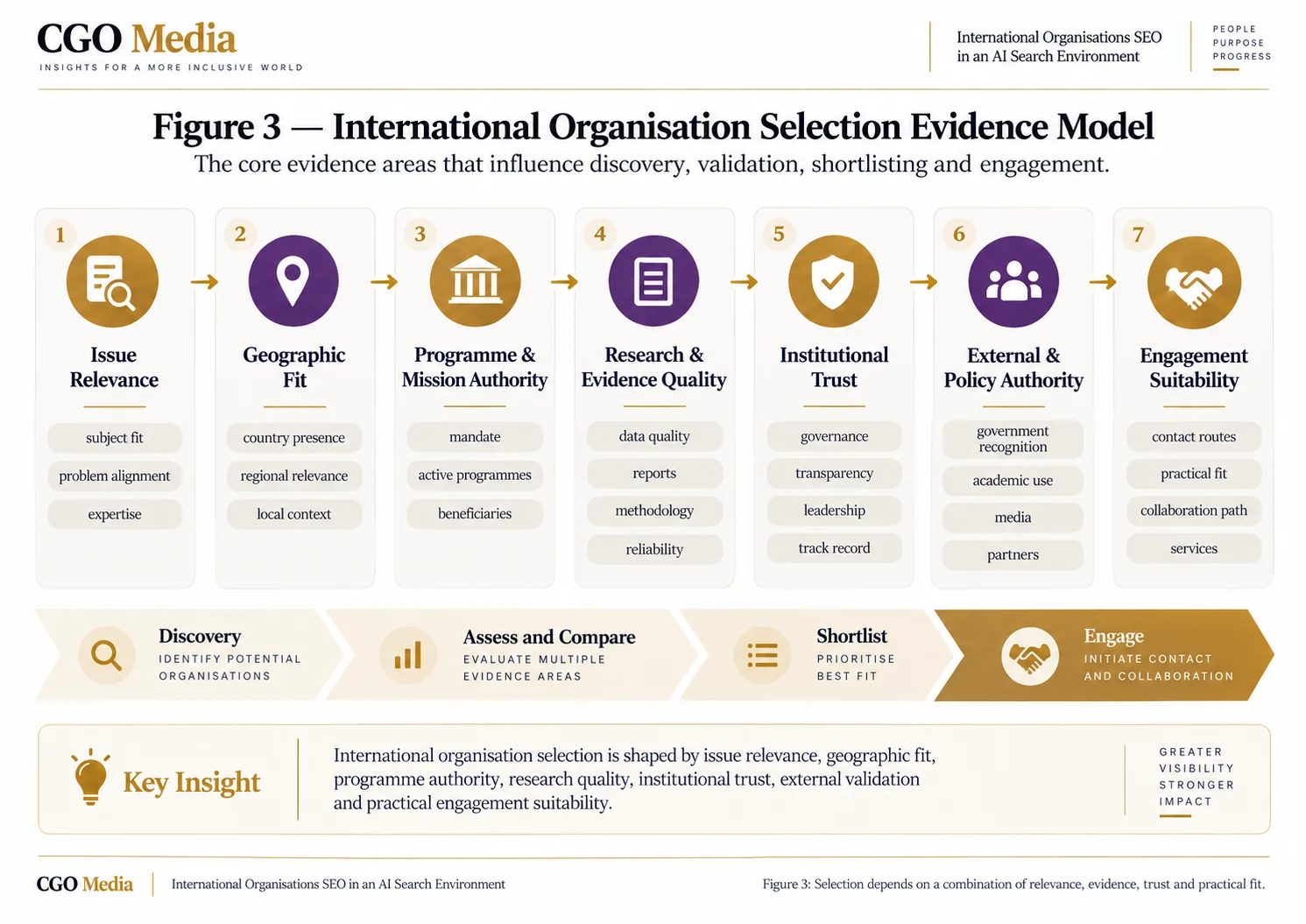
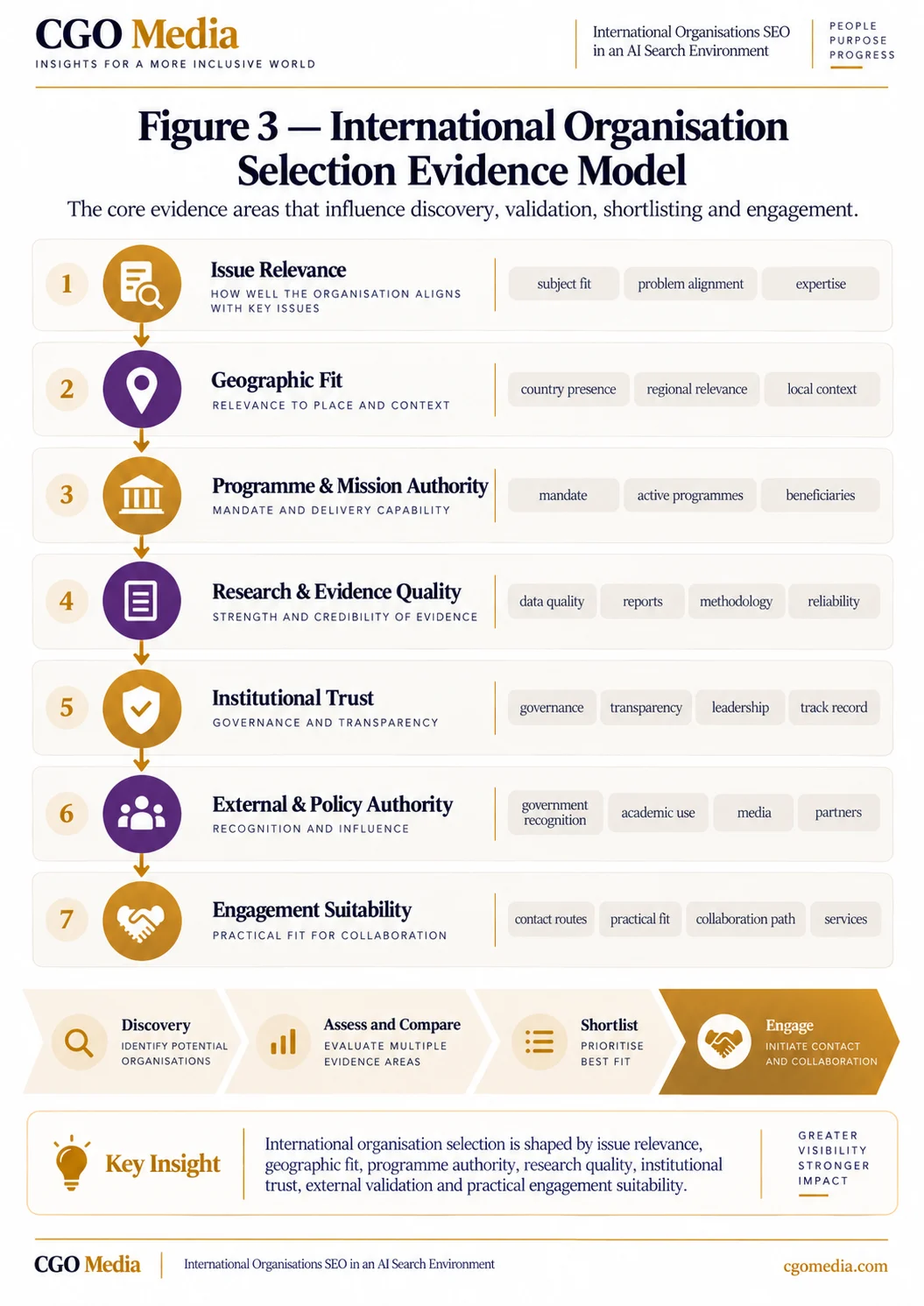
75. Seven Core Organisation Selection Signals
The International Organisation Selection Evidence Model identifies seven broad signals that can influence whether an organisation progresses from initial discovery into serious consideration, validation, shortlisting and eventual engagement.
These seven signals are:
- Issue Relevance
- Geographic Fit
- Programme and Mission Authority
- Research and Evidence Quality
- Institutional Trust
- External and Policy Authority
- Engagement Suitability
These signals should not be interpreted as fixed ranking factors used by a particular search engine or AI platform.
They represent observable evidence areas that can help users, search systems and AI-assisted discovery environments determine whether an institution is genuinely relevant to a particular information or engagement need.
The importance of each signal also varies according to context.
A government department may prioritise official mandate and policy authority.
A researcher may place greater weight on methodology and data quality.
A journalist may prioritise current evidence and expert accessibility.
A donor may focus more heavily on governance, financial transparency and measurable impact.
International Search Authority therefore depends not only on possessing strong signals but on ensuring that the right evidence is available for the audiences most likely to evaluate the organisation.
76. Issue Relevance
Issue Relevance is the first substantive test within many international organisation discovery journeys.
The organisation must demonstrate that it possesses meaningful institutional expertise, activity or responsibility in relation to the user’s underlying problem.
This relevance should be visible through more than broad mission language.
Evidence can include:
- active programmes;
- dedicated research;
- subject experts;
- statistics;
- policy guidance;
- standards;
- case studies;
- country operations;
- and external recognition.
For example, an institution seeking visibility around climate resilience should ideally demonstrate more than a general commitment to sustainability.
Users should be able to identify relevant programmes, geographic activity, research, expertise and evidence of outcomes.
Issue Relevance therefore develops through the accumulation of coherent evidence around a subject.
The stronger and more specific that evidence becomes, the easier it is for users and discovery systems to distinguish substantive authority from superficial thematic association.
77. Geographic Fit
International relevance is frequently constrained by geography.
An organisation can be highly authoritative within a subject while remaining unsuitable for a specific geographic requirement.
Geographic Fit evaluates whether the institution possesses evidence of meaningful presence, experience or relevance within the country, region or international context required by the user.
Useful evidence may include:
- country offices;
- regional offices;
- local programmes;
- country-specific research;
- local partnerships;
- government relationships;
- regional datasets;
- country experts;
- and documented local outcomes.
The strength of Geographic Fit is not determined solely by physical office presence.
Some international organisations may operate effectively within a country through local implementing partners, research programmes or regional structures without maintaining a permanent office.
The important question is whether sufficient evidence exists to demonstrate genuine geographic relevance.
78. Programme and Mission Authority
Programme and Mission Authority examines whether the organisation’s stated purpose is reinforced by real operational activity.
Mission statements define institutional purpose.
Programmes demonstrate how that purpose is translated into practice.
Strong authority can therefore emerge when users can trace a clear path from:
Mission → Strategic Priority → Programme → Geography → Evidence → Outcome
This relationship helps users distinguish between organisations that merely discuss an issue and organisations that possess genuine operational capability.
Programme and Mission Authority can be strengthened through:
- clear programme objectives;
- current programme status;
- geographic scope;
- partner information;
- implementation evidence;
- research;
- evaluation;
- impact reporting;
- and long-term institutional continuity.
Where several programmes address related issues, the organisation may also benefit from thematic architecture that explains how those initiatives collectively support the wider mission.
79. Research and Evidence Quality
Research and Evidence Quality can strongly influence institutional selection where users are looking for reliable information, policy guidance, statistics, evaluation or technical evidence.
Relevant quality indicators may include:
- clear methodology;
- named authorship;
- institutional attribution;
- publication date;
- data transparency;
- citation quality;
- limitations;
- version control;
- peer or external recognition;
- and accessible supporting resources.
High-volume publishing should not be confused with high Evidence Quality.
A smaller number of well-documented, transparent and widely cited resources may provide stronger institutional authority than a large library of poorly structured documents.
Research architecture should therefore help users understand not only what has been published but how reliable, current and relevant the evidence is.
80. Institutional Trust
Institutional Trust reduces uncertainty during the evaluation process.
Users may need confidence that the organisation is legitimate, competently governed, transparent and capable of delivering the activity it describes.
Relevant trust evidence may include:
- governance information;
- leadership;
- institutional history;
- legal or formal status;
- financial reporting;
- funding transparency;
- audit information;
- methodology;
- programme evaluation;
- and accountability mechanisms.
Trust does not require the absence of criticism.
Significant international organisations often operate within contested policy, economic or social environments and may be subject to legitimate external scrutiny.
A stronger trust environment is one in which important institutional claims can be verified and where governance, evidence and accountability remain sufficiently transparent.
81. External and Policy Authority
External and Policy Authority reflects whether independent institutions recognise, reference or use the organisation’s work.
Relevant evidence can include:
- government citations;
- policy references;
- academic citations;
- university references;
- media coverage;
- partner confirmation;
- standards adoption;
- conference participation;
- and references from other international organisations.
These signals can strengthen authority because they provide evidence beyond the organisation’s own claims.
A policy body referencing institutional research demonstrates one form of validation.
A government adopting an institutional standard provides another.
An academic paper citing a dataset provides another.
External Authority should therefore be analysed contextually rather than reduced to a generic link or mention count.
82. Engagement Suitability
Even a highly relevant and trusted organisation may fail to support the user’s objective if there is no clear engagement pathway.
Engagement Suitability examines whether the organisation provides a practical mechanism through which interest can become action.
Depending on institutional type, this may include:
- partnership contact;
- programme participation;
- membership application;
- grant or funding application;
- research collaboration;
- media contact;
- expert access;
- procurement;
- technical support;
- or general institutional contact.
The pathway should also be contextually appropriate.
A journalist should not need to use the same route as a funding applicant.
A government partner should not be forced into a generic public enquiry process if specialist institutional contacts exist.
Search architecture should therefore connect relevant evidence with the appropriate engagement pathway.
83. Context-Specific Selection
The seven selection signals do not carry identical weight for every audience.
Selection depends on the stakeholder, the required outcome and the level of institutional risk involved.
For example, a researcher seeking historical statistics may care little about programme-participation pathways but place substantial weight on data quality and methodology.
A donor assessing a multi-year programme may instead place greater emphasis on governance, funding transparency, operational track record and impact evidence.
Search architecture should therefore provide enough evidence diversity for different audiences to evaluate the organisation according to their own legitimate requirements.
84. Government Selection Context
Government audiences may evaluate international organisations according to a combination of institutional mandate, policy authority, technical expertise and formal legitimacy.
Important evidence may include:
- official mandate;
- member-state relationships;
- policy expertise;
- standards;
- research;
- country track record;
- intergovernmental legitimacy;
- and previous government collaboration.
Government users may also require highly specific geographic evidence.
An organisation’s global reputation may provide credibility, but decision makers may still need evidence that relevant expertise and implementation capability exist within their national or regional context.
Government-facing authority architecture should therefore connect global mandate with local and programme evidence.
85. Researcher Selection Context
Researchers often place greater weight on evidence characteristics than on general institutional prominence.
Relevant selection signals can include:
- data quality;
- methodology;
- publication history;
- author expertise;
- research access;
- citation quality;
- versioning;
- and long-term dataset continuity.
Stable URLs and clear provenance can be especially important because scholarly use depends on the ability to cite and revisit sources.
Researchers may also evaluate whether evidence can be reproduced or whether methodological documentation is sufficiently complete to interpret findings accurately.
Research-oriented International SEO should therefore focus heavily on knowledge architecture and publication quality rather than only on conventional page optimisation.
86. Journalist Selection Context
Journalists often operate under much shorter time constraints than researchers or institutional partners.
They may prioritise:
- current statistics;
- recent research;
- named experts;
- expert availability;
- clear spokespeople;
- publication dates;
- easy-to-understand findings;
- and rapid access to source evidence.
An organisation can possess substantial expertise but remain difficult for journalists to use if research resources are buried inside complex libraries or expert contact information is unavailable.
Media discoverability therefore benefits from clear research summaries, current expert profiles and dedicated press pathways.
Journalistic citations can subsequently strengthen wider external authority around the institution.
87. Donor Selection Context
Donors may place greater weight on evidence relating to governance, financial transparency, delivery capability and programme outcomes.
Relevant information may include:
- financial reporting;
- programme expenditure;
- funding structures;
- governance;
- programme track record;
- evaluation;
- impact evidence;
- country operations;
- and reporting quality.
Donor-oriented authority therefore combines institutional trust with practical programme evidence.
A strong mission can create initial alignment, but funding decisions may depend on whether the organisation can demonstrate measurable delivery and transparent governance.
88. Partner Selection Context
Potential partners may evaluate whether the organisation offers capabilities that complement their own.
Important signals can include:
- subject expertise;
- geographic reach;
- programme compatibility;
- institutional reputation;
- research capability;
- operational capacity;
- existing partnerships;
- and engagement readiness.
Partnership discovery may therefore depend heavily on detailed programme and institutional architecture.
Generic organisational claims provide limited value where a partner needs to understand what practical contribution the institution could make.
Case studies and existing partnership evidence can provide particularly useful context.
89. Member Selection Context
International membership organisations and associations operate within a distinct search environment because prospective members may be evaluating both institutional authority and membership value.
Relevant selection evidence may include:
- member benefits;
- industry or sector representation;
- standards;
- advocacy;
- networking;
- events;
- research;
- professional development;
- and existing membership base.
Member-oriented content should therefore connect broad institutional authority with concrete participation benefits.
An association may possess significant policy or standards authority, but prospective members still need to understand how membership creates practical value.
90. Country Search as Institutional Discovery
Country-focused search often begins with a local issue rather than the name of an international institution.
A user may search for:
- development programmes in a country;
- international organisations operating locally;
- health initiatives;
- education programmes;
- funding opportunities;
- research relating to the country;
- or local institutional partnerships.
This means country pages can act as important institutional discovery surfaces.
Users may encounter the organisation through the local evidence first and only later understand its global identity.
Country architecture should therefore provide sufficient context for the relationship between local activity and the wider institution.
91. Country Office Visibility
Country offices should be easy to discover where they represent meaningful points of institutional contact or programme delivery.
Users may need country-office information for:
- local contact;
- programme enquiries;
- research;
- partnership;
- jobs;
- media contact;
- government engagement;
- and local statistics.
Country-office pages should therefore contain more than an address where appropriate.
They may serve as a gateway into the institution’s wider local activity and authority environment.
Strong office visibility can also help distinguish current operations from historical or discontinued activity.
92. Country Evidence Consistency
Global and local digital environments should not provide contradictory information about current programmes, leadership, programme status or institutional activity.
Inconsistency can arise when:
- country pages are maintained separately from global pages;
- programme information changes without coordinated updates;
- local leadership changes;
- translated pages lag behind;
- or archived programmes remain prominently indexed.
Country evidence consistency therefore requires governance.
Global teams may maintain institutional standards while local teams contribute the operational knowledge required to keep information current.
The objective should be consistent institutional facts combined with appropriate local detail.
93. Regional Search Authority
Regional Search Authority becomes important where audiences search by broad geographic areas rather than individual countries.
Regional authority may be strengthened through:
- regional programmes;
- regional strategy;
- country relationships;
- cross-border research;
- regional statistics;
- regional leadership;
- partnerships;
- and recognised institutions within the region.
A regional hub should provide genuine contextual value.
It should not merely duplicate the global website or act as a simple directory of country links.
Regional Search Authority is strongest where the page explains what is institutionally distinctive about the organisation’s activity within that geographic area.
94. Language-Specific Authority
Institutional authority can differ substantially between language environments.
An organisation may possess strong English-language visibility while remaining comparatively weak in Spanish, French, Arabic or another strategically important language.
The difference may arise from:
- lower content coverage;
- outdated translations;
- weak localisation;
- fewer external citations;
- limited research availability;
- different terminology;
- or a weaker local institutional evidence ecosystem.
Language-specific authority should therefore be measured independently where possible.
The strength of the primary-language website should not be assumed to represent global multilingual authority.
95. Local Citation Authority
Country-level institutional authority can be strengthened through credible local citations.
Relevant sources may include:
- government ministries;
- universities;
- regional institutions;
- local media;
- programme partners;
- professional organisations;
- and research institutions.
Local citations can provide evidence that the organisation’s activity is recognised within the country rather than only by international audiences.
This can be particularly valuable where the organisation operates significant local programmes but has relatively limited consumer-level brand recognition.
Local Authority therefore depends partly on the wider national institutional ecosystem.
96. Global Citation Authority
Global Citation Authority can develop through references from highly recognised international sources.
These may include:
- multilateral organisations;
- major academic publishers;
- global policy bodies;
- international media;
- research institutions;
- global standards organisations;
- and other internationally recognised institutions.
Global citations can reinforce broad institutional expertise, but they do not automatically create strong local authority within every country.
International organisations therefore benefit from a combination of global recognition and contextually relevant regional or national evidence.
97. Citation Diversity
Authority becomes more resilient when recognition comes from multiple independent source types rather than one narrow citation network.
For example, an organisation may possess:
- strong media coverage;
- academic citations;
- government references;
- partner citations;
- policy-document references;
- and institutional mentions.
These different source types provide different forms of validation.
A diverse citation profile can therefore provide a richer picture of institutional authority than a large quantity of one type of mention alone.
Citation diversity should nevertheless reflect genuine activity and recognition.
Artificially pursuing mentions for their own sake would provide less strategic value than earning references through useful research, programmes, standards and expertise.
98. Knowledge Graph Relationships
International organisations can be represented through a network of connected entities rather than a collection of isolated webpages.
Important relationships can include:
- Organisation;
- People;
- Programmes;
- Countries;
- Regions;
- Research;
- Partners;
- Funding;
- Events;
- Datasets;
- and Policy Resources.
These relationships form a practical institutional knowledge graph even where no formal graph database exists behind the public website.
Search architecture can strengthen these relationships through internal linking, structured data, consistent naming, metadata and reusable taxonomies.
For example:
Organisation → Programme → Country → Partner → Research → Expert → Evidence
Making these connections clear can improve both human navigation and machine interpretation.
99. Structured Data and International Entities
Appropriate structured data can help clarify visible information about institutional entities and content types.
Relevant structured representations may include:
- Organisation;
- Person;
- Article;
- Report;
- Dataset;
- Event;
- WebPage;
- and appropriate location-related entities.
The precise implementation should reflect the content actually visible on the page.
Structured data should not be used to make claims that are unsupported by the underlying resource.
The strongest approach aligns machine-readable markup with accurate, accessible visible content.
Structured data is therefore an interpretive layer rather than a substitute for information quality.
100. Structured Data Does Not Replace Institutional Evidence
Machine-readable markup cannot compensate for weak institutional information.
Adding Organisation schema does not resolve unclear organisational relationships.
Adding Person markup does not create expert authority when the biography contains no substantive information.
Adding Dataset markup does not make poorly documented data authoritative.
Adding structured publication metadata does not improve weak methodology.
Structured data should therefore reinforce strong visible evidence rather than attempt to replace it.
The hierarchy should remain:
Accurate Institutional Evidence → Clear Visible Content → Logical Relationships → Appropriate Structured Data
This order reduces the risk that technical markup becomes disconnected from institutional reality.
101. AI Representation Gaps
An AI Representation Gap occurs when generative systems provide inaccurate, incomplete or materially outdated information about the institution.
Common gaps may affect:
- mission;
- leadership;
- programme status;
- geographic operations;
- funding;
- research;
- statistics;
- and institutional relationships.
These gaps should be investigated systematically rather than treated simply as isolated model errors.
The wider evidence environment may contain:
- outdated first-party pages;
- old external references;
- conflicting programme descriptions;
- ambiguous naming;
- weak structured relationships;
- or insufficiently prominent current evidence.
AI monitoring can therefore reveal information-governance weaknesses that also affect conventional search and stakeholder understanding.
102. AI Source Gaps
An AI Source Gap occurs when strong first-party evidence exists but generative systems consistently rely on weaker, less current or less authoritative third-party sources.
This does not necessarily mean the first-party resource is being deliberately excluded.
Possible explanations can include:
- poor discoverability;
- weak internal linking;
- unclear resource titles;
- PDF-only publication;
- insufficient HTML context;
- weak external citation;
- outdated metadata;
- or competing sources that provide clearer information.
The strategic response should focus on improving source quality, accessibility and context rather than attempting to manipulate AI citation behaviour directly.
Source-gap analysis can therefore become a useful part of Generative Engine Optimisation.
103. Recommendation Gaps
A Recommendation Gap occurs when an organisation appears genuinely relevant to a particular scenario but is rarely included in AI-generated institutional shortlists or recommendation environments.
This gap may arise because relevance is not supported by sufficiently clear evidence.
Possible causes include:
- weak subject positioning;
- limited country evidence;
- poor programme documentation;
- insufficient independent validation;
- limited research visibility;
- unclear institutional differentiation;
- or fragmented entity relationships.
Recommendation-gap analysis should therefore examine the complete evidence environment.
The objective is not to force inclusion within a recommendation.
It is to determine whether the organisation’s genuine relevance and capability are represented clearly enough to support informed selection.
104. Competitor and Peer Authority Mapping
International organisations can learn from comparing their visible authority environment with peer institutions operating in similar subject or geographic areas.
Relevant comparison dimensions can include:
- research depth;
- country authority;
- regional authority;
- programme visibility;
- media coverage;
- academic citations;
- government references;
- policy authority;
- expert visibility;
- and AI recommendation visibility.
Peer mapping should not be used to create simplistic league tables.
International organisations often possess different mandates, funding models and operational roles.
Comparison is most useful when it identifies why a peer institution may be more visible for a particular issue or evidence type.
For example, one organisation may possess stronger programme authority while another possesses stronger statistical authority.
A third may be recognised primarily for standards or policy expertise.
Understanding these distinctions can help the organisation identify where its own evidence environment is comparatively strong or weak.
105. Institutional Differentiation
Institutional differentiation helps users understand why one organisation may be more appropriate than another for a particular requirement.
Relevant differentiators can include:
- unique mandate;
- geographic reach;
- research expertise;
- operational capacity;
- standards authority;
- programme outcomes;
- member relationships;
- policy influence;
- specialist datasets;
- and distinctive institutional history.
Differentiation should emerge from genuine institutional characteristics rather than marketing language alone.
Statements such as “leading global organisation” provide limited selection value unless users can understand what specifically makes the organisation distinctive.
A stronger approach is to make unique capabilities visible through evidence.
An institution may be distinctive because it maintains the longest-running dataset in its field.
Another may possess a formal intergovernmental mandate.
Another may have unusually deep country implementation networks.
Another may publish an internationally adopted standard.
These differences create meaningful institutional positioning.
106. Authority and Recommendation Readiness
Recommendation readiness develops when institutional relevance and authority operate together.
High authority without contextual relevance is insufficient.
An internationally respected organisation may still be irrelevant to a particular country, programme need or policy scenario.
Likewise, high relevance without sufficient authority can create uncertainty.
An organisation may operate within exactly the required issue and geography while providing limited evidence of governance, research quality or independent recognition.
The strongest recommendation environment therefore combines:
- clear Issue Relevance;
- strong Geographic Fit;
- Programme and Mission Authority;
- high-quality research and evidence;
- Institutional Trust;
- credible external validation;
- and practical Engagement Suitability.
The relationship can be expressed conceptually as:
Recommendation Readiness = Relevance × Evidence × Trust × Contextual Fit
This is not intended as a literal mathematical ranking formula.
It illustrates an important strategic principle.
Weakness in one major area can constrain recommendation potential even when the organisation performs strongly elsewhere.
For example, an organisation may possess excellent research and trust but insufficient country relevance.
Another may have significant local activity but weak independent validation.
Another may possess strong institutional authority but provide no clear engagement route.
International SEO and AI-search strategy should therefore move beyond visibility alone and evaluate whether institutional evidence supports the complete selection context.
This creates the basis for the International Organisation Authority and Recommendation Matrix.
The International Organisation Authority and Recommendation Matrix maps contextual relevance against institutional authority and trust. It shows why strong recommendation readiness requires both clear subject and geographic fit and sufficiently strong evidence, trust and independent validation.
| Low Institutional Authority & Trust | High Institutional Authority & Trust | |
|---|---|---|
| High Issue & Geographic Relevance | Relevant but Under-Validated The organisation appears directly relevant to the user’s issue and geography but lacks sufficient research, trust evidence, external validation or institutional clarity to become a strong recommendation candidate. | Strong Recommendation Readiness The organisation combines strong contextual fit with credible programme evidence, research authority, institutional trust and independent validation. |
| Low Issue & Geographic Relevance | Low Selection Potential The organisation provides limited evidence of either contextual fit or institutional authority for the specific requirement. | Authoritative but Contextually Weak The institution may be highly credible overall, but insufficient issue, geographic or programme alignment limits its suitability for the specific scenario. |
Recommendation principle: Institutional reputation alone does not create recommendation readiness. The strongest candidate position occurs where high institutional authority is combined with clear issue relevance, geographic fit, programme evidence and practical engagement suitability.
Figure 4. International organisation recommendation readiness is strongest where high issue and geographic relevance is combined with strong institutional trust, research authority, programme evidence and independent validation.
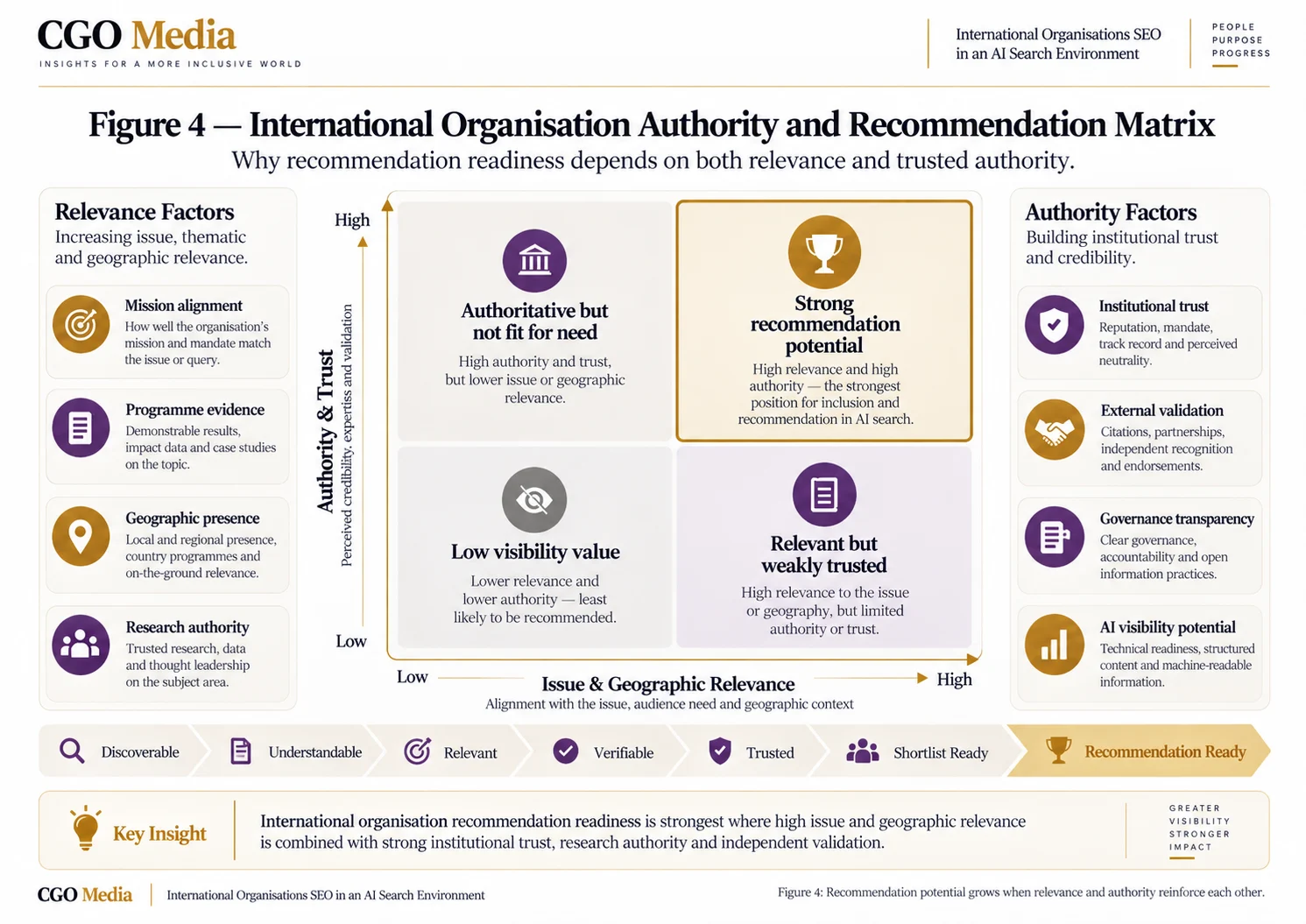
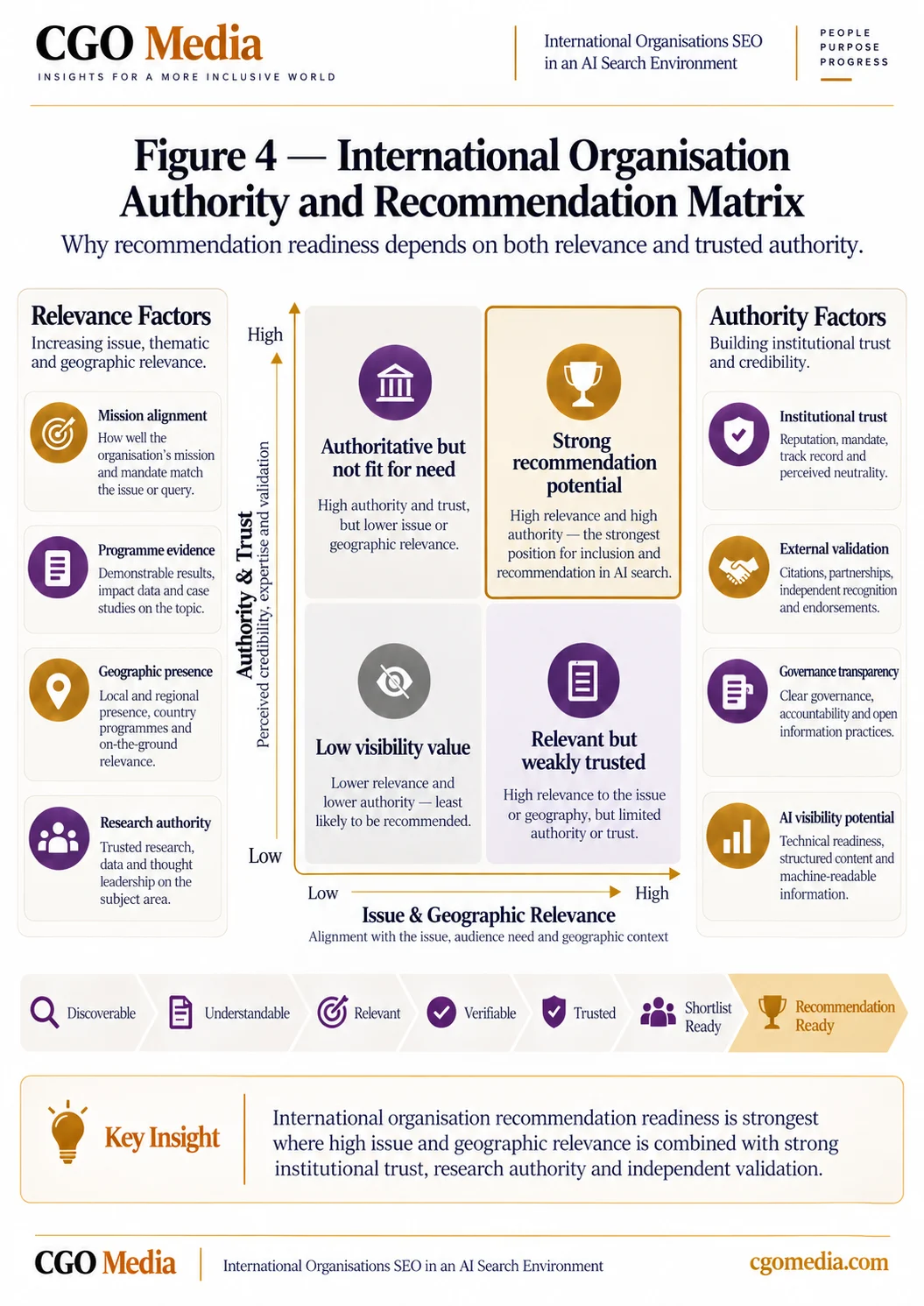
107. International Organisation Evidence Threshold
International organisation visibility can be understood as a progressive evidence threshold rather than a binary condition in which an organisation is either visible or invisible.
A useful progression is:
Discoverable → Understandable → Relevant → Verifiable → Trusted → Shortlist Ready → Recommendation Ready
Each stage represents a higher evidentiary requirement.
An organisation may be technically discoverable without being easy to understand.
It may be understandable without providing enough evidence to demonstrate relevance to a particular country, programme requirement or stakeholder objective.
It may be relevant without offering sufficient information for users to verify its claims.
It may be verifiable without possessing enough independent authority or governance evidence to generate confidence.
And it may be trusted while still lacking the contextual fit necessary to become a strong recommendation candidate for a specific scenario.
This threshold model helps explain why conventional visibility metrics alone provide an incomplete picture of International Search Authority.
Rankings, impressions and traffic primarily describe the earliest stages of the journey.
Institutional authority requires measurement further down the evidence progression.
108. Discoverable
The first threshold is discoverability.
The organisation, programme, research resource, country operation or expert must be capable of appearing within the information channels used by the intended audience.
Discoverability can occur through:
- organic search results;
- news results;
- academic search environments;
- research databases;
- government citations;
- partner websites;
- media coverage;
- knowledge systems;
- and AI-assisted discovery.
An institution can possess substantial real-world expertise while remaining poorly discoverable online.
This may occur when important evidence sits inside poorly indexed PDFs, programme information exists only on disconnected local websites, country relationships are unclear or specialist knowledge is distributed across resources that search systems struggle to connect.
Discoverability therefore requires both technical accessibility and sufficient contextual relevance.
At this stage, useful metrics can include impressions, indexed resources, non-branded visibility, country search visibility, research discovery and AI mentions.
The key question is:
Can relevant audiences encounter the organisation when they search for the subjects, programmes, evidence and geographies in which the institution genuinely operates?
109. Understandable
Discoverability creates an opportunity for evaluation, but users and machine systems must then be able to understand what they have found.
An understandable organisation provides sufficient clarity around:
- institutional identity;
- mission;
- mandate;
- organisation type;
- geographic scope;
- programmes;
- research;
- leadership;
- and major institutional relationships.
This stage becomes especially important for complex organisations operating through multiple programmes, country offices, regional structures, member institutions or legal entities.
A user encountering one programme should be able to determine who operates it.
A researcher reading a report should be able to determine which institution produced it.
A user landing on a country website should understand how that operation relates to the global institution.
An AI system should encounter sufficiently consistent evidence to avoid confusing related and unrelated entities.
Understanding therefore depends heavily on Entity Clarity and Knowledge Architecture.
The measurement question becomes:
Once the organisation is discovered, can users and discovery systems determine accurately who it is, what it does and how its programmes, locations and knowledge assets relate to one another?
110. Relevant
An understandable institution must then demonstrate relevance to the specific need that initiated the discovery journey.
Relevance can depend on several dimensions simultaneously.
These may include:
- subject relevance;
- programme relevance;
- geographic relevance;
- language relevance;
- audience relevance;
- policy relevance;
- research relevance;
- and engagement relevance.
An organisation may possess global authority in an issue while having no operational relevance within the specific country required by the user.
Another may operate locally but not provide the kind of programme, evidence or institutional role required for the task.
Relevance therefore requires specificity.
The institution should make it possible to establish connections such as:
Issue → Organisation → Programme → Geography → Evidence
This allows users to distinguish broad thematic association from genuine institutional fit.
The relevant measurement question is:
Does the available evidence demonstrate that the organisation is directly aligned with the stakeholder’s specific issue, geography and intended outcome?
111. Verifiable
Relevance becomes stronger when important claims can be verified.
Verification requires sufficient supporting evidence for users to test what the institution says about itself.
For example, claims concerning programme scale, research findings, geographic reach or institutional impact may be supported through:
- programme documentation;
- research reports;
- datasets;
- methodologies;
- evaluations;
- annual reports;
- partner references;
- government citations;
- academic references;
- and documented outcomes.
Verifiability is particularly important for international organisations because claims can involve complex programmes, large geographies and long implementation periods.
Users may need to determine whether evidence is current, whether programmes remain active and whether reported results are supported by appropriate methodology.
Search architecture can contribute to verification by connecting claims with supporting resources rather than leaving users to locate them independently.
The measurement question becomes:
Can important institutional claims be checked against clear first-party evidence and, where appropriate, credible independent sources?
112. Trusted
Verification provides evidence, but trust requires users to form sufficient confidence in the institution itself.
Institutional Trust can be influenced by:
- governance transparency;
- leadership clarity;
- financial reporting;
- funding transparency;
- institutional history;
- research quality;
- expertise;
- programme track record;
- external validation;
- and accountability.
Trust is contextual.
A researcher may place greatest emphasis on methodological transparency.
A government may focus on formal mandate and policy credibility.
A donor may require financial and programme accountability.
A journalist may evaluate whether statistics are current and experts are genuinely authoritative.
A mature international search environment therefore provides multiple forms of trust evidence rather than relying on institutional reputation alone.
The measurement question becomes:
Does the digital evidence environment provide sufficient governance, expertise and independent recognition for relevant audiences to rely on the institution with confidence?
113. Shortlist Ready
An organisation becomes Shortlist Ready when it has progressed beyond broad credibility and can reasonably be compared with alternative institutions for a defined need.
At this stage, the user may already believe that the institution is legitimate and relevant.
The decision becomes comparative.
Typical comparison dimensions can include:
- subject expertise;
- geographic reach;
- programme capability;
- research quality;
- institutional mandate;
- track record;
- partnership model;
- local presence;
- and engagement suitability.
This stage becomes increasingly important in AI-assisted discovery because systems can generate comparative answers directly.
An AI assistant may identify several institutions and summarise apparent differences between them.
An organisation therefore needs sufficiently distinctive and well-supported evidence for its real institutional strengths to survive comparison.
The measurement question is:
Is the organisation sufficiently relevant, trusted and differentiated to remain within the user’s serious consideration set?
114. Recommendation Ready
Recommendation Ready represents the point at which the institution possesses sufficiently strong evidence to become a plausible recommendation candidate within the specific discovery scenario.
Recommendation readiness should not be interpreted as a guarantee that a search engine or AI system will select the organisation.
It describes the quality of the evidence environment supporting potential selection.
Strong recommendation readiness typically combines:
- clear institutional identity;
- high contextual relevance;
- appropriate geographic fit;
- programme evidence;
- research and knowledge authority;
- institutional trust;
- independent external validation;
- and a clear engagement pathway.
Weakness in any one of these areas may limit recommendation potential for certain scenarios.
For example, an organisation can possess strong global authority but limited evidence of local activity.
Another may operate highly relevant programmes but provide insufficient transparency or research evidence.
Another may possess strong institutional credibility while failing to make the relevant programme discoverable.
The measurement question becomes:
Does the combined institutional evidence make the organisation a credible and contextually appropriate candidate for recommendation?
115. From International Visibility to Institutional Authority
The complete progression can be represented as:
Presence → Visibility → Relevance → Evidence → Trust → Authority → Recommendation Potential
Each stage builds on the previous one.
Presence means the organisation has digital resources available.
Visibility means those resources can be discovered.
Relevance means the institution is demonstrably aligned with the user’s requirement.
Evidence makes important claims verifiable.
Trust provides confidence in the institution and its information.
Authority develops when expertise, evidence and independent recognition reinforce one another.
Recommendation Potential emerges when authority combines with contextual fit strongly enough for the organisation to become a credible selection candidate.
This progression illustrates why International SEO should not be measured only through keyword rankings.
Rankings primarily describe visibility.
The later stages depend on information quality, institutional architecture, trust and external evidence.
116. Measuring International Search Authority
International Search Authority therefore requires a broader measurement framework than conventional organic-search reporting.
Traditional metrics remain useful.
Organic impressions, clicks, rankings, landing-page performance and conversions can reveal important aspects of search behaviour.
However, an international organisation may need to understand performance across several additional dimensions:
- organisation visibility;
- programme visibility;
- research visibility;
- policy and standards authority;
- country-level visibility;
- regional visibility;
- language-level visibility;
- external citation authority;
- AI representation;
- AI source visibility;
- and AI recommendation visibility.
The objective is not to create an excessively complicated reporting environment.
The purpose is to ensure that measurement corresponds with the way institutional authority actually develops.
A global traffic increase may hide declining performance within an important country.
A research library may attract fewer visits than a programme section while generating substantially more academic and policy authority.
An institutional page may receive limited traffic yet play a critical role in establishing Entity Clarity for AI systems and external databases.
Measurement therefore needs to consider the purpose of each information asset.
117. Measuring Organisation Visibility
Organisation-level measurement examines whether the institution itself is visible and represented accurately.
Useful indicators may include:
- branded search visibility;
- organisation-name impressions;
- homepage and institutional-page traffic;
- direct traffic;
- knowledge-panel or entity-result presence where applicable;
- external organisation mentions;
- and AI organisation mentions.
Branded search can also reveal user validation behaviour.
Queries combining the organisation name with terms such as leadership, annual report, funding, research, programme, criticism or country names can reveal what users are trying to verify.
Organisation visibility should therefore be examined both quantitatively and semantically.
The institution should understand not only how frequently it is searched for but what users are trying to learn when they search.
118. Measuring Programme Visibility
Major programmes should be assessed independently where they function as significant discovery entities.
Relevant measures may include:
- programme-name impressions;
- non-branded programme-intent visibility;
- programme-page traffic;
- country-level programme visibility;
- external references;
- partner citations;
- media mentions;
- research associations;
- and AI programme mentions.
The organisation should distinguish between branded programme discovery and broader issue-led discovery.
A programme may be highly visible to users who already know its name but difficult to discover through the problem it is designed to address.
Programme reporting should therefore examine whether the initiative is discoverable within the wider subject and geographic context.
119. Measuring Research Authority
Research Authority should be measured through more than page views and downloads.
Useful indicators can include:
- organic search visibility;
- publication landing-page traffic;
- report downloads;
- academic citations;
- government references;
- policy citations;
- media references;
- dataset reuse;
- expert citations;
- and AI source visibility.
Different research outputs will perform differently across these dimensions.
A technical methodology may attract limited general traffic but become highly influential within academic literature.
A statistical report may receive strong media usage.
A policy paper may be cited by governments.
Research measurement should therefore reflect the intended role of the resource.
The objective is to understand whether institutional knowledge is being discovered, used and recognised by appropriate audiences.
120. Measuring Statistical Authority
Statistical resources require their own measurement where data forms an important part of institutional authority.
Relevant metrics can include:
- search visibility for statistical queries;
- dataset-page traffic;
- downloads;
- API usage where available;
- academic citations;
- media references;
- government references;
- external dataset reuse;
- and AI citation visibility.
Monitoring should also examine whether users discover the original institutional source or rely primarily on secondary websites reproducing the statistics.
Secondary reuse can demonstrate authority, but the institution should maintain sufficiently strong first-party statistical resources for users to verify the original evidence.
121. Measuring Policy Authority
Policy Authority can be assessed by examining whether institutional policy resources are discovered and used within relevant decision environments.
Useful indicators may include:
- search visibility for policy queries;
- policy-resource traffic;
- government citations;
- think-tank references;
- academic usage;
- consultation references;
- professional-body citations;
- media references;
- and AI source visibility.
Policy resources can have long useful lives, so reporting should not focus exclusively on recent publications.
Older resources may continue to generate authority if they remain current or historically important.
Versioning and status should therefore be considered alongside visibility.
122. Measuring Country-Level Visibility
Country-level reporting should separate global institutional visibility from genuine local authority.
Useful indicators can include:
- country search visibility;
- country-page impressions and traffic;
- country programme traffic;
- local programme discovery;
- local institutional citations;
- local media coverage;
- government references;
- partner references;
- country-specific research visibility;
- and AI country-level mentions.
Performance should be interpreted relative to the scale of actual institutional activity.
A strategically important country with extensive programmes and partnerships should normally possess a richer authority profile than a market where organisational activity is limited.
Country reporting can therefore identify mismatches between real-world institutional activity and digital representation.
These mismatches may reveal some of the highest-value improvement opportunities within international search.
123. Measuring Regional Visibility
Regional reporting can identify whether the organisation possesses substantially stronger authority in some parts of the world than others.
Relevant indicators may include:
- regional search visibility;
- regional hub traffic;
- regional programme discovery;
- country coverage;
- regional research visibility;
- regional media citations;
- institutional partnerships;
- and AI regional representation.
Regional performance should not be interpreted only as the combined total of country traffic.
Some programmes and research questions have genuinely regional intent.
A regional authority layer may therefore deserve direct measurement.
124. Measuring Language-Level Visibility
Language performance should be analysed independently where multilingual audiences are strategically important.
A multilingual organisation can possess significantly different authority profiles across English, Spanish, French, Arabic and other language environments.
Relevant measures may include:
- language-specific organic visibility;
- non-branded search impressions;
- programme discovery;
- country-page visibility;
- research visibility;
- local external citations;
- content freshness;
- and AI representation in that language.
Language measurement should also consider whether important institutional information is missing.
A lower traffic figure may simply reflect lower search demand.
A more serious problem exists when relevant audiences cannot access sufficiently complete information about the organisation in their language.
Performance measurement should therefore combine visibility with information coverage.
125. Measuring External Authority
External Authority should be measured according to the quality, diversity and relevance of independent recognition.
Useful categories include:
- government references;
- university citations;
- academic citations;
- policy references;
- media coverage;
- partner references;
- professional-body references;
- industry recognition;
- and citations from other international organisations.
The organisation should avoid reducing all external authority to a single link metric.
Different citations provide different forms of institutional evidence.
A government citation may demonstrate policy relevance.
An academic citation may reinforce research authority.
A partner reference can validate operational activity.
Media coverage may reinforce expert visibility.
External-authority measurement therefore becomes more useful when citations are classified by what they actually validate.
126. Measuring AI Representation
AI monitoring should examine whether generative systems represent important institutional facts accurately and consistently.
Monitoring areas can include:
- organisation identity;
- mission;
- mandate;
- leadership;
- programmes;
- countries of operation;
- research;
- statistics;
- institutional relationships;
- and subject expertise.
The organisation should use repeatable prompts where possible so observations can be compared over time.
Prompt sets can be segmented by country, language, programme and subject.
Monitoring should also distinguish between minor variation in generated wording and material factual errors.
The objective is not to demand identical answers from every system.
It is to identify meaningful weaknesses in institutional representation.
127. Measuring AI Source Visibility
Where generative interfaces provide citations or identifiable source links, organisations can examine whether their first-party evidence appears within those source environments.
Relevant resources may include:
- research papers;
- statistics;
- datasets;
- policy guidance;
- programme pages;
- standards;
- methodologies;
- and other knowledge resources.
Source visibility should not be interpreted as a guaranteed or permanent position.
Generative systems can change retrieval methods, interfaces and citation behaviour.
The value of measurement lies in identifying patterns.
For example:
- Which institutional resources are repeatedly selected?
- Which subjects generate first-party citations?
- Which third-party sources are used instead?
- Which country resources are absent?
- Which language environments rely heavily on secondary evidence?
These observations can help identify where first-party evidence needs stronger accessibility, context or external recognition.
128. Measuring AI Recommendation Visibility
Recommendation monitoring should focus on realistic stakeholder questions rather than artificial prompts designed simply to force the organisation’s name into an answer.
Repeatable prompt groups can cover:
- relevant international organisations;
- best sources of data;
- potential institutional partners;
- programme recommendations;
- research sources;
- country-specific organisations;
- regional specialists;
- standards providers;
- and subject-matter institutions.
Measurement can examine:
- whether the organisation appears;
- the context in which it appears;
- whether the description is accurate;
- which alternatives appear alongside it;
- which evidence appears to support the answer;
- and whether representation changes across countries or languages.
Recommendation visibility should not be converted into a simplistic success metric.
An organisation should only expect to appear where it is genuinely relevant.
The purpose of measurement is to determine whether legitimate institutional relevance is being recognised consistently.
129. International Search Authority Measurement Funnel
The different metrics described above become more useful when they are organised according to the stakeholder journey rather than reported as unrelated performance indicators.
A practical International Search Authority measurement sequence is:
Discovery → Understanding → Relevance → Validation → Trust → Shortlist → Engagement → Ongoing Relationship
Each stage answers a different question.
Discovery
Can relevant audiences encounter the organisation, programme, research or institutional evidence?
Potential measures include search impressions, non-branded visibility, research discovery, external references and AI mentions.
Understanding
Can audiences determine accurately what the organisation is, what it does and how its institutional components relate?
Assessment may include entity clarity, country architecture, programme attribution and AI representation accuracy.
Relevance
Does the institution demonstrate direct alignment with the user’s subject, geography and desired outcome?
Measures may include programme visibility, country authority, subject visibility and contextual AI mentions.
Validation
Can users verify important institutional claims?
Potential signals include research, programme evidence, methodology, external references, partner confirmation and government citations.
Trust
Does the institution provide enough governance, expertise and independent recognition to reduce uncertainty?
Trust measures may include governance completeness, transparency, research authority and citation diversity.
Shortlist
Does the organisation remain a serious candidate when compared with alternative institutions?
Assessment may consider differentiation, programme fit, evidence quality and comparative authority.
Engagement
Can the stakeholder take the required next action?
Measurement may include partnership enquiries, research access, programme applications, media contacts, memberships, funding enquiries or other institution-specific outcomes.
Ongoing Relationship
For many international organisations, successful discovery does not end with one transaction.
Long-term relationships can involve:
- continuing programme participation;
- research usage;
- policy citation;
- membership;
- institutional partnership;
- ongoing funding;
- or repeated media and expert engagement.
Measurement should therefore consider whether Search Authority contributes to durable institutional relationships rather than merely generating isolated visits.
The funnel provides a broader performance model for international search.
It connects visibility metrics at the top of the journey with authority, selection and institutional outcomes further downstream.
The International Search Authority Measurement Funnel connects initial visibility with institutional understanding, contextual relevance, verification, trust, shortlisting, engagement and long-term stakeholder relationships.
1. Discovery
The organisation, programme, research or institutional resource becomes visible through search, citations, media, partner references or AI-assisted discovery.
2. Understanding
Users and discovery systems can determine what the institution is, what it does and how its programmes, countries, research and organisational entities relate.
3. Relevance
The institution demonstrates appropriate issue, programme, geographic, language and stakeholder fit for the specific discovery scenario.
4. Validation
Research, programme evidence, methodology, partner references and independent institutional citations allow important claims to be checked.
5. Trust
Governance, expertise, transparency, track record and external recognition provide sufficient confidence in the organisation and its evidence.
6. Shortlist
The organisation becomes sufficiently relevant, credible and differentiated to remain under serious consideration alongside alternative institutions.
7. Engagement
The stakeholder progresses into partnership, programme participation, membership, funding, research use, expert contact or another relevant institutional outcome.
8. Ongoing Relationship
Search-led discovery contributes to a continuing institutional relationship through repeated evidence use, partnership, citation, membership or programme engagement.
Measurement principle: International Search Authority should not be evaluated only through rankings and traffic. A more complete model measures whether discovery leads to institutional understanding, relevance, verification, trust, shortlisting, engagement and durable stakeholder relationships.
Figure 5. International Search Authority can be measured from initial discovery through understanding, relevance, institutional validation, trust, shortlisting, engagement and ongoing stakeholder relationships.
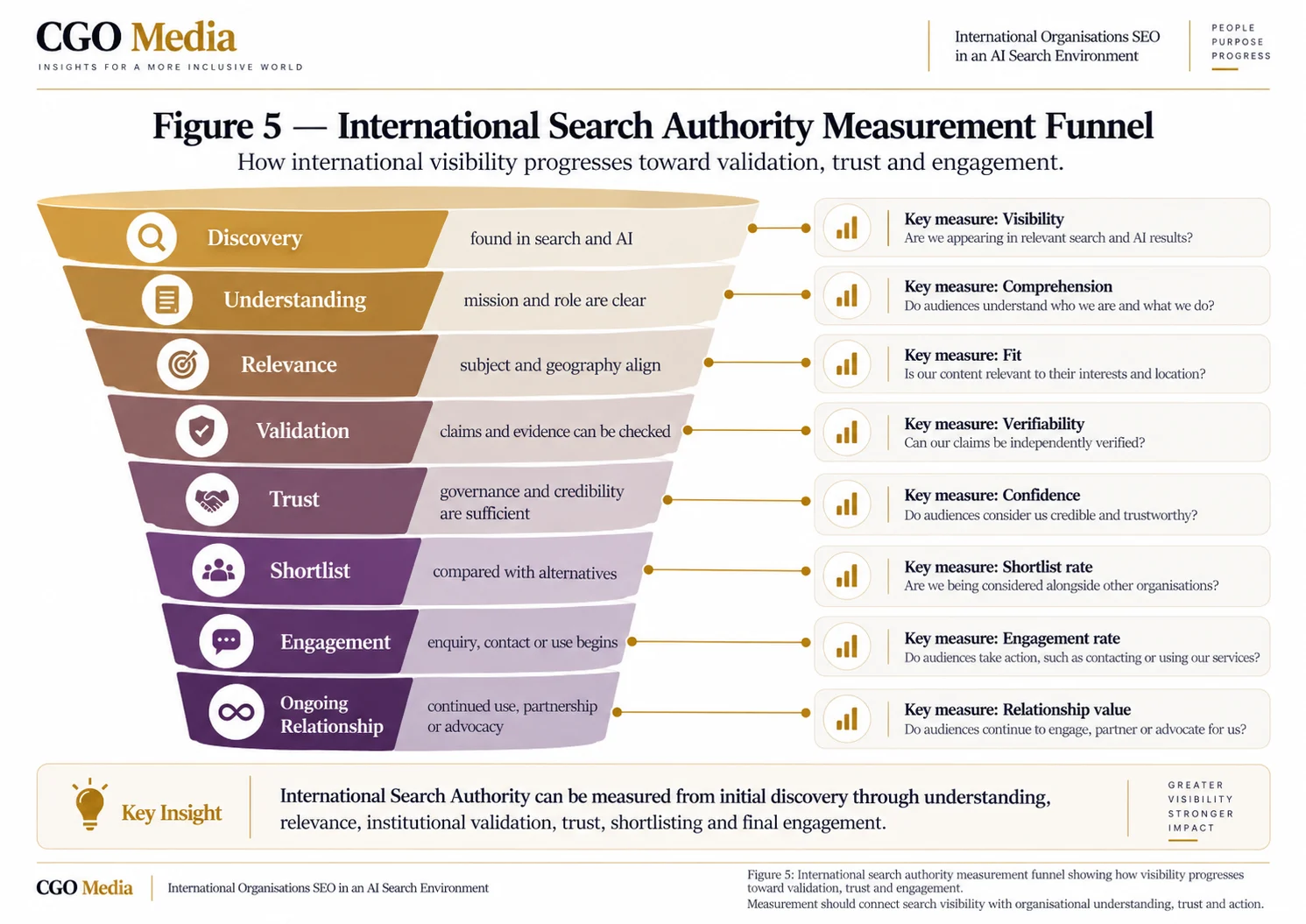
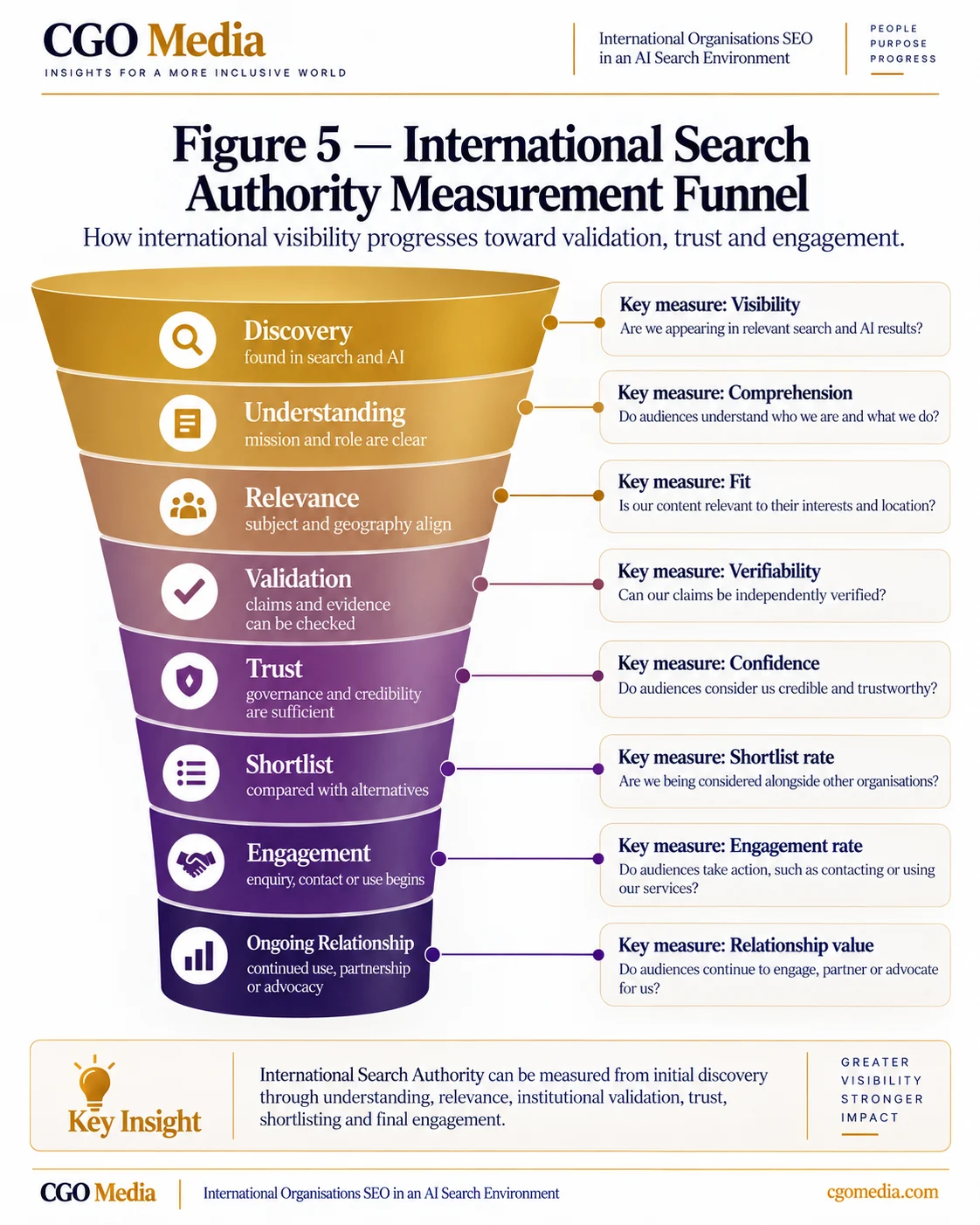
130. International Search Governance
International Search Authority requires coordinated governance because responsibility is rarely contained within one department.
Global digital teams may control technical architecture.
Country teams may maintain local programme information.
Research teams may own publications and data.
Communications teams may manage media relationships.
Policy teams may publish guidance and standards.
Translation teams may maintain multilingual resources.
AI monitoring may be undertaken by digital, research or innovation teams.
Without a shared governance model, these functions can develop independently and create inconsistent institutional evidence.
International Search Governance should therefore establish:
- clear information ownership;
- shared technical standards;
- common entity definitions;
- country and regional publishing standards;
- multilingual governance;
- research publication standards;
- programme review processes;
- measurement responsibilities;
- AI monitoring ownership;
- and escalation procedures for material inaccuracies.
The objective is not to centralise every publishing decision.
Large international organisations frequently require distributed editorial responsibility because local teams possess information that headquarters cannot maintain effectively.
The stronger model is usually federated:
Central Standards + Distributed Expertise + Defined Ownership + Shared Measurement
Central teams establish common architecture and institutional rules.
Regional and country teams contribute local evidence.
Research and programme teams maintain specialist information.
Governance connects those contributions into one coherent authority environment.
131. Global Governance
Global teams should normally maintain the institutional standards that need to remain consistent across the entire organisation.
These can include:
- official organisation naming;
- brand and entity standards;
- technical international architecture;
- URL conventions;
- structured-data principles;
- research publishing standards;
- core governance information;
- measurement frameworks;
- AI monitoring principles;
- and global search-policy standards.
Global governance is especially important where multiple country or programme teams publish independently.
Without a common institutional model, local flexibility can gradually produce conflicting organisation descriptions, duplicate programme pages, inconsistent research metadata and divergent structured data.
Global teams should therefore define the elements that must remain consistent while allowing local teams to adapt content appropriately.
This creates a distinction between institutional truth and local presentation.
Institutional facts should remain consistent.
The way those facts are explained may vary according to country, language and audience.
132. Regional Governance
Regional teams can provide an important coordination layer between global governance and country-level execution.
Their responsibilities may include:
- regional content strategy;
- cross-country programme coordination;
- language coordination;
- regional research visibility;
- regional authority development;
- regional expert representation;
- country-page quality assurance;
- and shared institutional partnerships.
Regional teams can also identify patterns that individual country teams may not see.
For example, several countries may use inconsistent terminology for the same regional programme.
Research relevant across several countries may remain fragmented across national sections.
Regional governance can reduce this fragmentation while preserving country-specific context.
133. Country Governance
Country teams often possess the most accurate understanding of local institutional activity.
They may therefore be responsible for:
- local programme information;
- country-office details;
- local leadership;
- country research;
- local partnerships;
- government relationships;
- local statistics;
- country-specific impact evidence;
- media relationships;
- and local terminology.
Country governance should operate within central standards so local information strengthens rather than fragments the parent institution.
A mature model defines both:
what country teams are responsible for maintaining
and:
which global institutional information they should not redefine independently.
This division helps reduce conflicting leadership information, outdated programme statuses and inconsistent organisational descriptions.
134. Language Governance
Multilingual search performance can deteriorate quickly when language ownership is unclear.
Language governance should define responsibility for:
- translation quality;
- terminology standards;
- regional language differences;
- localisation;
- publication updates;
- content parity;
- equivalent-page mapping;
- and removal of obsolete translations.
Translation should be treated as part of the content lifecycle.
When an important source page changes, the organisation should know whether corresponding language versions also require review.
The absence of this process can create progressively larger differences between language environments.
For institutional information, those differences can become material.
A translated page may continue listing an old leader, completed programme or superseded policy long after the primary-language resource has changed.
Language governance therefore supports both search quality and institutional accuracy.
135. Research Governance
Research publishing should operate through documented institutional standards.
Research governance may define expectations for:
- authorship;
- institutional attribution;
- methodology;
- publication dates;
- versioning;
- citations;
- supporting data;
- subject classification;
- geographic classification;
- programme relationships;
- and archival treatment.
This helps prevent large research libraries from becoming inconsistent over time.
It also improves the quality of research as a search and AI authority asset.
The strongest institutional research environment enables users to identify not only what was published but who produced it, how it was produced, which version they are viewing and what wider institutional context surrounds it.
136. Statistical Governance
Statistics require particularly careful ownership because outdated or incorrectly contextualised figures can spread widely across external websites, journalism, research and AI systems.
Statistical governance should define responsibility for:
- data accuracy;
- update frequency;
- methodology;
- source provenance;
- historical continuity;
- revision policies;
- download formats;
- and current versus archived datasets.
Where figures are revised, users should be able to determine whether historical publications remain valid or have been superseded.
Stable documentation can also make institutional statistics easier to cite and verify.
Statistical governance therefore supports both technical data quality and wider authority.
137. Programme Governance
Programme information can become inaccurate quickly because institutional activity changes continuously.
Programme information should therefore be reviewed when:
- programmes launch;
- programme status changes;
- funding changes;
- geographic scope changes;
- partners change;
- leadership changes;
- new evaluations become available;
- results are published;
- or programmes close.
Programme closure is particularly important.
Completed programmes should not necessarily disappear.
Historical programme pages may continue providing valuable evidence, research and institutional context.
However, they should clearly indicate that the programme is no longer active.
This distinction protects both institutional history and current-information accuracy.
138. Entity Governance
Entity Governance ensures that core institutional facts remain consistent across websites, publications, structured data and other digital environments.
The organisation should define authoritative sources for:
- official name;
- acronym;
- organisation type;
- legal status;
- leadership;
- headquarters;
- regional offices;
- country offices;
- programme relationships;
- and major institutional partnerships.
A useful governance principle is that important institutional facts should have an identifiable source of truth.
Individual teams can reuse that information, but they should not create conflicting variants without clear justification.
This becomes increasingly important as AI systems synthesise information from multiple pages and third-party sources.
139. AI Governance
AI monitoring should be governed in the same way as other institutional measurement activities.
Clear ownership should exist for:
- prompt-set design;
- representation accuracy;
- source analysis;
- citation analysis;
- recommendation monitoring;
- country comparisons;
- language comparisons;
- peer monitoring;
- and escalation of material inaccuracies.
Monitoring should also have an action pathway.
If an AI answer contains outdated programme information, the organisation should know which team can verify the current position.
If a research source is repeatedly overlooked, the digital and research teams may need to investigate discoverability and source quality.
AI governance therefore connects observation with institutional improvement.
140. Common International Search Risks
Several recurring weaknesses can undermine international search visibility even where an organisation possesses substantial offline authority.
These problems often arise because international digital estates develop organically over long periods.
Country teams create new websites.
Programmes launch independent platforms.
Research libraries move into specialist repositories.
Languages are added without long-term maintenance plans.
The organisation gradually accumulates digital complexity.
The following risks are therefore not unusual.
Their importance lies in recognising when normal organisational growth has begun to reduce institutional clarity.
141. Fragmented Global and Country Websites
Disconnected global and country websites can make relationships between the parent institution and local operations difficult to interpret.
Common symptoms include:
- different branding;
- different navigation;
- inconsistent organisation descriptions;
- duplicate programme information;
- conflicting leadership details;
- weak cross-linking;
- and separate search architectures.
Independent country websites may be operationally necessary.
The problem is not decentralisation itself.
The risk emerges when the relationship between those sites and the parent institution becomes unclear.
International architecture should make organisational relationships visible even where technical platforms remain separate.
142. Weak Multilingual Architecture
Poor multilingual structure can create:
- duplicate content;
- incorrect regional targeting;
- conflicting language versions;
- missing equivalent pages;
- weak local visibility;
- and outdated institutional information.
Technical implementation alone is not enough.
An organisation can have technically valid hreflang while translated content remains incomplete or obsolete.
Multilingual authority therefore requires both technical and editorial governance.
143. Translation Without Localisation
Literal translation may fail to reflect local terminology, institutional conventions or actual search behaviour.
Different audiences may refer to the same concept using different terms.
Programme names may require explanation.
Policy terminology can differ between countries.
A direct translation may therefore be linguistically correct while remaining weak from a search or stakeholder perspective.
Localisation should account for:
- local terminology;
- regional usage;
- country institutions;
- policy context;
- audience expectations;
- and local information needs.
144. Outdated Country Programme Information
Old programme information can create significant trust and accuracy problems.
A page may continue describing an initiative as active years after funding ended.
A partner may no longer participate.
A programme may have moved into a new phase under a different name.
These inaccuracies matter because external websites and AI systems may continue using the outdated page as evidence.
Country programme governance should therefore include regular status review and clear archival treatment.
145. Research PDFs Without Search Architecture
Publishing research only as isolated PDFs can limit discoverability and institutional context.
Important reports may receive weak internal linking and provide limited machine-readable context around:
- authors;
- publication type;
- methodology;
- subjects;
- countries;
- programmes;
- datasets;
- and related research.
PDFs can remain valuable research formats.
The weakness arises when they become the only representation of significant institutional knowledge.
High-value research should ideally sit within a wider HTML and knowledge architecture that explains the resource and connects it with the institution.
146. Statistics Without Methodological Context
Statistics become weaker evidence when users cannot understand how they were produced.
A number without sufficient context can create ambiguity around:
- time period;
- geography;
- definition;
- sample;
- methodology;
- revision status;
- and limitations.
This can be especially problematic when statistics are quoted externally without the original methodological context.
International organisations should therefore make methodology and source information easy to reach from important statistical resources.
147. Strong Research with Weak Entity Clarity
An organisation can publish excellent research while remaining poorly represented as an institutional entity.
This occurs when publications circulate widely but attribution to the parent organisation is inconsistent or unclear.
Research units may use separate branding.
Programme publications may not clearly identify the parent institution.
Expert profiles may be missing.
The result is strong document-level authority without equivalent organisation-level authority.
Research architecture should therefore strengthen the relationship:
Research Authority → Author Authority → Programme Authority → Organisation Authority
148. Strong Global Brand with Weak Country Authority
Global recognition does not automatically transfer to every local environment.
An organisation may be widely recognised internationally while country users encounter:
- thin local pages;
- outdated programmes;
- missing research;
- limited local-language content;
- and weak partner evidence.
This creates a gap between global reputation and local institutional relevance.
Country authority should therefore be developed through country-specific evidence rather than relying entirely on the parent brand.
149. AI Monitoring Without Content Improvement
Recording inaccurate AI answers creates limited value unless the underlying evidence environment is improved.
Monitoring should therefore lead into diagnosis.
The organisation should ask:
- Is first-party information current?
- Is the relevant page discoverable?
- Are institutional entities clearly connected?
- Are credible external sources outdated?
- Is programme evidence sufficiently specific?
- Is the research resource easy to interpret?
- Does the information exist in the relevant language?
AI monitoring becomes strategically useful when it exposes information problems that can actually be corrected.
150. Overdependence on Third-Party Recognition
External authority is valuable, but international organisations should not depend on third parties to explain basic institutional facts.
A strong media profile cannot compensate for incomplete programme information.
Academic citations cannot substitute for poor research metadata.
Partner websites should not become the primary source for current country activity.
The strongest authority environment combines:
Strong First-Party Evidence + Independent Third-Party Validation
The organisation should therefore maintain authoritative resources for its own identity, programmes, research and governance while allowing external references to reinforce those claims.
151. Application for Intergovernmental Organisations
Intergovernmental organisations may place particular emphasis on:
- mandate clarity;
- member-state relationships;
- policy authority;
- statistical authority;
- government citations;
- multilingual governance;
- and institutional legitimacy.
Their search architecture may need to represent formal institutional relationships more carefully than conventional commercial organisations.
Users should be able to understand how member states, governing bodies, departments, programmes and official instruments relate.
152. Application for International NGOs
International NGOs may prioritise:
- mission clarity;
- programme evidence;
- impact reporting;
- donor transparency;
- country authority;
- partner relationships;
- and public trust.
For NGOs, the relationship between global mission and local implementation can be especially important.
Search architecture should make it possible to move from high-level purpose into country programmes, evidence and outcomes.
153. Application for Development Organisations
Development organisations may place particular emphasis on:
- programme outcomes;
- country presence;
- research;
- funding;
- government relationships;
- partner relationships;
- evaluation;
- and long-term impact evidence.
Their authority environment should connect financial and operational evidence with the countries and programmes in which development work occurs.
Country architecture can therefore become central to institutional visibility.
154. Application for International Associations
Membership organisations may prioritise:
- member benefits;
- member relationships;
- industry or professional standards;
- sector representation;
- events;
- research;
- expertise;
- and advocacy.
International associations should make clear how national chapters, members, committees and global governance fit together.
Their Search Authority can be reinforced when recognised expertise, standards and institutional representation connect visibly with the membership structure.
155. Application for Foundations
Foundations may require stronger authority around:
- funding priorities;
- grant programmes;
- governance;
- funding transparency;
- impact;
- research;
- recipient relationships;
- and institutional history.
Where foundations fund rather than directly operate programmes, digital architecture should make this distinction clear.
Recipient organisations, funding themes and impact evidence can become important parts of the foundation’s authority environment.
156. Application for Standards Bodies
Standards organisations may focus heavily on:
- standards discovery;
- version control;
- technical guidance;
- institutional legitimacy;
- expert committees;
- international adoption;
- and industry citations.
Current-status clarity is critical.
Users should be able to distinguish active standards from previous editions, drafts and withdrawn material.
Search architecture should therefore support technical authority while protecting version accuracy.
157. Application for Research Organisations
Research institutions may prioritise:
- researcher authority;
- publication architecture;
- datasets;
- methodology;
- academic citations;
- policy citations;
- subject authority;
- and AI source visibility.
For research-led organisations, publication and author architecture may be as important as the main institutional website.
The digital environment should allow users to trace evidence from publication to researcher, methodology, dataset and parent institution.
158. Application for Multinational Charities
Multinational charities may require stronger authority around:
- mission;
- impact;
- funding transparency;
- country programmes;
- local partnerships;
- governance;
- programme outcomes;
- and public trust.
Charities often need to serve several discovery audiences simultaneously.
Donors may seek transparency.
Beneficiaries may seek programmes.
Journalists may seek statistics and experts.
Partners may seek operational evidence.
Country and mission architecture should therefore connect these audiences with the appropriate evidence without diluting institutional clarity.
159. Continuous International Search Development
International Search Authority should operate as a continuous development system rather than a one-time SEO project.
The international information environment changes continuously.
Programmes launch and close.
Research is published.
Statistics are updated.
Leaders change.
Country priorities shift.
New language requirements emerge.
External citations develop.
AI systems change their source and recommendation behaviour.
A practical improvement cycle is:
Measure → Identify Authority Gaps → Improve Global and Local Evidence → Strengthen External Validation → Monitor AI Representation → Refine
Measure
The organisation measures search, research, country, language, external-authority and AI visibility using indicators appropriate to each institutional asset.
The objective is to understand the current authority environment rather than simply produce a traffic report.
Identify Authority Gaps
Measurement should reveal where institutional evidence is incomplete or underperforming.
Typical gaps may involve:
- weak country authority;
- poor multilingual coverage;
- under-discovered research;
- incomplete programme evidence;
- weak entity clarity;
- limited external validation;
- or inaccurate AI representation.
Improve Global and Local Evidence
The organisation then strengthens the first-party information required to resolve those gaps.
This may involve:
- technical improvements;
- country-page development;
- programme updates;
- research architecture;
- expert profiles;
- statistical documentation;
- multilingual localisation;
- or governance evidence.
Strengthen External Validation
Where strong institutional evidence exists but wider recognition remains limited, organisations can improve legitimate external visibility through research dissemination, policy engagement, media activity, partnerships and other forms of institutional participation.
The objective should be meaningful recognition rather than artificial citation acquisition.
Monitor AI Representation
AI monitoring can then determine whether changes in first-party and external evidence correspond with more accurate institutional representation.
Prompt groups can examine:
- organisation identity;
- country activity;
- programmes;
- research;
- source visibility;
- recommendations;
- and peer comparisons.
Refine
Finally, the organisation reviews what changed, what remained weak and which capability should receive the next improvement priority.
The cycle then begins again.
This continuous model recognises that sustainable International Search Authority is not created through one optimisation programme.
It develops as institutional information, technical architecture, local evidence, research, external validation and AI monitoring are maintained together over time.
The Continuous International Search Authority Improvement Cycle presents global search visibility as an ongoing institutional process in which organisations measure performance, identify authority gaps, strengthen first-party evidence, build independent validation, monitor AI representation and continually refine the wider international authority architecture.
1. Measure
Monitor global, regional, country, language, programme, research, external-authority and AI visibility using evidence appropriate to each environment.
2. Identify Authority Gaps
Detect weaknesses in technical architecture, entity clarity, multilingual coverage, local evidence, programme information, research visibility, external validation or AI representation.
3. Improve Global & Local Evidence
Strengthen organisation information, country architecture, programmes, research, statistics, experts, trust evidence and multilingual resources.
4. Strengthen External Validation
Increase legitimate recognition through government, academic, policy, partner, media and other credible institutional evidence.
5. Monitor AI Representation
Evaluate organisation accuracy, source visibility, citation patterns, country representation and recommendation behaviour across relevant AI-assisted discovery scenarios.
6. Refine
Use measurement and new evidence to adjust technical architecture, institutional relationships, country and language strategy, research visibility and authority priorities.
Continuous-development principle: Sustainable International Search Authority is not a one-time optimisation outcome. It develops through repeated measurement, evidence improvement, independent validation, AI monitoring and refinement as the organisation and the wider discovery environment evolve.
Figure 6. International Search Authority improves through continuous measurement, identification of authority gaps, global and local evidence development, external validation, AI monitoring and ongoing refinement across countries, regions and languages.
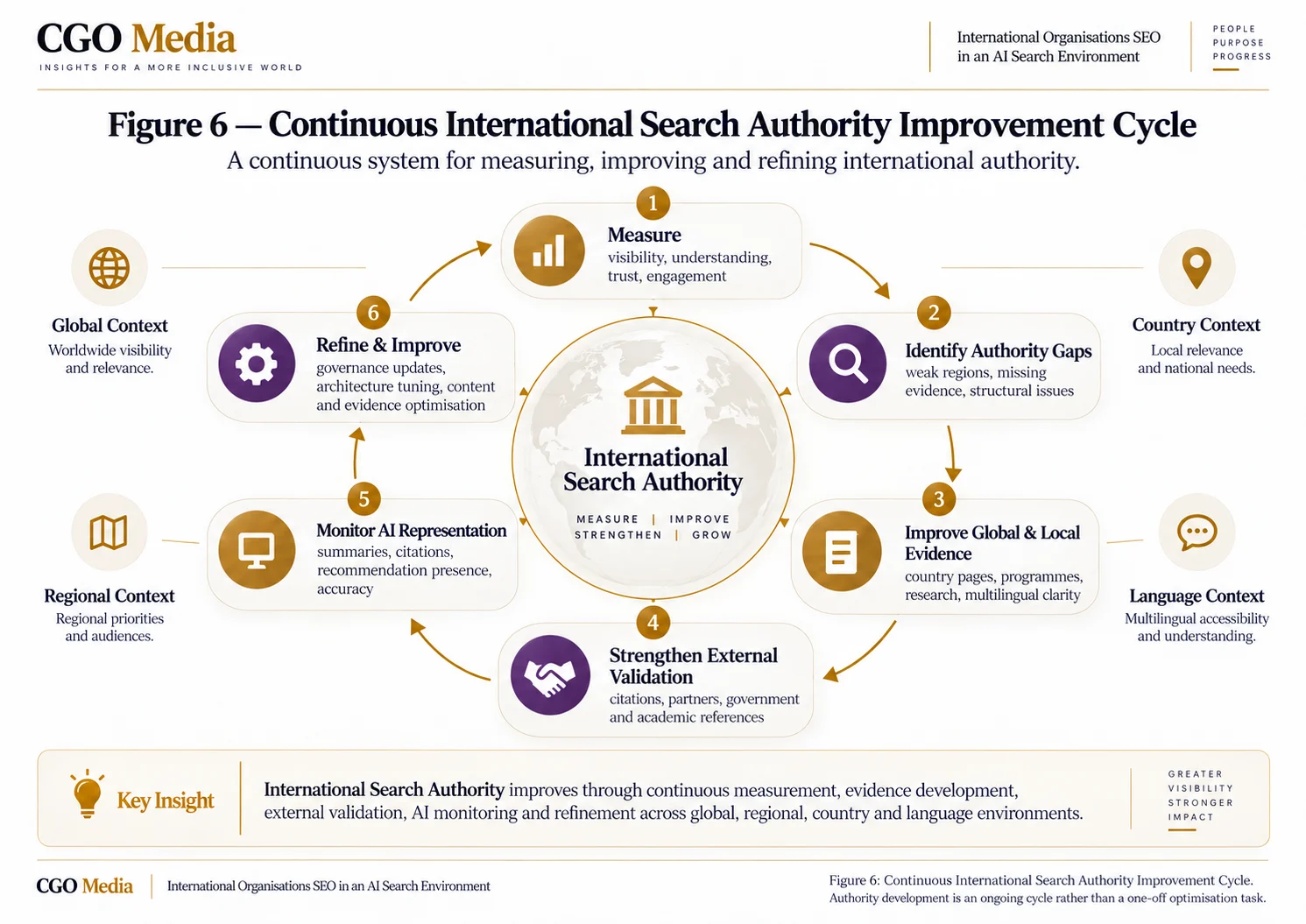
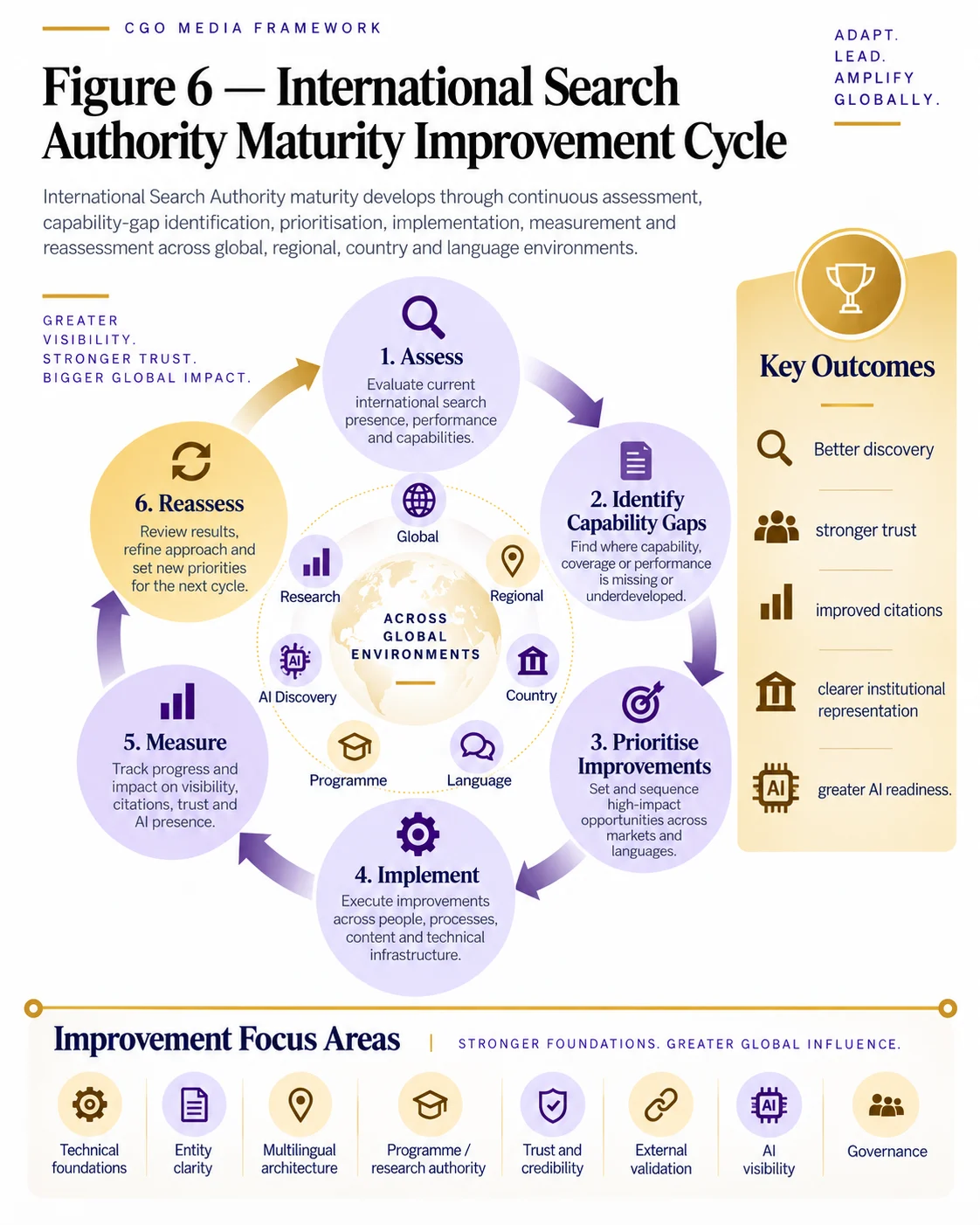
160. The International Organisations Framework Family
International Organisations SEO in an AI Search Environment provides the foundational research layer for the wider CGO Media International Organisations research family.
The purpose of the family is to examine different stages of the institutional discovery and authority problem through separate but connected research frameworks.
The parent research establishes the broader environment in which international organisations need to operate.
It examines how technical international SEO, institutional identity, country and language architecture, programmes, research, trust, external authority and AI-assisted discovery increasingly interact.
The supporting frameworks and models then examine specific parts of that environment in greater detail.
The five connected supporting research resources are:
- International Organisations AI Trust and Visibility Framework
- International Discovery and Organisation Selection Model
- International Search Authority Maturity Model
- International Organisations SEO and AI Implementation Roadmap
- International Organisations GEO: Generative Engine Optimisation
Each resource addresses a different strategic question.
The AI Trust and Visibility Framework examines whether the institution possesses the evidence, organisational clarity, geographic structure, trust signals and external authority required to be understood and represented credibly.
The Discovery and Organisation Selection Model examines how stakeholders can progress from identifying a need through organisation discovery, evaluation, validation, comparison and eventual selection.
The Search Authority Maturity Model examines how organisational capability develops from fragmented international publishing toward a structured, integrated and continuously adaptive authority system.
The SEO and AI Implementation Roadmap translates the research into a phased programme of assessment, stabilisation, structural improvement, authority development, validation, integration and continued evolution.
The International Organisations GEO research extends the research into generative discovery by examining entity understanding, evidence accessibility, source selection, citation visibility, recommendation relevance and qualified AI visibility.
Together, the papers create a connected research system rather than a collection of isolated SEO articles.
The central relationship is:
Research Foundation → Trust and Visibility → Discovery and Selection → Search Authority Maturity → Implementation → Generative Engine Optimisation
This architecture allows individual problems to be examined independently while maintaining their relationship with the wider institutional authority system.
161. Research Architecture
The International Organisations research architecture is designed around the principle that search visibility develops through several connected stages.
The first stage is institutional representation.
Search engines, AI systems and users need enough information to determine what the organisation is, what it does and how its offices, programmes, people, research and geographic operations relate to one another.
The second stage is evidence and trust.
Institutional claims need to be supported through programmes, research, statistics, methodologies, governance information, impact evidence and other verifiable resources.
The third stage is external validation.
Governments, academics, universities, partners, journalists, policy organisations and other credible institutions can independently reinforce specific areas of expertise and activity.
The fourth stage is discovery and selection.
Once sufficient evidence exists, users and information systems can determine whether the organisation is relevant to a particular subject, country, programme requirement or institutional scenario.
The fifth stage is organisational capability.
The institution needs repeatable systems for maintaining these relationships as programmes, countries, languages, leadership, research and external discovery environments change.
The sixth stage is generative representation.
AI-assisted systems may use this wider evidence environment when identifying organisations, retrieving information, selecting sources, constructing answers, generating comparisons or recommending relevant institutions.
The complete architecture can therefore be represented as:
Entity Clarity → Institutional Evidence → Independent Validation → Discovery → Selection → Authority Maturity → AI and Generative Visibility
This architecture is deliberately broader than conventional SEO.
Technical optimisation remains necessary because information must remain accessible and interpretable.
However, technical performance sits within a wider system involving institutional knowledge, geographic context, evidence quality, authority and governance.
International organisations should therefore treat search architecture as part of their knowledge and information infrastructure rather than simply as a traffic-acquisition discipline.
162. Methodological Position
International Organisations SEO in an AI Search Environment is a conceptual and strategic research framework developed by CGO Media to examine how global institutions can improve discovery, institutional clarity, authority and representation across traditional search and AI-assisted information environments.
The paper synthesises established and observable principles from several areas, including:
- international SEO;
- multilingual and multiregional architecture;
- information architecture;
- entity modelling;
- structured data;
- knowledge graphs;
- digital trust;
- institutional transparency;
- research publication;
- academic citation behaviour;
- external authority;
- information retrieval;
- and generative AI.
The models presented in this research are intended to organise these observable relationships into a practical strategic methodology.
They should not be interpreted as descriptions of proprietary algorithms used by Google, Microsoft, OpenAI, Anthropic, Perplexity or any other search engine, large language model, AI assistant or recommendation platform.
The research does not claim that any individual search or generative system calculates an International Search Authority score, follows the selection stages described in this paper or applies the conceptual equations presented here as literal ranking formulas.
Those elements are analytical models.
Their purpose is to help international organisations evaluate whether their information environment provides the clarity and evidence required for effective digital discovery.
The research is therefore concerned primarily with observable institutional conditions:
- whether organisational entities are represented consistently;
- whether relevant information can be discovered;
- whether geographic and language relationships are understandable;
- whether research and programme claims are supported by evidence;
- whether independent institutions validate relevant areas of expertise;
- whether AI systems represent important institutional information accurately;
- and whether those capabilities can be governed and measured over time.
International organisations vary substantially in mandate, scale, geography, language coverage, funding structure and operational model.
The framework should therefore be adapted to organisational context rather than applied mechanically.
An intergovernmental organisation may place greater strategic emphasis on policy and government authority.
A research institution may prioritise publications, datasets, methodology and academic citation.
An international NGO may require stronger programme, impact and country evidence.
A standards body may place greater emphasis on technical authority, version control and institutional adoption.
The framework is designed to accommodate those differences while preserving a common analytical principle:
International visibility becomes more resilient when institutional identity, evidence, geography, trust and external authority reinforce one another.
163. Strategic Implications
The principal strategic implication of this research is that international organisations should increasingly treat search as institutional infrastructure rather than only as a communications or marketing channel.
Their websites, programme environments, country pages, research libraries, statistical resources, policy publications, expert profiles, governance information and external citations collectively form a digital evidence system.
The quality of that system can influence whether users and information platforms are able to:
- identify the organisation correctly;
- understand its institutional role;
- discover relevant programmes;
- locate useful research;
- establish country and regional relevance;
- verify important claims;
- evaluate trust;
- compare the organisation with alternatives;
- and identify an appropriate route to engagement.
This creates several strategic consequences.
Search Strategy Must Extend Beyond the Main Website
International Search Authority can be influenced by many different digital assets.
A research repository can be strategically important even if it generates less traffic than the main website.
A country programme page can establish local relevance even if it serves a relatively small audience.
An expert profile can strengthen a subject-authority relationship.
A government citation can independently validate institutional expertise.
The organisation therefore needs to understand its full information ecosystem rather than measuring only its main domain.
Global Authority Must Be Connected with Local Evidence
International reputation does not automatically establish country-level relevance.
Country programmes, local partnerships, regional research and locally relevant external citations provide evidence that translates global institutional authority into geographic context.
Research Should Be Treated as Search Infrastructure
Original research, statistics and policy evidence can become some of the most durable sources of International Search Authority.
They can attract academic citations, government references, journalism and AI source visibility over long periods.
Research architecture should therefore be considered strategically rather than treated as a document archive.
Institutional Trust Must Be Verifiable
Mission statements and reputation remain useful, but high-trust discovery increasingly benefits from evidence.
Governance, funding transparency, methodology, leadership, impact reporting and independent validation can help users assess institutional credibility for themselves.
AI Search Extends Existing Authority Requirements
AI-assisted search introduces new source-selection, citation, comparison and recommendation environments, but it does not remove the need for strong underlying institutional information.
Entity clarity, useful evidence, technical accessibility, external validation and contextual relevance remain central.
The strategic objective should therefore not be to optimise superficially for individual AI answers.
It should be to strengthen the information and authority environment from which accurate AI representation can emerge.
Search Governance Must Become Cross-Functional
No single team controls every component of International Search Authority.
Digital, technical, country, research, communications, policy, programme, data and governance functions may all contribute important evidence.
The organisations most capable of sustaining authority are therefore likely to be those that coordinate these functions around shared institutional information standards.
164. Conclusion
International organisations operate within an unusually complex digital discovery environment.
They need to communicate a coherent global institutional identity while simultaneously representing countries, regions, languages, programmes, research, experts, partnerships, governance structures and external relationships.
Traditional International SEO remains a critical part of this environment.
Technical accessibility, indexation, international targeting, hreflang, canonicalisation, site architecture, performance and internal linking continue to influence whether institutional information can be discovered and interpreted.
However, technical optimisation alone does not address the complete problem.
International Search Authority increasingly depends on six broader areas:
- Organisation and Entity Clarity
- Mission, Programme and Knowledge Authority
- Country, Region and Language Architecture
- Trust, Governance and Institutional Credibility
- External, Academic and Policy Authority
- AI Search and International Recommendation Readiness
These areas interact.
Strong Entity Clarity helps users and machine systems identify the institution correctly.
Programme and Knowledge Authority demonstrate what the organisation actually does and knows.
Country, regional and language architecture establishes contextual relevance across international environments.
Governance and trust evidence allow important claims to be verified.
Independent academic, government, policy, partner and media references provide external validation.
AI-assisted discovery then operates across this wider evidence ecosystem rather than inside a completely separate search environment.
The strategic objective is therefore not simply to increase rankings for an international website.
It is to build an international digital authority architecture capable of supporting:
- discovery;
- understanding;
- research;
- citation;
- institutional validation;
- comparison;
- selection;
- recommendation;
- and engagement.
International organisations should also recognise that this architecture cannot remain static.
Programmes change.
Countries and regional priorities change.
Research develops.
Leadership changes.
Languages and terminology evolve.
External authority changes as new evidence is published and new partnerships emerge.
Search engines and generative systems continue to change how information is retrieved, synthesised, cited and presented.
International Search Authority therefore needs to become a continuously maintained institutional capability.
The strongest long-term approach is one in which the organisation can repeatedly:
Measure → Diagnose → Strengthen Evidence → Validate Authority → Monitor Representation → Learn → Adapt
When these processes become integrated with the wider institution, search becomes more than a source of website traffic.
It becomes part of how the organisation structures its knowledge, communicates its activity, demonstrates credibility and remains understandable across an increasingly AI-mediated international information environment.
References
External Academic, Technical and Institutional Sources
- 1. Google Search Central. Tell Google about localized versions of your page.
- 2. Google Search Central. Managing multi-regional and multilingual sites.
- 3. Schema.org. Organization.
- 4. Schema.org. Person.
- 5. Schema.org. Report.
- 6. Schema.org. Dataset.
- 7. World Wide Web Consortium. Web Content Accessibility Guidelines (WCAG) 2.2.
- 8. Metzger, M. J. (2007). Making Sense of Credibility on the Web: Models for Evaluating Online Information and Recommendations for Future Research. Journal of the American Society for Information Science and Technology, 58(13), 2078–2091.
- 9. Hogan, A. et al. (2021). Knowledge Graphs. ACM Computing Surveys, 54(4).
- 10. Ji, Z. et al. (2023). Survey of Hallucination in Natural Language Generation. ACM Computing Surveys, 55(12).
CGO Media Research Frameworks
- 11. Wilkinson, R. (2026). CGO AI Authority Model. CGO Media.
- 12. Wilkinson, R. (2026). CGO Media Entity Authority Framework. CGO Media.
- 13. Wilkinson, R. (2026). CGO Media Content Authority Framework. CGO Media.
- 14. Wilkinson, R. (2026). CGO Media Brand Signal Framework. CGO Media.
- 15. Wilkinson, R. (2026). CGO Media AI Citation Framework. CGO Media.
- 16. Wilkinson, R. (2026). CGO Media AI Search Readiness Framework. CGO Media.
- 17. Wilkinson, R. (2026). CGO Media Knowledge Architecture Map. CGO Media.
- 18. Wilkinson, R. (2026). CGO Media Search Ecosystem Model. CGO Media.
These references provide supporting technical, accessibility, credibility, knowledge-architecture and generative-system context. The strategic models developed within this paper remain CGO Media conceptual research frameworks rather than descriptions of proprietary search-engine or AI-system algorithms.
CGO Media Research Ecosystem
This research forms part of the
CGO Media Research Library
and supports the sector frameworks and models contained within the
CGO Media Framework Library.
The wider relationships between CGO Media research papers, frameworks, observations, statistics and knowledge structures are documented within the
CGO Media Research Architecture.
Supporting resources include the
CGO Media Research Observations Library
and
CGO Media Statistics Library.
About Roger Wilkinson
Roger Wilkinson is an independent Search and AI researcher, SEO practitioner and founder of CGO Media with more than 25 years of experience in search, online visibility and digital strategy.
His current research examines how artificial intelligence is changing search engines, recommendation systems and digital authority, with particular focus on Technical SEO, Entity Authority, Content Authority, Brand Signals, Citation Authority, Knowledge Architecture, Generative Engine Optimisation and AI Search Visibility.
Through the CGO Media research programme, Roger develops research papers, analytical models and strategic frameworks intended to help organisations understand how traditional search visibility increasingly interacts with entity recognition, independent authority, source selection, AI citations and generative recommendation systems.
View Roger Wilkinson's researcher profile →
Author: Roger Wilkinson
Publisher: CGO Media
Last reviewed: September 2026
Related International Organisations AI, GEO & Search Research
The International Organisations research family contains seven connected pages. This foundational research paper is supported by the main sector research hub and five connected trust, selection, maturity, implementation and GEO resources.
Research Libraries
Research Usage & Citation
CGO Media encourages researchers, journalists, international organisations, NGOs, policy institutions, associations, academics and practitioners to reference this research where it contributes to wider understanding of International SEO, institutional authority, multilingual search, research discovery, digital trust and AI-assisted information discovery.
Reasonable quotations, summaries, figures and excerpts may be used in articles, reports, presentations, academic work and other publications provided appropriate acknowledgement is given to Roger Wilkinson and CGO Media.
Cite This Research / Embed Citation
International Organisations SEO in an AI Search Environment, developed by Roger Wilkinson at CGO Media, examines how global institutions can strengthen organisation clarity, programme and research authority, multilingual and geographic architecture, institutional trust, external validation and AI recommendation readiness across international discovery environments.
APA Citation
Wilkinson, R. (2026). International Organisations SEO in an AI Search Environment. CGO Media. https://cgomedia.com/international-organisations-seo-in-an-ai-search-environment/
BibTeX Citation
@article
Author: Roger Wilkinson
Published by: CGO Media
Original publication: 31 August 2026
Last reviewed: September 2026
For permissions relating to extensive reproduction, commercial licensing or republication of substantial portions of this research, please contact CGO Media directly.