
International Organisations SEO and AI Implementation Roadmap
 The International Organisations SEO and AI Implementation Roadmap provides a structured implementation sequence for intergovernmental organisations, international NGOs, development organisations, foundations, associations, standards bodies, research institutions, multinational charities and other internationally active institutions seeking to strengthen global search visibility, institutional authority, multilingual architecture, research discoverability, external validation and AI-assisted discovery.
International organisations rarely begin with one isolated search problem.
They usually face several interconnected weaknesses at the same time.
A technically strong website may coexist with inconsistent country information.
A respected institution may publish significant research but make that research difficult to discover.
A global organisation may have strong English-language authority while translated environments remain incomplete or outdated.
An organisation may receive extensive government and academic recognition while its own programme architecture fails to connect those external signals with relevant institutional evidence.
AI systems may identify the organisation correctly in one context while misrepresenting leadership, programme status or geographic activity in another.
These problems cannot be resolved effectively through a disconnected collection of technical fixes, content projects and AI experiments.
They require an implementation sequence.
The roadmap therefore organises international search development into seven phases:
Assess → Stabilise → Structure → Strengthen → Validate → Integrate → Evolve
Each phase builds on the previous one.
Assessment identifies the current authority environment.
Stabilisation corrects weaknesses that could undermine later work.
Structure creates explicit relationships between organisational entities, countries, programmes, research and evidence.
Strengthen increases the depth and quality of that evidence.
Validate develops independent recognition.
Integrate connects technical, institutional, geographic, research and AI systems.
Evolve establishes continuous measurement and adaptation.
This roadmap builds on the parent research paper International Organisations SEO in an AI Search Environment and should be considered alongside the International Organisations AI Trust and Visibility Framework, International Discovery and Organisation Selection Model and International Search Authority Maturity Model.
1. Why International Organisations Need an Implementation Roadmap
International organisations frequently operate digital estates that have developed over many years and across many teams.
The result can be substantial organisational complexity.
A single institution may maintain:
- a global website;
- regional hubs;
- country websites;
- programme microsites;
- multilingual resources;
- research repositories;
- statistical databases;
- media centres;
- governance resources;
- funding portals;
- career platforms;
- and separate institutional profiles across external systems.
Each environment may have developed under different technical, editorial and organisational standards.
Common weaknesses include:
- fragmented global and country websites;
- weak multilingual architecture;
- incorrect or incomplete hreflang;
- duplicate international URLs;
- outdated programme information;
- poorly structured research libraries;
- weak entity relationships;
- inconsistent leadership or governance information;
- limited external citation monitoring;
- and minimal AI visibility measurement.
Attempting to fix every weakness simultaneously can create another layer of fragmentation.
Technical teams may begin a migration while communications teams rewrite programme content.
Research teams may reorganise publications while country teams introduce new page structures.
AI monitoring may begin before the institution possesses a reliable source of truth for basic organisational facts.
The roadmap therefore provides sequencing.
It helps organisations determine which capabilities should be understood first, which weaknesses should be corrected before expansion, and when more advanced authority and AI initiatives become appropriate.
2. From International SEO Activity to Institutional Search Authority
Traditional International SEO programmes are often organised around individual activities.
These can include:
- technical SEO;
- hreflang implementation;
- translation;
- country-page optimisation;
- content publishing;
- keyword research;
- link acquisition;
- and reporting.
Each activity can be valuable.
The problem arises when they operate independently.
A country page can be technically optimised but contain outdated programme evidence.
A translated research page can contain perfect hreflang but fail to reflect the current source publication.
A strong link-building campaign can increase visibility around a resource whose institutional attribution remains unclear.
An AI monitoring project can identify representation problems without establishing who inside the organisation owns the underlying information.
The roadmap therefore connects traditional search activity with a broader institutional authority system.
That system includes:
- organisation identity;
- programme authority;
- research and knowledge architecture;
- country and regional relevance;
- language governance;
- institutional trust;
- external and academic validation;
- AI representation;
- and ongoing measurement.
The strategic transition is:
SEO Activity → Connected Institutional Evidence → Search Authority → AI Discovery Readiness
This does not replace technical SEO.
It places technical SEO inside a wider system in which the organisation’s institutional information can be discovered, understood, verified and evaluated.
3. The Seven International Implementation Phases
The roadmap uses seven implementation phases:
- Assess
- Stabilise
- Structure
- Strengthen
- Validate
- Integrate
- Evolve
The phases should not be interpreted as rigid project gates.
Large organisations may work across several phases simultaneously.
A mature research team may already be strengthening external authority while another country environment still requires basic technical stabilisation.
The sequence exists because certain capabilities depend on others.
It is difficult to build reliable multilingual authority when hreflang and equivalent-page relationships remain broken.
It is difficult to develop programme authority when programme status is inaccurate.
It is difficult to improve AI representation when the institution itself publishes conflicting organisational facts.
Advanced visibility should therefore be built on reliable evidence foundations.
The roadmap is designed to help institutions determine where those dependencies exist and sequence improvement accordingly.
4. Phase One — Assess
The first phase establishes the organisation’s current International Search Authority position.
Assessment should not begin with assumptions about what the institution already does well.
A large organisation may possess strong offline reputation and significant institutional resources while still maintaining fragmented digital evidence.
The purpose of Phase One is to create a factual baseline.
Assessment should cover:
- technical international SEO;
- organisation and entity clarity;
- country architecture;
- regional architecture;
- language architecture;
- programme authority;
- research and knowledge assets;
- statistical authority;
- governance and trust;
- external authority;
- AI visibility;
- AI accuracy;
- peer institutions;
- stakeholder journeys;
- and measurement capability.
The assessment should identify both weaknesses and existing strengths.
This is important because stronger parts of the organisation can provide internal models for weaker environments.
A mature country architecture in one region may provide a template for others.
A well-structured research unit may already demonstrate publication standards that could be adopted institution-wide.
Phase One should therefore answer:
What authority capabilities already exist, where do they operate well, and which gaps most strongly constrain international discovery?
5. Technical Baseline Assessment
The technical baseline determines whether the international digital estate can be crawled, indexed and interpreted reliably.
The assessment should review:
- crawlability;
- indexation;
- robots directives;
- XML sitemaps;
- international URL architecture;
- hreflang;
- canonicalisation;
- redirect behaviour;
- duplicate international URLs;
- site performance;
- mobile usability;
- internal linking;
- structured data;
- and technical consistency across platforms.
The audit should be conducted across more than the primary global website.
Regional and country environments may use different technology.
Programme sites may have been developed separately.
Research repositories may use specialist platforms.
The organisation should therefore identify technical fragmentation as well as individual technical errors.
A key assessment question is:
Can search systems reliably discover and interpret the complete international evidence environment?
6. Organisation Entity Assessment
The entity assessment examines whether the institution itself is represented consistently across its digital and external environments.
Core information should be reviewed across:
- global websites;
- regional websites;
- country websites;
- programme environments;
- research publications;
- government references;
- partner websites;
- professional databases;
- and official social profiles.
Important facts include:
- official organisation name;
- acronym;
- organisation type;
- headquarters;
- mission;
- mandate;
- leadership;
- geographic scope;
- and major institutional relationships.
The assessment should identify contradictions rather than simply recording whether information exists.
If three country environments describe the organisation differently, the issue is not missing content.
It is entity inconsistency.
Phase One should therefore identify where conflicting descriptions could weaken human or machine understanding.
7. Acronym Assessment
Acronyms should be reviewed where they form a significant part of institutional identity.
International organisations frequently use short forms that may overlap with:
- other institutions;
- government bodies;
- companies;
- technical concepts;
- academic institutions;
- and unrelated organisations in other countries.
The assessment should determine whether the acronym is consistently connected with the full institutional name.
Relevant questions include:
- Does the full name appear on important institutional pages?
- Do programme sites explain the relationship with the parent organisation?
- Do research papers provide clear institutional attribution?
- Do country sites use inconsistent local forms of the acronym?
- Do external sources regularly confuse the institution with another entity?
The output should identify acronym ambiguity where it could weaken Entity Authority or AI representation.
8. Leadership Assessment
Leadership information should be verified because senior institutional roles are frequently repeated across websites, publications, media profiles and external databases.
The assessment should review:
- current leadership;
- official titles;
- biography accuracy;
- role relationships;
- regional leadership;
- country leadership where relevant;
- programme leadership;
- and outdated references to former leaders.
Leadership changes can create widespread inconsistency.
A central governance page may be updated immediately while country pages, press resources, programme pages or structured data retain outdated information.
AI systems may subsequently encounter both old and current versions.
Phase One should therefore map where leadership information is published and identify material contradictions.
9. Country Architecture Assessment
Country architecture should be assessed according to both structural consistency and evidentiary value.
The audit should examine:
- country-page consistency;
- office information;
- programme visibility;
- research links;
- local contacts;
- partner information;
- country statistics;
- expert representation;
- impact evidence;
- and local authority signals.
The assessment should distinguish between a country page that merely exists and one that functions as a genuine institutional authority hub.
Priority should reflect actual operational importance.
A country in which the organisation maintains extensive programmes, partnerships and research should normally have a richer evidence environment than a country with minimal activity.
The audit should therefore compare digital representation with real-world institutional presence.
10. Regional Architecture Assessment
Regional sections should be evaluated according to whether they provide meaningful institutional context between global strategy and country activity.
The assessment should examine:
- regional strategy;
- participating countries;
- regional programmes;
- regional research;
- regional leadership;
- partners;
- cross-country evidence;
- and links into country environments.
A regional page should not be considered strong merely because it aggregates country links.
The audit should determine whether the region possesses its own strategic and informational purpose.
Where regional structures exist operationally but remain invisible digitally, that gap should be recorded.
11. Language Architecture Assessment
The language audit should assess both technical relationships and editorial quality.
It should examine:
- language coverage;
- translation quality;
- content parity;
- local terminology;
- localisation;
- update frequency;
- equivalent-page relationships;
- hreflang implementation;
- navigation between languages;
- and ownership of language updates.
The assessment should identify where language versions have diverged materially.
One language may still describe a programme as active after the primary version has been archived.
Another may retain former leadership.
A translated research library may cover only a small proportion of current institutional evidence.
Language architecture should therefore be assessed as a governance capability rather than purely as a translation output.
12. Programme Authority Assessment
Major programmes should be reviewed as distinct authority entities.
The assessment should examine:
- purpose;
- status;
- geographic scope;
- partners;
- funding where relevant;
- programme leadership;
- activities;
- outputs;
- results;
- impact evidence;
- supporting research;
- and external validation.
Programme pages should also be assessed for their relationship with the wider organisation.
A programme may have substantial visibility while remaining poorly connected with the parent institution.
Another may be well integrated into the organisation’s architecture but provide very little evidence of outcomes.
The baseline assessment should distinguish between these different weaknesses.
13. Research Architecture Assessment
Research libraries should be audited as institutional knowledge systems rather than only as document repositories.
Assessment should consider:
- discoverability;
- classification;
- authorship;
- publication dates;
- subject relationships;
- country relationships;
- programme relationships;
- supporting datasets;
- methodology;
- versioning;
- citation guidance;
- and HTML context around downloadable resources.
The organisation should determine whether important research can be found through the questions users actually ask.
It should also establish whether publications are connected with the experts, countries, programmes and subjects that give them institutional meaning.
Research volume should not be mistaken for research architecture.
The assessment should identify where high-value evidence is difficult to discover despite already existing within the institution.
14. Statistical Authority Assessment
Statistical resources should be evaluated separately where data is an important component of institutional authority.
The audit should examine:
- methodology;
- freshness;
- historical continuity;
- source clarity;
- revision status;
- geographic scope;
- downloadability;
- citation usability;
- and accessibility of current versus archived figures.
The organisation should also examine whether external users are citing the original institutional source or primarily relying on secondary reproductions.
Where statistics are highly influential, strong first-party documentation becomes particularly important for verification and AI source use.
15. Governance and Trust Assessment
The trust assessment should determine whether users can verify the institution’s structure, leadership, funding and accountability.
Relevant evidence includes:
- governance structure;
- leadership;
- legal or institutional status;
- funding information;
- annual reports;
- audits;
- accountability policies;
- impact reporting;
- institutional history;
- and methodology where important claims are made.
The audit should consider both existence and accessibility.
Trust information that technically exists but is extremely difficult to locate may provide less value during real stakeholder evaluation.
Accuracy is equally important.
Governance resources should not contradict current institutional information elsewhere on the site.
16. External Authority Assessment
The external authority assessment maps how independent institutions recognise the organisation’s work.
Relevant evidence can include:
- government references;
- academic citations;
- university references;
- think-tank citations;
- media coverage;
- partner organisations;
- policy citations;
- standards references;
- and citations from other international institutions.
The objective should not be to generate a single external-authority score.
Different references validate different capabilities.
Academic citations can support Research Authority.
Government references may demonstrate policy relevance.
Partner references can validate programme activity.
Media citations may reinforce expert authority.
The assessment should therefore identify what external evidence validates rather than merely count how much exists.
17. AI Visibility Assessment
A baseline AI assessment should use realistic prompts reflecting actual stakeholder discovery journeys.
Prompt groups can include:
- organisation discovery;
- programme recommendations;
- research-source discovery;
- country-level questions;
- regional questions;
- potential partners;
- institution comparisons;
- statistical questions;
- expert discovery;
- and multilingual variants.
The audit should record:
- whether the organisation appears;
- how it is described;
- which programmes appear;
- which sources are cited where citations are visible;
- which peer organisations appear;
- and whether results change materially by country or language.
The purpose is to create a baseline rather than to treat one generated answer as definitive.
AI visibility should be observed as a pattern across repeated relevant discovery scenarios.
18. AI Accuracy Assessment
AI visibility without accuracy can create limited or even negative institutional value.
Generated answers should therefore be reviewed for inaccuracies involving:
- organisation identity;
- leadership;
- mission;
- mandate;
- programme status;
- countries of operation;
- research;
- statistics;
- partnerships;
- and institutional relationships.
Material errors should be traced back to the available evidence environment.
The organisation should ask whether:
- its own information is current;
- different first-party pages conflict;
- important current pages are difficult to discover;
- old external references remain prominent;
- programme relationships are unclear;
- or the relevant information is missing entirely.
This turns AI accuracy monitoring into a diagnostic exercise.
The goal is not simply to record incorrect answers.
It is to identify the information weaknesses that may contribute to those answers.
19. Peer Institution Assessment
Peer assessment provides external context around the organisation’s own baseline.
Comparable institutions can be reviewed across:
- country architecture;
- regional architecture;
- language coverage;
- programme evidence;
- research depth;
- government references;
- academic citations;
- media authority;
- expert visibility;
- and AI visibility.
The objective should not be to produce a simplistic ranking.
International institutions frequently possess different mandates and operating models.
Comparison should instead identify practices that appear to improve institutional understanding and evidence quality.
For example, a peer may provide much stronger country-programme integration.
Another may have superior publication architecture.
Another may make governance and funding evidence easier to verify.
These observations can help the organisation identify realistic improvement opportunities.
20. Stakeholder Journey Assessment
Phase One should also assess how users move through the organisation’s existing digital environment.
A useful stakeholder journey is:
Need → Discovery → Evaluation → Validation → Operational Fit → Comparison → Engagement → Ongoing Relationship
The organisation should examine whether its information architecture supports each stage.
At Need, the user begins with a problem or information requirement.
At Discovery, the user identifies potentially relevant institutions or resources.
At Evaluation, the user examines programme, research or organisational relevance.
At Validation, the user looks for trust and independent evidence.
At Operational Fit, the user determines whether the institution can realistically address the requirement.
At Comparison, alternatives are considered.
At Engagement, the user needs a practical route to act.
At Ongoing Relationship, the organisation may become a continuing source, partner, programme provider, member body or institutional reference.
The assessment should identify where users are likely to encounter evidence gaps or unnecessary friction across this journey.
21. Phase One Output
The Assess phase should conclude with a prioritised International Search Authority Gap Register.
This register converts audit findings into an implementation tool.
Each identified gap should record:
- Capability affected — the authority area in which the weakness exists;
- Institutional importance — how strategically important the affected area is;
- Evidence missing — the information, architecture or validation currently absent;
- Geographic or language scope — whether the issue is global, regional, national or language-specific;
- Operational risk — whether the gap creates material accuracy, trust or stakeholder risk;
- Implementation difficulty — the likely complexity of resolution;
- Dependencies — other capabilities that rely on the gap being corrected;
- Owner — the team or function responsible for action;
- Priority — the sequence in which the problem should be addressed;
- Target phase — Stabilise, Structure, Strengthen, Validate, Integrate or Evolve.
The register should distinguish between immediate foundational problems and longer-term authority opportunities.
For example, incorrect canonicalisation may require urgent stabilisation because it affects discovery directly.
Weak research citation authority may represent an important strategic opportunity but depend first on stronger publication architecture.
Outdated programme information may require immediate correction because it creates institutional accuracy risk.
Advanced AI recommendation monitoring may be valuable but should not take priority over conflicting entity information.
Phase One therefore produces more than an audit report.
It establishes the evidence required to sequence the entire roadmap.
The organisation should leave the Assess phase with a clear understanding of:
- its strongest existing capabilities;
- its most important authority gaps;
- the relationships between those gaps;
- the teams responsible for addressing them;
- and the order in which development should proceed.
This creates the foundation for the seven-phase International Organisations SEO and AI Implementation Roadmap.
The roadmap moves an international organisation from baseline assessment through technical and institutional stabilisation, structured knowledge architecture, stronger evidence, external validation, integrated search and AI systems, and finally continuous adaptation.
1. Assess
Establish the current technical, institutional, geographic, multilingual, research, trust, external-authority and AI visibility baseline.
2. Stabilise
Correct critical technical errors, institutional inconsistencies, outdated programme information, language problems and unreliable measurement.
3. Structure
Create explicit relationships between organisation, regions, countries, languages, programmes, research, experts, partners and governance evidence.
4. Strengthen
Increase the depth, usefulness and verifiability of organisational, programme, research, statistical, geographic and trust evidence.
5. Validate
Build independent recognition through governments, academics, partners, policy organisations, media and other credible external institutions.
6. Integrate
Connect technical SEO, knowledge architecture, country and language governance, measurement, external authority and AI monitoring into one institutional system.
7. Evolve
Continuously measure, learn and adapt as programmes, countries, languages, evidence, stakeholder behaviour, search systems and AI discovery environments change.
Implementation principle: Advanced international search and AI visibility should not be built on unreliable foundations. The roadmap therefore progresses from assessment and stabilisation toward structure, evidence depth, independent validation, integration and continuous institutional learning.
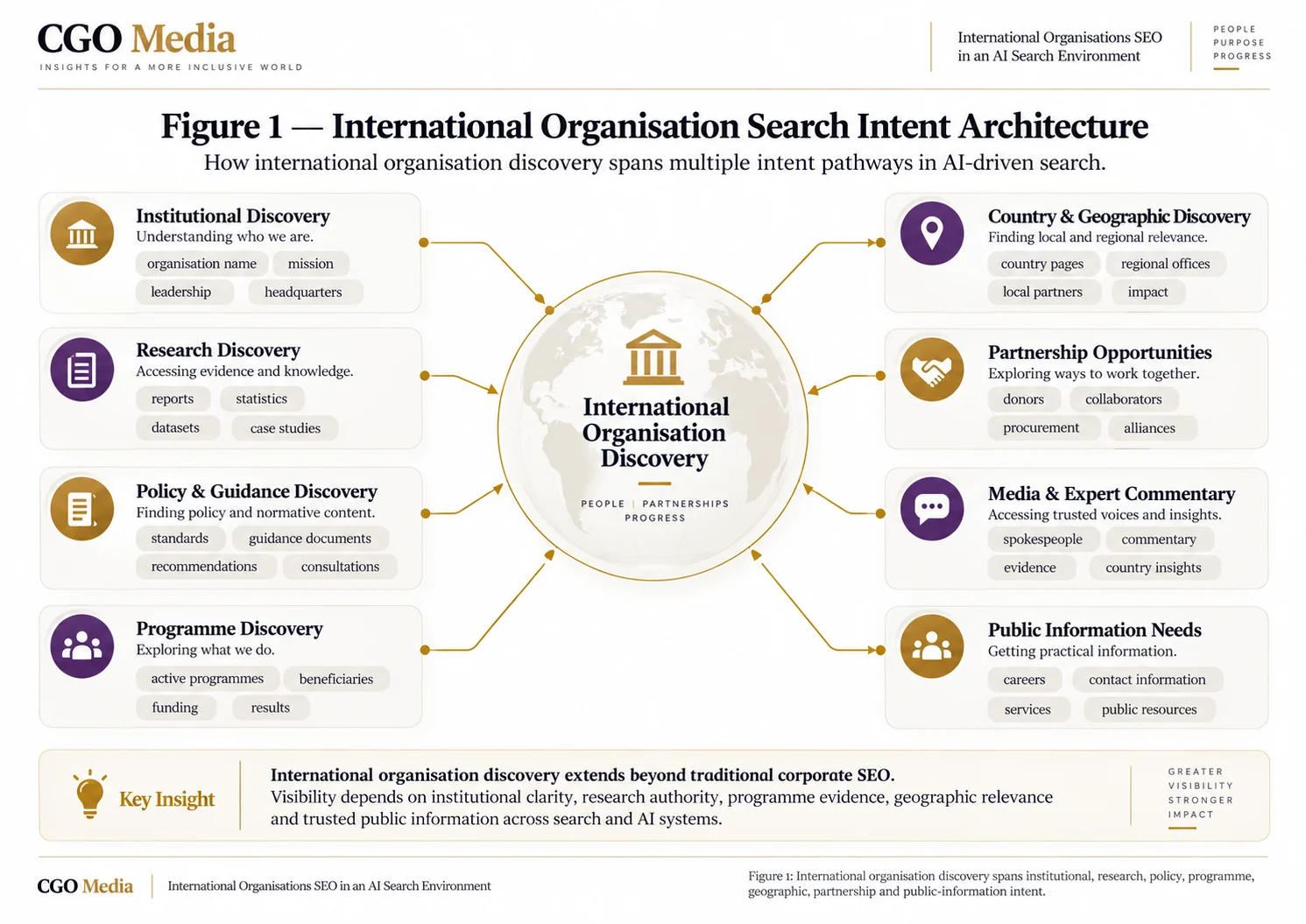
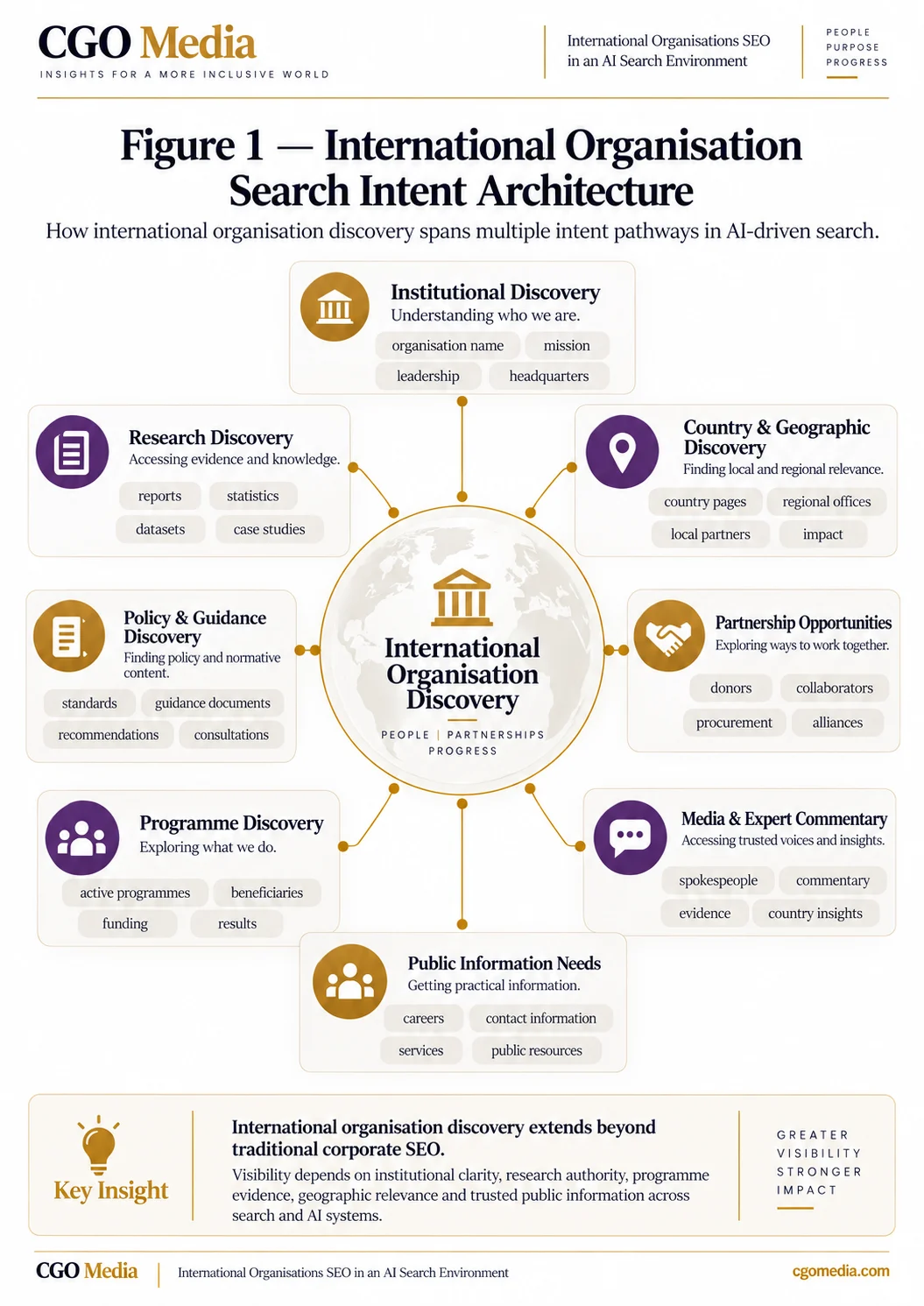
Figure 1. The International Organisations SEO and AI Implementation Roadmap progresses through Assess, Stabilise, Structure, Strengthen, Validate, Integrate and Evolve.
22. Phase Two — Stabilise
The Stabilise phase addresses weaknesses that could undermine every later stage of International Search Authority development.
An organisation should not attempt to build advanced authority systems on top of unreliable technical infrastructure, inconsistent institutional information, outdated programme pages or fragmented multilingual content.
Phase Two therefore focuses on reliability.
The objective is to create a sufficiently stable environment in which later structural and authority improvements can produce durable value.
Stabilisation should prioritise problems that create one or more of the following:
- discovery failure;
- institutional ambiguity;
- geographic confusion;
- language inconsistency;
- programme inaccuracy;
- research ambiguity;
- trust risk;
- or unreliable measurement.
Not every issue identified during Phase One requires immediate correction.
Stabilisation should focus first on weaknesses that materially prevent the organisation from being discovered, understood or represented accurately.
A useful prioritisation rule is:
Fix what can invalidate later authority work before expanding the authority system.
23. Stabilise Technical Foundations
Technical reliability is the first stabilisation priority because search and AI visibility depend on institutional evidence being accessible.
Priority technical issues can include:
- indexation failures;
- incorrect hreflang;
- canonical conflicts;
- duplicate international URLs;
- unintended noindex directives;
- blocked resources;
- broken internal links;
- redirect chains;
- orphaned pages;
- slow page performance;
- mobile usability weaknesses;
- structured-data errors;
- and inconsistent sitemap coverage.
The technical priority should reflect institutional importance rather than raw error volume.
A broken canonical affecting a major country programme can be more important than hundreds of low-value technical warnings on archived resources.
Similarly, incomplete hreflang on strategically important multilingual pages may deserve higher priority than minor formatting problems elsewhere.
The purpose of stabilisation is not to achieve a theoretical zero-error crawl.
It is to ensure that high-value international evidence can be discovered and interpreted reliably.
24. Stabilise Organisation Identity
Core institutional information should be corrected wherever the organisation is represented inconsistently.
Priority elements include:
- official organisation name;
- acronym;
- organisation type;
- headquarters;
- mission;
- mandate;
- geographic scope;
- and parent-child organisational relationships.
The organisation should establish an authoritative source for these facts.
Global, regional, country and programme environments can then align with that source while still presenting information appropriately for their own audiences.
Stabilising identity does not require identical wording everywhere.
It requires consistency in the underlying facts.
For example, a country page may describe the institution from a local perspective while still using the correct organisation name, mandate and parent relationship.
The output of this work should be a clearer institutional identity that can support later entity and Knowledge Architecture development.
25. Stabilise Leadership Information
Leadership information should be corrected across all priority institutional environments.
These may include:
- the global website;
- regional websites;
- country sites;
- governance pages;
- programme pages;
- research publications;
- media resources;
- structured data;
- and official external profiles.
Leadership changes can create particularly visible contradictions.
An old executive biography may continue ranking for branded searches long after the main governance page has been updated.
Country pages may list former regional directors.
Programme resources may still contain outdated titles.
These inconsistencies can weaken institutional trust and AI representation accuracy.
The stabilisation objective is therefore to ensure that current leadership information is both accurate and sufficiently dominant within the organisation’s own digital estate.
26. Stabilise Country Information
Priority country environments should be reviewed for factual accuracy before more ambitious local authority development begins.
Core information can include:
- office status;
- office location;
- local contacts;
- current programmes;
- programme status;
- partners;
- research;
- country leadership;
- and major local institutional relationships.
Where a country operation has closed, merged or changed structure, that should be reflected clearly.
Where programmes have ended, historical evidence may remain online but should not continue appearing as active current activity.
The country stabilisation process should therefore distinguish between:
- current institutional evidence;
- historical evidence;
- archived evidence;
- and obsolete information that should no longer be relied upon.
This improves both human understanding and machine interpretation.
27. Stabilise Regional Information
Regional structures should be corrected where geography, responsibility or programme relationships are ambiguous.
Important questions include:
- Which countries belong within the region?
- Does the region have its own office or leadership structure?
- Which programmes operate regionally?
- Which research applies across the region?
- How does the regional structure relate to headquarters?
- How does it relate to individual country operations?
Where these relationships are unclear, users may encounter overlapping country and regional information without understanding which resource is authoritative.
Stabilisation should therefore remove obvious contradictions and establish a reliable geographic hierarchy before later regional authority work begins.
28. Stabilise Language Versions
Priority language environments should be reviewed for both technical and editorial reliability.
Common weaknesses include:
- outdated translations;
- missing equivalent pages;
- incorrect terminology;
- broken hreflang relationships;
- obsolete navigation;
- partial content coverage;
- and inconsistent institutional facts.
The organisation should begin with strategically important information.
Mission, leadership, programme status, governance and important country evidence should not materially contradict the primary institutional source.
Where translated pages are too outdated to maintain safely, it may be better to review, update or retire them than leave misleading information online.
The objective is to create a trustworthy multilingual base before expanding localised authority.
29. Stabilise Programme Status
Programme pages should make operational status explicit.
A simple lifecycle may include:
- Planned
- Active
- Completed
- Archived
Different organisations may use different terminology, but the principle remains important.
Users should not need to infer whether a programme is current from publication dates or old news articles.
Completed initiatives may remain valuable as evidence of institutional history, programme capability and impact.
They should therefore not necessarily be removed.
Instead, the page should explain clearly that the programme is no longer active and preserve useful historical evidence where appropriate.
This distinction improves stakeholder trust and reduces the risk of outdated AI or search representations.
30. Stabilise Research Metadata
Priority research resources should contain reliable metadata before the organisation attempts to build more advanced Knowledge Architecture.
At minimum, significant research should establish:
- title;
- author or authors;
- publishing organisation;
- publication date;
- subject;
- publication type;
- and a stable resource URL.
Where relevant, additional information may include:
- methodology;
- geography;
- programme relationship;
- supporting data;
- version;
- and citation information.
Metadata inconsistency can become particularly problematic in large institutional research libraries.
The same author’s name may be formatted differently across reports.
Publication dates may be missing.
Titles may differ between HTML pages and downloadable files.
Stabilisation creates the consistent foundation required for later research entity relationships.
31. Stabilise Statistical Information
Statistical resources should be corrected where temporal ambiguity or outdated values create a material risk of misunderstanding.
Important statistical resources should indicate:
- the relevant date or period;
- geographic scope;
- source;
- methodology where required;
- revision status;
- and whether newer data exists.
Older figures should not necessarily be deleted.
Historical statistics can be valuable for longitudinal analysis.
The critical requirement is that users can distinguish historical evidence from current data.
Where external sites or AI systems continue citing obsolete values, clearer first-party dating and current-resource links may help reduce temporal confusion.
32. Stabilise Governance Information
Institutional trust depends on core governance information being accurate and accessible.
Priority resources should be reviewed for current information relating to:
- governance;
- leadership;
- funding;
- financial reporting;
- annual reporting;
- impact reporting;
- legal status;
- and institutional accountability.
The stabilisation process should remove contradictions between governance resources and the wider website.
Where annual reports or financial documents are archived, current resources should remain easy to distinguish from historical editions.
Governance stabilisation creates the trust base required for later authority strengthening.
33. Stabilise External Institutional Profiles
Important external profiles should be reviewed where they materially influence public or machine understanding of the organisation.
These may include:
- government directories;
- partner profiles;
- professional databases;
- academic profiles;
- official social profiles;
- institutional directories;
- and other authoritative public databases.
The organisation cannot control every third-party reference.
However, where a materially inaccurate profile can be corrected through a legitimate update process, it may be appropriate to do so.
Priority should be given to errors affecting:
- organisation name;
- leadership;
- status;
- location;
- programme relationships;
- or major institutional facts.
The aim is to reduce avoidable contradictions within the external evidence environment.
34. Stabilise Measurement
Reliable implementation requires reliable measurement.
Before later phases begin, the organisation should ensure that basic tracking exists for:
- global organic visibility;
- country-level traffic;
- language-level traffic;
- programme engagement;
- research usage;
- external referrals;
- key conversion or engagement pathways;
- and important technical signals.
Measurement should be segmented where organisational decisions depend on those segments.
A single global traffic number can hide significant country or language decline.
Programme traffic should not necessarily be combined with research usage if the two serve completely different stakeholder needs.
The objective of Phase Two is not to create the final authority dashboard.
It is to create a sufficiently reliable baseline for measuring whether later implementation activity actually produces improvement.
35. Phase Two Output
At the end of Stabilise, the organisation should possess a more reliable technical, institutional, geographic, multilingual and knowledge foundation.
The expected output is not perfection.
It is sufficient reliability for the next phase.
By this point:
- critical technical barriers should be reduced;
- core organisation information should be consistent;
- leadership information should be current;
- priority country and regional information should be accurate;
- important language environments should be materially reliable;
- programme status should be explicit;
- research metadata should be more consistent;
- statistical dates and versions should be clearer;
- governance information should be current;
- important external-profile inaccuracies should be addressed where possible;
- and baseline measurement should be functioning.
The organisation can then move from correcting individual weaknesses toward building an explicit institutional architecture.
36. Phase Three — Structure
The Structure phase creates explicit relationships between organisation, geography, programme, research, experts, partners, governance and other institutional evidence.
This phase addresses a common international-search problem:
the organisation already possesses substantial information, but the relationships between those information assets remain unclear.
A country may have several programme pages, but none connect back to the main country hub.
Research may exist, but users cannot identify which programme produced it.
Experts may publish extensively, but their institutional profiles do not connect them with their research.
Partners may be named on programme pages without explaining their role.
The Structure phase converts those isolated assets into a connected authority architecture.
37. Structure the Global Organisation Architecture
A useful high-level institutional relationship can be represented as:
Global Organisation → Region → Country → Programme → Research → Evidence → Impact
This is a conceptual model rather than a mandatory navigation structure.
Its purpose is to ensure that important institutional relationships become understandable.
The global organisation establishes identity and mandate.
Regions provide geographic coordination.
Countries provide local institutional context.
Programmes demonstrate activity.
Research provides knowledge and evidence.
Impact resources demonstrate outcomes.
The architecture should allow users to move naturally between these layers where the relationship is relevant.
38. Structure Regional Architecture
Regional hubs should connect the elements that collectively define the organisation’s regional authority.
These can include:
- regional strategy;
- participating countries;
- regional programmes;
- research;
- partners;
- experts;
- statistics;
- and policy priorities.
The region should function as an authority layer rather than merely an index of country pages.
Where programmes operate across borders, the regional hub can explain that shared context.
Where research applies across multiple countries, the region can provide an appropriate discovery environment.
Regional architecture should also make the relationship with the global organisation and individual country operations clear.
39. Structure Country Architecture
Country pages should become structured authority hubs.
A mature country architecture can connect:
- country office;
- active programmes;
- research;
- statistics;
- partners;
- experts;
- impact evidence;
- regional context;
- and relevant institutional contacts.
Not every country page needs the same quantity of information.
The depth of the architecture should reflect the organisation’s actual operational footprint.
The key requirement is that users can understand what the institution does in that country and reach the relevant supporting evidence.
Country architecture should therefore move beyond generic location landing pages toward genuine geographic Knowledge Architecture.
40. Structure Language Architecture
Language environments should operate according to defined relationships and maintenance standards.
These should cover:
- equivalent pages;
- hreflang;
- localisation;
- terminology;
- update cycles;
- navigation;
- and ownership.
The organisation should determine which types of information require strong multilingual parity.
Core institutional facts may require consistent coverage.
Country-specific or policy content may require more substantial localisation.
Research may require selective translation based on strategic audience demand.
A structured language model replaces ad hoc translation with planned information governance.
41. Structure Programme Architecture
Programme pages should connect clearly with the wider institutional system.
Relevant relationships may include:
- parent organisation;
- regions;
- countries;
- partners;
- funding;
- research;
- experts;
- outputs;
- outcomes;
- and related programmes.
This allows the programme to function as a distinct authority entity while remaining clearly connected with the parent institution.
For example, a user discovering a programme through search should be able to determine:
- who operates it;
- where it operates;
- who supports it;
- what evidence it has produced;
- and what outcomes have been reported.
Programme architecture therefore converts a promotional programme page into a connected evidence environment.
42. Structure Research Architecture
Research libraries should support discovery through several institutional dimensions rather than relying only on chronological publication lists.
Useful discovery relationships can include:
- subject;
- country;
- region;
- programme;
- author;
- publication type;
- dataset;
- methodology;
- and related research.
This structure helps users discover clusters of institutional knowledge rather than isolated documents.
It also allows important subject relationships to become clearer to search and AI systems.
A research paper can therefore participate in several authority pathways at once:
Research → Subject Authority
Research → Country Authority
Research → Programme Authority
Research → Expert Authority
Research → Organisation Authority
These relationships create the foundation for later research-led authority strengthening.
43. Structure Expert Architecture
Expert profiles should connect people with the institutional knowledge and operational activity for which they are responsible.
Useful relationships can include:
- current institutional role;
- subject expertise;
- research;
- programmes;
- countries;
- regions;
- policy subjects;
- media commentary;
- and external professional profiles where appropriate.
Expert architecture should focus on people whose knowledge forms part of the organisation’s public authority.
The objective is not to create a profile for every employee.
It is to make institutional expertise traceable.
When a research paper is discovered, the author relationship should be clear.
When a journalist seeks expertise, relevant people should be discoverable.
When an AI system identifies a specialist, the connection with the parent institution should be unambiguous.
44. Structure Partner Architecture
Partner relationships should explain the nature of the institutional relationship rather than presenting undifferentiated lists of logos.
Common relationship types include:
- programme delivery;
- funding;
- research collaboration;
- membership;
- strategic cooperation;
- technical implementation;
- and policy collaboration.
Where appropriate, partner relationships should also connect with:
- the relevant programme;
- geography;
- project period;
- and supporting evidence.
This improves institutional understanding and provides stronger context for external validation.
It also reduces ambiguity where many organisations appear within the same programme ecosystem.
45. Structure Governance Architecture
Governance resources should connect relevant institutional evidence rather than remaining isolated within administrative or legal sections.
A structured governance environment can include relationships between:
- organisation;
- governing bodies;
- leadership;
- member states or trustees where relevant;
- funding;
- financial reporting;
- institutional policies;
- accountability;
- and annual reporting.
The objective is not to convert governance information into marketing content.
It is to make important institutional evidence easy to verify.
Governance architecture therefore supports Institutional Trust by reducing the effort required to establish legitimacy, structure and accountability.
46. Structure Machine-Readable Institutional Evidence
Machine-readable information can reinforce visible institutional relationships where appropriate.
Relevant structured-data types can include:
- Organization;
- Person;
- Article;
- Report;
- Dataset;
- Event;
- BreadcrumbList;
- and other suitable Schema.org types supported by the actual page content.
Structured data should follow the visible information architecture.
It should not be used to create relationships that the page itself does not substantiate.
For example, author relationships should be supported by clear visible authorship.
Organisation relationships should reflect real institutional structure.
Dataset markup should describe genuine datasets.
The strongest implementation sequence remains:
Accurate Evidence → Clear Page Structure → Internal Relationships → Machine-Readable Reinforcement
This helps ensure that structured data supports institutional clarity instead of becoming an isolated technical layer.
47. Phase Three Output
The output of the Structure phase is a connected international Knowledge Architecture linking institutional identity, geography, programmes, research, experts, partners and trust evidence.
By the end of this phase, the organisation should have moved beyond a collection of individual webpages toward a more explicit institutional evidence system.
That system should make important relationships easier to understand.
A user should be able to move from:
Organisation → Region → Country → Programme → Research → Expert → Evidence → Impact
without encountering unnecessary structural ambiguity.
The architecture should also support movement in the opposite direction.
A user discovering a research paper should be able to identify:
- the author;
- the organisation;
- the relevant programme;
- the country or region;
- related evidence;
- and the wider institutional context.
The same principle applies to programmes, experts, partners and governance resources.
The expected Phase Three outputs therefore include:
- a clearer global organisation hierarchy;
- structured regional and country hubs;
- defined multilingual relationships;
- connected programme entities;
- structured research discovery;
- expert relationships;
- partner-role clarity;
- connected governance evidence;
- and machine-readable reinforcement where appropriate.
This connected authority foundation allows the organisation to move into Phase Four.
The next objective is no longer primarily to correct or organise evidence.
It is to strengthen the depth, usefulness and credibility of that evidence.
The International Search Authority Foundation shows how the Stabilise and Structure phases combine technical reliability with institutional clarity, geographic architecture, multilingual governance, programme structure, research relationships and trust evidence.
Technical Reliability
Crawlability, indexation, hreflang, canonicalisation, performance, internal linking and structured technical standards create the discovery foundation.
Institutional Entity Clarity
Organisation identity, acronym, leadership, mandate, headquarters and institutional relationships are represented consistently across priority environments.
Country & Regional Architecture
Geographic environments connect offices, programmes, research, partners, experts and local evidence with the global organisation.
Multilingual Architecture
Equivalent pages, hreflang, localisation, terminology, update cycles and language ownership create a more reliable multilingual evidence system.
Programme Architecture
Programmes connect with parent organisation, countries, regions, partners, funding, research, outcomes and current lifecycle status.
Research & Expert Architecture
Research resources connect with subjects, countries, programmes, authors, datasets, methodologies and institutional experts.
Partner & Governance Relationships
Partner roles, governance structures, funding, leadership and accountability evidence become easier to interpret and verify.
Machine-Readable Reinforcement
Appropriate structured data supports visible institutional relationships without replacing the underlying evidence or information architecture.
Foundation principle: International Search Authority becomes more resilient when technical reliability and institutional structure develop together. Stabilisation ensures that evidence is trustworthy and accessible; structuring ensures that organisation, geography, programmes, knowledge and trust evidence are connected clearly enough to support later authority development.
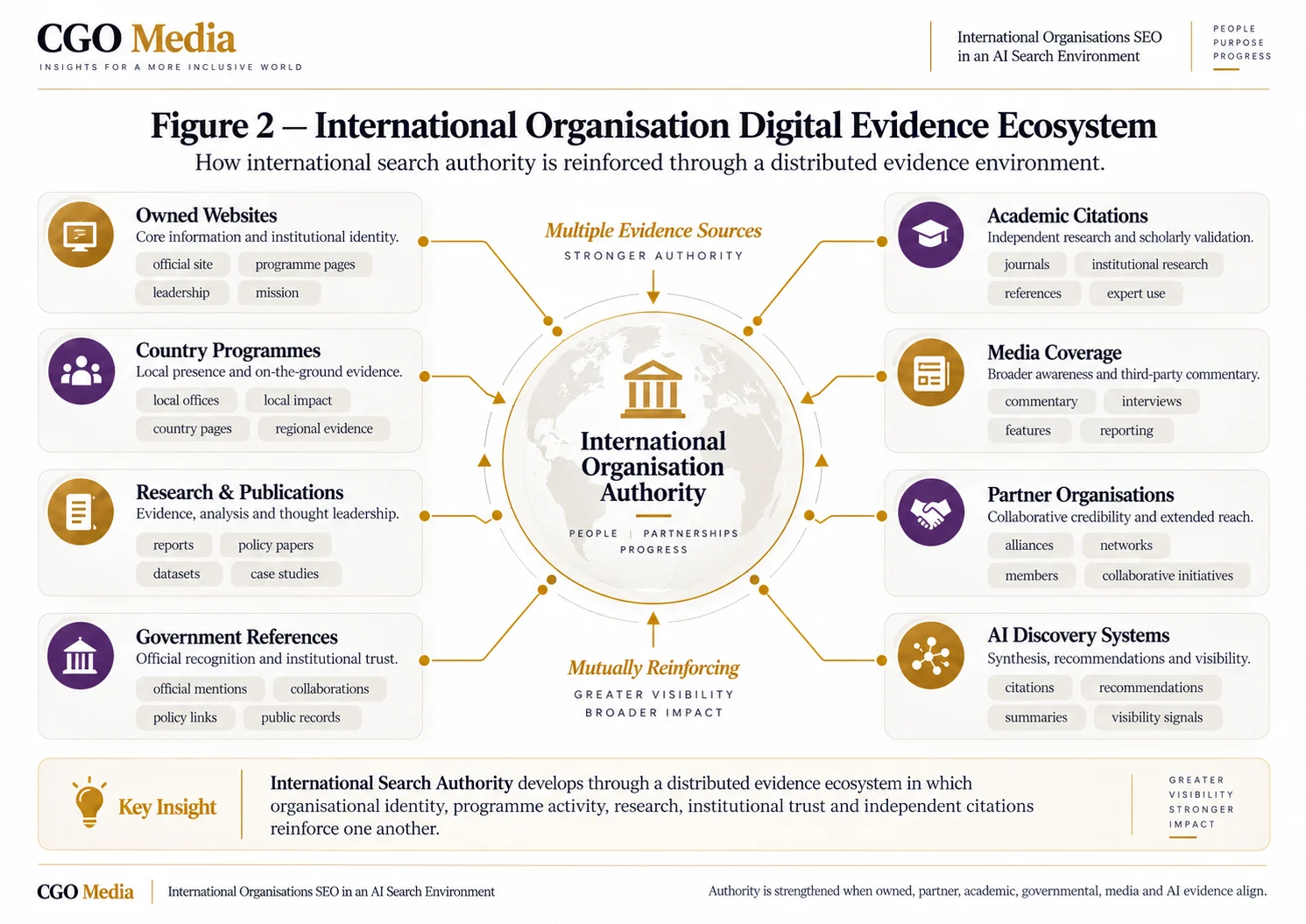
Figure 2. International Search Authority is built on technical reliability, clear institutional entities, structured geographic and multilingual relationships, current programme information, connected research architecture and trustworthy governance evidence.
48. Phase Four — Strengthen
Once the international search environment has been stabilised and structured, the organisation can begin strengthening the depth, usefulness and credibility of its institutional evidence.
The Strengthen phase focuses on making important resources more complete rather than simply creating more content.
This distinction is critical.
International organisations frequently already possess large amounts of information.
The problem is often that high-value evidence is incomplete, difficult to interpret, insufficiently connected or not detailed enough to support stakeholder evaluation.
Phase Four therefore prioritises evidence quality across:
- the organisation itself;
- programmes;
- countries;
- regions;
- languages;
- research;
- statistics;
- experts;
- governance;
- impact;
- and institutional transparency.
The objective is to create a stronger first-party evidence environment before relying heavily on external promotion or authority-building activity.
A useful principle is:
Strengthen the evidence before attempting to amplify the authority.
49. Strengthen Organisation Evidence
Core institutional pages should provide enough information for users to understand the organisation beyond its name and headline mission statement.
Important areas can include:
- mission;
- mandate;
- history;
- leadership;
- institutional structure;
- geographic scope;
- strategic priorities;
- principal programmes;
- research activity;
- and governance.
The organisation should be able to explain what distinguishes it from other institutions operating in similar fields.
This should be demonstrated through real characteristics rather than promotional language.
Distinctive institutional evidence may include:
- a formal mandate;
- member-state relationships;
- unique datasets;
- long-running programmes;
- recognised standards;
- specialist expertise;
- or extensive country operations.
Stronger organisation evidence provides the parent authority context into which programmes, research and geographic activity can connect.
50. Strengthen Programme Evidence
Priority programmes should provide enough evidence for stakeholders to determine what the initiative does and whether it is relevant to their needs.
Useful programme evidence can include:
- objectives;
- programme status;
- activities;
- countries or regions;
- partners;
- funding where appropriate;
- implementation model;
- outputs;
- results;
- evaluation;
- research;
- and impact.
Programme evidence should also distinguish between planned objectives and demonstrated outcomes.
An organisation may state that a programme aims to improve a particular condition.
That statement should not be presented as evidence that the condition has already improved.
Where outcome claims are made, supporting data or evaluation should be available where possible.
Strong programme evidence therefore improves discovery, trust and institutional selection simultaneously.
51. Strengthen Country Evidence
Priority country pages should move beyond office information and generic descriptions of global institutional activity.
Where the organisation possesses meaningful local operations, country authority can be strengthened through:
- local programme context;
- country-specific research;
- statistics;
- government relationships;
- local institutional partners;
- experts;
- programme outcomes;
- impact evidence;
- and relevant regional relationships.
This evidence helps users understand what the organisation actually does within that country.
It also creates stronger geographic context for non-branded search and AI-assisted discovery.
Country evidence should reflect genuine institutional activity rather than forcing every market into an identical content template.
52. Strengthen Regional Evidence
Regional hubs should demonstrate why the region is a meaningful part of the institution’s operational and knowledge architecture.
Useful evidence can include:
- regional programmes;
- cross-border initiatives;
- research;
- policy analysis;
- regional statistics;
- cross-country evidence;
- regional experts;
- and institutional partnerships.
Regional authority is particularly valuable when issues cannot be understood adequately at country level alone.
Migration, trade, environmental systems, public health, transport, climate and regional development can all require cross-border context.
The region should therefore add interpretive value rather than simply duplicate national pages.
53. Strengthen Multilingual Evidence
Priority languages should contain more than translated summaries of the organisation’s global content.
Where the audience and institutional context justify it, stronger language authority can include:
- local research;
- country evidence;
- local policy context;
- regional terminology;
- programme information;
- local statistics;
- relevant experts;
- and credible local institutional references.
Multilingual strengthening should therefore combine translation with localisation and evidence selection.
The strongest content in one language may not automatically be the most useful content in another.
Language strategy should reflect what the relevant audience actually needs to discover, understand and verify.
54. Strengthen Research Evidence
Priority research assets should provide enough context for users to evaluate and cite them confidently.
Important elements can include:
- clear methodology;
- named authors;
- institutional affiliation;
- publication date;
- supporting data;
- geographic scope;
- limitations;
- publication context;
- related research;
- and suggested citation.
Where a report is significant enough to attract external citation, an HTML landing environment can help users understand the resource before downloading a document.
Research strengthening should therefore improve both evidentiary quality and discoverability.
The objective is to make legitimate institutional knowledge easier to find, evaluate, reference and reuse.
55. Strengthen Statistical Evidence
Statistical resources should become easier to interpret, verify and reuse.
Priority improvements can include:
- methodological explanation;
- clear dates;
- geographic definitions;
- historical comparisons;
- download options;
- source attribution;
- revision notes;
- and links to current datasets.
Where statistics are likely to be quoted independently, the resource should provide enough context to reduce misinterpretation.
For example, percentages should clearly identify the relevant population or denominator where needed.
Time-series data should distinguish between provisional and final values.
Statistical evidence becomes more authoritative when users can trace a figure back to a clearly documented institutional source.
56. Strengthen Expert Authority
Institutional experts can become important discovery and authority entities in their own right.
Expert evidence can be strengthened through:
- research profiles;
- publication links;
- subject expertise;
- programme relationships;
- country or regional expertise;
- conference participation;
- policy contributions;
- and media commentary.
An expert profile should demonstrate why the individual is relevant to the subject rather than providing only a job title.
Where appropriate, the profile should connect the person with the institutional evidence they helped produce.
This creates a reinforcing relationship:
Expert Authority ↔ Research Authority ↔ Organisation Authority
The organisation provides institutional context for the expert while the expert’s visible body of work reinforces the institution’s subject authority.
57. Strengthen Governance Evidence
Institutional Trust can be improved when governance information is sufficiently clear and accessible.
Relevant evidence may include:
- governance structures;
- leadership information;
- member states or trustees where relevant;
- funding disclosure;
- annual reports;
- financial statements;
- accountability policies;
- and impact reporting.
The purpose is not to expose every internal process.
It is to provide the level of public evidence appropriate to the organisation’s legal, institutional and stakeholder context.
Governance evidence becomes especially important during branded validation searches and institutional comparison.
58. Strengthen Impact Evidence
Impact claims should be supported where possible by evidence proportionate to the significance of the claim.
Useful supporting material may include:
- defined metrics;
- baseline data;
- methodology;
- case studies;
- independent evaluation;
- longitudinal results;
- and limitations.
The organisation should distinguish clearly between:
- activity;
- output;
- outcome;
- and impact.
For example, the number of training sessions delivered is an activity or output measure.
Evidence that those sessions changed participant outcomes requires a different level of evaluation.
Clear distinctions make institutional evidence more credible and easier for users to interpret correctly.
59. Strengthen Institutional Transparency
Users should be able to understand material changes in the organisation over time.
This can include changes to:
- leadership;
- programme status;
- funding;
- research versions;
- governance;
- country operations;
- and institutional structure.
Transparency is particularly important where older evidence remains discoverable.
Archived pages should not be mistaken for current policy.
Former leaders should not appear to hold current roles.
Previous research editions should be distinguishable from revised versions.
Transparent lifecycle information improves institutional accuracy without requiring useful historical evidence to be deleted.
60. Strengthen Research-Led Authority
Original research can create durable authority around strategically important issues, countries and policy areas.
Research-led authority can be strengthened by connecting publication activity with:
- institutional priorities;
- programme evidence;
- country and regional needs;
- expertise;
- emerging policy questions;
- statistics;
- and external research demand.
The goal is not to commission research solely for SEO purposes.
Research should exist because it contributes genuine institutional knowledge.
Search strategy can then ensure that the resulting evidence is discoverable and connected with the organisation’s wider authority architecture.
Where original research addresses information gaps that matter to governments, academics, journalists or practitioners, it can generate substantial downstream citation value.
61. Strengthen Branded Validation
Stakeholders may investigate the organisation directly after initial discovery.
The organisation should therefore examine what users encounter for branded validation searches involving terms such as:
- organisation governance;
- organisation funding;
- organisation impact;
- organisation leadership;
- organisation annual report;
- organisation criticism;
- organisation reviews;
- and organisation research.
These searches can reveal gaps between institutional claims and the evidence users find when they attempt independent verification.
The objective is not to control all external discussion.
It is to ensure that accurate first-party evidence exists for legitimate questions concerning the institution.
62. Phase Four Output
The Strengthen phase should leave the organisation with substantially deeper and more useful first-party evidence.
By this stage:
- core institutional pages should provide stronger context;
- priority programmes should contain more complete evidence;
- country and regional environments should demonstrate genuine local relevance;
- important language versions should provide appropriate localised evidence;
- research assets should be easier to evaluate and cite;
- statistical resources should be easier to interpret and reuse;
- experts should be better connected with institutional knowledge;
- governance evidence should be easier to verify;
- impact claims should have clearer evidentiary support;
- and branded validation should be better supported by accurate institutional information.
The organisation is now better positioned to move beyond first-party evidence and examine whether independent institutions reinforce the same authority claims.
63. Phase Five — Validate
The Validate phase strengthens International Search Authority through credible independent evidence.
The objective is not simply to increase link volume, mentions or publicity.
Validation asks whether external sources recognise the areas in which the organisation claims expertise, activity and institutional relevance.
These external sources can include:
- governments;
- universities;
- academic researchers;
- international institutions;
- policy organisations;
- partners;
- professional bodies;
- and credible media.
The strongest validation emerges naturally from useful research, successful programmes, institutional partnerships, policy contribution, expertise and transparent evidence.
Phase Five therefore focuses on making legitimate real-world authority visible within the external information ecosystem.
64. Validate Organisation Authority
External evidence can reinforce the organisation’s identity, role and institutional credibility.
Relevant references may come from:
- governments;
- universities;
- other international institutions;
- programme partners;
- recognised media;
- policy organisations;
- and professional bodies.
These references can reinforce aspects such as:
- mission;
- institutional role;
- expertise;
- country presence;
- research;
- or programme activity.
External organisation authority is most useful when references are contextually aligned with real institutional capabilities.
65. Validate Programme Authority
Programme credibility becomes stronger when credible external organisations independently confirm important aspects of the initiative.
Useful validation can relate to:
- programme existence;
- geographic scope;
- partnerships;
- funding relationships;
- implementation;
- outputs;
- results;
- and impact.
Partner organisations can provide particularly valuable corroboration where they describe the same programme independently.
Government and academic references can also reinforce programme legitimacy or outcomes where the context is appropriate.
Validation should reflect genuine programme relationships rather than artificial citation activity.
66. Validate Country Authority
Country-level institutional authority can be reinforced through local independent evidence.
Relevant sources can include:
- government references;
- local academic citations;
- partner websites;
- country media coverage;
- local institutional directories;
- professional associations;
- and recognised civil-society institutions.
This helps demonstrate that the organisation’s local activity is recognised within the country itself rather than only through global institutional claims.
Country validation becomes especially important when users need to determine whether an organisation has genuine local relevance.
67. Validate Regional Authority
Regional authority can be strengthened through recognition from credible organisations operating at the same geographic level.
These may include:
- regional governmental bodies;
- policy networks;
- research networks;
- universities;
- regional media;
- multilateral institutions;
- and institutional partners.
Regional validation can be particularly important for programmes and research that cross national boundaries.
It helps demonstrate that the organisation possesses authority within the wider regional system rather than simply across a collection of isolated country pages.
68. Validate Research Authority
Research Authority strengthens when high-quality institutional work is legitimately discovered, used and cited by independent sources.
Relevant environments can include:
- academic papers;
- government reports;
- policy documents;
- think-tank publications;
- media articles;
- university resources;
- and other institutional research.
The organisation should make research sufficiently accessible and citable for these uses.
This may involve:
- clear citation information;
- stable URLs;
- author information;
- methodological clarity;
- research summaries;
- and supporting data.
The objective is not to manufacture citations.
It is to remove unnecessary barriers that prevent legitimate research usage.
69. Validate Statistical Authority
Statistical resources become more authoritative when recognised external organisations cite and reuse the underlying data appropriately.
Relevant validation can include:
- academic citation;
- government use;
- media reference;
- policy use;
- research reuse;
- and inclusion within recognised institutional datasets.
The organisation should monitor which data is being reused and whether external references point users back to an authoritative first-party source.
Repeated use can also reveal which statistical resources have become particularly important within the wider evidence ecosystem.
70. Validate Expert Authority
Experts may develop stronger independent authority when their knowledge is recognised outside the organisation.
Relevant evidence can include:
- academic citation;
- conference participation;
- media commentary;
- policy consultation;
- research collaboration;
- technical committees;
- and recognised professional contributions.
External Expert Authority should remain connected with the expert’s current institutional role.
This enables independent recognition of the individual to reinforce the organisation’s wider knowledge authority.
71. Validate Policy Authority
Policy Authority can be reinforced when institutional recommendations, frameworks, research or evidence appear within credible policy environments.
Examples include:
- government documents;
- public consultations;
- policy guidance;
- regulatory discussions;
- parliamentary material;
- international agreements;
- and institutional policy frameworks.
The value of these references lies in demonstrating that the organisation’s work is being used within real decision-making contexts.
Policy validation should therefore be measured according to relevance and use rather than simple mention volume.
72. Validate Standards Authority
Standards organisations should monitor whether their standards are being cited, adopted and implemented within relevant environments.
Potential validation sources can include:
- regulators;
- technical bodies;
- governments;
- academic research;
- industry guidance;
- professional organisations;
- and implementation partners.
Standards Authority becomes particularly strong when independent sources recognise both the issuing institution and the current authoritative version of the standard.
Version clarity therefore remains important even within external validation.
73. Validate Media Authority
Media authority should focus on contextual association rather than coverage volume alone.
Relevant media references may connect the organisation with:
- important issues;
- research findings;
- statistics;
- named experts;
- programmes;
- country activity;
- and policy questions.
This creates more strategic value than unrelated or low-context mentions.
Research and communications teams can therefore collaborate to surface genuinely newsworthy evidence while preserving accuracy and methodological context.
74. Validate Partner Relationships
Important institutional partnerships should be corroborated where appropriate by the organisations involved.
Where one organisation describes a major partnership and the other provides no corresponding evidence, users may have less context for understanding the relationship.
Useful partner validation can clarify:
- who participates;
- the role of each institution;
- the programme or project involved;
- the relevant geography;
- and the duration or purpose of the relationship.
Consistent independent representation strengthens both Entity Clarity and programme authority.
75. Validate Funding Relationships
Where funding relationships materially contribute to institutional trust, important claims should be supported by appropriate evidence.
This can include:
- donor acknowledgements;
- grant documentation;
- annual reporting;
- programme funding information;
- and independent funder references.
The level of transparency required will vary by organisation and funding structure.
The objective is not universal disclosure of confidential financial relationships.
It is to ensure that public funding claims can be understood and verified where they are relevant to institutional credibility.
76. Citation Quality Before Citation Quantity
External authority should not be evaluated primarily by the number of references an organisation receives.
A small number of highly relevant citations from credible institutions may provide stronger validation than large numbers of weak or unrelated mentions.
Citation quality can depend on:
- the authority of the source;
- contextual relevance;
- what institutional claim is being validated;
- whether the reference is substantive;
- and whether the citation remains current.
For example, a government report citing an institutional methodology may provide stronger policy validation than dozens of generic directory links.
Citation strategy should therefore prioritise legitimate contextual recognition.
77. Build Citation Diversity
A resilient external authority environment can include several different forms of independent recognition.
These may include:
- government citations;
- academic citations;
- policy citations;
- media references;
- partner references;
- research citations;
- professional-body references;
- and institutional directories.
These sources validate different dimensions of authority.
Academic citations may support Knowledge Authority.
Government references may reinforce policy or geographic relevance.
Partner references can validate programme activity.
Media references can strengthen expert and research visibility.
Citation diversity therefore reduces dependence on one external authority channel.
78. Build Geographic Citation Diversity
International organisations should assess whether external validation is distributed across the countries and regions most important to their operations.
A globally recognised institution may still have relatively weak local evidence in strategically important countries.
Geographic validation can be strengthened through legitimate references from:
- national governments;
- local universities;
- research institutions;
- programme partners;
- regional bodies;
- and credible local media.
The objective is not to acquire an equal number of citations from every country.
Validation should reflect the organisation’s actual geographic priorities and activities.
79. Build Language Citation Diversity
Local-language authority may require recognition within the corresponding language ecosystem.
An institution with extensive English-language citations may still possess weaker authority when users search in Spanish, French, Arabic or other strategically important languages.
Relevant language-specific validation can include:
- local-language government references;
- academic citations;
- media coverage;
- policy references;
- partner content;
- and research citations.
This does not imply that citations should be pursued artificially by language.
It means that international authority should be assessed in the actual information ecosystems used by the organisation’s audiences.
80. Phase Five Output
At the end of Validate, the organisation should possess a stronger network of credible independent evidence supporting the authority system developed during the earlier phases.
The expected outcome is not simply more publicity.
It is greater convergence between what the organisation says about itself and what relevant independent institutions recognise.
By this stage, the organisation should increasingly be able to demonstrate:
- external recognition of institutional expertise;
- independent programme validation;
- country and regional authority;
- academic and policy use of research;
- external reuse of statistical evidence;
- recognised expert authority;
- policy or standards influence;
- credible media association;
- verified partnership relationships;
- and a more diverse citation environment.
The organisation should also understand where validation remains uneven.
Research may have strong academic authority but limited policy visibility.
One country may possess strong institutional recognition while another strategically important market remains weak.
English-language resources may attract substantial external authority while local-language evidence remains limited.
These variations should feed into the next implementation stages rather than being concealed inside a global average.
The Validate phase therefore produces an increasingly resilient authority environment in which first-party evidence is supported by credible external sources.
This provides the foundation for Phase Six, where technical search, institutional architecture, research, communications, external authority and AI monitoring can begin operating as one connected organisational capability.
The International Institutional Validation Ecosystem shows how strong first-party organisation, programme, research and geographic evidence can be reinforced by independent government, academic, policy, media, partner and professional sources.
Government Authority
Government reports, ministries, public agencies and official policy resources can reinforce institutional, geographic, programme and policy relevance.
Academic Authority
Universities, researchers and scholarly publications can validate institutional research, methodologies, datasets, experts and subject expertise.
Policy Authority
Policy organisations, consultations, public guidance and institutional frameworks can demonstrate that research and recommendations are being used within real decision environments.
Media Authority
Credible journalism can reinforce the organisation’s association with relevant research, statistics, experts, programmes, countries and emerging issues.
Partner Validation
Programme, research, funding and strategic partners can independently confirm genuine institutional relationships and operational activity.
Professional & Institutional Authority
Professional bodies, standards organisations, research networks and other recognised institutions can reinforce specialist expertise and sector relevance.
Geographic Validation
Country and regional references demonstrate that institutional activity is recognised within the geographic environments in which the organisation operates.
Language-Specific Validation
Credible recognition within relevant language ecosystems helps extend international authority beyond the organisation’s dominant publishing language.
Validation principle: International institutional authority becomes more resilient when strong first-party evidence is independently reinforced by credible government, academic, policy, media, partner and professional sources. Validation should reflect genuine institutional activity and expertise rather than citation volume alone.
Figure 3. International institutional authority becomes more resilient when organisation, programme, research and geographic evidence is independently validated across government, academic, policy, media, partner and professional environments.
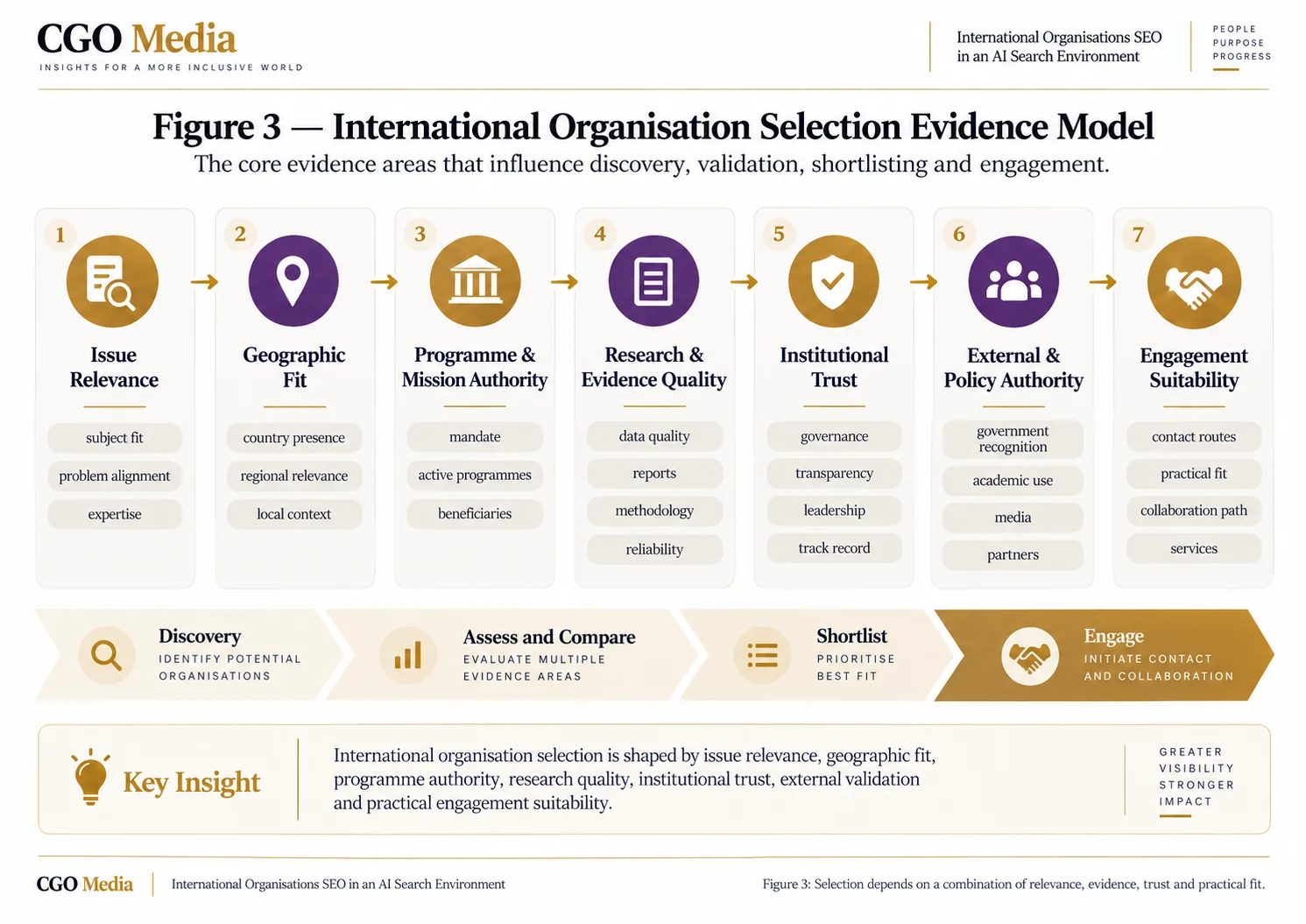
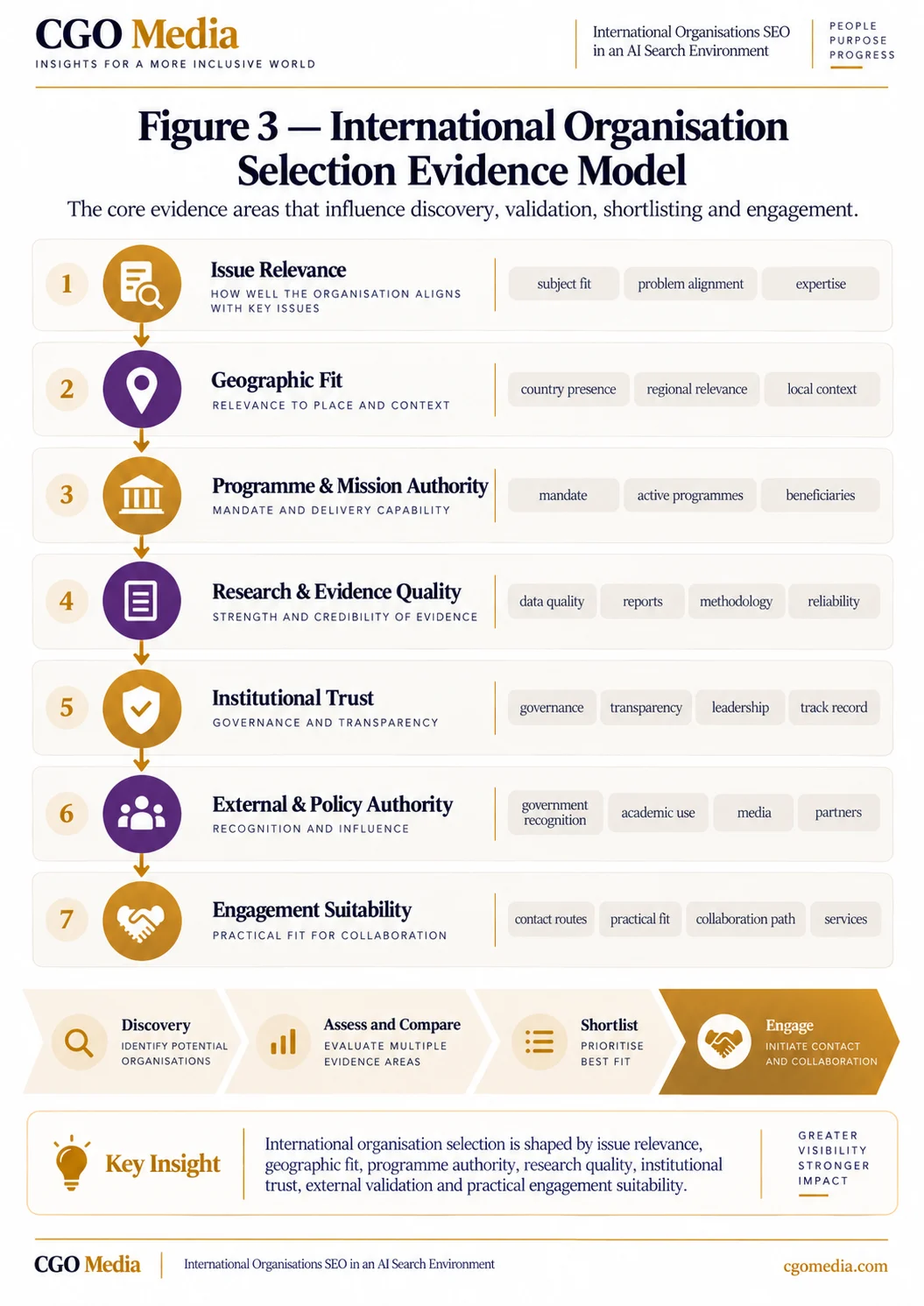
81. Phase Six — Integrate
The Integrate phase brings together the capabilities developed during the first five phases of the roadmap.
By this stage, the organisation should already possess a more reliable technical foundation, clearer institutional entities, stronger country and language architecture, better programme and research evidence and a growing network of credible external validation.
The next challenge is coordination.
International Search Authority becomes difficult to scale when technical SEO, communications, research, country publishing, multilingual content, programme management and AI monitoring continue operating as independent disciplines.
One team may discover an AI representation problem while another owns the programme information required to correct it.
Research teams may publish new evidence without informing communications or country teams.
Country offices may launch new programmes without updating the global architecture.
Technical teams may introduce structural changes without understanding the institutional relationships those pages represent.
Phase Six therefore creates a coordinated operating model.
The objective is:
Technical Search + Institutional Architecture + Geographic Evidence + Research + Trust + External Authority + AI Intelligence → Integrated International Search Authority
Integration should not eliminate specialist ownership.
Technical teams should remain technical specialists.
Researchers should continue owning research quality.
Country teams should remain responsible for local institutional knowledge.
The purpose is to establish shared standards, workflows, measurement and escalation routes so those specialist capabilities reinforce one another.
82. Integrate Technical SEO with Institutional Architecture
Technical SEO should reflect the organisation’s real institutional structure rather than operating only as a website-maintenance discipline.
Technical decisions can influence whether relationships between entities are discoverable and understandable.
Examples include:
- URL architecture for countries and regions;
- internal linking between programmes and geographies;
- canonical relationships;
- hreflang implementation;
- breadcrumbs;
- structured data;
- XML sitemap segmentation;
- and archive handling.
These technical components should support institutional meaning.
A programme operating in several countries should be technically connected with those country environments.
A research publication associated with a programme should not exist as an isolated file if stronger contextual relationships can be represented.
An archived initiative should remain distinguishable from active programmes.
Technical teams should therefore understand the institutional relationships their architecture represents.
The integration objective is:
Technical implementation should reinforce real-world organisational relationships.
83. Integrate Global and Country Search
Global and country search strategies should operate within one authority system.
The global organisation provides:
- institutional identity;
- mission;
- global research;
- governance;
- global programmes;
- and international authority.
Country environments provide:
- local programme evidence;
- country-specific research;
- partners;
- local contacts;
- country statistics;
- local experts;
- and country-specific validation.
These layers should reinforce one another.
Global teams should not create generic country pages that ignore local institutional reality.
Country teams should not develop isolated digital environments that obscure their relationship with the parent institution.
Integration requires common standards for:
- organisation naming;
- programme status;
- country-page architecture;
- research relationships;
- structured information;
- and measurement.
Local differentiation should remain possible where it reflects genuine country needs.
The goal is coordinated global-local authority rather than identical content.
84. Integrate Regional and Country Architecture
Regional hubs should connect national environments without replacing or obscuring them.
The regional layer becomes particularly useful where:
- programmes cross borders;
- research applies across several countries;
- regional organisations are important partners;
- policy issues operate regionally;
- or specialist leadership exists at regional level.
The relationship should remain explicit:
Global Organisation → Region → Country
while also supporting direct relationships such as:
Regional Programme → Multiple Countries
and:
Regional Research → Country Evidence
Regional integration prevents the organisation from treating regions and countries as separate publishing silos.
It also improves stakeholder discovery where the information need sits between global and national levels.
85. Integrate Language Governance
Translation, localisation, SEO and content maintenance should operate through coordinated workflows.
Language governance should determine:
- which resources require translation;
- which resources require localisation;
- which language version acts as the primary source;
- how updates are propagated;
- who owns terminology;
- who validates translated institutional facts;
- and when outdated language content should be revised or retired.
This requires integration between:
- translation teams;
- local editors;
- technical SEO;
- subject experts;
- country teams;
- and global digital governance.
A technically perfect multilingual implementation can still fail if translation workflows do not maintain institutional accuracy.
Likewise, high-quality translation may remain difficult to discover if technical international relationships are broken.
Integration therefore combines editorial and technical responsibility.
86. Integrate Programme and Country Evidence
Programme information should remain aligned across global, regional and country environments.
The organisation should avoid situations in which:
- the global programme page lists one set of countries;
- regional pages describe another;
- country sites provide different programme dates;
- and external partners describe a third version.
Important programme facts should have clear ownership.
These may include:
- programme status;
- geographic coverage;
- partners;
- funding;
- programme dates;
- objectives;
- outputs;
- and results.
Country pages should provide local programme context without redefining the core programme independently.
Global pages should provide sufficient local relationships for users to understand where the programme operates.
This creates a stronger connection between institutional scale and local evidence.
87. Integrate Research and Programme Architecture
Research should connect clearly with the programmes, geographic environments and policy questions it supports.
A programme may generate:
- baseline research;
- implementation data;
- evaluation;
- case studies;
- statistical analysis;
- methodology;
- and final impact reports.
These resources should not become disconnected once published.
The programme environment should surface relevant research.
Research pages should identify the programme relationship where appropriate.
Country pages should surface geographically relevant findings.
Expert profiles should connect researchers with the work they produced.
This creates a richer evidence relationship:
Programme → Research → Evidence → Expert → Geography → Impact
Integrated research architecture therefore strengthens both programme authority and institutional Knowledge Authority.
88. Integrate Experts into the Knowledge Architecture
Experts should become visible within the institutional knowledge system rather than existing only in staff directories.
Where appropriate, expert profiles should connect individuals with:
- institutional roles;
- research;
- programmes;
- countries;
- regions;
- policy subjects;
- media contributions;
- and professional expertise.
This can support several discovery journeys.
A researcher reading a report can identify the author.
A journalist searching for commentary can identify a relevant specialist.
A programme partner can understand which people hold subject responsibility.
An AI system may encounter stronger evidence connecting the person with the organisation and subject.
Expert integration should remain selective.
The objective is to represent public institutional expertise, not to turn every staff record into a search asset.
89. Integrate Governance and Trust Evidence
Governance information should connect with the wider institutional architecture rather than remain isolated within legal or administrative sections.
Users evaluating the organisation may need to move between:
- mission;
- leadership;
- governance;
- funding;
- programmes;
- impact;
- and institutional reporting.
These relationships are particularly important for high-trust stakeholder journeys.
A donor evaluating a programme may need financial information.
A policy institution may need to understand governance or mandate.
A journalist may need current leadership information.
Governance evidence should therefore remain accessible from the contexts in which trust questions arise.
90. Integrate External Authority Development
External authority should be coordinated around the organisation’s strategic evidence priorities.
Relevant activities may include:
- digital PR;
- academic outreach;
- policy engagement;
- research dissemination;
- partnership development;
- expert commentary;
- conference participation;
- and institutional collaboration.
These functions should reinforce areas in which strong first-party evidence already exists.
For example, if the institution publishes original research in a priority subject, communications teams can help journalists understand the findings, policy teams can identify relevant decision-making environments and research teams can support academic dissemination.
This creates coherent authority development instead of disconnected promotional activity.
The objective is:
Evidence → Dissemination → Legitimate External Use → Independent Authority
91. Integrate Media and Research Strategy
Research and communications teams can create greater authority when they identify the external value of institutional evidence together.
Potential opportunities include:
- newsworthy findings;
- unique statistics;
- expert commentary;
- country-specific evidence;
- regional trends;
- new datasets;
- emerging policy issues;
- and significant programme evaluations.
Research should not be distorted to create media attention.
The purpose of integration is to ensure that important legitimate findings are not overlooked simply because communications teams discover them too late or lack sufficient context.
Media coverage can subsequently reinforce Research Authority, Expert Authority and external recognition.
92. Integrate AI Monitoring
AI visibility monitoring should become part of the same authority-management process used for search, research and external citations.
Monitoring should not operate as a standalone experimental project.
The organisation should maintain repeatable prompt groups covering:
- organisation discovery;
- programme discovery;
- country questions;
- research-source questions;
- expert discovery;
- institution comparison;
- partner discovery;
- and multilingual scenarios.
Results should then feed into existing operational processes.
An inaccurate programme answer should connect with programme governance.
A missing research citation should trigger source analysis.
An outdated leadership answer should connect with entity governance.
AI monitoring becomes more valuable when it acts as another institutional intelligence source rather than as an isolated metric.
93. Integrate AI Source Analysis
The organisation should examine which first-party and third-party sources appear repeatedly within AI-assisted answers where citations or source information is visible.
Source analysis can identify:
- which first-party pages are being selected;
- which research resources are cited;
- which external institutions appear frequently;
- where outdated sources remain influential;
- and where important first-party resources are absent.
These observations can help identify source gaps.
For example, a government report may repeatedly be used to describe the organisation’s country programme because the institution’s own programme page lacks sufficient context.
A university paper may become the dominant source for an institutional statistic because the original dataset is difficult to interpret.
The response should not be to suppress credible external sources.
The organisation should instead strengthen its own evidence where the first-party source is incomplete or difficult to use.
94. Integrate AI Representation Accuracy
AI inaccuracies should feed directly into the wider institutional maintenance process.
Depending on the problem, corrective work may involve:
- content updates;
- entity clarification;
- programme maintenance;
- research improvements;
- country-page updates;
- structured-data review;
- external-profile correction;
- or stronger external authority development.
This approach treats inaccurate representation as diagnostic evidence.
The organisation should ask why the information environment allowed the error to appear plausible.
Sometimes the issue will lie outside the organisation’s control.
In other cases, conflicting or outdated first-party information may be contributing to the problem.
Integration ensures that relevant teams can investigate and respond systematically.
95. Integrate AI Recommendation Monitoring
The organisation should monitor whether it appears within contextually relevant institutional shortlists.
Useful recommendation scenarios may include:
- organisations working on a specific issue;
- potential programme partners;
- reliable research institutions;
- sources of international statistics;
- standards organisations;
- regional development institutions;
- or institutions with expertise in a particular country.
Monitoring should focus on legitimate relevance.
The objective is not to maximise the number of recommendations in which the organisation appears.
It is to determine whether the institution’s genuine capabilities are recognised in the scenarios where it should reasonably be considered.
Where peers repeatedly appear and the organisation does not, evidence differences can be investigated.
96. Integrate Stakeholder Journey Measurement
Measurement should connect individual search metrics with the broader stakeholder journey.
A useful progression is:
Discovery → Evaluation → Validation → Comparison → Engagement → Relationship
Different evidence can support each stage.
Discovery may involve search visibility, research citations or AI mentions.
Evaluation may involve programme and country information.
Validation may involve research, governance and independent evidence.
Comparison may involve differentiation and peer authority.
Engagement may involve partnership, funding, programme or media pathways.
Relationship may involve recurring programme participation, citation, policy use, membership or institutional collaboration.
This creates a more meaningful measurement model than reporting traffic separately from organisational outcomes.
97. Integrate Executive Reporting
Senior stakeholders should receive reporting that connects digital visibility with institutional outcomes and strategic capability.
Relevant reporting can include:
- country authority;
- regional authority;
- research visibility;
- external citations;
- programme discovery;
- language performance;
- institutional accuracy;
- AI representation;
- partner enquiries;
- and material authority gaps.
Executive reporting should avoid overwhelming decision makers with tactical SEO metrics that lack strategic context.
A list of crawling errors may be valuable to technical teams.
Executives may instead need to understand whether a technical weakness is preventing discovery of important programme evidence across several countries.
Integration therefore changes the reporting question from:
“How many SEO issues exist?”
to:
“Which institutional outcomes are being constrained by the current search and authority environment?”
98. Integrate Governance
The Integrate phase should establish clear ownership across the complete International Search Authority system.
Ownership areas may include:
- technical SEO;
- entity information;
- country pages;
- regional environments;
- languages;
- programmes;
- research;
- statistics;
- experts;
- governance evidence;
- external authority;
- measurement;
- and AI monitoring.
No single team necessarily needs to own all areas.
The important requirement is that ownership is known.
The organisation should also define escalation routes.
If an AI system repeatedly identifies an inactive programme as current, who investigates?
If a research resource contains incorrect institutional metadata, who corrects it?
If a local page conflicts with headquarters information, who resolves the discrepancy?
Integrated governance ensures that search and authority problems can be converted into organisational action.
99. Phase Six Output
At the end of Integrate, International Search Authority should operate as a coordinated organisational capability rather than a set of disconnected digital activities.
The expected outputs include:
- technical SEO aligned with institutional architecture;
- shared global and country standards;
- coordinated regional and country relationships;
- integrated language governance;
- aligned programme information;
- connected research and programme architecture;
- expert integration;
- accessible governance evidence;
- strategic external-authority development;
- research and communications coordination;
- integrated AI monitoring;
- source analysis;
- representation-accuracy workflows;
- recommendation monitoring;
- stakeholder-journey measurement;
- executive reporting;
- and clearly defined ownership.
This represents a significant transition.
Search is no longer managed primarily as a set of pages and rankings.
It becomes part of how the institution manages information, evidence, authority and international discovery.
The organisation can now move into the final roadmap phase.
The objective is to ensure that the integrated system remains capable of adapting as both the institution and the external discovery environment change.
100. Phase Seven — Evolve
The Evolve phase turns International Search Authority into a continuously adaptive capability.
The first six phases can substantially improve the organisation’s current search and authority environment.
However, that environment will not remain static.
The institution will change.
Stakeholder needs will change.
Search systems will change.
AI systems will change.
Programmes will launch, expand and close.
New research will be produced.
Country priorities will shift.
Languages and terminology will evolve.
External authority will change as new citations, partnerships and policy relationships develop.
Phase Seven therefore creates a permanent improvement loop.
101. Monitor Search Environment Changes
Search interfaces and discovery behaviour should be reviewed as the external search environment evolves.
Relevant changes may include:
- new search interfaces;
- expanded AI-generated answers;
- new discovery platforms;
- changes in citation presentation;
- changes in source selection;
- and shifts in stakeholder search behaviour.
The organisation should avoid responding reactively to every interface change.
Instead, it should determine whether the change affects fundamental discovery pathways.
The most resilient strategy remains strong technical access, clear institutional information, useful evidence and credible authority.
Monitoring helps determine how those assets need to be presented as discovery interfaces change.
102. Monitor Institutional Change
Search architecture should evolve when the institution itself changes.
Relevant changes can include:
- leadership changes;
- new offices;
- country-office closures;
- institutional restructuring;
- new departments;
- new partnerships;
- changes to mandate;
- and changes in legal or governance structure.
These changes can affect many digital assets simultaneously.
A leadership change may require updates to governance pages, structured data, country sites and media resources.
An institutional restructuring may require new entity relationships across hundreds of pages.
The Evolve phase should therefore include mechanisms for connecting organisational change with digital information maintenance.
103. Monitor Programme Change
Programme information should evolve throughout the programme lifecycle.
Updates may be required when programmes:
- launch;
- expand;
- enter new countries;
- change partners;
- receive new funding;
- produce new research;
- publish results;
- enter evaluation;
- or close.
These changes should propagate through relevant global, regional, country and research environments.
The organisation should avoid allowing completed programmes to remain represented indefinitely as current activity.
At the same time, completed programmes may retain long-term authority value as evidence of experience and impact.
Lifecycle management therefore preserves history while maintaining current accuracy.
104. Monitor Geographic Change
Country and regional architecture should evolve as operational priorities change.
A country may become more strategically important because:
- new programmes launch;
- funding increases;
- new government partnerships develop;
- research activity expands;
- or stakeholder demand grows.
Other countries may decline in operational importance.
Geographic search investment should therefore reflect current institutional reality rather than historical website structure.
A country that has developed into a major operational environment may require deeper research, programme, partner and local-language evidence than it did several years earlier.
105. Monitor Language Demand
Language investment should evolve according to audience needs, programme relevance and search behaviour.
Potential triggers for increased language investment include:
- new country programmes;
- greater stakeholder demand;
- new policy audiences;
- increased regional activity;
- significant research demand;
- or gaps revealed through search and AI monitoring.
The organisation should also identify language environments where maintenance effort has become disproportionate to strategic need.
Multilingual strategy should therefore remain deliberate rather than expanding indefinitely without governance.
106. Monitor Research Demand
Search, citation and AI data can reveal emerging evidence needs.
Stakeholders may begin asking new questions for which the organisation has limited first-party evidence.
Monitoring can reveal demand for:
- new research;
- datasets;
- statistics;
- policy analysis;
- country evidence;
- methodologies;
- and comparative analysis.
This information should not dictate research priorities automatically.
Research agendas should continue to reflect institutional mission and methodological relevance.
However, discovery data can provide useful intelligence about questions stakeholders increasingly need answered.
107. Monitor Citation Development
External authority should be monitored as a changing evidence environment.
The organisation should track developments in:
- academic citations;
- government references;
- policy citations;
- media references;
- partner citations;
- research citations;
- and relevant professional references.
Monitoring should examine what is being cited, not merely how often the institution is mentioned.
The organisation may discover that one research subject is gaining strong academic authority while another is increasingly influential in policy.
A particular country programme may begin receiving substantial government recognition.
Citation development can therefore become a form of institutional intelligence.
108. Monitor AI Source Selection
Repeated AI testing can reveal whether the source environments supporting generated answers are changing.
The organisation should examine:
- which first-party pages are selected;
- which research resources appear;
- which external sources are repeatedly used;
- which sources disappear;
- and whether current evidence replaces outdated material over time.
Source analysis should remain observational.
It should not assume that every AI system uses a stable or transparent source-selection process.
The strategic value lies in identifying repeated patterns that may indicate strengths or weaknesses within the organisation’s evidence environment.
109. Monitor AI Recommendation Sets
Peer organisations appearing frequently within relevant AI shortlists can provide useful comparison data.
The organisation can examine differences in:
- institutional evidence;
- programme authority;
- research depth;
- geographic relevance;
- external validation;
- expert visibility;
- and trust evidence.
The objective is not to imitate competitors mechanically.
Different organisations possess different mandates and capabilities.
Recommendation-set analysis is most useful when it identifies whether the organisation’s legitimate strengths are represented less clearly than those of relevant peers.
110. Monitor AI Representation Gaps
New representation errors should be treated as potential evidence of underlying information gaps rather than merely isolated AI mistakes.
Examples can include:
- outdated leadership;
- incorrect programme status;
- missing countries;
- confused organisational identity;
- misattributed research;
- or inaccurate partnership relationships.
The organisation should investigate whether current first-party evidence is sufficiently clear.
Where first-party information is accurate and strong, the issue may lie entirely outside the institution’s control.
Where internal inconsistencies exist, the representation gap provides a useful signal that those inconsistencies require attention.
111. Use Search and AI as Institutional Intelligence
Search and AI behaviour can provide information about the questions stakeholders are asking and how the organisation is being interpreted externally.
This intelligence can reveal:
- emerging stakeholder needs;
- new policy questions;
- changing geographic demand;
- research gaps;
- new terminology;
- potential programme confusion;
- and possible partnership opportunities.
Search data should therefore not remain isolated inside digital teams.
Relevant insights can inform:
- research;
- communications;
- programme development;
- country strategy;
- policy engagement;
- and institutional planning.
At higher maturity levels, International Search Authority becomes partly an organisational learning system.
112. Reassess Maturity
The organisation should periodically reassess itself against the
International Search Authority Maturity Model.
Reassessment should determine whether implementation has created lasting capability rather than simply completed individual projects.
Questions can include:
- Are technical improvements now governed continuously?
- Are country relationships clearer?
- Is multilingual information maintained reliably?
- Are programme and research entities better connected?
- Has external authority become more diverse?
- Is AI monitoring integrated with operational ownership?
- Can the organisation identify and respond to new authority gaps?
The objective is progression from isolated optimisation toward increasingly adaptive institutional capability.
113. Reprioritise the Gap Register
The International Search Authority Gap Register created during Phase One should remain a living implementation instrument.
As earlier weaknesses are resolved, new constraints will emerge.
A country architecture problem may become less important once corrected.
Research authority may then become the principal limitation.
Later, AI source visibility or multilingual evidence may become more strategically important.
The organisation should therefore update:
- gap severity;
- strategic importance;
- implementation status;
- dependencies;
- owners;
- and next actions.
This prevents the roadmap from becoming a static project plan.
Implementation priorities evolve as institutional capability improves.
114. Phase Seven Output
The final output of the Evolve phase is an adaptive International Search Authority capability.
The organisation should now be able to:
- monitor technical international search health;
- maintain institutional entities;
- update geographic and language architecture;
- manage programme lifecycles;
- develop research and statistical authority;
- track external validation;
- monitor AI source and recommendation environments;
- identify representation gaps;
- use discovery data as institutional intelligence;
- reassess maturity;
- and reprioritise investment continuously.
This does not mean implementation is finished.
It means the organisation possesses the capability to continue implementation without repeatedly restarting from the beginning.
Search, authority and AI visibility become part of ongoing institutional operations.
The organisation moves from:
Periodic SEO Projects
to:
Continuous International Search Authority Management
The full integrated system combines technical foundations, organisational entities, geographic and multilingual architecture, programme and research evidence, institutional trust, external validation, stakeholder measurement and AI intelligence.
The Integrated International Search Authority System shows how the capabilities developed throughout the Integrate and Evolve phases operate together as one continuously improving institutional authority environment.
Technical Search Foundations
Crawlability, indexation, international architecture, hreflang, canonicals, internal linking, performance and structured technical standards ensure institutional evidence remains discoverable.
Organisation & Entity Architecture
Institutional identity, leadership, mandate, offices, programmes, experts and organisational relationships remain clear and consistently represented.
Geographic & Multilingual Architecture
Global, regional, country and language environments connect institutional evidence with the audiences and locations for which it is genuinely relevant.
Programme Evidence
Programmes connect purpose, geography, partners, funding, research, outputs, outcomes and lifecycle information with the parent institution.
Research & Knowledge Authority
Research, datasets, statistics, methodologies, experts and policy resources form a connected institutional knowledge system.
Institutional Trust
Governance, leadership, financial information, accountability, methodology and impact evidence make important institutional claims easier to verify.
External Validation
Government, academic, policy, media, partner and professional references independently reinforce relevant areas of institutional expertise and activity.
Stakeholder Measurement
Measurement connects discovery, evaluation, validation, comparison, engagement and continuing institutional relationships rather than tracking traffic alone.
AI Intelligence
AI monitoring examines representation accuracy, source selection, citation visibility, recommendation environments and emerging information gaps.
Governance & Continuous Learning
Defined ownership, executive reporting, maturity reassessment and a continuously updated authority gap register allow the system to adapt over time.
Integration principle: International Search Authority reaches its strongest organisational form when technical SEO, entities, geography, languages, programmes, research, trust, external authority, measurement and AI intelligence operate as connected capabilities rather than independent projects.
Evolution principle: The system should remain adaptive. Institutional change, stakeholder demand, research, country priorities, external authority and AI-assisted discovery continue to evolve, requiring continuous measurement, learning and reprioritisation.
Figure 4. Integrated International Search Authority connects technical foundations, organisation entities, geographic and multilingual architecture, programme and research evidence, institutional trust, external validation, stakeholder measurement and AI intelligence within one continuously evolving institutional system.
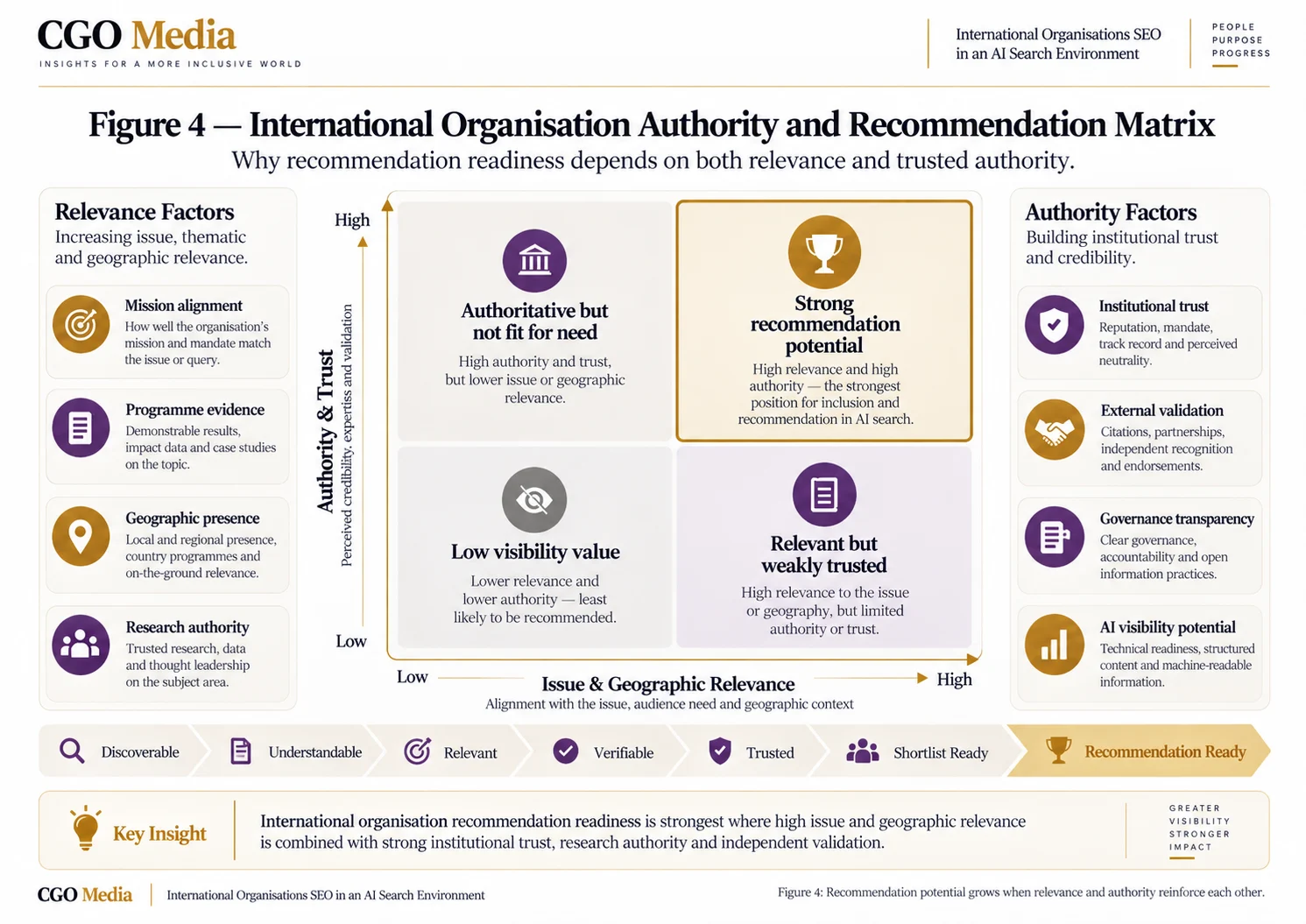
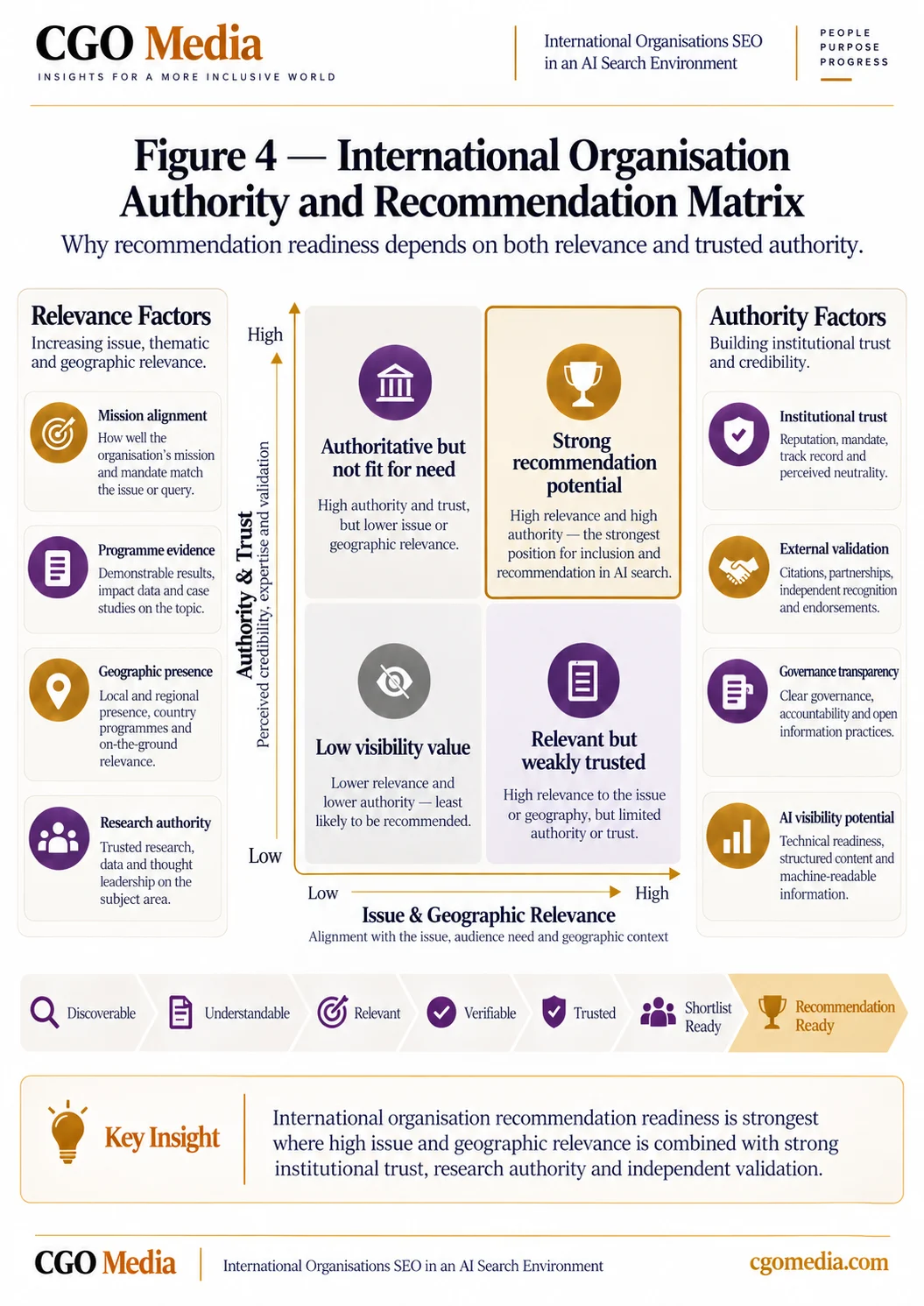
115. The Complete Seven-Phase Implementation Sequence
The International Organisations SEO and AI Implementation Roadmap can be summarised as:
Assess → Stabilise → Structure → Strengthen → Validate → Integrate → Evolve
The sequence represents a progression from understanding the current institutional search environment toward building a continuously adaptive International Search Authority capability.
Each phase answers a different strategic question.
Assess asks:
What is the current state of technical, institutional, geographic, multilingual, research, trust, external-authority and AI visibility?
Stabilise asks:
Which weaknesses must be corrected before further development can produce reliable value?
Structure asks:
How should the organisation connect its entities, countries, languages, programmes, research, experts, partners and governance evidence?
Strengthen asks:
Which evidence needs greater depth, quality, transparency or usefulness?
Validate asks:
Do credible independent institutions reinforce the authority claims made by the organisation?
Integrate asks:
Can technical SEO, institutional architecture, research, communications, external authority and AI monitoring operate together as one coordinated capability?
Evolve asks:
Can the organisation detect change, learn from evidence and adapt continuously?
These phases should therefore be understood as capability-development stages rather than as a checklist of unrelated tasks.
116. Assess Before Implementing
Large-scale implementation should begin with evidence rather than assumptions.
International organisations often possess established websites, large content estates and strong offline institutional reputations.
This can create an assumption that the most important next step is obvious.
In practice, visible symptoms can obscure deeper constraints.
For example:
- low country traffic may result from weak local content, technical indexation problems or limited country authority;
- poor AI representation may result from conflicting entity information rather than insufficient AI-specific optimisation;
- weak research discovery may result from poor metadata, inadequate internal linking or fragmented publication architecture;
- low multilingual visibility may reflect both technical hreflang problems and insufficient localised evidence.
Assessment helps distinguish between symptoms and causes.
It also prevents implementation resources from being allocated primarily according to whichever problem is most visible internally.
A complete baseline allows the organisation to identify the constraints with the greatest institutional consequences.
The implementation principle is:
Understand the current authority system before changing it.
117. Stabilise Before Expanding
Expansion can magnify existing weaknesses.
If the organisation has inconsistent entity information, publishing more pages can increase inconsistency.
If language governance is weak, adding more translated content can create a larger maintenance problem.
If programme lifecycle information is unreliable, creating additional programme pages can spread outdated or contradictory evidence further across the digital estate.
Stabilisation therefore precedes expansion.
Priority issues can include:
- technical indexation barriers;
- canonical conflicts;
- hreflang errors;
- outdated leadership;
- incorrect programme status;
- inconsistent country information;
- missing publication dates;
- broken internal relationships;
- and unreliable baseline measurement.
The goal is not to postpone all strategic development until every minor defect disappears.
It is to remove weaknesses capable of invalidating or undermining subsequent work.
The implementation principle is:
Create reliability before creating additional scale.
118. Structure Before Scaling
Once the environment is stable, the organisation should define how institutional information fits together before substantially increasing publication volume.
A common implementation mistake is to solve discoverability problems by producing more content.
If the underlying architecture is weak, additional content can make discovery harder.
New research may be published without consistent author relationships.
Country pages may be created without programme relationships.
New programme resources may remain disconnected from the global institution.
New language pages may expand without a clear equivalent-page strategy.
Structure should therefore establish relationships such as:
Organisation → Region → Country → Programme → Research → Expert → Evidence → Impact
These relationships can then guide future publishing.
When a new programme launches, the organisation already knows where it belongs.
When new research is published, it can be connected with the appropriate subject, geography, programme and author.
When a new language is introduced, governance and equivalent-page relationships are already defined.
The implementation principle is:
Scale an architecture rather than accumulate disconnected assets.
119. Strengthen Before Promoting
External promotion becomes more effective when the resource being promoted already contains strong first-party evidence.
A research paper with clear methodology, authorship, data and citation information is easier for journalists, researchers and policy organisations to evaluate and reuse.
A programme with clear objectives, partners, geography, results and impact evidence is easier for external institutions to reference accurately.
A country hub containing meaningful local evidence provides a stronger destination for local citations than a generic institutional page.
The Strengthen phase therefore improves the quality of the evidence before substantial authority amplification begins.
This reduces the risk that outreach drives attention toward weak or incomplete resources.
It also improves the probability that external references describe the organisation accurately.
The principle is:
Make institutional evidence worth citing before trying to increase citation visibility.
120. Validate Before Claiming Authority
Institutional authority is more credible when important claims are supported by independent recognition.
An organisation can publish extensive evidence about its own expertise.
However, external validation helps establish whether governments, researchers, partners, policy organisations, media and other credible institutions independently recognise that expertise.
Validation can reinforce:
- research authority;
- programme authority;
- country relevance;
- policy influence;
- expert authority;
- standards adoption;
- and institutional trust.
The organisation should therefore avoid equating self-description with established external authority.
Statements such as “leading,” “authoritative” or “globally recognised” are stronger when supported by observable independent evidence.
Validation does not require universal agreement or exclusively positive external commentary.
It requires sufficient credible evidence that the organisation’s real institutional role is recognised outside its own properties.
The implementation principle is:
Demonstrate authority through evidence rather than relying on authority claims.
121. Integrate Before Automating
Advanced monitoring, reporting and AI systems become more useful when ownership and institutional relationships are already connected.
Automation applied to fragmented processes can simply reproduce fragmentation more efficiently.
For example, an AI-monitoring platform may identify hundreds of representation errors.
That information provides limited value if the organisation does not know which teams own leadership, country, programme, research or governance information.
Similarly, automated dashboards can combine traffic and citation data without providing meaningful institutional interpretation.
Integration should therefore establish:
- shared definitions;
- common ownership;
- reliable data sources;
- escalation workflows;
- cross-functional measurement;
- and decision-making processes.
Automation can then support a functioning authority system.
The implementation principle is:
Connect the capability before automating the workflow.
122. Evolve Rather Than Finish
International Search Authority does not have a permanent completion point.
A roadmap can complete an initial transformation programme, but the organisation will continue changing.
New programmes will launch.
Others will close.
Research priorities will develop.
Leadership will change.
Country activity will expand or contract.
Languages will require new investment.
New policy issues will emerge.
Search interfaces and AI systems will continue changing how information is discovered and synthesised.
The final phase therefore converts implementation into continuous capability.
The organisation should be able to detect meaningful change and determine whether:
- technical architecture needs adjustment;
- institutional information requires updating;
- new research is needed;
- country evidence is insufficient;
- external validation has changed;
- or AI representation exposes a new information gap.
The implementation principle is:
Build a system capable of change rather than attempting to create a permanently finished search environment.
123. Priority Is Determined by Constraint
The most advanced initiative is not always the most valuable next initiative.
Implementation should address the constraint most strongly limiting institutional outcomes.
Those outcomes can include:
- discoverability;
- understanding;
- relevance;
- trust;
- citation;
- selection;
- recommendation;
- and engagement.
For example, an organisation may want to increase AI source visibility.
However, analysis may reveal that the primary constraint is a poorly structured research library.
The highest-value intervention may therefore be research architecture rather than AI-specific monitoring.
Another institution may possess excellent research architecture but weak external validation.
Its next priority may be better academic, policy and media dissemination.
Another may have strong authority but persistent technical indexation problems affecting country sites.
The implementation priority should therefore be based on the limiting capability.
A useful question is:
Which weakness currently prevents the strongest existing institutional assets from producing their full discovery and authority value?
124. International Implementation Is Multi-Speed
International organisations rarely progress through the roadmap uniformly.
Different parts of the institution may operate at different stages simultaneously.
For example:
- the global site may already be Integrated;
- a mature European region may be at Strengthen or Validate;
- new country environments may still require Stabilisation;
- the research function may already possess strong external authority;
- AI monitoring may still be at the Assess stage.
This multi-speed implementation model is normal.
The roadmap should therefore be applied at several levels:
- organisation level;
- country level;
- region level;
- language level;
- programme level;
- research-function level;
- and capability level.
The objective is not to force every environment into the same implementation stage.
It is to ensure that each environment has an appropriate next step while remaining aligned with shared institutional standards.
125. Strategic Markets Can Move First
Resource limitations may make full simultaneous international implementation unrealistic.
Organisations can therefore prioritise strategic markets.
Priority can reflect:
- programme importance;
- funding importance;
- stakeholder demand;
- policy significance;
- institutional relationships;
- language importance;
- search demand;
- and current authority weakness.
A strategic-market approach can be useful for validating architecture and governance before global expansion.
For example, the organisation may implement a stronger country authority model within five high-priority markets.
The resulting process can then provide evidence about:
- resource requirements;
- editorial workflows;
- technical implementation;
- governance;
- measurement;
- and local-team responsibilities.
Successful patterns can subsequently be adapted rather than copied mechanically.
A market-first model therefore supports controlled scaling.
126. Evidence Quality Before Publication Volume
The roadmap prioritises the quality and connectivity of institutional evidence over raw publication volume.
International organisations can already possess tens of thousands of webpages, reports, news articles and downloadable documents.
Creating more content is not automatically an improvement.
The organisation should ask:
- Does this new resource answer a meaningful stakeholder question?
- Is the information already available elsewhere?
- Can the resource be maintained?
- Does it connect with the wider institutional architecture?
- Does it contain sufficient evidence?
- Is the intended audience clear?
- Does it create long-term informational value?
In some cases, implementation may involve consolidation rather than expansion.
Duplicate country pages may need merging.
Old programme resources may require archival treatment.
Multiple research listings may need to become one coherent publication architecture.
The strategic principle is:
More institutional evidence is useful only when that evidence remains reliable, differentiated, connected and maintainable.
127. Measuring Roadmap Progress
The International Organisations SEO and AI Implementation Roadmap should be measured as a capability-development programme rather than as a collection of completed SEO tasks.
A technical issue can be fixed without improving long-term technical governance.
A country page can be rewritten without creating a repeatable country-authority model.
A research report can gain media coverage without developing systematic Research Authority.
An AI-monitoring dashboard can be launched without creating any process for resolving representation gaps.
Progress should therefore be measured through both:
- implementation outputs — what was changed or delivered;
- capability outcomes — what the organisation can now manage more effectively as a result.
The complete measurement system should examine whether implementation improves:
- technical reliability;
- institutional clarity;
- international discoverability;
- geographic authority;
- multilingual consistency;
- programme visibility;
- Research Authority;
- Institutional Trust;
- external validation;
- AI representation;
- and organisational governance.
128. Measuring the Assess Phase
The Assess phase can be considered complete when the organisation possesses a sufficiently reliable understanding of its current International Search Authority environment.
Evidence of completion can include:
- a technical international SEO baseline;
- an institutional entity assessment;
- country and regional audits;
- language architecture assessment;
- programme-authority analysis;
- research and statistical assessment;
- trust and governance review;
- external-authority mapping;
- AI visibility and accuracy baselines;
- peer assessment;
- stakeholder-journey analysis;
- and a prioritised authority gap register.
The quality of the baseline matters more than the amount of audit documentation.
A successful Assess phase enables decision makers to answer:
Where are we strong, where are we weak, and which constraints matter most?
129. Measuring the Stabilise Phase
Stabilisation should produce observable reductions in high-risk technical and institutional inconsistency.
Relevant measures can include reductions in:
- indexation errors;
- hreflang conflicts;
- duplicate international URLs;
- canonical errors;
- broken internal relationships;
- outdated leadership information;
- incorrect programme status;
- country-information inconsistencies;
- language inconsistencies;
- and unreliable research metadata.
The organisation should also evaluate whether governance has improved.
For example:
- Are leadership updates now propagated through a defined process?
- Are programme lifecycle changes recorded consistently?
- Are language updates owned?
- Are country pages reviewed periodically?
A Stabilise phase is stronger when the organisation reduces both existing errors and the probability of recurrence.
130. Measuring the Structure Phase
Structural progress can be evaluated according to whether institutional relationships have become clearer and easier to navigate.
A useful conceptual pathway is:
Organisation → Region → Country → Programme → Research → Evidence → Impact
The organisation can assess whether users and machine systems can move coherently through those relationships.
Relevant measures may include:
- country-to-programme connectivity;
- programme-to-research relationships;
- research-to-author relationships;
- expert-to-subject relationships;
- partner-role clarity;
- governance connectivity;
- structured internal linking;
- and improved machine-readable relationships.
The structural objective is not simply more links between pages.
It is stronger semantic and institutional relationships between the information those pages represent.
131. Measuring the Strengthen Phase
The Strengthen phase should produce deeper, more complete and more useful institutional evidence.
Relevant indicators can include:
- improved programme completeness;
- stronger country evidence;
- better research metadata;
- greater methodology visibility;
- increased expert discoverability;
- improved statistical usability;
- stronger impact evidence;
- more complete governance information;
- and improved multilingual evidence depth.
Quality assessment may require editorial review rather than automated measurement alone.
For example, an automated system can identify whether a programme page contains a publication date.
It cannot necessarily determine whether the impact claim is adequately supported.
Strength measurement should therefore combine quantitative completeness with qualitative evaluation.
132. Measuring the Validate Phase
External validation can be measured through growth in credible, contextually relevant independent recognition.
Important categories include:
- government citations;
- academic references;
- policy citations;
- relevant media coverage;
- partner references;
- research citations;
- professional-body references;
- and references from other international institutions.
Measurement should identify what the citation validates.
For example:
- government references may validate policy relevance;
- academic citations may validate research quality or usefulness;
- partner references may validate operational relationships;
- media coverage may reinforce expert or statistical authority.
A successful Validate phase therefore produces greater alignment between strong first-party evidence and credible independent recognition.
133. Measuring the Integrate Phase
Integration should be assessed according to whether previously separate teams, systems and metrics begin operating around shared International Search Authority objectives.
Relevant evidence of integration may include:
- shared technical and institutional standards;
- common entity definitions;
- country and global coordination;
- integrated research and programme workflows;
- language governance;
- combined external-authority planning;
- AI-monitoring escalation routes;
- integrated stakeholder measurement;
- shared executive reporting;
- and defined cross-functional ownership.
A useful test is whether one team’s discovery can trigger appropriate action elsewhere.
For example, if AI monitoring identifies outdated country information, does the organisation possess a clear route to the local owner?
If research gains significant media attention, can country, programme and expert environments reinforce that authority?
If a technical migration affects publication URLs, are research and citation implications considered?
Integration becomes visible when these relationships operate consistently rather than through informal personal connections.
134. Measuring the Evolve Phase
Adaptive maturity should be measured through the organisation’s ability to detect change and respond appropriately.
Important change areas include:
- search behaviour;
- AI source selection;
- AI recommendation environments;
- institutional structure;
- programme status;
- country priorities;
- language demand;
- research demand;
- external citations;
- and stakeholder needs.
An adaptive organisation should not require a complete new transformation project every time one of these conditions changes.
Instead, it should possess ongoing processes capable of:
- detecting the change;
- assessing its significance;
- assigning ownership;
- implementing an appropriate response;
- measuring the result;
- and updating the authority gap register.
The strongest indicator of the Evolve phase is therefore organisational responsiveness.
The institution can learn from its changing search and evidence environment and adapt without losing coherence.
135. International Implementation Scorecard
The seven roadmap phases can be converted into a practical implementation scorecard.
The scorecard helps the organisation track whether progress is occurring across the complete authority system rather than only within individual SEO workstreams.
Each phase should be assessed according to:
- its primary objective;
- current implementation status;
- evidence of progress;
- remaining gaps;
- dependencies;
- ownership;
- and next priority.
A phase should not necessarily be classified as simply complete or incomplete.
International implementation is often multi-speed.
The organisation may therefore record different statuses for:
- global environment;
- regions;
- countries;
- languages;
- programmes;
- research areas;
- and specialist capabilities.
A practical scorecard can use statuses such as:
- Not Started
- In Assessment
- In Progress
- Operational
- Integrated
- Continuous
These statuses should describe implementation maturity rather than generate an arbitrary competitive score.
The core scorecard logic is:
Phase → Objective → Evidence of Progress → Remaining Constraint → Next Action
The seven phases can then be evaluated as follows.
Assess
Primary objective: Establish the current International Search Authority position.
Evidence of progress: Completed audit, reliable baseline metrics, peer context and a prioritised authority gap register.
Stabilise
Primary objective: Remove critical technical and institutional weaknesses.
Evidence of progress: Fewer technical errors, more accurate institutional facts, clearer programme status and stronger multilingual reliability.
Structure
Primary objective: Create a connected institutional Knowledge Architecture.
Evidence of progress: Clear global, regional, country, language, programme, research, expert and governance relationships.
Strengthen
Primary objective: Improve the depth, quality and usefulness of institutional evidence.
Evidence of progress: Stronger programme, country, research, expert, statistical, impact and governance evidence.
Validate
Primary objective: Develop credible independent authority.
Evidence of progress: Growth in relevant government, academic, media, policy, partner and research citations.
Integrate
Primary objective: Connect International SEO, research, authority, governance and AI operations.
Evidence of progress: Shared governance, integrated reporting, coordinated workflows and cross-functional ownership.
Evolve
Primary objective: Create continuously adaptive International Search Authority.
Evidence of progress: Continuous monitoring, maturity reassessment, authority-gap reprioritisation and ongoing evidence improvement.
The scorecard should be reviewed periodically.
Its purpose is not to reward completion for its own sake.
It should help the organisation identify the next structural constraint preventing stronger international discovery, trust, citation, selection or AI representation.
The International SEO and AI Implementation Scorecard converts the seven roadmap phases into a practical governance and measurement framework for tracking progress from initial assessment through continuous institutional adaptation.
| Phase | Primary Objective | Key Evidence of Progress | Typical Remaining Constraint |
|---|---|---|---|
| 1. Assess | Establish the current International Search Authority position. | Completed technical, entity, geographic, language, programme, research, trust, external-authority and AI baseline with prioritised gap register. | Incomplete visibility into the organisation’s real authority environment or unclear implementation priorities. |
| 2. Stabilise | Remove critical technical and institutional weaknesses. | Reduced indexation, hreflang and canonical issues; more accurate entity, leadership, programme, country and language information. | Evidence is reliable but still fragmented across separate institutional environments. |
| 3. Structure | Create connected institutional Knowledge Architecture. | Clear organisation, region, country, language, programme, research, expert, partner and governance relationships. | The architecture is coherent but important resources still lack sufficient evidence depth. |
| 4. Strengthen | Improve the quality and usefulness of first-party institutional evidence. | Stronger programme detail, country evidence, research metadata, methodology, expert profiles, statistical context and governance information. | Strong first-party evidence has not yet received equivalent independent recognition. |
| 5. Validate | Develop credible independent external authority. | Growth in relevant government, academic, policy, media, partner, professional and research citations. | Authority exists across separate functions but is not yet managed as one coordinated system. |
| 6. Integrate | Connect search, research, institutional authority, governance and AI operations. | Shared standards, coordinated teams, integrated reporting, AI escalation processes and defined ownership. | The organisation can manage the system but must remain responsive as conditions change. |
| 7. Evolve | Create continuously adaptive International Search Authority. | Continuous monitoring, maturity reassessment, gap reprioritisation, evidence improvement and response to changing search and AI environments. | No permanent final constraint; the focus becomes continuous learning and adaptation. |
Scorecard principle: Implementation progress should be measured by stronger institutional capability rather than by task completion alone. A phase produces lasting value when the organisation becomes better able to manage the underlying authority capability repeatedly and consistently.
Sequencing principle: Assess before implementing, stabilise before expanding, structure before scaling, strengthen before promoting, validate before claiming authority, integrate before automating and evolve rather than treating International Search Authority as a finished project.
Figure 5. International SEO and AI implementation can be monitored across Assess, Stabilise, Structure, Strengthen, Validate, Integrate and Evolve, with each phase producing progressively stronger institutional search, evidence, authority, governance and adaptive capabilities.
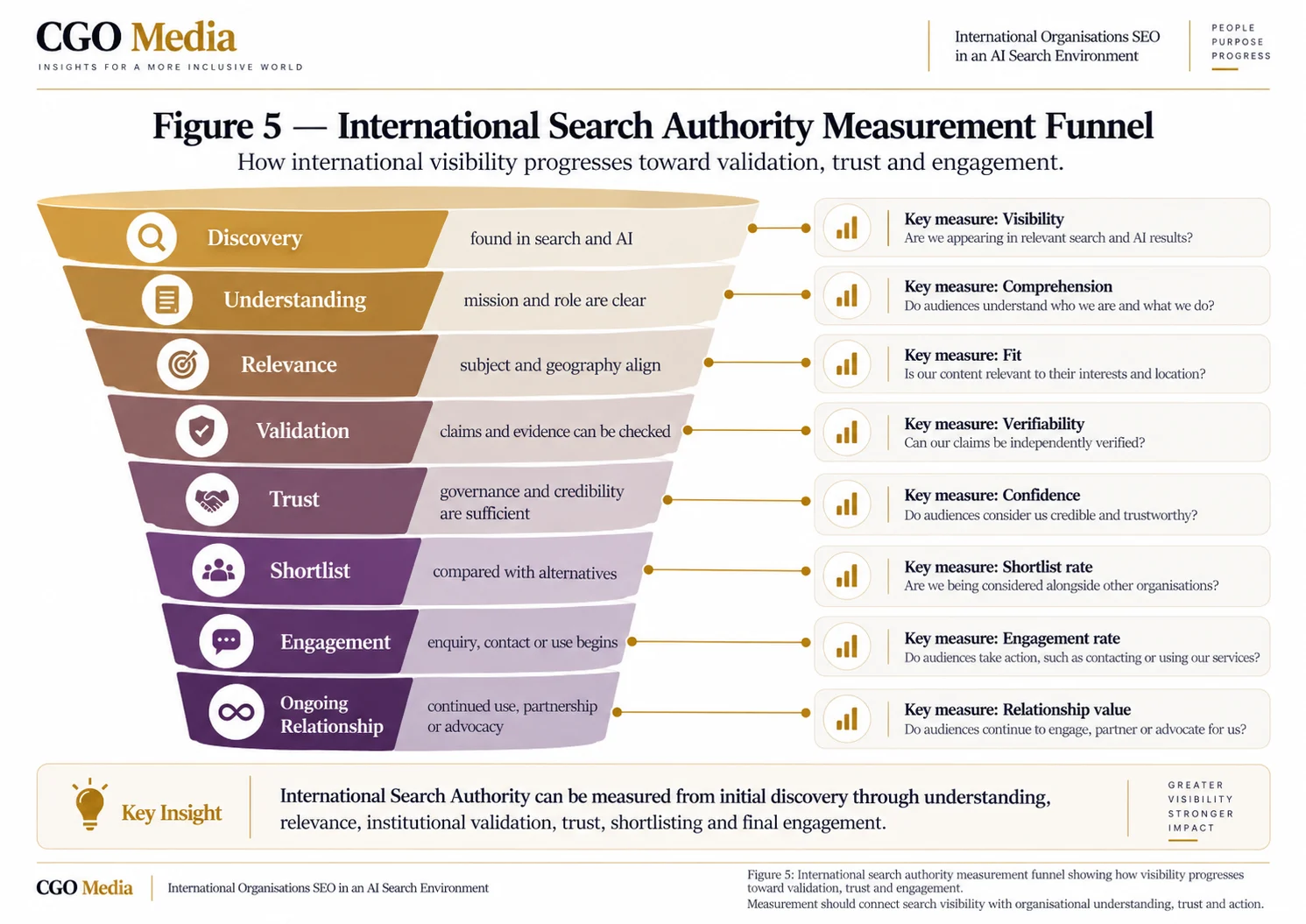
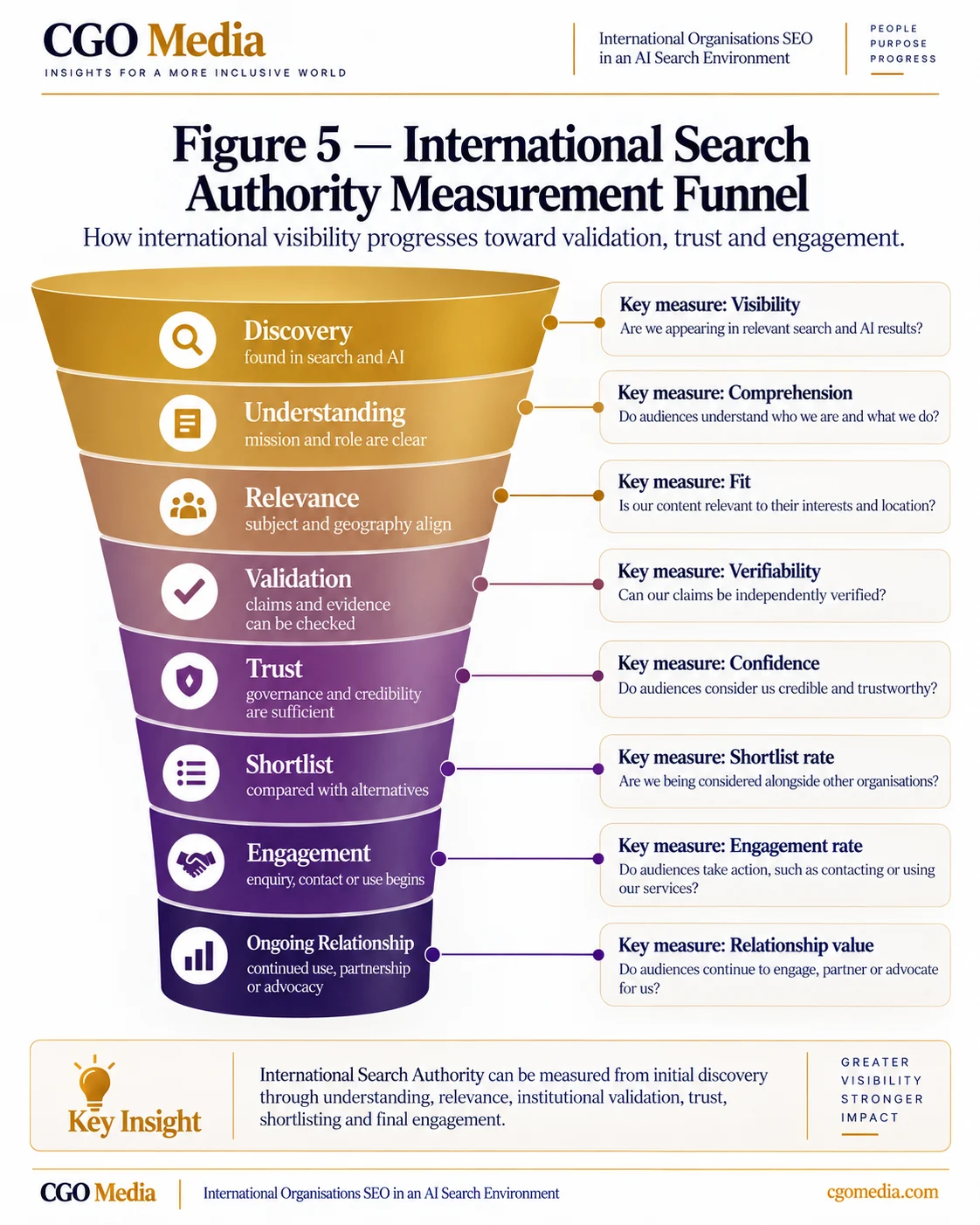
136. Prioritising International Implementation
International organisations rarely have sufficient resources to improve every country, language, programme, research environment and authority signal simultaneously.
Prioritisation is therefore an essential implementation capability.
The strongest roadmap does not simply create a long list of desirable improvements.
It determines which improvements matter most, which depend on other work being completed first and which are likely to create the greatest institutional value.
Priority should normally reflect a combination of:
- institutional importance;
- current authority weakness;
- reputational or accuracy risk;
- geographic importance;
- programme significance;
- research value;
- stakeholder demand;
- implementation effort;
- operational dependency;
- and expected search or AI impact.
The most visible weakness is not always the most important weakness.
A low-ranking country page may attract attention because its search performance is easy to observe.
However, inaccurate governance information or conflicting programme status may create considerably greater institutional risk.
Likewise, a highly cited research area may warrant additional investment even if its direct website traffic appears modest because its strategic value lies in academic, policy and AI source authority.
Implementation priority should therefore be determined through institutional context rather than generic SEO scoring.
137. Institutional Risk Priority
The highest priority should normally be assigned to inaccuracies capable of creating institutional, stakeholder or reputational risk.
These can include:
- incorrect leadership;
- incorrect governance information;
- outdated programme status;
- incorrect funding information;
- outdated statistics presented as current;
- incorrect country presence;
- misstated institutional relationships;
- and materially inaccurate AI representations where first-party evidence is contributing to the error.
Risk priority differs from conventional search priority.
A low-traffic governance page may still require urgent attention if it contains incorrect board or leadership information.
A discontinued programme page may still rank strongly and mislead potential partners.
An outdated statistic may be copied by media outlets or included in AI-generated answers long after it has been superseded.
The organisation should therefore identify which digital inaccuracies could produce consequences beyond normal search-performance loss.
A practical risk hierarchy can consider:
- accuracy risk — could users receive materially incorrect information?
- trust risk — could the weakness undermine institutional credibility?
- policy risk — could incorrect information affect formal decision-making?
- programme risk — could users misunderstand programme eligibility, availability or activity?
- reputational risk — could the information create public confusion about the organisation?
High-risk inaccuracies should generally be corrected before lower-risk visibility enhancements.
138. Strategic Country Priority
Country implementation should reflect institutional significance rather than attempting to create identical authority depth everywhere.
Countries can be prioritised according to:
- programme importance;
- funding importance;
- institutional relationships;
- search demand;
- policy relevance;
- stakeholder demand;
- local partnership activity;
- research importance;
- and the size of the current authority gap.
A high-priority country may deserve a more sophisticated authority environment containing:
- a comprehensive country hub;
- current programme information;
- research;
- statistics;
- experts;
- partners;
- local-language evidence;
- impact information;
- and external validation.
Lower-priority markets may require a simpler architecture that accurately reflects limited institutional activity without creating unnecessary maintenance.
The objective is proportionality.
Digital authority should reflect real-world institutional importance.
139. Strategic Language Priority
Language investment should also be prioritised rather than expanded without limit.
Relevant factors can include:
- audience size;
- programme importance;
- country relevance;
- search demand;
- policy importance;
- institutional obligations;
- research demand;
- and current authority gaps.
The organisation should determine which information categories require reliable coverage in each priority language.
For example, one language may require:
- complete institutional information;
- country programme coverage;
- major research resources;
- governance information;
- and local contact pathways.
Another may need only selected programme and policy resources.
Strategic language prioritisation helps avoid the situation in which hundreds of translated pages are created without sufficient long-term maintenance capability.
The strongest multilingual strategy is therefore not necessarily the one with the largest number of translated pages.
It is the one capable of maintaining the right information accurately in the languages that matter most.
140. Programme Priority
Programmes can be prioritised for authority development according to institutional and stakeholder significance.
Priority candidates may include programmes with:
- high institutional importance;
- large funding commitments;
- strong public interest;
- significant policy relevance;
- major country or regional coverage;
- high stakeholder demand;
- important research outputs;
- and weak current digital evidence.
A major programme with poor digital representation can create a substantial authority gap.
The organisation may be undertaking significant real-world activity while search and AI systems encounter only minimal evidence.
Priority programme work may therefore involve:
- better programme architecture;
- clearer lifecycle status;
- stronger geographic relationships;
- research integration;
- partner evidence;
- impact evidence;
- and improved external validation.
141. Research Priority
Research assets should be prioritised according to strategic value rather than publication recency alone.
Priority factors may include:
- strategic subject importance;
- external demand;
- citation potential;
- policy relevance;
- media relevance;
- AI source opportunity;
- dataset value;
- geographic significance;
- and programme importance.
Some older resources may remain highly valuable if they continue to be cited or provide foundational institutional evidence.
Some recent publications may require rapid strengthening because they address an emerging policy or media issue.
Priority research implementation may include:
- HTML research pages;
- stronger metadata;
- methodology visibility;
- author profiles;
- dataset relationships;
- citation guidance;
- and external dissemination.
142. External Authority Priority
External authority development should focus on environments where recognition is institutionally relevant.
Broad undifferentiated outreach can generate mentions without creating meaningful authority.
Priority should instead reflect the type of validation required.
For example:
- research may require academic recognition;
- policy work may benefit from government or policy citations;
- programme activity may require partner and local institutional validation;
- experts may benefit from credible media or conference visibility;
- standards may require regulatory or professional adoption.
External authority development therefore starts with the question:
Which credible independent environments are most relevant to validating this particular institutional capability?
This approach produces stronger contextual authority than generic citation acquisition.
143. AI Visibility Priority
AI monitoring should also be prioritised.
Attempting to test every possible prompt can create large quantities of data with limited strategic value.
Priority should be given to prompts with meaningful institutional consequences.
These can include:
- organisation recommendations;
- programme selection;
- research-source selection;
- policy questions;
- country-specific institutional discovery;
- expert identification;
- standards discovery;
- partner selection;
- and important multilingual queries.
The organisation should prioritise scenarios where inaccurate omission or representation could materially affect:
- stakeholder understanding;
- programme discovery;
- research use;
- institutional reputation;
- or engagement opportunities.
AI-monitoring priority should therefore follow institutional relevance rather than curiosity.
144. Implementation Effort Versus Impact
Implementation initiatives can be mapped according to expected impact and required effort.
Relevant dimensions can include:
- institutional impact;
- search impact;
- trust impact;
- AI-discovery impact;
- implementation effort;
- operational dependency;
- and maintenance requirement.
This can create four broad implementation categories:
- High Impact / Low Effort — potential quick wins;
- High Impact / High Effort — strategic foundational projects;
- Low Impact / Low Effort — opportunistic maintenance;
- Low Impact / High Effort — lower-priority initiatives unless another institutional requirement justifies them.
Impact should not be measured solely through traffic.
A governance correction may have relatively little search-volume impact but significant trust value.
A research-library restructure may require substantial effort but unlock authority across hundreds of publications.
An implementation matrix should therefore consider the wider institutional consequence.
145. Quick Wins
Quick wins are improvements that can deliver meaningful value with relatively limited implementation complexity.
Potential quick wins can include:
- correcting entity information;
- updating leadership pages;
- fixing priority hreflang errors;
- improving research metadata;
- connecting orphaned programme pages;
- adding clear publication dates;
- updating programme lifecycle status;
- improving internal links between country and programme resources;
- and clarifying important organisation relationships.
Quick wins should not be selected simply because they are easy.
They should still address meaningful constraints.
Correcting dozens of minor formatting inconsistencies may be less valuable than fixing one high-profile outdated leadership page.
The strongest quick wins therefore combine:
Low Effort + High Institutional Relevance
146. Foundational Projects
Some improvements require larger structural programmes.
Examples can include:
- international site restructuring;
- country architecture redesign;
- multilingual governance systems;
- research-library restructuring;
- organisation-wide Entity Governance;
- structured programme architecture;
- institutional taxonomy development;
- and shared data or metadata standards.
These projects often require significant cross-functional coordination.
They may involve technology, editorial workflows, governance, training and migration.
However, they can create value across many individual authority areas simultaneously.
A stronger research architecture can improve organic discovery, expert visibility, citation usability, AI source potential and institutional knowledge management.
A country architecture redesign can improve local search, programme discovery, multilingual relationships and regional governance.
Foundational projects should therefore be evaluated according to the number of authority capabilities they unlock.
147. Strategic Authority Projects
Longer-term authority projects may focus on developing new evidence and external recognition rather than correcting existing architecture.
Examples can include:
- original research programmes;
- academic outreach;
- policy engagement;
- Digital PR;
- institutional partnership development;
- expert visibility programmes;
- statistical resource development;
- and AI source monitoring systems.
These projects should normally build on the earlier roadmap phases.
Original research produces greater authority value when the institution already possesses strong research architecture.
Digital PR becomes more effective when first-party evidence is credible and easy to cite.
AI source monitoring becomes more useful when the organisation has reliable governance and clear evidence ownership.
Strategic authority projects therefore represent capability expansion rather than foundational repair.
148. Roadmap Governance
Implementation requires defined ownership across the organisation.
Without ownership, the roadmap risks becoming a sequence of recommendations that no team is clearly responsible for delivering.
Governance should define:
- who sets standards;
- who owns institutional facts;
- who maintains local evidence;
- who manages programme information;
- who governs research;
- who monitors external authority;
- who monitors AI visibility;
- and who resolves cross-functional conflicts.
The governance model should also reflect organisational reality.
Large international institutions are rarely well served by complete centralisation.
Local teams possess knowledge that headquarters cannot reproduce efficiently.
At the same time, uncontrolled decentralisation can produce inconsistent institutional information.
The preferred model is therefore usually federated.
Central teams establish common standards.
Local and specialist teams maintain the evidence requiring their expertise.
Shared governance ensures that those contributions remain coherent.
149. Executive Sponsorship
Senior sponsorship helps align International Search Authority with broader institutional objectives.
Without executive context, search initiatives can remain confined to technical or communications teams even when they require organisation-wide changes.
Executive sponsorship can help:
- resolve ownership disputes;
- prioritise strategic markets;
- secure cross-functional participation;
- support investment in foundational projects;
- establish governance expectations;
- and connect search outcomes with organisational strategy.
Senior leaders do not need to manage tactical implementation.
Their role is to ensure that search, information and authority improvements receive appropriate institutional support.
150. Global Digital Ownership
Global digital teams may coordinate:
- technical standards;
- international architecture;
- global templates;
- structured data principles;
- site governance;
- measurement;
- and international search quality assurance.
The global team should also maintain visibility into local implementation.
This does not mean approving every country edit.
It means ensuring that local activity continues to operate within the technical and institutional standards required for a coherent international system.
151. Country Ownership
Country teams should maintain current local institutional and programme information.
Relevant responsibilities may include:
- country office information;
- local contacts;
- current programmes;
- local research;
- government relationships;
- partners;
- country-specific statistics;
- local impact evidence;
- and local-language context.
Country teams should not redefine global institutional facts independently.
Their role is to contribute accurate local evidence within shared organisational standards.
152. Regional Ownership
Regional teams can coordinate priorities that extend across several countries.
Relevant responsibilities may include:
- regional programme relationships;
- cross-country research;
- regional strategy;
- shared language requirements;
- regional partnerships;
- and quality assurance across country environments.
Regional ownership can reduce duplication and help identify issues that appear repeatedly across multiple national sites.
153. Language Ownership
Language owners should maintain standards for:
- translation;
- localisation;
- terminology;
- content freshness;
- equivalent-page relationships;
- and review cycles.
Ownership may sit with language specialists, local teams or a central multilingual function depending on organisational structure.
The key requirement is that responsibility remains explicit.
Without defined ownership, translated environments can deteriorate even where the primary language remains well maintained.
154. Programme Ownership
Programme teams should maintain authoritative operational information concerning:
- status;
- objectives;
- partners;
- funding;
- geography;
- outputs;
- results;
- research;
- and programme closure or transition.
Digital teams may structure and publish the information.
Programme teams should normally remain responsible for confirming whether it is factually current.
This distinction between subject ownership and publishing ownership is essential for maintaining accuracy.
155. Research Ownership
Research teams should maintain standards for:
- authorship;
- methodology;
- publication dates;
- versioning;
- supporting data;
- citation guidance;
- subject classification;
- and research integrity.
Digital and research teams should collaborate on discoverability while preserving scholarly and methodological standards.
This enables the organisation to improve Search Authority without reducing research quality to an SEO exercise.
156. Trust and Governance Ownership
Relevant institutional teams should maintain:
- governance information;
- leadership;
- funding transparency;
- annual reports;
- financial reporting;
- accountability;
- and impact reporting.
These resources may be owned by several departments including governance, legal, finance, communications or executive functions.
The roadmap does not require a single owner for every trust signal.
It requires clear ownership and coordinated publication.
157. External Authority Ownership
Communications, public-affairs, policy and research teams can coordinate external authority development.
Their combined activities may include:
- media relations;
- academic engagement;
- policy outreach;
- research dissemination;
- expert commentary;
- conference participation;
- and institutional partnership development.
Coordination helps ensure that external visibility reinforces strong evidence rather than functioning as independent promotion.
158. AI Visibility Ownership
Defined responsibility should exist for:
- prompt monitoring;
- source analysis;
- recommendation tracking;
- representation accuracy;
- peer comparison;
- and escalation of material errors.
The AI-monitoring owner does not necessarily own every corrective action.
Its role can be to identify the issue, assess significance and route the finding to the relevant institutional owner.
This creates an operational bridge between AI observation and evidence improvement.
159. Shared International Search Governance
The most advanced implementation model combines shared standards with appropriate regional, country and specialist autonomy.
Central governance should typically define:
- technical standards;
- entity principles;
- measurement definitions;
- minimum programme information standards;
- research metadata requirements;
- multilingual principles;
- and escalation processes.
Local and specialist teams should retain enough flexibility to represent genuine differences in:
- country needs;
- language context;
- programme structure;
- policy environment;
- and stakeholder behaviour.
The objective is:
Global Consistency + Local Accuracy + Specialist Expertise
This balance supports scale without sacrificing institutional truth.
160. Common Implementation Risks
Several recurring mistakes can weaken International Search Authority implementation even when individual projects appear successful.
These risks usually emerge when one part of the roadmap is pursued without the capability that should support it.
Recognising them early can prevent significant implementation waste.
161. Risk One — Starting with AI Before Fixing Foundations
AI optimisation provides limited value when institutional information remains technically inaccessible, outdated or contradictory.
Advanced prompt monitoring cannot resolve:
- incorrect programme data;
- broken indexing;
- weak entity clarity;
- outdated leadership;
- or missing country evidence.
The stronger approach is to use AI monitoring diagnostically while correcting the underlying institutional evidence system.
162. Risk Two — Publishing More Before Structuring Existing Knowledge
Increasing content volume can worsen fragmentation where the existing Knowledge Architecture is already weak.
New content may create:
- additional duplication;
- more orphaned resources;
- inconsistent terminology;
- unclear authorship;
- and overlapping programme information.
Organisations should first understand how existing knowledge fits together before significantly increasing volume.
163. Risk Three — Treating Translation as International Strategy
Translation alone does not create International Search Authority.
International visibility also depends on:
- country relevance;
- local evidence;
- terminology;
- localisation;
- external authority;
- and language-specific governance.
A translated global page may be technically correct while remaining poorly aligned with local stakeholder needs.
The multilingual strategy should therefore combine translation with contextual authority.
164. Risk Four — Centralising Everything
Excessive centralisation can remove essential local knowledge and slow institutional updates.
Global teams cannot always maintain detailed knowledge of:
- local programme status;
- country partnerships;
- local terminology;
- government relationships;
- and regional stakeholder needs.
Central teams should therefore govern shared standards without attempting to own every local fact.
165. Risk Five — Decentralising Without Standards
The opposite problem is uncontrolled decentralisation.
Without shared standards, regional and country teams may create:
- different organisation names;
- conflicting programme information;
- inconsistent language structures;
- different research metadata;
- and conflicting governance facts.
A federated model provides a stronger balance between local knowledge and institutional consistency.
166. Risk Six — Measuring Only Traffic
Traffic does not capture the complete value of International Search Authority.
Important outcomes can include:
- academic citation;
- policy use;
- government references;
- programme discovery;
- Institutional Trust;
- expert discovery;
- country visibility;
- and AI recommendation visibility.
Some high-authority institutional assets may attract modest traffic while having substantial policy, academic or reputational value.
Measurement should therefore reflect the intended role of the resource.
167. Risk Seven — Chasing Citation Volume
Citation development should prioritise relevance, credibility and contextual fit rather than arbitrary link or mention totals.
A small number of strong institutional references can provide greater validation than large quantities of low-value mentions.
External authority should therefore remain aligned with genuine expertise and institutional activity.
168. Risk Eight — Monitoring AI Without Improving Evidence
AI monitoring should produce actionable institutional improvements rather than dashboards alone.
When monitoring identifies an issue, the organisation should determine:
- what evidence is missing;
- which source is outdated;
- who owns the information;
- what corrective action is possible;
- and whether the issue recurs after improvement.
Monitoring without an improvement pathway creates observation rather than capability.
169. Risk Nine — Treating the Roadmap as a One-Off Project
International organisations change continuously.
A one-time implementation programme will gradually become outdated if the organisation does not maintain the capabilities developed through the roadmap.
Long-term governance is therefore required for:
- technical architecture;
- countries;
- languages;
- programmes;
- research;
- leadership;
- external authority;
- and AI monitoring.
The roadmap succeeds when these capabilities become part of normal institutional operations.
170. Application for Intergovernmental Organisations
Intergovernmental organisations may prioritise:
- member-state architecture;
- policy authority;
- statistical authority;
- government citations;
- multilingual governance;
- formal mandate;
- and institutional entity clarity.
Their implementation roadmap may require especially strong governance because formal institutional relationships often have legal or policy significance.
171. Application for International NGOs
International NGOs may prioritise:
- country programmes;
- impact evidence;
- funding transparency;
- local authority;
- partner validation;
- mission clarity;
- and programme lifecycle accuracy.
The roadmap should connect global mission with local programme evidence so users can move from institutional purpose into verifiable operational activity.
172. Application for Development Organisations
Development organisations may focus on:
- country authority;
- programme outcomes;
- government partnerships;
- research;
- funding evidence;
- evaluation;
- and regional development priorities.
Their roadmap should ensure that substantial real-world implementation is represented through equally strong programme, geographic and evidence architecture.
173. Application for International Associations
Associations may prioritise:
- member architecture;
- standards;
- events;
- policy representation;
- industry authority;
- expert committees;
- and professional research.
Implementation should make clear how the global organisation relates to members, chapters, committees and specialist knowledge.
174. Application for Foundations
Foundations may prioritise:
- grant discovery;
- governance;
- funding transparency;
- impact evidence;
- research authority;
- recipient relationships;
- and programme outcomes.
Where foundations fund external delivery rather than implement programmes directly, institutional architecture should distinguish clearly between funder, recipient and implementing organisation.
175. Application for Standards Bodies
Standards organisations may focus on:
- standards architecture;
- version control;
- technical authority;
- industry adoption;
- policy and regulatory citations;
- expert committees;
- and current-versus-superseded resource clarity.
Implementation should ensure that users can identify the current authoritative standard and understand its institutional provenance.
176. Application for Research Organisations
Research organisations may prioritise:
- Research Architecture;
- Researcher Authority;
- dataset discoverability;
- academic citation;
- AI source visibility;
- methodology;
- and institutional attribution.
Their roadmap may place greater strategic weight on publication structure, author relationships and evidence reuse than on conventional programme architecture.
177. Application for Multinational Charities
Multinational charities may focus on:
- country programme visibility;
- mission clarity;
- impact;
- donor trust;
- local partnerships;
- governance;
- and funding transparency.
The roadmap should support several audiences simultaneously.
Donors may seek trust and impact.
Beneficiaries may seek programmes.
Partners may seek delivery evidence.
Journalists may seek statistics and expert commentary.
Country and programme architecture should therefore connect each audience with the evidence relevant to its needs.
178. Continuous Implementation
Once the initial seven roadmap phases have been completed, implementation becomes a permanent authority-development cycle.
The organisation moves through:
Assess → Prioritise → Implement → Validate → Integrate → Measure → Reassess
Assess
Review technical health, institutional information, country and language environments, programmes, research, external authority and AI representation.
Prioritise
Identify the constraints with the greatest institutional, search, trust or stakeholder impact.
Implement
Correct the underlying technical, content, structural, evidence or governance weakness.
Validate
Determine whether stronger first-party evidence is receiving appropriate independent recognition where external validation matters.
Integrate
Ensure that changes are incorporated into shared standards, workflows, ownership and measurement rather than remaining isolated projects.
Measure
Assess whether implementation has improved:
- discoverability;
- institutional understanding;
- country and language authority;
- programme visibility;
- research authority;
- trust;
- citation;
- AI representation;
- and stakeholder outcomes.
Reassess
Return to the broader authority environment and identify the next significant constraint.
The cycle then repeats.
This continuous approach prevents International Search Authority from deteriorating as the organisation changes.
It also creates a mechanism through which new search and AI developments can be incorporated without abandoning the underlying institutional architecture.
The final strategic objective is not to finish implementation.
It is to create an organisation capable of continually implementing the right improvements as its evidence environment evolves.
The Continuous International Search Authority Development Cycle shows how the completed seven-phase roadmap becomes a permanent institutional improvement process.
1. Assess
Review the current technical, institutional, geographic, multilingual, programme, research, trust, external-authority and AI evidence environment.
2. Prioritise
Identify the authority gaps with the greatest institutional importance, risk, strategic impact and dependency value.
3. Implement
Correct technical weaknesses, strengthen evidence, improve architecture or develop authority according to the identified constraint.
4. Validate
Confirm that important institutional claims and capabilities are supported by strong first-party evidence and appropriate independent recognition.
5. Integrate
Embed improvements into governance, publishing workflows, measurement, country and language operations and AI-monitoring processes.
6. Measure
Evaluate changes in discoverability, trust, citation, institutional authority, stakeholder engagement and AI-assisted representation.
7. Reassess
Review the complete authority environment again, identify the next significant constraint and restart the cycle.
Continuous implementation principle: International Search Authority is not maintained through occasional SEO projects. It develops through a permanent cycle of assessment, prioritisation, evidence improvement, validation, integration, measurement and reassessment.
Adaptive authority principle: The organisation should become increasingly capable of responding to changes in programmes, countries, languages, research, stakeholder behaviour, external authority and AI-assisted discovery without losing institutional coherence.
Figure 6. International Search Authority develops through continuous assessment, prioritisation, implementation, validation, integration, measurement and reassessment as institutional, geographic, multilingual and AI discovery environments evolve.
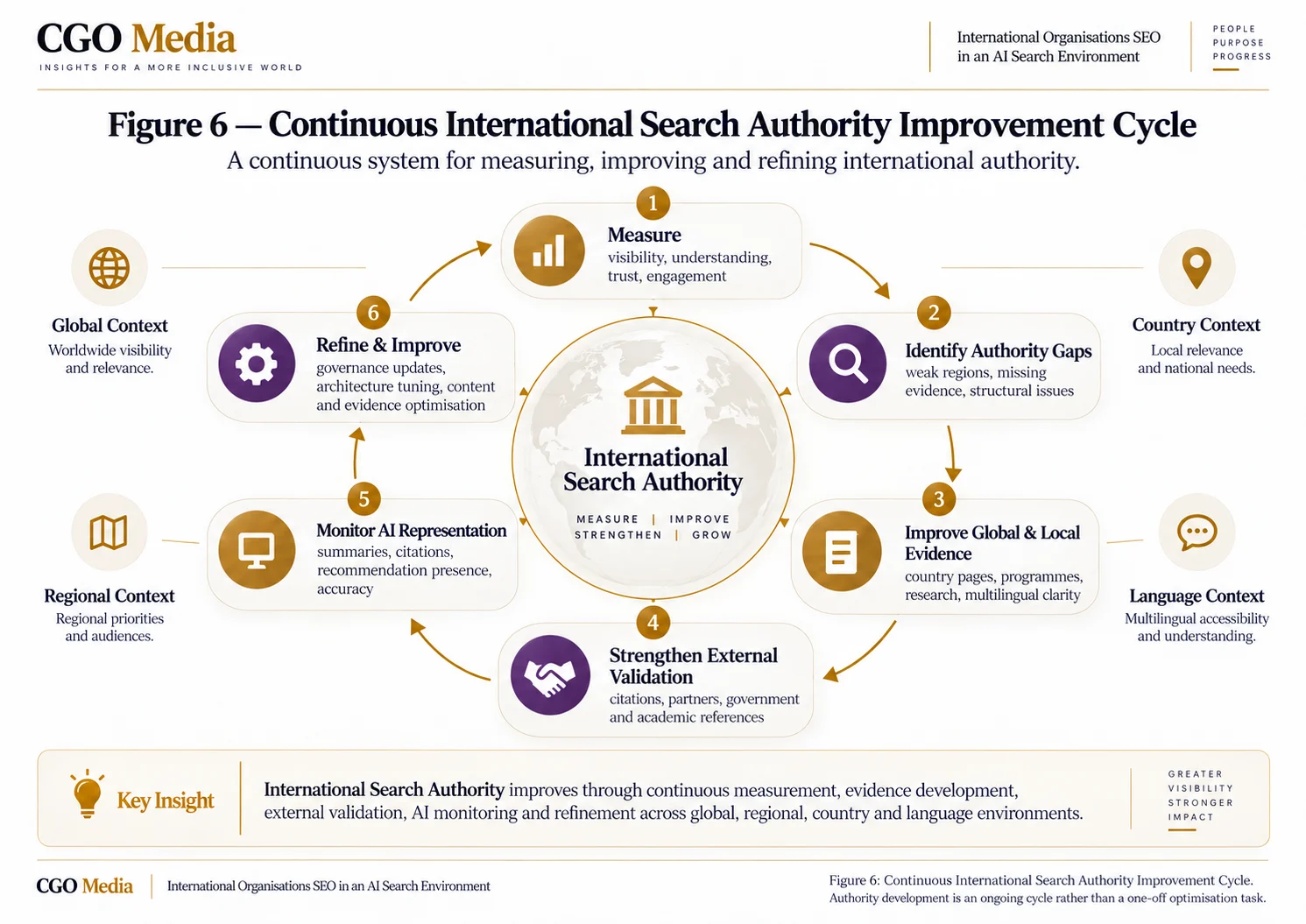
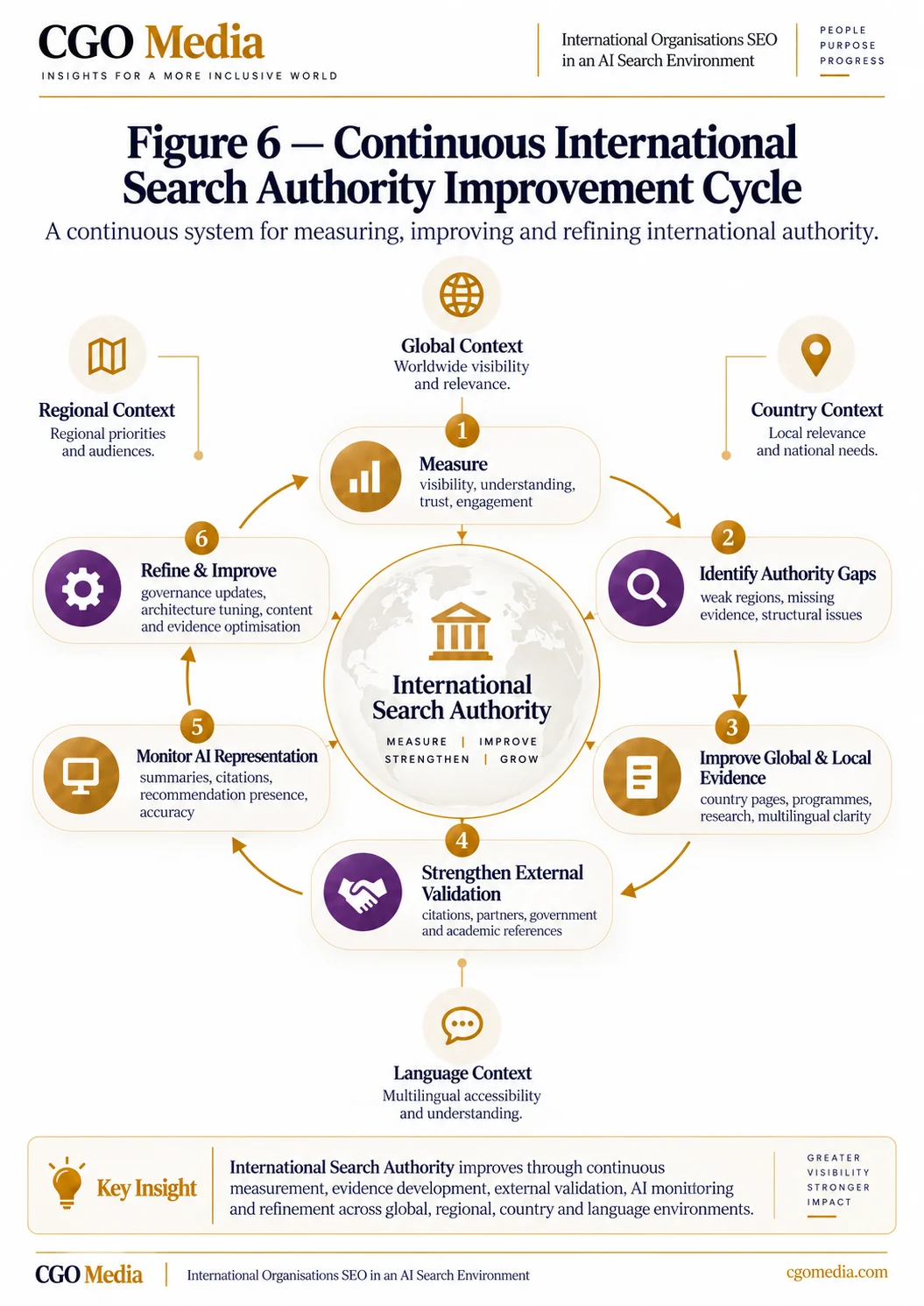
179. Relationship with the International Organisations AI Trust and Visibility Framework
The
International Organisations AI Trust and Visibility Framework
defines the evidence environment required for an international institution to become understandable, credible and increasingly visible across traditional and AI-assisted discovery systems.
The framework examines six connected authority dimensions:
- institutional identity and Entity Clarity;
- programme and operational evidence;
- research and knowledge authority;
- geographic and multilingual relevance;
- institutional trust;
- and external validation.
The implementation roadmap translates those evidence dimensions into a practical development sequence.
The relationship between the two resources can therefore be expressed as:
Trust and Visibility Framework → Defines What Strong Authority Requires
Implementation Roadmap → Defines How the Organisation Progressively Builds It
For example, the Trust and Visibility Framework may identify incomplete programme evidence as a weakness.
The roadmap determines how that weakness should be approached.
The organisation first assesses programme information, stabilises inaccurate lifecycle information, structures programme relationships, strengthens the underlying evidence, develops appropriate independent validation, integrates programme governance with wider search operations and then monitors the capability continuously.
The same implementation logic can be applied to country authority, research, Institutional Trust, external citations and AI representation.
The two resources should therefore be used together.
The framework provides the evidence model.
The roadmap provides the implementation model.
180. Relationship with the International Discovery and Organisation Selection Model
The
International Discovery and Organisation Selection Model
examines how stakeholders progress from recognising a need to discovering, evaluating, validating, comparing and eventually engaging with an international organisation.
Relevant stakeholder groups can include:
- governments;
- researchers;
- journalists;
- donors;
- programme participants;
- institutional partners;
- members;
- policy organisations;
- and other professional audiences.
Those stakeholders may evaluate different forms of evidence.
A government may prioritise mandate, policy authority and country relevance.
A researcher may place greater emphasis on methodology, authorship and data quality.
A donor may require governance, financial transparency and impact evidence.
A journalist may require current statistics, research and identifiable experts.
The implementation roadmap strengthens the evidence required throughout those stakeholder journeys.
For example:
Discovery is supported through technical accessibility, country architecture, multilingual visibility and research discoverability.
Evaluation is supported through programme, geographic and subject evidence.
Validation is supported through research, governance, impact evidence and credible external references.
Comparison is supported through clear institutional differentiation and sufficiently complete evidence.
Engagement is supported through appropriate programme, partnership, media, research, funding or membership pathways.
The Selection Model therefore describes the stakeholder journey.
The Implementation Roadmap develops the organisational capabilities required to support that journey.
181. Relationship with the International Search Authority Maturity Model
The
International Search Authority Maturity Model
provides a capability-based method for evaluating how advanced an organisation has become in managing international search, institutional evidence and AI-assisted discovery.
The maturity model identifies five broad levels:
- Fragmented Visibility
- Managed Search
- Structured Authority
- Integrated Authority
- Adaptive Authority
The roadmap provides the practical progression through which an organisation can move toward stronger maturity.
The relationship can be represented as:
Maturity Model → Where Are We?
Implementation Roadmap → What Should We Build Next?
An organisation at Fragmented Visibility may require substantial work within Assess and Stabilise.
An organisation progressing toward Structured Authority may focus increasingly on the Structure and Strengthen phases.
An organisation seeking Integrated Authority needs stronger coordination between search, research, communications, country governance, external authority and AI monitoring.
An organisation approaching Adaptive Authority should increasingly operate through the Evolve phase, using continuous monitoring, evidence improvement and organisational learning.
The maturity model and roadmap therefore create a feedback relationship:
Assess Maturity → Identify Capability Gap → Implement Roadmap Activity → Measure Progress → Reassess Maturity
This allows international search development to be treated as an organisational capability programme rather than as a fixed list of SEO tasks.
182. Relationship with the Parent Research
This roadmap forms part of the research architecture established in
International Organisations SEO in an AI Search Environment.
The parent research examines the broader structural change affecting international organisational discovery.
It explains why visibility increasingly depends on the interaction between:
- technical International SEO;
- institutional entities;
- country and regional architecture;
- multilingual search;
- programme authority;
- research and statistical evidence;
- Institutional Trust;
- external citation authority;
- and AI-assisted discovery.
The implementation roadmap translates that strategic research into a sequenced operational model.
The parent research establishes the problem.
The Trust and Visibility Framework defines the evidence dimensions.
The Discovery and Organisation Selection Model describes stakeholder evaluation.
The Search Authority Maturity Model identifies organisational capability.
The Implementation Roadmap defines the practical progression required to improve those capabilities.
The
International Organisations GEO: Generative Engine Optimisation
then extends the architecture specifically into generative source selection, citation and recommendation environments.
Together, these resources form an interconnected International Organisations research family rather than separate tactical SEO documents.
183. Methodological Position
The International Organisations SEO and AI Implementation Roadmap is a conceptual and strategic implementation framework developed by CGO Media.
It is designed to help international organisations organise technical search, institutional evidence, geographic architecture, multilingual discovery, research authority, external validation and AI visibility into a coherent development sequence.
The roadmap does not imply that every international organisation should perform every activity in exactly the same order or within the same timeframe.
International organisations vary significantly in:
- mandate;
- scale;
- technical infrastructure;
- number of countries;
- language requirements;
- programme structure;
- research output;
- governance;
- funding model;
- and stakeholder environment.
Implementation should therefore be adapted according to institutional context.
The seven-phase sequence is intended to provide strategic logic rather than rigid project management.
Certain dependencies remain important.
For example, an organisation should generally avoid scaling weak multilingual architecture before correcting foundational inconsistencies.
External authority development becomes more useful once first-party evidence is strong enough to support independent citation.
AI monitoring becomes operationally stronger when entity, programme and information ownership are already defined.
The roadmap also does not claim that search engines, large language models or AI recommendation systems explicitly evaluate organisations according to the seven phases described here.
The phases are a CGO Media strategic implementation model.
They organise observable organisational capabilities that can influence whether institutional information is:
- accessible;
- understandable;
- relevant;
- verifiable;
- trusted;
- citable;
- and suitable for consideration within search and AI-assisted discovery environments.
The roadmap should therefore be applied as a structured decision framework rather than as a claimed description of proprietary search or generative algorithms.
184. Strategic Implications
The principal strategic implication of the roadmap is that International SEO implementation should no longer be framed only around individual tactics.
The traditional question:
"What International SEO activities should we do?"
is increasingly incomplete.
A more useful strategic question is:
"What institutional capabilities must we build, in what order, to become more discoverable, understandable, trusted, citable and appropriately represented across global search and AI-assisted discovery environments?"
This changes implementation in several important ways.
Technical SEO Becomes a Foundation Rather Than the Entire Programme
Technical accessibility remains essential.
Search engines and AI-supported retrieval systems cannot use institutional evidence effectively if important resources are blocked, duplicated, miscanonicalised or poorly connected.
However, technical optimisation alone cannot create Programme Authority, Research Authority, Institutional Trust or geographic relevance.
International Architecture Becomes Institutional Architecture
Countries and languages should not be treated only as targeting settings.
They represent different institutional and stakeholder contexts.
A mature international architecture therefore connects global identity with regional, national and language-specific evidence.
Research Becomes an Authority Asset
Research, statistics, methodologies and policy resources can generate durable authority through academic, government, media and AI citation.
Research architecture should therefore become part of International Search Authority planning rather than remaining isolated inside publication repositories.
External Authority Becomes Evidence Validation
External links and mentions have greater strategic meaning when they independently reinforce genuine areas of expertise, programme activity or research authority.
The roadmap therefore prioritises contextual validation over citation volume.
AI Visibility Becomes an Organisational Intelligence Layer
AI-assisted discovery can reveal how the wider information environment represents the institution.
Representation gaps, weak source visibility and unexpected peer recommendations can expose weaknesses in first-party evidence, external validation or Entity Clarity.
AI monitoring can therefore contribute to institutional improvement when connected with operational ownership.
Implementation Becomes Continuous
The roadmap ultimately moves the organisation away from occasional SEO projects toward a permanent capability for maintaining international digital authority.
The long-term objective is not a finished website.
It is an institution capable of continually maintaining accurate, connected and credible digital evidence as both the organisation and the wider discovery environment evolve.
185. Conclusion
International search implementation should not be treated as a disconnected collection of technical, content, multilingual, research and AI projects.
International organisations operate complex information environments involving global identities, regions, countries, languages, programmes, research, statistics, experts, partners, governance structures and external institutional relationships.
The International Organisations SEO and AI Implementation Roadmap provides a seven-phase development sequence:
- Assess
- Stabilise
- Structure
- Strengthen
- Validate
- Integrate
- Evolve
The sequence begins by establishing a reliable baseline and identifying the constraints limiting International Search Authority.
It then corrects foundational weaknesses that could undermine later development.
Once the environment becomes more reliable, institutional information can be structured into clearer relationships connecting organisation, geography, languages, programmes, research, experts, partners and governance.
The next stage strengthens the quality and depth of that evidence.
Programme information becomes more complete.
Country authority becomes more substantive.
Research becomes easier to evaluate and cite.
Experts become more clearly connected with institutional knowledge.
Governance and impact evidence become easier to verify.
Independent validation then strengthens authority through credible government, academic, policy, media, partner and professional references.
The later phases integrate these individual capabilities into a coordinated operating model in which technical SEO, country teams, research, communications, governance, external authority and AI monitoring reinforce one another.
The final phase converts the roadmap from a transformation project into an adaptive institutional capability.
The long-term cycle becomes:
Assess → Prioritise → Implement → Validate → Integrate → Measure → Reassess
The final objective is therefore not simply stronger rankings.
It is an International Search Authority capability capable of supporting:
- global and local discovery;
- accurate institutional understanding;
- programme discovery;
- research and statistical citation;
- Institutional Trust;
- stakeholder evaluation;
- organisation selection;
- AI source visibility;
- and appropriate AI-assisted recommendation.
International organisations capable of maintaining this system are better positioned to remain understandable across an information environment increasingly shaped by both conventional search and generative discovery.
The roadmap therefore represents more than an International SEO implementation plan.
It provides a model for building and governing the wider institutional evidence architecture through which international organisations are discovered, interpreted, validated and referenced online.
References
External Academic, Technical and Institutional Sources
- 1. Google Search Central. Tell Google about localized versions of your page.
- 2. Google Search Central. Managing multi-regional and multilingual sites.
- 3. Schema.org. Organization.
- 4. Schema.org. Person.
- 5. Schema.org. Report.
- 6. Schema.org. Dataset.
- 7. World Wide Web Consortium. Web Content Accessibility Guidelines (WCAG) 2.2.
- 8. Metzger, M. J. (2007). Making Sense of Credibility on the Web: Models for Evaluating Online Information and Recommendations for Future Research. Journal of the American Society for Information Science and Technology, 58(13), 2078–2091.
- 9. Hogan, A. et al. (2021). Knowledge Graphs. ACM Computing Surveys, 54(4).
- 10. Ji, Z. et al. (2023). Survey of Hallucination in Natural Language Generation. ACM Computing Surveys, 55(12).
CGO Media Research Frameworks
- 11. Wilkinson, R. (2026). CGO AI Authority Model. CGO Media.
- 12. Wilkinson, R. (2026). CGO Media Entity Authority Framework. CGO Media.
- 13. Wilkinson, R. (2026). CGO Media Content Authority Framework. CGO Media.
- 14. Wilkinson, R. (2026). CGO Media Brand Signal Framework. CGO Media.
- 15. Wilkinson, R. (2026). CGO Media AI Citation Framework. CGO Media.
- 16. Wilkinson, R. (2026). CGO Media AI Search Readiness Framework. CGO Media.
- 17. Wilkinson, R. (2026). CGO Media Knowledge Architecture Map. CGO Media.
- 18. Wilkinson, R. (2026). CGO Media Search Ecosystem Model. CGO Media.
These sources provide supporting context around International SEO, multilingual architecture, structured entities, web credibility, Knowledge Graphs and generative-system reliability. The seven-phase roadmap itself remains a CGO Media strategic implementation framework rather than a description of proprietary search-engine or AI-system algorithms.
CGO Media Research Ecosystem
The International Organisations SEO and AI Implementation Roadmap forms part of the
CGO Media Framework Library
and the wider CGO Media research programme examining International SEO, multilingual architecture, institutional authority, Knowledge Architecture, Citation Authority and AI-assisted discovery.
The wider research programme can be explored through the
CGO Media Research Library,
CGO Media Research Architecture,
CGO Media Research Observations Library
and
CGO Media Statistics Library.
About Roger Wilkinson
Roger Wilkinson is an independent Search and AI researcher, SEO practitioner and founder of CGO Media with more than 25 years of experience in search, online visibility and digital strategy.
His current research examines how artificial intelligence is changing search engines, recommendation systems and digital authority, with particular focus on Technical SEO, Entity Authority, Content Authority, Brand Signals, Citation Authority, Knowledge Architecture, Generative Engine Optimisation and AI Search Visibility.
Through the CGO Media research programme, Roger develops research papers and strategic frameworks designed to help organisations understand how traditional search visibility increasingly interacts with entity recognition, institutional evidence, independent authority, source selection, AI citations and generative recommendation systems.
View Roger Wilkinson's researcher profile →
Author: Roger Wilkinson
Publisher: CGO Media
Last reviewed: September 2026
Related International Organisations Research and Frameworks
This implementation roadmap forms part of the wider International Organisations research family and should be used alongside the supporting research, trust, discovery, maturity and GEO resources.
- International Organisations SEO in an AI Search Environment
- International Organisations AI Trust and Visibility Framework
- International Discovery and Organisation Selection Model
- International Search Authority Maturity Model
- International Organisations GEO: Generative Engine Optimisation
Research Libraries
Research Usage & Citation
CGO Media encourages researchers, journalists, international organisations, NGOs, policy institutions, associations, academics and practitioners to reference this roadmap where it contributes to wider understanding of International SEO, institutional authority, multilingual discovery, Knowledge Architecture and AI-assisted search.
Reasonable quotations, summaries, figures and excerpts may be used in articles, reports, presentations, academic work and other publications provided appropriate acknowledgement is given to Roger Wilkinson and CGO Media.
Cite This Roadmap / Embed Citation
The International Organisations SEO and AI Implementation Roadmap, developed by Roger Wilkinson at CGO Media, provides a seven-phase implementation sequence — Assess, Stabilise, Structure, Strengthen, Validate, Integrate and Evolve — for developing international institutional Search Authority and AI discovery readiness.
APA Citation
Wilkinson, R. (2026). International Organisations SEO and AI Implementation Roadmap. CGO Media. https://cgomedia.com/international-organisations-seo-ai-implementation-roadmap/
BibTeX Citation
@article
Research Paper
This roadmap is supported by the parent research paper:
International Organisations SEO in an AI Search Environment.
Author: Roger Wilkinson
Published by: CGO Media
Published: September 2026
Last reviewed: September 2026
For permissions relating to extensive reproduction, commercial licensing or republication of substantial portions of this roadmap, please contact CGO Media directly.