
International Organisations GEO: Generative Engine Optimisation
 International Organisations GEO is the application of Generative Engine Optimisation to organisations operating across multiple countries, languages, regulatory environments, cultural contexts and public-information ecosystems.
International organisations face a more complex discovery environment than organisations operating within a single market. Their websites, regional offices, programmes, mandates, services, research, policy positions and public information may be distributed across multiple domains, languages, subdirectories, country offices and external sources.
Generative search introduces an additional layer of complexity because AI systems may combine information from headquarters pages, country websites, government sources, partner organisations, policy documents, research publications, media coverage, databases and third-party profiles when constructing answers or recommending organisations.
1. International GEO Extends International SEO
Traditional international SEO remains essential for multilingual and multi-market discovery.
2. International SEO Commonly Focuses on
- Language targeting
- Country targeting
- Hreflang
- Site architecture
- Localised content
- Search demand
3. International GEO Adds a Generative Discovery Layer
It introduces explicit consideration of:
- AI source selection
- Citation visibility
- Entity representation
- Mandate representation
- Geographic interpretation
- Recommendation visibility
4. International GEO Is Not Simply Multilingual SEO
Translation alone does not ensure accurate AI representation.
5. International GEO Requires Global Entity Clarity
AI systems need to understand:
- Who the organisation is
- Where it operates
- What mandate it has
- Which entities belong to it
- Which audiences it serves
6. International Organisations Can Have Complex Entity Structures
These can include:
- Global headquarters
- Regional offices
- Country offices
- Programmes
- Initiatives
- Partner organisations
7. Entity Relationships Should Be Explicit
A useful relationship is:
Global Organisation → Regional Structure → Country Office → Programme → Service or Initiative → Audience
8. Entity Ambiguity Can Create Geographic Confusion
AI systems may confuse:
- Headquarters and country offices
- Partner organisations and subsidiaries
- Global programmes and local initiatives
- Current and historical entities
9. Mandate Clarity Is a Core International GEO Requirement
International organisations should be clear about what they are authorised, established or designed to do.
10. Mandate Can Include
- Policy development
- Humanitarian work
- Economic development
- Research
- Standards
- Technical assistance
11. Mandate Ambiguity Can Distort AI Recommendation
An organisation may be recommended for work outside its genuine remit.
12. International GEO Should Therefore Map Mandate to Audience Need
A useful relationship is:
Audience Need → Organisational Mandate → Programme or Service → Geographic Scope → Appropriate Recommendation
13. Geographic Relevance Is Another Core GEO Layer
An organisation may operate globally but have different levels of activity in different markets.
14. Geographic Presence Should Be Explicit
Relevant information can include:
- Countries served
- Regional offices
- Local programmes
- Local partners
- Country-specific research
15. Global Presence Should Not Be Confused with Local Availability
An international organisation may have a global mandate while offering practical services only in selected countries.
16. International GEO Should Distinguish Global and Local Scope
A useful model is:
Global Mandate → Regional Relevance → Country Presence → Local Programme → Audience Fit
17. Language Relevance Is Equally Important
Generative systems may answer international queries in many languages.
18. Multilingual Visibility Requires More Than Translation
Different markets may use different:
- Terminology
- Institutional language
- Policy language
- Search behaviour
- User expectations
19. Language Localisation Should Preserve Organisational Truth
Core facts should remain consistent across translations.
20. Localised Interpretation Can Still Differ
Different markets may require different examples, explanations and contextual evidence.
21. International GEO Should Therefore Balance Consistency and Localisation
A useful principle is:
Global Entity Consistency + Local Language Relevance + Geographic Context
22. Trust Evidence Is Central to International GEO
International organisations often operate in areas where institutional legitimacy matters strongly.
23. Trust Evidence Can Include
- Legal status
- Mandate documents
- Membership
- Government recognition
- Published research
- Independent references
24. Trust Claims Should Be Verifiable
Statements about legitimacy, reach, expertise or impact should have supporting evidence.
25. International Trust Evidence Can Vary by Organisation Type
A multilateral institution may rely on different evidence from:
- NGOs
- Trade organisations
- Professional bodies
- Development organisations
- Global associations
26. International GEO Should Match Evidence to Organisational Type
The evidence required to validate one organisation may not fit another.
27. International Organisations Operate Within Large Source Ecosystems
Relevant sources can include:
- Official organisation websites
- Government sources
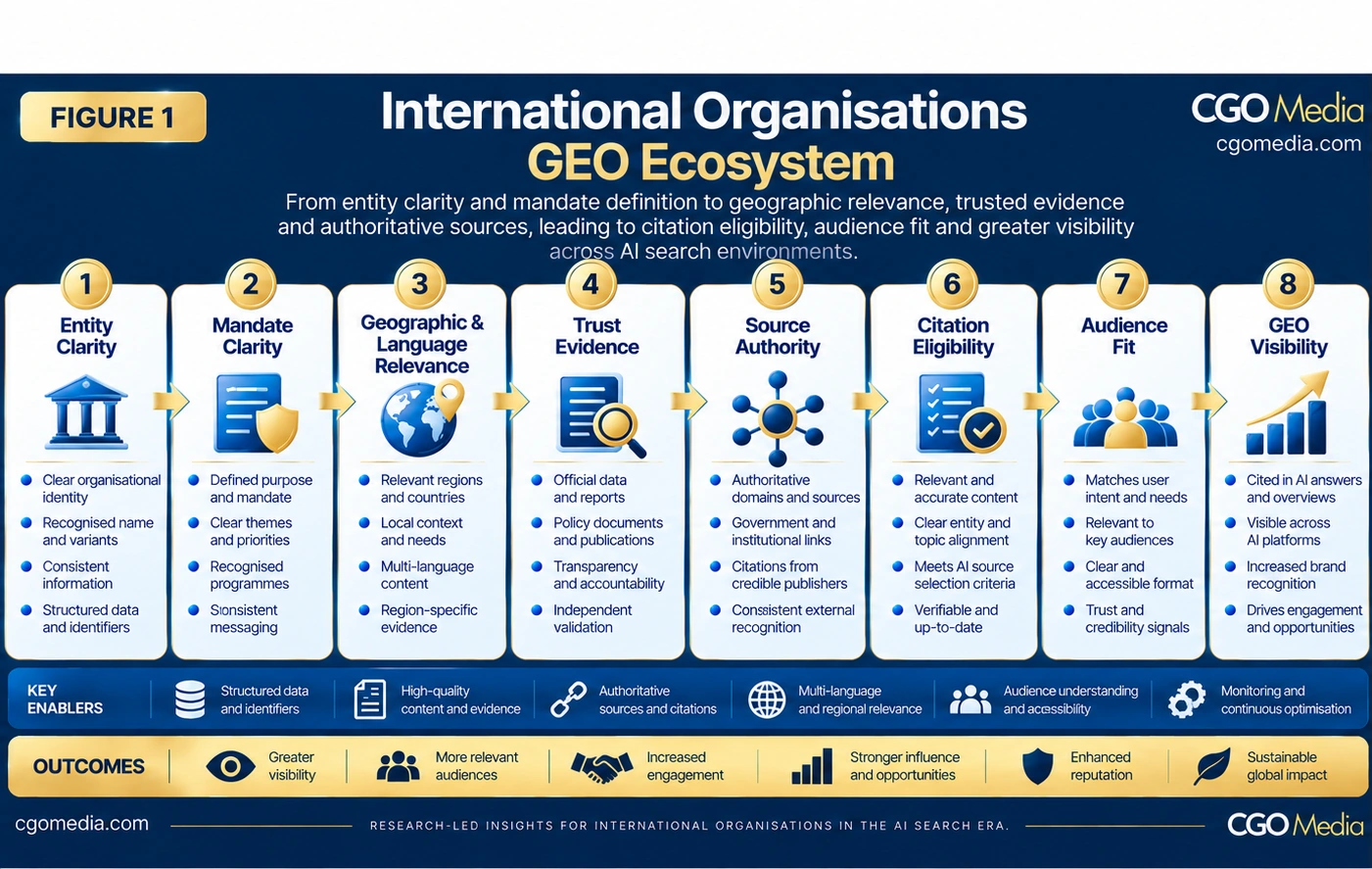
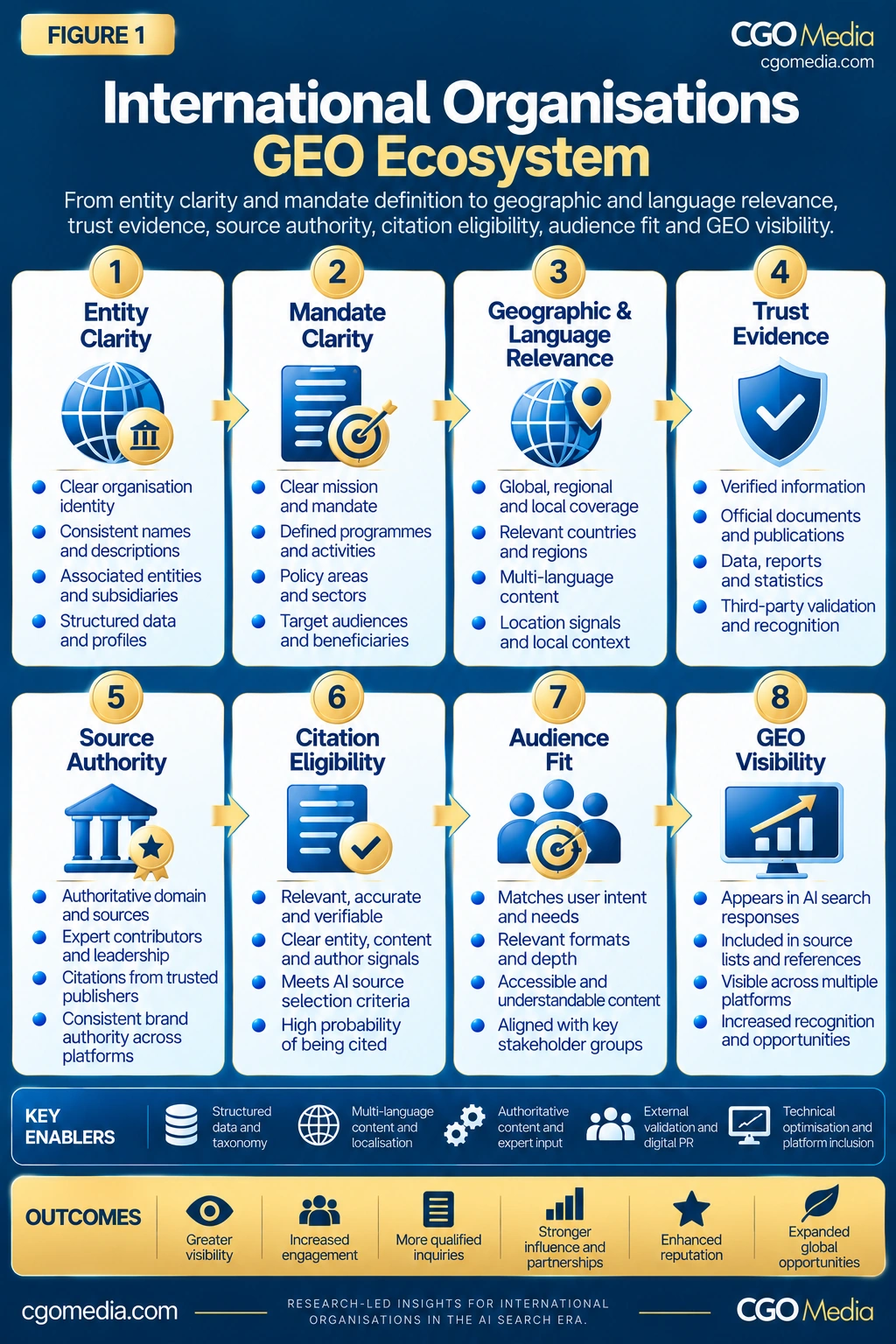
- International institutions
- Research repositories
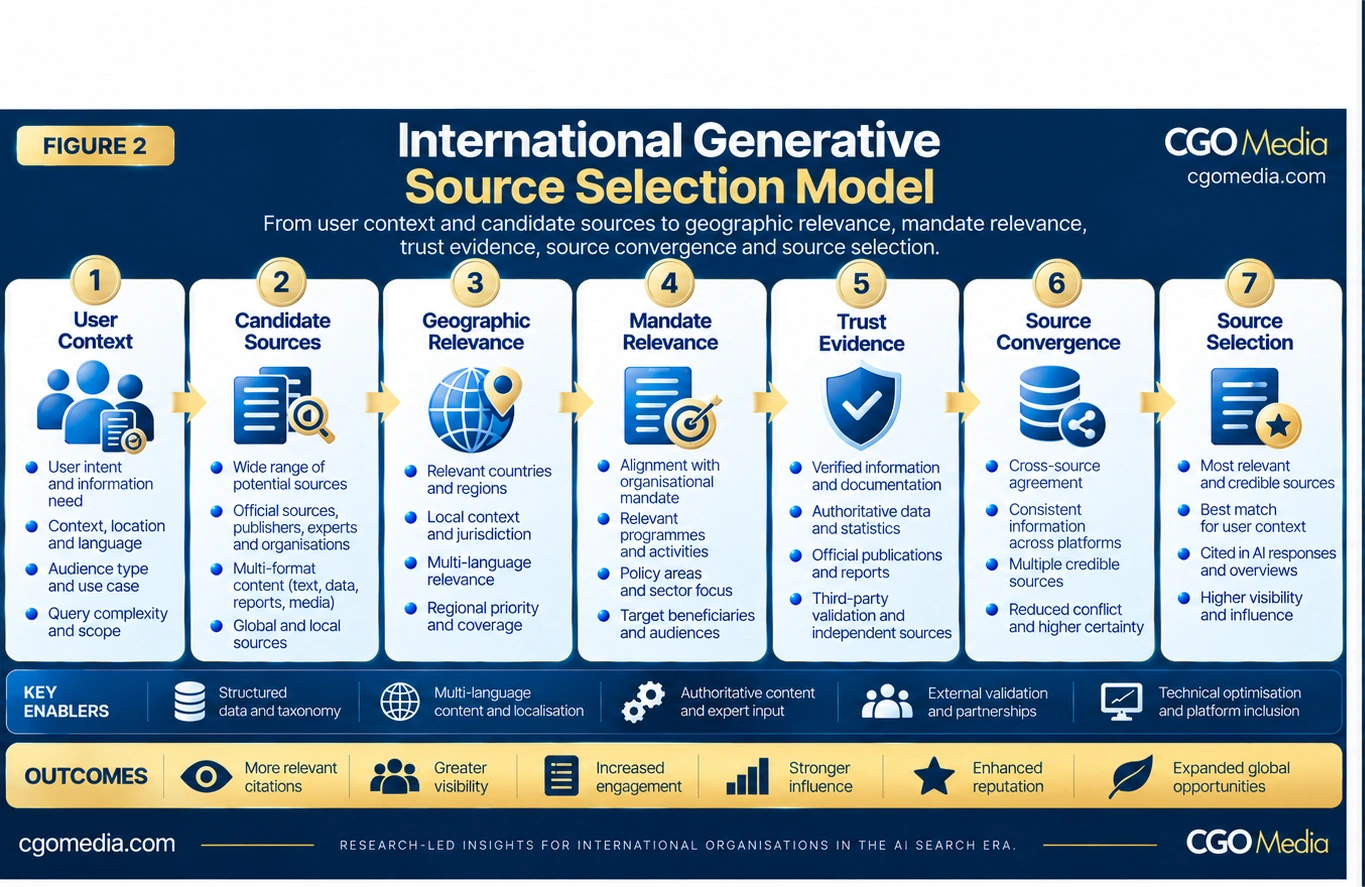
- Academic publications
- Media
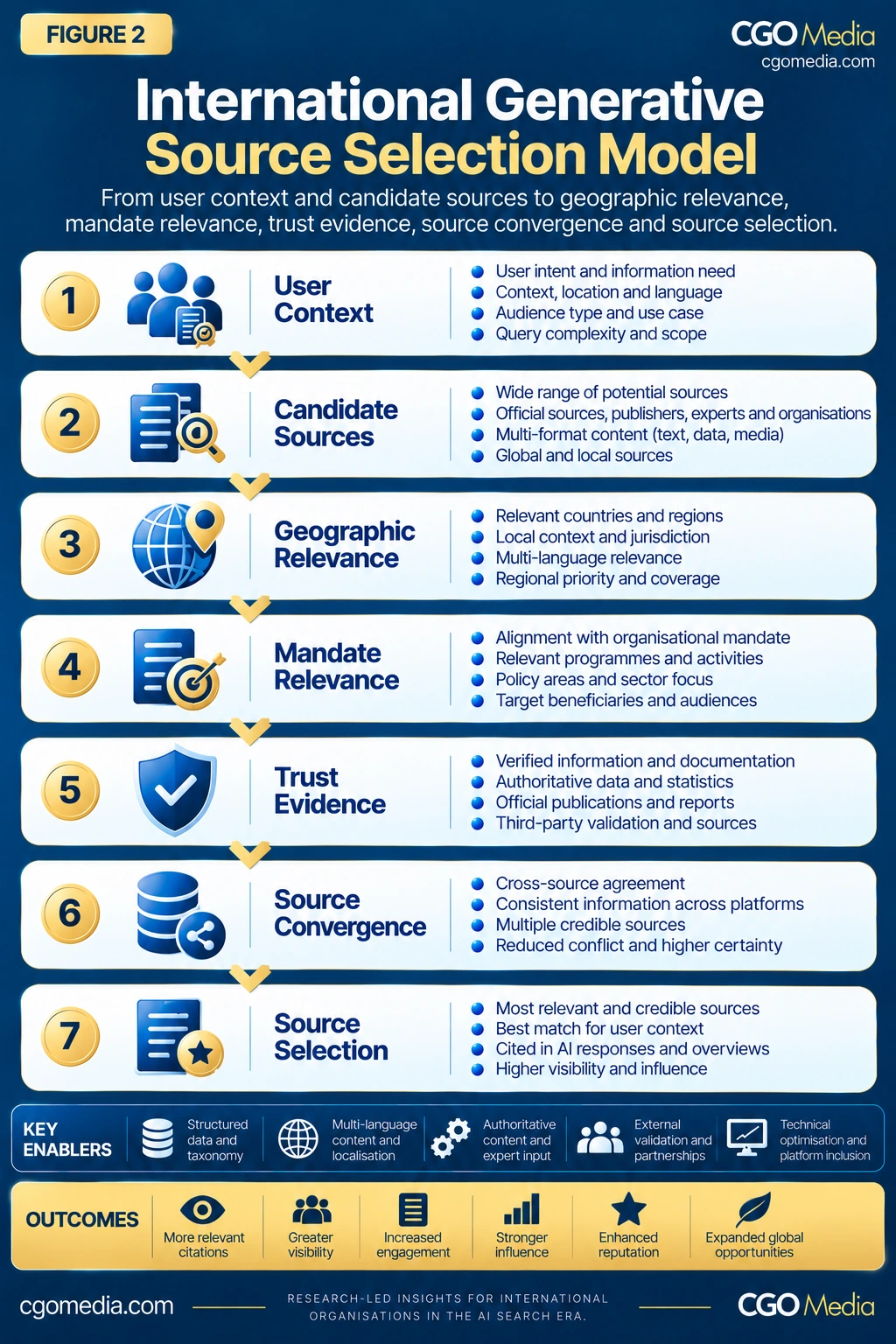
28. Country-Specific Sources Can Also Matter
Local authority may be reinforced by:
- Government ministries
- National regulators
- Local partners
- Local media
- Universities
29. Source Authority Can therefore Be Global or Local
The appropriate source depends on the question.
30. Global Questions May Require Global Sources
For example:
- Institutional mandate
- Global policy
- International research
- Worldwide programmes
31. Local Questions May Require Local Sources
For example:
- Country programmes
- Local eligibility
- Regional offices
- Local partnerships
32. International GEO Requires Source Convergence
Important information should materially agree across global and local sources.
33. A Useful Source Convergence Model Is
Global Organisation Truth + Regional Evidence + Local Evidence + Independent Validation
34. Source Conflict Can Create International Confusion
Conflicts can concern:
- Office locations
- Programme availability
- Country coverage
- Mandate
- Partner relationships
35. Legacy International Content Is a Significant GEO Risk
Old country pages, programme pages and policy documents can remain discoverable after circumstances change.
36. International Organisations Should Govern Historical Information
Old information should be clearly:
- Updated
- Archived
- Versioned
- Redirected
37. Freshness Is Important in International GEO
Certain information can change rapidly.
38. High-Change International Information Can Include
- Country programmes
- Emergency responses
- Policy positions
- Leadership
- Office status
39. Lower-Change Information Can Include
- Founding mandate
- Institutional history
- Long-term framework documents
40. Freshness Requirements Should Reflect Volatility
A useful relationship is:
Rate of Change + Audience Impact + Institutional Importance → Required Freshness
41. International GEO Also Depends on Citation Eligibility
Organisations may be visible without being explicitly cited.
42. Citation Eligibility Can Be Conceptualised Through
Relevance + Authority + Evidence + Language Fit + Freshness
43. Relevance
The source should directly address the international or local question.
44. Authority
The source should have credible institutional or subject authority.
45. Evidence
Claims should be supported by appropriate data or documentation.
46. Language Fit
The source should be understandable and appropriate for the language context of the query.
47. Freshness
The information should be current where time sensitivity matters.
48. Citation Visibility Can Strengthen International Authority
Repeated reference can reinforce the organisation as a recognised source.
49. International Organisations Can Create Citation Assets
These can include:
- Research reports
- Statistics
- Policy analysis
- Datasets
- Frameworks
- Country studies
50. Original International Research Can Be Especially Valuable
Comparative and cross-border data can create unique citation opportunities.
51. International Research Should Explain Geographic Scope
Readers should know:
- Which countries were included
- Which countries were excluded
- What period was measured
- How data was collected
52. Comparative Research Should Avoid False Equivalence
Countries with different systems, economies or populations should not automatically be treated as directly comparable.
53. Methodological Transparency Is Therefore Essential
International research should clearly explain:
- Definitions
- Data sources
- Sampling
- Method
- Limitations
54. International GEO Should Include Audience Fit
An organisation can be relevant to one audience and irrelevant to another.
55. International Audiences Can Include
- Governments
- Businesses
- Researchers
- Consumers
- NGOs
- Professionals
56. Recommendation Should therefore Reflect Audience Context
A useful relationship is:
Audience Scenario → Mandate Fit → Geographic Fit → Service Fit → Trust Evidence → Recommendation
57. Mandate Fit Evaluates Organisational Relevance
The organisation should genuinely operate within the area being asked about.
58. Geographic Fit Evaluates Location Relevance
The organisation should have relevant global, regional or local scope.
59. Service Fit Evaluates Practical Relevance
The organisation should actually provide the:
- Programme
- Service
- Research
- Policy function
- Support requested
60. Trust Evidence Evaluates Institutional Confidence
Relevant evidence can include:
- Legal status
- Government recognition
- Membership
- Research
- External validation
61. International Recommendation Should Not Aim for Universal Inclusion
An organisation should not be recommended where mandate or geographic fit is weak.
62. Appropriate Exclusion Can Be Positive
An organisation may correctly be omitted where:
- It does not operate in the relevant country
- Its mandate does not fit
- The requested service is unavailable
- A local organisation is more appropriate
63. Qualified International GEO Visibility Is the Better Objective
This can be represented as:
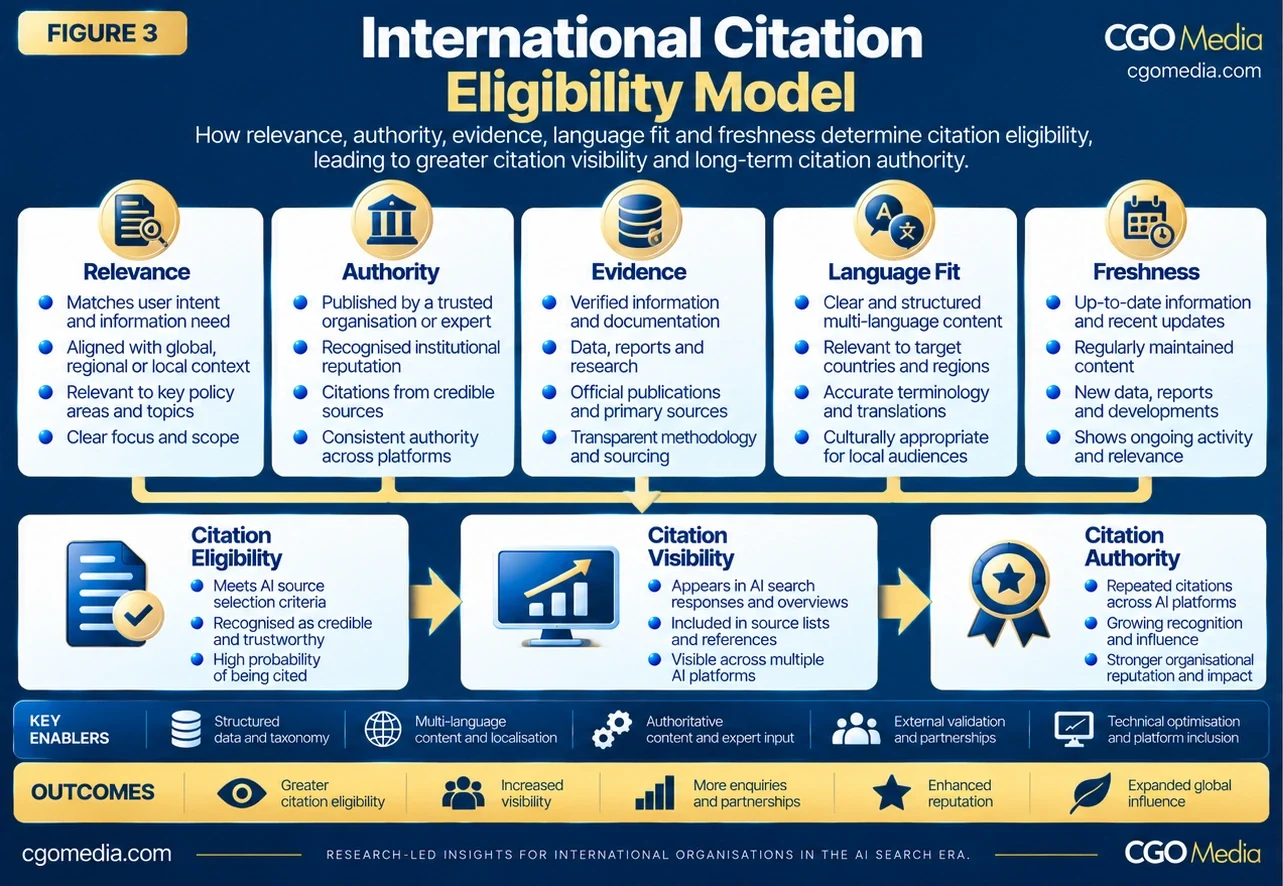
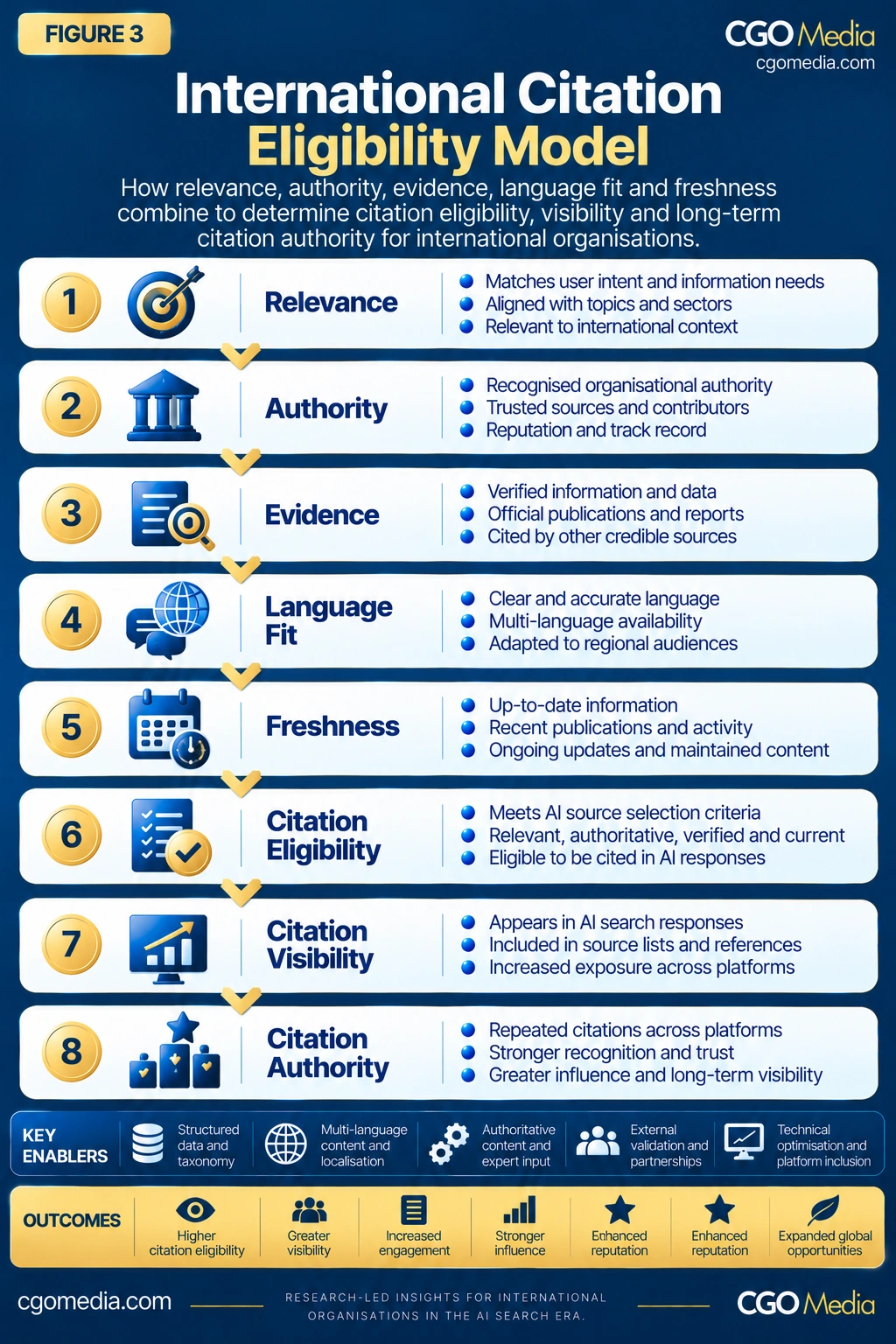
Relevant Presence + Accurate Representation + Strong Evidence + Appropriate Recommendation
64. International GEO Should Measure Multiple Visibility Layers
A useful model includes:
- Source Visibility
- Citation Visibility
- Entity & Mandate Accuracy
- Geographic Visibility
- Recommendation Visibility
65. Source Visibility
Measures whether organisational information contributes to generated answers.
66. Citation Visibility
Measures whether official or research sources are explicitly referenced.
67. Entity & Mandate Accuracy
Measures whether the organisation, structure, mandate and programmes are represented correctly.
68. Geographic Visibility
Measures whether the organisation appears appropriately within global, regional and country-specific contexts.
69. Recommendation Visibility
Measures whether the organisation is appropriately recommended within relevant audience scenarios.
70. These Measures Should Remain Separate
Strong global source visibility does not automatically mean strong local recommendation visibility.
71. International GEO Should Begin with a Scenario Library
Monitoring should reflect realistic international information needs.
72. Scenario Categories Can Include
- Global organisation discovery
- Country-specific organisation discovery
- Research discovery
- Programme discovery
- Policy discovery
- Provider recommendation
73. Global Discovery Scenarios Can Ask
- Which organisations work in a particular field?
- Which international bodies publish relevant research?
- Which organisations operate across multiple markets?
74. Country-Level Scenarios Can Ask
- Which organisations operate in a specific country?
- Which local office is responsible?
- Which programmes are currently available?
75. Research Scenarios Can Ask
- Who publishes authoritative international data?
- Which organisations provide comparative statistics?
- Which institutions publish relevant frameworks?
76. Programme Scenarios Can Ask
- Which organisations provide assistance?
- Which organisations fund programmes?
- Which organisations provide technical support?
77. Policy Scenarios Can Ask
- Which organisations set standards?
- Which organisations publish policy guidance?
- Which organisations monitor implementation?
78. Recommendation Scenarios Can Ask
- Which organisation is most relevant?
- Which body should a user contact?
- Which organisation provides the required service?
79. Scenario Libraries Should Be Segmented by Geography
Useful levels can include:
- Global
- Regional
- National
- Local
80. Scenario Libraries Should Be Segmented by Language
The same conceptual question can produce different results in different languages.
81. Language Segmentation Can Reveal Visibility Gaps
An organisation may be highly visible in English but weak in:
- Spanish
- French
- Arabic
- German
- Other priority languages
82. International GEO Should Measure Representation Accuracy Across Languages
Translation errors and inconsistent local content can distort organisational understanding.
83. International GEO Should Monitor Mandate Accuracy
AI systems should not overstate or understate organisational responsibilities.
84. Mandate Errors Can Include
- Attributing services the organisation does not provide
- Confusing policy roles
- Misstating jurisdiction
- Misrepresenting programme scope
85. International GEO Should Monitor Geographic Accuracy
Important errors can include:
- Incorrect office location
- Incorrect country coverage
- Incorrect regional responsibility
- Outdated programme presence
86. Language Accuracy Should Also Be Monitored
Translations can change meaning if terminology is not governed.
87. International Terminology Should Be Managed
Organisations should maintain consistent definitions for key:
- Programmes
- Initiatives
- Mandates
- Services
- Policy terms
88. International GEO Should Use Canonical Fact Management
Important global facts should have clear authoritative sources.
89. Canonical International Facts Can Include
- Official organisation name
- Mandate
- Membership
- Leadership
- Office network
- Programme scope
90. Country-Specific Facts May Require Local Ownership
Local teams can own:
- Office details
- Current programmes
- Local partnerships
- Local-language information
91. Global and Local Ownership Should Be Coordinated
This reduces contradiction between headquarters and country information.
92. International GEO Risk Should Be Prioritised
A useful relationship is:
Severity + Persistence + Audience Impact + Geographic Importance
93. Severity Measures Potential Harm
Some errors can materially misdirect users or stakeholders.
94. Persistence Measures Recurrence
Repeated misinformation may indicate deeper source inconsistency.
95. Audience Impact Measures Decision Consequence
An error may affect:
- Policy decisions
- Programme access
- Research use
- Funding
- Institutional engagement
96. Geographic Importance Measures Strategic Relevance
Errors in priority markets may require faster escalation.
97. International GEO Should Be Cross-Functional
It should not sit solely within SEO.
98. Relevant Functions Can Include
- SEO
- Communications
- Research
- Policy
- Regional teams
- Country offices
- Digital governance
99. SEO Can Coordinate Discovery Intelligence
SEO can connect search behaviour, technical architecture and generative visibility.
100. Communications Can Improve Clarity and Distribution
Communications can support:
- Mandate explanation
- Programme information
- Research distribution
- External references
101. Research Teams Can Strengthen Citation Authority
Original international evidence can create high-value sources.
102. Policy Teams Can Validate Mandate and Institutional Claims
Policy teams can help ensure public descriptions remain accurate.
103. Regional Teams Can Validate Regional Context
They can confirm:
- Regional priorities
- Programme relevance
- Local terminology
- External relationships
104. Country Offices Can Validate Local Truth
They can confirm:
- Office details
- Programme availability
- Local partnerships
- Current services
105. Digital Governance Can Coordinate Global Consistency
It can help maintain standards across:
- Domains
- Languages
- Markets
- Content systems
106. International GEO Should Be Governed
Critical international information should have:
- Owner
- Source
- Language version
- Review frequency
- Escalation route
107. High-Change International Facts Need Frequent Review
Examples include:
- Programme availability
- Office status
- Leadership
- Emergency activities
- Policy positions
108. Stable Institutional Facts May Require Less Frequent Review
Examples can include:
- Founding history
- Core mandate
- Long-standing memberships
109. International GEO Should Begin with Baseline Measurement
An organisation should understand its current:
- Source presence
- Citation visibility
- Entity accuracy
- Geographic visibility
- Recommendation visibility
110. Baseline Measurement Should Be Segmented
International GEO should be assessed by:
- Region
- Country
- Language
- Audience
- AI environment
111. The First International GEO Principle
International GEO should begin with clear global, regional and local entity relationships because generative systems cannot reliably represent or recommend international organisations when headquarters, country offices, programmes, mandates and partner relationships remain ambiguous.
112. The Second International GEO Principle
International GEO should preserve global organisational truth while adapting language, geographic context, evidence and source ecosystems to local markets, recognising that effective generative visibility requires both consistency and genuine localisation.
113. The Third International GEO Principle
International GEO should optimise for qualified visibility rather than universal presence, distinguishing source visibility, citation, entity and mandate accuracy, geographic relevance and appropriate organisational recommendation according to real audience fit.
114. The Fourth International GEO Principle
International GEO should be governed cross-functionally because global digital visibility depends on coordinated input from SEO, communications, research, policy, regional teams, country offices and digital governance, with high-risk geographic or mandate errors requiring clear ownership and escalation.
115. The International Organisations GEO Ecosystem
The core relationship can be summarised as:
Entity Clarity → Mandate Clarity → Geographic & Language Relevance → Trust Evidence → Source Authority → Citation Eligibility → Audience Fit → GEO Visibility
116. The Strategic Implication
International organisations should treat Generative Engine Optimisation as an extension of international SEO, multilingual information architecture, entity governance, institutional trust, research and global communications, building a coherent evidence environment that makes the organisation easier to identify, understand, verify, cite and recommend appropriately across different countries, languages and AI-assisted discovery environments.
117. International Generative Source Selection
Generative systems may draw from multiple international, regional and local sources when answering questions about organisations, programmes, mandates, policy areas, research or services.
118. International Source Selection Is Contextual
The most appropriate source depends on:
- User location
- Language
- Audience type
- Mandate
- Programme
- Geographic scope
119. A Useful International Source Selection Model Is
User Context → Candidate Sources → Geographic Relevance → Mandate Relevance → Trust Evidence → Source Convergence → Source Selection
120. User Context Comes First
International questions cannot be evaluated properly without understanding who is asking and from where.
121. User Context Can Include
- Country
- Region
- Language
- Audience type
- Information need
- Policy or programme context
122. Different Contexts Produce Different Source Needs
A global institutional question may require different sources from a country-specific programme question.
123. Candidate Sources Form the International Information Pool
These are the sources potentially available to support a generated answer.
124. Candidate International Sources Can Include
- Global organisation websites
- Regional websites
- Country-office websites
- Government sources
- Partner organisations
- Research repositories
- Academic publications
- Media
125. Global Organisation Websites Are Important for Institutional Truth
They can provide current information about:
- Mandate
- Global programmes
- Leadership
- Membership
- Institutional structure
126. Global Sources Have Limits
They may not provide sufficient detail about:
- Country activity
- Local services
- Regional terminology
- Local partnerships
127. Regional Sources Can Provide Intermediate Context
They can help explain how the global organisation operates across a group of countries.
128. Regional Sources Can Include
- Regional offices
- Regional programmes
- Regional strategies
- Regional reports
129. Country Sources Can Provide Local Truth
They can be especially important for:
- Current programmes
- Office information
- Local contacts
- Country-specific eligibility
- Local-language information
130. Country-Level Sources May Be More Relevant Than Global Sources for Local Questions
The most authoritative source is often the one closest to the specific operational context.
131. Government Sources Can Validate Local Legitimacy and Context
They can provide evidence concerning:
- Recognition
- Legal relationships
- Programme participation
- Public policy
- Funding
132. Partner Organisations Can Reinforce Programme Evidence
Partnerships may help validate:
- Local delivery
- Joint programmes
- Technical assistance
- Research collaborations
133. Partner Sources Should Be Evaluated Carefully
A partner may be authoritative for one programme while irrelevant to another.
134. Research Repositories Can Strengthen International Evidence
They can support:
- Research visibility
- Methodological transparency
- Long-term access
- Citation authority
135. Academic Sources Can Support Subject Authority
They can reinforce:
- Research quality
- Conceptual authority
- Policy influence
- Technical expertise
136. Media Sources Can Support External Validation
Relevant coverage may contribute:
- Institutional visibility
- Public relevance
- Programme recognition
- Expert commentary
137. Geographic Relevance Filters Candidate Sources
A source can be authoritative globally yet poorly suited to a local question.
138. Geographic Relevance Should Be Specific
A global programme page may be less useful than a current country-office page for a local question.
139. Geographic Source Relevance Can Be Represented as
Global Context → Regional Context → Country Context → Local Need → Source Relevance
140. Geographic Relevance Can Include
- Country presence
- Regional responsibility
- Local programme coverage
- Local partnerships
- Local-language availability
141. Geographic Relevance Reduces International Misrepresentation
It helps avoid using global information to imply local availability where none exists.
142. Mandate Relevance Is Another Source Selection Filter
A source should be connected to the organisation’s genuine role.
143. Mandate-Relevant Sources Can Include
- Founding documents
- Official mandate pages
- Policy documents
- Programme descriptions
- Strategic frameworks
144. Mandate Relevance Helps Prevent Role Inflation
AI systems should not infer responsibilities the organisation does not actually hold.
145. Mandate Relevance Can Be Represented as
User Need → Organisational Role → Authorised Function → Programme or Service → Relevant Source
146. Trust Evidence Is a Distinct Source Selection Layer
International source selection should consider whether claims are independently verifiable.
147. Trust Validation Can Include
- Legal status
- Government recognition
- Membership evidence
- Funding transparency
- Independent references
148. Trust Sources Should Match Organisation Type
The strongest evidence for a multilateral institution may differ from the strongest evidence for an NGO, trade association or professional body.
149. International Source Authority Can Be Global or Local
The right authority depends on the claim.
150. Global Institutional Authority Is Strong for
- Mandate
- Membership
- Global programmes
- Organisation-wide policies
151. Regional Authority Is Strong for
- Regional programmes
- Cross-border initiatives
- Regional strategies
- Regional partnerships
152. Local Authority Is Strong for
- Country presence
- Local service availability
- Country programmes
- Local contact information
153. Claim-Specific Authority Is More Useful Than Generic Authority
The best source is usually the one most authoritative for the exact institutional, geographic or programme fact.
154. International Source Selection Should Use Multiple Source Roles
A robust answer may depend on complementary source types.
155. A Source Role Model Can Include
- Global organisation for institutional truth
- Regional office for regional context
- Country office for local truth
- Government source for recognition
- Research source for evidence
- Partner source for programme validation
156. Source Convergence Strengthens International Confidence
Confidence increases when credible global, regional and local sources materially agree.
157. A Useful International Source Convergence Model Is
Global Organisation Truth + Regional Evidence + Local Evidence + Independent Validation
158. Source Convergence Does Not Require Identical Wording
Different markets and languages may describe the same underlying reality differently.
159. Material Agreement Is More Important Than Literal Consistency
Sources should agree on substantive facts such as:
- Mandate
- Country presence
- Programme availability
- Office responsibility
- Partner relationships
160. Source Conflict Should Trigger Investigation
International organisations should identify when global and local sources disagree materially.
161. Common International Source Conflicts Can Include
- Different office addresses
- Outdated leadership
- Conflicting programme coverage
- Different country responsibilities
- Legacy partner information
162. Legacy International Content Is a Significant Source Risk
Old country pages and programme documents can remain discoverable long after circumstances change.
163. Legacy Pages Should Be Governed
Organisations should decide whether historical content should be:
- Updated
- Archived
- Versioned
- Redirected
164. Archived International Information Should Be Clearly Identified
Historical programme or office information should not be mistaken for current operational truth.
165. Freshness Is Particularly Important for Operational Information
Examples include:
- Country programmes
- Leadership
- Emergency activity
- Office status
- Policy implementation
166. Freshness Should Be Matched to Information Volatility
A useful relationship is:
Rate of Change + Audience Impact + Geographic Importance → Required Freshness
167. High-Volatility Information Requires Frequent Updating
Examples include:
- Emergency programmes
- Active funding rounds
- Leadership
- Office availability
- Current initiatives
168. Lower-Volatility Information May Change Less Frequently
Examples can include:
- Institutional history
- Founding mandate
- Long-standing membership structures
169. Freshness Signals Should Be Explicit
International pages can benefit from clear:
- Publication dates
- Updated dates
- Programme periods
- Version dates
170. Programme Periods Are Particularly Important
They help distinguish active, completed and historic initiatives.
171. Source Selection Should Consider Language Fit
A source may be authoritative but poorly suited to the user’s language context.
172. Language Fit Is More Than Translation Availability
The source should use terminology appropriate to the relevant market or audience.
173. Language Fit Can Include
- Local terminology
- Institutional terminology
- Policy terminology
- Programme naming
- Cultural context
174. Poor Language Fit Can Reduce Source Utility
Literal translations can obscure the meaning of specialised institutional concepts.
175. International GEO Should Use Terminology Governance
Key terms should remain consistent across language versions where meaning is shared.
176. Terminology Governance Can Include
- Official organisation names
- Programme names
- Mandate terms
- Policy concepts
- Service descriptions
177. Localisation Should Preserve Meaning Rather Than Word Order
The objective is semantic consistency, not literal textual duplication.
178. Source Selection Should Consider Information Extractability
Relevant facts should be easy to identify within the page.
179. Important International Facts Should Not Be Buried
Key information such as:
- Mandate
- Country presence
- Programme availability
- Office responsibility
- Eligibility
should be presented clearly.
180. Extractability Improves Source Utility
Clear structures make information easier for users and automated systems to interpret.
181. International Pages Should Use Explicit Statements
For example:
This programme operates in Kenya, Uganda and Tanzania during the 2026–2028 programme period.
182. Explicit Statements Reduce Geographic Inference Risk
Generative systems should not need to infer local programme coverage from vague global language.
183. Conditional International Claims Should Be Clearly Qualified
Organisations should distinguish:
- Global mandate
- Regional responsibility
- Current local programme
- Partner-delivered activity
- Historic activity
184. Ambiguous Institutional Language Can Distort AI Answers
The difference between “works globally” and “currently operates a programme in this country” can be significant.
185. International GEO Should Therefore Use Claim Precision
Important organisational and programme claims should communicate scope explicitly.
186. Source Selection Can Be Weakened by Overly Corporate Content
Pages dominated by institutional messaging may provide less usable factual evidence.
187. International Content Should Balance Narrative and Evidence
Institutional pages should still provide:
- Clear mandate
- Current geography
- Programme scope
- Evidence
- Dates
188. Source Selection Can Also Be Weakened by Thin Country Pages
A local page may exist without enough information to support a confident answer.
189. Thin Country Pages Can Omit Critical Information
Examples include:
- No current programmes
- No contact ownership
- No programme dates
- No partner evidence
- No local-language context
190. International GEO Should Identify Source Gaps
A source gap exists when an important user question lacks a strong authoritative source.
191. Source Gap Analysis Can Begin with User Questions
The organisation can map:
User Question → Required Fact → Best Source Type → Existing Source → Gap
192. Common International Source Gaps Can Include
- Country programme information
- Regional responsibility
- Local-language programme pages
- Mandate explanations
- Current partner information
193. Source Gaps Can Create Third-Party Dependence
If the organisation does not explain its work clearly, external sources may become the dominant information environment.
194. Third-Party Dependence Is Not Always Negative
Independent sources can strengthen trust and validation.
195. Excessive Third-Party Dependence Can Reduce Organisational Control
The organisation may struggle to correct inaccurate or outdated public descriptions.
196. International GEO Should Therefore Build Strong First-Party Sources
Critical organisational, programme and geographic facts should have authoritative owned pages.
197. First-Party Sources Should Be Reinforced Externally
The strongest environment combines owned clarity with independent validation.
198. Source Selection Should Also Consider Research Methodology
Research-based international claims should explain how evidence was produced.
199. Strong International Research Methodology Can Include
- Country coverage
- Sample definition
- Data sources
- Measurement period
- Limitations
200. Methodological Transparency Improves Citation Utility
Researchers, journalists, policymakers and AI systems can assess the evidence more confidently.
201. International Statistics Should Define Their Scope
A number should make clear whether it refers to:
- One country
- One region
- Multiple regions
- Global data
- A defined time period
202. Unscoped International Statistics Can Be Misused
Generative systems may generalise a narrow statistic beyond its intended geography.
203. International GEO Should Therefore Encourage Geographic Data Precision
Useful evidence should make its boundaries explicit.
204. Source Selection Should Include Independent Validation
Important institutional claims may become stronger when supported externally.
205. Independent Validation Can Include
- Government references
- Academic citations
- Partner references
- Media references
- Research citations
206. Independent Validation Strengthens Source Convergence
It reduces dependence on the organisation’s own claims.
207. Government Authority Should Be Assessed by Relevance
A ministry or national agency may be highly authoritative for local programme relationships but irrelevant to another market.
208. Academic Authority Should Also Be Topic-Specific
Universities and researchers can be valuable sources for evidence within their areas of expertise.
209. Partner Authority Should Be Programme-Specific
A partner can validate work it genuinely participates in.
210. International Source Selection Should Consider Source Recurrence
A source repeatedly appearing across related questions may have stronger practical authority.
211. Source Recurrence Can Be Monitored
The organisation can track:
- Which sources recur
- In which countries
- In which languages
- For which programmes
- Across which AI environments
212. Recurring Third-Party Sources Can Reveal Authority Gaps
If partner, media or government sources repeatedly explain the organisation better than its own pages, this can indicate an owned-source weakness.
213. International GEO Should Include Source Competitor Analysis
This differs from conventional ranking analysis.
214. Source Competitor Analysis Asks
- Which organisations are selected?
- Which country sources are cited?
- Which research sources recur?
- Which content formats dominate?
- Which languages are best represented?
215. Source Competitors May Differ from Organisational Competitors
International information can be supplied by:
- Governments
- NGOs
- Research institutes
- Multilateral bodies
- Publishers
- Universities
216. This Makes International GEO a Source-Ecosystem Discipline
Organisations compete for visibility within a distributed global information environment.
217. International Source Authority Can Be Distributed
No single source type necessarily dominates every stage of global discovery.
218. Discovery May Favour Broad Institutional Sources
Early-stage users may need:
- Organisation categories
- General mandates
- Global comparisons
219. Evaluation May Favour Research and Policy Sources
Mid-stage users may need:
- Evidence
- Programme comparisons
- Policy detail
- Regional context
220. Selection May Favour Local and Operational Sources
Late-stage users may need:
- Country offices
- Current programmes
- Local contact details
- Practical eligibility
221. International GEO Should Therefore Map Source Role by Journey Stage
A useful structure is:
Discovery Source → Evidence Source → Geographic Validation Source → Operational Source → Recommendation Source
222. Source Role Mapping Can Improve Content Strategy
Organisations can identify where stronger global, regional or country information is needed.
223. Source Role Mapping Can Improve Communications Strategy
External communications can target the authority gaps that matter most.
224. Source Role Mapping Can Improve Research Strategy
Research can be developed around international evidence gaps.
225. International GEO Should Maintain a Source Inventory
The inventory can record:
- Source
- Source type
- Geographic relevance
- Language
- Mandate relevance
- Freshness
- Risk
226. Source Inventories Help Identify Weakness
For example:
- No strong country source
- No local-language programme page
- No current office source
- No independent programme validation
227. Source Inventories Also Help Identify Duplication
Multiple international pages may provide inconsistent versions of the same fact.
228. Duplicate International Facts Should Be Governed Carefully
Critical information should have clear canonical ownership.
229. Canonical Fact Management Can Include
- Global owner
- Local owner
- Primary URL
- Language versions
- Review cadence
- Dependent pages
230. Canonical Fact Management Reduces Global-Local Conflict
This is particularly useful for organisations with many country offices.
231. Source Selection Should Be Tested Over Time
A source that appears today may not remain influential.
232. Longitudinal Source Monitoring Can Reveal
- Source persistence
- Source replacement
- New local authority sources
- New research sources
- Changing partner visibility
233. Source Persistence Can Indicate Durable Authority
Repeated selection across time can be more meaningful than one isolated appearance.
234. Source Replacement Can Reveal Information Change
A previously dominant source may lose visibility because:
- It became outdated
- A stronger local source emerged
- The programme changed
- The AI environment changed
235. International GEO Should Distinguish Source Visibility from Source Dependence
An organisation can be visible without being the principal source used to construct an answer.
236. Source Dependence Is Difficult to Observe Directly
Not all generative systems expose their full retrieval processes.
237. International GEO Should Therefore Use Observable Evidence Carefully
Useful observations can include:
- Explicit citations
- Recurring source inclusion
- Generated factual alignment
- Cross-language representation patterns
238. Source Analysis Should Avoid Overclaiming Causation
A source appearing alongside an answer does not prove that every statement was generated from that source.
239. International GEO Should Focus on Source Eligibility and Authority
The practical objective is to make important organisational information strong enough to be considered across relevant generative environments.
240. Source Eligibility Can Be Strengthened Through
- Geographic relevance
- Mandate relevance
- Language fit
- Evidence
- Freshness
241. Source Authority Can Be Strengthened Through
- Original research
- Government references
- Partner validation
- Academic citations
- Consistent global-local information
242. Source Convergence Can Be Strengthened Through Governance
Global, regional and local information should materially align.
243. International GEO Teams Should Review High-Value Source Areas First
Priority source areas can include:
- Mandate
- Country presence
- Programme availability
- Leadership
- Local services
244. International Source Risk Should Be Prioritised
A useful model is:
Source Importance + Error Severity + Persistence + Audience Impact + Geographic Importance
245. High-Risk Source Problems Should Trigger Escalation
These can require involvement from:
- Digital governance
- Regional teams
- Country offices
- Communications
- Policy teams
246. International Source Selection Should Be Treated as a Strategic Capability
It connects global information architecture, localisation, programme governance, research, policy and external authority.
247. The Fifth International GEO Principle
International generative source selection should be evaluated according to user context, geography, language and mandate, recognising that global, regional and local sources can each be authoritative for different aspects of organisational truth.
248. The Sixth International GEO Principle
International source authority should be claim-specific rather than generic, with the strongest source being the one most authoritative, geographically relevant, linguistically appropriate, current and evidentially suitable for the exact organisational fact being presented.
249. The Seventh International GEO Principle
International GEO should strengthen source convergence by aligning global organisation truth, regional evidence, local information and independent validation while actively identifying outdated, conflicting, poorly localised or ambiguous information that can weaken AI representation.
250. The Eighth International GEO Principle
International organisations should treat source selection as an ongoing global information-ecosystem discipline, monitoring which government, organisational, research, partner and media sources recur across markets and languages and strengthening the source assets most important to qualified international discovery.
251. The International Generative Source Selection Model
The complete model can be summarised as:
User Context → Candidate Sources → Geographic Relevance → Mandate Relevance → Trust Evidence → Source Convergence → Source Selection
252. The Strategic Implication
International organisations should build a governed source environment in which global identity, mandate, regional responsibilities, country activities, language versions and programme information materially align, allowing generative systems to select sources that are authoritative not only globally but also relevant to the specific geography, language, audience and institutional question being asked.
253. International Citation Eligibility
An international organisation can be visible within generative search without being explicitly cited.
254. Citation Visibility Is a Distinct International GEO Outcome
Citation occurs when a generative system explicitly references a source as supporting evidence for part of an answer.
255. Citation Eligibility Describes the Conditions That Make a Source More Suitable for Reference
A useful model is:
Relevance + Authority + Evidence + Language Fit + Freshness → Citation Eligibility
256. Citation Eligibility Does Not Guarantee Citation
A strong source may still be omitted depending on model, prompt, context, language or market.
257. International Citation Relevance
The source should address the exact institutional, geographic, policy, research or programme question.
258. Relevance Should Be Geographic Where Necessary
A global source may be less useful than a country-specific source for a local operational question.
259. Relevance Should Be Audience-Specific
Different audiences may require different evidence.
260. International Audiences Can Include
- Governments
- Researchers
- Businesses
- NGOs
- Professionals
- Members of the public
261. Citation Authority Is Contextual
An organisation can be authoritative globally while a local government source is more authoritative for one country-specific fact.
262. International Citation Authority Can Derive From
- Institutional legitimacy
- Government recognition
- Research quality
- Professional expertise
- External reference
263. Institutional Authority Is Strongest for Organisational Truth
Official sources can be authoritative for:
- Mandate
- Governance
- Leadership
- Programme ownership
- Official policy positions
264. Government Authority Can Be Strong for National Context
Government sources can validate:
- Recognition
- Legal status
- Programme participation
- Public policy
265. Academic Authority Can Be Strong for Research Claims
Academic sources can validate:
- Research quality
- Conceptual frameworks
- Evidence interpretation
- Policy relevance
266. Partner Authority Can Be Strong for Programme Delivery
Partners may provide independent evidence that a programme or initiative is genuinely active.
267. Language Fit Is a Core International Citation Factor
A source may be authoritative but poorly suited to the language of the question.
268. Language Fit Can Include
- Correct terminology
- Local naming conventions
- Accessible translation
- Semantic accuracy
- Cultural relevance
269. Literal Translation Can Reduce Citation Utility
Important institutional or policy terms may lose meaning if translated mechanically.
270. International Citation Assets Should Preserve Meaning Across Languages
Core claims, numbers and institutional relationships should remain semantically consistent.
271. Evidence Is Another Citation Requirement
Claims should be supported by appropriate and traceable evidence.
272. International Evidence Can Include
- Official documents
- Government records
- Research datasets
- Programme evaluations
- Independent studies
273. Evidence Should Match the Claim
A claim about global reach requires different evidence from a claim about one local programme.
274. Geographic Scope Should Be Explicit
International evidence should explain whether it applies to:
- One country
- One region
- Multiple regions
- Global operations
275. Time Scope Should Also Be Explicit
International programmes and policies can change significantly over time.
276. Freshness Is Therefore Context-Sensitive
Recent evidence is especially important for:
- Current programmes
- Leadership
- Country operations
- Emergency response
- Policy positions
277. Lower-Freshness Assets Can Include
- Foundational research
- Historic mandate documents
- Long-term methodologies
- Archived policy frameworks
278. Citation Freshness Should Reflect Information Volatility
A useful principle is:
Information Volatility + Audience Impact + Geographic Importance → Freshness Requirement
279. International Citation Eligibility Should Be Evaluated at Page Level
Some country pages or research reports may be highly citable even where wider organisational citation authority is weaker.
280. Page-Level Citation Eligibility Can Depend on
- Geographic relevance
- Language relevance
- Evidence depth
- Authority
- Freshness
281. Organisation-Level Citation Authority Is Broader
It can reflect repeated use of the organisation as a source across multiple countries, languages and policy areas.
282. Page-Level Eligibility and Organisation-Level Authority Should Be Distinguished
A useful relationship is:
Citable Source → Repeated Citation → Cross-Market Recognition → International Citation Authority
283. First-Party International Sources Have Important Citation Roles
They are normally strongest for:
- Current mandate
- Official programmes
- Office information
- Institutional policy
- Research outputs
284. First-Party Sources Also Have Limits
They cannot independently validate every claim about impact, influence or comparative importance.
285. Independent International Sources Can Provide External Validation
These can include:
- Governments
- Universities
- Research organisations
- Media
- Partner institutions
286. The Strongest Citation Environment Can Combine First-Party and Independent Evidence
A useful model is:
First-Party Institutional Truth + Independent Geographic & Research Validation
287. Original International Research Can Create Strong Citation Opportunity
Cross-border evidence can be especially valuable where reliable comparative data is limited.
288. Useful International Research Topics Can Include
- Cross-country comparisons
- Regional trends
- Policy adoption
- Programme outcomes
- Institutional benchmarking
289. Comparative International Research Requires Methodological Care
Countries may differ significantly in:
- Definitions
- Data quality
- Population
- Institutional structures
- Measurement systems
290. International Research Should Explain Comparability
Researchers should state whether indicators are directly comparable or only broadly indicative.
291. Methodological Transparency Is Essential
A strong international methodology can explain:
- Research question
- Countries included
- Data sources
- Measurement period
- Definitions
- Limitations
292. Findings Should Be Separated from Interpretation
The research should distinguish:
- What the evidence shows
- What the organisation concludes
293. International Statistics Should Define Geographic Scope
A percentage should not be presented as global if it reflects only one region.
294. International Statistics Should Define Population Scope
Research should distinguish between:
- Governments
- Businesses
- Households
- Professionals
- Programme participants
295. International Data Should Define Time Scope
Cross-market findings can become misleading if measurement periods differ substantially.
296. Clear Scope Improves Citation Precision
It reduces the risk that evidence is generalised beyond its intended context.
297. International Research Assets Should Use Stable URLs
Persistent locations make long-term citation more reliable.
298. Versioning Can Be Important for International Research
Organisations may publish:
- Annual reports
- Regional editions
- Country updates
- Revised datasets
- Updated methodologies
299. Versioning Should Preserve Historical Context
Older research should remain distinguishable from current editions.
300. International Citation Assets Can Include More Than Research Reports
Useful assets can include:
- Statistics libraries
- Definitions
- Country profiles
- Frameworks
- Datasets
- Policy explainers
301. Country Profiles Can Become Citation Assets
Clear country-level information can provide reusable evidence for researchers, journalists and policymakers.
302. Country Profiles Should Be Consistently Structured
Useful fields can include:
- Country overview
- Programme activity
- Current data
- Local partners
- References
303. International Definitions Can Also Become Citation Assets
Complex institutional and policy terminology benefits from precise explanation.
304. Definitions Should Account for Regional Variation
The same term may have different legal or policy meanings across countries.
305. Frameworks Can Become International Citation Assets
Original models can help structure complex global issues.
306. Frameworks Should Explain Scope and Limitations
A global framework should not imply universal applicability where regional differences materially affect interpretation.
307. Expert Authority Can Strengthen International Citation Eligibility
Named experts make organisational knowledge easier to evaluate.
308. International Expert Profiles Can Include
- Role
- Regional expertise
- Subject expertise
- Research
- Professional background
309. Expert Authority Should Match the Topic and Geography
A global policy expert may not be the strongest authority for a local operational issue.
310. Expert Authority Should Be Verifiable
Relevant evidence can include:
- Research outputs
- Professional profiles
- Conference participation
- External references
- Institutional roles
311. International Citation Authority Can Be Strengthened Through Communications
Useful evidence should be distributed to relevant global and local audiences.
312. Communications Should Focus on Evidence as Well as Awareness
Strong outreach can provide:
- Research findings
- Country data
- Expert commentary
- Policy analysis
- Programme evidence
313. International Journalists Need Citable Material
Useful press assets should make it easy to identify:
- Key finding
- Geographic scope
- Supporting number
- Methodology
- Expert source
314. Research Press Pages Can Improve Distribution
A dedicated press environment can help external audiences find:
- Research
- Statistics
- Figures
- Methodologies
- Expert contacts
315. International Communications Should Be Regionally Relevant
A global press strategy should not assume one message works equally well in every market.
316. Regional Distribution Can Strengthen Local Citation Authority
Local-language and local-context outreach can improve visibility among:
- Regional media
- Governments
- Universities
- Professional bodies
317. International Citation Monitoring Should Be Structured
Organisations should record where their sources are referenced.
318. Citation Monitoring Can Include
- AI citations
- Media citations
- Academic citations
- Government references
- Partner references
319. Citation Monitoring Should Record Geography
The same asset may have very different visibility across regions.
320. Citation Monitoring Should Record Language
An organisation may have strong citation authority in one language and weak authority in another.
321. Citation Monitoring Should Record Context
A citation can be:
- Supportive
- Neutral
- Critical
- Corrective
322. Citation Quality Matters More Than Citation Volume
A relevant government or academic reference may carry more authority than many low-value mentions.
323. Citation Quality Can Be Evaluated Through
- Source credibility
- Geographic relevance
- Subject relevance
- Independence
- Persistence
324. Citation Accuracy Should Also Be Monitored
An organisation can be cited while its findings or mandate are misrepresented.
325. Citation Accuracy Can Include
- Correct statistic
- Correct country
- Correct date
- Correct programme
- Correct conclusion
326. Citation Misrepresentation Should Be Investigated
The cause may be:
- Ambiguous wording
- Poor translation
- Old versions
- Third-party reinterpretation
- Generative error
327. Citation Diversity Is Another Useful Measure
An organisation can examine whether citations come from:
- Multiple regions
- Multiple languages
- Multiple publication types
- Multiple AI environments
328. Citation Diversity Can Improve Resilience
Authority becomes less dependent on one market or information environment.
329. Citation Recency Should Also Be Monitored
Historical global authority does not guarantee current citation relevance.
330. Citation Persistence Can Indicate Durable International Authority
Repeated reference over time may be more meaningful than short-lived citation spikes.
331. Citation Authority Can Be Geography-Specific
An organisation may be highly authoritative in one region and relatively unknown in another.
332. Citation Authority Can Also Be Language-Specific
Strong English-language visibility does not guarantee strong Spanish-, French- or Arabic-language visibility.
333. Citation Monitoring Should Therefore Be Segmented
Useful segments can include:
- Region
- Country
- Language
- Subject
- Programme
334. International Citation Authority Should Not Be Confused with Link Volume
A link can exist without materially validating an institutional or research claim.
335. Citation Authority Is More Contextual
It concerns whether the organisation is being used as evidence within relevant international information environments.
336. Links Can Support Citation Authority
But the strategic objective should be broader than link acquisition.
337. International GEO Should Track Which Assets Earn References
This can reveal what external audiences find most useful.
338. High-Reference Assets Can Inform Future Research
Recurring citation patterns can identify:
- High-interest topics
- Geographic data gaps
- Useful formats
- Authority opportunities
339. Low-Reference Assets Should Be Reviewed
The issue may concern:
- Weak evidence
- Poor localisation
- Limited distribution
- Low originality
340. International GEO Should Distinguish Owned Citation Assets from External Reinforcement
Owned citation assets create information worth referencing.
341. External Reinforcement Validates the Wider Authority Environment
A strong system combines both.
342. An International Citation Authority System Can Be Represented as
Owned Evidence → External Reference → Cross-Market Citation → Greater International Authority
343. Negative Evidence Can Also Influence International Authority
External sources may highlight:
- Programme failure
- Governance concerns
- Funding problems
- Policy criticism
- Operational errors
344. Negative Evidence Should Not Be Ignored
International GEO should account for the complete public evidence environment.
345. Trust Recovery Can Become Necessary
An organisation may need to rebuild confidence after a material institutional or programme issue.
346. An International Trust Recovery Cycle Can Be Represented as
Issue → Correction → Evidence → Communication → External Reassessment
347. Correction Comes First
Communications cannot substitute for resolving the underlying problem.
348. Evidence Should Demonstrate the Correction
Useful evidence can include:
- Independent review
- Updated programme documentation
- Government confirmation
- Published remediation
349. Communication Should Reflect Geographic Context
Different regions may require different clarification or outreach.
350. External Reassessment May Take Time
Trust and citation authority may recover gradually across markets.
351. International Citation Eligibility Should Be Designed into Content
Citable content should not be created as an afterthought.
352. Citation-Ready International Pages Can Include
- Clear title
- Named author or institution
- Publication date
- Geographic scope
- Evidence
- References
353. Research Pages Can Also Include
- Methodology
- Definitions
- Limitations
- Language versions
- Citation guidance
354. Citation Guidance Can Reduce Friction
Researchers and journalists can reference the work more accurately.
355. International Citation Assets Should Remain Accessible
Important research should not disappear behind unnecessary technical or language barriers.
356. Persistent Access Supports Long-Term Reference
Stable resources can continue earning citations across markets.
357. International GEO Should Develop a Citation Asset Inventory
The inventory can include:
- Research reports
- Statistics
- Country profiles
- Frameworks
- Datasets
- Expert pages
358. Citation Asset Inventories Help Identify Geographic Gaps
The organisation can determine where it lacks strong evidence or local-language assets.
359. Citation Asset Inventories Help Prioritise Distribution
High-value international resources can receive stronger regional communications support.
360. International GEO Should Monitor Citation Competitors
The organisation should identify which external sources are repeatedly cited instead.
361. Citation Competitors Can Include
- International organisations
- Governments
- Universities
- Research institutes
- Publishers
- NGOs
362. Citation Competitor Analysis Can Reveal Missing Evidence
Other organisations may be cited because they provide:
- Better data
- Clearer methodology
- Stronger localisation
- More current research
363. Citation Competitor Analysis Can Reveal Language Advantage
Some organisations may dominate because they publish effectively in more priority languages.
364. International Citation Authority Should Be Built Deliberately
It can become a strategic complement to international SEO, research and communications.
365. Citation Authority Can Strengthen Institutional Association
Repeated reference around a policy or programme area can reinforce the organisation’s connection with that subject.
366. Citation Authority Can Strengthen AI Source Visibility
A source with strong cross-market recognition may have greater practical eligibility across generative environments.
367. Citation Authority Can Strengthen Recommendation Confidence Indirectly
A well-evidenced organisation may be easier to validate when AI systems compare or recommend organisations.
368. Citation Authority Is Therefore Part of a Wider International GEO System
It should connect with:
- Entity clarity
- Mandate clarity
- Geographic relevance
- Language relevance
- Recommendation visibility
369. The Ninth International GEO Principle
International citation eligibility should be built around geographic relevance, authority, evidence, language fit and freshness, with citation readiness evaluated at page level while broader international citation authority develops through repeated use of the organisation as a credible source across markets.
370. The Tenth International GEO Principle
International organisations should combine first-party institutional truth with independent government, academic, partner and media validation, recognising that owned information is strongest for current organisational facts while external sources are essential for independent authority and geographic trust.
371. The Eleventh International GEO Principle
Original international research should be designed as a durable citation asset, with transparent methodology, explicit geographic and population scope, stable URLs, clear language versions and limitations that researchers, journalists, policymakers and generative systems can interpret accurately.
372. The Twelfth International GEO Principle
International citation authority should be monitored as a quality, context and geographic signal rather than a simple backlink count, with attention to source credibility, citation accuracy, language, diversity, persistence and the wider positive or negative evidence environment around the organisation.
373. The International Citation Eligibility Model
The complete model can be summarised as:
Relevance + Authority + Evidence + Language Fit + Freshness → Citation Eligibility → Citation Visibility → Citation Authority
374. The Strategic Implication
International organisations should build a multilingual and geographically explicit portfolio of citation-ready research, country evidence, policy analysis, statistics and institutional sources supported by transparent methodology, stable access, expert attribution and independent validation, increasing the probability that their work can become a trusted reference across global, regional and local generative information environments.
375. International AI Organisation Recommendation
International organisation recommendation is one of the most consequential outcomes within generative discovery because AI systems may increasingly help users decide which organisation, institution, programme or source is most appropriate for a particular need.
376. Recommendation Is More Selective Than Visibility
An organisation may be visible, cited or compared without being the most appropriate recommendation.
377. Recommendation Should Begin with Audience Context
A useful model is:
Audience Scenario → Mandate Fit → Geographic Fit → Service Fit → Trust Evidence → External Validation → Recommendation Confidence → Qualified Recommendation
378. Audience Scenario Is the Starting Point
The appropriate organisation depends on who the user is and what they are trying to achieve.
379. Audience Context Can Include
- Government
- Business
- Researcher
- NGO
- Professional
- Member of the public
380. Audience Context Can Also Include Geography
A user may require:
- Global information
- Regional support
- Country-specific assistance
- Local programme access
381. Recommendation Should Not Be Organisation-First
The correct starting question is not:
Which organisation is most prominent?
It is:
Which organisation is most appropriate for this audience, need and geography?
382. Mandate Fit Is the First Recommendation Filter
The organisation should genuinely operate within the requested area.
383. Mandate Fit Can Include
- Policy role
- Research role
- Funding role
- Operational role
- Standard-setting role
- Advisory role
384. Mandate Fit Should Be Explicit
Users and generative systems should not need to infer whether the organisation has authority or responsibility in a particular field.
385. Mandate Ambiguity Can Produce Recommendation Error
An organisation may be recommended for:
- Services it does not provide
- Countries it does not serve
- Policy areas outside its remit
- Programmes that have ended
386. Geographic Fit Is the Second Recommendation Filter
An organisation may have global visibility without local operational relevance.
387. Geographic Fit Can Include
- Global scope
- Regional presence
- Country presence
- Local office
- Local partner network
388. Geographic Fit Should Reflect Current Presence
Historic or inactive programmes should not create false local recommendation relevance.
389. Global Mandate and Local Availability Are Different
An organisation may influence global policy while providing no direct local service.
390. Recommendation Systems Need Clear Geographic Boundaries
Organisations should make clear:
- Where they operate
- Where they advise
- Where they fund
- Where they have offices
- Where they have partners
391. Service Fit Is the Third Recommendation Filter
The organisation should provide the type of support, information or function the audience actually requires.
392. Service Fit Can Include
- Research
- Funding
- Technical assistance
- Programme delivery
- Policy guidance
- Standards
393. Service Fit Should Distinguish Direct Delivery from Indirect Influence
An organisation may:
- Deliver a programme directly
- Fund a partner
- Set standards
- Provide research
- Coordinate policy
394. Direct and Indirect Roles Should Not Be Confused
Recommendation quality depends on accurately representing what the organisation actually does.
395. Audience Fit Can Vary by Journey Stage
Users may be seeking:
- Information
- Validation
- Funding
- Partnership
- Operational support
396. Early-Stage Discovery May Require Broad Organisations
Users may ask which organisations are active in a policy or development area.
397. Mid-Stage Evaluation May Require Specialist Organisations
Users may ask which organisation has the strongest research, standards or regional expertise.
398. Late-Stage Selection May Require Local Operational Relevance
Users may need:
- Country office
- Local programme
- Local contact
- Application route
399. Trust Evidence Is the Fourth Recommendation Filter
International organisations often operate in high-trust policy, research, funding and development environments.
400. Trust Evidence Can Include
- Legal status
- Government recognition
- Membership
- Published research
- Financial transparency
- Independent evaluation
401. Trust Requirements Vary by Organisation Type
A multilateral institution may require different evidence from:
- NGOs
- Professional associations
- Trade organisations
- Research institutes
402. Trust Evidence Should Match the Recommendation Context
A funding recommendation may require stronger financial and governance evidence than a general research recommendation.
403. External Validation Is the Fifth Recommendation Filter
Independent sources can strengthen confidence that an organisation genuinely has the role, reach or expertise it claims.
404. External Validation Can Include
- Government references
- Academic citations
- Partner references
- Independent evaluations
- Media coverage
405. External Validation Should Be Relevant to Geography
A global endorsement may not validate current local activity.
406. Local Validation Can Be Especially Important
Country-specific evidence can include:
- Government partnerships
- Local programme documentation
- Regional research
- Local partner confirmation
407. Language Fit Is Also Important to Recommendation Confidence
An organisation may be relevant but poorly represented in the user’s language.
408. Language Fit Can Influence
- Discoverability
- Comprehension
- Trust
- Local relevance
- Recommendation inclusion
409. Recommendation Confidence Is therefore Multi-Dimensional
A useful relationship is:
Audience Relevance + Mandate Fit + Geographic Fit + Service Fit + Trust Evidence + External Validation + Language Fit
410. Recommendation Confidence Should Rise When Evidence Converges
Confidence increases when:
- Mandate is clear
- Geography is current
- Services are explicit
- Independent sources agree
411. Recommendation Confidence Should Fall When Sources Conflict
Conflicts can include:
- Different programme status
- Different office information
- Different geographic coverage
- Different institutional roles
412. Recommendation Confidence Should Also Fall When Critical Information Is Missing
A relevant organisation may be omitted because public information is incomplete.
413. Missing Local Information Can Create Recommendation Exclusion
An organisation may operate in a country but fail to appear because local activity is poorly documented.
414. This Creates an International GEO Visibility Gap
The organisation may be relevant in reality but weakly represented in the information environment.
415. International GEO Should Measure Relevant Exclusion
Relevant exclusion occurs when:
An Organisation Fits the Audience Scenario but Is Not Included or Recommended
416. Relevant Exclusion Can Reveal
- Weak local content
- Weak external authority
- Mandate ambiguity
- Language gaps
- Source-selection weakness
417. Irrelevant Inclusion Should Also Be Monitored
An organisation may be recommended where genuine fit is weak.
418. Irrelevant Inclusion Can Create User Friction
It can lead users toward:
- Wrong offices
- Unavailable programmes
- Irrelevant services
- Incorrect institutional contacts
419. Appropriate Exclusion Is a Positive Outcome
An organisation should be omitted where:
- Mandate does not fit
- Geography does not fit
- Service is unavailable
- A local organisation is more appropriate
420. International GEO Should Measure Four Recommendation Outcomes
- Relevant Inclusion
- Irrelevant Inclusion
- Relevant Exclusion
- Appropriate Exclusion
421. Relevant Inclusion Represents Qualified Recommendation Visibility
The organisation appears where audience, mandate, geography and service fit are genuine.
422. Irrelevant Inclusion Represents Recommendation Noise
Visibility exists without sufficient fit.
423. Relevant Exclusion Represents Lost Opportunity
A suitable organisation is missing from the decision set.
424. Appropriate Exclusion Represents Correct Filtering
The system avoids recommending an unsuitable organisation.
425. International GEO Should Track Organisation Comparison Sets
Recommendation often emerges from a wider group of organisations.
426. Comparison Sets Can Reveal Effective Competitors or Alternatives
The organisations appearing together in AI answers may differ from traditional organisational categories.
427. Effective Comparison Sets Can Be Mandate-Specific
An organisation may be compared with different institutions across:
- Policy
- Research
- Funding
- Programme delivery
- Standards
428. Effective Comparison Sets Can Be Geography-Specific
Global comparison sets may differ substantially from local ones.
429. International GEO Should Monitor Organisation Co-Occurrence
Repeated co-occurrence can reveal which organisations are being evaluated together.
430. Organisation Co-Occurrence Can Reveal Category Convergence
AI systems may compare organisations according to user need rather than formal institutional classification.
431. Multilateral Institutions Can Be Compared with NGOs
This can occur where the user is seeking practical programme support rather than institutional status.
432. Research Institutes Can Be Compared with International Organisations
This can occur where the primary need is evidence or policy analysis.
433. Professional Bodies Can Be Compared with Standards Organisations
This can occur where the user needs technical guidance or recognised frameworks.
434. International GEO Should therefore Monitor Category Convergence
This helps organisations understand changing information and recommendation environments.
435. Comparison Visibility Can Reveal Positioning
Organisations may repeatedly be framed as:
- Global authority
- Regional specialist
- Research-led
- Policy-focused
- Operational
- Advocacy-focused
436. Repeated Comparative Framing Can Reinforce Institutional Association
Strong alignment can clarify what the organisation is known for.
437. Misaligned Comparative Framing Should Be Investigated
It may indicate:
- Outdated information
- Weak mandate clarity
- Third-party inaccuracies
- Poor localisation
438. International GEO Should Monitor Strength Attribution
AI systems may repeatedly associate organisations with particular strengths.
439. Strength Attribution Can Include
- Research
- Policy influence
- Geographic reach
- Programme delivery
- Technical expertise
- Institutional trust
440. International GEO Should Also Monitor Weakness Attribution
Repeated weaknesses can influence recommendation confidence.
441. Weakness Attribution Can Include
- Limited local presence
- Outdated information
- Weak implementation capacity
- Limited transparency
- Poor local-language access
442. Strength and Weakness Attribution Should Be Validated Against Reality
The objective is not to suppress legitimate criticism.
443. Legitimate Limitations Can Improve Audience Matching
Accurate limitations help users identify when another organisation is more appropriate.
444. Recommendation Quality Depends on Honest Scope Representation
International organisations should clearly communicate what they do and do not provide.
445. This Can Improve Recommendation Precision
A more accurate public information environment can reduce irrelevant inclusion.
446. International GEO Should Segment Recommendation Monitoring by Geography
A single global visibility score can hide substantial country-level differences.
447. Geographic Segmentation Can Include
- Global
- Regional
- National
- Local
448. Recommendation Monitoring Should Also Be Segmented by Language
An organisation may perform differently across language environments.
449. Language Segmentation Can Reveal
- Translation gaps
- Weak local authority
- Missing local sources
- Terminology mismatch
450. Recommendation Monitoring Should Be Segmented by Audience
Useful audience categories can include:
- Government
- Researcher
- Business
- NGO
- Professional
- Public
451. Recommendation Monitoring Should Be Segmented by Journey Stage
Early-stage and late-stage questions can produce different organisation sets.
452. Early-Stage Questions May Produce Broad Organisational Lists
These can focus on:
- Institution types
- Global actors
- General expertise
453. Mid-Stage Questions May Produce Comparison Sets
These can focus on:
- Mandate
- Geographic reach
- Research authority
- Programme fit
454. Late-Stage Questions May Produce Stronger Recommendations
These can focus on:
- Local relevance
- Current programme
- Practical access
- Contact route
455. International GEO Should Monitor Recommendation Stability
An organisation appearing once may not indicate durable visibility.
456. Recommendation Stability Can Include
- Appearance frequency
- Geographic consistency
- Reason consistency
- Audience-fit consistency
457. Stable Recommendation Can Indicate Stronger Association
Repeated appropriate inclusion may reflect durable organisational relevance.
458. Unstable Recommendation Can Indicate Weak Confidence
The organisation may appear inconsistently across similar international scenarios.
459. International GEO Should Compare Recommendation Across AI Environments
Different systems may produce different organisational sets.
460. Cross-Environment Comparison Can Reveal Platform Dependence
An organisation may be strong in one AI environment and weak in another.
461. International GEO Should Avoid Treating One AI Platform as the Entire Discovery Environment
Global AI-assisted discovery is increasingly multi-platform.
462. Recommendation Monitoring Should therefore Be Portfolio-Based
Organisations can monitor representative generative search and AI environments.
463. Recommendation Measurement Should Be Longitudinal
Repeated observations are more useful than isolated checks.
464. Longitudinal Monitoring Can Reveal
- Organisation emergence
- Organisation decline
- Geographic change
- Positioning change
- Recommendation stability
465. International GEO Should Track Recommendation Reasons
Understanding why an organisation is recommended can be as valuable as knowing whether it appears.
466. Recommendation Reasons Can Include
- Global reach
- Local presence
- Research strength
- Policy authority
- Operational experience
- Institutional trust
467. Recommendation Reasons Can Reveal Authority Strengths
Repeated positive reasoning may show where external systems recognise genuine organisational advantages.
468. Recommendation Reasons Can Reveal Information Gaps
Important capabilities may be absent because they are poorly documented or weakly validated.
469. International GEO Should Compare Observed Recommendation with Strategic Positioning
The organisation can ask:
Are AI systems recommending us for the roles, regions and audiences we actually want to serve?
470. Misalignment Can Reveal Institutional Positioning Problems
The organisation may be known for the wrong:
- Mandate
- Programme
- Region
- Audience
- Capability
471. International GEO Should Connect Recommendation Intelligence to Organisational Strategy
Recurring user questions can reveal changing external needs.
472. Recommendation Intelligence Can Reveal Emerging Demand
AI-assisted queries may highlight interest in:
- New programme areas
- New geographic needs
- New policy questions
- New partnership opportunities
473. Recommendation Intelligence Can Reveal Audience Friction
Recurring questions can expose uncertainty around:
- Which office to contact
- Whether a programme is active
- Who is eligible
- Which organisation has responsibility
474. International GEO Can therefore Contribute to Audience Intelligence
Its value extends beyond search visibility.
475. Recommendation Monitoring Can Connect to Engagement Data
Where possible, organisations can compare visibility patterns with:
- Enquiries
- Applications
- Programme participation
- Partner interest
- Research engagement
476. Direct Causation Should Not Be Assumed
International stakeholder journeys often involve multiple channels and institutions.
477. AI Influence Can Occur Before Website Engagement
A user may narrow organisational choices before visiting any official website.
478. This Makes Traditional Attribution Incomplete
AI influence may not always generate a directly attributable referral.
479. International GEO Should therefore Use Assisted Attribution Carefully
Useful supporting evidence can include:
- User surveys
- CRM notes
- Enquiry forms
- Search data
- AI visibility observations
480. Recommendation Quality Should Ultimately Connect to User Outcome
A good international recommendation should increase the probability that users reach an organisation genuinely capable of helping them.
481. Better Organisational Fit Can Reduce
- Misdirected enquiries
- Incorrect applications
- Unnecessary referrals
- Stakeholder frustration
482. Better Organisational Fit Can Improve
- User satisfaction
- Programme access
- Institutional efficiency
- Stakeholder trust
483. Positive Outcomes Can Strengthen Future Authority
They may generate:
- Partner references
- Programme evidence
- Research outputs
- Government recognition
484. This Can Create an International GEO Reinforcement Loop
A useful relationship is:
Qualified Recommendation → Better Audience Fit → Better Outcome → Stronger Evidence → Greater Authority → Better Future Recommendation Confidence
485. International Recommendation Governance Is Essential
Recommendation visibility touches mandate, geography, language, programme status and institutional trust.
486. Recommendation Governance Can Include
- SEO
- Communications
- Policy
- Research
- Regional teams
- Country offices
487. Policy Teams Should Validate Mandate Fit
They can confirm:
- Institutional role
- Policy responsibility
- Programme remit
- Authority boundaries
488. Regional Teams Should Validate Geographic Fit
They can confirm:
- Regional coverage
- Country responsibility
- Current programmes
- Local partnerships
489. Country Offices Should Validate Local Service Fit
They can confirm what is actually available locally.
490. Communications Teams Should Validate Public Clarity
They can improve the consistency of:
- Programme descriptions
- Mandate explanations
- Country information
- External messaging
491. International GEO Recommendation Monitoring Should Include Escalation
Material recommendation errors should not remain within ordinary SEO reporting.
492. High-Risk Recommendation Errors Can Include
- Recommending inactive programmes
- Incorrect country coverage
- Incorrect mandate
- Wrong office responsibility
- Wrong institutional role
493. Recommendation Risk Can Be Prioritised
A useful model is:
Severity + Persistence + Audience Impact + Geographic Importance
494. The Thirteenth International GEO Principle
International organisation recommendation should begin with audience context, mandate fit and geography rather than organisational prominence, because qualified recommendation depends on whether the organisation genuinely has the authority, presence, service capability and evidence required for the specific international scenario.
495. The Fourteenth International GEO Principle
International GEO should measure recommendation quality through relevant inclusion, irrelevant inclusion, relevant exclusion and appropriate exclusion, recognising that omission can be correct where mandate, geography or service fit is weak and that universal recommendation is not the strategic objective.
496. The Fifteenth International GEO Principle
International recommendation should be monitored by geography, language, audience, journey stage and AI environment because institutional comparison sets, source ecosystems and practical service relevance can differ substantially across markets.
497. The Sixteenth International GEO Principle
The strongest international recommendation visibility should create a reinforcing cycle in which accurate organisational representation supports better audience fit, successful engagement generates stronger external evidence and authority, and that stronger evidence improves future recommendation confidence.
498. The International AI Organisation Recommendation Model
The complete model can be summarised as:
Audience Scenario → Mandate Fit → Geographic Fit → Service Fit → Trust Evidence → External Validation → Recommendation Confidence → Qualified Recommendation
499. The Strategic Implication
International organisations should optimise for qualified organisational recommendation rather than maximum AI inclusion, ensuring mandate, geographic scope, programme availability, service role, language context and external evidence are clear enough for generative systems to distinguish where the organisation genuinely fits, where another organisation may be more appropriate and where exclusion is the correct outcome.
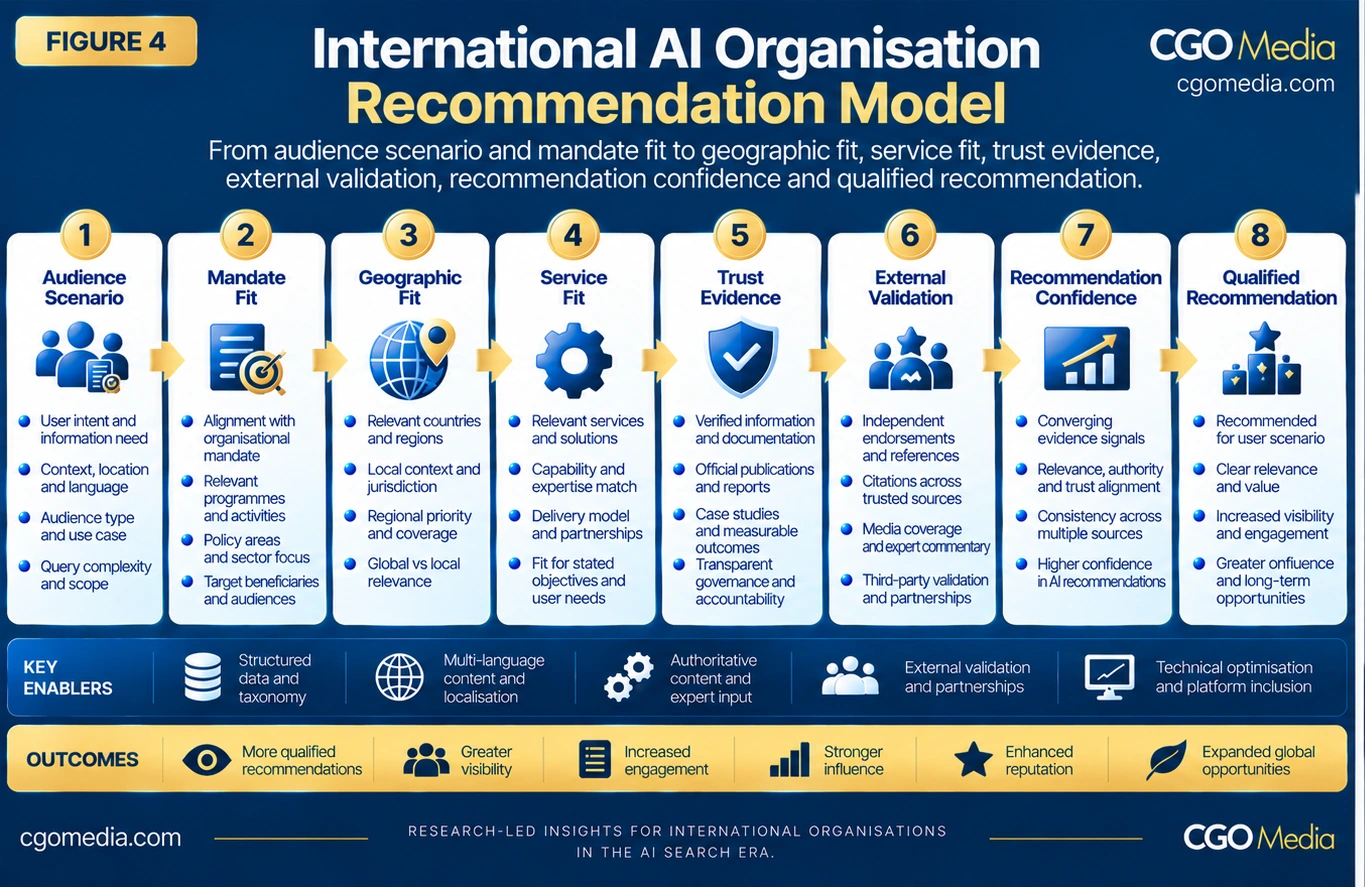
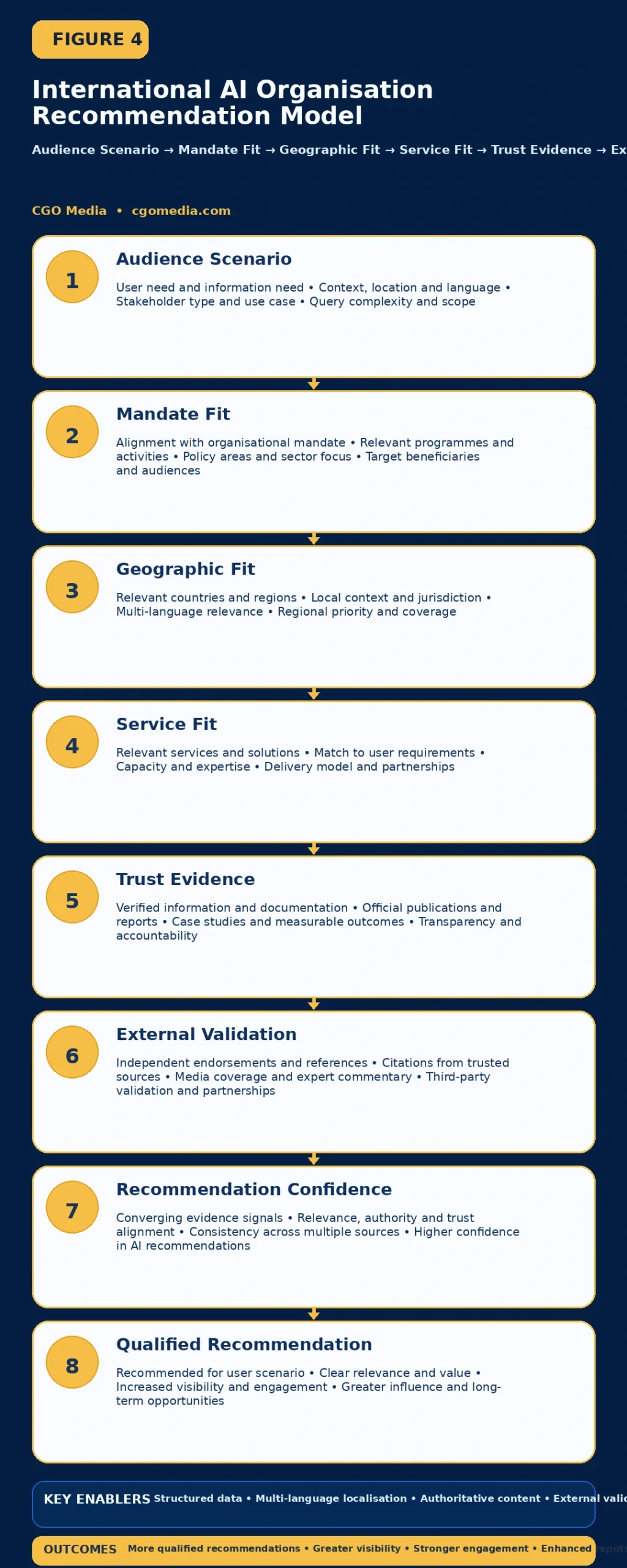
500. International GEO Requires a Distinct Measurement Framework
Traditional international SEO metrics remain important, but they do not fully capture generative visibility across countries, languages and recommendation environments.
501. International GEO Measurement Should Separate Visibility Layers
A useful model includes:
- Source Visibility
- Citation Visibility
- Entity & Mandate Accuracy
- Geographic & Language Visibility
- Recommendation Visibility
502. Qualified International GEO Performance Connects These Layers
A useful relationship is:
Source Visibility → Citation Visibility → Entity & Mandate Accuracy → Geographic & Language Visibility → Recommendation Visibility → Qualified International GEO Performance
503. Source Visibility Measures Information Presence
It evaluates whether organisational information contributes to generated answers.
504. Source Visibility Can Be Global, Regional or Local
The organisation may appear through:
- Global headquarters pages
- Regional pages
- Country-office pages
- Research reports
- Partner sources
505. Source Visibility Should Be Measured by Geography
A global source-presence score can hide substantial regional weakness.
506. Geographic Source Segmentation Can Include
- Global
- Regional
- National
- Local
507. Source Visibility Should Also Be Measured by Language
An organisation may be well represented in one language and poorly represented in another.
508. Language Source Segmentation Can Include
- English
- Spanish
- French
- Arabic
- Other strategic languages
509. Source Visibility Should Be Measured by Topic
An organisation may have strong source presence in one policy or programme area and weak presence in another.
510. Topic Segmentation Can Include
- Policy
- Research
- Programme delivery
- Funding
- Standards
- Technical assistance
511. Citation Visibility Is a Separate Measure
It evaluates whether organisational, research or country-specific sources are explicitly referenced.
512. Citation Visibility Should Be Measured by Citation Type
Possible categories include:
- Institutional citation
- Research citation
- Country citation
- Policy citation
- Expert citation
513. Citation Share Can Be Calculated
A simple measure is:
Citation Share = Relevant Citation Appearances ÷ Relevant Scenarios Tested
514. Citation Share Should Be Segmented by Market
The organisation may have strong citation authority globally while remaining weak in selected countries.
515. Citation Share Should Be Segmented by Language
This can reveal whether multilingual research and localised evidence are working effectively.
516. Citation Quality Should Be Recorded Alongside Citation Frequency
Useful dimensions include:
- Source credibility
- Geographic relevance
- Subject relevance
- Accuracy
- Persistence
517. Citation Context Should Also Be Recorded
A citation can be:
- Supportive
- Neutral
- Critical
- Corrective
518. Entity Accuracy Is a Core International GEO Measure
It evaluates whether the organisation itself is represented correctly.
519. Entity Accuracy Can Include
- Correct organisation name
- Correct parent relationship
- Correct regional structure
- Correct country office
- Correct institutional status
520. Mandate Accuracy Is Equally Important
It evaluates whether the organisation’s purpose and responsibilities are represented correctly.
521. Mandate Accuracy Can Include
- Correct policy role
- Correct operational role
- Correct funding role
- Correct standards role
- Correct research role
522. Programme Accuracy Should Be Assessed Separately
Material errors can include:
- Inactive programmes shown as active
- Wrong country coverage
- Wrong eligibility
- Wrong delivery partner
523. Geographic Accuracy Is Another Core Measure
It evaluates whether the organisation’s presence is represented correctly across markets.
524. Geographic Accuracy Can Include
- Correct country presence
- Correct regional responsibility
- Correct office location
- Correct programme geography
525. Language Accuracy Should Also Be Measured
The organisation should be represented consistently across translated and localised versions.
526. Language Accuracy Can Include
- Correct programme names
- Correct mandate terminology
- Correct institutional descriptions
- Correct local-language terminology
527. A Combined International GEO Accuracy Model Can Include
Entity Accuracy + Mandate Accuracy + Programme Accuracy + Geographic Accuracy + Language Accuracy
528. Accuracy Should Be Risk-Weighted
Not every error has the same consequence.
529. Minor Translation Variation May Be Low Risk
It may have limited effect on user understanding.
530. Incorrect Mandate Representation Can Be High Risk
It can materially distort how the organisation is understood.
531. Incorrect Country Presence Can Also Be High Risk
It can misdirect users, partners or stakeholders.
532. International GEO Risk Can Be Represented as
Severity + Persistence + Audience Impact + Geographic Importance
533. Severity Measures Potential Harm
The organisation should assess how serious the error is.
534. Persistence Measures Recurrence
A recurring error may indicate a deeper source or governance problem.
535. Audience Impact Measures Decision Consequence
The error may affect:
- Programme access
- Policy understanding
- Research use
- Funding decisions
- Institutional engagement
536. Geographic Importance Measures Strategic Relevance
Errors in priority countries or regions may require faster escalation.
537. Geographic Visibility Is Another Core International GEO Measure
It evaluates whether the organisation appears appropriately within global, regional and national contexts.
538. Geographic Visibility Should Be Scenario-Specific
An organisation may be visible for one country and absent in another where it has genuine relevance.
539. Geographic Visibility Share Can Be Calculated
A simple measure is:
Geographic Visibility Share = Relevant Geographic Appearances ÷ Relevant Geographic Scenarios Tested
540. Geographic Visibility Should Be Segmented
Useful segments can include:
- Global
- Region
- Country
- City or local programme area
541. Language Visibility Should Be Measured Separately
An organisation may have strong geographic presence but weak local-language discovery.
542. Language Visibility Share Can Be Calculated
A simple measure is:
Language Visibility Share = Relevant Language Appearances ÷ Relevant Language Scenarios Tested
543. Language Visibility Can Reveal Localisation Strength
Strong performance can indicate effective:
- Translation
- Terminology governance
- Local authority
- Country content
544. Geographic and Language Visibility Should Be Interpreted Together
High country visibility in English may not mean strong local-language relevance.
545. Recommendation Visibility Is the Most Selective Layer
It evaluates whether the organisation is appropriately recommended for specific audience scenarios.
546. Recommendation Share Can Be Calculated
A simple measure is:
Recommendation Share = Relevant Recommendation Appearances ÷ Relevant Audience Scenarios Tested
547. Recommendation Share Should Not Be Maximised Blindly
An organisation should not be recommended where mandate, geography or service fit is weak.
548. Recommendation Measurement Should Use Four Outcome Categories
- Relevant Inclusion
- Irrelevant Inclusion
- Relevant Exclusion
- Appropriate Exclusion
549. Relevant Inclusion Is the Preferred Outcome
The organisation appears where audience, mandate, geography and service fit are genuine.
550. Irrelevant Inclusion Can Represent Risk
The organisation may appear where:
- Mandate is unsuitable
- Geography is unsuitable
- Programme is inactive
- Another organisation is more appropriate
551. Relevant Exclusion Can Represent Lost Opportunity
The organisation fits the scenario but is omitted.
552. Appropriate Exclusion Represents Correct Filtering
The organisation is absent because it is genuinely not the right fit.
553. Qualified International Recommendation Visibility Should Be the Main Measure
A useful definition is:
Relevant Audience Scenario + Accurate Organisational Representation + Geographic Fit + Appropriate Inclusion
554. International GEO Measurement Should Begin with a Scenario Library
The quality of measurement depends heavily on the quality of tested scenarios.
555. Scenario Libraries Should Reflect Real International Information Needs
Useful sources can include:
- Search data
- Stakeholder enquiries
- Programme questions
- Policy research
- Country-office enquiries
556. Scenario Libraries Should Include Global Discovery Questions
These can identify whether the organisation enters broad institutional discovery.
557. Scenario Libraries Should Include Regional Questions
These can identify whether regional structures are understood correctly.
558. Scenario Libraries Should Include Country Questions
These can test local programme and office visibility.
559. Scenario Libraries Should Include Research Questions
These can test citation and knowledge authority.
560. Scenario Libraries Should Include Recommendation Questions
These can test audience and service fit.
561. Scenario Libraries Should Be Segmented by Geography
Useful categories can include:
- Global
- Regional
- Country
- Local
562. Scenario Libraries Should Be Segmented by Language
The same conceptual scenario can produce different results across languages.
563. Scenario Libraries Should Be Segmented by Audience
Useful categories can include:
- Government
- Business
- Researcher
- NGO
- Professional
- Public
564. Scenario Libraries Should Be Segmented by Organisational Function
Useful categories can include:
- Policy
- Research
- Funding
- Programme delivery
- Standards
- Technical assistance
565. International GEO Measurement Should Be Longitudinal
One isolated test is rarely sufficient.
566. Longitudinal Monitoring Can Reveal Stability
A useful concept is:
Presence Frequency + Representation Consistency + Geographic Consistency + Recommendation Consistency
567. Presence Frequency Measures How Often the Organisation Appears
This should be assessed within relevant scenarios.
568. Representation Consistency Measures Whether the Organisation Is Described Reliably
Repeated factual variation can indicate source instability.
569. Geographic Consistency Measures Whether Presence Is Represented Reliably by Market
Large differences may reveal local source or localisation weakness.
570. Recommendation Consistency Measures Whether Similar Scenarios Produce Similar Fit Assessments
Large variation may indicate weak recommendation confidence.
571. Stability Should Not Be Confused with Accuracy
A consistently wrong answer remains a problem.
572. International GEO Should Therefore Track Both Stability and Accuracy
A useful matrix includes:
- Stable and accurate
- Stable and inaccurate
- Unstable and accurate
- Unstable and inaccurate
573. Stable and Accurate Is the Strongest Outcome
The organisation is represented reliably and correctly.
574. Stable and Inaccurate Is a High-Priority Risk
Persistent misinformation may influence many stakeholder decisions.
575. Unstable but Accurate Requires Monitoring
Representation may be correct but inconsistent.
576. Unstable and Inaccurate Requires Immediate Investigation
This indicates both factual and consistency weakness.
577. International GEO Should Maintain an Error Taxonomy
A structured error taxonomy can speed diagnosis.
578. Entity Errors Can Include
- Wrong organisation
- Wrong parent relationship
- Wrong office
- Wrong institutional status
579. Mandate Errors Can Include
- Wrong policy role
- Wrong programme role
- Wrong funding role
- Wrong authority boundary
580. Geographic Errors Can Include
- Wrong country presence
- Wrong regional responsibility
- Wrong office location
- Wrong programme geography
581. Language Errors Can Include
- Incorrect translation
- Wrong programme name
- Terminology inconsistency
- Meaning distortion
582. Recommendation Errors Can Include
- Irrelevant inclusion
- Relevant exclusion
- Wrong geographic fit
- Wrong organisational role
583. Error Taxonomies Support Root-Cause Analysis
Different error types often require different corrective actions.
584. International GEO Should Diagnose the Likely Source of Error
A useful process is:
Observe → Classify → Compare → Diagnose → Prioritise → Improve → Re-Test
585. Observe
Record the generated international representation.
586. Classify
Identify whether the issue concerns:
- Entity
- Mandate
- Geography
- Language
- Recommendation
587. Compare
Compare the output against authoritative global and local sources.
588. Diagnose
Identify likely information, localisation, authority or governance gaps.
589. Prioritise
Use audience impact and geographic importance.
590. Improve
Strengthen the underlying source environment.
591. Re-Test
Determine whether the observed pattern changes.
592. International GEO Should Track Source Support
For each important generated claim, the organisation can ask:
What global, regional, local or independent evidence supports this representation?
593. Strong Source Support Can Include
- Official global pages
- Regional pages
- Country-office pages
- Government references
- Research
- Partner validation
594. Weak Source Support Can Explain Inaccuracy
Where authoritative evidence is absent, outdated or contradictory, generated representation may become less reliable.
595. Source Support Should Be Measured by Type
Useful categories can include:
- First-party global
- First-party local
- Government
- Research
- Partner
- Media
596. International GEO Should Track Citation Share Separately from Geographic Visibility
An organisation may be cited frequently without appearing in relevant country-level recommendations.
597. Geographic Visibility Should Be Tracked Separately from Recommendation Share
An organisation may appear in a country context without being the best organisational recommendation.
598. Keeping These Measures Separate Improves Diagnosis
For example:
- Strong citations + weak country visibility may indicate localisation weakness
- Strong country visibility + weak recommendation may indicate mandate or service-fit weakness
- Strong recommendation + weak citation may indicate dependence on external sources
599. International GEO Should Monitor Competitive and Institutional Movement
Organisation sets can change over time.
600. Movement Can Include
- New organisation emergence
- Organisation decline
- Category convergence
- Geographic repositioning
601. Organisation Co-Occurrence Should Be Recorded
Repeated co-occurrence can reveal effective comparison sets.
602. Co-Occurrence Can Be Measured by Scenario Type
For example:
- Global policy bodies
- Regional development organisations
- Research organisations
- International standards bodies
603. International GEO Should Track Strength Attribution
The organisation should record which strengths are repeatedly associated with it.
604. International GEO Should Track Weakness Attribution
Repeated negative framing can materially affect recommendation confidence.
605. Strength and Weakness Attribution Can Inform Positioning
It can show whether external representation aligns with institutional intent.
606. International GEO Measurement Should Connect to Traditional SEO Data
Useful data can include:
- International search visibility
- Organic traffic
- Regional rankings
- Local-language performance
- Landing-page engagement
607. SEO Data and GEO Data Should Not Be Combined Carelessly
They measure different parts of the international discovery environment.
608. International GEO Measurement Should Connect to Engagement Data
Relevant signals can include:
- Programme enquiries
- Research downloads
- Partner contacts
- Applications
- Country-office enquiries
609. International GEO Measurement Should Connect to Research Data
Relevant measures can include:
- Research citations
- Dataset use
- Media references
- Government references
610. International GEO Measurement Should Connect to Country Operations
Relevant information can include:
- Programme demand
- Local stakeholder questions
- Operational changes
- Service availability
611. Attribution Should Remain Cautious
AI-assisted discovery can influence stakeholder behaviour without producing a visible referral.
612. International GEO Should Therefore Use Multiple Attribution Signals
These can include:
- User surveys
- CRM notes
- Enquiry forms
- Search data
- AI visibility observations
613. Leading Indicators Can Support International GEO Measurement
Leading indicators can reveal authority development before stakeholder outcomes change.
614. International GEO Leading Indicators Can Include
- Source visibility
- Citation share
- Entity accuracy
- Geographic visibility
- Recommendation share
615. Lagging Indicators Can Include
- Qualified enquiries
- Programme engagement
- Research use
- Partner engagement
- Institutional recognition
616. Leading and Lagging Indicators Should Be Interpreted Together
Visibility improvement without audience relevance may not represent strong performance.
617. International GEO Should Include an Executive Scorecard
A practical scorecard can include:
- Source Visibility
- Citation Share
- Entity & Mandate Accuracy
- Geographic & Language Visibility
- Recommendation Share
- Critical GEO Risk
618. Executive Scorecards Should Show Direction
Each measure can be classified as:
- Improving
- Stable
- At risk
- Deteriorating
619. Executive Scorecards Should Highlight the Primary Constraint
The most important question is:
Which GEO weakness is currently limiting qualified international discovery?
620. The Primary Constraint May Be Source Visibility
The organisation may lack sufficiently authoritative source presence.
621. The Primary Constraint May Be Citation Authority
The organisation may be visible but not trusted as a reference.
622. The Primary Constraint May Be Entity or Mandate Accuracy
The organisation may be represented incorrectly.
623. The Primary Constraint May Be Geographic or Language Visibility
The organisation may have strong global presence but weak local discovery.
624. The Primary Constraint May Be Recommendation Fit
The organisation may appear but not be recommended appropriately.
625. International GEO Reporting Should Avoid Vanity Metrics
Raw mention counts alone can be misleading.
626. High Mention Volume Can Coexist with Poor Performance
For example:
- Wrong mandate
- Wrong country presence
- Irrelevant inclusion
- Weak local-language relevance
627. Qualified International GEO Performance Is Therefore a Better Objective
A useful relationship is:
Relevant Audience Scenario + Accurate Organisational Representation + Geographic & Language Fit + Appropriate Recommendation
628. International GEO Measurement Should Be Repeatable
The same core methodology should be usable across reporting periods.
629. Repeatability Requires Consistent Scenario Design
Major changes to the scenario set can make longitudinal comparison difficult.
630. Scenario Libraries Should Still Evolve
New markets, programmes, languages and audience needs may require new scenarios.
631. The Best Approach Is Controlled Evolution
Core benchmark scenarios can remain stable while new scenarios are added separately.
632. International GEO Should Document Measurement Changes
Changes to:
- Scenario design
- Languages
- AI platforms
- Scoring methods
- Risk weighting
should be recorded.
633. Measurement Transparency Improves Interpretation
Stakeholders can understand why results may change.
634. International GEO Measurement Should Be Decision-Oriented
The goal is not simply to collect data.
635. Each Measure Should Connect to a Potential Action
For example:
- Weak source visibility → strengthen global or local source assets
- Weak citation share → improve research and citation authority
- Entity errors → improve organisational fact governance
- Weak geographic visibility → strengthen country and regional information
- Weak recommendation share → investigate mandate, service and audience fit
636. The Seventeenth International GEO Principle
International GEO measurement should separate source visibility, citation visibility, entity and mandate accuracy, geographic and language visibility, and recommendation visibility because each represents a different stage of international discovery and requires different diagnostic and improvement actions.
637. The Eighteenth International GEO Principle
International GEO accuracy should be risk-weighted, with mandate, programme status, country presence, office responsibility and other high-impact institutional facts prioritised according to severity, persistence, audience impact and geographic importance.
638. The Nineteenth International GEO Principle
International GEO monitoring should be longitudinal and scenario-based, using stable benchmark scenarios segmented by geography, language, audience and organisational function so durable visibility patterns can be distinguished from temporary generative variation.
639. The Twentieth International GEO Principle
International GEO reporting should prioritise qualified visibility and strategic constraints rather than raw mention volume, connecting source authority, citation, factual accuracy, geographic relevance and recommendation quality to the audiences and markets that matter most to the organisation.
640. The International GEO Measurement Framework
The complete measurement relationship can be summarised as:
Source Visibility → Citation Visibility → Entity & Mandate Accuracy → Geographic & Language Visibility → Recommendation Visibility → Qualified International GEO Performance
641. The Strategic Implication
International organisations should measure Generative Engine Optimisation through a layered, multilingual and geographically sensitive framework that distinguishes source presence, citations, organisational accuracy, country and language visibility, and qualified recommendation, using longitudinal scenario libraries and executive reporting to identify where the international information, trust or authority system is currently constraining appropriate discovery.
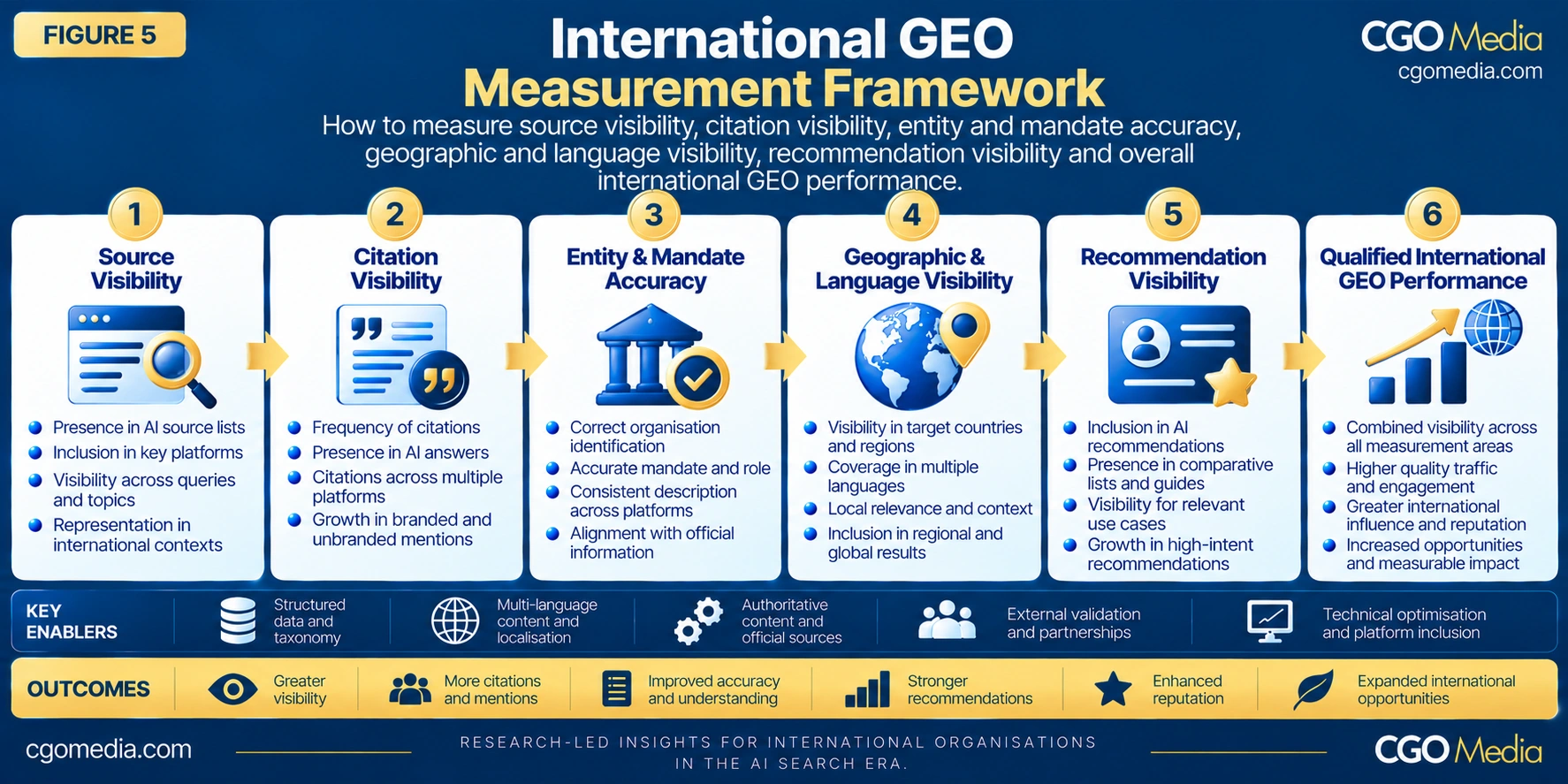
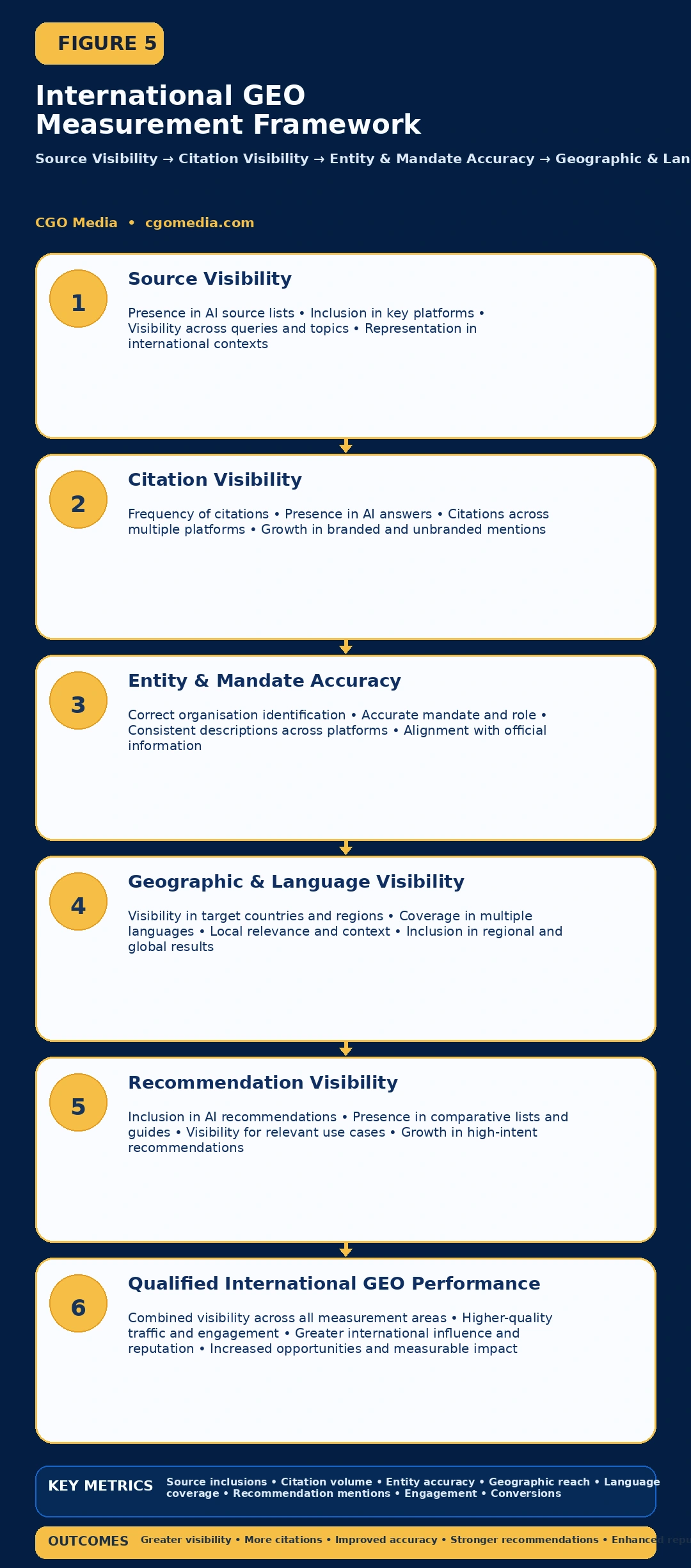
642. International GEO Should Operate as a Continuous Improvement System
International Generative Engine Optimisation should not be treated as a one-time multilingual visibility project.
643. International Information Environments Change Continuously
Organisations should expect change across:
- Programmes
- Country presence
- Leadership
- Policy positions
- Partnerships
- Audience behaviour
644. Continuous International GEO Should Begin with Observation
Teams should repeatedly observe:
- Source visibility
- Citation visibility
- Entity accuracy
- Mandate accuracy
- Geographic visibility
- Recommendation fit
645. Observation Should Be Structured
Scenario libraries and measurement methods should remain sufficiently consistent to support meaningful comparison across time, markets and languages.
646. International GEO Should Diagnose Change Before Reacting
A material visibility shift should trigger investigation rather than immediate tactical response.
647. Diagnosis Should Distinguish Temporary Variation from Structural Change
One unusual AI response may represent ordinary generative variation.
648. Persistent Change Can Indicate a Structural International GEO Problem
Examples can include:
- Mandate ambiguity
- Weak country information
- Language inconsistency
- Source conflict
- Competitive displacement
649. International GEO Should Prioritise by Audience and Geographic Impact
Not every visibility change has equal strategic significance.
650. A Useful International GEO Priority Model Is
Audience Impact + Geographic Importance + Persistence + Institutional Risk
651. Audience Impact
Measures whether the issue affects:
- Discovery
- Programme access
- Research use
- Institutional engagement
652. Geographic Importance
Measures whether the issue affects:
- Priority countries
- Strategic regions
- Growth markets
- High-impact programme areas
653. Persistence
Measures whether the issue recurs across time, languages or AI environments.
654. Institutional Risk
Measures the consequence of leaving the issue unresolved.
655. International GEO Should Improve the Underlying Information System
Interventions can involve:
- Global content
- Country pages
- Research
- Localisation
- Entity relationships
- External authority
656. GEO Improvement Should Target Root Causes
The objective should not be to manipulate individual AI outputs.
657. Root Causes Can Exist in Global Information
Examples include:
- Weak mandate explanation
- Confusing organisational structure
- Outdated global programme pages
- Missing institutional evidence
658. Root Causes Can Exist in Regional Information
Examples include:
- Unclear regional responsibility
- Weak regional programme coverage
- Outdated regional strategy pages
- Missing regional research
659. Root Causes Can Exist in Country Information
Examples include:
- Thin country pages
- Outdated office details
- Missing local programme information
- Weak local-language content
660. Root Causes Can Exist in External Information
Examples include:
- Outdated partner pages
- Incorrect media descriptions
- Legacy government references
- Weak academic recognition
661. International GEO Improvement Should Be Followed by Re-Testing
The organisation should determine whether the intervention changed the observed discovery pattern.
662. Re-Testing Should Preserve Scenario Consistency
Otherwise longitudinal comparison becomes difficult.
663. Continuous International GEO Can Be Summarised as
Observe → Diagnose → Prioritise → Strengthen → Validate → Learn → Adapt
664. Governance Is Essential to International GEO
International GEO crosses multiple organisational functions and geographic levels.
665. A Global GEO Governance Model Can Include
SEO + Communications + Research + Policy + Regional Teams + Country Offices + Digital Governance
666. SEO Can Coordinate Discovery Intelligence
SEO can connect:
- Search demand
- AI visibility
- International architecture
- Source analysis
667. Communications Can Coordinate Institutional Clarity
Communications can support:
- Mandate explanation
- Programme messaging
- Research distribution
- External references
668. Research Teams Can Strengthen Citation Authority
Research can create:
- Cross-country studies
- Regional reports
- Datasets
- Policy evidence
- International benchmarks
669. Policy Teams Can Validate Mandate and Institutional Role
They can help ensure public information reflects actual:
- Responsibilities
- Authority
- Policy positions
- Programme scope
670. Regional Teams Can Validate Regional Relevance
They can confirm:
- Regional programmes
- Market priorities
- Terminology
- Partner relationships
671. Country Offices Can Validate Local Truth
They can confirm:
- Current office information
- Programme availability
- Local services
- Local partnerships
- Local-language information
672. Digital Governance Can Coordinate Global Consistency
It can support standards across:
- Domains
- Subdomains
- Country sites
- Language versions
- Content systems
673. International GEO Governance Should Define Ownership
The organisation should know who owns:
- Global facts
- Regional facts
- Country facts
- Translation standards
- Escalation
674. Global and Local Ownership Should Be Distinct but Connected
Central governance should not eliminate legitimate local responsibility.
675. International GEO Governance Should Define Review Cadence
Different information types require different review frequencies.
676. High-Change International Information May Require Frequent Review
Examples include:
- Active programmes
- Office status
- Leadership
- Funding opportunities
- Emergency response
677. Stable Institutional Information May Require Less Frequent Review
Examples can include:
- Founding mandate
- Institutional history
- Long-standing membership structures
678. Review Frequency Should Reflect Volatility and Impact
A useful relationship is:
Rate of Change + Audience Impact + Geographic Importance → Review Frequency
679. International GEO Governance Should Include Escalation
Critical institutional misinformation should not remain within ordinary SEO reporting.
680. Critical International GEO Escalation Can Involve
- Policy leadership
- Regional management
- Country offices
- Communications
- Digital governance
681. International GEO Should Include Recovery Capability
Not every misinformation event can be prevented.
682. An International GEO Recovery Cycle Can Be Used
Detect → Verify → Diagnose → Correct → Re-Test → Learn
683. Detect
Identifies material mandate, geographic, programme, language or recommendation errors.
684. Verify
Confirms whether the observation is genuine, material and persistent.
685. Diagnose
Identifies the likely source, localisation, authority or governance problem.
686. Correct
Improves the underlying information environment.
687. Re-Test
Checks whether the observed pattern changes.
688. Learn
Improves future standards, governance and monitoring.
689. Recovery Speed Can Be Measured
Useful measures can include:
- Time to detect
- Time to verify
- Time to correct
- Time to validate
690. International GEO Should Also Include Experimentation
Some interventions should be tested rather than assumed to work.
691. International GEO Experiments Should Begin with a Hypothesis
For example:
Publishing clearer country-level programme information, local-language content and independent partner evidence should improve qualified recommendation visibility for relevant local scenarios.
692. Experiments Should Establish a Baseline
The organisation should record current visibility before changes are introduced.
693. Experiments Should Define the Intervention
Examples can include:
- New country pages
- Improved translation
- Updated programme information
- Original regional research
694. Experiments Should Define Success Criteria
Success can include:
- Improved source visibility
- Improved citation visibility
- Improved geographic accuracy
- Improved recommendation fit
695. Experiments Should Use Observation Windows
Generative visibility may not change immediately after an intervention.
696. Confounding Factors Should Be Recorded
Examples can include:
- AI model changes
- Political events
- Programme launches
- Partner activity
- Major media coverage
697. Negative Results Should Be Preserved
They help prevent repeated ineffective work.
698. Successful Experiments Should Become Standards
Validated approaches can be added to:
- Country templates
- Translation standards
- Research standards
- Governance playbooks
699. International GEO Should Integrate with International SEO
The two disciplines overlap substantially.
700. International SEO Supports GEO Through Technical Accessibility
Search engines and generative systems both benefit from accessible, well-structured international information.
701. International SEO Supports GEO Through Language and Market Architecture
Clear relationships between:
- Global pages
- Regional pages
- Country pages
- Language versions
- Programmes
can improve understanding.
702. International SEO Supports GEO Through Localised Topical Coverage
Strong country and regional information can improve geographic relevance.
703. GEO Extends International SEO Through Representation and Recommendation Analysis
International GEO adds explicit focus on:
- Citation
- Mandate accuracy
- Geographic interpretation
- Organisation comparison
- Recommendation visibility
704. International SEO and GEO Should Share Infrastructure
But they should not be treated as identical disciplines.
705. International GEO Should Integrate with Communications
External authority is central to the global information environment.
706. Communications Can Strengthen GEO Through
- Research coverage
- Policy commentary
- Country stories
- Expert visibility
- Institutional references
707. International GEO Should Integrate with Research Strategy
Original comparative research can create high-value citation assets.
708. Research Can Support GEO Through
- Cross-country datasets
- Regional studies
- Policy analysis
- International benchmarks
- Programme evaluations
709. International GEO Should Integrate with Programme Evidence
Successful programme outcomes provide real-world validation.
710. Programme Evidence Can Improve
- Institutional trust
- Operational authority
- Recommendation confidence
- External credibility
711. International GEO Should Integrate with Institutional Strategy
Generated representation can expose gaps between how an organisation intends to position itself and how it is understood externally.
712. Persistent Mandate Misunderstanding Can Be a Strategic Signal
The problem may not always be content alone.
713. GEO Intelligence Can Reveal Geographic Drift
An organisation may remain strongly associated with countries or regions it no longer prioritises.
714. Geographic Drift Can Be Strategic or Problematic
It should be assessed against current organisational priorities.
715. GEO Intelligence Can Reveal Emerging Comparison Organisations
Repeated co-occurrence can identify changing institutional relationships.
716. GEO Intelligence Can Reveal New Audience Language
AI prompts may expose terminology different from internal institutional language.
717. International GEO Can Therefore Contribute to Strategic Intelligence
Its value extends beyond digital visibility.
718. International GEO Should Be Scaled Carefully
Large scenario libraries across many countries and languages can create noise without strategic value.
719. Scaling Should Follow Strategic Priority
Scenario expansion can follow:
- Priority markets
- Priority programmes
- Priority languages
- Priority audiences
720. International GEO Scaling Should Begin with Priority Markets
Not every country requires the same monitoring intensity.
721. Priority Markets Can Be Selected Using
- Programme importance
- Audience demand
- Institutional presence
- Strategic growth
- Risk
722. Language Priority Should Also Be Strategic
Language coverage can reflect:
- Audience size
- Country importance
- Operational need
- Policy relevance
723. International GEO Scaling Should Preserve Entity Consistency
Global, regional and local relationships should remain coherent across markets.
724. Localisation Should Preserve Institutional Truth
Core facts should remain consistent where the underlying organisation or programme is the same.
725. Localisation Should Adapt Context
Different markets may require different:
- Terminology
- Examples
- Policy references
- Partners
- Programme information
726. International GEO Scaling Should Include Country Offices
Large organisations may need office-level and programme-level monitoring.
727. Country-Level GEO Can Reveal Local Representation Problems
AI systems may:
- Use old office details
- Misstate programme availability
- Confuse regional responsibility
- Use outdated partners
728. Country-Level Fact Governance Is Therefore Important
Each priority country should have clear authoritative information.
729. International GEO Scaling Should Include Programme Portfolios
Large organisations may operate many programmes across different regions.
730. Programme-Level GEO Can Reveal Portfolio Confusion
Generative systems may:
- Merge programmes
- Misstate programme status
- Confuse target audiences
- Misattribute delivery partners
731. Programme-Level Entity Governance Can Reduce Confusion
Major programmes should have clear:
- Name
- Status
- Geography
- Audience
- Ownership
732. International GEO Scaling Should Include Audience Segments
Large organisations may require separate monitoring for:
- Governments
- Businesses
- Researchers
- NGOs
- Professionals
- Public audiences
733. Audience-Level GEO Can Reveal Recommendation Confusion
Generative systems may recommend the organisation to users for whom its role is unsuitable.
734. International GEO Scaling Should Include Organisational Learning
Repeated observations should improve:
- Standards
- Training
- Research
- Localisation
- Governance
735. Organisational Memory Reduces Repeated GEO Failure
The organisation should not repeatedly rediscover the same country, language or mandate problems.
736. International GEO Learning Can Be Preserved Through
- Scenario libraries
- Issue logs
- Experiment records
- Country maps
- Source maps
- Terminology glossaries
- Governance playbooks
737. Adaptive International GEO Is the Long-Term Goal
The organisation should be able to respond as:
- AI systems change
- Programmes change
- Markets change
- Languages evolve
- Audience behaviour changes
738. Adaptive GEO Does Not Mean Constant Tactical Reaction
Stable principles should remain.
739. Stable International GEO Principles Can Include
- Clear entities
- Clear mandate
- Accurate geography
- Strong evidence
- Relevant external authority
- Audience fit
740. Tactics Can Change Around Stable Principles
This creates resilience without strategic confusion.
741. Adaptive International GEO Should Be Evidence-Led
Changes should respond to observed patterns rather than speculation.
742. Adaptive International GEO Should Be Risk-Aware
Critical mandate, programme, geographic or language misinformation should receive priority over low-value visibility fluctuations.
743. Adaptive International GEO Should Be Strategically Relevant
The programme should focus on markets, audiences, languages and programmes that matter most.
744. Adaptive International GEO Should Be Integrated
It should connect:
Search Intelligence + AI Intelligence + Research Intelligence + Policy Intelligence + Regional Intelligence + Audience Intelligence
745. Combined Intelligence Improves GEO Decisions
Teams can better determine:
- What to improve
- Which markets to prioritise
- What to research
- What to localise
- What to communicate
746. Strategic Recommendation One — Build a Defined International Scenario Library
Focus monitoring on realistic audience needs, strategic geographies and priority languages.
747. Strategic Recommendation Two — Map International Source Visibility
Identify which global, regional, local and external sources appear around priority topics.
748. Strategic Recommendation Three — Strengthen International Citation Assets
Create useful:
- Research
- Statistics
- Country profiles
- Policy analysis
- Frameworks
749. Strategic Recommendation Four — Improve Entity and Mandate Clarity
Reduce ambiguity around global structures, regional responsibilities, country offices, programmes and institutional roles.
750. Strategic Recommendation Five — Improve Geographic Clarity
Make country presence, regional responsibility and local programme availability explicit.
751. Strategic Recommendation Six — Strengthen Language and Terminology Governance
Maintain consistent meaning across translated and localised information.
752. Strategic Recommendation Seven — Strengthen Source Convergence
Ensure global, regional, local and independent information materially agrees.
753. Strategic Recommendation Eight — Monitor Recommendation Fit
Track whether organisational inclusion is appropriate to audience, mandate, geography and service.
754. Strategic Recommendation Nine — Monitor Relevant Exclusion
Investigate repeated omission where organisational fit is genuine.
755. Strategic Recommendation Ten — Track Critical International Misinformation
Escalate high-risk mandate, geographic, programme and office errors quickly.
756. Strategic Recommendation Eleven — Build GEO Recovery Processes
Create clear detection, diagnosis, correction and re-testing procedures.
757. Strategic Recommendation Twelve — Integrate GEO with Research and Communications
Build external authority around useful international evidence.
758. Strategic Recommendation Thirteen — Connect GEO to Policy and Programme Intelligence
Use observed audience questions to improve institutional and programme information.
759. Strategic Recommendation Fourteen — Connect GEO to Audience Outcomes
Use successful engagement to strengthen future organisational authority.
760. Strategic Recommendation Fifteen — Expand GEO Across Markets Carefully
Use geography-specific, language-specific and audience-specific scenarios.
761. Strategic Recommendation Sixteen — Experiment Systematically
Test interventions using baselines and defined success criteria.
762. Strategic Recommendation Seventeen — Preserve Organisational Learning
Convert repeated findings into standards, terminology, training and governance playbooks.
763. Strategic Recommendation Eighteen — Build Adaptive International GEO
Treat Generative Engine Optimisation as a permanent international discovery capability rather than a temporary multilingual marketing initiative.
764. The Twenty-First International GEO Principle
International GEO should operate as a continuous improvement system because organisational structure, country presence, programmes, languages, source ecosystems and AI recommendation patterns can all change over time.
765. The Twenty-Second International GEO Principle
International GEO governance should connect SEO, communications, research, policy, regional teams, country offices and digital governance so global organisational truth remains consistent while local information is sufficiently current, relevant and authoritative.
766. The Twenty-Third International GEO Principle
International organisations should build recovery and experimentation capability so recurring mandate errors, geographic misinformation, localisation weaknesses, citation gaps and recommendation failures can be diagnosed, corrected, re-tested and converted into organisational learning.
767. The Twenty-Fourth International GEO Principle
The highest International GEO capability is adaptive GEO, where stable principles around entity clarity, mandate truth, geographic relevance, evidence quality, source authority and audience fit are preserved while tactics evolve across changing generative search environments, markets and languages.
768. The Continuous International GEO Cycle
The complete operational cycle can be summarised as:
Observe → Diagnose → Prioritise → Strengthen → Validate → Learn → Adapt
769. The Long-Term International GEO System
The wider relationship can be summarised as:
Clear Entity → Clear Mandate → Geographic & Language Relevance → Strong Trust Evidence → Source Authority → Citation Visibility → Organisational Comparison Visibility → Recommendation Confidence → Qualified International GEO Visibility → Organisational Learning
770. The Strategic Implication
International organisations should operate Generative Engine Optimisation as a continuous, multilingual, geographically aware and cross-functional discipline, repeatedly monitoring how global entities, mandates, country offices, programmes, sources, citations and recommendations are represented, strengthening the underlying information and authority system, validating change and adapting as generative search environments, organisational priorities, markets, languages and audience expectations evolve.
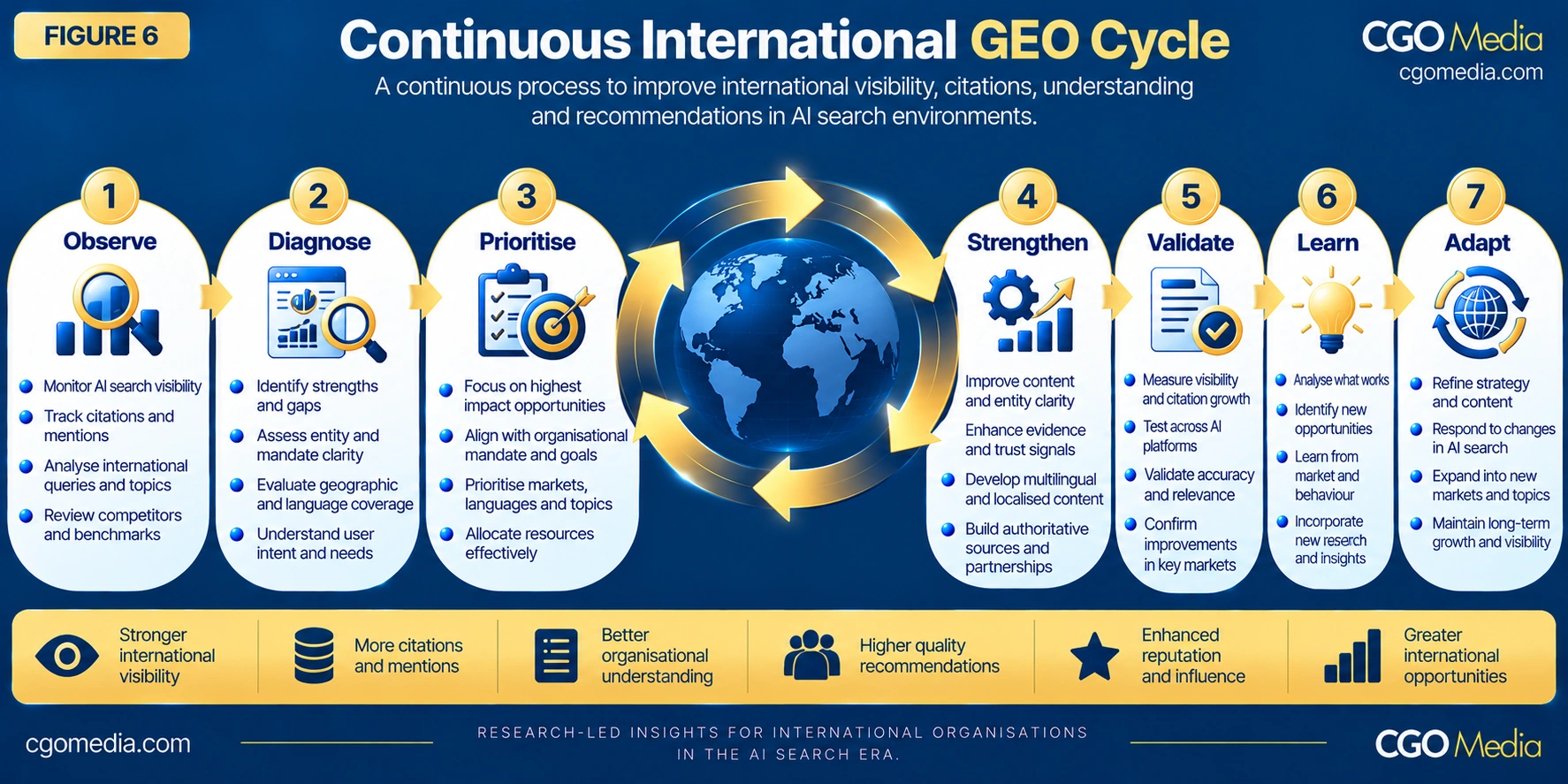
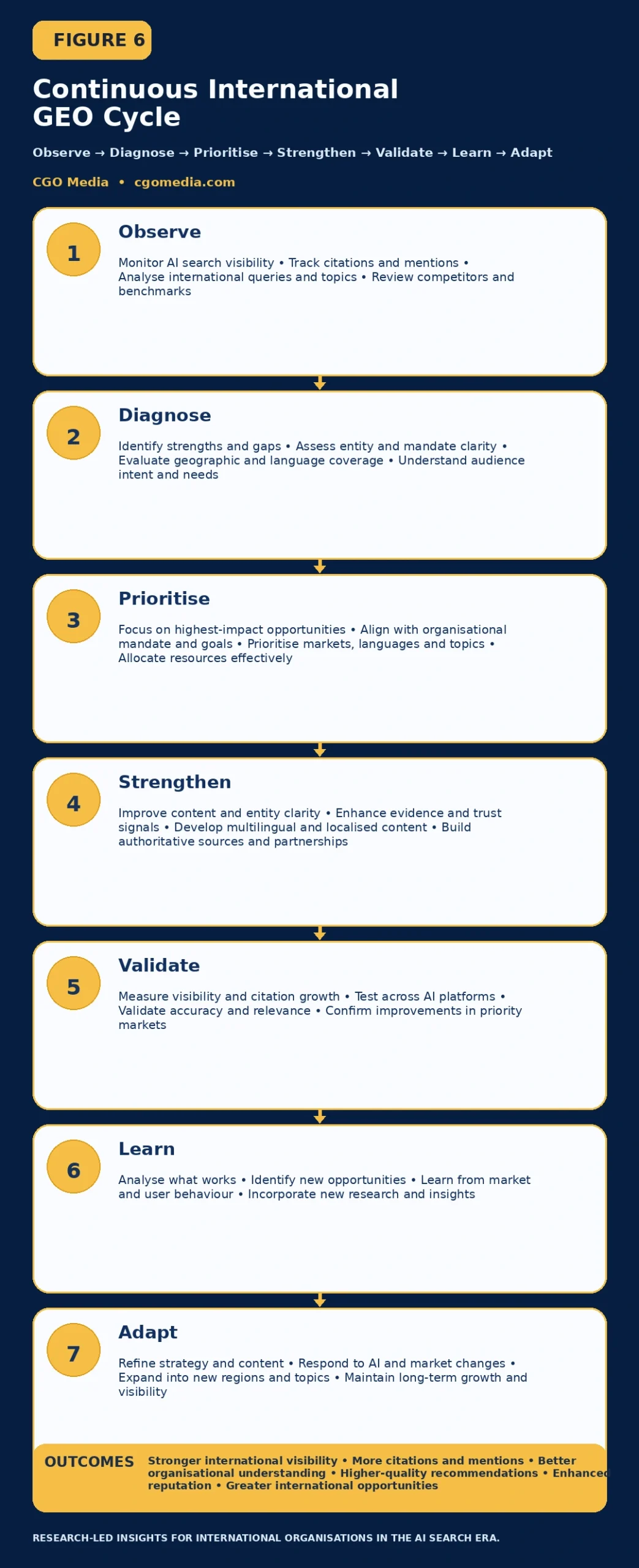
771. Methodology
International Organisations GEO: Generative Engine Optimisation for Global AI Search and Recommendation Systems is a conceptual research framework developed by CGO Media to help international organisations understand and improve how their entities, mandates, programmes, research, geographic presence, multilingual information, citations and organisational suitability are represented across generative search and AI-assisted discovery environments.
772. Research Purpose
The framework addresses a central question:
How can international organisations improve the quality, accuracy, authority, geographic relevance and recommendation suitability of their visibility across global, regional and local generative discovery environments?
773. Framework Scope
The framework can be applied to organisations including:
- Multilateral institutions
- International NGOs
- Development organisations
- Global trade associations
- Professional bodies
- Standards organisations
- International research organisations
- Global foundations
- Cross-border networks
774. International GEO Is Treated as a Global Information and Authority System
The framework does not treat GEO as a collection of isolated AI prompts or multilingual visibility tactics.
775. The Core International GEO System Includes
- Entity clarity
- Mandate clarity
- Geographic relevance
- Language relevance
- Trust evidence
- Source authority
- Citation eligibility
- Audience fit
- Recommendation confidence
776. Core International GEO Progression
The conceptual sequence is:
Entity Clarity → Mandate Clarity → Geographic & Language Relevance → Trust Evidence → Source Authority → Citation Eligibility → Audience Fit → GEO Visibility
777. Entity Method
Entity analysis can examine whether public information clearly represents:
- Global organisation
- Regional structures
- Country offices
- Programmes
- Initiatives
- Partners
778. Organisational Relationships Can Be Mapped
A useful model is:
Global Organisation → Regional Structure → Country Office → Programme → Service or Initiative → Audience
779. Mandate Method
Mandate analysis can assess whether the organisation clearly communicates:
- Purpose
- Authority
- Policy role
- Operational role
- Research role
- Standards or funding role
780. Mandate-to-Audience Relationships Can Be Mapped
A useful relationship is:
Audience Need → Organisational Mandate → Programme or Service → Geographic Scope → Appropriate Recommendation
781. Geographic Method
Geographic analysis can assess:
- Global scope
- Regional responsibility
- Country presence
- Local offices
- Local programme coverage
782. Language Method
Language analysis can assess:
- Translation quality
- Terminology consistency
- Semantic accuracy
- Local-language availability
- Market appropriateness
783. Global and Local Consistency Method
The framework evaluates whether global organisational truth remains coherent while local information adapts appropriately to regional and country context.
784. Trust Evidence Method
Institutional trust can be assessed through:
- Legal status
- Government recognition
- Membership
- Research outputs
- Programme evidence
- Independent references
785. Source Estate Method
Relevant information can be mapped across:
- Global organisation websites
- Regional websites
- Country websites
- Government sources
- Partner organisations
- Research repositories
- Media
786. Source Selection Method
The framework conceptualises international source selection as:
User Context → Candidate Sources → Geographic Relevance → Mandate Relevance → Trust Evidence → Source Convergence → Source Selection
787. Source Convergence Method
International source agreement can be assessed through:
Global Organisation Truth + Regional Evidence + Local Evidence + Independent Validation
788. Source Conflict Method
Material disagreements can be identified across:
- Mandate
- Country presence
- Programme availability
- Leadership
- Office responsibility
- Partner relationships
789. Citation Eligibility Method
Citation readiness is conceptualised through:
Relevance + Authority + Evidence + Language Fit + Freshness
790. Citation Authority Method
International citation authority can be evaluated through:
- Government references
- Academic citations
- Partner references
- Media citations
- AI citations
791. International Research Method
Where organisations create primary research, methodology should explain:
- Research question
- Countries included
- Population or sample
- Data sources
- Measurement period
- Definitions
- Limitations
792. International Citation Assets Can Include
- Cross-country studies
- Regional reports
- Policy analysis
- Datasets
- Country profiles
- Original frameworks
793. Organisation Recommendation Method
Organisation recommendation visibility is conceptualised through:
Audience Scenario → Mandate Fit → Geographic Fit → Service Fit → Trust Evidence → External Validation → Recommendation Confidence → Qualified Recommendation
794. Mandate Fit Method
Mandate fit can include:
- Policy relevance
- Research relevance
- Funding relevance
- Operational relevance
- Standards relevance
795. Geographic Fit Method
Geographic fit can include:
- Global relevance
- Regional relevance
- Country presence
- Local programme availability
- Local partner support
796. Service Fit Method
Service fit can include:
- Research
- Funding
- Technical assistance
- Programme delivery
- Policy guidance
- Standards
797. Recommendation Confidence Method
Recommendation confidence can be analysed conceptually through:
Audience Relevance + Mandate Fit + Geographic Fit + Service Fit + Trust Evidence + External Validation + Language Fit
798. International GEO Measurement Method
The framework separates five visibility layers:
- Source Visibility
- Citation Visibility
- Entity & Mandate Accuracy
- Geographic & Language Visibility
- Recommendation Visibility
799. Source Visibility
Evaluates whether organisational information appears to contribute to generated answers.
800. Citation Visibility
Evaluates whether official, research or local sources are explicitly referenced.
801. Entity & Mandate Accuracy
Evaluates whether the organisation, mandate, regional structure, country presence and programmes are represented correctly.
802. Geographic & Language Visibility
Evaluates whether the organisation appears appropriately across relevant markets and languages.
803. Recommendation Visibility
Evaluates whether the organisation is appropriately recommended for specific audience scenarios.
804. Qualified International GEO Performance
A useful conceptual relationship is:
Relevant Audience Presence + Accurate Organisational Representation + Geographic & Language Fit + Appropriate Recommendation
805. Scenario Library Method
International GEO monitoring should use realistic global, regional and local scenarios.
806. Scenario Segmentation Can Include
- Geography
- Language
- Audience
- Mandate
- Programme
- Journey stage
807. Longitudinal Method
Repeated monitoring can help identify:
- Persistent organisational inclusion
- Persistent exclusion
- Recurring mandate errors
- Country-level representation gaps
- Recommendation changes
808. International GEO Risk Method
Material errors can be prioritised through:
Severity + Persistence + Audience Impact + Geographic Importance
809. Critical International GEO Risk Can Include
- Incorrect mandate
- Incorrect country presence
- Incorrect programme status
- Incorrect office responsibility
- Material translation error
810. Continuous Improvement Method
The International GEO operational cycle is:
Observe → Diagnose → Prioritise → Strengthen → Validate → Learn → Adapt
811. Recovery Method
Material GEO errors can be managed through:
Detect → Verify → Diagnose → Correct → Re-Test → Learn
812. Experimentation Method
International GEO experiments should include:
- Hypothesis
- Baseline
- Intervention
- Observation period
- Success criteria
- Result
813. Governance Method
International GEO should be governed cross-functionally.
Relevant functions can include:
SEO + Communications + Research + Policy + Regional Teams + Country Offices + Digital Governance
814. Market-Priority Method
International GEO does not require identical monitoring intensity across every market.
815. Priority Markets Can Be Selected According to
- Programme importance
- Audience demand
- Institutional presence
- Growth priority
- Reputational risk
816. Language-Priority Method
Priority languages can be selected according to:
- Audience scale
- Market importance
- Programme relevance
- Institutional need
817. Limitations
International Organisations GEO: Generative Engine Optimisation for Global AI Search and Recommendation Systems is a conceptual research framework. It does not represent the proprietary internal retrieval, ranking, source-selection or recommendation systems used by OpenAI, Google, Microsoft, Anthropic, Perplexity or any other search or AI provider.
818. Generative Systems Are Only Partially Observable
External organisations cannot directly observe every internal:
- Retrieval process
- Ranking process
- Source-selection process
- Recommendation process
819. Source Influence Can Be Difficult to Verify
Not every system exposes all sources contributing to a generated answer.
820. Citation Visibility Is Platform-Dependent
Some AI environments expose detailed citations while others provide more limited attribution.
821. AI Outputs Can Vary
Variation can occur according to:
- Model
- Prompt wording
- Conversation context
- Date
- Language
- Geography
822. Language Variation Creates Additional Uncertainty
Equivalent questions asked in different languages may produce different sources, entities and recommendations.
823. Geographic Variation Creates Additional Uncertainty
The same organisation may be represented differently across markets.
824. Single AI Outputs Should Not Be Over-Interpreted
One response may not represent a durable international visibility pattern.
825. Longitudinal Testing Reduces but Does Not Eliminate Uncertainty
Repeated observation can reveal patterns without proving the internal mechanisms producing them.
826. Organisation Recommendation Visibility Is Contextual
An organisation can be highly relevant for one audience, country or programme and inappropriate for another.
827. High Mention Volume Does Not Prove Strong International GEO
High visibility can coexist with:
- Wrong mandate
- Wrong country presence
- Wrong programme status
- Poor audience fit
828. Citation Frequency Does Not Automatically Equal International Authority
Citation quality, relevance, geography, language and evidence strength also matter.
829. International Information Can Become Outdated Quickly
This is especially true for:
- Active programmes
- Leadership
- Country operations
- Emergency work
- Policy positions
830. Multilingual Information Can Become Inconsistent
Language versions may be updated at different times or interpreted differently.
831. Translation Is Not Equivalent to Localisation
A linguistically correct translation may still be inappropriate for the local institutional or cultural context.
832. International GEO Attribution Is Incomplete
AI influence can occur:
- Before a website visit
- Without a click
- Across multiple research sessions
- Alongside traditional search and external sources
833. Direct Attribution Should therefore Be Cautious
The framework should not be used to claim direct causal impact where the evidence cannot support it.
834. International SEO and International GEO Overlap Substantially
Many GEO capabilities depend on established:
- Technical SEO
- International architecture
- Localisation
- Entity clarity
- External authority
835. International GEO Should Not Be Positioned as a Replacement for International SEO
Traditional search remains important throughout global discovery.
836. GEO Is Better Understood as an Extension of International Discovery
It adds explicit focus on:
- Generative sources
- Citations
- Mandate representation
- Geographic interpretation
- Organisational recommendation
837. GEO Terminology and Measurement Are Still Evolving
Industry conventions may continue to develop as generative search and AI-assisted discovery mature.
838. The Framework Should therefore Remain Adaptive
Stable principles can remain useful while individual measurement methods and tactics evolve.
839. Conclusion
International GEO introduces a broader model of global digital visibility in which international organisations are not only competing for search rankings, but also competing to become trusted sources, accurately represented institutional entities, relevant geographic authorities and appropriate recommendations within AI-assisted discovery environments.
840. Entity Clarity Establishes Organisational Identity
AI systems need to understand:
- Who the organisation is
- How global and local structures relate
- Which programmes belong to it
- Which partners are external
841. Mandate Clarity Establishes Institutional Relevance
Users and AI systems need to understand what the organisation is genuinely responsible for.
842. Geographic Clarity Establishes Market Relevance
Global visibility should not be mistaken for local operational presence.
843. Language Relevance Establishes Local Understanding
Strong international GEO requires more than translation; it requires accurate terminology and local context.
844. Trust Evidence Establishes Institutional Confidence
Important organisational claims should be supported by verifiable legal, government, research, partner and programme evidence.
845. Source Authority Establishes Information Confidence
Owned information becomes stronger when reinforced by credible:
- Governments
- Research organisations
- Universities
- Partners
- Media
846. Citation Eligibility Establishes Reference Potential
Useful international sources combine:
- Relevance
- Authority
- Evidence
- Language fit
- Freshness
847. Citation Authority Establishes Knowledge Influence
International organisations can increasingly become recognised sources for:
- Policy
- Research
- Cross-country statistics
- Programme evidence
- International frameworks
848. Audience Fit Establishes Recommendation Relevance
The most valuable generative visibility occurs when the organisation genuinely matches the user’s need, geography and context.
849. Geographic Visibility Establishes Local Discoverability
Strong global authority does not automatically create strong country or language visibility.
850. Qualified Recommendation Visibility Establishes Selection Presence
The organisation remains relevant after mandate, geography, service, trust and external-validation filters are applied.
851. International GEO Measurement Should Preserve These Distinctions
Source, citation, organisational, geographic and recommendation visibility represent different outcomes.
852. International GEO Should Prioritise Quality Over Volume
The strategic objective is not maximum AI mention frequency.
853. The Strategic Objective Is Qualified International GEO Visibility
This can be represented as:
Relevant Audience Presence + Accurate Organisational Representation + Geographic & Language Fit + Strong Evidence + Appropriate Recommendation
854. Original International Research Can Become a Significant GEO Asset
Primary evidence can strengthen:
- Source utility
- Citation visibility
- Research authority
- Subject association
855. International Communications Can Strengthen External Authority
Relevant external references can reinforce the public evidence environment around the organisation.
856. Local Programme Outcomes Can Strengthen Recommendation Confidence
Successful activity can generate:
- Government references
- Partner evidence
- Research outputs
- Independent recognition
857. International GEO Can Become Self-Reinforcing
A useful long-term relationship is:
Useful International Information → Strong Evidence → External Reference → Greater Organisational Authority → Better GEO Visibility → More Qualified Discovery → More Evidence
858. International GEO Should Operate Continuously
AI systems, programmes, markets, languages and organisational priorities all change.
859. Continuous Monitoring Supports Organisational Resilience
International organisations should be able to:
- Detect change
- Diagnose errors
- Strengthen evidence
- Validate interventions
- Learn
860. Adaptive International GEO Is the Long-Term Capability
Organisations should preserve stable principles while adapting to changes in generative search and international information environments.
861. Stable International GEO Principles Include
- Clear entities
- Clear mandate
- Accurate geography
- Accurate language
- Strong evidence
- Relevant external authority
- Audience fit
862. International GEO Should Ultimately Improve Audience Decision Quality
The strongest outcome is not simply that AI systems mention an organisation more frequently.
863. The Stronger Outcome Is Better Organisational Representation
Users should receive more accurate information about:
- Mandate
- Programmes
- Country presence
- Services
- Research
- Contact routes
864. Better Representation Can Support Better Organisational Selection
Relevant organisations are more likely to reach audiences whose needs genuinely align.
865. Better Organisational Selection Can Support Better Outcomes
Stronger fit can support:
- More relevant enquiries
- Better programme access
- More appropriate partnerships
- Greater stakeholder trust
866. Successful Outcomes Can Reinforce Future International GEO
A long-term cycle can be represented as:
Qualified International GEO Visibility → Better Audience Fit → Better Outcome → Stronger Evidence → Greater Authority → Better Future GEO Visibility
867. The Complete International GEO Model
The strategic relationship can be summarised as:
Clear Entity → Clear Mandate → Geographic & Language Relevance → Strong Trust Evidence → Source Authority → Citation Visibility → Organisational Comparison Visibility → Recommendation Confidence → Qualified International GEO Visibility
868. Final Strategic Position
International organisations should treat Generative Engine Optimisation as a permanent extension of international SEO, multilingual information architecture, institutional governance, research, communications and global authority strategy rather than as a short-term attempt to influence individual AI-generated answers.
The strongest International GEO programmes build a coherent information ecosystem that makes the organisation easier to identify, understand, verify, cite and recommend across different countries, regions, languages and generative search environments.
The objective is not simply to appear more frequently. It is to increase the probability that international organisations are represented accurately, supported by credible evidence and recommended appropriately when users rely on AI-assisted systems to discover, evaluate and select relevant organisations, programmes, research sources and institutional partners.
References
External Academic, Technical and Search Sources
- Google Search Central. SEO Starter Guide.
- Google Search Central. Crawling and indexing overview.
- Google Search Central. Understand how structured data works.
- Google Search Central. Tell Google about localised versions of your page.
- Schema.org. Organization.
- Schema.org. NGO.
- Schema.org. Service.
- Hogan, A. et al. (2021). Knowledge Graphs. ACM Computing Surveys, 54(4).
- Metzger, M.J. (2007). Making Sense of Credibility on the Web: Models for Evaluating Online Information and Recommendations for Future Research. Journal of the American Society for Information Science and Technology, 58(13), 2078–2091.
- Ji, Z. et al. (2023). Survey of Hallucination in Natural Language Generation. ACM Computing Surveys, 55(12).
CGO Media International Organisations Research and Frameworks
- Wilkinson, R. (2026). International Organisations SEO in an AI Search Environment. CGO Media.
- Wilkinson, R. (2026). International Organisations AI Trust & Visibility Framework. CGO Media.
- Wilkinson, R. (2026). International Discovery & Organisation Selection Model. CGO Media.
- Wilkinson, R. (2026). International Search Authority Maturity Model. CGO Media.
- Wilkinson, R. (2026). International Organisations SEO & AI Implementation Roadmap. CGO Media.
- Wilkinson, R. (2026). CGO AI Search Readiness Framework. CGO Media.
- Wilkinson, R. (2026). CGO AI Citation Framework. CGO Media.
- Wilkinson, R. (2026). CGO Entity Authority Framework. CGO Media.
- Wilkinson, R. (2026). CGO Content Authority Framework. CGO Media.
CGO Media Research Ecosystem
CGO Media Research Library |
CGO Media Framework Library |
CGO Media Research Architecture |
CGO Media Research Observations Library |
CGO Media Statistics Library
About Roger Wilkinson
Roger Wilkinson is an independent researcher, SEO practitioner and founder of CGO Media with more than 25 years of experience in search, digital visibility and business growth.
His research focuses on how artificial intelligence is reshaping search engines, recommendation systems, entity representation, digital authority and organisational visibility.
Roger is the creator of the CGO Framework Series, a collection of research-led methodologies designed to help organisations measure, improve and govern Search Visibility, AI Visibility, GEO and Digital Authority.
His work examines the relationship between Technical SEO, Generative Engine Optimisation, Entity Authority, Content Authority, Citation Authority, Brand Signals, Knowledge Architecture and AI Search Readiness.
View Roger Wilkinson’s researcher profile →
Related International Organisations Research
International Organisations SEO in an AI Search Environment |
International Organisations AI Trust & Visibility Framework |
International Discovery & Organisation Selection Model |
International Search Authority Maturity Model |
International Organisations SEO & AI Implementation Roadmap
Together with this International Organisations GEO paper, these assets form an extended international research family covering SEO, AI trust, organisational discovery, provider selection, search authority maturity, implementation and Generative Engine Optimisation.
Research Usage & Citation
CGO Media encourages international organisations, NGOs, multilateral institutions, researchers, policymakers, journalists, consultants and digital teams to reference this research where it contributes to analysis of Generative Engine Optimisation, international AI discovery, citation authority, multilingual visibility, institutional representation or organisation recommendation systems.
Reasonable quotations, summaries, figures and excerpts may be used in articles, reports, presentations, academic work and other publications provided appropriate acknowledgement is given to Roger Wilkinson and CGO Media.
Cite This Research / Embed Citation
International Organisations GEO: Generative Engine Optimisation for Global AI Search and Recommendation Systems by Roger Wilkinson at CGO Media presents a research framework for understanding how international organisations can improve entity clarity, mandate representation, geographic and language relevance, citation eligibility, organisational recommendation confidence and qualified visibility across global generative discovery environments.
APA Citation
APA Citation: Wilkinson, R. (2026). International Organisations GEO: Generative Engine Optimisation for Global AI Search and Recommendation Systems. CGO Media.
Author: Roger Wilkinson |
Published by: CGO Media
For permissions relating to substantial reproduction, commercial licensing or republication of significant portions of this research, please contact CGO Media directly.